


Introduction
Large carnivores have extensive spatial requirements that may extend beyond geopolitical borders. Consequently, these wide-ranging animals can fall under several political jurisdictions, resulting in a diversity of conservation challenges and efforts (Bischof et al., Reference Bischof, Brøseth and Gimenez2016; Linnell et al., Reference Linnell, Trouwborst, Boitani, Kaczensky, Huber and Reljic2016). Neighbouring states may have different levels of technical expertise, knowledge, capacity and financial resources (Karlstetter & Mallon, Reference Karlstetter and Mallon2014). Importantly, persistence of large carnivore populations in one country can depend, because of source–sink dynamics, on populations on the other side of an international border (Falcucci et al., Reference Falcucci, Maiorano, Tempio, Boitani and Ciucci2013; Farhadinia et al., Reference Farhadinia, Ahmadi, Sharbafi, Khosravi, Alinezhad and Macdonald2015; Feng et al., Reference Feng, Shevtsova, Vitkalova, Matyukhina, Miquelle and Aramilev2017). Conservation of large carnivores requires a holistic appreciation of the geopolitical context (Hodgetts et al., Reference Hodgetts, Burnham, Dickman, Macdonald and Macdonald2019) for maintaining source populations as a priority and, where possible, enhancing links to ensure persistence of metapopulations.
Although geopolitical borderlands are typically rich in biodiversity, protecting these landscapes is often challenging. National conservation programmes usually stop at international borders, but the species they aim to conserve and the threats they strive to halt often do not (Macdonald et al., Reference Macdonald, Johnson and Whitehouse2018). Borderlands are characterized by dynamic social, political, economic and sometimes even ecological transitions that, at extremes, may involve armed conflict and political instability (McNeely, Reference McNeely2003). Man-made barriers along geopolitical borders, intended to control movement of people, can create an impediment for the movement of large carnivores (Karlstetter & Mallon, Reference Karlstetter and Mallon2014; Linnell et al., Reference Linnell, Trouwborst, Boitani, Kaczensky, Huber and Reljic2016; Trouwborst et al., Reference Trouwborst, Blackmore, Boitani, Bowman, Caddell and Chapron2017). Expansion of border security barriers is recognized as a threat to wildlife because they can cause mortality, obstruct access to seasonally important resources, and reduce effective population size and viability (Linnell et al., Reference Linnell, Trouwborst, Boitani, Kaczensky, Huber and Reljic2016). Range shifts across political borders induced by global climate change are also potential challenges for many species (Hannah, Reference Hannah2010). These challenges can add to the already precarious circumstances of many large carnivores, which often occur at low densities and are prone to demographic and environmental stochasticity.
Although its broad geographical range and charismatic appeal make the leopard Panthera pardus one of the most potent mammalian ambassador species, it is experiencing a greater range loss than most other large terrestrial carnivores (Wolf & Ripple, Reference Wolf and Ripple2017). In Asia, leopard subspecies currently occur in < 16% of their historical range, with the only relatively large populations (400–500 individuals) occurring in India, Sri Lanka and Iran (Jacobson et al., Reference Jacobson, Gerngross, Lemeris, Schoonover, Anco and Breitenmoser-Würsten2016; Stein et al., Reference Stein, Athreya, Gerngross, Balme, Henschel and Karanth2016). Persistence of many small populations of leopards is dependent on source–sink dynamics across international borders (Khorozyan et al., Reference Khorozyan, Stanton, Mohammed, Al-Ra'il and Pittet2014; Farhadinia et al., Reference Farhadinia, Ahmadi, Sharbafi, Khosravi, Alinezhad and Macdonald2015; Rostro-García et al., Reference Rostro-García, Kamler, Ash, Clements, Gibson and Lynam2016; Feng et al., Reference Feng, Shevtsova, Vitkalova, Matyukhina, Miquelle and Aramilev2017; Maharramova et al., Reference Maharramova, Moqanaki, Askerov, Faezi, Alinezhad and Mousavi2018; Askerov et al., Reference Askerov, Talibov, Manvelyan, Zazanashvili, Fatullayev and Malkhasyan2019).
Various international legal instruments exist that have a direct or indirect effect on the conservation of large carnivores, including the 1979 Bonn Convention on the Conservation of Migratory Species of Wild Animals (Karlstetter & Mallon, Reference Karlstetter and Mallon2014; Trouwborst et al., Reference Trouwborst, Blackmore, Boitani, Bowman, Caddell and Chapron2017). The Convention has evolved into an instrument focusing on the conservation of migratory wildlife crossing international borders (Trouwborst et al., Reference Trouwborst, Blackmore, Boitani, Bowman, Caddell and Chapron2017). Recent listing of the leopard in Appendix II of the Convention is a step towards initiating global or regional agreements for the conservation and management of this species. However, it is not yet clear what regional and global challenges are faced by leopard conservation in Asia and what opportunities exist for overcoming them.
Here, we highlight the importance of implementing transnational strategies for the conservation of leopards that range across extensive areas in continental Asia. We focus on the conservation status and challenges of transboundary populations of threatened leopard subspecies, and identify initiatives with which conservation practitioners can facilitate effective transboundary cooperation for the conservation of leopards, and perhaps also other large mammals.
We reviewed the available literature to collate a dataset of the population size and distribution of each threatened subspecies in Asia (Jacobson et al., Reference Jacobson, Gerngross, Lemeris, Schoonover, Anco and Breitenmoser-Würsten2016; Stein et al., Reference Stein, Athreya, Gerngross, Balme, Henschel and Karanth2016), and the legal status of the leopard in each country. The spatial metrics, specifically leopard range (extant and possibly extant) overlapping with borderlands, and length of border lines, were calculated using QGIS 3.2.1 (QGIS Development Team, 2017). We assigned a range patch as transboundary if it overlapped with borderlands, which we defined as a buffer zone of 80 km from the borderline. We chose this size because it is the maximum dispersal distance for leopards in Asia, recorded for the Persian subspecies using satellite telemetry in north-east Iran (Farhadinia et al., Reference Farhadinia, Johnson, Macdonald and Hunter2018). We acknowledge that this buffer is an approximation, but there are no similar data for the other Asian subspecies.
Transboundary ranges
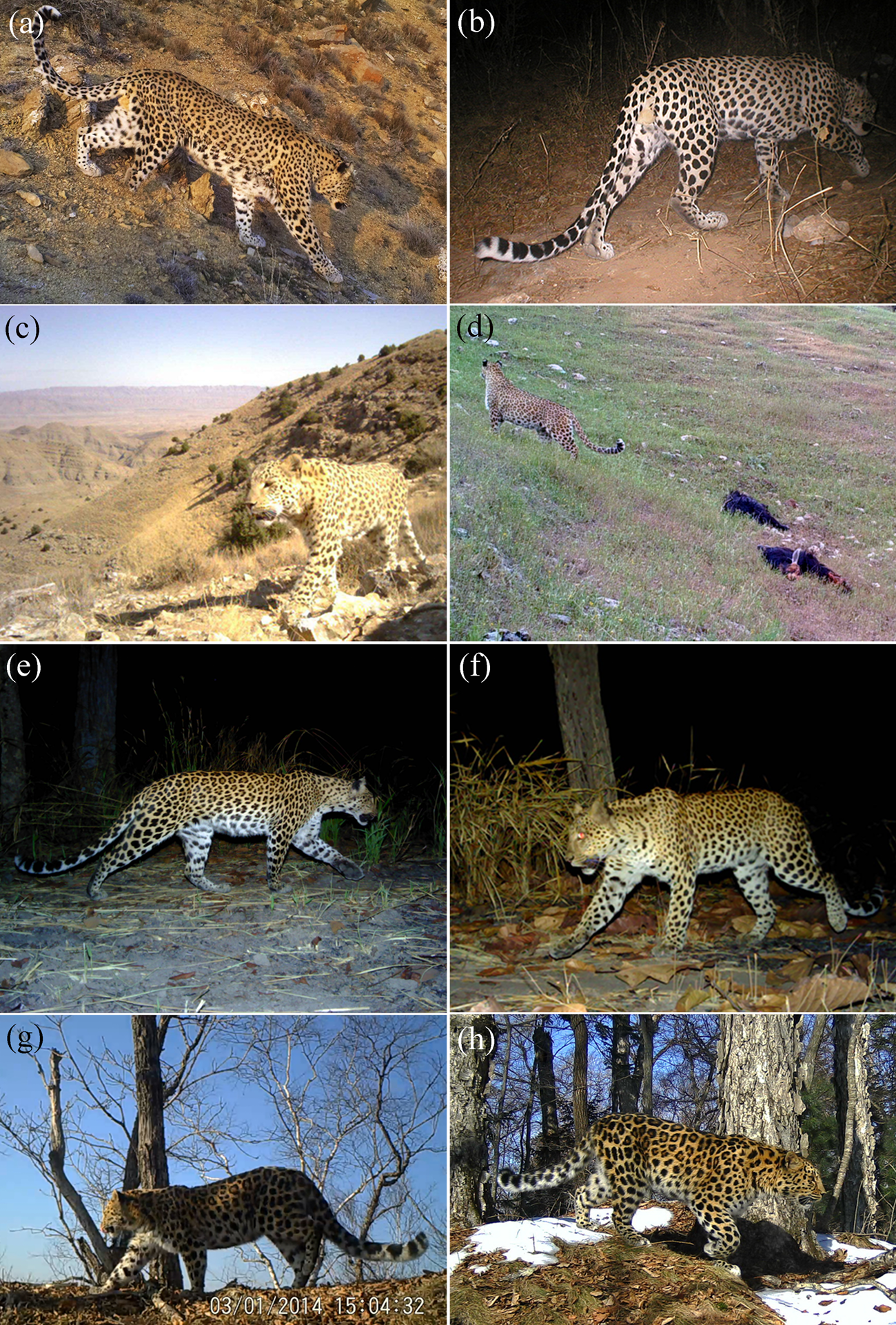
There are six leopard subspecies across continental Asia (Jacobson et al., Reference Jacobson, Gerngross, Lemeris, Schoonover, Anco and Breitenmoser-Würsten2016; Stein et al., Reference Stein, Athreya, Gerngross, Balme, Henschel and Karanth2016). We focus on those subspecies that have transboundary populations and are categorized, or are being petitioned to be categorized, as Endangered or Critically Endangered on the IUCN Red List of Threatened Species: the Persian P. pardus saxicolor (Endangered), Indochinese P. pardus delacouri (Critically Endangered), Arabian P. pardus nimr (Critically Endangered), and Amur P. pardus orientalis (Critically Endangered) leopards (Table 1, Plate 1).
Details of an Endangered and three Critically Endangered leopard Panthera pardus subspecies with populations in borderlands of continental Asia.

1 There are two leopard subspecies in both China and Russia, and therefore the total number of countries is 23 rather than 25.
Photographic evidence of Asian leopards in borderlands: (a) Persian leopard P. pardus saxicolor with amputated leg along the Armenia–Azerbaijan–Iran border in the Caucasus (Photo: WWF), (b) an Arabian leopard P. pardus nimr in the Hawf, on the Yemen–Oman border (Photo: Foundation for Endangered Wildlife Yemen), (c) a Persian leopard in north-east Iran, with Turkmenistan's mountains in the background (Photo: WildCRU/Future4Leopards Foundation), (d) a Persian leopard after killing two domestic goats along the Iran–Iraq border (Photo: Iran Department of Environment/R. Khoshfarman), (e, f) Indochinese leopards P. pardus delacouri near the Cambodia–Viet Nam border (Photo: Panthera/WildCRU/WWF Cambodia/Ministry of Environment), and Amur leopards P. pardus orientalis along the Russia–China border in (g) China (Photo: Beijing Normal University) and (h) Russia (Photo: FGBU/Land of the Leopard).
Persian leopard
The Persian leopard occurs across the rugged terrain of 13 countries in western Asia and the Caucasus, with a population of 800–1,000 individuals (Khorozyan, Reference Khorozyan2008) and > 75% of the subspecies' extant range within Iran (Jacobson et al., Reference Jacobson, Gerngross, Lemeris, Schoonover, Anco and Breitenmoser-Würsten2016). In 10 countries the Persian leopards' range occurs exclusively in borderlands (Fig. 1, Table 2), with small populations of generally < 10 individuals (Askerov et al., Reference Askerov, Talibov, Manvelyan, Zazanashvili, Malkhasyan, Fatullayev and Heidelberg2015; Avgan et al., Reference Avgan, Raza, Barzani and Breitenmoser2016). These appear to be sink populations on the brink of extinction (Askerov et al., Reference Askerov, Talibov, Manvelyan, Zazanashvili, Malkhasyan, Fatullayev and Heidelberg2015; Avgan et al., Reference Avgan, Raza, Barzani and Breitenmoser2016; Stein et al., Reference Stein, Athreya, Gerngross, Balme, Henschel and Karanth2016; Maharramova et al., Reference Maharramova, Moqanaki, Askerov, Faezi, Alinezhad and Mousavi2018), although under intensive conservation efforts they are able to recolonize suitable habitats (Askerov et al., Reference Askerov, Talibov, Manvelyan, Zazanashvili, Fatullayev and Malkhasyan2019).
The current range of the Persian Panthera pardus saxicolor, Arabian P. pardus nimr, Indochinese P. pardus delacouri and Amur P. pardus orientalis leopard subspecies in Asia, and the locations of borderlands.

Populations and legal status of the four threatened leopard subspecies across continental Asia.

1 Population size is the total number across Russia and China.
2 An increase up to USD 207,600 is currently under consideration.
Indochinese leopard
The Indochinese leopard is probably extant in only 2–6% of its historical distribution in South-east Asia, and the remaining populations are small and isolated (Rostro-García et al., Reference Rostro-García, Kamler, Clements, Lynam and Naing2019). This subspecies has been extirpated in Singapore, probably extirpated in Laos and Viet Nam, nearly extirpated in Cambodia and has a greatly reduced distribution in China, Thailand, Myanmar and Peninsular Malaysia (Rostro-García et al., Reference Rostro-García, Kamler, Ash, Clements, Gibson and Lynam2016). Of the remaining extant and possibly extant distribution, 58% lies within borderlands (Table 1). With the exception of Malaysia, most of the remaining leopard range within each country is in borderlands (Fig. 1, Table 2).
Arabian leopard
There are small populations of the Arabian leopard in Oman, Saudi Arabia, Israel, and Yemen (Fig. 1, Table 2). Until relatively recently, this subspecies also occurred in Jordan and the United Arab Emirates, in both of which the populations would have been partly transboundary with Israel and Oman, respectively (Jacobson et al., Reference Jacobson, Gerngross, Lemeris, Schoonover, Anco and Breitenmoser-Würsten2016). The main stronghold for the subspecies is the Dhofar Mountains of Oman, which comprise three contiguous mountain blocks: Jabal Samhan in the east, Jabal Al Qara in the centre and Jabal Al Qamar in the west, the latter contiguous with the mountains of Hawf in south-east Yemen. Occasional records of leopard mortality indicate some small populations across the inner parts of Yemen. The largest population nucleus of up to 30 Arabian leopards is believed to inhabit Jabal Samhan, which is c. 150 km from the Oman–Yemen border. A further 22–28 leopards occur across Jabal Al Qara and Jabal Al Qamar, with individuals recorded up to 16 km from the Oman–Yemen border (Spalton & Al Hikmani, Reference Spalton and Al Hikmani2014). Across the Oman–Yemen border in Hawf, leopards were recorded in low numbers in 2011 (Khorozyan et al., Reference Khorozyan, Stanton, Mohammed, Al-Ra'il and Pittet2014). Elsewhere, there are thought to be a few scattered areas of extant range for the Arabian leopard along the border between Yemen and Saudi Arabia (Zafar-ul Islam et al., Reference Zafar-ul Islam, Boug, Judas and As-Shehri2018).
Amur leopard
There is only one population of the Amur leopard (Fig. 1) shared between Russia's Primorskii Krai and China's Jilin Province (Jacobson et al., Reference Jacobson, Gerngross, Lemeris, Schoonover, Anco and Breitenmoser-Würsten2016; Feng et al., Reference Feng, Shevtsova, Vitkalova, Matyukhina, Miquelle and Aramilev2017). There are also occasional reports, based on snow tracking, from North Korea (Jacobson et al., Reference Jacobson, Gerngross, Lemeris, Schoonover, Anco and Breitenmoser-Würsten2016). With no evidence of Amur leopards occurring elsewhere, this single transboundary population of 70–108 individuals represents the global population of this subspecies (Vitkalova et al., Reference Vitkalova, Feng, Rybin, Gerber, Miquelle and Wang2018). After concerted conservation effort, the Amur leopard population is increasing in China, and some reproduction has been documented 50 km from the Russian border (Wang et al., Reference Wang, Feng, Mou, Wu, Smith and Xiao2016).
Discussion
The importance of borderlands for leopard conservation
A relatively high proportion (23–100%) of the ranges of each leopard subspecies occurs in borderlands. The Amur and Indochinese leopards are most dependent on borderlands as the majority of their remaining distribution occurs within these areas. The Persian and Arabian leopards have the majority of their remaining distribution beyond borderlands as most of their populations are within Iran and Afghanistan for the Persian leopard, and Oman and possibly Yemen for the Arabian leopard.
Transboundary conservation initiatives have been endorsed for many of Asian leopard subspecies (Knight et al., Reference Knight, Seddon and Al Midfa2011; Askerov et al., Reference Askerov, Talibov, Manvelyan, Zazanashvili, Malkhasyan, Fatullayev and Heidelberg2015; Farhadinia et al., Reference Farhadinia, Ahmadi, Sharbafi, Khosravi, Alinezhad and Macdonald2015; Feng et al., Reference Feng, Shevtsova, Vitkalova, Matyukhina, Miquelle and Aramilev2017). However, only two transboundary initiatives are actively working to facilitate leopard conservation across borders, in the Caucasus (Askerov et al., Reference Askerov, Talibov, Manvelyan, Zazanashvili, Malkhasyan, Fatullayev and Heidelberg2015) and in the Russian Far East and north-east China (Feng et al., Reference Feng, Shevtsova, Vitkalova, Matyukhina, Miquelle and Aramilev2017; Vitkalova et al., Reference Vitkalova, Feng, Rybin, Gerber, Miquelle and Wang2018). Transboundary conservation was not considered in the latest IUCN assessment of leopards (Stein et al., Reference Stein, Athreya, Gerngross, Balme, Henschel and Karanth2016). Our review highlights the importance of encouraging conservation agencies to work across international borders in Asia.
Conservation challenges in borderlands
Previous studies have highlighted poaching of leopards and their prey, and habitat loss, as the main reasons for the decline of leopards across most of their range in Asia (Farhadinia et al., Reference Farhadinia, Ahmadi, Sharbafi, Khosravi, Alinezhad and Macdonald2015; Jacobson et al., Reference Jacobson, Gerngross, Lemeris, Schoonover, Anco and Breitenmoser-Würsten2016; Rostro-García et al., Reference Rostro-García, Kamler, Ash, Clements, Gibson and Lynam2016; Wang et al., Reference Wang, Feng, Mou, Wu, Smith and Xiao2016; Zafar-ul Islam et al., Reference Zafar-ul Islam, Boug, Judas and As-Shehri2018). We identify four main challenges for the conservation of transboundary populations of Asian leopards: (1) different levels of legal protection and management across national jurisdictions, (2) military activities and armed conflict, (3) poaching for illegal international wildlife trade and (4) infrastructure projects, such as road development.
There are varied levels of legal protection and management for leopards across national jurisdictions and protection by law across most range countries, with substantial monetary fines and/or imprisonment for illegal killing (Table 2). However, there were time lags of several decades for legal protection in the adjacent countries in several large borderland populations, such as Thailand–Myanmar and Iran–Iraq–Turkey (Table 2). Neighbouring countries may have different agendas, technical capacities, and resources available for leopard conservation, potentially hindering the recovery of transboundary populations. For example, the governments of Turkmenistan, Kazakhstan and Afghanistan (Persian leopard) and Cambodia, China, Myanmar and Laos (Indochinese leopard) have not prioritized or supported conservation action plans for the leopard, which hampers conservation efforts made by neighbouring states. In Oman, conservation of the Arabian leopard benefits from strong government agencies, law enforcement and compensation programmes in cases of livestock depredation. In adjacent Yemen, however, where there is an ongoing armed conflict, there is little or no active conservation or protection of leopards.
Military activities and armed conflicts occur within the borderland ranges of all leopard subspecies except for the Amur leopard. Political unrest compromises law enforcement and effective conservation. Potential effects of military activities and armed conflicts on leopards and the persistence of their prey require further research. The principal conflicts currently affecting leopards are those between Yemen and Saudi Arabia, the Nagorno-Karabakh conflict between Armenia and Azerbaijan, and political instabilities along the borders between northern Iraq, western Iran and Turkey, and between Afghanistan and Pakistan. In Myanmar, the long-running Karen insurgency near the border with Thailand could be negatively affecting a local leopard population (Oswell, Reference Oswell2010), although recent surveys conducted in Karen State found a high diversity of species, including leopards (Moo et al., Reference Moo, Froese and Gray2018). Other non-government controlled areas in northern Myanmar, along the borders with Thailand, Laos, China and India, play a major role in illicit activities, including poaching and facilitating the illegal trade of leopards and other wild felids (Oswell, Reference Oswell2010). Furthermore, mine-strewn borderlands occasionally kill leopards and other wildlife, including areas along the Thailand–Myanmar, Iran–Iraq and Armenia–Azerbaijan borders (Oswell, Reference Oswell2010; Avgan et al., Reference Avgan, Raza, Barzani and Breitenmoser2016; IUCN SSC Cat Specialist Group, 2016).
Illegal wildlife trade, particularly intensive and indiscriminate snaring over large areas, is the main cause of the dramatic decline of the Indochinese leopard (Rostro-García et al., Reference Rostro-García, Kamler, Ash, Clements, Gibson and Lynam2016, Reference Rostro-García, Kamler, Clements, Lynam and Naing2019). This is particularly problematic in borderlands because poachers may originate from a neighbouring country (O'Kelly et al., Reference O'Kelly, Rowcliffe, Durant and Milner-Gulland2018) and return across the border before being apprehended. In general, weak enforcement of wildlife laws and lax border security have facilitated the illegal trade of wildlife products in South-east Asia (Oswell, Reference Oswell2010). Two border markets for the trafficking of exotic animals, including the Arabian leopard, are active in Harad and Al Khoba in Yemen and Saudi Arabia, respectively.
Existing and proposed infrastructure projects can have detrimental effects on leopards and other wildlife. For example, road development, which has increased in Asia, has direct negative impacts on wildlife, particularly large-bodied mammals such as leopards (Clements et al., Reference Clements, Lynam, Gaveau, Yap, Lhota and Goosem2014). Amongst other impacts, roads can promote illegal wildlife trade, impede animal movement, and be precursors of overhunting and habitat destruction. In Myanmar, a major source of illegal wildlife, road networks have facilitated illegal trade of mammals to border markets (Oswell, Reference Oswell2010). Proposed major infrastructure projects are expected to cause fragmentation of key landscapes, such as the Dawei Special Economic Zone road in the Northern Tenassarim Forest Complex (Helsingen et al., Reference Helsingen, Myint, Bhagabati, Dixon, Olwero, Kelly and Tang2015), one of the last strongholds for the Indochinese leopard (Rostro-García et al., Reference Rostro-García, Kamler, Ash, Clements, Gibson and Lynam2016) as well as Kopet Dag ecoregion along the Iran–Turkmenistan border for the Persian leopard (Farhadinia et al., Reference Farhadinia, Maheshwari, Nawaz, Ambarlı, Gritsina and Koshkin2019). Because development projects are increasing throughout many areas of Asia, it is imperative that measures are taken to minimize the impact that such projects have on leopards and other wildlife.
Border security fencing and associated roads are concerns for transboundary movement of wildlife in many parts of Eurasia (Linnell et al., Reference Linnell, Trouwborst, Boitani, Kaczensky, Huber and Reljic2016). Although barbed wire is common in some range country borderlands, such as parts of the Caucasus region, it is unlikely to act as a barrier for leopard movement, but more impassable border fences may impede movements of leopards and their prey along the Iran–Turkmenistan and Yemen–Oman borders (Fig. 2). Most borderland leopard populations in Asia occur along unfenced borders, and thus transboundary movements are still feasible.
Locations (from GPS fixes) of a collared Persian leopard that dispersed from Tandoureh National Park in north-east Iran to Turkmenistan (Farhadinia et al., Reference Farhadinia, Johnson, Macdonald and Hunter2018). The locations show that although the leopard moved freely across the international border, the security fence, which lies further north within Turkmenistan, was a barrier to the leopard's movements.

For leopards that move freely across international borders in Asia, the same individuals may be counted in more than one country, inflating abundance estimates (Bischof et al., Reference Bischof, Brøseth and Gimenez2016; Vitkalova et al., Reference Vitkalova, Feng, Rybin, Gerber, Miquelle and Wang2018). This may be a problem in the Caucasus and along the Russia–China border (Vitkalova et al., Reference Vitkalova, Feng, Rybin, Gerber, Miquelle and Wang2018; Askerov et al., Reference Askerov, Talibov, Manvelyan, Zazanashvili, Fatullayev and Malkhasyan2019). This emphasizes the need for the establishment of internationally managed monitoring programmes and for sharing monitoring information. Transboundary information exchange can improve the accuracy and precision of population estimates, which can lead to a better understanding of the status of leopard populations.
Implications for policy
Transboundary conservation areas are widely recommended as a means to encourage multilateral intergovernmental partnerships. The concept of international Peace Parks is being promoted as a way of linking biodiversity conservation with national security (McNeely, Reference McNeely2003), and such a park has been established between Arevik National Park in Armenia and Dizmar Protected Area in Iran, where leopards occur. In addition to the two existing transboundary leopard initiatives in the Caucasus and Russia–China borderlands (Vitkalova et al., Reference Vitkalova, Feng, Rybin, Gerber, Miquelle and Wang2018; Askerov et al., Reference Askerov, Talibov, Manvelyan, Zazanashvili, Fatullayev and Malkhasyan2019), we identified three key transboundary landscapes: (1) Kopet Dag ecoregion along the Iran–Turkmenistan border for the Persian leopard, although some parts contain impassable fences (Fig. 2), (2) Northern Tenasserim Forest Complex along the Thailand–Myanmar border for the Indochinese leopard, one of WWF's five priority global landscapes (WWF, 2019), and (3) Hawf–Dhofar Mountains along the Yemen–Oman border for the Arabian leopard. Despite the civil strife in Yemen, the border governorate of Al Mahrah in Yemen adjoining Oman's Dhofar Mountains remainsless affected.
Conservation paradigms need to be realigned with political reality when examining geopolitical situations for conservation (Linnell et al., Reference Linnell, Trouwborst, Boitani, Kaczensky, Huber and Reljic2016). Some Asian countries are facing security challenges from neighbouring countries, which could reduce opportunities for transboundary cooperation. Given that the majority of borderland leopard populations occur along unfenced international borders, conflicting countries can unilaterally enforce the conservation of their transboundary populations and shift their conservation investments towards the borderland. An example is leopard conservation in Armenia and Azerbaijan's Nakhichevan Republic which, despite a political dispute, has succeeded in maintaining protected areas for leopards and supporting population recovery on both sides of the shared border (Askerov et al., Reference Askerov, Talibov, Manvelyan, Zazanashvili, Fatullayev and Malkhasyan2019).
In addition, effects of border fences on leopard movements and demography need to be better understood. If planned without compromising national security, joint population monitoring (Feng et al., Reference Feng, Shevtsova, Vitkalova, Matyukhina, Miquelle and Aramilev2017; Vitkalova et al., Reference Vitkalova, Feng, Rybin, Gerber, Miquelle and Wang2018) and satellite telemetry (Farhadinia et al., Reference Farhadinia, Johnson, Macdonald and Hunter2018) can help elucidate the locations of corridors and source–sink dynamics across international borders. Citizen science monitoring schemes supported by border security personnel could provide coarse-scale data to identify key corridors.
There are two intergovernmental organizations, the Association of Southeast Asian Nations (ASEAN) and Economic Cooperation Organization (ECO), of which most of the regional countries within the ranges of the Indochinese and Persian leopard, respectively, are members. The ASEAN Wildlife Enforcement Network and ECO's Division on Social Welfare and Environment could provide a framework for the establishment of transboundary cooperation for leopard conservation and the suppression of illegal border trade. Given that the majority of the remaining leopard range in most countries is in borderlands, transboundary collaborations would foster the persistence of small but important populations of Asian leopards.
Acknowledgements
We thank S. Karryeva, E. Askerov, H. Raza, O. Pereladova, B. Lortkipanidze, Y. Ilemin, T. Rosen, M. Kabir, N. Jahed, M. Gritsina and A. Gasparyan for contributing data on the legal status of the Persian leopard, Z. Islam for data on the Arabian leopard, and G.R. Clements, A.J. Lynam, and H. Naing for help with collecting data on the Indochinese leopard. MSF was supported by a research fellowship from the Oxford Martin School at the University of Oxford.
Author contributions
Study design: MSF, DWM, data collection and analysis: MSF, SR-G, LF, JFK, AS, ES, MA-D; writing: all authors.
Conflicts of interest
None.
Ethical standards
This research abided by the Oryx guidelines on ethical standards.


 Open access

