

James Aird (1748–95) laid the foundations for music printing in Glasgow when, in 1782, he produced his first publication: A Selection of Scots, English, Irish, and Foreign Airs. He frequently reissued the Selection, and after his death it continued to be republished by other music printers in Glasgow, Edinburgh, and even as far away as London. Today it is perhaps his best-known publication among scholars of eighteenth-century Scottish music and culture. Yet there is much more to Aird’s career than one frequently referenced work. He made a success of a new style of business in the city, surviving financial and professional challenges along the way. His printing plates were bought by those who followed immediately in his footsteps, providing them with easy additions to their own catalogues. Almost one hundred works survive with his imprint, ranging from single song sheets to collections of Scottish traditional tunes. This article brings together the scant details that are already known about Aird’s career, publications, and printing methods with newly uncovered accounts of his business dealings, including a case at the Court of Session regarding the question of what constitutes the title of a song. The Appendix provides the fullest list of his publications that it has been possible to compile, including potentially lost works.
Aird’s business history, glimpsed through previously unused documents, serves as an example of similar establishments in the city during the closing decades of the eighteenth century. He represents those who provided the inhabitants with their daily needs, including the landed gentry with the means to conduct part of their lives in London. His is typical of businesses frequently mentioned in the press as facing bankruptcy or which placed advertisements requesting financial loans. In terms of the history of music printing in the city, Aird offers a window into the practices of his contemporaries, particularly in astutely assessing the needs of various patrons, from those looking to the fashions of London to the bands of the local volunteer militia.
The Background and Context for Aird’s Music Business
Glasgow’s musical life during the eighteenth century can be traced through newspaper advertisements, although few survive from any earlier than 1755.Footnote 1 The short-lived Glasgow Courant (November 1715–May 1716) and West-Country Intelligence (November 1715–May 1716) give no insight into the cultural life of the city in the early part of the century, and little can be gleaned from some 260 issues of the local press of the 1740s. Almost double the number of papers survives from the 1750s, and these record a number of benefit concerts and the existence of a Musical Society. Subscription concerts were advertised from October 1761, and in June 1763 a concert hall was being constructed, adding to the existing performance venues at the Merchants’ Hall, the new Assembly Room, and the hall at the Black Bull Inn. By 1770 there were several instrument teachers in the city who published their own instrumental and vocal tutors and collections of psalm tunes, as well as offering services such as tuning keyboard instruments and staging concerts to exhibit the achievements of their pupils. It is in this context that Aird established his business by 1776, at the age of 28. His advertisements for what he described as a music shop place musical instruments next to sealing wax, dawn pistols, and a list of titles of sheet music for songs from recent theatrical performances. Six years later, in the summer of 1782, he took the gamble of printing music in his shop, and by the time of his death in 1795 he had a significant catalogue of single songs, keyboard music, and collections of traditional tunes.
Aird’s was not the first music shop in Glasgow but seems to have been the first to have survived for more than a few years. Evidence of earlier ventures is sketchy due to the lack of newspapers between 1748 and 1755, and there are no trades directories for this period. In September 1755 and later, in August 1757, John Carlile advertised: ‘Fine Violins, German and common Flutes [i.e. recorders] of all Kinds, Hautboys, French-Horns, Violin-Strings new imported’.Footnote 2 The only other reference to the sale of music and musical instruments in the 1750s is in what appears to be a sequestration sale of a toyshop in October 1755, where the proprietor is not named: ‘THAT the whole Stock of GOODS in the TOYSHOP […] are to be sold off […] Among which are […] different kinds of Musical Instruments, viz., Violins, German Flutes, Common Flutes, Hautboys, Fifes, &c. Music-books and Ballads.’Footnote 3 Another shop appeared briefly in 1764, that of James McEwan and Company, where sample pages of ‘Six solos for the violin or German flute’ by Jacob Althause could be viewed by potential subscribers.Footnote 4 The next business described as a music shop, in 1776, is Aird’s; for several years his only real competitor was Archibald McGoun (active 1783–96), who opened his shop in 1783, describing it as ‘a business so entirely new here’.Footnote 5 Between them, they served a varied range of customers, from instrumental teachers and their pupils to dancing masters and the local militia bands. For example, Aird’s first publication, in 1782, refers to the Royal Glasgow Volunteers within the title-page image; this local regiment was raised in 1778 and disbanded in 1783.Footnote 6 The small format of this book, 113 x 164 mm, makes it easily portable, with two hundred tunes suited for the most commonly played instruments, namely fife, German flute, and violin.
Music publishing in Scotland did not gain momentum until the middle of the eighteenth century, and even then the number of works is small. Frank Kidson and Henry George Farmer outline the licensing and monopoly context which resulted in virtually no secular music being published in the country between John Forbes’s Cantus, Songs and Fancies (1662) and Musick for Allan Ramsay’s Collection of the Scots Songs (1724–25).Footnote 7 Robert Bremner (1720–89) was the first to establish a more sustained business, from 1754 in Edinburgh, although he left for London in 1761.Footnote 8 The next most important figure is the music engraver James Johnson (1753–1811), who produced printing plates for several Scottish music publishers, including Aird.Footnote 9 As the last quarter of the century progressed, Edinburgh had at least seven music publishers and Glasgow three, printing mostly traditional songs and tunes, as well as songs extracted from stage works.Footnote 10
In Glasgow, the only references to music publishing prior to Aird’s arrival reflect the nation’s focus on the improvement of congregational singing for church services. Several precentors produced collections of the so-called church tunes for their pupils and the general public. Most prolific among these was Thomas Moore (c. 1727–92), who from 1755 was favoured by the City Council to teach ‘psalmody and church music in the touns hospitall’ at public classes that met several times each week.Footnote 11 He subsequently published The Psalm-Singer’s Pocket Companion in 1756, ‘with all the church tunes usually sung in most parts of Scotland’.Footnote 12
Aird’s Biography and Entry into Business
The earliest scholarly reference to Aird can be found in James Brown’s Biographical Dictionary of Musicians of 1886, which sums up his career in three lines: ‘Scottish music-seller engaged in business in Glasgow. Published in the 18th cent.’, and includes the title of only one publication, A Selection of Scots, English, Irish, and Foreign Airs Adapted to the Fife, Violin, or German-Flute. Footnote 13 Subsequent reference works contain brief and often inaccurate details of his life and publications.Footnote 14 Parish registers show that Aird’s family lived in Govan, at this time a village just outside the Glasgow boundary. His baptismal record, dated 17 April 1748, includes the names of his parents, ‘AIRD James l[awful] s[on] of James Aird and Isobell FOGO’, who were married in Linlithgow on 20 May 1744.Footnote 15 The Govan parish baptismal records further reveal the names of James Aird Jr’s four sisters, the most significant for his publishing business being Jean, baptized in July 1751. His burial record, for 15 September 1795 in the register of Glasgow High Kirk (i.e. Cathedral), reads ‘AIRD James — Music Seller, 45 years FEVER’, although there is clearly a discrepancy in his age, which should be 47.Footnote 16
Nothing has been uncovered of Aird’s early life and training before he started in business, although it is reasonable to assume he received some guidance from his father. His entry into Glasgow’s business community is documented in the records of the Merchants’ House where, on 16 September 1773, ‘Aird, James, merchant’ was admitted ‘B[urgess] and G[uild] B[rother], as eld[est] l[awful] son to James A[ird], weaver, B[urgess] and G[uild] B[rother]’.Footnote 17 Here, he is simply described as ‘merchant’, with no indication of the nature of his business.
The earliest surviving reference to Aird’s business dates from February 1776, when it was described as a music shop with various ancillary services provided (see Table 1). An advertisement in the Glasgow Chronicle later that year gives a fuller picture of the diverse nature of his stock, which was not limited to musical items:
JAMES AIRD, junior, Desires to inform the Public that he continues to sell the following Goods, on very low terms, in wholesale and retail, at his Shop, Exchange [i.e. Trongate], Glasgow, Music Books and Musical Instruments, Great variety of Morocco Etwee [small cases for personal items] and Letter Cases, either mounted with Silver and Instruments or plain, Asses Skin and Slate paper Memorandum Books, Liverpool Strap-books with slate paper, all sizes; Royal, Medium, and Demy Paper, Foolscap and Pot writing do. Thick and Thin Post in Quarto, Gilt and Mourning Post; also the Maps of Lanerkshire [sic], and the Canal between the Firth of Forth and Clyde; Ink Powder, best Dutch Sealing Wax and Quills, Case-hardened Powder-Flasks, with rising, charge, and pump head or plain Shot Bags, and Bottle Flasks, with Hunter Cups; Message Cards, best Black and Red Lead Pencils; Pebble, Bristol, and sprigg’d Sleeve Buttons, set Stock and Knee Buckles; Pen Knives, Razors, Paper Snuff Boxes, Standard Gold Weights in Cases, Down [sic] Pistols, various sizes, either brass or steel, indented with silver or plain; with a variety of Opera Glasses, Concave and Convex Temple Spectacles and Glasses; with several other articles; Catalogues of which may be had at the shop.
Just arrived a fresh assortment of Violin Strings, and Standard Gold Weights according to the latest regulation.
Also just now arrived, a New Assortment of Vocal and Instrumental Music, among which are the following pieces, viz.,
[T. Linley, Sr and Jr] The Duenna, for Voice and Harpsichord, 10s. 6d.
[M. Arne] Cymon, ditto, 10s. 6d.
[Dibdin] The Deserter and Padlock, ditto, each 6s.
[T. Arne] The Beggars Opera, ditto, ditto, each 3s.
[Boyce] Midas, ditto, ditto, 4s.
The Duenna for the German Flute 2s.
Deserter, ditto, ditto, 2s.
[Dibdin] Institution of the Garter, ditto, 1s. 6d.
Dibdin’s Comic Dances 2s.
[T. Arne] Masque of Comus & [Dibdin] Padlock, each 1s. 6d.
Love in a Vi’lage & Beggar’s Opera, each 1s. 6d.
[T. Arne] Lady’s Frolic & [Anon.] Spanish Lady cur’d, each 1s. 6d.
3 setts of Scots songs for voice and harpsichord, each 2s. 6d.
Oswald’s Scots Tunes, in 12 books, each 1s. 6d.
Ditto neatly bound in rough calf and gilt on back, in 2 vols. 21s.
Variety of Operas [i.e. works] for the Violin or German Flute; with Violin, German Flute, Common Flute, Bagpipe, Guitar, and Fife Instruction Books, each 1s. 6d. with Violin Strings, and Harpsichord and Guitar Wire.
P.S. He takes this opportunity of returning his most grateful thanks to those who have favoured him with their orders, and hopes for the continuance of them. — Commissions from the Country carefully attended to.Footnote 18
James Aird’s published business addresses, March 1776 to September 1795
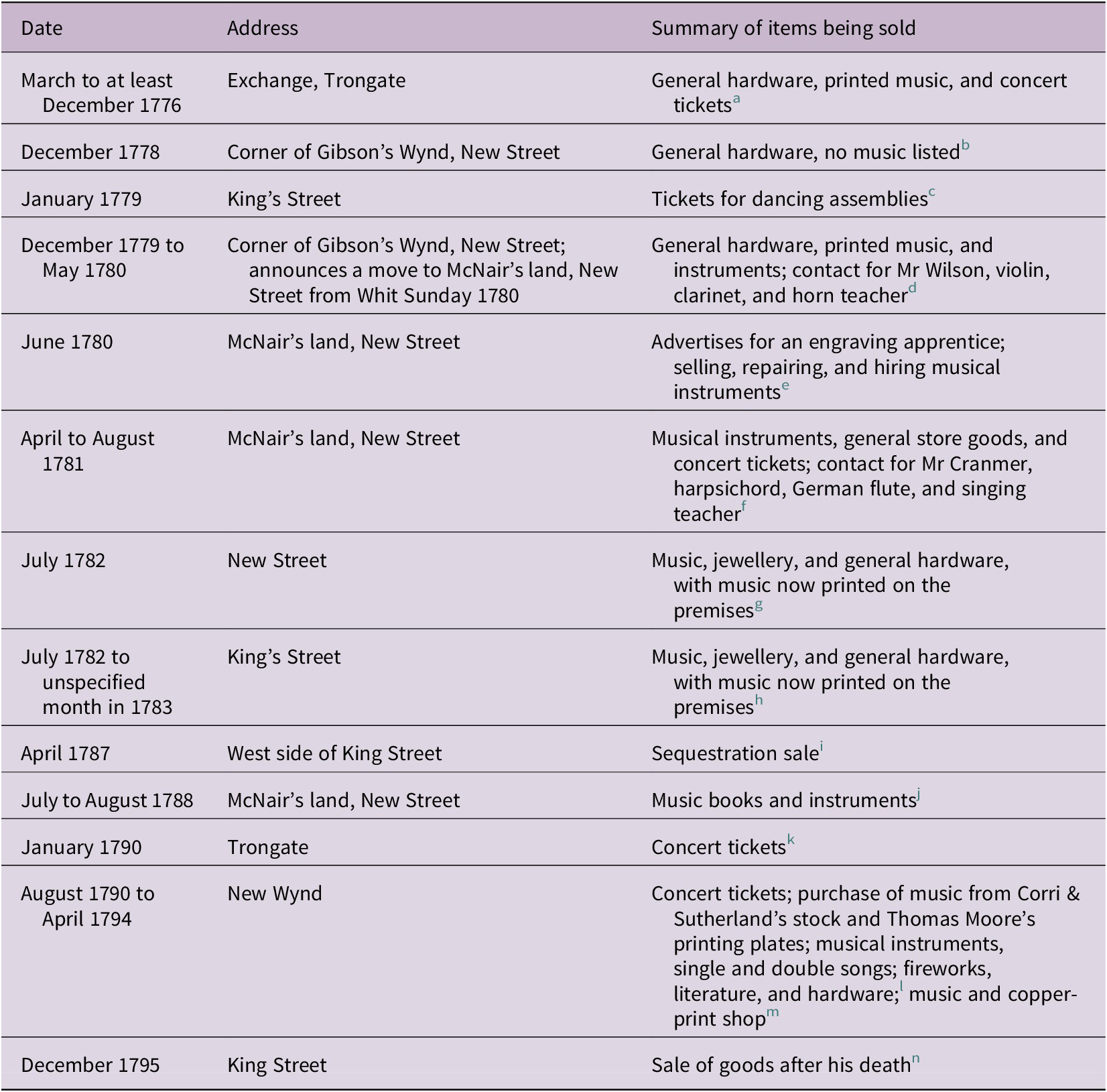
Table 1. Long description
Beginning at the top row, the table has three columns: Date, Address, and Summary of items being sold. The first entry, March to at least December 1776, lists Exchange, Trongate, with general hardware, printed music, and concert tickets. December 1778 shows the corner of Gibson’s Wynd, New Street, selling general hardware, no music listed. January 1779 records King’s Street, offering tickets for dancing assemblies. December 1779 to May 1780 covers the corner of Gibson’s Wynd, New Street, with a move to McNair’s land, New Street from Whit Sunday 1780, selling general hardware, printed music, instruments, and contact for Mr Wilson, violin, clarinet, and horn teacher. June 1780 at McNair’s land, New Street advertises for an engraving apprentice and deals in selling, repairing, and hiring musical instruments. April to August 1781 at McNair’s land, New Street includes musical instruments, general store goods, concert tickets, and contact for Mr Cranmer, harpsichord, German flute, and singing teacher. July 1782 at New Street lists music, jewellery, general hardware, and music printed on the premises. July 1782 to an unspecified month in 1783 at King’s Street repeats music, jewellery, general hardware, and music printed on the premises. April 1787 at west side of King Street notes a sequestration sale. July to August 1788 at McNair’s land, New Street features music books and instruments. January 1790 at Trongate offers concert tickets. August 1790 to April 1794 at New Wynd includes concert tickets, purchase of music from Corri and Sutherland’s stock and Thomas Moore’s printing plates, musical instruments, single and double songs, fireworks, literature, hardware, and a music and copper-print shop. December 1795 at King Street records sale of goods after James Aird’s death. Each entry is supported by footnotes referencing periodicals and directories.
a Glasgow Chronicle, 7–14 March, [p. 4], 24–31 October, [p. 4], and 19–26 December 1776, [p. 4].
b Glasgow Mercury, 10 December 1778, p. 40.
c Glasgow Mercury, 28 January 1779, p. 30.
d Glasgow Mercury, 23–30 December 1779, front page.
e Glasgow Mercury, 1–8 June 1780, p. 184.
f Glasgow Mercury, 12–19 April, p. 128, 7–14 June, p. 192, and 26 July–2 August 1781, p. 248.
g Glasgow Journal, 18–25 July 1782, [p. 4].
h Glasgow Mercury, 25 July–1 August 1782, p. 248; John Tait’s Directory for the City of Glasgow […] From the 15 May 1783, to the 15 May 1784 […] (John Tait, 1783), p. 14.
i Glasgow Mercury, 18–25 April 1787, p. 136.
j Glasgow Mercury, 16–23 July, [p. 239], and 30 July–5 August 1788, front page.
k Glasgow Advertiser & Evening Intelligencer, 29 January–1 February 1790, p. 99.
l Glasgow Advertiser & Evening Intelligencer, 7–10 January 1791, front page, and 13–16 July 1792, p. 463; Glasgow Courier, 20 March, [p. 3], 17 July, [p. 3], 17 November, [p. 4], and 29 December 1792, [p. 4], 7 March, [p. 3], 30 March, [p. 4], 30 April, [p. 3], and 2 May 1793, [p. 3], and 15 April 1794, [p. 3].
m Jones’s Directory or Useful Pocket Companion, For the year 1790 and 1791 […] (Joseph Galbraith, 1790), [p. 1].
n Glasgow Courier, 19 December 1795, [p. 3]; Glasgow Mercury, 22 December 1795, p. 271.
Most of the dramatic works listed under ‘Vocal and Instrumental Music’ were first performed in London in the 1760s, but there are a few more recent ones, such as Dibdin’s Institution of the Garter (1771) and The Deserter (1773), and Thomas Linley Sr and Jr’s The Duenna, performed for the first time about one year earlier, in November 1775.Footnote 19 The outlier seems to be Arne’s Masque of Comus, which was first performed in 1738, although it was revived in 1772.Footnote 20 At least two of the works for sale had been performed in Glasgow in the previous ten years as part of a regular season of plays and operas: The Beggar’s Opera on 6 May 1765 and The Padlock on 9 December 1769. The latter is described in the local press as ‘never Acted here [i.e. Glasgow] now performing at the THEATRE ROYAL in LONDON […] Being the first time of performing it in this Kingdom’.Footnote 21 This performance was just over one year after its first performance in London on 30 October 1768. So it would appear that Aird was stocking some music that was known to his customers, as well as introducing other works that were no doubt considered the height of fashion, coming so soon from a London performance.
This advertisement of November 1776 gives no indication of the instruments in stock, although some later notices do. For example, in December 1779 he had ‘just got home spinets, violins, German flutes, fifes, hautboys and clarionets’.Footnote 22 Later, he included more aesthetic descriptions of the instruments to entice customers: ‘Spinets, either with mahogany or wainscot cases; German flutes, mounted with ivory ferrels and silver keys, or plain; Common flutes, fifes, French horns, violin screwed bows.’Footnote 23 One instrument sold by Aird, a kit dated c. 1780, is an example of the type commonly played by dancing masters and is on display in Kelvingrove Art Gallery and Museum, Glasgow; his trade label, pasted inside, can be clearly read. Aird makes no reference to the suppliers of his stock, musical or otherwise, and no business records survive. He may have had arrangements with some agents based in Glasgow for businesses in England; one of these, for a Birmingham company, is named in a legal case of 1786 discussed further below.
Aird’s Music Business
Aird conducted his business from a variety of addresses all within about half a square mile in Glasgow’s eighteenth-century commercial district. Most of these are included in newspaper advertisements, although not all, and there are several gaps in his business history, as can be seen in Table 1. These record the development of his business from a general hardware store that included music to one with music publishing facilities. Such changes of business address seem to be typical of the period, and several dates align with the Scottish quarter days, when rental contracts would start and finish, i.e. Candlemas (2 February), Whitsunday (15 May), Lammas (1 August), and Martinmas (11 November).Footnote 24 However, it is possible that some of these moves were due to financial instability and a need for more affordable premises.
A few years later, in 1786, Aird’s business was more obviously in difficulties when his goods were sequestrated under the Bankrupt Statute. Some of the reasons for the bankruptcy are outlined in the sequestration papers, a situation that may have been exacerbated by his pursuit of debits owed to him and the legal costs that will have incurred. The case was heard at the Court of Session and the proceedings are laid out in five short unnumbered documents dated between 14 September and 31 October 1786. It is the nature of such proceedings to be repetitive, which helps to establish the contents of at least one missing document for the start of the case on 8 September, when:
Lord Eskgrove […] sequestrated the whole reall and personal Estate of the said James Aird wherever situated and appointed his Creditors to meet at Glasgow and within the house of Peter Mackinlay vinter there upon Thursday the fourteenth of September Current in order to name an Interim factor upon the sequestrate Estate.Footnote 25
The minutes of the 14 September meeting indicate that it was held as required ‘by the statute And in the presence of Mr Robert Graeme sheriff substitute of the County of Lanark’.Footnote 26 Only two creditors were present: Jean Aird, presumably James’s younger sister, who was owed £100, and Robert Armour, ‘Merchant in Glasgow as agent for Hodgson & Nicholson of Birmingham’, who was owed £20 11s.Footnote 27 Neither seems to have had any connection with the music business. A later Glasgow trades directory lists a ‘Miss Aird, dealer in dead crapes, Candleriggs’, who may have been Aird’s sister Jean. Armour could have been the local representative for a japanner, a tradesperson who varnishes surfaces with black varnish, named Thomas Hodgson, who is included in Bailey’s Northern Directory for 1781.Footnote 28 There were other creditors for smaller amounts, who threatened Aird with imprisonment, but they are not named or recorded as being present at any meetings, and the amounts owed are not stated. Armour was elected to preside at the meeting, and William Macaulay, ‘writer [i.e. lawyer] in Glasgow’, was chosen as interim factor. Macaulay set the ‘caution’ (i.e. bail) at £100, with Robert Maculay, ‘writer in Glasgow’, as the ‘cautioner’.Footnote 29 In addition, the creditors recommended that Aird be left free from ‘diligence’ (i.e. legal means of enforcing payment of debt) and that he should be granted ‘personal protection for the space of six months’ because ‘several of his Creditors for small sums threaten & oppress him with imprisonment’.Footnote 30 Personal protection was granted from 16 September until 15 November.Footnote 31
Under the Bankrupt Statute, Aird was required within fourteen days of the 31 October meeting:
to execute and deliver […] a Disposition or Dispositions making over to the said Trustee or Trustees in their order his whole real & personal Estate wherever situated, and which shall specifically describe & convey the Subject so far as they are known, or so far as the Trustee shall think it necessary.Footnote 32
Drafting this disposition was no doubt straightforward, since the creditors had already agreed
That the most part of the Estate of the said James Aird Consists of Musical instruments & Musical Books and of debts owing to him and as the values of these are best known to himself, it is necessary, that he be present at taking the inventories thereof, making the appretiations [i.e. valuing of poinded (seized) goods] of the same by attending the sales and Collection of the debts, which will find greatly to the benefit & advantage of the Creditors in general.Footnote 33
Full power to proceed with the sale was granted at this meeting, and it went ahead seven months later in May 1787.Footnote 34 Unlike Aird’s previous newspaper notices, there are no details of the genres of printed music or types and number of instruments held in stock from which it might now be possible to estimate the value or extent of this estate, and no sales catalogue exists. The notice reads:
SALE of MUSIC BOOKS, MUSICAL INSTRUMENTS and HARDWARE &c. — and NOTICE to the DEBTORS of JAMES AIRD, junior, merchant in Glasgow. To be sold by public roup [auction], on Wednesday the 2d day of May next, within the music shop of said James Aird, on the west side of King street. The whole Music Books, Musical Instruments, and Hardware, belonging to the said James Aird. The roup to begin at eleven o’clock forenoon, and continue daily until all is sold off.Footnote 35
It is the nature of sequestration sales for all the property to be sold as stated in this notice and the money raised used to clear the debts. Yet despite this major setback, Aird was trading again by July the following year, although now from ‘his room’ rather than a shop. This illustrates not only a determination to remain in the retail business, but also, as confirmed in the advertisement, his resolve to continue as a music publisher:
To be SOLD off immediately, considerably lower than usual, a Neat assortment of German Flutes, mounted with ivory and silver keys, or plain — Regimental or common Fifes; Violin screwed Bows. — Also a neat second-hand Harpsichord &c. — Great variety of Music Books, viz. Rondeaus, Concertos, Operas, Scots Tunes, Strathspeys, Airs and Marches, Minuets, Scots Reels. — Solos, Duets, Trios &c. for the Piano-forte or Spinet, Violin, German Flute, or Fife, &c. […] With great variety of the newest single and double Songs and Airs […] enquire at JAMES AIRD, junior, at his room […] NB Subscribers for J. AIRD’S 3d Selection of 200 Airs, will please call or send for their subscription copies […] NB Music exactly copied.Footnote 36
By January 1791, the business was trading as James Aird & Co. Again, a considerable amount of stock was available, ‘too numerous to be inserted in a newspaper’, including items obtained ‘at the sale of Messrs Corri & Sutherland’s stock in Edinburgh’, which ceased trading in 1790.Footnote 37 Aird compiled a manuscript catalogue for consultation within the shop with the intention of issuing a printed one; unfortunately, neither seems to have survived. Among the music that Aird reissued from the Corri & Sutherland sale is Thomas Hamly Butler’s (c. 1755–1823) The Favourite Quick March Composed by Mr Muschet. A close examination of the copy in the British Library shows how the imprint was changed: the new heading includes the phrase ‘GLASGOW Printed by I. AIRD where may be had all the Authors Rondos & Sonatas &c.’. The shadow of a capital C can be seen before Aird’s initial ‘I’, and there is a gap of 17 mm between ‘AIRD’ and ‘where’ in which the letters ‘land’ are just visible.Footnote 38
A comparison of the Corri & Sutherland stock that Aird was able to buy with that acquired by his close competitor Archibald McGoun may again reveal something of his financial status. Whereas Aird’s advertisement of January 1791 lists all the genres of instrumental music for sale, a month earlier, McGoun summarizes his purchase of printed music in a few words as ‘Harpsichord, Violin, and Flute Music’, focusing instead on the expensive instruments for sale:
A fine toned double Harpsichord, swell five stops, two pedels, &c. value 84L. — a portable grand Piano-Forte, by Longman and Brodrip, 30L. — a Piano Forte, by ditto, 15L — one ditto by Garka, 14L — one ditto, by Haxby, 16L. 16s. — one ditto by Broadwood, 22L 2s — one ditto, by Corri and Sutherland, 18L […] If within three months of this date […] any of the above instruments are purchased […], a very large discount will be given.Footnote 39
McGoun may have been at an advantage when acquiring stock since he was named as one of the shops where the Corri & Sutherland sale catalogue was available. Entry to the five-day sale, which started on 10 November 1790, was restricted to those with a copy.Footnote 40
Aird further increased his own stock in November 1792, when he ‘purchased the PLATES and PROPERTY […] of the deceased Mr. THOMAS MOOR, late Teacher of Vocal Music in this City’. By doing so, he would be able to produce new copies on demand. However, it is possible that this purchase included existing copies which, like the works from Corri & Sutherland, could be given a new imprint.
If the newspaper advertisements are accurate, it seems that Aird always sold a widely diverse stock. Not only did he supply music and musical instruments but all kinds of stationery items, no doubt to satisfy the needs of Glasgow’s mercantile classes and landed gentry. The music and printing equipment left in his King Street shop when he died in September 1795 was considerable:
A great variety of Scotch, Irish and English Songs; Operas, Overtures, Sonatas, Duets, Quartets, Reels, Church Music, […] Harpsichords; Violoncellos; Violins; Guitars and cases; common and small Flutes; Fyfes; Hautboys; Clarinets &c. Printing Paper; […] Strings f[or vario]us Instruments. Also above 50 sets of tin and copper plates of Church Music, Sonatas, Songs, […] a Printing Press, a set of steel Punches, a Rolling Machine; with other Musical and Shop Utensils.Footnote 41
The list of musical genres reflects the range of works that Aird published himself and may include items bought from his suppliers and liquidation sales. For example, there is no church music among the surviving publications with his imprint, so this notice most likely refers to items bought at the sale of Moore’s estate. Several of Aird’s own printing plates and perhaps some of the printing paraphernalia were bought by other Glasgow music printers, most notably McGoun and John McFadyen (active c. 1790–1826), both of whom reissued a number of items with their own imprint (see Appendix).
The Legal Case on the Definition of the Title of a Song
Aird did not have an easy time in business. Not only did he endure and survive sequestration but in the final years of his life he was involved in a two-year legal dispute with James Haldane, an engraver in Glasgow. Although Aird probably prepared the music sections of his own printing plates, he will have needed the specialist help of a text printer or engraver for other components.
The legal case brought by Haldane survives in a set of three lengthy documents from the Court of Session. In the earliest, a twenty-six-page document dated 27 February 1795, Haldane sets out his complaint against Aird. He describes how the two ‘entered into a bargain’ in June 1793 whereby Haldane ‘should engrave […] the title of 32 Songs for which the Complainer [Haldane] was to receive the like number of Copperplate prints in lieu of his trouble [and] Expence’.Footnote 42 He explains that at the time of the agreement, the cost of engraving each title and the value of the copperplate prints were not written down. As things turned out, these thirty-two songs were not delivered as a single commission, but
Mr Aird, in the line of his business, found it necessary only to employ the Complainer occasionally, when a new Song made its appearance so it was sometime posterior to entering into the foresaid agreement, that the first application was made to the Complainer to fullfill his part of the bargain.Footnote 43
This first commission arrived in December 1793, about six months after the agreement, and it is the nature of this task that led to the case being raised first before the Magistrates in Glasgow and later at the Court of Session in Edinburgh. The case hinges on the question of what constitutes the title of a song. As far as Haldane was concerned, “the bare title of a Song is comprehended in a very few words, such as “Britannia rules the waves” “God save the King” and so forth’, whereas Aird asked him to engrave ‘Wine for you, the same for me, a Dialogue and Duett, Sung by Mr Burling, and Mrs Harris at Spa Gardens Bermondsey written by Mr Harris. Music by J. Belwill, No3. Price 5sh. Printed by J. Bland, at his Music Ware House No45 Holburn.’Footnote 44 Haldane refused to do so, claiming that the workmanship involved greatly exceeded the value of one copperplate print ‘sold to him at the rate of 1/6 each’.Footnote 45 This must have been the verbal agreement not committed to writing since, as seen above, his testimony states that the costs and values were not written down.
To strengthen his case, Haldane presents a second example, where he was asked to engrave
‘Still the Lark finds repose’, and this the Complainer never refused to execute; and what was the addition demanded by the Charger? It was this ‘that it was a favourite Song, that it was Sung by Mrs Davis in the Theatre of Glasgow[’] — Nay not only so, but he insisted upon an addition of the following words ‘Glasgow printed and sold by James Aird with most other articles in the Music line’.Footnote 46
Here, we see Haldane’s argument for the definition of the title of a song. He had agreed to engrave ‘Still the Lark finds repose’, which fitted his own opinion, but disagreed that the supplementary text and imprint could be considered as constituting part of the title. However, he spoiled his argument by quoting the judgment of the Glasgow Magistrates’ Court of 27 December 1793, namely
that the title of a Song to be Engraved in a Copperplate ought not to be construed to the mere name of a Song, but means whatever words are printed, by means of a Copperplate before the music of a Song, because according to the Defenders limited construction of the title, it would be necessary, to make one bargain for printing merely the name, and another for printing the description or Explanation following it, which appears to be unreasonable, and cannot be practised in such cases.Footnote 47
Since by giving this conclusion the Glasgow Magistrates had already found against Haldane, his only hope of success was to appeal to the higher Court of Session.
In his reply to the Court of Session, dated 28 March 1795, Aird points out that Haldane had undertaken similar work in the past, and refers specifically to the song ‘Ah! çá ira’, which had been presented as evidence to the Glasgow Magistrates in December 1793.Footnote 48 The title reads: ‘Ah! çá ira carrillon national chanté a Paris a la Foédération avec une traduction Anglaise Glasgow se vende chez Jacques Aird Price 6.d.’Footnote 49 This song was examined by the expert witnesses James Richards and James Lumsden, also engravers in Glasgow, who submitted their report to the Glasgow Magistrates on 11 June 1794:
Had we engraved the ‘Ah Ça Ira’ with all the preamble thereto, as Mr Haldane did about two years since [i.e. c. June 1792] for Mr Aird, under the title of a Song, we certainly would have understood, had we made a bargain for any number of Songs to be engraved at an after period, they were to be somewhat like the former […] and would think ourselves well paid to receive one shilling and Sixpence Sterling for engraving in the Same stile.Footnote 50
The unstated conclusion here is that Haldane had already completed similar work without complaining, so he should have expected subsequent commissions to have a similar amount of text. The Court of Session documents do not include a ruling on the definition of the length of the title of a song nor refer to any copyright laws, but the concluding statement shows that Haldane was charged twenty shillings for having the case reconsidered.
Towards a Catalogue and Printing Chronology for Aird
There is no existing catalogue of Aird’s publications, either contemporary or modern, although there are brief lists in newspaper advertisements and within some of his publications. At least ninety-six works with his imprint survive (see Appendix); these are mostly single songs with keyboard accompaniment, some with an additional part for the guitar, German flute, clarinet, or violin, along with seven keyboard works and ten volumes of traditional tunes. Internal evidence from the imprints indicate that the majority were printed by Aird, i.e. ‘Printed and sold by James Aird’. However, as seen above in the case of the British Library copy of Butler’s The Favourite Quick March, he may have substituted his own imprint for that of a previous printer. Two volumes, twenty-one songs, and one keyboard work were printed for him under the imprint ‘Printed for and sold by James Aird’, but these other printers are not named.
Aird started planning to print his own publications in June 1780, when he advertised for ‘a stout YOUNG MAN, willing to engage for some years as an Apprentice to the Copperplate Printing’.Footnote 51 Unfortunately, printing was not one of the instituted guilds in Glasgow at this time, and there is no list of apprentices to help identify the person employed.Footnote 52 Two years later, in July 1782, he was able to say that he ‘now has the Music printed under his own eye, in his own shop, by an able hand from Edinburgh’.Footnote 53 It is likely that the ‘able hand’ was the established Edinburgh engraver James Johnson, whose name appears on five of the seven publications that can be dated to 1782 under the imprint ‘Printed and sold by’. Two pieces of evidence that help to establish a tentative publication chronology are the Court of Session documents discussed above and the newspaper advertisements announcing the publication of the four volumes of his Selection of Scotch, English, Irish, and Foreign Airs.
Aird’s Selection of Scotch, English, Irish, and Foreign Airs
Volume i of A Selection of Scotch, English, Irish, and Foreign Airs Adapted to the Fife, Violin, or German-Flute was advertised for sale in the Glasgow Journal in 1782, priced 3s.Footnote 54 By the following week Aird was able to describe the second volume as ‘near finished’ and to be ‘delivered to subscribers at 3s each copy’; when available for general sale, the price was 3s. 6d.Footnote 55 Thus he must have spent the two years between advertising for an apprentice in June 1780 and the appearance of these two volumes accumulating the music and commissioning the typesetting of the four hundred tunes required, two hundred for each volume.
The title pages of volumes i and ii are elaborately designed, with an iconography and dedication (in volume ii) that clearly point to the volunteer militia bands as being the intended buyers. The title and imprint of volume i are printed within the head of a military drum complete with shoulder strap; the drum shell bears the insignia of a crown surmounting the initials GR, i.e. George III, which are placed above the name of the regiment, Royal Glasgow Volunteers. It sits on what appears to be grassy ground with a pair of drumsticks, a German flute, and a cylindrical case for either the drumsticks or the flute (Figure 1). The second impression of this title page adds ‘Volume First’ below Aird’s name within the drumhead. A later impression was prepared to coincide with, or to be issued after, the publication of volume iii, which appeared for sale in July 1788. It can be identified by the addition of, firstly, ‘ENTERED IN STATIONERS HALL’ above the drum, even though none of Aird’s publications is included in the Stationers’ Hall records, and secondly, three more publications in the short catalogue, namely volume iii of the Selection, Campbell’s Scots Reels, and McDonald’s Strathspeys.
Title page, Aird’s Selection, volume i, first impression, July 1782, National Library of Scotland, Ing.33. Reproduced under a Creative Commons Attribution 4.0 International (CC-BY) licence with the permission of the National Library of Scotland <https://creativecommons.org/licenses/by/4.0/>.
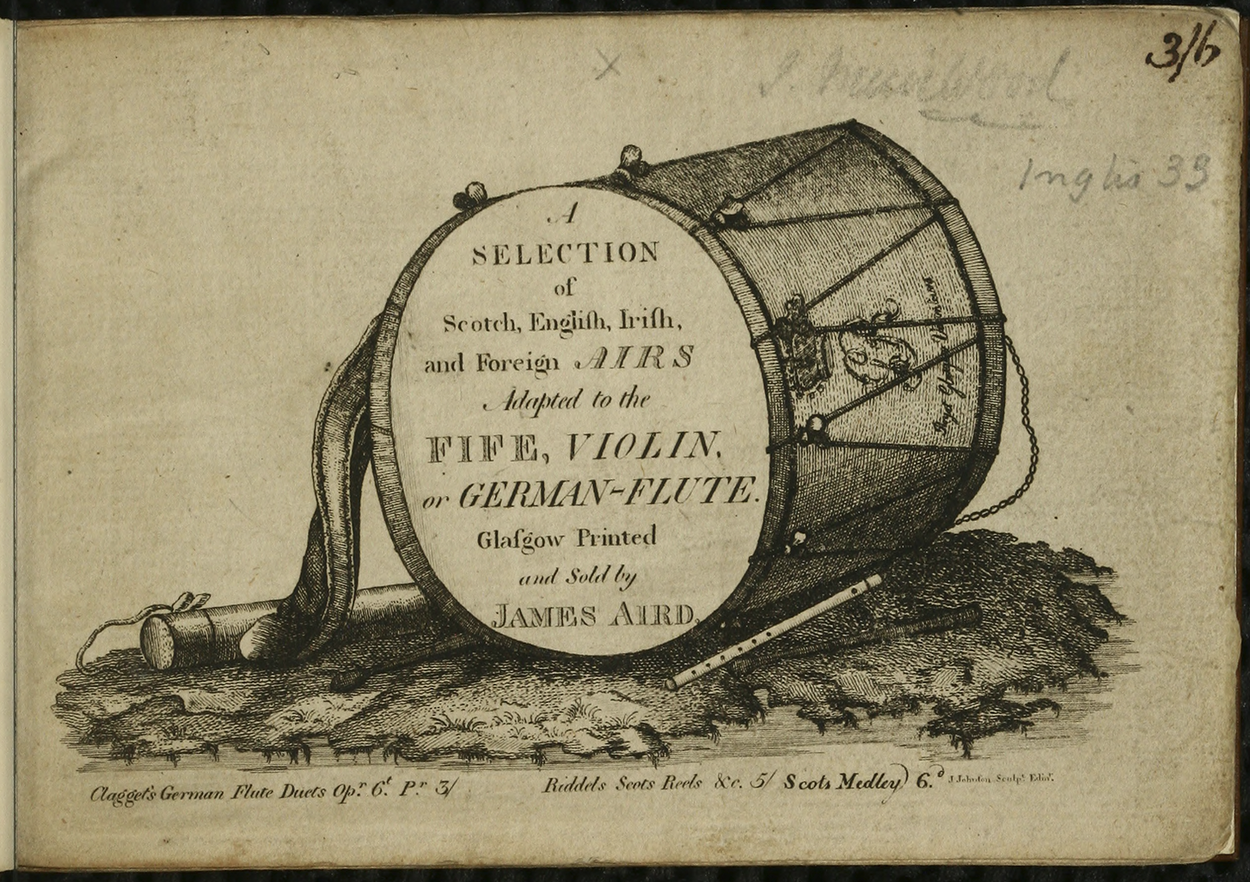
Figure 1. Long description
At the center, the drumhead displays the title text: ‘A Selection of Scotch, English, Irish, and Foreign Airs Adapted to the Fife, Violin, or German-Flute. Glasgow Printed and Sold by James Aird.’ The drum is angled with its body extending to the right, showing tension ropes and a crest. In front of the drum, a fife and drumsticks rest on the ground. Along the bottom edge, small print reads ‘Clagget's German Flute Duets Op. 6. Pr. 3/' and ‘Riddls Scots Reels &c. 5/ Scots Medley 6.’ with ‘J. Johnson Sculp. Edin.’ at the far right. In the upper right margin, handwritten notes include ‘Inglis 33’ and a price ‘3/6.’ The overall composition uses the drum as a frame for the publication information, with musical instruments and marginalia reinforcing the musical theme.
Title page, Aird’s Selection, volume ii, first impression, August 1782, National Library of Scotland, Glen.16a(2). Reproduced under a Creative Commons Attribution 4.0 International (CC-BY) licence with the permission of the National Library of Scotland <https://creativecommons.org/licenses/by/4.0/>.
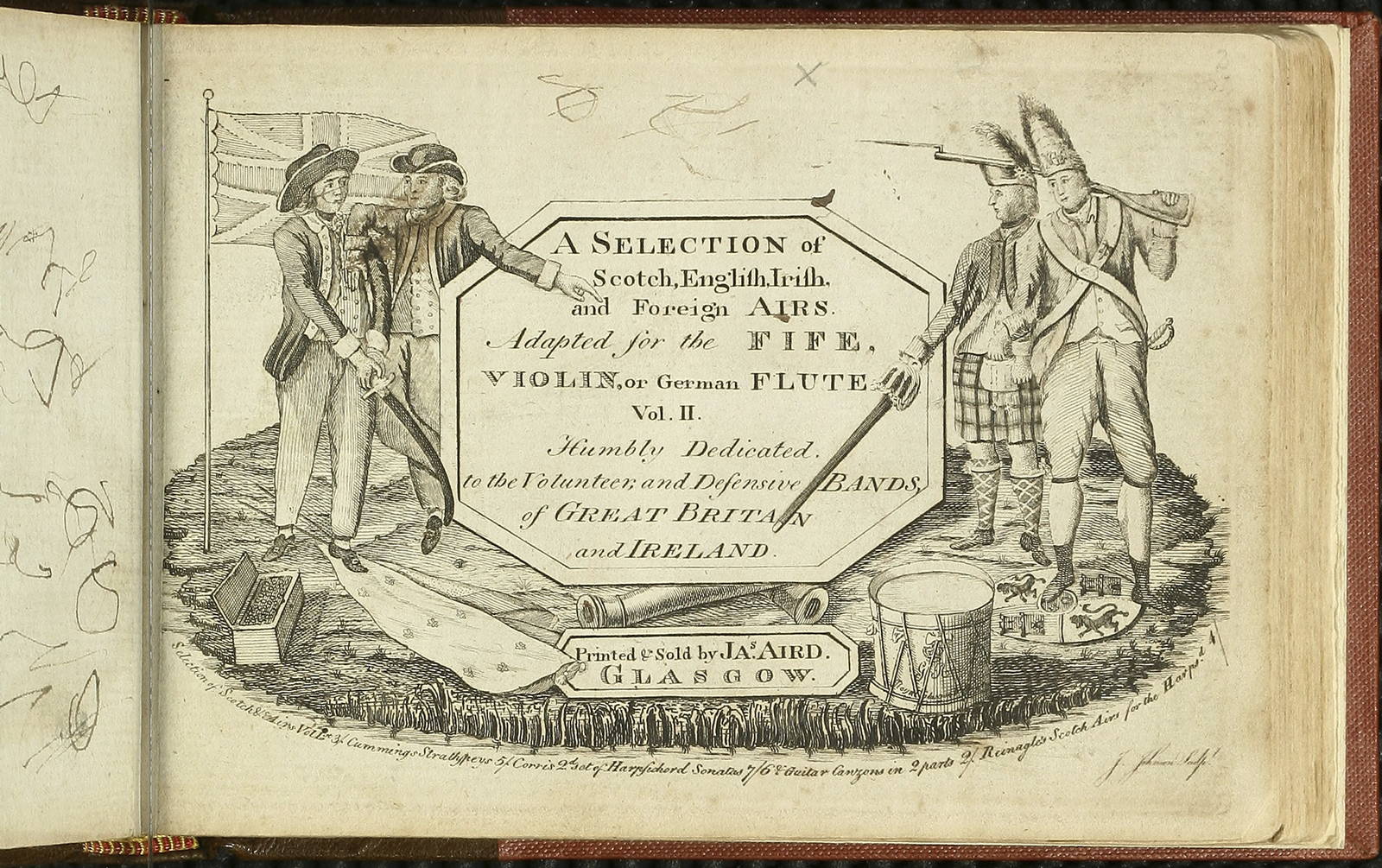
Figure 2. Long description
At the center is an octagonal panel containing the title text: ‘A Selection of Scotch, English, Irish, and Foreign Airs. Adapted for the Fife, Violin, or German Flute. Vol. II. Humbly Dedicated to the Volunteer and Defensive Bands of Great Britain and Ireland. Printed & Sold by Jas. Aird. Glasgow.’ Surrounding the panel, from left to right: on the far left, a man in a hat and striped trousers stands beside a flagpole with a large flag, and a closed book and sheet music rest at his feet. Next, a man in a dark coat and breeches points to the title panel with a staff. To the right of the panel, a man in Highland dress with a feathered bonnet and kilt stands with a musket over his shoulder, and another man in military uniform stands behind him. At the bottom right, a drum, a sword, and a shield with a lion rampant are arranged on the ground. The background is lightly shaded, and the entire scene is framed by the open book’s edges.
The title of volume ii is printed within a hexagonal frame which sits on two crossed cannons, again on a grassy ground. It is flanked by two military figures on each side: two sailors on the left stand in front of the UK union flag with a banner bearing the French fleur-de-lis on the ground; a Scottish soldier and a guardsman on the right stand upon a heraldic shield with the arms of Castile and León (Figure 2).Footnote 56 These reference British military engagements with France and Spain during the Anglo-French war, 1778–83, and no doubt were intended to appeal to nationalist sentiments and promote a sense of belief in the dominance of the British forces. The same drum from volume i is included, but there are no other instruments.
A second impression was created to coincide with the appearance of volume iii. It can be identified by the addition of ‘ENTERED IN STATIONERS HALL’ above the hexagonal frame and volume iii of the Selection in the list of publications. Aird announced the publication of volume iii in July 1788, when ‘Subscribers for J AIRD’S 3d Selection of 200 Airs’ were asked to ‘call or send for their subscription copies’.Footnote 57 It reuses the title-page image from the first impression of volume ii. A catalogue of Aird’s publications is included at the end of volume iii, which mostly repeats the lists from the title pages of volumes i and ii:
The Following Music Printed & Sold by JAMES AIRD at his Shop in GLASGOW
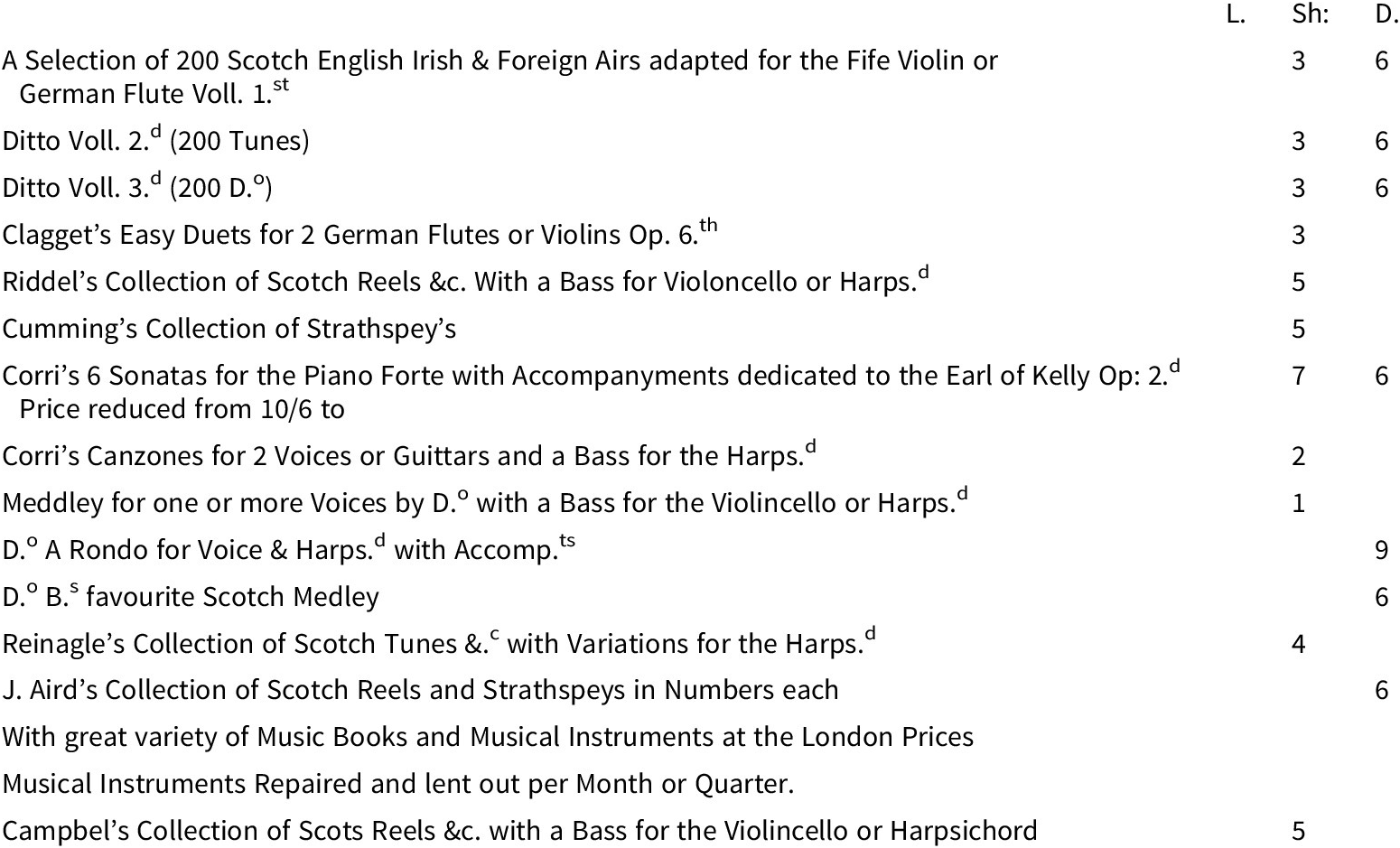
Table 2. Long description
The table lists music collections and compositions in the first column, including ‘A Selection of 200 Scotch English Irish and Foreign Airs adapted for the Fife Violin or German Flute Voll. 1st’, ‘Ditto Voll. 2d (200 Tunes)', ‘Ditto Voll. 3d (200 Do)', ‘Clagget’s Easy Duets for 2 German Flutes or Violins Op. 6th’, ‘Riddel’s Collection of Scotch Reels etc. With a Bass for Violoncello or Harpsichord’, ‘Cumming’s Collection of Strathspeys’, ‘Corri’s 6 Sonatas for the Piano Forte with Accompanyments dedicated to the Earl of Kelly Op: 2d Price reduced from 10 forward slash 6 to’, ‘Corri’s Canzones for 2 Voices or Guitars and a Bass for the Harpsichord’, ‘Meddley for one or more Voices by Do with a Bass for the Violincello or Harpsichord’, ‘Do A Rondo for Voice and Harpsichord with Accompaniments’, ‘Do B s favourite Scotch Medley’, ‘Reinagle’s Collection of Scotch Tunes etc. with Variations for the Harpsichord’, ‘J. Aird’s Collection of Scotch Reels and Strathspeys in Numbers each’, and ‘Campbel’s Collection of Scots Reels etc. with a Bass for the Violincello or Harpsichord’. The next three columns are labeled L., Sh., and D. Most entries in L. are blank. Sh. and D. columns contain numbers such as 3, 5, 7, 1, 2, 4, 6, and 9, corresponding to each music collection. Some entries have values in both Sh. and D., such as ‘A Selection of 200 Scotch English Irish and Foreign Airs adapted for the Fife Violin or German Flute Voll. 1st’ with 3 in Sh. and 6 in D., and ‘Corri’s 6 Sonatas for the Piano Forte...’ with 7 in Sh. and 6 in D. Two summary rows at the bottom state ‘With great variety of Music Books and Musical Instruments at the London Prices’ and ‘Musical Instruments Repaired and lent out per Month or Quarter.’
This catalogue clarifies the titles of the works by Corri and Reinagle referred to in earlier publications; Aird tends to abbreviate titles presumably to fit into the space available, which can create confusion, with so many being quite similar. There are two new publications, providing a terminus ante quem for both, namely Aird’s Collection of Scotch Reels and Strathspeys and Campbell’s Collection of Scots Reels, which seems to be a late addition to the page as it is placed after the general summary statement of the business.
The fourth and final volume was published in March 1793, when ‘Gentlemen wishing to subscribe for J. AIRD’S 4th VOLUME of SELECT AIRS, at 3s’, were asked to send their names.Footnote 58 Unfortunately, none of the volumes includes a list of subscribers. The contents of this fourth volume were no doubt successfully completed following his request for ‘a few Scotch and Irish Airs’ to be sent to him, with a promise that contributors would receive a copy as soon as it was published.Footnote 59 In at least one instance he seems to have taken a fiddle tune in manuscript, ‘Miss Fleming of Moness’s Strathspey’ by Simon Fraser (1773–1832), and published it a year before the composer was able to do so (Figure 3).Footnote 60 However, it could be said in Aird’s defence that he gave adequate notice of his intention to publish.
‘Miss Fleming of Moness’s Strathspey’, Aird’s Selection, volume iv (Glasgow, 1793), p. 74; reissued by McFadyen, National Library of Scotland, Glen.16b(2). Reproduced under a Creative Commons Attribution 4.0 International (CC-BY) licence with the permission of the National Library of Scotland <https://creativecommons.org/licenses/by/4.0/>.
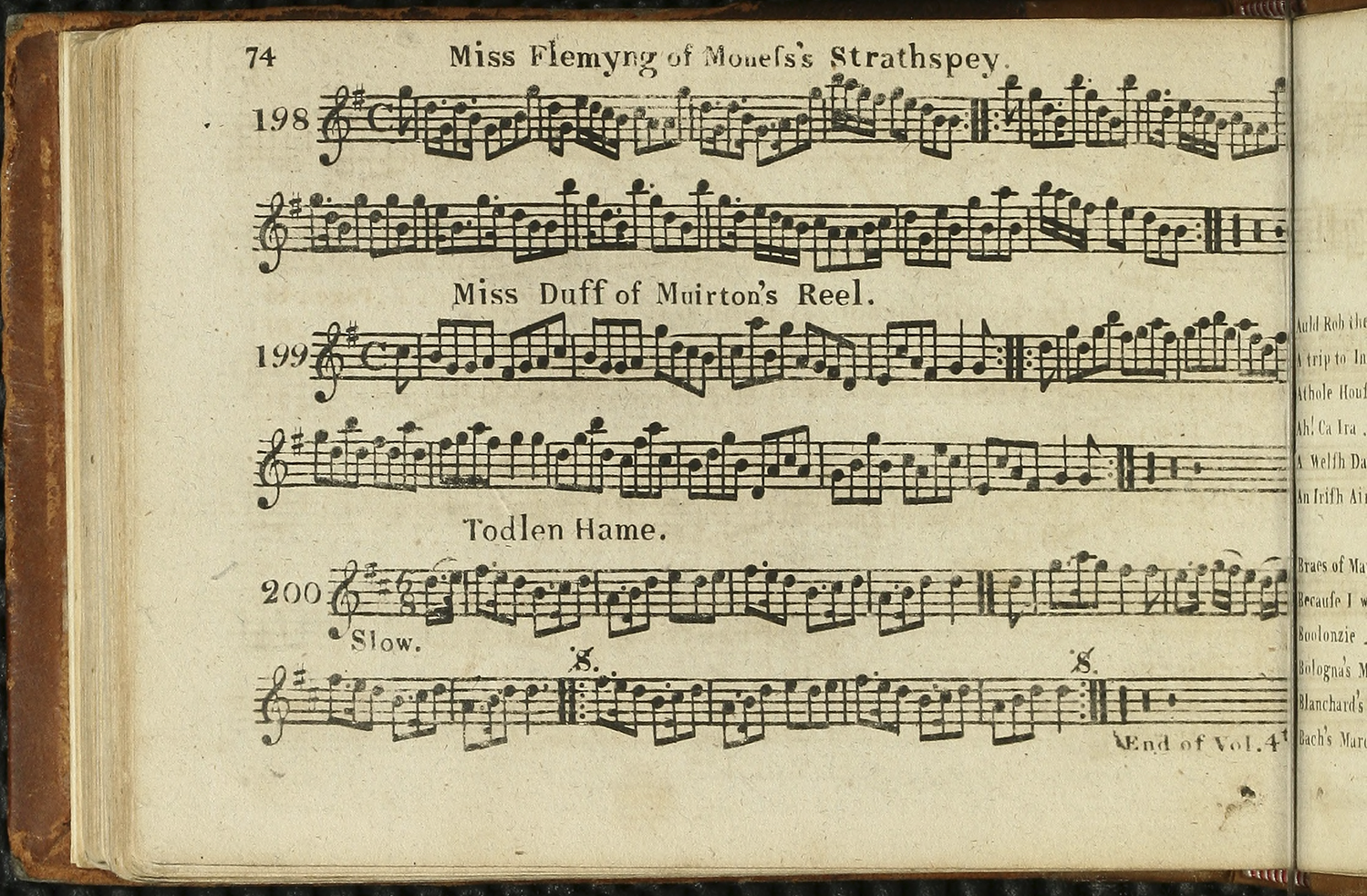
Figure 3. Long description
At the top, the page number 74 is printed leftmost. The first staff is labeled ‘Miss Fleming of Moness's Strathspey’ and numbered 198, with a treble clef and key signature of G major, followed by a single line of musical notation. Below, the second staff is labeled ‘Miss Duff of Muirton's Reel’ and numbered 199, also in G major, with a single line of musical notation. The third staff, labeled ‘Todlen Hame.’ and numbered 200, is marked ‘Slow.’ and contains a treble clef, a 6/8 time signature, and two lines of musical notation. At the end of the last staff, the text ‘End of Vol. 4.’ is printed at the far right. All staves are horizontally aligned, and the musical notation consists of standard note heads, stems, and beams, with various rhythmic patterns.
This fourth volume has a much simpler title page, with the full title placed in a hexagon on a plain background. However, the only surviving copy, in the British Library, does not include the printer’s name. The imprint reads ‘Printed & Sold at GLASGOW’ and the volume number ‘4’ has been added by hand.Footnote 61 It is possible this is a reissue by a publisher who did not have access to the original plates, unlike those produced by McGoun and McFadyen.
The known dates of these four volumes help to situate the appearance of other works within Aird’s publication chronology. A Favourite Collection of Scots Tunes & Highland Airs and the detached title page of A Collection of Scots, English, Irish &c. Songs and Airs both advertise two volumes of his Selection, thus placing their publication between August 1782 and July 1788. His business address is printed on both as New Street, where he was trading until July 1782 and again for certain in July and August 1788, although there is a gap in the evidence from April 1787. These collections could have been part of the first frenzy of activity in the summer of 1782; however, it is more likely that both were published upon his return to New Street in 1788. Two of his single songs, ‘The Tinker’ and ‘Ah! çá ira’, refer to three volumes of his Selection, placing their appearance after July 1788 and before March 1793. This dating for the latter fits perfectly with the evidence in the Haldane papers discussed above; there it is described as having been engraved by Haldane ‘more than a twelve month’ before June 1793, suggesting publication in the second quarter of 1792.Footnote 62 This neatly creates a latest possible date for the works listed on page 3 of this song, described as ‘Printed and Sold by J. AIRD’, namely:
Butler’s Rondos Viz.t Lochaber; Sow’s tail to Geordie; Muschets March; Pady-Whack; Tweed-side; Amo amas, a Duet for 2 Performers on one Piano Forte
[T. Arne] Overture to Artaxerxes, for 2 Performers on D.o
Aird’s Select Scots &c. Airs consisting of 600 Tunes in 3 Vol.s; Scots Tunes with a Bass; Scots Reels & Strathspeys
Haydens Master & Scholar for 2 Performers
Cumming’s Strathspey Reels
Riddel’s D.o
It is likely that the six rondos by Butler were bought at the Corri & Sutherland sale in November 1790 and reissued with Aird’s imprint between 1791 and the first half of 1792 in time to be listed here. Of these, ‘Lochaber’ and ‘Tweedside’ seem not to exist. ‘Paddy-Whack’ survives in a reissue by McFadyen; the heading in that publication uses the same font as Aird’s publications of ‘Sow’s Tail to Geordie’ and ‘Muschet’s March’. The ‘Scots Tunes with a Bass’ and ‘Scots Reels & Strathspeys’ are included in the catalogue at the end of the Selection, volume iii, placing these between July 1788 and early 1792. There is no extant copy of Haydn’s duet ‘Master and Scholar’ with Aird’s imprint, but one with McFadyen’s could be a reissue using Aird’s plates.
Engraved Songs
‘Ah! çá ira’ itself belongs to a group of thirteen songs printed from engraved plates that belong to a distinct period in the last five years of Aird’s life; the others are ‘Bonny Dundee’, ‘Cauld Kail in Aberdeen’, ‘Contented I Am and Contented I’ll Be’, ‘The Days of Langsyne’, ‘The Flowers of the Forrest’, ‘Jamie o’ the Glen’, ‘Jem of Aberdeen’, ‘The Lass of Glasgow Green’, ‘Logie of Buchan’, ‘O What a Beau My Granny Was’, ‘Tell Me Lasses, or Venus’s Reward for Cupid’, and ‘The Tinker’. All his other songs use a more universal music typeface, as found in the publications of his contemporaries; see Figure 3 for a sample of this style. Of these, ‘The Lass of Glasgow Green’ can be shown to be the earliest. The heading refers to a performance ‘by Mr Woodroffe, with universal applause, in the Theatre GLASGOW’ that can be dated precisely to 30 August 1790 via an announcement in the theatre section of the Glasgow Advertiser: ‘an entire new Song, called THE LASS OF GLASGOW GREEN To be sung by Mr WOODROFFE’.Footnote 63 The music and text belong to ‘The Lass of Richmond Hill’, with the recurring phrase ‘Sweet lass of Richmond Hill’ replaced with ‘Sweet lass of Glasgow Green’. It is likely that Aird’s version was published close to the date of Woodroffe’s performance, perhaps as early as September 1790. The brief list of composers in the heading includes Cumming and Riddell, already named in several publications from 1782 onwards, and Campbell, who is included in the catalogue at the end of the Selection, volume iii (July 1788). The others — McDonald, Dow, Anderson, and Gow — have not been found among Aird’s surviving publications. The newspaper notification of the performance of ‘The Lass of Glasgow Green’ gives Aird’s business address in New Wynd. Four other songs in this engraved group — ‘Contented I Am’, ‘The Flowers of the Forrest’, ‘Logie of Buchan’, and ‘O What a Beau’ — include an address in New Wynd, placing their publication between August 1790 and April 1794.
As noted above, ‘The Tinker’ must have been published by March 1793, based on the dates for volumes iii and iv of Aird’s Selection. This song is included in a list of thirteen works at the foot of ‘Jamie o’ the Glen’, placing ‘Jamie’ later in the publication chronology. Seven other songs listed on ‘Jamie o’ the Glen’ survive: ‘Ah! çá ira’ and ‘Logie of Buchan’ discussed above, along with ‘Cauld Kail in Aberdeen’, ‘Jem of Aberdeen’, ‘Loch Errochside’, ‘The Surprise’, and ‘The British Grenadiers’. A further five songs have not yet been located with Aird’s imprint: ‘On the Lake of Killarney’, ‘Britannia Rule the Waves’, ‘Did Not Tyrant Custom Guide Me’, ‘Admiral Russell’s Triumph’, and ‘My Ain Kind Deary O’. Aird announced the publication of ‘On the Lake of Killarney’ in December 1792, placing it in the latter part of that year.Footnote 64 There is reference to ‘Britannia Rule the Waves’ in the Haldane documents, but it is unclear if he is using this title as an example or if he knew of a printing plate belonging to Aird.
Except for ‘The Tinker’, this group of engraved songs shares several characteristics. The font of the lyrics within the scores is noticeably smaller than that used in songs produced with music typeface. For frequently occurring letters in the engraved scores, a = 1 mm, g = 2 mm, and T = 2 mm, compared with a = 2 mm, g = 3 mm, and T = 3 mm in the standard music typeface. The use of this noticeably different font style in headings or footers can be used to assign other works to this production period, for example ‘Loch Errochside’.
Each engraved song includes a remarkably similar statement in either the heading or at the foot of the page referring to the variety of musical items sold and the services available, as exemplified in the heading of ‘Logie of Buchan’:
LOGIE OF BUCHAN. […] where may be had, Great Choice of MUSIC BOOKS, SCOTS SONGS and AIRS with Variations, and Rondeaus, for the Harpsi.d. MUSICAL INSTRUMENTS Repair’d, Exchanged, or Lent out, per Month, or Quarter; Violin Strings, &c.
The service of repairing, exchanging, and hiring instruments had been offered at Aird’s shop from at least June 1780.Footnote 65 He also offered to prepare music and poetry for publication, as advertised on ‘The Tinker’, where customers are informed that ‘Manuscripts of MUSIC, or Poetry, will be most thankfully received, and Carefully Engraved. &c.’. A similar notice on ‘Cauld Kail in Aberdeen’ suggests that he was collecting items for volume iv of the Selection, placing the likely publication of this song in the latter part of 1792:
J. AIRD embraces this Opportunity to return his most grateful thanks to those who have favour’d him with the Various Airs and Songs received, and requests a Continuance of their Correspondence, as he intends to publish those received directly with proper Sets for Violin, Guitar & German Flute.
A closer examination of the engraved scores reveals several distinct levels of competency in handling notation, which suggests several engravers with little previous experience of music notation were involved. ‘The Lass of Glasgow Green’, already shown to be the earliest of the group, is the least well prepared and appears to be the work of an inexperienced hand. Not only are the ledger lines poorly spaced, but there are several ambiguous pitches due to crowding on the stave and a lack of skill in placing noteheads precisely. The key signature has been stamped twice on some staves, and the alignment is generally poor (Figure 4).
‘The Lass of Glasgow Green’, National Library of Scotland, Glen 368(1). Reproduced under a Creative Commons Attribution 4.0 International (CC-BY) licence with the permission of the National Library of Scotland <https://creativecommons.org/licenses/by/4.0/>.
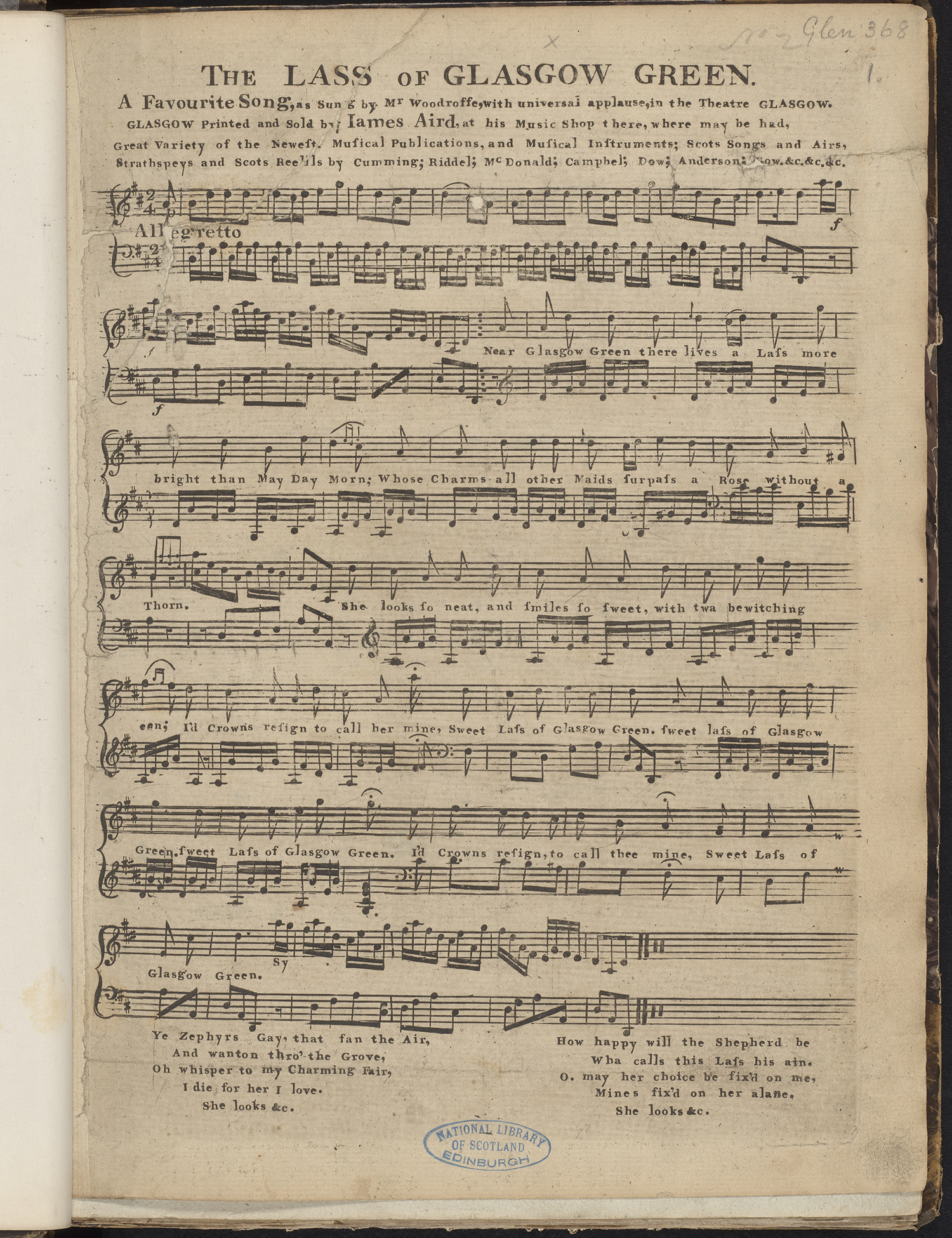
Figure 4. Long description
At the top, the title The Lass of Glasgow Green is centered in large bold text. Below, a subtitle describes it as a favourite song sung by Mr Woodroffe at the Theatre Glasgow, printed and sold by James Aird, with further publication and music shop details. The main body contains musical notation with a treble clef, time signature, and key signature, spanning five staves. Lyrics are interspersed below the notes, beginning with Near Glasgow Green there lives a Lass more bright than May Day Morn. The refrain Sweet Lass of Glasgow Green repeats. At the bottom, two verses are printed in smaller text, starting with Ye Zephyrs Gay that fan the Air and How happy will the Shepherd be. A blue oval stamp at the lower edge reads National Library of Scotland Edinburgh.
‘The Tinker’, National Library of Scotland, Mus.E.l.55(73). Reproduced under a Creative Commons Attribution 4.0 International (CC-BY) licence with the permission of the National Library of Scotland <https://creativecommons.org/licenses/by/4.0/>.
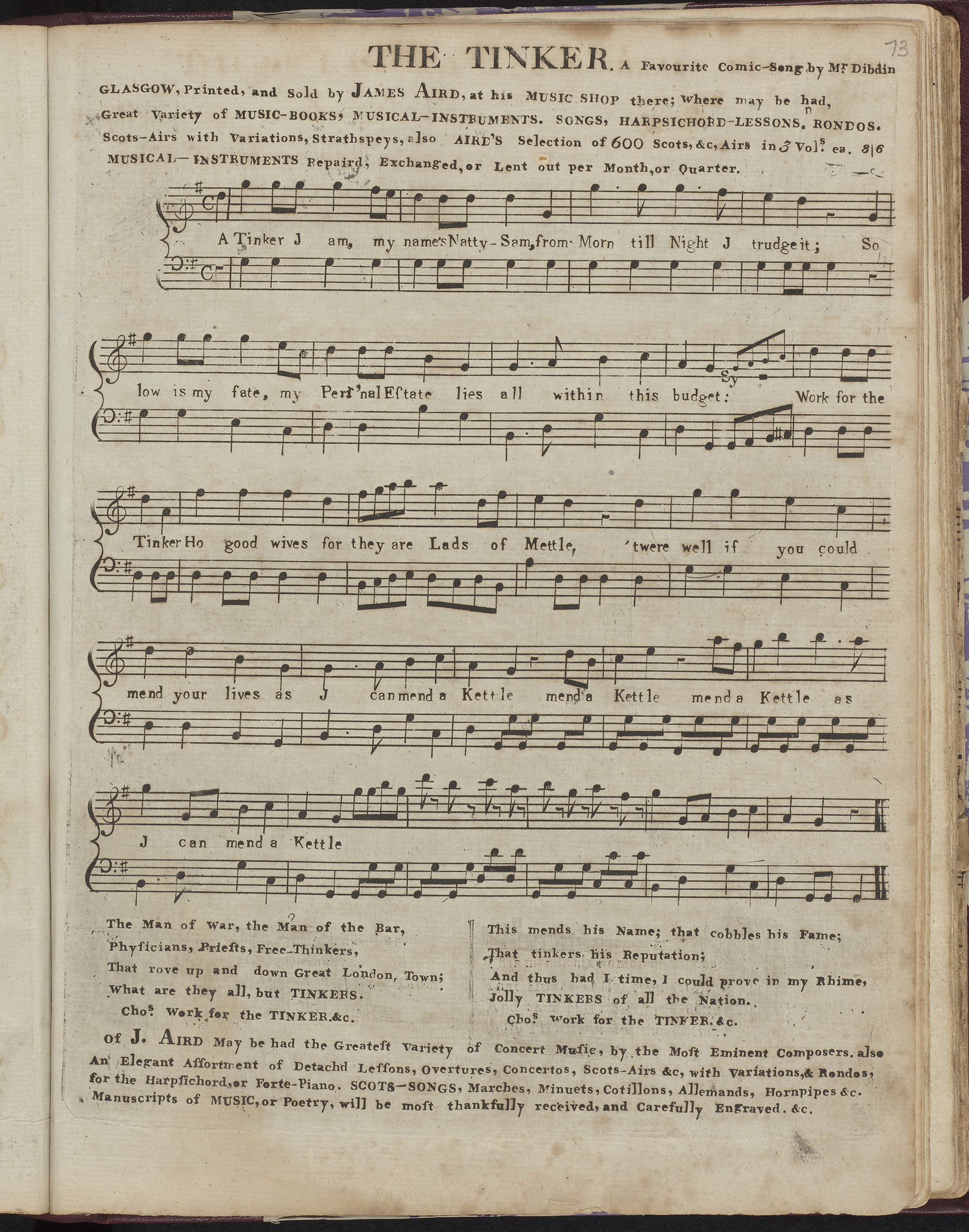
Figure 5. Long description
At the top is the title ‘THE TINKER’ in large bold text, followed by publication details about James Aird's music shop and available music books. Below, the main section contains a musical staff with treble and bass clefs, key signature of G major, and time signature of 6/8. The melody is notated with lyrics beneath each note, beginning with ‘A Tinker J am, my name's Natty-Sem, from Morn till Night J trudget.’ The lyrics continue across three staves, with repeated phrases such as ‘J can mend a Kettle.’ At the bottom, prose text in smaller font provides additional verses and commentary, including references to ‘The Man of War, the Man of the Bar,’ and a note about the availability of concert music by J. Aird. The page number 73 appears in the upper right corner.
A similar level of competency can be traced as developing through ‘O What a Beau’, ‘Ah! çá ira’, and ‘Jamie o’ the Glen’. These scores have some over-stamping and inconsistencies with alignment, but the handling of ledger lines gradually improves, although not all the noteheads are placed accurately. A more confident placement of noteheads and accurate treatment of stems is seen in ‘Logie of Buchan’, ‘Bonny Dundee’, ‘The Flowers of the Forrest’, ‘Contented I Am’, ‘Cauld Kail in Aberdeen’, and ‘Jem of Aberdeen’. More competently prepared are the plates for ‘The Days of Langsyne’ and ‘Tell Me Lasses’. Finally, ‘The Tinker’ is the most accomplished, with an unambiguous placement of notes on the stave, well-spaced ledger lines, no over-stamping, and a uniform approach to spacing systems within the plate. However, it uses a different set of music punches and text font for the score, characteristically using ‘J’ instead of ‘I’, e.g. ‘A Tinker J am […] from Morn till Night J trudge’ (Figure 5). This score may be the work of a different engraver. However, verses 2 and 3, placed in the lower part of the page, use the same font as found in other songs in this group and revert to using ‘I’, e.g. ‘And thus had I time, I could prove’. This dateable and visual evidence can be combined to suggest a tentative publication schedule, as shown in Table 3.
Combining competency at music engraving with the dateable evidence
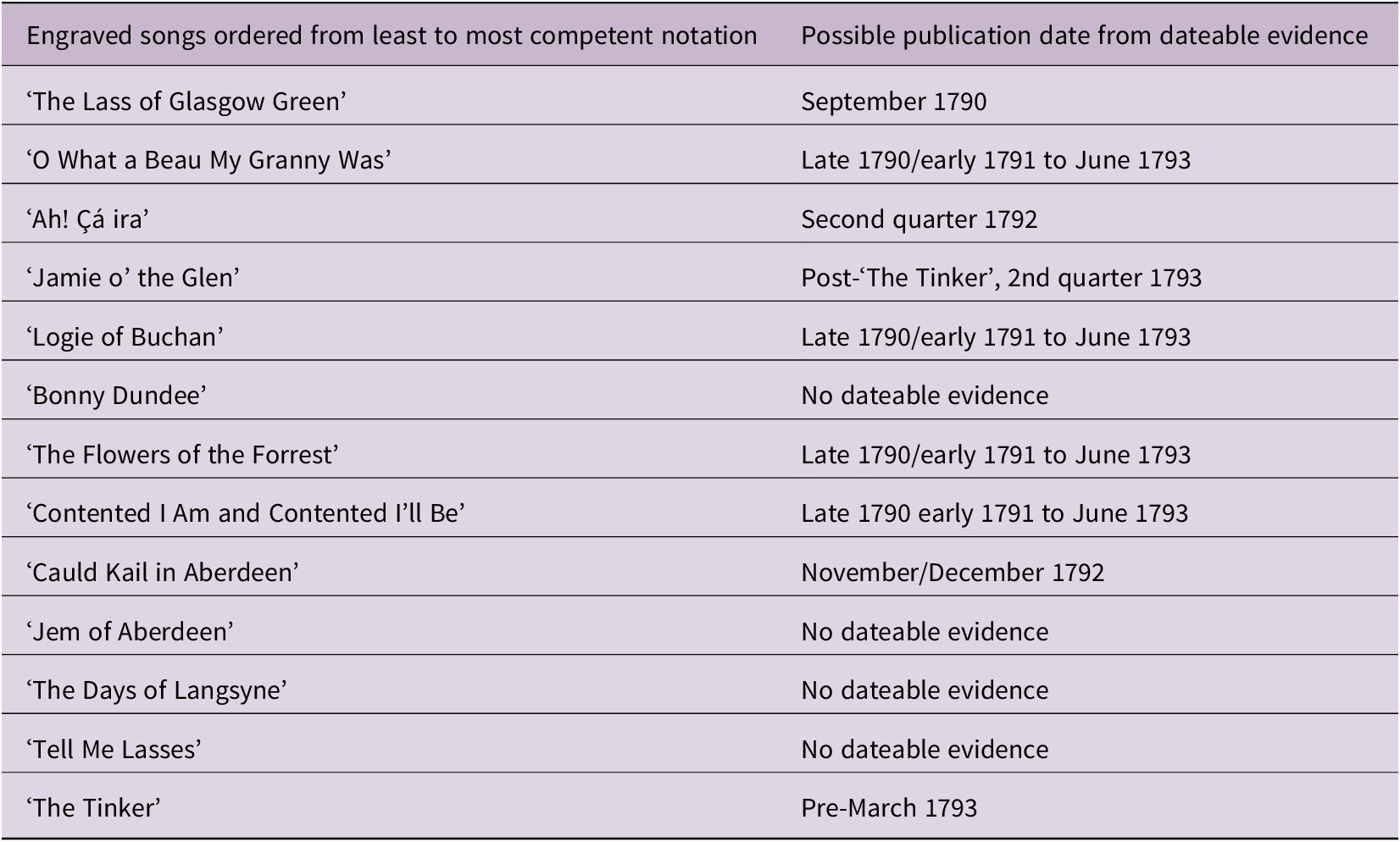
Table 3. Long description
The table has two columns. The left column is titled ‘Engraved songs ordered from least to most competent notation.’ The right column is ‘Possible publication date from dateable evidence.’ From top to bottom, the rows are: ‘The Lass of Glasgow Green’ with ‘September 1790’; ‘O What a Beau My Granny Was’ with ‘Late 1790/early 1791 to June 1793’; ‘Ah! Ça ira’ with ‘Second quarter 1792’; ‘Jamie o’ the Glen’ with ‘Post-‘The Tinker’, 2nd quarter 1793’; ‘Logie of Buchan’ with ‘Late 1790/early 1791 to June 1793’; ‘Bonny Dundee’ with ‘No dateable evidence’; ‘The Flowers of the Forrest’ with ‘Late 1790/early 1791 to June 1793’; ‘Contented I Am and Contented I’ll Be’ with ‘Late 1790 early 1791 to June 1793’; ‘Cauld Kail in Aberdeen’ with ‘November/December 1792’; ‘Jem of Aberdeen’ with ‘No dateable evidence’; ‘The Days of Langsyne’ with ‘No dateable evidence’; ‘Tell Me Lasses’ with ‘No dateable evidence’; and ‘The Tinker’ with ‘Pre-March 1793.’ The ordering reflects increasing competency in music engraving from top to bottom.
Single Songs and Keyboard Music
In contrast to the engraved songs, all the other works with Aird’s imprint are set in what appears to be an almost universal typeface of the period. This produces clearly legible scores with few ambiguities, although in songs that include an additional instrumental part, for example guitar or German flute, there may be some negligible rhythmic discrepancies between parts. Some of these instrumental parts are the same length as the keyboard score and include the introduction, interludes, and postlude, while others contain only the bars of the vocal part, even omitting any interludes.
Few of these sixty-three songs and seven solo keyboard works have any internal evidence to suggest their position in Aird’s publication chronology. None includes a business address or advertise other items for sale. However, some refer to stage works whose date of first performance may help to slot them into the chronology. Some of these first performances pre-date the earliest reference to Aird’s business, namely Arne’s Eliza (1758), Thomas and Sally (1760), and Love in a Village (1762); Dibdin’s The Deserter (1773), The Quaker (1775), and The Seraglio (1776); and Linley’s The Duenna, first performed in 1775. Others fall within the period when Aird was printing music in his own shop, for example ‘Amo amas’ from Arnold’s The Agreeable Surprise (1781) and ‘The Medium Way’ from Inkle and Yarico (1787); ‘A New Song’ from Which Is the Man, with lyrics by Hannah Cowley (1782); ‘Dans votre lit’ from O’Keeffe’s Love in a Camp, first performed in 1786, although the lyrics in Aird’s publication differ from those in the stage work; and ‘Sweet Poll of Plymouth’ from The Positive Man, first performed in 1784.
Six songs include the designation ‘junior’ in the imprint: ‘A Scotch Medley’, which can already be dated by other means to 1782, ‘The Broom on Cowdenknows’ and ‘When Sable Night’, both from The Duenna by Linley, and ‘The Highland Laddie’, ‘How Imperfect Is Expression’, and ‘Johnny Cope’. Aird could legitimately refer to himself as ‘junior’ until the death of his father in February 1790. If he used ‘junior’ in his imprint only during his father’s lifetime, this suggests that the plates for these works were produced between summer 1782 and late 1789 or early 1790. Additionally, if he used a standard music typeface during this phase of his business and changed to engraved scores from about 1790, that dates the majority of his catalogue to pre-1790, although he may have continued to reissue works from the music typeface plates after that date.
A more precarious approach involves aligning performers named in the heading of songs with recorded appearances in Glasgow. Aird may have included these names as a marketing ploy to encourage purchases of works associated with specific performers whom customers may have read about in the press or even heard at concerts in Glasgow or while visiting other musical centres. Most of the performers named are simply those listed in the wordbooks for London performances. For example, Mrs Wrighten is named in the heading of ‘Some How My Spindle I Mislaid’ from Dibdin’s The Deserter but is not recorded as having performed in Glasgow. Others do refer to performances in Glasgow that can be corroborated through newspaper advertisements, as seen above for ‘The Lass of Glasgow Green’.
Conclusion
Based on what has been uncovered about Aird’s career, it is reasonable to suggest that his publications can be assigned to four main periods of activity. The first is from around February 1776, when his shop is first advertised, until June 1782, immediately before he started printing music. During this period, it is most likely that he used the imprint ‘Printed for and sold by’ on scores produced using a near-universal music typeface. The second is from July 1782, when he started publishing from his own premises, until August 1786, immediately before the sequestration action in September. The imprint will have been changed for the remainder of his printing career to ‘Printed and sold by’, including those with the designation ‘junior’. It is likely that there was a fallow period between September 1786 and early 1788. The third period is from mid-1788, when he is back in business and preparing volume iii of his Selection for publication in July 1788, until August 1790, when he seems to have switched from music typeface to engraved scores. Publications with the imprint ‘James Aird junior’ can be assigned to this period. The final period is from September 1790, when he started publishing songs with an engraved score and reissuing works bought at the Corri & Sutherland and Thomas Moore sales, until the start of the Court of Session case with Haldane in February 1795. This legal case may have precipitated another fallow period of in-shop printing until his death in September 1795.
Aird’s resilience sustained his business through many challenges. It is possible that his younger sister Jean was a sympathetic financial backer throughout his career, including getting him back on his feet after sequestration. In addition, he must have had a keen understanding of the needs of the local market, which comprised not only amateur musicians, their teachers, and the militia bands, but also those requiring general hardware and fancy goods. The amateur musicians were looking for works that were easy to play, adaptable in performing forces, and that drew not only on the folk element of Scottish music, but also demonstrated their knowledge of the most up-to-date theatre productions touring from London. Likewise, the range of instruments sold — flutes, guitars, and keyboards — would no doubt have satisfied the domestic arrangements of the minor landed gentry and merchant classes, as well as the local volunteer bands.
His legacy as a music publisher is evident in the continuation of music printing in Glasgow through his contemporaries McGoun and McFadyen, both of whom used some of his printing plates to augment their own catalogues. McGoun’s output seems to be quite small, amounting to about thirty works, with half reproduced from Aird’s plates. McFadyen was significantly more prolific, leaving around two hundred works, only eleven of which are reissues from Aird’s catalogue. Thus Aird’s contribution to the cultural life of Glasgow within a short business career prepared the foundations for music publishing in the city throughout the nineteenth century.
Appendix: Provisional List of Aird’s Publications
Library Sigla
- GB-A
-
Aberdeen, Aberdeen University Library, King’s College.
- GB-AB
-
Aberystwyth, National Library of Wales.
- GB-Ap
-
Aberdeen, Public Library, Walker Collection.
- GB-DU
-
Dundee, Public Libraries, Wighton Collection.
- GB-En
-
Edinburgh, National Library of Scotland.
- GB-Ge
-
Glasgow, Glasgow University Library, Special Collections, Euing Music Collection.
- GB-Gm
-
Glasgow, Mitchell Library.
- GB-Gu
-
Glasgow, Glasgow University Library, Special Collections.
- GB-Lam
-
London, Royal Academy of Music.
- GB-Lbl
-
London, British Library.
- GB-Ob
-
Oxford, Bodleian Library.
- GB-P
-
Perth, AK Bell Library, Atholl Collection.
- US-BE
-
Berkeley, University of California, Music Library.
- US-Wc
-
Washington, DC, Library of Congress, Music Division.
Abbreviations
- cl
-
clarinet
- fl
-
flute
- Ger. fl
-
German flute
- gui
-
guitar
- kbd
-
keyboard
- v
-
voice
- vn
-
violin
Introduction to the Catalogue
The locations of the copies consulted are given in parentheses, including reissues by other printers. Tentative publication dates are given in square brackets. For works that include the name of a performer who is recorded in the local newspapers as having performed them in Glasgow, the date of performance is given in italics in square brackets.
Imprint ‘Printed and Sold by Aird’
Collected Volumes
-
Aird, James, A Collection, of Scots English Irish &.c songs & airs, adapted to the voice — violin German flute or guitar with a bass for the violoncello or pianoforte [Potentially only the title page survives] [1787–pre-July 1788] (GB-Gm SR 335 [1]/M4687; currently bound with seventy-eight items, fifteen of these by Aird).
-
Aird, James, A Favourite Collection of Scots tunes & Highland airs — For the Violin or German Flute with a bass for the violoncello or harpsichord by W. McGibbon, J. Oswald & Others BOOK 1st [1787–pre-July 1788] (GB-DU 92526; title page has Aird’s imprint but the paper has date watermark 1801, so this copy is most likely a reissue by McGoun; reissued with McGoun’s imprint GB-Gm Kidson Collection 786.45/M8852; GB-Lbl b.66.a).
-
Aird, James, A Selection of Scotch, English, Irish, and Foreign airs Adapted to the fife, violin, or German-flute. Volume i [1782]; volume ii [1782]; volume iii [1788]; volume iv [1793].
Volume i, 1st impression [1782] (GB-AB North PRINT (XM 1270 A298), GB-En Ing.33, GB-Gm Moir Collection M9243, and Gm uncatalogued 780s [copy A]); 2nd impression [1782] (GB-En Glen.16a(1); GB-Lbl a.27); 3rd impression [1788] (GB-En Ing.28); unidentified impressions GB-A SB 788515 Sel, lacks original title page which is substituted with a diplomatic copy; GB-Gm uncatalogued 780s [copy B] lacks title page.
Volume ii, 1st impression [1782] (GB-En Glen.16a(2); GB-Gm uncatalogued 780s [copy A]; GB-Lbl a.27); 2nd impression [1788] (GB-En Ing.34; GB-Gm Moir Collection M9244 and uncatalogued 780s [copy C]; GB-P N56/34711; unidentified impression GB-Gm uncatalogued 780s [copy D] lacks title page).
Volume iii [1788] (GB-Ob (W) Harding Mus. M45).
Volume iv [1793] (GB-Lbl a.27, no printer named on title page).
Reissues by John McFadyen, Glasgow: volumes i–iii (GB-DU 92419; GB-Lbl a.27.c); volume i (GB-En Ing.35; GB-Gm 788.51521 AIR [2]; GB-P N57/24712 and N58/34713); volume ii (GB-En Ing.29; GB-P N59/34714 and N60/34715); volume iii (GB-A SB 788515 Sel; GB-En Glen.16b(1) and Ing.30; GB-Gm 8.5 McF [2]; GB-P N61/34716); volume iv (GB-A SB 788515 Sel; GB-DU 92420; GB-En Glen.16b(2) and Ing.31).
Reissues by Archibald McGoun, Glasgow: volume i (GB-Ob (W) Harding Mus.M44(1)); volume iv (GB-En MH.s.244; (GB-Ob (W) Harding Mus.M46)
Reissue by Urbani & Liston, Edinburgh: volume ii (GB-A SB 788515 Sel; GB-En MH.s.246).
Reissues by G. Golding, London: volume i (GB-Gm Moir Collection M9249); volume iii (GB-Gm Moir Collection M9245); volume iv (GB-Gm Moir Collection M9246).
Copies without title page: volume i (GB-P N58); volume ii (GB-En Ing.30; GB-Ob (W) Harding Mus.M44(2)); volume iii (GB-Ob (W) Harding Mus. M.44(3)); volume iv (GB-En Ing.31).
-
Clagget, Walter, Six duetts for two German flutes or violins; composed in an easy stile, by Walter Clagget. Opera 6. [1782] (GB-Lbl g.280.hh.(2)).
-
Cumming, Angus, A Collection of strathspeys, or old highland reels by Angus Cumming, at Grantown in Strathspey with a bass for the violincello, harpsichord, or piano forte. [1782] (GB-En Glen.234 and Ing.295(4); GB-Gm f. 786.4552 CUM; GB-Lbl e.284.c.(1); reissued by James Steven (GB-A Lib R f 78155 (41) Cum c).
-
Riddell, John, A Collection of Scots reels, minuets, &c. for the violin, harpsichord, or German flute composed by John Riddell in Ayr, the second edition greatly improved. [1782] (GB-A SB 787 Rid; GB-DU 92464; GB-En Glen.97 and Glen.234; GB-Ge Ca.9-d.22; GB-Gm fo. 786.45 RID [2]/M22161; GB-Lbl a.219; GB-P Bd30/26642).
Single Songs
-
[Bécourt], ‘Ah! çá ira carrillon national chanté a Paris a la Foédération avec une traduction Anglaise’. v+kbd, [1792] (GB-Ge Ca.11-y.12[10]).
-
[Thomas Arne], ‘The Attic fire’. v+kbd, [1782–89], lyrics Richard Rolt for Eliza (GB-En MH.259(66); GB-Gm SR335[70]/M4687).
-
‘Bess the gawkie. A favourite Scotch song’. v+kbd, gui, [1782–89] (GB-En MH.259(3)); reissued by McGoun (GB-En MH.e.12; GB-Ob (W) Harding Mus.G.O.8(11)).
-
[Thomas Linley, Sr and Jr], ‘The Birks of Envermay. A favourite Scotch song. Sung by Mr Dubellamy in the Duenna’. v+kbd, Ger. fl, gui, [1782–89], lyrics Richard Brinsley Sheridan (GB-En MH.259(12); GB-Lam XX (146860.1); GB-Ob (W) Harding Mus.G.O.34(12)).
-
‘Bonny Dundee. A favourite Scots song’. v+kbd, Ger. fl/gui, [1791–93] (GB-Ge Ca.11-y.12[6]; reissued by McFadyen (GB-Gm f. 4.4941 [2] SEL, p. 60/D97018).
-
‘A bottle of good claret’. v+kbd, gui, [1782–89] (GB-Gm SR335 [48]/M4687).
-
‘Britannia’s call. A favourite new song. Tune Come then all ye social powers’. 2v+kbd, Ger. fl, [1782–89] (GB-En MH.259(4); GB-Ge Ca.11-y.12[8]; GB-Ob (W) Harding Mus.G.O.11(13); GB-P O1/26).
-
‘The British Grenadiers’. 3v+kbd, gui, [1782–89] (GB-En MH.259(24); GB-Ob (W) Harding Mus.G.O.49(8)).
-
‘The broom on Cowdenknows. Sung at Sadlers Wells’. v+kbd, gui, [1782–89], lyrics Robert Crawford (GB-En MH.259(34); GB-Lbl G.425.mm(19); GB-Ob (W) Harding Mus.G.O.53(6) and (W) Mus.306 c.18(3)).
-
‘Cauld kail in Aberdeen, a new set A favourite Scots song. Adapted for the voice, harpsichord, violin or German-flute &c. &c. &c.’. v+kbd, gui/cl, [1792], lyrics D of G (GB-Lbl G.426.xx.(10)).
-
‘Contented I am and contented I’ll be. A favourite Scots song for the voice, and harpsichord, piano forte, spinet, violin or German flute’. v+kbd, gui/cl, [1791–93] (GB-Ob (W) Mus.306 c.18(16)).
-
[William Shield], ‘Dans votre lit. A favourite new song’. v+kbd, Ger. fl, gui, [1787–89], lyrics differ from those by John O’Keeffe for Love in a Camp (GB-En MH.259(65); GB-Gm SR335[5]/M4687; GB-Lam XX (147171.1); GB-Ob (W) Mus.306 c.18(22)).
-
‘The days of langsyne. A favourite Scots sang adapted to the voice & harpsichord, violin, German-flute or clarinet’. v+kbd, gui/cl, [1792], lyrics Susanna Blamire (GB-En Mus.E.l.101(25); reissued by McFadyen GB-Gm f. 4.4941 [2] SEL, p. 53/D97018).
-
[James Hook], ‘The disconsolate sailor. A favourite song written by Mr G Carey’. [May 1794], v+kbd, Ger. fl, gui, [1782–89] (GB-Ap WW239(ii); GB-Gm SR335[31]/M4687; GB-Ob (W) Harding Mus.G.220(1); reissued by McGoun GB-En MH.e.547; GB-Ob (W) Mus.306 c.18(18)).
-
[Charles Dibdin], ‘A Favourite song. Sung by Mr Leoni in the Seraglio Tune Shepherds I have lost my love’. v+kbd, Ger. fl, [1782–89], lyrics Charles Dibdin (GB-En MH.259(11) and Mus.E.l.101(5); GB-Gm SR335[51]/M4687; GB-Ob (W) Harding Mus.G.O.13(5)).
-
[William] Felton, ‘Fill the glass. A 3 part song tune Felton’s gavot’. 3v or 3fl, [1782–89] (GB-En MH.259(50)).
-
‘The Flowers of Edinburgh. A favourite Scots song’. v+kbd, Ger. fl, [1782–89] (GB-En MH.259(17); GB-Gm 786.4552 McF[2] folio/[7] and SR335[44]/M4687).
-
‘The Flowers of the forrest. A favourite Scots air’. v+kbd, [1791–93] (GB-En Mus.E.l.84(49); reissued by McFadyen GB-Gm 786.4552 McF [2] folio, [6]).
-
‘The Flowing bowl. The words by an officer in the navy’. v+kbd, gui, [1782–89] (GB-En MH.259(48); GB-Gm SR335[49]/M4687).
-
[James Hook], ‘The Force of affection being sequel to Poll of Plymouth. Written by Mr G. S. Carey’. [May 1794], v+kbd, [1785–89] (GB-Ge Ca.11-y.12[14]; GB-Ob (W) Harding Mus.G.219(1)).
-
[Thomas Linley, Sr and Jr], ‘Give Isaac the nymph. For the violin and German flute. A favourite song in the Duenna’. v+kbd, gui, [1782–89], lyrics Richard Brinsley Sheridan (GB-En MH.259(6) and Mus.e.l.101(22); GB-Lbl I.530.(58); GB-Ob (W) Harding Mus.G.O.34(9)).
-
[Thomas Linley, Sr and Jr], ‘Had I a heart. Sung by Mr Leoni in the Duenna’. v+kbd, Ger. fl, gui, [1782–89], lyrics Richard Brinsley Sheridan (GB-En MH.259(8); GB-Ob (W) Harding Mus.G.O.34(10)).
-
‘He stole my tender heart away. A favorite song’. v+kbd, [1782–89] (GB-A Lib R f 784 (41) Bre [xiv]; GB-En MH.259(41), Mus.E.l.55(95), and Mus.E.l.78(7v); GB-Ge Ca.11-y.12[17]; GB-Gm f. 0.89 [2] COL [31]/M15042; GB-Ob (W) Harding Mus.G.O.15(13)).
-
[Thomas] Arne, ‘The Highland laddie. Sung by Mr Mattooks. Set by Mr Arne’. v+kbd, Ger. fl/gui, [1782–89], lyrics Allan Ramsay (GB-En MH.229(80) and MH.259(30); GB-Ob (W) Harding Mus.G.O.1(9); reissued by McGoun GB-A Lib R f 784 (41) Bre [iv]).
-
[Boyce, William], ‘How blest has my time been. A favourite Scotch song’. v+kbd, Ger. fl, [1782–89], lyrics Edward Moore (GB-En MH.259(10); GB-Ob (W) Harding Mus.G.O.29(8) and (W) Mus.306 c.18(78)).
-
[Charles] Dibdin, ‘How imperfect is expression. A favourite new song. Compos’d by Dibdin’. v+kbd, gui, [1785–89] (GB-En MH.259(9) and Mus.E.l.55(83); GB-Ge Ca.11-y.12[2]; GB-Gu Farmer f105(24); GB-Ob (W) Harding Mus.G.O.30(2); reissued by McGoun GB-Gm Kidson Collection scrap folio, p. 51/M9529).
-
‘Jamie o’ the glen A favourite Scots song’. v+kbd, gui, [1793] (GB-Gm Kidson Collection scrap folio (49)/M9529; reissued by McFadyen GB-Gm f. 4.4941 [2] SEL, p. 57/D97018).
-
[James Hook], ‘Jem of Aberdeen, a favourite Scots song’. v+kbd, [1791–93] (GB-Ge Ca.11-y.12[13]; GB-Lbl G.426.xx.(12); reissued by McFadyen GB-Lbl H.1652.a.(16)).
-
‘Johnny and Mary. The favorite new Scotch song introduc’d by Miss Catley in Love in a Village. For the guitar’. v+kbd, Ger. fl, [1782–89]; not included in the 1774, 1781, 1782, or 1791 published libretto of Love in a village (GB-A Lib R f 784 (41) Bre [xvi]; GB-En Cwn.817(7), MH.259(42), and Mus.E.l.55(88); GB-Ge Ca.11-y.12[18]; GB-Ob (W) Harding Mus.G.O.48(3)).
-
‘Johnny Cope. A fovourite [sic] Scots song adapted to the voice or harpsichord, violin, Ger: flute or guitar’. v+kbd, [1782–89]; lyrics are different from any published versions although similar in nature (GB-En MH.229(13) and MH.e.319).
-
[James Hook], ‘The Lass of Glasgow Green. A favourite song, as sung by Mr Woodroffe, with universal applause, in the theatre Glasgow’. [August 1790], v+kbd, [1790], lyrics Leonard McNally, [1790] (GB-En Glen.368(1)).
-
Dominico Corri, ‘Loch Errochside. Sett for the Voice and Harpsichord With Accompanyments for two Violins and a Bass. By Dominico Corri’. v, 2 vns, kbd [post-January 1791] (GB-En MH.e.54).
-
‘Logie of Buchan. A favourite Scots song’. v+kbd, [1791–92], lyrics George Halket (GB-Ge Ca.11-y.12[1]; GB-Lbl G.426.kk.(67) and G.426.xx.(18); GB-Ob (W) Mus.306 c.18(25); reissued by McFadyen GB-Gm f. 4.4941 [2] SEL, p. 56/D97018).
-
‘May we live all the days of our lives’. v+kbd, cl/gui, [1782–89] (GB-En Mus.E.l.101(4); reissued by McGoun US-Wc M1521. M Case).
-
[Samuel Arnold], ‘The Medium Way. A favourite song introduced by Mr Bell (of the Theatre Royal Edin.r & Glasgow, in the character of Old Medium in Inkle and Yarico; adapted to the violin German flute, or piano forte’. [1791], v+kbd, [1791–92], lyrics George Colman (GB-En MH.e.569).
-
‘A New song. Written by Mr Jackson and sung by Mrs Jackson in the character of Miss Pendragon in the comedy of Which is the man’. [Mr Jackson, December 1783, January 1784, July 1794], v+kbd, [1782–89], lyrics Hannah Cowley (?) (GB-A Dep Box 13; GB-En MH.259(53)).
-
‘O bonny lass will ye lye in a barrack. A Favourite New Song’. v+kbd, cl/gui, [1782–89] (GB-Gm SR335[69]/M4687).
-
[Thomas Linley, Sr and Jr], ‘O had my love. A favourite Scotch song sung by Mr Brown in the Duenna’. v+kbd, gui, Ger. fl, [1782–89], lyrics Richard Brinsley Sheridan (GB-En MH.259(21) and Mus.E.l.55(85); GB-Ge Ca.11-y.12[9]; GB-Ob (W) Harding Mus.G.O.35(2)).
-
[Thomas Linley, Sr and Jr], ‘O the days when I was young. Sung by Mr Wilson in the Duenna’. v+kbd, gui, [1782–89], lyrics Richard Brinsley Sheridan (GB-A Dep Box 13; GB-En MH.259(22); GB-Ob (W) Harding Mus.G.O.35(3); GB-P O1/23; reissued by McGoun GB-A Lib R f 784 (41) Bre [viii]).
-
‘O what a beau my granny was. A favourite song sung by Mr Moss, with universal applause in the theatre’. v+kbd, gui/cl, [1791–93] (GB-Gm Kidson Collection folio songs BB, p. 16/M9430; GB-Ob (W) Mus.306 c.18(31)).
-
[Thomas Linley, Sr and Jr], ‘O! what a plague. Favourite Scotch song in the Duenna’. v+kbd, gui/Ger. fl, [1782–89], lyrics Richard Brinsley Sheridan (GB-En MH.259(15); GB-Ob (W) Harding Mus.G.O.35(1)).
-
[Thomas Linley, Sr and Jr], ‘On a bank of flowers. A favourite Scotch song sung in the Duenna’. v+kbd, Ger. fl, [1782–89], lyrics Richard Brinsley Sheridan (GB-En MH.259(37); GB-Ge Ca.11-y.12[5]; GB-Ob (W) Harding Mus.G.O.35(4)).
-
‘One bottle more. A favourite Irish song adapted for the voice & harpsichord violin & German flute’. v+kbd, Ger. fl, [1782–89] (GB-Gm SR335[35]/M4687; reissued by McGoun GB-Ob (W) Mus.306 c.18(10)).
-
‘Rattle the bottles for German Flute. Irish air’, placed at the foot of the page of ‘Tell me lasses’, [1792] (GB-En Mus.E.l.55(72)).
-
‘A Scotch medley’. unaccomp. v, [1782], lyrics John Skinner (GB-Ob (W) Mus.306 c.18(68)).
-
‘The Surprise. A favourite Scots song the words by a Scots gentleman’. v+kbd, gui, [1782–89] (GB-En Cwn.817(3) and MH.259(27); GB-Ge Ca.11-y.12[16]; GB-Ob (W) Harding Mus.G.O.51(1)).
-
[Michael Arne], ‘Sweet Poll of Plymouth. A favourite song in the Positive Man’. v+kbd, [1785–89], lyrics John O’Keeffe (GB-Ob (W) Harding Mus.G.7(3); reissued by McGoun GB-Ob (W) Mus.306 c.18(28)).
-
‘Sweetest flow’r. May be sung either as a duett or air’. 2v+kbd, gui, Ger. fl, [1782–89] (GB-En Mus.E.l.55(79)).
-
[Thomas Carter], ‘Tally ho. A favourite hunting song. Sung by Mrs Wrighten at Vauxhall’. v+kbd, Ger. fl, [1782–89] (GB-En MH.259(46) and Mus.E.l.55(60); GB-Ob (W) Harding Mus.G.O.9(13) and (W) Mus.306 c.18(63)).
-
‘Tell me lasses, or Venus’s reward for Cupid. A favourite song adapted to the voice and harpsichord, violin, German flute, guitar or clarinet’. v+kbd, gui/cl, [1792], lyrics Samuel Derrick. (GB-En Mus.E.l.55(72)).
-
‘The Thief, or Cloe the conqueror. A song by the celebrated Earl of Chesterfield’. v+kbd, gui, [1782–89] (GB-Gm SR335[27]/M4687).
-
[Charles] Dibdin, ‘The Tinker. A favourite comic-song by Mr Dibdin’. v+kbd, [1791–93] (GB-En Mus.E.l.55(73); GB-Ob (W) Mus.306 c.18(42)).
-
[Samuel Arnold], ‘The Tobacco box, or Soldier’s pledge of love. A favorite dialogue’. v+kbd, gui, Ger. fl, [1782–89] (GB-En MH.259(58)).
-
[Thomas Linley, Sr and Jr], ‘When sable night. Sung by Miss Brown in the Duenna. Tune Deel tak the wars’. v+kbd, [1782–89], lyrics Richard Brinsley Sheridan (GB-En MH.259(36); GB-Ob (W) Harding Mus.G.O.53(5)).
-
‘Who’s afraid? A new song on the intended invasion’. v+kbd, gui, [1782–89] (GB-En MH.259(64)).
Keyboard
-
T. H. Butler, ‘Amo amas: a rondo for two performers on one piano forte or harpsichord composed by T. H. Butler’. [1791–92] (US-BE Music Case X, M20.A47 no. 9).
-
T. H. Butler/Muschet, ‘The Favourite quick march composed by Mr Muschet for the Edinburgh defensive band and made a rondo for the piano-forte or harpsichord by T. H. Butler’. [1791–92] (GB-Lbl h.772.nn.(10)).
-
‘Mullony’s jigg. With new variations, for the harpsichord, violin, or G: flute’, [1782–89] (GB-En Mus.E.l.55(74), Mus.E.l.55(100), and MH.259(18)).
-
T. H. Butler, ‘Over the water to Charlie a rondo for the piano forte by T. H. Butler’. [1791–92] (GB-En Mus.E.l.79(35); reissued by McFadyen GB-Ge Ca.12-y.46, pp. 156–58; GB-Lbl g.1529.g(9)).
-
J[ohn] Corri, ‘Prince of Wale’s minuet’. [1791–92] (GB-En Mus.E.l.55(71)).
-
T. H. Butler, ‘Sows tail to Geordie a favourite Scots air made into a rondo by T. H. Butler’. [1791–92] (GB-Gm Moir Collection/Kidson Collection 786.41/M8603; reissued by McFadyen GB-Ge Cb.4-d.15(5), pp. 6–7; GB-Gm 786.4154 fo [2]/461059).
Imprint ‘Printed for and Sold by Aird’
Collected Volumes
-
Joshua Campbell, A Collection of the newest & best reels and minuets; with improvements adapted for the violin or German flute with a bass for the violoncello or harpsichord. [1788] (GB-A Henderson inst Cam J r; GB-DU 92474; GB-En Glen.156(1)).
-
A[lexander] Reinagle, A Collection of the most favourite Scots tunes, with variations for the harpsichord. [1782] (GB-DU 10400; GB-En Glen.292(1); GB-Gm f. 786.4834 REI/461062).
Single Songs
-
‘Aileen Aroon, a favourite Irish song’. v+kbd, [pre-June 1782] (GB-En MH.259(5); GB-Ob (W) Harding Mus.G.O.14(7)).
-
[Samuel Arnold], ‘Amo amas. I love a lass. A favourite song sung by Mr Moss in the Agreable Surprize at the theatre Glasgow’. [May 1790], v+kbd, gui, lyrics John O’Keeffe, [1790–91] (GB-En MH.259(54)).
-
C[harles] Dibdin, ‘Blow high blow low. The words, and music by C Dibdin. As sung by Mr Rheinhold, in the Seraglio. & Mr Bannister in Thomas and Sally’. v+kbd, [pre-June 1782] (GB-A Lib R f 784 (41) Bre [xi]; GB-En MH.259(43), Mus.E.l.78(8), Mus.E.l.85(8), and Mus.E.l.291(22); GB-Ge Ca.11-y.12[11]; GB-Ob (W) Harding Mus.G.O.13(4) and (W) Mus.306 c.18(6); GB-P O1/31).
-
[James Hook], ‘Down the burn Davie. A favourite Scots song sung by Miss Cately’. v+kbd, gui, [pre-June 1782] (GB-A Lib R f 784 (41) Bre [x]; GB-En MH.259(35) and Mus.E.l.291(22); GB-Ob (W) Harding Mus.G.O.27(10); reissued by McGoun GB-En MH.e.545).
-
‘A Favourite laughing song. Sung by Mr Abbey in the Theater Glasgow’. [April 1780], v+kbd, gui, [1780–89] (GB-En MH.259(40); GB-Ge Ca.11-y.12[12]; GB-Ob (W) Harding Mus.G.O.306(10); GB-P O1/21).
-
[Samuel Arnold], ‘The Favourite rondeau. In the Agreable Surprize. Sung by Miss Farren at the theatre in Glasgow’. v+kbd, [1785–89], lyrics John O’Keeffe (GB-En MH.259(56); GB-Gm Kidson Collection, folio songs EEE, p. 347/G9940; GB-Ob (W) Harding Mus.G.22(4)).
-
[Richard Bride], ‘Hark the joy inspiring horn. Sung by Miss Catley’. v+kbd, Ger. fl, gui, [1782] (GB-En MH.259(13); GB-Ge Ca.11-y.12[4]; GB-Gm SR335[71]/M4687; GB-Ob (W) Harding Mus.G.O.8(6)).
-
[John Ernest Galliard], ‘A Hunting song. Sung by Mr Beard in Apollo and Dophne’. v+kbd, [pre-June 1782], lyrics Paul Whitehead (GB-En MH.259(32) and MH.e.332; GB-Gu Farmer f105 (53v); GB-Ob (W) Harding Mus.G.O.49(9); GB-P O1/11).
-
‘Johnny and Jenny. A favourite Scots song sung by Mr Wilson tune Johnny’s grey breeks’. v+kbd, Ger. fl, gui, [pre-June 1782] (GB-En MH.259(45); GB-Ge Ca.11-y.12[19]; GB-Lbl H.1980.yy.(13); GB-Ob (W) Harding Mus.G.O.41(2); GB-P O1/29).
-
[Charles Dibdin], ‘The Jolly young waterman. Sung by Mr Bannister’. v+kbd, [pre-June 1782], lyrics Charles Dibdin (GB-MH.259(2); GB-Gm SR335[73]/M4687; GB-Gu Farmer f105(25); GB-Ob (W) Harding Mus.G.O.13(7)).
-
‘Lass gin ye lo’e me, tell me now. A favourite Scots song sung by Mr Wilson’. v+kbd, gui, Ger. fl, [pre-June 1782] (GB-En MH.259(39) and Mus.E.l.78(9); GB-Ge Ca.11-y.12[20]; GB-Lbl G.426.kk.(77); GB-Ob (W) Harding Mus.G.O.31(1); reissued by McGoun GB-A Lib R f 784 (41) Bre [ix]).
-
‘Old Leo. A favourite song in memory of the glorious year 1759 sung by Mr. I.L. of Liverpool’. v+kbd, gui, [pre-June 1782] (GB-En MH.259(1); GB-Gm SR335[56]/M4687; GB-Ob (W) Harding Mus.G.O.54(6)).
-
‘Once the gods of the Greeks. The words by G. A. Stevens’. v+kbd, [pre-June 1782] (GB-En MH.259(20); GB-Gm SR335[33]/M4687; GB-Ob (W) Harding Mus.G.O.42(3)).
-
[James Hook], ‘Sandy o’er the lee or He’s aye a kissing me. A favourite Scotch song. as sung by Miss Mills with the variations’. v+kbd, gui [1780–89] (GB-En MH.259(14) and Mus.E.l.78(10); GB-Ge Ca.11-y.12[7]; GB-Gm 0.89 [2] folio, [vol. 1], [31]; GB-Lam XX (146845.1); GB-Ob (W) Harding Mus.G.O.31(7)).
-
[Charles Dibdin], ‘Some how my spindle I mislaid. A favourite song sung by M.rs Wrighten in the Deserter’. [1780–82], v+kbd, gui, lyrics Charles Dibdin (GB-En MH.259(25); GB-Ge Ca.11-y.12[22]; GB-Ob (W) Harding Mus.G.O.12(12); reissued by McGoun GB-Ob (W) Mus.306 c.18(52)).
-
[William Shield], ‘The Sportsman’s rhapsody. A favourite hunting song sung by Mr Lyon’. v+kbd, Ger. fl, [1780–82], lyrics Mr Hartley (GB-En MH.259(28); GB-Ge Ca.11-y.12[3]; GB-Ob (W) Harding Mus.G.O.8(10)).
-
[Charles Dibdin], ‘Tho prudence may press me. Sung by Mrs Smith in the Deserter’. v+kbd, gui, [1780–82], lyrics Charles Dibdin, adapted from Michel Jean Sedaine (GB-En MH.259(33); GB-Ob (W) Harding Mus.G.O.50(12)).
-
[Joseph Olive], ‘True blue or Britain’s glory. Sung by Mr Abbey’. [April 1780], v+kbd, gui, [1780–82], lyrics George Alexander Stevens (GB-En MH.259(44); GB-Ge Ca.11-y.12[15]; GB-Ob (W) Harding Mus.G.O.42(7)).
-
‘What a charming thing is feasting, or the peacefull sensations of tasting prefer’d to the warlike sensations of smelling. Sung by Mr Abbey’. [April 1780], v+kbd, [1785–89] (GB-En MH.259(47) and Mus.E.l.55(56)).
-
[Samuel] Arnold, ‘What posies and roses. Sung by Mr Moss in the Agreable Surprize’. [1782–89], v+kbd, gui, lyrics John O’Keeffe (GB-En MH.259(57)).
-
[Charles Dibdin], ‘While the lads of the village. Sung by Mr Bannister in the Quaker’. [1780–82], v+kbd, lyrics Charles Dibdin (GB-En MH.259(38) and Mus.E.l.85(93); GB-Gm SR335[39]/M4687; GB-Ob (W) Harding Mus.G.O.12(13) and (W) Mus.306 c.18(87)).
Keyboard
[Niccolò] Piccinni, ‘Overture of La buona figliola ’. [1785–89] (GB-Lbl g.354.o.(2)).
Doubtful Publications
-
‘The Banks of the Tweed’ (GB-Ge Ca.11-y.12[21]).
-
‘The Braes of Ballandine’ (GB-Ge Ca.11-y.12[26]).
-
‘Guardian angels’ (GB-En MH.259(7)).
-
‘The Highland Queen’ (GB-En MH.229(14), MH.259(19); GB-Ge Ca.11-y.12[23]).
-
Gerrard, ‘On friendship’ (GB-En MH.259(29) and Mus.E.l.55(92)).
-
‘Plato’s advice’ (GB-En MH.259(23); another copy issued by McGoun US-Wc M1621. P Case).
-
‘Thou art gone awa from me Mary’ (GB-Ge Ca.11-y.12[24]; GB-Gm f. 4.4941 [2] SEL, p. 15/D97018; GB-Gu Farmer f105 (23)).
-
‘To arms and Britons strike home’ (GB-En MH.259(26)).
Lost Works
Collected Volumes
-
A Collection of Scots, English, Irish, etc. Songs, [for] voice, violin, German flute, or guitar with bass for the violoncello or pianoforte, possibly only the title page survives (GB-Gm SR 335).
-
Anderson, unnamed work, possibly Strathspeys and reels, listed on ‘The Lass of Glasgow Green’, published [1790].
-
Walter Clagget, 6 easy duetts for 2 violins, op. 7, listed on Clagget’s op. 6 duets, published 1782.
-
Walter Clagget, 12 Ac[claimed] Tunes for the harpsichord, violin, or German flute, op. 12, listed on Clagget’s op. 6 duets, published 1782.
-
Corri, 6 Sonatas for the piano forte with accompanyments dedicated to the Earl of Kelly, op. 2, advertised on the title page of Aird’s Selection, volume ii.
-
Corri, Canzones for voice or guitar, advertised in the Glasgow Journal, 18–25 July 1782.
-
Dow, unnamed work, possibly Strathspeys and reels, listed on ‘The Lass of Glasgow Green’, published [1790].
-
Gow, unnamed work, possibly Strathspeys and reels, listed on ‘The Lass of Glasgow Green’, published [1790].
-
McDonald, Strathspeys, listed on the title page and end page catalogue of Aird’s Selection, volume iii, published July 1788, and ‘The Lass of Glasgow Green’, published [1790].
-
Thomas Moore, unspecified works likely reprinted from materials bought at the sale of his estate.
Single Songs
-
‘Admiral Russell’s triumph’, listed on ‘Jamie o’ the glen’.
-
‘Britannia rule the waves’, listed on ‘Jamie o’ the glen’.
-
‘Did not tyrant custom guide me’, listed on ‘Jamie o’ the glen’.
-
‘My ain kind deary o’, listed on ‘Jamie o’ the glen’; possibly reissued by McFadyen see GB-Gm f. 4.4941 [2] SEL, p. 20 and GB-Lbl H.1654.p.(14).
-
‘On the lake at Killarney’, listed on ‘Jamie o’ the glen’, and newspaper advertisement in December 1792; see unattributed publication GB-Gm f. 0.89 [2] COL [50]/M15042.
-
‘St Kilda Song: By the stream so cool and clear’, mentioned in the Haldane legal papers.
-
‘Still the lark finds repose’, mentioned in the Haldane legal papers.
-
‘Wine for you, and the same for me’, mentioned in the Haldane legal papers.
-
Corri, B’s favourite Scotch medley, advertised at the end of Selection, volume iii, published July 1788.
-
Corri, Meddley for one or more voices, with a bass for the violincello or harpsichord, advertised at the end of Selection, volume iii, published July 1788.
-
Corri, A rondo for voice and harpsichord with accompaniments, advertised at the end of Selection, volume iii, published July 1788.
Keyboard
-
[Arne], ‘Overture to Artaxerxes for 2 performers on [one piano forte]’, listed on ‘Ah! çá ira’, published [1792].
-
T. H. Butler, ‘Rondo Lochaber’, listed on ‘Ah! çá ira’, published [1792].
-
T. H. Butler, ‘Paddy-Whack’, listed on ‘Ah! çá ira’, published [1792]; possibly reissued by McFadyen, see GB-Ge Ca.12-y.46, pp. 173–74 and Cb.4-d.15(5), pp. 10–11; GB-Gm 6.4154 fo. [2]/461059.
-
T. H. Butler, ‘Tweedside’, listed on ‘Ah! çá ira’, published [1792].
-
Haydn, Master and scholar for 2 performers, listed on ‘Ah! çá ira’, published [1792] and ‘Loch Errochside’ [post-January 1791], possibly reissued by McFadyen; see GB-Lbl e.440.d.
-
Reinagle, Easy lessons for young beginners, advertised in the Glasgow Courier, 29 December 1792.
Alphabetical List of Songs by First Lines
-
A tinker I am, my name’s Natty-Sam; ‘The Tinker’
-
A worthy old lion the king of all beasts; ‘Old Leo’
-
Ah! ça ira, ça ira, ça ira
-
Airy pleasure is inviting ever she elates the heart; ‘The Favourite rondeau’ from The Agreeable Surprise
-
Amo amas, I love a lass; from The Agreeable Surprise
-
An thou wert my ain thing; ‘A Scotch medley’
-
And did you not hear of a jolly young waterman; ‘The Jolly young waterman’ from The Waterman
-
Assist me ye lads, who have hearts void of guile; ‘One bottle more’
-
Auld Rob the laird o’ muckle land; ‘Jamie o’ the glen’
-
Blow high blow low let tempest tear; from The Seraglio
-
Blyth young Bess to Jean did say; ‘Bess the gawkie’
-
Come ye lads who wish to shine; ‘Britannia’s call’
-
Contented I am, and contented I’ll be
-
Dans votre lit my Fanny, say
-
Down the burn and thro’ the mead; ‘Johnny and Mary’
-
Ducatu non vanatu Aileen Aroon; ‘Aileen Aroon’
-
Fill, fill, fill the glass
-
Give Isaac the nymph who no beauty can boast; from The Duenna
-
Had I a heart for falsehood fram’d; from The Duenna
-
Hark, hark the joy inspiring horn
-
Here each morn and ev’ry eve; ‘A Favourite song’ from The Seraglio
-
How blest has my time been! What joys have I known
-
How imperfect is expression
-
How oft Louisa hast thou said; ‘The Birks of Envermay’ from The Duenna
-
I ha’e laid a herring in sa’t; ‘Lass gin ye lo’e me’
-
I tell with equal truth and grief; ‘The Thief, or Cloe the conqueror’
-
I winna marry ony man but Sandy o’er the lee; ‘Sandy o’er the lee or He’s aye a kissing me’
-
If a daughter you have she’s the plague of your life; ‘O! what a plague’ from The Duenna
-
In spight of love; at length I’ve found; ‘A bottle of good claret’
-
I’ve seen the smiling of fortune beguiling; ‘The Flowers of the forrest’
-
John he rode the north right far; ‘Johnny Cope’
-
Let care be a stranger to each jovial soul; ‘May we live all the days of our lives’
-
My love was once a bonny lad; ‘The Flowers of Edinburgh’
-
Near Glasgow Green there lives a lass; ‘The lass of Glasgow Green’
-
Now smiling spring again appears; ‘Johnny and Jenny’
-
Now’s the time for mirth and glee; ‘A Favourite laughing song’
-
O bonny lass will ye lye in a barrack
-
O had my love ne’er smil’d on me; from The Duenna
-
O Logie of Buchan! O Logie the laird; ‘Logie of Buchan’
-
O the days when I was young; from The Duenna
-
O whar gat ye that bonny blue bonnet; ‘Bonny Dundee’
-
Oh what a charming thing is feasting
-
Once the gods of the Greeks at ambrosial feast
-
One evening at ambrosial feast, from her ethereal towr; ‘True blue or Britain’s glory’
-
Some how my spindle I mislaid; from The Deserter
-
Some talk of Alexander and some of Hercules; ‘The British Grenadiers’
-
Such beauties in view; ‘What posies and roses’
-
Sweet Poll of Plymouth was my dear; from The Positive Man
-
Sweetest flow’r that decks the garden
-
Tell me lasses have ye seen
-
The blush of Aurora now tinges the morn; ‘The Sportsman’s rhapsody’
-
The fields were green the hills were gay; ‘He stole my tender heart away’
-
The fields were green the hills were gay; ‘Loch Errochside’
-
The ladys can not but approve; ‘O what a beau my granny was’
-
The lawland lads think they are fine; ‘The Highland laddie’
-
The sun from the east tips the mountains with gold; ‘A Hunting song’
-
The tither morn when I forlorn; ‘The Surprise’
-
The tuneful lavrocks cheer the grove; ‘Jem of Aberdeen’
-
There’s cauld kail in Aberdeen; ‘Cauld kail in Aberdeen’
-
Tho’ in the fate of battle on to morrow wait; ‘The Tobacco box’
-
Tho’ Prudence may press me
-
To pass thro’ life easy, has still been my plan; ‘The Medium Way’
-
When a tender maid is first essay’d; ‘On a bank of flowers’ from The Duenna
-
When all the Attic fire was fled; ‘The Attic fire’ from Eliza
-
When brother Bobby came first to town; ‘A New song’
-
When Edward first heard Poll of Plymouth was dead; ‘The Force of affection’
-
When my money was gone that I gain’d in the wars; ‘The disconsolate sailor’
-
When once the gods like us below; ‘The Flowing bowl’
-
When sable night each drooping plant restoring; from The Duenna
-
When summer comes the swains on Tweed; ‘The broom on Cowdenknows’
-
When trees did bud and fields were green; ‘Down the burn Davie’
-
When war had broke in on the peace of auld men; ‘The days on langsyne’
-
While the lads in the village shall merrily ah sound
-
Ye sportsmen draw near and ye sportswomen too; ‘Tally ho’

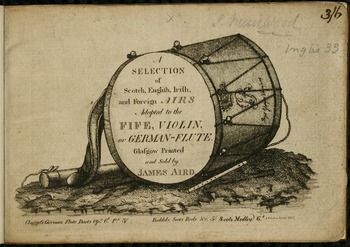
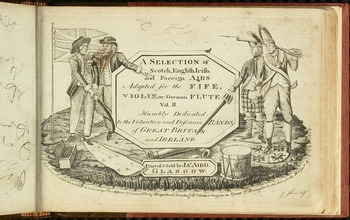
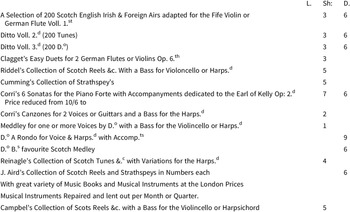
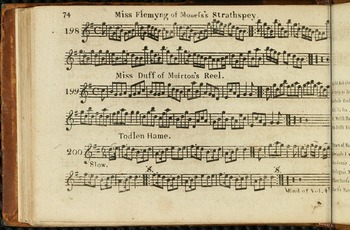
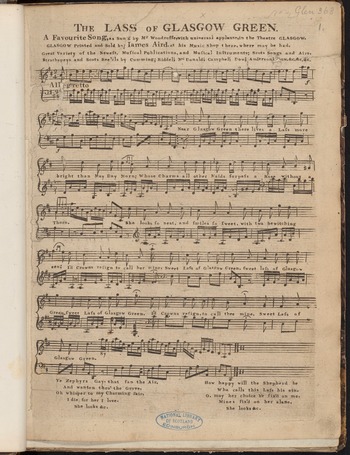
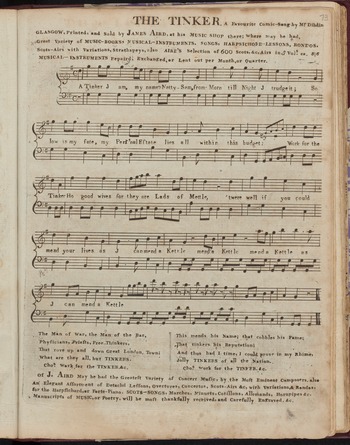
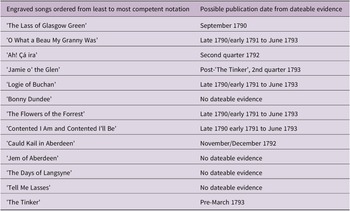

 Open access

