





1. Introduction
Design educators and practitioners play an essential role in fostering an inclusive society, as design solutions can either advance or hinder inclusivity. Inclusive innovations create products, services and built environments accessible to all, enhancing social participation and equity. They can also enable organisations to reach a broader range of users and foster long-term relationships (Dong et al. Reference Dong, Keates, Clarkson, Stary and Stephanidis2004). In contrast, biased technologies perpetuate inequalities and exacerbate exclusion. (Angwin et al. Reference Angwin, Larson, Mattu and Kirchner2016; Hutchison Reference Hutchison2019; Taati et al. Reference Taati, Zhao, Ashraf, Asgarian, Browne, Prkachin, Mihailidis and Hadjistavropoulos2019)
Several design principles have been introduced to advance inclusion in design. Inclusive design challenges the notion of designing for an “average” user by proposing that people are often disabled by design and seeks to develop solutions that serve diverse bodies and abilities (Clarkson et al. Reference Clarkson, Keates, Coleman and Lebbon2003). More recently, design justice has highlighted how design can reproduce inequalities related to race, gender, class and other intersecting identities (Costanza-Chock Reference Costanza-Chock2018). Together, these perspectives underscore the responsibility of designers not only to create solutions that serve diverse needs but also to reflect critically on the values and exclusions that design reproduces.
Despite growing awareness, designers still often treat inclusion as an afterthought or limit it to certain project briefs (Holmes Reference Holmes2018; Tatara and Giannoumis Reference Tatara and Giannoumis2017). They are also frequently unaware of the biases embedded in their designs until issues emerge (Norman Reference Norman2013). This is partly because, in favouring “solutions that sell” (Penny Reference Penny2014), the “default” imagined users are often the privileged ones – typically white, male, able-bodied, middle-class and with high technology literacy (Costanza-Chock Reference Costanza-Chock2018). As a result, the needs of underrepresented groups are frequently overlooked or deprioritised. Advancing inclusivity in design, therefore, requires not only tools and methods but also a mindset that deliberately considers non-typical users throughout the design process. Several scholars refer to this mindset as an “inclusive mindset” (e.g., Nezafati et al. Reference Nezafati, Schley and Le Doux2022; Valgeirsdottir Reference Valgeirsdottir2021; Zallio and Clarkson Reference Zallio and Clarkson2021).
In design, mindset refers to the practice-oriented understanding that shapes how designers interpret tasks and contexts to apply design methods appropriately (Andreasen et al. Reference Andreasen, Hansen and Cash2015). Building on this, Lavrsen et al. (Reference Lavrsen, Carbon and Daalhuizen2024) define a design mindset as the beliefs and attitudes that guide how designers understand design situations, make sense of challenges and select suitable activities. Similarly, Gaim and Wåhlin (Reference Gaim and Wåhlin2016) describe a design thinking mindset as a habitual outlook that determines how one interprets and responds to situations. Taken together, these perspectives suggest that mindsets are central to how designers frame problems, engage with contexts and enact design practices.
Nevertheless, the notion of an inclusive mindset – an orientation that prioritises inclusivity throughout the design process – remains underexplored and insufficiently defined. This lack of conceptual clarity presents a challenge for design practitioners and educators seeking to advance inclusion. While several design tools and methods have been developed to support inclusive practices, they do not necessarily shape the underlying attitudes or motivations that guide designers’ decisions. Furthermore, most tools, such as the inclusive design cube (Clarkson and Coleman Reference Clarkson and Coleman2015), the ability prompt card (Valgeirsdottir Reference Valgeirsdottir2021) and the value-sensitive design (Nezafati et al. Reference Nezafati, Schley and Le Doux2022), primarily focus on assessing inclusion and exclusion in design. Because inclusive design involves not only analytical evaluation but also user involvement and stakeholder management (Clarkson and Coleman Reference Clarkson and Coleman2015), an inclusive mindset is essential for both the analytical design process and interpersonal interactions.
To address the gap, this study examines what constitutes an inclusive mindset and how it can support inclusion in design. We begin with a scoping review of existing literature to explore how an inclusive mindset has been addressed across disciplines. The concept of mindset originates in psychology, where it has been described as a sum of cognitive processes, cognitive filters or beliefs (French II Reference French2016). Meanwhile, an inclusive mindset has been widely discussed in fields such as inclusive education and leadership studies. Drawing on these broader perspectives enriches our understanding of an inclusive mindset in the context of design.
Insights from the review informed the development of the inclusive mindset model, which explains its key constructs and underlying mechanisms. The model was subsequently validated through stakeholder interviews in design and engineering education to ensure its relevance and applicability. Ultimately, this study provides a framework that supports the enhancement of interventions, tools and methods for promoting inclusivity within design research, education and practice.
2. Methods
This study follows the design research methodology as outlined by Blessing and Chakrabarti (Reference Blessing and Chakrabarti2009). Specifically, it serves as a review-based study of the existing situation, aiming to gain a deeper understanding of what constitutes an inclusive mindset. A scoping review is an appropriate approach for clarifying concepts within the literature (Munn et al. Reference Munn, Peters, Stern, Tufanaru, McArthur and Aromataris2018). Therefore, we conducted a scoping review following Arksey and O’Malley’s (Reference Arksey and O’Malley2005) five-stage framework, as refined by Levac et al. (Reference Levac, Colquhoun and O’Brien2010).
First, we identified the primary research questions guiding this scoping review: What constitutes an inclusive mindset? To answer this question, we defined the scope of inquiry to ensure sufficient direction and focus throughout the review process. This scope explores different aspects of how the inclusive mindset is discussed in the literature, namely (1) the research areas in which it appears, (2) the types of diversity it addresses, (3) its definitions, (4) its related attributes and (5) its influencing factors.
Second, recognising that societal context influences designers’ attitudes (Kille-Speckter and Nickpour Reference Kille-Speckter, Nickpour, Lockton, Lenzi, Hekkert, Oak, Sádaba and Lloyd2022), we expanded our search beyond design literature. We conducted a systematic search across Scopus, Web of Science and Google Scholar on 19 January 2024 to ensure comprehensive coverage across disciplines. Scopus and Web of Science were chosen for their extensive indexing of international, peer-reviewed publications, while Google Scholar was included to capture theses and other scholarly works not indexed in traditional databases. The search strategy focused on identifying studies that explicitly discussed the terms “inclusive mindset” or “inclusive mind-set” in titles, abstracts or keywords. Table 1 presents the databases, search strings and applied filters.
Databases and search strings used to locate literature

Table 1. Long description
The table has three columns labeled Database name, Search string, and Note. The first row lists Scopus with the search string ‘inclusive mindset’ or ‘inclusive mind-set’ and the note ‘Search filter: Articles, Abstract, Keywords’. The second row lists Web of Science with the same search string and the note ‘Search filter: Topics’. The third row lists Google Scholar with the same search string and the note ‘Search filter: Title’.
Both published and unpublished literature were considered. Unpublished literature refers to scholarly work not formally published in peer-reviewed outlets, such as theses identified through Google Scholar. The search yielded 65 results (38 from Scopus, 12 from Web of Science and 15 from Google Scholar). After removing duplicates, 47 unique records were retained.
Third, we adopted an inclusive approach to our study selection and included all studies found in the previous stage. Unlike typical scoping reviews, where additional relevance criteria are applied, this review retained all records that met the initial inclusion criteria – namely, studies written in English that explicitly discussed the term “inclusive mindset” or “inclusive mind-set.” All results retrieved were scholarly works, comprising 35 peer-reviewed papers, eight book chapters and four theses (three master’s and one bachelor’s). This approach ensured a comprehensive overview of how the concept of an inclusive mindset has been addressed across different contexts.
Fourth, we extracted the data from the reviewed studies to gather bibliographic details, such as authors, title and year of publication, alongside responses to the five scoping areas. We manually coded the extracted data and organised it using Microsoft Excel. The coding process followed an inductive approach, where key information from the studies was systematically categorised to facilitate further analysis. As part of this iterative approach, the coding categories were continuously developed, revised and refined over time to accommodate new insights emerging from the data. This iterative process ensured a thorough exploration of coding categories and a comprehensive understanding of the reviewed literature (Thomas Reference Thomas2006).
To ensure reliability and validity, a subset of the literature was independently coded by the second author, who conducted the coding process without access to the initial codes generated by the first author to minimise potential bias. Following the completion of coding, the resulting codes were compared, and discrepancies were resolved through collaborative discussion and consensus building. This process aimed to enhance the consistency and accuracy of the coding and to validate the reliability of the findings.
Fifth, we conducted a numerical and thematic analysis of the coded data in Microsoft Excel. The numerical analysis involved frequency counts to quantify the occurrence of different categories and concepts within the data (Arksey and O’Malley Reference Arksey and O’Malley2005). The thematic analysis qualitatively identified themes or patterns within the dataset in relation to the research questions (Braun and Clarke Reference Braun and Clarke2006). Based on these analyses, we developed an inclusive mindset model to conceptualise the findings of the scoping review.
We then conducted consultations to validate and refine the model. Levac et al. (Reference Levac, Colquhoun and O’Brien2010) suggest that consultation should be considered an essential component of scoping reviews to enhance methodological rigour. They recommend that researchers use preliminary findings from the analytical stage to inform the consultation. Accordingly, we conducted semi-structured interviews with 23 stakeholders across three groups: eight engineering educators, eight inclusivity advocates in inclusive design and engineering education and seven engineering students.
As the scoping review findings were from broad multidisciplinary literature, the purpose of these interviews was to assess the model’s relevance and applicability within design and engineering education. During the interviews, participants were first asked how they define an inclusive mindset, followed by a presentation of the preliminary inclusive mindset model for their feedback and suggestions. The interview data were analysed thematically in Microsoft Excel to identify patterns across participant groups (Braun and Clarke Reference Braun and Clarke2006). The resulting insights were used to refine the inclusive mindset model. The findings of the scoping review and the final model are presented in the following sections.
3. Findings
The scoping review evaluated 47 sources (see overview in Appendix A) from diverse geographical regions, demonstrating a global engagement with the inclusive mindset concept. Our temporal analysis reveals an increasing trend in scholarly engagement with the concept, with the earliest work dating to 2002, and major contributions appearing post-2020 (see Figure 1).
Publications per year (n = 47).

The key findings of each scope of inquiry are presented below.
3.1. Research areas or disciplines
The concept of an inclusive mindset appears across various research areas and disciplines, with a predominant focus on educational and organisational contexts.
Most of the evaluated works (n = 32) examine the role of an inclusive mindset within educational contexts. They cover topics such as inclusive pedagogy, educational policy and curriculum development. Within this category, higher education emerges as the most prominent sub-discipline, comprising 20 publications. These studies address an inclusive mindset in multiple disciplines, including engineering education (n = 7), teacher education (n = 4) and management education (n = 2). Additionally, other education levels (e.g., primary and secondary education) and areas (e.g., special and music education) are also represented.
Organisational contexts account for a notable portion of the literature (n = 11). Among these publications, four address the role of inclusive mindsets in fostering diverse and inclusive workplace environments. An additional four works focus on inclusive leadership, highlighting the significance of leaders’ attitudes and behaviours in shaping inclusive organisational cultures. The remaining studies discuss inclusive mindsets within the context of recruitment processes, emphasising the necessity for unbiased hiring approaches.
A small subset of the literature (n = 3) discusses the concept of an inclusive mindset within the realm of accessibility, addressing issues related to web, museum and architectural accessibility.
Lastly, a few works (n = 3) explore an inclusive mindset within other domains: Artificial Intelligence (AI), tourism and social quality. Furthermore, three studies address two research areas – specifically, combinations of accessibility and education, education and organisation and organisation and AI. This overlap highlights the cross-disciplinary relevance of the inclusive mindset concept.
3.2. Types of inclusivity
An analysis of the reviewed literature uncovers various types of inclusivity and beneficiary groups when discussing an inclusive mindset.
Slightly more than half of the sources (n = 25) focus on a specific dimension of inclusivity or targeted groups. Disabilities emerge as the most prevalent theme in these works, with 14 studies centring their discussions on individuals with disabilities (e.g., physical impairments, learning disparities and neurodiversity). The remaining 11 studies in this category address various diversity dimensions, including gender, sexual orientations, races, cultural and sociological backgrounds, opinions and individuals with criminal records. While these works emphasise specific forms of inclusivity, many also acknowledge other dimensions of inclusivity in their publications.
Conversely, the other half of the literature (n = 22) adopts a broader perspective. They address multiple types of inclusivity or the general concept of inclusion. These types of inclusivity include gender, disabilities, race, ethnicity, culture, religion, physiological differences (e.g., left-handed, obese), socioeconomic status, sexuality, age, language and immigration status. Some studies explore general inclusion principles, referring to terms such as “under-represented groups,” “different social identities,” “team inclusivity” and “diverse learners.” Additionally, two publications do not explicitly state the types of inclusivity they address. Instead, they refer to an “inclusive mindset” as part of an essential skill (Chan et al. Reference Chan, Dorata, Ulrich, Dorata, Jones, Mensche and Ulrich2023) and a trait of Generation Z (Seibert Reference Seibert2021).
3.3. Inclusive mindset definition
Among the 47 works reviewed, only one study provides an explicit definition of an inclusive mindset. Forsberg (Reference Forsberg2022) develops an inclusive mindset situational judgment test within a workplace context. Therefore, she defines an inclusive mindset as “the degree to which an individual builds and maintains supportive and caring relationships that facilitate others’ perceptions that different perspectives are valued and respected” (p.8). This definition derives from the concept of workgroup inclusion, with additional behavioural aspects.
An additional 10 publications imply that an inclusive mindset involves learning and embracing differences (Eadens and Eadens Reference Eadens, Eadens, Papa, Eadens and Eadens2016), providing flexibility (Jones Young Reference Jones Young2022; Wiebusch Reference Wiebusch2013), embracing social justice (Cherrez et al. Reference Cherrez, McBrien, Scott, Hokanson, Exter, Schmidt and Tawfik2023), respecting diversity (Cohen Carrus Reference Cohen Carrus2017; Purwanto et al. Reference Purwanto, Mukharrom, Yusdani and Nasih2019), designing with accessibility in mind (Altinier et al. Reference Altinier, Oncins, Sauberer, Mehigan, Yilmaz, Clarke, Messnarz and Wöran2022), serving all stakeholders (Prasad et al. Reference Prasad, Rao and Vaidya2019), pursuing diversity and equity (Bosio Reference Bosio2023) and thinking inclusively (Valgeirsdottir Reference Valgeirsdottir2021).
Nevertheless, most literature does not offer explicit definitions of an inclusive mindset. This absence may stem from an assumption that the term is widely understood. However, our review demonstrates a diverse range of interpretations among scholars. This variation underscores the complexity of the concept and the necessity for further clarification and exploration of its related attributes.
3.4. Related attributes of an inclusive mindset
The thematic analysis of the 47 reviewed sources reveals a wide range of attributes associated with an inclusive mindset. These attributes can be classified into two intertwined categories: invisible and visible.
3.4.1. Invisible attributes
Invisible attributes represent the internal cognitive and affective qualities associated with an inclusive mindset. Open-mindedness and awareness are the most frequently discussed fundamental elements of an inclusive mindset. Open-mindedness refers to being open to acknowledging one’s own biases (Japar et al. Reference Japar, Hermanto, Muyaroah, Susila and Alfani2023; Wagemans Reference Wagemans2022), valuing different perspectives (Culp and Jones Reference Culp and Jones2023; Purwanto et al. Reference Purwanto, Mukharrom, Yusdani and Nasih2019; Weaver Reference Weaver2002; Wu Reference Wu2021) and having a genuine interest in learning about differences (Bosio Reference Bosio2023; Forsberg Reference Forsberg2022). It also entails tolerance towards people from diverse backgrounds (Brooks and Strunc Reference Brooks, Strunc, Huffman, Cunningham, Shavers and Adamson2022; Japar et al. Reference Japar, Hermanto, Muyaroah, Susila and Alfani2023) and a willingness to adapt one’s approach (Moriarty Reference Moriarty2007; Weaver Reference Weaver2002).
Awareness encompasses both self and social awareness. Self-awareness involves recognising one’s own biases (Jones Young Reference Jones Young2022; Owen Reference Owen2021), prejudice (Eadens and Eadens Reference Eadens, Eadens, Papa, Eadens and Eadens2016) and privileges (Malhotra and Pingali Reference Malhotra and Pingali2020). Meanwhile, social awareness relates to understanding diverse social identities (Cherrez et al. Reference Cherrez, McBrien, Scott, Hokanson, Exter, Schmidt and Tawfik2023), the challenges faced by different populations (Bandyopadhyay et al. Reference Bandyopadhyay, Das and Mahajan2021; Blaskova and Gibson Reference Blaskova and Gibson2023) and the impact of non-inclusive products (Nezafati et al. Reference Nezafati, Schley and Le Doux2022). Bridging these two dimensions is awareness of how biases and assumptions influence decision-making, design artefacts and the built environment (Cherrez et al. Reference Cherrez, McBrien, Scott, Hokanson, Exter, Schmidt and Tawfik2023; Jones Young Reference Jones Young2022; Nezafati et al. Reference Nezafati, Schley and Le Doux2022). Active self-reflection on these aspects is frequently described as a means of cultivating such awareness (e.g., Blake-Beard et al. Reference Blake-Beard, Shapiro and Ingols2021; Cherrez et al. Reference Cherrez, McBrien, Scott, Hokanson, Exter, Schmidt and Tawfik2023; Nezafati et al. Reference Nezafati, Chua and LeDoux2020)
A significant number of studies list empathy for individuals with different backgrounds and circumstances as an important aspect of an inclusive mindset. For example, Altinier et al. (Reference Altinier, Oncins, Sauberer, Mehigan, Yilmaz, Clarke, Messnarz and Wöran2022) and Nezafati et al. (Reference Nezafati, LeDoux, Pierre and Shook2021) argue that empathy can serve as an emotional reason to change towards inclusion. Moreover, several works discuss that an inclusive mindset is associated with certain knowledge and skills. This inclusive competence includes bias regulation (Wiebusch Reference Wiebusch2013), interpersonal skills (Forsberg Reference Forsberg2022; Japar et al. Reference Japar, Hermanto, Muyaroah, Susila and Alfani2023) and knowledge regarding various diversity dimensions and intersectionality (Blake-Beard et al. Reference Blake-Beard, Shapiro and Ingols2021; Dodge Reference Dodge, Ortlieb and Cheek2017; Emmers et al. Reference Emmers, Baeyens and Petry2021). For designers, an understanding of users, tasks and inclusive design is also relevant (Altinier et al. Reference Altinier, Oncins, Sauberer, Mehigan, Yilmaz, Clarke, Messnarz and Wöran2022).
Literature further suggests that individuals with an inclusive mindset hold inclusive values. They see differences as valuable (Cherrez et al. Reference Cherrez, McBrien, Scott, Hokanson, Exter, Schmidt and Tawfik2023; Cohen Carrus Reference Cohen Carrus2017) and focus on individuals’ strengths rather than their limitations or impairments (Culp and Jones Reference Culp and Jones2023; Eadens and Eadens Reference Eadens, Eadens, Papa, Eadens and Eadens2016; Thomas et al. Reference Thomas, Phillips, Lee, Tansey, Ochrach, Anderson and Lee2021). Several studies also highlight positive attitudes and feelings towards diversity and inclusion as part of an inclusive mindset (Bandyopadhyay et al. Reference Bandyopadhyay, Das and Mahajan2021; Bradford et al. Reference Bradford, Diaz and Schilling2021). Respect is equally discussed. It involves seeing everyone as equal (Cohen Carrus Reference Cohen Carrus2017; Purwanto et al. Reference Purwanto, Mukharrom, Yusdani and Nasih2019) and not regarding disability as a pathological deficit (Kopmann and Zeinz Reference Kopmann and Zeinz2018).
Finally, sensitivity and compassion are identified as attributes of an inclusive mindset. Sensitivity relates to being responsive to how biases, contexts and individual differences affect others’ experiences (La Fors Reference La Fors2022; Wiebusch Reference Wiebusch2013). Compassion, on the other hand, involves care and acceptance towards others and oneself. It includes embracing diversity (Japar et al. Reference Japar, Hermanto, Muyaroah, Susila and Alfani2023; Wagemans Reference Wagemans2022) and being mindful of one’s own biases and assumptions (Owen Reference Owen2021).
Table 2 summarises invisible attributes identified from the thematic analysis. It should be noted that the frequencies reported in the table(s) indicate how often each attribute appeared across the reviewed sources and are not intended to reflect their relative importance or weight.
Invisible attributes of an inclusive mindset identified in the reviewed literature

Table 2. Long description
The table has three columns: Invisible attribute, Description or example, and Sources (n). From top to bottom, the rows are as follows. Open-mindedness: Being open to differences and willing to adjust one’s approaches, 17 sources. Awareness: Being aware of one’s biases, privileges and systemic inequities, 16 sources. Self-reflection: Reviewing one’s context, biases and exclusions, 11 sources. Empathy: Understanding individuals with different circumstances, 10 sources. Inclusive competence: Having knowledge and skills of inclusive practices and contexts, 9 sources. Inclusive values: Seeing diversity and inclusion as valuable, 8 sources. Positive attitude: Having positive attitudes or feelings towards diversity and inclusion, 7 sources. Respect: Treating others equally and respectfully, 7 sources. Sensitivity: Being responsive to others’ feelings and circumstances, 6 sources. Compassion: Having compassion and acceptance towards oneself and others, 5 sources.
3.4.2. Visible attributes
Visible attributes are observable actions or behaviours that demonstrate inclusivity. They serve as tangible indicators of an inclusive mindset. Designing with inclusion in mind is the most frequently identified visible attribute. Often referred to as inclusive design, universal design or design for all, these approaches share the same goal of making designs and environments benefit as many diverse individuals as possible (Nezafati et al. Reference Nezafati, Schley and Le Doux2022; Valgeirsdottir Reference Valgeirsdottir2021; Zallio and Clarkson Reference Zallio and Clarkson2021). It includes considering users who are typically overlooked or excluded, such as people with disabilities. In education, this principle is reflected in universal design for learning, in which educators design classroom environments and learning materials that support learners with diverse abilities and social identities (Cherrez et al. Reference Cherrez, McBrien, Scott, Hokanson, Exter, Schmidt and Tawfik2023). Similarly, researchers can make their work accessible and understandable to non-scientists (Wiebusch Reference Wiebusch2013).
Providing flexibility is another recurring behaviour associated with an inclusive mindset, most prominently discussed in educational literature. It involves adapting and modifying approaches as needed to accommodate diverse needs (Cohen Carrus Reference Cohen Carrus2017; Malhotra and Pingali Reference Malhotra and Pingali2020). Examples include allowing children with lower levels of competence or confidence to learn at their own pace and offering different methods to enhance successful learning (Jefferson-Buchanan Reference Jefferson-Buchanan2022), adapting learning instruments to meet varied needs (Culp and Jones Reference Culp and Jones2023) and using the greatest number of instructional approaches (Moriarty Reference Moriarty2007).
A further expression of an inclusive mindset is involving diverse individuals. Such involvement entails considering diverse users and teammates beyond particular contexts (Nezafati et al. Reference Nezafati, LeDoux, Pierre and Shook2021) and allowing underrepresented groups or those affected by the outcomes to inform key decisions (Ashton-Hay and Williams Reference Ashton-Hay and Williams2023; Weaver Reference Weaver2002). Another expression is challenging current approaches, which involves questioning existing norms and practices to assess their inclusivity. For example, leaders are encouraged to review organisational policies, such as recruitment procedures, to identify potential biases (Blake-Beard et al. Reference Blake-Beard, Shapiro and Ingols2021; Jones Young Reference Jones Young2022). Similarly, designers should challenge how current designs and solutions can be scaled up for broader users (Valgeirsdottir Reference Valgeirsdottir2021).
Moreover, building supportive relationships is also an attribute of an inclusive mindset. This includes valuing different perspectives (Forsberg Reference Forsberg2022), making people feel heard and valued (Brooks and Strunc Reference Brooks, Strunc, Huffman, Cunningham, Shavers and Adamson2022) and developing meaningful relationships with diverse individuals (Eadens and Eadens Reference Eadens, Eadens, Papa, Eadens and Eadens2016). At the same time, using inclusive language serves as a means of expressing inclusivity. Inclusive language involves choosing words and actions that invite participation and acknowledge others’ contributions (Forsberg Reference Forsberg2022), focusing on their abilities rather than limitations. For instance, Thomas et al. (Reference Thomas, Phillips, Lee, Tansey, Ochrach, Anderson and Lee2021) suggest avoiding the term “disability,” while Eadens and Eadens (Reference Eadens, Eadens, Papa, Eadens and Eadens2016) recommend using people-first language, such as “child with autism” instead of “autistic child.”
Having an inclusive mindset also means going beyond minimum requirements. For example, companies with a disability-inclusive mindset strive to cultivate a disability-inclusive culture beyond the requirements of anti-discrimination laws (Ochrach et al. Reference Ochrach, Thomas, Phillips, Mpofu, Tansey and Castillo2022). Meanwhile, teachers with an inclusive mindset may proactively learn the social contexts of their diverse learners (Dodge Reference Dodge, Ortlieb and Cheek2017). Finally, an inclusive mindset involves treating others respectfully. This entails not bullying, blaming, ignoring, discriminating against or physically attacking people with different backgrounds, identities or beliefs (Massouti Reference Massouti2021; Wagemans Reference Wagemans2022).
Table 3 summarises visible attributes identified from the thematic analysis.
Visible attributes of an inclusive mindset identified in the reviewed literature

Table 3. Long description
The table has three columns labeled from left to right as Visible attribute, Description or example, and Sources n. The first row lists Designing with inclusion in mind, described as making designs and environments benefit as many people as possible, with 10 sources. The second row is Providing flexibility, described as adapting approaches to accommodate diverse needs, with 9 sources. The third row is Involving diverse individuals, described as engaging diverse or underrepresented groups in decision-making, with 7 sources. The fourth row is Challenging current approaches, described as examining norms and biases embedded in current practices, with 6 sources. The fifth row is Building supportive relationships, described as making people feel heard and valued, with 3 sources. The sixth row is Using inclusive language, described as using language that acknowledges others’ contributions and strengths, with 3 sources. The seventh row is Going beyond minimum requirements, described as proactively advancing inclusion beyond compliance or legal standards, with 2 sources. The eighth row is Treating others with respect, described as acting respectfully towards diverse individuals, with 2 sources.
3.5. Factors influencing an inclusive mindset
A thematic analysis of the literature reveals that several factors influence an inclusive mindset. These factors are often interconnected but can be categorised into internal and external factors.
3.5.1. Internal factors
Internal factors encompass individuals’ attributes and characteristics that shape an inclusive mindset. A significant body of literature highlights awareness and self-reflection as fundamental to developing an inclusive mindset. This awareness includes acknowledging one’s own biases and understanding how they influence design decisions (e.g., Jones Young Reference Jones Young2022; Nezafati et al. Reference Nezafati, Schley and Le Doux2022; Owen Reference Owen2021). It also encompasses recognising the challenges faced by different populations (e.g., Blaskova and Gibson Reference Blaskova and Gibson2023; Eadens and Eadens Reference Eadens, Eadens, Papa, Eadens and Eadens2016). This awareness often results from active self-reflection around these topics (Blake-Beard et al. Reference Blake-Beard, Shapiro and Ingols2021; Cherrez et al. Reference Cherrez, McBrien, Scott, Hokanson, Exter, Schmidt and Tawfik2023; Massouti Reference Massouti2021).
Attitudes, beliefs and perceptions also influence an inclusive mindset. Individuals’ attitudes towards certain populations determine their willingness to act inclusively (e.g., Bradford et al. Reference Bradford, Diaz and Schilling2021; Culp and Jones Reference Culp and Jones2023; Ochrach et al. Reference Ochrach, Thomas, Phillips, Mpofu, Tansey and Castillo2022). Beliefs about human ability and resource availability affect inclusion-related behaviour. For example, educators who believe intelligence can be developed are more likely to adopt inclusive teaching practices (Kopmann and Zeinz Reference Kopmann and Zeinz2018). Similarly, self-related perceptions, such as self-concept (Cohen Carrus Reference Cohen Carrus2017), self-efficacy (Bosio Reference Bosio2023; Kopmann and Zeinz Reference Kopmann and Zeinz2018), perceived behavioural control (Forsberg Reference Forsberg2022) and social identity (Forsberg Reference Forsberg2022; Steinthorsson Reference Steinthorsson2021; Vignola et al. Reference Vignola, Flowers and Coley2019), also shape individuals’ inclusive orientations.
Understanding is another key factor, encompassing both affective and cognitive dimensions. Empathy is frequently highlighted as a catalyst for inclusion (e.g., Altinier et al. Reference Altinier, Oncins, Sauberer, Mehigan, Yilmaz, Clarke, Messnarz and Wöran2022; Bandyopadhyay et al. Reference Bandyopadhyay, Das and Mahajan2021 ; Jones Young Reference Jones Young2022). Meanwhile, possessing knowledge about diversity, social identities and inclusive practices enhances individuals’ ability to engage in inclusive behaviours (e.g., Cohen Carrus Reference Cohen Carrus2017; Dodge Reference Dodge, Ortlieb and Cheek2017; Lowy et al. Reference Lowy, Gao, Hall and Kim2023).
Furthermore, intention and motivation guide the development of an inclusive mindset. Personal values (Bosio Reference Bosio2023), interests (Massouti Reference Massouti2021) and intrinsic motivation (Altinier et al. Reference Altinier, Oncins, Sauberer, Mehigan, Yilmaz, Clarke, Messnarz and Wöran2022; Nezafati et al. Reference Nezafati, Schley and Le Doux2022; Zallio and Clarkson Reference Zallio and Clarkson2021) all play significant roles. These factors influence how people prioritise things (Brooks and Strunc Reference Brooks, Strunc, Huffman, Cunningham, Shavers and Adamson2022) and their willingness to learn about differences and engage in inclusive behaviour. For instance, recognising the benefits of diversity and inclusion helps foster an inclusive mindset (e.g., Bandyopadhyay et al. Reference Bandyopadhyay, Das and Mahajan2021; Steinthorsson Reference Steinthorsson2021).
Certain skills and competencies also support an inclusive mindset. These competencies include perspective-taking (Cohen Carrus Reference Cohen Carrus2017; Lowy et al. Reference Lowy, Gao, Hall and Kim2023), critical thinking (Nezafati et al. Reference Nezafati, Chua and LeDoux2020), autonomy (Nezafati et al. Reference Nezafati, Schley and Le Doux2022), inclusive pedagogy (Massouti Reference Massouti2021; Moriarty Reference Moriarty2007) and inclusive design (e.g., Altinier et al. Reference Altinier, Oncins, Sauberer, Mehigan, Yilmaz, Clarke, Messnarz and Wöran2022; Valgeirsdottir Reference Valgeirsdottir2021; Zallio and Clarkson Reference Zallio and Clarkson2021).
Moreover, some personality traits are associated with an inclusive mindset. Forsberg (Reference Forsberg2022) found that ambition, sensitivity and humility can significantly predict an inclusive mindset. Meanwhile, other relevant traits include positive leadership (Altinier et al. Reference Altinier, Oncins, Sauberer, Mehigan, Yilmaz, Clarke, Messnarz and Wöran2022) and openness (Ashton-Hay and Williams Reference Ashton-Hay and Williams2023; Bradford et al. Reference Bradford, Diaz and Schilling2021).
Biases and assumptions can also influence an inclusive mindset. Particularly, biases and assumptions towards certain populations may hinder the development of an inclusive mindset (Nezafati et al. Reference Nezafati, Schley and Le Doux2022; Vignola et al. Reference Vignola, Flowers and Coley2019; Zallio and Clarkson Reference Zallio and Clarkson2021). Additionally, self-serving bias (Jones Young Reference Jones Young2022), social desirability bias (Blaskova and Gibson Reference Blaskova and Gibson2023) and representation bias can also play a role (Jones Young Reference Jones Young2022).
Another influencing factor concerns feelings. For example, psychological safety – feeling comfortable expressing oneself without fear of judgment – encourages individuals to engage in open dialogue, share diverse perspectives and challenge non-inclusive practices (Forsberg Reference Forsberg2022; Wagemans Reference Wagemans2022). Simultaneously, learning about one’s biases and social issues can induce cognitive dissonance (Emmers et al. Reference Emmers, Baeyens and Petry2021) and disoriented dilemmas (Owen Reference Owen2021). These processes may elicit negative feelings such as discomfort, but they present opportunities for personal growth and reflection.
Moreover, learning and sense-making play a pivotal role in developing an inclusive mindset. Transformative learning can be used to facilitate critical reflection and perspective shifts towards inclusion (Owen Reference Owen2021). Meanwhile, individuals’ interpretations of situations, others’ behaviour and the world around them further shape their inclusive orientation (Forsberg Reference Forsberg2022; Jones Young Reference Jones Young2022).
Relationships with diverse individuals also affect an inclusive mindset. Close relationships with people who have been affected by biases can strengthen empathy and awareness on this topic (Nezafati et al. Reference Nezafati, Schley and Le Doux2022; Zallio and Clarkson Reference Zallio and Clarkson2021). Similarly, previous experiences with certain populations or exposure to design bias can influence one’s perspectives. For example, educators with more experience working with individuals with disabilities may exhibit a greater inclusive mindset (Emmers et al. Reference Emmers, Baeyens and Petry2021).
Table 4 summarises the internal factors identified from the thematic analysis.
Internal influencing factors identified in the reviewed literature

Table 4. Long description
The table has three columns labeled Internal factor, Description or example, and Sources n. From top to bottom, the factors and their details are: Awareness and self-reflection, described as recognizing one’s biases and reflecting on their effects on decisions, with 24 sources. Attitudes, beliefs and perceptions, described as views about others and oneself, with 18 sources. Understanding, described as empathy towards others and knowledge of inclusivity, with 15 sources. Intention and motivation, described as values, goals and intrinsic drive to prioritize inclusion, with 14 sources. Competencies, described as skills such as perspective-taking, critical thinking and inclusive design, with 11 sources. Personality traits, described as dispositions such as openness, humility and sensitivity, with 7 sources. Biases and assumptions, described as stereotypes, self-serving or social biases, with 6 sources. Feelings, described as emotional responses to addressing and confronting bias, with 6 sources. Learning and sense making, described as learning and interpretation of social contexts, with 6 sources. Relationships, described as close connections that enhance empathy and challenge stereotypes, with 4 sources. Experience, described as prior exposure to diverse individuals or contexts, with 3 sources. The factors are ordered by the number of sources, highest to lowest.
3.5.2. External factors
External factors encompass broader societal influences that shape an individual’s mindset and behaviour towards inclusivity. A substantial body of literature promotes Learning interventions as mechanisms to cultivate an inclusive mindset. Training programmes, such as implicit bias training, are commonly used to increase awareness of biases and inclusivity issues (Owen Reference Owen2021). Various educational courses are designed to foster an inclusive mindset. Examples include an inclusive pedagogy course for pre-service teachers (Massouti Reference Massouti2021), a rural immersion programme for management students (Malhotra and Pingali Reference Malhotra and Pingali2020) and an inclusive design course for engineering students (Nezafati et al. Reference Nezafati, Schley and Le Doux2022). Learning materials, such as guidebooks (Cherrez et al. Reference Cherrez, McBrien, Scott, Hokanson, Exter, Schmidt and Tawfik2023; Thomas et al. Reference Thomas, Phillips, Lee, Tansey, Ochrach, Anderson and Lee2021; Valgeirsdottir Reference Valgeirsdottir2021), writing prompts (Nezafati et al. Reference Nezafati, Chua and LeDoux2020) and virtual reality tools (Lowy et al. Reference Lowy, Gao, Hall and Kim2023; Vignola et al. Reference Vignola, Flowers and Coley2019), can be utilised to develop awareness and knowledge on inclusivity.
Many studies also emphasise the role of the social and work environment in shaping an inclusive mindset. This environment comprises the surrounding people, the socialisation processes they create and the broader societal structures. Key figures include role models (Emmers et al. Reference Emmers, Baeyens and Petry2021), leaders (e.g., Forsberg Reference Forsberg2022), colleagues (e.g., Ochrach et al. Reference Ochrach, Thomas, Phillips, Mpofu, Tansey and Castillo2022) and stakeholders (Zallio and Clarkson Reference Zallio and Clarkson2021). These people form a socialisation process (e.g., organisational culture) that either supports or hinders inclusivity. A supportive environment that encourages curiosity and friendship can enhance an inclusive mindset (Chitra and Mohan Reference Chitra and Mohan2017; Eadens and Eadens Reference Eadens, Eadens, Papa, Eadens and Eadens2016; Prasad et al. Reference Prasad, Rao and Vaidya2019). On the other hand, a heteronormative environment can hinder it (Brooks and Strunc Reference Brooks, Strunc, Huffman, Cunningham, Shavers and Adamson2022). Broader societal structures, such as dominant practices (e.g., Vignola et al. Reference Vignola, Flowers and Coley2019), discourse (Chng et al. Reference Chng, Mårtensson and Leibowitz2020; Emmers et al. Reference Emmers, Baeyens and Petry2021) and technological systems (Lowy et al. Reference Lowy, Gao, Hall and Kim2023) also play a critical role.
Furthermore, social norms determine what behaviours are considered acceptable within society and influence attitudes towards various groups. Cultural expectations can limit inclusion by suppressing the rights or opportunities of specific populations, such as girls (Arinaitwe and Ahumuza Reference Arinaitwe and Ahumuza2023) and those who do not conform to heteronormative standards (Dodge Reference Dodge, Ortlieb and Cheek2017). In the past, those who did not fit in were often seen as a problem, whereas today, they can be recognised as accessibility or inclusion experts (Altinier et al. Reference Altinier, Oncins, Sauberer, Mehigan, Yilmaz, Clarke, Messnarz and Wöran2022). Accordingly, social norms can either promote or hinder an inclusive mindset and behaviour because people tend to conform to prevailing expectations through social desirability bias (e.g., Blaskova and Gibson Reference Blaskova and Gibson2023).
In addition, regulatory frameworks can impact an inclusive mindset. These frameworks include professional guidelines, standardised assessments, curricula, policies and regulations. For instance, the European Standard for Digital Accessibility and the IEEE Standard for Algorithmic Bias Considerations encourage developers to address inclusivity issues (Altinier et al. Reference Altinier, Oncins, Sauberer, Mehigan, Yilmaz, Clarke, Messnarz and Wöran2022; Weber-Lewerenz and Vasiliu-Feltes Reference Weber-Lewerenz and Vasiliu-Feltes2022). Furthermore, integrating inclusive value into conventional teaching requirements is crucial for fostering an inclusive mindset (Nezafati et al. Reference Nezafati, Schley and Le Doux2022).
Another influencing factor is resources and barriers. The availability of sufficient resources, including company support and access to relevant information, helps promote an inclusive mindset (Thomas et al. Reference Thomas, Phillips, Lee, Tansey, Ochrach, Anderson and Lee2021; Valgeirsdottir Reference Valgeirsdottir2021; Wagemans Reference Wagemans2022). Conversely, concerns about the costs or time needed to implement inclusive practices can limit engagement (Zallio and Clarkson Reference Zallio and Clarkson2021). Other common barriers involve the pressure to perform and busyness (Brooks and Strunc Reference Brooks, Strunc, Huffman, Cunningham, Shavers and Adamson2022), together with practical challenges such as class size and conventional teaching requirements (Moriarty Reference Moriarty2007; Nezafati et al. Reference Nezafati, Schley and Le Doux2022).
Interactions with diverse individuals also contribute to an inclusive mindset. Engaging with people from different backgrounds, abilities and perspectives broadens empathy and reduces bias. Particularly, intergroup contact, where individuals interact with others who are different from themselves, has been shown to promote inclusivity (Cohen Carrus Reference Cohen Carrus2017; Kopmann and Zeinz Reference Kopmann and Zeinz2018; Wagemans Reference Wagemans2022). Educational strategies such as incorporating student voices (Ashton-Hay and Williams Reference Ashton-Hay and Williams2023; Blake-Beard et al. Reference Blake-Beard, Shapiro and Ingols2021) and co-creating solutions with target populations (La Fors Reference La Fors2022; Valgeirsdottir Reference Valgeirsdottir2021) exemplify practices that enhance mutual understanding and empathy.
Moreover, global trends and movements towards greater diversity and inclusion influence the development of an inclusive mindset. These trends result from a shift in the mental framework of how people view diversity and are supported by research demonstrating the benefits of inclusion and diversity for organisations (Ochrach et al. Reference Ochrach, Thomas, Phillips, Mpofu, Tansey and Castillo2022). For instance, society has begun to view disability from a social perspective rather than a medical one, recognising that people are disabled by design and environment. This shift encourages a social responsibility framework and a more proactive approach to support people with disabilities (Moriarty Reference Moriarty2007).
Finally, communication plays a key role in framing how inclusivity is perceived and enacted. The discourse surrounding inclusivity – how it is framed and presented – plays a crucial role in influencing societal views (Chng et al. Reference Chng, Mårtensson and Leibowitz2020; Emmers et al. Reference Emmers, Baeyens and Petry2021). For instance, framing activities involving people with disabilities as volunteer opportunities may inadvertently reinforce power imbalances, hindering the development of reciprocal relationships (Cohen Carrus Reference Cohen Carrus2017). In contrast, communication that involves both top-down and bottom-up approaches can ensure that all voices are heard and valued (Ochrach et al. Reference Ochrach, Thomas, Phillips, Mpofu, Tansey and Castillo2022). Additionally, persuasive communication – rooted in credibility, likability and power – is essential for inducing attitudinal change (Emmers et al. Reference Emmers, Baeyens and Petry2021).
Table 5 summarises the external factors identified from the thematic analysis.
External influencing factors identified in the reviewed literature

Table 5. Long description
The table has three columns: External factor, Description or example, and Sources n. From top to bottom, the rows are: Learning interventions, described as educational programmes, trainings and learning tools, with 24 sources; Social or work Environments, described as influence of leaders, colleagues and organisational culture, with 22 sources; Social norms, described as cultural expectations and views towards a certain population, with 14 sources; Regulatory frameworks, described as professional guidelines, curricula, policies and regulations, with 13 sources; Resources and barriers, described as institutional supports and practical challenges, with 7 sources; Interactions with diverse individuals, described as engagement and collaboration with people from different backgrounds, identities and abilities, with 7 sources; Global trends, described as broader societal trends and movements, with 5 sources; Communication, described as how inclusivity and diversity are framed in public discourse, with 4 sources.
4. An inclusive mindset model
4.1. Model development
A preliminary inclusive mindset model (see Appendix B) was developed to conceptualise the findings of the scoping review. The model is structured into three main sections: what influences an inclusive mindset, what constitutes it and its resulting behaviours. This structure follows a cause-and-effect logic, where individual cognition is shaped by the contextual environment and subsequently results in behaviour. It aligns with psychology frameworks such as Bandura’s (Reference Bandura1986) Social Cognitive Theory and Ajzen’s (Reference Ajzen1991) Theory of Planned Behaviour.
The influencing factors of an inclusive mindset were derived from the findings in Section 3.5. In particular, external factors, including social norms, environment, learning interventions and interactions with diverse individuals, play a crucial role in shaping an inclusive mindset through continuous learning. Meanwhile, most internal factors, such as beliefs, motivation, and understanding, are embedded within the core constructs of an inclusive mindset.
The inclusive mindset itself comprises four key constructs: awareness, motivation, attitude and understanding, each informed by the invisible attributes identified in Section 3.4.1. Awareness encompasses both self and social awareness. Motivation reflects inclusive values. Attitude captures openness, acceptance and positive attitudes towards diversity and inclusion. Understanding integrates both cognitive inclusive competence and affective empathy.
An inclusive mindset subsequently translates into inclusive behaviours. However, this translation is influenced by contextual enablers or barriers. This non-guaranteed transition is represented by a dotted line, with arrows representing contextual factors pointing to it. Based on the visible attributes discussed in Section 3.4.2, we categorised inclusive behaviours into two domains: social interactions and design solutions. This distinction highlights multiple ways inclusivity can be enacted in practice. Finally, feedback from engaging in inclusive behaviours contributes to the ongoing learning process, further shaping one’s inclusive mindset.
4.2. Model validation and refinement
To validate the preliminary inclusive mindset model and assess its relevance and applicability to design science, we conducted semi-structured interviews with 23 stakeholders in design and engineering education. Participants generally agreed with the overall logic and completeness of the model while suggesting several refinements to enhance clarity, applicability and readability.
One key concern was the antecedents of an inclusive mindset. While the preliminary model presented only external influencing factors, several participants emphasised the importance of personal influences. Thus, personal factors were added to the model to include one’s personality, cognition and lived experience. Regarding the external factors, we renamed “learning interventions” to “education,” as many participants asked for clarification on the initial term. Additionally, “media” and “regulation” were added to emphasise their crucial role in shaping the mindset (Appel and Weber Reference Appel and Weber2021; Zallio and Clarkson Reference Zallio and Clarkson2021).
The interview also prompted a reorganisation of the core constructs of the inclusive mindset. When asked to describe an inclusive mindset before viewing the model, participants mostly mentioned open-mindedness, awareness and empathy. This aligns with the scoping review findings, where these attributes were also the most frequently discussed. Accordingly, open-mindedness and empathy were elevated from being sub-constructs to core constructs of an inclusive mindset.
Additionally, before seeing the model, participants rarely mentioned knowledge and competence as part of an inclusive mindset. One even noted that, with an inclusive mindset, “they may even do it wrong, but they want or try to be inclusive.” As such, knowledge and competence were repositioned from a sub-construct of the mindset to a key enabler bridging the mindset and behaviour. This change aligns with the Knowledge–Attitude–Behaviour model of assessment, which distinguishes between knowledge, attitude and behaviour (Schrader and Lawless Reference Schrader and Lawless2004). It is also consistent with the design thinking mindset conceptualisation that separates mindset from cognitive competence (Gaim and Wåhlin Reference Gaim and Wåhlin2016).
Moreover, participants appreciated that the model clearly distinguishes between mindset and behaviour, as well as the two domains of inclusive behaviour – social interaction and design. The list of inclusive behaviours underwent minor wording adjustments for clarity. However, many participants found the dotted line connecting the inclusive mindset to behaviour unclear. To address this, we replaced it with explicit text indicating that the translation from mindset to behaviour is supported or hindered by norms, regulations, resources and barriers.
Participants further agreed on the feedback learning loop, but some suggested that it should extend beyond the mindset itself. As one participant noted, “feedback process also gives you more information. That interaction with diverse individuals gives you more experience about how to be inclusive.” Reflecting this, the feedback loop was expanded to cover all elements, reinforcing the model’s dynamic and cyclical nature.
Furthermore, to raise awareness of various diversity dimensions, the preliminary model included the phrase “inclusive mindset towards…” with examples referring to specific populations such as people with disabilities, women and ethnic minorities. However, several participants found this wording unclear and cautioned that it could unintentionally reinforce an “us–them” distinction or power imbalance. As it is impossible to list every diversity dimension, keeping the phasing general enables readers to interpret and apply the model within their own context. Accordingly, we removed the phrase and designated populations from the final model. The overall model visual was also redesigned, from a horizontal to a vertical layout, to enhance readability.
Collectively, these refinements led to the inclusive mindset model (Figure 2), which integrates insights from both the scoping review and stakeholder validation. This integrative process ensured that the model was grounded in both empirical findings and theoretical reasoning to provide a robust framework for understanding and fostering inclusivity in design.
The inclusive mindset model.

Figure 2. Long description
At the top, environmental factors (environment, norms, media, education, regulations, global trends, interaction with diverse individuals) surround a central human icon labeled personality, cognition, lived experiences. An arrow points downward to the inclusive mindset box. This box contains five columns: open-minded (willingness and curiosity towards diversity), awareness (self-awareness of biases, social awareness), empathy (understanding of others’ feelings and perspectives), attitude (positive beliefs, feelings, intents towards diversity), and motivation (intrinsic such as value, extrinsic such as incentives). Another arrow leads down to knowledge and competence on how to foster inclusivity, which is supported or hindered by norms, regulations, resources, and barriers. The next arrow points to inclusive behavior, divided into two sections: in social interaction (use inclusive language, accommodate diverse needs, build supportive relationships, treat everyone respectfully, involve diverse individuals) and when designing solutions (challenge current approaches, design with inclusivity in mind, go beyond minimum requirements, include under-represented groups in the design or decision-making process). Feedback arrows loop from inclusive behavior back to the earlier stages of the model.
4.3. The inclusive mindset model
The inclusive mindset model (Figure 2) conceptualises an inclusive mindset as comprising five constructs: openness, awareness, empathy, attitude and motivation. These elements are shaped by both personal and contextual factors and together form the foundation for inclusive behaviour.
Regarding the core elements of an inclusive mindset, openness (i.e., open-mindedness) refers to a willingness to consider perspectives, values and beliefs that may challenge one’s own (Price et al. Reference Price, Ottati, Wilson and Kim2015). It also involves curiosity about differences (Bosio Reference Bosio2023; Forsberg Reference Forsberg2022) and a readiness to explore alternatives (Weaver Reference Weaver2002). At the same time, awareness enables individuals to recognise how their perspectives and actions influence inclusion. Self-awareness involves examining one’s biases, privileges and assumptions, while social awareness entails recognising systemic barriers that contribute to exclusion and how they affect different groups in society (Nezafati et al. Reference Nezafati, Schley and Le Doux2022).
Empathy refers to the ability to recognise others’ emotions, perspectives and lived experiences (Rogers Reference Rogers and Koch1959). It also encompasses empathic concern, which motivates care and efforts to improve others’ well-being (Batson Reference Batson2011). Meanwhile, attitude is a personal evaluation of someone or something and consists of three components: cognitive, affective and behavioural (Eagly and Chaiken Reference Eagly and Chaiken1998). Within an inclusive mindset, attitude encompasses positive beliefs, feelings and behavioural intentions towards diverse individuals.
Motivation determines whether intentions turn into action. Drawing on self-determination theory (Ryan and Deci Reference Ryan and Deci2000), intrinsic motivation arises from personal values on inclusion and diversity, fostering openness to learning and embracing differences. Extrinsic motivation, on the other hand, is shaped by external influences such as organisational incentives, regulatory frameworks or social expectations. An inclusive mindset often integrates both, where personal commitment aligns with external reinforcement.
These five constructs of an inclusive mindset are shaped by both internal and external factors. Internal factors include one’s personality, cognition and lived experience. Meanwhile, external factors encompass environment, norms, media, education, regulations, global trends and interactions with diverse individuals. Together, these factors interact to either support or hinder the development of an inclusive mindset.
The translation from an inclusive mindset to behaviour is then influenced by multiple factors. Knowledge and competence are key enablers in this process. Although a mindset determines one’s orientation towards inclusion, practical knowledge and relevant skills facilitate inclusive action. In addition, broader contextual conditions, such as social norms, regulations, resources and barriers, can support or hinder this translation.
Once enacted, inclusive behaviours manifest both in social interactions and when designing solutions. Examples of inclusive behaviour in social interactions include using inclusive language, accommodating diverse needs, building supportive relationships, treating others respectfully and involving diverse individuals. Meanwhile, inclusive behaviour when designing solutions involves challenging current approaches, designing with inclusivity in mind, going beyond minimum requirements and including underrepresented groups in the design/decision-making process. These behaviours often lead to a broader societal impact.
Finally, feedback from engaging in inclusive behaviours – whether positive or negative – influences an inclusive mindset and its surrounding factors. Positive experiences, such as successful collaboration or recognition, can strengthen motivation and thereby reinforce inclusive behaviours. Conversely, negative experiences, such as resistance or lack of support, may discourage inclusive action. However, challenges create opportunities for learning, helping individuals refine their understanding, build competence and deepen awareness. Through this iterative process, inclusive action not only strengthens one’s mindset and capacity but also contributes to shaping a more inclusive environment through evolving social norms or improved practices.
5. Discussion
This study developed and validated the inclusive mindset model, a conceptual framework that explains what constitutes an inclusive mindset and how it contributes to inclusion in design. The model was derived from a scoping review of existing literature and subsequently refined through stakeholder interviews in design and engineering education. To our knowledge, this is the first study to propose an empirically informed framework for studying and fostering an inclusive mindset.
In this section, we interpret the findings in relation to existing design literature and discuss how the inclusive mindset model contributes to advancing design for inclusion.
5.1. What constitutes an inclusive mindset
5.1.1. Inclusive mindset definition
As our literature search did not focus exclusively on design literature, it provides broader insights into the concept of an inclusive mindset. We found discrepancies in the meaning of an inclusive mindset even within design and engineering literature. Therefore, we adopted a broader definition of an inclusive mindset, grounded in the principles of social inclusion. The United Nations Department of Economic and Social Affairs ( 2016) defined social inclusion as:
the process of improving the terms of participation in society for people who are disadvantaged on the basis of age, sex, disability, race, ethnicity, origin, religion, or economic or other status, through enhanced opportunities, access to resources, voice, and respect for rights (p.20).
However, we argue that an inclusive mindset should address not only those considered disadvantaged but all individuals. First, due to intersectionality, defining who belongs to a disadvantaged group can be difficult. A person may experience privilege in some aspects of life (e.g., socioeconomic status) while facing disadvantages in others (e.g., disability or racial discrimination). Second, viewing individuals through the lens of disadvantage can hinder reciprocal relationships, where the strengths of those labelled as disadvantaged are overlooked or undervalued. Importantly, an inclusive mindset should be nurtured by all populations towards all populations, regardless of their demographics, ability or identity.
Therefore, we define an inclusive mindset as:
A psychological orientation that supports the process of improving the quality of participation for diverse populations, characterised by openness, awareness, empathy, positive attitudes towards diversity, and motivation that values inclusion.
This definition broadens the scope of inclusivity by recognising that while certain populations face systemic disadvantages, the goal of inclusivity is to foster environments where all diverse individuals can participate, contribute and thrive. It also clarifies that an inclusive mindset is not simply a belief or attitude towards inclusion but encompasses openness, awareness, empathy, and motivation necessary to create an inclusive society.
Moreover, this definition differs from Forsberg’s (Reference Forsberg2022) definition of an inclusive mindset in two ways. First, it does not incorporate the behavioural aspects. Separating a mindset from behaviour aligns with the conceptualisation of the design mindset (Lavrsen et al. Reference Lavrsen, Carbon and Daalhuizen2024) and design thinking mindset (Gaim and Wåhlin Reference Gaim and Wåhlin2016). Second, it covers contexts beyond workplace interpersonal relationships. In engineering design, an inclusive mindset is needed in both interpersonal interactions and design practices (Nezafati et al. Reference Nezafati, Schley and Le Doux2022).
5.1.2. An inclusive mindset for designers
Our definition of an inclusive mindset can be applied directly to the design context. The five constructs of an inclusive mindset – openness, awareness, empathy, attitude and motivation – clarify the qualities designers need to facilitate inclusive solutions.
First, openness reflects a designer’s willingness to consider diverse perspectives, challenge assumptions and explore alternative possibilities. It enables designers to see beyond their own experiences and question dominant norms that may shape design decisions. Openness is not limited to designing for inclusion. It is, in fact, recognised as a fundamental quality of good designers. For instance, openness is a key component of both the design mindset and the design thinking mindset (Gaim and Wåhlin Reference Gaim and Wåhlin2016; Lavrsen et al. Reference Lavrsen, Carbon and Daalhuizen2024).
Second, awareness is crucial in driving inclusivity in design. Designers are inclined to design for themselves (Clarkson et al. Reference Clarkson, Keates, Coleman and Lebbon2003). Since most design engineers are predominantly white, male and able-bodied (Design Engineer Demographics 2024), they may unintentionally overlook the needs or adverse effects on underrepresented populations. For instance, software used to predict criminal behaviour in the United States was found to reproduce racial bias (Angwin et al. Reference Angwin, Larson, Mattu and Kirchner2016), whereas medical and facial-recognition technologies fail to accommodate gender and age diversity (Hutchison Reference Hutchison2019; Taati et al. Reference Taati, Zhao, Ashraf, Asgarian, Browne, Prkachin, Mihailidis and Hadjistavropoulos2019). Awareness of exclusion is therefore the first step towards inclusive design (Clarkson et al. Reference Clarkson, Keates, Coleman and Lebbon2003) and design justice (Costanza-Chock Reference Costanza-Chock2020), as it guides designers to question potential biases embedded in their work.
Third, empathy enables designers to see and experience through another person’s eyes and understand the reasons behind their actions (Kelley and Kelley Reference Kelley and Kelley2013). Similar to openness, empathy is not unique to design for inclusion. Rather, it is a general capacity that helps designers understand users and bridge the different gaps (Jiancaro Reference Jiancaro, Filimowicz and Tzankova2018). It is a core element of the design thinking mindset and human-centred design (Schweitzer et al. Reference Schweitzer, Groeger and Sobel2016; Vignoli et al. Reference Vignoli, Dosi and Balboni2023). Overall, empathy is considered a key to successful design and can be fostered through design approaches that emphasise interaction, reflection and ethical thinking (Chang-Arana et al. Reference Chang-Arana, Surma-aho, Hölttä-Otto and Sams2022).
Fourth, a positive attitude, including beliefs and feelings, towards diversity and inclusion encourages designers to adopt inclusive design practices. Such an attitude involves viewing disability as a result of societal or design failures rather than individual impairment. Recognising that anyone, including themselves, can experience disability at different stages of life further emphasises the need for inclusive design (Clarkson et al. Reference Clarkson, Keates, Coleman and Lebbon2003).
Fifth, motivation drives designers to act on inclusivity issues and can be both intrinsic and extrinsic. Schweitzer et al. (Reference Schweitzer, Groeger and Sobel2016) identified the “desire and determination to make a difference” as part of the design thinking mindset. This desire reflects a form of intrinsic motivation that inspires designers to create value through design. In an inclusive mindset, this motivation is further directed towards fostering a more inclusive society. Such inclusive motivation may stem from personal values or be reinforced by external influences such as organisational incentives, policies and social norms.
All in all, an inclusive mindset integrates qualities fundamental to good design (i.e., openness and empathy) with additional dimensions that deliberately address inclusion, awareness of bias and value-driven motivation. It complements existing design mindsets by placing inclusivity not merely as a design outcome but as an underlying orientation guiding how designers think, act and make decisions. By identifying these core components, this study clarifies the qualities that need to be nurtured to advance design for inclusion.
5.2. Using the inclusive mindset model to advance design for inclusion
5.2.1. A framework to develop or assess learning interventions
The core constructs of an inclusive mindset (i.e., openness, awareness, empathy, attitude and motivation), together with its key enabler (i.e., knowledge and competence), can guide the development of learning interventions aimed at fostering design for inclusion. When developing a course, workshop or learning material, educators should consider both the knowledge and skills they want students to gain and the mindset elements they aim to cultivate. Since these components are interlinked and mutually reinforcing (Batson Reference Batson2011; Schrader and Lawless Reference Schrader and Lawless2004), effective learning interventions should target multiple elements of an inclusive mindset.
The value-sensitive design intervention by Nezafati et al. (Reference Nezafati, Schley and Le Doux2022) provides a good example. Their approach begins with a reflective exercise asking students to reflect on the impact of non-inclusive products on themselves or people they care about. They are then invited to identify biases and assumptions underlying those designs. This reflection enhances students’ inclusive motivation by deepening their awareness and empathy. Students then learn technical knowledge and skills related to inclusive design through a subsequent redesign exercise. Together, these steps illustrate how multiple elements of an inclusive mindset can be integrated into learning experiences.
Furthermore, the inclusive mindset model outlines inclusive behaviours that educators can expect from students. It also underscores that inclusion in design extends beyond the final product to involve how designers collaborate within teams and engage with diverse stakeholders. The behavioural examples in the model make the concept of inclusion more concrete and actionable. Educators may explicitly communicate these expected behaviours to students or set them as learning outcomes.
The three-dimensional flow between inclusive mindset, knowledge and behaviour can also serve as a framework for learning evaluation. Assessing these three dimensions separately enables educators to identify areas for improvement. For example, if students show growth in the mindset but not in behaviour, this may suggest the need to further develop their knowledge and skills. Conversely, if knowledge improves but behavioural change does not follow, it may indicate a lack of motivation to apply that knowledge. If both mindset and knowledge are enhanced, but no inclusive behaviour is observed, this might suggest that the limiting factors lie beyond the effectiveness of the learning intervention. Such insights help educators understand whether the challenges lie in learning design, student engagement or the translation of mindset into action.
5.2.2. Beyond learning interventions
Learning interventions are not the only way to foster an inclusive mindset. Our model highlights that factors such as social norms, environment, regulations and interaction with diverse individuals also play a crucial role.
Societal norms set expectations around inclusion and shape how design decisions are made. Particularly, Kille-Speckter and Nickpour (Reference Kille-Speckter, Nickpour, Lockton, Lenzi, Hekkert, Oak, Sádaba and Lloyd2022) reviewed how societal attitudes towards people with disabilities have shaped design practices. During the industrial revolution, disability was predominantly viewed as a physical impairment that required correction, leading to the development of assistive devices. However, societal views shifted in the post-war era, as the influx of disabled veterans pushed disability into the realms of social welfare and civil rights. This change led to the implementation of accessibility standards and design practices aimed at creating a more inclusive environment. The rise in design for inclusivity since the mid-1990s reflects a shift in thinking towards framing disability as shaped by design and environment and is supported by the global ageing population trend.
Yet, despite emerging inclusive norms, exclusionary norms remain deeply embedded in many aspects of society, often unquestioned. Therefore, as design justice emphasises, designers must be norm-critical: actively examining the norms embedded in their environments, communications and, most importantly, their design solutions (Costanza-Chock Reference Costanza-Chock2018). This involves questioning who the designers and users are; who holds power and who is marginalised; and what values are being reproduced through design.
At the same time, designers should take an active role in establishing new inclusive norms both through design solutions and within professional cultures. For instance, the shift in terminology – from “impairment and treatment” to “accessibility and diversity” – has reframed conversations about inclusion, emphasising empowerment rather than limitation (Kille-Speckter and Nickpour Reference Kille-Speckter, Nickpour, Lockton, Lenzi, Hekkert, Oak, Sádaba and Lloyd2022). To foster inclusion in design, we must continually assess whether the narrative embedded in our communication, design processes and environments supports the norms we seek to promote.
In addition to the norms, organisational policies and market dynamics strongly influence whether inclusive intentions translate into action. Much design work takes place within consultancy or client-based settings, where priorities, such as budget constraints, client expectations and time pressure, can limit designers’ autonomy. Even when designers possess an inclusive mindset and competencies, their decisions may be overridden by leaders or stakeholders who prioritise efficiency or profit over inclusivity. As Lebbon and Morrow (Reference Lebbon and Morrow2002) note, cost is one of the biggest perceived barriers to implementing inclusive design. One way to counter this is to persuade decision-makers through successful business cases of inclusive solutions, highlighting their potential for market expansion as a strong commercial incentive (Clarkson et al. Reference Clarkson, Keates, Coleman and Lebbon2003).
Another approach is to strengthen regulatory frameworks and design standards that make inclusion a requirement rather than a choice. While persuading decision-makers with business cases can be effective, it may not be enough. Inclusion should not rely solely on individuals’ goodwill but be embedded within systems and institutional practices. Laws, standards and policies can ensure that inclusivity is not overlooked. For example, accessibility regulations in both physical and digital design have played a major role in mainstreaming inclusive practices (Altinier et al. Reference Altinier, Oncins, Sauberer, Mehigan, Yilmaz, Clarke, Messnarz and Wöran2022). Although inclusive designers should go beyond those standards, such regulatory requirements can make inclusion a baseline expectation rather than an optional ideal.
Furthermore, meaningful intergroup contact is effective at reducing intergroup prejudice, especially under Allport’s optimal contact conditions (Pettigrew and Tropp Reference Pettigrew and Tropp2006). These conditions encompass equal status, common goals, cooperation and institutional support (Allport Reference Allport1954). Thus, a promising strategy to promote inclusion in design is to engage underrepresented populations in the design process through diverse team formation, stakeholder engagement and co-creation. Such engagement can enable individuals from different backgrounds and abilities to work together, exchange perspectives and jointly shape design solutions.
Research also shows that diverse teams tend to achieve better outcomes and foster innovation (Horwitz and Horwitz Reference Horwitz and Horwitz2007; Trischler et al. Reference Trischler, Kristensson and Scott2018). Engaging those who reflect a range of abilities, genders, ethnicities and experiences can help mitigate the risk of unintentional bias and improve the inclusivity of the solutions. However, these benefits are realised only when team members and stakeholders feel psychologically safe to contribute (Cole et al. Reference Cole, Marhefka, Jablokow, Mohammed, Ritter and Miller2022). Designers should thereby be aware of existing power imbalances, treat everyone with respect and use language that values diverse perspectives and experiences. When intergroup collaboration is safe, equal and purposeful, it not only empowers underrepresented voices but also enriches the design process by revealing the genuine needs and preferences of diverse user groups (Sarmiento Pelayo Reference Sarmiento Pelayo2015)
5.2.3. Towards design for intersectionality
While disabilities have traditionally been the central focus of inclusive design tools and methods, our findings reveal that inclusion extends beyond this dimension. As highlighted in Section 3.2, inclusivity encompasses a wide range of underrepresented groups, including but not limited to gender, race, sexuality, age, culture, socioeconomic status and physiological differences. Additionally, these dimensions often intersect. Following a feminist scholar Kimberlé Crenshaw, Costanza-Chock (Reference Costanza-Chock2020) describes intersectionality as the way overlapping systems of oppression – such as racism, sexism, ableism and classism – shape people’s lived experiences across multiple identities.
Despite being aware of intersectionality, design practitioners often find designing for various diversity dimensions abstract and challenging (Lamirande Reference Lamirande2022). Costanza-Chock (Reference Costanza-Chock2018) criticises that most design principles and practices, even when trying to address inequality in design, are single-axis frameworks. This one-dimensional focus limits designers’ ability to recognise, engage with or remedy the unequal distribution of benefits and burdens that design processes reproduce.
Design justice addresses this issue and challenges the matrix of domination by examining how design contributes to domination and resistance across personal, community and institutional levels (Costanza-Chock Reference Costanza-Chock2018). It encourages designers to question who benefits from design, who participates in it, whose knowledge is valued and how design can be used as a tool for collective liberation rather than exclusion. Design justice also promotes the full involvement of people who are most directly affected by the issue in the design process, whether through participatory design or user-led innovation (Costanza-Chock Reference Costanza-Chock2018). This involvement is not only an ethical imperative but also a practical one, as those with lived experience bring experiential insights that others are unlikely to identify.
Nevertheless, many design research methods, even those participatory in nature, can paradoxically reinforce existing power imbalances (Udoewa Reference Udoewa2022) or fail to address the challenges experienced by communities facing long-term discrimination (Erete et al. Reference Erete, Israni and Dillahunt2018). To address these limitations, Udoewa (Reference Udoewa2022) proposes radical participatory design as a meta-methodology in which community members not only participate but also lead and drive the design process. Complementing this, Erete et al. (Reference Erete, Israni and Dillahunt2018) identify three principles to support an inclusive approach to design. First, researchers must understand and attend to the lived contexts of marginalised communities to adapt design activities in ways that foster meaningful engagement. Second, they should actively reflect on how their identities, values and assumptions shape interactions and influence the design research experience. Third, they should document and disclose conflicts, as well as strategies for resolving them, to support future researchers facing similar challenges.
Together, these principles highlight the importance of critical self-reflection, questioning existing norms, and engaging communities in meaningful ways. Such practices can help foster both self- and social-awareness dimensions of an inclusive mindset. However, challenges remain in sustaining motivation and developing the necessary knowledge to design across multiple axes of diversity. As design practice is inherently method-driven (Lavrsen et al. Reference Lavrsen, Carbon and Daalhuizen2024), advancing inclusion requires methods and tools to tackle intersectionality. The prominence of inclusive design stems from its ability to translate abstract ideals into structured methods. Extending such methodological development to additional diversity dimensions is therefore critical for advancing more equitable design practice.
5.3. Limitations and future research
While this study provides an important first step in conceptualising an inclusive mindset and examining its relevance for design and engineering education, it has some limitations.
First, the scoping review primarily focused on literature that explicitly mentioned the term “inclusive mindset.” As a result, relevant studies that explore similar concepts under different terms, such as accessibility-, diversity- or equity-related mindsets, may have been excluded. Future research should broaden the scope of inquiry to include these related terms to ensure a more comprehensive understanding of inclusivity in design and innovation.
Second, although the inclusive mindset model has been refined through stakeholder interviews, it remains in an early stage of empirical validation. Further research should examine the model’s robustness across different educational and professional contexts through survey-based validation, intervention studies or longitudinal research. These efforts would help assess how the relationship between mindset, knowledge and behaviour operates in practice and whether it leads to measurable changes in inclusive design outcomes.
Third, while this study establishes links between the inclusive mindset model, design justice, and intersectionality, further work is needed to translate these principles into tangible design tools and educational methods. Doing so would help bridge the gap between abstract ideals of inclusivity and the method-driven nature of design practice.
By addressing these limitations, future research can strengthen the empirical foundation of the inclusive mindset model, enhance its practical application and advance the broader goal of fostering design for inclusion.
6. Conclusion
This study offers both theoretical and practical contributions to advancing design for inclusion. Through a scoping review and stakeholder interviews, we clarified the multifaceted nature of an inclusive mindset and identified the internal and external factors that shape its development. By synthesising these insights into the inclusive mindset model, we provide a conceptual and empirically informed framework for understanding and fostering inclusivity in design research, education and practice. This study also lays the foundation for future research to validate the model empirically, investigate interventions that cultivate inclusive mindsets and develop tangible methods and tools that enable designers and educators to embed inclusion in their practices.
Acknowledgements
The authors thank Professor Thomas J. Howard for drawing our attention to this Design Science special issue and for his constructive feedback on the abstract and early draft of this manuscript. We are grateful to all interview participants who generously shared their insights. We also appreciate the feedback received from participants at the NORSI 2024 conference, the SEFI 2024 conference and the DTU Entrepreneurship workshop “Inclusive or Exclusive?” on earlier versions of this work. This research was conducted as part of the Technology Leaving No One Behind initiative in collaboration with the Bevica Foundation, whose research network also helped connect us with several participants in this study. Finally, we thank the anonymous reviewers for their constructive comments, which helped improve the clarity and quality of the manuscript. Additionally, the authors made use of ChatGPT (OpenAI, accessed via https://chat.openai.com) to assist with the drafting and linguistic editing of this article. The tool was used without modification on several occasions between October 2024 and March 2026. All intellectual content, analysis and interpretations are the sole responsibility of the authors.

A. Appendix A Long description
This image was flagged as sensitive.

B. Appendix B Long description
The flowchart begins at the far left with a box labeled ‘External Factors’ containing Social Norms, Environment, Learning Interventions, and Interactions with Diverse Individuals. An arrow points right to ‘Learning.’ From ‘Learning,’ an arrow leads to a central box titled ‘Inclusive Mindset towards… (Implicit & Explicit),’ which refers to populations such as people with disabilities, women, or Blacks. This central box is divided into four columns: Awareness (self-awareness of biases and social issues), Motivation (intrinsic and extrinsic), Attitude (positive beliefs, feelings, and behavioral intentions), and Understanding (affective empathyand cognitive knowledge). A dotted arrow points right to ‘Inclusive Behaviour towards…’ which splits into two boxes: ‘In Social Interaction’ (use inclusive language, accommodate diverse needs, create supportive relationships, treat everyone respectfully, involve those who are different) and ‘In Design / Solutions’ (challenge current approaches, design for accessibility in mind, go beyond minimum requirements, consider all stakeholders, include … in decision-making). At the top, a feedback arrow runs from the rightmost box back to learning, labeled ‘Feedback’. Two arrows points to the dotted line linking inclusive mindset and behaviour. The top arrow labeled ‘Social Norms, Regulations, Resources & Barriers’, while the bottom arrow is labeled ‘Intention & Behavioural Control.’


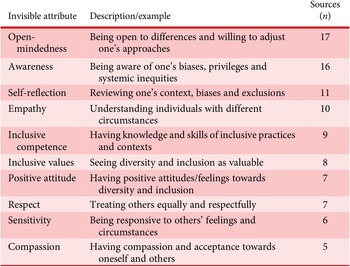
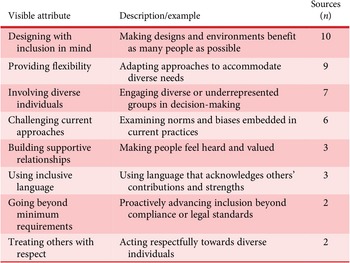

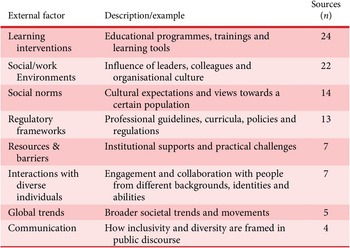
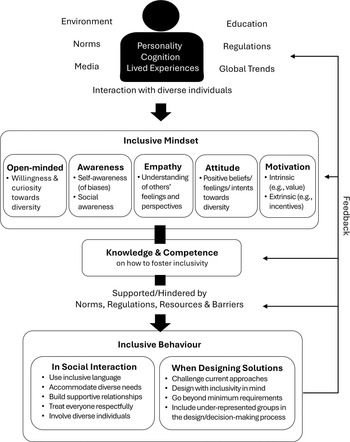


 Open access

