




Introduction
Long-Term Care (LTC) homes play an important part in older adults’ health and well-being. During times of medical urgency, LTC residents may be transferred from their LTC home to emergency departments (ED) for further treatment. Approximately 25% of older adult residents who experience an acute change in health status are transferred from LTC to ED (Kessler et al., Reference Kessler, Williams, Moustoukas and Pappas2013). Medical urgency includes a significant change in resident health status requiring advanced care not available in the LTC home, such as intravenous treatment of pneumonia or management of acute kidney failure.
Transfer numbers and rates of residents from LTC to ED vary across provinces in Canada. Closely examining transfers from LTC to ED across Canada can lead to a better understanding of the potential differences and subsequent needs among provinces. For example, in Ontario, rates of transfer between LTC and ED ranged between 4 and 58% over a 1-year period, suggesting that LTC homes’ responses to resident health care needs were varied (Gruneir et al., Reference Gruneir, Bronskill, Newman, Bell, Gozdyra, Anderson and Rochon2016). In British Columbia, there are approximately 13,500 transfers from care homes to emergency departments per year, with 40% of residents being transferred to the ED in their first year in LTC (Office of the Seniors Advocate of British Columbia, 2018). Over 15,000 Albertans live in LTC facilities, and prior to the pandemic, approximately 28 residents daily were transferred to an ED (Alberta Health Services, 2018a, 2018b). There are approximately 3500 ED transfers from LTC each year within the Calgary zone and 1500 per year in the Central zone. Within the Calgary zone, over 90% are transferred by Emergency Medical Services (EMS). In 2017/18, 44% and 70% of these LTC-ED transfers within the Calgary and Central zones, respectively, did not require admission to hospital. Although many transfers are appropriate, 16–17% of Calgary zone transfers and 41–45% of Central zone transfers are less urgent to non-urgent (Alberta Health Services, 2018a, 2018b).
While admissions and triage scores are not direct measures of the appropriateness of an ED visit, these statistics suggest that some resident medical concerns that lead to ED visits may be better treated in other settings. Members of our team have been engaged in research exploring the definition of an ‘avoidable’ LTC to ED transfers and found that a transfer may be avoidable if diagnostics or treatment may be conducted in an alternate setting, the reason for transfer is unclear, the transfer could negatively impact the resident, and the transfer is against the wishes of the resident (Cummings et al., Reference Cummings, Tate, Spiers, El-Bialy, McLane, Park, Penconek, Cummings, Robinson, Reid, Estabrooks, Rowe and Anderson2024). Many LTC to ED transfers are potentially avoidable if adequate supports are provided in LTC or alternate care settings other than ED (Ouslander et al., Reference Ouslander, Naharci, Engstrom, Shutes, Wolf, Alpert, Rojido, Tappen and Newman2016).
LTC residents can experience discontinuity in care as communication between LTC, EMS, and ED health practitioners may be lacking (Tate et al., Reference Tate, Ma, Reid, McLane, Waywitka, Cummings and Cummings2023). Poor and inconsistent communication can result in an inadequate understanding of a patient’s baseline functional and cognitive abilities, misdiagnosis and poor treatment of patient’s ailment, inefficient resource utilization, and patient and family dissatisfaction in the transfer process, which may result in poor patient outcomes (Griffiths et al., Reference Griffiths, Morphet, Innes, Crawford and Williams2014; Parashar et al., Reference Parashar, McLeod and Melady2018; Tate et al., Reference Tate, Ma, Reid, McLane, Waywitka, Cummings and Cummings2023). Furthermore, prolonged ED wait times and heightened risk of exposure to iatrogenic harms within the ED environment can result in LTC residents’ cognitive and functional decline (Wakefield, Reference Wakefield2002).
Residents may also experience effects of ageist perspectives from health care providers regarding transfers from LTC to ED. Ageism refers to the stereotypes (how we think), prejudice (how we feel), and discrimination (how we act) towards others or oneself based on age ((Burnes et al. Reference Burnes, Sheppard, Henderson, Wassel, Cope, Barber and Pillemer2019)). Ageist perspectives held by health care providers can potentially negatively impact the health outcomes of older adults, for example, through less delivery of lifesaving efforts and reduced participation in clinical trials (Chang et al., Reference Chang, Kannoth, Levy, Wang, Lee and Levy2020). Improving health care providers’ knowledge on the aging process could increase awareness and reduce ageism (Palsgaard et al., Reference Palsgaard, Maino Vieytes, Peterson, Francis, Monroe-Lord, Sahyoun, Ventura-Marra, Weidauer, Xu and Arthur2022).
We developed and implemented a unique intervention to support effective and consistent communication among health care providers in the decision-making process of transfers of LTC residents to the ED in times of medical urgency. The primary goal of this intervention was to reduce the rate of transfers from LTC to ED (Munene et al., Reference Munene, Wyer, McLane, Ewa, Lang, Faris, Reid, Penconek, Cummings, Chen, Spackman, George and Holroyd-Leduc2025).
The intervention
The intervention included a standardized LTC to ED care and referral pathway supported by a centralized 24-hour nurse-operated telephone call system to connect physicians across referring and receiving facilities, community paramedics, and two INTERACT® (Interventions to Reduce Acute Care Transfers) tools (STOP AND WATCH for health care aides; Change in Condition Cards for nursing). Through the centralized call system, a physician at the transferring facility (e.g., LTC) could connect via phone call to a physician at the intended destination (e.g., ED) to discuss transfer decisions of the resident to ED for further care. The LTC physician and the ED physician may discuss the details of the acute presentation and relevant chronic comorbidities that could inform management plans, as well as the potential benefits and harms that an ED transfer versus treatment in the LTC would entail. The call also could include discussions of the resident’s current established goals of care and whether a substitute decision maker is involved in care decisions. Community paramedics are specially trained EMS personnel who provide community-based health care delivery, such as the provision of acute care at an LTC home (Choi et al., Reference Choi, Blumberg and Williams2016). LTC physicians will liaise with community paramedics as required.
Interventions to Reduce Acute Care Transfers (INTERACT®) tools were introduced into LTC homes as part of the intervention (Ouslander et al., Reference Ouslander, Bonner, Herndon and Shutes2014). INTERACT® Care is a quality improvement program that includes specific tools and pathways designed to improve the identification, evaluation, and communication around changes in LTC resident health status. These tools are focused on early identification and assessment of changes in residents’ health condition before they become severe enough to warrant a hospital transfer (Ouslander et al., Reference Ouslander, Bonner, Herndon and Shutes2014). Specifically, LTC sites trained health care aides (HCAs) to identify changes in the health and behavior of residents, and then effectively communicate this to nursing staff and physicians through the use of the INTERACT® STOP and WATCH tool. This tool uses simple language to identify common, but nonspecific changes in condition (Ouslander et al., Reference Ouslander, Bonner, Herndon and Shutes2014). Nurses in LTC were supported in making acute care decisions through the use of the INTERACT® Change in Condition cards, which are based on current clinical guidelines and are used to guide clinical decision making at the bedside (Ouslander et al., Reference Ouslander, Bonner, Herndon and Shutes2014). INTERACT® tools have been widely implemented and validated across long-term care settings (Ouslander et al., Reference Ouslander, Bonner, Herndon and Shutes2014, Reference Ouslander, Engstrom, Reyes, Tappen, Rojido and Gray2018). A decision tree based on the interventions used is presented in Figure 1.
Decision tree based on the use of intervention. Notes: RAAPID = Centralized advice and transfer call system. CP = Community Paramedic. LTC = Long-Term Care home. ED = Emergency Department. HCA = Health Care Aide.

Forty LTC homes and four EDs within the Calgary health zone of Alberta Health Services (AHS) were involved in the implementation of LTC to ED care and referral pathway. Implementation in the homes began before the COVID-19 pandemic (i.e., October 2019) and continued until April 2022 using a randomized stepped-wedge design (Lilford & Brown, Reference Lilford and Brown2006). Research team members also engaged with ED leaders, such as clinical department heads and/or physician site chiefs, who then shared information about the intervention with their staff as part of the implementation process.
Implementation was supported by a centralized implementation coach (SR) who provided support to LTC staff in the development and execution of local implementation plans. Each LTC facility was encouraged to organize an implementation team consisting of managers, nurse educators, and front-line staff. Implementation was divided into recruitment and launch. During an introductory meeting, the implementation coach familiarized attendees with the intervention, and scheduled implementation meetings with the LTC facility. In-person or virtual implementation meetings included a project overview, an in-depth intervention review, and a survey to assess local barriers to implementation that then guided development of the local implementation strategy. Several mitigation strategies were employed depending upon the LTC site’s assessment of barriers to implementation such as, (1) linking the intervention with action items from audits, (2) educating and planning implementation with LTC site educators and 2–3 champions, (3) incorporating mid-shift huddles at which the LTC nurse checked in with all the HCAs and facilitated report with the STOP AND WATCH tool.
The aim of this qualitative study was to understand the experiences of those interacting with the intervention and how this impacted the intervention for decision-making on resident transfers.
Methods
Study design
This qualitative research was part of a mixed-methods study aimed at improving care for LTC residents experiencing an acute change in health status (Munene et al., Reference Munene, Wyer, McLane, Ewa, Lang, Faris, Reid, Penconek, Cummings, Chen, Spackman, George and Holroyd-Leduc2025). Qualitative description through thematic analysis was used, which gave a comprehensive summary of phenomena or events being studied with the context of those events (Sandelowski, Reference Sandelowski2000). The broad philosophical approach we used to inform this study is pragmatism, focusing on practical approaches, solutions, and ‘what works’ (Denzin, Reference Denzin2010).
Study sample and recruitment
We recruited HCPs using a snowball sampling technique. Invitations to participate were sent via email on three occasions to the LTC contacts we established during the implementation phase of the study. HCPs were eligible to participate if they acted as community paramedics, utilized the centralized advice and transfer call system (e.g., LTC and ED physicians, call system registered nursing staff), the INTERACT® Change in Condition cards or the INTERACT® STOP AND WATCH tool (e.g., LTC nurses and health care aides). Other staff who did not meet the eligibility criteria were not actively recruited.
We also took steps to recruit LTC residents and their family members from the participating LTC facilities for individual in-person or phone interviews. Recruitment strategies included recruitment posters in LTC homes as well as utilizing LTC staff members to identify potentially eligible LTC residents and/or family members, who could then contact the research team if they were interested in participating. Eligibility criteria also included those residents with recent ED transfers/treatment on-site. This may have limited the number of eligible resident and family participants.
Recruitment materials consisted of an information letter and digital posters that could be printed and placed in common areas in the LTC or distributed further through email lists and/or newsletters. For example, including study information in a newsletter meant for ED physicians was one recruitment strategy, while email distribution lists were used for the recruitment of community paramedics as another strategy. LTC physicians were also recruited via emails sent to the LTC physician list serve and weekly updates. Two study team members (TP, VE) shared recruitment information at a virtual meeting of LTC physicians. One study team member (LW) attended in-person HCA team huddles to share recruitment materials.
All participants were offered a $50 gift card reimbursement for their time to participate in the interviews. All participants were offered identical compensation and reminded that participation was voluntary and did not impact care or employment. Due to limited responses from HCPs to our initial recruitment offering focus groups only, we decided to also offer the option of individual interviews to enhance recruitment. HCPs could choose to participate in a focus group or an individual interview. LTC residents and their family members were offered an individual interview only, as this was deemed most suitable for this population.
Data collection
Consent to participate and participant demographics were managed using Research Electronic Data Capture (REDCap®) electronic data capture tools hosted by the University of Calgary. REDCap® is a secure, web-based software platform designed to support data capture for research studies (Harris et al., Reference Harris, Taylor, Minor, Elliott, Fernandez, O’Neal, McLeod, Delacqua, Delacqua and Kirby2019). We used practitioner-specific interview guides to understand the experiences using the different elements within the LTC to ED pathway intervention, with the implementation process, the sense of effectiveness of intervention elements, and the perceptions of the roles of other HCPs involved in the LTC to ED pathway. Semi-structured interviews were conducted online by three of the research team members (TP, LW, and AM) through the University of Calgary institutional Zoom account due to ongoing issues with visitation to LTC during the COVID-19 pandemic. Interviews were scheduled based on participants’ availability. Due to the COVID-19 pandemic and recruitment issues, the interviews took place approximately 6 months after the completion of the implementation of the intervention. The team debriefed after each session to discuss whether we were soliciting useful project data or whether modifications were necessary. Sessions were recorded via Zoom and transcribed verbatim by a University of Calgary-employed transcriptionist.
Data analysis
We used thematic analysis to analyze the interview transcripts (Braun & Clarke, Reference Braun and Clarke2006). Three authors (TP, LW, and AM) read through a subset of four transcripts, one from each participating health care provider group, to acquaint themselves with transcripts and help in generation of a standardized codebook. This initial analysis involved weekly or bi-weekly meetings and discussions about the data, which led to the generation of codes from the data. Generation of a standardized codebook utilized qualitative data analysis software, NVIVO 12. Four members of the study team reviewed the codebook (TP, LW, AM, and PM) and applied it to the remaining transcripts. Related codes were combined together to generate themes. Thematic categories were developed inductively and iteratively through regular discussion with four of the authors (TP, LW, AM, and PM). The Consolidated Framework for Implementation Research (CFIR), a determinant framework consisting of several constructs with the aim of predicting or explaining barriers and facilitators to implementation effectiveness, was adopted as a guide for emerging themes (Damschroder et al., Reference Damschroder, Reardon, Widerquist and Lowery2022). We used the framework to contextualize and categorize HCPs experiences with the intervention. During our analysis, we found that elements of CFIR could explain health care provider goals. After themes were defined and data organized in tables, we met as a larger study team to further interpret the qualitative results. We took a critical perspective in that we read the responses as evidence of health care providers’ interests/goals even where these were unstated (Denzin, Reference Denzin2017). Although not the focus of this study, we were interested in how HCPs use the power they have in their positions in the system to pursue goals that were often at odds with other providers’ goals. We also initially took an inductive approach and later found that CFIR constructs could be applied to our data.
We took steps to enhance the trustworthiness of the findings and rigour throughout the research study. For example, we thoroughly documented each step of the research process, supporting the dependability of the findings. We had multiple authors analyzing the data and iteratively working together on a codebook. We also sought feedback on the findings with the members of the research team, who included experts in gerontological health care and family advisors (Lincoln & Guba, Reference Lincoln and Guba1985; Shenton, Reference Shenton2004).
Ethics
The study was conducted under a joint University of Calgary and University of Alberta collaboration approved by the University of Calgary Conjoint Faculties Ethics Research Board (REB19–0106) and by the University of Alberta Research Ethics Board (Pro 00090932).
Results
Study participants
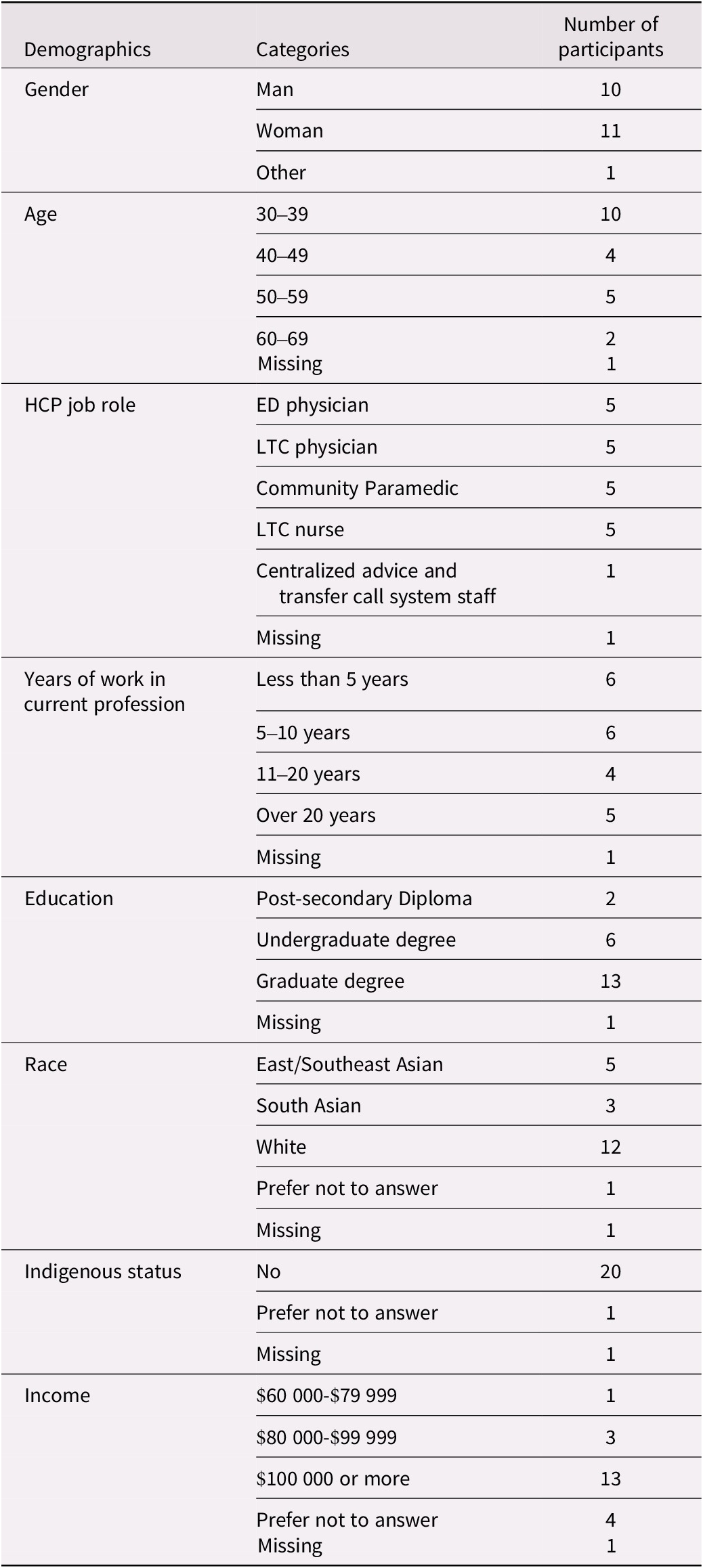
Twenty-two HCPs participated in the individual interviews including six LTC nurses, five LTC physicians, five ED physicians, five community paramedics, and one centralized advice and transfer call system staff member. Individual interviews took place between August 2022 and October 2022 and ranged from 40 to 60 minutes. No focus groups were conducted. Attempts to recruit LTC residents and family members were unsuccessful. A summary of the participant demographics is presented in Table 1 (we were unable to obtain a demographic form for 1 LTC nurse). Our sample, half of which were aged 30–39, is representative of the workforce in the province in which the study took place. Approximately 73% of employment in the health care sector of this province is made up of a core working group aged 25–54 years old (Government of Canada, 2023). We also collected information on participants’ income to further contextualize the sample with the majority of participants reporting a high income.
Participant demographics
Themes
We generated six themes: (1) interprofessional practice and conflict, (2) ambiguous and clear cases, (3) ageism, (4) health care providers’ goals, (5) family involvement in resident care, and (6) intervention tools.
Interprofessional practice and conflict
HCPs described complex interprofessional collaborations and conflicts when reflecting on the use of the standardized LTC-to-ED care and referral pathway. An LTC nurse describes the collaboration between the LTC staff, physician, and community paramedic regarding an acute change in the resident’s health status,
There was a discussion because there was one instance where we requested community paramedics to come to do IV antibiotics and the community paramedics noticed that some of the vitals were not within the range and that caused concern. So, the community paramedics talked to our attending physician… but there was discussion on whether to send this resident to the hospital to Emergency or not, but they ended up not sending. LTC Nurse 3.
However, not all interprofessional interactions were collaborative and conflict also arose from the use of the pathway.
There was this one experience with an Emergency doctor which I will always remember. I was just calling him for advice really. And because there was family with a patient who wanted to send [the patient] to emergency… and before I even started my question the Emergency doctor was just like, look, I know you are going to send them to Emergency. Let us just get it over with. And it was just so disappointing. Because here I was trying to prevent an expensive hospital admission and it was almost like giving in. … LTC Physician 15.
An ED physician quote supports the LTC physician perspective above and serves to confirm that interprofessional dialogue through the centralized advice and transfer call system was not always valued by physicians,
The [the centralized advice and transfer call system] process for Long Term Care can definitely be a little frustrating just because if there is no value added with information what is the point? We are going to see the patient anyways. Just get them here. ED Physician 6.
An LTC physician expressed their frustration with the referral process, emphasizing that in some cases, they had made the decision to transfer a LTC resident, yet felt that they had to seek permission for the transfer.
I am a bit angry that I feel like I need permission to send someone to the Emergency Department. But I feel like sometimes when I call [the centralized advice and transfer call system], I am begging them to take my patient when I know full well that this person needs to go and I have done a good assessment. LTC Physician 19.
An ED physician described their perspective that the centralized advice and transfer call system was their opportunity to prevent unnecessary medical transports, and to express their perspective that LTC physicians should conduct an in-person assessment prior to initiating transfer.
I think we need to change the expectation of the standard of care. The standard of care should be that patients prior to transferring, unless it is a true medical emergency which is very few and far between, should be assessed and evaluated by an MD and called through [centralized advice and transfer call system]. That should be the standard of care…Because fifty percent of these phone calls, I can deal with over the phone without the need for transfer… I think it should be mandatory for a transfer from Long Term Care to the Emergency Department. ED Physician 17.
There was also interprofessional conflict evident in some quotes between LTC physicians and LTC nurses. Despite some nurses expressing that their clinical assessments were critical to the decision making by the physicians, LTC physicians did not always trust the nursing assessment. One LTC physician described using community paramedics as a way to verify nursing assessments,
I tend to use community paramedics in [LTC] sites that are not as strong. When I do not believe what the nurse is telling me and I cannot get there. So, that is one way to use community paramedics. LTC Physician 19.
Ambiguous and clear cases
In this theme, participants referred to (1) ambiguity about when to use the intervention, (2) clinical ambiguity, and (3) clear clinical cases.
Ambiguity about when to use intervention
Participants described some uncertainty with when and how to use the LTC-to-ED care and referral pathway, although it is unclear whether this is due to the intervention itself or to the implementation process (e.g., insufficient education and orientation).
I think there still remains some ambiguity first of all and when to use [centralized advice and transfer call system] and when and which hospitals and which doctors will accept once the call has been made. Nurses just call 911, which is the default. There have been some instances where a patient has been uncontrollably having epistaxis for twenty, thirty or so minutes and not stopping. And I have instructed the nurses to call 911 and I got a bounce back saying I have got to call [centralized advice and transfer call system] first. And for what? Just a check in saying it is okay to transfer to hospital. I do not see it as an effective use of healthcare dollars that way. LTC Physician 15.
However, others expressed that processes within the pathway worked well in the decision-making process on whether to transfer the resident to the ED.
So, a couple of times that I have been able to defer; one was mostly the level of care did not warrant that a patient be transferred. So, one of them was a patient who was in a care home, dying of multiple end stage organ system issues … we were able to kind of have thoughtful review and discussion about the benefit to the patient and the detriment to the system by pulling, basically a patient that is on comfort level of care, end of life care, out of a supported facility and being sent into the Emergency Department and all the resources that would involve. ED Physician 22.
LTC physicians also described the potential value of the process of intervention using the centralized advice and transfer call system as a way of providing important information to the ED physician and potentially helping to clarify the LTC resident’s clinical case.
[The centralized advice and transfer call system] is good. When I speak with the [centralized advice and transfer call system] nurse they coordinate all of the patient transfers, they call the ambulance, they arrange it so that the patient gets transferred to the appropriate hospital. Gets seen by the appropriate physician … I think also the Emergency doctors really benefit from us telling them a bit more about the patient than just giving the one paragraph summary. LTC Physician 15.
This was echoed by the centralized advice and transfer call system nurse, who shared their unique role within the pathway.
I think we facilitate the patient flow very well…I think we play an important role in facilitating and coordinating the patient flow in each step of the way. So, from pickup to delivery in Emergency. We coordinate that. We make that happen…Because again, a lot of our Long Term Care patients are very sick, they cannot speak. And there is no advocate for them. I feel that we are a good advocate for them in letting the rest of the healthcare system know about the patients and needs of the patients. Centralized Advice and Transfer Call System Nurse.
Clinical ambiguity
Providers discussed that clinical ambiguity influenced when and how to use the pathway components.
I have used [centralized advice and transfer call system] to transfer my own patients to Emergency in Long Term Care…I think a common one I see would be like failure to thrive or dehydration. I see it in the elderly where they just are not doing well. But it is not really kind of clear exactly. Like they are not really showing any obvious signs or symptoms of like a specific type of condition… LTC Physician.
Clear clinical cases
Health care providers also shared clinical cases where the appropriate option within the pathway was clear.
Inappropriate [for community paramedics] would probably be things like falls with head injury and stuff like that. There is no point. Just send them to hospital. Community Paramedic 13.
Because we do not transport people and we are not set up to deal with emergencies. Our goal is always to do the care we can to keep the patient home. So, if that patient’s complaint falls outside of us being able to do that safely for them, then the only next best option is to go to the Emergency Department. Community Paramedic 12.
Ageism
Examples of ageism occurred rarely in our data but were highlighted in research team discussions with family advisors as important enough to warrant inclusion as a theme. The family advisors were citizens or residents who were part of the research team. They provided ongoing oversight of the intervention to ensure that it reflected the needs of LTC residents and family members. An ED physician stated that few situations for LTC residents would require or qualify for hospital care,
I would say it totally depends on the patient’s baseline and what their goals of care are to constitute kind of a true medical emergency. But if they are like a medical treatment and would benefit from hospital testing and treatment, then there are a few things that might be a true medical emergency but these are very few and far between in this patient population. ED Physician 17.
We interpret this quote as expressing ageism, given reference to ‘this patient population’ (meaning older, LTC patients) and the implied contrast with other younger populations who are tacitly framed as more deserving of emergency care. We saw an example of a potential barrier to LTC residents accessing the ED in an earlier participant quote where a LTC physician expressed anger over feeling like they needed permission and were begging to send a LTC resident to the hospital. Ageist perspectives may also influence the decision-making process for transferring an LTC resident to the ED.
I mean, a little bit of ageism, kind of with that. I think that the [centralized advice and transfer call system] has helped us with that. Because that has actually been a serious problem in terms of the relationship between Long Term Care and EMS is the ageist attitude of some of the caregivers. They are old, they are at the end of their life. They do not deserve care. LTC Physician 21.
Health care providers’ goals
The decision process related to the intervention pathway regarding a transfer of a resident from LTC to ED is influenced by health care provider goals for their work in relation to the care of the resident. These goals can be resident centered (which corresponds to the CFIR category of patient-centred) (Damschroder et al., Reference Damschroder, Reardon, Widerquist and Lowery2022).
I always think it is important to provide the information that is going to get that patient the best care. So, I always weigh it at the end of the day, that is what my decision is based on. Community Paramedic 14.
However, not all decisions related to a transfer are resident centered. At times convenience for the health care provider guides decision-making (corresponding to the CFIR category of provider-centered) (Damschroder et al., Reference Damschroder, Reardon, Widerquist and Lowery2022).
… I think the rule to use community paramedic is not clear. Like frontline nurses, are confused when we can call a community paramedic. And also, using the community paramedic, the paperwork is, I think, how many pages? Two pages or three pages and some questions. So, well, we do not have time to figure out their form. We rather just do the ER transfer form. Is faster and everybody knows it. LTC Nurse 11.
Other times, efforts to save system resources were seen as a reason to engage with the care and referral pathway.
So, I do think that to a certain degree it has decreased Emergency visits. We have seen that in our monthly stats that we get from Alberta Health since the last four and a half years. What we also tend to see in our statistics as far as Emergency visits, percentages of admissions and length of stay once they are in acute, is that we have gotten a lot better at keeping them at home in Long Term Care until such time as, okay, now we need to make a new decision and reinitiate [centralized advice and transfer call system] and see where we are at. So, we hold on to these people significantly longer than just arbitrarily sending them off in an ambulance to ED. LTC Nurse 2.
Family involvement in resident care
HCPs expressed that the influence of family members often guided the decision making on whether a resident stays in LTC or is transferred to the ED. A community paramedic explains how some families insist on a transfer to the ED despite HCPs assessment,
Some family members know about our programing. Because their loved ones have been seen by us before and they know us, and they are happy that we are there. Others have no clue what we are doing and again, they hear paramedic, and it quickly goes both ways where I do not want my family member being taken out of their house. I want them to stay home… But I have also had people that regardless of what I say, regardless of what the physician has suggested they just want their loved ones sent to hospital I just want my mom or dad taken care of and I do not think you can do it at this site. Community Paramedic 14.
The decision to transfer can be underscored by the family wanting what they perceive is best for their family member despite health care providers’ guidance. This may mean a transfer to the ED.
…there are times when the family wishes to send the patient to the hospital even though the designated goals of care would be C [Comfort Care] or from my understanding it is not something that needs to go to hospital for. Then in that sense, I am not going to fight the family… because I am pretty sure if I were in their situation, I might also opt to that. So, I think it is very important for each of the physician to have a very clear discussion with their guardians and families…And you know, I really cannot really crush the hope. And I feel like the family they probably feel like really powerless. LTC Physician 15.
Intervention tools
In this theme, we collected specific comments on the use INTERACT® Change in Condition Cards and the INTERACT® STOP AND WATCH tool within LTC. These tools were met with various barriers and facilitators yet were overall described as useful early detection tools for acute changes in resident clinical status.
The INTERACT cards and the STOP AND WATCH tool, they are helpful in terms of like an early warning thing and also for other nurses that are not as experienced in terms of assessment and how to deal with situations where they have to decide whether to send to Emergency or if it is something that can be treated at the facility at that time… It is a nice tool to have because it is accessible. It’s clear, it is concise. I think as well too for the HCAs to be accustomed or at least familiar with the STOP AND WATCH early warning tool. Because in the end, they are the ones who report to the nurses, ‘oh, this resident is off, something and something’ and then at least we can follow up on that. LTC Nurse 3.
The same LTC nurse also described these intervention tools as influencing the decision-making process for transferring a resident to ED as well as effectively facilitating reporting the clinical status to the physician.
On those four occasions that I have used it [Change in Condition Cards], three out of four made a difference in terms of, you know, trying to determine whether to send a resident to Emergency or not…. It became a good learning tool for me when I had a student doing their practicum in our facility. Basically, I could teach them how to use it. It is a tool that they can use when they are starting out their nursing career in a Long Term Care nursing facility…. LTC Nurse 3.
However, barriers such as lack of ongoing training were reported to influence the use of the intervention tools in LTC.
…so, we did get our initial training, which is usually like half an hour. But there was a lack of ongoing training with all the new nurses that were hired through this pandemic. Everything was online but I could have missed it but I did not have, any further touch up or training or anything to go back and reflect on this and how has this benefited us in our facility or if we needed to improve on anything…. LTC Nurse 10.
Relationships among themes
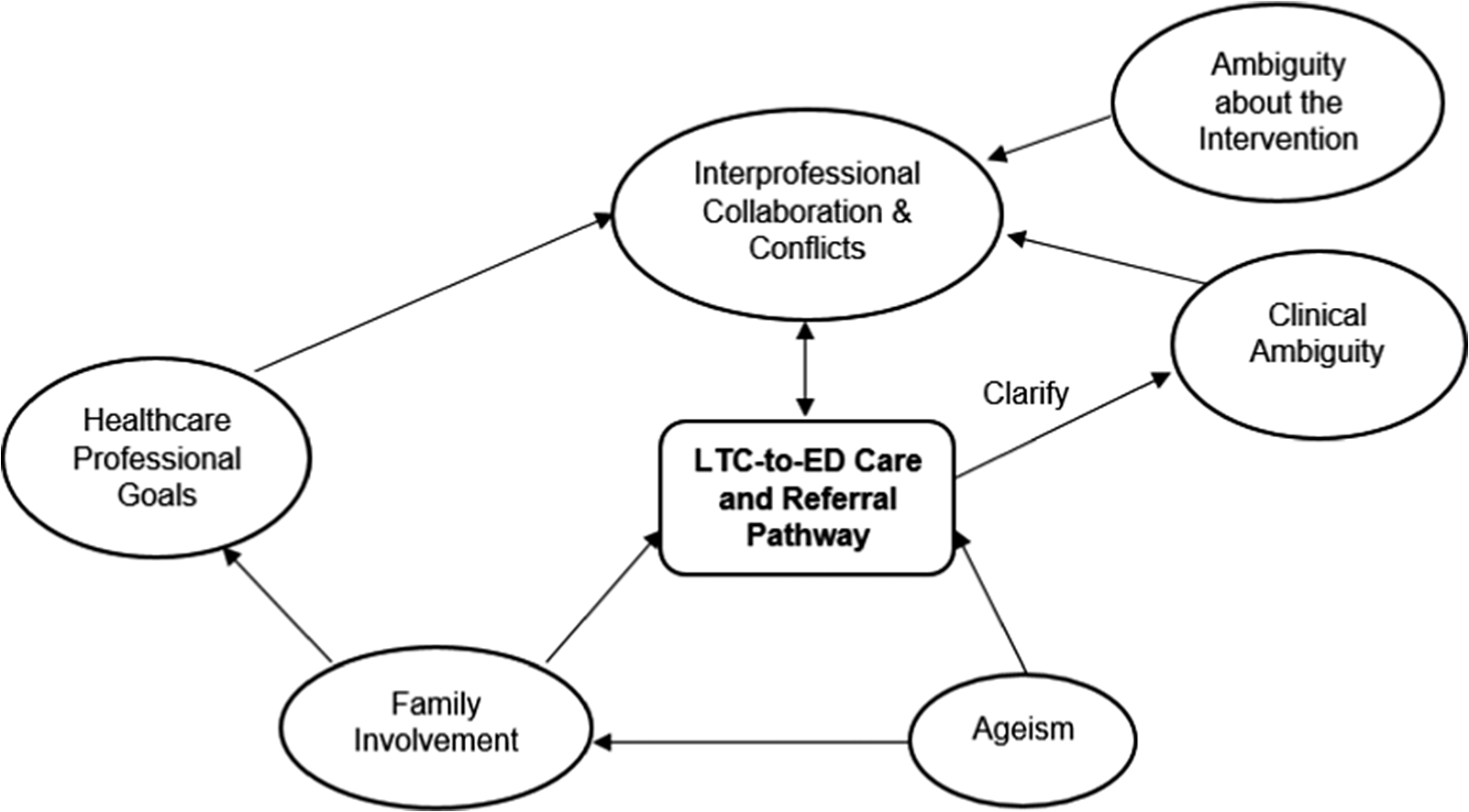
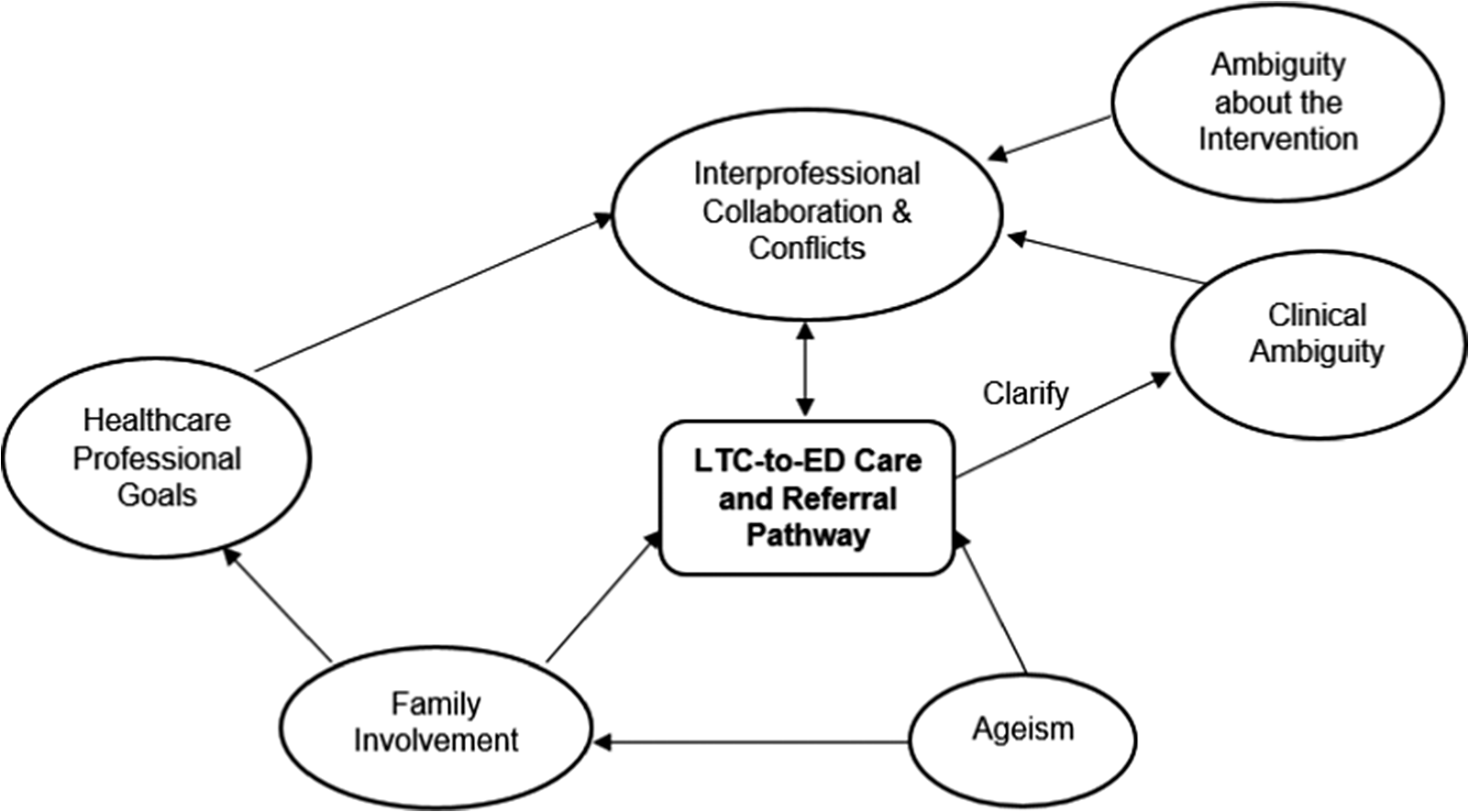
We interpreted the relationships among the themes to be the following. Ageist perspectives within the general health care context may have affected decision-making around transferring to ED. Intervention tools may help to clarify ambiguous cases but are subject to facilitators and barriers (including ambiguity about when use of intervention components is appropriate; and family insistence on direct transfer). The intervention components become part of interprofessional collaborations and conflicts as HCPs enact competing resident-centred, deliverer-centered, and system-centred goals. Figure 2 illustrates these relationships among the themes.
Visual representation of the relationships among themes.
Discussion
Individual interviews with HCPs involved in the implementation of the LTC to ED care and referral pathway provided key insights into the use of the intervention components, as well as exposing interprofessional collaborations and conflicts. Differing understandings of what each provider group’s role were evident, which influenced overall use of the intervention components. This highlights the importance of fostering interprofessional relationships when implementing complex health system interventions. Externally facilitated interprofessional activities, such as interprofessional rounds, meetings and checklists that help to improve interprofessional collaboration amongst health care providers may be required (Reeves et al., Reference Reeves, Pelone, Harrison, Goldman, Zwarenstein and Zwarenstein2017). From a social identity theory perspective, interprofessional collaborations may also be hindered by the self-categorization of health care providers into separate groups with which they identify and where they negatively view other provider groups (Bochatay et al., Reference Bochatay, Bajwa, Blondon, Junod Perron, Cullati and Nendaz2019). The development of an emergency care interprofessional identity representing a mixed group of professionals and providers may mitigate the pursuance of unique professional agendas by differing groups of providers (Reinders & Krijnen, Reference Reinders and Krijnen2023); Kreindler et al., (Reference Kreindler, Dowd, Star and Gottschalk2012) offer insights for interventions which address group conflict through consideration of how social identity plays a role in current organizational problems or conflicts, which groups need to involve in developing new ways of working, what matters most to groups’ members, and potential for context change.
The goals in LTC tend to focus on quality of life and quality end of life care (Estabrooks et al., Reference Estabrooks, Straus, Flood, Keefe, Armstrong, Donner, Boscart, Ducharme, Silvius and Wolfson2020), whereas the focus of the emergency department is typically to stabilize and treat patients with the goal of saving lives. Given that goals in LTC can differ from those of ED, this may lead to differences in how the care for older adults is perceived and delivered, particularly when the clinical case is ambiguous. It is possible that the intervention pathway amplified a real or perceived power imbalance between LTC and ED physicians. Nonetheless, we found that having a clear line of communication between LTC and ED staff such as through the centralized advice and transfer call system, supported by LTC staff documenting their decision making with the INTERACT® STOP AND WATCH tool and Change in Condition cards, could help clarify ambiguity and improve clinical decision making.
Ageism may go unnoticed by both the person communicating the ageist perspective and the target of ageism (Gendron et al., Reference Gendron, Welleford, Inker and White2016) and may have factored into the care provided for LTC residents throughout the implementation of the LTC-to-ED care and referral pathway. Educational strategies such as purposeful activities and reflection guided by skilled educators are needed to help learners comprehend the needs of older adults (Gallo, Reference Gallo2019). Learners may also benefit from humanistic community-based approaches to understanding the needs of the older adults (George et al., Reference George, Stuckey and Whitehead2013). Moreover, education programs to improve the perceptions of older adult care should be available as ongoing competency training for health care providers (Rowe et al., Reference Rowe, Fulmer and Fried2016). However, these types of interventions were beyond the scope of this study.
Our theme of health care providers’ goals show that providers have diverse competing goals, and framed the intervention components through the lens of the goals they were enacting. Importantly, we do not have evidence that providers who expressed health care provider or system centred perspectives in interviews always, or even usually, act on these perspectives in their practice. Comments in interviews may instead reflect practice context and complexity. Nonetheless, the comments are evidence of how competing goals can impact uptake of interventions within health care settings.
The intent of our intervention was to increase health system efficiency, while improving acute care for older adults living in LTC. As some nursing staff mentioned, a tool such as the INTERACT® Change in Condition cards may be useful for new LTC staff or trainees but may not necessarily be perceived as useful for experienced staff with experiential knowledge from working within LTC. Furthermore, the time it takes for LTC and ED physicians to connect through a facilitated telephone call must be weighed against the alternative pressures on time that both ED or LTC physicians have. Given that LTC homes are under resourced and understaffed (Baumbusch et al., Reference Baumbusch, Cooke and Sloan Yip2023), while EDs are also experiencing staffing issues and an overflow of patients (Morley et al., Reference Morley, Unwin, Peterson, Stankovich and Kinsman2018), interventions designed to increase efficiency in patient care should be simple and not time consuming. In the implementation of this intervention, the centralized intervention coach played a key role helping LTC staff establish local implementation plans. It is not clear from our qualitative data whether this intervention would be feasible without this role. However, ongoing interprofessional training sessions, by a facilitator or staff members familiar with the intervention, that support education and collaboration related to the intervention are warranted to ensure consistency in its implementation. Additionally, opportunities for HCPs to provide feedback on the intervention and collectively co-create solutions to identified issues are also needed. Adult learners are autonomous, self-directed, experienced, knowledgeable, practical, goal and relevancy oriented, and need to be shown respect (Knowles, Reference Knowles1970). By applying these adult learning characteristics, a mutually co-operative environment for HCPs can be fostered to support continued full engagement in the intervention.
While we do not have family or resident data for this study, it is clear from provider quotes that family involvement in the transfer decision-making process may compete with HCP care decisions and goals. In a Canadian study of sources of LTC to ED transfers, 9.4% of transfers to the ED were a result of family/friend caregiver insistence for transfer (Cummings et al., Reference Cummings, McLane, Reid, Tate, Cooper, Rowe, Estabrooks, Cummings, Abel, Lee, Robinson and Wagg2020). Reconciliation of different perspectives on resident care may occur through collaborative efforts of both the families and HCPs. Inclusive spaces for family members can be fostered in LTC through mutual respect and recognition, invitation to participate in LTC activities, honest and adequate information from the LTC staff regarding treatment options, and opportunities for family members to provide feedback (Puurveen et al., Reference Puurveen, Baumbusch and Gandhi2018) on the care of their relative. Future research or iterations of this intervention could consider integrating family members more into the process.
Strengths and limitations
Our findings are strengthened by the diverse perspectives from HCPs. Despite our various recruitment efforts, we were not able to recruit LTC residents or their family members. This may have been due to the specific recruitment criteria for residents and/or family members to participate in this study. We also initially intended to interview residents and their family members in person, however, COVID-19 outbreaks in the long-term care homes limited our ability to do so. Members of our resident family advocacy council, many who had family members living in LTC during the study period, provided valuable insights throughout the study and contributed to the development of this manuscript. We were also unable to recruit HCAs despite our efforts to incorporate their perspectives into this research. HCAs may have perceived researchers as being present to critically evaluate them or been discouraged from participating due to increased workloads and stressors during the COVID-19 pandemic. Our qualitative data did not offer clear insights on how the pandemic impacted implementation fidelity or intensity of the intervention.
Conclusions
When implementing an intervention targeted towards care for older adults across the health care continuum, it is important to consider how implementation may be impacted by interprofessional conflict, clinical ambiguity, ageism, family involvement, and competing provider goals. Future interventions targeted towards addressing acute care issues among LTC residents may benefit from the incorporation of interprofessional activities, intentionally including family in the care continuum, and activities to address ageism among health care providers.
Data availability statement
The data that support the findings of this study will be kept for a minimum for 5 years after collection and are available upon reasonable request at the discretion of the corresponding author and study nominated Principal Investigator.
Acknowledgements
The authors would like to acknowledge John Montpetit and Suzanne Pozak for assisting with recruitment.
Financial support
We received financial support for this study from Alberta Innovates in the form of a Partnership for Research and Innovation in the Health System (PRIHS IV) research grant.
Competing interests
The authors declare none.



 Open access

