



The German National Nutrition Survey (NVS) II provides representative data on food consumption of the German population( Reference Heuer, Krems and Moon 1 ). In 2005–2007, German men and women aged 14–80 years did not consume enough foods of plant origin and ate too much meat/meat products in comparison with dietary guidelines. For example, the consumption of vegetables was about half of the nationally recommended amount. The maximum recommended consumption of meat/meat products was exceeded by men, whereas women were in the upper range of the recommendations. Regarding non-alcoholic beverages, men and women met the recommended amount of at least 1·5 litres/d, primarily through the consumption of water. The NVS II results highlight that the German population consumes a diet that only partially meets the national food-based dietary guidelines.
However, food consumption may have changed in the last few years caused by factors such as changed consumer attitudes and behaviour as well as public health policies and programmes( Reference Kearney 2 , 3 ). In order to gain insights into the developments regarding food consumption and nutrient intakes of the German population, the German National Nutrition Monitoring (NEMONIT) was initiated in 2008. NEMONIT is a longitudinal survey collecting data on an annual basis from a sample of participants recruited from the NVS II.
Thus, the objectives of the present study were as follows: to investigate changes in food consumption and nutrient intakes of a German cohort between 2005–2007 and 2012/2013; to analyse whether observed changes were caused by period effects or by age effects; and to compare results with those of nutrition surveys in other European countries.
Methods
Study design and participants
NEMONIT is a longitudinal study that is based on the NVS II( Reference Heuer, Krems and Moon 1 ). NVS II participants who completed one or two 24-h recall interviews and did not refuse to take part in further surveys were asked to participate in NEMONIT (Fig. 1). After excluding individuals who refused or did not respond, 2749 participants from NVS II were recruited for NEMONIT for annual assessments of their food consumption and nutritional behaviour. In addition, data on socio-demographic characteristics, health aspects and lifestyle were collected. In the present study, data from NVS II (2005–2007) and 4 NEMONIT survey years (2008–2012/2013) are presented. Analyses included either individuals who participated in the NVS II and in least three of the four NEMONIT study years or participants from whom dietary information was available at least at baseline (NVS II) and the fourth NEMONIT survey year (2012/2013). At baseline, the study population consisted of 1840 participants who were 14–80 years old.
Flow chart of the study population. NVS II, German National Nutrition Survey II. NEMONIT, German National Nutrition Monitoring.

The surveys were approved by the German Federal Data Protection Office. Respondents were informed in detail about the study objectives and interview procedures as well as the handling of data records and analyses under pseudonymous conditions. It was made clear that participation was on a voluntary basis and could be terminated at any time. Participants provided informed written or verbal consent.
Dietary intake
Data on food consumption and nutrient intake were collected in each survey year using two 24-h telephone recall interviews (EPIC-Soft( Reference Slimani, Deharveng and Charrondiere 4 , Reference Slimani, Ferrari and Ocke 5 ), re-named GloboDiet in 2014), which were conducted on randomly drawn non-consecutive days (at least 1 week apart). Dietary assessment for each study year was carried out in four waves through the year. Household measurements, standard units and a picture booklet providing photographed portion sizes for various foods and dishes were used to assist participants to indicate the consumed amount of food. The picture booklet is an excerpt from the original EPIC-Soft picture book. Intake of each food item was calculated as the average intake of both recall days. Food items were categorised into twenty-three food groups. Nutrient supplement intake was not included.
The calculation of energy and nutrient intakes for all survey years was based on the German Nutrient Database 3.02( Reference Hartmann, Heuer and Hoffmann 6 ).
Healthy Eating Index
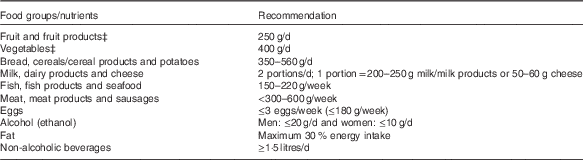
The Healthy Eating Index-NVS (HEI-NVS) II( Reference Wittig and Hoffmann 7 ) adapted to 24-h recalls was used to evaluate the quality of participants’ diets. Participants’ consumed amounts of food groups were compared with the food-based dietary guidelines of the German Nutrition Society( Reference Oberritter, Schäbethal and von Ruesten 8 ) and macronutrient intakes were compared with the national reference values for nutrient intake( 9 ). The HEI-NVS II is composed of ten components (Table 1). Each of the ten components is given a maximum score of 10 points, except for the components fruit/fruit products and vegetables (max. 15 points). The total HEI-NVS II score ranges from 0 to 110 points. High HEI-NVS II scores indicate intakes close to the recommended ranges or amounts.
Components of the Healthy Eating Index-NVS IIFootnote * and adapted dietary recommendationsFootnote †
NVS II, German National Nutrition Survey II.
* According to Wittig & Hoffmann( Reference Wittig and Hoffmann 7 ).
† According to German Nutrition Society( Reference Oberritter, Schäbethal and von Ruesten 8 , 9 ).
‡ Consideration of one glass of fruit or vegetable juice as a substitute for one portion of fruit or vegetables.
Socio-demographic characteristics
Age, place of residence and socio-economic status (SES) were assessed by a computer-assisted telephone interview (CATI). Participants’ places of residence were aggregated to regions (north, south, east and west). SES encompassed education (five categories ranging from no qualification to baccalaureate; additional points for vocational training and university education), net household income (on a monthly basis, nine categories from <750 € to 5000 € or higher) and employment status of the principal earner of the household (eight categories ranging from unskilled worker to executive employee/senior official)( 10 ).
Statistics
Statistical analyses were performed using SAS (version 9.2; SAS Institute Inc.). NEMONIT participants were compared with non-participants (n 12 086) to analyse whether the differences in demographic characteristics of participants and non-participants may have biased the study results. The Mann–Whitney U test was used to detect differences in age between participants and non-participants. The prevalences of categorical variables were compared using χ 2 tests.
Daily food consumption and nutrient intake data for each survey year are expressed as mean and the corresponding 95 % CI, although data were not normally distributed. This presentation was chosen because rarely consumed foods such as fish often have median intakes of zero, and the applied regression model provides estimates of the mean. Median food consumption and nutrient intake data are provided in the online Supplementary Tables S1–S3. A bivariate generalised estimation equation (GEE) model was used to calculate P for trend for the period between 2005–2007 and 2012/2013. Time in years since baseline (baseline: 0 value) was modelled as a continuous variable and an unstructured working correlation structure was assumed. GEE, an extension of the quasi-likelihood approach, assumed no distribution of response observations and described how the mean response of the population is related to the covariates (population-averaged interpretation)( Reference Zeger, Liang and Albert 11 ).
To analyse whether observed longitudinal changes in food consumption and nutrient intake may have arisen from age, period and/or cohort effects, a multivariate GEE model was used following the method of Jacobs et al.( Reference Jacobs, Hannan and Wallace 12 ). In this model, current age at each study year, time (in years since baseline) and interaction of age and time were included. The age coefficient estimates between-person differences in food consumption/nutrient intake per year of age (cross-sectional age effect). The time coefficient estimates the change in food consumption/nutrient intake per year excluding inter-person differences in age (age-matched time trend), whereas the age-by-time-interaction represents the cohort effect that has evolved since the initial observation (variation in food consumption/nutrient intake in specific ages over time).
The GEE analyses showed that the interaction term of age and time was often not significant or was very small compared with the other regression coefficients, and inclusion of the interaction term did not result in a smaller quasi-likelihood under the independence model criterion value. For this reason, the age-by-time-interaction was suppressed in the model, assuming that cohort effects are minimal. In the present study, the cross-sectional age effect was therefore interpreted as an estimate of the age effect and the age-matched time trend as a measure of period effect.
Level of significance was set at P<0·05 (two-sided).
Results
Sample characteristics
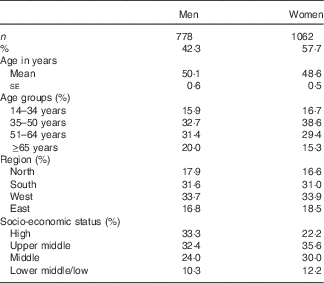
Baseline characteristics of the study sample are shown in Table 2. There was a higher percentage of women in the cohort, and men had a higher SES than women.
Characteristics of the study sample at baseline (NVS II, 2005–2007) (Numbers and percentages; mean values with their standard errors)
NVS II, German National Nutrition Survey II.
Compared with non-participants, NEMONIT participants were older (49·3 v. 45·8 years; P<0·001) and had a higher percentage of women (57·7 v. 54·7 %; P=0·014) at baseline. Furthermore, NEMONIT participants showed a higher SES than non-participants (high SES: 26·9 v. 17·3 %; P<0·001). There was no significant difference with regard to region.
Trends in food consumption and Healthy Eating Index-German National Nutrition Survey II
Between 2005–2007 (baseline) and 2012/2013, only a few changes in food consumption were observed (Table 3(a) and (b)). Consumption of fruit/fruit products decreased in both men and women, whereas animal fat consumption increased. An increase in confectionery consumption was also observed in women and an increased consumption of eggs was seen in men. Furthermore, men and women increased their non-alcoholic beverage consumption over time. This increase was caused by the higher consumption of water and coffee/tea (black/green). However, men and women reduced their fruit juice/nectar consumption over the 6-year period. Among the other food groups, there were no significant changes in the consumption of vegetables, meat/meat products and fish/fish products. With regard to the HEI-NVS II score, no significant trend was observed for either sex.
Food consumption (g/d) and HEI-NVS II scores in men (n 778) and women (n 1062) over the study period (Mean values and 95 % confidence intervals)

NVS II, German National Nutrition Survey II; NEMONIT, German National Nutrition Monitoring; HEI-NVS II, Healthy Eating Index-NVS II.
* Generalised estimating equation.
Trends in energy and nutrient intake
For both sexes, no significant changes in total energy intake were observed over the study period, but the relative energy intake from macronutrients changed (Table 4). The energy proportion from carbohydrates decreased among men and women because of the reduced intake of mono/disaccharides over the 6-year period. In contrast, percentage of energy from fat increased for both sexes. In women, intake of SFA, MUFA and PUFA increased, whereas men showed only an increased intake of SFA and MUFA over the years. In addition, an increase in energy intake from proteins was observed among women.
Energy and macronutrient intakes in men (n 778) and women (n 1062) over the study period (Mean values and 95 % confidence intervals)

NVS II, German National Nutrition Survey II; NEMONIT, German National Nutrition Monitoring.
* Generalised estimating equation.
With regard to micronutrients, a significant decrease was observed in thiamin, riboflavin and vitamin B6 intakes in men and women as well as in folate intake in men (Table 5(a) and (b)). In addition, women showed a higher intake of Mg, Fe and niacin over time.
Micronutrient intake in men (n 778) and women (n 1062) over the study period (Mean values and 95 % confidence intervals)

NVS II, German National Nutrition Survey II; NEMONIT, German National Nutrition Monitoring; RE, retinol equivalents (retinol+1/6 β-carotene); TE, tocopherol equivalents (mainly based on α-tocopherol without considering further vitamin E vitamers); NE, niacin equivalents; FE, folate equivalents (to calculate folate equivalents for enriched foods the factor 1·7 was used).
* Generalised estimating equation.
† Iodised salt and foods made with it were not taken into account.
Age and period effects on food consumption and nutrient intake
Longitudinal changes, presented in Tables 3(a), (b) and 4, were differentiated into age and period effects (Table 6). Food groups and macronutrients are presented when either longitudinal changes or significant age and period effects could be found. An age effect could be observed for most food groups and macronutrients in men and women. For example, consumption of fruit/fruit products and coffee/tea as well as fibre intakes increased with participants’ age, whereas consumption of water and soft drinks decreased with age. The multivariate GEE analysis further revealed that most of the changes in food consumption and macronutrient intake, which were observed in the NEMONIT study population (shown in Tables 3(a), (b) and 4), occurred independently of participants’ increasing age (period effect), with the exception of animal fats and egg consumption in men and protein intake in women. After taking into account participants’ age, significant period effects could also be observed in soft drink consumption (increase) in both sexes, cereal/cereal product consumption (increase) in men as well as meat/meat product consumption (increase) and fibre intake (decrease) in women.
Estimated cross-sectional age effect and period effect (age-matched time trend) on food consumption and macronutrient intake in men and women (NEMONIT, 2005–2007 to 2012/2013)Footnote *

* NEMONIT, German National Nutrition Monitoring. Age and period effects are presented as regression coefficients, generalised estimating equation.
† Food groups and macronutrients are presented when either longitudinal changes or significant age and period effects could be observed.
Longitudinal changes in micronutrient intake observed in the bivariate GEE model (Table 5(a) and (b)) were caused by age as well as period effects (data not shown).
Discussion
Trends in food consumption and nutrient intake
Over a 6-year period (2005–2007 to 2012/2013), only a few changes in food consumption and nutrient intakes were observed in the German cohort NEMONIT (age: 14–80 years), a sample drawn from the representative NVS II. In particular, a downward trend could be observed in the daily consumption of fruit/fruit products and fruit juice/nectar, whereas the consumption of certain food groups (e.g. water, coffee/tea, confectionery and animal fats) increased. However, the HEI-NVS II score remained unchanged over the study period. With regard to macronutrients, the results showed an increased intake of fat and a decrease in carbohydrate intake.
In general, differences in food consumption trends were found between male and female participants of NEMONIT. Changes in food consumption occurred more often in women, whereas men showed greater changes compared with women. This may partly be explained by the fact that more women than men participated in NEMONIT, and thus smaller changes in food consumption and nutrient intake could be shown as significant in women.
We compared the present results with the German food balance sheets, which are published annually by the German Federal Ministry for Food and Agriculture( 13 ), because there are no other national survey data available for comparison in relation to food consumption in adults between 2006 and 2012. The decrease in consumption of fruit/fruit products and fruit juice/nectar is consistent with the food balance sheet data. However, the food balance sheet data showed a decline of lower magnitude in fruit juice supply between 2006 and 2012. The results concerning the increase in water, soft drink and coffee/tea consumption are also in agreement with the food balance sheet data. In NEMONIT, no or very minor changes were found with regard to consumption of fish/seafood, milk/dairy products and meat/meat products. Similar trends were shown by the food balance sheets data. In contrast, an increase in daily vegetable supply based on the German food balance sheets could not be observed for the NEMONIT participants.
The longitudinal analysis of the HEI-NVS II showed no significant changes over time. One reason for this result is the unchanged consumption of seven out of ten HEI-NVS II components (e.g. vegetables, fish/seafood and milk/dairy products). Another explanation lies in the method. Regarding the HEI-NVS II score, the favourable increase in non-alcoholic beverage consumption was offset by the simultaneous unfavourable decline in fruit/fruit product consumption and increased energy intake from fat. This finding indicates that the HEI-NVS II is not suitable for pointing out longitudinal trends, because changes in consumption of single food groups may cancel each other out.
Total energy intake remained stable over the 6-year period, whereas the contribution of different macronutrients to energy intake changed. Energy intake from carbohydrates declined, whereas energy derived from fat increased over time. This reflects the observed trends in food consumption. The decrease in mono/disaccharides could be caused by the decreased fruit/fruit product and fruit juice/nectar consumption. Furthermore, the increased SFA intake may be related to the increase in animal fat consumption. Most trends in micronutrients cannot directly be explained by changes in consumption of certain food groups.
Effects of ageing of the population and period on food consumption and nutrient intake
In NEMONIT, the same persons were evaluated over a period of time. Therefore, the observed changes are less likely to be the result of differences in the sample characteristics. However, the age of the participants increased over time, and the ageing process causes physiological/physical changes, which can affect food consumption. In order to verify whether the observed changes in food consumption and nutrient intake occurred solely because of the increasing age of the participants (age effect), or whether they simultaneously occur in all age groups caused by external variations (period effect), it is necessary to take into account participants’ age in the statistical analyses. The present analysis indicated that the longitudinal changes in food consumption and nutrient intakes observed in NEMONIT were caused by participants’ increasing age (age effect) as well as by period effects. For some food groups and nutrients, age and period effect headed in the same direction. For example, participants’ ageing contributed to the decrease in fruit juice/nectar consumption over the follow-up period, because fruit juice/nectar consumption decreased across age in every survey year. In addition, a decreased age-matched time trend (period effect) regarding fruit juice/nectar consumption could be observed. The combined effect of age and period resulted in a large decrease in fruit juice/nectar consumption seen in the bivariate GEE analysis including only time as a covariate (Table 3(a) and (b)). In contrast, for some food groups (e.g. soft drinks or fruit/fruit products), age and period had the opposite effect. Soft drink consumption, for instance, was negatively associated with age, but data analysis also showed a time-related increase for this food group. As a result, age and period effect balanced each other out, and therefore significant changes in consumption over time could not be revealed or were weakened in the bivariate GEE analysis. For most food groups and nutrients with detected longitudinal changes, the period effect was slightly larger than the age effect. Overall, the data indicate a need to take account of participants’ increasing age in longitudinal dietary analyses. Otherwise population-wide variations over time may be masked by the age effect.
Comparison with other European nutrition surveys
Reported food consumption and nutrient intake trends from other European nutrition surveys differ from those observed in Germany. The UK’s National Diet and Nutrition Survey found stable fruit consumption and decreased energy intake among adults (aged 19 years and over) between 2008/2009 and 2011/2012 (assessed by 4-d dietary records)( 14 ). In addition, fat intake as a percentage of energy intake declined in men aged 19–64 years and in women aged 65 years and over, whereas carbohydrate intake increased. In the French Individual and National Food Consumption Survey (assessed by 7-d dietary records) on men and women aged 18–79 years, increases in overall fresh fruit and vegetable consumption as well as vitamin C and folate intakes were observed (1998/1999 v. 2006/2007)( Reference Dubuisson, Lioret and Touvier 15 ). Moreover, a downward trend in meat consumption (only women) and a stable energy intake were reported. The Bus Santé Geneva Study (Switzerland, 1999–2009, participants’ age: 34–74 years) showed that intakes of energy, SFA, PUFA, Ca and Fe decreased for both sexes, whereas intakes of carbohydrates (only women) and MUFA increased (assessed by semi-quantitative FFQ)(16). Overall, other European surveys reveal more favourable trends in food consumption and nutrient intake compared with NEMONIT. However, comparisons should be made with caution. In contrast to NEMONIT, the reported European studies used repeated cross-sectional study designs and did not examine the same cohort over time. Furthermore, the surveys were conducted throughout different time periods among samples of various age ranges using different dietary assessment methods and nutrient databases.
Public health implications
The present study suggests that compliance with national food-based dietary guidelines has not generally improved in German men and women over the study period (2006–2012). The consumption of fruit/fruit products, which was already below the recommended amount at baseline, decreased even more over the six study years. In contrast, meat/meat product consumption remained too high. A balanced diet plays an essential role in maintaining health and preventing nutrition-related chronic diseases such as obesity, diabetes and cancer. These data underscore the need for public health policies, which especially focus on encouraging consumption of fruit/fruit products and vegetables while reducing consumption of meat/meat products and soft drinks.
Limitations and strengths of the study
The following limitations of the present study warrant consideration: the comparison of NEMONIT participants with non-participants indicated a selection bias towards older, female and higher SES class participants. However, the present results are in good agreement with the observed trends documented in the German food balance sheets, assuming a small-to-moderate impact of the selection bias. The assessment of food consumption using two 24-h recalls per study period, which is in accordance with the requirements of the European Food Safety Authority( 17 ) regarding collection of national food consumption data, could be a further limitation of this study. The intake of episodically consumed food such as fish could be underestimated. It also has to be noted that the present study included participants who may have under-reported their energy intake. The degree of under-reporting found at baseline and the follow-up period ranged from 11 to 17 % according to the cut-off points derived by Goldberg et al.( Reference Goldberg, Black and Jebb 18 ) and Black( Reference Black 19 ). However, as the underestimation of episodically consumed foods and the low level of under-reporting occurred systematically in all survey years, trend direction is unlikely to be affected by these biases.
Besides the limitations described above, the present study has several strengths worth noting. With NEMONIT, individual food consumption and nutrient intake were assessed on a longitudinal and nationwide basis. For the repeated evaluation of the same subjects, the same dietary assessment methods and nutrient databases were applied. Therefore, observed trends cannot be attributed to variation in methods or differences in sample characteristics, which often occur in repeated cross-sectional studies. NEMONIT also covers a wide age range, allowing an estimation of population-wide trends in food consumption and nutrient intake.
Conclusions
Food consumption and nutrient intake remained relatively stable between 2005–2007 and 2012/2013 within the nationwide sample of German men and women. A few favourable as well as unfavourable changes were observed. Altogether, in Germany, consumption of food of plant origin remained too low and consumption of meat/meat products was too high. Further assessment of food consumption and nutrient intake of the German population is necessary to evaluate whether the observed trends will continue over the next few years or whether they are temporary fluctuations.
Acknowledgements
The authors thank Alexander Roth (Max Rubner-Institut, Department of Physiology and Biochemistry of Nutrition, Karlsruhe) for his statistical consulting.
NVS II and NEMONIT were funded by the German Federal Ministry of Food, Agriculture and Consumer Protection. The Ministry had no role in the design, analysis or writing of this article.
M. G. analysed and interpreted the data and drafted the manuscript. C. K. was involved in the study design, data interpretation and manuscript preparation. T. H. contributed to the study design and was in charge of data management. I. H. critically reviewed the manuscript and had primary responsibility for the final content. All the authors contributed to the concept of this manuscript as well as read and approved the final version.
The authors declare that there are no conflicts of interest.
Supplementary Material
For supplementary material/s referred to in this article, please visit http://dx.doi.org/10.1017/S0007114516000544



