


Numerous publications have focused on the association between nutrition and mental health problems, with sugar, micronutrients and omega-3 fatty acids at the centre of attentionReference Gesch, Hammond, Hampson, Eves and Crowder1–5. The effect of dieting, especially among girls, on various mental health problems has also been well documentedReference Lien, Dalgard, Heyerdahl, Thoresen and Bjertness6, Reference Littleton and Ollendick7.
The mental health effects of eating meals regularly have received less attention. Smith has published a few studies on the association between mental health problems and eating breakfast regularlyReference Smith8–Reference Smith10, and others have examined the effect of daily healthy practices, where eating breakfast is one of them, on mental well-beingReference Arai, Anme, Katakura and Sato11–Reference Morimoto, Takeshita, Inoue-Sakurai and Maruyama13. The conclusion from most of these studies is that eating breakfast regularly is associated with an improved mental health status.
Several explanations have been offered for the relationship between mental health and eating breakfast regularly. According to Smith, breakfast and especially the intake of cereals is beneficial due to its effect on brain glucose after a night-time fastReference Smith10. Regular consumption of breakfast cereals has, in experimental studies, been shown not only to lead to positive mood, but also to improve memory and driving performanceReference Smith10.
Regular breakfast consumption has also been linked to reduced stress and reduced infection rates, with a concurrent lowering of cortisol activityReference Smith14. Improved sleep quality and bowel functions have also been related to regular breakfast consumption, both important to mediate psychological well-beingReference Smith10, Reference Tanaka, Taira, Arakawa, Masuda, Yamamoto and Komoda15. The effect of breakfast in reducing fatigue is probably the most important factor contributing to mental healthReference Chen, Sekine, Hamanishi, Wang, Gaina and Yamagami16.
Most studies of breakfast and mental health have been on small study samples and with a few exceptions on adults. Chen et al. carried out a prospective study on factors contributing to quality of life in 12- to 13-year-old Japanese children. They found that in addition to physical activity and a normal bedtime, regular breakfast was the most important contributor to quality of lifeReference Chen, Sekine, Hamanishi, Wang, Gaina and Yamagami16. In a review of dietary habits in adolescents, Bull found that skipping breakfast was related to dieting among girls and that black people skipped breakfast more often than whites, and people from England and Wales had breakfast less often compared with people from Northern and Southern IrelandReference Bull17. A study among Norwegian adolescents from different ethnic groups found a wide variation in food habits and dietingReference Kumar, Holmboe-Ottesen, Lien and Wandel18.
Several factors might influence the association between mental distress, school grades and eating breakfast regularly. Parental education is a strong predictor for school performance, but less so for mental distressReference Costello, Compton, Keeler and Angold19, 20. A change in family structure might, however, influence both mental distress and school performanceReference Gilman, Kawachi, Fitzmaurice and Buka21. Socio-economic status is a strong predictor of both food choice and meal practicesReference Johansen, Rasmussen and Madsen22, Reference Bull23.
The aim of this study is to examine the association between regular breakfast consumption and mental distress (symptom load) and academic performance (functional impact) of 10th grade students in a multicultural city. Due to the large sample size, we are also able to study if the association differs with regard to gender and immigration status.
Methods
Participants and subjects
The study was based on data from the youth part of the Oslo Health Study, a cross-sectional survey conducted by the Norwegian Institute of Public Health, the Municipality of Oslo and the University of Oslo. All pupils in the 10th grade of all schools in Oslo during 1999/2000 and 2000/2001 were included. The 10th grade is compulsory in Norway; therefore, the present study included all 15–16 year olds in two cohorts. Of 8316 eligible pupils, 7343 (88.3%) participated in the study and each pupil completed two four-page questionnaires. Information about sex was missing for 38 participants because of a data coupling error, and these participants were excluded from the study, leaving 7305 participants.
Dependent variables
Average grade
Participants were asked to fill in the most recent grade recorded in their school record book for mathematics, written Norwegian, English and social science. The grade scale is from 1 (lowest) to 6 (highest). An average grade score for each participant was calculated from the four grades. The variable was dichotomised between those with average grade ≤ 3 and >3.
Mental distress
Internalised problems, such as anxiety and depression, were measured by the 10-item version of Hopkins Symptoms Checklist (HSCL-10). The reliability was high (Cronbach α = 0.87) and the correlation with other instruments, including HSCL-90, has ranged between 0.87 and 0.97Reference Lipman, Covi and Shapiro24–Reference Strand, Dalgard, Tambs and Rognerud26. Each item was rated on a scale of 1 (not at all) to 4 (extremely), with the time period being the past week. An average score for all 10 items of ≥ 1.85 is a valid predictor for mental distress among subjects aged 16–24 years of age, corresponding to the 1.75 cut-off of HSCL-25Reference Strand, Dalgard, Tambs and Rognerud26, Reference Tambs27.
Independent variable
Having breakfast
The question asked was: ‘How often do you eat breakfast in an ordinary week?’ The answering alternatives were seldom/never, 1–2 times per week, 3–4 times per week, 5–6 times per week and daily. In one of the analyses, we dichotomised between those eating seldom ( ≤ 2 times per week) and often ( ≥ 3 times).
Control variables
Educational level of parents
To obtain information on parental educational level, the questionnaire was linked to sociodemographic information collected by Statistics Norway for all participants. Their unique 11-digit personal identification (ID) number identifies the individuals, and this number was used for the linkage of data files. The data used for research purposes are anonymous because all names and personal ID numbers have been omitted. The following variables were added: Statistics Norway's register of highest parental education completed as at 1 October 2000 (more information at www.ssb.no/english/subjects/05/01/inntind)28.
The educational level was, for the purpose of the analysis, grouped into four major groups according to the highest educational level attained: higher university, lower university/college, secondary education and primary or less education.
Family structure
This variable was self-reported by the pupils. We divided the responses into three groups: living with both parents; living with one parent (comprising those living with only their mother, only their father, or about the same time with either mother or father); and living with foster parents.
Immigrant status
The majority of the adolescents with immigrant background were born in Norway and were second-generation immigrants. The labelling of participants as immigrant was therefore determined based on their parents' country of birth. Statistics Norway defines immigrants (or ethnic minorities) as those having both parents born in a country other than Norway29. This definition was applied in this study.
Smoking
The possible categories were as follows: no, never; yes, but stopped; yes, at times; and yes, daily.
Dieting
The question as asked was: ‘Have you ever dieted’ with these alternatives: no, never; yes, in the past; yes, now; and yes, all the time.
Soft drinks consumption
The following question was asked: ‘How much do you normally drink of cola/‘fizzy’ drinks with sugar’: seldom/never, 1–6 glasses per week, 1 glass per day, 2–3 glasses per day, 4 glasses or more per day. The variable was dichotomised between those drinking one glass per week or less and those drinking two glasses or more per week.
Data analysis
Cross tables were analysed with Pearson's χ2 test, and crude odd ratios (ORs) with 95% confidence intervals (CIs) were calculated. A logistic regression model, with mental distress and school grades as dependent variables, was used to calculate the ORs in the multivariate analysis in separate analyses for gender and immigration status. In addition, interaction analysis between sex, immigration status and the main independent variable was conducted. The level of significance was set to P ≤ 0.05, at a 95% CI.
Ethics
The study protocol was reviewed by the Regional Committee for Medical Research Ethics and approved by the Norwegian Data Inspectorate. The study has been conducted in accordance with the World Medical Association Declaration of Helsinki.
Results
Eating breakfast is more of a Norwegian and Western countries phenomenon, as significantly more of the immigrants from other continents tend to skip breakfast (Table 1). Only 19% of boys and 27% of the girls eat breakfast ≤ 2 times or less during an ordinary week. There are also significant differences between boys and girls and Norwegians and immigrants in the level of mental distress and the number of those with ≤ 3 as their average school grade (Table 2).
Prevalence (%) of those eating breakfast ≤2 times per week by selected sociodemographic variables, soft drinks consumption, smoking and dieting
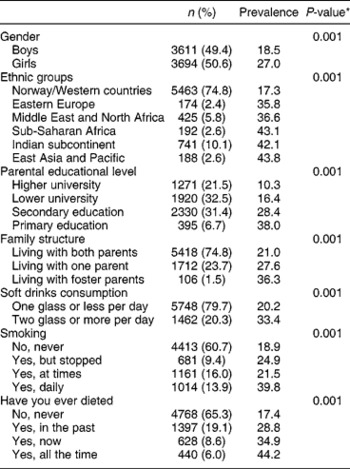
* P-value for the difference between those eating breakfast seldom and often, Pearson's χ2 test.
Prevalence (%) of eating breakfast, mental distress and school grade by gender and immigrant status
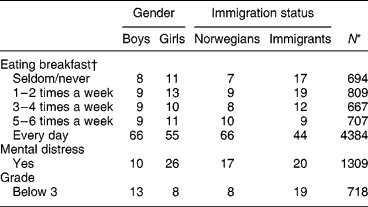
* Total number.
† Pearson's χ2 test for differences between groups is < 0.001, except for mental distress between Norwegians and immigrants (P = 0.009).
Parental education and to a lesser degree family structure also seem to influence the regularity of breakfast consumption (Table 1). Only 10% of students whose parents have a higher university degree eat breakfast seldom, while 38% of those with only primary education are in the same category. Students who drink sugar-containing soft drinks, smoke and diet report less frequent breakfast consumption compared with students who drink fewer soft drinks and do not smoke or diet.
Regression analysis
Before we entered all the proposed variables into the model, we tested the change in OR of the independent variable going from eating breakfast every day as the reference category to seldom/never, on each of the covariates. For mental distress, the largest change was for the dieting variable (OR from 3.2 to 2.2). Smoking gave a change in OR from 3.2 to 2.7. For school grades, parental educational level made the greatest change in OR from 3.4 to 2.5. Smoking changed the OR to 2.8 and drinking soft drinks changed it to 3.0. For the other variables, the changes were small (results not presented in the table).
The strongest correlation between the variables was for average grade and parental educational level, with a Pearson correlation coefficient of 0.22 (P = 0.001). The strongest correlation between the independent variables was for soft drinks consumption and smoking, with a Pearson correlation coefficient of 0.18 (P = 0.001). The final evaluation of the model showed a Hosmer and Lemeshow goodness-of-fit test of P = 0.95.
Boys have higher crude and adjusted ORs for mental distress when skipping breakfast than girls, and Norwegians considerably higher than immigrants (Table 3). For immigrants, it is only when going from eating breakfast every day to seldom/never that remains statistically significant after adjustment. For boys, even going from every day to 3–4 times a week remains significant (OR = 2.1).
Crude and adjusted* association between mental distress and eating breakfast across gender and immigrant status; odds ratios with 95% confidence intervals

* Adjustment made for parental educational level, family structure, dieting, smoking and drinking soft drinks.
With school grades as dependent variable, the gender differences are less prominent for both the crude and adjusted ORs, while the differences between Norwegians and immigrants are immense (Table 4). For the immigrant group none of the adjusted ORs are statistically significant.
Crude and adjusted* association between school grades and eating breakfast across gender and immigrant status; odds ratios with 95% confidence intervals

* Adjustment made for parental educational level, family structure, dieting, smoking and drinking soft drinks.
Discussion
The main finding from this study is that eating breakfast regularly is associated with less mental distress and improved academic performance in a dose–response manner among adolescents. Girls and immigrants skip breakfast more often than boys and the Norwegian group, but the association between both mental distress and academic performance is stronger for boys than girls and stronger for the Norwegian compared with the immigrant group even after adjustment for possible confounding factors.
Several studies by Smith have confirmed that eating breakfast regularly improves mental well-being and physical health, and reduces stress in the form of a reduced cortisol level among adultsReference Smith8, Reference Smith9, Reference Smith14. Other studies have shown that breakfast is associated with quality of life in schoolchildrenReference Chen, Sekine, Hamanishi, Wang, Gaina and Yamagami16, natural killer cell and lymphokine activity in workersReference Morimoto, Takeshita, Inoue-Sakurai and Maruyama13 and sleep health in studentsReference Tanaka, Taira, Arakawa, Masuda, Yamamoto and Komoda15.
The Norwegian breakfast most often includes some kind of cereal and a drink such as coffee, tea, fruit juice or milk. The frequency of skipping breakfast increases as adolescents become olderReference Bull17. In a Norwegian study, 73% of 15–16 year olds were eating breakfast daily, while only 50% of 18–19 year olds maintained the same habitReference Lien, Lytle and Klepp30. Less is known about the breakfast content of the immigrant groups. Studies has revealed that immigrants from Asia and Africa often consume less fruits and vegetables and more chocolate, sweets and full-fat milk than immigrants from Western countriesReference Kumar, Holmboe-Ottesen, Lien and Wandel18.
There might be many beneficial effects of breakfast consumption. These include, as pointed out by Smith, the vital energy intake after a long night's fast and the improved bowel function arising from the consumption of cerealsReference Smith10. Glucose is essential in the formation of tryptophan, a precursor protein in the synthesis of serotonin, which regulates mood and memoryReference Wallin and Rissanen4, Reference Christensen and Redig31, Reference Young, Smith, Pihl and Ervin32. Other positive effects of breakfast might be the consumption of micronutrients and essential fatty acids that in some studies have been shown to be associated with mental health problems such as affective disorders, hyperactivity and behavioural problemsReference Gesch, Hammond, Hampson, Eves and Crowder1Reference Benton, Haller and Fordy25Reference Schoenthaler and Bier33–Reference Hibbeln and Salem36.
A different theory on the beneficial effects of regular breakfast eating is that the effect of regularity in life is the most important factor. Adolescents eating breakfast and other meals regularly also tend to have more healthy food habits, drink less alcohol and abstain from smokingReference Wetzler and Ursano12, Reference Bull17, Reference Johansen, Rasmussen and Madsen22. Finally, the social gathering around a table might also be favourable for mood and of course be an indicator of the functioning of the family that has been shown to be a predictor of distress in adolescentsReference Gilman, Kawachi, Fitzmaurice and Buka37, Reference Rutter and Smith38.
The strength of this study is the high response rate (88.3%) from all 15- to 16-year-old adolescents in Oslo for two consecutive years, and the large number of adolescents with an immigrant background (25%), making selection bias a minor problem. A validated questionnaire was applied to assess mental distress and self-reported grade to assess academic performance. We were able to control for known possible confounders in the multivariate analysis. However, the breakfast questions have not been validated.
There are several limitations in this study. First, we are not able to decide on the direction of the association. It is possible that students who are mentally distressed tend to skip breakfast more often that those who are not, but it is more unlikely that students with lower grades should have a tendency to skip breakfast more often than those with higher grades. Secondly, there might be even more important confounders than those we have already detected, obscuring the association between mental distress, academic performance and regularly eating breakfast.
Thirdly, there might be information bias in the form of misclassifications. There might be responders (personality types) that systematically tend to report negative exposure and the most negative outcome, or positive exposure and the most positive outcome, which may lead to a false inflation or deflation of the associationReference Kristensen39. It is, however, unlikely that, for example, a pupil with a depressive personality should report more frequent skipping of breakfast and lower grades than a non-depressive personality type. One way to minimise the effect of non-differential, dependent misclassification is to obtain objective information about exposure and/or outcomeReference Podsakoff, MacKenzie, Lee and Podsakoff40. In our case, more extensive information about breakfast habits could have been obtained from parents.
The public health impact of our study is that parents should be made more aware of the possible benefit of eating breakfast regularly. With both parents working in busy full-time jobs, it might be difficult to set aside time for breakfast. One possible solution to the time constraint felt by parents and adolescents is to serve breakfast at school, thereby also securing a balanced diet with cereals, fruit and vegetables.
Acknowledgements
Sources of funding: The author was employed as a Research fellow by the University of Oslo and did not receive any further funding.
Conflict of interest declaration: The author declares that there are no competing interests.
Acknowledgements: Data collection was conducted as part of the Oslo Health Study 2000–2001 in collaboration with the National Health Screening Service of Norway, now the Norwegian Institute of Public Health.



