





Orthorexia has been studied chiefly from its pathological side: orthorexia nervosa (OrNe), an intense preoccupation with a healthy diet with negative emotional, cognitive and/or social consequences. Research focuses both on how those with high OrNe trait levels pursue their goals and how they respond when their eating behaviour deviates from them(Reference Lasson, Rousseau and Vicente1). A panel of experts recently proposed new diagnostic criteria for OrNe(Reference Donini, Barrada and Barthels2). Furthermore, considering that orthorexia can also reflect healthy behaviour(Reference Bratman3), a bidimensional conceptualisation of orthorexia has emerged(Reference Barrada and Roncero4).
Healthy orthorexia (HeOr) is distinguished from OrNe. It includes a healthy interest in diet, healthy behaviour with regard to diet and eating healthily as part of one’s identity. Importantly, although HeOr and healthy eating are positively associated(Reference Zickgraf and Barrada5,Reference Mohamed Halim, Dickinson and Kemps6) , they are not equivalent. A person can be highly engaged with following his/her standards of healthy eating, which may or may not be, in fact, healthy, as official guidance provided by government-appointed public health experts and lay beliefs about healthy eating tend to differ(Reference Hanras, Dorard and Boujut7). Furthermore, a person can follow a healthy diet with or without considering it relevant to his/her identity. Thus, this bidimensional model implies that orthorexic trait levels should not be placed within a single continuum ranging from no relevance of healthy diet in one’s life to a pathological approach to healthy eating via intermediate points with adaptive and not interfering levels of relationship with healthy eating. To describe a person’s orthorexic trait levels, we need two scores: one for OrNe and another for HeOr. These two dimensions tend to show low–medium correlations(Reference Depa, Barrada and Roncero8,Reference Chace and Kluck9) .
It has been noted that the scales traditionally used to measure OrNe (the Düsseldorf Orthorexia Scale, DOS(Reference Barthels, Meyer and Pietrowsky10), and the Eating Habits Questionnaire, EHQ(Reference Gleaves, Graham and Ambwani11)) can be divided into two factors: OrNe and HeOr(Reference Hallit, Barrada and Salameh12). This bidimensional conceptualisation is promising, especially as the initial properties of these scales are not stable(Reference Hanras, Dorard and Boujut7), but it raises questions about the interpretation of previous studies using either the DOS or EHQ. In light of this, ‘OrNe’ will hereafter be used to refer to orthorexia nervosa and ‘ON’ to the way some studies and scales have operationalised this construct while partially evaluating HeOr.
According to the consensus document on OrNe diagnosis(Reference Donini, Barrada and Barthels2), OrNe should be considered an eating disorder (ED). ED are supposed to be exclusive (two diagnoses cannot be made at the same time), but OrNe can be prodromal, co-morbid or resolutive of another ED (in particular, anorexia nervosa, AN(Reference Barthels, Meyer and Huber13–Reference DeBois and Chatfield15)). OrNe is understood to differ from AN in its relationship with the body(Reference Donini, Barrada and Barthels2): while the search for potential weight loss in OrNe is understood to be associated with health concerns, AN is usually associated with body dissatisfaction and/or dysmorphia. Nevertheless, Depa et al.(Reference Depa, Barrada and Roncero8) showed that OrNe scores are positively predicted by ‘weight control’ motives for food choice, while HeOr scores are positively predicted by ‘health content’. Contrary to the suggestion of Donini et al.(Reference Donini, Barrada and Barthels2), no significant associations between ‘health’ motivations and OrNe scores were found. Therefore, further research is needed to better understand food choice motives in orthorexia.
Moreover, while several risk factors for OrNe have been suggested(Reference Donini, Barrada and Barthels2), many issues remain unresolved regarding their relationships with both dimensions of orthorexia. First, a systematic review and meta-analysis showed that exercise addiction is moderately associated with OrNe(Reference Strahler, Wachten and Mueller-Alcazar16). Kiss-Leizer et al.(Reference Kiss-Leizer, Tóth-Király and Rigó17) suggested that physical exercise may be an attempt to control weight. However, no studies have tested this hypothesis. Thus, it is not yet possible to determine whether OrNe and HeOr differ in terms of their associations with physical exercise or dependence on it.
Second, ON/OrNe is positively associated with health anxiety/hypochondria(Reference Chace and Kluck9,Reference Kiss-Leizer, Tóth-Király and Rigó17,Reference Barthels, Horn and Pietrowsky18) . OrNe could be a coping strategy(Reference Kiss-Leizer, Tóth-Király and Rigó17). Conversely, no association between HeOr and health anxiety was found(Reference Chace and Kluck9). It is important to continue exploring the different components of health anxiety in relation to orthorexia and to determine whether it is possible to refine the distinction between HeOr and OrNe.
Third, it has been shown that ON/OrNe is associated with difficulty identifying emotions(Reference Obeid, Hallit and Akel19–Reference Vuillier, Robertson and Greville-Harris21). The results concerning other emotional regulation dimensions are diverse: while two studies showed that ON was positively associated with difficulties in emotional regulation(Reference Obeid, Hallit and Akel19,Reference Vuillier, Robertson and Greville-Harris21) , Strahler et al.(Reference Strahler, Wachten and Neuhofer20) found that OrNe was positively associated with difficulty in controlling impulses. Therefore, further studies are required to clarify these discrepancies, especially as the results on the dimensions of personality are also heterogeneous.
Regarding the Big Five personality traits, ON/OrNe is positively associated with Neuroticism/Negative Affectivity(Reference Gleaves, Graham and Ambwani11,Reference Barthels, Barrada and Roncero22,Reference Strahler, Haddad and Salameh23) , although conversely, Awad et al.(Reference Awad, Salameh and Sacre24) showed that OrNe was negatively predicted by Negative Affectivity. The results are more contradictory for other personality traits. For example, HeOr was positively correlated with Extraversion in a German sample but negatively in a Lebanese sample(Reference Strahler, Haddad and Salameh23). Culture seems to influence the expression of personality traits, and in turn, this influences eating/orthorexic behaviour(Reference Strahler, Haddad and Salameh23). Further studies are needed to clarify the personality traits associated with orthorexia.
Although the bidimensional conceptualisation of orthorexia(Reference Barrada and Roncero4) is gradually gaining recognition, more studies are needed to better understand it. To date, the findings concerning OrNe/ON obtained are very diverse, not only regarding its association with sociodemographic(Reference Donini, Barrada and Barthels2), health and weight status data but also with psychological and dietary dimensions. This diversity can be explained by the different methods used to measure ON/OrNe. The unidimensional conceptualisation assesses non-pathological features of orthorexia, which ultimately correspond to HeOr in the bidimensional conceptualisation. To better understand orthorexia, it is essential to distinguish striving for a healthy diet from a psychopathological preoccupation in order to avoid pathologising what should not be pathologised. In this way, study results will likely be less heterogeneous in the future. Indeed, this study aimed to better characterise orthorexia in terms of its bidimensional conceptualisation.
To do this, we selected broad variables (in terms of sociodemographic characteristics, health, weight status and psychological processes) and key aspects of eating behaviour or ED. We used a double statistical approach: first, by comparing the scores of HeOr and OrNe according to the modalities of the sociodemographic, health, weight status and dietary variables, and second, by evaluating the correlations between HeOr and OrNe scores with age and clinical scales. Due to the exploratory nature of some of the study variables, no hypothesis was made regarding the links between orthorexia scores and participants’ sociodemographic characteristics. We assumed, however, that OrNe scores would be associated with more problematic functioning modalities (e.g. ED Neuroticism and health anxiety) than HeOr scores.
Method
Participants and procedure
Participants were recruited between May 2021 and September 2022. The call for participation was disseminated through social media and the investigators’ networks. The link to the study – hosted on the LimeSurvey platform – was included in the advertisements to recruit participants. The investigators had no contact with the participants, and participation was voluntary, without compensation.
The inclusion criteria for each participant were checked after they had read the study information leaflet and given their consent. To participate, individuals had to be between 18 and 65 years old, fluent in French, and, for women, not pregnant. The research protocol was approved by the Research Ethics Committee of the University that hosted the study (N°2020-97).
A total of 1742 participants were recruited. Male respondents were excluded due to their small number (n 174), and some women were excluded due to missing or outlying sociodemographic data (n 33 for missing data: they selected the ‘do not wish to answer’ or ‘other’ response without adding any further details as requested; n 6 mentioned their age as a single digit), anthropometric measures (n 15 mentioned aberrant heights and/or weights) or dietary answers (n 5 for which a diet was not attributable). The final sample was comprised of 1515 French-speaking women. Within this final sample, the median participation time was 29 min (first quartile: 23 min; third quartile: 38 min).
Measures
Sociodemographic, health, weight status and dietary data
We collected sociodemographic characteristics (e.g. gender (male/female), age, marital status (single/in a relationship)), health-related data (e.g. chronic diseases (yes/no)), weight status (i.e. height and current weight), physical exercise (yes/no/in the past) and dietary-related data (e.g. diet (check list with definition from omnivore to vegan), frequency of organic food consumption (from only organic food to never)).
Teruel Orthorexia Scale (TOS)
The French Teruel Orthorexia Scale (TOS)(Reference Maïano, Aimé and Almenara25) measures the bidimensional conceptualisation of OrNe (α = 0·82; all Cronbach’s αs reported correspond to the current sample) and HeOr (α = 0·85). The scale consists of seventeen items rated on a four-point scale from 0 = strongly disagree to 3 = strongly agree.
Food Choice Questionnaire
The French Food Choice Questionnaire (FCQ)(Reference Hanras, Mathieu and Chevrier26) assesses nine food choice motives: convenience (α = 0·80), natural content (α = 0·83), ethical concern (α = 0·85), weight control (α = 0·79), sensory appeal (α = 0·67), price (α = 0·82), familiarity (α = 0·73), health (α = 0·82) and mood (α = 0·83). The scale consists of thirty-nine items rated on a four-point scale from 1 = not at all important to 4 = very important.
Exercise Dependence Questionnaire
The French Exercise Dependence Questionnaire (EDQ)(Reference Kern and Baudin27) assesses eight dimensions of exercise dependence: positive reward (α = 0·78), stereotypical behaviour (α = 0·64), withdrawal symptoms (α = 0·85), interference with social/family/work life (α = 0·56), insight into problems (α = 0·70), exercise for weight control (α = 0·65), exercise for social reasons (α = 0·43) and exercise for health reasons (α = 0·76). The questionnaire was presented only to participants who reported exercising regularly. The scale consisted of twenty-nine items rated on a seven-point scale from 1 = strongly disagree to 7 = strongly agree. Unfortunately, we omitted Item 14 when designing the survey.
Questionnaire for Eating Disorder Diagnoses
The French Questionnaire for Eating Disorder Diagnoses (Q-EDD)(Reference Callahan, Rousseau and Knotter28) assesses the presence of disordered eating behaviours based on fifty items using Diagnostic and Statistical Manual of Mental Disorders-IV (DSM-IV) diagnostic criteria. Item scoring was adapted to match the DSM-5 diagnostic criteria for ED. The Q-EDD allows for a diagnosis of AN, bulimia nervosa (BN) or binge eating disorder (BED) to be made. Some data can also be processed categorically (e.g. afraid to gain weight (yes/no)).
Health Anxiety Questionnaire
The French Health Anxiety Questionnaire (HAQ)(Reference Bridou29) measures four dimensions of health anxiety: health worry and preoccupation (α = 0·89), fear of illness and death (α = 0·89), reassurance-seeking behaviour (α = 0·76) and interference with life (α = 0·82). The scale consists of twenty-one items rated on five-point scale from 1 = never to 5 = most of the time.
Profile of Emotional Competence
The Profile of Emotional Competence (PEC)(Reference Brasseur, Grégoire and Bourdu30) measures intra- and interpersonal emotional competencies. Only the items that assess intrapersonal skills were used to assess participants’ ability to identify (α = 0·72), understand (α = 0·81), express (α = 0·69), regulate (α = 0·77) and use (α = 0·70) their emotions. This part consists of twenty-five items rated on a five-point scale from 1 = strongly disagree to 5 = strongly agree.
Big Five Inventory
The French Big Five Inventory (BFI-Fr)(Reference Plaisant, Courtois and Réveillère31) assesses five personality traits: Extraversion (α = 0·87), Agreeableness (α = 0·73), Conscientiousness (α = 0·81), Neuroticism (α = 0·86) and Openness (α = 0·77). The scale consists of forty-five items rated on a five-point scale from 1 = strongly disapprove to 5 = strongly approve.
Statistical analysis
Statistical analyses were performed with R 4.3.2. Comparative analyses were conducted to assess whether there was a difference in means between orthorexia scores (OrNe and HeOr) according to the assessed sociodemographic, health, weight status and dietary variables. One-way ANOVA were used to analyse categorical data. When the independent variable had two levels (e.g. marital status and mother), Cohen’s d was used to measure the effect size (interpreted according to Cohen(Reference Cohen32)). When the independent variable had more than two levels (e.g. academic degree and ED), we used R (the square root of the percentage of explained variance) as the effect size measure for the overall model and Cohen’s d for Tukey’s pair-wise comparisons. Also, Pearson’s correlations were performed between HeOr, OrNe and other quantitative variables (i.e. age, subscales). We analysed all of the subscales even though internal consistencies were relatively low for some.
Results
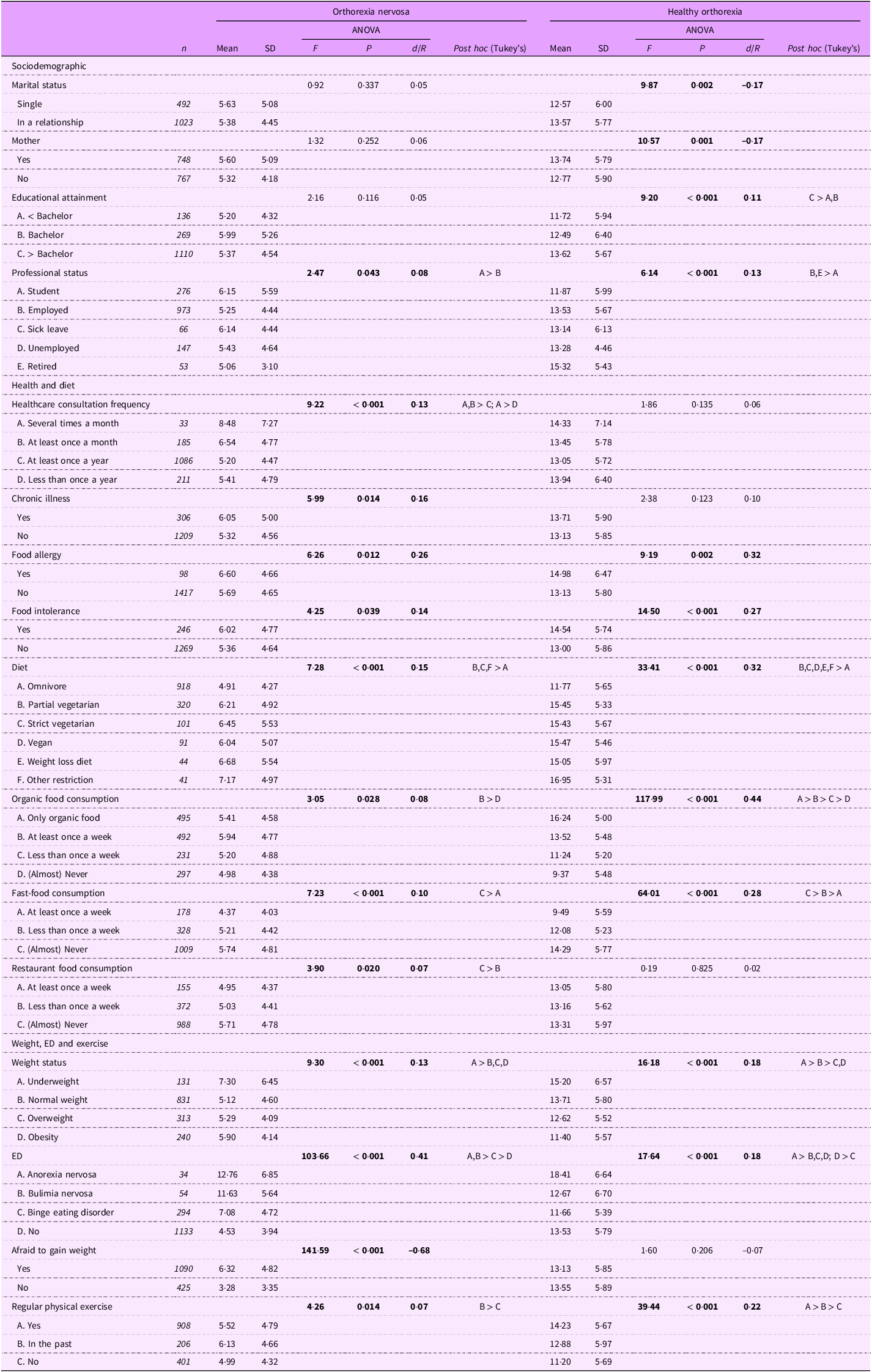
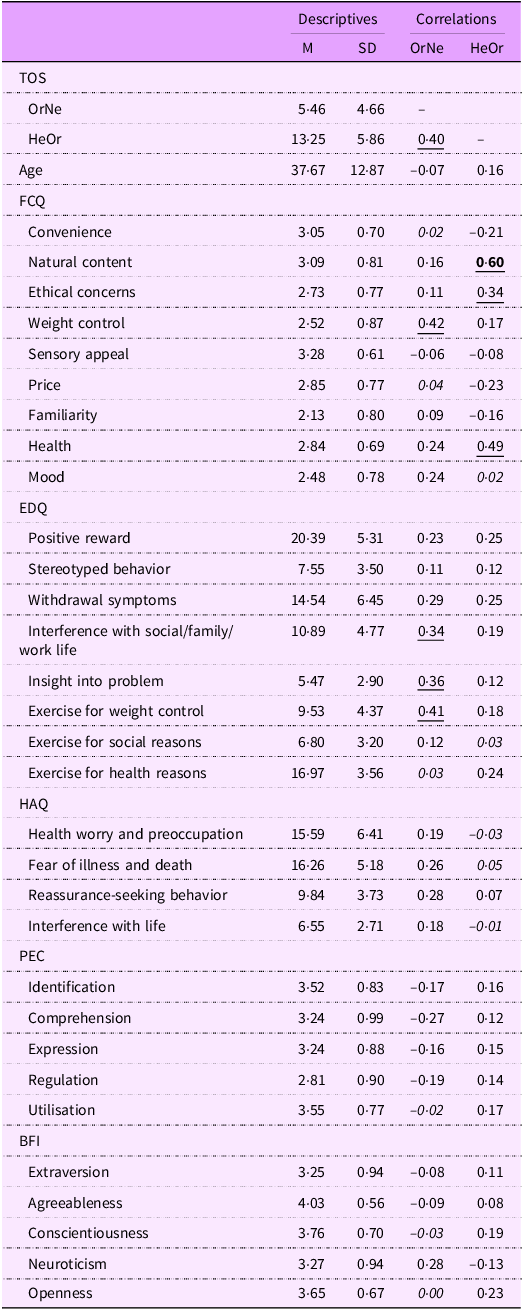
Descriptive analysis, mean comparisons and Pearson’s correlations are shown in Tables 1 and 2. The possible range of scores for OrNe was 0–24. Sample mean was 5·46. These results indicate that most participants presented very low scores on this dimension. For HeOr, the acceptable range was 0–27, with the mean being 13·25, almost at the mid-point. The mean orthorexia scores in the present study were comparable to previous results within the same cultural context (the study presenting the French validation of the TOS(Reference Lasson, Rousseau and Vicente1)), despite differences in the sample composition – inclusion of men in(Reference Lasson, Rousseau and Vicente1) – and slight differences in the wording of the applied TOS and sample recruitment.
Descriptive analysis and comparison of sociodemographic, health and dietary data for HeOr and OrNe (n 1515)

HeOr, healthy orthorexia; OrNe, orthorexia nervosa; d, Cohen’s d; ED, eating disorder. Bold values correspond to statistically significant effects, P < 0·05.
Descriptive analysis and Pearson’s correlations with HeOr and OrNe

M, mean; HeOr, healthy orthorexia; OrNe, orthorexia nervosa; TOS, Teruel Orthorexia Scale; FCQ, Food Choice Questionnaire; EDQ, Exercise Dependence Questionnaire; HAQ, Health Anxiety Questionnaire; PEC, Profile of Emotional Competence; BFI, Big Five Inventory.
All correlations were statistically significant, P < 0·05, except for italicized values. Underlined correlations correspond to |r| > 0·30. Bold correlations correspond to |r| > 0·50.
Mean comparisons for orthorexia nervosa and healthy orthorexia
Sociodemographic data
OrNe scores were associated with professional status (F(4, 1510) = 2·47, P = 0·043, R = 0·08), with students presenting higher OrNe scores than employees (P = 0·037, d = 0·19). HeOr scores were higher when participants were in a relationship (F(1, 1513) = 9·87, P = 0·002, d = –0·17) and mothers (F(1, 1513) = 10·57, P = 0·001, d = –0·17). HeOr was related with educational attainment (F(2, 1512) = 9·20, P < 0·001, R = 0·11) and professional status (F(4, 1510) = 6·14, P < 0·001, R = 0·13). More specifically, holders of a degree higher than a bachelor’s compared with those with a lower degree (P = 0·001, d = 0·19) or equal to the bachelor’s (P = 0·012, d = 0·33) showed larger means. Employed and retired participants had higher HeOr scores than students (P < 0·001 for both post hoc tests, d = 0·29 and d = 0·59, respectively).
Health and diet data
OrNe and HeOr scores were higher when participants presented a food allergy (OrNe: F(1, 1513) = 6·26, P = 0·012, d = 0·26; HeOr: F(1, 1513) = 9·19, P = 0·002, d = 0·32) or a food intolerance (OrNe: F(1, 1513) = 4·25, P = 0·039, d = 0·14; HeOr: F(1, 1513) = 14·50, P < 0·001, d = 0·27). While OrNe scores were associated with presenting a chronic illness (F(1, 1513) = 5·99, P = 0·014, d = 0·16) and with healthcare consultation frequency (F(3, 1511) = 9·22, P < 0·001, R = 0·13), none of these associations were statistically significant for HeOr (Ps ≥ 0·123). Mean OrNe scores were higher among participants who consulted a healthcare professional several times a month compared with those who consulted at least once a year (P < 0·001, d = –0·71) or less than once a year (P = 0·002, d = –0·67). Moreover, those who consulted at least once a month had higher OrNe scores than those who consulted less than once a year (P = 0·002, d = –0·29).
Both orthorexia dimensions were associated with diet, although the effect size for HeOr (F(5, 1508) = 33·51, P < 0·001, R = 0·32) was almost double that of OrNe (F(5, 1508) = 7·28, P < 0·001, R = 0·15). Compared with omnivores, OrNe and HeOr scores were higher when participants were partial vegetarians (P < 0·001 for both post hoc comparisons, d = –0·28 and –0·66, respectively), strict vegetarians (P = 0·019, d = –0·33; P < 0·001, d = –0·66) or under other dietary restrictions (e.g. macrobiotic diet, lactose-free diet; P = 0·026, d = 0·49; P < 0·001, d = 0·93). HeOr scores were also higher when participants were vegans (P < 0·001, d = –0·66) or had followed a weight loss diet (P = 0·002, d = 0·59).
OrNe and HeOr scores were associated with organic food consumption, although the relationship was much stronger with HeOr (OrNe: F(3, 1511) = 3·05, P = 0·028, R = 0·08; HeOr: F(3, 1511) = 117·99, P < 0·001, R = 0·44). Participants who ate organic food at least once a week had higher orthorexia scores than those who almost never did (OrNe: P = 0·026, d = –0·21; HeOr: P = 0·001, d = –0·79). HeOr scores were higher as organic food consumption increased (P < 0·001 for all post hoc comparisons, range of ds [–1·30, –0·52]). Second, OrNe scores were associated with restaurant food consumption (F(2, 1512) = 3·90, P = 0·020, R = 0·07). Participants who almost never ate prepared meals in restaurants had higher OrNe scores than those who ate them at least once a week (P = 0·045, d = –0·15). Third, OrNe and HeOr were related to fast-food consumption, again with a larger effect size for HeOr (OrNe: F(2, 1512) = 7·23, P < 0·001, R = 0·10; HeOr: F(2 1512) = 64·01, P < 0·001, R = 0·28). Participants who almost never ate at a fast-food restaurant had higher orthorexia scores than those who ate at such a restaurant at least once a week (P < 0·001 for both post hoc comparisons, d = –0·30 for OrNe and –0·85 for HeOr). HeOr scores were also higher as fast-food consumption decreased (P < 0·001 for all post hoc comparisons, range of ds [–0·40, –0·46]).
Weight, eating disorder and physical exercise
OrNe and HeOr scores were associated with weight status (OrNe: F(3, 1511) = 9·30, P < 0·001, R = 0·13, HeOr: F(3, 1511) = 16·18, P < 0·001, R = 0·18). Underweight participants had higher orthorexia scores than those reporting normal weight (OrNe: P < 0·001, d = 0·47; HeOr: P = 0·032, d = 0·26), being overweight (OrNe: P < 0·001, d = 0·43; HeOr: P < 0·001, d = 0·45) or living with obesity (OrNe: P = 0·028, d = 0·30; HeOr: P < 0·001, d = 0·66). For HeOr, post hoc tests also showed that scores were higher among normal-weight than overweight participants (P = 0·023, d = 0·19) or those living with obesity (P < 0·001, d = 0·40).
Both orthorexia dimensions were related to ED, with an effect size for OrNe scores (F(3, 1511) = 103·66, P < 0·001, R = 0·41) that was more than double that of HeOr scores (F(3, 1511) = 17·64, P < 0·001, R = 0·18). More specifically, participants who were identified as having AN had higher orthorexia scores compared with those with BED (P < 0·001 for both post hoc tests, d = 1·34 for OrNe and 1·17 for HeOr), without ED (P < 0·001 for both post hoc tests, d = 1·94 for OrNe and 0·85 for HeOr) and (but only for HeOr) those with BN (P < 0·001, d = 1·00). Participants who suffered from BN had higher OrNe scores than those with BED (P < 0·001, d = 1·07) or those without ED (P < 0·001, d = 1·67). Conversely, participants without ED had higher HeOr scores than those with BED (P < 0·001, d = 0·33). While participants who were afraid to gain weight had higher OrNe scores than those who did not (F(1, 1513) = 141·59, P < 0·001, d = –0·68), that difference was not statistically significant for HeOr (F(1, 1513) = 1·60, P = 0·206, d = –0·07).
OrNe and HeOr scores were associated with engaging in regular physical exercise, with a stronger relationship for HeOr (OrNe: F(2, 1512) = 4·26, P = 0·014, R = 0·07; HeOr: F(2, 1512) = 39·44, P < 0·001, R = 0·22). Participants who had exercised regularly in the past had higher orthorexia scores than those who had not (OrNe: P = 0·012, d = 0·25; HeOr: P = 0·002, d = 0·29). Participants who were currently exercising had higher HeOr scores than participants who had exercised in the past (P = 0·006, d = 0·24) and those who had not (P < 0·001, d = 0·53).
Correlations between quantitative data for orthorexia nervosa and healthy orthorexia
In line with previous research, there was a medium correlation between both orthorexia scores (r = 0·40, P < 0·001). While OrNe scores were negatively correlated with age (r = –0·07, P = 0·004), the opposite pattern was observed for HeOr (r = 0·16, P < 0·001).
With respect to food choice motives, the highest association for OrNe scores was with Weight Control (r = 0·42, P < 0·001), followed by Health and Mood (both rs = 0·24, Ps < 0·001). The lowest (not statistically significant) correlations were with Convenience (r = 0·02, P = 0·524) and Price (r = 0·04, P = 0·114). The pattern was very different for HeOr, where the strongest association was with Natural Content (r = 0·60), followed by Health (r = 0·49), Ethical Concerns (r = 0·34) and, negatively, with Price (r = –0·23) and Convenience (r = –0·21, all ps < 0·001). HeOr and Mood were not significantly correlated (r = 0·02, P = 0·463).
While the strongest associations between OrNe scores and EDQ dimensions were with Exercise for Weight Control (r = 0·41), Insight into Problems (r = 0·36), and Interference with Social/Family/Work Life (r = 0·34, all ps < 0·001), the smallest correlations were for Stereotyped Behaviour (r = 0·11, P = 0·001), Exercise for Social Reasons (r = 0·12, P < 0·001), and, notably, a non-statistically significant association with Exercise for Health Reasons (r = 0·03, P = 0·333). For HeOr scores, correlations were, overall, smaller. The larger ones were with Positive Reward and Withdrawal Symptoms (both rs = 0·25) and Exercise for Health Reasons (r = 0·24, all ps < 0·001), while the smallest (and non-statistically significant) one was with Exercise for Social Reasons (r = 0·03, P = 0·294).
The mean correlation between HAQ scores and orthorexia scores was 0·23 for OrNe (range of rs [0·18, 0·28], all Ps < 0·001) and 0·02 for HeOr (range of rs [–0·03, 0·07], all Ps ≥ 0·070, except for reassurance-seeking behaviour: P = 0·006). With respect to PEC, while the mean correlation was negative for OrNe (M r = –0·16; range of rs from –0·02 for Utilisation to –0·27 for Comprehension), the pattern was positive for HeOr, with a mean correlation of 0·15 (range of rs [0·12, 0·17]). All the correlations between both orthorexia and PEC scores were statistically significant (Ps < 0·001), except for that between OrNe and Utilisation (P = 0·437). The personality dimension with the highest correlation with OrNe was Neuroticism (r = 0·28, P < 0·001), with Conscientiousness (r = –0·03, P = 0·186) and Openness (r = –0·03, P = 0·904) presenting non-significant correlations. For HeOr, the strongest association was with Openness (r = 0·23), while the other four ranged between –0·13 and 0·19 (all Ps ≤ 0·002).
Discussion
The purpose of this article was to evaluate OrNe and HeOr in relation to several broad and relevant dimensions in the areas of sociodemographic characteristics, psychopathology and ED.
Regarding ED, significant differences in OrNe scores were found between participants without an ED and those who presented it (whether for AN, BN or – to a lesser extent – BED). When comparing the latter three groups of participants with those who did not have an ED, all the Cohen’s ds were equal or larger than 1 (very large effect sizes). It is important to clarify these findings to avoid the possible interpretation that OrNe is merely a new way of talking about AN(Reference Bhattacharya, Cooper and McAdams33). To say that those presenting AN have high scores on OrNe does not equate to saying that those with high scores on OrNe present AN. In line with this, according to DSM-5, a required diagnostic criterion for AN is a significantly low body weight. If OrNe and AN were essentially equivalent, OrNe and weight status would show a much higher association than that which we found. Although underweight individuals had higher OrNe scores, the effect sizes of those differences were moderate. In fact, previous studies have not found systematic associations between BMI and OrNe(Reference Barrada and Roncero4,Reference Godefroy, Trinchera and Dorard34) . Criterion B for AN includes an intense fear of gaining weight or becoming fat. Our results indicated that respondents with this fear showed higher OrNe traits. Donini et al.’s(Reference Donini, Barrada and Barthels2) assertion that body appearance problems can distinguish AN from OrNe, therefore, appears problematic, as weight concerns (e.g. fear of gaining weight and choosing food for weight control) are clearly associated with OrNe.
OrNe scores were strongly linked to BN but not as much with BED. Several elements help to understand these associations. First, to distinguish purgative AN from BN, the main criterion is weight (underweight for AN v. normal weight for BN). Therefore, some participants may oscillate between a diagnosis of AN and BN. However, as the study was cross-sectional, these data could not be captured. Second, the medium-strength positive correlations between OrNe scores and mood-based food choice motivations are important to consider. Indeed, our results suggest that OrNe is associated with emotional eating(Reference Barthels, Barrada and Roncero22), and this eating pattern is favoured by the medium correlation found between OrNe and Neuroticism. In addition to the dietary restrictions found in OrNe, the presence of emotional eating may explain the presence of binge eating episodes(Reference Macht35). Although previous studies have found contradictory results (positive, negative or no relationship) between ON/OrNe and symptoms of binge eating(Reference Barthels, Kisser and Pietrowsky36,Reference Brytek-Matera, Onieva-Zafra and Parra-Fernández37) , the present association is not surprising. Criterion B of the BN specifies that, unlike BED, outbursts are preceded or followed by inappropriate behaviours aimed at weight loss or maintenance. These behaviours include physical exercise. Our results indicate that OrNe scores were moderately related to exercise for weight control purposes, as well as to interference with daily life. In addition to a strong association between weight control food choices motive and OrNe, compensatory behaviours can also be found. Finally, the association between OrNe scores and BED was weaker, but this is probably due to the body dissatisfaction characteristic of OrNe. In fact, this aspect of the body is not addressed in the diagnosis of BED, whereas it is in the other ED.
However, OrNe may be independent of other ED diagnoses. It is, therefore, possible that OrNe, like binge eating episodes, could be a symptom of an existing ED (AN or BN) but is also a disorder in its own right (like BED). Like other ED(Reference Fairburn, Cooper and Shafran38,Reference Monell, Clinton and Birgegård39) , the results showed that OrNe scores were negatively and moderately associated with emotional competencies but positively with weight control food choice motive(Reference Depa, Barrada and Roncero8). Weight control can also be expressed through the adoption of a vegetarian diet, a socially acceptable strategy to control food intake and thus justify caloric restrictions(Reference O’Connor, Touyz and Dunn40). Indeed, higher OrNe scores were observed among partial vegetarians, strict vegetarians and vegans compared with omnivores, with medium effect sizes. This pattern does not imply, however, that a vegetarian diet is a marker of OrNe, as has been suggested(Reference Donini, Barrada and Barthels2), but only that some vegetarians may present with OrNe. Indeed, it is not adherence to a particular diet that is associated with OrNe but rather the rigidification of dietary practices(Reference Bratman3). In line with this, the association was higher for HeOr than for OrNe, with an effect size that was more than twice as large.
While motivations for choosing food based on its natural content and ethical concerns are frequently linked to health(Reference Depa, Barrada and Roncero8,Reference Milošević, Žeželj and Gorton41) , it is interesting to note that these motivations were closely linked to HeOr scores but only very weakly to OrNe scores. In OrNe, the health motive might be used to select and exclude foods that are, for example, too high in calories. This may explain the weak relationship observed between OrNe scores and the frequency of fast-food consumption, as well as the frequency of consumption of organic foods, which were moderate for HeOr scores. In HeOr, health-oriented food choices are probably linked to specific sociodemographic characteristics(Reference Kesse-Guyot, Lairon and Allès42). Indeed, the transition to a healthy diet may have been facilitated by the stability of individuals’ professional lives, as well as by the arrival of children. These food choice motivations can also be explained by Conscientiousness, which is positively associated with the adoption of healthy behaviours(Reference Gartland, Wilson and Lawton43), like consuming healthy food or engaging in physical exercise. Particularly for health reasons, physical exercise was moderately associated with HeOr scores in our study. Although HeOr scores were moderately associated with weight status, AN and weight control food choice motives, it would seem that these results are explained by the moderate correlation found between HeOr and OrNe. To the extent that HeOr scores were not associated with a fear of weight gain, the motivation for weight control could be directly related to health(Reference Oberle, Samaghabadi and Hughes44,Reference Varga, Dukay-Szabó and Túry45) . Thus, it appears that HeOr is associated with a generally healthy lifestyle(Reference Hallit, Barrada and Salameh12) compared with OrNe. Dietary selectivity for health reasons does not appear to be the dominant factor in OrNe, contrary to what has long been suggested(Reference Dunn and Bratman46).
Regarding other dimensions of psychological functioning and health, our results showed that OrNe scores were moderately and negatively associated with emotional competence, while HeOr scores were positively associated. Moreover, OrNe scores showed small–medium correlations with all dimensions of health anxiety, including interference with life, but none with HeOr(Reference Chace and Kluck9). It is, therefore, possible that the emotional difficulties found in the OrNe trend are linked to health concerns. Interestingly, these latter associations were not higher in relation to OrNe, even though OrNe is considered to be closely related to eating, an important dimension of health. Connecting this with the fact that OrNe was more strongly correlated with weight control behaviours – both for food choice and physical exercise – we can infer that the pathological dimension of orthorexia is not so much about health and healthy eating. This leads to the intriguing conclusion that, apparently, OrNe is not coherent with even its own definition. This hypothesis is corroborated by our results showing that OrNe scores were unrelated to exercising for health reasons.
In addition, OrNe scores were higher among participants who consulted a healthcare professional at least once a month compared with those who did so less frequently, which was not the case with HeOr. These results may be explained by health reasons or/and health anxiety. OrNe scores were higher when participants reported a chronic illness, food allergy, food intolerance or an ED. Thus, participants with high OrNe trait levels seem to be sicker or perceive themselves as sicker and show more significant health-related concerns, not just those related to healthy eating. For these people, the change in dietary practice may reflect a desire to get better or to adhere rigidly to dietary prescriptions(Reference Donini, Barrada and Barthels2,Reference Bratman3) .
Regarding HeOr, these scores were also higher when participants reported a food allergy or intolerance, with a small to moderate effect size. HeOr was also moderately related to age. Therefore, individuals with HeOr may have more expertise in their food selectivity than those with OrNe.
When interpreting these results, we must consider the study’s limitations. The first is sampling. Most participants were recruited from social networks and are likely to have chosen to participate because they were interested in the topic. This may have influenced the data collected and can explain why the study sample was almost exclusively female. In line with this, we decided to exclude them. If we had retained them, the results of what we would have presented as a mixed-gender sample would have been, in fact, dominated by women. Furthermore, comparisons between genders could not have been adequately conducted with proper statistical power. Thus, although our study has helped to better identify what distinguishes orthorexia from different ED in women, further studies are needed with men to assess the potential existence of gender specificities.
Second, some of our variables are partially overlapped. For instance, professional status or healthcare consultation frequency are each tied to age. We decided to only report associations without any control variables, both because it was not clear which of those control variables we should include and to reduce manuscript length. Future research should attempt to clarify these associations. Nonetheless, age shared less than 1 % of the variance with OrNe and 2·6 % with HeOr, so we expect our results to largely hold if we were to control for these variables.
Third, the Q-EDD is based on DSM-IV criteria. Although the French validation of the Q-EDD shows very good validity(Reference Callahan, Rousseau and Knotter28) and the scoring was adapted to the DSM-5, future studies could consider conducting diagnostic interviews with participants to better relate orthorexia measures and other ED.
Finally, some Cronbach’s α coefficients are low, such as those for several of the EDQ subscales. We could have anticipated these problems given the reported alphas in previous studies(Reference Kern and Baudin27,Reference Ogden, Veale and Summers47) . Thus, the results for these subscales should be interpreted with caution, as associations uncorrected for measurement error are systematically biased downward(Reference Fan48). These reliabilities also point to the need for conducting further research to develop alternatives with better psychometric properties. In line with this, when designing our survey, we (inadvertently) did not include Item 14 of the EDQ, which belongs to the Exercise for Weight Control dimension. Applying the Spearman–Brown formula (which allows us to predict the expected reliability in the case of inclusion or exclusion of items like those already present in the questionnaire), if the number of items of that dimension had not been 3 (as in our survey) but 4 (as in the correct version), the Cronbach’s α for that dimension would have increased from 0·65 to 0·71. Despite this omission, we believe the results for this dimension remain relevant.
Although some readers may consider it to be a limitation, a key aspect of our approach was to use bidimensional scoring for the two orthorexias. The TOS does not provide a cut-off point beyond which participants can be tagged as presenting with OrNe or HeOr. We consider this to be a strength of this questionnaire – or, at least, not a limitation – for three reasons. First, as there is not yet a consensus concerning how to diagnose OrNe, nor a robust method to do so, no meaningful cut-off point for a self-report can be derived. In other words, we consider that other questionnaires that purportedly allow the diagnosis of OrNe are misleading, as there is no way to correctly validate that categorisation when presented. Second, using cut-off points reduces available information by transforming a numerical variable into a dichotomous one, reducing statistical power(Reference Cohen49). Third, the TOS is aligned with the general trend in psychopathology to consider mental disorders as dimensions, not categories. In the words of Smith et al.(Reference Smith, Atkinson and Davis50), ‘traditional systems defined mental disorders as categories. This approach is at odds with a vast body of empirical work providing compelling evidence that psychological dysfunction exists along continua’. We agree that diagnostics are sometimes necessary (e.g. insurance and prevalence studies), but in other cases, a dimensional model is preferred.
Our study points to different practical applications (though it does so tentatively, as the study design does not allow the establishment of causal relationships). It seems beneficial to develop the emotional skills of individuals with a tendency to present with OrNe, helping them regulate their negative emotions. Indeed, emotional difficulties are central to ED. In addition, work on the relationship with the body seems important since there is a tendency in OrNe to want to lose weight, whether through dietary restrictions or physical exercise. Similarly, when a patient is identified as having ED (other than OrNe), it seems to us essential that the presence of food obsessions and behaviours focused on the quality of food be regularly questioned. Indeed, numerous studies have shown that ED can turn into OrNe and vice versa(Reference Barthels, Meyer and Huber13–Reference DeBois and Chatfield15). If this is the case, the patient’s relationship with healthy eating needs to be addressed to help him or her shift from a dichotomous vision of food, which is often based on restriction and deprivation. Furthermore, our results suggest that the adoption or promotion of a healthy lifestyle is not connected with OrNe, as they are more tied with HeOr.
Conclusion
This study is the first to investigate the associations between the biconceptualisation of orthorexia and a broad set of sociodemographic, health, dietary and psychological variables. The findings confirm that each orthorexia – considered dimensionally – is associated with specific modalities of eating and psychological functioning. The results suggest that HeOr is, in general, part of a healthy lifestyle, whether through following a healthy diet or engaging in physical exercise. In contrast, OrNe is more likely to fall into the category of an ED and was associated with more problematic psychological functioning (e.g. health-related anxiety and fear of gaining weight). Future studies could focus on describing how the development of the two orthorexia is articulated over time.
Acknowledgements
None.
Authorship
Conceptualisation: E.H., E.B. and G.D.; Methodology: E.H., E.B. and G.D.; Validation: E.H., E.B. and G.D.; Formal analysis: E.H. and J.B.; Investigation: E.H.; Data curation: E.H.; Writing – original draft: E.H.; Writing – review and editing: E.H., E.B., J.B. and G.D.; Visualisation: E.H., E.B., J.B. and G.D.; Supervision: G.D. and E.B.; Project administration: E.H., E.B. and G.D.
Financial Support
None.
Competing interests
None.
Ethics of human subject participation
This study was conducted according to the guidelines laid down in the Declaration of Helsinki, and all procedures involving research study participants were approved by the Research Ethics Committee of the University Université Paris Cité (e.g. Université de Paris; N°2020-97). Informed consent was obtained from all participants.

 Open access

