

1. Introduction
In September 1896, the quarterly patient magazine of the Bethlem Royal Hospital, Under the Dome, opened with the obituary of Henry Francis Harding. Described as the magazine’s ‘Sub-Editor’, Harding had corrected proofs and compiled indexes, personally requested articles from hospital residents and contributed many of his own. The obituarist, presumably a member of Bethlem staff, concluded: ‘[n]ot only is he missed on account of his valued services to the Magazine, but also as a personal friend of many of the staff with whom he worked in the interests of the Hospital.’Footnote 1 Who was Henry Francis Harding? Although the obituary did not make it clear, he was, in fact, a patient at Bethlem. A law stationer by trade, Harding had first been admitted in December 1886 at the age of sixty. Despite having never previously been considered mentally unsound, Harding remained at Bethlem as a voluntary boarder until his death, a decade later.Footnote 2
The fact that the obituary omitted this detail is interesting. Indeed, it raises the wider question of how we are to understand the ‘patient’s voice’ in British psychiatry of this period. This particular hospital resident can be found in a variety of roles across published and unpublished material. A colleague and friend to hospital staff, especially Assistant Physician Theo Hyslop and Chaplain Edward O’Donoghue, Harding even received an acknowledgement in a nineteenth-century psychiatric textbook: Hyslop’s Mental Physiology (1895). At the same time, in a case study published some seven months before his death, he was referred to as a ‘weak-minded’ patient.Footnote 3 This description sits awkwardly alongside what we see of Harding in Under the Dome. In his regular column, ‘Notes Apropos’ (begun in 1893), and in articles published under the initials ‘H.F.H.’ and ‘X.’, Harding cast himself as an educated gentleman writer, covering topics that ranged from London life and history to leisure pursuits, which included music and cigar smoking. Nonetheless, he also identified himself as a patient and, although keen to describe Bethlem as a ‘happy family’, he was something of a patient advocate, responding in his writings to popular stereotypes of asylum patients and stressing the importance of patient representation at official functions.
So what can Henry Francis Harding’s case tell us about the ‘patient’s view’ of asylum life? Some thirty years after Roy Porter’s call for social historians of medicine to explore the perspective ‘from below’, the history of the patient remains ‘curiously underwritten’ in certain areas, according to some.Footnote 4 Flurin Condrau, for example, has suggested that, conceptually speaking, ‘the history of the patient’s view is as undeveloped now as it was back in the mid-1980s’.Footnote 5 This might appear surprising in the British context, given the numerous responses to Porter’s plea. Yet the changing and fluid role of patients in specific cultural and institutional settings needs to be further explored. Indeed, such discussions have long been caught in a divide that has been brought to the fore by Foucauldian analyses of power relations: as Condrau puts it, the patient has only been considered either as an independent, autonomous partner in the medical encounter or a construct of medical discourse, knowledge and power.Footnote 6 Recent works, however, have shown that this dichotomy needs to be qualified: in some instances, the construction of the patient’s identity emerged from a process of collaboration between doctor and sufferer.Footnote 7 Similarly, other players such as nurses and family members were instrumental in shaping asylum culture and patient experience.Footnote 8 Michael Barfoot and Allan Beveridge’s detailed descriptions of two patients in the Royal Edinburgh Asylum provided a vivid illustration of how varied asylum life could be, even for a single individual in one institution.Footnote 9 The authors explored the difficulties in interpreting a patient’s experience through medical and related records, showing how a nuanced understanding of asylum psychiatry can be gained by looking in depth at both positive and negative patient experiences. Patients’ daily lives, in other words, were far from homogeneous. Asylum dynamics varied widely from one country to another and from one institution to another, and also depended on elements such as gender and social class. Accordingly, when exploring the ‘patient’s view’ it is necessary to understand this diversity, not as a static, but as a complex and context-specific phenomenon. Although historians have delved into the history of British psychiatry ‘from below’, a number of these nuances and differences remain underexplored.
The question of ‘voluntary’ commitment in nineteenth-century British asylums is one such topic. In most continental European countries, ‘voluntary’ commitment did not exist before the interwar period. French patients, for instance, were either sent by the State or by their relatives; they could not commit themselves. In fact, practices of ‘voluntary confinement’, ‘no-restraint’ and ‘boarding out’ were known in the nineteenth century as typically British – and especially Scottish – features (as was the practice of allowing patients to write in asylum magazines).Footnote 10 Although considered a source of inspiration by some, most continental alienists (notably in GermanyFootnote 11 and FranceFootnote 12) rejected these British features and considered them to be unacceptable infringements on medical authority. The view was that it should not be the patients who decided when and how they were to be confined or restrained – it should be the physicians.
By following the case stories of two patients at Bethlem Royal Hospital (Henry Francis Harding and Walter Abraham Haigh), I aim to unpick the notion of ‘asylum patient’ and provide another angle on the interplay between patients and doctors within the late-Victorian psychiatric world. Haigh and Harding were treated as friends, and even as academic consultants, by their physicians. As such, they had a special relationship with them. In public asylums across Britain and continental Europe patients would, typically, meet with their alienist once a month. Harding and Haigh’s example shows that, in some instances, the psychiatric universe could foster more meaningful doctor–patient connections. Harding was a voluntary patient throughout his asylum stay; Haigh was legally certified as insane, but his relationship with his physicians led to later voluntary admissions and eventually a re-evaluation of his legal status. I argue that it is this unique (ambiguous) status that provided them both with a unique place within the asylum’s social order. By presenting an original angle that contradicts classic views on doctor–patient relationships, this facet of late-Victorian asylumdom also sheds new light on classic historiographical narratives. Both Haigh and Harding seemingly accepted certain elements of the patient role while rejecting others; both also took on additional identities and even contributed to medical debates over the ways in which madness could be defined and represented. In these particular cases, the patient’s view thus sits between the professionalised medical view and lay conceptualisations of madness.Footnote 13 The interactions that Harding and Haigh had with their physicians indicate that the Victorian ‘failure’ to correlate brain lesions with psychiatric diagnoses did not inevitably lead to psychiatric pessimism. It also shaped other approaches: an individualised, case-centred view of madness in which the patient could have input into the way madness was represented and understood.
2. ‘Genus Patient (Species: “Voluntary”)’: Boarding in Asylums in the 1880s
Henry Francis Harding was admitted to Bethlem in the year that ‘voluntary boarding’ at the hospital officially began. While most secondary literature has considered voluntary asylum admission to be a feature of the 1930 Mental Treatment Act, Bethlem was not the only institution to admit non-certified patients in the late nineteenth century. The York Retreat admitted occasional voluntary patients before 1890, and the number increased thereafter – reaching 246 by 1910.Footnote 14 Manor House, in Chiswick, kept separate records of voluntary boarders from at least 1896, while the exclusive Ticehurst House Hospital began this in 1895.Footnote 15 In 1888, the middle-class Holloway Sanatorium at Virginia Water (a registered hospital), admitted an enormous eighty-five boarders, which was not far off the number of certified patients (a total of one hundred and eight).Footnote 16 This feature of the late-Victorian asylum has been neglected by historians, as it did not apply to the much larger county asylum system. While Bethlem (the hospital that forms the focus of this article) primarily admitted charitable patients, the clientele became increasingly middle class through the second half of the nineteenth century. By the mid-1880s, patients were mostly drawn from the ‘poor educated classes’: that is, clerks and governesses rather than domestic servants and unskilled labourers.Footnote 17 Until 1853, the hospital held specialist status, and was exempt from many of the conditions of the Lunacy Laws: after this, Bethlem was treated legally as a ‘licensed institution’, and can be better equated with private asylums and voluntary hospitals than with county asylums.Footnote 18
Prior to 1890, licensed institutions were allowed to admit patients voluntarily if they had been certified on a prior occasion. In the 1890 Lunacy Act, however, section 229 stipulated that the same hospitals might ‘receive and lodge as a boarder for the time specified in the consent any person who is desirous of voluntarily submitting to treatment’.Footnote 19 A boarder was entitled by law to leave at twenty-four hours’ notice: a period long enough for an emergency certificate to be obtained, making the voluntary nature of these admissions questionable. At Holloway Sanatorium, forty-one out of the one hundred boarders admitted in 1889 were subsequently certified.Footnote 20 Certification certainly occurred in some instances when boarders tried to leave Bethlem. In 1896, Henry MacLagen, a young surgeon admitted for morphine and cocaine addiction, came in voluntarily ‘on the condition that the morphia was not entirely stopped at once’. Footnote 21 When he tried to leave two weeks later he was certified, but was eventually discharged the following spring. Despite professing anger at his certification, MacLagen returned to Bethlem as a boarder five years later, still addicted to morphine. After four days, he gave notice to leave, stating that he could not ‘stay in a place where they knock all the morphia at once’.Footnote 22 This time, he was not certified (and thus allowed to discharge himself), indicating that the certification of boarders was by no means a straightforward or definite practice. Frequently, certification was a means of exercising a greater amount of control over a patient. Anne Digby gives the example of Bryan S. at the York Retreat, who had once been a certified patient but was re-admitted informally in 1881. Bryan was quickly considered so ‘unmanageable’ that he was certified. His difficult behaviour included wasteful spending, dirty habits, refusal to go to bed before eleven or twelve at night and playing ‘at snowballs with common street-boys’.Footnote 23 At Bethlem, refusal of food was a common reason for certification, indicating that what we might class as distinctions around human rights were made between voluntary and involuntary patients. Although it does not appear to have been a written rule (and certainly was not a legal requirement), voluntary boarders were never force-fed; nevertheless, the stomach pump often made a prompt appearance following certification.Footnote 24
Beginning with George Savage in the 1880s, Bethlem’s superintendents were vocal about the value of voluntary boarding, particularly in annual reports to the hospital governors and the Lunacy commission (the government asylum inspectorate). While the latter apparently discouraged the practice, given the uncertain legal status of such patients,Footnote 25 Savage saw it as the future for institutions:
In this voluntary placing of patients under care I believe I see the solution of the great bugbear of Asylums, for as soon as they are looked upon by patients and their friends as hospitals, or as retreats where quiet and treatment can be sought and not as prisons, the dread [of] the word Asylum will disappear, and there will be a greater chance of getting patients early under treatment, and, therefore, greater prospects of getting satisfactory cures.Footnote 26
Voluntary boarding thus changed the very nature of asylums, turning them from prisons into retreats. The practice of voluntary admission was even felt by some to have an impact on social prejudice, putting mental illness on a par with other forms of illness: a view held by Dr Pierce at the York Retreat.Footnote 27
Yet the practice of voluntary boarding very much depended on the individual accepting the role of obedient patient. Those who did not (for example, by refusing food) would be forced to submit through certification and coercive practices. Henry Harding, it seems, took on the role of patient so completely that he remained at Bethlem far longer than was usually permitted. Bethlem had strict regulations on long-term admission: most patients were discharged after a year, with a very small number transferred to an incurable ward. The hospital was intended for acute (and curable) cases, and it was considered that a failure to show improvement might be evidence of chronicity. Such cases would usually be discharged to their friends or transferred. Yet Harding remained at Bethlem for a decade, despite never once being certified. A lengthy stay like this required personal support from the physicians to fight any efforts by the hospital committee or Commissioners in Lunacy to enforce discharge, which, in turn, required an individual to be a ‘good’ patient. Those, like Harding, who were acknowledged as working ‘in the interests of the Hospital’ were much more likely to receive this support than less articulate or more challenging inmates.Footnote 28
Nonetheless, Harding was considered a patient, and his case notes read little differently from those of other Bethlem boarders in this period. His decade at the hospital was squeezed into three and a half densely written casebook pages, which recorded the occasional conversation alongside observations of his actions and mood. Unlike certified patients, voluntary boarders did not receive a formal diagnosis, and the notes on admission record a confusing mixture of anecdotal detail, symptoms and possible explanations. This was presumably based on what Harding himself considered significant, with selection or emphasis by the admitting doctor. Voluntary boarders, who often admitted themselves rather than being confined by a friend or relative, had greater input into the initial medical presentation of their case than did certified patients. Yet theirs was an ambiguous role: the narratives and explanations of voluntary boarders might well be listened to and recorded, perhaps to a greater degree than those of certified patients, but these narratives were still invariably selected and re-interpreted by medical staff.Footnote 29
Despite being an asylum resident, for much of his time at Bethlem, Henry Harding was described as jovial: indeed, in late 1893 it was noted that he was ‘contented and cheerful. No signs of mental aberration’.Footnote 30 Why, then, did he stay at Bethlem for so long? One answer can be found in superintendent Percy Smith’s 1896 article on voluntary boarding in asylums. Here, Smith set out the legal context of voluntary admission and explained how it functioned at Bethlem, in particular. There were ten types of case, Smith held, in which voluntary admission was necessary or desirable. These included instances of ‘weak-mindedness’, which Smith illustrated with a description of one paying voluntary boarder who had been under care since 1888. Despite the date error, this can only have been Harding, as no other boarders remained at Bethlem for even a fraction of that time. The reason for admission of ‘weak-minded’ individuals like Harding was claimed to be entirely the request of the patient: he ‘feels that he needs the support of an asylum and is enabled to lead a more regular and healthy life under the routine and control of an institution than he would in the outer world.’Footnote 31 Harding, Smith claimed, would have been incapable of earning a living; indeed, Henry himself dated the onset of his mental turmoil to the time when he had been forced to give up work, some nine months before arrival at Bethlem. The asylum was thus cast as protective, since ‘having a small amount of means, [he] would easily become the prey of designing persons.’Footnote 32 This ‘weak-mindedness’ was not mentioned in Harding’s case notes, nor did it fit with his literary output or the persona he cultivated while at Bethlem. Nevertheless, his case was used to make a wider point about institutions, supporting the claim that the mental hospital could be an asylum in the true sense of the word: a sanctuary for the friendless and the unhappy, as well as for those certifiably insane.Footnote 33 Indeed, patients may well have derived certain benefits from the asylum system, as Barfoot and Beveridge also found in the example of John Willis Mason in Edinburgh.Footnote 34
Harding would probably have agreed with this interpretation of Bethlem, although he was not unaware that other ‘retreats’ might offer a less pleasant environment.Footnote 35 The asylum, he felt, protected him from misery and suicide, and it was this protection that had inspired his initial request for admission.Footnote 36 This dread was countered, however, by his ideal of Bethlem as a ‘happy family’, as he frequently referred to it in his columns for the hospital magazine.Footnote 37 Nonetheless, Harding’s articles do not indicate an entirely submissive attitude towards the asylum regime, but instead provide evidence that he actively used his role as writer and sub-editor of Under the Dome. He was explicit about his identity as a patient, writing in his second ‘Notes Apropos’ column:
We who write these notes are of the genus patient (species: ‘Voluntary’) – and very patient, if a somewhat lengthy abiding in Bethlem be taken – and should it not? – as evidence thereof.Footnote 38
This whimsical aside, which points to the dual meaning of the term ‘patient’ in medical and non-medical realms, can be viewed as mildly critical of asylum psychiatry (and its seeming failure to cure). It also emphasised the passive position in which a patient might find himself – or herself – waiting for medical intervention rather than taking an active role in negotiating treatment. Patients’ letters to physicians typically contain more explicit complaints along these lines.Footnote 39 In any case, Harding seems to have been able to accomplish certain things in his position as a voluntary boarder that other patients did not have the opportunity to do. Yet, while proving a useful ally for the regime, he was not averse to criticising it. In particular, he asserted the importance of patient involvement in official functions (for example, the opening of the new recreation hall) and organisations (he attended meetings of the After Care Association when it met at Bethlem).Footnote 40
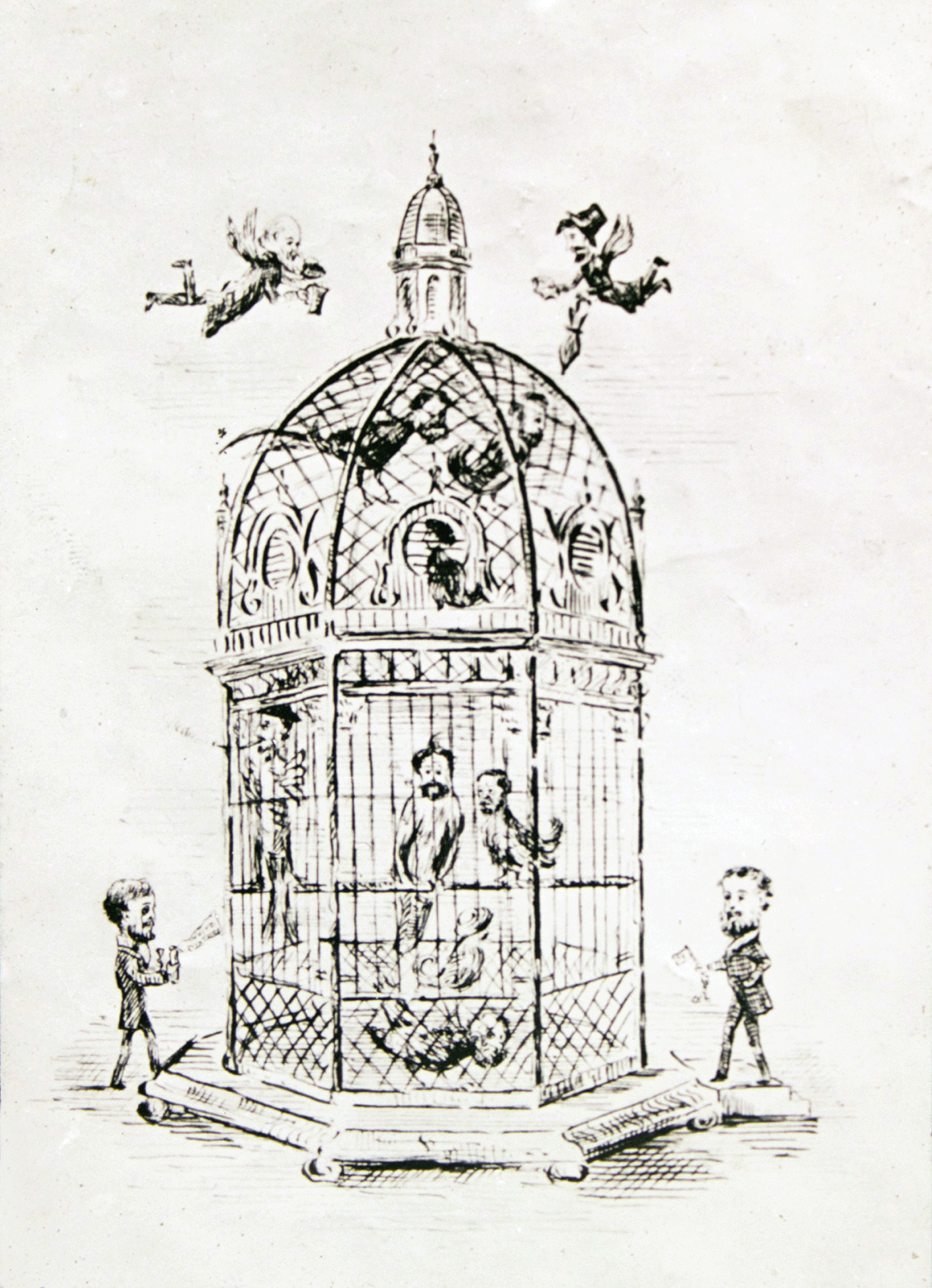
Kentish Scribbler (pseudonym) ‘Sketch showing the Bethlem Royal Hospital as a bird cage’ (c. 1870–8). (© Bethlem Museum of the Mind).

This opportunity for patients who identified themselves as hospital supporters to have their opinions acknowledged, and even respected, was an interesting one. Another magazine writer, known only by her pseudonym Kentish Scribbler, remained associated with the hospital long after her discharge as a patient. Most patient accounts of pre-twentieth-century asylums have tended to be produced by male patients, so Kentish Scribbler is an unusual case.Footnote 41 Until her death in 1902 (also reported in Under the Dome), she wrote puzzles and charades for every issue of the magazine, alongside occasional articles and poems.Footnote 42 She was also something of an artist and, in 1899, the Chaplain reported a peek inside her scrapbook, which included drawings made while she was a patient in the 1870s (see Figure 1).Footnote 43
One of these represents the Dome as a cage. Within are the figures of the artist, and other well-known patients of the period. The chaplain (then Mr Vaughan) is depicted as flying to it with a characteristic umbrella and his bible, while another bird is Mr Haydon (the steward) with a case of provisions. At the foot of the cage are the medical superintendent (Dr Williams) with the keys, and Dr Savage (then the chief’s understudy), with a bottle of ‘white mixture’.Footnote 44
Birdcages can be considered one of the symbols of the asylum in this period, for aviaries were frequently found as a domestic trapping in the galleries.Footnote 45 There is some evidence that patients identified with these animals. The much loved parrot on Bethlem’s ward M3 (often referenced in Under the Dome) was given a brief psychiatric record by his fellow inmates: a short pastiche which noted, among other things, that he was ‘addicted on occasion to much talking (a habit not uncommon in Bethlem galleries)’.Footnote 46 A short obituary was even published on its death in 1895.Footnote 47 As with Harding’s mildly critical language, these pastiches were pleasant and whimsical; Kentish Scribbler’s sketch did not contain any outright threat to the asylum regime or explicit complaint. Nonetheless, the fact remained that the patients (male and female) were pictured within the confines of the birdcage, while the staff stood or flew outside it.
It is also interesting to note that it was not until well after Kentish Scribbler’s discharge that the image seems to have been acknowledged by hospital staff. As a certified patient, Kentish Scribbler’s voice may not have carried the same weight as her ongoing relationship with the hospital permitted after her discharge: or perhaps the artist simply feared it would not, and only shared the drawing in later years. As a woman, it may also be significant that her ongoing relationship was with the hospital chaplain rather than the medical staff: religion was regarded as a female pursuit in a way that medicine was not. While some female patients did keep up a correspondence with their former doctors following discharge (most often with Theo Hyslop rather than his predecessors Savage or Smith), the tone of these letters was often quite different from those of some male patients. Medical matters were rarely discussed, other than simple requests for advice, and discussion of the asylum tended to be about domestic situations rather than medical or legal ones.Footnote 48
3. ‘Classified Under the Name of Insanity’: From Certified Patient to Voluntary Boarder
A very different perspective comes across in the letters of Walter Abraham Haigh. Haigh was under certificate for six years, yet his relationship with several of the asylum staff appears to have been just as close as Harding’s: unlike Kentish Scribbler, he did not have to wait to be discharged for this to be the case. University-educated, Haigh was twenty-seven years old and working as a tutor when he was first admitted in October 1882. His casebook entry recorded him to be suffering from ‘delusional insanity’ (a rare diagnosis at Bethlem, where most patients were classified with either melancholia or mania), evidenced by the fact he ‘[s]ays he must have his eyes removed. Fancies everybody is talking about him to his discredit. Thinks people cough at him in the street.’Footnote 49 Haigh’s symptoms were described as hallucinations and delusions of persecution and they continued, to a greater or lesser extent, throughout his time at Bethlem and beyond. Yet, despite the apparent seriousness of his symptoms (far more likely to be considered difficult or dangerous than Henry Harding’s malaise) and the suggestion that he had ‘very strong impulses to injure & mutilate himself’ (primarily by having his eyes put out), Walter Haigh was given a free pass in March 1885.Footnote 50 Like Harding, he appears to have viewed the asylum as protective: the casebook recorded that he never left the grounds or attended entertainments because he was suspicious of strangers.
The ‘pass key’ was as much a signifier of status as of practical use – a reward for the assistance this ‘quiet and well conducted’ patient had given to staff, since Haigh had ‘during the last year rendered considerable assistance to Dr Savage in the production of his Manual on Insanity.’Footnote 51 Walter Haigh was one of just two people acknowledged in the preface to Savage’s textbook, for correcting the proofs as well as for having ‘by criticism aided me much in the legal chapters’.Footnote 52 Haigh was not a lawyer, so it is interesting to note that, although certainly well read, his only direct experience of the legal context of insanity was through his personal experience. More than a decade later, assistant physician Theo Hyslop (who had also acknowledged Harding) similarly thanked ‘the valuable assistance and advice of his friend, Mr W.A. Haigh’ in his own textbook, Mental Physiology. Footnote 53 Without reference to the casebook, one would have no idea that Haigh had been a patient of both authors. In this instance a ‘patient’ view is – to an external reader at least – placed on an equal footing with a doctor’s; although this, it seems, can take place only when the individual’s identity as a patient is made invisible: something that also occurred in Harding’s obituary in Under the Dome.
Personal friendships between doctors and patients may have occurred less frequently in county asylums, where differences in class and education tended to be greater. In middle-class asylums like Bethlem, however, patients and their alienists often had similar backgrounds and shared a world view that was different from that of other asylum staff (with the exception of the chaplain and steward). Barfoot and Beveridge consider this identification with staff to have often been a conscious strategy that helped patients to cope with asylum life.Footnote 54 Thus, while some patient letters to superintendents were very formal, others were written in distinctly familiar tones. In 1896, Alia Stringer wrote to Dr Hyslop after returning home, in what seemed a fond (albeit a little patronising) reminiscence:
I often think I can see your face when I once asked you at Witley if we could have a spirit kettle! You were afraid of us setting ourselves on fire! No fear you dear cautious old thing, I was born before you and could have taught you how to be careful of fire …Footnote 55
We must remember that the asylum superintendent was generally resident on site: as, indeed, were his family who also appeared in asylum records. At the Crichton Royal Institution, superintendent James Adam’s diary noted the attendance of his wife and children at picnics and other activities, including the patient Christmas party, where he was helped to distribute presents by ‘his little girl …as Little Red Riding Hood’.Footnote 56 George Savage brought his wife and children back to Bethlem to attend parties long after leaving the hospital, while, nearly a decade after her father resigned his position as resident physician, ‘Miss Savage’ returned independently to hold tea parties on the wards.Footnote 57 Indeed, a fond notice of her forthcoming marriage in Under the Dome proclaimed that: ‘There was once a little baby named Maggie, who used to come into the wards on the shoulders of her father, her laugher and childish prattle lighting up the darkest day.’Footnote 58 While there is undoubtedly a good deal of poetic licence in this romanticised tale, the fact remains that the magazine’s readers were expected to be as aware of Marguerite Savage as the article’s author was. This type of familiarity was rarely, if ever, recorded in casebooks and other clinical records.
Walter Haigh’s personal friendship with certain asylum medical staff was undoubtedly connected to his educational background: initially judged to be ‘good’, Savage later edited the casebook record to ‘sup’ (that is, superior).Footnote 59 This gave him a privileged position in the institution. While in hospital, he was able to publish a book and gain paid work writing for a London directory.Footnote 60 Following his discharge in July 1888, Haigh temporarily moved to France to work as a tutor, but remained in regular contact with his former doctors, writing letters and returning to visit at Christmas and in the following two summers. His interactions with the hospital are particularly interesting in light of his varied status: certified patient, private individual and voluntary boarder, respectively. Yet his continued correspondence indicates that Walter Haigh’s identity as a certified patient cast a long shadow over his life outside the asylum. He appears to have returned to work and remained relatively well for long periods, but nonetheless feared discrimination. In one letter to Hyslop, for example, Haigh complained: ‘I do despise those who know I have been certified and judge ignorantly’.Footnote 61 On other occasions he wrote about the fear of others finding out. It was only in writing to his former doctors that Walter Haigh could openly admit to and discuss his former and ongoing symptoms, meaning that, in some ways, he remained a Bethlem patient even when no longer in the institution. Conversely, the doctors’ interest in Haigh’s welfare extended beyond the asylum walls, for when the patient discharged himself after a stay as a voluntary boarder in March 1896, Dr Smith:
wrote and asked his uncle if he w[oul]d assist the patient and to-day received £5. P[atien]t has been up to get the money and said that he had been staying with some friends.Footnote 62
This note indicates the ambiguous status of patient and that this label remained associated with an individual even after discharge; it shows that doctors continued to feel a responsibility for a former patient’s welfare. Here, Haigh was given financial assistance as well as the reassurance that he had somewhere to stay – responsibilities that we might have assumed would be undertaken by the uncle, rather than a doctor.Footnote 63 In other cases, families assumed that this connection would continue. A month after her discharge from Bethlem, Emily Barker wrote to Hyslop to thank him for his ‘kind letter [which] helped a great deal’. However, she also requested that he reply to letters from her family asking questions about her case, although ‘I have told my sister-in-law that now I [have] left your hospital I am no longer under your care, which she does not seem to think is true.’Footnote 64
Interestingly, Haigh was never again certified during his later admissions, although, on one occasion, he remained in the hospital (as a charity patient) for eighteen months, admitting to hallucinations of hearing on several occasions. Presumably, Dr Smith succeeded in convincing the Commissioners in Lunacy that Haigh was not certifiable despite his symptoms: most patients who hallucinated would certainly have been deemed insane. Smith felt that certification could prove a challenge to doctor–patient relationships yet, as the alienist complained, the Commissioners insisted that they ‘had not to ask …the question as to what was best for the patient …but whether he was “insane” or not and to act accordingly.’ Smith argued, however, that ‘although the patient may be certifiable, I hold that it is quite legal to admit the patient if he or she understand fully the need of care in a hospital for mental diseases.’Footnote 65 Cases like Walter Haigh’s appear to have indicated to Percy Smith that mental illness was not necessarily a barrier to understanding: asylum patients could, after all, be found legally responsible for managing their affairs by inquisition. Similarly, he felt, some patients could be responsible for understanding the treatment and management of their symptoms. This was not a view shared by the Commissioners, who complained in one report on Holloway Sanatorium that some boarders
are undoubtedly insane, and should be placed on the footing of patients. …[I]t should not be forgotten that the law prohibits the reception of any person as a lunatic without the proper order and certificates.Footnote 66
This statement supports the view that the role of the Lunacy Commission was a legal and not a medical one, and emphasises this aspect of certification.Footnote 67 A voluntary boarder was not legally detained and thus, it appears, did not entirely meet the definition of ‘patient’, despite being under medical care. Here, ‘patient’ has become a legal category, although the term was not formally defined as such in asylum circles. However, it was this legal ambiguity that was behind the ‘growing opposition’ of the Commissioners to voluntary boarders, as the superintendent at Holloway, Sutherland Rees Phillips, put it.Footnote 68
Walter Haigh’s adoption of the role of voluntary boarder, and his willingness to accept asylum life, did not make him a passive recipient of his doctors’ views. This is perhaps true to a even greater extent than in the case of Henry Harding. Haigh seems to have had some influence on his medical treatment. While still a certified patient, in March 1885, it was noted that he ‘[a]t times complains of severe pain on the top of his head, to relieve which at his suggestion he has had several setons at different times in the back of his neck.’Footnote 69 This was an unusual method of treatment in late nineteenth-century medicine – particularly psychiatry. Setons had been used in previous centuries to treat various bodily conditions through ‘counter-irritation’. A needle threaded with silk or string was passed through the skin, and the irritation caused would create an outlet for pus which, it was felt, might clear the original complaint. It is generally perceived that this type of procedure fell out of use following the introduction of antisepsis in the 1860s, although it did have some application in fever therapy, as popularised by Julius Wagner-Jauregg.Footnote 70 There is no record of any other patient being treated in this way at Bethlem at this time, suggesting that Haigh’s personal relationship with his doctors enabled him to exert some control over the treatment of his condition. In private asylums, patients also had some say in how they were treated, sometimes due to the difficulty asylum doctors had in coercing their upper class charges, who were used to giving orders rather than taking them. At West Malling Place, a small private asylum in Kent, casebooks recorded repeated exasperation at the refusal of Captain Henry Puge Halhed to follow medical advice. Halhed insisted on taking daily walks, even in cold weather, despite his advancing age and feeble physical health. The superintendent complained that ‘he is so perverse you cannot get him to remain indoors or take anything except what he feels inclined’ because he thought he owned the institution.Footnote 71 Patients at Bethlem also refused the attentions of their doctors. In 1898, it was recorded of Antonia Mary Brooke that ‘Dr Craig went to see her to make the physical examination but she objected & said he was too young’; the examination never took place.Footnote 72 In both of these examples, patients considered themselves to be the superiors of their alienists – in the first instance by class, in the second due to age. In both cases, the refusal to co-operate appears to have gone unchallenged, suggesting that doctors might have accepted the social value of class and age differentials just as their patients did.
In addition, some patients were sceptical, as Walter Haigh was, not of psychiatry per se, but of contemporary attitudes towards mental health and illness. Early in his first admission to Bethlem, Savage noted that Haigh ‘is convinced he is made where he is by the habits of society pointing to certain people who are “peculiar” and society supposes they are sinners specially along the reproductive line.’Footnote 73 One might infer this to be a reference to homosexuality; later it was noted that Haigh ‘thinks that his name may be connected with the Wild [sic] case (sodomy)’.Footnote 74 Most of Bethlem’s doctors, however, attributed Haigh’s claims, at least on paper, to ‘over-sensitiveness to outside impression’, never suggesting that any specific acts or desires might have prompted this sensitivity. It is impossible for us to delve into Haigh’s personal feelings on the matter. What we can state is that, despite his long-term involvement with psychiatry and a strong conviction that asylum treatment was something he required on occasion, Walter Haigh’s letters indicate that he was nonetheless unconvinced by the ways madness might be judged and diagnosed by those around him. In his letters, he regularly placed the word ‘sane’ in inverted commas. In the 1890s, for example, Haigh wrote to Dr Smith about his ongoing hallucinations, which he considered could not possibly be understood by those who had not experienced them. ‘As to what my perversions of sensations are no “sane” person w[oul]d have any idea.’ A later letter to Hyslop remarked similarly that: ‘[a]s you are aware the “sane” world has little idea of these “sense perversions” many of which are classified under the name of insanity.’Footnote 75
Hyslop did indeed seem to be aware of the complexity of determining how to classify symptoms of insanity, believing that ‘[i]llusions are common to us all. …There is no sudden break between the illusions of the sane and those of the insane.’Footnote 76 Although Haigh did consider that his experiences fitted within the medical realm – as his ongoing correspondence with his former psychiatrists suggests – he did not accept outright that his ‘sense perversions’ were incompatible with sanity, and he continued to incorporate his own spiritual philosophy into a medical framework for exploring and understanding his state of mind. Were his symptoms, he wondered, ‘[g]eneral brain degeneration with death of the spiritual entity or functional perversion or what?’Footnote 77 This repeated questioning may even have inspired his doctors to think more critically about the nature of insanity. Given their close relationship, it does not seem coincidental that George Savage, in his later career, began to place greater emphasis on the environmental and sociological influences in what he now termed ‘so-called insanity’.Footnote 78 Echoing Haigh’s inverted commas around ‘sane’, Savage came to declare sanity ‘a relative term’ related to ‘certain laws, rules and conventions which slowly grow around men as they advance in civilization’.Footnote 79 While he continued to hold a socio-evolutionary concept of progress (in that he regarded such changes as ‘natural’), by the turn of the twentieth century Savage nonetheless appeared to have reconsidered certain issues, which he himself directly equated to his experiences of asylum life and his encounters with patients.
In his early asylum experience, Savage claimed, he ‘should without any hesitation have said if a man hears “voices” he is not safe to be at large.’ However, since then, he had witnessed ‘several examples of men suffering from these subjective nervous disorders who are earning their livings and are as free as you or I. …it is interesting to have to note that there are some who, being hallucinated, still are capable citizens.’Footnote 80 While Savage was likely to have had professional considerations in mind when he gave this lecture – he was by that time in private practice, and keen to widen the field of those who might be treated by ‘nerve specialists’ outside the asylum – he also urged greater freedom for certified asylum patients and an end to ‘unbending regulations’, which did not take into account the context of each case. His former colleague, Theo Hyslop agreed that ‘hallucinations may be perfectly compatible with sanity’, concluding wryly that ‘[w]e must, as presumably sane individuals, be generous in the limits we assign to the interpretations which others give to their own experiences.’Footnote 81 Thus, instead of attempting to uncover a ‘typical’ experience of asylum life or a generic ‘patient view’, looking at those, like Walter Haigh, who were not typical patients opens up the way in which patients might encourage discussion among – and, indeed, engage in discussion with – psychiatrists as to whether anything was, in fact, typical and even, sometimes, to question the very boundaries of insanity. By the turn of the twentieth century, most of George Savage’s lectures reminded his audience that the individual nature of each case meant that the alienist should judge a patient’s sanity in relation to his or her own past experiences and behaviour, rather than by comparison to others, for something that was pathological in one person might be perfectly compatible with sanity in another.Footnote 82 This made the patient narrative central to the very diagnosis of insanity itself.
4. Conclusion
Neither Henry Francis Harding nor Walter Haigh had ‘typical’ patient experiences. Yet their lives, and the ways in which their doctors interacted with them, reminds us that there is quite possibly no such thing. In the case of Haigh, at least, the question of a typical ‘patient identity’ seems to have also been raised and debated by his own alienists. By highlighting the importance of voluntary asylum boarders in late nineteenth-century psychiatry, the examples of Henry Harding and Walter Haigh offer an alternative to the deterministic, materialist approach that is often assumed to dominate in this period. Instead, they indicate that doctor–patient relations often involved a subtle negotiation, even where the patient’s subordination to medical ideology lurked in the background (as in the role of patients’ writing in hospital magazines). As I have shown, in some instances a patient might gain seemingly equal footing to his or her doctor. This, however, as in the textbook acknowledgements to Walter Haigh and Henry Harding, appears to have only been possible when the identity of a patient as a patient was hidden.
These differing relationships sit within a social environment (the asylum) where patients’ educational background, gender, age and class also played a role in negotiating their relationship with medical authority. Although the legal distinction between voluntary boarder and certified patient was supposed to take place on medical grounds, the individual’s background sometimes played a greater part in determining his or her status than diagnosis or symptoms (which are strangely absent from many of the discussions outlined above). Exploring multiple accounts can help historians move beyond the linear narrative of the case history to view patients’ voices as being varied and complex. While acknowledging the dominance of the medical perspective and the hierarchical structure of institutions, we should, nonetheless, be aware that other factors were also at play. Choosing to adopt certain elements of a ‘patient’ role could give asylum residents – in particular voluntary boarders – a leeway to negotiate other aspects of treatment and even contemporary understandings of madness. This led to a fluid two-way process of negotiation that altered the doctor’s position as well as the patient’s. Of course, there were many other people with key roles within the asylum system, including nurses, family members, justices and governors (to name but a few); focusing on the doctor–patient dyad should not obscure this broader picture.Footnote 83 Some of these actors do appear in the cases discussed here: most notably the hospital chaplain, who seems to have held a central (and often mediatory) role for both doctors and patients in the institution. But returning the patient–doctor relationship to the centre of such investigations can also open up a new way of exploring the wider context of the asylum system. What effect, for example, did this interaction between alienist and patient have on shaping lay views of insanity outside the asylum? The patient was, after all, the most prominent link between the hospital staff and the non-medical community beyond the asylum walls. To this effect, it was not unusual, at the middle-class Bethlem Royal Hospital at least, for patients to surprise alienists with their use of clinical terminology.Footnote 84 While this paper did not explore this issue in depth, I suggest that the patient–doctor relationship in late nineteenth-century psychiatry would make an interesting departure point from which to further examine ‘lay’ representations of mental illness at that period.
As seen above, Walter Haigh was one of just two people acknowledged in the preface to Savage’s textbook. Assistant physician Theo Hyslop similarly acknowledged Harding and thanked ‘his friend, Mr W.A. Haigh’ in his own textbook.Footnote 85 Were it not for the medical records, there would be no way of knowing that Haigh had been a patient of both alienists. Recent scholarship has shown that there were a number of ‘hidden’ authors behind medical textbooks at that period (usually physicians’ wives, often credited only with their initials so as to conceal their female identities).Footnote 86 But the mention of Haigh by Hyslop in Mental Physiology reveals that those hidden authors could also include patients. This is especially interesting in psychiatry, where the divide between the discourse ‘from below’ and ‘from above’ is usually considered most pronounced. The fact that the contribution of an individual considered insane was acknowledged by a physician, even in such a ‘hidden’ way, provides another angle on the formation of psychiatric categories and discourses. It shows that alienists did not solely rely on the language of experts. Some of them seem to have actively sought advice ‘from below’, incorporating lay and patients’ perspectives in their conceptualisations of madness.
In fact, what makes the cases of Harding and Haigh distinctive and relatively unique in the wider context of nineteenth-century psychiatry is precisely the deliberate incorporation of a patient’s name in the list of contributors. It has been shown that some asylum patients contributed to major academic achievements (witness Dr William Chester Minor’s involvement in the Oxford English Dictionary during those same years).Footnote 87 Yet in Minor’s case, the editor did not realise until later that one of his contributors was a patient at the Broadmoor Criminal Lunatic Asylum. The stories outlined in this paper provide a new angle to the representation of the patient at that seminal period, arguing that this added authority might have been due to these two men’s unique status. I claim that it was Haigh and Harding’s unusual background and role, respectively – carefully and ambiguously positioned between ‘real’ patients and ‘sane’ individuals – that provided them with a special place within the asylum’s social order. Exploring further cases in similar detail will expand our knowledge of these dynamics, highlighting the importance of studying patients’ views in late nineteenth-century psychiatry.