





Encountering any album by Nanook, the most internationally renowned band from Kalaallit Nunaat (Greenland), means viewing artistic interpretations of climate change. Album cover art introduces Nanook’s climate change branding of its alternative rock sounds with, among other images, a silhouetted polar bear head with mouth agape and eyes half-closed, against a mottled gold-brown background – the colours of Greenland’s landscape where melting glacial ice meets rock and soil. The head image mostly appears to melt from white into greys, browns, and blacks flecking a gold background of this cover art for the album Seqinitta Qinngorpaatit (Our Sun is Shining on You, 2009). The remaining white fur of the polar bear’s ear area feels raised to the touch when handling the physical CD.
Or one may encounter the melting ice suffusing the painting of an Inuit hunter’s head and shoulders on the cover art of Nanook’s Pissaaneqaqisut (2014). Turquoises and whites drip right-to-left from a background, across the hunter’s head, and down into his eyes, ears, and hair, rendered in a blood-red wash. Melting ice crystals feel raised when touched on their CD and vinyl covers. The hunter’s mouth appears least affected.
Greenland exists at the forefront of climate change impacts. Global warming is happening in the Arctic nearly four times as fast as on the rest of earth. The intensifying melting of the massive Greenland Ice Sheet – the North Polar Ice Cap (1,783,090 km2) – results in a variety of provocative and disturbing experiences for Greenlanders as well as a global impact of general sea-level rise. Ice melt and related Greenlandic landscapes likewise flash through Greenlandic online music videos of popular songs. Ninety percent of Greenland’s population of 57,000 identify as ethnic Inuit and as Greenlandic people who speak Kalallissut (the dialect of the Greenlandic language most prominent in GreenlandFootnote 1); the rest are Asian and Northern European, especially Danish. Greenlandic Inuit also increasingly identify as Indigenous people,Footnote 2 who form the population group most impacted by climate change globally.
The case study presented in this article explores how nonhuman agency ‘sounds’ in Greenlandic popular music about climate change. Although the concept of agency has an important history in music studies (Born Reference Born1997, Reference Born, Chua and Elliot2013, DeNora Reference DeNora2021 [1997], Maus Reference Maus1988), and Indigenous people are reasonably well represented in music publications on environmental issues (e.g., in Allen and Titon Reference Allen and Titon2023, McDowell et al. Reference McDowell, Borland, Dirksen and Tuohy2021), specifically Indigenous onto-epistemologies of the nonhuman have been underrepresented in music and sound scholarship on environmental crises. This article critically considers how Greenlandic musical expressions draw on Indigenous philosophical thinking on the nonhuman, and then how they engage the nonhuman through emotion and affect as well as protest and debate, about which new questions are raised for future research. Finally, it draws attention to contradictions and ambiguities in the Greenlandic case regarding capital accumulation and thereby politics and ideologies. This article’s key contribution, of what Indigenous ways of knowing and being about the nonhuman in commercial music contexts can contribute to sonic agencies of climate change and vice-versa, is first contextualized in terms of the sensory and audience engagements of Greenlandic popular music on global heating and academic literature on (music in) the (Indigenous) Anthropocene.
Engagement with environmentally conscious Greenlandic popular music
Greenlandic popular music on climate change is engaging acoustically, visually, and linguistically. The video for ‘Mingutserineq’ (Pollution; 2022), by indie rock band Nuija, starts with silent drone footage of permafrost thaw streaming into the Arctic Ocean, towering glaciers dissolving, and a glacial lake pooling above extreme ice melt. In nature, these are noisy processes of water runoff over fells, waterfalls crashing down glaciers, and the slow dripping sounds of icebergs dissolving into the sea. In this video, we hear not the sounds of ice melt but drama in a CNN anchor’s voice reporting rapid glacial ice melt, visually cut to a calving glacier crashing into the ocean while two electric guitarists, an electric bassist, and a violinist carve the song’s D minor riff, with a loud drum set, into chilly air. Tenor Nick Ørbæk sings Kalallissut lyrics about global warming’s interrelationships with pollution. Other music videos, for instance ‘Sequtserinermiit eqqugaavugut’ (‘We Are Hit by Destruction’), by Frederik Elsner and Alan Tausen, share the images as well as sounds of the intensifying melt of Greenland’s hydrosphere.
The language in these songs and music videos engages diverse audiences by being imagistic (see Harrison, Jacobsen and Sunderland Reference Harrison, Jacobsen and Sunderland2019) and acousmatic.Footnote 3 Kalallissut popular music expressions recorded or commissioned by international organizations and the few artists with international careers address global publics, featuring English and other foreign-language subtitles. These typically present global consequences of the ice melt or present (new) angles on climate change. Greenland’s ice melt contributes 40% of the global annual sea-level rise: it will inevitably contribute a minimum of 27 cm to global sea rise in the next 100-150 years – but likelier about double that amount – and an overall maximum of 78 cm (Box et al. Reference Box, Hubbard, Bahr, Colgan, Fettweis, Mankoff and Wehrlé2022). Other songs target Inuit audiences through their Kalallissut/Greenlandic language lyrics, again either presenting global heating realities, and/or presenting related experiences and understandings of them from an Inuit perspective.
While the online spoken word/cinematographic/art music work Rise: From One Island to Another (360.org 2018) put Greenlandic arts about global heating into the international spotlight, a vibrant live performance scene in Greenland featured popular music about climate change throughout the period covered in this article, from 2008 to today. This generated a small body of professionally recorded and publicly released works – about 35 at the time of writing – with music videos generally accessible on YouTube. These have emerged within a larger body of environmentally political popular song/sound expressions thriving on the island of Greenland since the early 1970s. From the 1990s to the late 2010s, the songs were distributed on CDs, increasingly via Internet streaming since 2010, and continuously through live performances, for example at festivals throughout Greenland and occasionally abroad. Nanook attracted most international attention with songs about global heating; singer-poet Nivi Nielsen, on the related issue of fossil fuel extraction.
In one perspective, all the above musical, sonic, and visual actions have been generated through forms of agency – a key concept also in scholarship on climate change and the Anthropocene.Footnote 4 Agency has to do with ‘getting into’ and effects of action as well as acts and their actors or, in Latour’s meaning, actants (Latour Reference Latour1997, Reference Latour2017), and as such, is highly appropriate to music of climate change.Footnote 5 The notion of sonic agencies of climate change invites analysis of the relationships between soundings and the intensifying climate emergency. Sonic typically means of, relating to, or involving sound and sound waves. Music is sound and vibration; nature vibrates and makes sounds, and can be incorporated into music. The verb ‘sounding’ refers not only to sound waves and the act of expressing, but also resounding or resonating to or with something (LaBelle Reference LaBelle2018). Sounding, then, also means the hearing of or, for lack of a better word, witnessing of environmental or other phenomena through the creation or encountering of musickings and soundings.
Sonic agencies of climate change
Scholarship on the Anthropocene invites us to take seriously diverse conceptualizations and experiences of agency as they relate to music and sound. Sonic agencies of climate change can contribute to this project, also critically regarding how climate change may be resisted and supported through musical and sonic acts.
The academy has great motivation for embracing diverse nonhuman agencies at a time of intensifying environmental crises because humankind cannot help but notice how they impact us in a rapidly warming world with a melting cryosphere, higher ocean levels, droughts, floods, and violent weather. Various publications on the Anthropocene cultivate new ways of thinking and being in efforts to resist the so-called one-world world (OWW) model or dominant modern epistemology, which has led to the suppression of billions of people and environmental devastation. In my view, this epistemological and ontological project should ideally facilitate or speed concrete changes to exploitative socio-economic systems, and I would argue that, where it does not, a constructivist systemic approach may be more effective in bringing concrete change (Táíwò Reference Táíwò2022).
Academic communities take diverse views as to how such an onto-epistemological project – my focus here – ‘should’ be approached, which has to do with values and politics. OWW-resistant views aligned most famously with the work of Arturo Escobar have advocated for pluriverses of human and nonhuman beings in a post-dualist manner (Carvalho and Riquito Reference Carvalho and Riquito2022, Escobar Reference Escobar2020). With pluriverse-resonant perspectives has come advocacy for understandings of agency that attribute consciousness and intelligence to nonhuman entities (see Turner Reference Turner2012, Turner Reference Turner, McDowell, Borland, Dirksen and Tuohy2021, p. 80). In music studies, Ana María Ochoa Gautier (Reference Ochoa Gautier2016) has critiqued ecomusicology and sonic ecology for reiterating the nature/culture divide – arguably at the very roots of climate change (Chakrabarty Reference Chakrabarty2009, pp. 201-7) – by focusing on a perceived need to resolve tensions between nature and culture. Ochoa Gautier proposed acoustic multinaturalism or perspectivism to describe how diverse beings relate acoustically from their diverse ‘natures’ of sensing.
Relatedly, various Indigenous scholars have approached ‘nature’ and ‘culture’ in fluid relationship (Hamill Reference Hamill, Allen and Titon2021, Robinson Reference Robinson2020), as have non-Indigenous theorists who may perceive Gaia or earth as a living being by asserting, after Donna Haraway, that
all beings, including humans, are composed of other beings and enmeshed in a dense web of becoming-along-with. Instead of inter-relationality, we are dealing with an intra-relationality; we are entities composed of relations, cut across by other agencies and inhabited by different subjectivities. (Lagrou Reference Lagrou2018)
Haraway, calling herself a compost-ist instead of a posthuman-ist (because all biotic beings eventually become abiotic), elaborated the process of attributing nonhuman agency as ‘making kin’ (meaning making persons – not necessarily humans), and ‘making kind’ in her ethical relational ontology (Haraway Reference Haraway2015).
This is not to undercut debates about the place of Indigenous knowledges in theorizations of nonhuman agencies, particularly regarding whether posthumanism as a Western tradition of thought and theory is commensurable with Indigenous worldviews (Hird, Predko and Renders Reference Hird, Predko, Renders, Herbrechter, Callus, Rossini, Grech, de Bruin-Molé and Müller2022), and whether posthumanism ‘rips off’ ancient Indigenous knowledge formations in acts of knowledge colonialism (Todd Reference Todd2016). As in Indigenous contemporary music of climate change, Indigenism and other politics of the Indigenous rights movement may be at play. I will describe a case where Indigenous-centred musicking arguably questions ways of knowing and being behind climate change, yet their commercialization – and especially dissemination – contributes to the capital accumulation and industries driving climate change. Sonic agencies of climate change is a notion with which one can bring together in analysis points of onto-epistemological, political, and ideological tension and contention and – as in this case study of Greenlandic musicking – generate knowledge about how relations play out between human and nonhuman practically and ideally.
Nonhuman agency in Kalallissut/Greenlandic popular music
The human and nonhuman intermingle in the onto-epistemologies or types of ‘knowledge as being’ (Barad Reference Barad2003) of tradition-oriented Inuit people of Greenland. They share this with historical Indigenous worldviews globally (Brabec de Mori Reference Brabec de Mori and Post2017). Indigenous Australian scholar Brian Martin writes that the concept of onto-epistemology recognizes that ‘all “things” have agency and are interconnected through a system of relationality’ (Martin Reference Martin2017, p. 1392). ‘Things’ may also have agency that exists outside of any human interpellation (Martin Reference Martin2017, p. 1397). Further, this ‘is vital to an understanding of agency as it suggests that there exists an inherent “relatedness” between things internally. It is here that we can recognize that all matter, including knowledge, has agency’ (Martin Reference Martin2017, pp. 1392-3). Such a perspective, also shared among Greenlandic Inuit (Harrison, Hivshu and Moisala Reference Harrison, Hisvhu and Moisala2024), moves beyond the ‘objectivizing stance’ criticized by Escobar (Reference Escobar2020, p. 3) as enabling capitalist exploitation within the OWW model.
The traditional-historical Inuit principle of collaborative reciprocity can be understood as such an onto-epistemology. Chie Sakakibara defines collaborative reciprocity as animals willingly giving themselves to humans in exchange for ‘respectful treatment as nonhuman persons’ (Sakakibara Reference Sakakibara2020, p. 22). Collaborative reciprocity is one way of understanding the fishing and hunting activities that many Greenlanders count on for sustenance. Imported food is expensive, being flown in by plane in winter and shipped in by boat in summer. Most people hunt and fish, while others benefit or survive due to prevalent poverty in remote areas, thanks to those who do. Sakakibara describes, in her insightful multispecies ethnography of whaling, that the ‘belief that humans and animals physically and spiritually constitute one another’, particularly in ‘the northern Indigenous philosophy as reflected in subsistence whaling … the souls, thoughts and behaviours of animals and people interpenetrate in a collaboration of life’ (Sakakibara Reference Sakakibara2020, p. 21 after Fienup-Riordan Reference Fienup-Riordan1994). The Inuit onto-epistemology of collaborative reciprocity extends to various hunted and fished animals. Sakakibara collaborates with Inuit in Alaska, but the same can be said throughout the Inuit culture area from Chukotka in Siberia through Alaska to northern Canada, to Greenland.
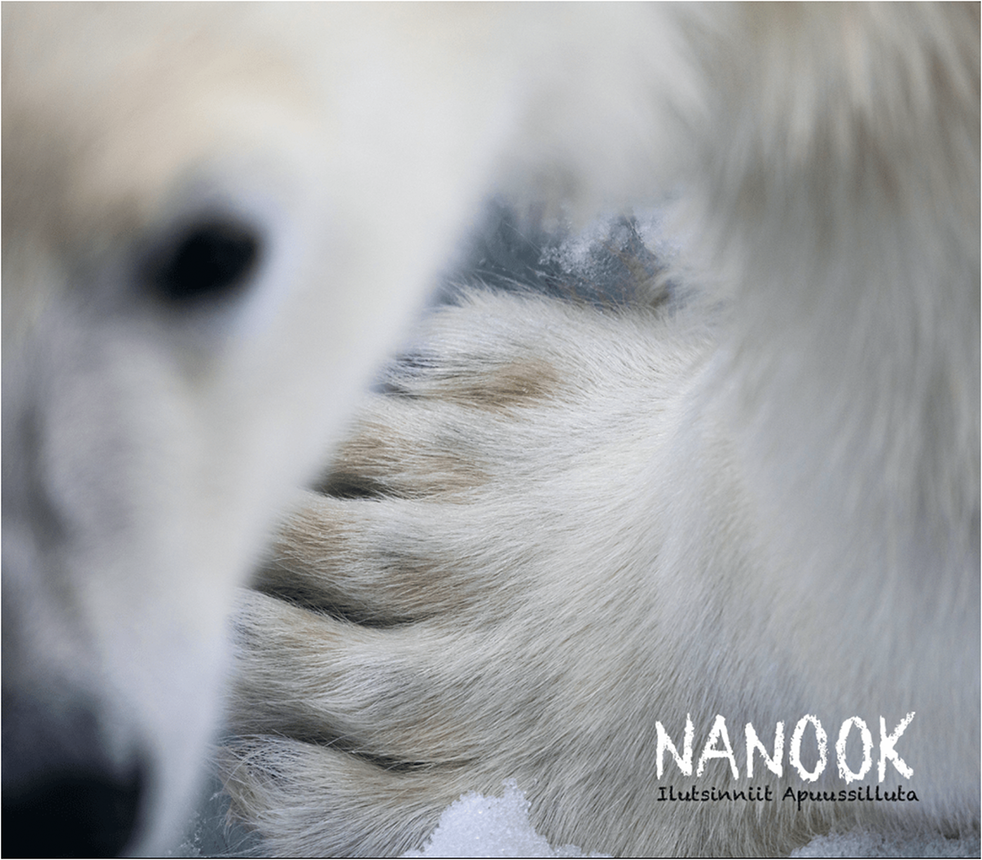
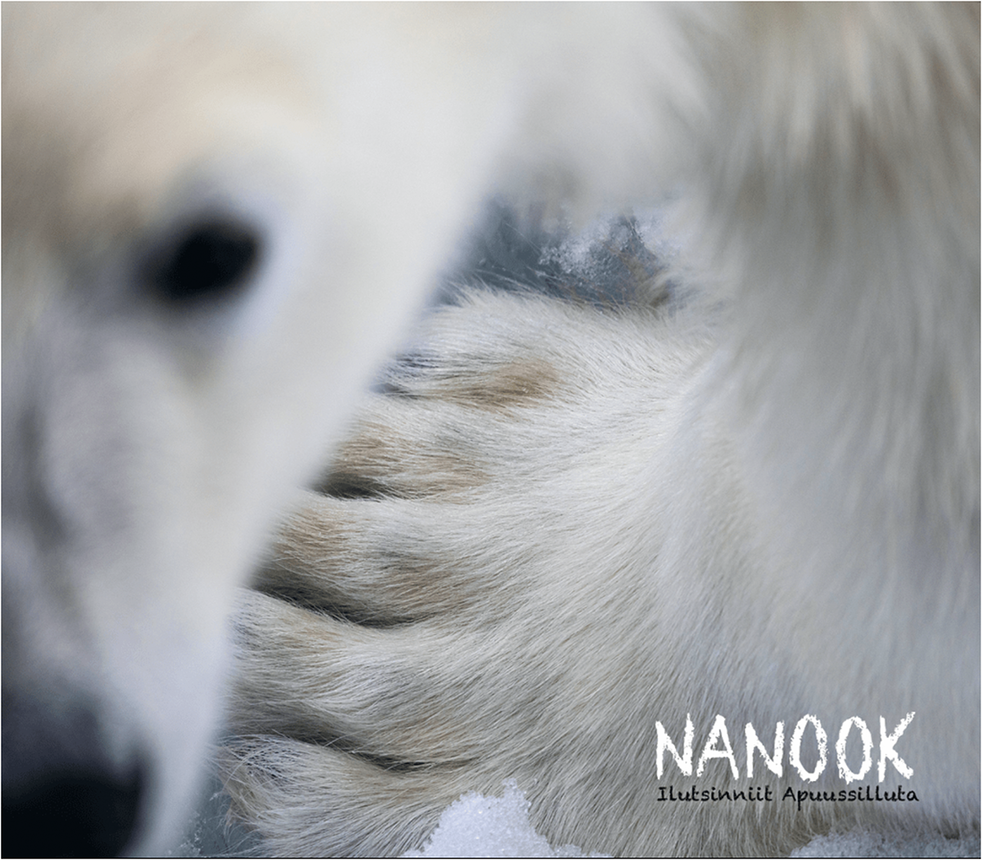
Drawing a relationship between the human and nonhuman can be interpreted as a key element of some Greenlandic popular music expressions about climate change. Figure 1, for instance, shows the cover art of a 2022 CD, Ilutsinniit Apuussilluta, by Nanook. Human-like toes of the polar bear – hunted by Inuit today and historically, especially in northern and eastern GreenlandFootnote 6 – may be viewed as underscoring the notion. Inside the cover, one sees a polar bear looking up at the viewer (the photos are not digitally manipulated), and the text, ‘“Nanoq” is the word for polar bear in Greenland. Nanook comes from Inuit mythology and means the greatest polar bear of all – like a polar bear God’ (Nanook 2022).
The cover art of Nanook’s Ilutsinniit Apuussillut.
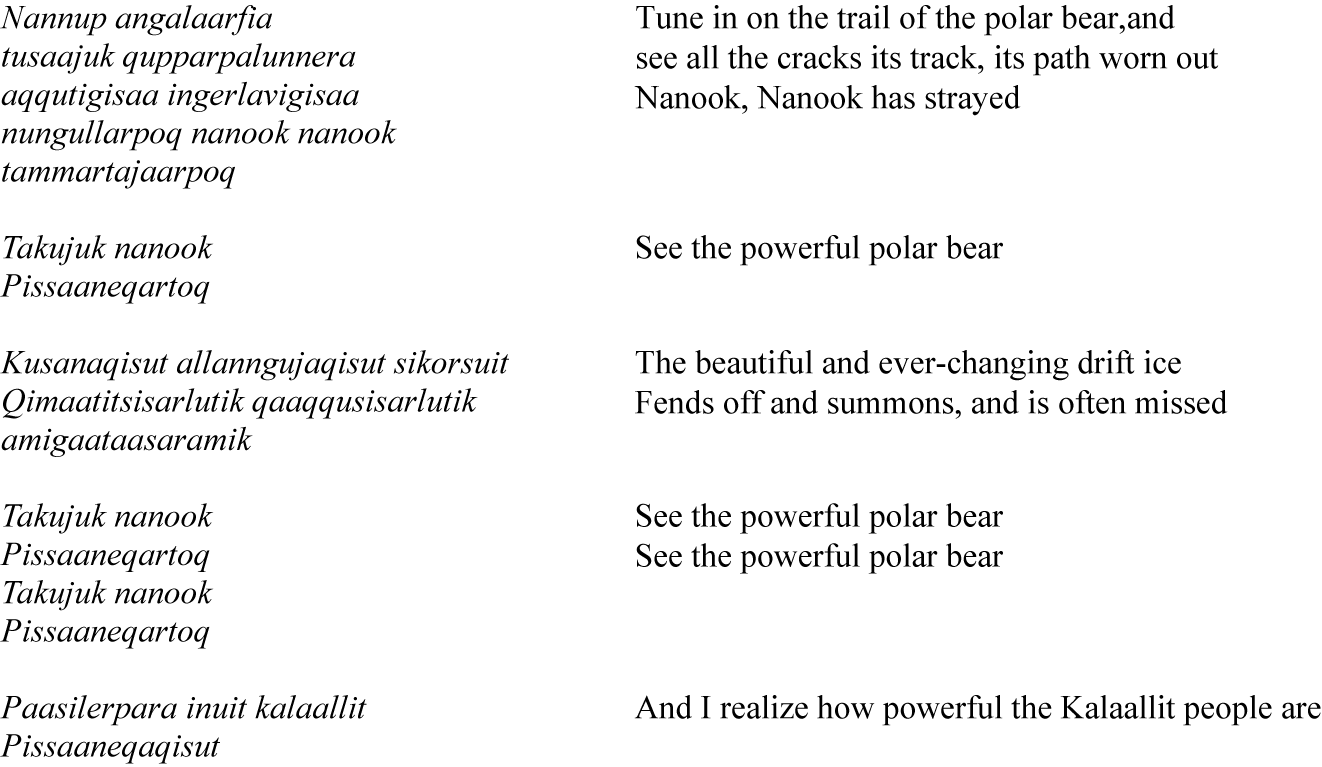
Nanook’s song ‘Nanook’ interrelates polar bears and Arctic peoples’ experiences of climate change, which are – for both – difficulties with subsistence, and physical and psychological stress. The lyrics (Figure 2) reference polar bears being in danger due to global heating. Thinning sea ice hinders their deep-water fishing. Polar bears fall through the ice before they get far enough out to sea for fishing. Desperate for food, some rove Greenlandic towns and cities and get shot. A few have even swum to Iceland. Others starve to death. The lyrics end by drawing a likeness between the power of the polar bear and the Kalaallit or Greenlandic people.
The lyrics of ‘Nanook’, by Christian Elsner and Frederik Elsner (trans. at Nanook Official & Frederik Elsner GL 2016).
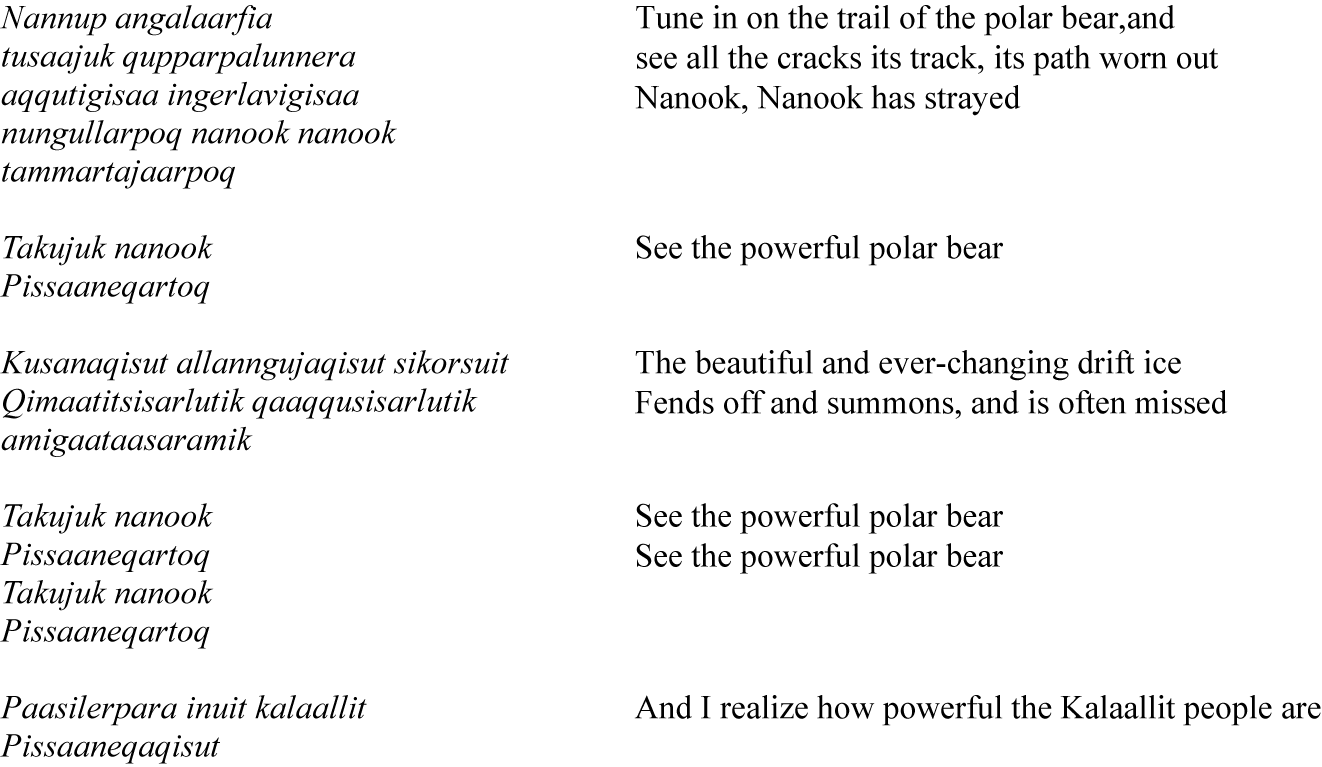
Figure 2. Long description
The layout consists of two columns. The left column, in italics, presents Greenlandic lyrics: ‘Nannup angalaarfia tusajuk qupparpalunnera aqqutigisaa ingerlavigisaa nungullartoq nanook nanook tammartajaartoq’, followed by ‘Takujuk nanook Pissaaneqartoq’. Next, ‘Kusanaqisut allangvujaqisut sikorsuit Qimaatitsisarlutik qaaqqusisarlutik amigaataasaramik’, then ‘Takujuk nanook Pissaaneqartoq Takujuk nanook Pissaaneqartoq’, and finally ‘Paasilerpara inuit kalaallit Pissaaneqartut’. The right column, in regular font, gives the English translation for each line: ‘Tune in on the trail of the polar bear, and see all the cracks its track, its path worn out Nanook, Nanook has strayed’, then ‘See the powerful polar bear’. Next, ‘The beautiful and ever-changing drift ice Fends off and summons, and is often missed’, then ‘See the powerful polar bear See the powerful polar bear’, and finally ‘And I realize how powerful the Kalaallit people are’. Each Greenlandic line is directly aligned with its English translation.
The visuals of the song’s music video similarly draw a relationship between polar bears and humans. Actor Ujarneq Fleisher constantly mimics a polar bear. He crawls on all fours over a glacier and ice floes. He dives from pristine ice into the ocean, embodying a polar bear fishing. The video immediately cuts to a swimming polar bear. Fleisher later wears a beige mask, which a band member told me in an interview was intended to represent ‘the polar bear’s perspective’.Footnote 7
Another climate change song that interrelates human with nonhuman is Rasmus Lyberth’s ‘Anoraannguummi supimmatit’ (‘Climate Song’). In its lyrics, the wind not only blows but says something to the listener when approaching him or her with a message of responsibility for the future. The earth invites the listener to be constituted by her/his message: to ‘take care of the world while you live’ and not to ‘forget the new generation when it finally approaches you’ (Lyberth Reference Lyberth2019). Such thinking-being, in Inuit and other Indigenous philosophies, means that human and animate, conscious, intelligent nonhuman beings (including spirits) continuously bring one another into existence in a perpetual, relational, and ontological flux. In Lyberth’s song, connecting earth with ancestors refracts Greenlandic Inuit worldviews about energy or spirit (Harrison, Hivshu and Moisala Reference Harrison, Hisvhu and Moisala2024) while the earth and weather are animate, conscious, and intelligent. Weather may be referred to as an emergent entity, which means entities, for example, tornadoes, that emerge only when interacting with other components of a complex entity or system.
Emotion, affect, and beyond
Climate change is a human-generated problem and, as such, brings very human worries concerning the nonhuman. In one interview, Greenlandic hunter and elder Mads Ole Kristiansen said that in North Greenland, animals are quick to adapt to global heating, while humans are slow to do so.Footnote 8 In terms of scholarly thinking, too, we need to adapt and change when including the most impacted peoples, places, and musical and sonic expressions in our discussions and considerations of climate change. Regarding Indigenous peoples with relational human-nonhuman onto-epistemologies, this fundamentally means broadening beyond the human to also include the nonhuman. A pluriversal perspective, or even a perspectivist or multinaturalist perspective (Holbraad and Pedersen Reference Holbraad and Pedersen2017), can be relevant depending on cultural context.
In diverse areas of scholarship on agency and climate change relationships, key themes such as emotion, affect, protest, and debate are typically treated anthropocentrically. To move thinking further, music and sound studies are now poised to make new contributions by asking questions about how agentic soundings of climate change may include the nonhuman in human experiences such as emotions, affects, and politics, or by giving musical and sonic evidence that nonhuman agency is already part of such phenomena, thereby drawing relationalities between the human and nonhuman.
Musickings and other artistic soundings about climate change are often intended to mobilize emotion and affect in their audiences. Yet what is meant by audiences in that case: human or nonhuman, or both? In people, musicking and sound art about environmental crises may express or evoke what Glenn Albrecht calls earth emotions: ‘human and emotional responses to the scale and pace of ecological and environmental change’ (Albrecht Reference Albrecht2019, p. x). Albrecht describes a range of ‘psychoterratic’ (psyche-earth) emotions, such as negative responses to the destruction of the Anthropocene and positive emotions that he would hope to lead us to what he calls the Symbiocene, a future in which beings live together symbiotically.
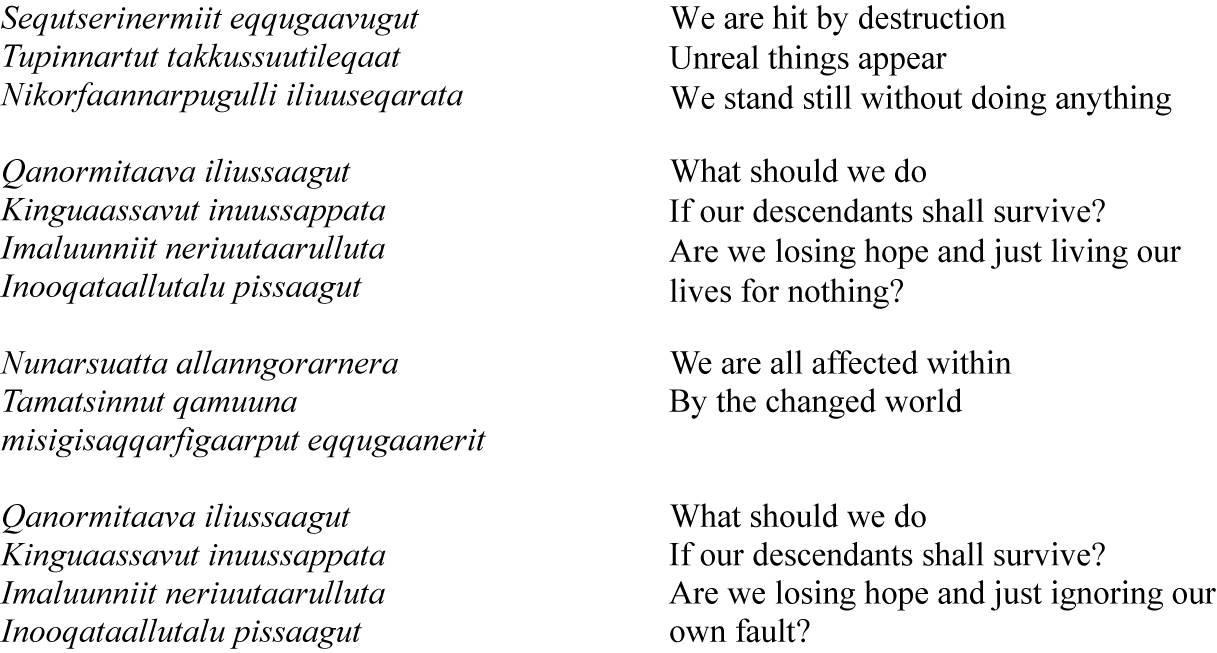
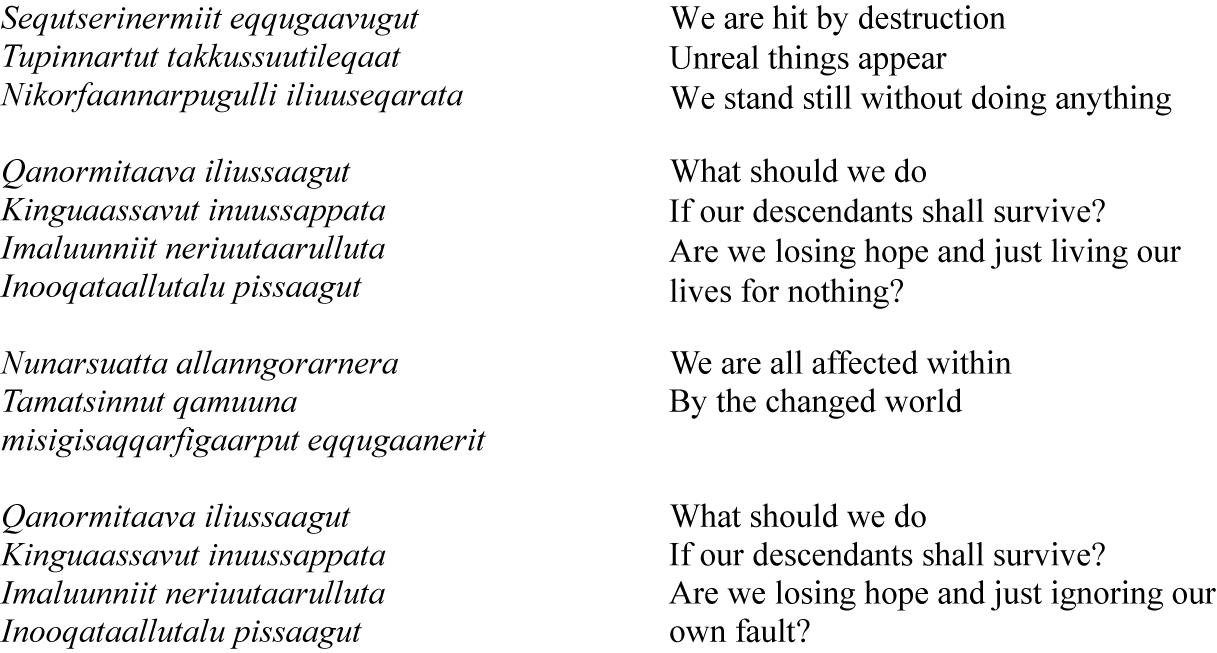
If an artist experiences earth emotions when creating lyrics, music videos, and album art about climate change, the emotions may inform those acts of agency. This is the case with creative processes behind certain Greenlandic popular songs. In an interview, Athena Lings said that she created her song ‘Depression in the Roads’ after experiencing depressive and sad feelings at witnessing permafrost melt making large holes in the roads and cracking buildings in her hometown of Kangerlussuaq.Footnote 9 In the interview context, a week-long popular songwriting workshop on climate change,Footnote 10 specific feelings about climate change came up among the ten participants creating new songs. Greenlandic popular music expressions may represent emotions related to climate change, as well. The lyrics (Figure 3) and music video of the pop-rock song ‘Sequtserinermiit eqqugaavugut’ (‘We Are Hit by Destruction’) convey a sense of hopelessness about whether ‘descendants shall survive’ while wondering about self-blame.
‘Sequtserinermiit eqqugaavugut’ or ‘We Are Hit by Destruction’, by Frederik Elsner and Alan Tausen (trans. at Nanook Official & Frederik Elsner GL 2020).
Affect, which the lyrics of ‘Sequtserinermiit eqqugaavugut’ mention (in the phrase ‘We all are affected within’), can be understood to refer to internal energetic sensations in the body that relate to emotions, other experiential changes, or potentialities for change outside the body (Massumi Reference Massumi2015). All the musical expressions examined in this article come from affect and, through sounding self and identity in relation to the climate and nonhuman, the ‘affective base by which we feel ourselves a part of the world’ (LaBelle Reference LaBelle2018, p. 30).
Notably, no environmental study of music thus far considers in depth the consciousness and intelligence of nonhuman and emergent entities in relation to states of (well-)being, either human or nonhuman. What role might experience of emotion and affect have in such a discussion? In such a project, would one need to move beyond emotion and affect as conventionally understood? Folklorist Mary Hufford, after questioning whether ‘purposeful’ resource-sharing among trees might mean the enaction of vegetal agency, asks whether plants and humans share a ‘zone of human and vegetal interbeing’ (Hufford Reference Hufford, McDowell, Borland, Dirksen and Tuohy2021, p. 51). Albrecht writes that animals must feel extremely stressed by global warming and concomitant habitat destruction. He asks why animals’ place-based distress and disorientation should not be called solastalgia, as it is in humans (Albrecht Reference Albrecht2019, p. 47). This raises a number of questions: should words for human emotions be applied to nonhumans where appropriate? When does it become necessary to develop new terminologies or other expressions that represent the states of (well-)being of relevant nonhuman and emergent entities? What roles might diverse musickings and soundings take?
Protest and debate
In Greenlandic popular music, nonhuman and human agencies both have roles and likely impacts in environmental protest that indirectly involves climate change. In Greenlandic popular songs, this is most clearly represented in songs and music videos that debate the pros and cons of oil drilling, natural gas extraction, and mining in Greenland.
Greenland is one of the richest areas of underdeveloped oil, gas, and mineral wealth in the world. A connection of fossil fuel extraction to climate change is not lost on musicians. One can hear this in the chorus and an ensuing verse of Nuija’s ‘Mingutserineq’ (‘Pollution’) (Nuija 2022; trans. Lana Hansen Larsen):

Long description
The table consists of two rows and two columns. In the first row, the left cell contains the Greenlandic phrase ‘Nunarsuarput allanngornera – Kinguneqarpoq kissattinnera – Iliuutsigullu kingunerisai: Mingutserineq’ and the right cell contains its English translation ‘The change of our world – has consequences – The weather is getting warmer – The consequences of our actions: Pollution’. In the second row, the left cell contains ‘Qitornatta nunassaraat – Paaritigu kingornussaat …’ and the right cell contains ‘It is our children’s future country – Let us protect what has been given to us’.
‘Mingutserineq’ references children’s futures, a trope used for decades in Indigenous rights and environmental movements globally. Nuija adds ‘country’, which relates to living land and to a colonial history in Greenland, which is an imperial one as well. Denmark colonized Greenland since 1721 but Greenland gained home rule in 1979 and, in 2009, more comprehensive self-government as well as the island’s subterranean rights.
In the past, Greenland granted many licenses for oil and natural gas as well as mining exploration, a trend that just a few songs supported. One ‘pro’ song, Arctic Spirits’ heavy metal ‘Kalunnerit’ (‘Chains’) criticizes the metaphorical chains of Inuit people ‘dragging’ their ‘identities’ when resisting the exploitation of mineral and ‘gold’ resources of Greenland (Arctic Spirits 2012). ‘Con’ songs in the 2000s and 2010s included ‘Uulia’ (the Greenlandic word for oil) by Nivi Nielsen and ‘Tusaajuk qilaatip katuarneqarnera’ (‘Listen to the Greenlandic Drum’) by KimOJax. ‘Tusaajuk qilaatip katuarneqarnera’ urged audiences to listen to the Indigenous philosophies and onto-epistemologies communicated via the Greenlandic traditional drum qilaat, used in the historical Inuit tradition of drum singing (Hauser and Petersen Reference Hauser and Petersen2006). It contains the line ‘We are drilling our country with a drill, we pour oil into the environment’, followed by ‘Question, will we become independent? / We are moving slowly, we know we always have obstacles’ (KimOJax 2019). KimOJax stood as a political candidate for the Siumut party in a national election, but in 2017, performed the rap at a Siumut party convention, in front of Greenland’s then-prime minister, Kim Kielsen. KimOJax said in an interview that the main message of his rap was: ‘Should I trust the government? Should I trust the leaders? Or I’m just going to go my way?’Footnote 11
Nielsen’s Inuit indie rock/folk song also critiqued oil drilling in Greenland. Its lyrics mention extracting oil and uranium, then take a moral stance (Nivi Nielsen and the Deer Children 2009; trans. Lana Hansen Larsen).

Long description
The table has two rows and two columns. In the first row, the left cell contains italicized text ‘Iluaniittunuku nikisitassaanngikkaluit’, and the right cell reads ‘We aren’t supposed to touch what’s inside’. In the second row, the left cell contains italicized text ‘Nuna manna aserunngikkaluarutsigu’, and the right cell reads ‘We don’t have to ruin this land’.
When international media asked Nielsen for interviews, she spoke against oil extraction in forceful terms of colonialism and imperialism, therewith exerting pressure directed at Greenland’s government (e.g., Macalister Reference Macalister2010).
Both pro and con songs, within the context of a larger, societal debate about natural resource extraction in Greenland, ultimately contributed to a reversal of national environmental politics and policies. Until Greenland’s 2021 elections, when the pro-environment Inuit Ataqatigiit party overturned the Siumut party, which had been in power since 1979, the ‘pro’ side of the natural-resource extraction debate dominated the political atmosphere. After that, Greenland’s parliament passed legislation that banned oil and gas exploration and exploitation, and mining with a uranium content of over 100 g per tonne of rock.Footnote 12
One could take popular music examples still deeper by considering the possible roles of nonhuman affectivity (i.e., attributing affectivity to nonhuman animals and plants as well as objects; Grusin Reference Grusin and Grusin2015, pp. xvii-xviii) in sonic agencies having to do with protest and debate. Arguably, Greenlandic Inuit philosophy has had an impact on protesting and raising awareness on climate change and related issues, such as those debated here. I write this article from Qaanaaq, in the very northernmost area of Greenland (at almost 78°N), which, next to the North Polar Ice Cap, is severely affected by global heating. Permafrost melt is streaming just now down the hill on which our cabin is located. My research partner, Pirkko Moisala, and I have been working with, among others, Christian Elsner of Nanook and a drum singer, David Manumina, who has performed together with Nanook. The band has integrated Manumina presenting a drum song that conveys a relational onto-epistemology between humans and polar bears, as a part of the popular song ‘Nanook’, when on tour in Greenland and internationally. Manumina has also told audiences about the onto-epistemology through a story behind the song.Footnote 13 One could question, in other contexts, whether and to what degree climate change musickings and soundings that express relational onto-epistemologies shape (environmental-)political developments and how.
Contradictions and ambiguities
In addition to the open questions above, the notion of sonic agencies of climate change includes contradictions, for instance, regarding the hope often held out that different and new-to-the-mainstream onto-epistemologies can further an urgently felt need to shift the OWW mindset. In Chad Hamill/čnaq’ymi’s words, ‘a radical return to a world view centred on balance and reciprocity’ without which ‘the change of long-term survival, for us and many of our nonhuman relatives, is slim’ (Hamill Reference Hamill, Allen and Titon2021, p. 149). Such an onto-epistemology can be troubled and not always ‘true’ in the sense of being entirely honestly felt and financially uncalculated, especially in commercial music contexts. Dominant forms of capitalism, which the music industry typically plays into, continue to feed and deepen climate change. When is an onto-epistemology that presents nature-culture more about marketing (for example, ethnoprise) than nurturing the planet?
One report (Andersen and Otte Reference Andersen and Otte2010) on Greenlandic music stated that most popular musicians in Greenland’s capital, Nuuk, around 2010, joked about ‘being one with nature’ being a stereotype of indigeneity, for example, by making word plays and humorous gestures on Indigenous ethnicity and nature relationships. The report pictures a founder of Nanook sitting in lotus position with eyes closed when jokingly ‘being one with nature’. At the same time, climate change activism via promoting Indigenous onto-epistemology was a foundational concept for the band and dominates its album cover art as well as some of its song lyrics and music videos. Sometimes contradictions make for good jokes.
Also humorously, the band Liima Inui called itself Klima Inui (Andersen and Otte Reference Andersen and Otte2010, pp. 94-5): Liima Inui means ‘the People of Liima’; Liima is a Latin word meaning Goddess of the Threshold. In Greenlandic, Klima Inui means ‘Souls of the Climate’. In an interview, two members of Liima Inui, Paaliit Molgaard and founder Georg Kiiu Olsen, described their song lyrics as generally critical of the exploitation of humans and nature, of which climate change is one result.Footnote 14 The new name more accurately reflected the band’s song contents than their original name, therefore making a clever joke. Yet the tension also holds in this example: Liima Inui, like so many Greenlandic Inuit bands, has used ethnoprise to promote itself.Footnote 15
Contradictions can also be drawn regarding the industrial processes through which that music is conveyed. Streaming, touring, festivals: none of these are environmentally friendly (see Brennan Reference Brennan, Devine and Boudreault-Fournier2021; Devine Reference Devine2019, pp. 147, 156, 158-60), for example, touring the festival and touring scenes of Greenland, which is 2.16 million km2. While incomparable to the massive global heating associated with the fossil fuel and concrete production industries, transmitting anti-climate change music via means that increase greenhouse gas emissions is close to an oxymoron. Music transmission also does not support the concrete aims of climate change activism when it happens digitally, via the electricity-demanding algorithmic computing of Internet streaming services. It boosts greenhouse gas emissions.
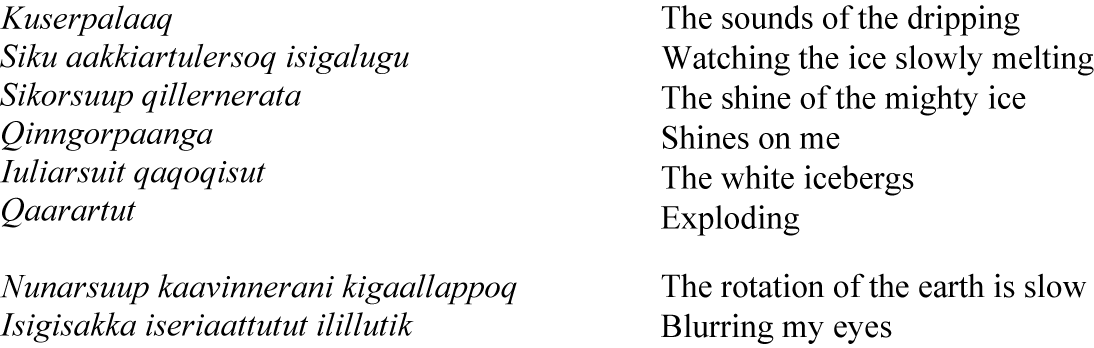
Another problematic issue that sonic agencies of climate change can be used to approach is when agency is defined ambiguously, for instance, in musical aesthetics and purposefully by artists. ‘Kuserpalaaq’ is a Greenlandic song example that collapses who or what is the witness or agent (here, musicians and/or an iceberg) and whether this agent is conscious and intelligent (If also the iceberg, is it agentive?). Kuserpalaaq translates from Greenlandic as ‘The Sound of Melting Water’, particularly the ‘calm drip’ or ‘fast dripping water’ of iceberg melt.Footnote 16 The lyrics describe the sounds and visuals of iceberg melt (Figure 4).
The lyrics of ‘Kuserpalaaq’ or ‘The Sound of Melting Water’, by Christian Elsner and Frederik Elsner (Nanook 2011; trans. Ivaana Olsen).
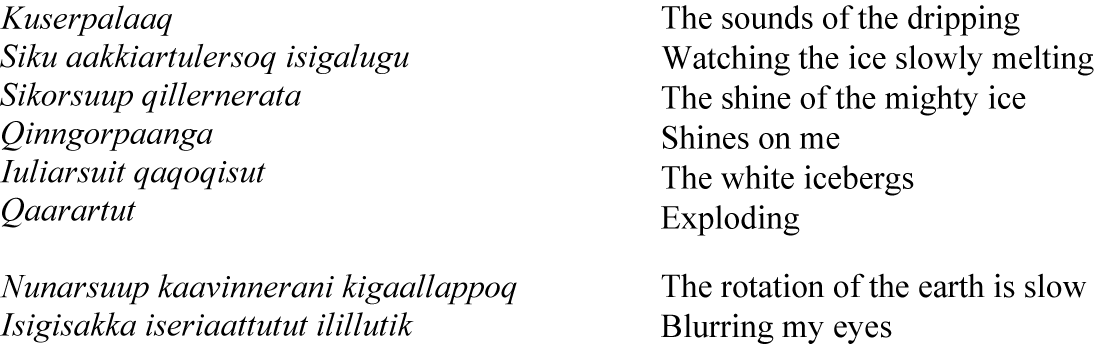
Figure 4. Long description
Starting at the top left, the Greenlandic lyrics are presented in italic font, each line directly aligned with its English translation on the right in regular font. The first Greenlandic line reads ‘Kuserpalaaq’, paired with ‘The sounds of the dripping’. The second line is ‘Siku aakkiartulersoq isigalugu’, paired with ‘Watching the ice slowly melting’. The third line is ‘Sikorsuup qillernerta’, paired with ‘The shine of the mighty ice’. The fourth line is ‘Qinngorpaanga’, paired with ‘Shines on me’. The fifth line is ‘Iuliarsuit qaqoqisut’, paired with ‘The white icebergs’. The sixth line is ‘Qaarartut’, paired with ‘Exploding’. The seventh line is ‘Nunarsuup kaavinnerani kigaallappoq’, paired with ‘The rotation of the earth is slow’. The eighth line is ‘Isigisakka iseriaattutut illutillu’, paired with ‘Blurring my eyes’. The spatial structure is strictly left-to-right, with each Greenlandic lyric horizontally matched to its English translation.
Christian Elsner explained that the band intended a tempo change, from about 120 to 135 BPM, to illustrate the increased pace of the sound of dripping water as an iceberg’s melt-rate quickens. The song’s brevity – two minutes 15 seconds – warns of the fast speed of ice melt in Greenland. The biggest problem is the liquification of the North Polar Ice Cap, from which icebergs break off and then dissolve into the sea. In Elsner’s words:
The message of the song comes through the music. It starts very slow and then Frederik [Elsner] sings about the dripping from the iceberg that hits the water because it’s melting and then the song becomes very fast all-of-a-sudden. That’s how we show that the melting is happening faster and faster and faster. That’s also why the song is so short because we don’t think the ice will be there for much time.Footnote 17
As the tempo quickens suddenly at 0:44, the musical texture densifies to a full rock band with no vocal – drum kit, electric guitar, bass guitar, electric keyboard, and acoustic guitar. The shift in tempo and texture comes immediately after Frederik Elsner sings to acoustic guitar ‘qaarartut’, which means ‘exploding’ in Greenlandic. Qaarartut refers to the explosive sound of an iceberg calving or splitting apart as it melts. In my experience, the sound ranges from something like a gunshot to a dynamite explosion or thunderclap, depending on iceberg mass and environmental acoustics. With a guitar glissando, Elsner ties ‘qaarartut’ into the explosion of band sound.
The founders of Nanook, Christian and Frederik Elsner, are of Inuit Greenlandic and Danish descent, but identify as Inuit and Indigenous. While an iceberg is animate in historical Inuit worldviews, the lyrics are ambiguous about whether they would reference an Inuit onto-epistemology or Danish-resonant worldview, or both, and at which ‘density’. Native Alaskan scholar Jessica Bisset Perea developed the idea of density to politically resist ‘difference’ and ‘diversity’ and to signal that indigeneity and coloniality are inextricably intertwined (Perea Reference Perea2021, p. 8). The lyrics are also unclear about who or what might be the agent sounding, hearing, witnessing, musicking, or causing the iceberg melt. Is the experience voiced that of the iceberg, other beings, or the lyricists? There’s something about the last two lines that recalls my experiences of days on the sea among icebergs in Greenland – one’s vestibular system struggling to keep up, temporary sun blindness.
Conclusion
As in agency literature on the Anthropocene, Greenlandic or Kalallissut popular music about global heating shows that agencies of actors, getting into actions, acts, and acts’ effects intersect human with nonhuman, other-than-human, more-than-human, and emergent entities. Kalallissut musicking sounds and shows – from the point of view of artists from a population acutely affected by global heating – the role of such intermingling agencies in related emotion, affect, protest, and debate. Such agencies are indeterminant (Maus Reference Maus1988) in that they do not locate in any single ‘place’, such as in the music, a musical instrument, or an effect, but rather, in all. I used what agency flows through and from, such as emotion and affect, and circles around, such as protest and debate, to raise questions aimed at broadening and deepening thinking on (human relationships with) the nonhuman in soundings and musickings of climate change, while acknowledging potential contradictions and ambiguities.
In so doing, this article drew attention to key aspects of sonic agencies of climate change, especially nonhuman elements and relationalities between human and nonhuman entities. The notion seeks to dissolve, where possible, the nature/culture divide while leaving room to probe it when present. Sonic’s meaning ‘of sound’ is pushed open to all meanings of ‘sound’, as noun, verb, and adjective. In sonic agencies of climate change, sound refers to all aspects of sound and music production and reception, as well as their (im)materialities, as verbs, musicking and sounding (LaBelle Reference LaBelle2018), and metaphoric uses of sound and resound.
Limiting agency to the human when studying music vis-à-vis climate change does not always make sense in the context of Greenlandic popular music created by Inuit musicians and, I would argue, other Indigenous and resonant musical expressions of onto-epistemology globally. Indigenous peoples of the world, Inuit included, currently suffer most from climate change; global heating hits them hardest. Already for millennia, Indigenous cultures have attributed what we today know as agency to nonhuman and emergent entities and interrelated these with the human. Most Indigenous peoples’ traditional worldviews emphasise music and sounds’ interconnections with nonhuman agencies, as well as human agencies and their interrelationships, which in turn inform lived onto-epistemologies. This was analysed in Greenlandic culture and popular music examples relevant to the Inuit relational onto-epistemology of collaborative reciprocity.
Relational onto-epistemology becomes conflicted, however – vis-à-vis resisting or overturning the so-called one-world world (OWW) mindset that much literature on the Anthropocene seeks to move beyond – when commercialized. An example is Greenlandic popular music that seeks a climate change niche market through engaging acoustic, visual, and linguistic strategies. Even though such expressions may resist the OWW with political messaging, they also reinforce the nature/culture divide through objectifying, then selling, ‘nature’ in music products. The Indigenous songs, album cover art, and music videos discussed in this article were capital-friendly from the get-go, whereas the historical Inuit philosophy of collaborative reciprocity became so through the musicking.
From the standpoint of other directions in Greenlandic Inuit philosophy, particularly an influential stream from northern Greenland (Harrison, Hivshu and Moisala Reference Moisala2024), Greenlandic popular music on global heating leaves out many nonhuman actants – from spirits to industrial products and processes – while foregrounding others most stereotypically associated with Inuit Greenland, such as polar bears and icebergs (Otte Reference Otte and Langgård2013). From the point of view of resisting/overturning the OWW model in the music industry, it is problematic when technological agency – which leads current thinking in music studies (Snape and Born Reference Snape, Born and Born2022) and is also theorized in northern Greenlandic philosophy (Harrison, Hivshu and Moisala Reference Moisala2024) – is erased because global heating critiques amnesiac of music technology’s growing carbon footprint end up reinforcing the OWW. Aesthetic, onto-epistemological strategies in climate change music can align with status quos of thinking and being that enable environmental degradation. In addition to illuminating politically positive contributions or contradictions and ambiguities regarding global heating, sonic agencies of climate change can be used to reveal potentially destructive aspects of musickings and soundings.
My case study of Greenlandic popular music thus raised a variety of critical areas that future work on sonic agencies can engage within and beyond theorizations of posthumanism, Indigenous culture, and the Anthropocene. Politically left scholarship on the Anthropocene, for example, has redefined agencies to make space for the idea that pluriverses can be perceived and experienced by human and nonhuman beings. Both posthumanist and Indigenous studies have taken stances against the OWW mindset of unfettered capitalist development, although exploitative roles of Indigenous thought in the posthuman or nonhuman turn face justly substantial criticisms (Moisala Reference Moisala2024). At the same time, Indigenous soundings of the climate emergency in public spaces have much to contribute to the perception and experience of the nonhuman, which is precisely what they seek to do – although not always critically or in ideologically or politically unproblematic ways. Indeed, Kalallissut/Greenlandic popular musicking demonstrates that social agencies of climate change may be politically, ideologically, and onto-epistemologically complex and contradictory.
Acknowledgements
Thank you to the thoughtful music reading group at Aarhus University’s School of Communication and Culture, particularly Martin Guldberg, Niclas Nørby Jochumsen Hundahl, Morten Michelsen, and Steen Kaargaard Nielsen, who sparked some of my thinking on agency and the nonhuman. Many thanks to my brilliant co-researcher on music of Kalaallit Nunaat, Pirkko Moisala (University of Helsinki), for critically stimulating discussions and enlightened inputs on posthumanism, ecophilosophy, Indigenous music, and far more. The article would have been impossible without our musician-collaborators in Greenland – Christian Elsner, Frederik Elsner, KimOJax, Mads Ole Kristiansen, Athena Lings, Georg Kiiu Olsen, David Manumina, and Paaliit Molgaard. Thanks also to translators Lana Hansen Larsen and Ivaana Olsen.

 Open access

