







1 Introduction
Let $U_g=(S^1\times S^2)^{\# g}$
be the boundary of the
$U_g=(S^1\times S^2)^{\# g}$
be the boundary of the $4$
-dimensional handlebody
$4$
-dimensional handlebody $H_g=(S^1\times D^3)^{\natural g}$
, and let
$H_g=(S^1\times D^3)^{\natural g}$
, and let $\operatorname {\mathrm {Homeo}}(M)$
be the group of homeomorphisms (not required to be orientation preserving) of a manifold M. Our main result is the following.
$\operatorname {\mathrm {Homeo}}(M)$
be the group of homeomorphisms (not required to be orientation preserving) of a manifold M. Our main result is the following.
Theorem 12. For all $g \ge 0$
the map
$g \ge 0$
the map $B\!\operatorname {\mathrm {Homeo}}(H_g) \overset {\partial }{\to }B\!\operatorname {\mathrm {Homeo}}(U_g)$
has a section.
$B\!\operatorname {\mathrm {Homeo}}(H_g) \overset {\partial }{\to }B\!\operatorname {\mathrm {Homeo}}(U_g)$
has a section.
We now discuss some immediate consequences of the theorem. Since $B\!\operatorname {\mathrm {Homeo}}(M)$
classifies topological M bundles, this shows that any topological
$B\!\operatorname {\mathrm {Homeo}}(M)$
classifies topological M bundles, this shows that any topological $U_g$
bundle can be fiberwise filled by a topological
$U_g$
bundle can be fiberwise filled by a topological $H_g$
bundle. In fact, this can also be applied to families of 4-manifolds with
$H_g$
bundle. In fact, this can also be applied to families of 4-manifolds with $U_g$
boundary, via the following corollary.
$U_g$
boundary, via the following corollary.
Corollary 13. Let M be a compact $4$
-manifold with
$4$
-manifold with $U_g \subseteq \partial M$
. Then the restriction map
$U_g \subseteq \partial M$
. Then the restriction map
 $$\begin{align*}B\!\operatorname{\mathrm{Homeo}}(M \cup_{U_g} H_g, H_g) \longrightarrow B\!\operatorname{\mathrm{Homeo}}(M, U_g) \end{align*}$$
admits a section.
Laudenbach–Poénaru [Reference Laudenbach and PoénaruLP72] proved that every diffeomorphism of $U_g$
can be extended to a diffeomorphism of
$U_g$
can be extended to a diffeomorphism of $H_g$
. Since
$H_g$
. Since $\operatorname {\mathrm {Homeo}}(M)$
is locally path-connected by Fisher [Reference FisherFis60], Kister [Reference KisterKis60], and Hamstrom [Reference HamstromHam61], and since every path component of
$\operatorname {\mathrm {Homeo}}(M)$
is locally path-connected by Fisher [Reference FisherFis60], Kister [Reference KisterKis60], and Hamstrom [Reference HamstromHam61], and since every path component of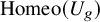 $\operatorname {\mathrm {Homeo}}(U_g)$
contains a diffeomorphism by approximation results of Moise and Bing [Reference MoiseMoi54, Reference BingBin54], every homeomorphism of
$\operatorname {\mathrm {Homeo}}(U_g)$
contains a diffeomorphism by approximation results of Moise and Bing [Reference MoiseMoi54, Reference BingBin54], every homeomorphism of $U_g$
also extends to
$U_g$
also extends to $H_g$
by isotopy extension. Our theorem extends this result to families and de-loops it to the level of classifying spaces. With this viewpoint, there is scope to apply Corollary 13 to study families of homeomorphisms of 4-manifolds obtained via Kirby diagrams (see [Reference NiuNiu24, Section 3]) or trisections (see, e.g., [OWR23, Gay, p. 240]). Of course, for these settings it would be more natural to use a section for classifying spaces of diffeomorphisms and we expect that such a section can indeed be constructed. We note here that although we view the theorem as a parametrised topological version of Laudenbach–Poénaru, our proof does not use their result.
$H_g$
by isotopy extension. Our theorem extends this result to families and de-loops it to the level of classifying spaces. With this viewpoint, there is scope to apply Corollary 13 to study families of homeomorphisms of 4-manifolds obtained via Kirby diagrams (see [Reference NiuNiu24, Section 3]) or trisections (see, e.g., [OWR23, Gay, p. 240]). Of course, for these settings it would be more natural to use a section for classifying spaces of diffeomorphisms and we expect that such a section can indeed be constructed. We note here that although we view the theorem as a parametrised topological version of Laudenbach–Poénaru, our proof does not use their result.
1.1 Consequences for homotopy groups
Ideally we would like to loop the section in Theorem 12 to obtain a homotopy section $\Omega s$
as a map of spaces between the corresponding topological groups (though not necessarily a group homomorphism, and in fact for
$\Omega s$
as a map of spaces between the corresponding topological groups (though not necessarily a group homomorphism, and in fact for $g=1$
no such group-theoretic section exists [Reference Chen and MannCM23, Theorem 6.1]). However, for a 3-manifold M, it is not known that
$g=1$
no such group-theoretic section exists [Reference Chen and MannCM23, Theorem 6.1]). However, for a 3-manifold M, it is not known that $\operatorname {\mathrm {Homeo}}(M)$
has the homotopy type of a CW complex and so we only have a section after taking CW replacements, that is, after passing to
$\operatorname {\mathrm {Homeo}}(M)$
has the homotopy type of a CW complex and so we only have a section after taking CW replacements, that is, after passing to $|\mathrm {S}_{\bullet }\!\operatorname {\mathrm {Homeo}}(-)|$
. Nevertheless, the group homomorphism
$|\mathrm {S}_{\bullet }\!\operatorname {\mathrm {Homeo}}(-)|$
. Nevertheless, the group homomorphism $\pi _k(\operatorname {\mathrm {Homeo}}(H_g))\to \pi _k(\operatorname {\mathrm {Homeo}}(U_g))$
admits a section for all k, and in fact we have a weak equivalence
$\pi _k(\operatorname {\mathrm {Homeo}}(H_g))\to \pi _k(\operatorname {\mathrm {Homeo}}(U_g))$
admits a section for all k, and in fact we have a weak equivalence
 $$\begin{align*}\operatorname{\mathrm{Homeo}}_\partial(H_g) \times \operatorname{\mathrm{Homeo}}(U_g) \simeq \operatorname{\mathrm{Homeo}}(H_g). \end{align*}$$
Restricting to mapping class groups it was already known that a section exists, since the generators of $\pi _0\operatorname {\mathrm {Homeo}}(U_g)$
determined by Laudenbach [Reference LaudenbachLau73, Reference LaudenbachLau74] all admit explicit extensions to
$\pi _0\operatorname {\mathrm {Homeo}}(U_g)$
determined by Laudenbach [Reference LaudenbachLau73, Reference LaudenbachLau74] all admit explicit extensions to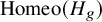 $\operatorname {\mathrm {Homeo}}(H_g)$
[Reference Laudenbach and PoénaruLP72]. Using the weak equivalence above, we obtain the following corollary:
$\operatorname {\mathrm {Homeo}}(H_g)$
[Reference Laudenbach and PoénaruLP72]. Using the weak equivalence above, we obtain the following corollary:
 $$ \begin{align*} \pi_0\operatorname{\mathrm{Homeo}}(H_g) & \cong \pi_0\operatorname{\mathrm{Homeo}}(U_g) \ltimes \pi_0 \operatorname{\mathrm{Homeo}}_\partial(H_g) \\ & \cong \left(\mathrm{Out}(F_g) \ltimes (\mathbb{Z}/2)^g\right) \ltimes \pi_0 \operatorname{\mathrm{Homeo}}_\partial(H_g) \end{align*} $$
where the second isomorphism is Brendle–Broaddus–Putman [Reference Brendle, Broaddus and PutmanBBP23, Theorem A]. Recall that Budney–Gabai showed that $\pi _0\operatorname {\mathrm {Homeo}}_\partial (H_1)$
is not finitely generated [Reference Budney and GabaiBG25] and thus we conclude
$\pi _0\operatorname {\mathrm {Homeo}}_\partial (H_1)$
is not finitely generated [Reference Budney and GabaiBG25] and thus we conclude $\pi _0 \operatorname {\mathrm {Homeo}}(H_1)$
is not finitely generated. (This can already be deduced from [Reference Budney and GabaiBG25] using work of Hatcher [Reference HatcherHat81, Reference HatcherHat03], but perhaps for higher genus our perspective could be utilised.)
$\pi _0 \operatorname {\mathrm {Homeo}}(H_1)$
is not finitely generated. (This can already be deduced from [Reference Budney and GabaiBG25] using work of Hatcher [Reference HatcherHat81, Reference HatcherHat03], but perhaps for higher genus our perspective could be utilised.)
We note that our proof heavily relies on the choice of the 4-manifold $H_g$
. For example,
$H_g$
. For example, $U_g$
is also the boundary of
$U_g$
is also the boundary of $(S^2 \times D^2)^{\natural g}$
, but
$(S^2 \times D^2)^{\natural g}$
, but $\pi _0 \operatorname {\mathrm {Homeo}}((S^2 \times D^2)^{\natural g}) \to \pi _0\operatorname {\mathrm {Homeo}}(U_g)$
is not surjective (e.g., nontrivial Gluck twists do not extend – for genus 1 see [Reference GluckGlu62, Lemma 15.3]) so there is no hope of an analogous section in this case.
$\pi _0 \operatorname {\mathrm {Homeo}}((S^2 \times D^2)^{\natural g}) \to \pi _0\operatorname {\mathrm {Homeo}}(U_g)$
is not surjective (e.g., nontrivial Gluck twists do not extend – for genus 1 see [Reference GluckGlu62, Lemma 15.3]) so there is no hope of an analogous section in this case.
1.2 Characteristic classes
The section from Theorem 12 allows us to define rational characteristic classes for $U_g$
-bundles analogous to the Miller–Morita–Mumford classes for surfaces. (Recall that the usual generalised MMM-classes
$U_g$
-bundles analogous to the Miller–Morita–Mumford classes for surfaces. (Recall that the usual generalised MMM-classes $\kappa _c$
are all trivial in dimension
$\kappa _c$
are all trivial in dimension $3$
by a theorem of Ebert [Reference EbertEbe13].) For every monomial
$3$
by a theorem of Ebert [Reference EbertEbe13].) For every monomial $c = p_1^a e^b$
in
$c = p_1^a e^b$
in $H^*(\operatorname {\mathrm {BSO}}(4);\mathbb {Q}) \cong \mathbb {Q}[p_1,e]$
and every
$H^*(\operatorname {\mathrm {BSO}}(4);\mathbb {Q}) \cong \mathbb {Q}[p_1,e]$
and every $H_g$
fiber bundle
$H_g$
fiber bundle $\pi \colon E \to B$
over a compact manifold B we can define
$\pi \colon E \to B$
over a compact manifold B we can define $c(\mathfrak {t}_v E) \in H^{4(a+b)}(E; \mathbb {Q})$
where
$c(\mathfrak {t}_v E) \in H^{4(a+b)}(E; \mathbb {Q})$
where $\mathfrak {t}_vE$
is the vertical tangent microbundle, as in [Reference Ebert and Randal-WilliamsERW14, §4]. Taking the Becker–Gottlieb transfer yields π
!
c(𝔱
v
E) ∈ H
4(a+b)(B; ℚ). By varying B as in [Reference Ebert and Randal-WilliamsERW14, Proposition 4.2] these classes assemble into a characteristic class
$\mathfrak {t}_vE$
is the vertical tangent microbundle, as in [Reference Ebert and Randal-WilliamsERW14, §4]. Taking the Becker–Gottlieb transfer yields π
!
c(𝔱
v
E) ∈ H
4(a+b)(B; ℚ). By varying B as in [Reference Ebert and Randal-WilliamsERW14, Proposition 4.2] these classes assemble into a characteristic class
 $$\begin{align*}\alpha_c \in H^{4(a+b)}(B\!\operatorname{\mathrm{Homeo}}(H_g); \mathbb{Q}) \end{align*}$$
and pulling it back under the section from Theorem 12 we get s
*
α
c
∈ H
4(a+b)(B Homeo(U
g
); ℚ). (More generally, we could have started with $c \in H^*(B\mathrm {STop}(4);\mathbb {Q})$
, but we believe that this does not lead to additional classes once we restrict along s.) Hatcher proposed during a talk [Reference HatcherHat12] that the stable cohomology of
$c \in H^*(B\mathrm {STop}(4);\mathbb {Q})$
, but we believe that this does not lead to additional classes once we restrict along s.) Hatcher proposed during a talk [Reference HatcherHat12] that the stable cohomology of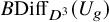 $B\!\operatorname {\mathrm {Diff}}_{D^3}(U_g)$
as
$B\!\operatorname {\mathrm {Diff}}_{D^3}(U_g)$
as $g \to \infty $
should be given by
$g \to \infty $
should be given by
 $$\begin{align*}H^*(\operatorname*{\mathrm{colim}}_{g \to \infty} B\!\operatorname{\mathrm{Diff}}_{D^3}(U_g); \mathbb{Q}) \stackrel{\text{conj.}}{\cong} H^*(\Omega^\infty \Sigma^\infty_+ \operatorname{\mathrm{BSO}}(4); \mathbb{Q}) \cong \mathbb{Q}\left[ \rho_c \;|\; c \text{ monomial in } p_1 \text{ and } e\right]. \end{align*}$$
The above construction of $s^*\alpha _c$
yields reasonable candidates for the restriction of these generators
$s^*\alpha _c$
yields reasonable candidates for the restriction of these generators $\rho _c$
to
$\rho _c$
to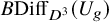 $B\!\operatorname {\mathrm {Diff}}_{D^3}(U_g)$
for all g. Hatcher’s approach to computing the stable homology implicitly uses that a section as in Theorem 12 exists in the smooth setting, in order to obtain the description of the stable homology above.
$B\!\operatorname {\mathrm {Diff}}_{D^3}(U_g)$
for all g. Hatcher’s approach to computing the stable homology implicitly uses that a section as in Theorem 12 exists in the smooth setting, in order to obtain the description of the stable homology above.
1.3 Outline of paper
The proof uses the space of separating systems developed in previous work of the authors [Reference Boyd, Bregman and SteinebrunnerBBS24], which studied $B\!\operatorname {\mathrm {Diff}}(M)$
, imported into the topological setting. This setting involves passing to a singular set-up and we introduce the necessary theory in Section 2. The topological separating systems are the topic of Section 3, and the theorem is proved in Section 4.
$B\!\operatorname {\mathrm {Diff}}(M)$
, imported into the topological setting. This setting involves passing to a singular set-up and we introduce the necessary theory in Section 2. The topological separating systems are the topic of Section 3, and the theorem is proved in Section 4.
2 Simplicial preliminaries
For X a topological space, let $\mathrm {S}_{\bullet } X$
denote the singular simplicial set defined via
$\mathrm {S}_{\bullet } X$
denote the singular simplicial set defined via $\mathrm {S}_n X = \operatorname {\mathrm {Map}}_{\mathrm {Top}}(\Delta ^n, X)$
. In particular, for
$\mathrm {S}_n X = \operatorname {\mathrm {Map}}_{\mathrm {Top}}(\Delta ^n, X)$
. In particular, for $\operatorname {\mathrm {Homeo}}(M)$
the group of homeomorphisms
$\operatorname {\mathrm {Homeo}}(M)$
the group of homeomorphisms $\varphi \colon M \to M$
, we let
$\varphi \colon M \to M$
, we let $\mathrm {S}_{\bullet }\!\operatorname {\mathrm {Homeo}}(M)$
denote the resulting simplicial group. We can alternatively think of an n-simplex in
$\mathrm {S}_{\bullet }\!\operatorname {\mathrm {Homeo}}(M)$
denote the resulting simplicial group. We can alternatively think of an n-simplex in $\mathrm {S}_n\operatorname {\mathrm {Homeo}}(M)$
as a homeomorphism
$\mathrm {S}_n\operatorname {\mathrm {Homeo}}(M)$
as a homeomorphism $\Delta ^n \times M \to \Delta ^n \times M$
that commutes with the projection to
$\Delta ^n \times M \to \Delta ^n \times M$
that commutes with the projection to $\Delta ^n$
. Face and degeneracy maps are inherited from
$\Delta ^n$
. Face and degeneracy maps are inherited from $\Delta ^n$
.
$\Delta ^n$
.
We will work with these simplicial sets instead of topological spaces, hence we will encounter bi-simplicial sets whenever one would otherwise consider simplicial (topological) spaces. The geometric realisation of a simplicial (topological) space is then replaced by taking the diagonal bisimplicial set $\delta (Y_{\bullet , \bullet })$
defined by
$\delta (Y_{\bullet , \bullet })$
defined by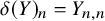 $\delta (Y)_n = Y_{n,n}$
. For example, if a simplicial group G acts on a simplicial set X, then the bar construction
$\delta (Y)_n = Y_{n,n}$
. For example, if a simplicial group G acts on a simplicial set X, then the bar construction
 $$\begin{align*}\mathrm{Bar}_n(X_m, G_m, *) = X_m \times (G_m)^{\times n} \end{align*}$$
is a bisimplicial set, and we define the homotopy orbit construction to be its diagonal
 $$\begin{align*}X/\!\!/ G := \delta( \mathrm{Bar}_{\bullet}(X_{\bullet}, G_{\bullet}, *) ). \end{align*}$$
The realisation of the diagonal $|\delta (Y)|$
is homeomorphic to the realisation of the simplicial space
$|\delta (Y)|$
is homeomorphic to the realisation of the simplicial space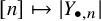 $[n] \mapsto |Y_{\bullet ,n}|$
. In fact,
$[n] \mapsto |Y_{\bullet ,n}|$
. In fact, $|\delta (Y)|$
is also weakly equivalent to the more well-behaved fat geometric realisation of
$|\delta (Y)|$
is also weakly equivalent to the more well-behaved fat geometric realisation of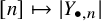 $[n] \mapsto |Y_{\bullet ,n}|$
[Reference Ebert and Randal-WilliamsERW19, Theorem 7.1 and Lemma 1.7]. Therefore
$[n] \mapsto |Y_{\bullet ,n}|$
[Reference Ebert and Randal-WilliamsERW19, Theorem 7.1 and Lemma 1.7]. Therefore
 $$\begin{align*}|X /\!\!/ G| \simeq \|[n] \mapsto \mathrm{Bar}_n(|X|, |G|, *) \| = |X|/\!\!/ |G|. \end{align*}$$
The simplicial set $EG = G /\!\!/ G$
is contractible and admits a (left) G-action that is level-wise free. We can alternatively write the homotopy orbit construction as the quotient of the diagonal action
$EG = G /\!\!/ G$
is contractible and admits a (left) G-action that is level-wise free. We can alternatively write the homotopy orbit construction as the quotient of the diagonal action
 $$\begin{align*}X \times EG \longrightarrow (X \times EG)/G \cong X /\!\!/ G. \end{align*}$$
This map is a Kan fibration with fiber G [Reference MayMay92, Lemma 18.2].
For a topological group H (such as $\operatorname {\mathrm {Homeo}}(M)$
or
$\operatorname {\mathrm {Homeo}}(M)$
or $\operatorname {\mathrm {Diff}}(M)$
) we can find an H principal bundle
$\operatorname {\mathrm {Diff}}(M)$
) we can find an H principal bundle $EH \to BH$
such that
$EH \to BH$
such that $BH$
is a CW complex and
$BH$
is a CW complex and $EH$
is weakly contractible (take Milnor’s construction [Reference MilnorMil56] and pull back along a CW approximation). This
$EH$
is weakly contractible (take Milnor’s construction [Reference MilnorMil56] and pull back along a CW approximation). This $BH$
classifies H-principal bundles over spaces homotopy equivalent to CW complexes, and is unique up to homotopy equivalence.
$BH$
classifies H-principal bundles over spaces homotopy equivalent to CW complexes, and is unique up to homotopy equivalence. $\mathrm {S}_{\bullet } H$
is a simplicial group and there are equivalences
$\mathrm {S}_{\bullet } H$
is a simplicial group and there are equivalences
 $$\begin{align*}|* /\!\!/ \mathrm{S}_{\bullet} H| \simeq * /\!\!/ |\mathrm{S}_{\bullet} H| = B(|\mathrm{S}_{\bullet} H|) \simeq BH. \end{align*}$$
Using this model, $\Omega BH$
is always weakly homotopy equivalent to H and they are homotopy equivalent when H has the homotopy type of a CW complex.
$\Omega BH$
is always weakly homotopy equivalent to H and they are homotopy equivalent when H has the homotopy type of a CW complex.
We will need the following lemma for comparing homotopy orbit constructions, which is a simplicial analogue of [Reference Boyd, Bregman and SteinebrunnerBBS24, Lemma 2.10].
Lemma 1 (Orbit stabiliser lemma).
Let $\varphi \colon G \to H$
be a simplicial group homomorphism and
$\varphi \colon G \to H$
be a simplicial group homomorphism and $f\colon X \to Y$
a map of simplicial sets such that G acts on X, H acts on Y, and f is
$f\colon X \to Y$
a map of simplicial sets such that G acts on X, H acts on Y, and f is $\varphi $
-equivariant. Assume that for each
$\varphi $
-equivariant. Assume that for each $y \in Y_0$
there is an
$y \in Y_0$
there is an $h \in H_0$
and
$h \in H_0$
and $x \in X_0$
such that
$x \in X_0$
such that $h\cdot f(x)$
is in the same path component as y. Assume further that one of the following two conditions holds.
$h\cdot f(x)$
is in the same path component as y. Assume further that one of the following two conditions holds.
-
1. For each $x \in X_0$
the commutative square is a homotopy pullback square.
$x \in X_0$
the commutative square is a homotopy pullback square. -
2. The group actions are such that for all
$x \in X_0$
the maps
$-\cdot x\colon G \to X$
and
$-\cdot f(x)\colon H \to Y$
are Kan fibrations and the induced map on stabilisers is a weak equivalence.
$$\begin{align*}\mathrm{Stab}_G(x) \longrightarrow \mathrm{Stab}_H(f(x)) \end{align*}$$





Then the induced map on homotopy orbits is a weak equivalence
 $$\begin{align*}X/\!\!/ G \longrightarrow Y/\!\!/ H. \end{align*}$$
Proof. First, note that (2) implies (1). Indeed, (2) says that the horizontal maps in (1) are Kan fibrations, so their fibers (which are exactly the stabiliser groups) are equivalent to their homotopy fibers. A square is a homotopy pullback square if and only if the induced map on horizontal fibers at every base point is a weak equivalence, but this is exactly what the hypothesis about stabiliser groups in (2) tells us.
Now suppose we have (1). We may additionally assume that X and Y are Kan. In order to prove the lemma, we need to show that for each $[y] \in Y/\!\!/ H$
the homotopy fiber of
$[y] \in Y/\!\!/ H$
the homotopy fiber of $f /\!\!/ \varphi $
at
$f /\!\!/ \varphi $
at $[y]$
is contractible. By the additional hypothesis,
$[y]$
is contractible. By the additional hypothesis, $[y]$
is in the same path component as
$[y]$
is in the same path component as $[f(x)]$
for some
$[f(x)]$
for some $x \in X_0$
, so it suffices to study the homotopy fiber at
$x \in X_0$
, so it suffices to study the homotopy fiber at $[f(x)]$
.
$[f(x)]$
.
If we replace X by $X \times EG$
and Y by
$X \times EG$
and Y by $Y \times EH$
, then the square remains a homotopy pullback square and fits into a map of fiber sequences
$Y \times EH$
, then the square remains a homotopy pullback square and fits into a map of fiber sequences

Here we have continued the fiber sequence to the left by looping the map $f /\!\!/ \varphi $
. Since the middle square is a homotopy pullback square the induced map
$f /\!\!/ \varphi $
. Since the middle square is a homotopy pullback square the induced map $\Omega (f /\!\!/ \varphi )$
on the horizontal homotopy fibers is an equivalence. This shows that
$\Omega (f /\!\!/ \varphi )$
on the horizontal homotopy fibers is an equivalence. This shows that $f /\!\!/ \varphi $
is an isomorphism on
$f /\!\!/ \varphi $
is an isomorphism on $\pi _i$
for
$\pi _i$
for $i \ge 1$
.
$i \ge 1$
.
It follows from the additional hypothesis that $f /\!\!/ \varphi $
is surjective on path components, so it remains to show that
$f /\!\!/ \varphi $
is surjective on path components, so it remains to show that $\pi _0(f /\!\!/ \varphi )$
is injective. Suppose
$\pi _0(f /\!\!/ \varphi )$
is injective. Suppose $[x], [x'] \in \pi _0(X/\!\!/ G)$
(with representatives
$[x], [x'] \in \pi _0(X/\!\!/ G)$
(with representatives $x,x' \in X_0$
) are such that
$x,x' \in X_0$
) are such that $[f(x)] = [f(x')] \in \pi _0(Y /\!\!/ H)$
. This means that there is
$[f(x)] = [f(x')] \in \pi _0(Y /\!\!/ H)$
. This means that there is $h \in H_0$
and a path
$h \in H_0$
and a path $\gamma $
from
$\gamma $
from $h\cdot f(x)$
to
$h\cdot f(x)$
to $f(x')$
. The triple
$f(x')$
. The triple $(h, \gamma , x')$
defines a vertex in the homotopy pullback
$(h, \gamma , x')$
defines a vertex in the homotopy pullback $H \times _Y^h X$
, where we take
$H \times _Y^h X$
, where we take $H \to Y$
to be the map that acts on
$H \to Y$
to be the map that acts on $f(x)$
. Since the map
$f(x)$
. Since the map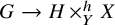 $G \to H \times _Y^h X$
(given by
$G \to H \times _Y^h X$
(given by $g \mapsto (\varphi (g), \mathrm {const}_{g\cdot f(x)}, g\cdot x)$
) is assumed to be a weak equivalence, we can find
$g \mapsto (\varphi (g), \mathrm {const}_{g\cdot f(x)}, g\cdot x)$
) is assumed to be a weak equivalence, we can find $g \in G_0$
such that
$g \in G_0$
such that $(\varphi (g), \mathrm {const}_{g\cdot f(x)}, g\cdot x)$
is in the same path component as
$(\varphi (g), \mathrm {const}_{g\cdot f(x)}, g\cdot x)$
is in the same path component as $(h, \gamma , x')$
. In particular,
$(h, \gamma , x')$
. In particular, $g\cdot x$
is in the same path component as
$g\cdot x$
is in the same path component as $x'$
, so
$x'$
, so $[x] = [x'] \in \pi _0(X /\!\!/ G)$
, proving that
$[x] = [x'] \in \pi _0(X /\!\!/ G)$
, proving that $\pi _0(f /\!\!/ \varphi )$
is injective.
$\pi _0(f /\!\!/ \varphi )$
is injective.
3 Topological separating systems
In our previous work, [Reference Boyd, Bregman and SteinebrunnerBBS24], we study the homotopy type of $B\!\operatorname {\mathrm {Diff}}(M)$
and
$B\!\operatorname {\mathrm {Diff}}(M)$
and $B\!\operatorname {\mathrm {Diff}}_\partial (M)$
. One of our main tools is a space of separating systems for a 3-manifold M, which parametrises decompositions of M into irreducible manifolds [Reference Boyd, Bregman and SteinebrunnerBBS24, §3]. This space is denoted
$B\!\operatorname {\mathrm {Diff}}_\partial (M)$
. One of our main tools is a space of separating systems for a 3-manifold M, which parametrises decompositions of M into irreducible manifolds [Reference Boyd, Bregman and SteinebrunnerBBS24, §3]. This space is denoted $\operatorname {\mathrm {Sep}}(M)$
, and point corresponds to a collection of disjointly embedded spheres
$\operatorname {\mathrm {Sep}}(M)$
, and point corresponds to a collection of disjointly embedded spheres $\Sigma \subset \smash {\mathring {M}}$
that ‘cut’ M into (punctured) irreducible pieces. Note that
$\Sigma \subset \smash {\mathring {M}}$
that ‘cut’ M into (punctured) irreducible pieces. Note that $M \setminus \Sigma $
is diffeomorphic to the interior of a compact 3-manifold with boundary, which we denote as
$M \setminus \Sigma $
is diffeomorphic to the interior of a compact 3-manifold with boundary, which we denote as $M \!\mid \! \Sigma $
. Intuitively,
$M \!\mid \! \Sigma $
. Intuitively, $M \!\mid \! \Sigma $
is the manifold obtained from cutting M along
$M \!\mid \! \Sigma $
is the manifold obtained from cutting M along $\Sigma $
. We endow
$\Sigma $
. We endow $\operatorname {\mathrm {Sep}}(M)$
with a poset structure induced by inclusion of separating systems, and we show that the realisation of the nerve is contractible. Thus we gain a model
$\operatorname {\mathrm {Sep}}(M)$
with a poset structure induced by inclusion of separating systems, and we show that the realisation of the nerve is contractible. Thus we gain a model $\|\operatorname {\mathrm {Sep}}_{\bullet }(M)\|/\!\!/ \operatorname {\mathrm {Diff}}(M)$
for
$\|\operatorname {\mathrm {Sep}}_{\bullet }(M)\|/\!\!/ \operatorname {\mathrm {Diff}}(M)$
for $B\!\operatorname {\mathrm {Diff}}(M)$
.
$B\!\operatorname {\mathrm {Diff}}(M)$
.
We will build similar models for $B\!\operatorname {\mathrm {Homeo}}(U_g)$
and
$B\!\operatorname {\mathrm {Homeo}}(U_g)$
and $B\!\operatorname {\mathrm {Homeo}}(H_g)$
. We start by defining a topological version of
$B\!\operatorname {\mathrm {Homeo}}(H_g)$
. We start by defining a topological version of $\operatorname {\mathrm {Sep}}(M)$
, specifically in the setting of
$\operatorname {\mathrm {Sep}}(M)$
, specifically in the setting of $M=U_g$
. Since we will require the action map from
$M=U_g$
. Since we will require the action map from $\mathrm {S}_{\bullet }\!\operatorname {\mathrm {Homeo}}(U_g)$
to this space to be a Kan fibration, we define everything simplicially. Recall that since a separating system
$\mathrm {S}_{\bullet }\!\operatorname {\mathrm {Homeo}}(U_g)$
to this space to be a Kan fibration, we define everything simplicially. Recall that since a separating system $\Sigma \subset M$
satisfies that
$\Sigma \subset M$
satisfies that $M \!\mid \! \Sigma $
is a disjoint union of (punctured) irreducible manifolds, it follows that if
$M \!\mid \! \Sigma $
is a disjoint union of (punctured) irreducible manifolds, it follows that if $\Sigma \in \operatorname {\mathrm {Sep}}(U_g)$
, then
$\Sigma \in \operatorname {\mathrm {Sep}}(U_g)$
, then $U_g \!\mid \!\Sigma $
is homeomorphic to a disjoint union of punctured
$U_g \!\mid \!\Sigma $
is homeomorphic to a disjoint union of punctured $3$
-spheres.
$3$
-spheres.
The following discussion follows Appendix I of Burghelea–Lashof–Rothenberg [Reference Burghelea, Lashof and RothenbergBLR75], an account of which can also be found in Kupers [Reference KupersKup15, §3.2].
Definition 2. Let M be a compact topological n manifold. A locally flat $\Delta ^k$
-family of d-dimensional submanifolds in M is a compact subset
$\Delta ^k$
-family of d-dimensional submanifolds in M is a compact subset $W \subseteq \Delta ^k \times M$
such that for every
$W \subseteq \Delta ^k \times M$
such that for every $(t,x) \in W$
there is a neighbourhood
$(t,x) \in W$
there is a neighbourhood $t \in B \subseteq \Delta ^k$
and an open embedding
$t \in B \subseteq \Delta ^k$
and an open embedding $\varphi \colon B \times \mathbb {R}^d \hookrightarrow B \times M$
over B satisfying
$\varphi \colon B \times \mathbb {R}^d \hookrightarrow B \times M$
over B satisfying $\varphi (t,0) = (t,x)$
and
$\varphi (t,0) = (t,x)$
and $\varphi ^{-1}(W) = B \times \mathbb {R}^k$
. If M has boundary we further require
$\varphi ^{-1}(W) = B \times \mathbb {R}^k$
. If M has boundary we further require $\partial W = W \cap \partial (\Delta ^k \times M)$
and we replace
$\partial W = W \cap \partial (\Delta ^k \times M)$
and we replace $\mathbb {R}^d$
and
$\mathbb {R}^d$
and $\mathbb {R}^k$
by the half-space whenever
$\mathbb {R}^k$
by the half-space whenever $(t,x)$
is a boundary point.
$(t,x)$
is a boundary point.
It follows from the definition that W is a $(d+k)$
-dimensional manifold and the projection
$(d+k)$
-dimensional manifold and the projection $W \to \Delta ^k$
is a trivial fiber bundle with fiber N. This definition is chosen such that the simplicial set
$W \to \Delta ^k$
is a trivial fiber bundle with fiber N. This definition is chosen such that the simplicial set $\mathrm {Sub}(M)_{\bullet }$
whose k-simplices are locally flat
$\mathrm {Sub}(M)_{\bullet }$
whose k-simplices are locally flat $\Delta ^k$
-families of submanifolds of M is isomorphic to
$\Delta ^k$
-families of submanifolds of M is isomorphic to
 $$\begin{align*}\mathrm{Sub}(M)_{\bullet} \cong \coprod_{[N]} \operatorname{\mathrm{Emb}}^{\mathrm{lf}}(N, M)_{\bullet} / \mathrm{S}_{\bullet}\!\operatorname{\mathrm{Homeo}}(N) \end{align*}$$
where the coproduct runs over representatives of homeomorphism types of submanifolds. Here the definition of the simplicial set of locally flat embeddings is taken to be as in [Reference Burghelea, Lashof and RothenbergBLR75, Appendix I, p.119]. Acting by homeomorphisms of M on a fixed submanifold $N \subseteq M$
defines a map
$N \subseteq M$
defines a map
 $$\begin{align*}\mathrm{S}_{\bullet}\!\operatorname{\mathrm{Homeo}}(M) \longrightarrow \operatorname{\mathrm{Emb}}^{\mathrm{lf}}(N, M)_{\bullet} \longrightarrow \operatorname{\mathrm{Emb}}^{\mathrm{lf}}(N, M)_{\bullet}/\mathrm{S}_{\bullet}\!\operatorname{\mathrm{Homeo}}(N) \subseteq \mathrm{Sub}(M)_{\bullet} \end{align*}$$
The first of these maps is a Kan fibration by the parametrised isotopy extension theorem for locally flat embeddings ([Reference Burghelea, Lashof and RothenbergBLR75, Theorem 4.14, p.129] or [Reference KupersKup15, Theorem 3.9]). The second map is a Kan fibration by [Reference MayMay92, Lemma 18.2] as the action of $\mathrm {S}_{\bullet }\!\operatorname {\mathrm {Homeo}}(N)$
on
$\mathrm {S}_{\bullet }\!\operatorname {\mathrm {Homeo}}(N)$
on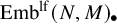 $\operatorname {\mathrm {Emb}}^{\mathrm {lf}}(N,M)_{\bullet }$
by precomposition is level-wise free. The third map is a Kan fibration because it is an inclusion of path components. Therefore the composite map is a Kan fibration.
$\operatorname {\mathrm {Emb}}^{\mathrm {lf}}(N,M)_{\bullet }$
by precomposition is level-wise free. The third map is a Kan fibration because it is an inclusion of path components. Therefore the composite map is a Kan fibration.
Definition 3. A $\Delta ^k$
-family of separating systems in
$\Delta ^k$
-family of separating systems in $U_g$
is a locally flat
$U_g$
is a locally flat $\Delta ^k$
-family
$\Delta ^k$
-family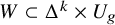 $W \subset \Delta ^k \times U_g$
of submanifolds such that in each fiber
$W \subset \Delta ^k \times U_g$
of submanifolds such that in each fiber $W_t$
over
$W_t$
over $t \in \Delta ^k$
-
1.
$W_t$
is a disjoint union of
$2$
-spheres in
$U_g$
, and -
2.
$U_g \!\mid \! W_t \cong \sqcup _{i=1}^{l} (S^3 \setminus \sqcup _{m_i} \smash {\mathring {D}}^3)$
for some
$l \ge 1$
and
$m_i \ge 2$
.





Note that $W_t$
is a separating system in the sense of [Reference Boyd, Bregman and SteinebrunnerBBS24]. Let
$W_t$
is a separating system in the sense of [Reference Boyd, Bregman and SteinebrunnerBBS24]. Let $\operatorname {\mathrm {Sep}}^{\mathrm {top}}(U_g)_{\bullet }$
be the simplicial set
$\operatorname {\mathrm {Sep}}^{\mathrm {top}}(U_g)_{\bullet }$
be the simplicial set
 $$\begin{align*}\operatorname{\mathrm{Sep}}^{\mathrm{top}}(U_g)_k = \{W\subset \Delta^k\times M \;|\; W \text{ is a } \Delta^k\text{-family of separating systems}\}. \end{align*}$$
Face and degeneracy maps are inherited from $\Delta ^k$
. This is a poset under
$\Delta ^k$
. This is a poset under $\subseteq $
and taking the nerve of this poset yields a bisimplicial set with
$\subseteq $
and taking the nerve of this poset yields a bisimplicial set with
 $$\begin{align*}\operatorname{\mathrm{Sep}}^{\mathrm{top}}_n(U_g)_k=\{W_0\subseteq W_1 \subseteq \cdots \subseteq W_n \;|\; W_i \in\operatorname{\mathrm{Sep}}^{\mathrm{top}}(U_g)_k \} \end{align*}$$
where the face operators in the nerve direction forget elements of the chain and the degeneracy operators repeat elements. We then let $\delta \operatorname {\mathrm {Sep}}^{\mathrm {top}}(U_g)_{\bullet }$
denote the diagonal simplicial set with
$\delta \operatorname {\mathrm {Sep}}^{\mathrm {top}}(U_g)_{\bullet }$
denote the diagonal simplicial set with $\delta \operatorname {\mathrm {Sep}}^{\mathrm {top}}(U_g)_n = \operatorname {\mathrm {Sep}}^{\mathrm {top}}_n(U_g)_n$
.
$\delta \operatorname {\mathrm {Sep}}^{\mathrm {top}}(U_g)_n = \operatorname {\mathrm {Sep}}^{\mathrm {top}}_n(U_g)_n$
.
In our analogous definition for $H_g$
, we cut the manifold up using discs, and require that the restriction to the boundary
$H_g$
, we cut the manifold up using discs, and require that the restriction to the boundary $U_g$
is a separating system.
$U_g$
is a separating system.
Definition 4. A $\Delta ^k$
-family of separating systems in
$\Delta ^k$
-family of separating systems in $H_g$
is a locally flat
$H_g$
is a locally flat $\Delta ^k$
-family
$\Delta ^k$
-family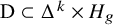 $\mathrm {D} \subset \Delta ^k \times H_g$
of submanifolds such that in each fiber
$\mathrm {D} \subset \Delta ^k \times H_g$
of submanifolds such that in each fiber $\mathrm {D}_t$
over
$\mathrm {D}_t$
over $t \in \Delta ^k$
-
1.
$\mathrm {D}_t$
is a disjoint union of
$3$
-discs, -
2.
$H_g \!\mid \! \mathrm {D}_t$
is a disjoint union of
$4$
-discs, and -
3.
$\mathrm {D} \cap (\Delta ^k \times \partial H_g)$
is a
$\Delta ^k$
-family of separating systems in
$U_g = \partial H_g$
.





As in the case of separating systems we let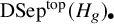 $\text {DSep}^{\mathrm {top}}(H_g)_{\bullet }$
be the simplicial set
$\text {DSep}^{\mathrm {top}}(H_g)_{\bullet }$
be the simplicial set
 $$\begin{align*}\text{DSep}^{\mathrm{top}}(H_g)_k = \{\mathrm{D}\subset \Delta^k\times M \;|\; \mathrm{D} \text{ is a } \Delta^k \text{-family of disc systems}\}, \end{align*}$$
with face and degeneracy maps once again inherited from $\Delta ^k$
. Then
$\Delta ^k$
. Then $\text {DSep}^{\mathrm {top}}(H_g)_k$
has a poset structure given by
$\text {DSep}^{\mathrm {top}}(H_g)_k$
has a poset structure given by $\subseteq $
. Taking the nerve of this poset yields a bisimplicial set with
$\subseteq $
. Taking the nerve of this poset yields a bisimplicial set with
 $$\begin{align*}\text{DSep}^{\mathrm{top}}_n(H_g)_k=\{\mathrm{D}_0\subseteq \mathrm{D}_1 \subseteq \cdots \subseteq \mathrm{D}_n \;|\; \mathrm{D}_i \in\text{DSep}^{\mathrm{top}}(H_g)_k \} \end{align*}$$
We then let $\delta \text {DSep}^{\mathrm {top}}(H_g)_{\bullet }$
denote the diagonal simplicial set with
$\delta \text {DSep}^{\mathrm {top}}(H_g)_{\bullet }$
denote the diagonal simplicial set with $\delta \text {DSep}^{\mathrm {top}}(H_g)_n = \text {DSep}^{\mathrm {top}}_n(H_g)_n$
.
$\delta \text {DSep}^{\mathrm {top}}(H_g)_n = \text {DSep}^{\mathrm {top}}_n(H_g)_n$
.
In both Definition 3 and Definition 4, if the condition on $W_t$
or
$W_t$
or $\mathrm {D}_t$
is satisfied for one
$\mathrm {D}_t$
is satisfied for one $t \in \Delta ^k$
then it is satisfied for all. Thus, the simplicial sets of separating systems are unions of path-components in
$t \in \Delta ^k$
then it is satisfied for all. Thus, the simplicial sets of separating systems are unions of path-components in $\mathrm {Sub}(U_g)_{\bullet }$
and
$\mathrm {Sub}(U_g)_{\bullet }$
and $\mathrm {Sub}(H_g)_{\bullet }$
, respectively, and from the discussion following Definition 2 we see that the action of the respective homeomorphism groups on these simplicial sets induces Kan fibrations.
$\mathrm {Sub}(H_g)_{\bullet }$
, respectively, and from the discussion following Definition 2 we see that the action of the respective homeomorphism groups on these simplicial sets induces Kan fibrations.
Corollary 5. For every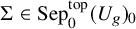 $\Sigma \in \operatorname {\mathrm {Sep}}^{\mathrm {top}}_0(U_g)_0$
the map
$\Sigma \in \operatorname {\mathrm {Sep}}^{\mathrm {top}}_0(U_g)_0$
the map
 $$\begin{align*}\mathrm{S}_{\bullet}\!\operatorname{\mathrm{Homeo}}(U_g) \longrightarrow \operatorname{\mathrm{Sep}}^{\mathrm{top}}_0(U_g)_{\bullet}, \qquad \varphi \mapsto \varphi(\Sigma) \end{align*}$$
is a Kan fibration. Similarly, the map $\mathrm {S}_{\bullet }\!\operatorname {\mathrm {Homeo}}(H_g) \to \text {DSep}^{\mathrm {top}}_0(H_g)$
, defined by acting on a disc system, is a Kan fibration for any choice of disc system.
$\mathrm {S}_{\bullet }\!\operatorname {\mathrm {Homeo}}(H_g) \to \text {DSep}^{\mathrm {top}}_0(H_g)$
, defined by acting on a disc system, is a Kan fibration for any choice of disc system.
Every separating system $\Sigma $
(or family thereof) has a finite set of sub-separating systems
$\Sigma $
(or family thereof) has a finite set of sub-separating systems $\Sigma ' \subseteq \Sigma $
. Indeed, every sub-separating system is a union of components and thus determined by a choice of subset
$\Sigma ' \subseteq \Sigma $
. Indeed, every sub-separating system is a union of components and thus determined by a choice of subset $\pi _0(\Sigma ') \subset \pi _0(\Sigma )$
. Conversely, a union of components
$\pi _0(\Sigma ') \subset \pi _0(\Sigma )$
. Conversely, a union of components $\Sigma ' \subseteq \Sigma $
is a separating system if and only if
$\Sigma ' \subseteq \Sigma $
is a separating system if and only if $U_g \!\mid \! \Sigma '$
has simply connected components. The same description holds for
$U_g \!\mid \! \Sigma '$
has simply connected components. The same description holds for $\Delta ^k$
-families of separating systems and thus we have a bijection between subsystems of
$\Delta ^k$
-families of separating systems and thus we have a bijection between subsystems of $W \subset \Delta ^k \times U_g$
and subsystems of the fiber
$W \subset \Delta ^k \times U_g$
and subsystems of the fiber $W_i \subset \{i\} \times U_g$
for any vertex
$W_i \subset \{i\} \times U_g$
for any vertex $i \in \Delta ^k$
. Iterating this to describe n-chains of subsystems we see that every lifting problem
$i \in \Delta ^k$
. Iterating this to describe n-chains of subsystems we see that every lifting problem

has a unique lift, where $d_0^n$
is the map that sends
$d_0^n$
is the map that sends $(\Sigma _0 \subseteq \dots \subseteq \Sigma _n)$
to
$(\Sigma _0 \subseteq \dots \subseteq \Sigma _n)$
to $\Sigma _n$
. In other words,
$\Sigma _n$
. In other words, $d_0^n\colon \operatorname {\mathrm {Sep}}_n(U_g) \to \operatorname {\mathrm {Sep}}_0(U_g)$
is a covering, that is, it is
$d_0^n\colon \operatorname {\mathrm {Sep}}_n(U_g) \to \operatorname {\mathrm {Sep}}_0(U_g)$
is a covering, that is, it is $0$
-coskeletal or, equivalently, it is a minimal Kan fibration with discrete fiber, see [Reference MayMay92, §11]. Sub-disc systems in
$0$
-coskeletal or, equivalently, it is a minimal Kan fibration with discrete fiber, see [Reference MayMay92, §11]. Sub-disc systems in $H_g$
admit a similar characterisation, giving us the following lemma.
$H_g$
admit a similar characterisation, giving us the following lemma.
Lemma 6. In the diagram

the vertical maps, defined by $(\Sigma _0 \subseteq \dots \subseteq \Sigma _n) \mapsto \Sigma _n$
, are finite coverings, and both squares are pullback squares.
$(\Sigma _0 \subseteq \dots \subseteq \Sigma _n) \mapsto \Sigma _n$
, are finite coverings, and both squares are pullback squares.
Proof. The left and middle vertical maps are coverings by the argument preceding the lemma. Moreover, they are finite coverings since every separating system has a finite set of sub-separating systems. For the right vertical map, by [Reference Boyd, Bregman and SteinebrunnerBBS24, Lemma 3.10] $\operatorname {\mathrm {Sep}}_n(U_g) \to \operatorname {\mathrm {Sep}}_0(U_g)$
is a finite covering (of topological spaces). Applying
$\operatorname {\mathrm {Sep}}_n(U_g) \to \operatorname {\mathrm {Sep}}_0(U_g)$
is a finite covering (of topological spaces). Applying $\mathrm {S}_{\bullet }(-)$
yields a covering of simplicial sets in the above sense. The middle and right vertical maps have the same fibers so the right square is a pullback.
$\mathrm {S}_{\bullet }(-)$
yields a covering of simplicial sets in the above sense. The middle and right vertical maps have the same fibers so the right square is a pullback.
For the left square, note that for $\mathrm {D} \in \text {DSep}^{\mathrm {top}}(H_g)_0$
a union of components
$\mathrm {D} \in \text {DSep}^{\mathrm {top}}(H_g)_0$
a union of components $\mathrm {D}' \subseteq \mathrm {D}$
is a sub-separating system if and only if
$\mathrm {D}' \subseteq \mathrm {D}$
is a sub-separating system if and only if $\partial \mathrm {D}' \subset \partial \mathrm {D}$
is a subsystem. Therefore, in the left square the horizontal maps induce a bijection between the fibers of the vertical maps and thus this square is a pullback.
$\partial \mathrm {D}' \subset \partial \mathrm {D}$
is a subsystem. Therefore, in the left square the horizontal maps induce a bijection between the fibers of the vertical maps and thus this square is a pullback.
To prove that $\delta (\operatorname {\mathrm {Sep}}^{\mathrm {top}}(U_g))_{\bullet }$
is contractible we will compare it to the simplicial space of smooth separating systems from [Reference Boyd, Bregman and SteinebrunnerBBS24]. Recall that
$\delta (\operatorname {\mathrm {Sep}}^{\mathrm {top}}(U_g))_{\bullet }$
is contractible we will compare it to the simplicial space of smooth separating systems from [Reference Boyd, Bregman and SteinebrunnerBBS24]. Recall that $\operatorname {\mathrm {Diff}}(M, \Sigma ) \subset \operatorname {\mathrm {Diff}}(M)$
denotes the subgroup of diffeomorphisms that fix
$\operatorname {\mathrm {Diff}}(M, \Sigma ) \subset \operatorname {\mathrm {Diff}}(M)$
denotes the subgroup of diffeomorphisms that fix $\Sigma $
set-wise and similarly for
$\Sigma $
set-wise and similarly for $\operatorname {\mathrm {Homeo}}(M, \Sigma ) \subset \operatorname {\mathrm {Homeo}}(M)$
.
$\operatorname {\mathrm {Homeo}}(M, \Sigma ) \subset \operatorname {\mathrm {Homeo}}(M)$
.
Lemma 7. Let M be a 3-manifold. For every smooth separating system $\Sigma \subset M$
the map
$\Sigma \subset M$
the map
 $$\begin{align*}\operatorname{\mathrm{Diff}}(M, \Sigma) \longrightarrow \operatorname{\mathrm{Homeo}}(M, \Sigma) \end{align*}$$
is a weak equivalence.
Proof. Consider the following map of fiber sequences of topological spaces:

Here the top right map is a Serre fibration by [Reference PalaisPal60, Reference CerfCer61] and the bottom right map is a Serre fibration as a consequence of [Reference Burghelea, Lashof and RothenbergBLR75, Theorem 4.14, p.129]. (By [Reference MayMay92, Remark 16.5] if $\mathrm {S}_{\bullet }(f)$
is a Kan fibration, then f is a Serre fibration.) By the equivalence between homeomorphisms and diffeomorphisms for surfaces [Reference RadóRad25, Reference EpsteinEps66] the right map is an equivalence. As a consequence of work of Cerf [Reference CerfCer61, §3.2.1, Théorème 8] and Hatcher’s resolution of the Smale conjecture [Reference HatcherHat83], there is an equivalence of diffeomorphisms and homeomorphisms of 3-manifolds fixing a subsurface pointwise [Reference CerfCer61, Reference HatcherHat83] so the left map is an equivalence. It follows that the central map is an equivalence, as required.
$\mathrm {S}_{\bullet }(f)$
is a Kan fibration, then f is a Serre fibration.) By the equivalence between homeomorphisms and diffeomorphisms for surfaces [Reference RadóRad25, Reference EpsteinEps66] the right map is an equivalence. As a consequence of work of Cerf [Reference CerfCer61, §3.2.1, Théorème 8] and Hatcher’s resolution of the Smale conjecture [Reference HatcherHat83], there is an equivalence of diffeomorphisms and homeomorphisms of 3-manifolds fixing a subsurface pointwise [Reference CerfCer61, Reference HatcherHat83] so the left map is an equivalence. It follows that the central map is an equivalence, as required.
Proposition 8. The simplicial set $\delta (\operatorname {\mathrm {Sep}}^{\mathrm {top}} (U_g))_{\bullet }$
is weakly contractible.
$\delta (\operatorname {\mathrm {Sep}}^{\mathrm {top}} (U_g))_{\bullet }$
is weakly contractible.
Proof. We will show that for all n the map
 $$\begin{align*}\mathrm{S}_{\bullet}\operatorname{\mathrm{Sep}}_n(U_g) \longrightarrow \operatorname{\mathrm{Sep}}^{\mathrm{top}}_n(U_g)_{\bullet} \end{align*}$$
is a weak equivalence. As recalled in Section 2 we then have
 $$\begin{align*}|\delta(\operatorname{\mathrm{Sep}}^{\mathrm{top}}(U_g))_{\bullet}| \simeq \|[n] \mapsto |\operatorname{\mathrm{Sep}}^{\mathrm{top}}_n(U_g)_{\bullet}|\| \simeq \|[n] \mapsto |\mathrm{S}_{\bullet} \operatorname{\mathrm{Sep}}_n(U_g)| \| \simeq \|\operatorname{\mathrm{Sep}}_{\bullet}(U_g) \| \end{align*}$$
which is contractible by [Reference Boyd, Bregman and SteinebrunnerBBS24, Proposition 3.12].
For simplicity, we first consider the case of $n=0$
. At every
$n=0$
. At every $\Sigma \in \operatorname {\mathrm {Sep}}_0(U_g)_0$
consider the diagram
$\Sigma \in \operatorname {\mathrm {Sep}}_0(U_g)_0$
consider the diagram

The top row is a fiber sequence as $\operatorname {\mathrm {Diff}}(U_g) \to \operatorname {\mathrm {Sep}}_0(U_g)$
is a Serre fibration (see [Reference Boyd, Bregman and SteinebrunnerBBS24, first line of the proof of Lemma 3.19]) and thus becomes a Kan fibration after applying
$\operatorname {\mathrm {Diff}}(U_g) \to \operatorname {\mathrm {Sep}}_0(U_g)$
is a Serre fibration (see [Reference Boyd, Bregman and SteinebrunnerBBS24, first line of the proof of Lemma 3.19]) and thus becomes a Kan fibration after applying $\mathrm {S}_{\bullet }$
. It follows from Corollary 5 that the bottom sequence is also a fiber sequence. (Note, however, that the two Kan fibrations involved are usually not surjective.) In this diagram the middle map is an equivalence by [Reference CerfCer61, Reference HatcherHat83] and the left map is an equivalence by Lemma 7. As we know this for all
$\mathrm {S}_{\bullet }$
. It follows from Corollary 5 that the bottom sequence is also a fiber sequence. (Note, however, that the two Kan fibrations involved are usually not surjective.) In this diagram the middle map is an equivalence by [Reference CerfCer61, Reference HatcherHat83] and the left map is an equivalence by Lemma 7. As we know this for all $\Sigma \in \operatorname {\mathrm {Sep}}_0(U_g)_0$
this shows that the right map is an equivalence onto the components it hits.
$\Sigma \in \operatorname {\mathrm {Sep}}_0(U_g)_0$
this shows that the right map is an equivalence onto the components it hits.
We also need to argue that $\pi _0\operatorname {\mathrm {Sep}}_0(U_g) \to \pi _0(\operatorname {\mathrm {Sep}}^{\mathrm {top}}_0(U_g)_{\bullet })$
is surjective. If
$\pi _0\operatorname {\mathrm {Sep}}_0(U_g) \to \pi _0(\operatorname {\mathrm {Sep}}^{\mathrm {top}}_0(U_g)_{\bullet })$
is surjective. If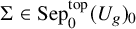 $\Sigma \in \operatorname {\mathrm {Sep}}^{\mathrm {top}}_0(U_g)_0$
is a topological sphere system, then by [Reference BingBin57] it is isotopic to a smooth sphere system. So far we have shown that
$\Sigma \in \operatorname {\mathrm {Sep}}^{\mathrm {top}}_0(U_g)_0$
is a topological sphere system, then by [Reference BingBin57] it is isotopic to a smooth sphere system. So far we have shown that $\mathrm {S}_{\bullet }\operatorname {\mathrm {Sep}}_n(U_g) \to \operatorname {\mathrm {Sep}}^{\mathrm {top}}_n(U_g)_{\bullet }$
is a weak equivalence when
$\mathrm {S}_{\bullet }\operatorname {\mathrm {Sep}}_n(U_g) \to \operatorname {\mathrm {Sep}}^{\mathrm {top}}_n(U_g)_{\bullet }$
is a weak equivalence when $n=0$
. It follows from the right pullback square in Lemma 6 that it is a weak equivalence for all n, completing the proof.
$n=0$
. It follows from the right pullback square in Lemma 6 that it is a weak equivalence for all n, completing the proof.
4 Proof of the main theorem
We need the following adaptation of the Alexander trick.
Lemma 9. Let $V\subset S^3=\partial D^4$
be a submanifold. The map
$V\subset S^3=\partial D^4$
be a submanifold. The map
 $$\begin{align*}\operatorname{\mathrm{Homeo}}_{V}(D^4)\overset{\partial}{\to} \operatorname{\mathrm{Homeo}}_{V}(S^3)\end{align*}$$
given by restriction to the boundary is a homotopy equivalence.
Proof. We check that the proof of the Alexander trick, which shows $\operatorname {\mathrm {Homeo}}(D^4)\simeq \operatorname {\mathrm {Homeo}}(S^3)$
restricts to these subgroups. We first define a map
$\operatorname {\mathrm {Homeo}}(D^4)\simeq \operatorname {\mathrm {Homeo}}(S^3)$
restricts to these subgroups. We first define a map
 $$ \begin{align*} s\colon \operatorname{\mathrm{Homeo}}_{V}(S^3) &\overset{\partial}{\to} \operatorname{\mathrm{Homeo}}_{V}(D^4)\\ \varphi &\mapsto \left(x \mapsto |x|\cdot \varphi\big(\tfrac{x}{|x|}\big)\right). \end{align*} $$
Then $\partial \circ s = \text {id}_{\operatorname {\mathrm {Homeo}}_{V}(S^3)}$
, and
$\partial \circ s = \text {id}_{\operatorname {\mathrm {Homeo}}_{V}(S^3)}$
, and $s\circ \partial \simeq \text {id}_{\operatorname {\mathrm {Homeo}}_{V}(D^4)}$
via the following homotopy.
$s\circ \partial \simeq \text {id}_{\operatorname {\mathrm {Homeo}}_{V}(D^4)}$
via the following homotopy.
 $$ \begin{align*} H\colon \operatorname{\mathrm{Homeo}}_{V}(D^4) \times I &\to \operatorname{\mathrm{Homeo}}_{V}(D^4)\\ (\psi, t) &\mapsto \begin{cases} |x|\cdot \psi \big(\frac{x}{|x|}\big) & |x|\geq t \\ t\cdot \psi\big(\frac{x}{t}\big) & |x|\leq t. \end{cases} \end{align*} $$
Note that throughout this homotopy the homeomorphism on the boundary remains unchanged, and so $V\subset \partial M$
remains pointwise fixed, that is, we stay in the required subgroup.
$V\subset \partial M$
remains pointwise fixed, that is, we stay in the required subgroup.
Lemma 10. Let $\mathrm {D}\in \text {DSep}^{\mathrm {top}}(H_g)$
be a disc system. Then
$\mathrm {D}\in \text {DSep}^{\mathrm {top}}(H_g)$
be a disc system. Then
 $$\begin{align*}\operatorname{\mathrm{Homeo}}(H_g,\mathrm{D}) \overset{\partial}{\to} \operatorname{\mathrm{Homeo}}(U_g, \partial \mathrm{D})\end{align*}$$
is a weak equivalence.
Proof. Consider the following map of fiber sequences, given by restriction to the boundary. (The right horizontal maps are Serre fibrations by the argument in Lemma 7.)

The right-hand vertical map is an equivalence by the Alexander trick in dimension 3 ( $\operatorname {\mathrm {Homeo}}(D^3)\to \operatorname {\mathrm {Homeo}}(S^2)$
is an equivalence). The domain and codomain of the left-hand vertical map can be rewritten as
$\operatorname {\mathrm {Homeo}}(D^3)\to \operatorname {\mathrm {Homeo}}(S^2)$
is an equivalence). The domain and codomain of the left-hand vertical map can be rewritten as
 $$\begin{align*}\operatorname{\mathrm{Homeo}}_{\mathrm{D}}(H_g)\cong \prod \operatorname{\mathrm{Homeo}}_{\sqcup D^3}(D^4) \qquad\text{and}\qquad \operatorname{\mathrm{Homeo}}_{\partial\mathrm{D}}(U_g)\cong \prod \operatorname{\mathrm{Homeo}}_{\sqcup D^3}(S^3). \end{align*}$$
where the number of factors in the product is the same and corresponds to components of $H_g\!\mid \! \mathrm {D}$
and
$H_g\!\mid \! \mathrm {D}$
and $U_g\!\mid \! \partial \mathrm {D}$
, respectively. Since
$U_g\!\mid \! \partial \mathrm {D}$
, respectively. Since $\sqcup D^3\subset \partial D^4$
, we apply Lemma 9 to each component. Therefore the left-hand vertical map is also an equivalence, hence the central vertical map is an equivalence, as required.
$\sqcup D^3\subset \partial D^4$
, we apply Lemma 9 to each component. Therefore the left-hand vertical map is also an equivalence, hence the central vertical map is an equivalence, as required.
Lemma 11. Let $\Sigma \in \operatorname {\mathrm {Sep}}^{\mathrm {top}}(U_g)_0$
be a separating system in
$\Sigma \in \operatorname {\mathrm {Sep}}^{\mathrm {top}}(U_g)_0$
be a separating system in $U_g$
. Then there is a disc system
$U_g$
. Then there is a disc system $\mathrm {D} \in \text {DSep}^{\mathrm {top}}(H_g)_0$
and
$\mathrm {D} \in \text {DSep}^{\mathrm {top}}(H_g)_0$
and $\phi \in \operatorname {\mathrm {Homeo}}(U_g)$
with
$\phi \in \operatorname {\mathrm {Homeo}}(U_g)$
with $\phi (\partial \mathrm {D}) = \Sigma $
.
$\phi (\partial \mathrm {D}) = \Sigma $
.
Proof. Consider the dual graph $\Gamma _\Sigma $
of
$\Gamma _\Sigma $
of $\Sigma \subset U_g$
, whose vertices correspond to the components of
$\Sigma \subset U_g$
, whose vertices correspond to the components of $U_g \!\mid \! \Sigma $
, and whose edges correspond to the spheres in
$U_g \!\mid \! \Sigma $
, and whose edges correspond to the spheres in $\Sigma $
. We first build a manifold N that is homeomorphic to
$\Sigma $
. We first build a manifold N that is homeomorphic to $H_g$
and contains a disc system
$H_g$
and contains a disc system $\mathrm {D}$
such that
$\mathrm {D}$
such that $\Gamma _{\partial \mathrm {D}}\cong \Gamma _\Sigma $
, as follows. To each
$\Gamma _{\partial \mathrm {D}}\cong \Gamma _\Sigma $
, as follows. To each $v\in V(\Gamma _\Sigma )$
assign a disc
$v\in V(\Gamma _\Sigma )$
assign a disc $D^4_v$
, to obtain the manifold
$D^4_v$
, to obtain the manifold $\coprod _{v\in V(\Gamma _\Sigma )} D^4_v$
. Now for each edge
$\coprod _{v\in V(\Gamma _\Sigma )} D^4_v$
. Now for each edge $e=\{v,w\}$
in
$e=\{v,w\}$
in $E(\Gamma _\Sigma )$
choose a standard 3-disc in the boundaries of the 4-discs
$E(\Gamma _\Sigma )$
choose a standard 3-disc in the boundaries of the 4-discs $D^4_v$
and
$D^4_v$
and $D^4_w$
, respectively, and glue on a handle
$D^4_w$
, respectively, and glue on a handle $h_e=D_e^3\times I$
, in such a way that the attaching discs are pairwise disjoint. The output of this construction is a topological manifold N with boundary that is homeomorphic to
$h_e=D_e^3\times I$
, in such a way that the attaching discs are pairwise disjoint. The output of this construction is a topological manifold N with boundary that is homeomorphic to $H_g$
. Let
$H_g$
. Let $\psi \colon N\cong H_g$
be a choice of such a homeomorphism. The required disc system
$\psi \colon N\cong H_g$
be a choice of such a homeomorphism. The required disc system $\mathrm {D}\subset H_g$
is given by
$\mathrm {D}\subset H_g$
is given by $\sqcup _{e\in E(\Gamma _\Sigma )}\psi (D_e^3\times \{\frac {1}{2}\})$
.
$\sqcup _{e\in E(\Gamma _\Sigma )}\psi (D_e^3\times \{\frac {1}{2}\})$
.
It remains to find $\phi \in \operatorname {\mathrm {Homeo}}(U_g)$
with
$\phi \in \operatorname {\mathrm {Homeo}}(U_g)$
with $\phi (\partial \mathrm {D}) = \Sigma $
. By construction, we have an identification of dual graphs
$\phi (\partial \mathrm {D}) = \Sigma $
. By construction, we have an identification of dual graphs $f\colon \Gamma _\Sigma \cong \Gamma _{\partial \mathrm {D}}$
giving a bijection between components
$f\colon \Gamma _\Sigma \cong \Gamma _{\partial \mathrm {D}}$
giving a bijection between components $\pi _0(\Sigma )$
and
$\pi _0(\Sigma )$
and $\pi _0(\partial \mathrm {D})$
(edges), and between components
$\pi _0(\partial \mathrm {D})$
(edges), and between components $\pi _0(U_g \!\mid \! \Sigma )$
and
$\pi _0(U_g \!\mid \! \Sigma )$
and $\pi _0(U_g \!\mid \! \partial \mathrm {D})$
(vertices). We build
$\pi _0(U_g \!\mid \! \partial \mathrm {D})$
(vertices). We build $\phi \in \operatorname {\mathrm {Homeo}}(U_g)$
via the following two steps.
$\phi \in \operatorname {\mathrm {Homeo}}(U_g)$
via the following two steps.
-
1. Each component
$K \in \pi _0(U_g \!\mid \! \Sigma )$
is homeomorphic to the component
$f(K)=K' \in \pi _0(U_g \!\mid \! \partial \mathrm {D})$
, and to
$S^3\setminus \sqcup _m \smash {\mathring {D}}^3$
, where m is the valence of the corresponding vertex in the dual graph. Furthermore, each boundary component of K (resp.
$K'$
) is identified with a sphere in
$\Sigma $
(resp.
$\partial D$
). Using this identification, pick a homeomorphism
$\phi _K\colon K \to K'$
such that
$\phi _K(S)=f(S)\in \pi _0(\partial \mathrm {D})$
for all
$S\in \Sigma $
(this is always possible since
$\operatorname {\mathrm {Homeo}}(S^3)$
acts transitively on embedded discs). -
2. We now make the homeomorphisms
$\{\phi _K\}_{K\in \pi _0(U_g \,\!\mid \!\, \Sigma )}$
compatible so that they can be glued along
$\Sigma $
in the domain and
$\partial \mathrm {D}$
in the codomain to yield the desired
$\phi \in \operatorname {\mathrm {Homeo}}(U_g)$
. Given a sphere
$S\subset \Sigma $
there are components
$K_1,K_2$
of
$U_g\!\mid \! \Sigma $
and inclusions
$\rho _i\colon S\rightarrow S_i\subset \partial K_i$
for
$i=1,2$
. From Step
$(1)$
, we have homeomorphisms
$\phi _{K_i}\colon K_i\rightarrow K_i'$
such that
$\phi _{K_i}(S_i)$
corresponds to the sphere
$f(S)\in \partial \mathrm {D}$
under the inclusions
$\rho _i'\colon f(S)\rightarrow K_i'$
. Since
$\operatorname {\mathrm {Homeo}}^+(S^2)$
is path-connected we can isotope
$\phi _{K_1}$
in a neighbourhood of
$S_1$
so that
$(\rho _1')^{-1}\circ \phi _{K_1}\circ \rho _1=(\rho _2')^{-1}\circ \phi _{K_2}\circ \rho _2.$
After doing this for each
$S\in \Sigma $
, the
$\phi _K$
agree along each component of
$\Sigma $
hence we obtain our desired
$\phi \in \operatorname {\mathrm {Homeo}}(U_g)$
.










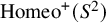



Using the result of Laudenbach-Poénaru, Lemma 11 can be strengthened so that $\partial D = \Sigma $
, that is, we can choose
$\partial D = \Sigma $
, that is, we can choose $\phi $
to be the identity. However, the above version of the lemma will suffice, so our proof remains independent of [Reference Laudenbach and PoénaruLP72].
$\phi $
to be the identity. However, the above version of the lemma will suffice, so our proof remains independent of [Reference Laudenbach and PoénaruLP72].
Theorem 12. The map $\partial \colon B\!\operatorname {\mathrm {Homeo}}(H_g) \to B\!\operatorname {\mathrm {Homeo}}(U_g)$
has a section.
$\partial \colon B\!\operatorname {\mathrm {Homeo}}(H_g) \to B\!\operatorname {\mathrm {Homeo}}(U_g)$
has a section.
Proof. As recalled in Section 2, we can model classifying spaces as the realisation of the simplicial homotopy orbit construction and so it suffices to construct a section (up to homotopy) of the map
 $$\begin{align*}|*/\!\!/\mathrm{S}_{\bullet}\!\operatorname{\mathrm{Homeo}}(H_g)| \xrightarrow[\quad]{\partial} |*/\!\!/\mathrm{S}_{\bullet}\!\operatorname{\mathrm{Homeo}}(U_g)|. \end{align*}$$
We will apply Lemma 1 to the map $\text {DSep}^{\mathrm {top}}_0(H_g)_{\bullet } \to \operatorname {\mathrm {Sep}}^{\mathrm {top}}_0(U_g)_{\bullet }$
to prove that the map
$\text {DSep}^{\mathrm {top}}_0(H_g)_{\bullet } \to \operatorname {\mathrm {Sep}}^{\mathrm {top}}_0(U_g)_{\bullet }$
to prove that the map
 $$\begin{align*}\text{DSep}^{\mathrm{top}}_0(H_g)_{\bullet} /\!\!/ \mathrm{S}_{\bullet}\!\operatorname{\mathrm{Homeo}}(H_g) \longrightarrow \operatorname{\mathrm{Sep}}^{\mathrm{top}}_0(U_g)_{\bullet} /\!\!/ \mathrm{S}_{\bullet}\!\operatorname{\mathrm{Homeo}}(U_g) \end{align*}$$
is a weak equivalence. By Corollary 5 both of the action maps $\mathrm {S}_{\bullet }\!\operatorname {\mathrm {Homeo}}(H_g) \to \text {DSep}^{\mathrm {top}}_0(H_g)_{\bullet }$
and
$\mathrm {S}_{\bullet }\!\operatorname {\mathrm {Homeo}}(H_g) \to \text {DSep}^{\mathrm {top}}_0(H_g)_{\bullet }$
and $\mathrm {S}_{\bullet }\!\operatorname {\mathrm {Homeo}}(U_g) \to \operatorname {\mathrm {Sep}}^{\mathrm {top}}_0(U_g)_{\bullet }$
are fibrations. The map of stabiliser groups is
$\mathrm {S}_{\bullet }\!\operatorname {\mathrm {Homeo}}(U_g) \to \operatorname {\mathrm {Sep}}^{\mathrm {top}}_0(U_g)_{\bullet }$
are fibrations. The map of stabiliser groups is
 $$\begin{align*}\mathrm{S}_{\bullet}\!\operatorname{\mathrm{Homeo}}(H_g, \mathrm{D}) \longrightarrow \mathrm{S}_{\bullet}\!\operatorname{\mathrm{Homeo}}(U_g, \partial \mathrm{D}) \end{align*}$$
which is indeed a weak equivalence by Lemma 10. Moreover, by Lemma 11, every $\Sigma \in \operatorname {\mathrm {Sep}}^{\mathrm {top}}_0(U_g)_0$
can be written as
$\Sigma \in \operatorname {\mathrm {Sep}}^{\mathrm {top}}_0(U_g)_0$
can be written as $\phi (\partial \mathrm {D})$
for some
$\phi (\partial \mathrm {D})$
for some $\mathrm {D} \in \text {DSep}^{\mathrm {top}}_0(H_g)_0$
and
$\mathrm {D} \in \text {DSep}^{\mathrm {top}}_0(H_g)_0$
and $\phi \in \operatorname {\mathrm {Homeo}}(U_g)$
. This verifies the surjectivity condition of Lemma 1, so we have
$\phi \in \operatorname {\mathrm {Homeo}}(U_g)$
. This verifies the surjectivity condition of Lemma 1, so we have
 $$\begin{align*}\text{DSep}^{\mathrm{top}}_n(H_g)_{\bullet} /\!\!/ \mathrm{S}_{\bullet}\!\operatorname{\mathrm{Homeo}}(H_g) \longrightarrow \operatorname{\mathrm{Sep}}^{\mathrm{top}}_n(U_g)_{\bullet} /\!\!/ \mathrm{S}_{\bullet}\!\operatorname{\mathrm{Homeo}}(U_g) \end{align*}$$
is a weak equivalence for $n=0$
. Because the left square in Lemma 6 remains a pullback after taking homotopy orbits, the case of general n follows.
$n=0$
. Because the left square in Lemma 6 remains a pullback after taking homotopy orbits, the case of general n follows.
We have thus shown that the left-hand map in the diagram

is a weak equivalence, as depicted. The bottom map is a weak equivalence as $\delta (\operatorname {\mathrm {Sep}}^{\mathrm {top}}(U_g))_{\bullet } \simeq \delta (\mathrm {S}_{\bullet }\operatorname {\mathrm {Sep}}(U_g))_{\bullet } \simeq *$
by Proposition 8. After passing to geometric realisations we can find homotopy inverses to these equivalences and the desired lift is then given by starting at the bottom right and going left, up, and right.
$\delta (\operatorname {\mathrm {Sep}}^{\mathrm {top}}(U_g))_{\bullet } \simeq \delta (\mathrm {S}_{\bullet }\operatorname {\mathrm {Sep}}(U_g))_{\bullet } \simeq *$
by Proposition 8. After passing to geometric realisations we can find homotopy inverses to these equivalences and the desired lift is then given by starting at the bottom right and going left, up, and right.
We finish with the proof of Corollary 13. In particular, applying this inductively gives the analogous result with multiple $U_g$
boundary components.
$U_g$
boundary components.
Corollary 13. Let M be a compact $4$
-manifold with
$4$
-manifold with $U_g \subseteq \partial M$
. Then the restriction map
$U_g \subseteq \partial M$
. Then the restriction map
 $$\begin{align*}B\!\operatorname{\mathrm{Homeo}}(M \cup_{U_g} H_g, H_g) \longrightarrow B\!\operatorname{\mathrm{Homeo}}(M, U_g) \end{align*}$$
admits a section.
Proof. The restriction maps between homeomorphism groups induce a square of classifying spaces

The vertical maps are surjective on $\pi _1$
by Theorem 12 (or [Reference Laudenbach and PoénaruLP72]). This is a homotopy pullback square as the induced map on vertical fibers is
$\pi _1$
by Theorem 12 (or [Reference Laudenbach and PoénaruLP72]). This is a homotopy pullback square as the induced map on vertical fibers is
 $$\begin{align*}B\!\operatorname{\mathrm{Homeo}}_{M}(M \cup_{U_g} H_g) \longrightarrow B\!\operatorname{\mathrm{Homeo}}_{U_g}(H_g), \end{align*}$$
which is an equivalence. The right vertical map in the square admits a section by Theorem 12 and thus we can pull it back to obtain a section of the left vertical map.
Acknowledgments
We would like to thank Mark Powell and Oscar Randal-Williams for helpful comments and conversations. We would also like to acknowledge the anonymous referee for their helpful comments.
Competing interests
The authors have no competing interests to declare.
Financial support
We would like to thank the Isaac Newton Institute for funding the satellite programme Topology, representation theory and higher structures based at Gaelic College, Sabhal Mòr Ostaig, Isle of Skye, where some of this work was carried out. The first author was supported by EPSRC Fellowship EP/V043323/2. The second author was supported by NSF grant DMS-2401403. The third author was supported by the Independent Research Fund Denmark (grant no. 10.46540/3103-00099B).


 Open access

