

Introduction
South Korea joined the high-income level country list in 1993,Footnote 1 merely 6 years after its former colonizer, Japan, had. South Korea's average real gross domestic product (GDP) per capita growth of 5.9% from 1961 to December 2020 justifies descriptions of this development as ‘miraculous’ (CEIC DATA, World Bank, 1993; WDI, 2022). In the aftermath of the Second World War and its independence from Japanese imperial colonial rule, Korea suffered a bloody civil war that resulted in the long-lasting division of the peninsula since 1953. At that time, the gross national income per capita was merely US$67, making South Korea one of the poorest countries in the world. Taking into account the unpromising pre-conditions for growth in the early 1950s, South Korea's astonishing development has made it one of the most frequently cited cases for developing economies – particularly low-income countries – to draw lessons from.
This paper addresses a question situated at the borderline of two major discussions in contemporary historical and institutional economics which, over the last few decades, has been extensively debated and still remains highly contested: the institutional origins of long-term growth and, more particularly, the colonial impact on post-colonial development. By recreating and observing the different factor endowments between the two regions that would later become the two Koreas, we estimate a significant and increasing divergence in economic performance between them. The periodization of this divergence coincides with a differentiated shift in colonial policies. Our findings corroborate that the two Koreas were far from being on equal footing at the time of division, suggesting that the differing institutional set-ups after 1953 might not exclusively be the sole explanation; their colonial origins should be taken into account when analysing the different long-term trajectories between the two countries.
By dividing the regions of pre-partition Korea into the equivalent of post-partition North and South, this paper examines when and how these regions differed. The analysis is based on previous works in the field as well as the data gathered by the Naksungdae Institute of Economic Research. The first part of the empirical analysis depicts differences in labour availability and capacity (population density), as well as geographical and resource-related dissimilarities in order to show the existence of variations in factor endowments between North and South Korea prior to their division. This provides us with information that enables us to argue that the different development trajectories post-1953 of North and South Korea, respectively, also have colonial origins. These are, however, not necessarily deterministic. At a more theoretical level, this paper speaks to two larger issues. The first is on the role of factor endowments in affecting policy choices and institutional arrangements. Second, the vast literature that draws lessons from the development strategies of the Koreas will be enriched if it can be credibly demonstrated that policy choices made during colonialism may have explanatory power for the immediate post-independence development.
Much academic effort has been spent to identify the fundamental causes for South Korea's remarkable economic performance, and consequently, focus has been directed towards the reforms, policies and global occurrences that affected South Korea after the division (e.g. Acemoglu et al., Reference Acemoglu, Johnson and Robinson2005; Kim, Reference Kim1976; Rodrik, Reference Rodrik1995; Wade, Reference Wade2003; World Bank, 1993). In response, a strand of literature has argued for revising the periodization of the transformation back to colonial rule (e.g. Eckert, Reference Eckert2014; Kimura, Reference Kimura1999; Kohli, Reference Kohli1994; Mizoguchi, Reference Mizoguchi1979; Peattie and Myers, Reference Peattie and Myers1984; Yoo and Steckel, Reference Yoo and Steckel2016). The extent of the impact of Japanese colonialism in relation to its continuity has led to vigorous debates, best exemplified by Kohli (Reference Kohli1994) and Haggard et al. (Reference Haggard, Kang and Moon1997), and the recent contribution by Anne Booth and Kent Deng (Reference Booth, Deng, Frankema and Booth2019). Consequently, the relationship between Korea's colonial past and post-independence economic development has, in one form or the other, gained a more predominant role in the understanding of South Korea's transformation. But it remains inconclusive. In particular, the timing of, and reasons behind, the economic divergence between North and South remains largely understudied.
In this article we revisit and re-assess the discussion of the role of Japanese colonialism in the economic development of the Koreas by employing data that have previously not been used in this area of research. The paper contributes by highlighting incomplete debates and inconsistencies both within the literature that propose a significant impact of Japanese colonialism on the long-term development of the Koreas, as well as the strand that assumes the theoretical irrelevance of the period. The paper suggests an alternative and synthesized narrative. It argues that colonial policies conditioned on the different factor endowments of the two regions partly laid the foundations of the institutional arrangements coming into being post partition. The logic of those differences is that the economic mechanisms were based on the political economy of resource extraction versus labour abundance respectively.
The opposite institutional systems eventually established in post-partition North and South are providing ample explanatory power as to why development patterns differed. In order to learn how and why different institutions are formed however, we analyse colonial economic processes that emerged for colonial purposes that likely had repercussions after partition. This allows us to establish that a divergence commenced decades prior to the formal separation along the 38th parallel. This opens up for a new research agenda that could further our understanding of the roots of the East Asian economic transformation.
Controversies of the Japanese legacy
Korea was under official Japanese rule from 1910 until the end of the Second World War. After the Second World War and subsequent Korean War, Korea was divided at the 38th parallel. From the 1960s until present, the South Korean economy has grown from one of the poorest to one of the leading economies in the world, whereas North Korea's economic performance has been stagnant, at least over the last 40 years. Since the sustainable growth trajectory of the South Korean economy was observed only from the 1960s on, it is not surprising that most of the research is focused on reforms, policies, practices and institutions in South Korea after the division of the peninsula (Kim, Reference Kim1976; Rodrik, Reference Rodrik1995; Wade, Reference Wade2003; World Bank, 1993). On the contrary, the Koreas have been considered by some authors as a perfect natural experiment for testing hypotheses about various factors driving and hindering the sustainable rise in economic activity. This is based on the premise of the separation of a once-unified country with the same history, language and culture, with one part of the country following a path towards economic prosperity and the other towards economic stagnation (Acemoglu et al., Reference Acemoglu, Johnson and Robinson2005; Glaeser et al., Reference Glaeser, La Porta, Lopez-de-Silanes and Shleifer2004). The ‘Korean Experiment’ (Acemoglu et al., Reference Acemoglu, Johnson and Robinson2005) aims at retrospectively assessing the long-term consequences of two different institutional systems implanted in two otherwise essentially parallel contexts; this design consequently provides enough evidence that the post-partition institutional choice is the root cause of economic divergence on the peninsula.
Against this, there is a branch of literature arguing that by only observing the evolution of economic activity in Korea after its division at the 38th parallel ignores significant initial conditions for explaining the divergent development paths. The mechanisms by which colonialism might be significant, however, remain contested and the literature polarized around those who claim a direct positive effect and those arguing for the opposite. In his seminal study, Kohli (Reference Kohli1994) suggested that an exclusive post-independence approach is misleading because it ignores the historical development of the Koreas, i.e. the fact that Korea experienced significant socio-economic transformation under Japanese rule. He argues that Japanese rule over Korea made it possible for the Korean state to become more efficient, in contrast to the corruption that had existed prior to Japanese colonialization. Following Japanese rule, the Korean state developed better control over the masses; it was capable to conduct significant socio-economic transformations; and to efficiently participate in production-oriented alliances. Kohli (Reference Kohli1994) does not neglect the discontinuities occurring after the Korean War, but he still goes as far as to suggest that the changes Korea experienced under Japan were decisive in leading South Korea towards economic prosperity after the 1960s.
Kohli's (Reference Kohli1994) claims are supported by other scholarly works, for instance Eckert's (Reference Eckert2014) and McNamara's (Reference McNamara1990) historical tracing of Korean entrepreneurship, business organization and industrialization; observations and historical considerations made in essays collected by Peattie and Myers (Reference Peattie and Myers1984); Woo-Cumings’ (Reference Woo-Cumings1991) investigation of the history of Korea's financial systems and Yoo and Steckel's (Reference Yoo and Steckel2016) focus on land surveys as an instrument for secure property rights. However, Kohli's assertions are not unchallenged. Haggard et al. (Reference Haggard, Kang and Moon1997) emphasize that in the case of Korea, there were ‘greater discontinuities than continuities between the colonial and post-war eras’ (Haggard et al., Reference Haggard, Kang and Moon1997: 867). They consider that political independence played a non-trivial role in South Korea's economic growth, and that the growth of economic performance during the period of Japanese colonialization was more modest than is often claimed. Booth (Reference Booth2005) furthers the critique by presenting evidence suggesting that Japanese colonial practices were not very different from practices of other colonizers present in the region, casting additional doubt on the assertion that Japanese colonialism could have been vital for South Korea's future success. Booth and Deng (Reference Booth and K.2017, Reference Booth, Deng, Frankema and Booth2019) go further still by assessing the Japanese fiscal state and practices in a comparative perspective, reaching the conclusion that one cannot identify any major differentiation from other colonizers at the time.
On the opposite side of the literature strand, which considers Japanese colonialization an important determinant for later development of Koreas is a set of claims made by Kimura (Reference Kimura1999). In his research, Kimura (Reference Kimura1999) provides historical evidence, particularly in relation to agricultural policy, that North Korea continued colonial practices inherited from Japan, whereas South Korea's discontinuation of such practices and policies created a suitable environment for sustainable economic growth. Nevertheless, Kimura (Reference Kimura1999) does not provide a clear-cut answer to the question of what made South Korea discontinue practices inherited from Japan, nor does he identify the specific reforms or policies that led South Korea towards prosperity.
Summing up, two completely different approaches to development of the Koreas – one focused on the period after the division and the other on Japanese colonial influence, though inconclusively on whether positive or negative – dominate the debate on the comparative economic history on the South Korean economic miracle. By providing support for the claim that North and South Korea were treated differently by Japanese colonizers, this study points out the contradictions and inconsistencies in these debates on the origin and the causes behind the different pathways in the Koreas and proposes a narrative that may bridge these approaches.
A first implication is that it is possible that both Kohli's (Reference Kohli1994) and Kimura's (Reference Kimura1999) conclusions, to a certain extent, are simultaneously valid, assuming that Japanese colonialization was significant for the future development paths of Koreas. If North and South Korea were treated differently, it is possible that South Korea preserved certain types of Japanese practices that differed from practices enacted in the North. At the same time, North Korea could have continued with practices that were the legacy of Japanese colonialization. After all, those policies had significantly resulted in greater output per capita from 1910/11 to 1938/40 in the North than in the South, 3.8 to 1.8%, respectively (Cha and Kim, Reference Cha and Kim2012: 73). In other words, the diverging development paths between North and South Korea after the separation could have resulted from differences in practices inherited from Japanese colonialization, at least initially. While inconclusive – due to the unreliability of sources – the decline of annual GDP and gross national product growth rates for North Korea is estimated to have taken place as early as the 1960s (Kim et al., Reference Kim, Kim and Lee2007). The resource mobilization strategy was, however, likely successful from 1954 to 1960, substantiating that the North Korean economy was ahead after partition. Nevertheless, one must acknowledge that achieving economic growth in the short-term does not automatically lead to the necessary institutional transformations of the factor markets, nor capacity investments, to sustain the economic development that characterized the post-partition period in the South. Kim et al. (Reference Kim, Kim and Lee2007) estimate that by the early 1980s, the slowdown of labour inputs in North Korea, without an accompanying increase in labour productivity, supports the claim that the South Korean economy was likely already ahead in productivity gains and living standards.
Second, studies that assume the same history of Koreas before their division ought to be revisited. Depending on how much these studies have relied upon this assumption, the more their conclusions are vulnerable to biases. Third, the discussion on continuity and discontinuity brought up by Haggard et al. (Reference Haggard, Kang and Moon1997) leads us to question the impact and significance of how other factors interact with (colonial and post-colonial) governing institutions in bridging these two periods – namely, the economic conditions and activities in the historically specific socio-economic system (Hodgson, Reference Hodgson2001: 23). This approach is in line with a more nuanced understanding of the long-term effects of colonialism, where factor endowments dynamically interact with institutional and technological variables (Austin, Reference Austin2008; López Jerez, Reference López Jerez2022; Sokoloff and Engerman, Reference Sokoloff and Engerman2000).
As a first step in our empirical strategy, we set out to assess the main factors identified in the literature as indicators that post-colonial development was caused by colonial policies. Issues of periodization of the colonial experience are also discussed (North, Reference North1978). The objective of this assessment is to elucidate further on the conflicting explanations. We start by examining whether there were significant factor endowment differences between the regions that would later compose North or South Korea, respectively.
The second part of the study will comparatively analyse economic activity and economic performance of the northern and southern regions. The differences in economic performances of northern and southern Korean regions from 1911 to 1943 are measured by GDP per capita in 2010 prices. The study finds that for some time, beginning in the mid-1920s, northern Korea's (hereinafter ‘North Korea’) GDP per capita was increasingly higher than southern Korea's (hereinafter ‘South Korea’). By 1940, the difference in per-capita GDP between North and South Korea was large enough to justify the notion that the two areas constituted distinct economic entities.
In order to observe the differences in the structure of economic activity and evolution of these differences between North and South Korea under the Japanese rule, we employ the methodology of assessing the sectoral similarities developed by Sun and Ng (Reference Sun and Ng2000). This methodology compares the relative participation of sectors in an economy, and allows temporal tracking of the similarities between sectoral compositions of regions that would later become constituting parts of North or South Korea, respectively. The importance of location and regional variation, particularly through the processes of economic transformation, has a long-standing tradition in economic analysis (e.g. Hoover and Fisher, Reference Hoover and Fisher1949; North, Reference North1955; Ohlin, Reference Ohlin1935). And it has become particularly relevant for the study of present-day emerging economies (Arora and Anand, Reference Arora and Anand2021, for India; Nguyen, Reference Nguyen2020, on Vietnam). For our case, at the beginning of the observational period (1911) results obtained from the measurement developed by Sun and Ng (Reference Sun and Ng2000) show small differences in the structures of economic activity between North and South Korea. The sectoral differences calibrated are fairly stable prior to 1924. From 1924 on, sectoral differences between regions that would become North or South Korea, respectively, begin to increase rapidly and this trend of widening differences does not change until the end of the observational period (1940). These changes coincide with greater Japanese imperial expansion and may be a potential cause of observed diverging economic activities and performance of different regions on the Korean peninsula (see Cha, Reference Cha, Latham and Kawakatsu2000; Francks et al., Reference Francks, J. and C.H.1999; Gradjanzev, Reference Gradjanzev1944).
The last part of the study is devoted to a discussion of the implications of the observations presented. This study does not claim to resolve the debate surrounding the causal mechanisms behind North and South Korean development, however. The volume of studies written about Korea's development and the myriad approaches to the topic make it impossible to address all of them individually within the scope of this study. Confronting the validity of conclusions from particular approaches to Korean development and/or enriching those findings with observations from this study is left for future scholarly work. As well as providing relevant insights into Korea's colonial economic history, thereby refining our understanding of economic history of the Korean peninsula, our analysis also has implications for the analytical strength of influential research in the field, challenging the periodization, and hence assumptions of initial conditions and the evolution of constraints.
Factor endowments in Korea under Japanese rule
As labour and natural endowments were not evenly distributed over the Korean peninsula, North and South Korea were differently endowed with factors of production prior and during Japanese rule. That these differences had some impact on the Japanese authorities' decisions on where to make industrial investments should be an uncontroversial standpoint, given that differences in natural resources have often been a common element for decisions about the location of certain industries (e.g. Beckmann and Thisse, Reference Beckmann, Thisse and Nijkamp1987). Likewise, the availability of labour between geographical locations can be determinant for colonial treatment as Engerman and Sokoloff (Reference Engerman and Sokoloff2002, Reference Engerman and Sokoloff2011) have shown to be the case between North and South America. Similarly, such differences in factor endowments between North Korea and South Korea arguably led to different institutional and economic developments during colonial times.
Japanese colonial rulers were likely well informed about the state of natural-resource and labour endowments of the peninsula because they meticulously gathered most of the data that are available for the period from 1910 to 1940s. City-level data collected by Kim et al. (Reference Kim, Park, Park and Cha2018) can provide some information about certain geographical differences between North and South Korea. This dataset contains information about forested area in square kilometres, soil acidity,Footnote 2 distance to coastline in kilometres, distance from major rivers in kilometres and distance from Seoul (capital city of Korea under Japanese rule) in kilometres for 238 inhabited areas on the Korean peninsula. It is possible to divide these areas into those located in today's North and South Korea, respectively (4 out of 238 areas that are now located in the Demilitarized Zone or are divided between North and South Korea are excluded from ensuing analysis). After the division, averages for the mentioned characteristics were calculated for the cities that would become part of North or South Korea, respectively. Results of this calculation are presented in Table 1.
Some geographical differences between North and South Korea under Japanese rule

Source: Calculations based on Kim et al. (Reference Kim, Park, Park and Cha2018).
From the results depicted in Table 1, it can be inferred that on average, cities that would later compose North Korea had more than one and a half times area under forest compared to the area under forest in localities that would later become parts of South Korea. On the contrary, localities that would become part of South Korea after the Korean War were, on average, more than twice as close to the major rivers compared to areas that would compose North Korea. This is unsurprising given traditional patterns of settlement favouring economic activities, such as cultivation and fishing, and reducing transportation costs, eventually generally leading to increased urbanization rates (e.g. Bairoch, Reference Bairoch1991). In other aspects presented in Table 1, there does not seem to be as large a difference between areas that would become North and South Korea. Distance to coastline is, on average, somewhat smaller for the southern compared to northern inhabited areas; average soil acidity is slightly higher in South Korean cities compared to North Korean cities; and the average distance from Seoul is marginally smaller for the settled areas that would compose South Korea, compared to areas that would become parts of North Korea. None of these differences is as drastic as the noted differences in forestation and distances from major rivers.
Data presented in Table 1 show the existence of some differences in natural-resource endowment distributions between North and South Korea under Japanese rule, which may have impacted the Japanese authorities' decisions on how to administer the peninsula. To these observations, it is relevant to add differences in coal and iron ore deposits noted by Feffer (Reference Feffer2003): North Korea has been ‘blessed’ with relatively more natural resources.Footnote 3 The terrain of North Korea is covered by mountains (80% of the total terrain) and all higher mountains of the peninsula are located in North Korea (Savada, Reference Savada1993).
The differences in factor endowments between North and South Korea are more pronounced when labour endowments are observed. Figure 1 depicts the evolution of population densities in Korea from 1911 to 1943. The database of Kim et al. (Reference Kim, Park, Park and Cha2018) provides population densities separately for North and South Korea. As can be observed, throughout the whole period, South Korea had higher population density than North Korea. It is likely not the case that these differences in population densities were driven by the inclusion of certain highly populated cities or regions located in South Korea. Regional-level data, which will be presented in more detail later in the study, show that almost every region that later became a part of South Korea had higher population density than any region that later became a part of North Korea (Kim et al., Reference Kim, Park, Park and Cha2018). It should be noted that, within the observed period, there is no convergence of North and South Korea in terms of population densities. This is partly explained by the lack of intersectoral labour mobility to more skill-intensive industries (such as metal and machinery), located in the North (Cha, Reference Cha, Latham and Kawakatsu2000: 93).
Population densities in North and South Korea from 1911 to 1943.
Source: Calculations based on Kim et al. (Reference Kim, Park, Park and Cha2018).

Based on the data from Figure 1, it can be confidently asserted that there was a significant difference in labour endowments between the territories of present-day North and South Korea when they were a part of the Japanese Empire. South Korea consistently had around three times more people per square kilometre than North Korea during the whole observational period. Some differences in natural endowments between North and South Korea under Japanese rule existed, but the biggest observed difference in factor endowments could be found in labour abundance. This is of greater significance when applied to paddy-/rice-producing regions, where population densities were greater in South Korea, particularly in Keiki prefecture with over 500 inhabitants per square mile in 1939 (Gradjanzev, Reference Gradjanzev1944: 86).
Historical accounts show that the Japanese treatment of its colonies was by no means static and that it was influenced by Japan's internal state of affairs, and own industrial transformation (Francks, Reference Francks1999: 64, 65; Meissner and Tang, Reference Meissner and Tang2018). Agricultural policies concerning rice production in Korea, for instance, were heavily influenced by rice prices and rice growers' interests in Japan (Kimura, Reference Kimura1999). The conflicting interests in relation to rice cultivation faced by the Japanese Empire were significant; on the one hand, the 1918 rice shortage in Japan led to a dramatic policy change aimed at expanding the area of rice cultivation in Korea (Gradjanzev, Reference Gradjanzev1944: 104), but increased competition from overseas was detrimental to rice farmers in Japan. This was of particular significance in the face of the agricultural depression in Japan in the early 1930s. By 1934, the 1926 10-year plan to increase area under cultivation by providing low-interest rate loans to the landlords to reclaim land and diffusing technological improvements was discontinued (Ban et al., Reference Ban, Moon and Perkins1980: 164; Suh, Reference Suh1978: 74, 75). By 1939, Japanese rice yields and gross value of production per farm were almost double those of Korea (Gradjanzev, Reference Gradjanzev1944: 98). Korean rice productivity and incomes per farming household were suppressed as population pressure was mounting, particularly in the southern paddy regions. For that matter, it is also important to recognize that the Japanese socio-economic order was changing while Korea was a Japanese colony. Since 1925 and the rise of Emperor Hirohito to power in 1926,Footnote 4 the Japanese Empire was becoming more nationalistic and expansionist (Bix, Reference Bix2000), and was imposing greater state control over economic affairs (Kimura, Reference Kimura1999). More specifically, Japan started to alter the tariff system in their expanding occupied territories to benefit its own manufactures and restrict foreign access (Ayuso-Díaz and Tena-Junguito, Reference Ayuso-Díaz and Tena-Junguito2019). In order to emphasize the existence of these changes in the Japanese socio-political order since 1925, historians have designated this period as the early (or pre-war) Shōwa era (Kosaka, Reference Kosaka1990).
For Korea the implications are twofold. First, there is a rapid policy shift from agricultural (rice, and secondarily cotton) production to industrialization, which resulted in regional specialization, relatively favouring the northern regions alongside the later annexation of Manchuria (see also Francks et al., Reference Francks, J. and C.H.1999; Kimura, Reference Kimura2018; Shu, Reference Suh1978). Second, the ‘over-crowded’ southern Korean rice production (as characterized by Gradjanzev, Reference Gradjanzev1944: 85) might have been, however, disadvantaged if compared to Taiwanese factor proportions and climate for rice cultivation. Greater investments in irrigation should have necessary to increase yields and multi-cropping (to increase cultivated area with a second crop) in South Korea (Hayami and Ruttan, Reference Hayami and Ruttan1971: 207–211). The fact that in Taiwan rice yields and cropping intensity were improving until the outbreak of the Second World War (Koo, Reference Koo1968) might support the claim that Japan prioritize Taiwanese agricultural development for its supply of rice and other agricultural products (such as sugar). The introduction of the high-yielding Japanese ponlai rice in Taiwan in the mid-1920s led to a dramatic transformation of the surplus capacity, resulting in exporting approximately 50% of its output to Japan a decade later (Ka, Reference Ka1995: 67). South Korean rice economy is therefore not unlike many contemporaneous paddy regions with high labour to land ratios cultivating on small plots under exploitative tenancy agreementsFootnote 5; this normally results in a subsistence household farming economy with limited commercialized surplus (see López Jerez, Reference López Jerez2022, for the detrimental economic and institutional effects of high land and labour intensification).
The differentiated economic performances have led to the historiographical claim that Japanese rulers were aware of these differences and implemented distinctive types of investments and policies in order to maximize gains from colonized Korea, which in turn arguably impacted the future decisions and development paths of South and North Korea (see Cha, Reference Cha, Latham and Kawakatsu2000). Furthermore, a branch of the literature argues that Japan adopted an exceptional and more lenient attitude towards its colonies compared to other colonialists (see, for instance, essays in Peattie and Myers, Reference Peattie and Myers1984). These studies assert that Japan treated its colonies as an integral part of an empire, implying that Japan helped its colonies to develop. Colonial institutions were designed for investment, not extraction (Cha and Kim, Reference Cha and Kim2012: 73). Booth (Reference Booth2005) contests this perspective by showing that the Japanese attitude to its colonies was not sufficiently dissimilar from the treatment of other colonizers present in the East and Southeast Asian regions – British, French, USA and Dutch – to be regarded as exceptional. Nonetheless, it should be noted that whether or not Japanese colonialism was exceptional is not a decisive factor for our analysis. If Japan wished to economically develop its colonies, it could be expected that policies crafted for such an endeavour would take into account an abundance of factors in different regions, resulting in distinct policies for southern and northern Korean areas, respectively. If Japan's goal had been to maximize extraction of wealth from its colonies, the resulting policies would likely have considered resource abundance. In other words, regardless of how Japan planned to benefit from its colonies – whether by simple extraction or by making gains from colonies as developed parts of the Japanese Empire – it is safe to assume that polices would have been crafted with respect to the state of factor endowments of colonies, which would have resulted in different treatments of northern and southern Korea.
Furthermore, there is a tendency in this literature to attribute the economic growth that the Korean peninsula experienced (via investments in industrialization, irrigation for increased rice output and rice price convergence at ports) to the motives of the Japanese; but with little, to no, attention paid to observable outcomes on the living standards of the population. Whatever the motivations of the Japanese, the evidence suggests a worsening of the living standards of the overall population, particularly in daily per capita food availability and real wages by the 1930s (Suh, Reference Suh1978: 86, 149). This might have had more detrimental effects on the South, than the North, based on evidence on heights (Pak et al., Reference Pak, Schwekendiek and Kim2011). This seems to highlight at growing economic inequalities in the peninsula, particularly driven by differences between regions. Further research is needed to establish levels of within regional inequalities. The literature suggests they likely worsened within the South (Moore, Reference Moore and White1988); specifically between trading and light-manufacturing areas of Pusan and Seoul (where these activities had already a larger share of household income in 1910, see Shu, Reference Suh1978: 34), and the rural areas. For the latter, the Japanese Government-General's plan to incentivize settlement of Japanese farmers to increase agricultural productivity (initially as ‘protected settlers’ see Suh, Reference Suh1978: 78) likely contributed to the greater polarization of ownership of cultivated land, and therefore worsening of tenancy conditions during the period (Francks et al., Reference Francks, J. and C.H.1999: 104; Takeo Suzuki in Shu, Reference Suh1978: 82).
Economic performance and economic activity in Korea under Japanese rule
It should not be unreasonable to assume that Japanese authorities' different treatment of Northern Korea and Southern Korea would produce different economic outcomes, as Japan was able to effectively control its colonies due to their proximity to the mainland Japan (Peattie and Myers, Reference Peattie and Myers1984). In order to explore this, we analyse economic performance and activity pairwise, comparing both aggregate and sectoral data of the two regions. If North and South Korea experienced different treatment from Japan over the colonial period, it can be expected that the economic performance and economic activity of South and North Korea grew to be dissimilar. However, if differences in economic activity and performance were constant from the start to the end of the observational period, then the differences observed are less likely to stem from differential Japanese policies. Hence, it becomes necessary to observe variability in differences in economic activity and performance over time. Moreover, such variability, ex hypothesi, should coincide with potential changes in the Japanese attitude towards its colonies, driven by the internal state of affairs in the metropolis.
The Naksungdae Institute of Economic Research provides disaggregated data about economic performance of North and South Korea during the period of Japanese colonial rule over the peninsula. Measured in GDP per capita (2010 constant prices) this performance was far from impressive. Figure 2 depicts the trajectory of GDP per capita (2010 constant prices) for North and South Korea.
GDP per capita in North and South Korea from 1911 to 1940 (2010 prices).
Source: Calculations based on Kim et al. (Reference Kim, Park, Park and Cha2018).
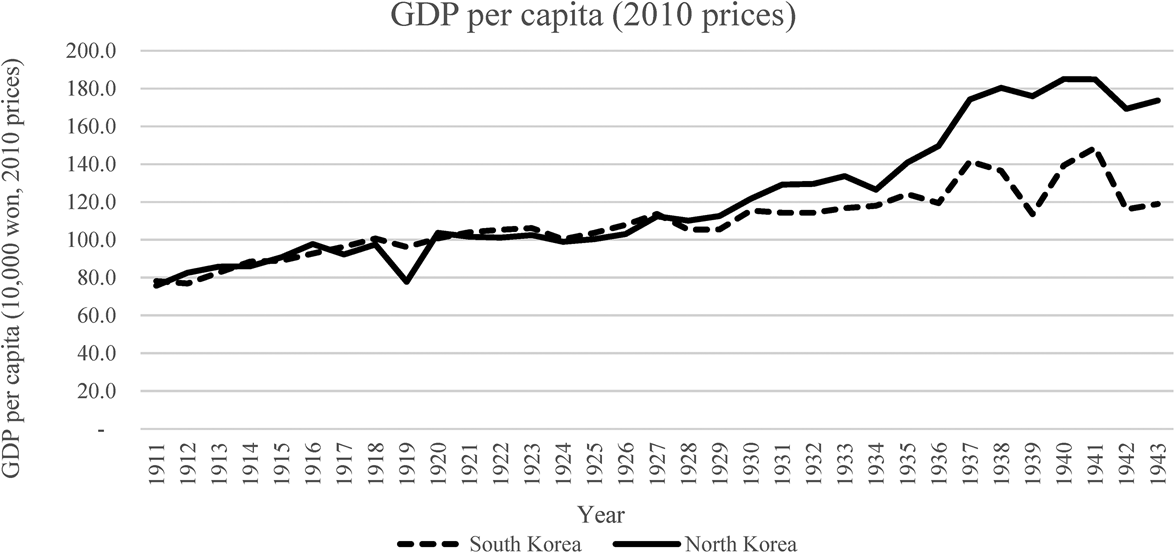
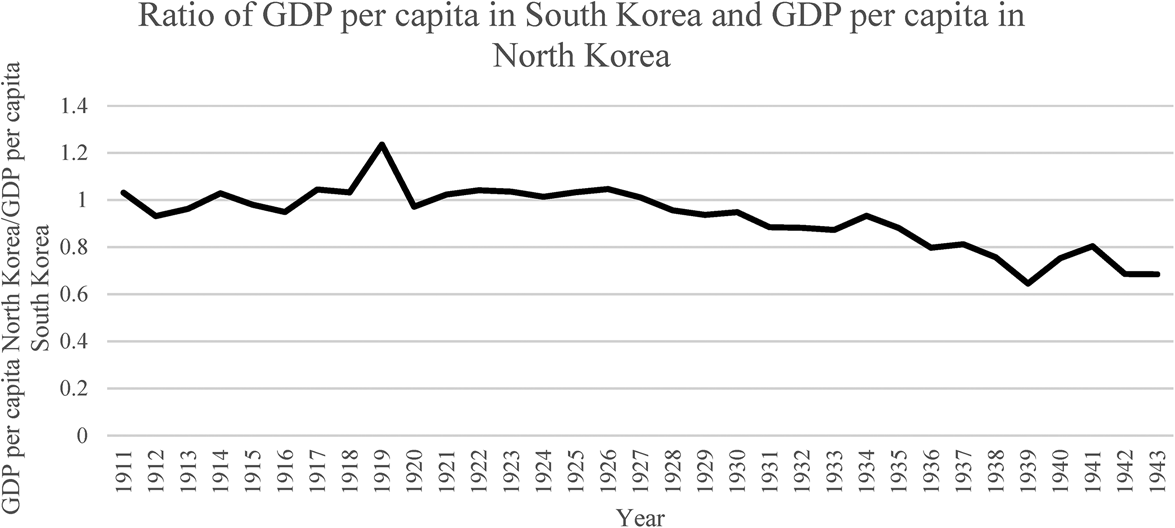
From 1911 to 1925, the value of GDP per capita (2010 constant prices) was almost the same in North and South Korea, growing sluggishly throughout the period. After 1925, GDP per capita (2010 constant prices) in North Korea started to grow faster than in South Korea. North Korea was performing better in terms of GDP per capita until the end of the observational period (1943, the last year for which there is available data). This divergence in economic performance of North and South Korea is perhaps more comprehensively presented in Figure 3, where the ratio of GDP per capita between South and North Korea is depicted: from 1911 to 1925 this ratio hovers around 1, with exception of the 1919, when GDP per capita in South Korea was slightly higher. After 1925, the line representing this ratio falls below 1 and has a downward sloping trend, reaching its minimum in 1939, when GDP per capita in South Korea was around 60% of GDP per capita in North Korea. After 1939, the ratio rises slightly, but does not return to the unity value – nor even close to it – during the observational period.
Ratio of GDP per capita between South and North Korea from 1911 to 1940 (2010 prices).
Source: Calculations based on Kim et al. (Reference Kim, Park, Park and Cha2018).
However, the divergence in GDP per capita between North and South Korea does not necessarily provide an insight into the economic significance of these differences, such as deviating living standards, among other factors. Since both North and South Korea were destitute during the period of observation (Perkins, Reference Perkins2013), it could be asserted that even the slightest increase in economic activity could benefit people living on the verge of subsistence. Therefore, an increase in the economic activity in North Korea could be impactful – that is, economically significant. As an illustration for the assertions that an increase in North Korea's economic performance could be economically significant, it is possible to note that in 1940, the average North Korean could buy 2.54 kg of white rice which, if consumed cooked, would yield 3,295 calories, whereas the average South Korean could buy 1.9 kg of white rice, which would yield around 2,480 calories – precariously close to the recommended minimum of 2,500 calories for men. Prices from 2010 for white rice in Seoul and Pyongyang are used for this illustration (gathered from Kim et al., Reference Kim, Park, Park and Cha2018 and Choi et al., Reference Choi, Dyck and Childs2016) and it is assumed that cooked white rice contains 130 calories per 100 grams (U.S. Department of Agriculture).
Although certain objections can be raised against the implied assumptions of the argument above (such as that families only consume cooked white rice or that most of the benefits of GDP growth went into Korean hands), it seems reasonable to suggest that the differences in economic performance between North and South Korea prior to their division could be economically relevant; the rise in GDP per capita in North Korea is more likely to have led the country away from poverty than the slight GDP per capita increase observed in South Korea. Moreover, divergence in economic performance between North Korea and South Korea took place immediately after the beginning of the Shōwa era in 1925/26.
Diverging structural differences
Sectoral composition of economic activity in North and South Korea is analysed using the regional data gathered by Kim et al. (Reference Kim, Park, Park and Cha2018). Japanese rulers divided Korea into 13 provinces: Gyeonggi, North Chungcheong, South Chungcheong, North Jeolla, South Jeolla, North Gyeongsang, South Gyeongsang, Hwanghae, South Pyongan, North Pyongan, Gangwon, South Hamgyong and North Hamgyong. Six of these in their entirety later became parts of South Korea: North Chungcheong, South Chungcheong, North Jeolla, South Jeolla, North Gyeongsang and South Gyeongsang. Four of them in their entirety became parts of North Korea: South Pyongan, North Pyongan, South Hamgyong and North Hamgyong. Only a small fraction of Gyeonggi province is now a part of North Korea, and for the purposes of this study it will be treated as a South Korean province. Similarly, although a minor part of Hwanghae province is a part of today's South Korea, in this study Hwanghae will be treated as a North Korean province. Gangwon province will be treated as being half in North Korea and half in South Korea.Footnote 6
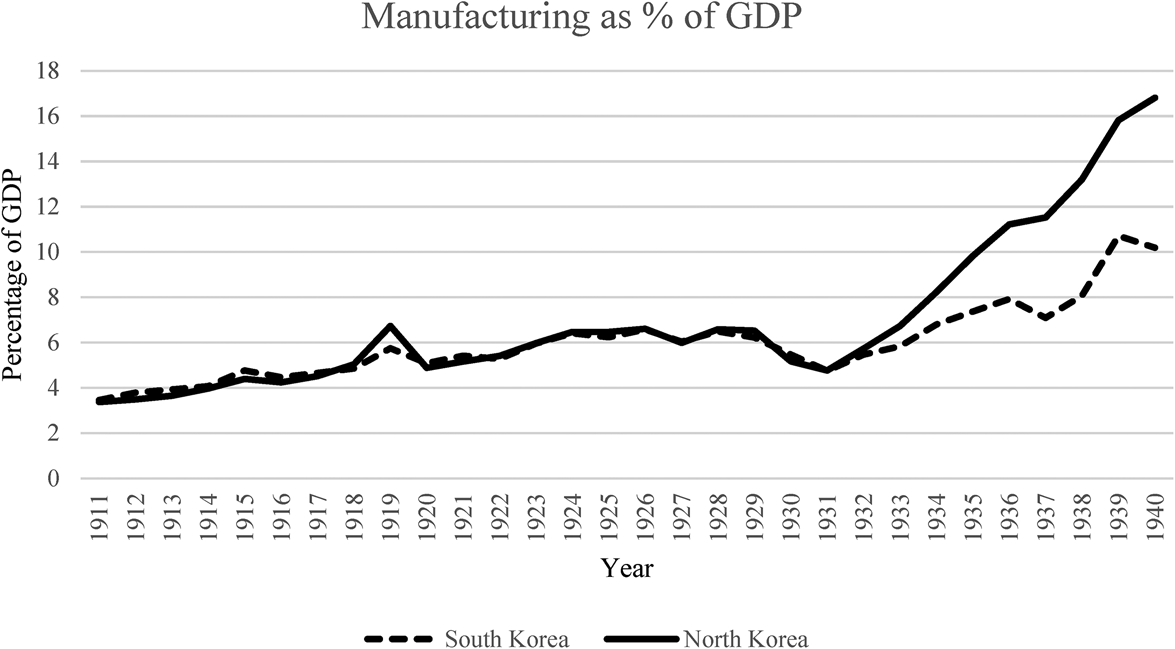
Data about value added by year (base price 1935) from South Korean regions for a specific sector were summed in order to form a time series for that particular sector for all of South Korea. This procedure was done for all sectors. The same approach was followed to obtain sectoral composition for the North Korean economy. When these time series were constructed, it was possible to assess their relative participation in the GDPs of North and South Korea. Figures 4–10 illustrate that the evolution of sectoral participation in GDP for sectors which participation in GDP was at least 5% in either North or South Korea at some point in time during the period 1911–40.
Agriculture value added in North and South Korea from 1911 to 1940 (base price 1935).
Source: Calculations based on Kim et al. (Reference Kim, Park, Park and Cha2018).

Manufacturing in North and South Korea from 1911 to 1940 (base price 1935).
Source: Calculations based on Kim et al. (Reference Kim, Park, Park and Cha2018).
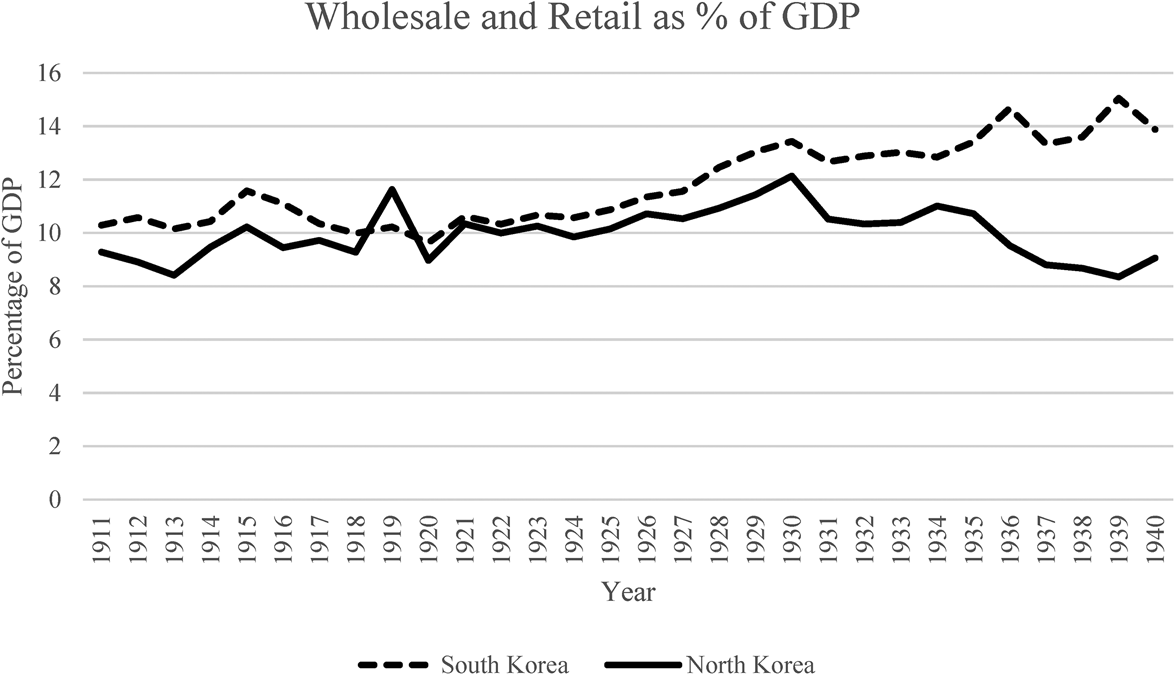
Wholesale and retail in North and South Korea from 1911 to 1940 (base price 1935).
Source: Calculations based on Kim et al. (Reference Kim, Park, Park and Cha2018).
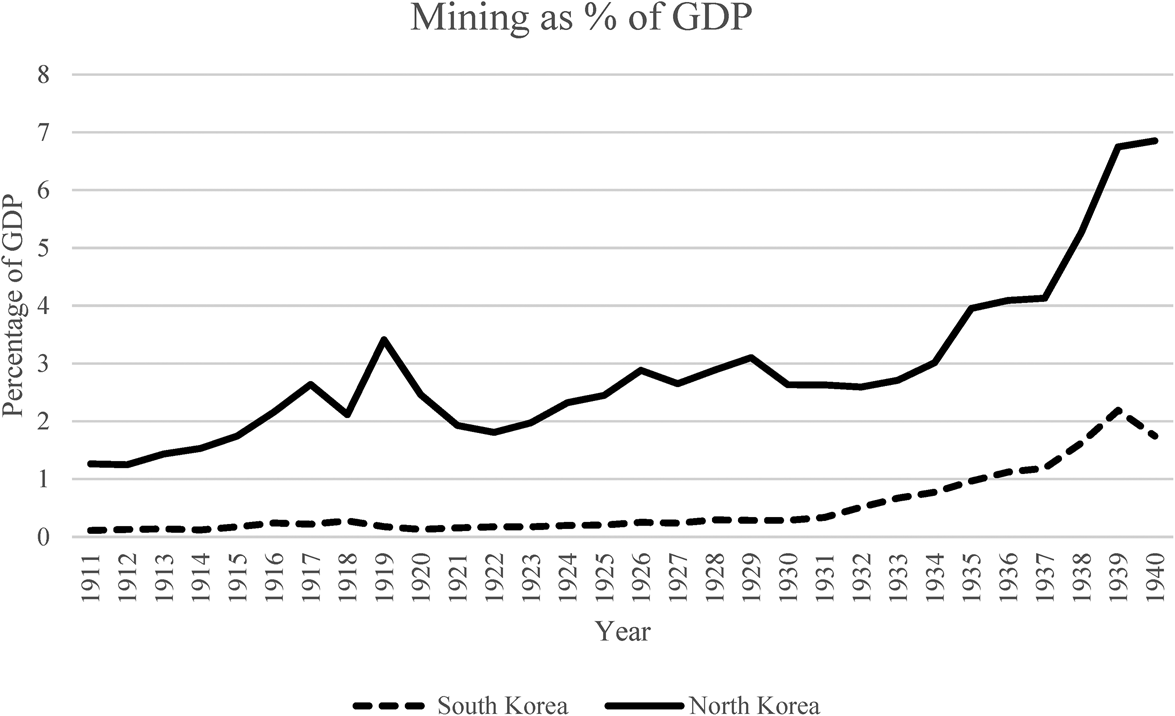
Mining in North and South Korea from 1911 to 1940 (base price 1935).
Source: Calculations based on Kim et al. (Reference Kim, Park, Park and Cha2018).
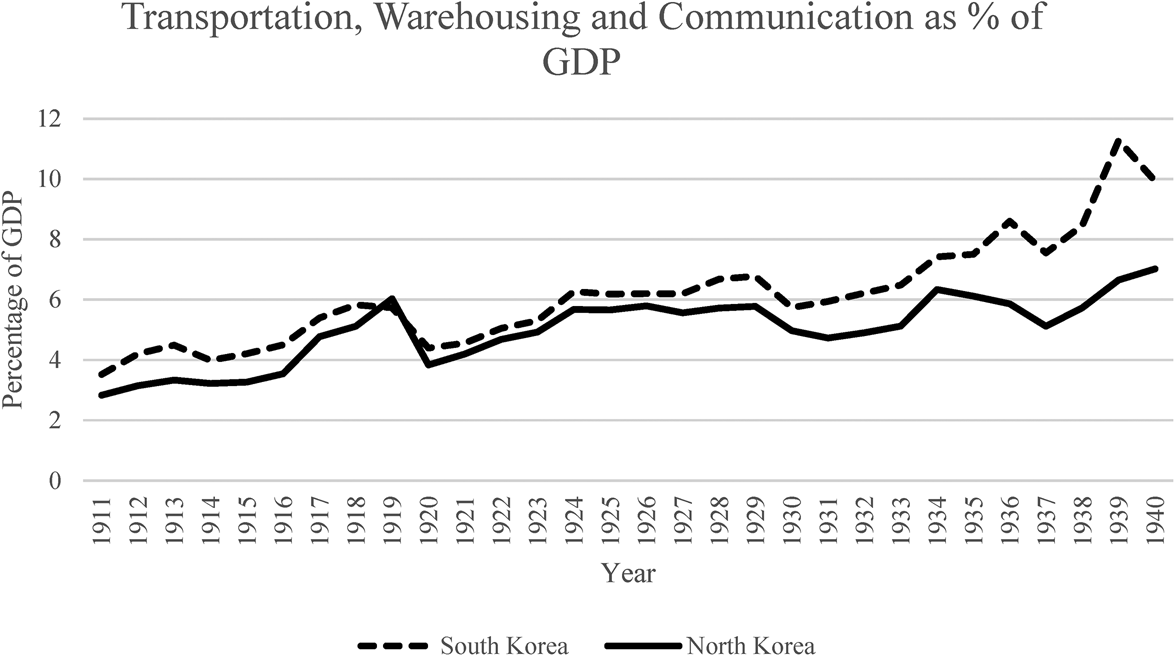
Transportation, warehousing and communication in North and South Korea from 1911 to 1940 (base price 1935).
Source: Calculations based on Kim et al. (Reference Kim, Park, Park and Cha2018).
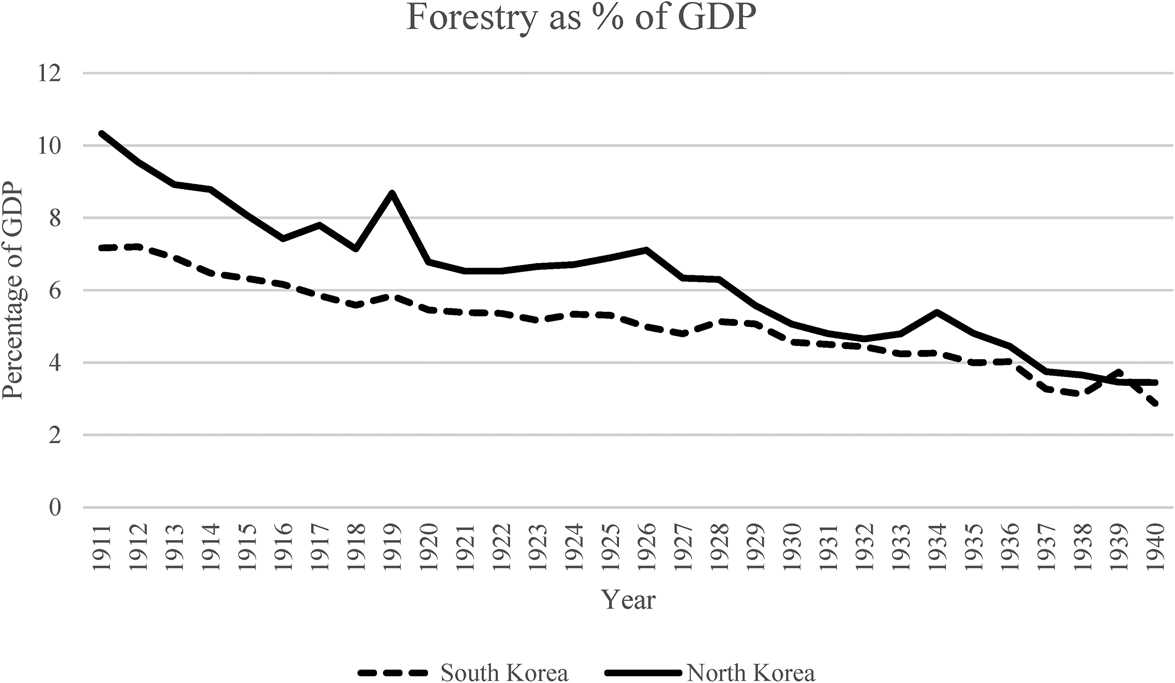
Forestry in North and South Korea from 1911 to 1940 (base price 1935).
Source: Calculations based on Kim et al. (Reference Kim, Park, Park and Cha2018).
Electricity and gas production in North and South Korea from 1911 to 1940 (base price 1935).
Source: Calculations based on Kim et al. (Reference Kim, Park, Park and Cha2018).

The dominant sector in both regions throughout the observed period was agriculture, responsible for around the half of GDP in 1911, with a declining trend. From 1911 to 1929, the contribution of agriculture to GDP was very similar in both Koreas. However, since 1929, agricultural share of GDP in North Korea was constantly lower than in South Korea. On average, agricultural contribution to total GDP in the 1930s in South Korea was around 42% and in North Korea, slightly above 35%.
Similarly, prior to the 1930s, the manufacturing sector's contribution to GDP was almost the same for both Koreas. From 1931, North Korean manufacturing began to participate relatively more in GDP, and this participation growth was faster than in South Korea. In 1940, share of manufacturing in total GDP was almost 17% in North Korea; in South Korea it was around 10%. These findings corroborate the development of a dual economy in colonial Korea (Suh, Reference Suh1978).
Wholesale and retail participation in GDP was also fairly similar in both Koreas until the 1930s. Prior to the 1930s, the wholesale and retail share in GDP was slightly lower in North Korea compared to South Korea, with an average difference between of less than 1%. Beginning in the 1930s, GDP shares of wholesale and retail declined in North Korea and grew in South Korea, deepening the difference in this sectoral participation.
Participation of mining in GDP in North Korea was consistently higher compared to South Korea. In 1940, share of mining as a percentage of GDP in North Korea was around 7%, and slightly above 1.5% in South Korea.
The difference in sectoral participation of transportation, warehousing and communications in the respective GDPs of North Korea and South Korea evolves similarly before the 1930s, and this difference does not exceed 1%. Beginning in 1931, participation of transportation, warehousing and communications in GDP of South Korea was more than 1% higher than participation of this sector in North Korea's GDP, and after 1935 it was more than 2% higher until the end of the observational period.
The participation of electricity and gas production in the GDPs of both North and South Korea is insignificant (less than 1%) prior to the end of the 1920s. From 1929, however, participation in GDP of electricity and gas production began to rise very slowly in South Korea, accounting for 1.3% of GDP at its maximum, and more rapidly in North Korea, contributing more than 7.5% of GDP at its maximum.
Forestry as a percentage of GDP was declining in both North Korea and South Korea from 1911 to 1940. Nevertheless, the GDP participation of forestry was declining much faster in North Korea than in South Korea, with its most rapid decline from 1925 to 1931. At the beginning of the observational period, the participation of forestry in North Korea's GDP was more than 3% greater than in South Korea, but by the end of the period, the GDP share of forestry for North and South Korea had nearly equalized.
Comparative analysis of individual sectoral activity in North Korea and South Korea reveals an interesting pattern. Except in the cases of mining and forestry, it seems that prior to 1925, the beginning of the Shōwa era, economic activity in North Korea and South Korea was fairly similar. After 1925, and especially after 1930, economic activities of South Korea and North Korea seem to diverge. Even in the case of forestry, it is possible to perceive the abrupt change in the speed of the decline of forestry's share of GDP in North Korea.
Although indicative, analysis of individual sectors does not provide direct information about potential changes in (dis)similarity of overall sectoral structure between North and South Korea. In order to assess the overall trajectory of structural differences between them, it is possible to calibrate the measure of their sectoral similarities for each year and directly observe how similarities in economic activity between North Korea and South Korea evolve.
Sun and Ng (Reference Sun and Ng2000) have, via an axiomatic approach, devised a measurement for overall structural differences between two economies. The measurement is calibrated via the following expression:
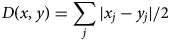
where D(x, y) is a measurement of structural differences between two economies x and y, taking the values between 0 (no differences) and 1 (no similarities); x j and y j are relative participations of sector j in economies x and y, respectively.
Figure 11 shows the calibrated measure for structural similarity between the South Korean and North Korean economies. The trajectory of the overall measure for structural similarity between the economies of North and South Korea confirms the suspicions raised when individual sectoral participation is analysed. Similarly to the evolution of differences in economic performance between North and South Korea, the differences in structural constellation between these two economies under Japanese rule become increasingly pronounced from the mid-1920s, i.e. after the beginning of the Shōwa era.
Overall structural differences between North Korea and South Korea.
Source: Calculations based on Kim et al. (Reference Kim, Park, Park and Cha2018).
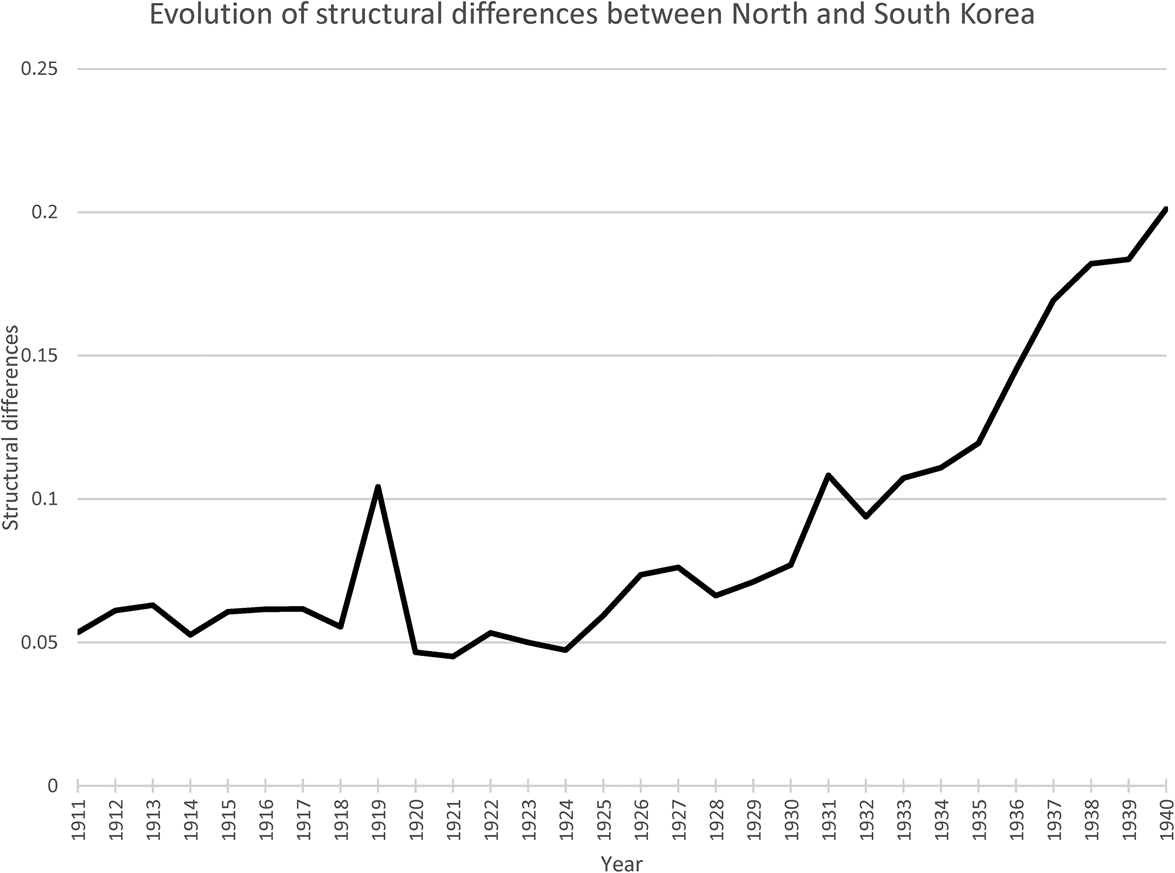
From 1911 to 1925, North and South Korea had very similar structures of economic activity, with the exception of 1919. Afterwards, differences of relative sectoral participation between the two Koreas were expanding until 1940, the last year for which there is available relevant data. Observed differences mainly stem from changes in agricultural activity (accounting for 20% of rising differences on average since 1925), manufacturing (13% of rising differences on average since 1925), production of electricity, gas and water (11%), mining (14%) and wholesale and retail (11%).
Conclusions
This study suggests that Japanese colonialism had a different impact on North Korea compared to South Korea. Differences in natural-resource and, especially, labour endowments, as well as differences in geographical characteristics, generated incentives for the Japanese to treat the northern and southern regions differently. The divergent trajectories of economic performance and economic activity between the north and south in late colonial-era Korea – which coincide with changes in internal Japanese political and economic state of affairs – further reinforces the notion that Japan's economic engagement in the two regions on the Korean peninsula differed.
Although the study has not made a detailed assessment on the long-term consequences of Japanese colonialism on the post-colonial economic performance of the Koreas, the further validation that colonialism impacted North and South Korea differently calls for re-examination of assertions that the regions share the same history. The economic initial conditions greatly differed. More specifically, to the extent that factor endowments, the structure of economic activity and economic performance play a role in institutional arrangements and policy choices, our analysis suggests that the origins of the diverging economic trajectories are earlier than what the received wisdom in the literature suggests and based on a different set of reasons. The different pathways are not, however, automatically explained by a colonial institutional effect. Hence, the causes behind South Korea's eventual economic success and North Korea's stagnation are likely to be at least partly conditioned by hitherto largely neglected factors of cumulative causation beyond the scope of this paper to deal with in depth.
This paper contributes by showing that the accounts that suggest that both Koreas shared the same initial conditions prior to their division and, hence, that their separate economic trajectories are solely the product of the post-colonial institutional setup, are prone to oversimplification. Although the assumptions made may remain valid – that the war created substantial discontinuity – further empirical investigation ought to be done to show that such propositions and analytical conclusions remain sound. The differences in factor endowments, as well as the post-1925 divergence in economic performance and activities, support the claim that the northern and the southern regions were treated differently and that the two regions were not on equal footing after the partition. As far as path dependence is concerned, the two regions had already embarked upon separate paths, although not necessarily paths that would predict the long-term outcome after independence, particularly for the South. This is not to argue that the discontinuity invalidates the necessity of pre-independence historical analysis; rather, it underscores the need for more nuanced considerations of the initial conditions that the related literature is based on (see Haggard et al., Reference Haggard, Kang and Moon1997).
One implication of our findings is that the details of the indirect roots of South Korea's successful labour-intensive development path might be found in the late colonial period. Not in the sense that colonial policies directly encouraged labour-intensive manufacturing, but rather that the colonial attention became increasingly directed towards the North, where conditions for heavy industry and extractive measures were better. Upon partition the South was completely cut off from North Korea's fertilizer, coal, electrical and heavy industries (Chung, Reference Chung2007). This, along the relative absence of forced industrialization in the South, possibly opened up economic activities and capabilities in a more bottom-up process, where light manufacturing and more dispersed entrepreneurial skills were nurtured. Whether this is actually the case, however, is a subject for future research. The reconstruction efforts after the war to avoid starvation (Francks et al., Reference Francks, J. and C.H.1999: 107), to stabilize the economy and foster industrialization (see Stubbs, Reference Stubbs2018), and to increase farming incomes through land reforms and directed investments, particularly after the second and third 5-year plans expanding from 1967 to 1976 (Ban et al., Reference Ban, Moon and Perkins1980), eventually led to a successful structural change. But this was achieved at least one decade after Taiwan's, and partly hindered by a less extensive presence of farmers' associations and cooperatives for expanding technological use (Oshima, Reference Oshima1986: 795). In the 1950s in an economy where approximately 75% of the labour was employed in agriculture (Yu, Reference Yu1979, cited in Francks et al., Reference Francks, J. and C.H.1999: 104), a centrally directed approach to rural development appears to be part of the continuities from the past. Our analysis accentuates how complex it is to fully understand how colonialism impacts post-colonial development in general.
The main implication of our study is to be found at the more general and theoretical level. The observed economic divergence during the colonial period nuances the solely comparative institutional narrative, which suggests that the different institutional set-ups after 1953 are sufficient to explain the divergent economic trajectories. This may not be devastating to the new institutional thesis, but it should encourage further research to more thoroughly confront how institutions are formed and dynamically interact with factor endowments over time.
Acknowledgements
The authors would like to thank the editors and anonymous referees for their insightful comments, and to acknowledge funding from Crafoord Foundation (20160995), Riksbankens Jubileumsfond (P18-0603:1) and Jan Wallanders och Tom Hedelius Stiftelse samt Tore Browaldhs Stiftelse (P21-0044).


 Open access

