


The rise of illiberal powers and the challenge they pose to democracies globally have sparked extensive debates in the field of international relations (Akaliyski and Welzel Reference Akaliyski and Welzel2020; Bargués, Juncos, and Joseph Reference Bargués, Juncos and Joseph2023; Ikenberry Reference Ikenberry2018; Layne Reference Layne2012). Russian military interventions in Syria, West Africa, and Ukraine, Iranian influence in the Levant or Yemen, and Chinese assertiveness in the Taiwan Strait and South China Sea are the most visible signs of “authoritarian resurgence” (Hall Reference Hall2023). In addition to these examples of military hard power, China and Russia also compete with the United States through soft power, or the “ability to co-opt rather than coerce” (Nye Reference Nye2004). One of the best barometers of such power is public opinion in the wider world, insofar as foreign publics manifest favorability or enmity toward a country (Goldsmith and Horiuchi Reference Goldsmith and Horiuchi2012).
Recent analyses differ, however, in their assessment of authoritarian soft power in the world today. On the one hand, a substantial body of literature points to a decline in the resilience of democratic values, both in transitional democracies (Chu et al. Reference Chu, Huang, Lagos and Mattes2020) and consolidated democracies of the west (Claassen and Magalhães Reference Claassen and Magalhães2023; Shin Reference Shin2021; Wuttke, Schimpf, and Schoen Reference Wuttke, Schimpf and Schoen2023). This could lead to lower public support for democracy promotion (Goldsmith and Horiuchi Reference Goldsmith and Horiuchi2012), the election of politicians lacking the commitment to uphold international democratic norms (Destradi and Plagemann Reference Destradi and Plagemann2019; Lewandowsky and Jankowski Reference Lewandowsky and Jankowski2023), and even the weakening of democracy itself (Claassen Reference Claassen2020). Conversely, other studies detect a decline in public sympathy for authoritarian great powers, notably toward both Russia and China (Wike et al. Reference Wike, Fetterolf, Fagan and Gubbala2022; Xie and Jin Reference Xie and Jin2022). This suggests that waning liberal democratic influence is not ceding place to authoritarian hegemony, but rather to a multipolar world, in which emerging geopolitical actors eschew both western political values and autocratic great power allegiance (Acharya Reference Acharya2014).
This article contributes to both positions by examining data from western democracies on political attitudes and global loyalties during the period of the Russian invasion of Ukraine, together with longer-term global data for both variables over the course of the last decade. We find that the rise of authoritarian great powers has not only resulted in greater aversion toward Russia and China but also in an affirmative response, which we term the “rally for democracy.” As does a conventional “rally ‘round the flag effect,” this involves a shift in citizen sentiment in reaction to a perceived external threat (Baum Reference Baum2002; Lai and Reiter Reference Lai and Reiter2005; Mueller Reference Mueller1970). Yet, instead of rallying behind a specific government, we argue that citizens have rallied around the principle of democracy itself as an international ideal. This phenomenon can be observed through a variety of reactions among citizens living in democracies: a stronger affinity toward democratic powers, higher approval for democratic leaders abroad, and placing greater value on civic duties such as voting in democratic elections. As the most prominent violation of the liberal international order, the invasion of Ukraine had this effect immediately—but as we also show, it has emerged steadily over the past decade with the rising assertiveness of authoritarian powers.
We make these observations based on two novel forms of analysis. First, we take advantage of a six-country survey quasi-experiment on the effect of the war in Ukraine on global public opinion, which allows us to separate the opinions of respondents polled immediately before the outbreak of war on February 24, 2022, from those who were polled after this date (Achen Reference Achen2021; Gates and Justesen Reference Gates and Justesen2020). From this, we observe a generalized rally in support for democratic leaders, together with a convergence of citizen evaluations of their own democracy with their overall support for democratic powers worldwide. We supplement these findings with multilevel models on Pew Global Attitudes project data for the five years leading up to the war. These models show that the rally for democracy is the continuation of a multiyear trend, whereby those who are more attached to their democratic institutions have become more satisfied with democratic actors in the international arena and are at the same time more aversive toward Russia and China.
As a result, we argue, the war has galvanized democratic governments around the world to confront the threat posed by resurgent authoritarian states. In Europe, Finland and Sweden have voted to join the North Atlantic Treaty Organization (Alberque and Schreer Reference Alberque and Schreer2022; Ydén, Berndtsson, and Petersson Reference Ydén, Berndtsson and Petersson2019), and Germany has committed to an ambitious plan for rearmament (Blumenau Reference Blumenau2022; Scholz Reference Scholz2022). In Asia, Japan has pledged to double military spending by 2027 (Tian et al. Reference Tian, da Silva, Béraud-Sudreau, Liang, Scarazzato and Assis2023), whereas governments from Taiwan to the Philippines are pursuing enhanced military cooperation with the United States. These changes in foreign policy, we argue, are mirrored by the reaction of citizens in democratic countries to the rise of authoritarian great powers.
In addition to its direct policy implications, our study also offers four significant contributions to the existing literature. First, although a few studies have documented several public opinion changes in response to Russia’s war against Ukraine, ours is the first to provide cross-national data on its effects on democratic attitudes. Previous studies have found classic within-country rally effects; for example, the boosting of citizen support for governing parties in Japan (Fukumoto and Tabuchi Reference Fukumoto and Tabuchi2022). At the cross-national scale, a survey of European exchange students found that the war increased attachment to the EU and made them more appreciative of the benefits of deeper European integration (Steiner et al. Reference Steiner, Berlinschi, Farvaque, Fidrmuc, Harms, Mihailov, Neugart and Stanek2023). When it comes to democratic attitudes, we only have evidence for Ukraine, where the Russian attack has triggered a dramatic increase in Ukrainians’ support for democracy (Onuch Reference Onuch2022). Yet our study is the first to examine the effect of the invasion on the democratic beliefs and values held by citizens globally and to link this to prior public opinion trends.
Second, our work contributes to a growing academic and policy debate about the role of ideology in foreign relations. Some observers argue that we are witnessing a “new cold war” between western democratic powers, on the one hand, and Russia and China on the other (Brands Reference Brands2018). Meanwhile, academic research is suggesting that public support for conflict is contingent on the political nature of the other state involved, whether it is democratic or autocratic (Johns and Davies Reference Johns and Graeme2012; Tomz and Weeks Reference Tomz and Jessica2013). This divide between authoritarianism and democracy has been studied as a “global social cleavage,” insofar as it reflects a cleft in public attitudes and allegiances that is rooted in core ideological values on issues such as human rights, civil liberties, and democratic freedoms (Brands Reference Brands2018; Chu Reference Chu2021). Building on these insights, our study aims to contribute to the understanding of the impact of democratic values on international relations. By showing the significance of internal democratic performance and citizen satisfaction with it, we shed light on how these factors shape an emerging global divide.
Third, our study makes an important contribution to the broader literature on democratic vulnerability and resilience. In an era in which democratic norms and institutions appear challenged by civic discontent and populism, our study suggests that, when faced with a global threat, citizens are still capable of rallying behind democratic institutions and alliances. Similarly, at a time when the liberal international order is being undermined not only by states such as Russia but also by voters in democratic countries who elect anti-system leaders (Adler-Nissen and Zarakol Reference Adler-Nissen and Zarakol2021; Flockhart and Korosteleva Reference Flockhart and Korosteleva2022), we show that an external threat can rally public support not only for national leaders but also for aid to revive international democratic alliances.
Finally, our findings help reconcile two trends that appear contradictory in recent global developments. On the one hand, there is a weakening of democratic norms and practices within established democracies (Bermeo Reference Bermeo2016) and, paradoxically, a simultaneous rise in positive public sentiment toward leading democracies and their leaders on the global stage. Though autocratic powers like Russia and China have expanded their global influence and soft power outreach (Hall Reference Hall2023), there is a noticeable decline in favorable views toward these states and their leaders. Our findings suggest that these seemingly opposing trends can be understood through the lens of a transnational rallying effect. The assertiveness and military actions of autocratic regimes have not only reinforced aversion to these autocracies but are also galvanizing citizens in democratic societies to rally around democratic principles and alliances.
Public Attitudes and the “Democracy vs. Authoritarianism” Cleavage
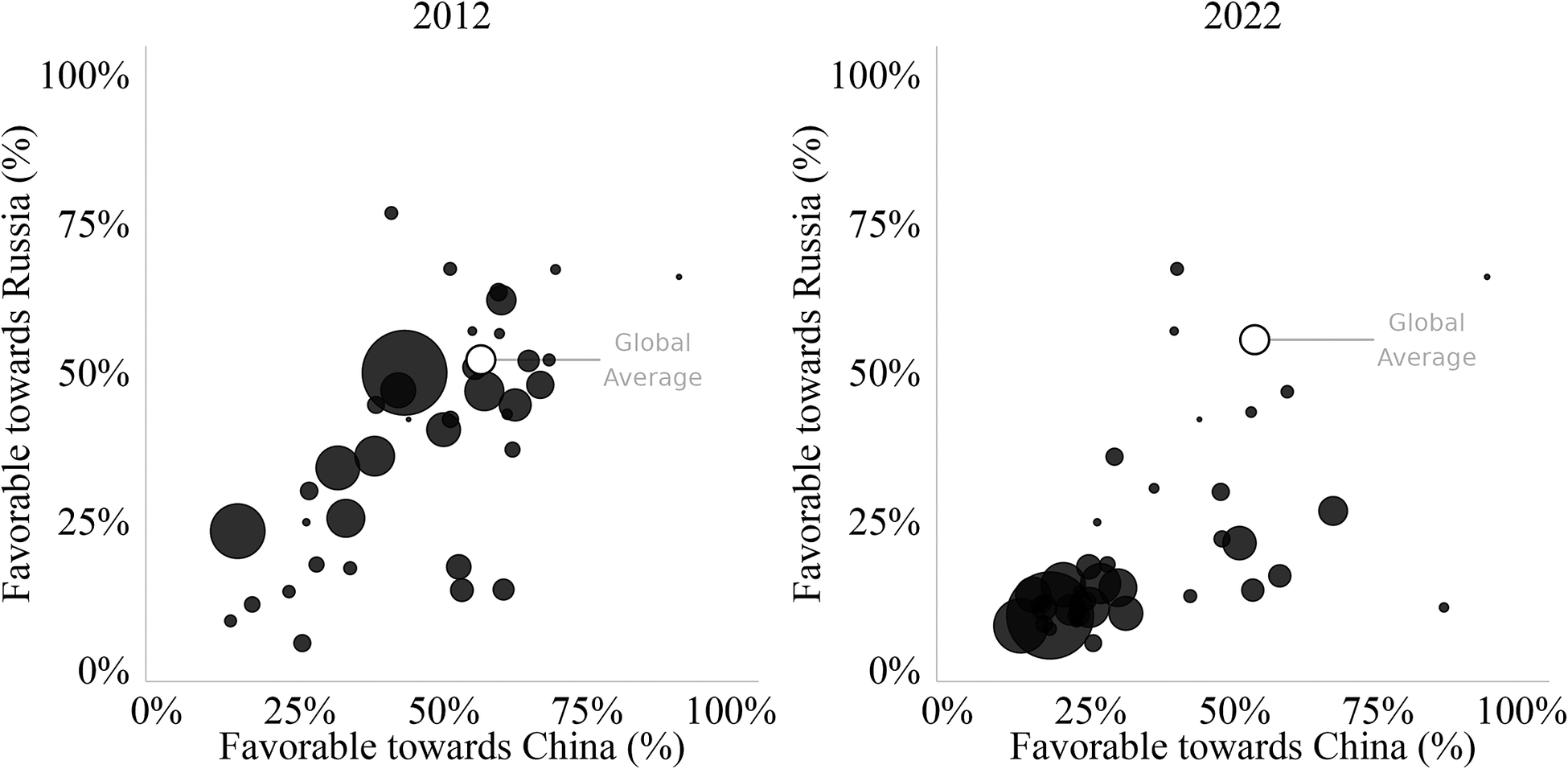
Previous research on global public opinion regarding Russia and China reveals a distinct pattern of sorting at the country level over the past decade. For instance, in western democracies public attitudes toward NATO became more favorable after the invasion, while public attitudes toward Russia dramatically deteriorated (Wike et al. Reference Wike, Fetterolf, Fagan and Gubbala2022). Similarly, public sentiment toward China has grown more negative in the United States and other democracies (Silver, Huang, and Clancy Reference Silver, Huang and Clancy2022). Whereas a majority of citizens in liberal democracies viewed Russia and China favorably 10 years ago, pooled and harmonized cross-country data show western attitudes have deteriorated significantly since, even as global averages remained relatively unchanged (Foa et al. Reference Foa, Mollat, Isha, Romero-Vidal, Evans and Klassen2022; figure 1).
Favorability to Russia and China in Liberal Democracies, 2012 and 2022
Notes: The distribution of public opinion toward Russia and China among liberal democracies in 2012 and 2022, shown with the global population-weighted average (for all countries, including nondemocracies) for each year. Point size area represents country population. Liberal democracies (38 countries) are countries with a V-Dem liberal democracy score higher than 0.6 in the most recent year of the data. Source data aggregated from the Pew Global Attitudes project, Latinobarometer, Afrobarometer, the Arab Barometer, Latana, Zogby, the International Republican Institute, Gallup, the Central Asia Barometer, and individual country polls (for a summary of sources and items, see Foa et al. Reference Foa, Mollat, Isha, Romero-Vidal, Evans and Klassen2022). On a population-weighted basis, global public opinion toward Russia and China is little changed, with little net shift of attitudes in countries such as India, Pakistan, Indonesia, or Nigeria. By contrast, the publics of western liberal democracies have clustered toward negative evaluations.
However, the roots of such divergent patterns between liberal democratic publics and autocratic powers remain largely unexplored. International relations research has begun to examine the factors influencing the dynamics of amity and hostility between states, suggesting that democratic powers receive greater support than autocracies because of their perceived legitimacy and a shared sense of belonging to an international community of democracies. Existing studies show that citizens often consider a country’s political regime type (Gries and Yam Reference Gries and Yam2020) and its respect for human rights (Tomz and Weeks Reference Tomz and Jessica2020) as crucial determinants in shaping their perceptions of other nations. This finding supports the “democratic peace” thesis (Doyle Reference Doyle1986; Russet Reference Russet1993), which suggests that democracies are less likely to engage in conflict with each other—a notion supported by public attitudes that oppose conflicts with other democracies but remain more open to conflict with autocracies (Johns and Davies Reference Johns and Graeme2012; Tomz and Weeks Reference Tomz and Jessica2013).
In the first major study of this divide at a global level, Chu (Reference Chu2021) expands on this by proposing that countries sharing an in-group identity and characterized by a common ideology like liberal democracy will experience greater reciprocal amity.Footnote 1 This suggests that a shared ideological commitment to liberal democracy is emerging as a significant cleavage, shaping the formation of social groups among states. Such a dichotomy between “us” and “them” explains why citizens of democracies perceive members of autocratic out-groups as more threatening in international politics (Risse-Kappen Reference Risse-Kappen1995) and why governments seeking to bolster domestic support for military alliances often leverage in-group identity and shared values among allies (Chu, Ko, and Liu Reference Chu, Ko and Liu2021).
However, although this body of literature can help us explain why citizens in democratic states tend to hold more negative views of authoritarian states, this framework alone is by and large “static” and cannot explain change over time. A dynamic approach is required to explain the increase of polarization between democracies and authoritarian regimes over the last decade (see figure 1). On a theoretical level, constructivist approaches to international relations offer a way to incorporate change over time within the democratic peace framework, as actors in the international arena develop (or “construct”) new divisions and conflicts that are not a mere reflection of the world but also actively shape and create it (Houghton Reference Houghton2009). The assumption that democracies are inherently more peaceful becomes a self-fulfilling prophecy when both sides act on this assumption (Risse-Kappen Reference Risse-Kappen1995). Rather than a fixed and objective truth, democratic peace—and its underpinning public attitudes—are dynamic and context dependent, capable of reinforcing or undermining themselves (Houghton Reference Houghton2009).
The post–Cold War period, characterized by the resurgence of Wilsonian ideals of collective security and liberal values, has provided fertile ground for the democracy–authoritarian divide to emerge as a global social cleavage (Houghton Reference Houghton2009). This divide was actively promoted by the Biden administration in the United States, which made the competition between democratic and autocratic regimes the centerpiece of its foreign policy strategy (Brands Reference Brands2021). This dichotomy is not limited to political elites but is also reflected among citizens in democratic countries, who see other democracies as members of an international community while viewing autocratic powers like China as out-group members, whose influence is perceived as threatening (Chu Reference Chu2021; Risse-Kappen Reference Risse-Kappen1995).
Expanding on the constructivist perspective, we propose that strategic motivations for cooperation among autocratic regimes are contributing to the development of a normative division based on political regimes on the international stage. As autocratic regimes modernize, they face increasing risks of internal dissent and regime instability (Inglehart and Welzel Reference Inglehart and Welzel2005). To manage such domestic opposition, these regimes often mimic the outcomes of democratic processes, such as improved public goods or quality of government, while also investing in their repressive and surveillance capacities (Foa Reference Foa2018; Morgenbesser Reference Morgenbesser2020). However, these domestic strategies are also heavily influenced by international trends: Political change tends to occur in waves, and a revolution in one’s neighborhood increases the risk of a revolution at home (Beissinger Reference Beissinger2009; Weyland Reference Weyland2012). Consequently, authoritarian regimes engage in a foreign policy that supports fellow autocrats and undermines democratic institutions abroad to secure their own regime stability (Nelson Reference Nelson2014).
For Russia, this has involved political interference in Georgia, Armenia, and Ukraine and support for dictators in Belarus and Kazakhstan, particularly since the wave of “color revolutions” that began in the mid-2000s. For this reason, Thomas Ambrosio, terms the country as a “guardian” state that actively seeks to halt, resist, or contain democratization to preserve its own system (Ambrosio Reference Ambrosio2009). For China, it has necessitated a clampdown on protests in Hong Kong, together with support for regimes in Myanmar, Laos, and North Korea. It is this behavior that prompts a reaction from citizens in liberal democracies, whether out of solidarity with civil society movements abroad or fear of meddling in their own societies.
According to Nye (Reference Nye2004), soft power is dependent on the power of attraction to a state based on the appeal of its culture, political values, and foreign policies. Democracy, human rights, and individual opportunities are particularly powerful sources of attraction. Such a view, shared by many in the literature, makes an implicit assumption that soft power may only be derived from liberal values, whereas illiberal practices and the normative conservatism of governments such as Russia can only be detrimental to their soft power (Keating and Kaczmarska Reference Keating and Kaczmarska2019). However, an important implication of the rise of authoritarian global powers centers on their effectiveness in offering and promoting alternative values (Beeson and Li Reference Beeson and Li2015). In recent times, the Kremlin has noticeably intensified its use of identity rhetoric, portraying Russia as a beacon of global appeal through its commitment to conservative traditional values (Wilson Reference Wilson2015); it has succeeded in challenging the liberal international order through “conservative soft power” (Keating and Kaczmarska Reference Keating and Kaczmarska2019). This newfound emphasis adds an ideological dimension that signals the Kremlin’s aspirations to challenge and contest liberal western values (Wilson Reference Wilson2015).
Finally, the behavior of both authoritarian and democratic elites and publics can also be analyzed using social identity theory (SIT; Tajfel and Turner Reference Tajfel, Turner, Williams and Worchel1979). SIT suggests that social groups, including states, strive to create a positively distinct identity by elevating their status through various strategies, leading them to favor their in-group while potentially exhibiting bias or hostility toward out-groups. Just as a group’s social standing is influenced by traits valued by society, a state’s international standing is shaped by its performance in areas like military power, economic development, and technological innovation (Larson Reference Larson2017). The type of political regime—democratic or autocratic—should also be included as a key factor in determining a state’s global standing.
Perceived threats tend to intensify in-group cohesion and out-group hostility, regardless of a group’s status in the hierarchy (Giles and Evans Reference Giles and Evans1985). For instance, Viskupič (Reference Viskupič2020) found that individuals who strongly identify with the United States are more likely to support military intervention when they perceive a threat to their status, even if their strategic interests are minimal and potential casualties are high. Moreover, individuals who strongly identify with a social group, such as a nation or a coalition of nations, tend to experience the group’s successes and setbacks as their own. Therefore, those more closely attached to the group are expected to react more strongly to perceived external threats.
Social identity theory offers valuable insights into how external threats can strengthen in-group cohesion and shape public opinion, providing a psychological mechanism for understanding how these identities and perceptions evolve over time in response to changing circumstances. Recent empirical research finds that SIT offers a compelling explanation of individual-level support for democracy within democratic states facing external autocratic threats (e.g., Alexseev and Dembitskyi Reference Alexseev and Dembitskyi2024). However, this framework alone is insufficient to explain how residents of other democracies might respond to such changes in the international arena. Political realists might argue that transnational solidarity would only emerge if it aligns with the national interest of each state, which might not always align to produce democratic solidarity. Constructivist theory, in contrast, suggests that international norms and the perceived moral status of states’ behavior play a crucial role in shaping public opinion (Tomz and Weeks Reference Tomz and Jessica2013). From this perspective, an attack on one democratic state would be expected to bolster public support for democracy among other democratic societies.
Our study contributes to this discussion by demonstrating that social identity theory and constructivism together offer a robust framework for understanding the public opinion dynamics at play. SIT explains how such challenges bolster support for the political system itself, extending beyond individual leaders. Constructivism, meanwhile, highlights how support for democracy can transcend borders, emerging as a reaction to an attack on an in-group member. By integrating these perspectives, we make two contributions with significant theoretical implications. First, our study shows that rally effects can occur around political systems, not just their leaders. Second, we demonstrate that these effects are not limited to the state under direct attack but can manifest on a global scale—an important and novel insight.
Similarly, our constructivist framework highlights how narratives and identities are not static but are continually constructed and reinforced through interaction, discourse, and socialization. Both approaches, therefore, offer dynamic explanations for the observed polarization between democratic and authoritarian states, accounting for shifts in public attitudes as a response to both external threats and evolving identities. By integrating social identity theory and constructivism, we provide a comprehensive understanding of the democracy–autocracy divide—not just as a static outcome but also as a dynamic process driven by psychological reactions to perceived threats and the construction of new narratives and identities over time. These mechanisms explain how global events and strategic alignments can reshape public opinion and international relations, contributing to the ever-evolving landscape of amity and hostility between democratic and authoritarian regimes.
Hypotheses
In 2014, the Euromaidan protests and the subsequent Russian annexation of Crimea marked a critical period in Ukraine, significantly affecting national identity and public opinion. These events solidified a sense of Ukrainian national identity and mobilized nationalistic sentiment (Kulyk Reference Kulyk2016; Pop-Eleches and Robertson Reference Pop-Eleches and Robertson2018). Such a response aligns with a substantial body of literature indicating that shock events can foster a strong sense of collective identity (Van Hauwaert and Huber Reference Van Hauwaert and Huber2020) and increase positive attitudes toward domestic governments, including approval of elected politicians (Lai and Reiter Reference Lai and Reiter2005). However, to date, such “rally round the flag” effects (Baum Reference Baum2002; Mueller Reference Mueller1970) have only been found to boost support for incumbents at the national level, while any impact on other key political attitudes such as trust in government or shifts in party identification are considered only short-lived or negligible (Hetherington and Nelson Reference Hetherington and Nelson2003). Until now, less attention has been given to the possibility of a rally effect extending beyond national governments and publics, as is the focus of our article.
Based on our findings we propose that the Russian invasion of Ukraine in 2022 triggered an increase in democratic support not only in Ukraine (Alexseev and Dembitskyi Reference Alexseev and Dembitskyi2024; Onuch Reference Onuch2022) but also among citizens from liberal democracies who view Ukraine as an in-group member. Given the existence of a social community of liberal democracies (Chu Reference Chu2021) and the propensity for in-group members to show solidarity under threat, this suggests that citizens in democratic countries respond in solidarity to threatened democracies abroad, leading to what we term a “rally for democracy.” When a democratic state faces an external threat, this prompts a collective response from citizens in other democracies, rallying behind democratic leaders and principles. Unlike traditional “rally ‘round the flag” arguments that address the effect of external shocks on domestic governments, this extends the concept to the international arena, suggesting that publics can rally not only around their national governments but also around a global community of liberal democracies. Our first hypothesis states,
H1: When observing a military threat from an authoritarian to a democratic polity, citizens within other democracies will increase their collective support for global democratic leadership.
Building on this hypothesis is a second proposition that highlights the heterogeneity of this response as a function of individual characteristics. Previous research has shown that predispositions toward international identities, for example, moderate individual rally responses toward the European Union (Mader et al. Reference Mader, Gavras, Hofmann, Reifler, Schoen and Thomson2023). Because we argue that the rally effect would be the result of a shared identity with an international community of democratic states, we expect something similar to occur for democracies more broadly.
According to SIT those who feel closely attached to an in-group are likely to react more strongly to external threats. When applied to the context of democracy, this means that those who deeply value democratic institutions in their own country are more likely to perceive threats to democracy—whether domestic or international—as personal threats. Individuals who value democracy in their own countries are more likely to want such institutions safeguarded and protected and to be wary of attempts by authoritarian regimes to undermine electoral integrity, support antisystem parties, or repress or distort information (Walker Reference Walker2018). The extent to which citizens value democracy would therefore determine the magnitude of the “rally for democracy” effect. Thus, we also expect the further outcome to be:
H2: Individuals who report higher levels of satisfaction with the performance of their democratic institutions are more likely to support democratic powers internationally. Conversely, those who express lower levels of satisfaction with their democratic institutions are more likely to be receptive toward nondemocratic actors.
Third, we consider whether this thesis is subject to a scope condition. Rather than reflecting a universal state of affairs, the importance of democratic attitudes for international allegiances may depend upon the relative salience of regime differences during periods of great power competition. In times when domestic democratic stability is relatively unaffected by interference from authoritarian powers, such factors are unlikely to weigh heavily on the minds of citizens when they consider their country’s place in the world. Yet in a situation of “authoritarian resurgence”—in which undemocratic powers are seen to use “sharp power” such as disinformation, electoral interference, or political donations to augment their influence (Walker Reference Walker2018, Reference Walker2022; Walker, Kalathil, and Ludwig Reference Walker, Kalathil and Ludwig2020)—we may expect citizens who value their own democracy to show greater authoritarian aversion and a stronger sense of allegiance to democratic powers in the international arena. This is consistent with social categorization theory, which predicts that divisions between in-groups and out-groups will intensify under conditions of external threat, and is supported by Giles and Evans’s (Reference Giles and Evans1985) argument that external threats (real or perceived) heighten the salience of group identity, reinforcing in-group cohesion and amplifying negative perceptions of out-groups. In the context of our study, we expect that authoritarian aggression, as a perceived threat to democracy, would deepen divisions between democratic and authoritarian states, leading to more polarized attitudes toward out-group states. We may also expect the same reaction from citizens in countries where democratic sovereignty is threatened by actual or potential “hard power” interventions in their neighborhood, not least of all when a democratic hegemon plays a role in democracy’s defense. Because international rivalry between states has become aligned along the axis of “democracy versus autocracy,” we should expect democratic values to play a greater role in explaining foreign policy preferences. This leads to our third hypothesis:
H3: As geopolitical tensions between democratic and authoritarian states have increased, the link between domestic and international democratic legitimacy will strengthen: Citizens who value their own democracy will increasingly look to global democratic powers to protect their institutions.
Finally, if this hypothesis is true, then the link between domestic and international democratic legitimacy should be greatest in those states whose democratic stability depends the most strongly on their security partnership with western powers. In countries of the “democratic frontier” such as Ukraine, South Korea, or the Baltic states, direct military ties to the United States and European Union serve as a factor in securing democratic survival against identifiable external threats (Grygiel and Mitchell Reference Grygiel and Mitchell2017). It is thus logical that in such countries individuals who value their domestic democratic institutions should also value western democratic powers. By contrast, we would expect this to be less true in democracies such as South Africa, Chile, or Argentina, for whom external security threats are at best remote and whose citizens are hence less likely to view their own democratic survival as requiring external protection. We therefore propose a fourth hypothesis:
H4: In democracies whose security depends on close partnership with democratic powers such as the United States, the association between perceptions of domestic democratic performance and positive views of other western democracies will be stronger.
Data and Methods
Data
We use data collected by the Pew Research Center to test our hypotheses. Pew data are available from 2010 to 2023 inclusive, covering 61 countries. Pooling this data together into a single dataset, we are able to work with responses from 219,872 respondents, with valid responses from 118,942 respondents on our key variables of interest. Data from 2010 to 2023 are freely available to users of the Pew Research Center website.
First, as measures of attitudes toward democratic and authoritarian states, we use data about respondents’ favorability toward a list of countries and international organizations, including the United States, the European Union, Russia, and China. Responses were given on a four-point scale, ranging from “very favorable,” “somewhat favorable,” “somewhat unfavorable,” to “very unfavorable.” Questionnaire text for key survey items is detailed in the appendix, along with descriptive statistics of the variables used (see table A.1).
Second, the Pew dataset includes items on both satisfaction with and support for democracy. The former is measured using a four-point scale that is modeled on the Eurobarometer (1973–) formulation, which asks respondents to rate their degree of satisfaction with the “functioning” of democracy (“the way democracy is working”) within their country; it is included by Pew in all but two annual survey rounds in the past decade. Meanwhile, an item on support for democracy as an inherent ideal entered the Pew dataset only in 2017 but was refielded for a second time in 2023. In its Pew formulation it modifies a World Values Survey battery on regime preferences that asks respondents to assess (from “very good” to “very bad”) a range of governing options, including a “democratic system where representatives elected by citizens decide what becomes law.”Footnote 2 Because of large differences in data availability, we lead each section with analyses that use the satisfaction with democracy item to show gradual change over time. Then, in recognition of the fact that democratic “satisfaction” and “support” each measure distinctive aspects of democratic legitimacy—the former evaluating the perceived quality of political outputs and the latter core democratic inputs, such as regular elections and parliamentary representation—we advance to validate these findings via the latter measure wherever data availability makes it possible (see tables A.3 and A.4).
Methods
Our empirical analysis proceeds in several stages. First, we take advantage of a survey quasi-experiment to test the impact on democratic attitudes of a specific exogenous threat to democracies’ security: the full-scale Russian invasion of Ukraine in February of 2022. Then, having shown that a specific threat to the liberal international order prompted an immediate rally response behind democratic leaders and values, we assess change over the longer term, using multilevel models on five years of Pew global polling data to examine how the covariance of democratic attitudes and net support for democratic actors has evolved over time. Finally, we test additional covariates to explain observed differences and changes among countries in their degree of support for western democracies vis-a-vis authoritarian revisionist powers over the course of the observation period.
Results
A Survey Quasi-Experiment in Six Countries
We begin by examining the results of a survey quasi-experiment, taking advantage of a unique feature of the 2022 round of Pew global survey fieldwork. By chance, the 2022 Pew dataset offers subsamples of interviews that were conducted both prior to and after the Russian invasion of Ukraine on February 24, 2022. This is the case for six countries included in the global sample—Canada, France, Germany, Italy, Japan and the United Kingdom—all of which began fieldwork data collection 10 days before the outbreak of war (on February 14).
When exogenous events occur in the course of survey fieldwork, this can offer valuable opportunities to assess treatment effects—in this case, a quasi-experiment to examine the impact of Russia’s war against Ukraine on global attitudes to democracy and authoritarian powers— provided that certain conditions are fulfilled. Specifically, Muñoz, Falcó-Gimeno, and Hernández (Reference Muñoz, Falcó-Gimeno and Hernández2020) highlight two preconditions for such “unexpected event during survey” (UEDS) research designs to be considered as valid. The first is “ignorability” (i.e., that pre- and post-survey respondents were randomly assigned, which allows us to “ignore” whether a respondent was polled before or after the event of interest). In the case of the 2022 invasion of Ukraine, even though there was a period of tension before the outbreak of hostilities, the dramatic full-scale war of February 24 clearly came as a major shock to the international community and constitutes a valid treatment effect. After the event, overseas observers were affected in a way that provides a clear break from the preceding period of relative complacency. In our sample, there is a difference between treatment and control groups linked to differences in survey fieldwork timing, which produced a somewhat larger cohort of pretreatment individuals from Japan and Germany than that of Canada or the United Kingdom. Although we control for this by including country-fixed effects in all our models, to address concerns of sample bias a comparison of pre- and post-invasion samples across broader respondent attributes is also supplied in figure A.2. In total, 648 interviews were conducted before the invasion, with an additional 7,095 interviews completed after the war began.
The second empirical condition is “excludability,” meaning that we can “exclude” other events occurring during the same period that might influence our dependent variables of interest. With respect to perceptions of authoritarian powers, the only feasible candidate during this short observation period would be the conduct of the Winter Olympic Games in Beijing (from February 4–20, 2022), if it had positively influenced perceptions of China in the immediate prewar period. Hence, as a robustness check we also reestimated models to exclude surveys conducted during the Winter Olympics, though this identified no difference from our core results (see the table A.3).
Our baseline models in table 1 show the estimated effect of the war on a range of items after controlling for country-fixed effects (a visualization is provided in figure A.1 ). As a robustness check, we also report estimated effects using two further specifications. First, in accordance with the recommendation of Muñoz, Falcó-Gimeno, and Hernández (Reference Muñoz, Falcó-Gimeno and Hernández2020), we report results after adding demographic controls for age, sex, income, and education under variant one (Var 1). Second, to discount any generalized “rally” effect whereby confidence or favorability ratings may have been higher across the board after the invasion, we report a third set of models that add a control for the respondent average level of country or leader approval, and these are reported under variant two (Var 2). Finally, to exclude the possibility that our results reflect the leveraging observations of one to two countries, rather than a more universal reaction, we report results of two-sample t-tests conducted within each national subsample in table A.2 confirming a significant post-invasion change in each individual case.
Pre/Post-Treatment Effect of the War in Ukraine
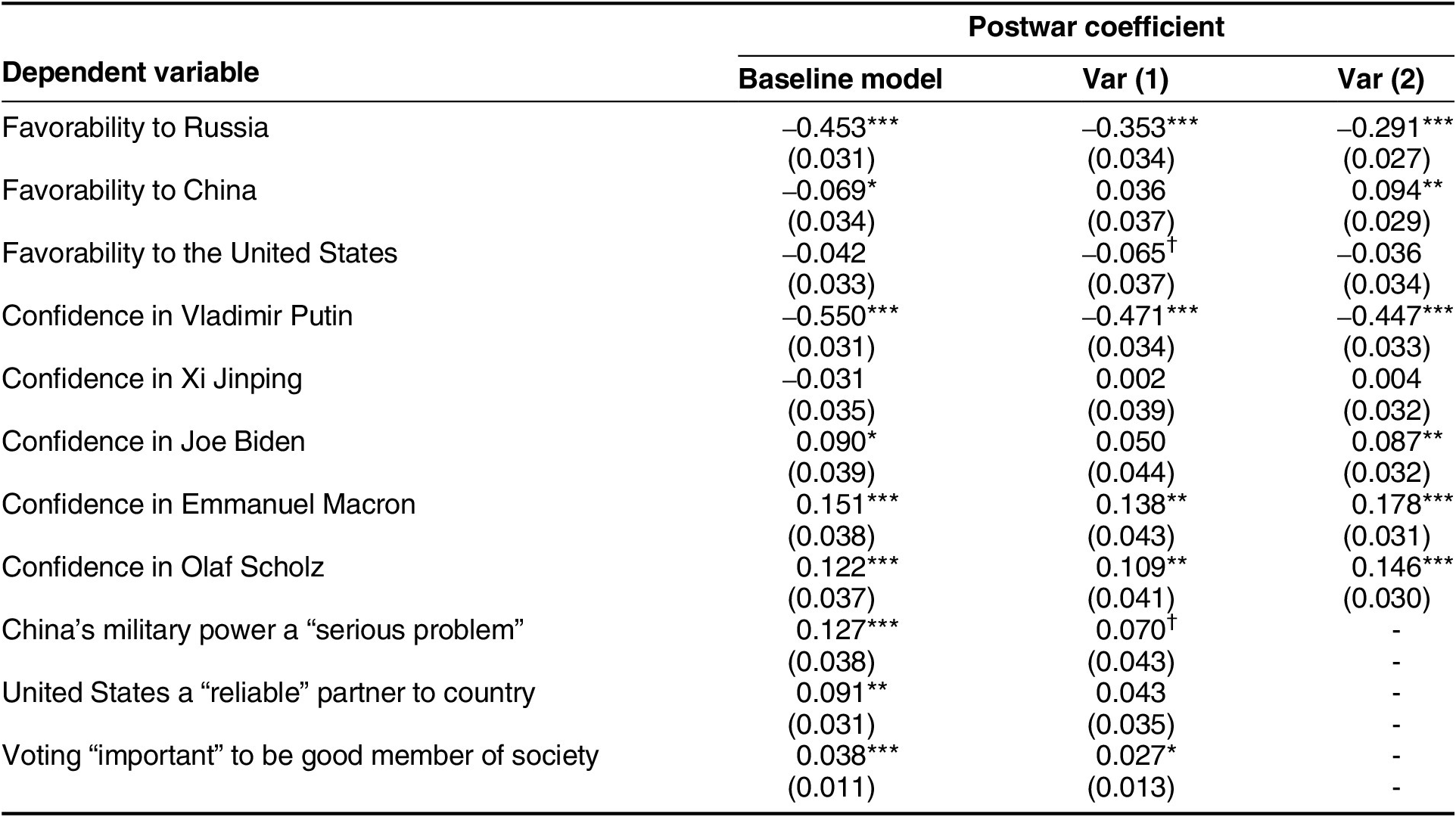
* p < 0.05, ** p < 0.01, *** p < 0.001. Unstandardized coefficients; all estimates by OLS.
Notes: Baseline model: country-fixed effects (CFEs) only. Var (1): CFEs plus demographic controls (age, age squared, sex, income, education). Var (2): CFEs, demographic controls and respondent average favorability/confidence.
Unsurprisingly, in all model specifications, favorability toward both Russia and Vladimir Putin fell after the full-scale invasion of Ukraine—and by a large amount (each by about 0.5 points on a 4-point scale). Less intuitively, however—though consistent with our first hypothesis—we also find evidence of a broader “rally for democracy.” First, public confidence in democratic leaders increased across the board. Yet unlike a classic “rally ‘round the flag” effect, whereby citizens within each country show greater support for their own leader, in our results we find that this effect was generalized across democracies. Significant increases in public approval were registered for all western leaders, and these effects in fact became larger after excluding domestic respondents from the sample (e.g., excluding French respondents from opinions of President Macron, or German respondents from opinions about Chancellor Scholz). Second, although public favorability toward the United States did not immediately increase, surveys did show a greater proportion of respondents reporting that the United States was a “reliable” partner to their country, as well as higher overseas approval ratings for President Joe Biden.Footnote 3 In our baseline specification, favorability toward China also fell, although given that Russia invaded a neighboring state, a greater proportion of respondents also reported feeling that China’s military power was a “problem” for the world. Finally, though the Pew surveys contain few items on democratic norms per se, we did find an increase in the importance that citizens attributed to voting in elections, which further points to an increased favorability not only to democratic actors but also to democratic practices. In line with our first hypothesis, this suggests that the immediate effect of the Ukraine invasion was a generalized rally behind democratic leadership, together with a decline in the legitimacy of authoritarian powers.
Our second hypothesis focuses on the alignment between favorability toward world powers and perceived democratic legitimacy. It posits that, after Russia’s full-scale invasion of Ukraine, individuals who reported feeling satisfied with the performance of their own democracy were significantly more likely to express favorability toward western democratic powers and less likely to favor authoritarian states, than had been the case before the Russian invasion. We test this by estimating a series of models on country favorability ratings in the pre- and post-invasion data separately, including in each set a variable for satisfaction with the performance of democracy, alongside country-fixed effects and standard demographic controls for age, age squared, gender, income, and education. This allows us to examine how domestic democratic legitimacy relates to shifts in the legitimacy of democratic and authoritarian states in the international arena.
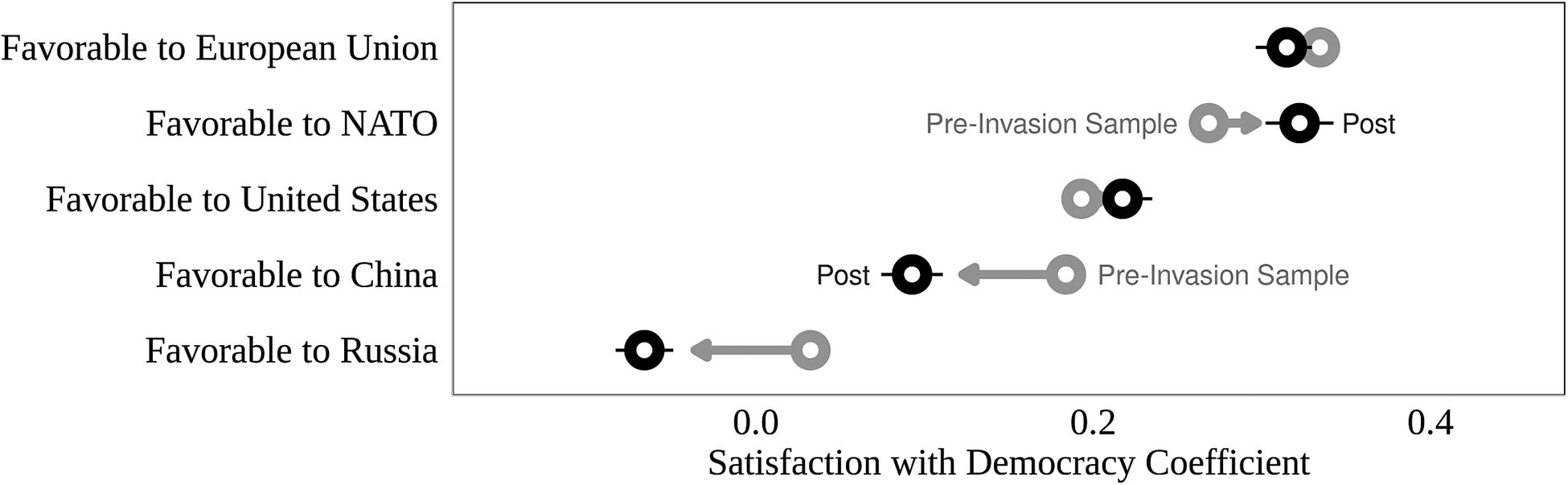
The resulting shift can be seen from the coefficients in figure 2, which shows the changes in the democratic satisfaction coefficient on country favorability ratings before and after the invasion. Among those who perceive their democracy to be working, there was an especially large drop in favorability toward Russia and China post-invasion, combined with a larger-than-expected uptick in favorability toward NATO and the United States. The most logical interpretation of this finding is that citizens who value their democratic institutions were “galvanized” by the Ukraine invasion—against authoritarian regimes and in support of western military powers. This pattern is consistent with Chu’s (Reference Chu2021) argument that international publics recognize the existence of an international community of democracies, with NATO’s increased favorability likely reflecting its role as a symbol of democratic in-group identity during a time of heightened political polarization.
Pre- and Post-Invasion Estimated Effect of Democratic Legitimacy on Favorability Toward Great Powers
Notes: Change in coefficient magnitude for the effect of democratic satisfaction on favorability toward each international actor before the invasion (in gray) and post-invasion (in black). 90% coefficient confidence intervals indicated by strikethrough lines.
Ordered Logit Models
We next provide a more general test to show the association of democratic legitimacy with support for democratic powers, based on the full range of recent data collected by the Pew global attitudes surveys. To test for the influence of democratic attitudes on global allegiances, we first estimated ordered logit models on the four-point scale item response. Ordered logit models are especially appropriate in circumstances where we are analyzing response scales that reflect a latent variable—in this case, the exact feeling of allegiance toward a specified country, for which the ordered response categories reflect an approximate estimate (Gelman and Hill Reference Gelman and Hill2006). The preservation of the extent of agreement (“very favorable” and “very unfavorable” responses) allows for a richer analysis and respects that the strength of agreement likely has a material impact on the willingness to endorse other favorable or unfavorable attitudes to these countries.
As the dependent variable, we included each of the four favorability ratings for China, Russia, the United States and the European Union. Our main independent variable of interest included respondent satisfaction with democracy, together with a dummy variable for whether the survey took place after the February 2022 invasion of Ukraine (either in the 2022 or 2023 waves) and its interaction with democratic satisfaction. Control variables included four types of variables. First, we included common sociodemographic indicators such as age (both as a linear and square term to detect the potential nonlinearity of age effects), gender (proportion female), income, and education. Second, we included attitudinal controls such as religiosity (importance of religion), ideology (right- to left-wing self-placement), and the degree of respondent economic optimism (extent to which the respondent would describe as good the current economic situation of the country), which we expected to play a role in shaping individuals’ attitudes toward foreign powers. Next, we included a control variable for the mean average level of favorability expressed by the respondent toward all countries in general (baseline), so that we could control for personal baseline positivity or negativity. Finally, we included both country- and year-fixed dummy variables to discount the result of idiosyncratic national differences and the influences of specific time periods.
To test our second hypothesis on this expanded dataset, we conducted an ordered logistic regression on the pooled dataset. It included an interaction term by period (pre- or post-invasion), to estimate separately any time-invariant component in the link from domestic democratic legitimacy to foreign power preferences. The results are presented in table 2, which shows the results of ordinal logistic regression models on each of the four countries’ favorability ratings. Consistent with the thesis, even controlling for the polarization of global opinion by the level of attachment to democracy since the outbreak of the war in Ukraine (as captured by the interaction term), lower-order coefficients for domestic democratic legitimacy (satisfaction with democracy) are associated most positively with perceptions of the European Union (0.82) and least positively with Russia (0.24), with China and the United States in between (0.36). Substantively this reflects a present yet latent degree of polarization in geopolitical attitudes by democratic attachment for the period before 2022 (for which values of both the post-invasion dummy and the interaction with democratic satisfaction would equal zero).
Ordered Logistic Regression Models
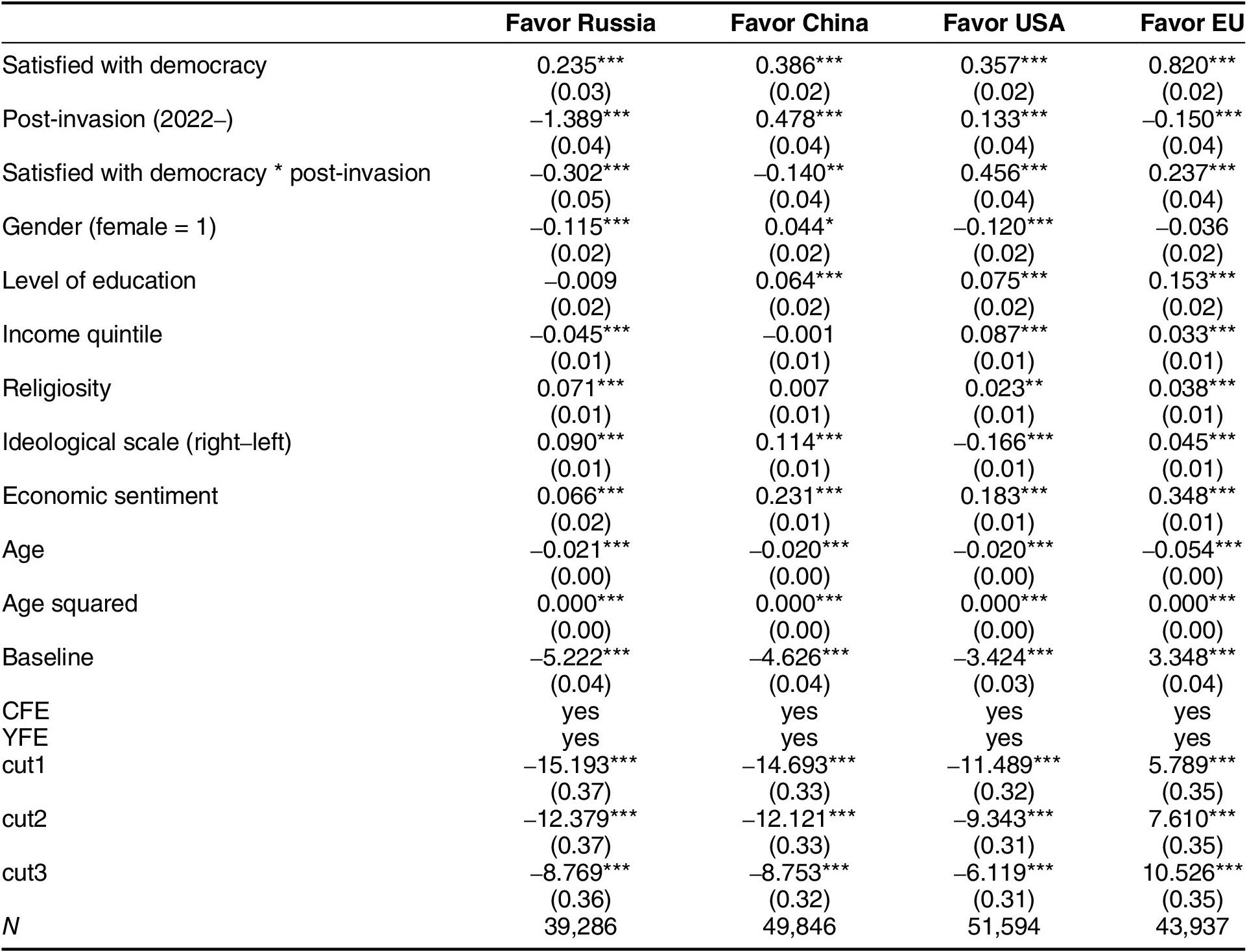
* p < 005, ** p < 001, *** p < 0001. CFE: country-fixed effects; YFE: year-fixed effects.
However, for the post-invasion period, the cleavage becomes stark: Among respondents who express satisfaction with democracy, the joint estimated effect on country favorability for post-invasion interviewees becomes negative for Russia (-0.07) and lower for China (0.25) yet is significantly more positive for both the United States (0.81) and European Union (1.06). These in turn reflect interaction effects consistent with a democratic polarizing effect, with large negative associations for Russia (-0.30) and China (-0.14) and positive interaction terms for the EU (0.24) and United States (0.46). Overall, the combination of a positive post-invasion dummy term and its interaction with democratic satisfaction implies a large increase in public favorability toward the United States, whereas for the European Union a negative lower-order period effect (-0.15) is counterbalanced by a gain in favorability among democratically satisfied respondents (0.24). In contrast to theories of a global cultural divide, religiosity has no consistent effect, predicting positive favorability toward Russia but not toward China. Consistent with modernization theory, higher personal income predicts a lesser likelihood of favoring authoritarian countries and a higher likelihood of favoring the United States and Europe, whereas education predicts more negative evaluations of Russia and China and more positive perceptions of the European Union.
Multilevel Models
Although Russia’s war against Ukraine is the most dramatic indication of the desire by revisionist authoritarian powers to challenge the liberal international order, it is the culmination of a series of events in recent years by which a resurgent Russia and China have asserted greater dominance in their neighborhood and across the globe, including the 2014 annexation of Crimea, the suppression of prodemocracy protests in Hong Kong, and Russian electoral interference in a wide range of cases (Mounk Reference Mounk2020). To establish whether the “rally for democracy” is a temporary effect or longer-term trend, in this section we examine how the association between democratic legitimacy and global support for democratic powers has evolved over time.
To test our third hypothesis, we estimated a series of multilevel models with random slopes by year for the democratic satisfaction variable to see how the association between democratic legitimacy and global democratic allegiance evolved. Our prior intuition is that as international competition between democratic and authoritarian powers increased, attitudes to democracy would become more salient in determining how individuals felt over time regarding democratic versus autocratic states, which is similar to the effect we have already shown pre- and post-invasion. If this were so, then the random slopes by year for the effect of democratic satisfaction should grow wider over time, as attitudes to great powers became polarized around democratic values.
Our multilevel models have the same variable specification as the models in table 2, except with the replacement of the lower-order term for satisfaction with democracy (demsat) by a random slopes term that varies by year (demsat $ \mid $
year). Because the satisfaction with democracy item was not fielded in a substantial number of countries until 2014, we begin visualization of random slope coefficients from that year, as shown in figure 3. To prevent variation in country-sample coverage from biasing our results, in addition to controls for country-fixed effects we restrict the sample space to the subset of countries that are most consistently included in annual rounds.
$ \mid $
year). Because the satisfaction with democracy item was not fielded in a substantial number of countries until 2014, we begin visualization of random slope coefficients from that year, as shown in figure 3. To prevent variation in country-sample coverage from biasing our results, in addition to controls for country-fixed effects we restrict the sample space to the subset of countries that are most consistently included in annual rounds.
Relationship Between Democratic Legitimacy and Country Favorability over Time
Notes: Multilevel model results showing random slopes by year for the association between domestic democratic legitimacy (satisfaction with democracy) and favorability to democratic or authoritarian powers, for the years 2014–23. 90% confidence intervals displayed by shaded areas around each line. Stable country sample (consistent across waves): Australia, Canada, France, Germany, Greece (except 2020), Hungary (except 2020/21), Israel (except 2020/21), Italy, Japan, Netherlands, Poland (except 2020/21), South Korea, Spain, Sweden, United Kingdom.
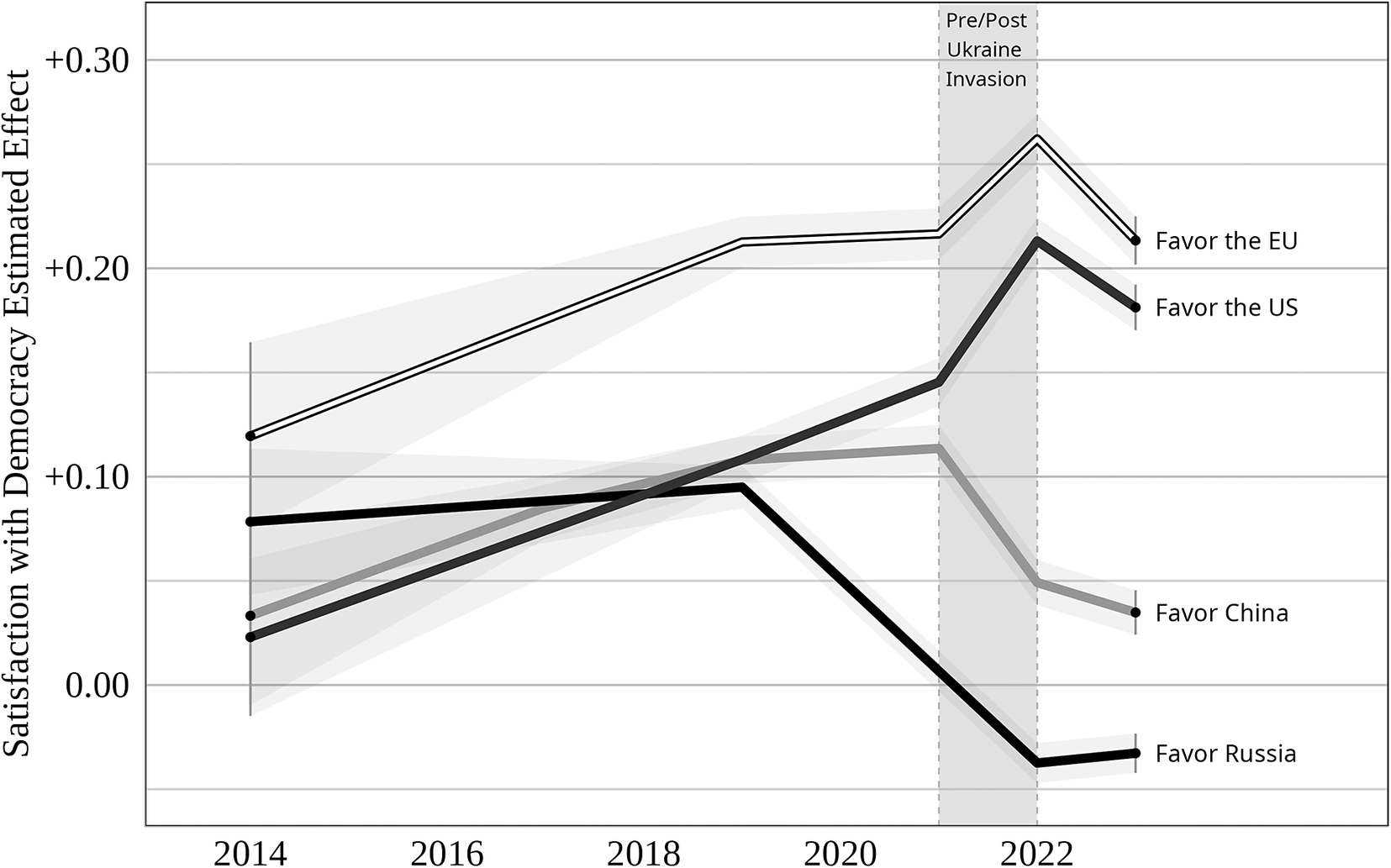
Consistent with hypothesis 3, the association between domestic democratic legitimacy and relative favorability toward western powers is found to have emerged only over the past decade, during a time in which perceptions of democratic efficacy have also become negatively associated with receptivity toward either Russia or China. It is notable that at the start of the series, in 2014, there was little association between how respondents perceived the performance of their democracy and how they perceived authoritarian and democratic powers in the international arena: The substantive estimated effects were low and not statistically significantly different from zero. Alternatively stated, individuals reporting dissatisfaction with their democratic institutions in 2014 could almost as equally likely be either pro- or anti-Russian or pro- or anti-United States. Today this is no longer so. In more recent surveys, individuals exhibiting discontent with their own country’s democracy are significantly more likely to favor Russia and China and significantly less likely to favor western powers. In 2022–23 this also held true outside the EU regarding attitudes toward the European Union, something that had not previously been the case. We also ran separate tests for countries in the global south and found that a similar effect persists even outside the west (see figure A.7).
The Role of Democratic Quality and Security Partnerships
If individuals who value democracy also value a closer relationship with Europe and the United States, then the link between expressed satisfaction with democracy and pro-western attitudes should be stronger in those countries whose democratic institutions are the most robust. By contrast, we should expect the opposite to be true in authoritarian regimes and illiberal democracies, in which respondents with prodemocratic values ought to express a lower degree of satisfaction with their present governing institutions while still feeling positively toward democratic actors globally.
We do so in figure 4 by plotting the random slopes by country for the association between respondent satisfaction with democracy and pro-western attitudes (net pro-EU and pro-US minus pro-Russia and pro-China) against the degree of democracy in each country, measured using the V-Dem index for liberal democracy (Coppedge Reference Coppedge2023). Multilevel random slopes are obtained by estimating models in the standard configuration, this time with a random slope term for democratic satisfaction by country (Satis. democracy $ \mid $
country).
$ \mid $
country).
Multilevel Slopes by Country and Degree of Democracy
Notes: Multilevel model random slopes for the association between democratic legitimacy (satisfaction with democracy) and pro-western views by country, plotted by country degree of democracy (V-Dem index of liberal democracy).
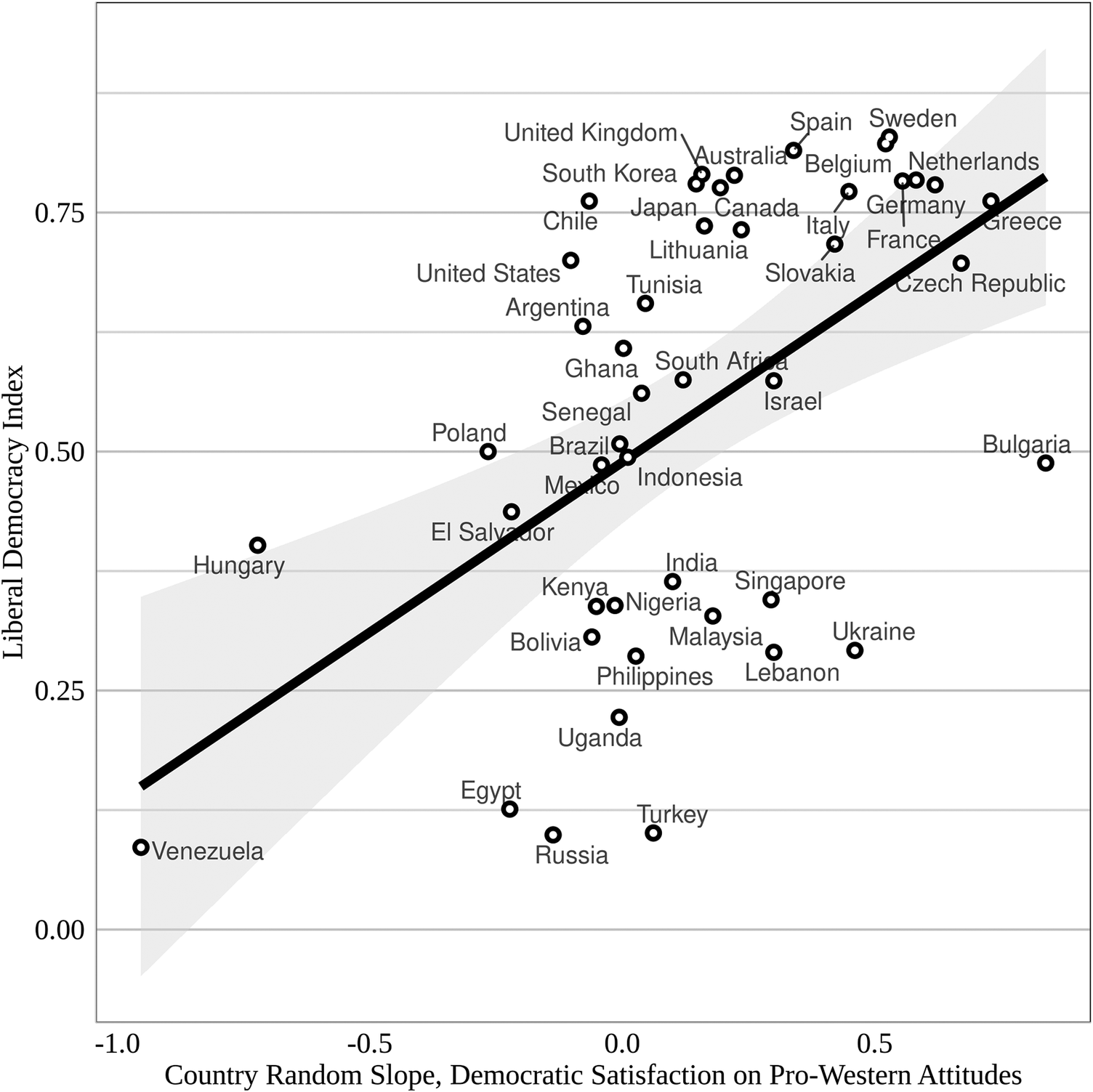
If there is only a minor difference between how citizens in the global north and those in the global south connect personal feelings of democratic contentment to closer allegiance with western democratic powers, what other factors could explain the strength of this association? One theory is that fears concerning the rising influence of authoritarian powers are primarily responsible, reflecting a reaction by citizens concerned for their own future democratic stability. This informs our fourth hypothesis, which posits that the link between domestic democratic legitimacy and pro-western attitudes ought to be strongest in countries whose democratic stability depends the most tightly on a security relationship with the United States, because these are the cases in which the role of western protection is most evident. In such countries, it is logical to assume that individuals who value and appreciate their own democratic institutions will also value and appreciate their relationships with the United States and the west while feeling more wary toward authoritarian powers such as Russia and China.
To test this conjecture, we continue to make estimates using multilevel models, but this time altering the random slope component to examine differences by country typology and, specifically, the nature and depth of their alliance with the United States. We do so by characterizing each country according to the following alliance classifications: (1) whether a country is currently a comember of the NATO alliance, (2) whether a country is classified by the United States as a Major Non-NATO Ally (MNNA); and (3) whether a country is considered a U.S. Major Defense Partner (MDP). We include Ukraine separately because of its unique degree of dependence on western military and financial support since the onset of the Donbass war in 2014 and the full-scale invasion by Russia in 2022. All other countries are classified as neutral, with the exception of the two countries in the dataset—Russia and Venezuela—that, being currently subject to broad US sanctions, are classified as having adverse relations with the United States. In terms of country-sample coverage in our dataset, most of the MNNAs are represented, including Argentina, Australia, Brazil, Egypt, Israel, Japan, Jordan, the Philippines, South Korea, and Tunisia. Similarly, all 15 NATO member states with a population higher than 10 million are present in the Pew dataset, except for Portugal and Romania. Models are estimated according to the same standard specification as before. Figure 5 shows random slopes for the association between democratic legitimacy (satisfaction with democracy) and an index of pro-western orientation (net pro-US and pro-EU minus pro-China and pro-Russia) according to the characterization of a country’s security relationship with the United States.
Democratic Legitimacy and Pro-Western Orientation Link by Alliance Status
Notes: Multilevel model random slopes for the association between democratic legitimacy (satisfaction with democracy) and pro-western orientation by US defense partnership categorization. The closer a country’s security relationship to the United States, the stronger the association between domestic democratic legitimacy and pro-western foreign policy attitudes. 90% estimate confidence intervals indicated by segment lines.
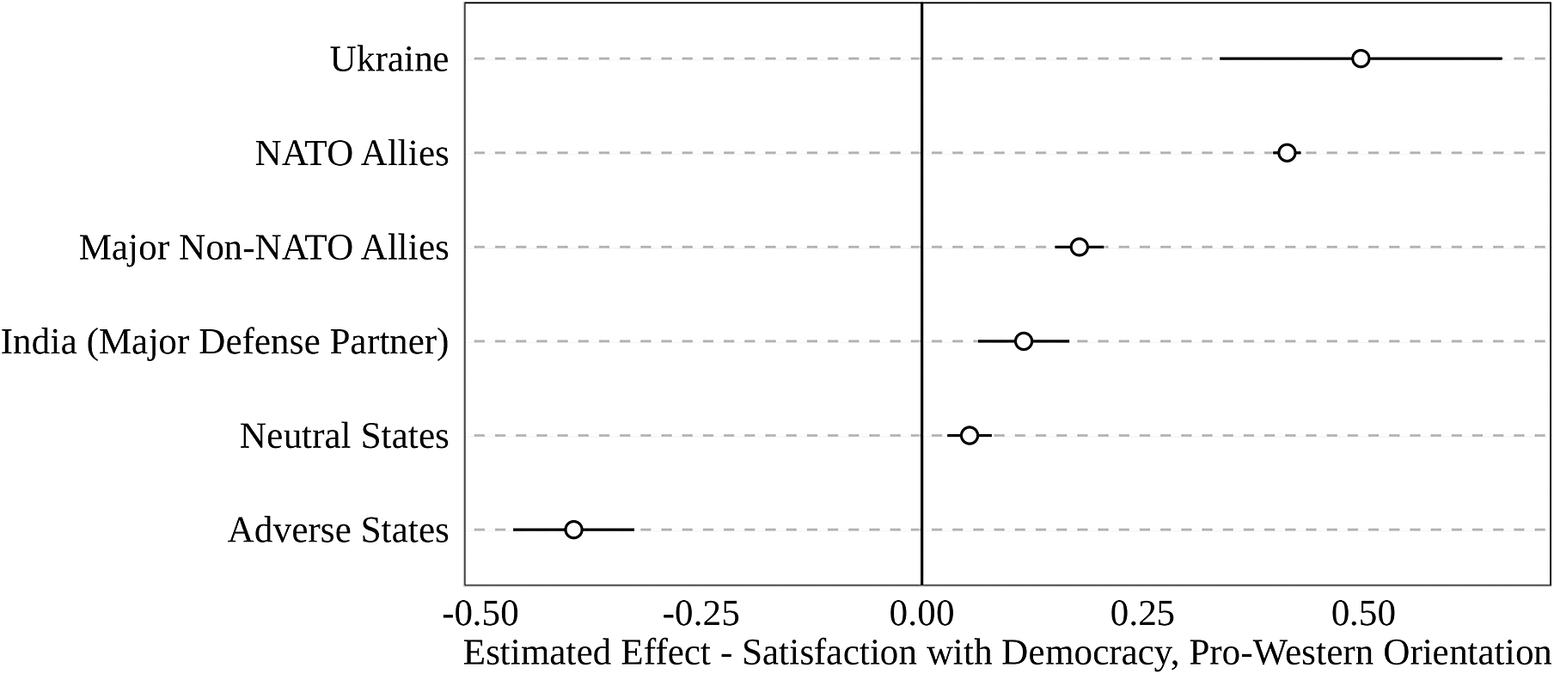
Broadly speaking, we find that the closer a country’s security relationship is to the United States, the stronger the tie connecting domestic democratic legitimacy to support for western powers. This association is clearest in the data from Ukraine, whose military funding and rearmament depend heavily on western aid and logistical support. Ukraine is then followed by the member states of NATO. Beyond the NATO alliance, we find that the association is stronger among non-NATO US allies than in countries lacking an explicit security partnership with the United States. This likely reflects the central role played by the United States in providing military aid and direct security protection to non-NATO countries such as Israel, South Korea, and Japan, as well as the historical role that US society has played in fostering the democratic development of partner countries. In contrast to the realist view that international allegiances reflect strictly “national” sovereignty goals that function independently of domestic political ideals, these results suggest an important role for “regime” sovereignty. We have no a priori reason to believe that respondents who are satisfied with democratic functioning should differ in valuing the guarantors of national sovereignty, except insofar as this specifically links with regime security; that is, the stability of the democratic institutions that they value.
This is further confirmed by the fact that in both states (Russia and Venezuela) whose governments are subject to US sanctions and hence can be considered to have hostile relations with the United States, we find a strong inverse relationship between appraisal of domestic political institutions and relative closeness to western powers. Because neither Russia nor Venezuela is a liberal democracy, answers to questions regarding the performance of domestic democratic institutions operate as proxies of regime support, rather than the legitimacy of genuine democratic ideals and practices. It is consistent with the desire for regime sovereignty that respondents who value the performance of domestic illiberal institutions express more negative attitudes regarding international democratic actors. In short, we find broad support for hypothesis 4. In countries that practice democracy, geopolitical proximity to the United States predicts the nexus between domestic democratic legitimacy and support for global democratic powers, and this link is strongest in those democracies whose security depends most strongly on their partnership with the west and their membership of western alliances.
Conclusion
The full-scale Russian invasion of Ukraine has brought renewed urgency to the study of geopolitical allegiances and preferences. Yet, although the unity of the west’s initial policy response surprised many observers, an important debate now concerns whether and how the western democratic alliance will survive in the years ahead. Understanding the basis of mass attitudes toward international affairs—including not only the extent of allegiance to democratic actors but also recent changes in opinion and the reasons for such shifts—will prove crucial for assessing the degree of popular alignment behind policy actor objectives and whether and how a supporting coalition can be maintained going forward.
This article sheds critical light on such questions by studying the association between democratic legitimacy and global democratic allegiance. Through our analysis, we have uncovered three key findings. First, acts by authoritarian states to challenge the liberal order, such as Russia’s war against Ukraine, have prompted a “rally for democracy” in which the citizens of democratic nations express greater relative favorability toward democratic powers and greater confidence in the leadership of democratic politicians outside their own country. Second, this rally has been led by citizens who are the most satisfied with their existing democratic institutions. Third, it forms part of a longer-term trend, with this association strengthening while authoritarian great powers have become more prominent in the international arena. Taken together, these observations suggest that the unity of the western policy response to Russian actions reflects not only elite agreement but also a genuine alignment with public attitudes and beliefs.
The alignment between public sentiment and policy in this context suggests that the “rally for democracy” could have significant implications for the future of democratic governance, potentially counterbalancing the global democratic backsliding identified in other studies. The literature on democratic backsliding (Bermeo Reference Bermeo2016; Haggard and Kaufman Reference Haggard and Kaufman2021) emphasizes the role of internal factors in shaping democratic attitudes but has given less attention to the geopolitical dimension. Recent research has examined how major societal changes, such as immigration (Claassen Reference Claassen2024) and aging populations (Buchmeier and Vogt Reference Buchmeier and Vogt2024), influence democratic attitudes. Additionally, internal pressures, such as the rise of populist and authoritarian leaders driven by cultural backlash (Norris and Inglehart Reference Norris and Inglehart2019) and increasing political polarization (McCoy and Somer Reference McCoy and Somer2021), may have further intensified the perceived divide between democracy and autocracy. These domestic challenges not only threaten democratic norms but may also sharpen citizens’ perceptions of international conflicts, framing them through the lens of a struggle of democracy versus autocracy.
Naturally, there are certain limitations to our analysis. For one, for the time being we cannot know for certain whether the cleavage we observe reflects a temporary reaction to the shock of the war in Ukraine and for how long it will continue. Such concerns are inevitably reinforced by the loss of unconditional US support for Kyiv and the pivotal role of American leadership in the western alliance network. However, the benefit of having multiple years of data is that we can make some inferences regarding long-term trends, and data over the past decade suggest that the cleavage has been forming over a number of years. This observation is also consistent with other studies (e.g., Chu Reference Chu2021) that have reported a global democracy–authoritarianism cleavage based on experimental studies conducted before the onset of the Ukraine war. Far from undermining international democratic solidarity, the 2022 invasion of Ukraine galvanized European democracies to support democracies in their neighborhood. So far, it is consistent with our findings that the prospect of reduced US assistance to Kyiv has only reinforced the determination of democratic leaders and societies elsewhere to enhance collective security and democratic alliances—most notably, via the substitution of American assistance to Ukraine with European military, economic, and diplomatic support where possible.
In addition, one important restriction on the inferences we can draw from our analysis is that we are only able to measure democratic legitimacy (satisfaction with the performance of democracy), rather than other measures of fundamental prodemocratic values such as support for free and fair elections or attitudes regarding the protection of basic civil liberties (Chapman et al. Reference Chapman, Hanson, Dzutsati and DeBell2023; Shin and Kim Reference Shin and Kim2018). This is an inherent constraint imposed by the available data, which do not include such measures for a significant number of countries over time. We anticipate that future studies will be able to build on our work. Already, comparative survey projects such as the World Values Survey are planning to include questions on country favorability in forthcoming survey waves, thereby enabling a far richer analysis of how basic human values relate to foreign policy orientations. For the time being, our contribution opens the door for such future study.
Notwithstanding these caveats, by establishing the link between domestic democratic legitimacy and global democratic allegiance, this article has made three primary contributions. First, this research offers a valuable insight into the nature of soft power in the current era of rising geopolitical competition between western democracies and revisionist authoritarian powers. Soft power, as defined by Nye (Reference Nye2004), refers to the ability to co-opt rather than coerce. One of the best barometers of the extent to which soft power is enjoyed by a country is how that country is perceived by others, because this determines its ability to lean on allies for military support, intelligence cooperation, and enforcement of special measures such as blacklists and sanctions. Contributing to the debate on the contemporary role of ideology in international relations, our analysis suggests that western soft power increasingly depends on the appeal of democratic values and the existence of citizens elsewhere who share these attitudes and beliefs.
Furthermore, our findings have important implications regarding the role of democracy-building and democratic resilience in ensuring the health of western alliances more broadly. The link from domestic democratic contentment to global democratic allegiance means that when citizens feel that their own democratic institutions are delivering, this positive evaluation of democracy spills over to the global level: They are more likely to feel affinity toward international democratic actors such as the United States or the European Union and less likely to express closeness to authoritarian revisionist powers such as Russia or China. By contrast, citizens who feel that their own democratic institutions are failing will give democracy a lower salience in their evaluation of actors in the international system. Moreover, such citizens are more likely not only to express positive attitudes toward authoritarian countries as societies but also to have a more positive evaluation of their authoritarian leaders and a negative perception of the NATO security alliance.
Finally, our study has important implications for the resilience of democratic support in an era in which democratic norms and institutions appear increasingly challenged by popular discontent, populism, and civic withdrawal. Our findings suggest that this process is not a one-way street. Faced with a threat to global democracy, citizens are capable of rallying behind their own democratic institutions and in support of democratic powers in the international arena. The more that democratic institutions face external pressure, the more likely they are to rise to meet such challenges, and this fact remains true today.
Supplementary material
To view supplementary material for this article, please visit http://doi.org/10.1017/S1537592725000623.
Acknowledgments
The authors would like to thank the Pew Research Center for making available the 2022 version of the Pew Global Attitudes survey and Richard Wike and Christine Huang for their valuable support for this project. The authors would also like to thank Pol Bargués Pedreny for his feedback and comments. Xavier Romero-Vidal gratefully acknowledges the support of the Spanish Ministry of Science, Innovation, and Universities and the “Carlos III University of Madrid Call for Grants to Requalify the Spanish University System for 2021–2023, as of July 1, 2021,” under Royal Decree 289/2021 of April 20, 2021, which governs the direct allocation of subsidies to public universities for the requalification of the Spanish university system.


 Open access

