

Introduction
When and why do legislators use emotive rhetoric? In today’s political landscape many prominent politicians, such as Donald Trump, rely heavily on emotional appeals, both positive (“Make America Great Again”) and fear-inducing (“They’re bringing drugs. They’re bringing crime. They’re rapists”) (Nai and Maier Reference Nai and Maier2018). However, we know less about whether and how emotions are used strategically in parliamentary speeches. Legislatures are at the heart of representative democracy and parliamentary debates serve as an important forum for politicians to publicly express their views and communicate with voters (Martin and Vanberg Reference Martin and Vanberg2008; Mayhew Reference Mayhew1974; Proksch and Slapin Reference Proksch and Slapin2012; Victor Reference Victor2011). Hence, understanding the role of emotions in these debates is important. Our argument is that politicians are most likely to employ such rhetoric when their speeches reach a large public audience—that is, when they are speaking to the electorate. We leverage the variation in the public profile of legislative debates to test this proposition empirically. In low-profile legislative debates, we contend that legislators will primarily seek to address colleagues within the parliament and consequently emotive rhetoric should be less pronounced. In contrast, in high-profile debates parliamentarians have an incentive to use emotive rhetoric to attract the attention of a larger audience and appeal to them, with not only policy substance but also more emotive language. This argument builds on two strands of literature. First, recent work on political speech has studied how politicians adapt the style and the tone of their speeches to appeal to the electorate. For example, Spirling (Reference Spirling2016) argues that cabinet members began using more simple language after the extension of the franchise in the Second Reform Act in Britain in 1867, because they sought to appeal to the less educated citizens who were now part of the electorate. Rheault et al. (Reference Rheault, Beelen, Cochrane and Hirst2016) show that government parliamentarians tend to use more positive language, while opposition parliamentarians use more negative language (see also Crabtree et al. Reference Crabtree, Golder, Gschwend and Indridason2020). Slapin and Kirkland (Reference Slapin and Kirkland2020) provide evidence that rebel parliamentarians in the House of Commons use simpler language and more first-person pronouns. Thus, these studies suggest that politicians consider various aspects of their rhetoric beyond policy content.
Second, studies on the role of emotions in individual-level decision making have shown that emotional appeals can be an effective persuasive tool for politicians to influence how voters process information and respond to their messages (Bakker, Schumacher, and Rooduijn Reference Bakker, Schumacher and Rooduijn2021; Bless, Mackic, and Schwarz Reference Bless, Mackie and Schwarz1992; Brader Reference Brader2005; Weeks Reference Weeks2015). Moreover, as qualitative studies of political rhetoric have documented, emotions are often used by politicians to convey their message, persuade their constituents, or trigger a reaction from the opponent (Crines Reference Crines2013; Finlayson and Martin Reference Finlayson and Martin2008; Prior Reference Prior2018). Building on these strands of literature, we argue that emotive rhetoric is one of the devices that legislators employ in speeches that have a larger audience.
We test this proposition by analyzing a unique dataset of nearly one million parliamentary speeches between 2001 and 2019 in the lower house of the UK Parliament, the House of Commons. As one of the oldest parliaments in the world, the UK Parliament is an ideal institutional setting in which to study parliamentary speeches. Our analysis focuses on the House of Commons, which is the elected and more powerful of the two legislative chambers of the UK Parliament.Footnote 1 Importantly, we can leverage the fact that the legislative debates in the House of Commons differ in terms of their profile and the size of the audience. This allows us to compare emotive rhetoric across different types of debates.
We measure emotive rhetoric by combining the Affective Norms for English Words (ANEW) dictionary with word-embedding techniques (Bradley and Lang Reference Bradley and Lang2017; Mikolov, Sutskever, et al. Reference Mikolov, Chen, Corrado and Dean2013; Rice and Zorn Reference Rice and Zorn2019). Our results confirm that legislative debates with larger public audiences—such as Prime Minister’s Questions (PMQs) and the opening day of the Queen’s Speech debates—are characterized by higher levels of emotive rhetoric. We find this effect holds even when holding constant individual speakers and policy topics. Furthermore, we demonstrate the generalizability by replicating our analysis using one million parliamentary speeches from the lower house of the Irish Parliament, Dáil Éireann, where we find very similar results across different debates. Overall, our analysis lends support to the argument that politicians use emotive rhetoric strategically in parliamentary debates to appeal to a wider audience.
Our article thus makes three main contributions. First, by analyzing how politicians use emotive rhetoric in parliaments, we contribute to the understanding of political competition. Most previous work on parliamentary speeches emphasizes the role of ideological positions and the expression of dissent (Baumann, Debus, and Klingelhöfer Reference Baumann, Debus and Klingelhöfer2017; Herzog and Benoit Reference Herzog and Benoit2015; Proksch et al. Reference Proksch, Lowe, Wäckerle and Soroka2019; Slapin et al. Reference Slapin, Kirkland, Lazzaro and Leslie2018). While these features are central to our understanding of political speeches, we argue that the “tone” and emotiveness of speeches should also be considered. Our article thus extends previous work on the role of emotions in political rhetoric, both in the UK (Crines Reference Crines2013; Finlayson and Martin Reference Finlayson and Martin2008; Prior Reference Prior2018) and in the field of international relations (Holmes Reference Holmes2015; Koschut et al. Reference Koschut, Hall, Wolf, Solomon, Hutchison and Bleiker2017). Second, our paper contributes to the study of legislative behavior by emphasizing how the incentives of politicians differ across types of debates. Previous work suggests that parliamentarians use parliamentary speeches strategically to appeal to voters (Maltzman and Sigelman Reference Maltzman and Sigelman1996; Proksch and Slapin Reference Proksch and Slapin2012; Rheault et al. Reference Rheault, Beelen, Cochrane and Hirst2016; Spirling Reference Spirling2016). Our research provides evidence that the incentives to appeal to voters differ systematically across different types of debates. Finally, we present a novel methodological application to measure emotive rhetoric by combining the well-established ANEW dictionary with word-embedding techniques. Here we build upon existing work, which shows that word-embedding techniques can improve the performance of dictionaries (Rice and Zorn Reference Rice and Zorn2019).
Emotive Political Rhetoric
Speeches are a crucial tool for communicating political messages. Politicians frequently transmit their viewpoints to the wider public through speeches, generally via the media, ranging from TV to social media platforms (Aalberg and Curran Reference Aalberg and Curran2012; Ponder and Haridakis Reference Ponder and Haridakis2015). Any political message includes two core components: first, the “focus” or the position through which the speaker targets their audience, and second, the tone expressed in the message (e.g., Jung Reference Jung2020).
Most research on parliamentary speeches has focused on the first part (e.g., Baumann, Debus, and Klingelhöfer Reference Baumann, Debus and Klingelhöfer2017; Herzog and Benoit Reference Herzog and Benoit2015; Martin and Vanberg Reference Martin and Vanberg2008; Proksch and Slapin Reference Proksch and Slapin2012; Proksch et al. Reference Proksch, Lowe, Wäckerle and Soroka2019; Slapin et al. Reference Slapin, Kirkland, Lazzaro and Leslie2018). For example, Slapin et al. (Reference Slapin, Kirkland, Lazzaro and Leslie2018) examine legislative speeches in the United Kingdom and argue that rebel parliamentarians from government parties strategically deviate from the party leadership to signal their preferred policy stance to their electorate. Opposition parliamentarians are likely to benefit less from this strategy, because they may be perceived as supporting the government. Other studies have shown that the political ambition of legislators affects the way they behave in parliament. Politicians who seek higher office have electoral incentives to act in ways that appeal to a larger electorate (Hibbing Reference Hibbing1986) and to be more responsive to public opinion (Høyland, Hobolt, and Hix Reference Høyland, Hobolt and Hix2019; Victor Reference Victor2011). Such attempts to appeal to the electorate are evidenced in patterns of legislative voting. While there is a growing interest in parliamentary speeches (Blumenau Reference Blumenau2021; Proksch and Slapin Reference Proksch and Slapin2012; Spirling Reference Spirling2016), less attention has been paid to the emotional content of the speeches (for exceptions, see, e.g., Rheault et al. Reference Rheault, Beelen, Cochrane and Hirst2016; Slapin and Kirkland Reference Slapin and Kirkland2020).Footnote 2
However, research in political behavior suggests that appeals to emotions can significantly influence voters. For example, recent work demonstrates that emotive appeals can increase participation and activate existing loyalties (Brader Reference Brader2005), mobilize populist support (Wirz Reference Wirz2018), affect the way information is interpreted (Weeks Reference Weeks2015), and change public opinion (Kühne et al. Reference Kühne, Schemer, Matthes and Wirth2011). Qualitative research also highlights the importance of studying emotive rhetoric in order to understand the behavior of politicians and their interaction with voters (Prior Reference Prior2018; Prior and van Hoef Reference Prior and van Hoef2018).
Bridging these two strands of literature, on parliamentary speeches and on the role of emotive rhetoric in politics, we develop an argument for why politicians use emotive appeals in their speeches for strategic reasons.
Emotions and Political Persuasion
Emotive or “loaded” language generally refers to a style of communication that elicits an emotional response from the listener, thereby evoking positive or negative reactions that go beyond the specific meaning of the word or sentence used. Linguists have identified that emotions are built-in devices of human expressiveness and that the expression of verbal emotions allows listeners to get information about the speakers’ interpretation of their message (e.g., Damasio Reference Damasio2000; Macagno and Walton Reference Macagno and Walton2014). In other words, some prosodic cues—certain words, pitch, stress, etc.—inform individuals that speakers are using emotive language, which they will subsequently use to interpret the content of the message (Bull Reference Bull2002; Gerholm Reference Gerholm2018).
Emotive language can be a powerful tool for persuading people of the validity of a particular message. For instance, experimental research has shown that individuals who feel happy are more likely to be persuaded, independent of the strength of the argument (Bless, Mackie, and Schwarz Reference Bless, Mackie and Schwarz1992; Griskevicius, Shiota, and Neufeld Reference Griskevicius, Shiota and Neufeld2010; Sinclair, Mark, and Clore Reference Sinclair, Mark and Clore1994). The effect of emotive language appears to be present even when the speech is solely transmitted in a written format (Heath Reference Heath2017; Yeung Reference Yeung2007). Political psychologists often argue that “politics is about feeling” (Redlawsk Reference Redlawsk2006) as much as it is about thinking (Redlawsk and Pierce Reference Redlawsk, Pierce, Arzheimer, Evans and Lewis-Beck2017). Indeed, previous works have pointed out that people often use emotional expressions to convince others and to send a signal of their own attitude toward a topic (Rocklage, Rucker, and Nordgren Reference Rocklage, Rucker and Nordgren2018; Van Kleef, van den Berg, and Heerdink Reference Kleef, Gerben, van den Berg and Heerdink2015). Formal theorists have argued that emotions can motivate citizens to abandon individual rational utility calculation and engage in politics (Groenendyk Reference Groenendyk2011). Emotive rhetoric has also been linked to the quality of political deliberation (Steiner et al. Reference Steiner, Bächtiger, Spörndli and Steenbergen2005).
From an electoral competition point of view, there is evidence linking emotion-eliciting appeals with the electoral success of certain political formations, such as populist parties (Wirz Reference Wirz2018). Emotion shapes how citizens respond to misinformation (Weeks Reference Weeks2015) and represents an important component in understanding campaign effects (Weber Reference Weber2013). Studies on rhetorical political analysis have examined the use of emotions in the rhetorical performance of UK parliamentarians (Atkins et al. Reference Atkins, Finlayson, Martin and Turnbull2014; Crines Reference Crines2013; Crines, Heppell, and Hill Reference Crines, Heppell and Hill2016; Finlayson and Martin Reference Finlayson and Martin2008). For instance, Crines and Heppell (Reference Crines and Heppell2017), building on an analysis of speeches of the leader of the United Kingdom Independence Party (UKIP), conclude that Nigel Farage often relies on emotional appeals, such as hyperbole and fear, in order to define his position on identity issues. Similarly, Prior (Reference Prior2018) suggests that emotions are an important tool employed by parliamentarians in their “engaging storytelling” strategy to effectively communicate with voters.
Even though the debate on whether emotions increase or decrease political mobilization is still ongoing (Brader Reference Brader2005; Ryan Reference Ryan2012; Valentino et al. Reference Valentino, Hutchings, Banks and Davis2008), the important point from a politician’s point of view is that emotional appeals can affect an individual’s political attitudes and political behavior (Renshon, Lee, and Tingley Reference Renshon, Lee and Tingley2015). To mention a few examples, when politicians use emotive language, party identification increases (Groenendyk and Banks Reference Groenendyk and Banks2014), individuals are more likely to be persuaded (Arceneaux Reference Arceneaux2012), and they are more likely to resort to affective heuristics when making decisions (Kühne et al. Reference Kühne, Schemer, Matthes and Wirth2011). Considering this evidence, we would also expect that politicians use emotional language strategically to appeal to voters.
Strategic Incentives and Audience Exposure
Given the importance of emotional appeals to voters, this paper focuses on the emotive language in legislative speeches. We argue that emotional appeals are one of the tools that politicians can use to appeal to voters, in addition to other well-studied aspects of political messages, such as ideological positioning and agenda setting. Building on a rational choice approach (Downs Reference Downs1957), politicians are regarded as strategic agents who seek to maximize their electoral appeal. Thus, we contend that they will be more likely to resort to emotive language when they think they can obtain positive electoral rewards. Legislative speeches are used for multiple purposes, including conveying information to other parliamentarians and signaling competence to party leaders.
Our core argument is that legislators will strategically employ more emotive language to convey their messages when they expect that more voters are likely to hear their speeches and thus more likely to respond to their appeals. This argument builds upon recent research, which shows that elites’ rhetoric changes in response to voter incentives. Previous research provides evidence that politicians adapt the comprehensibility of their speeches to their constituents’ linguistic skills to facilitate effective communication (Lin and Osnabrügge Reference Lin and Osnabrügge2018; Slapin and Kirkland Reference Slapin and Kirkland2020; Spirling Reference Spirling2016). For example, ministers of the UK became significantly easier to understand, relative to backbenchers, immediately after the 1868 election, when the electorate doubled with the incorporation of mostly poorer and less educated voters (Spirling Reference Spirling2016). Hager and Hilbig (Reference Hager and Hilbig2020) find that sudden exposure to public opinion leads elites to align their language—the tone and the content of their discourse—to that of the public opinion. Bryan and Ringsmuth (Reference Bryan and Ringsmuth2016) show that dissenting judges in the Supreme Court use more emotive language to attract the public’s attention, influence the public debate on the issue, and provoke further litigation.
Importantly, it is not always advantageous for legislators to use emotive language–otherwise they would be using emotive rhetoric all the time. While emotiveness has been shown to attract the attention of voters, such language can also signal a lack of credibility, seriousness, and expert knowledge in other contexts. For example, research on the language that lawyers use has shown that overtly emotional rhetoric suggests that the lawyer using it lacks credibility. Conversely, a legal statement that contains objective and logical information highlights the credibility and expertise of the writer (Black et al. Reference Black, Matthew, Owens and Ringsmuth2016; Scalia and Garner Reference Scalia and Garner2008). Therefore, parliamentarians seeking to persuade their audience have to balance ethos (ethical appeals), logos (logical appeals), and pathos (emotional appeals). The chosen rhetoric, we argue, will depend on the audience. In legislative debates with a larger electoral audience (e.g., via media attention), politicians have greater incentives to employ more emotional appeals, whereas in debates that are focused primarily on persuading other parliamentarians and party leaders of their expertise and credibility, they are incentivized to use more neutral and technical language. Of course, politicians can use emotive rhetoric in any parliamentary debate or speech in the hope that it will help them attract the attention of their constituents. However, high-profile debates are particularly convenient platforms for politicians to leverage to appeal to voters because such debates are followed more closely by the media (Salmond Reference Salmond2014). We therefore anticipate that the level of emotive rhetoric differs across types of debates, depending on the size of the electoral audience.
In most parliaments, such as the House of Commons, the electoral audience argument is first and foremost evident by observing the type of the debates that members of parliament (MPs) participate in. While some debates are very low-profile events, others generate considerable public and media interest. Most notably, there is one very high-profile weekly debate in the House of Commons—namely, PMQs, which is a convention during which the prime minister answers questions from MPs, particularly from the Leader of the Opposition. It is the most prominent parliamentary moment of the week, broadcast live and extensively covered by the media. PMQs is arguably the debate citizens are more likely to be exposed to, thus providing incentives to MPs to use more emotive language in their PMQs speeches than in other legislative debates. The same argument applies to other high-profile debates in other parliamentary systems, such as Leaders’ Questions in Ireland. Such high-profile debates receive greater attention by both voters and the media, thereby increasing the potential audience that messages are transmitted to and representing an important opportunity for legislators to appeal to voters by using emotive language. This leads to our main hypothesis:
H: Legislators make greater use of emotive rhetoric in high-profile debates than in low-profile debates.
We examine this hypothesis by analyzing House of Commons debates between 2001 and 2019. This allows us to examine the rich variation in legislative speeches, both in terms of emotive content of the speeches and the exposure of the speakers to a larger or smaller audience. We also test our expectations using data from the lower house of the Irish Parliament between 2002 and 2013. Below we discuss the nature and type of legislative debates in the House of Commons in more detail.
Debates in the House of Commons
In this section, we consider the nature of debates in the House of Commons and the attention they attract. The term debate refers to “a sequence of utterances pertaining to the same subject at a particular time as demarcated by parliamentary recorders” (Eggers and Spirling Reference Eggers and Spirling2014, 877).Footnote 3 The lower house of the Parliament of the United Kingdom, formally known as The House of Commons of the United Kingdom of Great Britain and Northern Ireland, hosts different types of debates (Norton Reference Norton2013). Our analysis focuses on PMQs and Ministerial Question Times, Queen’s Speech debates, and Urgent Questions.
An important type of debate are question times, which take place from Monday to Thursday (House of Commons 2019, Standing Order 21). Questions to the Prime Minister takes place on a weekly basis, usually each WednesdayFootnote 4 , and departmental ministers follow the rotation principle. During PMQs, the Prime Minister answers questions from opposition leaders and backbenchers. The Leader of the Opposition has a guaranteed number of questions and is permitted to ask six questions (Bates et al. Reference Bates, Kerr, Byrne and Stanley2014; Bates, Kerr, and Serban Reference Bates, Kerr, Serban, Leston-Bandeira and Thompson2018). To ask a question, parliamentarians need to submit a question to the Table Office, which selects the questions randomly (Hutton et al. Reference Hutton, Natzler, Hamlyn, Lee, Mawson, Poyser and Samson2019). The Prime Minister attends question time on a weekly basis and the departmental ministers typically answer questions every five weeks. Ministerial Question Time ends with topical questions, which are open questions.
A second prominent debate is the Queen’s Speech debate, which occurs at the beginning of a new parliamentary session. In the Queen’s Speech, the Queen reads the main legislative priorities of the government. Afterwards, a mover and seconder move the debate on the Address in reply in the House of Commons. The debate on the Address has three parts. In the first part, parliament debates the main government policies in a general manner. This takes place on the opening day and focuses on the entire government policy. The Leader of the Opposition and the Prime Minister usually take part in this debate. The second part of the debate focuses on specific policy areas. Last, the debate includes amendments on the Address. In total, the debate on the Queen’s Speech takes five to six days (Hutton et al. Reference Hutton, Natzler, Hamlyn, Lee, Mawson, Poyser and Samson2019, chaps. 8, 18).
Urgent Questions are another format in the House of Commons (Martin and Rozenberg Reference Martin and Rozenberg2012). Parliamentarians can submit each day for an urgent question to the Speaker. If the Speaker considers the matter to be urgent and important, the parliamentarian can ask the question after the question time or on Friday at 11 a.m. The government can decide which minister responds to the urgent question (Hutton et al. Reference Hutton, Natzler, Hamlyn, Lee, Mawson, Poyser and Samson2019, chap. 19).
These debates in the House of Commons differ significantly with respect to the expected audience. PMQs are the most high-profile debates. They are broadcast live on TV and the radio and receive extensive media coverage: TV snippets of the debate are featured in the media, usually during the daily news programs (Betsy and Goldsmith Reference Betsy and Goldsmith2019; Salmond Reference Salmond2014). According to Bates, Kerr, and Serban (Reference Bates, Kerr, Serban, Leston-Bandeira and Thompson2018, 8), PMQs “provide a high-profile means for MPs to maintain Parliament’s representational link between government and citizens.” The British public is generally familiar with PMQs and the head-to-head debate between the Prime Minister and the Leader of the Opposition (Norton Reference Norton2013, 122–123). Indeed, data from YouGov/The Hansard Society Survey results shows that almost 70% of the population either regularly watches the PMQs or have seen it.Footnote 5 Appendix C illustrates further evidence suggesting that PMQs receive a relatively high level of attention.
In contrast to PMQs, the Ministerial Question Times receive less attention and “are characterized at times by informed questioning by a small number of members pursuing issues of concern to constituents and others in society” (Norton Reference Norton2013, 123). In the Queen’s Speech debate, the opening day including the exchange between the Prime Minister and the Leader of the Opposition receives a high level of attention, but the other days receive less attention in the public debate. The size of the audience of Urgent Questions is less predictable because the questions are submitted on the same day (Bates, Kerr, and Serban Reference Bates, Kerr, Serban, Leston-Bandeira and Thompson2018).
We thus leverage the variation in the visibility of the different debates to examine whether the level of emotive rhetoric of MPs varies accordingly.
Data
To test variation in emotive rhetoric across individual speakers and debates, we build a dataset on all parliamentary speeches held in the House of Commons in the period from 2001 until 2019 (Osnabrügge, Hobolt, and Rodon Reference Osnabrügge, Hobolt and Rodon2021). We use the data from Rheault et al. (Reference Rheault, Beelen, Cochrane and Hirst2016) for the period from 2001 until 2014 and extend this dataset until 2019 using information from TheyWorkForYou Footnote 6 . We drop speeches with less than 40 characters because these oral contributions are either interruptions or very brief statements and, because our study focuses on the strategic incentives of politicians, we also remove speeches by the Speaker or the Deputy Speakers of the House of Commons (Peterson and Spirling Reference Peterson and Spirling2018).
In addition, we extract from the Hansard and TheyWorkForYou detailed meta-data on the type of speech. We create a set of indicators equal to one if a speech is held in a particular debate, and zero otherwise. More precisely, we generate indicator variables for PMQs, Queen’s Speech debates (opening day and other days), Ministerial Question Times, Urgent Questions, and speeches held in other debates. The indicator variable on PMQs is our main explanatory variable. We use the other debates as a reference category.
We complement the dataset by incorporating MPs’ individual characteristics. These controls are important because parliamentarians with specific features or in certain roles might be more emotive and more likely to participate in high-profile debates. Additionally, some MPs’ characteristics might be correlated with the use of emotive language. To be more specific, we add information on the party, party leadership position, ministerial position, shadow cabinet, seniority, committee chairmanship, gender, and age. Minister is a binary variable that captures whether an MP is a minister—senior and junior—or not. Shadow cabinet is an indicator variable equal to one if a parliamentarian is the Leader of the Opposition, the shadow Deputy Leader, the shadow Chancellor of the Exchequer, or the shadow Secretary of State for Foreign and Commonwealth Affairs. Seniority is coded as one if the MP is the Secretary of State for the Home Department, the Secretary of State for Foreign and Commonwealth Affairs, or the Chancellor of the Exchequer, and zero otherwise. Committee chairmanship is also an indicator variable equal to one if a parliamentarian is a committee chair, and zero otherwise. Gender is an indicator variable equal to one if a parliamentarian is a woman, and zero otherwise. The party indicator is a categorical variable that distinguishes between the different parties in the House of Commons. We use information from the House of Commons to compile the individual-level data.Footnote 7
Table 1 summarizes our data on parliamentary speeches, which encompasses 958,925 speeches from five electoral periods. A total of 34,030 speeches were held in the PMQs and 15,160 in the Queen’s Speech debates, 279,076 in Ministerial Question Times, and 37,523 in Urgent Questions. Appendix D includes further descriptive information.
Data on Speeches in the House of Commons

Measuring Emotive Rhetoric
Two main approaches can be used for measuring emotive rhetoric (Grimmer and Stewart Reference Grimmer and Stewart2013): First, supervised learning, which involves hand-annotating a subset of the speeches according to their level of emotiveness and training a machine learning algorithm on the hand-annotated data to predict the labels of unseen speeches. Second, researchers can use dictionary-based methods. We adopted a dictionary-based approach because the generation of a training data on emotive rhetoric using human annotators is very costly. Specifically, we combine the Affective Norms for English Words (ANEW) with word-embedding techniques to create a domain-specific dictionary.Footnote 8 The ANEW dictionary allows us to produce an exogenous measure of emotive rhetoric that is not contaminated by partisan attitudes and political predispositions. However, as all generic dictionaries, the ANEW dictionary was not developed for political texts, which may produce measurement error (Grimmer and Stewart Reference Grimmer and Stewart2013, 275). To address this problem, we use word-embedding techniques (Gennaro and Ash Reference Gennaro and Ash2021; Rice and Zorn Reference Rice and Zorn2019), and add context-specific words to the dictionary. The main advantage of this method over manually adding words is that it is more transparent and systematic. In contrast to the work on sentiment analysis, we do not study whether politicians use positive or negative language (Proksch et al. Reference Proksch, Lowe, Wäckerle and Soroka2019; Young and Soroka Reference Young and Soroka2012); we focus on emotional appeals versus neutral language. However, in Appendix F we show that our results are robust if we distinguish between positive and negative affect, as high-profile debates include both more positive and more negative language.
Using the ANEW dictionary comes with several advantages. First, the methodology for creating the ratings has been validated and the dictionary is well-established in the scientific community (Bradley and Lang Reference Bradley and Lang2017). Second, the dictionary is freely available, which facilitates replication. Third, the ANEW dictionary includes complete words (rather than stemmed words) and emotive as well as neutral words, which facilitates the application of word-embedding techniques.
We create the domain-specific dictionary in several steps. First, we identify seed words in the ANEW dictionary. We define neutral words as words that are associated with neither positive nor negative emotions. The ANEW dictionary includes 851 emotive words and 970 neutral words. We do not consider words that have a rating with a large standard deviation because we are interested in words that are unambiguously emotive and neutral.Footnote 9 We change the spelling of several words from American English to British English.
Second, we estimate the word vectors based on our corpus of parliamentary speeches using the skip-gram model with hierarchical softmax as implemented in the gensim python module (Mikolov, Chen, et al. Reference Mikolov, Chen, Corrado and Dean2013; Mikolov, Sutskever, et al. Reference Mikolov, Sutskever, Chen, Corrado and Dean2013; Řehůřek and Sojka Reference Řehůřek and Sojka2010). For the computation of word vectors, we split the speeches into randomly ordered sentencesFootnote 10 (Rheault and Cochrane Reference Rheault and Cochrane2020). In our main analysis, we use word embeddings calculated based on a window of 10 words and a vector dimensionality of 250.Footnote 11 These word vectors capture the word meaning.
Third, we calculate an emotive score for each vocabulary word that is not a seed word by comparing its word vector with the word vectors of the seed words. For each word, we add the cosine similarities between the word and the emotive seed words and then subtract the cosine similarities between the word and the neutral seed words (Rheault et al. Reference Rheault, Beelen, Cochrane and Hirst2016; Turney and Littman Reference Turney and Littman2003).
 $$ {s}_i=\sum \limits_{e=1}^E\frac{{\mathbf{v}}_i\cdot {\mathbf{v}}_e}{\left\Vert {\mathbf{v}}_i\right\Vert\;\left\Vert {\mathbf{v}}_e\right\Vert }-\sum \limits_{n=1}^N\frac{{\mathbf{v}}_i\cdot {\mathbf{v}}_n}{\left\Vert {\mathbf{v}}_i\right\Vert\;\left\Vert {\mathbf{v}}_n\right\Vert }. $$
The words in our vocabulary that are not seed words are indexed $ i $
, the emotive words are indexed
$ i $
, the emotive words are indexed $ e $
= 1,…,
$ e $
= 1,…, $ E $
, and
$ E $
, and $ n $
= 1,…,
$ n $
= 1,…, $ N $
refers to the neutral phrases.
$ N $
refers to the neutral phrases.
Figure 1 illustrates the score of the words with the highest and lowest level of emotiveness. Words with a high emotive loading are appalling, empathy, horrific, and admiration. Neutral words include words such as walkway, diameter, metres, and radiators. These words are not in the ANEW dictionary, but our word embeddings suggest that these words are highly related to our emotive and neutral seed words, respectively.
Word Clouds of Emotive and Neutral Words
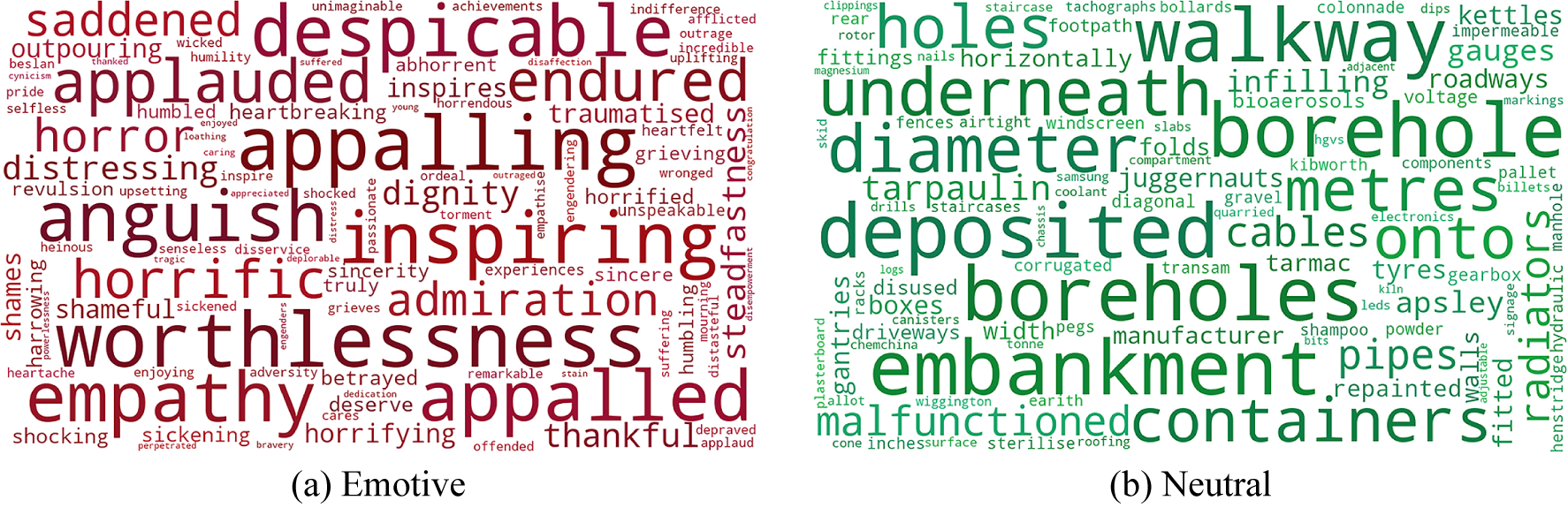
We identify for each pole the words with the highest and the lowest score and add these words to the dictionary.Footnote 12 This procedure leads to a vocabulary of 2,015 emotive and 2,095 neutral words. We compute the level of emotive rhetoric by subtracting the percentage of neutral from the percentage of emotive words (Bird, Klein, and Loper Reference Bird, Klein and Loper2009). The scale is thus from −100% to +100%. The average level of emotive rhetoric is 0.88 and the standard deviation is equal to 8.95. This suggests that most words in a parliamentary speech are neither highly emotive nor highly neutral. We provide further information on the distribution in Appendix D. Table 2 demonstrates a speech with high and a speech with low levels of emotive rhetoric.
Examples: Emotive and Neutral Speeches

Results
In this section, we start by examining the level of emotive rhetoric graphically. Thereafter we present the results of regression models to analyze the relationship between the type of debate and the level of emotiveness at the speech level. When interpreting the effect sizes, it is important to keep in mind that even a small number of emotive words can strongly influence the rhetorical style or meaning of a speech (see e.g., Crabtree et al. Reference Crabtree, Golder, Gschwend and Indridason2020; Eichorst and Lin Reference Eichorst and Lin2019).
Figure 2 illustrates the development of emotive rhetoric in the period 2001 until 2019. As discussed, the scale is from -100% to 100%. The figure shows that the variation in emotive rhetoric is substantial across all debate forms. We distinguish between speeches held in the PMQs, Queen’s Speech debates (opening day and other days), Ministerial Question Times, Urgent Questions, and other debates. Each dot represents the average level of emotive rhetoric in a half-year by different types of debates. To provide contextual reference points, the two dotted vertical lines correspond to the beginning of the Iraq war and the Brexit referendum—two highly polarizing and emotive issues in the UK Parliament. The figure illustrates that the level of emotive rhetoric is highest for PMQs and the opening day of the Queen’s Speech debate, in line with our expectation.
Emotive Rhetoric by Type of Debate over Time
Note: The figure summarizes the average level of emotive rhetoric for half-year periods.
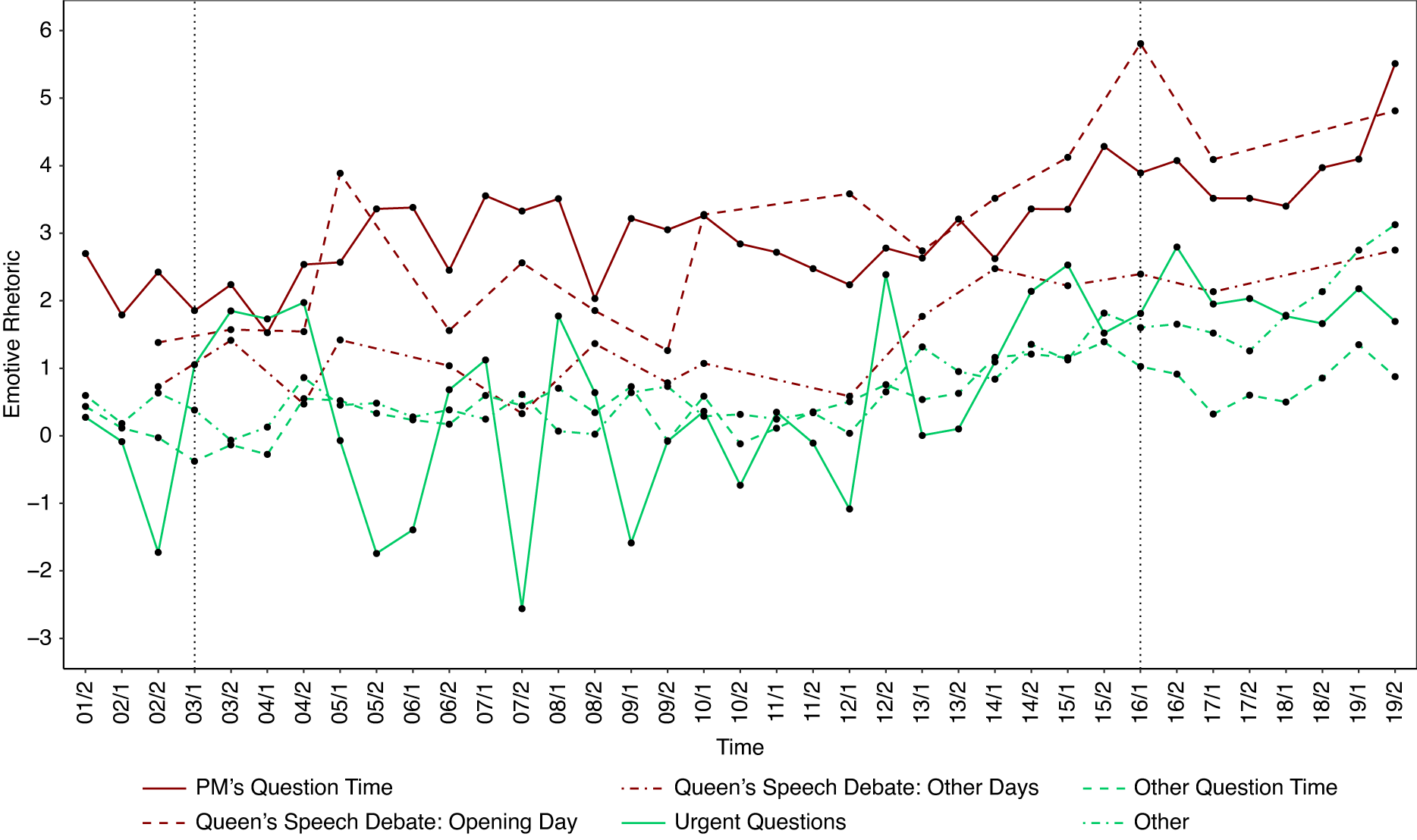
The comparison of PMQs and Ministerial Question Times suggest that the high level of emotive rhetoric in PMQs is not the result of the “question time” format. The level of emotive rhetoric of ministerial questions is lower than in PMQs. The Urgent Questions exhibit large variation in early years because the number of Urgent Questions was relatively low. The level of emotive rhetoric also varies over time. The figure illustrates that the level of emotive rhetoric appears to increase in the period when the Iraq war began. We also observe increasing trends before the Brexit referendum and before the UK left the European Union. The other debates, such as Queen’s Speech debate, also become more emotive over time, but the trend is less strong for other days of the Queen’s Speech debate, Urgent Questions, and the Ministerial Question Time. The level of emotive rhetoric in Urgent Questions exhibits significant variation, especially in the period before 2009.Footnote 13 Overall, this shows that in line with our expectations, the high-profile debates that attract a larger audience and greater media coverage are also those in which MPs employ more emotive rhetoric.
As a next step in the analysis, we use linear regression to examine the association between debate type and emotive rhetoric. Table 3 summarizes our main results. We run five regression models with different specifications. In all models, the standard errors are clustered at the MP level. Appendix E includes the full regression output.
Regression Analysis of Emotive Rhetoric
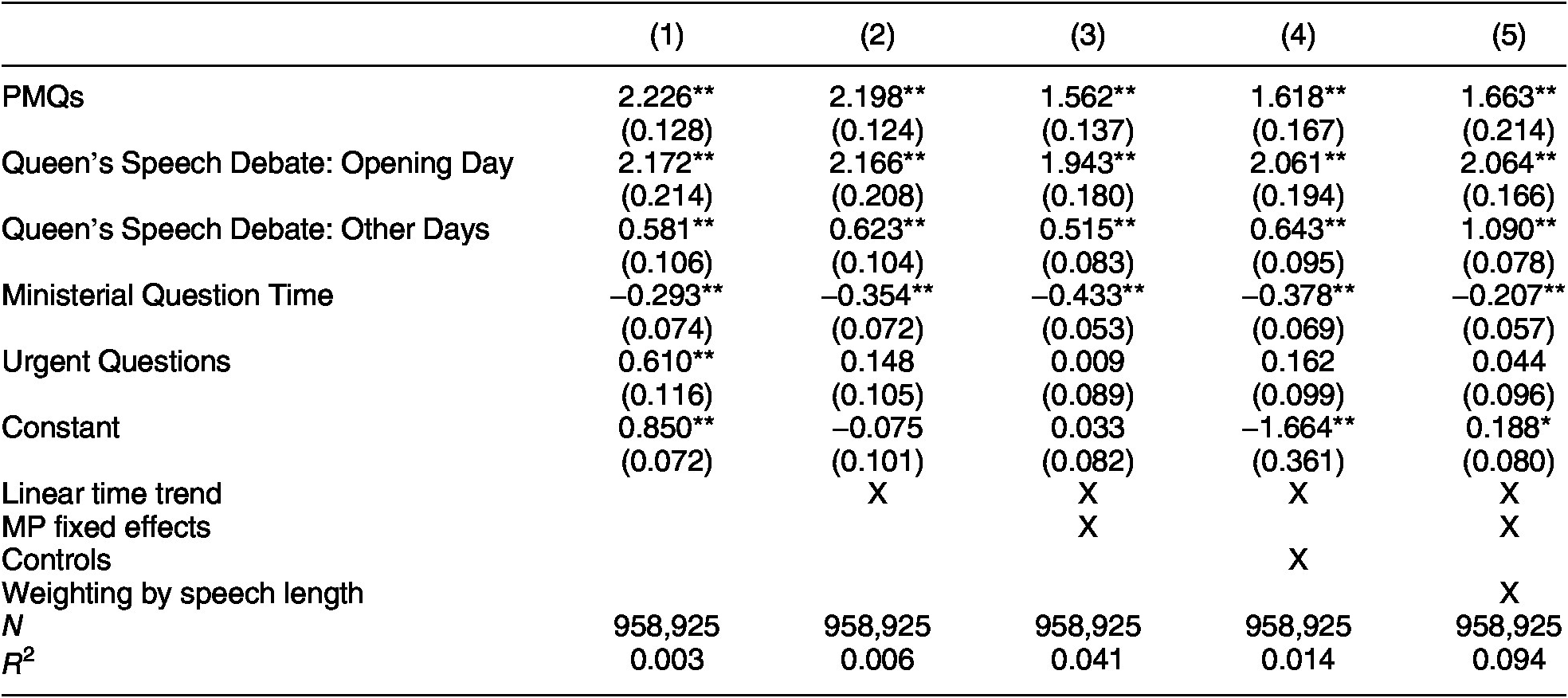
Note: Standard errors, clustered by speaker, in parentheses; + p < 0.10, * p < 0.05, ** p < 0.01.
Model 1 is a baseline model, which includes our explanatory variables, which capture the type of debate in which the speech is given. The results show that the effects of the variables capturing PMQs and Queen’s Speech debates (opening day and other days) are statistically significant at the 0.01 level. More concretely, we observe that if a speech is held during PMQs, the percentage point difference between emotive and neutral words increases by 2.2. If we compare the effect across the type of debates, we observe that the effect size of the PMQs and the opening day of the Queen’s Speech debates is the largest, followed by the effect of the other days of Queen’s Speech debates. The effect of Ministerial Question Times is negative, but the effect size is relatively small. The effect of Urgent Questions is not robust.
Model 2 includes our main explanatory variables and a linear time trend. The effects of PMQs and Queen’s Speech debates are robust and the coefficient sizes are very similar, as in Model 1. In Model 3, we include a linear time trend and speaker fixed effects. MP fixed effects allow us to study the within-MP variation over time. The MP-specific fixed effects correct for all time-constant heterogeneity among parliamentarians. As the table shows, the coefficients for PMQs and Queen’s Speech debates are very similar to those from the previous models. The evidence suggests that the high level of emotive rhetoric in PMQs is not the result of different speaker characteristics.
The inspection of the rules of debate supports this conclusion. In particular, except for the Leader of the Opposition, no parliamentarian receives priority in speaking in PMQs.Footnote 14 Importantly, the questions for PMQs are selected randomly from all the parliamentarians that expressed interest in asking a question, so this reduces the potential problem of selection bias in who speaks (Betsy and Goldsmith Reference Betsy and Goldsmith2019; Kelly Reference Kelly2015).
In Model 4 we include a linear time trend, party fixed effects, and controls for party leader position, gender, ministerial position, shadow cabinet, committee chairmanship, party, and age. We include the controls because certain parliamentarians might be more likely to be emotive and participate in PMQs. We find that the effect of the type of debate is robust and is similar in size to those of the previous models. The results for the control variables show that party leaders are more likely to use emotive rhetoric. In addition, we also find that women MPs tend to use more emotive rhetoric than men MPs.Footnote 15
In Model 5, we run our regression analysis with a linear time trend and MP fixed effects and weight the speeches by their length to account for the different number of words. As the table illustrates, the effect of the type of debates is robust and similar to that from the other models. Note that the effects are also robust if we control for the number of words.
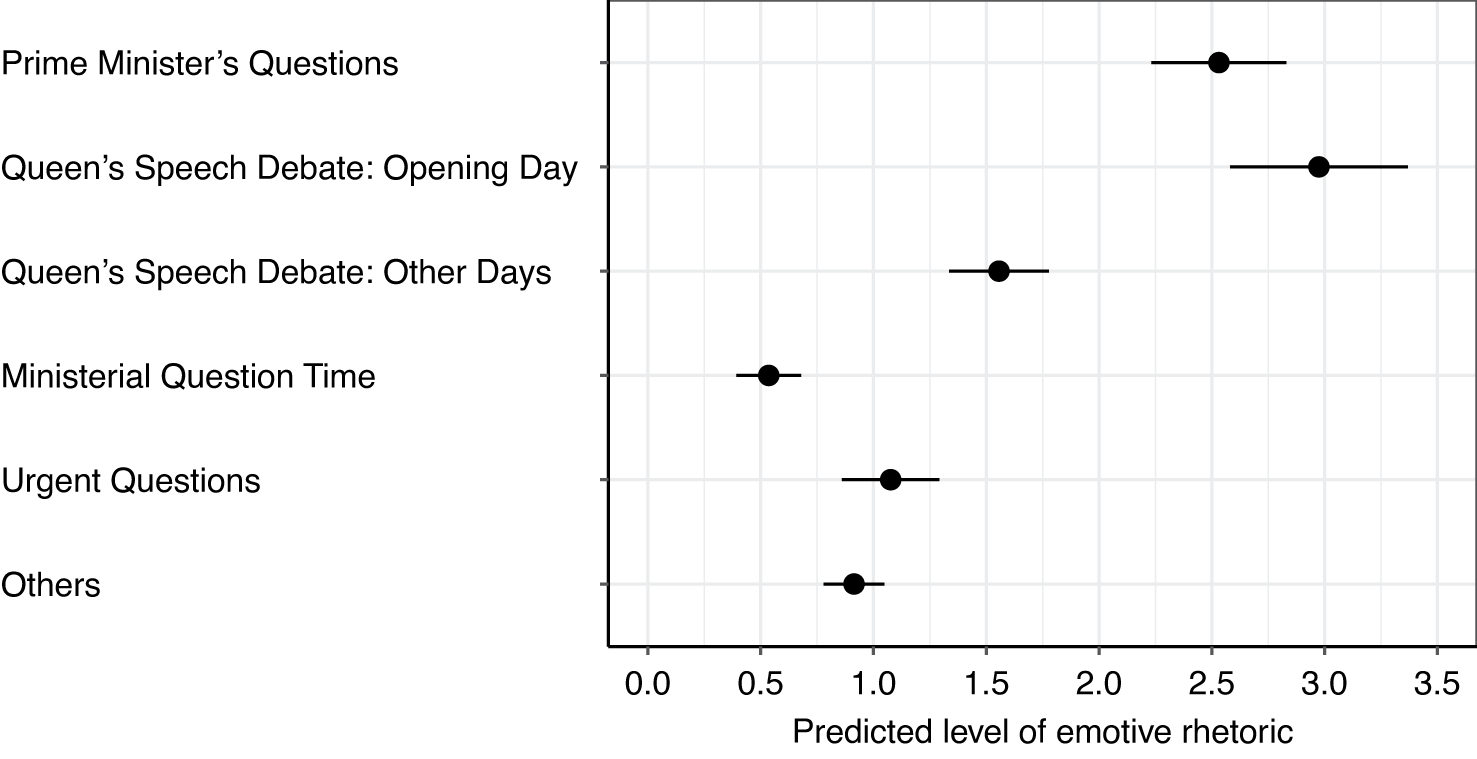
Using Model 4 as reference, we calculate the predicted levels of emotive rhetoric for speeches held in different debates. We show the results in Figure 3. The predicted level of emotive rhetoric in speeches held during PMQs and the opening day of the Queen’s Speech debate is around 2.5 and 3.0, respectively. In other words, the predicted percentage of emotive words minus the percentage of neutral words is 2.5–3.0. The predicted level of emotive rhetoric in other days of the Queen’s Speech debates equals 1.5. The model also predicts that the level of emotive rhetoric in Ministerial Question Time, Urgent Questions, and other debates is 1.0 or lower. This means that the level of emotive rhetoric in other debates is less than half of that in PMQs and Queen’s Speech debates.
Predicted Level of Emotive Rhetoric by Type of Debate and 95% Confidence Intervals
Note: The predictions are predictive margins computed based on Model 4.
We also explore the effect of electoral cycles and do find an effect of electoral cycles on emotive rhetoric. If a speech is held 100 days closer to a general election, the level of emotive rhetoric increases by 0.015. This effect may seem small, but the House of Commons is not a major arena for campaigning in the run-up to elections, as it closes 25 working days before general elections.
In order to strengthen the confidence in our results, we replicate our analysis with alternative dependent variables (see Appendices F and G). First, we use the share of emotive words. Furthermore, we create a measure based on the scaling procedure of Lowe et al. (Reference Lowe, Benoit, Mikhaylov and Laver2011) and we apply the LIWC dictionary (Pennebaker et al. Reference Pennebaker, Booth, Boyd and Francis2015). We also run multilevel regression models clustering speeches into MPs and parties. In all cases, the difference between the level of emotive rhetoric in high-profile debates and the other debates remains statistically significant and robust.
Overall, and regardless of the measurement strategy or statistical specification, we confirm our expectation, namely that MPs are more likely to use emotive rhetoric in their legislative speeches when they face a larger public audience, such as during the PMQs and other high-profile debates.
Alternative Mechanism: Issue-specific Affect
While our results are robust to different measures and statistical specifications, there could be a concern that alternative mechanisms could explain why MPs make more use of emotive rhetoric in some debates compared with others. Notably, it may be argued that rather than considering the likely audience, politicians use more emotive rhetoric when they talk about specific topics that are more emotive or polarizing in nature.
In this section, we discuss this alternative mechanism, and we show that it cannot account for our main finding; that is, politicians primarily use emotive rhetoric in high-profile debates that have a large audience. Of course, this does not mean that we can causally identify the effect of audience exposure on emotive rhetoric, but it does suggest that this is a plausible explanation for the patterns we are observing.
One might argue that some topics are simply more emotive than others. If such highly emotive topics are discussed more in high-profile debates, then the topic, and not the type of debate, will be driving up the level of emotive rhetoric. To examine this potential explanation, we check whether our results hold when we control for topics.
To do so, we use supervised learning to implement cross-domain classification of parliamentary speeches to topics (Osnabrügge, Ash, and Morelli Reference Osnabrügge, Ash and Morelli2020). We train a machine learning system on the annotated manifesto corpus (Krause et al. Reference Krause, Lehmann, Lewandowski, Matthieß, Merz and Regel2018) and then use the trained model to predict the topics of parliamentary speeches. We focus on seven main topics as defined by the manifesto project: economy, external relations, fabric of society, freedom and democracy, political system, social groups, and welfare and quality of life.Footnote 16 We use the python module scikit-learn to predict the topics of parliamentary speeches held in the House of Commons (Pedregosa et al. Reference Pedregosa, Varoquaux, Gramfort, Michel, Thirion, Grisel and Blondel2011).Footnote 17 In Appendix H, we show how many speeches were classified to the topics over time.
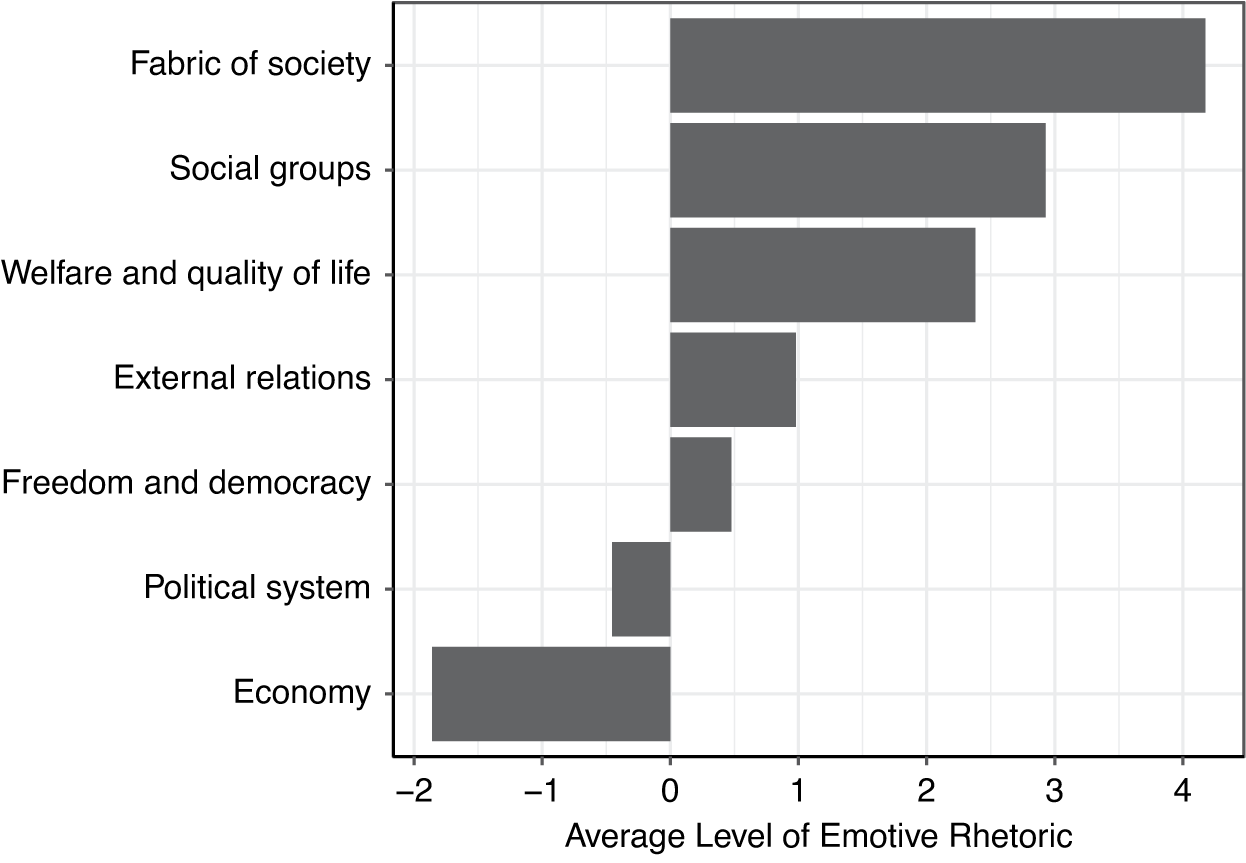
We start by summarizing the average level of emotiveness by topic.Footnote 18 Figure 4 shows the average level of emotive rhetoric across the seven topics. Not surprisingly, the highest (mean) emotiveness is found in speeches on the topic fabric of society, which includes discussions about the national way of life, traditional morality, and law and order. The second highest level of emotiveness is in speeches on social groups, which includes discussions about underprivileged minority groups, labor groups, and agriculture and farmers. Thereafter, we find speeches on welfare and quality of life, followed by external relations and the freedom and democracy, which cover discussions about human rights, democracy, and constitutionalism. Finally, speeches on the economy show the lowest level of emotive rhetoric.
Average Level of Emotive Rhetoric by Topic
In a subsequent step, we rerun our regression models with topic fixed effects. Table 4 summarizes the results. The effect of PMQs and Queen’s Speech debates are statistically significant in all regression models at the 0.01 level. We find that the effect sizes are slightly smaller, but they are very similar to those from our main analysis. Model 1 shows, for example, that the level of emotive rhetoric increases by about 2.0 if the speech was held in PMQs. The effect of Urgent Questions is not robust. Therefore, this evidence strongly suggests that topics are not the main reason for the high levels of emotive rhetoric in PMQs and Queen’s Speech debates. Appendix E includes the full regression output. In Appendix I we examine polarization as an alternative mechanism.
Regression Analysis of Emotive Rhetoric with Topic Fixed Effects
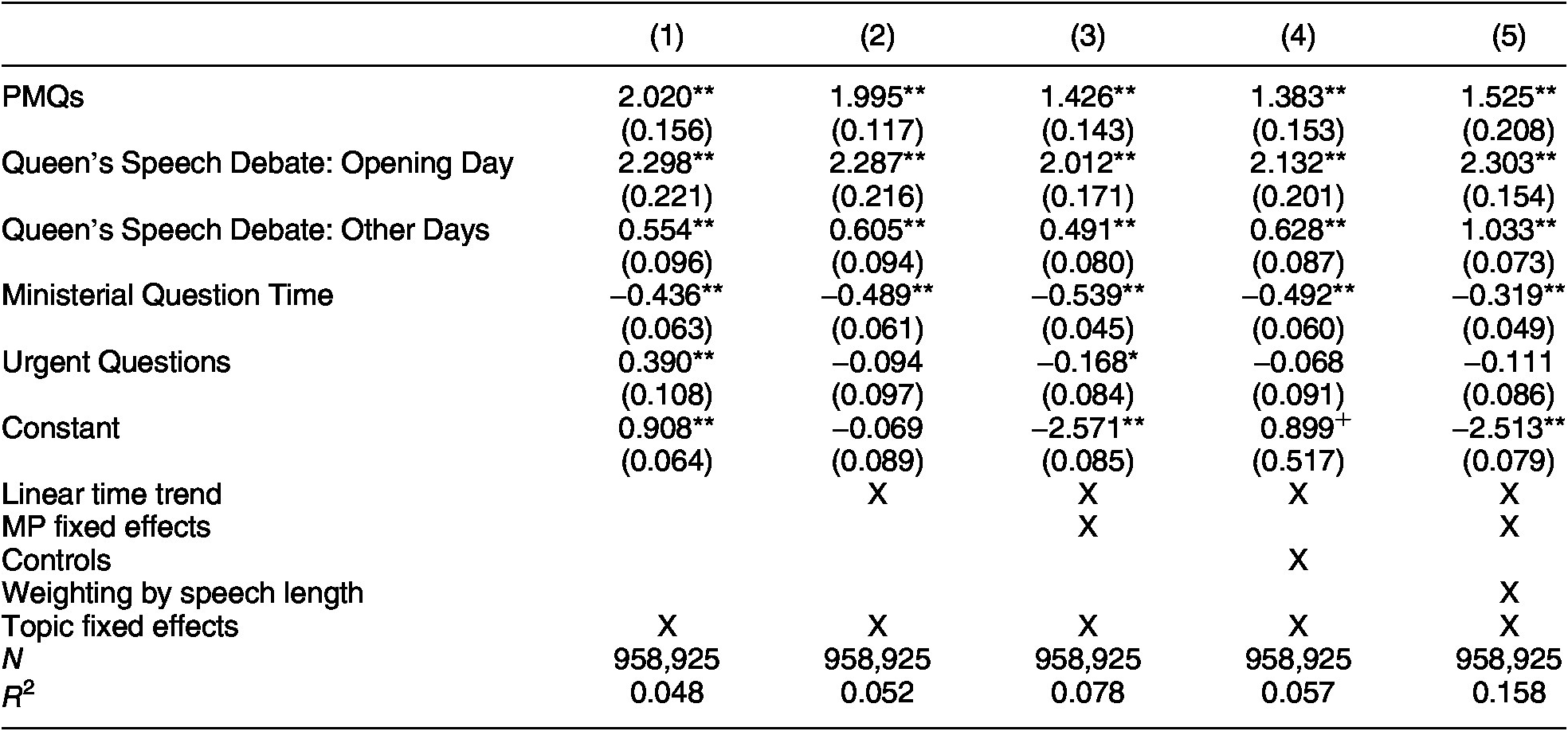
Note: Standard errors, clustered by speaker, in parentheses; + p < 0.10, * p < 0.05, ** p < 0.01.
Generalizability: The Case of Ireland
As one of the oldest parliaments in the world, the UK House of Commons provides an apposite case for the study of emotive rhetoric in parliamentary debates. The UK Parliament has served as a role model for parliaments around the world (e.g., Lijphart Reference Lijphart1999). As a consequence, other democracies share a number of important institutional features with the UK (Bäck, Debus, and Fernandes Reference Bäck, Debus and FernandesForthcoming). Nearly all advanced industrialized democracies have some form of question time, and similar to PMQs in the UK, oral question times tend to receive high levels of publicity (Martin and Rozenberg Reference Martin and Rozenberg2012; Salmond Reference Salmond2014). For example, the Australian Parliament has a question time, which Dowding, Leslie, and Taflaga (Reference Dowding, Leslie, Forthcoming, Bäck, Debus and FernandesForthcoming) describe as “the peak of political theatre.” Similarly, a form of PMQs was introduced for the German Chancellor in 2018.Footnote 19 While each parliament has its own idiosyncratic characteristics, they share the core feature examined in this paper—namely, that some debates are high-profile and likely to receive media and public attention, while others largely go unnoticed by the wider public (Martin and Rozenberg Reference Martin and Rozenberg2012). Yet, a key concern of our results is the external validity of our findings and the degree to which our conclusions can be generalized to other contexts.
In this section, we further examine the generalizability of our findings by studying the lower house of the Irish Parliament, the Dáil Éireann. We focus on Ireland for multiple reasons. First, the Irish Parliament is a good case to use to assess generalizability because it exhibits a number of institutional differences from the UK. For example, the Irish lower house uses single-transferable vote and not a first-past-the-post system as in the UK House of Commons (Gallagher Reference Gallagher, Gallagher and Mitchell2006). Second, it allows us to apply the same English language dictionary as in the analysis of the UK House of Commons. Finally, the Irish Parliament has debates that, by design, vary in the public attention they receive.
We compare rhetoric in Dáil Leaders’ Questions, as the most high-profile parliamentary debates, with rhetoric in other debates. Leaders’ Questions were set up in 2001 and further amended in October 2002 (MacCarthaigh Reference MacCarthaigh2005; MacCarthaigh and Manning Reference MacCarthaigh and Manning2010). According to the Standing Order 36 (Dáil Éireann Reference Éireann2020), Leaders’ Questions take place on Tuesdays, Wednesdays, and Thursdays. Opposition leaders have 32 minutes to ask questions to the prime minister. Leaders’ Questions receive significant public attention and are televised by the public broadcasters, RTÉ One and RTÉ news. During 2018–2019, an average of 7% of those watching TV in Ireland followed the live broadcasting on RTÉ One.Footnote 20 Other debates receive much less media and public attention.
We proceed in the same manner as in our analysis of the House of Commons and create a domain-specific dictionary of emotive and neutral words. Using the data of Herzog and Mikhaylov (Reference Herzog and Mikhaylov2018), we focus on all speeches of at least 40 characters held in the lower house of the Irish Parliament from November 2002 until 2013. The dictionary includes 1,692 emotive and 1,764 neutral words. The dataset of parliamentary speeches includes meta-data on the ministerial positions of parliamentarians, the party, and the electoral cycle.
Table 5 summarizes our results. We run the same models as in our analysis of parliamentary debates in the House of Commons. In all models, the effect of Leaders’ Questions is positive and statistically significant at the 0.01 level. The level of emotive rhetoric increases by 4.5 in Models 1 to 2 and by around 4 in Models 3 to 4. In Model 5, the coefficient of the explanatory variable is slightly smaller because we weight the speeches by length. In Appendix E, we provide the complete results.
Regression Analysis of Irish Parliamentary Speeches
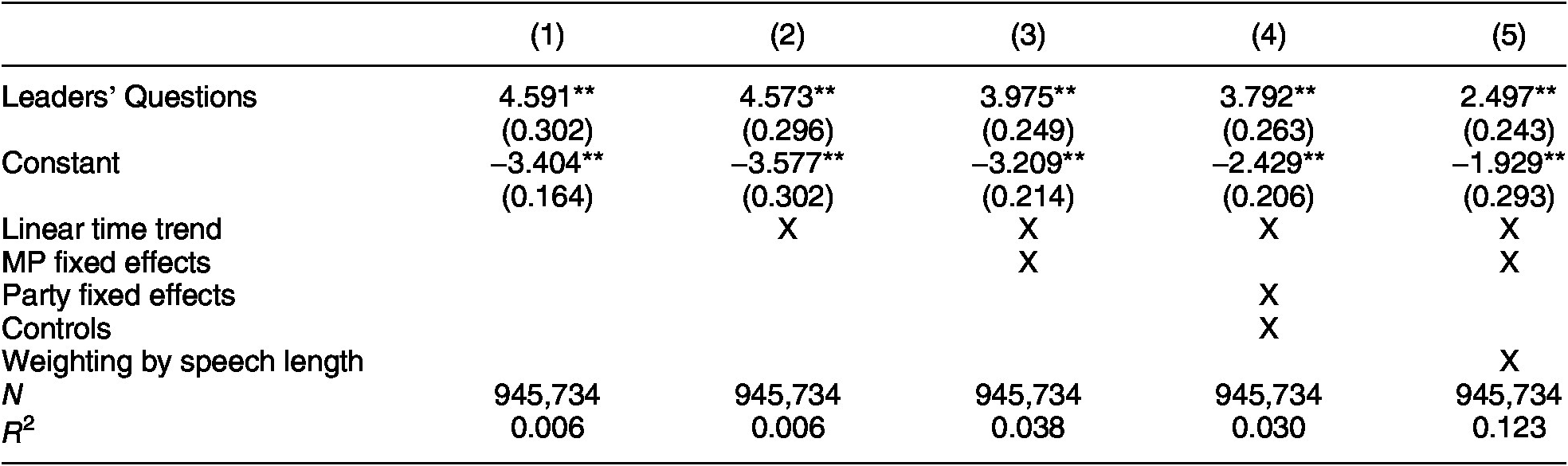
Note: Standard errors, clustered by speaker, in parentheses; + p < 0.10, * p < 0.05, ** p < 0.01.
Overall, the evidence suggests that our results are generalizable beyond the British case.
Conclusion
This article has examined when and why parliamentarians use emotive rhetoric in parliamentary speeches. Recent research on emotions in political rhetoric has largely focused on how parties use positive and negative language in political campaigns (Crabtree et al. Reference Crabtree, Golder, Gschwend and Indridason2020; Kosmidis et al. Reference Kosmidis, Hobolt, Molloy and Whitefield2019), but we know less about the use of emotive rhetoric in parliaments (Rheault et al. Reference Rheault, Beelen, Cochrane and Hirst2016; Slapin and Kirkland Reference Slapin and Kirkland2020). Previous work on legislative debates has analyzed intraparty politics by studying position taking and dissent expressed in parliamentary debates (Baumann, Debus, and Klingelhöfer Reference Baumann, Debus and Klingelhöfer2017; Herzog and Benoit Reference Herzog and Benoit2015; Martin and Vanberg Reference Martin and Vanberg2008; Proksch and Slapin Reference Proksch and Slapin2012). This study extends the literature on legislative behavior by focusing specifically on how politicians use emotional appeals in their speeches.
Our main argument is that politicians use emotive rhetoric primarily to appeal to voters. We therefore expect that the level of emotive rhetoric is especially high in high-profile debates, which have a large (electoral) audience. By contrast, in more low-profile debates where legislators are primarily addressing their fellow parliamentarian, they are less incentivized to use emotive rhetoric.
This article makes three main contributions to the literature on legislative debates and political speech. First, the findings of this study indicate that emotive rhetoric is used primarily when politicians think they are addressing not only their fellow parliamentarians but also voters. Our results thus support our main expectation, as we find a positive and statistically significant effect of high-profile debates—PMQs and Queen’s Speech debates—on the use of emotive rhetoric. PMQs exhibit higher levels of emotive rhetoric than Ministerial Question Times, which supports our argument because Ministerial Question Times have a format similar to that of PMQs but receive less attention. We also provide evidence that these findings are generalizable to other countries that have similar parliamentary procedures, such as Ireland. Second, the study contributes to our understanding of how political behavior in parliamentary speeches differs across debates. Previous research argues that parliamentarians use speeches to appeal to voters. Our paper provides evidence that these incentives differ significantly across types of debates.
Third, we contribute to the literature on emotive rhetoric by applying a novel measurement technique of emotions in political text compared with the standard dictionary approach (Rice and Zorn Reference Rice and Zorn2019). Our measure of emotive rhetoric combines the ANEW dictionary and word-embedding techniques. We classify emotive and neutral words using the ANEW dictionary but further identify additional emotive and neutral words on the basis of the word vectors (Mikolov, Sutskever, et al. Reference Mikolov, Chen, Corrado and Dean2013). This procedure allows us to add the most emotive and neutral words that are used in parliamentary speeches, but are not included in the ANEW dictionary, to our domain-specific dictionary. Therefore, our measurement technique captures the use of emotive language in a political setting more precisely.
Overall, this study suggests that emotive rhetoric is a tool that politicians use to communicate their messages, especially when addressing voters, and we should study this alongside other political appeals, such as policy positions. This matters because we know from the literature on opinion formation that emotional appeals can have a range of effects on voters. Future research could further explore the implications of emotive rhetoric. Emotive parliamentary speeches may have positive implications by increasing political interest in the activities of representatives and in politics more generally. Yet, emotive rhetoric may also increase polarization and may favor politicians who prioritize emotional appeals over competent, coherent policy making. More generally, emotive rhetoric may have an influence on the quality of deliberation and, in turn, on the quality of democratic representation.
Supplementary Materials
To view supplementary material for this article, please visit http://dx.doi.org/10.1017/S0003055421000356.
DATA AVAILABILITY STATEMENT
Research documentation and/or data that support the findings of this study are openly available at the American Political Science Review Dataverse: https://doi.org/10.7910/DVN/QDTLYV.
ACKNOWLEDGMENTS
For helpful comments and suggestions we thank Elliott Ash, Kenneth Benoit, Jack Blumenau, Lotte Hargrave, Ben Lauderdale, Sven-Oliver Proksch, Tom Robinson, Meg Russell, Jonathan Slapin, Katerina Tertytchnaya, Stephane Wolton, and our audiences at the EPSA conference, at Durham University, the IPERG–Universitat de Barcelona, the London School of Economics and Political Science, and the University College London. We thank Tom Hunter for excellent research assistance.
FUNDING STATEMENT
We acknowledge the generous funding from the European Research Council (ERC GA647835, EUDEMOS).
CONFLICTS OF INTEREST
The authors declare no ethical issues or conflicts of interest in this research.
ETHICAL STANDARDS
The authors affirm that this research did not involve human participants.


 Open access


Comments
No Comments have been published for this article.