





Policy Significance Statement
Policymakers face a rapidly expanding and fragmented landscape of AI tools for citizen participation. Current debates often emphasise technical capabilities while overlooking how these tools are shaped by the organisations that build them, the funding that sustains them, and the pathways through which they are adopted. Our commentary introduces a political economy perspective that foregrounds these dynamics. By mapping archetypes, funding models, and adoption routes, we show how incentives and constraints shape which tools succeed and which fail. This perspective highlights practical levers in procurement, funding priorities, and institutional design that can support a diverse and democratically oriented ecosystem.
1. Introduction
Over the past 5 years, policymakers, scholars, and practitioners have shown growing interest in the potential of artificial intelligence (AI) to transform democratic practice (Landemore, Reference Landemore, Chang and Srinivasan2024; McKinney, Reference McKinney2024; Lazar and Manuali, Reference Lazar and Manuali2025; OECD, 2025), particularly tools that promise to harness public input at scale by widening access and reducing costs of participation (Schmidt, Reference Schmidt2024). Reactions have ranged from enthusiasm (Sarafis et al., Reference Sarafis, Karamitsios and Kravari2025) to scepticism (European Center for Non-Profit Law, 2024), and concern (Hyams and Sutherland, Reference Hyams and Sutherland2024). Most analyses have shared a common focus on the technical capabilities of tools, exploring what they might achieve under ideal conditions. Far less attention is paid to tracing the institutional and economic dynamics that shape which of these tools are eventually adopted, by whom, and to what end. A focus on startups and civic technologies has similarly obscured the role of established market research firms and consultancies in shaping developments in AI and public participation.
We argue for a political economy perspective to better understand how the promise of AI tools for citizen participation will be realised in practice. By political economy, we mean an approach that locates these technologies in the context of firms, finance, and institutions. Applying this lens shifts attention away from a sole focus on technical capability, to questions of scale, sustainability, and power. In this commentary, we do not analyse the normative implications of these political economy dynamics for democratic outcomes. This is a vital question for future empirical and theoretical work. We make a prior, and more modest, claim that the political economy will have important democratic implications by shaping which tools get built, find sustainable funding, and reach citizens at scale, long before any individual tool’s technical capabilities can be assessed. We therefore develop an ex-ante heuristic framework that identifies organisational archetypes, funding models, and adoption pathways within the political economy of AI and citizen participation. This lens is intended for policymakers and researchers to situate emerging practices, identify levers to shape ecosystems, and pursue future research directions.
The article proceeds as follows. Section 2 sets out the promise and perils of AI tools for citizen participation, contextualising the historical, technical, and research context. Section 3 introduces the political economy lens. Section 4 applies this lens to outline who builds, funds, and adopts these tools. Section 5 concludes by highlighting the value of the political economy lens for current policymaking and future research.
2. Context: The promise and perils of AI tools for citizen participation
Citizen participation, as we will use it, refers to “a broad concept that can involve many or few citizens, offering a range of opportunities to influence policy – from informing policymakers’ actions to having an empowered decision-making role” (Evans et al., Reference Evans, Davies and Mutibwa2025, p. 1). This can take many forms, “from light-touch engagement and collaboration to deeper exercises entailing extensive co-production and deliberation” (UK Gov.UK, 2024). International organisations stress its importance for democratic legitimacy and trust (OECD, 2020a, 2025), describing a “deliberative wave” building since the 1980s, gaining momentum in the 2010s (OECD, 2020b), with a “surge” in the 2020s (European Commission, 2020).
Democratic and citizen participation have a long relationship with tools and technology. As far back as ancient Greece, marked pebbles or shards were used for voting, and a kleroterion was used to select citizens (Goñi, Reference Goñi2025, p. 3). The tool randomised impartially, but selected among a demos that excluded women, the enslaved, and foreigners, operating within, and giving effect to, prior decisions about who the public is. Two millennia later, practitioners and activists assembled digital platforms and participatory tools into a “Civic Tech” movement (UNDP, n.d.; Zhang et al., Reference Zhang, Lim, Perrault and Wang2022). In recent years, some have argued that governments should explore the potential of AI to enhance participation by expanding their ability to analyse contributions, enabling mass deliberation, and lowering barriers to participation (OECD, 2025). Generative AI (GenAI) has become a prominent focus for democratic innovation, specifically Large Language Models (LLMs), computational models trained on large text datasets to generate human-like responses across a wide range of tasks (Naveed et al., Reference Naveed, Khan, Qiu, Saqib, Anwar, Usman, Akhtar, Barnes and Mian2024). Academic projects have set out multi-year research agendas (e.g. Bullock et al., Reference Bullock, Ajmeri, Batty, Black, Cartlidge, Challen, Chen, Chen, Condell, Danon, Dennett, Heppenstall, Marshall, Morgan, O’Kane, Smith, Smith and Williams2024), and new start-ups and civic organisations have launched tools for participation and international organisations encourage governments to experiment with AI-supported participation (OECD, 2025). GenAI is being explored in citizen participation in a variety of ways, including to enhance analysis of large unstructured qualitative datasets, as seen in government experiments with polling data deliberation (Lenihan et al., Reference Lenihan, Carmichael and Workman2024; UK Government, n.d.). Within more deliberative processes, it is being tested to improve quality and reduce costs by identifying consensus (Tessler et al., Reference Tessler, Bakker, Jarrett, Sheahan, Chadwick, Koster, Evans, Campbell-Gillingham, Collins, Parkes, Botvinick and Summerfield2024), supporting reflection (Ji et al., Reference Ji, Wang, Wang and Tan2023), fact-checking contributions (Karacapilidis et al., Reference Karacapilidis, Kalampokis and Giarelis2024), stimulating creativity in problem solving (Kehler et al., Reference Kehler, Page, Pentland, Reeves and Brown2025), and facilitating group interactions (McKinney, Reference McKinney2024; Tessler et al., Reference Tessler, Bakker, Jarrett, Sheahan, Chadwick, Koster, Evans, Campbell-Gillingham, Collins, Parkes, Botvinick and Summerfield2024). At the individual level, GenAI has been suggested as a tool for managing information overload in participatory settings (Procter and Zubiaga, Reference Procter and Zubiaga2019). Finally, novel approaches around simulation and “synthetic polling” use frontier models to generate artificial citizen responses.
Experts have expressed disagreement over these tools. Optimistic accounts suggest that LLMs could strengthen citizen participation in governance and civic affairs, arguing that “when used thoughtfully, LLMs can help unlock public wisdom, rebuild trust, and enable better decision making” (Sarabi, Reference Sarabi2025). Advocates argue that such methods could expand access to citizen insights, overcome declining participation (Berger et al., Reference Berger, Schneier, Gong and Sanders2024), and enrich understanding of social systems (Wright, Reference Wright2024). Others have raised significant concerns, including risks of bias and opacity (McKinney, Reference McKinney2024), loss of meaningful control (Alnemr, Reference Alnemr2020), erosion of trust (Jungherr and Rauchfleisch, Reference Jungherr and Rauchfleisch2025), and the increased likelihood of methodological flaws (Bisbee et al., Reference Bisbee, Clinton, Dorff, Kenkel and Larson2024).
Social scientists have rightly called for proactive research on AI and democracy to evaluate impacts and shape trajectories (Jungherr, Reference Jungherr2023, p. 9). However, proponents and sceptics of AI and citizen participation tend to engage on relatively narrow technical terrains. While some have noted structural factors, such as the role of ownership and incentives in shaping outcomes (McKinney, Reference McKinney2024) and the “concentration of wealth and power” (Summerfield et al., Reference Summerfield, Argyle, Bakker, Collins, Durmus, Eloundou, Gabriel, Ganguli, Hackenburg, Hadfield, Hewitt, Huang, Landemore, Marchal, Ovadya, Procaccia, Risse, Schneier, Seger, Siddarth, Skaug Sætra, Tessler and Botvinick2025), these concerns remain marginal. Building on a recent intervention that noted that “these tools also construct a political economy” (Goñi, Reference Goñi2025, p. 3), we begin to ask: what are the characteristics of this political economy, how does it shape the possibility for democratic participation, and what are the policy levers available to shape it?
3. Political economy
As a field, political economy considers politics and economics to be mutually co-constituted, embedding any “analysis of the economic within the social and political realm” (Clift, Reference Clift2014, pp. 1–2). We use it here pragmatically as an analytical tool to examine the interplay of firms, finance, and institutions that shape what gets built, funded, and adopted, and what those conditions mean for the possibility space for democratic participation.
Our commentary builds on three related bodies of work. Within the field of democratic innovation, there is growing recognition that engaging with political economy is essential for the field’s change-making potential (Habermas, Reference Habermas2023; Vlahos, Reference Vlahos, Bussu and Bua2023; Escobar and Bua, Reference Escobar and Bua2026). As Alnemr (Reference Alnemr2020, p. 534) has suggested, private providers of deliberation tools may be incentivized to make them enjoyable rather than “politically transformative.” These concerns are rooted in Dryzek’s (Reference Dryzek1996) foundational argument that democratic ideals are always constrained by capitalism—though constraint is not determination. While we do not adjudicate the broader normative debates about the goals and trade-offs of democratic theory, we share the view that understanding this political economy is a precondition for informed policy choices.
Work in Data and Policy has demonstrated the importance of political economy analysis across diverse policy domains (Whitley and Schoemaker, Reference Whitley and Schoemaker2022; Mac Ginty and Firchow, Reference Mac Ginty and Firchow2024), including in the context of AI and elections in Africa, where private sector dominance, limited public sector capacity, and procurement structures shaped which technologies reached citizens and on what democratic terms (Adeleke, Reference Adeleke2025). Guerrero and Castañeda (Reference Guerrero and Castañeda2020)’s warning that the absence of political-economic analyses risks producing misleading policy prescriptions further motivates our commentary.
Adjacent literatures on the political economy of digital technologies have shown how structural conditions shape technologies across their development, funding, and implementation, highlighting the democratic and distributional consequences of concentration, lock-in, and dependency (Srnicek, Reference Srnicek and McDonnell2018; Trajtenberg, Reference Trajtenberg2018; Whittaker, Reference Whittaker2021; Collington, Reference Collington2022; Burkhardt and Rieder, Reference Burkhardt and Rieder2024; Margetts and Dunleavy, Reference Margetts and Dunleavy2024; Ulbricht and Egbert, Reference Ulbricht and Egbert2024). This work provides both precedent and broader context for our analysis, including the political economies of foundation models and cloud infrastructure (Tan & Thelen, Reference Tan and Thelen2025; Van Der Vlist et al., Reference Van Der Vlist, Helmond, Dieter and Weltevrede2025), on which many application-layer tools depend. However, the political economy of AI tools for citizen participation at the application layer remains largely unexamined.
4. Towards a political economy of AI and citizen participation
Applying this perspective to AI and citizen participation shifts attention away from the novelty of individual tools and towards the conditions that shape which of them are imagined, funded, and used, and by whom. Despite the proliferation of AI tools for citizen participation, we lack systematic analysis along these lines.
4.1. Who builds?
By “building” we mean the design and deployment of application layer tools: the participation processes, interfaces, technical architecture, and platforms through which citizens participate, increasingly built on top of foundation models whose own political economy we set aside here. Though current interest centres on LLM-based tools, the field remains technically heterogeneous, spanning hand-coded participation platforms, inspectable statistical methods, and tools built on externally developed general-purpose models. These differences concern us only insofar as they have political-economic effects—dependence on an external model provider, say, or the feasibility of self-hosting—and we note where our claims turn on them.
We employed an iterative and abductive process grounded in sustained engagement with the field to develop a typology of those building these tools. This began with extensive desk research and was refined through ongoing dialogue with policymakers and practitioners who helped us identify practically important dimensions of variation. We converged on scale, primary clients, structure, and maturity because they proved both tractable, lending themselves to meaningful differentiation, and consequential, mapping onto real decisions these organisations face when securing funding, development, and adoption pathways.
The result is a set of seven illustrative builder archetypes (Table 1). The categories are analytically distinct, though organisations may shift between them over time as they scale, restructure, or reorient. Given the emergent nature of the field, we do not claim comprehensive coverage, and dimensions such as open versus closed source technology stacks warrant further attention in future work. Our aim is to offer policymakers and researchers a practical starting point for mapping a landscape that has, until now, received little systematic attention through a political economy lens.
Archetypes of organisations building toolsa
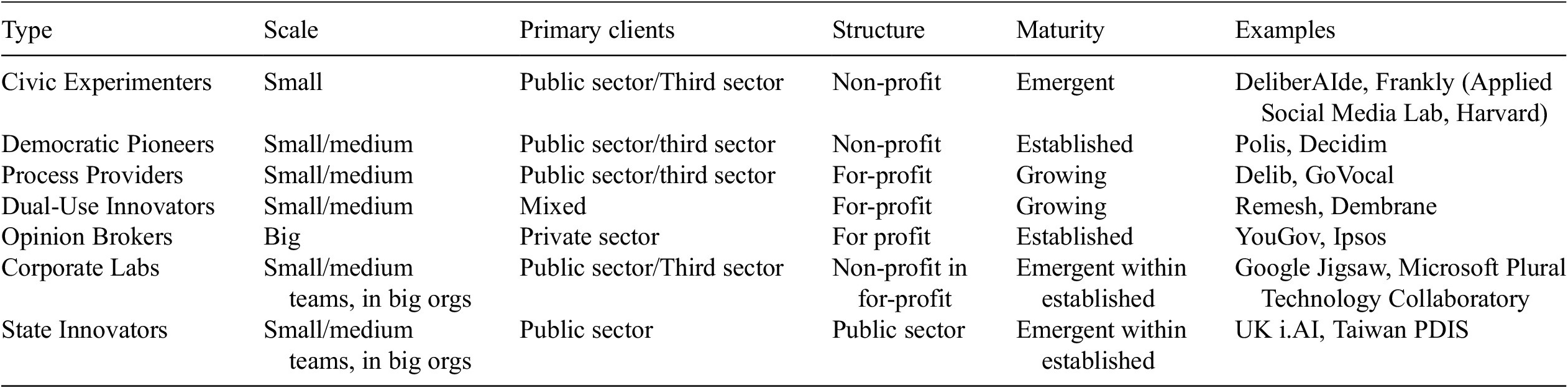
Table 1. Long description
Table 1 presents seven builder archetypes, each described by five attributes: scale, primary clients, structure, maturity, and examples. Civic Experimenters are small non-profits serving the public and third sectors, emergent in maturity; examples are DeliberAIde and Frankly (Applied Social Media Lab, Harvard). Democratic Pioneers are small-to-medium non-profits serving the public and third sectors, established in maturity; examples are Polis and Decidim. Process Providers are small-to-medium for-profits serving the public and third sectors, growing in maturity; examples are Delib and GoVocal. Dual-Use Innovators are small-to-medium for-profits serving mixed clients, growing in maturity; examples are Remesh and Dembrane. Opinion Brokers are large for-profits serving the private sector, established in maturity; examples are YouGov and Ipsos. Corporate Labs are small-to-medium teams within large organisations, structured as non-profit units inside for-profit firms, serving the public and third sectors, emergent within established organisations; examples are Google Jigsaw and the Microsoft Plural Technology Collaboratory. State Innovators are small-to-medium teams within large public-sector organisations, serving the public sector, emergent within established organisations; examples are the UK’s i.AI and Taiwan’s PDIS.
a Scale: small = start-up or small NGO (<20 staff); medium = scale-up or growing org (<50 staff); large = established incumbent (>100 staff). Primary Clients: the sector each organisation is primarily set up to serve (public, private, or third sector); organisations may serve multiple sectors but are optimised towards one. Structure: legal form (for-profit, non-profit, public sector). Maturity: emergent (few deployments); growing (pilots and expanding adoption); established (good market capture, repeated deployments). Our labels describe market position and organisational form, not democratic merit.
The typology reveals a more diverse builder landscape than is often recognised in mainstream discussions that focus on high-profile experiments. There are reasons to expect these differences to have downstream impacts on the tools that are developed, including impacting their intended users, product development incentives, organisational constraints, and access to resources. Civic Experimenters and Democratic Pioneers may drive innovation but face challenges of financial sustainability or gaining market traction. Dynamics such as these shape the range and quality of tools available for democratic use. Opinion Brokers can leverage established reputations, procurement channels, and compliance infrastructure, but may struggle to innovate quickly. Corporate Labs, such as Jigsaw,—set up and funded by Google (Jigsaw, n.d.—or the team of Google DeepMind researchers behind the Habermas Machine (Tessler et al., Reference Tessler, Bakker, Jarrett, Sheahan, Chadwick, Koster, Evans, Campbell-Gillingham, Collins, Parkes, Botvinick and Summerfield2024), benefit from access to proprietary AI models and technical talent, creating technical advantages that smaller builders cannot easily replicate. One might expect non-profit builders to favour openness, and examples like Polis (GitHub, 2016/2025a) and Decidim (GitHub, 2016/2025b) are consistent with this. In practice, the implications for open/closed-source context are complex, with examples of for-profit and open-source, and vice versa. The relationship between the political-economic context of those building and the extent to which these tools are accessible and transparent for democratic use warrants closer empirical attention.
Beyond individual tools, these dynamics have aggregate consequences on the ecosystem. A landscape dominated by Opinion Brokers or Corporate Labs will produce a different range of tools than one that sustains diverse builders with varied missions. YouGov’s acquisition of Yabble (YouGov, 2024) is one example of how established Opinion Brokers can consolidate capabilities through acquisition and crowd out smaller entrants while preserving the appearance of a plural market. Policymakers should consider what mix of scale, purpose, structure, and maturity across the ecosystem supports long-term democratic innovation for different purposes and needs.
4.2. Who funds?
Funding has downstream consequences for how AI tools for citizen participation are developed, deployed, sustained, and evaluated. It conditions which projects survive and shapes incentives and orientation towards democratic goals. We identify three high-level categories of funding sources—public funding, philanthropic and non-profit support, and market-based finance, with important implications for the stability, time horizons, scale, and governance conditions attached to each.
Public funding includes government support and research grants. Government agencies sometimes directly fund development: Unanimous AI, for example, lists the U.S. National Science Foundation and the Department of Defense among its early backers (Pitchbook, n.d.). Academic projects such as the Deliberatorium (Klein, Reference Kleinn.d.) and AllOurIdeas (All Our Ideas, n.d.) were partially sustained by research councils and innovation funders. Public funding can provide medium-to-long-term stability and reputational support, but it is not agenda-neutral: research-council priorities and security framings shape what gets funded and projects often remain tied to specific research agendas, struggling to develop roadmaps for scaling into operational tools for wider use.
Philanthropic and non-profit funding remains essential for Civic Experimenters and Democratic Pioneers and makes up a large percentage of how projects in this space gain capital. Cortico, for example, a non-profit spun out of MIT, received a $2 m Knight Foundation grant (Knight Foundationn.d.) to build its community listening platform. These models can align with democratic missions, yet they can leave organisations financially fragile and reactive to shifting donor agendas, constraining long-term technical roadmaps and hiring capacity. This funding can also create systemic challenges with the specific agendas of a few powerful funders interested in a space steering the direction of an entire ecosystem.
Market-based funding includes venture capital, private loans, and “bootstrapping” or existing operational revenue. Venture investment flows to private-facing or dual-use platforms with clear commercial potential. Remesh, for instance, has raised over $40 million (Tracxn, 2025) across multiple rounds, with its $10 million Series A explicitly targeting the $71 billion market research industry. Unanimous AI attracted institutional VC alongside government SBIR grants, pitching its tools as relevant to both corporate and public-sector clients (Pitchbook, n.d.). These pathways provide resources for rapid growth and offer a scale of funding often unmatched by other means, but they may create governance pressures to prioritize private-sector revenue or avoid politically sensitive topics. As ethnographic work on venture-funded firms shows, such pressures can impact product design and organisational priorities (Shestakofsky, Reference Shestakofsky2024). Process Providers or Dual-Use Innovators using operational revenue or loaned capital may retain more independence from external influence but can face constraints in scaling and struggle with long-term planning.
Financing patterns can influence the development of tools and the adoption strategy. Venture-backed firms face pressures to optimise for rapid growth (Hoffman and Yeh, Reference Hoffman and Yeh2018). Grant-funded projects emphasise mission but remain vulnerable to discontinuity. Public and research funding can enable experimentation, but often under conditions that limit applicability or sustainability. The “graveyard” of short-lived Civic Experimenters’ projects that collapsed for lack of sustainable financing highlights the important impacts of the political economy of AI and citizen participation in shaping what tools develop over time.
Funding can also be epistemically constitutive, not simply selecting what projects survive, but shaping what questions get asked, what counts as a good answer, and what the object of study is taken to be. Historians have traced these dynamics in postwar science, where boom-and-bust cycles of funding and enrolment reshaped the structure of knowledge production, and through it, its intellectual content and style (Kaiser, Reference Kaiser2012). In evaluating projects and potential tools, funders apply epistemic standards, whether impacts must be quantifiable within a grant cycle, whether evidence must be experimental rather than interpretive, or whether success must register as a scalable metric (Fourcade and Healy, Reference Fourcade and Healy2024; Mac Ginty and Firchow, Reference Mac Ginty and Firchow2024). These standards condition rather than determine—and they can differ within funding categories as much as between them—but together they shape what “successful participation” is taken to mean upstream of any assessment of democratic value.
This merits further research to understand the effects of different funding time-horizons and governance requirements on long-term openness, adoption, and viability, and on how funding regimes shape the structure, and thereby the epistemics, of the participation-tool ecosystem. Given that many organisations building AI for citizen participation tools lack commercial viability in the eyes of traditional VCs or private funding, exploring applications for ARPA-style funding (Azoulay et al., Reference Azoulay, Fuchs, Goldstein and Kearney2018) or Focused Research Organisations (Convergent Research, n.d.) in this space would be valuable. These funding arrangements represent an underutilised policy lever to support promising projects that market and philanthropic funding alone are unlikely to sustain.
4.3. Who adopts?
Adoption determines which AI tools for citizen participation gain traction, visibility, scale, and impact. While many prototypes exist, relatively few become embedded in routine practice. We identify four main adopter groups: government, civil society, grassroots organisations, and private actors. The characteristics of these adopting organisations—their mandate, institutional capacity, and legitimacy—shape which tools they select and how those tools are implemented.
4.3.1. Government
Local, national, and regional governments are major clients for participation technologies, but adoption is uneven. Although experiments exist, most public participation within government projects relies on surveys and focus groups run by large incumbents. Public procurement is a critical aspect of public sector adoption. In the African election context, Adeleke (Reference Adeleke2025, p. 6) highlights how procurement laws and policies strongly shape which technologies are deployed. Structural barriers also vary by organisational size. Civic Experimenters and Process Providers face many of the same challenges as SMEs and startups when encountering erratic procurement cycles, which make it difficult to plan roadmaps or sustain technical teams (Davies et al., Reference Davies, McBride and Kleinaltenkamp2025). Some more “self-serve” tools, like those from Democratic Pioneers, such as Polis or Decidim, may offer transparency and adaptability but require greater in-house technical capacity for adopting organisations. This capability is lacking in many public agencies (Adeleke, Reference Adeleke2025; Goñi, Reference Goñi2025) and means adoption of these tools may even require additional consulting capacity from a third party. At larger scales (i.e., nationally), these dynamics, combined with governments’ history of lock-in and low risk tolerance (Margetts and Dunleavy, Reference Margetts and Dunleavy2024), advantage Opinion Brokers and other larger players over smaller entrants.
4.3.2. Civil society
Think tanks, interest groups, and political non-profits can provide early adoption pathways for new tools. Organisations interested in citizen participation often integrate experimental tools into pilot projects, offering proof-of-concept demonstrations that governments or other large bodies may later scale, from the UK (Demos, 2025) and the USA (What Could BG Be, n.d.) to Nepal (Kettle, Reference Kettle2025). However, these pathways are constrained by funding cycles and project-specific mandates, often limiting experimental scope and available resources. Organisations reliant upon civil society custom may, therefore, get exposure but struggle to obtain sustainable revenue streams or opportunities for projects.
4.3.3. Grassroots
Community organisers and social movements frequently pioneer new digital tools for participation. Taiwan’s vTaiwan initiative (Horton, Reference Horton2018) and Iceland’s Better Reykjavik platform (OPSI) illustrate how grassroots use can precede broader institutional uptake of tools (OPSI., n.d.). However, scaling into mainstream adoption beyond experimental pilots often remains difficult and can largely be defined by the success of the grassroots movement and its pioneering of a tool’s use.
4.3.4. Private actors
Large technology companies occasionally adopt deliberative tools for governance experiments: Meta’s use of the Stanford Deliberation Platform (Siu, Reference Siu2024) and Anthropic’s deployment of Polis (Anthropic, 2023) are high-profile cases, but they remain exceptions. Most private-sector engagement with citizens continues to run through commercial survey and market research tools, where Opinion Brokers thrive, and new opportunities may be more primed for the likes of Dual-Use Innovators.
These patterns reveal a landscape shaped by structural barriers. Governments continue to rely on established providers; civil society and grassroots actors drive experimentation but struggle to scale; and private-sector adoption, while occasionally high-profile, is not systemic. These barriers point to several open research questions: what influences adoption decisions (networks of expertise, ad hoc choices, deliberate strategies); how does the adoption of AI tools differ from earlier patterns of outsourced citizen participation (Brunjes, Reference Brunjes2019; Levin, Reference Levin2023); and how the mandate, capacity, and institutional position of different adopters shape democratic quality. Given that the public procurement of these tools can “constitute policy” (Mulligan & Bamberger, Reference Mulligan and Bamberger2019), policymakers should consider how the choice of different archetypes of builders (Table 1) aligns with other strategic priorities (such as digital sovereignty or supporting SMEs), include ecosystem scanning using available databases (People Powered, 2025) during procurement processes, and consider reforms, such as sandboxes, to remove barriers that disproportionately affect certain types of suppliers.
4.4. Connecting builders, funders, and adopters
Although we artificially separate them above for ease of exploration, building, funding, and adoption cannot be understood in isolation. Organisations can straddle multiple roles: governments and large technology companies act as funders, adopters, and occasionally builders through in-house teams; non-profits and grassroots organisations sometimes combine building and adoption, developing tools as part of a wider movement. An organisation’s position across these roles shapes both its incentives and influence over the broader ecosystem. Government, as a large funder and client, has a distinctive capacity to act as a market-shaper (Mazzucato and Kattel, Reference Mazzucato and Kattel2026).
Many of the interactions across building, funding, and adoption are only fully visible when examined together. Perceived, or real, lack of adequate philanthropic funding means startups that aim to work on public-interest projects and tools may initially go after commercial clients to raise private capital necessary for product development and create initial revenue towards financial sustainability, impacting their initial offering and long-term trajectories. Commercialisation can also operate as a legitimacy strategy, with evidence from Germany suggesting that civic technology ventures adopt commercial forms to align with public administration perceptions that commercial suppliers are more reliable than non-profits (Bauer, Reference Bauer2025). Adoption itself exhibits path-dependent characteristics. Governments can default to longstanding providers unless procurement actively supports alternatives, and uneven awareness of available tools favours those with established reputations or significant public visibility. These interactions suggest that intervention at one dimension, from funders interested in democratic renewal or public sector adopters wanting to diversify adoption pathways, can have cascading effects. Future work should further unpack and theorise these political economy dynamics, working with and beyond the categories we offer here as an initial map of actors in this space, and building on practitioners’ assessments of developing deliberative capabilities (AI & Democracy Foundation, n.d.).
5. Concluding remarks
This commentary has argued that AI for citizen participation must be understood not only through the technical capabilities of individual tools but also through the political economy that shapes who builds, funds, and adopts them. A political economy lens shifts attention to the structural forces that condition which tools are developed, at what scale, and how they influence democratic practices, prior to any assessment of an individual tool’s democratic value. Though our analysis is necessarily ex-ante and exploratory, the lens offers policymakers immediate benefits. It clarifies the landscape of AI and citizen participation by mapping actors across this space, including those traditionally overlooked, and connecting variation with potential democratic implications. It further reveals interconnected policy levers, such as in-house development, funding priorities, and procurement processes, that can be used to sustain an effective, diverse, and democratically oriented ecosystem over time.
For researchers, the political economy lens offers three further payoffs. It provides a focus for future empirical analysis to determine what organisations, funding models, and adoption pathways dominate in practice and to assess what combinations best support democratic participation. The lens can be used comparatively, mapping changes in the political economy across regions and political contexts. It also productively refracts existing theoretical debates, connecting technical research on the capabilities of novel democratic tools with established literatures on outsourcing, platform capitalism, and digital government, while contributing to the growing body of work within democratic innovation that takes political economy as a central concern.
We recognise the limits of a commentary. Our framework sketches the terrain’s contours but does not exhaustively map it. Many specific political economy dynamics warrant closer analysis. Equipped with this lens, these questions, and others, can constitute a much-needed research agenda: one that recognises that the future of AI and citizen participation will be shaped as much by the political economy in which technologies are embedded as by their technical affordances. Whatever democratic goals policymakers, researchers, and practitioners hold, and however they navigate the contested trade-offs—including between participation and deliberation, or capacity and legitimacy—understanding the political economy of AI for citizen participation tools is a necessary precondition for pursuing them.
Data availability statement
There are no new data to report.
Acknowledgements
The authors thank Maximilian Kroner Dale, Omer Bilgin, Krystian Łukasik, Elijah Lewien, Eloïse Gabadou, Marc Aidinoff, and the GETTING-Plurality Group for their engaging conversation and feedback. Nathan is particularly grateful to Sheila Jasanoff and Stefanos Geroulanos for their intellectual guidance and for hosting him in their respective fellowship communities at the Harvard Kennedy School’s Program on Science, Technology and Society and New York University’s Remarque Institute. All errors remain our own.
Claude Opus 4.6 (Anthropic) was employed to assist with copy-editing and phrasing. Substantive content, analysis, and conclusions were developed independently and verified by both authors.
Author contribution
Conceptualisation: N.D., F.D.; Data Curation: N.D., F.D.; Data Visualisation: N.D., F.D.; Formal analysis: N.D., F.D.; Investigation: Methodology: N.D., F.D.; Project Administration: N.D.; Visualization: N.D., F.D.; Writing – Original Draft: N.D., F.D.; Writing – Review & Editing: N.D., F.D. All authors approved the final submitted draft.
Funding statement
This work received no specific grant from any funding agency, commercial or not-for-profit sectors.
Competing interests
Since submission of the article, Nathan Davies has taken on paid advisory services to a democracy startup that is not mentioned in the paper. Flynn Devine is a Research Fellow at the AI & Democracy Foundation. Since submission, he has taken a paid role at Demos and has undertaken paid consultancy related to organisations discussed in this article, including the Computational Democracy Project and Andrew Konya (Remesh).

 Open access


Comments
No Comments have been published for this article.