




Non-technical Summary
Phosphatocopids are tiny (millimeter-scale) arthropods—animals with jointed limbs, such as crustaceans—that had a global distribution in marine environments during the Cambrian, between about 521 and 487 million years ago. Phosphatocopids are often known only from fossils of the carapace that covered the animal’s body, but sometimes exceptionally preserved specimens show soft-anatomical details, as with the new species we describe here from rocks of late Cambrian age in Nevada, USA. The new specimen preserves most of the limbs and some of the body, enabling a very detailed description of an arthropod that lived about 490 million years ago. Phosphatocopids seem to have thrived in marine habitats where oxygen was limited. Their global distribution patterns for the Cambrian are examined here and show that both geography and sea temperature exerted a strong control on their distribution, in a similar manner to many living marine arthropods.
Introduction
Phosphatocopids are small bivalved and univalved pancrustaceans known from Cambrian strata worldwide (Olempska et al., Reference Olempska, Maas, Waloszek and Eriksson2019) that briefly became a significant component of the arthropod micro-benthos during the latest Miaolingian and early Furongian (Olempska and Chauffe, Reference Olempska and Chauffe1999). Phosphatocopids are known predominantly from fossils of their carapaces, although instances of exceptional “Orsten-type” preservation mean they are one of the best-known groups of Cambrian arthropods. Although this secondary phosphatization of limbs and other non-mineralized tissues is rare (Zhang et al., Reference Zhang, Dong and Xiao2012), it is geographically widespread, and such specimens are known from Sweden, Australia, England, China, and Poland (e.g., Müller, Reference Müller1979; Walossek et al,. Reference Walossek, Hinz-Schallreuter, Shergold and Müller1993; Siveter et al., Reference Siveter, Williams and Waloszek2001; Zhang and Pratt Reference Zhang and Pratt2012; Olempska et al., Reference Olempska, Maas, Waloszek and Eriksson2019). These exceptionally preserved fossils are invaluable for deciphering the biological relationships between individual taxa and in the broader analysis of the phylogenetic position of Phosphatocopida (Müller, Reference Müller1964; Maas et al., Reference Maas, Waloszek and Muller2003; Siveter et al., Reference Siveter, Waloszek and Williams2003; Olempska et al., Reference Olempska, Maas, Waloszek and Eriksson2019 for a recent summary). Phosphatocopids have long been associated with phosphate-rich pyritic limestone and black shale sedimentary deposits, many of which signal low oxygen in the marine environment (Williams et al., Reference Williams, Vannier, Corbari and Massabuau2011; Supplementary Data 1), and this group may therefore be useful paleobiological indicators of environmental conditions.
Here we describe a new phosphatocopid genus and species from the first exceptionally preserved specimen found in the Cambrian of the USA, Planamandibulus nevadensis n. gen n. sp. Its occurrence in late Cambrian (Furongian, Stage 10) deposits of paleocontinental Laurentia fills a gap in the geographical record of this group. We integrate this new occurrence data with a global compilation data set of Cambrian phosphatocopids to assess their spatial and temporal distributions and to evaluate the main environmental and biogeographical controls on their distribution.
Materials and methods
New material from Laurentia
We present new phosphatocopid material from petroliferous limestones in the upper Windfall Formation, Cambrian Stage 10 (from the Eoconodontus Biozone; for which, see Miller et al., Reference Miller, Ripperdan, Loch, Freeman, Evans, Taylor and Tolbart2015), from a section in Ninemile Canyon, Antelope Range, Nevada. These fossils were recovered during analysis of rock for conodonts by heavy-liquid and magnetic separation following 10% acetic acid treatment. Several individual phosphatocopids were recovered, most of which are indeterminate carapaces, but one preserves internal anatomy. Specimen was mounted on a 3 mm brass stub using clear nail varnish and volumetrically characterized using synchrotron radiation X-ray tomographic microscopy (SRXTM). Measurements were taken using ×10 objective lenses at 14 keV. For each data set, 1,501 projections over 180° were acquired, resulting in volumetric data with voxel sizes of 0.65 μm. These experiments were performed on the TOMCAT beamline at the Swiss Light Source, Paul Scherrer Institut, Villigen, Switzerland. The resultant ~1,250 images were rendered into a three-dimensional volume using the imaging software Dragonfly and Avizo, from which anatomy was then determined by identifying and highlighting the structures on each image. The new material from the upper Windfall Formation is among the youngest occurrences of phosphatocopids from the Cambrian (Fig. 1).
Phosphatocopid occurrences through the Cambrian. The majority of occurrences are from the Miaolingian and Furongian series, with particular concentrations at the Wuliuan–Drumian boundary (Baltica and East Gondwana) and throughout the Guzhangian and Paibian stages (across Avalonia, Baltica, East Gondwana, Laurentia, North China, and South China). There are no occurrences below Stage 3 and a paucity of occurrences in the upper Cambrian, above the Paibian Stage. Circles represent occurrence best-estimate ages; vertical lines represent occurrence age uncertainties; colors represent the craton (paleocontinent) of each occurrence. For details of stratigraphy and age assignments, see Supplementary Data 1. Timescale produced using the ‘deeptime’ package (Gearty, Reference Gearty2024). The phosphatocopid-bearing level in the upper part of the Bitao Formation at the Wangcun Section, western Hunan, is reported to be from strata assignable to the Westergaardodina cf. W. calix–Prooneotodus rotundatus Zone by Zhang et al. (Reference Zhang, Dong and Xiao2011, Reference Zhang, Dong and Xiao2012) and Zhang and Dong (Reference Zhang and Dong2009). Those authors referred this level to the Paibian Stage. Bagnoli et al. (Reference Bagnoli, Qi, Zuo, Du, Liu and Zhang2014) correlated the Westergaardodina cf. W. calix–Prooneotodus rotundatus Zone with the Westergaardodina aff. W. fossa–Prooneotodus rotundatus Zone of North China, which is above the Paibian Stage, and Dong and Zhang (Reference Dong and Zhang2017) record this level as Jiangshanian. Accordingly, for the purpose of this paper, we have referred the taxa from the Wangcun Section, including those given by Dong et al. (Reference Dong, Donoghue, Liu, Liu and Peng2005), Zhang and Dong (Reference Zhang and Dong2009), and Zhang et al. (Reference Zhang, Dong and Xiao2011, Reference Zhang, Dong and Xiao2012), including Hesslandona necopina, H. longispinosa, H. angustata, Vestrogothia anterispinata Zhang and Dong, Reference Zhang and Dong2009, V. bispinata Zhang and Dong, Reference Zhang and Dong2009, and V. spinata Müller, Reference Müller1964, to the Jiangshanian, while noting that there is some uncertainty in this assignment, and they may be Paibian.

Phosphatocopid occurrence data
We have compiled our phosphatocopid occurrence data set on the basis of a primary review of literature from which 101 occurrences comprising 75 phosphatocopid taxa, including 26 genera and several taxa listed in open nomenclature, are examined (Fig. 1; Supplementary Data 1). Our data set includes phosphatocopid material from North America (United States, Canada), Europe (United Kingdom, Scandinavia, Poland, glacial erratics from Germany), central Asia (Kazakhstan, Kyrgyzstan), China, Australia, and Antarctica (glacial erratics from King George Island). We note that there are large geographical gaps in the fossil record of phosphatocopids. In particular, there are no specimens reported from South America, Africa, or south and southeast Asia, which we consider to partly reflect societally influenced collection biases (Raja et al., Reference Raja, Dunne, Matiwane, Khan, Nätscher, Ghilardi and Chattopadhyay2022) together with the distribution of strata that typically bear phosphatocopids (especially phosphatic limestones and black shales) in Cambrian stages 3 to 10 (e.g., Cook and Shergold, Reference Cook and Shergold1984; Fig. 1).
Although many taxa are crudely identifiable from their carapace morphology, soft anatomy is crucial for confident taxonomy of phosphatocopids because of the problems of homoplasy with arthropod carapaces (see for example, Zhai et al., Reference Zhai, Williams, Siveter, Harvey, Sansom, Gabbott, Ma, Zhou, Liu and Hou2019). We have therefore not included some groups of putative phosphatocopids (see Maas et al., Reference Maas, Waloszek and Muller2003) for which there are no specimens reported with nonmineralized tissues or interdorsum preserved. We have excluded the following genera from our analysis, several of which have been alternatively assigned to the polyphyletic group Bradoriida (see Williams et al., Reference Williams, Siveter, Popov and Vannier2007): Liangshanella, Dielymella, Alutella, Flemingopsis, Gladioscutum, Oepikaluta, Pejonesia, Zepaera, Epactridion, and Monasterium. We also note that many Dabashanella species names are synonyms (see Hou et al., Reference Hou, Siveter, Williams and Feng2001) and have accounted for this in our data compilation (Supplementary Data 1).
In our compilation of data, we noted uncertainties in the definition of some taxa at the family level (see Maas et al., Reference Maas, Waloszek and Muller2003) and use genera rather than families to interrogate paleodistribution patterns. We note that some authors regard the genus Hesslandona as polyphyletic (e.g., Zhang and Dong, Reference Zhang and Dong2009), and we thus identify a core Hesslandona necopina Müller, Reference Müller1964 group, which includes that type species and H. curvispina Maas et al., Reference Maas, Waloszek and Muller2003, H. ventrospinata Gründel in Gründel and Buchholz, Reference Gründel and Buchholz1981, H. trituberculata Lochman and Hu, Reference Lochman and Hu1960, Rushton, Reference Rushton1978, H. longispinosa (Kozur, Reference Kozur1974) sensu Zhang et al., Reference Zhang, Dong and Xiao2011, H. toreborgensis Maas et al., Reference Maas, Waloszek and Muller2003, H. suecica Maas et al., Reference Maas, Waloszek and Muller2003, and H. kinnekullensis Müller, Reference Müller1964 (see Zhang et al., Reference Zhang, Dong and Xiao2011), and a broader group, Hesslandona sensu lato, which also includes H. unisulcata Müller, Reference Müller, Bate, Robinson and Sheppard1982 and H. angustata Maas et al., Reference Maas, Waloszek and Muller2003.
Quantitative analyses
We analyzed the temporal and spatial patterns of phosphatocopid occurrences in our data set to evaluate the underlying controls on their occurrence in the fossil record. Quantitative analyses were conducted in the statistical software package R (R Core Team, 2021). Present-day coordinates of occurrences were rotated to their midpoint age paleopositions using the “reconstruct” function of the “rgplates” package (Müller et al., Reference Müller, Cannon, Qin, Watson, Gurnis, Williams, Pfaffelmoser, Seton, Russell and Zahirovic2018; Kocsis et al., Reference Kocsis, Raja, Williams and Dowding2024). Of the 94 occurrences with known present-day coordinates, all were paleorotated on the Merdith et al. (Reference Merdith, Williams, Collins, Tetley and Mulder2021) rotation model, all but two occurrences were paleorotated on the PALEOMAP rotation model (Scotese and Wright, Reference Scotese and Wright2018), and all but three (including Planamandibulus) were paleorotated on the Torsvik and Cocks (Reference Torsvik and Cocks2016) rotation model (see Supplementary Data 1). For paleorotation, the present-day coordinates of the King George Island (Antarctica) occurrence were shifted to the Transantarctic Mountains, which is likely where the glacial erratic originated from (Wrona, Reference Wrona2009).
Numerical model simulations
Climate model simulations were performed using the HadCM3L general circulation model (GCM) by the BRIDGE group at the University of Bristol; it has been widely applied in deep-time paleoclimate studies. The simulations used here are from the “tfks” series of simulations, with pCO2 values tuned to match the global mean surface temperatures of Scotese et al. (Reference Scotese, Song, Mills and van der Meer2021), and are the same as the “scotese_08” simulations of Judd et al. (Reference Judd, Tierney, Lunt, Montañez, Huber, Wing and Valdes2024). The “tfks” simulations are archived in the Providing Unified Model Access (PUMA) code archive.
Assessment of paleoenvironment
We have estimated water-column oxygen level and water depth from data in the original publications (Supplementary Data 1). We have used the presence of pyrite, phosphorites, glauconite, olenid trilobites, high organic content, petroliferous facies, “stinkstones” (sulfur-rich), and black shales—sometimes in combination—as indicators of low oxygen level in the Cambrian water column. We used reported sedimentary criteria to assess whether deposits formed at or above storm wave base as a means of differentiating between more nearshore shallow marine settings and more offshore deeper settings (i.e., below storm-wave base would be a minimum several 10s of meters depth).
Repositories and institutional abbreviations
Specimens and additional data examined in this study are deposited in the following institutions: Oxford University Museum of Natural History (OUMNH), Oxford, UK, and University of Plymouth PURE repository, Plymouth, UK.
Systematic paleontology
Phylum Euarthropoda Lankester, Reference Lankester1904
Class Pancrustacea Zrzavý and Štys, Reference Zrzavý and Štys1997
Order Phosphatocopida Müller, Reference Müller1964
Family Cyclotronidae Gründel and Buchholz, Reference Gründel and Buchholz1981
Genus Planamandibulus new genus
Type species
By monotypy, Planamandibulus nevadensis new species.
Diagnosis
Cyclotronid with uniramous antenna (a2) in combination with a mandible (a3) that bears an endopod with three podomeres and a large plate-like exopod.
Etymology
Plana, Latin for flat, and mandibula, the third appendage of phosphatocopids. This name alludes to the plate-like shape of the exopod (a3) that is unique to the holotype and is one of the distinguishing features that separate this genus from other Phosphatocopida (notably from its closest relative, Cyclotron).
Remarks
A uniramous antenna (a2) is shared only with Cyclotron Rushton, Reference Rushton1969 (see Olempska et al., Reference Olempska, Maas, Waloszek and Eriksson2019, fig. 2a), whereas in all other phosphatocopids, this limb is biramous. However, in Cyclotron, the mandible (a3) is distinctly different from that of Planamandibulus, with a two-podomere-bearing endopod and a small exopod (Olempska et al,. Reference Olempska, Maas, Waloszek and Eriksson2019, fig. 2b). The post-mandibular limbs of Planamandibulus are very similar to those of Cyclotron: compare limbs a4 and a5 (Fig. 3.3, 3.4) with Olempska et al. (Reference Olempska, Maas, Waloszek and Eriksson2019) figure 2c, and limbs a6 and a7 (Fig. 3.5, 3.6) with Olempska et al. (Reference Olempska, Maas, Waloszek and Eriksson2019) figure 2d.
Planamandibulus nevadensis new species
Holotype of Planamandibulus nevadensis n. gen. n. sp., virtual reconstructions of carapace with soft parts. (1) External right lateral view, posterior to anterior (stereo pair). (2) External left lateral view, anterior to posterior (stereo pair). (3) External anterior view of valves (stereo pair). (4) External posterior view of valves (stereo pair). (5) Ventral view (stereo pair). (6) Ventral view of soft anatomy with valves removed (stereo pair). (7) Right lateral view, posterior to anterior with valves removed (stereo pair). (8) Left lateral view, anterior to posterior with valves removed (stereo pair). (9) Medial anterior to posterior view of appendages 2–7 with valves removed. Scale bars = 100 μm. an str = anterior structure; ant = antenna (a2); ant en = antenna (a2) endopod; ant syn = antenna (a2) syncoxa; mnd = mandible; mnd ex = mandible exopod; 1 pm = first post-mandibular limb; 2 pm = second post-mandibular limb; 3 pm = third post-mandibular limb; 4 pm = fourth post-mandibular limb; cdl str = caudal structure; tls = telson; cdl pr = caudal process; tnk str = trunk structure.

Soft anatomy of Planamandibulus nevadensis n. gen. n. sp., virtual reconstructions of individual limbs. (1) Dorsal-anterior view of antenna (a2) (stereo pair). (2) Inverted anterior view of mandibles (stereo pair). (3) Inverted posterior view of first post-mandibular limbs (stereo pair). (4) Inverted posterior view of second post-mandibular limbs (stereo pair). (5) Inverted posterior view of third post-mandibular limbs (stereo pair). (6) Inverted posterior view of fourth post-mandibular limbs (stereo pair). (7) Posterior view of caudal structure (stereo pair). (8) Anterior view of caudal structure (stereo pair). (9) Right ventral-lateral view of caudal process on caudal structure. Scale bars = 50 μm. en = endopod; syn = syncoxa; plb = proximal limb branch; sa = setae; ensp = endopodal spines; ens = endtitic surface; ex = exopod; bsi = basipod; pdm = podomeres; pe = proximal endite; tls = telson; cdl pr = caudal process; mg = medial groove; lb = lateral bulge; sp = spine; sg = segment.

Holotype
OUMNH PAL-AT.00740, a carapace with preserved appendages, from a sample of dark gray, petroliferous carbonate concretions within fine-grained laminated carbonate in the upper Windfall Formation, Furongian (Stage 10), from a section in Ninemile Canyon, Antelope Range, Nevada (39.20°N, 116.26°W). The sample yields hundreds of pristinely preserved conodonts of the Eoconodontus Biozone.
Diagnosis
Valves sub-elliptical bearing a low-relief subcircular anterodorsal node and a low-relief but more elongate posterodorsal lobe. Uniramous antenna (a2) in combination with a mandible (a3) that bears an endopod with three podomeres and a large plate-like exopod. Well-developed and large bifurcate caudal process at posterior termination of body.
Description
Carapace
Valves sub-elliptical in lateral view (Fig. 2.1, 2.2), ~1.2 mm long. Lobation as in diagnosis. Valve margin weakly flattened, without marginal rim.
Antennule (a1)
The antennules are not preserved.
Antenna (a2)
The second appendage is uniramous. The proximal part of the limb branch, presumed to be a syncoxa (coxa + basipod), is wedge-shaped, bends medially and broadens distally, and is ~250 $ \unicode{x03BC} $
m long (Fig. 3.1). The endopod arises laterodistally from the proximal limb branch. Its differentiation into discrete podomeres cannot be discerned, but it possesses ~12 setae, which fan out from its perimeter. The endopod is flattened slightly and is ~100
$ \unicode{x03BC} $
m long (Fig. 3.1). The endopod arises laterodistally from the proximal limb branch. Its differentiation into discrete podomeres cannot be discerned, but it possesses ~12 setae, which fan out from its perimeter. The endopod is flattened slightly and is ~100 $ \unicode{x03BC} $
m long (Fig. 3.1, en, sa).
$ \unicode{x03BC} $
m long (Fig. 3.1, en, sa).
Mandible (a3)
The third appendage is biramous and ~300 $ \unicode{x03BC} $
m long (not including endopodal spines). The proximal limb branch (presumed coxa and basipod, although differentiation between the two is unclear) is ~180
$ \unicode{x03BC} $
m long (not including endopodal spines). The proximal limb branch (presumed coxa and basipod, although differentiation between the two is unclear) is ~180 $ \unicode{x03BC} $
m long and bears several setae toward its distal inner end (Fig. 3.2, plb, sa). The endopod has three podomeres, which narrow distally: podomeres one and three bear eight setae on their inner enditic surface, and podomere two bears four with no evidence of an enditic surface. A long, sub-ovate and plate-like exopod arises mesiodistally from the proximal limb branch and is fringed by at least 21 setae (Fig. 3.2, ex, sa).
$ \unicode{x03BC} $
m long and bears several setae toward its distal inner end (Fig. 3.2, plb, sa). The endopod has three podomeres, which narrow distally: podomeres one and three bear eight setae on their inner enditic surface, and podomere two bears four with no evidence of an enditic surface. A long, sub-ovate and plate-like exopod arises mesiodistally from the proximal limb branch and is fringed by at least 21 setae (Fig. 3.2, ex, sa).
First and second post-mandibular limbs (a4 and a5)
The fourth appendage is biramous and ~300 $ \unicode{x03BC} $
m long (not including setae). Its proximal limb branch is ~150
$ \unicode{x03BC} $
m long (not including setae). Its proximal limb branch is ~150 $ \unicode{x03BC} $
m long and comprises basipod and proximal endite (Fig. 3.3, 3.4). The basipod is sub-triangular in overall shape, ~100
$ \unicode{x03BC} $
m long and comprises basipod and proximal endite (Fig. 3.3, 3.4). The basipod is sub-triangular in overall shape, ~100 $ \unicode{x03BC} $
m long, and bears about 12 setae. The proximal endite bears about 17 setae. The endopod is ~100
$ \unicode{x03BC} $
m long, and bears about 12 setae. The proximal endite bears about 17 setae. The endopod is ~100 $ \unicode{x03BC} $
m long and bears two podomeres. The proximal podomere has a medial endite from which seven setae arise (Fig. 3.3, en, pdm). The distal podomere is slightly narrower, has a rounded and tapering end, and bears six setae. The exopod is ~150
$ \unicode{x03BC} $
m long and bears two podomeres. The proximal podomere has a medial endite from which seven setae arise (Fig. 3.3, en, pdm). The distal podomere is slightly narrower, has a rounded and tapering end, and bears six setae. The exopod is ~150 $ \unicode{x03BC} $
m long, paddle-shaped, does not taper distally, and at its margin bears at least 19 setae. The second post-mandibular limb (a5) displays similar morphology.
$ \unicode{x03BC} $
m long, paddle-shaped, does not taper distally, and at its margin bears at least 19 setae. The second post-mandibular limb (a5) displays similar morphology.
Third and fourth post-mandibular limbs (a6 and a7)
The sixth and seventh appendages are biramous and ~250 $ \unicode{x03BC} $
m long (not including setae). They comprise a broad, sub-rectangular basipod that does not bear setae and accounts for just under half the length of the appendage (Fig. 3.5, 3.6). The exopod is leaf-shaped, narrows distally, and is fringed by about 19 setae (Fig. 3.5, 3.6, ex, sa). The endopod, although not always visible, is evident on a7 as a structure that tapers distally and appears to be fringed by up to 7 setae medially (Fig. 3.6, en).
$ \unicode{x03BC} $
m long (not including setae). They comprise a broad, sub-rectangular basipod that does not bear setae and accounts for just under half the length of the appendage (Fig. 3.5, 3.6). The exopod is leaf-shaped, narrows distally, and is fringed by about 19 setae (Fig. 3.5, 3.6, ex, sa). The endopod, although not always visible, is evident on a7 as a structure that tapers distally and appears to be fringed by up to 7 setae medially (Fig. 3.6, en).
Terminal end of body
The terminal segment of the body is developed into two lateral bulges, behind which is a large bipartite caudal process ~450 $ \unicode{x03BC} $
m long (Fig, 3.73.9). Each branch bears a row of 10 spines that are directed posteroventrally along the medial and exterior surfaces and appear to correlate to segments in each branch. The spines are ~75 μm long. The base of the structure has a medial groove terminating before the two branches. At the base of the two branches are two distally pointing bulges.
$ \unicode{x03BC} $
m long (Fig, 3.73.9). Each branch bears a row of 10 spines that are directed posteroventrally along the medial and exterior surfaces and appear to correlate to segments in each branch. The spines are ~75 μm long. The base of the structure has a medial groove terminating before the two branches. At the base of the two branches are two distally pointing bulges.

Etymology
Nevadensis is Latin for Nevada, in reference to the mountain range and state of Nevada where the holotype was discovered.
Material
Only the holotype. Several indeterminate phosphatocopid carapaces are associated with this.
Remarks
Planamandibulus nevadensis n. gen. n. sp. is ~1.2 mm long and compared with carapaces of Cyclotron lapworthi Groom Reference Groom1902, Rushton, Reference Rushton1969, which reach 5 mm long in adults (Williams et al., Reference Williams, Siveter, Rushton and Berg-Madsen1994), is probably a juvenile instar. Planamandibulus nevadensis co-occurs with several other indeterminate phosphatocopids in deposits that represent grain flow in a mid- or upper-slope regime and in a dysoxic or an anoxic setting (Cook and Taylor, Reference Cook and Taylor1977; Taylor and Cook, Reference Taylor, Cook, Cook and Enos1977). The phosphatocopids may have been transported downslope in the grain flows. However, the fully articulated soft anatomy of P. nevadensis suggests minimal transport. Associated taxa include the agnostoid Lotagnostus, the olenid trilobite Bienvillia sp., and a fragmentary pygidium of Hedinaspis sp. The agnostoids and trilobites were disarticulated and probably transported before deposition. Repetski et al. (Reference Repetski, Loch, Taylor and Strauss2019) confirmed that Lotagnostus is abundant in deep basinal marine facies but nearly absent from shallower marine deposits (Westrop et al., Reference Westrop, Adrain and Landing2011; Tortello, Reference Tortello2014). This restricted distribution supports Landing and Westrop (Reference Landing and Westrop2015), who noted Lotagnostus occurs together with phosphatocopids in dysoxic settings and is a pattern we examine in more detail in the following sections.
Discussion
Temporal and lithofacies distribution of phosphatocopid occurrences
The majority of phosphatocopid occurrences are from the Miaolingian and Furongian series, with particular concentrations around the Wuliuan–Drumian boundary and the Guzhangian and Paibian stages (Figs. 1, 4). The oldest known phosphatocopid occurrences are from Cambrian Stage 3 deposits (maximum age of ca. 521 Ma) of South China, Baltica, and East Gondwana (Fig. 1; e.g., Zhang and Pratt, Reference Zhang and Pratt2012). The youngest known phosphatocopids are those newly reported here from Laurentian deposits (from the Eoconodontus Biozone; see Miller et al., Reference Miller, Ripperdan, Loch, Freeman, Evans, Taylor and Tolbart2015) that are about 489 Ma, along with taxa from Avalonian and Baltic deposits. The greatest species and genus diversity occurs in the upper Guzhangian to lower Paibian interval (Fig. 1), and similar numbers of taxa are also known from the uppermost Wuliuan Stage. However, there are too few occurrences (and taxa) to draw any robust conclusions about phosphatocopid diversity through time. The Wuliuan–Drumian boundary concentration of occurrences are all from Baltica (Borregard Member, Bornholm, Denmark) and East Gondwana (Arthur Creek and Beetle Creek formations, northern Australia). The Guzhangian–Paibian concentration of occurrences are predominantly from Avalonia (United Kingdom and eastern Canada) and Baltica (Sweden, Germany, and Poland), with additional specimens from North China (China) and Laurentia (United States) confined to the lower Guzhangian. Additional occurrences are known from Jiangshanian to Stage 10 deposits of South China (China), Avalonia (United Kingdom and eastern Canada), Baltica (Sweden and Germany), and Laurentia (United States).
Paleolatitudinal distribution of phosphatocopid genera by Cambrian stage and rotation model. There are no occurrences in the Terreneuvian (Fortunian Stage and Stage 2). Series 2 (stages 3 and 4) occurrences are sparse but span low, middle, and high paleolatitudes. Lower and middle Miaolingian (Wuliuan and Drumian stages) occurrences are sparse, but not from high paleolatitudes. Upper Miaolingian through middle Furongian (Guzhangian to Jiangshanian) occurrences are more commonly high paleolatitude, and notably so during the Paibian Stage. Sparse Stage 10 occurrences include low to high paleolatitude taxa. Colors represent different continental configurations (rotation models): light blue = MERDITH2021 (Merdith et al., Reference Merdith, Williams, Collins, Tetley and Mulder2021); orange = PALEOMAP (Scotese and Wright, Reference Scotese and Wright2018); dark blue = TorsvikCocks2017 (Torsvik and Cocks, Reference Torsvik and Cocks2016).

The temporal occurrence and abundance of phosphatocopids correspond to particular lithofacies (Supplementary Data 1), notably black shale horizons that are sometimes associated with pyritiferous limestones (stinkstones), phosphatic or glauconitic limestones, and phosphorites. This lithofacies control limits the utility of phosphatocopids for biostratigraphical analysis, although a few taxa that are closely associated with certain trilobite zones, such as the Paibian Cyclotron lapworthi, have interregional correlative value (Williams et al., Reference Williams, Siveter, Rushton and Berg-Madsen1994; Williams and Siveter, Reference Williams and Siveter1998).
In the Anglo-Welsh Cambrian succession, which has been collected for over 100 years, phosphatocopids occur only in the glauconite- and pyrite-rich Comley Limestones of Stage 4 (lower Comley Group) and the black shale facies that characterize the upper Miaolingian and lower Furongian (e.g., Outwoods Shales Formation) on the Midland Craton (Williams and Siveter, Reference Williams and Siveter1998). Phosphatocopids are essentially absent from the less organic-rich mainly sandstone, mudstone, and turbidite deposits of the early Paleozoic Welsh Basin and the adjacent shelf (e.g., of the upper Comley Group). In the Baltic region (Scandinavia, Poland), phosphatocopid occurrences are associated with the glauconitic and pyritic limestones (Borregard Member/Exsulans Limestone), black shales, and stinkstones of the Miaolingian and Furongian Alum Shale Formation (Maas et al., Reference Maas, Waloszek and Muller2003) but are absent from less organic-rich siliciclastic deposits of the Terreneuvian and Series 2 (Calner et al., Reference Calner, Ahlberg, Lehnert and Erlström2013).
In South China, phosphatocopid occurrences similarly correlate with black shale facies of the Series 2 (Nangaoan) Shuijingtuo Formation or are associated with exceptional preservation as phosphatized specimens in the Furongian Bitao Formation. In East Gondwana (Australia), phosphatocopids are recorded from black shales (e.g., Arthur Creek Formation) and phosphorite deposits (Beetle Creek Formation) of the Miaolingian. A few phosphatocopid taxa, notably the paleogeographically widespread Dabashanella hemicyclica Huo et al., Reference Huo, Shu and Fu1983, occur in both phosphorite and black shales settings (e.g., Tarim, South China) and carbonates (e.g., Ajax and Mernmerna formations, Australia; Tuva/Mongolia; Supplementary Data 1).
Geographic and bathymetric distribution of phosphatocopids
There are two predominant spatial patterns in our phosphatocopid database: paleobiogeographic and paleobathymetric. At the genus level, most taxa are found at either low (approximately <30°) or mid- to high (approximately >45°) paleolatitudes, excepting Hesslandona and Vestrogothia, which span low to mid-paleolatitudes. There is a temporal trend throughout the Cambrian from a lower paleolatitude dominance in Stage 3 and the Wuliuan Stage toward a mid- to high paleolatitude dominance from the Guzhangian onward (Figs. 4, 5). These results are robust to the choice of plate rotation model.
Paleolatitudinal and water-depth distribution of phosphatocopid genera by Cambrian stage and rotation model. There are no occurrences in the Terreneuvian (Fortunian and Stage 2). There is a shift from lower paleolatitudinal distributions during Series 2 to the Wuliuan Stage to a higher paleolatitudinal preference in the Drumian through Jiangshanian stages. The Stage 10 occurrences are low and high paleolatitudes. There is a concomitant shift in water-depth preference from mixed or shallower preference until the Wuliuan, to deeper preference from the Drumian onward. Colors represent different continental configurations (rotation models): light blue = MERDITH2021 (Merdith et al., Reference Merdith, Williams, Collins, Tetley and Mulder2021); orange = PALEOMAP (Scotese and Wright, Reference Scotese and Wright2018); dark blue = TorsvikCocks2017 (Torsvik and Cocks, Reference Torsvik and Cocks2016).

Most genera also occur preferentially in either shallower or deeper water settings. However, although many genera are known exclusively from shallow-water deposits, the deeper-water-occurring genera are often also known from a smaller number of shallow to mid-depth deposits (e.g., Dabashanella, Hesslandona). There is a temporal trend in the water-depth preferences of occurrences through the Cambrian, with more shallower water occurrences before the Drumian and more deeper water occurrences from the Guzhangian onward (Fig. 5). Note, however, that there are a large number of deeper water occurrences in Stage 3 deposits as well (Fig. 5), driven by Dabashanella occurrences in South China.
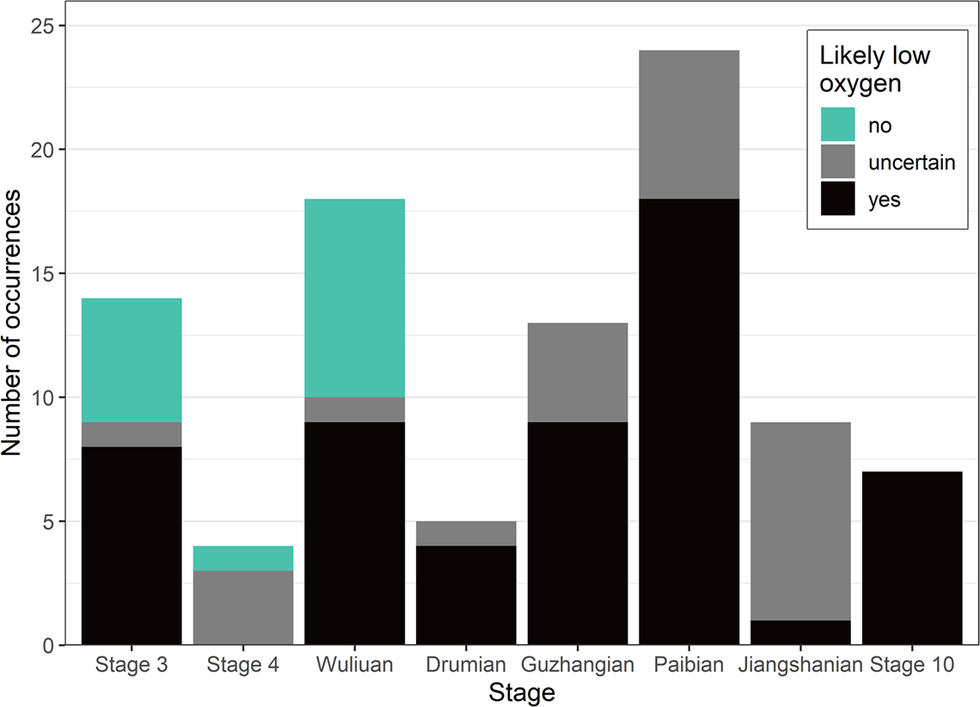
Phosphatocopids are known from a range of depositional settings, including shallow marine carbonates and phosphorites, as well as outer shelf settings characterized by black shales and pyritic limestones. Phosphatocopids commonly, although not exclusively, occur in facies indicative of low environmental oxygen levels (Supplementary Data 1). Across the data set, 60% of occurrences are from likely low-oxygen settings, and only 15% of occurrences are from settings that are unlikely to be characterized as low oxygen (the remaining 25% are “unknown” or “possibly” low oxygen; Fig. 6; Supplementary Data 1). From the Drumian through Paibian stages, the proportion of occurrences from likely low-oxygen settings is between 69 and 80%, with the absolute number of likely low-oxygen-setting occurrences peaking during the Paibian Stage (18 of 24 occurrences; Fig. 6).
Number of occurrences by Cambrian stage and their identified marine oxygenation conditions based on the geological setting of each occurrence. The majority (50%) of phosphatocopid occurrences are from likely low-oxygen settings, with only 15% of occurrences from settings identified as not likely to have a low oxygen concentration; the remaining 35% of occurrences are from settings where we are uncertain of the oxygenation state. From the Drumian onward, all occurrences are from either uncertain or low oxygen settings.

The earliest phosphatocopid assemblages, within stratigraphic uncertainty, are from the Cambrian Epoch 2 Age 3 Yurtus Formation of Tarim (Zhang et al., Reference Zhang, Guan, Wu, Ren, Wang and Wu2020) and the Shuijingtuo and Heilinpu formations (Hubei and Yunnan provinces) of the South China paleoplate (Hou et al., Reference Hou, Siveter, Williams and Feng2001) and include several species of Dabashanella in deep shelf settings. One of these taxa, Dabashanella hemicyclica, is paleogeographically widespread and also occurs in shallow to mid-shelf carbonates of the approximately contemporaneous Besh-Tash and Shabakta formations of the Tuva/Mongolia terrane (Malyi Karatau and Talas Alatau terranes) of central Asia (Melnikova et al., Reference Melnikova, Siveter and Williams1997) and the shallow shelf carbonates of the Ajax and Mernmerna formations of East Gondwana (Australia; Topper et al., Reference Topper, Skovsted, Brock and Paterson2011). Other taxa of Epoch 2 include the Avalonian Comleyopsis schallreuteri Hinz-Schallreuter, Reference Hinz-Schallreuter1993 and Klausmuelleria salopiensis Siveter et al., Reference Siveter, Waloszek and Williams2003 in the shelf marine carbonates of the Lower Comley Limestones, Welsh Borderland of the United Kingdom (Cambrian Age 3 to Age 4; Siveter et al., Reference Siveter, Waloszek and Williams2003).
A further group of phosphatocopids occur in shallow marine phosphorite depositional settings of the early Miaolingian (Wuliuan) in East Gondwana (Australia). These include the assemblages from the Monastery Creek Phosphorite Member of the Beetle Creek Formation in Queensland, Australia (Valetich et al., Reference Valetich, Zivak, Spandler, Degeling and Grigorescu2022), which includes endemic species of Parashergoldopsis, Schallreuterina, Semilia, Dabashanella, and Tubupestis, and Ulopsis and Ingelorehinzia from the Arthur’s Creek Formation of the Northern Territories (Jones and Laurie, Reference Jones and Laurie2006; Jones and Kruse, Reference Jones and Kruse2009).
Late Miaolingian (Guzhangian) and early Furongian (Paibian) phosphatocopids typically occur in pyritic black mudstones and interbedded nodular limestones and mudstones that were deposited in deep, outer shelf settings (Fig. 6). Associated minerals include glauconite and phosphate (Supplementary Data 1) and, together with pyrite and high-organic-matter content of the deposits (sometimes referred to as petroliferous), point toward low-oxygen seabed conditions at the time of deposition. This is the context for most of the taxa from Baltica and Avalonia, which are found predominantly in the black shales of the Outwoods Shales Formation in Warwickshire, England (Williams and Siveter, Reference Williams and Siveter1998), and “stinkstones” and mudstones of the Alum Shales Formation of southern Sweden (e.g., Maas et al., Reference Maas, Waloszek and Muller2003). Associated taxa include olenid trilobites that are thought to signal low-oxygen conditions (e.g., Fortey, Reference Fortey2000, Reference Fortey2014). Phosphatocopid taxa that are exclusive to such facies include Aparchona, Bidimorpha, Waldoria, Veldotron, Trapezilites, Cyclotron, and Falites species and the majority of Hesslandona (neocopina and broader groups) and Vestrogothia species (Supplementary Data 1). The late Furongian Planamandibulus nevadensis n. gen n. sp. is also associated with dysoxic sedimentary facies in the upper Windfall Formation of Nevada, USA. During the late Miaolingian and Furongian, phosphatocopids are only very rarely reported from more inshore and shallower water facies (Fig. 5; Supplementary Data 1).
Latitude and sea temperature controls on phosphatocopid distribution
The lithofacies distribution patterns of phosphatocopids suggest an association with low-oxygen environments, but the group also demonstrates clear paleolatitudinal differentiation of taxa, and here we compare these patterns with paleoclimate model simulations of sea surface and below sea surface Cambrian ocean temperatures. We plot the latitudinal distributions of taxa according to three continental rotation models (Torsvik and Cocks, Reference Torsvik and Cocks2016; PALEOMAP: Scotese and Wright, Reference Scotese and Wright2018; MERDITH2021: Merdith et al., Reference Merdith, Williams, Collins, Tetley and Mulder2021). Although absolute paleolatitudes and positions vary between the different models, the overall patterns are remarkably consistent (Fig. 5). Phosphatocopid occurrence data are available for Cambrian ages 3 to 10, but it is the patterns identified in the Guzhangian (late Miaolingian) and Paibian (early Furongian) that provide the greatest detail as these have the widest geographical spread. We identify species that suggest warm-water and cool-water preferences.
In Cambrian Epoch 2 (Age 3), and later in the early Miaolingian (Wuliuan), Dabashanella possessed an essentially low-latitude (<35°) range and occurred in both shallow marine and deeper shelf settings (Fig. 5). Comparison with climate models for this interval suggests that shallow marine Dabashanella species lived in surface waters typically of about 25 to 30 °C but extended into deeper water settings (below storm-wave base) that may have been as cool as 20 °C. The wide geographical distribution of Dabashanella species between East Gondwana, South China, Tarim, and Tuva/Mongolia, but their absence from higher paleolatitude sites, suggests this was a warm-water taxon. By comparison, the late Epoch 2 Comleyopsis and Klausmuelleria occur at high southern paleolatitudes (>60°S) likely in water temperatures modeled to between 5 and <15 °C. We note that the single occurrence of an unidentified phosphatocopid in the lower Comley Limestones (Series 2) of the Welsh Borderland that resembles Dabashanella (Williams and Siveter, Reference Williams and Siveter1998, pl. 6, figs. 9, 10) might challenge these assumptions if further evidence is identified.
The shallow marine shelf taxa of early Miaolingian age that are endemic to East Gondwana (Australia), namely Ulopsis, Ingelorehinzia, Parashergoldopsis, Schallreuterina, Semilia, and Tubupestis may represent a warm-water-adapted tropical phosphatocopid assemblage, likely in waters modeled to between 25 and 30 °C. None of these taxa has been reported elsewhere from eastern Gondwana or adjacent paleocontinents, but the phosphatocopid Dabashanella, which is also a component of these assemblages, does occur in South China, Tarim, and Tuva/Mongolia, suggesting that environmental barriers, including temperature, and not geography, were a key control on the endemic taxa.
Late Miaolingian and early Furongian phosphatocopid occurrences cover a wide paleolatitudinal range, but most faunas have been described from paleocontinental Baltica and Avalonia. These include the taxa Aparchona, Bidimorpha, Waldoria, Veldotron, Trapezilites, and Cyclotron that occur exclusively in mid- to high paleolatitude (>35 to 90°S) deep shelf sites, probably with water temperatures from 4 to 20 °C (Fig. 7). These may define a warm-temperate and temperate zone fauna, though it is notable that some of the co-occurring phosphatocopid taxa also extended into lower paleolatitudes, notably Hesslandona (both necopina and broader groups), Vestrogothia, and Falites. Although generally a mid- to high-paleolatitude taxon, Hesslandona is known from a mid-depth deposit low (<30°) paleolatitude deposit in the Jiangshanian, with water temperatures potentially reaching the mid-20s °C (Fig. 7).
Comparison between Guzhangian + Paibian phosphatocopid occurrences (1) and modelled zonal average sea temperatures with depth (2). Note, there are no “shallow–mid” or “mid” depth occurrences for the Guzhangian or Paibian. Colors represent water depth: categorical for phosphatocopid occurrences; model ocean depth level for zonal average temperatures. Modelled sea temperatures from the HadCM3L “tfks” series 500 Ma simulation (see Judd et al., Reference Judd, Tierney, Lunt, Montañez, Huber, Wing and Valdes2024, and explanation in text).

No definitive low-paleolatitude phosphatocopid fauna is identified for the late Miaolingian and early Furongian, although rare and putative Falites and Vestrogothia are reported from the late Miaolingian of the Qilian Block (peri-South China) and Laurentia, respectively (Supplementary Data 1). Overall, this may represent a particular collection bias toward Avalonia/Baltica during this interval, and/or the absence of suitable lithofacies for phosphatocopids in other paleocontinental areas. However, the persistence of phosphatocopids in low paleolatitudes is suggested by a suite of Hesslandona and Vestrogothia species from South China in the Jiangshanian, and the late Furongian (Age 10) Planamandibulus n. gen., which currently is known only from low-paleolatitude Laurentia.
Oxygen levels as a control on phosphatocopid distribution
Although some of the patterns of distribution may indicate a water temperature preference, phosphatocopids have long been associated with dysoxic facies (e.g., Williams et al., Reference Williams, Vannier, Corbari and Massabuau2011). This is borne out in our data set, which shows that about 60% of all occurrences are from likely low-oxygen settings, and only about 15% are unlikely to be from low-oxygen settings (the remaining ~25% are uncertain, rated “possible” low-oxygen or “unknown” settings; Fig. 6; Supplementary Data 1). From the Drumian through Paibian stages, the proportion of occurrences from likely low-oxygen settings is between 69 and 80%, with the absolute number of likely low-oxygen-setting occurrences peaking during the Paibian Stage (18 of 24 occurrences; Fig. 6).
The dominant occurrence of phosphatocopids in facies that signal low ocean oxygen concentrations suggests that they may have had a capacity to recover from anaerobic shock, as demonstrated by some modern aquatic pancrustaceans (e.g., Malard and Hervant, Reference Malard and Hervant1999). However, it is unlikely they occupied permanently hypoxic environments as living arthropods are unable to withstand reduced oxygen for more than a few days. This resilience to low-oxygen conditions may have been present in the earliest phosphatocopids, explaining the wide geographical and environmental occurrence of Dabashanella in both shallower marine carbonates and deep shelf black mudstones. This environmental resilience may also explain the wide dispersal of individual species such as Dabashanella hemicyclica and Hesslandona angustata (Supplementary Data 1).
Biogeographical patterns
Biogeographical patterns have been explored in Cambrian arthropods, including trilobites and bradoriids. For trilobites, the data set is very extensive and involves some 2,460 genera from about 40 tectonostratigraphic settings worldwide (Álvaro et al., Reference Álvaro, Ahlberg, Loren, Bordonaro and Choi2013). That analyzed for Bradoriida is much smaller and includes 64 genera from 20 geographical occurrences worldwide (Williams et al., Reference Williams, Siveter, Popov and Vannier2007). By comparison, we analyze 75 phosphatocopid taxa (Fig. 1) from nine geographical regions (Fig. 8) whose reconstructed biogeographical patterns are similar to those of bradoriids and trilobites. In our analysis of biogeography, we focus on genera, mindful that higher-level taxonomy of phosphatocopids is complex, with the families Hesslandonidae, Falitidae, and Vestrogothiidae all being identified as paraphyletic and the genus Hesslandona currently ill-defined (Zhang and Dong, Reference Zhang and Dong2009).
Paleobiogeography of phosphatocopid genera occurrences through the Cambrian, grouped into two time bins, Stage 3 to Drumian and Guzhangian to Stage 10, shown as craton presence–absence matrices and maps. For this plot only, occurrences were rotated to the midpoint ages for each set of stages (510.75 Ma and 493.675 Ma, respectively) using the PALEOMAP rotation model (Scotese and Wright, Reference Scotese and Wright2018). Colors represent phosphatocopid genera, including those in open nomenclature; taxa in open nomenclature are faded in the presence–absence matrices and are excluded from the paleobiogeographic maps; the color scale is consistent across all panels; convex hulls span the locations of occurrences of each genus.

For trilobites in Epoch 2, a redlichiid province has been recognized in South China and East Gondwana, an olenellid province in Laurentia, Baltica, and Siberia, and an intermediate (“overlapping”) bigotinid province in peri-Gondwanan terranes (summarized by Álvaro et al., Reference Álvaro, Ahlberg, Loren, Bordonaro and Choi2013). Nevertheless, phylogenetic analysis of fallotaspid trilobites within the olenellid province demonstrated close links with redlichiid trilobites, so that a complex pattern of biogeographical relationships emerges (Lieberman, Reference Lieberman2002). Williams et al. (Reference Williams, Siveter, Popov and Vannier2007) also recognized distinct eastern and western bradoriid assemblages for Epoch 2 and the Miaolingian, with tropical/subtropical bradoriid assemblages in East Gondwana, South China, and Siberia characterized by kunmingellids and comptalutids, and a cooler-water hipponicharionid, beyrichonid, and bradoriidid assemblage of Avalonia, Baltica, and West Gondwana. Although phosphatocopid faunas are sparsely geographically distributed through this interval, those of East Gondwana and South China are characterized by Dabashanella and taxa endemic to East Gondwana such as Ingelorehinzia and Tubupestis, being different from those of Avalonia and Baltica, where Compleyopsis and Klausmuelleria are reported.
Late Miaolingian and Furongian occurrences of bradoriids are too rare to define clear biogeographical regions (Williams et al., Reference Williams, Siveter, Popov and Vannier2007), but Acado-Baltic (sometimes referred to as Atlantic) and Pacific trilobite provinces have been distinguished (patterns summarized by Álvaro et al., Reference Álvaro, Ahlberg, Loren, Bordonaro and Choi2013). The Acado-Baltic province is represented by Avalonian, Baltic, certain peri-Gondwanan, and deep-water Laurentian trilobite faunas and seems to signal a cool-water setting (Álvaro et al., Reference Álvaro, Ahlberg, Loren, Bordonaro and Choi2013). Late Miaolingian and early Furongian phosphatocopid faunas of Avalonia and Baltica show a pattern consistent with the Acado-Baltic province and are characterized by a cool and often deep-water assemblage of Bidimorpha, Veldotron, Cyclotron, Trapezilites, and Waldoria. We have noted (in the preceding) that the North American Planamandibulus n. gen. is related to Cyclotron, being also consistent with the extent of the Acado-Baltic trilobite province, although it may have occurred in a warmer sub-surface temperature regime. These assemblages also include Hesslandona (necopina and broader groups) and Vestrogothia, which show biogeographical links with rare phosphatocopid faunas of this age from South China, although no endemic South China or East Gondwana phosphatocopid assemblages of this age have been described.
Conclusions
We describe the new phosphatocopid Planamandibulus nevadensis n. gen. n. sp. from the upper Windfall Formation (Furongian, Stage 10) of Nevada, USA. This is the first phosphatocopid from North America to be described with its soft anatomy, and it indicates an affinity with the Baltic and Avalonian genus Cyclotron. The new phosphatocopid material from Laurentia facilitates a global analysis of Cambrian phosphatocopid faunas that suggests sea temperature, seawater oxygen level, and paleogeography all exerted controls on phosphatocopid distribution. Thus, many phosphatocopids are associated with sedimentary deposits that suggest low-oxygen conditions at the seabed, vis black shales, sulfurous or petroliferous deposits, pyrite, glauconite, and associated fauna of olenid trilobites (Supplementary Data 1). These deposits become particularly widespread during the late Miaolingian and early Furongian, when records of phosphatocopids are most diverse. Patterns of paleolatitudinal differentiation identify warm-water tropical/subtropical taxa such as Dabashanella and cooler (temperate) water fauna such as Veldotron, Bidimorpha, Trapezilites, Cyclotron, and Waldoria. While some taxa exhibit wide paleogeographical connections, for example, Hesslandona (necopina and broader group) in Baltica and South China, clear biogeographical patterns emerge, with an early (Epoch 2–early Miaolingian) South China/East Gondwanan assemblage characterized by Dabashanella and ulopsids such as Tubupestis and a later (late Miaolingian–early Furongian) Avalonian/Baltic assemblage characterized by Veldotron, Bidimorpha, Trapezilites, Cyclotron, and Waldoria. Planamandibulus nevadensis from the late Furongian of the USA is the youngest phosphatocopid taxon to be described, and its depositional context in deep-water petroliferous deposits and affinities with the Baltic/Avalonian Cyclotron are consistent with the environmental and biogeographical patterns described here.
Acknowledgments
M.W., T.H.P.H., and T.W.W.H. acknowledge Leverhulme Grant RPG-2022-233 “Earth system dynamics at the dawn of the animal-rich biosphere.” We also acknowledge J.F. Taylor, co-collector of the Ninemile section, H. Belkin for assistance with initial SEM imagery, and S.W. Nixon for 3D printing. Huaqiao Z. (NIGPAS, Nanjing), D.J. Horne (Queen Mary, London), and T. Topper (Swedish Museum of Natural History) are thanked for their constructive and invaluable reviews.
Competing interests
None.
Data availability statement
All data and code needed to reproduce the analyses are included in the main text and supplementary materials. The SRXTM data are available in the University of Plymouth PURE repository: https://doi.org/10.24382/5495bebb-698a-4c5f-a4ad-c7cc9367c4f7.




 Open access

