

Of the official languages of South Africa, Afrikaans has the widest geographical, demographic and racial distribution (Webb Reference Webb, Tollefson and Tsui2003). According to the latest South African census of 2011 (StatsSA 2012), Afrikaans as first language is spoken by 13.5% of the country's inhabitants, only surpassed in numbers by Zulu (22.7%) and Xhosa (16%). In neighbouring Namibia, 10.4% of the population has Afrikaans as their first language. A noteworthy number of recent emigrants to United Kingdom, Australia, Europe and North America are likely to be Afrikaans speakers as well.Footnote 1 A handful of elderly persons in Patagonia still speak Afrikaans; they are descendants of some 600 Afrikaans speakers who settled in Patagonia at the beginning of the 20th century (Du Toit Reference Du Toit1995, Coetzee et al. Reference Coetzee, Beddor, Shedden and Wissing2018).
Of the 6,855,082 Afrikaans speakers in South Africa, 39.78% are White, 50.52% are Coloured and the rest are Black African (8.84%), or Indian Asian (0.86%). Within South African population groups,Footnote 2 75.8% of Coloured South Africans, and 60.8% of White South Africans are first-language Afrikaans speakers. A large number of speakers with first languages other than Afrikaans also have good to reasonable proficiency in Afrikaans. In the post-apartheid era, younger speakers generally lack such skills.
Language map of South Africa. (A) The nine provinces. Light-coloured areas are those where Afrikaans dominates. (B) Areas where Afrikaans is spoken the most, i.e. the Western and Northern Cape. (C) Gauteng and the surrounding areas. (Main map was obtained from Ethnologue: https://www.ethnologue.com; inserted map of SA provinces: https://www.google.co.za/ provincesofsouthafrica/map.)

Afrikaans, spoken mainly in South Africa, belongs to the same group of West Germanic languages as Dutch and German. It has its roots in 17th century Dutch, but has been influenced by English, French and German. Traces of other non-European languages are mentioned in the literature, which include, amongst others, Malay and Portuguese (see Conradie & Groenewald Reference Conradie, Groenewald, Carstens and Bosman2014, for a general overview and references). The role played by the pidgin talk of the indigenous Cape Khoikhoi (or Khoe) in the development of Afrikaans is dealt with especially by De Ruyter & Kotzé (Reference De Ruyter and Kotzé2002). Kotzé (Reference Kotzé2014) highlights the role of Kaapse Moesliemafrikaans (viz. Cape Muslim Afrikaans) in this regard. The influence of these non-European languages is restricted mainly to aspects other than pronunciation.
A number of varieties of Afrikaans are mentioned in the literature. Especially prior to the end of the apartheid era (during the last decades of the previous century), Standaardafrikaans (viz. Standard Afrikaans, henceforth SA) was widely regarded as the official variety. De Villiers & Ponelis (Reference De Villiers and Ponelis1987), specifically referring to ‘standard pronunciation’, typify SA as developing from the dialect used in the Cape (currently Western Cape) inland, the Eastern Cape, the Free State and Natal (i.e. Kwazulu-Natal), and often used by the SABC (South African Broadcasting Corporation); one could also add, ‘in public life’. Less strictly defined, it may be equated with the koine described by De Villiers & Ponelis (Reference De Villiers and Ponelis1987: 44) as the ‘verbreidste omgangsuitspraakvorm’ (the most widely used colloquial language). According to these authors, it can be characterised negatively by the absence, or positively by the presence, of a number of marked pronunciation features (De Villiers & Ponelis Reference De Villiers and Ponelis1987: 44). They furthermore indicate the status of SA as that of a formal speech style which, in terms of pronunciation, is free of obvious, particularly regional, dialect features.Footnote 3 Note that at the time of publication of their book, Afrikaans radio commentators of the SABC were exclusively white, educated persons, mainly from the northern parts of South Africa, and centred in Johannesburg (currently in the Gauteng province). Implicitly or explicitly, this formal pronunciation formed, up until then, the basis of virtually all standard phonetic and phonological descriptions of Afrikaans (see Le Roux & Pienaar, Reference Le Roux and Pienaar1927, Wissing Reference Wissing1982, Combrink & De Stadler Reference Combrink and Stadler1987, De Villiers & Ponelis Reference De Villiers and Ponelis1987). Le Cordeur (Reference Le Cordeur2011) provides the following fairly comprehensive list of Afrikaans varieties other than SA: Cape Afrikaans (including Muslim Afrikaans), Orange River Afrikaans (including Griekwa-Afrikaans, and Namakwalands), Eastern Border Afrikaans (including Karoo-Afrikaans, Tswana-Afrikaans, and Tsotsitaal). However, given his focus on speaker identity, one does not find much detail concerning the pronunciation features of these non-standard varieties.
De Villiers & Ponelis (Reference De Villiers and Ponelis1987) do include references to and descriptions of facets of the pronunciation of non-standard varieties, notably Cape Afrikaans. Wissing (Reference Wissing2017a) devotes some attention to the acoustic features of the vowel system of GA. Links (Reference Links1989) covers some aspects of the pronunciation of Namakwaland Afrikaans, as spoken in Kharkams, Northern Cape, while Wissing (Reference Wissing2011) focuses on acoustic aspects of the phonetics of that variety of Afrikaans.
Currently, a clear drive towards restandardisation can be observed. Odendaal (Reference Odendaal2014) addresses the question of whether or not restandardisation is desirable from a sociolinguistic viewpoint. This is done by giving an overview of why SA is not seen as being representative of the entire Afrikaans speech community since the 1980s; why it is necessary that the standard be redefined; and lastly, what the restandardisation of Afrikaans would entail in outline.
Hendricks (Reference Hendricks, Hendricks and Dyers2016) considers two possible routes in this regard. Firstly, SA could be replaced by one of the historically marginalised regional lects – either south-western Afrikaans (notably, Cape Afrikaans), or Orange River Afrikaans. Hendricks maintains that such a radical undertaking, although perhaps politically correct, could lead to an implosion of the language as a whole, and accelerate destandardisation instead (see also Hendricks Reference Hendricks and Prah2012). He promotes a less drastic reform option, supported by inclusive sociopolitical backing (see also Kotzé Reference Kotzé2014 in this regard).
It is against the foregoing background that the current phonetic and phonological description of Afrikaans is to be viewed. The content covered below is largely delimited by the available literature. In this respect, the standard textbooks of Le Roux & Pienaar (Reference Le Roux and Pienaar1927), Combrink & De Stadler (Reference Combrink and Stadler1987), and De Villiers & Ponelis (Reference De Villiers and Ponelis1987) form the basic reference works, supplemented by a number of other publications – mainly articles in linguistic journals.
The transcriptions of the narrative of the Afrikaans version of ‘The North Wind and the Sun’ (‘Die Noordewind en die Son’) are based on recordings of a prominent 58-year-old female radio presenter, generally considered to be a speaker of SA.Footnote 4 The remaining examples (word lists and those in the main text) are recordings of a second female native speaker (aged 30 years) who speaks what would generally be considered to be SA.
Consonants

The consonants that occur in Afrikaans are presented in the above table. The sounds between parentheses have a marginal status, in that they occur in loan words only, or are allophones that result from surface phenomena.
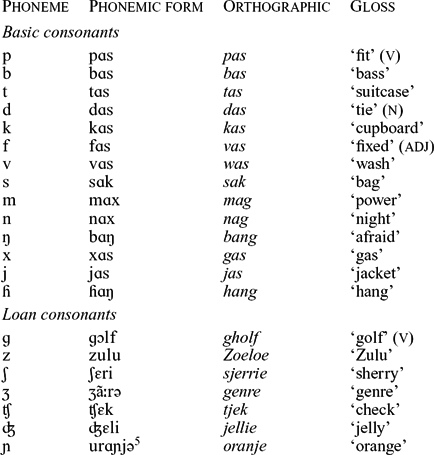
The Afrikaans voiceless plosive consonants /ptk/ lack aspiration, but may show some presence of affrication (Wissing & Coetzee Reference Wissing and Coetzee1996). The voiced plosives /b/ and /d/ are traditionally characterised by the presence of prevoicing, although prevoicing is frequently absent. Coetzee et al. (Reference Coetzee, Beddor, Shedden and Wissing2018) demonstrate that the voicing contrast is collapsing word-initially, with prevoiced plosives being replaced by voiceless (unaspirated) plosives. They also found that the loss of the voicing contrast does not result in a concomitant loss of lexical contrast. Lexical contrast, rather, is preserved on the following vowel, with vowels after historically voiced plosives being realised with a low f0, and those after historically voiceless plosives being realised with a high f0 (i.e. the original voicing contrast is being replaced by a tonal contrast).
The alveolar trill [r] varies with the uvular trill [ʀ], the latter found notably in the Boland region of the Western Cape, but also quite frequently in other areas of SA (Pienaar Reference Pienaar2017 provides an overview and mentions relevant literature; see also Ribbens-Klein Reference Ribbens-Klein2016).
Note that /j/ may be either a fricative or an approximant (Le Roux & Pienaar Reference Le Roux and Pienaar1927: 82). The first variant is common in onset position, as in [jɑs] jas ‘jacket’; the latter, as an intervocalic glide (e.g. in [fliːjә] vlieë ‘flies’, the plural form of vlieg ‘fly’). [ɦ] has a similar function as a glide intervocalically, as in [traːɦә]) trae ‘reluctantly’, derived from traag ‘reluctant’; so does [ʋ]Footnote 6 (in [uːʋә] oë ‘eyes’, the plural form of oog ‘eye’). Furthermore, [ʋ] is an allophone of the voiced labiodental fricative /v/, when preceded by voiceless plosives /tk/ (e.g. /tvaːlf/ [tʋaːlf] twaalf ‘twelve’, or /kvaːd/ [kʋaːt] kwaad ‘angry’). A small number of (mostly borrowed) words have the post-alveolar affricates /t͡ʃ/ (voiceless), e.g. in [t͡ʃ ɛk] tjek ‘check’, and /d͡ʒ/ (voiced), e.g. in [d͡ʒ ɛli] jellie ‘jelly’. The latter regularly appears in Cape Afrikaans, especially as used by Coloured speakers, e.g. in jy ‘you’ (De Villiers & Ponelis Reference De Villiers and Ponelis1987: 45). Adam Small, a well-known Capetonian poet, even transcribes this affricate orthographically with ‘dj’ in some of his poems; for example, in Doemanie: ‘djy moet djou palys-hys’ (i.e. jy met jou paleis-huis ‘you with your palace house’). Kotzé (Reference Kotzé1983) mentions similar instances in Malayan Afrikaans.
De Villiers & Ponelis (Reference De Villiers and Ponelis1987) highlight a type of affrication in Cape Afrikaans that is absent in the standard variety. In the latter, /k/ frequently has [c] as an allophone, via a process of coarticulation, as in /biki/ > [bici] bietjie ‘a little bit’, while in Cape Afrikaans, it surfaces as [t͡ʃ], thus [bit͡ʃi].
Consonant reduction
As is common in other Germanic languages, consonants are reduced in a number of instances, especially at a rapid speech rate. Usage frequency is an important restrictive factor. The most frequently used reductions are the following: /d/-reduction, /r/-reduction, identical consonant cluster simplification, and complex cluster simplification.
Deletion of /d/ is a widely occurring phenomenon in all varieties of Afrikaans, especially, but not restricted to, the phonetic context of sonorant consonants /nmlr ŋ/, followed by unstressed vowels – mostly schwa. Examples include the following: /ˈɑndər/ > [ɑnər] ander ‘other’, /ˈɦɑndə/ > [ɦɑnə] hande ‘hands’, /ˈɔmdɑt/ > [ˈɔmɑt] omdat ‘because’, /ˈkɛldər/ > [kɛlər] kelder ‘cellar’, and /ˈpɛrdə/ > [pærə] perde ‘horses’. This phenomenon is most commonly found in plural forms similar to perde, e.g. in /ˈfrində/ > [frinə] vriende ‘friends’, and /ˈspɛldə/ > [spælə] spelde ‘pins’. The same happens in attributive adjectives; for example, /ˈvəldə/ > [vələ] wilde ‘wild’, and /ˈfɔlxəndə/ > [fɔlxənə] volgende ‘next’. Adjectives with -ig (/əx/) also tend to lose /d/, as in /xəˈvɛldəx/ > [xəˈvæləx] geweldig ‘mightily’. (For /ɛ/ > [æ] see ‘Vowels’ section.)
In connected speech, the /d/ in function words like die, dat and daar is regularly deleted, as in /əndi/ > [əni] in die ‘in the’, /vəldi/ > [vəli] wil die ‘will the’, /ɔmdi/ > [ɔmi] om die ‘around the’, and /maːrdi/ > [maːri] maar die ‘but the’. Such deletion extends to cases of consonants other than the sonorants; for example, in /ɔfdi/ > [ɔfi] of die ‘or the’, /mɑxdi/ > [mɑxi] mag die ‘may the’, /ɔpdi/ > [ɔpi] op die ‘on the’, /oːkdi/ > [ɔki] ook die ‘also the’, and /vɑsdi/ > [vɑsi] was die ‘was the’. The loss of /n/ in the function word nie ‘not’ is similar to this, as in /ɔfni/ > [ɔfi] of nie ‘or not’, and /mɑxni/ > [mɑxi] mag nie ‘may not’.
/d/-deletion is not only characteristic of SA. De Villiers & Ponelis (Reference De Villiers and Ponelis1987: 122) list a number of cases where this commonly happens in Cape Vernacular Afrikaans. They restrict this to the loss of /d/ in the position after the homorganic sonorants /nl/. Examples from their list include the following: /xrɔnd/ > [xrɔːn] grond ‘ground’, /mɔnd/ > [mɔn] mond ‘mouth’, and /xɛld/ > [çiæl] geld ‘money’. See also Kotzé (Reference Kotzé1983), who provides similar examples for Malayan Afrikaans.
In colloquial speech, the voiced alveolar trill /r/ tends to be omitted in syllable-final position. This happens mostly in unstressed syllables, and regularly in the prefix ver-, as in /fərˈkeːrd/ > [fəkiərt] verkeerd ‘wrong’. In word-final position, as in /lɛkər/ > [lækə] lekker ‘nice’, /r/-deletion is quite common across the board, especially in function words like daar, maar, hier, vir: /daːr/ > [daː] daar ‘there’, /maːr/ > [maː]Footnote 7maar ‘but’, /foːr/ > [fuə] voor ‘in front of’, and /fər/ > [fə] vir Footnote 8 ‘for’. This phenomena is widely present in Malayan Afrikaans. Kotzé (Reference Kotzé1983) mentions similar examples, but adds to these the loss of /r/, even in complex codas, e.g. [fəket] verkeerd ‘wrong’, [bɔːs] bors ‘breast’, and [kənəs] kinders ‘children’ – transcriptions are Kotzé’s.
Identical consonant simplification
In rapid speech, identical consonants that occur adjacently tend to be pronounced as a single sound, especially in compounds, such as in /jɑssɑk/ > [jɑsɑk] jassak ‘coat pocket’. In the narrow transcription of the Noordewind passage provided later, the same is to be observed across word boundaries, as in /nɛttu/ > [nɛtu] net toe ‘just then’, and /vɑrmmɑntəl/ > [vɑrəmɑntəl]Footnote 9warm mantel ‘warm cloak’.
Simplification of complex consonant clusters
Some Afrikaans words have multiple intervocalic consonant clusters, which tend to be simplified in normal speech, e.g. /ɑmptənaːr/ > [ɑmtənaːr] amptenaar ‘official’, /səmptoːm/ > [səmtuəm] simptoom ‘symptom’, or /ɔntstaːn / > [ɔnstaːn] ontstaan ‘originate’, and /pɑntsər/ > [pɑnsər] panser ‘armor’, whereby the obstruent consonants /p/ and /t/ are deleted, when preceded by a homorganic nasal consonant and followed by another obstruent.
Some phonological processes affecting consonants
Word- and syllable-final plosives devoice in the coda (by ‘Auslautsverhärting’); for example, /ɦud/ > [ɦut] hoed ‘hat’, and also in /vənd/ > [vənt] wind ‘wind’. On the other hand, when followed by voiced consonants, voiceless plosives and voiceless fricatives become voiced allophones through a process of regressive voicing assimilation; for example, /sɛsdə/ > [sɛzdə] sesde ‘sixth’. This also happens across word boundaries, as follows: /dəsvɑrm/ > [dəzvɑrəm] dis warm ‘it's hot’ – i.e. all types of obstruents, plosives as well as fricatives, can trigger regressive voicing assimilation. Progressive assimilation of voicing is also present in Afrikaans, resulting in the devoicing of voiced obstruents. A widely observed case is that of the onset consonant of the suffix -de, as in /sɛsdə/ > [sɛstə] sesde ‘sixth’. Note that both types of voicing assimilation are possible in the same word (i.e. sesde). It seems that progressive voicing assimilation is more likely to occur in the speech of females, while male speakers more commonly present regressive voicing assimilation.
In Afrikaans, like in many other languages, nasal consonants are often homorganic, with a following obstruent – i.e. there is nasal assimilation. As a process, this is mainly relevant in the case of the alveolar nasal /n/ that takes on the same place of articulation of the following consonant (usually obstruent). Nasal assimilation occurs freely within derivations and compound words. Nasal-final prefixes like in- and on-, underlyingly ending in the alveolar consonant /n/, thus assimilate according to the place of articulation of the following obstruent. Examples of nasal assimilation within derivations include the following: /ənpɑs/ > [/ənpɑs/ inpas ‘fit in’ (following bilabial obstruent), and /ənkɔm/ > [əŋkɔm] inkom ‘come in’ (following velar obstruent). Similar examples are found in compounds, as follows: /steːnbɔk/ > [stiəmbɔk] steenbok ‘ibex’ (bilabial obstruent), and /steːnkoːl/ > [stiəŋkuəl] steenkool ‘coal’ (velar obstruent). As is the case with similar assimilatory processes, factors like speech rate and usage frequency play a role in the occurrence of this type of consonant assimilation. Wissing (Reference Wissing, Carstens and Bosman2017b: 138) provides a complete set of examples.
The palatalisation of the allophonic voiceless alveolar fricative /s/ to a voiceless post-alveolar fricative [ʃ] is evident in the pronunciation of especially young speakers (< 40 years), and especially in the coda cluster -rs, as in /bɑrs/ > [bɑrʃ] bars ‘burst’ (Wissing, Pienaar & Van Niekerk Reference Wissing, Pienaar and Niekerk2015). At the same time, evidence has been found for /s/-fronting in the speech of, in particular, palatalisers, in contexts other than post-/r/, e.g. in /sɛs/ ses ‘six’ – similar to the fronted /s/ of General White South African English, as reported by Bekker (Reference Bekker2007). Furthermore, in connected speech, /s/ is realised as palatal [ʃ] when it occurs word-finally, and when followed across a word boundary by the homorganic fricative /j/ – a case of regressive coarticulation (e.g. in /ɑsjəi/ > [ɑʃəi] as jy ‘if you’). Palatal consonants elsewhere are also the allophonic products of regressive coarticulation, whereby the voiceless velar plosive /k/ is realised as a voiceless palatal plosive [c], when followed by especially the front, high vowel /i/; for example, /kis/ > [cis] kies ‘choose’, or /eː/, as in /keːl/ > [ciəl] keel ‘throat’. The same applies in the voiceless velar fricative /x/, realised as a voiceless palatal fricative [ҫ], as in /xit/ > [ҫit] giet ‘pour’, and /xeːl/ > [ҫiəl] geel ‘yellow’. More examples of this kind are frequently found in standard textbooks, such as Le Roux & Pienaar (1928), Combrink & De Stadler (Reference Combrink and Stadler1987), De Villiers & Ponelis (Reference De Villiers and Ponelis1987) and Wissing (Reference Wissing, Carstens and Bosman2017b).
Vowels
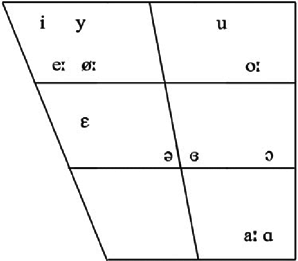
Afrikaans has twelve vowels; a set of eight short (lax, monophthongal) vowels (/iy ɛ ɑ ə œ ɔ u/), and a set of four long (tense) vowels (/eː oː øː aː/), as well as three diphthongs. The long mid-high vowels are usually transcribed by the phonemes /eː øː oː/, though phonetically they are diphthongal in nature (respectively [iə yœ uœ]).Footnote 10 Note (in the vowel diagram above) the use of the phonetic symbol [œ] instead of the IPA symbol [ɞ] for a rounded schwa, as is traditionally being done in all Afrikaans phonetic and phonological work, for example by Le Roux & Pienaar (1928), Combrink & De Stadler (Reference Combrink and Stadler1987), De Villiers & Ponelis (Reference De Villiers and Ponelis1987) and Wissing (Reference Wissing, Carstens and Bosman2017b), as well as in the case of Dutch for example by Booij (Reference Booij1995). Allophonic vowels are introduced in the text.
Although the traditional phoneme symbol /a:/Footnote 11 for this vowel in Afrikaans seems indicative of a somewhat front vowel, the phonetic value is a relatively retracted one; in modern versions of Afrikaans even somewhat rounded and heightened, in the direction of the low-mid back vowel /ɔ/, rendering a phonetic character resembling [ɐ].
The long vowels

Standard Afrikaans long /aː/, especially when stressed or in an accented sentence position, tends to be pronounced as a fully-back vowel; in some cases, even with a clear rounded character. In extreme cases, it is misheard as /ɔː/ (Wissing Reference Wissing2006). This near-homophony with /ɔː/ is a relatively modern sound change, noticed in many younger speakers, especially white female speakers from the northern parts of South Africa. In most non-standard varieties, the long /aː/ has a very similar quality to that of the short vowel /ɑ/.
The short vowels
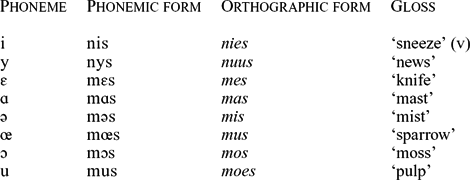
Afrikaans short vowels exhibit a number of special features. Firstly, the front /ɛ/ is high-mid in nature – strikingly higher than that of Standard Dutch. This vowel (as in /sɛs/ [sɛs] ses ‘six’) typically lowers to [æ] in especially the northern variety of SA, with the consonants /kxrl/ as coda of a syllable. Examples include the following: /ɛk/ > [æk] ek ‘I’, /slɛx/ > [slæx] sleg ‘bad’, /fɛr/ > [fær] ver ‘far’, and /sɛl/ > [sæl] sel ‘cell’. Due to its palatalised character, a narrower phonetic transcription [jæ] is feasable. De Villiers & Pienaar (Reference De Villiers and Ponelis1987: 108) transcribe this variant as [iæ]. This specific allophone of /ɛ/, when followed by [l], is widely heard in various Afrikaans variants, especially in the southern parts of South Africa, and is not restricted to the speech of Coloured speakers.
Secondly, the high /u/, again, notably in modern Afrikaans, is clearly a centralised vowel (Wissing Reference Wissing2010). This is in line with the characteristically laxer articulation of SA (Le Roux & Pienaar Reference Le Roux and Pienaar1927).
The diphthongs
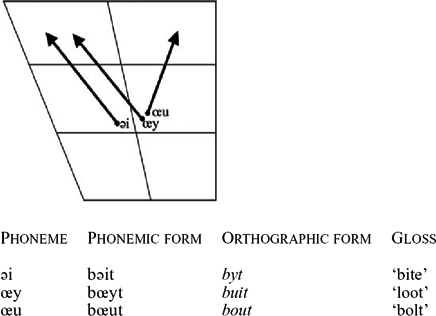
There are three (rising) diphthongs: /əi œy œu/. /əi/ is spelled as either y or ei, /œy/ as ui, and /œu/ as ou.
A small number of words exist with eeu, ooi, aai, mostly in word-final open syllables (e.g. [leːu]Footnote 12leeu ‘lion’, [moːi]Footnote 13mooi ‘pretty’, and [kraːi]Footnote 14kraai ‘crow’. In these cases, it is feasible to view the last segment not as [u] and [i], but as the approximants [ʋ] or [j]. See Booij (Reference Booij1995), for a similar proposal in the case of Dutch.
Except for these three diphthongs, a number of allophonic diphthongs also exist. They are derived from vowels plus [j] in the diminutive forms of nouns that have word-final [t] or [nt] in the singular form. As an example, consider kat+jie ‘kitten’: /kɑt/+/ji/ > [kɑiki].Footnote 15 Apart from [ɑi], [uiyi ɛi ɔi œi əi] are frequently formed in a similar manner – i.e. all with a short vowel as kernel. The long vowels /eː oː øː/ also occur in secondary diphthongs, which are formed in a similar way, rendering respectively [iəi], or perhaps rather [iəj].
Vowel variation
As is the case in other Germanic languages, Afrikaans is characterised by a number of vowel changes, of which reduction is the most salient. Full vowels in unstressed position may reduce, with respect to duration and quality. Reduction manifests itself especially in words with a high frequency of usage, and in informal speech. SA is covered by most textbooks (e.g. those of Le Roux & Pienaar Reference Le Roux and Pienaar1927, Combrink & De Stadler Reference Combrink and Stadler1987, and De Villiers & Ponelis Reference De Villiers and Ponelis1987). The pronunciation of Coloured speakers is covered less fully. De Villiers & Ponelis (Reference De Villiers and Ponelis1987) refer to aspects of Cape Afrikaans; Links (Reference Links1989) deals with some aspects, notably that of unrounding; and Kotzé (Reference Kotzé1983), in the case of Malayan Afrikaans, provides examples of aspects such as unrounding and vowel raising. Here, we mainly focus on SA.
Vowel reduction
Vowels are frequently reduced to schwa in unstressed positions, as in /xɔrˈdəin/ > [xərˈdəin] gordyn ‘curtain’, and /kɑˈnɔn/ > [kəˈnɔn] kanon ‘canon’. When stressed vowels get unstressed, reduction to schwa is evident; for example, stressed /eː/ becomes [ə] in [mɑxnəˈtəsmə] magnetisme ‘magnetism’, derived from /mɑxˈnet/ magneet, and stressed /ɛ/ becomes [ə] in [prɔtəsˈtiər] protesteer ‘protest’, derived from /pruˈtɛs/ protes ‘protest (n)’. These kinds of reduction frequently go together with vowel shortening, whereby long /aː/ in /bɑˈnaːl/ banaal ‘banal’ reduces to [bɑnɑliˈtəit]Footnote 16banaliteit ‘banality’.
Unrounding
A distinctive feature of Afrikaans pronunciation, when compared to Dutch pronunciation, is the unrounding of marked rounded vowels, and also partly of diphthongs. Examples include the following: /nys/ > [nis] nuus ‘news’, /nøːs/ > [niəs] neus ‘nose’, and /rœs/ > [rəs] rus ‘rest’ (vowels); and even in diphthongs, as follows: /mœys/ > [məis] muis ‘mouse’, and /sœus/ > [səus] sous ‘sauce’.
Lack of stress, as well as unaccentnessFootnote 17 in connected speech, is conducive to, but not limited to this phenomenon. Though high-frequency usage, informal style, and fast speech rate are amplifying factors, it is not unusual to notice unrounding in the case of factors other than these too.
An interesting observation in the written Afrikaans (or in the text messages) of especially learners, is that of hypercorrection; for example, [eː] > [øː] in [vaːrdiər] waardeer ‘appreciate’ > [vaːrdyœr], and [ə] > [œ] in [ənməiskək] in my skik ‘satisfied’ > [ənməiskœk].
Nasalisation
Although nasalisation of the vowels of Afrikaans (Coetzee Reference Coetzee1977) has been a distinct characteristic of the vowel system since, at least, the first part of the 20th century (Le Roux & Pienaar Reference Le Roux and Pienaar1927), it seems to be much less the case in recent years. Heavy nasalisation is not observed in especially the speech of younger persons, as well as Coloured speakers of Afrikaans. Nasalisation occurs especially when a vowel is followed by one of the fricative consonants /fvs/; sonorant segments (the consonants /lr/, even in some instances a vowel) may also trigger nasalisation. In the instance of heavy nasalisation, /n/ is deleted, causing compensatory lengthening of preceding short vowels. A typical example is found in the otherwise identical pair, /ɔns/ [ɔ̃ːs] ons ‘we’, compared to /ɔns/ [ɔns] ons ‘ounce’. Nasalisation of diphthongs does occur, though less commonly.
Stress
Primary stress lies predominantly on the final syllable of monomorphemic words, unless such a syllable is unstressable (usually with schwa as nucleus) when penultimate or antepenultimate stress is required. In quite a number of words only containing schwa, one of these vowels do carry stress; for example, in simplexes such as [ˈbətər] bitter ‘bitter’, [ˈvəntər] winter ‘winter’, and [ˈsəndələk] sindelik ‘tidy’. Words ending on /ɑ/, illustrate a strong tendency towards penultimate stress, irrespective of the word length. In the following simplexes, stress invariably lies on the penultimate syllable: [pɑˈtɑtɑ] patatta ‘sweet potato’, [jɑkɑˈrɑndɑ] jakaranda ‘jacaranda’, and [kukəmɑˈkrɑnkɑ] koekemakranka ‘indigenous plant’. The same rule applies in South African Bantu proper names when pronounced in Afrikaans, e.g. [mɑnˈdɛlɑ] Mandela, [rɑmɑˈpɔːzɑ] Ramaphosa, and [ɛkuruˈlɛːni] Ekurhuleni. Final syllables in words of Classic origin generally carry primary stress. Some representative examples include the following: [ɑmbɑsɑˈdøːr] ambassadeur ‘ambassador’, /bɑkɑˈtɛl/ [bɑkɑˈtæl] bakatel ‘trifle’, [əntrəˈsɑnt] interessant ‘interesting’, [dəpɑrtəˈmɛnt] department ‘department’, [ɛtiˈkɛt] etiket ‘label’, [jurnɑˈləs] joernalis ‘journalist’, [kɔsˈtym] kostuum ‘costume’, [pæləˈtɔn] peloton ‘platoon’, [kwɑrəntəin] kwaranˈtyn ‘quarantine’, [suwəˈniːr] soewenier ‘souvenir’, and [trubɑˈduːr] troebadoer ‘troubadour’. A complete list of such cases is provided, together with bibliographical references, in Wissing (Reference Wissing, Carstens and Bosman2017b).
In compounds, it is normally the first constituent that receives primary stress, whereas secondary stress will be on the second constituent; for example, in [ˈplɑtdɑkˌhœys] [[plat][dak]][huis]] ‘flat roof house’, or [ˈɑrbəitsbəˌləit] [[arbeids][beleid]] ‘labour policy’.
Prefixes and suffixes in words of Germanic origin are normally not stressed. Many of these affixes have schwa as nucleus. Words with unstressed (pseudo-)prefixes include the following: [bəˈxən] begin ‘begin’, [xəˈnaːdə] genade ‘mercy’, and [fərˈbaːs] verbaas ‘astonished’; and words with unstressed suffixes include the following: [ˈmuədə] mode ‘vogue’, [ˈliəpəl] lepel ‘spoon’, [ˈtiəkən] teken ‘sign’, [ˈɛmər] emmer ‘bucket’, [ˈvəŋərt] wingerd ‘vineyard’, [ˈniədərəx] nederig ‘humble’, [ˈsaːləx] salig ‘glorious’, and [ˈpirəŋ] piering ‘saucer’, etc.Footnote 18 Non-native suffixes (or pseudo-suffixes) normally do carry primary stress; consider the following: [huərisɔnˈtaːl] horisontaal ‘horizontal’, [priədəˈkɑnt] predikant ‘reverend’, [xəmˈnɑs] gimnas ‘gymnast’, [pɛrsuˈniəl] personeel ‘staff’, [rəxəˈstriər] registreer ‘register’, [jɑpɑˈniəs] Japannees ‘Japanese’, [rəpəbliˈkəin] republikein ‘republican’, [rələxiˈjyəs] religieus ‘religious’, [jəvəˈliːr] juwelier ‘jeweller’, [idijɑˈləs] idealis ‘idealist’, [særtifiˈsiər] sertifiseer ‘certify’, and [ɦistuəriˈkœs] historikus ‘historian’, etc.
Transcriptions of the recorded passage ‘Die Noordewind en die Son’
In this narrative, all twelve Afrikaans vowels and each of the three pure diphthongs are present. The most frequently occurring vowel is schwa /ə/ (N = 54). Every Afrikaans consonant is present as well, bar /j/. Here, /trsnln/, in this order, are the most frequently used consonants (N > 29).
Phonemic transcription
/Ɂɔp ə keːr ɦɛt ˈnoːrdəvənt ɛnsɔnstrəixəˈkrəi Ɂoːrvifɑn ɦœlə nœu ˈɁəintləkdi ˈstɛrkstə vɑs || nɛttukɔmdaːr ə ˈrəisəxərfərˈbəi | xəˈɦœl ən ə ˈlɛkər ˈvɑrəm ˈmɑntəl || ˈɦœlə bəˈslœyttudɑtdi Ɂeːnvɑtdətkɑn ˈrɛxkrəi | Ɂɔmdi ˈrəisəxərtə dvəŋ Ɂɔmsəi ˈmɑntəl Ɂɑftə ɦaːl | di ˈstɛrkstə əs || tublaːsdivənt ˈyːrə lɑŋkfər ˈɁɑlvɑt ɦəivɛrt əs || maːr ɦu ˈɦɑrdər ɦəiblaːs | ɦu ˈdəxtər ɦœldi ˈrəisəxərdi ˈmɑntəl Ɂɔm ɦɔm || Ɂɛntɛn ˈlɑːstə laːt ˈnoːrdəvənt Ɂɑlsəi ˈrøːsə ˈpoːxəŋsfaːr || tuskəinsɔn ˈlɛkər ˈvɑrəm || Ɂɛn ˈdaːdələktrɛkdi ˈrəisəxərsəi ˈmɑntəl Ɂœyːt || Ɂɛnsoː mus ˈnoːrdəvənt Ɂɛrˈkɛndɑt | sɔndi ˈstɛrkstə fɑn ˈɦœlə tveː vɑs/
Narrow transcription
The transcription is based on the fast reading of a 58-year-old reader.
[Ɂɔ pə kiːrət ˈnuərəvənt ənsɔnstrəixəˈkrəi ˈɁuərvifə ˈnələ nəu ˈəintləkdi ˈstærkstə vɑs || ˈnɛtukɔmnaː rə ˈrəisəxərfər ˈbɑi | xəˈɦœl ən ə ˈlækə ˈvɑrəˈmɑntəl || ˈɦələ bəˈsləitudə di Ɂiənvɑ rətkɑn ˈræxkrəi | Ɂɔ mi ˈrəisəxərtə dʋəŋ Ɂɔmsəi ˈmɑntəl Ɂɑftə ɦaːl | di ˈstærkstə Ɂəs || tu ˈblaːsivənt ˈɁyːrə lɑŋkfə Ɂɑlvɑ təiværtəs || maːr ɦu ˈɦɑrdər ɦəiblaːs | ɦu ˈdəxtər ɦœldi ˈrəisəxərdi ˈmɑntəl Ɂɔm ɦɔm || Ɂɛn | tɛn ˈlɑːstə lɑt ˈnuərdəvənt Ɂɑlsəi ˈrøːsə ˈpoːxəŋsfaːr || tuskəinsɔn ˈlækə ˈvɑrəm || Ɂɛn ˈdaːrləktræ ki ˈrəisəxərsɛː ˈmɑntəl Ɂɑit || Ɂɛnsuə mus ˈnuərdəvənt Ɂærˈkɛn | dɑtsɔndistɛrkstə fɑ ˈnə lə tʋeː vɑs]
Orthographic transcription
Op ’n keer het Noordewind en Son stry gekry oor wie van hulle nou eintlik die sterkste was. Net toe kom daar ’n reisiger verby, gehul in ’n lekker warm mantel. Hulle besluit toe dat dié een wat dit kan regkry om die reisiger te dwing om sy mantel af te haal, die sterkste is. Toe blaas die wind ure lank vir al wat hy werd is. Maar hoe harder hy blaas, hoe digter hul die reisiger die mantel om hom. En ten laaste laat Noordewind al sy reuse pogings vaar. Toe skyn Son lekker warm, en dadelik trek die reisiger sy mantel uit. En so moes Noordewind erken dat Son die sterkste van hulle twee was.
Acknowledgements
This article was made possible with the support from the South African Centre for Digital Language Resources (SADiLaR). SADiLaR is a research infrastructure established by the Department of Science and Technology of the South African government as part of the South African Research Infrastructure Roadmap (SARIR). This research was in part financially supported by the National Research Foundation (NRF) of South Africa. Opinions expressed, and conclusions arrived at are those of the author's and are not necessarily to be attributed to the NRF. Anonymous reviewers are thanked for invaluable positive recommendations, as well as the Editor for her patience and meticulous handling of various drafts. Wikus Pienaar was of great technological help throughout this project.
Supplementary material
To view supplementary material for this article, please visit https://doi.org/10.1017/S0025100318000269.



