




The conglomerate caves
In north-eastern Iberia, the margins of the Ebro Depression are characterised by conglomeratic formations that originated as Palaeogene alluvial fans of the fluvial systems discharging into the Ebro Basin. These Palaeogene coastal areas form an exceptional geological area, recognised by UNESCO as the Central Catalonia Global Geopark, that hosts several natural parks (Parc Natural) on the iconic conglomerate massifs of Sant Llorenç del Munt, Montserrat and Montsant. Neogene karstification processes resulted in abundant cave complexes within these formations, such as the Montserrat Caves, the Simanya and Ànimes cave systems in Sant Llorenç del Munt, or the Cova de la Font Major in l'Espluga de Francolí (Figure 1).
Palaeogene conglomerate formations in north-eastern Iberia (1): 2) Central Catalonia Global Geopark (grey outline), and natural parks of Montserrat and Sant Llorenç del Munt (red outline); 3) main conglomerate caves at Sant Llorenç del Munt (top) and Montserrat (bottom); 4) territorial visibility of the Montserrat and Sant Llorenç massifs (maps created in ArcMap 10.7, © J.I. Morales; orthophotomaps from ICGC (www.icgc.cat)).

These caves have been archaeologically recorded since the early 1900s, when excavations at Montserrat's Cova Gran and Cova Freda produced the first Neolithic Cardial ware in Europe, then known as Montserratina (Colomines Reference Colomines1925). In 1930, Holocene materials were recovered from the Simanya cave system, and Cova de la Font Major was recognised as an exceptional Early Neolithic site in the 1950s (Vilaseca Reference Vilaseca1969). Complex sedimentary dynamics and extensive roof collapses have prevented modern archaeological investigation, but not regular looting, resulting in some extant archaeological collections, but also an abundance of untraceable ones.
The attractiveness
The Catalan conglomerates are today recognised as defining different regions. These formations separate the inland plains from the littoral and pre-littoral regions, in which the Palaeolithic record is broadly established by sites such as Cova Foradada, La Griera and Cova del Gegant, among others. Furthermore, the Monserrat and Sant Llorenç massifs border the main natural corridors that connect the northern mountainous areas, including the Pyrenean valleys, with the coastal regions within the Llobregat and Besòs basins. Along these pathways are found key Middle Palaeolithic sites with sequences ranging from 40 ka to the MIS-5 (c. 70–130 ka BP), such as Abric Romaní and Coves del Toll.
The conglomerate massifs and their caves are majestic landmarks that have played an important role in the imagination since the Neolithic (<7.5 ka BP), and archaeological and historical data provide plenty of evidence of their special character. Montserrat and Sant Llorenç have attracted writers, artists and geographers since at least the sixteenth century, and naturalists, speleologists and hikers actively explored these areas throughout the nineteenth and twentieth centuries. In earlier periods, the Romans used Simanya Gran as a cemetery during the fifth century AD, while in the Iron Age (eighth to sixth century BC), caches of singular materials were deposited at Cova Gran and Cova Freda, and an exceptional coeval sanctuary (seventh to third century BC) has been discovered on the inner river shores of Cova de la Font Major. Late Neolithic inhumations are ubiquitous here, and a cache of thousands of Neolithic seashell beads was found at the Ànimes complex. Before this, the first farmers arriving to Iberia visited and used these places systematically during the Early Neolithic (Cebrià et al. Reference Cebrià2014; Oms et al. Reference Oms2019). The question remains, however: did Palaeolithic groups repeatedly occupy these caves and view them as exceptional locations?
The project
This question triggered the first systematic approach to the Palaeolithic archaeology of the Catalan conglomerate caves (Figure 2). Preliminary evidence pointed to the potential preservation of the Pleistocene record, such as faunal remains recovered during the 1930s and 1970s at Simanya Gran and during the 1990s at Cova de la Font Major, as well as uncatalogued stone tools from Cova Gran that had been stored for decades at Montserrat Abbey (Gorina Reference Gorina1930; Genera & Carreras Reference Genera and Carreras2007).
Ground plans of the conglomerate caves: 1) projection of the Cova de la Font Major itinerary over the l'Espluga de Francolí village; 2–3) Simanya and Ànimes complexes (Sant Llorenç del Munt); 4–5) Cova Freda and Cova Gran caves (Montserrat); 6–8) entrances to Triangle, Simanya Gran and Canal (Simanya cave complex, Sant Llorenç del Munt) (drawings and photographs © J.I. Morales).

In 2016, we began locating, recovering and studying every extant collection from the caves in order to reconstruct their archaeological life histories, while fieldwork commenced with sieving the ancient backfill blocking the galleries of the Ànimes complex, revealing unstratified Pleistocene faunal remains. Later, in 2018, the first test-pitting was undertaken at Montserrat's Cova Gran and Cova Freda, while work at Cova Canal and Simanya Gran in the Sant Llorenç massif, and at Cova de la Font Major began between 2019 and 2020. These investigations have documented the Palaeolithic record at Cova de la Font Major, Cova Gran and Simanya Gran.
At Cova de la Font Major, fieldwork has exposed Upper Palaeolithic occupations that have been severely disturbed by Holocene fluvial activity. Investigation of the cave has, nevertheless, led to the discovery of the first rock-art sanctuary in north-eastern Iberia. Currently, around 100 Palaeolithic-style engraved figurative representations have been documented (Figure 3), marking the site as the most important cave containing Palaeolithic rock-art in the Iberian northern Mediterranean.
Cova de la Font Major: 1) location of the major accumulation of engravings; 2) exploration of the inner galleries; 3–5) Palaeolithic representations: horse (3), cervid (4) and overlapped undefined herbivores (5) (photographs © J.M. Vergès).

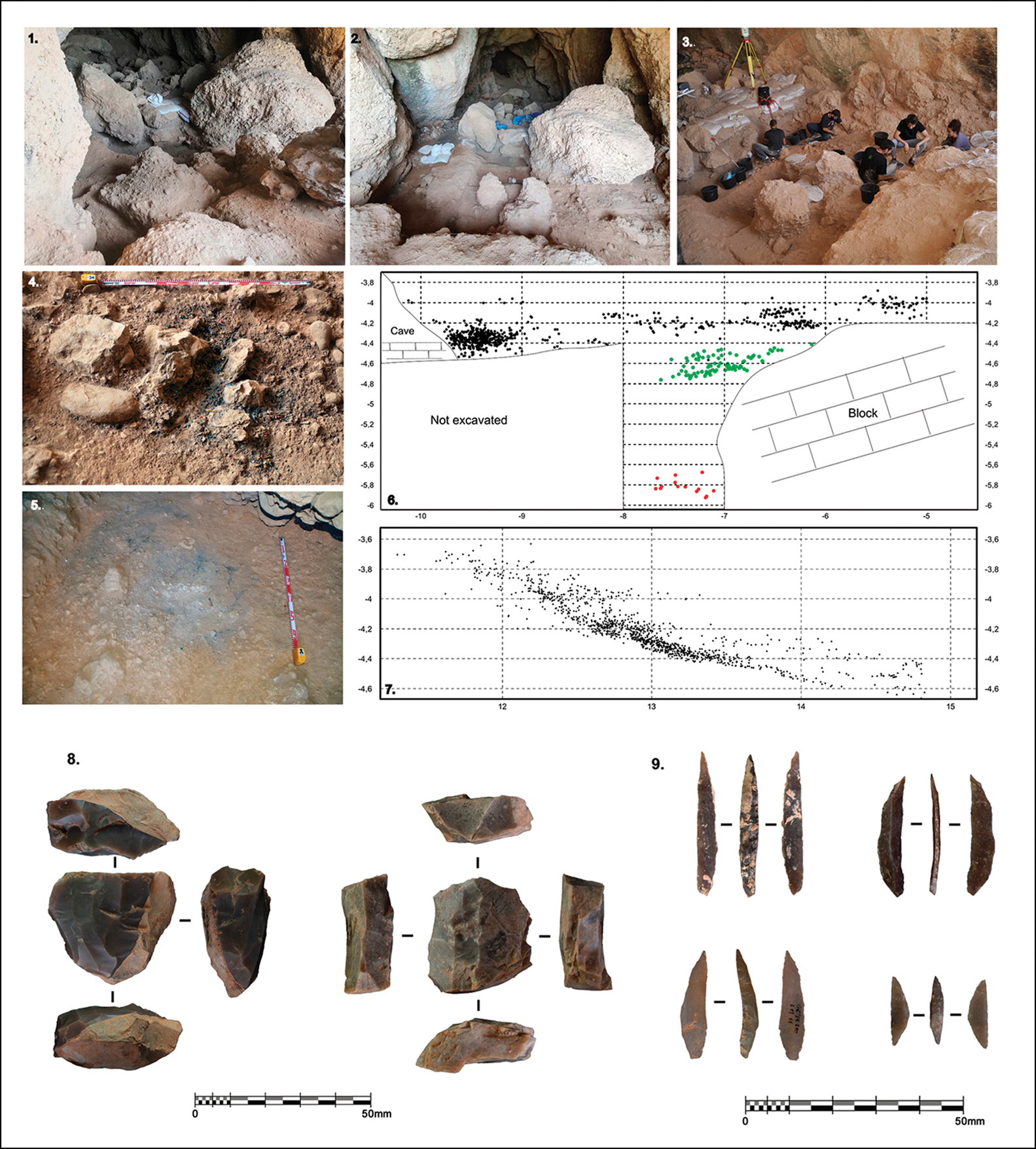
In 2018, well-preserved Upper Palaeolithic occupations were discovered at Cova Gran de Montserrat (Figure 4), and the 2019 and 2020 seasons focused on the extraction of large conglomerate blocks from the collapsed ceilings to allow for a larger excavation area. This led to the discovery of domestic occupation, with structured hearths and a microlithic technology dating to the Magdalenian and Epipalaeolithic. Furthermore, a test pit also confirmed the preservation of 1.5m of stratigraphy containing continuous, undiagnostic Upper Palaeolithic occupations and Middle Palaeolithic layers at the bottom. The upcoming expansion of the test pit will provide the data necessary for characterising this cultural sequence.
Cova Gran de Montserrat: 1–3) general view of the excavation area in 2019, 2020 and 2021; 4–5) Late Palaeolithic combustion features; 6–7) transverse (6) and longitudinal (7) plotting of the archaeological layers documented in the test pit; 8–9) laminar cores (8) and backed bladelets (9) from the Late Upper Palaeolithic occupations (photographs © María Guillen-IPHES).
Finally, at Simanya Gran (Figure 5), a cemented layer containing Pleistocene faunal remains was documented in 2020 and partially excavated in 2021. Remains of brown bear (Ursus arctos) and cave bear (Ursus spelaeus), together with the carnivore-derived accumulation of Pyrenean ibex (Capra pyrenaica) have been recovered, as well as Middle Palaeolithic stone tools, cut-marked bones, charcoal accumulations and a human tooth. Surprisingly, all these materials were found in a small gallery less than 1m wide and between 70 and 90m inside the cave.
Simanya Gran, 2021 excavation: 1–2) horizontal (1) and longitudinal (2) plotting of the recorded materials; 3–4) combustion feature and associated Middle Palaeolithic stone tool; 5) evidence of undocumented excavations: a previous superficial layer enclosed between two backfill deposits; 6) fauna, from left to right: left lower first molar of Capra pyrenaica, right upper second molar and left upper second molar of Ursus arctos, carnivore-gnawed left proximal femur of Capra pyrenaica; 7) lithic flakes recovered during the 2021 excavation (photographs © María Guillen-IPHES).

Early results from the project are fulfilling our highest expectations about the use of these conglomerate caves by Palaeolithic hunter-gatherers. Future mid-term objectives of the project will be:
1) to define the stylistic succession and the chronology of the rock-art assemblage from Cova de la Font Major;
2) to define a transitional sequence through the excavations at Cova Gran de Montserrat, which is of particular significance due to the scarcity of continuous sequences in northern Mediterranean Iberia (Morales et al. Reference Morales2016, Reference Morales2019);
3) to constrain the chronology of the Middle Palaeolithic occupations at Cova Simanya and explore the potential preservation of additional human remains;
4) and to continue test-pitting of the remaining conglomerate caves where the Palaeolithic sequence has not yet been reached.
Acknowledgements
We are highly indebted to Joan Lleonart and Josep Fígols, who enabled the research at Sant Llorenç del Munt, and to Angel Miño (Parc Natural de Sant Llorenç del Munt i l'Obac), Parc Natural de Montserrat and Collbató City Council for their support.
Funding statement
This research is funded by the Generalitat de Catalunya's Culture Department (CLT009/18/00024 and 00053) and AGAUR (2017SGR-0011 and 1040), the Spanish Ministry of Science (PID2020-113960GB-I00) and the City Council of l'Espluga de Francolí. A.R.-H., J.I.M. and M.G. are supported by the Spanish Ministry of Science and Innovation through the María de Maeztu excellence accreditation (CEX2019-000945-M); M.S. is the beneficiary of the UAM TyV Program, R.H. of the URV 2019PMF-PIPF-59 grant and J.R.R. of the UA MARSALAS21-22 grant.


 Open access

