




Introduction
In the early 1920s, during the post-WWI downturn, the North Dakota Cooperative Wool Marketing Association became emblematic of the burgeoning cooperative movement in the American West. As prices collapsed and pressures mounted, members vowed “We’ll stick,” capturing what reporter Fussell (Reference Fussell1921) called “that sticky feeling” – the solidarity binding woolgrowers against market volatility. Yet the association’s performance revealed a sharp gap between rhetoric and reality: volumes fell from 815,347 pounds in 1920 to 400,000 in 1921 and to 160,671 in 1922 – about 80 percent in two years – before a partial rebound to 415,000 in 1923 (Elsworth, Reference Elsworth1930: 50). This volatility – nearly 1.7 times the national aggregate trend – exemplified a broader 1920s pattern: crisis mobilized solidarity, but institutional requirements tested who could remain attached. Initial cohesion proved insufficient once economic pressures exposed unequal capacities to finance withholding, meet grading standards, and tolerate deferred settlement.
This study argues that wool cooperatives evolved in ways that systematically favoured producers with specific economic characteristics, rather than serving broad democratic constituencies. Crisis spurred rapid expansion, but the marketing tools that followed – binding multiyear contracts and deferred payments – imposed fixed costs and liquidity demands that acted as membership filters. These features, central to stabilizing prices and extracting quality premia, generated selection pressures that reshaped cooperative composition over time. The result is not cooperative “failure” but institutional evolution towards serving members able to meet operational demands despite nominal democratic principles.
This institutional transformation within wool cooperatives reflects broader gaps in scholarly understanding of western agricultural marketing. While scholars have thoroughly examined cooperative marketing in many agricultural industries, wool cooperatives have received comparatively little attention despite the industry’s former importance in the West. Existing scholarship extensively examined tariff policy and range management issues (Taussig, Reference Taussig1912; Adams, Reference Adams1916) while largely overlooking marketing institutions. Wool scholars highlighted this gap, with Drummond (Reference Drummond1962) noting, “The history of wool in the United States shows that there has always been a need for improved methods of marketing raw wool” (p. 1). Regional studies touched on marketing without focusing on cooperatives – for example, examining merchant-house intermediation, labour arrangements, and railhead warehousing in New Mexico (Carlson, Reference Carlson1969; Wallace, Reference Wallace2024) and documenting Midwest wool pools that functioned as seasonal aggregation rather than durable cooperatives with binding contracts or member governance (Crockett, Reference Crockett1968, Reference Crockett1970). Early government reports promoted cooperative marketing (Carman et al., Reference Carman, Heath and Minto1892; Marshall, Reference Marshall1917; Christensen, Reference Christensen1929), yet agricultural economists also identified systematic weaknesses decades before recent critical scholarship emerged: over-dependence on contract creating coercive participation and remoteness from members in large organizations (Erdman, Reference Erdman1924; Youde and Helmberger, Reference Youde and Helmberger1966).
Australian scholarship on wool marketing institutions demonstrates that they operated as selection mechanisms consistently privileging well-resourced participants, with viable price stabilization schemes presupposing large capital pools and technical capacity that disadvantaged smaller producers (Abbott and Merrett, Reference Abbott and Merrett2017; Patmore et al., Reference Patmore, Balnave and Marjanovic2024). Work on brokerage and associations shows rule-based gatekeeping, dense social capital, and coordinated routines that disciplined participation and narrowed access (Merrett and Ville, Reference Merrett and Ville2012; Merrett et al., Reference Merrett, Morgan and Ville2008). Viewed across the Antipodes sheep business, New Zealand evidence points to similar institutional routines within wool broking, reinforcing the broader pattern (Ville, Reference Ville2007). Research on the shift of auction markets from London to Australian centers underscores selection via scale economies and specialized expertise among dominant agent-brokers (Ville, Reference Ville2005). Taken together, this literature reframes ‘success’ as adaptation to members able to meet demanding financial, organizational, and knowledge thresholds – and it supplies the comparative frame I use to interpret western wool cooperatives.
The question, then, is which features of wool and of cooperative design made this sorting predictable – a question formalized by Hoffman and Libecap (Reference Hoffman and Libecap1991). In their framework, agricultural marketing arrangements hinge on commodity-specific and institutional factors. Successful private cooperation typically requires storability, thick producer networks, manageable free-rider problems, and – crucially – members’ ability to internalize coordination costs. Hoffman and Libecap (Reference Hoffman and Libecap1991) also emphasize that organization and enforcement costs rise with the number, heterogeneity, and spatial dispersion of producers, and that distributional conflict over who bears those costs destabilizes coalitions; where monitoring and penalties are weak, private schemes tend to give way to statutory interventions – policy substituting for contract.
Wool fit this profile: nonperishability enabled strategic withholding; standardized grading facilitated quality pooling; and existing woolgrowers’ associations supplied social capital. Yet heterogeneity in scale and liquidity generated systematic selection pressures that reshaped cooperative membership despite nominally democratic structures. In the United States, the Capper–Volstead Act of 1922 lowered legal barriers to cooperation but left operational burdens – cash-flow requirements, storage costs, and grading discipline – squarely on members, ensuring endurance primarily among those able to bear these institutional demands. Through systematic analysis of government agricultural reports and trade publications, this study demonstrates how cooperative marketing became highly concentrated among large organizations capable of meeting demanding operational requirements. This pattern extends the Hoffman–Libecap framework to reveal how internal producer heterogeneity can reshape institutional objectives even when commodity characteristics favour cooperation.
Origins and Early Growth of Wool Cooperatives
The development of cooperative marketing in American agriculture found particularly fertile ground in the wool-growing industry due to the commodity’s unique characteristics. Wool possessed several features that, according to Hoffman and Libecap (Reference Hoffman and Libecap1991), typically favour successful private cooperation over government intervention: Unlike perishable crops that demanded immediate sale, wool’s durability allowed producers to store clips for extended periods while awaiting optimal market conditions. This storage capacity enabled the strategic withholding essential for collective bargaining, while the standardized nature of wool grades facilitated the quality pooling that cooperatives required to extract price premiums. Collective marketing became both feasible and potentially profitable for individual growers seeking to escape the disadvantages of fragmented selling.
However, as Hoffman and Libecap (Reference Hoffman and Libecap1991) demonstrate, favourable commodity characteristics alone do not guarantee broad-based cooperative success – the critical factor becomes members’ capacity to bear coordination costs. The expansion of middlemen and commission houses throughout the late nineteenth and early twentieth centuries intensified marketing challenges for individual producers, creating the structural asymmetries that motivated collective organization. Yet the solutions that emerged would systematically favour producers capable of financing the operational demands that sophisticated cooperative marketing required.
The inception of wool cooperative marketing organizations in the United States can be traced back to around 1840, primarily in the Eastern regions. Prior to the 1860s, the American sheep industry predominantly thrived in the East and Midwest. Woolgrowers were pioneers in adopting cooperative methods for more effective marketing within American agriculture. In the 1840s, sheep farmers in New York established the earliest cooperative institutions that facilitated wool sales through centralized depots. These initial cooperative efforts extended beyond the wool industry, catalyzing a broader interest in cooperative approaches across various agricultural sectors. This led to notable successes in the fruit and cotton industries as well (Unknown, 1952: 354). Historically, wool marketing was driven by the demands of local markets, and it was a common practice for farmers to barter or trade small quantities of wool to meet immediate local needs.
By the late nineteenth century, as American farmers became increasingly integrated into the commercial economy, they established selling organizations to manage the growing complexity of their business affairs. Starting in the 1870s and 1880s, small and medium farmers formed cooperatives to market their products. A genuine farmer cooperative was defined by several criteria. First, control was maintained by farmers, growers, or producers. Second, membership voting rights were limited to one vote per member, regardless of the amount of stock or capital owned, and the cooperative did not distribute dividends on stock or capital exceeding eight percent annually. Additionally, the value of non-member products handled did not exceed that of member products (Bureau of Census, 1960: 270).
By pooling their marketing resources, they aimed to reduce competition among themselves, thereby increasing the prices they could command for their crops. They also collaborated to secure lower railroad rates. Some cooperatives expanded their role beyond marketing, branching out to purchase a variety of products for farmers, from gasoline to insurance. Although early attempts in the 1870s and 1880s faced challenges and setbacks, cooperatives steadily grew in both number and influence (Blackford, Reference Blackford2003: 63–64). Throughout the 1880s, a new impetus for cooperative formation emerged as numerous farmers, who were not part of general farm organizations, began establishing marketing cooperatives. In states like Delaware, New York, and California, associations were created specifically to sell fruits. Additionally, groups focusing on the marketing of livestock, wool, tobacco, walnuts, and dairy products emerged. By 1890, there were approximately 1,000 active cooperatives, with 75 percent dealing with dairy products, 10 percent with grain, and over 10 percent with fruits and vegetables (Abrahamsen, Reference Abrahamsen1981: 6–7). In some places, woolgrowers also joined the cooperative momentum.
The American wool cooperative movement developed within a broader international context of agricultural cooperation across major wool-producing regions. Australian agricultural cooperatives emerged contemporaneously during the 1880s, similarly driven by farmers’ desires to ‘cut out the middleman’ and achieve better marketing arrangements through collective action. The establishment of the English Cooperative Wholesale Society’s Australian depot in 1897, which operated until 1917, created direct institutional links between wool producers across the Pacific within global commodity chains centered on British textile manufacturing. Australian dairy and agricultural cooperatives faced identical organizational challenges: while commodity characteristics enabled collective marketing, the operational demands of sophisticated marketing institutions – storage capacity, quality grading, and delayed payment structures – systematically favoured producers with greater capitalization (Patmore et al., Reference Patmore, Balnave and Marjanovic2024: 86, 103–104).
In the American West, successful wool cooperative development required pre-existing social infrastructure that could support sustained collective action. This social capital foundation provided the trust networks essential for cooperation, but would prove insufficient once institutional requirements became more demanding. Woolgrowers’ associations created networks of communication among producers, with the California Wool Growers Association (1860) and National Wool Growers Association (1865) offering organizational templates that spread throughout the region to Montana (1883), Oregon (1893), Idaho (1895), and Wyoming (1905) (Adams, Reference Adams and Hutchison1946: 34–35; Brown, Reference Brown1955: 5–10; Crockett, Reference Crockett1970: 16, 52). These associations fostered the mutual recognition that enabled initial cooperative formation, but their democratic structure would later conflict with the operational demands of sophisticated marketing institutions.
By the late nineteenth century, Australian brokers had developed a sophisticated auction system centered in port cities (Melbourne, Sydney) in which pastoral agent firms aggregated clips from dispersed stations and then classed and displayed them in centralized warehouses/showrooms; regular auction rosters, expert classing, and binning/interlotting reduced buyer search costs, sharpened price discovery, and sped realization to growers – and, as the system matured, the technical taxonomy deepened to well over 1,500 types and sub-types (Ville, Reference Ville2005: 11–15, 25). In the United States, warehousemen and commission merchants experimented with similar centralized grading and auctions in eastern hubs in the late 1890s – e.g., the October 1897 New York Warehouse Company sale of Arizona and New Mexico wools, which contemporaries reported brought prices roughly 20 percent above prevailing rates (“Local and Personal,” 1897 3; Marshall, Reference Marshall1917; Cherington, Reference Cherington1911: 85–88) – but early U.S. efforts struggled to replicate Australian efficiencies: volumes were uneven, speculative dealing could unsettle prices, and, crucially, the broker/classer infrastructure that underpinned trusted grading in Australia remained thin in the United States (Marshall, Reference Marshall1917: 229–233; Federal Trade Commission, 1928: 333–343). In short, the Australian model rested on long-established pastoral agents, centralized showrooms, and a national sales roster that lowered transaction costs – features that took longer to assemble in the American context (Ville, Reference Ville2005: 11–14).
The early institutional pattern revealed both opportunities and inherent tensions. As the industry consolidated west of the Mississippi River, producers faced increased exposure to dealer manipulation and unfavourable consignment arrangements. Wool pools formed across the West, but scale proved crucial: pools handling 50,000 pounds or more proved most effective, attracting more buyers and leveraging greater marketing expertise. For instance, in 1875, a wool pool in Oregon stored 60,000 pounds of wool at the Albany Farmers’ Warehouse before selling it through a competitive bidding system (“Wool Pool,” 1875). Conversely, pools handling smaller volumes – less than the 20,000 to 30,000 pounds needed to efficiently fill a railcar – struggled to provide adequate marketing services. Such low-volume pools were often less viable, encountering difficulties in merchandising and facing higher transportation costs (Wilson, Reference Wilson1965: 30–31).
During the three decades from 1890 to 1920, agricultural cooperation entered its third phase of development, firmly establishing itself within the economic framework supporting American farmers. By the end of this period, there were an estimated 14,000 active cooperatives nationwide. Marketing associations approached a historical peak with over 12,000 organizations, while approximately 2,100 cooperatives specialized in supplying production inputs. This growth marked a significant expansion and integration of cooperative efforts across nearly all states, exemplified by the emergence of an increasing number of wool pools and marketing associations (Abrahamsen, Reference Abrahamsen1981: 6 –7).
Legal uncertainties complicated organizational efforts until the early twentieth century. The Sherman Antitrust Act of 1890 introduced significant ambiguity regarding the legality of cooperative marketing activities, as agricultural enterprises found themselves vulnerable to prosecution under broad anti-restraint provisions. This federal law prohibited contracts, combinations, or conspiracies in restraint of trade, creating uncertainty about whether cooperative marketing agreements constituted illegal collusion. Though enforcement of the Sherman Act around the turn of the twentieth century created powerful incentives for businesses to avoid interfirm agreements and organize instead in the legally safer structure of integrated multiunit operating companies, agricultural cooperatives lacked clear exemptions from these provisions. While Chandler (Reference Chandler1977) demonstrated that the managerial corporation emerged primarily from technological and economic forces rather than public policy, the enforcement of the Sherman Act nevertheless created powerful incentives for businesses to adopt integrated corporate structures. Economic historians have shown that antitrust policy frequently worked, often unintentionally, to benefit large integrated enterprises at the expense of smaller firms that were the intended beneficiaries (Langlois, Reference Langlois2023: 14) – a pattern that would repeat itself in agricultural cooperation, where legal uncertainty favoured organizations with sufficient resources to navigate complex regulatory requirements. The Sherman Act thus inadvertently reinforced the organizational advantages of scale, pushing economic activity toward centralized corporate structures while leaving looser cooperative arrangements legally exposed.
Several early court cases illustrated the precarious legal position of agricultural cooperatives. An Illinois milk cooperative discovered this vulnerability in 1895 when courts voided payment contracts on grounds that the association constituted an illegal trade restraint under state law. Texas lawmakers attempted to address such concerns by crafting agricultural exemptions from antitrust provisions in 1897, but federal courts struck down these protections as unconstitutional just two years later. The 1911 federal indictment of the Boston Cooperative Milk Producers’ Company further demonstrated that even well-established agricultural marketing organizations remained subject to antitrust prosecution. While such legal challenges remained relatively infrequent compared to the systematic dismantling of industrial monopolies, these precedents created persistent uncertainty about permissible cooperative activities (Federal Trade Commission, 1928: 29–30, 333–343). The threat of prosecution, though sporadic, encouraged agricultural cooperatives to develop more legally defensible organizational structures and operational practices, inadvertently favouring those with sufficient resources to secure professional legal guidance and navigate complex regulatory requirements.
Despite legal uncertainty, larger-scale cooperative enterprises emerged that could afford the legal and operational infrastructure these constraints required. The National Wool Warehouse and Storage Company, established in winter 1908–1909, exemplified how early institutional innovations systematically favoured larger producers despite cooperative rhetoric. The initiative was partly co-owned and co-managed by large growers, led by J. E. Cosgriff – a wealthy Wyoming sheep rancher and banker – as president. The company’s structure revealed the emerging pattern of selective participation: growers purchased stock proportional to their wool supply (5,000 to 6,000 pounds per $50 share), but membership did not obligate complete marketing through the company. Large woolgrowers strategically used this flexibility, selling portions independently while benefiting from cooperative services when advantageous – a pattern that would characterize sophisticated cooperative institutions throughout the 1920s. Often referred to as the “Chicago Warehouse,” the company established a 25,000-pound-capacity warehouse in Chicago and handled wool on a consignment basis, charging growers low commission rates for sales. Despite fierce opposition from dealers who viewed it as market manipulation, it operated successfully until 1925 (Federal Farm Board, 1932: 43–45).
Large western woolgrowers began turning to cooperative organizations in the early twentieth century, seeking to bypass middlemen and gain greater influence over wool pricing and distribution. This shift was driven by a desire to establish collective market power capable of challenging dealer control over prices. By 1905, the National Wool Growers Association recognized dealers’ growing control over pricing and distribution, prompting advocacy for cooperative alternatives. At their 1906 annual convention, woolgrowers openly discussed their concerns about what they perceived to be a cartel of wool dealers manipulating prices to their disadvantage. That same year, the Montana Wool Growers Commission Company was formed with the goal of providing growers with greater autonomy in marketing their wool, but it struggled to achieve significant results (“Woolgrowers company,” 1906).
A parallel pattern was visible abroad. In Australia, woolbrokers’ associations functioned as explicit cartels engaging in price fixing and exclusive dealing, coordinating access and terms in ways that entrenched intermediary power (Merrett and Ville, Reference Merrett and Ville2012). The Antipodean experience underscores how wool marketing tended to concentrate in organizations able to coordinate pricing, information, and logistics – the very dynamic American growers aimed to counter through cooperative organization. Yet in both settings, the institutions that endured – American cooperatives and Australian broker cartels – gravitated towards participants with greater operational capacity, indicating that market concentration reflected structural features of wool marketing rather than merely institutional preference (Sexton, Reference Sexton1990).
Recognizing both the potential benefits of agricultural cooperation and the legal obstacles hindering its development, federal policymakers began crafting supports to foster cooperative growth while addressing antitrust concerns. Government action in the early twentieth century provided the legal footing and educational infrastructure for more sophisticated cooperative structures. The Smith–Lever Act of 1914 established agricultural extension services that disseminated cooperative know-how, and county-level farm bureaus became instrumental in organizing local wool pools. In Idaho, for example, farm bureaus in Ada and Canyon counties facilitated the marketing of 230,000 pounds of wool in 1918, securing 60 cents per pound – a premium price that yielded $76,400 for participating farmers while eliminating handling costs that would have otherwise consumed several thousand dollars. Beyond immediate economic benefits, farm bureaus provided educational services that taught growers wool grading techniques and quality improvement methods, enabling more effective future marketing. This institutional support even facilitated agricultural diversification, as the success of wool pools sparked interest in sheep raising in traditionally grain-growing regions like Lewis County. Yet while this case demonstrated how government extension services could improve cooperative performance, the benefits accrued chiefly to producers with sufficient scale to participate in coordinated marketing and absorb the learning curve of improved grading practices (Idaho farmers, 1918; Hayes, Reference Hayes1926).
By the late 1910s, cooperative wool marketing had already coalesced around two main organizational forms. Local pools – exemplified by the Jericho Wool Pool (Utah, 1917–1929) – aggregated members’ clips into single lots and empowered selling committees to accept or reject offers, turning fragmented supplies into unified bargaining blocks that could time sales and resist downward pressure. These local pools, sometimes operating intermittently, depended heavily on loyalty within smaller groups of producers who knew each other personally and could enforce participation through social pressure rather than formal contracts (Berry, Reference Berry1961: 4; “Utah wool growers,” 1929). State and regional associations – such as the Ohio Wool Growers’ Cooperative Association, revived in 1918 and quickly expanding to thirty counties and 2,720 members by early 1919 – operated with binding annual delivery requirements, professional grading, quality pooling, and coordinated sales that created dependable supply for collective price bargaining (Elsworth, Reference Elsworth1927: 4). The agricultural depression of the early 1920s then amplified these templates, prompting new formations and scaling up existing ones. Alongside these, the earlier National Wool Warehouse and Storage Company functioned as a regional service hub – centralized warehousing, handling, and related services—that supported widely dispersed cooperative efforts because shares were tied to anticipated clip, participation tilted towards larger, better-capitalized producers, a pattern that recurred in the 1920s (Federal Farm Board, 1932: 43–45).
Taken together, these pre-1920 developments established the infrastructure and templates for collective marketing while also revealing the scale and capitalization biases that would become more pronounced in the next decade. As the 1920s opened, institutional backing from government reinforced this trajectory – extension networks and county farm bureaus after Smith–Lever, and, crucially, the legal authorization supplied by the Capper–Volstead Act (1922) – enabling cooperatives to harden these templates into enforceable organizations. In response to side-selling and price volatility, they then turned to contract enforcement and loyalty mechanisms, intensifying the selection pressures analysed in the next section.
Agricultural Collapse and the Turn to Cooperation
The cessation of World War I hostilities brought unprecedented disruption to American wool markets. During the war, European demand and government purchasing programs had driven wool prices to historic highs, reaching 55 cents per pound in 1918 – nearly triple pre-war levels. American woolgrowers responded by expanding production, purchasing additional land, and taking on substantial debt to finance increased operations. This pattern mirrored broader agricultural responses to wartime demand. Farmers across the country expanded onto marginal lands – in the West, this included arid rangeland with sparse vegetation, high-elevation grazing areas with short growing seasons, and remote properties far from railheads and water sources. Federal land management agencies actively facilitated this expansion: the Forest Service substantially relaxed grazing restrictions on public-domain lands during the war years, allowing woolgrowers to increase their flocks on previously restricted federal rangeland to meet wartime production demands (U.S. Senate Committee on Agriculture and Forestry, 1954: 12–15; Brown, Reference Brown1985: 129–130). This expansion required substantial debt financing secured against inflated land values and enlarged herds. However, this expansion proved catastrophically mistimed for woolgrowers. European wool production recovered far more rapidly than anticipated, and the federal government’s abrupt withdrawal from wool purchasing in 1919 eliminated the price floor that had sustained wartime prosperity (U.S. Tariff Commission, 1921: 167–171).
The 1920–1923 crisis struck woolgrowers with particular severity within a broader agricultural collapse. Wool prices collapsed from their wartime peak to approximately 17 cents per pound by 1921 – a decline of nearly 70 percent (Figure 1). While consumer prices fell 11.3 percent and wholesale prices dropped 45.9 percent between 1920 and 1921, the farm products price index plummeted 53.3 percent during the same period (U.S. Bureau of the Census, 1976: 200, 210). Wool’s even steeper decline reflected the commodity’s particular vulnerability to the simultaneous restoration of European production and contraction of domestic demand. Cash receipts from wool sales plummeted from over $90 million in 1918 to less than $30 million in 1921, leaving woolgrowers facing debt obligations contracted at peak prices with revenues barely sufficient to cover production costs. Figure 1 reveals a crucial asymmetry in overall market conditions: while prices collapsed 70 percent, western wool production remained relatively stable, declining only modestly from 167 million pounds in 1919 to 144 million pounds in 1921 – a 14 percent reduction far smaller than the price decline. This production stickiness intensified the crisis across the entire industry, as woolgrowers’ inability to rapidly adjust output magnified financial pressures. The West’s declining share of national production – from 63 percent in 1918 to 59 percent in 1921 – indicates that eastern producers with more diversified farming operations could exit wool production more readily than western ranchers whose specialized operations and fixed investments in rangeland made rapid adjustment economically infeasible.
Wool Prices, Western Production, and Regional Market Share, 1909–1932
Note: Dual-axis graph showing three variables: western wool production in million pounds (left axis), price per pound in cents (right axis), and the West’s percentage share of total U.S. production (right axis).
Source: Author’s elaboration based on data from Bureau of Agricultural Economics (1949).

The crisis intensified existing vulnerabilities within the wool-growing sector. Producers who had purchased marginal rangeland during the wartime boom now faced mortgage payments that consumed any remaining profits from wool sales. The combination of collapsed prices and fixed financial obligations created immediate pressures that tested woolgrowers’ capacity to maintain operations. Those with sufficient capital reserves or diversified income sources could weather the downturn by reducing expenses and waiting for recovery. However, producers dependent solely on wool income and lacking substantial liquidity faced impossible choices between defaulting on debt obligations and liquidating breeding stock at depressed prices.
The industry-wide production trajectory visible in Figure 1 illuminates the structural pressures that would drive woolgrowers toward cooperative solutions. Despite sustained price depression, western wool production expanded from 144 million pounds in 1921 to 204 million pounds by 1930, revealing a fundamental problem: individual producers had incentives to expand output to cover fixed costs, but aggregate expansion further depressed prices industry-wide. The West’s continued decline in national market share – falling to 58 percent by 1930 – demonstrates that specialized wool production characterized precisely those regions where cooperative marketing would take root, as producers lacking alternative enterprises had greatest need for collective strategies to improve returns.
Agricultural income collapsed across all sectors. As Johnson (Reference Johnson1974) demonstrates, the severity of the rural financial crisis reflected wartime optimism that had encouraged excessive debt accumulation and land purchases at inflated values. Western representatives voiced the desperate financial straits of their ranching constituencies, including woolgrowers, seeking federal intervention to prevent wholesale collapse. A notorious case emerged in December 1921, when Charles J. Smith – a prominent Pendleton physician and influential Democratic Party leader serving as chairman of Oregon’s state central committee – presented the War Finance Corporation with a comprehensive plan for emergency advances to grain and woolgrowers in Eastern Oregon. Smith calculated that over $21,000,000 would be required: $15,000,000 for grain alone, assuming half might be secured from other sources, and an additional $11,000,000 advanced by the government on mortgages secured by growing grain, growing wool, and half the sheep increase. U.S. Senator Robert N. Stanfield – Oregon’s newly elected senator and himself a major Eastern Oregon woolgrower from Umatilla County – consulted officials on the plan and reported it had been well received, anticipating substantial relief would be forthcoming (“$21,000,000 will be asked,” 1921). Such emergency interventions, however, could not reverse the fundamental damage. Mortgage foreclosures reached historically high levels and remained elevated through the 1920s, though as Alston (Reference Alston1983) shows, these primarily affected second mortgages rather than primary loans, indicating that speculative expansion during the boom created the crisis rather than fundamental production failures.
This differential impact of the crisis established the selection pressures that would reshape cooperative membership throughout the decade. The agricultural extension services and cooperative marketing organizations that emerged in response to the crisis offered potential solutions to marketing challenges, but participation required resources that crisis conditions had distributed unevenly across the woolgrowing population. The capacity to finance storage while awaiting better prices, to meet quality standards requiring investment in improved handling, and to tolerate deferred payment schedules became implicit membership requirements that systematically favoured producers whose financial position had survived the initial crisis intact.
By the late 1910s, cooperative wool marketing had institutional momentum from both producer initiatives and government support. Federal agricultural extension services and county farm bureaus expanded rapidly after the Smith–Lever Act, and US Department of Agriculture allotments specifically for marketing and rural organization climbed through the decade (True, Reference True1928: 199). Coverage widened in step: the number of counties with men county agents rose from 928 in 1915 to 2,097 by 1923, with especially dense build-out across wool country. Using True (Reference True1928: 200) state counts, the Great Plains accounted for roughly 15 percent of covered counties in 1915 and approximately 21 percent by 1923; the Mountain West and Pacific states rose from approximately 8 percent to approximately 11 percent over the same span. Together, these developments created an organizational scaffolding for collective marketing that was more robust than the loose pooling of earlier decades.
Perhaps more importantly, the Capper–Volstead Act of 1922 – passed amid this expansion – granted producer associations a qualified antitrust exemption to process and market farm products and to set prices collectively, on the condition that associations be producer-only and democratically controlled (e.g., one-member–one-vote or limited dividends), while preserving federal oversight of combinations that might unduly enhance prices (Torgerson et al., Reference Torgerson, Reynolds and Gray1998: 5–6; Frederick, Reference Frederick2002: 22–48). In effect, Capper–Volstead lowered legal barriers but left operational burdens – financing storage, tolerating deferred settlement, and meeting grading standards – squarely on members. Contemporary practice shows the two facets working together: courts enforced cooperative delivery contracts and penalties, validating the use of binding agreements to secure supply (“Upholds cooperative contract,” 1923; “Suits against members,” 1923). At the same time, federal scrutiny remained in reserve for associations judged to restrain trade beyond the Act’s intent (Frederick, Reference Frederick2002: 22–48). In wool specifically, Capper–Volstead complemented the Department of Agriculture warehouse framework (e.g., wool-warehouse regulations under the U.S. Warehouse Act of 1916) and the extension network, supplying a legal shell within which cooperatives could professionalize classing, storage, and sales – without offsetting the capacity thresholds that sorted members (U.S. Department of Agriculture, 1920; Federal Trade Commission, 1928: 153–160; Federal Farm Board, 1932).
The rise of cooperative wool marketing in the early 1920s was evident in the growing number of associations, the expanding volume of wool they handled, and their increasing membership. According to Department of Agriculture reports, by 1926, there were seventy-four wool-marketing associations in operation, including twenty-two regional or statewide cooperatives and 38 independent locals. The volume of wool marketed through these organizations rose from 5.8 million pounds in 1920 to more than 20.2 million pounds in 1926 – an increase of nearly 250 percent. Membership also expanded steadily, as thousands of growers joined in the hope of securing more favourable terms through collective bargaining. Altogether, cooperatives accounted for over 10 percent of the national clip by the mid-1920s – a modest share that nevertheless represented their emergence as an organized alternative in an industry long dominated by private dealers and commission houses (Federal Trade Commission, 1928: 153–160).
The gradual rise in cooperative prices through the mid-1920s, reaching 50.5 cents in 1923 and 48 cents in 1924, demonstrated how disciplined withholding and coordinated marketing could secure more favourable terms for growers (Elsworth, Reference Elsworth1927: 4). In this way, the Ohio association functioned not merely as a marketing service but as a regional mechanism of cooperative price-fixing – formalizing at scale the same principles of unity, market timing, and minimum-price enforcement that local pools like Jericho practiced on a smaller, more informal basis. Over time, its reach extended beyond Ohio, serving sheep producers in adjoining states and illustrating how statewide cooperatives could expand into broader regional organizations – a model exemplified by the Pacific Cooperative Wool Growers discussed in the next section. These two cases – one rooted in the informal cooperation of a rural Utah community, the other in the contractual discipline of a statewide association – highlight the diversity of organizational forms that underpinned cooperative price coordination in the U.S. wool industry. Both, however, relied on the commodity’s storability and the strategic withholding of supply to enhance bargaining power, practices that became increasingly formalized and legally protected in the 1920s.
In 1925, after the collapse of the “Chicago Warehouse,” woolgrowers and financial backers organized the National Wool Exchange, headquartered in Boston with a branch in Chicago. Unlike its predecessor, the Exchange avoided speculative advances and instead operated on a commission basis, concentrating small western clips and fleece wools for sale on more favourable terms. By 1926 it handled an impressive 27 million pounds of wool, integrating local pools into a broader cooperative framework and offering them representation in distant markets otherwise dominated by private dealers. Though volumes declined at the decade’s end and the Exchange was eventually consolidated into the National Wool Marketing Corporation in 1929, both organizations played a pivotal role in extending the cooperative principle from local and state pools to national marketing agencies. Together, they demonstrated both the promise and the fragility of cooperative price coordination at scale, underscoring how institutional experiments could push woolgrowers beyond regional markets in pursuit of stronger countervailing power (Federal Farm Board, 1932: 43–44, 50–52).
Yet statutory authorization alone could not resolve all the uncertainties surrounding cooperative marketing. Even as the courts upheld pooling contracts and clarified the boundaries of antitrust immunity, lawmakers sought to reinforce the cooperative framework with more explicit federal backing. The legal foundation for these practices was strengthened with the passage of the Agricultural Marketing Act of 1926, which built on the earlier Capper–Volstead Act. While it did not mandate prices or guarantee returns, the law explicitly validated the use of pooling contracts and collective marketing agreements, allowing cooperatives to require members to deliver all their output and empowering them to sell as a unified body. In practice, this meant that associations could withhold wool until minimum price thresholds were met and negotiate collectively with buyers without fear of antitrust prosecution. What might otherwise have been construed as price-fixing or market manipulation by private firms was thus legalized when undertaken by producer cooperatives. The Act therefore marked a decisive institutional shift: it provided the statutory protection that enabled woolgrower organizations to act as collective price-setters, even if their success in stabilizing returns remained contingent on market conditions (Jones and Thompson, Reference Jones and Thompson1982: 10–16).
The momentum for cooperative marketing was further reinforced with the Agricultural Marketing Act of 1929, which represented an effort by the Hoover administration to provide federal credit and institutional support on an unprecedented scale. The Act established the Federal Farm Board, capitalized with $500 million, to extend loans to farm cooperatives and to create stabilization corporations that could purchase and hold surplus commodities off the market. In theory, this framework offered cooperatives both the legal authority (under Capper–Volstead and the 1926 Marketing Act) and the financial means to resist price declines by withholding product and timing sales more strategically. For woolgrowers, the 1929 Act seemed to promise a way to translate cooperative ideals into tangible price stability. Yet the broader experience of the Farm Board revealed the limits of state-supported stabilization: efforts to purchase surpluses often failed to prevent price collapses, and in some cases even prolonged gluts. Thus, while the 1929 legislation deepened federal involvement in cooperative marketing, it also underscored the structural difficulty of sustaining agricultural prices in the face of overproduction and weak demand (Lauck, Reference Lauck2000: 111–113).
The momentum generated by these local, regional, and national experiments culminated at the close of the 1920s, when cooperative wool marketing reached its historical peak. Backed by the legal foundation of Capper–Volstead and the institutional support of the Farm Bureau, large-scale associations expanded their membership and the volume of wool they handled to unprecedented levels. By 1930, under the stabilization program of the Federal Farm Board, cooperatives marketed more than 140 million pounds of wool and mohair – a scale unimaginable only a decade earlier. This growth reflected both the structural advantages of wool as a storable commodity and the increasing willingness of growers to place their clips under binding cooperative contracts. Yet the very conditions that enabled this expansion – federal credit, coordinated withholding, and collective price-setting – also exposed cooperatives to the vulnerabilities of overproduction and volatile demand (Van Horn and Hulbert, Reference Van Horn, Hulbert, Fetrow and Elsworth1947: 99). The 1930 peak therefore stands not only as the culmination of the cooperative surge of the 1920s but also as a reminder of the fragility of such gains in the face of broader agricultural depression and the looming collapse of commodity markets in the Great Depression.
Volatility, Survival, and Institutional Selection
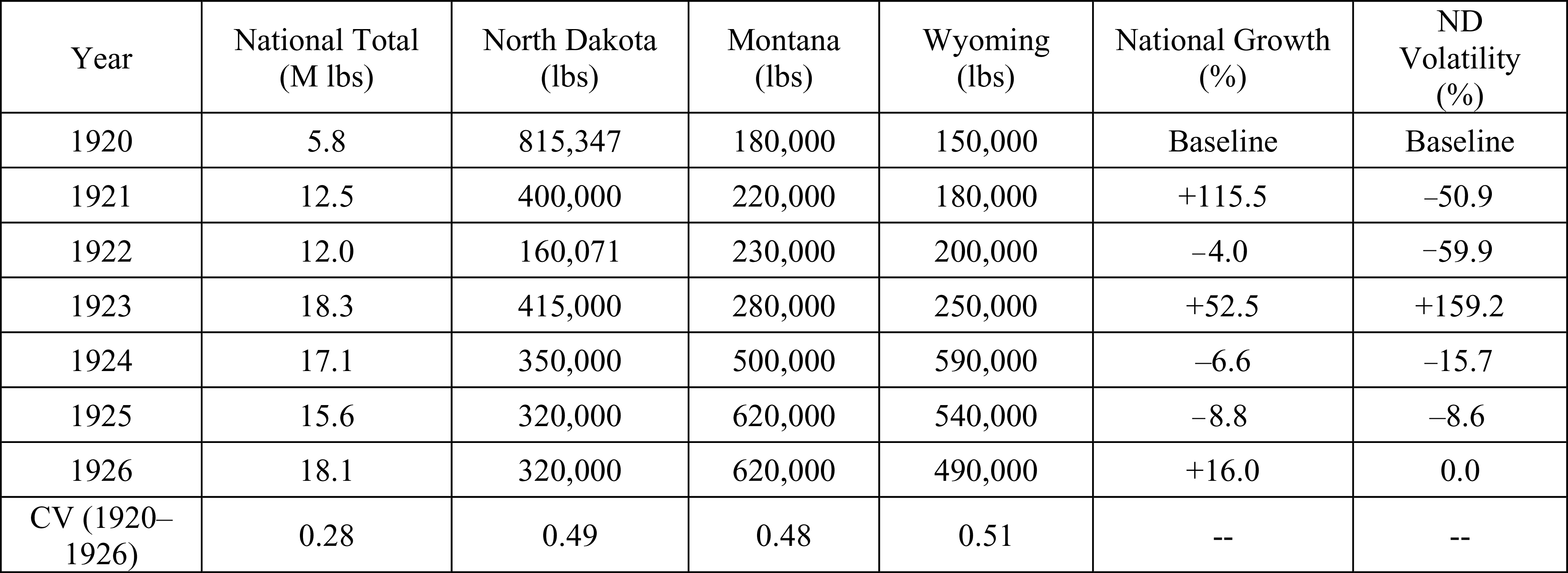
The institutional momentum described above created conditions for cooperative expansion that contemporary observers often interpreted as evidence of sustainable transformation. However, aggregate statistics concealed profound instability beneath surface-level growth. Figure 2 reveals the gulf between aggregate stability and individual volatility. While government reports emphasized national volumes expanding from 5.8 million pounds in 1920 to 18.1 million pounds in 1926, with 74 associations nationwide operating by mid-decade, the coefficient of variation measures expose systematic fragility that these totals obscured.
Cooperative Wool Marketing Growth and Individual Associations Volatility, 1920–1930
Note: CV denotes the coefficient of variation computed over 1920–1926. National CV ≈ 0.28; state CVs ≈ 0.47–0.51.
Source: Data from Federal Trade Commission (1928), Elsworth (Reference Elsworth1930), Van Horn and Hulbert (Reference Van Horn, Hulbert, Fetrow and Elsworth1947).

To analyze this volatility pattern, I focus on North Dakota, Montana, and Wyoming because they represented major wool-growing centers in the West and contained some of the largest and best-documented statewide cooperative associations. Their experiences capture a spectrum of conditions – North Dakota’s crisis-born collapse, Montana’s rapid expansion, and Wyoming’s mixed outcomes – making them well suited to illustrate both statistical volatility and regional diversity in cooperative performance. North Dakota’s association experienced a coefficient of variation (CV) of 0.49 – nearly 1.7 times the national aggregate’s 0.28. Montana (CV = 0.48) and Wyoming (CV = 0.51) show similar patterns, with volatility approximately 1.7 and 1.8 times higher than the national trend.
As outlined in the Introduction, the North Dakota case exemplifies how crisis mobilization could not substitute for durable capacity. The volatility differential visible in Figure 2 exposes fundamental tensions between cooperative rhetoric and operational reality. This pattern demonstrates that extreme instability characterized western associations rather than reflecting isolated management failures. North Dakota’s dramatic swings – from 815,347 pounds in 1920 to 160,071 in 1922 (an approximately 80 percent decline), then rebounding to 415,000 in 1923 (an approximately 159 percent increase) – illustrate how crisis could mobilize solidarity that proved insufficient once economic pressures exposed unequal capacities to finance withholding, meet grading standards, and tolerate deferred settlement. These patterns connect directly to the capacity-filter argument: institutional requirements – binding delivery contracts, storage finance, grading discipline, and tolerance for deferred settlement – systematically tested members’ differential economic capabilities during market stress. The volatility indicates that solidarity functioned as emotional mobilization rather than a durable institutional foundation. Producers could proclaim collective dedication during crisis, but participation decisions ultimately reflected balance-sheet constraints that rhetoric could not override. Systematic volatility across multiple associations thus reflects fundamental incompatibilities between operational requirements and heterogeneous producer capabilities.
The contrast between individual volatility (state CVs of approximately 0.47–0.51) and relative aggregate stability (a national CV of approximately 0.29), as shown in Figure 2, demonstrates how evolution operated through selection mechanisms favouring associations whose members could bear coordination costs. Extreme volatility led either to organizational failure or to retrenchment around a membership base with characteristics conducive to sustained participation. The volatility gap of approximately 1.7–1.8 times provides quantitative evidence that institutional transformation occurred primarily through differential member retention rather than broad-based democratic effectiveness.
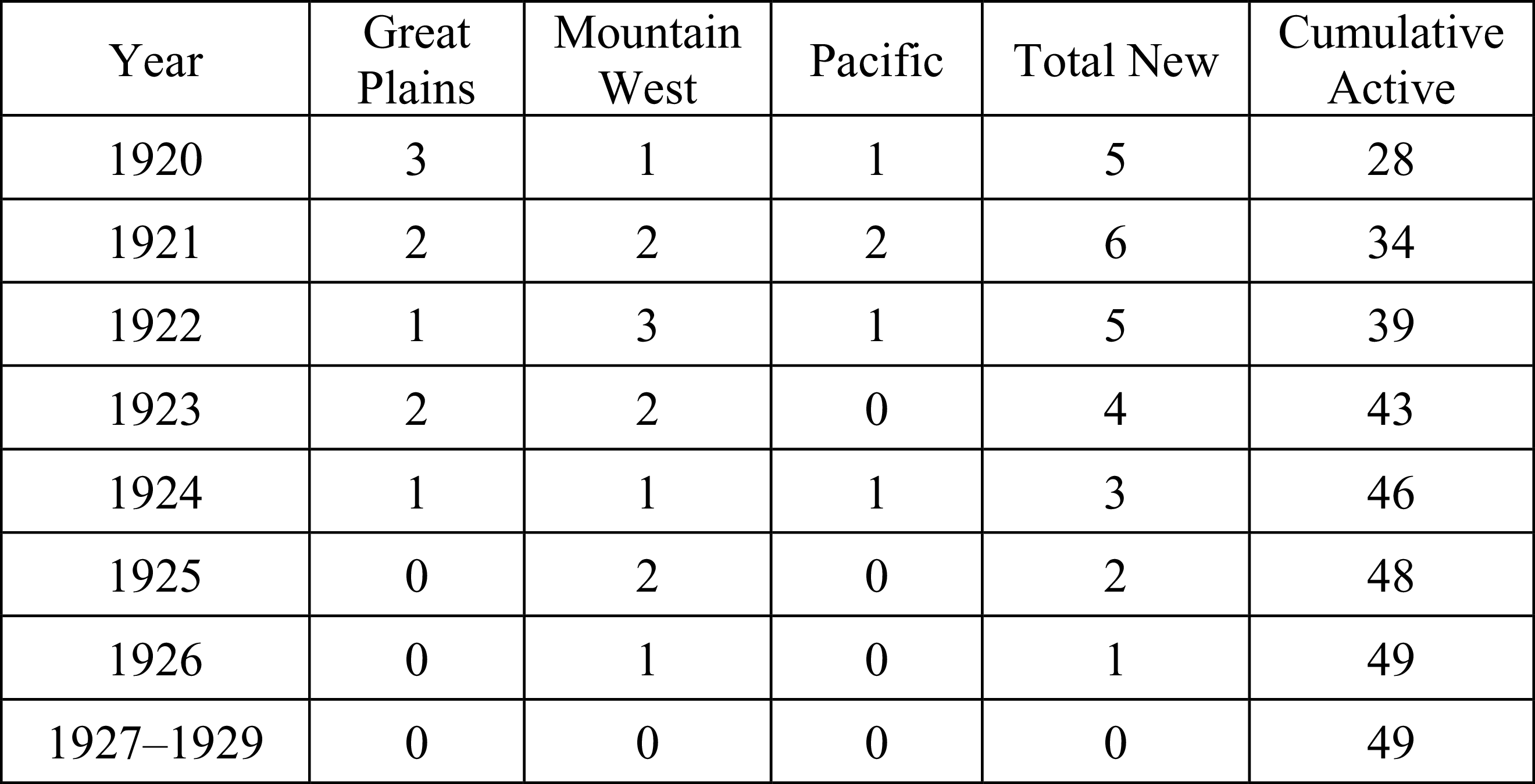
Figure 3 reveals the temporal limits of crisis-driven expansion. The geographic expansion of wool cooperatives followed systematic patterns reflecting both agricultural distress and pre-existing organizational infrastructure. The Great Plains witnessed initial expansion with statewide cooperatives in North Dakota, South Dakota, and Minnesota (1920), followed by Kansas and Nebraska (1921). Mountain West development accelerated following the Capper-Volstead Act, with major associations in Montana and Wyoming (1921), Utah, Nevada, and Arizona (1922), and subsequent state-level organizations through 1926. Pacific Coast expansion centered on the Pacific Cooperative Wool Growers (Oregon, 1921) and affiliated California and Washington associations.
New Cooperative Associations Established by Year and Region, 1920–1929
Source: Christensen, Reference Christensen1929, Federal Trade Commission, 1928.

However, Figure 3 shows that new formations peaked in 1921 with six associations, then declined steadily – from five in 1922, to four in 1923, two in 1924–1925, one in 1926, and zero during 1927–1929. The cessation of new cooperative formation after 1926 coincided with federal policy shifts – beginning with the Cooperative Marketing Act of 1926 and culminating in the Agricultural Marketing Act of 1929 – while many cooperatives, operating under state cooperative marketing statutes, adopted mandatory-delivery clauses in their bylaws and contracts, thereby raising the commitment threshold for new formations. This provision strengthened existing associations but raised the commitment threshold for new formations, deterring producers unwilling or unable to relinquish marketing flexibility. Mandatory delivery requirements imposed particularly heavy constraints on larger growers, who possessed the scale and resources to market independently and benefited from maintaining flexibility to exploit favourable market opportunities outside cooperative channels. No new associations emerged during 1927–1929, indicating that expansion had reached natural boundaries determined by producer characteristics and capacity to meet binding commitments rather than continued agricultural distress or institutional innovation.
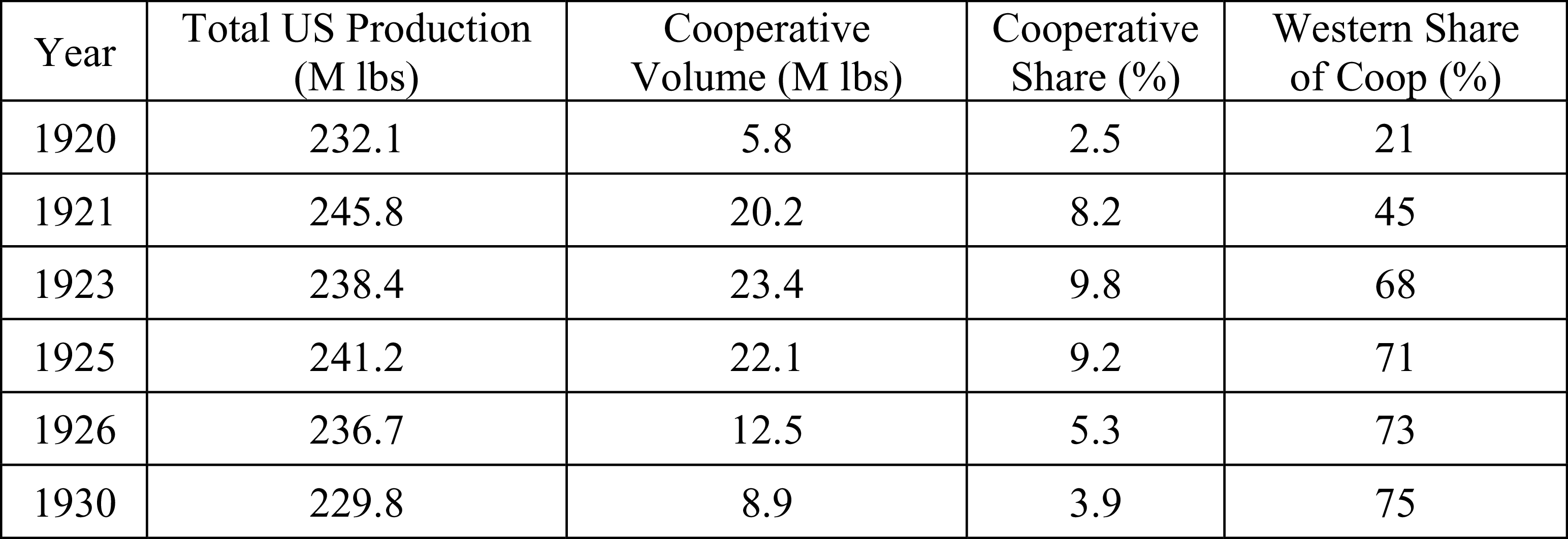
The cessation of new formations after 1926 visible in Figure 3 coincided with declining market share from 9.8 percent to 3.9 percent by 1930 shown in Figure 4, suggesting that crisis-driven expansion had exhausted its natural constituency. The market share trajectory reveals a distinct peak-and-decline pattern that illuminates the temporary nature of crisis-driven cooperative expansion and the systematic emergence of capacity-based selection pressures. Figure 4 shows the rise from 2.5 percent of national wool production in 1920 to a peak of 9.8 percent in 1923, followed by sustained decline to 3.9 percent by 1930 – approximately 60 percent reduction in market share over seven years.

The timing of this decline is crucial for understanding its underlying causes. While wool prices recovered substantially from their 1921 crisis lows, reaching 50.5 cents in 1923 and remaining elevated through the mid–1920s (Figure 1), cooperative market share began declining precisely during this recovery period. This pattern suggests that improving market conditions reduced crisis-driven solidarity while simultaneously exposing differential member capabilities to sustain institutional commitment when conventional marketing alternatives became viable again. However, the subsequent decline demonstrates that initial solidarity could not sustain institutional commitment once market conditions stabilized and alternative marketing channels became available, exposing fundamental incompatibilities between cooperative operational requirements and diverse producer capabilities.
Yet the simultaneous geographic concentration trend visible in Figure 4 – western states’ share of cooperative volume increasing from 21 to 75 percent – reveals that this decline reflected capacity-based selection rather than simply reduced crisis motivation. While improving wool prices might suggest that cooperatives were only attractive during acute crisis, the geographic concentration indicates selection by producer characteristics rather than uniform response to market conditions. Associations could mobilize producers during acute distress, but could not retain them once market pressures exposed differential capacities to meet operational demands. The geographic concentration indicates selection by producer characteristics: western producers operated at larger scales, specialized in wool as a primary enterprise, and possessed the operational capabilities to sustain participation in demanding collective marketing arrangements. This pattern demonstrates that declining aggregate market share masked a fundamental transformation in cooperative membership composition towards producers with characteristics conducive to strategic marketing coordination – a sorting process that occurred precisely when crisis pressure eased and participation became voluntary rather than desperate.
The survival differential captured in Figure 5 quantifies the selection mechanism at work and reveals capacity thresholds operating systematically rather than randomly. Analysis of association survival patterns provides quantitative evidence of systematic selection pressures operating within the cooperative movement. Associations capitalized above $100,000 achieved 91.7 percent survival rates through 1930, while those below $25,000 suffered 73.7 percent failure rates – a 3.5-fold difference in survival probability that cannot be explained by management competence alone.
Association Survival Rates by Size and Capitalization, 1920–1930
Note: Survival rate represents the percentage of cooperatives established between 1920 and 1930 that remained active in 1930. Failure rate = 100 - Survival rate. Capitalization levels determined at time of establishment.
Source: Cochrane and Elsworth (Reference Cochrane and Elsworth1943), Federal Trade Commission (1928).

The near-linear relationship between capitalization and survival visible in Figure 5 (91.7 percent for large, 66.7 percent for medium, and 26.3 percent for small) indicates that institutional requirements scaled continuously with organizational sophistication rather than operating as simple binary thresholds. Moving from small to medium capitalization is associated with approximately 40 percentage points higher survival rate (26.3 percent to 66.7 percent), and from medium to large with about 25 percentage points (66.7 percent to 91.7 percent) – a total gap of about 65 percentage points between small and large associations. Large associations, characterized by substantial capitalization exceeding $100,000 and serving predominantly large-scale producers, achieved survival rates of 91.7 percent. Medium associations’ 66.7 percent survival rate reveals a transitional zone where some could meet operational demands through member concentration or external credit, while others fell below critical viability thresholds. Small associations with limited capitalization suffered failure rates of 73.7 percent.
This survival gradient demonstrates that small associations failed not because they lacked management skill but because the fixed costs of professional grading, bonded storage, and delayed settlement imposed minimum viable scales that excluded associations serving predominantly small-scale producers. This survival gradient demonstrates that institutional requirements imposed minimum viable scales rather than merely creating economies of scale. The systematic relationship between capitalization and survival probability – where each $75,000 increase in capital base corresponded to roughly 25 percent points higher survival rates – reveals capacity thresholds operating as effective organizational filters. Unlike random business failures, this linear progression indicates that cooperative marketing success required predictable financial capabilities that sorted associations by their members’ aggregate resources.
Conclusions
This study of wool cooperatives in the West reveals how institutional evolution systematically reshaped democratic marketing organizations through capacity-based selection pressures. While agricultural crisis initially mobilized widespread solidarity among woolgrowers, the sophisticated marketing tools that emerged – binding multiyear contracts, deferred payment structures, and professional grading requirements – imposed fixed costs and liquidity demands that operated as effective membership filters. The result was not cooperative “failure” but institutional adaptation toward serving producers able to meet demanding operational requirements despite nominal democratic principles.
The quantitative evidence establishes three key patterns demonstrating this transformation. First, survival rates correlated strongly with organizational capacity: large associations capitalized above $100,000 achieved 91.7 percent survival rates through 1930, while small associations below $25,000 suffered 73.7 percent failure rates – a 3.5-fold difference revealing systematic advantages in absorbing storage costs, financing delayed settlements, and weathering market volatility. Second, individual associations experienced extreme volatility with coefficient of variation measures 1.7 to 1.8 times higher than national trends, exposing fundamental tensions between cooperative rhetoric and operational reality. Third, geographic concentration patterns demonstrate that declining aggregate market share from 9.8 percent to 3.9 percent between 1923 and 1930 masked fundamental membership transformation, as western states’ share increased from 21 percent to 75 percent, indicating that membership composition shifted toward producers with characteristics conducive to sustained participation rather than ebbing simply with crisis motivation.
Taken together, these patterns extend the Hoffman–Libecap (Reference Hoffman and Libecap1991) framework. Wool possessed features that typically favour private cooperation – storability, standardized grading, pre-existing producer networks – yet producer heterogeneity in scale and liquidity predictably transformed membership and objectives. Legal developments lowered barriers to cooperate (e.g., Capper–Volstead) without relieving operational burdens, leaving endurance to those who could finance storage, accept deferred payment, and sustain grading discipline. The persistent tension between democratic ideals and institutional effectiveness suggests that achieving both broad participation and sophisticated marketing requires explicit recognition of how operational requirements shape membership – regardless of rhetorical commitments to universal service. In short, the “sticky feeling” of solidarity proved potent in crisis but dissolved into capacity-based selection as cooperative routines matured.
Acknowledgements
I acknowledge with gratitude financial support from the Basque Government Research Group IT-22 (2023–2026) and Research Project Grant PID2021-122846NB-I00 funded by MCIN/AEI/10.13039/501100011033, ERDF ‘A way of making Europe’.



 Open access

