




Introduction
Climate change increases the vulnerability of grassland-based production systems given that it affects the annual distribution of forage production and enhances its inter-annual variability (Ergon et al., Reference Ergon, Seddaiu, Korhonen, Virkajärvi, Bellocchi, Jørgensen, Østrem, Reheul and Volaire2018; Henry, Eckard, and Beauchemin, Reference Henry, Eckard and Beauchemin2018). Grassland-based farmers may therefore attempt to increase the socio-economic resilience of their farms by mobilizing a variety of levers at the herd, forage-system, and farm-management levels (López-i-Gelats, Milán, and Bartolomé, Reference López-i-Gelats, Milán and Bartolomé2011; Dumont et al., Reference Dumont, Franca, López-i-Gelats, Mosnier and Pauler2022; Lüscher et al., Reference Lüscher, Barkaoui, Finn, Suter, Suter and Volaire2022). Resilience has been defined in the context of farmers as their capability to implement changes in their system and make management decisions that maintain a farm in its current configuration or lead to a new equilibrium (Darnhofer, Reference Darnhofer2014).
In grassland-based production systems, different strategies help farmers enhance the resilience of their forage systems. For instance, one strategy involves purchasing feed during unseasonably hot or cold weather in order to maintain production objectives (Mosnier et al., Reference Mosnier, Agabriel, Lherm and Reynaud2009). Another strategy pertains to achieving high levels of forage self-sufficiency so that there are no increases in herd-feeding costs during poor weather (Martin and Magne, Reference Martin and Magne2015). To increase forage self-sufficiency, farmers can adapt their herd size, defoliation regime (e.g., mowing and grazing intensity), and mineral fertilization; moderate defoliation intensities stabilize forage production and increase farm self-sufficiency (Tracy et al., Reference Tracy, Foster, Butler, Islam, Toledo and Vendramini2018). The presence of multi-species permanent grasslands (PGs) can also enhance farm resilience. The higher the plant species diversity, the greater the forage yield adjusted to forage quality and farm income (Schaub et al., Reference Schaub, Finger, Leiber, Probst, Kreuzer, Weigelt, Buchmann and Scherer-Lorenzen2020). Within plots, plant species diversity stabilizes sward productivity through intra- and inter-specific synergies and compensation mechanisms (Lüscher et al., Reference Lüscher, Barkaoui, Finn, Suter, Suter and Volaire2022). Over the long term, plant diversity in PGs may ease the transition toward plant communities that are better adapted to new climatic conditions (Lavorel et al., Reference Lavorel, Locatelli, Colloff and Bruley2020). Forage crops or temporary grasslands (TGs) can be used to enhance forage yield, and commercial multi-species mixtures have been developed based on the complementarity of plant traits and strategies so that they are adapted to specific soil and climatic conditions (Ergon et al., Reference Ergon, Seddaiu, Korhonen, Virkajärvi, Bellocchi, Jørgensen, Østrem, Reheul and Volaire2018; Suter, Huguenin-Elie, and Lüscher, Reference Suter, Huguenin-Elie and Lüscher2021). Growing drought-resistant mixtures, cover crops, and well-adapted forage species such as sainfoin and chicory can also buffer the effects of droughts on forage production (Dumont et al., Reference Dumont, Franca, López-i-Gelats, Mosnier and Pauler2022). The use of complementary forage species such as C3 and C4 grass species increases grass yield, lengthens the grazing season, and reduces the needs for conserved forage during winter; those changes can all buffer the effects of climate-related hazards (Tracy et al., Reference Tracy, Foster, Butler, Islam, Toledo and Vendramini2018). Farmers can accordingly implement strategies with various end goals to adapt their forage system: they can either preserve multi-species PGs or convert them into TGs or annual forage crops. These actions impact not only forage production but also the regulating and cultural services provided by multi-species PGs (e.g., Bengtsson et al., Reference Bengtsson, Bullock, Egoh, Everson, Everson, O'Connor, O'Farrell, Smith and Lindborg2019; Lindborg et al., Reference Lindborg, Hartel, Helm, Prangel, Reitalu and Ripoll-Bosch2023; Allart et al., Reference Allart, Dumont, Joly, Mosnier, Alvarez, Gaillot, Luna, Pottier and Gross2024) and multi-species grassland leys (Malisch et al., Reference Malisch, Finn, Eriksen, Loges, Brophy and Huguenin-Elie2024).
Previous studies have shown that farmers' adaptation strategies are partly driven by external factors, such as public policy (Kipling et al., Reference Kipling, Bannink, Bellocchi, Dalgaard, Fox, Hutchings, Kjeldsen, Lacetera, Sinabell, Topp, van Oijen, Virkajärvi and Scollan2016), economic pressure (Zilberman, Zhao, and Heiman, Reference Zilberman, Zhao and Heiman2012) and advice from consultants, each with their own commercial interests (Schils et al., Reference Schils, Philipsen, Hoekstra, Holshof, Zom, Hovig, van Reenen, Stienezen, Klootwijk, van der Werf, Sebek, van Eekeren, van Dixhoorn and van den Pol-van Dasselaar2019). A recent meta-analysis concluded that internal factors (i.e., socio-psychological factors), are typically underweighted by farmers when it comes to adaptation strategies (Swart et al., Reference Swart, Levers, Davis and Verburg2023). These socio-psychological factors include, for example, how farmers perceive the risks resulting from climate change. In the Model of Proactive Private Adaptation to Climate Change (MPPACC), Grothmann and Patt (Reference Grothmann and Patt2005) accounted for both the perception of climate change risk and the perception of one's own adaptive capacity; both factors condition the intention to adapt. These authors also accounted for how farmers and farm advisors experienced risk, which Grothmann and Patt (Reference Grothmann and Patt2005) termed ‘risk experience appraisal.’ For example, experiencing one or more droughts has been shown, in the Midwest of the United States, to increase farm advisors' awareness of risks (Carlton et al., Reference Carlton, Mase, Knutson, Lemos, Haigh, Todey and Prokopy2016) and to enhance Ethiopian farmers' motivation to take up adaptation measures (Gebrehiwot and van der Veen, Reference Gebrehiwot and van der Veen2021). However, very few studies have attempted to link European farmers' adaptation strategies to socio-psychological factors (Nguyen et al., Reference Nguyen, Seddaiu, Virdis, Tidore, Pasqui and Roggero2016; Mitter et al., Reference Mitter, Larcher, Schönhart, Stöttinger and Schmid2019).
A second key socio-psychological factor relates to farmers' perception of the intrinsic, instrumental, and relational values and disvalues of PGs on their farm. Values are usually expressed in positive terms (Schmitzberger et al., Reference Schmitzberger, Wrbka, Steurer, Aschenbrenner, Peterseil and Zechmeister2005; Lamarque et al., Reference Lamarque, Meyfroidt, Nettier and Lavorel2014; Petit et al., Reference Petit, Martel, Vertès and Couvreur2019). However, some scholars (Lliso et al., Reference Lliso, Lenzi, Muraca, Chan and Pascual2022; Oostvogels et al., Reference Oostvogels, Dumont, Nijland, de Boer and Ripoll-Bosch2022; Reference Oostvogels, Dumont, Nijland, De Boer and Ripoll-Bosch2024) suggest to also consider values with negative valence, i.e. disvalues. For example, grass-based dairy farmers in the Netherlands express very contrasting narratives about nature that are characterized by distinct sets of values and disvalues (Oostvogels et al., Reference Oostvogels, Dumont, Nijland, de Boer and Ripoll-Bosch2022; Reference Oostvogels, Dumont, Nijland, De Boer and Ripoll-Bosch2024). Some farmers have the mindset that PGs invoke ecological and economic costs (Saunders, Reference Saunders2020). In French Massif Central, a recent study revealed that climatic factors can also modulate the delivery of ecosystem services by grasslands by altering plant species richness (Allart et al., Reference Allart, Dumont, Joly, Mosnier, Alvarez, Gaillot, Luna, Pottier and Gross2024); farmers' perceptions of multi-species PGs as part of their adaptation strategy may thus change over time and with the local climate. This finding suggests that accounting for the geographical context of a farm is critical to understanding how farmers develop strategies to adapt to climate change.
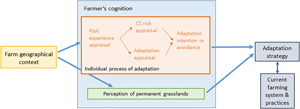
Here, we hypothesize that those strategies depend on i) whether farmers intend to take actions to adapt; that decision is partly dictated by the farmers' previous exposure to risk and ii) how they perceive the values and disvalues of PGs on their farm. Both of those factors in turn vary as a function of the geographical context of a farm. We explored these hypotheses by conducting 15 semi-structured interviews with pasture-based dairy cattle farmers in the French Massif Central. Our goal was to qualitatively analyze consistencies among the farmers' thinking in light of the geographical context of each farm. Doing this, we propose an integrated approach for analyzing farmers' transitions to more resilient grassland-based systems that accounts for both socio-psychological and environmental factors.
Material and methods
We focused on the French Massif Central, the largest semi-natural grassland in western Europe (60% of the usable agricultural area (UAA) in the region is composed of PGs that support herbivore production systems). In the Massif Central, many dairy farmers produce cheese under Protected Denominations of Origins (PDOs). Most PDOs (e.g., Cantal, Bleu d'Auvergne, and Laguiole cheese) require a high proportion of grazed grass and hay in animal diets and are furthermore characterized by specific requirements pertaining to grassland management. Therefore, the future of grassland-based herbivore production systems is important for Massif Central landscapes, and PGs there provide a number of environmental, economic, social, and cultural services (Hulin et al., 2017).
We conducted 15 semi-structured interviews with dairy cattle farmers in the Massif Central from November 2021 through March 2022. The farmers were selected from a group of participants who took part in a grasslands sampling project 10 years prior to develop a multifunctional typology of grasslands in the Massif Central and characterize grassland diversity and the ecosystem services they provide to society (e.g., cheese nutritional and sensory quality) (Galliot et al., Reference Galliot, Hulin, Bonsacquet and Carrère2019; Hulin et al., Reference Hulin, Galliot, Carrère, Le Henaff and Bonsacquet2019). Farms were selected to ensure a wide range of climatic and elevation conditions (Fig. 1).
Map of the Massif Central and the locations of the 15 farmers interviewed. To preserve the anonymity of the interviewees, the locations correspond to the municipality in which each farm is situated.

We first collected information from each farmer about his or her farming system and grassland management techniques. We then asked questions about each farmer's perception of biodiversity and the capacity of multi-species PGs to mitigate or adapt to climatic-related hazards. We additionally queried the farmers about their experience with climate change risk and the adaptation strategies, if any, they had previously implemented or planned to implement in the future. The interviews, which included a plot visit, ranged in duration from two and a half hours to three hours. We audio recorded all the interviews. Shortly after conducting the interviews, we transcribed the parts related to climate change, biodiversity, and adaptation strategy; we excluded stutters, fillers, and false starts (Oliver, Serovich, and Mason, Reference Oliver, Serovich and Mason2005). We used the Microsoft software NVivo for transcription, and we performed text analysis based on deductive coding. We used the terms employed in two perception frameworks on climate change (Grothmann and Patt, Reference Grothmann and Patt2005) and grassland values (Oostvogels et al., Reference Oostvogels, Dumont, Nijland, de Boer and Ripoll-Bosch2022, Reference Oostvogels, Dumont, Nijland, De Boer and Ripoll-Bosch2024) that represented farmers' thinking. The same two persons who collected data, before transcription, agreed on which terms could determine the coding for the same variable and had frequent meetings to double check coding, in order to ensure inter-coder reliability. They then deduced the farmers' adaptation strategies and discussed the levels of change consistent with the resilience typology of Darnhofer (Reference Darnhofer2014).
Geographical context of the farms
The farmers' exposure to climate change-related risks depended on the geographic context of each farm (i.e., its altitude and latitude). In the Massif Central, the mean annual temperature is strongly correlated with altitude (r = −0.89; Allart et al., Reference Allart, Dumont, Joly, Mosnier, Alvarez, Gaillot, Luna, Pottier and Gross2024). Farmers were therefore asked to note the range of elevations encompassed by their grassland plots; the values ranged from 500–1300 meters (m) above sea level (asl). The transition from hill to mountain climate occurs between 700 and 900 m asl in the Massif Central, depending on slope orientation (Conservatoire botanique national du Massif central, 2023). If the maximum elevation of a farm was below 900 m asl, it was considered to be a lowland farm characterized by a warm climate and lowland grassland communities. If the minimum elevation of a farm was above 700 m, it was considered to be an upland farm with a cold climate and upland grassland communities. No single farm had plots confined to between 700 and 900 m asl.
The farms were located along a 150-km-long latitudinal gradient from Puy-de-Dôme department in the north to Aveyron in the south (Fig. 1). Drought severity was determined using the standard precipitation evapotranspiration index (SPEI), which is the difference between precipitation and potential evapotranspiration (Luna, Pottier, and Picon-Cochard, Reference Luna, Pottier and Picon-Cochard2023). The SPEI was retrieved from the SAFRAN database (Le Moigne, Reference Le Moigne2002), which contains data from the past 10 years. Across the Massif Central, latitude is negatively correlated with drought severity (r = −0.68; Allart et al., Reference Allart, Dumont, Joly, Mosnier, Alvarez, Gaillot, Luna, Pottier and Gross2024); in other words, farms located in the southern part of the Massif Central experience increased exposure to drought. We assumed that a farm's latitude was defined by the latitude of its main building. We accordingly split the farm sample into two groups: northern farms were located at latitudes above the mean latitude of the 15 farms (i.e., 45° 17′), and southern farms were located below the mean latitude (Fig. 1).
Combining farm altitude and latitude led us to identify three geographical contexts that predict farmers' experiences with climate change. Six northern farms had not been exposed to severe droughts thus far but had already faced a warming climate; five out of the six farms were located in the hilly area that we considered to be lowlands. Five southern upland farms had already been exposed to droughts in a cold climate, and the four southern lowland farms had been exposed to both droughts and a warming climate.
Table 1 summarizes the farms' characteristics. We used the fractional area of PGs in farm UAA to assess the farmers' current reliance on PGs. The PGs were classically defined as grasslands that had been sown at least five years prior and that has never been ploughed. We used official declarative documents to calculate farm annual stocking rate in 2021, fertilization of PGs, and milk produced per hectare of UAA. To calculate feed self-sufficiency per livestock unit (LU) on an annual basis, we reported the forage units (FUs) bought from outside the farm in 2021. A FU corresponds to the energy content of 1 kg of barley harvested at maturity. We used standard energetic values of feed described by Nozière, Sauvant, and Delaby (Reference Nozière, Sauvant and Delaby2018) to convert the fodder and concentrate feed purchased by farmers into FUs. We then summed the fodder and concentrate that were bought (expressed in FUs bought per LU per year) to calculate the reliance of each farm on feed in 2021. That year was a standard year, climatically speaking, in the Massif Central.
Primary characteristics of the farms in the three geographical contexts. Lowland farms had maximum elevations below 900 m asl, and upland farms had minimum elevations above 700 m asl.

PG, permanent grassland; FU, feed unit; LU, livestock unit.
Perception of risk and farmer intention to adapt to climate change
We used the MPPACC framework to analyze the farmers' individual adaptations to climate change (Grothmann and Patt, Reference Grothmann and Patt2005). This framework is the most suitable socio-cognitive framework for agricultural systems (Mitter et al., Reference Mitter, Larcher, Schönhart, Stöttinger and Schmid2019), given that it accounts for elements that the interviewee may not be fully conscious of to capture the effect of external factors on a farmer's intention to adapt to climate change (Mitter et al., Reference Mitter, Larcher, Schönhart, Stöttinger and Schmid2019). During the interviews, we qualitatively assessed (i) climate risk experience, which is defined as the way farmers describe their previous experience of climate-related hazards that in turn influences their (ii) climate risk appraisal i.e., the perception of a threat probability and of its potential damage. Perceived adaptive capacity (variable iii) refers to a farmer's perception of his/her own resources to adapt, which, together with climate risk appraisal, influences (iv) adaptation appraisal, which is defined as a person's ‘ability to avert being harmed by the threat, along with the costs of taking such action.’ Given that climate change results in an increased frequency and intensity of climate-related hazards and a long-term shift in local climates (Lee et al., Reference Lee, Marotzke, Bala, Cao, Corti, Dunne, Engelbrecht, Fischer, Fyfe, Jones, Maycock, Mutemi, Ndiaye, Panickal, Zhou, Masson-Delmotte, Zhai, Pirani, Connors, Péan, Berger, Caud, Chen, Goldfarb, Gomis, Huang, Leitzell, Lonnoy, Matthews, Maycock, Waterfield, Yelekçi, Yu and Zhou2021), we accounted for the intention to adapt to both hazards (variable v) and to long-term changes (variable vi). We defined four classes for each variable. We then assessed the farmers' profiles of adaptation by analyzing these six variables using the Multiple Correspondences Analysis function in the FactoMineR software package (Lê, Josse, and Husson, Reference Lê, Josse and Husson2008). This function allows projecting a dataset of multiple categorical variables by identifying the dimensions linked to the highest variability (or inertia) in the dataset. From this projection, we performed a clustering of the individuals with HCPC function in the FactoMineR software package (Lê, Josse, and Husson, Reference Lê, Josse and Husson2008) to characterize their adaptation intention from the six previously mentioned variables.
Perception of permanent grasslands
To characterize the farmers' perceptions of PGs, we considered the values and disvalues the farmers attributed to them. We used the Integrated Nature Futures Framework to analyze the plural value dimensions of human–nature interactions (Oostvogels et al., Reference Oostvogels, Dumont, Nijland, de Boer and Ripoll-Bosch2022; Reference Oostvogels, Dumont, Nijland, De Boer and Ripoll-Bosch2024). Values can be understood to have positive valence (positive values, generally simply referred to as ‘values’; Pascual et al., Reference Pascual, Balvanera, Díaz, Pataki, Roth, Stenseke, Watson, Dessane, Islar, Kelemen, Maris, Quaas, Subramanian, Wittmer, Adlan, Ahn, Al-Hafedh, Amankwah, Asah, Berry, Bilgin, Breslow, Bullock, Cáceres, Daly-Hassen, Figueroa, Golden, Gómez-Baggethun, González-Giménez, Houdet, Keune, Kumar, Ma, May, Mead, O'Farrell, Pandit, Pengue, Pichis-Madruga, Popa, Preston, Pacheco-Balanza, Saarikoski, Strassburg, van del Belt, Verma, Wickson and Yagi2017) or negative valence (‘disvalues’; Lliso et al. Reference Lliso, Lenzi, Muraca, Chan and Pascual2022). Building on previous literature regarding nature's values and disvalues (Pascual et al., Reference Pascual, Balvanera, Díaz, Pataki, Roth, Stenseke, Watson, Dessane, Islar, Kelemen, Maris, Quaas, Subramanian, Wittmer, Adlan, Ahn, Al-Hafedh, Amankwah, Asah, Berry, Bilgin, Breslow, Bullock, Cáceres, Daly-Hassen, Figueroa, Golden, Gómez-Baggethun, González-Giménez, Houdet, Keune, Kumar, Ma, May, Mead, O'Farrell, Pandit, Pengue, Pichis-Madruga, Popa, Preston, Pacheco-Balanza, Saarikoski, Strassburg, van del Belt, Verma, Wickson and Yagi2017; Pereira et al., Reference Pereira, Davies, den Belder, Ferrier, Karlsson-Vinkhuyzen, Kim, Kuiper, Okayasu, Palomo, Pereira, Peterson, Sathyapalan, Schoolenberg, Alkemade, Carvalho Ribeiro, Greenaway, Hauck, King, Lazarova, Ravera, Chettri, Cheung, Hendriks, Kolomytsev, Leadley, Metzger, Ninan, Pichs, Popp, Rondinini, Isabel, van Vuuren and Lundquist2020; Lliso et al., Reference Lliso, Lenzi, Muraca, Chan and Pascual2022), this framework considers three perspectives on the basis of which humans characterize objects related to nature (i.e., biodiversity, natural processes and nature management and conservation). We used this framework to reveal the arguments that farmers used in favor or against multi-species PGs on their farm and PG management. The ‘nature’ perspective concerns the idea that nature has an intrinsic value and highlights how an interviewee considers the object of the study; i.e., how PGs would affect nature. The ‘society’ perspective focuses on how PGs provide instrumental value to humans (e.g., provisioning and regulating services). Finally, the ‘culture’ perspective focuses on the relational value of PGs; i.e., how PGs affect humans' relationships with or via nature.
Farmers' adaptation strategies
Based on textual analysis, we identified the adaptation strategy of each farmer as a combination of various adaptation measures. Consistent with the methodology of Dumont et al. (Reference Dumont, Franca, López-i-Gelats, Mosnier and Pauler2022), we categorized management decisions according to whether they occurred at the feed-resource, herd, or farm-management levels. We qualitatively clustered farmers' narratives based on textual analysis to identify contrasting adaptation strategies; we also discussed the levels of change (i.e., gradual or transformative) in line with the resilience typology of Darnhofer (Reference Darnhofer2014).
Results
Perception of risk and farmer intention to adapt to climate change
The Multiple Component Analysis and clustering based on the MPPACC revealed four different groups (Fig. 2) that displayed different levels of adaptation intention. This clustering takes into account the first three axes of the Multiple Component Analysis, which explain 71% of the observed variance. The first group was composed of four farmers who considered their farming systems to be already adapted to climate change; they noted different options to overcome future climate-related hazards (e.g., buying fodder or using security stocks). Farm resilience results from adaptations farmers have already implemented (e.g., increasing their farm area, which allows them to build fodder stocks) or from assets already present from their system (e.g., a PG-based system costs little money to maintain, which allows farmers to save money to use in the case of poor weather). These farmers accordingly felt ready to overcome future climate-related hazards and did not see the need for changes, as illustrated by this quote: ‘Well I think we are adapted, now. […] Well head down and we let the wind blow. What else can we do?’ (Farmer A)
Groups that exhibited different levels of intention to adapt to climate change based on Multiple Component Analysis and clustering of the six variables from the MPPACC (Grothmann and Patt, Reference Grothmann and Patt2005). We accounted for farmers' perception of the risks associated with climate change and their own ability to adapt and adaptation levers to both climate-related hazards and long-term changes.

The five farmers in the second group planned to implement new adaptations on their farms (Table 2). That finding was consistent with the farmers' appraisals of significant climate change-related risks and their perceived high capacity to adapt (even though they had not done so already). Those farmers were, however, sure to implement these management options, as revealed by this quote: ‘No, as far as I am concerned, the climate adaptation that us, farmers, have to do, is to reduce the number of cows everywhere […]. We are going to do it with [name of the associate], for sure.’ (Farmer M)
Management practices implemented by farmers in the four adaptation strategies, organized according to whether the adaptations occur at the feed-resource, herd, or farm-management levels.

Graphical abstract: Hypothesized relationships among a farm's location, a farmer's individual process of adapting to climate change, a farmer's perception of permanent grasslands and his or her adaptation strategy.
The three farmers in the third group foresaw little room for maneuvering since they believed that they had limited capacity to adapt; they also acknowledged that climate change posed a risk to their farms. Their statements highlighted external administrative or economical constraints that prevented them from implementing adaptations and reduced their ability to adapt to climate change. They accordingly favored short-term adaptation to climate-related hazards; they had not yet made a firm decision as to whether to adapt to long-term changes or not. An illustration of short-term adaptation options is expressed in this quote: ‘We undergo [climate change]. […] When it is very hot, for example, we put the cows where there is more wood to keep them in the shade, and we graze them at night. We just go from day to day!’ (Farmer F)
The three farmers in the fourth group did not intend to adapt to climate change. This mindset resulted from a high appraisal of climate change-related risks that generated a sense of fatalism, as revealed by this quote: ‘In 2050, here, the climate will be the one of Andalusia [South Spain]. It won't be possible to grow anything.’ (Farmer K). The other two farmers in this group did not intend to take action given that they were close to retirement age. They believed that they did not have enough time to implement changes and reap the benefits of those changes in practices; that mindset persisted regardless of whether the farmers had identified a successor to take over their farm.
Perception of permanent grasslands
We analyzed human–nature interactions following the Nature Futures Framework of Pereira et al. (Reference Pereira, Davies, den Belder, Ferrier, Karlsson-Vinkhuyzen, Kim, Kuiper, Okayasu, Palomo, Pereira, Peterson, Sathyapalan, Schoolenberg, Alkemade, Carvalho Ribeiro, Greenaway, Hauck, King, Lazarova, Ravera, Chettri, Cheung, Hendriks, Kolomytsev, Leadley, Metzger, Ninan, Pichs, Popp, Rondinini, Isabel, van Vuuren and Lundquist2020) while also accounting for the disvalues of PGs as proposed by Oostvogels et al. (Reference Oostvogels, Dumont, Nijland, De Boer and Ripoll-Bosch2024). We found that farmers' perceptions of PGs could be separated into four categories. We note, however, that two farmers did not refer to any values or disvalues of PGs in their interviews. When asked about biodiversity, they focused on sown TGs or forage crops. The characteristics of PGs that the other farmers reported, along with their integrated visions, can be found in Fig. 3.
Various perceptions of permanent grasslands in the livestock farming systems. The values of permanent grasslands perceived by farmers are noted in green, and the disvalues are noted in red.

The first group of farmers (four out of 15 farmers) emphasized the intrinsic values of PGs (on the ‘for nature’ axis), their instrumental values and their relational values. These farmers' self-identity is linked to farming with PGs. These farmers view species-rich PGs as the functional basis of their production systems; their management practices are tied to caring for the land and increasing biodiversity. Consistent with the practice of Oostvogels et al. (Reference Oostvogels, Dumont, Nijland, De Boer and Ripoll-Bosch2024), we refer to these farmers as ‘farming with PGs.’ The following quote illustrates these farmers' beliefs about PGs: ‘For us, it is also an identity to produce cheese with only grass and a maximum of natural grasslands. […] We feel better producing milk with grass than intensively producing milk with oilcakes and corn.’ (Farmer B)
The second group of five farmers emphasized only the instrumental values of PGs. They valued PGs for their agronomic functions and the various benefits they can confer. We therefore referred to these farmers as ‘farming from PGs.’ The instrumental value these individuals attributed to PGs is reflected in the following quote: ‘And it is a natural grassland. So you have more flexibility, and it matures more slowly. If you miss the time to cut on temporary meadow, you will soon have spikes of grass, and it will flower very quickly.’ (Farmer A)
The third group consisted of two farmers who also emphasized the instrumental values of PGs on the ‘society’ axis; they also noted some disvalues on the same axis. We referred to these two farmers as ‘farming mostly from PGs.’ Like the group of farmers discussed above, they did not express narratives about the intrinsic or relational values of PGs during their interviews. Their ambivalence in terms of perceiving the instrumental value of PGs is reflected in the quote ‘Yes, that is it, with sometimes lower yields, but grassland biodiversity brings durability.’ (Farmer M)
The fourth group of two farmers emphasized the instrumental disvalues of PGs compared with the benefits of relying on TGs or forage crops in rotations. Although these farmers perceived some instrumental value to PGs (e.g., fodder nutritional quality), we decided to group those farmers as ‘farming separate from PGs’ (Oostvogels et al., Reference Oostvogels, Dumont, Nijland, De Boer and Ripoll-Bosch2024). These individuals emphasized a number of instrumental disvalues of PGs (e.g., low grass yield, low system operability, and compact soils). That mindset is expressed in the quote ‘You would think that permanent grasslands would be just about ideal. When I have ploughed mine, the soil was extremely compact. There are quite a few where not a single earthworm could be found […] After four years of crop rotation, it changed completely. It was easier, it was full of earthworms, it was nothing like before.’ (Farmer L)
Farmers' adaptation strategies
The qualitative clustering of the narratives of the 12 farmers who have already adapted to climate change or who intended to adapt—determined based on textual analysis—led us to identify four contrasting strategies. The details of the management practices of these four strategies are provided in Table 2; they are organized on the basis of whether the adaptations occurred at the feed-resource, herd, or farm-management levels.
The benefits of the intra- and inter-plot diversity of PGs and hedgerows
Six out of the 12 farmers who have adapted to climate change or intended to adapt perceived resilience-related benefits to preserving PGs and other landscape features such as trees and hedgerows. Four of those farmers' properties are located in the northern Massif Central; the remaining two in are located in the southern uplands. In the minds of these farmers, PGs, hedgerows and trees directly reduce farm vulnerability and/or indirectly provide adaptation options. For example, grazing livestock on PGs makes it possible to feed herbivores at low cost, which in turn confers cost savings since fodder does not have to be purchased. Different grasslands (e.g., wet grasslands and dry grasslands on shallow soils) with various nutritive values and abilities to withstand droughts make it possible to graze animals while coping with fluctuating meteorological conditions that occur throughout the grazing season. The contrasting dynamics of biomass production enhance flexibility in grassland management (e.g., variability in the timing of cutting meadows) while stabilizing grass yields available on a farm scale. The perceived value of PGs to farmers' adaptations is reflected in the following quote: ‘We need everything and the fact that we have fields in different places, in different elevations, sometimes it is not so bad. They say you should not put all your eggs in one basket. Because here it can be dry, there it can be wet and up there dry when we come to cut, all well in good conditions. A wet year, we will be less comfortable here because it is little carrying and in a dry year we will be more comfortable there because the soil is carrying.’ (Farmer B)
More than 90% of the UAAs of these six farms were devoted to PGs; the farmers' average yearly stocking rate was 1.04 LUs per ha. Five out of these six farmers acknowledged adaptations resulting from within-plot floristic diversity. Four of the farmers also noted that grazing their livestock on PGs allowed them to feed their animals at low cost and saved them money because they did not have to buy fodder in the case of poor weather.
Complementarity between PGs and forage crop rotations
Two farmers intended to buffer climate-related hazards with PGs—they believed that PGs stabilized inter-annual grass yields. However, those same farmers also engaged in forage crop rotations. They noted that forage crop rotations enhanced the nutritional quality of their animals' diets, benefitted the soil, and contributed to regulating rodent pests (e.g., vole outbreaks). Even though PGs were viewed as an asset when it came to adapting to climate change and a diversity of PGs allowed for flexibility in management, these same farmers also perceived their disvalues, and they intended to compensate for those disvalues by using their land in other ways. Trees and hedgerows were also viewed as assets that could reduce the vulnerability of a farm's PGs or forage crops to heat and droughts. One farmer noted that his system was already adapted to climate change since he combines PGs with crops and TGs on 50% of his UAA and furthermore has security stocks. The other farmer still had 90% of his UAA as PGs but intended to adapt his system in the future by increasing the proportion of TGs and by planting trees.
Adjusting the composition of temporary grasslands
Two farmers with lands located in the southern uplands intended to build forage stocks to buffer against climate-related hazards and achieve feed self-sufficiency by sowing multiple species of grasslands with adapted mixtures or species adapted to drought conditions. Less-diverse mixtures (e.g., rye-grass-clover) are viewed as a way to extend the grazing season and reduce the need for fodder during the winter. Even though both of these farmers had 80–90% of their UAA covered by PGs, they did not consider PGs to be an asset to adapting to climate change. Their farm stocking rate was the highest (i.e., 1.28 LUs per ha), which led them to buy more than 1000 FUs of fodder per LU in 2021 despite their proficiency managing TGs. Both of these farmers discussed sown mixtures when asked about grassland biodiversity.
Relying on crop rotations protected by hedgerows and trees
Two farmers with lands located in the southern lowlands did not consider PGs to be a viable solution to adapting to climate change; they instead opted for fodder stocks to buffer against climate-related hazards. Both farmers had planted trees and hedgerows to protect TGs and forage crops in rotation, and one of them diversified his farm revenue by selling wood: ‘Trees protect crops during droughts. So I am a bit unconventional, I am planting trees in the middle of fields. […] But this is not a step back. I am spacing them 26 meters apart; they will not interfere with modern machinery.’ (Farmer L). Both farmers were disappointed with PGs after experiencing a severe summer drought in 2003; just 35 and 51% of their UAA, respectively, was covered by PGs. Both farmers had furthermore built security fodder stocks to buffer against climate-related hazards; each only bought 300 FUs of fodder per LU in 2021. They planned to implement new adaptations in the future, as reflected in this quote: ‘Will other plants appear in the future? I do not know, with climate change. I think we will have to associate maize with something else. […] Grass can grow in the shade of maize and ends after the maize has been harvested. Fifteen days after the grassland can be grazed.’ (Farmer L)
Discussion
Consistencies among perceptions, farm locations, and adaptation strategies
We hypothesized that the strategies employed by farmers to adapt to climate change would depend on (i) their intention to take action to adapt, which partly results from their climate risk appraisal, (ii) their perception of the values and disvalues of PGs; and (iii) that both of the aforementioned factors would vary according to local climatic and topographical conditions.
We confirmed that perception and farm location influenced farmers' adaption strategies; we also found consistent combinations of factors for farmers who intend to adapt. For the nine farmers who considered their system to be adapted to climate change or who were planning to implement new adaptations in the future (i.e., clusters 1 and 2 in Fig. 2), we observed straightforward relationships between perceptions of PGs and adaptation strategies (Fig. 4a). For example, nearly all of the farmers in the northern Massif Central and southern uplands emphasized only the instrumental values of PGs (‘farming from’ type) or their intrinsic, instrumental, and relational values (Pascual et al., Reference Pascual, Balvanera, Díaz, Pataki, Roth, Stenseke, Watson, Dessane, Islar, Kelemen, Maris, Quaas, Subramanian, Wittmer, Adlan, Ahn, Al-Hafedh, Amankwah, Asah, Berry, Bilgin, Breslow, Bullock, Cáceres, Daly-Hassen, Figueroa, Golden, Gómez-Baggethun, González-Giménez, Houdet, Keune, Kumar, Ma, May, Mead, O'Farrell, Pandit, Pengue, Pichis-Madruga, Popa, Preston, Pacheco-Balanza, Saarikoski, Strassburg, van del Belt, Verma, Wickson and Yagi2017, in the case of ‘farming with’). Conversely, farmers located in the southern lowlands either only highlighted the disvalues of PGs (‘farming separate from PGs’) or noted both their instrumental values and disvalues (‘farming mostly from PGs’). That group of farmers therefore mostly based their adaptation strategies on TGs and forage crops. Conversely, when farmers foresaw little room for maneuver their perception of PGs did not match their adaptation strategy (Fig. 4b). For example, farmers in the southern uplands and the northern Massif Central highlighted the values of PGs; those individuals belonged to the ‘farming with PGs’ or ‘farming with PGs’ groups. However, they did not systematically intend to use PGs to adapt to climate change. Finally, two out of the three farmers not intending to adapt (Fig. 4c) did not discuss PGs when asked about biodiversity. Instead, they referred to forage mixtures or hedgerows.
Relationships among a farm's location, the farmer's perception of permanent grasslands (PGs) and the farmer's adaptation strategy. Thicker arrows correspond to a larger fraction of farmers: (a) feeling their system is adapted to climate change or planning to implement new adaptations; (b) foreseeing little room for maneuvering; and (c) not intending to adapt. Lowland farms had maximum elevations below 900 m asl; upland farms had minimum elevations above 700 m asl.

The consistency in the farmers' perceptions of PGs and their adaptation strategies (among the farmers who intended to adapt; Fig. 4a) echoes how farmers' perceptions of PGs in Brittany influenced the long-term maintenance of PGs in lowland dairy farms, in a context of regional intensification of farming practices (Petit et al., Reference Petit, Martel, Vertès and Couvreur2019). A close link between farmers' views, land-use intensity and biodiversity conservation has also been established in Austria: farmers who were qualified as innovative or traditionally oriented were more likely to preserve the natural value of their farm compared with production-oriented farmers (Schmitzberger et al., Reference Schmitzberger, Wrbka, Steurer, Aschenbrenner, Peterseil and Zechmeister2005). In the Massif Central, temperature is negatively correlated with altitude, and drought severity is negatively correlated with latitude (Allart et al., Reference Allart, Dumont, Joly, Mosnier, Alvarez, Gaillot, Luna, Pottier and Gross2024). Farm surveys have revealed that the perceptions of the services provided by PGs also vary with geographic context. Farmers located at more northern latitudes and in uplands—characterized by less-frequent and less-severe droughts—were more likely to embrace PGs than farmers working in the southern lowlands, where grasslands experienced more frequent droughts and a warmer climate. This finding suggests that the local climate may influence the perceptions of grasslands among farmers who are considering various management practices and strategies to adapt to climate change. Lamarque et al. (Reference Lamarque, Meyfroidt, Nettier and Lavorel2014) confirmed this result—these authors observed that farmers in the French Alps made management decisions based on the combined effects of their farm's characteristics (e.g., climatic and topographical constraints) and their knowledge of ecosystem services and social values. Farmers were therefore able to adapt their practices based on observations of how drought conditions affected the outputs of their management practices, which in turn led to changes in the farmers' values (Lamarque et al., Reference Lamarque, Meyfroidt, Nettier and Lavorel2014).
We found no difference in adaptation strategies between farmers who emphasized only the instrumental values of PGs (‘farming from PGs’) and farmers who also noted the intrinsic and cultural values of PGs (‘farming with PGs’) (Fig. 4a). This finding suggests that the perception of the instrumental values of PGs may be more crucial for decision-making; farmers value the viability of their business first and foremost. As already highlighted by Oostvogels et al. (Reference Oostvogels, Dumont, Nijland, De Boer and Ripoll-Bosch2024), farmers also perceive the disvalues of PGs. That situation, in turn, shapes farmers' adaptation strategies and the role of TGs on farmlands.
Factors that can promote or inhibit adaptation intentions
Knowledge of relevant agronomic and ecological processes is an important aspect connecting multi-species PG perceptions and practices. For example, in the French Alps, farmers' decisions to spread manure were not only based on grass yield criteria but also on their knowledge of how the presence of manure affects grassland botanical diversity (Lamarque et al., Reference Lamarque, Meyfroidt, Nettier and Lavorel2014). Knowledge has also been noted to be an element of adaptive capacity that drives the individual process of adaptation to climate change (Grothmann and Patt, Reference Grothmann and Patt2005). In our study, farmers' perceptions of the advantages of land use were consistent with those noted in the scientific literature. For example, farmers who relied on PGs noted that floristic diversity was akin to the so-called ‘portfolio effect’ when it came to reducing the vulnerability of plant communities to hazards (Lüscher et al., Reference Lüscher, Barkaoui, Finn, Suter, Suter and Volaire2022); floristic diversity also reduced inter-annual yield variability (Tilman, Reich, and Knops, Reference Tilman, Reich and Knops2006). The farmers we interviewed noted that grassland diversity facilitates flexible grassland management (e.g., in pasture rotations), stabilizes grass yields on the farm scale (Nettier et al., Reference Nettier, Dobremez, Coussy and Romagny2010), benefits the sensory quality of dairy products (Martin et al., Reference Martin, Verdier-Metz, Buchin, Hurtaud and Coulon2005) and helps to keep the costs of grass-based diets low (Peeters, Reference Peeters2009). Farmers relying partly on forage crop rotations also reported the benefits of diversifying the forage system for regulating rodent pests (e.g., vole outbreaks) (Fichet-Calvet et al., Reference Fichet-Calvet, Pradier, Quéré, Giraudoux and Delattre2000). The ecosystem services provided by trees and hedgerows were also noted; these features can regulate water flow and accordingly affect local climate patterns and animal welfare (Moreno et al., Reference Moreno, Aviron, Berg, Crous-Duran, Franca, de Jalón, Hartel, Mirck, Pantera, Palma, Paulo, Re, Sanna, Thenail, Varga, Viaud and Burgess2018). Although our study does not differentiate between beliefs and knowledge, the consistency that we noted between farmers' perceptions and data in the literature suggests that the farmers possess knowledge about the resources that they use. That situation, in turn, encourages adaptation intentions via perceived adaptive capacity (Grothmann and Patt, Reference Grothmann and Patt2005). We also noted inconsistencies in the case of farmers highlighting the values of multi-species PGs but relying on sown TGs for adaptation (Fig. 4b). That situation was also linked to access to knowledge. One farmer reported that he had benefited from more training opportunities related to TGs compared with PGs; that finding highlighted the need for knowledge transfer. A range of tools can be used to characterize PG diversity and the ecosystem services they provide to farmers and to society (Galliot et al., Reference Galliot, Hulin, Bonsacquet and Carrère2019; Hulin et al., Reference Hulin, Galliot, Carrère, Le Henaff and Bonsacquet2019; Dernat, Dumont, and Vollet, Reference Dernat, Dumont and Vollet2023).
Some of the narratives we recorded were similar to those reported in other studies that also used the MPPACC framework with European farmers (e.g., Mitter et al. (Reference Mitter, Larcher, Schönhart, Stöttinger and Schmid2019) in Austria). The ‘climate change adaptors’ found by Mitter et al. (Reference Mitter, Larcher, Schönhart, Stöttinger and Schmid2019) are comparable to our groups of farmers who considered their system to be already adapted or who were planning to implement new adaptations. Skepticism about climate change was reported by both Mitter et al. (Reference Mitter, Larcher, Schönhart, Stöttinger and Schmid2019) and by one farmer in our study. Wider sampling efforts are necessary to assess how the characteristics of agricultural systems and farming areas, access to information, social norms, and the role of peer groups (Kreft et al., Reference Kreft, Huber, Schäfer and Finger2024) influence farmers' narratives about climate change-related adaptations. While the presentation of data source counts provides transparency about how the research was conducted (i.e. credentialing counting as defined by Hannah and Lautsch, Reference Hannah and Lautsch2011), a wider sampling effort would provide more in-depth understanding of the frequency with which each adaptation strategy occurs in the Massif Central, and insights on changes in the perception of grass-based farmers over time.
Despite a relatively limited sample size, we found one statement to be true for all of the farmers that we interviewed: farm adaptations resulted from incremental changes over time, a situation analogous to ‘path dependency’ (Sutherland et al., Reference Sutherland, Burton, Ingram, Blackstock, Slee and Gotts2012). These changes involved resilience dimensions of adaptive and buffer capabilities (Darnhofer, Reference Darnhofer2014). In other words, farmers overcame hazards without significantly changing how their system functioned. Indeed, farmers who possess certain feed resources (e.g., PGs, TGs, or forage crops) may rely exclusively on the resources they know how to manage. However, five out of the 15 farmers had transformed their system—be enacting changes in their farm's structure and functioning (Darnhofer, Reference Darnhofer2014)—after significant events such as the farm changing hands or the passage of climatic-related incidents. Intuitively, one could believe that previous exposure to risk would trigger a stronger intention to take action. For example, the two farmers in the southern lowlands who relied on crop rotations that were protected by hedgerows and trees changed their land use after the 2003 drought (Ciais et al., Reference Ciais, Reichstein, Viovy, Granier, Ogée, Allard, Aubinet, Buchmann, Bernhofer, Carrara, Chevallier, De Noblet, Friend, Friedlingstein, Grünwald, Heinesch, Keronen, Knohl, Krinner, Loustau, Manca, Matteucci, Miglietta, Ourcival, Papale, Pilegaard, Rambal, Seufert, Soussana, Sanz, Schulze, Vesala and Valentini2005); the direct experience of natural hazards increased their risk perception (Bronfman et al., Reference Bronfman, Cisternas, Repetto, Castañeda and Guic2020) and consequently led them to adapt (Grothmann and Patt, Reference Grothmann and Patt2005). Conversely, we also observed fatalism in one farmer who did not intend to adapt, despite his strong beliefs in the risks associated with climate change. This situation confirms the conclusions drawn by Grothmann and Patt (Reference Grothmann and Patt2005) that an increase in climate change risk appraisal can result in either the development of intentions to adapt or the mindset of fatalism (i.e., a driver of adaptation avoidance).
In the same way, intergenerational transmission of a farm from one person to another provided an opportunity to transform the system on two farms; the new farm manager used his position to implement radical changes in land use (e.g., crop rotations with TGs). However, intergenerational transmission also occurred on three farms whose owners did not intend to adapt. Both the soon-to-be-retired farmers and their successors clearly stated that the forthcoming retirement was the reason for inaction; that mindset put the responsibility to adapt on the next generation. This finding confirms that intergenerational farm transfer is a critical phase of farm management (Chiswell, Reference Chiswell2018) that encompasses adaptations of grass-based systems to climate change.
Implications of contrasting adaptation strategies for landscape sustainability
Contrasting strategies observed in a given grassland-based landscape can represent a threat to PGs or an opportunity to develop different ecosystem services and boost overall sustainability at landscape scale. Multi-species PGs are biodiversity hotspots that provide a number of ecosystem services (Bengtsson et al., Reference Bengtsson, Bullock, Egoh, Everson, Everson, O'Connor, O'Farrell, Smith and Lindborg2019; Lindborg et al., Reference Lindborg, Hartel, Helm, Prangel, Reitalu and Ripoll-Bosch2023; Allart et al., Reference Allart, Dumont, Joly, Mosnier, Alvarez, Gaillot, Luna, Pottier and Gross2024); converting them to forage crops or sown mixtures reduces local biodiversity and represents a threat to the multiple services they deliver. The conversion of old multi-species PGs to TGs or annual crops leads to large releases of soil-borne carbon stocks and can have long-lasting impacts on the abundance and diversity of pest predators and pollinators (Le Provost et al., Reference Le Provost, Badenhausser, Le Bagousse-Pinguet, Clough, Henckel, Violle, Bretagnolle, Roncorini, Manning and Gross2020). On the other hand, farming with crop forage and TGs in rotations contributes to weed control in crop fields (Meiss et al., Reference Meiss, Médiène, Waldhardt, Caneill and Munier-Jolain2010) and can mitigate vole outbreaks (Fichet-Calvet et al., Reference Fichet-Calvet, Pradier, Quéré, Giraudoux and Delattre2000). Grass-legume mixtures and TGs that are well adapted to climate change (see, for example, Lüscher et al., Reference Lüscher, Barkaoui, Finn, Suter, Suter and Volaire2022) can also increase and stabilize grass yields on a farm scale. Grass production on these productive plots enables farmers to attain higher levels of animal production per unit area or to build up fodder stocks that can reduce productive pressure on diversified PGs. Those diversified PGs, in turn, can be used more extensively (e.g., for grazing heifers). Reducing grazing intensity on multi-species PGs benefits biodiversity in multi-species upland grasslands (e.g., Dumont et al., Reference Dumont, Farruggia, Garel, Bachelard, Boitier and Frain2009). In this way, the intensification of the conversion of some PGs to ensure sufficient grass production can indirectly enable the conservation of extensively managed PGs of patrimonial value.
Conclusion
Our study has revealed a high level of consistency between farmers' climate risk appraisals and perceptions of the instrumental values and disvalues of PGs, and the adaptation strategies of farmers who intend to adapt to climate change. Farmers in the southern lowlands who are already experiencing drought severity in a warm climate have a low perception of the instrumental value of PGs and opt for forage crops to adapt to climate change. Conversely, farmers in other areas of the Massif Central where the experience of climate change-related risks has been less prominent place greater value on permanent grassland and choose to keep them at the core of their forage system. The importance of the geographical context calls for wider sampling to identify thresholds guiding decisions and to determine the most significant variables (e.g. average yield or variability of yield) guiding farmers' decisions. In the mid-term, climate change could shift strategies from south to north, reducing the share of permanent grassland everywhere. Temporal monitoring would thus be necessary to assess changes in the perception of grasslands over time. Strategies leading to the ploughing up of grasslands also raise many questions: they are costly for the farmer (mechanization, fuel, seeds etc.) and contribute directly and indirectly to global warming. In a context where water limitation will increase, the decision to irrigate forage crops and leys can become a territorial concern that needs to be balanced with the need to produce an acceptable level of animal products. The ploughing up of a limited part of the permanent grasslands is, however, an option to consider in a land sparing strategy that preserves a large part of the permanent grasslands while securing some production.
This study also shows the lack of knowledge of some farmers on the assets of PGs, as well as the complex intertwinement of socio-psychological and environmental factors. Extreme events such as the 2003 summer drought and human factors such as intergenerational transmission of a farm from person to person can either trigger or temporarily block the transition. There is thus no turn-key solution to recommend to all farmers of a given territory. Instead, we need to provide them with information and advices while considering their experience, values and farm structure (grassland type, housing, microclimate, etc.), to help them to transition to more climate-resilient systems.
Acknowledgements
We thank the farmers who deeply engaged in the survey.
Authors’ contributions
Lucie Allart, Frédéric Joly, Claire Mosnier, Nicolas Gross, and Bertrand Dumont agreed on overarching research aims. Lucie Allart and Vincent Oostvogels collected data and transcribed the parts related to climate change, biodiversity and adaptation strategy. All authors agreed on statistical analyses, the manuscript structure, and key messages. Lucie Allart and Bertrand Dumont then led the manuscript writing. All authors contributed to the draft revisions and gave final approval for publication.
Funding statement
Lucie Allart was funded by Auvergne-Rhône-Alpes region (CPER Symbiose) and by Biosefair (INRAE scientific programming) for her travel costs. This study received additional support from the project Agroecology-TRANSECT, which received funding from the European Union's Horizon Europe research and innovation program under grant agreement N101060816. The views and opinions expressed are those of the authors only and do not necessarily reflect those of the European Union or the European Research Executive Agency; neither the European Union nor the granting authority can be held responsible for them.
Competing interests
None.


 Open access

