




Introduction
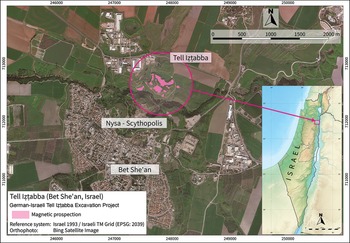
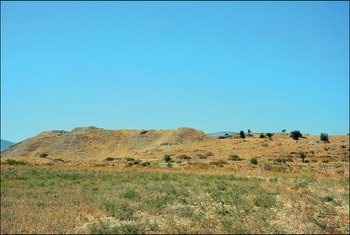
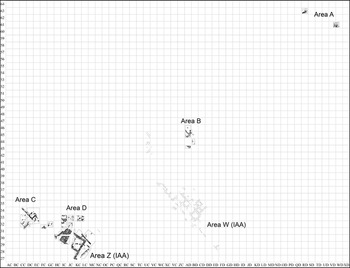
The seasonal nature of archaeological evidence has come to the forefront of archaeological research in recent years (cf. Lichtenberger & Raja Reference Lichtenberger and Raja2021). Historical events are often recounted in history books as simply part of a year's occurrences. The time of the year and accompanying season, however, also have an impact on the course of historical events. Moreover, if such events leave archaeological traces, the particular season, which can affect the population's behaviour, may affect the structure of the archaeological record. In other words, whether an event, such as the destruction of a domestic building, took place in summer or winter is reflected in the archaeological record. Consequently, the archaeological evidence needs to be interpreted with a consideration of seasonality in mind. In this article, we discuss the destruction of the Seleucid town of Tell Iẓṭabba (also known as Beth She'an/Nysa-Scythopolis) (Ebeling et al. Reference Ebeling2020, Reference Ebeling2021) (Figures 1–3).
Map of Tell Iẓṭabba (© German-Israeli Tell Iẓṭabba Excavation Project).

View of Tell Iẓṭabba from the north (© German-Israeli Tell Iẓṭabba Excavation Project).

Plan of the excavated areas at Tell Iẓṭabba. IAA = Israel Antiquities Authority (© German-Israeli Tell Iẓṭabba Excavation Project).

The year of destruction
The previously published stamped amphora handles from Tell Iẓṭabba's environs (as well as other finds) date the occupation and re-foundation of the site to the second quarter of the second century BC. Finkielsztejn's (Reference Finkielsztejn, Mazor, Atrash and Finkielsztejn2018) report, detailing 327 stamps, places the re-foundation of the site within the reign of Antiochus IV (175‒164 BC). By the end of the second century BC, the Judaean Hasmonean state had expanded into the neighbouring pagan centres in Palestine and Transjordan and conquered and destroyed them. According to Classical sources, Nysa-Scythopolis was destroyed by John Hyrcanus in the context of a siege of the city of Samaria (Josephus, War, I, 66 [Thackeray trans. Reference Thackeray and Thackeray1927]; Ant. XIII, 280 [Thackeray trans. Reference Thackeray and Thackeray1930]; cf. Bar-Kochva Reference Bar-Kochva2002: 12, note 13). The destruction of Nysa-Scythopolis is considered to have taken place either between 111 and 107 BC (e.g. Schürer Reference Schürer1973: 210, footnote 22) or in 107 BC (e.g. Avi-Yonah Reference Avi-Yonah1976: 65‒66; Fuks Reference Fuks1983: 63). These dates were later supported by the stamped Rhodian amphora handles, the latest being dated to 108 BC by Finkielsztejn for the eponym Agoranax (Reference Finkielsztejn1999: 50, Reference Finkielsztejn, Mazor, Atrash and Finkielsztejn2018: 19 & 55, cat. no. 172), but his year of activity was recently updated to either 110 or 109 BC (cf. Finkielsztejn Reference Finkielsztejn, Berlin and Kosmin2021: 208). The latest legible Hellenistic coin recovered by our expedition (Lichtenberger & Tal Reference Lichtenberger and Tal2021: 44, cat. no. 10), as well as several yet-unpublished coins recovered by the Israel Antiquities Authority expedition (Y. Farhi, pers. comm.), are dated to Seleucid Era (SE) 202, which corresponds to the period between October 111 BC and September 110 BC, in Antiochus IX's reign (based on the Seleucid Era in Syria; cf. Kosmin Reference Kosmin2018: 35–39). These data provide a terminus post quem for the destruction of Nysa-Scythopolis after 110/109 BC and, given the fact that the destruction of the site concurs with that of Samaria (based on Josephus’ accounts), the customary 108/107 BC date (SE 205) is preferred (Bar-Kochva Reference Bar-Kochva2002).
The season of destruction
The exact date of destruction is hinted at in the testimony of the Megillat Ta‘anit (Scroll of Fasting), which reports Hasmonaean events. It states, in verse 10, “On the 15th and 16th of Sivan the people of Beth She'an and the Valley were exiled” (cf. Noam Reference Noam2003: 44 [Scroll], 69 [Scholion] & 196 [Critical Edition]). The Hebrew month of Sivan corresponds to May/June and, based on the Rhodian stamped handles and coins, it is possible to suggest that the site's destruction took place in late spring/early summer. The season of the destruction matches what is generally known regarding Hellenistic warfare: military campaigns were usually conducted in spring and early summer (Chaniotis Reference Chaniotis2005: 122; cf. also Ecclesiastes 3: 1–8).
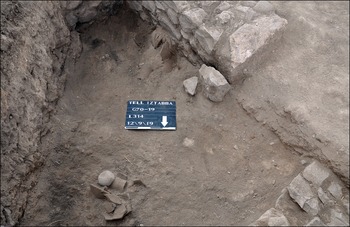
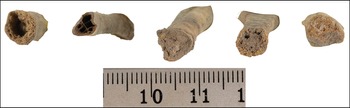
That spring represents the season of destruction is corroborated by the organic evidence discovered in the destruction layers at the site (Figure 4). Medullary bone deposits in the marrow cavity of leg bones of egg-laying hens serve to store calcium for eggshell production during the laying season (Van Neer et al. Reference Van Neer, Noyen and Cupere2002: 123‒24). These deposits indicate the sex of the individual and, in the case of ancient hens, the season in which they were butchered—that is, either spring or early summer (cf. Van Neer et al. Reference Van Neer, Noyen and Cupere2002: 123) (Figure 5). The presence of medullary bone was observed in skeletal elements from five hens collected in the destruction layers excavated at the site (Area B, Loci 209 [femur], 245 [tibiotarsus, humerus] and 257 [femur, humerus]; the total NISP of Gallus gallus domesticus in the sample = 9).
Spring 107 BC destruction layer of the Seleucid settlement of Tell Iẓṭabba (© German-Israeli Tell Iẓṭabba Excavation Project).

Examples of medullary bone deposits from Gallus gallus domesticus (© German-Israeli Tell Iẓṭabba Excavation Project).

The spring season of destruction is also supported by the macrobotanical remains of wild plant species found in the fills of silos and on the floors of domestic buildings, which represent the refuse of the destroyed occupation layers. Reconstruction of seasonality by means of botanical remains (e.g. seeds, fruits and pollen) has been posited for several ancient sites in the Southern Levant (Kislev Reference Kislev1992; Langgut et al. Reference Langgut2016; Dunseth et al. Reference Dunseth2019). At Tell Iẓṭabba, only 18 of the 63 wild plant taxa present could be identified to species level (see supplementary file 1 in Orendi et al. Reference Orendi, Lichtenberger and Tal2021). Up to 80 per cent of the local flora in ancient Israel fruited during spring and summer (March to July; Zohary Reference Zohary1962: 27), as illustrated in the dataset from Tell Iẓṭabba. The fruiting periods of wild species recovered from the site, in Areas B–D, indicate a time span falling within spring and early summer (Table 1). Certain taxa form exceptions, with fruiting and seed dispersal taking place in summer and autumn (e.g. Scirpus maritimus and Prosopis farcta), or almost all year round (e.g. Chenopodium murale). It is important to note, however, that the plant remains from the site do not come from a single event, but rather, represent waste disposal, storage remnants and random finds from many years and seasons of occupation that have accumulated within certain contexts (Orendi et al. Reference Orendi, Lichtenberger and Tal2021).
List of species with the months of seed dispersal (dark green). In general, the ripening of fruit starts one month earlier (shown in light green). Data from Danin & Fragman-Sapir (Reference Danin and Fragman-Sapir2016).

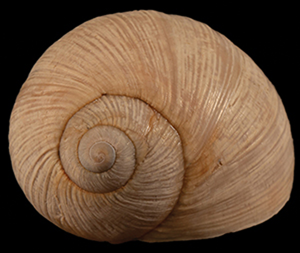
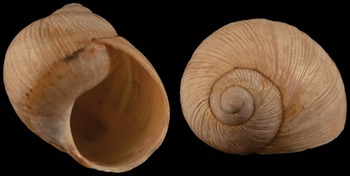
Additional evidence that can corroborate a spring/early summer date for the destruction is provided by molluscs recovered from the site, which had been used as food items—especially specimens of the common field snail Helix engaddensis engaddensis (Figure 6). Numerous field snail shells were found in Areas B and D, comprising slightly more than 23.5 per cent of all the shells found at the site. This species, which can live for up to six years, is only active during the rainy period, namely until March and April in the area of the Beth She'an Valley. Since some of these shells came from destruction layers, we assume that they were consumed during the month or two following their collection.
The common field snail Helix engaddensis engaddensis (© German-Israeli Tell Iẓṭabba Excavation Project).

Discussion
A multi-modal approach has made it possible to establish the season of the destruction of the Seleucid settlement of Nysa-Scythopolis by John Hyrcanus. While none of the data alone justify an unequivocal conclusion due to the limitations of the individual proxies used, their combination via a multi-proxy approach allows for a stronger argument to be made. A date in spring/early summer of apparently 107 BC can now be verified, rather than the more general date of the year SE 205 (= 108/107 BC). The provision of a more precise date not only contributes to a more accurate reconstruction of the course of events of the Hasmonaean campaigns led by John Hyrcanus, but also contributes to the archaeological analysis of the destruction layers and the impact of a specific season on the structure and character of the archaeological finds.
Funding statement
The project High-resolution Hellenistic Settlement Archaeology and the Reassessment of the Formation of the Decapolis, led by A. Lichtenberger (University of Münster) & O. Tal (Tel Aviv University) during the years 2019–2021, is funded by the German-Israeli Foundation (GIF)—Regular Program (No. I-1447-108.4/2018)—Tell Iẓṭabba (Nysa-Scythopolis).


 Open access

