


Affective polarization has been on the rise in many countries. Many argue that these increases create challenges for democracy (McCoy, Rahman, and Somer Reference McCoy, Rahman and Somer2018),Footnote 1 giving rise to scholarly interest in processes that might improve interpartisan relations (Hartman et al. Reference Hartman, Blakey, Womick, Bail, Finkel, Han and Sarrouf2022). High levels of affective polarization and hostility across partisan group lines have taken root in a global context where democracy is institutionalized through periodic competitive elections, which creates challenges because competitive elections can amplify affective polarization (Hansen and Kosiara-Pedersen Reference Hansen and Kosiara-Pedersen2017; Sood and Iyengar Reference Sood and Iyengar2016) and increase interpartisan discrimination (Michelitch Reference Michelitch2015). Are there other democratic processes that can reduce affective polarization?
Advocates of deliberative democracy argue that the answer is “Yes.” A group of deliberative democracy scholars recently proposed deliberation as a solution to our current “crisis of democracy” in part because of its potential to heal social divisions and reduce animus across partisan group lines (Dryzek et al. Reference Dryzek, Bächtiger, Chambers, Cohen, Druckman, Felicetti and Fishkin2019). Yet with few important exceptions (e.g., Fishkin, Siu, et al. Reference Fishkin, Siu, Diamond and Bradburn2021), affective polarization has been relatively underexamined in the literature on deliberation. In addition, deliberative processes may be consequential for several reasons, but existing research has largely not been designed to gain causal leverage on why deliberation has an impact. Can deliberation reduce affective polarization and partisan animus? If so, why?
This paper addresses both questions. Theoretically and empirically, I emphasize the importance of deliberation’s role in promoting active engagement with the policy perspectives of out-partisans—or perspective taking. This argument builds on ideas from deliberative theory, which has emphasized the importance of perspective taking as a component of deliberative processes (e.g., Bohman Reference Bohman2007; Habermas [Reference Habermas1981] 1986; Manin Reference Manin2017; Mansbridge Reference Mansbridge1983; Morrell Reference Morrell2010).Footnote 2 It also relates to the intergroup contact literature, which has highlighted perspective taking as a potential causal mechanism through which contact could reduce prejudice (Pettigrew and Tropp Reference Pettigrew and Tropp2008). Deliberation involves the examination, discussion, and weighing of reasons for different policy (or other) positions with other citizens, often those who have different policy points of view. This exposure to and engagement with the policy perspectives of out-groups can reduce affective polarization and out-partisan animus by increasing cognitive empathy: an ability to understand the ideas, reasons, and perspectives of others (Cuff et al. Reference Cuff, Brown, Taylor and Howat2016). Increases in empathy can lead to more positive affect toward out-groups (e.g., Adida, Lo, and Platas Reference Adida, Lo and Platas2018; Broockman and Kalla Reference Broockman and Kalla2016). Furthermore, a greater understanding of the justifications that out-partisans have for their political positions can promote greater tolerance across group lines (Mutz Reference Mutz2002).
I present evidence from a deliberation experiment in Honduras.Footnote 3 Because of COVID-19 and security risks, the experiment was conducted online. While online deliberation may be different from deliberation in person, it is potentially far more scalable. The challenge of how to scale and maintain the purported beneficial aspects of deliberation and other democratic innovations (Smith Reference Smith2009) has received increasing attention (e.g., Fishkin, Bolotnyy, et al. Reference Fishkin, Bolotnyy, Lerner, Siu and Bradburn2025). This challenge is particularly pronounced where groups are geographically and socially segregated; the online context makes possible interactions that might be difficult to achieve otherwise. This study is thus in line with recent research studying forms of online engagement, such as artificial-intelligence-assisted online group deliberation (Fishkin, Bolotnyy, et al. Reference Fishkin, Bolotnyy, Lerner, Siu and Bradburn2025), short cross-party video conversations (Santoro and Broockman Reference Santoro and Broockman2022), and short cross-party conversations via text chat (Greene et al. Reference Greene, Rossiter, Seira and Simpser2024; Rossiter and Carlson Reference Rossiter and Carlson2024).
Honduras is a valuable context for this research, as until recently affective polarization had been on the rise since a military coup removed President Manuel Zelaya from power in 2009 (Almeida Reference Almeida2014; Perelló and Navia Reference Perelló and Navia2023). Polarization intensified under the administration of conservative National Party (NP) president Juan Orlando Hernández (2014–22). Protests broke out following the 2017 elections, fueled by the suspicion of vote rigging (Freeman and Perelló Reference Freeman and Perelló2022) and the removal of a constitutional ban on presidential second terms that was controversially approved by the courts (Moncada Reference Moncada2022). Protests broke out again in 2019, after the government sought to privatize some social services and following allegations that drug traffickers had given financial support to Hernández’s campaign in 2013 (Freeman and Perelló Reference Freeman and Perelló2022; Sosa and Almeida Reference Sosa and Almeida2019). In each instance, the government responded to protests with violence and repression, further intensifying political divisions.
In the experiment, I adapt a deliberative civic education model centered around assigned advocacy and structured controversy (Avery Reference Avery2011; Johnson and Johnson Reference Johnson and Johnson1985). In this approach, participants are assigned to defend specific policy positions as part of the deliberative session. To gain causal leverage on the causal mechanism of focus, I implemented a two-stage randomization design. First, subjects were randomly assigned to either a deliberation treatment (a one-and-a-half to two-hour deliberation session) or control. Second, treatment-group participants were randomly assigned to develop arguments in favor of specific policy positions, regardless of their actual views. Some participants were randomly assigned to defend positions with which they disagreed at the baseline (out-partisan perspective) and others were randomly assigned to defend positions with which they agreed (own perspective). The out-partisan perspective group was more directly and actively engaged with the perspectives of out-group members. As all other components of the experience were identical, larger treatment effects in the out-partisan perspective group would imply that engagement with out-partisan perspectives is an operative causal mechanism. The design thus provides causal leverage on a mechanism through the randomization of a mediator, an implicit mediation design (Gerber and Green Reference Gerber and Green2012). Outcome measures were gathered in a survey immediately following the deliberation or control-group sessions (midline) and two to six weeks later (end line).
The deliberation treatment generated significant and substantively meaningful reductions in affective polarization and animus across partisan group lines. These reductions were larger and longer lasting in the out-partisan perspective group—experimental evidence of the causal mechanism. For those assigned to defend their own predeliberation positions, there is some evidence of a longer-term backfire effect: these participants became somewhat more affectively polarized, mainly because they became more favorable toward in-group members. I supplement these experimental findings with qualitative evidence gathered from participants in the deliberations.
The results are consistent with the argument that deliberative discussions can reduce cross-partisan hostility and affective polarization because they promote engagement with the policy positions and perspectives of out-group members. As one participant put it, “when one is forced to speak, to think in a way that is not the way one usually does … that leads us to have a little empathy so to speak for people who for one reason or another have that position with conviction.” Yet the results also highlight the potential limitations of deliberation in the absence of active engagement with out-group points of view. At best, those who focused on defending their own position were not impacted, but there is some evidence that these subjects became somewhat more polarized.
This paper advances the literature in several ways. First, a novel empirical contribution of this research is that it shows that online deliberation, using the assigned-advocacy deliberative civic education approach, can generate reductions in affective polarization and out-partisan animus. I present evidence from a Latin American context, Honduras, which has not been studied in this literature. The findings corroborate the notion that deliberation can reduce out-partisan/out-group animus (Dryzek et al. Reference Dryzek, Bächtiger, Chambers, Cohen, Druckman, Felicetti and Fishkin2019), complementing research testing this idea in other contexts (Caluwaerts and Reuchamps Reference Caluwaerts and Reuchamps2014; Fishkin, Siu, et al. Reference Fishkin, Siu, Diamond and Bradburn2021; Luskin et al. Reference Luskin, O’Flynn, Fishkin and Russell2014; Ugarriza and Trujillo-Orrego Reference Ugarriza and Trujillo-Orrego2020). The results also relate to research on intergroup discussion and out-group attitudes (e.g., Baron et al. Reference Baron, Blair, Choi, Gamboa, Gottlieb, Robinson and Rosenzweig2025; Greene et al. Reference Greene, Rossiter, Seira and Simpser2024; Levendusky and Stecula Reference Levendusky and Stecula2021; Paler, Marshall, and Atallah Reference Paler, Marshall and Atallah2020; Rossiter and Carlson Reference Rossiter and Carlson2024; Santoro and Broockman Reference Santoro and Broockman2022). Importantly, I demonstrate that the deliberative approach studied here can be scaled and implemented online. In addition, the assigned-advocacy approach—also known as structured controversy (Johnson and Johnson Reference Johnson and Johnson1985)—has been implemented in the context of civic education (Avery Reference Avery2011; Johnson and Johnson Reference Johnson and Johnson1985). This approach to deliberation could be scaled in educational contexts as well.
Second, the paper contributes with an experimental design that provides evidence of a causal mechanism. Both the literature on deliberation and intergroup contact suggest perspective taking as a potential mechanism linking deliberative activities to reductions in affective polarization and out-partisan animus. However, research to date has not been designed to gain causal leverage on deliberation’s mechanisms. In a review paper, Paluck, Green, and Green (Reference Paluck, Green and Green2019) also note evidence on mechanisms as a gap in the intergroup contact literature. By randomizing a mediating variable—engagement with out-group policy perspectives—this study permits design-based inferences about this particular mechanism. My goal is not to argue that other mechanisms might not be important, but rather to emphasize this potential mechanism and provide an experimental test of it. Because deliberation could be impactful for a number of reasons, this focus on mechanisms is important for theoretical reasons and from a policy perspective: knowing why deliberation matters can guide investments about how to most effectively scale up deliberative projects.
Finally, this research contributes to the literature on affective polarization in Latin America, a topic that has received increasing attention (Bergman and Fernández Reference Bergman and Fernández2025; Comellas and Torcal Reference Comellas and Torcal2023; McCoy Reference McCoy2024; Sarsfield, Moncagatta, and Roberts Reference Sarsfield, Moncagatta and Roberts2024; Segovia Reference Segovia2022). Much research focuses on the drivers and consequences of affective polarization. This research contributes with its focus on how deliberation might reduce affective polarization in a Latin American context.
Concepts and Theory
Whereas ideological polarization centers around divergence in policy or ideological attitudes (e.g., Abramowitz and Saunders Reference Abramowitz and Saunders2008; Fiorina Reference Fiorina2017), affective polarization is characterized by negative emotions and attitudes toward those who support competing parties, political coalitions, or political leaders (Iyengar et al. Reference Iyengar, Lelkes, Levendusky, Malhotra and Westwood2019; Reiljan, Silva, and Trechsel Reference Reiljan, Garzia, da Silva and Trechsel2023; Sarsfield, Moncagatta, and Roberts Reference Sarsfield, Moncagatta and Roberts2024). Most accounts of affective polarization are thus rooted in social identity theory (Iyengar et al. Reference Iyengar, Lelkes, Levendusky, Malhotra and Westwood2019; Iyengar, Sood, and Lelkes Reference Iyengar, Sood and Lelkes2012; Tajfel Reference Tajfel1981; West and Iyengar Reference West and Iyengar2022). Affective polarization emerges as political or partisan attachments become markers of social identity and people come to see in-group members favorably and out-group members negatively and with suspicion (Iyengar et al. Reference Iyengar, Lelkes, Levendusky, Malhotra and Westwood2019; Mason Reference Mason2018). At higher levels of affective polarization, political contestation takes on a strong “us-versus-them” dynamic (McCoy, Rahman, and Somer Reference McCoy, Rahman and Somer2018; Sarsfield, Moncagatta, and Roberts Reference Sarsfield, Moncagatta and Roberts2024), where people have strong negative feelings toward the out-group “them.” I focus on affective polarization at the citizen level—feelings about the supporters of opposing political groups—though affective polarization can also relate to affect toward elites or relationships between elites (Druckman and Levendusky Reference Druckman and Levendusky2019; Sarsfield, Moncagatta, and Roberts Reference Sarsfield, Moncagatta and Roberts2024).
While much research has focused on partisan affective polarization in contexts such as the United States, affective polarization can take root without stable partisanship or where there are declining partisan attachments (Sarsfield, Moncagatta, and Roberts Reference Sarsfield, Moncagatta and Roberts2024; Segovia Reference Segovia2022). This is relevant for Latin America—and Honduras specifically—as affective polarization has intensified in some countries despite general trends of weakening partisan attachments (Bergman and Fernández Reference Bergman and Fernández2025; Lupu Reference Lupu2016; Meléndez Reference Meléndez2022; Sarsfield, Moncagatta, and Roberts Reference Sarsfield, Moncagatta and Roberts2024). Affective polarization requires an “us” and, sometimes more importantly, a “them” (Areal Reference Areal2022), which can be defined differently across contexts. Support of or opposition to a specific leader can form the basis of affective polarization (Reiljan, Silva, and Trechsel Reference Reiljan, Garzia, da Silva and Trechsel2023), which has been documented in Brazil (Samuels, Mello, and Zucco Reference Samuels, Mello and Zucco2024; Samuels and Zucco Reference Samuels and Zucco2018). This relates to the concept of “negative partisanship,” where citizens have strong negative feelings toward a specific party or leader but no positive attachment of their own (Areal Reference Areal2022; Haime and Cantú Reference Haime and Cantú2022; Meléndez Reference Meléndez2022; Sarsfield, Moncagatta, and Roberts Reference Sarsfield, Moncagatta and Roberts2024). Affective polarization can also solidify around ideological cleavages. Research from some Latin American contexts illustrates that ideological identification can have a social identity meaning (Argote and Visconti Reference Argote and Visconti2025; Comellas and Torcal Reference Comellas and Torcal2023). Polarization can also be structured around pro- or anti-establishment cleavages (Sarsfield, Moncagatta, and Roberts Reference Sarsfield, Moncagatta and Roberts2024) or support for or opposition to social movements or movement parties, which have emerged in a number of Latin American countries (McCoy Reference McCoy2024).
Affective polarization is often operationalized at the individual level in two ways. First, scholars compare evaluations or attitudes toward the in-group to those toward the out-group. A larger difference between in- and out-group attitudes reflects greater affective polarization. Second, scholars focus on attitudes toward the out-group—for example, measures of out-group animosity or trust. Where negative partisanship is common, this latter approach may be particularly appropriate. I focus on both outcomes. In addition, the division along which affective polarization occurs can vary across contexts. Nevertheless, it is usually the case that, around election time, groups coalesce to support specific parties or coalitions—even if these are not institutionalized and exist only for a single electoral contest. For this reason, I refer to animosity or attitudes across group or partisan lines, in addition to using the more general term “affective polarization.”
Deliberation and Affective Polarization
Advocates of deliberative democracy suggest that deliberative activities involving members of different partisan or adversarial groups may help to reduce affective polarization (Dryzek et al. Reference Dryzek, Bächtiger, Chambers, Cohen, Druckman, Felicetti and Fishkin2019; Fishkin, Siu, et al. Reference Fishkin, Siu, Diamond and Bradburn2021). Deliberative democrats emphasize that decision-making processes can be made more democratic—or should only qualify as democratic—if citizens themselves reason together and make decisions (Cohen and Fung Reference Cohen and Fung2004). Deliberative democracy has many definitions, but many share the idea that deliberative democratic processes involve groups of citizens analyzing and discussing policy or other politically relevant questions, considering evidence and alternative arguments and viewpoints, and engaging with one another in a context of equality and respect (e.g., Cohen and Fung Reference Cohen and Fung2004; Gastil Reference Gastil2018).
Relatively little research has empirically investigated the connection between deliberation and affective polarization, though the research that has is promising (Caluwaerts and Reuchamps Reference Caluwaerts and Reuchamps2014; Fishkin, Siu, et al. Reference Fishkin, Siu, Diamond and Bradburn2021; Luskin et al. Reference Luskin, O’Flynn, Fishkin and Russell2014; Siu, Ciesla, and Goodwin Reference Siu, Ciesla and Goodwin2025). In an important recent study, Fishkin, Siu, and colleagues (Reference Fishkin, Siu, Diamond and Bradburn2021) find meaningful reductions in affective polarization that followed from a large deliberative poll conducted in the US. Recent research on cross-party or cross-group contact and discussion also corroborates the potential for deliberative activities to reduce affective polarization (Greene et al. Reference Greene, Rossiter, Seira and Simpser2024; Paler, Marshall, and Atallah Reference Paler, Marshall and Atallah2020; Rossiter and Carlson Reference Rossiter and Carlson2024). However, findings are mixed on the temporal persistence of the effects (Fishkin, Bolotnyy, et al. Reference Fishkin, Bolotnyy, Lerner, Siu and Bradburn2024; Levendusky and Stecula Reference Levendusky and Stecula2021; Santoro and Broockman Reference Santoro and Broockman2022), and cross-party discussion appears to be most beneficial when people discuss less sensitive political issues (Santoro and Broockman Reference Santoro and Broockman2022).
While these results are promising, open questions remain. First, most—though not all (Greene et al. Reference Greene, Rossiter, Seira and Simpser2024; Paler, Marshall, and Atallah Reference Paler, Marshall and Atallah2020)—research takes place in the US. I present evidence from a new context—Honduras—and a form of deliberation that has not received attention in this literature. Second, empirical research to date has not been designed with the goal of gaining causal leverage on mechanisms. While some studies are theoretically grounded in intergroup contact theory (Allport Reference Allport1954; Caluwaerts and Reuchamps Reference Caluwaerts and Reuchamps2014; Fishkin, Siu, et al. Reference Fishkin, Siu, Diamond and Bradburn2021; Levendusky and Stecula Reference Levendusky and Stecula2021; Luskin et al. Reference Luskin, O’Flynn, Fishkin and Russell2014; Pettigrew and Tropp Reference Pettigrew and Tropp2006), intergroup contact can be consequential for several reasons (Pettigrew and Tropp Reference Pettigrew and Tropp2008). For example, deliberation—or intergroup contact—could reduce affective polarization by increasing knowledge and reducing misperceptions about the out-group (Druckman et al. Reference Druckman, Klar, Krupnikov, Levendusky and Ryan2022; Levendusky Reference Levendusky2023; Levendusky and Stecula Reference Levendusky and Stecula2021; Pettigrew and Tropp Reference Pettigrew and Tropp2008) or by decreasing anxiety or feelings of threat in interactions with out-group members (Pettigrew and Tropp Reference Pettigrew and Tropp2008). Deliberative activities could also lead to the recategorization of out-group members under a broader superordinate identity—consistent with the common in-group identity model (Gaertner and Dovidio Reference Gaertner and Dovidio2000)—such as the national identity (Levendusky Reference Levendusky2018).
Why Might Deliberation Reduce Affective Polarization?
This paper emphasizes one mechanism through which deliberation can reduce affective polarization: promoting exposure to and engagement with out-group policy perspectives—or perspective taking. As I will elaborate, such perspective taking can generate cognitive empathy with out-group members, thus reducing affective polarization.
This argument is rooted in the literatures on deliberative democracy and intergroup contact. With respect to the deliberative literature, some—though not all (Scudder Reference Scudder2020)—scholars have noted the potential for deliberation to generate empathy through perspective taking and understanding of other points of view (e.g., Mansbridge Reference Mansbridge1983). For some, the practice of perspective taking is central to the deliberative process (Habermas [Reference Habermas1981] 1986). For others, exposure to and an understanding of different points of view—not simply knowing the opinions of others but understanding their perspectives—is a key value of deliberation (Bohman Reference Bohman2007). For Morrell (Reference Morrell2010, 16), empathy is critical to the deliberative process and decisions can only be considered democratically legitimate “after a process of deliberation that gives all citizens the opportunity to engage in a full exchange of perspectives and induces them to empathize with one another” (emphasis added). Empirically, Muradova (Reference Muradova2021) provides qualitative evidence from the Irish Citizen’s Assembly that deliberation generates perspective taking. For its part, the literature on intergroup contact (Allport Reference Allport1954) has suggested perspective taking as one causal mechanism through which intergroup contact can reduce prejudice (Pettigrew and Tropp Reference Pettigrew and Tropp2006).
Why should deliberation generate out-group perspective taking? Deliberation involves the giving of reasons and the weighing of arguments for and against different policy or choice options. Deliberation is also a social activity. This provides opportunities for learning about and active engagement with out-group perspectives. Indeed, for scholars such as Manin (Reference Manin2017), confronting opposing viewpoints is one of the most important aspects of a deliberative process.
The social dimension of deliberation is also important because it generates accountability and reciprocity. When people expect others to listen to their arguments, they are less likely to present extreme, unflattering versions of these perspectives and more likely to engage out-group perspectives in a moderate way (Tuller et al. Reference Tuller, Bryan, Heyman and Nicholas2015). This reduces the likelihood that perspective taking will involve a focus on negative out-group traits (Tarrant, Calitri, and Weston Reference Tarrant, Calitri and Weston2012). The social context of deliberation thus provides an environment where there is some accountability for how out-partisan views are characterized and discussed. There are also possibilities for reciprocity: members of one group will be more likely to fairly engage with the ideas of another group if members of the other group are doing the same. These aspects of deliberation should deepen engagement with out-partisan viewpoints.
Exposure and engagement with out-partisan policy perspectives is important because it can generate cognitive empathy. Empathy has both emotional and cognitive elements (Sirin, Valentino, and Villalobos Reference Sirin, Valentino and Villalobos2016). These forms of empathy interact and are intertwined but are different concepts (Cuff et al. Reference Cuff, Brown, Taylor and Howat2016). Emotional empathy refers to feeling or understanding the emotions of others. Cognitive empathy centers on understanding the ideas or viewpoints of others or being able to think through issues from their point of view.
Both forms of empathy are linked to and promoted by perspective taking, which has been studied in the literature on out-group prejudice and intergroup contact (Adida, Lo, and Platas Reference Adida, Lo and Platas2018; Broockman and Kalla Reference Broockman and Kalla2016; Galinsky and Moskowitz Reference Galinsky and Moskowitz2000; Kalla and Broockman Reference Kalla and Broockman2023; Larson and Lewis Reference Larson and Lewis2025; Pettigrew and Tropp Reference Pettigrew and Tropp2008; Williamson et al. Reference Williamson, Adida, Lo, Platas, Prather and Werfel2021). Much of this literature centers on perspective-taking activities that generate emotional empathy through gaining an understanding of the experiences of out-group members. While deliberative activities can generate emotional empathy through interactions with and learning about out-groups, the structure of deliberative interactions is particularly oriented toward cognitive empathy—learning to see the policy problem or question from the perspective of out-group members—though as noted the two are intertwined.
Cognitive empathy is relevant for affective polarization for several reasons. First, perspective taking and increased empathy can reduce prejudice and increase positive affect across group lines (e.g., Adida, Lo, and Platas Reference Adida, Lo and Platas2018; Broockman and Kalla Reference Broockman and Kalla2016; Galinsky and Moskowitz Reference Galinsky and Moskowitz2000; Kalla and Broockman Reference Kalla and Broockman2023; Simonovits, Kédzi, and Kardos Reference Simonovits, Kézdi and Kardos2018), though it should be noted that there remains debate about how dispositional empathy, or empathic concern, shapes affective polarization (Simas, Clifford, and Kirkland Reference Simas, Clifford and Kirkland2020). While this has generally been applied to out-groups that are nonpartisan—for example, refugees or immigrants (e.g., Larson and Lewis Reference Larson and Lewis2025; Williamson et al. Reference Williamson, Adida, Lo, Platas, Prather and Werfel2021)—it should also apply to out-groups that are partisan or political in nature. Second, cognitive empathy implies an understanding of the reasons that out-group members hold their policy and political positions. Research demonstrates that understanding that political opponents have reasons and legitimate justifications for their beliefs can increase tolerance (Mutz Reference Mutz2002) and reduce bias (Lord, Lepper, and Preston Reference Lord, Lepper and Preston1984), even when disagreements remain. Third, increased cognitive empathy through perspective taking can also encourage people to interrogate and better understand the reasons for their own beliefs (Galinsky and Moskowitz Reference Galinsky and Moskowitz2000), which can often lead to moderation (Mutz Reference Mutz2006). For example, a deeper understanding of out-group perspectives can complicate peoples’ own views on a subject. Even if their position on the issue does not change, a more nuanced perspective on the issue can reduce feelings of animus toward those who may hold another viewpoint.
The argument generates the following hypotheses, which I test in the remainder of this paper. Both hypotheses were preregistered in advance of the study.Footnote 4
Hypothesis 1: participation in deliberation will reduce negative feelings (animus) toward supporters of other parties.
Hypothesis 2: participation in deliberation will reduce affective polarization among incumbent party and opposition party (Libre/Alliance) supporters.
The discussion also has implications for causal mechanisms—specifically the role of exposure to and, importantly, engagement with out-partisan perspectives in driving these hypothesized effects. If the argument is correct about the importance of engagement with out-partisan perspectives, we would expect deliberation to have a greater effect on improving out-group attitudes when those involved actively engage with the perspectives of the out-group.
Deliberation in the Absence of Engagement with Out-Group Perspectives
The discussion raises the question of what we might expect if those involved in deliberation do not engage with the perspectives of the out-group, or when they do so to a lesser degree. Or, what might happen if people only engage most deeply in defending their own point of view? One answer to this question is normative: we should not consider a discussion to be deliberative in the absence of inducements to seriously consider perspectives of different groups (Morrell Reference Morrell2010).
Putting this normative answer aside, there are reasons to believe that deliberation (or discussion) would have minimal or potentially even adverse effects on out-partisan attitudes if participants are only engaged with their own point of view. First, and perhaps most obviously, defending one’s own point of view should not be expected to produce the same levels of empathy or understanding of the perspectives of the out-group. Second, instead of leading one to interrogate the sources of their own views or see the merits of alternative viewpoints, more deeply engaging with one’s own viewpoint could reinforce or strengthen the preexisting viewpoint. This dynamic could be amplified by a group setting where others are making similar arguments, leading to more extreme points of view (Sunstein Reference Sunstein1999). Thus, there are reasons to expect that deliberation or discussion centered more deeply on one’s own perspective would have minimal effects on out-group attitudes and could perhaps even make them worse.
Context: Honduras
After decades of autocratic rule, Honduras transitioned to more democratic politics in the 1980s. Seven generally democratic elections were held between 1981 and 2005 (Ruhl Reference Ruhl2010). Until 2009, politics was dominated by two political parties, the Liberal Party and the NP, and Honduras had one of the most stable party systems in Latin America (Mainwaring Reference Mainwaring2018). The parties were not characterized by ideological differences (Ajenjo Fresno Reference Fresno and Natalia2007; Perelló and Navia Reference Perelló and Navia2023) and mobilized support through entrenched clientelist networks (González-Ocantos, Kiewiet de Jonge, and Nickerson Reference González-Ocantos, de Jonge and Nickerson2015; Perelló and Navia Reference Perelló and Navia2023; Taylor Reference Taylor1996; Reference Taylor, Helmke and Levitsky2006). Despite democratization, corruption remained prevalent and high poverty rates went unaddressed (Ruhl Reference Ruhl2010). Hondurans have suffered from among the world’s highest crime and homicide rates and from the prevalence of criminal organizations. As a result, positive partisan identification with the two main parties has deteriorated over time, consistent with trends in Latin America (Lupu Reference Lupu2016).
Affective polarization in Honduras began to intensify following a military coup in 2009, which removed Liberal Party president Manuel Zelaya from office (Almeida Reference Almeida2014; Freeman and Perelló Reference Freeman and Perelló2022). Zelaya had been elected as a moderate member of the Liberal Party in 2005. In 2007, he began to shift to the Left, forging alliances with trade unions, bringing left-wing politicians into his government, and forming a relationship with Venezuela’s Hugo Chávez (Freeman and Perelló Reference Freeman and Perelló2022). In 2008, he called for a constituent assembly to reform the country’s constitution.
Some suspected this was aimed at reforming the constitution to allow him to run for a second term. In 2009, the military removed Zelaya from power with the support of the establishment parties and economic elites (Ruhl Reference Ruhl2010). The military handed power to an interim civilian government, which oversaw elections in 2009 that brought NP president Porfirio Lobo Sosa to power. The NP won again in 2013, with Juan Orlando Hernández securing the presidency.
The coup jump-started a process of polarization and intensifying negative partisanship that centered around a division between those who supported the coup—and subsequent NP governments—and those who did not. Protests by those on both sides broke out and anti-coup protests were suppressed, often violently (Almeida Reference Almeida2014; Freeman and Perelló Reference Freeman and Perelló2022). The Frente Nacional de Resistencia Popular emerged as an anti-coup coalition that included social movement organizations, worker’s groups, and other left-wing political organizations. Later, this same political cleavage evolved to center around those who supported the NP-led governments and those who supported the main opposition groups that emerged after the coup. Indeed Zelaya returned to Honduras in 2011. He and his wife, Xiomara Castro, formed the Liberty and Refoundation party (Libertad y Refundación, Libre). Libre began a years-long process of building up a political party organization and support base that brought together left-leaning and anti-coup constituencies (Freeman and Perelló Reference Freeman and Perelló2022). The 2009 coup and subsequent government repression were important starting points in the polarization process. As Freeman and Perelló (Reference Freeman and Perelló2022) note, “the shared experience of persecution [following the coup] fostered a deep-rooted sense of partisan loyalty” among Libre supporters. By contrast, more conservative and pro-establishment citizens were mobilized around a fear of Zelaya and his alleged connections to leaders in other countries such as Hugo Chávez (Ruhl Reference Ruhl2010; Taylor-Robinson and Ura Reference Taylor-Robinson and Ura2013).
Several other episodes further intensified polarization. First, in 2017, President Hernández led an effort to remove the constitutional ban on reelection. While this same intention had been a justification for removing Zelaya in 2009, the courts, stacked with NP loyalists, ruled that such a change was legal, and the military did not intervene. This controversial reform paved the way for Hernández to run again in 2017. Second, the 2017 presidential elections were flawed by what many perceived to be significant vote rigging. In the presidential election, Libre formed an alliance with another opposition candidate, television personality Salvador Nasralla, with Nasralla at the top of the ticket. Early results published by the election commission showed Nasralla winning the election. However, the electronic vote-counting system shut down. When it was restarted, Hernández was in the lead and ultimately declared the winner. This led to protests by opposition supporters. The government responded by suspending constitutional rights and repressing opposition and protest activity (Sosa and Almeida Reference Sosa and Almeida2019). Third, protests broke out in 2019 after the government proposed privatization and austerity reforms to the education and health sectors. After Hernández’s brother was convicted on drug trafficking charges in New York and allegations emerged that the NP may have used finances from drug organizations to fund earlier election campaigns, protesters began calling for Hernández to step down (Sosa and Almeida Reference Sosa and Almeida2019).
In the 2021 elections—the period of focus in this study—Libre again formed an alliance with Salvador Nasralla, with Xiomara Castro running for president. I refer to this political coalition as Libre/Alliance. Castro’s main competition was the NP’s Nasry Asfura. Despite democratic backsliding under Hernández (Freeman and Perelló Reference Freeman and Perelló2022), Castro was victorious, becoming Honduras’s first woman president. After Castro’s election—and after this study was completed—polarization began to decline in Honduras due to Castro’s broad popularity (McCoy Reference McCoy2024).
Figure 1 uses Varieties of Democracy (V-Dem) data (Coppedge et al. Reference Coppedge, Gerring, Knutsen, Lindberg, Teorell, Altman and Angiolillo2025) to show that polarization has increased substantially in Honduras since 2009.Footnote 5 The V-Dem political polarization measure captures the extent to which “society [is] organized into antagonistic, political camps.” According to V-Dem, the measure indicates “the extent to which political differences affect social relationships beyond political discussions. Societies are highly polarized if supporters of opposing political camps are reluctant to engage in friendly interactions, for example, in family functions, civic associations, their free time activities and workplaces” (Coppedge et al. Reference Coppedge, Gerring, Knutsen, Lindberg, Teorell, Altman and Angiolillo2025). As such, some scholars interpret the measure as capturing affective polarization (McCoy Reference McCoy2024).
Political Polarization over Time in Honduras
Note: Data are from V-Dem (Coppedge et al. Reference Coppedge, Gerring, Knutsen, Lindberg, Teorell, Altman and Angiolillo2025). Survey item is as follows: “Is society organized into antagonistic, political camps?” Low values on the y-axis indicate low levels of political polarization (lowest = not at all), while high values indicate high polarization (highest = to a large extent).

Until 2005, Honduras had very low political polarization. However, polarization increased dramatically around the coup in 2009. Polarization began to recede somewhat until the controversial events surrounding the election in 2017, and it has stayed high ever since. Figure C.1 in online appendix C uses data from 2020 to illustrate how Honduras compares to other countries in Latin America. On political polarization, Honduras is toward the middle of the distribution in the region: levels are not as high as they are in the most polarized countries in the region, Bolivia and Brazil, but Honduras is still on the polarized end of the spectrum.
Figure 2 presents evidence that suggests that polarization had an affective dimension at the time of this study. The figure presents information from the baseline survey detailed below. All participants were asked to report on their warmth toward the supporters of different political groups (akin to feeling thermometers) and trust in supporters of different political groups, consistent with approaches to measurement of affective polarization. The figure illustrates generally negative feelings of warmth and trust toward out-party supporters and a substantial gap in in-party versus out-party evaluations; both are generally taken as indicative of affective polarization (Iyengar et al. Reference Iyengar, Lelkes, Levendusky, Malhotra and Westwood2019). For example, when asked how much they trust supporters of the out-party, only about 7.5% of respondents offered a positive answer indicating some or a great deal of trust. That figure is 65% for trust in in-partisans.
Affective Polarization in the Baseline Survey: Warmth toward and Trust in Out-Party versus In-Party Supporters
Note: Data from baseline survey. Figure presents the proportion of NP and Libre/Alliance supporters who report feeling trust and warmth toward in-party and out-party supporters.

Research Design
This study involved an online deliberation experiment.Footnote 6 The study was implemented with Le Vote, an organization with extensive experience conducting surveys and qualitative research in Honduras. Figure D.1 in the online appendix describes the timeline: the baseline survey was conducted in October 2021; the deliberation (and control-group) sessions and postsession midline survey were conducted in November and December 2021, in the time period surrounding the general elections on 28 November, 2021; and the end-line survey was conducted in January 2022.Footnote 7 Online appendix B details ethical considerations guiding the study design.
Sampling and Randomization
The population of interest is Honduran youth, broadly defined as individuals aged 18–40. I selected this population for several reasons. First, the youth are a large and important constituency. Because of political disillusionment and lack of trust in political institutions among the youth, the partner organization was interested in programs that might engage young people. Second, youth would be more likely to attend online sessions.
To draw the baseline sample, we used random-digit dialing to cell phones (nationwide). Participants were screened for their age. We conducted 1,054 baseline surveys. In all, 607 people said they would participate in online sessions several weeks later (58%). We randomly assigned each of these 607 participants to an experimental condition: treatment (deliberation) or control. We also randomly assigned participants in both conditions to groups for the online sessions. This resulted in groups that were diverse in their partisan composition.Footnote 8
We invited all 607 participants to an online group session conducted via the Zoom videoconferencing application. Subjects were blind to their treatment status when they were invited to their group sessions—that is, their decision to continue participating was unrelated to their treatment status. Two hundred sixty-one showed up to participate: 112 in treatment and 149 in control. We conducted 24 treatment condition sessions and 21 control condition sessions.Footnote 9
The experimental sample is representative of Honduran youth who are willing and able to show up to an online group meeting. This sample may not be representative of Honduran youth in general. Online appendix F shows how the experimental sample differs from the baseline sample. The experimental sample is more urban, and includes more women and more NP supporters. Both samples have similar levels of education and age. They also look similar in terms of baseline affective polarization and out-partisan animus. These differences do not pose a threat to internal validity: participants in the experimental sample are assigned at random to the experimental conditions.
In a second stage of randomization, treated participants were randomly assigned to discuss and develop arguments for or against a specific policy proposal, detailed below. Participant positions on the policy proposals were measured at the baseline. Sixty-five were assigned to a position with which they agreed and 45 were assigned to a condition with which they disagreed.Footnote 10 I refer to the former as the own-policy perspective condition and the latter as the out-partisan policy perspective condition. Assignment to these conditions is not confounded with the subject’s prior opinion.
The experimental sample size is similar to or slightly smaller than the sample size in other studies on interparty discussion (Baron et al. Reference Baron, Blair, Choi, Gamboa, Gottlieb, Robinson and Rosenzweig2025; Druckman Reference Druckman2004; Santoro and Broockman Reference Santoro and Broockman2022).Footnote 11 The sample size partly reflects the intensity and time commitment of the treatment, which is considerably larger than most interparty discussion studies: one-and-a-half to two hours versus 10–15 minutes (Levendusky and Stecula Reference Levendusky and Stecula2021; Santoro and Broockman Reference Santoro and Broockman2022). Honduras is also particularly challenging for recruitment relative to the US, an issue that was amplified by COVID-19. There can thus be a trade-off between a larger sample and a deeper and more time-intensive deliberative treatment. As the latter is more reflective of “true” deliberative processes, I erred on the side of a deeper engagement. Online appendix E presents the minimum detectable effect sizes and statistical power for the main comparisons of focus in this paper. The study is powered to detect effect sizes that are generally considered moderate (0.35–0.42 standard-deviation effect sizes), but relatively underpowered to detect smaller effect sizes. To enhance statistical power, I prespecified that I would control for baseline measures of the outcome and pretreatment covariates (Gerber and Green Reference Gerber and Green2012). Where appropriate, I also generate randomization inference p-values, which are valid for smaller sample sizes (see figure 6 and online appendix N) (Gerber and Green Reference Gerber and Green2012).
Online appendix G presents descriptive statistics and evidence of balance across experimental groups. The treatment and control group are well balanced on observable characteristics (appendix table G.1). There is also evidence of balance between the own-policy perspective and the out-partisan policy perspective conditions (appendix table G.2).
Deliberation Treatment Condition
Three moderators from Le Vote, each with extensive experience conducting qualitative focus-group research, moderated the deliberations (two men, one woman). Moderators were assigned at random to each group, which should minimize concerns about moderator effects (Humphreys, Masters, and Sandbu Reference Humphreys, Masters and Sandbu2006). Sessions were conducted in Spanish and lasted about 90–120 minutes.
In treatment groups, the moderator began by introducing the goals of the sessions and reiterating key points from the consent documents. They emphasized ground rules guiding the discussions, including respect, active listening, participation, brevity to ensure that everyone can participate, and the need to avoid distractions. The introductory section ended with an icebreaker.
The second section focused on agenda setting. The group was offered one of five policy topics for discussion: (1) democracy and constitutional reform, (2) corruption, (3) climate change and the environment, (4) public services such as education and health, and (5) the economy. These topics were selected because they are key issues in politics in Honduras and because they are policy areas where there are clear policy differences between the NP and Libre/opposition, as discussed below.Footnote 12 Most groups selected either corruption or public services. After making their selection, the groups spent some time brainstorming on the key challenges and issues in that area.
The next section turned to the main policy-focused discussion. In each topic, we identified a major policy debate where the main parties/coalitions have different policy perspectives. Table I.1 in online appendix I presents the discussion prompts. The prompts do not indicate which party supports each policy position. Each group discussed one of these policy debates, on the topic selected by the group. Many of these policy debates have been central in polarizing moments over the past few decades in Honduras. For example, Libre advocated for holding a National Constituent Assembly to revise the constitution, while the NP opposed doing so. Zelaya’s efforts to convene such an assembly formed part of the pretext for the coup in 2009. Similarly, the NP’s efforts to privatize health and education services prompted widespread protests by opposition groups in 2019. The proposal to bring in an international commission to fight corruption has also been controversial. The NP was opposed—and allowed the mandate of an Organization of American States anti-corruption commission (Misión de Apoyo contra la Corrupción e Impunidad en Honduras, MACCIH) to expire in 2020—while the opposition groups have been more supportive.
Participants were randomly assigned to “team A” or “team B” in their group session. Participants were aware that the assignment was random: random groups were put together in Zoom and then the moderator flipped a coin to determine which group defended which position. The moderators were trained to emphasize that the goal for each team was to discuss justifications for this policy, regardless of their opinion on the issue. In team breakout groups, participants worked to develop the best two arguments in favor of their assigned position. To make this clear, moderators used language such as, “Remember, it is your team’s job to defend the position that it was assigned, to the best of your ability, even if it is not your own individual opinion. You want to imagine that this is your position and think hard about the best possible case for it” (emphasis added). Moderators moved between breakout groups to ensure that the breakout discussions stayed on track and maintained the appropriate tone.
After the breakout sessions, the groups returned to present their arguments and discuss potential arguments against certain policy justifications. Finally, the participants engaged in a reflective discussion about the process and whether it changed anything about how they think about the policy issue or politics more broadly.
The treatment includes many aspects that scholars would consider essential for deliberation. Indeed, the sessions follow an assigned-advocacy structured-controversy model that has been used in deliberative civic education (Avery Reference Avery2011; Johnson and Johnson Reference Johnson and Johnson1985). Moderators were trained to maintain an atmosphere of civility and respect, and evidence from the discussion transcripts suggest that they were successful in achieving this. The participants set their own agenda (with some constraints on topics) and engaged in discussions around a specific policy question. Deliberators engaged in breakout sessions where they could brainstorm ideas and consider arguments in favor of specific policy decisions. While the “team” structure gave the sessions a debate-like setup, the goal was not to “win” the discussion, but rather to help the group better understand the perspective behind a specific policy position. Because of their engagement with others, participants could have been exposed to new information or arguments about their policy domain, contributing to learning. For some participants, these sessions may have been their first opportunity to engage in deep thinking and discussion on the policy issue. Finally, while the sessions did not last for several days like some deliberative events, the sessions were substantially longer and allowed for more discussion than those studied in research on interparty conversation (Levendusky and Stecula Reference Levendusky and Stecula2021; Rossiter and Carlson Reference Rossiter and Carlson2024; Santoro and Broockman Reference Santoro and Broockman2022).
This said, other aspects of deliberation were not included. We did not provide information or access to outside experts to use as a guide for discussions. While the partisan diversity of the groups would have generated contact and discussion across partisan group lines, this was fairly constrained by the online nature of the sessions (participants could not, for example, have informal interactions during breaks). Finally, recommendations from the group sessions were not going to be used to guide actual policy decisions.
Control Condition
Control-group participants also came to an online group Zoom session. Participants were blind to treatment status before they arrived. In these groups, the moderator reviewed the information in the consent documents and provided information about how to take the midline survey. Participants then took the midline survey after completing their sessions.
The advantage of this process is that this group represents a true control group for comparison with the treatment group: the analyses compare treated participants with control-group participants who were also willing to show up to a deliberative session. A limitation, however, is that the control-group sessions were shorter than the treatment-group sessions. While I considered a longer placebo, I decided it was not appropriate to keep (mostly low-income) Hondurans in a placebo activity for one-and-a-half to two hours. Studies on interparty contact that use placebos generally involve conversations that are much shorter, 10–15 minutes (e.g., Santoro and Broockman Reference Santoro and Broockman2022). Past research on deliberation, such as by Fishkin, Siu, and colleagues (2021), does not include a placebo or a true control group.
This limitation is not relevant for one of the key comparisons of interest: the own-policy perspective condition compared with the out-partisan policy perspective. The experiences of these groups are identical in all other ways except for the policy position they are assigned to defend.
Measurement
We gathered outcome measures using surveys: immediately after participants left their group sessions (midline), and two to four weeks later (end line). Of the 261 participants who participated in sessions and took the midline survey, 245 took the end-line survey. This low attrition rate is due to the effort that the research team put into tracking, and because a portion of the participation incentive was not delivered until after the completion of the end-line survey. All results are robust to analyses in which the sample is restricted to include only participants who took the midline and end-line surveys.
The main outcome measures are affective polarization and out-partisan favorability (opposite of animus). I used a survey question battery that included questions that are comparable to those used in other studies on affective polarization and out-partisan animus (e.g., Garrett et al. Reference Garrett, Gvirsman, Johnson, Tsfati, Neo and Dal2014; Iyengar and Westwood Reference Iyengar and Westwood2015; Levendusky Reference Levendusky2018). Each participant answered the battery twice, once for each partisan group. The prompt was as follows:
Now I would like you to think about supporters of [the NP or Libre/opposition alliance]. I would like you to think about citizens who support [the NP or Libre/opposition alliance], not about elected officials.
The question wording deliberately emphasized to respondents that they should be thinking about their feelings about supporters of the other parties, not about elites and politicians. This emphasis is important because prior research shows that voters often think of elites when responding to these types of questions (Druckman and Levendusky Reference Druckman and Levendusky2019).
The four items are presented in table 1.Footnote 13 The items capture different dimensions of attitudes toward supporters of each of the political blocs. The warmth and friends items most directly tap affect. The warmth measure is similar to feeling thermometers that are often used in affective polarization research. The intelligence and trust items involve more cognitive evaluations, but responses also likely have affective foundations as well. That is, when responding to survey questions about the trustworthiness and intelligence of out-group members, general affect toward them is likely to shape responses.
Survey Items Measuring Affective Polarization

To create indices of favorability toward NP supporters and favorability toward Libre/Alliance supporters, I average each of these items for each party, respectively. For ease of interpretation, I then rescale the index to run from zero to one. Using the favorability indices, I create three measures: in-party favorability (NP [or Libre/Alliance] supporters’ favorability toward NP [or Libre/Alliance] supporters); out-party favorability (NP supporters’ favorability toward Libre/Alliance supporters and Libre/Alliance supporters’ favorability toward NP supporters); and a measure of affective polarization that is measured as the difference between in-party favorability and out-party favorability. This approach follows much of the literature on affective polarization (e.g., Iyengar and Westwood Reference Iyengar and Westwood2015; Levendusky Reference Levendusky2018). For ease of interpretation, all measures are rescaled to run from zero to one.
To measure partisanship, I use a baseline measure of vote intention “if the presidential election were held today.” Twenty-five percent of the experiment sample supported the NP and 23% supported Libre or an alliance partner (125 partisans in the experimental sample). I use this measure because many Hondurans do not express an attachment to a political party, consistent with research on partisan identification in Latin America (Meléndez Reference Meléndez2022). However, this literature also emphasizes the importance of both positive and negative partisanship. Survey questions asking whether citizens feel attached to a particular party pick up positive partisanship. However, negative feelings toward other parties (negative partisanship) can also be an important driver of attitudes and behavior (e.g., Samuels and Zucco Reference Samuels and Zucco2018). The vote intention measure picks up both forms of partisanship, as vote choice could be driven by a desire to support one party (positive partisanship) or a desire to oppose one party (negative partisanship), or both. The use of this measure is consistent with prior research from the region suggesting that it most accurately taps partisan identification (e.g., Greene et al. Reference Greene, Rossiter, Seira and Simpser2024).
To illustrate this, table H.1 in online appendix H categorizes the sample into different forms of partisanship. I use an additional baseline survey question that asks respondents to rate each party on a five-point scale (“very bad,” “bad,” “neutral,” “good,” or “very good”). I code “committed partisans” as those who are positive about their own party and negative about the other party (or alliance). “Positive partisans” are positive about their own party and neutral or positive about the other party. “Negative partisans” are neutral about their own party and negative about the other party. “Neutrals” are those who are neutral about all parties. Finally, “anti-partisans” are those who are negative about both parties/alliances.
Each type of partisan is represented in the data. Libre/Alliance supporters are generally more motivated by negative partisanship toward the NP. Seventy-nine percent of Libre/Alliance voters hold a negative view of the NP, while 51% hold a positive view of the alliance. About 40% are committed partisans. NP supporters display a bit more positive partisanship: only 15% are negative partisans, 37% are positive partisans, and 33% are committed partisans. Libre/Alliance also has more support from the anti-partisans, who perhaps not surprisingly are less supportive of the establishment incumbent party.
Results
Figure 3 summarizes the main results by presenting mean levels of out-partisan favorability and affective polarization separated by experimental condition and survey round. The top row presents the results with the deliberation treatment condition aggregated. The treatment increased out-partisan favorability relative to control at the midline. It also substantially reduced affective polarization relative to control at the same stage. On average, however, the treatment and control groups converge back together at the end line.
Out-Partisan Favorability and Affective Polarization by Experimental Condition
Note: Figure presents the mean level of out-partisan favorability and affective polarization by experimental condition and survey wave. The sample includes only those participants who enter in each round. Panels (a) and (b) show the pooled effect of the deliberation treatment. Panels (c) and (d) disaggregate the deliberation condition by own-policy perspective (own) and out-partisan policy perspective (out) conditions.

Out-partisan favorability also increased in the control group between the baseline and midline (but not as much as in treatment). This trend likely reflects the timing of the surveys. The baseline was conducted at a more conflictual time in the election, and some group sessions were held after election day when partisan tensions could have been reduced (session timing was randomly assigned and all results are robust to controlling for whether the session occurred before or after the election; see tables 2 and 3). These trends do not threaten internal validity, as timing effects impact both treatment and control groups equally. Indeed the trends highlight the critical importance of having a true control group that allows us to examine change in treatment relative to change in control, something that distinguishes this study from some past research on deliberation and intergroup attitudes (which use before/after designs).
Treatment Effects of Deliberative Discussion on Affective Polarization

Note: Robust standard errors clustered on group session in parentheses. Dependent variable is a polarization measure calculated as in-party favorability minus out-party favorability measured at the midline after deliberation (short term) and end line two to four weeks later (longer term). * p < 0.10; ** p < 0.05; *** p < 0.01.
Treatment Effects of Deliberative Discussion on Out-Partisan Favorability

Note: Robust standard errors clustered on group session in parentheses. Dependent variable is out-party favorability measured at the midline after deliberation (short term) and end line two to four weeks later (longer term). * p < 0.10; ** p < 0.05; *** p < 0.01.
The bottom row disaggregates the treatment by the own-policy perspective and out-partisan policy perspective conditions. At the midline, the increase in out-partisan favorability and decrease in affective polarization (relative to control) is substantially larger in the out-partisan policy perspective condition. Moreover, these effects persist to the end-line survey. The out-partisan policy perspective condition led to larger and more persistent impacts on out-partisan animus and affective polarization. By contrast, there appears to be no short-term impact for deliberation on those assigned to defend their own perspective. However, there is evidence of a potential longer-term backfire effect: own-perspective participants are somewhat more polarized and slightly less favorable toward out-partisans (relative to control) at the end line.
Impacts on Affective Polarization
Table 2 presents estimated treatment effects on affective polarization at the midline (short term) and end line (longer term). All treatment effects are estimated using ordinary least-squares regression with robust standard errors clustered on group session. As prespecified, the models include a baseline measure of the outcome variable and a set of pretreatment controls. Inclusion of pretreatment covariates can improve statistical power (Gerber and Green Reference Gerber and Green2012). In addition, columns 3 and 6 include a dummy variable indicating whether the deliberative sessions and midline survey were conducted before or after the election, which could impact out-partisan attitudes. The timing of the deliberative sessions was randomized across the groups, but for logistical reasons not all groups were completed in advance of the election (mainly because of the time and resources involved in organizing each session). I therefore include this control as a robustness check.
The aggregated treatment led to a statistically significant reduction in affective polarization at the midline (column 1). The effect size is about a 15% reduction relative to control. The effect size is also about 0.5 standard deviations. This is comparable to or larger than other effect sizes in the literature. For example, Levendusky (Reference Levendusky2018) finds that priming American identity had about a 0.2 standard-deviation effect on out-party animus.
Columns 2 and 3 present treatment effects on affective polarization that separate the out-partisan from the own-policy perspective conditions. These specific tests were not preregistered, but the comparison follows directly from the research design and estimates are based on the experimental design. Affective polarization is reduced in the out-partisan group by about 0.13, a 22% reduction relative to control (column 2; effect is statistically significant). By contrast, the effect of own-policy perspective is a reduction of 0.05 (effect is not significant). The results in column 2 are robust to the inclusion of a control for the timing of the deliberative discussion (column 3). In online appendix J, I present trends in copartisan favorability across each survey by treatment condition. These patterns, combined with the results on out-partisan favorability below, demonstrate that the reductions in affective polarization are driven by a combination of more positive evaluations of out-partisans and somewhat more negative evaluations of in-group members.
Columns 4–6 present results on the end-line measure. As illustrated in figure 3, the aggregated treatment has no impact on affective polarization at the end line (column 4). However, the impact of treatment in the out-partisan perspective group does persist (columns 5–6). By contrast, there is some evidence of a backfire effect in the own-perspective condition. The results from column 6 suggest an increase in polarization in this group over the longer term. Results from online appendix J show that this increase in affective polarization is largely driven by a substantial increase in positive views toward copartisans.
Figure 4 presents treatment effects on polarization measures using each of the individual measures that make up the index. The estimates come from the prespecified models with baseline measures of the outcome and pretreatment covariates. The top panel presents short-term effects while the bottom panel presents longer-term effects. For each, the impact of out-partisan policy perspective is consistently larger (in the negative direction) than is the effect of own-policy perspective. The out-partisan perspective treatment has negative effects on each item and significant effects (at p < 0.1 or below) on three of the four items. By contrast, in the longer term, the own-perspective condition increased polarization on three of the four measures (warmth is the exception). In sum, the main results on the affective polarization index do not appear to be driven solely by one of the items.
Treatment Effects on Index Items and Polarization Measures
Note: Point estimates and 95% confidence intervals (calculated using robust standard errors clustered on group session). The items that make up the index (warmth, friends, trust, and intelligence) are the dependent variables. For each measure, I subtract the response about the out-party from the response about the in-party. The top panel presents results from the midline survey after deliberation and the bottom panel presents results from the end-line survey two to four weeks later.

Impacts on Out-Partisan Favorability
Table 3 presents treatment-effect estimates on out-party favorability. Column 1 presents average effects in the short term following the treatment. The effect is positive, but not statistically significant. Column 2 disaggregates the treatment by the own- versus out-partisan perspective conditions. The out-partisan policy perspective treatment increases out-party favorability by 0.11 points, about a 25% increase over control, and the effect is statistically significant. The effect size is about 0.4 standard deviations. By contrast, the own-policy perspective condition has no effect: the coefficients are either zero or negative. This shorter-term impact is not robust to controlling for the timing of the sessions (column 3). However, the out-partisan perspective condition has more robust longer-term positive effects on out-partisan favorability, as illustrated by the findings in columns 5 and 6.
Figure 5 presents the out-partisan favorability results for each of the four items that make up the index. While some estimates are not precisely estimated, the out-partisan perspective condition has generally positive effects, while the own-partisan perspective effects are smaller or negligible. Once again, the main treatment effects do not appear to be driven solely by one of the items of the index.
Treatment Effects on Index Items and Out-Party Attitude Measures
Note: Point estimates and 95% confidence intervals (calculated using robust standard errors clustered on group session). The items that make up the index (warmth, friends, trust, and intelligence) are the dependent variables. Each measure represents the response toward out-party members. The top panel presents results from the midline survey after deliberation and the bottom panel presents results from the end-line survey two to four weeks later.

Online appendix M shows that deliberation increased tolerance of out-partisans as measured by the beliefs that they have a right to peacefully protest to express their views, that they have the right to go on television to express their views, and that they have reasonable justifications for their beliefs.Footnote 14 These effects are larger among those in the out-partisan perspective treatment: engaging with and defending out-partisan viewpoints led to greater increases in tolerance for out-partisans, particularly in the shorter term.
Out-Partisan versus Own-Perspective Effects
Figure 6 compares the out-partisan perspective condition directly to the own-perspective condition. In these analyses, the control group is removed, and the treatment effect represents the effect of the out-partisan perspective condition relative to the own-perspective condition. Full regression results are in online appendix K. Hypotheses associated with this specific test were not preregistered. However, the comparison follows from the research design. Because of the relatively smaller sample sizes in these analyses, figure 6 presents point estimates and randomization inference p-values, which are valid even with smaller sample sizes (Gerber and Green Reference Gerber and Green2012). The results show that the out-partisan perspective treatment had larger and more durable effects than the own-perspective treatment on out-partisan favorability and affective polarization. All differences are statistically significant, or very close to significance at the p < 0.1 level.
Effects of Out-Partisan Perspective Relative to Own-Perspective Conditions
Note: Treatment-effect estimates generated from regressions in which the control group is removed and the out-partisan perspective treatment is compared directly with the own-perspective treatment. Full regression results are in online appendix K. P-values are generated from a randomization inference procedure (with 50,00 permutations).

Robustness
One concern is that social desirability bias or experimenter-demand effects could be driving the results. There are several reasons why these are unlikely to explain the main findings. First, such concerns also apply to the control group, as these participants also came to a group session and understood that they were part of a study. Second, the discussions focused on a specific policy area, not on issues related to polarization or partisan relations.Footnote 15 The discussions thus did not send normative signals about partisan animus. Third, these concerns cannot account for the differences between the out-partisan policy perspective and the own-policy perspective groups (figure 6). The potential for response bias and experimenter-demand effects applies equally to both groups: the only difference between their experiences lies in which policy position they were assigned to defend.
Online appendix N presents randomization inference p-values for all treatment-effect estimates, which are appropriate for smaller sample sizes. The results are robust. Appendix N also presents false-discovery-rate-adjusted p-values (Benjamini and Hochberg Reference Benjamini and Hochberg1995), which account for multiple hypothesis tests. The main findings are broadly robust.
Illustrative Qualitative Evidence
This section presents illustrative qualitative evidence on the mechanisms driving reductions in partisan animus. The goal for this section is not to systematically test the arguments qualitatively, but rather to show that participants described their experiences in a manner consistent with the theoretical emphasis of this paper. The evidence comes from the concluding reflection section of the deliberative sessions, where participants were asked if anything surprised them about the discussions or if they learned anything new. Participants were not asked about affective polarization, attitudes about political groups, or group relations. Rather, the reflections below come in response to an open-ended question about whether anything surprised them from the discussion or whether the discussion changed their thinking in any way.
The theoretical discussion emphasized several ways in which policy-centered perspective taking might impact affective polarization. The first centered on the connection between perspective taking, cognitive empathy, and more positive affect toward out-groups. One participant explicitly noted the connection between actively defending out-party connections and empathy building:
I think it’s always a little surprising the capacity that one has because I’m almost sure that my two companions who were on the other side from us … [t]hey don’t have the way of thinking that they defended, so when one is forced to speak, to think in a way that is not the way one usually does, he thinks, however, he can do it. And that leads us to have a little empathy so to speak for people who for one reason or another have that position with conviction [emphasis added].
This participant explicitly linked his experience trying to make arguments in favor of opposition viewpoints to empathy building.
The theoretical discussion also highlighted how an understanding of opposition viewpoints can promote tolerance and encourage people to interrogate the reasoning behind their own beliefs. For example, by complicating or making peoples’ views on a subject more nuanced, deliberation can reduce animus toward those who hold a position with which one disagrees. Relevant for these points, several participants emphasized how the discussions made them think about their discussed policy issue in a more complex way, with a better understanding of opposition viewpoints. A participant noted:
I was focused on the negative, but listening to what my colleagues were saying about it and everything, I mean, there are advantages and disadvantages.
Another made a similar point on the National Constituent Assembly:
I think [my thinking] has changed because perhaps we are only seeing the good side of the National Constituent Assembly, that it can provide order, that it can help us the people, we are the ones who direct the assembly, but what we had not thought about is that, what would happen if these things are not fulfilled? Regulations, standards, what would happen?
Another participant echoed this sentiment:
Maybe we thought that in the National Constituent Assembly, the rules or regulations that they put in place were always complied with, and as [the other participant] said, sometimes they are not complied with, so that left me thinking about it.
Others highlighted how the experience prompted them to think about the importance of overcoming partisan divisions in Honduras. Many emphasized the importance of finding good ideas from all political groups, rather than focusing exclusively on partisanship or winning elections. This highlights how the experience seems to have led participants to a greater understanding and appreciation of the policy positions of different partisan groups. For example, one participant emphasized the importance of learning about different perspectives and taking good ideas from each side of the political divide.
It is good to hear different points of view, not only to see each other as different parties. … But if the proposal of the liberals is good then it is national, I mean, not to see differences of parties but to take positive ideas from each one [emphasis added].
Another explained:
I think that there are many people who get carried away by the parties that maybe I am from the National Party. … I am National from many years ago and the truth is my point of view.
Several others highlighted that the parties focus exclusively on winning elections, but should instead focus on good ideas from different perspectives:
It would be good if the politicians left a space to listen to everyone’s opinions. … [T]hey only think about the campaign to win and are leaving the important points from the other side.
In sum, illustrative evidence from the deliberative discussions provides further support for the notion that engagement with out-group policy perspectives is an important element of deliberation. Participants reported a greater empathy for the other side’s point of view, an enhanced understanding of the advantages and disadvantages of different proposals, and a desire to overcome partisan divisions and use good ideas that emerge from all partisan groups.
Discussion and Conclusion
This study generates three key findings. First, deliberation reduced affective polarization and out-partisan animus. This is consistent with the idea that deliberation can improve interpartisan relations. Second, these effects were larger, more concentrated, and more durable among those who more deeply discussed, engaged with, and defended the perspectives of the out-group. Third, there is some evidence of a longer-term backfire effect on affective polarization among those randomly assigned to defend their own policy positions.
Together, the findings are consistent with the idea that deliberation can reduce affective polarization, but they also highlight the importance of engagement with out-group perspectives as a component of that process. That is, the results both corroborate the notion that deliberation can ameliorate affective polarization and provide evidence on a causal mechanism. On the latter, the main evidence follows from the experimental design, which generates random variation in the extent of engagement with out-partisan policy points of view. By contrast, other potential mechanisms should apply equally and be operative in both the own-perspective and out-partisan perspective groups; alternative mechanisms are therefore unlikely to explain the different levels of affective polarization in these two groups. That said, I cannot completely rule out that other potential causal mechanisms beyond perspective taking are also activated or more operative in the out-partisan perspective group. It is also possible that perspective taking is impactful because it triggers other mechanisms as well—for example, by making it more likely that participants begin to recognize a shared common overarching identity. Thus, while this study demonstrates that out-partisan policy perspective taking is an important driver of deliberation’s impact, future research could be designed to pin down more precisely exactly why it does so.
One limitation of this study is that it is relatively underpowered to detect smaller effect sizes. It is therefore possible that the null results on the own-policy perspective treatment are the result of limited statistical power. This will be important for future research to assess. However, the estimated treatment effects for the own-policy condition are relatively small and in some cases are very close to zero. One exception is where the own-perspective treatment produces a statistically significant increase in affective polarization at the end line. In addition, figure 6 shows statistically significant differences between the out-partisan and own-perspective treatments. While it is possible that the marginal effect of the own-perspective condition is nonzero but undetected due to limited power, the evidence demonstrates that the out-partisan perspective condition has a distinctly larger effect, which is important for theoretical and programmatic reasons.
This study has focused on a deliberative approach in which participants were assigned to advocate specific positions, regardless of their own views. This is a model that has been used in civic education globally (e.g., Avery Reference Avery2011). The approach was also helpful for the research design, providing experimental leverage on a causal mechanism. Yet one might ask about the external validity of the findings given that people are rarely explicitly assigned to defend out-group positions. On this question, I offer three responses. First, these findings illustrate the potential for engagement with out-group policy perspectives to reduce affective polarization. While the exact processes of the experiment might rarely occur outside the study (though it does happen in the context of this approach to civic education), opportunities for engagement with out-group perspectives do arise and the findings are relevant for the impacts of these opportunities. From a policy or programmatic perspective, these findings demonstrate that inducements to engage with out-group policy perspectives could be fruitfully integrated into a broader range of activities. Second, I would argue that the deliberative approach studied here amplifies or strengthens elements that are key to quality deliberation more generally: that is, even if people are not explicitly assigned to advocate out-group positions, quality deliberative processes should deepen understanding of out-group perspectives (as argued by Morrell Reference Morrell2010). This claim is consistent with literature on deliberation (e.g., Bohman Reference Bohman2007; Habermas [Reference Habermas1981] 1986; Muradova Reference Muradova2021), although future research should assess this argument. Third, the assigned-advocacy approach has been included in deliberative civic education programs around the world (Avery Reference Avery2011) and this study’s results have direct implications for these kinds of programs and for other kinds of programs where inducements to engage more deeply with the perspectives of others could be integrated.
How should we expect these results to travel beyond Honduras? More research is required, but we should expect them to hold in contexts with strong partisan or group divisions and where there exist clear and politically salient policy divisions between groups. It is also important to emphasize that there are some issues around which we would not expect to find—nor normatively desire to find—such effects: for example, if certain groups hold racist, pro-violence, or other kinds of highly discriminatory positions (we would not want to assign people to advocate for such positions). The policy debates in this study were divisive in context, but they were policy areas where the positions of each group fall within the bounds of democratic discourse. It is these kinds of policy areas where deliberations of this sort are most appropriate and where we would expect to find similar kinds of effects on out-partisan hostility.
This study opens questions for future research. The first is whether the results are driven by deliberation itself, or the act of considering out-partisan points of view. In the deliberative model studied here, these are bundled. Future research designs could include deliberation and consideration of out-group perspectives in the absence of deliberation to provide stronger evidence of the role of deliberation. Future research could also measure the quality of deliberation (as in Caluwaerts and Reuchamps Reference Caluwaerts and Reuchamps2014) to help assess this question. Relatedly, if engagement with out-group policy positions helps to reduce partisan hostility, can such engagement be generated in the absence of deliberation or group discussion—for example, by having individuals reflect in private or through exposure to media that might present out-group viewpoints? Or is the exposure to new information and the social accountability of deliberation necessary? Such questions are important theoretically, but also because they have implications for how these processes might be scaled or integrated more broadly into democratic processes. Second, can the deliberative model studied here be used to reduce hostility between nonpartisan groups, such as ethnic or religious ones? Third, the findings imply opportunities for studying civic education and citizen debates. Studying this deliberative model in the context of civic education could be fruitful (Hanson and Howe Reference Hanson and Howe2011). The approach is similar to the experience of debate teams, suggesting opportunities to study student and citizen debate. Fourth, the structured-controversy approach may help to address critiques that deliberative democracy is overly consensus or nonconflict oriented (Mouffe Reference Mouffe1999; Reference Mouffe2000). Future research could draw on these perspectives to study whether this deliberative model can improve democracy by making people more tolerant and more capable of engaging in the types of conflictual political discussions that often arise in a democracy.
While these questions are important, this project advances literatures on deliberative democracy, affective polarization, and interparty relations by demonstrating how and why deliberation has the potential to reduce affective polarization.
Supplementary Material
To view supplementary material for this article, please visit http://doi.org/10.1017/S1537592725104313.
Data Replication
Data replication sets are available in Harvard Dataverse at: https://doi.org/10.7910/DVN/GOPOYQ.
Acknowledgments
I gratefully acknowledge support from the National Democratic Institute of International Affairs for this project. Linda Stern, Matt Dippel, Arwa El Boraei, Thelma Martinez, and the Honduras country team at the National Democratic Institute of International Affairs provided essential support and work on this research. Thank you to Ricardo Romero and the staff at Le Vote. Thank you also to Brandon Bartels, Alicia Cooperman, Adam Dean, Omar Garcia Ponce, Jessica Gottlieb, Andrew Thompson, and the anonymous reviewers at Perspectives on Politics for their very helpful feedback on previous versions of this article.
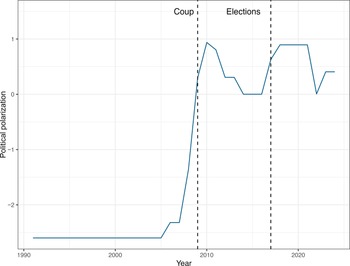
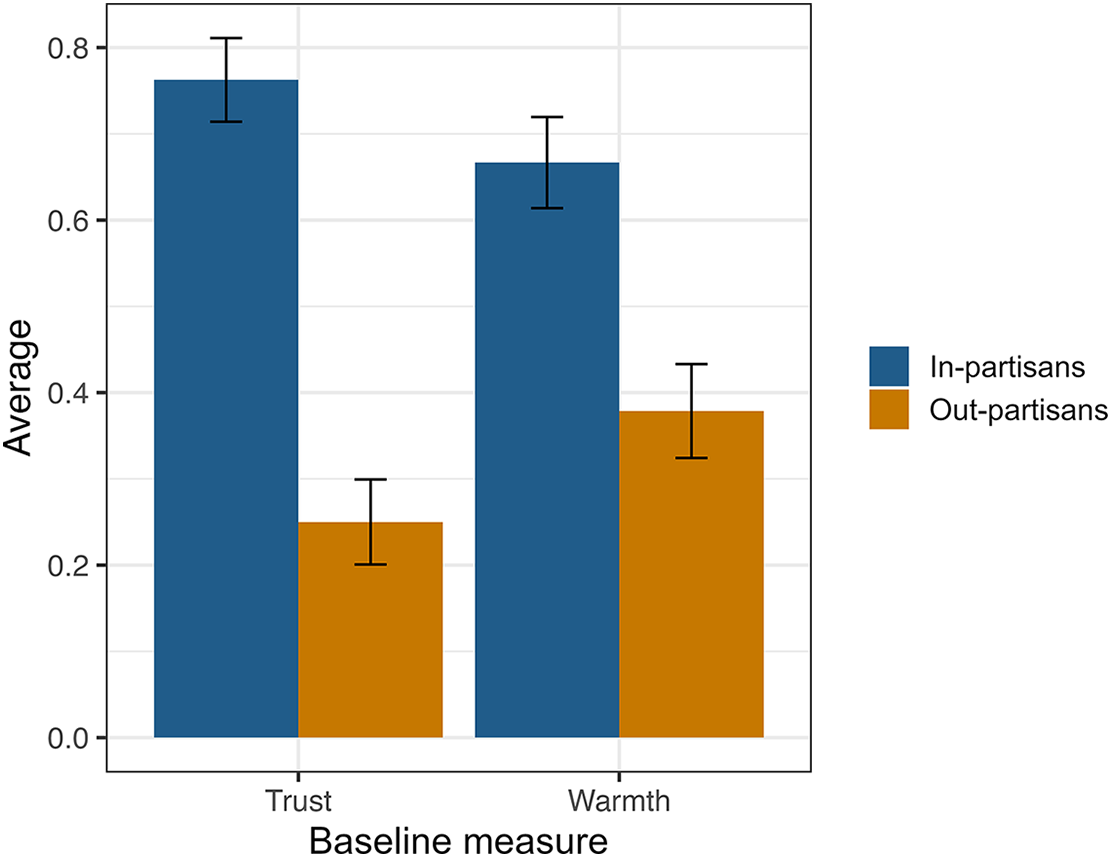


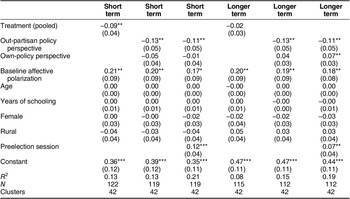
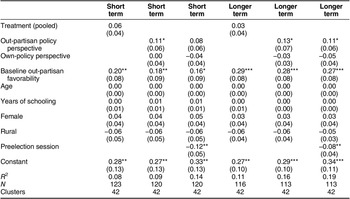
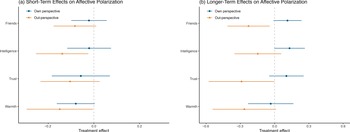

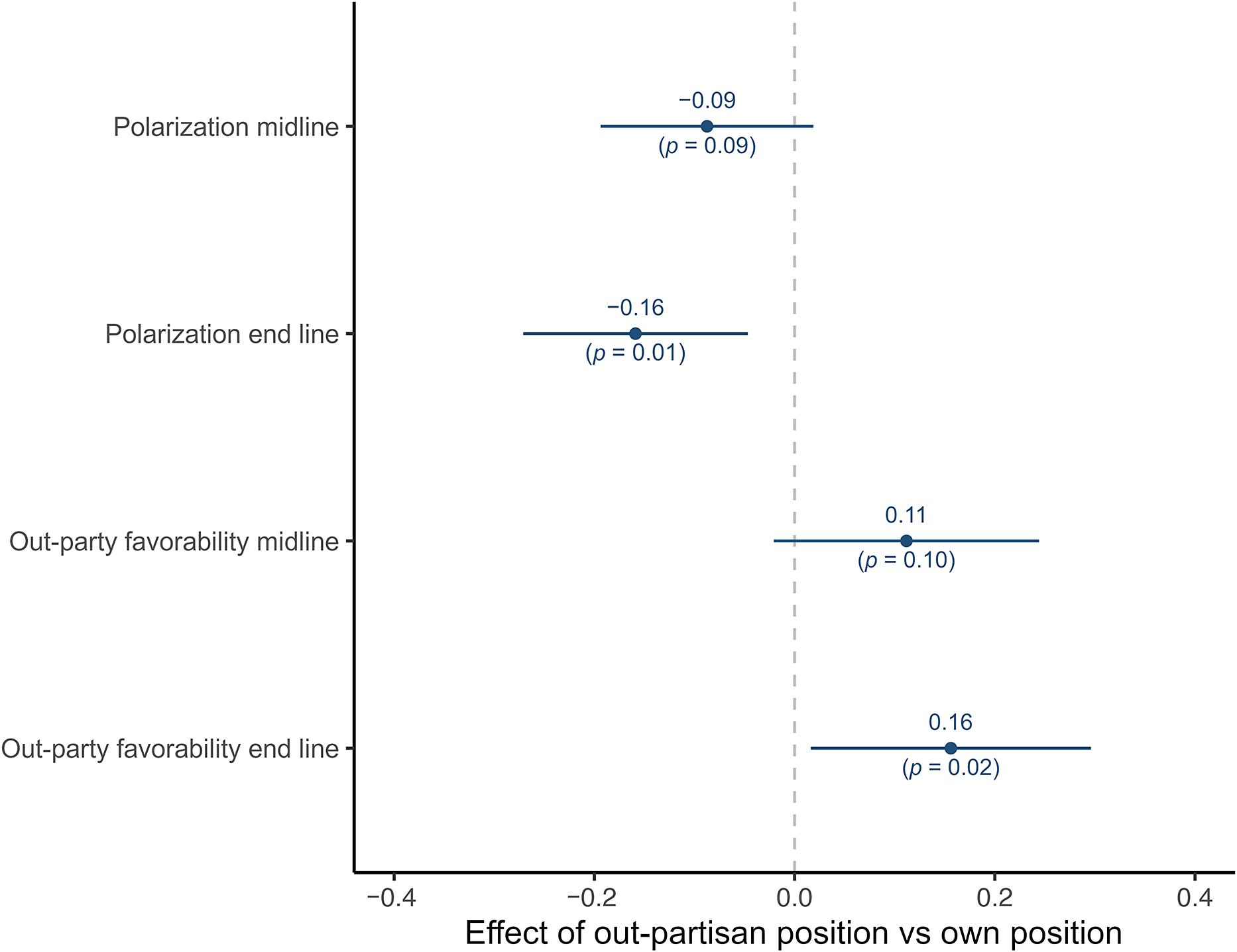


 Open access

