





Introduction
Glaciers are often seen as sentinels of climate change. Since the end of the Little Ice Age, glaciers have been retreating dramatically, and virtually all of the ice loss is due to anthropogenic climate change (Roe and others, Reference Roe, Christian and Marzeion2021; Zekollari and others, Reference Zekollari2025). In the European Alps, rising temperatures have caused the equilibrium line to rise from an average of 114 m between 1901–1930 and 1971–2000. Under a 2.8°C warming scenario, the equilibrium line could rise a further 390 m by 2071–2100 (Žebre and others, Reference Žebre, Colucci, Giorgi, Glasser, Racoviteanu and Gobbo2021). The retreat of alpine glaciers has implications for water resources as well as for the geomorphological processes shaping mountain landscapes. During the paraglacial period, increased moraine destabilisation and glacial debuttressing (Grämiger and others, Reference Grämiger, Moore, Gischig, Ivy‐Ochs and Loew2017), combined with permafrost degradation are accelerating the frequency and magnitude of rockfalls (Courtial-Manent and others, Reference Courtial-Manent, Mugnier, Ravanel, Carcaillet, Deline and Buoncristiani2025). As climate change continues, glaciers will continue to melt, with ice mass in the European Alps from 2015 onwards potentially decreasing by 86–99% by 2100 under the IPCC SSP1.2.6 and SSP5-8.5 scenario, respectively (Rounce and others, Reference Rounce2023). Limiting global warming is important for minimising this loss. This is the objective of the International Year of Glaciers in 2025.
Glaciers are not only physical objects that can be measured. In some places around the world, glaciers are sacred, acting as religious, spiritual and symbolic entities (Carey and others, Reference Carey, Jackson, Antonello and Rushing2016). They are providing aesthetic value and an important resource for drinking water, energy production, and tourism (Schaefli and others, Reference Schaefli, Manso, Fischer, Huss and Farinotti2019; Salim and others, Reference Salim, Ravanel and Deline2023b). As glaciers recede, they create a sense of loss from a human perspective. An example of this is the mourning of the Okjokull glacier in Iceland in 2019, which lost its status as a glacier and lead to a funeral ceremony organised by anthropologists Cymene Howe and Dominic Boyer with about 100 participants (Árnason and Hafsteinsson, Reference Árnason and Hafsteinsson2020). This was not a one-off event, as other mourning ceremonies for lost glaciers were organised in Switzerland, the French Pyrenees and Alps and the USA (Varnajot and Saarinen, Reference Varnajot and Saarinen2022). This mourning for past glaciers resulted in traces and specific activities, materialised through elements such as markers of past glaciers, information about future and past expansions, as well as guided tours that make the link between climate change and the disappearance of glaciers (Varnajot and Salim, Reference Varnajot and Salim2025). Glaciers also mobilise people against climate change. A famous example is the ‘Glacier Initiative’, which led to the adoption of the Swiss Climate Law and mobilised people by organising hikes around glaciers (https://gletscher-initiative.ch/ - accessed in January 2025). These examples highlight the role of glaciers on society as their retreat not only reshapes landscapes, but also reconfigures social practices, narratives and emotional attachments (Howe and Boyer, Reference Howe and Boyer2025).
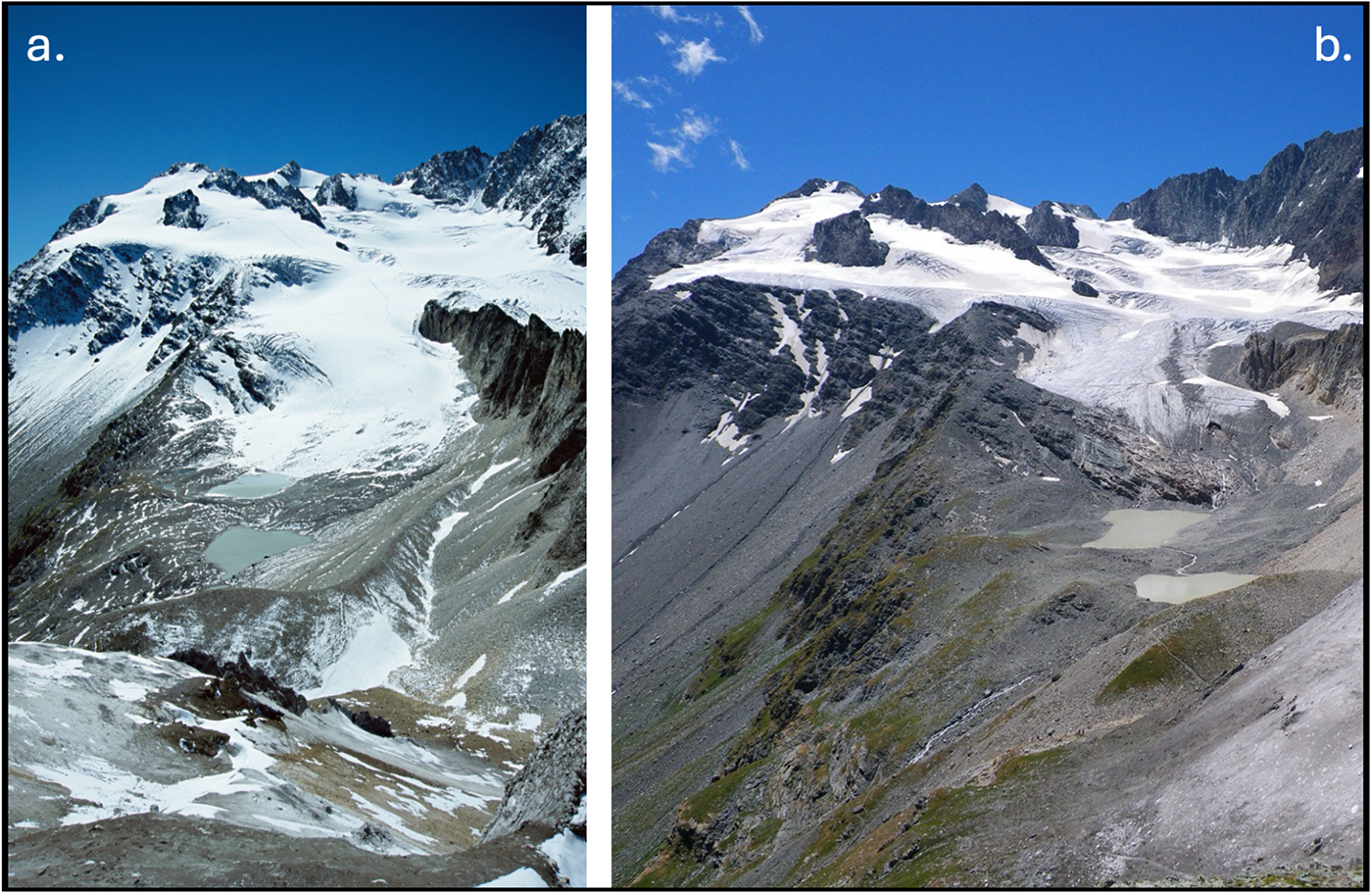
Mountaineers, who have traditionally relied on glaciers to reach mountain summits, may be the group most affected by changes to glaciers in terms of leisure and recreation. The practice of alpinism has long relied on the stability of glacial landscapes, whether for access to summits, technical routes, or the very identity of certain climbs (Fig. 1). From an alpinist perspective, most of the activity is changed by the ice loss. Access to certain mountain huts is becoming more difficult and dangerous because of the retreat of the glacier itself, but also because of the intense paraglacial activity and permafrost degradation. Examples can be found in the Mer de Glace basin (Mourey and Ravanel, Reference Mourey and Ravanel2017), in the Western Alps (Mourey and others, Reference Mourey, Ravanel and Lambiel2022), in Canada (Hanly and McDowell, Reference Hanly and McDowell2025) or New Zealand (Purdie and Kerr, Reference Purdie and Kerr2018). The climbing routes themselves have undergone changes related to a number of geomorphological processes, such as the increase in the slope angle of the glacier surface, the development of supraglacial debris cover, more open crevasses, more icy snow routes, or the reduction in the height of the glacier (Mourey and others, Reference Mourey, Ravanel and Lambiel2022; Arnaud and others, Reference Arnaud, Mourey, Bourdeau, Bonet and Ravanel2024). The geomorphological processes impacting alpinism also influence the behaviour of climbers and mountain guides (Salim and others, Reference Salim, Mourey, Ravanel, Picco and Gauchon2019; Rushton and Rutty, Reference Rushton and Rutty2023), making them substitute their activity (Salim and others, Reference Salim, Mourey, Crépeau and Ravanel2023a). However, little is known about climbers’ intimate relationships with glaciers, their possible processes of mourning, or how the retreat of glaciers transforms the emotional and symbolic meanings through which mountain places are experienced and valued.
Change to the Gebroulaz glacier (Vanoise National Park, France); a. 1980, B. Vion; b. 2022, B. Vion. The Gebroulaz glacier is the main access point for routes such as the Aiguille de Polset. Its retreat has made access longer and more complicated.

Accordingly, the aim of this paper is to examine the relationship between Western European alpinists and vanishing glaciers. It examines how glacier retreat leads alpinists to reconsider their practices, reshape their engagement with the mountain environment, and transform their emotional relationships with glaciers and alpine landscapes. Furthermore, it seeks to understand the mourning processes triggered by this disappearance. Rather than merely describing behavioural adaptations, the paper considers glaciers to be more-than-human entities that influence human practices and feelings through their material transformations.
Influenced by intellectual currents such as Actor-Network Theory, more-than-human geography challenges the centrality of humans in the world, acknowledging that the planet is shared with entities that have their own being and agency, i.e. the ability to influence the world through the relationships in which they are involved (Ganambarr and others, Reference Ganambarr2024). This human geography perspective moves beyond the idea of the separation of nature and culture, recognising that the cultural and natural worlds are mutually constitutive (Sharp and others, Reference Sharp, Brierley, Salmond and Lewis2022). It refuses to consider humans as exceptional and to presume that socio-material changes are solely the result of human action (Whatmore, Reference Whatmore2006). Some recognise that this perspective is part of a ‘relational turn’ within the discipline, enabling geographers to reconsider the intricate connections between humans and the environment. It acknowledges that the world humans inhabit exceeds their control (Dowling and others, Reference Dowling, Lloyd and Suchet-Pearson2017). More-than-human geographers focus on relations, affects, involvement and embodiment. From this perspective, glaciers are seen as active participants in the socio-environmental transformations they provoke, questioning their relationship with those close to them (Isaacs, Reference Isaacs2020).
Methodology
To explore the relationship between alpinists and glaciers, this paper draws on 30 semi-structured interviews conducted with recreational alpinists in the European Alps between March 2023 and June 2024. These interviews were part of a larger study focusing on alpinists’ adaptation to climate change. To this end, a quantitative survey was conducted from August to December 2022, which identified four segments of recreational alpinists (Salim and others, Reference Salim, Gruet, Sacher, Rushton and Hanly2025). From the 1534 completed questionnaires, the following segments were identified. Core climbers (28%) are motivated by a strong desire to overcome challenges and achieve routes. Aware of the changes affecting mountain environments, they climb frequently and intensively. Traditional climbers (7%) are a more experienced yet conservative group who are less inclined to question their routines or recognise the impact of climate change. They maintain an approach that is firmly grounded in technical mastery. By contrast, environment lovers (34%) climb less often but express a profound sensitivity to mountain ecosystems. Their motivations are strongly shaped by their attachment to nature and concern for climate change. Finally, casual climbers (31%) engage with mountaineering in a more measured and pragmatic way, adjusting their activities according to circumstances, rather than being driven by environmental or performance motivations.
Based on this segmentation, respondents who agreed to be contacted for an interview were contacted by email. The interview guide (Appendix A) includes topics related to the alpinist profile, their motivations, their perspective on climate change, their relationship with glaciers and the influence of climate change on their behaviour. The interviews lasted from 22 to 90 minutes, with an average of 52 minutes (Appendix B). The saturation point occurred at the 22nd interview. Saturation is reached when conducting additional interviews no longer yields new insights or themes (Creswell and Creswell, Reference Creswell and Creswell2017). All interviews were recorded and transcribed with the consent of the participants. MaxQDA software was used to carry out a conventional content analysis, employing deductive category development to identify relations to glaciers and mountain landscapes in respondents’ discourse. Then, different dynamics of relationships with glaciers and landscapes were produced inductively to extend the meaning of these relations (Hsieh and Shannon, Reference Hsieh and Shannon2005). Specifically, the author first read the verbatim transcripts and manually coded each sentence relating to glaciers and mountain landscapes. In a second step, new categories were created inductively. These categories were formed from the participants’ own words to capture how they described and understood their experiences. The developed categories were then regrouped to the four main dynamics used in the results. The process including the intermediate categories can be found in Appendix C.
Among the 30 respondents, 17 (57%) lived in France, 10 (33%) in Switzerland, 2 (7%) in Austria and 1 (3%) in the UK. Twenty-five (83%) of the interviewees were male, and five (17%) were female, aged between 24 and 67 years, with mountaineering experience ranging from 3 to 47 years. The sample over-represents males and people with a high level of education, which is consistent with the few studies carried out on the alpinist population (Moraldo, Reference Moraldo2013; Fink, Reference Fink2018).
Results
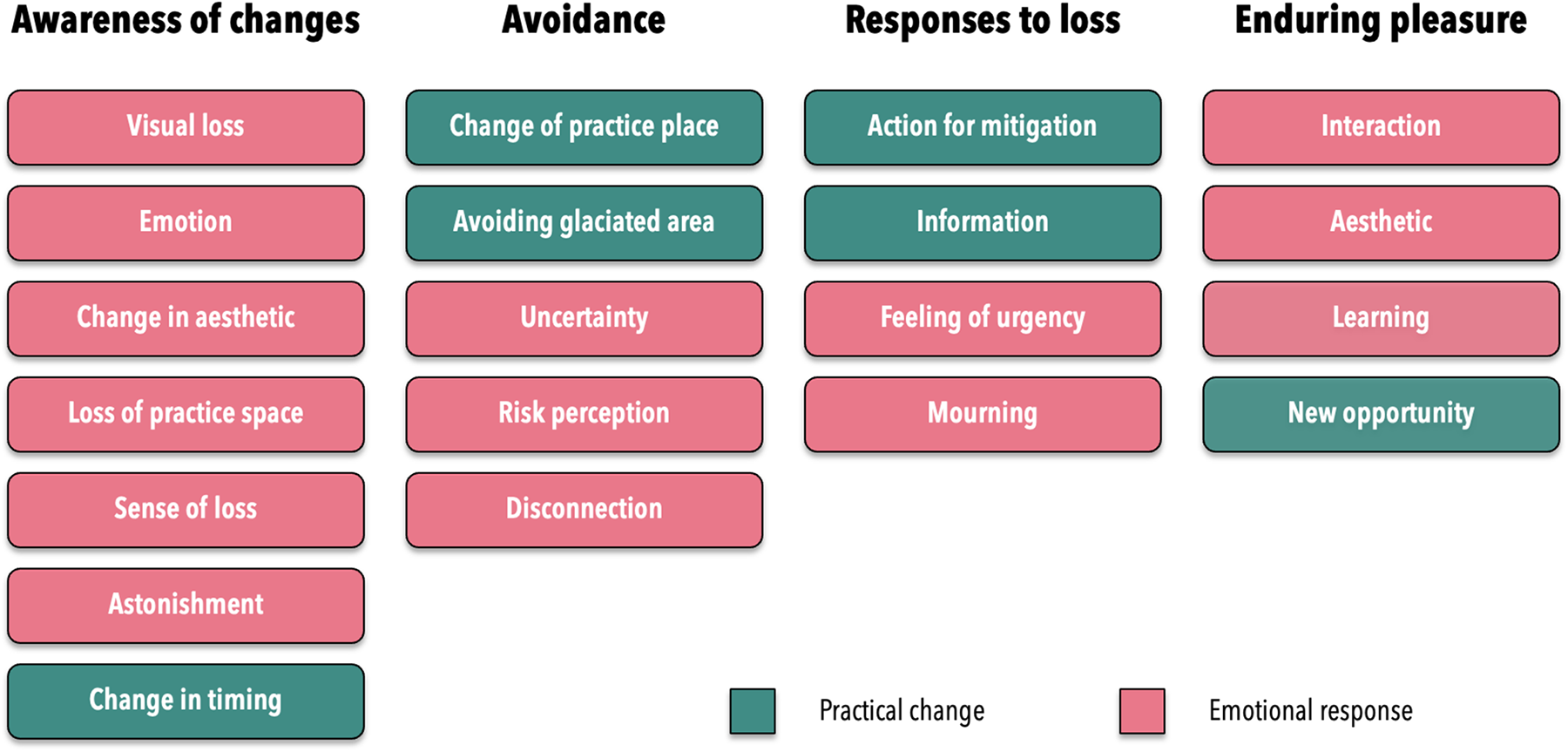
The interviews identify four main ways in which alpinists relate to glaciers in their practice: The relationships identified falls in two main categories: emotional responses and practical changes (Fig. 2).
Four categories of alpinists’ relationships with glaciers and their emotional and practical dimensions.

Glacier loss from visual awareness to practical changes
Most respondents (66%, N = 20) spontaneously mentioned glacier retreat as a visual consequence of climate change and one of the most noticeable changes resulting from it. As AE22 states, ‘We see the glaciers retreating, the rock outcrops appearing, all these glaciers that are just dying’. The rate at which glaciers are retreating is noted by respondents who express shock: ‘In the mountains, [glacier retreat] is really noticeable. [..] It’s so obvious, the Mer de Glace is scarce, even in February [..] there’s a word for it. Amazed, but it’s not amazed, it’s astounded’. (AE23). Such visual changes transform abstract climate data into tangible evidence of loss. It also provokes an emotional response described as a ‘heart-breaking’ encounter with a dying glacier landscape (AE02). Aesthetic changes associated with ice turning grey and prominent moraines alter the aesthetic perception of several climbers, challenging the image of the practice of mountaineering: ‘We go into much darker massifs. And so, quite apart from the practice itself, it affects the aesthetics we have, the emotional relationship we have with the landscape, but also because we’ve created a certain image for ourselves. And it’s an image that we have to change, because they’re going to leave anyway’ (AE12). Beyond aesthetic, participants linked these changes to concrete technical consequences: steeper glacier snouts, lengthier moraine approaches and the earlier emergence of hard blue ice on the route were all cited as changes that raise the technical grade of many climbs.
In relational terms, the retreat of glaciers evokes a sense of astonishment among alpinists, who experience their disappearance as the loss of a fundamental element of the alpine mountain environment. This retreat elicits feelings of sadness and abandonment, as glaciers are perceived not only as physical features but as integral components of the alpine experience. These emotional responses are further intensified by the practical consequences of glacial retreat, which often results in more difficult access to mountain massifs. As a result, the reduction of glaciated terrain diminishes the scope of accessible practice environments and/or introduces greater complexity in reaching them, thereby demanding higher levels of skill and experience from climbers.
From awareness to avoidance
Facing the awareness of glacier loss and its impact on alpinism, respondents (80%, N = 25) react with avoidance; often avoiding the glaciated area in order to improve access conditions, as AE01 explains: ‘Before you had a path, then you were on snow, then you were climbing, now you have a path, you’re on rocks, well, on dirty scree [..] There is a loss of attractiveness’. Some respondents explain that some routes are no longer feasible in certain periods because of the loss of glacier height, as AE2 illustrates for the Pointe de Labby in the French Alps: ‘Last year, we wanted to do the ‘arête du soleil,’ but we couldn’t do it because the glacier had receded too much and the conditions were too complicated to reach it, even though it was a route I had done at the same time a few years before and it was perfectly feasible’. Others are moving away from snow and ice altogether, redirecting their efforts towards climbing or other sports: ‘It’s a reorientation of our goals. As a result, we’ll be doing more climbing and less playing on glaciers’ (AE01). Avoidance takes the form of deliberate exclusion from routes perceived as too risky, as explained by AE10: ‘If there is an objective risk, increased by global warming, that exceeds the threshold I have set for myself, I won’t do it’. For a minority, this logic extends to a possible withdrawal from glacier mountaineering: ‘We discussed [the risk] with my wife. We said that if we can’t touch the mountain anymore, in, I don’t know, 5, 10, 15, 20 years, because it gets too dangerous and we don’t feel like pushing ourselves anymore, then we won’t go and that’s it. We’ll do something else’ (AE21).
In this dynamic of avoidance, glacier retreat increases climbers’ estimation of objective risk, leading them to reconsider when and where they climb. In many cases, they avoid snow and ice routes. The growing perception of risk is reinforced by uncertainty about the stability of snow and ice conditions, but also about the reliability of guidebooks that no longer reflect rapidly changing terrain. Consequently, the disappearance of glaciers is creating an increasing discrepancy between alpinists’ imagined or remembered mountain landscapes and the altered environments they now encounter, gradually producing a sense of disconnection between climbers and the mountain environment previously felt to be familiar.
The coping responses to losing ice
While avoidance is the most shared relational dynamic among respondents, some (37%, N = 11) also express coping responses to the consequences of glacial retreat, in a way to continue practicing in the same place in the same season, despite the new difficulties it brings. This is exemplified by AE02: ‘The ice zones are smaller. [You take more into account] the weather, the fact that the glacier is probably more crevassed than you’d expect during the year. I take the route as it is today [if I want to], I don’t say to myself that it’s because of global warming that this route is like this’. In some cases, this dynamic is possible because the climber takes more time to prepare the trip, monitors conditions day by day, consults the frost level to adjust the timing, and shares information with others. This form of coping also creates a sense of urgency to do the route for some respondents: ‘if you want to do this summit, theoretically it will be worse next year’ (AE02). This is particularly the case for glacier and snow routes, as exemplified by AE12: ‘Now I have a kind of desire and ‘stress’ to be able to do some nice routes in ice and hard snow, because I know that these are routes that we won’t be able to do anymore’. The responses also take the form of mourning processes. The awareness that these adjustments can only postpone an inevitable disappearance inspires symbolic acts to mark the moment: ‘the Sarene glacier is at the end of its life, we should put up a plaque like they did in Iceland’ (AE01). Such gestures transform powerlessness into a shared ritual, recognising the glaciers as companions whose passing deserves to be commemorated. Finally, some respondents spontaneously linked the glacier retreat to a form of leadership alpinist must have regarding protecting the environment. ‘We’re gonna reverse the question. Anything that harms [the environment] in my practice must stop. [..] even more so, as amateurs we must be the first to change our behaviour (AE19).
In the face of glacial retreat, alpinists engage in with responses that enable them to adapt both practically and emotionally to changing alpine conditions. Glaciers, as dynamic non-human actors, influence the informational strategies employed by alpinists, who adjust their planning, timing, and risk assessments to continue pursuing desired routes, even as conditions become increasingly unreliable or hazardous. This process reflects not only technical adaptation but also an existential response to loss, wherein the disappearance of glaciers evokes a sense of urgency or ‘last-chance’ motivation to climb routes before they become inaccessible. Simultaneously, the glaciers’ retreat is experienced as a form of death, prompting processes of mourning that manifest through acts of commemoration, storytelling, and the materialization of the traces of past glaciers in the alpine landscape. These coping mechanisms bridge practical adaptation with emotional resilience in the face of irreversible environmental change.
Aesthetics of the mountain and the pleasure of encounter
Despite the shrinking ice and increased risk, respondents (50%, N = 15) describe a resilient pleasure that continues to bring them to glacial terrain. The main reason for the pleasure is the mountain landscape in general, even if the glacier itself is perceived negatively, e.g. AE10: ‘The scenery is always magnificent. Sunrise, sunset, sun at its zenith. The mountains are varied. The whole thing, let’s call it, is the view’. The glacier itself is still a source of awe for alpinists, even more so when it is white or blue. The retreat of the glacier is also sometimes perceived as a source of knowledge, a teacher who helps to learn about the current dynamics of the mountain environment: ‘It’s incredible to think that it all happened by itself. That’s what I like about nature, it’s a lot of unknowns and then a lot of new things all the time, it’s always new landscapes, it’s always different and I find that incredible’ (AE6). For a minority of respondents, the dying glaciers and changing routes open-up new opportunities for exploration, as AE10 expresses: ‘We’re rediscovering a bit, exploring again, the weakness in the wall. It’s as if the fact that certain routes are no longer in good condition or have been destroyed has finally led to a new positive dimension. I feel we’re back in the golden age of alpinism’.
Glaciers continue to inspire awe in alpinists with their sublime aesthetic. However, this experience is ambivalent, influenced by both the physical state of the glacier and the climbers’ mental image of what a glacier ‘should’ look like. A debris-covered or darkened ice surface may be perceived as less beautiful than a pristine white one, altering the emotions it evokes. At the same time, glaciers are also perceived as sources of knowledge, revealing the ongoing evolution of the mountain environment. Their constantly changing forms invite observation and interpretation, creating an interaction between humans and ice that becomes a source of curiosity and enjoyment in itself. While glacier retreat often generates a sense of loss by shrinking familiar practice spaces, for some respondents it also unveils new, untouched areas that reawaken their sense of exploration.
Discussion
As shown by previous research in other contexts (e.g., Gagné and others, Reference Gagné, Rasmussen and Orlove2014; Jackson, Reference Jackson2015; Provant and others, Reference Provant2021), our results confirm that glaciers can be understood as more-than-human entities and as concrete markers of ongoing climate change among alpinists. Describing glaciers in this way acknowledges their capacity to act and affect human lives beyond their physical properties. Through their retreat, appearance and changing forms, glaciers interact with climbers, co-producing meanings, emotions and adaptations.
In practical terms, glacier retreat influences adaptive behaviours among alpinists that range from technical changes that include the temporal, spatial, activity, strategic and informational substitutions described elsewhere (Rushton and Rutty, Reference Rushton and Rutty2023; Salim and others, Reference Salim, Mourey, Crépeau and Ravanel2023a). Glacier retreat also acts as a catalyst for alpinists to rethink their role in limiting climate change, encouraging them to adopt new behaviours such as using public transport or electric bikes to reach mountain areas. Even if the proportion of respondents expressing this change remains low, it argues for the development of more effective alternatives to cars for reaching mountain areas.
In emotional terms, glacier loss diminishes climbers’ connection to the mountain environment, making former familiar landscapes seem distant and inaccessible. For climbers, it also means a loss of practice space, for which a few feel compensated, considering that the deglaciated landscape will create new places to explore. This point could be extended, as the loss of ice and the resulting deglaciated spaces have the potential to offer new practices and itineraries for hikers and professional mountain leaders. As the avoidance dynamic is the most pronounced among the interviewees, this suggests that glaciers, as one of the objects that made the Alps attractive in the middle of the 18th century (Joutard, Reference Joutard1986) is now shunned by a part of the climbing community for reasons of safety, conditions and accessibility. The results also show that changes in the aesthetics of the glacier often create a sense of sadness and negative judgement related to the markers of its retreat (new and obvious deglaciated moraines, debris cover, changes compared to the image the respondent has), but does not alter the general aesthetic judgement of the mountain landscape as a whole, as it has already been shown for tourists visiting the Mer de Glace in France (Salim and others, Reference Salim, Ravanel and Gauchon2021).
In most cases, glaciers are seen as important entities that have been lost or will be lost in the future. As glaciers are still present in some guidebooks or in the mental representation of the alpinist, it can be considered as an ambiguous loss, where the object is physically absent but psychologically present during the route (Pihkala, Reference Pihkala2024). In some cases, respondents report this sense of loss in the opposite way, projecting the disappearance of the glacier into the future, even though it is still there. For the climbers, the loss of the glacier can be considered tangible, because of the actual retreat and the inaccessibility of certain routes, and at the same time intangible, because of the aesthetic changes and the loss of identity for the alpinism community associated with the glacial landscape (Brugger and others, Reference Brugger, Dunbar, Jurt and Orlove2013). These different forms of losses can be interpreted as an encounter with death, which, according to Guy Debord and his ‘society of the spectacle’, is not only a death lived as a spectacle in TV news or documentaries, but also experienced in the body of the individual (Jacobsen, Reference Jacobsen2016). The death of glaciers, as more-than-human entities that are endowed with agency and an affective presence, produces material and symbolic losses. This leads to a process of mourning, exemplified by a willingness to commemorate and remember past (or future past) glaciers.
This mourning can be seen as chronic sorrow (Gillespie, Reference Gillespie2019), as it implies that the alpinist is constantly re-exposed to a glacier-related environment, but it can also be seen as anticipatory mourning when the loss is considered for the future (Pihkala, Reference Pihkala2024). The results presented here show that the process of mourning glacier exist in individuals that can be linked to recent event of public mourning of glaciers in different part of the world (Varnajot and Saarinen, Reference Varnajot and Saarinen2022). The process of loss and mourning described here goes beyond the idea of solastalgia as it implies political issues on the action to protect glacier and can be called an ecological grief (Markkula and others, Reference Markkula, Turunen, Rikkonen, Rasmus, Koski and Welker2024). Ecological grief is the sorrow experienced in response to the actual or anticipated loss of species, ecosystems or landscapes due to climate change, whereas solastalgia is the distress caused by witnessing environmental change in one’s local area, rather than by the loss itself (Cunsolo and Ellis, Reference Cunsolo and Ellis2018). This ecological grief raises the question of the ultimate nature of the mourning process for the glaciers. Will it, according to Árnason and Hafsteinsson (Reference Árnason and Hafsteinsson2020), lead to a new attachment or will it be a longing for a return that falls into melancholia?
Part of the answer can be explored through the geographical perspective of the production of place. For Bennett (Reference Bennett2021), the visible effects of climate change on the environment generate an ‘Anthropocene gaze’ that alpinists are constantly confronted with in their practice. This gaze encompasses current glacial conditions, but also those that will come as ruins. A parallel can be drawn with the Arctic and the process of ‘arctification’ that produces places based on winter and cryospheric narratives (Cooper and others, Reference Cooper, Spinei and Varnajot2019). Given the consequences of climate change on the cryosphere, a process of ‘de-arctification’ is leading to post-arctic narratives based on a world without snow and ice (Varnajot and Saarinen, Reference Varnajot and Saarinen2022). As Varnajot and Adie (Reference Varnajot and Adie2025) discussed, the production of the post-arctic narratives is falling short, with stakeholders blocked in a form of denial that leads them to focus mainly on artificial solutions to maintain the cryospheric elements that fall within the arctic narratives. According to Cunsolo and Ellis (Reference Cunsolo and Ellis2018), this can be an example of a constant mourning that falls into melancholia and does not allow the community to create a new attachment to the post-arctic landscape that will inevitably come, increasing the risk of developing maladaptive responses to current and future changes and inhibiting action.
In the context of alpinism, this constant mourning could fuel the idea of last-chance to climb and expose the individual to unwise risks. Another example comes from mountain glacier tourism sites, where markers showing the past and future state of the glaciers have been deployed (Salim, Reference Salim2024). Tourists’ relationship with these traces has the potential to raise their awareness of the need for change and promote pro-environmental behaviour and climate action (Salim and others, Reference Salim, Ravanel and Deline2023b; Lv and others, Reference Lv, Pan, Xu and Lan2024; Varnajot and Salim, Reference Varnajot and Salim2025). As our results show, some respondents spontaneously move from a feeling of loss to a call for action and the development of new and decarbonised practices. In the context of the Year of Glaciers’ Preservation 2025, this dynamic has the potential to position alpinists not only as witnesses to environmental change, but also as stewards of the mountain landscape, transforming grief into responsibility and fostering new forms of attachment through the act of protecting a disappearing cryosphere and the environment as a whole.
Conclusion
From the more-than-human perspective adopted in this paper, glacier retreat emerges as an entity that reshapes the practical and emotional relationship between alpinists and glaciers. In practical terms, it compels climbers to adjust the timing and location of their ascents as well as to seek more information about changing conditions. For some, it also means adopting a more active role as climate change ambassadors. Emotionally, glacier loss generates a complex set of responses, including feelings of loss and disconnection from familiar landscapes and practices, heightened perceptions of risk and uncertainty, and an increasing sense of urgency to climb before routes disappear. These practical and emotional changes can be categorised into four main groups, as identified in this study: acute awareness of disappearance, avoidance strategies, responses to loss and enduring experiences of pleasure. Together, these categories reveal how glacier retreat induces a sense of loss in the present and in anticipation of the future.
In this context, the loss experienced by alpinists can be understood as a form of ecological grief. Such grief has dual potential: it can foster renewed attachment and action, transforming sorrow into responsibility; or it can lead to a static state of melancholia in which constant mourning inhibits change. Beyond alpinism, glacier retreat also creates new opportunities for other mountain users, such as mountain leaders and hikers. Their evolving relationships with deglaciated landscapes deserve further attention from the research perspective. Developing new visions of a deglaciated high mountain, rather than remaining anchored in nostalgia, may help to reduce the risk of perpetual mourning. Therefore, future research could focus on people who are engaging with these emerging narratives, as well as the barriers hindering behavioural change, to better support more sustainable and adaptive forms of mountain engagement.
Acknowledgements
The author would like to thank the reviewers for their valuable feedback on the manuscript. He would also like to thank Xavier Cailhol and Eric Charamel for helping to identify the repeated photographs used in the manuscript. The author's institution did not require ethical approval for this research. All of the individuals agreed that the interview data could be used anonymously.
Appendix A. Interview guide
Interview guide

Practitioner profiles
- How long have you been mountaineering?
- What are your main activities (rock, snow, ice, etc.)?
- How often do you practice?
- What are the difficulties of the routes you frequently do?
- What are your main places of practice?
- In which condition do you practice (personal, club, with a guide, a mix)
- Do you practice other activities in the mountains?
Motivation
(Laddering)
- Why do you climb mountains?
- Why do you find * important or desirable?
- Why is * important to you?
Awareness and relationship to climate change
- What do you think about climate change (global and local scales)
- What do you think is the cause of climate change?
- In your everyday life (outside of mountaineering), do you feel that you perceive the consequences of climate change?
- In your mountaineering practice, do you feel you perceive the consequences of climate change?
- What do you think these consequences are?
- What about glacier retreat?
- How do you feel climate change is influencing your relation to glaciers?
Influence of climate change on behaviour
- Do you feel that climate change and its consequences have an influence on the way you prepare your routes?
- What about glacier retreat?
- Would you say that climate change and its consequences influence your motivation to practice?
- Would you say that CC and its consequences change the way you practice?
Profile of the respondent
- Age; place of residence; employment; degree:
Appendix B. List of the interviewee

Appendix C. Coding process


 Open access

