





Introduction
Stevia is a relatively new specialty crop in the United States. With the FDA’s approval of stevia as a food additive, interest in stevia has increase in the United States (Cavaliere Reference Cavaliere2009). The plant is 200 to 400 times sweeter than sugar, and is used as a nonnutritive sweetener (FDA 2018; Lester Reference Lester1999). Stevia is a member of the Asteraceae family, is native to Paraguay, and has a long history of human consumption (PCSI 2017; Ramesh et al. Reference Ramesh, Singh and Megeji2006). However, stevia was not approved for food and beverage consumption in the United States until December 2008 (Cavaliere Reference Cavaliere2009; ISO 2001). Several companies have made stevia commercially available through various products, including Coca-Cola, which produces Truvia, and PepsiCo, which produces PureVia (Cavaliere Reference Cavaliere2009).
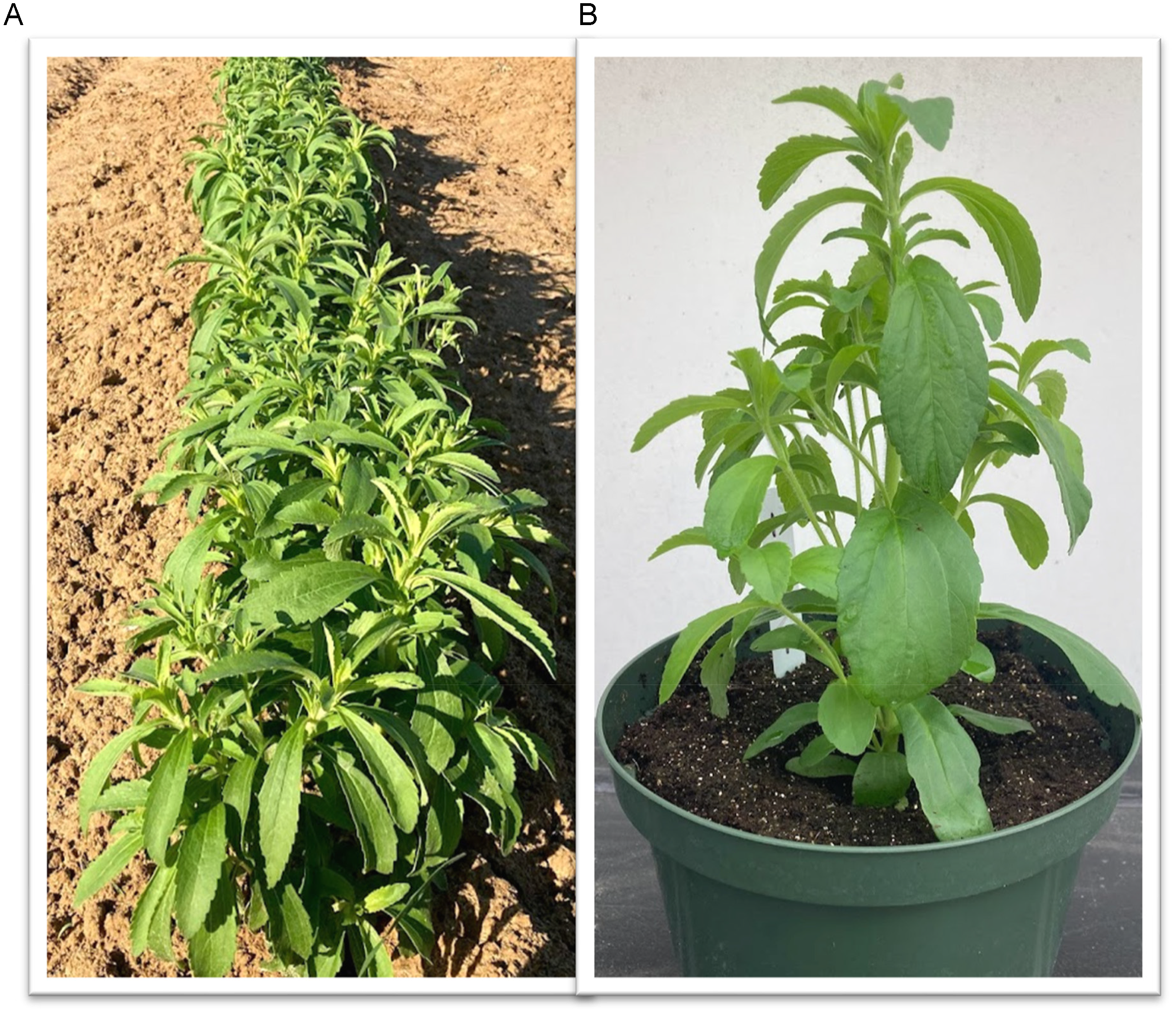
Stevia is a perennial plant with an upright growth habit (Figure 1) and can be harvested more than once a season, depending on where it is grown and its age (Koehler Reference Koehler2018; Ramesh et al. Reference Ramesh, Singh and Megeji2006). In North Carolina, stevia is typically planted in April through May and has a field life of 3 to 5 yr (Koehler Reference Koehler2018). In field production stevia is typically harvested with a combine before being dried, baled, and shipped to an extraction facility (Koehler Reference Koehler2018). Stevia does not compete well with weeds (Chriest Reference Chriest2019), especially early in the season (Azimah et al., Reference Azimah, Ismail and Juraimi2018; Ramesh et al. Reference Ramesh, Singh and Megeji2006), although weed loss studies have not been conducted. Research conducted by Harrington et al. (Reference Harrington, Southward, Kitchen and He2011) found that hand weeding increased stevia yield by 30-fold compared to a weedy check. However, few herbicides have been registered for use in stevia production (Chriest Reference Chriest2019; Harrington et al. Reference Harrington, Southward, Kitchen and He2011). Ethafluralin and glyphosate are registered for use pre-transplant, and carfentrazone, clethodim, glyphosate, and S-metolachlor are the only herbicides registered for post-transplant application. S-metolachlor can be applied over-the-top of stevia for residual control of small-seeded grass and broadleaf weed species (Anonymous, 2023). In addition, clethodim can be applied over-the-top of stevia to control emerged grass species (Anonymous 2017). Carfentrazone and glyphosate are registered only for directed applications between rows for controlling emerged weeds after stevia has been transplanted. Therefore, few herbicides are registered for use over-the-top of stevia, especially to control broadleaf weeds.
Stevia grown in the field (A) and in a greenhouse (B). In field production, stevia is typically harvested by cutting the plant approximately 3 cm above the soil line with a combine.

With few herbicide registered for use post-transplant in stevia production, the addtion of more herbicides for use over-the-top may help to prevent weed interference in the crop. In addition, adding alternative modes of action to those currently registered for use in stevia production can help to prevent the development of herbicide-resistant weed populations. Thus, greenhouse studies were conducted to determine stevia tolerance to post-transplant applied herbicides not registered for use in stevia production.
Material and Methods
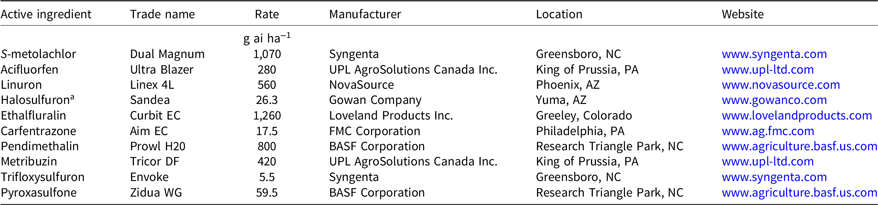
Stevia seeds (Johnny’s Selected Seeds, Winslow, ME) were planted in 50 square-cell trays (T.O. Plastics, Inc., Clearwater, MN) at North Carolina State University’s Method Road Greenhouse in Raleigh, NC (35.788°N, 78.694°W) in fall 2021. Stevia seedlings (8 to 10cm tall) were then each transplanted into 6.2-L (25.4 cm diam, 18.4 cm high) standard round pots (HC Companies, Twinsburg, OH) containing a propagation mix (Sun Gro Horticulture Distribution Inc., Agawam, MA). The stevia plants were watered three times daily from overhead irrigation and received supplemental lighting to prevent them from flowering. The greenhouse was kept at 29 ± 5 C. The treatments were arranged as a randomized complete block design with seven replications and consisted of two experimental runs. Each plot consisted of two pots. Treatments consisted of herbicides, listed in Table 1, applied 2 wk after transplanting to 25.4- to 30.5-cm-tall stevia plants. Treatments were applied over-the-top with a CO2-pressurized backpack sprayer calibrated to deliver 187 L ha−1 at 124 kPa. The boom was equipped with two flat-fan XR 8003VS nozzles (TeeJet Technologies, Glendale Heights, IL) spaced 51 cm apart.
Herbicide treatments applied to stevia 2 wk after transplant in 2021.

a A nonionic surfactant (Chemwet 1000; Victorian Chemical Company Pty, LLC, Coolaroo, Victoria, Australia) was included at 25 mL L−1.
At 1, 2, 3, and 4 wk after treatment (WAT), stevia injury, including chlorosis and necrosis, was evaluated on a scale of 0% to 100%, with 0% indicating no injury and 100% representing plant death (Frans et al. Reference Frans, Talbert, Marx, Crowley and Methods1986). At 3 WAT, one pot of stevia per plot was randomly selected for destructive root analysis. Stevia roots were excavated, washed, and then analyzed using the WinRHIZO root scanning system (Regent Instruments Inc., Montreal, QC, Canada) for root volume and projected root surface area. The roots were then dried for 1 d at 49 C and weighed. Aboveground biomass was also dried at 49 C for 3 d, and then weighed. The remaining pot of stevia per plot was allowed to grow for an additional week, then aboveground biomass was collected and dried at 49 C for 3 d, and then weighed.
Data Analysis
Data were subjected to ANOVA using the MIXED procedure with SAS software (v. 9.4; SAS Institute Inc., Cary, NC). Residuals were plotted to visually examine homogeneity of variance. Herbicide treatment and experimental run were treated as fixed effects, while replication nested within experimental run was treated as a random effect. Means were separated utilizing Fisher’s protected LSD (α = 0.05). Stevia foliar injury data required an arcsine square root transformation for analysis. Projected root surface area, root volume, and root biomass required a square root transformation for analysis. Data were presented as back-transformed least-squares means.
Results and Discussion
Stevia Injury
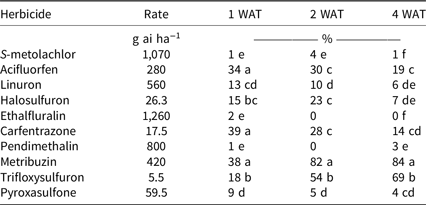
At 1 and 2 WAT, there was a significant (P < 0.05) experimental run by treatment interaction. Interaction means were plotted, and following assessment, the interaction was determined to be biologically uninformative; therefore, data were pooled across experimental runs for analysis. No interactions were significant (P > 0.05) at 4 WAT; therefore, data were pooled across experimental runs. Stevia injury from herbicide treatments across the study appeared as chlorosis and necrosis. In particular, foliar necrosis was observed after applications of aciflurofen, carfentrazone, linuron, and metribuzin. Halosulfuron application resulted in chlorosis and necrosis at the meristem. Pyroxasulfone caused slight chlorosis along the leaf edges of stevia. Trifloxysulfuron caused initial chlorosis followed by necrosis and stevia death. At 1 WAT, stevia exhibited ≥34% injury from application of acifluorfen, carfentrazone, or metribuzin (Table 2). By 4 WAT, stevia injury was observed to be 19% and 14% from acifluorfen and carfentrazone, respectively. In contrast, by 4 WAT, injury from metribuzin increased to 84%. In prior research, metribuzin applied at 350 g ai ha−1 caused 48% injury to stevia at 2 WAT (Harrington et al. Reference Harrington, Southward, Kitchen and He2011). At 1 WAT, linuron caused 13% injury to stevia, which dropped to 6% by 4 WAT. Prior research has shown that stevia has some tolerance to linuron (Hopkins and Midmore Reference Hopkins and Midmore2015). When applied at a higher rate, linuron can injure greenhouse-grown stevia by as much as 42% (Harrington et al. Reference Harrington, Southward, Kitchen and He2011). At 1 WAT, stevia injury was 15% and 18%, respectively from halosulfuron and trifloxysulfuron. Stevia injury was 23% at 2 WAT from halosulfuron, an 8% increase compared with that observed at 1 WAT. By 4 WAT, injury from halosulfuron was reduced to 7%; however, injury from trifloxysulfuron increased to 69%. Stevia injury was ≤9% at 1 and 2 WAT, and ≤4% at 4 WAT from S-metolachlor, pendimethalin, or pyroxasulfone.
Stevia injury at 1, 2, and 4 wk after treatment following herbicide applications at 2 wk after transplant a–d .

a Abbreviation: WAT, weeks after treatment.
b Stevia injury included chlorosis, necrosis, and stunting, and was evaluated on a 0% to 100% scale, where 0% represented no injury, and 100% represented plant death.
c At 1 and 2 WAT, there was a significant (P < 0.05) experimental run by treatment interaction. Interactions means were plotted, and following assessment, the interactions were determined to be biologically uninformative; therefore, data were pooled across experimental runs for analysis. No interactions were significant (P > 0.05) at 4 WAT; therefore, data were pooled across experimental runs.
d Least squared means within a column followed by the same letter are not significantly different according to Fisher’s protected LSD (α = 0.05). Data were transformed using a square root transformation for analysis. Back transformed least squared means are presented.
Aboveground Biomass
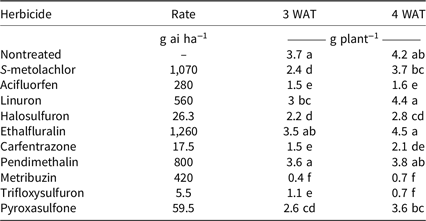
Due to a lack of experimental run-by-treatment interactions, data for aboveground biomass were combined across experimental runs. In the first year of field production, stevia is typically harvested approximately 110 d after transplanting; therefore, data from this study best quantifies stevia’s early recovery from the herbicides that were applied. Aboveground biomass collected at 4 WAT was generally higher than that collected at 3 WAT. At 3 WAT, there was no reduction in aboveground biomass from ethalfluralin and pendimethalin, compared to nontreated check (Table 3). By 4 WAT, stevia had further recovered from the herbicide treatment, resulting in no difference between S-metolachlor, linuron, ethalfluralin, pendimethalin, pyroxasulfone and the nontreated check. Harrington et al. (Reference Harrington, Southward, Kitchen and He2011) also reported no reduction in aboveground biomass of stevia when it was treated with linuron at 900 g ai ha−1 in greenhouse experiments. Aboveground biomass of stevia was reduced by 87% at 4 WAT when metribuzin was applied (Table 3). However, relative to a nontreated check, at a lower rate of metribuzin (350 g ai ha−1), Harrington et al. (Reference Harrington, Southward, Kitchen and He2011) did not observe a reduction in aboveground biomass. In addition, our results support those reported by Hopkins and Midmore (Reference Hopkins and Midmore2015) that no aboveground biomass reduction occurred when stevia was treated with pendimethalin.
Stevia dry aboveground biomass at 3 and 4 WAT following herbicide applications 2 wk after transplant a,b,c .

a Abbreviation: WAT, weeks after treatment.
b There were no significant experimental run interactions (P > 0.05); therefore, data were pooled across experimental runs.
c Least squared means within a column followed by the same letter are not significantly different according to Fisher’s protected LSD (α = 0.05).
Projected Root Surface Area, Root Volume, and Belowground Root Biomass
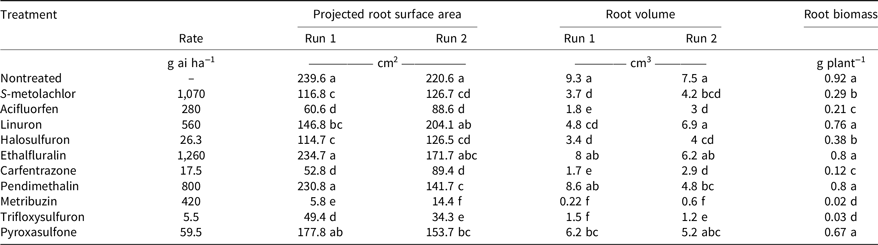
A significant treatment by experimental run interaction was observed with projected root surface area and root volume; therefore, the data were separated by experimental run for analysis and presentation. However, no interactions were significant for belowground root biomass data; therefore, data were pooled across experimental runs. In the first experimental run, ethalfluralin, pendimethalin, and pyroxasulfone did not reduce stevia projected root surface area compared with the nontreated check (Table 4). In the second experimental run, compared with the nontreated check, stevia projected root surface area was not reduced as a result of treatment with linuron or ethalflurali. Root volume followed a similar trend: in the first experimental run, compared with the nontreated check, stevia aboveground biomass was not reduced after ethalfluralin and pendimethalin applications. However, in contrast to projected root surface area in the first run, application of pyroxasulfone resulted in less root volume. Root volume and belowground biomass were not reduced in the second run by linuron, ethalfluralin, or pyroxasulfone (Table 4).
Stevia projected root surface area, root volume, and belowground root biomass following herbicide applications 2 wk after transplant a,b .

a The interaction between treatment and experimental run was significant (P < 0.05) for projected root surface area and root volume; therefore, data were separated by experimental run. Data were transformed using a square root transformation for analysis, and then back-transformed for reporting the least-squared means. There were no significant experimental run interactions (P > 0.05) for root biomass; therefore, data were pooled across experimental runs.
b Least-squared means within a column followed by the same letter are not significantly different according to Fisher’s protected LSD (α = 0.05)
At present, the only options for weed control in stevia after transplanting are carfentrazone, clethodim, glyphosate, and S-metolachlor. However, neither aboveground nor belowground biomass of stevia were reduced with applications of ethalfluralin, linuron, pendimethalin, and pyroxasulfone. If these herbicides were registered for use in stevia production, they could help to control broadleaf weeds such as Palmer amaranth (Amaranthus palmeri S. Watson). In prior research, at 1 WAT, 98% of Palmer amaranth was controlled when linuron was applied post-transplant in sweetpotato (Moore et al. Reference Moore, Jennings, Monks, Leon, Jordan and Boyette2021). Ethalfluralin, linuron, and pendimethalin may provide new modes of action for post-transplant weed management in stevia. However, further research is needed to evaluate the effect of these herbicides on stevia growth and quality in the field, as these studies were limited to the greenhouse. In addition, the soil used in this study contains a high concentration of organic matter. Thus, future research is needed to determine the safety of these herbicides applied to stevia grown in fields with various soil types and textures. In addition, while S-metolachlor is registered for use on stevia and did not affect aboveground biomass at 4 WAT, root biomass, projected root surface area, and root volume were reduced. As a perennial crop, root growth is important to stevia establishment and overwintering. Further research is needed to determine the long-term effect of S-metolachlor application on stevia’s ability to overwinter and regrowth the following season.
Practical Implications
Growers have few options for controlling broadleaf weeds in stevia production, primarily because S-metolachlor is the only herbicide to have been registered for over-the-top use. This research aimed to identify herbicides that may be safe for use in stevia production to help control weeds that emerge after the effective residual activity of S-metolachlor has worn off.
Acknowledgments
We thank Colton Blankenship, Chitra, Andrew Ippolito, Rebecca Middleton, Rebecca Cooper, Anthony Ippolito, and Helen Nocito for providing technical assistance.
Funding statement
Funding for this research was provided by the North Carolina Tobacco Trust Fund Commission.
Competing interests
The authors declare they have no competing interests.

 Open access

