

A short passage in the Han shu 漢書 (Book of Han) states that “the common people put eating on par with heaven” (min yi shi wei tian 民以食為天).Footnote 1 Modern readers might take this quotation to mean that ordinary people regarded food as a divine delight; but given the dire living situations of large parts of the population in early China, an alternative reading is more likely. Indeed, the remainder of the passage unveils Ban Gu's 班固 (32–92 c.e.) true intention. He contended that nourishment was as important as the all-encompassing powers of heaven. Both were vital to the survival of the common people. Similar existential insights already had been expressed in earlier medical texts retrieved from Tomb No. 3 at Mawangdui (dated 186 b.c.e.). They simply maintain that eating and breathing are the most basic human needs.Footnote 2 If the physical and, by extension, emotional impact of eating was considered to be essential to the human condition, one cannot help but wonder: Did people still crave meals after they died? More importantly, was there still some kind of need to dine in the first place? Judging from purely biological and rational perspectives, one would obviously say no. At the moment of death, sustenance loses all its physical meaning. However, the sheer volume of food and drink vessels yielded by late pre-imperial and early imperial tombs demonstrate that the answer was not so clear-cut to the ancient Chinese populace.
Then again, food and drink (containers) as burial goods are by no means popular subjects of study in research on early mortuary practices. In Chinese archaeology, foodstuffs recovered from tombs have been studied purely as sources of cultural history. Archaeologists have been mainly concerned with various kinds of meats, fruits, vegetables, and spices that were once more or less widely used. Past studies further focused on the manifold methods of preparing such foodstuffs and how these functioned in society at large. The very fact that food and food containers salvaged from late pre-imperial and early imperial graves were a crucial component of burial rituals is an afterthought at best.Footnote 3
Archaeology, in general, understands food and food containers either as remnants of (sacrificial) feasts that were hosted for and with the dead at the time of the burial or as sustenance in a post-mortem existence.Footnote 4 The matter of food as a burial good is considered so trivial that none of the modern archaeological traditions express a deeper interest in it.Footnote 5 Although it ties into a much more fundamental debate on the relation of archaeological deposits and ritual, scholarship remains largely silent on the subject.Footnote 6 Even the most commonly cited hand- and textbooks on mortuary archaeology devote no more than a few sentences to food as a burial good. Mike Parker Pearson, for instance, quickly anchors the practice in the much larger discourse on funerary feasts:
Archaeologists used to understand these items [i.e. animal bones, pots, tableware, trays etc.] in very literal terms as mere accoutrements to feed the dead in the other world rather than as complex symbols which express the various values, aims and attitudes of the mourners in the face of death. The placing of food and drink in a grave is only part, and not necessarily the last part, of a whole sequence of feasts, fasts or food offerings which is triggered by a death.Footnote 7
Pearson criticizes past scholarship for taking food-related burials goods “in very literal terms.” He frowns upon the old guard’s view of food deposits as nourishment in the afterlife rather than a part of elaborate sacrificial feasts that expressed the views and feelings of the bereaved. His reading of mortuary rituals also implies that the very act of depositing food and drink inevitably required more or less lavish feasts. Yet, this need not necessarily have been the case. As the discussion below will demonstrate, food and drink containers, especially when they appear in large numbers, most likely were transferred into tombs after the official funerary ceremonies.Footnote 8 Such chronologically unrelated deposits allude to differences in meaning. In fact, my analysis of the archaeological record indicates that they were supposed to ensure the long-term nourishment of the dead in the afterlife.
In contrast, occasional sacrifices that were either offered inside the tombs in the course of more extensive funerary feasts on the day of interment or repeated with some degree of regularity at the tomb primarily fulfilled an alternative function. The second half of Pearson's quotation condenses a consensus that has long been reached in ritual studies and sociology: sacrifices served “to reinforce the social fabric.”Footnote 9 The performance of rituals actively created social order among the living. Similar to any other culture of the past and present, the families of the deceased in ancient China used funerary rituals to showcase their command of economic, social, and cultural capital.Footnote 10 However, it would be a gross misunderstanding of occasional sacrifices to deny them any supernatural qualities. There is compelling evidence that sacrifices inside and at the tomb were indeed believed to feed the ghosts of the dead either on an ad hoc basis or at fixed dates.Footnote 11 In such instances, the sacrificer became the mediator between the worlds of the living and the deceased and thus asserted his social position among his audience. The latter might have comprised a few family members or much larger crowds in the event of official sacrifices.Footnote 12 Similar to modern-day commensal meals that bring the entire family together on widely observed holidays to strengthen family ties, the social bonds between the individual participants of early Chinese mortuary sacrifices—living as well as dead—needed to be reaffirmed at frequent intervals.Footnote 13 Occasional sacrifices, then, clearly are epistemologically different from food deposits whose sole purpose was to provide long-term sustenance in the hereafter. The latter ensured the survival of the dead in an alternate state of being, whereas the former linked the deceased with the bereaved at specific moments in time. Ultimately, occasional sacrifices mainly benefited the living, since the ontological state of the dead was secured by the inhumation of food and drink before or after the actual burial of the corpse.
The analytical separation of sustenance practices from sacrifices is significant for another reason. So far, only sacrifices to the deceased have been mentioned. Yet, the archaeological record proves to be far richer: loose foodstuffs or food and drink containers that were discovered in special locations inside or in direct vicinity of several tombs reveal that sacrifices to supernatural entities other than the spirits of the dead were an integral part of at least some burials. The respective offerings would either protect the tomb occupants, the individuals involved in the construction of the tomb, or both.Footnote 14 My in-depth study of finds and features of late pre-imperial and early imperial tombs thus discloses a hitherto unknown aspect of mortuary rituals: burial procedures also heeded the interests of various nature deities.
By paying close attention to the complexities of the archaeological record, in particular the specific location and chronological sequence in which objects were deposited in graves, this article aims to provide a broader appreciation of the role of food in early Chinese funerary practices and the burial process. The outcome of my analysis will have ramifications for our understanding of early Chinese notions of the afterlife. So far, there are two lines of reasoning that are diametrically opposed. One side favors a model in which tombs are regarded as way stations on a journey to a somewhat paradisiac final destination. The other prefers to view graves as the ultimate locus of an enduring post-mortem existence.Footnote 15 By illustrating that food in tombs was mostly intended as sustenance that, in theory, was supposed to last indefinitely, this study is lending more credence to the argument for the tomb as a long-term residence for the dead.
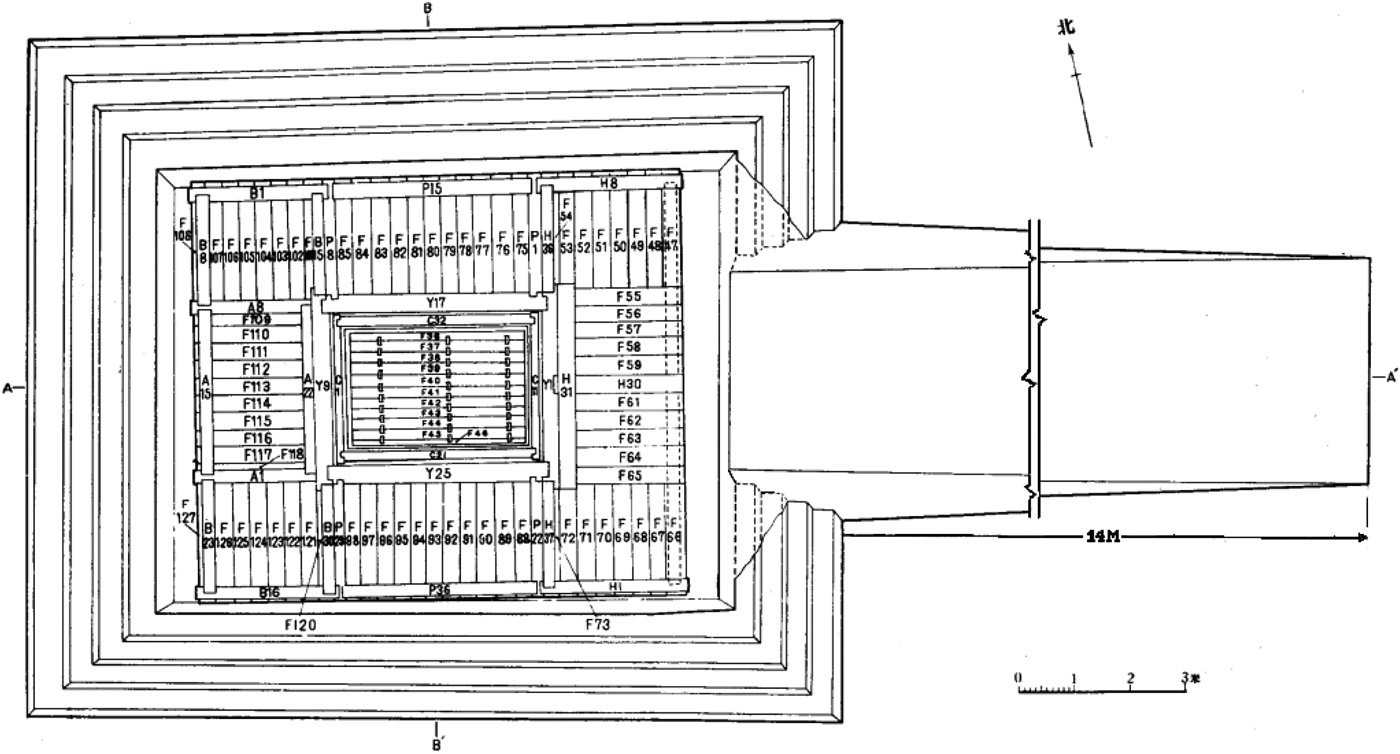
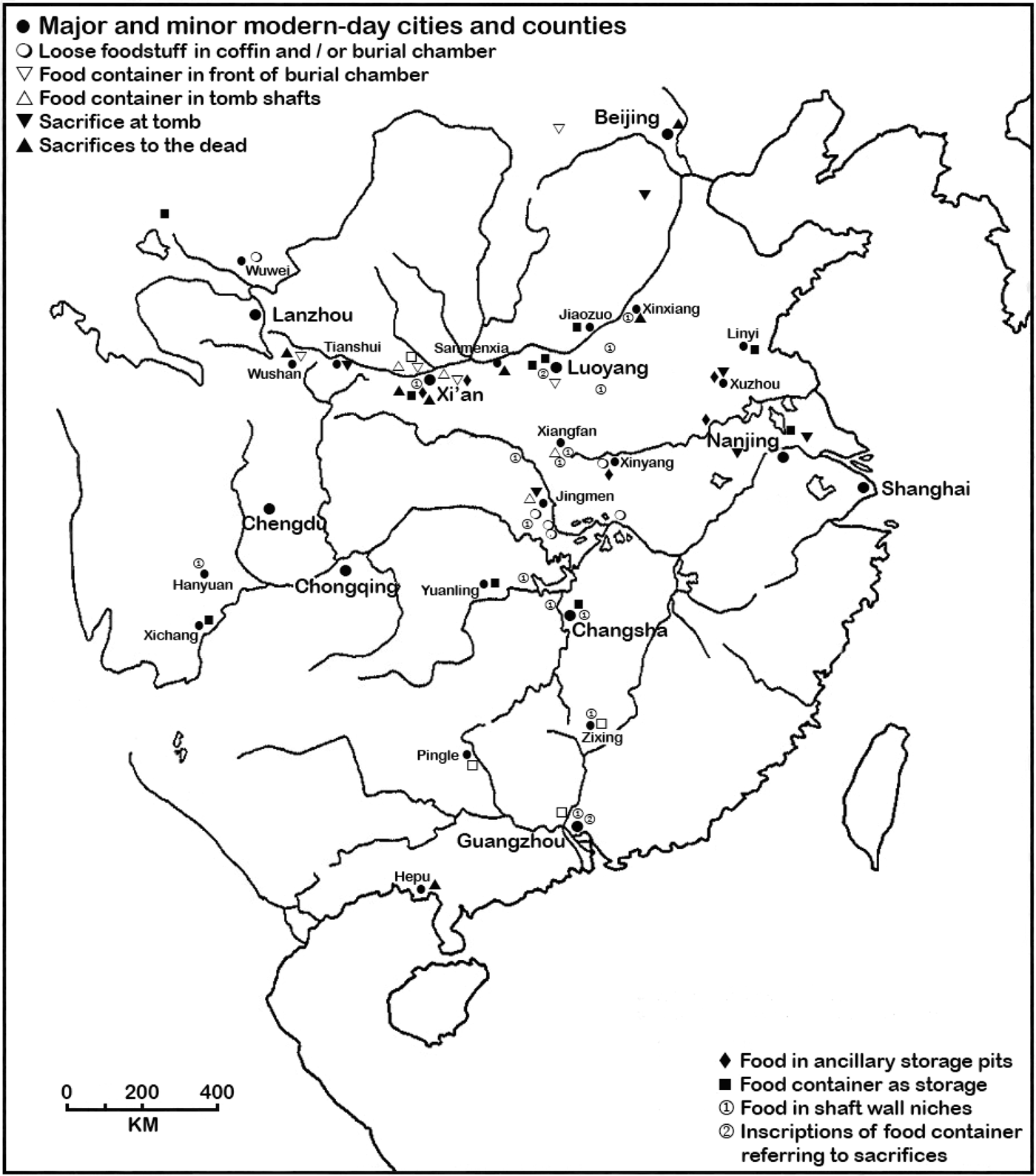
In order to achieve this goal, I start with a review of the most pertinent claims with respect to food in mortuary contexts in western and Chinese archaeological research. Since scholarship has all but neglected the opinions of ancient Chinese authors on food-related burial customs along with the issue itself, their views will also be taken into account. In a second step, archaeological material gathered from published excavation reports of late pre-imperial to early imperial tombs dating mostly from the late fourth century b.c.e. through the late second century c.e. will be analyzed. This period covers two fundamental changes in early Chinese burial rituals. On the one hand, bronze ritual vessels were more and more substituted by objects of daily use by the late fifth century b.c.e. and on the other, vertical shaft-pit tombs were substituted by horizontal brick chamber tombs starting from the early first century c.e. (Figures 1–4).Footnote 16 As Map 1 illustrates, evidence has been gathered from all over the Chinese mainland; extensive references may be found in the footnotes below. Whenever certain phenomena seem specific to a geographically confined space or only limited data is available, I will explicitly address these issues in my discussion. As for the actual evidence, food-related finds that were discovered in close proximity to tombs, inside tomb shafts and passageways, and just outside as well as inside the burial chambers informed this study. Thirdly, an assessment of the finds and features under discussion will conclude this article.
Tomb plan of the vertical shaft pit Tomb No. 1 at Xinyang (mid- to late fifth century b.c.e.). After: Henan sheng wenwu kaogu yanjiusuo, Xinyang Chu mu 信陽楚墓 (Beijing: Wenwu, 1986), 16, Figure 13.
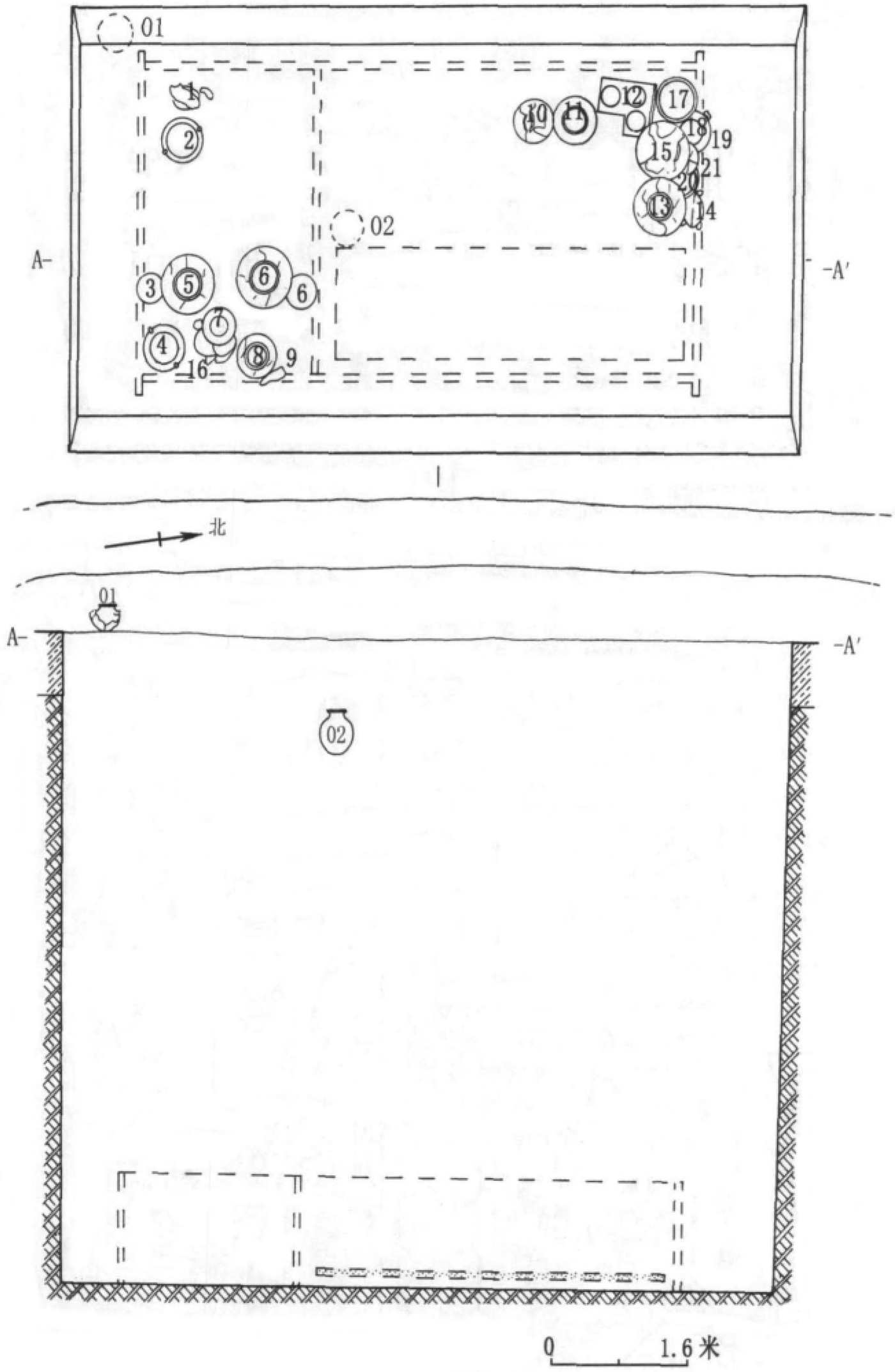
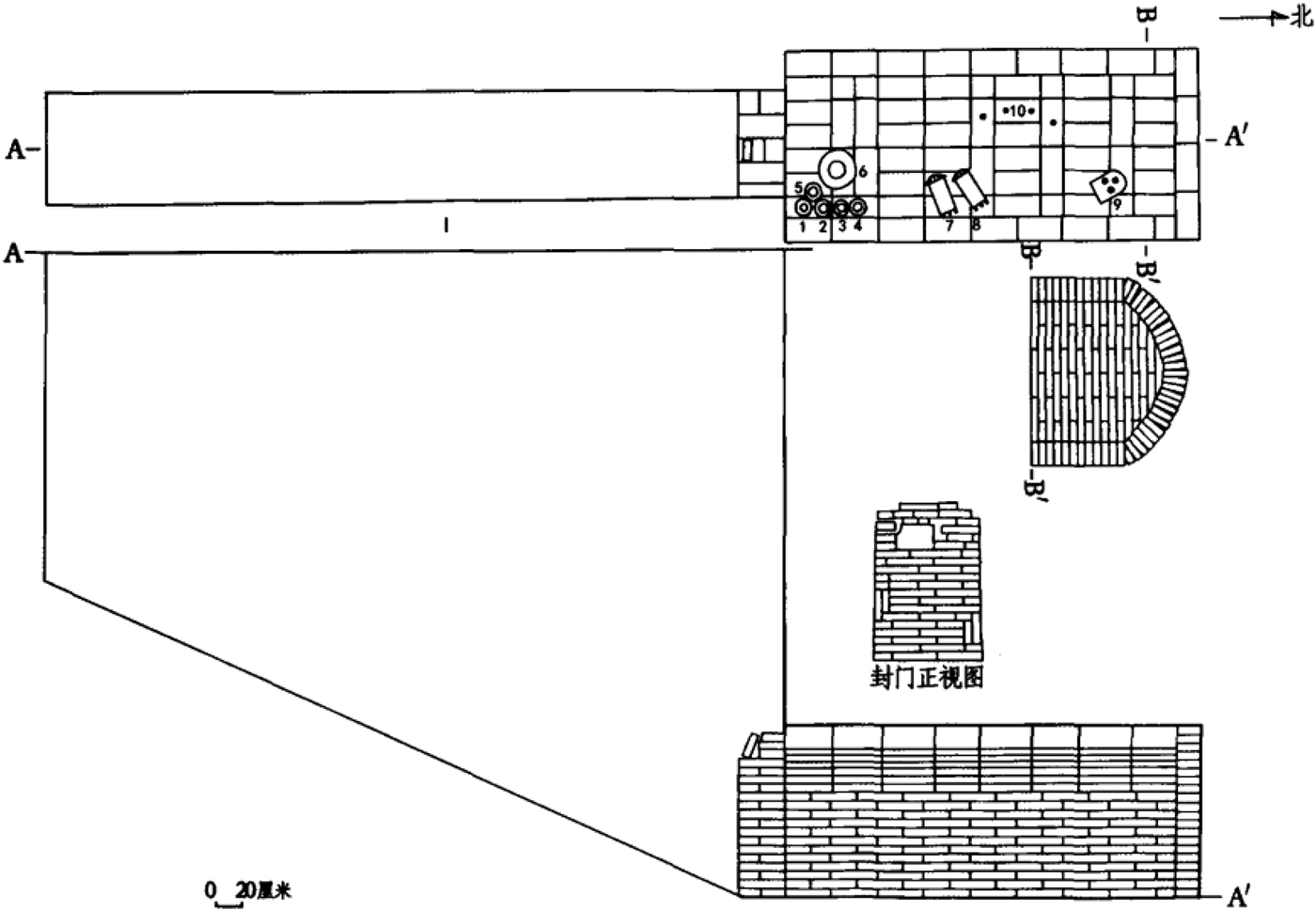
Remnants of sacrifices on the surface (No. 01) and in the shaft (No. 02) of Tomb No. 1 at Shilipu, Hunan province (ca. early first century B.C.E.). After Hubei sheng wenwu kaogu yanjiusuo and Jingmen shi bowuguan, “Hubei Jingmen Shilipu Tugongtai Han mu fajue jianbao” 湖北荆門十里鋪土公台西漢墓發掘簡報, Jiang Han kaogu 2008.3, 11–32 and 85, here 12, Figure 3.
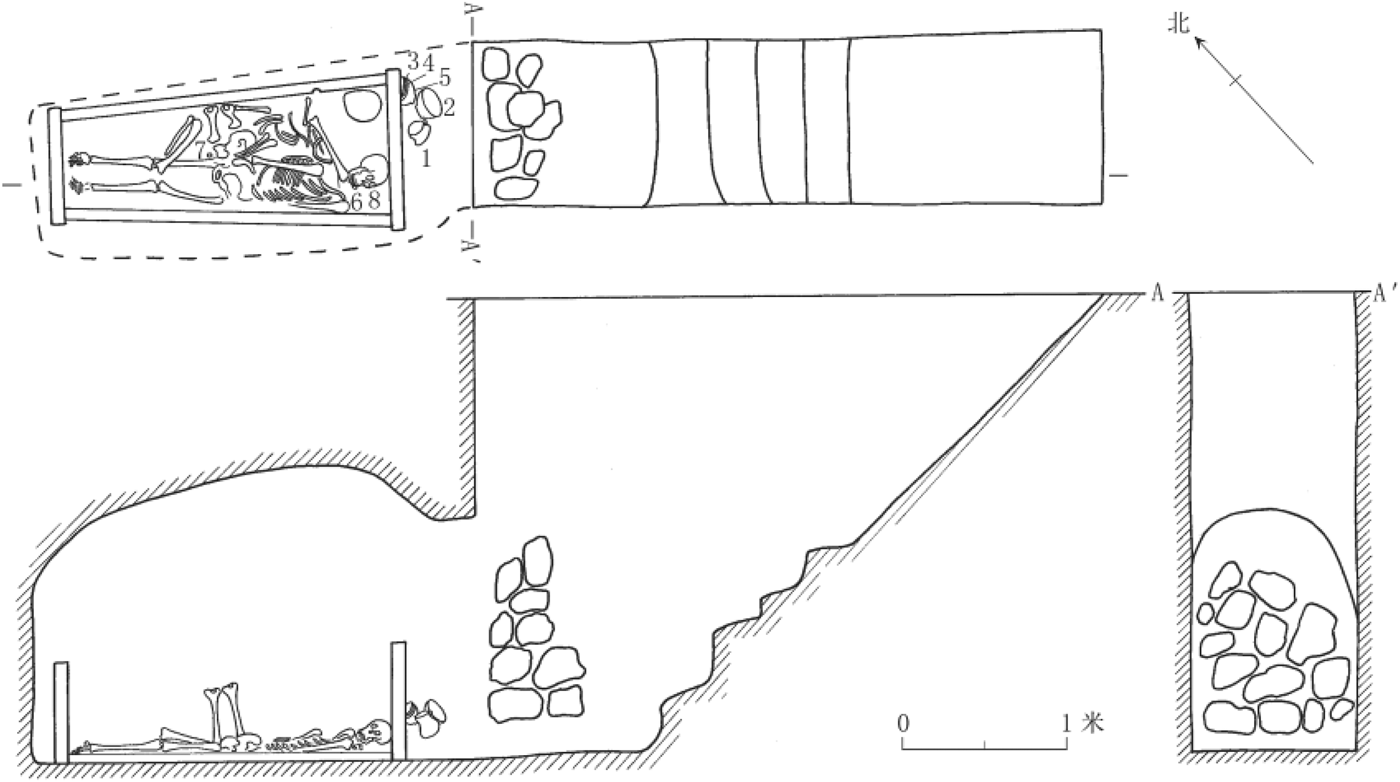
Plan of catacomb Tomb No. 4 at Kaihua, Shanxi province (c. first century b.c.e.).
After: Shanxi sheng kaogu yanjiusuo, Shanxi daxue lishi wenhua xueyuan, Taiyuan shi wenwu kaogu yanjiusuo, and Taiyuan shi Jinyuan qu wenwu lüyouju, “Shanxi Taiyuan Kaihua muqun 2012–2013 nian fajue jianbao” 山西太原開化墓群 2012–2013 年發掘簡報, Wenwu 2015.12, 23–45, here 25, Figure 4.
Plan of brick chamber Tomb AM5 at Doufucun, Shaanxi province (c. late first century b.c.e.). After: Shaanxi sheng kaogu yanjiusuo, Baoji shi kaogu yanjiusuo, and Fengxiang xian bowuguan, “Shaanxi Fengxiang Doufucun Han Tang muzang fajue jianbao” 鳳翔縣豆腐村漢唐墓葬發掘簡報, Wenbo 2012.5, 3–13, here 4, Figure 3.
Geographic distribution of evidence of different functions of food as a burial good. After (sites and landmarks inserted by the author): Hans Bielenstein, “The Restoration of the Han Dynasty, Vol. IV: The Government,” Bulletin of the Museum of Far Eastern Antiquities 51 (1979), 1–300, here 256, map 13.
Archaeologically verified sightings of actual food, which by nature of their fragility are rare, have already been extensively covered by earlier surveys. My focus will be on vessels that were used to prepare, store, and serve food and drink. Liquids are generally even more transient in the archaeological record than solid organic materials, and it can be difficult to identify vessels as beverage containers with certainty. Therefore, I will no longer distinguish between food and drink, but treat both as essential accoutrements of burial rituals. Whenever the concept of food is invoked in what follows, the inclusion of drink is implied.Footnote 17
1. Food as a Burial Good: Ancient Authors and Previous Scholarship
1.1 Food and the Use of Burial Goods in Received Literature
It is commonly believed that at least from the late Shang or Anyang period (c. 1200–1045 b.c.e.) onward, the habit of putting bronze ritual food and drinking vessels in graves served two purposes. On the one hand, such artifacts were subject to social restrictions during the lifetimes of their owners. After death they basically fulfilled the same function: the ritual vessels still represented the status of the deceased. More importantly, they continued to be employed in sacrifices to one's ancestors. As in life, the tomb occupants were expected to revere their dead relatives on a regular basis.Footnote 18 How this view might have been affected by changes in tomb architecture and grave good assemblages that started to occur by the late fifth century b.c.e. remains unexplored. Modern commentators unanimously agree that burials increasingly resembled “underground houses,” and burial goods reflected a concern for the demands of everyday life rather than ancestral worship.Footnote 19 The exact way food and food receptacles figured in these novel practices is barely touched upon. Scholarship simply takes for granted that viands stored in fairly ordinary vessels served to delight and sustain the occupants in the afterlife without any further analysis of the evidence.Footnote 20
I will first examine more closely the textual evidence at hand. Early ritual compendia are prescriptive and are overwhelmingly concerned with events that preceded the act of lowering the body of the deceased into the tomb.Footnote 21 Early dynastic histories and philosophical writings include some perspectives on the dead and occasional speculate on the afterlife. Although biased, these sources provide a more balanced picture of the cultural context of the time than idealizing, prescriptive ritual texts.
As Jeffrey Riegel has notably shown, Lü Buwei 呂不韋 (d. 235 b.c.e.) was a fervent advocate of an attitude that demanded that the dead not be treated in the same way as one would treat the living. In his L üshi chunqiu 呂氏春秋 (The Spring and Autumn Annals of Master L ü), Lü, the son of a wealthy merchant and later chancellor of the Qin state, explicitly opposes lavish burials. His main concern was that tall mounds and luxurious processions attracted the attention of looters, who would eventually dig up graves and violate the peace of the dead. With regards to food in funerary contexts, Lü regrettably confines himself to one single observation without offering any deeper insights into the meaning of the practice; namely that the rich put pearls into the mouths of their deceased (han zhu 含珠).Footnote 22 Xunzi 荀子, a text that is believed to reflect the mindset of its third century b.c.e. author Xun Kuang 荀況 (c. 310–235 b.c.e.), even though it was compiled in its current form by Liu Xiang 劉向 (79–8 b.c.e.) in the first century b.c.e.,Footnote 23 argues that, among other things, the mouths of recently deceased individuals were filled with cooked rice because they were treated as they were when still alive (fan han, xiang sheng zhi ye 飯唅,象生執也).Footnote 24
Both writers agree that something was inserted in the oral cavities of corpses before their interment. If we are to trust Xunzi’s account, we might, in theory, discover rice seeds inside or near the heads of buried bodies. Since organic materials are extremely unlikely to be preserved for over two millennia, it is almost to be expected that no such finds have been reported to date. Lü Buwei's claims have had some confirmation as small stone or jade cicadas have come to light in the mouths of numerous tomb occupants. However, relying on the work of other ancient authors, the overwhelming majority of modern commentators do not agree with Lü’s initial rationale. To their minds the cicadas were not at all related to sustenance; they were supposed to keep the body from decaying and thus played a vital role in the tomb occupants’ quest for immortality.Footnote 25 Apparently, early Chinese intellectuals did not see eye to eye on this issue and it is impossible to overcome this impasse within the confinements of this article.Footnote 26
While neither L üshi chunqiu nor Xunzi are able to shed light on food as a burial good, the two books are among the earliest non-prescriptive sources that reflect on the most basic principle when handling the dead: Was there a difference between the living and the deceased? Of course this question has larger implications for a study of food-related burial customs since it relates to the question asked at the beginning of this article: Did the dead still require food? At first sight, the L üshi chunqiu argues that there was a fundamental gap between the two forms of being. As Jeffrey Riegel has put it:
The two L üshi chunqiu treatises [i.e. “Jiesang” 節喪, “Be Moderate in Mourning” and “Ansi” 安死, “Let the Dead Rest in Peace”] accept the basic Ruist doctrine that one should care for the dead, but they argue that the best way to do that is to recognize that, unlike the living, the dead do not require nurturing but instead undisturbed stillness; and that the best way to guarantee such peace is by avoiding the ostentatious display of wealth that attracts grave robbers. Thus, according to the L üshi chunqiu, moderation in burials should be practiced not for the sake of the world but for the sake of dead relatives.Footnote 27
Essentially, the deceased did not need to be cared for and it was best to leave them alone. The crucial point for us to realize is that this verdict was not the product of a purely philosophical mind that operated in complete isolation from the real world. Instead, it was informed by a keen sense of awareness of practices that were extremely popular during the third century b.c.e. The L üshi chunqiu complains that especially wealthy members of society, in fact, did not distinguish between living and dead. The latter received as much care as the former (if not much more). The level of effort that went into burials with their tall mounds and lavish burials goods ultimately was nothing short of advertisement of the riches that lay below; the criminally predisposed only had to dig them up.
If the rejection of equal treatment of living and dead in the L üshi chunqiu was based on common habits, let us consider what Xunzi contributes to the discussion:
喪禮者,以生者飾死者也,大象其生以送其死也。故如死如生,如亡如存,終始也。
In the course of mortuary rites, one uses items of the living to adorn the dead. By and large, their lives [i.e. way of living] are taken and transferred to their deaths. Thus, one treats the dead just like the living; one deals with them once they are gone as if they were still here so that the end [of their biological lives] is just like its beginning.Footnote 28
Xunzi obviously considers human behavior at funeral preparations just as astutely as L üshi chunqiu. All the things people did to make the lives of the living possible and comfortable were done for the dead as well. More significantly, the authors and compilers of both texts were not the only ones to make such assertions. For instance, the Shi ji gathers a list of raw materials, grains, and livestock such as various timber species, gold, lacquer, salt, jade, fish, silk, cinnabar, rhinoceros (horn), horses, cattle, sheep, bronze, and iron that were typically associated with the regions Shandong 山東, Shanxi 山西, and Jiangnan 江南 during the Western Han (206 b.c.e.–9 c.e.). It then states,
皆中國人民所喜好,謠俗被服飲食奉生送死之具也。
These are all products that the people of the Middle Kingdoms enjoy and love; they are processed into objects that are used in the customs, clothes, and food that serve the living and are extended to the dead.Footnote 29
Here, for the first time, food is explicitly mentioned as a burial good. Once again, the sphere of the living was not discerned from the realm of the dead. All items including sustenance-related products that featured in every aspect of the lives of the living were given to the dead as well. This mode of thinking continued in later eras as one passage recorded in the late first century c.e. Discussions in the White Tiger Hall (Baihu tong 白虎通) reveals:
喪葬之禮,緣生以事死,生時無,死亦不敢造。
As far as the mourning and burial rituals are concerned, one follows [the way of] the living in order to serve the dead. What the living did not have during their lifetimes, one also does not dare to build for the dead.Footnote 30
The compilers of this text went one step further than their predecessors when stipulating that the living and the dead were to be treated exactly alike. There was no leeway to favor the dead by any means. Of course, the quotation implies that this, in reality, was happening all time. Otherwise the writers would not have expressly denied such impulses. Given the present evidence, we cannot know to what extent food might have played a role in exaggerated public displays of wealth that aimed to impress the audiences. It is possible, though, to argue that a number of ancient thinkers were aware of (elite) funerary practices of their times. They witnessed and recorded that descendants by and large did not discriminate between living and dead relatives. One way or another, any kind of material culture that was part of their former lives also was part of their burials. And food certainly was no exemption.
In contrast, Xunzi, Li ji (禮記, Records of Rites; compiled c. second century b.c.e.), and other late pre-imperial and early imperial sources famously propagate the concept of “luminous” or “brilliant” objects (mingqi 明器). Many of the ancient authors apparently disapproved of the mortuary activities prevalent at their times and thus argued that one should not deal with the living and the dead in the same way. In order to emphasize the ontological difference between both spheres, they concocted the mingqi idea. It mandates, for instance, that
竹不成用,瓦不成味(沫),木不成斲,琴瑟張而不平,竽笙備而不和,有鐘磬而無簨虡。
Bamboo [artifacts that were placed in tombs] should not be completely usable, ceramic [objects] should not entirely hold water, and wooden [items] should not be completely carved. Lutes should be stringed, yet remain out of tune; the pipes of a mouth organ should be arranged, but not harmonized. One should [accompany the dead] with bells and lithophones, but not suspend them from the proper racks.Footnote 31
Implements that were intended as burial goods were supposed to lack practical functions. Considering that unfinished or unusable artifacts emerge from graves that date as early as the late Shang or Western Zhou periods (c. 1045–771 b.c.e.),Footnote 32 that is to say long before the bulk of the transmitted texts were committed to writing in their received form, it seems as if the late pre-imperial and early imperial intellectuals retroactively aimed to justify a practice that already had been customary for centuries. Nevertheless, however popular the mingqi concept might be in modern literature,Footnote 33 it does not at all account for the fact that the majority of burial goods, in particular those linked to food, were real, functioning objects.
All in all, only one single source ostensibly invokes grave goods that mimicked real food. The Huainanzi 淮南子 (dated 139 b.c.e.) declares that “one cannot know the taste of simulated meat in one's mouth” (xiang rou zhi wei, bu zhi yu kou 象肉之味,不知於口).Footnote 34 This sentence was not immediately embedded in any debate of mortuary rites. Rather, an argument has been put forth that this “statement refers to simulated goods made of wood, ceramic, or other materials for burial with the dead.”Footnote 35 Not counting miniature figurines of livestock, no imitation foodstuffs whatsoever have been uncovered from late pre-imperial and early imperial graves. Granted, organic materials such as wood are by their very nature highly susceptible to decay. However, the tremendous volume of wood, bamboo, or textile artifacts and sometimes even food and drink yielded by ancient burials indicates that it is supremely unlikely that artificial food was widely employed (if at all).
To sum up, most of the early Chinese intellectuals observed that the populace essentially did not discriminate between the living and the dead. The funeral proceedings they witnessed in their times fueled their indignation. Much to their dismay, the descendants, friends, and acquaintances of the deceased predominantly equipped them with authentic, functional objects on the occasion of their interment. That food was a significant part of the process is confirmed by copious numbers of food containers that surface from almost every grave known to date.
1.2 Discussions of Food in Funerary Contexts in Modern Scholarship
Pearson's quotation cited above indicates that especially western archaeologists and anthropologists have long ago shifted their attention towards the (social) significance of feasting in funerary rituals. Michael Dietler, for instance, has argued that food and drink was “embodied material culture.” The biological imperative to eat and drink, of course, is innate to human beings. Following Pierre Bourdieu, Dietler explains that for humans as social rather than purely biological beings it is more important to internalize what kinds of food to consume in order to mark their positions within society. Such skills are learned from an early age and eventually become part of one's habitus. Wedding and funeral feasts gather large groups of people and thus provide an ideal “stage” on which habitus can act. To put it in Dietler's words: “feasting is a polysemic activity.” Hosts and participants act out social distinctions by consuming and using special kinds of foods (expensive, exotic, acquired taste etc.), special vessels and paraphernalia, and the complexity of recipes or serving order. This might sound agonistic, but feasts ultimately serve to establish and maintain social relations such as friendship, kinship, or group solidarity.Footnote 36
Brian Hayden has contended that archaeologists are unable to determine whether funerary feasts were held at the actual time of death or at the end of a series of feasts, or were “commemorative” events. He considers such distinctions rather futile since “the ultimate function of any initial burial feasts and the ultimate farewell feasts is fundamentally the same.”Footnote 37 A little more specific in his arguments than Dietler, Hayden concludes that the main purposes of such affairs are social; they primarily affect the living participants. Enormous gatherings occasioned by funerals (and weddings) are used to forge bonds, for instance, by attracting allies or arrange marriages; they serve as a platform to introduce new social concepts and values; and they may present the hosts with opportunities to manipulate the crowds in their favor.Footnote 38 These social effects aside, one of Hayden's insights is of particular interest here. He notices that at some megalithic tombs in Western Europe, remains of feasts (primarily intended for the living) have been attested either outside the burial chambers or inside special enclosures.Footnote 39 Taking such evidence seriously means that a priori assumptions that food-related grave goods invariably comprise remnants of mortuary feasts are misguided.Footnote 40 In order to substantiate such claims, one would have to supply positive evidence.
Although lacking the theoretical sophistication of anthropological and archaeological specialists, whose arguments have yet to resonate with Sinologists, cases for enacting social differences have also been made for early Chinese feasts. Guolong Lai, for instance, notes in passing that “death rituals allow the bereaved … to negotiate power and prestige among the living” without further elaboration on how precisely this was accomplished.Footnote 41 Constance Cook reasons that feasts reaffirmed the social identities of the participants and the current social hierarchies. She goes as far as to claim that “[t]he larger the feast, the greater the status of the host.”Footnote 42 Suffice it to say that this is an overly simplistic equation as it unilaterally emphasizes the intention of the host and downplays the role of the audience in status and prestige competitions.Footnote 43 More significantly, Cook takes for granted that at least parts of early Chinese burial feasts were conducted inside the tomb. For example, she speaks of a “spirit feast in the tomb,” an “underground banquet,” and “underground ceremony,” “underground mortuary feast,” or a “tomb feast” that allegedly constituted “the primary stage of the ceremonial cycle.” Unfortunately, pertinent references are missing from the article, and these assertions remain in the realm of speculation.Footnote 44
It is implausible for several reasons that the interior of early Chinese tombs, especially the vertical shaft-pits mostly predating the first century b.c.e., were indeed the sites of elaborate feasts. For instance, Cook herself concedes that the primary function of feasts was the reaffirmation of social identities and hierarchies. These desired outcomes could only be efficacious when large enough groups were attending the proceedings. That sizeable audiences were almost universally mandatory at funerals has been amply demonstrated by Dietler and Hayden (among others). In addition, early Chinese historical records sometimes mention the purported numbers of participants at funerary processions to the tomb. It is, for example, reported that even the mother of a degenerate gambler such as Ju Meng 劇孟 was accompanied by more than one thousand chariots.Footnote 45 We cannot be sure whether such figures were accurate (they most likely were not), nor whether such parties did indeed partake in feasts at the tomb in their entirety. Yet, they suffice to illustrate that funerals were anything but subdued affairs that only catered to immediate family and closest acquaintances.
More concretely, the tomb structures were ill equipped to admit larger crowds. Fairly simple graves exhibited steep shafts that were between five and ten meters deep and featured tiny burial chambers that barely created enough space to house the body and some burial goods.Footnote 46 More extensive burials that encompassed ramps and more spacious chambers were equally unsuitable to accommodate a large group of people. For instance, the exterior of the rectangular wooden chamber of Tomb No. 1 at Xinyang 信陽 in Henan province measured 895 cm in length, 760 cm in width and 325 cm in height (dated roughly mid- to late fifth century b.c.e.; Figure 1).Footnote 47 After subtracting 30 cm on all four sides to account for the thickness of the walls, the footprint covers more than 56 m2. By (optimistically) allowing four individuals per square meter, we are looking at a capacity of roughly 224 people. However, this number does not factor in the space occupied by the two coffins of both occupants as well as partition walls in the interior that divided the chamber into seven smaller compartments. At best, its dimensions and overall design would have made it possible for roughly 100 people to tightly cram into the chamber, and then only if none of the burial goods had been deposited before the visitors filed in. This points to a logistical problem: The only sensible method for a larger group of people to access the chamber would have been via the slanted passageway that entered the shaft at the same level as the chamber ceiling. The remaining three sides of the shaft were almost vertical, leading down over a length of eight meters until they reached the ceiling. Any guest of the feast would have needed a rope, a rope ladder, or similar aids to reach the chamber interior. Using the passageway would not have been much more convenient or faster; visitors would still have had to climb down more than three meters until they finally stood on the floor of the wooden construction. Overall, it seems extremely improbable that people flocked into first millenium b.c.e. tombs in numbers that would constitute a funeral feast in the sense that anthropological archaeologists have defined it. The same is also true for the vast majority of first through third century c.e. (and younger) brick chamber tombs. Usually, they did not provide copious spaces either.
It is much more likely that most grave goods, including food containers and real food, were first collected and displayed aboveground, which may or may not have been part of a feast (as opposed to a ceremony that did not feature food and drink). The objects were transferred into the tomb only after the official mortuary rites had ended. This is suggested by a steady stream of so-called “inventory lists” (qiance 遣策) that come to light in fifth through first century b.c.e. burials. It has been contended that they were read aloud during the funeral in order to announce the assembled items—they comprised presents from guests and private possessions of the deceased—to the audience and check that all the objects required for the interment were gathered at the site. Subsequently, the records written on bamboo slips or wooden tablets were buried along with the grave goods in the aftermath of the large gatherings.Footnote 48
However likely feasts at the burial plot may have been in theory, early Chinese tombs offer no material confirmation at this point. There are several accounts of imperial presents that were occasioned by the funerals of high and highest officials in the early standard histories, none of which included food. Most often they were gifts of money that was specifically allocated to support the funeral, gold, the tomb plot itself, coffins, silk fabrics, clothes, or sometimes jade ornaments.Footnote 49 Archaeological confirmation of such imperial gifts comes in the form of scattered manuscripts. For instance, the tomb of a certain Yu Yang 漁陽 at Wangchengpo 望城坡 near Changsha 長沙, Hunan province still contained a small wooden tablet that presumably once was fastened to a bamboo hamper. The ink inscription on the label reads as follows:
陛下所以贈物: 青璧三,紺繒十一匹,薰繒九匹。(tablet E:47)
Objects bestowed by his majesty: three green [jade] discs; eleven bales of purple silk; nine bales of black silk.Footnote 50
None of these items were found by the excavators, but it is impossible to determine whether they were not deposited in the tomb in the first place since the grave had been looted soon after it was closed.Footnote 51 Nonetheless, the nature of the imperial presents noted in the inscription basically mirrors the gifts recorded in the histories: silk fabrics and jade ornaments. Once again, edibles were completely absent. Since the processions mentioned above were also devoid of any references to food, one has to assume that the imperial court had no hand in the food supply of purported feasts. If there were indeed any at the burial plot, catering was the sole responsibility of the family of the deceased.
To sum up, past scholarship has put forth arguments that located funerary feasts inside the chambers and pits of first millennia b.c.e. tombs. The likelihood of ritual activity in the interior of graves will be explored in the next section. It is important not to confuse occasional sacrifices made in the presence of a small group of people with large-scale funerary feasts, whose dimensions and purposes have been extensively covered by anthropological and archaeological studies. In general, feasts comprised large numbers of people, who did not venture inside burials. This is also true for early China. Moreover, although ceremonies of some sort quite possibly were held outside of Chinese structures, they have not been supported by any kind of evidence so far. Perhaps missing cues to such events are due to the fact that archaeologists rarely have the time or the money to conduct thorough surveys of the immediate vicinity of graves. The discovery of more definitive finds and features may very well help to reverse my arguments in the future. However, for now there is but one conclusion to draw: there were no major feasts in or at late pre-imperial or early imperial tombs.
2. Food as a Burial Good: The Mortuary Data
2.1 Sacrificial Activity at the Surface Level of Tombs
Before any discussion of food in actual tomb contexts can begin in earnest, a few more words on the nature of food-related archaeological finds are in order. Food intended for consumption by whatever entity—be it the spirit of the deceased themselves or any other kind of spirit—that is still palpable in the archaeological record is usually associated with some kind of repository. This may take the form of a bowl, a dish, a jar, a box, a goblet, or a flask or similar containers. More precisely, such vessels are most often the only sign that food had any meaning in mortuary contexts. One cannot even be sure that real food was buried in every single one of these artifacts. On the contrary, it is possible that most of them never contained any viands to begin with. The more lavish the grave, the higher the chance that the majority of vessels remained empty. Only a small percentage of the vessels may have held ingredients or prepared meals.Footnote 52 To be absolutely certain whether food, and if so, what kinds of food were deposited in the objects, scientific analyses of organic residues inside the vessels would be necessary. These rarely have been conducted in the past.Footnote 53 Even with the prospect that scientific data will be more readily available in the years to come, it is not entirely clear whether respective items had already been in use (long) before the burial or the act of cooking was prompted by the interment. Residual food and drink may or may not have been directly related to the funerary ritual. This kind of uncertainty is of secondary importance here. Judging from the ubiquity of food and drink containers in early Chinese graves, it appears safe to assume that they were semiotic indexical signs that referred to their erstwhile contents. Ideally, one would take a second step and examine whether specific vessel types corresponded with particular foods in order to draw better informed conclusions. Did certain ritual vessels contain specific meats or liquids? Do such findings align with the textual record? These are but two questions that come to mind. Unfortunately, available samples of preserved food are too rare and random for any substantial analyses of this kind.
Sacrifices at the tomb
Moving on to evidence of ritual activities at burial sites: Ever since Wu Hung published “From Temple to Tomb: Ancient Chinese Art and Religion in Transition,” there has been an ongoing debate whether sacrifices to the dead were conducted at the tomb or ancestral temple. Wu contended that the ceremonies gradually shifted from the latter to the former during the period from the late fifth century b.c.e. to the first century c.e. Largely basing his arguments on imperial sacrifices at the ancestral temple as they are described in historiography and an inscription on an Eastern Han (23–220 c.e.) tomb shrine, he asserted that ancestral temples became all but obsolete because lineages grew increasingly less meaningful to social and political success. At the same time, sacrifices offered at shrines that were erected at the tomb served to nourish the hun 魂 soul of one's immediate forbear. To Wu Hung's mind, a heightened sense of filial piety might have spurred the change from temple to tomb. However, except for the Eastern Han inscription, he did not provide any additional information, textual or archaeological, on sacrificial structures at tombs.Footnote 54 Subsequently, a number of scholars have cast doubt on this strict dichotomy. They argued that both locations remained active: ancestors were revered at the ancestral temple as well as the gravesite.Footnote 55 In general, neither these authors nor Wu Hung addressed any specifics of how we might have to imagine food offerings at the grave.
As has been noted above, early historiography describes several cases in which emperors granted generous gifts to recently deceased high state officials. In one way or another, such presents were always linked to the actual funerals. Huo Guang 霍光 (d. 68 b.c.e.), for instance, was given gold, money, silk fabrics, clothes, a jade suit, and a so-called huangchang ticou 黃腸題湊 chamber.Footnote 56 Gold and money were supposed to alleviate (and maybe completely cover) the costs of the burial, while the rest of the items were intended to be interred with him. In addition, the imperial endowment entailed a tumulus and a sacrificial hall (qi zhong ci tang 起冢祠堂), both of which were erected at Huo's tomb. What is more, subsequently officials and soldiers visited the site and offered sacrifices to his spirit.Footnote 57 Shrines were not exclusively given by the emperor. The former chancellor Zhang Yu 張禹 (retired in 20 b.c.e.) took it upon himself to “govern [the raising of his own] barrow and built a sacrificial house (zhi zhong ying, qi ci shi 治冢塋,起祠室).”Footnote 58 Others, in turn, made a point of not having a shrine at all. Sheng Junbin 勝君賓, an esteemed counselor to Wang Mang 王莽 (46 b.c.e.–23 c.e.), explicitly asked that no sacrificial hall be constructed at his mound.Footnote 59
These passages show that one could reasonably expect to find relics of aboveground architectural structures that once were associated with at least the tombs of the higher and highest echelons of society. A document of such (and other) buildings stems from the burial of King Cuo of Zhongshan (中山王 , d. c. 308 b.c.e.), which yielded the blueprint of a tomb complex engraved on a bronze plaque. Among other architectural elements, five halls that align along a horizontal axis are outlined in gold and silver inlay and captions denote the function of all structures. In addition, a longer inscription recites a royal order that mandates that the funerary park was to be built in absolute accordance with this plan. Disregarding any of the commands would have been punishable by death.Footnote 60 Most notably, the square outline at the center of the map describes the “Hall of the King” (wang tang王堂), while the one to its right refers to the “Hall of the Queen” (wang hou tang 王后堂).Footnote 61 There is no reason to doubt that these two as well as the remaining three main buildings referred to sacrificial halls similar to those we know from the historiographical sources. It has long been maintained that related sacrifices to deceased family members served to “create” ancestors. It was solely the communal ritual activities that surrounded the sacrificial offerings that turned the dead relatives into socially meaningful entities. They were the metaphorical stage on which the descendants established that they were the rightful successors of the deceased. Thus, such sacrifices were essential to affirm and legitimize one's own position in society.Footnote 62 The practice was strongly motivated by social, this-worldly concerns. Furthermore, the strong social agency of shrines is attested in received literature and excavated manuscripts. They show, for instance, that having a shrine at one's tomb was a privilege that could be revoked at any time or that some shrines simply were illegal.Footnote 63
Nonetheless, there was definitely also a religious side to occasional sacrifices at the burial site. Tomb No. 1 at Fangmatan 放馬灘 in Tianshui 天水, Gansu province (dated 239 b.c.e.) probably has produced the most revealing piece of evidence to date, especially for burials of strata below the highest levels of aristocracy. The wooden coffin of the male occupant, who worked as a scribe in a local office of the administration of the late pre-imperial Qin state, contained a total of 460 inscribed bamboo slips. Seven slips amounted to a coherent text that recounts the story of a man named Dan 丹. Following an incident in which he stabbed a man, Dan killed himself only to be resurrected three years later. That he was able to come back to life was due to the advocacy of the Scribe of the Manager of Allotments (Siming shi 司命史).Footnote 64 At the end of the (reconstructed) manuscript, Dan recounts his experiences in the world of the dead:Footnote 65
丹言曰:死者不欲多衣,(slip 4) 死人以白茅为富,其鬼勝于它而富。
丹言:祠墓者毋敢哭。哭,鬼去敬走。已收腏而哭之,如此鬼終身不食殹。(slip 5)Footnote 66
丹言:祠者必謹騷除,毋以淘海祠所,毋以羹沃腏上,鬼弗食殹。(slip 7)
Dan said: “The dead do not desire many clothes. They regard White Cogongrass (Imperata cylindrica) to be the richest [in “nutritional” value];Footnote 67 their ghosts [consider it] to be rich because it is superior to other [offerings].”
Dan said: “Those who offer sacrifices at the tomb must not dare to weep [at the site]. If they should indeed weep, the ghost [who is supposed to receive the offering] will depart and respectfully withdraw. In case the ghost has already received the offeringsFootnote 68 and the sacrificer weeps at the ghost, the latter will not eat for the rest of his life.Footnote 69”
Dan said: “Those who offer sacrifices will inevitably be deferential and excited and clean up after themselves. However, they must not flush out the location of the sacrifice and they must not use geng-brothFootnote 70 as a libationFootnote 71 to sprinkle on the surface as the ghost will not eat it.”
There are several things to take away from Dan's statements. First, the spirits—or ghosts (gui 鬼) as it wereFootnote 72—that were associated with the deceased seemed to favor certain offerings. It needs to be pointed out that the recipient of the sacrifice was not the so-called hun soul as has been suggested by Wu Hung, but expressly a ghost. Dan's account thus fully supports the arguments put forth by Kenneth Brashier some twenty years ago: A dualistic notion of hun and po 魄 souls was a minority opinion among early Chinese writers.Footnote 73 Second, ghosts not only were fond of receiving sacrifices (hence the favorite dishes), but the sacrifices were crucial for their very existence. Not being fed, i.e. offered sacrifices, meant to die yet again and thus be irretrievably gone.Footnote 74 The reference to ghosts, who would be so deeply distraught if someone wept during the sacrifice that they would never eat again, indicates that even ghosts had a limited lifespan. A phrase that literally reads “this ghost will not eat until his body ends” (ci gui zhong shen bu shi 此鬼終身不食) leaves no room for alternative interpretations. Finally, there is no mention of any kind of architectural structure in the sense of a sacrificial hall that may have been a prerequisite to implement offerings at the tomb. On the contrary, the text speaks of an indistinct “location, place” (suo 所) that hosted the sacrifices and whose surface was best not sprinkled with libations.Footnote 75
That being said, we must not take the manuscript and Dan's report from the afterlife at face value. The chances that someone truly returned to life and reminisced about the spirit realm are slim. And this is not just the cynical view of a modern-day scholar; the idea of resurrection was already contested in ancient times. Sima Qian 司馬遷 (145 or 135–c. 90–80 b.c.e.), for instance, firmly believed that “the dead cannot be returned to life” (si zhe bu ke fu sheng 死者不可復生).Footnote 76 The point here is that the original real-life author of the Fangmatan manuscript expressed a certain way of thinking; one that conveys the views of a stratum of educated people who were not immediately affected by the intellectual discourse at the highest level. Thus, the sentiments visible in such documents are much closer in spirit to the majority of tomb occupants we detect in the archaeological record.Footnote 77 The consequences for this and subsequent studies are, in turn, that sacrificial halls might have been much less popular than commonly assumed. In addition to the bronze blueprint of King Cuo's funeral park, there is some evidence of above ground structures that may have functioned as shrines at tombs of the highest social strata. For example, stone enclosures that demarcated the inner sanctum of individual tombs are known from several second and first century b.c.e. sites around Xuzhou 徐州 in Jiangsu province. They all belonged to members of the imperial Liu 劉 family or people who were very close to the dynastic clan. In addition, the excavators documented large quantities of fragmented roof tiles within the enclosures on and slightly below the modern-day surfaces.Footnote 78 Such finds and features might very well be the vestiges of sacrificial halls comparable to those chronicled in the early standard histories and outlined above. But that still leaves us with the question of sacrificial activity at smaller tombs. Is there any archaeological evidence that would support sacrifices at less lavish graves? And if so, what spiritual entities were they addressing?
At first glance, the exact location of a tomb might not carry any deeper significance for an inquiry into food as a grave good. This changes once we explore how and why plots were chosen in early China. The Zuo zhuan 左傳 (dated fourth to third century b.c.e.) discloses that scheduling entombments involved a certain level of preparation. Divination about auspicious times was mandatory as days too distant from the date of death did not conform to ritual propriety.Footnote 79 More severe consequences were predicted in hemerological Daybooks (rishu 日書) recovered from Fangmatan Tomb No. 1. The ink inscriptions on two bamboo slips mention that if someone was interred on the wrong day, they would inevitably return from the dead.Footnote 80 Unfortunately, neither work discloses the underlying causes of such undesirable outcomes. Some second and third century c.e. sources are more revealing. One entry in the Hou Han shu states that the exact positions of burial plots were determined by divination because auspicious locations promised fame and fortune for the family in the future.Footnote 81 Burying the dead at the right spot was beneficial to the well-being of the descendants. This element also flares up in so-called “land contracts” (maidijuan 賣地卷), several of which have been unearthed from late first through late second century c.e. tombs. The main purpose of these writings on lead, stone, or pottery tablets was to attest the rightful ownership of the plot, but a small number also assumed responsibility for the fact that digging a grave shaft disturbed the peace of chthonic deities.Footnote 82 Writing roughly at the same time, Wang Chong 王充 (27–100) concurs that penetrating the soil did indeed anger some kind of “earth spirit” (tu shen 土神), who, as a consequence, needed to be pacified by sacrifices. In case people neglected to do so, the spirit potentially harmed the living as well as the dead.Footnote 83 At that point the soil itself had been the subject of worship for many centuries. This veneration peaked with the establishment of imperial sacrifices to Houtu 后土, “God of the Earth,” under Emperor Wu of the Western Han (r. 141–87 b.c.e.).Footnote 84
In settlement contexts, archaeology produces evidence of buried sacrificial remains on a fairly regular basis. Among the most expansive examples ranges an eighth through late fifth century site at Houma 侯馬 in Shanxi province. A total of 733 sacrificial pits were documented; some of them were empty while others yielded more or less complete skeletons of horses, cattle, and capriovids. The location is thought to have served in rituals devoted to some kind of riverine deity.Footnote 85 A nearly contemporary and equally impressive site was found at Xinzheng 新鄭 in Henan province. It covered an area of 4000 m2 and surprised scholars with a total of 18 pits that housed neatly arranged assemblages of bronze ritual vessels and bells. Either two or four horses were buried in each of 45 additional pits. According to the excavators, the recipients of the erstwhile ritual offerings were chthonic deities.Footnote 86 A considerably more modest and slightly later discovery comes from a settlement site at Shaojiagou 邵家溝 near Gaoyou 高郵 in Jiangsu province (c. late third century b.c.e. through early third century c.e.). In 1957, archaeologists encountered a small pit that contained a lacquer bowl, two pottery flasks, fragments of bamboo hampers and straw baskets along with foodstuff. The latter comprised the skulls of two capriovids, three fish skulls (Flathead Grey Mullet [Mugil cephalus]), and several watermelon seeds. A small ceramic chicken figurine very well might have substituted for a real animal. This miniscule hole in the ground certainly was not a tomb. It was not associated with any human remains whatsoever; neither bones nor cremation ashes have been reported. The fact that the assemblage exclusively encompassed food and drink containers, a food-related figurine as well as actual food indicates sacrificial activity. Moreover, an ink inscription on one of the flasks likely addressed the recipient of the sacrifice. Although most of the graphs are illegible, the excavators deciphered some that refer to a certain “pond and soil spirit” (chi kun shen 池坤神).Footnote 87
These kinds of offerings were not immediately linked to burials. I have discussed them at length as they help to establish a more general picture of the ritual landscape at the time. There is solid evidence of sacrifices to various kinds of nature deities on private and state-levels, the Shaojiagou artifacts being representative of private sacrifices whereas the Xinzheng site stands for state-level sacrifices.Footnote 88 As a result, we may have to think of food and food containers that were deposited in close vicinity to tombs (or even mounds) in ways other than as sacrifices to the dead. Granted, such finds are few and far between and it is not surprising that they have been all but neglected by excavators and secondary scholarship alike. It is unusual for site reports to mention the discovery of vessels outside of the main burial pit that may have been related to sacrifices.Footnote 89 At best, they merely address such features as “sacrificial pits” (jisi keng 祭祀坑) without further specification as to the recipient of the offering.Footnote 90 It is highly unlikely that food in these pits was intended as continuing sustenance in the afterlife. For one thing, this function was already fulfilled by various receptacles inside the grave pits proper. For another, the number of containers yielded by such pits is fairly limited. If providing food for the dead into the distant future would indeed have been on the minds of the erstwhile depositors, much larger quantities (or certain kinds of inscriptionsFootnote 91) could be expected. Futhermore, the fact that these were one-off deposits as well as their close proximity to the burial pit itself is significant. For example, two black pottery flasks at Changfeng 長豐 Tomb No. 10 in Anhui province appeared towards the entrance of the tomb passageway. They were once placed in a small pit that was located 65 cm below the ancient surface level, which, in turn, was then covered by the tomb mound.Footnote 92 The stratigraphic record clearly shows that the vessels were not buried after the construction of the burial complex had been completed since the sacrifice preceded the raising of the tumulus. It follows that these flasks were not involved in any sacrificial offerings made by visitors at the grave in order to “nourish” the spirit of the deceased.Footnote 93
If such finds were neither thought of as sustenance in the beyond nor as food for the spirits that had returned to the tomb on the occasion of the sacrifice—remember, the spirits/ghosts seemed to have been fairly thin-skinned and “left” (qu 去) when they felt offended—another rationale must have guided this practice. Seeing that roughly contemporary received and excavated texts as well as sacrificial sites at early settlements reveal a strong concern for the well-being of chthonic and hydraulic deities, it appears as if small sacrificial pits in the near vicinity of burials met similar needs. To the minds of some early Chinese people, digging up soil in the process of building a tomb was akin to intruding into the realms of various nature deities. Related sacrifices might not necessarily have been part of the official mortuary rituals conducted on the day of the funeral. Most likely they were either performed at the very beginning of the construction of the grave, at the time when the soil was initially broken (and the spirit angered), or at the very end when the suffering of the spirit was finally over and a sort of final “peace offering” was in order. Accepting these premises also carries the implication that the persons offering sacrifices were not necessarily immediate family members of the deceased. It may very well have been the case that the construction workers themselves made the offerings or that some ritual specialist was called to the site.
In a nutshell, tombs as monuments to the dead usually saw occasional sacrifices that were addressed to their spirits, at least if we follow the accounts provided by the Fangmatan manuscripts discussed above and similar finds.Footnote 94 Yet, the clues gathered here indicate that they were also venues for communication with natural spirits whose sense of peace had been interrupted by the construction of the graves themselves.
2.2 Food in Tomb Shafts
Food containers in tomb shafts
Scattered food containers are not exclusive to the immediate surroundings of tombs; they also appear in a number of tomb shafts. The undisturbed Tomb No. 1 at Shilipu 十里鋪 near Jingmen 荊門 in Hubei province is particularly intriguing, as it yielded one pottery jar on the ancient surface and one in the shaft fill. The former was placed above the southwest corner of the tomb shaft, while the latter was located slightly off the center at roughly 80 cm depth. Since both vessels were still standing upright at the time of excavation, it is fairly certain that they were put there intentionally. Most interesting, the jar on the surface was still covered by the remnants of a tumulus. This indicates that it was deposited after the shaft had been filled, but before the mound had been raised. Similar to vessels buried close by the tombs, we might consider such a find as either a construction sacrifice or the very first offering to the spirit of the deceased. The position of the second container is remarkable as well. The line drawing of the tomb plan (Figure 2) shows that the pit cut through two soil horizons, with the jar directly at the top of the lower stratum. Yet, before ascribing any deeper meaning to this observation, evidence from other burials at the same cemetery suggest that this might just have been a coincidence. Tombs No. 2 and 17 brought, respectively, four and two jars to light that were buried roughly in the upper third of the shaft but visibly below the intersection of both horizons.Footnote 95
What might seem like a local phenomenon at first glance, was in fact more widely distributed across the country (Map 1). The main difference between the Shilipu discoveries and other sites was that elsewhere marginally more effort was invested in interring food vessels in tomb shafts. Either rather close above the actual burial chamber or towards the shaft opening small niches were dug into one of the pit walls that contained mostly one, occasionally two or more containers.Footnote 96 As for the significance of such evidence, the relative distance and occasionally even spatial segregation of the vessels from the human remains renders a direct relation between both unlikely. Once again, the objects were eventually engulfed by soil and deposited either during or at the end of the grave construction. More noteworthy, they were installed by someone who needed to be inside the shaft. If digging a simple hole in the ground was already enough reason to fear retribution from natural spirits, imagine the anxiety some ancient believer in such malicious forces must have experienced while spending time in a burial pit. Containers left in niches in the shaft walls thus might have been employed in offerings that were occasioned by the completion of the earthworks. The structure was now ready to receive the corpse and the burial goods. Transferring both into the chamber involved people moving in and out of the tomb, and the sacrifices were one method of keeping them safe from supernatural influences. Offerings associated with the containers in the shaft fill itself were more akin to the “peace offerings” mentioned above. In the process of sealing the grave, workers made sure that potentially offended spirits were propitiated.
Food containers in front of burial chambers
As far as access to burial chambers in late pre-imperial and early imperial graves is concerned, there were two different ways to approach tombs. In the above discussion of Tomb No. 1 at Xinyang, it was only insinuated that vertical shaft-pits dominated tomb architecture until roughly the end of the first century b.c.e. The deceased were buried at the bottom of such pits either directly on the sole, in coffins, or in wooden chambers and coffins. Larger burials regularly featured sloping passageways that either ended at the pit sole but more often on par with the ceiling of the wooden chamber (Figure 1). Especially in the territory that is generally associated with the Qin state, catacomb tombs in which a horizontal burial chamber was attached at the end of a vertical shaft are more commonly documented (Figure 3). Initially, mainly single occupants without coffins were interred in those chambers. Upon entering the second century b.c.e., wooden chambers and/or coffins were increasingly utilized in lateral compartments and slanting ramps replaced the erstwhile vertical shafts. By the mid-century b.c.e. through the first century c.e., vertical shaft-pits and catacomb graves gradually gave way to horizontal brick chamber tombs with vaulted ceilings (Figure 4); long slopes were connecting them with the ground above.Footnote 97
Regardless of whether vertical or slanting passages led from the burial chambers to the surface, a small number of instances indicate that the intersections between both elements of the tomb structure served as venues for specific rituals. For example, a brick wall separated the lateral chamber of Tomb No. 2 at Jianbin 澗濱 near Luoyang from its sloping passageway. The inside of the chamber housed the remains of a male and a female as well as nearly forty ceramic and lacquer food vessels in addition to an iron sword, some bronze coins, and a pottery miniature stove. On the other side of the wall, the excavators recorded the scattered fragments of a lacquer erbei 耳杯 cup on top of an unspecified vessel. Tomb No. 29 at the Northwestern Research Institute of Non-ferrous Metals (Xibei youse jinshu yanjiuyuan 西北有色金屬研究院) presented similar arrangements. A male and a female occupant were accompanied by several ceramic (and one bronze) food containers, bronze coins, a bronze mirror, and an iron sword inside the chamber, while a pottery jar was sitting outside of the wall in the vertical tomb shaft. The two graves were unlooted and overall well preserved. Hence, there can be no doubt that in both cases the vessels standing in front of the chambers were intentional deposits.Footnote 98 What is more, other sites yielded comparable arrangements.Footnote 99
All in all this seems like a recurrent theme: at least to the minds of some contemporaries, finishing important construction stages called for sacrifices. Here, the sealing of the factual burial space was the decisive event. It created a physical boundary between the inside realm of the tomb occupant and the outside world of the living. Both spheres were now ideologically and physically divorced from each other and the act of separation was acknowledged by an offering. This may have functioned as construction sacrifice that was supposed to ensure the structural integrity of the wall (and therefore the safety of the interred person(s) on the inside) or it may have been the first offering to the spirit of the deceased after the actual burial. Both explanations see the occupant as the ultimate beneficiary, unlike sacrifices in tomb shafts that acted on behalf of the living as well as the dead.
2.3 Food in Direct Relation with Burial Chambers
When all of the food and drink containers from grave good assemblages signify food and drink in a generic way, how can we move beyond the dichotomy between sustenance and sacrifice? The exact locations of the finds might be the best indicator as they often allow us to establish a depositional chronology. The sequence in which objects were buried might have been representative of various stages of the funerary ritual that fulfilled different purposes. At least sometimes, sacrifices to nature deities were just as much part of the burial rituals as offerings to and supplies for the deceased. Scrutinizing the positions of food containers inside tomb pits and burial chambers unveils that the patterns of food deposition in tombs were fairly straightforward. The vast majority of burials contained at least one food or drink vessel that was placed somewhere near the body of the occupant or the coffin,Footnote 100 with slight preferences for the areas above the heads or below the feet of the deceased; food vessels inside coffins are rare exceptions.Footnote 101 Divergent positions of food and food vessels in the context of grave good assemblages may thus point to alternative motives for deposition, some of which will be explored in the following subsections.
Loose foodstuff in coffins and burial chambers
From time to time, foodstuff emerges without any apparent link to containers. For example, large numbers of Chinese Prickly Ash husks (Zanthoxylum bungeanum) were documented in a limited number of graves that have been attributed to the Chu 楚 culture. Approximately 1500 husks were scattered on top of the chamber ceiling at Xinyang Tomb No. 1, while Tomb No. 2 produced about 200 husks in addition to 1000 millet kernels.Footnote 102 In other late fourth through third century b.c.e. burials, the hulls were scattered on coffin lids.Footnote 103 Nowadays, Chinese Prickly Ash is better known as “Sichuan Pepper,” a widely used spice in Asian and international cuisines. Yet, it is unlikely that the seeds in these tombs were primarily meant for consumption. The slightly later medical texts from Mawangdui Tomb No. 3 invoked at the beginning of this article list a number of medical uses of Zanthoxylum: either applied externally or ingested it was believed to ease urine retention, cure abscesses, or to have prophylactic effects.Footnote 104 The fact that such drugs invariably combined several substances that were processed into powders or juices suggests that medical functions were less pertinent in burial contexts. Instead of being ground and mixed with various ingredients, husks were intentionally spread out and, except for Xinyang Tomb No. 2, not mixed with any other herbs, spices, or foodstuff in general. On the other hand, the Mawangdui medical texts describe one attribute that fits the archaeological evidence very well: Prickly Ash was supposed to avert dangers posed by supernatural powers.Footnote 105 Scattered over extensive areas on chamber ceilings and coffin lids, the hulls created some sort of barrier between the personal space of the occupant and its immediate environment; this seems like the perfect confirmation of the apotropaic uses of Zanthoxylum. Dispersing this potent spice should ensure that the corpses were not harmed by evil forces.
Apart from such occult precautions, Chinese archaeologists have detected a variety of other edibles that allude to different depositional motives. These range from rice stalks that still carried grains,Footnote 106 jujubes (Ziziphus jujube),Footnote 107 food in grass or silk pouches,Footnote 108 cereals in silk pouches and chicken bones in lacquer boxes,Footnote 109 as well as lacquer erbei cupsFootnote 110 on coffin lids, to skulls of various domesticated animals on the ceilings of wooden chambers.
The latter have so far only been attested at Shuihudi 睡虎地 cemetery in Hubei province, where Tomb No. 36 (dated mid-third century b.c.e.) boasted a bovine skull, while Tombs No. 44 and 45 (both dated mid- to late third century b.c.e.) each yielded one dog skull. Once these rather small wooden chambers had been sealed, their ceilings were covered with woven reed mats. The individual animal skulls were placed on top of the mats roughly at the center of the ceiling before the tomb shaft was filled with soil. The most elaborate of these arrangements comes from Tomb No. 11 (dated 217 b.c.e.), which featured one additional layer as tree bark was spread on top of a reed mat.Footnote 111 At Shuihudi cemetery, the closing of burial chambers obviously was considered a significant act. One reason to put mats (and bark) on top of the chambers might have been to weathertighten the wooden structure. At the same time, the mats also served as the canvas of a final ritual. Similar to sacrifices in front of the chambers of horizontal tombs introduced previously, setting down these skulls concluded the physical construction of the burial chamber. It is therefore unlikely that these were viewed as nourishment for the tomb occupants in the afterlife or even as sacrifices to the spirits of the deceased. Not unlike waist-pits that will be discussed in more detail shortly and offerings outside of burial chambers, they were another form of construction sacrifices. These were all for the good of the deceased individuals. Yet, there is a difference in addressing the dead directly or entities who might have affected them in one way or another. Construction sacrifices were measures of first-level protection, so to speak, since they were geared towards maintaining the structural integrity of the grave itself. Tombs were obviously buried in the ground—some deeper than others—and chthonic as well as hydraulic spirits posed potential threats.
In turn, placing fruits and cereals on top of coffins followed a contrasting logic. Once again, the act itself concluded a crucial step in the burial process as the objects were deposited after the coffin had been sealed and lowered into the tomb. After a lengthy process leading up to the actual burial,Footnote 112 the corpse was finally below ground and thus out of sight for most of the funeral guests. This was the last chance to say goodbye to the mortal remains of the deceased. Today, in many parts of the UK and Germany, for example, members of the immediate family of the deceased throw flowers onto the casket while it is being lowered into the grave in order to bid farewell to their loved ones. From the perspectives of the occupants, jujubes, bundles of rice and other kinds of food that came to light on top of coffin lids were expected to please them in their post-mortem existence. The fruits may have been a favorite snack during the lifetime of the deceased, but rice as a staple food in southern China suggests a more general interest in the continued well-being of the dead. Rice bundles might have expressed the wish that the dead never go hungry in their future form of being. Other items that were placed on top of coffin lids together with food corroborate the personal relationship between such objects and the deceased. For instance, a pair of shoes has been recorded on at least three occasions; one time the footwear was accompanied by a wooden (walking?) staff.Footnote 113 A similar find emerged from Tomb No. 168 at Fenghuangshan 鳳凰山, Hubei province (dated 167 b.c.e.) in the shape of a bamboo cane.Footnote 114 While they were still alive, the dead sported these shoes (or comparable ones—we cannot know whether the ones retrieved from the tomb were actually worn at some point) on their feet and relied on the canes to get around. It appears as if the bereaved felt that there was a connection between artifacts and individuals and they did not want them to go on in the hereafter without the things that had a certain meaning to both parties.
Animal remains and food containers in waist-pits (yaokeng 腰坑)
When studying possible food sources in funerary contexts, it is worth revisiting the so-called “waist-pits” (yaokeng 腰坑). Usually these were rectangular or irregularly oval shaped cavities that were dug into the sole of burial pits. The corpse was then placed over it so that its waist and/or upper body covered the opening. They were most popular prior to the era under review, but, albeit far less often, still occurred in late pre-imperial and early imperial burials.
Lothar von Falkenhausen has surmised that, at least during the Shang and Zhou periods, waist-pits were charged with religious meaning. They were chiefly occupied by dogs and occasionally other wild rather than domesticated beasts. Accordingly, such animals “might have been valued as psychopomps who could guide the spirits of the deceased to the ancestral realm.” By the end of the third century b.c.e. the custom had run its course as new religious ideas took over.Footnote 115 However, it is striking that waist-pits do not exclusively reveal animal remains. For instance, the 5000–3000 b.c.e. Tomb No. 1 at Zhongtaizi 中臺子 in Hubei province ranges among the earliest burials to exhibit a yaokeng.Footnote 116 Unlike the majority of its later counterparts, this waist-pit yielded a ceramic pot that could hardly have functioned as a guide on a supposed afterlife journey. It must have been related to sustenance instead. While later examples unlikely were part of a static cultural continuum, it is remarkable to make that same observation in several late fifth through early second century b.c.e. graves in Shaanxi, Hunan, Guangxi, and Guangdong provinces.Footnote 117 Since the majority of these tombs yielded additional food containers on the burial pit soles, nourishing the occupants in the netherworld was not a primary concern. Located at the lowest point of the tomb, the waist-pits were among the last if not the ultimate structural elements that were created by digging into previously untouched soil. Once this step was accomplished, the deceased would either be buried or a wooden chamber would be erected above the waist-pit.Footnote 118 Thus, vessels inside the latter were structurally comparable to construction sacrifices that were supposed to appease supernatural entities.Footnote 119 This sheds some new light on waist-pits that featured animals. In early China, at the most basic level dogs and other beasts were not totemic tokens but sources of food.Footnote 120 As such, animal remains that emerge from waist-pits could be understood in a similar way to food vessels: they were addressed to some kind of nature deity who required mollification.Footnote 121
As we have seen with the skull deposits at Shuihudi cemetery, animals, in parts or whole, were not exclusive to waist-pits. Whenever they were not associated with clusters of food containersFootnote 122 or other distinctive find patterns such as chariots,Footnote 123 it is difficult to make sense of them. One might read them either as symbols of the material wealth of the deceased,Footnote 124 companions in the afterlife, or guards. For instance, considering the significance of foodstuff on coffins and the use of dog meat as a source of sustenance have already been discussed, the skeleton of a juvenile dog on top of the casket of a 50- to 60-year-old male buried in Tomb No. 1 at Shexian 渉縣, Hebei province (dated late second to early first century b.c.e.) could be understood as a meat offering to the deceased. Given the fact that I have argued for a close relationship between objects that were placed on coffins and tomb occupants, I think the symbolism of this canine exceeds the notion of mere nourishment in the hereafter or sacrifice. Taking its actual find spot and the existence of one clapper bell at the body's left hand and hip into account, its role as a companion in the hereafter comes to the fore. The position of the skeleton at the foot end of the coffin corresponded with the usual position of a dog walking at the heel of its master. Using his clapper bells, the man issued commands to the animal.Footnote 125
A distinctive setting at an elaborate, looted late third to early second century b.c.e. burial at Lashan 臘山 near Jinan 濟南 in Shandong province invites a different interpretation. The tomb itself consisted of three parts that were separated from each other by stone walls: a vestibule followed by an antechamber and the actual burial chamber. The antechamber, which had not been touched by the grave robbers, was dominated by one smaller and two larger wooden chambers that housed burial goods. The two larger wooden structures ran parallel to the pit walls and to each other. In between both, a passageway led to the burial chamber at the back. Not only was this thoroughfare paved with rocks that were covered with several layers of woven mats, but two canine skeletons were basically blocking the passage. This striking position of both dogs in addition to the fact that they were not deposited inside the wooden structures along with some food remains such as fish and chicken bones as well as thirty-five food vessels suggests that they were expressions of a different rationale. Instead of being food or sacrifices, these two dogs were supposed to guard the burial chamber in the rear.Footnote 126
Food in shaft wall niches
Niches that were dug into the chamber or shaft walls of some graves are among the most conspicuous features that correlate with food vessels. They appear as early as the Neolithic in mortuary contexts.Footnote 127 By the early fifth century b.c.e., niches were fairly common, especially in some areas that are generally attributed to the Chu culture, but nowhere near omnipresent. More often than not, they occur in smaller tombs and the burial goods they hold overwhelmingly comprise of two to five food vessels. This suggests that the economic use of resources dictated the existence of most niches. Whenever coffins were employed in such burials, the respective tomb shafts were customized to tightly fit them. Larger tombs at the same cemeteries generally featured wooden chambers. Occasionally, niches were so small that they could barely contain the vessels that were stored in them. In terms of construction, they were either dug into the shaft walls at the bottom of the pit, slightly elevated from the bottom, or roughly at the height of the breast of a human being standing inside the grave.Footnote 128 Considering the little space that was available between coffin and shaft walls, it is clear that niches ordinarily were stocked with burial goods prior to the lowering of the body. The ones closer to the bottom of the pit would have been blocked by the coffin and it seems unlikely that the bereaved would step on the coffin just to fill the ones that were located slightly above the coffin lid.
Food containers inside such niches pose the familiar problem: Were they used in sacrifices or buried to nourish the dead in the beyond? The finds from a few second to first century b.c.e. graves at least allow us to appreciate qualitative differences between objects in niches and artifacts on the sole of the burial chamber. The latter yielded personal effects such as belt hooks, ornaments as well as bronze and stone weapons; the former a small number of food vessels.Footnote 129 Disappointingly, all this observation illuminates is that items directly associated with the deceased (i.e. body and clothing ornaments or weapons) were interred at a different stage than food. There is no way of knowing which came first and what kind of significance this may have had.
Zixing 資興 cemetery in Hunan province provides more enlightening evidence. Tombs No. 193, 229, and 245 added food containers to the burial good assemblages on the very pit sole (Figure 5). The three graves are fairly uniform: In an almost straight line, bronze weapons such as swords, halberds, or lance heads were followed by an orderly array of ceramic vessels, whose shapes emulated bronze ritual vessels.Footnote 130 It is doubtful whether these were truly employed in ancestral rituals as they primarily operated on a social level.Footnote 131 Their function as status markers notwithstanding, they were still artifacts that represented vessels in which food was prepared and served. It deserves noting that liquid containers stood slightly separate from food vessels. Most significantly, the single niches in each of the three tombs displayed one relatively large pottery container: a flask (hu 壺) in Tomb No. 436, a pot (guan 罐) in Tomb No. 193, and a weng 瓮 in Tomb No. 245. In contrast to the objects at the bottom of the pits, these were receptacles that were largely used for storage.Footnote 132 Similar ways of keeping large ceramic storage containers in niches are also visible in settlement sites. To my knowledge, the earliest examples date from the tenth century b.c.e.,Footnote 133 while first through second century c.e. finds have also been reported.Footnote 134 More significantly, the three Zixing tombs are by no means exceptions. The phenomenon is at least attested from the late eighth century b.c.e.,Footnote 135 with a majority of burials dating from the late third through late first century b.c.e.Footnote 136
Storage container (No. 15) placed in niche in pit wall and serving containers deposited on the pit sole (Nos. 3–13) of Tomb No. 245 at Zixing, Hunan province (late third century b.c.e.). After: Hunan sheng bowuguan, “Hunan Zixing jiushi Zhanguo mu” 湖南資興舊市戰國墓, Kaogu xuebao 1983.1, 93–124, here 96, Figure 9.
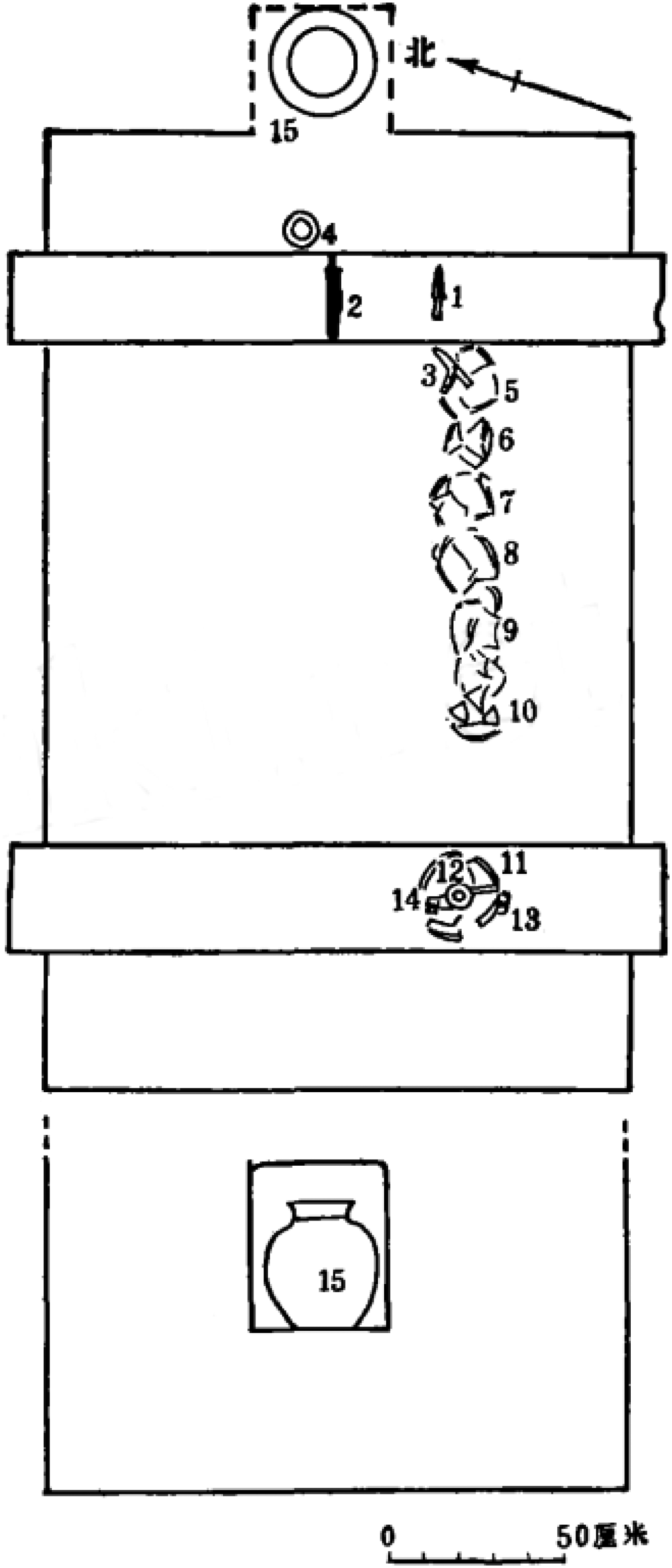
Such distinctive clusters of storage containers in opposition to vessels for consumption strongly suggest different motives for deposition. The majority of tombs cited here produced niches that housed storage receptacles, whereas containers close to the body of the deceased were related to serving and preparing food. If judged purely on the merits of the archaeological record, storage containers discovered in niches seem to be related to the long-term nourishment of the dead in their post-mortem existence, while food represented by vessels close to the body was destined for immediate consumption, i.e. the artifacts are remnants of sacrifices to the spirit of the dead at the time of the burial. The issue is far less straightforward, though, once we consider the contents of two manuscripts yielded by Shuihudi Tomb No. 11 and Mawangdui Tomb No. 3. The so-called “horse ritual” described in the Shuihudi text requires the sacrificer to “make a hole in the enclosing wall” of the stable and put a horse figurine as well as “three food offerings” (san zhui 三腏) in it in order to treat some undisclosed ailments.Footnote 137 The Mawangui document presents a method to cure hemorrhoids. To rid themselves of such unpleasant swollen veins in the lower rectum, male humans were advised to “[t]ake the millet food sacrifice from the offering niche by the entrance to the inner (chamber) [nei hu pang ci kong zhong 內戶旁祠空中] and incinerate the head of a dead person.”Footnote 138 Leaving the drastic measure of burning a human head aside, both documents show that sacrifices to supernatural agents in niches were known in settlement contexts. The Mawangdui manuscript even hints at somewhat permanent offerings of grain. The “millet food sacrifice” seems to just have sat in the “offering niche” for people to help themselves. This would accord well with the storage containers recovered from niches in shaft walls of tombs, since such receptacles usually were used to stock cereals. However, in light of the almost overwhelming evidence from contemporaneous burials that indicates a distinction between long-term food storage and occasional sacrifices,Footnote 139 I am inclined to view containers in shaft wall niches as indices of food reserves for the afterlife.
Furthermore, it is my contention that large pottery jars that were dug into pit soles (although not covered by the coffin or tomb occupant) or sometimes stored outside the actual burial chambers also primarily fulfilled storage purposes. In settlement contexts it is well-attested that the cool and consistent climate in underground storage units was utilized to preserve perishables.Footnote 140
Food in ancillary storage pits
Examples of storage containers in niches are expressions of a mindset that is considerably more prominent in burials of members of higher social strata and became more pronounced over time. Ancillary pits that served to store diverse kinds of grave goods (not human sacrifices) were built as parts of tomb complexes at least from the fifth century b.c.e. onwards. For instance, the 520 cm long and 430 cm wide looted chamber of a thirty-year-old woman buried at Hougudui 侯古堆 in Henan province was covered by a mound that still measured 55 m in diameter at the time of excavation. In thirteen meters distance from the main chamber, archaeologists unearthed a second wooden chamber that had not been touched by grave robbers. It was filled with the remnants of three chariots, bronze ritual vessels, bronze bells including a wooden rack, jade ornaments, wooden instruments, a so-called lacquer tomb guardian figurine (zhenmushou 鎮墓獸) and ceramic food containers.Footnote 141 Starting from the mid-third century b.c.e., ancillary pits became increasingly commonFootnote 142 and after Qin Shihuangdi had established the empire they turned into an almost ubiquitous feature of burials of the higher and highest elite. The above mentioned tomb of Yu Yang at Wangchengpo near Changsha is but one of many examples.Footnote 143 The most elaborate find so far is Jingdi's (r. 157–141 b.c.e.) mausoleum, whose numerous satellite pits uncovered thousands of anthropomorphic and zoomorphic figurines. For instance, Pit K13A contained over 1300 livestock miniatures of pigs, cattle, chicken, goats, sheep, and dogs.Footnote 144
After the early second century b.c.e., livestock figurines became nearly universal elements of burial good assemblages in tombs of the upper echelons of society. This practice introduced a new chronological dimension to the idea of a lasting food supply. More often than not, farm animals of various species come in pairs of one male and one female figurine. In theory, the semiotic referents of these beasts were expected to procreate and hence furnish the tomb occupant with an infinite supply of meat and related products such as eggs or hides. The same is true for miniature models of stoves, granaries, and wells that began to appear marginally earlier, roughly around the late third century b.c.e., on a regular basis.Footnote 145
Food containers and the idea of food storage
A particularly powerful manifestation of the underlying rationale of tomb miniatures and food as a burial good is palpable in a group of objects that surfaced from almost forty burials in modern-day Luoyang 洛陽, Henan province, dating from the first century b.c.e. through the second century c.e.The artifacts in question comprised mainly pottery granaries (cang 倉) of 20 to 50 cm height and, to a lesser degree, ceramic flasks of different sizes. All items bore inscriptions that referred to the purported contents of the vessels. The simplest texts solely state the names of several cereals. For instance, Tomb No. 61 (dated 48–47 b.c.e.) excavated in 1957 yielded a total of nine granaries, which displayed the following eight inscriptions in white writing:
a) Millet seeds for seeding (su zhong 粟種)
b) Glutinous millet seeds for seeding (shu zhong 黍種)
c) Barley (da mai 大麥; Hordeum vulgare L.)
d) Soybean (da dou 大豆; Glycine max)
e) Millet (su 粟; Setaria italica [L.] Beauv.)
f) Glutinous millet (shu 黍; Panicum miliaceum)
g) Refined variety of glutinous millet (liang 粱)
h) Hemp [seeds] (ma 麻; Cannabis sativa L.)
According to the excavation report, five out of the nine models contained “husks of millet, glutinous millet and so forth” (su, shu deng qiaoli 粟, 黍等殼粒).Footnote 146 The publication does not provide enough information to determine whether the individual species of the preserved grains indeed correlated with the respective inscriptions. Then again, it has already been argued above that actual contents were of secondary importance since the containers themselves can be regarded as indexical signs for food. Inscriptions enforced this effect. Consequently, most of the labeled granaries ensured that the occupant was supplied with a stock of staple cereals that could be processed into meals in the distant future. The inscriptions of lines a) and b) above take this idea even further. Explicitly providing the deceased with seeds for seeding shows that the repositories were not only thought of as storage facilities for grains that served as ingredients of dishes to be prepared in the afterlife, but as the source material for new crops. This way the granaries never ran empty.
Unlike the minimal writings on the items from Tomb No. 61, the majority of inscriptions added weight declarations to the specific contents. Some speak of “one hundred bushels” (bai shi 百石),Footnote 147 whereas most mention “ten thousand bushels” (wan shi 萬石). Bearing in mind that during the Han period the volume shi conformed to 20.024 liters,Footnote 148 it is obvious that such denominations are not be taken literally. A granary model of 53 cm height and 26 cm medium diameter that was said to contain “ten thousand bushels of soybeans” (da dou wan shi 大豆萬石) certainly was ill-suited to hold over 200 cubic meters of any kind of cereal when it barely made 28 liters (0.028 cubic meters) work.Footnote 149 Thus, the exact function of writing in this context is a key issue here. Several scholars have proposed that words and writing evoke the presence of real things.Footnote 150 Therefore, it did not matter exactly how much grain or if any at all was put into these containers. The exaggerated numbers written onto the surfaces of granary models emphasized the storage function of the vessel itself.Footnote 151 With thousands of tons of soybeans, rice, millet, barley, and other kinds of cereals in addition to broth (geng),Footnote 152 the tomb occupants were splendidly prepared to have their meals cooked on miniature stoves for a long time to come. What is more, the idea of food preparation in the hereafter is also perceptible in a different kind of source. After Wu Yang 吳陽, the son of Wu Chen 吳臣, King of Changsha, had died in 162 b.c.e., he was interred in an elaborate wooden chamber and, among many other artifacts and manuscripts, accompanied with a cookbook. Despite the fact that the manuscript entitled Methods [for Preparing] Pleasing Meals (Meishi fang 美食方) by the excavators was badly damaged, it is clear that it recorded a number of recipes that involved various kinds of meat and cereals. Wu Yang evidently was keen on having his culinary demands met even after his biological death.Footnote 153
Although inscriptions on miniature granaries that make overblown claims as to their contents are specific to the Luoyang area and a certain cultural milieu,Footnote 154 the custom of burying such models was widespread throughout the Chinese mainland by the second century b.c.e.Footnote 155 Since the fundamental principle is the same for inscribed objects and items without text, it seems legitimate to extend conclusions based on the Luoyang container on structurally similar finds from the rest of the country. The fact that these artifacts were inextricably linked to and embedded in clusters of food vessels suggests that both kinds of artifacts were manifestations of the same ideology. There can be little doubt that the vast majority of food in late pre-imperial and early imperial burials served to sustain the deceased in their post-mortem form of being.
Additional evidence came to light in slightly earlier tombs. Numerous bamboo hampers filled with cooked and cured meat of wild and domesticated fowl, fish, and mammals as well as fruits, grains, and spices were still (partially) preserved in Tomb No. 1 at Mawangdui (dated 168 b.c.e.). Some of the meals that originally accompanied the female occupant are only known from bamboo inventory slips that were part of the tomb assemblage or small wooden tablets attached to the bamboo boxes.Footnote 156 Such labels were by no means unique to Mawangdui Tomb No. 1 as comparable ones were recovered from a few second to first century b.c.e. burials in Jiangsu and Hunan provinces. The black ink inscriptions on their surfaces refer to cooked, braised, or pickled meats, fruits, vegetables, or grains that were once supposedly stored in bamboo baskets.Footnote 157 Moreover, the inventory slips yielded by Tomb No. 3 at Mawangdui referred to a total of thirty cauldrons (ding 鼎), each one ascribed to a different kind of meat broth (geng).Footnote 158 These cases illustrate once again that food as a burial good above all stressed extended temporality. Preserved food and prepared dishes that were stored in boxes rather than being presented on plates or similar vessels emphasized future meals not sacrifices to the dead at the time of the funeral. Seeing that some of the occupants were even given utensils such as chopsticksFootnote 159 only strengthens the impression that provisions were expected to be consumed by the spirits of the deceased on a regular basis after they had been laid to rest.
2.4 Sacrifices Inside the Burial Chamber
Ceramic cauldrons and bowls with inscriptions that refer to sacrifices
Although the overwhelming evidence is that food werved as continued sustenance, at least on some occasions sacrifices were also associated with tombs. When the bulk of finds were supposed to nourish the dead in the afterlife, and a minority of food-related discoveries were remnants of sacrifices, what are we to make of inscriptions on vessels that refer to sacrifices? For example, Tomb No. 125 at Shaogou 燒溝 cemetery in Luoyang revealed a ceramic cauldron inscribed with the phrase chu ji rou 初祭肉, “meat to initiate the sacrifice.”Footnote 160 Slightly alternative wordings are attested for cauldrons from other Luoyang burials. While four items found in Tomb No. 81 in the historic district of the city speak of “meat to start the sacrifice” (shi ji rou 始祭肉), others mention “cooked rice and glutinous millet to start the sacrifice” (shi ji fan shu 始祭飯黍) or simply “food to start the sacrifice” (shi ci shi 始祠食).Footnote 161 Four ceramic bowls recovered from the eastern ancillary chamber (dong er shi 東耳室) of the tomb of Zhao Mo 趙眜, King of Nanyue (r. 137–122 b.c.e.), in Guangzhou 廣州 indicate that this was not purely a local custom. Their three-character inscriptions in black ink spell out the sentence “meat for the final sacrifice” (shi ji rou 實祭肉).Footnote 162 Are these artifacts to be taken as physical manifestations of offerings to the deceased? Or were they simply part of the sustenance rationale that was represented by the remaining food containers in such tombs? Taking into account that they were neither associated with distinctive object clusters nor encountered in prominent positions, but were integral components of storage container assemblages, one has to assume that the respective sacrifices were projected into the future. It seems as if previous claims regarding earlier periods also apply to early imperial times: tomb occupants were supposed to continue offerings to their own ancestors in the hereafter.Footnote 163
Sacrifices to the dead
So far, the only evidence of sacrifices to the dead stems from sacrificial activity at the surfaces of tombs and maybe from offerings in front of closed-off burial chambers. To reiterate, late pre-imperial and early imperial tombs were largely constructed as wooden chambers at the bottoms of vertical shaft-pits. It has already been stated that the distinctive features of this design—vertical orientation, shaft depth, and limited space—rendered feasts and large scale sacrificial rituals inside the chambers all but impossible. In principle, such tombs were devised to house the remains of a single occupant. Of course, numerous joint burials have been attested, but they are the exception and not the rule. Rather than being interred together in one single tomb, spouses and members of the immediate family were buried in separate chambers in more or less close proximity to each other.
With the advent of brick chamber tombs, especially larger and more complex ones, from the first century c.e. onward, the situation dramatically altered. One recent study asserted that the changes in mortuary architecture were due to the fact that artisans had more time to construct and decorate the novel brick chambers. Moreover, they could be reopened without causing structural damage. This last point, in particular, is worth exploring. Unfortunately, the author is silent about what exactly the “the need to reopen the tomb” might have been.Footnote 164 Michèle Pirazzoli-t'Serstevens is more forthcoming with an explanation. She argues that the horizontally arranged monuments were accessed multiple times, because additional family members followed the main occupant at later stages. In her description of large second century c.e. brick structures, she distinguishes “antechambers” that symbolized courtyards from “reception room[s] (chao 朝),” in which “the rites took place.”Footnote 165 Astute as it may be, Pirazzoli-t'Serstevens's interpretation leaves some questions unanswered: What kind of rituals are we talking about? Who exactly were the recipients?
Like most structural innovations, fully fledged horizontal brick chambers did not burgeon overnight. The gradual shift from single occupant catacomb tombs over wooden chambers in catacombs that increasingly hosted two individuals to brick chambers that occasionally accommodated several corpses has already been introduced. Some well-preserved tombs dating from the transitional phase illustrate that the spaces in front of lateral chambers were no longer exclusively associated with the occupants. At least for the duration of the burial they became a kind of “public zone.”Footnote 166 The orderly arrangement of a bronze basin holding a bronze ladle, a bronze lamp, and a bronze steamer in a single file followed by a row of vessels consisting of two bronze cauldrons—one of which was full of chicken bones at the time of discovery—and a bronze erbei cup in the vestibule of a late first century b.c.e. brick chamber tomb that still featured a wooden chamber at Maquan 馬泉 near Xianyang 咸陽 in Shaanxi province indicates that sacrificial offerings were conducted in this liminal area between burial chamber and access ramp (Figure 6). In addition, a total of nineteen ceramic jars are neatly lined up along both walls of the antechamber. In contrast to thirteen larger pottery jars that blocked the passageway in front of the vestibule, they likely were part of the ritual whereas the large vessels represented storage units. Although these voluminous jars bore no inscriptions, their contents betray their essential function. Filled with various types of wheat, hemp, and millet, their ties to sustained sustenance in the afterlife are hard to deny. Since this was a single burial, the recipient of the offerings is obvious. Inside his tomb, perhaps for the first time after his demise, a limited number of descendants (or their proxies) paid their respects to the deceased as an ancestor.Footnote 167
Remnants of sacrificial offerings in the form of orderly arranged ritual vessels in the liminal area between coffin and passageway in a late first century b.c.e. tomb at Maquan, Shaanxi province. After: Xianyang shi bowuguan, “Shaanxi Xiangyang Maquan Xi-Han mu” 陝西咸陽馬泉西漢墓, Kaogu 1979.2, 125–35, here 126, Figure 2.
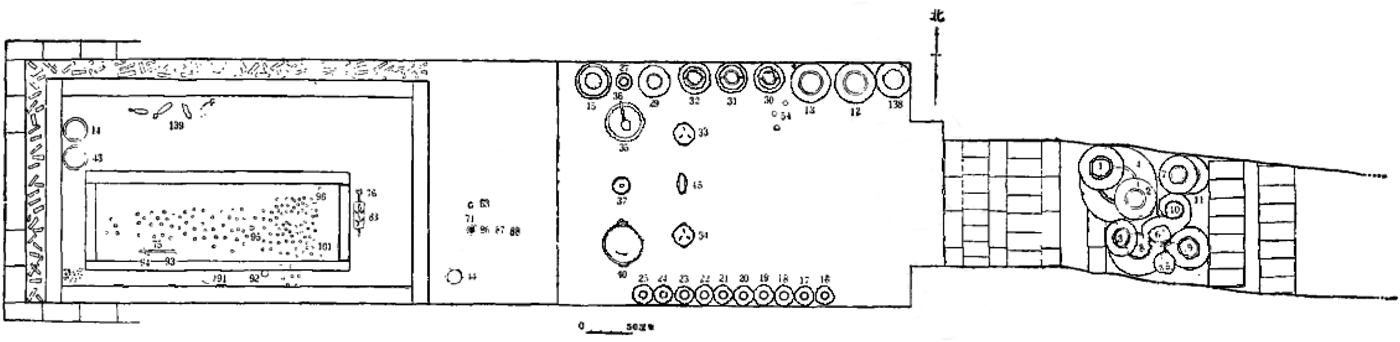
Over the course of the second century b.c.e., multiple burials became more common. Simultaneously, the practice of sacrificial offerings in the interior of tombs grew ever more popular. However, by then trays or low tables laden with tableware had substituted for the explicit arrangements of ritual vessels in front of coffins. The basic principle remained the same: a reverential meal was presented to the recently buried departed, while storage containers deposited at other parts of the structure or in special niches, alcoves, or entirely separate chambers provided for later nourishment. The spatial separation and eventual location of both kinds of food vessels bespeaks a chronological sequence of deposition. The coffin always was brought into the lateral catacombs first; only then was the sacrifice conducted. Since storage containers were regularly placed along the sides of the coffin, it is highly likely that they were transferred into the burial chamber after the coffin. When they were stored in niches etc. or very rarely in the passageway as was the case in the Maquan tomb, they may have been transported there after the offerings.Footnote 168 Occasionally, only a single tray emerges from tombs that held the remains of more than two individuals. Such items were discovered either at the center of the antechamber, towards the entrance, or inside the passageway. The latter position in particular suggests that the respective offerings concluded the final interment in the respective tombs. Before leaving the brick chambers for the last time, the descendants offered a meal to all of the occupants. Since they were not addressing the dead individually, the food probably was not referencing one specific progenitor. It was rather a gesture of farewell that also had the benefit of soothing the spirits of previous occupants after one terminal intrusion.Footnote 169 Finally, it is striking that quite frequently one tray less than the number of occupants emerged from complex multiple burials.Footnote 170 At first glance, such scenes give the impression that one person did not receive any offerings at all. In cases of joint burials it might also have been a matter of gender as to who received sacrifices (men?) and who did not (women?).Footnote 171 One way to explain missing trays would be that the last person to be buried was not entitled to a sacrifice inside the tomb since she or he was the subject of the ongoing ceremonies. Offerings, then, were only made to the ancestors who were disturbed by reopening the burial chamber and whose presence needed to be acknowledged. Yet, the vast majority of complex brick chamber tombs that housed the remains of several individuals along with trays and other burial goods have been looted. It is quite possible that originally more trays were present. Future finds from undisturbed sites might help to lend credence to this argument or simply negate it.
Even if the latter might be the case at some point, sufficient data have been gathered to support the conclusion that sacrificial offerings to the dead within the confines of first century b.c.e. through early third century c.e. (and later) tombs were indeed common. To be sure, the aspect of sustained provision with food and drink in the hereafter prevailed, but sometimes we catch a glimpse of more nuanced ritual practices. Accordingly, we can no longer presuppose a rigid dichotomy between food as sacrifice and sustenance when it clearly may have served as both.
3. Conclusion
Proper treatment of the dead weighed heavily on the minds of several early Chinese thinkers, but the role of food and drink in their discourse is marginal at best. Some equated the custom of putting food or objects into the mouths of the deceased with the need to sustain the dead, while others alluded to mock food that was supposed to nourish them in the afterlife. In general, the entire debate on whether the dead ought to be treated like the living was a reaction to the actual funerary practices of the times. Contrary to the complaints and appeals of some early Chinese authors, the recently departed were almost invariably awarded the same level of attention as the living. In reality, the material endowments of the dead often surpassed the true means of their families. Countless vessels that were used to store and serve food and drink as well as the occasional remnants of meat, cereals, or fruit recovered from thousands of late pre-imperial and early imperial tombs amply testify that food and drink indeed played a significant role in the burial process. The multitude of food-related receptacles have inspired modern scholars to locate extensive feasts at or even inside early Chinese graves. The work of anthropological archaeologists shows that large-scale gatherings at the burial plots were customary in many ancient cultures. Yet, however likely such festivities on site might have been in early China, there is neither physical nor textual evidence to support them at this point. As for funerary feasts that were supposedly held inside tombs, it is clear from the archaeological record that such large-scale ceremonies did not actually occur. Elaborate feast might have been hosted at the tomb, but so far they are not visible in the remaining finds and features. The claim itself illustrates that it is extremely important to analytically distinguish feasts, which mainly catered to the social aspirations of the living, from downscaled occasional sacrifices, which may be viewed as commensal meals with supernatural beings including the spirits of the dead.
Sacrifices took different forms and addressed different entities. In past studies, the spirits of the deceased have been addressed as the default recipients of offerings at the tomb and shrines have been accepted as the places at which such ceremonies were conducted. My arguments have demonstrated that shrines were a) primarily a social privilege that needed to be approved by the authorities, and b) absolutely not necessary to implement sacrifices at the tomb. A manuscript recovered from Tomb No. 1 at Fangmatan suggests that sacrifices at the tombs of members of the lower elite did not require any architectural structure whatsoever. In such cases, offerings were simply made on the ground. Of course, some kind of roof structure might have been erected in order to shield the worshippers from the elements, but these were not necessarily equivalent to full-blown shrines. Nevertheless, the Fangmatan text shows that previous scholarship was right to claim that the spirits of the dead were eager to receive sacrifices. More importantly, though, the document reveals that the very existence of the ancestral ghosts depended on food offerings. At the same time, sacrifices helped the descendants to cope with the loss of loved ones. “The dead matter because we cannot bear to give them up,” to put it in the words of Thomas W. Lacqueur.Footnote 172
Yet, not all sacrifices at tombs were directed at the dead themselves. Rather, a number of sacrificial remains yielded by small and shallow pits at several tombs were addressed to nature spirits. They had been offended by humans, who intruded into their realms, by digging tomb shafts. Feeding various supernatural subterranean entities thus ensured that the buried deceased, the construction workers going in and out of the tombs, and the bereaved themselves remained free from harm. Since these kinds of sacrifices were closely related to the physical construction of tombs, it seems highly likely that the individuals conducting the sacrifices were not necessarily relatives of the departed. Workers could have acted on behalf of the families and very likely also had their own well-being at heart. My analysis of the archaeological data has moreover highlighted that evidence of construction sacrifices is not limited to the surface level of burial sites. Material remains of occasional sacrifices to natural spirits emerged from tomb shafts, niches in tomb shafts, waist pits, the ceilings of wooden burial chambers in vertical shaft pits, and the space immediately in front of horizontal burial chambers as well.
Food vessels in niches sometimes point to a completely different motive of deposition. Quite regularly, larger containers that were placed in niches stand in opposition to smaller serving containers on the bottoms of burial pits. The former reflect a notion that emphasized food storage, whereas the latter represent meals that were presented to the deceased at the time of burial. The idea of storing foodstuffs became ever more prominent from the first century c.e. onwards. Spatial division of storage from serving vessels in smaller tombs went hand in hand with separate compartments that were solely devoted to stocking food supplies. The most articulate expressions of this mindset are visible in model granaries from the Luoyang area, whose inscriptions profess to contain up to 200 cubic meters of various cereals. By the power of writing, they provided sufficient ingredients to be cooked on miniature stoves in the afterlife for a long time to come. But it did not stop there. Some tomb occupants were explicitly accompanied by grains that served as seeds. The imagined life after death included harvests that, in theory, could be perpetuated indefinitely. Models of (paddy) fields depicting miniature humans at work that became frequent grave goods in the second century c.e. follow the same rationale. In short, a significant effort was expended in order to offer perfect conditions for an infinite post-mortem existence in the microcosmic realm created by the tomb. It follows that the commonly held assumption that late pre-imperial and early imperial burials were temporary stopovers on the way to some final destination seems but a distant possibility and at best an expression of the mindset of a limited group of people such as (some) soldiers.Footnote 173
Finally, although there are no archaeological finds and features that support sacrificial offerings to the dead on the ancient surfaces, pertinent evidence came to light from the tombs themselves. Sacrifices to the deceased in their roles as ancestors are reflected in clusters of food containers that became increasingly common during the first century c.e. Sometimes actual ritual vessels were neatly arranged before the coffins, but mostly we find trays laden with serving receptacles that were decidedly placed in front of the departed. Such scenes clearly suggest communal meals that linked the living with the dead. Consequently, food as a burial good in early Chinese tombs was never just a matter of sacrifice vs. sustenance; very often it was both or even more. There are numerous tombs that simultaneously exhibit evidence of food as a source of continuous nourishment, sacrifices to the spirit of the dead, and offerings to third parties. Being aware of depositional and ideological differences enables us to develop a much more nuanced (and palpable) understanding of early Chinese mortuary rites. The latter did not just comprise detailed steps as prescribed by early ritual compendia (if at all),Footnote 174 but also intricate additional measures. None of the received texts describe what happened over the course of the actual interment; paying attention to food as a burial good has demonstrated the complexity of the whole process. The welfare of ancestors, nature spirits, and the living were all at stake, and food as sacrifice and sustenance was used to do all of them justice.
 墓: 戰國中山國國王之墓 (Beijing: Wenwu, 1995), 104–10. Moreover, see Fu Xinian 傅熹年, “Zhanguo Zhongshan wang Cuo mu chutu de ‘zhao yu tu’ jiqi lingyuan guizhi de yanjiu” 戰國中山王
 墓出土的‘兆域圖’及其陵園規制的研究, Kaogu xuebao 1980.1, 97–118; Cordell D. K. Yee, “Reinterpreting Traditional Chinese Geographical Maps,” in The History of Cartography, Vol. 2, Bk. 2: Cartography in the Traditional East and Southeast Asian Societies, ed. J. B. Harley and David Woodward (Chicago and London: University of Chicago Press, 1994), 35–70, esp. 37.



