


1. Introduction
In the years 2003–06, European, Japanese and Russian drilling teams at different sites in Antarctica and Greenland had the experience of drilling ice under high pressure, close to the pressure-melting point. It was a unique field experiment and an opportunity to test the performance of different drills in such conditions, which cannot be reproduced in a laboratory without tremendous technical effort and financial cost. ‘Warm ice’ (unpublished data from the ‘International Partnership in the Ice Core Sciences’Workshop, 2004) under high pressure (P > 25 000 kPa) seems to be problematic for electromechanical drills. Several shallow drillings in temperate glaciers have been conducted successfully without any special difficulty (personal communications from B. Koci and H. Rufli, 2006). The environments in dry holes and in fluid-filled holes differ from each other, having different pressure and ice temperature gradients. In deep holes, close to the pressure-melting point, the main issue is that the water produced by the heat of the cutting process refreezes. Each drill performs differently in warm ice. Several parameters, including cutter angle, cutting speed, pump flow, amount of chips transported and drilling fluid, are important.
All the data presented in this paper are drillers’ data. Some of them are approximate. Depths are drillers’ depths, which can include uncertainty coming from depth-meter error, cable elasticity, hole inclination and temperature gradient. For Vostok, Antarctica, depths are derived from ice-core measurement.
2. The Five Drilling Sites
One drilling site, the North Greenland Icecore Project (NorthGRIP) site, is located in the Northern Hemisphere, and the other four are located in the Southern Hemisphere (Table 1).
Drilling-site characteristics

NorthGRIP
The drill used at NorthGRIP is an EPICA (European Project for Ice Coring in Antarctica) drill with the motor section and the anti-torque section of the ISTUK drill used in the 1990s at GRIP (Reference Gundestrup, Johnsen and ReehGundestrup and others, 1984). The drilling twice reached bedrock. In July 2003, basal water rose 45 m into the hole due to drilling-fluid pressure imbalance. The 45 m of refrozen water were drilled out in July 2004. The final depth was 3091 m.
EPICA DC
The drill used at Dome C, Antarctica, is also an EPICA drill, with a motor and electronic section developed in Brasimone, Italy, by Ente per le Nuove tecnologie, l’Energia e l’Ambiente (ENEA; S. Panichi and others, unpublished information). The anti-torque is from the ISTUK drill. The final depth was 3270 m, 16m above bedrock (Reference Augustin, Panichi and FrascatiAugustin and others, 2007).
EPICA DML
The drill used in Dronning Maud Land, Antarctica, was the same as at NorthGRIP. The drilling ended in January 2006, reaching bedrock. The depth was 2774 m; basal water rose several meters.
Dome Fuji
The JARE (Japanese Antarctic Research Expedition) drill was used at Dome Fuji, Antarctica (Reference TanakaTanaka and others, 1994; Reference FujiiFujii and others, 2002). The drilling reached 3029m depth in January 2006, and 3035 m in January 2007.
Vostok
The drill used was the KEMS-132 (core electromechanical drill; Reference Kudryashov, Vasiliev and TalalayKudryashov and others, 1994, Reference Kudryashov2002). Drilling reached 3650m depth in January 2006 and continued in 2006/07.
3. Drilling Performances in Warm Ice
For each drilling site we compare depth, temperature, pressure and temperature difference from pressure-melting point (ΔT). We also look at drill characteristics.
‘First difficulties’
What we call ‘first difficulties’ is the first remarkable penetration rate change approaching warm ice (Table 2). One of the first signs is ice chips frozen onto shoes and cutters’ cutting edges. The JARE drill encountered first difficulties much later than the other drills, progressing normally until ΔT = 1.1˚C. EPICA drills performed differently at the three different sites. The drill versions were slightly different and were operated by different driller crews at each drilling site, which probably explains the variation in ΔT from 3.1˚C to 5˚C. The KEMS-132 drill seems to have encountered drilling difficulties earlier, at ΔT = 5.4˚C. At most sites, drillers can use change parameters like cutter head rotation speed, cutting angles and fluid circulation to deal with the first difficulties encountered when drilling warm ice.
First difficulties at the drilling sites

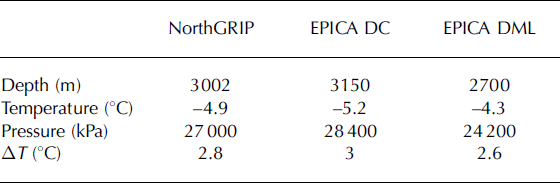
First use of ethanol/water solution
At three of the sites (NorthGRIP, EPICA DC and EPICA DML), ethanol/water solution (EWS; Reference Zagorodnov, Kelley and NagornovZagorodnov and others, 1994) was used to facilitate drilling (Table 3) by being poured into the hole at the start of each run (Reference Augustin, Panichi and FrascatiAugustin and others, 2007). With the EPICA drill it was used within the very short range 2.6˚C<ΔT<3˚C, showing the limitations of the EPICA drill’s capability to penetrate ‘warm ice’.
First EWS use at drilling sites
Last drilling depth
So far, drilling operations have been concluded at only two sites, NorthGRIP and EPICA DC. At EPICA DML, refrozen water may be drilled in the near future. At Dome Fuji, the temperature is very close to pressure-melting point (ΔT = 0.3˚C), and there are 15 m left before bedrock. With some difficulty, our Japanese colleagues are still able to drill without using EWS. At Vostok, the situation is affected by the presence of the subglacial lake, the distance to which is estimated at 105 m. Water should refreeze at the interface (Reference Salamatin, Vostretsov, Petit, Lipenkov and BarkovSalamatin and others, 1998). In the 2005/06 season, KEMS-132 was able to penetrate into ‘warm ice’ with some difficulty (Table 4). The data in Tables 2–4 are also displayed in Figure 1.
Drilling comparison: first difficulties, EWS first use, and last drilling depth.

Drill characteristics
We compare the flow, fluid velocity, density and cutting speed of the four drills operated at the five sites (Fig. 2). The JARE drill has the smallest pump flow (8.5 L min–1), and the KEMS drill the highest (27.5 L min–1). KEMS has the highest cutting speed (0.76ms–1), and JARE and NorthGRIP the lowest (0.3ms–1). These preliminary data from field experiments show that flow and fluid velocity are not the only determinant factors for drills to behave better in ‘warm ice’. The JARE drill had excellent results with the smallest pump flow. It also has a great capacity to store ice chips. The mechanical action of the boosters inside the chips chamber provides an excellent chip density (0.49), much higher than that of the other drills. It will be interesting to follow the KEMS-132 drill performance, to see how close to the pressure-melting point the drill can go. EPICA drills have limited capability in ‘warm ice’, as shown by the use of EWS to overcome this problem.
Drill comparison: pump flow, fluid speeds, ice-chip density and linear cutting speed.
Two different types of drilling fluid were used at the five different sites. NorthGRIP, EPICA (DC and DML) and Vostok used a two-component drilling fluid (D30 or D60 mixed with 141 B), while at Dome Fuji a single drilling-fluid component, n-butyl acetate, is used (Reference Talalay and GundestrupTalalay, 2002). These two drilling fluids have different effects on the cutting process close to the pressure-melting point. Another example of a deep ice-core drill that used n-butyl acetate and reached warm ice is the PICO 132mm drill used at Siple Dome, Antarctica, in 1999. Data are not complete, but the drill reached bedrock close to the pressure-melting point (ΔT = 1.74˚C). No problems were encountered (Reference Bentley and KociBentley and Koci, 2007).
4. Drill Design Comparison
Ten different deep drills, or more if we include all the different versions, have been manufactured since deep ice coring began. The first one, the CRREL (US Army Cold Regions Research and Engineering Laboratory) electromechanical drill, was used at Byrd Station, Antarctica, in 1968 (Reference Ueda and GarfieldUeda and Garfield, 1969). Unfortunately, few data are available for this drill, so it is not listed with the others in Table 5. The Italian drill IDRA is still under development at the time of writing. It is scheduled to be used for the Talos drilling operation during the 2007/08 Antarctic season. The Berkner drill is a short version of the EPICA drill, with a different motor section. The ISTUK drill (Gundestrup and others, 1984) and the PICO (Polar Ice Coring Office) drill (Reference WumkesWumkes, 1994a, Reference Wumkesb) were used in the 1990s. The Deep Ice Sheet Coring (DISC) drill, developed by Ice Core Drilling Services (ICDS), Madison, Wisconsin, USA, tested in Greenland in summer 2006 in pure Isopar K. The very low density value of Isopar K (0.761 g cm–3) may have significantly affected the performance of the DISC drill. EPICA, JARE and KEMS have already been mentioned. Drill length, core length, ice-chip concentration and ice-chip density are shown in Figure 3.
Last drilling depth in February 2006

Drill specifications

Drill design comparison: drill length, core length, concentration and ice-chip density.
It is interesting to look at two drill parameters, Rd (Rd = core barrel length/drill length) and Rda (Rda = average core length drilled/drill length). Rd varies from 0.24 (PICO) to 0.34 (EPICA), while Rda varies from 0.16 (DISC) to 0.31 (Berkner). The ratio Rd is one of the most difficult parameters to determine in drill design, as one cannot know in advance how dense the ice chips inside the ice-chips chamber will be. Another interesting parameter is the concentration of ice cuttings, η c (percentage of the ratio of the ice volume cut by the volume of the chips chamber), inside the chips chamber, as defined by Reference TalalayTalalay (2006). For the nine drills, η c varies from 73% (IDRA) to 38% (KEMS). KEMS’ designers were very careful, designing a long chips chamber giving a 38% concentration for their drill, while IDRA’s designers have been very optimistic, as the concentration cannot exceed 63% (Reference GardnerGardner, 1994, cited in Talalay, 2006).
The ice-chip density inside the chips chamber can be checked during the drilling operation. If we call the design density Dd, calculated from the ice cut weight for the maximum possible core length, and the average density Da, calculated from the ice cut weight for the average core length obtained in the drilling operation, Dd varies from 0.39 (Berkner) to 0.67 (IDRA) and Da varies from 0.30 (DISC) to 0.49 (JARE). The Da obtained by the JARE drill is a maximum that can be reached inside a chips chamber. The density of ice chips inside a chip chamber depends on several factors such as chip size and chip shape, which themselves depend on cutting angle, cutting speed and ice structure. Studies of ice-chip structure would be very useful. The density of ice chips inside the chips chamber also depends on the ability of the fluid circulation and filtering systems to compact chips inside the chips chamber. Therefore it is not possible to calculate, at the time of the drill design, the ice-chip density that will be reached inside the chips chamber. The real ice-chip density value is known after the production of the first cores. History shows that very often designers are too optimistic and expect longer cores than the drill (ice-chips chamber capacity) allows. How densely the drill is able to pack the chips inside the chips chamber is an important issue.
5. Conclusion
Data collection is incomplete, but we have some good information and possible tracks for drill design. The amount of ice chips produced, ice-chip transportation and storage are important factors in drill design. These factors directly affect the length of the drill, and therefore the speed of descent of the drill, which will have a direct impact on the duration of the whole drilling operation. The JARE drill is the most efficient in terms of ice-chip density; the mechanical action of an Archimedes screw located at the lower part of the chips chamber seems to be more efficient than the greater pump flow of the KEMS drill. Some uncertainties remain about how to overcome the problem of drilling warm ice, concerning the importance of pump flow and drilling-fluid type. For most drillers, a large pump flow is a positive thing for pushing forward the limit of an electromechanical drill in warm ice, especially if cutting speed and pump flow can be driven independently, as permitted by the DISC drill. Nobody yet knows how far the limit of electromechanical drills in warm ice can be pushed. Experiments in natural temperature, fluid and pressure conditions can only be carried out on site, so it may take the drilling community a few more years to answer this question. Funding agencies, principal investigators and project partners should be aware of the difficulty of the task. This issue, arising at the very end of the project, should be resolved while drillers are still producing cores. This leaves very little room for tests and experiments, especially when, as tends to be the case, projects are running out of time and funding and the drilling teams are tired.
Acknowledgements
We thank all the institutions and funding agencies of the different projects who have given this generation of drillers the unique opportunity of having all these deep-drilling projects take place within a few years. We warmly thank all the participants in the different drilling projects who have enabled these data to be collected and made this comparative study possible. This work is a contribution to the European Project for Ice Coring in Antarctica (EPICA), a joint European Science Foundation/European Commission scientific programme, funded by the European Union and by national contributions from Belgium, Denmark, France, Germany, Italy, the Netherlands, Norway, Sweden, Switzerland and the United Kingdom. The main logistic support was provided by Institut Polaire Français–Emile Victor (IPEV) and Programma Nazionale di Ricerche in Antartide (PNRA) (at Dome C) and the Alfred-Wegener-Institut (at Dronning Maud Land). This is EPICA publication no. 203. Additional funding support was provided by the FP6 STREP EPICA-MIS.



