





Introduction
Postpartum depression (PPD) has wide-ranging consequences for both mother and child, including future maternal mental health difficulties (e.g., Cooper & Murray, Reference Cooper and Murray1995; Goodman, Reference Goodman2004; Philipps & O’Hara, 1991; Vliegen et al., Reference Vliegen, Casalin and Luyten2014) and child internalizing (e.g., depression, anxiety) and externalizing (e.g., conduct problems) problems (for systematic review, see Slomian et al., Reference Slomian, Honvo, Emonts, Reginster and Bruyère2019). Especially among low-income and ethnic minority families, PPD symptoms are associated with less warm, more intrusive, and more disengaged and withdrawn caregiving (Gueron-Sela et al., Reference Gueron-Sela, Camerota, Willoughby, Vernon-Feagans and Cox2018; Lovejoy et al., Reference Lovejoy, Graczyk, O’Hare and Neuman2000), which accounts in part for the adverse effects of maternal depression on youth mental health outcomes (for meta-analyses, see Goodman et al., Reference Goodman, Simon, Shamblaw and Kim2020; Madigan et al., Reference Madigan, Deneault, Duschinsky, Bakermans-Kranenburg, Schuengel, van IJzendoorn, Ly, Fearon, Eirich and Verhage2024). Attesting to the reciprocity between mothers and their infants, infant behavior problems also positively predict future maternal depressive symptoms, even after accounting for intra-individual stability in maternal depression (Curci et al., Reference Curci, Somers, Winstone and Luecken2023). At the same time, early exposure to PPD symptoms does not determine a dyad’s destiny; there is considerable variability in the effects of postpartum depression exposure on early childhood outcomes (Murray & Cooper, Reference Murray and Cooper1997; Walker et al., Reference Walker, Davis, Al-Sahab and Tamim2013) and the course of maternal depression (Goodman & Gotlib, Reference Goodman and Gotlib1999). Given the interdependence of maternal depression with youth behavior problems, it is imperative to evaluate dyadic factors that may be key sources of risk or resilience.
Biobehavioral synchrony theory and the broader clinical and developmental literatures underscore the interdependence between maternal and child functioning over time and in the moment (Bell, Reference Bell1968; Feldman, Reference Feldman2012; Hudson & Rapee, Reference Hudson and Rapee2001; Sameroff, Reference Sameroff1975). During social interactions, mothers’ and their infants’ affect, behavior, and physiological functioning vary from one moment to the next; rapid changes in infants’ biobehavioral signals influence and are influenced by corresponding changes in their mothers (a process known as synchrony; Feldman, Reference Feldman2007; Fogel, Reference Fogel, Nadel and Camaioni1993). Over time, moment-to-moment mother-infant biobehavioral synchrony is internalized and shapes the evolving dyadic relationship (Atzil et al., Reference Atzil, Hendler and Feldman2014; Somers et al., Reference Somers, Ho, Roubinov and Lee2024) and longer-term adjustment for both mother and child (Butler, Reference Butler2011; King et al., Reference King, Salo, Kujawa and Humphreys2021; Leclère et al., Reference Leclère, Viaux, Avril, Achard, Chetouani, Missonnier and Cohen2014; Somers et al., Reference Somers, Ho, Roubinov and Lee2024). Positive mother-infant synchrony (i.e., in-phase coordination where mothers and their infants match moment-to-moment changes in each other’s biobehavioral functioning) is thought to support offspring emerging emotion regulation and socioemotional competence (Beeghly & Tronick, Reference Beeghly and Tronick2011; Beebe et al., Reference Beebe, Jaffe, Markese, Buck, Chen, Cohen, Bahrick, Andrews and Feldstein2010, Reference Beebe, Lachmann, Markese, Buck, Bahrick, Chen, Cohen, Andrews, Feldstein and Jaffe2012; Feldman, Reference Feldman2007, Reference Feldman2009, Reference Feldman2012; Tronick, Reference Tronick1989; Tronick & Beeghly, Reference Tronick and Beeghly2011). Likewise, synchronous mothers may experience parenting as more emotionally rewarding and are more likely to engage in sensitive caregiving (Feldman, Reference Feldman2012), which in turn is associated with fewer child behavior problems (Cooke et al., Reference Cooke, Deneault, Devereux, Eirich, Fearon and Madigan2022). Yet, it remains unclear whether mother-infant synchrony can confer resilience against the effects of early maternal mental health difficulties on longer-term adjustment (Lan et al., Reference Lan, Zhang, Lunkenheimer, Chang, Li and Wang2023; Lunkenheimer, Reference Lunkenheimer2024). To address this knowledge gap, the present study sought to evaluate whether mother-infant physiological synchrony specifically during playful interactions attenuates the longer-term effects of maternal postpartum depression (PPD) on offspring and their mothers, among low-income, Mexican-origin families who are disproportionately affected by maternal and child mental health problems relative those in the majority culture (Avila & Bramlett, Reference Avila and Bramlett2013; Calzada et al., Reference Calzada, Huang, Covas, Ramirez and Brotman2016; D’Anna-Hernandez et al., Reference D’Anna-Hernandez, Aleman and Flores2015; Flores et al., Reference Flores, Fuentes-Afflick, Barbot, Carter-Pokras, Claudio, Lara and Weitzman2002; Ponting et al., Reference Ponting, Chavira, Ramos, Christensen, Guardino and Dunkel Schetter2020).
Mother-infant parasympathetic synchrony
Biobehavioral synchrony refers to the coordination of affect and social behavior with physiological biomarkers during ongoing interaction (Gordon & Feldman, Reference Gordon, Feldman and Calkins2015). According to the biobehavioral synchrony model (e.g., Feldman, Reference Feldman2012), early developmental changes in brainstem-mediated biological systems prepare the mother to initiate species-typical maternal behavior (e.g., “motherese” vocalizations, positive affect, gaze) and the child to detect social contingencies from birth (Feldman & Eidelman, Reference Feldman and Eidelman2007; Feldman, Reference Feldman2012). From their earliest interactions, mothers’ and infants’ temporally-coordinated behavior is mapped onto biological processes and shapes physiological and socioemotional development (Feldman, Reference Feldman2012). Notably, though several physiological pathways (e.g., autonomic, endocrine, and neural) undergird biobehavioral synchrony (Gordon & Feldman, Reference Gordon, Feldman and Calkins2015), parasympathetic processes are ideally suited for examining the synchronization of rapidly-changing emotions during mother-infant interactions because of the second-by-second timescale on which the parasympathetic nervous system can respond to environmental demands (Butler & Randall, Reference Butler and Randall2013; DePasquale, Reference DePasquale2020; Teti & Cole, Reference Teti and Cole2011). Multiple theoretical perspectives (e.g., polyvagal theory, Porges & Furman, Reference Porges and Furman2011; Porges, Reference Porges2007; neurovisceral integration model; Thayer et al., Reference Thayer, Hansen, Saus-Rose and Johnsen2009) converge upon the idea that rapid parasympathetically-mediated influences on cardiometabolic output support emotion regulation and harmonious social interaction (Beauchaine & Thayer, Reference Beauchaine and Thayer2015; Porges, Reference Porges2001), including effective communication and social engagement between infants and their caregivers (Kolacz & Porges, Reference Kolacz, Porges, Osofsky, Fitzgerald, Keren and Puura2024).
Parasympathetic influences on cardiometabolic output are typically indexed by respiratory sinus arrhythmia (RSA), a measure of the normal ebb and flow in heart rate that is governed by the vagus nerve during a respiratory cycle (Porges et al., Reference Porges, Doussard-Roosevelt and Maiti1994). Greater RSA during rest is thought to support social engagement and calm behavioral states; in response to environmental challenges, rapid decreases in RSA are an efficient strategy for mobilizing physiological resources needed for active coping and regulatory behaviors (Porges, Reference Porges2007). Dynamic changes in RSA during parent-child interaction, including second-by-second intra-individual variability in RSA, have been linked to maternal mental health and sensitive, well-regulated parenting behavior (Giuliano et al., Reference Giuliano, Skowron and Berkman2015; Moore et al., Reference Moore, Hill‐Soderlund, Propper, Calkins, Mills‐Koonce and Cox2009; Skoranski & Lunkenheimer, Reference Skoranski and Lunkenheimer2021; Skowron et al., Reference Skowron, Cipriano-Essel, Benjamin, Pincus and Van Ryzin2013; Somers et al., Reference Somers, Curci, Winstone and Luecken2021b) and child behavioral adjustment (Berry et al., Reference Berry, Palmer, Distefano and Masten2019; Somers et al., Reference Somers, Curci and Luecken2021a). Further, these dynamic changes in parents’ and children’s RSA do not occur in isolation; rather, on average, parent-child dyads typically exhibit positive RSA synchrony (for reviews, see Davis et al., Reference Davis, West, Bilms, Morelen and Suveg2018; DePasquale, Reference DePasquale2020; Miller et al., Reference Miller, Armstrong-Carter, Balter and Lorah2023). Yet, it is not clear whether the ability to establish typical patterns of positive RSA synchrony is adaptive in the context of maternal depression (e.g., Lan et al., Reference Lan, Zhang, Lunkenheimer, Chang, Li and Wang2023; West et al., Reference West, Oshri, Mitaro, Caughy and Suveg2020).
Variation in the effects of maternal depressive symptoms: the role of RSA synchrony
Research, including among the present sample, has demonstrated that individual biological factors, such as infant resting RSA, account in part for variation in the effects of PPD symptoms on child behavior problems (Somers et al., Reference Somers, Luecken, Spinrad and Crnic2019) and in the course of maternal depressive symptoms (Somers et al., Reference Somers, Curci and Luecken2021a). Increasingly, theoretical and empirical perspectives have also posited that dyadic factors may account for variability in the outcomes of PPD (Lan et al., Reference Lan, Zhang, Lunkenheimer, Chang, Li and Wang2023). Following the biobehavioral synchrony model, positive RSA synchrony is generally conceptualized as a process that supports smooth dyadic interactions and facilitates child self-regulation (Davis et al., Reference Davis, West, Bilms, Morelen and Suveg2018; DePasquale, Reference DePasquale2020; Feldman, Reference Feldman2012), which may be a protective factor that confers resilience for both members of the dyad (Feldman, Reference Feldman2020). Recent research lent empirical support for the biobehavioral synchrony model among families from a rural, under-resourced community in China: Children from dyads with weaker RSA synchrony, which may reflect poorer interaction quality or failures to co-regulate, were most vulnerable to PPD-associated risk for future internalizing problems. In contrast, greater levels of positive mother-infant RSA synchrony during playful interaction attenuated the adverse effects of maternal PPD symptoms on future offspring internalizing problems (Lan et al., Reference Lan, Zhang, Lunkenheimer, Chang, Li and Wang2023). Notably, conclusions that positive RSA synchrony may provide a relational foundation from which children can draw upon to overcome early adversity were strengthened by a prospective design, which accounted for early precursors of child internalizing problems (Lan et al., Reference Lan, Zhang, Lunkenheimer, Chang, Li and Wang2023). Nevertheless, it is not known whether the protective benefits of positive RSA synchrony during play would also confer resilience against child externalizing behavior problems or against persistent or worsening maternal depression after the postpartum period.
Whether or not positive RSA synchrony attenuates the transmission of emotional difficulties between parents and children may also depend on the proximal contexts of parent-child interactions (Davis et al., Reference Davis, Brooker and Kahle2020; Somers et al., Reference Somers, Ho, Roubinov and Lee2024). Whereas positive RSA synchrony in neutral conditions may facilitate mutual engagement and fluent interactions, under stressful conditions, positive RSA synchrony may reflect empathic distress or impairments in co-regulation (e.g., failure to remain calm while one’s partner experiences heightened arousal). When assessed during tasks designed to elicit negative emotions, there is evidence that positive RSA synchrony both acts as a diathesis for poor outcomes associated with maternal emotional risk (Creavy et al., Reference Creavy, Gatzke-Kopp, Zhang, Fishbein and Kiser2020; West et al., Reference West, Oshri, Mitaro, Caughy and Suveg2020), and as a susceptibility factor that strengthens the relationship between parenting and youth emotion regulation and mental health problems, for better or for worse (Oshri et al., Reference Oshri, Liu, Suveg, Caughy and Huffman2023; Xu et al., Reference Xu, Zhang, Wang, Peng, Zhu, Wang, Yi, Chen and Han2024). Taken together, these results underscore the importance of the proximal contexts of parent-child interactions in shaping the role of RSA synchrony, and raise questions about whether and in what contexts positive RSA synchrony during is a protective factor, a risk factor, or plasticity factor (i.e., whether patterns of interaction conform to stress-diathesis or differential susceptibility; Roisman et al., Reference Roisman, Newman, Fraley, Haltigan, Groh and Haydon2012).
In infancy, playful interactions are particularly important as they provide opportunities for the formation of attachment ties and facilitate children’s developing emotion regulation (Feldman, Reference Feldman2012; Lan et al., Reference Lan, Zhang, Lunkenheimer, Chang, Li and Wang2023; Morris et al., Reference Morris, Cui, Criss, Simmons, Cole and Hollenstein2018). Autonomic mother-infant synchrony that is framed by moments of simultaneous vocalization and positive affect (Feldman et al., Reference Feldman, Magori-Cohen, Galili, Singer and Louzoun2011), such as those that frequently occur during play (Brazelton et al., Reference Brazelton, Koslowski and Main1975; Papoušek, Reference Papoušek, Marková, Graumann and Foppa1995), may represent an active mechanism that fosters emotion co-regulation and lays the foundation for socioemotional development (Feldman, Reference Feldman2020). Despite calls to consider the proximal contexts of parent-child interactions when interpreting physiological synchrony (Davis et al., Reference Davis, Brooker and Kahle2020; Somers et al., Reference Somers, Ho, Roubinov and Lee2024), few studies have compared synchrony and its correlates across different conditions (for exception, see Creavy et al., Reference Creavy, Gatzke-Kopp, Zhang, Fishbein and Kiser2020). Although physiological synchrony can occur in the absence of behavioral synchrony and even in the absence of interaction (Creavy et al., Reference Creavy, Gatzke-Kopp, Zhang, Fishbein and Kiser2020; Suveg et al., Reference Suveg, Shaffer and Davis2016, Reference Suveg, Braunstein West, Davis, Caughy, Smith and Oshri2019; Woltering et al., Reference Woltering, Lishak, Elliott, Ferraro and Granic2015), this may reflect passive, automatic influences that result in the coordination of mother and infant RSA. Understanding whether the protective benefits of mother-infant RSA synchrony are specific to mother-infant RSA synchrony during a playful interaction, relative to a non-interactive resting condition, offers a deeper understanding of how parents’ effortful attempts to playfully interact with their child influence biobehavioral coordination and longer-term trajectories of risk and resilience, which can inform prevention and intervention efforts.
Current study aims
The current study sought to evaluate whether positive mother-infant RSA synchrony during free play attenuated associations between maternal PPD symptoms and future maternal depression and child mental health concerns, among a sample of low-income, Mexican-origin families. It is especially important to evaluate dyadic factors associated with risk and resilience among ethnic minority and low-income mothers, particularly those that recently immigrated to the United States, who are more likely to experience depressive symptoms (CDC, 2007; Chaudron et al., Reference Chaudron, Kitzman, Peifer, Morrow, Perez and Newman2005; Ertel et al., Reference Ertel, Rich-Edwards and Koenen2011; Gavin et al., Reference Gavin, Gaynes, Lohr, Meltzer-Brody, Gartlehner and Swinson2005; Gress-Smith et al., Reference Gress-Smith, Luecken, Lemery-Chalfant and Howe2012; Howell et al., Reference Howell, Mora, Horowitz and Leventhal2005; O’Hara & McCabe, Reference O’Hara and McCabe2013; Surkan et al., Reference Surkan, Peterson, Hughes and Gottlieb2006). For economically-disadvantaged, Mexican-origin families living in the United States, stress associated with separation from family members, acculturative processes, poverty, and discrimination can exacerbate risk for both maternal depressive symptoms (Calzada et al., Reference Calzada, Huang, Covas, Ramirez and Brotman2016; D’Anna-Hernandez et al., Reference D’Anna-Hernandez, Aleman and Flores2015; Ponting et al., Reference Ponting, Chavira, Ramos, Christensen, Guardino and Dunkel Schetter2020) and behavioral problems in children (Avila & Bramlett, Reference Avila and Bramlett2013; Flores et al., Reference Flores, Fuentes-Afflick, Barbot, Carter-Pokras, Claudio, Lara and Weitzman2002). At the same time, traditional Mexican cultural values that emphasize the importance of placing family members above one’s own needs (e.g., familismo) and the primacy of the maternal role (e.g., marianismo) may be culturally salient, dyadic sources of resilience for both mothers and their children (Cabrera et al., Reference Cabrera, Alonso, Chen and Ghosh2022; Calzada et al., Reference Calzada, Tamis-LeMonda and Yoshikawa2013; Stein & Polo, Reference Stein and Polo2014).
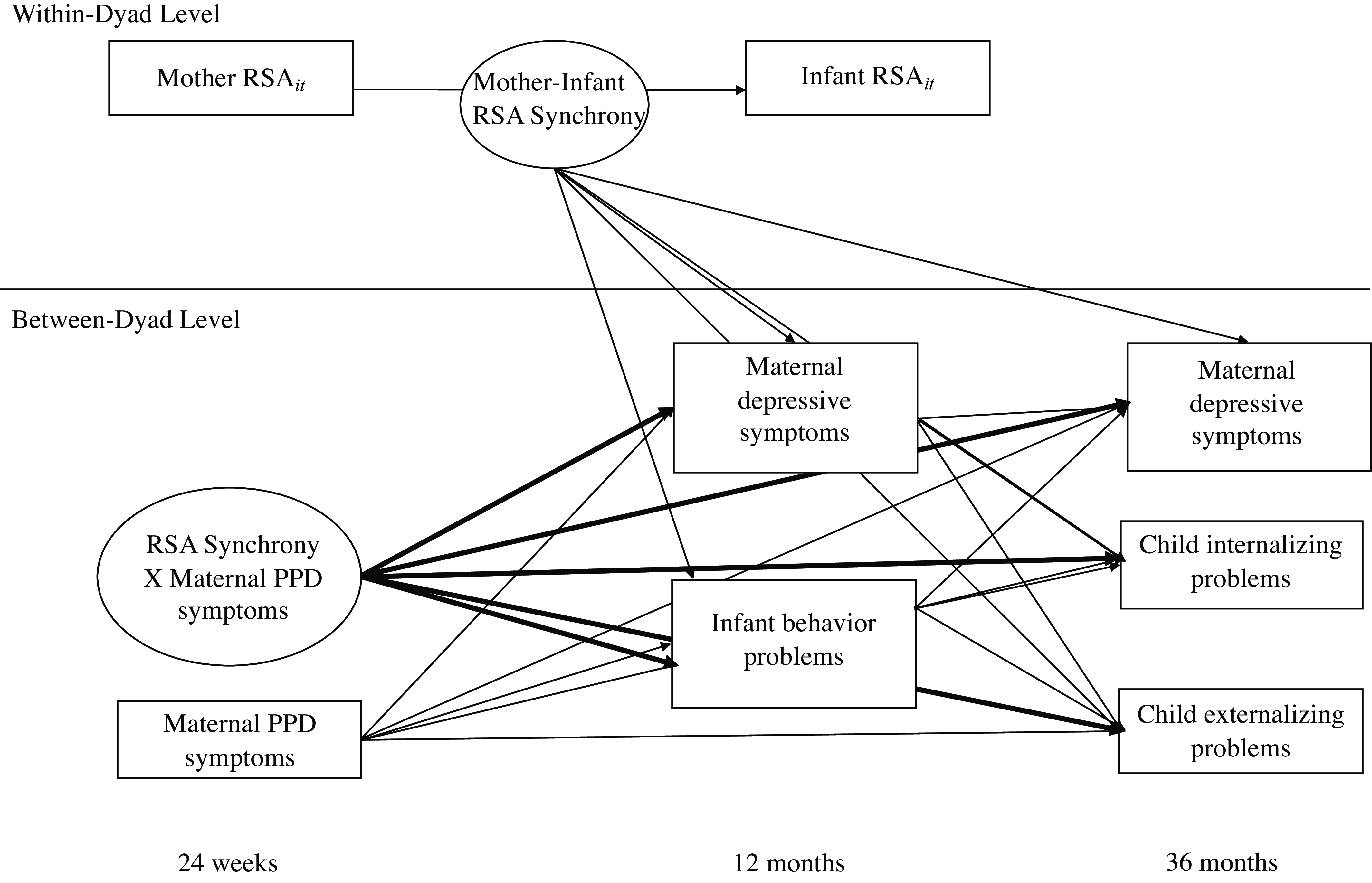
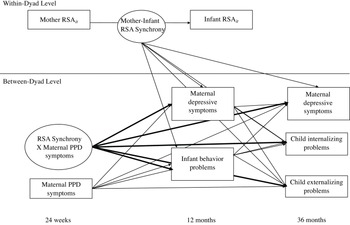
Drawing on the biobehavioral synchrony model (Feldman, Reference Feldman2012, Reference Feldman2020), our first two aims were to evaluate whether positive mother-infant RSA synchrony during free play protected against the adverse effects of maternal PPD symptoms on future child behavior problems and maternal depressive symptoms. Consistent with theory and prior research (Lan et al., Reference Lan, Zhang, Lunkenheimer, Chang, Li and Wang2023), we hypothesized that associations between maternal PPD symptoms and (1) offspring behavior problems and (2) maternal depressive symptoms at 12 and 36 months would be attenuated in the presence of stronger positive RSA synchrony during a free play task at 24-weeks postpartum (see Figure 1 for conceptual model). We evaluated maternal and child outcomes at two time points – when children were 12 and 36 months – in order to assess potentially enduring benefits of synchrony beyond infancy. Extending prior work that demonstrated mother-infant RSA synchrony during play confers resilience for child internalizing problems (Lan et al., Reference Lan, Zhang, Lunkenheimer, Chang, Li and Wang2023), we evaluated whether resilience-promoting effects of synchrony are specific to early childhood internalizing problems (Lan et al., Reference Lan, Zhang, Lunkenheimer, Chang, Li and Wang2023) or also generalize to externalizing behavior problems. Our final aim was to (3) evaluate specificity of our results to a free play task. We hypothesized that the stress-diathesis model where positive RSA synchrony confers resilience for both members of the dyad would be specific to a free play task relative to a non-interactive baseline.
Conceptual model of the joint effects of within-dyad RSA synchrony and maternal PPD symptoms on subsequent maternal and child outcomes. note. PPD = postpartum depression. RSA = respiratory sinus arrhythmia. For visual clarity, covariate effects and covariances are not shown. Primary paths of interest are shown in bold.
Method
Participants
The sample included 322 mother-infant dyads who participated in a broader examination of maternal mental health and child socioemotional development in very low-income, Mexican-origin families, Las Madres Nuevas. Pregnant women were invited to participate in the study if they met the following eligibility criteria: 1) self-identification as Mexican or Mexican American, 2) fluency in English or Spanish, 3) 18 years of age or older, 4) low-income status (family income below $25,000 or eligibility for Medicaid or Federal Emergency Services coverage for childbirth), and 5) anticipated delivery of a singleton baby with no significant health or developmental problems. The Arizona State University Institutional Review Board and the Maricopa Integrated Health System IRB approved all study procedures prior to recruitment or data collection.
The first data collection occurred during the prenatal period, at which time women were 18-42 years old (M = 27.8, SD = 6.5 years). The majority of women (86.3%) were born in Mexico. On average, women had lived in the United States for 11.9 years (range 0-32 years). The modal family income was $10,001 - $15,000 for an average household of four people. Approximately 77.3% of women were married or living with a partner. Approximately one-quarter of the sample was first-time mothers (22.2%); among the rest of the sample, the number of biological children (not including the target child) ranged from zero to nine (M = 2.0; SD = 1.7). The sample included 149 (46.3%) male children and 173 (53.7%) female children.
Recruitment
Women were recruited from hospital-based clinics during prenatal care visits. Bilingual female interviewers explained the study, evaluated eligibility, and obtained permission for a prenatal home visit (26–38 weeks gestation). Interviews were conducted in the participant’s choice of Spanish (86%) or English (14%).
Procedures
At the prenatal and 6-week home visits, mothers completed questionnaires. At the 24-week home visit, mothers completed interaction tasks with their infants, including a baseline and free play task. To minimize infants’ and mothers’ movement during the tasks, infants were placed in study-provided seats and seated upright, and mothers were seated next to their infants. During the 7-minute baseline period, mothers were instructed “Please relax quietly for the next seven minutes and breathe normally. Feel free to close your eyes if that makes you feel more comfortable.” The first 5 minutes of the 7-minute baseline period were used. During the 5-minute free play task, mothers were given a small basket of toys and objects (e.g., plastic cookware and food, dolls, cars, farm animals, etc.) and told to play with their infants as they normally would if alone. Research assistants provided childcare for other children present in the home during the visit to minimize interruptions. Women were compensated with $75 and small gifts at the prenatal interview, and $50 and small gifts at the 24-week visit.
The 12-month and 36-month visits were conducted in the laboratory at Arizona State University. Women were compensated $100 for each laboratory visit and provided either free transportation to/from the laboratory or $50 for travel costs.
Measures
Maternal and infant RSA
At the 24-week visit, a research assistant placed electrodes on the mother’s and infant’s left shoulder and right and left waist in a standard lead configuration. Heart rate data were recorded at 256 Hz with electrocardiography (ECG) monitors (Forrest Medical, LLC; Trillium 5000; East Syracuse, NY, USA) during the baseline and free play periods. QRSTool software 1.2.2 (Allen et al., Reference Allen, Chambers and Towers2007) was used to process the data and automatically obtain R-spikes from the ECG data. Trained coders manually corrected misidentified or unidentified R-spikes. Time-varying RSA across the five minutes of baseline and of free play was estimated from the cleaned R-R interval data, using the MATLAB toolbox RSAseconds (Gates et al., Reference Gates, Gatzke-Kopp, Sandsten and Blandon2015). RSA was estimated in the frequency band of respiration for adults (.12 – .40 Hz) and for infants (.30 – 1.30 Hz) (Porges, Reference Porges1985). Prior published work with this sample demonstrates the validity of these time-varying estimates relative to estimates of RSA derived from the Porges method (Porges, Reference Porges2007; Somers et al., Reference Somers, Curci and Luecken2021a). Following recommendations to remove any systematic time trends prior to synchrony analyses (Gates et al., Reference Gates, Gatzke-Kopp, Sandsten and Blandon2015), mothers’ and infants’ RSA time series were first-differenced, yielding time series of reactive changes in RSA that were used in primary analyses.
Maternal depressive symptoms
Women reported on their postpartum depressive symptoms at 24-weeks child age using the 10-item Edinburgh Postnatal Depression Scale (EPDS; Cox et al., Reference Cox, Holden and Sagovsky1987). Women respond using a scale from 0 to 3, and higher scores correspond to more severe depressive symptoms. The EPDS has been validated in English and Spanish (Garcia-Esteve et al., Reference Garcia-Esteve, Ascaso, Ojuel and Navarro2003). An error in the response set rendered two items on the EPDS unusable for 43 participants at 24-weeks. For these participants, item-level multiple imputation (Mplus 7; Muthén & Muthén, Reference Muthén and Muthén2012) was used to impute the missing values which were then used to calculate a full scale score. The imputation variables included parity, survey administration language, the two depression items, and parcels created by averaging the remaining eight EPDS items.
Women reported on their depressive symptoms at 12- and 36-months using the Center for Epidemiologic Studies Depression Scale (CES-D; Radloff, Reference Radloff1977). Items are rated on a scale from 0-4, and higher scores indicate greater frequency of depressive symptoms. The CES-D has been validated in Spanish among Mexican Americans (Roberts et al., Reference Roberts, Vernon and Rhoades1989). Internal consistency (a conservative estimate of scale reliability) of the original EPDS and CES-D at each time point was good; α’s > .82. 5.9% of sample endorsed clinically significant (EPDS ≥ 13) depressive symptoms at 24-weeks postpartum; 21.5 and 14.5% of sample endorsed clinically significant (CES-D ≥ 16) depressive symptoms at 12- and 36-months, respectively.
Infant behavior problems
Women reported on their infant’s behavior problems at the 12-month visit using the 42-item Brief Infant-Toddler Social and Emotional Assessment (BITSEA; Briggs-Gowan et al., Reference Briggs-Gowan, Carter, Irwin, Wachtel and Cicchetti2004). Thirty-one items comprised the behavioral problem subscale. Items are rated from 0-2, and higher scores indicate more behavioral problems. The BITSEA has been validated among low-income Hispanic/Latinx families (Hungerford et al., Reference Hungerford, Garcia and Bagner2015). The internalizing (Cronbach’s α = .55) and externalizing behavior problem (Cronbach’s α = .52) subscales did not demonstrate acceptable reliability and were therefore not used in the present study. The total behavioral problems subscale demonstrated acceptable internal consistency (Cronbach’s α = .81). 9.7% of sample endorsed clinically significant (BITSEA ≥ 13 for girls, ≥ 15 for boys) infant behavior problems.
Child internalizing and externalizing behavior problems
Women reported on their child’s behavior problems at 36 months using the 113-item Child Behavior Checklist (CBCL/1.5-5; Achenbach & Rescorla, Reference Achenbach and Rescorla2000), yielding information on internalizing and externalizing behaviors. Items are rated from 0-2, and higher scores indicate more behavior problems. The CBCL is validated in English and Spanish (Achenbach & Rescorla, Reference Achenbach and Rescorla2000; Rubio-Stipec et al., Reference Rubio-Stipec, Bird, Canino and Gould1990). Gross and colleagues (Reference Gross, Fogg, Young, Ridge, Cowell, Richardson and Sivan2006) demonstrated equivalence across ethnic groups by income and language versions. The internalizing and externalizing behavior problems subscales demonstrated good internal consistency (Cronbach’s α for internalizing problems = .87, externalizing problems = .90). In present analyses, T-scores for internalizing and externalizing problems were used; 10.2% of sample endorsed at-risk or clinically significant (T-scores ≥ 60) internalizing problems and 6.5% of sample endorsed at-risk or clinically significant externalizing problems.
Potential covariates
Child sex and birth outcomes (gestational age and birthweight) were obtained through medical record review. At the prenatal visit, women reported their country of birth and completed the 20-item Economic Hardship Scale (Barrera et al., Reference Barrera, Caples and Tein2001; α = .72). Because parenting experience may shape mothers’ physiological and socioemotional regulation during mother-infant interactions (Rutherford et al., Reference Rutherford, Wallace, Laurent and Mayes2015), we obtained the number of other children from mothers’ report at the prenatal visit. In addition, mothers’ perceptions of their infant’s temperament may influence how mothers respond to their infant, at both physiological and behavioral levels (Kiff et al., Reference Kiff, Lengua and Zalewski2011). Maternal ratings of infant temperament were obtained at the 6-week time point using the negativity dimension of the Infant Behavior Questionnaire-Revised (IBQ-R, Gartstein & Rothbart, Reference Gartstein and Rothbart2003; α = .61).
Analytic plan
Study hypotheses were tested using a Bayesian plausible values approach in which plausible values (i.e., latent variable scores) for within-dyad RSA synchrony were multiply-imputed in the first step and then effects of within-dyad RSA synchrony, maternal PPD symptoms, and their interaction were evaluated in a second step (Asparouhov & Muthén, Reference Asparouhov and Muthén2010). In the context of multilevel structural equation modeling, the plausible values approach affords evaluation of latent moderated structural equations without requiring high-dimensional numerical integration, while still allowing for uncertainty in cross-product estimates (Asparouhov & Muthén, Reference Asparouhov and Muthén2010; Zyphur et al., Reference Zyphur, Zhang, Preacher, Bird, Humphrey and LeBreton2019). Within-dyad RSA synchrony was first evaluated with a multilevel structural equation model (MSEM). To yield within-dyad estimates, as desired, mothers’ reactive RSA (i.e., first-differenced RSA) was person-mean centered. At the within-dyad level, concurrent RSA synchrony was calculated as the slope of the effect of maternal reactive RSA on infant reactive RSA (following Lan et al., Reference Lan, Zhang, Lunkenheimer, Chang, Li and Wang2023; Miller et al., Reference Miller, Armstrong-Carter, Balter and Lorah2023):
 $$iRSADif{f_{i,t}} = {B_{\it 0i}} + {B_{\it 1i}}mRS{A_{i,t}} + {r_{i,t}}$$
Plausible values for within-dyad RSA synchrony were obtained by sampling from their posterior distribution 20 times, resulting in a distribution of factor scores (Zyphur et al., Reference Zyphur, Zhang, Preacher, Bird, Humphrey and LeBreton2019). Consistent with prior work (e.g., Lan et al., Reference Lan, Zhang, Lunkenheimer, Chang, Li and Wang2023), the resulting assessment of concurrent synchrony lies on a spectrum from positive (i.e., in-phase coordination such that infants show changes in RSA in the same direction as their mothers) to negative (i.e., anti-phase coordination such that infants show changes in RSA in the opposite direction as their mothers) values of synchrony. All between-level information per imputation was saved and subsequently analyzed in a single-level structural equation model (SEM) with maximum likelihood estimation with robust standard errors, which is an appropriate strategy for handling missing data and nonnormality (Enders, Reference Enders2001). Interaction effects between within-dyad RSA synchrony and maternal PPD symptoms on 12- and 36-month outcomes were computed for the plausible values to approximate latent interactions. Models adjusted for average levels of maternal and infant RSA and other identified covariates. Continuous predictors were grand-mean centered.
Model fit and parameter estimates of the SEM were analyzed using standard imputation methodology (Asparouhov & Muthén, Reference Asparouhov and Muthén2010). Significant interaction effects were probed at the mean and 1 standard deviation (SD) above and below the mean on the moderator (Aiken & West, Reference Aiken and West1991). Following recommendations for adjudicating between different patterns of interaction effects (Roisman et al., Reference Roisman, Newman, Fraley, Haltigan, Groh and Haydon2012), the regions of significance on X (i.e., PPD symptoms), within 2 SD of the mean, were also computed and used to interpret the pattern of the interaction effect (differential susceptibility, vantage sensitivity, or stress-diathesis). If the effect of the moderator (i.e., synchrony) on the outcome is significant at both low and high ends (within 2 SD) from the mean on the environmental exposure (i.e., maternal PPD symptoms), there can be evidence of differential susceptibility; if the effect of synchrony on the outcome is significant only at low levels (indicating a relatively more positive environment) or high levels (indicating a relatively more adverse environment) of PPD symptoms, there is evidence for vantage sensitivity or stress-diathesis models, respectively (Roisman et al., Reference Roisman, Newman, Fraley, Haltigan, Groh and Haydon2012). Separate models were conducted for analyses of within-dyad RSA synchrony during the baseline task and during the free play interaction. Primary analyses were conducted in Mplus version 8.10 (Muthén & Muthén, Reference Muthén and Muthén2017).
Results
Preliminary analyses
Selection of covariates
Average levels of maternal and infant RSA were included as a priori covariates. Additional potential covariates (maternal country of origin, number of children, child sex, prenatal perceived economic hardship, and 6-week infant temperament) were identified based on the theoretical literature; covariates that were associated with missingness on primary study variables and/or associations with levels of observed primary study variables were retained in primary models (see Supplementary Material for more information on covariate selection).
Descriptive statistics
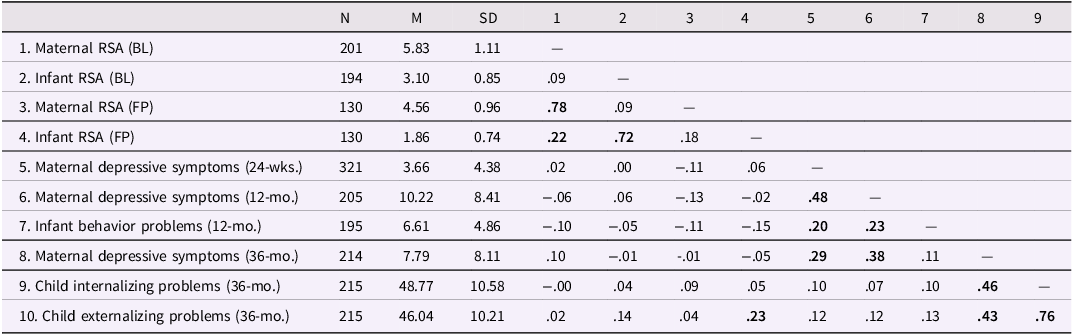
Descriptive statistics and bivariate correlations of primary study variables are presented in Table 1. All continuous study variables, except 12-month infant behavior problems, had acceptable skewness and kurtosis (skewness cutoff<2 and kurtosis cutoff<7; West et al., Reference West, Finch and Curran1995); as noted above, maximum likelihood standard errors were computed using a sandwich estimator that is robust to non-normality. Because dyadic synchrony was a latent variable that can only be estimated within a multilevel model, it was not included in these preliminary analyses.
Descriptive statistics and bivariate correlations among primary observed variables
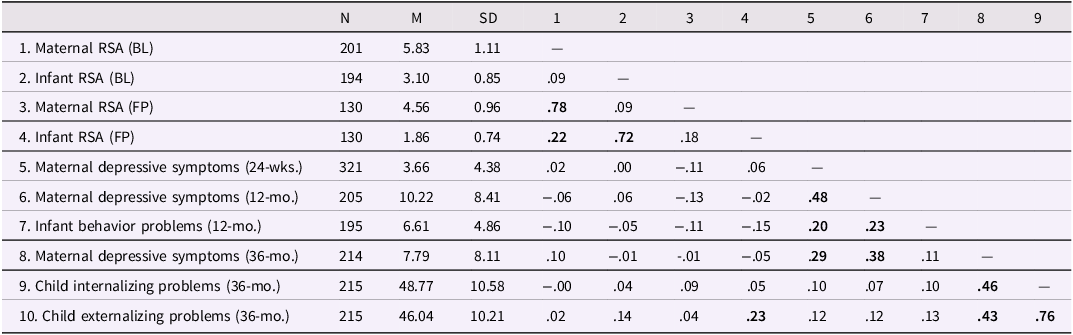
Note. RSA = Average respiratory sinus arrhythmia (RSA). BL = Baseline. FP = Free play. Maternal depressive symptoms at 24 weeks were assessed with the EPDS and depressive symptoms at 12 and 36 months were assessed with the CESD. Infant behavior problems were assessed with the BITSEA and child internalizing and externalizing behavior problems were assessed with the CBCL. Correlations shown in bold are statistically significant, p < .05.
Multilevel SEMs
MSEMs were evaluated to obtain estimates of within-dyad RSA synchrony during the free play and baseline tasks. On average, in both tasks, there was no evidence of concurrent mother-infant RSA synchrony, although there was significant variability across families in RSA synchrony. For the free play task, the fixed effect of mother-infant RSA synchrony was null, B 1 = −0.020, 95% CrI: [−0.047, 0.011], such that, on average, mothers’ reactive RSA was not associated with her infants’ concurrent reactive RSA. However, the random effect for free play mother-infant RSA synchrony was significant, Est = 0.019, 95% CrI: [0.014, 0.027], indicating significant differences across our sample in the levels of RSA synchrony during free play.
For the baseline task, the fixed effect of mother-infant RSA synchrony was null, B 1 = 0.022, 95% CrI: [−0.005, 0.047], such that, on average, mothers’ reactive RSA was not associated with her infants’ concurrent reactive RSA. However, the random effect for baseline mother-infant RSA synchrony was significant, Est = 0.025, 95% CrI: [0.020, 0.035], indicating significant differences across our sample in the levels of RSA synchrony during the baseline period.
Primary analyses
Aims 1 & 2: Role of mother-infant RSA synchrony during free play
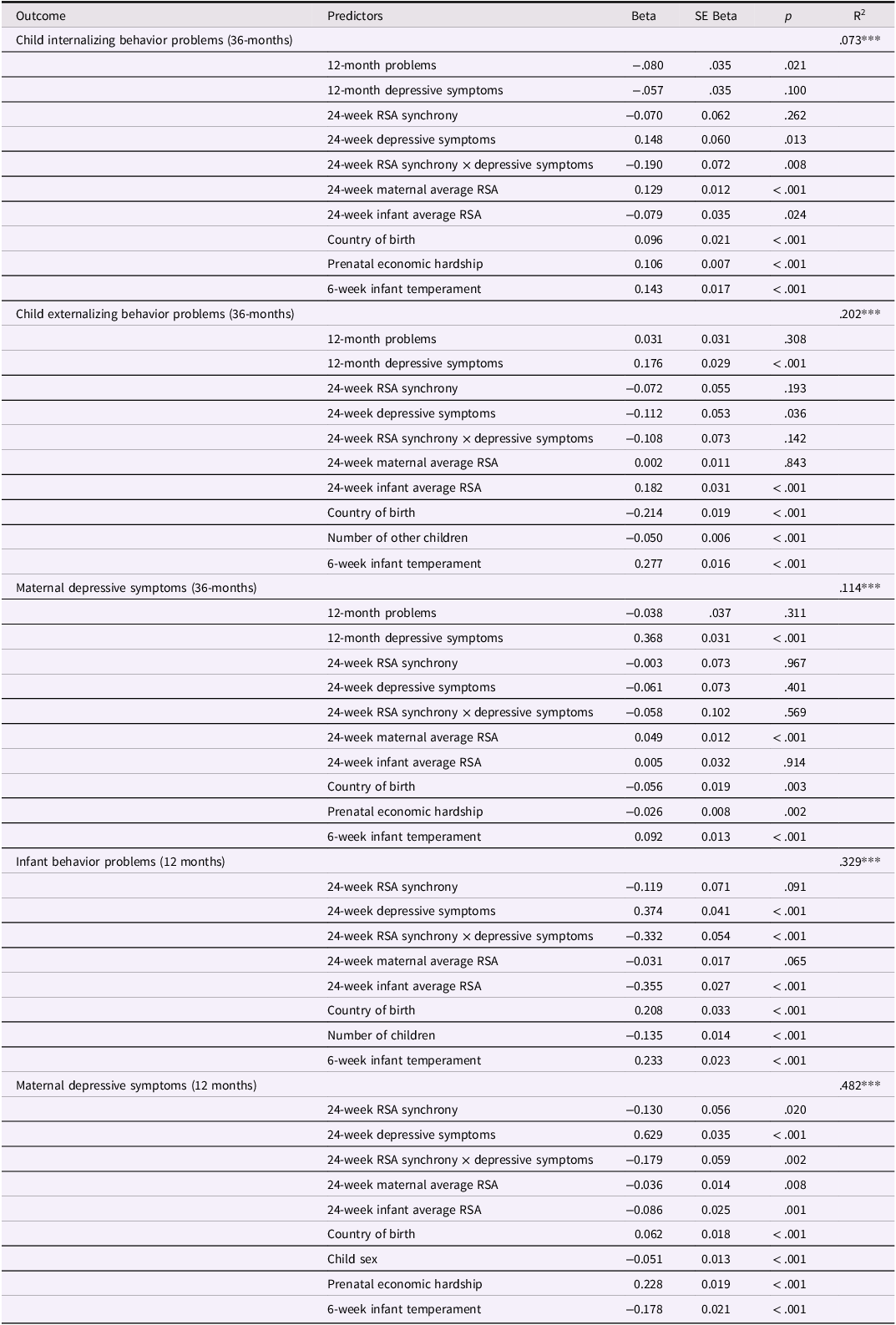
The free play model predicted maternal depressive symptoms and child internalizing and externalizing behavior problems at 36-months from levels of maternal depressive symptoms and child behaviors at 12 months and the interaction of maternal PPD symptoms and within-dyad RSA synchrony during the 24-week free play task, adjusting for covariates. Overall, model fit to the data was good (West et al., Reference West, Taylor, Wu and Hoyle2012): mean RMSEA = 0.08 (SD = 0.00); mean CFI = 0.96 (SD = 0.00); mean SRMR = 0.02 (SD = 0.00). Standardized parameter estimates are shown in Table 2 and unstandardized parameter estimates are reported in the text. Surprisingly, maternal PPD symptoms were positively correlated with mother-infant RSA synchrony, ϕ = 0.08, SE ϕ = 0.03, p = 0.005. Greater positive mother-infant RSA synchrony was associated with fewer 12-month maternal depressive symptoms, B = −8.72, SE (B) = 3.79, p = .021, although this association was qualified by a significant interaction effect with 24-week PPD symptoms (described below).
Model predicting maternal depressive symptoms and child behavior problems from within-dyad RSA synchrony during free play task
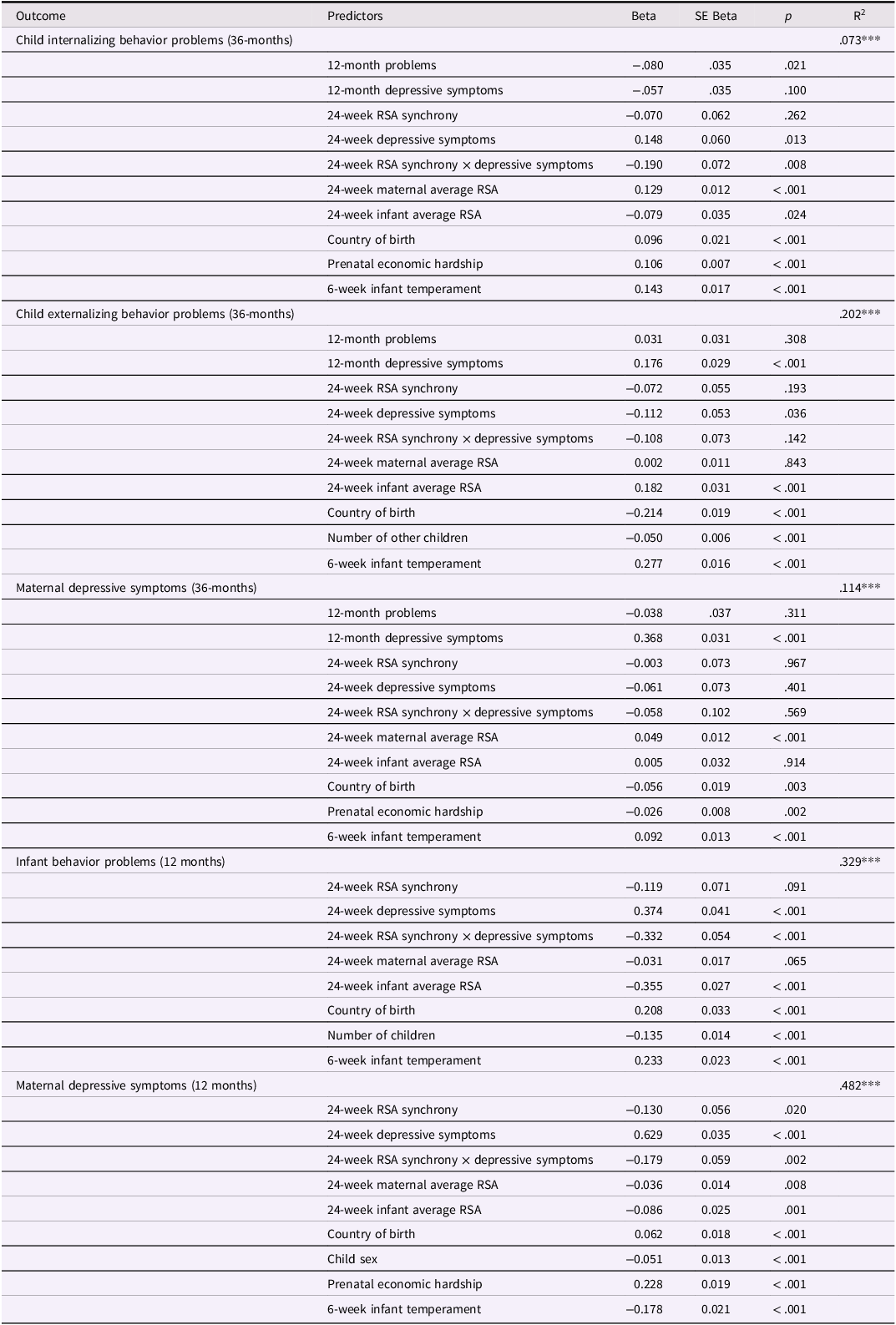
Note. RSA = Respiratory Sinus Arrhythmia. *** p ≤ .001. 36-month internalizing problems were correlated with 36-month externalizing problems, Est = 0.749, SE Est = 0.007, p < .001, and 36-month maternal depressive symptoms, Est = 0.366, SE Est = 0.018, p < .001. 36-month externalizing problems were also correlated with 36-month maternal depressive symptoms, Est = 0.358, SE Est = 0.016, p < .001. 12-month child behavior problems were correlated with 12-month maternal depressive symptoms, Est = 0.060, SE Est = 0.037, p = .031. For visual clarity, covariances between exogenous variables are not shown.
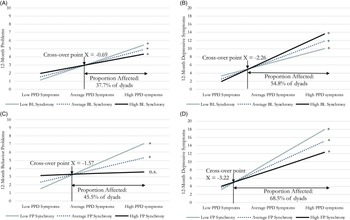
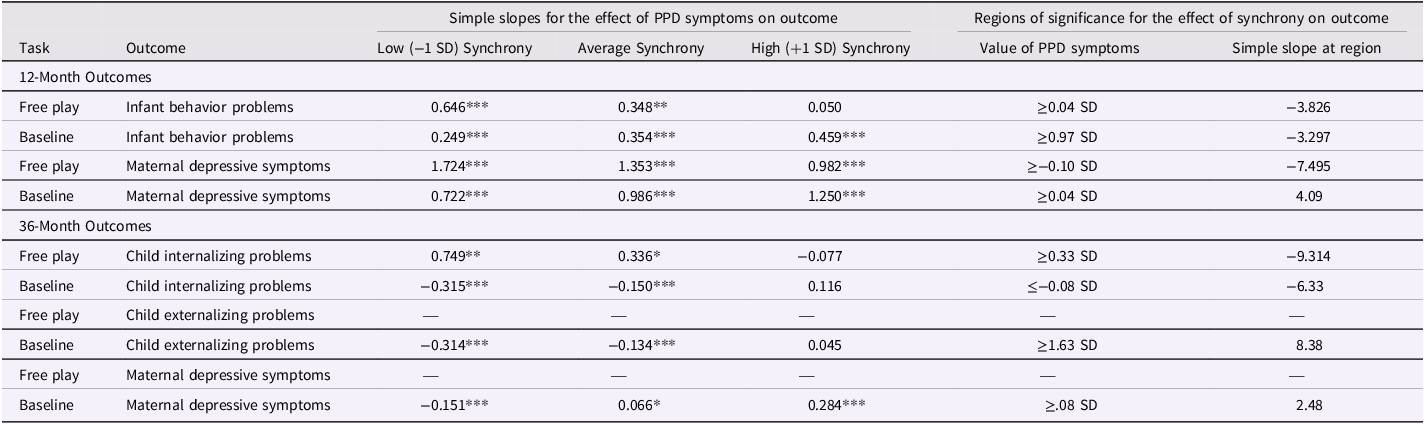
With respect to our first two aims, there were significant interaction effects between mother-infant RSA synchrony during free play and maternal PPD symptoms on 12-month behavior problems, B = −2.18, SE (B) = 0.39, p < .001; 12-month maternal depressive symptoms, B = −2.71, SE (B) = 0.90, p = .003; and 36-month internalizing problems, B = −3.04, SE (B) = 1.16, p = .009. Post-hoc probing of interaction effects is presented in Table 4. As hypothesized, at above average (+1 SD; EstSynchrony = 0.138) values of free play RSA synchrony, maternal PPD symptoms were not associated with 12-month infant behavior problems, Est = 0.050, SE Est = 0.045, = .27; in contrast, at average (EstSynchrony = -0.02), Est = 0.348, SE Est = 0.039, p = .010 and below average (−1 SD: EstSynchrony = 0.178) values of free play RSA synchrony, Est = 0.646, SE Est = 0.085, p < .001, maternal PPD symptoms were positively associated with infant behavior problems (see Figure 2). At approximately average or greater values of maternal PPD symptoms, greater positive free play RSA synchrony was associated with fewer 12-month behavior problems. These results are consistent with a stress-diathesis model, where greater positive free play RSA synchrony attenuates PPD-related risk for 12-month child behavior problems.
Interactive effects between mother-infant RSA synchrony and postpartum depressive symptoms on 12-month outcomes. note. BL = baseline. FP = free play. PPD = postpartum depressive symptoms. Low = -1 SD. High = + 1 SD. * p < .05. n.s. = not statistically significant (p > .05). Cross-over points are on grand-mean centered values of X.
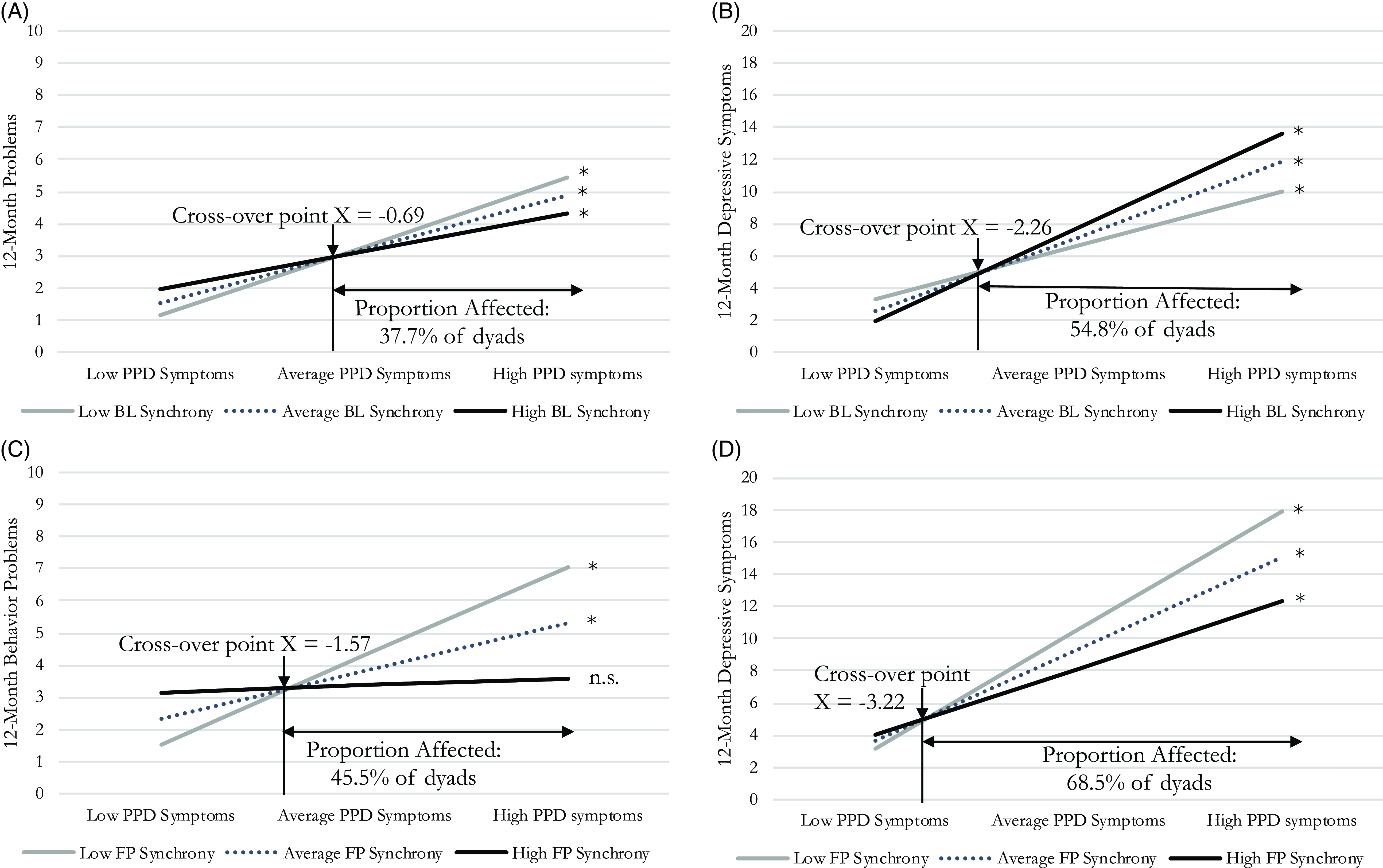
Maternal PPD symptoms were positively associated with 12-month maternal depressive symptoms at above average, average, and below average levels of free play RSA synchrony; however, this effect was weaker at above average levels of free play RSA synchrony (above average: Est = 0.982, SE Est = 0.091, p < .001; average: Est = 1.353, SE Est = 0.078, p < .001; below average: Est = 1.724, SE Est = 0.193, p < .001). At approximately average or greater values of maternal PPD symptoms, greater positive free play RSA synchrony was associated with fewer 12-month maternal depressive symptoms. These results are consistent with a stress-diathesis model, where greater positive free play RSA synchrony attenuates PPD-related risk for future 12-month maternal depressive symptoms.
As hypothesized, at above average values of free play RSA synchrony, maternal PPD symptoms were not associated with 36-month child internalizing problems, Est = −0.077, SE Est = 0.087, p = .38. In contrast, at average, Est = 0.336, SE Est = 0.135, p = 0.013, and below average, Est = 0.749, SE Est = 0.278, p = .007, values of free play RSA synchrony, maternal PPD symptoms were positively associated with child internalizing problems (see Figure 3).
Interactive effects between mother-infant RSA synchrony and postpartum depressive symptoms on 36-month outcomes. Note. BL = baseline. FP = free play. PPD = postpartum depressive symptoms. Low = -1 SD. High = + 1 SD. * p < .05. n.s. = not statistically significant (p > .05). Cross-over points are on grand-mean centered values of X.
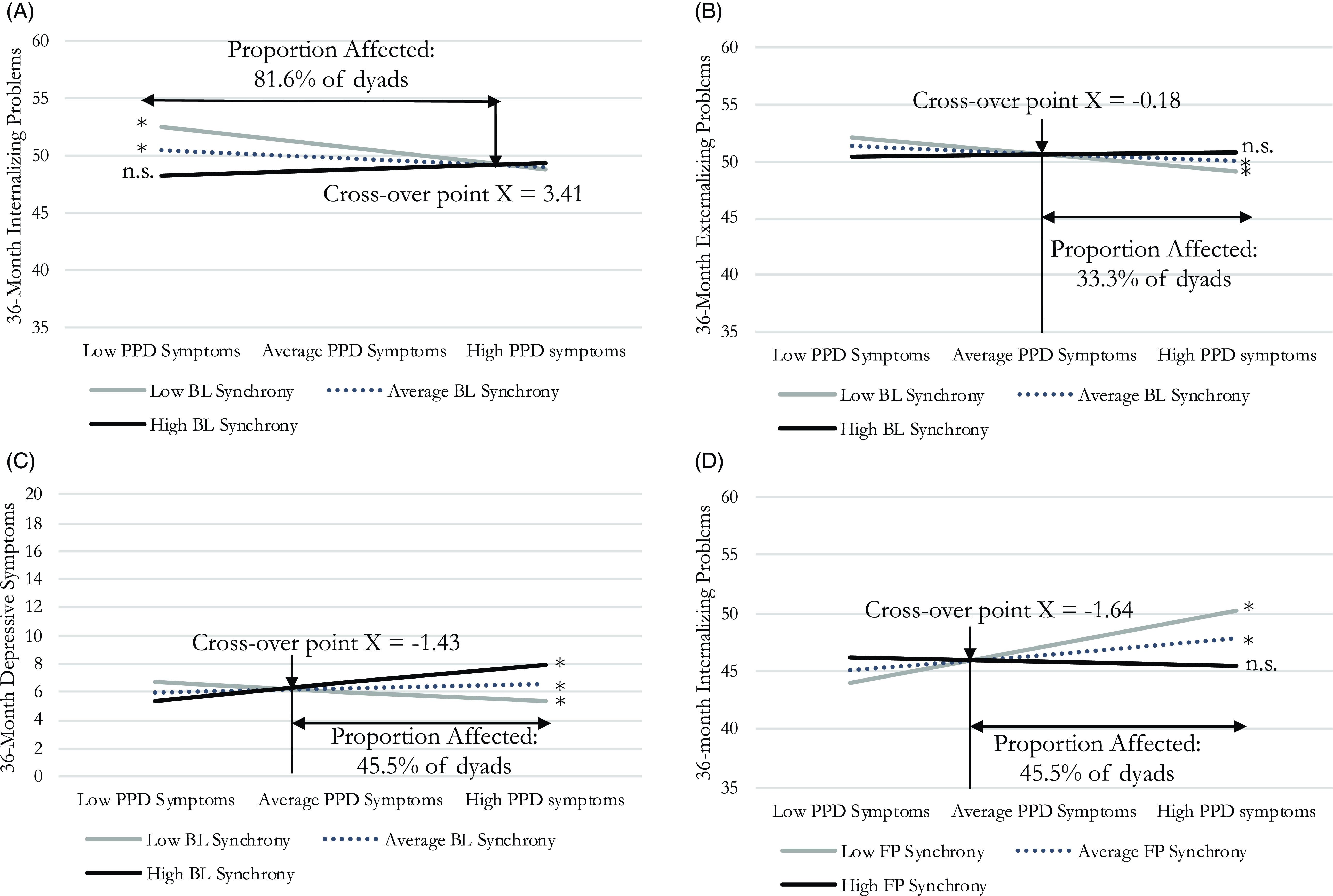
At approximately average or greater values of maternal PPD symptoms, greater positive free play RSA synchrony was associated with fewer 36-month child internalizing problems. These results are consistent with a stress-diathesis model, where greater positive free play RSA synchrony attenuates PPD-related risk for 36-month child internalizing behavior problems.
Aim 3: Specificity of results to free play relative to a non-interactive baseline
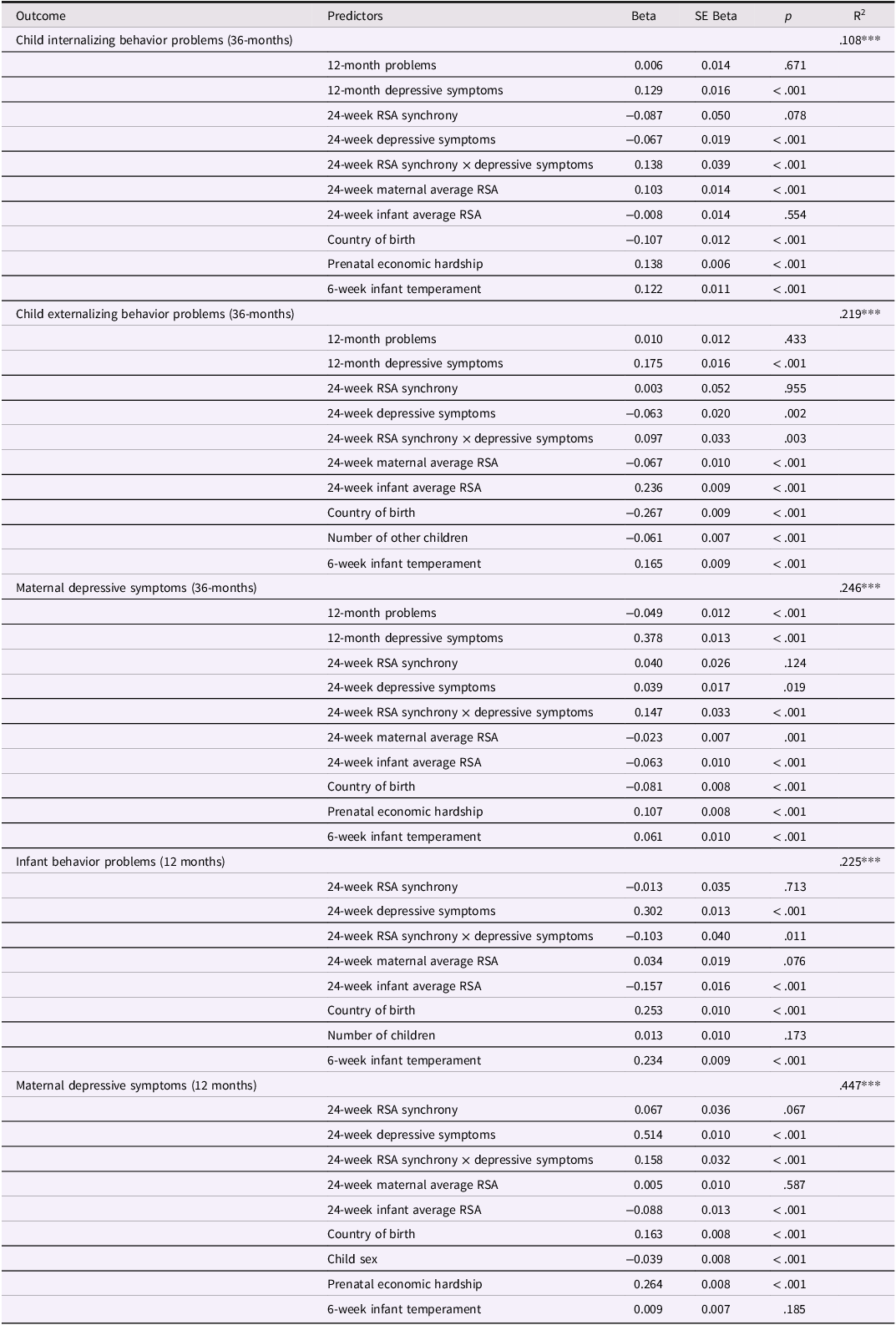
The baseline model was identical to the free play model, except that it included within-dyad RSA synchrony during the 24-week baseline task. Overall, model fit to the data was good (West et al., Reference West, Taylor, Wu and Hoyle2012): mean RMSEA = 0.09 (SD = 0.00); mean CFI = 0.96 (SD = 0.00); mean SRMR = 0.03 (SD = 0.00). Standardized parameter estimates are shown in Table 3 and unstandardized parameter estimates are reported in the text. Maternal PPD symptoms were not correlated with mother-infant RSA synchrony during the baseline task, φ = -0.02, SE φ = 0.02, p = 0.32. Baseline mother-infant RSA synchrony was also not associated with 12- or 36-month outcomes (all p’s > 0.07).
Model predicting maternal depressive symptoms and child behavior problems from within-dyad RSA synchrony during baseline task
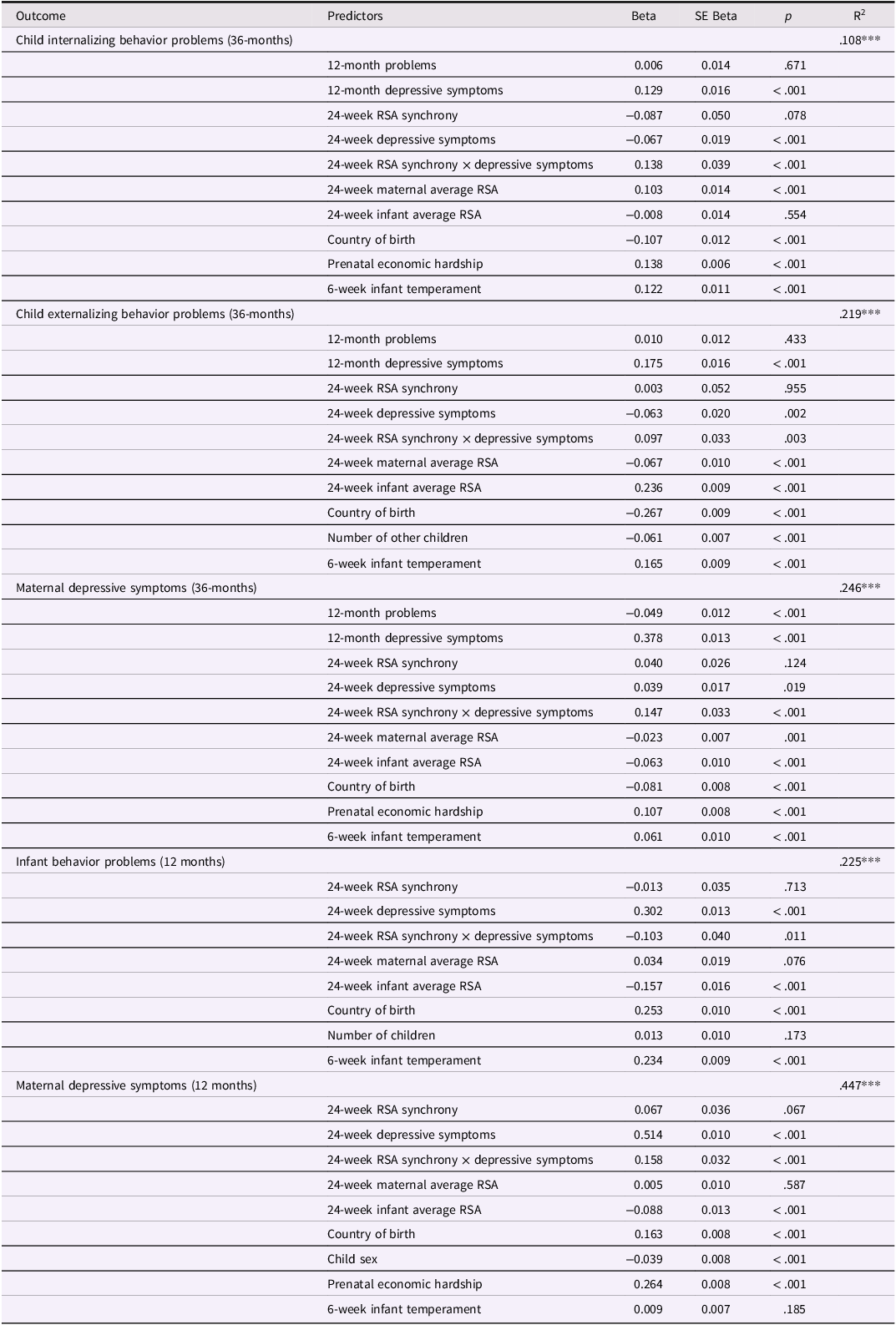
Note. RSA = Respiratory Sinus Arrhythmia. *** p ≤ .001. 36-month internalizing problems were correlated with 36-month externalizing problems, Est = 0.749, SE Est = 0.06, p < .001, and 36-month maternal depressive symptoms, Est = 0.353, SE Est = 0.011, p < .001. 36-month externalizing problems were also correlated with 36-month maternal depressive symptoms, Est = 0.292, SE Est = 0.009, p < .001. 12-month child behavior problems were correlated with 12-month maternal depressive symptoms, Est = 0.164, SE Est = 0.012, p < .001. For visual clarity, covariances between exogenous variables are not shown.
With respect to our third aim, we surprisingly demonstrated statistically significant interaction effects between mother-infant RSA synchrony and maternal PPD symptoms on 12-month behavior problems, B = −0.67, SE B = 0.26, p = .011; 12-month maternal depressive symptoms, B = 1.68, SE B = 0.33, p ≤ .001; 36-month internalizing problems, B = 1.69, SE B = .47, p = .001; 36-month externalizing problems, B = 1.14, SE B = 0.38, p = .003; and 36-month maternal depressive symptoms, B = 1.38, SE B = 0.33, p ≤ .001. Post-hoc probing of interaction effects is presented in Table 4. As shown in Table 5 and described in the text below, the pattern of interaction effects between mother-infant RSA synchrony and maternal PPD symptoms on 12- and 36-month outcomes differed for free play and RSA synchrony (with the exception of effects on 12-month child behavior problems).
Post-hoc probing of significant interaction effects
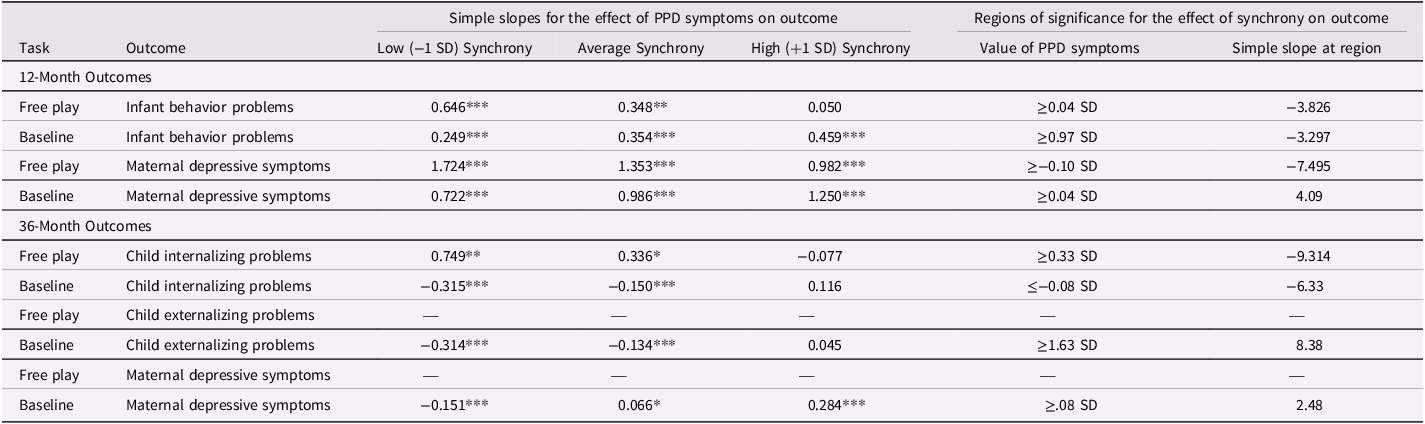
Note. SD = standard deviation. ***p ≤ .001. **p ≤ .01. *p < .05. — Non-significant interaction effect.
Pattern of interaction effects between mother-infant RSA synchrony and maternal postpartum depressive symptoms on outcomes

Note. The pattern of the interaction effect was interpreted based on Roisman et al. (Reference Roisman, Newman, Fraley, Haltigan, Groh and Haydon2012). — Indicates there was not a statistically significant interaction effect on the outcome. Stress-diathesis = Adverse developmental experiences (i.e., elevated levels of postpartum depressive symptoms) are most likely to impact those who possess a diathesis. Vantage sensitivity = Salutary developmental experiences (i.e., low levels of postpartum depressive symptoms) are most likely to impact those who carry a vantage factor.
Maternal PPD symptoms were positively associated with 12-month infant behavior problems at above average (Est = 0.459, SE Est = 0.035, p < .001), average (Est = 0.354, SE Est = 0.015, p < .001), and below average (Est = 0.249, SE Est = 0.050, p < .001) levels of RSA synchrony; this effect was weaker at below average (−1 SD; EstSynchrony = − 0.182) levels of baseline RSA synchrony. At above average or greater values of PPD symptoms, greater positive baseline RSA synchrony was associated with fewer infant behavior problems. Consistent with a stress-diathesis model, at very high levels of maternal PPD symptoms, greater positive baseline RSA synchrony attenuated PPD-related risk for 12-month child behavior problems.
Likewise, maternal PPD symptoms were positively associated with 12-month maternal depressive symptoms at above average (Est = 1.250, SE Est = 0.058, p < .001), average (Est = 0.986, SE Est = 0.022, p < .001), and below average (Est = 0.722, SE Est = 0.056, p < .001) levels of RSA synchrony, and this effect was weaker at below average levels of baseline RSA synchrony (see Figure 2). At average or greater values of PPD symptoms, greater positive baseline RSA synchrony was associated with more maternal depressive symptoms. These results are consistent with a stress-diathesis model, where greater positive baseline RSA synchrony operates as a diathesis (rather than protective factor) for PPD-related risk for future 12-month maternal depressive symptoms.
At above average (+1 SD; EstSynchrony = 0.138) levels of baseline RSA synchrony, maternal PPD symptoms were not associated with 36-month child internalizing problems (Est = 0.116, SE Est = 0.109, p = 0.29) or child externalizing problems (Est = 0.045, SE Est = 0.099, p = 0.65). Surprisingly, at average (Est = −0.150, SE Est = 0.032, p < .001) and low (Est = −0.315, SE Est = 0.052, p < .001) levels of baseline RSA synchrony, maternal depressive symptoms were associated with fewer child internalizing problems. Only at average or below values of maternal PPD symptoms, greater positive baseline RSA synchrony was related to fewer child internalizing problems at 36-months. These results are consistent with a vantage sensitivity model, where greater positive baseline RSA synchrony promotes the beneficial effects of maternal psychological adjustment (i.e., low PPD symptoms) for 36-month child internalizing problems.
Likewise, at average (Est = −0.134, SE Est = 0.042, p = .001) and low (Est = −0.314, SE Est = 0.037, p < .001) levels of baseline RSA synchrony, maternal depressive symptoms were associated with fewer child externalizing problems (see Figure 3). At above average values of PPD symptoms, greater positive baseline RSA synchrony was related to more child externalizing problems at 36-months. These results are consistent with a stress-diathesis model, where greater positive baseline RSA synchrony operates as a diathesis for PPD-related risk for 36-month child externalizing problems.
Maternal PPD symptoms were positively associated with maternal depressive symptoms at 36-months at above average (Est = 0.284, SE Est = .070, p < .001) and average (Est = 0.066, SE Est = 0.029, p = 0.020) levels of baseline RSA synchrony. In contrast, maternal PPD symptoms were negatively associated with maternal depressive symptoms at below average (Est = −0.151, SE Est = 0.044, p = .001) levels of RSA synchrony (see Figure 3). At average or above values of PPD symptoms, greater positive baseline RSA synchrony was related to more maternal depressive symptoms. These results are consistent with a stress-diathesis model, where greater positive baseline RSA synchrony operates as a diathesis for PPD-related risk for future 36-month maternal depressive symptoms.
Discussion
Extending recent theoretical advances in biobehavioral synchrony research, which recognize the interdependence between parents and their children across multiple timescales of development (Feldman, Reference Feldman2012), the current study evaluated a novel, dyadic model of the protective role of mother-infant parasympathetic nervous system synchrony during play following exposure to maternal PPD symptoms, for both mothers and their children. As expected, among low-income, Mexican-origin families, associations between maternal PPD symptoms and (1) greater offspring total behavior problems at 12 months and internalizing problems at 36 months and (2) worse maternal depressive symptoms at 12 months were attenuated for families with stronger positive RSA synchrony during a free play task at 24-weeks. Further, protective aspects of positive RSA synchrony were generally specific to a playful mother-infant interaction and not evident during a non-interactive resting task. Our results suggest that dyadic sources of resilience reflect active mechanisms that support emotion co-regulation during play, rather than passive entrainment of children’s and parents’ physiological rhythms that occur without parents’ effortful attempts to influence or interact with their child (Wass et al., Reference Wass, Greenwood, Esposito, Smith, Necef and Phillips2024).
Dyads who were exposed to elevated PPD symptoms but had stronger positive RSA synchrony during play exhibited fewer behavior problems in infancy and fewer internalizing problems in early childhood than their counterparts with weaker (or negative) RSA synchrony. Our results extend recent evidence of the protective benefits of RSA synchrony during mother-infant play for toddler internalizing problems (Lan et al., Reference Lan, Zhang, Lunkenheimer, Chang, Li and Wang2023) by demonstrating that these results are in fact specific to childhood internalizing problems and also are evident for both members of the dyad. During playful interactions, which are characterized by simultaneous vocalization and positive affect (Feldman et al., Reference Feldman, Magori-Cohen, Galili, Singer and Louzoun2011), positive RSA synchrony may operate with a broader, multimodal form of biobehavioral synchrony that fosters emotion co-regulation (Feldman, Reference Feldman2020). In contrast, negative RSA synchrony may co-occur with poorly coordinated or dysregulated behavioral interaction patterns during play (e.g., withdrawn or intrusive behavior). Though internalizing problems are characterized by high levels of negative affect, recent theoretical models highlight the role of positive affect in the etiology of internalizing problems (Breaux et al., Reference Breaux, Lewis, Cash, Shroff, Burkhouse and Kujawa2022; Kujawa & Burkhouse, Reference Kujawa and Burkhouse2017; Nusslock & Alloy, Reference Nusslock and Alloy2017). Our results extend these theoretical models by tracing the importance of the socialization and regulation of positive affect in the etiology of internalizing problems to dyadic physiological co-regulation during playful interactions characterized by relatively more frequent expressions of positive affect. Further, positive RSA synchrony during play, especially in the context of maternal mental health problems, may enhance mothers’ ability to reap the affective rewards of parenting, which in turn may attenuate risk for worsening depressive symptoms across infancy. For women who hold traditional values of familismo and marianismo, which encompass implicit values of prioritizing motherhood and caring for children (Castillo & Cano, Reference Castillo and Cano2007), the ability to attune with and co-regulate their babies may help mothers to overcome perinatal mental health challenges. The protective benefits of positive RSA synchrony during play on maternal mental health were only apparent during infancy, suggesting the perinatal period (i.e., from pregnancy throughout the first year after her child’s arrival) may be a time of unique plasticity in maternal mental health that maximizes the potential benefits of positive dyadic co-regulatory experiences.
Rather than acting as a buffer against the effects of PPD symptoms, stronger positive RSA synchrony during a non-interactive baseline task acted as a diathesis and amplified risk associated with maternal PPD symptoms on maternal depressive symptoms at 12 and 36 months and on child externalizing problems at 36 months. In contrast, stronger positive RSA synchrony during the baseline task attenuated depression-related risk on 12-month child behaviors (similar to the pattern obtained for free play synchrony) and amplified the salutary effects of low levels of maternal PPD symptoms on 36-month child internalizing problems. Whereas synchrony that occurs during an unstructured play context may reflect coordinated biobehavioral processes that serve to maintain an optimal level of arousal for the dyad (i.e., active co-regulation), synchrony during the resting baseline task may reflect entrainment to each partner’s biobehavioral rhythms that unfolds over a longer time course (Wass et al., Reference Wass, Greenwood, Esposito, Smith, Necef and Phillips2024). Early in life, this passive entrainment may reflect a child’s attunement to maternal biobehavioral signals. Youth with lower-risk mothers may reap the salutary benefits of maternal sensitivity and emotional availability on internalizing problems. However, close attunement to depressed mothers, who tend to be less sensitive and responsive (Goodman et al., Reference Goodman, Simon, Shamblaw and Kim2020) and may exhibit more volatile physiological signals (Somers et al., Reference Somers, Curci, Winstone and Luecken2021b), may lead children to adapt to a harsh or unpredictable environment in ways that heighten their vigilance to threat cues, distractibility, and impulsivity and increase risk for children’s externalizing problems (Glover, Reference Glover2011; Monk et al., Reference Monk, Lugo-Candelas and Trumpff2019; Sandman et al., Reference Sandman, Davis, Buss and Glynn2012) and in turn for poorer maternal wellbeing. The results of the present study suggest that the effects of dyadic synchrony may be context- and domain-specific; yet, we were only able to reliably assess internalizing and externalizing problems in childhood, and earlier assessments of child internalizing and externalizing problems are needed to inform the timing of these effects, including both the duration of effects on maternal mental health and the emergence of differential effects on child internalizing and externalizing problems. Future research is also needed to evaluate how maternal mental health and the history of dyadic interactions shapes synchrony during and in the absence of interaction, which each influence the longer-term effects of the mother-child relationship on both members of the dyad.
Associations between postpartum depressive symptoms and RSA synchrony
Surprisingly, in the present study, PPD symptoms were positively associated with positive mother-infant RSA synchrony during play, and were not associated with RSA synchrony during the non-interactive baseline. These results add to a mixed literature on maternal mental health correlates of RSA synchrony. Prior work with infants and young children failed to detect associations between maternal depressive symptoms and RSA during play tasks (Lan et al., Reference Lan, Zhang, Lunkenheimer, Chang, Li and Wang2023; Lunkenheimer et al., Reference Lunkenheimer, Tiberio, Skoranski, Buss and Cole2018). However, elevated maternal emotion dysregulation has been associated with attenuated mother-driven RSA synchrony during and immediately after a relational challenge (Gao et al., Reference Gao, Vlisides-Henry, Kaliush, Thomas, Butner, Raby, Conradt and Crowell2023). Likewise, among older children and adolescents, there is some evidence that maternal depression may contribute to dampened or negative RSA synchrony across negative tasks (Amole et al., Reference Amole, Cyranowski, Wright and Swartz2017; Woody et al., Reference Woody, Feurer, Sosoo, Hastings and Gibb2016; McKillop & Connell, Reference McKillop and Connell2018; Suveg et al., Reference Suveg, Braunstein West, Davis, Caughy, Smith and Oshri2019). Dyads with mothers who face mental health difficulties may not show typical patterns of positive RSA synchrony specifically during challenging interpersonal interactions; by contrast, less stressful interactions (e.g., play) may offer these dyads unique opportunities for cultivating resilience. Among low-income, Latina women, more severe PPD symptoms are associated with more frequent and severe exposures to stressors, which may be due to inequalities in access to community resources and racial discrimination (Krieger, Reference Krieger2008) that predate the birth of their child (Roubinov et al., Reference Roubinov, Luecken, Curci, Somers and Winstone2021). The arrival of their baby may present a unique period of plasticity in maternal adjustment, and mothers may actively seek out opportunities for synchrony and co-regulation to improve their own wellbeing. Pending replication of our results, longitudinal research on how maternal depression influences the development of mother-child RSA synchrony is warranted.
Strengths and limitations
Our study design assessed dyadic factors involved in resilience at multiple timescales, including second-by-second assessment of maternal and infant RSA during interactive and non-interactive tasks, as well as repeated measures of both maternal depression and child behavior problems collected from infancy through early childhood. Extending prior child-focused research on the effects of mother-infant RSA synchrony, our study is one of few studies to assess long-term effects of synchrony and the first to our knowledge to assess its effects on both members of the dyad. Further, the results held after adjusting for infant difficult temperament, a well-established risk factor for later child behavior problems and maternal stress/mental health (Kiff et al., Reference Kiff, Lengua and Zalewski2011), strengthening our interpretation that RSA synchrony accounts for variation in later maternal and child outcomes. Our focus on low-income, Mexican-origin families addressed a critical gap in the literature, which has typically focused on White populations with relatively low levels of environmental risk (e.g., Graziano & Derefinko, Reference Graziano and Derefinko2013; van IJzendoorn & Bakermans-Kranenburg, Reference Van Ijzendoorn and Bakermans-Kranenburg2015), despite the higher likelihood of postpartum mental health problems and child behavior problems among low-income, Latina families in the United States (e.g., Chaudron et al., Reference Chaudron, Kitzman, Peifer, Morrow, Perez and Newman2005), for whom dyadic factors may be especially salient source of resilience (Cabrera et al., Reference Cabrera, Alonso, Chen and Ghosh2022; Perreira & Allen, Reference Perreira and Allen2021).
Nevertheless, the results must be understood in the context of our study’s limitations. Our results may not generalize to more challenging social interactions, different developmental periods, families with greater socioeconomic resources, or families from other ethnic backgrounds. Our evaluation of concurrent mother-infant RSA synchrony was based on simultaneous moment-to-moment changes between mothers’ and infants’ physiology, which is the most common model of synchrony in the literature (e.g., Lan et al., Reference Lan, Zhang, Lunkenheimer, Chang, Li and Wang2023; Miller et al., Reference Miller, Armstrong-Carter, Balter and Lorah2023); however, time-lagged models are needed to evaluate potentially causal positive and negative feedback loops that regulate each dyad member’s emotional states (Somers et al., Reference Somers, Ho, Roubinov and Lee2024; Wass et al., Reference Wass, Greenwood, Esposito, Smith, Necef and Phillips2024). Supporting our vagal interpretation of RSA, we set the frequency band for RSA using age-appropriate values for infants and mothers; however, because respiration was not directly assessed, obtained RSA values may reflect cardiac parasympathetic control rather than parasympathetic activity (Quigley et al., Reference Quigley, Gianaros, Norman, Jennings, Berntson and de Geus2024). Our sample size also precluded assessment of sex differences in the effects of RSA synchrony; as sex differences in behavior problems begin to emerge in later childhood and adolescence (Jose & Brown, Reference Jose and Brown2008), future research could address how early synchrony, in concert with environmental factors, contributes to the development of internalizing versus externalizing behavior problems. Future work with multi-informant assessments of maternal internalizing problems (e.g., depression and anxiety), along with assessments of biobehavioral synchrony across different physiological systems and in a range of ecologically-valid contexts (including challenging conditions; Somers et al., Reference Somers, Ho, Roubinov and Lee2024), would advance our understanding of what types of synchrony can promote dyadic resilience, which may vary depending on the units of analysis and interaction context in which synchrony is assessed and the timing and domains of mental health problems (e.g., Somers et al., Reference Somers, Ho, Roubinov and Lee2024).
Conclusions
The current study extends child-focused perspectives on synchrony by demonstrating context-specific processes in which physiological synchrony can confer resilience for both low-income, Mexican-origin mothers and their young children. Rather than reflecting passive entrainment of physiological regulatory capacities, reciprocal coordination of mothers’ and their infant’s parasympathetic functioning during play may protect infants and their mothers against the adverse consequences of postpartum depressive symptoms on maternal depression and early childhood internalizing problems. Our results suggest that attention to the interdependence in maternal and child functioning, from moment-to-moment physiological fluctuations to longer-term developmental trajectories, is necessary for early prevention and intervention efforts.
Supplementary material
The supplementary material for this article can be found at https://doi.org/10.1017/S0954579424001950.
Acknowledgements
We thank Linda Luecken for her support of this project; the mothers and infants for their participation in the Las Madres Nuevas study; Kirsten Letham, Monica Gutierrez, Elizabeth Nelson, and Jody Southworth-Brown for their assistance with data collection and management; Dr Dean Coonrod and the Maricopa Integrated Health System for their assistance with recruitment; and the interviewers for their commitment and dedication to this project.
Funding statement
The study was funded by the National Institute of Mental Health (NIMH No. R01 HD083027; Grant No. R01 MH083173-01). Somers was supported by an NIMH National Research Service Award (F32 MH132254-01).
Competing interests
The author has no conflicts of interest to declare.




 Open access

