





Introduction
In the family Ixodidae, there are currently 762 recognized species, with the Haemaphysalis Koch, 1844, genus comprising 176 of them (Guglielmone et al., Reference Guglielmone, Nava and Robbins2023). Within the Western Palaearctic, so far, at least 11 out of the 18 endemic Haemaphysalis species with a Palaearctic distribution have been recognized: Haemaphysalis (Rhipistoma) adleri Feldman-Muhsam, 1951, Haemaphysalis (Rhipistoma) caucasica Olenev, 1928, Haemaphysalis (Haemaphysalis) concinna Koch, 1844, Haemaphysalis (Rhipistoma) erinacei Pavesi, 1884, Haemaphysalis (Rhipistoma) hispanica Gil Collado, 1938, Haemaphysalis (Alloceraea) inermis Birula, 1895, Haemaphysalis (Allophysalis) kopetdaghica Kerbabaev, 1962, Haemaphysalis (Rhipistoma) leachi Audouin, 1826, Haemaphysalis (Segalia) parva Neumann, 1897, Haemaphysalis (Aboimisalis) punctata Canestrini and Fanzago, 1878 and Haemaphysalis (Herpetobia) sulcata Canestrini and Fanzago, 1878 (Estrada-Peña et al., Reference Estrada-Peña, Pfäffle, Petney, Estrada-Peña, Mihalca and Petney2017; Guglielmone et al., Reference Guglielmone, Nava and Robbins2023). With some exceptions (Hornak et al., Reference Hornok, Flaisz, Takács, Kontschán, Csörgo, Csipak, Jaksa and Kováts2016a, Reference Hornok, Wang, Otranto, Keskin, Lia, Kontschán, Takács, Farkas and Sándor2016b; Kelava et al., Reference Kelava, Mans, Shao, Barker, Teo, Chatanga, Gofton, Moustafa, Nakao and Barker2023), the phylogenetic relationships of the Haemaphysalis ticks in this zoogeographic region have gained little attention, despite their economic, medical and veterinary importance.
The subgenus Ornithophysalis Hoogstraal and Wassef, Reference Hoogstraal and Wassef1973, defined within the Haemaphysalis genus, comprises 19 known species (Hoogstraal and Wassef, Reference Hoogstraal and Wassef1973; Saito et al., Reference Saito, Hoogstraal and Wassef1974; Camicas et al., Reference Camicas, Hervy, Adam and Morel1998) that serve as the main phylogenetic branch for the emergence of more than 30 species, primarily parasitizing mammals, within the subgenus Rhipistoma Koch, 1844 (Hoogstraal et al., Reference Hoogstraal, Kohls and Trapido1965; Estrada-Peña, Reference Estrada-Peña1990; Apanaskevich and Tomlinson, Reference Apanaskevich and Tomlinson2019). Ornithophysalis species predominantly exhibit an affinity for avian hosts, although there is a subset that displays dual parasitism on both avian and mammalian hosts, while some exclusively infest mammals (Hoogstraal and Wassef, Reference Hoogstraal and Wassef1973). The subgenus can be taxonomically categorized into either 4 or 5 distinct structural-biological groups of species, given uncertainties on Haemaphysalis verticalis Itagaki, Noda and Yamaguchi, 1944 status, each exhibiting specific host preferences and geographical distribution (Emel'yanova and Hoogstraal, Reference Emel'yanova and Hoogstraal1973; Hoogstraal and Wassef, Reference Hoogstraal and Wassef1973; Camicas et al., Reference Camicas, Hervy, Adam and Morel1998). The taxon known as the Haemaphysalis (Ornithophysalis) doenitzi group, as defined by Hoogstraal and Wassef (Reference Hoogstraal and Wassef1973), encompasses multiple species with distinct geographical distributions. Within this group, the species H. doenitzi Warburton and Nuttall, Reference Warburton and Nuttall1909 is observed in the Australasian (Australia, Papua New Guinea), Oriental (south China, India, Laos, Malaysia, Myanmar, south and central Nepal, the Philippines, Singapore, Sri Lanka, Taiwan, Thailand, Vietnam) and Eastern Palaearctic (only in north China) faunal regions. The species Haemaphysalis phasiana Saito, Hoogstraal and Wassef, 1974 is identified in the Oriental (south China) and Eastern Palaearctic (Japan, South Korea, Turkmenistan, Russia) regions, Haemaphysalis madagascariensis, as described by Colas-Belcour and Millot (1948), in the Afrotropical region (only Madagascar) and finally, the Afrotropical region (30 countries) hosts the species Haemaphysalis hoodi Warburton and Nuttall, Reference Warburton and Nuttall1909 (Hoogstraal and Wassef, Reference Hoogstraal and Wassef1973; Saito et al., Reference Saito, Hoogstraal and Wassef1974; Guglielmone et al., Reference Guglielmone, Nava and Robbins2023). Haemaphysalis pavlovskyi Pospelova-Shtrom, 1935 is considered a valid tick species that can be found in the Palaearctic region (Kyrgyzstan, Tajikistan) according to some authors (Filippova, Reference Filippova1997; Guglielmone et al., Reference Guglielmone, Robbins, Apanaskevich, Petney, Estrada-Peña and Horak2009, Reference Guglielmone, Apanaskevich, Estrada-Peña, Robbins, Petney and Horak2014, Reference Guglielmone, Petney and Robbins2020), whereas others considered it a synonym of H. doenitzi (Camicas et al., Reference Camicas, Hervy, Adam and Morel1998; Kolonin, Reference Kolonin2009). Fifty years ago, Hoogstraal and Wassef (Reference Hoogstraal and Wassef1973) noted that Ornithophysalis populations in bordering and adjacent ecological and geographical areas of the Palaearctic and Oriental faunal regions, including the Western Palaearctic, were in special need of more investigation given the lack of data.
The Western Palaearctic hosts the largest avian migration system where billions of land birds travel twice each year between their breeding and wintering grounds (Hahn et al., Reference Hahn, Bauer and Liechti2009). A well-known long-distance migrant of the Afro-Palaearctic flyway is Eleonora's falcon (Falco eleonorae Géné, 1839), a summer breeder of the Mediterranean region and North-west Africa and a winter resident of Madagascar and surrounding areas (Walter, Reference Walter1979), thus characterized as a double endemic (Bildstein, Reference Bildstein2006).
Little is known regarding ectoparasitic infestations and related pathogens transmitted by them to Eleonora's falcons (Wink et al., Reference Wink, Ristow and Wink1979; Gutiérrez-López et al., Reference Gutiérrez-López, Gangoso, Martínez-De La Puente, Fric, López-López, Mailleux, Muñoz, Touati, Samraoui and Figuerola2015; Gangoso et al., Reference Gangoso, Gutiérrez-López, Martínez-de la Puente and Figuerola2019; Laid et al., Reference Laid, Abdennour, Nedjah, Samraoui and Samraoui2019). Regarding ticks, past studies from breeding colonies situated at Aegean Sea islets (Dionysades islets north-east of Crete) in Greece highlighted the infestation of both adult and juvenile birds by adult and immature Haemaphysalis numidiana Neumann, 1905 (Wink et al., Reference Wink, Ristow and Wink1979), which is a synonym of Haemaphysalis erinacei Pavesi, 1884 (Guglielmone et al., Reference Guglielmone, Apanaskevich, Estrada-Peña, Robbins, Petney and Horak2014, Reference Guglielmone, Petney and Robbins2020). However, it is important to note that in a later publication summarizing the above findings this species was erroneously referred to as Haemaphysalis hoody (Wink and Ristow, Reference Wink, Ristow, Chancellor and Meyburg2000), a designation that does not correspond to a valid tick species and was probably a typographical error, with the intended name being H. hoodi.
Within the context of a long-term monitoring and conservation programme on Antikythira Island, Greece, which accommodates one of the largest concentrations of breeding pairs of Eleonora's falcons globally (Dimalexis et al., Reference Dimalexis, Xirouchakis, Portolou, Latsoudis, Karris, Fric, Georgiakakis, Barboutis, Bourdakis, Ivovič, Kominos and Kakalis2008; Kassara et al., Reference Kassara, Bairaktaridou, Kakalis, Tsiopelas, Giokas and Barboutis2019), birds were subjected to regular inspections for the presence of ticks. The current study describes a new species using morphological and molecular criteria to differentiate it from closely related species in the H. doenitzi group.
Materials and methods
Study site
The study was centred on Antikythira Island, located in the southern Aegean Sea, Greece (35.864N, 23.309E). Antikythira is a relatively hilly island, positioned between Kythira and Crete, with a maximum altitude of nearly 400 m above sea level and covering an area of around 20 km2. The island is predominantly covered with phrygana and maquis vegetation, whereas agricultural activities are currently limited to a small portion of the island (Kassara et al., Reference Kassara, Bairaktaridou, Kakalis, Tsiopelas, Giokas and Barboutis2019). Apart from a few scattered cultivated trees, such as olive and almond trees, the maquis vegetation on the island remains relatively low due to the grazing activities of goats (Kassara et al., Reference Kassara, Bairaktaridou, Kakalis, Tsiopelas, Giokas and Barboutis2019). The presence of ticks infesting other long-distance migratory birds was recorded in Antikythira, including passerines and near-passerines, given its importance as an important refuelling site (Barboutis et al., Reference Barboutis, Navarrete, Karris, Xirouchakis, Fransson and Bounas2022). Among these ticks, the most prevalent species identified were Hyalomma marginatum and Hyalomma rufipes (Wallménius et al., Reference Wallménius, Barboutis, Fransson, Jaenson, Lindgren, Nyström, Olsen, Salaneck and Nilsson2014).
Field survey
Field surveys were undertaken over a period of approximately 5 days each in May and September of the respective year. In 2017 and 2018, ticks opportunistically observed on falcons were collected. From May 2019 to September 2023, a 5 min comprehensive examination for ticks was systematically conducted on virtually all handled falcons (Keskin et al., Reference Keskin, Erciyas Yavuz, Özsemir and Mumcuoglu2021). The capture of these falcons was carried out using mist nets in proximity to a natural water pond complex, as part of an ongoing long-term monitoring project in the region run by the Hellenic Ornithological Society. In September, predominantly female Eleonora's falcons were captured, most likely nesting on Antikythira and/or nearby islets (Kassara et al., Reference Kassara, Bairaktaridou, Maximiadi, Akriotis, Giokas, Psiloglou and Barboutis2023). In contrast, during May, the captured individuals were predominantly males that had recently arrived in the Mediterranean and presumably engaged in nest-site selection in the vicinity of the study area for the upcoming breeding period (Kassara et al., Reference Kassara, Bairaktaridou, Maximiadi, Akriotis, Giokas, Psiloglou and Barboutis2023). Additionally, a few nestlings were checked (n = 11, of which 8 siblings, pertaining to 6 nests of which 1 was revisited in subsequent years). Ticks were exclusively found on the head, and were collected and stored in absolute ethanol.
Morphological identification
Ticks were first identified using morphological keys (Warburton and Nuttall, Reference Warburton and Nuttall1909; Nuttal and Warburton, Reference Nuttal, Warburton and Nuttall1915; Hoogstraal, Reference Hoogstraal1956; Hoogstraal and Wassef, Reference Hoogstraal and Wassef1973; Saito et al., Reference Saito, Hoogstraal and Wassef1974; Horak et al., Reference Horak, Heyne, Williams, Gallivan, Spickett, Bezuidenhout and Estrada-Peña2018), under a Keyence VHX-900F microscope (Itasca, IL, USA). Specimens from all found life stages (females, males and nymphs) were photographed and measured for the morphological description using the same microscope.
16S sequencing
DNA was extracted from 1 female (collected on 20 May 2021), 2 males (both collected on 14 May 2022) and a nymph (collection date: 21 September 2019), previously used for both morphological descriptions and provided photos in the new species description section, using the QIAamp Mini DNA extraction kit (Qiagen, Hilden, Germany) according to the manufacturer's instructions. The 16S rRNA gene of ticks was amplified according to Halos et al. ( Reference Halos, Jamal, Vial, Maillard, Suau, Le Menach, Boulouis and Vayssier-Taussat2004), visualized in 1.5% agarose gel, purified using a QIAquick® PCR Purification Kit (Qiagen, Hilden, Germany), and subsequently bi-directionally sequenced, consensus sequences derived and submitted to GenBank (PP769621–PP769624).
Next-generation sequencing, assembly and mitochondrial genome annotation
Genomic DNA was extracted from 2 female ticks (collected on 14 May 2022 and 17 May 2022, respectively) using the QIAamp DNA Blood Mini Kit (Qiagen), processed using the MGIEasy Universal DNA Library Prep kit (MGI, Shenzhen, China) and sequenced on the MGI DNBSEQ-G400 sequencing instrument using the PE150 (paired-end 2 × 150 bp) format (Agricultural Research Council-Biotechnology Platform, South Africa). Paired-end sequence data were quality trimmed (0.001 quality limit) and MGI adapters removed using CLC Genomics Workbench v.20.1 software (Qiagen). Standard assembly parameters (mismatch cost-2, insertion cost-3, deletion cost-3, length fraction-0.9, similarity-0.9, minimum contig length-200 and automatic bubble size) were used and assembly performed using a word size of 49 in CLC Genomics Workbench v.20.0 software (Qiagen). Contigs were identified as mitochondrial, 18S or 28S rRNA using BLAST analysis. Final contigs were obtained by mapping data back to the contigs using CLC Genomics Workbench v.20.1 (mismatch cost-2, insertion cost-3, deletion cost-3, length fraction-0.5 and similarity-0.9) to obtain consensus sequences and final coverage values (coverage 1283 and 6054). The mitochondrial genome was annotated using the MITOS and ARWEN servers to identify tRNA genes (Laslett and Canbäck, Reference Laslett and Canbäck2008; Bernt et al., Reference Bernt, Donath, Jühling, Externbrink, Florentz, Fritzsch, Pütz, Middendorf and Stadler2013). Protein coding and rRNA genes were identified using BLAST analysis (Altschul et al., Reference Altschul, Gish, Miller, Myers and Lipman1990). Mitochondrial genomes have been submitted to GenBank (accession numbers: PP059219 and PP059220).
Phylogenetic analysis
16S rRNA phylogenetic analysis
Sequences from GenBank were downloaded using BLASTN analysis (Altschul et al., Reference Altschul, Gish, Miller, Myers and Lipman1990) of the new species to retrieve all Haemaphysalis sequences and produce a non-redundant dataset with sequences that represented unique species. This yielded a final dataset of 54 sequences that was aligned using MAFFT taking rRNA secondary structure into account (Q-INS-i) (1PAM/k = 2 scoring matrix) (Katoh and Standley, Reference Katoh and Standley2013). Maximum-likelihood analysis was performed using IQ-Tree2 v 2.2.0 (Minh et al., Reference Minh, Schmidt, Chernomor, Schrempf, Woodhams, Von Haeseler, Lanfear and Teeling2020) with an alignment size of 297 bp. The most optimal substitution model used was K3Pu + F + I + G4. Nodal support was estimated using ultrafast bootstrap (n = 10 000) and the 50% consensus tree was reported.
Cytochrome oxidase I phylogenetic analysis
Sequences from GenBank were downloaded using BLASTN analysis (Altschul et al., Reference Altschul, Gish, Miller, Myers and Lipman1990) of the new species to retrieve all Haemaphysalis sequences and produce a non-redundant dataset with sequences that represented unique species. As outgroup the sequence for I. scapularis was included. This yielded a final dataset of 26 sequences that was aligned using MAFFT taking rRNA secondary structure into account (Q-INS-i) (1PAM/k = 2 scoring matrix) (Katoh and Standley, Reference Katoh and Standley2013). Maximum-likelihood analysis was performed using IQ-Tree2 v 2.2.0 (Minh et al., Reference Minh, Schmidt, Chernomor, Schrempf, Woodhams, Von Haeseler, Lanfear and Teeling2020) with an alignment size of 636 bp. The most optimal substitution model used was TIM2 + F + I + I + R3. Nodal support was estimated using ultrafast bootstrap (n = 100 000) and the 50% consensus tree was reported.
Mitochondrial genome phylogenetic analysis
Translated protein sequences for the 13 protein genes were used for phylogenetic analysis. Multiple sequence alignments for each protein were performed separately using MAFFT with iterative alignment (FFT-NS-i) and the BLOSUM62 amino acid scoring matrix (Katoh and Standley, Reference Katoh and Standley2013). Maximum-likelihood analysis was performed in IQ-Tree2 v 2.2.0 (Minh et al., Reference Minh, Schmidt, Chernomor, Schrempf, Woodhams, Von Haeseler, Lanfear and Teeling2020). An optimal substitution model was calculated for each protein partition: ATP6 (mtInv + I + I + R5), ATP8 (mtMAM + F + G4), COI (mtMet + R4), Cytb (mtInv + I + I + R5), ND1 (mtInv + I + G4), ND2 (mtMet + F + I + I + R5), ND3 (mtInv + I + G4), ND4 (mtInv + I + G4), ND4L (mtART + G4), ND5 (mtMet + F + I + I + R6) and ND6 (mtInv + I + G4). Absent protein genes were treated as missing data. An edge-proportional partition model with proportional branch lengths (-spp) was used to allow each partition its own specific rate to accommodate different evolutionary rates between partitions. Nodal support was estimated using ultrafast bootstrap (n = 1 000 000) and the 50% consensus tree was reported.
Results
A total of 110 Eleonora's falcons, comprising both adults and subadults (the latter being non-reproductively mature) were captured utilizing mist nets. Of these individuals 25 were tick infested, constituting 22.7% (95% confidence interval (CI): 15.3–31.7) of the overall sample, with 52% (13/25) of them captured during the breeding period of different years. In addition, our survey encompassed 11 nestlings, with 7 of them exhibiting tick infestations during different years, corresponding to an infestation rate of 63.6% (95% CI: 30.8–89.1) within this specific cohort. In total, 104 adults and 149 nymphs (all belonging to Haemaphysalis genus) were collected. All ticks, apart from 2 nymphs, exhibit broadly salient palpi and do not possess the pronounced palpal segment 2 spurs or spur-like angles that are characteristic of adults, nymphs and most larvae of Rhipistoma, thus placed them in the Ornithophysalis subgenus.
Below we describe the Haemaphysalis sp. nov. collected from Eleonora's falcons in this study.
Systematic for the Ixodidae
Class Arachnida Lamarck, 1801
Order Parasitiformes Reuter, 1909
Suborder Ixodida Leach, 1815
Family Ixodidae Murray, 1877
Haemaphysalis Koch, 1844
Haemaphysalis eleonorae sp. nov., Chitimia-Dobler, Mans and Saratsis
Diagnostic: rectangular basis capituli, palpal segment II without spur, palpal segment III with a short ventral spur, dental formula 4/4 for adults and 3/3 for nymph, 11 festoons, with 2 enclosed by the marginal groove in females and with 1 in males.
Type host: Falco eleonorae
Type locality: Antikythira, Greece
Type material: Holotype male, from Falco eleonorae, Antikythira, Greece (35°51′36.1″N, 23°17′15.1″E), collected on 14 May 2022 by C. Barboutis; deposited in the Natural History Museum of Crete (NHMC.81.4.19216.1 ). Allotype female, with the same collection data as holotype; deposited in the NHMC (NHMC.81.4.19216.2). Paratype nymphs (3 specimens; NHMC.81.4.19217.1-3) and males (2 specimens; NHMC.81.4.19216.3-4), with the same collection data as holotype except for the collection date in the case of the nymphs (20 September 2019); deposited in the NHMC. One paratype female (ZMB_Arach 55352; collection date: 17 May 2022), one paratype male (ZMB_Arach 55353; collection date: 14 May 2022) and one paratype nymph (ZMB_Arach 55354; collection date: 21 September 2019) were deposited in the Natural History Museum of Berlin.Three paratype males with the same collection data as holotype were submitted to the National Tick Collection Onderstepoort Veterinary Institute.
Etymology: The species' name is derived from its host species, F. eleonorae.
ZooBank registration: The Life Science Identifier (LSID) for Haemaphysalis eleonorae is urn:lsid:zoobank.org:pub:6553B708-7D27-4C3F-B94A-E94E8F8F3C91.
Description of male
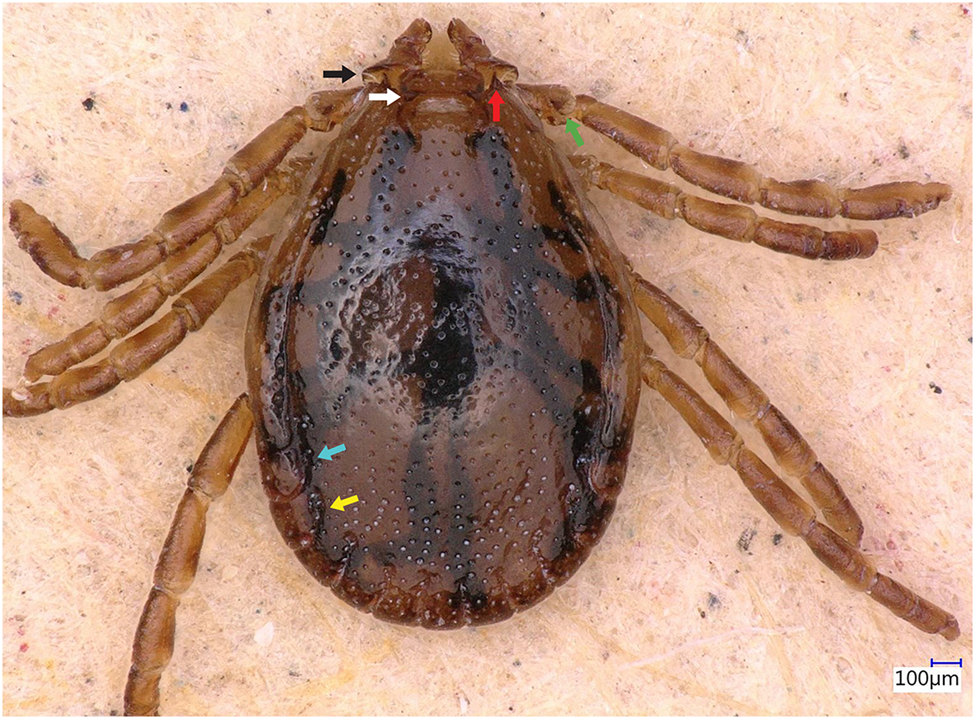
Idiosoma: Ornamentation is indistinct on the conscutum, with reddish brown to dark reddish colour. Overall body length (from 2 slightly engorged males) is 1.76–1.85 mm (from the middle of idiosoma to the edge of the idiosoma), width 1.29–1.38 mm, ovoid, widest at the 4th coxa (Fig. 1). Punctations are shallow, moderately sized, distributed slightly dense and uniform (Fig. 1); lateral grooves distinct, beginning at the level between coxae II and III and enclosing the first of the 11 festoons at each side (Fig. 1), the second festoon is nearly enclosed by a groove, which however does not come in contact with the lateral groove (Fig. 1). Scapulae are short and blunt; cervical grooves are inconspicuous, short, slightly convex externally, converging posteriorly; eyes absent; 11 festoons ranging from 0.15 to 0.21 mm in width, ventrally delimited by a marginal groove (Fig. 2). Stigmas are oval-elongated and rounded macula located on the antero-inferior side (Figs 2 and 3); anus with ‘Y’ anal groove, ‘Y’ tail reaching the marginal groove at the level of the central festoon and the lateral arms diverge below the middle of the anus laterally and come together with the genital groove (Figs 2 and 3). Genital apron medial to coxa II, with numerous small, distinct denticles on posterior margin (Fig. 4).
Haemaphysalis eleonorae male dorsal view: note the broadly salient palp article 2 (black arrow) and the broadly triangular cornua (white arrow). Coxa I anterior spurs are visible on the dorsal side (red arrow), trochanters with a small triangular spur (green arrow), lateral groove encloses first festoon at each side (cyan arrow); however, the second festoon is nearly enclosed by a groove, which does not come in contact with the lateral groove (yellow arrow).
Haemaphysalis eleonorae male ventral view: stigmas are oval-elongated and rounded macula located on the antero-inferior side (yellow arrow).

Haemaphysalis eleonorae male ventral view: spiracles, anus, anal groove and festoons. Note the ‘Y’ anal groove (white arrow), with ‘Y’ tail reaching the marginal groove at the level of the central festoon (yellow arrow) whereas the lateral arms diverge below the middle of the anus laterally and come together with the genital groove (black arrow).

Haemaphysalis eleonorae male ventral view: gnathosoma, coxae and genital apron. Note the broadly salient palpal segment 2 (green arrow), the intermediary denticles of this specimen presenting a variation in the commonly observed 4/4 dental formula (black arrow), the long spur, with rounded apex on coxa I (yellow arrow), the genital apron located between coxae II, with numerous small denticles on posterior margin (white arrow) and the short palp article 3 ventral spur, which is posterointernally directed, reaching or slightly extending beyond intersegmental suture (cyan arrow).
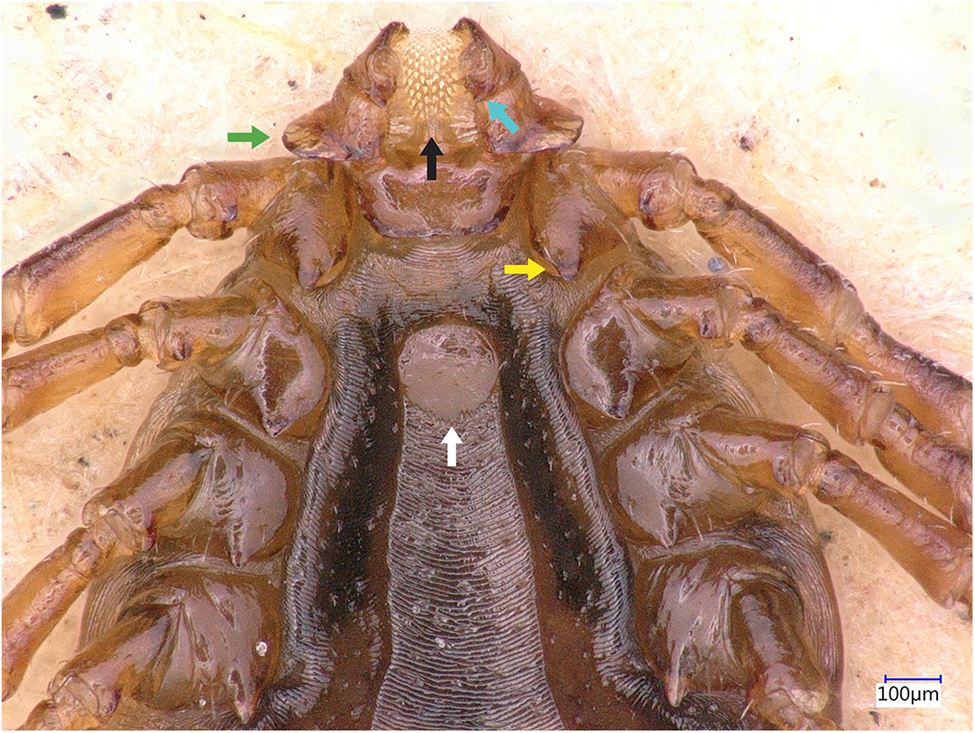
Gnathosoma: Length from apices to posterior margin of the basis 0.26 mm; the basis capituli is rectangular (0.29 length, 0.07–0.08 width), 4.1 times wider than long, with the posterior margin being straight and cornua being broadly triangular (Fig. 1). The distal end of article 2 is noticeably wider than the third article, without spurs dorsally (Fig. 1). Article 3, ventral spur short, slightly curved, reaches or slightly extends beyond intersegmental suture (Fig. 4); article 4 is in the apical pit, visible ventrally; hypostome is slightly shorter than the palpi, having length 0.20–0.21 mm; dental formula is 4/4, occasionally with some irregular rudimental denticles in the middle, with 8 large teeth in the principal files, distally a rosette is visible (Fig. 4).
Legs are short and robust (Figs 1 and 2). Coxa I with long spur, with rounded apex, directed posteriorly; coxae II–III with short and moderately broad spur and rounded apex; coxa IV with a long and moderately broad spur, with narrowly rounded apex (Fig. 4). Coxa I anterior spurs are visible on the dorsal side, between scapulas and second palp segment. All trochanters have a small triangular spur (Fig. 1). Tarsus I tapers distally, measuring a length of 0.37 mm, small oval area on the dorsum of tarsus I, Haller's organ.
Chaetotaxy: Small and tiny hairs can be observed on the palps and legs. Palpal segments II have 3 hairs on the dorsal side, and 8 setae on ventral side each. Coxae have 4 setae, 1 on the dorsal point, 1 on the internal side and 2 on the external side of the spurs.
Description of female
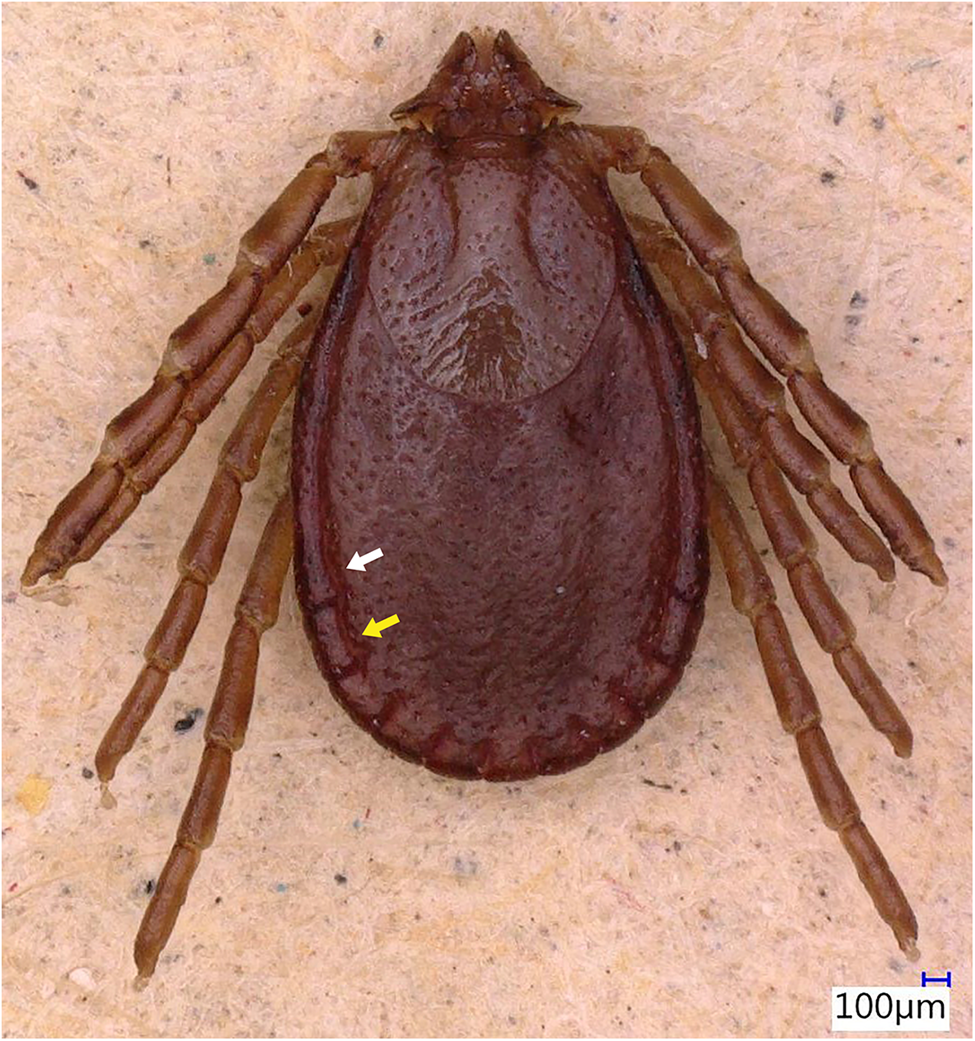
Idiosoma: Ornamentation is indistinct on the scutum, with reddish brown to dark reddish colour. Overall body length (from 3 females; 2 unengorged and 1 slightly engorged) is 1.87–2.51 mm (from the middle to the edge of the idiosoma), width 1.16–1.53 mm, ovoid, widest at the 4th coxa (Fig. 5). Scutum is wide-oval or almost circular (length 0.74–0.99 mm, width 0.73–1.01 mm), punctations are shallow, moderately sized, distributed slightly dense and uniform (Fig. 5); scapulae are short and blunt; cervical grooves are inconspicuous, long, almost parallel, slightly divergent anteriorly and posteriorly, eyes absent; lateral grooves are evident, beginning at the level between coxa II, from the scutum down enclosing the first 2 festoons at each side. Eleven festoons ranging from 0.15 to 0.26 mm in width, without ventral marginal groove, first festoon is not well delimited on the dorsal side (Fig. 5). Stigmas are oval-elongated and rounded macula located on the antero-inferior side (Figs 6 and 7); anus with ‘Y’ anal groove, ‘Y’ tail not reaching the central festoon and the lateral arms diverge laterally and come together with the genital groove (Fig. 7). The genital aperture is located between the coxae II and III, genital aperture lips form a wide ‘V’ (Fig. 8).
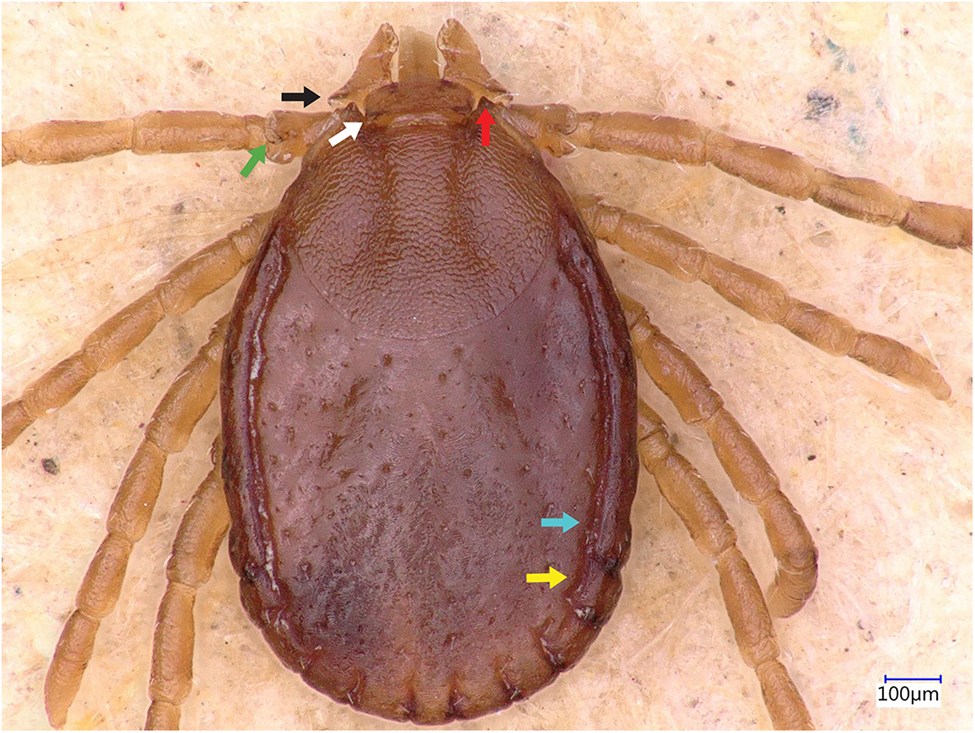
Haemaphysalis eleonorae female dorsal view. Note that the first 2 festoons are enclosed by the lateral grooves (yellow arrow). The first festoon is not clearly delimited (white arrow).
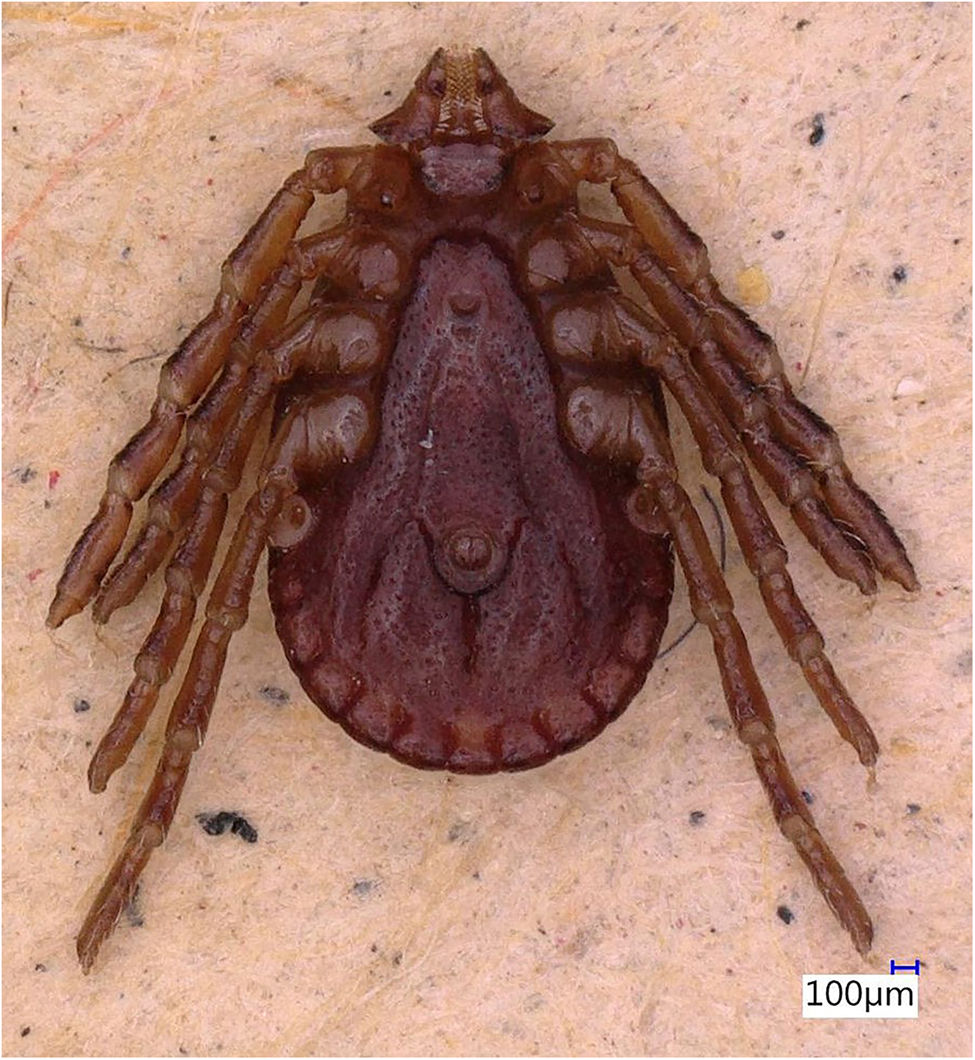
Haemaphysalis eleonorae female ventral view.
Haemaphysalis eleonorae female ventral view: anus, anal groove, festoons and spiracles. Stigmas are oval-elongated and rounded macula located on the antero-inferior side (yellow arrow), anus with ‘Y’ anal groove (white arrow), ‘Y’ tail not reaching the central festoon (cyan arrow) and the lateral arms diverge laterally and come together with the genital groove (black arrow).

Haemaphysalis eleonorae female ventral view: gnathosoma, coxae and genital aperture. Note the intermediary denticles of this specimen presenting a variation in the commonly observed 4/4 dental formula (black arrow), the broadly salient palpal segment 2 (green arrow), the short palp article 3 ventral spur, which is posterointernally directed, reaching or slightly extending beyond intersegmental suture (cyan arrow), coxa I with moderately long spur and broadly rounded apex (yellow arrow) and genital aperture lips forming a broad V (white arrow).
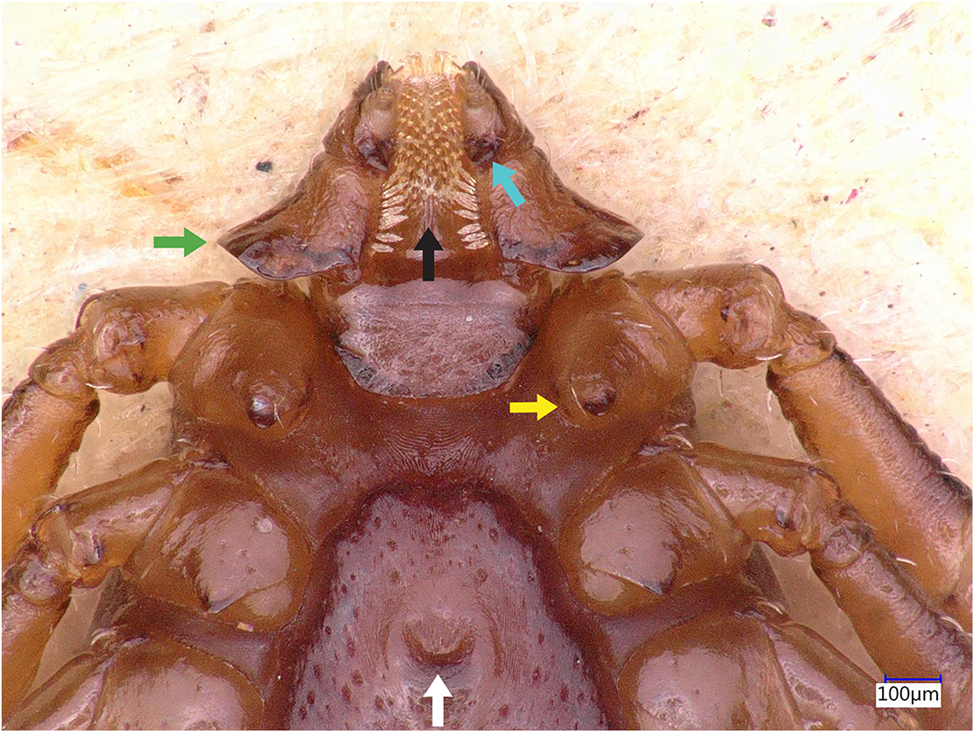
Gnathosoma: Length from apices to posterior margin of the basis 0.29–0.44 mm; the basis capituli is rectangular (length 0.09–0.12, width 0.37–0.43), 3.5–4.1 times wider than long, with the posterior margin being straight, and cornua are broadly triangular (Fig. 9). Porose areas oval, length 0.09–0.10 mm, wide 0.09–0.12 mm with large distance between them, almost touching the posterior margin. Palpi are broad. The distal end of article 2 is noticeably wider than the third article. Article 3, ventral spur short, slightly curved, extents slightly beyond intersegmental suture; article 4 is in the apical pit, visible ventrally; hypostome is slightly shorter than the palpi, having length 0.30–0.33 mm; dental formula is 4/4, with 8 teeth in the principal files, distally a rosette is visible (Fig. 8).
Haemaphysalis eleonorae female dorsal view: scutum and gnathosoma. Palp article 2 is broadly salient (black arrow), cornua is broadly triangular (white arrow), distance between oval porose areas large, they nearly reach the posterior margin of the basis capitula (cyan arrow). Coxa I anterior spurs visible dorsally (red arrow). Trochanters with a small triangular spur (green arrow).
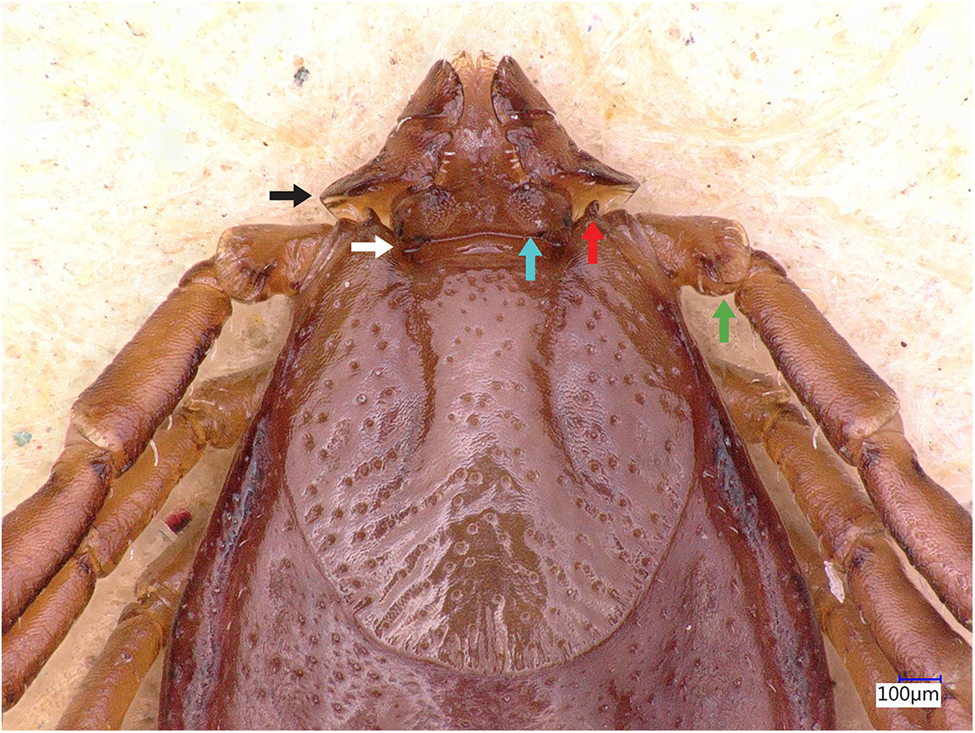
Legs are short and robust (Figs 5 and 6). Coxa I with moderately long spur, with broadly rounded apex, directed posteriorly; coxa II with short spur, with broadly rounded apex; coxae III–IV with longer spur, with a narrowly rounded apex (Figs 6 and 8). Coxa I anterior spurs are visible on the dorsal side, between scapulas and second palps segment (Fig. 9). All trochanters have a small triangular spur. Tarsus I tapers distally, measuring a length of 0.47–0.59 mm, oval small area on the dorsum of tarsus I, Haller's organ.
Chaetotaxy: Small and tiny hairs can be observed on the palps, legs and idiosoma both dorsally and ventrally. Palpal segments II have 3 hairs on the dorsal side, and 6 setae on ventral side each.
Description of nymph
Idiosoma: Ornamentation is indistinct on the scutum, with reddish brown colour. Overall body length (from 3 nymphs) is 0.85–1.09 mm (from the middle to the edge of the idiosoma), width 0.61–0.69 mm, ovoid, widest at the 4th coxa (Fig. 10). Scutum is wide-circular (length 0.31–0.39 mm, width 0.40–0.50 mm), punctations absent, presence of rugose transversal depressions (Fig. 10); scapulae blunt; cervical grooves, long, almost parallel, slightly divergent at the end, not reaching the scutum edge; eyes absent; lateral grooves are evident, extending from the scutum down enclosing the first 2 festoons at each side. Eleven festoons ranging from 0.06 to 0.11 mm in width, first festoons are not well delimited dorsally, without ventral marginal groove (Figs 10 and 11). Stigmas are almost round (0.05–0.06 mm) (Fig. 11); anus with ‘Y’ anal groove, ‘Y’ tail not reaching the central festoon and the lateral arms diverged laterally and come together with the genital groove (Fig. 11).
Haemaphysalis eleonorae nymph, dorsal view. Note that the first 2 festoons are enclosed by the lateral grooves (yellow arrow). The first festoon is not clearly delimited (cyan arrow). Palpal segment 2 is broad (black arrow), cornua broadly triangular (white arrow), coxa I anterior spurs visible dorsally (red arrow) and trochanter with a small spur (green arrow).
Haemaphysalis eleonorae nymph, ventral view. Palp articles 2 are broad (black arrow) and dental formula presents with a 3/3 pattern (red arrow).
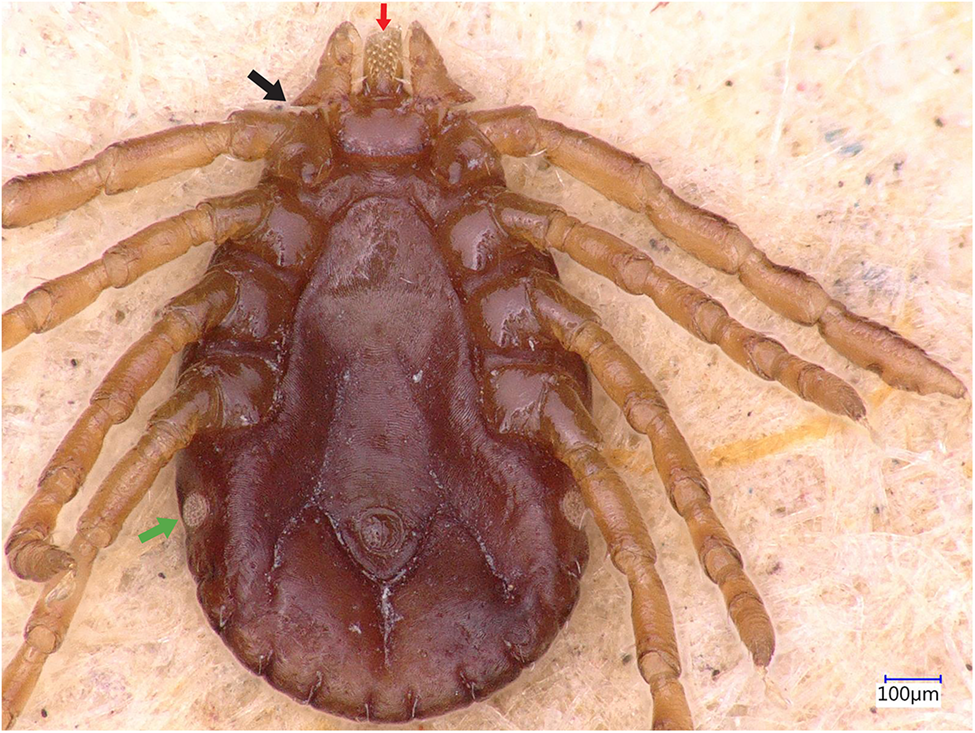
Gnathosoma: Length from apices to posterior margin of the basis 0.14–0.15 mm; the basis capituli is rectangular (length 0.04–0.05, width 0.17–0.19), 3.8–4.2 times wider than long, with the posterior margin being straight and cornua are broadly triangular (Fig. 10). Palpi are broad. Hypostome is slightly shorter than the palpi, having length 0.10–0.11 mm; dental formula is 3/3, with 4–5 teeth in the principal files, distally a rosette is visible (Fig. 11).
Legs are short and robust (Figs 10 and 11). Coxae with moderately long spur, with broadly rounded apex, directed posteriorly. Coxa I anterior spurs are visible on the dorsal side, between scapulas and second palps segment (Fig. 10). Tarsus I measuring a length of 0.25–0.29 mm, oval small area on the dorsum of tarsus I, Haller's organ.
Chaetotaxy: Small and tiny hairs can be observed on the palps, legs and idiosoma dorsal and ventral. Palpal segments II have 1 seta on the dorsal side, and 3 setae on ventral side each.
Remarks
Haemaphysalis is divided into 3 groups based on morphology: primitive, intermediate and structurally advanced. The structurally advanced group contains 6 Haemaphysalis subgenera, namely Ornithophysalis, Haemaphysalis, Kaiseriana, Aborphysalis, Segalia and Rhipistoma (Geevarghese and Mishra, Reference Geevarghese and Mishra2011).
The new species is based on its morphological features: 11 festoons, basis capituli rectangular without any lateral expansion in both immature and adults, dental formula 3/3 for nymphs and 4/4 for adults, belongs to the structurally advanced (Geevarghese and Mishra, Reference Geevarghese and Mishra2011).
The collected ticks lack any pronounced palpal segment 2 spurs and/or spur-like angles that characterize all adults and nymphs and most larvae of Rhipistoma. Therefore, Rhipistoma can be ruled out. In addition, palp article 3 ventral spur is short (reaching or slightly exceeding the border between articles 2 and 3), so it belongs to the Ornithophysalis subgenus. The species belonging to this subgenus seem to have abruptly evolved from structurally primitive. Six species from the known 20 parasitize only birds (Geevarghese and Mishra, Reference Geevarghese and Mishra2011). The adults have a 4/4 dental formula as H. hoodi, while some showed some intermediary denticles like a 5/5 dental formula as H. phasiana. However, according to Saito et al. (Reference Saito, Hoogstraal and Wassef1974), this is the most important character to distinguish H. phasiana from the H. doenitzi group, which comprises 4 mainly ornithophilic tick species (H. phasiana, H. hoodi, H. madagascariensis, H. doenitzi). In female of H. eleonorae the first festoons are not well delimited in the posterior part as in H. hoodi.
Nymph has 3/3 dental formula.
Comparison of ticks belonging to the H. doenitzi group
Table 1 provides the critical characters for morphological differentiation of the ticks belonging to the H. doenitzi group based on previous literature (Warburton and Nuttall, Reference Warburton and Nuttall1909; Hoogstraal, Reference Hoogstraal1966; Hoogstraal and Wassef, Reference Hoogstraal and Wassef1973; Saito et al., Reference Saito, Hoogstraal and Wassef1974; Horak et al., Reference Horak, Heyne, Williams, Gallivan, Spickett, Bezuidenhout and Estrada-Peña2018).
Morphological comparison of Haemaphysalis doenitzi group species adults with Haemaphysalis eleonorae sp. nov. based on Warburton and Nuttall (Reference Warburton and Nuttall1909), Hoogstraal (Reference Hoogstraal1966), Hoogstraal and Wassef (Reference Hoogstraal and Wassef1973), Saito et al. (Reference Saito, Hoogstraal and Wassef1974) and Horak et al. (Reference Horak, Heyne, Williams, Gallivan, Spickett, Bezuidenhout and Estrada-Peña2018)
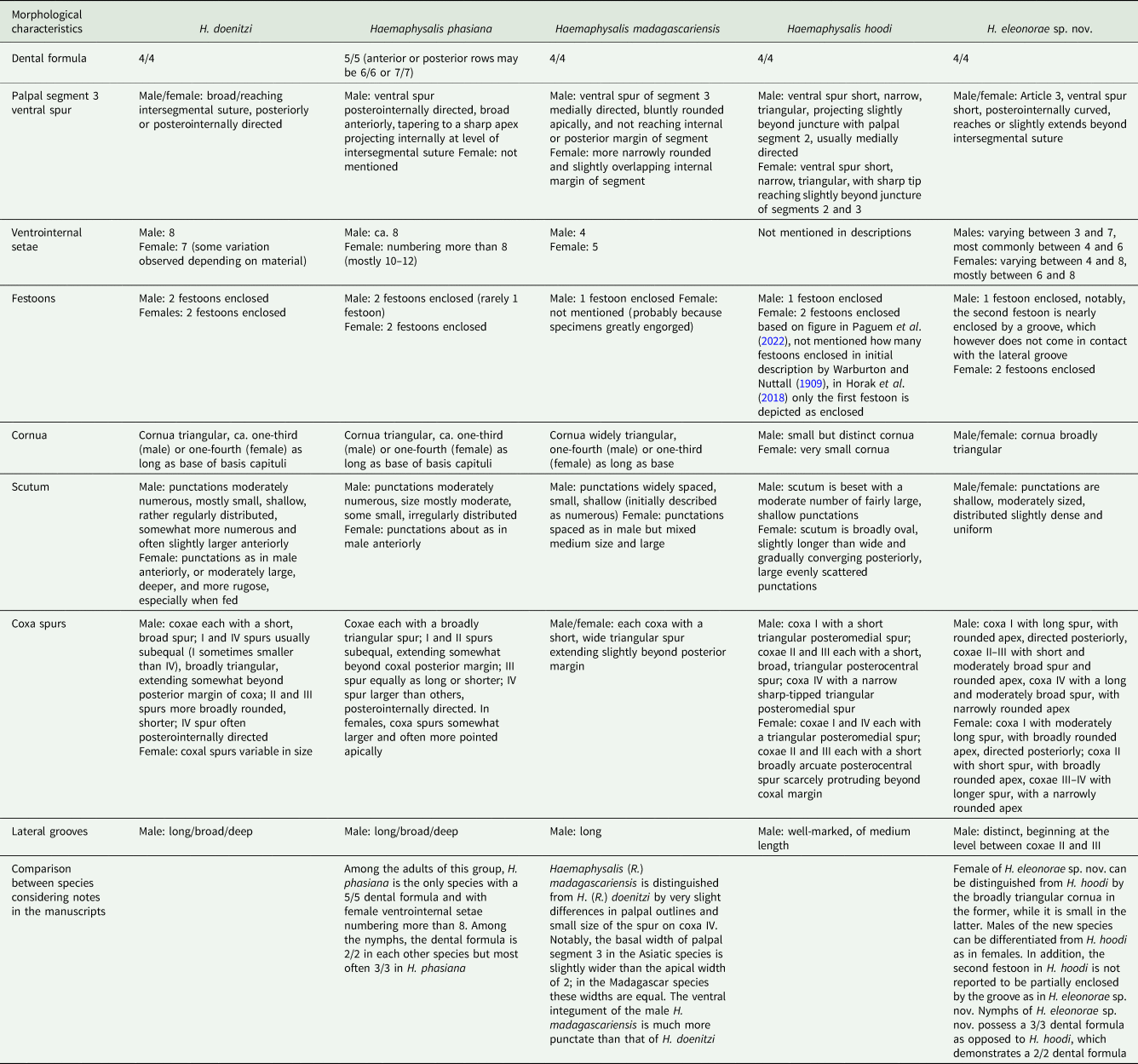
Note: Key characteristics are detailed in the referenced literature, in addition to the figures provided herein.
Phylogenetic analysis
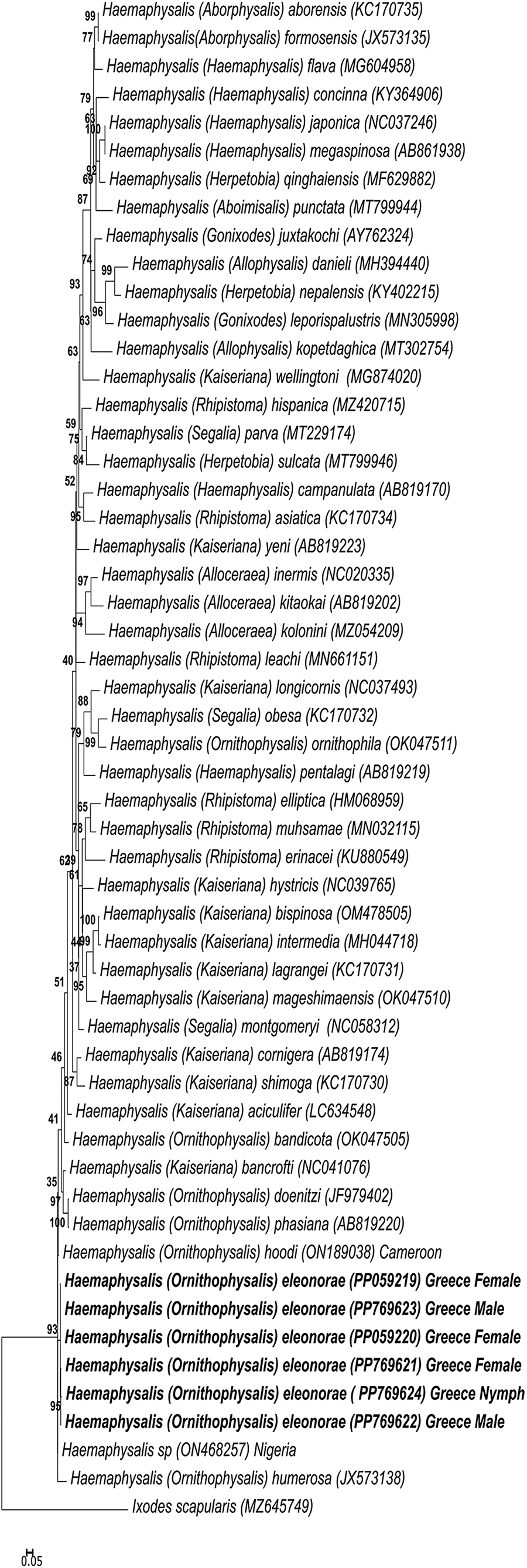
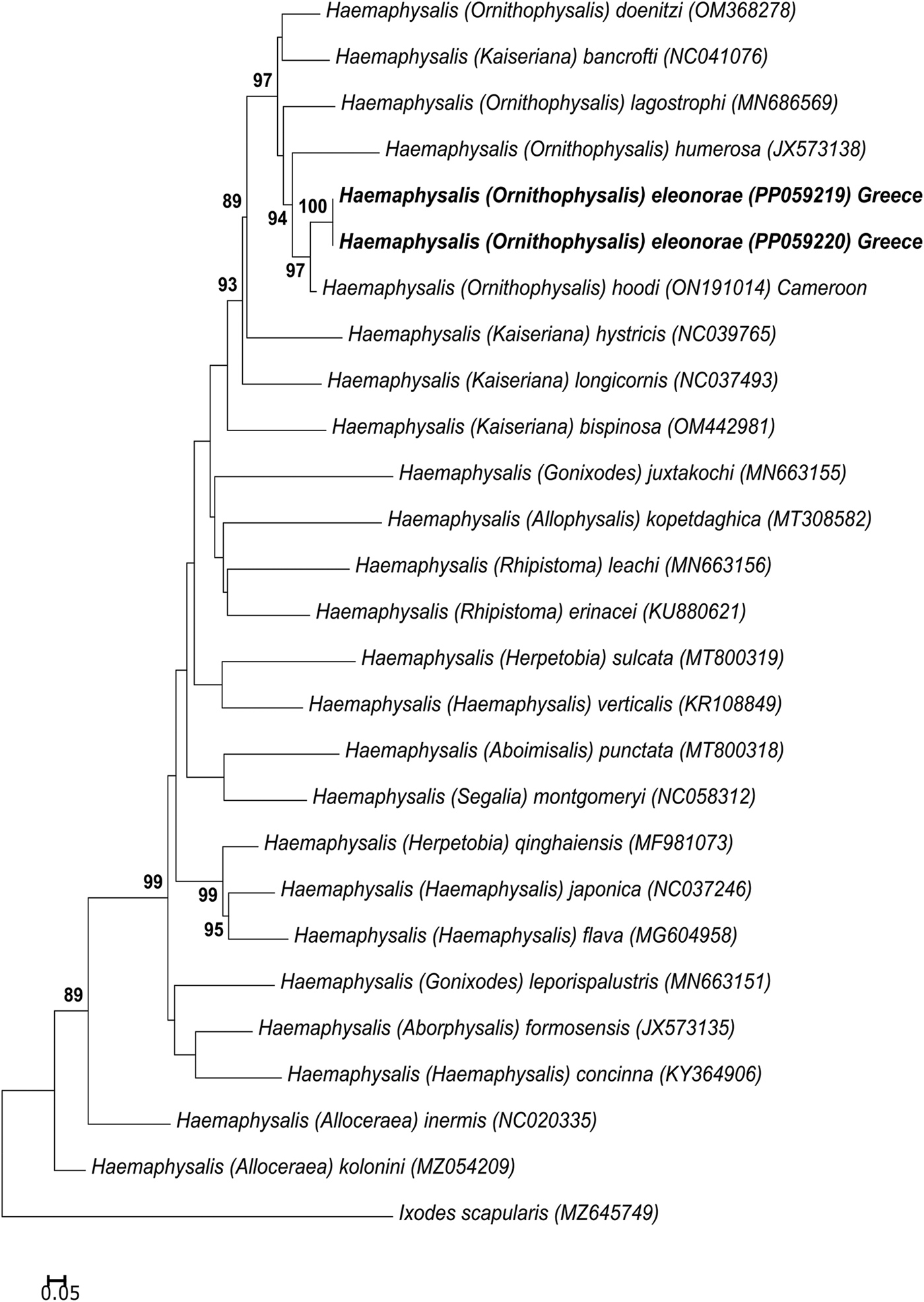
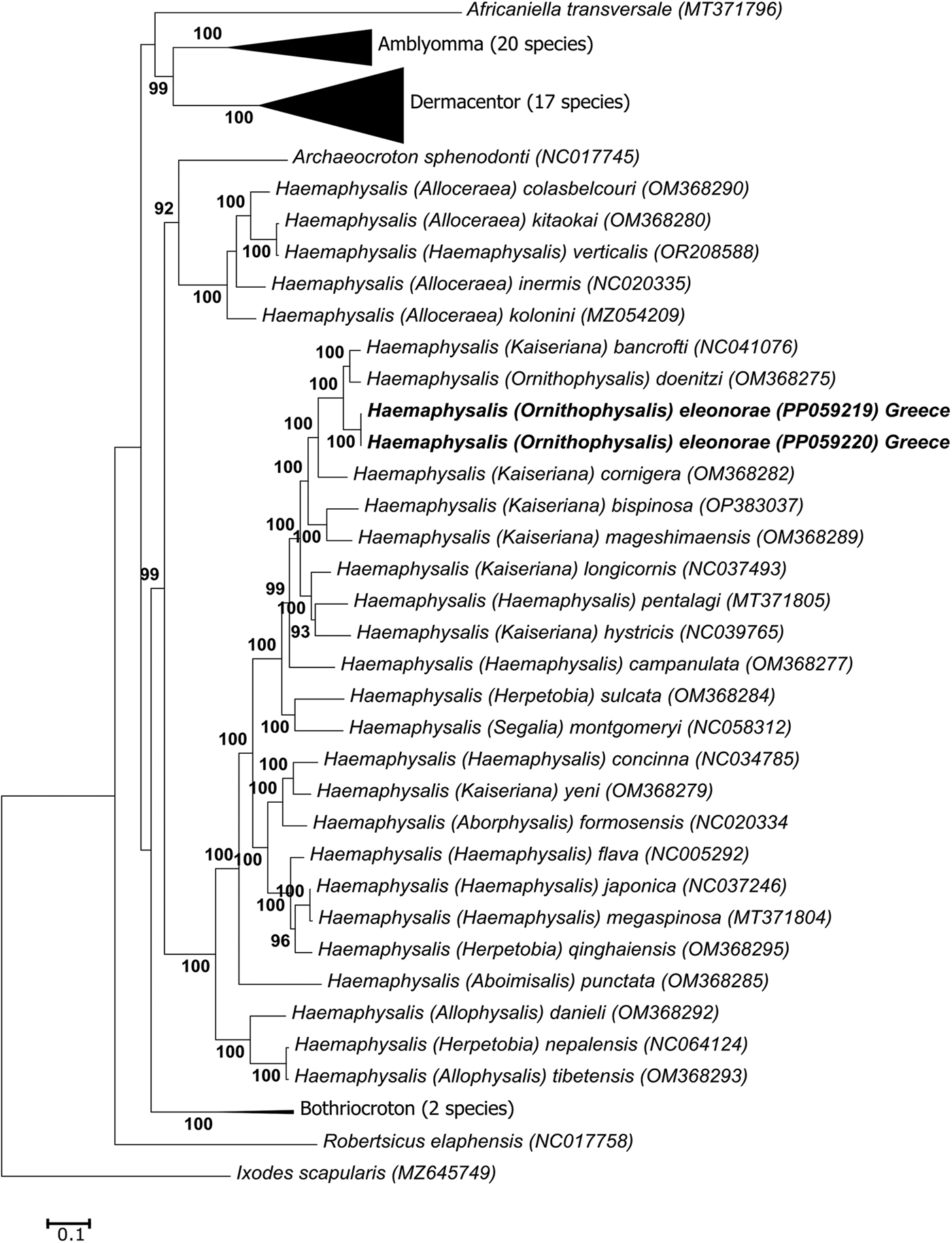
Phylogenetic analysis using the 16S gene indicates that H. eleonorae groups with H. hoodi from Cameroon as well as a sequence from Nigeria and Haemaphysalis humerosa forming a well-supported clade (Fig. 12). It also indicated that all 16S gene sequences from females, males and the nymph of the new species grouped in the same clade and showed >99% sequence identity. This clade is in turn nested within another well-supported clade with other members of Ornithophysalis and Kaiseriana. Similarly, for the COI gene, H. eleonorae groups with H. hoodi from Cameroon in a clade composed of other members of the Ornithophysalis and Kaiseriana (Fig. 13). The same grouping is observed for the analysis based on all mitochondrial proteins (Fig. 14). No strong support is observed for the monophyly of any of the subgenera.
Phylogenetic analysis of the 16S rRNA gene. Indicated are species names and subgenera followed by their GenBank accession number. The sequences from the current study are indicated in bold. Bootstrap values above 80% are indicated.
Phylogenetic analysis of the COI gene. Indicated are species names and subgenera followed by their GenBank accession number. The sequences from the current study are indicated in bold. Bootstrap values above 80% are indicated.
Phylogenetic analysis of the mitochondrial protein genes. Indicated are species names and subgenera followed by their GenBank accession number. The sequences from the current study are indicated in bold. Bootstrap values above 80% are indicated. Genera with more than 1 species have been collapsed and number of species in clade indicated.
Discussion
Migratory birds are well known to transport various tick species over long distances, climate zones and continents. A number of ticks, infesting other long-distance migratory birds (passerines and near-passerines species) have been detected in Antikythira, with the most abundant tick species belonging to H. marginatum and H. rufipes (Wallménius et al., Reference Wallménius, Barboutis, Fransson, Jaenson, Lindgren, Nyström, Olsen, Salaneck and Nilsson2014; Hoffman et al., Reference Hoffman, Carra, Öhagen, Fransson, Barboutis, Piacentini, Figuerola, Kiat, Onrubia, Jaenson, Nilsson, Lundkvist and Olsen2021). The detection of a new tick species which to the current knowledge seems to be associated specifically with Eleonora's falcons, in a single breeding island of the species so far, is therefore important. However, identifying possible areas of exposure to this tick species and/or possible modes of dispersal based on the information in hand is challenging considering that Eleonora's falcon is well-known for unique ecological adaptations that introduce further complexity.
Eleonora's falcons are aerial hunters, feeding almost exclusively on flying insects, except for the breeding period during which they rely on migratory birds (Walter, Reference Walter1979; Ristow, Reference Ristow, Chancellor and Meyburg2004; Xirouchakis et al., Reference Xirouchakis, Alivizatos, Georgopoulou, Dimalexis, Latsoudis, Portolou, Karris, Georgiakakis, Fric, Saravia, Barboutis, Bourdakis, Kakalis, Kominos and Simaiakis2019). In fact, the breeding period (mid-July–late October) has been fine-tuned with the passage of autumn migratory birds, an abundant food source intercepting the rocky islands where Eleonora's falcons breed colonially (Walter, Reference Walter1979; Xirouchakis et al., Reference Xirouchakis, Alivizatos, Georgopoulou, Dimalexis, Latsoudis, Portolou, Karris, Georgiakakis, Fric, Saravia, Barboutis, Bourdakis, Kakalis, Kominos and Simaiakis2019). For its increased insularity the Aegean Sea hosts more than 80% of the species' global breeding population (Dimalexis et al., Reference Dimalexis, Xirouchakis, Portolou, Latsoudis, Karris, Fric, Georgiakakis, Barboutis, Bourdakis, Ivovič, Kominos and Kakalis2008) that comprises of 29 200–29 600 mature individuals (BirdLife International, 2023). Following a trans-equatorial voyage of more than 7000 km, the falcons spend approximately 5 months in the Malagasy region visiting mainly rainforests and cultivated areas (Kassara et al., Reference Kassara, Gangoso, Mellone, Piasevoli, Hadjikyriakou, Tsiopelas, Giokas, López-López, Urios, Figuerola, Silva, Bouten, Kirschel, Virani, Fiedler, Berthold and Gschweng2017; Hadjikyriakou et al., Reference Hadjikyriakou, Kassara, de Roland, Giokas, Tsiopelas, Evangelidis, Thorstrom and Kirschel2020). Compared to a less consistent stopover pattern in autumn, on their way back to the Mediterranean in spring, they refuel intensively in savannas and shrublands in the Horn of Africa (Gschweng et al., Reference Gschweng, Kalko, Querner, Fiedler and Berthold2008; Kassara et al., Reference Kassara, Fric and Sfenthourakis2014; Vansteelant et al., Reference Vansteelant, Gangoso, Viana, Shamoun-Baranes and Figuerola2023 and references therein). Upon reaching their breeding grounds and until the onset of the breeding period, Eleonora's falcons can be observed in a variety of habitats across the Mediterranean region [e.g. forests, shrublands, cultivated areas, rivers (Kassara et al., Reference Kassara, Bairaktaridou, Kakalis, Tsiopelas, Giokas and Barboutis2019)], up to several hundred kilometres away from their breeding colonies during the pre-breeding period from April to July (Ristow and Wink, Reference Ristow and Wink1992–1994; Gschweng et al., Reference Gschweng, Kalko, Querner, Fiedler and Berthold2008; Ristow, Reference Ristow2010; Mellone et al., Reference Mellone, Lopez-Lopez, Liminana and Urios2013; Kassara et al., Reference Kassara, Evangelidis, Tsiopelas, Barboutis and Giokas2022). Given the extensive range and diverse habitats frequented by Eleonora's falcons throughout their annual cycle, understanding the potential pathways for the spread of H. eleonorae is intricate. Considering the infestation of both adults and nestlings during the breeding period, months after their arrival in the Mediterranean, we can at least safely assume that this tick species is established on the island of Antikythira. Future studies should explore the distribution of this tick species in other breeding colonies across its range, including those in the Aegean Sea. Additionally, data on Eleonora's falcons' infestation with ticks from the Malagasy region and sub-Saharan Africa would be necessary; however, their collection might be hindered by increased logistical and field-related constraints.
Reports on the established populations of tick species belonging to the H. doenitzi group seem to be missing from the Western Palaearctic, whereas the status of H. pavlovskyi is uncertain (Sames et al., Reference Sames, Kim, Chong, Lee, Apanaskevich, Robbins, Bast, Robert Moore and Klein2008). Haemaphysalis phasiana, which is assumed to be present in the Palaearctic was so far only described for its central/eastern part (Japan, Korea, Eastern Russia, Turkmenistan and China), whereas H. hoodi rather seems to have a sub-Saharan distribution (Hoogstraal and Wassef, Reference Hoogstraal and Wassef1973; Sames et al., Reference Sames, Kim, Chong, Lee, Apanaskevich, Robbins, Bast, Robert Moore and Klein2008; Paguem et al., Reference Paguem, Mans, Kingsley, Renz, Apanaskevich and Chitimia-Dobler2022). A single report on H. hoodi parasitizing Falco tinnunculus from Morocco and a Haemaphysalis sp. on Eleonora's falcons from Algeria has been additionally identified within the existing scientific literature (Bailly-Choumara et al., Reference Bailly-Choumara, Morel and Perez1980; Laid et al., Reference Laid, Abdennour, Nedjah, Samraoui and Samraoui2019). Haemaphysalis madagascariensis was so far only described from Madagascar (Hoogstraal, Reference Hoogstraal1966), whereas H. doenitzi seems to have an Oriental–Australian distribution (Hoogstraal and Wassef, Reference Hoogstraal and Wassef1973). The presence of the former species also needs careful re-evaluation according to Guglielmone et al. (Reference Guglielmone, Apanaskevich, Estrada-Peña, Robbins, Petney and Horak2014). Falconidae parasitism by H. doenitzi has been reported according to Guglielmone et al. (Reference Guglielmone, Apanaskevich, Estrada-Peña, Robbins, Petney and Horak2014) and H. hoodi in the past (Hoogstraal, Reference Hoogstraal1956). Our findings emphasize the probable significance of Falconidae as substantial hosts for tick species within the H. doenitzi group, underscoring the necessity for additional investigation into their impact on the ecology of these ticks.
Future investigations into the newly described species should prioritize an in-depth examination of its morphological and phylogenetic connections with closely related species within the H. doenitzi group, given the still limited mitochondrial genome data availability within the Ornithophysalis subgenus. Additionally, emphasis should be placed on exploring its ecology, biology and epidemiological importance, bearing relevance to both Falconidae conservation efforts and implications for public health. Considering the recent phylogenetic study on H. hoodi (Paguem et al., Reference Paguem, Mans, Kingsley, Renz, Apanaskevich and Chitimia-Dobler2022), the findings of the current study seem to be timely, also considering Saito et al.'s (Reference Saito, Hoogstraal and Wassef1974) comments on the necessity for studies from a greater number of regions and locations.
Data availability statement
All data generated or analysed during this study are included in this published article. Generated sequences were submitted to GenBank as stated in the main text.
Acknowledgements
This is contribution No. 40 from the Antikythira Bird Observatory, Hellenic Ornithological Society/BirdLife Greece. We thank the numerous volunteers of Antikythira Bird Observatory.
Author contributions
A. S., L. C.-D., C. B. and B. J. M. conceived and designed the study; C. B., C. K. and A. B. conducted the field survey; L. C.-D. and A. S. performed the literature search and morphological descriptions; B. J. M. obtained genetic data and performed their phylogenetic analysis. All authors contributed to writing, reviewing and editing the manuscript.
Financial support
This research received no specific grant from any funding agency, commercial or not-for-profit sectors.
Competing interests
None.
Ethical standards
Trapping of Eleonora's falcons was carried out with the relevant permits from the Hellenic Ministry of Environment and Energy. Rings were supplied free of charge by the Hellenic Bird Ringing Centre.


 Open access

