




Introduction
“All art is an imitation of nature.” (Seneca)
Antequera in Andalusia is one of five European megalithic sites to have been awarded UNESCO World Heritage status, and the only one to include ‘natural monuments’ alongside human-made ones. As well as three major megaliths built in the third and fourth millennia BC (Menga, Viera and El Romeral), Antequera includes two natural geological formations that played an important part in the genesis and development of Late Neolithic and Copper Age monumentality in the region: El Torcal and La Peña de los Enamorados (Figure 1).
Shaded relief map showing the locations of the sites mentioned in the text and the alignment of Menga's central axis. The base source is the 25m DEM of the Instituto Geográfico Nacional de España (IGN). Height above sea level ranges from approximately 400–450m in the Guadalhorce river basin to 1000–1300m in El Torcal. La Peña de los Enamorados has a maximum height of 880m (design: D. Wheatley).

El Torcal is a karstic formation located 11km south of Antequera and is home to El Toro, a cave occupied from the start of the Neolithic (c. 5400 cal BC) until the late fifth/early fourth millennium cal BC. El Torcal's significance for the Antequera prehistoric landscape relates to two factors: the ‘natural architecture’ created by the differential dissolution of the limestone and the concentration of natural resources around it, including flint, marble, ophite, dolerite, salt, iron oxides and peridotites.
A second natural monument is La Peña de los Enamorados (hereafter La Peña), a prominent limestone massif, orientated north–south, which towers at 880m asl above the Antequera plain. La Peña is remarkable for several reasons. First, because of its anthropomorphic silhouette: when the sun is low (especially at sunrise and sunset), it resembles the profile of a human head, or even a torso, facing upwards (Figure 2A). Second, the site is notable for its location at a natural crossroads connecting Málaga and Córdoba (i.e. south–north, between the Mediterranean coast and inner Iberia) and Sevilla and Granada (i.e. west–east, between the lower Guadalquivir Valley on the Atlantic coast, and the Spanish Levant). This location, and the distinctive shape of the mountain, have made La Peña an easily recognisable and well-known landmark for historical terrestrial navigation. Third, La Peña is notable for its visual connection with Menga, the earliest and largest of the three megaliths at the Antequera site. Menga, which was built between 3800 and 3600 cal BC (García Sanjuán et al. 2023), was orientated at 45°, beyond the range of sunrises between the summer and winter solstices with which most Iberian megaliths are aligned. At 45°, however, Menga is exactly aligned with the natural plane of the 100m-high cliff that forms La Peña's ‘chin’ on its northern side—a protrusion resulting from a concordant contact between oolitic and red nodular limestones with variable resistance to erosion (Figure 1).
View of La Peña de los Enamorados: A) from the south-west (photograph by C. Mora Molina); B) from the north-west, showing the location of the Matacabras rock art shelter and Piedras Blancas site (photograph by L. García Sanjuán).

Menga is thus likely to have originally been conceived to refer to a landform that its builders deemed so important that it would outweigh a more typical solar orientation for the monument. Research over the last 15 years has consistently emphasised the importance of La Peña's northern sector in the configuration of the Antequera landscape. This is evidenced, firstly, by the Matacabras rock art shelter, a sanctuary whose schematic motifs were painted before c. 3800 cal BC—that is, before Menga was built (Rogerio-Candelera et al. Reference Rogerio-Candelera2018)—and which was likely the specific ‘target’ of Menga's orientation (Figure 2B); and, secondly, by the Piedras Blancas site (García Sanjuán et al. Reference García Sanjuán2015), which lies immediately below Matacabras (Figure 2B) and of which the megalithic tomb presented in this article forms a part.
While the discovery and investigation of this site (between September and December 2020) further demonstrates that Menga was orientated towards La Peña's northern sector, it also reinforces the social, ideological and symbolic significance of the mountain before Menga was built, adding further layers of complexity to the Antequera prehistoric landscape. Here, we aim to show that the new discovery is in line with previous research that highlights the complex patterns of interaction between natural and human-made features in the making of places, particularly where conspicuous natural formations existed. This has been observed among prehistoric communities in Britain, Portugal, the Netherlands and elsewhere in Europe (e.g. Bradley Reference Bradley, Bradley and Williams1998, Reference Bradley2000; Calado Reference Calado and Scarre2002; Fontijn Reference Fontijn2002; Salisbury Reference Salisbury, Díaz-Guardamino, García Sanjuán and Wheatley2015) and is clearly the case at Antequera (García Sanjuán & Wheatley Reference García Sanjuán, Wheatley, Lillios and Tsamis2010).
Geology, architecture and archaeoastronomy
The Piedras Blancas megalithic tomb was built on a small hill of calcarenites, with nummulites corresponding to the Baetic flysch, of Eocene age. This hill is part of an anticline fold, with a fracture on its hinge line with a N160°E vertical direction. This fracture cuts the stratification (N45°E) in a series of highly penetrative planes to a metric scale. Thus the megalithic structure is embedded in the local geological substrate, following the general N45°E orientation of the local geology. This matches the direction of La Peña's north-east plane (the cliff resembling the chin of the anthropomorphic figure), where the Matacabras rock art shelter is located, as well as Menga's axial orientation. Seen from a distance, particularly from the west, the hill where the Piedras Blancas megalithic tomb was built resembles the chest of the ‘sleeping giant’ (Figure 2B).
The tomb is part natural monument, part hypogeum, part megalith. It consists of a pseudo-rectangular cavity, 4.5m long and 1.45m wide, which was cut into the bedrock through the removal of the local calcarenite rock and then delimited, to the east and west, by a series of medium-sized slabs (Figure 3). The long sides of the structure, to the north and south, are formed by the naturally occurring calcarenite rocks, which are vertical by virtue of the anticline fold. The builders thus made intentional use of the naturally folded geology, creating a structure integrated into the landscape. No evidence was found to ascertain the presence of a roof, although some large broken slabs found in the upper part of the tomb's fill may constitute the remains of capstones from an earlier phase.
General view of the Piedras Blancas megalithic grave, with La Peña de los Enamorados in the background (photograph by M. Ángel Blanco de la Rubia).

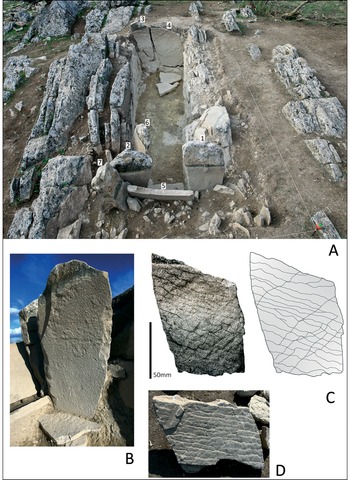
The two slabs delimiting the tomb at its eastern side (the entrance) and the two that close it on the western end (the back of the chamber) are made of locally available stone and appear to have been carefully selected and carved. All the slabs forming the entrance (nos 1, 2, 5, 6 & 7) were carefully dressed and decorated with engraved motifs, currently under study (Figure 4A & B). The stone on the right-hand side of the back of the chamber (no. 4) is not engraved or painted but was possibly chosen because, while natural, it appears decorated, consisting of a series of parallel undulating ripples arranged horizontally (Figure 4C). These ripples formed on the seabed, where this sedimentary rock originated. Seen under a raking, contrasting light, these motifs resemble waves, but also convey the idea of an organic texture, such as the scales of a fish or reptile. A large fragment (measuring approximately 0.70m across) of an identical stone was found in the upper part of the tomb's fill (Figure 4D). This type of ‘natural decoration’ is significant because it supplements recent evidence pointing to the interest of megalith-builders in sedimentary marine rocks with biogenic or natural decoration (Cáceres-Puro et al. Reference Cáceres-Puro2019; Cortés-Sánchez et al. Reference Cortés-Sánchez2020). Furthermore, a (larger) slab with identical ripples was used as a jamb on the right-hand side of the threshold between the long corridor and the main chamber at the El Romeral tholos, located approximately 3km west of Piedras Blancas. The use at visually prominent locations, such as Piedras Blancas and El Romeral, of slabs of marine sedimentary rocks with ripples suggests that these structures were built according to a shared set of ideas.
A) General view of the excavated Piedras Blancas megalithic grave from the east, with numbering of the stones. At the far end, the two ‘arrow-like’ slabs attached to the bedrock; B) stone no. 6 (stela), with horizontally laid slab at its base (for offerings); C) stone no. 4, including line drawing of the natural ripple decoration; D) fragmented slab with ripple decoration found inside the tomb, in the upper part of the fill (photographs by M. Ángel Blanco de la Rubia and L. García Sanjuán; line drawing and qualitative image enhancement of photograph of stone no. 4 by M. Díaz-Guardamino).

Another remarkable architectural device consists of two triangular dressed stones of similar size (0.45–0.50m maximum width) placed horizontally, directly on the bedrock at the foot of slab 4 (Figure 4A). Both triangular slabs were firmly fixed to the chamber's floor with a mud mortar. The two slabs were laid when the tomb was first built, or shortly afterwards, and are thus integral to its original design. Taking an archaeoastronomical approach to the general plan of the structure, the significance of these two triangular stones (‘arrow-like device’ hereafter) becomes apparent.
To ascertain the precise orientation of the tomb, and of the arrow-like device in particular, we use:
1) the World Magnetic Model (WMM) provided by the National Geophysical Data Centre of the National Oceanic and Atmospheric Administration (http://www.ngdc.noaa.gov/geomag-web/);
2) direct measurements made in situ towards three landmarks on the horizon;
3) photographs of the tomb used to form a cylindrical panoramic view (processed with Hugin and Stellarium 0.20.3 software); and
4) photogrammetric models produced during the excavation.
Azimuth data were collected with a professional compass (SUUNTO 360-R) and corrected for magnetic declination, with a 0.25° accuracy. Horizon heights were obtained with a professional SUUNTO inclinometer, with 0.33° precision. Each structure was measured at least five times, and the results in Table 1 provide the means of these measurements. The final uncertainty, ±0.5° in azimuth, is the quadratic sum of the device precision and the standard deviation of such measurements. The readings in Table 1 include astronomical declinations of 34.2° for the axis of the chamber and 24.8° for the arrow-like device.
Azimuth, horizon heights and declination of the Piedras Blancas grave.

Our results show that the orientation of the arrow-like device coincides with the summer solstice sunrise (approximately 24.2°) for 3400 cal BC, a date deemed plausible for the construction of the tomb (see below). Remarkably, the projection of the line formed by the arrow-like device passes exactly through the gap between the eastern end of the southern rock wall of the tomb and two stones positioned at the eastern end; the latter were not intended to delimit the tomb's entrance but, rather, were placed inside (no. 5 on Figure 4) and outside (no. 7) the entrance, on either side of slab 1. Slabs 5 and 7, which are heavily engraved, appear to have been precisely placed to ‘funnel’ the light from the rising sun towards the back of the chamber at the summer solstice. Indeed, this elaborate arrangement of stones would allow the sun to illuminate, on those days, slab 4 at the back of the chamber, producing a visual effect on the ripples present on that stone. The ‘window’ created by slabs 5 and 7 subtends to an angle between 58.75° and 55.75°, at an average height of 0.25°, which translates in declinations to between 24.2° and 26.5°. This solstice sunrise effect is fully corroborated by simulations combining a 3D model of the chamber based on two different models of the horizon: one drawing on a Digital Terrain Model of the Shuttle Radar Topography Mission (low resolution: 30m) and another on the panoramic image (Figure 5).
Archaeoastronomical analysis of the Piedras Blancas megalithic grave: A) sunrise on the summer solstice of 3400 cal BC; B) sunlight funnelled to illuminate slab no. 4, with undulating ripples (design by C. González-García).

It is also worth noting that the line perpendicular to the axis of the tomb points, at one end (south-east), towards the slope of La Peña, whereas at the other end it points towards the north-west (azimuth: 315°; height: 0°; declination: 33.9°), outside the sunrise range. Given the height of the horizon in the direction of La Peña, the south-easterly orientation could be significant, as it matches the winter solstice sunrise.
Phases, chronology and human remains
The fill of the tomb included a substantial assemblage of human bone, some faunal remains, knapped lithics and ceramics. A large number of stones (988kg), used to create specific features and spaces within the burial chamber, was also recorded.
The human remains are of special importance, given the total absence of prehistoric human bone from the three main megalithic monuments at the Antequera site. In general, the bone recovered is poorly preserved and highly fragmented, showing a 0–25 per cent level of completeness. This makes it impossible to observe certain morphological characteristics and to record essential metrics, and seriously hampers pathological analysis. Taphonomic effects are visible mainly through alterations in the periosteum (outer surface) of the bones; signs of erosion and wear, as well as rugose surfaces, sometimes associated with longitudinal crevices, are probably due to prolonged weathering.
Many of the teeth are covered in concretion, impeding surface observation. Despite these drawbacks, the human bone assemblage provides valuable information concerning the use of the tomb and the demography of the communities that built and used it. In addition, seven radiocarbon dates were obtained on samples of this human bone (Table 2). A Bayesian model based on those dates (Figure 6A), with ages rounded to five years and run on OxCal v4.4 (Bronk Ramsey & Lee Reference Bronk Ramsey and Lee2013) and the IntCal 20 curve (Reimer et al. Reference Reimer2020), indicates that the use of the tomb began in 3185–2935 cal BC (at 68.2% confidence) or 3635–2915 cal BC (at 95.4% confidence), and ended in 1900–1630 cal BC (at 68.2% confidence) or 1950–1180 cal BC (at 95.4% confidence), with a duration of 1180–1185 years (at 68.2% confidence) or 985–1265 years (at 95.4% confidence). The stratigraphic evidence, combined with the human bone and radiocarbon dates, suggests that the tomb was used over three major phases (Table 2).
Bayesian chronometric models: A) model based on the eight dates available for the tomb; B) model for individuals 3005 and 3006 in Phase 2 (design by V. Balsera Nieto).

Radiocarbon dates for the Piedras Blancas grave.

Phase 1
The lowest level of the tomb, directly above the bedrock, represents its earliest phase of use. Spatially, this level shows a clear division into four distinct areas (Figure 7). The closest to the entrance yielded no human bones and was largely clear of stones; it appears to have been devoted to the deposition of offerings, including 10 complete ceramic vessels. Further towards the back of the chamber, a complex arrangement of medium-sized stones tightly bonded with mud appears to have acted as a platform on which to place bodies and/or bones. Further to the west were numerous human bones, forming a dense and unstructured ossuary, as if they had been intermittently pushed from the central stone platform into the space as the bodies of the deceased decayed. Finally, an empty space was identified between this area and the back of the chamber. This part of the tomb was reserved for the two stones of the arrow-like device described above, which might be interpreted as a sophisticated solar ‘compass’.
Phase 1 (earliest) of the Piedras Blancas megalithic grave, from the east. Offerings in the foreground, ossuary in the background, and platform made of stones in between (photograph by M. Ángel Blanco de la Rubia).

Relating to this phase, we identified 95 bones and 40 teeth. The estimated minimum number of individuals (MNI) is five: four adults (represented by four left femora and four identical teeth—left lower second molars), for whom no precise age at the time of death could be established, and one child of a dental age of approximately 7.5±2 years. One left talus with a maximum length of 55mm (i.e. above the cut-off point for males; Wasterlain Reference Wasterlain2000) suggests the presence of at least one male individual.
Two radiocarbon dates from the human bone relate to this phase (Table 2). Multiple attempts to obtain further dates failed due to insufficient collagen. The earliest of these dates (3093–2911 cal BC, at 95.4% confidence) reveals that the tomb was already in use at the turn of the third millennium cal BC, suggesting its construction sometime earlier, in the final centuries of the fourth millennium cal BC. The second radiocarbon determination for this phase is much later (2577–2459 cal BC, at 95.4% confidence), suggesting that the use of the tomb as a charnel house spanned several centuries. The small number of individuals represented in this phase may indicate that the tomb was either only sporadically used and/or that only select individuals were interred there, or that subsequent activities have disturbed some of the human bone from this phase.
Phase 2
Circa 2500 cal BC, a major transformation of the tomb took place. Its entire base was covered with a thick layer of sediment (approximately 0.30m thick) and the floor of the structure levelled. Two complex stone niches were built on this newly created surface, into which two primary inhumations were placed within a short period of time (Figures 8 & 9).
Phase 2 (middle) of the Piedras Blancas megalithic grave, from the east. In the centre of the chamber are niches made for individuals 3005 and 3006 (photograph by M. Ángel Blanco de la Rubia).

Phase 2 (middle) of the Piedras Blancas megalithic grave. Detail of the stone niches with individuals 3005 and 3006 (photograph by M. Ángel Blanco de la Rubia).

The westernmost of these features was carefully made with several stones enclosing a bed made of horizontally laid slabs. Within this feature, an individual (designated 3006) was interred in right lateral decubitus position, with the head pointing south-east. This individual's bones are relatively well preserved, with 50–75 per cent of the skeleton recovered, and all skeletal elements present. Individual 3006 is a male adult, more than 28 years old, based on epiphyseal fusion data; one femur has a weak degree of flatness, whereas the right tibia shows crushing and considerable flattening of the shaft due to biomechanical effects. Tooth wear varies between medium and high. Two possible cariogenic lesions were identified on the upper left second and third molars. Only one type of non-articular degenerative pathology could be identified: entheseal changes (or biomechanical stress markers) on the right humerus, the left ulna and one phalanx of the left hand. Sexually dimorphic amelogenin protein fragments from the tooth enamel of this individual were analysed by nanoflow Liquid Chromatography-Tandem Mass Spectrometry (nanoLC-MS/MS), confirming the sex identification as male (for details of method, see Rebay-Salisbury et al. Reference Rebay-Salisbury2020, Reference Rebay-Salisbury2022).
The second of the niches was attached to the eastern side of the first niche, and therefore closer to the tomb's entrance. This was a simpler structure, with stones forming an elongated space, approximately 1m in length, on the same orientation as the base of the other niche. An individual (3005) was buried in the second niche in hyper-flexed, right lateral decubitus position, with the head also pointing south-east. Approximately 50–75 per cent of the skeleton is preserved. The individual was an adult, probably female based on cranial morphology—an identification confirmed by the analysis of sex-specific peptides by nanoLC-MS/MS. In terms of age, it is not possible to be more specific, since none of the diagnostic anatomical elements was present. Among the teeth, all third molars were absent, probably resulting from agenesis (non-eruption); the other teeth present atypical wear, perhaps due to non-masticatory use. Three cariogenic lesions were recorded but no other pathologies were identified.
The radiocarbon dates for each of these individuals are detailed in Table 2. A statistical model combining both dates shows that they are statistically different, and therefore the individuals died and were buried at different times. A second Bayesian model using two phases (one for each date) and adding the Interval function between them yields a robust verisimilitude index (99.2 Amodel), showing that individual 3005 was buried first (start 2510–2350 cal BC (at 68.2% confidence) or 2745–2290 cal BC (at 95.4% confidence) and end 2430–2305 cal BC (at 68.2% confidence) or 2485–2245 cal BC (at 95.4% confidence)). Individual 3006 was buried between 2355–2235 cal BC (at 68.2% confidence) or 2450–2200 cal BC (at 95.4% confidence) and 2335–2155 cal BC (at 68.2% confidence) or 2445–1935 cal BC (at 95.4% confidence). The time span between the two burials was 0–85 years (at 68.2% confidence) or 0–185 years (at 95.4% confidence).
Neither of these two individuals was accompanied by grave goods. Knapped lithics were found around both of them, though not within the niches; as similar lithic material was noted throughout the entire fill of the tomb, there is nothing to suggest they were intended as personal grave goods. Considering their burial within the carefully built niches, the absence of prestige objects associated with these two individuals is notable, as they appear to have been people of elevated social status.
Phase 3
Sometime after the inhumation of individuals 3005 and 3006, the tomb underwent another significant transformation. A set of medium- to large-sized stones was placed inside the entrance, as if to block or seal it. The size of some of these stones suggests that they may originally have been capstones used to roof the structure, but this remains unclear. Around and above these stones, another assemblage of human remains was found, including five crania associated with mandibles and other articulated bones. These latter bones were not anatomically related to the five crania.
The MNI for Phase 3 is eight (based on eight right lower first molars), including at least two non-adult individuals estimated to have been approximately 13.5 years and 9 years (both ±24 months) old at death. Three of the crania (nos 3003-4, 3003-5 & 3003-7) present features which indicate that they possibly belonged to female individuals. A circular depression on the left parietal of cranium 3003-3, which displays masculine features, might result from a trepanation procedure. The bone around the possible trepanation hole is smooth, rounded, and a little thinner than the surrounding bone, indicating that the individual survived whatever caused the hole long enough for healing to begin. No other age or sex indicators are present in the sample. One loose upper left incisor has a small cariogenic lesion. Cranium 3003-1 presents shovelling in the superior central incisors and a double-rooted lower left canine. No pathologies were observed in the bones from this phase, although once again, poor preservation of the bone surfaces hinders observation.
Radiocarbon dates obtained from crania 3003-1 and 3003-2 yield ages of 2291–2047 and 1931–1749 cal BC (at 95.4% confidence) respectively, which places them in the Early Bronze Age. This underlines the remarkable persistence of the monument's use through time, and fits well with the abundant evidence for the extensive reuse of Late Neolithic and Copper Age monuments by Bronze Age communities across the Antequera region (García Sanjuán & Mora Molina Reference García Sanjuán, Molina, Bartelheim, Cortés and Hardenberg2022).
Material culture
The material assemblage recovered from the tomb is remarkably homogeneous across the three phases of use. The grave goods appear to have consisted exclusively of numerous knapped lithics (351 in total) and pottery vessels, including 12 complete examples and many fragments (1407 in total). Although a detailed study is yet to be completed, the lithic tools are primarily of the same microlithic type found in large quantities on the surrounding surface at Piedras Blancas (García Sanjuán et al. Reference García Sanjuán2015) and at other Late Neolithic and Copper Age settlements of the Antequera plain (García Sanjuán et al. Reference García Sanjuán2020). No metal objects were recovered, even though the monument was used during the Copper and Bronze Ages (in this context, it should be noted that no signs of modern looting were recorded). Artefacts made of imported raw materials, such as ivory, amber or ostrich eggshell, were absent, as was cinnabar pigment, which is typically present elsewhere in major Copper Age megalithic tombs (Costa Caramé et al. Reference Costa Caramé, Sanjuán, Scarre and Wheatley2011).
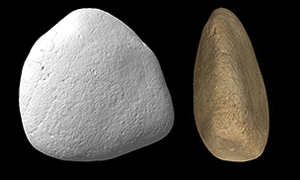
A remarkable object was discovered at the threshold of the tomb's entrance: a triangular limestone ‘pebble’ (0.175m maximum length) that had been carefully inserted between slabs 1 and 2 (Figure 10). The base of this stone was flattened through abrasion, so that it could stand vertically. Detailed analysis with high-resolution digital techniques identified no other human modification on the stone's surface (for a 3D model, see https://skfb.ly/osMtU). Seen from its narrower side, the stone has a powerful ‘biomorphic’ appearance, resembling the head or face of an animal (a bird) or a human being. This object, like many ‘baetyls’ or ‘idols’ placed at the thresholds of atria or corridors of megalithic tombs across Iberia, particularly in the north-west (Fábregas Valcarce et al. Reference Fábregas Valcarce, Rodríguez-Rellán, Caamaño, Ramírez and Díaz2020), would probably have had an apotropaic function. The largely unmodified state of this pebble underlines, once again, the significance of ‘natural’ elements in the composition of the Antequera landscape.
Apotropaic pebble found at the entrance of the Piedras Blancas megalithic grave (photograph by L. García Sanjuán): A) the pebble as found; B) photogrammetric renderings (design by M. Díaz-Guardamino).

Conclusions
The discovery of a new megalithic monument at La Peña de los Enamorados considerably expands our understanding of the Antequera World Heritage site. Although our study of this new site is in its early stages, several notable elements can already be determined. First, the location and architectural concept of the tomb underline the subtle but sophisticated dialogue between natural formations and human-made monuments during the Neolithic. Second, along with the nearby Matacabras rock art shelter, the tomb further emphasises the importance of La Peña as a focus of Neolithic activity; this underscores the character of La Peña as both a landmark and a geo-sculpture. Third, the in-depth study of the geology, architecture and orientation of the tomb reveals a sophisticated arrangement through which the carving of rocks (either as stelae, as astronomical devices, or as canvasses decorated with natural motifs of marine origin) was coupled with the natural orientation of the geological substrate to ‘domesticate’ sunlight; this was intended to produce a specific (even dramatic) visual effect at the summer solstice sunrise—a symbolically charged time of the year. In this sense, the architectural design of the newly discovered Piedras Blancas tomb plays a role not unlike that of Newgrange in Ireland (Patrick Reference Patrick1974). Indeed, although not directly orientated to the sunrise, Menga was created so that, during the summer solstice, sunlight would cause a certain effect on the right-hand side of the chamber (Lozano Rodríguez et al. Reference Lozano Rodríguez2014).
Our observations suggest that natural formations and elements, especially rock outcrops, but also water and light, played a major part in the way in which Neolithic societies created the Antequera monumental landscape. This is consistent with the observations of Richard Bradley in An archaeology of natural places (2000), which has inspired much research on European monumental and sacred places dating to the Neolithic and Bronze Age (e.g. Devereux Reference Devereux1991; Calado Reference Calado and Scarre2002; Fontijn Reference Fontijn2002; García Sanjuán & Wheatley Reference García Sanjuán, Wheatley, Lillios and Tsamis2010; Salisbury Reference Salisbury, Díaz-Guardamino, García Sanjuán and Wheatley2015). To quote Salisbury (Reference Salisbury, Díaz-Guardamino, García Sanjuán and Wheatley2015: 21), “the religious beliefs of the early Neolithic settlers, who erected the great standing stones, did not rise with the stones. Instead, before their engineering feats, they venerated the world around them, the mountains, the caves, the trees and the springs.”
Antequera illustrates the power by which nature presided over the Neolithic worldview, inspiring and guiding the creation of monuments. Is it mere chance that the largest and most sophisticated Neolithic monumental landscape in Iberia is in a region with not one but two remarkable natural formations: El Torcal and La Peña de los Enamorados? El Torcal was the location of choice for the first Neolithic settlers of the region, when, c. 5400 cal BC, a small community—most probably arriving from the Málaga coast (40km south)—occupied El Toro cave. Geologically, El Torcal is a pseudo-horizontal stratigraphy of limestone rocks, which clearly conditions the circulation of water, helping the dissolution of the various different materials from which it is formed (well-stratified oolithic, nodular, or pseudobrechoid limestones). Due to their different textures and carbonate content, processes such as dissolution, gelation and wind action have differentially dissolved the limestones to form corridors, sinkholes and caves, among other geomorphological features (Burillo Panivino Reference Burillo Panivino, Durán and Martínez1998). Neolithic settlers in the region may not have understood the formation processes that created El Torcal, but for a millennium and a half they lived among geological towers, corridors and chambers that very much resembled a natural architecture.
Perhaps the ultimate proof of the solid natural or geological foundation of the Antequera megalithic monuments is their persistence. While apparently founded in the final centuries of the fourth millennium cal BC, the Piedras Blancas tomb was still in use in the Early Bronze Age at the beginning of the second millennium cal BC. Its remarkable biography bears witness not only to the powerful, deep-rooted natural inspiration for the concept of monumentality, but also to the place-making legacy of Late Neolithic societies, and to the strong sense of place-keeping of the Copper Age and Bronze Age communities who followed in Andalusia, as elsewhere in Europe.
Acknowledgements
We thank the Moreno-Gozálvez family for kindly allowing us to excavate at their La Peña estate between September and November 2020. We also thank José Ruiz Flores, Juan del Caño Cobo, María del Carmen González Serna and Claudia Riera Ferrer, graduate students at the University of Sevilla, for their hard work and enthusiasm.
Funding statement
This study has been funded by the National R&D Plan of the Spanish Government (project Megalithic Biographies: The Antequera Megalithic Landscape in its Temporal and Spatial Context, HAR2017-87481-P, 2018–2021), and by the European Union's Horizon 2020 Research and Innovation Programme, under Marie Sklodowska-Curie Grant Agreement no. 891776.




 Open access

