


Throughout infancy and adolescence, just as in adulthood, waist circumference (WC) is significantly correlated to BMI and to percentage body fat (%BF)( Reference Carmenate, Marrodán and Mesa 1 , Reference Gorostiza-Langa, Román Busto and Marrodán 2 ). Studies carried out on a wide range of boys and girls of different ethnic origin have revealed a clear association between this circumference and serum concentrations of lipids, insulin and glycaemic index( Reference Steiberg and Daniels 3 , Reference Barba, Sieri and Dello Russo 4 ). Thus, it is considered a good indicator of abdominal obesity and a prognostic factor for the metabolic syndrome in the child and adolescent population( Reference Benjumea, Molina and Arbeláez 5 , Reference Hirscher, Molinari and Maccallini 6 ).
Nevertheless, the diagnostic use of WC has diminished due to it being a variable that increases throughout growth, thus requiring comparison of an individual's value with percentile standards for sex and age. Furthermore, published standards reflect some ethnic variability, demonstrating the importance of choosing an appropriate reference, since the diagnosis can vary according to the reference applied( Reference Xiong, Garnett and Cowell 7 – Reference Kromeyer-Hauschild, Dortschy and Stolzenberg 9 ). On the contrary, the quotient between WC and height, also known as waist-to-height ratio (WtHR), eliminates the need to compare with percentile standards since it remains stable throughout growth( Reference Mihanoupulos, Holubkob and Young 10 ).
Furthermore, recent studies have shown that WtHR is more successful at detecting and predicting metabolic risk in children and adolescents than other anthropometric dimensions such as WC, BMI or the sum of triceps and subscapular skinfolds( Reference Freedman, Dietz and Srinivasan 11 – Reference Schwandt, Bertsch and Hass 13 ). WtHR, as compared with BMI, is also more tightly associated with a larger left ventricle( Reference Di Bonito, Capaldo and Forziato 14 ) and even with the presence of depression in children and adolescents with excess weight( Reference Rend, Escobedo and Fajardo 15 ).
A WtHR higher than 0·50 is considered to be an indicator of central obesity in adults( Reference Cristo Rodríguez-Pérez, Cabrera de León and Aguirre-Jaime 16 , Reference Hsieh, Ashwell and Muto 17 ). This figure has also been used in the child and adolescent population( Reference Schwandt, Bertsch and Hass 13 , Reference Setton 18 ). Although WtHR is primarily a reflection of abdominal fat, it is interesting to know the relationship it has to other total or relative adiposity estimators. Working with a large sample of Australian schoolchildren, Nambiar et al. found that WtHR is very useful to identify individuals with a high percentage of fat( Reference Nambiar, Hughes and Davies 19 ). The same conclusion was reached by the authors of the present work, after applying the method of ROC (receiver-operating characteristic) curves in the Spanish infant population( Reference Marrodán, Martínez-Álvarez and González-Montero de Espinosa 20 ). With this background, the aim of present study was to deepen the analysis of the association between WtHR and body fat, from 6 to 14 years of age, with the goal of developing predictive equations for adiposity which will simplify the diagnosis of overweight and obesity in schoolchildren.
Methodology
A total of 2319 schoolchildren (1158 boys and 1161 girls) between the ages of 6 and 14 years were analysed. Data collection was carried out in 2007 and 2008 in elementary and secondary schools in the city of Madrid (Spain) and as part of a project financed by the Ministry of Education and Science of the Spanish Government (GGL-2005-03752). The boys and girls of the sample had parents and grandparents born in different Spanish regions. According to the profession and studies of the parents (28·93 % college, 31·07 % with secondary education or professional training, 40·00 % with primary education), socio-economic status was considered medium.
Once parental or guardian written informed consent was obtained, respecting the Helsinki Declaration( 21 ), each of the participating boys and girls was measured with approved materials and according to International Biology Program regulations( Reference Weiner and Lourie 22 ). Anthropometric dimensions included weight (kg), height (cm), WC (cm) and biceps, triceps, subscapular and suprailiac skinfolds (mm). Sum of four skinfolds, WtHR (WC divided by height), BMI (weight in kilograms divided by the square of height in metres) and %BF (from the direct measurements of skinfold thickness) were calculated. In the last case, the Siri equation was used( Reference Siri 23 ), previously estimating the density by means of Brook( Reference Brook 24 ) or Durnin and Rahaman( Reference Durnin and Rahaman 25 ) equations in accordance with sex and age. Subsequently, the children were classified according to adiposity percentile (P) standards for the Spanish child population, published by Marrodán et al. ( Reference Marrodán, Mesa and Alba 26 ): underweight (%BF ≤ P10), adequate weight (%BF >P10 to <P90), overweight (%BF ≥P90 to <P97) and obese (%BF ≥ P97).
Anthropometric assessments were performed by members of the research team, each highly trained and accredited (third and fourth level) by the International Society for the Advancement of Kinanthropometry( Reference Stewart, Marfell-Jones and Olds 27 ). Technical errors of measurement (TEM; intra-evaluator and inter-evaluator) were estimated according to Pederson and Gore's methodology( Reference Pederson and Gore 28 ). Both absolute and relative TEM were in the tolerance margins recommended by the International Society for the Advancement of Kinanthropometry for all measures and anthropometrists( Reference Stewart, Marfell-Jones and Olds 27 ). The lowest values corresponded to weight (TEM intra: 1·2 %; inter TEM: 0·4 %) and the highest values to suprailiac skinfold (TEM intra: 1·87 %; inter TEM: 1·22 %). This procedure ensures the validity and reliability of anthropometric measurements.
Sex and age differences in anthropometric data were assessed using the Student's t test or ANOVA. In the same way, ANOVA was used to evaluate WtHR differences among the four established nutritional status categories based on %BF. Pearson correlation coefficients were estimated among BMI, sum of skinfolds, %BF, WC and WtHR. In order to determine whether individuals falling within the high body fat category were likely to have higher WtHR than those with lower body fat, binary logistic regression analysis was run considering as dependent variable the presence of central obesity (WtHR ≥0·5) including body fat categories (overweight and obesity), age and sex as independent variables.
A linear regression analysis was carried out using WtHR as the predictor variable and %BF as the dependent variable. In order to validate the prediction equations a Student t test for paired samples was carried out by comparing the %BF obtained using the Siri formula and the %BF obtained using the model. Furthermore, agreement between both expressions was calculated using the intra-class correlation coefficient (ICC)( Reference Kramer and Feinstein 29 ). The statistical software package SPSS version 19·0 was used for statistical analysis.
Results
Table 1 provides summary statistics for anthropometric variables by age categories, in boys and girls. Among ages 6 to 14 years, all anthropometric dimensions showed significant changes (P < 0·001) except for WtHR, which remained stable throughout the growth period analysed. On the other hand, boys were generally taller than girls except at age 12 years when girls were 2·35 cm taller than boys (P < 0·05). Also, girls had higher skinfold thicknesses and %BF from 12 years old (P < 0·001).
Summary statistics for anthropometric variables; boys and girls aged 6–14 years, Madrid, Spain, 2007–2008

WC, waist circumference; TS, triceps skinfold; BS, biceps skinfold; SBS, subscapular skinfold; SPS, suprailiac skinfold; WtHR, waist-to-height ratio; %BF, percentage body fat.
Table 2 shows, in both sexes, that WtHR differed significantly (P < 0·001) depending on nutritional status category established according to adiposity standards. The mean WtHR values for the overweight and obesity categories were higher in the feminine series. By analysing the correlation among anthropometric variables related to total or abdominal fat, Pearson's r coefficients proved to be significant in all cases (Table 3). However, contrary to what happened with WC, WtHR was more closely associated with sum of skinfolds and %BF than with BMI. Logistic regression confirmed the association between WtHR and relative adiposity as deduced from the observed odds ratio for the categories of overweight (%BF ≥P90: OR = 1·76, P < 0·001) and obesity (%BF ≥P97: OR = 4·78, P < 0·001).
WtHR according to nutritional status category; boys and girls aged 6–14 years, Madrid, Spain, 2007–2008
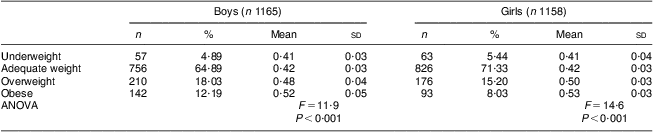
WtHR, waist-to-height ratio; P, percentile.
Underweight: %BF ≤ P10; adequate weight: %BF >P10 to <P90; overweight: % BF ≥P90 to <P97; obese: %BF ≥ P97.
Correlation of WC and WtHR with sum of skinfolds, BMI and %BF; boys and girls aged 6–14 years, Madrid, Spain, 2007–2008

WC, waist circumference; WtHR, waist-to-height ratio; %BF, percentage body fat.
Correlation coefficient (r): *P < 0·05, ***P < 0·001.
The equations obtained from the regression analysis (Table 4) allow for %BF estimation from WtHR. As deduced from the slope values and determination coefficients (R 2), the model adjustment was better in the masculine series. With the aim of testing the validity of these, the relative adiposity values predicted by the model were compared with those obtained using the Siri equation by applying a Student's t test for paired samples (Table 5). This statistical test starts with analysis of the observed differences in each individual for the adiposity variable calculated using the two methods which are being compared. The average %BF values estimated from WtHR were slightly higher than those obtained from skinfolds (0·14 mm in boys and 0·31 mm in girls). The t statistic highlighted this proximity, demonstrating that, for relative adiposity, there were no significant differences between the Siri( Reference Siri 23 ) expression, considered to be the standard by the SEEDO (Spanish Association for the Study of Obesity)( 30 ), and the equation developed in this work. In addition, the ICC was 0·85 in the masculine series and 0·79 in the feminine series, which shows a high agreement between both expressions according to the scale proposed by Landis and Koch and described by Kramer and Feinstein( Reference Kramer and Feinstein 29 ).
Regression analysis results for the prediction of %BF from WtHR; boys and girls aged 6–14 years, Madrid, Spain, 2007–2008

%BF, percentage body fat; WtHR, waist-to-height ratio.
Contrast between %BF obtained by the Siri equation and the estimates obtained by applying the equations derived from WtHR; boys and girls aged 6–14 years, Madrid, Spain, 2007–2008

%BF, percentage body fat; WtHR, waist-to-height ratio; ICC, intra-class correlation coefficient.
Discussion
Anthropometric dimensions that reflect body size (height, weight, BMI) and total or central body fat (skinfold thickness, WC) increased significantly in both sexes from 6 to 14 years of age. %BF also varied significantly as expected during puberty. However, WtHR remained constant, suggesting that the observed increase in WC reflects a normal growth process. These results are consistent with those obtained in the ‘Heart Beat’ project which involved 642 American children between the ages of 8 and 18 years( Reference Eissa, Dai and Mihalopoulos 31 ). They also agree with those obtained in a sample of Australian students, where it was found that WtHR correlates more strongly with sum of skinfolds or with relative adiposity than with BMI( Reference Nambiar, Hughes and Davies 19 ). This fact confirms the stability of the WtHR index during the studied growth period and supports the proposed methodology of using WtHR as a predictor of %BF.
A prior study carried out on a sample of young Mexicans aged between 16 and 19 years has already shown significant differences for WtHR among individuals included in the normal weight, overweight and obese categories; although it should be noted that, in all of them, the mean WtHR values obtained were slightly higher than those in the present study: 0·53 (in boys) and 0·54 (in girls) for overweight and obesity( Reference Ortiz-Pérez, Molina-Frechero and Castañeda-Castaneira 32 ). Also, in Chilean schoolchildren studied by Arnaiz et al. ( Reference Arnaiz, Marín and Pino 12 ), the WtHR values presented were higher than those obtained here, independently of the nutritional status category. Several studies have described ethnic disparity in the normal values of WtHR in adult populations and, in a recent meta-analysis, Lee et al.( Reference Lee, Huxley and Wildman 33 ) found that the optimal cut-off point for discriminating cardiometabolic risk factors ranged between 0·46 and 0·62 in different human groups. It is possible that WtHR shows certain population variability also in the paediatric age group, which has already been confirmed by other anthropometric indicators such as waist-to-hip ratio and conicity index. Analysing these characteristics, Sempei et al. ( Reference Sempei, Novo and Juliano 34 ) and Kagawa et al. ( Reference Kagawa, Byrne and King 35 ) have reported differences in the ontogenetic pattern of adipose distribution among schoolchildren from Europe, Asia and Australia. Likewise, Romero-Collazos et al. ( Reference Romero-Collazos, Marrodán and Mesa 36 ) found that children of Argentinean, Cuban, Mexican and Venezuelan origin, among whom there was a high indigenous component, presented a more centralized fat distribution than did Spanish children.
To date, many equations have been published for calculating body composition by anthropometry in the child and adolescent population, and their consistency is variable( Reference Marrodán, Pérez and Morales 37 ). The majority of formulas for estimating fat percentages in children under 18 years old were elaborated with regression techniques applied to samples from populations from a determined origin and age range, as in the current work. Some of these equations estimate relative adiposity from body density( Reference Brook 24 , Reference Durnin and Rahaman 25 , Reference Lohman, Slaughter and Boileau 38 , Reference Deurenberg, Pieters and Hautvast 39 ) while others do this directly by measuring various skinfolds( Reference Johnston, Leong and Checkland 40 – Reference Bray, DeLany and Volaufova 44 ). Other mathematical expressions obtain fat mass or fat-free mass using factors such as weight, height and triceps skinfold( Reference Johnston 45 , Reference Ellis 46 ). The formula proposed in the present investigation shows a clear advantage over all of these, since it uses only height and WC for %BF prediction. The two dimensions that make up the WtHR are considerably simpler than skinfold thickness, whose measurement requires more precise techniques and special equipment.
Study limitations
The strength of the present study is the gender balanced and large sample. Furthermore, the anthropometry for estimating total and relative adiposity was proved a reliable technique as deduced from the low TEM. As indicated in the Methodology, the sample was taken in schools and colleges of the city of Madrid, so we do not have individuals from rural areas. Moreover, no information is available concerning the level of income to properly define socio-economic status. Also we do not have data on dietary and exercise habits, factors that modulate growth and levels of adiposity. This situation can limit the scope of the results, although the purpose of the study was not to analyse the association between environmental factors and anthropometry, but to determine the association between two types of anthropometric indicators to establish a predictive model. It should be noted that the design of the study is cross-sectional and the sample is homogeneous; therefore, the developed equations may not be generalizable to other ethnically diverse populations.
Conclusions
WtHR is effective for predicting fat percentage in 6- to 14-year-olds. The equations developed through regression analysis in order to estimate %BF from WtHR show high concordance with the Siri method and obtain comparable results. The use of the expressions obtained here can simplify the diagnosis of obesity in the paediatric age group.
Acknowledgements
Sources of funding: The study was supported by Ministry of Education and Science of the Spanish Government (Project BOS/GGL-2005-03752). Ethics: Ethical approval was not required. Conflicts of interest: The authors declare that they have no conflict of interest. Authors’ contributions: All authors were involved in study design, anthropometric measurements, statistical analysis and interpretation, and preparation of the paper.



