





1 Introduction
In this paper we describe a new construction of equilibrium states for certain partially hyperbolic diffeomorphisms. In particular, we extend the ideas in [Reference Parmenter and Pollicott12] to the setting of partially hyperbolic diffeomorphisms where we further assume some control on the action in either the centre-stable or centre-unstable direction (see Definitions 2.2 and 5.3 respectively for details).
Given a continuous map on a compact metric space $f: X \to X$
and a continuous function
$f: X \to X$
and a continuous function $G: {X} \to \mathbb R$
, we say that an f-invariant probability measure
$G: {X} \to \mathbb R$
, we say that an f-invariant probability measure $\mu _G$
is an equilibrium state for G if
$\mu _G$
is an equilibrium state for G if
 $$ \begin{align} h(\mu_G) + \int G \,d\mu_G = \sup\bigg\{h(\mu) + \int G\, d\mu { : } \mu \in \mathcal M_f(X) \bigg\} \end{align} $$
where $\mathcal M_f(X)$
denotes the space of f-invariant probability measures, that is,
$\mathcal M_f(X)$
denotes the space of f-invariant probability measures, that is, $\mu _G$
is a measure which maximizes the sum of the entropy
$\mu _G$
is a measure which maximizes the sum of the entropy $h(\mu )$
and the integral of G, over all f-invariant measures
$h(\mu )$
and the integral of G, over all f-invariant measures $\mu $
[Reference Ruelle13, Reference Walters15]. The value attained by the supremum in (1.1) is called the pressure and denoted
$\mu $
[Reference Ruelle13, Reference Walters15]. The value attained by the supremum in (1.1) is called the pressure and denoted $P(G)$
.
$P(G)$
.
In this paper we consider a construction of equilibrium states for partially hyperbolic diffeomorphisms $f: X \to X$
by using sequences of measures supported on a piece of unstable manifold
$f: X \to X$
by using sequences of measures supported on a piece of unstable manifold $W_\delta ^u(x)$
that are absolutely continuous with respect to the induced volume. Let
$W_\delta ^u(x)$
that are absolutely continuous with respect to the induced volume. Let $\Phi : X \rightarrow \mathbb {R}$
be the geometric potential defined by
$\Phi : X \rightarrow \mathbb {R}$
be the geometric potential defined by $\Phi (x) = - \log | $
det
$\Phi (x) = - \log | $
det $(Df\mid E_x^u)|,$
where
$(Df\mid E_x^u)|,$
where $E_x^u$
is the unstable bundle for the diffeomorphism.
$E_x^u$
is the unstable bundle for the diffeomorphism.
Theorem 1.1. Let $f: X \to X$
be a
$f: X \to X$
be a $C^{1+\alpha }$
topologically mixing partially hyperbolic attracting diffeomorphism satisfying Lyapunov stability (Definition 2.2) and let
$C^{1+\alpha }$
topologically mixing partially hyperbolic attracting diffeomorphism satisfying Lyapunov stability (Definition 2.2) and let ${G: X \to \mathbb R}$
be a continuous function. Given
${G: X \to \mathbb R}$
be a continuous function. Given $x\in X$
and
$x\in X$
and $\delta> 0$
, consider the sequence of probability measures
$\delta> 0$
, consider the sequence of probability measures $(\unicode{x3bb} _n)_{n=1}^\infty $
supported on
$(\unicode{x3bb} _n)_{n=1}^\infty $
supported on $W^u_\delta (x)$
and absolutely continuous with respect to the induced volume
$W^u_\delta (x)$
and absolutely continuous with respect to the induced volume $\unicode{x3bb} = \unicode{x3bb} _{W^u_\delta (x)}$
,
$\unicode{x3bb} = \unicode{x3bb} _{W^u_\delta (x)}$
,

Then the weak* limit points of the averages
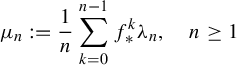
(where $f_* \unicode{x3bb} _n(A) = \unicode{x3bb} _n(f^{-1}A)$
for Borel sets
$f_* \unicode{x3bb} _n(A) = \unicode{x3bb} _n(f^{-1}A)$
for Borel sets $A \subset X$
), are equilibrium states for G.
$A \subset X$
), are equilibrium states for G.
From the change of variables for $f^n: W^u_\delta (x) \to f^n(W^u_\delta (x))$
, we can reformulate (1.2) as
$f^n: W^u_\delta (x) \to f^n(W^u_\delta (x))$
, we can reformulate (1.2) as

which is often more convenient in the proofs.
In the setting of Theorem 1.1, existence of equilibrium states is guaranteed by abstract methods (h-expansivity) and our contribution is the concrete construction. The proof of Theorem 1.1 relies on the following characterization of the pressure which is of independent interest.
Proposition 1.2. Let $f: X \to X$
be a topologically mixing partially hyperbolic attracting diffeomorphism satisfying Lyapunov stability. For any continuous function
$f: X \to X$
be a topologically mixing partially hyperbolic attracting diffeomorphism satisfying Lyapunov stability. For any continuous function $G: X \to \mathbb R$
we have
$G: X \to \mathbb R$
we have

Partially hyperbolic systems satisfying Lyapunov stability have lately received growing attention. In particular, Climenhaga, Pesin and Zelerowicz [Reference Climenhaga, Pesin and Zelerowicz8] construct unique equilibrium states for $C^2$
systems and potentials satisfying a leafwise version of the Bowen property by a Carathéodory-type construction using fixed reference measures on pieces of local unstable manifold. Additionally, in the setting of partially hyperbolic diffeomorphisms with isometric action along the centre, Carrasco and Rodriguez-Hertz [Reference Carrasco and Rodriguez-Hertz5] provide a geometric construction of equilibrium states for Hölder potentials that are either the geometric potential or are constant along centre leaves. Another consideration of such systems can be found in [Reference Bonthonneau, Guillarmou and Weich2].
$C^2$
systems and potentials satisfying a leafwise version of the Bowen property by a Carathéodory-type construction using fixed reference measures on pieces of local unstable manifold. Additionally, in the setting of partially hyperbolic diffeomorphisms with isometric action along the centre, Carrasco and Rodriguez-Hertz [Reference Carrasco and Rodriguez-Hertz5] provide a geometric construction of equilibrium states for Hölder potentials that are either the geometric potential or are constant along centre leaves. Another consideration of such systems can be found in [Reference Bonthonneau, Guillarmou and Weich2].
We finish this paper with an extension of our construction to systems with a stable, centre-unstable splitting. In this setting we require integrability of the centre-unstable bundle and a subexponential contraction hypothesis (Definition 5.3) which is less restrictive than Lyapunov stability.
2 Definitions
In this section we introduce the notion of partially hyperbolic dynamics and provide useful background results and classical examples. We then briefly recall the definition of Kolmogorov–Sinai entropy and state a useful result due to Misiurewicz.
2.1 Partial hyperbolicity
We begin with the definition of partial hyperbolicity.
Definition 2.1. (Partially hyperbolic set)
Let M be a compact Riemannian manifold and ${f : M \rightarrow M}$
be a diffeomorphism. A closed f-invariant subset
${f : M \rightarrow M}$
be a diffeomorphism. A closed f-invariant subset $X \subset M$
is said to be partially hyperbolic (in the broad sense) if:
$X \subset M$
is said to be partially hyperbolic (in the broad sense) if:
-
• there exists a continuous invariant splitting of the tangent bundle into subbundles $E^u$
and
$E^{cs}$
such that
$T_{X}M = E^u \oplus E^{cs}$
; and
$E^u$
and
$E^{cs}$
such that
$T_{X}M = E^u \oplus E^{cs}$
; and -
• there is a Riemannian metric
$\| \cdot \|$
on M and constants
$C_1> 1$
and
$0 < C_2 < C_1$
such that for every
$x \in X$
,
$$ \begin{align*} \| Df_x v\| & \geq C_1 \|v\| \quad \text{for } v \in E^u(x), \\ \| Df_x v\| & \leq C_2 \|v\| \quad \text{for } v \in E^{cs}(x). \end{align*} $$








We shall always assume that the map is topologically mixing.
If $C_2 < 1$
then f is uniformly hyperbolic. Definition 2.1 also covers the more traditional and narrower definition of partial hyperbolicity involving a splitting into an expanding, centre and contracting direction.
$C_2 < 1$
then f is uniformly hyperbolic. Definition 2.1 also covers the more traditional and narrower definition of partial hyperbolicity involving a splitting into an expanding, centre and contracting direction.
There is a continuous cone family $K^{cs}$
defined on X which is
$K^{cs}$
defined on X which is $Df^{-1}$
-invariant [Reference Hasselblatt and Sinai9, Proposition 2.9]. A curve
$Df^{-1}$
-invariant [Reference Hasselblatt and Sinai9, Proposition 2.9]. A curve $\gamma $
is a
$\gamma $
is a $cs$
-curve if all its tangent vectors lie in
$cs$
-curve if all its tangent vectors lie in $K^{cs}$
. We can now give the formal definition of Lyapunov stability.
$K^{cs}$
. We can now give the formal definition of Lyapunov stability.
Definition 2.2. (Lyapunov stability) A partially hyperbolic diffeomorphism $f : X \rightarrow X$
has Lyapunov stability if for every
$f : X \rightarrow X$
has Lyapunov stability if for every $\epsilon>0$
there exists an
$\epsilon>0$
there exists an $\epsilon _0>0$
such that if
$\epsilon _0>0$
such that if $\gamma $
is a curve in X with length at most
$\gamma $
is a curve in X with length at most $\epsilon _0$
and
$\epsilon _0$
and $n \geq 0$
is such that
$n \geq 0$
is such that $f^n \gamma $
is a
$f^n \gamma $
is a $cs$
-curve then the length of
$cs$
-curve then the length of $f^n \gamma $
is at most
$f^n \gamma $
is at most $\epsilon $
.
$\epsilon $
.
This condition is labelled (C1) in [Reference Climenhaga, Pesin and Zelerowicz8]. For an interesting consideration of systems satisfying Lyapunov stability, see [Reference Bonatti1].
2.2 Local manifolds
We begin with the definition of a local unstable manifold.
Definition 2.3. (Local unstable manifold)
Choose $\rho> 0$
such that
$\rho> 0$
such that $C_2 < 1/\rho < C_1$
. For
$C_2 < 1/\rho < C_1$
. For $x \in X$
and sufficiently small
$x \in X$
and sufficiently small $\delta> 0$
we define the local unstable manifold through x as follows:
$\delta> 0$
we define the local unstable manifold through x as follows:
 $$ \begin{align*} W_\delta^{u}(x) & = \{y \in M : d(f^{-n}x, f^{-n}y) \leq \delta \text{ for all } n \geq 0 \\ & \quad \hspace{4pt} \text{and } d(f^{-n}x, f^{-n}y) / \rho^n \rightarrow 0 \text{ as }n \rightarrow \infty \}. \end{align*} $$
The following result is the unstable manifold theorem.
Theorem 2.4. [Reference Shub14, Theorem IV.1]
For $f \in C^r(M)$
,
$f \in C^r(M)$
, $r> 1$
, and
$r> 1$
, and $\delta> 0$
sufficiently small, there exist a
$\delta> 0$
sufficiently small, there exist a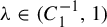 $\unicode{x3bb} \in (C_1^{-1}, 1)$
and
$\unicode{x3bb} \in (C_1^{-1}, 1)$
and $C> 0$
such that for any
$C> 0$
such that for any $x \in X$
there is a
$x \in X$
there is a $C^{r}$
local unstable manifold
$C^{r}$
local unstable manifold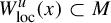 $W_{\mathrm {loc}}^u(x) \subset M$
such that:
$W_{\mathrm {loc}}^u(x) \subset M$
such that:
-
•
$T_yW_\delta ^u(x) = E^u(y)$
for every
$y \in W_\delta ^u(x) \cap X$
; -
•
$W_\delta ^{u}(x)$
is a
$C^{r}$
embedded disk of dimension
$\dim (E^u)$
; and -
• for every
$n \geq 0$
and
$y \in W_\delta ^u(x)$
,
$d(f^{-n}x, f^{-n}y) \leq C \unicode{x3bb} ^{n} d(x,y)$
.





In the uniformly hyperbolic setting we are able to define a similar local stable manifold focusing on the forward orbits of points, but it is not always possible in the partially hyperbolic setting. The following theorem states that with the assumption of f satisfying Definition 2.2, there is a local centre-stable manifold that plays the role of the stable manifold from the uniform hyperbolic setting.
Theorem 2.5. (Local product structure [Reference Hertz, Hertz and Ures10])
Let $f : M \rightarrow M$
be a diffeomorphism and
$f : M \rightarrow M$
be a diffeomorphism and $X \subset M$
be a compact f-invariant subset admitting a splitting
$X \subset M$
be a compact f-invariant subset admitting a splitting $E^{cs} \oplus E^u$
satisfying Lyapunov stability. For every
$E^{cs} \oplus E^u$
satisfying Lyapunov stability. For every $x \in X$
there is a local manifold
$x \in X$
there is a local manifold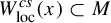 $W_{\mathrm {loc}}^{cs}(x) \subset M$
satisfying:
$W_{\mathrm {loc}}^{cs}(x) \subset M$
satisfying:
-
•
$T_yW_{\mathrm {loc}}^{cs}(x) = E^{cs}(y)$
for every
$y \in W_{\mathrm {loc}}^{cs}(x) \cap X$
; and -
•
$W_{\mathrm {loc}}^{cs}(x)$
is a
$C^{1}$
embedded disk of dimension
$\dim (E^{cs})$
.




Moreover, there exists an $\epsilon {\kern-1pt}>{\kern-1pt} 0$
such that if
$\epsilon {\kern-1pt}>{\kern-1pt} 0$
such that if $x, y {\kern-1pt}\in{\kern-1pt} X$
and
$x, y {\kern-1pt}\in{\kern-1pt} X$
and $d(x,y) {\kern-1pt}<{\kern-1pt} \epsilon $
then
$d(x,y) {\kern-1pt}<{\kern-1pt} \epsilon $
then ${W_\delta ^u(x) {\kern-1pt}\cap{\kern-1pt} W_{\mathrm {loc}}^{cs}(y)}$
is exactly one point which we denote
${W_\delta ^u(x) {\kern-1pt}\cap{\kern-1pt} W_{\mathrm {loc}}^{cs}(y)}$
is exactly one point which we denote $[x,y]$
.
$[x,y]$
.
2.3 Entropy
Let $(X, \mathcal {B}, \mu , f)$
be a measure-preserving probability space. We now describe some results on the entropy with respect to
$(X, \mathcal {B}, \mu , f)$
be a measure-preserving probability space. We now describe some results on the entropy with respect to $\mu $
. For the duration of this subsection we will only require the weaker assumption that
$\mu $
. For the duration of this subsection we will only require the weaker assumption that $f: X \to X$
is a homeomorphism.
$f: X \to X$
is a homeomorphism.
We begin with some standard definitions, [Reference Walters15].
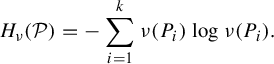
Definition 2.6. Given a finite measurable partition $\mathcal P = \{P_1, \ldots , P_k\}$
and a probability measure
$\mathcal P = \{P_1, \ldots , P_k\}$
and a probability measure $\nu $
, we can associate the entropy of the partition defined by
$\nu $
, we can associate the entropy of the partition defined by
 $$ \begin{align*} H_\nu(\mathcal P) = - \sum_{i=1}^k \nu(P_i) \log \nu(P_i). \end{align*} $$
Given $n \geq 1$
, we let
$n \geq 1$
, we let $\bigvee _{i=0}^{n-1} f^{-i} \mathcal P = \{P_{i_0} \cap f^{-1} P_{i_1} \cap \cdots \cap f^{-(n-1)} P_{i_{n-1}} { : } 1 \leq i_0, \ldots , i_{n-1} \leq k \}$
be the refinement of the partitions
$\bigvee _{i=0}^{n-1} f^{-i} \mathcal P = \{P_{i_0} \cap f^{-1} P_{i_1} \cap \cdots \cap f^{-(n-1)} P_{i_{n-1}} { : } 1 \leq i_0, \ldots , i_{n-1} \leq k \}$
be the refinement of the partitions $\mathcal P, f^{-1}\mathcal P, \ldots , f^{-(n-1)}\mathcal P$
.
$\mathcal P, f^{-1}\mathcal P, \ldots , f^{-(n-1)}\mathcal P$
.
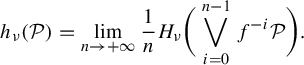
Definition 2.7. We can define the entropy associated to the partition $\mathcal P$
by
$\mathcal P$
by
 $$ \begin{align*} h_\nu(\mathcal P) = \lim_{n \to +\infty} \dfrac{1}{n} H_\nu\bigg( \bigvee_{i=0}^{n-1} f^{-i} \mathcal P\bigg). \end{align*} $$
Finally, the entropy with respect to the measure is defined by
 $$ \begin{align*} h(\nu) = \sup_{\mathcal{P}}\{h_{\nu}(\mathcal{P}) { : \mathcal{P} \text{ is a countable partition with } H_{\nu}(\mathcal{P}) < \infty}\}. \end{align*} $$
In the case that $\mathcal P$
is a generating partition (
$\mathcal P$
is a generating partition ( $\bigvee _{i=-\infty }^{\infty } f^{-i} \mathcal {P} = \mathcal {B}$
) we have that
$\bigvee _{i=-\infty }^{\infty } f^{-i} \mathcal {P} = \mathcal {B}$
) we have that ${h(\nu ) = h_\nu (\mathcal P)}$
is the entropy of the measure
${h(\nu ) = h_\nu (\mathcal P)}$
is the entropy of the measure $\nu $
.
$\nu $
.
We require the following application of a lemma due to Misiurewicz [Reference Misiurewicz11], relating the entropy with respect to $\unicode{x3bb} _n$
and the averaging of pushforwards
$\unicode{x3bb} _n$
and the averaging of pushforwards $\mu _n$
(defined in (1.2) and (1.3), respectively).
$\mu _n$
(defined in (1.2) and (1.3), respectively).
Lemma 2.8. For any $n \geq 2$
and
$n \geq 2$
and $0 < q < n$
,
$0 < q < n$
,

We shall not provide a proof here, but a detailed proof can be found above Lemma 4.5 in [Reference Parmenter and Pollicott12].
3 Pressure and growth
The pressure $P(G)$
has various different interpretations in terms of the growth of appropriate quantities. We begin with the standard definition of the pressure
$P(G)$
has various different interpretations in terms of the growth of appropriate quantities. We begin with the standard definition of the pressure $P(G)$
written in terms of the growth rates of sets of spanning sets and separated sets due to Bowen.
$P(G)$
written in terms of the growth rates of sets of spanning sets and separated sets due to Bowen.
Recall that, given $\epsilon> 0$
and
$\epsilon> 0$
and $n \geq 1$
, an
$n \geq 1$
, an $(n,\epsilon )$
-spanning set
$(n,\epsilon )$
-spanning set $S \subset X$
is such that
$S \subset X$
is such that $ \bigcup _{x\in S} B(x,n,\epsilon )$
covers X, where
$ \bigcup _{x\in S} B(x,n,\epsilon )$
covers X, where $B(x,n,\epsilon ) := \bigcap _{k=0}^{n-1}f^{-k} B(f^kx, \epsilon )$
is called a Bowen ball. On the other hand, an
$B(x,n,\epsilon ) := \bigcap _{k=0}^{n-1}f^{-k} B(f^kx, \epsilon )$
is called a Bowen ball. On the other hand, an $(n,\epsilon )$
-separated set
$(n,\epsilon )$
-separated set $\Sigma \subset X$
is such that
$\Sigma \subset X$
is such that $d_n(x,y)> \epsilon $
for
$d_n(x,y)> \epsilon $
for $x,y \in \Sigma $
(and, in particular,
$x,y \in \Sigma $
(and, in particular, $B(x,n,\epsilon /2)$
,
$B(x,n,\epsilon /2)$
, $x \in \Sigma $
, are disjoint in X).
$x \in \Sigma $
, are disjoint in X).
Lemma 3.1. Given $n \geq 1$
and
$n \geq 1$
and $\epsilon> 0$
, let
$\epsilon> 0$
, let
 $$ \begin{align*} Z_{0}(n, \epsilon) = \inf \bigg\{\sum_{y \in S} \exp\{G^n(y)\} : S \text{ is an } (n, \epsilon)\text{-spanning set}\bigg\} \end{align*} $$
and
 $$ \begin{align*} Z_{1}(n, \epsilon) = \sup\bigg\{\sum_{y \in \Sigma } \exp\{G^n(y)\} : \Sigma \text{ is an } (n, \epsilon)\text{-separated set}\bigg\}, \end{align*} $$
where $G^n(x) = \sum _{j=0}^{n-1}G(f^jx)$
. Then the following limits exist and are equal:
$G^n(x) = \sum _{j=0}^{n-1}G(f^jx)$
. Then the following limits exist and are equal:
 $$ \begin{align*} P_{\mathrm{top}}(G):= \lim_{\epsilon \to 0} \limsup_{n \to +\infty} \dfrac{1}{n}\log Z_{0}(n, \epsilon) = \lim_{\epsilon \to 0}\limsup_{n \to +\infty} \dfrac{1}{n}\log Z_{1}(n, \epsilon). \end{align*} $$
We call $P_{\mathrm {top}}(G)$
the topological pressure of G.
$P_{\mathrm {top}}(G)$
the topological pressure of G.
(See [Reference Walters15, Ch. 9]).
By the variational principle [Reference Walters15] for any continuous G, $P_{\mathrm {top}}(G) = P(G)$
.
$P_{\mathrm {top}}(G) = P(G)$
.
We will need the following characterization of the pressure in terms of growth rates of appropriate densities defined on a piece of unstable manifold.
Proposition 3.2. Let $f: X \to X$
be a mixing partially hyperbolic attracting diffeomorphism satisfying Lyapunov stability. For any continuous function
$f: X \to X$
be a mixing partially hyperbolic attracting diffeomorphism satisfying Lyapunov stability. For any continuous function $G: X \to \mathbb R$
we have
$G: X \to \mathbb R$
we have

We can use the change of variables formula to rewrite this in the equivalent form

Example 3.3. If we consider the potential $G = 0$
then Proposition 3.2 gives
$G = 0$
then Proposition 3.2 gives
 $$ \begin{align*} P(0) = \limsup_{n \rightarrow + \infty} \frac{\log \unicode{x3bb}(f^n W_{\delta}^u(x))}{n}. \end{align*} $$
Therefore, the topological entropy $h_{\mathrm {top}}(f) = P(0)$
is the exponential growth rate of the volume of a small piece of unstable manifold.
$h_{\mathrm {top}}(f) = P(0)$
is the exponential growth rate of the volume of a small piece of unstable manifold.
Example 3.4. Another important potential is the geometric potential $G = \Phi = - \log |{\det} (Df|E_x^u)|$
. Then Proposition 3.2 gives
$G = \Phi = - \log |{\det} (Df|E_x^u)|$
. Then Proposition 3.2 gives
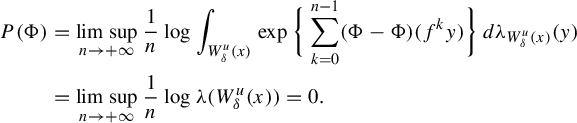
This is a well-known result in the uniformly hyperbolic setting [Reference Bowen3, Theorem 4.11], and we provide a new elementary proof of this fact for partially hyperbolic diffeomorphisms.
Example 3.5. More generally, we can consider the geometric q-potential defined by
 $$ \begin{align*} \Phi_q = - q \log |\!\det ( Df\mid E_x^u)| \quad \text{ for } q \in \mathbb{R}. \end{align*} $$
Then the pressure has the following characterization:

The proof of Proposition 3.2 is analogous to the proof of Proposition 4.6 in [Reference Parmenter and Pollicott12]. The proof in [Reference Parmenter and Pollicott12] relies on the local product lemma and the requirement that points on local unstable manifolds contract in the past. We describe the adjustments to the partially hyperbolic setting using the local product structure in Lemma 2.5 and the assumption that we have some control over the expansion of points under $f^n$
in the centre-stable direction.
$f^n$
in the centre-stable direction.
Proof of Proposition 3.2
We begin with the following standard result, which can be compared with Lemma 4.7 in [Reference Parmenter and Pollicott12].
Lemma 3.6. For any $\epsilon _0> 0$
there exists an
$\epsilon _0> 0$
there exists an $m> 0$
such that
$m> 0$
such that $f^mW^u_\delta (x)$
is
$f^mW^u_\delta (x)$
is $\epsilon _0$
-dense in X. In particular, we can assume that
$\epsilon _0$
-dense in X. In particular, we can assume that $X = \bigcup _{y \in f^mW^u_\delta (x)} W_{\mathrm {loc}}^{cs}(y).$
Proof. For $\epsilon _1> 0$
small enough, consider an
$\epsilon _1> 0$
small enough, consider an $\epsilon _1$
-fattening,
$\epsilon _1$
-fattening, $W_{\delta , \epsilon _1}^u$
, of
$W_{\delta , \epsilon _1}^u$
, of $W_{\delta }^u(x)$
. By this we mean
$W_{\delta }^u(x)$
. By this we mean $W_{\delta , \epsilon _1}^u = \cup \{ B(y, \epsilon _1) \text { : } y \in W_\delta ^u(x)\}$
. For any
$W_{\delta , \epsilon _1}^u = \cup \{ B(y, \epsilon _1) \text { : } y \in W_\delta ^u(x)\}$
. For any $z \in W_{\delta , \epsilon _1}^u$
, using Theorem 2.5, we have that
$z \in W_{\delta , \epsilon _1}^u$
, using Theorem 2.5, we have that $W_\delta ^u(x) \cap W_{\mathrm {loc}}^{cs}(z)$
is a single point which we call
$W_\delta ^u(x) \cap W_{\mathrm {loc}}^{cs}(z)$
is a single point which we call $z_1$
. Provided
$z_1$
. Provided $\epsilon _1> 0$
is small enough, by Lyapunov stability we deduce that
$\epsilon _1> 0$
is small enough, by Lyapunov stability we deduce that $d(f^m z_1, f^m z) < \epsilon _0/2$
for any
$d(f^m z_1, f^m z) < \epsilon _0/2$
for any $m \in \mathbb {N}$
. Thus we have shown, for any
$m \in \mathbb {N}$
. Thus we have shown, for any $z \in W_{\delta , \epsilon _1}^u$
, that there exists a
$z \in W_{\delta , \epsilon _1}^u$
, that there exists a $z_1 \in W_\delta ^u(x)$
such that
$z_1 \in W_\delta ^u(x)$
such that $d(f^m z_1, f^m z) < \epsilon _0/2$
for any
$d(f^m z_1, f^m z) < \epsilon _0/2$
for any $m \in \mathbb {N}$
.
$m \in \mathbb {N}$
.
For any $\epsilon _0> 0$
, by using compactness we can choose a finite set C such that
$\epsilon _0> 0$
, by using compactness we can choose a finite set C such that $\{B(c,\epsilon _0/4) \text { : } c \in C\}$
forms a cover of X. Since
$\{B(c,\epsilon _0/4) \text { : } c \in C\}$
forms a cover of X. Since $W_{\delta , \epsilon _1}^u$
is open, by topological mixing provided
$W_{\delta , \epsilon _1}^u$
is open, by topological mixing provided $m \in \mathbb N$
is sufficiently large, for any
$m \in \mathbb N$
is sufficiently large, for any $c \in C$
,
$c \in C$
, $f^m W_{\delta , \epsilon _1}^u \cap B(c, {\epsilon _0}/{4}) \neq \emptyset $
. Let
$f^m W_{\delta , \epsilon _1}^u \cap B(c, {\epsilon _0}/{4}) \neq \emptyset $
. Let ${y_c \in f^m W_{\delta , \epsilon _1}^u \cap B(c, {\epsilon _0}/{4})}$
; then for any
${y_c \in f^m W_{\delta , \epsilon _1}^u \cap B(c, {\epsilon _0}/{4})}$
; then for any $y \in X$
there is a
$y \in X$
there is a $c \in C$
such that
$c \in C$
such that $y \in B(c,\epsilon _0/4)$
and, in particular,
$y \in B(c,\epsilon _0/4)$
and, in particular, $d(y, y_c) < \epsilon _0/2$
. We have
$d(y, y_c) < \epsilon _0/2$
. We have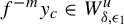 $f^{-m}y_c \in W_{\delta , \epsilon _1}^u$
and therefore by the preceding paragraph there is a
$f^{-m}y_c \in W_{\delta , \epsilon _1}^u$
and therefore by the preceding paragraph there is a $z \in W_\delta ^u(x)$
such that
$z \in W_\delta ^u(x)$
such that $d(y_c , f^m z) < \epsilon _0/2$
.
$d(y_c , f^m z) < \epsilon _0/2$
.
By the triangle inequality, for any $y \in X$
, we have that there is a
$y \in X$
, we have that there is a $z \in W_\delta ^u(x)$
such that
$z \in W_\delta ^u(x)$
such that $d(y, f^m z) \leq d(y, y_c) + d(y_c,f^m z) < \epsilon _0$
. Taking
$d(y, f^m z) \leq d(y, y_c) + d(y_c,f^m z) < \epsilon _0$
. Taking $\epsilon _0$
small enough (and making
$\epsilon _0$
small enough (and making $\epsilon _1$
smaller if necessary), we can apply the local product structure (Lemma 2.5) again to conclude.
$\epsilon _1$
smaller if necessary), we can apply the local product structure (Lemma 2.5) again to conclude.
To get a lower bound on the growth rate in Proposition 3.2 we proceed as follows. Given $\epsilon> 0$
and
$\epsilon> 0$
and $n \geq 1$
, we want to construct an
$n \geq 1$
, we want to construct an $(n, 2\epsilon )$
-spanning set. We begin by choosing a covering of
$(n, 2\epsilon )$
-spanning set. We begin by choosing a covering of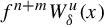 $ f^{n+m} W_\delta ^u(x)$
by
$ f^{n+m} W_\delta ^u(x)$
by $\epsilon $
-balls
$\epsilon $
-balls
 $$ \begin{align*} B_{d_u}(x_i, \epsilon) { : } i=1, \ldots, N:=N(n+m, \epsilon)\end{align*} $$
contained within the unstable manifold with respect to the induced metric denoted by $d_u$
and let
$d_u$
and let $A_{\epsilon } : = f^{n+m} W_\delta ^u(x) \setminus \bigcup _{y \in \partial f^{n+m} W_\delta ^u(x)} B_{d_u}(y, \epsilon /2)$
, where
$A_{\epsilon } : = f^{n+m} W_\delta ^u(x) \setminus \bigcup _{y \in \partial f^{n+m} W_\delta ^u(x)} B_{d_u}(y, \epsilon /2)$
, where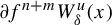 $\partial f^{n+m} W_\delta ^u(x)$
is the boundary of
$\partial f^{n+m} W_\delta ^u(x)$
is the boundary of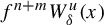 $f^{n+m} W_\delta ^u(x)$
. We can choose a maximal set
$f^{n+m} W_\delta ^u(x)$
. We can choose a maximal set $S= \{x_1, \ldots , x_{N(n+m,\epsilon )}\}$
with the additional property that
$S= \{x_1, \ldots , x_{N(n+m,\epsilon )}\}$
with the additional property that $d_u(x_i,x_j)> \epsilon /2$
for
$d_u(x_i,x_j)> \epsilon /2$
for $i \neq j$
and
$i \neq j$
and $x_i \in A_\epsilon $
. By our choice of S we have that
$x_i \in A_\epsilon $
. By our choice of S we have that
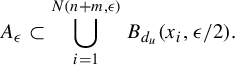 $$ \begin{align*} A_{\epsilon} \subset \bigcup_{i=1}^{N(n+m,\epsilon)} B_{d_u}(x_i, \epsilon/2). \end{align*} $$
By the triangle inequality we have that
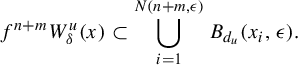 $$ \begin{align*} f^{n+m} W_\delta^u(x) \subset \bigcup_{i=1}^{N(n+m,\epsilon)} B_{d_u}(x_i, \epsilon). \end{align*} $$
We have the additional property $B_{d_u}(x_i, \epsilon /4)\cap B_{d_u}(x_j, \epsilon /4) = \emptyset $
for
$B_{d_u}(x_i, \epsilon /4)\cap B_{d_u}(x_j, \epsilon /4) = \emptyset $
for $i \neq j$
, so then the disjoint union satisfies
$i \neq j$
, so then the disjoint union satisfies
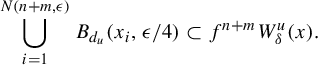 $$ \begin{align*} \bigcup_{i=1}^{N(n+m,\epsilon)} B_{d_u}(x_i, \epsilon/4) \subset f^{n+m} W_\delta^u(x). \end{align*} $$
We assume without loss of generality that
 $$ \begin{align*}f^n: f^{m}W^u_\delta(x) \to f^{n+m}W^u_\delta(x)\end{align*} $$
locally expands distance along the unstable manifold (which is achieved by our choice of the Riemannian metric being adapted in Definition 2.1). In particular, we will use the local expansion to show that the preimages $y_i := f^{-n} x_i \in f^m(W_\delta ^u(x))$
(
$y_i := f^{-n} x_i \in f^m(W_\delta ^u(x))$
( $i=1, \ldots , N$
) form an
$i=1, \ldots , N$
) form an $(n, 2 \epsilon )$
-spanning set.
$(n, 2 \epsilon )$
-spanning set.
By Lemma 3.6, for any point $z\in {X}$
we can choose a point
$z\in {X}$
we can choose a point $y \in f^m(W^u_\delta (x))$
with
$y \in f^m(W^u_\delta (x))$
with ${z \in W^{cs}_{\mathrm {loc}}(y)}$
and
${z \in W^{cs}_{\mathrm {loc}}(y)}$
and $d(y,z) < \epsilon _0$
. Then by Lyapunov stability for
$d(y,z) < \epsilon _0$
. Then by Lyapunov stability for $\epsilon _0>0$
sufficiently small we have
$\epsilon _0>0$
sufficiently small we have $d(f^jz, f^jy) < \epsilon $
for
$d(f^jz, f^jy) < \epsilon $
for $0\leq j \leq n$
. We can then choose a
$0\leq j \leq n$
. We can then choose a $y_i$
such that
$y_i$
such that ${d_n(y,y_i)} < \epsilon $
since
${d_n(y,y_i)} < \epsilon $
since $f^n$
is locally expanding along unstable manifolds. In particular, by the triangle inequality,
$f^n$
is locally expanding along unstable manifolds. In particular, by the triangle inequality,
 $$ \begin{align*}d(f^j z, f^jy_i) \leq d(f^j z, f^jy)+d(f^j y, f^jy_i) \leq 2\epsilon\end{align*} $$
for $0\leq j \leq n$
. Therefore,
$0\leq j \leq n$
. Therefore, $\{y_1, \ldots , y_{N(n+m,\epsilon )}\}$
is an
$\{y_1, \ldots , y_{N(n+m,\epsilon )}\}$
is an $(n,2\epsilon )$
-spanning set.
$(n,2\epsilon )$
-spanning set.
Since G is continuous we have the following bound (cf. [Reference Parmenter and Pollicott12, Lemma 4.9]).
Lemma 3.7. For all $\tau> 0$
there exists
$\tau> 0$
there exists $\epsilon> 0$
sufficiently small such that for all
$\epsilon> 0$
sufficiently small such that for all $n \geq 1$
and points
$n \geq 1$
and points $y, z\in X$
satisfying
$y, z\in X$
satisfying $d(f^jy, f^jz) \leq \epsilon $
for
$d(f^jy, f^jz) \leq \epsilon $
for $0 \leq j \leq n-1$
we have
$0 \leq j \leq n-1$
we have ${|G^n(y) - G^n(z)| \leq n \tau }$
.
${|G^n(y) - G^n(z)| \leq n \tau }$
.
It remains to relate $Z_0(n, 2\epsilon )$
to an integral over
$Z_0(n, 2\epsilon )$
to an integral over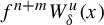 $f^{n+m}W_\delta ^u(x)$
. By the properties of our choice of
$f^{n+m}W_\delta ^u(x)$
. By the properties of our choice of $\epsilon $
-cover for
$\epsilon $
-cover for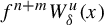 $f^{n+m}W_\delta ^u(x)$
we have that for all
$f^{n+m}W_\delta ^u(x)$
we have that for all $n \geq 1$
,
$n \geq 1$
,
 $$ \begin{align} \begin{aligned} Z_0(n,2\epsilon) &\leq \sum_{i=1}^N \exp\{G^n(y_i)\} \leq\sum_{i=1}^N \frac{1}{\unicode{x3bb}(B_{d_u}(x_i,\epsilon/4))}\int_{B_{d_u}(x_i,\epsilon/4)} \exp\{G^n(f^{-n}x_i)\} \,d\unicode{x3bb}({z})\\ &\leq \dfrac{1}{M} e^{n \tau} \int_{f^{n+m}W_\delta^u(x)} \exp\{G^n(f^{-n}{z})\}\,d\unicode{x3bb}({z}) \end{aligned} \end{align} $$
where $M = M(\epsilon ) = \inf _{z} \unicode{x3bb} (B_{d_u}(z,\epsilon /4))>0$
. Finally, we can bound
$M = M(\epsilon ) = \inf _{z} \unicode{x3bb} (B_{d_u}(z,\epsilon /4))>0$
. Finally, we can bound
 $$ \begin{align} \int_{f^{n+m}W_\delta^u(x)} \exp\{G^n(f^{-n}{z})\}\,d\unicode{x3bb}({z}) \leq e^{m \|G\|_\infty} \int_{f^{n+m}W_\delta^u(x)} \exp\{G^{n+m}(f^{-(n+m)}{z})\}\,d\unicode{x3bb}({z}). \end{align} $$
Comparing equations (3.3) and (3.4), we see that
 $$ \begin{align*} P(G) =\lim_{\epsilon \to 0}\limsup_{n \to +\infty}\dfrac{1}{n} \log Z_0(n, 2\epsilon) \leq \limsup_{n \to +\infty}\frac{1}{n} \log\! \int_{f^{n}W_\delta^u(x)}\! \exp\{G^n(f^{-n}{z})\} \,d\unicode{x3bb}({z}) +\tau. \end{align*} $$
Since $\tau>0$
can be chosen arbitrarily small the lower bound follows.
$\tau>0$
can be chosen arbitrarily small the lower bound follows.
To prove the reverse inequality, given $\epsilon> 0$
and
$\epsilon> 0$
and $n \geq 1$
, we want to create an
$n \geq 1$
, we want to create an $(n,\kappa \epsilon )$
-separated set for some constant
$(n,\kappa \epsilon )$
-separated set for some constant $\kappa> 0$
. To this end, we can choose a maximal number of points
$\kappa> 0$
. To this end, we can choose a maximal number of points $x_i \in {f^n}W_\delta ^u(x)\, (i = 1, \ldots , N= N(n, \epsilon ))$
so that
$x_i \in {f^n}W_\delta ^u(x)\, (i = 1, \ldots , N= N(n, \epsilon ))$
so that $d_u(x_i, x_j)> \epsilon $
whenever
$d_u(x_i, x_j)> \epsilon $
whenever $i \neq j$
. We can again assume without loss of generality that
$i \neq j$
. We can again assume without loss of generality that $f^n: W^u_\delta (x) \to f^nW^u_\delta (x)$
is locally distance expanding and thus, in particular, the points
$f^n: W^u_\delta (x) \to f^nW^u_\delta (x)$
is locally distance expanding and thus, in particular, the points $y_i = f^{-n}x_i$
(
$y_i = f^{-n}x_i$
( $i=1, \ldots , N = N(n, \epsilon )$
) form an
$i=1, \ldots , N = N(n, \epsilon )$
) form an $(n, \kappa \epsilon )$
-separated set, for some
$(n, \kappa \epsilon )$
-separated set, for some $\kappa> 0$
independent of n and
$\kappa> 0$
independent of n and $\epsilon $
.
$\epsilon $
.
The balls $B_{d_u}(x_i, \epsilon )$
(
$B_{d_u}(x_i, \epsilon )$
( $i=1, \ldots , N=N(n, \epsilon )$
) form a cover for
$i=1, \ldots , N=N(n, \epsilon )$
) form a cover for $f^nW^u_\delta (x)$
, since otherwise we could choose an extra point
$f^nW^u_\delta (x)$
, since otherwise we could choose an extra point $z \in f^nW^u_\delta (x)$
with
$z \in f^nW^u_\delta (x)$
with $\inf _i\{d(z, x_i)\} \geq \epsilon $
contradicting the maximality of the
$\inf _i\{d(z, x_i)\} \geq \epsilon $
contradicting the maximality of the $x_i$
. We can therefore use Lemma 3.7 to bound
$x_i$
. We can therefore use Lemma 3.7 to bound
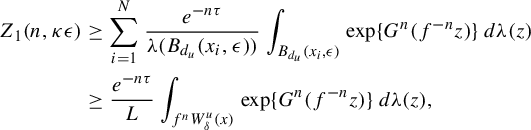
where $L = L(\epsilon )= \sup _z \unicode{x3bb} (B_{d_u}(z, \epsilon ))> 0$
. In particular, we see that
$L = L(\epsilon )= \sup _z \unicode{x3bb} (B_{d_u}(z, \epsilon ))> 0$
. In particular, we see that
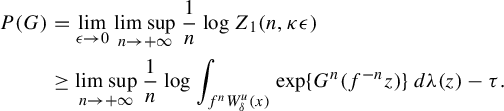 $$ \begin{align*} P(G) & = \lim_{\epsilon \to 0} \limsup_{n \to +\infty} \dfrac{1}{n} \log Z_1(n, \kappa \epsilon) \\ & \geq \limsup_{n \to +\infty}\frac{1}{n} \log \int_{f^{n}W_\delta^u(x)} \exp\{G^n(f^{-n}{z})\}\,d\unicode{x3bb}({z}) - \tau. \end{align*} $$
Since $\tau> 0$
is arbitrary. this inequality completes the proof of Proposition 3.2.
$\tau> 0$
is arbitrary. this inequality completes the proof of Proposition 3.2.
4 Proof of Theorem 1.1
The proof of Theorem 1.1 relies on the growth rate result, Proposition 3.2.
Proof of Theorem 1.1
Consider a weak* accumulation point, $\mu = \lim _{k \rightarrow \infty } \mu _{n_k}$
. For any continuous
$\mu = \lim _{k \rightarrow \infty } \mu _{n_k}$
. For any continuous $F: X \to \mathbb R$
,
$F: X \to \mathbb R$
,

and therefore $\mu $
is f-invariant.
$\mu $
is f-invariant.
For convenience we denote
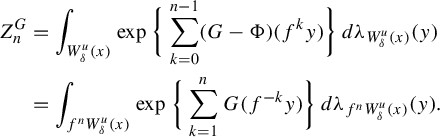
We want to show that $\mu $
is an equilibrium state for G.
$\mu $
is an equilibrium state for G.
Definition 4.1. Given a finite partition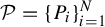 $\mathcal P = \{P_i\}_{i=1}^N$
, we say that it has size
$\mathcal P = \{P_i\}_{i=1}^N$
, we say that it has size $\epsilon> 0$
if
$\epsilon> 0$
if $\sup _{i}\{{\text {diam}}(P_i) \}< \epsilon $
.
$\sup _{i}\{{\text {diam}}(P_i) \}< \epsilon $
.
By Lemma 3.7, for any $\tau>0$
and
$\tau>0$
and $n \geq 1$
we can choose a partition
$n \geq 1$
we can choose a partition $\mathcal P$
of size
$\mathcal P$
of size $\epsilon $
such that for all
$\epsilon $
such that for all $x,y \in A \in \vee _{i=0}^{n-1} T^{-i}\mathcal P$
we have that
$x,y \in A \in \vee _{i=0}^{n-1} T^{-i}\mathcal P$
we have that
 $$ \begin{align} |G^n(x) - G^n(y)| \leq n \tau. \end{align} $$
Proceeding with the proof of Theorem 1.1, for each $A \in \bigvee _{h=0}^{n-1} f^{-h} \mathcal P$
we fix a choice of an
$A \in \bigvee _{h=0}^{n-1} f^{-h} \mathcal P$
we fix a choice of an $x_A \in A$
. By definition of
$x_A \in A$
. By definition of $\unicode{x3bb} _n$
, for each
$\unicode{x3bb} _n$
, for each $0 \leq j \leq n-1$
,
$0 \leq j \leq n-1$
,

Hence, using the definition of $\mu _n$
in (1.3) and the lower bound in equation (4.1), we have that
$\mu _n$
in (1.3) and the lower bound in equation (4.1), we have that
 $$ \begin{align} \int G(y) \,d\mu_{n}(y) \geq \frac{1}{nZ_n^G} \sum_{A \in \bigvee_{h=0}^{n-1} f^{-h}\mathcal P} (G^n(x_A) - n \tau) K_{n,A}, \end{align} $$
where $K_{n,A} = \int _{f^n(A \cap W^u_\delta (x))} \exp \{G^n(f^{-n}y)\} \,d\unicode{x3bb} _{f^n W^u_\delta (x)} $
.
$K_{n,A} = \int _{f^n(A \cap W^u_\delta (x))} \exp \{G^n(f^{-n}y)\} \,d\unicode{x3bb} _{f^n W^u_\delta (x)} $
.
Using Lemma 3.7 again, we have

where in the last inequality we use that the diameters of elements in the partition are arbitrarily small so that $\log \unicode{x3bb} _{f^n W^u_\delta (x))}(f^n(A))$
is negative.
$\log \unicode{x3bb} _{f^n W^u_\delta (x))}(f^n(A))$
is negative.
Consider the entropy
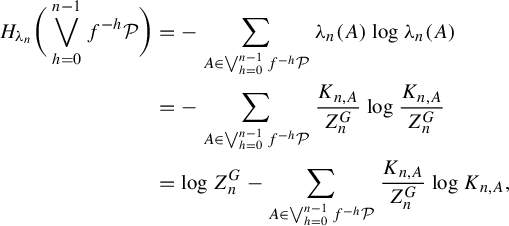
where the last equality uses $\sum _{A \in \bigvee _{h=0}^{n-1}f^{-h}\mathcal P} K_{n,A} = Z_n^G.$
Therefore, comparing (4.3) and (4.4) gives
$\sum _{A \in \bigvee _{h=0}^{n-1}f^{-h}\mathcal P} K_{n,A} = Z_n^G.$
Therefore, comparing (4.3) and (4.4) gives

By (4.2) we can also bound
 $$ \begin{align} n \int_X G \,d \mu_{n} \geq \frac{1}{Z_n^G} \sum_{A \in \bigvee_{h=1}^{n} f^{-h}\mathcal P} (G^n(x_A) - n \tau) K_{n,A}. \end{align} $$
Comparing (4.5) and (4.6), we can write
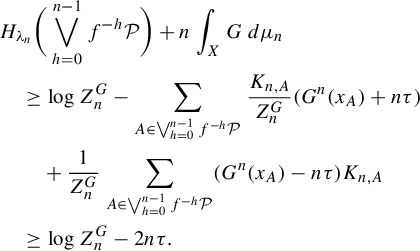
We use (4.7) and Lemma 2.8 to write, for $0 < q < n$
,
$0 < q < n$
,
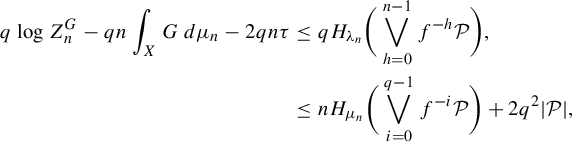
which we can rearrange to get
 $$ \begin{align*} \begin{aligned} \frac{\log Z_n^G}{n} - {2\tau} - \frac{2q|\mathcal{P}|}{n} & \leq \frac{H_{\mu_{n}} (\bigvee_{i=0}^{q-1} f^{-i}\mathcal{P})}{q} + \int_X G \,d \mu_{n}. \end{aligned} \end{align*} $$
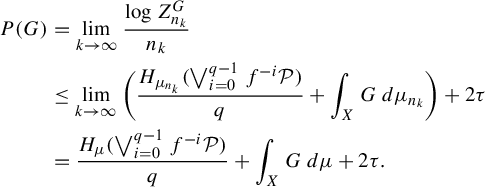
Letting $n_k \to +\infty $
gives that
$n_k \to +\infty $
gives that
 $$ \begin{align*} P(G) & = \lim_{k \rightarrow \infty} \frac{\log Z_{n_k}^G}{n_k}\\ & \leq \lim_{k \rightarrow \infty} \bigg(\frac{H_{\mu_{n_k}}(\bigvee_{i=0}^{q-1} f^{-i}\mathcal{P} )}{q} + \int_X G \,d \mu_{n_k}\bigg) + 2 \tau \\ & = \frac{H_{\mu}(\bigvee_{i=0}^{q-1} f^{-i}\mathcal{P})}{q} + \int_X G \,d \mu + 2\tau. \end{align*} $$
Here we use Portmanteau’s theorem, assuming without loss of generality that the boundaries of the partition have zero measure. Letting $q \rightarrow \infty $
,
$q \rightarrow \infty $
,
 $$ \begin{align} \begin{aligned} P(G) \leq {h_{\mu}(\mathcal P)} + \int_X G \,d \mu + {2}\tau. \end{aligned} \end{align} $$
Finally, we recall that $\tau $
is arbitrary. Therefore, since
$\tau $
is arbitrary. Therefore, since $\mu $
is an f-invariant probability measure, we see from the variational principle (1.1) that the inequalities in (4.8) are actually equalities (since
$\mu $
is an f-invariant probability measure, we see from the variational principle (1.1) that the inequalities in (4.8) are actually equalities (since $h_{\mu }(\mathcal P) \leq h({\mu })$
) and therefore we conclude that the measure
$h_{\mu }(\mathcal P) \leq h({\mu })$
) and therefore we conclude that the measure $\mu $
is an equilibrium state for G.
$\mu $
is an equilibrium state for G.
Remark 4.2. If an equilibrium state corresponding to a potential G were known to be unique then we would have that $\mu _n \to \mu _G$
as
$\mu _n \to \mu _G$
as $n \to +\infty $
.
$n \to +\infty $
.
5 Partially hyperbolic diffeomorphisms with subexponential contraction in centre-unstable manifolds
In this section we explore constructions of equilibrium states for partially hyperbolic diffeomorphisms with a stable, centre-unstable splitting. Our motivation is to weaken the Lyapunov stability condition in Theorem 1.1 in this context. Again we construct equilibrium states using a suitable sequence of reference measures but this time supported on a local centre-unstable manifold. We still require additional conditions, this time assuming integrability of the centre-unstable bundle and restricting the contraction of orbits in centre-unstable manifolds.
Definition 5.1. (Partially hyperbolic set with stable, centre-unstable splitting)
Let M be a compact Riemannian manifold and $f : M \rightarrow M$
be an attracting
$f : M \rightarrow M$
be an attracting $C^1$
diffeomorphism. A closed f-invariant subset
$C^1$
diffeomorphism. A closed f-invariant subset $X \subset M$
is said to be partially hyperbolic if:
$X \subset M$
is said to be partially hyperbolic if:
-
• there exists a continuous invariant splitting of the tangent bundle into subbundles
$E^{cu}$
and
$E^{s}$
such that
$T_{X}M = E^{cu} \oplus E^{s}$
; and -
• there exist a Riemannian metric
$\| \cdot \|$
on M, and constants
$0 < \unicode{x3bb} _1 < \unicode{x3bb} _2$
with
${0 < \unicode{x3bb} _1 < 1}$
, such that for every
$x \in X$
,







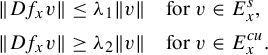
We have the following analogue of Lemma 2.4 in the case of partially hyperbolic diffeomorphisms with a stable, centre-unstable splitting.
Theorem 5.2. (Shub [Reference Shub14])
For any $x \in X$
and for
$x \in X$
and for $\delta> 0$
sufficiently small, there are two
$\delta> 0$
sufficiently small, there are two $C^1$
embedded discs,
$C^1$
embedded discs, $W_\delta ^s(x)$
and
$W_\delta ^s(x)$
and $W_\delta ^{cu}(x)$
, tangent to
$W_\delta ^{cu}(x)$
, tangent to $E_x^s$
and
$E_x^s$
and $E_x^{cu}$
respectively, and satisfying the following properties.
$E_x^{cu}$
respectively, and satisfying the following properties.
-
(1) Choose
$\rho> 0$
such that
$\unicode{x3bb} _1 < \rho < \unicode{x3bb} _2$
. Then the
$\delta $
-local stable manifold is given by
$$ \begin{align*} W_\delta^s(x) & = \{y \in M {: } d(f^{n}x, f^{n}y) \leq \delta, \text{ for all } n \geq 0\\ & \quad \text{ and } d(f^{n}x, f^{n}y) / \rho^n \rightarrow 0 \text{ as }n \rightarrow \infty \}. \end{align*} $$
-
(2)
$f(W_\delta ^s(x)) \subset W_\delta ^s(f(x))$
and f contracts distances by a constant close to
$\unicode{x3bb} _1$
. -
(3)
$f(W_\delta ^{cu}(x)) \cap B(x,\delta ) \subset W_\delta ^{cu}(f(x))$
.







For all results in this section we will also assume that $E^{cu}$
is integrable. By this we mean that there exists a foliation of M by immersed
$E^{cu}$
is integrable. By this we mean that there exists a foliation of M by immersed $\dim (E^{cu})$
-manifolds whose leaves are everywhere tangent to
$\dim (E^{cu})$
-manifolds whose leaves are everywhere tangent to $E^{cu}$
(see [Reference Burns and Wilkinson4]). The key here is that by assuming integrability of
$E^{cu}$
(see [Reference Burns and Wilkinson4]). The key here is that by assuming integrability of $E^{cu}$
we have an analogue of the local product structure, Theorem 2.5.
$E^{cu}$
we have an analogue of the local product structure, Theorem 2.5.
Our results require an additional condition which is less restrictive than Lyapunov stability. Heuristically, we assume that the contraction of distances in the centre-unstable manifold needs to be subexponential.
Definition 5.3. (Subexponential contraction in the centre-unstable manifold)
A partially hyperbolic diffeomorphism with stable, centre-unstable splitting $f : X \rightarrow X$
satisfies subexponential contraction in the centre-unstable manifold if there exists an increasing
$f : X \rightarrow X$
satisfies subexponential contraction in the centre-unstable manifold if there exists an increasing $g : \mathbb {N} \rightarrow \mathbb {R}_{\geq 1}$
such that for
$g : \mathbb {N} \rightarrow \mathbb {R}_{\geq 1}$
such that for $x \in X$
,
$x \in X$
, $y, z \in W_\delta ^{cu}(x)$
and
$y, z \in W_\delta ^{cu}(x)$
and $n \in \mathbb {N}$
,
$n \in \mathbb {N}$
,
 $$ \begin{align*} d_{cu}(f^{n}y, f^{n}z)> \frac{1}{g(n)}d_{cu}(y,z), \end{align*} $$
with
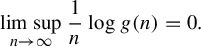 $$ \begin{align*} \limsup_{n \rightarrow \infty} \dfrac{1}{n} \log g(n) = 0. \end{align*} $$
In [Reference Climenhaga, Fisher and Thompson7, §4], Climenhaga, Fisher and Thompson describe a class of derived from Anosov systems with a constraint on the derivative in the centre-stable direction. The inverse of such systems are examples of partially hyperbolic diffeomorphisms with integrable $E^{cu}$
satisfying Definition 5.3. For another class of systems satisfying Definition 5.3 consider the following variant of the Smale–Williams solenoid found in [Reference Castro and Nascimento6]. In the classical setting the unstable direction arises from the doubling map on the circle. Example 2.6 in [Reference Castro and Nascimento6] replaces the doubling map with a family of differentiable Manneville–Pomeau maps on the circle to form partially hyperbolic solenoids satisfying Definition 5.3.
$E^{cu}$
satisfying Definition 5.3. For another class of systems satisfying Definition 5.3 consider the following variant of the Smale–Williams solenoid found in [Reference Castro and Nascimento6]. In the classical setting the unstable direction arises from the doubling map on the circle. Example 2.6 in [Reference Castro and Nascimento6] replaces the doubling map with a family of differentiable Manneville–Pomeau maps on the circle to form partially hyperbolic solenoids satisfying Definition 5.3.
5.1 Growth of centre-unstable manifolds
As in Proposition 3.2, we need the following characterization of the pressure in terms of growth rates of appropriately weighted centre-unstable manifolds.
Proposition 5.4. Let $f: X \to X$
be a mixing partially hyperbolic attracting diffeomorphism with subexponential contraction in centre-unstable manifolds. For any continuous function
$f: X \to X$
be a mixing partially hyperbolic attracting diffeomorphism with subexponential contraction in centre-unstable manifolds. For any continuous function $G: X \to \mathbb R$
,
$G: X \to \mathbb R$
, $x \in X$
and
$x \in X$
and $\delta> 0$
sufficiently small, we have
$\delta> 0$
sufficiently small, we have

In Proposition 3.2 we require Lyapunov stability to restrict growth in the centre-stable direction so that the centre direction does not contribute to the pressure. In the present case we require that the centre-unstable direction does not contract exponentially, otherwise this contributes to the right-hand side of (5.1).
The proof of Proposition 5.4 is similar to the proof of Proposition 3.2. The overall approach is the same, but we have to be more careful constructing the spanning set in the first half of the proof. In particular, we no longer cover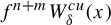 $f^{n+m}W_\delta ^{cu}(x)$
with balls of a fixed radius.
$f^{n+m}W_\delta ^{cu}(x)$
with balls of a fixed radius.
Proof. We start with the following analogue of Lemma 3.6.
Lemma 5.5. For any $\epsilon> 0$
there exists an
$\epsilon> 0$
there exists an $m> 0$
such that
$m> 0$
such that $f^mW^{cu}_\delta (x)$
is
$f^mW^{cu}_\delta (x)$
is $\epsilon $
-dense in X. In particular, we can assume that
$\epsilon $
-dense in X. In particular, we can assume that $X = \bigcup _{y \in f^mW^{cu}_\delta (x)} W_\epsilon ^s(y).$
This is a direct consequence of mixing and the local product structure.
To get a lower bound on the growth rate in Proposition 5.4, given $\epsilon> 0$
and
$\epsilon> 0$
and $n \geq 1$
, we want to construct an
$n \geq 1$
, we want to construct an $(n, 2\epsilon )$
-spanning set. The way we construct the spanning set is similar to Proposition 3.2, although here the cover of
$(n, 2\epsilon )$
-spanning set. The way we construct the spanning set is similar to Proposition 3.2, although here the cover of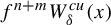 $f^{n+m}W_\delta ^{cu}(x)$
uses balls whose radius depends on n.
$f^{n+m}W_\delta ^{cu}(x)$
uses balls whose radius depends on n.
We begin by choosing a covering of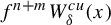 $ f^{n+m} W_\delta ^{cu}(x)$
by balls of radius
$ f^{n+m} W_\delta ^{cu}(x)$
by balls of radius $\epsilon _n = g(n)^{-1}\epsilon < \epsilon $
,
$\epsilon _n = g(n)^{-1}\epsilon < \epsilon $
,
 $$ \begin{align*} B_{d_{cu}}(x_i, \epsilon_n) { : } i=1, \ldots, N:=N(n+m, \epsilon_n),\end{align*} $$
contained within the centre-unstable manifold with respect to the induced metric $d_{cu}$
, and let
$d_{cu}$
, and let $A_{\epsilon _n} : = f^{n+m} W_\delta ^{cu}(x) \setminus \bigcup _{y \in \partial f^{n+m} W_\delta ^{cu}(x)} B_{d_{cu}}(y, \epsilon _n/2)$
, where
$A_{\epsilon _n} : = f^{n+m} W_\delta ^{cu}(x) \setminus \bigcup _{y \in \partial f^{n+m} W_\delta ^{cu}(x)} B_{d_{cu}}(y, \epsilon _n/2)$
, where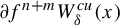 $\partial f^{n+m} W_\delta ^{cu}(x)$
is the boundary of
$\partial f^{n+m} W_\delta ^{cu}(x)$
is the boundary of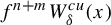 $f^{n+m} W_\delta ^{cu}(x)$
. We can choose a maximal set
$f^{n+m} W_\delta ^{cu}(x)$
. We can choose a maximal set $S= \{x_1, \ldots , x_{N(n+m,\epsilon _n)}\}$
with the additional properties that
$S= \{x_1, \ldots , x_{N(n+m,\epsilon _n)}\}$
with the additional properties that $d_{cu}(x_i,x_j)> \epsilon _n/2$
for
$d_{cu}(x_i,x_j)> \epsilon _n/2$
for $i \neq j$
and
$i \neq j$
and $x_i \in A_{\epsilon _n}$
. By our choice of S we have that
$x_i \in A_{\epsilon _n}$
. By our choice of S we have that
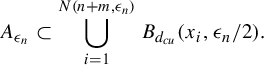 $$ \begin{align*} A_{\epsilon_n} \subset \bigcup_{i=1}^{N(n+m,\epsilon_n)} B_{d_{cu}}(x_i, \epsilon_n/2). \end{align*} $$
By the triangle inequality we have that
 $$ \begin{align*} f^{n+m} W_\delta^{cu}(x) \subset \bigcup_{i=1}^{N(n+m,\epsilon_n)} B_{d_{cu}}(x_i, \epsilon_n). \end{align*} $$
Since $B_{d_{cu}}(x_i, \epsilon _n/4)\cap B_{d_{cu}}(x_j, \epsilon _n/4) = \emptyset $
for
$B_{d_{cu}}(x_i, \epsilon _n/4)\cap B_{d_{cu}}(x_j, \epsilon _n/4) = \emptyset $
for $i \neq j$
, we have that the disjoint union satisfies
$i \neq j$
, we have that the disjoint union satisfies
 $$ \begin{align*} \bigcup_{i=1}^{N(n+m,\epsilon_n)} B_{d_{cu}}(x_i, \epsilon_n/4) \subset f^{n+m} W_\delta^{cu}(x). \end{align*} $$
By Lemma 5.5, for any point $z\in X$
we can choose a point
$z\in X$
we can choose a point $y \in f^m(W^u_\delta (x))$
with
$y \in f^m(W^u_\delta (x))$
with $z \in W^{s}_{\epsilon }(y)$
and
$z \in W^{s}_{\epsilon }(y)$
and $d(y,z) < \epsilon $
. Then
$d(y,z) < \epsilon $
. Then $d(f^jz, f^jy) < \epsilon $
for
$d(f^jz, f^jy) < \epsilon $
for $0\leq j \leq n$
. By construction, we can then choose an
$0\leq j \leq n$
. By construction, we can then choose an $x_i$
such that
$x_i$
such that $f^ny \in W_\delta ^{cu}(x_i)$
and
$f^ny \in W_\delta ^{cu}(x_i)$
and $d_{cu}(f^ny,x_i) < \epsilon _n = ({1}/{g(n)}) \epsilon $
. Additionally, for every
$d_{cu}(f^ny,x_i) < \epsilon _n = ({1}/{g(n)}) \epsilon $
. Additionally, for every $0 \leq j \leq n$
, we have
$0 \leq j \leq n$
, we have $d_{cu}(f^{n-j}y,f^{-j}x_i) < \epsilon $
. Otherwise, let
$d_{cu}(f^{n-j}y,f^{-j}x_i) < \epsilon $
. Otherwise, let ${j \in \{0,\ldots ,n-1\}}$
be the smallest such that
${j \in \{0,\ldots ,n-1\}}$
be the smallest such that $d_{cu}(f^{n-j}y,f^{-j}x_i)> \epsilon $
. Then
$d_{cu}(f^{n-j}y,f^{-j}x_i)> \epsilon $
. Then $d_{cu}(f^ny,x_i) {\kern-1pt}<{\kern-1pt} ({1}/{g(n)}) \epsilon < ({1}/{g(n)})d_{cu}(f^{n-j}y,f^{-j}x_i) < ({1}/{g(j)}) d_{cu}(f^{n-j}y,f^{-j}x_i)$
(as g is increasing). Since
$d_{cu}(f^ny,x_i) {\kern-1pt}<{\kern-1pt} ({1}/{g(n)}) \epsilon < ({1}/{g(n)})d_{cu}(f^{n-j}y,f^{-j}x_i) < ({1}/{g(j)}) d_{cu}(f^{n-j}y,f^{-j}x_i)$
(as g is increasing). Since $f^{n-j}y$
and
$f^{n-j}y$
and $f^{-j}x_i$
are in the same piece of centre-unstable manifold, this would contradict the assumption of Definition 5.3. In particular, letting
$f^{-j}x_i$
are in the same piece of centre-unstable manifold, this would contradict the assumption of Definition 5.3. In particular, letting $y_i = f^{-n}x_i$
, by the triangle inequality,
$y_i = f^{-n}x_i$
, by the triangle inequality,
 $$ \begin{align*} d(f^j z, f^jy_i) \leq d(f^j z, f^jy)+d(f^j y, f^jy_i) \leq 2\epsilon \end{align*} $$
for $0\leq j \leq n$
. Therefore,
$0\leq j \leq n$
. Therefore, $\{y_1, \ldots , y_{N(n+m,\epsilon _n)}\}$
is an
$\{y_1, \ldots , y_{N(n+m,\epsilon _n)}\}$
is an $(n,2\epsilon )$
-spanning set.
$(n,2\epsilon )$
-spanning set.
It remains to relate $Z_{0,G}(n, 2\epsilon )$
to an integral over
$Z_{0,G}(n, 2\epsilon )$
to an integral over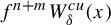 $f^{n+m}W_\delta ^{cu}(x)$
. By the properties of our choice of
$f^{n+m}W_\delta ^{cu}(x)$
. By the properties of our choice of $\epsilon _n$
-cover for
$\epsilon _n$
-cover for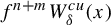 $f^{n+m}W_\delta ^{cu}(x)$
and using Lemma 3.7, we have that for all
$f^{n+m}W_\delta ^{cu}(x)$
and using Lemma 3.7, we have that for all $n \geq 1$
,
$n \geq 1$
,
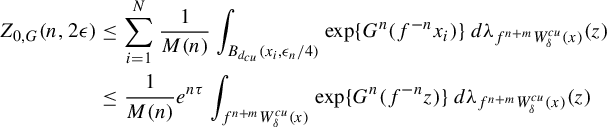
where $M(n) = M(n,\epsilon _n) = \inf _{z} \unicode{x3bb} _{f^{n+m}W_\delta ^{cu}(x)}(B_{d_{cu}}(z,\epsilon _n/4))>0$
. For
$M(n) = M(n,\epsilon _n) = \inf _{z} \unicode{x3bb} _{f^{n+m}W_\delta ^{cu}(x)}(B_{d_{cu}}(z,\epsilon _n/4))>0$
. For $\epsilon $
small, there is a constant
$\epsilon $
small, there is a constant $K_1$
such that
$K_1$
such that $\unicode{x3bb} (B_{d_{cu}}(z,\epsilon _n/4)) \geq K_1 g(n)^{-\dim (E^{cu})} \unicode{x3bb} (B_{d_{cu}}(z,\epsilon /4))$
. Therefore, by the defining property of g,
$\unicode{x3bb} (B_{d_{cu}}(z,\epsilon _n/4)) \geq K_1 g(n)^{-\dim (E^{cu})} \unicode{x3bb} (B_{d_{cu}}(z,\epsilon /4))$
. Therefore, by the defining property of g, $\limsup _{n \rightarrow \infty } ({- \log M(n)}/{n}) = 0$
. Finally, we can bound
$\limsup _{n \rightarrow \infty } ({- \log M(n)}/{n}) = 0$
. Finally, we can bound
 $$ \begin{align} \int_{f^{n+m}W_\delta^{cu}(x)} \! \exp\{G^n(f^{-n}{z})\}\,d\unicode{x3bb}({z}) \leq e^{m \|G\|_\infty} \! \int_{f^{n+m}W_\delta^{cu}(x)}\! \exp\{G^{n+m}(f^{-(n+m)}{z})\}\,d\unicode{x3bb}({z}). \end{align} $$
Comparing equations (5.2) and (5.3), we see that
 $$ \begin{align*} \lim_{\epsilon \to 0} \limsup_{n \to +\infty} \dfrac{1}{n} \log Z_{0,G}(n, 2\epsilon) \leq \limsup_{n \to +\infty}\dfrac{1}{n} \log \int_{f^{n}W_\delta^{cu}(x)} \exp\{G^n(f^{-n}{z})\} \,d\unicode{x3bb}({z}) +\tau. \end{align*} $$
Since $\tau>0$
can be chosen arbitrarily small the lower bound follows.
$\tau>0$
can be chosen arbitrarily small the lower bound follows.
To get an upper bound on the growth rate in Proposition 5.4, we proceed the same way as in the second half of the proof of Proposition 3.2, so we shall omit it.
5.2 Constructing equilibrium states
We conclude with a statement about the construction of equilibrium states for partially hyperbolic systems with subexponential contraction in the centre-unstable direction.
Theorem 5.6. Let $f: X \to X$
be a topologically mixing partially hyperbolic attracting diffeomorphism satisfying Definition 5.3, and let
$f: X \to X$
be a topologically mixing partially hyperbolic attracting diffeomorphism satisfying Definition 5.3, and let $G: X \to \mathbb R$
be a continuous function. Given
$G: X \to \mathbb R$
be a continuous function. Given $x\in X$
and
$x\in X$
and $\delta> 0$
small, consider the sequence of probability measures
$\delta> 0$
small, consider the sequence of probability measures $(\unicode{x3bb} _n)_{n=1}^\infty $
supported on
$(\unicode{x3bb} _n)_{n=1}^\infty $
supported on $W^u_\delta (x)$
and absolutely continuous with respect to the induced volume
$W^u_\delta (x)$
and absolutely continuous with respect to the induced volume $\unicode{x3bb} _{W^u_\delta (x)}$
given by
$\unicode{x3bb} _{W^u_\delta (x)}$
given by

Then the weak* limit points of the averages
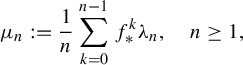
are equilibrium states for G.
The proof of Theorem 5.6 is the same as that of Theorem 1.1, so we will not repeat it.
Acknowledgements
M. Pollicott is partly supported by ERC-Advanced grant 833802-Resonances and EPSRC grant EP/T001674/1.


 Open access

