





1. Introduction
Intermittency, defined as the inherent spatiotemporal inhomogeneity of turbulence due to random fluctuations in the energy cascade as it proceeds from large to small scales (Zhdankin, Boldyrev & Uzdensky Reference Zhdankin, Boldyrev and Uzdensky2016), is generally present in astrophysical plasma turbulence. It manifests as thin structures with enhanced current densities and/or vorticities that take up a small fraction of space but account for a substantial portion of the energy dissipated in turbulence (Zhdankin et al. Reference Zhdankin, Boldyrev and Uzdensky2016). In a magnetised plasma, these structures imply strong velocity and magnetic shears coinciding in space. These two shears drive various instabilities. Thus, velocity shear is prone to the Kelvin–Helmholtz instability (KHI), which has been studied extensively using linear theory, fluid simulations and kinetic simulations. On the other hand, magnetic shear is susceptible to tearing modes and magnetic reconnection creating plasmoid chains and accelerating particles efficiently (Zenitani & Hoshino Reference Zenitani and Hoshino2007; Guo et al. Reference Guo, Li, Daughton and Liu2014; Werner et al. Reference Werner, Uzdensky, Cerutti, Nalewajko and Begelman2016; Sironi et al. Reference Sironi, Uzdensky and Giannios2025). Magnetic shear is also prone to drift–kink instability (DKI) (Zhu & Winglee Reference Zhu and Winglee1996; Pritchett, Coroniti & Decyk Reference Pritchett, Coroniti and Decyk1996; Daughton Reference Daughton1999; Zenitani & Hoshino Reference Zenitani and Hoshino2007, Reference Zenitani and Hoshino2008; Barkov & Komissarov Reference Barkov and Komissarov2016; Werner & Uzdensky Reference Werner and Uzdensky2021) which, in a pair plasma with a weak guide magnetic field, grows faster during the linear stage than the tearing modes, but is generally not as efficient a particle accelerator as reconnection (Zenitani & Hoshino Reference Zenitani and Hoshino2007). How the instabilities arising from velocity and magnetic shear interact with one another is an open question that has only now begun to be explored. A practical question is how such interaction affects energy dissipation and non-thermal particle acceleration. With applications to the boundaries of relativistic jets in active galactic nuclei in mind, Sironi, Rowan & Narayan (Reference Sironi, Rowan and Narayan2021) considered a two-dimensional jet–wind model – a ‘jet’ medium made up of pair plasma and a ‘wind’ medium made up of normal (electron–ion) plasma with a relativistic velocity shear between them, and a magnetic field that was helical in the jet and toroidal and significantly weaker in the wind. That study found that KH vortices can wrap the field lines over each other, creating current sheets that trigger reconnection and considerable dissipation, but the specific set-up of that study precluded the authors from exploring the effects of DKI.
In this article we consider a similar computational set-up (see figure 1), but simplified in order to explore the joint effects of KH and DK modes, and their nonlinear interplay, on magnetic and bulk-kinetic dissipation. Here, for the first time, we incorporate the effects of velocity and magnetic shear in a two-dimensional configuration where DKI coexists with KHI, while tearing is forbidden. Using first-principles particle-in-cell (PIC) simulations, we show that the interaction between the KHI and DKI creates qualitatively new structures and very different amounts of dissipation compared with the case when only one of the instabilities is present. It also leads to a new and efficient means of non-thermal particle acceleration. Thus, dissipation is highly sensitive to the interplay of the two instabilities.
The structure of this paper is as follows. In § 2 we describe the simulation set-up for this study, including the parameters explored and the diagnostics used. In § 3 we present our results, focusing first on the morphology and dissipation of the system in § 3.1 and then on particle acceleration in § 3.2. In § 4 we discuss the applicability of our results and draw our conclusions.
2. Methods
We perform two-dimensional relativistic electromagnetic PIC simulations using the code Zeltron (Cerutti et al. Reference Cerutti, Werner, Uzdensky and Begelman2013). We consider a relativistically warm ( $\theta \equiv T/m_e c^2\sim 1$
) electron–positron pair plasma in a double-layer shear flow (see figure 1). Our set-up consists of two regions, Zone j (blue) and Zone w (red), with two thin interface layers between them. In the following,
$\theta \equiv T/m_e c^2\sim 1$
) electron–positron pair plasma in a double-layer shear flow (see figure 1). Our set-up consists of two regions, Zone j (blue) and Zone w (red), with two thin interface layers between them. In the following, $x$
is the direction of the fluid flow while
$x$
is the direction of the fluid flow while $y$
is the gradient direction. We impose an initial out-of-plane magnetic field that is perpendicular to the flow and the gradient direction, i.e.
$y$
is the gradient direction. We impose an initial out-of-plane magnetic field that is perpendicular to the flow and the gradient direction, i.e. $\boldsymbol{B} = B(y)\hat {z}$
. We simulate the
$\boldsymbol{B} = B(y)\hat {z}$
. We simulate the $x,y$
plane keeping all three components for vector quantities. Since the
$x,y$
plane keeping all three components for vector quantities. Since the $z$
direction is not simulated, no tearing modes can be excited (a full three-dimensional study is left to future work). This allows us to focus on the KH and DK modes and their interplay. We run the simulations in the frame where both zones are moving at the same speed but in opposite (
$z$
direction is not simulated, no tearing modes can be excited (a full three-dimensional study is left to future work). This allows us to focus on the KH and DK modes and their interplay. We run the simulations in the frame where both zones are moving at the same speed but in opposite ( $\pm \hat {x}$
) directions.
$\pm \hat {x}$
) directions.
The double-shear-layer set-up used in this study, consisting of two zones, Zone j and Zone w, in equal and opposite motion along the $x$
axis with respect to each other. The magnetic field in Zone j points out of the page (
$x$
axis with respect to each other. The magnetic field in Zone j points out of the page ( $+z$
direction) while that in Zone w can point either into (
$+z$
direction) while that in Zone w can point either into ( $-z$
) or out of the page. The plasma quantities
$-z$
) or out of the page. The plasma quantities $B, E$
, etc., are connected smoothly between the two zones by a tanh profile (equation (A2)).
$B, E$
, etc., are connected smoothly between the two zones by a tanh profile (equation (A2)).

The set-up is characterised by the following initial dimensionless parameters: Zone j’s bulk-flow 4-velocity $u_j = \varGamma _j\beta _j$
, normalised temperature
$u_j = \varGamma _j\beta _j$
, normalised temperature $\theta _j= T_j/m_e c^2$
, magnetisation
$\theta _j= T_j/m_e c^2$
, magnetisation $\sigma _j = B_j^2/4\pi w_j$
(where
$\sigma _j = B_j^2/4\pi w_j$
(where $w_j$
is Zone j’s relativistic enthalpy density) and the ratio of Zone w’s to Zone j’s magnetic field
$w_j$
is Zone j’s relativistic enthalpy density) and the ratio of Zone w’s to Zone j’s magnetic field $B_{w}/B_{j}$
. Zone j’s magnetisation
$B_{w}/B_{j}$
. Zone j’s magnetisation $\sigma _j$
and normalised temperature
$\sigma _j$
and normalised temperature $\theta _j$
are set to 1 initially in all the cases we consider, while
$\theta _j$
are set to 1 initially in all the cases we consider, while $u_j$
is varied from run to run. Zone w’s rest-frame density, temperature and bulk speed are initially set equal to those in Zone j (with bulk velocity reversing direction). We connect Zone j’s and Zone w’s flow velocities and magnetic fields smoothly by a tanh functionFootnote
1
of
$u_j$
is varied from run to run. Zone w’s rest-frame density, temperature and bulk speed are initially set equal to those in Zone j (with bulk velocity reversing direction). We connect Zone j’s and Zone w’s flow velocities and magnetic fields smoothly by a tanh functionFootnote
1
of $y$
with a transition half-width
$y$
with a transition half-width $\varDelta$
(equation (A2)). Combining Maxwell’s equations and the ideal gas law with the assumptions of pressure balance across the shear layer and the ideal magnetohydrodynamic (MHD) condition that the initial electric field is purely motional,
$\varDelta$
(equation (A2)). Combining Maxwell’s equations and the ideal gas law with the assumptions of pressure balance across the shear layer and the ideal magnetohydrodynamic (MHD) condition that the initial electric field is purely motional, $\boldsymbol{E} = -\boldsymbol{v}\times \boldsymbol{B}/c$
, the
$\boldsymbol{E} = -\boldsymbol{v}\times \boldsymbol{B}/c$
, the $y$
profiles of the electric field, velocity, density and temperature of the electrons and positrons can be determined. The initial velocities of the particles are then sampled from the local drifting Maxwell–Jüttner distribution. Details of this set-up can be found in Appendix A. With this set-up, we ran two control cases with only one type of shear present
$y$
profiles of the electric field, velocity, density and temperature of the electrons and positrons can be determined. The initial velocities of the particles are then sampled from the local drifting Maxwell–Jüttner distribution. Details of this set-up can be found in Appendix A. With this set-up, we ran two control cases with only one type of shear present $(u_j, B_w/B_j) = (0.5,+1)$
and
$(u_j, B_w/B_j) = (0.5,+1)$
and $(0, -1)$
(hereafter referred to as the VS and MS cases, respectively), and a series of mixed cases with fixed magnetic shear (
$(0, -1)$
(hereafter referred to as the VS and MS cases, respectively), and a series of mixed cases with fixed magnetic shear ( $B_w/B_j = -1$
) and progressively varied
$B_w/B_j = -1$
) and progressively varied $u_j:\{0.01,0.03,0.05,0.07,0.1,0.2,0.3,0.4,0.5,0.6,0.7,0.8,0.9\}$
. This allowed us to investigate systematically the effects of velocity shear on DKI and its co-evolution with KHI. Table 1 presents a summary of the simulation parameters used.
$u_j:\{0.01,0.03,0.05,0.07,0.1,0.2,0.3,0.4,0.5,0.6,0.7,0.8,0.9\}$
. This allowed us to investigate systematically the effects of velocity shear on DKI and its co-evolution with KHI. Table 1 presents a summary of the simulation parameters used.
Simulation parameters for the cases explored in this study. Here, $\sigma _j\equiv B_j^2/4\pi w_j$
and
$\sigma _j\equiv B_j^2/4\pi w_j$
and $\theta _j\equiv T_j/m_e c^2$
are the initial magnetisation and the initial relativistic temperature, respectively, in Zone j, while
$\theta _j\equiv T_j/m_e c^2$
are the initial magnetisation and the initial relativistic temperature, respectively, in Zone j, while $u_j\equiv \varGamma _j\beta _j$
is the bulk 4-velocity of the plasma flow in Zone j and
$u_j\equiv \varGamma _j\beta _j$
is the bulk 4-velocity of the plasma flow in Zone j and $B_w/B_j$
is the ratio of Zone w’s to Zone j’s magnetic field (+1 means they are aligned, −1 means they are oppositely aligned).
$B_w/B_j$
is the ratio of Zone w’s to Zone j’s magnetic field (+1 means they are aligned, −1 means they are oppositely aligned).

The simulation domain is a rectangular box with periodic boundaries spanning $L_x = 100 d_{e,j}$
in the
$L_x = 100 d_{e,j}$
in the $x$
direction and
$x$
direction and $L_y = 300 d_{e,j}$
in the
$L_y = 300 d_{e,j}$
in the $y$
direction, where
$y$
direction, where $d_{e,j} \equiv (\bar {\gamma }_j m_e c^2/4\pi \tilde {n}_{e,j}e^2)^{1/2}$
is the electron inertial length in Zone j; it is resolved fiducially by
$d_{e,j} \equiv (\bar {\gamma }_j m_e c^2/4\pi \tilde {n}_{e,j}e^2)^{1/2}$
is the electron inertial length in Zone j; it is resolved fiducially by $1024\times 3072$
grid cells, which resolves Zone j’s electron inertial length
$1024\times 3072$
grid cells, which resolves Zone j’s electron inertial length $d_{e,j}$
by
$d_{e,j}$
by $\approx$
10 cells. The initial half-thickness of each shear layer, located at
$\approx$
10 cells. The initial half-thickness of each shear layer, located at $y_{1,2} = \{L_y/3, 2L_y/3\} = \{100, 200\}\, d_{e,j}$
, is set to
$y_{1,2} = \{L_y/3, 2L_y/3\} = \{100, 200\}\, d_{e,j}$
, is set to $\varDelta = 5 d_{e,j}$
as motivated by Serrano, Nättilä & Zhdankin (Reference Serrano, Nättilä and Zhdankin2024), which finds that intermittent structures typically have a width of
$\varDelta = 5 d_{e,j}$
as motivated by Serrano, Nättilä & Zhdankin (Reference Serrano, Nättilä and Zhdankin2024), which finds that intermittent structures typically have a width of $3 d_{e,j}$
. For relativistically warm (
$3 d_{e,j}$
. For relativistically warm ( $\theta \sim 1$
), moderately magnetised (
$\theta \sim 1$
), moderately magnetised ( $\sigma \sim 1$
) pair plasma, Zone j’s electron Debye length
$\sigma \sim 1$
) pair plasma, Zone j’s electron Debye length $\lambda _{\mathrm{D},e}$
, average gyroradius
$\lambda _{\mathrm{D},e}$
, average gyroradius $\rho _{e,j}$
and electron inertial length
$\rho _{e,j}$
and electron inertial length $d_{e,j}$
are roughly equal, so all the kinetic scales are well resolved (exact definitions for
$d_{e,j}$
are roughly equal, so all the kinetic scales are well resolved (exact definitions for $d_{e,j},\ \lambda _{\mathrm{D},e}\text{ and }\rho _{e,j}$
are given in Appendix B, though we note that
$d_{e,j},\ \lambda _{\mathrm{D},e}\text{ and }\rho _{e,j}$
are given in Appendix B, though we note that $\rho _{e,j}\sim (\theta _j/\sigma _j)^{1/2}d_{e,j}$
). We create 64 particles per cell (PPC) per species (totaling 128 PPC); this results in
$\rho _{e,j}\sim (\theta _j/\sigma _j)^{1/2}d_{e,j}$
). We create 64 particles per cell (PPC) per species (totaling 128 PPC); this results in $d^2_{e,j}/\Delta x\Delta y\times \mathrm{PPC} \sim 6400$
particles per area spanned by Zone j’s electron inertial length, sufficient for our purposes. We run our simulations for approximately
$d^2_{e,j}/\Delta x\Delta y\times \mathrm{PPC} \sim 6400$
particles per area spanned by Zone j’s electron inertial length, sufficient for our purposes. We run our simulations for approximately $50 L_x/c$
to ensure the saturated stage is reached. For kinetic diagnostic purposes, we randomly select and track the trajectories of
$50 L_x/c$
to ensure the saturated stage is reached. For kinetic diagnostic purposes, we randomly select and track the trajectories of $10^5$
electrons and positrons throughout the simulation.
$10^5$
electrons and positrons throughout the simulation.
The main focus of this study is on the evolution of the total magnetic and bulk kinetic energies. The total magnetic energy is calculated as $E_B \equiv \int B^2/8\pi \,\mathrm{d}V$
. To calculate the total bulk kinetic energy, we first perform a Lorentz transformation into the local zero-particle-flux (Eckart) frame at each cell, calculate the local pressure tensor there and then subtract it from the total stress tensor to obtain the bulk-flow stress tensor. Integrating its trace over the box volume gives the total bulk kinetic energy
$E_B \equiv \int B^2/8\pi \,\mathrm{d}V$
. To calculate the total bulk kinetic energy, we first perform a Lorentz transformation into the local zero-particle-flux (Eckart) frame at each cell, calculate the local pressure tensor there and then subtract it from the total stress tensor to obtain the bulk-flow stress tensor. Integrating its trace over the box volume gives the total bulk kinetic energy $E_{\mathrm{KE}}$
[details of this procedure are given in Appendix C (V. Zhdankin, personal communication)]. As a consistency check, the total energy in all our simulations is conserved to within 0.2 %.
$E_{\mathrm{KE}}$
[details of this procedure are given in Appendix C (V. Zhdankin, personal communication)]. As a consistency check, the total energy in all our simulations is conserved to within 0.2 %.
Snapshots of $B_z/B_j$
for simulations with velocity shear only (‘VS’, upper-top), magnetic shear only (‘MS’, upper-middle) and both shears (
$B_z/B_j$
for simulations with velocity shear only (‘VS’, upper-top), magnetic shear only (‘MS’, upper-middle) and both shears ( $u_j=0.5,B_w/B_j=-1$
, upper-bottom). The lower panel shows snapshots of
$u_j=0.5,B_w/B_j=-1$
, upper-bottom). The lower panel shows snapshots of $B_z, E_x$
in the saturated stage (
$B_z, E_x$
in the saturated stage ( $tc/L_x=27.3$
) for the
$tc/L_x=27.3$
) for the $u_j=0.5,B_w/B_j=-1$
case, with the ‘annihilated core’ and ‘KH cocoon’ annotated.
$u_j=0.5,B_w/B_j=-1$
case, with the ‘annihilated core’ and ‘KH cocoon’ annotated.

3. Results
3.1. Morphology and dissipation
In this section, we first give a quick overview of the evolution of selected simulations, summarising the stages they go through; then we discuss each stage in greater detail, focusing on the linear growth rate, nonlinear shear-layer width and dissipation.
Figure 2 shows the typical evolution of our simulations, which first follows a linear stage, then a nonlinear stage when the conversion of magnetic or bulk kinetic energy into internal energy takes place and finally a saturated stage. The onset times of these stages are different for the MS, mixed-shear and VS cases. In the MS case, the linear stage occurs at $0\lt tc/L_x\lesssim 2.5$
, the nonlinear stage at
$0\lt tc/L_x\lesssim 2.5$
, the nonlinear stage at $2.5\lesssim tc/L_x\lesssim 13$
and the saturated stage from
$2.5\lesssim tc/L_x\lesssim 13$
and the saturated stage from $tc/L_x\gtrsim 13$
. For the mixed-shear cases, the linear stage ends roughly at
$tc/L_x\gtrsim 13$
. For the mixed-shear cases, the linear stage ends roughly at $tc/L_x\approx 2.5$
, as in the MS case, but the nonlinear stage is somewhat prolonged, lasting until
$tc/L_x\approx 2.5$
, as in the MS case, but the nonlinear stage is somewhat prolonged, lasting until $tc/L_x\approx 25$
before transitioning to the saturated stage. For the VS case, the linear stage ends at
$tc/L_x\approx 25$
before transitioning to the saturated stage. For the VS case, the linear stage ends at $tc/L_x\approx 7$
, the nonlinear stage lasts until
$tc/L_x\approx 7$
, the nonlinear stage lasts until $tc/L_x\approx 13$
and is then followed by the saturated stage. The upper two panels of figure 2 show the evolution of the two control cases: the VS case (
$tc/L_x\approx 13$
and is then followed by the saturated stage. The upper two panels of figure 2 show the evolution of the two control cases: the VS case ( $B_j/B_w = 1$
), where only the KHI is excited, and the MS case (
$B_j/B_w = 1$
), where only the KHI is excited, and the MS case ( $u_j=0$
), where only the DKI is excited. The instabilities give rise to prominent features in the nonlinear stage: cat’s-eye vortices can be clearly seen in the VS case (upper-top panel of figure 2), while Rayleigh–Taylor-like plume features (upper-middle panel of figure 2) arise in the MS case. The nonlinear phase begins when the
$u_j=0$
), where only the DKI is excited. The instabilities give rise to prominent features in the nonlinear stage: cat’s-eye vortices can be clearly seen in the VS case (upper-top panel of figure 2), while Rayleigh–Taylor-like plume features (upper-middle panel of figure 2) arise in the MS case. The nonlinear phase begins when the $y$
displacement of the features becomes comparable to the modal wavelength in the
$y$
displacement of the features becomes comparable to the modal wavelength in the $x$
direction. For the VS case this is characterised only by a slight smearing of the KH vortices, while the DK plumes mix together violently. This is the stage where most of the dissipation (if any) occurs. In the later saturated stage, the KH vortices persist to the end in the VS case, while in the MS case the mixing leads to a thickened shear layer where the electric and magnetic fields are drastically reduced. The DK plumes do not persist to the end.
$x$
direction. For the VS case this is characterised only by a slight smearing of the KH vortices, while the DK plumes mix together violently. This is the stage where most of the dissipation (if any) occurs. In the later saturated stage, the KH vortices persist to the end in the VS case, while in the MS case the mixing leads to a thickened shear layer where the electric and magnetic fields are drastically reduced. The DK plumes do not persist to the end.
When both types of shear are present, the KHI and DKI interact. The nonlinear stage ( $tc/L_x\gtrsim 5{-}6$
) is marked by the nonlinear interactions of the KH vortices and DK plumes, creating a turbulent shear layer (e.g. upper-bottom panel of figure 2) at around
$tc/L_x\gtrsim 5{-}6$
) is marked by the nonlinear interactions of the KH vortices and DK plumes, creating a turbulent shear layer (e.g. upper-bottom panel of figure 2) at around $(7{-}10) L_x/c$
(a small multiple of the DK growth time scale). As discussed below, the dissipation level is also modified significantly. In the saturated stage, the turbulence subsides, giving way to a shear layer consisting of a broad ‘annihilated core’ where the
$(7{-}10) L_x/c$
(a small multiple of the DK growth time scale). As discussed below, the dissipation level is also modified significantly. In the saturated stage, the turbulence subsides, giving way to a shear layer consisting of a broad ‘annihilated core’ where the $E$
and
$E$
and $B$
fields are suppressed, the flow is nearly stagnant and the thermal pressure dominates. This relatively quiet layer is enshrouded by an active ‘KH cocoon’ (lower panel of figure 2).
$B$
fields are suppressed, the flow is nearly stagnant and the thermal pressure dominates. This relatively quiet layer is enshrouded by an active ‘KH cocoon’ (lower panel of figure 2).
Top left: growth curves of selected modes (indicated by the wavelength $\lambda$
) for the control cases (red for VS, blue for MS). Note that the wavelengths of the displayed modes are different for the MS (
$\lambda$
) for the control cases (red for VS, blue for MS). Note that the wavelengths of the displayed modes are different for the MS ( $\lambda = 33 d_{e,j}$
) and VS (
$\lambda = 33 d_{e,j}$
) and VS ( $\lambda = 100 d_{e,j}$
) cases. Top right: growth curves for selected mixed-shear cases (red for
$\lambda = 100 d_{e,j}$
) cases. Top right: growth curves for selected mixed-shear cases (red for $u_j=0.05$
, blue for
$u_j=0.05$
, blue for $u_j=0.3$
, green for
$u_j=0.3$
, green for $u_j=0.9$
). In both panels, dashed lines show fitted linear growth rates as indicated in the legends. The growth curve of the
$u_j=0.9$
). In both panels, dashed lines show fitted linear growth rates as indicated in the legends. The growth curve of the $u_j=0.9$
case is not fitted as no exponential growth phase can be identified. Bottom: fitted linear growth rates for mixed-shear cases as a function of
$u_j=0.9$
case is not fitted as no exponential growth phase can be identified. Bottom: fitted linear growth rates for mixed-shear cases as a function of $u_j\equiv \varGamma _j\beta _j$
, with the fastest-growing mode displayed in the legend. No fitted growth rate is displayed for the
$u_j\equiv \varGamma _j\beta _j$
, with the fastest-growing mode displayed in the legend. No fitted growth rate is displayed for the $u_j\gt 0.6$
cases as no exponential growth phase can be identified. Note that the growth rate of the VS case is not displayed in this panel. The black arrow highlights the drastic drop in growth rate for the
$u_j\gt 0.6$
cases as no exponential growth phase can be identified. Note that the growth rate of the VS case is not displayed in this panel. The black arrow highlights the drastic drop in growth rate for the $u_j=0.5$
case.
$u_j=0.5$
case.

To examine how velocity shear modifies the linear growth rate of the DKI, we calculate the deviation of the $z$
-component magnetic field from the initial value, i.e.
$z$
-component magnetic field from the initial value, i.e. $\delta B_z =B_z(x,y,t) - B_z(x,y,0)$
, at
$\delta B_z =B_z(x,y,t) - B_z(x,y,0)$
, at $y/d_{e,j}=200$
(which is the initial location of the upper shear layer) and then Fourier-transform it in the
$y/d_{e,j}=200$
(which is the initial location of the upper shear layer) and then Fourier-transform it in the $x$
direction, i.e. compute
$x$
direction, i.e. compute $\delta \tilde {B}_z(k_x, t)$
. We then select for our analysis the Fourier mode whose amplitude first reaches
$\delta \tilde {B}_z(k_x, t)$
. We then select for our analysis the Fourier mode whose amplitude first reaches $\delta \tilde {B}_z/B_j=0.1$
(which is typically
$\delta \tilde {B}_z/B_j=0.1$
(which is typically $\lambda \approx 33d_{e,j}$
for the MS and mixed-shear cases and
$\lambda \approx 33d_{e,j}$
for the MS and mixed-shear cases and $\lambda \approx 100d_{e,j}$
for the VS case, or equivalently
$\lambda \approx 100d_{e,j}$
for the VS case, or equivalently $k_x\varDelta \sim 1$
, where
$k_x\varDelta \sim 1$
, where $\varDelta$
is the initial shear-layer width, as shown in figure 3). The variation of
$\varDelta$
is the initial shear-layer width, as shown in figure 3). The variation of $\delta \tilde {B}_z/B_j$
of this mode with time (in units of
$\delta \tilde {B}_z/B_j$
of this mode with time (in units of $tc/L_x$
) is displayed in figure 3. We observe, for most cases (VS, MS and the
$tc/L_x$
) is displayed in figure 3. We observe, for most cases (VS, MS and the $u_j\lt 0.6$
cases), a clear linear phase, exponential growth within the first
$u_j\lt 0.6$
cases), a clear linear phase, exponential growth within the first $2.5 L_x/c$
. For the VS and MS cases (top-left panel), two very different growths can be seen, corresponding to the KH-only (red line, VS) and DK-only (blue line, MS) instabilities. Using (25) in Zenitani & Hoshino (Reference Zenitani and Hoshino2007) to estimate the growth rate of the relativistic DKI in the MS case, we find an analytic expectation of
$2.5 L_x/c$
. For the VS and MS cases (top-left panel), two very different growths can be seen, corresponding to the KH-only (red line, VS) and DK-only (blue line, MS) instabilities. Using (25) in Zenitani & Hoshino (Reference Zenitani and Hoshino2007) to estimate the growth rate of the relativistic DKI in the MS case, we find an analytic expectation of $\mathrm{Im}(\omega L_x/c)\approx 3.05$
, fairly consistent with our measured simulation resultFootnote
2
$\mathrm{Im}(\omega L_x/c)\approx 3.05$
, fairly consistent with our measured simulation resultFootnote
2 $\mathrm{Im}(\omega L_x/c)\approx 2.67$
. Adopting the linear analysis described in Chow et al. (Reference Chow, Rowan, Sironi, Davelaar, Bodo and Narayan2023), we calculate the analytic growth rate for the KHI to be
$\mathrm{Im}(\omega L_x/c)\approx 2.67$
. Adopting the linear analysis described in Chow et al. (Reference Chow, Rowan, Sironi, Davelaar, Bodo and Narayan2023), we calculate the analytic growth rate for the KHI to be $\mathrm{Im}(\omega L_x/c)\approx 2.47$
for the VS case, whereas our simulation result gives
$\mathrm{Im}(\omega L_x/c)\approx 2.47$
for the VS case, whereas our simulation result gives $\mathrm{Im}(\omega L_x/c)=1.15$
, which is a factor of 2 lower. Possible reasons for this discrepancy are noted in a footnote.Footnote
3
Even though the KH and DK modes separately grow on different time scales and length scales, as shown in the top-left panel for the VS and MS cases, there is only one linear, exponential growth phase in the mixed-shear cases (
$\mathrm{Im}(\omega L_x/c)=1.15$
, which is a factor of 2 lower. Possible reasons for this discrepancy are noted in a footnote.Footnote
3
Even though the KH and DK modes separately grow on different time scales and length scales, as shown in the top-left panel for the VS and MS cases, there is only one linear, exponential growth phase in the mixed-shear cases ( $u_j\neq 0,B_w/B_j=-1$
), as shown in the top-right panel (e.g. red and blue lines). From figure 3, the linear stage for this mode lasts for
$u_j\neq 0,B_w/B_j=-1$
), as shown in the top-right panel (e.g. red and blue lines). From figure 3, the linear stage for this mode lasts for $2.5 L_x/c$
for the MS case and all the mixed-shear cases with
$2.5 L_x/c$
for the MS case and all the mixed-shear cases with $u_j\lt 0.4$
, whereas for the VS case it lasts until about
$u_j\lt 0.4$
, whereas for the VS case it lasts until about $7 L_x/c$
. When
$7 L_x/c$
. When $u_j$
is increased above
$u_j$
is increased above $0.5$
, no exponential growth phase can be identified.
$0.5$
, no exponential growth phase can be identified.
We extract the growth rates by fitting the linear phase whenever it can be identified and plot the results as a function of $u_j$
in the bottom panel of figure 3. The wavelength of the displayed mode is
$u_j$
in the bottom panel of figure 3. The wavelength of the displayed mode is $\lambda =33.3d_{e,j}$
(note that only the MS and mixed-shear cases are displayed in this panel). As shown in this panel, the growth rates of all cases with an identifiable linear growth phase (except the
$\lambda =33.3d_{e,j}$
(note that only the MS and mixed-shear cases are displayed in this panel). As shown in this panel, the growth rates of all cases with an identifiable linear growth phase (except the $u_j=0.5$
case) are roughly the same [
$u_j=0.5$
case) are roughly the same [ $\mathrm{Im}(\omega L_x/c)\sim 2.75$
, equivalently
$\mathrm{Im}(\omega L_x/c)\sim 2.75$
, equivalently $\mathrm{Im}(\omega /\omega _{pe,j})\sim 0.0275$
and
$\mathrm{Im}(\omega /\omega _{pe,j})\sim 0.0275$
and $\mathrm{Im}(\omega /\omega _{ce,j})\sim 0.0138$
], equal to that in the MS case. This, together with the fact that the fastest-growing modes for the mixed-shear cases are the same as in the MS case, implies that the DK modes still dominate the linear growth in the presence of moderately strong velocity shear (
$\mathrm{Im}(\omega /\omega _{ce,j})\sim 0.0138$
], equal to that in the MS case. This, together with the fact that the fastest-growing modes for the mixed-shear cases are the same as in the MS case, implies that the DK modes still dominate the linear growth in the presence of moderately strong velocity shear ( $u_j\lesssim 0.4$
), and there is minimal interaction of the DK and KH modes in this linear stage. The effect of velocity shear in the linear phase becomes more apparent for
$u_j\lesssim 0.4$
), and there is minimal interaction of the DK and KH modes in this linear stage. The effect of velocity shear in the linear phase becomes more apparent for $u_j\geqslant 0.5$
– the growth rate drops to
$u_j\geqslant 0.5$
– the growth rate drops to $\mathrm{Im}(\omega L_x/c)\sim 2.29$
for
$\mathrm{Im}(\omega L_x/c)\sim 2.29$
for $u_j=0.5$
and no exponential growth phase can be identified for stronger shears.
$u_j=0.5$
and no exponential growth phase can be identified for stronger shears.
Left: $x$
-averaged plots of
$x$
-averaged plots of $B_z/B_j$
for
$B_z/B_j$
for $u_j = 0.05,0.1,0.3,0.8$
,
$u_j = 0.05,0.1,0.3,0.8$
, $B_w/B_j = -1$
at
$B_w/B_j = -1$
at $tc/L_x=55$
, showing how the instabilities thicken the magnetic shear layer. The black dashed line is the
$tc/L_x=55$
, showing how the instabilities thicken the magnetic shear layer. The black dashed line is the $x$
-averaged plot of
$x$
-averaged plot of $B_z/B_j$
at
$B_z/B_j$
at $t=0$
. The horizontal translucent brown line indicates
$t=0$
. The horizontal translucent brown line indicates $B_z=0$
. Right: width of the thickened shear layer as a function of velocity shear, at
$B_z=0$
. Right: width of the thickened shear layer as a function of velocity shear, at $tc/L_x=55$
.
$tc/L_x=55$
.

Despite the relatively unchanged linear growth rates observed at early times for $u_j\lesssim 0.4$
cases, the morphological changes at late times are apparent. In the following, we characterise the structure of the test cases by the width of the thickened shear layer. In the left-hand panel of figure 4 we plot the
$u_j\lesssim 0.4$
cases, the morphological changes at late times are apparent. In the following, we characterise the structure of the test cases by the width of the thickened shear layer. In the left-hand panel of figure 4 we plot the $x$
-averaged profiles of
$x$
-averaged profiles of $B_z/B_j$
at the final time
$B_z/B_j$
at the final time $tc/L_x = 55$
for several values of
$tc/L_x = 55$
for several values of $u_j$
. We observe that turbulence driven by nonlinear interactions of the instabilities has thickened the shear layer, within which
$u_j$
. We observe that turbulence driven by nonlinear interactions of the instabilities has thickened the shear layer, within which $B_z$
is reduced. We measure the width of this layer
$B_z$
is reduced. We measure the width of this layer $\Delta y_{B_z}$
at
$\Delta y_{B_z}$
at $tc/L_x=55$
by the
$tc/L_x=55$
by the $y$
separation between isosufaces of
$y$
separation between isosufaces of $B_z/B_j = -0.5$
and
$B_z/B_j = -0.5$
and $0.5$
and display it as a function of
$0.5$
and display it as a function of $u_j$
in the right-hand panel of figure 4. A non-trivial picture emerges. The width is substantial in the pure DKI MS case (
$u_j$
in the right-hand panel of figure 4. A non-trivial picture emerges. The width is substantial in the pure DKI MS case ( $u_j=0$
), but decreases with increased shear for relatively weak
$u_j=0$
), but decreases with increased shear for relatively weak $u_j\lesssim 0.1$
. It then bounces back up for intermediate values of
$u_j\lesssim 0.1$
. It then bounces back up for intermediate values of $u_j$
(
$u_j$
( $0.1\lt u_j\lt 0.3$
), but drops again for larger values of
$0.1\lt u_j\lt 0.3$
), but drops again for larger values of $u_j$
. This is quite different from the
$u_j$
. This is quite different from the $u_j$
dependence of the linear growth rate, which shows no such variations for
$u_j$
dependence of the linear growth rate, which shows no such variations for $u_j\lesssim 0.4$
. We therefore attribute the changes in the shear-layer width to nonlinear interaction of the instabilities. Namely, when the velocity shear is moderately weak (
$u_j\lesssim 0.4$
. We therefore attribute the changes in the shear-layer width to nonlinear interaction of the instabilities. Namely, when the velocity shear is moderately weak ( $u_j\lt 0.1$
), DK plumes protruding across the plasma’s bulk flow are quickly sheared away, reducing the layer’s width. As
$u_j\lt 0.1$
), DK plumes protruding across the plasma’s bulk flow are quickly sheared away, reducing the layer’s width. As $u_j$
increases to around 0.2, KHI initiates and the cat’s-eye vortices wrap up the layer, causing it to thicken again. When the velocity difference becomes super-magnetosonic, however, KHI is suppressed (Chow et al. Reference Chow, Rowan, Sironi, Davelaar, Bodo and Narayan2023), leading to a thinner saturated layer. We observe that the onset of KH vortices, if it happens, occurs at a slightly later time than the linear, DK-dominated growth phase. For example, in the
$u_j$
increases to around 0.2, KHI initiates and the cat’s-eye vortices wrap up the layer, causing it to thicken again. When the velocity difference becomes super-magnetosonic, however, KHI is suppressed (Chow et al. Reference Chow, Rowan, Sironi, Davelaar, Bodo and Narayan2023), leading to a thinner saturated layer. We observe that the onset of KH vortices, if it happens, occurs at a slightly later time than the linear, DK-dominated growth phase. For example, in the $u_j=0.3$
case, the KH vortices set in at around
$u_j=0.3$
case, the KH vortices set in at around $tc/L_x\sim 5$
, whereas the linear phase occurs in the range
$tc/L_x\sim 5$
, whereas the linear phase occurs in the range $0\lt tc/L_x\lt 2.5$
(observe in the top-right panel of figure 3 that there is a small increase in
$0\lt tc/L_x\lt 2.5$
(observe in the top-right panel of figure 3 that there is a small increase in $\delta \tilde {B}_z/B_j$
at
$\delta \tilde {B}_z/B_j$
at $tc/L_x\sim 5$
for the blue line, indicative of KH vortex wrap-ups). As shown below, the width of the thickened shear layer correlates strongly with magnetic energy dissipation.
$tc/L_x\sim 5$
for the blue line, indicative of KH vortex wrap-ups). As shown below, the width of the thickened shear layer correlates strongly with magnetic energy dissipation.
Top and bottom left: the total magnetic and bulk kinetic energies within the simulation box $E_B, E_{\mathrm{KE}}$
, normalised by their initial values
$E_B, E_{\mathrm{KE}}$
, normalised by their initial values $E_{B,0}, E_{\mathrm{KE,0}}$
, against time for selected cases (
$E_{B,0}, E_{\mathrm{KE,0}}$
, against time for selected cases ( $u_j = 0.05,0.1,0.3,0.8$
,
$u_j = 0.05,0.1,0.3,0.8$
, $B_w/B_j = -1$
and the VS case). Top and bottom right: brown dotted lines with red triangles show the magnetic and bulk kinetic energy dissipated, measured by
$B_w/B_j = -1$
and the VS case). Top and bottom right: brown dotted lines with red triangles show the magnetic and bulk kinetic energy dissipated, measured by $-\Delta E_B/E_{B,0},-\Delta E_{\mathrm{KE}}/E_{\mathrm{KE,0}}$
, as a function of velocity shear
$-\Delta E_B/E_{B,0},-\Delta E_{\mathrm{KE}}/E_{\mathrm{KE,0}}$
, as a function of velocity shear $u_j$
, at
$u_j$
, at $tc/L_x=50$
. Black dashed lines with blue squares show the width of the thickened shear layer for different
$tc/L_x=50$
. Black dashed lines with blue squares show the width of the thickened shear layer for different $u_j$
, same as the bottom-right panel of figure 4, superimposed for comparison. Here,
$u_j$
, same as the bottom-right panel of figure 4, superimposed for comparison. Here, $u_j\equiv \varGamma _j\beta _j$
.
$u_j\equiv \varGamma _j\beta _j$
.

The dissipation of magnetic and bulk kinetic energy is closely tied to the instabilities. In the top- and bottom-left panels of figure 5 we show the evolution of the total magnetic and bulk kinetic energies, $E_B$
and
$E_B$
and $E_{\mathrm{KE}}$
, normalised by their initial values, for selected cases. Most of the dissipation occurs at around
$E_{\mathrm{KE}}$
, normalised by their initial values, for selected cases. Most of the dissipation occurs at around $tc/L_x\approx 10$
, when the perturbations have fully grown, with
$tc/L_x\approx 10$
, when the perturbations have fully grown, with $E_B$
and
$E_B$
and $E_{\mathrm{KE}}$
steadying out afterwards. Up to half of the initial
$E_{\mathrm{KE}}$
steadying out afterwards. Up to half of the initial $E_B$
and
$E_B$
and $E_{\mathrm{KE}}$
can be dissipated as a result of the instabilities, but as shown in the top- and bottom-right panels of figure 5, this is very sensitive to the velocity shear
$E_{\mathrm{KE}}$
can be dissipated as a result of the instabilities, but as shown in the top- and bottom-right panels of figure 5, this is very sensitive to the velocity shear $u_j$
. In fact, the dissipation of magnetic energy for different
$u_j$
. In fact, the dissipation of magnetic energy for different $u_j$
closely mimics the trend for the width of the thickened shear layer. The reason for this is simple: the shear layer is devoid of magnetic flux density, whereas outside the layer it is roughly the same as the initial value, so the total decrease of magnetic energy is just due to dissipation of the field inside this layer. This is why the decrease in
$u_j$
closely mimics the trend for the width of the thickened shear layer. The reason for this is simple: the shear layer is devoid of magnetic flux density, whereas outside the layer it is roughly the same as the initial value, so the total decrease of magnetic energy is just due to dissipation of the field inside this layer. This is why the decrease in $E_B$
is directly proportional to the unmagnetised layer’s thickness
$E_B$
is directly proportional to the unmagnetised layer’s thickness $\Delta y_{B_z}$
. The dissipation of bulk kinetic energy also shows a prominent peak at moderate velocity shears
$\Delta y_{B_z}$
. The dissipation of bulk kinetic energy also shows a prominent peak at moderate velocity shears $0.2\lt u_j\lt 0.4$
, but unlike
$0.2\lt u_j\lt 0.4$
, but unlike $E_B$
, the dissipation of
$E_B$
, the dissipation of $E_{\mathrm{KE}}$
is less effective for weak velocity shears
$E_{\mathrm{KE}}$
is less effective for weak velocity shears $u_j\lt 0.1$
. We note also that the case with only velocity shear (VS) exhibits zero magnetic dissipation and close-to-zero (less than
$u_j\lt 0.1$
. We note also that the case with only velocity shear (VS) exhibits zero magnetic dissipation and close-to-zero (less than $5\,\,\%$
) bulk kinetic energy dissipation. While KH vortices alone do not appear to be able to dissipate magnetic energy or bulk kinetic energy effectively in this two-dimensional configuration (at least within the time scales we explored), and even a weak velocity shear is enough to reduce the dissipation of magnetic energy with DK plumes alone, their combined effects are strong. There are two noteworthy points here: firstly, that the dissipation correlates with the thickening of the shear layer and, secondly, that the instabilities can synergistically increase the dissipation. With two shears, which could source two different instabilities, it is possible for one type of shear to limit how large the perturbations arising from the other type can grow, thus reducing dissipation; e.g. velocity shear disrupts DK plumes. At the same time, it is also possible for one type of shear to enhance the dissipative effect of perturbations arising from the other type of shear, as in the case of magnetic shear influencing KH vortices.
$5\,\,\%$
) bulk kinetic energy dissipation. While KH vortices alone do not appear to be able to dissipate magnetic energy or bulk kinetic energy effectively in this two-dimensional configuration (at least within the time scales we explored), and even a weak velocity shear is enough to reduce the dissipation of magnetic energy with DK plumes alone, their combined effects are strong. There are two noteworthy points here: firstly, that the dissipation correlates with the thickening of the shear layer and, secondly, that the instabilities can synergistically increase the dissipation. With two shears, which could source two different instabilities, it is possible for one type of shear to limit how large the perturbations arising from the other type can grow, thus reducing dissipation; e.g. velocity shear disrupts DK plumes. At the same time, it is also possible for one type of shear to enhance the dissipative effect of perturbations arising from the other type of shear, as in the case of magnetic shear influencing KH vortices.
We summarise our discussion up to this point with a schematic diagram (figure 6), showing how the flow structure and dissipation change with respect to the magnitude of the two shears we investigated, within the regimes we explored. As shown in the diagram, there are two free parameters, each controlling a type of shear, represented by the two axes. We show simulation snapshots for selected cases, each characterised by a combination $(u_j, B_w/B_j)$
. In the absence of any shear
$(u_j, B_w/B_j)$
. In the absence of any shear $(u_j=0, B_w/B_j=+1)$
, the result is just particle white noise. In the absence of magnetic shear (VS case;
$(u_j=0, B_w/B_j=+1)$
, the result is just particle white noise. In the absence of magnetic shear (VS case; $B_w/B_j=+1$
), KH vortices develop when the velocity shear increases, subsiding when
$B_w/B_j=+1$
), KH vortices develop when the velocity shear increases, subsiding when $u_j$
becomes supersonic (Chow et al. Reference Chow, Rowan, Sironi, Davelaar, Bodo and Narayan2023). In the absence of velocity shear (MS case;
$u_j$
becomes supersonic (Chow et al. Reference Chow, Rowan, Sironi, Davelaar, Bodo and Narayan2023). In the absence of velocity shear (MS case; $u_j=0,B_w/B_j=-1$
), Rayleigh–Taylor-like plumes develop from DKI, developing into a thickened shear layer with subdued electromagnetic field. Holding the velocity shear constant at
$u_j=0,B_w/B_j=-1$
), Rayleigh–Taylor-like plumes develop from DKI, developing into a thickened shear layer with subdued electromagnetic field. Holding the velocity shear constant at $u_j=0.5$
, we observe an increase in turbulent activity as the magnetic shear
$u_j=0.5$
, we observe an increase in turbulent activity as the magnetic shear $B_w/B_j$
increases, indicating enhanced nonlinear interplay between the KHI and DKI. With the magnetic shear fixed at
$B_w/B_j$
increases, indicating enhanced nonlinear interplay between the KHI and DKI. With the magnetic shear fixed at $B_w/B_j=-1$
while varying
$B_w/B_j=-1$
while varying $u_j$
, which is the subject of inquiry in this study, we observe the aforementioned change in morphology and dissipation. These changes can be divided into four regimes: (i) without velocity shear, magnetic dissipation is dominated by the DK modes; (ii) in the presence of a weak velocity shear, the DK plumes are suppressed nonlinearly by the velocity shear, resulting in a drop in dissipation; (iii) with a moderately strong velocity shear, KH vortices are excited, resulting in nonlinear interplay with the DK modes, leading to enhanced dissipation; and (iv) with supersonic shear, KH modes subside and dissipation reduces.
$u_j$
, which is the subject of inquiry in this study, we observe the aforementioned change in morphology and dissipation. These changes can be divided into four regimes: (i) without velocity shear, magnetic dissipation is dominated by the DK modes; (ii) in the presence of a weak velocity shear, the DK plumes are suppressed nonlinearly by the velocity shear, resulting in a drop in dissipation; (iii) with a moderately strong velocity shear, KH vortices are excited, resulting in nonlinear interplay with the DK modes, leading to enhanced dissipation; and (iv) with supersonic shear, KH modes subside and dissipation reduces.
Schematic diagram showing how velocity and magnetic shear affect the plasma flow through the instabilities they excite, with the magnitude of the velocity shear (measured by $u_j$
, the ‘jet’ 4-velocity) on one axis and the magnetic shear (measured by
$u_j$
, the ‘jet’ 4-velocity) on one axis and the magnetic shear (measured by $B_w/B_j$
) on the other. The snapshots are taken mostly at
$B_w/B_j$
) on the other. The snapshots are taken mostly at $tc/L_x=8.2$
, with some taken at other times. The inset shows the fraction of magnetic energy dissipated as a function of
$tc/L_x=8.2$
, with some taken at other times. The inset shows the fraction of magnetic energy dissipated as a function of $u_j$
(measured by
$u_j$
(measured by $-\Delta E_B/E_{B,0}$
, same as figure 5) for the cases framed in red. The plot is divided into four regions, representing different regimes where a certain instability is active/suppressed.
$-\Delta E_B/E_{B,0}$
, same as figure 5) for the cases framed in red. The plot is divided into four regions, representing different regimes where a certain instability is active/suppressed.

3.2. Particle acceleration
We now delve deeper into the kinetic aspects of the instabilities and dissipation by tracking particles that have been accelerated. We first point out the generation of a non-thermal tail in the mixed-shear $(u_j=0.3, B_w/B_j=-1)$
case in figure 7, showing a small power-law section for
$(u_j=0.3, B_w/B_j=-1)$
case in figure 7, showing a small power-law section for $3\leqslant \gamma \leqslant 30$
with spectral index
$3\leqslant \gamma \leqslant 30$
with spectral index $\sim 2.3$
and a steeper spectrum for
$\sim 2.3$
and a steeper spectrum for $30\leqslant \gamma \leqslant 200$
, suggestive of a scale-invariant dissipative process. We also observe a modest power-law tail at
$30\leqslant \gamma \leqslant 200$
, suggestive of a scale-invariant dissipative process. We also observe a modest power-law tail at $3\leqslant \gamma \leqslant 30$
with spectral index
$3\leqslant \gamma \leqslant 30$
with spectral index $\sim 2.3$
in the MS case, followed by a much steeper power law and then a pile-up of particles at
$\sim 2.3$
in the MS case, followed by a much steeper power law and then a pile-up of particles at $\gamma \sim 10^2$
. The pile-up is similar to that observed in figure 14 of Zenitani & Hoshino (Reference Zenitani and Hoshino2007). The energy distribution of the VS case remains thermal. In the top panels of figures 8–10 we show, respectively, for the VS, MS and mixed
$\gamma \sim 10^2$
. The pile-up is similar to that observed in figure 14 of Zenitani & Hoshino (Reference Zenitani and Hoshino2007). The energy distribution of the VS case remains thermal. In the top panels of figures 8–10 we show, respectively, for the VS, MS and mixed $(u_j=0.3, B_w/B_j=-1)$
cases, the Lorentz factors of selected electrons as a function of time in comparison with the work done on them by various components of the electric field; the three bottom panels in each case display the trajectories of the particles during three time windows, taken in the linear, nonlinear and saturated stages. Additional explanatory panels are also inserted. In the top panel of each figure, the blue solid line denotes the Lorentz factor
$(u_j=0.3, B_w/B_j=-1)$
cases, the Lorentz factors of selected electrons as a function of time in comparison with the work done on them by various components of the electric field; the three bottom panels in each case display the trajectories of the particles during three time windows, taken in the linear, nonlinear and saturated stages. Additional explanatory panels are also inserted. In the top panel of each figure, the blue solid line denotes the Lorentz factor $\gamma (t)$
of the particle, while the orange dashed line denotes the work done by the ideal MHD, motional electric field,
$\gamma (t)$
of the particle, while the orange dashed line denotes the work done by the ideal MHD, motional electric field, $W_{\mathrm{ideal}}(t) = -e\int _0^{t}\boldsymbol{E}_{\mathrm{ideal}}\boldsymbol{\cdot }\boldsymbol{v}\mathrm{d}{t'}/m_e c^2$
; the green dashed line denotes work done by the
$W_{\mathrm{ideal}}(t) = -e\int _0^{t}\boldsymbol{E}_{\mathrm{ideal}}\boldsymbol{\cdot }\boldsymbol{v}\mathrm{d}{t'}/m_e c^2$
; the green dashed line denotes work done by the $E_x$
component,
$E_x$
component, $W_x(t) = -e\int _0^{t}E_x v_x\mathrm{d}{t'}/m_e c^2$
; and the red dashed line denotes the work done by the
$W_x(t) = -e\int _0^{t}E_x v_x\mathrm{d}{t'}/m_e c^2$
; and the red dashed line denotes the work done by the $E_y$
component,
$E_y$
component, $W_y(t) = -e\int _0^{t}E_y v_y\mathrm{d}{t'}/m_e c^2$
. In each of the bottom panels, the particle’s trajectory is displayed by a rainbow-coloured line with the progress of time shown in the colourbar (blue, earlier; red, later). The particle trajectories are overlaid on three simulation snapshots of
$W_y(t) = -e\int _0^{t}E_y v_y\mathrm{d}{t'}/m_e c^2$
. In each of the bottom panels, the particle’s trajectory is displayed by a rainbow-coloured line with the progress of time shown in the colourbar (blue, earlier; red, later). The particle trajectories are overlaid on three simulation snapshots of $E_x$
to show the background field through which the particle is passing.
$E_x$
to show the background field through which the particle is passing.
Particle energy distributions for the VS, MS and $u_j=0.3, B_w/B_j=-1$
cases at
$u_j=0.3, B_w/B_j=-1$
cases at $tc/L_x=27.3$
, showing the generation of a non-thermal power-law-like tail. For comparison, a thermal (Maxwell–Jüttner) distribution with temperature
$tc/L_x=27.3$
, showing the generation of a non-thermal power-law-like tail. For comparison, a thermal (Maxwell–Jüttner) distribution with temperature $\theta =1$
is shown with a black dashed line. Also shown are three power-law segments at parts of the curves that resemble a power law, denoted by brown, green and blue dashed lines, corresponding to, respectively, power-law indices of –2.26, –4.86 and –5.79.
$\theta =1$
is shown with a black dashed line. Also shown are three power-law segments at parts of the curves that resemble a power law, denoted by brown, green and blue dashed lines, corresponding to, respectively, power-law indices of –2.26, –4.86 and –5.79.

Energetics and trajectory of a particle in the VS case. The selected particle has a Lorentz factor of $10$
at
$10$
at $tc/L_c=27.3$
. Top panel: Lorentz factor
$tc/L_c=27.3$
. Top panel: Lorentz factor $\gamma (t)$
as a function of time (blue), in comparison with the work done by various components of the
$\gamma (t)$
as a function of time (blue), in comparison with the work done by various components of the $E$
field (
$E$
field ( $W_{\mathrm{ideal}}, W_x, W_y$
, defined in the main text, representing the work done by the motional
$W_{\mathrm{ideal}}, W_x, W_y$
, defined in the main text, representing the work done by the motional $E_x$
and
$E_x$
and $E_y$
fields). Bottom panels: trajectories of the particle at three time windows (marked by red, blue and green in the top panel), overlaid on three
$E_y$
fields). Bottom panels: trajectories of the particle at three time windows (marked by red, blue and green in the top panel), overlaid on three $E_x$
snapshots taken at
$E_x$
snapshots taken at $tc/L_x=0, 8.75, 31.45$
. The panel on the top right, showing three
$tc/L_x=0, 8.75, 31.45$
. The panel on the top right, showing three $E_x$
snapshots, displays the passage of waves (the passage of the wavecrest in the
$E_x$
snapshots, displays the passage of waves (the passage of the wavecrest in the $y$
direction is highlighted by the red rectangular boxes), which generates the large-scale bumps in the
$y$
direction is highlighted by the red rectangular boxes), which generates the large-scale bumps in the $E_x, E_y$
work done.
$E_x, E_y$
work done.

For the VS case (figure 8), we select a particle that has reached a Lorentz factor of $10$
at
$10$
at $tc/L_x=27.4$
for display. As observed in the top panel, the Lorentz factor of this particle remains at
$tc/L_x=27.4$
for display. As observed in the top panel, the Lorentz factor of this particle remains at $\gamma \sim 10$
throughout the simulation; it does not experience net acceleration over time. There is no substantial work done by the ideal motional
$\gamma \sim 10$
throughout the simulation; it does not experience net acceleration over time. There is no substantial work done by the ideal motional $E$
field. The work done by
$E$
field. The work done by $E_x$
and
$E_x$
and $E_y$
is anti-correlated and exhibits short and long periodicity on the time scales of
$E_y$
is anti-correlated and exhibits short and long periodicity on the time scales of $\sim L_x/c$
(short) and
$\sim L_x/c$
(short) and $10 L_x/c$
(long). In the bottom panels, which trace the trajectory of the particle at three time windows, we observe that the particle is initially undergoing
$10 L_x/c$
(long). In the bottom panels, which trace the trajectory of the particle at three time windows, we observe that the particle is initially undergoing $E\times B$
drift (bottom-left panel). When KH vortices develop, the background
$E\times B$
drift (bottom-left panel). When KH vortices develop, the background $E$
field changes, bending the drift’s trajectory (bottom-middle panel). The particle goes back and forth between two vortices with different field polarities in ellipsoidal motion, gaining and losing the same amount of energy as it passes through them. This leads to the short periodicity in the
$E$
field changes, bending the drift’s trajectory (bottom-middle panel). The particle goes back and forth between two vortices with different field polarities in ellipsoidal motion, gaining and losing the same amount of energy as it passes through them. This leads to the short periodicity in the $E_x$
and
$E_x$
and $E_y$
work done. The particle maintains its ellipsoidal motion throughout the rest of the simulation, gaining no net energy. Beginning at
$E_y$
work done. The particle maintains its ellipsoidal motion throughout the rest of the simulation, gaining no net energy. Beginning at $tc/L_x\approx 20$
, some larger bumps appear in the
$tc/L_x\approx 20$
, some larger bumps appear in the $E_x, E_y$
work done, with longer periodicity. This is due to waves passing by, as illustrated in the top-right panel, which lead to neither acceleration nor any substantial change in the particle’s trajectory. Therefore, we did not investigate these waves further.
$E_x, E_y$
work done, with longer periodicity. This is due to waves passing by, as illustrated in the top-right panel, which lead to neither acceleration nor any substantial change in the particle’s trajectory. Therefore, we did not investigate these waves further.
Energetics and trajectory of a particle in the MS case. The selected particle has a Lorentz factor of $100$
at
$100$
at $tc/L_c=27.3$
. The meanings of the plots and legends are the same as in figure 8, with the difference that the trajectories in the bottom panels are taken at different times, and the
$tc/L_c=27.3$
. The meanings of the plots and legends are the same as in figure 8, with the difference that the trajectories in the bottom panels are taken at different times, and the $E_x$
snapshots in the background are taken at
$E_x$
snapshots in the background are taken at $tc/L_x=0, 3.85, 21.1$
.
$tc/L_x=0, 3.85, 21.1$
.

For the MS case (figure 9), we select a particle that has reached a Lorentz factor of $100$
at
$100$
at $tc/L_x=27.4$
for display, corresponding to the non-thermal tail in figure 7. As observed in the top panel, there is substantial increase in the Lorentz factor of this particle from
$tc/L_x=27.4$
for display, corresponding to the non-thermal tail in figure 7. As observed in the top panel, there is substantial increase in the Lorentz factor of this particle from $25$
to
$25$
to $100$
. The increase in
$100$
. The increase in $\gamma$
occurs in a single burst at
$\gamma$
occurs in a single burst at $2.5\leqslant tc/L_x\leqslant 4.5$
, mainly due to the work done by the
$2.5\leqslant tc/L_x\leqslant 4.5$
, mainly due to the work done by the $E_x$
component of the ideal motional
$E_x$
component of the ideal motional $E$
field. There is hardly any work done by the
$E$
field. There is hardly any work done by the $E_y$
component. In the bottom panels, we observe that the particle is initially performing a Speiser-like orbit close to the shear layer at
$E_y$
component. In the bottom panels, we observe that the particle is initially performing a Speiser-like orbit close to the shear layer at $200 d_{e,j}$
due to the
$200 d_{e,j}$
due to the $B_z$
-field reversal. When DKI develops, the DK plumes bring plasma from both sides of the interface with the same
$B_z$
-field reversal. When DKI develops, the DK plumes bring plasma from both sides of the interface with the same $E_x$
polarity into alignment, creating a channel that accelerates the particles linearly (Zenitani & Hoshino Reference Zenitani and Hoshino2007). In the saturated stage, a thickened shear layer is created. The electromagnetic field within the thickened layer is drastically reduced, so particles simply pass through it ballistically. When the particle exits the shear layer, it resumes its Speiser-like orbit under the influence of the
$E_x$
polarity into alignment, creating a channel that accelerates the particles linearly (Zenitani & Hoshino Reference Zenitani and Hoshino2007). In the saturated stage, a thickened shear layer is created. The electromagnetic field within the thickened layer is drastically reduced, so particles simply pass through it ballistically. When the particle exits the shear layer, it resumes its Speiser-like orbit under the influence of the $B$
field.
$B$
field.
Energetics and trajectory of a particle in the mixed-shear ( $u_j=0.3, B_w/B_j=-1$
) case. The selected particle has a Lorentz factor of
$u_j=0.3, B_w/B_j=-1$
) case. The selected particle has a Lorentz factor of $100$
at
$100$
at $tc/L_c=27.3$
. The meanings of the plots and legends are the same as in figure 8, with the difference that the trajectories of the bottom panels are taken at different times, and the
$tc/L_c=27.3$
. The meanings of the plots and legends are the same as in figure 8, with the difference that the trajectories of the bottom panels are taken at different times, and the $E_x$
snapshots in the background are taken at
$E_x$
snapshots in the background are taken at $tc/L_x=0, 3, 15.5$
. The top-right panel shows the initial positions of particles (blue dots) that were accelerated to
$tc/L_x=0, 3, 15.5$
. The top-right panel shows the initial positions of particles (blue dots) that were accelerated to $\gamma \gt 30$
, superimposed on the initial
$\gamma \gt 30$
, superimposed on the initial $B_z$
background.
$B_z$
background.

For the mixed-shear case ( $u_j=0.3, B_w/B_j=-1$
; figure 10), we again select a particle that has reached a Lorentz factor of
$u_j=0.3, B_w/B_j=-1$
; figure 10), we again select a particle that has reached a Lorentz factor of $100$
at
$100$
at $tc/L_x=27.4$
for display, corresponding to the non-thermal tail in figure 7. As observed in the top panel, there is substantial increase in the Lorentz factor of this particle from
$tc/L_x=27.4$
for display, corresponding to the non-thermal tail in figure 7. As observed in the top panel, there is substantial increase in the Lorentz factor of this particle from $35$
to
$35$
to $\sim 120$
. The increase in
$\sim 120$
. The increase in $\gamma$
occurs in a stochastic manner, accumulating energy over an extended period of time. Most of the energy is gained over
$\gamma$
occurs in a stochastic manner, accumulating energy over an extended period of time. Most of the energy is gained over $12\leqslant tc/L_x\leqslant 25$
, mainly due to work done by the
$12\leqslant tc/L_x\leqslant 25$
, mainly due to work done by the $E_y$
component. This
$E_y$
component. This $E_y$
arises from the motional field
$E_y$
arises from the motional field $(-\boldsymbol{v}\times \boldsymbol{B})$
, which is non-zero due to the background fluid flow
$(-\boldsymbol{v}\times \boldsymbol{B})$
, which is non-zero due to the background fluid flow $v_x\hat {x}$
and magnetic field
$v_x\hat {x}$
and magnetic field $B_z\hat {z}$
. At the same time,
$B_z\hat {z}$
. At the same time, $E_x$
contributes very little to the overall increase in energy. In the bottom panels, we observe that the particle is initially performing a Speiser-like orbit (with a rather large radius of curvature), gradually shifting to an S-shaped trajectory in the nonlinear stage. Due to the moderately strong velocity shear in the background, the DK plumes are unable to align plasma with the same
$E_x$
contributes very little to the overall increase in energy. In the bottom panels, we observe that the particle is initially performing a Speiser-like orbit (with a rather large radius of curvature), gradually shifting to an S-shaped trajectory in the nonlinear stage. Due to the moderately strong velocity shear in the background, the DK plumes are unable to align plasma with the same $E_x$
polarity to produce a large-scale
$E_x$
polarity to produce a large-scale $E_x$
channel; thus, we do not observe linear acceleration by
$E_x$
channel; thus, we do not observe linear acceleration by $E_x$
in the manner observed in the MS case. The background flow is substantially more turbulent than in the MS and VS cases, and the
$E_x$
in the manner observed in the MS case. The background flow is substantially more turbulent than in the MS and VS cases, and the $E_x$
field is also stochastic in appearance. In the top-right panel, we display the initial positions of the particles that underwent substantial acceleration, defined by acquiring a Lorentz factor above 30 by
$E_x$
field is also stochastic in appearance. In the top-right panel, we display the initial positions of the particles that underwent substantial acceleration, defined by acquiring a Lorentz factor above 30 by $tc/L_x=27.4$
, i.e. much higher than the mean
$tc/L_x=27.4$
, i.e. much higher than the mean $\bar {\gamma } \simeq 2.4$
corresponding to a thermal distribution with temperature
$\bar {\gamma } \simeq 2.4$
corresponding to a thermal distribution with temperature $\theta =1$
. These particles are clustered initially at the shear interface, implying that they are likely accelerated there.
$\theta =1$
. These particles are clustered initially at the shear interface, implying that they are likely accelerated there.
Top-left panels: zoom-in energetics of the selected particle over $12\leqslant tc/L_x\leqslant 20$
, illustrating the four jumps it took to acquire an increase in the Lorentz factor of
$12\leqslant tc/L_x\leqslant 20$
, illustrating the four jumps it took to acquire an increase in the Lorentz factor of $\sim 50$
. Top-right panels: particle trajectories over jumps 1 and 2, overlaid on two
$\sim 50$
. Top-right panels: particle trajectories over jumps 1 and 2, overlaid on two $E_y$
snapshots, with the colourbar indicating the strength of
$E_y$
snapshots, with the colourbar indicating the strength of $E_y$
. Bottom panels: particle trajectory over jumps 1 and 2 combined, with a schematic diagram showing how it is energised throughout the process.
$E_y$
. Bottom panels: particle trajectory over jumps 1 and 2 combined, with a schematic diagram showing how it is energised throughout the process.

Figures 8–10 show that dissipation and particle acceleration in the single-shear cases (VS and MS, where there is only one kind of shear) are very different from those in the mixed-shear case. Specifically, in the mixed-shear case we uncovered a new mechanism by which particles are accelerated mainly due to work done by $E_y$
. This process is stochastic, with particle trajectories that exhibit a distinct S-shape. We illustrate the details of this type of acceleration in figure 11 by zooming in to the time period
$E_y$
. This process is stochastic, with particle trajectories that exhibit a distinct S-shape. We illustrate the details of this type of acceleration in figure 11 by zooming in to the time period $12\leqslant tc/L_x\leqslant 20$
, where the particle acquires the greatest increase in
$12\leqslant tc/L_x\leqslant 20$
, where the particle acquires the greatest increase in $\gamma$
. We observe an increase in
$\gamma$
. We observe an increase in $\gamma$
from
$\gamma$
from $\approx 40$
to
$\approx 40$
to $\approx 90$
, acquired over four major jumps. Each jump is characterised by net positive work done by
$\approx 90$
, acquired over four major jumps. Each jump is characterised by net positive work done by $E_y$
. Focusing on jump 1 and jump 2, in the two top-right panels of figure 11 we plot the trajectories of the particle as it is energised, overlaid on the
$E_y$
. Focusing on jump 1 and jump 2, in the two top-right panels of figure 11 we plot the trajectories of the particle as it is energised, overlaid on the $E_y$
-field background, with the colourbar indicating the strength of
$E_y$
-field background, with the colourbar indicating the strength of $E_y$
. The trajectories are again rainbow-coloured to indicate the progress of time (blue, early; red, later). The thickened shear layer is clearly marked in orange in this colour scheme, and we observe
$E_y$
. The trajectories are again rainbow-coloured to indicate the progress of time (blue, early; red, later). The thickened shear layer is clearly marked in orange in this colour scheme, and we observe $E_y\approx 0$
within the layer, so particles are not energised or de-energised by
$E_y\approx 0$
within the layer, so particles are not energised or de-energised by $E_y$
as they pass through the layer. A finite
$E_y$
as they pass through the layer. A finite $E_y\lt 0$
is present outside the shear layer, marked by blue, mainly due to the motional
$E_y\lt 0$
is present outside the shear layer, marked by blue, mainly due to the motional $E$
field. During jump 1, the particle performs a U-shape turn, exiting the shear layer in the first half of the displayed trajectory and re-entering it in the second half. As the tracked particle is an electron and
$E$
field. During jump 1, the particle performs a U-shape turn, exiting the shear layer in the first half of the displayed trajectory and re-entering it in the second half. As the tracked particle is an electron and $E_y\lt 0$
, there is a slight de-energisation as the particle exits the shear layer, going in the
$E_y\lt 0$
, there is a slight de-energisation as the particle exits the shear layer, going in the $-y$
direction. The electron quickly turns around due to
$-y$
direction. The electron quickly turns around due to $B_z$
, going in the
$B_z$
, going in the $+y$
direction, and is then energised before re-entering the shear layer. Due to the bent geometry of the shear layer, the particle covers a greater distance going upward than downward in the region with finite
$+y$
direction, and is then energised before re-entering the shear layer. Due to the bent geometry of the shear layer, the particle covers a greater distance going upward than downward in the region with finite $E_y$
(blue region), thus acquiring net energy. The same happens at jump 2, where the particle traverses a larger distance going upward than downward in the region with finite
$E_y$
(blue region), thus acquiring net energy. The same happens at jump 2, where the particle traverses a larger distance going upward than downward in the region with finite $E_y$
due to the bent geometry of the shear layer, thus acquiring net energy. This asymmetry between energisation and de-energisation of the particle in the motional
$E_y$
due to the bent geometry of the shear layer, thus acquiring net energy. This asymmetry between energisation and de-energisation of the particle in the motional $E_y$
field, due to the bent geometry of the shear layer, leads to a gradual accumulation of energy and, thus, to particle acceleration. Combining the particle trajectories through jumps 1 and 2, we observe an S-shaped pattern, with the particle weaving in and out of the thickened shear layer.
$E_y$
field, due to the bent geometry of the shear layer, leads to a gradual accumulation of energy and, thus, to particle acceleration. Combining the particle trajectories through jumps 1 and 2, we observe an S-shaped pattern, with the particle weaving in and out of the thickened shear layer.
We offer a simplified model of how particles are accelerated in the mixed-shear cases with the help of the schematic diagram at the bottom of figure 11. As shown in the diagram, a particle performs an S-shaped trajectory in and out of the shear layer due to the presence of a $B_z$
field outside the shear. The particle streams through the shear layer ballistically as there is no field within it. Due to the bent geometry of the shear layer (depicted by the two lumps above and below the shear layer in the diagram), there is asymmetric energisation and de-energisation as work done is given by
$B_z$
field outside the shear. The particle streams through the shear layer ballistically as there is no field within it. Due to the bent geometry of the shear layer (depicted by the two lumps above and below the shear layer in the diagram), there is asymmetric energisation and de-energisation as work done is given by $\int \boldsymbol{E}_y\boldsymbol{\cdot }\mathrm{d}{\boldsymbol{l}}\approx E_y(\Delta y_{\mathrm{up}} - \Delta y_{\mathrm{down}})$
, where
$\int \boldsymbol{E}_y\boldsymbol{\cdot }\mathrm{d}{\boldsymbol{l}}\approx E_y(\Delta y_{\mathrm{up}} - \Delta y_{\mathrm{down}})$
, where $\Delta y_{\mathrm{up}}$
and
$\Delta y_{\mathrm{up}}$
and $\Delta y_{\mathrm{down}}$
are the upward and downward displacements of the particle as it weaves in and out of the bent shear layer (figure 11). If
$\Delta y_{\mathrm{down}}$
are the upward and downward displacements of the particle as it weaves in and out of the bent shear layer (figure 11). If $\Delta y_{\mathrm{down}}\lt \Delta y_{\mathrm{up}}$
there will be a net energisation. On the other hand, if the shear layer were not bent (i.e. flat in the
$\Delta y_{\mathrm{down}}\lt \Delta y_{\mathrm{up}}$
there will be a net energisation. On the other hand, if the shear layer were not bent (i.e. flat in the $x$
direction, as in the saturated stage of the simulation,
$x$
direction, as in the saturated stage of the simulation, $tc/L_x\gtrsim 20$
), then there would be equal energisation and de-energisation of the particle as it weaves in and out of it, resulting in no particle acceleration. The DKI and KHI both contribute to creating such a bent layer. In particular, DKI creates a shear layer where the electromagnetic field is suppressed, while KHI creates the vortical modulations which gives the layer a bent geometry; without either of them we would not have observed such particle acceleration. In Appendix D we show additional examples of particle acceleration through this mechanism, illustrating that the process described is not an isolated event.
$tc/L_x\gtrsim 20$
), then there would be equal energisation and de-energisation of the particle as it weaves in and out of it, resulting in no particle acceleration. The DKI and KHI both contribute to creating such a bent layer. In particular, DKI creates a shear layer where the electromagnetic field is suppressed, while KHI creates the vortical modulations which gives the layer a bent geometry; without either of them we would not have observed such particle acceleration. In Appendix D we show additional examples of particle acceleration through this mechanism, illustrating that the process described is not an isolated event.
Histograms showing contributions of the work done by $E_x$
(green) and
$E_x$
(green) and $E_y$
(red), denoted respectively by
$E_y$
(red), denoted respectively by $W_x\text{ and } W_y$
(defined in § 3.2), to the increase in the Lorentz factor
$W_x\text{ and } W_y$
(defined in § 3.2), to the increase in the Lorentz factor $\gamma$
(
$\gamma$
( $\Delta \gamma =\gamma - \gamma (t=0)$
), for tracked particles that have acquired
$\Delta \gamma =\gamma - \gamma (t=0)$
), for tracked particles that have acquired $\gamma \gt 30$
(top left),
$\gamma \gt 30$
(top left), $\gamma \gt 50$
(top right) and
$\gamma \gt 50$
(top right) and $\gamma \gt 70$
(bottom) at
$\gamma \gt 70$
(bottom) at $tc/L_x=27.4$
. The histograms are fitted with a Gaussian
$tc/L_x=27.4$
. The histograms are fitted with a Gaussian $\exp [-(x - x_0)^2/2\sigma ^2]$
and the fitted shifts
$\exp [-(x - x_0)^2/2\sigma ^2]$
and the fitted shifts $x_0$
are displayed. The angled brackets
$x_0$
are displayed. The angled brackets $\langle \boldsymbol{\cdot }\rangle$
denote time average over
$\langle \boldsymbol{\cdot }\rangle$
denote time average over $30\leqslant tc/L_x\leqslant 50$
.
$30\leqslant tc/L_x\leqslant 50$
.

The mechanism described, in which particles are accelerated due to asymmetric work done by the motional $E_y$
external to the bent shear layer as they traverse an S-shaped orbit through it, is not the only way particles are accelerated, but accounts for particles at the highest end of the non-thermal spectrum. The histograms in figure 12 show contributions of the work done by
$E_y$
external to the bent shear layer as they traverse an S-shaped orbit through it, is not the only way particles are accelerated, but accounts for particles at the highest end of the non-thermal spectrum. The histograms in figure 12 show contributions of the work done by $E_x$
(green) and
$E_x$
(green) and $E_y$
(red), denoted by
$E_y$
(red), denoted by $W_x, W_y$
, to the increase in the Lorentz factor
$W_x, W_y$
, to the increase in the Lorentz factor $\Delta \gamma$
, for tracked particles that have acquired
$\Delta \gamma$
, for tracked particles that have acquired $\gamma \gt 30$
(top left),
$\gamma \gt 30$
(top left), $\gamma \gt 50$
(top right) and
$\gamma \gt 50$
(top right) and $\gamma \gt 70$
(bottom) at
$\gamma \gt 70$
(bottom) at $tc/L_x=27.4$
. The angled brackets
$tc/L_x=27.4$
. The angled brackets $\langle \boldsymbol{\cdot }\rangle$
denote time average over
$\langle \boldsymbol{\cdot }\rangle$
denote time average over $30\leqslant tc/L_x\leqslant 50$
. Thus, if a particle has a value of
$30\leqslant tc/L_x\leqslant 50$
. Thus, if a particle has a value of $\langle W_y\rangle /\langle \Delta \gamma \rangle \approx 1$
, it means that all of the increase in
$\langle W_y\rangle /\langle \Delta \gamma \rangle \approx 1$
, it means that all of the increase in $\gamma$
is due to work done by
$\gamma$
is due to work done by $E_y$
, and vice versa when this value is zero. Note that the ratio
$E_y$
, and vice versa when this value is zero. Note that the ratio $\langle W_i\rangle /\langle \Delta \gamma \rangle$
can be greater than 1 or less than 0 as there could be net negative or positive work done by the other component of the electric field. We fit the histograms with a Gaussian
$\langle W_i\rangle /\langle \Delta \gamma \rangle$
can be greater than 1 or less than 0 as there could be net negative or positive work done by the other component of the electric field. We fit the histograms with a Gaussian $\exp [-(x-x_0)^2/2\sigma ^2]$
and the fitted shifts
$\exp [-(x-x_0)^2/2\sigma ^2]$
and the fitted shifts $x_0$
are displayed. Observe that in all three panels,
$x_0$
are displayed. Observe that in all three panels, $W_y$
contributes the majority to the increase in particle energy. The discrepancy between
$W_y$
contributes the majority to the increase in particle energy. The discrepancy between $W_y$
and
$W_y$
and $W_x$
, as shown by the difference in
$W_x$
, as shown by the difference in $x_0$
, increases as we move to higher energy thresholds (from
$x_0$
, increases as we move to higher energy thresholds (from $\gamma \gt 30$
to
$\gamma \gt 30$
to $\gamma \gt 70$
). In particular, for particles with
$\gamma \gt 70$
). In particular, for particles with $\gamma \gt 70$
,
$\gamma \gt 70$
, $W_y$
contributes
$W_y$
contributes $84\,\%$
of the energy gained while
$84\,\%$
of the energy gained while $W_x$
contributes only
$W_x$
contributes only $12\,\%$
. Thus, the mechanism described above accounts for most of the particle acceleration in the mixed-shear cases, particularly for the highest-energy particles.
$12\,\%$
. Thus, the mechanism described above accounts for most of the particle acceleration in the mixed-shear cases, particularly for the highest-energy particles.
Top: simplified model of a shear layer bent by KHI–DKI interaction, where regions of possible acceleration/deceleration (circled in red) are modelled as slanted strips. Middle: depending on the orientation of the slanted strips (left: downwards from left to right; right: upwards from left to right), electrons and positrons can be net energised (left) or de-energised (right) due to asymmetric work done by the motional $E_y$
field exterior to the shear layer. Bottom: the slant length of the strip in the energising configuration is stretched by background shear while it is shrunk in the de-energising configuration.
$E_y$
field exterior to the shear layer. Bottom: the slant length of the strip in the energising configuration is stretched by background shear while it is shrunk in the de-energising configuration.

The configuration depicted in the bottom panel of figure 11, where the particle exits and re-enters the shear layer with the slant direction as shown, favours net energisation of the particle. If the slant direction of the shear layer is different, net de-energisation may result. In figure 13 we describe when this happens. Focusing on a simplified picture where regions of possible acceleration/deceleration in a shear layer bent by the KHI–DKI interaction are modelled as diagonal strips (see top panel), we observe that the configuration in the middle-left panel, where the shear layer slants down from left to right, energises both electrons and positrons, while the other configuration, where the shear layer slants up from left to right, de-energises them. One can convince oneself that the direction the particle is travelling initially does not affect whether it is energised or de-energised – it is determined only by the slant direction of the shear layer. Thus, if particles (both electrons and positrons) encounter the configuration on the left more often than that on the right, net stochastic acceleration results. Intuitively, the slant length of the shear layer in the energising configuration will be stretched out due to the background shear, while in the de-energising configuration it will shrink (see bottom panel of figure 13). A larger slant length will likely expose the particles to more energising encounters, thus resulting in net energisation. We conclude this section with a remark that if one flips the orientation of the magnetic field while keeping the velocity field the same, the exterior motional electric field will flip in sign but the trajectories of the electrons and positions will reverse such that overall the energising configuration will remain energising and vice versa for the de-energising configuration.
4. Discussion and conclusion
In this study, we performed two-dimensional relativistic, collisionless pair-plasma PIC simulations of a thin layer subject to velocity and magnetic shear in the relativistically warm ( $\theta = T/m_ec^2\sim 1$
) and moderately magnetised (
$\theta = T/m_ec^2\sim 1$
) and moderately magnetised ( $\sigma \sim 1$
) regime. We created conditions where only the KHI and DKI can develop, while tearing modes are prohibited. By varying the magnitude of the velocity shear from zero to some supersonic value while keeping the magnetic field equal but opposite across the shear layer, we investigated the effects of velocity shear on DKI, including its nonlinear interplay with KHI. Our main findings are:
$\sigma \sim 1$
) regime. We created conditions where only the KHI and DKI can develop, while tearing modes are prohibited. By varying the magnitude of the velocity shear from zero to some supersonic value while keeping the magnetic field equal but opposite across the shear layer, we investigated the effects of velocity shear on DKI, including its nonlinear interplay with KHI. Our main findings are:
-
(i) The interaction of KHI and DKI creates qualitatively new flow structures compared with the cases that harbour only KHI or DKI: a thick, pressure-dominated shear layer with very weak electromagnetic field (‘annihilated core’), modulated by KH vortices (‘KH cocoon’).
-
(ii) A moderate velocity shear ( $u_j\leqslant 0.4$
) has minimal effect on the linear growth of DK modes due to the lag between DK and KH growth times. For
$u_j\gt 0.4$
, the linear evolution is substantially modified, and no exponential growth phase can be captured.
$u_j\leqslant 0.4$
) has minimal effect on the linear growth of DK modes due to the lag between DK and KH growth times. For
$u_j\gt 0.4$
, the linear evolution is substantially modified, and no exponential growth phase can be captured. -
(iii) The dissipation of magnetic energy and bulk kinetic energy varies drastically with velocity shear and depends sensitively on how strongly the KHI and DKI are excited. In the absence of velocity shear (MS case), DKI can dissipate a significant amount of magnetic energy. However, a weak shear (
$u_j\leqslant 0.1$
) disrupts DKI plumes and thus reduces dissipation. For moderately strong velocity shear (
$0.2\leqslant u_j\leqslant 0.4$
), KHI becomes excited and KH vortices lead to a drastic rise in dissipation. Finally, for supersonic shear, KHI is weakened and we observe reduced dissipation. In the most dissipative case (
$u_j=0.3$
), 40 % of the magnetic energy and 50 % of the bulk kinetic energy within the box are converted to internal energy while these numbers can be as low as 10 % for some other velocity shear values. We note that less than 5 % of the magnetic energy and nearly zero bulk kinetic energy are dissipated in the VS (purely KH) case. More details can be found in § 3.1 (figure 6). -
(iv) We observe non-thermal power-law tails in the energy spectra of the mixed-shear cases, distinct from the MS (purely DK) and VS (purely KH) cases, thus suggesting different particle-acceleration mechanisms. By examining the trajectories and energisation histories of selected particles that have been accelerated, we find that in the MS case particles are accelerated linearly in a channel with aligned
$E_x$
(consistent with Zenitani & Hoshino (Reference Zenitani and Hoshino2007)) while in the mixed-shear case particles are stochastically accelerated by
$E_y$
in a shear layer bent by KHI–DKI interaction. This is a newly discovered way to accelerate particles. -
(v) In this new acceleration mechanism, particles weave in and out of a bent shear layer in an S-shaped pattern due to the exterior magnetic field. They gain energy when the re-entry location is downstream/upstream (for positrons/electrons) of the exit location (relative to the exterior motional electric field) and lose energy in the opposite case. Whether a particle gains or loses energy is independent of the direction in which it is travelling – it depends only on the slant direction of the shear layer (as depicted in figure 13). The slant configuration that energises particles is more likely to be found than the opposite, thus leading to net acceleration.
-
(vi) Other acceleration mechanisms exist in the mixed-shear cases, but the new mechanism accounts for the majority of the particles accelerated and for the highest-energy particles found.





How are our results likely to scale with system size? Focusing on the most dissipative mixed-shear case ( $u_j=0.3$
), we note that there is a high-energy cutoff in the particle energy spectrum at
$u_j=0.3$
), we note that there is a high-energy cutoff in the particle energy spectrum at $\gamma \sim 300$
. Is this cutoff intrinsic to the acceleration mechanism or due to limited system size? Note that for the assumed conditions in Zone j (
$\gamma \sim 300$
. Is this cutoff intrinsic to the acceleration mechanism or due to limited system size? Note that for the assumed conditions in Zone j ( $\theta _j=1,\sigma _j=1$
),
$\theta _j=1,\sigma _j=1$
), $d_{e,j}\sim \rho _{0,j}$
, where
$d_{e,j}\sim \rho _{0,j}$
, where $\rho _{0,j}=m_e c^2/eB_j$
is the nominal gyroradius. For relatively unchanged magnetic field exterior to the shear layer, the system size can be cast as
$\rho _{0,j}=m_e c^2/eB_j$
is the nominal gyroradius. For relatively unchanged magnetic field exterior to the shear layer, the system size can be cast as $L/\rho _{0j}\sim L/d_{e,j}\sim 100$
. The Hillas energy limit, which is defined as
$L/\rho _{0j}\sim L/d_{e,j}\sim 100$
. The Hillas energy limit, which is defined as $\gamma _{\mathrm{max}}=L/\rho _{0j}$
, is then
$\gamma _{\mathrm{max}}=L/\rho _{0j}$
, is then $\sim 100$
, comparable to the observed spectral cutoff. The high-energy cutoff is thus likely due to the system-size limit, which suggests that the non-thermal power-law tail in the mixed-shear case will likely extend further with a larger box size. It follows that in astrophysical settings particles can be accelerated to well beyond
$\sim 100$
, comparable to the observed spectral cutoff. The high-energy cutoff is thus likely due to the system-size limit, which suggests that the non-thermal power-law tail in the mixed-shear case will likely extend further with a larger box size. It follows that in astrophysical settings particles can be accelerated to well beyond $\gamma \sim 10^2$
. We relegate a detailed examination of system-size scaling to future work.
$\gamma \sim 10^2$
. We relegate a detailed examination of system-size scaling to future work.
In this study we explored only a relativistically warm, moderately magnetised pair plasma in two dimensions, varying the velocity shear while holding magnetic shear constant. We also restricted our consideration to KHI and DKI, leaving out tearing modes.Footnote
4
Many possible follow-up studies can be devised, for example by varying the initial orientation of the magnetic field ( $\boldsymbol{B}=B_z\hat {z}\rightarrow \boldsymbol{B} = B(\cos \theta \hat {x} + \sin \theta \hat {z})$
) so as to introduce tearing modes into the problem. One can also investigate how the results translate to a normal (
$\boldsymbol{B}=B_z\hat {z}\rightarrow \boldsymbol{B} = B(\cos \theta \hat {x} + \sin \theta \hat {z})$
) so as to introduce tearing modes into the problem. One can also investigate how the results translate to a normal ( $e{-}p$
) plasma and across a range of temperatures and magnetisations. Ultimately, the aim is to generalise our understanding of the problem from two to three dimensions. This study, therefore, should be viewed as only the first step towards a comprehensive understanding of dissipation and particle acceleration at intermittent structures which harbour both velocity and magnetic shears.
$e{-}p$
) plasma and across a range of temperatures and magnetisations. Ultimately, the aim is to generalise our understanding of the problem from two to three dimensions. This study, therefore, should be viewed as only the first step towards a comprehensive understanding of dissipation and particle acceleration at intermittent structures which harbour both velocity and magnetic shears.
The shear layers with which we initiate our set-up are marked by spatially coincident vortex and current sheets with the same thickness. While this is a simplifying assumption, Jain et al. (Reference Jain, Büchner, Comişel and Motschmann2021) and Hubbert et al. (Reference Hubbert, Qi, Russell, Burch, Giles and Moore2021) have shown that kinetic-scale current sheets are tightly correlated with electron shear-flow structures, at least in non-relativistic, $e{-}p$
plasma turbulence. In fact, thin vortex and current sheets have separately been found to be characteristics of intermittency in turbulence, and responsible for a substantial amount of dissipation (Zhdankin et al. Reference Zhdankin, Boldyrev and Uzdensky2016). A detailed examination of the alignment and magnitudes of current and vortex sheets at intermittent structures, in simulations of MHD turbulence, would offer us a clearer picture of the most relevant configurations for future simulations.
$e{-}p$
plasma turbulence. In fact, thin vortex and current sheets have separately been found to be characteristics of intermittency in turbulence, and responsible for a substantial amount of dissipation (Zhdankin et al. Reference Zhdankin, Boldyrev and Uzdensky2016). A detailed examination of the alignment and magnitudes of current and vortex sheets at intermittent structures, in simulations of MHD turbulence, would offer us a clearer picture of the most relevant configurations for future simulations.
Our results are relevant to a range of astrophysical settings because of the ubiquity of plasma turbulence. In low-energy settings, dissipation at intermittent structures has often been associated with nanoflares, X-ray bursts in the solar corona and wind (Dmitruk & Gómez Reference Dmitruk and Gómez1997; Dmitruk, Gómez & DeLuca Reference Dmitruk, Gómez and DeLuca1998). Recent studies have begun to see intermittent structures as the means by which cosmic rays in galaxies are scattered and transported (Kempski et al. Reference Kempski, Fielding, Quataert, Galishnikova, Kunz, Philippov and Ripperda2023; Lemoine Reference Lemoine2023). In high-energy settings, intermittent heating could be responsible for flares observed in black-hole accretion flows (Giannios Reference Giannios2012; Ripperda, Bacchini & Philippov Reference Ripperda, Bacchini and Philippov2020), limb brightening at active galactic nucleus jet boundaries (Duran, Tchekhovskoy & Giannios Reference Duran, Tchekhovskoy and Giannios2016; Sridhar et al. Reference Sridhar, Ripperda, Sironi, Davelaar and Beloborodov2025), rapid variability in gamma-ray bursts (Drenkhahn & Spruit Reference Drenkhahn and Spruit2002) and other phenomena, thus highlighting the need for further investigation of the nonlinear interactions of multiple instabilities, sourced from magnetic and velocity shears, at the kinetic level.
Acknowledgements
We thank L. Sironi, V. Zhdankin and N. Sridhar for useful comments and suggestions. We are also grateful for the comments and suggestions made by the anonymous reviewers, which improved the manuscript significantly. This work is supported by NASA Astrophysics Theory Program grants 80NSSC22K0828 and 80NSSC24K0941, and ACCESS computing grants PHY140041 and PHY240194.
Editor Thierry Passot thanks the referees for their advice in evaluating this article.
Declaration of interests
The authors report no conflict of interest.
Appendix A. Details of the model set-up
Our set-up is based on the one described in Rowan (Reference Rowan2019) and is a relativistic modification of the Harris sheet (Harris Reference Harris1962; Kirk & Skjæraasen Reference Kirk and Skjæraasen2003) taking into account the bulk plasma flow. Due to velocity and magnetic shears, there are current and charge excesses at the shear interfaces, which imply that the electron and positron densities and bulk velocities will be different close to the interfaces. Therefore, when we mention quantities with the subscripts ‘j’ or ‘w’ we are referring to their values far from the interfaces, in the respective Zone j and Zone w regions where the current and charge excess are zero. There, the bulk speeds and rest-frame electron and positron densities are equal: $\beta _{e,j}=\beta _{p,j}$
,
$\beta _{e,j}=\beta _{p,j}$
, $\beta _{e,w}=\beta _{p,w}$
and
$\beta _{e,w}=\beta _{p,w}$
and $\tilde {n}_{e,j} = \tilde {n}_{p,j}$
,
$\tilde {n}_{e,j} = \tilde {n}_{p,j}$
, $\tilde {n}_{e,w} = \tilde {n}_{p,w}$
.
$\tilde {n}_{e,w} = \tilde {n}_{p,w}$
.
Assuming equal jet rest-frame electron and positron temperatures, $\theta _{e,j} = \theta _{p,j}\equiv \theta _j$
, the rest-frame mean particle speed
$\theta _{e,j} = \theta _{p,j}\equiv \theta _j$
, the rest-frame mean particle speed $\bar {v}_j$
in Zone j (and the mean Lorentz factor
$\bar {v}_j$
in Zone j (and the mean Lorentz factor $\bar {\gamma }_j$
) for a given jet temperature
$\bar {\gamma }_j$
) for a given jet temperature $\theta _j$
can be determined from the local Maxwell–Jüttner distribution. The adiabatic index
$\theta _j$
can be determined from the local Maxwell–Jüttner distribution. The adiabatic index $\varGamma _{\mathrm{ad}}(\theta _j)$
of the electrons and positrons can be found using the fitting formula given by (14) in Service (Reference Service1986). Together,
$\varGamma _{\mathrm{ad}}(\theta _j)$
of the electrons and positrons can be found using the fitting formula given by (14) in Service (Reference Service1986). Together, $\bar {\gamma }_j$
and the rest-frame jet electron (and positron) particle density
$\bar {\gamma }_j$
and the rest-frame jet electron (and positron) particle density $\tilde {n}_{e,j} = \tilde {n}_{p,j} = \tilde {n}_{e,j}$
define the main normalising length scale in our simulations: the electron inertial length
$\tilde {n}_{e,j} = \tilde {n}_{p,j} = \tilde {n}_{e,j}$
define the main normalising length scale in our simulations: the electron inertial length $d_{e,j} \equiv c/\omega _{pe,j}$
, where
$d_{e,j} \equiv c/\omega _{pe,j}$
, where $\omega _{pe,j} \equiv (4\pi \tilde {n}_{e,j}e^2/\bar {\gamma }_j m_e)^{1/2}$
is the comoving electron plasma frequency. The comoving jet enthalpy density, which enters the expression for magnetisation
$\omega _{pe,j} \equiv (4\pi \tilde {n}_{e,j}e^2/\bar {\gamma }_j m_e)^{1/2}$
is the comoving electron plasma frequency. The comoving jet enthalpy density, which enters the expression for magnetisation $\sigma _j$
, is given by
$\sigma _j$
, is given by $w_j = w_{e,j} + w_{p,j} = 2[1+\varGamma _{\mathrm{ad},j}/(\varGamma _{\mathrm{ad},j}-1)\theta _j]\tilde {n}_{e,j}m_e c^2$
.
$w_j = w_{e,j} + w_{p,j} = 2[1+\varGamma _{\mathrm{ad},j}/(\varGamma _{\mathrm{ad},j}-1)\theta _j]\tilde {n}_{e,j}m_e c^2$
.
The plasma bulk velocity $\beta _x(y)$
and the magnetic field are initialised with the following profiles:
$\beta _x(y)$
and the magnetic field are initialised with the following profiles:
 \begin{align} \beta _x(y) = \beta _j\left [1 - \tanh \left(\frac {y-y_1}{\varDelta }\right) + \tanh \left(\frac {y-y_2}{\varDelta }\right)\right ], \end{align}
 \begin{align} B_z(y) & = B_j\biggl \{\frac {B_w}{B_j} + \frac {1}{2}\left (1 - \frac {B_w}{B_j}\right )\biggl [\tanh \left(\frac {y-y_1}{\varDelta }\right) \nonumber \\&\quad - \tanh \left(\frac {y-y_2}{\varDelta }\right)\biggr ]\biggr \}, \end{align}
where $\beta _j = u_j/(1 + u_j^2)^{1/2}$
is the velocity of Zone j (normalised by
$\beta _j = u_j/(1 + u_j^2)^{1/2}$
is the velocity of Zone j (normalised by $c$
) corresponding to the specified normalised 4-velocity
$c$
) corresponding to the specified normalised 4-velocity $u_j$
;
$u_j$
; $y_1,y_2$
are the
$y_1,y_2$
are the $y$
locations of the shear interfaces; and
$y$
locations of the shear interfaces; and $\varDelta$
is the half-width of the shear (and also current) layer at these interfaces. The initial laboratory-frame electric field, current density and charge density are given by
$\varDelta$
is the half-width of the shear (and also current) layer at these interfaces. The initial laboratory-frame electric field, current density and charge density are given by $\boldsymbol{E}=-\boldsymbol{v}\times \boldsymbol{B}/c= \beta _x B_z\hat {y}$
,
$\boldsymbol{E}=-\boldsymbol{v}\times \boldsymbol{B}/c= \beta _x B_z\hat {y}$
, $\boldsymbol{J} = c\mathrm{d}{B_z}{y}/4\pi \hat {x}$
and
$\boldsymbol{J} = c\mathrm{d}{B_z}{y}/4\pi \hat {x}$
and $\rho _e = (\mathrm{d}{E_y}{y})/4\pi$
, as dictated by the ideal MHD Ohm’s law, Ampere’s law, and Gauss’s law, respectively.
$\rho _e = (\mathrm{d}{E_y}{y})/4\pi$
, as dictated by the ideal MHD Ohm’s law, Ampere’s law, and Gauss’s law, respectively.
The $y$
profiles of the laboratory-frame electron and positron number densities
$y$
profiles of the laboratory-frame electron and positron number densities $n_e, n_p$
and of the bulk velocities
$n_e, n_p$
and of the bulk velocities $\beta _{e,x}, \beta _{p,x}$
are constrained to satisfy the self-consistency conditions
$\beta _{e,x}, \beta _{p,x}$
are constrained to satisfy the self-consistency conditions
 \begin{gather} \rho _e = \left (n_p - n_e\right ) e, \end{gather}
 \begin{gather} J_x = \left (n_p \beta _{p,x} c - n_e \beta _{e, x}\right ) e c, \end{gather}
 \begin{gather} \beta _x = \frac {n_p\beta _{p,x} + n_e\beta _{e,x}}{n_p + n_e}. \end{gather}
To proceed, we recast $n_p, n_e$
as
$n_p, n_e$
as
 \begin{equation} n_p = n_0\left (1-\delta _n\right ), \quad n_e = n_0\left (1+\delta _n\right ), \end{equation}
where $n_0 = \varGamma (y)\tilde {n}_0$
can be regarded as some background laboratory-frame density profile. The bulk Lorentz-factor profile is given by
$n_0 = \varGamma (y)\tilde {n}_0$
can be regarded as some background laboratory-frame density profile. The bulk Lorentz-factor profile is given by $\varGamma (y) = 1/(1 - \beta _x^2)^{1/2}$
, and the rest-frame background density
$\varGamma (y) = 1/(1 - \beta _x^2)^{1/2}$
, and the rest-frame background density $\tilde {n}_0$
by
$\tilde {n}_0$
by
 \begin{align} \tilde {n}_0(y) &= \tilde {n}_{e,j}\biggl \{\frac {\tilde {n}_{e,w}}{\tilde {n}_{e,j}} + \frac {1}{2}\left (1 - \frac {\tilde {n}_{e,w}}{\tilde {n}_{e,j}}\right )\biggl [\tanh \left(\frac {y-y_1}{\varDelta }\right) \nonumber \\[4pt] &\quad - \tanh \left(\frac {y-y_2}{\varDelta }\right)\biggr ]\biggr \}. \end{align}
In this study, for simplicity we take the rest-frame jet and wind density to be the same, $\tilde {n}_{e,w}/\tilde {n}_{e,j} = 1$
. Substituting (A6) into (A3)–(A5) and solving, we then have
$\tilde {n}_{e,w}/\tilde {n}_{e,j} = 1$
. Substituting (A6) into (A3)–(A5) and solving, we then have
 \begin{gather} \delta _n = -\frac {\rho _e}{2n_0 e}, \end{gather}
 \begin{gather} \beta _{e,x} = \frac {2n_0 e\beta _x - J_x/c}{2n_0 (1 + \delta _n)e}, \quad \beta _{p,x} = \frac {2n_0 e\beta _x + J_x/c}{2n_0 (1 - \delta _n)e}. \end{gather}
Finally, to determine the electron and positron temperature profiles $\theta _{e,p}(y)$
, we employ pressure balance:
$\theta _{e,p}(y)$
, we employ pressure balance:
 \begin{equation} \tilde {n}_p m_e c^2\theta _p + \tilde {n}_e m_e c^2\theta _e + \frac {B_z^2}{8\pi \varGamma ^2} = \mathrm{const.} \end{equation}
Assuming $\theta _p(y) = \theta _e(y)$
initially, these temperatures can be determined from (A10). The temperature profiles of the positrons and electrons are doubly peaked, with temperature away from the layer equal to
$\theta _p(y) = \theta _e(y)$
initially, these temperatures can be determined from (A10). The temperature profiles of the positrons and electrons are doubly peaked, with temperature away from the layer equal to $\theta _j$
, and peaking at the layer centres (where the magnetic field is zero initially) to maintain pressure balance across. This completes the PIC set-up of the model.
$\theta _j$
, and peaking at the layer centres (where the magnetic field is zero initially) to maintain pressure balance across. This completes the PIC set-up of the model.
Appendix B. Definition of the plasma microscales
The key plasma length scales describing our system are the initial jet electron inertial length $d_{e,j} \equiv c/\omega _{pe,j}$
, where
$d_{e,j} \equiv c/\omega _{pe,j}$
, where $\omega _{pe,j} \equiv (4\pi \tilde {n}_{ej} e^2/\bar {\gamma }_jm_e)^{1/2}$
is the plasma frequency (
$\omega _{pe,j} \equiv (4\pi \tilde {n}_{ej} e^2/\bar {\gamma }_jm_e)^{1/2}$
is the plasma frequency ( $\tilde {n}_{e,j}$
is the rest-frame jet electron number density and
$\tilde {n}_{e,j}$
is the rest-frame jet electron number density and $\bar {\gamma }_j$
is the mean Lorentz factor of Zone j’s rest-frame Maxwell–Jüttner distribution), Zone j’s electron Debye length
$\bar {\gamma }_j$
is the mean Lorentz factor of Zone j’s rest-frame Maxwell–Jüttner distribution), Zone j’s electron Debye length $\lambda _{\mathrm{D}e} \equiv (T_j/4\pi n_{e,j} e^2)^{1/2}\sim \theta _j^{1/2} d_{e,j}$
and the characteristic jet electron gyroradius
$\lambda _{\mathrm{D}e} \equiv (T_j/4\pi n_{e,j} e^2)^{1/2}\sim \theta _j^{1/2} d_{e,j}$
and the characteristic jet electron gyroradius $\rho _j \equiv \bar {\gamma }_j m_e \bar {v}_j c/e B_j\sim (\theta _j/\sigma _j)^{1/2} d_{e,j}$
(where
$\rho _j \equiv \bar {\gamma }_j m_e \bar {v}_j c/e B_j\sim (\theta _j/\sigma _j)^{1/2} d_{e,j}$
(where $\bar {v}_j$
is the mean particle velocity). For relativistically warm (
$\bar {v}_j$
is the mean particle velocity). For relativistically warm ( $\theta \sim 1$
), moderately magnetised (
$\theta \sim 1$
), moderately magnetised ( $\sigma \sim 1$
) plasma the three plasma length scales (
$\sigma \sim 1$
) plasma the three plasma length scales ( $d_{e,j},\lambda _{\mathrm{D}e},\rho _j$
) are roughly equal.
$d_{e,j},\lambda _{\mathrm{D}e},\rho _j$
) are roughly equal.
Appendix C. Decomposing the stress tensor into thermal and bulk components
We describe the procedure for decomposing the stress tensor into thermal and bulk-flow components, needed to monitor the bulk kinetic energy content. We thank V. Zhdankin (personal communication) for offering insights on this procedure.
The procedure is as follows:
-
1. For each species
$s$
, calculate the number density
$n = \sum _l w_l/\Delta V$
, the stress tensor
$\varPi _{ij} = \sum _l\gamma _l m_{s,l} w_l v_{l,i} v_{l,j}/\Delta V$
, momentum density
$U_{p,i} = \sum _l\gamma _l m_{s,l} w_l v_{l,i}/\Delta V$
, energy density
$U_e = \sum _l\gamma _l w_l m_{s,l} c^2/\Delta V$
and particle flux
$F_i = \sum _l w_l v_{l,i}/\Delta V$
at each grid point, where the sum is taken over all (macro)particles in the neighbourhood of a cell,
$w_l$
is the weight of the macroparticles,
$\gamma _l$
is their Lorentz factor,
$m_{s,l}$
is the particle mass,
$\Delta V$
is the volume element and
$v_{l,i}$
is the
$i$
component of the particle’s velocity. These laboratory-frame quantities are outputted automatically in Zeltron. -
2. Rotate the laboratory-frame vector and tensor quantities
$\boldsymbol{U}_p$
,
$\boldsymbol{F}$
,
$\boldsymbol{\varPi }$
to the frame
$x',y',z'$
such that the particle flux
$\boldsymbol{F}'$
points in the
$x'$
direction. Note that scalar quantities such as
$U_e, n$
are rotationally invariant. -
3. The components of the comoving thermal pressure tensor in the rotated frame can be obtained by the following equations:
(C1)where
\begin{align} P'_{x'x'} &= \varGamma _b^2\left (\varPi '_{x'x'} - 2v_b U'_{p,x'} + \left (v_b/c\right )^2 U_e\right ), \nonumber \\ P'_{x'y'} &= \varGamma _b\left (\varPi '_{x'y'} - v_b U'_{p,y'}\right ), \nonumber \\ P'_{x'z'} &= \varGamma _b\left (\varPi '_{x'z'} - v_b U'_{p,z'}\right ), \nonumber \\ P'_{y'y'} &= \varPi '_{y'y'}, \nonumber \\ P'_{y'z'} &= \varPi '_{y'z'}, \nonumber \\ P'_{z'z'} &= \varPi '_{z'z'}, \end{align}
$v_b = F'_{x'}/n$
is the bulk speed of the Eckart frame (the frame for which particle flux is zero) and
$\varGamma _b = (1 - v_b^2/c^2)^{-1/2}$
.
-
4. Inverse-rotate
$P'_{i'j'}$
to obtain the thermal pressure tensor
$P_{ij}$
in the laboratory frame. The bulk-flow dynamic pressure can be obtained by subtracting
$P_{ij}$
from
$\varPi _{ij}$
(i.e.
$P_{b,ij} = \varPi _{ij} - P_{ij}$
). These are then the thermal and dynamic pressure tensors for species
$s$
. -
5. The total bulk-flow kinetic and thermal energies can then be obtained by taking the trace of the respective pressure tensors over all volume
$\sum _V\sum _i P_{b,ii}\Delta V$
and
$\sum _V\sum _i P_{ii}\Delta V$
, for all species present.











Left: particle energetics of a selected particle (electron) that has reached a Lorentz factor of $\gamma =95$
at
$\gamma =95$
at $tc/L_x=27.4$
in the
$tc/L_x=27.4$
in the $u_j=0.3$
mixed-shear case, with a zoom-in panel focusing on the time period
$u_j=0.3$
mixed-shear case, with a zoom-in panel focusing on the time period $13\leqslant tc/L_x\leqslant 22$
. Terms
$13\leqslant tc/L_x\leqslant 22$
. Terms $W_{\mathrm{ideal}}, W_x, W_y$
are defined in the main text in § 3.2. Right: trajectories of the particle over two time windows, corresponding to jumps 1 and 2 indicated in the lower-left panel, overlaid on an
$W_{\mathrm{ideal}}, W_x, W_y$
are defined in the main text in § 3.2. Right: trajectories of the particle over two time windows, corresponding to jumps 1 and 2 indicated in the lower-left panel, overlaid on an $E_y$
snapshot. Colourbar indicates the strength of
$E_y$
snapshot. Colourbar indicates the strength of $E_y$
, while the rainbow-coloured trajectories indicate the progress of time (blue, early; red, later).
$E_y$
, while the rainbow-coloured trajectories indicate the progress of time (blue, early; red, later).

The justification for the procedure is as follows. First, note that thermal pressure is defined in the bulk frame of the plasma:
 \begin{equation} P_{ij} = \int \mathrm{d}^3\boldsymbol{\bar {p}} \bar {f} \bar {\gamma } m_s\bar {v}_i\bar {v}_j, \end{equation}
with barred quantities denoting comoving-frame quantities. Here, $\bar {f}(\boldsymbol{\bar {x}},\boldsymbol{\bar {p}},\bar {t})$
is the distribution function satisfying
$\bar {f}(\boldsymbol{\bar {x}},\boldsymbol{\bar {p}},\bar {t})$
is the distribution function satisfying $\bar {n} = \int \mathrm{d}^3\boldsymbol{\bar {p}}\bar {f}$
. The comoving frame is connected to the laboratory (or simulation) frame (denoted by unbarred quantities) by the Lorentz transformation corresponding to the bulk velocity
$\bar {n} = \int \mathrm{d}^3\boldsymbol{\bar {p}}\bar {f}$
. The comoving frame is connected to the laboratory (or simulation) frame (denoted by unbarred quantities) by the Lorentz transformation corresponding to the bulk velocity $\boldsymbol{v}_b$
and the associated Lorentz factor
$\boldsymbol{v}_b$
and the associated Lorentz factor $\varGamma _b = (1 - v_b^2/c^2)^{-1/2}$
. We do not specify
$\varGamma _b = (1 - v_b^2/c^2)^{-1/2}$
. We do not specify $\boldsymbol{v}_b$
for now to keep this derivation general. Using the Jacobian of the Lorentz transformation matrix and the fact that particle number is invariant with respect to frame transformation, we have
$\boldsymbol{v}_b$
for now to keep this derivation general. Using the Jacobian of the Lorentz transformation matrix and the fact that particle number is invariant with respect to frame transformation, we have $\mathrm{d}^3\boldsymbol{p}/\gamma =\mathrm{d}^3\boldsymbol{\bar {p}}/\bar {\gamma }$
and
$\mathrm{d}^3\boldsymbol{p}/\gamma =\mathrm{d}^3\boldsymbol{\bar {p}}/\bar {\gamma }$
and $f = \bar {f}$
. This gives
$f = \bar {f}$
. This gives
 \begin{equation} \int \mathrm{d}^3\boldsymbol{\bar {p}} \bar {f} \bar {\gamma } m_s\bar {v}_i\bar {v}_j = \int \mathrm{d}^3\boldsymbol{p}\frac {\bar {\gamma }}{\gamma } f \bar {\gamma } m_s \bar {v}_i\bar {v}_j = \int \mathrm{d}^3\boldsymbol{p}\frac {f}{\gamma m_s}\bar {p}_i\bar {p}_j. \end{equation}
If we assume the bulk motion is entirely in the $x$
direction,
$x$
direction, $\boldsymbol{v}_b=v_b\hat {x}$
(if it were not, one could simply rotate into a frame in which it is), then Lorentz transformation of the 4-momentum gives
$\boldsymbol{v}_b=v_b\hat {x}$
(if it were not, one could simply rotate into a frame in which it is), then Lorentz transformation of the 4-momentum gives $\bar {p}_x=\varGamma _b(p_x - v_bE/c^2)$
,
$\bar {p}_x=\varGamma _b(p_x - v_bE/c^2)$
, $\bar {p}_y=p_y,\bar {p}_z=p_z$
. Substituting into (C3) and noting that
$\bar {p}_y=p_y,\bar {p}_z=p_z$
. Substituting into (C3) and noting that $\varPi _{ij} = \int \mathrm{d}^3\boldsymbol{p} f \gamma m_s v_i v_j$
,
$\varPi _{ij} = \int \mathrm{d}^3\boldsymbol{p} f \gamma m_s v_i v_j$
, $U_{p,i} = \int \mathrm{d}^3\boldsymbol{p} f \gamma m_s v_i$
,
$U_{p,i} = \int \mathrm{d}^3\boldsymbol{p} f \gamma m_s v_i$
, $U_e = \int \mathrm{d}^3\boldsymbol{p} f \gamma m_s c^2$
in the continuous limit gives the equations listed in point (iii) of the procedure. Unlike the prescription described in Zhdankin (Reference Zhdankin2021), we have selected the bulk frame to be the zero-particle-flux frame (Eckart’s frame),
$U_e = \int \mathrm{d}^3\boldsymbol{p} f \gamma m_s c^2$
in the continuous limit gives the equations listed in point (iii) of the procedure. Unlike the prescription described in Zhdankin (Reference Zhdankin2021), we have selected the bulk frame to be the zero-particle-flux frame (Eckart’s frame), $v_b = F_x/n$
.
$v_b = F_x/n$
.
Appendix D. Additional examples of particle acceleration by the new mechanism in the mixed-shear
$u_j=0.3$
case

Same as in figure 14 but for a particle (electron) that has reached a Lorentz factor of $\gamma =105$
at
$\gamma =105$
at $tc/L_x=27.4$
.
$tc/L_x=27.4$
.

In figures 14 and 15 we show two more examples of particle acceleration through the new mechanism described in § 3.2, i.e. asymmetric work done by the motional $E_y$
as a particle performs S-shaped orbits through a bent shear layer, acquiring net energisation. In figure 14 we select a particle that has reached a Lorentz factor
$E_y$
as a particle performs S-shaped orbits through a bent shear layer, acquiring net energisation. In figure 14 we select a particle that has reached a Lorentz factor $\gamma =95$
at
$\gamma =95$
at $tc/L_x=27.4$
, while in figure 15 we select a particle that has reached a Lorentz factor
$tc/L_x=27.4$
, while in figure 15 we select a particle that has reached a Lorentz factor $\gamma =105$
at
$\gamma =105$
at $tc/L_x=27.4$
. In both figures, we show the S-shaped orbits performed by the particles over two time windows, corresponding to jumps 1 and 2 indicated in the lower-left panel, where the particle acquires net energisation from the work done by
$tc/L_x=27.4$
. In both figures, we show the S-shaped orbits performed by the particles over two time windows, corresponding to jumps 1 and 2 indicated in the lower-left panel, where the particle acquires net energisation from the work done by $E_y$
.
$E_y$
.







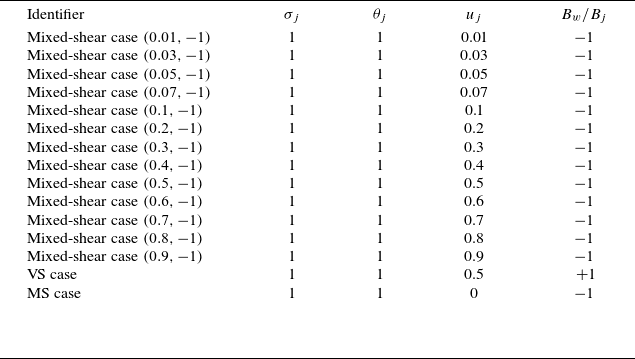


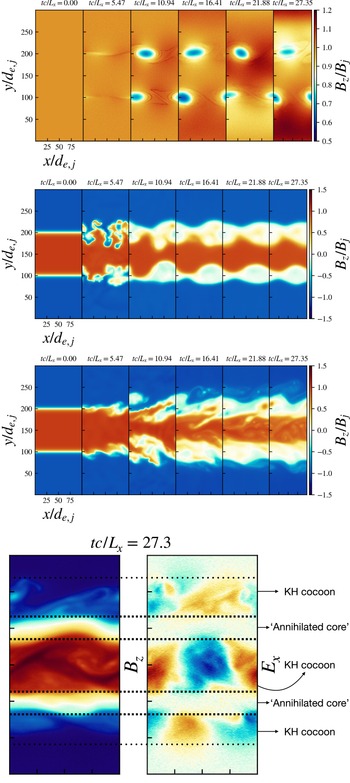


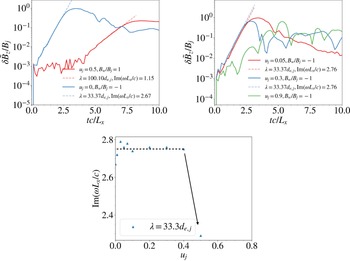


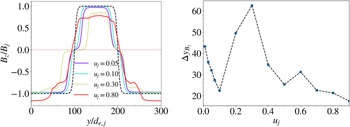


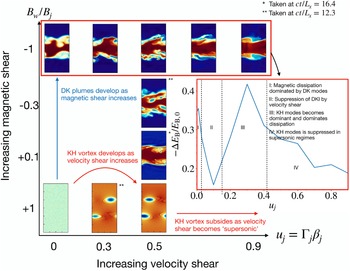


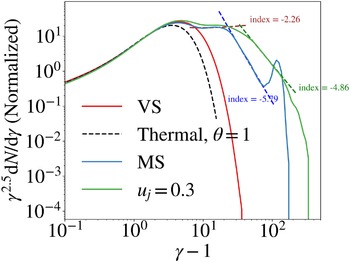


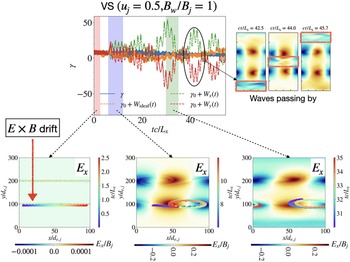


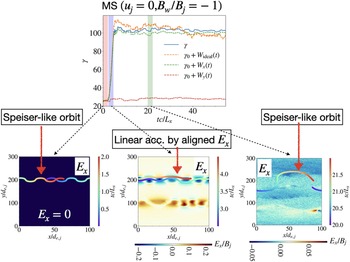


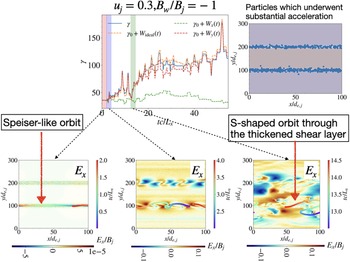


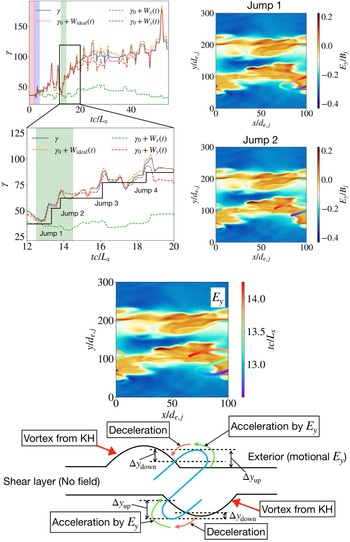


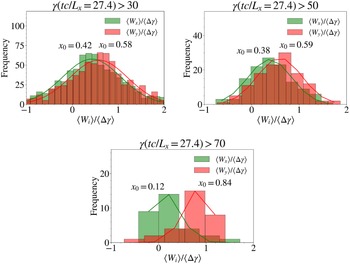


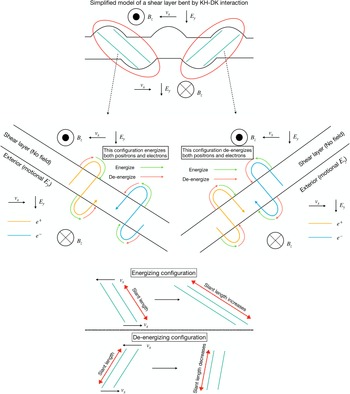

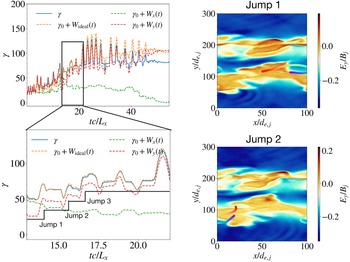


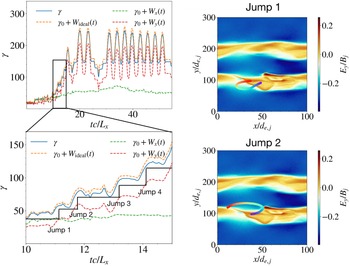


 Open access

