


Socioeconomic transitions occurring in middle-income countries are accompanied by increases in obesity and related co-morbidities such as diabetes and CVD(Reference Monteiro, Moura and Conde1–Reference Subramanian, Perkins and Özaltin3). Obesity is typically assessed in terms of BMI, a measure of weight-for-height which is used as a proxy for adiposity but is not a measure of body composition or body fat distribution. In recent years, however, it has become increasingly clear that the distribution of body fat may be a stronger predictor of metabolic and cardiovascular risk compared to BMI or total adiposity alone(Reference Goossens4).
Specifically, studies have shown that adiposity on the trunk of the body v. on the periphery (e.g. limbs) exerts an independent, and sometimes opposite, effect on cardiometabolic outcomes and mortality(Reference Hu, Bouchard and Bray5,Reference Lee, Pedley and Therkelsen6) . Indeed, lower body (legs) adiposity appears to be protective against cardiometabolic risks relative to upper body adiposity, when controlled for total adiposity(Reference Okura, Nakata and Yamabuki7,Reference Vasan, Osmond and Canoy8) . Despite the critical role of body fat distribution in understanding chronic disease risk, the possibility that increases in obesity in middle-income countries are also accompanied by changes in body fat distribution has received little attention. Additionally, given the well-established relationship between socioeconomic status (SES) and BMI observed in middle-income countries(Reference Neuman, Finlay and Davey Smith9–Reference Yamada, Jones-Smith and Castillo-Salgado11), it is also possible that body fat distribution, and its concomitant health implications, may differ according to SES in these settings.
The most commonly used indicators of body fat distribution in population-based studies in resource-limited settings, such as middle-income countries, are body circumferences and measures of subcutaneous skinfold thickness(Reference Scafoglieri, Tresignie and Provyn12), which can provide discrete data points at twelve or more different locations on the upper and lower body. These multiple measures of adiposity can be difficult to interpret since the individual measures all provide unique information but are generally correlated with each other, and researchers must consider several differences and comparisons simultaneously. This is problematic for sets of related variables such as skinfold measures which are treated as providing independent information (e.g. adiposity at different bodily sites), yet also as measuring aspects of a single underlying source of variation (e.g. overall adiposity). For example, ratios of individual skinfolds, such as the subscapular–triceps ratio, are used as measures of body fat distribution. At the same time, individual skinfold measures are also entered into equations for predicting total body fat(Reference Durnin and Womersley13), or are simply added together to calculate variables such as the sum of four or six skinfolds. Here, we show how a multivariate statistical approach – namely, factor analysis – can aid in the interpretation of secular changes in body fat distribution and overall adiposity while minimising the problems associated with an individual variable-by-variable analysis.
Factor analysis is a multivariate approach that describes a set of observed variables in terms of a smaller number of latent (i.e. unobserved) variables or factors. These factors are constructed as linear combinations of the observed variables that account for the maximum amount of variability in the original data. Factor analysis can be used to reduce the dimensionality of a dataset, that is, to include fewer variables in an analysis while maintaining most of the information contained in the original dataset. Factor analysis is also used to interpret the shared variation in a dataset in terms of underlying constructs that may not be directly measurable. In the present context, this approach allows us to analyse all skinfold measures simultaneously, parsing the unique contributions of each skinfold from the shared variability among all skinfolds. The approach also provides the opportunity to explore the pattern of adiposity that may not be readily apparent when interpreting individual skinfold measures.
In this analysis, we use previously published data from two separate cross-sectional anthropometric surveys of women in the city of Cali, Colombia(Reference Olszowy, Dufour and Bender14). The surveys bracketed a 20-year period (1988–1989 and 2007–2008) during which Colombia showed rapid economic development(15). The anthropometric surveys documented increases in body weight as well as stature but no significant change in mean BMI, except for a small increase in the lowest SES group. In approximately the same period of time (1995–2005), there was a 40 % increase in the burden of chronic disease in Colombia, of which CVD is a leading contributor(16). Indeed, given this shift in disease burden, the lack of clear increases in BMI found in the original study(Reference Olszowy, Dufour and Bender14) was surprising in light of the expected link between obesity and chronic disease(Reference Monteiro, Moura and Conde1–Reference Subramanian, Perkins and Özaltin3). Thus, using a novel analytic approach to understand changes in both overall adiposity and body fat distribution in a middle-income country during a period of economic development and increased chronic disease burden may help to inform public health practices in similar contexts.
To more precisely understand changes in adiposity during a period of rapid economic transition in Colombia, the current paper focuses explicitly on shifts in adiposity and body fat distribution between time periods in the Cali dataset. These are the only data of which we are aware that provide skinfold measurements in the lower and upper body, and hence can document secular changes in overall adiposity as well as whole-body fat distribution.
Although these data are from 1988–1989 to 2007–2008, they are relevant to current public health practice for two primary reasons. First, understanding changes in body fat distribution and overall adiposity over time is critical for identifying modifiable targets for interventions to reduce the burden of chronic disease in middle-income countries, and few studies provide comparable skinfold data at multiple time points. Second, unfavourable shifts in body fat distribution were not readily apparent in the original analysis of Colombian BMI data and skinfold measures using more traditional analytic methods(Reference Olszowy, Dufour and Bender14). Studies that use such methods to assess changes in adiposity between time points may similarly fail to identify or underestimate population-level shifts in body fat distribution that have important implications for public health practice. The novel analytic approach used in the current paper may be applicable to the broader public health and nutrition communities because it allows for better interpretation of multiple, interrelated biological variables. Our goals were to (i) use factor analysis to better understand secular changes in overall adiposity and body fat distribution in Cali women, and (ii) determine if these changes vary by SES.
Methods
Study participants and data collection methods are discussed in detail in the original analysis(Reference Olszowy, Dufour and Bender14) and are summarised briefly here. Participants in both the 1988–1989 (n 1553) and 2007–2008 (n 577) studies were distinct cross-sectional samples of two different groups of women aged 18–44 living in the city of Cali. In both studies, a socioeconomically diverse sample of participants was recruited as a convenience sample from medical clinics (staff and non-patients), private schools, a government institute and a health club. Only women who self-reported as healthy and not pregnant or lactating were enrolled in the studies.
In both the 1988–1989 and 2007–2008 studies, the SES of participants was defined in terms of their residential address using the classification system of the city of Cali (EMCALI, unpublished results)(Reference Reyes, Ponce de Leon and Suarez Becerra17). In this system, each city block is classified into one of six estratos (strata) based on the external appearance of the houses, access to municipal services and the condition of streets. The six estratos are compressed into three SES groups for analysis: estratos one and two – lower; estratos three and four – middle; estratos five and six – higher.
In both the 1988–1989 and 2007–2008 studies, anthropometric measurements were taken by the same experienced technician following standardised procedures(Reference Lohman, Roche and Martorell18). Height (m) was measured with a Harpenden stadiometer, and weight (kg) with a digital Seca scale. Skinfold thicknesses (mm) were measured in triplicate with a Lange skinfold calliper at six sites: triceps, biceps, subscapular, suprailiac, mid-thigh and medial calf. Waist circumference (WC; cm) was measured in duplicate with a flexible steel tape. BMI was calculated as weight (kg)/height (m2).
Statistical analysis
We applied a factor analysis to the six skinfold variables reported in the original analysis(Reference Olszowy, Dufour and Bender14). While previous researchers have employed multivariate methods to analyse sets of skinfold measurements, most of these studies date from the 1990s, and most used principal components analysis rather than factor analysis(Reference Baumgartner, Roche and Guo19–Reference Rebato, Salces and San Martin21). Principal components analysis partitions the total variability in the dataset, including unique and error variability, but factor analysis partitions shared variability only(Reference Bryant, Yarnold, Grimm and Yarnold22). Therefore, factor analysis is better suited to our goal of identifying and interpreting latent variables in the dataset.
We used the maximum likelihood method of factor extraction. This allowed us to subsequently use Bartlett’s test for sphericity to test for the sufficiency of the number of factors extracted from the pooled data(Reference Tobias and Carlson23). Skinfold data from the 1988–1989 and 2007–2008 studies were pooled to allow for the extraction of common factors that could be directly compared between the two time periods. Following the initial factor extraction, the varimax method was used for orthogonal rotation of factors. This method aids the interpretation of factors by maximising the variance accounted for by each factor while keeping the factors orthogonal (i.e. uncorrelated) and without altering the multivariate relationship among individual data points(Reference Kaiser24,Reference Abdi, Lewis-Beck, Bryman and Futing25) . We report factor loadings, that is, the correlation between an initial skinfold variable and a factor, for each extracted factor both before and after varimax rotation. The strength of factor loadings was used to interpret and label the factors in biological terms. We placed our factors’ labels in italics and quotation marks (e.g. ‘overall adiposity’) to emphasise that the labels reflect our own interpretations of the data.
For both un-rotated and rotated factors, we calculated individual factor scores for each subject, which are interpretable as standard scores (i.e. z-scores) in units of standard deviations with a mean of zero. Subsequently, we used independent samples t-tests with Tukey–Kramer correction for multiple comparisons to compare mean age, height, weight and factor scores between time periods within each SES group. Pearson’s χ 2 test was used to assess the distribution of SES groups by time period, with Cramer’s V as the measure of association. Correlation analysis (Pearson’s r) and ordinary least squares regression were used to assess the associations among age, height, weight, waist circumference and factor scores. We used ANCOVA to compare mean factor scores between time periods while controlling for potential confounding effects of age and height. Factor analyses and statistical tests were conducted in JMP Pro 12 with statistical significance set at P < 0·05 (two-sided). Figures were created in SigmaPlot 12.5.
Results
Sample characteristics
Sample sizes by SES groups and time periods are shown in Table 1. There was a significant association between SES and time period, but the measure of association was weak.
Comparison (χ 2) of sample sizes by socioeconomic status (SES) groups between time periods

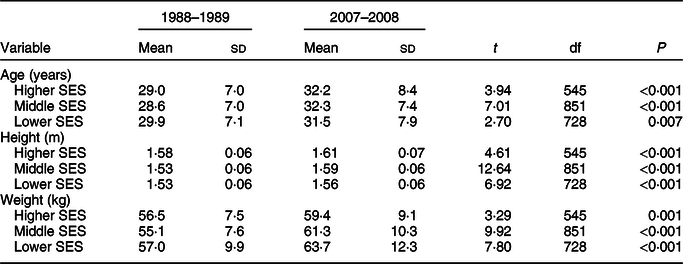
Mean age, height and weight of women by SES group in both time periods are shown in Table 2. For all SES groups, the 2007–2008 sample was significantly older, taller and heavier. Also, in both time periods, age was positively correlated with weight and skinfold measures (data not shown).
Comparisons (t-tests) of age, height and weight between time periods within socioeconomic status (SES) groups
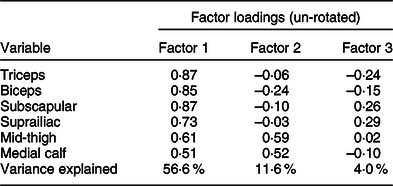
Factor loadings
The factor analysis resulted in three factors extracted from the pooled 1988–1989 and 2007–2008 data (Bartlett’s test of sphericity, χ 2 = 326·0, df = 4, P < 0·001), together accounting for 72·2 % of the total variation in the skinfold data. We first present the loadings for the three factors before rotation (Table 3). We interpret the first of these factors, which accounts for 56·6 % of total variation and is loaded positively on all six skinfold variables, as an ‘overall adiposity’ factor.
Factor loadings for initial un-rotated solution. Three factors extracted, accounting for 72·2 % of variation
Factor loadings for the varimax-rotated solution are shown in Table 4. Here, each of the three extracted factors accounts for between 23 and 26 % of total variation. Factor 1 loads strongly on triceps and biceps skinfolds, with moderate loadings on subscapular and suprailiac skinfolds. Factor 2 loads strongly on mid-thigh and medial calf skinfolds, with a moderate loading on the triceps skinfold. Finally, factor 3 loads strongly on subscapular and suprailiac skinfolds, with moderate loadings on biceps and triceps skinfolds.
Factor loadings after varimax rotation. Three factors extracted, accounting for 72·2 % of variation. Bold corresponds to stronger loadings

We interpret the three rotated factors as follows. Factor 1 is an arm adiposity factor (‘arms’), reflecting adiposity mainly in the biceps and triceps depots of the arms, with some contribution from the subscapular and suprailiac depots of the trunk. Factor 2 is a leg adiposity factor (‘legs’), reflecting adiposity in the mid-thigh and medial calf depots of the legs. Factor 3 is a trunk adiposity factor (‘trunk’), reflecting adiposity mainly in the subscapular and suprailiac depots of the trunk, with some contribution from the biceps and triceps depots of the arms.
Correlations among factors and anthropometric variables
The ‘overall adiposity’ factor was positively correlated with weight in all SES groups in both time periods (0·68 ≤ r ≤ 0·82, P < 0·001 in all cases; Fig. 1), but not significantly correlated with height in any SES group or time period (0·02 ≤ |r| ≤ 0·09, P > 0·05 in all cases; Fig. 1). Additionally, the ‘overall adiposity’ factor was positively correlated with WC in all SES groups and time periods (0·68 ≤ r ≤ 0·82, P < 0·001 in all cases; Fig. 1). Finally, all three of the rotated factors (‘arms’, ‘legs’ and ‘trunk’) were positively correlated with WC in all SES groups and time periods (0·33 ≤ r ≤ 0·69, P < 0·001 in all cases; data not shown).
Relationship among ‘overall adiposity’ score, weight (kg), height (m) and waist circumference (cm) within each time period, with ordinary least squares regression lines. Correlations in both time periods are statistically significant between ‘overall adiposity’ score and weight (r > 0·743, P < 0·001 in both cases) and between ‘overall adiposity’ score and waist circumference (r > 0·717, P < 0·001 in both cases). Correlations between ‘overall adiposity’ score and height are not significant in either time period (|r| < 0·042, P ≥ 0·275 in both cases)

Changes between time periods within SES groups
Table 5 and Fig. 2 show changes in the means of factor scores for the extracted adiposity factors (‘overall’, ‘arms’, ‘legs’ and ‘trunk’) between time periods in each SES group. Mean ‘overall adiposity’ factor scores increased significantly from 1988–1989 to 2007–2008 in all SES groups, with the smallest increase in the higher SES group and the largest increase in the middle SES group. Means of ‘arms’ and ‘trunk’ factor scores also increased significantly between time periods in all SES groups. For the ‘arms’ factor, the smallest increase was observed in the higher SES group, with a lesser (but equal) increase in lower and middle SES groups. For the ‘trunk’ factor, the smallest increase was in the lower SES group, with the largest increase in the middle SES group. Lastly, mean ‘legs’ factor scores decreased significantly between 1988–1989 and 2007–2008 in all SES groups, with the smallest decrease in the lower SES group and a greater (but equal) decrease in the middle and higher SES groups.
Comparisons (t-tests) of adiposity factor scores between time periods within socioeconomic status (SES) groups

* Tukey–Kramer adjustment for multiple comparisons.
Change between time periods in mean scores for the ‘overall adiposity’, ‘arms’, ‘legs’ and ‘trunk’ factors. Filled squares, lower socioeconomic status (SES); shaded circles, middle SES; open triangles, higher SES

To control for potential confounding effects of age and height on adiposity factor scores, we repeated these comparisons with ANCOVA, using age and height as covariates. In all cases, the main effect of time period on adiposity factor scores remained significant at P ≤ 0·009.
Discussion
Our goals in this paper were to (i) better understand secular changes in body fat distribution in Cali women, and (ii) determine if these changes vary by SES. To accomplish that, we applied a multivariate method that is particularly well suited to the analysis of intercorrelated biological variables in a variety of populations – factor analysis. The re-analysis highlighted three features of the original data set that were not readily apparent in the variable-by-variable analysis of discrete skinfold measurements or BMI.
First, our initial factor analysis provided a measure of ‘overall adiposity’ that increased significantly between time periods in all SES groups. The magnitude of increases in ‘overall adiposity’ scores, between +0·54 and +0·86 sds, suggests a substantial increase in the aspect of body fatness measured by this factor. This measure was highly correlated with body weight, but not height, an observation that increased our confidence that the ‘overall adiposity’ factor was not tracking overall body size, but rather a dimension of body weight that was independent of height, that is, adiposity. The overall increases in adiposity were not evident when BMI was used as a proxy for adiposity in the original study(Reference Olszowy, Dufour and Bender14): mean BMI only increased significantly in the lower SES group, and that increase was small (1·5 kg/m2 over 20 years).
The relative lack of changes in BMI stems from the fact that although weight increased between time periods in all SES groups, so did height. Thus, the effect of increases in weight were attenuated by a concurrent secular change in height. Our re-analysis suggests that adiposity did, in fact, increase in this sample over time, even though the most commonly used indicator of obesity – BMI – did not. Unlike BMI, our ‘overall adiposity’ factor was not correlated with height, and the changes in ‘overall adiposity’ scores between time periods remained statistically significant after controlling for height and age. Therefore, the change in ‘overall adiposity’ between 1988–1989 and 2007–2008 was unlikely to be an artefact of increased height between these time periods. Also, although the SES distribution differed in the 1988–1989 and 2007–2008 samples, it was unlikely that these differences introduced bias for two reasons: the magnitude of difference in the distribution was small, and our analysis focused on changes within each SES group rather than on SES itself as a driver of adiposity.
Furthermore, the ‘overall adiposity’ factor was positively correlated with WC in all SES groups and both time periods. WC is a commonly measured variable in nutritional epidemiology due to its strong association with numerous health risks, including hypertension, type 2 diabetes mellitus and CVD(Reference Janssen, Katzmarzyk and Ross26–Reference Balkau, Deanfield and Després30). Thus, the association between our ‘overall adiposity’ factor and WC further suggests that the ‘overall adiposity’ factor may be a biologically meaningful indicator of health risks.
Second, following varimax rotation, our factor analysis distinguished a pattern of body fat distribution in which the increases in adiposity were restricted to the upper body, that is, ‘trunk’ and ‘arms’; adiposity actually decreased in the lower body, that is, ‘legs’. These changes were generally consistent with the changes in individual skinfolds originally reported(Reference Olszowy, Dufour and Bender14). However, given the opposite direction of adiposity changes in the upper and lower body, it was difficult to judge from the original variable-by-variable analysis if overall adiposity had increased. Hence, our factor analytic approach more clearly demonstrated that the general adiposity increase observed in this population was driven by an increase in upper body fatness specifically. The magnitude of changes suggests a meaningful shift in the aspects of adiposity measured by these factors. Overall, the smallest change was the increase in ‘trunk’ adiposity in the lower SES group (+0·21 sds), while the greatest change was the ‘arms’ adiposity increase in both lower and middle SES groups (+1·15 sds). The potential health implications of this increase in upper body fatness in conjunction with decreased leg fatness are unclear.
The distinctions in the pattern of subcutaneous fat distribution we found are in reasonable agreement with the results from studies conducted in the 1970s, 1980s and 1990s using multivariate techniques (principal components analysis and factor analysis) to analyse skinfold data in a variety of populations. For example, principal components of overall fatness, trunk v. extremity fatness and upper v. lower body fatness were uncovered in adults and children in a re-analysis of forty-four samples of anthropometric data(Reference Mueller and Reid31,Reference Mueller and Wohlleb32) . Indices of trunk v. extremity fatness were also reported among Polish adults(Reference Badora33) and among Mexican-American children(Reference Baumgartner, Roche and Guo19). These previous studies of skinfold data, having uncovered the patterns of body fat distribution similar to those in the current study, provide a good basis for between-group comparisons and for our cross-sectional examination of changes between time periods.
Third, in our re-analysis, we found that the increase in ‘overall adiposity’ and ‘trunk’ adiposity specifically was greatest in the middle SES group. This was not evident in the original analysis using WC and waist–hip ratio (WHR) as indices of truncal fat deposition: WC increased in all groups, but WHR only increased in lower and higher SES groups(Reference Olszowy, Dufour and Bender14). Hence, the assumption was that the middle SES group had experienced less of an increase in truncal body fat than the other two groups. Since the ‘trunk’ factor was positively correlated with WC, the ‘trunk’ adiposity data suggest that the greatest increase in adiposity-related health risk occurred within the middle SES group. Thus, the factor analysis approach revealed a potential health risk that was not readily apparent in the original variable-by-variable analysis of individual skinfold measures(Reference Olszowy, Dufour and Bender14).
Comparable data on secular changes in body fat distribution in reproductive-age women are limited, and most focused on WC and/or WHR as indices of truncal adiposity; only a few studies reported skinfold data. Reports from developing countries during periods of significant economic change are of particular interest. For example, an increase in WC was found in 20-year-old female students in Slovenia over a 30-year period (1964–1965 to 2008)(Reference Kotnik and Golja34). It is noteworthy that this change occurred in the absence of a change in BMI. A 12-year (1999–2012) increase in WC was also reported in Mexican women of reproductive age(Reference Albrecht, Barquerra and Popkin35). It was accompanied by an increase in BMI, but interpreted as an increase in truncal adiposity, because the increases in WC were greater than expected for a given BMI. Data for reproductive-age women in developed countries (USA, Mexico, Canada, Sweden, Finland) in the past ~50 years also provide evidence of an increase in WC in the absence of a change in mean BMI, or an increase in WC greater than expected for the change in BMI(Reference Albrecht, Barquerra and Popkin35–Reference Lissner, Björkelund and Heitmann38). In all cases, WC increases are interpreted as changes in the distribution of body fat to a more truncal pattern, but since the data are limited to the upper body, they are incomplete measures of fat distribution. However, observations that hip circumferences were smaller, or unchanged, in more recent cohorts of Scandinavian women(Reference Lahti-Koski, Pietinen and Männistö37,Reference Lissner, Björkelund and Heitmann38) suggest that fat was being preferentially deposited in the upper rather than lower body. Several studies also measured skinfolds and reported secular increases in subcutaneous fatness(Reference Kotnik and Golja34,Reference Janssen, Shields and Craig36,Reference Lissner, Björkelund and Heitmann38) , but all of the skinfolds were on the upper body, or reported as the sum of skinfolds, and hence limit our understanding of possible changes in fat distribution over the whole body.
The upper v. lower body sites of fat deposition matter in terms of health outcomes. It is generally accepted that higher levels of abdominal and trunk fat are associated with greater obesity-related comorbidities, and lower body adipose tissue depots are thought to be associated with decreased CVD risk(Reference Goossens4). For example, a number of studies using imaging technologies such as dual-energy X-ray absorptiometry (DXA) have shown that, after controlling for total adiposity, higher leg adiposity is associated with lower CVD risk in the US and British women over a wide age range (18–64 years)(Reference Hu, Bouchard and Bray5,Reference Vasan, Osmond and Canoy8) , pre-menopausal European women(Reference Sánchez-López, Ortega and Moya-Martínez39) and even severely obese women(Reference Faloia, Tirabassi and Canibus40). Indeed, the association is stronger in more obese women.
The health significance of fat depots on the arms is less clear. Arm fat has been reported to be associated with greater CVD risk in US adult women(Reference Hu, Bouchard and Bray5). In contrast, other studies have found no association of arm fat with increased risk of type 2 diabetes mellitus or CVD in adult women(Reference Vasan, Osmond and Canoy8,Reference Sánchez-López, Ortega and Moya-Martínez39) . Reasons for these disparate results are not readily apparent, but could be related to participant age: abdominal fat deposition increases post menopause, and arm fat also increases until 60–70 years(Reference Svendsen, Hassager and Christiansen41,Reference Shimokata, Tobin and Muller42) .
In Cali, the changes in body fat distribution between 1988–1989 and 2007–2008 occurred in the context of an ongoing period of economic development, but causal linkages are not readily apparent. The general assumption is that nutrition transitions in middle-income countries such as Colombia involve changes in lifestyle, especially in diet and physical activity(Reference Popkin43). Results of studies attempting to link changes in lifestyle to both overall adiposity and body fat distribution are contradictory. Studies of Scandinavian women have not been able to link increases in WC to lifestyle changes (alcohol consumption, smoking, physical activity) between 1980–1981 and 1992–1993(Reference Lahti-Koski, Pietinen and Männistö37,Reference Lissner, Björkelund and Heitmann38) . In contrast, increases in WC in US women between 1988 and 2010 have been linked to decreases in self-reported physical activity(Reference Ladabaum, Mannalithara and Myer44), although other studies have not demonstrated a strong link between physical activity and abdominal (specifically visceral) adiposity(Reference Thompson, Karpe and Lafontan45,Reference Karpe and Pinnick46) .
The strengths of the present study, a re-analysis of secular changes in adiposity in urban women in three SES groups in a developing country, include the use of factor analysis to understand intercorrelated biological variables and the potential for the application of this method to other populations. Factor analysis allowed us to analyse all skinfold measures simultaneously and helped reveal the underlying patterns within body fat distribution data, suggesting avenues for future population health monitoring. Public health and nutrition scientists interested in body fat distribution can benefit from using factor analysis to interpret skinfold data, especially for assessing secular changes, because typical analytic approaches may fail to identify or underestimate important population changes in human biology.
Could factor analysis also be useful in analysing more direct measures of body fat, such as those provided by imaging technologies such as DXA scans? Presumably yes, because a number of studies have demonstrated good agreement between estimates of total and extremity fat mass derived from skinfolds and their DXA analogues(Reference Scafoglieri, Tresignie and Provyn12,Reference Demura, Sato and Noguchi47,Reference Holmes, Andrews and Durkin48) . Further, analyses of intercorrelated biological variables, such as nutritional biomarkers, biological measures of stress and mental health outcomes, could also benefit from factor analysis, a low-cost analytical approach that is easily implemented in current statistical packages.
Another strength of our study is the use of anthropometric data from reasonably large samples, collected by the same technician using the same equipment and techniques, which reduced measurement error, and at time points that bracketed a period of significant economic change. Further, skinfold data from different time periods within the same setting are scarce among Latin American countries, and most studies relied solely on BMI to assess secular changes in adiposity(Reference Kasper, Herrán and Villamor10,Reference Yamada, Jones-Smith and Castillo-Salgado11) . We also recognise the limitations of the data. Our samples were cross-sectional convenience samples from one urban area. We were not able to assess lifestyle changes which may have been associated with changes in body fat distribution. Additional studies incorporating multiple measures of body fat distribution over time are needed to fully understand the transition in body composition in this population.
Conclusions
We used factor analysis to re-examine secular changes in adiposity and body fat distribution among women in Cali, Colombia, between 1988–1989 and 2007–2008, a period of rapid economic development and increased chronic disease burden in this middle-income country. Factor analysis provides a parsimonious method of analysing large datasets of intercorrelated anthropometric variables, such as skinfolds. We found that this method highlighted three trends that were not readily visible in the original analysis of skinfold data(Reference Olszowy, Dufour and Bender14). First, overall adiposity increased between time periods in all three SES groups, a change that was not apparent in the original analysis using BMI as a proxy. Second, the increase in adiposity was greatest in the middle SES group. Third, the overall adiposity increase was driven by a shift in adiposity from the lower to upper body, a shift associated with increased health risks. Factor analysis provided novel insights into secular changes and socioeconomic variation in body fat distribution during a period of rapid economic development in Colombia.
Acknowledgements
Acknowledgements: The authors thank the women who volunteered for the studies for their patience and cooperation. The authors also express their gratitude to Betty de Orozco and Yazmin Villota for their invaluable assistance with data collection; to Coldeportes del Valle for their logistical support; and to Kathryn M. Olszowy for collaboration in analysing the original dataset. The authors thank the directors of the following facilities for their assistance in recruiting participants: Centro Médico Imbanaco; Hospital Carlos Holmes Trujillo; Instituto de Seguros Sociales; FENALCO; Colegio Bolivar; Colegio Gymnasio de Colina; Gymnasio Estamina. Additionally, the authors thank three anonymous reviewers for their helpful comments and suggestions. Financial support: The original study was supported by the National Science Foundation (D.L.D., grant number BCS 0742959) and the National Institutes of Health (D.L.D., grant number 5-R22-DK39734). T.A.B. receives salary support from NIH T32 DK007658-27. This research received no specific grant from any funding agency, commercial or not-for-profit sectors. The National Science Foundation and the National Institutes of Health had no role in the design, analysis or writing of this article. Conflict of interest: None. Authorship: R.L.B., D.L.D., P.A.S., and T.A.B. conceptualised the project. J.C.R. and D.L.D. supervised data collection. R.L.B. and P.A.S. analysed the data. R.L.B. and D.L.D. drafted the manuscript. T.A.B. and P.A.S. provided substantive feedback on the manuscript. All authors contributed to data interpretation and critically reviewed the final manuscript. Ethics of human subject participation: This study was conducted according to the guidelines laid down in the Declaration of Helsinki and all procedures involving human participants were approved by the Institutional Review Board of the University of Colorado Boulder and the Comité de Investigaciones y Etica en Investigación del Centro Médico Imbanaco in Cali. Written informed consent was obtained from all participants.



