




Introduction
Numerous archaeological sites along the frontiers of the Roman Empire bear testament to the profound influence exerted by the Roman army on the landscapes and societies on both sides of these militarised borders. Amidst the finds from these sites, ranging across north Africa, the Middle East and Europe, certain individual discoveries emerge as particularly illuminating. A recent and noteworthy example is a substantial hoard from Bonn, Germany, containing 14kg of mail armour. The hoard highlights some key aspects of the Roman military economy, particularly aspects of repair and recycling. Moreover, it offers a compelling insight into the interactions between the Roman army and the local population dwelling along the frontier.
Repair and recycling in the Roman army
As the Roman Empire expanded into new territories, often far from the regions where military equipment was originally produced, the Roman army faced a growing demand for self-sufficiency (Bishop Reference Bishop1985; Bishop & Coulston Reference Bishop and Coulston2006: 233–40; Hanel Reference Hanel and Murillo Cerdán2006). This need was especially significant along the German frontier, or limes, extending from the Danube to the mouth of the Rhine, where the limited local capacity to supply the army made it necessary for military units to become involved in the manufacture of their own equipment. In turn, the Roman army's increased self-sufficiency in the production of military gear was closely intertwined with the supply of raw materials and recycling practices.
Recycling is fundamental for the conservation and management of resources. Although waste is an integral part of archaeological formation processes, the study of reuse and recycling, and their importance for understanding ancient economies, has only recently gained attention (e.g. Hoss Reference Hoss, Sommer and Matešić2018a; Duckworth & Wilson Reference Duckworth and Wilson2020). It is evident from the archaeological record that recycling played a pivotal role in the Roman economy and that the Roman army was remarkably efficient at the recycling of materials (Bishop Reference Bishop, Sommer and Matešić2018). This was not without reason, for the Roman army was a major consumer of metals, which were crucial not only for crafting armour and weapons, but also for manufacturing tools and construction materials (Manning Reference Manning, Collins and McIntosh2014). An illustrative example is the discovery of a ten-tonne metal deposit primarily consisting of iron nails, at the Inchtuthil legionary fortress in Scotland, underscoring the immense scale of metal consumption by the Roman army (Angus et al. Reference Angus, Brown and Cleere1962). Sourcing new metal supplies for all of this output would have required extensive, and expensive, mining and processing; metal recycling was an effective strategy for increasing efficiency and hence an important component of the Roman military economy. However, these military recycling practices varied over time and in different parts of the empire (Schubert Reference Schubert, Sommer and Matešić2018; Peña Reference Peña, Duckworth and Wilson2020; Wenner Reference Wenner2023: 221–90).
An examination of waterlogged waste dumps near five military sites on the Lower Rhine exemplifies this complexity (Hoss Reference Hoss, Sommer and Matešić2018b). Here numerous metal artefacts were discarded rather than recycled suggesting an ample supply of metal was available, and the conservation of resources considered less important. This example demonstrates that the extent to which the Roman army recycled waste should not, therefore, be overstated; it may have fluctuated with local variation in supply and demand. For instance, the initial establishment of military installations on the northern Roman frontier following the Roman conquests of the early first century AD demanded significant quantities of metal, especially nails and other metal construction materials (Manning Reference Manning, Collins and McIntosh2014). Once the military was established, however, this demand gradually decreased.
Economic downturn is often cited as the primary reason for the adoption of recycling practices, with producers compelled to make use of every last scrap of waste metal (e.g. Swift Reference Swift2012); but the significance of such economic pressures may be overemphasised (e.g. Crummy Reference Crummy2016; Duckworth & Wilson Reference Duckworth and Wilson2020). For example, the cost of clothing in the Roman period, though challenging to calculate precisely, appears to have been lower than commonly assumed. The abundance of evidence for the recycling of Roman clothing therefore appears to highlight an inherent ‘make-do-and-mend’ attitude rather than an economic necessity (Wild Reference Wild, Duckworth and Wilson2020).
The army on the northern Roman frontier not only bore responsibility for producing much of its own military equipment but was also involved in its repair and eventual recycling (Oldenstein Reference Oldenstein1976: 68–85; Bishop Reference Bishop1985). These activities were conducted in workshops within military installations and surrounding settlements, including vici and canabae—extramural communities attached to forts and fortresses, respectively. In fact, evidence for recycling practices is more prevalent in the vicinity of Roman military installations than within the installations themselves (Schubert Reference Schubert, Sommer and Matešić2018), underlining the close relationship between the army and non-military communities. Even locations beyond the frontiers could be involved in recycling for the Roman army. Substantial quantities of Roman military equipment dating to the time of the Marcomannic Wars in the mid-second century AD have been recovered at the Germanic settlement of Pasohlávky in Czechia. The simultaneous existence of the Germanic settlement at Pasohlávky and the Roman military fortress at Mušov, located a mere 2.5km apart, strongly suggests collaboration between the two communities. It is likely that this settlement beyond the frontier assisted the Roman army with the recycling of military metal, even during turbulent periods of war (Komoróczy et al. Reference Komoróczy, Rajtár, Vlach, Hüssen, Erdrich, Komoróczy, Madejski and Vlach2020: 210–12).
The Roman army recycled their metal equipment in a variety of ways (Sim & Kaminski Reference Sim and Kaminski2012: 39–40). Artefacts could be cut into new shapes and repurposed. Ferrous artefacts could be reforged, and copper alloys smelted. However, certain metal artefacts, by their very nature, cannot be recycled into usable raw material—including iron mail armour. This is because the mail rings cannot be successfully melted down, as the heat required to melt the iron would mostly burn away the small, thin rings. Consequently, the recycling of mail was accomplished through a different process, akin to the recycling of textiles (cf. Wild Reference Wild, Duckworth and Wilson2020). Mail armour that was no longer serviceable would be used as donors to patch up and repair other mail garments. This practice has also been observed for scale and segmented armour (Allason-Jones & Bishop Reference Allason-Jones and Bishop1988: 100; James Reference James2004: 112–15).
The interpretation of Roman military recycling practices also depends on an understanding of military waste deposition. Here, it is useful to make a broad distinction between everyday rubbish disposal and specific acts of deposition (Schubert Reference Schubert, Sommer and Matešić2018). For the former, the army typically favoured the use of middens rather than landfills, usually located close to, and downwind of, military bases for logistical convenience (Bishop Reference Bishop, Sommer and Matešić2018). Examples of disposal in landfills and the dumping of waste into nearby rivers, have also been recorded (Hoss Reference Hoss, Sommer and Matešić2018b). Such routine disposal typically excluded metal military equipment, although the discovery of metal artefacts in a midden at the fortress of Vindonissa, Switzerland (Trumm Reference Trumm, Sommer and Matešić2018), indicates that there were exceptions, possibly during periods with abundant metal supplies.
As well as everyday waste disposal, some deposits found both inside and outside military installations might be connected to specific occasions (Schubert Reference Schubert, Sommer and Matešić2018). These often comprise caches or hoards of materials intended for recycling but which were never ultimately processed, possibly because the sites were abandoned before the materials were required. There is growing archaeological evidence to suggest that military sites were actively dismantled and cleared before their garrisons’ departure (Bishop Reference Bishop and Unz1986; Bishop & Coulston Reference Bishop and Coulston2006: 27; Fischer Reference Fischer2019: 51–52). The extent of material left behind was dictated by the limitations of transport, and scrap metal that could not be taken away was often left in ditches, pits or wells to prevent it from falling into enemy hands. A substantial proportion of Roman armour and weapons found on the northern frontier originates from such contexts (Fischer Reference Fischer2019: 47; Wijnhoven Reference Wijnhoven2022: 50–58), highlighting scrap as a crucial source for understanding Roman military equipment. The hoard of mail armour found at Bonn deepens this understanding and offers a unique insight into recycling practices at the Roman frontier.
The discovery of the Bonn hoard
In 2008 and 2012, excavations were conducted by the LVR-State Service for Archaeological Heritage in the Rhineland at Adenauer Allee in Bonn, Germany, to investigate a Roman vicus settlement. Previous excavations in the surrounding area had revealed traces of Roman streets and strip houses, shedding light on the overall settlement form (Andrikopoulou-Strack Reference Andrikopoulou-Strack1996, Reference Andrikopoulou-Strack and Rey2001). The vicus was located south of the Roman legionary fortress of Bonna and its associated canaba, forming a distinct settlement with its own baths, workshop areas and infrastructure.
During the excavations, five strip houses were discovered (Schenk Reference Schenk2009; Morscheiser-Niebergall Reference Morscheiser-Niebergall2013) (Figure 1). The fronts of these houses, which faced the road to the south, could not be fully uncovered due to the size of the excavation area but the rears of these buildings and their backyards yielded numerous features that provide a clear indication of the original layout of the plots. At least during the final phase, the strip houses were constructed in stone, with evidence of extensions made of wood. Three of these strip buildings did not occupy the full width of their respective plots, allowing for paths surfaced with broken pottery and pebbles to provide access from the front road to the rear of the buildings.
Map of the excavation areas of 2008 and 2012 at the vicus near the legionary fortress in Bonn. In total five strip houses were discovered; their fronts lie beneath the modern road and could not be studied, but all other parts of the buildings were documented in detail (map by C. Koppmann).

In the southernmost area of excavation, a substantial quantity of mail armour was found in a pit, located 260mm outside the outer wall of one of the strip houses (Stelle 33, Figure 2). The decision was made to recover the mail armour as a single block, which was subsequently conserved at the LVR-LandesMuseum Bonn. Despite almost all iron of the mail block having corroded away, and nowadays mainly consisting of corrosion products, the mail remains still weigh more than 14kg in total, indicating the presence of a significant amount of armour.
Map of the strip house where the mail hoard was discovered (Stelle 33). The mail hoard was located adjacent to one of its outer walls (map by C. Koppmann).

The hoard
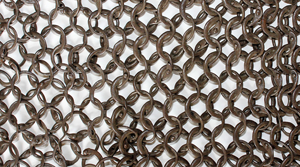
The mail armour was deposited in a shallow pit in a single event; no other objects were recovered (Koppmann Reference Koppmann2022; Koppmann et al. Reference Koppmann, Dirsch and Willer2022). The remains consist of one large block of mail weighing 8.3kg (Figure 3), and many smaller fragments that were originally part of the larger block (Figure 4). The armour uses two types of rings: riveted and solid. The riveted rings are made from wire with overlapping ends pierced and closed with a small rivet; the solid rings are punched out of sheet metal. The rings are woven in a 4-in-1 pattern, as is typical for European mail (Wijnhoven Reference Wijnhoven2022: 211–22). The 4-in-1 pattern involves arranging rings in rows, where each ring connects to two rings in the row above and two in the row below.
The large block of mail from the Bonn hoard (photograph by J. Vogel).

Small mail fragments from the Bonn hoard. A total of 303 fragments was recovered, together weighing more than 6kg (photographs by J. Vogel).

The remains were examined macroscopically and using x-ray and computed tomography (CT) scans (Figure 5). X-ray analyses performed at the conservation laboratory of the LVR-LandesMuseum at the maximum voltage of 245kV proved insufficient to penetrate the block. Only portions of the woven mail in the outer parts of the block indicated the likely internal structure. The overlapping layers of mail also made it challenging to visualise the intricacies of the armour's construction in a two-dimensional form. Consequently, further investigations were conducted at the Industrial X-ray and CT Communications Centre of Waygate Technologies/Baker Hughes Digital Solutions GmbH in Wunstorf. Informative images were eventually obtained by utilising a Phoenix V|tome|x L 450 micro-CT-system equipped with an Isovolt 450kV tube (Figure 6). The examination, spanning several hours, involved applying a voltage of 450kV and a current of 3300mA, enabling a layer-by-layer exploration of the inner mass. Images were captured using a 16-inch GE Dynamic 41|100 detector, yielding a voxel (three-dimensional pixel) resolution of up to 2μm. This high resolution facilitated the comprehensive visualisation of the mail armour's shape and construction details.
The x-rays (top left) and CT-scans of the large block of mail. There are different ring sizes throughout the fragment, and the smallest rings measure just over 3mm in diameter (bottom left). The middle right scan contains a pottery sherd in the outer layer of the mail block (x-ray and CT-scans by H. Becker).

Phoenix V|tome|x L 450 micro-CT-system of Waygate Technologies/Baker Hughes Digital Solutions GmbH in Wunstorf (photograph by H. Becker).

Based on the observed differences in ring size, we conclude that the hoard comprises four different mail coats. Differences in the diameters of the solid rings are the most important indicator. Typically, the diameter of solid rings, which are punched out of sheet metal, is highly consistent, while variation in the size of riveted rings may be greater. The average outer diameter of the solid rings ranges from large (7.9mm), medium (7.1mm) and small (5.8mm) to extra-small (3.1mm), with the large and medium sizes being the most abundant and likely representing two almost complete coats of mail. Most of the large and medium-sized rings are found in the large block of mail but are also present in the detached fragments. The smaller fragments contain only a few mail pieces made with small rings, which are too few to represent an entire garment. The occurrence of the extra-small rings was only revealed in the CT-scans and likely indicate only a very small piece of mail. The distribution of ring sizes among the fragments demonstrates that the complete coat with large rings was laid down with the piece made of extra-small rings placed on top of it. These were rolled up together and deposited into the pit (Figure 7). The other coat of mail was then stacked on top of this, together with the larger piece made of small rings.
The best-preserved rings of the hoard are located at the bottom part of the large block of mail. These mail remains have been rolled-up prior to their deposition (photograph by M.A. Wijnhoven).

X-rays and CT-scans of the large block of mail reveal the presence of a pottery sherd embedded in the outer layer (Figure 5). The scans do not offer any diagnostic information about the sherd, which probably came from the surrounding soil, but its presence suggests that the hoard was deposited without being wrapped in a cloth or bag. The absence of any fasteners is a good indicator that the hoard post-dates the first century AD (Wijnhoven Reference Wijnhoven2022: 50–51). Earlier mail armour consisted of a sleeveless shirt with two shoulder guards that extended from the back to the front over the shoulders and the chest, where fasteners fixed the guards into place. During the first century AD, this design fell out of use and was replaced by a short-sleeved design resembling a modern T-shirt. There are numerous examples of this latter type in the iconography of the imperial period as well as in the archaeological record (Figure 8). It is likely that the mail from the Bonn hoard are of this fastener-free, sleeved design.
Left: Detail of the Great Ludovisi Sarcophagus (Rome), mid third-century AD, depicting a standard-bearer in a short-sleeved mail coat (photograph by M.A. Wijnhoven). Right: Digital reconstruction of a mail coat from Vimose (Denmark), second half of the second century to early third century AD (reconstruction by A. Moskvin & M.A. Wijnhoven).

The size of the mail rings also provides another clue to the date of the hoard. The size of mail rings fluctuated through time and differed by regions (Wijnhoven Reference Wijnhoven2022: 261–65). The medium-sized and large rings identified in the hoard were already in use during the first and second centuries but are most typical of the third century AD. The extra-small rings, on the other hand, were not used after the second century, suggesting an earlier date. However, this particular artefact may have already had some age when deposited. In sum, the ring sizes of mail remains combined with the absence of fasteners allows the mail artefacts to be dated to the second or third century AD.
Roman mail armour finds contexts
Beyond the Roman frontiers, mail armour is predominantly found in funerary contexts (Wijnhoven Reference Wijnhoven2022: 66–70), regularly remaining buried intact as a complete garment. In contrast, within the Roman provinces, mail is far less frequently found in burials. Roman funerary traditions seldom involved the inclusion of militaria as grave offerings. The few exceptions—such as the discovery of a complete mail coat at Chassenard, France (Beck & Chew Reference Beck and Chew1991: 34–45), at Weiler-la-Tour, Luxembourg (Waurick Reference Waurick1982), and at St Albans, England (Gilmour Reference Gilmour1997)—are typically attributed to auxiliaries or non-Roman indigenous traditions assimilated into a Roman context. Complete mail garments were therefore rarely intentionally deposited in Roman contexts. At Dura-Europos in Syria the collapse of a siege tunnel during a conflict between Roman and Sassanian forces in the mid-third century AD entombed soldiers complete with their armour (James Reference James2004: 33–39). Similarly, a fire in the barracks at the Roman fort of Arbeia, England, during the late third or early fourth century AD, caused a wall to collapse onto and preserve a mail coat stored within (Croom Reference Croom1998).
The majority of Roman mail finds, however, comprise smaller fragments or patches of mail (Figure 9), found either inside or near military installations (Wijnhoven Reference Wijnhoven2022: 53–57). This patterning can best be explained through the practices of armour production and, in particular, recycling by the Roman army and its adjacent urban communities. These fragmented mail finds correspond with the overall impression of the retention of military equipment for scrap metal on the northern frontier. Most likely these finds were pieces of mail intended for recycling but, for whatever reason, were never used for this purpose.
Examples of mail fragments from the Roman Principate. Top left: Loughor, United Kingdom, c. AD 260–310. Top right: Gnotzheim, Germany, second–third centuries AD. Bottom left: Newstead, United Kingdom, AD 140–180. Bottom right: Sisak, Croatia, broadly dated to the Roman Principate (photographs by M.A. Wijnhoven).

The stockpile of materials for repair and reuse
As one of the largest single finds of mail armour in the Roman world, the Bonn hoard is exceptional. Yet, the question remains as to why such a significant accumulation of mail was deposited in a pit in the vicus. Here, we note that although the quantity of mail may be larger, the character of the deposit does not significantly differ from most other finds of mail within the Roman Empire, which are characterised by fragments rather than complete pieces of mail. The incomplete condition of at least two of the mail garments in the Bonn hoard make it likely that the whole collection was intended for recycling purposes.
The discovery of the hoard in the context of the vicus underscores the close relationship between extramural settlements and military installations, with the former playing an active part in the military economy, including the recycling of military gear (Bishop & Coulston Reference Bishop and Coulston2006: 238). Mail finds from other vici include Thuilet in France, Rainau-Buch in Germany, and Leiden in the Netherlands (Chew Reference Chew, Vallet and Kazanski1993; Greiner Reference Greiner2008: 97–101; Hazenberg Reference Hazenberg2000: fig. 25). These typically comprise fragments of mail, supporting their interpretation as scrap material for recycling. This is reinforced by the presence in some deposits of other scrap materials alongside pieces of mail, including at Strasbourg in France (Hatt Reference Hatt1953), and at Steinheim and Trier in Germany (Hansen Reference Hansen2003: 167; Miks Reference Miks2008: 14). At Lyon, France, a complete coat of mail was discovered among materials intended to be recycled (Guillaud Reference Guillaud2019: 80).
What sets mail armour apart from most other types of military equipment is that the nature of recycling and repair is distinct. As described above, mail cannot be melted down and reworked as a raw material. The only way to recycle mail is through reuse as donor material for repairing other mail garments. This practice can be observed in well-preserved coats of mail from the Late Middle Ages and Early Modern period. Most surviving mail coats from these periods show evidence of repair and modification (Figure 10) (cf. Burgess Reference Burgess1953; Schmid Reference Schmid2003; Checksfield et al. Reference Checksfield, Edge and Williams2012). Sometimes these repairs involve replacing a single ring, which can be recognised when the inserted ring differs from the other original rings. Repairs to historical mail coats often also involve removing a damaged or worn-out section from a mail garment and replacing it with a patch from a donor coat. A similar patching strategy might be used if the mail coat required tailoring or alterations. Therefore, in contrast to other military equipment found in scrap contexts, which may be destined for recycling into raw materials, the particular characteristics of mail led to a different pathway of reuse and repair. Given these considerations, it is likely that the Bonn hoard represents a stockpile of mail intended for repairing other mail garments by craftworkers in the vicus.
Detail of European mail coat, fifteenth century. Two sets of repairs are visible. The original all-riveted rings on the left have been thinned by wear. A repair patch consisting of heavier punched and riveted rings is visible in the centre. Another repair patch on the right is made from riveted heavy rings (photograph by M.A. Wijnhoven).

The wider contexts for deposition and non-retrieval
If the mail likely formed a collection to be used for repairs, the precise circumstances surrounding the deposition of the mail armour at Bonn are unclear. The stratigraphy of the site and the lack of other finds do not offer much information. The most useful contextual evidence is therefore the hoard's proximity to one of the strip houses. The latter date to the end of the second or third century AD. There are traces of fire in the stone cellar of one of the neighbouring strip houses, but there is no evidence for large-scale destruction indicating the abandonment of the area.
The traditional explanation for hoards found along the Lower Germanic Limes focuses on a series of invasions by Germanic tribes during the years AD 275/276, also known as the Limesfall. The hoards would then represent valuables, hidden away in haste with the intent to retrieve them at a later stage once the threat had passed. The idea of the Limesfall was proposed by French historian Camille Jullian (Reference Jullian1913: 598–99), and was influenced by strained Franco-German relations immediately before the First World War. Early proponents of this interpretation noted that many coin hoards aligned well with this timeframe (Blanchet Reference Blanchet1900: 14–15, 58–61; Koethe Reference Koethe1942). Yet coin hoards of a similar date are also widely found in other Roman provinces far from those regions affected by any Germanic invasions. This suggests that the hoards may reflect economic considerations rather than military instability (Pferdehirt & Scholz Reference Pferdehirt and Scholz2012; Heising Reference Heising, Henrich, Miks, Obmann and Wieland2015).
In recent decades, the Limesfall theory has come under increasing scrutiny and evidence, or the lack thereof, found wanting (Heising Reference Heising, Henrich, Miks, Obmann and Wieland2015; Heeren Reference Heeren2016). Consequently, it is unlikely that the Bonn hoard represents a hastily made hiding place in response to the Germanic threat. Other reasons for depositing military equipment in pits might include preventing theft, concealing stolen items, or a religious or ritual motive. It was not uncommon for weapons and other military equipment to be placed in ‘consecrated’ pits, following either official directives or as personal dedications made by soldiers, possibly at the end of their service (Nicolay Reference Nicolay2007: 157–206; Deschler-Erb Reference Deschler-Erb2020). Even in settlement contexts, however, structured deposition with ritual intent is well recognised (Fulford Reference Fulford2001). Indeed, the interplay of economy and social organisation with ritual actions and beliefs seems to be more important than previously believed (Clarke Reference Clarke2000; Hingley Reference Hingley2006). Yet, the context of the Bonn hoard does not suggest any ritual significance and the contents of the hoard—comprising four (partial) mail garments of different quantities with no other military gear—make a votive offering improbable.
Instead, the Bonn hoard may best be explained by reference to its find spot in the vicus. Small-scale excavations at the site have revealed that occupation likely ended around the middle or during the second half of the third century AD (Andrikopoulou-Strack Reference Andrikopoulou-Strack and Rey2001). The cellar of one of the strip houses was found to be filled with fragments of ‘Jupiter columns’ (carved stone columns topped by a statue of Jupiter, commonly found across the provinces of Germany and Gaul) and parts of other stone sculptures that once adorned the settlement. The deposition of these materials suggests the planned abandonment of the settlement, similar to the active clearance and dismantling of Roman military installations before their garrisons departed. Furthermore, excavations at the site in 2007 corroborate a likely abandonment, without any indication of violent destruction, during the mid-third century, a conclusion consistent with the numismatic evidence (Ulbert Reference Ulbert2008a & Reference Ulbert and Thielb). In this scenario, it seems most likely that, during the planned abandonment of the vicus, the mail was deemed too heavy to be taken away, no longer of economic value, or was simply forgotten. Similar to the behaviour observed during the abandonment of military sites, the material was not left exposed but was ‘neatly’ deposited to prevent it from falling into the wrong hands.
Conclusion
The discovery at the vicus close to the Roman legionary fortress of Bonn of a 14kg deposit of mail armour, comprising at least four different garments, offers insight into the organisation of the Roman military economy. In particular, the hoard emphasises the close relationship between the military installations along the German frontier and the extramural settlements that developed close by. The mail seems likely to have been intended to be used for the repair and patching of other garments for the Roman army. The hoard therefore illustrates how military waste materials, especially scrap metal, could be processed by local craftworkers. It also suggests that waste management and recycling extended beyond the melting of scrap for raw materials and included the skilled patching and repair of mail armour. In the mid-third century AD, the vicus was systematically dismantled and cleared, in a manner similar to that documented at military sites across the Roman Empire. It is likely that the mail hoard was deposited during the dismantlement of the vicus. The find adds to a growing corpus of mail armour from a variety of different contexts across the Roman world, and beyond the frontiers, and contributes to understanding of the complexity of economic and military organisation of ancient armies.
Acknowledgements
We would like to thank Christiane Dirsch and Frank Willer from the LVR-LandesMuseum Bonn for their efforts to conserve and understand the hoard.
Funding statement
This work was supported by the Czech Academy of Sciences under a Podpora Perspektivních Lidských Zdrojů grant; and the Czech Science Foundation under grant 24-11397S.


 Open access

