





1. Introduction
Cavitation refers to the phase change from liquid to vapour caused by a drop in pressure. Hydrodynamic cavitation denotes cavitation induced by liquid flows. Among various types of hydrodynamic cavitation, attached cavitation is one of the most common forms. It typically appears as a vapour cavity that remains attached to the wall with an unstable tail, leading to periodic shedding and collapse of bubble clouds (Franc & Michel Reference Franc and Michel1985). The cyclic growth and collapse of the attached cavity result in a range of rich phenomena, such as strong pressure waves and micro-jets (Dular & Petkovšek Reference Dular and Petkovšek2015), luminescence (Leighton et al. Reference Leighton, Farhat, Field and Avellan2003) and the formation of reactive radicals (Nöpel & Ayela Reference Nöpel and Ayela2023). Because of these effects, attached cavitation plays crucial roles in many industrial processes, including fluid machinery erosion (Arndt Reference Arndt1981), mineral flotation (Li et al. Reference Li, Liu, Li, Xiang, Manica and Liu2022) and water treatment (Šarc et al. Reference Šarc, Stepišnik-Perdih, Petkovšek and Dular2017).
Despite its common occurrence and significance, the reason why hydrodynamic cavitation tends to appear in the form of attached cavitation is still not fully understood. Previous studies have highlighted its strong connection with the flow boundary layer, where the cavity can remain attached within the low-momentum region with laminar separation or large adverse pressure gradients (Franc & Michel Reference Franc and Michel1985; Ram, Agarwal & Katz Reference Ram, Agarwal and Katz2020). Outside the boundary layer, nuclei experience a more direct evolution process: they expand into isolated vapour bubbles that travel downstream with the main flow – commonly referred to as travelling cavitation bubbles (Chatterjee & Arakeri Reference Chatterjee and Arakeri2004). Nevertheless, usually, the final cavitation pattern is dominated by attached cavitation, except in certain special flow conditions, such as flows with strong vortices (Pennings et al. Reference Pennings, Bosschers, Westerweel and Van Terwisga2015) or very small adverse pressure gradients (Li, Zuo & Qian Reference Li, Zuo and Qian2023), where other patterns prevail. This raises a question: What happens from nucleation to developed cavitation that results in the dominance of attached cavitation? From the experimental side, a straightforward approach to addressing this question is to introduce controllable nuclei into the flow and track their evolution, thereby allowing direct and systematic observation of how hydrodynamic cavitation develops from its very inception.
To date, methods for controllable nucleation in hydrodynamic cavitation experiments remain relatively limited. The most commonly used approach involves introducing microbubbles with partially controlled size and concentration upstream of the low-pressure region, allowing them to be convected into the region of interest. Such microbubbles are typically generated through capillary injection (Agarwal et al. Reference Agarwal, Ram, Lu and Katz2023), ultrasound excitation (Chatterjee & Arakeri Reference Chatterjee and Arakeri2004) or the collapse of focused laser-induced cavitation bubbles (Li & Ceccio Reference Li and Ceccio1996). These methods have enabled relatively direct observations of nucleation in specific flow patterns (Allan et al. Reference Allan, Barbaca, Russell, Venning, Pearce and Brandner2025) and how nuclei influence the developed cavitation (Venning, Pearce & Brandner Reference Venning, Pearce and Brandner2022). However, since the aforementioned nucleation methods do not generate nuclei in situ at the cavitation inception site, further improvement in spatio-temporal resolution – particularly temporal precision – is hindered, which limits the ability to perform rapid and detailed observations of cavitation nucleation.
In this study, we develop a laser-based on-demand nucleation technique within a Venturi flow. A pulsed laser sheet is used to illuminate the region of interest. The inevitably present tiny contaminants in the water are rapidly heated upon absorbing the laser energy, leading to the formation of micro- and nanobubbles (Rosselló & Ohl Reference Rosselló and Ohl2023) that serve as nuclei for hydrodynamic cavitation. Owing to the extremely high spatio-temporal controllability of the laser, both the location and timing of nucleation in hydrodynamic cavitation can be precisely controlled in an unprecedented manner. Based on this technique, we first examine single-bubble cases and obtain a phase diagram of cavitation regimes. Extending to multiple-bubble cases, we developed a simple theoretical model to estimate the probability of attached cavitation. We found that, at typical cavitation numbers, only a few bubbles are sufficient for the probability of attached cavitation to approach nearly 100 %.
Description of the experimental set-up (not to scale, the unit of all length labels in mm). (a) Hydraulic system and laser set-up from the front view. (b) Schematic of the nuclei seeding by a pulsed laser sheet in the Venturi flow. (c) Laser and high-speed photography set-up from the side view. (d) Parameter definition of a cavitation bubble in the Venturi flow.

2. Experimental set-up
As shown in figure 1(a), we adopt a custom-designed Venturi tube, fabricated by thermally pulling a straight borosilicate glass tube (inner diameter: 3 mm; outer diameter: 6 mm). The throat – the narrowest section of the channel – has an inner diameter of 1.37 mm, and both upstream and downstream sections smoothly expand (upstream single-side angles of 0–3.7 $^\circ$
, downstream of 0–3.0
$^\circ$
, downstream of 0–3.0 $^\circ$
) to an inner diameter of 3 mm. The total length of the tube is 214 mm, with the convergent–divergent section measuring 40.8 mm in length. The Venturi tube is integrated into a closed-loop hydraulic circuit with the flow driven by a diaphragm pump (Flojet Model D1625J7011A, 0–6.4 l min−1). The pump has flow rate pulsations with a period approaching 30 ms, which is much longer than the time scale we care about in our experiments (around 1 ms), indicating the pulsations can be safely neglected. Before the experiments, an open-top acrylic reservoir is filled with approximately 2 l of deionised water. The water recirculates and does not undergo deaeration, so the concentration of air should be approaching saturated at atmospheric pressure (Tian, Li & Qian Reference Tian, Li and Qian2025). We do not vary the gas content to manipulate the naturally existing nuclei population, as its influence on nuclei properties is indirect and difficult to control in a reproducible manner. Instead, as described below, we employ a laser-based seeding approach to generate nuclei with well-defined temporal and spatial control in the flow.
$^\circ$
) to an inner diameter of 3 mm. The total length of the tube is 214 mm, with the convergent–divergent section measuring 40.8 mm in length. The Venturi tube is integrated into a closed-loop hydraulic circuit with the flow driven by a diaphragm pump (Flojet Model D1625J7011A, 0–6.4 l min−1). The pump has flow rate pulsations with a period approaching 30 ms, which is much longer than the time scale we care about in our experiments (around 1 ms), indicating the pulsations can be safely neglected. Before the experiments, an open-top acrylic reservoir is filled with approximately 2 l of deionised water. The water recirculates and does not undergo deaeration, so the concentration of air should be approaching saturated at atmospheric pressure (Tian, Li & Qian Reference Tian, Li and Qian2025). We do not vary the gas content to manipulate the naturally existing nuclei population, as its influence on nuclei properties is indirect and difficult to control in a reproducible manner. Instead, as described below, we employ a laser-based seeding approach to generate nuclei with well-defined temporal and spatial control in the flow.
A downstream absolute pressure sensor (DwyerOmega PX209-030A5V, range: 0–2 bar, accuracy: 0.25 % full scale) is installed to record the pressure used for cavitation number estimation. The cavitation number $ \textit{Ca}$
is defined as
$ \textit{Ca}$
is defined as $ \textit{Ca} = (p_d - p_v ) / (0.5\, \rho \, u_{\textit{th}}^2 )$
, where
$ \textit{Ca} = (p_d - p_v ) / (0.5\, \rho \, u_{\textit{th}}^2 )$
, where $p_d$
is the time-averaged downstream pressure during each experimental run,
$p_d$
is the time-averaged downstream pressure during each experimental run, $p_v = 2338.6$
Pa is the saturation vapour pressure of water at room temperature,
$p_v = 2338.6$
Pa is the saturation vapour pressure of water at room temperature, $\rho = 998.2$
kg m−3 is the water density and
$\rho = 998.2$
kg m−3 is the water density and $u_{\mathrm{th}}$
is the mean flow velocity at the throat section. In our experiments, the valve is always fully open, and
$u_{\mathrm{th}}$
is the mean flow velocity at the throat section. In our experiments, the valve is always fully open, and $ \textit{Ca}$
is tuned between 0.4 and 0.9 by regulating the pump power to modify
$ \textit{Ca}$
is tuned between 0.4 and 0.9 by regulating the pump power to modify $u_{\textit{th}}$
. At the location of the downstream pressure sensor, the cross-sectional area of the duct is
$u_{\textit{th}}$
. At the location of the downstream pressure sensor, the cross-sectional area of the duct is $27.92$
times larger than that at the throat, which makes the averaged velocity here very low and it varies little. Therefore,
$27.92$
times larger than that at the throat, which makes the averaged velocity here very low and it varies little. Therefore, $p_d$
varies weakly (103.9–105.9 kPa) across different operating conditions. The internal flow field is characterised by combining numerical simulation and particle tracking. Background-flow fields are obtained using steady-state simulations based on simpleFoam in OpenFOAM extended 4.0. Here, background flow refers to the pre-existing flow before the appearance of cavitation bubbles. These are experimentally validated using particle tracking results at the throat. For particle tracking, 20
$p_d$
varies weakly (103.9–105.9 kPa) across different operating conditions. The internal flow field is characterised by combining numerical simulation and particle tracking. Background-flow fields are obtained using steady-state simulations based on simpleFoam in OpenFOAM extended 4.0. Here, background flow refers to the pre-existing flow before the appearance of cavitation bubbles. These are experimentally validated using particle tracking results at the throat. For particle tracking, 20 $\unicode{x03BC}$
m-diameter polystyrene (PS) particles are employed as tracer particles. Further description of the methodology and results of the simulation and particle tracking is provided in Appendix A.
$\unicode{x03BC}$
m-diameter polystyrene (PS) particles are employed as tracer particles. Further description of the methodology and results of the simulation and particle tracking is provided in Appendix A.
To realise spatio-temporally controlled cavitation nucleation, we utilise laser-induced heating of nano-sized contaminants that are inevitably present in the Venturi flow and on the wall. Some contaminants absorb laser energy and generate micro- and nanobubbles containing both non-condensable gas and vapour by localised boiling, which can act as cavitation nuclei (Rosselló & Ohl Reference Rosselló and Ohl2021; Jelenčič et al. Reference Jelenčič, Orthaber, Mur, Petelin and Petkovšek2023), see figure 1(b). A pulsed laser (Quantum Q2, wavelength 1064 nm, 7 ns duration) and a cylindrical convex lens (Thorlabs LJ1821L1-A, focal length 50 mm) are used to form a laser sheet with a thickness below 0.2 mm inside the Venturi tube. An upstream aperture adjusts the sheet width between 0 and 3.5 mm, with the centre positioned approximately 2.6 mm downstream of the throat. Narrower widths reduce the illuminated volume, increasing the likelihood of producing single or a few bubbles. As shown in figure 1(c), the laser sheet is aligned parallel to the flow direction and lies in the mid-plane of the Venturi tube. By controlling the illumination position and pulse timing, we achieve non-intrusive, high-resolution spatio-temporal control of cavitation nucleation. Nucleation within the illuminated volume, however, remains random due to the stochastic distribution of contaminants, so even under identical flow and laser conditions, different bubble types and combinations may appear.
It should be noted that not every laser shot can induce cavitation. In the illumination region, a distribution of micro- and nanobubbles with different sizes will form. In high-speed recordings, we usually cannot see them, indicating their diameters are smaller than the pixel size, which is 18.8 $\unicode{x03BC}$
m. If cavitation can nucleate from these micro- and nanobubbles, according to the classic Blake threshold (Blake Reference Blake1949) for spherical bubble nuclei, the nuclei diameters should be larger than
$\unicode{x03BC}$
m. If cavitation can nucleate from these micro- and nanobubbles, according to the classic Blake threshold (Blake Reference Blake1949) for spherical bubble nuclei, the nuclei diameters should be larger than $8 \sigma / [3 (p_v - p ) ]$
, where
$8 \sigma / [3 (p_v - p ) ]$
, where $\sigma = 0.072$
Nm−1 and
$\sigma = 0.072$
Nm−1 and $p$
denote the surface tension coefficient and local pressure, respectively. For the lowest
$p$
denote the surface tension coefficient and local pressure, respectively. For the lowest $ \textit{Ca} = 0.4$
, the maximum diameter among the group of micro- and nanobubbles should be larger than
$ \textit{Ca} = 0.4$
, the maximum diameter among the group of micro- and nanobubbles should be larger than $1.92$ $\unicode{x03BC}$
m. If a laser shot does not generate micro- and nanobubbles larger than this size, then cavitation is not likely to be induced. Actually, from the perspective of a large time scale (of the order of seconds), the Venturi flow can naturally generate cavitation without the laser seeding. This is due to the pre-existing nuclei in the experimental system, possible sources could be the tracking particles in the flow (Marschall et al. Reference Marschall, Mørch, Keller and Kjeldsen2003), or microbubbles (Khoo et al. Reference Khoo, Venning, Pearce, Takahashi, Mori and Brandner2020) entrapped into the system in recirculation. However, these pre-existing nuclei have little effect on our experiments. The density of the pre-existing nuclei is very low, in the time window of high-speed recording (not exceeding 1.28 ms), cavitation bubbles induced by laser-seeding and pre-existing nuclei rarely both occur.
$\unicode{x03BC}$
m. If a laser shot does not generate micro- and nanobubbles larger than this size, then cavitation is not likely to be induced. Actually, from the perspective of a large time scale (of the order of seconds), the Venturi flow can naturally generate cavitation without the laser seeding. This is due to the pre-existing nuclei in the experimental system, possible sources could be the tracking particles in the flow (Marschall et al. Reference Marschall, Mørch, Keller and Kjeldsen2003), or microbubbles (Khoo et al. Reference Khoo, Venning, Pearce, Takahashi, Mori and Brandner2020) entrapped into the system in recirculation. However, these pre-existing nuclei have little effect on our experiments. The density of the pre-existing nuclei is very low, in the time window of high-speed recording (not exceeding 1.28 ms), cavitation bubbles induced by laser-seeding and pre-existing nuclei rarely both occur.
As shown in figure 1(c), we use a high-speed camera (Shimadzu HPV-X2) equipped with a macro-lens (Canon MP-E 65 mm, f/2.8, 1–5 $\times$
) to capture cavitation bubble motion after inception from a direction perpendicular to the flow direction. The camera operates on 200 000 or 500 000 frames per second (fps) with a diffused back illumination from a high-intensity flash lamp. The position of the nucleation plane in the Venturi tube, where the laser sheet passes, is monitored from below with a second high-speed camera (Photron AX-Mini 200, not shown here) at 40 000 fps. For better visualisation, a rectangular borosilicate glass box is placed around the Venturi tube and filled with glycerine (refractive index 1.47), which matches the refractive index of the borosilicate glass. The image distortions induced by the water–glass interface are corrected by an in-house script, which calculates the actual spatial position of each pixel based on the refractive index difference, and then reconstructs the image. Since the refractive index difference is not large, noticeable image distortion occurs only in regions close to the wall.
$\times$
) to capture cavitation bubble motion after inception from a direction perpendicular to the flow direction. The camera operates on 200 000 or 500 000 frames per second (fps) with a diffused back illumination from a high-intensity flash lamp. The position of the nucleation plane in the Venturi tube, where the laser sheet passes, is monitored from below with a second high-speed camera (Photron AX-Mini 200, not shown here) at 40 000 fps. For better visualisation, a rectangular borosilicate glass box is placed around the Venturi tube and filled with glycerine (refractive index 1.47), which matches the refractive index of the borosilicate glass. The image distortions induced by the water–glass interface are corrected by an in-house script, which calculates the actual spatial position of each pixel based on the refractive index difference, and then reconstructs the image. Since the refractive index difference is not large, noticeable image distortion occurs only in regions close to the wall.
Figure 1(d) shows the parameter definition of a nearly spherical bubble with the radius $R$
moving in the Venturi flow. The distance between the bubble centre and the throat is denoted as
$R$
moving in the Venturi flow. The distance between the bubble centre and the throat is denoted as $x$
. For the subsequent quantification of the effects of the flow and wall on the bubble dynamics, we denote
$x$
. For the subsequent quantification of the effects of the flow and wall on the bubble dynamics, we denote $h$
,
$h$
, $R_v$
and
$R_v$
and $h_{bl}$
as the distance between the bubble centre and the nearest wall, flow channel radius and boundary-layer thickness, respectively. When they refer to the moment of cavitation bubble generation, the above parameters will be denoted with 0 as the subscript. The local pressure and velocity of the background flow are denoted as
$h_{bl}$
as the distance between the bubble centre and the nearest wall, flow channel radius and boundary-layer thickness, respectively. When they refer to the moment of cavitation bubble generation, the above parameters will be denoted with 0 as the subscript. The local pressure and velocity of the background flow are denoted as $p$
and
$p$
and $u$
. Beside the cavitation number
$u$
. Beside the cavitation number $ \textit{Ca}$
, three other non-dimensional parameters are set. The non-dimensional distance from the bubble centre to the wall,
$ \textit{Ca}$
, three other non-dimensional parameters are set. The non-dimensional distance from the bubble centre to the wall, $\gamma = h / R_v$
, characterises the relative bubble–wall position. The non-dimensional distance from the nucleation site to the wall, i.e.
$\gamma = h / R_v$
, characterises the relative bubble–wall position. The non-dimensional distance from the nucleation site to the wall, i.e. $\gamma _0 = h_0 / R_{v0}$
, is random in every laser shot but can be measured from the high-speed images. The pressure coefficient
$\gamma _0 = h_0 / R_{v0}$
, is random in every laser shot but can be measured from the high-speed images. The pressure coefficient $C_p = (p - p_d ) / (0.5\,\rho \,u_{\textit{th}}^2 )$
represents the local pressure relative to the downstream reference pressure. The velocity coefficient
$C_p = (p - p_d ) / (0.5\,\rho \,u_{\textit{th}}^2 )$
represents the local pressure relative to the downstream reference pressure. The velocity coefficient $C_u = u / u_{\textit{th}}$
describes the local flow velocity normalised by the averaged flow velocity at the throat. The uncertainty analysis of experiment-defined parameters is shown in Appendix B.
$C_u = u / u_{\textit{th}}$
describes the local flow velocity normalised by the averaged flow velocity at the throat. The uncertainty analysis of experiment-defined parameters is shown in Appendix B.
3. Single-bubble dynamics
We first investigate single cavitation bubble events before we address multi-bubble dynamics and their interaction. Overall, we find in experiments that a single bubble may exhibit one of three distinct fates, which are shown exemplarily in figure 2.
Fates of single bubbles. (a) The bubble grows, deforms and finally collapses as a travelling cavitation bubble (supplementary movie 1 are available at https://doi.org/10.1017/jfm.2026.11571). (b) The bubble grows and induces an attached cavity (supplementary movie 2). The red lines denote the upper flow boundary layer which is defined by 95 % mainstream velocity. The low-pressure region ( $p \lt p_v$
) is indicated by a double-headed arrow according to the simulation results of the background flow. The bubble is magnified three times in the inset for
$p \lt p_v$
) is indicated by a double-headed arrow according to the simulation results of the background flow. The bubble is magnified three times in the inset for $t = 50\,\unicode{x03BC} \mathrm{s}$
, where the alternating bright and dark contrasts on its upper surface indicate the presence of a wave structure. (c) The bubble occurs on the wall and directly develops into an attached cavity (supplementary movie 3).
$t = 50\,\unicode{x03BC} \mathrm{s}$
, where the alternating bright and dark contrasts on its upper surface indicate the presence of a wave structure. (c) The bubble occurs on the wall and directly develops into an attached cavity (supplementary movie 3).

Figure 2(a) shows a bubble generated near the centreline of the flow channel ( $\gamma _0 = 0.92$
). Driven by the background flow and low pressure, the bubble grows while moving downstream, remaining nearly spherical due to surface tension (
$\gamma _0 = 0.92$
). Driven by the background flow and low pressure, the bubble grows while moving downstream, remaining nearly spherical due to surface tension ( $t = 75\,\unicode{x03BC} \mathrm{s}$
,
$t = 75\,\unicode{x03BC} \mathrm{s}$
, $R \approx 138.3\,\unicode{x03BC} \mathrm{m}$
). As it expands, a downstream indentation appears under the adverse pressure gradient (
$R \approx 138.3\,\unicode{x03BC} \mathrm{m}$
). As it expands, a downstream indentation appears under the adverse pressure gradient ( $t = 140\,\unicode{x03BC} \mathrm{s}$
) and gradually deepens, flattening the bubble surface by
$t = 140\,\unicode{x03BC} \mathrm{s}$
) and gradually deepens, flattening the bubble surface by $t = 205\,\unicode{x03BC} \mathrm{s}$
. A re-entrant jet then develops from the downstream side, penetrates the bubble (
$t = 205\,\unicode{x03BC} \mathrm{s}$
. A re-entrant jet then develops from the downstream side, penetrates the bubble ( $t = 270$
–
$t = 270$
– $335\,\unicode{x03BC} \mathrm{s}$
) and forms a vapour vortex ring that eventually collapses (
$335\,\unicode{x03BC} \mathrm{s}$
) and forms a vapour vortex ring that eventually collapses ( $t = 400\,\unicode{x03BC} \mathrm{s}$
). Throughout the process, the bubble remains detached from the wall, representing a travelling cavitation bubble (Sato, Hachino & Saito Reference Šarc, Stepišnik-Perdih, Petkovšek and Dular2003).
$t = 400\,\unicode{x03BC} \mathrm{s}$
). Throughout the process, the bubble remains detached from the wall, representing a travelling cavitation bubble (Sato, Hachino & Saito Reference Šarc, Stepišnik-Perdih, Petkovšek and Dular2003).
When the bubble is generated closer to the wall, a different fate is observed. As shown in figure 2(b) ( $\gamma _0 = 0.36$
), the bubble initially remains nearly spherical (
$\gamma _0 = 0.36$
), the bubble initially remains nearly spherical ( $t = 10\,\unicode{x03BC} \mathrm{s}$
), but by
$t = 10\,\unicode{x03BC} \mathrm{s}$
), but by $t = 30\,\unicode{x03BC} \mathrm{s}$
, part of its upper surface enters the boundary layer and deforms under local shear. As the bubble grows, more of its surface interacts with the boundary layer, enhancing the deformation (
$t = 30\,\unicode{x03BC} \mathrm{s}$
, part of its upper surface enters the boundary layer and deforms under local shear. As the bubble grows, more of its surface interacts with the boundary layer, enhancing the deformation ( $t = 50\,\unicode{x03BC} \mathrm{s}$
). Because the bubble’s translational velocity exceeds that of the surrounding flow, the Kelvin–Helmholtz (K–H) instability (Podbevšek et al. Reference Podbevšek, Petkovšek, Ohl and Dular2021) develops along the upper interface, producing small wave-like structures (inset at
$t = 50\,\unicode{x03BC} \mathrm{s}$
). Because the bubble’s translational velocity exceeds that of the surrounding flow, the Kelvin–Helmholtz (K–H) instability (Podbevšek et al. Reference Podbevšek, Petkovšek, Ohl and Dular2021) develops along the upper interface, producing small wave-like structures (inset at $t = 50\,\unicode{x03BC} \mathrm{s}$
). As this instability intensifies, the upper surface breaks apart, and some gas detaches from the main body and becomes entrained into the lower part of the boundary layer (
$t = 50\,\unicode{x03BC} \mathrm{s}$
). As this instability intensifies, the upper surface breaks apart, and some gas detaches from the main body and becomes entrained into the lower part of the boundary layer ( $t = 70\,\unicode{x03BC} \mathrm{s}$
) due to the lift force (Legendre & Magnaudet Reference Legendre and Magnaudet1998) and bubble expansion. In this region, the entrained gases experience a weak downstream drag force due to the very low flow velocity, while a strong adverse pressure gradient simultaneously exerts an upstream force. Dynamic competition between these opposing forces prevents the gases from moving downstream following the flow, but they get trapped in the low-pressure region. Since the local pressure remains below the vapour pressure, the trapped gas rapidly expands into a surface-attached cavity (
$t = 70\,\unicode{x03BC} \mathrm{s}$
) due to the lift force (Legendre & Magnaudet Reference Legendre and Magnaudet1998) and bubble expansion. In this region, the entrained gases experience a weak downstream drag force due to the very low flow velocity, while a strong adverse pressure gradient simultaneously exerts an upstream force. Dynamic competition between these opposing forces prevents the gases from moving downstream following the flow, but they get trapped in the low-pressure region. Since the local pressure remains below the vapour pressure, the trapped gas rapidly expands into a surface-attached cavity ( $t = 90\,\unicode{x03BC} \mathrm{s}$
), while the main bubble collapses (
$t = 90\,\unicode{x03BC} \mathrm{s}$
), while the main bubble collapses ( $t = 130\,\unicode{x03BC} \mathrm{s}$
). Unlike travelling bubbles, this attached cavity is self-sustained (
$t = 130\,\unicode{x03BC} \mathrm{s}$
). Unlike travelling bubbles, this attached cavity is self-sustained ( $t = 250\,\unicode{x03BC} \mathrm{s}$
); its tail continuously sheds microbubbles, some of which are convected upstream by the adverse gradient and act as new nuclei, forming a self-sustaining cycle (Ram et al. Reference Ram, Agarwal and Katz2020).
$t = 250\,\unicode{x03BC} \mathrm{s}$
); its tail continuously sheds microbubbles, some of which are convected upstream by the adverse gradient and act as new nuclei, forming a self-sustaining cycle (Ram et al. Reference Ram, Agarwal and Katz2020).
When the bubble is generated on or very close to the wall surface, it becomes fully immersed in the boundary layer. As shown in figure 2(c) ( $\gamma _0 \approx 0$
), the bubble’s side facing away from the wall is exposed to shear flow and deflected downstream (
$\gamma _0 \approx 0$
), the bubble’s side facing away from the wall is exposed to shear flow and deflected downstream ( $t = 10\,\unicode{x03BC} \mathrm{s}$
), stretching into an elongated shape (
$t = 10\,\unicode{x03BC} \mathrm{s}$
), stretching into an elongated shape ( $t = 110\,\unicode{x03BC} \mathrm{s}$
). The cavity is simultaneously subjected to the downstream drag and the upstream adverse pressure gradient, and their dynamic competition keeps the cavity developing in the low-pressure region. As the interface evolves, the K–H instability develops along the shear-exposed surface, destabilising the interface (
$t = 110\,\unicode{x03BC} \mathrm{s}$
). The cavity is simultaneously subjected to the downstream drag and the upstream adverse pressure gradient, and their dynamic competition keeps the cavity developing in the low-pressure region. As the interface evolves, the K–H instability develops along the shear-exposed surface, destabilising the interface ( $t = 210\,\unicode{x03BC} \mathrm{s}$
). Since the cavity stays in the low-pressure region, it keeps expanding as long as the surrounding pressure is below the vapour pressure (210–1010
$t = 210\,\unicode{x03BC} \mathrm{s}$
). Since the cavity stays in the low-pressure region, it keeps expanding as long as the surrounding pressure is below the vapour pressure (210–1010 $\unicode{x03BC} \mathrm{s}$
), showing a self-sustaining nature that ultimately develops into the typical form of attached cavitation (Gawandalkar & Poelma Reference Gawandalkar and Poelma2024).
$\unicode{x03BC} \mathrm{s}$
), showing a self-sustaining nature that ultimately develops into the typical form of attached cavitation (Gawandalkar & Poelma Reference Gawandalkar and Poelma2024).
From the single-bubble observations, it can be concluded that a self-sustaining attached cavity forms once the bubble surface enters the boundary layer while the local pressure remains below the vapour pressure $p_v$
. Within the low-pressure region, such cavities continue to develop and evolve into the typical attached cavitation structure. Based on the parameter definitions in figure 1(d), the onset condition of attached cavitation is expressed as
$p_v$
. Within the low-pressure region, such cavities continue to develop and evolve into the typical attached cavitation structure. Based on the parameter definitions in figure 1(d), the onset condition of attached cavitation is expressed as
 \begin{align} \exists \, x:\quad R(x) + h_{bl}(x) \gt h(x) \quad \text{and} \quad p(x) \lt p_v, \end{align}
where $h_{bl}(x)$
and
$h_{bl}(x)$
and $p(x)$
depend on the background-flow field. In our experiments, the flow is sufficiently smooth, giving
$p(x)$
depend on the background-flow field. In our experiments, the flow is sufficiently smooth, giving $R_v (x) - h(x)\approx R_{v0} - h_0$
during bubble growth, with
$R_v (x) - h(x)\approx R_{v0} - h_0$
during bubble growth, with $R_{v0}$
and
$R_{v0}$
and $h_0$
denoting the
$h_0$
denoting the $R_{v}$
and
$R_{v}$
and $h$
values when the bubble first appears. The bubble radius
$h$
values when the bubble first appears. The bubble radius $R(x)$
is predicted using the Rayleigh–Plesset (R–P) framework, which assumes a spherical bubble. In the travelling-bubble regime, the bubble remains approximately spherical throughout growth.
$R(x)$
is predicted using the Rayleigh–Plesset (R–P) framework, which assumes a spherical bubble. In the travelling-bubble regime, the bubble remains approximately spherical throughout growth.
Due to the presence of wall constraints and background flow, correction terms are introduced to the original R–P equation, which can be written as
 \begin{align} \rho \left ( R \ddot {R} + \dfrac {3}{2} \dot {R}^2 \right ) - \underbrace {\rho \varphi \left ( R \ddot {R} + 2 \dot {R}^2 \right )}_{\textrm{wall constraint effect}} & = p_0 \left ( \dfrac {R_0}{R} \right )^{3\alpha } + p_v - p - \dfrac {2\sigma }{R} - \dfrac {4\mu \dot {R}}{R} \nonumber \\& \quad + \underbrace {\dfrac {1}{4} \rho \left ( u - u_b \right )^2}_{\textrm{flow effect}} , \end{align}
where $\dot {R}$
and
$\dot {R}$
and $\ddot {R}$
are the first and second derivatives with respect to
$\ddot {R}$
are the first and second derivatives with respect to $t$
,
$t$
, $p_0$
is the non-condensable gas pressure inside the nucleus,
$p_0$
is the non-condensable gas pressure inside the nucleus, $R_0$
is the radius of the initial nucleus,
$R_0$
is the radius of the initial nucleus, $\alpha =1.4$
is the polytropic exponent of the gas and
$\alpha =1.4$
is the polytropic exponent of the gas and $\sigma =0.072\,$
Nm−1 and
$\sigma =0.072\,$
Nm−1 and $\mu =0.001\,$
Pa s are the coefficient of surface tension and dynamic viscosity of water, respectively. Because the initial nuclei are not visible in experiments,
$\mu =0.001\,$
Pa s are the coefficient of surface tension and dynamic viscosity of water, respectively. Because the initial nuclei are not visible in experiments, $p_0$
and
$p_0$
and $R_0$
need to be assumed. Actually, the two parameters have little effect on bubble growth by testing, because the bubble volume will rapidly expand by several orders of magnitude larger than the initial size. The term in (3.2) for the wall constraint effect is derived from the image method in potential-flow theory, see for example Ren et al. (Reference Ren, Zuo, Wu and Liu2022) and Zhang et al. (Reference Zhang, Li, Cui, Li and Liu2023). The influence of the wall is simplified to an image bubble located on the other side of the wall. The bubble can be regarded as a point source with a potential equal to
$R_0$
need to be assumed. Actually, the two parameters have little effect on bubble growth by testing, because the bubble volume will rapidly expand by several orders of magnitude larger than the initial size. The term in (3.2) for the wall constraint effect is derived from the image method in potential-flow theory, see for example Ren et al. (Reference Ren, Zuo, Wu and Liu2022) and Zhang et al. (Reference Zhang, Li, Cui, Li and Liu2023). The influence of the wall is simplified to an image bubble located on the other side of the wall. The bubble can be regarded as a point source with a potential equal to $4\pi R^2 \dot {R}$
, and the pressure exerted by the image bubble on the bubble is proportional to
$4\pi R^2 \dot {R}$
, and the pressure exerted by the image bubble on the bubble is proportional to ${\partial (4\pi R^2 \dot {R} )} / {\partial t} = 4\pi ( R \ddot {R} + 2 \dot {R}^2 )$
, which corresponds to the form of the wall constraint effect term. For cylindrical boundaries such as the present Venturi tube, obtaining exact potential solutions is challenging. However, the wall constraint effect can still be formulated as a bubble–bubble interaction term, with an additional coefficient
${\partial (4\pi R^2 \dot {R} )} / {\partial t} = 4\pi ( R \ddot {R} + 2 \dot {R}^2 )$
, which corresponds to the form of the wall constraint effect term. For cylindrical boundaries such as the present Venturi tube, obtaining exact potential solutions is challenging. However, the wall constraint effect can still be formulated as a bubble–bubble interaction term, with an additional coefficient $\varphi$
introduced and calibrated using the experimental data. Here,
$\varphi$
introduced and calibrated using the experimental data. Here, $\varphi = \pi \textit{CR} / R_v$
following Fan, Li & Fuster (Reference Fan, Li and Fuster2020), and
$\varphi = \pi \textit{CR} / R_v$
following Fan, Li & Fuster (Reference Fan, Li and Fuster2020), and $C$
is a constant determined by calibration. The flow effect term represents the Bernoulli pressure drop associated with the velocity difference between the bubble translational velocity
$C$
is a constant determined by calibration. The flow effect term represents the Bernoulli pressure drop associated with the velocity difference between the bubble translational velocity $u_b$
and the local flow velocity
$u_b$
and the local flow velocity $u$
(Moo et al. Reference Moo, Mayorga-Martinez, Wang, Teo, Tan, Luong, Gonzalez-Avila, Ohl and Pumera2018), with a simplification into the average pressure on a sphere when a potential flow passes it.
$u$
(Moo et al. Reference Moo, Mayorga-Martinez, Wang, Teo, Tan, Luong, Gonzalez-Avila, Ohl and Pumera2018), with a simplification into the average pressure on a sphere when a potential flow passes it.
Two representative cases were employed to calibrate the parameter $C$
for the wall effect, as illustrated in figure 3. The initial conditions are set as
$C$
for the wall effect, as illustrated in figure 3. The initial conditions are set as $R|_{t=0}=R_0$
and
$R|_{t=0}=R_0$
and $\dot {R}|_{t=0}=0$
. Here,
$\dot {R}|_{t=0}=0$
. Here, $R_0$
is taken to be 4
$R_0$
is taken to be 4 $\unicode{x03BC}$
m, which is below the image resolution, but lets the nucleus be weak enough to be activated in hydrodynamic cavitation scenarios. For
$\unicode{x03BC}$
m, which is below the image resolution, but lets the nucleus be weak enough to be activated in hydrodynamic cavitation scenarios. For $p_0$
, we choose 10
$p_0$
, we choose 10 $^4$
Pa, which makes for good agreement between theory and experiments at the initial stage of bubble growth. It should be noted that the selected values for
$^4$
Pa, which makes for good agreement between theory and experiments at the initial stage of bubble growth. It should be noted that the selected values for $R_0$
and
$R_0$
and $p_0$
affect only the early stage of bubble growth, and have little influence on the overall growth stage. The unmodified original R–P equation significantly overpredicts bubble growth. As the wall constraint effect is gradually strengthened (increasing
$p_0$
affect only the early stage of bubble growth, and have little influence on the overall growth stage. The unmodified original R–P equation significantly overpredicts bubble growth. As the wall constraint effect is gradually strengthened (increasing $C$
), the theoretical predictions approach the experimental measurements, with good agreement obtained at
$C$
), the theoretical predictions approach the experimental measurements, with good agreement obtained at $C = 20$
revealing the importance of the bubble–wall interaction.
$C = 20$
revealing the importance of the bubble–wall interaction.
Prediction of bubble growth in the main flow by a R–P-type equation considering the wall confinement and flow effect. Bubble shapes at different time instants are overlaid in one composite image to show the evolution process in the Venturi flow field intuitively. The uncertainty of $R$
,
$R$
, $ \textit{Ca}$
and
$ \textit{Ca}$
and $\gamma _0$
refers to the pixel size 18.8
$\gamma _0$
refers to the pixel size 18.8 $\unicode{x03BC}$
m, 0.064, 0.014, respectively: (a)
$\unicode{x03BC}$
m, 0.064, 0.014, respectively: (a) $ \textit{Ca} = 0.51$
,
$ \textit{Ca} = 0.51$
, $\gamma _0 = 0.92$
, the time interval between different instants is 35
$\gamma _0 = 0.92$
, the time interval between different instants is 35 $\unicode{x03BC}$
s; (b)
$\unicode{x03BC}$
s; (b) $ \textit{Ca} = 0.73$
,
$ \textit{Ca} = 0.73$
, $\gamma _0 = 0.49$
, the time interval between different instants is 40
$\gamma _0 = 0.49$
, the time interval between different instants is 40 $\unicode{x03BC}$
s.
$\unicode{x03BC}$
s.

Experimentally derived phase diagram of cavitation regimes for single-bubble cases. Here, $ \textit{Ca}$
represents the cavitation number, with the uncertainty not exceeding 0.064, and
$ \textit{Ca}$
represents the cavitation number, with the uncertainty not exceeding 0.064, and $\gamma _0 = h_0 / R_{v0}$
represents the non-dimensional distance from nucleation site, with the uncertainty not exceeding 0.014.
$\gamma _0 = h_0 / R_{v0}$
represents the non-dimensional distance from nucleation site, with the uncertainty not exceeding 0.014.

Based on (3.1) and the corresponding expressions of its variables, we obtain the phase diagram shown in figure 4. The fate of a single cavitation bubble can be expressed as a function of two basic parameters: the dimensionless initial wall distance $\gamma _0 = h_0 / R_{v0}$
and the cavitation number
$\gamma _0 = h_0 / R_{v0}$
and the cavitation number $ \textit{Ca}$
. Here,
$ \textit{Ca}$
. Here, $ \textit{Ca}$
characterises the susceptibility of the Venturi flow to cavitation. Lower
$ \textit{Ca}$
characterises the susceptibility of the Venturi flow to cavitation. Lower $ \textit{Ca}$
leads to larger maximum bubble sizes, thereby increasing the likelihood of penetrating into the boundary layer. The parameter
$ \textit{Ca}$
leads to larger maximum bubble sizes, thereby increasing the likelihood of penetrating into the boundary layer. The parameter $\gamma _0$
, on the other hand, represents the ease with which a bubble of a given size can interact with the boundary layer; smaller
$\gamma _0$
, on the other hand, represents the ease with which a bubble of a given size can interact with the boundary layer; smaller $\gamma _0$
values correspond to bubbles located closer to the wall which are thus more prone to entering the boundary layer. As a result, the attached cavity regime appears in the lower-left corner of the phase diagram, corresponding to relatively small
$\gamma _0$
values correspond to bubbles located closer to the wall which are thus more prone to entering the boundary layer. As a result, the attached cavity regime appears in the lower-left corner of the phase diagram, corresponding to relatively small $\gamma _0$
and
$\gamma _0$
and $ \textit{Ca}$
. In contrast, the travelling-bubble regime occupies the upper-right region. To quantify this boundary, the boundary between the two regimes is evaluated at intervals of
$ \textit{Ca}$
. In contrast, the travelling-bubble regime occupies the upper-right region. To quantify this boundary, the boundary between the two regimes is evaluated at intervals of $\Delta Ca = 0.005$
, and the resulting points are connected to form the theoretically predicted boundary. Specifically, the bubble radius
$\Delta Ca = 0.005$
, and the resulting points are connected to form the theoretically predicted boundary. Specifically, the bubble radius $R(x)$
is computed using (3.2), while the boundary-layer thickness
$R(x)$
is computed using (3.2), while the boundary-layer thickness $h_{bl}(x)$
and the pressure distribution
$h_{bl}(x)$
and the pressure distribution $p(x)$
are extracted from the numerical background-flow simulation. The critical value of
$p(x)$
are extracted from the numerical background-flow simulation. The critical value of $\gamma _0$
is then determined from the onset condition of attached cavitation given by (3.1). When
$\gamma _0$
is then determined from the onset condition of attached cavitation given by (3.1). When $ \textit{Ca}$
is large, the theoretical boundary asymptotically approaches
$ \textit{Ca}$
is large, the theoretical boundary asymptotically approaches $\gamma _0 = h_{bl}(x_0)/R_{v0}$
, corresponding to bubbles generated entirely within the boundary layer. The experimental data show good agreement with the theoretically predicted regime boundary, which demonstrates the consistency and validity of the proposed model. A small number of points lie outside the nominal regime boundary, which can be attributed to finite experimental uncertainties, slight deviations from spherical bubble growth and the approximate nature of the R–P prediction. It should also be noted that a third regime, denoted as no cavitation, naturally exists. This regime is controlled solely by
$\gamma _0 = h_{bl}(x_0)/R_{v0}$
, corresponding to bubbles generated entirely within the boundary layer. The experimental data show good agreement with the theoretically predicted regime boundary, which demonstrates the consistency and validity of the proposed model. A small number of points lie outside the nominal regime boundary, which can be attributed to finite experimental uncertainties, slight deviations from spherical bubble growth and the approximate nature of the R–P prediction. It should also be noted that a third regime, denoted as no cavitation, naturally exists. This regime is controlled solely by $ \textit{Ca}$
: when
$ \textit{Ca}$
: when $ \textit{Ca}$
exceeds approximately 0.825, the local pressure at the nucleation site (2.6 mm downstream of the throat with
$ \textit{Ca}$
exceeds approximately 0.825, the local pressure at the nucleation site (2.6 mm downstream of the throat with $C_p = -0.825$
) remains above
$C_p = -0.825$
) remains above $p_v$
, thus violating the fundamental condition for hydrodynamic cavitation (Blake Reference Blake1949).
$p_v$
, thus violating the fundamental condition for hydrodynamic cavitation (Blake Reference Blake1949).
4. Multiple bubbles
To move closer to typical hydrodynamic cavitation scenarios, we now consider cases involving multiple bubbles. The aim of this part is not to introduce new physical mechanisms, but to examine whether the conclusions drawn from single-bubble cases remain valid in the presence of multiple bubbles. In practice, the water used in hydraulic systems is rarely well controlled. Parameters such as gas content, including both dissolved gas, which affects gas diffusion (Arndt & Keller Reference Arndt and Keller1992; Li et al. Reference Li, Zuo and Qian2023), and free gas bubbles, which directly serve as nuclei (Briançon-Marjollet et al. Reference Briançon-Marjollet, Franc and Michel1990; Brandner, Venning & Pearce Reference Brandner, Venning and Pearce2022), can significantly influence the characteristics of the nuclei population. As a result, water in practical systems generally contains abundant nuclei, and the more common situation is the simultaneous inception of multiple cavitation bubbles. Here, we use the combination of nuclei seeded at different locations by laser to assemble this situation. Careful inspection of our experimental data reveals three representative cases, as shown in figure 5.
In the first case, all bubbles are travelling bubbles (figure 5 a). In this example, three bubbles nucleate almost simultaneously and are subsequently convected downstream with the flow while growing in size. Since all bubbles remain sufficiently far from the wall, no attached cavities are formed. The evolution of these travelling bubbles is interpreted within the R–P framework. In principle, the presence of multiple bubbles introduces complex, difficult-to-quantify bubble–bubble interactions. Nevertheless, when these interactions are neglected, the R–P framework still provides a physically meaningful description of the bubble growth at a qualitative level, as demonstrated in Appendix C, where the predicted growth trends agree with the experimental observations while generally overestimating the bubble size. Within this framework, the pressure difference between the bubble interior and the surrounding liquid constitutes the dominant driving mechanism for bubble growth. In the diffuser section of the Venturi tube, the cross-section increases gradually and, according to Bernoulli’s principle, the local pressure increases downstream. As a result, bubbles initiated further downstream experience smaller pressure differentials, leading to weaker growth, smaller maximum radii and shorter lifetimes.

When attached cavities and travelling bubbles appear simultaneously, two distinct configurations are found. In the first configuration, the attached cavity is located upstream of the travelling bubble (figure 5
b). Although the attached cavity becomes irregular in shape due to shear flow, it still follows the trend observed in figure 5(a): the upstream attached cavity dominates. The downstream travelling bubble collapses rapidly ( $t=140\,\unicode{x03BC} \mathrm{s}$
), while the attached cavity remains on the wall and gradually develops into a typical attached cavitation structure (
$t=140\,\unicode{x03BC} \mathrm{s}$
), while the attached cavity remains on the wall and gradually develops into a typical attached cavitation structure ( $t=1250\,\unicode{x03BC} \mathrm{s}$
). In this case, the attached cavity extends to the sidewall, which may be due to the small channel diameter. Here, period folds form near the cavity fore part and some of them undergo strong deformation and shedding (supplementary movie 5), which may be associated with K–H instability (Podbevšek et al. Reference Podbevšek, Petkovšek, Ohl and Dular2021). In the second configuration, the travelling bubble is initially located upstream of the attached cavity (figure 5
c). Between
$t=1250\,\unicode{x03BC} \mathrm{s}$
). In this case, the attached cavity extends to the sidewall, which may be due to the small channel diameter. Here, period folds form near the cavity fore part and some of them undergo strong deformation and shedding (supplementary movie 5), which may be associated with K–H instability (Podbevšek et al. Reference Podbevšek, Petkovšek, Ohl and Dular2021). In the second configuration, the travelling bubble is initially located upstream of the attached cavity (figure 5
c). Between $t=10$
and
$t=10$
and $t=75\,\unicode{x03BC} \mathrm{s}$
, both the travelling bubble and the attached cavity grow, with the upstream travelling bubble attaining a larger size. Furthermore, the potential flow induced by the travelling bubble increases the pressure around the attached cavity and suppresses its growth (Ida Reference Ida2009), especially when the two approach their closest separation at approximately
$t=75\,\unicode{x03BC} \mathrm{s}$
, both the travelling bubble and the attached cavity grow, with the upstream travelling bubble attaining a larger size. Furthermore, the potential flow induced by the travelling bubble increases the pressure around the attached cavity and suppresses its growth (Ida Reference Ida2009), especially when the two approach their closest separation at approximately $t=120\,\unicode{x03BC} \mathrm{s}$
. Nevertheless, due to the particular flow conditions within the boundary layer, the attached cavity stays put. After
$t=120\,\unicode{x03BC} \mathrm{s}$
. Nevertheless, due to the particular flow conditions within the boundary layer, the attached cavity stays put. After $t=120\,\unicode{x03BC} \mathrm{s}$
, the relative positions of the two structures switch, with the attached cavity now located upstream. As in the previous case (figure 5
b), the attached cavity subsequently dominates the evolution: the travelling bubble collapses rapidly, while the attached cavity remains in the low-pressure region and develops.
$t=120\,\unicode{x03BC} \mathrm{s}$
, the relative positions of the two structures switch, with the attached cavity now located upstream. As in the previous case (figure 5
b), the attached cavity subsequently dominates the evolution: the travelling bubble collapses rapidly, while the attached cavity remains in the low-pressure region and develops.
Probability of attached cavitation. The uncertainty of the cavitation number $ \textit{Ca}$
not exceeding 0.064. The theoretical curves are based on (4.1) with different bubble numbers, i.e.
$ \textit{Ca}$
not exceeding 0.064. The theoretical curves are based on (4.1) with different bubble numbers, i.e. $n$
.
$n$
.

The above observations show that in the competition between attached cavities and travelling bubbles, the former always finally prevail and eventually develop into attached cavitation. Consequently, the only condition under which attached cavitation does not occur is that no attached cavity is formed at all. Assuming that nuclei are randomly distributed in the flow and, for simplicity, neglecting bubble–bubble interactions, the probability of attached cavitation can be expressed as in (4.1)
 \begin{align} P_a = 1 - P_{\textit{st}}^n , \end{align}
where $P_a$
represents the probability of attached cavitation,
$P_a$
represents the probability of attached cavitation, $P_{\textit{st}}$
represents the probability of a nucleus developing into a travelling bubble and
$P_{\textit{st}}$
represents the probability of a nucleus developing into a travelling bubble and $n$
represents the number of bubbles in a case. For
$n$
represents the number of bubbles in a case. For $P_{\textit{st}}$
, since the nucleation positions are assumed to be random, its value for a given
$P_{\textit{st}}$
, since the nucleation positions are assumed to be random, its value for a given $ \textit{Ca}$
can be written as
$ \textit{Ca}$
can be written as $P_{\textit{st}} = 1 - \gamma _{0,c}$
, where
$P_{\textit{st}} = 1 - \gamma _{0,c}$
, where $\gamma _{0,c}$
refers to
$\gamma _{0,c}$
refers to $\gamma _0$
lying on the boundary between two cavitation regimes in figure 4. Figure 6 shows a comparison between experimental and theoretical results. The experimental data are divided into 16 groups according to
$\gamma _0$
lying on the boundary between two cavitation regimes in figure 4. Figure 6 shows a comparison between experimental and theoretical results. The experimental data are divided into 16 groups according to $ \textit{Ca}$
(0.4–0.5, 0.5–0.6, 0.6–0.7 and 0.7–0.8) and bubble number (
$ \textit{Ca}$
(0.4–0.5, 0.5–0.6, 0.6–0.7 and 0.7–0.8) and bubble number ( $n=1$
,
$n=1$
, $n=2$
,
$n=2$
, $n=3$
and
$n=3$
and $n \gt 3$
). Each group contains more than 10 individual cases, allowing us to statistically assess the probability of attached cavitation. The experimental results and the model overall agree well. Only for many bubbles does the model overestimate the probability of attached cavitation. This discrepancy may arise from neglecting bubble–bubble interactions, which tend to suppress each other’s growth by decreasing the pressure difference between the bubble interior and the surrounding liquid (Bremond et al. Reference Bremond, Arora, Ohl and Lohse2006; Ida Reference Ida2009). Nevertheless, the simple probabilistic model successfully captures the overall trend of the data. Importantly, the results indicate that, with only a few bubbles and at cavitation numbers commonly encountered in hydrodynamic cavitation applications, the probability of attached cavitation approaches nearly 100 %. This provides a possible explanation for why nuclei in hydrodynamic processes tend to predominantly evolve into attached cavitation.
$n \gt 3$
). Each group contains more than 10 individual cases, allowing us to statistically assess the probability of attached cavitation. The experimental results and the model overall agree well. Only for many bubbles does the model overestimate the probability of attached cavitation. This discrepancy may arise from neglecting bubble–bubble interactions, which tend to suppress each other’s growth by decreasing the pressure difference between the bubble interior and the surrounding liquid (Bremond et al. Reference Bremond, Arora, Ohl and Lohse2006; Ida Reference Ida2009). Nevertheless, the simple probabilistic model successfully captures the overall trend of the data. Importantly, the results indicate that, with only a few bubbles and at cavitation numbers commonly encountered in hydrodynamic cavitation applications, the probability of attached cavitation approaches nearly 100 %. This provides a possible explanation for why nuclei in hydrodynamic processes tend to predominantly evolve into attached cavitation.
5. Conclusions
Attached cavitation is the most common manifestation of developed hydrodynamic cavitation, yet the reason why it predominantly appears in this form was unclear. A natural way to address this question is to examine how different types of nuclei evolve under hydrodynamic cavitation conditions. However, existing experimental techniques lack the ability to precisely control cavitation nuclei in both space and time. In this work, we developed an on-demand nucleation technique for a Venturi operated below the cavitation regime. There, inevitably present micro-sized impurities in the water are rapidly heated by absorbing the energy from a pulsed laser, leading to the formation of micro- and nanobubbles. These subsequently become nuclei for hydrodynamic cavitation. Owing to the high spatio-temporal controllability of the laser, both the location and timing of nucleation events can be precisely controlled.
Using this technique, we systematically study the evolution of cavitation bubbles with various numbers, locations and cavitation numbers, $ \textit{Ca}$
. We found that single bubbles can evolve into one of two regimes: travelling bubbles or attached cavities. The former originate from the direct expansion of nuclei, while the latter arise when the bubble surface enters and interacts with the boundary layer at locations where
$ \textit{Ca}$
. We found that single bubbles can evolve into one of two regimes: travelling bubbles or attached cavities. The former originate from the direct expansion of nuclei, while the latter arise when the bubble surface enters and interacts with the boundary layer at locations where $p \lt p_v$
. We propose a critical condition separating these two regimes and illustrate them in a phase diagram with
$p \lt p_v$
. We propose a critical condition separating these two regimes and illustrate them in a phase diagram with $ \textit{Ca}$
against the non-dimensional distance from nucleation site to wall, i.e.
$ \textit{Ca}$
against the non-dimensional distance from nucleation site to wall, i.e. $\gamma _0$
.
$\gamma _0$
.
Extending to multiple bubbles, we find that attached cavities consistently dominate in the competition with travelling bubbles. A probabilistic model, derived from the single-bubble criterion and assuming random nucleation positions, is proposed to estimate the likelihood of attached cavitation. Despite its simplicity and the neglect of bubble–bubble interactions, the model captures the experimental trend very well. Importantly, it shows that at typical $ \textit{Ca}$
, only a few bubbles are sufficient for attached cavitation to occur at nearly 100 % probability.
$ \textit{Ca}$
, only a few bubbles are sufficient for attached cavitation to occur at nearly 100 % probability.
The present technique allows for operating Venturi flows to achieve local, on-demand hydrodynamic cavitation wherever $p\lt p_v$
. The process may be even better controlled using suitable nanoparticles to absorb laser energy (Sharma, Ohl & Rosselló Reference Sharma, Ohl and Rosselló2024), or crossed laser beams to nucleate hydrodynamic cavitation on demand three-dimensionally.
$p\lt p_v$
. The process may be even better controlled using suitable nanoparticles to absorb laser energy (Sharma, Ohl & Rosselló Reference Sharma, Ohl and Rosselló2024), or crossed laser beams to nucleate hydrodynamic cavitation on demand three-dimensionally.
Future work can extend the present framework to account for spatially non-uniform distributions of cavitation nuclei, as commonly encountered in practical flows. For example, surface roughness and crevices on solid boundaries have long been recognised as potential sites for cavitation nuclei (Harvey et al. Reference Harvey, Barnes, McElroy, Whiteley, Pease and Cooper1944; Atchley & Prosperetti Reference Atchley and Prosperetti1989), and experimental studies have shown that wall-bounded nuclei can act as important sources of attached cavitation (Guennoun Reference Guennoun2006; Groß & Pelz Reference Groß and Pelz2017). From the perspective of the present framework, this would lead to an increased probability of attached cavitation, which is consistent with the commonly observed prevalence of attached cavitation in hydrodynamic cavitation experiments. Such spatial inhomogeneity can be incorporated by assigning different weights to the occurrence of nuclei at different spatial locations.
Supplementary movies
Supplementary movies are available at https://doi.org/10.1017/jfm.2026.11571.
Acknowledgements
We acknowledge Professor H. Soyama for the initial version of the hydraulic system set-up.
Funding
We acknowledge financial support from DFG through the grant OH 75/12-1.
Declaration of interests
The authors report no conflict of interest.
Appendix A. Background-flow estimation
In this study, the background flow is approximated as a steady-state single-phase flow. This assumption is justified because the geometry of the Venturi flow channel varies smoothly with small single-side angles (0–3.7 $^\circ$
and 0–3.0
$^\circ$
and 0–3.0 $^\circ$
for convergent and divergent parts, respectively), ensuring that the flow remains steady when cavitation is absent. Moreover, the number of bubbles generated in the present experiments is small, and their effect on the overall flow field is limited before developing into attached cavities. Therefore, the steady single-phase flow solution provides a reliable reference for estimating the background-flow field.
$^\circ$
for convergent and divergent parts, respectively), ensuring that the flow remains steady when cavitation is absent. Moreover, the number of bubbles generated in the present experiments is small, and their effect on the overall flow field is limited before developing into attached cavities. Therefore, the steady single-phase flow solution provides a reliable reference for estimating the background-flow field.
The background-flow field is resolved by solving the incompressible steady-state Reynolds-averaged Navier–Stokes equations:
 \begin{align} \boldsymbol{\nabla }\boldsymbol{u} = 0, \\[-28pt] \nonumber \end{align}
 \begin{align} \boldsymbol{\nabla }\boldsymbol{\cdot }(\boldsymbol{u}\boldsymbol{u}) = -\boldsymbol{\nabla }P + \boldsymbol{\nabla }\boldsymbol{\cdot }(\nu \boldsymbol{\nabla }\boldsymbol{u}) + \boldsymbol{\nabla }\boldsymbol{\cdot }\boldsymbol{\tau }, \\[0pt] \nonumber \end{align}
where $P$
is the pressure normalised by the water density,
$P$
is the pressure normalised by the water density, $\nu$
is the kinematic viscosity of water (
$\nu$
is the kinematic viscosity of water ( $1\times 10^{-6}\,\mathrm{m^2s}^{-1}$
) and
$1\times 10^{-6}\,\mathrm{m^2s}^{-1}$
) and $\boldsymbol{\tau }$
is the Reynolds stress tensor, modelled using the
$\boldsymbol{\tau }$
is the Reynolds stress tensor, modelled using the $k$
–
$k$
– $\omega$
shear stress transport turbulence model (Menter Reference Menter1994), where
$\omega$
shear stress transport turbulence model (Menter Reference Menter1994), where $k$
is turbulent kinetic energy and
$k$
is turbulent kinetic energy and $\omega$
is specific dissipation rate. The simulation is conducted using simpleFoam in OpenFOAM extended 4.0.
$\omega$
is specific dissipation rate. The simulation is conducted using simpleFoam in OpenFOAM extended 4.0.
Background-flow estimation. (a) Computation domain and mesh system for numerical simulations. (b) Velocity profile at the throat. The particle tracking result for $u_{\textit{th}} = 20.1$
ms−1 is used to validate the numerical velocity profiles. The thickness change of the boundary layer defined by 95 % mainstream velocity is marked by two dashed lines, which shows it slightly decreases with increasing
$u_{\textit{th}} = 20.1$
ms−1 is used to validate the numerical velocity profiles. The thickness change of the boundary layer defined by 95 % mainstream velocity is marked by two dashed lines, which shows it slightly decreases with increasing $u_{\textit{th}}$
. (c) Pressure and velocity coefficient distribution in the region of interest. Here, the line and bands show the average value and data scatter of
$u_{\textit{th}}$
. (c) Pressure and velocity coefficient distribution in the region of interest. Here, the line and bands show the average value and data scatter of $C_p$
or
$C_p$
or $C_u$
for different
$C_u$
for different $u_{\textit{th}}$
and across the cross-section. For
$u_{\textit{th}}$
and across the cross-section. For $C_u$
, only the main flow is taken into account.
$C_u$
, only the main flow is taken into account.

The computational domain is illustrated in figure 7(a), covering the section from the Venturi tube inlet to the cross-section where the downstream pressure sensor is located. Owing to the geometric symmetry of the Venturi tube, only a quadrant of the circular cross-section is simulated to reduce computational cost. As the top and front views are identical, only the front view is shown here. We consider a boundary layer developed from the Venturi inlet. Thus, a uniform velocity is imposed at the inlet and a uniform pressure at the outlet. Seven steady-state cases are simulated with the throat velocity $u_{\textit{th}}$
ranging from 14 to 26 ms−1 in increments of approximately 2 ms−1. The value of the outlet pressure can be arbitrarily selected. Since this solver only solves the relative pressure of the entire field relative to the outlet, for the convenience of calculation, we take it as 0 Pa. All solid walls are treated as no-slip boundaries, and the symmetry planes are defined as symmetry boundaries. The computational mesh contains 5422 534 cells for all cases. At the throat, one half of the diameter (0.685 mm) is resolved by 50 computational nodes, corresponding to a maximum cell size of approximately 0.022 mm in the wall-normal direction. The streamwise cell size is allowed to be larger because the Venturi tube has a much larger extent in the flow direction than in the cross-sectional direction, and the average velocity gradient along the streamwise direction is substantially weaker than it across the cross-section. Near the throat region, the cell size along the streamwise direction is below 0.1 mm. To resolve the near-wall flow accurately, the dimensionless wall distance of the first cell layer is maintained with the non-dimensional wall distance of the first mesh layer
$u_{\textit{th}}$
ranging from 14 to 26 ms−1 in increments of approximately 2 ms−1. The value of the outlet pressure can be arbitrarily selected. Since this solver only solves the relative pressure of the entire field relative to the outlet, for the convenience of calculation, we take it as 0 Pa. All solid walls are treated as no-slip boundaries, and the symmetry planes are defined as symmetry boundaries. The computational mesh contains 5422 534 cells for all cases. At the throat, one half of the diameter (0.685 mm) is resolved by 50 computational nodes, corresponding to a maximum cell size of approximately 0.022 mm in the wall-normal direction. The streamwise cell size is allowed to be larger because the Venturi tube has a much larger extent in the flow direction than in the cross-sectional direction, and the average velocity gradient along the streamwise direction is substantially weaker than it across the cross-section. Near the throat region, the cell size along the streamwise direction is below 0.1 mm. To resolve the near-wall flow accurately, the dimensionless wall distance of the first cell layer is maintained with the non-dimensional wall distance of the first mesh layer $y^+\lt 1$
, ensuring that the flow characteristics within the boundary layer are well captured.
$y^+\lt 1$
, ensuring that the flow characteristics within the boundary layer are well captured.
Figure 7(b) shows the velocity distribution at the throat obtained from the numerical simulation. The flow can be divided into a mainstream region and a boundary layer, defined here by 95 % mainstream velocity. The mainstream exhibits nearly uniform velocity, while a shear flow develops within the boundary layer. For the experimental validation, PS tracer particles with a diameter $d_p$
of approximately
$d_p$
of approximately $20\,\unicode{x03BC} \mathrm{m}$
and a density
$20\,\unicode{x03BC} \mathrm{m}$
and a density $\rho _p$
of
$\rho _p$
of $1.05\,\mathrm{g\,cm}^{-3}$
are seeded into the flow at the operating condition corresponding to
$1.05\,\mathrm{g\,cm}^{-3}$
are seeded into the flow at the operating condition corresponding to $u_{\textit{th}}=20.1\,\mathrm{ms}^{-1}$
. The associated Stokes number is defined as
$u_{\textit{th}}=20.1\,\mathrm{ms}^{-1}$
. The associated Stokes number is defined as $St = \tau _p / \tau _f$
, where
$St = \tau _p / \tau _f$
, where $\tau _p = \rho _p d_p^2 / (18 \mu )$
is the particle relaxation time and
$\tau _p = \rho _p d_p^2 / (18 \mu )$
is the particle relaxation time and $\tau _f = l_{con} / u_{\textit{th}}$
is the characteristic flow time scale, where
$\tau _f = l_{con} / u_{\textit{th}}$
is the characteristic flow time scale, where $l_{con} = 19.8$
mm is the length of the convergent part. Then it yields
$l_{con} = 19.8$
mm is the length of the convergent part. Then it yields $St = 0.024$
. This form of
$St = 0.024$
. This form of $St$
reflects the ability of particles to follow the acceleration of Venturi flow through the convergent part. Although
$St$
reflects the ability of particles to follow the acceleration of Venturi flow through the convergent part. Although $St$
is not small enough to reach the ideal range of
$St$
is not small enough to reach the ideal range of ${\lt} 10^{-3}$
(Adrian & Westerweel Reference Adrian and Westerweel2011), it is still applicable enough to capture such smooth and nearly steady flow (Gebensleben, Reuter & Ohl Reference Gebensleben, Reuter and Ohl2025), without concern for the detailed turbulent structure. Near the throat, the tracer particles move essentially in a one-dimensional manner. The particle velocities are obtained by manually tracking multiple particles at different wall-normal positions in the high-speed images. Their displacement over a given number of frames is measured, and the corresponding velocities are computed, with the uncertainty arising from the pixel size; the uncertainty analysis can be found in Appendix B. As shown in figure 7(b), the velocity measurements by particle tracking agree very well with the numerical simulation in the Reynolds-averaged sense, demonstrating the high reliability of the simulated background flow. Moreover, the boundary-layer thickness at the throat shows little variation among different velocity cases, with a single-side thickness decreasing from 0.142 to 0.134
${\lt} 10^{-3}$
(Adrian & Westerweel Reference Adrian and Westerweel2011), it is still applicable enough to capture such smooth and nearly steady flow (Gebensleben, Reuter & Ohl Reference Gebensleben, Reuter and Ohl2025), without concern for the detailed turbulent structure. Near the throat, the tracer particles move essentially in a one-dimensional manner. The particle velocities are obtained by manually tracking multiple particles at different wall-normal positions in the high-speed images. Their displacement over a given number of frames is measured, and the corresponding velocities are computed, with the uncertainty arising from the pixel size; the uncertainty analysis can be found in Appendix B. As shown in figure 7(b), the velocity measurements by particle tracking agree very well with the numerical simulation in the Reynolds-averaged sense, demonstrating the high reliability of the simulated background flow. Moreover, the boundary-layer thickness at the throat shows little variation among different velocity cases, with a single-side thickness decreasing from 0.142 to 0.134 $R_v$
with
$R_v$
with $u_{\textit{th}}$
from 14 to 26 ms−1. This small decrease is supported by an empirical scaling law, which indicates that the turbulent boundary-layer thickness scales approximately with the Reynolds number to the power of -1/5 (White & Majdalani Reference White and Majdalani2006; Schlichting & Gersten Reference Schlichting and Gersten2016).
$u_{\textit{th}}$
from 14 to 26 ms−1. This small decrease is supported by an empirical scaling law, which indicates that the turbulent boundary-layer thickness scales approximately with the Reynolds number to the power of -1/5 (White & Majdalani Reference White and Majdalani2006; Schlichting & Gersten Reference Schlichting and Gersten2016).
Numerically derived distributions of the velocity coefficient $C_u$
in the main flow and the pressure coefficient
$C_u$
in the main flow and the pressure coefficient $C_p$
are presented in figure 7(c). Both
$C_p$
are presented in figure 7(c). Both $C_p$
and
$C_p$
and $C_u$
show very small variations across the cross-section and different
$C_u$
show very small variations across the cross-section and different $u_{\textit{th}}$
, indicating that they can be represented by a single value at each streamwise position. The narrow shaded bands in figure 7(c) illustrate these small differences across different positions and flow conditions. Therefore,
$u_{\textit{th}}$
, indicating that they can be represented by a single value at each streamwise position. The narrow shaded bands in figure 7(c) illustrate these small differences across different positions and flow conditions. Therefore, $C_p$
and
$C_p$
and $C_u$
can be reasonably expressed as functions of the streamwise coordinate
$C_u$
can be reasonably expressed as functions of the streamwise coordinate $x$
alone.
$x$
alone.
Appendix B. Uncertainty analysis
The uncertainties of the measured quantities are estimated by considering both instrumental and statistical contributions. For convenience, relative uncertainties are first derived for propagation, while the final uncertainties are reported in absolute form.
B.1. Flow velocity $u$
$u$

The flow velocity is obtained from particle tracking as $u = (x_i - x_{i-1})/\Delta t$
, where
$u = (x_i - x_{i-1})/\Delta t$
, where $x_i$
and
$x_i$
and $x_{i-1}$
denote two consecutive particle positions and
$x_{i-1}$
denote two consecutive particle positions and $\Delta t$
is the corresponding time interval. The spatial resolution is
$\Delta t$
is the corresponding time interval. The spatial resolution is $\Delta x = 0.5$
pixel, corresponding to
$\Delta x = 0.5$
pixel, corresponding to $9.4\,\unicode{x03BC} \text{m}$
. The velocity is evaluated over a time interval of
$9.4\,\unicode{x03BC} \text{m}$
. The velocity is evaluated over a time interval of $t = 40\,\unicode{x03BC} \text{s}$
, and the temporal resolution error is negligible. The instrumental uncertainty of the velocity is therefore estimated as
$t = 40\,\unicode{x03BC} \text{s}$
, and the temporal resolution error is negligible. The instrumental uncertainty of the velocity is therefore estimated as $\Delta u_{\textit{ins}} = 2\Delta x / t \approx 0.47\,\text{ms}^{-1}$
.
$\Delta u_{\textit{ins}} = 2\Delta x / t \approx 0.47\,\text{ms}^{-1}$
.
Typically, the velocity is evaluated from 5 tracked particles. The statistical uncertainty of the mean velocity is estimated using the Student’s $t$
distribution at a
$t$
distribution at a $95\,\%$
confidence level, yielding
$95\,\%$
confidence level, yielding $\Delta u_{\textit{st}} \approx 1.24\, s_u$
, where
$\Delta u_{\textit{st}} \approx 1.24\, s_u$
, where $s_u$
is the sample standard deviation. In the present measurements,
$s_u$
is the sample standard deviation. In the present measurements, $s_u$
does not exceed
$s_u$
does not exceed $0.3\,\text{ms}^{-1}$
, giving
$0.3\,\text{ms}^{-1}$
, giving $\Delta u_{\textit{st}} \leqslant 0.37\,\text{ms}^{-1}$
. The total uncertainty of the velocity is obtained as
$\Delta u_{\textit{st}} \leqslant 0.37\,\text{ms}^{-1}$
. The total uncertainty of the velocity is obtained as $\Delta u_{\textit{tot}} = \sqrt { ({2}/{3}\Delta u_{\textit{ins}} )^2 + (\Delta u_{\textit{st}} )^2} \leqslant 0.49\,\text{ms}^{-1}$
.
$\Delta u_{\textit{tot}} = \sqrt { ({2}/{3}\Delta u_{\textit{ins}} )^2 + (\Delta u_{\textit{st}} )^2} \leqslant 0.49\,\text{ms}^{-1}$
.
B.2. Cavitation number
$ \textit{Ca}$

The cavitation number is defined as $ \textit{Ca} = (p_d - p_v)/(0.5 \rho u_{\textit{th}}^2)$
. The pressure is measured using a pressure transducer with an uncertainty of
$ \textit{Ca} = (p_d - p_v)/(0.5 \rho u_{\textit{th}}^2)$
. The pressure is measured using a pressure transducer with an uncertainty of $\Delta p = \pm 500\,\text{Pa}$
. Since
$\Delta p = \pm 500\,\text{Pa}$
. Since $p_d$
is defined as the time-averaged value within a single experimental run, only the instrumental uncertainty of the pressure is considered.
$p_d$
is defined as the time-averaged value within a single experimental run, only the instrumental uncertainty of the pressure is considered.
The instrumental uncertainty of the cavitation number is estimated as $\Delta Ca_{\textit{ins}} = Ca (({\Delta p}/{p_d - p_v}) + 2 ({\Delta u_{\textit{ins}}}/{u_{\textit{th}}}) )$
. Using conservative bounds of the experimental conditions, the instrumental contribution to the total uncertainty is estimated as
$\Delta Ca_{\textit{ins}} = Ca (({\Delta p}/{p_d - p_v}) + 2 ({\Delta u_{\textit{ins}}}/{u_{\textit{th}}}) )$
. Using conservative bounds of the experimental conditions, the instrumental contribution to the total uncertainty is estimated as $(2/3)\Delta Ca_{\textit{ins}} \leqslant 0.043$
. The statistical uncertainty of the cavitation number arises from the statistical uncertainty of the velocity, given by
$(2/3)\Delta Ca_{\textit{ins}} \leqslant 0.043$
. The statistical uncertainty of the cavitation number arises from the statistical uncertainty of the velocity, given by $\Delta Ca_{\textit{st}} = Ca (2 ({\Delta u_{\textit{st}}}/{u_{\textit{th}}} )) \leqslant 0.048$
. The total uncertainty of the cavitation number is therefore
$\Delta Ca_{\textit{st}} = Ca (2 ({\Delta u_{\textit{st}}}/{u_{\textit{th}}} )) \leqslant 0.048$
. The total uncertainty of the cavitation number is therefore $\Delta Ca_{\textit{tot}} = \sqrt { ({2}/{3}\Delta Ca_{\textit{ins}} )^2 + (\Delta Ca_{\textit{st}} )^2} \leqslant 0.064$
.
$\Delta Ca_{\textit{tot}} = \sqrt { ({2}/{3}\Delta Ca_{\textit{ins}} )^2 + (\Delta Ca_{\textit{st}} )^2} \leqslant 0.064$
.
B.3. Non-dimensional distance from nucleation site to wall
$\gamma _0$

The non-dimensional distance is defined as $\gamma _0 = h_0/R_{v0}$
, where
$\gamma _0 = h_0/R_{v0}$
, where $h$
is the distance between the nucleation site and the wall, and
$h$
is the distance between the nucleation site and the wall, and $R_{v0}$
is the throat radius. The uncertainty in
$R_{v0}$
is the throat radius. The uncertainty in $h_0$
is determined by the spatial resolution, taken as half a pixel (
$h_0$
is determined by the spatial resolution, taken as half a pixel ( $9.4\,\unicode{x03BC} \text{m}$
). The corresponding uncertainty in
$9.4\,\unicode{x03BC} \text{m}$
). The corresponding uncertainty in $\gamma _0$
is
$\gamma _0$
is $\Delta \gamma _0 = \Delta h_0 / R_{v0} \approx 0.014$
. Since
$\Delta \gamma _0 = \Delta h_0 / R_{v0} \approx 0.014$
. Since $\gamma _0$
corresponds to a single geometrical measurement for each event, only instrumental uncertainty is considered.
$\gamma _0$
corresponds to a single geometrical measurement for each event, only instrumental uncertainty is considered.
Appendix C. Bubble growth prediction for example case of multiple bubbles without considering bubble–bubble interaction
To assess, in a simplified manner, the influence of bubble–bubble interactions on the applicability of the R–P framework, we consider the representative multiple travelling-bubble case shown in figure 5(a).
In principle, each cavitation bubble induces an additional pressure field that affects the dynamics of neighbouring bubbles, which can be incorporated into the R–P equation through a bubble–bubble interaction term derived from potential-flow theory by modelling each bubble as a point source (Moo et al. Reference Moo, Mayorga-Martinez, Wang, Teo, Tan, Luong, Gonzalez-Avila, Ohl and Pumera2018). However, in the present problem, multiple bubbles evolve simultaneously in close proximity to complex solid boundaries, giving rise to a highly intricate system of image bubbles. Under such conditions, obtaining a closed-form expression for the bubble–bubble interaction terms becomes impractical. We therefore neglect bubble–bubble interactions and predict the growth of the three bubbles using (3.2).
The initial conditions are set as $R\mid _{t=0}=0.004\,\mathrm{mm}$
and
$R\mid _{t=0}=0.004\,\mathrm{mm}$
and $\mathrm{d}R/\mathrm{d}t\mid _{t=0}=0$
, with
$\mathrm{d}R/\mathrm{d}t\mid _{t=0}=0$
, with $p_0=10\,000\,\mathrm{Pa}$
. The background pressure distribution used in the calculation corresponds to the same experimental case shown in figure 5(a). The resulting comparison between the predicted and experimentally measured bubble radii is shown in figure 8.
$p_0=10\,000\,\mathrm{Pa}$
. The background pressure distribution used in the calculation corresponds to the same experimental case shown in figure 5(a). The resulting comparison between the predicted and experimentally measured bubble radii is shown in figure 8.
The results indicate that, for this relatively sparse multiple-bubble configuration, the R–P framework without bubble–bubble interactions remains qualitatively valid and captures the overall growth trends of the bubbles. However, the predicted radii are systematically overestimated. This discrepancy becomes more pronounced for bubbles 2 and 3 as bubble 1 grows, highlighting the increasing influence of bubble–bubble interactions. Here, a larger bubble number means the location of generation is further downstream. These observations suggest that, at a qualitative level, bubble growth in multiple-bubble hydrodynamic cavitation can still be interpreted within the R–P framework by recognising the pressure difference between the bubble interior and the background flow as the dominant driving mechanism, while bubble–bubble interactions act to reduce the effective growth rate.
At a quantitative level, an accurate description of multiple-bubble hydrodynamic cavitation requires resolving complex interactions between bubbles and solid boundaries. The most promising route towards such a description is advanced numerical simulation. To the best of our knowledge, fully resolved simulations of even a single hydrodynamic cavitation bubble barely exist. We are currently developing, together with collaborators, numerical models aimed at resolving the dynamics of a single and a small number of hydrodynamic cavitation bubbles. A quantitative treatment of multiple-bubble interactions is therefore left for future work.
Prediction of bubble growth for the case of figure 5(a) using (3.2). A larger bubble number means the location of generation is further downstream. Initial condition: $R\mid _{t = 0} = 0.004$
mm,
$R\mid _{t = 0} = 0.004$
mm, $\mathrm{d}R/\mathrm{d}t\mid _{t = 0} = 0$
,
$\mathrm{d}R/\mathrm{d}t\mid _{t = 0} = 0$
, $p_0 = 10\,000$
Pa. The experimental uncertainty of
$p_0 = 10\,000$
Pa. The experimental uncertainty of $R$
refers to the pixel size 18.8 µm.
$R$
refers to the pixel size 18.8 µm.


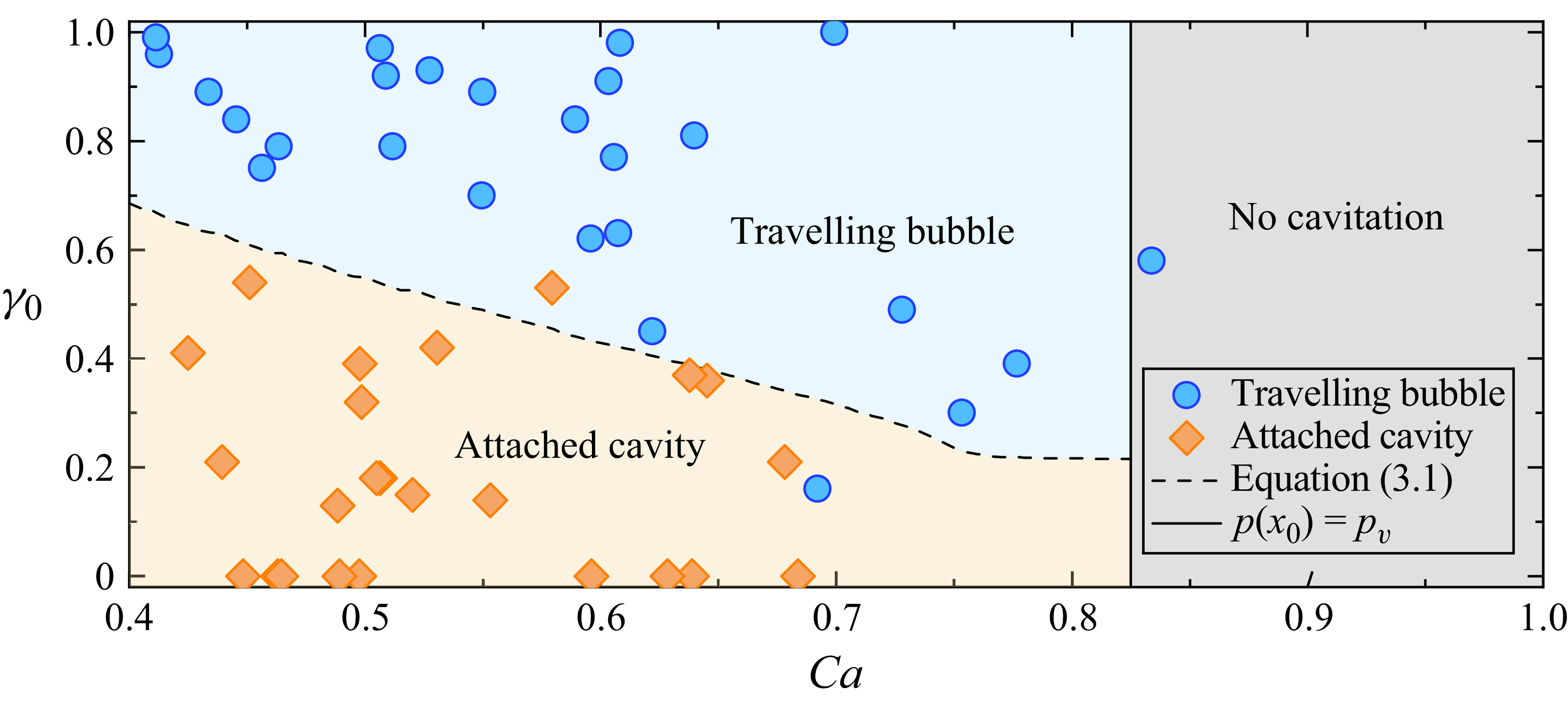


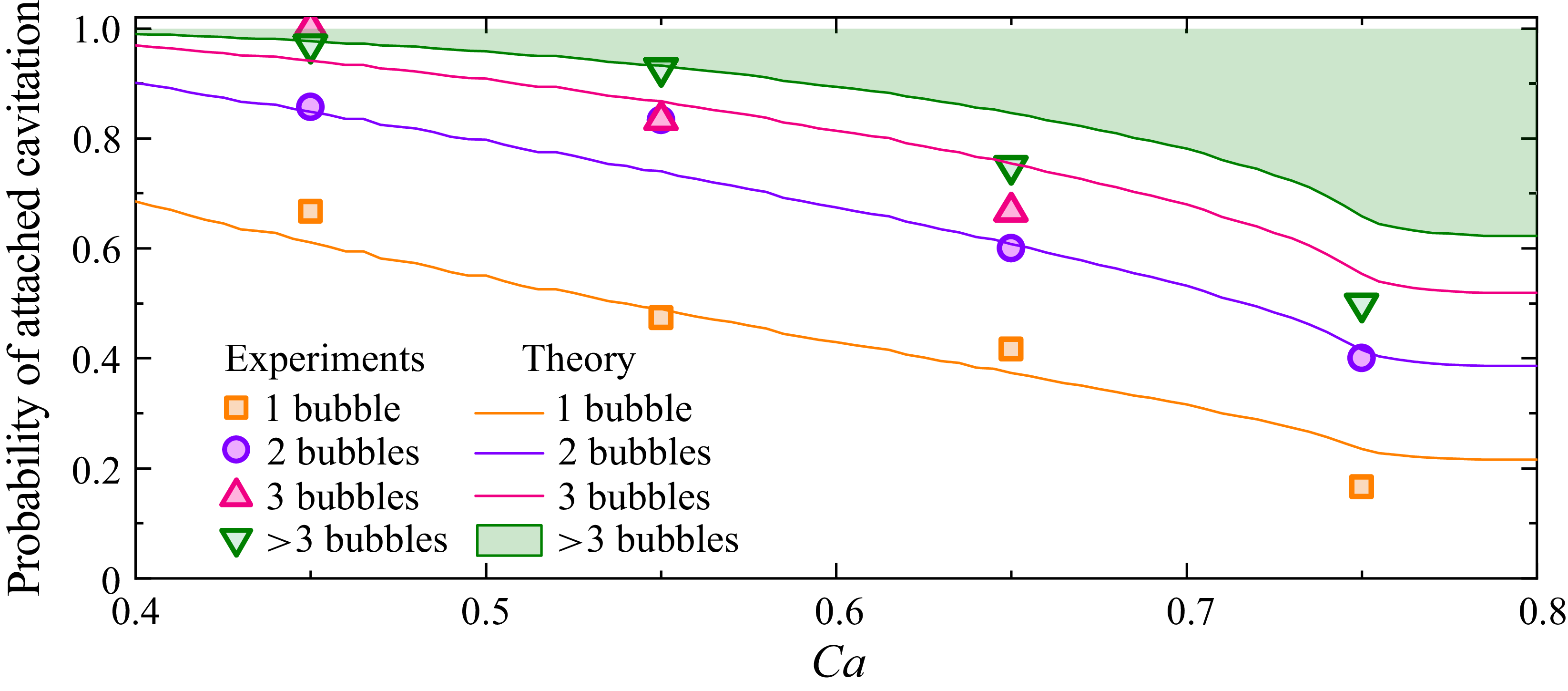


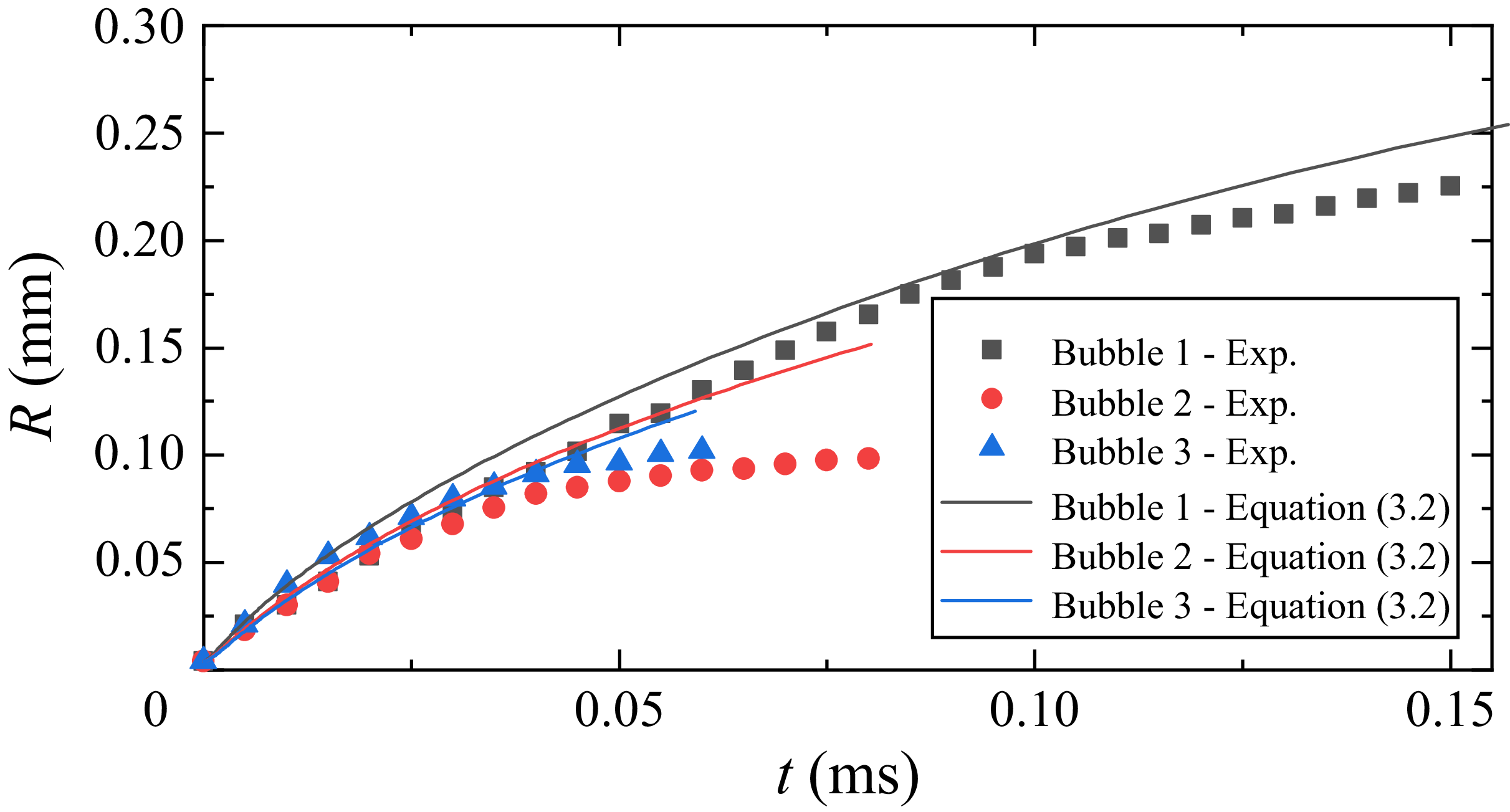


 Open access

