





Autism spectrum disorder (ASD) is a developmental disorder of growing global public health concern that presents with some of the greatest burdens of disease in children and adolescents.1 The externalising behaviours of ASD may contribute to its greater manifestation in boys than in girls, thus accounting for the observed higher prevalence of ASD in boys than in girls.Reference Kirkovski, Enticott and Fitzgerald2 ASD occurs among African children living both in Africa and abroad.Reference Fombonne3–Reference Mankoski, Collins, Ndosi, Mgalla, Sarwatt and Folstein7 Most studies in Sub-Saharan Africa have come from paediatric neurology clinics, where the most common comorbid disorders were neurological and developmental conditions or intellectual disability; for example, the prevalence of ASD in a paediatric neurology clinic in Nigeria was 2.3%Reference Lagunju, Bella-Awusah and Omigbodun8 and in Nigerian children with intellectual disability it was 11.4%.Reference Bakare, Ebigbo and Ubochi9 To the best of our knowledge, the only community survey of ASD in Sub-Saharan Africa, involving 1169 children aged between 2 and 9 yearsReference Kakooza-Mwesige, Ssebyala, Karamagi, Kiguli, Smith and Anderson10 in Uganda, found a prevalence of 0.68%, which is comparable to global estimatesReference Elsabbagh, Divan, Koh, Kim, Kauchali and Marcín11 but lower than the 1.85% reported in the USA.Reference Maenner, Shaw, Baio, Washington, Patrick and DiRienzo12 In particular, we have not found any study in non-clinical high school, college and university students reported in Sub-Saharan Africa. ASD is associated with a wide variety of psychiatric disorders, including psychosis and, in particular, schizophrenia,Reference King and Lord13,Reference Spek and Wouters14 bipolar disorder,Reference Selten, Lundberg, Rai and Magnusson15 developmental disorders in childhood and psychotic experiences in adolescenceReference Constantino and Charman16 and post-traumatic stress disorder (PTSD) following exposure to traumatic life events and social victimisation.Reference Haruvi-Lamdan, Horesh, Zohar, Kraus and Golan17 Traumatic events and social victimisation can lead to various psychiatric disorders, including depression, anxiety, bipolar disorders, personality disorders, psychotic disorders and trauma-related disorders, especially post-traumatic stress disorder.Reference Schäfer and Fisher18 Individuals with ASD are more likely to show obsessive–compulsive traits, and people with obsessive–compulsive disorder (OCD) are more likely to show autistic symptoms.Reference Weidle, Melin, Drotz, Jozefiak and Ivarsson19,Reference Ruta, Mugno, D'Arrigo, Vitiello and Mazzone20 There is evidence of increased rates of substance use disorders among individuals with ASD.Reference Rengit, McKowen, O'Brien, Howe and McDougle21 We have not found any community-based studies in non-clinical populations that report the comorbidity of ASD and psychiatric and substance use disorders.
The aims of the study were to: (a) document the overall ASD risk level and its traits/symptoms in a Kenyan student population and (b) determine the associations between ASD, psychiatric disorders and substance use disorders.
Method
Recruitment and data collection
This was a cross-sectional study. Participants were recruited from 4 out of the 47 counties in Kenya: Nairobi (the capital city of Kenya) and Machakos, Kitui and Makueni (three counties in the south-east of the country). Participants were high school, college and university students. High school participants were recruited from a community in Machakos County. We were already working with these four counties on other projects and had gained acceptance from local people, hence the choice of these counties for this project. College and university students who were ≥18 years and could communicate in English were invited to participate in the study after the nature of the study had been explained to them following one of their lectures in a classroom setting. The choice of the high school was leveraged on another study that had already taken place in the same communities. Since the schools were closed, we went through the community administrative structures to reach the families. We explained the nature of the study to the parents and guardians and, for those willing for their children (aged <18 years) to participate, we obtained written informed consent. The children were then invited to a central place where the nature of the study was explained and assent obtained from them. Only those children who presented themselves at the community meeting places were invited to participate in the study. The focus of the study was on students who are equitably admitted through a central process regardless of which county they come from and regardless of the socioeconomic and urban/rural status of the different counties in which the educational establishments were located. The only exclusion criteria for those approached in a classroom setting or who had come to the community centre for data collection were (a) no consent for those aged ≥18 years, (b) no parental consent for those <18 years and (c) no assent by those <18 years. A total of 9626 participants were recruited for the study.
Ethics statement
The authors assert that all procedures contributing to this work comply with the ethical standards of the relevant national and institutional committees on human experimentation and with the Helsinki Declaration of 1975, as revised in 2008. Ethical approval was granted by the Maseno University Ethics Review Board in Kenya (IRB number MSU/DRPI/MUERC/00344/16).
Instruments
Sociodemographic characteristics
A researcher designed a sociodemographic questionnaire to capture the sociodemographic data.
Autism-Spectrum Quotient (AQ)
This is a self-assessment questionnaire that evaluates the following autistic traits: social skills, communication skills, imagination, attention to detail and attention switching/tolerance to change.Reference Baron-Cohen, Wheelwright, Skinner, Martin and Clubley22 Total scores range between 0 and 50. A score ≥32 indicates a strong likelihood of an autism spectrum disorder,Reference Baron-Cohen, Wheelwright, Skinner, Martin and Clubley22,Reference Woodbury-Smith, Robinson, Wheelwright and Baron-Cohen23 whereas a score of 26–31 indicates low risk. Thus, the AQ will identify individual symptoms of autism spectrum, and computation for the various symptoms can give a diagnosis of autism spectrum disorder.
Psychiatric Diagnostic Screening Questionnaire (PDSQ)
This is a self-report questionnaire that has 126 questions assessing symptoms of 13 DSM-IV Axis I disorders: major depression; anxiety disorders (panic disorder, agoraphobia, post-traumatic stress disorder (PTSD), obsessive–compulsive disorder, generalised anxiety disorder and social phobia); substance use disorders (alcohol misuse/dependence and drug misuse/dependence); and somatoform disorders (somatisation disorder and hypochondriasis). It has an additional six-item psychosis screen. Six questions on major depressive episode measure suicidal ideation, classified as: frequently thinking of dying in passive ways like going to sleep and not waking up, wishing to be dead, thinking you were better off dead, having thoughts of suicide, seriously considering taking life, and thinking about a specific way of taking your life. The questions are coded No/Yes, with values of zero and one respectively. The PDSQ has sufficient psychometric properties and almost excellent internal consistency. In a validity study that involved 994 psychiatric out-patients,Reference Zimmerman and Mattia24 Cronbach's α was greater than 0.80 for 12 of the 13 subscales, and the mean of the α coefficient was 0.86. Good to excellent levels of internal consistency, test–retest reliability and discriminant and convergent validity were achieved in previous studies.Reference Ndetei, Pike, Mutiso, Tele, Gitonga and Rebello27 However, its psychometric properties have not been tested in a sociocultural context similar to Kenya. In mitigation, the PDSQ screens for symptoms that are diagnostic of DSM-IV disorders.
Washington Early Recognition Center Affectivity and Psychosis (WERCAP) screen
The WERCAP is a tool for assessing risk of developing a bipolar or psychotic disorder, based on severity of mood symptoms (‘affectivity’) and psychotic symptoms, using both frequency of occurrence and effect on functioning. It has high test–retest reliability and validity, with sensitivity of 0.91 and specificity of 0.71 for affectivity and sensitivity of 0.88 and specificity of 0.82 for psychosis.Reference Mamah, Owoso, Sheffield and Bayer25 Its sufficient psychometric properties have been validated in Rwanda and Kenya.Reference Owoso, Jansen, Ndetei, Musau, Mutiso and Mudenge26,Reference Ndetei, Pike, Mutiso, Tele, Gitonga and Rebello27
Alcohol, Smoking and Substance Involvement Screening Test (ASSIST)
The ASSIST collects information on the use of tobacco products, alcohol, cannabis, amphetamine-type stimulants, cocaine, sedatives and sleeping pills, hallucinogens, opioids and ‘other’ drugs, and determines levels of risk from the use of these substances.Reference Humenuik, Henry-Edwards, Ali, Poznyak and Montero28 This instrument was developed by the World Health Organization specifically for use in low-resource settings such as Kenya. It has sufficient psychometric properties and good discriminative validity. It can adequately screen for low-, moderate- and high-risk use of any substance. From a test–retest reliability study conducted in nine different countries that involved 1047 respondents, Cronbach's α was over 0.80.Reference Humeniuk, Ali, Babor, Farrell, Formigoni and Jittiwutikarn29
Training on data collection
Training on data collection was given by D.M. (from Washington University, St. Louis) in face-to-face residential training in Kenya. Data collection was overseen by D.M.N. and V.M. (from the Africa Mental Health Research and Training Foundation, AMHRTF). The lead research assistant, Isaiah Gitonga, was a university Masters Level graduate nurse who was responsible for the supervision of all sites and all data collection and transmission to AMHRTF headquarters. He supervised informed consent and sat through all data collection sessions.
Data management and analysis
The coded data were checked, cleaned and exported into SPSS version 23 for Windows for analysis. Basic descriptive statistics (frequency, percentages, means and standard deviations) were calculated. The chi-squared test and Fisher's exact test when appropriate were used for categorical data to analyse the association of the various variables with the ASD risk level. For continuous data, the independent t-test and one-way analysis of variance were used to examine the association of sociodemographic variables with AQ scores. Significant PDSQ disorders, risk levels of substance use and sociodemographic variables were then fitted to a generalised linear model (GLM) with multinomial distribution and cumulative negative log–log link function to identify the predictors of ASD in the participants. Correlation analysis was also carried out between AQ total score and PDSQ disorder scores, AQ total score and substance use scores, and AQ total score and AQ subscale scores. The reliability of the various AQ subscales was indexed using Cronbach's alphas (internal consistency). Statistical significance was considered at P < 0.05.
Results
A total of the 9626 students were approached and all participated in the study.
Reliability of the AQ
Internal consistency coefficients and cross-subscale correlations are displayed in Table 1.
Descriptive statistics for the Autism-Spectrum Quotient (AQ) test in a student sample (n = 9626)

* Correlation is significant at the 0.01 level (2-tailed).
The internal consistency coefficients (Cronbach's alphas) were generally satisfactory (mean α = 0.72). Cronbach's alpha for AQ total score was notably high. Cronbach's alpha for social skills, attention switching and imagination were notably low.
Correlations among AQ subscales were weak to moderate (ρ = 0.041–0.251). Note also that attention to detail correlated inversely with social skills and imagination.
ASD risk level
Of the 9626 participants, 54 (0.56%) were found to be at high risk of ASD and 1255 (13.0%) at low risk.
Sociodemographic characteristics and associated AQ scores
Distribution of sociodemographic variables
Males (53.5%) were predominant among the 9626 respondents. The mean age was 21.45 years (s.d. = 2.30, median 21.36). The majority of respondents were single (93.3%), attending university (69.4%), were either first or second born in their families (56.9%) and were Protestant (57.1%).
Sociodemographic factors associated with the risk of ASD
Sociodemographic factors found to be associated with the risk of ASD are summarised in Table 2. Males were at a significantly higher risk of ASD compared with females (P < 0.001). Of the religions, only Protestants were significantly associated with high risk of ASD (P = 0.021). Being first or second born and a high school student was also significantly (P < 0.05) associated with a high risk of ASD, as was an age of 19 or younger (including, of course, high school students). Of the demographics, only marital status was not significantly associated with high ASD risk.
Sociodemographic factors associated with risk of autism spectrum disorder (ASD) in a student sample (n = 9626)
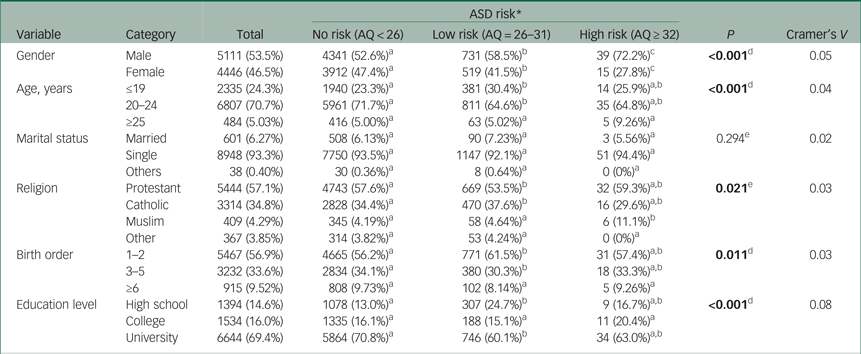
AQ, Autism-Spectrum Quotient; bold denotes significance at P < 0.05.
a.–c. Each superscript letter (a–c) denotes a subset of ASD risk categories whose column proportions do not differ significantly from each other at the 0.05 level.
d. chi-squared test
e. Fisher's exact test.
Sociodemographic differences in AQ scores
Sociodemographic differences in the different traits of ASD are summarised in Table 3.
Sociodemographic differences in the five Autism-Spectrum Quotient subscales in a student sample (n = 9626)

Bold denotes significance at P < 0.05.
a. Independent t-test/Cohen's D statistic.
b. One-way analysis of variance/eta-squared statistic.
Males had significantly higher AQ mean scores compared with females. Social skills scores were significantly higher in females than in males. Attention to detail, communication and imagination scores were significantly higher in males than females. There was no significant difference in attention switching scores. Overall, males had more ASD traits.
Younger age was significantly associated with higher AQ mean scores compared with older age. Social skills, attention switching and communication scores were significantly higher in younger participants. Attention to detail mean score was significantly higher in older participants. There was no significant between-group difference in imagination. Overall, those in the younger age group had more ASD traits.
High school students had significantly higher AQ mean scores compared with college and university students. Social skills, attention to detail, communication and imagination scores were significantly higher in high school students than in college and university students. Attention switching was significantly lower in university students than in high school and college students. Overall, high school students had more ASD traits.
Psychiatric disorders (PDSQ and WERCAP) associated with ASD risk
Table 4 summarises the association between risk of ASD and psychiatric disorders on the PDSQ and WERCAP. Significant differences (P < 0.05) were observed between those at risk of ASD and all the listed psychiatric disorders. Progressively, high risk of psychosis increased from 4.02% for no risk of ASD through 7.81% for low risk of ASD to 16.7% for high risk of ASD, which is much higher than the average risk of 4.58%. Other psychiatric disorders follow the same pattern of progressively increasing risk of ASD. OCD stands out as the disorder with the highest progressively increasing risk of ASD.
Psychiatric disorders (PDSQ and WERCAP) associated with risk of autism spectrum disorder (ASD) in a student sample (n = 9626)

Bold denotes significance at P < 0.05.
PDSQ, Psychiatric Diagnostic Screening Questionnaire; WERCAP, Washington Early Recognition Center Affectivity and Psychosis screen.
a.–c. Each superscript letter (a–c) denotes a subset of ASD risk categories whose column proportions do not differ significantly from each other at the 0.05 level.
There were significantly positive correlations between AQ total score and all psychiatric symptom scores on the PDSQ (P < 0.01). The correlation ranged from r = 0.111 to r = 0.207; the highest correlation was with the psychosis score, followed by major depressive disorder and eating disorder, and the lowest correlation was with OCD. More detailed data are presented in Table 5.
Correlation between Autism-Spectrum Quotient (AQ) total score and Psychiatric Diagnostic Screening Questionnaire (PDSQ) scores

PTSD, post-traumatic stress disorder; WERCAP, Washington Early Recognition Center Affectivity and Psychosis screen.
* Correlation is significant at the 0.01 level (2-tailed).
Association of ASD risk with ASSIST diagnoses of substance use
As reported in Table 6, all drugs/substances were significantly (P < 0.05) associated with ASD risk except for alcohol and cannabis.
Risk levels of ASSIST individual substance uses associated with risk of autism spectrum disorder (ASD) in a student sample (n = 9626)

ASSIST, Alcohol, Smoking, and Substance Involvement Screening Test; bold denotes significance at P < 0.05.
a., b. each superscript (a, b) letter denotes a subset of ASD risk categories whose column proportions do not differ significantly from each other at the 0.05 level.
There were significant positive correlations between AQ total score and all drug/substance use scores (P < 0.01). More detailed data are presented in Table 7.
Correlation between ASSIST and Autism-Spectrum Quotient (AQ) total score

ASSIST, Alcohol, Smoking, and Substance Involvement Screening Test.
* Correlation is significant at the 0.01 level (2-tailed).
Determinants of ASD risk
These are summarised in Table 8. Major depressive disorder and drug misuse/dependence are determinants of ASD risk (P < 0.05). The risk of ASD was 1.45 and 1.83 times higher in participants with major depressive disorder and drug misuse/dependence respectively.
Factors associated with autism spectrum disorder: ordinal logistic regression model

AOR, adjusted odds ratio; Ref., reference variable; WERCAP, Washington Early Recognition Center Affectivity and Psychosis screen.
Discussion
Our discussion is primarily based on what we found in our study. We were highly limited by the relative unavailability of data, particularly from Africa, for purposes of comparisons.
Reliability of the AQ and its subscales
The fact that we found significant reliability of the AQ subscales implies that the results across the different students are reliable and provide a sound basis for comparison across all the variables studied.
ASD risk level and sociodemographic variables
Global trends
As far as we could establish from our literature search, we present the largest sample (n = 9626) study reported in Africa on ASD risk in a population not drawn from clinical services; an earlier study, involving n = 1169, was reported in Kampala, Uganda,Reference Kakooza-Mwesige, Ssebyala, Karamagi, Kiguli, Smith and Anderson10 but with the difference that our study was on high school, college and university students whereas that in Uganda was on much younger children. This difference in age range between our study and the Ugandan study may be the explanation for our finding that 0.56% of participants were at high risk of ASD, compared with the higher 0.68% found in the Uganda children.Reference Kakooza-Mwesige, Ssebyala, Karamagi, Kiguli, Smith and Anderson10 Our finding of 0.56% is within the global range (0.3–1.16%, median 0.62%), but lower than the 1.85% reported in the USA.Reference Maenner, Shaw, Baio, Washington, Patrick and DiRienzo12 As expected, the 0.56% risk level is much lower than the 2.3% found in participants drawn from populations attending neurology clinics in NigeriaReference Lagunju, Bella-Awusah and Omigbodun8 or 11.4% among participants with intellectual disability, also in Nigeria.Reference Bakare, Ebigbo and Ubochi9
Gender
The gender comparisons summarised in Tables 2 and 3 are similar to what has been found in most reported studies. For example, the finding that males had nearly three times the level of autistic traits compared with females (0.8% and 0.3% respectively) is similar to the 3:1 reported elsewhere.Reference Loomes, Hull and Mandy30 Females, however, had more impairment in social skills compared with males, although there were no gender differences in attention switching, a finding that has been observed in other studies.Reference Loomes, Hull and Mandy30
Age and level of education
The higher risk of ASD in the younger age group explains why in our study we found ASD to be significantly (P < 0.001) associated with high school students (who are younger than college and university students). It is not unexpected that high school students had higher levels of ASD risk, given that they are younger than college and university students. Students at high risk of ASD would naturally have dropped out because of the highly competitive academic entrance to colleges and universities. This explanation is further supported by Uganda's findingsReference Kakooza-Mwesige, Ssebyala, Karamagi, Kiguli, Smith and Anderson10 in younger children of a 0.68% prevalence of ASD, compared with the 0.56% average at high risk of ASD in our population, which included older students in higher learning institutions.
Marital status
It is noteworthy that marital status did not affect the risk of ASD. However, we do not have information on exactly what constituted ‘other' marital status. We speculate that this may have been a sensitive question that the students were not prepared to talk about. These could include students who are involved in ‘come we stay’ arrangements very common among college and university students for purposes of sharing the cost of accommodation. When it comes to specific symptoms of ASD, the students in the ‘other’ marital status group scored higher on poor social coping skills, poor communication and imagination. We have no explanation for this; only qualitative studies have the potential to provide the explanation.
Religion
We have no explanation for the marginally significant association of ASD risk with the Muslim religion. However, it is noteworthy that children of Somali background in Sweden, who are predominantly of Muslim background, had three times the risk of ASD compared with children of parents of Swedish background.Reference Barnevik-Olsson, Gillberg and Fernell31
Birth order
We speculate that the marginally significant association with first or second birth order, i.e. being the mother's first or second child, may be a reflection of brain injury associated with primigravida. Although we appreciate that pregnancy in older age could also be a risk factor for brain damage in the offspring, in this Kenya context we were dealing with a relatively young population of mothers and their first or second offspring.
Association with psychiatric disorders
We found a highly significant association (P < 0.001) of ASD risk with all psychiatric disorders we studied except for OCD, for which the significance was P = 0.003, making OCD less associated than the other disorders. These statistically significant findings are confirmed by correlation analysis. It is to be noted that this association between psychiatric disorders and ASD is uniformly consistent for both low risk and high risk of ASD. Studies on biomarkers of ASD and psychiatric conditions, in particular schizophrenia, will clarify the relation between these conditions. It is also possible that school children and students with ASD are placed at a functional disadvantage that predisposes them to various psychiatric disorders, such as PTSD, as explained in our literature review.
Association with substance misuse
Only alcohol and cannabis misuse did not achieve significant association with ASD risk. There was a consistent correlation between substance use and both low and high risk of ASD, observed all through and this is therefore likely to reflect the real trend, i.e. association between ASD and substance misuse. Further studies are required to confirm this.
Determinants of ASD
In all cases of ASD, it is important to screen for depression and substance misuse as comorbidities, whether in clinical or non-clinical populations.
Strengths and limitations of our study
The main strength of our study is that it is in the largest sample reported in Sub-Saharan Africa and is the first of its type in high school, college and university students. We used DSM-IV symptoms – DSM-IV is a widely used tool in both clinical and epidemiological research.
Our study had several limitations, although for some there were mitigating factors. The university students were drawn from 4 counties out of the 47 counties in Kenya. This study was leveraged on another study that was focused not on epidemiological patterns of psychiatric disorders but on biomarkers of early psychosis. It is therefore feasible that this approach may have introduced bias, as the sample may not be representative of the national sample. However, this is strongly mitigated by the admissions policy to public universities and colleges in Kenya. Placement in national universities is done centrally to ensure equitable distribution of students from all counties. We therefore believe that our sample of university students represented the face of Kenya.
The study in the high schools was leveraged on the same biomarker study. Unlike the universities, admission to high schools is partially regional, national and local. However, during this study, there was a nationwide closure of schools, with students going back to their homes and families. We were therefore forced to access only students who came from schools within the community, whom we approached collectively through the community administration to come to a central place. We have no reason to assume these schools were different from or similar to any other schools. Only future studies with a better sampling process will determine differences or similarities across a more representative sample. Either way, in the universities and schools, this study generates data that demonstrate that ASD is an ongoing concern in the Kenyan setting.
A major limitation of this study is that only individuals enrolled in typical educational settings participated. There is therefore the possibility that the study excluded individuals who were not enrolled in educational institutions.
Despite the strengths and limitations of our study, it remains essentially an exploratory descriptive study that at best serves to raise awareness of ASD in the non-clinical population, and in particular, students whose behavioural dysfunctions and possibly academic performance could be explained by the presence of unrecognised ASD.
Data availability
Data are available from the corresponding author on reasonable request.
Acknowledgements
We thank all the participants in this study and the different institutions and communities who facilitated the study, in particular the Africa Mental Health Research and Training Foundation.
Author contributions
V.N.M.: oversight on data collection, drafting of the paper; D.M.N.: conceptualisation and oversight of the study, drafting of the paper; E.N.M. and M.M.: literature review; R.K.A. and L.O.: data analysis; C.M.: ethical conduct of the study and data management; D.M.: conceptualisation of the study.
Funding
Africa Mental Health Research and Training Foundation (AMHRTF) provided in-house support for this particular set of data collection and analysis. The Foundation did not influence researchers’ work independently.
Declaration of interest
None.


 Open access


eLetters
No eLetters have been published for this article.