





Introduction
Nearly one in six children in the United States resides in a family with income below the federal poverty threshold (American Psychological Association, 2024). Relative to their high-income peers, children from low-income settings are more vulnerable to a range of cognitive, emotional, and behavioral adjustment problems with enduring health impacts, including impairments in executive control, developmental delays, and poorer socioemotional functioning (Brooks-Gunn et al., Reference Brooks-Gunn, Klebanov, Liaw and Duncan2021; Redd et al., Reference Redd, Thomson and Moore2024; Schmidt et al., Reference Schmidt, Merrill, Gill, Miller, Gadermann and Kobor2021). In this regard, scholars assert that exacerbated stress across the family system, driven by economic strain, represents a primary mechanism linking low-income status to adverse developmental outcomes (Conger et al., Reference Conger, Conger and Martin2010). Indeed, the challenges associated with difficulty meeting basic needs may disrupt family relationships, heighten parental stress, and increase the likelihood of maladaptive parenting behaviors, thereby threatening children’s health and well-being (Conger & Elder, Reference Conger and Elder2020). Consequently, understanding how low-income parents mobilize psychosocial resources to cope with economic stress is central to efforts aimed at promoting positive child development in the context of socioeconomic disadvantage.
One key individual difference variable that facilitates effective coping with economic stress and promotes positive parenting behaviors is social support (Lee et al., Reference Lee, Anderson, Horowitz and August2009). Parental social support encompasses the emotional and material resources made accessible through a parent’s social network. According to Lazarus and Folkman’s (Reference Lazarus and Folkman1984) transactional model of stress and coping, even in the context of limited material resources, social support enhances parents’ confidence in their ability to manage life’s stressors. Indeed, for parents experiencing economic stressors in particular, access to instrumental or tangible forms of social support, such as providing childcare, lending money, or offering a safe place to stay, is critical for effectively addressing practical demands as well as emotional strain. For example, the presence of instrumental social support has been found to alleviate, or even avert, psychological distress among parents with low income (e.g., Turney, Reference Turney2013). A substantial body of evidence demonstrates that low-income parents who report greater instrumental social support experience positive psychological outcomes (e.g., enhanced personal control, reduced parenting stress; Kang, Reference Kang2013; Turney, Reference Turney2013) that in turn, are associated with more effective parenting practices (e.g., improved provision of emotional and physical care to children; Kang, Reference Kang2013). Consistent with these findings, parents’ perceptions of adequate instrumental social support is linked to improved child health outcomes in low-income contexts (e.g., Melnick & Doom, Reference Melnick and Doom2024). Thus, greater social support may strengthen parenting practices and, ultimately, promote more favorable developmental trajectories in children (see also Armstrong et al., Reference Armstrong, Birnie-Lefcovitch and Ungar2005).
Children’s prosocial development in low-income contexts: The influence of parental social support
A large body of evidence documents adverse psychosocial adjustment outcomes among children from socially and economically marginalized backgrounds (e.g., Schmidt et al., Reference Schmidt, Merrill, Gill, Miller, Gadermann and Kobor2021), yet comparatively few studies examine the development of adaptive social and emotional skills in such vulnerable populations. In particular, empirical investigation into the prosocial development of children from economically disadvantaged contexts is largely lacking (Armstrong-Carter & Telzer, Reference Armstrong-Carter and Telzer2021). Child prosocial behavior refers to voluntary actions that benefit others, including cooperation, emotional support, and helping (Eisenberg et al., Reference Eisenberg, Spinrad, Morris and Zelazo2013). Although prosocial behaviors are predicated on benefiting others, engaging in such behaviors bolsters children’s own psychosocial adjustment (e.g., positive peer relationships, psychological well-being, academic achievement; Caprara et al., Reference Caprara, Barbaranelli, Pastorelli, Bandura and Zimbardo2000; Eisenberg et al., Reference Eisenberg, Zuffianò and Spinrad2024; Layous et al., Reference Layous, Nelson, Oberle, Schonert-Reichl and Lyubomirsky2012).
Notably, much of children’s prosocial skill acquisition is attributed to parental socialization processes. According to Spinrad and Gal (Reference Spinrad and Gal2018), affectionate, responsive, and nurturing interactions between parents and children serve as models of cooperative and reciprocal social responses that, in turn, facilitate children’s own competence in prosocial actions. In line with this view, empirical studies in low-income settings (e.g., Lee et al., Reference Lee, Lee, Ward, Pace and Chang2024) and meta-analytic findings (e.g., Menting et al., Reference Menting, de Castro and Matthys2013) indicate that parental responsiveness and warmth are positively associated with child prosocial behavior. Unfortunately, research indicates that economic and material pressures can substantially constrain parents’ capacity to maintain warm and responsive interactions with their children (e.g., Kang, Reference Kang2013).
Nevertheless, even in the context of significant economic stress, low-income parents’ use of social support from others may actively promote children’s prosocial development. Specifically, robust social support systems can protect low-income parents from psychological distress, thereby enhancing their capacity to engage in parenting behaviors critical to children’s prosocial development (e.g., parental warmth; Pastorelli et al., Reference Pastorelli, Zuffianò, Lansford, Thartori, Bornstein, Chang, Deater-Deckard, Di Giunta, Dodge, Gurdal, Liu, Long, Oburu, Skinner, Sorbring, Steinberg, Tapanya, Uribe Tirado, Yotanyamaneewong, Al-Hassan, Peña Alampay and Bacchini2021). Indeed, Ensor and Hughes (Reference Ensor and Hughes2010) observed that preschool-aged children of mothers reporting greater instrumental and emotional social support were more likely to demonstrate prosocial behaviors, including sharing with peers. Furthermore, children whose parents are embedded within communities characterized by strong social networks may benefit from increased exposure to adults who exemplify and reinforce prosocial actions. For example, prior work indicates that parents’ perceptions of instrumental, emotional, and confidant social support is associated with more cohesive and socially regulated neighborhoods (Byrnes & Miller, Reference Byrnes and Miller2012). Such social contexts may plausibly contribute to children’s prosocial development, consistent with research demonstrating links between neighborhood social regulation and prosocial behavior in children (e.g., Holmes et al., Reference Holmes, Bender, Yoon, Berg, Duda-Banwar, Chen, Evans, Korsch-Williams and Perzynski2025). Taken together, for low-income parents in particular, access to social support may promote children’s prosocial development both by cultivating less stressful and warmer parenting contexts, as well as by increasing children’s exposure to prosocial exchanges within parents’ broader social networks.
Parental social support as a dyadic and dynamic pathway to prosocial behavior
Despite promising evidence for the contribution of parental social support in enhancing children’s prosocial skills, the current body of research remains limited. For instance, maternal social support has been the primary focus of most studies linking parental social support to children’s prosociality (e.g., Ensor & Hughes, Reference Ensor and Hughes2010), with comparatively few investigations addressing paternal social support. However, fathers may play a distinct role in children’s prosocial development. Gryczkowski et al. (Reference Gryczkowski, Jordan and Mercer2018) demonstrated that maternal and paternal parent–child interactions exert distinct influence on children’s prosocial behavior at different developmental stages. Far fewer studies have investigated how social support at the level of the mother–father dyad jointly contributes to child prosocial behavior.
This limitation is important to note, as research in low-income settings underscores the coordinated role of mothers’ and fathers’ parenting behaviors in shaping children’s prosocial development. For instance, Lee and colleagues (Reference Lee, Lee, Ward, Pace and Chang2024) found that among unmarried parents with low income, greater alignment in responsiveness within the parental dyad was associated with higher levels of child prosocial behavior. Accordingly, concordance in social support between parents may also play an important role in children’s prosocial development, as discordant levels of social support could create inconsistencies in parental stress levels, parenting behaviors, and modeling of prosocial interactions. Taken together, efforts to understand the influence of parental social support on children’s prosociality necessitate careful consideration of both the level and alignment of social support within the mother–father dyad.
Notably, recent research suggests that parental social support represents a dynamic construct that vacillates across early childhood. For example, Chang (Reference Chang2025) found that among parents with prior child welfare contact, parents differed not only in their absolute levels of instrumental and emotional social support but also in the stability of each over time. Importantly, adverse child outcomes were observed for children whose parents reported consistently low levels of instrumental and emotional social support, as well as those whose parents experienced instability in these supports (Chang, Reference Chang2025). Given that social-interactional accounts of prosocial development (e.g., Dahl & Brownell, Reference Dahl and Brownell2019) emphasize that children’s prosocial behaviors are scaffolded on prior social experiences, instability and disruption in parental social support may interfere with children’s prosocial skill progression. Assessing changes in mother–father dyadic social support from birth through early childhood, therefore, allows researchers to consider absent, discordant, as well as unstable social support patterns across a sensitive window, providing valuable insight into the developmental contexts for children’s emerging prosocial skills. For this purpose, a person-centered approach may be particularly useful, as it can capture both the alignment of maternal and paternal social support as well as the temporal stability and variability of multiple types of social support across time.
Purpose of the present study
In light of the aforementioned considerations and limitations, the present study sought to deepen understanding of the relationship between mothers’ and fathers’ social support and children’s prosocial development from a dyadic perspective. Specifically, the present study draws on data from a large, racially diverse sample of low-income families to: (1) characterize trajectories of mother–father dyadic social support between birth and age five; and (2) evaluate how these dyadic social support trajectories are associated with child prosocial behavior at ages five and nine.
A. Methods
A. Participants and procedure
Data were drawn from the Future of Families and Child Well-being Study (FFCWS), an ongoing longitudinal birth cohort study of 4,898 families across 20 large cities in the United States, oversampled for births to unmarried mothers. Approval for this study was obtained from the author’s Institutional Review Board. Given the current focus on changes in parental social support within early childhood, this study utilized the first four waves of the FFCWS, near the birth of the focal child (Wave 1), and when the focal child was approximately one (Wave 2), three (Wave 3), and five years old (Wave 4). A total of 569 cases were excluded due to mothers or fathers having missing data on all parental social support indicators at each wave, yielding an analytic sample of 4,329 mother–father dyads.
Measures
Indicators of maternal and paternal social support
Four indicator variables were created to assess mothers’ and fathers’ social support, respectively, at Waves 1, 2, 3, and 4. Consistent with prior studies (e.g., Driver et al., Reference Driver, Tebbe, Burke and Amin2023), indicators of social support were drawn from parents’ responses to whether they could count on someone to provide them with three types of instrumental social support, namely, childcare support (i.e., “In the next year, could you count on someone to help with emergency child care?”), housing support (i.e., “In the next year, could you count on someone to provide you with a place to live?”), and financial support (i.e., “If you needed help in the next year, could you count on someone to loan you $200?”). The fourth type of social support, coparent support (i.e., “[Coparent often] helps you with things that are important to you”), reflected positive social interactions and tangible support between biological parents. A dichotomous variable was constructed to indicate the presence of each type of social support, respectively. This coding procedure was repeated for mothers and fathers across each wave, with the exception that the indicator for childcare support at birth was unavailable for fathers, as they were not asked this question during the Wave 1 interview. Thus, a total of 31 social support indicators were included, comprising 16 for mothers and 15 for fathers.
Child prosocial behavior outcomes
To assess child prosocial behavior, 13 items adapted from the Express subscale of the Adaptive Social Behavior Inventory (ASBI; Hogan et al., Reference Hogan, Scott and Bauer1992) were measured at ages five and nine, respectively. The ASBI-Express subscale reflects children’s social competence, particularly their prosocial skills (e.g., “Understands others’ feelings”). Primary caregivers were asked to rate each item using a 3-point Likert scale, ranging from not true (0), sometimes true (1), to often true (2). Items were mean-scored such that higher scores indicate greater child prosocial behavior at ages five and nine (Cronbach’s alpha = 0.80 and 0.91, respectively). Mean scores in the current sample were comparable to those reported in national studies of premature infants, as well as in racially diverse samples of children participating in Head Start programs (Greenfield et al., Reference Greenfield, Iruka and Munis2004; Hogan et al., Reference Hogan, Scott and Bauer1992). Mean scores were subsequently standardized into z-scores to facilitate interpretation and comparison.
Sociodemographic covariates
A number of sociodemographic variables were included as covariates of child prosocial behavior. This included parent age, child sex, and child race/ethnicity (i.e., White, Black, Hispanic, multiracial). Parents’ highest level of education at the time of the child’s birth was measured categorically to indicate less than high school, high school or equivalent, some college or postsecondary education, or a college degree or higher. Coparental relationship status was assessed at ages five and nine, categorized as separated from, cohabitating with, or married to the child’s other biological parent. Parent employment status was measured dichotomously, indicating whether the parent was currently engaged in any full-or part-time work at ages five and nine. Poverty status was also measured dichotomously at ages five and nine, indicating whether the parent reported that their household income fell below the federal poverty line (FPL). Child residency status at ages five and nine was categorized as residing primarily (i.e., at least half the time) with both biological parents, residing primarily with only the biological mother, or residing primarily with only the biological father. Maternal and paternal depression at ages five and nine was measured via the Composite International Diagnostic Interview-Short Form (CIDI-SF; Kessler et al., Reference Kessler, Andrews, Mroczek, Ustun and Wittchen1998). Following conservative criteria for probable depression, a constructed dichotomous variable was used to indicate parental depression status. Parent–child relationship quality, available at age nine, was assessed via child report separately for relationships with their mother and father (i.e., “How close do you feel to your [mother/father]?”). Responses were coded on a 4-point Likert scale ranging from not very close (1) to extremely close (4).
Analytic approach
The present study employed repeated-measures latent class analysis (RMLCA; Collins & Lanza, Reference Collins and Lanza2010) to investigate temporal patterns of mother–father dyadic social support, as well as outcomes (i.e., child prosocial behavior) associated with dyadic social support trajectories. RMLCA is a longitudinal extension of latent class analysis (LCA) that can flexibly model nonparametric change over time, accommodating indicator variables that do not conform to continuous patterns of change (Killian et al., Reference Killian, Cimino, Weller and Hyun Seo2019; Wright & Hallquist, Reference Wright and Hallquist2014).
Data were initially cleaned in Stata v17.0, and all analyses were conducted in Mplus v8.9. First, RMLCA was performed using maximum likelihood estimation with robust standard errors (Vermunt & Magidson, Reference Vermunt and Magidson2004; Yuan & Bentler, Reference Yuan and Bentler2000) to identify dyadic social support trajectories. Mplus handles missing data in RMLCA by directly estimating model parameters using all available information (i.e., Full Information Maximum Likelihood [FIML]). To identify the best-fitting class, RMLCA was conducted iteratively with k+ 1 classes, ranging from two- to six-class models. In selecting the best-fitting class solution, several fit indices were considered, including Akaike Information Criterion (AIC; Akaike, Reference Akaike1987), Bayesian Information Criterion (BIC; Schwarz, Reference Schwarz1978), and adjusted Bayesian Information Criterion (aBIC; Sclove, Reference Sclove1987), wherein lower values indicate improved model fit. Entropy for each class solution was also considered, with values closer to one indicating greater class distinction and separation within a solution. Finally, the significance of the Lo-Mendell-Rubin Adjusted likelihood ratio test (aLRT) and Vuong-Lo-Mendell-Rubin likelihood ratio test (VLMR-LRT) were used to determine whether the k class solution had a significantly better fit than the k – 1 class model (Collins & Lanza, Reference Collins and Lanza2010; Lo et al., Reference Lo, Mendell and Rubin2001).
Second, an auxiliary model was estimated to examine distal outcomes associated with membership in dyadic social support trajectories. This model was estimated separately for child prosocial behavior at ages five and nine, respectively. Child prosocial behavior was specified as the distal outcome in a conditional latent class model, with latent class membership and sociodemographic covariates included as simultaneous predictors. Pairwise comparisons of prosocial behavior scores across latent classes were derived from differences in covariate-adjusted estimated marginal means and were evaluated for statistical significance. Covariate effects are reported as regression coefficients estimated within the same conditional specification. Sociodemographic covariates included child race/ethnicity, child sex, parent age at the time of the child’s birth, parent educational attainment at birth, current parental employment status, current coparental relationship status, current household poverty status, current parental depression, and current residential status of the child. In analyses examining prosocial behavior at age nine, additional covariates were available to incorporate, including parent–child relationship quality and child prosocial behavior at age five. Again, missing data on endogenous variables were handled using FIML. Cases with missing data on exogenous variables, however, are excluded in the distal outcome analysis, yielding a sample of 1,538 families in the distal model.
Results
Table 1 presents study descriptive statistics, and Supplemental Table 1 illustrates pairwise correlations of study variables. The majority of children in the analytic sample (N = 4,329) were Black (44%), followed by Hispanic (22%), White (17%), or multiracial (15%). At the time of the focal child’s birth, 40% of biological mothers were cohabitating with the biological father. Regarding living arrangements, an equal proportion of children resided primarily with both biological parents (50%) or only their mother (50%). Fathers were significantly older than mothers at the time of the child’s birth (Ms = 27.92 and 25.29, SDs = 7.16 and 6.06, respectively; p < .001). Educational attainment differed significantly between fathers and mothers (χ2[3] = 12.58, p < .01), with fathers more likely to have attained a high school diploma (33%) and mothers more likely to have attained some college or postsecondary education (25%). Employment status also differed significantly (χ2[1] = 58.80, p < .001), such that mothers (20%) were more likely than fathers (13%) to be unemployed at the time of the child’s birth. Similarly, poverty status varied significantly between mothers and fathers (χ2[1] = 58.08, p < .001), with fathers (27%) less likely than mothers (35%) to report household income below the FPL at the time of the child’s birth.
Descriptive statistics of study variables
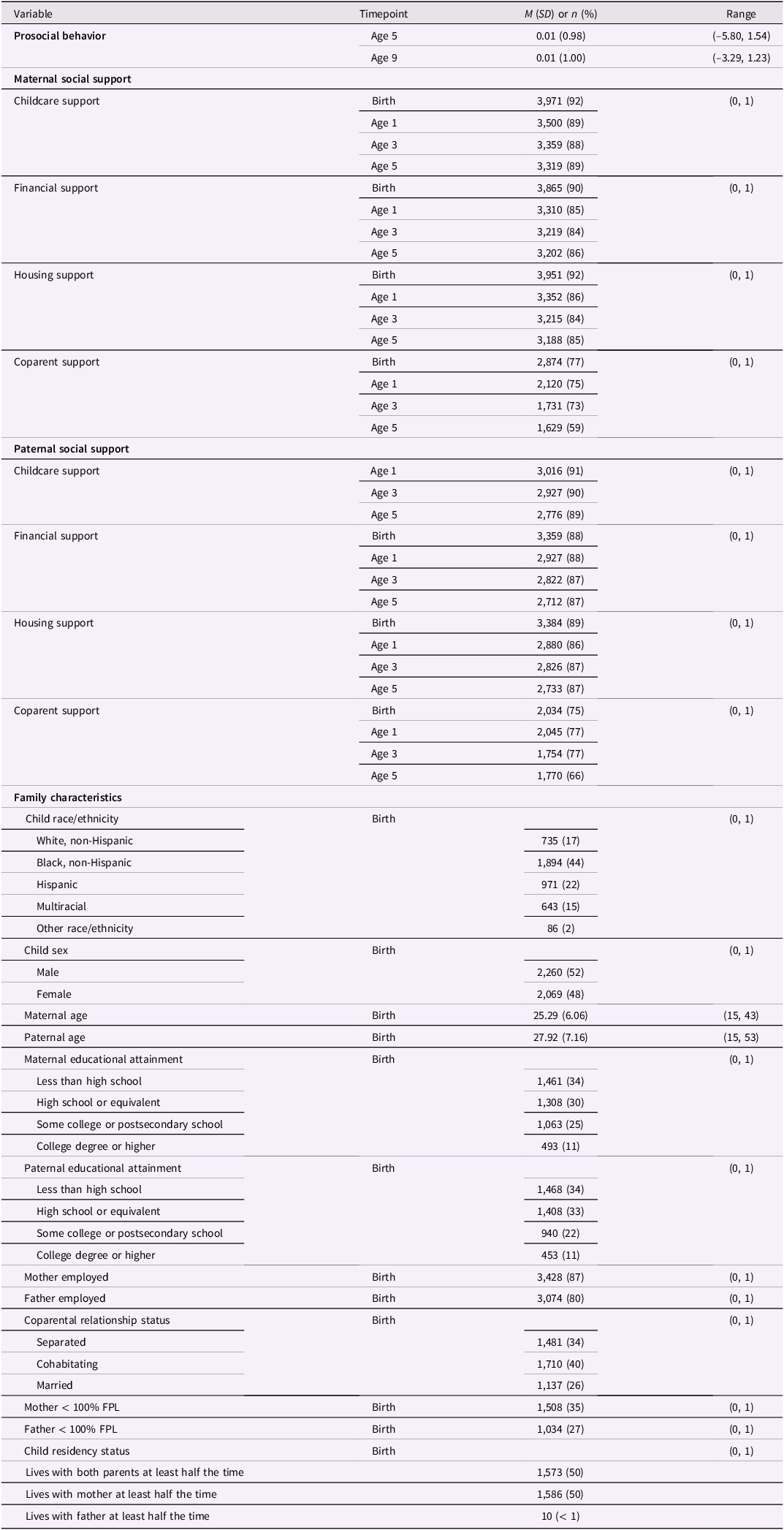
Note. Fathers’ perceptions of childcare support at birth are not available. FPL = Federal Poverty Line.
Identification of latent dyadic social support trajectories
Table 2 provides fit indices compared across the two-to six-class solutions. Log-likelihood, AIC, BIC, and aBIC all decreased in value for sequential classes through the six-class solution, indicating relatively improved model fit with more classes. Both aLRT and VLMR-LRT were significant through the six-class solution (ps < .001). While models with a greater number of classes yielded continued improvement in model fit indices, these improvements were incremental in magnitude, and were accompanied by diminishing entropy and smaller minimum class sizes (≤ 6%), suggesting reduced classification precision and potential overextraction of classes. In contrast, the three-class solution had the highest entropy (0.85), statistically significant likelihood ratio tests, and acceptable minimum class sizes. Thus, class size, entropy, parsimony, and interpretability supported the selection of the three-class solution as the optimal class solution.
Fit indices of identified latent dyadic social support trajectories

Note: N = 4,329 mother–father dyads. Boldface values represent the selected class solution. AIC = Akaike Information Criterion; BIC = Bayesian Information Criterion; aBIC = adjusted Bayesian Information Criterion; aLRT = Lo-Mendell-Rubin adjusted Likelihood Ratio Test p-values; VLMR-LRT = Vuong-Lo-Mendell-Rubin Likelihood Ratio Test p-values.
Interpretation of the three-class solution
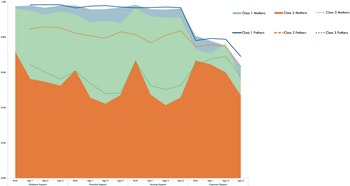
Descriptives of sociodemographic characteristics for each class and supplemental analyses of sociodemographic predictors of class membership are reported in Supplemental Tables 2 and 3, respectively. Figure 1 presents item response probabilities and class membership proportions for the three-class solution of dyadic social support trajectories.
Dyadic social support item response probabilities and overall class prevalence for the repeated-measures latent class solution.
Note. Fathers’ perceptions of childcare support at birth are not available. Class 1 = “High and concordant” (64%); Class 2 = “Paternal-advantaged, declining maternal” (20%); Class 3 = “Maternal-advantaged” (16%).
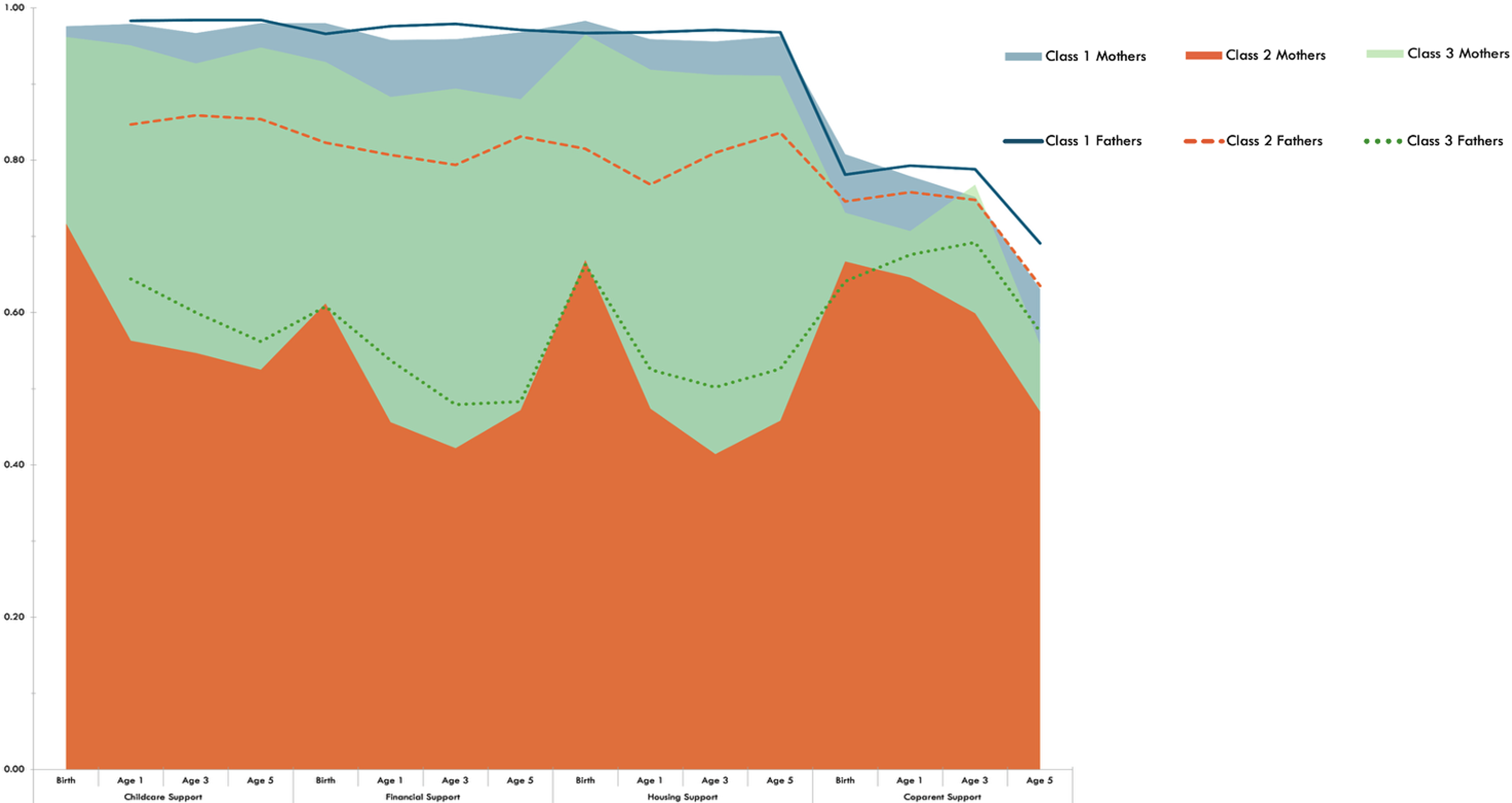
Figure 1. Long description
A line graph showing the probabilities of dyadic social support responses and overall class prevalence for repeated-measures latent class solutions. The horizontal axis represents different age points (Birth, Age 1, Age 3, Age 5) across three types of support (Childcare Support, Financial Support, Housing Support, and Coparent Support). The vertical axis represents the probability values ranging from 0.00 to 1.00. The graph includes six data lines: Class 1 Mothers (solid blue line), Class 2 Mothers (solid orange line), Class 3 Mothers (solid green line), Class 1 Fathers (dashed blue line), Class 2 Fathers (dashed orange line), and Class 3 Fathers (dotted green line). The lines show varying trends across the different age points and types of support, indicating differences in social support probabilities among the classes and genders.
Approximately 64% of mother–father dyads demonstrated the highest and most stable levels of all four social support types (i.e., childcare, financial, housing, and coparent support) across the first five years of their child’s life. This class, labeled “High and Concordant” social support, was the largest class and was selected as the referent class based on prior evidence that children of parents reporting high overall levels of social support demonstrate greater prosocial behavior (Hosokawa & Katsura, Reference Hosokawa and Katsura2024). In addition to a “High and Concordant” class, two other types of dyadic social support trajectories were identified: “Paternal-Advantaged, Declining Maternal” and “Maternal-Advantaged” social support.
The smallest class, labeled “Maternal-Advantaged” social support, contained 16% of the sample. The “Maternal-Advantaged” social support class was characterized by high probabilities of the mother endorsing childcare, financial, and housing support across early childhood (0.88–0.97). Fathers in this class also demonstrated a stable endorsement of these supports across childhood; however, their likelihood of endorsement was only moderate (0.50–0.66). Mothers and fathers in this class both demonstrated moderate to high probabilities of coparent support across early childhood (0.56–0.73). Despite not exhibiting an especially high level of coparent support, parents in this class demonstrated relatively concordant levels of coparent support from birth to age five.
The “Paternal-Advantaged, Declining Maternal” social support class contained 20% of the sample. This class was characterized by the lowest absolute levels of all types of social support, as reported by mothers. Although social support levels were somewhat higher for mothers at the time of the child’s birth (.61–.72), the overall pattern for mothers reflected a trajectory of decline in childcare, financial, and housing support across early childhood (0.41–0.56). Mothers in this class retained a moderate degree of coparent support from birth to age three (0.60–0.67), but these values declined to 0.47 by age five. Notably, the overall decline in each social support type across early childhood was steeper than that of mothers or fathers in any other class. Fathers in this class, by contrast, demonstrated high and stable endorsement of childcare, financial, and housing support across early childhood (0.77–0.86). While these probabilities are high, they remain slightly lower than those exhibited by mothers in the “Maternal-Advantaged” social support class.
Comparisons of child prosocial behavior across dyadic social support trajectories
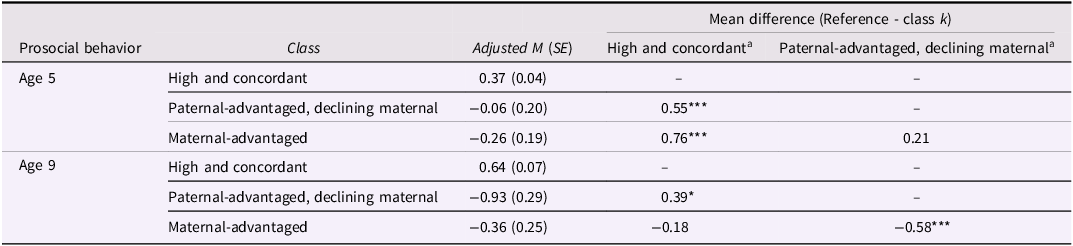
As shown in Table 3, mothers’ and fathers’ class membership was significantly associated with children’s prosocial behavior. Pairwise comparisons indicated that children of parents in the “Paternal-Advantaged, Declining Maternal” (M = –0.06, SE = 0.20; p < .001) and “Maternal-Advantaged” (M = –0.26, SE = 0.19; p < .001) social support classes scored significantly lower on prosocial behavior at age five, relative to the “High and Concordant” social support class (M = 0.37, SE = 0.04). When examining children’s prosocial behaviors at age nine, the pairwise comparison between the “Paternal-Advantaged, Declining Maternal” and “High and Concordant” class remained significant (p = .01). In addition, children of parents in the “Paternal-Advantaged, Declining Maternal” class (M = −0.93, SE = 0.29) scored significantly lower on prosocial behavior at age nine, relative to the “Maternal-Advantaged” class (M = −0.36, SE = 0.25; p < .001).
Child prosocial behaviors as a distal outcome of dyadic social support class membership
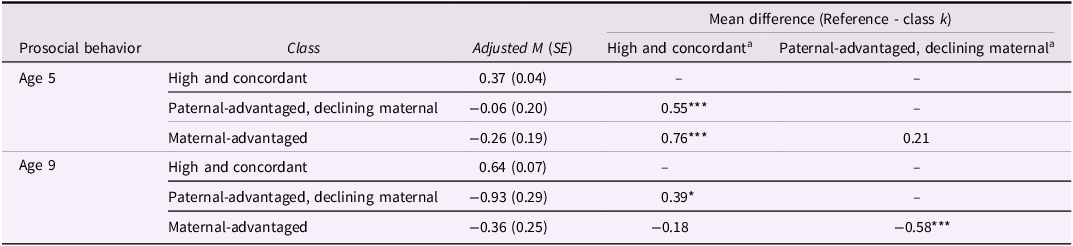
Note: N = 1,538 mother–father dyads. Adjusted mean values represent covariate-adjusted model-implied means within each class (covariate effects are presented in Supplemental Table 3). Mean differences reflect pairwise contrasts between covariate-adjusted class-specific means.
A.Reflects the reference class for pairwise contrasts.
A.p < .05. **p < .01. ***p < .001.
In examining child prosocial behavior as an outcome of dyadic social support trajectories, several sociodemographic factors were included as covariates to account for their potential influence on child prosocial behavior (see Supplemental Table 4). At both ages five and nine, children whose mothers had attained some college or postsecondary school at the time of their birth had higher prosocial behavior scores compared with those whose mothers had attained less than a high school education (bs = 0.17; ps = .02). Fathers’ higher educational attainment was only significantly associated with child prosocial behavior scores at age nine (bs = 0.14−0.32; ps = .001−.047). In addition, children who lived primarily only with their mother at age five, relative to children living primarily with both parents, had higher prosocial behavior scores at ages five and nine (bs = 0.14–0.16; ps = .048). Maternal depression at age nine was the only parental mental health indicator significantly associated with reductions in child prosocial behavior scores (b = −0.17; p = .04).
Discussion
A central goal of the present study was to expand current knowledge of children’s prosocial skill development in low-income settings, including the potential contributions of mothers’ and fathers’ perceived social support. Three mother–father dyadic social support trajectories across a five-year period were identified and analyzed in relation to children’s prosocial development. The identified dyadic social support trajectories are interpreted as descriptive summaries of how social support clusters across parents and time. Although the identified differences in child prosocial behavior may, in part, reflect gradients in aggregate levels of social support across the family system, the person-centered approach used herein allowed for the examination of dyadic social support configurations that may be overlooked in analyses relying solely on overall social support levels. These trajectories should be interpreted carefully, as latent class solutions are sensitive to model specification and summarize patterns within the observed data rather than fixed or universal groupings. Given that the current sample consists of low-income parents with nonmarital births, replication in other populations is needed to establish the generalizability of the current findings.
Changes in social support within the parental dyad and children’s prosociality
The present findings are partially consistent with prior research, illustrating the presence of both dynamic and static trajectories of parental social support. Specifically, this study identified classes in which parents exhibited highly stable patterns of social support (e.g., “High and Concordant”) as well as classes in which at least one parent’s social support changed notably over time (e.g., “Paternal-Advantaged, Declining Maternal”), consistent with the notion of dynamism in parental social support during early childhood. The “Paternal-Advantaged, Declining Maternal” social support class, which was also characterized by the lowest overall probabilities of maternal-reported social support relative to mothers and fathers in all classes, exhibited the greatest precarity in social support over time, suggesting that instability in social support, as well as low levels of support, may represent a dual risk. That said, changes in parental social support observed in the present study generally followed more continuous trajectories, rather than the volatile fluctuations observed in previous research. It is plausible that, in contrast to Chang’s (Reference Chang2025) sample of child welfare-involved families, this sample experienced relatively fewer acute life stressors within early childhood, resulting in more gradual, continuous changes in parental social support.
The person-centered approach implemented in this study also indicated varying degrees of correspondence between maternal-and paternal-reported social support. First, a class of mothers and fathers that displayed particularly high, congruent, and stable levels of social support across time was identified (i.e., “High and Concordant”). Given extant evidence of the association between greater parental social support and increased child prosocial behavior (e.g., Hosokawa & Katsura, Reference Hosokawa and Katsura2024), this class allowed for meaningful comparisons with parental dyads experiencing lower, less stable, or divergent levels of social support. Moreover, the identification of this class highlights complementary protective factors among coparents in low-income settings, demonstrating an important strength among many parents despite facing substantial economic adversity.
Second, two classes of parents emerged exhibiting discrepant maternal and paternal trajectories of social support. In particular, one class of parental dyads was characterized by elevated maternal relative to paternal social support (i.e., “Maternal-Advantaged”), and another exhibited elevated paternal social support alongside a downward trend in maternal social support (i.e., “Paternal-Advantaged, Declining Maternal”). Although children in both these diverging mother–father social support classes demonstrated significantly less prosocial behavior relative to those in the “High and Concordant” class, the magnitude of differences in prosociality varied across time. Specifically, although the “Maternal-Advantaged” and “Paternal-Advantaged, Declining Maternal” social support classes had similarly low levels of prosocial behavior at age five, children in the “Maternal-Advantaged” class had significantly higher levels of prosocial behavior by age nine. This specific developmental patterning may reflect cumulative and/or delayed effects of early parental social support, as children’s prosocial skills emerge gradually and become more readily identifiable as children enter middle childhood and engage in increasingly complex social exchanges.
Interestingly, these findings suggest that mothers’ social resources may hold distinct value for children’s prosociality. One possible explanation is that children’s prosociality is most likely to be influenced by the social interactions to which they are most regularly exposed. Nearly all children in the current sample were born living primarily only with their mothers or primarily with both biological parents, whereas fewer than 1% lived primarily only with their fathers. Indeed, even in two-parent households, mothers continue to assume a greater share of daily caregiving responsibilities (Pakaluk & Price, Reference Pakaluk and Price2020). In such family contexts, modest levels of paternal social support may have a lessened negative impact on children’s prosocial development (when maternal social support is high). Still, another possibility is that the present findings point to the perniciousness of declines in parental social support, such as that observed in the “Paternal-Advantaged, Declining Maternal” social support class. Indeed, even modest losses in this resource over time may disrupt children’s scaffolded development of prosocial behavior (Dahl & Brownell, Reference Dahl and Brownell2019). While additional empirical evidence is needed, it is worth considering that parents’ access to reliable and consistent sources of social support over time may be as critical for children’s prosocial development as absolute levels of social support.
Third, as commonly observed in latent class analyses, inspection of class composition suggested variation in sociodemographic characteristics across parental social support trajectories, including parental education, poverty status, and coparental relationship status. These patterns suggest that latent trajectories may reflect not only dyadic patterns of social support but also broader structural differences in family context. Accordingly, findings should be interpreted as describing how child prosocial behavior varies across empirically derived dyadic social support profiles that are themselves socially patterned.
To address potential confounding by these sociodemographic characteristics, corresponding covariates were included in the distal outcome models examining associations between class membership and child prosocial behavior. It is notable that although the status of the coparental relationship was included as a covariate, it was not significantly associated with children’s prosocial behavior and did not meaningfully alter the associations between dyadic social support trajectories and prosocial behavior outcomes. This provides partial evidence that, even in a sample overrepresented by unmarried parents, whether the biological parents were separated, cohabitating, or married may be less relevant than the quality and dynamics of social support within the parental dyad (Lee et al., Reference Lee, Lee, Ward, Pace and Chang2024). This said, several other sociodemographic covariates demonstrated meaningful associations with children’s prosociality. As evident in prior research (e.g., Sutter & Untertrifaller, Reference Sutter and Untertrifaller2020), higher maternal and paternal educational attainment was consistently linked to greater child prosocial behavior, suggesting that parents with greater educational resources may have access to broader social networks or knowledge of effective parenting strategies that support children’s prosocial development. In addition, maternal depression at age nine was associated with reduced prosociality, highlighting the influence of parental well-being on children’s socioemotional adjustment (e.g., Gryczkowski et al., Reference Gryczkowski, Jordan and Mercer2018). Collectively, these findings illustrate the complex interplay between parental social support, socioeconomic resources, and mental health in shaping children’s prosocial development.
Implications for children’s prosocial development in low-income settings
The present study provides evidence that mothers’ and fathers’ access to instrumental sources of social support plays a significant role in fostering children’s positive social behaviors. Results suggest a partially robust association between dyadic social support trajectories and children’s prosocial development, with certain effects persisting from age five into middle childhood. Given extant evidence that children’s prosocial behaviors remain relatively stable from middle childhood into adolescence (Flynn et al., Reference Flynn, Ehrenreich, Beron and Underwood2015), these findings suggest that enhancing mothers’ and fathers’ social support networks, particularly their access to instrumental social support during infancy and early childhood, may yield important benefits for children’s prosocial development. Indeed, several programs and interventions aimed at strengthening parental social support in low-resource settings, especially those that teach parents skills for seeking, mobilizing, and effectively utilizing social supports (e.g., guided practice), have been found to promote a number of other socioemotional competencies in children (e.g., enhanced cognitive and social development, reduced behavior problems; Doty et al., Reference Doty, Davis and Arditti2017; Ingram et al., Reference Ingram, Cash, Oats, Simpson and Thompson2015; Nabuco et al., Reference Nabuco, Aguiar, Costa and Morais2014). Nonetheless, while these studies indicate moderate effects, they are largely based on quasi-experimental designs with relatively short follow-up periods (e.g., six months; Ingram et al., Reference Ingram, Cash, Oats, Simpson and Thompson2015). Thus, future research would benefit from more rigorous randomized controlled trials and extended longitudinal assessments to better establish causal effects and the durability of intervention impacts.
These important implications notwithstanding, the present findings call for a nuanced consideration of children who exhibit fewer prosocial behaviors in early and middle childhood. Children of parents in the “Paternal-Advantaged, Maternal Declining” and “Maternal-Advantaged” social support classes displayed the lowest levels of prosociality, yet this should not be taken as inherently indicative of maladaptive functioning. While lower levels of prosocial behavior have been linked to greater internalizing and externalizing problems (e.g., Eisenberg et al., Reference Eisenberg, Zuffianò and Spinrad2024; Flynn et al., Reference Flynn, Ehrenreich, Beron and Underwood2015), limited engagement in prosocial behavior may, in certain contexts, serve adaptive functions. For example, low-income children who are heavily burdened by concerns about their family’s material and emotional needs may prioritize meeting those needs before prosocial engagement with others (Armstrong-Carter & Telzer, Reference Armstrong-Carter and Telzer2021). Evidently, additional research is needed to clarify the long-term implications of diminished prosociality in childhood and to determine the conditions under which lower levels of prosocial behavior reflect potentially adaptive responses.
Limitations
The current findings should be interpreted in light of several study limitations. First, the current study examined longitudinal associations between dyadic social support and children’s prosocial behavior; however, causal inferences cannot be drawn from this observational design. It is also plausible, for example, that parents with high social competence both develop stronger social support networks for themselves and foster positive parent–child relationships that buttress children’s prosocial skills. Second, children’s prosocial behavior was assessed solely via reports from the primary caregiver. Prior research indicates that maternal and paternal reports can yield different estimates of children’s prosociality (Yuh, Reference Yuh2017). Given concerns for potential reporter bias, future work would do well to examine both maternal and paternal perceptions of children’s prosocial behaviors. Third, although the longitudinal and dyadic assessment of maternal and paternal social support is a notable strength of the current study, the available social support indicators largely reflect instrumental social support. Subsequent studies should investigate whether these trajectories similarly characterize other types of social support, including confidant support (Wills & Ainette, Reference Wills, Ainette, Baum, Revenson and Singer2012). Fourth, although this study leveraged a large and diverse sample, the oversampling of unmarried parents may limit the generalizability of the present findings to broader populations of families. Fifth, and finally, the present findings identify meaningful dyadic social support configurations but do not adjudicate among potential mechanisms (e.g., absolute social support levels vs. dyadic alignment) underlying their specific associations with children’s prosocial development. Nonetheless, the person-centered approach leveraged herein offers unique insight into how mothers’ and fathers’ social support resources co-occur in ecologically meaningful configurations.
Concluding thoughts
Helping and supporting others represents a behavior of both individual and universal significance. The present findings clarify how the correspondence, stability, and overall level of social support in mother–father dyads during the first five years of life are associated with children’s prosocial development. Children whose parents demonstrate similar, stable, and high levels of social support were most likely to exhibit prosocial behaviors. For low-income families especially, social support may not only confer benefits for parents themselves but also for their children’s long-term positive adjustment.
Supplementary material
The supplementary material for this article can be found at https://doi.org/10.1017/S0954579426101618.
Data availability statement
The authors do not own the study data and do not have permission to share it; access may be requested directly from the Future of Families and Child Well-being Study. The underlying code is not publicly available due to proprietary limitations, but all analytical steps are documented in the Methods. Materials cannot be shared due to ownership and confidentiality restrictions, but procedural details are provided to allow replication.
Acknowledgments
The author gratefully acknowledges Katie Maguire-Jack for her invaluable guidance and support throughout this work.
Funding statement
The authors received no external funding.
Conflicts of interests
The authors declare no competing interests. No generative AI tools were used in the production, analysis, or interpretation of this work.
Pre-registration statement
The study was not pre-registered because it is an exploratory, data-driven analysis.



 Open access

