


Introduction
Ascidians are invasive species globally, having widespread effects on ecosystems. Ascidiella aspersa (Müller, 1776) has been introduced to coasts around the globe. With a native range in the North-east Atlantic, it has a wide introduced range from North America to New Zealand and Japan (Osman and Whitlatch, Reference Osman and Whitlatch1996; Kanamori et al., Reference Kanamori, Baba, Natsuike and Goshima2017; Nydam et al., Reference Nydam, Nichols and Lambert2022). There has been persistent confusion in the literature between A. aspersa and the congener Ascidiella scabra (Müller, 1776). The latter is a species described as new to science in the same publication as A. aspersa and also considered native to the North-east Atlantic and introduced to other parts of the globe (Nishikawa and Otani, Reference Nishikawa and Otani2004; Taverna et al., Reference Taverna, Reyna, Giménez and Tatián2022). Although the ecological effects of both as non-native species may be similar owing the similar functional niche occupied, understanding exactly which species is present is important for identifying future new introductions and pathways. A. aspersa has had severe impacts on scallop aquaculture in northern Japan (Kanamori et al., Reference Kanamori, Baba, Natsuike and Goshima2017).
The Falkland Islands in the South Atlantic has high but relatively poorly understood ascidian diversity. Furthermore, it has at least one known non-native ascidian, Ciona sp., already known to be present in high densities in the two main harbour areas in East Falkland ports of Stanley and Mare Harbour (SMSG (Shallow Marine Surveys Group), 2011, SMSG, 2019; Vye et al., Reference Vye, Büring, Brickle, Belchier and Morley2025a). Stanley port is subject to international vessel traffic, including tourism vessels, yachts and fishing vessels (Vye et al., Reference Vye, Gregory, Belchier, Morley and Brickle2025b), with substantial ongoing risks of non-native species introductions from around the globe. As part of a horizon-scanning exercise, A. aspersa was identified as having a high risk of introduction and biodiversity impact in the Falkland Islands (Dawson et al., Reference Dawson, Peyton, Pescott, Adriaens, Cottier‐Cook, Frohlich, Key, Malumphy, Martinou, Minchin and Moore2023). Additionally, the Falkland Islands have close vessel links with South America (Vye et al., Reference Vye, Gregory, Belchier, Morley and Brickle2025b). Ascidiella aspersa is known to be present in ports on the south and east coast of Argentine Patagonia, such as Ushuaia (south coast) and Puerto Madryn (east coast) (Tatian et al., Reference Tatian, Schwindt, Lagger and Varela2010; Schwindt et al., Reference Schwindt, López Gappa, Raffo, Tatián, Bortolus, Orensanz, Alonso, Diez, Doti, Genzano, Lagger, Lovrich, Piriz, Mendez, Savova and Sueiro2014).
During sampling for Ciona sp. from Stanley port as part of a research project (Vye et al., Reference Vye, Büring, Brickle, Belchier and Morley2025a), an ascidian matching the field description of A. aspersa was identified. Discussions with local experts suggested the ascidian was not a known native species and warranted further investigation.
Methods
Specimen collection
Six specimens were collected by hand from a pontoon attached to the floating barge structure of FIPASS (the Falklands Interim Port and Storage System), Stanley, Falkland Islands (−51.69261, − 57.82149) on 5 March 2024. The pontoon is on the south side of the FIPASS structure, between the barge and the shore, and is frequented by local yachts and logistics vessels. Specimens were collected by leaning over the pontoon and collecting from just below the surface and were taken from random locations along the pontoon. Three specimens (designated Stanley 1, 2, and 3) were dissected on site to take a body-wall tissue sample for DNA analysis while the others (designated Stanley 4, 5, and 6) were preserved whole with the tunics slit to allow entry of preservative. Specimens were immediately preserved in >98% ethanol.
Individuals were temporarily stored at the South Atlantic Environmental Research Institute in Stanley before being sent to the Marine Biological Association in Plymouth, UK for morphological and genetic identification.
On 19 November 2024, three specimens of A. aspersa designated Plymouth 1, 2, and 3 were collected by hand from pontoons in a Plymouth, UK, marina (50.36844, −4.133735), within the native range of A. aspersa. Two small samples of branchial basket tissue were taken from each specimen for barcoding and preserved in 99.5% ethanol, while the remainder was preserved in 70% ethanol for morphological examination. For genetic comparison with A. aspersa, single specimens attributed to A. scabra were collected from Kingswear, Devon, UK (50.35067, −3.57132) and south of Clachan Bridge, Argyll and Bute, UK (56.31664, −5.58243). Specimens of UK A. scabra were collected on the shore on the basis, compared with A. aspersa, of laying flatter, with much of the left side attached, having a more rounded-oval outline, smaller size, and siphons relatively closer together, although these distinctions may not all apply in other geographical regions or habitats.
Identification
For morphological examination the preserved specimens were removed from their tunics, cut open from the oral siphon along the mid-ventral line (i.e. along the endostyle) and pinned flat to allow the oral tentacles, dorsal tubercle and inner surface of the branchial basket to be observed.
Sequencing of the COI-5P region was undertaken by the Canadian Centre for DNA Barcoding, University of Guelph, with the primers introduced by Nishikawa et al., (Reference Nishikawa, Oohara, Saitoh, Shigenobu, Hasegawa, Kanamori, Baba, Turon and Bishop2014) for Ascidiella spp.: Asc.COI-ForC: 5′-TTATTCGGGTTGAGTTATCTCA-3′ and Asc.COI-RevC: 5′-TCAAAAAGAAGCATAGTAATAGC-3′. Based on the sequence information obtained, specimens were allocated by BOLD (The Barcode of Life Data System) to Barcode Index Numbers (BINs), unique identifiers each representing a cluster of sequences considered usually to correspond to a species (Ratnasingham and Hebert, Reference Ratnasingham and Hebert2013).
Abundance and extent
After identification, previous survey data from FIPASS was inspected to estimate abundance of the population on the structure and to elucidate whether the species was newly arrived in the Falkland Islands. Survey data had been collected from scuba dive surveys in 2021 by SAERI (Falklands) Limited (SFL) and the Shallow Marine Surveys Group (SMSG) dive team as part of ongoing baseline and commercial survey work (Fig. 1; SFL (SAERI (Falklands) Ltd), 2022).

Figure 1. Survey stations around the FIPASS structure in Stanley Harbour, Falkland Islands. Stations in red indicate Ascidiella aspersa presence. Pontoons (in shadow) are attached alongside the main barges in stations 7, 8, and 9, with vessels moored against the pontoons. Satellite imagery from Google Maps, © 2025 Airbus, CNES/Airbus, Maxar Technologies, Map data © 2025.
There were 27 survey stations around the FIPASS barges (Fig. 1). Photo quadrats (0.25 × 0.25 m) were taken by divers at each station using a Nikon D90 with a wide-angle lens and a dome port (Supplementary material Figures S1 and S2). Photo quadrats were taken at different depths on the floating barges from just below the waterline to the bottom edge (max depth 3.5 m). At each station two photo quadrats were selected at random for reanalysis for this study to understand the abundance and extent of the ascidian on the structure. Abundance was estimated as number of individuals per 0.25 × 0.25 m2 photo quadrat. Individuals were identified through matching features to the following characteristics: greyish and rough looking tunic, with one siphon located one third down the side, fluted siphons with slight red colouring, whitish tentacles visible inside the siphons.
In addition to the 2022 data, images were examined from a dive survey in 2011 (SMSG, 2011) of Stanley Harbour (23 natural stations and 1 station on FIPASS) and of Mare Harbour approximately 60 km to the southwest of Stanley (13 stations), the other significant port facility that supports primarily military and logistics shipping activity. Presence only was recorded in these images. Images of the seabed taken while diving in Port William Sound in 2025 were also reviewed (unpublished data).
Results
Morphological identification
The branchial baskets of the Stanley and Plymouth specimens closely resembled each other and lacked inwardly directed secondary papillae at the intersections of the internal longitudinal and transverse vessels; this confirmed them, in the context of the family Ascidiidae, as belonging to the genus Ascidiella.
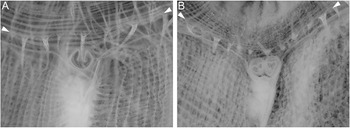
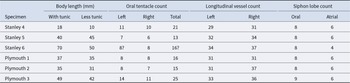
Nishikawa et al., (Reference Nishikawa, Oohara, Saitoh, Shigenobu, Hasegawa, Kanamori, Baba, Turon and Bishop2014) concluded that A. aspersa and A. scabra were separable morphologically and that the most reliable feature concerned the internal tentacles arranged in a ring at the base of the oral siphon (shown in Fig. 2). These were more densely packed (and thus more numerous) in A. scabra than in A. aspersa. The recommended diagnostic criterion was that the total number of oral tentacles (i.e. on the left plus right together) exceeds the number of longitudinal vessels on either side of the branchial basket (i.e. on the left or right separately) in A. scabra but not in A. aspersa (Nishikawa et al., Reference Nishikawa, Oohara, Saitoh, Shigenobu, Hasegawa, Kanamori, Baba, Turon and Bishop2014). According to this, the Stanley specimens, along with those from Plymouth, are confirmed as A. aspersa rather than A. scabra (Table 1). Nishikawa et al., (Reference Nishikawa, Oohara, Saitoh, Shigenobu, Hasegawa, Kanamori, Baba, Turon and Bishop2014) also noted that there were generally more longitudinal vessels on the right side of the branchial basket than on the left in both species (as exemplified in A. aspersa in Table 1), and that the count of vessels on the left side of the branchial basket appeared to be the more reliable option for distinguishing the species.

Figure 2. Interior views of antero-dorsal region of the pharynx: (A) specimen Plymouth 3; (B) specimen Stanley 4. In each, the line of oral tentacle bases is indicated by arrowheads and the dorsal tubercle is central. Dorsal tubercle in (A) is typical of A. Aspersa, in (B) abnormal (see the text). (Dorsal tubercle in A is crossed by an oral tentacle).
Table 1. Body size and counts of anatomical features in Stanley (Falkland Islands) and Plymouth (UK) specimens of Ascidiella

A second reliable point of distinction between A. aspersa and A. scabra concerns the layer of outer follicle cells surrounding each egg. These cells are less numerous but larger in A. aspersa than in A. scabra (Berrill, Reference Berrill1928; Lindsay and Thompson, Reference Lindsay and Thompson1930), so that the number of follicle cells around the circumference of an egg seen in optical section was 28–32 in A. aspersa but 70-80 in A. scabra (Lindsay and Thompson, Reference Lindsay and Thompson1930). However, although eggs were present in the oviducts of specimens Stanley 4, Stanley 6 and Plymouth 1, their state of preservation did not allow the outer follicle cells to be assessed.
A number of abnormalities compared to the typical anatomy of A. aspersa were noted, mostly in the Stanley specimens. In Stanley 6 the atrial siphon had four lobes rather than the usual six (Table 1); furthermore, in this specimen the oral tentacles on the left-hand side included a few double tentacles arising from a common base (counted as single tentacles in Table 1) and c. 5 tentacles were present anterior to the regular ring of tentacles (not included in the total shown in Table 1). Most specimens showed the typical dorsal tubercle form for the species, with the two ends of the curved, slit-like opening of the neural gland duct strongly incurved (Fig. 2A). However, specimen Stanley 4 had an apparently double structure with the openings complexly folded (Fig 2B). The atrial siphon of specimen Plymouth 3 had nine lobes rather than the usual eight.
The third accepted species (Shenkar et al., Reference Shenkar, Gittenberger, Lambert, Rius, Moreira da Rocha, Swalla and Turon2025) of Ascidiella, A. senegalensis Michaelsen, Reference Michaelsen1914 (a tropical species) can be discounted because the Falkland material lacks the hook-shaped anterior ends to the longitudinal vessels of the branchial basket seen in A. senegalensis (Michaelsen, Reference Michaelsen1914; Millar, Reference Millar1957).
Barcoding
Barcoding was successful for two of the Stanley specimens and all three Plymouth specimens. Based on the COI sequences all five specimens were identified by the BOLD System as A. aspersa and referred to the same BIN, BOLD:ACB6347 (Fig. 3). The percentage dissimilarities between the A. aspersa sequences obtained ranged from 0 to 0.5%. The sequences of the two UK A. scabra specimens were both attributed to A. scabra BIN BOLD:ADK6133 and differed from each other by 0.5%. The dissimilarities between A. aspersa and A. scabra sequences ranged from 10.9 to 12.1% (Fig. 3).

Figure 3. Neighbour-joining dendrogram of COI sequences of putative non-native Ascidiella aspersa from Stanley (Falkland Islands) and native-range A. aspersa from Plymouth UK, along with presumed Ascidiella scabra (confusion species) specimens from widely separated UK sites (Devon, SW England and Clachan Bridge, W coast of Scotland); Ascidia conchilega, a member of a different genus in the Ascidiidae, included as outgroup. (Alignment by BOLD Aligner; Kimura 2 distance model. Scale bar: percent dissimilarity between sequences).
Abundance & extent
Individuals of A. aspersa were identified in 11 of the 27 stations on the FIPASS barges in the 2021 survey (example images in Supplementary Material Figures S1 and S2). A. aspersa were present in most stations along the sheltered south side of the structure, from stations 2–10 (absent at stations 3 and 6). A. aspersa was present on the west side and northwest corner of the barges. Abundance ranged from 1 individual to 11 per 0.25 × 0.25 m photoquadrat (0.87 ± 0.30 individuals per 0.0625 m2). This equates to a mean abundance of 14 individuals per m2.
In the 2011 survey photos, individuals of A. aspersa were identified on the images from FIPASS in Stanley Harbour (Figure S3), but not from images from natural substrates. Individuals of A. aspersa were present in images from artificial substrates at Mare Harbour (Figures S4 and S5) and in images of natural sandy substrates at two stations.
An individual A. aspersa was also tentatively identified on natural substrate from images taken during a dive in Port William Sound in 2025 (−51 39.600, −57 46.489) (Figure S6).
Discussion
This study confirms the presence of the non-native ascidian A. aspersa in the Falkland Islands, an expansion of its previous known range in the South Atlantic. Furthermore, the abundance of the species and its presence since at least 2011 suggests that the population is established and self-sustaining in Stanley Port on the FIPASS artificial structure. The full extent of the population outside of the main ports in the Falkland Islands is currently unknown, as is any potential impact on the local ecosystems.
The ascidian was confirmed as A. aspersa through both morphological and genetic analyses. Successful identification to species level enables future non-native species monitoring to detect any new Ascidiella introductions, such as the introduction of A. scabra. Further population-level genetic analysis could shed light on the origin of the population in Stanley harbour.
The apparent morphological abnormalities of the Falkland specimens relative to typical A. aspersa were reported here as they were potentially relevant to the identification of the material. However, they can probably be attributed to external causes, which could include environmental stress, including pollution, or physical injury to the anterior end of the body followed by imperfect healing or regeneration. Lindsay and Thompson (Reference Lindsay and Thompson1930) describe and illustrate extensive variation in the shape of the opening of the dorsal tubercle in A. aspersa and particularly A. scabra (their Plate 6), but they show no variant of either species that matches the pattern seen in specimen Stanley 4.
Possible vectors for the introduction of A. aspersa into the Falkland Islands include vessel biofouling. The Falkland Islands receive vessels from around the globe (Bayley et al., Reference Bayley, Brewin, James, McCarthy and Brickle2024; Vye et al., Reference Vye, Gregory, Belchier, Morley and Brickle2025b). Furthermore, many vessels entering Stanley Harbour use ports in South America, where A. aspersa and other non-native ascidians are known to be present in some ports (Schwindt et al., Reference Schwindt, López Gappa, Raffo, Tatián, Bortolus, Orensanz, Alonso, Diez, Doti, Genzano, Lagger, Lovrich, Piriz, Mendez, Savova and Sueiro2014; Turon et al., Reference Turon, Cañete, Sellanes, Rocha and López-Legentil2016). To date, it is unknown whether the first introduction was into Stanley Harbour or Mare Harbour, or whether one location is a result of secondary spread from the other. It is also unknown whether there has been secondary spread of A. aspersa to other ports, jetties and anchorage points around the Falkland Islands. Surveys of artificial wharf sites around the Falkland Islands particularly those locations that have shipping connections to Stanley and Mare Harbours, would provide a wider overview of the extent of the species. An individual was identified in opportunistic data from natural substrates, but focused surveys of nearby natural substrates would provide an indication of the abundance and spread of A. aspersa onto natural substrates. If found to be widely present on natural substrates, experimental studies could provide additional insight into the potential impacts of A. aspersa on native communities.
In conclusion, the identification of a population of A. aspersa in the Falkland Islands expands this species’ known non-native range and suggests that new marine non-native species continue to be introduced to the Falkland Islands. Improving marine biosecurity measures, in particular in relation to vessel biofouling, and establishing a comprehensive monitoring programme would both reduce the risk of future introductions and allow early action to be taken to manage or eradicate new species of concern.
Supplementary material
The supplementary material for this article can be found at https://doi.org/10.1017/S0025315426101258.
Acknowledgements
The authors would like to thank Heather Mitchell and Simon Morley for assistance with field collection, FIPASS and Sullivan Shipping for access to the pontoon.
Author contributions
SV initiated the study, undertook fieldwork and image analysis, drafted sections and reviewed the final draft. JB collected the UK specimens, undertook the laboratory identifications, drafted the relevant sections, and reviewed the final draft. PB provided distribution data and contributed to drafting sections. All authors approved the final version.
Financial support
No specific funding was received for this investigation. SV collected specimens while undertaking field work for a project funded through the Government of South Georgia & the South Sandwich Islands as part of the UK Government Blue Belt Programme. Abundance surveys on FIPASS were funded by the Falkland Islands Government as part of an environmental impact assessment.
Conflict of interest
The authors declare none.
Data availability
The Ascidiella sequences obtained in this study have been deposited in GenBank with the following accession numbers: A. aspersa, PX501992 Stanley 2, PX501993 Stanley 3, PX501994 Plymouth 1, PX501995 Plymouth 2, PX501996 Plymouth 3; A. scabra, PX501997 Clachan, PX501998 Kingswear. The specimens of A. aspersa from both Stanley and Plymouth have been deposited in the collections of the Natural History Museum, London, with the following registration numbers: NHMUK2026.1-3 Stanley 4-6; NHMUK 2026.4 Plymouth 1, 2, and 3; NHMUK 2026.5-7 Stanley 2, 1, and 3, respectively.



 Open access

