Evidence from systematic reviews of the scientific literature consistently shows that food advertising influences children's food preferences, intake and purchase requests(Reference Cairns, Angus and Hastings1, 2). Energy-dense nutrient-poor foods, described as non-core foods, contribute over a third of Australian children's daily energy intake, which is more than double what is recommended in the Australian national dietary selection guide for children(Reference Rangan, Kwan and Flood3).
The extent and persuasive nature of food marketing to children and its contribution to children's excessive consumption of non-core foods have prompted highly contested international debates about the need for restrictions on unhealthy food marketing to children. Internationally, the types of regulatory and policy responses to this issue have varied, comprising both statutory bans on advertising and self-regulatory pledges from food and advertising industries(Reference Hawkes and Lobstein4). Australia has a combination of regulatory arrangements, with two food industry self-regulatory pledges: in January 2009, the Australian Food and Grocery Council (AFGC) introduced the Responsible Children's Marketing Initiative (RCMI)(5); and in August 2009, the Australian Quick Service Restaurant Industry in collaboration with the Australian Association of National Advertisers introduced the Quick Service Restaurant Industry Initiative (QSRII) for Responsible Advertising and Marketing to Children(6). These two initiatives outline a set of commitments regarding the placement and content of advertisements for foods and non-alcoholic drinks, to which companies agree when becoming a signatory of these initiatives. However, the commitments are quite permissive, limiting their potential impact; and are based on subjective criteria, so that they are interpreted differently by different companies, making it difficult to monitor companies’ compliance(Reference Hebden, King and Kelly7). Indeed, independent studies on the impact of these two initiatives, based on data collected for Sydney television channels in comparable sample periods in May 2007, 2009 and 2010, found that they had not reduced advertising for non-core foods and drinks as might have been expected(Reference King, Hebden and Grunseit8, Reference Hebden, King and Grunseit9).
However, despite a mix of regulatory initiatives and evaluation studies internationally(Reference Kelly, Halford and Boyland10), there has been little attention given to the development of systems for independently monitoring food advertising to children in Australia and elsewhere. The aim of the present study was to extend earlier research to provide an independent monitoring report on the ongoing impact of Australian self-regulatory pledges on food and drink advertising to children on Sydney television up to 2011. In particular, the present study is unique in examining comparable data over a 5-year period, up to 2 years after industry self-regulation was introduced in Australia.
Methods
Data sample
All advertisements for food and non-food products broadcast on the three main Sydney free-to-air commercial television channels (7, 9 and 10) were recorded over a consecutive 7 d period in May 2006 and May 2007, and over a consecutive 4 d period in May 2009, April 2010 and May 2011. Data were included from 07.00 to 22.00 hours daily for all recording periods. Ethical approval to conduct the study was not required.
Data coding
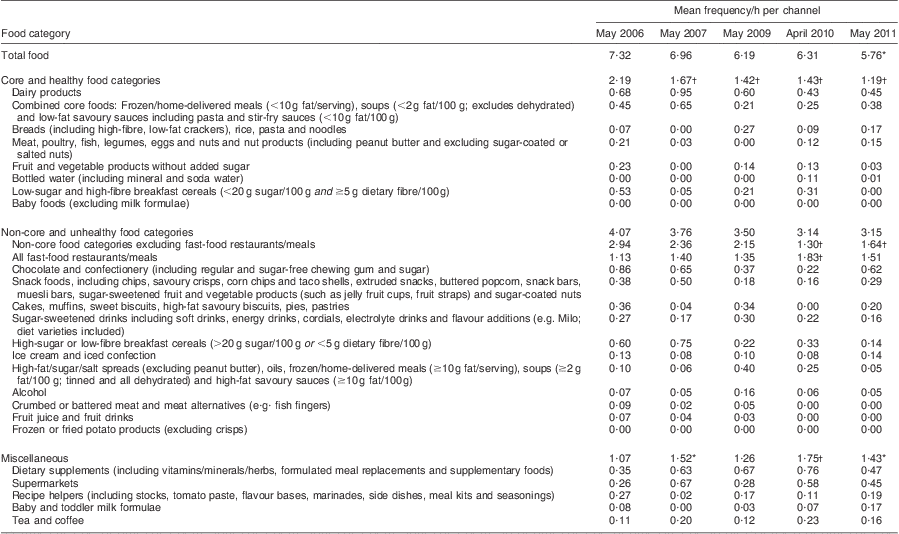
Coding was performed using the same methods with tested reliability described in earlier research(Reference King, Hebden and Grunseit8, Reference Hebden, King and Grunseit9). Briefly, food advertisements were identified and coded based on a set of food categories (‘core’, ‘non-core’ and ‘miscellaneous’) and food sub-categories used in previous research(Reference King, Hebden and Grunseit8, Reference Hebden, King and Grunseit9) (see Table 1). Fast-food advertisements were coded into three categories: (i) ‘core’ (only core foods or drinks were shown in the advertisement), (ii) ‘non-core’ (all or some of the foods in a single advertisement were non-core) or (iii) ‘company only’; this coding was performed prospectively for 2009, 2010 and 2011 data samples. Food advertisements were also coded according to whether the company was signed to the RCMI or QSRII.
Rate of food advertisements during children's peak viewing times within each recording period by type of food, Sydney, Australia

None of the Bonferroni-adjusted multiple comparisons between 2011 and 2010 reached statistical significance.
*P < 0·05, Bonferroni-adjusted multiple comparisons to 2006.
†P < 0·01, Bonferroni-adjusted multiple comparisons to 2006.
Data analysis
Data from each sample period were aggregated to provide the count of advertisements for each hour, channel and day. The average count of advertisements within each recording period was calculated for total food advertisements, and for each food category (core, non-core and miscellaneous), food sub-category and fast-food sub-category (core, non-core and company only). Average counts of food advertisements were calculated for children's peak viewing times comprising 06.00 to 09.00 hours and 16.00 to 21.00 hours on weekdays, and 06.00 to 12.00 hours and 16.00 to 21.00 hours on weekend days(Reference MacKay, Antonopoulos and Martin11).
Linear regression models were generated, with number of advertisements in the food category of interest as the outcome variable, and year of data collection and whether advertisements were shown on a weekday or weekend as the independent variables. Planned contrasts comparing each year with 2006 (or with 2009 for fast-food advertisement categories, which only had three years of data), and 2011 with 2010, for all food, core food, non-core food, miscellaneous and fast-food advertisements were conducted with Bonferroni adjustment of alpha for the number of contrasts. Tests of trend across all years were also performed. As a number of distributions of the outcome variables were highly skewed and had high zero counts, further analyses using count models (Poisson, negative binomial, zero-inflated Poisson and zero-inflated negative binomial) were also run. Where the results of the count models were consistent with those of the linear regression, the latter are reported; otherwise the results of the most appropriate count model (as determined by the Vuong test (zero-inflated Poisson v. Poisson; zero-inflated negative binomial v. negative binomial) and the dispersion parameter alpha (negative binomial v. Poisson)) are used. A threshold of 0·05 was used for statistical significance and all analyses were conducted using the STATA statistical software package version 11·1.
Results
Data presented in the results are for children's peak viewing times. There was a significant negative trend in total food advertising from 2006 to 2011 (β = −0·23, P = 0·004). In 2011, the mean rate of total food advertisements was significantly lower than in 2006 (5·8/h v. 7·3/h, P = 0·028), but similar to the frequency in 2010 (5·8/h v. 6·3/h, NS; Table 1 and Fig. 1).
Rate of food advertisements during children's peak viewing times within each recording period by type of food (——, total food; – · –, non-core; – – –, non-core (excludes fast food); · · · ·, core; – · · –, miscellaneous; - - -, fast food), Sydney, Australia. Vertical lines represent the introduction of two self-regulatory pledges by food industries (RCMI, Australian Food and Grocery Council's Responsible Children's Marketing Initiative(5); QSRII, Quick Service Restaurant Industry Initiative for Responsible Advertising and Marketing to Children(6)). *P < 0·05, Bonferroni-adjusted multiple comparisons to 2006; †P < 0·01, Bonferroni-adjusted multiple comparisons to 2006. None of the Bonferroni-adjusted multiple comparisons between 2011 and 2010 reached statistical significance
Trends in advertising by food category
The mean rate of core food advertisements in 2011 was significantly lower than in 2006 (1·2/h v. 2·2/h, P < 0·001). By contrast, the frequency of advertisements for non-core foods in 2011 was not significantly different from that in 2006 or 2010 (3·2/h v. 4·1/h and 3·1/h, NS), although there was a significant negative trend from 2006 to 2011 (β = −0·18, P = 0·003; Table 1). After excluding advertisements for fast food, the rate of non-core food advertisements was significantly lower in 2010 and 2011, compared with 2006 (1·3/h and 1·6/h, v. 2·9/h, P < 0·001).
Trends in advertising by food sub-category
The rate of fast-food advertising in 2010 was significantly higher than in 2006 (1·8/h v. 1·1/h, P = 0·004), but comparable to that in 2011 (1·5/h; see Table 1). Table 2 and Fig. 2 present the rates of advertisements for sub-categories of fast foods for 2009, 2010 and 2011. The rate of non-core fast-food advertising did not vary across these three years. While there has been a trend towards small increases in core fast-food advertisements since 2009 (β = 0·13, P = 0·001), the overall level remains low (one in every six fast-food advertisements in 2011). Advertising of fast-food brands (i.e. where no specific foods or drinks were advertised, only the company brand) increased significantly from 2009 to 2010 (0·06/h to 0·34/h, P < 0·001) but dropped to a lower level in 2011 (0·13/h, P = 0·003).
Rate of fast-food advertisements during children's peak viewing times within each recording period by type of fast food, Sydney, Australia

*All or some of the advertised foods or drinks were non-core.
†All advertised foods or drinks were core.
‡No specific foods or drinks advertised, only the company brand or a specific promotion advertised, e.g. ‘cheaper Tuesdays’.
§P ≤ 0·01.
∥P < 0·01, Bonferroni-adjusted multiple comparisons to 2010.
Rate of fast-food advertisements during children's peak viewing times within each recording period by type of fast food (——, total fast food; – · –, non-core fast food; · · · ·, core fast food; – · · –, fast food company only), Sydney, Australia. Vertical line represents the introduction of a self-regulatory pledge by food industries (QSRII, Quick Service Restaurant Industry Initiative for Responsible Advertising and Marketing to Children(6)). *P ≤ 0·01; †P < 0·01, Bonferroni-adjusted multiple comparison to 2010
Variations by company signatory status
Examining the advertising patterns of companies with self-regulatory commitments in 2011, 62 % of advertisements for non-core foods excluding fast foods were from AFGC signatory companies, while 90 % of fast-food advertisements were for products sold by QSRII signatory companies.
Discussion
Overall, the frequency of non-core food advertising on Sydney television has remained unchanged, despite a reduction in total food advertising and the implementation of two industry self-regulatory pledges. Our findings show that in 2011, children continued to be exposed to unhealthy food advertising to the same extent as they were prior to the introduction of any industry self-regulatory initiatives.
However, there appear to be changes in some food advertising patterns. The frequency of all food advertisements was lowest in May 2009 and May 2011. There was a significant negative trend in non-core food advertising excluding fast foods from 2006 to 2011, suggesting that food manufacturers’ advertising patterns may have altered as early as 2007, prior to the introduction of two industry self-regulatory initiatives in January and August 2009. The frequency of advertisements for core foods was significantly lower in 2010 and 2011, compared with 2006.
The frequency of fast-food advertisements has increased since 2006, and the level of non-core fast-food advertising has remained unchanged since May 2009, despite the introduction of the QSRII in August 2009. In 2011, the frequency of fast-food advertisements featuring only the company brand had returned to 2009 levels after an increase in 2010. Fast-food advertisements promoting the company brand have been shown to influence children's food preferences(Reference Arredondo, Castaneda and Elder12, Reference Robinson, Borzekowski and Matheson13).
The present study demonstrates the value of an ongoing monitoring system as a basic component of a regulatory approach, in order to support compliance, review and public accountability functions(Reference Reeve14). Without a monitoring and review system, there is no formal means of determining if the regulatory approaches are sufficiently stringent to reduce exposure. These data are particularly valuable in the absence of any formal, national, independent monitoring and in the context of the inconsistencies in industries’ own reporting. The AFGC's methods for monitoring and reporting on companies’ compliance with pledges are not useful or accurate, as they have not enumerated the repeated broadcasting of advertisements and hence the extent of exposure(15). Further, the AFGC classifies foods as ‘non-core’ inconsistently, depending on the specific nutritional criteria used by each signatory company in its company action plan. Thus industry has reported on compliance, rather than monitoring the overall extent of unhealthy food advertising. This is despite the WHO recommendation that restrictions should aim to reduce the extent and exposure of children to marketing for unhealthy foods(16).
The narrow sample periods used are a limitation to the present research, although the periods are highly comparable between years. The patterns observed for these sample time periods may not reflect advertising across the entire year, although the sample periods were not associated with any major events or school holiday periods. On the other hand, a strength of the present study is that the variables monitored and reported are consistent with the WHO recommended policy objective, to reduce children's exposure to unhealthy food advertising; also, the variables are based upon objectively collected data over comparable sample periods from 2006 to 2011.
Findings from the study indicate that current industry self-regulation has had minimal impact in reducing children's exposure to unhealthy food advertising on Sydney television. Similarly, industry self-regulation of alcohol advertising has not prevented children being exposed to advertisements depicting alcohol consumption as fun, social and inexpensive(Reference Pettigrew, Roberts and Pescud17). A responsive regulatory approach that includes performance standards agreed between industry and government, as proposed by WHO, other public health and consumer groups and legal experts(Reference MacKay, Antonopoulos and Martin11, Reference Reeve14, 16), as well as regular monitoring with sanctions for non-compliance, would be more effective.
The present study contributes to the accumulating body of international research describing changes or lack thereof in the patterns and extent of food marketing across different media and to ongoing assessments of the impact of self-regulatory arrangements. Furthermore, it supports the need for stronger regulatory systems, including a formal, independent monitoring system, in order to achieve meaningful reductions in children's exposure to unhealthy food marketing.
Acknowledgements
Sources of funding: This research received no specific grant from any funding agency in the public, commercial or not-for-profit sector. Conflicts of interest: There are no conflicts of interest. Authors’ contributions: L.K. designed the study, conceptualised the manuscript, and was the primary author. L.H. arranged data collection, some data analyses and data reporting, and contributed to writing. A.G. did the advanced data analyses and statistical testing, and contributed to writing the methods and results. B.K. and K.C. each contributed to design and conceptualisation, interpretation of results and writing of the manuscript, particularly the discussion.