

16.1 Introduction
This chapter focuses on issues of justice in sustainability transitions, highlighting why there is an increased focus, and need, to develop sustainability transitions that are fair for all. Imagine a housing retrofit scheme being designed for your local area. Would you like to know who is planning that scheme and expect to hear from them? Would you want them to outline the process that is planned for the scheme? Would you expect that they would ask your opinion on it, listen to you and take your views on board? Would you want to know how decisions about the scheme are made, and by whom? Finally, would you care who benefits, or may even become worse off, because of that new retrofit scheme? Questions such as these are increasingly being asked about developments and initiatives that are the building blocks of sustainability transitions as we move towards net-zero societies. The concept of energy justice, in particular, has gained attention as a growing topic (e.g. Qian et al. Reference Qian, Xu, Gou and Škare2023) that has been used as an approach to unpack the justice implications that are related to whole energy systems, all the way from the materials that are needed, for example, for energy technologies, to end-use practices and waste (Sovacool et al. Reference Sovacool, Bell, Daggett, Labuski, Lennon, Naylor, Klinger, Leonard and Firestone2023). However, justice concerns spanning social and environmental justice (e.g. Fitzgerald Reference Fitzgerald2022) are also increasingly addressed in the context of other socio-technical systems of relevance for sustainability transitions, such as mobility justice (e.g. Sheller Reference Sheller, Cook and Butz2019), food system justice (including issues such as biodiversity loss) (e.g. Tribaldos and Kortetmäki Reference Tribaldos and Kortetmäki2022), labour justice (e.g. Kaizuka Reference Kaizuka2024) and social justice related to fast fashion (e.g. Buchel et al. Reference Buchel, Hebinck, Lavanga and Loorbach2022).
The issue of justice is an important concern for sustainability transitions as without due consideration for it, sustainability transitions may disproportionally benefit some people whilst causing harm to others. This risks sustainability transitions affecting people unevenly and casting a shadow on the end goal of sustainability transitions being core to addressing climate change. For example, in the United Kingdom (UK), Low Traffic Neighbourhoods (LTN) (RAC 2022) is a concept that has become hotly debated. Similar schemes have been introduced in other countries too, including, for example, car-free city centres in Norway (Haugland Reference Haugland2023; Remme et al. Reference Remme, Sareen and Haarstad2022). LTNs and car-free city centres aim to reduce travel-related emissions and air pollution in local streets by limiting car use and increasing active travel like walking and cycling. While LTNs’ objectives are to improve health, reduce emissions and make streets safer, they have become hotly contested in public, political and media debates as potentially impending on people’s right to choose how and when they use cars, for instance (The Guardian 2023). Another example of sustainability transitions being contested is the Fosen Vind project in Mid-Norway, one of Europe’s largest onshore wind farms, which has been developed despite being in conflict with the rights of the indigenous Southern Sami people to maintain reindeer herding practices as a basis of their culture and lifestyle (Fjellheim Reference Fjellheim2023). This has led to massive protests against wind power, involving prominent figures such as Greta Thunberg (Milne Reference Milne2023). Fosen Vind is only one of several wind developments in Norway that have been termed ‘green colonialism’, emphasising that sustainability transitions can have negative consequences and exacerbate existing injustices for marginalised groups (Fjellheim Reference Fjellheim2023). Such debates are a good example of the reasons why sustainability transitions need to not only consider but also integrate principles of justice, so that transitions can be truly inclusive and equitable. Addressing climate change requires a considerable effort in sustainability transitions, meaning that the issues of justice need careful consideration and debate, to avoid downplaying the core need for transitions.
This chapter first elaborates on the roots of the current research on justice in sustainability transitions and introduces relevant frameworks and their relevance to sustainability transitions research. It then illustrates via case studies of the digitalisation of transport and mobility and of double energy vulnerability how justice issues come to surface in sustainability transitions. Following the case studies, the chapter further outlines some of the ongoing debates and further research needs in justice research related to sustainability transitions, concluding with a summary of the chapter.
16.2 Historical and Thematic Development
The research addressing justice issues in sustainability transitions is a growing and increasingly multifaceted interdisciplinary field which focuses on different sustainability transition-related areas, such as energy, transport, agriculture and fashion and encompasses various conceptual approaches (for recent reviews, see, e.g. Jenkins et al. Reference Jenkins, Sovacool, Mouter, Hacking, Burns and McCauley2021; Qian et al. Reference Qian, Xu, Gou and Škare2023; Stark et al. Reference Stark, Gale and Murphy-Gregory2023; Wang and Lo Reference Wang and Lo2021). In this section, we outline the historical development of the field along two key linesFootnote 1: (1) the ‘just transition’ concept and its roots in labour rights struggles and (2) the environmental justice movement, before elaborating on energy justice frameworks and briefly introducing relevant strands of justice literature related to other socio-technical systems, such as mobility and food systems.
The ‘just transition’ concept became prominent in the US labour movement in the 1970s when labour unions advocated for justice for workers in existing fossil fuel industries whose jobs were threatened by new environmental regulations (Wilgosh et al. Reference Wilgosh, Sorman and Barcena2022, Newell and Mulvaney Reference Newell and Mulvaney2013). The term has later been adopted by international organisations, such as the International Labour Organisation (ILO) and the International Trade Union Confederation (ITUC), who shifted its focus from polluting industries to climate change and green industries while maintaining workers’ rights as key priority (Wilgosh et al. Reference Wilgosh, Sorman and Barcena2022, Stark et al. Reference Stark, Gale and Murphy-Gregory2023). Today, the concept also figures prominently in EU Green Deal policy and the vision of ‘leaving no one behind’ (European Commission 2019). The increasing popularity of the ‘just transition’ concept has led to the development of various interpretations of the concept (Healy and Barry 2017). McCauley and Heffron, for example, have introduced ‘just transition’ as an umbrella term encompassing perspectives from energy, environmental and climate justice, defining just transition as ‘a fair and equitable process of moving towards a post-carbon society’ (McCauley and Heffron Reference McCauley and Heffron2018: 2).
The research on justice issues in transitions also builds on the environmental justice movement and literature, which emerged in the US in the 1970s – parallel to the just transition concept – to investigate environmental injustices in relation to the siting of polluting infrastructure, such as hazardous landfills, in areas mostly inhabited by socio-economically disadvantaged groups (Knoble and Yu Reference Knoble and Yu2023). A range of studies show that impacts from environmental pollution are unequally distributed and that ‘ethnic minorities, indigenous persons, people of colour and low-income communities confront a higher burden of environmental exposure from air, water and soil pollution from industrialisation, militarisation and consumer practices’ (Mohai et al. Reference Mohai, Pellow and Timmons Robert2009: 406). The ‘jobs versus environment dilemma’ (Räthzel and Uzzell Reference Räthzel and Uzzell2011) becomes evident when environmentalists point out the injustices caused by polluting industries (environmental justice), while labour unions protest the loss of fossil fuel industry jobs due to new environmental regulation (just transition).
In the beginning, the concept of environmental justice focused mostly on questions of equity and the distribution of environmental risk and environmental ‘goods’ and ‘bads’, thus linking environmental questions to social differences along dimensions such as race/ethnic identity, gender and social class (Fuller and McCauley Reference Fuller and McCauley2016; Schlosberg Reference Schlosberg2013). Later, the environmental justice literature became increasingly pluralistic; however, the most common framework – which the energy justice literature also adopted – is to distinguish between three dimensions of justice: distributional, recognition and procedural justice (Schlosberg Reference Schlosberg2013).
The energy justice literature, which features prominently in current research on justice in sustainability transitions, applies the same way of conceptual, analytical and normative thinking to a slightly narrower range of topics than environmental justice, that is, energy policy and energy systems encompassing both supply and demand and the entire lifecycle of energy systems (Jenkins Reference Jenkins2018). Socio-technical energy systems and changes of both energy supply and demand are at the center of sustainability transitions. McCauley et al. (Reference McCauley, Ramasar, Heffron, Sovacool, Mebratu and Mundaca2019: 920) argue that ‘addressing the transition towards sustainable low carbon energy systems means recognising and addressing energy justice’. As transitions entail radical changes of how we organise society and live our everyday lives, justice-related questions regarding energy transition processes and outcomes should be at the centre of attention. A popular definition of the energy justice concept has been introduced by Sovacool and Dworkin (Reference Sovacool and Dworkin2015: 436) who define it ‘as a global energy system that fairly disseminates both the benefits and costs of energy services, and one that has representative and impartial energy decision-making’.
There are two main energy justice frameworks. The first framework (see Table 16.1) represents the first systematic conceptualisation of the energy justice concept and is still among the most utilised frameworks today. It was introduced by McCauley et al. (Reference McCauley, Heffron, Stephan and Jenkins2013) as the three tenets of energy justice which mirror the three abovementioned environmental justice dimensions. The first tenet, distributional justice, focuses on how benefits and burdens are distributed. It investigates the outcomes of energy projects and policies, where injustices happen, what the positive and negative effects are, and who is affected how. The second tenet, recognition justice, addresses social inequities, diversity and representation with a specific focus on vulnerable and marginalised groups. It emphasises the recognition of the diverse voices, perspectives, needs, experiences and knowledges and pays attention to which societal groups are represented and who is ignored. Finally, the third tenet, procedural justice, focuses on participation and decision-making processes. It explores how different actors are invited and included in these processes and how to design and implement fair processes that enable just outcomes (Jenkins et al. Reference Jenkins, McCauley, Heffron, Stephan and Rehner2016).
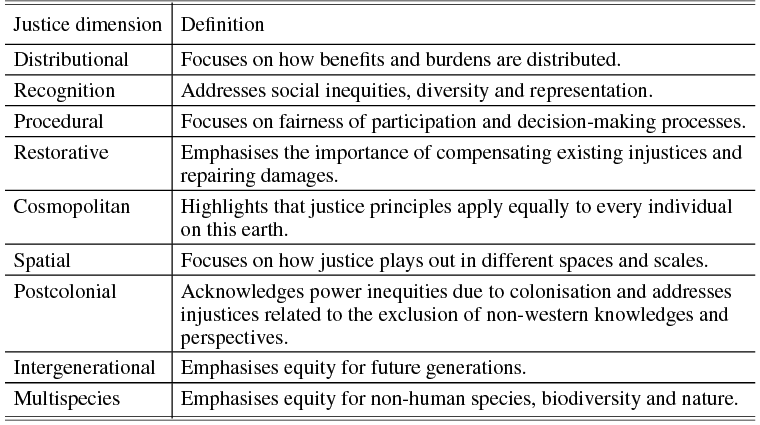
Later, other dimensions have been added to these three tenets. Restorative justice emphasises the importance of compensating injustices that already happened and of repairing damages caused by energy-related activities and restoration to the original state (Heffron and McCauley Reference Heffron and McCauley2017). Cosmopolitan justice highlights that justice principles apply equally to every individual on this earth. It emphasises the importance of having a global perspective when investigating energy justice and considering the impacts of people’s actions in one country on people’s lives in other countries (McCauley et al. Reference McCauley, Ramasar, Heffron, Sovacool, Mebratu and Mundaca2019). Linked to that, the concept of spatial justice pays attention to how justice plays out in different spaces and scales (regional, national, supranational) (Gürtler Reference Gürtler2023), whereas postcolonial justice acknowledges the continued power inequities due to colonisation and challenges white western hegemony. It addresses injustices related to the exclusion of non-western knowledges and perspectives and focuses on land justice and the need for rectifying injustices through ‘reparation, restoration, compensation and apology’ (Sovacool et al. Reference Sovacool, Bell, Daggett, Labuski, Lennon, Naylor, Klinger, Leonard and Firestone2023: 4).
Other justice dimensions go beyond the dominant focus on currently living human beings and emphasise equity for future generations, intergenerational justice (Eames and Hunt Reference Eames, Hunt, Bickerstaff, Walker and Bulkeley2013) and for non-human species, multispecies justice, focusing on the inherent value of biodiversity and nature (Winter, Reference Winter2022). The latter two dimensions reflect the breadth of sustainability as not only addressing relations between people who currently populate the earth but also relations with future generations and with the environment (Stumpf et al. Reference Stumpf, Baumgärtner, Becker and Sievers-Glotzbach2015).
The second widely used energy justice framework was introduced by Sovacool and colleagues (Reference Sovacool, Burke, Baker, Kotikalapudi and Wlokas2017) and incorporates the different justice dimensions into ten principles for decision-making. These are (1) availability, (2) affordability, (3) due process, (4) transparency and accountability, (5) sustainability, (6) intragenerational equity, (7) intergenerational equity, (8) responsibility, (9) resistance and (10) intersectionality (Sovacool et al. Reference Sovacool, Burke, Baker, Kotikalapudi and Wlokas2017).
While research on energy justice still dominates the field of justice in sustainability transitions, justice considerations related to other socio-technical systems are increasingly addressed as well. One example is the integration of justice considerations in transitions of food systems. Tribaldos and Kortetmäki (Reference Tribaldos and Kortetmäki2022), for example, introduce a framework that identifies principles for just transitions in food systems based on the following justice dimensions: distributive justice, cosmopolitan justice, ecology and non-human beings, procedural justice, recognition justice and capacities. They also note the importance of biodiversity and preventing biodiversity loss.
Another example is research on justice issues in transport and mobility systems which has grown significantly over the last years (Verlinghieri and Schwanen Reference Verlinghieri and Schwanen2020). Sheller (Reference Sheller, Cook and Butz2019:23) describes mobility justice as ‘overarching concept for thinking about how power and inequality inform the governance and control of movement, shaping the patterns of unequal mobility and immobility in the circulation of people, resources and information’. Research in this field has focused on a large diversity of issues, ranging from personal mobility and the accessibility and affordability of transport systems, the interlinkages of gender, race, class and age and how they affect (im)mobility to spatial injustices at different scales from urban inequities to issues of migration (Cook and Butz Reference Cook and Butz2019; Verlinghieri and Schwanen Reference Verlinghieri and Schwanen2020). Section 16.3 will illustrate some of the justice aspects to consider in transitions to sustainable mobility and energy systems.
16.3 Empirical Application
In this section, we illustrate the importance of considering justice issues in sustainability transitions through introducing two empirical examples: (1) Digitalisation of transport and (2) double energy vulnerability (DEV).
16.3.1 Digitalisation of Transport and Mobility
Our first justice example is digitalisation in transport and mobility, which is claimed to have both positive and negative impacts on just transitions. On the one hand, it can enable the development of new mobility services, such as ride-sharing and micro mobility, which can provide affordable and accessible transportation options for low-income communities and marginalised groups, improving the distributional aspects of who benefits from such systems. On the other hand, digitalisation in transport and mobility may exacerbate existing inequalities and create new ones (Ryghaug et al. Reference Ryghaug, Subotički, Smeds, von Wirth, Scherrer, Foulds and Wentland2023; Verlinghieri and Schwanen Reference Verlinghieri and Schwanen2020). The shift towards automation and digital technologies may, for example, lead to job losses in some sectors, particularly in low-skilled jobs, which could result in increased inequality and social exclusion, particularly for those who are already marginalised or living in poverty. Again, this would have both distributional and recognition justice impacts, if certain groups are affected more than others, and they have little say on the outcomes. Furthermore, there is a risk that the benefits of digitalisation will not be equally distributed, with some groups having better access to new technologies and services than others.
One example of this we find when it comes to electric vehicles and concepts such as Mobility as a Service (MaaS), which refers to ‘integrative approaches for accessing transport services […] via mobile applications (apps)’ (Pangbourne et al. Reference Pangbourne, Mladenović, Stead and Milakis2020: 35–36) and is envisioned to support the transition away from the private car. Many variants of MaaS are currently being developed; most of which tend to offer door-to-door multi-modal mobility services, brokered via digital platforms connecting users and service operators (Pangbourne et al. Reference Pangbourne, Mladenović, Stead and Milakis2020). From the perspective of sustainability transitions, MaaS offers potential for significantly altering mobility systems, if it replaces private car ownership and travel with more sustainable solutions (Kivimaa and Rogge Reference Kivimaa and Rogge2022). So far, there is, however, limited evidence that MaaS will have such effects, and it may be just as likely that consequences will be more cars and a deepening of car-based mobility systems (Butler et al. Reference Butler, Yigitcanlar and Paz2021; Milakis and Seibert Reference Milakis and Seibert2024). For instance, this may be the case if these systems are predominantly tailored to and utilised by younger middle-class residents living in cities. They typically have several mobility options available to them, and if they were to benefit from MaaS disproportionally, it could mean that other demographic groups are left out to some degree (Lange et al. Reference Lange2022). Also, research has shown that MaaS may adversely affect equity of access as it relies upon registration and digitalisation for service access and that its reliance on smartphone access also prevents MaaS from offering ‘access for all’ (Pangbourne et al. Reference Pangbourne, Stead, Mladenović, Milakis, Marsden and Reardon2018). Other studies have shown that regulatory measures are required to ensure equal access to transportation for all in a MaaS environment, because, ‘multi-worker households in outlying areas bear most of the cost burden because they lack the variety of mobility alternatives of areas around the CBD [central business district] and must purchase additional cars to make commuting trips to, potentially, dispersed work locations’ (Hawkins and Habib Reference Hawkins2019: 3106). Thus, there is the chance that MaaS and similar digital transport innovations may be co-opted by entrenched interests and elites (Verlinghieri and Schwanen Reference Verlinghieri and Schwanen2020). Moreover, digitalisation may require significant investments in new infrastructure and equipment, which could further exacerbate inequalities, especially if the costs are borne by people from vulnerable communities or those with limited resources. Different geographies have different economic capabilities to invest in infrastructures and communication technologies needed for digitalisation of transport systems and new innovations such as autonomous vehicles (Ryghaug et al. Reference Ryghaug, Haugland, Søraa and Skjølsvold2022). Different places may also have other qualities making them unfit, or unlikely, sites for the development, implementation and/or maintenance of infrastructures, for example, for the reasons of a lack of access to public transport infrastructure, or due to lack of skills, knowledge and resources.
There is also a risk that digital technologies could be controlled by a small number of powerful actors, (for instance, within big tech industries) further concentrating economic power and exacerbating inequality. Well-configured and governed mobility platforms, utilising open-source data and algorithms, can advance environmental and social sustainability. Success, however, depends on customer support for transport workers and fair pricing, and that governments protect commoning mobility platforms from hyper-capitalist rivals focused on profit and monopolies (Lange et al. Reference Lange2022).
16.3.2 Double Energy Vulnerability
A second example presented in this chapter on justice concerns focuses on energy and transport services and vulnerabilities related to those. Energy poverty is one area of research that is closely related to issues of justice. This form of injustice can be defined as the lack of access to sufficient domestic energy services such as space heating and cooling, lighting and the use of appliances (Bouzarovski and Petrova Reference Bouzarovski and Petrova2015). Increasingly, research is recognising the concept of ‘DEV’, which also factors in transport (Robinson and Mattioli Reference Robinson and Mattioli2020; Martiskainen et al. Reference Martiskainen, Sovacool, Lacey-Barnacle, Hopkins, Jenkins, Simcock, Mattioli and Bouzarovski2021). Simcock et al. define energy and transport poverty as the ‘inability to attain a socially and materially necessitated level of domestic energy and/or transport services’ (Reference Simcock, Jenkins, Lacey-Barnacle, Martiskainen, Mattioli and Hopkins2021: 2). This means that a person or household struggles with both energy and transport poverty. Living in DEV means that people must choose between different services of energy or transport, often juggling day-to-day activities such as balancing a high cost of using energy at home for heating with high transport costs (Martiskainen et al. Reference Martiskainen, Hopkins, Torres Contreras, Jenkins, Mattioli, Simcock and Lacey-Barnacle2023; Solbu et al. Reference Solbu, Ryghaug, Skjølsvold, Heidenreich and Næss2024). While DEV can easily be seen to be associated with costs and affordability of energy and transport services, it also links to infrastructural inequalities such as poor housing conditions and access to adequate transport services (Martiskainen et al. Reference Martiskainen, Hopkins, Torres Contreras, Jenkins, Mattioli, Simcock and Lacey-Barnacle2023), having clear links to distributional justice implications. For example, someone could have a bus network nearby but struggles to use it due to costs, mobility requirements or the fact that the buses do not go to where needed. Another may live in a rural location with limited public transport links, thus having to rely on a ‘forced ownership’ of personal cars which can be costly (Martiskainen et al. Reference Martiskainen, Hopkins, Torres Contreras, Jenkins, Mattioli, Simcock and Lacey-Barnacle2023). If those people then also live in poor housing conditions with high energy bills, DEV becomes an issue. This reduces quality of life, and the impact of DEV have been shown to affect certain people more, for example those with children, disabilities and health conditions are particularly at risk, as are women and people from ethnic minorities (Simcock et al. Reference Simcock, Jenkins, Lacey-Barnacle, Martiskainen, Mattioli and Hopkins2021). This not only has distributional and recognition justice implications, but also links to intergenerational justice as growing up in poverty can influence children’s later life, for example (e.g. Tilahun et al. Reference Tilahun, Persky, Shin and Zellner2021). Facing DEV means missing out on what people themselves deem to make a good quality of life, for example having to forgo leisure trips, buying favourite food, or keeping the home at a comfortable temperature (Martiskainen et al. Reference Martiskainen, Hopkins, Torres Contreras, Jenkins, Mattioli, Simcock and Lacey-Barnacle2023; Woods et al. Reference Woods, Heidenreich, Korsnes and Solbu2024). Given the prevalence of energy poverty globally and its dire implications on health, wellbeing, education and life chances (Simcock et al. Reference Simcock, Thomson, Petrova and Bouzarovski2018) it is important to recognise its connections to, and how it can be further worsened by, transport poverty.
Household DEV is closely linked to digitalisation which are increasingly seen as entangled in energy social science (Sareen et al. Reference Sareen, Waage, Smirnova, Boakye Botah and Loe2022). For example, the concept of flexibility within household energy consumption, whereby people have the ability to adjust the timing of their energy use in response to changes in energy prices or the availability of renewable energy sources, requires further examination from a justice angle (Fjellså et al. Reference Fjellså, Silvast and Skjølsvold2021a). For instance, providing information and activating people through technology such as apps or automated demand side management (DSM) solutions may have serious implications for justice, especially on distributional impacts (who benefits), recognition (who has a say on how those systems are designed) and procedural aspects (how are such systems designed and governed). Flexibility capital has been introduced as a concept to capture the way flexibility depends on specific resources and capabilities within the households (Powells and Fell Reference Powells and Fell2019: 57). Households that lack the resources to invest in smart grid technology or who have inflexible schedules may be unable to take advantage of flexible pricing schemes or real-time energy consumption data or avoid expensive peak hours for their commute to work. This could create distributional justice implications where more affluent households benefit from reduced energy bills or transport costs, while less affluent households continue to pay higher prices and experience ‘flexibility poverty’ (Fjellså et al. Reference Fjellså, Ryghaug and Skjølsvold2021b; Solbu et al. Reference Solbu, Ryghaug, Skjølsvold, Heidenreich and Næss2024). Thus, the intersection of energy poverty and transport poverty due to the twin transition of decarbonisation and digitalisation seems to exacerbate existing inequalities and create new ones (Sareen et al. Reference Sareen, Waage, Smirnova, Boakye Botah and Loe2022), with the risk of further cementing distributional and recognition justice implications. As we move towards more digitalised and interconnected energy and transport systems, it is important to apply the principles of recognition justice, that many people are excluded and vulnerable within these systems, and how those issues could be addressed. For example, when schemes such as housing retrofits and developments, LTNs, car free city centres and MaaS are designed, these need to take into consideration justice issues such as DEV and flexibility poverty, so that sustainability transitions provide an opportunity to address rather than worsen them (Dossett Reference Dossett2022).
16.4 Ongoing Debates and Future Research Needs
As the field of research on justice issues related to sustainability transitions is growing and getting increasingly pluralistic as well as getting increasingly recognised as relevant by other academic fields and by policymakers and practitioners within sustainability transitions, many important debates have recently emerged in the field pointing towards new directions and research needs. In this section, we will briefly introduce four topics representing important debates and directions for the field (knowingly excluding many other important topicsFootnote 2): (1) acceleration and justice, (2) geographies and justice, (3) epistemic justice and (4) linking justice and sustainability transitions theories and education.
16.4.1 Acceleration and Justice
The first topic for future research is how the issues of justice will be addressed in the debates surrounding the need to accelerate sustainability transitions (see Chapter 8). As governments, cities and companies are adopting net-zero emissions goals by mid-century to combat global warming, the world requires an unprecedented but purposeful speeding up of change in all significant systems. As a result, research on sustainability transitions should prioritise studying how we can accelerate these transitions and quickly spread new technological and social advancements needed to reach these goals (Andersen et al. Reference Andersen, Geels, Coenen, Hanson, Korsnes, Linnerud and Wiebe2023). However, the speed at which for example the energy transition occurs can impact social and environmental justice in a number of ways. For instance: (1) Employment: A rapid transition could result in the displacement of workers in industries that are being phased out, such as coal mining or oil and gas extraction, while a slower transition could delay the creation of new jobs in the clean energy sector. (2) Energy affordability: A rapid transition may lead to higher energy costs in the short-term, due to initial capital investment for example, which could disproportionately impact low-income households, while a slower transition could result in prolonged exposure to the harms of fossil fuels, such as air pollution. (3) Community participation: A rapid transition could limit opportunities for community input and participation in decision-making, especially for marginalised groups, while a slower transition could provide more time for community engagement and collaboration. (4) Timing of benefits and harms: A rapid transition could bring about positive impacts quickly, such as reduced emissions and improved air quality, but may also lead to short-term negative impacts, such as job losses or higher energy costs. A slower transition may delay these positive impacts but could also avoid some of the negative impacts associated with a rapid transition. (5) Environmental impacts: A rapid transition without due process for environmental impacts of development, for example, in sensitive locations and regions, could lead to land use concerns and impacts on biodiversity, while a slower transition would increase the negative impacts on biodiversity caused by climate change.
Thus, lately the temporal aspects of transitions have spurred debate within the transitions community, especially relating to the way the need for accelerating the speed of the transition impact the ability to enact such change in just and inclusive ways (Skjølsvold and Coenen Reference Skjølsvold and Coenen2021).
16.4.2 Geographies and Justice
The second topic for further investigation centres on geographies and justice. While the temporal dimension of transition has received more traction lately in relation to justice, also spatial or geographical perspectives (see also Chapter 21) have been highlighted more (Skjølsvold and Coenen Reference Skjølsvold and Coenen2021). As both the urgency and scale of the energy transition may be perceived differently in different regions, sustainability transitions must take into account the unique needs and vulnerabilities of different places and communities. The abovementioned ‘spatial justice’ dimension also emphasises the importance of recognising the interrelations between regional, national and international scales (Gürtler Reference Gürtler2023). This also relates to the speed of transitions. For example, regions in the Global South may be more severely affected if transitions are accelerated due to, for example, poor working condition in extractive industries that produce materials needed for new green technologies. On the other hand, many regions in the Global South are among the most vulnerable to the effects of climate change and will thus be more severely hit if the transition does not happen fast enough (Kumar et al. Reference Kumar, Höffken and Pols2021). Transitions can lead to social unrest, such as when dominant areas become even more powerful than less dominant ones, or when they reinforce the authority and progress of existing centres, leaving other areas at a disadvantage (Skjølsvold and Coenen Reference Skjølsvold and Coenen2021). Spatial justice considerations are also highly relevant in the context of biodiversity loss and environmental degradation.
16.4.3 Epistemic Justice
The third area for further research focuses on epistemic justice or ‘knowledge justice’ highlighting the need to include a broad set of societal actors and their different knowledges into decision-making in sustainability transitions (Schwanen Reference Schwanen2021). Rather than only relying on and valuing expert knowledge, important decisions should also be based on the participation and knowledge of citizens (Foulds et al. Reference Foulds, Valkenburg, Ryghaug, Suboticki, Skjølsvold, Korsnes and Heidenreich2023). This is important as, for example, transportation and energy researchers working on making transportation more sustainable should not automatically assume that they fully understand how people and groups affected by these changes think and feel (Schwanen Reference Schwanen2021) as such understanding can be limited and influenced by their own backgrounds and the idea that expert knowledge is more important than knowledge specific to a certain place or social group. When developing renewable energy projects, for example, the participation of local communities, who may represent different values of nature than the developers, and their context-specific knowledge of nature and their environment is essential for understanding the local impacts of the proposed development. Thus, there is a need to make sure that not only the same expertise, and the same type of knowledge get the possibility to set the agenda and contribute to important decisions concerning sustainability transitions.
On a more fundamental level, epistemic justice also relates to what perspectives are used when studying sustainability transitions and justice. For instance, non-Western and feminist perspectives on justice have been underprivileged compared to justice literature dominated by Western, male ideas. Hence, there is a need to broaden the scope of the justice field itself and give attention and space to ideas, philosophies and perspectives from the Global South, indigenous groups, women and other under-represented groups (Sovacool et al. Reference Sovacool, Bell, Daggett, Labuski, Lennon, Naylor, Klinger, Leonard and Firestone2023).
16.4.4 Linking Justice and Sustainability Transitions Theories and Education
Finally, it has been pointed out that sustainability transitions and justice often are treated separately by two different strands of literature without many points of contact and calls for more comprehensive approaches encompassing both the socio-technical transition dimension and the justice dimension have been voiced (Sareen and Haarstad Reference Sareen and Haarstad2018). In line with that, we argue that the sustainability transitions field must focus more on social organisation and social innovation in addition to its current dominant focus on technology and technological innovation. This includes incorporating the issue of justice in the dominant sustainability transition theories. One example of this is Williams and Doyon’s (Reference Williams and Doyon2019) analytical framework for justice and system transition which identifies (1) key questions, (2) risks of not incorporating justice and (3) mitigation strategies to overcome risks, for each of the three justice tenets (distributive, procedural and recognition). Another example is the integration of energy justice and the Multi-level perspective (MLP) (see also Chapter 2) to a framework addressing the connections between injustices and transition dynamics (Kanger and Sovacool Reference Kanger and Sovacool2022). Thus, while it is important to study how transitions unfold and how to support transitions as is commonly done in the field of sustainability transition, it is as important to study the implications of transition processes and how they impact social and environmental justice.
Moreover, justice perspectives should also be included into the education of sustainability transitions in a range of fields and professions. Tomorrow’s teachers, planners, engineers, politicians, craftsmen, nurses, social workers and chefs will be part of forming the sustainability transitions in our societies and should therefore be made aware of the inherently socio-technical nature and the social and environmental justice implications of transition processes.
16.5 Conclusion
This chapter focused on the issue of justice in sustainability transitions. Although there is an increasing focus in academia, policymaking and practice on the importance of making transitions not only environmentally and economically sustainable, but also just and fair – so that costs and benefits are shared equally (European Commmission 2019) – this chapter has illustrated that social inequities can often be exacerbated rather than alleviated in the context of transitions. Indeed, people who are vulnerable and marginalised do not often benefit from sustainability transitions: they may have, for example, limited opportunities to actively participate as citizens, and suffer from negative consequences of climate and energy policies and projects. Such injustices are often the reason for contestations of developments, projects, policies and initiatives that are part of sustainability transitions. This underlines the importance of considering questions of distributional, recognition, procedural, restorative, cosmopolitan, spatial, postcolonial, intergenerational and multispecies justice when designing, developing and implementing sustainability transition policies and projects across all socio-technical systems, while keeping the injustices of existing fossil fuel systems in mind (Newell and Mulvaney Reference Newell and Mulvaney2013).

 Open access