





1 Introduction
Let p denote any prime number, let F be a finite extension of $\mathbb {Q}_p$
, and let
$\mathbb {Q}_p$
, and let $\Gamma _F$
denote its absolute Galois group. Let L be another finite extension of
$\Gamma _F$
denote its absolute Galois group. Let L be another finite extension of $\mathbb {Q}_p$
with ring of integers
$\mathbb {Q}_p$
with ring of integers $\mathscr O$
, uniformiser
$\mathscr O$
, uniformiser $\varpi $
and residue field
$\varpi $
and residue field $k=\mathscr O/\varpi $
.
$k=\mathscr O/\varpi $
.
Let G be a smooth affine group scheme over $\mathscr O$
, such that its neutral component
$\mathscr O$
, such that its neutral component $G^0$
is reductive and the component group
$G^0$
is reductive and the component group $G/G^0$
is a finite group scheme over
$G/G^0$
is a finite group scheme over $\mathscr O$
. We call such group schemes generalised reductive. We do not make any assumptions on the prime p regarding G.
$\mathscr O$
. We call such group schemes generalised reductive. We do not make any assumptions on the prime p regarding G.
We fix a continuous representation ${\overline {\rho }}:\Gamma _{F}\rightarrow G(k)$
and denote by
${\overline {\rho }}:\Gamma _{F}\rightarrow G(k)$
and denote by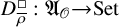 $D^{\square }_{\overline {\rho }}: {\mathfrak {A}}_{\mathscr {O}}{\rightarrow } \text {Set}$
the functor from the category
$D^{\square }_{\overline {\rho }}: {\mathfrak {A}}_{\mathscr {O}}{\rightarrow } \text {Set}$
the functor from the category ${\mathfrak {A}}_{\mathscr {O}}$
of local artinian
${\mathfrak {A}}_{\mathscr {O}}$
of local artinian $\mathscr O$
-algebras with residue field k to the category of sets, such that for
$\mathscr O$
-algebras with residue field k to the category of sets, such that for $(A,\mathfrak m_A)\in {\mathfrak {A}}_{\mathscr {O}}$
,
$(A,\mathfrak m_A)\in {\mathfrak {A}}_{\mathscr {O}}$
, $D^{\square }_{\overline {\rho }}(A)$
is the set of continuous representations
$D^{\square }_{\overline {\rho }}(A)$
is the set of continuous representations $\rho _{A}: \Gamma _{F}\rightarrow G(A)$
, such that
$\rho _{A}: \Gamma _{F}\rightarrow G(A)$
, such that $\rho _{A}(\gamma ) \equiv {\overline {\rho }}(\gamma )\ \pmod {\mathfrak m_A}$
, for all
$\rho _{A}(\gamma ) \equiv {\overline {\rho }}(\gamma )\ \pmod {\mathfrak m_A}$
, for all $\gamma \in \Gamma _F.$
The functor
$\gamma \in \Gamma _F.$
The functor $D^{\square }_{\overline {\rho }}$
of framed deformations of
$D^{\square }_{\overline {\rho }}$
of framed deformations of $\overline {\rho }$
is pro-represented by a complete local noetherian
$\overline {\rho }$
is pro-represented by a complete local noetherian $\mathscr O$
-algebra
$\mathscr O$
-algebra $R^{\square }_{\overline {\rho }}$
with residue field k.
$R^{\square }_{\overline {\rho }}$
with residue field k.
Böckle, Iyengar and VP have studied in [Reference Böckle, Iyengar and Paškūnas6] ring theoretic properties of $R^{\square }_{\overline {\rho }}$
, when
$R^{\square }_{\overline {\rho }}$
, when $G= {\mathrm {GL}}_d$
. In this paper we extend the results of [Reference Böckle, Iyengar and Paškūnas6] to an arbitrary generalised reductive group G.
$G= {\mathrm {GL}}_d$
. In this paper we extend the results of [Reference Böckle, Iyengar and Paškūnas6] to an arbitrary generalised reductive group G.
Theorem 1.1 (Corollaries 13.27, 15.29).
The ring $R^{\square }_{\overline {\rho }}$
is a local complete intersection, flat over
$R^{\square }_{\overline {\rho }}$
is a local complete intersection, flat over $\mathscr O$
and of relative dimension
$\mathscr O$
and of relative dimension $\dim G_k ([F:\mathbb {Q}_p]+1)$
. In particular, every continuous representation
$\dim G_k ([F:\mathbb {Q}_p]+1)$
. In particular, every continuous representation $\overline {\rho }: \Gamma _F\rightarrow G(k)$
has a lift to characteristic zero. Moreover,
$\overline {\rho }: \Gamma _F\rightarrow G(k)$
has a lift to characteristic zero. Moreover, $R^{\square }_{\overline {\rho }}$
is reduced and
$R^{\square }_{\overline {\rho }}$
is reduced and $R^{\square }_{\overline {\rho }}[1/p]$
is normal.
$R^{\square }_{\overline {\rho }}[1/p]$
is normal.
Obstruction theory provides a presentation  with r equal to the dimension of the tangent space and s equal to $\dim _k H^2(\Gamma _F, {\mathrm {ad}}\overline {\rho })$
. The Euler–Poincaré characteristic formula from local class field theory gives
$\dim _k H^2(\Gamma _F, {\mathrm {ad}}\overline {\rho })$
. The Euler–Poincaré characteristic formula from local class field theory gives
 $$ \begin{align} r-s=\dim G_k ([F:\mathbb {Q}_p]+1). \end{align} $$
Our theorem proves that $\dim R^\square _{\overline {\rho }}/\varpi $
is given by this cohomological quantity, the expected dimension in the spirit of the Dimension Conjecture of Gouvêa from [Reference Gouvêa31, Lecture 4]. Having the expected dimension implies that
$\dim R^\square _{\overline {\rho }}/\varpi $
is given by this cohomological quantity, the expected dimension in the spirit of the Dimension Conjecture of Gouvêa from [Reference Gouvêa31, Lecture 4]. Having the expected dimension implies that $\varpi ,f_1, \ldots , f_s$
is a regular sequence and that
$\varpi ,f_1, \ldots , f_s$
is a regular sequence and that $R^\square _{\overline {\rho }}$
is a local complete intersection. It also implies (see [Reference Galatius and Venkatesh29, Lemma 7.5]) that the derived deformation ring of
$R^\square _{\overline {\rho }}$
is a local complete intersection. It also implies (see [Reference Galatius and Venkatesh29, Lemma 7.5]) that the derived deformation ring of $\overline {\rho }$
as introduced by Galatius and Venkatesh in [Reference Galatius and Venkatesh29] is homotopy discrete, which means the derived deformation theory of
$\overline {\rho }$
as introduced by Galatius and Venkatesh in [Reference Galatius and Venkatesh29] is homotopy discrete, which means the derived deformation theory of $\overline {\rho }$
does not contain more information than the usual deformation theory of
$\overline {\rho }$
does not contain more information than the usual deformation theory of $\overline {\rho }$
.
$\overline {\rho }$
.
We expect that our results will play an important role in the categorical p-adic local Langlands correspondence. Conjecturally [Reference Emerton, Gee and Hellmann27, Conjecture 6.1.14] on the Galois side one should consider a derived category of coherent sheaves (or some $\infty $
-category version of it) on the Emerton–Gee stack. The local rings considered in Theorem 1.1 should arise as versal rings at finite type points of the Emerton–Gee stack, when G is an L-group or a C-group of a connected reductive group defined over F (see [Reference Emerton and Gee26, Proposition 3.6.3], when
$\infty $
-category version of it) on the Emerton–Gee stack. The local rings considered in Theorem 1.1 should arise as versal rings at finite type points of the Emerton–Gee stack, when G is an L-group or a C-group of a connected reductive group defined over F (see [Reference Emerton and Gee26, Proposition 3.6.3], when $G= {\mathrm {GL}}_d$
). In other words, they are expected to describe the local properties of the Emerton–Gee stack. An instance of this is a paper of Yu Min [Reference Min45], where he uses the analogue of Theorem 1.1 proved in [Reference Böckle, Iyengar and Paškūnas6] for
$G= {\mathrm {GL}}_d$
). In other words, they are expected to describe the local properties of the Emerton–Gee stack. An instance of this is a paper of Yu Min [Reference Min45], where he uses the analogue of Theorem 1.1 proved in [Reference Böckle, Iyengar and Paškūnas6] for $ {\mathrm {GL}}_d$
to show that if
$ {\mathrm {GL}}_d$
to show that if $G= {\mathrm {GL}}_d$
then the derived version of the Emerton–Gee stack is equivalent to the classical Emerton–Gee stack, obtaining an analogue of the result explained above, that derived deformation rings are homotopy discrete, over the whole of the stack. The Emerton–Gee stack has been recently defined and studied for
$G= {\mathrm {GL}}_d$
then the derived version of the Emerton–Gee stack is equivalent to the classical Emerton–Gee stack, obtaining an analogue of the result explained above, that derived deformation rings are homotopy discrete, over the whole of the stack. The Emerton–Gee stack has been recently defined and studied for $\mathrm {GSp}_4$
in [Reference Lee39] and for tame groups in [Reference Lin40]. We infinitesimally guarantee that the results of [Reference Min45] will extend to this context.
$\mathrm {GSp}_4$
in [Reference Lee39] and for tame groups in [Reference Lin40]. We infinitesimally guarantee that the results of [Reference Min45] will extend to this context.
In the paper we introduce and study a scheme $X^{\mathrm {gen}}_{G, \overline {\rho }^{\mathrm {ss}}}$
; its definition is reviewed in Section 1.4.1 below. Its
$X^{\mathrm {gen}}_{G, \overline {\rho }^{\mathrm {ss}}}$
; its definition is reviewed in Section 1.4.1 below. Its $\overline {k}$
-points correspond to continuous representations
$\overline {k}$
-points correspond to continuous representations $\rho :\Gamma _F\rightarrow G(\overline {k})$
with G-semisimplification equal to
$\rho :\Gamma _F\rightarrow G(\overline {k})$
with G-semisimplification equal to $\overline {\rho }^{\mathrm {ss}}$
. It carries an action of
$\overline {\rho }^{\mathrm {ss}}$
. It carries an action of $G^0$
and the quotient stack
$G^0$
and the quotient stack $[X^{\mathrm {gen}}_{G, \overline {\rho }^{\mathrm {ss}}}/ G^0]$
is an analogue of the stacks studied by Wang-Erickson in [Reference Wang-Erickson62] for
$[X^{\mathrm {gen}}_{G, \overline {\rho }^{\mathrm {ss}}}/ G^0]$
is an analogue of the stacks studied by Wang-Erickson in [Reference Wang-Erickson62] for $G= {\mathrm {GL}}_d$
. We expect that the disjoint union of the stacks
$G= {\mathrm {GL}}_d$
. We expect that the disjoint union of the stacks $[X^{\mathrm {gen}}_{G, \overline {\rho }^{\mathrm {ss}}}/ G^0]$
(or rather their formal versions) taken over all possible
$[X^{\mathrm {gen}}_{G, \overline {\rho }^{\mathrm {ss}}}/ G^0]$
(or rather their formal versions) taken over all possible $\overline {\rho }^{\mathrm {ss}}$
will be the largest substack of the Emerton–Gee stack on which the universal
$\overline {\rho }^{\mathrm {ss}}$
will be the largest substack of the Emerton–Gee stack on which the universal $(\varphi , \Gamma )$
-module can be realised as a representation of
$(\varphi , \Gamma )$
-module can be realised as a representation of $\Gamma _F$
, that is, the situation described in [Reference Emerton and Gee26, Remark 6.7.4] for
$\Gamma _F$
, that is, the situation described in [Reference Emerton and Gee26, Remark 6.7.4] for $ {\mathrm {GL}}_d$
will continue to hold in a more general setting.
$ {\mathrm {GL}}_d$
will continue to hold in a more general setting.
1.1 The conjecture of Böckle–Juschka
Our second main result proves a generalisation of a conjecture of Böckle–Juschka concerning the irreducible components of $R^{\square }_{\overline {\rho }}$
. We assume that
$R^{\square }_{\overline {\rho }}$
. We assume that $G^0$
is split over
$G^0$
is split over $\mathscr O$
and
$\mathscr O$
and $G/G^0$
is a constant group scheme. This can be achieved after replacing L by a finite unramified extension. Let
$G/G^0$
is a constant group scheme. This can be achieved after replacing L by a finite unramified extension. Let $\Gamma _E$
be the kernel of the homomorphism
$\Gamma _E$
be the kernel of the homomorphism $\Gamma _F\overset {\overline {\rho }}{\longrightarrow } G(k) \rightarrow (G/G^0)(k)$
. We assume that
$\Gamma _F\overset {\overline {\rho }}{\longrightarrow } G(k) \rightarrow (G/G^0)(k)$
. We assume that $\mathscr O$
contains
$\mathscr O$
contains $\mu _{p^{\infty }}(E)$
. One may further assume that this map is surjective, as replacing G with a subgroup does not change the deformation problem, so that
$\mu _{p^{\infty }}(E)$
. One may further assume that this map is surjective, as replacing G with a subgroup does not change the deformation problem, so that $(G/G^0)(k)= {\mathrm {Gal}}(E/F)$
.
$(G/G^0)(k)= {\mathrm {Gal}}(E/F)$
.
Let $G'$
be the derived group scheme of
$G'$
be the derived group scheme of $G^0$
, let
$G^0$
, let $G^{\prime }_{\operatorname {sc}}\rightarrow G'$
be the simply connected central cover of
$G^{\prime }_{\operatorname {sc}}\rightarrow G'$
be the simply connected central cover of $G'$
and let
$G'$
and let $\pi _1(G')$
be the kernel of this map. Then
$\pi _1(G')$
be the kernel of this map. Then $\pi _1(G')$
is a finite diagonalisable subgroup scheme of the centre of
$\pi _1(G')$
is a finite diagonalisable subgroup scheme of the centre of $G^{\prime }_{\operatorname {sc}}$
and is isomorphic to
$G^{\prime }_{\operatorname {sc}}$
and is isomorphic to $\prod _{i=1}^r \mu _{n_i}$
for some integers
$\prod _{i=1}^r \mu _{n_i}$
for some integers $n_i$
. The group scheme
$n_i$
. The group scheme $\pi _1(G')$
is étale if and only if p does not divide
$\pi _1(G')$
is étale if and only if p does not divide $n_i$
for all i.
$n_i$
for all i.
Our assumptions on G imply that $G^0/G'$
is a split torus. The action of
$G^0/G'$
is a split torus. The action of $G/G'$
on
$G/G'$
on $G^0/G'$
by conjugation induces an action of
$G^0/G'$
by conjugation induces an action of $ {\mathrm {Gal}}(E/F)$
on its character lattice
$ {\mathrm {Gal}}(E/F)$
on its character lattice $M:=X^*(G^0/G')$
.
$M:=X^*(G^0/G')$
.
Let $\overline {\psi }: \Gamma _F \rightarrow (G/G')(k)$
be the representation
$\overline {\psi }: \Gamma _F \rightarrow (G/G')(k)$
be the representation $\overline {\psi }= \varphi \circ \overline {\rho }$
, where
$\overline {\psi }= \varphi \circ \overline {\rho }$
, where $\varphi : G\rightarrow G/G'$
is the quotient map. Let
$\varphi : G\rightarrow G/G'$
is the quotient map. Let $R^{\square }_{\overline {\psi }}$
be the universal deformation ring of
$R^{\square }_{\overline {\psi }}$
be the universal deformation ring of $\overline {\psi }$
.
$\overline {\psi }$
.
Theorem 1.2 (Corollaries 15.28, 15.30).
The natural map $R^{\square }_{\overline {\psi }}\to R^{\square }_{\overline {\rho }}$
, induced by composing a deformation of
$R^{\square }_{\overline {\psi }}\to R^{\square }_{\overline {\rho }}$
, induced by composing a deformation of $\overline {\rho }$
with
$\overline {\rho }$
with $\varphi : G\rightarrow G/G'$
, is flat and if
$\varphi : G\rightarrow G/G'$
, is flat and if $\pi _1(G')$
is étale then it induces a bijection between the sets of irreducible components.
$\pi _1(G')$
is étale then it induces a bijection between the sets of irreducible components.
In a companion paper [Reference Paškūnas and Quast48] we deal with the case, when $G^0$
is a torus. In particular, we show that the irreducible components of
$G^0$
is a torus. In particular, we show that the irreducible components of $R^{\square }_{\overline {\psi }}$
can be labelled by characters
$R^{\square }_{\overline {\psi }}$
can be labelled by characters $\chi : (\mu _{p^{\infty }}(E)\otimes M)^{ {\mathrm {Gal}}(E/F)}\rightarrow \mathscr O^{\times }$
.
$\chi : (\mu _{p^{\infty }}(E)\otimes M)^{ {\mathrm {Gal}}(E/F)}\rightarrow \mathscr O^{\times }$
.
We assume that $\pi _1(G')$
is étale until the end of this subsection. Let
$\pi _1(G')$
is étale until the end of this subsection. Let $R^{\square , \chi }_{\overline {\rho }}$
be an irreducible component of
$R^{\square , \chi }_{\overline {\rho }}$
be an irreducible component of $R^{\square }_{\overline {\rho }}$
corresponding to a character
$R^{\square }_{\overline {\rho }}$
corresponding to a character $\chi $
under Theorem 1.2.
$\chi $
under Theorem 1.2.
Theorem 1.3 (Corollary 15.20).
If $\pi _1(G')$
is étale then the rings
$\pi _1(G')$
is étale then the rings $R^{\square , \chi }_{\overline {\rho }}$
,
$R^{\square , \chi }_{\overline {\rho }}$
, $R^{\square , \chi }_{\overline {\rho }}/\varpi $
are complete intersection, regular in codimension
$R^{\square , \chi }_{\overline {\rho }}/\varpi $
are complete intersection, regular in codimension $[F:\mathbb {Q}_p]$
, normal domains.
$[F:\mathbb {Q}_p]$
, normal domains.
Theorem 1.3 and a theorem of Grothendieck on factoriality of complete intersections imply:
Corollary 1.4 (Corollary 15.22).
If $\pi _1(G')$
is étale and
$\pi _1(G')$
is étale and $[F:\mathbb {Q}_p]\ge 3$
then
$[F:\mathbb {Q}_p]\ge 3$
then $R^{\square , \chi }_{\overline {\rho }}$
and
$R^{\square , \chi }_{\overline {\rho }}$
and $R^{\square , \chi }_{\overline {\rho }}/\varpi $
are factorial.
$R^{\square , \chi }_{\overline {\rho }}/\varpi $
are factorial.
If a further hypothesis on $\overline {\rho }$
and G is satisfied (for example, if
$\overline {\rho }$
and G is satisfied (for example, if $G/Z(G^0)$
does not have
$G/Z(G^0)$
does not have $ {\mathrm {PGL}}_2$
as a factor) then we show in Corollary 15.20 that
$ {\mathrm {PGL}}_2$
as a factor) then we show in Corollary 15.20 that $R^{\square , \chi }_{\overline {\rho }}$
and
$R^{\square , \chi }_{\overline {\rho }}$
and $R^{\square , \chi }_{\overline {\rho }}/\varpi $
are regular in codimension
$R^{\square , \chi }_{\overline {\rho }}/\varpi $
are regular in codimension $2[F:\mathbb {Q}_p]-1$
and hence Corollary 1.4 holds if
$2[F:\mathbb {Q}_p]-1$
and hence Corollary 1.4 holds if $[F:\mathbb {Q}_p]=2$
. If
$[F:\mathbb {Q}_p]=2$
. If $F=\mathbb {Q}_p$
then [Reference Böckle, Iyengar and Paškūnas6, Remark 4.24, Corollary 4.25] provide examples, where Corollary 1.4 fails.
$F=\mathbb {Q}_p$
then [Reference Böckle, Iyengar and Paškūnas6, Remark 4.24, Corollary 4.25] provide examples, where Corollary 1.4 fails.
1.2 Deformation problems with fixed partial determinant
In fact, Theorems 1.1, 1.2, 1.3 and Corollary 1.4 hold in a more general setting, which might be called deformation problems with ‘fixed partial determinant’. Assume that we have a $ {\mathrm {Gal}}(E/F)$
-invariant decomposition
$ {\mathrm {Gal}}(E/F)$
-invariant decomposition $X^*(G^0/G')=M_1\oplus M_2$
and let
$X^*(G^0/G')=M_1\oplus M_2$
and let $H_1$
be the quotient of
$H_1$
be the quotient of $G/G'$
such that their component groups coincide and the character lattice of
$G/G'$
such that their component groups coincide and the character lattice of $H_1^0$
is equal to
$H_1^0$
is equal to $M_1$
. We fix a continuous representation
$M_1$
. We fix a continuous representation $\psi _1: \Gamma _F \rightarrow H_1(\mathscr O)$
, such that
$\psi _1: \Gamma _F \rightarrow H_1(\mathscr O)$
, such that $\psi _1 \equiv \varphi _1\circ \overline {\rho } \pmod {\varpi }$
, where
$\psi _1 \equiv \varphi _1\circ \overline {\rho } \pmod {\varpi }$
, where $\varphi _1: G\rightarrow H_1$
is the composition of
$\varphi _1: G\rightarrow H_1$
is the composition of $\varphi $
with the quotient map
$\varphi $
with the quotient map $G/G'\twoheadrightarrow H_1$
. Let
$G/G'\twoheadrightarrow H_1$
. Let $D^{\square , \psi _1}_{\overline {\rho }}$
be a subfunctor of
$D^{\square , \psi _1}_{\overline {\rho }}$
be a subfunctor of $D^{\square }_{\overline {\rho }}$
, such that
$D^{\square }_{\overline {\rho }}$
, such that
 $$ \begin{align*}D^{\square, \psi_1}_{\overline{\rho}}(A)=\{ \rho_{A}\in D^{\square}_{\overline{\rho}}(A): \varphi_1\circ \rho_{A}= \psi_1\otimes_{\mathscr{O}} A\}.\end{align*} $$
The functor $D^{\square , \psi _1}_{\overline {\rho }}$
is pro-represented by a quotient
$D^{\square , \psi _1}_{\overline {\rho }}$
is pro-represented by a quotient $R^{\square , \psi _1}_{\overline {\rho }}$
of
$R^{\square , \psi _1}_{\overline {\rho }}$
of $R^{\square }_{\overline {\rho }}$
. Then the above results hold with
$R^{\square }_{\overline {\rho }}$
. Then the above results hold with $R^{\square }_{\overline {\rho }}$
replaced with
$R^{\square }_{\overline {\rho }}$
replaced with $R^{\square , \psi _1}_{\overline {\rho }}$
, see Corollary 15.14, Theorems 15.18, 15.19 and their Corollaries.
$R^{\square , \psi _1}_{\overline {\rho }}$
, see Corollary 15.14, Theorems 15.18, 15.19 and their Corollaries.
If $\pi _1(G')$
is étale then the irreducible components of
$\pi _1(G')$
is étale then the irreducible components of $R^{\square , \psi _1}_{\overline {\rho }}$
can be indexed by characters
$R^{\square , \psi _1}_{\overline {\rho }}$
can be indexed by characters ${\chi : (\mu _{p^{\infty }}(E)\otimes M_2)^{ {\mathrm {Gal}}(E/F)} \rightarrow \mathscr O^{\times }}$
. There are always two interesting cases: if
${\chi : (\mu _{p^{\infty }}(E)\otimes M_2)^{ {\mathrm {Gal}}(E/F)} \rightarrow \mathscr O^{\times }}$
. There are always two interesting cases: if $M_1=0$
then we impose an empty condition and
$M_1=0$
then we impose an empty condition and $R^{\square , \psi _1}_{\overline {\rho }}=R^{\square }_{\overline {\rho }}$
; if
$R^{\square , \psi _1}_{\overline {\rho }}=R^{\square }_{\overline {\rho }}$
; if $M_1=X^*(G^0/G')$
then
$M_1=X^*(G^0/G')$
then $R^{\square , \psi _1}_{\overline {\rho }}$
parameterises deformations with ‘fixed determinant’ equal to
$R^{\square , \psi _1}_{\overline {\rho }}$
parameterises deformations with ‘fixed determinant’ equal to $\psi _1$
and it follows from above that
$\psi _1$
and it follows from above that $R^{\square , \psi _1}_{\overline {\rho }}$
and
$R^{\square , \psi _1}_{\overline {\rho }}$
and $R^{\square , \psi _1}_{\overline {\rho }}/\varpi $
are integral domains. If
$R^{\square , \psi _1}_{\overline {\rho }}/\varpi $
are integral domains. If $G= {\mathrm {GL}}_d$
then
$G= {\mathrm {GL}}_d$
then $X^*(G^0/G')=\mathbb Z$
and these are the only cases that can occur. However, in general there are further interesting cases naturally appearing in the Langlands program, as we discuss in Section 16.
$X^*(G^0/G')=\mathbb Z$
and these are the only cases that can occur. However, in general there are further interesting cases naturally appearing in the Langlands program, as we discuss in Section 16.
If H is a connected reductive group over F (or more generally over a number field) which splits over a finite Galois extension E of F then it is expected in [Reference Buzzard and Gee13] that the Galois representations attached to C-algebraic automorphic forms on H take values in the C-group ${}^C H$
, which is a generalised reductive group scheme over
${}^C H$
, which is a generalised reductive group scheme over $\mathscr O$
with component group the constant group scheme
$\mathscr O$
with component group the constant group scheme $ {\mathrm {Gal}}(E/F)$
. Moreover, they should satisfy the condition
$ {\mathrm {Gal}}(E/F)$
. Moreover, they should satisfy the condition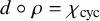 $d\circ \rho = \chi _{\mathrm {cyc}}$
, where
$d\circ \rho = \chi _{\mathrm {cyc}}$
, where $\chi _{\mathrm {cyc}}$
is the p-adic cyclotomic character and d is the canonical map
$\chi _{\mathrm {cyc}}$
is the p-adic cyclotomic character and d is the canonical map $d:{}^C H\rightarrow \mathbb G_{m}$
. We explain in Theorem 16.5 that the functor
$d:{}^C H\rightarrow \mathbb G_{m}$
. We explain in Theorem 16.5 that the functor $D^{\square ,\psi _1}_{\overline {\rho }}$
with
$D^{\square ,\psi _1}_{\overline {\rho }}$
with $G={}^C H$
,
$G={}^C H$
, $H_1= {\mathrm {Gal}}(E/F)\times \mathbb G_{m}$
and
$H_1= {\mathrm {Gal}}(E/F)\times \mathbb G_{m}$
and $\psi _1: \Gamma _F \rightarrow H_1(\mathscr O)$
,
$\psi _1: \Gamma _F \rightarrow H_1(\mathscr O)$
, $\gamma \mapsto (\gamma |_E, \chi _{\mathrm {cyc}}(\gamma ))$
parameterises deformations
$\gamma \mapsto (\gamma |_E, \chi _{\mathrm {cyc}}(\gamma ))$
parameterises deformations $\rho _{A}$
of
$\rho _{A}$
of $\overline {\rho }: \Gamma _F \rightarrow {}^CH(k)$
satisfying
$\overline {\rho }: \Gamma _F \rightarrow {}^CH(k)$
satisfying $d\circ \rho _{A} = \chi _{\mathrm {cyc}}\otimes _{\mathscr {O}} A$
. We show that in this case, under the assumption that
$d\circ \rho _{A} = \chi _{\mathrm {cyc}}\otimes _{\mathscr {O}} A$
. We show that in this case, under the assumption that $\pi _1(\widehat {H}')$
is étale, the irreducible components are canonically in bijection with characters of p-power torsion subgroup of
$\pi _1(\widehat {H}')$
is étale, the irreducible components are canonically in bijection with characters of p-power torsion subgroup of $Z(H)^0(F)$
, where
$Z(H)^0(F)$
, where $Z(H)^0$
is the neutral component of the centre of H.
$Z(H)^0$
is the neutral component of the centre of H.
1.3 Deformation space of Lafforgue’s pseudocharacters
We refer the reader to Section 7 for the definition of V. Lafforgue’s G-pseudocharacters. We single out some properties for the purpose of this introduction. To every representation $\rho : \Gamma _F \rightarrow G(A)$
one may attach an A-valued G-pseudocharacter
$\rho : \Gamma _F \rightarrow G(A)$
one may attach an A-valued G-pseudocharacter $\Theta _{\rho }$
. Moreover, conjugation of
$\Theta _{\rho }$
. Moreover, conjugation of $\rho $
with elements of
$\rho $
with elements of $G^0(A)$
does not change the associated G-pseudocharacter. If
$G^0(A)$
does not change the associated G-pseudocharacter. If $\Theta $
is a G-pseudocharacter with values in an algebraically closed field
$\Theta $
is a G-pseudocharacter with values in an algebraically closed field $\kappa $
then there exists a representation
$\kappa $
then there exists a representation $\rho : \Gamma _F \rightarrow G(\kappa )$
, uniquely determined up to
$\rho : \Gamma _F \rightarrow G(\kappa )$
, uniquely determined up to $G^0(\kappa )$
-conjugation, such that
$G^0(\kappa )$
-conjugation, such that $\rho $
is G-semisimple (Definition 2.22) and
$\rho $
is G-semisimple (Definition 2.22) and $\Theta _{\rho }=\Theta $
. If A and
$\Theta _{\rho }=\Theta $
. If A and $\kappa $
carry a topology then there is a notion of continuous G-pseudocharacters, which interacts well with continuous representations.
$\kappa $
carry a topology then there is a notion of continuous G-pseudocharacters, which interacts well with continuous representations.
Let $\overline {\Theta }$
be the G-pseudocharacter attached to
$\overline {\Theta }$
be the G-pseudocharacter attached to $\overline {\rho }$
. JQ has shown in [Reference Quast50] as part of his PhD thesis under the direction of Gebhard Böckle that the functor
$\overline {\rho }$
. JQ has shown in [Reference Quast50] as part of his PhD thesis under the direction of Gebhard Böckle that the functor $D^{\mathrm {ps}}:{\mathfrak {A}}_{\mathscr {O}}\rightarrow \text {Set}$
, such that
$D^{\mathrm {ps}}:{\mathfrak {A}}_{\mathscr {O}}\rightarrow \text {Set}$
, such that $D^{\mathrm {ps}}(A)$
is the set of continuous A-valued G-pseudocharacters deforming
$D^{\mathrm {ps}}(A)$
is the set of continuous A-valued G-pseudocharacters deforming $\overline {\Theta }$
is pro-represented by a complete local noetherian
$\overline {\Theta }$
is pro-represented by a complete local noetherian $\mathscr O$
-algebra
$\mathscr O$
-algebra $R^{\mathrm {ps}}_G$
with residue field k. The proof that
$R^{\mathrm {ps}}_G$
with residue field k. The proof that $R^{\mathrm {ps}}_G$
is noetherian uses the fact that
$R^{\mathrm {ps}}_G$
is noetherian uses the fact that $\Gamma _F$
is topologically finitely generated.
$\Gamma _F$
is topologically finitely generated.
If $G= {\mathrm {GL}}_d$
then Emerson–Morel have shown in [Reference Emerson and Morel25] that there is a natural bijection between G-pseudocharacters and Chenevier’s d-dimensional determinant laws defined in [Reference Chenevier15]. Thus in this case the ring
$G= {\mathrm {GL}}_d$
then Emerson–Morel have shown in [Reference Emerson and Morel25] that there is a natural bijection between G-pseudocharacters and Chenevier’s d-dimensional determinant laws defined in [Reference Chenevier15]. Thus in this case the ring $R^{\mathrm {ps}}_{ {\mathrm {GL}}_d}$
coincides with the deformation ring studied by Böckle–Juschka in [Reference Böckle and Juschka7]. The results of that paper are an important input in [Reference Böckle, Iyengar and Paškūnas6]. In our paper we extend the main result [Reference Böckle and Juschka7, Theorem 5.5.1] to G-pseudocharacters, also obtaining a new proof of it, when
$R^{\mathrm {ps}}_{ {\mathrm {GL}}_d}$
coincides with the deformation ring studied by Böckle–Juschka in [Reference Böckle and Juschka7]. The results of that paper are an important input in [Reference Böckle, Iyengar and Paškūnas6]. In our paper we extend the main result [Reference Böckle and Juschka7, Theorem 5.5.1] to G-pseudocharacters, also obtaining a new proof of it, when $G= {\mathrm {GL}}_d$
.
$G= {\mathrm {GL}}_d$
.
Theorem 1.5 (Corollary 13.31).
The rings $R^{\mathrm {ps}}_G$
and
$R^{\mathrm {ps}}_G$
and $R^{\mathrm {ps}}_G/\varpi $
are equidimensional of dimension
$R^{\mathrm {ps}}_G/\varpi $
are equidimensional of dimension $d+1$
and d, respectively, where
$d+1$
and d, respectively, where $d= \dim G_k [F:\mathbb {Q}_p] + \dim Z(G)_k$
.
$d= \dim G_k [F:\mathbb {Q}_p] + \dim Z(G)_k$
.
Let $U^{\mathrm {ps}}:=( {\mathrm {Spec}} R^{\mathrm {ps}}_G)\setminus \{\text {the closed point}\}$
. The non-special absolutely irreducible locus
$U^{\mathrm {ps}}:=( {\mathrm {Spec}} R^{\mathrm {ps}}_G)\setminus \{\text {the closed point}\}$
. The non-special absolutely irreducible locus $U^{ {\mathrm {n-spcl}}}$
is an open subscheme of
$U^{ {\mathrm {n-spcl}}}$
is an open subscheme of $U^{\mathrm {ps}}$
such that a geometric point
$U^{\mathrm {ps}}$
such that a geometric point $x: {\mathrm {Spec}} \kappa \rightarrow U^{\mathrm {ps}}$
lies in
$x: {\mathrm {Spec}} \kappa \rightarrow U^{\mathrm {ps}}$
lies in $U^{ {\mathrm {n-spcl}}}$
if and only if the representation
$U^{ {\mathrm {n-spcl}}}$
if and only if the representation $\rho _x: \Gamma _F \rightarrow G(\kappa )$
associated to the specialisation of the universal G-pseudocharacter at x is G-irreducible (Definition 2.26) and
$\rho _x: \Gamma _F \rightarrow G(\kappa )$
associated to the specialisation of the universal G-pseudocharacter at x is G-irreducible (Definition 2.26) and $H^0(\Gamma _F, ( {\mathrm {Lie}} G^{\prime }_{\operatorname {sc}})_{x}^*(1))=0$
, where
$H^0(\Gamma _F, ( {\mathrm {Lie}} G^{\prime }_{\operatorname {sc}})_{x}^*(1))=0$
, where $\Gamma _F$
acts on
$\Gamma _F$
acts on $( {\mathrm {Lie}} G^{\prime }_{\operatorname {sc}})_x$
via
$( {\mathrm {Lie}} G^{\prime }_{\operatorname {sc}})_x$
via $\rho _x$
composed with the adjoint action. If
$\rho _x$
composed with the adjoint action. If $\pi _1(G')$
is étale or
$\pi _1(G')$
is étale or $\mathrm {char}(\kappa )=0$
then
$\mathrm {char}(\kappa )=0$
then $( {\mathrm {Lie}} G^{\prime }_{\operatorname {sc}})_x=( {\mathrm {Lie}} G')_x$
and the last condition is equivalent to
$( {\mathrm {Lie}} G^{\prime }_{\operatorname {sc}})_x=( {\mathrm {Lie}} G')_x$
and the last condition is equivalent to $H^0(\Gamma _F, ( {\mathrm {ad}}^0 \rho _x)^*(1))=0$
.
$H^0(\Gamma _F, ( {\mathrm {ad}}^0 \rho _x)^*(1))=0$
.
Theorem 1.6 (Corollary 13.32). $U^{{\mathrm {n-spcl}}}$
is Zariski dense in
$U^{{\mathrm {n-spcl}}}$
is Zariski dense in ${\mathrm {Spec}} R^{\mathrm {ps}}_G$
and its special fibre is Zariski dense in
${\mathrm {Spec}} R^{\mathrm {ps}}_G$
and its special fibre is Zariski dense in ${\mathrm {Spec}} R^{\mathrm {ps}}_G/\varpi $
.
${\mathrm {Spec}} R^{\mathrm {ps}}_G/\varpi $
.
We also show in Corollary 15.25 that the reduced subscheme $({\mathrm {Spec}} R^{\mathrm {ps}}_G[1/p])^{\mathrm {red}}$
is normal. If
$({\mathrm {Spec}} R^{\mathrm {ps}}_G[1/p])^{\mathrm {red}}$
is normal. If $\pi _1(G')$
is étale then we compute the set of irreducible components of
$\pi _1(G')$
is étale then we compute the set of irreducible components of ${\mathrm {Spec}} R^{\mathrm {ps}}_G$
in Corollary 15.27, which together with Theorem 1.2 implies that
${\mathrm {Spec}} R^{\mathrm {ps}}_G$
in Corollary 15.27, which together with Theorem 1.2 implies that ${\mathrm {Spec}} R^{\square }_{\overline {\rho }}\rightarrow {\mathrm {Spec}} R^{\mathrm {ps}}_G$
induces a bijection between the sets of irreducible components.
${\mathrm {Spec}} R^{\square }_{\overline {\rho }}\rightarrow {\mathrm {Spec}} R^{\mathrm {ps}}_G$
induces a bijection between the sets of irreducible components.
1.4 Complete intersection
We will now sketch the proof of Theorem 1.1. Let ${\mathrm {Rep}}^{\Gamma _F}_G: \mathscr O\text {-}\mathrm {alg} \rightarrow \text {Set}$
be the functor, which maps an
${\mathrm {Rep}}^{\Gamma _F}_G: \mathscr O\text {-}\mathrm {alg} \rightarrow \text {Set}$
be the functor, which maps an $\mathscr O$
-algebra A to the set of group homomorphisms
$\mathscr O$
-algebra A to the set of group homomorphisms $\Gamma _F\rightarrow G(A)$
. The scheme
$\Gamma _F\rightarrow G(A)$
. The scheme $G^0$
acts on
$G^0$
acts on ${\mathrm {Rep}}^{\Gamma _F}_G$
by conjugation. We construct an affine scheme
${\mathrm {Rep}}^{\Gamma _F}_G$
by conjugation. We construct an affine scheme $X^{\mathrm {gen}}_{G, \overline {\rho }^{\mathrm {ss}}}={\mathrm {Spec}} A^{\mathrm {gen}}_{G, \overline {\rho }^{\mathrm {ss}}}$
over
$X^{\mathrm {gen}}_{G, \overline {\rho }^{\mathrm {ss}}}={\mathrm {Spec}} A^{\mathrm {gen}}_{G, \overline {\rho }^{\mathrm {ss}}}$
over $\mathscr O$
, which is a
$\mathscr O$
, which is a $G^0$
-invariant subfunctor of
$G^0$
-invariant subfunctor of ${\mathrm {Rep}}^{\Gamma _F}_G$
and the following desiderata hold:
${\mathrm {Rep}}^{\Gamma _F}_G$
and the following desiderata hold:
-
(D1) the specialisation of the universal representation $\rho ^{\mathrm {univ}}: \Gamma _F \rightarrow G(A^{\mathrm {gen}}_{G, \overline {\rho }^{\mathrm {ss}}})$
at
$x\in X^{\mathrm {gen}}_{G, \overline {\rho }^{\mathrm {ss}}}(\overline {k})$
induces a bijection
$x\mapsto \rho _x$
between
$X^{\mathrm {gen}}_{G, \overline {\rho }^{\mathrm {ss}}}(\overline {k})$
and the set of continuous representations
$\rho : \Gamma _F \rightarrow G(\overline {k})$
such that the G-semisimplification (Definition 2.21) of
$\rho $
is equal to
$\overline {\rho }^{\mathrm {ss}}$
;
$\rho ^{\mathrm {univ}}: \Gamma _F \rightarrow G(A^{\mathrm {gen}}_{G, \overline {\rho }^{\mathrm {ss}}})$
at
$x\in X^{\mathrm {gen}}_{G, \overline {\rho }^{\mathrm {ss}}}(\overline {k})$
induces a bijection
$x\mapsto \rho _x$
between
$X^{\mathrm {gen}}_{G, \overline {\rho }^{\mathrm {ss}}}(\overline {k})$
and the set of continuous representations
$\rho : \Gamma _F \rightarrow G(\overline {k})$
such that the G-semisimplification (Definition 2.21) of
$\rho $
is equal to
$\overline {\rho }^{\mathrm {ss}}$
; -
(D2) the completion of a local ring at
$x\in X^{\mathrm {gen}}_{G, \overline {\rho }^{\mathrm {ss}}}(\overline {k})$
is isomorphic to
$R^{\square }_{\rho _x}$
; -
(D3) the GIT quotient
is the spectrum of a complete local noetherian
$\mathscr O$
-algebra
$R^{\mathrm {git}}_{G,\overline {\rho }^{\mathrm {ss}}}$
with residue field k.

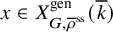





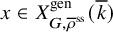

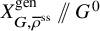 is the spectrum of a complete local noetherian

We then bound the dimension of the special fibre $\overline {X}^{\mathrm {gen}}_{G, \overline {\rho }^{\mathrm {ss}}}$
from above
$\overline {X}^{\mathrm {gen}}_{G, \overline {\rho }^{\mathrm {ss}}}$
from above
 $$ \begin{align} \dim \overline{X}^{\mathrm{gen}}_{G, \overline{\rho}^{\mathrm{ss}}}\le \dim G_k([F:\mathbb {Q}_p]+1). \end{align} $$
Once we can do this the first part of Theorem 1.1 follows immediately as (D2) implies that ${\dim R^{\square }_{\overline {\rho }}/\varpi \le \dim G_k([F:\mathbb {Q}_p]+1)}$
and the result follows from (1) and a little commutative algebra (Lemma 3.9). So the overall strategy is similar to the strategy in [Reference Böckle, Iyengar and Paškūnas6], however its execution requires substantially new ideas.
${\dim R^{\square }_{\overline {\rho }}/\varpi \le \dim G_k([F:\mathbb {Q}_p]+1)}$
and the result follows from (1) and a little commutative algebra (Lemma 3.9). So the overall strategy is similar to the strategy in [Reference Böckle, Iyengar and Paškūnas6], however its execution requires substantially new ideas.
1.4.1 Definition
The difficulty in defining $X^{\mathrm {gen}}_{G, \overline {\rho }^{\mathrm {ss}}}$
stems from the fact that we would like to work with continuous representations of
$X^{\mathrm {gen}}_{G, \overline {\rho }^{\mathrm {ss}}}$
stems from the fact that we would like to work with continuous representations of $\Gamma _F$
, but for arbitrary A there seems to be no sensible topology to put on
$\Gamma _F$
, but for arbitrary A there seems to be no sensible topology to put on $G(A)$
which allows us to express the desired continuity condition by simply asking the map
$G(A)$
which allows us to express the desired continuity condition by simply asking the map $\Gamma _F \to G(A)$
to be continuous. The solution to this problem is inspired by the analogous definition by Fargues–Scholze [Reference Fargues and Scholze28] in the
$\Gamma _F \to G(A)$
to be continuous. The solution to this problem is inspired by the analogous definition by Fargues–Scholze [Reference Fargues and Scholze28] in the $\ell \neq p$
case, which uses condensed mathematics.
$\ell \neq p$
case, which uses condensed mathematics.
One may define $X^{\mathrm {gen}}_{G, \overline {\rho }^{\mathrm {ss}}}$
as a functor from
$X^{\mathrm {gen}}_{G, \overline {\rho }^{\mathrm {ss}}}$
as a functor from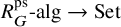 $R^{\mathrm {ps}}_G\text {-}\mathrm {alg}\rightarrow \text {Set}$
such that
$R^{\mathrm {ps}}_G\text {-}\mathrm {alg}\rightarrow \text {Set}$
such that $X^{\mathrm {gen}}_{G, \overline {\rho }^{\mathrm {ss}}}(A)$
is the set of representations
$X^{\mathrm {gen}}_{G, \overline {\rho }^{\mathrm {ss}}}(A)$
is the set of representations $\rho : \Gamma _F \rightarrow G(A)$
, such that
$\rho : \Gamma _F \rightarrow G(A)$
, such that $\Theta _{\rho }$
is the specialisation of the universal G-pseudocharacter
$\Theta _{\rho }$
is the specialisation of the universal G-pseudocharacter $\Theta ^u$
along
$\Theta ^u$
along $R^{\mathrm {ps}}_G\rightarrow A$
and
$R^{\mathrm {ps}}_G\rightarrow A$
and $\rho $
extends to a homomorphism of condensed groups
$\rho $
extends to a homomorphism of condensed groups
 $$ \begin{align*}\tilde{\rho}: \underline{\Gamma_F} \rightarrow G(A_{\operatorname{disc}}\otimes_{(R^{\mathrm{ps}}_G)_{\operatorname{disc}}} \underline{R^{\mathrm{ps}}_G}).\end{align*} $$
We refer the reader to Section 4.2 for the notation. In Lemma 4.8 we show that the condensed condition can be reformulated as follows: for some (equivalently any) closed immersion $\tau : G\hookrightarrow \mathbb A^n$
the image
$\tau : G\hookrightarrow \mathbb A^n$
the image $\tau (\rho (\Gamma _F))$
is contained in a finitely generated
$\tau (\rho (\Gamma _F))$
is contained in a finitely generated $R^{\mathrm {ps}}_G$
-submodule
$R^{\mathrm {ps}}_G$
-submodule $M \subseteq A^n = \mathbb A^n(A)$
such that the map
$M \subseteq A^n = \mathbb A^n(A)$
such that the map $\tau \circ \rho : \Gamma _F \rightarrow M$
is continuous for the canonical topology on M as an
$\tau \circ \rho : \Gamma _F \rightarrow M$
is continuous for the canonical topology on M as an $R^{\mathrm {ps}}_G$
-module. We call such representations
$R^{\mathrm {ps}}_G$
-module. We call such representations $R^{\mathrm {ps}}_G$
-condensed. This definition of
$R^{\mathrm {ps}}_G$
-condensed. This definition of $X^{\mathrm {gen}}_{G, \overline {\rho }^{\mathrm {ss}}}$
is aesthetically pleasing and helpful to prove that
$X^{\mathrm {gen}}_{G, \overline {\rho }^{\mathrm {ss}}}$
is aesthetically pleasing and helpful to prove that $X^{\mathrm {gen}}_{G, \overline {\rho }^{\mathrm {ss}}}$
is functorial in G. However, it is not immediately clear (at least to the authors) from the definition that the functor is representable by a finite type
$X^{\mathrm {gen}}_{G, \overline {\rho }^{\mathrm {ss}}}$
is functorial in G. However, it is not immediately clear (at least to the authors) from the definition that the functor is representable by a finite type $R^{\mathrm {ps}}_G$
-algebra.
$R^{\mathrm {ps}}_G$
-algebra.
If $G={\mathrm {GL}}_d$
then one may linearise representations and work instead with Cayley–Hamilton homomorphisms of
$G={\mathrm {GL}}_d$
then one may linearise representations and work instead with Cayley–Hamilton homomorphisms of $R^{\mathrm {ps}}_{{\mathrm {GL}}_d}$
-algebras
$R^{\mathrm {ps}}_{{\mathrm {GL}}_d}$
-algebras $E^{u}\rightarrow M_d(A)$
, where
$E^{u}\rightarrow M_d(A)$
, where $E^u$
is a universal Cayley–Hamilton quotient of the completed group algebra
$E^u$
is a universal Cayley–Hamilton quotient of the completed group algebra  . We refer the reader to Section 5.1 for more details. Wang-Erickson has shown in [Reference Wang-Erickson62] that the algebra $E^u$
is a finitely generated
$E^u$
is a finitely generated $R^{\mathrm {ps}}_{{\mathrm {GL}}_d}$
-module. This result is the reason why
$R^{\mathrm {ps}}_{{\mathrm {GL}}_d}$
-module. This result is the reason why $R^{\mathrm {ps}}_{{\mathrm {GL}}_d}$
-condensed representations do not explicitly appear in [Reference Böckle, Iyengar and Paškūnas6]. In Lemma 5.2 we show that
$R^{\mathrm {ps}}_{{\mathrm {GL}}_d}$
-condensed representations do not explicitly appear in [Reference Böckle, Iyengar and Paškūnas6]. In Lemma 5.2 we show that $X^{\mathrm {gen}}_{{\mathrm {GL}}_d, \overline {\rho }^{\mathrm {ss}}}$
coincides with the scheme
$X^{\mathrm {gen}}_{{\mathrm {GL}}_d, \overline {\rho }^{\mathrm {ss}}}$
coincides with the scheme $X^{\mathrm {gen}}$
defined in [Reference Böckle, Iyengar and Paškūnas6]. In particular, it is represented by a finite type
$X^{\mathrm {gen}}$
defined in [Reference Böckle, Iyengar and Paškūnas6]. In particular, it is represented by a finite type $R^{\mathrm {ps}}_{{\mathrm {GL}}_d}$
-algebra
$R^{\mathrm {ps}}_{{\mathrm {GL}}_d}$
-algebra $A^{\mathrm {gen}}_{{\mathrm {GL}}_d}$
.
$A^{\mathrm {gen}}_{{\mathrm {GL}}_d}$
.
In the general case, we fix a closed immersion $\tau : G \hookrightarrow {\mathrm {GL}}_d$
of
$\tau : G \hookrightarrow {\mathrm {GL}}_d$
of $\mathscr O$
-group schemes and define
$\mathscr O$
-group schemes and define $X^{\mathrm {gen}, \tau }_G$
as a closed subscheme of
$X^{\mathrm {gen}, \tau }_G$
as a closed subscheme of $X^{\mathrm {gen}}_{{\mathrm {GL}}_d}:=X^{\mathrm {gen}}_{{\mathrm {GL}}_d, (\tau \circ \overline {\rho })^{\mathrm {ss}}}$
, such that
$X^{\mathrm {gen}}_{{\mathrm {GL}}_d}:=X^{\mathrm {gen}}_{{\mathrm {GL}}_d, (\tau \circ \overline {\rho })^{\mathrm {ss}}}$
, such that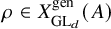 $\rho \in X^{\mathrm {gen}}_{{\mathrm {GL}}_d}(A)$
lies in
$\rho \in X^{\mathrm {gen}}_{{\mathrm {GL}}_d}(A)$
lies in $X^{\mathrm {gen}, \tau }_G(A)$
if and only if
$X^{\mathrm {gen}, \tau }_G(A)$
if and only if $\rho (\Gamma _F)$
is contained in
$\rho (\Gamma _F)$
is contained in $\tau (G(A))$
. The functor
$\tau (G(A))$
. The functor $X^{\mathrm {gen}, \tau }_G$
is representable by a finite type
$X^{\mathrm {gen}, \tau }_G$
is representable by a finite type $R^{\mathrm {ps}}_{{\mathrm {GL}}_d}$
-algebra
$R^{\mathrm {ps}}_{{\mathrm {GL}}_d}$
-algebra $A^{\mathrm {gen}, \tau }_G$
. We show in Proposition 8.3 that the connected component of
$A^{\mathrm {gen}, \tau }_G$
. We show in Proposition 8.3 that the connected component of $X^{\mathrm {gen},\tau }_G$
containing the point corresponding to
$X^{\mathrm {gen},\tau }_G$
containing the point corresponding to $\overline {\rho }:\Gamma _F \rightarrow G(k)$
is canonically isomorphic to the functor
$\overline {\rho }:\Gamma _F \rightarrow G(k)$
is canonically isomorphic to the functor $X^{\mathrm {gen}}_{G, \overline {\rho }^{\mathrm {ss}}}$
defined via condensed mathematics as above. In particular, the connected component is independent of the chosen embedding
$X^{\mathrm {gen}}_{G, \overline {\rho }^{\mathrm {ss}}}$
defined via condensed mathematics as above. In particular, the connected component is independent of the chosen embedding $\tau $
. Using the construction via
$\tau $
. Using the construction via $X^{\mathrm {gen}, \tau }_G$
we show that desiderata (D1), (D2), (D3) hold. The condensed description allows to show in Proposition 8.5 that
$X^{\mathrm {gen}, \tau }_G$
we show that desiderata (D1), (D2), (D3) hold. The condensed description allows to show in Proposition 8.5 that $X^{\mathrm {gen}}_{G, \overline {\rho }^{\mathrm {ss}}}$
is functorial in G.
$X^{\mathrm {gen}}_{G, \overline {\rho }^{\mathrm {ss}}}$
is functorial in G.
A key input in the above argument is the following fundamental finiteness theorem proved by Vinberg [Reference Vinberg61], when S is a spectrum of a field of characteristic zero, by Martin [Reference Martin42], when S is a spectrum of a field of characteristic p, and by Cotner [Reference Cotner21] in general.
Theorem 1.7 (Cotner, [Reference Cotner21]).
Let S be a locally noetherian scheme and let $f: H\rightarrow G$
be a finite morphism of generalised reductive smooth affine S-group schemes. Then the induced map on the GIT quotients
$f: H\rightarrow G$
be a finite morphism of generalised reductive smooth affine S-group schemes. Then the induced map on the GIT quotients

is finite, where the action on both sides is given by conjugation.
The homomorphism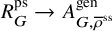 $R^{\mathrm {ps}}_G \rightarrow A^{\mathrm {gen}}_{G, \overline {\rho }^{\mathrm {ss}}}$
is
$R^{\mathrm {ps}}_G \rightarrow A^{\mathrm {gen}}_{G, \overline {\rho }^{\mathrm {ss}}}$
is $G^0$
-equivariant for the trivial action on the source. Hence, its image is contained in
$G^0$
-equivariant for the trivial action on the source. Hence, its image is contained in $G^0$
-invariants
$G^0$
-invariants $R^{\mathrm {git}}_{G, \overline {\rho }^{\mathrm {ss}}}$
, which represents the GIT quotient
$R^{\mathrm {git}}_{G, \overline {\rho }^{\mathrm {ss}}}$
, which represents the GIT quotient  .
.
Proposition 1.8 (Proposition 7.4).
The morphism  is a finite universal homeomorphism.
We expect that the morphism is adequate in the sense of Alper [Reference Alper1], that is, moreover ${R^{\mathrm {ps}}_G[1/p] \cong R^{\mathrm {git}}_{G, \overline {\rho }^{\mathrm {ss}}}[1/p]}$
, and hope to return to this question in future workFootnote
1
. If this were true then one could show that
${R^{\mathrm {ps}}_G[1/p] \cong R^{\mathrm {git}}_{G, \overline {\rho }^{\mathrm {ss}}}[1/p]}$
, and hope to return to this question in future workFootnote
1
. If this were true then one could show that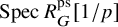 ${\mathrm {Spec}} R^{\mathrm {ps}}_G[1/p]$
is reduced and hence normal, as explained in Section 1.3.
${\mathrm {Spec}} R^{\mathrm {ps}}_G[1/p]$
is reduced and hence normal, as explained in Section 1.3.
We define $X^{\mathrm {gen}}_{G, \overline {\rho }^{\mathrm {ss}}}$
for any profinite group
$X^{\mathrm {gen}}_{G, \overline {\rho }^{\mathrm {ss}}}$
for any profinite group $\Gamma $
satisfying Mazur’s p-finiteness condition. However, starting with Section 12 we use in an essential way that
$\Gamma $
satisfying Mazur’s p-finiteness condition. However, starting with Section 12 we use in an essential way that $\Gamma =\Gamma _F$
: besides Euler–Poincaré characteristic formula, it is crucial to our argument that using local Tate duality we may transfer obstructions to lifting from
$\Gamma =\Gamma _F$
: besides Euler–Poincaré characteristic formula, it is crucial to our argument that using local Tate duality we may transfer obstructions to lifting from $H^2$
to
$H^2$
to $H^0$
.
$H^0$
.
1.4.2 Bounding the dimension
We will now sketch how we obtain the bound (2). Let $Y_{\overline {\rho }^{\mathrm {ss}}}$
be the preimage of the closed point of
$Y_{\overline {\rho }^{\mathrm {ss}}}$
be the preimage of the closed point of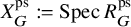 $X^{\mathrm {ps}}_G:= {\mathrm {Spec}} R^{\mathrm {ps}}_G$
in
$X^{\mathrm {ps}}_G:= {\mathrm {Spec}} R^{\mathrm {ps}}_G$
in $X^{\mathrm {gen}}_{G, \overline {\rho }^{\mathrm {ss}}}$
. We bound the dimension of
$X^{\mathrm {gen}}_{G, \overline {\rho }^{\mathrm {ss}}}$
. We bound the dimension of $Y_{\overline {\rho }^{\mathrm {ss}}}$
in Corollary 12.18. Its complement V and the special fibre
$Y_{\overline {\rho }^{\mathrm {ss}}}$
in Corollary 12.18. Its complement V and the special fibre $\overline {{V}}$
of V are Jacobson schemes and residue fields of closed points
$\overline {{V}}$
of V are Jacobson schemes and residue fields of closed points $x\in V$
are local fields. Moreover, in Lemma 5.17 we relate the completions of local rings
$x\in V$
are local fields. Moreover, in Lemma 5.17 we relate the completions of local rings $\mathscr O_{V, x}$
to the deformation rings
$\mathscr O_{V, x}$
to the deformation rings $R^{\square }_{G, \rho _x}$
, and completions of local rings
$R^{\square }_{G, \rho _x}$
, and completions of local rings $\mathscr O_{\overline {{V}}, x}$
to
$\mathscr O_{\overline {{V}}, x}$
to $R^{\square }_{G, \rho _x}/\varpi $
. The upshot is that if we control the dimension of
$R^{\square }_{G, \rho _x}/\varpi $
. The upshot is that if we control the dimension of $R^{\square }_{G, \rho _x}/\varpi $
then we control the dimension of
$R^{\square }_{G, \rho _x}/\varpi $
then we control the dimension of $\mathscr O_{\overline {{V}},x}$
and if we can do this at every closed point then we can bound the dimension of
$\mathscr O_{\overline {{V}},x}$
and if we can do this at every closed point then we can bound the dimension of $\overline {{V}}$
and the dimension of its closure in
$\overline {{V}}$
and the dimension of its closure in $\overline {X}^{\mathrm {gen}}_{G, \overline {\rho }^{\mathrm {ss}}}$
. In Proposition 3.6 we establish a presentation
$\overline {X}^{\mathrm {gen}}_{G, \overline {\rho }^{\mathrm {ss}}}$
. In Proposition 3.6 we establish a presentation

where $s=\dim _{\kappa (x)} H^2(\Gamma _F, {\mathrm {ad}}^0 \rho _x)$
and
$s=\dim _{\kappa (x)} H^2(\Gamma _F, {\mathrm {ad}}^0 \rho _x)$
and $r-s= \dim G^{\prime }_k ([F:\mathbb {Q}_p]+1)$
. We deduce from the results of [Reference Paškūnas and Quast48] that if
$r-s= \dim G^{\prime }_k ([F:\mathbb {Q}_p]+1)$
. We deduce from the results of [Reference Paškūnas and Quast48] that if $x\in \overline {{V}}$
is a closed point then
$x\in \overline {{V}}$
is a closed point then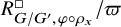 $R^{\square }_{G/G', \varphi \circ \rho _x}/\varpi $
is formally smooth over the group algebra
$R^{\square }_{G/G', \varphi \circ \rho _x}/\varpi $
is formally smooth over the group algebra $\kappa (x)[\mu ]$
of dimension
$\kappa (x)[\mu ]$
of dimension $\dim (G/G')_k ([F:\mathbb {Q}_p]+1)$
, where
$\dim (G/G')_k ([F:\mathbb {Q}_p]+1)$
, where $\mu =(\mu _{p^{\infty }}(E)\otimes M)^{{\mathrm {Gal}}(E/F)}$
. This is easy if
$\mu =(\mu _{p^{\infty }}(E)\otimes M)^{{\mathrm {Gal}}(E/F)}$
. This is easy if $G={\mathrm {GL}}_d$
or more generally if G is connected, but requires a non-trivial argument in the non-connected case, which we carry out in [Reference Paškūnas and Quast48]. This allows us to conclude that the closure in
$G={\mathrm {GL}}_d$
or more generally if G is connected, but requires a non-trivial argument in the non-connected case, which we carry out in [Reference Paškūnas and Quast48]. This allows us to conclude that the closure in $\overline {X}^{\mathrm {gen}}_{G, \overline {\rho }^{\mathrm {ss}}}$
of the locus in
$\overline {X}^{\mathrm {gen}}_{G, \overline {\rho }^{\mathrm {ss}}}$
of the locus in $\overline {{V}}$
, where
$\overline {{V}}$
, where $H^2(\Gamma _F, {\mathrm {ad}}^0\rho _x)$
vanishes, has dimension
$H^2(\Gamma _F, {\mathrm {ad}}^0\rho _x)$
vanishes, has dimension $\dim G_k([F:\mathbb {Q}_p]+1)$
, if non-empty. This locus will be referred to as the
$\dim G_k([F:\mathbb {Q}_p]+1)$
, if non-empty. This locus will be referred to as the $({\mathrm {Lie}} G^{\prime }_k)^*$
-non-special locus later on.
$({\mathrm {Lie}} G^{\prime }_k)^*$
-non-special locus later on.
One is left to understand the locus, where $H^2(\Gamma _F, {\mathrm {ad}}^0\rho _x)\neq 0$
. By local Tate duality this is equivalent to
$H^2(\Gamma _F, {\mathrm {ad}}^0\rho _x)\neq 0$
. By local Tate duality this is equivalent to $H^0(\Gamma _F, ({\mathrm {ad}}^0 \rho _x)^*(1))\neq 0$
. Let us suppose that
$H^0(\Gamma _F, ({\mathrm {ad}}^0 \rho _x)^*(1))\neq 0$
. Let us suppose that $\rho _x$
is absolutely G-irreducible. If
$\rho _x$
is absolutely G-irreducible. If $G={\mathrm {GL}}_d$
then Böckle–Juschka show in [Reference Böckle and Juschka7] that non-vanishing of
$G={\mathrm {GL}}_d$
then Böckle–Juschka show in [Reference Böckle and Juschka7] that non-vanishing of $H^0(\Gamma _F, ({\mathrm {ad}}^0 \rho _x)^*(1))$
implies that
$H^0(\Gamma _F, ({\mathrm {ad}}^0 \rho _x)^*(1))$
implies that $\rho _x$
is induced from
$\rho _x$
is induced from $\Gamma _{F'}$
, where
$\Gamma _{F'}$
, where $F'$
is a proper abelian extension of F. We know the dimension of
$F'$
is a proper abelian extension of F. We know the dimension of $\overline {X}^{\mathrm {ps}, \Gamma _{F'}}_{{\mathrm {GL}}_{d'}}$
, where
$\overline {X}^{\mathrm {ps}, \Gamma _{F'}}_{{\mathrm {GL}}_{d'}}$
, where $d'=\frac {d}{[F':F]}$
, inductively and using this it is shown in [Reference Böckle, Iyengar and Paškūnas6] that the closure of this locus has positive codimension. Such arguments might work for classical groups (JQ has studied the case
$d'=\frac {d}{[F':F]}$
, inductively and using this it is shown in [Reference Böckle, Iyengar and Paškūnas6] that the closure of this locus has positive codimension. Such arguments might work for classical groups (JQ has studied the case $G={\mathrm {Sp}}_{2n}$
under the assumption
$G={\mathrm {Sp}}_{2n}$
under the assumption $p>2$
in [Reference Quast50, Section 7]), but it seems impossible to get a characterisation like this for an arbitrary generalised reductive group.
$p>2$
in [Reference Quast50, Section 7]), but it seems impossible to get a characterisation like this for an arbitrary generalised reductive group.
Our key observation is that instead of having such a precise description of $\rho _x$
, it is enough to observe that
$\rho _x$
, it is enough to observe that $\rho _x$
has ‘small’ image. Namely, let H be the Zariski closure of
$\rho _x$
has ‘small’ image. Namely, let H be the Zariski closure of $\rho _x(\Gamma _F)$
in
$\rho _x(\Gamma _F)$
in $G(\kappa )$
, where
$G(\kappa )$
, where $\kappa $
is the algebraic closure of
$\kappa $
is the algebraic closure of $\kappa (x)$
. Since
$\kappa (x)$
. Since $\rho _x$
is absolutely G-irreducible, its image is not contained in any parabolic subgroup of
$\rho _x$
is absolutely G-irreducible, its image is not contained in any parabolic subgroup of $G_{\kappa }$
. A theorem of Martin [Reference Martin42] asserts that H is again generalised reductive. In Section 10 we prove two results:
$G_{\kappa }$
. A theorem of Martin [Reference Martin42] asserts that H is again generalised reductive. In Section 10 we prove two results:
Proposition 1.9 (Corollary 10.2).
If a generalised reductive subgroup H of $G_{\kappa }$
does not contain
$G_{\kappa }$
does not contain $G^{\prime }_{\kappa }$
then
$G^{\prime }_{\kappa }$
then $\dim G_{\kappa } -\dim H\ge 2$
.
$\dim G_{\kappa } -\dim H\ge 2$
.
Our original proof of the above result used Matsushima’s theorem. The current simpler proof was suggested by both Sean Cotner and the anonymous referee.
Lemma 1.10 (Lemma 10.5).
The $G^{\prime }_{\kappa }$
-invariants in
$G^{\prime }_{\kappa }$
-invariants in $({\mathrm {Lie}} G^{\prime }_{\operatorname {sc}})^*_{\kappa }$
are zero.
$({\mathrm {Lie}} G^{\prime }_{\operatorname {sc}})^*_{\kappa }$
are zero.
We note that the above Lemma would be false in small characteristics if we did not take the dual. We first prove it for ${\mathrm {SL}}_2$
and then use this together with arguments with roots to prove it in the general case.
${\mathrm {SL}}_2$
and then use this together with arguments with roots to prove it in the general case.
Let us go back to the situation at hand, where H is the Zariski closure of $\rho _x(\Gamma _F)$
in
$\rho _x(\Gamma _F)$
in $G(\kappa )$
. If x lies in the special fibre, then the twisting operation by the cyclotomic character becomes trivial after the restriction to
$G(\kappa )$
. If x lies in the special fibre, then the twisting operation by the cyclotomic character becomes trivial after the restriction to $\Gamma _{F(\zeta _p)}$
. Using this we show that non-vanishing of
$\Gamma _{F(\zeta _p)}$
. Using this we show that non-vanishing of $H^0(\Gamma _F, ({\mathrm {ad}} \rho _x)^*(1))$
implies that the neutral component
$H^0(\Gamma _F, ({\mathrm {ad}} \rho _x)^*(1))$
implies that the neutral component $H^0$
of H has non-zero invariants in
$H^0$
of H has non-zero invariants in $({\mathrm {Lie}} G')^*_{\kappa }$
. If
$({\mathrm {Lie}} G')^*_{\kappa }$
. If $\pi _1(G')$
is étale or
$\pi _1(G')$
is étale or $\mathrm {char}(\kappa )=0$
then
$\mathrm {char}(\kappa )=0$
then $({\mathrm {Lie}} G')^*_{\kappa } =({\mathrm {Lie}} G^{\prime }_{\operatorname {sc}})^*_{\kappa }$
and Proposition 1.9 and Lemma 1.10 imply that
$({\mathrm {Lie}} G')^*_{\kappa } =({\mathrm {Lie}} G^{\prime }_{\operatorname {sc}})^*_{\kappa }$
and Proposition 1.9 and Lemma 1.10 imply that $\dim G_{\kappa }-\dim H^0\ge 2$
and hence
$\dim G_{\kappa }-\dim H^0\ge 2$
and hence $\dim G_{\kappa }- \dim H \ge 2$
. The fact that the difference can be bounded below by
$\dim G_{\kappa }- \dim H \ge 2$
. The fact that the difference can be bounded below by $2$
(and not by
$2$
(and not by $1$
) plays an important role in verifying Serre’s criterion for normality in the proof of Theorem 1.3. As you can see there is an induction argument shaping up. To explain it we need two further ingredients.
$1$
) plays an important role in verifying Serre’s criterion for normality in the proof of Theorem 1.3. As you can see there is an induction argument shaping up. To explain it we need two further ingredients.
Let W be an algebraic representation of G on a finite free $\mathscr O$
-module, and let
$\mathscr O$
-module, and let $\rho : \Gamma _F \rightarrow G(A)$
be a representation, where A is a noetherian
$\rho : \Gamma _F \rightarrow G(A)$
be a representation, where A is a noetherian $\mathscr O$
-algebra. We show in Lemma 13.8 that there is a closed subscheme
$\mathscr O$
-algebra. We show in Lemma 13.8 that there is a closed subscheme $X_{W,j}$
of
$X_{W,j}$
of $X={\mathrm {Spec}} A$
such that
$X={\mathrm {Spec}} A$
such that
 $$ \begin{align*}x\in X_{W,j} \iff \dim_{\kappa(x)} H^0(\Gamma_F, W\otimes_{\mathscr{O}} \kappa(x)(1))\ge j+1.\end{align*} $$
We refer to $X_{W,j}$
as the W-special locus of level j and just the W-special locus when
$X_{W,j}$
as the W-special locus of level j and just the W-special locus when $j=0$
. The complement of the W-special locus is called W-non-special. The proof amounts to reformulating these conditions in terms of some finitely generated A-module and a little of commutative algebra. We apply this notion to
$j=0$
. The complement of the W-special locus is called W-non-special. The proof amounts to reformulating these conditions in terms of some finitely generated A-module and a little of commutative algebra. We apply this notion to $W=({\mathrm {Lie}} G^{\prime }_{\operatorname {sc}})^*$
and if the image of
$W=({\mathrm {Lie}} G^{\prime }_{\operatorname {sc}})^*$
and if the image of $\rho $
is contained in
$\rho $
is contained in $P(A)$
, where P is a parabolic subgroup scheme of G with unipotent radical U, then we apply it to
$P(A)$
, where P is a parabolic subgroup scheme of G with unipotent radical U, then we apply it to $W=({\mathrm {Lie}} U)^*$
. When working with the special fibre we consider representations W over k instead of
$W=({\mathrm {Lie}} U)^*$
. When working with the special fibre we consider representations W over k instead of $\mathscr O$
.
$\mathscr O$
.
The second ingredient, which uses Theorem 1.7 as an input, is the following finiteness result proved in Proposition 8.6. If $H\rightarrow G_k$
is a finite morphism of generalised reductive k-group schemes which maps an H-pseudocharacter
$H\rightarrow G_k$
is a finite morphism of generalised reductive k-group schemes which maps an H-pseudocharacter $\overline {\Psi }$
to
$\overline {\Psi }$
to $\overline {\Theta }$
then the natural map
$\overline {\Theta }$
then the natural map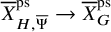 $\overline {X}^{\mathrm {ps}}_{H, \overline {\Psi }} \rightarrow \overline {X}^{\mathrm {ps}}_G$
is finite. Moreover, there are only finitely many H-pseudocharacters
$\overline {X}^{\mathrm {ps}}_{H, \overline {\Psi }} \rightarrow \overline {X}^{\mathrm {ps}}_G$
is finite. Moreover, there are only finitely many H-pseudocharacters $\overline {\Psi }$
mapping to
$\overline {\Psi }$
mapping to $\overline {\Theta }$
. In particular, the dimension of the union
$\overline {\Theta }$
. In particular, the dimension of the union $\overline {X}^{\mathrm {ps}}_{HG}$
of the scheme theoretic images can be bounded by the largest
$\overline {X}^{\mathrm {ps}}_{HG}$
of the scheme theoretic images can be bounded by the largest $\dim \overline {X}^{\mathrm {ps}}_{H,\overline {\Psi }}$
.
$\dim \overline {X}^{\mathrm {ps}}_{H,\overline {\Psi }}$
.
We are now in a position to sketch the proof of the bound in (2) when $\overline {\rho }$
is absolutely G-irreducible. From (3) and the relation between
$\overline {\rho }$
is absolutely G-irreducible. From (3) and the relation between $R^{\square }_{G, \rho _x}/\varpi $
and the completions of
$R^{\square }_{G, \rho _x}/\varpi $
and the completions of $\mathscr O_{\overline {{V}},x}$
we obtain a lower bound
$\mathscr O_{\overline {{V}},x}$
we obtain a lower bound
 $$ \begin{align} \dim \overline{X}^{\mathrm{gen}}_{G, \overline{\rho}^{\mathrm{ss}}}\ge \dim G_k ([F:\mathbb {Q}_p]+1). \end{align} $$
We then construct a pair $(G_1, \overline {\rho }_1)$
such that
$(G_1, \overline {\rho }_1)$
such that $\dim G_1\le \dim G$
,
$\dim G_1\le \dim G$
, $\pi _1(G^{\prime }_1)$
is étale and if (2) holds for
$\pi _1(G^{\prime }_1)$
is étale and if (2) holds for $(G_1, \overline {\rho }_1)$
then it also holds for
$(G_1, \overline {\rho }_1)$
then it also holds for $(G, \overline {\rho })$
. For example, if
$(G, \overline {\rho })$
. For example, if $G={\mathrm {PGL}}_d$
then
$G={\mathrm {PGL}}_d$
then $G_1= {\mathrm {SL}}_d/\mu _m$
, where
$G_1= {\mathrm {SL}}_d/\mu _m$
, where $d=p^e m$
and
$d=p^e m$
and $p \nmid m$
, and
$p \nmid m$
, and $\overline {\rho }_1=\overline {\rho }$
as
$\overline {\rho }_1=\overline {\rho }$
as $G(k)=G_1(k)$
. In general, the presence of the component group of G complicates the construction of
$G(k)=G_1(k)$
. In general, the presence of the component group of G complicates the construction of $G_1$
, see Section 2.3. This reduction step allows us to assume that
$G_1$
, see Section 2.3. This reduction step allows us to assume that $\pi _1(G')$
is étale, which implies that
$\pi _1(G')$
is étale, which implies that ${\mathrm {Lie}} G^{\prime }_{\operatorname {sc}}={\mathrm {Lie}} G'$
. We then show that there are finitely many generalised reductive subgroup schemes
${\mathrm {Lie}} G^{\prime }_{\operatorname {sc}}={\mathrm {Lie}} G'$
. We then show that there are finitely many generalised reductive subgroup schemes $H_i$
of
$H_i$
of $G_k$
, defined over some finite extension of k, such that
$G_k$
, defined over some finite extension of k, such that $\dim G_k - \dim H_i \ge 2$
and the
$\dim G_k - \dim H_i \ge 2$
and the $({\mathrm {Lie}} G^{\prime }_{\operatorname {sc}})^*_k$
-special locus in
$({\mathrm {Lie}} G^{\prime }_{\operatorname {sc}})^*_k$
-special locus in $\overline {X}^{\mathrm {gen}}_{G, \overline {\rho }^{\mathrm {ss}}}$
is contained in the preimage of the union of
$\overline {X}^{\mathrm {gen}}_{G, \overline {\rho }^{\mathrm {ss}}}$
is contained in the preimage of the union of $\overline {X}^{\mathrm {ps}}_{H_i G}$
. The assumption that
$\overline {X}^{\mathrm {ps}}_{H_i G}$
. The assumption that $\overline {\rho }$
is absolutely G-irreducible implies that every fibre
$\overline {\rho }$
is absolutely G-irreducible implies that every fibre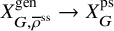 $X^{\mathrm {gen}}_{G,\overline {\rho }^{\mathrm {ss}}}\rightarrow X^{\mathrm {ps}}_G$
has dimension
$X^{\mathrm {gen}}_{G,\overline {\rho }^{\mathrm {ss}}}\rightarrow X^{\mathrm {ps}}_G$
has dimension $\dim G_k - \dim Z(G)_k$
. Inductively, we may bound the dimension of
$\dim G_k - \dim Z(G)_k$
. Inductively, we may bound the dimension of $\overline {X}^{\mathrm {ps}}_{H_iG}$
by
$\overline {X}^{\mathrm {ps}}_{H_iG}$
by $\dim H_i [F:\mathbb {Q}_p] +\dim Z(H_i)$
. Using this we show that the codimension of the
$\dim H_i [F:\mathbb {Q}_p] +\dim Z(H_i)$
. Using this we show that the codimension of the $({\mathrm {Lie}} G^{\prime }_{\operatorname {sc}})^*_k$
-special locus in
$({\mathrm {Lie}} G^{\prime }_{\operatorname {sc}})^*_k$
-special locus in $\overline {X}^{\mathrm {gen}}_{G, \overline {\rho }^{\mathrm {ss}}}$
is at least
$\overline {X}^{\mathrm {gen}}_{G, \overline {\rho }^{\mathrm {ss}}}$
is at least $2[F:\mathbb {Q}_p]$
. It follows from (4) that the
$2[F:\mathbb {Q}_p]$
. It follows from (4) that the $({\mathrm {Lie}} G')^*_k$
-non-special locus in
$({\mathrm {Lie}} G')^*_k$
-non-special locus in $\overline {X}^{\mathrm {gen}}_{G, \overline {\rho }^{\mathrm {ss}}}$
is non-empty and as explained above its closure has dimension
$\overline {X}^{\mathrm {gen}}_{G, \overline {\rho }^{\mathrm {ss}}}$
is non-empty and as explained above its closure has dimension $\dim G_k ([F:\mathbb {Q}_p]+1)$
. This lets us conclude that (4) is an equality.
$\dim G_k ([F:\mathbb {Q}_p]+1)$
. This lets us conclude that (4) is an equality.
Let us briefly indicate how we find the subgroup schemes $H_i$
in the above argument. The
$H_i$
in the above argument. The $({\mathrm {Lie}} G^{\prime }_{\operatorname {sc}})^*_k$
-special locus of level j is non-empty only for finitely many j. The group schemes
$({\mathrm {Lie}} G^{\prime }_{\operatorname {sc}})^*_k$
-special locus of level j is non-empty only for finitely many j. The group schemes $H_i$
correspond to the generic points of these loci for
$H_i$
correspond to the generic points of these loci for $j\ge 0$
. Given such a generic point
$j\ge 0$
. Given such a generic point $\eta $
we let H be the Zariski closure of
$\eta $
we let H be the Zariski closure of $\rho _{\eta }(\Gamma _F)$
in
$\rho _{\eta }(\Gamma _F)$
in $G(\overline {\kappa (\eta )})$
. Since
$G(\overline {\kappa (\eta )})$
. Since $\overline {\rho }^{\mathrm {ss}}$
is assumed to be absolutely G-irreducible H is not contained in any parabolic subgroup of
$\overline {\rho }^{\mathrm {ss}}$
is assumed to be absolutely G-irreducible H is not contained in any parabolic subgroup of $G_{\overline {\kappa (\eta )}}$
and hence is generalised reductive. A conjugate of H by an element of
$G_{\overline {\kappa (\eta )}}$
and hence is generalised reductive. A conjugate of H by an element of $G(\overline {\kappa (\eta )})$
can be defined over
$G(\overline {\kappa (\eta )})$
can be defined over $\overline {k}$
and hence over a finite extension of k. Our arguments with generalised reductive groups over algebraically closed fields use results of Martin [Reference Martin42] and Bate–Martin–Röhrle [Reference Bate, Martin and Röhrle3] in an essential way.
$\overline {k}$
and hence over a finite extension of k. Our arguments with generalised reductive groups over algebraically closed fields use results of Martin [Reference Martin42] and Bate–Martin–Röhrle [Reference Bate, Martin and Röhrle3] in an essential way.
The general case is an elaboration of this inductive argument. If $\overline {\rho }^{\mathrm {ss}}$
is not absolutely G-irreducible then the dimensions of the fibres
$\overline {\rho }^{\mathrm {ss}}$
is not absolutely G-irreducible then the dimensions of the fibres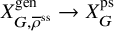 $X^{\mathrm {gen}}_{G, \overline {\rho }^{\mathrm {ss}}}\rightarrow X^{\mathrm {ps}}_G$
can vary. We bound their dimensions in Section 12. We stratify
$X^{\mathrm {gen}}_{G, \overline {\rho }^{\mathrm {ss}}}\rightarrow X^{\mathrm {ps}}_G$
can vary. We bound their dimensions in Section 12. We stratify $\overline {X}^{\mathrm {ps}}_G$
by
$\overline {X}^{\mathrm {ps}}_G$
by $\overline {X}^{\mathrm {ps}}_{LG}$
, where L runs over the Levi subgroup schemes of G containing a fixed maximal split torus. If
$\overline {X}^{\mathrm {ps}}_{LG}$
, where L runs over the Levi subgroup schemes of G containing a fixed maximal split torus. If $y\in \overline {X}^{\mathrm {ps}}_{LG}$
, but does not lie in any
$y\in \overline {X}^{\mathrm {ps}}_{LG}$
, but does not lie in any $\overline {X}^{\mathrm {ps}}_{L'G}$
for a proper Levi
$\overline {X}^{\mathrm {ps}}_{L'G}$
for a proper Levi $L'\subsetneq L$
then for typical y the fibre will have dimension
$L'\subsetneq L$
then for typical y the fibre will have dimension $\dim G_k - \dim Z(L)_k +\dim U_k [F:\mathbb {Q}_p]$
, where U is the unipotent radical of any parabolic subgroup with Levi L. By induction we know that
$\dim G_k - \dim Z(L)_k +\dim U_k [F:\mathbb {Q}_p]$
, where U is the unipotent radical of any parabolic subgroup with Levi L. By induction we know that $\dim \overline {X}^{\mathrm {ps}}_{LG}$
is at most
$\dim \overline {X}^{\mathrm {ps}}_{LG}$
is at most $\dim L_k [F:\mathbb {Q}_p]+ \dim Z(L)_k$
. The sum of these numbers does not exceed
$\dim L_k [F:\mathbb {Q}_p]+ \dim Z(L)_k$
. The sum of these numbers does not exceed $\dim G_k ([F:\mathbb {Q}_p]+1)$
. In fact, the difference is equal to
$\dim G_k ([F:\mathbb {Q}_p]+1)$
. In fact, the difference is equal to $\dim U_k [F:\mathbb {Q}_p]$
. We deal with the fibres, which have dimension exceeding
$\dim U_k [F:\mathbb {Q}_p]$
. We deal with the fibres, which have dimension exceeding $\dim G_k - \dim Z(L)_k +\dim U_k [F:\mathbb {Q}_p]$
by considering the
$\dim G_k - \dim Z(L)_k +\dim U_k [F:\mathbb {Q}_p]$
by considering the $({\mathrm {Lie}} U_k)^{\ast }$
-special locus inside
$({\mathrm {Lie}} U_k)^{\ast }$
-special locus inside $X^{\mathrm {ps}}_L$
. The inductive argument is carried out in Section 13.
$X^{\mathrm {ps}}_L$
. The inductive argument is carried out in Section 13.
If $X^{\mathrm {ps}}_{LG}$
is non-empty for a Levi subgroup L satisfying
$X^{\mathrm {ps}}_{LG}$
is non-empty for a Levi subgroup L satisfying $\dim G -\dim L=2$
then the bound
$\dim G -\dim L=2$
then the bound ${\dim U_k [F:\mathbb {Q}_p]}$
is not good enough to apply the Serre’s criterion for normality, when
${\dim U_k [F:\mathbb {Q}_p]}$
is not good enough to apply the Serre’s criterion for normality, when $F=\mathbb {Q}_p$
, as the assumption on L forces
$F=\mathbb {Q}_p$
, as the assumption on L forces $\dim U_k = 1$
. We analyse the
$\dim U_k = 1$
. We analyse the $({\mathrm {Lie}} G^{\prime }_{\operatorname {sc}})^{\ast }$
-non-special locus in the preimage of
$({\mathrm {Lie}} G^{\prime }_{\operatorname {sc}})^{\ast }$
-non-special locus in the preimage of $X^{\mathrm {ps}}_{LG}$
in
$X^{\mathrm {ps}}_{LG}$
in $X^{\mathrm {gen}}_{G, \overline {\rho }^{\mathrm {ss}}}$
in this case in detail in Section 11. In Section 14 we show that the
$X^{\mathrm {gen}}_{G, \overline {\rho }^{\mathrm {ss}}}$
in this case in detail in Section 11. In Section 14 we show that the $({\mathrm {Lie}} G^{\prime }_{\operatorname {sc}})^{\ast }$
-special locus in
$({\mathrm {Lie}} G^{\prime }_{\operatorname {sc}})^{\ast }$
-special locus in $X^{\mathrm {gen}}_{G, \overline {\rho }^{\mathrm {ss}}}$
and also in
$X^{\mathrm {gen}}_{G, \overline {\rho }^{\mathrm {ss}}}$
and also in $\overline {X}^{\mathrm {gen}}_{G, \overline {\rho }^{\mathrm {ss}}}$
has codimension of at least
$\overline {X}^{\mathrm {gen}}_{G, \overline {\rho }^{\mathrm {ss}}}$
has codimension of at least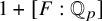 $1+[F:\mathbb {Q}_p]$
and of at least
$1+[F:\mathbb {Q}_p]$
and of at least $2[F:\mathbb {Q}_p]$
if
$2[F:\mathbb {Q}_p]$
if $X^{\mathrm {ps}}_{LG}$
is empty for all Levi subgroups L of codimension
$X^{\mathrm {ps}}_{LG}$
is empty for all Levi subgroups L of codimension $2$
.
$2$
.
1.5 Irreducible components
We will sketch the proof of Theorem 1.3. Using the results of [Reference Paškūnas and Quast48] we show that

where $l= \dim (G/G')_k - \dim Z(G/G')_k$
,
$l= \dim (G/G')_k - \dim Z(G/G')_k$
, $m+l= \dim (G/G')_k ([F:\mathbb {Q}_p]+1)$
and
$m+l= \dim (G/G')_k ([F:\mathbb {Q}_p]+1)$
and $\mu ={(\mu _{p^{\infty }}(E)\otimes M)^{{\mathrm {Gal}}(E/F)}}$
. Let
$\mu ={(\mu _{p^{\infty }}(E)\otimes M)^{{\mathrm {Gal}}(E/F)}}$
. Let $\mathrm {X}(\mu )$
be the group of characters
$\mathrm {X}(\mu )$
be the group of characters $\chi : \mu \rightarrow \mathscr O^{\times }$
. If A is an
$\chi : \mu \rightarrow \mathscr O^{\times }$
. If A is an $A^{\mathrm {gen}}_{G/G', \overline {\psi }^{\mathrm {ss}}}$
-algebra then we use (5) to define
$A^{\mathrm {gen}}_{G/G', \overline {\psi }^{\mathrm {ss}}}$
-algebra then we use (5) to define $A^{\chi }:= A\otimes _{\mathscr O[\mu ], \chi } \mathscr O$
and if
$A^{\chi }:= A\otimes _{\mathscr O[\mu ], \chi } \mathscr O$
and if $X={\mathrm {Spec}} A$
we write
$X={\mathrm {Spec}} A$
we write $X^{\chi }:={\mathrm {Spec}} A^{\chi }$
. It follows from (5) that the irreducible components of
$X^{\chi }:={\mathrm {Spec}} A^{\chi }$
. It follows from (5) that the irreducible components of $X^{\mathrm {gen}}_{G/G', \overline {\psi }^{\mathrm {ss}}}$
are given by
$X^{\mathrm {gen}}_{G/G', \overline {\psi }^{\mathrm {ss}}}$
are given by $X^{\mathrm {gen}, \chi }_{G/G', \overline {\psi }^{\mathrm {ss}}}$
for
$X^{\mathrm {gen}, \chi }_{G/G', \overline {\psi }^{\mathrm {ss}}}$
for $\chi \in \mathrm X(\mu )$
and are regular. In particular, the completions of local rings of
$\chi \in \mathrm X(\mu )$
and are regular. In particular, the completions of local rings of $X^{\mathrm {gen}, \chi }_{G/G', \overline {\psi }^{\mathrm {ss}}}$
are also regular. Thus the presentation (3) gives us a presentation
$X^{\mathrm {gen}, \chi }_{G/G', \overline {\psi }^{\mathrm {ss}}}$
are also regular. Thus the presentation (3) gives us a presentation

where $R^{\square ,\chi }_{G/G', \varphi \circ \rho _x}$
is a regular ring. Further, if x is in the
$R^{\square ,\chi }_{G/G', \varphi \circ \rho _x}$
is a regular ring. Further, if x is in the $({\mathrm {Lie}} G')^{\ast }$
-non-special locus then s in the above presentation is
$({\mathrm {Lie}} G')^{\ast }$
-non-special locus then s in the above presentation is $0$
and we can conclude that
$0$
and we can conclude that $R^{\square ,\chi }_{G, \rho _x}$
is a regular ring. We deduce that the
$R^{\square ,\chi }_{G, \rho _x}$
is a regular ring. We deduce that the $({\mathrm {Lie}} G')^{\ast }$
-non-special locus in
$({\mathrm {Lie}} G')^{\ast }$
-non-special locus in $X^{\mathrm {gen},\chi }_{G, \overline {\rho }^{\mathrm {ss}}}$
is contained in the regular locus. In general, the
$X^{\mathrm {gen},\chi }_{G, \overline {\rho }^{\mathrm {ss}}}$
is contained in the regular locus. In general, the $({\mathrm {Lie}} G')^{\ast }$
-non-special locus might be empty, for example this happens if
$({\mathrm {Lie}} G')^{\ast }$
-non-special locus might be empty, for example this happens if $G={\mathrm {PGL}}_p$
. On the other hand the complement of
$G={\mathrm {PGL}}_p$
. On the other hand the complement of $({\mathrm {Lie}} G^{\prime }_{\operatorname {sc}})^{\ast }$
-non-special locus has codimension of at least
$({\mathrm {Lie}} G^{\prime }_{\operatorname {sc}})^{\ast }$
-non-special locus has codimension of at least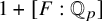 $1+[F:\mathbb {Q}_p]$
in
$1+[F:\mathbb {Q}_p]$
in $X^{\mathrm {gen}, \chi }_{G, \overline {\rho }^{\mathrm {ss}}}$
. If
$X^{\mathrm {gen}, \chi }_{G, \overline {\rho }^{\mathrm {ss}}}$
. If $\pi _1(G')$
is étale then these loci coincide and this implies that
$\pi _1(G')$
is étale then these loci coincide and this implies that $X^{\mathrm {gen},\chi }_{G, \overline {\rho }^{\mathrm {ss}}}$
is regular in codimension
$X^{\mathrm {gen},\chi }_{G, \overline {\rho }^{\mathrm {ss}}}$
is regular in codimension $[F:\mathbb {Q}_p]$
. Since
$[F:\mathbb {Q}_p]$
. Since $X^{\mathrm {gen},\chi }_{G, \overline {\rho }^{\mathrm {ss}}}$
is excellent the same applies to the completions of its local rings, and we may deduce that the deformation rings
$X^{\mathrm {gen},\chi }_{G, \overline {\rho }^{\mathrm {ss}}}$
is excellent the same applies to the completions of its local rings, and we may deduce that the deformation rings $R^{\square ,\chi }_{G, \rho _x}$
are regular in codimension
$R^{\square ,\chi }_{G, \rho _x}$
are regular in codimension $[F:\mathbb {Q}_p]$
. To show that they are complete intersection it is enough to bound their dimension from above and then use (6). Since
$[F:\mathbb {Q}_p]$
. To show that they are complete intersection it is enough to bound their dimension from above and then use (6). Since $k[\mu ]$
is a local artinian algebra the underlying reduced subschemes of the special fibres of
$k[\mu ]$
is a local artinian algebra the underlying reduced subschemes of the special fibres of $X^{\mathrm {gen}}_{G, \overline {\rho }^{\mathrm {ss}}}$
and
$X^{\mathrm {gen}}_{G, \overline {\rho }^{\mathrm {ss}}}$
and $X^{\mathrm {gen}, \chi }_{G, \overline {\rho }^{\mathrm {ss}}}$
coincide and hence they have the same dimension. Serre’s criterion for normality implies that
$X^{\mathrm {gen}, \chi }_{G, \overline {\rho }^{\mathrm {ss}}}$
coincide and hence they have the same dimension. Serre’s criterion for normality implies that $R^{\square ,\chi }_{G, \rho _x}$
is normal. Since the ring is local, it is a domain.
$R^{\square ,\chi }_{G, \rho _x}$
is normal. Since the ring is local, it is a domain.
Since $({\mathrm {Lie}} G')_L= ({\mathrm {Lie}} G^{\prime }_{\operatorname {sc}})_L$
the
$({\mathrm {Lie}} G')_L= ({\mathrm {Lie}} G^{\prime }_{\operatorname {sc}})_L$
the $({\mathrm {Lie}} G')^{\ast }$
-non-special and
$({\mathrm {Lie}} G')^{\ast }$
-non-special and $({\mathrm {Lie}} G^{\prime }_{\operatorname {sc}})^{\ast }$
-non-special loci in the generic fibre coincide. This allows us to prove that
$({\mathrm {Lie}} G^{\prime }_{\operatorname {sc}})^{\ast }$
-non-special loci in the generic fibre coincide. This allows us to prove that $X^{\mathrm {gen}}_{G, \overline {\rho }^{\mathrm {ss}}}[1/p]$
is normal without any assumption on
$X^{\mathrm {gen}}_{G, \overline {\rho }^{\mathrm {ss}}}[1/p]$
is normal without any assumption on $\pi _1(G')$
.
$\pi _1(G')$
.
A similar argument works in the ‘fixed partial determinant’ setting described in Section 1.2. However, there is one new idea not present in [Reference Böckle, Iyengar and Paškūnas6]. To bound the dimension of $X^{\mathrm {gen}, \psi _1}_{G, \overline {\rho }^{\mathrm {ss}}}$
we show that there is a finite morphism
$X^{\mathrm {gen}, \psi _1}_{G, \overline {\rho }^{\mathrm {ss}}}$
we show that there is a finite morphism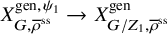 $X^{\mathrm {gen}, \psi _1}_{G, \overline {\rho }^{\mathrm {ss}}}\rightarrow X^{\mathrm {gen}}_{G/Z_1, \overline {\rho }^{\mathrm {ss}}}$
, where
$X^{\mathrm {gen}, \psi _1}_{G, \overline {\rho }^{\mathrm {ss}}}\rightarrow X^{\mathrm {gen}}_{G/Z_1, \overline {\rho }^{\mathrm {ss}}}$
, where $Z_1$
is a central subtorus of
$Z_1$
is a central subtorus of $G^0$
such that the composition
$G^0$
such that the composition $Z_1\rightarrow G \rightarrow H_1$
is an isogeny. We can then bound the dimension of various subschemes of
$Z_1\rightarrow G \rightarrow H_1$
is an isogeny. We can then bound the dimension of various subschemes of $X^{\mathrm {gen}, \psi _1}_{G, \overline {\rho }^{\mathrm {ss}}}$
by dimensions of the corresponding subschemes in
$X^{\mathrm {gen}, \psi _1}_{G, \overline {\rho }^{\mathrm {ss}}}$
by dimensions of the corresponding subschemes in $X^{\mathrm {gen}}_{G/Z_1, \overline {\rho }^{\mathrm {ss}}}$
. So for example, to prove the results in the fixed determinant case, when
$X^{\mathrm {gen}}_{G/Z_1, \overline {\rho }^{\mathrm {ss}}}$
. So for example, to prove the results in the fixed determinant case, when $G={\mathrm {GL}}_d$
, we use the results proved for
$G={\mathrm {GL}}_d$
, we use the results proved for $G={\mathrm {PGL}}_d$
. In [Reference Böckle, Iyengar and Paškūnas6] one twists by characters to unfix the determinant instead. This argument can be made to work, when G is connected, but will not work in general.
$G={\mathrm {PGL}}_d$
. In [Reference Böckle, Iyengar and Paškūnas6] one twists by characters to unfix the determinant instead. This argument can be made to work, when G is connected, but will not work in general.
1.6 Overview by section
In Section 2 we review some facts about the generalised reductive $\mathscr O$
-group schemes and their parabolic subgroup schemes, which we call R-parabolic. We also review G-semisimplification and G-irreducibility. In Section 3 we recall deformation theory of representations of a profinite group satisfying Mazur’s p-finiteness condition. Proposition 3.6 is a key result of that section. In Section 4 we discuss and compare notions of continuity via algebra and via condensed sets. As explained in Section 1.4.1 this is used to define
$\mathscr O$
-group schemes and their parabolic subgroup schemes, which we call R-parabolic. We also review G-semisimplification and G-irreducibility. In Section 3 we recall deformation theory of representations of a profinite group satisfying Mazur’s p-finiteness condition. Proposition 3.6 is a key result of that section. In Section 4 we discuss and compare notions of continuity via algebra and via condensed sets. As explained in Section 1.4.1 this is used to define $X^{\mathrm {gen}}_{G,\overline {\rho }^{\mathrm {ss}}}$
later on. In Section 5 we construct the scheme
$X^{\mathrm {gen}}_{G,\overline {\rho }^{\mathrm {ss}}}$
later on. In Section 5 we construct the scheme $X^{\mathrm {gen},\tau }_G$
and study the relation between the completion of its local rings and deformation rings of Galois representations. In Section 6 we study the GIT quotient
$X^{\mathrm {gen},\tau }_G$
and study the relation between the completion of its local rings and deformation rings of Galois representations. In Section 6 we study the GIT quotient  and define $X^{\mathrm {gen},\tau }_{G,\overline {\rho }^{\mathrm {ss}}}$
and its GIT quotient
$X^{\mathrm {gen},\tau }_{G,\overline {\rho }^{\mathrm {ss}}}$
and its GIT quotient $X^{\mathrm {git}}_{G,\overline {\rho }^{\mathrm {ss}}}$
. In Section 7 we introduce Lafforgue’s G-pseudocharacters and their deformation spaces
$X^{\mathrm {git}}_{G,\overline {\rho }^{\mathrm {ss}}}$
. In Section 7 we introduce Lafforgue’s G-pseudocharacters and their deformation spaces $X^{\mathrm {ps}}_G$
and show that the natural map
$X^{\mathrm {ps}}_G$
and show that the natural map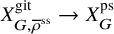 $X^{\mathrm {git}}_{G,\overline {\rho }^{\mathrm {ss}}}\rightarrow X^{\mathrm {ps}}_G$
is a finite universal homeomorphism. In Section 8 we give a condensed description of
$X^{\mathrm {git}}_{G,\overline {\rho }^{\mathrm {ss}}}\rightarrow X^{\mathrm {ps}}_G$
is a finite universal homeomorphism. In Section 8 we give a condensed description of $X^{\mathrm {gen},\tau }_{G,\overline {\rho }^{\mathrm {ss}}}$
as explained in Section 1.4.1. This allows us to conclude that
$X^{\mathrm {gen},\tau }_{G,\overline {\rho }^{\mathrm {ss}}}$
as explained in Section 1.4.1. This allows us to conclude that $X^{\mathrm {gen},\tau }_{G,\overline {\rho }^{\mathrm {ss}}}$
is independent of
$X^{\mathrm {gen},\tau }_{G,\overline {\rho }^{\mathrm {ss}}}$
is independent of $\tau $
, which we then omit from notation, and is functorial in G. In Section 9 we show that without loss of generality one may assume that the map
$\tau $
, which we then omit from notation, and is functorial in G. In Section 9 we show that without loss of generality one may assume that the map $\Gamma _F \overset {\overline {\rho }}{\longrightarrow } G(k) \rightarrow (G/G^0)(\overline {k})$
is surjective. In this case we define the absolutely G-irreducible locus in
$\Gamma _F \overset {\overline {\rho }}{\longrightarrow } G(k) \rightarrow (G/G^0)(\overline {k})$
is surjective. In this case we define the absolutely G-irreducible locus in $X^{\mathrm {gen}}_{G, \overline {\rho }^{\mathrm {ss}}}$
and show that if it is non-empty then the difference between its dimension and the dimension of its GIT quotient is
$X^{\mathrm {gen}}_{G, \overline {\rho }^{\mathrm {ss}}}$
and show that if it is non-empty then the difference between its dimension and the dimension of its GIT quotient is $\dim G_k - \dim Z(G)_k$
. In Section 10 we bound the codimension of generalised reductive subgroups of generalised reductive groups over algebraically closed fields. The results of this section are used to bound the dimensions of
$\dim G_k - \dim Z(G)_k$
. In Section 10 we bound the codimension of generalised reductive subgroups of generalised reductive groups over algebraically closed fields. The results of this section are used to bound the dimensions of $({\mathrm {Lie}} G^{\prime }_{\operatorname {sc}})^{\ast }$
-special and
$({\mathrm {Lie}} G^{\prime }_{\operatorname {sc}})^{\ast }$
-special and $({\mathrm {Lie}} U)^{\ast }$
-special loci, as explained in Section 1.4.2. In Section 11 we show that if G is a generalised reductive group over an algebraically closed field with an R-Levi L of codimension
$({\mathrm {Lie}} U)^{\ast }$
-special loci, as explained in Section 1.4.2. In Section 11 we show that if G is a generalised reductive group over an algebraically closed field with an R-Levi L of codimension $2$
such that
$2$
such that $L/L^0\rightarrow G/G^0$
is an isomorphism then
$L/L^0\rightarrow G/G^0$
is an isomorphism then $G/Z(G^0)\cong G_1\times {\mathrm {PGL}}_2$
and
$G/Z(G^0)\cong G_1\times {\mathrm {PGL}}_2$
and $L/Z(G)\cong G_1\times \mathbb G_{m}$
. Proposition 11.5 is used to bound the dimension of the
$L/Z(G)\cong G_1\times \mathbb G_{m}$
. Proposition 11.5 is used to bound the dimension of the $({\mathrm {Lie}} G^{\prime }_{\operatorname {sc}})^{\ast }$
-special locus in Section 14. This section can be omitted if one is only interested in the complete intersection property and does not care for normality and irreducible components. In Section 12 we bound the dimensions of fibres of
$({\mathrm {Lie}} G^{\prime }_{\operatorname {sc}})^{\ast }$
-special locus in Section 14. This section can be omitted if one is only interested in the complete intersection property and does not care for normality and irreducible components. In Section 12 we bound the dimensions of fibres of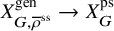 $X^{\mathrm {gen}}_{G, \overline {\rho }^{\mathrm {ss}}}\rightarrow X^{\mathrm {ps}}_G$
. In Section 13, which is the core of the paper, we carry out the induction argument described in Section 1.4.2. In Section 14 we bound the dimension of the
$X^{\mathrm {gen}}_{G, \overline {\rho }^{\mathrm {ss}}}\rightarrow X^{\mathrm {ps}}_G$
. In Section 13, which is the core of the paper, we carry out the induction argument described in Section 1.4.2. In Section 14 we bound the dimension of the $({\mathrm {Lie}} G^{\prime }_{\operatorname {sc}})^*$
-special locus. In Section 15 we study the irreducible components of
$({\mathrm {Lie}} G^{\prime }_{\operatorname {sc}})^*$
-special locus. In Section 15 we study the irreducible components of $X^{\mathrm {gen},\psi _1}_{G, \overline {\rho }^{\mathrm {ss}}}$
. In Section 16 we explain that our results apply, when G is an L-group or a C-group, for the convenience of the reader. The appendix recalls some background on condensed mathematics, which is used in Section 4.
$X^{\mathrm {gen},\psi _1}_{G, \overline {\rho }^{\mathrm {ss}}}$
. In Section 16 we explain that our results apply, when G is an L-group or a C-group, for the convenience of the reader. The appendix recalls some background on condensed mathematics, which is used in Section 4.
1.7 Notation
Let F be a finite extension of $\mathbb {Q}_p$
. We fix an algebraic closure
$\mathbb {Q}_p$
. We fix an algebraic closure $\overline {F}$
over F. Let
$\overline {F}$
over F. Let $\Gamma _F:={\mathrm {Gal}}(\overline {F}/F)$
be the absolute Galois group of F. We will denote by
$\Gamma _F:={\mathrm {Gal}}(\overline {F}/F)$
be the absolute Galois group of F. We will denote by $\zeta _p$
a primitive p-th root of unity in
$\zeta _p$
a primitive p-th root of unity in $\overline {F}$
.
$\overline {F}$
.
Let L be another finite extension of $\mathbb Q_p$
, such that
$\mathbb Q_p$
, such that ${\mathrm {Hom}}_{\mathbb {Q}_p\text {-}\mathrm {alg}}(F, L)$
has cardinality
${\mathrm {Hom}}_{\mathbb {Q}_p\text {-}\mathrm {alg}}(F, L)$
has cardinality $[F:\mathbb {Q}_p]$
. Let
$[F:\mathbb {Q}_p]$
. Let $\mathscr O$
be the ring of integers in L,
$\mathscr O$
be the ring of integers in L, $\varpi $
a uniformiser, and k the residue field. All our schemes are defined over
$\varpi $
a uniformiser, and k the residue field. All our schemes are defined over $\mathscr O$
(unless stated otherwise). We omit
$\mathscr O$
(unless stated otherwise). We omit ${\mathrm {Spec}} \mathscr O$
from the notation, when we take fibre products over it, so that
${\mathrm {Spec}} \mathscr O$
from the notation, when we take fibre products over it, so that $X\times Y:= X\times _{{\mathrm {Spec}} \mathscr O} Y$
.
$X\times Y:= X\times _{{\mathrm {Spec}} \mathscr O} Y$
.
If A is a commutative ring and $\rho : \Gamma \rightarrow {\mathrm {GL}}_d(A)$
is a representation, we let
$\rho : \Gamma \rightarrow {\mathrm {GL}}_d(A)$
is a representation, we let
 $$ \begin{align*}\rho^{\mathrm{lin}}: A[\Gamma]\rightarrow M_d(A), ~\sum_{\gamma\in \Gamma} a_{\gamma} \gamma \mapsto \sum_{\gamma\in \Gamma} a_{\gamma} \rho(\gamma)\end{align*} $$
be its linearisation, where $M_d(A)$
is the set of
$M_d(A)$
is the set of $d \times d$
matrices with entries in A.
$d \times d$
matrices with entries in A.
We denote by $A\text {-}\mathrm {alg}$
the category of commutative A-algebras.
$A\text {-}\mathrm {alg}$
the category of commutative A-algebras.
2
$\mathscr O$
-group schemes

The category of $\mathscr O$
-group schemes embeds fully faithfully in the category of fppf group sheaves on
$\mathscr O$
-group schemes embeds fully faithfully in the category of fppf group sheaves on $(\mathscr O\text {-}\mathrm {alg})^{\mathrm {op}}$
. Whenever an exact sequence is considered it is understood as an exact sequence of fppf group sheaves. If G is a flat
$(\mathscr O\text {-}\mathrm {alg})^{\mathrm {op}}$
. Whenever an exact sequence is considered it is understood as an exact sequence of fppf group sheaves. If G is a flat $\mathscr O$
-group scheme of finite presentation and
$\mathscr O$
-group scheme of finite presentation and $N \leq G$
is a flat closed normal subgroup, then the quotient group sheaf
$N \leq G$
is a flat closed normal subgroup, then the quotient group sheaf $G/N$
is representable by a scheme [Reference Anantharaman2, Théorème 4.C]. If G and N are generalised reductive then the quotient is affine by [Reference Alper1, Theorem 9.4.1].
$G/N$
is representable by a scheme [Reference Anantharaman2, Théorème 4.C]. If G and N are generalised reductive then the quotient is affine by [Reference Alper1, Theorem 9.4.1].
Lemma 2.1. Let G be a flat affine group scheme of finite presentation over $\mathscr O$
. Then the functor
$\mathscr O$
. Then the functor $\underline Z(G) : \mathscr O\text {-}\mathrm {alg} \to \text {Set}$
given by
$\underline Z(G) : \mathscr O\text {-}\mathrm {alg} \to \text {Set}$
given by
 $$ \begin{align*}\underline Z(G)(A) := \{g \in G(A) \mid \forall A \to A' , \forall h \in G(A') , g = hgh^{-1}\}\end{align*} $$
is representable by a closed subgroup scheme of G, which we will denote by $Z(G)$
and call the centre of G.
$Z(G)$
and call the centre of G.
Proof. This is a special case of [Reference Demazure and Grothendieck22, Exposé VIII, Théorème 6.4] as explained in [Reference Demazure and Grothendieck22, Exposé VIII, Exemples 6.5 (e)].
Lemma 2.2. Let G be a flat affine group scheme of finite presentation over $\mathscr O$
and let
$\mathscr O$
and let $A \to B$
be a map of
$A \to B$
be a map of $\mathscr O$
-algebras. Then
$\mathscr O$
-algebras. Then $\underline Z(G_A)$
and
$\underline Z(G_A)$
and $\underline Z(G_B)$
as in Lemma 2.1 are representable and we have
$\underline Z(G_B)$
as in Lemma 2.1 are representable and we have $Z(G_A)_B = Z(G_B)$
.
$Z(G_A)_B = Z(G_B)$
.
Proof. By Lemma 2.1 $\underline Z(G)$
is representable by an
$\underline Z(G)$
is representable by an $\mathscr O$
-scheme
$\mathscr O$
-scheme $Z(G)$
. By definition
$Z(G)$
. By definition $\underline Z(G_A)$
is the restriction of
$\underline Z(G_A)$
is the restriction of $\underline Z(G)$
to the category of A-algebras and is thus represented by
$\underline Z(G)$
to the category of A-algebras and is thus represented by $Z(G)_A$
. The same argument shows, that
$Z(G)_A$
. The same argument shows, that $\underline Z(G_B)$
is representable by
$\underline Z(G_B)$
is representable by $Z(G)_B$
and the claim follows.
$Z(G)_B$
and the claim follows.
Lemma 2.3. Let $ 0 \to G_1 \to G_2 \to G_3 \to 0 $
be a short exact sequence of affine
$ 0 \to G_1 \to G_2 \to G_3 \to 0 $
be a short exact sequence of affine $\mathscr O$
-group schemes of finite presentation. If
$\mathscr O$
-group schemes of finite presentation. If $G_1$
and
$G_1$
and $G_3$
are flat, then
$G_3$
are flat, then $G_2 \to G_3$
is faithfully flat and in particular
$G_2 \to G_3$
is faithfully flat and in particular $G_2$
is flat.
$G_2$
is flat.
Proof. This is [Reference Demazure, Grothendieck, Gille and Polo30, Exposé VIB, Proposition 9.2 (xi)].
Lemma 2.4. If G is a flat $\mathscr O$
-group scheme of finite presentation then
$\mathscr O$
-group scheme of finite presentation then $\dim G_k = \dim G_L$
.
$\dim G_k = \dim G_L$
.
Proof. See [Reference Demazure, Grothendieck, Gille and Polo30, Exposé VIB, Corollaire 4.3].
Definition 2.5. A generalised reductive group scheme over a scheme S is a smooth affine S-group scheme G, such that the geometric fibres of $G^0$
are reductive and
$G^0$
are reductive and $G/G^0\rightarrow S$
is finite.
$G/G^0\rightarrow S$
is finite.
Remark 2.6. It follows from [Reference Conrad19, Proposition 3.1.3], that for a generalised reductive $\mathscr O$
-group scheme G the quotient
$\mathscr O$
-group scheme G the quotient $G/G^0$
is étale. Sean Cotner has shown in [Reference Cotner21] using the results of Alper that a smooth affine S-group scheme G is generalised reductive if and only if it is geometrically reductive in the sense of [Reference Alper1, Definition 9.1.1]. In particular, this holds over
$G/G^0$
is étale. Sean Cotner has shown in [Reference Cotner21] using the results of Alper that a smooth affine S-group scheme G is generalised reductive if and only if it is geometrically reductive in the sense of [Reference Alper1, Definition 9.1.1]. In particular, this holds over $S={\mathrm {Spec}} \mathscr O$
.
$S={\mathrm {Spec}} \mathscr O$
.
Lemma 2.7. Let G be an affine group scheme of finite type over a perfect field $\kappa $
. If G is reduced then G is smooth over
$\kappa $
. If G is reduced then G is smooth over $\kappa $
. Moreover, if we additionally assume that the unipotent radical of G is trivial then G is generalised reductive.
$\kappa $
. Moreover, if we additionally assume that the unipotent radical of G is trivial then G is generalised reductive.
Proof. The first assertion follows from [Reference Project59, Tag 047N, Tag 047P]. Since $\kappa $
is perfect, if the unipotent radical of G is trivial then also the unipotent radical of
$\kappa $
is perfect, if the unipotent radical of G is trivial then also the unipotent radical of $G_{K}$
is trivial, for any field extension K of
$G_{K}$
is trivial, for any field extension K of $\kappa $
by [Reference Conrad, Gabber and Prasad20, Proposition 1.1.9]. Thus
$\kappa $
by [Reference Conrad, Gabber and Prasad20, Proposition 1.1.9]. Thus $G^0$
is reductive and
$G^0$
is reductive and $G/G^0$
is finite by [Reference Conrad19, Proposition 3.1.3].
$G/G^0$
is finite by [Reference Conrad19, Proposition 3.1.3].
Proposition 2.8. Let G be a generalised reductive $\mathscr O$
-group scheme. Then there exists a finite unramified extension
$\mathscr O$
-group scheme. Then there exists a finite unramified extension $L'/L$
with ring of integers
$L'/L$
with ring of integers $\mathscr O'$
, such that the following hold:
$\mathscr O'$
, such that the following hold:
-
(1)
$(G/G^0)_{\mathscr O'} = G_{\mathscr O'}/G_{\mathscr O'}^0$
is a constant group scheme; -
(2)
$G(\mathscr O')\rightarrow (G/G^0)(\mathscr O')$
is surjective; -
(3)
$G^0_{\mathscr O'}$
is split.



Proof. We observed in Remark 2.6 that $G/G^0$
is finite étale. Using [Reference Project59, Tag 0BND] and the fact that the étale fundamental group of
$G/G^0$
is finite étale. Using [Reference Project59, Tag 0BND] and the fact that the étale fundamental group of $\mathscr O$
is the Galois group of the maximal unramified extension of L we find a finite unramified extension
$\mathscr O$
is the Galois group of the maximal unramified extension of L we find a finite unramified extension $L'$
, such that
$L'$
, such that $(G/G^0)_{\mathscr O'}$
is constant. Since the extension
$(G/G^0)_{\mathscr O'}$
is constant. Since the extension $\mathscr O\rightarrow \mathscr O'$
is flat the sequence of group schemes
$\mathscr O\rightarrow \mathscr O'$
is flat the sequence of group schemes $0\rightarrow G^0\rightarrow G \rightarrow G/G^0\rightarrow 0$
remains exact after base change to
$0\rightarrow G^0\rightarrow G \rightarrow G/G^0\rightarrow 0$
remains exact after base change to $\mathscr O'$
.
$\mathscr O'$
.
Let $k'$
be the residue field of
$k'$
be the residue field of $\mathscr O'$
. After further enlarging
$\mathscr O'$
. After further enlarging $k'$
we may ensure that
$k'$
we may ensure that $G(k')\rightarrow (G/G^0)(k')$
is surjective. Since G is smooth and
$G(k')\rightarrow (G/G^0)(k')$
is surjective. Since G is smooth and $\mathscr O'$
is complete the map
$\mathscr O'$
is complete the map $G(\mathscr O')\rightarrow G(k')$
is surjective. Since
$G(\mathscr O')\rightarrow G(k')$
is surjective. Since $G/G^0$
is a constant group scheme
$G/G^0$
is a constant group scheme $(G/G^0)(k')=(G/G^0)(\mathscr O')$
and hence we obtain part (2).
$(G/G^0)(k')=(G/G^0)(\mathscr O')$
and hence we obtain part (2).
Part (3) follows by the same argument as in part (1) from [Reference Conrad19, Lemma 5.1.3].
Proposition 2.9. Let G be a generalised reductive $\mathscr O$
-group scheme. Then
$\mathscr O$
-group scheme. Then $Z(G) \cap G^0$
is flat over
$Z(G) \cap G^0$
is flat over $\mathscr O$
. In particular,
$\mathscr O$
. In particular, $\dim Z(G)_k = \dim Z(G)_L$
.
$\dim Z(G)_k = \dim Z(G)_L$
.
Proof. By Lemma 2.1 we see that $Z(G)$
exists as a closed subgroup scheme of G. For flatness and the equality of dimensions, by Proposition 2.8 we may extend
$Z(G)$
exists as a closed subgroup scheme of G. For flatness and the equality of dimensions, by Proposition 2.8 we may extend $\mathscr O$
, such that
$\mathscr O$
, such that $G/G^0$
is constant and the map
$G/G^0$
is constant and the map $G \to G/G^0$
has a section
$G \to G/G^0$
has a section $s : G/G^0 \to G$
as
$s : G/G^0 \to G$
as $\mathscr O$
-schemes. We write
$\mathscr O$
-schemes. We write $\underline \Delta = G/G^0$
for some finite group
$\underline \Delta = G/G^0$
for some finite group $\Delta $
. The s is determined by a map
$\Delta $
. The s is determined by a map $\Delta \to G(\mathscr O)$
and for every
$\Delta \to G(\mathscr O)$
and for every $\mathscr O$
-algebra A the map
$\mathscr O$
-algebra A the map $G(A) \to (G/G^0)(A)$
is surjective.
$G(A) \to (G/G^0)(A)$
is surjective.
By [Reference Conrad19, Theorem 3.3.4] $Z(G^0)$
is diagonalisable; that is,
$Z(G^0)$
is diagonalisable; that is, $Z(G^0) = {\mathrm {Spec}}(\mathscr O[M])$
for some finitely generated abelian group M. We have an action of
$Z(G^0) = {\mathrm {Spec}}(\mathscr O[M])$
for some finitely generated abelian group M. We have an action of $\Delta $
by conjugation on
$\Delta $
by conjugation on $Z(G^0)$
. Let
$Z(G^0)$
. Let $Z(G^0)^{\Delta }$
be the maximal closed subgroup scheme of
$Z(G^0)^{\Delta }$
be the maximal closed subgroup scheme of $Z(G^0)$
on which the action of
$Z(G^0)$
on which the action of $\Delta $
is trivial. The kernel of
$\Delta $
is trivial. The kernel of $\mathscr O[Z(G^0)] \to \mathscr O[Z(G^0)^{\Delta }]$
is generated by
$\mathscr O[Z(G^0)] \to \mathscr O[Z(G^0)^{\Delta }]$
is generated by $x - \delta x$
for
$x - \delta x$
for $x \in M$
and
$x \in M$
and $\delta \in \Delta $
. Hence,
$\delta \in \Delta $
. Hence, $\mathscr O[Z(G^0)^{\Delta }] = \mathscr O[M_{\Delta }]$
.
$\mathscr O[Z(G^0)^{\Delta }] = \mathscr O[M_{\Delta }]$
.
The group $Z(G^0)^{\Delta }$
is equal to
$Z(G^0)^{\Delta }$
is equal to $Z(G) \cap G^0$
, since for every
$Z(G) \cap G^0$
, since for every $\mathscr O$
-algebra A, the group
$\mathscr O$
-algebra A, the group $G(A)$
is generated by
$G(A)$
is generated by $G^0(A)$
and
$G^0(A)$
and $s((G/G^0)(A))$
. In particular,
$s((G/G^0)(A))$
. In particular, $Z(G) \cap G^0$
is flat over
$Z(G) \cap G^0$
is flat over $\mathscr O$
. We have a short exact sequence
$\mathscr O$
. We have a short exact sequence
 $$ \begin{align} 1 \to Z(G) \cap G^0 \to Z(G) \to H \to 1 \end{align} $$
where H is the image of $Z(G)$
in
$Z(G)$
in $G/G^0$
, in particular H is finite. It follows from (7) that special (resp. generic) fibres of
$G/G^0$
, in particular H is finite. It follows from (7) that special (resp. generic) fibres of $Z(G) \cap G^0$
and
$Z(G) \cap G^0$
and $Z(G)$
will have the same neutral component, and hence the same dimension. Since
$Z(G)$
will have the same neutral component, and hence the same dimension. Since $(Z(G) \cap G^0)_k = \dim (Z(G) \cap G^0)_L$
by Lemma 2.4, we deduce that
$(Z(G) \cap G^0)_k = \dim (Z(G) \cap G^0)_L$
by Lemma 2.4, we deduce that $\dim Z(G)_k = \dim Z(G)_L$
.
$\dim Z(G)_k = \dim Z(G)_L$
.
Lemma 2.10. Let G be a generalised reductive group scheme over $\mathscr O$
. Then the natural map
$\mathscr O$
. Then the natural map ${\pi : G \to G/G'}$
is smooth.
${\pi : G \to G/G'}$
is smooth.
Proof. By [Reference Conrad19, Theorem 5.3.1] $G'$
is a semisimple
$G'$
is a semisimple $\mathscr O$
-group scheme and in particular smooth. Since
$\mathscr O$
-group scheme and in particular smooth. Since $G'$
is the fppf sheafification of the commutator subgroup functor
$G'$
is the fppf sheafification of the commutator subgroup functor $A \mapsto [G^0(A), G^0(A)]$
, it is preserved under any automorphism of
$A \mapsto [G^0(A), G^0(A)]$
, it is preserved under any automorphism of $G^0$
. So
$G^0$
. So $G'$
is a closed normal subgroup scheme of G. By Lemma 2.3 the map
$G'$
is a closed normal subgroup scheme of G. By Lemma 2.3 the map $\pi $
is faithfully flat and of finite presentation. By [Reference Demazure, Grothendieck, Gille and Polo30, Exposé VIB, Proposition 9.2 (vii)] smoothness of
$\pi $
is faithfully flat and of finite presentation. By [Reference Demazure, Grothendieck, Gille and Polo30, Exposé VIB, Proposition 9.2 (vii)] smoothness of $G'$
implies smoothness of
$G'$
implies smoothness of $\pi $
.
$\pi $
.
Lemma 2.11. Let G be a generalised reductive group scheme over $\mathscr O$
. Let
$\mathscr O$
. Let $G^{\prime }_{\operatorname {sc}}\rightarrow G'$
be the simply connected central cover of
$G^{\prime }_{\operatorname {sc}}\rightarrow G'$
be the simply connected central cover of $G'$
. Then there is a natural action of G on
$G'$
. Then there is a natural action of G on ${\mathrm {Lie}}(G^{\prime }_{\operatorname {sc}})$
such that the map
${\mathrm {Lie}}(G^{\prime }_{\operatorname {sc}})$
such that the map ${\mathrm {Lie}}(G^{\prime }_{\operatorname {sc}})\rightarrow {\mathrm {Lie}} G'$
is G-equivariant.
${\mathrm {Lie}}(G^{\prime }_{\operatorname {sc}})\rightarrow {\mathrm {Lie}} G'$
is G-equivariant.
Proof. Existence and uniqueness of the simply connected central cover is ensured by [Reference Conrad19, Exercise 6.5.2 (i)]. For any $\mathscr O$
-algebra A, the map
$\mathscr O$
-algebra A, the map $(G^{\prime }_{\operatorname {sc}})_A \to (G')_A$
is a simply connected central cover of
$(G^{\prime }_{\operatorname {sc}})_A \to (G')_A$
is a simply connected central cover of $(G')_A$
. By [Reference Conrad19, Exercise 6.5.2 (iii)] an automorphism of
$(G')_A$
. By [Reference Conrad19, Exercise 6.5.2 (iii)] an automorphism of $(G')_A$
lifts to a unique automorphism of
$(G')_A$
lifts to a unique automorphism of $(G^{\prime }_{\operatorname {sc}})_A$
, so the conjugation action of
$(G^{\prime }_{\operatorname {sc}})_A$
, so the conjugation action of $G(A)$
on
$G(A)$
on $(G')_A$
by A-group scheme automorphisms extends to an action of
$(G')_A$
by A-group scheme automorphisms extends to an action of $G(A)$
on
$G(A)$
on $(G^{\prime }_{\operatorname {sc}})_A$
. This action is functorial in A and the map
$(G^{\prime }_{\operatorname {sc}})_A$
. This action is functorial in A and the map $(G^{\prime }_{\operatorname {sc}})_A \to (G')_A$
is
$(G^{\prime }_{\operatorname {sc}})_A \to (G')_A$
is $G(A)$
-equivariant. So
$G(A)$
-equivariant. So $G(A)$
acts functorially on
$G(A)$
acts functorially on ${\mathrm {Lie}}(G^{\prime }_{\operatorname {sc}}) \otimes A$
, which gives
${\mathrm {Lie}}(G^{\prime }_{\operatorname {sc}}) \otimes A$
, which gives ${\mathrm {Lie}}(G^{\prime }_{\operatorname {sc}})$
the structure of a rational G-module. This action is clearly compatible with the action of G on
${\mathrm {Lie}}(G^{\prime }_{\operatorname {sc}})$
the structure of a rational G-module. This action is clearly compatible with the action of G on ${\mathrm {Lie}} G'$
.
${\mathrm {Lie}} G'$
.
2.1 R-parabolics
We recall some facts about parabolic subgroups of a generalised reductive $\mathscr O$
-group scheme G. The main issue is that we do not assume that G is connected. The letter R stands for Richardson. Let A be an
$\mathscr O$
-group scheme G. The main issue is that we do not assume that G is connected. The letter R stands for Richardson. Let A be an $\mathscr O$
-algebra and let
$\mathscr O$
-algebra and let $\lambda : \mathbb {G}_{m, A} \rightarrow G_A$
be a cocharacter. We then define
$\lambda : \mathbb {G}_{m, A} \rightarrow G_A$
be a cocharacter. We then define $P_{\lambda }$
(resp.
$P_{\lambda }$
(resp. $U_{\lambda }$
) to be the closed A-group scheme of
$U_{\lambda }$
) to be the closed A-group scheme of $G_A$
representing the functor of points g of G such that the limit
$G_A$
representing the functor of points g of G such that the limit $\lim _{t\rightarrow 0} \lambda (t)g \lambda (t)^{-1}$
exists (resp. exists and is equal to the identity), see [Reference Conrad, Gabber and Prasad20, Lemmas 2.1.4, 2.1.5]. Let
$\lim _{t\rightarrow 0} \lambda (t)g \lambda (t)^{-1}$
exists (resp. exists and is equal to the identity), see [Reference Conrad, Gabber and Prasad20, Lemmas 2.1.4, 2.1.5]. Let $L_{\lambda }= P_{\lambda }\cap P_{-\lambda }$
, where
$L_{\lambda }= P_{\lambda }\cap P_{-\lambda }$
, where $-\lambda $
is the cocharacter defined by
$-\lambda $
is the cocharacter defined by $-\lambda (t):= \lambda (1/t)= \lambda (t)^{-1}$
. We call subgroup schemes of G of the form
$-\lambda (t):= \lambda (1/t)= \lambda (t)^{-1}$
. We call subgroup schemes of G of the form $P_{\lambda }$
R-parabolic subgroup schemes and
$P_{\lambda }$
R-parabolic subgroup schemes and $L_{\lambda }$
R-Levi subgroup schemes of
$L_{\lambda }$
R-Levi subgroup schemes of $P_{\lambda }$
. We will only consider R-parabolic and R-Levi subgroup schemes over a connected base.
$P_{\lambda }$
. We will only consider R-parabolic and R-Levi subgroup schemes over a connected base.
Lemma 2.12. The following hold
-
(1)
$L_{\lambda }$
is the scheme theoretic centraliser of
$\lambda $
; -
(2)
$U_{\lambda }$
is a closed normal subgroup scheme of
$P_{\lambda }$
; -
(3) the multiplication map
$L_{\lambda } \ltimes U_{\lambda } \rightarrow P_{\lambda }$
is an isomorphism of R-groups; -
(4)
$L_{\lambda }$
,
$U_{\lambda }$
,
$P_{\lambda }$
are smooth over
$\mathscr O$
.





Proof. The assertions follow from Lemma 2.1.5 and Proposition 2.1.8(2) of [Reference Conrad, Gabber and Prasad20]. The last assertion is given by Theorem 4.1.7 (4) in [Reference Conrad19].
Lemma 2.13. Let P be an R-parabolic subgroup of G with R-Levi subgroup L, both defined over $\mathscr O$
. Then
$\mathscr O$
. Then $P\cap G^0$
(resp.
$P\cap G^0$
(resp. $L\cap G^0)$
is the neutral component of P (resp. L) and is a parabolic (resp. Levi) subgroup of
$L\cap G^0)$
is the neutral component of P (resp. L) and is a parabolic (resp. Levi) subgroup of $G^0$
. In particular, L is a generalised reductive
$G^0$
. In particular, L is a generalised reductive $\mathscr O$
-group scheme. Moreover, there are only finitely many R-parabolic subgroups Q of G such that
$\mathscr O$
-group scheme. Moreover, there are only finitely many R-parabolic subgroups Q of G such that $Q^0=P^0$
.
$Q^0=P^0$
.
Proof. Let $\lambda : \mathbb G_{m}\rightarrow G$
be a cocharacter such that
$\lambda : \mathbb G_{m}\rightarrow G$
be a cocharacter such that $P=P_{\lambda , G}$
and
$P=P_{\lambda , G}$
and $L=L_{\lambda , G}$
. Since
$L=L_{\lambda , G}$
. Since $\mathbb G_{m}$
is connected
$\mathbb G_{m}$
is connected $\lambda $
factors through
$\lambda $
factors through $\lambda : \mathbb G_{m}\rightarrow G^0$
. It follows from [Reference Conrad, Gabber and Prasad20, Lemma 2.1.5] that
$\lambda : \mathbb G_{m}\rightarrow G^0$
. It follows from [Reference Conrad, Gabber and Prasad20, Lemma 2.1.5] that $P\cap G^0=P_{\lambda , G^0}$
and
$P\cap G^0=P_{\lambda , G^0}$
and $L\cap G^0= L_{\lambda , G^0}$
. Let
$L\cap G^0= L_{\lambda , G^0}$
. Let $\bar {x}$
be a geometric point of
$\bar {x}$
be a geometric point of ${\mathrm {Spec}} \mathscr O$
. Then
${\mathrm {Spec}} \mathscr O$
. Then $(P_{\lambda , G^0})_{\bar {x}}= P_{\lambda _{\bar {x}}, G^0_{\bar {x}}}$
and
$(P_{\lambda , G^0})_{\bar {x}}= P_{\lambda _{\bar {x}}, G^0_{\bar {x}}}$
and $(L_{\lambda , G^0})_{\bar {x}}= L_{\lambda _{\bar {x}}, G^0_{\bar {x}}}$
. It follows from [Reference Conrad, Gabber and Prasad20, Proposition 2.2.9] that
$(L_{\lambda , G^0})_{\bar {x}}= L_{\lambda _{\bar {x}}, G^0_{\bar {x}}}$
. It follows from [Reference Conrad, Gabber and Prasad20, Proposition 2.2.9] that $P_{\lambda _{\bar {x}}, G^0_{\bar {x}}}$
is a parabolic subgroup of
$P_{\lambda _{\bar {x}}, G^0_{\bar {x}}}$
is a parabolic subgroup of $G^0_{\bar {x}}$
with Levi
$G^0_{\bar {x}}$
with Levi $L_{\lambda _{\bar {x}}, G^0_{\bar {x}}}$
. Moreover, both groups are connected and
$L_{\lambda _{\bar {x}}, G^0_{\bar {x}}}$
. Moreover, both groups are connected and $L_{\lambda _{\bar {x}}, G^0_{\bar {x}}}$
is reductive by the classical theory of reductive groups over algebraically closed fields. Thus
$L_{\lambda _{\bar {x}}, G^0_{\bar {x}}}$
is reductive by the classical theory of reductive groups over algebraically closed fields. Thus $P\cap G^0$
is the neutral component of P and
$P\cap G^0$
is the neutral component of P and $L\cap G^0$
is the neutral component of L. Moreover,
$L\cap G^0$
is the neutral component of L. Moreover, $P^0$
is a parabolic subgroup of
$P^0$
is a parabolic subgroup of $G^0$
in the sense of [Reference Conrad19, Definition 5.2.1] and it follows from Lemma 2.12 (3) that
$G^0$
in the sense of [Reference Conrad19, Definition 5.2.1] and it follows from Lemma 2.12 (3) that $L^0$
is a Levi of
$L^0$
is a Levi of $P^0$
in the sense of [Reference Conrad19, Definition 5.4.2]. Further,
$P^0$
in the sense of [Reference Conrad19, Definition 5.4.2]. Further, $L^0$
is reductive in the sense of [Reference Conrad19, Definition 3.1.1]. The map
$L^0$
is reductive in the sense of [Reference Conrad19, Definition 3.1.1]. The map $L\rightarrow G/G^0$
identifies
$L\rightarrow G/G^0$
identifies $L/L^0$
with a closed subgroup of
$L/L^0$
with a closed subgroup of $G/G^0$
. Hence
$G/G^0$
. Hence $L/L^0$
is finite over
$L/L^0$
is finite over $\mathscr O$
. We deduce that L is generalised reductive and
$\mathscr O$
. We deduce that L is generalised reductive and $L/L^0$
is finite étale over
$L/L^0$
is finite étale over $\mathscr O$
by Remark 2.6.
$\mathscr O$
by Remark 2.6.
Since U is contained in $P^0$
the map
$P^0$
the map $L\rightarrow P/P^0$
induces an isomorphism
$L\rightarrow P/P^0$
induces an isomorphism $L/L^0\cong P/P^0$
. Thus
$L/L^0\cong P/P^0$
. Thus $P/P^0$
is a closed subgroup of
$P/P^0$
is a closed subgroup of $G/G^0$
, which is finite étale over
$G/G^0$
, which is finite étale over $\mathscr O$
. Since
$\mathscr O$
. Since $G/G^0$
is finite étale over
$G/G^0$
is finite étale over $\mathscr O$
by Remark 2.6, there are only finitely many closed subgroup schemes of
$\mathscr O$
by Remark 2.6, there are only finitely many closed subgroup schemes of $G/G^0$
, which are finite étale over
$G/G^0$
, which are finite étale over $\mathscr O$
. This implies that there are only finitely many R-parabolic subgroups Q such that
$\mathscr O$
. This implies that there are only finitely many R-parabolic subgroups Q such that $Q^0=P^0$
.
$Q^0=P^0$
.
Example 2.14. Let $G= (\mathbb G_{m} \times \mathbb G_{m})\rtimes \mathbb Z/2\mathbb Z$
with
$G= (\mathbb G_{m} \times \mathbb G_{m})\rtimes \mathbb Z/2\mathbb Z$
with $\mathbb Z/2\mathbb Z$
acting on
$\mathbb Z/2\mathbb Z$
acting on $\mathbb G_{m}\times \mathbb G_{m}$
by permuting the coordinates. Let
$\mathbb G_{m}\times \mathbb G_{m}$
by permuting the coordinates. Let $\lambda , \mu : \mathbb G_{m} \rightarrow G$
be the cocharacters
$\lambda , \mu : \mathbb G_{m} \rightarrow G$
be the cocharacters $\lambda (t)= ((t, 1),0)$
and
$\lambda (t)= ((t, 1),0)$
and $\mu (t)=((1,1), 0)$
. Then
$\mu (t)=((1,1), 0)$
. Then $P_{\lambda }= G^0$
and
$P_{\lambda }= G^0$
and $P_{\mu }=G$
, but their neutral components are the same.
$P_{\mu }=G$
, but their neutral components are the same.
Remark 2.15. If $G\rightarrow S$
is a connected reductive group scheme and S is affine then the notions of R-parabolic and parabolic subgroup schemes coincide; see the discussion at the end of [Reference Conrad19, Section 5.4].
$G\rightarrow S$
is a connected reductive group scheme and S is affine then the notions of R-parabolic and parabolic subgroup schemes coincide; see the discussion at the end of [Reference Conrad19, Section 5.4].
Proposition 2.16. Let G be a generalised reductive group over a field, let L be an R-Levi factor of an R-parabolic subgroup P, let U be the unipotent radical of P and assume that the natural map $L/L^0 \to G/G^0$
is an isomorphism. Then
$L/L^0 \to G/G^0$
is an isomorphism. Then
 $$ \begin{align} \dim L + \dim Z(L) \leq \dim G + \dim Z(G) - \dim U \end{align} $$
Proof. We may assume throughout the proof that the base field is algebraically closed. Let $T \subseteq L^0$
be a maximal torus of
$T \subseteq L^0$
be a maximal torus of $G^0$
. Since
$G^0$
. Since $G^0$
is generated by
$G^0$
is generated by $L^0$
, the root subgroups of U and their opposites, we have
$L^0$
, the root subgroups of U and their opposites, we have $Z(G^0) = Z(L^0) \cap \bigcap _a \ker (a)$
, where
$Z(G^0) = Z(L^0) \cap \bigcap _a \ker (a)$
, where $a : T \to \mathbb G_{m}$
varies over all roots, which generate root subgroups
$a : T \to \mathbb G_{m}$
varies over all roots, which generate root subgroups $U_a \subseteq U$
. The groups
$U_a \subseteq U$
. The groups $U_{\pm a}$
commute with
$U_{\pm a}$
commute with $\ker (a)$
and
$\ker (a)$
and $\dim \ker (a) = \dim T - 1$
, so
$\dim \ker (a) = \dim T - 1$
, so
 $$ \begin{align} \dim Z(L^0) \leq \dim Z(G^0) + \dim U. \end{align} $$
Since $\Delta := G/G^0$
is constant, we have a scheme theoretic splitting
$\Delta := G/G^0$
is constant, we have a scheme theoretic splitting $s : G/G^0 \to G$
and
$s : G/G^0 \to G$
and $\Delta $
acts on
$\Delta $
acts on $Z(G^0)$
by conjugation. Since we are assuming that
$Z(G^0)$
by conjugation. Since we are assuming that $L/L^0 = G/G^0$
, we have a compatible action of
$L/L^0 = G/G^0$
, we have a compatible action of $\Delta $
on
$\Delta $
on $Z(L^0)$
. We have a diagram
$Z(L^0)$
. We have a diagram

and the right vertical map is injective, since $Z(G^0)^{\Delta } = Z(L^0)^{\Delta } \cap Z(G^0)$
. As in the proof of Proposition 2.9, we have
$Z(G^0)^{\Delta } = Z(L^0)^{\Delta } \cap Z(G^0)$
. As in the proof of Proposition 2.9, we have $Z(G^0)^{\Delta } = Z(G) \cap G^0$
and
$Z(G^0)^{\Delta } = Z(G) \cap G^0$
and $Z(L^0)^{\Delta } = Z(L) \cap L^0$
, so
$Z(L^0)^{\Delta } = Z(L) \cap L^0$
, so $\dim Z(G^0)^{\Delta } = \dim Z(G)$
and
$\dim Z(G^0)^{\Delta } = \dim Z(G)$
and $\dim Z(L^0)^{\Delta } = \dim Z(L)$
. Injectivity of the right vertical map gives
$\dim Z(L^0)^{\Delta } = \dim Z(L)$
. Injectivity of the right vertical map gives
 $$ \begin{align} \dim Z(L) - \dim Z(G) \leq \dim Z(L^0) - \dim Z(G^0) \end{align} $$
We conclude from (10) and (9) that
 $$ \begin{align*} \dim L + \dim Z(L) &\leq \dim L^0 + \dim Z(L^0) - \dim Z(G^0) + \dim Z(G) \\ &\leq \dim L^0 + \dim U + \dim Z(G) = \dim G + \dim Z(G) - \dim U, \end{align*} $$
where we use $\dim G^0 = \dim L^0 + 2 \dim U$
in the last step.
$\dim G^0 = \dim L^0 + 2 \dim U$
in the last step.
For the rest of the subsection we assume that G is split and $G/G^0$
is constant. We fix a maximal split torus T of G defined over
$G/G^0$
is constant. We fix a maximal split torus T of G defined over $\mathscr O$
. Let s be the closed point of
$\mathscr O$
. Let s be the closed point of ${\mathrm {Spec}} \mathscr O$
and let
${\mathrm {Spec}} \mathscr O$
and let $\bar {s}$
be a geometric point above s.
$\bar {s}$
be a geometric point above s.
Lemma 2.17. Base change induces a bijection between the following sets:
-
(1) R-parabolics of G containing T;
-
(2) R-parabolics of
$G_s$
containing
$T_s$
; -
(3) R-parabolics of
$G_{\bar {s}}$
containing
$T_{\bar {s}}$
.


Proof. We will first establish that $P\mapsto P_{\bar {s}}$
induces the bijection between sets in parts (1) and (3). If
$P\mapsto P_{\bar {s}}$
induces the bijection between sets in parts (1) and (3). If $\lambda : \mathbb G_{m} \rightarrow G$
is a cocharacter defined over
$\lambda : \mathbb G_{m} \rightarrow G$
is a cocharacter defined over $\mathscr O$
then
$\mathscr O$
then $(P_{\lambda })_{\bar {s}} = P_{\lambda _{\bar {s}}}$
by [Reference Conrad, Gabber and Prasad20, Lemma 2.1.4]. Moreover, if P contains T then
$(P_{\lambda })_{\bar {s}} = P_{\lambda _{\bar {s}}}$
by [Reference Conrad, Gabber and Prasad20, Lemma 2.1.4]. Moreover, if P contains T then $P_{\bar {s}}$
will contain
$P_{\bar {s}}$
will contain $T_{\bar {s}}$
. Hence, the map is well defined.
$T_{\bar {s}}$
. Hence, the map is well defined.
If P and Q are R-parabolics of G such that $P_{\bar {s}}=Q_{\bar {s}}$
then
$P_{\bar {s}}=Q_{\bar {s}}$
then $P^0_{\bar {s}}=Q^0_{\bar {s}}$
. It follows from [Reference Conrad19, Corollary 5.2.7 (2)] that there exists a Zariski open subset U of
$P^0_{\bar {s}}=Q^0_{\bar {s}}$
. It follows from [Reference Conrad19, Corollary 5.2.7 (2)] that there exists a Zariski open subset U of ${\mathrm {Spec}} \mathscr O$
containing s such that
${\mathrm {Spec}} \mathscr O$
containing s such that $P^0_U = Q^0_U$
. Since
$P^0_U = Q^0_U$
. Since $\mathscr O$
is a DVR we have
$\mathscr O$
is a DVR we have $U={\mathrm {Spec}} \mathscr O$
and hence
$U={\mathrm {Spec}} \mathscr O$
and hence $P^0=Q^0$
. It follows from Lemma 2.13 that
$P^0=Q^0$
. It follows from Lemma 2.13 that $P\cap G^0= P^0=Q^0= Q\cap G^0$
. Thus both P and Q are contained in the G-normaliser
$P\cap G^0= P^0=Q^0= Q\cap G^0$
. Thus both P and Q are contained in the G-normaliser $N_G(P^0)$
of
$N_G(P^0)$
of $P^0$
and it is enough to show that the images of P and Q in
$P^0$
and it is enough to show that the images of P and Q in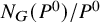 $N_G(P^0)/P^0$
coincide. Since
$N_G(P^0)/P^0$
coincide. Since $N_G(P^0)\cap G^0 = P^0$
it is enough to show that the images of P and Q in
$N_G(P^0)\cap G^0 = P^0$
it is enough to show that the images of P and Q in $G/G^0$
coincide. Since
$G/G^0$
coincide. Since $G/G^0$
is a constant group scheme, we may check this after base change to
$G/G^0$
is a constant group scheme, we may check this after base change to $\bar {s}$
, which holds as
$\bar {s}$
, which holds as $P_{\bar {s}}=Q_{\bar {s}}$
.
$P_{\bar {s}}=Q_{\bar {s}}$
.
Let $\bar {\lambda }: \mathbb G_{m}\rightarrow G_{\bar {s}}$
be a cocharacter. Its image is contained in a maximal split torus
$\bar {\lambda }: \mathbb G_{m}\rightarrow G_{\bar {s}}$
be a cocharacter. Its image is contained in a maximal split torus $T'$
of
$T'$
of $G_{\bar {s}}$
. Moreover,
$G_{\bar {s}}$
. Moreover, $T'$
is contained in
$T'$
is contained in $P_{\bar {\lambda }}$
. If
$P_{\bar {\lambda }}$
. If $P_{\bar {\lambda }}$
contains
$P_{\bar {\lambda }}$
contains $T_{\bar {s}}$
then there is
$T_{\bar {s}}$
then there is $g\in P_{\bar {\lambda }}(\kappa (\bar {s}))$
such that
$g\in P_{\bar {\lambda }}(\kappa (\bar {s}))$
such that $T_{\bar {s}}= g T' g^{-1}$
by [Reference Borel9, Proposition 11.19]. We thus may assume that the image of
$T_{\bar {s}}= g T' g^{-1}$
by [Reference Borel9, Proposition 11.19]. We thus may assume that the image of $\bar {\lambda }$
is contained in
$\bar {\lambda }$
is contained in $T_{\bar {s}}$
. Since both
$T_{\bar {s}}$
. Since both $\mathbb G_{m}$
and T are split tori defined over
$\mathbb G_{m}$
and T are split tori defined over $\mathscr O$
there is a cocharacter
$\mathscr O$
there is a cocharacter $\lambda : \mathbb G_{m}\rightarrow T$
, such that
$\lambda : \mathbb G_{m}\rightarrow T$
, such that $\lambda _{\bar {s}}=\bar {\lambda }$
. Then
$\lambda _{\bar {s}}=\bar {\lambda }$
. Then $P_{\lambda }$
contains T and satisfies
$P_{\lambda }$
contains T and satisfies $(P_{\lambda })_{\bar {s}} = P_{\bar {\lambda }}$
.
$(P_{\lambda })_{\bar {s}} = P_{\bar {\lambda }}$
.
The proof that base change induces a bijection between the sets in parts (2) and (3) is the same. Since $P_{\bar {s}}= (P_s)_{\bar {s}}$
this also implies that base change induces a bijection between the sets in parts (1) and (2).
$P_{\bar {s}}= (P_s)_{\bar {s}}$
this also implies that base change induces a bijection between the sets in parts (1) and (2).
Lemma 2.18. There are only finitely many R-parabolic subgroups of G containing T. Each of them has a unique R-Levi subgroup containing T.
Proof. Lemma 2.17 implies that it is enough to show that there are only finitely many R-parabolics of $G_{\bar {s}}$
containing
$G_{\bar {s}}$
containing $T_{\bar {s}}$
. Lemma 2.13 implies that we may assume that
$T_{\bar {s}}$
. Lemma 2.13 implies that we may assume that $G_{\bar {s}}$
is connected. Proposition 11.19 (b) in [Reference Borel9] says that there are only finitely many Borel subgroups of
$G_{\bar {s}}$
is connected. Proposition 11.19 (b) in [Reference Borel9] says that there are only finitely many Borel subgroups of $G^0_{\bar {s}}$
containing
$G^0_{\bar {s}}$
containing $T_{\bar {s}}$
. Proposition 14.18 in [Reference Borel9] implies that there are only finitely many parabolic subgroups of
$T_{\bar {s}}$
. Proposition 14.18 in [Reference Borel9] implies that there are only finitely many parabolic subgroups of $G^0_{\bar {s}}$
containing a given Borel subgroup. This proves the first assertion.
$G^0_{\bar {s}}$
containing a given Borel subgroup. This proves the first assertion.
Let M be the unique Levi of $P^0$
containing T, [Reference Conrad19, Proposition 5.4.5]. Let
$P^0$
containing T, [Reference Conrad19, Proposition 5.4.5]. Let $\lambda : \mathbb G_{m}\rightarrow G$
be a cocharacter such that
$\lambda : \mathbb G_{m}\rightarrow G$
be a cocharacter such that $P=P_{\lambda }$
. Then
$P=P_{\lambda }$
. Then $L^0_{\lambda }$
is also a Levi of
$L^0_{\lambda }$
is also a Levi of $P^0$
by Lemma 2.13. The scheme of Levi subgroups of
$P^0$
by Lemma 2.13. The scheme of Levi subgroups of $P^0$
is a
$P^0$
is a $U_{\lambda }$
-torsor, [Reference Conrad19, Corollary 5.4.6]. Thus there is
$U_{\lambda }$
-torsor, [Reference Conrad19, Corollary 5.4.6]. Thus there is $g\in U_{\lambda }(\mathscr O)$
such that
$g\in U_{\lambda }(\mathscr O)$
such that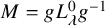 $M= g L^0_{\lambda } g^{-1}$
. Then
$M= g L^0_{\lambda } g^{-1}$
. Then $g L_{\lambda } g^{-1}$
is an R-Levi of P containing T.
$g L_{\lambda } g^{-1}$
is an R-Levi of P containing T.
If L and M are R-Levi subgroups of P containing T then $M_{\bar {x}}=L_{\bar {x}}$
for every geometric point
$M_{\bar {x}}=L_{\bar {x}}$
for every geometric point $\bar {x}$
of
$\bar {x}$
of ${\mathrm {Spec}} \mathscr O$
by [Reference Bate, Martin and Röhrle3, Corollary 6.5]. This implies that
${\mathrm {Spec}} \mathscr O$
by [Reference Bate, Martin and Röhrle3, Corollary 6.5]. This implies that $L=M$
.
$L=M$
.
Lemma 2.19. Let $\bar {x}$
be a geometric point of
$\bar {x}$
be a geometric point of ${\mathrm {Spec}} \mathscr O$
and let Q be an R-parabolic subgroup of
${\mathrm {Spec}} \mathscr O$
and let Q be an R-parabolic subgroup of $G_{\bar {x}}$
with R-Levi M. Then there is an R-parabolic subgroup P of G defined over
$G_{\bar {x}}$
with R-Levi M. Then there is an R-parabolic subgroup P of G defined over $\mathscr O$
with R-Levi L containing T and
$\mathscr O$
with R-Levi L containing T and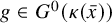 $g\in G^0(\kappa (\bar {x}))$
, such that
$g\in G^0(\kappa (\bar {x}))$
, such that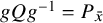 $g Q g^{-1} = P_{\bar {x}}$
and
$g Q g^{-1} = P_{\bar {x}}$
and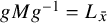 $g M g^{-1} = L_{\bar {x}}$
.
$g M g^{-1} = L_{\bar {x}}$
.
Proof. Let $\lambda : \mathbb G_{ m,\bar {x}}\rightarrow G_{\bar {x}}$
be a cocharacter such that
$\lambda : \mathbb G_{ m,\bar {x}}\rightarrow G_{\bar {x}}$
be a cocharacter such that $Q=P_{\lambda }$
and
$Q=P_{\lambda }$
and $M=L_{\lambda }$
. There is a maximal torus
$M=L_{\lambda }$
. There is a maximal torus $T'$
of
$T'$
of $G_{\bar {x}}$
, such that the image of
$G_{\bar {x}}$
, such that the image of $\lambda $
is contained in
$\lambda $
is contained in $T'$
. Since tori are connected, both
$T'$
. Since tori are connected, both $T'$
and
$T'$
and $T_{\bar {x}}$
are contained in
$T_{\bar {x}}$
are contained in $G^0_{\bar {x}}$
. Since
$G^0_{\bar {x}}$
. Since $\kappa (\bar {x})$
is algebraically closed any two maximal tori in
$\kappa (\bar {x})$
is algebraically closed any two maximal tori in $G^0_{\bar {x}}$
are conjugate, and hence after conjugating Q we may assume that
$G^0_{\bar {x}}$
are conjugate, and hence after conjugating Q we may assume that $\lambda : \mathbb G_{ m,\bar {x}}\rightarrow T_{\bar {x}}$
. Since T is split over
$\lambda : \mathbb G_{ m,\bar {x}}\rightarrow T_{\bar {x}}$
. Since T is split over $\mathscr O$
, there is a cocharacter
$\mathscr O$
, there is a cocharacter $\mu : \mathbb G_{m}\rightarrow T$
defined over
$\mu : \mathbb G_{m}\rightarrow T$
defined over $\mathscr O$
such that
$\mathscr O$
such that $\lambda = \mu _{\bar {x}}$
. We have
$\lambda = \mu _{\bar {x}}$
. We have $P_\mu \times _{{\mathrm {Spec}} \mathscr O} \bar {x} = P_{\mu _{\bar {x}}}$
by [Reference Conrad, Gabber and Prasad20, Lemma 2.1.4] and
$P_\mu \times _{{\mathrm {Spec}} \mathscr O} \bar {x} = P_{\mu _{\bar {x}}}$
by [Reference Conrad, Gabber and Prasad20, Lemma 2.1.4] and $L_{\mu }\times _{{\mathrm {Spec}} \mathscr O} \bar {x} = L_{\mu _{\bar {x}}}$
by [Reference Conrad, Gabber and Prasad20, Lemma 2.1.5].
$L_{\mu }\times _{{\mathrm {Spec}} \mathscr O} \bar {x} = L_{\mu _{\bar {x}}}$
by [Reference Conrad, Gabber and Prasad20, Lemma 2.1.5].
2.2 G-semisimplification
In this section let G be a generalised reductive group over an algebraically closed field $\kappa $
. Let
$\kappa $
. Let $\Gamma $
be a group and let
$\Gamma $
be a group and let $\rho : \Gamma \rightarrow G(\kappa )$
be a representation. Let P be an R-parabolic of G minimal with respect to the property that
$\rho : \Gamma \rightarrow G(\kappa )$
be a representation. Let P be an R-parabolic of G minimal with respect to the property that $P(\kappa )$
contains
$P(\kappa )$
contains $\rho (\Gamma )$
. Let L be an R-Levi of P and let U be the unipotent radical of P. The composition
$\rho (\Gamma )$
. Let L be an R-Levi of P and let U be the unipotent radical of P. The composition $L\rightarrow P\rightarrow P/U$
is an isomorphism, and we define
$L\rightarrow P\rightarrow P/U$
is an isomorphism, and we define $c_{P,L}: P(\kappa )\rightarrow G(\kappa )$
as the composition
$c_{P,L}: P(\kappa )\rightarrow G(\kappa )$
as the composition $P(\kappa )\rightarrow (P/U)(\kappa )\overset {\cong }{\longrightarrow } L(\kappa )\hookrightarrow G(\kappa )$
.
$P(\kappa )\rightarrow (P/U)(\kappa )\overset {\cong }{\longrightarrow } L(\kappa )\hookrightarrow G(\kappa )$
.
Proposition 2.20. The $G^0(\kappa )$
-conjugacy class of
$G^0(\kappa )$
-conjugacy class of $c_{P,L} \circ \rho $
is independent of the choice of P and L.
$c_{P,L} \circ \rho $
is independent of the choice of P and L.
Proof. If G is connected then this is proved in [Reference Serre56, Proposition 3.3 (b)]. The same argument is carried out in our more general setting in [Reference Quast50, Proposition 2.15].
Definition 2.21. The G-semisimplification of $\rho $
is the
$\rho $
is the $G^0(\kappa )$
-conjugacy class of the representation
$G^0(\kappa )$
-conjugacy class of the representation $c_{P,L} \circ \rho $
. It will be denoted by
$c_{P,L} \circ \rho $
. It will be denoted by $\rho ^{\mathrm {ss}}$
.
$\rho ^{\mathrm {ss}}$
.
In [Reference Serre56, Section 3.2.1] Serre introduced the notion of G-complete reducibility in the connected case. This definition extends to generalised reductive group schemes verbatim.
Definition 2.22. A subgroup H of $G(\kappa )$
is G-completely reducible if for every R-parabolic
$G(\kappa )$
is G-completely reducible if for every R-parabolic $P \subseteq G$
with
$P \subseteq G$
with $H \subseteq P (\kappa )$
, there exists an R-Levi subgroup
$H \subseteq P (\kappa )$
, there exists an R-Levi subgroup $L \subseteq P$
with
$L \subseteq P$
with $H \subseteq L(\kappa )$
. We say, that a homomorphism
$H \subseteq L(\kappa )$
. We say, that a homomorphism $\rho :\Gamma \rightarrow G(\kappa )$
is G-completely reducible, if its image is G-completely reducible. We will also use the term G-semisimple synonymously for G-completely reducible.
$\rho :\Gamma \rightarrow G(\kappa )$
is G-completely reducible, if its image is G-completely reducible. We will also use the term G-semisimple synonymously for G-completely reducible.
Proposition 2.23. Let $\rho : \Gamma \to G(\kappa )$
be a homomorphism. Then
$\rho : \Gamma \to G(\kappa )$
be a homomorphism. Then $\rho $
is G-completely reducible if and only if
$\rho $
is G-completely reducible if and only if $\rho ^{\mathrm {ss}}$
is the
$\rho ^{\mathrm {ss}}$
is the $G^0(\kappa )$
-conjugacy class of
$G^0(\kappa )$
-conjugacy class of $\rho $
.
$\rho $
.
Proof. Let P be a minimal R-parabolic, such that $\rho (\Gamma ) \subseteq P(\kappa )$
. If
$\rho (\Gamma ) \subseteq P(\kappa )$
. If $\rho $
is G-completely reducible, there exists some R-Levi L of P, such that
$\rho $
is G-completely reducible, there exists some R-Levi L of P, such that $\rho (\Gamma ) \subseteq L(\kappa )$
. In particular
$\rho (\Gamma ) \subseteq L(\kappa )$
. In particular $\rho = c_{P,L} \circ \rho $
. We can apply Proposition 2.20 to conclude,
$\rho = c_{P,L} \circ \rho $
. We can apply Proposition 2.20 to conclude, $\rho ^{\mathrm {ss}}$
is in the
$\rho ^{\mathrm {ss}}$
is in the $G^0(\kappa )$
-conjugacy class of
$G^0(\kappa )$
-conjugacy class of $\rho $
. Conversely, suppose that
$\rho $
. Conversely, suppose that $\rho \in \rho ^{\mathrm {ss}}$
, let L be any R-Levi of P. The assumption implies that
$\rho \in \rho ^{\mathrm {ss}}$
, let L be any R-Levi of P. The assumption implies that $\rho $
is conjugate to
$\rho $
is conjugate to $c_{P,L}\circ \rho $
by an element of
$c_{P,L}\circ \rho $
by an element of $g\in G^0(\kappa )$
. Minimality of P and [Reference Bate, Martin and Röhrle3, Corollary 6.4] imply that the image of
$g\in G^0(\kappa )$
. Minimality of P and [Reference Bate, Martin and Röhrle3, Corollary 6.4] imply that the image of $c_{P,L}\circ \rho $
is L-irreducible, which means that it is not contained in any proper R-parabolic of L. Hence,
$c_{P,L}\circ \rho $
is L-irreducible, which means that it is not contained in any proper R-parabolic of L. Hence, $\rho (\Gamma )$
is
$\rho (\Gamma )$
is $g L g^{-1}$
-irreducible. It follows from the equivalence of parts (iv) and (v) of [Reference Bate, Martin and Röhrle3, Corollary 3.5], which as explained in [Reference Bate, Martin and Röhrle3, Section 6.3] also holds for non-connected groups, that
$g L g^{-1}$
-irreducible. It follows from the equivalence of parts (iv) and (v) of [Reference Bate, Martin and Röhrle3, Corollary 3.5], which as explained in [Reference Bate, Martin and Röhrle3, Section 6.3] also holds for non-connected groups, that $\rho (\Gamma )$
is G-completely reducible.
$\rho (\Gamma )$
is G-completely reducible.
Proposition 2.24. Let $\rho : \Gamma \to G(\kappa )$
be a homomorphism. Then the determinant laws attached to
$\rho : \Gamma \to G(\kappa )$
be a homomorphism. Then the determinant laws attached to $(\tau \circ \rho )^{\mathrm {lin}}$
and
$(\tau \circ \rho )^{\mathrm {lin}}$
and $(\tau \circ \rho ^{\mathrm {ss}})^{\mathrm {lin}}$
agree.
$(\tau \circ \rho ^{\mathrm {ss}})^{\mathrm {lin}}$
agree.
Proof. Let P be an R-parabolic of G, minimal with respect to the property that $P(\kappa )$
contains
$P(\kappa )$
contains $\rho (\Gamma )$
. Let U be the unipotent radical of P and let let
$\rho (\Gamma )$
. Let U be the unipotent radical of P and let let $\lambda $
be a cocharacter, such that
$\lambda $
be a cocharacter, such that $P=P_{\lambda }$
. Then
$P=P_{\lambda }$
. Then ${\lim \nolimits_{t \to 0} \lambda (t) U\lambda (t)^{-1}=\{1\}}$
and hence
${\lim \nolimits_{t \to 0} \lambda (t) U\lambda (t)^{-1}=\{1\}}$
and hence $c_{P, L_{\lambda }}\circ \rho = \lim \nolimits_{t \to 0} \lambda (t) \rho \lambda (t)^{-1}$
. Let
$c_{P, L_{\lambda }}\circ \rho = \lim \nolimits_{t \to 0} \lambda (t) \rho \lambda (t)^{-1}$
. Let $D_{\tau \circ \rho } : \kappa [\Gamma ] \to \kappa $
be the determinant law attached to
$D_{\tau \circ \rho } : \kappa [\Gamma ] \to \kappa $
be the determinant law attached to $(\tau \circ \rho )^{\mathrm {lin}}$
and let
$(\tau \circ \rho )^{\mathrm {lin}}$
and let $D_{\tau \circ \rho ^{\mathrm {ss}}}$
be the determinant law attached to
$D_{\tau \circ \rho ^{\mathrm {ss}}}$
be the determinant law attached to $(\tau \circ c_{P, L_{\lambda }}\circ \rho )^{\mathrm {lin}}$
. We note that replacing
$(\tau \circ c_{P, L_{\lambda }}\circ \rho )^{\mathrm {lin}}$
. We note that replacing $c_{P, L_{\lambda }}\circ \rho $
by a conjugate with an element of
$c_{P, L_{\lambda }}\circ \rho $
by a conjugate with an element of $G^0(\kappa )$
does not change the determinant law, as they are invariant under conjugation.
$G^0(\kappa )$
does not change the determinant law, as they are invariant under conjugation.
We also have a family of determinant laws $D : \kappa [\Gamma ] \to \kappa [t,t^{-1}]$
over
$D : \kappa [\Gamma ] \to \kappa [t,t^{-1}]$
over $\mathbb G_{m}$
given by
$\mathbb G_{m}$
given by
 $$ \begin{align*}D_A : A[\Gamma] \to A[t,t^{-1}], \quad r \mapsto \det(((\tau(\lambda(t)) (\tau \circ \rho) \tau(\lambda(t))^{-1}) \otimes {\mathrm{id}}_A)(r)),\end{align*} $$
which is actually constant in t and equal to $D_{\tau \circ \rho }$
. So this family extends uniquely to a family over
$D_{\tau \circ \rho }$
. So this family extends uniquely to a family over $\mathbb A^1$
. Since the limit of
$\mathbb A^1$
. Since the limit of $\lambda (t) \rho \lambda (t)^{-1}$
as
$\lambda (t) \rho \lambda (t)^{-1}$
as $t \to 0$
exists and formation of the determinant is algebraic, we obtain
$t \to 0$
exists and formation of the determinant is algebraic, we obtain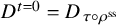 $D^{t=0} = D_{\tau \circ \rho ^{\mathrm {ss}}}$
and hence
$D^{t=0} = D_{\tau \circ \rho ^{\mathrm {ss}}}$
and hence $D_{\tau \circ \rho } = D_{\tau \circ \rho ^{\mathrm {ss}}}$
.
$D_{\tau \circ \rho } = D_{\tau \circ \rho ^{\mathrm {ss}}}$
.
Remark 2.25. In general $(\tau \circ \rho )^{\mathrm {ss}}$
is not isomorphic to
$(\tau \circ \rho )^{\mathrm {ss}}$
is not isomorphic to $\tau \circ \rho ^{\mathrm {ss}}$
. But it follows from Proposition 2.24, that
$\tau \circ \rho ^{\mathrm {ss}}$
. But it follows from Proposition 2.24, that $D_{\tau \circ \rho ^{\mathrm {ss}}} = D_{\tau \circ \rho }$
and in particular from [Reference Chenevier15, Theorem 2.12] that
$D_{\tau \circ \rho ^{\mathrm {ss}}} = D_{\tau \circ \rho }$
and in particular from [Reference Chenevier15, Theorem 2.12] that $(\tau \circ \rho ^{\mathrm {ss}})^{\mathrm {ss}}$
coincides with
$(\tau \circ \rho ^{\mathrm {ss}})^{\mathrm {ss}}$
coincides with $(\tau \circ \rho )^{\mathrm {ss}}$
.
$(\tau \circ \rho )^{\mathrm {ss}}$
.
Definition 2.26. A subgroup H of $G(\kappa )$
is G-irreducible if H is not contained in any proper R-parabolic subgroup of G. We say, that a homomorphism
$G(\kappa )$
is G-irreducible if H is not contained in any proper R-parabolic subgroup of G. We say, that a homomorphism $\rho :\Gamma \rightarrow G(\kappa )$
is G-irreducible, if its image is G-irreducible.
$\rho :\Gamma \rightarrow G(\kappa )$
is G-irreducible, if its image is G-irreducible.
Proposition 2.27. Let L and M be R-Levi subgroups of G and let H be a closed subgroup of $L\cap M$
such that H is both L-irreducible and M-irreducible. Then there is
$L\cap M$
such that H is both L-irreducible and M-irreducible. Then there is $g\in Z_G(H)^0(\kappa )$
such that
$g\in Z_G(H)^0(\kappa )$
such that $L= g M g^{-1}$
.
$L= g M g^{-1}$
.
Proof. Let $\lambda , \mu : \mathbb G_{m}\rightarrow G$
be cocharacters such that
$\lambda , \mu : \mathbb G_{m}\rightarrow G$
be cocharacters such that $L=L_{\lambda }$
and
$L=L_{\lambda }$
and $M=L_{\mu }$
. Since H is contained in L and in M, Lemma 2.12 (1) implies that the both
$M=L_{\mu }$
. Since H is contained in L and in M, Lemma 2.12 (1) implies that the both $\lambda $
and
$\lambda $
and $\mu $
factor through the inclusion
$\mu $
factor through the inclusion $Z_G(H) \subseteq G$
. Let S (resp. T) be a maximal torus of
$Z_G(H) \subseteq G$
. Let S (resp. T) be a maximal torus of $Z_G(H)$
containing the image of
$Z_G(H)$
containing the image of $\lambda $
(resp.
$\lambda $
(resp. $\mu $
). It follows from the proof of [Reference Borel9, Proposition 8.18] that
$\mu $
). It follows from the proof of [Reference Borel9, Proposition 8.18] that $Z_G(S)$
is an R-Levi of G containing H and contained in L. Since H is L-irreducible by assumption we get that
$Z_G(S)$
is an R-Levi of G containing H and contained in L. Since H is L-irreducible by assumption we get that $L=Z_G(S)$
. Similarly, we obtain that
$L=Z_G(S)$
. Similarly, we obtain that $M=Z_G(T)$
. There is
$M=Z_G(T)$
. There is $g\in Z_G(H)^0(\kappa )$
such that
$g\in Z_G(H)^0(\kappa )$
such that $S= g T g^{-1}$
by [Reference Borel9, Proposition 11.19]. Thus
$S= g T g^{-1}$
by [Reference Borel9, Proposition 11.19]. Thus $L=Z_G (g T g^{-1}) = g Z_G(T)g^{-1} = g M g^{-1}$
.
$L=Z_G (g T g^{-1}) = g Z_G(T)g^{-1} = g M g^{-1}$
.
2.3 Extensions
Let N and $\Delta $
be abstract groups. A rigidified extension of
$\Delta $
be abstract groups. A rigidified extension of $\Delta $
by N is a group law
$\Delta $
by N is a group law $\ast $
on the set
$\ast $
on the set $N\times \Delta $
, such that the maps
$N\times \Delta $
, such that the maps $\iota : N \rightarrow N\times \Delta $
,
$\iota : N \rightarrow N\times \Delta $
, $g\mapsto (g, 1)$
and
$g\mapsto (g, 1)$
and $\pi : N\times \Delta \rightarrow \Delta $
,
$\pi : N\times \Delta \rightarrow \Delta $
, $(g, \delta )\mapsto \delta $
are group homomorphisms.
$(g, \delta )\mapsto \delta $
are group homomorphisms.
Definition 2.28. A generalised 2-cocycle of $\Delta $
with coefficients in N is a pair
$\Delta $
with coefficients in N is a pair $(\omega , c)$
, where
$(\omega , c)$
, where ${\omega : \Delta \rightarrow {\mathrm {Aut}}(N)}$
and
${\omega : \Delta \rightarrow {\mathrm {Aut}}(N)}$
and $c: \Delta \times \Delta \rightarrow N$
are maps (of sets) satisfying the following:
$c: \Delta \times \Delta \rightarrow N$
are maps (of sets) satisfying the following:
-
(1)
$\omega (\delta _1) \circ \omega (\delta _2) = \operatorname {Int}_{N}(c(\delta _1, \delta _2)) \circ \omega (\delta _1\delta _2)$
in
${\mathrm {Aut}}(N)$
; -
(2)
$\omega (1) = {\mathrm {id}}_{N}$
; -
(3)
$c(\delta _1,\delta _2)c(\delta _1\delta _2, \delta _3) = \omega (\delta _1)(c(\delta _2, \delta _3)) c(\delta _1, \delta _2\delta _3)$
in N; -
(4)
$c(\delta _1, 1) = c(1,\delta _2) = 1$
;





where for $g\in N$
,
$g\in N$
, $\operatorname {Int}_N(g)$
is the inner automorphism
$\operatorname {Int}_N(g)$
is the inner automorphism $x \mapsto gxg^{-1}$
of N.
$x \mapsto gxg^{-1}$
of N.
We emphasise that, since N is not assumed to be abelian, $\omega $
is not going to be a group homomorphism in general. Let
$\omega $
is not going to be a group homomorphism in general. Let $(N\times \Delta , \ast )$
be a rigidified extension of
$(N\times \Delta , \ast )$
be a rigidified extension of $\Delta $
by N. It is a pleasant exercise in algebra to verify that if we let
$\Delta $
by N. It is a pleasant exercise in algebra to verify that if we let
 $$ \begin{align*}\omega^{\ast}(\delta)(x):= s(\delta) x s(\delta)^{-1}, \quad c^{\ast}(\delta_1, \delta_2):= s(\delta_1)s(\delta_2)s(\delta_1 \delta_2)^{-1},\end{align*} $$
for all $x\in N$
and all
$x\in N$
and all $\delta , \delta _1, \delta _2\in \Delta $
, where
$\delta , \delta _1, \delta _2\in \Delta $
, where $s(\delta )= (1, \delta )$
, then the group axioms for
$s(\delta )= (1, \delta )$
, then the group axioms for $\ast $
imply that
$\ast $
imply that $(\omega ^{\ast }, c^{\ast })$
is a generalised
$(\omega ^{\ast }, c^{\ast })$
is a generalised $2$
-cocycle.
$2$
-cocycle.
Lemma 2.29. Mapping $(N\times \Delta , \ast )$
to
$(N\times \Delta , \ast )$
to $(\omega ^{\ast }, c^{\ast })$
induces a bijection from the set of rigidified extensions of
$(\omega ^{\ast }, c^{\ast })$
induces a bijection from the set of rigidified extensions of $\Delta $
by N to the set of generalised
$\Delta $
by N to the set of generalised $2$
-cocycles of
$2$
-cocycles of $\Delta $
with values in N.
$\Delta $
with values in N.
Proof. If N is abelian then $\operatorname {Int}_N ={\mathrm {id}}_N$
and the result is well known. In general, the assertion follows from [Reference Schreier54, Satz I], a nice exposition is given in [Reference Zhang65, Section 2.2] and the lemma follows from [Reference Zhang65, Lemma 2.11]. One could also deduce the assertion from [Reference Eilenberg and Mac Lane24]: property (3) implies that the element denoted by
$\operatorname {Int}_N ={\mathrm {id}}_N$
and the result is well known. In general, the assertion follows from [Reference Schreier54, Satz I], a nice exposition is given in [Reference Zhang65, Section 2.2] and the lemma follows from [Reference Zhang65, Lemma 2.11]. One could also deduce the assertion from [Reference Eilenberg and Mac Lane24]: property (3) implies that the element denoted by $f_3(x,y,z)$
in [Reference Eilenberg and Mac Lane24, Section 7] is
$f_3(x,y,z)$
in [Reference Eilenberg and Mac Lane24, Section 7] is $1_N$
. Theorem 8.1 in [Reference Eilenberg and Mac Lane24] then implies that every generalised
$1_N$
. Theorem 8.1 in [Reference Eilenberg and Mac Lane24] then implies that every generalised $2$
-cocycle comes from a rigidified extension.
$2$
-cocycle comes from a rigidified extension.
Proposition 2.30. Let G be a generalised reductive group over a perfect field $\kappa $
of characteristic p, such that
$\kappa $
of characteristic p, such that $G^0$
is split semisimple,
$G^0$
is split semisimple, $G/G^0=\underline {\Delta }$
is constant and the map
$G/G^0=\underline {\Delta }$
is constant and the map $G(\kappa )\rightarrow (G/G^0)(\kappa )$
is surjective. Then there exists a surjection of generalised reductive groups
$G(\kappa )\rightarrow (G/G^0)(\kappa )$
is surjective. Then there exists a surjection of generalised reductive groups $H \to G$
over
$H \to G$
over $\kappa $
with kernel
$\kappa $
with kernel $\mu $
, such that the following hold:
$\mu $
, such that the following hold:
-
(1)
$H \to G$
induces an isomorphism
$H/H^0 \cong G/G^0$
; -
(2)
$0 \to \mu \to H^0 \to G^0 \to 0$
is a central extension with
$\mu (\overline {\kappa })=1$
; -
(3)
$\pi _1(H^0)$
is étale.





Moreover, $H(\kappa ) \cong G(\kappa )$
.
$H(\kappa ) \cong G(\kappa )$
.
Proof. We may choose a set-theoretic section $s : \Delta \to G(\kappa )$
such that
$s : \Delta \to G(\kappa )$
such that $s(1) = 1$
. It induces an isomorphism of
$s(1) = 1$
. It induces an isomorphism of $\kappa $
-schemes
$\kappa $
-schemes
 $$ \begin{align} G^0 \times \underline\Delta \xrightarrow{\sim} G, \quad (g, \delta) \mapsto gs(\delta). \end{align} $$
We define a map $\omega : \Delta \to {\mathrm {Aut}}(G^0)$
by
$\omega : \Delta \to {\mathrm {Aut}}(G^0)$
by $\omega (\delta )(g) := s(\delta )gs(\delta )^{-1}$
. We further define a map
$\omega (\delta )(g) := s(\delta )gs(\delta )^{-1}$
. We further define a map ${c : \Delta \times \Delta \to G^0(\kappa )}$
by
${c : \Delta \times \Delta \to G^0(\kappa )}$
by $c(\delta _1,\delta _2) := s(\delta _1)s(\delta _2)s(\delta _1\delta _2)^{-1}$
.
$c(\delta _1,\delta _2) := s(\delta _1)s(\delta _2)s(\delta _1\delta _2)^{-1}$
.
For a $\kappa $
-algebra A, we get a map
$\kappa $
-algebra A, we get a map $\omega _A : \Delta \to {\mathrm {Aut}}(G^0(A))$
by composing with the homomorphism
$\omega _A : \Delta \to {\mathrm {Aut}}(G^0(A))$
by composing with the homomorphism ${\mathrm {Aut}}(G^0) \to {\mathrm {Aut}}((G^0)_A)\to {\mathrm {Aut}}(G^0(A))$
with
${\mathrm {Aut}}(G^0) \to {\mathrm {Aut}}((G^0)_A)\to {\mathrm {Aut}}(G^0(A))$
with $\omega $
and a map
$\omega $
and a map $c_A: \Delta \times \Delta \rightarrow G^0(A)$
by composing c with the map
$c_A: \Delta \times \Delta \rightarrow G^0(A)$
by composing c with the map $G^0(\kappa ) \to G^0(A)$
.
$G^0(\kappa ) \to G^0(A)$
.
The natural map $\Delta \to \underline \Delta (A)$
is a group homomorphism. The isomorphism (11) induces a bijection
$\Delta \to \underline \Delta (A)$
is a group homomorphism. The isomorphism (11) induces a bijection $G^0(A)\times \underline {\Delta }(A)\xrightarrow {\sim } G(A)$
. We use the bijection to transport the group structure on
$G^0(A)\times \underline {\Delta }(A)\xrightarrow {\sim } G(A)$
. We use the bijection to transport the group structure on $G^0(A)\times \underline {\Delta }(A)$
. When
$G^0(A)\times \underline {\Delta }(A)$
. When $A \neq 0$
, Lemma 2.29 implies that
$A \neq 0$
, Lemma 2.29 implies that $(\omega _A, c_A)$
is a generalised
$(\omega _A, c_A)$
is a generalised $2$
-cocycle of
$2$
-cocycle of $\Delta $
with values in
$\Delta $
with values in $G^0(A)$
corresponding to the restriction of this group law to the subset
$G^0(A)$
corresponding to the restriction of this group law to the subset $G^0(A)\times \Delta $
. Thus, for all
$G^0(A)\times \Delta $
. Thus, for all $\delta _1,\delta _2, \delta _3 \in \Delta $
we obtain the following identities:
$\delta _1,\delta _2, \delta _3 \in \Delta $
we obtain the following identities:
-
(C1)
$\omega (\delta _1) \circ \omega (\delta _2) = \operatorname {Int}_{G^0}(c(\delta _1, \delta _2)) \circ \omega (\delta _1\delta _2)$
in
${\mathrm {Aut}}(G^0)$
, -
(C2)
$\omega (1) = {\mathrm {id}}_{G^0}$
in
${\mathrm {Aut}}(G^0)$
, -
(C3)
$c(\delta _1,\delta _2)c(\delta _1\delta _2, \delta _3) = \omega _{\kappa }(\delta _1)(c(\delta _2, \delta _3)) c(\delta _1, \delta _2\delta _3)$
in
$G^0(\kappa )$
, and -
(C4)
$c(1,\delta _1) = c(\delta _1, 1) = 1$
in
$G^0(\kappa )$
,


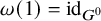





where for $g \in G^0(\kappa )$
,
$g \in G^0(\kappa )$
, $\operatorname {Int}_{G^0}(g)$
is the inner automorphism
$\operatorname {Int}_{G^0}(g)$
is the inner automorphism $x \mapsto gxg^{-1}$
of
$x \mapsto gxg^{-1}$
of $G^0$
. Here (C1) and (C2) follow by considering all A. Identities (C3) and (C4) follow by considering the case
$G^0$
. Here (C1) and (C2) follow by considering all A. Identities (C3) and (C4) follow by considering the case $A=\kappa $
.
$A=\kappa $
.
The simply connected central cover $\pi _{\operatorname {sc}} : (G^0)_{\operatorname {sc}} \to G^0$
has finite multiplicative kernel K. Let
$\pi _{\operatorname {sc}} : (G^0)_{\operatorname {sc}} \to G^0$
has finite multiplicative kernel K. Let $K_0$
be the prime to p part of K and define
$K_0$
be the prime to p part of K and define $H_0 := (G^0)_{\operatorname {sc}}/K_0$
. The kernel
$H_0 := (G^0)_{\operatorname {sc}}/K_0$
. The kernel $\mu $
of
$\mu $
of $\pi : H_0 \to G^0$
is isomorphic to
$\pi : H_0 \to G^0$
is isomorphic to $K/K_0$
and is thus a connected finite multiplicative
$K/K_0$
and is thus a connected finite multiplicative $\kappa $
-group scheme. Since
$\kappa $
-group scheme. Since $G^0$
is split,
$G^0$
is split, $\mu $
is a product of group schemes of the form
$\mu $
is a product of group schemes of the form $\mu _{p^r}$
. We have an exact sequence of non-abelian fppf cohomology groups
$\mu _{p^r}$
. We have an exact sequence of non-abelian fppf cohomology groups
 $$ \begin{align*}0 \to \mu(\kappa) \to H_0(\kappa) \to G^0(\kappa) \to H^1_{\mathrm{fppf}}({\mathrm{Spec}}(\kappa), \mu).\end{align*} $$
Since $H^1_{\mathrm {fppf}}({\mathrm {Spec}}(\kappa ), \mu _{p^n}) = \kappa ^{\times }/ (\kappa ^{\times })^{p^n}$
by [Reference Project59, Tag 040Q] and
$H^1_{\mathrm {fppf}}({\mathrm {Spec}}(\kappa ), \mu _{p^n}) = \kappa ^{\times }/ (\kappa ^{\times })^{p^n}$
by [Reference Project59, Tag 040Q] and $\kappa $
is a perfect field of characteristic p, we have
$\kappa $
is a perfect field of characteristic p, we have $\mu (\kappa )=1$
and
$\mu (\kappa )=1$
and $H^1_{\mathrm {fppf}}({\mathrm {Spec}}(\kappa ), \mu ) = 0$
. So we can see c as a map to
$H^1_{\mathrm {fppf}}({\mathrm {Spec}}(\kappa ), \mu ) = 0$
. So we can see c as a map to $H_0(\kappa )$
, which we will denote by
$H_0(\kappa )$
, which we will denote by $\tilde c$
. If A is a
$\tilde c$
. If A is a $\kappa $
-algebra we let
$\kappa $
-algebra we let $\tilde {c}_A$
be the composition of c with the map
$\tilde {c}_A$
be the composition of c with the map $H_0(\kappa ) \to H_0(A)$
.
$H_0(\kappa ) \to H_0(A)$
.
By [Reference Conrad19, Exercise 6.5.2 (iii)] any automorphism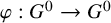 $\varphi : G^0 \to G^0$
lifts uniquely to an automorphism
$\varphi : G^0 \to G^0$
lifts uniquely to an automorphism $\varphi _{\operatorname {sc}} : (G^0)_{\operatorname {sc}} \to (G^0)_{\operatorname {sc}}$
such that
$\varphi _{\operatorname {sc}} : (G^0)_{\operatorname {sc}} \to (G^0)_{\operatorname {sc}}$
such that $\pi _{\operatorname {sc}} \circ \varphi _{\operatorname {sc}} = \varphi \circ \pi _{\operatorname {sc}}$
and
$\pi _{\operatorname {sc}} \circ \varphi _{\operatorname {sc}} = \varphi \circ \pi _{\operatorname {sc}}$
and $\varphi _{\operatorname {sc}}$
preserves
$\varphi _{\operatorname {sc}}$
preserves $K_0$
, so
$K_0$
, so $\varphi $
lifts uniquely to an automorphism
$\varphi $
lifts uniquely to an automorphism $L(\varphi ) : H_0 \to H_0$
such that
$L(\varphi ) : H_0 \to H_0$
such that $\pi \circ L(\varphi ) = \varphi \circ \pi $
and we obtain an injective group homomorphism
$\pi \circ L(\varphi ) = \varphi \circ \pi $
and we obtain an injective group homomorphism $L : {\mathrm {Aut}}(G^0) \hookrightarrow {\mathrm {Aut}}(H_0)$
.
$L : {\mathrm {Aut}}(G^0) \hookrightarrow {\mathrm {Aut}}(H_0)$
.
Let $\tilde \omega := L \circ \omega $
, that is, for all
$\tilde \omega := L \circ \omega $
, that is, for all $\delta \in \Delta $
, we have
$\delta \in \Delta $
, we have $\omega (\delta ) \circ \pi = \pi \circ \tilde \omega (\delta )$
. We claim that the pair
$\omega (\delta ) \circ \pi = \pi \circ \tilde \omega (\delta )$
. We claim that the pair $(\tilde \omega , \tilde c)$
satisfies the identities (C1), (C2), (C3) and (C4) above. Clearly the map
$(\tilde \omega , \tilde c)$
satisfies the identities (C1), (C2), (C3) and (C4) above. Clearly the map $\tilde c$
satisfies (C4). Via the isomorphism
$\tilde c$
satisfies (C4). Via the isomorphism $H_0(\kappa ) \cong G^0(\kappa )$
the maps
$H_0(\kappa ) \cong G^0(\kappa )$
the maps $\omega _{\kappa }$
and
$\omega _{\kappa }$
and $\tilde \omega _{\kappa }$
can be identified, so (C3) holds for
$\tilde \omega _{\kappa }$
can be identified, so (C3) holds for $(\tilde \omega , \tilde c)$
. Property (C2) holds, as L is a homomorphism. By applying L to the identity (C1) for
$(\tilde \omega , \tilde c)$
. Property (C2) holds, as L is a homomorphism. By applying L to the identity (C1) for $G^0$
, we get
$G^0$
, we get
 $$ \begin{align} \tilde \omega(\delta_1) \circ \tilde \omega(\delta_2) = L(\operatorname{Int}_{G^0}(c(\delta_1, \delta_2))) \circ \tilde \omega(\delta_1\delta_2) \quad \text{ in } {\mathrm{Aut}}(H_0). \end{align} $$
Since under the isomorphism $H_0(\kappa ) \xrightarrow {\sim } G^0(\kappa )$
the element
$H_0(\kappa ) \xrightarrow {\sim } G^0(\kappa )$
the element $\tilde c(\delta _1, \delta _2)$
is mapped to
$\tilde c(\delta _1, \delta _2)$
is mapped to $c(\delta _1, \delta _2)$
, we have
$c(\delta _1, \delta _2)$
, we have $\pi \circ \operatorname {Int}_{H_0}(\tilde c(\delta _1, \delta _2)) = \operatorname {Int}_{G^0}(c(\delta _1, \delta _2)) \circ \pi $
. Thus
$\pi \circ \operatorname {Int}_{H_0}(\tilde c(\delta _1, \delta _2)) = \operatorname {Int}_{G^0}(c(\delta _1, \delta _2)) \circ \pi $
. Thus $L(\operatorname {Int}_{G^0}(c(\delta _1, \delta _2))) = \operatorname {Int}_{H_0}(\tilde c(\delta _1, \delta _2))$
by definition of L and we deduce from (12) that (C1) holds for
$L(\operatorname {Int}_{G^0}(c(\delta _1, \delta _2))) = \operatorname {Int}_{H_0}(\tilde c(\delta _1, \delta _2))$
by definition of L and we deduce from (12) that (C1) holds for $H_0$
, which finishes the proof of the claim. We deduce that for every
$H_0$
, which finishes the proof of the claim. We deduce that for every $\kappa $
-algebra A the pair
$\kappa $
-algebra A the pair $(\tilde {\omega }_A, \tilde {c}_A)$
is a generalised
$(\tilde {\omega }_A, \tilde {c}_A)$
is a generalised $2$
-cocycle of
$2$
-cocycle of $\Delta $
with values in
$\Delta $
with values in $H_0(A)$
, which by Lemma 2.29 defines a group law
$H_0(A)$
, which by Lemma 2.29 defines a group law $\ast $
on
$\ast $
on $H_0(A)\times \Delta $
, natural in A.
$H_0(A)\times \Delta $
, natural in A.
The functor $A\mapsto (H_0(A)\times \Delta , \ast )$
defines a presheaf of groups, which we denote by
$A\mapsto (H_0(A)\times \Delta , \ast )$
defines a presheaf of groups, which we denote by $H^{\mathrm {pre}}$
. The map
$H^{\mathrm {pre}}$
. The map $H^{\mathrm {pre}}(A) \to G(A)$
,
$H^{\mathrm {pre}}(A) \to G(A)$
, $(h, \delta )\mapsto \pi (h) s(\delta )$
is a group homomorphism natural in A, as
$(h, \delta )\mapsto \pi (h) s(\delta )$
is a group homomorphism natural in A, as $\pi _A \circ \tilde c_A = c_A$
and for any
$\pi _A \circ \tilde c_A = c_A$
and for any $\delta \in \Delta $
, we have
$\delta \in \Delta $
, we have $\omega (\delta ) \circ \pi = \pi \circ \tilde \omega (\delta )$
. We let H be the Zariski sheafification of
$\omega (\delta ) \circ \pi = \pi \circ \tilde \omega (\delta )$
. We let H be the Zariski sheafification of $H^{\mathrm {pre}}$
. Since
$H^{\mathrm {pre}}$
. Since $\underline {\Delta }$
is the sheafification of the constant presheaf
$\underline {\Delta }$
is the sheafification of the constant presheaf $\Delta $
,
$\Delta $
, $H= H_0\times \underline {\Delta }$
and
$H= H_0\times \underline {\Delta }$
and $H^{\mathrm {pre}}\rightarrow G$
induces a map of
$H^{\mathrm {pre}}\rightarrow G$
induces a map of $\kappa $
-group schemes
$\kappa $
-group schemes $H\rightarrow G$
. Properties (1) and (2) claimed in the Lemma hold by construction as
$H\rightarrow G$
. Properties (1) and (2) claimed in the Lemma hold by construction as $H^0=H_0$
and (3) holds as
$H^0=H_0$
and (3) holds as $\pi _1(H^0)$
is isomorphic to
$\pi _1(H^0)$
is isomorphic to $K_0$
.
$K_0$
.
3 Deformation rings
Let $\Gamma $
be a profinite group such that
$\Gamma $
be a profinite group such that $H^1(\Gamma ', \mathbb F_p)$
is finite for all open subgroups
$H^1(\Gamma ', \mathbb F_p)$
is finite for all open subgroups $\Gamma '$
of
$\Gamma '$
of $\Gamma $
. This p-finiteness condition introduced by Mazur holds, when
$\Gamma $
. This p-finiteness condition introduced by Mazur holds, when $\Gamma =\Gamma _F$
.
$\Gamma =\Gamma _F$
.
Let $\rho : \Gamma \rightarrow G(\kappa )$
be a continuous representation, where G is a smooth affine
$\rho : \Gamma \rightarrow G(\kappa )$
be a continuous representation, where G is a smooth affine $\mathscr O$
-group scheme and
$\mathscr O$
-group scheme and $\kappa $
is either a finite extension of k, a finite extension of L or a local field of characteristic p containing k equipped with natural topology. We will refer to such fields
$\kappa $
is either a finite extension of k, a finite extension of L or a local field of characteristic p containing k equipped with natural topology. We will refer to such fields $\kappa $
as a finite or a local
$\kappa $
as a finite or a local $\mathscr O$
-field. In this section we will study the deformation theory of
$\mathscr O$
-field. In this section we will study the deformation theory of $\rho $
. We first define a ring of coefficients
$\rho $
. We first define a ring of coefficients $\Lambda $
over which the deformation problem is defined following [Reference Böckle, Iyengar and Paškūnas6, Section 3.5].
$\Lambda $
over which the deformation problem is defined following [Reference Böckle, Iyengar and Paškūnas6, Section 3.5].
-
(1) If
$\kappa $
is a finite field then pick an unramified extension
$L'$
of L with residue field
$\kappa $
and let
$\Lambda := \mathscr O_{L'}$
denote the ring of integers in
$L'$
. -
(2) If
$\kappa $
is a finite extension of L then let
$\Lambda :=\kappa $
, let
$\Lambda ^0$
be the ring of integers in
$\Lambda $
and let
$t=\varpi $
. -
(3) If
$\kappa $
is a local field of characteristic p then let
$\mathscr O_{\kappa }$
be the ring of integers in
$\kappa $
and let
$k'$
be its residue field. Since
$\mathrm {char}(\kappa )=p$
by choosing a uniformiser we obtain an isomorphism . Let
$L'$
be an unramified extension of L with residue field
$k'$
, let and let
$\Lambda $
be the p-adic completion of
$\Lambda ^0[1/t]$
. Then
$\Lambda $
is a complete DVR with uniformiser
$\varpi $
and residue field
$\kappa $
. We equip
$\Lambda ^0$
with its
$(\varpi , t)$
-adic topology, this induces a topology on
$\Lambda ^0[1/t]$
and
$\Lambda ^0[1/t]/ p^n \Lambda ^0[1/t]$
for all
$n\ge 1$
. We equip
$\Lambda = \varprojlim _{n} \Lambda ^0[1/t]/ p^n \Lambda ^0[1/t]$
with the projective limit topology.


 . Let
. Let 

 and let



Let ${\mathfrak {A}}_{\Lambda }$
be the category of local artinian
${\mathfrak {A}}_{\Lambda }$
be the category of local artinian $\Lambda $
-algebras with residue field
$\Lambda $
-algebras with residue field $\kappa $
. If
$\kappa $
. If $(A, \mathfrak m_A)\in {\mathfrak {A}}_{\Lambda }$
then we define the topology on A in the cases (1), (2) and (3) above as follows:
$(A, \mathfrak m_A)\in {\mathfrak {A}}_{\Lambda }$
then we define the topology on A in the cases (1), (2) and (3) above as follows:
-
(1) A is a finite
$\mathscr O/\varpi ^n$
-module for some
$n\ge 1$
with the discrete topology on A; -
(2) A is a finite dimensional L-vector space with the p-adic topology on A;
-
(3) A is a
$\Lambda ^0[1/t]/ \varpi ^n \Lambda ^0[1/t]$
-module of finite length for some
$n\ge 1$
and we put the induced topology on A.




Since G is smooth the map $G(A)\rightarrow G(\kappa )$
is surjective for all
$G(A)\rightarrow G(\kappa )$
is surjective for all $A\in {\mathfrak {A}}_{\Lambda }$
. Let
$A\in {\mathfrak {A}}_{\Lambda }$
. Let $D^{\square }_{\rho , G}: {\mathfrak {A}}_{\Lambda } \rightarrow \text {Set}$
be the functor such that
$D^{\square }_{\rho , G}: {\mathfrak {A}}_{\Lambda } \rightarrow \text {Set}$
be the functor such that $D^{\square }_{\rho , G}(A)$
is the set of continuous group homomorphisms
$D^{\square }_{\rho , G}(A)$
is the set of continuous group homomorphisms $\rho _{A}: \Gamma \rightarrow G(A)$
satisfying
$\rho _{A}: \Gamma \rightarrow G(A)$
satisfying $\rho _{A} \pmod {\mathfrak m_A}=\rho $
.
$\rho _{A} \pmod {\mathfrak m_A}=\rho $
.
Lemma 3.1. Let V be a continuous representation of $\Gamma $
on a finite dimensional
$\Gamma $
on a finite dimensional $\kappa $
-vector space V. Then
$\kappa $
-vector space V. Then
 $$ \begin{align} \dim_{\kappa} Z^1(\Gamma, V)= h^1(\Gamma, V) +\dim_{\kappa} V - h^0(\Gamma, V), \end{align} $$
where $h^i(\Gamma , V):= \dim _{\kappa } H^i(\Gamma , V)$
. Moreover, if
$h^i(\Gamma , V):= \dim _{\kappa } H^i(\Gamma , V)$
. Moreover, if $\Gamma =\Gamma _F$
then
$\Gamma =\Gamma _F$
then
 $$ \begin{align} \begin{aligned} \dim_{\kappa} Z^1(\Gamma_F, V)&=\dim_{\kappa} V ([F:\mathbb {Q}_p]+1)+ h^0(\Gamma_F, V^*(1))\\ &= \dim_{\kappa} V ([F:\mathbb {Q}_p]+1)+ h^2(\Gamma_F, V). \end{aligned} \end{align} $$
Proof. Mapping $v\in V$
to a coboundary
$v\in V$
to a coboundary $\gamma \mapsto (\gamma -1) v$
induces an exact sequence:
$\gamma \mapsto (\gamma -1) v$
induces an exact sequence:
 $$ \begin{align*}0\rightarrow V^{\Gamma} \rightarrow V \rightarrow Z^1(\Gamma, V)\rightarrow H^1(\Gamma, V)\rightarrow 0,\end{align*} $$
which implies (13). The second part follows from local Euler–Poincaré characteristic formula and local Tate duality, see for example [Reference Böckle and Juschka7, Theorem 3.4.1].
Let $\kappa [\varepsilon ]$
be the ring of dual numbers over
$\kappa [\varepsilon ]$
be the ring of dual numbers over $\kappa $
. The Lie algebra
$\kappa $
. The Lie algebra ${\mathrm {Lie}} G_{\kappa }$
of
${\mathrm {Lie}} G_{\kappa }$
of $G_{\kappa }$
is a finite dimensional
$G_{\kappa }$
is a finite dimensional $\kappa $
-vector space, which sits in the exact sequence of groups
$\kappa $
-vector space, which sits in the exact sequence of groups
 $$ \begin{align*}0\rightarrow {\mathrm{Lie}} G_{\kappa}\rightarrow G(\kappa[\varepsilon])\rightarrow G(\kappa)\rightarrow 0.\end{align*} $$
The action of $G(\kappa )$
on
$G(\kappa )$
on $G(\kappa [\varepsilon ])$
by conjugation induces a
$G(\kappa [\varepsilon ])$
by conjugation induces a $\kappa $
-linear action of
$\kappa $
-linear action of $G(\kappa )$
on
$G(\kappa )$
on ${\mathrm {Lie}} G_{\kappa }$
. We let
${\mathrm {Lie}} G_{\kappa }$
. We let ${\mathrm {ad}} \rho $
be the representation of
${\mathrm {ad}} \rho $
be the representation of $\Gamma $
on
$\Gamma $
on ${\mathrm {Lie}} G_{\kappa }$
defined by
${\mathrm {Lie}} G_{\kappa }$
defined by
 $$ \begin{align*}{\mathrm{ad}}(\rho)(\gamma)(X):= \rho(\gamma) X \rho(\gamma)^{-1}, \quad \forall \gamma\in \Gamma, \quad \forall X\in {\mathrm{Lie}} G_{\kappa}.\end{align*} $$
Then ${\mathrm {ad}} \rho $
is a continuous representation of
${\mathrm {ad}} \rho $
is a continuous representation of $\Gamma $
for the topology on
$\Gamma $
for the topology on ${\mathrm {Lie}} G_{\kappa }$
induced by the topology on
${\mathrm {Lie}} G_{\kappa }$
induced by the topology on $\kappa $
.
$\kappa $
.
Lemma 3.2. Let $\rho : \Gamma \to G(\kappa )$
be a continuous representation. Then
$\rho : \Gamma \to G(\kappa )$
be a continuous representation. Then $D^{\square }_{\rho , G}$
is pro-representable by a complete local noetherian
$D^{\square }_{\rho , G}$
is pro-representable by a complete local noetherian $\Lambda $
-algebra
$\Lambda $
-algebra $R^{\square }_{\rho , G}$
with residue field
$R^{\square }_{\rho , G}$
with residue field $\kappa $
.
$\kappa $
.
Proof. If $A,B,C \in {\mathfrak {A}}_{\Lambda }$
, then a homomorphism
$A,B,C \in {\mathfrak {A}}_{\Lambda }$
, then a homomorphism $\Gamma \to G(A \times _C B)$
is continuous if and only if its projections to
$\Gamma \to G(A \times _C B)$
is continuous if and only if its projections to $G(A)$
and
$G(A)$
and $G(B)$
are continuous. It follows that the functor
$G(B)$
are continuous. It follows that the functor ${\mathfrak {A}}_{\Lambda } \to \text {Set}, ~ A \mapsto {\mathrm {Hom}}^{\mathrm {cont}}_{\mathrm {Group}}(\Gamma , G(A))$
preserves finite limits. The deformation functor
${\mathfrak {A}}_{\Lambda } \to \text {Set}, ~ A \mapsto {\mathrm {Hom}}^{\mathrm {cont}}_{\mathrm {Group}}(\Gamma , G(A))$
preserves finite limits. The deformation functor $D^{\square }_{\rho , G}$
is defined as a pullback of the latter, so
$D^{\square }_{\rho , G}$
is defined as a pullback of the latter, so $D^{\square }_{\rho , G}$
also preserves finite limits. By Grothendieck’s criterion,
$D^{\square }_{\rho , G}$
also preserves finite limits. By Grothendieck’s criterion, $D^{\square }_{\rho , G}$
is pro-representable by a projective limit of objects in
$D^{\square }_{\rho , G}$
is pro-representable by a projective limit of objects in ${\mathfrak {A}}_{\Lambda }$
.
${\mathfrak {A}}_{\Lambda }$
.
The map $Z^1(\Gamma , {\mathrm {ad}} \rho )\rightarrow D^{\square }_{\rho , G}(\kappa [\varepsilon ])$
,
$Z^1(\Gamma , {\mathrm {ad}} \rho )\rightarrow D^{\square }_{\rho , G}(\kappa [\varepsilon ])$
, $\Phi \mapsto [\gamma \mapsto \rho (\gamma ) (1 +\varepsilon \Phi (\gamma ))]$
is an isomorphism of
$\Phi \mapsto [\gamma \mapsto \rho (\gamma ) (1 +\varepsilon \Phi (\gamma ))]$
is an isomorphism of $\kappa $
-vector spaces. Since
$\kappa $
-vector spaces. Since $\Gamma $
satisfies Mazur’s p-finiteness condition [Reference Böckle and Juschka7, Theorem 3.4.1] implies that
$\Gamma $
satisfies Mazur’s p-finiteness condition [Reference Böckle and Juschka7, Theorem 3.4.1] implies that $h^1(\Gamma , {\mathrm {ad}} \rho )$
is finite. Lemma 3.1 implies that
$h^1(\Gamma , {\mathrm {ad}} \rho )$
is finite. Lemma 3.1 implies that $Z^1(\Gamma , {\mathrm {ad}} \rho )$
is finite dimensional, thus
$Z^1(\Gamma , {\mathrm {ad}} \rho )$
is finite dimensional, thus $R^{\square }_{\rho , G}$
is noetherian.
$R^{\square }_{\rho , G}$
is noetherian.
Lemma 3.3. Let $f : G \to H$
be a continuous surjective open homomorphism between locally profinite groups. Then there is a continuous map
$f : G \to H$
be a continuous surjective open homomorphism between locally profinite groups. Then there is a continuous map $s: H \to G$
with
$s: H \to G$
with $f \circ s = {\mathrm {id}}_H$
.
$f \circ s = {\mathrm {id}}_H$
.
Proof. If G and H are profinite, this is [Reference Serre55, Section I.1, Proposition 1]. In general, let N be an open profinite subgroup of G. Then $N' := f(N)$
is an open profinite subgroup of H and we find a continuous map
$N' := f(N)$
is an open profinite subgroup of H and we find a continuous map $s : N' \to N$
with
$s : N' \to N$
with $f|_N \circ s = {\mathrm {id}}_{N'}$
. Let
$f|_N \circ s = {\mathrm {id}}_{N'}$
. Let $R \subseteq H$
be a set of
$R \subseteq H$
be a set of $N'$
-coset representatives so that
$N'$
-coset representatives so that $H = \bigcup _{r \in R} rN'$
and choose
$H = \bigcup _{r \in R} rN'$
and choose $g_r \in G$
with
$g_r \in G$
with $f(g_r) = r$
for each
$f(g_r) = r$
for each $r \in R$
. We can extend s to a continuous map
$r \in R$
. We can extend s to a continuous map $\tilde s : H \to G$
by defining
$\tilde s : H \to G$
by defining $\tilde s(rn') := g_rs(n')$
for all
$\tilde s(rn') := g_rs(n')$
for all $n' \in N'$
and see, that
$n' \in N'$
and see, that $f \circ \tilde s = {\mathrm {id}}_H$
, as desired.
$f \circ \tilde s = {\mathrm {id}}_H$
, as desired.
Lemma 3.4. Let $\kappa $
be a local
$\kappa $
be a local $\mathscr O$
-field, let
$\mathscr O$
-field, let $\Lambda $
be a coefficient ring for
$\Lambda $
be a coefficient ring for $\kappa $
and let
$\kappa $
and let $(A, \mathfrak m_A) \in {\mathfrak {A}}_{\Lambda }$
. Then there is a module-finite
$(A, \mathfrak m_A) \in {\mathfrak {A}}_{\Lambda }$
. Then there is a module-finite $\Lambda ^0$
-subalgebra R of A with
$\Lambda ^0$
-subalgebra R of A with $R \otimes _{\Lambda ^0} \Lambda = A$
. In particular, R is a profinite open subring of A.
$R \otimes _{\Lambda ^0} \Lambda = A$
. In particular, R is a profinite open subring of A.
Proof. Let $\pi _A : A \to \kappa $
be the projection to the residue field. Pick
$\pi _A : A \to \kappa $
be the projection to the residue field. Pick $\Lambda $
-module generators
$\Lambda $
-module generators $x_1, \dots , x_n$
of A and we may assume by rescaling with t, that
$x_1, \dots , x_n$
of A and we may assume by rescaling with t, that $\pi _A(x_i) \in \mathscr O_{\kappa }$
for all i. Since
$\pi _A(x_i) \in \mathscr O_{\kappa }$
for all i. Since $\Lambda ^0$
surjects onto
$\Lambda ^0$
surjects onto $\mathscr O_{\kappa }$
, we can pick
$\mathscr O_{\kappa }$
, we can pick $y_i \in \Lambda ^0$
with
$y_i \in \Lambda ^0$
with $\pi _A(y_i) = \pi _A(x_i)$
for all i. Since
$\pi _A(y_i) = \pi _A(x_i)$
for all i. Since $\mathfrak m_A$
is nilpotent, the finitely many nonzero products of the elements
$\mathfrak m_A$
is nilpotent, the finitely many nonzero products of the elements $x_i - y_i \in \mathfrak m_A$
generate a multiplicatively closed finitely generated
$x_i - y_i \in \mathfrak m_A$
generate a multiplicatively closed finitely generated $\Lambda ^0$
-submodule I of
$\Lambda ^0$
-submodule I of $\mathfrak m_A$
. In particular
$\mathfrak m_A$
. In particular $R := \Lambda ^0 + I$
is a module-finite
$R := \Lambda ^0 + I$
is a module-finite $\Lambda ^0$
-subalgebra of A with
$\Lambda ^0$
-subalgebra of A with $R[1/t] = A$
. Since R is a finitely generated
$R[1/t] = A$
. Since R is a finitely generated $\Lambda ^0$
-module,
$\Lambda ^0$
-module, $\Lambda ^0$
is open in
$\Lambda ^0$
is open in $\Lambda $
and
$\Lambda $
and $\Lambda $
is Hausdorff, R is profinite and open.
$\Lambda $
is Hausdorff, R is profinite and open.
Lemma 3.5. Let $\kappa $
be either a finite or a local
$\kappa $
be either a finite or a local $\mathscr O$
-field and let
$\mathscr O$
-field and let $\Lambda $
be a coefficient ring for
$\Lambda $
be a coefficient ring for $\kappa $
. Let G be a smooth affine
$\kappa $
. Let G be a smooth affine $\mathscr O$
-group.
$\mathscr O$
-group.
-
(1) For every
$A \in {\mathfrak {A}}_{\Lambda }$
, the topological group
$G(A)$
is locally profinite. -
(2) Let
$f : A \to B$
be a surjective morphism in
${\mathfrak {A}}_{\Lambda }$
. Then the map
$\varphi : G(A) \to G(B)$
induced by f is surjective and there is a continuous map
$s : G(B) \to G(A)$
with
$\varphi \circ s = {\mathrm {id}}_{G(B)}$
.





Proof. When $\kappa $
is finite, both assertions are clear, so we assume that
$\kappa $
is finite, both assertions are clear, so we assume that $\kappa $
is local. Let R be a profinite open subalgebra of A with
$\kappa $
is local. Let R be a profinite open subalgebra of A with $R \otimes _{\Lambda ^0} \Lambda = A$
as constructed in Lemma 3.4.
$R \otimes _{\Lambda ^0} \Lambda = A$
as constructed in Lemma 3.4.
Part (1). We claim, that $G(R) \subseteq G(A)$
is a profinite open subgroup. Choose a closed immersion
$G(R) \subseteq G(A)$
is a profinite open subgroup. Choose a closed immersion $G \hookrightarrow \mathbb A^n$
over
$G \hookrightarrow \mathbb A^n$
over $\mathscr O$
. By definition
$\mathscr O$
. By definition $G(A)$
carries the subspace topology of
$G(A)$
carries the subspace topology of $\mathbb A^n(A)$
. Since
$\mathbb A^n(A)$
. Since $\mathbb A^n(R)$
is open in
$\mathbb A^n(R)$
is open in $\mathbb A^n(A)$
,
$\mathbb A^n(A)$
, $G(R)$
is open in
$G(R)$
is open in $G(A)$
. Since R is Hausdorff,
$G(A)$
. Since R is Hausdorff, $G(R)$
is closed in
$G(R)$
is closed in $\mathbb A^n(R)$
and since
$\mathbb A^n(R)$
and since $\mathbb A^n(R)$
is profinite,
$\mathbb A^n(R)$
is profinite, $G(R)$
is profinite.
$G(R)$
is profinite.
Part (2). Surjectivity of $\varphi $
follows from smoothness of G. Then
$\varphi $
follows from smoothness of G. Then $R' := f(R)$
is a compact subalgebra of B with
$R' := f(R)$
is a compact subalgebra of B with $R' \otimes _{\Lambda ^0} \Lambda = B$
. Since the topology of B is by definition induced by an arbitrary open
$R' \otimes _{\Lambda ^0} \Lambda = B$
. Since the topology of B is by definition induced by an arbitrary open $\Lambda ^0$
-lattice, we see that
$\Lambda ^0$
-lattice, we see that $R'$
is open in B. Since G is smooth, we have a surjection
$R'$
is open in B. Since G is smooth, we have a surjection $G(R) \to G(R')$
of open profinite subgroups of
$G(R) \to G(R')$
of open profinite subgroups of $G(A)$
and
$G(A)$
and $G(B)$
respectively. Since any surjective continuous homomorphism between profinite groups is openFootnote
2
, we see that
$G(B)$
respectively. Since any surjective continuous homomorphism between profinite groups is openFootnote
2
, we see that $\varphi $
is open. The assertion follows from Lemma 3.3.
$\varphi $
is open. The assertion follows from Lemma 3.3.
Proposition 3.6. Let $\varphi : G \to H$
be a morphism of smooth affine
$\varphi : G \to H$
be a morphism of smooth affine $\mathscr O$
-group schemes such that the induced morphism on neutral components
$\mathscr O$
-group schemes such that the induced morphism on neutral components $G^0\rightarrow H^0$
is smooth and surjective. Let
$G^0\rightarrow H^0$
is smooth and surjective. Let $\rho : \Gamma \to G(\kappa )$
be a continuous representation and let
$\rho : \Gamma \to G(\kappa )$
be a continuous representation and let ${\mathrm {ad}}^{0, \varphi }= \ker ({\mathrm {ad}} \rho \rightarrow {\mathrm {ad}} \varphi \circ \rho )$
. Then there is a natural isomorphism of
${\mathrm {ad}}^{0, \varphi }= \ker ({\mathrm {ad}} \rho \rightarrow {\mathrm {ad}} \varphi \circ \rho )$
. Then there is a natural isomorphism of $R^{\square }_{\varphi \circ \rho , H}$
-algebras
$R^{\square }_{\varphi \circ \rho , H}$
-algebras

where $r = \dim _{\kappa } Z^1(\Gamma , {\mathrm {ad}}^{0,\varphi } \rho )$
,
$r = \dim _{\kappa } Z^1(\Gamma , {\mathrm {ad}}^{0,\varphi } \rho )$
, $t = h^2(\Gamma , {\mathrm {ad}}^{0,\varphi } \rho )$
. Moreover, if
$t = h^2(\Gamma , {\mathrm {ad}}^{0,\varphi } \rho )$
. Moreover, if $\Gamma =\Gamma _F$
then
$\Gamma =\Gamma _F$
then
 $$ \begin{align} r-t = (\dim G_{\kappa} - \dim H_{\kappa}) \cdot ([F : \mathbb {Q}_p] + 1). \end{align} $$
Proof. If $\kappa $
is a finite field then the argument of [Reference Böckle, Iyengar and Paškūnas6, Proposition 4.3], where
$\kappa $
is a finite field then the argument of [Reference Böckle, Iyengar and Paškūnas6, Proposition 4.3], where $G = {\mathrm {GL}}_d$
,
$G = {\mathrm {GL}}_d$
, $H = {\mathrm {GL}}_1$
,
$H = {\mathrm {GL}}_1$
, $\varphi = \det $
, goes through verbatim. If
$\varphi = \det $
, goes through verbatim. If $\kappa $
is a local field then one needs to additionally verify that obstruction to lifting can be realised by a continuous
$\kappa $
is a local field then one needs to additionally verify that obstruction to lifting can be realised by a continuous $2$
-cocycle, as noted in [Reference Böckle, Iyengar and Paškūnas6, Remark 4.4]. The solution to this problem is explained in detail in [Reference Conrad17, Lecture 6], when
$2$
-cocycle, as noted in [Reference Böckle, Iyengar and Paškūnas6, Remark 4.4]. The solution to this problem is explained in detail in [Reference Conrad17, Lecture 6], when $\kappa $
is a local field of characteristic zero and H is trivial. We sketch how these arguments fit together.
$\kappa $
is a local field of characteristic zero and H is trivial. We sketch how these arguments fit together.
The exact sequence $0\rightarrow {\mathrm {ad}}^{0,\varphi }\rho \rightarrow {\mathrm {ad}} \rho \rightarrow {\mathrm {ad}} \varphi \circ \rho \rightarrow 0$
of Galois representations induces an exact sequence of abelian groups:
$0\rightarrow {\mathrm {ad}}^{0,\varphi }\rho \rightarrow {\mathrm {ad}} \rho \rightarrow {\mathrm {ad}} \varphi \circ \rho \rightarrow 0$
of Galois representations induces an exact sequence of abelian groups:
 $$ \begin{align*}0 \rightarrow Z^1(\Gamma, {\mathrm{ad}}^{0,\varphi}\rho)\rightarrow Z^1(\Gamma, {\mathrm{ad}}\rho) \rightarrow Z^1(\Gamma, {\mathrm{ad}} \varphi\circ \rho)\end{align*} $$
and hence $r=\dim _{\kappa } \ker (Z^1({\mathrm {ad}}\varphi ))$
. The map
$r=\dim _{\kappa } \ker (Z^1({\mathrm {ad}}\varphi ))$
. The map
 $$ \begin{align*}Z^1({\mathrm{ad}} \varphi): Z^1(\Gamma, {\mathrm{ad}}\rho) \to Z^1(\Gamma, {\mathrm{ad}} \varphi\circ\rho)\end{align*} $$
is the induced map on Zariski tangent spaces of the map of deformation rings $R_{\varphi \circ \rho }^{\square } \to R^{\square }_{\rho }$
, and thus lifts to a surjection
$R_{\varphi \circ \rho }^{\square } \to R^{\square }_{\rho }$
, and thus lifts to a surjection

We set $J := \ker \tilde \phi $
. By Nakayama’s lemma, we need to show, that
$J := \ker \tilde \phi $
. By Nakayama’s lemma, we need to show, that $\dim _{\kappa } J/\tilde {\mathfrak {m}} J \leq t$
. The module
$\dim _{\kappa } J/\tilde {\mathfrak {m}} J \leq t$
. The module $J/\tilde {\mathfrak {m}} J$
appears as the kernel of the sequence
$J/\tilde {\mathfrak {m}} J$
appears as the kernel of the sequence
 $$ \begin{align} 0 \to J/\tilde {\mathfrak{m}} J \to \tilde {R} / \tilde {\mathfrak{m}} J \to \tilde {R}/J \cong R_{\rho, G}^{\square} \to 0 \end{align} $$
In view of the above sequence, it is enough construct a homomorphism
 $$ \begin{align} \alpha : {\mathrm{Hom}}_{\kappa}(J/\tilde{\mathfrak{m}} J, \kappa) \to \ker (H^2({\mathrm{ad}} \varphi) : H^2(\Gamma, {\mathrm{ad}} \rho) \to H^2(\Gamma, {\mathrm{ad}} \varphi \circ \rho)) \end{align} $$
and show, that $\ker (\alpha )$
injects into
$\ker (\alpha )$
injects into ${\mathrm {coker}}(H^1({\mathrm {ad}} \varphi ))$
. This will imply the existence of the presentation in the statement of the Proposition, since then
${\mathrm {coker}}(H^1({\mathrm {ad}} \varphi ))$
. This will imply the existence of the presentation in the statement of the Proposition, since then
 $$ \begin{align} \dim_{\kappa} J/\tilde{\mathfrak {m}} J \leq \dim_{\kappa} \ker(H^2({\mathrm{ad}} \varphi)) + \dim_{\kappa} {\mathrm{coker}}(H^1({\mathrm{ad}} \varphi)) = h^2(\Gamma,{\mathrm{ad}}^{0,\varphi} \rho) \end{align} $$
where the last equality comes from the long exact cohomology sequence that arises from $0 \to {\mathrm {ad}}^{0,\varphi } \rho \to {\mathrm {ad}}\rho \to {\mathrm {ad}}\varphi \circ \rho \to 0$
.
$0 \to {\mathrm {ad}}^{0,\varphi } \rho \to {\mathrm {ad}}\rho \to {\mathrm {ad}}\varphi \circ \rho \to 0$
.
For all $i> 0$
, we define
$i> 0$
, we define $\tilde {R}_i:=\tilde {R}/\tilde {\mathfrak {m}}^{i}$
,
$\tilde {R}_i:=\tilde {R}/\tilde {\mathfrak {m}}^{i}$
,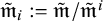 $\tilde {\mathfrak {m}}_{i} := \tilde {\mathfrak {m}}/\tilde {\mathfrak {m}}^{i}$
,
$\tilde {\mathfrak {m}}_{i} := \tilde {\mathfrak {m}}/\tilde {\mathfrak {m}}^{i}$
, $J_i := (J + \tilde {\mathfrak {m}}^{i})/\tilde {\mathfrak {m}}^{i}$
and
$J_i := (J + \tilde {\mathfrak {m}}^{i})/\tilde {\mathfrak {m}}^{i}$
and $R_{\rho , G,i}^{\square } := R_{\rho , G}^{\square }/\tilde {\mathfrak {m}}^{i} R_{\rho , G}^{\square }$
. The Artin–Rees lemma implies that
$R_{\rho , G,i}^{\square } := R_{\rho , G}^{\square }/\tilde {\mathfrak {m}}^{i} R_{\rho , G}^{\square }$
. The Artin–Rees lemma implies that $J\cap (\tilde {\mathfrak {m}} J +\tilde {\mathfrak {m}}^{i})= \tilde {\mathfrak {m}} J$
for sufficiently large
$J\cap (\tilde {\mathfrak {m}} J +\tilde {\mathfrak {m}}^{i})= \tilde {\mathfrak {m}} J$
for sufficiently large $i \gg 0$
, thus the map
$i \gg 0$
, thus the map $J/\tilde {\mathfrak {m}} J \to J_i/\tilde {\mathfrak {m}}_{i}J_{i}$
is an isomorphism. We will fix such i for the rest of the proof. It is therefore enough to work with objects of
$J/\tilde {\mathfrak {m}} J \to J_i/\tilde {\mathfrak {m}}_{i}J_{i}$
is an isomorphism. We will fix such i for the rest of the proof. It is therefore enough to work with objects of $\mathfrak {A}_{\Lambda }$
whose maximal ideal has vanishing i-th power, we will denote this category by
$\mathfrak {A}_{\Lambda }$
whose maximal ideal has vanishing i-th power, we will denote this category by $\mathfrak {A}_{\Lambda , i}$
. The inclusion functor
$\mathfrak {A}_{\Lambda , i}$
. The inclusion functor $\mathfrak {A}_{\Lambda , i} \to \mathfrak {A}_{\Lambda }$
has a left adjoint given by modding out the i-th power of the maximal ideal. The ring
$\mathfrak {A}_{\Lambda , i} \to \mathfrak {A}_{\Lambda }$
has a left adjoint given by modding out the i-th power of the maximal ideal. The ring $R_{\rho , G,i}^{\square }$
represents the restriction of
$R_{\rho , G,i}^{\square }$
represents the restriction of $D^{\square }_{\rho ,G}$
to
$D^{\square }_{\rho ,G}$
to $\mathfrak {A}_{\Lambda ,i}$
and we will denote the universal lift by
$\mathfrak {A}_{\Lambda ,i}$
and we will denote the universal lift by $\rho ^{\square }_i : \Gamma \to G(R_{\rho , G,i}^{\square })$
. We obtain an exact sequence
$\rho ^{\square }_i : \Gamma \to G(R_{\rho , G,i}^{\square })$
. We obtain an exact sequence
 $$ \begin{align} 0 \to J_i/\tilde {\mathfrak {m}}_{i} J_{i} \to \tilde {R}_i / \tilde {\mathfrak {m}}_{i} J_{i} \to \tilde {R}_i/J_i \cong R_{\rho, G, i}^{\square} \to 0 \end{align} $$
where $\tilde {R}_i / \tilde {\mathfrak {m}}_{i} J_i$
and
$\tilde {R}_i / \tilde {\mathfrak {m}}_{i} J_i$
and $R_{\rho , G, i}^{\square }$
are objects of
$R_{\rho , G, i}^{\square }$
are objects of $\mathfrak {A}_{\Lambda , i}$
. If
$\mathfrak {A}_{\Lambda , i}$
. If $u \in {\mathrm {Hom}}_{\kappa }(J_i/\tilde {\mathfrak {m}}_{i} J_{i}, \kappa )$
then by modding out
$u \in {\mathrm {Hom}}_{\kappa }(J_i/\tilde {\mathfrak {m}}_{i} J_{i}, \kappa )$
then by modding out $\ker (u)$
in (20) we obtain an exact sequence
$\ker (u)$
in (20) we obtain an exact sequence
 $$ \begin{align} 0 \to I_u \to R_u \xrightarrow{\phi_u} R^{\square}_{\rho, G,i} \to 0, \end{align} $$
The surjection of locally profinite groups $G(R_u)\twoheadrightarrow G(R^{\square }_{\rho , G,i})$
has a continuous section by Lemma 3.5. Once we have this the proof is identical to the proof of [Reference Böckle, Iyengar and Paškūnas6, Proposition 4.3]. Moreover, if
$G(R_u)\twoheadrightarrow G(R^{\square }_{\rho , G,i})$
has a continuous section by Lemma 3.5. Once we have this the proof is identical to the proof of [Reference Böckle, Iyengar and Paškūnas6, Proposition 4.3]. Moreover, if $\Gamma =\Gamma _F$
then (16) follows from Lemma 3.1.
$\Gamma =\Gamma _F$
then (16) follows from Lemma 3.1.
Remark 3.7. We will apply the above proposition in the setting of Lemma 2.10.
Corollary 3.8. There is an isomorphism of local $\Lambda $
-algebras
$\Lambda $
-algebras

with $r = \dim _{\kappa } Z^1(\Gamma , {\mathrm {ad}} \rho )$
and
$r = \dim _{\kappa } Z^1(\Gamma , {\mathrm {ad}} \rho )$
and $s = \dim _{\kappa } H^2(\Gamma , {\mathrm {ad}} \rho )$
. Further, if
$s = \dim _{\kappa } H^2(\Gamma , {\mathrm {ad}} \rho )$
. Further, if $\Gamma =\Gamma _F$
then
$\Gamma =\Gamma _F$
then
 $$ \begin{align*}r-s= \dim G_{\kappa} ([F:\mathbb {Q}_p]+1).\end{align*} $$
Proof. The assertion follows from Lemma 3.2 and Proposition 3.6 applied with H equal to the trivial group.
Proposition 3.6 will be often used together with the following lemma.
Lemma 3.9. Let A be a complete local noetherian $\mathscr O$
-algebra with residue field k and let
$\mathscr O$
-algebra with residue field k and let  . If A is complete intersection and $\dim B\le \dim A + r - t$
then B is complete intersection and
$\dim B\le \dim A + r - t$
then B is complete intersection and $\dim B=\dim A + r - t$
. Moreover, if
$\dim B=\dim A + r - t$
. Moreover, if $\dim k\otimes _A B\le r-t$
then B is a flat A-algebra and
$\dim k\otimes _A B\le r-t$
then B is a flat A-algebra and $\dim k\otimes _A B= r-t$
.
$\dim k\otimes _A B= r-t$
.
Proof. Since A is complete intersection we may write $A= S/(g_1, \ldots , g_s)$
, where S is a complete local regular ring and
$A= S/(g_1, \ldots , g_s)$
, where S is a complete local regular ring and $g_1, \ldots , g_s$
is a regular sequence in S. We choose
$g_1, \ldots , g_s$
is a regular sequence in S. We choose  that map to $f_1, \ldots , f_t$
. Since when we quotient out by a relation the dimension either goes down by one or stays then same, the assumption on the dimension of B implies that
$f_1, \ldots , f_t$
. Since when we quotient out by a relation the dimension either goes down by one or stays then same, the assumption on the dimension of B implies that $\dim B= \dim A + r - t$
and
$\dim B= \dim A + r - t$
and $g_1, \ldots , g_s, \tilde {f}_1, \ldots , \tilde {f}_t$
can be extended to a system of parameters of
$g_1, \ldots , g_s, \tilde {f}_1, \ldots , \tilde {f}_t$
can be extended to a system of parameters of  , and hence is a regular sequence in the regular ring
  . Thus B is complete intersection and also
  is complete intersection. Since $k\otimes _S B= k\otimes _A B$
, it follows from miracle flatness [Reference Matsumura43, Theorem 23.1] that C is flat over S, and hence
$k\otimes _S B= k\otimes _A B$
, it follows from miracle flatness [Reference Matsumura43, Theorem 23.1] that C is flat over S, and hence $B= C/(g_1, \ldots , g_s)$
is flat over
$B= C/(g_1, \ldots , g_s)$
is flat over $A= S/(g_1, \ldots , g_s)$
.
$A= S/(g_1, \ldots , g_s)$
.
Lemma 3.10. Let $\rho : \Gamma \rightarrow G(\kappa )$
be a continuous representation, where
$\rho : \Gamma \rightarrow G(\kappa )$
be a continuous representation, where $\kappa $
is either local or finite
$\kappa $
is either local or finite $\mathscr O$
-field. Let
$\mathscr O$
-field. Let $\kappa '$
be a finite extension of
$\kappa '$
be a finite extension of $\kappa $
and let
$\kappa $
and let $\rho ': \Gamma \rightarrow G(\kappa ')$
be the representation obtained by composing
$\rho ': \Gamma \rightarrow G(\kappa ')$
be the representation obtained by composing $\rho $
with the inclusion
$\rho $
with the inclusion $G(\kappa ) \subseteq G(\kappa ')$
. Then there is a natural isomorphism of local
$G(\kappa ) \subseteq G(\kappa ')$
. Then there is a natural isomorphism of local $\Lambda '$
-algebras:
$\Lambda '$
-algebras:
 $$ \begin{align*}\Lambda'\otimes_{\Lambda} R^{\square}_{G, \rho} \cong R^{\square}_{G, \rho'},\end{align*} $$
where $\Lambda $
and
$\Lambda $
and $\Lambda '$
are coefficient rings for
$\Lambda '$
are coefficient rings for $\kappa $
and
$\kappa $
and $\kappa '$
, respectively.
$\kappa '$
, respectively.
Proof. The argument explained on page 457 of [Reference Wiles64] also applies in our setting.
Lemma 3.11. Let $\kappa $
be a local
$\kappa $
be a local $\mathscr O$
-field with ring of integers
$\mathscr O$
-field with ring of integers $\mathscr O_{\kappa }$
and residue field k. Let
$\mathscr O_{\kappa }$
and residue field k. Let $\rho : \Gamma \rightarrow G(\kappa )$
be a continuous representation, such that its image is contained in
$\rho : \Gamma \rightarrow G(\kappa )$
be a continuous representation, such that its image is contained in $G(\mathscr O_{\kappa })$
, and let
$G(\mathscr O_{\kappa })$
, and let $\overline {\rho }:\Gamma \rightarrow G(k)$
be the composition of
$\overline {\rho }:\Gamma \rightarrow G(k)$
be the composition of $\rho $
with the reduction map
$\rho $
with the reduction map $G(\mathscr O_{\kappa })\rightarrow G(k)$
. Let
$G(\mathscr O_{\kappa })\rightarrow G(k)$
. Let $\varphi : R^{\square }_{G, \overline {\rho }} \rightarrow \mathscr O_{\kappa }\hookrightarrow \kappa $
be the map induced by considering
$\varphi : R^{\square }_{G, \overline {\rho }} \rightarrow \mathscr O_{\kappa }\hookrightarrow \kappa $
be the map induced by considering $\rho $
as a deformation of
$\rho $
as a deformation of $\overline {\rho }$
to
$\overline {\rho }$
to $\mathscr O_{\kappa }$
. Let
$\mathscr O_{\kappa }$
. Let $\mathfrak {q}$
be the kernel of the natural map
$\mathfrak {q}$
be the kernel of the natural map
 $$ \begin{align*}\Lambda\otimes_{\mathscr{O}} R^{\square}_{G, \overline{\rho}} \rightarrow \kappa, \quad \lambda\otimes a\mapsto \bar{\lambda} \varphi(a),\end{align*} $$
where $\Lambda $
is the coefficient ring for
$\Lambda $
is the coefficient ring for $\kappa $
. Then there is a natural isomorphism of local
$\kappa $
. Then there is a natural isomorphism of local $\Lambda $
-algebras between
$\Lambda $
-algebras between $R^{\square }_{G, \rho }$
and the completion
$R^{\square }_{G, \rho }$
and the completion $\Lambda \otimes _{\mathscr {O}} R^{\square }_{G, \overline {\rho }}$
with respect to
$\Lambda \otimes _{\mathscr {O}} R^{\square }_{G, \overline {\rho }}$
with respect to $\mathfrak {q}$
.
$\mathfrak {q}$
.
Proof. The proof is the same as the proof of [Reference Böckle and Juschka7, Theorem 3.3.1] for ${\mathrm {GL}}_d$
, which in turn is based on [Reference Kisin36, Proposition 9.5], where the case
${\mathrm {GL}}_d$
, which in turn is based on [Reference Kisin36, Proposition 9.5], where the case $G={\mathrm {GL}}_d$
and
$G={\mathrm {GL}}_d$
and $\mathrm {char}(\kappa )=0$
is treated.
$\mathrm {char}(\kappa )=0$
is treated.
3.1 Central extensions
In this section, we assume that G is generalised reductive and let $H=G/Z$
, where Z is a flat closed subgroup scheme of
$H=G/Z$
, where Z is a flat closed subgroup scheme of $Z(G^0)$
, which is normal in G. Part (i) of [Reference Conrad19, Exercise 5.5.9] implies that H is also generalised reductive. We let
$Z(G^0)$
, which is normal in G. Part (i) of [Reference Conrad19, Exercise 5.5.9] implies that H is also generalised reductive. We let $\varphi : G \rightarrow H$
be the quotient map. We fix a continuous representation
$\varphi : G \rightarrow H$
be the quotient map. We fix a continuous representation $\rho : \Gamma \rightarrow G(\kappa )$
and drop it from the notation. We will write
$\rho : \Gamma \rightarrow G(\kappa )$
and drop it from the notation. We will write $R^{\square }_{G}$
for
$R^{\square }_{G}$
for $R^{\square }_{\rho , G}$
,
$R^{\square }_{\rho , G}$
, $R^{\square }_H$
for
$R^{\square }_H$
for $R^{\square }_{\varphi \circ \rho , H}$
, etc.
$R^{\square }_{\varphi \circ \rho , H}$
, etc.
Corollary 3.12. If Z is finite étale then $R^{\square }_{ H}=R^{\square }_{ G}$
.
$R^{\square }_{ H}=R^{\square }_{ G}$
.
Proof. Since Z is finite étale its Lie algebra is zero. We thus get ${\mathrm {ad}}^{0,\varphi }\rho =0$
and the assertion follows from Proposition 3.6.
${\mathrm {ad}}^{0,\varphi }\rho =0$
and the assertion follows from Proposition 3.6.
Proposition 3.13. If Z is a torus such that $Z \cap G'$
is étale then there is a natural isomorphism of local
$Z \cap G'$
is étale then there is a natural isomorphism of local $\Lambda $
-algebras
$\Lambda $
-algebras $R^{\square }_{G/G'}{\widehat {\otimes }}_{R^{\square }_{H/H'}} R^{\square }_{H} \xrightarrow {\sim } R^{\square }_{G}$
.
$R^{\square }_{G/G'}{\widehat {\otimes }}_{R^{\square }_{H/H'}} R^{\square }_{H} \xrightarrow {\sim } R^{\square }_{G}$
.
Proof. Let $D: \mathfrak {A}_{\Lambda }\rightarrow \text {Set}$
be the functor such that
$D: \mathfrak {A}_{\Lambda }\rightarrow \text {Set}$
be the functor such that $D(A)$
is the set of pairs
$D(A)$
is the set of pairs $(\psi , \xi )\in D^{\square }_{G/G'}(A)\times D^{\square }_{H}(A)$
such that
$(\psi , \xi )\in D^{\square }_{G/G'}(A)\times D^{\square }_{H}(A)$
such that $\pi \circ \psi = \theta \circ \xi $
, where
$\pi \circ \psi = \theta \circ \xi $
, where $\theta : H\rightarrow H/H'$
and
$\theta : H\rightarrow H/H'$
and $\pi : G/G'\rightarrow H/H'$
are the quotient maps. The Proposition amounts to the claim that the map
$\pi : G/G'\rightarrow H/H'$
are the quotient maps. The Proposition amounts to the claim that the map
 $$ \begin{align} D^{\square}_{G}(A)\rightarrow D(A),\quad \rho_{A} \mapsto (\varphi\circ \rho_{A}, q\circ \rho_{A}) \end{align} $$
is bijective. Since $Z\cap G'$
is étale by assumption, using Corollary 3.12 we may assume that
$Z\cap G'$
is étale by assumption, using Corollary 3.12 we may assume that $Z\cap G'$
is trivial. The map
$Z\cap G'$
is trivial. The map $G^0 \to H^0$
is surjective with kernel Z and the map
$G^0 \to H^0$
is surjective with kernel Z and the map $G' \to H'$
is surjective with kernel
$G' \to H'$
is surjective with kernel $Z \cap G'$
. The map of group schemes
$Z \cap G'$
. The map of group schemes
 $$ \begin{align} G \rightarrow G/G'\times_{H/H'} H \end{align} $$
has kernel $Z\cap G'$
, so it is injective. If
$Z\cap G'$
, so it is injective. If $([g],h) \in G(A)/G'(A) \times _{H(A)/H'(A)} H(A)$
then, since
$([g],h) \in G(A)/G'(A) \times _{H(A)/H'(A)} H(A)$
then, since $G\rightarrow H$
is surjective, there exists a finite flat extension
$G\rightarrow H$
is surjective, there exists a finite flat extension $A \hookrightarrow B$
and
$A \hookrightarrow B$
and $\tilde {g}\in G(B)$
, which maps to
$\tilde {g}\in G(B)$
, which maps to $h\in H(A)\subseteq H(B)$
. Then
$h\in H(A)\subseteq H(B)$
. Then $\tilde {g} g^{-1} \in H'(B) = G'(B)$
, so
$\tilde {g} g^{-1} \in H'(B) = G'(B)$
, so $[\tilde {g}] = [g]$
in
$[\tilde {g}] = [g]$
in $G(B)/G'(B)$
. By sheafification this implies, that (24) is bijective.
$G(B)/G'(B)$
. By sheafification this implies, that (24) is bijective.
This implies that (23) is bijective, since then given $(\psi , \xi )\in D(A)$
for every
$(\psi , \xi )\in D(A)$
for every $\gamma \in \Gamma $
there is a unique
$\gamma \in \Gamma $
there is a unique $\rho '(\gamma )\in G(A)$
such that
$\rho '(\gamma )\in G(A)$
such that $\varphi (\rho '(\gamma ))=\psi (\gamma )$
and
$\varphi (\rho '(\gamma ))=\psi (\gamma )$
and $\pi (\rho '(\gamma ))=\xi (\gamma )$
. Uniqueness implies that
$\pi (\rho '(\gamma ))=\xi (\gamma )$
. Uniqueness implies that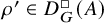 $\rho '\in D^{\square }_{G}(A)$
, which maps to
$\rho '\in D^{\square }_{G}(A)$
, which maps to $(\psi ,\xi )$
.
$(\psi ,\xi )$
.
Corollary 3.14. If $\Gamma =\Gamma _F$
,
$\Gamma =\Gamma _F$
, $\kappa $
is finite and we are in the setting of Proposition 3.13 then
$\kappa $
is finite and we are in the setting of Proposition 3.13 then ${\dim R^{\square }_G/\varpi = \dim R^{\square }_H/\varpi + ([F:\mathbb {Q}_p]+1)(\dim G_k - \dim H_k)}$
.
${\dim R^{\square }_G/\varpi = \dim R^{\square }_H/\varpi + ([F:\mathbb {Q}_p]+1)(\dim G_k - \dim H_k)}$
.
Proof. Let $A'= (R^{\square }_{H/H'}/\varpi )^{\mathrm {red}}$
,
$A'= (R^{\square }_{H/H'}/\varpi )^{\mathrm {red}}$
, $B'= (R^{\square }_{G/G'}/\varpi )^{\mathrm {red}}$
,
$B'= (R^{\square }_{G/G'}/\varpi )^{\mathrm {red}}$
, $A=(R^{\square }_{H}/\varpi )^{\mathrm {red}}$
, where the superscript
$A=(R^{\square }_{H}/\varpi )^{\mathrm {red}}$
, where the superscript $\mathrm {red}$
indicates reduced rings. We have shown in [Reference Paškūnas and Quast48, Corollary 9.9] that
$\mathrm {red}$
indicates reduced rings. We have shown in [Reference Paškūnas and Quast48, Corollary 9.9] that $A'\rightarrow B'$
is flat and the dimension d of the fibre
$A'\rightarrow B'$
is flat and the dimension d of the fibre $\kappa \otimes _{A'} B'$
is equal to
$\kappa \otimes _{A'} B'$
is equal to
 $$ \begin{align*}(\dim (G/G')_k -\dim (H/H')_k)([F:\mathbb {Q}_p]+1)=(\dim G_k-\dim H_k)([F:\mathbb {Q}_p]+1).\end{align*} $$
Hence, $A\rightarrow B'{\widehat {\otimes }}_{A'} A$
is flat and the fibre has dimension d. Thus
$A\rightarrow B'{\widehat {\otimes }}_{A'} A$
is flat and the fibre has dimension d. Thus $\dim A+d=\dim B'{\widehat {\otimes }}_{A'} A$
by [Reference Project59, Tag 00ON]. Proposition 3.13 implies that
$\dim A+d=\dim B'{\widehat {\otimes }}_{A'} A$
by [Reference Project59, Tag 00ON]. Proposition 3.13 implies that $(B'{\widehat {\otimes }}_{A'} A)^{\mathrm {red}}\cong (R^{\square }_G/\varpi )^{\mathrm {red}}$
. Hence,
$(B'{\widehat {\otimes }}_{A'} A)^{\mathrm {red}}\cong (R^{\square }_G/\varpi )^{\mathrm {red}}$
. Hence, $\dim R^{\square }_G/\varpi = \dim A +d = \dim R^{\square }_H/\varpi +d$
.
$\dim R^{\square }_G/\varpi = \dim A +d = \dim R^{\square }_H/\varpi +d$
.
For the rest of the section we let Z be a finite connected diagonalisable subgroup scheme of $Z(G^0)$
. If
$Z(G^0)$
. If $\mathrm {char}(\kappa )=0$
then Z is trivial so we assume that
$\mathrm {char}(\kappa )=0$
then Z is trivial so we assume that $\mathrm {char}(\kappa )=p$
. In this case there is a finite abelian p-group
$\mathrm {char}(\kappa )=p$
. In this case there is a finite abelian p-group $\mathrm m$
such that
$\mathrm m$
such that $Z(A)= {\mathrm {Hom}}(\mathrm m, A^{\times })$
for
$Z(A)= {\mathrm {Hom}}(\mathrm m, A^{\times })$
for $A\in \mathscr O\text {-}\mathrm {alg}$
.
$A\in \mathscr O\text {-}\mathrm {alg}$
.
Lemma 3.15. $R^{\square }_H \rightarrow R^{\square }_G$
is finite.
$R^{\square }_H \rightarrow R^{\square }_G$
is finite.
Proof. Let $A:= \kappa \otimes _{R^{\square }_H} R^{\square }_G$
and let
$A:= \kappa \otimes _{R^{\square }_H} R^{\square }_G$
and let $\mathfrak {p}$
be a prime ideal of A. Since
$\mathfrak {p}$
be a prime ideal of A. Since $A/\mathfrak {p}$
is a domain of characteristic p, we have
$A/\mathfrak {p}$
is a domain of characteristic p, we have $Z(A/\mathfrak {p})=0$
and thus
$Z(A/\mathfrak {p})=0$
and thus $G(A/\mathfrak {p})\subseteq H(A/\mathfrak {p})$
. Let
$G(A/\mathfrak {p})\subseteq H(A/\mathfrak {p})$
. Let $\rho _{\mathfrak {p}}$
be the specialisation of the universal deformation
$\rho _{\mathfrak {p}}$
be the specialisation of the universal deformation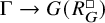 $\Gamma \rightarrow G(R^{\square }_G)$
at
$\Gamma \rightarrow G(R^{\square }_G)$
at $\mathfrak {p}$
. Since
$\mathfrak {p}$
. Since $\varphi \circ \rho _{\mathfrak {p}}= \varphi \circ \rho $
by definition of A, we get that
$\varphi \circ \rho _{\mathfrak {p}}= \varphi \circ \rho $
by definition of A, we get that $\rho _{\mathfrak {p}}(\Gamma )$
is contained in
$\rho _{\mathfrak {p}}(\Gamma )$
is contained in $G(\kappa )$
. Hence,
$G(\kappa )$
. Hence, $\mathfrak {p}$
is the maximal ideal of A. We conclude that A is zero dimensional and, since
$\mathfrak {p}$
is the maximal ideal of A. We conclude that A is zero dimensional and, since $R^{\square }_G$
is noetherian, A is a finite dimensional
$R^{\square }_G$
is noetherian, A is a finite dimensional $\kappa $
-vector space. The claim follows from Nakayama’s Lemma.
$\kappa $
-vector space. The claim follows from Nakayama’s Lemma.
Proposition 3.16. $\dim R^{\square }_H/\varpi = \dim R^{\square }_G/\varpi $
.
$\dim R^{\square }_H/\varpi = \dim R^{\square }_G/\varpi $
.
Proof. For any local $\kappa $
-algebra A we have an exact sequence of non-abelian fppf cohomology groups
$\kappa $
-algebra A we have an exact sequence of non-abelian fppf cohomology groups
 $$ \begin{align} 0\rightarrow Z(A) \rightarrow G(A) \rightarrow H(A) \rightarrow H^1_{\mathrm{fppf}}({\mathrm{Spec}}(A), Z) \end{align} $$
Let $e\ge 0$
be an integer such that
$e\ge 0$
be an integer such that $p^e\cdot \mathrm m=0$
. Let
$p^e\cdot \mathrm m=0$
. Let $A=R^{\square }_H/\varpi $
and let
$A=R^{\square }_H/\varpi $
and let $\mathfrak {m}$
be the maximal ideal of A. We choose elements
$\mathfrak {m}$
be the maximal ideal of A. We choose elements $a_1, \ldots , a_r\in \mathfrak {m}$
such that their images form a basis of
$a_1, \ldots , a_r\in \mathfrak {m}$
such that their images form a basis of $\mathfrak {m}/\mathfrak {m}^{2}$
as a
$\mathfrak {m}/\mathfrak {m}^{2}$
as a $\kappa $
-vector space. Let
$\kappa $
-vector space. Let $B=A[x_1,\ldots , x_n]/I$
, where I is the ideal generated by
$B=A[x_1,\ldots , x_n]/I$
, where I is the ideal generated by $x_i^{p^e}-a_i$
for
$x_i^{p^e}-a_i$
for $1\le i \le r$
. Then B is finite flat over A and every
$1\le i \le r$
. Then B is finite flat over A and every $x\in 1+\mathfrak {m}$
is a
$x\in 1+\mathfrak {m}$
is a $p^e$
-th power in
$p^e$
-th power in $B^{\times }$
. Let
$B^{\times }$
. Let $A^{\mathrm {red}}$
and
$A^{\mathrm {red}}$
and $B^{\mathrm {red}}$
be the maximal reduced quotients of A and B, respectively. Then
$B^{\mathrm {red}}$
be the maximal reduced quotients of A and B, respectively. Then $A^{\mathrm {red}}$
is a subring of
$A^{\mathrm {red}}$
is a subring of $B^{\mathrm {red}}$
and every
$B^{\mathrm {red}}$
and every $x\in 1+\mathfrak {m}_{A^{\mathrm {red}}}$
is a
$x\in 1+\mathfrak {m}_{A^{\mathrm {red}}}$
is a $p^{e}$
-th power in
$p^{e}$
-th power in $B^{\mathrm {red}}$
. Let
$B^{\mathrm {red}}$
. Let $\rho ': \Gamma \rightarrow H(A^{\mathrm {red}})$
be the specialisation of the universal deformation
$\rho ': \Gamma \rightarrow H(A^{\mathrm {red}})$
be the specialisation of the universal deformation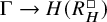 $\Gamma \rightarrow H(R^{\square }_H)$
along
$\Gamma \rightarrow H(R^{\square }_H)$
along $R^{\square }_H \rightarrow A^{\mathrm {red}}$
.
$R^{\square }_H \rightarrow A^{\mathrm {red}}$
.
Since Z is a finite product of $\mu _{p^n}$
with
$\mu _{p^n}$
with $n\le e$
and
$n\le e$
and $B^{\mathrm {red}}$
is reduced and of characteristic p, we have
$B^{\mathrm {red}}$
is reduced and of characteristic p, we have $Z(B^{\mathrm {red}})=1$
. Since
$Z(B^{\mathrm {red}})=1$
. Since $H^1_{\mathrm {fppf}}({\mathrm {Spec}}(A), \mu _{p^n}) = A^{\times }/ (A^{\times })^{p^n}$
by [Reference Project59, Tag 040Q], it follows from (25) that there exists a continuous representation
$H^1_{\mathrm {fppf}}({\mathrm {Spec}}(A), \mu _{p^n}) = A^{\times }/ (A^{\times })^{p^n}$
by [Reference Project59, Tag 040Q], it follows from (25) that there exists a continuous representation $\tilde {\rho }: \Gamma \rightarrow G(B^{\mathrm {red}})$
deforming
$\tilde {\rho }: \Gamma \rightarrow G(B^{\mathrm {red}})$
deforming $\rho $
such that
$\rho $
such that $\varphi \circ \tilde {\rho } = \rho '\otimes _{A^{\mathrm {red}}} B^{\mathrm {red}}$
. This induces a map of A-algebras
$\varphi \circ \tilde {\rho } = \rho '\otimes _{A^{\mathrm {red}}} B^{\mathrm {red}}$
. This induces a map of A-algebras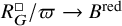 $R^{\square }_G/\varpi \rightarrow B^{\mathrm {red}}$
. This map is finite as B is a finite A-algebra. Hence
$R^{\square }_G/\varpi \rightarrow B^{\mathrm {red}}$
. This map is finite as B is a finite A-algebra. Hence $\dim (R^{\square }_G/\varpi )\ge \dim B^{\mathrm {red}}= \dim B =\dim A$
, where the last equality follows as B is finite and flat over A. Lemma 3.15 implies that
$\dim (R^{\square }_G/\varpi )\ge \dim B^{\mathrm {red}}= \dim B =\dim A$
, where the last equality follows as B is finite and flat over A. Lemma 3.15 implies that $ \dim (R^{\square }_G/\varpi )\le \dim A$
.
$ \dim (R^{\square }_G/\varpi )\le \dim A$
.
4 Continuity
In this section let $\mathscr O$
be any ring, let
$\mathscr O$
be any ring, let $R\rightarrow A$
be a map of
$R\rightarrow A$
be a map of $\mathscr O$
-algebras, with R noetherian and profinite. Let
$\mathscr O$
-algebras, with R noetherian and profinite. Let $\rho : \Gamma \rightarrow G(A)$
be a group homomorphism, where
$\rho : \Gamma \rightarrow G(A)$
be a group homomorphism, where $\Gamma $
is a profinite group and G is an affine
$\Gamma $
is a profinite group and G is an affine $\mathscr O$
-group scheme of finite type.
$\mathscr O$
-group scheme of finite type.
In Section 4.1 we define an algebraic notion of continuity for such representations, such that whenever A is a topological R-algebra the algebraic notion of continuity implies that the representation ${\rho :\Gamma \rightarrow G(A)}$
is continuous for the topology on the target induced by the topology of A. Our construction is based on the fact that if M is a finitely generated R-module then since R is noetherian and profinite there is a unique topology on M making M into a Hausdorff topological R-module; this topology is profinite. For example, if
${\rho :\Gamma \rightarrow G(A)}$
is continuous for the topology on the target induced by the topology of A. Our construction is based on the fact that if M is a finitely generated R-module then since R is noetherian and profinite there is a unique topology on M making M into a Hausdorff topological R-module; this topology is profinite. For example, if $G=\mathbb G_{a}$
then our algebraic notion of continuity is the requirement that
$G=\mathbb G_{a}$
then our algebraic notion of continuity is the requirement that $\rho (\Gamma )$
is contained in a finitely generated R-submodule
$\rho (\Gamma )$
is contained in a finitely generated R-submodule $M \subseteq A=\mathbb G_{a}(A)$
and the map
$M \subseteq A=\mathbb G_{a}(A)$
and the map $\rho : \Gamma \rightarrow M$
is continuous. We extend this example following Conrad’s exposition in [Reference Conrad18] on how to topologise
$\rho : \Gamma \rightarrow M$
is continuous. We extend this example following Conrad’s exposition in [Reference Conrad18] on how to topologise $X(A)$
, when A is a topological ring.
$X(A)$
, when A is a topological ring.
In Section 4.2 we reformulate this notion in terms of condensed sets. In fact, one could reprove the results of Section 4.1 entirely within the framework of condensed sets. However, we have chosen not to do so as the arguments in Section 4.1 are elementary and suffice for the paper.
4.1 Continuity via algebra
The following is the key lemma.
Lemma 4.1. Let $f\in A[y_1,\ldots , y_n]$
be a polynomial, which we view as a function on
$f\in A[y_1,\ldots , y_n]$
be a polynomial, which we view as a function on $A^n$
and let
$A^n$
and let $V(f):=\{\underline {a}\in A^n: f(\underline {a})=0\}$
. Let M be a finitely generated R-submodule of
$V(f):=\{\underline {a}\in A^n: f(\underline {a})=0\}$
. Let M be a finitely generated R-submodule of $A^n$
. Then
$A^n$
. Then $f|_M : M \to A$
is a continuous map with values in a finitely generated R-submodule of A. In particular,
$f|_M : M \to A$
is a continuous map with values in a finitely generated R-submodule of A. In particular, $V(f)\cap M$
is a closed subset of M for the natural topology on M as an R-module.
$V(f)\cap M$
is a closed subset of M for the natural topology on M as an R-module.
Proof. We first focus on the case, when f is a monomial $y_1^{d_1} \cdots y_n^{d_n}$
of degree
$y_1^{d_1} \cdots y_n^{d_n}$
of degree $d_1 + \dots + d_n= d \geq 1$
. There exists an A-multilinear form
$d_1 + \dots + d_n= d \geq 1$
. There exists an A-multilinear form $\beta : A^{\otimes _A d} \to A$
, such that
$\beta : A^{\otimes _A d} \to A$
, such that $f(a_1, \dots , a_n) = \beta (a_1 \otimes \dots \otimes a_1 \otimes \cdots \otimes a_n \otimes \cdots \otimes a_n)$
for all
$f(a_1, \dots , a_n) = \beta (a_1 \otimes \dots \otimes a_1 \otimes \cdots \otimes a_n \otimes \cdots \otimes a_n)$
for all $a_1, \dots , a_n \in A$
, where in the argument of
$a_1, \dots , a_n \in A$
, where in the argument of $\beta $
,
$\beta $
, $a_i$
is repeated
$a_i$
is repeated $d_i$
times. Write
$d_i$
times. Write $\iota : M \to A$
for the inclusion map. We have a natural R-linear map
$\iota : M \to A$
for the inclusion map. We have a natural R-linear map $\iota ^{\otimes } : M^{\otimes _R d} \to A^{\otimes _A d}$
and we denote by N the image of
$\iota ^{\otimes } : M^{\otimes _R d} \to A^{\otimes _A d}$
and we denote by N the image of $M^{\otimes _R d}$
under
$M^{\otimes _R d}$
under $\tilde {\beta }:= \beta \circ \iota ^{\otimes }$
in A. In particular
$\tilde {\beta }:= \beta \circ \iota ^{\otimes }$
in A. In particular $f|_M$
takes values in N and arises as the composition
$f|_M$
takes values in N and arises as the composition
 $$ \begin{align*}M \xrightarrow{\Delta} M^d \xrightarrow{\mathrm{can}} M^{\otimes_R d} \xrightarrow{\tilde{\beta}} N.\end{align*} $$
The diagonal $\Delta $
and
$\Delta $
and $\tilde {\beta }$
are R-linear, hence continuous. We are left to show, that the universal d-multilinear form
$\tilde {\beta }$
are R-linear, hence continuous. We are left to show, that the universal d-multilinear form $M^d \to M^{\otimes _R d}$
is continuous. Choose an R-linear surjection
$M^d \to M^{\otimes _R d}$
is continuous. Choose an R-linear surjection $R^s \twoheadrightarrow M$
. We have a commutative square
$R^s \twoheadrightarrow M$
. We have a commutative square

where the top and the bottom maps are the universal d-multilinear forms. The vertical maps are quotient maps. The top map is a polynomial map over R, hence continuous and thus the bottom map is continuous, which finishes the proof in this case.
Now assume, that f is a general polynomial and let us write $f = \sum _i a_i f_i$
for monomials
$f = \sum _i a_i f_i$
for monomials $f_i$
and
$f_i$
and $a_i \in A$
. As in the previous step, we obtain multilinear maps
$a_i \in A$
. As in the previous step, we obtain multilinear maps $\beta _i : A^{\otimes _A d} \to A$
and we define
$\beta _i : A^{\otimes _A d} \to A$
and we define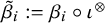 $\tilde {\beta }_i := \beta _i \circ \iota ^{\otimes }$
,
$\tilde {\beta }_i := \beta _i \circ \iota ^{\otimes }$
, $N_i := {\mathrm {Im}}(\tilde {\beta }_i)$
and
$N_i := {\mathrm {Im}}(\tilde {\beta }_i)$
and $N := \sum _i a_iN_i$
. The multiplication maps
$N := \sum _i a_iN_i$
. The multiplication maps $N_i \to N, ~x \mapsto a_ix$
are R-linear, thus N is a finitely generated R-module. So
$N_i \to N, ~x \mapsto a_ix$
are R-linear, thus N is a finitely generated R-module. So $f|_M = \sum _i a_i f_i|_M$
is a sum of continuous maps and hence continuous, which finishes the proof.
$f|_M = \sum _i a_i f_i|_M$
is a sum of continuous maps and hence continuous, which finishes the proof.
Since R is Hausdorff, so is N and we get that $V(f) \cap M$
is closed.
$V(f) \cap M$
is closed.
Let $X={\mathrm {Spec}} B$
be an affine scheme of finite type over
$X={\mathrm {Spec}} B$
be an affine scheme of finite type over $\mathscr O$
. A point
$\mathscr O$
. A point $x\in X(A)$
corresponds to an
$x\in X(A)$
corresponds to an $\mathscr O$
-algebra homomorphism
$\mathscr O$
-algebra homomorphism $x: B\rightarrow A$
. We thus have a canonical map
$x: B\rightarrow A$
. We thus have a canonical map
 $$ \begin{align*}X(A)\times \Gamma(X, \mathscr O_X)\rightarrow A, \quad (x, b)\mapsto \mathrm{ev}_b(x):= x(b).\end{align*} $$
This induces a canonical injection
 $$ \begin{align*}\iota_X:=\prod_{b\in B}\mathrm{ev}_b: X(A) \hookrightarrow A^B:= \prod_{b\in B} A.\end{align*} $$
We will denote the projection map onto the b-th component by $p_b: A^B\rightarrow A$
. As explained above any finitely generated R-module M has a unique topology, which makes it into a Hausdorff topological R-module. Moreover, M is profinite with respect to this topology.
$p_b: A^B\rightarrow A$
. As explained above any finitely generated R-module M has a unique topology, which makes it into a Hausdorff topological R-module. Moreover, M is profinite with respect to this topology.
Lemma 4.2. Let S be a profinite set and let $f: S\rightarrow X(A)$
be a map of sets. Then the following are equivalent:
$f: S\rightarrow X(A)$
be a map of sets. Then the following are equivalent:
-
(1) for each
$b\in B$
there exists a finitely generated R-submodule
$M_b$
of A, such that
$\iota _X(f (S))$
is contained in
$\prod _{b\in B} M_b$
and the map
$\iota _X\circ f: S \rightarrow \prod _{b\in B} M_b$
is continuous for the product topology on the target. -
(2) for all
$n\ge 1$
and all closed immersions
$\tau : X\hookrightarrow \mathbb A^n$
of
$\mathscr O$
-schemes there exists a finitely generated R-submodule
$M \subseteq \mathbb A^n(A)= A^n$
such that
$\tau (f(S)) \subseteq M$
and
$\tau \circ f: S \rightarrow M$
is continuous for the canonical R-module topology on the target. -
(3) there exists a closed immersion
$\tau : X\hookrightarrow \mathbb A^n$
of
$\mathscr O$
-schemes and a finitely generated R-submodule
$M \subseteq \mathbb A^n(A)=A^n$
such that
$\tau (f(S)) \subseteq M$
and
$\tau \circ f: S \rightarrow M$
is continuous for the canonical R-module topology on the target.














Proof. A closed immersion $\tau : X\hookrightarrow \mathbb A^n$
corresponds to a surjective homomorphism of
$\tau : X\hookrightarrow \mathbb A^n$
corresponds to a surjective homomorphism of $\mathscr O$
-algebras
$\mathscr O$
-algebras $\mathscr O[x_1, \ldots , x_n]\twoheadrightarrow B$
. Let
$\mathscr O[x_1, \ldots , x_n]\twoheadrightarrow B$
. Let $b_1, \ldots , b_n$
be the images of
$b_1, \ldots , b_n$
be the images of $x_1, \ldots , x_n$
in B. Then the map
$x_1, \ldots , x_n$
in B. Then the map ${X(A) \overset {\tau }{\longrightarrow } \mathbb A^n(A)=A^n}$
factors as
${X(A) \overset {\tau }{\longrightarrow } \mathbb A^n(A)=A^n}$
factors as $X(A) \rightarrow A^B \overset {\prod _{i=1}^n p_{b_i}}{\longrightarrow } A^n$
. The image of
$X(A) \rightarrow A^B \overset {\prod _{i=1}^n p_{b_i}}{\longrightarrow } A^n$
. The image of $\prod _{b} M_b$
under this map is
$\prod _{b} M_b$
under this map is $\prod _{i=1}^n M_{b_i}$
, which is a finitely generated R-module. Moreover, this projection is continuous. Hence, part (1) implies part (2).
$\prod _{i=1}^n M_{b_i}$
, which is a finitely generated R-module. Moreover, this projection is continuous. Hence, part (1) implies part (2).
Part (2) trivially implies part (3).
Let us assume that (3) holds. Let $M_i \subseteq A$
be the image of
$M_i \subseteq A$
be the image of $M \subseteq \prod _{i=1}^n A$
under the projection onto the i-th component. Then
$M \subseteq \prod _{i=1}^n A$
under the projection onto the i-th component. Then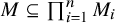 $M \subseteq \prod _{i=1}^n M_i$
and
$M \subseteq \prod _{i=1}^n M_i$
and $\prod _{i=1}^n M_i$
is a finitely generated R-module. Hence, we may replace M with
$\prod _{i=1}^n M_i$
is a finitely generated R-module. Hence, we may replace M with $\prod _{i=1}^n M_i$
. Let
$\prod _{i=1}^n M_i$
. Let $b_i\in B$
be the images of
$b_i\in B$
be the images of $x_i$
as before. If
$x_i$
as before. If $b\in B$
then there is
$b\in B$
then there is $g\in \mathscr O[x_1, \ldots , x_n]$
such that
$g\in \mathscr O[x_1, \ldots , x_n]$
such that $b= g(b_1, \ldots , b_n)$
. The image of
$b= g(b_1, \ldots , b_n)$
. The image of $\prod _{i=1}^n M_i$
under the map
$\prod _{i=1}^n M_i$
under the map $\varphi _g: A^n \rightarrow A$
,
$\varphi _g: A^n \rightarrow A$
, $(a_1, \ldots , a_n) \mapsto g(a_1, \ldots , a_n)$
is contained in a finitely generated R-module
$(a_1, \ldots , a_n) \mapsto g(a_1, \ldots , a_n)$
is contained in a finitely generated R-module $M_b$
by Lemma 4.1. Since
$M_b$
by Lemma 4.1. Since $\tau (f(S)) \subseteq \prod _{i=1}^n M_i$
we have
$\tau (f(S)) \subseteq \prod _{i=1}^n M_i$
we have $\varphi _g(\tau (f(S))) \subseteq M_b$
. Moreover, the induced map
$\varphi _g(\tau (f(S))) \subseteq M_b$
. Moreover, the induced map $S\rightarrow M_b$
is continuous since polynomial maps are continuous. The composition
$S\rightarrow M_b$
is continuous since polynomial maps are continuous. The composition $\varphi _g \circ \tau : X(A) \rightarrow A$
is the map given by evaluation at b. Hence, (3) implies (1).
$\varphi _g \circ \tau : X(A) \rightarrow A$
is the map given by evaluation at b. Hence, (3) implies (1).
Lemma 4.3. Let $g: X\rightarrow Y$
be a morphism of affine schemes of finite type over
$g: X\rightarrow Y$
be a morphism of affine schemes of finite type over $\mathscr O$
. Let S be a profinite set and let
$\mathscr O$
. Let S be a profinite set and let $f: S\rightarrow X(A)$
be a map of sets. If the equivalent conditions of Lemma 4.2 hold for f then they also hold for
$f: S\rightarrow X(A)$
be a map of sets. If the equivalent conditions of Lemma 4.2 hold for f then they also hold for $g\circ f$
.
$g\circ f$
.
Proof. Let us assume that $\iota _X(f(S))$
is contained in
$\iota _X(f(S))$
is contained in $\prod _{b\in \Gamma (X, \mathscr O_X)} M_b$
. We claim that
$\prod _{b\in \Gamma (X, \mathscr O_X)} M_b$
. We claim that $\iota _Y(g (f(S)))$
is contained in
$\iota _Y(g (f(S)))$
is contained in $\prod _{c\in \Gamma (Y, \mathscr O_Y)} M_{g^{\sharp }(c)}$
. Indeed, if
$\prod _{c\in \Gamma (Y, \mathscr O_Y)} M_{g^{\sharp }(c)}$
. Indeed, if $c\in \Gamma (Y, \mathscr O_Y)$
and
$c\in \Gamma (Y, \mathscr O_Y)$
and $x\in X(A)$
then
$x\in X(A)$
then $\mathrm {ev}_c (g(x)) = \mathrm {ev}_{g^{\sharp }(c)}(x)$
.
$\mathrm {ev}_c (g(x)) = \mathrm {ev}_{g^{\sharp }(c)}(x)$
.
Lemma 4.4. Let S be a profinite set and let $f_1: S\rightarrow X_1(A)$
and
$f_1: S\rightarrow X_1(A)$
and $f_2: S\rightarrow X_2(A)$
be maps of sets, where
$f_2: S\rightarrow X_2(A)$
be maps of sets, where $X_1$
and
$X_1$
and $X_2$
are affine schemes of finite type over
$X_2$
are affine schemes of finite type over $\mathscr O$
. If the equivalent conditions of Lemma 4.2 hold for
$\mathscr O$
. If the equivalent conditions of Lemma 4.2 hold for $f_1$
and
$f_1$
and $f_2$
then they also hold for the product
$f_2$
then they also hold for the product $f_1\times f_2: S\rightarrow X_1(A)\times X_2(A)=(X_1\times X_2)(A)$
.
$f_1\times f_2: S\rightarrow X_1(A)\times X_2(A)=(X_1\times X_2)(A)$
.
Proof. We pick closed embeddings $X_1\hookrightarrow \mathbb A^{n_1}$
,
$X_1\hookrightarrow \mathbb A^{n_1}$
, $X_2\hookrightarrow \mathbb A^{n_2}$
. This induces a closed embedding
$X_2\hookrightarrow \mathbb A^{n_2}$
. This induces a closed embedding ${X_1\times X_2\hookrightarrow \mathbb A^{n_1}\times \mathbb A^{n_2} \cong \mathbb A^{n_1+n_2}}$
. If
${X_1\times X_2\hookrightarrow \mathbb A^{n_1}\times \mathbb A^{n_2} \cong \mathbb A^{n_1+n_2}}$
. If $f_1(S)\subseteq M_1\subseteq A^{n_1}$
and
$f_1(S)\subseteq M_1\subseteq A^{n_1}$
and $f_2(S)\subseteq M_2 \subseteq A^{n_2}$
then
$f_2(S)\subseteq M_2 \subseteq A^{n_2}$
then $(f_1\times f_2)(S)\subseteq M_1\times M_2\subseteq A^{n_1}\times A^{n_2}$
. Moreover, if
$(f_1\times f_2)(S)\subseteq M_1\times M_2\subseteq A^{n_1}\times A^{n_2}$
. Moreover, if $f_1: S\rightarrow M_1$
and
$f_1: S\rightarrow M_1$
and $f_2: S\rightarrow M_2$
are continuous then
$f_2: S\rightarrow M_2$
are continuous then $f_1\times f_2: S\rightarrow M_1\times M_2$
is continuous.
$f_1\times f_2: S\rightarrow M_1\times M_2$
is continuous.
Lemma 4.5. Let $R'$
be a noetherian profinite R-algebra together with a map of R-algebras
$R'$
be a noetherian profinite R-algebra together with a map of R-algebras $R'\rightarrow A$
. Let S be a profinite set and let
$R'\rightarrow A$
. Let S be a profinite set and let $f: S\rightarrow X(A)$
be a map of sets. If the equivalent conditions of Lemma 4.2 hold for f with respect to R then they also hold with respect to
$f: S\rightarrow X(A)$
be a map of sets. If the equivalent conditions of Lemma 4.2 hold for f with respect to R then they also hold with respect to $R'$
.
$R'$
.
Proof. It is immediate that part (1) of Lemma 4.2 holds with $M^{\prime }_b$
equal to the
$M^{\prime }_b$
equal to the $R'$
-submodule of A generated by
$R'$
-submodule of A generated by $M_b$
.
$M_b$
.
4.2 Continuity via condensed sets
We will now express the equivalent conditions in Lemma 4.2 in terms of condensed sets. Recall that these are certain functors from the category of profinite sets to the category of sets, see [Reference Scholze53] and Appendix A. We may view profinite sets as condensed sets via the Yoneda embedding $S\mapsto \underline {S}$
, where
$S\mapsto \underline {S}$
, where $\underline S (T) := \mathscr {C}(T,S)$
. The underlying set of a condensed set is by definition that functor evaluated at a point.
$\underline S (T) := \mathscr {C}(T,S)$
. The underlying set of a condensed set is by definition that functor evaluated at a point.
Recall further, that every profinite group (ring) is naturally a condensed group (ring), as the functor from topological spaces to condensed sets commutes with finite limits [Reference Scholze53, Proposition 1.7]. We can also equip a profinite ring R with the discrete topology and write $R_{\operatorname {disc}}$
to denote the associated discrete condensed ring. We have a natural map of condensed rings
$R_{\operatorname {disc}}$
to denote the associated discrete condensed ring. We have a natural map of condensed rings $R_{\operatorname {disc}} \to \underline {R}$
. An abstract R-module M can be seen as a discrete condensed
$R_{\operatorname {disc}} \to \underline {R}$
. An abstract R-module M can be seen as a discrete condensed $R_{\operatorname {disc}}$
-module
$R_{\operatorname {disc}}$
-module $M_{\operatorname {disc}}$
, so that
$M_{\operatorname {disc}}$
, so that $M_{\operatorname {disc}}(T)=\mathscr {C}(T, M)$
, where the target M is given the discrete topology. The tensor product of condensed
$M_{\operatorname {disc}}(T)=\mathscr {C}(T, M)$
, where the target M is given the discrete topology. The tensor product of condensed $R_{\operatorname {disc}}$
-modules
$R_{\operatorname {disc}}$
-modules $M_{\operatorname {disc}} \otimes _{R_{\operatorname {disc}}} \underline {R}$
is a condensed R-module.Footnote
3
$M_{\operatorname {disc}} \otimes _{R_{\operatorname {disc}}} \underline {R}$
is a condensed R-module.Footnote
3
Lemma 4.6. Let N be an abstract R-module. Then $N_{\operatorname {disc}} \otimes _{R_{\operatorname {disc}}} \underline {R}$
is an inductive limit of profinite submodules along quasi-compact injections. In particular,
$N_{\operatorname {disc}} \otimes _{R_{\operatorname {disc}}} \underline {R}$
is an inductive limit of profinite submodules along quasi-compact injections. In particular, $N_{\operatorname {disc}} \otimes _{R_{\operatorname {disc}}} \underline {R}$
is quasi-separated.
$N_{\operatorname {disc}} \otimes _{R_{\operatorname {disc}}} \underline {R}$
is quasi-separated.
Proof. We write $N=\varinjlim _i M_i$
where
$N=\varinjlim _i M_i$
where $M_i$
are finitely generated R-submodules of N. As the tensor product of condensed
$M_i$
are finitely generated R-submodules of N. As the tensor product of condensed $R_{\operatorname {disc}}$
-modules is left adjoint to the internal Hom functor of condensed
$R_{\operatorname {disc}}$
-modules is left adjoint to the internal Hom functor of condensed $R_{\operatorname {disc}}$
-modules, it commutes with arbitrary colimits. Thus
$R_{\operatorname {disc}}$
-modules, it commutes with arbitrary colimits. Thus
 $$ \begin{align*} N_{\operatorname{disc}} \otimes_{R_{\operatorname{disc}}} \underline{R} = (\varinjlim\nolimits_i (M_{i})_{\operatorname{disc}}) \otimes_{R_{\operatorname{disc}}} \underline{R} = \varinjlim\nolimits_i ((M_i)_{\operatorname{disc}} \otimes_{R_{\operatorname{disc}}} \underline{R}). \end{align*} $$
Since $M_i$
are finitely generated they are profinite and we have a natural isomorphism
$M_i$
are finitely generated they are profinite and we have a natural isomorphism ${(M_i)_{\operatorname {disc}}\otimes _{R_{\operatorname {disc}}} \underline {R} \cong \underline {M_i}}$
. Moreover, the transition maps are quasi-compact injections, so
${(M_i)_{\operatorname {disc}}\otimes _{R_{\operatorname {disc}}} \underline {R} \cong \underline {M_i}}$
. Moreover, the transition maps are quasi-compact injections, so $N_{\operatorname {disc}} \otimes _{R_{\operatorname {disc}}} \underline {R}$
is quasi-separated by Lemma A.5.
$N_{\operatorname {disc}} \otimes _{R_{\operatorname {disc}}} \underline {R}$
is quasi-separated by Lemma A.5.
Let X be an affine scheme of finite type over $\mathscr O$
as before and let S be a profinite set. If C is a commutative condensed
$\mathscr O$
as before and let S be a profinite set. If C is a commutative condensed $\mathscr O$
-algebra then by evaluating it at a profinite set T we obtain a commutative
$\mathscr O$
-algebra then by evaluating it at a profinite set T we obtain a commutative $\mathscr O$
-algebra
$\mathscr O$
-algebra $C(T)$
and then we may evaluate X at
$C(T)$
and then we may evaluate X at $C(T)$
to obtain a set
$C(T)$
to obtain a set $X(C(T))$
. One may show that
$X(C(T))$
. One may show that ${X(C):= X \circ C}$
is a condensed set. If C is quasi-separated, then
${X(C):= X \circ C}$
is a condensed set. If C is quasi-separated, then $X(C)$
is quasi-separated (see Lemma A.6).
$X(C)$
is quasi-separated (see Lemma A.6).
Definition 4.7. We will say that a map of sets $f:S\rightarrow X(A)$
is R-condensed if there is a morphism of condensed sets
$f:S\rightarrow X(A)$
is R-condensed if there is a morphism of condensed sets $\tilde {f} : \underline {S} \to X(A_{\operatorname {disc}} \otimes _{R_{\operatorname {disc}}} \underline {R})$
, whose map on underlying sets is f.
$\tilde {f} : \underline {S} \to X(A_{\operatorname {disc}} \otimes _{R_{\operatorname {disc}}} \underline {R})$
, whose map on underlying sets is f.
Lemma 4.8. Let $f: S\rightarrow X(A)$
be a map of sets. Then f is R-condensed if and only if the equivalent conditions of Lemma 4.2 hold.
$f: S\rightarrow X(A)$
be a map of sets. Then f is R-condensed if and only if the equivalent conditions of Lemma 4.2 hold.
Proof. Suppose f is R-condensed. To verify (1) of Lemma 4.2, let $b \in B$
, where
$b \in B$
, where $X={\mathrm {Spec}}(B)$
. This determines a map of schemes
$X={\mathrm {Spec}}(B)$
. This determines a map of schemes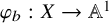 $\varphi _b : X \to \mathbb A^1$
. We obtain a map of condensed sets
$\varphi _b : X \to \mathbb A^1$
. We obtain a map of condensed sets
 $$ \begin{align*}\underline S \xrightarrow{\tilde {f}} X(A_{\operatorname{disc}} \otimes_{R_{\operatorname{disc}}} \underline R) \xrightarrow{\varphi_b} \mathbb A^1(A_{\operatorname{disc}} \otimes_{R_{\operatorname{disc}}} \underline R) = A_{\operatorname{disc}} \otimes_{R_{\operatorname{disc}}} \underline R.\end{align*} $$
By Lemma 4.6 $A_{\operatorname {disc}} \otimes _{R_{\operatorname {disc}}} \underline R$
is an inductive limit of condensed R-submodules of the form
$A_{\operatorname {disc}} \otimes _{R_{\operatorname {disc}}} \underline R$
is an inductive limit of condensed R-submodules of the form $\underline M$
for some finitely generated R-submodule
$\underline M$
for some finitely generated R-submodule $M \subseteq A$
. By Lemma A.1
$M \subseteq A$
. By Lemma A.1 $\underline S$
is a compact object in the category of condensed sets. In particular there exists a finitely generated R-submodule
$\underline S$
is a compact object in the category of condensed sets. In particular there exists a finitely generated R-submodule $M_b \subseteq A$
, such that
$M_b \subseteq A$
, such that $\varphi _b \circ \tilde {f}$
factors over a map
$\varphi _b \circ \tilde {f}$
factors over a map $\underline S \to \underline {M_b}$
. It follows, that
$\underline S \to \underline {M_b}$
. It follows, that $\varphi _b(f(S))$
is contained in
$\varphi _b(f(S))$
is contained in $M_b$
. We deduce condition (1) by applying the universal property of product spaces.
$M_b$
. We deduce condition (1) by applying the universal property of product spaces.
Assume (2) of Lemma 4.2, i.e. there is a closed immersion $\tau : X \hookrightarrow \mathbb A^n$
of
$\tau : X \hookrightarrow \mathbb A^n$
of $\mathscr O$
-schemes, a finitely generated R-submodule
$\mathscr O$
-schemes, a finitely generated R-submodule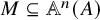 $M \subseteq \mathbb A^n(A)$
, such that
$M \subseteq \mathbb A^n(A)$
, such that $\tau (f(S)) \subseteq M$
and
$\tau (f(S)) \subseteq M$
and $\tau \circ f : S \to M$
is continuous. We obtain a map of condensed sets
$\tau \circ f : S \to M$
is continuous. We obtain a map of condensed sets
 $$ \begin{align*}g : \underline S \to \underline M = M_{\operatorname{disc}} \otimes_{R_{\operatorname{disc}}} \underline R \to \mathbb A^n(A_{\operatorname{disc}} \otimes_{R_{\operatorname{disc}}} \underline R).\end{align*} $$
By Lemma A.8 the map $X(A_{\operatorname {disc}} \otimes _{R_{\operatorname {disc}}} \underline R) \to \mathbb A^n(A_{\operatorname {disc}} \otimes _{R_{\operatorname {disc}}} \underline R)$
is a quasi-compact injection. It follows from [Reference Scholze52, Proposition 4.13], that
$X(A_{\operatorname {disc}} \otimes _{R_{\operatorname {disc}}} \underline R) \to \mathbb A^n(A_{\operatorname {disc}} \otimes _{R_{\operatorname {disc}}} \underline R)$
is a quasi-compact injection. It follows from [Reference Scholze52, Proposition 4.13], that
 $$ \begin{align*}X(A_{\operatorname{disc}} \otimes_{R_{\operatorname{disc}}} \underline R)(S) \cong \mathbb A^n(A_{\operatorname{disc}} \otimes_{R_{\operatorname{disc}}} \underline R)(S) \times_{\mathrm{Map}(S, \mathbb A^n(A))} \mathrm{Map}(S, X(A)).\end{align*} $$
The pair $(g,f)$
is an element in the right hand side. So by Yoneda there exists a map of condensed sets
$(g,f)$
is an element in the right hand side. So by Yoneda there exists a map of condensed sets $\tilde {f} : \underline S \to X(A_{\operatorname {disc}} \otimes _{R_{\operatorname {disc}}} \underline R)$
with underlying map f.
$\tilde {f} : \underline S \to X(A_{\operatorname {disc}} \otimes _{R_{\operatorname {disc}}} \underline R)$
with underlying map f.
Lemma 4.9. Let A be a topological R-algebra and let $f : S \to X(A)$
be an R-condensed map. Then f is continuous.
$f : S \to X(A)$
be an R-condensed map. Then f is continuous.
Proof. Let $\tau : X \hookrightarrow \mathbb A^n$
be a closed immersion. Since
$\tau : X \hookrightarrow \mathbb A^n$
be a closed immersion. Since $X(A)$
has the subspace topology of
$X(A)$
has the subspace topology of $A^n$
, it is enough to show that
$A^n$
, it is enough to show that $\tau \circ \rho : \Gamma \to A^n$
is continuous for the product topology on
$\tau \circ \rho : \Gamma \to A^n$
is continuous for the product topology on $A^n$
. Since
$A^n$
. Since $\rho $
is R-condensed, there is a finitely generated R-submodule
$\rho $
is R-condensed, there is a finitely generated R-submodule $N \subseteq A^n$
, such that
$N \subseteq A^n$
, such that $\tau (\rho (\Gamma )) \subseteq N$
and such that
$\tau (\rho (\Gamma )) \subseteq N$
and such that $\tau \circ \rho : \Gamma \to N$
is continuous for the unique Hausdorff topology on N. Let us write
$\tau \circ \rho : \Gamma \to N$
is continuous for the unique Hausdorff topology on N. Let us write $N^s$
for N equipped with the subspace topology of
$N^s$
for N equipped with the subspace topology of $A^n$
. We claim, that the identity
$A^n$
. We claim, that the identity ${\mathrm {id}}_N : N \to N^s$
is continuous for the Hausdorff topology on the source. It is enough to show that the projection
${\mathrm {id}}_N : N \to N^s$
is continuous for the Hausdorff topology on the source. It is enough to show that the projection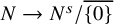 $N \to N^s/\overline {\{0\}}$
is continuous, as every closed subset of
$N \to N^s/\overline {\{0\}}$
is continuous, as every closed subset of $N^s$
is a union of translates of
$N^s$
is a union of translates of $\overline {\{0\}}$
, where the closure is taken in
$\overline {\{0\}}$
, where the closure is taken in $N^s$
. But the quotient topology on
$N^s$
. But the quotient topology on $N^s/\overline {\{0\}}$
is Hausdorff, so
$N^s/\overline {\{0\}}$
is Hausdorff, so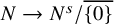 $N \to N^s/\overline {\{0\}}$
is continuous.
$N \to N^s/\overline {\{0\}}$
is continuous.
4.3 R-condensed representations
Let $\Gamma $
be a profinite group, and let G be an affine group scheme of finite type over
$\Gamma $
be a profinite group, and let G be an affine group scheme of finite type over $\mathscr O$
.
$\mathscr O$
.
Definition 4.10. A representation $\rho : \Gamma \rightarrow G(A)$
is R-condensed if
$\rho : \Gamma \rightarrow G(A)$
is R-condensed if $\rho $
is R-condensed as a map of sets.
$\rho $
is R-condensed as a map of sets.
Remark 4.11. Lemma 4.8 implies that $\rho $
is R-condensed if and only if there is a closed immersion
$\rho $
is R-condensed if and only if there is a closed immersion $\tau : G\hookrightarrow \mathbb A^n$
of
$\tau : G\hookrightarrow \mathbb A^n$
of $\mathscr O$
-schemes such that
$\mathscr O$
-schemes such that $\tau (\rho (\Gamma ))$
is contained in a finitely generated R-submodule M of
$\tau (\rho (\Gamma ))$
is contained in a finitely generated R-submodule M of $A^n=\mathbb A^n(A)$
and the map
$A^n=\mathbb A^n(A)$
and the map $\tau \circ \rho : \Gamma \rightarrow M$
is continuous for the canonical topology on M. For the purposes of the paper we could take this last statement as the definition of R-condensed representations, and proceed without actually making use of condensed mathematics. The main point of Lemma 4.2 is that this definition is independent of the chosen embedding
$\tau \circ \rho : \Gamma \rightarrow M$
is continuous for the canonical topology on M. For the purposes of the paper we could take this last statement as the definition of R-condensed representations, and proceed without actually making use of condensed mathematics. The main point of Lemma 4.2 is that this definition is independent of the chosen embedding $\tau $
.
$\tau $
.
Lemma 4.12. Let $\rho : \Gamma \to G(A)$
be an R-condensed representation. Then there is a unique homomorphism of condensed groups
$\rho : \Gamma \to G(A)$
be an R-condensed representation. Then there is a unique homomorphism of condensed groups $\tilde {\rho } : \underline {\Gamma } \to G(A_{\operatorname {disc}} \otimes _{R_{\operatorname {disc}}} \underline {R})$
whose map on underlying sets is
$\tilde {\rho } : \underline {\Gamma } \to G(A_{\operatorname {disc}} \otimes _{R_{\operatorname {disc}}} \underline {R})$
whose map on underlying sets is $\rho $
.
$\rho $
.
Proof. Since $\rho $
is R-condensed, there is a map of condensed sets
$\rho $
is R-condensed, there is a map of condensed sets
 $$ \begin{align*}\tilde {\rho} : \underline{\Gamma} \to G(A_{\operatorname{disc}} \otimes_{R_{\operatorname{disc}}} \underline{R})\end{align*} $$
whose map on underlying sets is $\rho $
. Moreover, this map is unique by Lemma A.7. We need to show, that the diagram of condensed sets
$\rho $
. Moreover, this map is unique by Lemma A.7. We need to show, that the diagram of condensed sets

commutes, where the vertical maps are the multiplications. The diagram commutes on underlying sets, so the claim follows from uniqueness Lemma A.7.
Lemma 4.13. Let $\rho : \Gamma \rightarrow G(A)$
be a representation and let
$\rho : \Gamma \rightarrow G(A)$
be a representation and let $\Gamma '$
be an open subgroup of
$\Gamma '$
be an open subgroup of $\Gamma $
. Then the following are equivalent:
$\Gamma $
. Then the following are equivalent:
-
(1)
$\rho $
is R-condensed; -
(2) the restriction of
$\rho $
to
$\Gamma '$
is R-condensed.


Proof. Since $\rho (\Gamma ')\subseteq \rho (\Gamma )$
part (1) trivially implies part (2).
$\rho (\Gamma ')\subseteq \rho (\Gamma )$
part (1) trivially implies part (2).
Since $\Gamma '$
is an open subgroup of
$\Gamma '$
is an open subgroup of $\Gamma $
we may write
$\Gamma $
we may write $\Gamma = \bigcup _i c_i \Gamma '$
for
$\Gamma = \bigcup _i c_i \Gamma '$
for $c_1, \dots , c_r \in \Gamma $
a finite set of coset representatives. Let
$c_1, \dots , c_r \in \Gamma $
a finite set of coset representatives. Let $\tau : G \hookrightarrow {\mathrm {GL}}_d$
be a homomorphism of
$\tau : G \hookrightarrow {\mathrm {GL}}_d$
be a homomorphism of $\mathscr O$
-group schemes, which is a closed immersion and let
$\mathscr O$
-group schemes, which is a closed immersion and let $\delta : {\mathrm {GL}}_d\rightarrow M_d\times M_d$
be the closed immersion
$\delta : {\mathrm {GL}}_d\rightarrow M_d\times M_d$
be the closed immersion $g\mapsto (g, g^{-1})$
. Then
$g\mapsto (g, g^{-1})$
. Then $\delta \circ \tau : G \hookrightarrow M_d \times M_d$
is a closed immersion. If (2) holds then
$\delta \circ \tau : G \hookrightarrow M_d \times M_d$
is a closed immersion. If (2) holds then $\delta (\tau (\rho (\Gamma '))$
is contained in a finitely generated R-submodule of
$\delta (\tau (\rho (\Gamma '))$
is contained in a finitely generated R-submodule of $M_d(A)\times M_d(A)$
. Since the map
$M_d(A)\times M_d(A)$
. Since the map
 $$ \begin{align*}M_d(A)\times M_d(A)\rightarrow M_d(A)\times M_d(A), \quad (X, Y)\mapsto (\tau(\rho(c_i))X, Y\tau(\rho(c_i))^{-1})\end{align*} $$
is R-linear, we conclude that $\rho (\Gamma )$
maps into a finitely generated R-submodule of
$\rho (\Gamma )$
maps into a finitely generated R-submodule of $M_d(A) \times M_d(A)$
, which implies that
$M_d(A) \times M_d(A)$
, which implies that $\rho $
is R-condensed.
$\rho $
is R-condensed.
Lemma 4.14. Let A be a Hausdorff topological R-algebra, such that A is a filtered union of closed R-subalgebras $B \subseteq A$
, where each B contains an open R-subalgebra
$B \subseteq A$
, where each B contains an open R-subalgebra $B^0 \subseteq B$
, which is a finitely generated R-module. Assume, that
$B^0 \subseteq B$
, which is a finitely generated R-module. Assume, that $\Gamma $
is a topologically finitely generated profinite group and let
$\Gamma $
is a topologically finitely generated profinite group and let $\rho : \Gamma \to G(A)$
be a homomorphism. Then the following are equivalent:
$\rho : \Gamma \to G(A)$
be a homomorphism. Then the following are equivalent:
-
(1)
$\rho $
is continuous; -
(2)
$\rho $
is R-condensed.


Proof. (1) implies (2). Let $\gamma _1, \dots , \gamma _N \in \Gamma $
be generators of a dense subgroup of
$\gamma _1, \dots , \gamma _N \in \Gamma $
be generators of a dense subgroup of $\Gamma $
. By assumption there is an R-subalgebra
$\Gamma $
. By assumption there is an R-subalgebra $B \subseteq A$
, which contains an R-finite open R-subalgebra
$B \subseteq A$
, which contains an R-finite open R-subalgebra $B^0$
, such that
$B^0$
, such that ${\rho (\gamma _1), \dots , \rho (\gamma _N) \in G(B)}$
. Since
${\rho (\gamma _1), \dots , \rho (\gamma _N) \in G(B)}$
. Since $G(B)$
is closed in
$G(B)$
is closed in $G(A)$
, we have
$G(A)$
, we have $\rho (\Gamma ) \subseteq G(B)$
. Since G is of finite type over
$\rho (\Gamma ) \subseteq G(B)$
. Since G is of finite type over $\mathscr O$
,
$\mathscr O$
, $G(B^0)$
is an open subgroup of
$G(B^0)$
is an open subgroup of $G(B)$
. Thus the preimage
$G(B)$
. Thus the preimage $\Gamma ':=\rho ^{-1}(G(B^0))$
is an open subgroup of
$\Gamma ':=\rho ^{-1}(G(B^0))$
is an open subgroup of $\Gamma $
. If
$\Gamma $
. If $\tau : G\rightarrow \mathbb A^n$
is a closed immersion then
$\tau : G\rightarrow \mathbb A^n$
is a closed immersion then $\tau (\rho (\Gamma '))$
is contained in
$\tau (\rho (\Gamma '))$
is contained in $\mathbb A^n(B^0)$
, which a finitely generated R-module. Thus the restriction of
$\mathbb A^n(B^0)$
, which a finitely generated R-module. Thus the restriction of $\rho $
to
$\rho $
to $\Gamma '$
is R-condensed and Lemma 4.13 implies that
$\Gamma '$
is R-condensed and Lemma 4.13 implies that $\rho $
is R-condensed.
$\rho $
is R-condensed.
(2) implies (1) by Lemma 4.9.
Lemma 4.15. Let H be a closed subgroup scheme of G, let $\{\gamma _i\}_{i\in I}$
be a set of topological generators of
$\{\gamma _i\}_{i\in I}$
be a set of topological generators of $\Gamma $
and let
$\Gamma $
and let $\rho : \Gamma \rightarrow G(A)$
be an R-condensed representation. Then the following are equivalent:
$\rho : \Gamma \rightarrow G(A)$
be an R-condensed representation. Then the following are equivalent:
-
(1)
$\rho $
factors through
$H(A)\subseteq G(A)$
; -
(2)
$\rho (\gamma _i)\in H(A)$
for all
$i\in I$
.




Proof. Clearly (1) implies (2). For the converse, let $\Delta $
be the abstract subgroup of
$\Delta $
be the abstract subgroup of $\Gamma $
generated by
$\Gamma $
generated by $\{\gamma _i\}_{i\in I}$
. Let
$\{\gamma _i\}_{i\in I}$
. Let $\tau : G\hookrightarrow \mathbb A^n$
be a closed immersion. Since
$\tau : G\hookrightarrow \mathbb A^n$
be a closed immersion. Since $\rho $
is R-condensed
$\rho $
is R-condensed $\rho (\Gamma )$
is contained in a finitely generated R-submodule
$\rho (\Gamma )$
is contained in a finitely generated R-submodule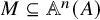 $M \subseteq \mathbb A^n(A)$
and the map
$M \subseteq \mathbb A^n(A)$
and the map $\rho : \Gamma \rightarrow M$
is continuous. The assumption in (2) implies that
$\rho : \Gamma \rightarrow M$
is continuous. The assumption in (2) implies that $\rho (\Delta )\subseteq H(A)$
. Since H is closed in G the restriction of
$\rho (\Delta )\subseteq H(A)$
. Since H is closed in G the restriction of $\tau $
to H is a closed immersion. It follows from Lemma 4.1 that
$\tau $
to H is a closed immersion. It follows from Lemma 4.1 that $M\cap H(A)$
is a closed subset of M. Its preimage in
$M\cap H(A)$
is a closed subset of M. Its preimage in $\Gamma $
will be a closed subset of
$\Gamma $
will be a closed subset of $\Gamma $
containing
$\Gamma $
containing $\Delta $
. Since
$\Delta $
. Since $\Delta $
is dense in
$\Delta $
is dense in $\Gamma $
we conclude that
$\Gamma $
we conclude that $\rho (\Gamma )\subseteq M\cap H(A)$
, which implies part (1).
$\rho (\Gamma )\subseteq M\cap H(A)$
, which implies part (1).
Lemma 4.16. Let $\varphi : G\rightarrow H$
be a morphism of
$\varphi : G\rightarrow H$
be a morphism of $\mathscr O$
-group schemes of finite type, and let
$\mathscr O$
-group schemes of finite type, and let $\rho : \Gamma \rightarrow G(A)$
be a representation. Then the following hold:
$\rho : \Gamma \rightarrow G(A)$
be a representation. Then the following hold:
-
(1) if
$\rho $
is R-condensed then
$\varphi \circ \rho : \Gamma \rightarrow H(A)$
is R-condensed; -
(2) if
$\varphi \circ \rho $
is R-condensed and
$\varphi $
is a closed immersion then
$\rho $
is R-condensed.




Proof. Lemma 4.3 implies part (1); part (2) holds trivially.
5 The space of generic matrices
Let G be a smooth affine $\mathscr O$
-group scheme and let
$\mathscr O$
-group scheme and let $\overline {\rho }:\Gamma \rightarrow G(k)$
be a continuous representation, where
$\overline {\rho }:\Gamma \rightarrow G(k)$
be a continuous representation, where $\Gamma $
is a profinite group satisfying Mazur’s p-finiteness condition. We will introduce a space of generic matricesFootnote
4
for G, which will depend on
$\Gamma $
is a profinite group satisfying Mazur’s p-finiteness condition. We will introduce a space of generic matricesFootnote
4
for G, which will depend on $\overline {\rho }$
and a faithful representation
$\overline {\rho }$
and a faithful representation $\tau : G \to {\mathrm {GL}}_d$
.
$\tau : G \to {\mathrm {GL}}_d$
.
5.1 Definition of
$X^{\mathrm {gen}}_{{\mathrm {GL}}_d}$
and
$X^{\mathrm {gen}, \tau }_G$


We fixFootnote
5
a closed immersion $\tau : G \to {\mathrm {GL}}_d$
of
$\tau : G \to {\mathrm {GL}}_d$
of $\mathscr O$
-group schemes. By composing it with
$\mathscr O$
-group schemes. By composing it with $\overline {\rho }$
we obtain a continuous representation
$\overline {\rho }$
we obtain a continuous representation $\tau \circ \overline {\rho }: \Gamma \rightarrow {\mathrm {GL}}_d(k)$
. The linearisation
$\tau \circ \overline {\rho }: \Gamma \rightarrow {\mathrm {GL}}_d(k)$
. The linearisation $(\tau \circ \overline {\rho })^{\mathrm {lin}} : k[\Gamma ] \to M_d(k)$
extends to the completed group ring
$(\tau \circ \overline {\rho })^{\mathrm {lin}} : k[\Gamma ] \to M_d(k)$
extends to the completed group ring  . Let
. Let  be the continuous determinant law associated to $(\tau \circ \overline {\rho })^{\mathrm {lin}}$
. (See [Reference Chenevier15] and [Reference Wang-Erickson62, Section 3].)
$(\tau \circ \overline {\rho })^{\mathrm {lin}}$
. (See [Reference Chenevier15] and [Reference Wang-Erickson62, Section 3].)
Let $R^{\mathrm {ps}}_{{\mathrm {GL}}_d}$
be the universal deformation ring of
$R^{\mathrm {ps}}_{{\mathrm {GL}}_d}$
be the universal deformation ring of $\overline {D}$
introduced in [Reference Chenevier15, Section 3.1] and let
$\overline {D}$
introduced in [Reference Chenevier15, Section 3.1] and let  be the extension of the universal d-dimensional determinant law lifting $\overline {D}$
. In particular,
$\overline {D}$
. In particular, $R^{\mathrm {ps}}_{{\mathrm {GL}}_d}$
is a complete local noetherian
$R^{\mathrm {ps}}_{{\mathrm {GL}}_d}$
is a complete local noetherian $\mathscr O$
-algebra with residue field k, and we equip it with its
$\mathscr O$
-algebra with residue field k, and we equip it with its $\mathfrak {m}$
-adic topology. We will write
$\mathfrak {m}$
-adic topology. We will write $D^u_{|A}$
for the specialisation of
$D^u_{|A}$
for the specialisation of $D^u$
along
$D^u$
along $R^{\mathrm {ps}}_{{\mathrm {GL}}_d}\rightarrow A$
. We let
$R^{\mathrm {ps}}_{{\mathrm {GL}}_d}\rightarrow A$
. We let $X^{\mathrm {ps}}_{{\mathrm {GL}}_d} := {\mathrm {Spec}}(R^{\mathrm {ps}}_{{\mathrm {GL}}_d})$
. Note, that
$X^{\mathrm {ps}}_{{\mathrm {GL}}_d} := {\mathrm {Spec}}(R^{\mathrm {ps}}_{{\mathrm {GL}}_d})$
. Note, that $R^{\mathrm {ps}}_{{\mathrm {GL}}_d}$
corresponds to
$R^{\mathrm {ps}}_{{\mathrm {GL}}_d}$
corresponds to $R^{\mathrm {ps}}$
of [Reference Böckle, Iyengar and Paškūnas6] when we take the residual representation to be
$R^{\mathrm {ps}}$
of [Reference Böckle, Iyengar and Paškūnas6] when we take the residual representation to be $\tau \circ \overline {\rho }$
.
$\tau \circ \overline {\rho }$
.
Let $\mathrm {CH}(D^u)$
be the two-sided ideal of
$\mathrm {CH}(D^u)$
be the two-sided ideal of  defined in [Reference Chenevier15, Section 1.17], so that
  is the largest quotient of
  on which $D^u$
descends to a Cayley–Hamilton determinant law. Since
$D^u$
descends to a Cayley–Hamilton determinant law. Since $\Gamma $
satisfies Mazur’s p-finiteness condition,
$\Gamma $
satisfies Mazur’s p-finiteness condition, $E^u$
is a finitely generated
$E^u$
is a finitely generated $R^{\mathrm {ps}}_{{\mathrm {GL}}_d}$
-module and
$R^{\mathrm {ps}}_{{\mathrm {GL}}_d}$
-module and $\mathrm {CH}(D^u)$
is closed by [Reference Wang-Erickson62, Proposition 3.6]. We write
$\mathrm {CH}(D^u)$
is closed by [Reference Wang-Erickson62, Proposition 3.6]. We write $D^u_{E^u} : E^u \to R^{\mathrm {ps}}_{{\mathrm {GL}}_d}$
for the determinant law induced on
$D^u_{E^u} : E^u \to R^{\mathrm {ps}}_{{\mathrm {GL}}_d}$
for the determinant law induced on $E^u$
by
$E^u$
by $D^u$
and
$D^u$
and  for the projection.
If $f: E^u \rightarrow M_d(A)$
is a homomorphism of
$f: E^u \rightarrow M_d(A)$
is a homomorphism of $R^{\mathrm {ps}}_{{\mathrm {GL}}_d}$
-algebras for a commutative
$R^{\mathrm {ps}}_{{\mathrm {GL}}_d}$
-algebras for a commutative $R^{\mathrm {ps}}_{{\mathrm {GL}}_d}$
-algebra A then we say f is a homomorphism of Cayley–Hamilton algebras if
$R^{\mathrm {ps}}_{{\mathrm {GL}}_d}$
-algebra A then we say f is a homomorphism of Cayley–Hamilton algebras if $\det \circ (f \otimes A): E^u \otimes _{R^{\mathrm {ps}}_{{\mathrm {GL}}_d}} A \rightarrow A$
is equal to
$\det \circ (f \otimes A): E^u \otimes _{R^{\mathrm {ps}}_{{\mathrm {GL}}_d}} A \rightarrow A$
is equal to $D^u_{E^u} \otimes A$
.
$D^u_{E^u} \otimes A$
.
Lemma 5.1. The composition  is surjective.
Proof. Let S be the image of $R^{\mathrm {ps}}_{{\mathrm {GL}}_d}[\Gamma ]$
in
$R^{\mathrm {ps}}_{{\mathrm {GL}}_d}[\Gamma ]$
in $E^u$
. Since
$E^u$
. Since $R^{\mathrm {ps}}_{{\mathrm {GL}}_d}[\Gamma ]$
is a dense subring of
$R^{\mathrm {ps}}_{{\mathrm {GL}}_d}[\Gamma ]$
is a dense subring of  , S is also dense in $E^u$
. It is enough to show that S is closed in
$E^u$
. It is enough to show that S is closed in $E^u$
.
$E^u$
.
It follows from [Reference Wang-Erickson62, Proposition 3.6] that $E^u$
is a finitely generated
$E^u$
is a finitely generated $R^{\mathrm {ps}}_{{\mathrm {GL}}_d}$
-module. This implies that the quotient topology on
$R^{\mathrm {ps}}_{{\mathrm {GL}}_d}$
-module. This implies that the quotient topology on $E^u$
coincides with the topology inherited from
$E^u$
coincides with the topology inherited from $R^{\mathrm {ps}}_{{\mathrm {GL}}_d}$
as a finitely generated
$R^{\mathrm {ps}}_{{\mathrm {GL}}_d}$
as a finitely generated $R^{\mathrm {ps}}_{{\mathrm {GL}}_d}$
-module, see the proof of [Reference Böckle, Iyengar and Paškūnas6, Lemma 3.2]. Every
$R^{\mathrm {ps}}_{{\mathrm {GL}}_d}$
-module, see the proof of [Reference Böckle, Iyengar and Paškūnas6, Lemma 3.2]. Every $R^{\mathrm {ps}}_{{\mathrm {GL}}_d}$
-submodule of
$R^{\mathrm {ps}}_{{\mathrm {GL}}_d}$
-submodule of $E^u$
is closed with respect to this topology. Hence, S is closed in
$E^u$
is closed with respect to this topology. Hence, S is closed in $E^u$
, and thus
$E^u$
, and thus $S=E^u$
.
$S=E^u$
.
Lemma 5.2. Let $R\rightarrow A$
be a map of
$R\rightarrow A$
be a map of $R^{\mathrm {ps}}_{{\mathrm {GL}}_d}$
-algebras such that R is a noetherian profinite topological
$R^{\mathrm {ps}}_{{\mathrm {GL}}_d}$
-algebras such that R is a noetherian profinite topological $R^{\mathrm {ps}}_{{\mathrm {GL}}_d}$
-algebra. Let
$R^{\mathrm {ps}}_{{\mathrm {GL}}_d}$
-algebra. Let $\rho : \Gamma \to {\mathrm {GL}}_d(A)$
be a representation satisfying
$\rho : \Gamma \to {\mathrm {GL}}_d(A)$
be a representation satisfying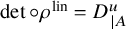 $\det \circ \rho ^{\mathrm {lin}} = D^u_{|A}$
. Then the following are equivalent:
$\det \circ \rho ^{\mathrm {lin}} = D^u_{|A}$
. Then the following are equivalent:
-
(1)
$\rho ^{\mathrm {lin}}:R^{\mathrm {ps}}_{{\mathrm {GL}}_d}[\Gamma ]\rightarrow M_d(A)$
extends to a homomorphism of
$R^{\mathrm {ps}}_{{\mathrm {GL}}_d}$
-algebras ; -
(2)
$\rho ^{\mathrm {lin}}: R^{\mathrm {ps}}_{{\mathrm {GL}}_d}[\Gamma ]\rightarrow M_d(A)$
factors through a homomorphism of
$R^{\mathrm {ps}}_{{\mathrm {GL}}_d}$
-algebras
$E^u\rightarrow M_d(A)$
; -
(3)
$\rho $
is
$R^{\mathrm {ps}}_{{\mathrm {GL}}_d}$
-condensed; -
(4)
$\rho $
is R-condensed.


 ;
;




Moreover, if the equivalent conditions hold then $E^u\rightarrow M_d(A)$
in
$E^u\rightarrow M_d(A)$
in $(2)$
is a homomorphism of Cayley–Hamilton algebras.
$(2)$
is a homomorphism of Cayley–Hamilton algebras.
Proof. (1) implies (2). The homomorphism  induces a d-dimensional A-valued Cayley–Hamilton determinant law

which satisfies $\det \circ (\widehat \rho \otimes A) = D^u_{|A}$
by assumption.
$\det \circ (\widehat \rho \otimes A) = D^u_{|A}$
by assumption.
It follows, that $D^u_{|A}$
is Cayley–Hamilton, hence
$D^u_{|A}$
is Cayley–Hamilton, hence $\widehat \rho \otimes A$
factors through a homomorphism
$\widehat \rho \otimes A$
factors through a homomorphism ${E^u \otimes _{R^{\mathrm {ps}}_{{\mathrm {GL}}_d}} A \to M_d(A)}$
and so
${E^u \otimes _{R^{\mathrm {ps}}_{{\mathrm {GL}}_d}} A \to M_d(A)}$
and so $\rho ^{\mathrm {lin}}|_{R^{\mathrm {ps}}_{{\mathrm {GL}}_d}[\Gamma ]}$
factors through a homomorphism of Cayley–Hamilton algebras
$\rho ^{\mathrm {lin}}|_{R^{\mathrm {ps}}_{{\mathrm {GL}}_d}[\Gamma ]}$
factors through a homomorphism of Cayley–Hamilton algebras $E^u\rightarrow M_d(A)$
.
$E^u\rightarrow M_d(A)$
.
(2) implies (3). Since $E^u$
is finitely generated as
$E^u$
is finitely generated as $R^{\mathrm {ps}}_{{\mathrm {GL}}_d}$
-module by considering the closed embedding
$R^{\mathrm {ps}}_{{\mathrm {GL}}_d}$
-module by considering the closed embedding $\delta : {\mathrm {GL}}_d\hookrightarrow M_d\times M_d$
,
$\delta : {\mathrm {GL}}_d\hookrightarrow M_d\times M_d$
,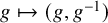 $g\mapsto (g, g^{-1})$
we obtain that
$g\mapsto (g, g^{-1})$
we obtain that $\rho $
is
$\rho $
is $R^{\mathrm {ps}}_{{\mathrm {GL}}_d}$
-condensed.
$R^{\mathrm {ps}}_{{\mathrm {GL}}_d}$
-condensed.
(3) implies (4) by Lemma 4.5.
(4) implies (1). Since $\rho $
is R-condensed,
$\rho $
is R-condensed, $\delta (\rho (\Gamma ))$
is contained in a finitely generated R-submodule of
$\delta (\rho (\Gamma ))$
is contained in a finitely generated R-submodule of $M_d(A)\times M_d(A)$
. By projecting onto the first factor we deduce that the the image of
$M_d(A)\times M_d(A)$
. By projecting onto the first factor we deduce that the the image of ${\rho ^{\mathrm {lin}}: R^{\mathrm {ps}}_{{\mathrm {GL}}_d}[\Gamma ]\rightarrow M_d(A)}$
is contained in a finitely generated R-module M. Since M is profinite the map extends to a continuous map of profinite
${\rho ^{\mathrm {lin}}: R^{\mathrm {ps}}_{{\mathrm {GL}}_d}[\Gamma ]\rightarrow M_d(A)}$
is contained in a finitely generated R-module M. Since M is profinite the map extends to a continuous map of profinite $R^{\mathrm {ps}}_{{\mathrm {GL}}_d}$
-modules
$R^{\mathrm {ps}}_{{\mathrm {GL}}_d}$
-modules  . Since $R^{\mathrm {ps}}_{{\mathrm {GL}}_d}[\Gamma ]$
is a dense subalgebra of
$R^{\mathrm {ps}}_{{\mathrm {GL}}_d}[\Gamma ]$
is a dense subalgebra of  we deduce that $\rho ^{\mathrm {lin}}$
extends to a map of
$\rho ^{\mathrm {lin}}$
extends to a map of $R^{\mathrm {ps}}_{{\mathrm {GL}}_d}$
-algebras
$R^{\mathrm {ps}}_{{\mathrm {GL}}_d}$
-algebras  .
.
Definition 5.3. Let $X^{\mathrm {gen}}_{{\mathrm {GL}}_d} : R^{\mathrm {ps}}_{{\mathrm {GL}}_d}\text {-}\mathrm {alg} \to \text {Set}$
be the functor which sends A to the set of representations
$X^{\mathrm {gen}}_{{\mathrm {GL}}_d} : R^{\mathrm {ps}}_{{\mathrm {GL}}_d}\text {-}\mathrm {alg} \to \text {Set}$
be the functor which sends A to the set of representations $\rho : \Gamma \rightarrow {\mathrm {GL}}_d(A)$
such that
$\rho : \Gamma \rightarrow {\mathrm {GL}}_d(A)$
such that $\det \circ \rho ^{\mathrm {lin}}= D^u \otimes _{R^{\mathrm {ps}}_{{\mathrm {GL}}_d}} A$
and
$\det \circ \rho ^{\mathrm {lin}}= D^u \otimes _{R^{\mathrm {ps}}_{{\mathrm {GL}}_d}} A$
and $\rho $
satisfies the equivalent conditions of Lemma 5.2.
$\rho $
satisfies the equivalent conditions of Lemma 5.2.
We give an alternative description of the points of $X^{\mathrm {gen}}_{{\mathrm {GL}}_d}$
. By the following Lemma, we see that
$X^{\mathrm {gen}}_{{\mathrm {GL}}_d}$
. By the following Lemma, we see that $X^{\mathrm {gen}}_{{\mathrm {GL}}_d}$
identifies canonically with the scheme
$X^{\mathrm {gen}}_{{\mathrm {GL}}_d}$
identifies canonically with the scheme $X^{\mathrm {gen}}$
of [Reference Böckle, Iyengar and Paškūnas6].
$X^{\mathrm {gen}}$
of [Reference Böckle, Iyengar and Paškūnas6].
Lemma 5.4. Let A be a commutative $R^{\mathrm {ps}}_{{\mathrm {GL}}_d}$
-algebra.
$R^{\mathrm {ps}}_{{\mathrm {GL}}_d}$
-algebra.
-
(1)
$X^{\mathrm {gen}}_{{\mathrm {GL}}_d}(A)$
is in natural bijection with the set of homomorphisms of Cayley–Hamilton
$R^{\mathrm {ps}}_{{\mathrm {GL}}_d}$
-algebras
$f : E^u \to M_d(A)$
. In particular,
$X^{\mathrm {gen}}_{{\mathrm {GL}}_d}$
is representable by a finitely generated commutative
$R^{\mathrm {ps}}_{{\mathrm {GL}}_d}$
-algebra
$A^{\mathrm {gen}}_{{\mathrm {GL}}_d}$
. -
(2) If A is a topological
$R^{\mathrm {ps}}_{{\mathrm {GL}}_d}$
-algebra then every representation
$\rho \in X^{\mathrm {gen}}_{{\mathrm {GL}}_d}(A)$
is continuous.





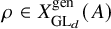
Proof. Part (1). Recall, that in [Reference Böckle, Iyengar and Paškūnas6, Lemma 3.1] the $R^{\mathrm {ps}}_{{\mathrm {GL}}_d}$
-algebra
$R^{\mathrm {ps}}_{{\mathrm {GL}}_d}$
-algebra $A^{\mathrm {gen}}$
is proved to represent the functor, that maps an
$A^{\mathrm {gen}}$
is proved to represent the functor, that maps an $R^{\mathrm {ps}}_{{\mathrm {GL}}_d}$
-algebra A to the set of homomorphisms of Cayley–Hamilton algebras
$R^{\mathrm {ps}}_{{\mathrm {GL}}_d}$
-algebra A to the set of homomorphisms of Cayley–Hamilton algebras ${f : E^u \to M_d(A)}$
. Once we prove this functor to be naturally isomorphic to
${f : E^u \to M_d(A)}$
. Once we prove this functor to be naturally isomorphic to $X^{\mathrm {gen}}_{{\mathrm {GL}}_d}$
as in Definition 5.3, the claim about representability follows and
$X^{\mathrm {gen}}_{{\mathrm {GL}}_d}$
as in Definition 5.3, the claim about representability follows and $X^{\mathrm {gen}}_{{\mathrm {GL}}_d}$
is naturally isomorphic to the
$X^{\mathrm {gen}}_{{\mathrm {GL}}_d}$
is naturally isomorphic to the $R^{\mathrm {ps}}_{{\mathrm {GL}}_d}$
-scheme
$R^{\mathrm {ps}}_{{\mathrm {GL}}_d}$
-scheme ${X^{\mathrm {gen}} = {\mathrm {Spec}} A^{\mathrm {gen}}}$
from [Reference Böckle, Iyengar and Paškūnas6].
${X^{\mathrm {gen}} = {\mathrm {Spec}} A^{\mathrm {gen}}}$
from [Reference Böckle, Iyengar and Paškūnas6].
If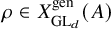 $\rho \in X^{\mathrm {gen}}_{{\mathrm {GL}}_d}(A)$
then by Lemma 5.2 (2) we obtain a natural homomorphism of Cayley–Hamilton algebras
$\rho \in X^{\mathrm {gen}}_{{\mathrm {GL}}_d}(A)$
then by Lemma 5.2 (2) we obtain a natural homomorphism of Cayley–Hamilton algebras $f_{\rho }: E^u \to M_d(A)$
. Conversely, a map of Cayley–Hamilton algebras
$f_{\rho }: E^u \to M_d(A)$
. Conversely, a map of Cayley–Hamilton algebras $f : E^u \to M_d(A)$
gives rise to a representation by means of the composition
$f : E^u \to M_d(A)$
gives rise to a representation by means of the composition $ \rho _f : \Gamma \to (E^u)^{\times } \overset {f}{\to } {\mathrm {GL}}_d(A). $
By restriction along
$ \rho _f : \Gamma \to (E^u)^{\times } \overset {f}{\to } {\mathrm {GL}}_d(A). $
By restriction along  , we see that
 $$ \begin{align*}\det \circ \rho_f^{\mathrm{lin}} = \det \circ ((f \circ \pi_{E^u}) \otimes A) = D^u_{|A}.\end{align*} $$
Lemma 5.2 (1) implies that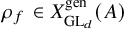 $\rho _f\in X^{\mathrm {gen}}_{{\mathrm {GL}}_d}(A)$
. The maps
$\rho _f\in X^{\mathrm {gen}}_{{\mathrm {GL}}_d}(A)$
. The maps $\rho \mapsto f_{\rho }$
and
$\rho \mapsto f_{\rho }$
and $f\mapsto \rho _f$
are mutually inverse.
$f\mapsto \rho _f$
are mutually inverse.
Part (2) follows from [Reference Böckle, Iyengar and Paškūnas6, Lemma 3.2] or Lemma 4.9.
Lemma 5.5. There is a topologically finitely generated quotient $\Gamma \twoheadrightarrow Q$
such that
$\Gamma \twoheadrightarrow Q$
such that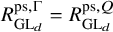 $R^{\mathrm {ps}, \Gamma }_{{\mathrm {GL}}_d}=R^{\mathrm {ps},Q}_{{\mathrm {GL}}_d}$
and every
$R^{\mathrm {ps}, \Gamma }_{{\mathrm {GL}}_d}=R^{\mathrm {ps},Q}_{{\mathrm {GL}}_d}$
and every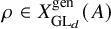 $\rho \in X^{\mathrm {gen}}_{{\mathrm {GL}}_d}(A)$
, where
$\rho \in X^{\mathrm {gen}}_{{\mathrm {GL}}_d}(A)$
, where $A\in R^{\mathrm {ps}}_G\text {-}\mathrm {alg}$
, factors as
$A\in R^{\mathrm {ps}}_G\text {-}\mathrm {alg}$
, factors as $\rho : \Gamma \rightarrow Q \rightarrow {\mathrm {GL}}_d(A)$
.
$\rho : \Gamma \rightarrow Q \rightarrow {\mathrm {GL}}_d(A)$
.
Proof. Let $Q= \Gamma /K$
, where
$Q= \Gamma /K$
, where $K\subseteq \ker (\overline {\rho })$
is the smallest closed normal subgroup of
$K\subseteq \ker (\overline {\rho })$
is the smallest closed normal subgroup of $\Gamma $
such that
$\Gamma $
such that $\ker (\overline {\rho })/K$
is pro-p. Since
$\ker (\overline {\rho })/K$
is pro-p. Since $\ker (\overline {\rho })$
is open in
$\ker (\overline {\rho })$
is open in $\Gamma $
and
$\Gamma $
and $\Gamma $
satisfies Mazur’s p-finiteness condition, Q is topologically finitely generated. Lemma 3.8 in [Reference Chenevier15] implies that
$\Gamma $
satisfies Mazur’s p-finiteness condition, Q is topologically finitely generated. Lemma 3.8 in [Reference Chenevier15] implies that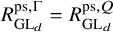 $R^{\mathrm {ps}, \Gamma }_{{\mathrm {GL}}_d}=R^{\mathrm {ps},Q}_{{\mathrm {GL}}_d}$
and the Cayley–Hamilton algebra
$R^{\mathrm {ps}, \Gamma }_{{\mathrm {GL}}_d}=R^{\mathrm {ps},Q}_{{\mathrm {GL}}_d}$
and the Cayley–Hamilton algebra $E^u$
does not change if we replace
$E^u$
does not change if we replace $\Gamma $
by Q. The assertion follows from Lemma 5.4 (1).
$\Gamma $
by Q. The assertion follows from Lemma 5.4 (1).
As already explained above, [Reference Wang-Erickson62, Proposition 3.6] implies that $E^{u}$
is a finitely generated
$E^{u}$
is a finitely generated $R^{\mathrm {ps}}_{{\mathrm {GL}}_d}$
-module, and hence
$R^{\mathrm {ps}}_{{\mathrm {GL}}_d}$
-module, and hence $k\otimes _{R^{\mathrm {ps}}_{{\mathrm {GL}}_d}}E^u$
is a finite dimensional k-vector space.
$k\otimes _{R^{\mathrm {ps}}_{{\mathrm {GL}}_d}}E^u$
is a finite dimensional k-vector space.
Lemma 5.6. Let $\{\gamma _1, \ldots , \gamma _N\}$
be a subset of
$\{\gamma _1, \ldots , \gamma _N\}$
be a subset of $\Gamma $
, such that its image via the map in Lemma 5.1 spans
$\Gamma $
, such that its image via the map in Lemma 5.1 spans $k\otimes _{R^{\mathrm {ps}}_{{\mathrm {GL}}_d}}E^u$
as a k-vector space. Then the map
$k\otimes _{R^{\mathrm {ps}}_{{\mathrm {GL}}_d}}E^u$
as a k-vector space. Then the map
 $$ \begin{align*}X^{\mathrm{gen}}_{{\mathrm{GL}}_d} \rightarrow {\mathrm{GL}}_d^N\times X^{\mathrm{ps}}_{{\mathrm{GL}}_d}, \quad \rho\mapsto (\rho(\gamma_1), \ldots, \rho(\gamma_N))\end{align*} $$
is a closed immersion.
Proof. It follows from Part (1) of Lemma 5.4 that $X^{\mathrm {gen}}_{{\mathrm {GL}}_d}$
coincides with the scheme
$X^{\mathrm {gen}}_{{\mathrm {GL}}_d}$
coincides with the scheme $X^{\mathrm {gen}}$
, that was contructed in [Reference Böckle, Iyengar and Paškūnas6, Lemma 3.1] as a closed subscheme of
$X^{\mathrm {gen}}$
, that was contructed in [Reference Böckle, Iyengar and Paškūnas6, Lemma 3.1] as a closed subscheme of $M_d^{n}\times X^{\mathrm {ps}}_{{\mathrm {GL}}_d}$
by choosing generators
$M_d^{n}\times X^{\mathrm {ps}}_{{\mathrm {GL}}_d}$
by choosing generators $\delta _1, \ldots , \delta _n$
of
$\delta _1, \ldots , \delta _n$
of $E^u$
as an
$E^u$
as an $R^{\mathrm {ps}}_{{\mathrm {GL}}_d}$
-module and mapping
$R^{\mathrm {ps}}_{{\mathrm {GL}}_d}$
-module and mapping $\rho $
to the n-tuple
$\rho $
to the n-tuple $(\rho (\delta _1), \ldots , \rho (\delta _n))$
. Since
$(\rho (\delta _1), \ldots , \rho (\delta _n))$
. Since $\rho (\gamma _i)$
are invertible matrices, it is enough to show that the images of
$\rho (\gamma _i)$
are invertible matrices, it is enough to show that the images of $\gamma _1, \ldots , \gamma _N$
generate
$\gamma _1, \ldots , \gamma _N$
generate $E^u$
as an
$E^u$
as an $R^{\mathrm {ps}}_{{\mathrm {GL}}_d}$
-module. This follows from Nakayama’s lemma.
$R^{\mathrm {ps}}_{{\mathrm {GL}}_d}$
-module. This follows from Nakayama’s lemma.
Let Q be a quotient of $\Gamma $
as in Lemma 5.5. We fix an N-tuple
$\Gamma $
as in Lemma 5.5. We fix an N-tuple $(\gamma _1, \ldots , \gamma _N)\in \Gamma ^N$
, such that the entries generate a dense subgroup of Q and its image spans
$(\gamma _1, \ldots , \gamma _N)\in \Gamma ^N$
, such that the entries generate a dense subgroup of Q and its image spans $E^u\otimes _{R^{\mathrm {ps}}_{{\mathrm {GL}}_d}} k$
as a k-vector space.
$E^u\otimes _{R^{\mathrm {ps}}_{{\mathrm {GL}}_d}} k$
as a k-vector space.
Definition 5.7. We define the $R^{\mathrm {ps}}_{{\mathrm {GL}}_d}$
-scheme
$R^{\mathrm {ps}}_{{\mathrm {GL}}_d}$
-scheme $X^{\mathrm {gen}, \tau }_G$
as the fibre product
$X^{\mathrm {gen}, \tau }_G$
as the fibre product
 $$ \begin{align} X^{\mathrm{gen}, \tau}_G := X^{\mathrm{gen}}_{{\mathrm{GL}}_d}\times_{{\mathrm{GL}}_d^N} G^N, \end{align} $$
where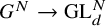 $G^N \rightarrow {\mathrm {GL}}_d^N$
is the map
$G^N \rightarrow {\mathrm {GL}}_d^N$
is the map $(g_1, \ldots , g_N)\mapsto (\tau (g_1),\ldots , \tau (g_N))$
.
$(g_1, \ldots , g_N)\mapsto (\tau (g_1),\ldots , \tau (g_N))$
.
Thus $X^{\mathrm {gen}, \tau }_G$
is a closed
$X^{\mathrm {gen}, \tau }_G$
is a closed $R^{\mathrm {ps}}_{{\mathrm {GL}}_d}$
-subscheme of
$R^{\mathrm {ps}}_{{\mathrm {GL}}_d}$
-subscheme of $X^{\mathrm {gen}}_{{\mathrm {GL}}_d}$
, and hence a closed subfunctor. We note that
$X^{\mathrm {gen}}_{{\mathrm {GL}}_d}$
, and hence a closed subfunctor. We note that $X^{\mathrm {gen}, \tau }_G$
is non-empty, as
$X^{\mathrm {gen}, \tau }_G$
is non-empty, as $X^{\mathrm {gen}, \tau }_G(k)$
contains the representation
$X^{\mathrm {gen}, \tau }_G(k)$
contains the representation $\overline {\rho }$
that we have started with.
$\overline {\rho }$
that we have started with.
Remark 5.8. By construction $X^{\mathrm {gen}}_{{\mathrm {GL}}_d}$
is a closed subscheme of
$X^{\mathrm {gen}}_{{\mathrm {GL}}_d}$
is a closed subscheme of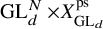 ${\mathrm {GL}}_d^N \times X^{\mathrm {ps}}_{{\mathrm {GL}}_d}$
. Thus
${\mathrm {GL}}_d^N \times X^{\mathrm {ps}}_{{\mathrm {GL}}_d}$
. Thus $X^{\mathrm {gen}, \tau }_G$
is a closed subscheme of
$X^{\mathrm {gen}, \tau }_G$
is a closed subscheme of $G^N\times X^{\mathrm {ps}}_{{\mathrm {GL}}_d}$
, which can interpreted as follows.
$G^N\times X^{\mathrm {ps}}_{{\mathrm {GL}}_d}$
, which can interpreted as follows.
Let $\mathcal F_N$
be a free group generated by elements
$\mathcal F_N$
be a free group generated by elements $x_1, \ldots , x_N$
. Let
$x_1, \ldots , x_N$
. Let ${\mathrm {Rep}}_G^{\mathcal F_N, \square }$
be the affine
${\mathrm {Rep}}_G^{\mathcal F_N, \square }$
be the affine $R^{\mathrm {ps}}_{{\mathrm {GL}}_d}$
-scheme, which represents the functor, that maps a commutative
$R^{\mathrm {ps}}_{{\mathrm {GL}}_d}$
-scheme, which represents the functor, that maps a commutative $R^{\mathrm {ps}}_{{\mathrm {GL}}_d}$
-algebra A to the set of (abstract) group homomorphisms
$R^{\mathrm {ps}}_{{\mathrm {GL}}_d}$
-algebra A to the set of (abstract) group homomorphisms $\rho : \mathcal F_N \to G(A)$
. Sending
$\rho : \mathcal F_N \to G(A)$
. Sending $\rho $
to the N-tuple
$\rho $
to the N-tuple $(\rho (x_1), \ldots , \rho (x_N))$
induces an isomorphism of
$(\rho (x_1), \ldots , \rho (x_N))$
induces an isomorphism of $X^{\mathrm {ps}}_{{\mathrm {GL}}_d}$
-schemes
$X^{\mathrm {ps}}_{{\mathrm {GL}}_d}$
-schemes
 $$ \begin{align*}{\mathrm{Rep}}_G^{\mathcal F_N, \square} \cong G^N\times X^{\mathrm{ps}}_{{\mathrm{GL}}_d}.\end{align*} $$
Mapping $x_i$
to
$x_i$
to $\gamma _i$
induces a group homomorphism
$\gamma _i$
induces a group homomorphism $\varphi :\mathcal F_N\rightarrow Q$
and it follows from above, that mapping
$\varphi :\mathcal F_N\rightarrow Q$
and it follows from above, that mapping $\rho $
to
$\rho $
to $\rho \circ \varphi $
induces a closed immersion
$\rho \circ \varphi $
induces a closed immersion $X^{\mathrm {gen}, \tau }_G \rightarrow {\mathrm {Rep}}_G^{\mathcal F_N, \square }$
.
$X^{\mathrm {gen}, \tau }_G \rightarrow {\mathrm {Rep}}_G^{\mathcal F_N, \square }$
.
Remark 5.9. If $L'$
is a finite extension of L with ring of integers
$L'$
is a finite extension of L with ring of integers $\mathscr O'$
then it follows from the definition that
$\mathscr O'$
then it follows from the definition that $(X^{\mathrm {gen}, \tau }_G)_{\mathscr O'}\cong X^{\mathrm {gen}, \tau }_{G_{\mathscr O'}}$
. The main technical result of this paper is the computation of the dimension of
$(X^{\mathrm {gen}, \tau }_G)_{\mathscr O'}\cong X^{\mathrm {gen}, \tau }_{G_{\mathscr O'}}$
. The main technical result of this paper is the computation of the dimension of $X^{\mathrm {gen}, \tau }_G$
. Since
$X^{\mathrm {gen}, \tau }_G$
. Since $\mathscr O'$
is finite and flat over
$\mathscr O'$
is finite and flat over $\mathscr O$
the dimensions of
$\mathscr O$
the dimensions of $(X^{\mathrm {gen}, \tau }_G)_{\mathscr O'}$
and
$(X^{\mathrm {gen}, \tau }_G)_{\mathscr O'}$
and $X^{\mathrm {gen}, \tau }_G$
are the same and using Proposition 2.8 we may assume that G is split,
$X^{\mathrm {gen}, \tau }_G$
are the same and using Proposition 2.8 we may assume that G is split, $G/G^0$
is constant and
$G/G^0$
is constant and $G(\mathscr O)\rightarrow (G/G^0)(\mathscr O)$
is surjective.
$G(\mathscr O)\rightarrow (G/G^0)(\mathscr O)$
is surjective.
We are now ready to give a description of the points of $X^{\mathrm {gen}, \tau }_G$
.
$X^{\mathrm {gen}, \tau }_G$
.
Lemma 5.10. Let A be a commutative $R^{\mathrm {ps}}_{{\mathrm {GL}}_d}$
-algebra.
$R^{\mathrm {ps}}_{{\mathrm {GL}}_d}$
-algebra.
-
(1)
$X^{\mathrm {gen}, \tau }_G(A)$
is the set of representations
$\rho : \Gamma \rightarrow G(A)$
, such that
$\tau \circ \rho \in X^{\mathrm {gen}}_{{\mathrm {GL}}_d}(A)$
. -
(2) If A is a topological
$R^{\mathrm {ps}}_{{\mathrm {GL}}_d}$
-algebra then every representation
$\rho \in X^{\mathrm {gen}, \tau }_G(A)$
is continuous.


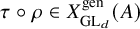

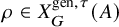
Proof. Part (1) follows from Lemmas 4.15 and 5.5.
For part (2), we observe that part (1) and Lemma 5.4 (2) imply that that the composition ${\tau \circ \rho : \Gamma \to G(A) \to {\mathrm {GL}}_d(A)}$
is continuous. Since
${\tau \circ \rho : \Gamma \to G(A) \to {\mathrm {GL}}_d(A)}$
is continuous. Since $\tau $
is a closed immersion the topology on
$\tau $
is a closed immersion the topology on $G(A)$
is the subspace topology induced by
$G(A)$
is the subspace topology induced by ${\mathrm {GL}}_d(A)$
and thus
${\mathrm {GL}}_d(A)$
and thus $\rho $
is continuous.
$\rho $
is continuous.
Remark 5.11. It follows from Lemma 5.10 that the definition of $X^{\mathrm {gen}, \tau }_G$
does not depend on the choice of the quotient Q and
$X^{\mathrm {gen}, \tau }_G$
does not depend on the choice of the quotient Q and $\gamma _1, \ldots , \gamma _N$
. However, it will depend a priori on the choice of the faithful representation
$\gamma _1, \ldots , \gamma _N$
. However, it will depend a priori on the choice of the faithful representation $\tau $
. It will follow from Corollaries 6.12 and 8.4 that the connected component of
$\tau $
. It will follow from Corollaries 6.12 and 8.4 that the connected component of $X^{\mathrm {gen}, \tau }_G$
containing the point corresponding to the representation
$X^{\mathrm {gen}, \tau }_G$
containing the point corresponding to the representation $\overline {\rho }: \Gamma \rightarrow G(k)$
is independent of
$\overline {\rho }: \Gamma \rightarrow G(k)$
is independent of $\tau $
.
$\tau $
.
If $\mathfrak {p}$
is the maximal ideal of
$\mathfrak {p}$
is the maximal ideal of $R^{\mathrm {ps}}_{{\mathrm {GL}}_d}$
then
$R^{\mathrm {ps}}_{{\mathrm {GL}}_d}$
then $\kappa (\mathfrak {p})=k$
and we equip the algebraic closure
$\kappa (\mathfrak {p})=k$
and we equip the algebraic closure $\overline {\kappa (\mathfrak {p})}$
with the discrete topology. If
$\overline {\kappa (\mathfrak {p})}$
with the discrete topology. If $\mathfrak {p}$
is a prime of
$\mathfrak {p}$
is a prime of $R^{\mathrm {ps}}_{{\mathrm {GL}}_d}$
with
$R^{\mathrm {ps}}_{{\mathrm {GL}}_d}$
with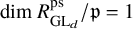 $\dim R^{\mathrm {ps}}_{{\mathrm {GL}}_d}/\mathfrak {p} =1$
then
$\dim R^{\mathrm {ps}}_{{\mathrm {GL}}_d}/\mathfrak {p} =1$
then $\kappa (\mathfrak {p})$
is a local field and the valuation topology on
$\kappa (\mathfrak {p})$
is a local field and the valuation topology on $\kappa (\mathfrak {p})$
makes it into a topological
$\kappa (\mathfrak {p})$
makes it into a topological $R^{\mathrm {ps}}_{{\mathrm {GL}}_d}$
-algebra by [Reference Böckle, Iyengar and Paškūnas6, Lemma 3.17]. We equip the algebraic closure
$R^{\mathrm {ps}}_{{\mathrm {GL}}_d}$
-algebra by [Reference Böckle, Iyengar and Paškūnas6, Lemma 3.17]. We equip the algebraic closure $\overline {\kappa (\mathfrak {p})}$
with the topology induced by a valuation, which extends the valuation on
$\overline {\kappa (\mathfrak {p})}$
with the topology induced by a valuation, which extends the valuation on $\kappa (\mathfrak {p})$
.
$\kappa (\mathfrak {p})$
.
Lemma 5.12. Let $\mathfrak {p}$
be a prime of
$\mathfrak {p}$
be a prime of $R^{\mathrm {ps}}_{{\mathrm {GL}}_d}$
such that
$R^{\mathrm {ps}}_{{\mathrm {GL}}_d}$
such that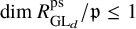 $\dim R^{\mathrm {ps}}_{{\mathrm {GL}}_d}/\mathfrak {p}\le 1$
. The set
$\dim R^{\mathrm {ps}}_{{\mathrm {GL}}_d}/\mathfrak {p}\le 1$
. The set $X^{\mathrm {gen}, \tau }_G(\overline {\kappa (\mathfrak {p})})$
is naturally in bijection with the set of continuous representations
$X^{\mathrm {gen}, \tau }_G(\overline {\kappa (\mathfrak {p})})$
is naturally in bijection with the set of continuous representations $\rho : \Gamma \rightarrow G(\overline {\kappa (\mathfrak {p})})$
, with the topology on
$\rho : \Gamma \rightarrow G(\overline {\kappa (\mathfrak {p})})$
, with the topology on $\overline {\kappa (\mathfrak {p})}$
as above, such that the d-dimensional determinant law
$\overline {\kappa (\mathfrak {p})}$
as above, such that the d-dimensional determinant law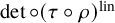 $\det \circ (\tau \circ \rho )^{\mathrm {lin}}$
is equal to the specialisation of
$\det \circ (\tau \circ \rho )^{\mathrm {lin}}$
is equal to the specialisation of $D^u$
along
$D^u$
along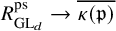 $R^{\mathrm {ps}}_{{\mathrm {GL}}_d}\rightarrow \overline {\kappa (\mathfrak {p})}$
.
$R^{\mathrm {ps}}_{{\mathrm {GL}}_d}\rightarrow \overline {\kappa (\mathfrak {p})}$
.
Proof. Lemma 4.14 implies that a representation $\rho : \Gamma \rightarrow G(\overline {\kappa (\mathfrak {p})})$
is continuous if and only if it is
$\rho : \Gamma \rightarrow G(\overline {\kappa (\mathfrak {p})})$
is continuous if and only if it is $R^{\mathrm {ps}}_{{\mathrm {GL}}_d}$
-condensed. The assertion then follows from Lemma 5.10.
$R^{\mathrm {ps}}_{{\mathrm {GL}}_d}$
-condensed. The assertion then follows from Lemma 5.10.
Let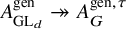 $A^{\mathrm {gen}}_{{\mathrm {GL}}_d}\twoheadrightarrow A^{\mathrm {gen}, \tau }_G$
be the quotient representing
$A^{\mathrm {gen}}_{{\mathrm {GL}}_d}\twoheadrightarrow A^{\mathrm {gen}, \tau }_G$
be the quotient representing $X^{\mathrm {gen}, \tau }_G$
. We will denote by
$X^{\mathrm {gen}, \tau }_G$
. We will denote by $\overline {X}^{\mathrm {gen},\tau }_G$
the special fibre of
$\overline {X}^{\mathrm {gen},\tau }_G$
the special fibre of $X^{\mathrm {gen}, \tau }_G$
over
$X^{\mathrm {gen}, \tau }_G$
over $\mathscr O$
.
$\mathscr O$
.
Lemma 5.13. Let $y: R^{\mathrm {ps}}_{{\mathrm {GL}}_d} \rightarrow \Omega $
be a ring homomorphism into an algebraically closed field
$y: R^{\mathrm {ps}}_{{\mathrm {GL}}_d} \rightarrow \Omega $
be a ring homomorphism into an algebraically closed field $\Omega $
and let
$\Omega $
and let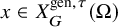 $x\in X^{\mathrm {gen}, \tau }_G(\Omega )$
be a point above y. Let H be the smallest Zariski closed subgroup of
$x\in X^{\mathrm {gen}, \tau }_G(\Omega )$
be a point above y. Let H be the smallest Zariski closed subgroup of $G_{\Omega }$
containing
$G_{\Omega }$
containing $\rho _{x}(\gamma _1), \ldots , \rho _x(\gamma _N)$
, where
$\rho _{x}(\gamma _1), \ldots , \rho _x(\gamma _N)$
, where $\rho _x$
is the specialisation at x of the universal representation
$\rho _x$
is the specialisation at x of the universal representation $\rho : \Gamma \rightarrow {\mathrm {GL}}_d(A^{\mathrm {gen}}_{{\mathrm {GL}}_d})$
. Then H is equal to the Zariski closure of
$\rho : \Gamma \rightarrow {\mathrm {GL}}_d(A^{\mathrm {gen}}_{{\mathrm {GL}}_d})$
. Then H is equal to the Zariski closure of $\rho _x(\Gamma )$
in
$\rho _x(\Gamma )$
in $G_{\Omega }$
.
$G_{\Omega }$
.

5.2 Completion at maximal ideals and deformation problems
Let $Y\subset X^{\mathrm {gen},\tau }_G$
be the preimage of the closed point of
$Y\subset X^{\mathrm {gen},\tau }_G$
be the preimage of the closed point of $X^{\mathrm {ps}}_{{\mathrm {GL}}_d}$
and let x be either a closed point of Y or a closed point of
$X^{\mathrm {ps}}_{{\mathrm {GL}}_d}$
and let x be either a closed point of Y or a closed point of $X^{\mathrm {gen},\tau }_G\setminus Y$
and let y be its image in
$X^{\mathrm {gen},\tau }_G\setminus Y$
and let y be its image in ${\mathrm {Spec}} R^{\mathrm {ps}}_{{\mathrm {GL}}_d}$
. It follows from [Reference Böckle, Iyengar and Paškūnas6, Lemmas 3.17, 3.18] that
${\mathrm {Spec}} R^{\mathrm {ps}}_{{\mathrm {GL}}_d}$
. It follows from [Reference Böckle, Iyengar and Paškūnas6, Lemmas 3.17, 3.18] that $\kappa (x)$
is a finite extension of
$\kappa (x)$
is a finite extension of $\kappa (y)$
and there are the following possibilities:
$\kappa (y)$
and there are the following possibilities:
-
(1) if
$x\in Y$
then
$\kappa (x)$
is a finite extension of k; -
(2) if
$x\in X^{\mathrm {gen},\tau }_G[1/p]$
then
$\kappa (x)$
is a finite extension of L; -
(3) if
$x\in \overline {X}^{\mathrm {gen},\tau }_G\setminus Y$
then
$\kappa (x)$
is a local field of characteristic p.


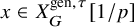

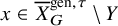

The universal property of $A^{\mathrm {gen},\tau }_G$
gives us a continuous Galois representation
$A^{\mathrm {gen},\tau }_G$
gives us a continuous Galois representation
 $$ \begin{align*}\rho_x: \Gamma \rightarrow G(\kappa(x))\end{align*} $$
for the natural topology on the target. In this section we want to relate the completion of the local ring $\mathscr O_{X^{\mathrm {gen},\tau }_G, x}$
to a deformation problem for
$\mathscr O_{X^{\mathrm {gen},\tau }_G, x}$
to a deformation problem for $\rho _x$
.
$\rho _x$
.
Lemma 5.14. Let $\kappa $
be either a finite or a local
$\kappa $
be either a finite or a local $\mathscr O$
-field and let
$\mathscr O$
-field and let $\rho : \Gamma \rightarrow G(\kappa )$
be a continuous representation. Let
$\rho : \Gamma \rightarrow G(\kappa )$
be a continuous representation. Let $\Lambda $
be a coefficient ring of
$\Lambda $
be a coefficient ring of $\kappa $
and let
$\kappa $
and let $(A,\mathfrak {m}_{A})\in \mathfrak {A}_{\Lambda }$
. If
$(A,\mathfrak {m}_{A})\in \mathfrak {A}_{\Lambda }$
. If $\gamma _1, \ldots , \gamma _N$
topologically generate
$\gamma _1, \ldots , \gamma _N$
topologically generate $\Gamma $
then the map
$\Gamma $
then the map
 $$ \begin{align*}\rho_{A}\mapsto (\tau\circ \rho_{A}, (\rho(\gamma_1), \ldots, \rho(\gamma_N)))\end{align*} $$
induces a bijection of sets $D^{\square }_{\rho ,G}(A)\longrightarrow D^{\square }_{\tau \circ \rho ,{\mathrm {GL}}_d}(A)\times _{{\mathrm {GL}}_d^N(A)} G^N(A).$
Proof. Since $\tau : G(A)\rightarrow {\mathrm {GL}}_d(A)$
is injective, the map is an injection. A point in
$\tau : G(A)\rightarrow {\mathrm {GL}}_d(A)$
is injective, the map is an injection. A point in ${D^{\square }_{\tau \circ \rho ,{\mathrm {GL}}_d}(A)\times _{{\mathrm {GL}}_d^N(A)}G^N(A)}$
corresponds to continuous representation
${D^{\square }_{\tau \circ \rho ,{\mathrm {GL}}_d}(A)\times _{{\mathrm {GL}}_d^N(A)}G^N(A)}$
corresponds to continuous representation $\rho _{A}: \Gamma \rightarrow {\mathrm {GL}}_d(A)$
such that
$\rho _{A}: \Gamma \rightarrow {\mathrm {GL}}_d(A)$
such that $\rho _{A} \equiv \tau \circ \rho \pmod {\mathfrak {m}_{A}}$
and
$\rho _{A} \equiv \tau \circ \rho \pmod {\mathfrak {m}_{A}}$
and $(g_1, \ldots , g_N)\in G^N(A)$
such that
$(g_1, \ldots , g_N)\in G^N(A)$
such that $\rho (\gamma _i)=\tau (g_i)$
for
$\rho (\gamma _i)=\tau (g_i)$
for $1\le i \le N$
. Since
$1\le i \le N$
. Since $\tau (G(A))$
is a closed subgroup of
$\tau (G(A))$
is a closed subgroup of ${\mathrm {GL}}_d(A)$
, its preimage
${\mathrm {GL}}_d(A)$
, its preimage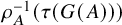 $\rho _{A}^{-1}(\tau (G(A)))$
is a closed subgroup of
$\rho _{A}^{-1}(\tau (G(A)))$
is a closed subgroup of $\Gamma $
. Since it contains the topological generators
$\Gamma $
. Since it contains the topological generators $\gamma _1, \ldots , \gamma _N$
we deduce that the image of
$\gamma _1, \ldots , \gamma _N$
we deduce that the image of $\rho _{A}$
is contained in
$\rho _{A}$
is contained in $\tau (G(A))$
. This implies that the map is surjective.
$\tau (G(A))$
. This implies that the map is surjective.
Lemma 5.15. Let $(A, \mathfrak {m})$
be a local (possibly non-noetherian) ring and let I be a finitely generated ideal of A. If the
$(A, \mathfrak {m})$
be a local (possibly non-noetherian) ring and let I be a finitely generated ideal of A. If the $\mathfrak {m}$
-adic completion
$\mathfrak {m}$
-adic completion $\hat {A}$
of A is noetherian then
$\hat {A}$
of A is noetherian then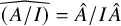 $\widehat {(A/I)}= \hat {A}/ I\hat {A}$
.
$\widehat {(A/I)}= \hat {A}/ I\hat {A}$
.
Proof. It follows from [Reference Project59, Tag 0BNG] that $A/\mathfrak {m}^{n}$
is a quotient of
$A/\mathfrak {m}^{n}$
is a quotient of $\hat {A}$
for all
$\hat {A}$
for all $n\ge 1$
. Since
$n\ge 1$
. Since $\hat {A}$
is noetherian,
$\hat {A}$
is noetherian, $A/\mathfrak {m}^{n}$
is noetherian, and hence artinian for all
$A/\mathfrak {m}^{n}$
is noetherian, and hence artinian for all $n\ge 1$
. By choosing generators of
$n\ge 1$
. By choosing generators of $I=(a_1, \ldots , a_s)$
we obtain a surjection
$I=(a_1, \ldots , a_s)$
we obtain a surjection $A^s\twoheadrightarrow I$
. Let
$A^s\twoheadrightarrow I$
. Let $K_n= {\mathrm {Ker}}((A/\mathfrak {m}^{n})^s \twoheadrightarrow (I+\mathfrak {m}^{n})/\mathfrak {m}^{n})$
. The modules
$K_n= {\mathrm {Ker}}((A/\mathfrak {m}^{n})^s \twoheadrightarrow (I+\mathfrak {m}^{n})/\mathfrak {m}^{n})$
. The modules $K_n$
are artinian, since they are finitely generated over the artinian ring
$K_n$
are artinian, since they are finitely generated over the artinian ring $A/\mathfrak {m}^{n}$
, and thus form a Mittag-Leffler system, which implies that the map
$A/\mathfrak {m}^{n}$
, and thus form a Mittag-Leffler system, which implies that the map $\hat {A}^s= \varprojlim _n (A/\mathfrak {m}^{n})^s\rightarrow \varprojlim _n (I +\mathfrak {m}^{n})/\mathfrak {m}^{n}$
is surjective.
$\hat {A}^s= \varprojlim _n (A/\mathfrak {m}^{n})^s\rightarrow \varprojlim _n (I +\mathfrak {m}^{n})/\mathfrak {m}^{n}$
is surjective.
The map $\hat {A}\rightarrow \widehat {(A/I)}$
is surjective by [Reference Project59, Tag 0315] and the kernel is equal to
$\hat {A}\rightarrow \widehat {(A/I)}$
is surjective by [Reference Project59, Tag 0315] and the kernel is equal to $\varprojlim _n (I +\mathfrak {m}^{n})/\mathfrak {m}^{n}$
, [Reference Project59, Tag 02N1]. It follows from above that this projective limit is equal to
$\varprojlim _n (I +\mathfrak {m}^{n})/\mathfrak {m}^{n}$
, [Reference Project59, Tag 02N1]. It follows from above that this projective limit is equal to $I \hat {A}$
, which implies the assertion.
$I \hat {A}$
, which implies the assertion.
Proposition 5.16. Let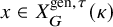 $x\in X^{\mathrm {gen}, \tau }_G(\kappa )$
, where
$x\in X^{\mathrm {gen}, \tau }_G(\kappa )$
, where $\kappa $
is either a finite or a local
$\kappa $
is either a finite or a local $\mathscr O$
-field. Let
$\mathscr O$
-field. Let $\mathfrak {q}$
be the kernel of the map
$\mathfrak {q}$
be the kernel of the map
 $$ \begin{align*}\Lambda\otimes_{\mathscr{O}} A^{\mathrm{gen},\tau}_G \rightarrow \kappa, \quad \lambda \otimes a \mapsto \bar{\lambda}\bar{a},\end{align*} $$
where $\bar {\lambda }$
and
$\bar {\lambda }$
and $\bar {a}$
denote the images of
$\bar {a}$
denote the images of $\lambda $
and a in
$\lambda $
and a in $\kappa $
and
$\kappa $
and $\Lambda $
is a coefficient ring for
$\Lambda $
is a coefficient ring for $\kappa $
. The completion of
$\kappa $
. The completion of $\Lambda \otimes _{\mathscr {O}} A^{\mathrm {gen},\tau }_G$
with respect to
$\Lambda \otimes _{\mathscr {O}} A^{\mathrm {gen},\tau }_G$
with respect to $\mathfrak {q}$
is naturally isomorphic to
$\mathfrak {q}$
is naturally isomorphic to $R^{\square }_{\rho _x,G}$
.
$R^{\square }_{\rho _x,G}$
.
Proof. If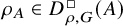 $\rho _{A}\in D^{\square }_{\rho , G}(A)$
then [Reference Böckle, Iyengar and Paškūnas6, Proposition 3.33] implies that A is naturally an
$\rho _{A}\in D^{\square }_{\rho , G}(A)$
then [Reference Böckle, Iyengar and Paškūnas6, Proposition 3.33] implies that A is naturally an $R^{\mathrm {ps}}_{{\mathrm {GL}}_d}$
-algebra and
$R^{\mathrm {ps}}_{{\mathrm {GL}}_d}$
-algebra and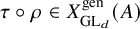 $\tau \circ \rho \in X^{\mathrm {gen}}_{{\mathrm {GL}}_d}(A)$
. Lemma 5.5 implies that there is a topologically finitely generated quotient Q of
$\tau \circ \rho \in X^{\mathrm {gen}}_{{\mathrm {GL}}_d}(A)$
. Lemma 5.5 implies that there is a topologically finitely generated quotient Q of $\Gamma $
such that any deformation of
$\Gamma $
such that any deformation of $\rho $
factor through Q. Hence, we may assume without loss of generality that
$\rho $
factor through Q. Hence, we may assume without loss of generality that $\gamma _1, \ldots , \gamma _N$
are topological generators of
$\gamma _1, \ldots , \gamma _N$
are topological generators of $\Gamma $
.
$\Gamma $
.
Let I be the kernel of the surjection $\mathscr O({\mathrm {GL}}_d^N)\twoheadrightarrow \mathscr O(G^N)$
. We note that I is a finitely generated ideal. Let
$\mathscr O({\mathrm {GL}}_d^N)\twoheadrightarrow \mathscr O(G^N)$
. We note that I is a finitely generated ideal. Let $\mathfrak {m}_{G}$
and
$\mathfrak {m}_{G}$
and $\mathfrak {m}_{{\mathrm {GL}}_d}$
be the maximal ideals of
$\mathfrak {m}_{{\mathrm {GL}}_d}$
be the maximal ideals of $R^{\square }_{\rho _x,G}$
and
$R^{\square }_{\rho _x,G}$
and $R^{\square }_{\tau \circ \rho _x, {\mathrm {GL}}_d}$
, respectively. The rings
$R^{\square }_{\tau \circ \rho _x, {\mathrm {GL}}_d}$
, respectively. The rings $R^{\square }_{\rho _x,G}/\mathfrak {m}_G^n$
and
$R^{\square }_{\rho _x,G}/\mathfrak {m}_G^n$
and $R^{\square }_{\tau \circ \rho _x, {\mathrm {GL}}_d}/\mathfrak {m}_{{\mathrm {GL}}_d}^n$
represent the restrictions of functors
$R^{\square }_{\tau \circ \rho _x, {\mathrm {GL}}_d}/\mathfrak {m}_{{\mathrm {GL}}_d}^n$
represent the restrictions of functors $D^{\square }_{\rho _x, G}$
and
$D^{\square }_{\rho _x, G}$
and $D^{\square }_{\tau \circ \rho _x, {\mathrm {GL}}_d}$
to
$D^{\square }_{\tau \circ \rho _x, {\mathrm {GL}}_d}$
to $\mathfrak {A}_{\Lambda , n}$
, respectively. It follows from Lemma 5.14 that
$\mathfrak {A}_{\Lambda , n}$
, respectively. It follows from Lemma 5.14 that
 $$ \begin{align*}R^{\square}_{\rho_x,G}/\mathfrak {m}_G^n\cong (R^{\square}_{\tau\circ \rho_x, {\mathrm{GL}}_d}/\mathfrak {m}_{{\mathrm{GL}}_d}^n) \otimes_{\mathscr O({\mathrm{GL}}_d^N)} \mathscr O(G^N).\end{align*} $$
By passing to the limit and using Lemma 5.15 with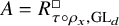 $A=R^{\square }_{\tau \circ \rho _x, {\mathrm {GL}}_d}$
we obtain
$A=R^{\square }_{\tau \circ \rho _x, {\mathrm {GL}}_d}$
we obtain
 $$ \begin{align*}R^{\square}_{\rho_x, G}\cong R^{\square}_{\tau\circ\rho_x, {\mathrm{GL}}_d}\otimes_{\mathscr O({\mathrm{GL}}_d^N)} \mathscr O(G^N).\end{align*} $$
If $G={\mathrm {GL}}_d$
and
$G={\mathrm {GL}}_d$
and $\tau ={\mathrm {id}}$
then the proposition is [Reference Böckle, Iyengar and Paškūnas6, Proposition 3.33], so that
$\tau ={\mathrm {id}}$
then the proposition is [Reference Böckle, Iyengar and Paškūnas6, Proposition 3.33], so that $R^{\square }_{\tau \circ \rho _x, {\mathrm {GL}}_d}$
is naturally isomorphic to the completion of the local ring of
$R^{\square }_{\tau \circ \rho _x, {\mathrm {GL}}_d}$
is naturally isomorphic to the completion of the local ring of $\Lambda \otimes _{\mathscr {O}} A^{\mathrm {gen}}_{{\mathrm {GL}}_d}$
at
$\Lambda \otimes _{\mathscr {O}} A^{\mathrm {gen}}_{{\mathrm {GL}}_d}$
at $\mathfrak {q}$
. Since
$\mathfrak {q}$
. Since $A^{\mathrm {gen},\tau }_G=A^{\mathrm {gen}}_{{\mathrm {GL}}_d} \otimes _{\mathscr O({\mathrm {GL}}_d^N)} \mathscr O(G^N)= A^{\mathrm {gen}}_{{\mathrm {GL}}_d}/ I A^{\mathrm {gen}}_{{\mathrm {GL}}_d}$
by definition, and
$A^{\mathrm {gen},\tau }_G=A^{\mathrm {gen}}_{{\mathrm {GL}}_d} \otimes _{\mathscr O({\mathrm {GL}}_d^N)} \mathscr O(G^N)= A^{\mathrm {gen}}_{{\mathrm {GL}}_d}/ I A^{\mathrm {gen}}_{{\mathrm {GL}}_d}$
by definition, and $R^{\square }_{\tau \circ \rho _x, {\mathrm {GL}}_d}$
is noetherian by Proposition 3.8, the assertion follows from Lemma 5.15 applied to
$R^{\square }_{\tau \circ \rho _x, {\mathrm {GL}}_d}$
is noetherian by Proposition 3.8, the assertion follows from Lemma 5.15 applied to $A=(\Lambda \otimes _{\mathscr {O}} A^{\mathrm {gen}}_{{\mathrm {GL}}_d})_{\mathfrak {q}}$
.
$A=(\Lambda \otimes _{\mathscr {O}} A^{\mathrm {gen}}_{{\mathrm {GL}}_d})_{\mathfrak {q}}$
.
Lemma 5.17. Let $X:=X^{\mathrm {gen},\tau }_G$
and let x be either a closed point of Y or a closed point of
$X:=X^{\mathrm {gen},\tau }_G$
and let x be either a closed point of Y or a closed point of $X\setminus Y$
. Let
$X\setminus Y$
. Let $\mathscr O_{X,x}$
be the local ring at x and let
$\mathscr O_{X,x}$
be the local ring at x and let $\hat {\mathscr {O}}_{X,x}$
be its completion with respect to the maximal ideal. Then we have the following isomorphisms of local rings:
$\hat {\mathscr {O}}_{X,x}$
be its completion with respect to the maximal ideal. Then we have the following isomorphisms of local rings:
-
(1) if
$x\in X[1/p]$
or
$x\in Y$
then
$\hat {\mathscr {O}}_{X,x}\cong R^{\square }_{G, \rho _x}$
; -
(2) if
$x\in \overline {X} \setminus Y$
then .


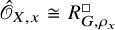

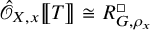 .
.In particular, $\mathscr O_{X,x}$
is complete intersection if and only if
$\mathscr O_{X,x}$
is complete intersection if and only if $R^{\square }_{G, \rho _x}$
is.
$R^{\square }_{G, \rho _x}$
is.
Proof. The assertion follows from Proposition 5.16 and [Reference Böckle, Iyengar and Paškūnas6, Lemmas 3.36, 3.37].
6 GIT quotients
Let G be a generalised reductive $\mathscr O$
-group scheme. If A is an
$\mathscr O$
-group scheme. If A is an $R^{\mathrm {ps}}_{{\mathrm {GL}}_d}$
-algebra then the group
$R^{\mathrm {ps}}_{{\mathrm {GL}}_d}$
-algebra then the group $G(A)$
acts on the set
$G(A)$
acts on the set $X^{\mathrm {gen}, \tau }_G(A)$
by conjugation. This defines an action of G on
$X^{\mathrm {gen}, \tau }_G(A)$
by conjugation. This defines an action of G on $X^{\mathrm {gen}, \tau }_G$
. We let
$X^{\mathrm {gen}, \tau }_G$
. We let

Remark 6.1. The closed immersion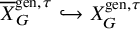 $\overline {X}^{\mathrm {gen},\tau }_G \hookrightarrow X^{\mathrm {gen}, \tau }_G$
induces a morphism
$\overline {X}^{\mathrm {gen},\tau }_G \hookrightarrow X^{\mathrm {gen}, \tau }_G$
induces a morphism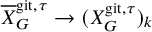 $\overline {X}^{\mathrm {git},\tau }_G \rightarrow (X^{\mathrm {git}, \tau }_{G})_k$
, which is finite by [Reference Seshadri57, Theorem 2] and induces a bijection on geometric points by [Reference Seshadri57, Theorem 3]. We deduce that this map is a homeomorphism.
$\overline {X}^{\mathrm {git},\tau }_G \rightarrow (X^{\mathrm {git}, \tau }_{G})_k$
, which is finite by [Reference Seshadri57, Theorem 2] and induces a bijection on geometric points by [Reference Seshadri57, Theorem 3]. We deduce that this map is a homeomorphism.
We will show that $X^{\mathrm {git}, \tau }_{G}$
is the spectrum of a complete semi-local
$X^{\mathrm {git}, \tau }_{G}$
is the spectrum of a complete semi-local $\mathscr O$
-algebra. We use its connected components to decompose
$\mathscr O$
-algebra. We use its connected components to decompose $X^{\mathrm {gen}, \tau }_G$
and show in Lemma 6.12 that the resulting decomposition is the decomposition of
$X^{\mathrm {gen}, \tau }_G$
and show in Lemma 6.12 that the resulting decomposition is the decomposition of $X^{\mathrm {gen}, \tau }_G$
into connected components. The component containing the point corresponding to a representation
$X^{\mathrm {gen}, \tau }_G$
into connected components. The component containing the point corresponding to a representation $\overline {\rho }: \Gamma _F \rightarrow G(k)$
that we have started with in Section 5.1 will be denoted
$\overline {\rho }: \Gamma _F \rightarrow G(k)$
that we have started with in Section 5.1 will be denoted $X^{\mathrm {gen}, \tau }_{G, \overline {\rho }^{\mathrm {ss}}}$
. We then evaluate both functors at finite and local fields and study the corresponding Galois representations.
$X^{\mathrm {gen}, \tau }_{G, \overline {\rho }^{\mathrm {ss}}}$
. We then evaluate both functors at finite and local fields and study the corresponding Galois representations.
In Corollary 6.5 we prove an important finiteness result, which is used in an essential way in the induction argument in Section 13. This in turn rests on the following fundamental finiteness theorem proved by Vinberg [Reference Vinberg61], when S is a spectrum of a field of characteristic zero, by Martin [Reference Martin42], when S is a spectrum of a field of characteristic p, and by Cotner [Reference Cotner21] in general.
Theorem 6.2 [Reference Cotner21].
Let S be a locally noetherian scheme and let $f: H\rightarrow G$
be a finite morphism of generalised reductive smooth affine S-group schemes. Then the induced map
$f: H\rightarrow G$
be a finite morphism of generalised reductive smooth affine S-group schemes. Then the induced map

is finite.

Proof. Since  and
and  are affine and S is locally noetherian, we may assume that S is affine and noetherian. Then G, H, $G^N$
,
$G^N$
, $H^N$
as well as their respective GIT quotients are all affine schemes. Since H is generalised reductive
$H^N$
as well as their respective GIT quotients are all affine schemes. Since H is generalised reductive $H/ H^0$
is a finite étale S-group scheme. Since
$H/ H^0$
is a finite étale S-group scheme. Since

[Reference Demazure, Grothendieck, Gille and Polo30, Exp. V, Thm. 4.1 (ii)] applied with  and
and $X_1= (H/H^0)\times _S X_0$
, implies that the morphism
$X_1= (H/H^0)\times _S X_0$
, implies that the morphism  is integral. It follows from [Reference Alper1, Theorem 6.3.3] applied to the quotient stack $[H^N/H^0]$
that
$[H^N/H^0]$
that  is of finite type over S. (If $S={\mathrm {Spec}} R$
, where R is of finite type over a universally Japanese integral domain then the assertion also follows from [Reference Seshadri57, Theorem 2 (i)]. This setting is sufficient for our paper as we only need it over
$S={\mathrm {Spec}} R$
, where R is of finite type over a universally Japanese integral domain then the assertion also follows from [Reference Seshadri57, Theorem 2 (i)]. This setting is sufficient for our paper as we only need it over $\mathscr O$
.) Hence,
$\mathscr O$
.) Hence,  is of finite type, and [Reference Project59, Tag 01WJ] implies that
  is finite.
Since the composition of finite morphisms is finite, using Theorem 6.2 we obtain that  is finite. Since this map factors as
  and all the schemes are affine we obtain the claim.
Proposition 6.4. The maps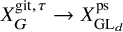 $X^{\mathrm {git}, \tau }_{G} \to X^{\mathrm {ps}}_{{\mathrm {GL}}_d}$
and
$X^{\mathrm {git}, \tau }_{G} \to X^{\mathrm {ps}}_{{\mathrm {GL}}_d}$
and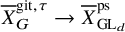 $\overline {X}^{\mathrm {git},\tau }_G\rightarrow \overline {X}^{\mathrm {ps}}_{{\mathrm {GL}}_d}$
are finite.
$\overline {X}^{\mathrm {git},\tau }_G\rightarrow \overline {X}^{\mathrm {ps}}_{{\mathrm {GL}}_d}$
are finite.
Proof. We consider the following diagram:

By Corollary 6.3 the right map is finite. Since the map $X^{\mathrm {gen}, \tau }_G \to X^{\mathrm {ps}}_{{\mathrm {GL}}_d} \times G^N$
defined in Definition 5.7 is a closed immersion, it follows from [Reference Seshadri57, Theorem 2 (ii)], that the induced map of GIT quotients, which is the top map in the diagram, is finite. It follows that the left map in the diagram is finite. The same argument over k proves the last assertion.
$X^{\mathrm {gen}, \tau }_G \to X^{\mathrm {ps}}_{{\mathrm {GL}}_d} \times G^N$
defined in Definition 5.7 is a closed immersion, it follows from [Reference Seshadri57, Theorem 2 (ii)], that the induced map of GIT quotients, which is the top map in the diagram, is finite. It follows that the left map in the diagram is finite. The same argument over k proves the last assertion.
Corollary 6.5. Let H be a closed generalised reductive subgroup scheme of G (resp. $G_k$
). Then the map
$G_k$
). Then the map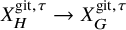 $X^{\mathrm {git}, \tau }_{H} \rightarrow X^{\mathrm {git}, \tau }_{G}$
(resp.
$X^{\mathrm {git}, \tau }_{H} \rightarrow X^{\mathrm {git}, \tau }_{G}$
(resp.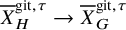 $\overline {X}^{\mathrm {git},\tau }_H \rightarrow \overline {X}^{\mathrm {git},\tau }_G$
) is finite.
$\overline {X}^{\mathrm {git},\tau }_H \rightarrow \overline {X}^{\mathrm {git},\tau }_G$
) is finite.
Proof. It follows from Proposition 6.4 that the map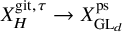 $X^{\mathrm {git}, \tau }_{H} \rightarrow X^{\mathrm {ps}}_{{\mathrm {GL}}_d}$
is finite. Moreover, it factors as
$X^{\mathrm {git}, \tau }_{H} \rightarrow X^{\mathrm {ps}}_{{\mathrm {GL}}_d}$
is finite. Moreover, it factors as $X^{\mathrm {git}, \tau }_{H} \rightarrow X^{\mathrm {git}, \tau }_{G} \rightarrow X^{\mathrm {ps}}_{{\mathrm {GL}}_d}$
. Since these are affine schemes we deduce that the map
$X^{\mathrm {git}, \tau }_{H} \rightarrow X^{\mathrm {git}, \tau }_{G} \rightarrow X^{\mathrm {ps}}_{{\mathrm {GL}}_d}$
. Since these are affine schemes we deduce that the map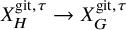 $X^{\mathrm {git}, \tau }_{H} \rightarrow X^{\mathrm {git}, \tau }_{G}$
is finite. The same argument over k gives finiteness of
$X^{\mathrm {git}, \tau }_{H} \rightarrow X^{\mathrm {git}, \tau }_{G}$
is finite. The same argument over k gives finiteness of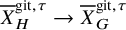 $\overline {X}^{\mathrm {git},\tau }_H \rightarrow \overline {X}^{\mathrm {git},\tau }_G$
.
$\overline {X}^{\mathrm {git},\tau }_H \rightarrow \overline {X}^{\mathrm {git},\tau }_G$
.
Proposition 6.6 [Reference Cotner21, Lemma 4.3].
Let $\kappa $
be a local
$\kappa $
be a local $\mathscr O$
-field and let
$\mathscr O$
-field and let $\rho : \Gamma _F \rightarrow G(\kappa )$
be a continuous representation for the topology on the target induced by the valuation on
$\rho : \Gamma _F \rightarrow G(\kappa )$
be a continuous representation for the topology on the target induced by the valuation on $\kappa $
. Then there exists a finite extension
$\kappa $
. Then there exists a finite extension $\kappa '$
of
$\kappa '$
of $\kappa $
and
$\kappa $
and $g\in G^0(\kappa ')$
such that
$g\in G^0(\kappa ')$
such that $g \rho (\gamma ) g^{-1} \in G(\mathscr O_{\kappa '})$
for all
$g \rho (\gamma ) g^{-1} \in G(\mathscr O_{\kappa '})$
for all $\gamma \in \Gamma _F$
.
$\gamma \in \Gamma _F$
.
6.1 Points in
$X^{\mathrm {gen}, \tau }_G$

We recall some terminology following [Reference Martin42]. Let $\kappa $
be an algebraically closed field, which is an
$\kappa $
be an algebraically closed field, which is an $\mathscr O$
-algebra. Let H be a closed reduced subgroup of
$\mathscr O$
-algebra. Let H be a closed reduced subgroup of $G_{\kappa }$
. We say that H is G-irreducible in
$G_{\kappa }$
. We say that H is G-irreducible in $G_{\kappa }$
if it is not contained in any proper R-parabolic subgroup of
$G_{\kappa }$
if it is not contained in any proper R-parabolic subgroup of $G_\kappa $
. Let S be a maximal torus in the centraliser
$G_\kappa $
. Let S be a maximal torus in the centraliser $Z_G(H)$
. We say that H is strongly reductive in G if H is
$Z_G(H)$
. We say that H is strongly reductive in G if H is $Z_G(S)$
-irreducible in
$Z_G(S)$
-irreducible in $Z_G(S)$
.
$Z_G(S)$
.
Proposition 6.7. Let x be a geometric point of $X^{\mathrm {gen}, \tau }_G$
, and let H be the Zariski closure of
$X^{\mathrm {gen}, \tau }_G$
, and let H be the Zariski closure of $\rho _x(\Gamma _F)$
in
$\rho _x(\Gamma _F)$
in $G(\kappa (x))$
. Then the following are equivalent
$G(\kappa (x))$
. Then the following are equivalent
-
(1) the orbit
$G^0\cdot x$
is closed in its fibre over
$X^{\mathrm {git}, \tau }_G$
; -
(2) the orbit
$G\cdot x$
is closed in its fibre over
$X^{\mathrm {git}, \tau }_G$
; -
(3) H is strongly reductive in
$G_{\kappa (x)}$
; -
(4)
$\rho _x: \Gamma _F \rightarrow G(\kappa (x))$
is G-completely reducible.



Proof. Since $G^0$
is of finite index in G we may pick
$G^0$
is of finite index in G we may pick $g_1, \ldots , g_n \in G(\kappa (x))$
such that
$g_1, \ldots , g_n \in G(\kappa (x))$
such that
 $$ \begin{align} G\cdot x = \bigcup_{i=1}^n G^0\cdot (g_i x)= \bigcup_{i=1}^n g_i\cdot (G^0\cdot x). \end{align} $$
It follows from (30) that (1) implies (2). If $G\cdot x$
is closed, then as it is
$G\cdot x$
is closed, then as it is $G^0$
-invariant it will contain a closed
$G^0$
-invariant it will contain a closed $G^0$
-orbit. We deduce from (30) that
$G^0$
-orbit. We deduce from (30) that $G^0\cdot x$
is closed, so that (2) implies (1). We have established in Lemma 5.13 that H is equal to the Zariski closure in
$G^0\cdot x$
is closed, so that (2) implies (1). We have established in Lemma 5.13 that H is equal to the Zariski closure in $G(\kappa (x))$
of the subgroup generated by the N-tuple
$G(\kappa (x))$
of the subgroup generated by the N-tuple $(\rho _x(\gamma _1), \ldots , \rho _x(\gamma _N))$
. The equivalence of parts (2), (3) has been established in [Reference Richardson51, Theorem 16.4]. The equivalence of (3) and (4) follows from [Reference Bate, Martin and Röhrle3, Theorem 3.1], see the begining of [Reference Bate, Martin and Röhrle3, Section 6.3] for the non-connected case.
$(\rho _x(\gamma _1), \ldots , \rho _x(\gamma _N))$
. The equivalence of parts (2), (3) has been established in [Reference Richardson51, Theorem 16.4]. The equivalence of (3) and (4) follows from [Reference Bate, Martin and Röhrle3, Theorem 3.1], see the begining of [Reference Bate, Martin and Röhrle3, Section 6.3] for the non-connected case.
Lemma 6.8. Let y be a geometric point in $X^{\mathrm {git}, \tau }_{G}$
. Then the fibre
$X^{\mathrm {git}, \tau }_{G}$
. Then the fibre $(X^{\mathrm {gen}, \tau }_G)_y$
contains a unique closed
$(X^{\mathrm {gen}, \tau }_G)_y$
contains a unique closed $G^0$
-orbit.
$G^0$
-orbit.
Proof. This follows from [Reference Seshadri57, Theorem 3].
Proposition 6.9. Let x be a geometric point of $X^{\mathrm {gen}, \tau }_G$
. Then there is
$X^{\mathrm {gen}, \tau }_G$
. Then there is $z\in \overline {G^0\cdot x}$
such that the
$z\in \overline {G^0\cdot x}$
such that the $G^0$
-orbit of
$G^0$
-orbit of $\rho _z$
is equal to the G-semisimplification of
$\rho _z$
is equal to the G-semisimplification of $\rho _x$
. Moreover,
$\rho _x$
. Moreover, $G^0\cdot z$
is the unique closed
$G^0\cdot z$
is the unique closed $G^0$
-orbit contained in
$G^0$
-orbit contained in $\overline {G^0\cdot x}$
. Here the closures are taken in the fibre of x over
$\overline {G^0\cdot x}$
. Here the closures are taken in the fibre of x over $X^{\mathrm {git}, \tau }_G$
.
$X^{\mathrm {git}, \tau }_G$
.
Proof. Let z be a point in the closure of the $G^0$
-orbit of x in
$G^0$
-orbit of x in $G^N(\kappa (x))$
, such that the
$G^N(\kappa (x))$
, such that the $G^0$
-orbit of z is closed. Since
$G^0$
-orbit of z is closed. Since $X^{\mathrm {gen}, \tau }_G$
is closed in
$X^{\mathrm {gen}, \tau }_G$
is closed in $X^{\mathrm {ps}}_{{\mathrm {GL}}_d}\times G^N$
by Remark 5.8, we deduce that
$X^{\mathrm {ps}}_{{\mathrm {GL}}_d}\times G^N$
by Remark 5.8, we deduce that $z\in X^{\mathrm {gen}, \tau }_G(\kappa (x))$
. Lemma 5.13 implies that the
$z\in X^{\mathrm {gen}, \tau }_G(\kappa (x))$
. Lemma 5.13 implies that the $G^0$
-orbit of
$G^0$
-orbit of $\rho _{z}$
is the G-semisimplification of
$\rho _{z}$
is the G-semisimplification of $\rho _x$
. Thus
$\rho _x$
. Thus $\rho _{z}$
is G-completely reducible by Proposition 2.23. Thus the orbit
$\rho _{z}$
is G-completely reducible by Proposition 2.23. Thus the orbit $G\cdot z$
is closed by Proposition 6.7. Let y be the image of x in
$G\cdot z$
is closed by Proposition 6.7. Let y be the image of x in $X^{\mathrm {git}, \tau }_{G}$
. The fibre
$X^{\mathrm {git}, \tau }_{G}$
. The fibre $(X^{\mathrm {gen}, \tau }_G)_y$
is a closed
$(X^{\mathrm {gen}, \tau }_G)_y$
is a closed $G^0$
-invariant subscheme
$G^0$
-invariant subscheme $X^{\mathrm {gen}, \tau }_G$
and thus it will contain
$X^{\mathrm {gen}, \tau }_G$
and thus it will contain $\overline {G^0\cdot x}$
. The last assertion follows from Lemma 6.8.
$\overline {G^0\cdot x}$
. The last assertion follows from Lemma 6.8.
Corollary 6.10. Let y be a geometric point of $X^{\mathrm {ps}}_{{\mathrm {GL}}_d}$
and let
$X^{\mathrm {ps}}_{{\mathrm {GL}}_d}$
and let $x, x'\in X^{\mathrm {gen}, \tau }_G(\kappa (y))$
. Then x and
$x, x'\in X^{\mathrm {gen}, \tau }_G(\kappa (y))$
. Then x and $x'$
map to the same point in
$x'$
map to the same point in $X^{\mathrm {git}, \tau }_{G}$
if and only if
$X^{\mathrm {git}, \tau }_{G}$
if and only if $\rho _x$
and
$\rho _x$
and $\rho _{x'}$
have the same G-semisimplification.
$\rho _{x'}$
have the same G-semisimplification.
Proof. Let x and $x'$
map to the same point in
$x'$
map to the same point in $X^{\mathrm {git}, \tau }_{G}$
. By Lemma 6.8 there is a unique closed
$X^{\mathrm {git}, \tau }_{G}$
. By Lemma 6.8 there is a unique closed $G^0$
-orbit in the fibre of y, let
$G^0$
-orbit in the fibre of y, let $z \in X^{\mathrm {git}, \tau }_{G}$
be a point in this orbit. It follows from Proposition 6.9 that the G-semisimplification of
$z \in X^{\mathrm {git}, \tau }_{G}$
be a point in this orbit. It follows from Proposition 6.9 that the G-semisimplification of $\rho _x$
and of
$\rho _x$
and of $\rho _{x'}$
are equal to the
$\rho _{x'}$
are equal to the $G^0$
-orbit of
$G^0$
-orbit of $\rho _z$
. The other implication follows from directly from Proposition 6.9.
$\rho _z$
. The other implication follows from directly from Proposition 6.9.
Corollary 6.11. Let y be a geometric point of $X^{\mathrm {git}, \tau }_{G}$
. Assume that G is split and let T be a maximal split torus of G defined over
$X^{\mathrm {git}, \tau }_{G}$
. Assume that G is split and let T be a maximal split torus of G defined over $\mathscr O$
. Then there is an R-Levi L of G defined over
$\mathscr O$
. Then there is an R-Levi L of G defined over $\mathscr O$
, which contains T, and
$\mathscr O$
, which contains T, and $x\in X^{\mathrm {gen}, \tau }_G(\kappa (y))$
such that the following hold:
$x\in X^{\mathrm {gen}, \tau }_G(\kappa (y))$
such that the following hold:
-
(1) x maps to y;
-
(2)
$\rho _x(\Gamma _F)\subseteq L(\kappa (y))$
; -
(3)
$\rho _x$
is
$L_{\kappa (y)}$
-irreducible.



Moreover, if $x'\in X^{\mathrm {gen}, \tau }_G(\kappa (y))$
maps to y and Q is a minimal R-parabolic of
$x'\in X^{\mathrm {gen}, \tau }_G(\kappa (y))$
maps to y and Q is a minimal R-parabolic of $G_{\kappa (y)}$
containing
$G_{\kappa (y)}$
containing $\rho _{x'}(\Gamma _F)$
with an R-Levi M then there is
$\rho _{x'}(\Gamma _F)$
with an R-Levi M then there is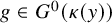 $g\in G^0(\kappa (y))$
such that M and
$g\in G^0(\kappa (y))$
such that M and $L_{\kappa (y)}= g M g^{-1}$
and
$L_{\kappa (y)}= g M g^{-1}$
and ${\rho _x(\gamma )= g c_{Q,M}(\rho _{x'}(\gamma ))g^{-1}}$
for all
${\rho _x(\gamma )= g c_{Q,M}(\rho _{x'}(\gamma ))g^{-1}}$
for all $\gamma \in \Gamma _F$
.
$\gamma \in \Gamma _F$
.
Proof. Lemma 6.8 implies that there exists $x\in X^{\mathrm {gen}, \tau }_G(\kappa (y))$
such that
$x\in X^{\mathrm {gen}, \tau }_G(\kappa (y))$
such that $G^0 \cdot x$
is a closed. The representation
$G^0 \cdot x$
is a closed. The representation $\rho _x$
is G-completely reducible by Proposition 6.7. Let P be a minimal R-parabolic of
$\rho _x$
is G-completely reducible by Proposition 6.7. Let P be a minimal R-parabolic of $G_{\kappa (x)}$
containing
$G_{\kappa (x)}$
containing $\rho _x(\Gamma _F)$
. Since
$\rho _x(\Gamma _F)$
. Since $\rho _x$
is G-completely reducible the image of
$\rho _x$
is G-completely reducible the image of $\rho _x(\Gamma _F)$
is contained in an R-Levi L of P. Lemma 2.19 implies that after replacing L and P by a conjugate by
$\rho _x(\Gamma _F)$
is contained in an R-Levi L of P. Lemma 2.19 implies that after replacing L and P by a conjugate by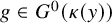 $g\in G^0(\kappa (y))$
we may assume that L and P are defined over
$g\in G^0(\kappa (y))$
we may assume that L and P are defined over $\mathscr O$
and L contains T.
$\mathscr O$
and L contains T.
Let Q be a minimal R-parabolic containing $\rho _x$
and let M be an R-Levi of Q. Since x and
$\rho _x$
and let M be an R-Levi of Q. Since x and $x'$
both map to y, Corollary 6.10 implies that
$x'$
both map to y, Corollary 6.10 implies that $\rho _x$
and
$\rho _x$
and $\rho _{x'}$
have the same G-semisimplification. It follows from Proposition 2.23 that
$\rho _{x'}$
have the same G-semisimplification. It follows from Proposition 2.23 that $\rho _x$
is conjugate to
$\rho _x$
is conjugate to $\rho ':=c_{Q, M}\circ \rho _{x'}$
by
$\rho ':=c_{Q, M}\circ \rho _{x'}$
by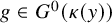 $g\in G^0(\kappa (y))$
. After replacing
$g\in G^0(\kappa (y))$
. After replacing $(Q,M)$
by a conjugate, we may assume that
$(Q,M)$
by a conjugate, we may assume that $\rho _x=\rho '$
, so that
$\rho _x=\rho '$
, so that $\rho _x(\Gamma _F) \subseteq M$
, and Q is minimal with respect to the property containing
$\rho _x(\Gamma _F) \subseteq M$
, and Q is minimal with respect to the property containing $\rho _x(\Gamma _F)$
. Let H be the Zariski closure of
$\rho _x(\Gamma _F)$
. Let H be the Zariski closure of $\rho _x(\Gamma _F)$
in
$\rho _x(\Gamma _F)$
in $G(\kappa (y))$
. Minimality of P and Q implies that H is both L-irreducible and M-irreducible. Proposition 2.27 implies that L and M are conjugate by an element
$G(\kappa (y))$
. Minimality of P and Q implies that H is both L-irreducible and M-irreducible. Proposition 2.27 implies that L and M are conjugate by an element $h\in Z_{G}(H)^0(\kappa (y))\subseteq G^0(\kappa (y))$
. Since the image of
$h\in Z_{G}(H)^0(\kappa (y))\subseteq G^0(\kappa (y))$
. Since the image of $\rho '$
is contained in H, we have
$\rho '$
is contained in H, we have $h \rho '(\gamma ) h^{-1}= \rho '(\gamma ) = \rho (\gamma )$
for all
$h \rho '(\gamma ) h^{-1}= \rho '(\gamma ) = \rho (\gamma )$
for all $\gamma \in \Gamma _F$
.
$\gamma \in \Gamma _F$
.
6.2 Definition of
$X^{\mathrm {gen}, \tau }_{G, \overline {\rho }^{\mathrm {ss}}}$

Proposition 6.4 implies that the map $R^{\mathrm {ps}}_{{\mathrm {GL}}_d}\rightarrow (A^{\mathrm {gen}, \tau }_G)^{G^0}$
is finite. Since
$R^{\mathrm {ps}}_{{\mathrm {GL}}_d}\rightarrow (A^{\mathrm {gen}, \tau }_G)^{G^0}$
is finite. Since $R^{\mathrm {ps}}_{{\mathrm {GL}}_d}$
is a complete local ring with residue field k, part (1) of [Reference Project59, Tag 04GH] implies that
$R^{\mathrm {ps}}_{{\mathrm {GL}}_d}$
is a complete local ring with residue field k, part (1) of [Reference Project59, Tag 04GH] implies that
 $$ \begin{align} R^{\mathrm{git},\tau}_G:=(A^{\mathrm{gen}, \tau}_G)^{G^0}\cong R_1\times \ldots \times R_n, \end{align} $$
where each $R_j$
is a complete local noetherian
$R_j$
is a complete local noetherian $R^{\mathrm {ps}}_{{\mathrm {GL}}_d}$
-algebra with residue field a finite extension of k. The product can be indexed by the set of
$R^{\mathrm {ps}}_{{\mathrm {GL}}_d}$
-algebra with residue field a finite extension of k. The product can be indexed by the set of ${\mathrm {Gal}}(\overline {k}/k)$
-orbits in
${\mathrm {Gal}}(\overline {k}/k)$
-orbits in $X^{\mathrm {git},\tau }_G(\overline {k})$
. From (31) we obtain a
$X^{\mathrm {git},\tau }_G(\overline {k})$
. From (31) we obtain a $G^0$
-equivariant decomposition
$G^0$
-equivariant decomposition
 $$ \begin{align} X^{\mathrm{gen}, \tau}_G\cong \coprod_j X^{\mathrm{gen}, \tau}_G\times_{X^{\mathrm{git}, \tau}_{G}} {\mathrm{Spec}} R_j. \end{align} $$
Moreover, we have

Lemma 6.12. Each $X^{\mathrm {gen}, \tau }_G\times _{X^{\mathrm {git}, \tau }_{G}} {\mathrm {Spec}} R_j$
is connected. In particular, (32) is the decomposition of
$X^{\mathrm {gen}, \tau }_G\times _{X^{\mathrm {git}, \tau }_{G}} {\mathrm {Spec}} R_j$
is connected. In particular, (32) is the decomposition of $X^{\mathrm {gen}, \tau }_G$
into connected components.
$X^{\mathrm {gen}, \tau }_G$
into connected components.
Proof. Since a connected component is a union of irreducible components, [Reference Böckle, Iyengar and Paškūnas6, Lemma 2.1] implies that the connected components of $X^{\mathrm {gen}, \tau }_G\times _{X^{\mathrm {git}, \tau }_{G}} {\mathrm {Spec}} R_j$
are
$X^{\mathrm {gen}, \tau }_G\times _{X^{\mathrm {git}, \tau }_{G}} {\mathrm {Spec}} R_j$
are $G^0$
-invariant. It follows from [Reference Seshadri57, Theorem 3 (iii)] that if there were more than one then their images in
$G^0$
-invariant. It follows from [Reference Seshadri57, Theorem 3 (iii)] that if there were more than one then their images in ${\mathrm {Spec}} R_j$
under (33) would disconnect it. This is not possible as
${\mathrm {Spec}} R_j$
under (33) would disconnect it. This is not possible as $R_j$
is a local ring.
$R_j$
is a local ring.
The representation $\overline {\rho }: \Gamma _F\rightarrow G(k)$
that we have fixed in Section 5 gives us a point
$\overline {\rho }: \Gamma _F\rightarrow G(k)$
that we have fixed in Section 5 gives us a point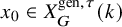 $x_0\in X^{\mathrm {gen}, \tau }_G(k)$
. We denote the unique connected component of
$x_0\in X^{\mathrm {gen}, \tau }_G(k)$
. We denote the unique connected component of $X^{\mathrm {gen},\tau }_G$
which contains
$X^{\mathrm {gen},\tau }_G$
which contains $x_0$
by
$x_0$
by $X^{\mathrm {gen}, \tau }_{G, \overline {\rho }^{\mathrm {ss}}}$
, where
$X^{\mathrm {gen}, \tau }_{G, \overline {\rho }^{\mathrm {ss}}}$
, where $\overline {\rho }^{\mathrm {ss}}$
is the G-semisimplification of the representation
$\overline {\rho }^{\mathrm {ss}}$
is the G-semisimplification of the representation $\Gamma _F \overset {\overline {\rho }}{\longrightarrow } G(k) \hookrightarrow G(\overline {k})$
. The justification for this notation is given in the lemma below. Let
$\Gamma _F \overset {\overline {\rho }}{\longrightarrow } G(k) \hookrightarrow G(\overline {k})$
. The justification for this notation is given in the lemma below. Let
 $$ \begin{align*}R^{\mathrm{git}, \tau}_{G, \overline{\rho}^{\mathrm{ss}}}:= R_{j_0}, \quad X^{\mathrm{git}, \tau}_{G, \overline{\rho}^{\mathrm{ss}}}:= {\mathrm{Spec}} R^{\mathrm{git}, \tau}_{G, \overline{\rho}^{\mathrm{ss}}},\end{align*} $$
where $j_0$
is the index corresponding to the image of
$j_0$
is the index corresponding to the image of $x_0$
in
$x_0$
in $X^{\mathrm {git}, \tau }_G(k)\subseteq X^{\mathrm {git}, \tau }_G(\overline {k})$
. Since
$X^{\mathrm {git}, \tau }_G(k)\subseteq X^{\mathrm {git}, \tau }_G(\overline {k})$
. Since $x_0$
is k-rational, the residue field of
$x_0$
is k-rational, the residue field of $R^{\mathrm {git}, \tau }_{G, \overline {\rho }^{\mathrm {ss}}}$
is equal to k.
$R^{\mathrm {git}, \tau }_{G, \overline {\rho }^{\mathrm {ss}}}$
is equal to k.
Lemma 6.13. Let x be a geometric point of $X^{\mathrm {gen}, \tau }_G$
above the closed point of
$X^{\mathrm {gen}, \tau }_G$
above the closed point of $X^{\mathrm {ps}}_{{\mathrm {GL}}_d}$
. Then
$X^{\mathrm {ps}}_{{\mathrm {GL}}_d}$
. Then $x\in X^{\mathrm {gen}, \tau }_{G, \overline {\rho }^{\mathrm {ss}}}$
if and only if the G-semisimplification of
$x\in X^{\mathrm {gen}, \tau }_{G, \overline {\rho }^{\mathrm {ss}}}$
if and only if the G-semisimplification of $\rho _x$
is equal to
$\rho _x$
is equal to $\overline {\rho }^{\mathrm {ss}}$
.
$\overline {\rho }^{\mathrm {ss}}$
.
Proof. Let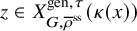 $z\in X^{\mathrm {gen}, \tau }_{G, \overline {\rho }^{\mathrm {ss}}}(\kappa (x))$
be a point above
$z\in X^{\mathrm {gen}, \tau }_{G, \overline {\rho }^{\mathrm {ss}}}(\kappa (x))$
be a point above $x_0$
. It follows from Lemma 6.12 that x and z lie on the same connected component of
$x_0$
. It follows from Lemma 6.12 that x and z lie on the same connected component of $X^{\mathrm {gen}, \tau }_G$
if and only if their images in
$X^{\mathrm {gen}, \tau }_G$
if and only if their images in $X^{\mathrm {git}, \tau }_G$
lie on the same connected component of
$X^{\mathrm {git}, \tau }_G$
lie on the same connected component of $X^{\mathrm {git}, \tau }_G$
. Since
$X^{\mathrm {git}, \tau }_G$
. Since $z\in X^{\mathrm {gen}, \tau }_{G, \overline {\rho }^{\mathrm {ss}}}$
and the residue field of
$z\in X^{\mathrm {gen}, \tau }_{G, \overline {\rho }^{\mathrm {ss}}}$
and the residue field of $R^{\mathrm {git}, \tau }_{G, \overline {\rho }^{\mathrm {ss}}}$
is k,
$R^{\mathrm {git}, \tau }_{G, \overline {\rho }^{\mathrm {ss}}}$
is k,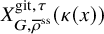 $X^{\mathrm {git}, \tau }_{G, \overline {\rho }^{\mathrm {ss}}}(\kappa (x))$
is a point, and thus this is equivalent to z and x mapping to the same point in
$X^{\mathrm {git}, \tau }_{G, \overline {\rho }^{\mathrm {ss}}}(\kappa (x))$
is a point, and thus this is equivalent to z and x mapping to the same point in $X^{\mathrm {git}, \tau }_{G}$
. Corollary 6.10 implies that this is equivalent to
$X^{\mathrm {git}, \tau }_{G}$
. Corollary 6.10 implies that this is equivalent to $\rho _x$
and
$\rho _x$
and $\rho _z$
having the same G-semisimplification.
$\rho _z$
having the same G-semisimplification.
Remark 6.14. After replacing L by an unramified extension we may assume that all the factors in (31) have residue field k. It follows from Lemma 6.13 that in this case the connected components of $X^{\mathrm {gen}, \tau }_G$
are indexed by
$X^{\mathrm {gen}, \tau }_G$
are indexed by $G^0(\overline {k})$
-conjugacy classes of continuous G-completely reducible representations
$G^0(\overline {k})$
-conjugacy classes of continuous G-completely reducible representations $\overline {\rho }^{\mathrm {ss}}: \Gamma _F \rightarrow G(\overline {k})$
such that
$\overline {\rho }^{\mathrm {ss}}: \Gamma _F \rightarrow G(\overline {k})$
such that $\det \circ (\tau \circ \overline {\rho }^{\mathrm {ss}})^{\mathrm {lin}}=\overline {D}$
. Lemma 6.12 implies that after replacing L by a finite unramified extension we may assume that every connected component of
$\det \circ (\tau \circ \overline {\rho }^{\mathrm {ss}})^{\mathrm {lin}}=\overline {D}$
. Lemma 6.12 implies that after replacing L by a finite unramified extension we may assume that every connected component of $X^{\mathrm {gen}, \tau }_G$
has a k-rational point.
$X^{\mathrm {gen}, \tau }_G$
has a k-rational point.
7 Lafforgue’s G-pseudocharacters
In his work on the local Langlands correspondence for function fields [Reference Lafforgue37] Vincent Lafforgue introduced a notion of G-pseudocharacter for a reductive group G. If $G={\mathrm {GL}}_d$
then Emerson and Morel [Reference Emerson and Morel25] have shown that a
$G={\mathrm {GL}}_d$
then Emerson and Morel [Reference Emerson and Morel25] have shown that a ${\mathrm {GL}}_d$
-pseudocharacter after Lafforgue is equivalent to a determinant law after Chenevier [Reference Chenevier15]. If
${\mathrm {GL}}_d$
-pseudocharacter after Lafforgue is equivalent to a determinant law after Chenevier [Reference Chenevier15]. If $d!$
is invertible in the base ring then the trace of representation valued in
$d!$
is invertible in the base ring then the trace of representation valued in ${\mathrm {GL}}_d$
determines its
${\mathrm {GL}}_d$
determines its ${\mathrm {GL}}_d$
-pseudocharacter. In the arithmetic setting this was first used by Wiles [Reference Wiles63] and Taylor [Reference Taylor60].
${\mathrm {GL}}_d$
-pseudocharacter. In the arithmetic setting this was first used by Wiles [Reference Wiles63] and Taylor [Reference Taylor60].
7.1 Definition of G-pseudocharacter
The definition of G-pseudocharacter we use is a slight modification of Lafforgue’s original definition [Reference Lafforgue37, Section 11], in that we work over the base ring $\mathscr O$
and allow arbitrary (disconnected) generalised reductive group schemes for G.
$\mathscr O$
and allow arbitrary (disconnected) generalised reductive group schemes for G.
Definition 7.1. Let $\Gamma $
be an abstract group and let A be a commutative
$\Gamma $
be an abstract group and let A be a commutative $\mathscr O$
-algebra. A G-pseudocharacter
$\mathscr O$
-algebra. A G-pseudocharacter $\Theta $
of
$\Theta $
of $\Gamma $
over A is a sequence
$\Gamma $
over A is a sequence $(\Theta _n)_{n \geq 1}$
of
$(\Theta _n)_{n \geq 1}$
of $\mathscr O$
-algebra maps
$\mathscr O$
-algebra maps
 $$ \begin{align*}\Theta_n : \mathscr O[G^n]^{G^0} \to \mathrm{Map}(\Gamma^n,A)\end{align*} $$
for $n \geq 1$
, satisfying the following conditionsFootnote
6
:
$n \geq 1$
, satisfying the following conditionsFootnote
6
:
-
(1) For each
$n,m \geq 1$
, each map
$\zeta : \{1, \dots , m\} \to \{1, \dots ,n\}$
,
$f \in \mathscr O[G^m]^{G^0}$
and
$\gamma _1, \dots , \gamma _n \in \Gamma $
, we have where
$$ \begin{align*}\Theta_n(f^{\zeta})(\gamma_1, \dots, \gamma_n) = \Theta_m(f)(\gamma_{\zeta(1)}, \dots, \gamma_{\zeta(m)})\end{align*} $$
$f^{\zeta }(g_1, \dots , g_n) = f(g_{\zeta (1)}, \dots , g_{\zeta (m)})$
.
-
(2) For each
$n \geq 1$
, for each
$\gamma _1, \dots , \gamma _{n+1} \in \Gamma $
and each
$f \in \mathscr O[G^n]^{G^0}$
, we have where
$$ \begin{align*}\Theta_{n+1}(\hat f)(\gamma_1, \dots, \gamma_{n+1}) = \Theta_n(f)(\gamma_1, \dots, \gamma_n\gamma_{n+1})\end{align*} $$
$\hat f(g_1, \dots , g_{n+1}) = f(g_1, \dots , g_ng_{n+1})$
.








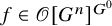


We denote the set of G-pseudocharacters of $\Gamma $
over A by
$\Gamma $
over A by $\mathrm {PC}_G^{\Gamma }(A)$
. If
$\mathrm {PC}_G^{\Gamma }(A)$
. If $f : A \to B$
is a homomorphism of
$f : A \to B$
is a homomorphism of $\mathscr O$
-algebras, then there is an induced map
$\mathscr O$
-algebras, then there is an induced map $f_* : \mathrm {PC}_{G}^{\Gamma }(A) \to \mathrm {PC}_{G}^{\Gamma }(B)$
. For
$f_* : \mathrm {PC}_{G}^{\Gamma }(A) \to \mathrm {PC}_{G}^{\Gamma }(B)$
. For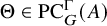 $\Theta \in \mathrm {PC}_{G}^{\Gamma }(A)$
, the image
$\Theta \in \mathrm {PC}_{G}^{\Gamma }(A)$
, the image $f_*(\Theta )$
is called the specialisation of
$f_*(\Theta )$
is called the specialisation of $\Theta $
along f and is denoted by
$\Theta $
along f and is denoted by $\Theta \otimes _A B$
. When
$\Theta \otimes _A B$
. When $\varphi : G \to H$
is a homomorphism of generalised reductive
$\varphi : G \to H$
is a homomorphism of generalised reductive $\mathscr O$
-group schemes, the induced maps
$\mathscr O$
-group schemes, the induced maps $\varphi ^*_n : \mathscr O[H^n]^{H^0} \to \mathscr O[G^n]^{G^0}$
give rise to an H-pseudocharacter
$\varphi ^*_n : \mathscr O[H^n]^{H^0} \to \mathscr O[G^n]^{G^0}$
give rise to an H-pseudocharacter $(\Theta _n \circ \varphi ^*_n)_{n \geq 1}$
. By analogy with the notation for representations we denote this H-pseudocharacter by
$(\Theta _n \circ \varphi ^*_n)_{n \geq 1}$
. By analogy with the notation for representations we denote this H-pseudocharacter by $\varphi \circ \Theta $
. So we also have an induced map
$\varphi \circ \Theta $
. So we also have an induced map $\mathrm {PC}_G^{\Gamma }(A) \to \mathrm {PC}_H^{\Gamma }(A)$
. It is easy to verify that specialisation along
$\mathrm {PC}_G^{\Gamma }(A) \to \mathrm {PC}_H^{\Gamma }(A)$
. It is easy to verify that specialisation along $f : A \to B$
commutes with composition with
$f : A \to B$
commutes with composition with $\varphi $
, that is,
$\varphi $
, that is, $(\varphi \circ \Theta ) \otimes _A B = \varphi \circ (\Theta \otimes _A B)$
.
$(\varphi \circ \Theta ) \otimes _A B = \varphi \circ (\Theta \otimes _A B)$
.
When $\Gamma $
is a topological group, A is a topological ring and for all
$\Gamma $
is a topological group, A is a topological ring and for all $n \geq 1$
, the map
$n \geq 1$
, the map $\Theta _n$
has image in the set
$\Theta _n$
has image in the set $\mathscr {C}(\Gamma ^n, A)$
of continuous maps
$\mathscr {C}(\Gamma ^n, A)$
of continuous maps $\Gamma ^n \to A$
, we say that
$\Gamma ^n \to A$
, we say that $\Theta $
is continuous. We denote the set of continuous G-pseudocharacters of
$\Theta $
is continuous. We denote the set of continuous G-pseudocharacters of $\Gamma $
with values in A by
$\Gamma $
with values in A by $\mathrm {cPC}_G^{\Gamma }(A)$
.
$\mathrm {cPC}_G^{\Gamma }(A)$
.
When $\mathscr O'$
is a commutative
$\mathscr O'$
is a commutative $\mathscr O$
-algebra and A is a commutative
$\mathscr O$
-algebra and A is a commutative $\mathscr O'$
-algebra the natural maps
$\mathscr O'$
-algebra the natural maps $\mathscr O[G^n]^{G^0} \to \mathscr O'[G^n]^{G^0}$
induce a map
$\mathscr O[G^n]^{G^0} \to \mathscr O'[G^n]^{G^0}$
induce a map $\mathrm {PC}_{G_{\mathscr O'}}^{\Gamma }(A)\to \mathrm {PC}_G^{\Gamma }(A)$
. This map is always a bijection, as we will now explain. When
$\mathrm {PC}_{G_{\mathscr O'}}^{\Gamma }(A)\to \mathrm {PC}_G^{\Gamma }(A)$
. This map is always a bijection, as we will now explain. When $\mathscr O'$
is flat over
$\mathscr O'$
is flat over $\mathscr O$
the map
$\mathscr O$
the map $\mathscr O[G^n]^{G^0} \otimes _{\mathscr {O}} \mathscr O' \to \mathscr O'[G^n]^{G^0}$
is an isomorphism by the universal coefficient theorem in rational cohomology, see [Reference Jantzen35, Proposition I.4.18 (a)]. The case of a general
$\mathscr O[G^n]^{G^0} \otimes _{\mathscr {O}} \mathscr O' \to \mathscr O'[G^n]^{G^0}$
is an isomorphism by the universal coefficient theorem in rational cohomology, see [Reference Jantzen35, Proposition I.4.18 (a)]. The case of a general $\mathscr O$
-algebra is treated in [Reference Quast50, Proposition 3.21]. We will use this fact whenever we need to extend the base ring
$\mathscr O$
-algebra is treated in [Reference Quast50, Proposition 3.21]. We will use this fact whenever we need to extend the base ring $\mathscr O$
.
$\mathscr O$
.
7.2 Deformations of G-pseudocharacters
We adopt the deformation theoretic setup of subsection 5.2. Let $\kappa $
be either a finite or a local field, which is an
$\kappa $
be either a finite or a local field, which is an $\mathscr O$
-algebra, equipped with its natural topology. Let
$\mathscr O$
-algebra, equipped with its natural topology. Let $\Lambda $
be the coefficient ring for
$\Lambda $
be the coefficient ring for $\kappa $
and let
$\kappa $
and let $\mathfrak {A}_{\Lambda }$
be the category of local artinian
$\mathfrak {A}_{\Lambda }$
be the category of local artinian $\Lambda $
-algebras with residue field
$\Lambda $
-algebras with residue field $\kappa $
, equipped with the natural topology.
$\kappa $
, equipped with the natural topology.
In this section G is a generalised reductive group over $\mathscr O$
. We consider the following deformation problem for G-pseudocharacters.
$\mathscr O$
. We consider the following deformation problem for G-pseudocharacters.
Definition 7.2. Let $\overline {\Theta } \in \mathrm {cPC}^{\Gamma }_G(\kappa )$
be a continuous G-pseudocharacter of
$\overline {\Theta } \in \mathrm {cPC}^{\Gamma }_G(\kappa )$
be a continuous G-pseudocharacter of $\Gamma $
with values in
$\Gamma $
with values in $\kappa $
. We define the deformation functor
$\kappa $
. We define the deformation functor
 $$ \begin{align*}D_{\overline{\Theta}} : \mathfrak {A}_{\Lambda} \to \text{Set}, \quad A \mapsto \{\Theta \in \mathrm{cPC}_G^{\Gamma}(A) \mid \Theta \otimes_A \kappa = \overline{\Theta}\}\end{align*} $$
that sends an object $A \in \mathfrak {A}_{\Lambda }$
to the set of continuous G-pseudocharacters
$A \in \mathfrak {A}_{\Lambda }$
to the set of continuous G-pseudocharacters $\Theta $
of
$\Theta $
of $\Gamma $
over A with
$\Gamma $
over A with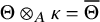 $\Theta \otimes _A \kappa = \overline {\Theta }$
.
$\Theta \otimes _A \kappa = \overline {\Theta }$
.
The deformation problem for G-pseudocharacters admits a universal deformation ring, which we will denote by $R^{\mathrm {ps}}_G$
when
$R^{\mathrm {ps}}_G$
when $\overline {\Theta } = \Theta _{\overline {\rho }}$
. We will denote the universal G-pseudocharacter by
$\overline {\Theta } = \Theta _{\overline {\rho }}$
. We will denote the universal G-pseudocharacter by $\Theta ^u_G$
and will drop the index G, when it is clear which group scheme we are working with.
$\Theta ^u_G$
and will drop the index G, when it is clear which group scheme we are working with.
7.3 Comparison of
$X^{\mathrm {git},\tau }_{G,\overline {\rho }^{\mathrm {ss}}}$
with
$X^{\mathrm {ps}}_G$


In this section we assume that $\Gamma $
is a profinite topologically finitely generated group. It has been shown by the second author in [Reference Quast50, Theorem A] that
$\Gamma $
is a profinite topologically finitely generated group. It has been shown by the second author in [Reference Quast50, Theorem A] that $R^{\mathrm {ps}}_G$
is a complete noetherian local
$R^{\mathrm {ps}}_G$
is a complete noetherian local $\Lambda $
-algebra.
$\Lambda $
-algebra.
Let A be a commutative $R^{\mathrm {ps}}_{{\mathrm {GL}}_d}$
-algebra. We have a natural transformation
$R^{\mathrm {ps}}_{{\mathrm {GL}}_d}$
-algebra. We have a natural transformation
 $$ \begin{align*}\vartheta_A : X^{\mathrm{gen},\tau}_G(A) \to \mathrm{PC}_G^{\Gamma}(A), \quad\rho \mapsto \Theta_{\rho},\end{align*} $$
that attaches to a representation $\rho $
its G-pseudocharacter
$\rho $
its G-pseudocharacter $\Theta _{\rho }$
. By [Reference Quast50, Theorem 3.19]
$\Theta _{\rho }$
. By [Reference Quast50, Theorem 3.19] $\mathrm {PC}_G^{\Gamma }$
is representable by an affine scheme, so
$\mathrm {PC}_G^{\Gamma }$
is representable by an affine scheme, so $\vartheta : X^{\mathrm {gen},\tau }_G \to \mathrm {PC}_G^{\Gamma }$
factors over
$\vartheta : X^{\mathrm {gen},\tau }_G \to \mathrm {PC}_G^{\Gamma }$
factors over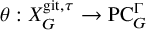 $\theta : X^{\mathrm {git},\tau }_G \to \mathrm {PC}_G^{\Gamma }$
.
$\theta : X^{\mathrm {git},\tau }_G \to \mathrm {PC}_G^{\Gamma }$
.
Lemma 7.3. Let $\rho :\Gamma \rightarrow G(A^{\mathrm {gen}, \tau }_{G, \overline {\rho }^{\mathrm {ss}}})$
be the universal representation. Then
$\rho :\Gamma \rightarrow G(A^{\mathrm {gen}, \tau }_{G, \overline {\rho }^{\mathrm {ss}}})$
be the universal representation. Then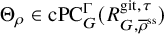 $\Theta _{\rho }\in \mathrm {cPC}_G^{\Gamma }(R^{\mathrm {git}, \tau }_{G, \overline {\rho }^{\mathrm {ss}}})$
for the
$\Theta _{\rho }\in \mathrm {cPC}_G^{\Gamma }(R^{\mathrm {git}, \tau }_{G, \overline {\rho }^{\mathrm {ss}}})$
for the $\mathfrak {m}$
-adic topology on
$\mathfrak {m}$
-adic topology on $R^{\mathrm {git}, \tau }_{G, \overline {\rho }^{\mathrm {ss}}}$
.
$R^{\mathrm {git}, \tau }_{G, \overline {\rho }^{\mathrm {ss}}}$
.
Proof. Lemma 5.10 implies that $\rho $
is continuous for the
$\rho $
is continuous for the $\mathfrak {m}_{R^{\mathrm {ps}}_{{\mathrm {GL}}_d}}$
-adic topology on
$\mathfrak {m}_{R^{\mathrm {ps}}_{{\mathrm {GL}}_d}}$
-adic topology on $A^{\mathrm {gen}, \tau }_{G, \overline {\rho }^{\mathrm {ss}}}$
. The G-pseudocharacter
$A^{\mathrm {gen}, \tau }_{G, \overline {\rho }^{\mathrm {ss}}}$
. The G-pseudocharacter $\Theta _{\rho }$
takes values in
$\Theta _{\rho }$
takes values in $R^{\mathrm {git},\tau }_{G,\overline {\rho }^{\mathrm {ss}}}$
and is thus continuous for the subspace topology on
$R^{\mathrm {git},\tau }_{G,\overline {\rho }^{\mathrm {ss}}}$
and is thus continuous for the subspace topology on $R^{\mathrm {git},\tau }_{G,\overline {\rho }^{\mathrm {ss}}}$
. Since
$R^{\mathrm {git},\tau }_{G,\overline {\rho }^{\mathrm {ss}}}$
. Since
 $$ \begin{align*}\mathfrak {m}_{R^{\mathrm{ps}}_{{\mathrm{GL}}_d}}^n R^{\mathrm{git}, \tau}_{G, \overline{\rho}^{\mathrm{ss}}}\subseteq \mathfrak{m}_{R^{\mathrm{ps}}_{{\mathrm{GL}}_d}}^n A^{\mathrm{gen}, \tau}_G \cap R^{\mathrm{git},\tau}_{G, \overline{\rho}^{\mathrm{ss}}}, \quad \forall n\ge 1,\end{align*} $$ $\Theta _{\rho }$
is continuous for the
$\Theta _{\rho }$
is continuous for the $\mathfrak {m}_{R^{\mathrm {ps}}_{{\mathrm {GL}}_d}}$
-adic topology on
$\mathfrak {m}_{R^{\mathrm {ps}}_{{\mathrm {GL}}_d}}$
-adic topology on $R^{\mathrm {git},\tau }_{G, \overline {\rho }^{\mathrm {ss}}}$
. Since by Proposition 6.4,
$R^{\mathrm {git},\tau }_{G, \overline {\rho }^{\mathrm {ss}}}$
. Since by Proposition 6.4, $R^{\mathrm {git},\tau }_{G,\overline {\rho }^{\mathrm {ss}}}$
is a finite
$R^{\mathrm {git},\tau }_{G,\overline {\rho }^{\mathrm {ss}}}$
is a finite $R^{\mathrm {ps}}_{{\mathrm {GL}}_d}$
-algebra, this topology coincides with the topology defined by the maximal ideal of
$R^{\mathrm {ps}}_{{\mathrm {GL}}_d}$
-algebra, this topology coincides with the topology defined by the maximal ideal of $R^{\mathrm {git},\tau }_{G,\overline {\rho }^{\mathrm {ss}}}$
.
$R^{\mathrm {git},\tau }_{G,\overline {\rho }^{\mathrm {ss}}}$
.
Let $\Theta _{\rho }$
be the G-pseudocharacter of the universal representation over
$\Theta _{\rho }$
be the G-pseudocharacter of the universal representation over $A^{\mathrm {gen}, \tau }_{G, \overline {\rho }^{\mathrm {ss}}}$
as in Lemma 7.3. Recall that
$A^{\mathrm {gen}, \tau }_{G, \overline {\rho }^{\mathrm {ss}}}$
as in Lemma 7.3. Recall that $R^{\mathrm {git},\tau }_{G,\overline {\rho }^{\mathrm {ss}}}$
has residue field k and
$R^{\mathrm {git},\tau }_{G,\overline {\rho }^{\mathrm {ss}}}$
has residue field k and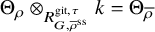 $\Theta _{\rho }\otimes _{R^{\mathrm {git},\tau }_{G,\overline {\rho }^{\mathrm {ss}}}} k = \Theta _{\overline {\rho }}$
. It follows from Lemma 7.3, that
$\Theta _{\rho }\otimes _{R^{\mathrm {git},\tau }_{G,\overline {\rho }^{\mathrm {ss}}}} k = \Theta _{\overline {\rho }}$
. It follows from Lemma 7.3, that $\Theta _{\rho }$
is indeed a continuous deformation of
$\Theta _{\rho }$
is indeed a continuous deformation of $\Theta _{\overline {\rho }^{\mathrm {ss}}}$
, so we have a local homomorphism
$\Theta _{\overline {\rho }^{\mathrm {ss}}}$
, so we have a local homomorphism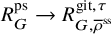 $R^{\mathrm {ps}}_G \to R^{\mathrm {git},\tau }_{G,\overline {\rho }^{\mathrm {ss}}}$
which induces a map
$R^{\mathrm {ps}}_G \to R^{\mathrm {git},\tau }_{G,\overline {\rho }^{\mathrm {ss}}}$
which induces a map
 $$ \begin{align} \nu : X^{\mathrm{git},\tau}_{G,\overline{\rho}^{\mathrm{ss}}} \to X^{\mathrm{ps}}_G \end{align} $$
of $\mathscr O$
-schemes.
$\mathscr O$
-schemes.
Proposition 7.4.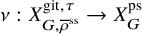 $\nu : X^{\mathrm {git},\tau }_{G,\overline {\rho }^{\mathrm {ss}}} \to X^{\mathrm {ps}}_G$
is a finite universal homeomorphism.
$\nu : X^{\mathrm {git},\tau }_{G,\overline {\rho }^{\mathrm {ss}}} \to X^{\mathrm {ps}}_G$
is a finite universal homeomorphism.
Proof. By [Reference Project59, Tag 04DF], it suffices to show, that $\nu $
is finite, universally injective and surjective. By Proposition 6.4
$\nu $
is finite, universally injective and surjective. By Proposition 6.4 $R_{G,\overline {\rho }^{\mathrm {ss}}}^{\mathrm {git},\tau }$
is a finite
$R_{G,\overline {\rho }^{\mathrm {ss}}}^{\mathrm {git},\tau }$
is a finite $R^{\mathrm {ps}}_{{\mathrm {GL}}_d}$
-module. From the embedding
$R^{\mathrm {ps}}_{{\mathrm {GL}}_d}$
-module. From the embedding $\tau : G \to {\mathrm {GL}}_d$
we obtain a factorisation
$\tau : G \to {\mathrm {GL}}_d$
we obtain a factorisation $R^{\mathrm {ps}}_{{\mathrm {GL}}_d} \to R^{\mathrm {ps}}_G \to R^{\mathrm {git},\tau }_{G,\overline {\rho }^{\mathrm {ss}}}$
. In particular,
$R^{\mathrm {ps}}_{{\mathrm {GL}}_d} \to R^{\mathrm {ps}}_G \to R^{\mathrm {git},\tau }_{G,\overline {\rho }^{\mathrm {ss}}}$
. In particular, $R^{\mathrm {git},\tau }_{G,\overline {\rho }^{\mathrm {ss}}}$
is a finite
$R^{\mathrm {git},\tau }_{G,\overline {\rho }^{\mathrm {ss}}}$
is a finite $R^{\mathrm {ps}}_G$
-module.
$R^{\mathrm {ps}}_G$
-module.
The closed point of $X^{\mathrm {git},\tau }_{G,\overline {\rho }^{\mathrm {ss}}}$
is mapped to the closed point of
$X^{\mathrm {git},\tau }_{G,\overline {\rho }^{\mathrm {ss}}}$
is mapped to the closed point of $X^{\mathrm {ps}}_G$
, so we only need to show surjectivity of
$X^{\mathrm {ps}}_G$
, so we only need to show surjectivity of $\dot \nu : U^{\mathrm {git},\tau }_{G, \overline {\rho }^{\mathrm {ss}}} := X^{\mathrm {git},\tau }_{G,\overline {\rho }^{\mathrm {ss}}} \setminus \{*\} \to U^{\mathrm {ps}}_{G} := X^{\mathrm {ps}}_G \setminus \{*\}$
. By [Reference Project59, Tag 02J6]
$\dot \nu : U^{\mathrm {git},\tau }_{G, \overline {\rho }^{\mathrm {ss}}} := X^{\mathrm {git},\tau }_{G,\overline {\rho }^{\mathrm {ss}}} \setminus \{*\} \to U^{\mathrm {ps}}_{G} := X^{\mathrm {ps}}_G \setminus \{*\}$
. By [Reference Project59, Tag 02J6] $U^{\mathrm {git},\tau }_{G, \overline {\rho }^{\mathrm {ss}}}$
and
$U^{\mathrm {git},\tau }_{G, \overline {\rho }^{\mathrm {ss}}}$
and $U^{\mathrm {ps}}_{G}$
are Jacobson. By Chevalley’s theorem [Reference Project59, Tag 054K] the image of
$U^{\mathrm {ps}}_{G}$
are Jacobson. By Chevalley’s theorem [Reference Project59, Tag 054K] the image of $\dot \nu $
is locally constructible and thus also its complement. Therefore for surjectivity of
$\dot \nu $
is locally constructible and thus also its complement. Therefore for surjectivity of $\nu $
it is sufficient to show, that the closed points of
$\nu $
it is sufficient to show, that the closed points of $U^{\mathrm {ps}}_{G}$
are all contained in the image of
$U^{\mathrm {ps}}_{G}$
are all contained in the image of $\dot \nu $
.
$\dot \nu $
.
Let $y \in U^{\mathrm {ps}}_{G}$
be a closed point. By [Reference Böckle, Iyengar and Paškūnas6, Lemma 3.17]
$y \in U^{\mathrm {ps}}_{G}$
be a closed point. By [Reference Böckle, Iyengar and Paškūnas6, Lemma 3.17] $\kappa (y)$
is a local field. By [Reference Quast50, Theorem 5.7],
$\kappa (y)$
is a local field. By [Reference Quast50, Theorem 5.7], $R^{\mathrm {ps}}_G$
is noetherian, and thus
$R^{\mathrm {ps}}_G$
is noetherian, and thus $\kappa (y)$
with its natural topology is a topological
$\kappa (y)$
with its natural topology is a topological $R^{\mathrm {ps}}_G$
-algebra and the image of
$R^{\mathrm {ps}}_G$
-algebra and the image of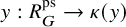 $y: R^{\mathrm {ps}}_G \rightarrow \kappa (y)$
is contained in the ring of integers
$y: R^{\mathrm {ps}}_G \rightarrow \kappa (y)$
is contained in the ring of integers $\mathscr O_{\kappa (y)}$
by [Reference Böckle, Iyengar and Paškūnas6, Lemma 3.17]. We obtain a continuous G-pseudocharacter
$\mathscr O_{\kappa (y)}$
by [Reference Böckle, Iyengar and Paškūnas6, Lemma 3.17]. We obtain a continuous G-pseudocharacter $\Theta _y \in \mathrm {cPC}_G^{\Gamma }(\mathscr O_{\kappa (y)})$
, which is a deformation of
$\Theta _y \in \mathrm {cPC}_G^{\Gamma }(\mathscr O_{\kappa (y)})$
, which is a deformation of $\Theta _{\overline {\rho }}$
to
$\Theta _{\overline {\rho }}$
to $\mathscr O_{\kappa (y)}$
. By the continuous reconstruction theorem [Reference Quast50, Theorem 3.8], there is a continuous representation
$\mathscr O_{\kappa (y)}$
. By the continuous reconstruction theorem [Reference Quast50, Theorem 3.8], there is a continuous representation $\rho ' : \Gamma \to G(\overline {\kappa })$
with
$\rho ' : \Gamma \to G(\overline {\kappa })$
with $\Theta _{\rho '} = \Theta _y$
, where
$\Theta _{\rho '} = \Theta _y$
, where $\overline {\kappa }$
is an algebraic closure of
$\overline {\kappa }$
is an algebraic closure of $\kappa (y)$
. Lemma 5.12 implies that
$\kappa (y)$
. Lemma 5.12 implies that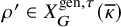 $\rho '\in X^{\mathrm {gen}, \tau }_G(\overline {\kappa })$
. The
$\rho '\in X^{\mathrm {gen}, \tau }_G(\overline {\kappa })$
. The $G(\overline {\kappa })$
-conjugacy class of
$G(\overline {\kappa })$
-conjugacy class of $\rho '$
defines a point
$\rho '$
defines a point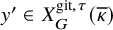 $y'\in X^{\mathrm {git},\tau }_G(\overline {\kappa })$
which maps to y. We have to show that
$y'\in X^{\mathrm {git},\tau }_G(\overline {\kappa })$
which maps to y. We have to show that $y'$
lies on the same connected component of
$y'$
lies on the same connected component of $X^{\mathrm {git}, \tau }_G$
as
$X^{\mathrm {git}, \tau }_G$
as $\overline {\rho }^{\mathrm {ss}}$
. Since
$\overline {\rho }^{\mathrm {ss}}$
. Since $X^{\mathrm {gen},\tau }_G$
is of finite type over
$X^{\mathrm {gen},\tau }_G$
is of finite type over $X^{\mathrm {ps}}_{{\mathrm {GL}}_d}$
,
$X^{\mathrm {ps}}_{{\mathrm {GL}}_d}$
, $\rho '$
takes values in
$\rho '$
takes values in $G(\kappa ')$
for some finite extension of
$G(\kappa ')$
for some finite extension of $\kappa (y)$
in
$\kappa (y)$
in $\overline {\kappa }$
. Proposition 6.6 implies that after conjugating
$\overline {\kappa }$
. Proposition 6.6 implies that after conjugating $\rho '$
with an element of
$\rho '$
with an element of $G^0(\overline {\kappa })$
we may assume that
$G^0(\overline {\kappa })$
we may assume that $\rho '$
takes values in
$\rho '$
takes values in $G(\mathscr O_{\overline {\kappa }})$
. Let
$G(\mathscr O_{\overline {\kappa }})$
. Let $\overline {\rho }'$
be the composition of
$\overline {\rho }'$
be the composition of $\rho '$
with the reduction map
$\rho '$
with the reduction map $G(\mathscr O_{\overline {\kappa }})\rightarrow G(\overline {k})$
. Then
$G(\mathscr O_{\overline {\kappa }})\rightarrow G(\overline {k})$
. Then $\Theta _{\overline {\rho }'}= \Theta _y\otimes _{\mathscr O_{\kappa (y)}} \overline {k} = \Theta _{\overline {\rho }^{\mathrm {ss}}}$
. The uniqueness part of the reconstruction theorem [Reference Quast50, Theorem 3.7] implies that G-semisimplification of
$\Theta _{\overline {\rho }'}= \Theta _y\otimes _{\mathscr O_{\kappa (y)}} \overline {k} = \Theta _{\overline {\rho }^{\mathrm {ss}}}$
. The uniqueness part of the reconstruction theorem [Reference Quast50, Theorem 3.7] implies that G-semisimplification of $\overline {\rho }'$
is equal to
$\overline {\rho }'$
is equal to $\overline {\rho }^{\mathrm {ss}}$
, and Lemma 6.12 implies that
$\overline {\rho }^{\mathrm {ss}}$
, and Lemma 6.12 implies that $y'\in X^{\mathrm {git},\tau }_{G, \overline {\rho }^{\mathrm {ss}}}$
.
$y'\in X^{\mathrm {git},\tau }_{G, \overline {\rho }^{\mathrm {ss}}}$
.
For universal injectivity it suffices by [Reference Project59, Tag 01S4] to show that the diagonal morphism $X^{\mathrm {git},\tau }_{G,\overline {\rho }^{\mathrm {ss}}} \to X^{\mathrm {git},\tau }_{G,\overline {\rho }^{\mathrm {ss}}} \times _{X^{\mathrm {ps}}_G} X^{\mathrm {git},\tau }_{G,\overline {\rho }^{\mathrm {ss}}}$
is surjective. Let
$X^{\mathrm {git},\tau }_{G,\overline {\rho }^{\mathrm {ss}}} \to X^{\mathrm {git},\tau }_{G,\overline {\rho }^{\mathrm {ss}}} \times _{X^{\mathrm {ps}}_G} X^{\mathrm {git},\tau }_{G,\overline {\rho }^{\mathrm {ss}}}$
is surjective. Let $x \in X^{\mathrm {git},\tau }_{G,\overline {\rho }^{\mathrm {ss}}} \times _{X^{\mathrm {ps}}_G} X^{\mathrm {git},\tau }_{G,\overline {\rho }^{\mathrm {ss}}}$
. We obtain by Proposition 6.7 and Lemma 6.8 two G-semisimple representations
$x \in X^{\mathrm {git},\tau }_{G,\overline {\rho }^{\mathrm {ss}}} \times _{X^{\mathrm {ps}}_G} X^{\mathrm {git},\tau }_{G,\overline {\rho }^{\mathrm {ss}}}$
. We obtain by Proposition 6.7 and Lemma 6.8 two G-semisimple representations $\rho _x, \rho _x' \in X^{\mathrm {gen}}_{G, \overline {\rho }^{\mathrm {ss}}}(\overline {\kappa (x)})$
, such that their associated G-pseudocharacters coincide. This means by the uniqueness part of the reconstruction theorem and Corollary 6.10, their image in
$\rho _x, \rho _x' \in X^{\mathrm {gen}}_{G, \overline {\rho }^{\mathrm {ss}}}(\overline {\kappa (x)})$
, such that their associated G-pseudocharacters coincide. This means by the uniqueness part of the reconstruction theorem and Corollary 6.10, their image in $X^{\mathrm {git}}_{G}(\overline {\kappa (x)})$
coincides and therefore x is in the image of the diagonal.
$X^{\mathrm {git}}_{G}(\overline {\kappa (x)})$
coincides and therefore x is in the image of the diagonal.
Lemma 7.5. $\nu \otimes _{\mathbb {Z}_p} \mathbb {Q}_p : X^{\mathrm {git},\tau }_{G,\overline {\rho }^{\mathrm {ss}}}[1/p] \to X^{\mathrm {ps}}_G[1/p]$
is a closed immersion.
$\nu \otimes _{\mathbb {Z}_p} \mathbb {Q}_p : X^{\mathrm {git},\tau }_{G,\overline {\rho }^{\mathrm {ss}}}[1/p] \to X^{\mathrm {ps}}_G[1/p]$
is a closed immersion.
Proof. Let $\mathcal F_N$
be a free group generated by elements
$\mathcal F_N$
be a free group generated by elements $x_1, \ldots , x_N$
. Let
$x_1, \ldots , x_N$
. Let ${\mathrm {Rep}}_G^{\mathcal F_N, \square }$
be the affine
${\mathrm {Rep}}_G^{\mathcal F_N, \square }$
be the affine $R^{\mathrm {ps}}_{{\mathrm {GL}}_d}$
-scheme, which represents the functor, that maps a commutative
$R^{\mathrm {ps}}_{{\mathrm {GL}}_d}$
-scheme, which represents the functor, that maps a commutative $R^{\mathrm {ps}}_{{\mathrm {GL}}_d}$
-algebra A to the set of (abstract) homomorphisms
$R^{\mathrm {ps}}_{{\mathrm {GL}}_d}$
-algebra A to the set of (abstract) homomorphisms $\rho : \mathcal F_N \to G(A)$
. Mapping
$\rho : \mathcal F_N \to G(A)$
. Mapping $x_i$
to
$x_i$
to $\gamma _i$
induces a group homomorphism
$\gamma _i$
induces a group homomorphism $\mathcal F_N\rightarrow \Gamma $
and it follows from Remark 5.8, that we have a closed immersion
$\mathcal F_N\rightarrow \Gamma $
and it follows from Remark 5.8, that we have a closed immersion $X^{\mathrm {gen},\tau }_G \rightarrow {\mathrm {Rep}}_G^{\mathcal F_N, \square }$
and hence a closed immersion
$X^{\mathrm {gen},\tau }_G \rightarrow {\mathrm {Rep}}_G^{\mathcal F_N, \square }$
and hence a closed immersion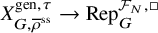 $X^{\mathrm {gen},\tau }_{G, \overline {\rho }^{\mathrm {ss}}} \rightarrow {\mathrm {Rep}}_G^{\mathcal F_N, \square }$
.
$X^{\mathrm {gen},\tau }_{G, \overline {\rho }^{\mathrm {ss}}} \rightarrow {\mathrm {Rep}}_G^{\mathcal F_N, \square }$
.
By [Reference Emerson and Morel25, Proposition 2.11 (i)] the vertical map on the left hand side of the following diagram is an isomorphism.

The bottom map is surjective, since $R^{\mathrm {ps}}_{{\mathrm {GL}}_d}[1/p][{\mathrm {Rep}}_G^{\mathcal F_N, \square }] \to A^{\mathrm {gen},\tau }_{G,\overline {\rho }^{\mathrm {ss}}}[1/p]$
is surjective as explained above and taking
$R^{\mathrm {ps}}_{{\mathrm {GL}}_d}[1/p][{\mathrm {Rep}}_G^{\mathcal F_N, \square }] \to A^{\mathrm {gen},\tau }_{G,\overline {\rho }^{\mathrm {ss}}}[1/p]$
is surjective as explained above and taking $G^0$
-invariants is exact in characteristic
$G^0$
-invariants is exact in characteristic $0$
. Since the diagram commutes the right vertical arrow is surjective, and we obtain the claim.
$0$
. Since the diagram commutes the right vertical arrow is surjective, and we obtain the claim.
Corollary 7.6. The map $\nu \otimes _{\mathbb {Z}_p} \mathbb {Q}_p$
induces an isomorphism of underlying reduced schemes. In particular, if
$\nu \otimes _{\mathbb {Z}_p} \mathbb {Q}_p$
induces an isomorphism of underlying reduced schemes. In particular, if $X^{\mathrm {ps}}_G[1/p]$
is reduced, then
$X^{\mathrm {ps}}_G[1/p]$
is reduced, then $\nu \otimes _{\mathbb {Z}_p} \mathbb {Q}_p$
is an isomorphism.
$\nu \otimes _{\mathbb {Z}_p} \mathbb {Q}_p$
is an isomorphism.
Proof. Proposition 7.4 implies that $\nu \otimes _{\mathbb {Z}_p} \mathbb {Q}_p$
is a universal homeomorphism and Lemma 7.5 that it is a closed immersion, which implies the first claim. The second claim is then immediate.
$\nu \otimes _{\mathbb {Z}_p} \mathbb {Q}_p$
is a universal homeomorphism and Lemma 7.5 that it is a closed immersion, which implies the first claim. The second claim is then immediate.
Remark 7.7. In [Reference Paškūnas and Quast47], building on the results of this paper, we show that $\nu \otimes _{\mathbb {Z}_p} \mathbb {Q}_p$
is an isomorphism.
$\nu \otimes _{\mathbb {Z}_p} \mathbb {Q}_p$
is an isomorphism.
8 Functoriality
The main result of this section is Proposition 8.3, which gives an intrinsic description of $X^{\mathrm {gen}, \tau }_{G, \overline {\rho }^{\mathrm {ss}}}$
as a functor. As a consequence in Section 8.1 we show that
$X^{\mathrm {gen}, \tau }_{G, \overline {\rho }^{\mathrm {ss}}}$
as a functor. As a consequence in Section 8.1 we show that $X^{\mathrm {gen}, \tau }_{G, \overline {\rho }^{\mathrm {ss}}}$
is independent of the choice of an embedding
$X^{\mathrm {gen}, \tau }_{G, \overline {\rho }^{\mathrm {ss}}}$
is independent of the choice of an embedding $\tau : G\hookrightarrow {\mathrm {GL}}_d$
and is functorial in G. In Section 8.2 we investigate functoriality in G under finite maps. In Section 8.3 we study the case when G is a product of two generalised reductive
$\tau : G\hookrightarrow {\mathrm {GL}}_d$
and is functorial in G. In Section 8.2 we investigate functoriality in G under finite maps. In Section 8.3 we study the case when G is a product of two generalised reductive $\mathscr O$
-groups. In Section 8.4 we study the morphisms induced by restriction of pseudocharacters and representations to an open subgroup of
$\mathscr O$
-groups. In Section 8.4 we study the morphisms induced by restriction of pseudocharacters and representations to an open subgroup of $\Gamma $
.
$\Gamma $
.
We assume in this section that $\Gamma $
is topologically finitely generated. This assumption ensures that
$\Gamma $
is topologically finitely generated. This assumption ensures that $R^{\mathrm {ps}}_G$
is noetherian. If
$R^{\mathrm {ps}}_G$
is noetherian. If $\Gamma $
is only assumed to satisfy Mazur’s p-finiteness conditionFootnote
7
then results of this section can be reformulated by replacing
$\Gamma $
is only assumed to satisfy Mazur’s p-finiteness conditionFootnote
7
then results of this section can be reformulated by replacing $\Gamma $
by a topologically finitely generated quotient as in Lemma 5.5. We note that
$\Gamma $
by a topologically finitely generated quotient as in Lemma 5.5. We note that $\Gamma _F$
is topologically finitely generated by [Reference Jannsen34, Satz 3.6].
$\Gamma _F$
is topologically finitely generated by [Reference Jannsen34, Satz 3.6].
8.1 Independence of
$\tau $
and functoriality in G

Lemma 8.1. Let A be an $R^{\mathrm {ps}}_G$
-algebra and let
$R^{\mathrm {ps}}_G$
-algebra and let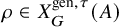 $\rho \in X^{\mathrm {gen}, \tau }_{G}(A)$
. Then
$\rho \in X^{\mathrm {gen}, \tau }_{G}(A)$
. Then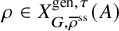 $\rho \in X^{\mathrm {gen}, \tau }_{G,\overline {\rho }^{\mathrm {ss}}}(A)$
if and only if the G-pseudocharacter
$\rho \in X^{\mathrm {gen}, \tau }_{G,\overline {\rho }^{\mathrm {ss}}}(A)$
if and only if the G-pseudocharacter $\Theta _{\rho }$
is equal to the specialisation of
$\Theta _{\rho }$
is equal to the specialisation of $\Theta ^u$
at A.
$\Theta ^u$
at A.
Proof. Let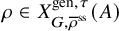 $\rho \in X^{\mathrm {gen}, \tau }_{G,\overline {\rho }^{\mathrm {ss}}}(A)$
. Then
$\rho \in X^{\mathrm {gen}, \tau }_{G,\overline {\rho }^{\mathrm {ss}}}(A)$
. Then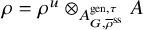 $\rho = \rho ^u \otimes _{A^{\mathrm {gen}, \tau }_{G, \overline {\rho }^{\mathrm {ss}}}} A$
where
$\rho = \rho ^u \otimes _{A^{\mathrm {gen}, \tau }_{G, \overline {\rho }^{\mathrm {ss}}}} A$
where $\rho ^u \in X^{\mathrm {gen}, \tau }_{G,\overline {\rho }^{\mathrm {ss}}}(A^{\mathrm {gen}, \tau }_{G, \overline {\rho }^{\mathrm {ss}}})$
is the universal representation. Taking G-pseudocharacters, we obtain
$\rho ^u \in X^{\mathrm {gen}, \tau }_{G,\overline {\rho }^{\mathrm {ss}}}(A^{\mathrm {gen}, \tau }_{G, \overline {\rho }^{\mathrm {ss}}})$
is the universal representation. Taking G-pseudocharacters, we obtain $\Theta _{\rho } = \Theta _{\rho ^u} \otimes _{A^{\mathrm {gen}, \tau }_{G, \overline {\rho }^{\mathrm {ss}}}} A$
. Using the map
$\Theta _{\rho } = \Theta _{\rho ^u} \otimes _{A^{\mathrm {gen}, \tau }_{G, \overline {\rho }^{\mathrm {ss}}}} A$
. Using the map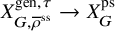 $X^{\mathrm {gen}, \tau }_{G,\overline {\rho }^{\mathrm {ss}}} \to X^{\mathrm {ps}}_G$
given by composing the map in (34) with the GIT quotient map, we see that
$X^{\mathrm {gen}, \tau }_{G,\overline {\rho }^{\mathrm {ss}}} \to X^{\mathrm {ps}}_G$
given by composing the map in (34) with the GIT quotient map, we see that $\Theta _{\rho ^u} = \Theta ^u \otimes _{R^{\mathrm {ps}}_G} A^{\mathrm {gen}, \tau }_{G, \overline {\rho }^{\mathrm {ss}}}$
, so
$\Theta _{\rho ^u} = \Theta ^u \otimes _{R^{\mathrm {ps}}_G} A^{\mathrm {gen}, \tau }_{G, \overline {\rho }^{\mathrm {ss}}}$
, so $\Theta _{\rho } = \Theta ^u \otimes _{R^{\mathrm {ps}}_G} A$
.
$\Theta _{\rho } = \Theta ^u \otimes _{R^{\mathrm {ps}}_G} A$
.
Conversely, let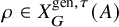 $\rho \in X^{\mathrm {gen}, \tau }_G(A)$
satisfy
$\rho \in X^{\mathrm {gen}, \tau }_G(A)$
satisfy $\Theta _{\rho } = \Theta ^u \otimes _{R^{\mathrm {ps}}_G} A$
. By factoring
$\Theta _{\rho } = \Theta ^u \otimes _{R^{\mathrm {ps}}_G} A$
. By factoring $\rho $
as
$\rho $
as $\Gamma \to G(A^{\mathrm {gen}, \tau }_G) \to G(A)$
over the universal representation on
$\Gamma \to G(A^{\mathrm {gen}, \tau }_G) \to G(A)$
over the universal representation on $A^{\mathrm {gen}, \tau }_G$
and using that
$A^{\mathrm {gen}, \tau }_G$
and using that $A^{\mathrm {gen}, \tau }_G$
is of finite type over
$A^{\mathrm {gen}, \tau }_G$
is of finite type over $R^{\mathrm {ps}}_{{\mathrm {GL}}_d}$
, we see that
$R^{\mathrm {ps}}_{{\mathrm {GL}}_d}$
, we see that $\rho $
actually takes values in a finitely generated
$\rho $
actually takes values in a finitely generated $R^{\mathrm {ps}}_G$
-subalgebra
$R^{\mathrm {ps}}_G$
-subalgebra $A' \subseteq A$
. We want to show, that the image of
$A' \subseteq A$
. We want to show, that the image of ${\mathrm {Spec}}(A') \to X^{\mathrm {gen}, \tau }_G$
is entirely contained in the component
${\mathrm {Spec}}(A') \to X^{\mathrm {gen}, \tau }_G$
is entirely contained in the component $X^{\mathrm {gen}, \tau }_{G,\overline {\rho }^{\mathrm {ss}}}$
, which amounts to showing that an idempotent
$X^{\mathrm {gen}, \tau }_{G,\overline {\rho }^{\mathrm {ss}}}$
, which amounts to showing that an idempotent $e \in A^{\mathrm {gen}, \tau }_G$
associated to a component
$e \in A^{\mathrm {gen}, \tau }_G$
associated to a component $X^{\mathrm {gen}, \tau }_{G, \overline {\rho }^{\mathrm {ss}}_2}$
associated with a residual representation
$X^{\mathrm {gen}, \tau }_{G, \overline {\rho }^{\mathrm {ss}}_2}$
associated with a residual representation $\overline {\rho }^{\mathrm {ss}}_2$
which is non-conjugate to
$\overline {\rho }^{\mathrm {ss}}_2$
which is non-conjugate to $\overline {\rho }^{\mathrm {ss}}$
acts as zero on
$\overline {\rho }^{\mathrm {ss}}$
acts as zero on $A'$
. By contradiction, we assume that
$A'$
. By contradiction, we assume that $eA'$
is nonzero. As
$eA'$
is nonzero. As $A'$
is of finite type over
$A'$
is of finite type over $R^{\mathrm {ps}}_G$
, there is a dimension
$R^{\mathrm {ps}}_G$
, there is a dimension $\leq 1$
prime ideal
$\leq 1$
prime ideal $\mathfrak {p} \in {\mathrm {Spec}}(eA')$
with residue field
$\mathfrak {p} \in {\mathrm {Spec}}(eA')$
with residue field $\kappa (\mathfrak {p})$
finite or local by [Reference Böckle, Iyengar and Paškūnas6, Lemma 3.17]. By Lemma 5.12, we know that the representation
$\kappa (\mathfrak {p})$
finite or local by [Reference Böckle, Iyengar and Paškūnas6, Lemma 3.17]. By Lemma 5.12, we know that the representation $\rho _{\mathfrak {p}} : \Gamma \to G(\overline {\kappa (\mathfrak {p})})$
is continuous and that
$\rho _{\mathfrak {p}} : \Gamma \to G(\overline {\kappa (\mathfrak {p})})$
is continuous and that $\Theta _{\rho _{\mathfrak {p}}} = \Theta ^u \otimes _{R^{\mathrm {ps}}_G} \overline {\kappa (\mathfrak {p})}$
. If
$\Theta _{\rho _{\mathfrak {p}}} = \Theta ^u \otimes _{R^{\mathrm {ps}}_G} \overline {\kappa (\mathfrak {p})}$
. If $\kappa (\mathfrak {p})$
is a finite field then we deduce that the G-semisimplification of
$\kappa (\mathfrak {p})$
is a finite field then we deduce that the G-semisimplification of $\rho _{\mathfrak {p}}$
is
$\rho _{\mathfrak {p}}$
is $\overline {\rho }^{\mathrm {ss}}$
, which yields a contradiction to the choice of e via Lemma 6.13. If
$\overline {\rho }^{\mathrm {ss}}$
, which yields a contradiction to the choice of e via Lemma 6.13. If $\kappa (\mathfrak {p})$
is a local field, by Proposition 6.6 the image of
$\kappa (\mathfrak {p})$
is a local field, by Proposition 6.6 the image of $\rho _{\mathfrak {p}}$
lies up to conjugation in the ring of integers of a finite extension of
$\rho _{\mathfrak {p}}$
lies up to conjugation in the ring of integers of a finite extension of $\kappa (\mathfrak {p})$
. The G-semisimplification of the reduction modulo the maximal ideal is
$\kappa (\mathfrak {p})$
. The G-semisimplification of the reduction modulo the maximal ideal is $\overline {\rho }^{\mathrm {ss}}$
, since
$\overline {\rho }^{\mathrm {ss}}$
, since $\Theta _{\rho _{\mathfrak {p}}}$
specialises
$\Theta _{\rho _{\mathfrak {p}}}$
specialises $\Theta ^u$
, which yields a contradiction to the choice of e via Lemma 6.13. We conclude, that
$\Theta ^u$
, which yields a contradiction to the choice of e via Lemma 6.13. We conclude, that $\rho \in X^{\mathrm {gen}, \tau }_{G,\overline {\rho }^{\mathrm {ss}}}(A')\subseteq X^{\mathrm {gen}, \tau }_{G,\overline {\rho }^{\mathrm {ss}}}(A)$
.
$\rho \in X^{\mathrm {gen}, \tau }_{G,\overline {\rho }^{\mathrm {ss}}}(A')\subseteq X^{\mathrm {gen}, \tau }_{G,\overline {\rho }^{\mathrm {ss}}}(A)$
.
Lemma 8.2. Let $R\rightarrow A$
be a map of
$R\rightarrow A$
be a map of $R^{\mathrm {ps}}_G$
-algebras such that R is a noetherian profinite topological
$R^{\mathrm {ps}}_G$
-algebras such that R is a noetherian profinite topological $R^{\mathrm {ps}}_G$
-algebra. Let
$R^{\mathrm {ps}}_G$
-algebra. Let $\rho : \Gamma \to G(A)$
be a representation satisfying
$\rho : \Gamma \to G(A)$
be a representation satisfying $\Theta _{\rho }=\Theta ^u_{|A}$
. Then the following are equivalent:
$\Theta _{\rho }=\Theta ^u_{|A}$
. Then the following are equivalent:
-
(1)
$(\tau \circ \rho )^{\mathrm {lin}}|_{R^{\mathrm {ps}}_G[\Gamma ]}$
factors through
$R^{\mathrm {ps}}_G \otimes _{R^{\mathrm {ps}}_{{\mathrm {GL}}_d}} E^u$
; -
(2)
$\rho $
is
$R^{\mathrm {ps}}_G$
-condensed; -
(3)
$\rho $
is R-condensed.


Proof. It follows from Lemma 4.16 that $\rho $
is R-condensed if and only if
$\rho $
is R-condensed if and only if $\tau \circ \rho $
is R-condensed. As explained in section 7.3 the assumption
$\tau \circ \rho $
is R-condensed. As explained in section 7.3 the assumption $\Theta _{\rho }=\Theta ^u_{|A}$
implies that
$\Theta _{\rho }=\Theta ^u_{|A}$
implies that $\det \circ (\tau \circ \rho )^{\mathrm {lin}} = D^{u}_{|A}$
. The equivalence now follows from Lemma 5.2.
$\det \circ (\tau \circ \rho )^{\mathrm {lin}} = D^{u}_{|A}$
. The equivalence now follows from Lemma 5.2.
Proposition 8.3. Let A be an $R^{\mathrm {ps}}_G$
-algebra. There is canonical bijection between the following sets:
$R^{\mathrm {ps}}_G$
-algebra. There is canonical bijection between the following sets:
-
(1)
$X^{\mathrm {gen}, \tau }_{G, \overline {\rho }^{\mathrm {ss}}}(A)$
; -
(2) the set of representations
$\rho : \Gamma \to G(A)$
, such that the G-pseudocharacter
$\Theta _{\rho }$
is equal to the specialisation of
$\Theta ^u$
at A and the equivalent conditions of Lemma 8.2 hold.




Proof. If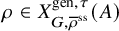 $\rho \in X^{\mathrm {gen}, \tau }_{G, \overline {\rho }^{\mathrm {ss}}}(A)$
then
$\rho \in X^{\mathrm {gen}, \tau }_{G, \overline {\rho }^{\mathrm {ss}}}(A)$
then $\Theta _{\rho }=\Theta ^u_{|A}$
by Lemma 8.1. Moreover,
$\Theta _{\rho }=\Theta ^u_{|A}$
by Lemma 8.1. Moreover, $\tau \circ \rho $
is
$\tau \circ \rho $
is $R^{\mathrm {ps}}_{{\mathrm {GL}}_d}$
-condensed by Lemma 5.10 (1). Lemmas 4.16 and 4.5 imply that
$R^{\mathrm {ps}}_{{\mathrm {GL}}_d}$
-condensed by Lemma 5.10 (1). Lemmas 4.16 and 4.5 imply that $\rho $
is
$\rho $
is $R^{\mathrm {ps}}_G$
-condensed.
$R^{\mathrm {ps}}_G$
-condensed.
If $\rho :\Gamma \rightarrow G(A)$
satisfies the conditions of part (2) then
$\rho :\Gamma \rightarrow G(A)$
satisfies the conditions of part (2) then $\det \circ (\tau \circ \rho )^{\mathrm {lin}}= D^u_{|A}$
and
$\det \circ (\tau \circ \rho )^{\mathrm {lin}}= D^u_{|A}$
and $\tau \circ \rho $
is
$\tau \circ \rho $
is $R^{\mathrm {ps}}_G$
-condensed. Thus
$R^{\mathrm {ps}}_G$
-condensed. Thus $\rho $
satisfies part (4) of Lemma 5.2 with
$\rho $
satisfies part (4) of Lemma 5.2 with $R=R^{\mathrm {ps}}_G$
and thus
$R=R^{\mathrm {ps}}_G$
and thus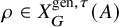 $\rho \in X^{\mathrm {gen}, \tau }_{G}(A)$
by Lemma 5.10 (1). Since
$\rho \in X^{\mathrm {gen}, \tau }_{G}(A)$
by Lemma 5.10 (1). Since $\Theta _{\rho }=\Theta ^u_{|A}$
, Lemma 8.1 implies that
$\Theta _{\rho }=\Theta ^u_{|A}$
, Lemma 8.1 implies that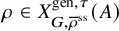 $\rho \in X^{\mathrm {gen}, \tau }_{G, \overline {\rho }^{\mathrm {ss}}}(A)$
.
$\rho \in X^{\mathrm {gen}, \tau }_{G, \overline {\rho }^{\mathrm {ss}}}(A)$
.
Corollary 8.4. The $R^{\mathrm {ps}}_G$
-algebra
$R^{\mathrm {ps}}_G$
-algebra $A^{\mathrm {gen}, \tau }_{G, \overline {\rho }^{\mathrm {ss}}}$
does not depend on the chosen embedding
$A^{\mathrm {gen}, \tau }_{G, \overline {\rho }^{\mathrm {ss}}}$
does not depend on the chosen embedding $\tau : G\hookrightarrow {\mathrm {GL}}_d$
.
$\tau : G\hookrightarrow {\mathrm {GL}}_d$
.
Proof. The assertion follows from Proposition 8.3, as the condition in part (2) of Lemma 8.2 is independent of $\tau $
.
$\tau $
.
As a consequence of the Corollary we will drop $\tau $
from the notation and write
$\tau $
from the notation and write $A^{\mathrm {gen}}_{G, \overline {\rho }^{\mathrm {ss}}}$
,
$A^{\mathrm {gen}}_{G, \overline {\rho }^{\mathrm {ss}}}$
, $R^{\mathrm {git}}_{G, \overline {\rho }^{\mathrm {ss}}}$
,
$R^{\mathrm {git}}_{G, \overline {\rho }^{\mathrm {ss}}}$
, $X^{\mathrm {gen}}_{G,\overline {\rho }^{\mathrm {ss}}}$
,
$X^{\mathrm {gen}}_{G,\overline {\rho }^{\mathrm {ss}}}$
, $X^{\mathrm {git}}_{G, \overline {\rho }^{\mathrm {ss}}}$
for
$X^{\mathrm {git}}_{G, \overline {\rho }^{\mathrm {ss}}}$
for $A^{\mathrm {gen},\tau }_{G, \overline {\rho }^{\mathrm {ss}}}$
,
$A^{\mathrm {gen},\tau }_{G, \overline {\rho }^{\mathrm {ss}}}$
, $R^{\mathrm {git},\tau }_{G, \overline {\rho }^{\mathrm {ss}}}$
,
$R^{\mathrm {git},\tau }_{G, \overline {\rho }^{\mathrm {ss}}}$
, $X^{\mathrm {gen}, \tau }_{G,\overline {\rho }^{\mathrm {ss}}}$
and
$X^{\mathrm {gen}, \tau }_{G,\overline {\rho }^{\mathrm {ss}}}$
and $X^{\mathrm {git},\tau }_{G, \overline {\rho }^{\mathrm {ss}}}$
, respectively.
$X^{\mathrm {git},\tau }_{G, \overline {\rho }^{\mathrm {ss}}}$
, respectively.
We now turn to functoriality.
Proposition 8.5. Let $\varphi : G \to H$
be a homomorphism of generalised reductive
$\varphi : G \to H$
be a homomorphism of generalised reductive $\mathscr O$
-group schemes. Then there is a natural mapFootnote
8
of
$\mathscr O$
-group schemes. Then there is a natural mapFootnote
8
of $R^{\mathrm {ps}}_H$
-schemes
$R^{\mathrm {ps}}_H$
-schemes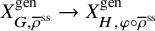 $X^{\mathrm {gen}}_{G,\overline {\rho }^{\mathrm {ss}}} \to X^{\mathrm {gen}}_{H, \varphi \circ \overline {\rho }^{\mathrm {ss}}}$
, such that for every
$X^{\mathrm {gen}}_{G,\overline {\rho }^{\mathrm {ss}}} \to X^{\mathrm {gen}}_{H, \varphi \circ \overline {\rho }^{\mathrm {ss}}}$
, such that for every $R^{\mathrm {ps}}_G$
-algebra A, the map
$R^{\mathrm {ps}}_G$
-algebra A, the map $X^{\mathrm {gen}}_{G,\overline {\rho }^{\mathrm {ss}}}(A) \to X^{\mathrm {gen}}_{H, \varphi \circ \overline {\rho }^{\mathrm {ss}}}(A)$
is given by
$X^{\mathrm {gen}}_{G,\overline {\rho }^{\mathrm {ss}}}(A) \to X^{\mathrm {gen}}_{H, \varphi \circ \overline {\rho }^{\mathrm {ss}}}(A)$
is given by $\rho \mapsto \varphi \circ \rho $
.
$\rho \mapsto \varphi \circ \rho $
.
Proof. Let $\Theta ^u_G$
be the universal G-pseudocharacter deforming
$\Theta ^u_G$
be the universal G-pseudocharacter deforming $\Theta _{\overline {\rho }^{\mathrm {ss}}}$
and let
$\Theta _{\overline {\rho }^{\mathrm {ss}}}$
and let $\Theta ^u_H$
be the universal H-pseudocharacter deforming
$\Theta ^u_H$
be the universal H-pseudocharacter deforming $\Theta _{\varphi \circ \overline {\rho }^{\mathrm {ss}}}$
. Since
$\Theta _{\varphi \circ \overline {\rho }^{\mathrm {ss}}}$
. Since $\varphi (\Theta _G^u)$
is a deformation of
$\varphi (\Theta _G^u)$
is a deformation of $\Theta _{\varphi \circ \overline {\rho }^{\mathrm {ss}}}$
to
$\Theta _{\varphi \circ \overline {\rho }^{\mathrm {ss}}}$
to $R^{\mathrm {ps}}_G$
, we obtain a natural homomorphism of local
$R^{\mathrm {ps}}_G$
, we obtain a natural homomorphism of local $\mathscr O$
-algebras
$\mathscr O$
-algebras $R^{\mathrm {ps}}_H \rightarrow R^{\mathrm {ps}}_G$
such that
$R^{\mathrm {ps}}_H \rightarrow R^{\mathrm {ps}}_G$
such that $\varphi (\Theta ^u_G)= \Theta ^u_H \otimes _{R^{\mathrm {ps}}_H} R^{\mathrm {ps}}_G$
.
$\varphi (\Theta ^u_G)= \Theta ^u_H \otimes _{R^{\mathrm {ps}}_H} R^{\mathrm {ps}}_G$
.
If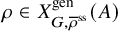 $\rho \in X^{\mathrm {gen}}_{G,\overline {\rho }^{\mathrm {ss}}}(A)$
then
$\rho \in X^{\mathrm {gen}}_{G,\overline {\rho }^{\mathrm {ss}}}(A)$
then $\Theta _{\rho }= \Theta ^u_G \otimes _{R^{\mathrm {ps}}_G} A $
and by applying
$\Theta _{\rho }= \Theta ^u_G \otimes _{R^{\mathrm {ps}}_G} A $
and by applying $\varphi $
, we get
$\varphi $
, we get
 $$ \begin{align} \Theta_{\varphi \circ \rho}= \varphi(\Theta_{\rho})=\varphi(\Theta^u_G)\otimes_{R^{\mathrm{ps}}_G} A = \Theta^u_H\otimes_{R^{\mathrm{ps}}_H} A. \end{align} $$
Lemma 4.16 implies that $\varphi \circ \rho $
is
$\varphi \circ \rho $
is $R^{\mathrm {ps}}_G$
-condensed. Since
$R^{\mathrm {ps}}_G$
-condensed. Since $\varphi \circ \rho $
satisfies (36), Lemma 8.2 (3) applied with
$\varphi \circ \rho $
satisfies (36), Lemma 8.2 (3) applied with $R=R^{\mathrm {ps}}_G$
and Proposition 8.3 imply that
$R=R^{\mathrm {ps}}_G$
and Proposition 8.3 imply that $\varphi \circ \rho \in X^{\mathrm {gen}}_{H, \varphi \circ \overline {\rho }^{\mathrm {ss}}}(A)$
.
$\varphi \circ \rho \in X^{\mathrm {gen}}_{H, \varphi \circ \overline {\rho }^{\mathrm {ss}}}(A)$
.
8.2 Finite maps
Let $\varphi : G\rightarrow H$
be a morphism of generalised reductive
$\varphi : G\rightarrow H$
be a morphism of generalised reductive $\mathscr O$
-group schemes. By functoriality of
$\mathscr O$
-group schemes. By functoriality of $X^{\mathrm {gen}}_{G,\overline {\rho }^{\mathrm {ss}}}$
proved in Propositions 8.5 we obtain a morphism
$X^{\mathrm {gen}}_{G,\overline {\rho }^{\mathrm {ss}}}$
proved in Propositions 8.5 we obtain a morphism $f: X^{\mathrm {gen}}_{G, \overline {\rho }^{\mathrm {ss}}}\rightarrow X^{\mathrm {gen}}_{H, \varphi \circ \overline {\rho }^{\mathrm {ss}}}$
.
$f: X^{\mathrm {gen}}_{G, \overline {\rho }^{\mathrm {ss}}}\rightarrow X^{\mathrm {gen}}_{H, \varphi \circ \overline {\rho }^{\mathrm {ss}}}$
.
Proposition 8.6. If $\varphi $
is finite then the map
$\varphi $
is finite then the map $X^{\mathrm {ps}}_{G}\rightarrow X^{\mathrm {ps}}_H$
is also finite.
$X^{\mathrm {ps}}_{G}\rightarrow X^{\mathrm {ps}}_H$
is also finite.
Proof. By topological Nakayama’s lemma it is enough to show, that the fibre ring $C := k \otimes _{R^{\mathrm {ps}}_{H}} R^{\mathrm {ps}}_{G}$
is a finite-dimensional k-vector space. Since
$C := k \otimes _{R^{\mathrm {ps}}_{H}} R^{\mathrm {ps}}_{G}$
is a finite-dimensional k-vector space. Since $\Gamma $
is topologically finitely generated, we know by [Reference Quast50, Theorem 5.7], that
$\Gamma $
is topologically finitely generated, we know by [Reference Quast50, Theorem 5.7], that $R^{\mathrm {ps}}_{G}$
is noetherian, hence C is a complete local noetherian ring and we are left to show, that C has Krull dimension
$R^{\mathrm {ps}}_{G}$
is noetherian, hence C is a complete local noetherian ring and we are left to show, that C has Krull dimension $0$
.
$0$
.
If C is not $0$
-dimensional then there is a point
$0$
-dimensional then there is a point $x \in {\mathrm {Spec}}(C)$
of dimension
$x \in {\mathrm {Spec}}(C)$
of dimension $1$
. The residue field
$1$
. The residue field $\kappa (x)$
is a local field of characteristic p by [Reference Böckle, Iyengar and Paškūnas6, Lemma 3.17] and the corresponding homomorphism
$\kappa (x)$
is a local field of characteristic p by [Reference Böckle, Iyengar and Paškūnas6, Lemma 3.17] and the corresponding homomorphism $C \to \kappa (x)$
gives a G-pseudocharacter
$C \to \kappa (x)$
gives a G-pseudocharacter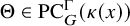 $\Theta \in \mathrm {PC}_{G}^{\Gamma }(\kappa (x))$
, such that
$\Theta \in \mathrm {PC}_{G}^{\Gamma }(\kappa (x))$
, such that $\varphi \circ \Theta \in \mathrm {PC}_{H}^{\Gamma }(\kappa (x))$
arises by scalar extension from the residual pseudocharacter attached to
$\varphi \circ \Theta \in \mathrm {PC}_{H}^{\Gamma }(\kappa (x))$
arises by scalar extension from the residual pseudocharacter attached to $\varphi \circ \overline {\rho }$
.
$\varphi \circ \overline {\rho }$
.
For all $m \geq 0$
, the map
$m \geq 0$
, the map $(\varphi \circ \Theta )_m = \Theta _m \circ \varphi ^*$
is the composition
$(\varphi \circ \Theta )_m = \Theta _m \circ \varphi ^*$
is the composition
 $$ \begin{align*}\mathscr O[H^m]^{H^0} \xrightarrow{\varphi^*} \mathscr O[G^m]^{G^0} \xrightarrow{\Theta_m} \mathrm{Map}(\Gamma^m, \kappa(x))\end{align*} $$
and has image in $\mathrm {Map}(\Gamma ^m, k)$
. By Corollary 6.3
$\mathrm {Map}(\Gamma ^m, k)$
. By Corollary 6.3 $\varphi ^*$
is finite, so
$\varphi ^*$
is finite, so $\Theta _m$
has image in
$\Theta _m$
has image in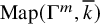 $\mathrm {Map}(\Gamma ^m, \overline {k})$
. This implies that
$\mathrm {Map}(\Gamma ^m, \overline {k})$
. This implies that $\kappa (x)$
is algebraic over k and contradicts the assumption that x is a dimension
$\kappa (x)$
is algebraic over k and contradicts the assumption that x is a dimension $1$
point.
$1$
point.
Proposition 8.7. If $\varphi : G \rightarrow H $
is finite then
$\varphi : G \rightarrow H $
is finite then $f:X^{\mathrm {gen}}_{G, \overline {\rho }^{\mathrm {ss}}}\rightarrow X^{\mathrm {gen}}_{H, \varphi \circ \overline {\rho }^{\mathrm {ss}}}$
is also finite.
$f:X^{\mathrm {gen}}_{G, \overline {\rho }^{\mathrm {ss}}}\rightarrow X^{\mathrm {gen}}_{H, \varphi \circ \overline {\rho }^{\mathrm {ss}}}$
is also finite.
Proof. The induced map $X^{\mathrm {ps}}_G \rightarrow X^{\mathrm {ps}}_H$
is finite by Proposition 8.6. Since
$X^{\mathrm {ps}}_G \rightarrow X^{\mathrm {ps}}_H$
is finite by Proposition 8.6. Since $G\rightarrow H$
is finite by assumption the map
$G\rightarrow H$
is finite by assumption the map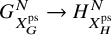 $G^N_{X^{\mathrm {ps}}_G}\rightarrow H^N_{X^{\mathrm {ps}}_H}$
is also finite. We have a commutative diagram
$G^N_{X^{\mathrm {ps}}_G}\rightarrow H^N_{X^{\mathrm {ps}}_H}$
is also finite. We have a commutative diagram

with horizontal arrows closed immersions. Since closed immersions are finite maps and the composition of finite maps are again finite, the diagram implies the assertion.
8.3 Products
In this subsection suppose that $G=G_1\times G_2$
, where the fibre product is taken over
$G=G_1\times G_2$
, where the fibre product is taken over ${\mathrm {Spec}} \mathscr O$
and
${\mathrm {Spec}} \mathscr O$
and $G_1$
and
$G_1$
and $G_2$
are generalised reductive group schemes over
$G_2$
are generalised reductive group schemes over $\mathscr O$
. Let
$\mathscr O$
. Let $p_i: G\rightarrow G_i$
denote the projection map onto the i-th component. Then
$p_i: G\rightarrow G_i$
denote the projection map onto the i-th component. Then $\overline {\rho }^{\mathrm {ss}}$
is of the form
$\overline {\rho }^{\mathrm {ss}}$
is of the form $\overline {\rho }^{\mathrm {ss}}_1\times \overline {\rho }^{\mathrm {ss}}_2$
, where
$\overline {\rho }^{\mathrm {ss}}_1\times \overline {\rho }^{\mathrm {ss}}_2$
, where $\overline {\rho }^{\mathrm {ss}}_i: \Gamma \rightarrow G_i(k)$
is
$\overline {\rho }^{\mathrm {ss}}_i: \Gamma \rightarrow G_i(k)$
is $G_i$
-semisimple.
$G_i$
-semisimple.
Lemma 8.8. The map $\Theta \mapsto (p_1\circ \Theta , p_2\circ \Theta )$
induces a bijection of functors
$\Theta \mapsto (p_1\circ \Theta , p_2\circ \Theta )$
induces a bijection of functors $\mathrm {PC}_G^{\Gamma }\overset {\sim }{\rightarrow } \mathrm {PC}_{G_1}^{\Gamma }\times \mathrm {PC}_{G_2}^{\Gamma }$
and
$\mathrm {PC}_G^{\Gamma }\overset {\sim }{\rightarrow } \mathrm {PC}_{G_1}^{\Gamma }\times \mathrm {PC}_{G_2}^{\Gamma }$
and $\mathrm {cPC}_G^{\Gamma }\overset {\sim }{\rightarrow }\mathrm {cPC}_{G_1}^{\Gamma }\times \mathrm {cPC}_{G_2}^{\Gamma }$
.
$\mathrm {cPC}_G^{\Gamma }\overset {\sim }{\rightarrow }\mathrm {cPC}_{G_1}^{\Gamma }\times \mathrm {cPC}_{G_2}^{\Gamma }$
.
Proof. For an integer $m \geq 0$
, we have
$m \geq 0$
, we have $\mathscr O[G^m]^{G^0} = \mathscr O[G_1^m]^{G_1^0} \otimes _{\mathscr {O}} \mathscr O[G_2^m]^{G_2^0}$
, since the
$\mathscr O[G^m]^{G^0} = \mathscr O[G_1^m]^{G_1^0} \otimes _{\mathscr {O}} \mathscr O[G_2^m]^{G_2^0}$
, since the $\mathscr O[G_i^m]$
are flat
$\mathscr O[G_i^m]$
are flat $\mathscr O$
-modules.
$\mathscr O$
-modules.
Recall that a G-valued pseudocharacter is a family of $\mathscr O$
-algebra homomorphisms
$\mathscr O$
-algebra homomorphisms ${\Theta _m : \mathscr O[G^m]^{G^0} \to \mathrm {Map}(\Gamma ^m, A)}$
satisfying certain compatibility conditions. Restriction along the map
${\Theta _m : \mathscr O[G^m]^{G^0} \to \mathrm {Map}(\Gamma ^m, A)}$
satisfying certain compatibility conditions. Restriction along the map $\mathscr O[G_i^m]^{G_i^0} \to \mathscr O[G^m]^{G^0}$
defines
$\mathscr O[G_i^m]^{G_i^0} \to \mathscr O[G^m]^{G^0}$
defines $G_i$
-pseudocharacters
$G_i$
-pseudocharacters $\Theta ^{(i)}$
satisfying the same compatibility conditions; this can be directly seen from the description of pseudocharacters in terms of functors on the category of finitely generated free groups [Reference Quast50, Proposition 3.18]. Conversely given
$\Theta ^{(i)}$
satisfying the same compatibility conditions; this can be directly seen from the description of pseudocharacters in terms of functors on the category of finitely generated free groups [Reference Quast50, Proposition 3.18]. Conversely given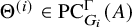 $\Theta ^{(i)} \in \mathrm {PC}_{G_i}^{\Gamma }(A)$
, we can define a G-pseudocharacter
$\Theta ^{(i)} \in \mathrm {PC}_{G_i}^{\Gamma }(A)$
, we can define a G-pseudocharacter $\Theta ^{(1)} \otimes \Theta ^{(2)}$
by defining
$\Theta ^{(1)} \otimes \Theta ^{(2)}$
by defining $(\Theta ^{(1)} \otimes \Theta ^{(2)})_m : \mathscr O[G^m]^{G^0} \to \mathrm {Map}(\Gamma ^m, A)$
as the tensor product
$(\Theta ^{(1)} \otimes \Theta ^{(2)})_m : \mathscr O[G^m]^{G^0} \to \mathrm {Map}(\Gamma ^m, A)$
as the tensor product $\Theta ^{(1)}_m \otimes \Theta ^{(2)}_m : \mathscr O[G_1^m]^{G_1^0} \otimes _{\mathscr {O}} \mathscr O[G_2^m]^{G_2^0} \to \mathrm {Map}(\Gamma ^m, A)$
. This implies that the first map is bijective.
$\Theta ^{(1)}_m \otimes \Theta ^{(2)}_m : \mathscr O[G_1^m]^{G_1^0} \otimes _{\mathscr {O}} \mathscr O[G_2^m]^{G_2^0} \to \mathrm {Map}(\Gamma ^m, A)$
. This implies that the first map is bijective.
If A is a topological $\mathscr O$
-algebra then a map
$\mathscr O$
-algebra then a map $f: \Gamma ^m \rightarrow G(A)$
is continuous if and only if
$f: \Gamma ^m \rightarrow G(A)$
is continuous if and only if $p_1\circ f$
and
$p_1\circ f$
and $p_2\circ f$
are continuous. This implies the second assertion.
$p_2\circ f$
are continuous. This implies the second assertion.
Lemma 8.9. $R^{\mathrm {ps}}_G \cong R^{\mathrm {ps}}_{G_1}{\widehat {\otimes }}_{\mathscr {O}} R^{\mathrm {ps}}_{G_2}$
.
$R^{\mathrm {ps}}_G \cong R^{\mathrm {ps}}_{G_1}{\widehat {\otimes }}_{\mathscr {O}} R^{\mathrm {ps}}_{G_2}$
.
Proof. Let $\overline {\Theta }_i$
be the
$\overline {\Theta }_i$
be the $G_i$
-pseudocharacter associated to
$G_i$
-pseudocharacter associated to $\overline {\rho }^{\mathrm {ss}}_i$
;
$\overline {\rho }^{\mathrm {ss}}_i$
; $i=1,2$
. The ring
$i=1,2$
. The ring $R^{\mathrm {ps}}_{G_1}{\widehat {\otimes }}_{\mathscr {O}} R^{\mathrm {ps}}_{G_2}$
pro-represents the product functor
$R^{\mathrm {ps}}_{G_1}{\widehat {\otimes }}_{\mathscr {O}} R^{\mathrm {ps}}_{G_2}$
pro-represents the product functor $D_{\overline {\Theta }_1} \times D_{\overline {\Theta }_2} : \mathfrak {A}_{\mathscr {O}} \to \text {Set}$
. If
$D_{\overline {\Theta }_1} \times D_{\overline {\Theta }_2} : \mathfrak {A}_{\mathscr {O}} \to \text {Set}$
. If $A\in \mathfrak {A}_{\mathscr {O}}$
then the bijection between
$A\in \mathfrak {A}_{\mathscr {O}}$
then the bijection between $\mathrm {cPC}_{G_1}^{\Gamma }(A) \times \mathrm {cPC}_{G_2}^{\Gamma }(A)$
and
$\mathrm {cPC}_{G_1}^{\Gamma }(A) \times \mathrm {cPC}_{G_2}^{\Gamma }(A)$
and $\mathrm {cPC}_G^{\Gamma }(A)$
established in Lemma 8.8 induces a bijection between
$\mathrm {cPC}_G^{\Gamma }(A)$
established in Lemma 8.8 induces a bijection between $D_{\overline {\Theta }_1}(A) \times D_{\overline {\Theta }_2}(A)$
and
$D_{\overline {\Theta }_1}(A) \times D_{\overline {\Theta }_2}(A)$
and $D_{\overline {\Theta }}(A)$
, which implies the assertion.
$D_{\overline {\Theta }}(A)$
, which implies the assertion.
The map from the usual tensor product into the completed tensor product induces a morphism of schemes $X^{\mathrm {ps}}_G\rightarrow X^{\mathrm {ps}}_{G_1}\times X^{\mathrm {ps}}_{G_2}$
over
$X^{\mathrm {ps}}_G\rightarrow X^{\mathrm {ps}}_{G_1}\times X^{\mathrm {ps}}_{G_2}$
over ${\mathrm {Spec}} \mathscr O$
.
${\mathrm {Spec}} \mathscr O$
.
Proposition 8.10. The natural maps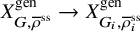 $X^{\mathrm {gen}}_{G, \overline {\rho }^{\mathrm {ss}}} \to X^{\mathrm {gen}}_{G_i, \overline {\rho }^{\mathrm {ss}}_i}$
constructed in Proposition 8.5 induce an isomorphism of schemes over
$X^{\mathrm {gen}}_{G, \overline {\rho }^{\mathrm {ss}}} \to X^{\mathrm {gen}}_{G_i, \overline {\rho }^{\mathrm {ss}}_i}$
constructed in Proposition 8.5 induce an isomorphism of schemes over $X^{\mathrm {ps}}_G$
:
$X^{\mathrm {ps}}_G$
:
 $$ \begin{align} X^{\mathrm{gen}}_{G, \overline{\rho}^{\mathrm{ss}}} \xrightarrow{\sim} (X^{\mathrm{gen}}_{G_1, \overline{\rho}^{\mathrm{ss}}_1}\times X^{\mathrm{gen}}_{G_2, \overline{\rho}^{\mathrm{ss}}_2})\times_{X^{\mathrm{ps}}_{G_1}\times X^{\mathrm{ps}}_{G_2}} X^{\mathrm{ps}}_G, \end{align} $$
where the fibre products without subscript are taken over ${\mathrm {Spec}} \mathscr O$
.
${\mathrm {Spec}} \mathscr O$
.
Proof. Let A be an $R^{\mathrm {ps}}_G$
-algebra. By Proposition 8.3 and Lemma 8.2 (3) applied with
$R^{\mathrm {ps}}_G$
-algebra. By Proposition 8.3 and Lemma 8.2 (3) applied with $R=R^{\mathrm {ps}}_G$
, the A-valued points of the right hand side of (38) are pairs of
$R=R^{\mathrm {ps}}_G$
, the A-valued points of the right hand side of (38) are pairs of $R^{\mathrm {ps}}_G$
-condensed representations
$R^{\mathrm {ps}}_G$
-condensed representations ${\rho _1 : \Gamma \to G_1(A)}$
and
${\rho _1 : \Gamma \to G_1(A)}$
and $\rho _2 : \Gamma \to G_2(A)$
, such that
$\rho _2 : \Gamma \to G_2(A)$
, such that $\Theta ^u_{G_i} \otimes _{R^{\mathrm {ps}}_{G_i}} A = \Theta _{\rho _i}$
for
$\Theta ^u_{G_i} \otimes _{R^{\mathrm {ps}}_{G_i}} A = \Theta _{\rho _i}$
for $i=1,2$
. Lemma 4.4 implies, that the representation
$i=1,2$
. Lemma 4.4 implies, that the representation $\rho := \rho _1 \times \rho _2 : \Gamma \to G(A)$
is
$\rho := \rho _1 \times \rho _2 : \Gamma \to G(A)$
is $R^{\mathrm {ps}}_G$
-condensed. It follows from Lemma 8.9 that the bijection
$R^{\mathrm {ps}}_G$
-condensed. It follows from Lemma 8.9 that the bijection
 $$ \begin{align*}\mathrm{PC}^{\Gamma}_{G}(R^{\mathrm{ps}}_G)\xrightarrow{\sim} \mathrm{PC}^{\Gamma}_{G_1}(R^{\mathrm{ps}}_G)\times \mathrm{PC}^{\Gamma}_{G_2}(R^{\mathrm{ps}}_G)\end{align*} $$
maps $\Theta ^u_G$
to
$\Theta ^u_G$
to $(\Theta ^u_{G_1}\otimes _{R^{\mathrm {ps}}_{G_1}} R^{\mathrm {ps}}_G, \Theta ^u_{G_2}\otimes _{R^{\mathrm {ps}}_{G_2}} R^{\mathrm {ps}}_G)$
. Hence,
$(\Theta ^u_{G_1}\otimes _{R^{\mathrm {ps}}_{G_1}} R^{\mathrm {ps}}_G, \Theta ^u_{G_2}\otimes _{R^{\mathrm {ps}}_{G_2}} R^{\mathrm {ps}}_G)$
. Hence, $(\Theta ^u_G)_{|A}\in \mathrm {PC}^{\Gamma }_{G}(A)$
is mapped to
$(\Theta ^u_G)_{|A}\in \mathrm {PC}^{\Gamma }_{G}(A)$
is mapped to ${(\Theta _{\rho _1}, \Theta _{\rho _2})\in \mathrm {PC}^{\Gamma }_{G_1}(A)\times \mathrm {PC}^{\Gamma }_{G_2}(A)}$
and hence
${(\Theta _{\rho _1}, \Theta _{\rho _2})\in \mathrm {PC}^{\Gamma }_{G_1}(A)\times \mathrm {PC}^{\Gamma }_{G_2}(A)}$
and hence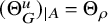 $(\Theta ^u_G)_{|A}=\Theta _{\rho }$
by Lemma 8.9. Proposition 8.3 implies that
$(\Theta ^u_G)_{|A}=\Theta _{\rho }$
by Lemma 8.9. Proposition 8.3 implies that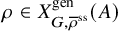 $\rho \in X^{\mathrm {gen}}_{G, \overline {\rho }^{\mathrm {ss}}}(A)$
and hence (38) is surjective. Since
$\rho \in X^{\mathrm {gen}}_{G, \overline {\rho }^{\mathrm {ss}}}(A)$
and hence (38) is surjective. Since $p_1\circ \rho $
and
$p_1\circ \rho $
and $p_2\circ \rho $
uniquely determine
$p_2\circ \rho $
uniquely determine $\rho \in X^{\mathrm {gen}}_{G, \overline {\rho }^{\mathrm {ss}}}(A)$
, (38) is also injective.
$\rho \in X^{\mathrm {gen}}_{G, \overline {\rho }^{\mathrm {ss}}}(A)$
, (38) is also injective.
8.4 Functoriality in
$\Gamma $

Let $\Gamma '$
be an open subgroup of
$\Gamma '$
be an open subgroup of $\Gamma $
. The restriction of G-pseudocharacters of
$\Gamma $
. The restriction of G-pseudocharacters of $\Gamma $
to
$\Gamma $
to $\Gamma '$
defines a morphism
$\Gamma '$
defines a morphism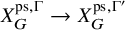 $X^{\mathrm {ps}, \Gamma }_{G}\rightarrow X^{\mathrm {ps},\Gamma '}_{G}$
. Similarly, Lemma 4.13 implies that the restriction of representations of
$X^{\mathrm {ps}, \Gamma }_{G}\rightarrow X^{\mathrm {ps},\Gamma '}_{G}$
. Similarly, Lemma 4.13 implies that the restriction of representations of $\Gamma $
to
$\Gamma $
to $\Gamma '$
induces a morphism
$\Gamma '$
induces a morphism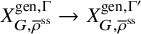 $X^{\mathrm {gen},\Gamma }_{G, \overline {\rho }^{\mathrm {ss}}}\rightarrow X^{\mathrm {gen},\Gamma '}_{G, \overline {\rho }^{\mathrm {ss}}}$
.
$X^{\mathrm {gen},\Gamma }_{G, \overline {\rho }^{\mathrm {ss}}}\rightarrow X^{\mathrm {gen},\Gamma '}_{G, \overline {\rho }^{\mathrm {ss}}}$
.
Lemma 8.11. The morphism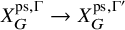 $X^{\mathrm {ps}, \Gamma }_{G}\rightarrow X^{\mathrm {ps},\Gamma '}_{G}$
is finite.
$X^{\mathrm {ps}, \Gamma }_{G}\rightarrow X^{\mathrm {ps},\Gamma '}_{G}$
is finite.
Proof. If $G={\mathrm {GL}}_d$
then this is proved in [Reference Böckle, Iyengar and Paškūnas6, Lemma A.3]. In the general case, one could either use that
$G={\mathrm {GL}}_d$
then this is proved in [Reference Böckle, Iyengar and Paškūnas6, Lemma A.3]. In the general case, one could either use that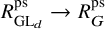 $R^{\mathrm {ps}}_{{\mathrm {GL}}_d}\rightarrow R^{\mathrm {ps}}_G$
is finite, which follows from Propositions 6.4 and 7.4, or observe that the proof of [Reference Böckle, Iyengar and Paškūnas6, Lemma A.3] carries over to the more general setting.
$R^{\mathrm {ps}}_{{\mathrm {GL}}_d}\rightarrow R^{\mathrm {ps}}_G$
is finite, which follows from Propositions 6.4 and 7.4, or observe that the proof of [Reference Böckle, Iyengar and Paškūnas6, Lemma A.3] carries over to the more general setting.
Lemma 8.12. The morphism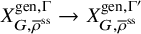 $X^{\mathrm {gen},\Gamma }_{G, \overline {\rho }^{\mathrm {ss}}}\rightarrow X^{\mathrm {gen},\Gamma '}_{G, \overline {\rho }^{\mathrm {ss}}}$
is of finite type.
$X^{\mathrm {gen},\Gamma }_{G, \overline {\rho }^{\mathrm {ss}}}\rightarrow X^{\mathrm {gen},\Gamma '}_{G, \overline {\rho }^{\mathrm {ss}}}$
is of finite type.
Proof. The assertion follows from Lemma 8.11 and the fact that $X^{\mathrm {gen}}_{G,\overline {\rho }^{\mathrm {ss}}}$
is of finite type over
$X^{\mathrm {gen}}_{G,\overline {\rho }^{\mathrm {ss}}}$
is of finite type over $X^{\mathrm {ps}}_G$
.
$X^{\mathrm {ps}}_G$
.
9 Absolutely irreducible locus
Let G be a generalised reductive $\mathscr O$
-group scheme and let
$\mathscr O$
-group scheme and let $\pi _G: G\rightarrow G/G^0$
be the quotient map. Naively, the absolutely irreducible locus should be an open subscheme V of
$\pi _G: G\rightarrow G/G^0$
be the quotient map. Naively, the absolutely irreducible locus should be an open subscheme V of $X^{\mathrm {gen}}_{G, \overline {\rho }^{\mathrm {ss}}}$
such that a geometric point x of
$X^{\mathrm {gen}}_{G, \overline {\rho }^{\mathrm {ss}}}$
such that a geometric point x of $X^{\mathrm {gen}}_{G, \overline {\rho }^{\mathrm {ss}}}$
lies in V if and only if the image of
$X^{\mathrm {gen}}_{G, \overline {\rho }^{\mathrm {ss}}}$
lies in V if and only if the image of $\rho _x$
is not contained in any proper R-parabolic subgroup of
$\rho _x$
is not contained in any proper R-parabolic subgroup of $G_{\kappa (x)}$
. It turns out that if
$G_{\kappa (x)}$
. It turns out that if $\pi _G\circ \overline {\rho }^{\mathrm {ss}}: \Gamma \rightarrow (G/G^0)(\overline {k})$
is not surjective then the naively defined absolutely irreducible locus might be empty, see Example 9.14. To overcome this problem we first show that there is a closed generalised reductive subgroup scheme H of G, such that
$\pi _G\circ \overline {\rho }^{\mathrm {ss}}: \Gamma \rightarrow (G/G^0)(\overline {k})$
is not surjective then the naively defined absolutely irreducible locus might be empty, see Example 9.14. To overcome this problem we first show that there is a closed generalised reductive subgroup scheme H of G, such that $H^0=G^0$
,
$H^0=G^0$
, $\overline {\rho }^{\mathrm {ss}}$
factors through H,
$\overline {\rho }^{\mathrm {ss}}$
factors through H, $\pi _H\circ \overline {\rho }^{\mathrm {ss}}: \Gamma \rightarrow (H/H^0)(\overline {k})$
is surjective and
$\pi _H\circ \overline {\rho }^{\mathrm {ss}}: \Gamma \rightarrow (H/H^0)(\overline {k})$
is surjective and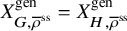 $X^{\mathrm {gen}}_{G, \overline {\rho }^{\mathrm {ss}}}= X^{\mathrm {gen}}_{H,\overline {\rho }^{\mathrm {ss}}}$
. In particular, we may always assume that
$X^{\mathrm {gen}}_{G, \overline {\rho }^{\mathrm {ss}}}= X^{\mathrm {gen}}_{H,\overline {\rho }^{\mathrm {ss}}}$
. In particular, we may always assume that $G/G^0$
is a finite constant group scheme.
$G/G^0$
is a finite constant group scheme.
We then define the absolutely irreducible locus in $X^{\mathrm {gen}}_{G, \overline {\rho }^{\mathrm {ss}}}$
under the assumption that G is split and
$X^{\mathrm {gen}}_{G, \overline {\rho }^{\mathrm {ss}}}$
under the assumption that G is split and $\pi _G \circ \overline {\rho }^{\mathrm {ss}}: \Gamma \rightarrow (G/G^0)(\overline {k})$
is surjective, see Proposition 9.7 and Definition 9.12. It is convenient to define it as a subscheme of
$\pi _G \circ \overline {\rho }^{\mathrm {ss}}: \Gamma \rightarrow (G/G^0)(\overline {k})$
is surjective, see Proposition 9.7 and Definition 9.12. It is convenient to define it as a subscheme of $X^{\mathrm {gen}}_{G, \overline {\rho }^{\mathrm {ss}}}\setminus Y_{\overline {\rho }^{\mathrm {ss}}}$
, so that points in
$X^{\mathrm {gen}}_{G, \overline {\rho }^{\mathrm {ss}}}\setminus Y_{\overline {\rho }^{\mathrm {ss}}}$
, so that points in $X^{\mathrm {gen}}_{G, \overline {\rho }^{\mathrm {ss}}}(\overline {k})$
are never in the absolutely irreducible locus, even if the image of the corresponding representation
$X^{\mathrm {gen}}_{G, \overline {\rho }^{\mathrm {ss}}}(\overline {k})$
are never in the absolutely irreducible locus, even if the image of the corresponding representation $\rho _x: \Gamma \rightarrow G(\overline {k})$
is not contained in any proper R-parabolic subgroup of G.
$\rho _x: \Gamma \rightarrow G(\overline {k})$
is not contained in any proper R-parabolic subgroup of G.
The main result proved in Corollary 9.10 says that if the absolutely irreducible locus is non-empty then the difference between its dimension and the dimension of its GIT quotient by $G^0$
is equal to
$G^0$
is equal to $\dim G_k - \dim Z(G_k)$
. We also define schemes
$\dim G_k - \dim Z(G_k)$
. We also define schemes $V_{LG}$
and
$V_{LG}$
and $U_{LG}$
for an R-Levi L, which along with Corollary 9.10 play an important role in the inductive argument in Section 13.
$U_{LG}$
for an R-Levi L, which along with Corollary 9.10 play an important role in the inductive argument in Section 13.
The results of this section apply to any profinite group $\Gamma $
satisfying Mazur’s p-finiteness condition. Lemma 5.5 implies that we may replace
$\Gamma $
satisfying Mazur’s p-finiteness condition. Lemma 5.5 implies that we may replace $\Gamma $
with a topologically finitely generated quotient without changing
$\Gamma $
with a topologically finitely generated quotient without changing $X^{\mathrm {gen}}_{G, \overline {\rho }^{\mathrm {ss}}}$
. Hence, without loss of generality we assume that
$X^{\mathrm {gen}}_{G, \overline {\rho }^{\mathrm {ss}}}$
. Hence, without loss of generality we assume that $\Gamma $
is topologically finitely generated.
$\Gamma $
is topologically finitely generated.
9.1 Trimming the component group
Let $\rho _z: \Gamma \rightarrow G(\overline {k})$
be a representation corresponding to a point
$\rho _z: \Gamma \rightarrow G(\overline {k})$
be a representation corresponding to a point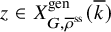 $z\in X^{\mathrm {gen}}_{G, \overline {\rho }^{\mathrm {ss}}}(\overline {k})$
. Then the composition
$z\in X^{\mathrm {gen}}_{G, \overline {\rho }^{\mathrm {ss}}}(\overline {k})$
. Then the composition $\pi _G\circ \rho _z: \Gamma \rightarrow (G/G^0)(\overline {k})$
depends only on the G-semisimplification of
$\pi _G\circ \rho _z: \Gamma \rightarrow (G/G^0)(\overline {k})$
depends only on the G-semisimplification of $\rho _z$
. Since
$\rho _z$
. Since $\rho _z^{\mathrm {ss}}=\overline {\rho }^{\mathrm {ss}}$
by Lemma 6.13 the map
$\rho _z^{\mathrm {ss}}=\overline {\rho }^{\mathrm {ss}}$
by Lemma 6.13 the map $\pi _G \circ \overline {\rho }^{\mathrm {ss}}$
is well defined. Let
$\pi _G \circ \overline {\rho }^{\mathrm {ss}}$
is well defined. Let $\Delta $
be the image of
$\Delta $
be the image of
 $$ \begin{align*}\pi_G \circ \overline{\rho}^{\mathrm{ss}}: \Gamma \rightarrow (G/G^0)(\overline{k}).\end{align*} $$
Since G is generalised reductive $G/G^0$
is finite étale over
$G/G^0$
is finite étale over $\mathscr O$
by Remark 2.6. The map
$\mathscr O$
by Remark 2.6. The map $\mathfrak {S}\mapsto \mathfrak {S}(\overline {k})$
induces an equivalence of categories between finite étale
$\mathfrak {S}\mapsto \mathfrak {S}(\overline {k})$
induces an equivalence of categories between finite étale $\mathscr O$
-groups schemes and the category of finite groups together with
$\mathscr O$
-groups schemes and the category of finite groups together with ${\mathrm {Gal}}(\overline {k}/k)$
-action by group automorphisms. Since
${\mathrm {Gal}}(\overline {k}/k)$
-action by group automorphisms. Since $X^{\mathrm {gen}}_{G, \overline {\rho }^{\mathrm {ss}}}(k)$
is non-empty,
$X^{\mathrm {gen}}_{G, \overline {\rho }^{\mathrm {ss}}}(k)$
is non-empty, $\Delta $
is contained in
$\Delta $
is contained in $(G/G^0)(k)$
and hence the constant group scheme
$(G/G^0)(k)$
and hence the constant group scheme $\underline {\Delta }$
defined by
$\underline {\Delta }$
defined by $\Delta $
is a finite étale subgroup scheme of
$\Delta $
is a finite étale subgroup scheme of $G/G^0$
.
$G/G^0$
.
By construction $X^{\mathrm {gen},\tau }_G$
is a closed subscheme of
$X^{\mathrm {gen},\tau }_G$
is a closed subscheme of $G_{X^{\mathrm {ps}}_{{\mathrm {GL}}_d}}^N$
. The map
$G_{X^{\mathrm {ps}}_{{\mathrm {GL}}_d}}^N$
. The map $\pi _G$
induces a
$\pi _G$
induces a $G^0$
-equivariant morphism of schemes
$G^0$
-equivariant morphism of schemes $\nu : X^{\mathrm {gen},\tau }_G\rightarrow (G/ G^0)^N_{X^{\mathrm {ps}}_{{\mathrm {GL}}_d}}$
for the trivial action on the target. If A is an
$\nu : X^{\mathrm {gen},\tau }_G\rightarrow (G/ G^0)^N_{X^{\mathrm {ps}}_{{\mathrm {GL}}_d}}$
for the trivial action on the target. If A is an $R^{\mathrm {ps}}_{{\mathrm {GL}}_d}$
-algebra then the map
$R^{\mathrm {ps}}_{{\mathrm {GL}}_d}$
-algebra then the map $\nu $
on A-points is given by
$\nu $
on A-points is given by
 $$ \begin{align} \nu: X^{\mathrm{gen},\tau}_G(A)\rightarrow (G/G^0)_{X^{\mathrm{ps}}_{{\mathrm{GL}}_d}}^N(A), \quad \rho\mapsto (\pi_G(\rho(\gamma_1)), \ldots, \pi_G(\rho(\gamma_N))), \end{align} $$
where $\gamma _1, \ldots , \gamma _N$
is a generating set for
$\gamma _1, \ldots , \gamma _N$
is a generating set for $\Gamma $
chosen before Definition 5.7. Since
$\Gamma $
chosen before Definition 5.7. Since $\nu $
is
$\nu $
is $G^0$
-equivariant it factors through
$G^0$
-equivariant it factors through $X^{\mathrm {git},\tau }_G\rightarrow (G/ G^0)^N_{X^{\mathrm {ps}}_{{\mathrm {GL}}_d}}$
. We view an N-tuple
$X^{\mathrm {git},\tau }_G\rightarrow (G/ G^0)^N_{X^{\mathrm {ps}}_{{\mathrm {GL}}_d}}$
. We view an N-tuple $\underline {\delta }=(\delta _1, \ldots , \delta _N)\in \Delta ^N$
as a closed constant subscheme of
$\underline {\delta }=(\delta _1, \ldots , \delta _N)\in \Delta ^N$
as a closed constant subscheme of $\underline {\Delta }^N_{X^{\mathrm {ps}}_{{\mathrm {GL}}_d}}$
over
$\underline {\Delta }^N_{X^{\mathrm {ps}}_{{\mathrm {GL}}_d}}$
over $X^{\mathrm {ps}}_{{\mathrm {GL}}_d}$
and define
$X^{\mathrm {ps}}_{{\mathrm {GL}}_d}$
and define
 $$ \begin{align*}X^{\mathrm{git},\tau}_{G, \underline{\delta}}:= X^{\mathrm{git},\tau}_G\times_{(G/G^0)^N_{X^{\mathrm{ps}}_{{\mathrm{GL}}_d}}} \underline{\delta}.\end{align*} $$
If X is a scheme over $X^{\mathrm {git}, \tau }_G$
we let
$X^{\mathrm {git}, \tau }_G$
we let
 $$ \begin{align} X_{\underline{\delta}}:= X\times_{X^{\mathrm{git}, \tau}_{G}} X^{\mathrm{git},\tau}_{G, \underline{\delta}}, \quad X_{\overline{\rho}^{\mathrm{ss}}}:= X \times_{X^{\mathrm{git}, \tau}_{G}} X^{\mathrm{git}}_{G, \overline{\rho}^{\mathrm{ss}}}. \end{align} $$
Lemma 9.1. If $\underline {\delta }=(\pi _G(\overline {\rho }^{\mathrm {ss}}(\gamma _1)), \ldots , \pi _G(\overline {\rho }^{\mathrm {ss}}(\gamma _N)))$
then
$\underline {\delta }=(\pi _G(\overline {\rho }^{\mathrm {ss}}(\gamma _1)), \ldots , \pi _G(\overline {\rho }^{\mathrm {ss}}(\gamma _N)))$
then
 $$ \begin{align*}X^{\mathrm{git}}_{G, \overline{\rho}^{\mathrm{ss}}} = ((X^{\mathrm{git}, \tau}_{G})_{\overline{\rho}^{\mathrm{ss}}})_{\underline{\delta}} = ((X^{\mathrm{git}, \tau}_{G})_{\underline{\delta}})_{\overline{\rho}^{\mathrm{ss}}}.\end{align*} $$
In particular, for any scheme X over $X^{\mathrm {git}, \tau }_{G}$
we have
$X^{\mathrm {git}, \tau }_{G}$
we have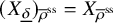 $(X_{\underline {\delta }})_{\overline {\rho }^{\mathrm {ss}}}= X_{\overline {\rho }^{\mathrm {ss}}}$
.
$(X_{\underline {\delta }})_{\overline {\rho }^{\mathrm {ss}}}= X_{\overline {\rho }^{\mathrm {ss}}}$
.
Proof. If R is a complete local noetherian $\mathscr O$
-algebra with residue field k then the map
$\mathscr O$
-algebra with residue field k then the map $R\rightarrow k$
induces a bijection
$R\rightarrow k$
induces a bijection $(G/G^0)(R)\overset {\sim }{\longrightarrow } (G/G^0)(k)$
by [Reference Grothendieck32, Exp. I, Cor. 6.2]. We apply this observation with
$(G/G^0)(R)\overset {\sim }{\longrightarrow } (G/G^0)(k)$
by [Reference Grothendieck32, Exp. I, Cor. 6.2]. We apply this observation with ${R=R^{\mathrm {git}}_{G,\overline {\rho }^{\mathrm {ss}}}}$
and let
${R=R^{\mathrm {git}}_{G,\overline {\rho }^{\mathrm {ss}}}}$
and let $\underline {\delta }\in (G/G^0)^N(k)$
be the N-tuple corresponding to
$\underline {\delta }\in (G/G^0)^N(k)$
be the N-tuple corresponding to $\alpha : X^{\mathrm {git}}_{G, \overline {\rho }^{\mathrm {ss}}} \rightarrow X^{\mathrm {git}, \tau }_{G} \overset {\nu }{\rightarrow } (G/G^0)^N_{X^{\mathrm {ps}}_{{\mathrm {GL}}_d}}$
. Since the closed point in
$\alpha : X^{\mathrm {git}}_{G, \overline {\rho }^{\mathrm {ss}}} \rightarrow X^{\mathrm {git}, \tau }_{G} \overset {\nu }{\rightarrow } (G/G^0)^N_{X^{\mathrm {ps}}_{{\mathrm {GL}}_d}}$
. Since the closed point in $X^{\mathrm {git}}_{G, \overline {\rho }^{\mathrm {ss}}}$
maps to
$X^{\mathrm {git}}_{G, \overline {\rho }^{\mathrm {ss}}}$
maps to $(\pi _G(\overline {\rho }^{\mathrm {ss}}(\gamma _1)), \ldots , \pi _G(\overline {\rho }^{\mathrm {ss}}(\gamma _N)))\in (G/G^0)^N_{X^{\mathrm {git}, \tau }_{G}}(k)$
under
$(\pi _G(\overline {\rho }^{\mathrm {ss}}(\gamma _1)), \ldots , \pi _G(\overline {\rho }^{\mathrm {ss}}(\gamma _N)))\in (G/G^0)^N_{X^{\mathrm {git}, \tau }_{G}}(k)$
under $\alpha $
we conclude that
$\alpha $
we conclude that $\underline {\delta }=(\pi _G(\overline {\rho }^{\mathrm {ss}}(\gamma _1)), \ldots , \pi _G(\overline {\rho }^{\mathrm {ss}}(\gamma _N)))$
.
$\underline {\delta }=(\pi _G(\overline {\rho }^{\mathrm {ss}}(\gamma _1)), \ldots , \pi _G(\overline {\rho }^{\mathrm {ss}}(\gamma _N)))$
.
The image of $\alpha $
is contained in
$\alpha $
is contained in $\underline {\delta }$
, which implies the first equality. The second equality follows from the symmetry of a tensor product. The last part follows from a manipulation with fibre products.
$\underline {\delta }$
, which implies the first equality. The second equality follows from the symmetry of a tensor product. The last part follows from a manipulation with fibre products.
Lemma 9.2. Let H be a closed subgroup scheme of G, such that $H^0=G^0$
. If
$H^0=G^0$
. If ${(\pi _G\circ \overline {\rho }^{\mathrm {ss}})(\Gamma ) \subseteq (H/H^0)(k)}$
then
${(\pi _G\circ \overline {\rho }^{\mathrm {ss}})(\Gamma ) \subseteq (H/H^0)(k)}$
then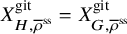 $ X^{\mathrm {git}}_{H, \overline {\rho }^{\mathrm {ss}}}= X^{\mathrm {git}}_{G, \overline {\rho }^{\mathrm {ss}}}$
and
$ X^{\mathrm {git}}_{H, \overline {\rho }^{\mathrm {ss}}}= X^{\mathrm {git}}_{G, \overline {\rho }^{\mathrm {ss}}}$
and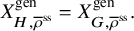 $X^{\mathrm {gen}}_{H, \overline {\rho }^{\mathrm {ss}}}= X^{\mathrm {gen}}_{G, \overline {\rho }^{\mathrm {ss}}}.$
Moreover, there exists H as above, such that
$X^{\mathrm {gen}}_{H, \overline {\rho }^{\mathrm {ss}}}= X^{\mathrm {gen}}_{G, \overline {\rho }^{\mathrm {ss}}}.$
Moreover, there exists H as above, such that $\pi _H \circ \overline {\rho }^{\mathrm {ss}}: \Gamma \rightarrow (H/H^0)(\overline {k})$
is surjective.
$\pi _H \circ \overline {\rho }^{\mathrm {ss}}: \Gamma \rightarrow (H/H^0)(\overline {k})$
is surjective.
Proof. We may write $X^{\mathrm {gen},\tau }_{H}$
as the fibre product of
$X^{\mathrm {gen},\tau }_{H}$
as the fibre product of $X^{\mathrm {gen},\tau }_G$
and
$X^{\mathrm {gen},\tau }_G$
and $(H/H^0)^N$
over
$(H/H^0)^N$
over $(G/G^0)^N$
. The assumption implies that
$(G/G^0)^N$
. The assumption implies that $X^{\mathrm {gen},\tau }_{H}$
contains
$X^{\mathrm {gen},\tau }_{H}$
contains $X^{\mathrm {gen},\tau }_{G, \underline {\delta }}$
as a closed subscheme with
$X^{\mathrm {gen},\tau }_{G, \underline {\delta }}$
as a closed subscheme with $\underline {\delta }$
as in Lemma 9.1. The assertion follows from Lemma 9.1. Since
$\underline {\delta }$
as in Lemma 9.1. The assertion follows from Lemma 9.1. Since $H^0=G^0$
by passing to GIT quotients we obtain
$H^0=G^0$
by passing to GIT quotients we obtain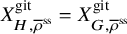 $X^{\mathrm {git}}_{H, \overline {\rho }^{\mathrm {ss}}}=X^{\mathrm {git}}_{G, \overline {\rho }^{\mathrm {ss}}}$
. For the last part we may take H to be the preimage of
$X^{\mathrm {git}}_{H, \overline {\rho }^{\mathrm {ss}}}=X^{\mathrm {git}}_{G, \overline {\rho }^{\mathrm {ss}}}$
. For the last part we may take H to be the preimage of $\underline {\Delta }$
in G.
$\underline {\Delta }$
in G.
If H is a closed generalised reductive subgroup scheme of G (resp. $G_k$
) we let
$G_k$
) we let $X^{\mathrm {git},\tau }_{HG}$
(resp.
$X^{\mathrm {git},\tau }_{HG}$
(resp. $\overline {X}^{\mathrm {git},\tau }_{HG}$
) be the scheme theoretic image of
$\overline {X}^{\mathrm {git},\tau }_{HG}$
) be the scheme theoretic image of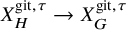 $X^{\mathrm {git}, \tau }_{H}\rightarrow X^{\mathrm {git}, \tau }_{G}$
(resp.
$X^{\mathrm {git}, \tau }_{H}\rightarrow X^{\mathrm {git}, \tau }_{G}$
(resp.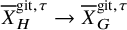 $\overline {X}^{\mathrm {git},\tau }_H \rightarrow \overline {X}^{\mathrm {git},\tau }_G$
). Since these maps are finite by Corollary 6.5 we have
$\overline {X}^{\mathrm {git},\tau }_H \rightarrow \overline {X}^{\mathrm {git},\tau }_G$
). Since these maps are finite by Corollary 6.5 we have
 $$ \begin{align} \dim X^{\mathrm{git},\tau}_{HG} \le \dim X^{\mathrm{git}, \tau}_{H}, \quad \dim \overline{X}^{\mathrm{git},\tau}_{HG} \le \dim \overline{X}^{\mathrm{git},\tau}_H. \end{align} $$
Remark 9.3. We note that if H is a closed generalised reductive subgroup of G then the special fibre of $X^{\mathrm {git},\tau }_{HG}$
is homeomorphic to
$X^{\mathrm {git},\tau }_{HG}$
is homeomorphic to $\overline {X}^{\mathrm {git},\tau }_{H_kG}$
, see Remark 6.1. We will denote both by
$\overline {X}^{\mathrm {git},\tau }_{H_kG}$
, see Remark 6.1. We will denote both by $\overline {X}^{\mathrm {git},\tau }_{HG}$
. This is harmless, since in our arguments we only care about dimensions.
$\overline {X}^{\mathrm {git},\tau }_{HG}$
. This is harmless, since in our arguments we only care about dimensions.
We denote by $X^{\mathrm {gen}}_{H, \overline {\rho }^{\mathrm {ss}}}$
(resp.
$X^{\mathrm {gen}}_{H, \overline {\rho }^{\mathrm {ss}}}$
(resp. $X^{\mathrm {git}}_{H, \overline {\rho }^{\mathrm {ss}}}$
,
$X^{\mathrm {git}}_{H, \overline {\rho }^{\mathrm {ss}}}$
, $X^{\mathrm {git}}_{HG, \overline {\rho }^{\mathrm {ss}}}$
) the schemes
$X^{\mathrm {git}}_{HG, \overline {\rho }^{\mathrm {ss}}}$
) the schemes $(X^{\mathrm {gen}, \tau }_H)_{\overline {\rho }^{\mathrm {ss}}}$
(resp.
$(X^{\mathrm {gen}, \tau }_H)_{\overline {\rho }^{\mathrm {ss}}}$
(resp. $(X^{\mathrm {git}, \tau }_H)_{\overline {\rho }^{\mathrm {ss}}}$
,
$(X^{\mathrm {git}, \tau }_H)_{\overline {\rho }^{\mathrm {ss}}}$
, $(X^{\mathrm {git}, \tau }_{HG})_{\overline {\rho }^{\mathrm {ss}}}$
) with the notation introduced in (40). Lemma 9.1 implies that these schemes are independent of
$(X^{\mathrm {git}, \tau }_{HG})_{\overline {\rho }^{\mathrm {ss}}}$
) with the notation introduced in (40). Lemma 9.1 implies that these schemes are independent of $\tau $
and only depend on the map
$\tau $
and only depend on the map $H \to G$
.
$H \to G$
.
Lemma 9.4. Let H be a generalised reductive subgroup scheme of G (resp. $G_k$
). If
$G_k$
). If $X^{\mathrm {git}}_{HG, \overline {\rho }^{\mathrm {ss}}}$
(resp.
$X^{\mathrm {git}}_{HG, \overline {\rho }^{\mathrm {ss}}}$
(resp. $\overline {X}^{\mathrm {git}}_{HG, \overline {\rho }^{\mathrm {ss}}}$
) is non-empty then there exist
$\overline {X}^{\mathrm {git}}_{HG, \overline {\rho }^{\mathrm {ss}}}$
) is non-empty then there exist
-
(a) a finite unramified extension
$L'$
of L with ring of integers
$\mathscr O'$
and residue field
$k'$
; -
(b) finitely many generalised reductive subgroup schemes
$H_i$
of
$H_{\mathscr O'}$
; -
(c) continuous representations
$\overline {\rho }_i: \Gamma \rightarrow H_i(k')$
;



such that the following hold:
-
(1)
$H_i^0=H^0_{\mathscr O'}$
and
$\pi _{H_i}\circ \overline {\rho }_i: \Gamma \rightarrow (H_i/H_i^0)(\overline {k})$
is surjective; -
(2)
$(X^{\mathrm {git}}_{H, \overline {\rho }^{\mathrm {ss}}})_{\mathscr O'}$
(resp.
$(\overline {X}^{\mathrm {git}}_{H, \overline {\rho }^{\mathrm {ss}}})_{k'}$
) is a disjoint union of
$X^{\mathrm {git}}_{H_i, \overline {\rho }^{\mathrm {ss}}_i}$
(resp.
$\overline {X}^{\mathrm {git}}_{H_i, \overline {\rho }^{\mathrm {ss}}_i}$
); -
(3)
$(X^{\mathrm {gen}}_{H, \overline {\rho }^{\mathrm {ss}}})_{\mathscr O'}$
(resp.
$(\overline {X}^{\mathrm {gen}}_{H, \overline {\rho }^{\mathrm {ss}}})_{k'}$
) is a disjoint union of
$X^{\mathrm {gen}}_{H_i, \overline {\rho }^{\mathrm {ss}}_i}$
(resp.
$\overline {X}^{\mathrm {gen}}_{H_i, \overline {\rho }^{\mathrm {ss}}_i}$
); -
(4)
$(X^{\mathrm {git}}_{HG, \overline {\rho }^{\mathrm {ss}}})_{\mathscr O'}$
(resp.
$(\overline {X}^{\mathrm {git}}_{HG, \overline {\rho }^{\mathrm {ss}}})_{k'}$
) is a union of scheme theoretic images
$$ \begin{align*}X^{\mathrm{git}}_{H_i, \overline{\rho}^{\mathrm{ss}}_i}\rightarrow (X^{\mathrm{git},\tau}_G)_{\mathscr O'},\quad \text{(resp. }\overline{X}^{\mathrm{git}}_{H_i, \overline{\rho}^{\mathrm{ss}}_i}\rightarrow (X^{\mathrm{git},\tau}_G)_{k'}).\end{align*} $$




Proof. The map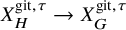 $X^{\mathrm {git},\tau }_H \rightarrow X^{\mathrm {git},\tau }_G$
corresponds to the map between finite products of local rings
$X^{\mathrm {git},\tau }_H \rightarrow X^{\mathrm {git},\tau }_G$
corresponds to the map between finite products of local rings $\prod _{i\in I} R_i \rightarrow \prod _{j\in J} R_j'$
by (31). The representation
$\prod _{i\in I} R_i \rightarrow \prod _{j\in J} R_j'$
by (31). The representation $\overline {\rho }^{\mathrm {ss}}$
defines an idempotent
$\overline {\rho }^{\mathrm {ss}}$
defines an idempotent $e\in \prod _i R_i$
, such that
$e\in \prod _i R_i$
, such that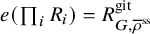 $e(\prod _i R_i)= R^{\mathrm {git}}_{G, \overline {\rho }^{\mathrm {ss}}}$
. Then
$e(\prod _i R_i)= R^{\mathrm {git}}_{G, \overline {\rho }^{\mathrm {ss}}}$
. Then $X^{\mathrm {git}}_{H, \overline {\rho }^{\mathrm {ss}}}$
is the spectrum of
$X^{\mathrm {git}}_{H, \overline {\rho }^{\mathrm {ss}}}$
is the spectrum of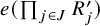 $e(\prod _{j\in J} R_j')$
. Since
$e(\prod _{j\in J} R_j')$
. Since $R_j'$
are local rings we have either
$R_j'$
are local rings we have either $e(R_j')=R^{\prime }_j$
or
$e(R_j')=R^{\prime }_j$
or $e(R^{\prime }_j)=0$
. Thus
$e(R^{\prime }_j)=0$
. Thus $e(\prod _{j\in J} R_j')= \prod _{j\in J'} R^{\prime }_j$
for some subset
$e(\prod _{j\in J} R_j')= \prod _{j\in J'} R^{\prime }_j$
for some subset $J'\subseteq J$
. We may identify
$J'\subseteq J$
. We may identify $J'$
with the set of
$J'$
with the set of ${\mathrm {Gal}}(\overline {k}/k)$
-orbits in
${\mathrm {Gal}}(\overline {k}/k)$
-orbits in $X^{\mathrm {git}}_{H, \overline {\rho }^{\mathrm {ss}}}(\overline {k})$
.
$X^{\mathrm {git}}_{H, \overline {\rho }^{\mathrm {ss}}}(\overline {k})$
.
After replacing L by a finite unramified extension we may ensure that every connected component of $X^{\mathrm {gen}}_{H, \overline {\rho }^{\mathrm {ss}}}$
has a k-rational point, see Remark 6.14. Then (31) yields decompositions:
$X^{\mathrm {gen}}_{H, \overline {\rho }^{\mathrm {ss}}}$
has a k-rational point, see Remark 6.14. Then (31) yields decompositions:
 $$ \begin{align*}X^{\mathrm{git}}_{H, \overline{\rho}^{\mathrm{ss}}}\cong \coprod_i X^{\mathrm{git}}_{H, \overline{\rho}^{\mathrm{ss}}_i},\quad X^{\mathrm{gen}}_{H, \overline{\rho}^{\mathrm{ss}}}\cong \coprod_i X^{\mathrm{gen}}_{H, \overline{\rho}^{\mathrm{ss}}_i}\end{align*} $$
for finitely many continuous representations $\rho _i:\Gamma \rightarrow H(k)$
. The existence of
$\rho _i:\Gamma \rightarrow H(k)$
. The existence of $H_i$
follows from Lemma 9.2. Parts (2), (3) and (4) then follows immediately. If H is a closed subgroup of
$H_i$
follows from Lemma 9.2. Parts (2), (3) and (4) then follows immediately. If H is a closed subgroup of $G_k$
the argument is the same.
$G_k$
the argument is the same.
9.2 Absolutely irreducible locus
In this subsection we omit the fixed embedding $\tau :G\hookrightarrow {\mathrm {GL}}_d$
from the notation and write
$\tau :G\hookrightarrow {\mathrm {GL}}_d$
from the notation and write $X^{\mathrm {gen}}_G$
,
$X^{\mathrm {gen}}_G$
, $X^{\mathrm {git}}_G$
,
$X^{\mathrm {git}}_G$
, $X^{\mathrm {gen}}_{HG}$
and
$X^{\mathrm {gen}}_{HG}$
and $X^{\mathrm {git}}_{HG}$
for
$X^{\mathrm {git}}_{HG}$
for $X^{\mathrm {gen},\tau }_G$
,
$X^{\mathrm {gen},\tau }_G$
, $X^{\mathrm {git},\tau }_G$
,
$X^{\mathrm {git},\tau }_G$
, $X^{\mathrm {gen},\tau }_{HG}$
and
$X^{\mathrm {gen},\tau }_{HG}$
and $X^{\mathrm {git},\tau }_{HG}$
. We note that as a consequence of Corollary 8.4
$X^{\mathrm {git},\tau }_{HG}$
. We note that as a consequence of Corollary 8.4 $X^{\mathrm {gen}}_{HG,\overline {\rho }^{\mathrm {ss}}}$
and
$X^{\mathrm {gen}}_{HG,\overline {\rho }^{\mathrm {ss}}}$
and $X^{\mathrm {git}}_{HG,\overline {\rho }^{\mathrm {ss}}}$
are independent of
$X^{\mathrm {git}}_{HG,\overline {\rho }^{\mathrm {ss}}}$
are independent of $\tau $
. In particular, the schemes
$\tau $
. In particular, the schemes $U_{LG,\overline {\rho }^{\mathrm {ss}}}$
and
$U_{LG,\overline {\rho }^{\mathrm {ss}}}$
and $V_{LG, \overline {\rho }^{\mathrm {ss}}}$
defined below are independent of
$V_{LG, \overline {\rho }^{\mathrm {ss}}}$
defined below are independent of $\tau $
.
$\tau $
.
It follows from Proposition 6.4 that $X^{\mathrm {git}}_{G}$
has only finitely many closed points, we denote this subscheme by
$X^{\mathrm {git}}_{G}$
has only finitely many closed points, we denote this subscheme by $\mathrm {pts}$
. We let Y be the preimage of these closed points in
$\mathrm {pts}$
. We let Y be the preimage of these closed points in $X^{\mathrm {gen}}_G$
. Then Y is a closed subscheme of
$X^{\mathrm {gen}}_G$
. Then Y is a closed subscheme of $X^{\mathrm {gen}}_G$
contained in
$X^{\mathrm {gen}}_G$
contained in $\overline {X}^{\mathrm {gen}}_G$
.
$\overline {X}^{\mathrm {gen}}_G$
.
We assume for the rest of this subsection that $G^0$
is split and fix a maximal split torus T defined over
$G^0$
is split and fix a maximal split torus T defined over $\mathscr O$
. Let L be an R-Levi subgroup of G containing T. Then we define
$\mathscr O$
. Let L be an R-Levi subgroup of G containing T. Then we define
 $$ \begin{align*}U_{LG}:=X^{\mathrm{git}}_{LG} \setminus (\mathrm{pts} \cup \bigcup_{M} X^{\mathrm{git}}_{MG}),\quad \overline{U}_{LG}:=\overline{X}^{\mathrm{git}}_{LG} \setminus (\mathrm{pts} \cup \bigcup_{M} \overline{X}^{\mathrm{git}}_{MG})\end{align*} $$
where the union is taken over all R-Levi subgroups M of G, such that $T\subseteq M \subsetneq L$
. Lemma 2.18 implies that there are only finitely many such M. Thus
$T\subseteq M \subsetneq L$
. Lemma 2.18 implies that there are only finitely many such M. Thus $U_{LG}$
is an open subscheme of
$U_{LG}$
is an open subscheme of $X^{\mathrm {git}}_{LG} \setminus \mathrm {pts}$
and
$X^{\mathrm {git}}_{LG} \setminus \mathrm {pts}$
and $\overline {U}_{LG}$
is an open subscheme of
$\overline {U}_{LG}$
is an open subscheme of $\overline {X}^{\mathrm {git}}_{LG} \setminus \mathrm {pts}$
. Hence,
$\overline {X}^{\mathrm {git}}_{LG} \setminus \mathrm {pts}$
. Hence, $U_{LG}$
and
$U_{LG}$
and $\overline {U}_{LG}$
are locally closed subschemes of
$\overline {U}_{LG}$
are locally closed subschemes of $X^{\mathrm {git}}_G\setminus \mathrm {pts}$
. We let
$X^{\mathrm {git}}_G\setminus \mathrm {pts}$
. We let $V_{LG}$
be the preimage of
$V_{LG}$
be the preimage of $U_{LG}$
in
$U_{LG}$
in $X^{\mathrm {gen}}_G$
and
$X^{\mathrm {gen}}_G$
and $\overline {{V}}_{LG}$
be the preimage of
$\overline {{V}}_{LG}$
be the preimage of $\overline {U}_{LG}$
in
$\overline {U}_{LG}$
in $X^{\mathrm {gen}}_G$
. We then have
$X^{\mathrm {gen}}_G$
. We then have
 $$ \begin{align} X^{\mathrm{gen}}_G= Y \cup \bigcup_{L} V_{LG}, \quad \overline{X}^{\mathrm{gen}}_G= Y\cup \bigcup_{L} \overline{V}_{LG}, \end{align} $$
where the union is taken over all R-Levi subgroups L of G containing T.
Definition 9.5. We say that a geometric point $x\in X^{\mathrm {gen}}_G$
is G-stable, if the orbit
$x\in X^{\mathrm {gen}}_G$
is G-stable, if the orbit $G\cdot x$
is closed and
$G\cdot x$
is closed and $\dim Z_G(x) = \dim Z(G)_{\kappa (x)}$
, where
$\dim Z_G(x) = \dim Z(G)_{\kappa (x)}$
, where $Z_G(x)$
is the
$Z_G(x)$
is the $G_{\kappa (x)}$
-centraliser of x.
$G_{\kappa (x)}$
-centraliser of x.
Remark 9.6. The action of G on $X^{\mathrm {gen}}_G$
factors through the action of
$X^{\mathrm {gen}}_G$
factors through the action of $G/Z(G)$
. The stability condition in the definition is equivalent to
$G/Z(G)$
. The stability condition in the definition is equivalent to $G\cdot x$
closed and
$G\cdot x$
closed and $\dim G\cdot x = \dim (G/Z(G))_{\kappa (x)}$
. Hence, it is equivalent to
$\dim G\cdot x = \dim (G/Z(G))_{\kappa (x)}$
. Hence, it is equivalent to $G/Z(G)$
-stability in the sense of [Reference Seshadri57, Definition 1].
$G/Z(G)$
-stability in the sense of [Reference Seshadri57, Definition 1].
Proposition 9.7. Let x be a geometric point of $X^{\mathrm {gen}}_G\setminus Y$
, and let H be the Zariski closure of
$X^{\mathrm {gen}}_G\setminus Y$
, and let H be the Zariski closure of $\rho _x(\Gamma )$
in
$\rho _x(\Gamma )$
in $G_{\kappa (x)}$
. Then the following statements are equivalent:
$G_{\kappa (x)}$
. Then the following statements are equivalent:
-
(1)
$x\in V_{GG}$
; -
(2)
$\rho _x$
is G-irreducible; -
(3) H is G-irreducible;
-
(4) x is G-stable.


Moreover, H is reductive and $\dim Z_G(H)= \dim Z(G_{\kappa (x)})$
.
$\dim Z_G(H)= \dim Z(G_{\kappa (x)})$
.
Proof. The equivalence of (1) and (2) follows from Corollary 6.11. The equivalence of (2) and (3) follows from Definition 2.26. The equivalence of (3) and (4) follows from [Reference Richardson51, Proposition 16.7]. The last part follows from [Reference Martin42, Lemma 6.2].
Corollary 9.8. Let L be an R-Levi of G and let H be a closed generalised reductive subgroup of $L_{k'}$
, where
$L_{k'}$
, where $k'$
is a finite extension of k. If
$k'$
is a finite extension of k. If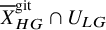 $\overline {X}^{\mathrm {git}}_{HG}\cap U_{LG}$
is non-empty then
$\overline {X}^{\mathrm {git}}_{HG}\cap U_{LG}$
is non-empty then $\dim Z(H)\le \dim Z(L_k)$
.
$\dim Z(H)\le \dim Z(L_k)$
.
Proof. After extending scalars we may assume that $k=k'$
. Since H is contained in L the map
$k=k'$
. Since H is contained in L the map $\overline {X}^{\mathrm {git}}_H \rightarrow \overline {X}^{\mathrm {git}}_G$
factors through
$\overline {X}^{\mathrm {git}}_H \rightarrow \overline {X}^{\mathrm {git}}_G$
factors through $\overline {X}^{\mathrm {git}}_H \rightarrow \overline {X}^{\mathrm {git}}_L\rightarrow \overline {X}^{\mathrm {git}}_G$
. The assumption that
$\overline {X}^{\mathrm {git}}_H \rightarrow \overline {X}^{\mathrm {git}}_L\rightarrow \overline {X}^{\mathrm {git}}_G$
. The assumption that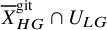 $\overline {X}^{\mathrm {git}}_{HG}\cap U_{LG}$
is non-empty implies that
$\overline {X}^{\mathrm {git}}_{HG}\cap U_{LG}$
is non-empty implies that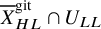 $\overline {X}^{\mathrm {git}}_{HL} \cap U_{LL}$
is non-empty. It follows from Proposition 9.7 that
$\overline {X}^{\mathrm {git}}_{HL} \cap U_{LL}$
is non-empty. It follows from Proposition 9.7 that $H_{\kappa (x)}$
is not contained in any R-parabolic subgroup of
$H_{\kappa (x)}$
is not contained in any R-parabolic subgroup of $L_{\kappa (x)}$
, where x is any geometric point of
$L_{\kappa (x)}$
, where x is any geometric point of $V_{LL}$
, such that its image in
$V_{LL}$
, such that its image in $\overline {X}^{\mathrm {git}}_L$
is contained in
$\overline {X}^{\mathrm {git}}_L$
is contained in $\overline {X}^{\mathrm {git}}_{HL}$
. Moreover, we have
$\overline {X}^{\mathrm {git}}_{HL}$
. Moreover, we have
 $$ \begin{align*}\dim Z(H)= \dim Z(H_{\kappa(x)})\le \dim Z(L_{\kappa(x)}) = \dim Z(L_k),\end{align*} $$
where the inequality in the middle follows from [Reference Martin42, Lemma 6.2], as the centre of $H_{\kappa (x)}$
is contained in the
$H_{\kappa (x)}$
is contained in the $L_{\kappa (x)}$
-centraliser of
$L_{\kappa (x)}$
-centraliser of $H_{\kappa (x)}$
, and the other two follow from Lemma 2.2.
$H_{\kappa (x)}$
, and the other two follow from Lemma 2.2.
Corollary 9.9. Let $X^{\mathrm {gen}}_{G, y}$
be the fibre at a point
$X^{\mathrm {gen}}_{G, y}$
be the fibre at a point $y\in U_{GG}$
. Then
$y\in U_{GG}$
. Then
 $$ \begin{align*}\dim X^{\mathrm{gen}}_{G, y}= \dim G -\dim Z(G)=\dim G_k - \dim Z(G_k).\end{align*} $$
Proof. Let $\kappa $
be an algebraic closure of
$\kappa $
be an algebraic closure of $\kappa (y)$
. If
$\kappa (y)$
. If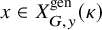 $x\in X^{\mathrm {gen}}_{G, y}(\kappa )$
then the G-orbit
$x\in X^{\mathrm {gen}}_{G, y}(\kappa )$
then the G-orbit $G\cdot x$
is closed, as x is G-stable by Proposition 9.7. Proposition 6.7 implies that the
$G\cdot x$
is closed, as x is G-stable by Proposition 9.7. Proposition 6.7 implies that the $G^0$
-orbit
$G^0$
-orbit $G^0\cdot x$
is also closed. Since
$G^0\cdot x$
is also closed. Since $X^{\mathrm {gen}}_{G, y}$
contains a unique closed
$X^{\mathrm {gen}}_{G, y}$
contains a unique closed $G^0$
-orbit by Proposition 6.9 we conclude that
$G^0$
-orbit by Proposition 6.9 we conclude that $G^0(\kappa )$
acts transitively on
$G^0(\kappa )$
acts transitively on $X^{\mathrm {gen}}_{G, y}(\kappa )$
. Thus the orbit map
$X^{\mathrm {gen}}_{G, y}(\kappa )$
. Thus the orbit map
 $$ \begin{align*}G^0_{\kappa}/ Z_{G^0_{\kappa}}(x) \rightarrow X^{\mathrm{gen}}_{G, y, \kappa}\end{align*} $$
induces a bijection on $\kappa $
-points. Since both schemes are of finite type over
$\kappa $
-points. Since both schemes are of finite type over $\kappa $
, we deduce that
$\kappa $
, we deduce that ${\dim X^{\mathrm {gen}}_{G, y}= \dim G^0_{\kappa }/ Z_{G^0_{\kappa }}(x)= \dim G^0_{\kappa } - \dim Z_{G^0_{\kappa }}(x)}$
. By passing to the underlying reduced subschemes of neutral components we obtain
${\dim X^{\mathrm {gen}}_{G, y}= \dim G^0_{\kappa }/ Z_{G^0_{\kappa }}(x)= \dim G^0_{\kappa } - \dim Z_{G^0_{\kappa }}(x)}$
. By passing to the underlying reduced subschemes of neutral components we obtain $(Z_{G^0_{\kappa }}(x)^0)^{\mathrm {red}} = (Z_{G_{\kappa }}(x)^0)^{\mathrm {red}}= (Z(G)_{\kappa }^0)^{\mathrm {red}}$
, where the last equality holds as x is G-stable. Thus
$(Z_{G^0_{\kappa }}(x)^0)^{\mathrm {red}} = (Z_{G_{\kappa }}(x)^0)^{\mathrm {red}}= (Z(G)_{\kappa }^0)^{\mathrm {red}}$
, where the last equality holds as x is G-stable. Thus $\dim Z_{G^0_{\kappa }}(x)= \dim Z(G)_{\kappa }$
and we conclude that
$\dim Z_{G^0_{\kappa }}(x)= \dim Z(G)_{\kappa }$
and we conclude that
 $$ \begin{align*}\dim X^{\mathrm{gen}}_{G, y} = \dim G_{\kappa} - \dim Z(G)_{\kappa}.\end{align*} $$
The other assertions follow from Proposition 2.9 and Lemma 2.1.
Corollary 9.10. Let U be a non-empty locally closed subspace of $U_{GG}$
(resp.
$U_{GG}$
(resp. $\overline {U}_{GG}$
) and let V be the preimage of U in
$\overline {U}_{GG}$
) and let V be the preimage of U in $X^{\mathrm {gen}}_G$
(resp.
$X^{\mathrm {gen}}_G$
(resp. $\overline {X}^{\mathrm {gen}}_G$
). Then
$\overline {X}^{\mathrm {gen}}_G$
). Then
 $$ \begin{align*}\dim V = \dim U +\dim G_k -\dim Z(G_k).\end{align*} $$
Proof. Corollary 9.9 says that $\dim V_{y}=d$
, where
$\dim V_{y}=d$
, where $d:=\dim G_k -\dim Z(G_k)$
, for all
$d:=\dim G_k -\dim Z(G_k)$
, for all $y\in U$
. The inequality
$y\in U$
. The inequality $\dim V \le \dim U +d$
follows directly from [Reference Böckle, Iyengar and Paškūnas6, Lemma 3.18 (6)] (or alternatively [Reference Project59, Tag 0BAG]).
$\dim V \le \dim U +d$
follows directly from [Reference Böckle, Iyengar and Paškūnas6, Lemma 3.18 (6)] (or alternatively [Reference Project59, Tag 0BAG]).
To prove the reverse inequality we may assume that U is irreducible and, since $V\rightarrow U$
is surjective by [Reference Seshadri57, Theorem 3 (ii)], we may replace V by an irreducible component, whose image contains the generic point of U. Lemma 2.1 in [Reference Böckle, Iyengar and Paškūnas6] implies that V is
$V\rightarrow U$
is surjective by [Reference Seshadri57, Theorem 3 (ii)], we may replace V by an irreducible component, whose image contains the generic point of U. Lemma 2.1 in [Reference Böckle, Iyengar and Paškūnas6] implies that V is $G^0$
-invariant and [Reference Seshadri57, Theorem 3 (iii)] implies that the image of V in U is closed, and hence
$G^0$
-invariant and [Reference Seshadri57, Theorem 3 (iii)] implies that the image of V in U is closed, and hence $V\rightarrow U$
is surjective. It follows from [Reference Project59, Tag 02JU] applied with
$V\rightarrow U$
is surjective. It follows from [Reference Project59, Tag 02JU] applied with $s\in U$
a closed point such that
$s\in U$
a closed point such that $\dim U=\dim \mathscr O_{U, s}$
and
$\dim U=\dim \mathscr O_{U, s}$
and $x\in V$
a closed point, which maps to s, that
$x\in V$
a closed point, which maps to s, that $\dim V\ge \dim U+d$
.
$\dim V\ge \dim U+d$
.
Lemma 9.11. Assume that $\pi _G\circ \overline {\rho }^{\mathrm {ss}}: \Gamma \rightarrow (G/G^0)(\overline {k})$
is surjective. Let L be an R-Levi of G containing T and let P be an R-parabolic subgroup of G with R-Levi L and unipotent radical N. Assume that one of the following is non-empty:
$\pi _G\circ \overline {\rho }^{\mathrm {ss}}: \Gamma \rightarrow (G/G^0)(\overline {k})$
is surjective. Let L be an R-Levi of G containing T and let P be an R-parabolic subgroup of G with R-Levi L and unipotent radical N. Assume that one of the following is non-empty: $X^{\mathrm {gen}}_{L, \overline {\rho }^{\mathrm {ss}}}$
,
$X^{\mathrm {gen}}_{L, \overline {\rho }^{\mathrm {ss}}}$
, $X^{\mathrm {git}}_{L, \overline {\rho }^{\mathrm {ss}}}$
,
$X^{\mathrm {git}}_{L, \overline {\rho }^{\mathrm {ss}}}$
, $V_{LG, \overline {\rho }^{\mathrm {ss}}}$
,
$V_{LG, \overline {\rho }^{\mathrm {ss}}}$
, $U_{LG, \overline {\rho }^{\mathrm {ss}}}$
. Then the following hold:
$U_{LG, \overline {\rho }^{\mathrm {ss}}}$
. Then the following hold:
-
(1)
$L/L^0\rightarrow G/G^0$
is an isomorphism; -
(2) if
$\dim L=\dim G$
then
$L=G$
; -
(3) If
$L\neq G$
then
$\dim N_k\ge 1$
.




Proof. It follows from Lemma 2.13 that $L^0= L\cap G^0$
, so that the map in (1) is injective. The assumption in all the cases implies that
$L^0= L\cap G^0$
, so that the map in (1) is injective. The assumption in all the cases implies that $X^{\mathrm {git}}_{L, \overline {\rho }^{\mathrm {ss}}}$
is non-empty. Lemma 9.1 implies that
$X^{\mathrm {git}}_{L, \overline {\rho }^{\mathrm {ss}}}$
is non-empty. Lemma 9.1 implies that $X^{\mathrm {git}}_{L, \underline {\delta }}$
is non-empty, where
$X^{\mathrm {git}}_{L, \underline {\delta }}$
is non-empty, where $\underline {\delta }$
is as in Lemma 9.1. Thus
$\underline {\delta }$
is as in Lemma 9.1. Thus $\underline {\delta }\in (L/L^0)(k)^N$
and thus
$\underline {\delta }\in (L/L^0)(k)^N$
and thus $\pi _G(\overline {\rho }^{\mathrm {ss}}(\gamma _i))\in (L/L^0)(k)$
for all
$\pi _G(\overline {\rho }^{\mathrm {ss}}(\gamma _i))\in (L/L^0)(k)$
for all $1\le i \le N$
. Since
$1\le i \le N$
. Since $\pi _G\circ \overline {\rho }^{\mathrm {ss}}$
is continuous and surjects onto
$\pi _G\circ \overline {\rho }^{\mathrm {ss}}$
is continuous and surjects onto $(G/G^0)(\overline {k})$
and
$(G/G^0)(\overline {k})$
and $\gamma _1, \ldots \gamma _N$
generate
$\gamma _1, \ldots \gamma _N$
generate $\Gamma $
topologically, the entries of
$\Gamma $
topologically, the entries of $\underline {\delta }$
generate
$\underline {\delta }$
generate $(G/G^0)(\overline {k})$
as a group. Thus
$(G/G^0)(\overline {k})$
as a group. Thus $(L/L^0)(k)=(G/G^0)(k)=(G/G^0)(\overline {k})$
. Thus
$(L/L^0)(k)=(G/G^0)(k)=(G/G^0)(\overline {k})$
. Thus $G/G^0$
is a constant group scheme and we deduce part (1).
$G/G^0$
is a constant group scheme and we deduce part (1).
As explained in Lemma 2.13, $P^0$
is a parabolic of
$P^0$
is a parabolic of $G^0$
with Levi
$G^0$
with Levi $L^0$
. Thus
$L^0$
. Thus $\dim L=\dim G$
implies that
$\dim L=\dim G$
implies that $\dim L^0= \dim G^0$
and hence
$\dim L^0= \dim G^0$
and hence $L^0=G^0$
. Combining this with part (1) we deduce part (2).
$L^0=G^0$
. Combining this with part (1) we deduce part (2).
Part (3) follows from $\dim G_k - \dim L_k= \dim G_k^0 - \dim L_k^0 = 2 \dim N_k$
.
$\dim G_k - \dim L_k= \dim G_k^0 - \dim L_k^0 = 2 \dim N_k$
.
Definition 9.12. If $\pi _G\circ \overline {\rho }^{\mathrm {ss}}: \Gamma \rightarrow (G/G^0)(\overline {k})$
is surjective then we define the absolutely G-irreducible locus in
$\pi _G\circ \overline {\rho }^{\mathrm {ss}}: \Gamma \rightarrow (G/G^0)(\overline {k})$
is surjective then we define the absolutely G-irreducible locus in $X^{\mathrm {gen}}_{G, \overline {\rho }^{\mathrm {ss}}}$
as
$X^{\mathrm {gen}}_{G, \overline {\rho }^{\mathrm {ss}}}$
as $V_{GG,\overline {\rho }^{\mathrm {ss}}}$
.
$V_{GG,\overline {\rho }^{\mathrm {ss}}}$
.
Remark 9.13. The justification for calling $V_{GG,\overline {\rho }^{\mathrm {ss}}}$
absolutely G-irreducible locus comes from Proposition 9.7. We are not sure if this is a good definition if
$V_{GG,\overline {\rho }^{\mathrm {ss}}}$
absolutely G-irreducible locus comes from Proposition 9.7. We are not sure if this is a good definition if $\pi _G\circ \overline {\rho }^{\mathrm {ss}}$
is not surjective, and we discuss an example below. However, one can get around the problem by replacing G by a closed subgroup scheme H such that
$\pi _G\circ \overline {\rho }^{\mathrm {ss}}$
is not surjective, and we discuss an example below. However, one can get around the problem by replacing G by a closed subgroup scheme H such that $G^0=H^0$
and
$G^0=H^0$
and $\pi _G\circ \overline {\rho }^{\mathrm {ss}}$
surjects onto
$\pi _G\circ \overline {\rho }^{\mathrm {ss}}$
surjects onto $(H/H^0)(\overline {k})$
and using Lemma 9.2.
$(H/H^0)(\overline {k})$
and using Lemma 9.2.
Example 9.14. Assume that $p>2$
and let G be the normaliser of the subgroup of diagonal matrices in
$p>2$
and let G be the normaliser of the subgroup of diagonal matrices in ${\mathrm {GL}}_2$
. Then
${\mathrm {GL}}_2$
. Then $G\cong \mathbb G_{m}^2\rtimes \mathbb Z/2\mathbb Z$
as in the Example 2.14. Let E be a quadratic Galois extension of F and let
$G\cong \mathbb G_{m}^2\rtimes \mathbb Z/2\mathbb Z$
as in the Example 2.14. Let E be a quadratic Galois extension of F and let $c\in {\mathrm {Gal}}(E/F)$
be non-trivial. Let
$c\in {\mathrm {Gal}}(E/F)$
be non-trivial. Let $\overline {\rho }_1, \overline {\rho }_2: \Gamma _F \rightarrow G(k)$
be representations, such that
$\overline {\rho }_1, \overline {\rho }_2: \Gamma _F \rightarrow G(k)$
be representations, such that $\Gamma _E$
is mapped to identity and
$\Gamma _E$
is mapped to identity and
 $$ \begin{align*}\overline{\rho}_1(c)= \begin{pmatrix} 1 & 0 \\ 0 & -1\end{pmatrix}, \quad \overline{\rho}_2(c)= \begin{pmatrix} 0 & 1\\ 1 & 0 \end{pmatrix}.\end{align*} $$
These representations are G-semisimple. Since $\overline {\rho }_1(c)$
and
$\overline {\rho }_1(c)$
and $\overline {\rho }_2(c)$
are conjugate in
$\overline {\rho }_2(c)$
are conjugate in ${\mathrm {GL}}_2(k)$
the representations
${\mathrm {GL}}_2(k)$
the representations $\tau \circ \overline {\rho }_1$
and
$\tau \circ \overline {\rho }_1$
and $\tau \circ \overline {\rho }_2$
will have the same
$\tau \circ \overline {\rho }_2$
will have the same ${\mathrm {GL}}_2$
-pseudocharacter, where
${\mathrm {GL}}_2$
-pseudocharacter, where $\tau : G\hookrightarrow {\mathrm {GL}}_2$
is the natural inclusion. The image of
$\tau : G\hookrightarrow {\mathrm {GL}}_2$
is the natural inclusion. The image of $\overline {\rho }_1$
is contained in
$\overline {\rho }_1$
is contained in $G^0(k)$
and
$G^0(k)$
and $G^0$
is a proper R-parabolic subgroup of G, as explained in Example 2.14, hence
$G^0$
is a proper R-parabolic subgroup of G, as explained in Example 2.14, hence $V_{GG, \overline {\rho }_1}$
is empty, and hence the G-irreducible locus in
$V_{GG, \overline {\rho }_1}$
is empty, and hence the G-irreducible locus in $X^{\mathrm {gen}}_{G, \overline {\rho }_1}$
is also empty. On the other hand,
$X^{\mathrm {gen}}_{G, \overline {\rho }_1}$
is also empty. On the other hand, $V_{GG, \overline {\rho }_2}$
is non-empty. We also would like to point out that in this case
$V_{GG, \overline {\rho }_2}$
is non-empty. We also would like to point out that in this case $Z(G^0)$
and
$Z(G^0)$
and $Z(G)$
have different dimensions, and this results in a difference between the dimensions of
$Z(G)$
have different dimensions, and this results in a difference between the dimensions of 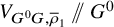 and
and 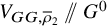 .
.
Remark 9.15. The referee suggested getting around the problem explained in Remark 9.13 and Example 9.14 by working only with G-normalisers of parabolic subgroups of $G^0$
(which are R-parabolic by [Reference Bate, Martin and Röhrle3, Proposition 6.1]) instead of all R-parabolic subgroups. This definition would save some work in Section 9.1, but would not match the standard definition for G-irreducibility in the literature such as [Reference Bate, Martin and Röhrle3], which we use. If
$G^0$
(which are R-parabolic by [Reference Bate, Martin and Röhrle3, Proposition 6.1]) instead of all R-parabolic subgroups. This definition would save some work in Section 9.1, but would not match the standard definition for G-irreducibility in the literature such as [Reference Bate, Martin and Röhrle3], which we use. If $\pi _G \circ \overline {\rho }^{\mathrm {ss}}$
is surjective then both definitions of irreducibility coincide.
$\pi _G \circ \overline {\rho }^{\mathrm {ss}}$
is surjective then both definitions of irreducibility coincide.
10 Bounds for the dimensions of reductive subgroups
Let G be a generalised reductive group over an algebraically closed field $\kappa $
. If H is a closed reduced subgroup scheme of G, such that the unipotent radical of
$\kappa $
. If H is a closed reduced subgroup scheme of G, such that the unipotent radical of $H^0$
is trivial then H is also generalised reductive by Lemma 2.7. Let
$H^0$
is trivial then H is also generalised reductive by Lemma 2.7. Let $G'$
denote the derived subgroup of
$G'$
denote the derived subgroup of $G^0$
. Then
$G^0$
. Then $G'$
is semisimple and
$G'$
is semisimple and $G^0= Z(G^0) G'$
, [Reference Borel9, 14.2]. Moreover,
$G^0= Z(G^0) G'$
, [Reference Borel9, 14.2]. Moreover, $G'$
is equal to its own derived subgroup, [Reference Conrad16, Example 1.1.16].
$G'$
is equal to its own derived subgroup, [Reference Conrad16, Example 1.1.16].
Proposition 10.1. Let H be a closed reductive subgroup of G. Then one of the following holds:
-
(i) H contains
$G'$
; -
(ii)
$\dim G' - \dim (H\cap G')\ge 2$
.


Proof. After replacing G by $G'$
we may assume that G is connected and semisimple. One may check that the unipotent radical of
$G'$
we may assume that G is connected and semisimple. One may check that the unipotent radical of $(G'\cap H)^0$
is normal in
$(G'\cap H)^0$
is normal in $H^0$
. Since
$H^0$
. Since $H^0$
is reductive,
$H^0$
is reductive, $(G'\cap H)^0$
is also reductive. Thus after replacing H by
$(G'\cap H)^0$
is also reductive. Thus after replacing H by $H\cap G'$
we may assume that H is closed reductive subgroup of G.
$H\cap G'$
we may assume that H is closed reductive subgroup of G.
Let $B_0=T_0 U_0$
be a Borel subgroup of H with the unipotent radical
$B_0=T_0 U_0$
be a Borel subgroup of H with the unipotent radical $U_0$
and a maximal torus
$U_0$
and a maximal torus $T_0$
. Let
$T_0$
. Let $B=T U$
be a Borel subgroup of G with the unipotent radical U and a maximal torus T, such that U contains
$B=T U$
be a Borel subgroup of G with the unipotent radical U and a maximal torus T, such that U contains $U_0$
and T contains
$U_0$
and T contains $T_0$
. We have
$T_0$
. We have $\dim G = 2\dim U + \dim T$
and
$\dim G = 2\dim U + \dim T$
and $\dim H = 2 \dim U_0 +\dim T_0$
. If
$\dim H = 2 \dim U_0 +\dim T_0$
. If $U\neq U_0$
then
$U\neq U_0$
then $\dim U>\dim U_0$
and we deduce that
$\dim U>\dim U_0$
and we deduce that $\dim G -\dim H \ge 2$
.
$\dim G -\dim H \ge 2$
.
Let us assume that $U=U_0$
and let
$U=U_0$
and let $U^-_0$
be the unipotent radical of a Borel subgroup of H, which is opposite to
$U^-_0$
be the unipotent radical of a Borel subgroup of H, which is opposite to $B_0$
with respect to
$B_0$
with respect to $T_0$
. Since
$T_0$
. Since $U_0=U$
,
$U_0=U$
, $U_0^-$
is a unipotent radical of a Borel subgroup of G. Since
$U_0^-$
is a unipotent radical of a Borel subgroup of G. Since $U_0^-\cap U_0=\{e\}$
, [Reference Borel and Tits10, Proposition 4.10 e)] implies that
$U_0^-\cap U_0=\{e\}$
, [Reference Borel and Tits10, Proposition 4.10 e)] implies that $U^-_0$
is a unipotent radical of a parabolic subgroup of G, which is opposite to B with respect to T. Since G is by assumption semisimple,
$U^-_0$
is a unipotent radical of a parabolic subgroup of G, which is opposite to B with respect to T. Since G is by assumption semisimple, $U_0$
and
$U_0$
and $U_0^{-}$
generate it as a group by [Reference Springer58, Theorem 8.1.5(i)]. Thus
$U_0^{-}$
generate it as a group by [Reference Springer58, Theorem 8.1.5(i)]. Thus $G=H$
.
$G=H$
.
Corollary 10.2. Assume that we are in the situation of part (ii) of Proposition 10.1. Then ${\dim G -\dim H \ge 2}$
.
${\dim G -\dim H \ge 2}$
.
Proof. The $G'$
-orbit of H in
$G'$
-orbit of H in $G/H$
is isomorphic to
$G/H$
is isomorphic to $G'/(G'\cap H)$
and hence
$G'/(G'\cap H)$
and hence
 $$ \begin{align*}\dim G/H \ge \dim G'/(G'\cap H)\ge 2.\\[-39pt] \end{align*} $$
Corollary 10.3. Let V be a finite dimensional representation of G and let H be a closed reductive subgroup of G. If $V^{G'}=0$
and
$V^{G'}=0$
and $V^H\neq 0$
then
$V^H\neq 0$
then $\dim G - \dim H\ge 2$
.
$\dim G - \dim H\ge 2$
.
Proof. If H contains $G'$
then
$G'$
then $V^H$
is contained in
$V^H$
is contained in $V^{G'}$
and so
$V^{G'}$
and so $V^H\neq 0$
implies that
$V^H\neq 0$
implies that $V^{G'}\neq 0$
. The assertion follows from Corollary 10.2.
$V^{G'}\neq 0$
. The assertion follows from Corollary 10.2.
Since $G'$
is a normal subgroup of G, G acts on
$G'$
is a normal subgroup of G, G acts on ${\mathrm {Lie}}(G')$
by conjugation.
${\mathrm {Lie}}(G')$
by conjugation.
Lemma 10.4. If $\pi _1(G')$
is étale then
$\pi _1(G')$
is étale then $(({\mathrm {Lie}} G')^*)^{G'}=0$
.
$(({\mathrm {Lie}} G')^*)^{G'}=0$
.
Proof. We may assume that ${\mathrm {Lie}} G'$
is non-zero. Let
${\mathrm {Lie}} G'$
is non-zero. Let $G^{\prime }_{\operatorname {sc}} \rightarrow G'$
be the universal simply connected cover of
$G^{\prime }_{\operatorname {sc}} \rightarrow G'$
be the universal simply connected cover of $G'$
. Since
$G'$
. Since $\pi _1(G')$
is étale the exact sequence:
$\pi _1(G')$
is étale the exact sequence:
 $$ \begin{align*}0 \rightarrow \pi_1(G')\rightarrow G^{\prime}_{\operatorname{sc}}\rightarrow G'\rightarrow 0\end{align*} $$
induces a $G^{\prime }_{\operatorname {sc}}$
-equivariant isomorphism of Lie algebras
$G^{\prime }_{\operatorname {sc}}$
-equivariant isomorphism of Lie algebras ${\mathrm {Lie}} G^{\prime }_{\operatorname {sc}}\cong {\mathrm {Lie}} G'$
. We thus may assume that
${\mathrm {Lie}} G^{\prime }_{\operatorname {sc}}\cong {\mathrm {Lie}} G'$
. We thus may assume that $G'$
is simply connected. Let T be a maximal torus in
$G'$
is simply connected. Let T be a maximal torus in $G'$
.
$G'$
.
If $\dim T=1$
then
$\dim T=1$
then $G'={\mathrm {SL}}_2$
by [Reference Springer58, 7.2.4], as the assumption that
$G'={\mathrm {SL}}_2$
by [Reference Springer58, 7.2.4], as the assumption that $G'$
is simply connected rules out
$G'$
is simply connected rules out ${\mathrm {PGL}}_2$
. If
${\mathrm {PGL}}_2$
. If $\mathrm {char}(\kappa ) \neq 2$
then the action of
$\mathrm {char}(\kappa ) \neq 2$
then the action of $G'$
on
$G'$
on ${\mathrm {Lie}} G'$
is an irreducible representation, isomorphic to
${\mathrm {Lie}} G'$
is an irreducible representation, isomorphic to ${\mathrm {Sym}}^2(\mathrm {Std})$
, where
${\mathrm {Sym}}^2(\mathrm {Std})$
, where $\mathrm {Std}$
is the standard
$\mathrm {Std}$
is the standard $2$
-dimensional representation of
$2$
-dimensional representation of ${\mathrm {SL}}_2$
. If
${\mathrm {SL}}_2$
. If $\mathrm {char}(\kappa )=2$
then
$\mathrm {char}(\kappa )=2$
then ${\mathrm {Lie}} G'$
is a non-split extension
${\mathrm {Lie}} G'$
is a non-split extension $0\rightarrow \mathbf 1 \rightarrow {\mathrm {Lie}} G' \rightarrow V\rightarrow 0$
, with
$0\rightarrow \mathbf 1 \rightarrow {\mathrm {Lie}} G' \rightarrow V\rightarrow 0$
, with $\mathbf 1$
equal to the subspace of scalar matrices and V an irreducible
$\mathbf 1$
equal to the subspace of scalar matrices and V an irreducible $2$
-dimensional representation. In both cases we obtain the claim.
$2$
-dimensional representation. In both cases we obtain the claim.
Let $\dim T$
be arbitrary and let
$\dim T$
be arbitrary and let $\chi : {\mathrm {Lie}} G'\rightarrow \mathbf 1$
be
$\chi : {\mathrm {Lie}} G'\rightarrow \mathbf 1$
be $G'$
-invariant. Let us abbreviate
$G'$
-invariant. Let us abbreviate $\mathfrak {g}= {\mathrm {Lie}} G'$
. We have
$\mathfrak {g}= {\mathrm {Lie}} G'$
. We have $\mathfrak {g}= \mathfrak {g}^T \oplus \bigoplus \nolimits_{\alpha \in \Phi } \mathfrak {g}_{\alpha }$
, where
$\mathfrak {g}= \mathfrak {g}^T \oplus \bigoplus \nolimits_{\alpha \in \Phi } \mathfrak {g}_{\alpha }$
, where $\Phi $
is the set of roots, and
$\Phi $
is the set of roots, and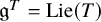 $\mathfrak {g}^T= {\mathrm {Lie}}(T)$
, [Reference Borel9, 13.18(1)]. Let
$\mathfrak {g}^T= {\mathrm {Lie}}(T)$
, [Reference Borel9, 13.18(1)]. Let $\alpha \in \Phi $
and let
$\alpha \in \Phi $
and let $G_{\alpha }$
be the centraliser of
$G_{\alpha }$
be the centraliser of $({\mathrm {Ker}} \alpha )^0$
in
$({\mathrm {Ker}} \alpha )^0$
in $G'$
. Then
$G'$
. Then $G_{\alpha }$
is reductive of semisimple rank
$G_{\alpha }$
is reductive of semisimple rank $1$
, [Reference Borel9, 13.18(4)]. Let
$1$
, [Reference Borel9, 13.18(4)]. Let $G^{\prime }_{\alpha }$
be the derived subgroup of
$G^{\prime }_{\alpha }$
be the derived subgroup of $G_{\alpha }$
. The assumption that
$G_{\alpha }$
. The assumption that $G'$
is simply connected implies that
$G'$
is simply connected implies that $G^{\prime }_{\alpha }\cong {\mathrm {SL}}_2$
by [Reference Conrad16, 5.3.9]. It follows from [Reference Conrad16, 1.2.7] that
$G^{\prime }_{\alpha }\cong {\mathrm {SL}}_2$
by [Reference Conrad16, 5.3.9]. It follows from [Reference Conrad16, 1.2.7] that ${\mathrm {Lie}} G_{\alpha }'= \mathfrak {g}_{-\alpha }\oplus {\mathrm {Lie}} (\alpha ^{\vee }(\mathbb G_{m}))\oplus \mathfrak {g}_{\alpha }$
. The restriction of
${\mathrm {Lie}} G_{\alpha }'= \mathfrak {g}_{-\alpha }\oplus {\mathrm {Lie}} (\alpha ^{\vee }(\mathbb G_{m}))\oplus \mathfrak {g}_{\alpha }$
. The restriction of $\chi $
to
$\chi $
to ${\mathrm {Lie}} G^{\prime }_{\alpha }$
is
${\mathrm {Lie}} G^{\prime }_{\alpha }$
is $G^{\prime }_{\alpha }$
-invariant and hence zero by the previous part. Hence,
$G^{\prime }_{\alpha }$
-invariant and hence zero by the previous part. Hence, $\chi $
is zero on
$\chi $
is zero on ${\mathrm {Lie}} (\alpha ^{\vee }(\mathbb G_{m}))$
and
${\mathrm {Lie}} (\alpha ^{\vee }(\mathbb G_{m}))$
and $\mathfrak {g}_{\alpha }$
for every coroot
$\mathfrak {g}_{\alpha }$
for every coroot $\alpha ^{\vee }$
.
$\alpha ^{\vee }$
.
Let $T_1=\prod _{\alpha \in \Delta }\mathbb G_{m}$
, where
$T_1=\prod _{\alpha \in \Delta }\mathbb G_{m}$
, where $\Delta $
is the set of positive simple roots with respect to a Borel subgroup containing T. Since
$\Delta $
is the set of positive simple roots with respect to a Borel subgroup containing T. Since $G'$
is simply connected the map
$G'$
is simply connected the map $\prod _{\alpha \in \Delta } \alpha ^{\vee }: T_1\rightarrow T$
induces an isomorphism on the character groups, [Reference Conrad19, Example 1.3.10], and hence an isomorphism between tori. Thus the subspaces
$\prod _{\alpha \in \Delta } \alpha ^{\vee }: T_1\rightarrow T$
induces an isomorphism on the character groups, [Reference Conrad19, Example 1.3.10], and hence an isomorphism between tori. Thus the subspaces ${\mathrm {Lie}}(\alpha ^{\vee }(\mathbb G_{m}))$
for
${\mathrm {Lie}}(\alpha ^{\vee }(\mathbb G_{m}))$
for $\alpha \in \Delta $
span
$\alpha \in \Delta $
span ${\mathrm {Lie}} (T)$
. Thus
${\mathrm {Lie}} (T)$
. Thus $\chi $
vanishes on
$\chi $
vanishes on $\mathfrak {g}^T$
and
$\mathfrak {g}^T$
and $\mathfrak {g}_{\alpha }$
for every
$\mathfrak {g}_{\alpha }$
for every $\alpha \in \Phi $
and hence
$\alpha \in \Phi $
and hence $\chi =0$
.
$\chi =0$
.
Lemma 10.5. Let $G^{\prime }_{\operatorname {sc}}\rightarrow G'$
be the simply connected central cover of
$G^{\prime }_{\operatorname {sc}}\rightarrow G'$
be the simply connected central cover of $G'$
. Then there is a natural action of G on
$G'$
. Then there is a natural action of G on ${\mathrm {Lie}} (G^{\prime }_{\operatorname {sc}})$
such that the map
${\mathrm {Lie}} (G^{\prime }_{\operatorname {sc}})$
such that the map ${\mathrm {Lie}} (G^{\prime }_{\operatorname {sc}})\rightarrow {\mathrm {Lie}} G'$
is G-equivariant. Moreover,
${\mathrm {Lie}} (G^{\prime }_{\operatorname {sc}})\rightarrow {\mathrm {Lie}} G'$
is G-equivariant. Moreover, $G'$
-invariants in
$G'$
-invariants in $({\mathrm {Lie}} (G^{\prime }_{\operatorname {sc}}))^{\ast }$
are zero.
$({\mathrm {Lie}} (G^{\prime }_{\operatorname {sc}}))^{\ast }$
are zero.
Proof. The action has been defined over $\mathscr O$
in Lemma 2.11 and the same holds over
$\mathscr O$
in Lemma 2.11 and the same holds over $\kappa $
. The
$\kappa $
. The $G^{\prime }_{\operatorname {sc}}$
-invariants in
$G^{\prime }_{\operatorname {sc}}$
-invariants in $({\mathrm {Lie}}(G^{\prime }_{\operatorname {sc}}))^*$
are zero by Lemma 10.4. The assertion follows as
$({\mathrm {Lie}}(G^{\prime }_{\operatorname {sc}}))^*$
are zero by Lemma 10.4. The assertion follows as $G^{\prime }_{\operatorname {sc}} \to G'$
is a central extension and therefore this action factors through the action of
$G^{\prime }_{\operatorname {sc}} \to G'$
is a central extension and therefore this action factors through the action of $G'$
.
$G'$
.
Let P be an R-parabolic subgroup of G, let U its unipotent radical and let L be an R-Levi subgroup of P. Then $P^0= P\cap G^0$
is a parabolic subgroup of
$P^0= P\cap G^0$
is a parabolic subgroup of $G^0$
and
$G^0$
and $L^0=L\cap G^0$
is a Levi subgroup of
$L^0=L\cap G^0$
is a Levi subgroup of $P^0$
, [Reference Martin42, Proposition 5.2]. In particular,
$P^0$
, [Reference Martin42, Proposition 5.2]. In particular, $L^0$
is reductive. We let
$L^0$
is reductive. We let $L'$
be the derived subgroup of
$L'$
be the derived subgroup of $L^0$
.
$L^0$
.
Lemma 10.6. Let H be a closed reductive subgroup of L. If $(({\mathrm {Lie}} U)^*)^H\neq 0$
then one of the following holds:
$(({\mathrm {Lie}} U)^*)^H\neq 0$
then one of the following holds:
-
(i)
$\dim L - \dim H \ge 2$
; -
(ii)
$\dim L -\dim H =1$
and
$\dim _{\kappa } (({\mathrm {Lie}} U)^*)^H=1$
.



Proof. We may assume that H contains $L'$
since otherwise (i) holds by Corollary 10.2. By replacing H by
$L'$
since otherwise (i) holds by Corollary 10.2. By replacing H by $H\cap L^0$
and L by
$H\cap L^0$
and L by $L^0$
we may assume that L is connected. Then
$L^0$
we may assume that L is connected. Then $L=Z(L)H$
. Let T be a maximal torus in L. Then T contains
$L=Z(L)H$
. Let T be a maximal torus in L. Then T contains $Z(L)$
and hence
$Z(L)$
and hence $L/H \cong T/(T\cap H)$
. The action of T on
$L/H \cong T/(T\cap H)$
. The action of T on ${\mathrm {Lie}} U$
is semisimple, multiplicity free and
${\mathrm {Lie}} U$
is semisimple, multiplicity free and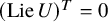 $({\mathrm {Lie}} U)^T=0$
, [Reference Borel9, 13.18]. Thus
$({\mathrm {Lie}} U)^T=0$
, [Reference Borel9, 13.18]. Thus $\dim L> \dim H$
. If
$\dim L> \dim H$
. If $\dim _{\kappa } (({\mathrm {Lie}} U)^*)^H\ge 2$
, then
$\dim _{\kappa } (({\mathrm {Lie}} U)^*)^H\ge 2$
, then $\dim _{\kappa } (({\mathrm {Lie}} U)^*)^{T\cap H}\ge 2$
. Let
$\dim _{\kappa } (({\mathrm {Lie}} U)^*)^{T\cap H}\ge 2$
. Let $\alpha ,\beta \in \Phi $
be distinct roots such that the dual characters
$\alpha ,\beta \in \Phi $
be distinct roots such that the dual characters $\alpha ^*$
and
$\alpha ^*$
and $\beta ^*$
appear in
$\beta ^*$
appear in $(({\mathrm {Lie}} U)^*)^{T\cap H}$
. We note that both
$(({\mathrm {Lie}} U)^*)^{T\cap H}$
. We note that both $\alpha $
and
$\alpha $
and $\beta $
are positive with respect to a Borel subgroup of
$\beta $
are positive with respect to a Borel subgroup of $G'$
containing T and U. Thus
$G'$
containing T and U. Thus $\alpha \neq -\beta $
. Now
$\alpha \neq -\beta $
. Now $\{\alpha , -\alpha \}$
are the roots of the centraliser of
$\{\alpha , -\alpha \}$
are the roots of the centraliser of $({\mathrm {Ker}} \alpha )^0$
in
$({\mathrm {Ker}} \alpha )^0$
in $G'$
, [Reference Borel9, 13.18(4d)]. Thus
$G'$
, [Reference Borel9, 13.18(4d)]. Thus ${\mathrm {Ker}} \alpha \neq {\mathrm {Ker}} \beta $
and hence
${\mathrm {Ker}} \alpha \neq {\mathrm {Ker}} \beta $
and hence $\dim T - \dim ({\mathrm {Ker}} \alpha \cap {\mathrm {Ker}} \beta ) = 2$
. Thus
$\dim T - \dim ({\mathrm {Ker}} \alpha \cap {\mathrm {Ker}} \beta ) = 2$
. Thus $\dim T -\dim T\cap H\ge 2$
, as
$\dim T -\dim T\cap H\ge 2$
, as $T\cap H$
is contained in
$T\cap H$
is contained in ${\mathrm {Ker}} \alpha \cap {\mathrm {Ker}} \beta $
. Thus part (i) holds.
${\mathrm {Ker}} \alpha \cap {\mathrm {Ker}} \beta $
. Thus part (i) holds.
Corollary 10.7. $(({\mathrm {Lie}} U)^*)^{L^0}=0$
.
$(({\mathrm {Lie}} U)^*)^{L^0}=0$
.
Proof. This follows from Lemma 10.6 as $\dim L=\dim L^0$
.
$\dim L=\dim L^0$
.
Example 10.8. Let $G=G'= G_1\times {\mathrm {SL}}_2$
, where
$G=G'= G_1\times {\mathrm {SL}}_2$
, where $G_1$
is any semisimple group,
$G_1$
is any semisimple group, $L= G_1\times \mathbb G_{m}$
and
$L= G_1\times \mathbb G_{m}$
and $P= G_1\times B$
, where B is the subgroup of upper triangular matrices in
$P= G_1\times B$
, where B is the subgroup of upper triangular matrices in ${\mathrm {SL}}_2$
. If
${\mathrm {SL}}_2$
. If $H=G_1\times \{1\}$
then part (ii) of Lemma 10.6 holds.
$H=G_1\times \{1\}$
then part (ii) of Lemma 10.6 holds.
11 R-Levi subgroups of codimension
$2$

Let G be a generalised reductive group over an algebraically closed field $\kappa $
. Let P be an R-parabolic subgroup of G with R-Levi L and unipotent radical U. We have
$\kappa $
. Let P be an R-parabolic subgroup of G with R-Levi L and unipotent radical U. We have $\dim G - \dim L = 2 \dim U$
. In this section we assume that
$\dim G - \dim L = 2 \dim U$
. In this section we assume that $\dim U=1$
and the natural map
$\dim U=1$
and the natural map $L/L^0 \rightarrow G/G^0$
is an isomorphism. The main result of this section is Proposition 11.5, which is a criterion for a representation
$L/L^0 \rightarrow G/G^0$
is an isomorphism. The main result of this section is Proposition 11.5, which is a criterion for a representation $\rho : \Gamma _F \rightarrow L(\kappa )$
to have
$\rho : \Gamma _F \rightarrow L(\kappa )$
to have $h^0(\Gamma _F, ({\mathrm {Lie}} G^{\prime }_{\operatorname {sc}})^*(1))=0$
, where
$h^0(\Gamma _F, ({\mathrm {Lie}} G^{\prime }_{\operatorname {sc}})^*(1))=0$
, where $G^{\prime }_{\operatorname {sc}}$
is the simply connected central cover of
$G^{\prime }_{\operatorname {sc}}$
is the simply connected central cover of $G'$
and the action of G on
$G'$
and the action of G on ${\mathrm {Lie}} G^{\prime }_{\operatorname {sc}}$
is given by Lemma 2.11. Proposition 11.5 is not needed to prove the complete intersection property of deformation rings, but is first used in Section 14 and is needed to compute their irreducible components.
${\mathrm {Lie}} G^{\prime }_{\operatorname {sc}}$
is given by Lemma 2.11. Proposition 11.5 is not needed to prove the complete intersection property of deformation rings, but is first used in Section 14 and is needed to compute their irreducible components.
Let $\varphi : G \rightarrow {\mathrm {Aut}}(G^0)$
be the group homomorphism induced by the action of G on
$\varphi : G \rightarrow {\mathrm {Aut}}(G^0)$
be the group homomorphism induced by the action of G on $G^0$
by conjugation. If H is a subgroup of G then we let
$G^0$
by conjugation. If H is a subgroup of G then we let $\overline {H}$
be the image of H in
$\overline {H}$
be the image of H in $G/{\mathrm {Ker}} \varphi $
. We have
$G/{\mathrm {Ker}} \varphi $
. We have $G^0\cap {\mathrm {Ker}} \varphi = Z(G^0)$
and
$G^0\cap {\mathrm {Ker}} \varphi = Z(G^0)$
and $U \cong \overline {U}$
. Since the image of any cocharacter
$U \cong \overline {U}$
. Since the image of any cocharacter $\lambda : \mathbb G_{m} \rightarrow G$
is contained in
$\lambda : \mathbb G_{m} \rightarrow G$
is contained in $G^0$
,
$G^0$
, ${\mathrm {Ker}} \varphi $
is contained in every R-parabolic and R-Levi subgroup of G. Thus L is the preimage of
${\mathrm {Ker}} \varphi $
is contained in every R-parabolic and R-Levi subgroup of G. Thus L is the preimage of $\overline {L}$
and P is the preimage of
$\overline {L}$
and P is the preimage of $\overline {P}$
.
$\overline {P}$
.
We will let $B_2$
,
$B_2$
, $T_2$
and
$T_2$
and $U_2$
be subgroups of
$U_2$
be subgroups of ${\mathrm {PGL}}_2$
consisting of upper-triangular, diagonal and unipotent upper-triangular matrices, respectively. We will identify
${\mathrm {PGL}}_2$
consisting of upper-triangular, diagonal and unipotent upper-triangular matrices, respectively. We will identify $T_2$
with
$T_2$
with $\mathbb G_{m}$
via the character
$\mathbb G_{m}$
via the character $\alpha $
, which sends
$\alpha $
, which sends $\bigl (\begin {smallmatrix} a & 0 \\ 0 & d \end {smallmatrix}\bigr )$
to
$\bigl (\begin {smallmatrix} a & 0 \\ 0 & d \end {smallmatrix}\bigr )$
to $ad^{-1}$
.
$ad^{-1}$
.
Proposition 11.1. There is a generalised reductive group $G_1$
such that
$G_1$
such that $G^0_1$
is semisimple,
$G^0_1$
is semisimple, $\overline {G}\cong G_1\times {\mathrm {PGL}}_2$
and this isomorphism induces isomorphisms:
$\overline {G}\cong G_1\times {\mathrm {PGL}}_2$
and this isomorphism induces isomorphisms:
 $$ \begin{align*}\overline{P}\cong G_1\times B_2 ,\quad \overline{L} \cong G_1\times T_2,\quad \overline{U} \cong \{1\} \times U_2.\end{align*} $$
Proof. We fix a Borel subgroup $B^0$
of
$B^0$
of $G^0$
contained in P and a maximal split torus T contained in
$G^0$
contained in P and a maximal split torus T contained in $B^0\cap L$
. Let
$B^0\cap L$
. Let $\Phi (G^0)$
be the set of roots of
$\Phi (G^0)$
be the set of roots of $G^0$
with respect to T, and let
$G^0$
with respect to T, and let $\Phi ^+(G^0)$
be the set of positive roots with respect to
$\Phi ^+(G^0)$
be the set of positive roots with respect to $(B^0,T)$
. We define
$(B^0,T)$
. We define $\Phi (L^0)$
,
$\Phi (L^0)$
, $\Phi ^+(L^0)$
in the same way with respect to
$\Phi ^+(L^0)$
in the same way with respect to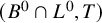 $(B^0\cap L^0, T)$
. We then have
$(B^0\cap L^0, T)$
. We then have
 $$ \begin{align} \dim G =\dim_{\kappa} {\mathrm{Lie}} G = \dim T +\sum_{\alpha\in \Phi(G^0)} \dim_{\kappa} \mathfrak {g}_{\alpha}, \end{align} $$
 $$ \begin{align} \dim L = \dim_{\kappa} {\mathrm{Lie}} L = \dim T + \sum_{\alpha\in \Phi(L^0)} \dim_{\kappa} \mathfrak {g}_{\alpha}. \end{align} $$
If $\Phi ^+(L^0)$
contains all simple roots of
$\Phi ^+(L^0)$
contains all simple roots of $\Phi ^+(G^0)$
then
$\Phi ^+(G^0)$
then $\Phi (L^0)=\Phi (G^0)$
and hence
$\Phi (L^0)=\Phi (G^0)$
and hence $L^0=G^0$
. Thus there is a simple root
$L^0=G^0$
. Thus there is a simple root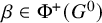 $\beta \in \Phi ^+(G^0)$
, such that
$\beta \in \Phi ^+(G^0)$
, such that $\beta \not \in \Phi ^+(L^0)$
. It follows from (43), (44) and the assumption
$\beta \not \in \Phi ^+(L^0)$
. It follows from (43), (44) and the assumption $\dim G-\dim L=2$
that
$\dim G-\dim L=2$
that $\Phi (G^0)$
is a disjoint union of
$\Phi (G^0)$
is a disjoint union of $\Phi (L^0)$
and
$\Phi (L^0)$
and $\{\beta , -\beta \}$
. Let
$\{\beta , -\beta \}$
. Let $U_{\alpha }$
be the root subgroup of
$U_{\alpha }$
be the root subgroup of $G^0$
corresponding to
$G^0$
corresponding to $\alpha $
. If
$\alpha $
. If $\alpha \in \Phi (L^0)$
then
$\alpha \in \Phi (L^0)$
then $r \alpha \pm s\beta $
is not a root of G for any integers
$r \alpha \pm s\beta $
is not a root of G for any integers $r, s>0$
, it follows from assertion
$r, s>0$
, it follows from assertion $(\ast )$
in the proof of [Reference Borel9, 14.5] that the commutator
$(\ast )$
in the proof of [Reference Borel9, 14.5] that the commutator $(U_{\alpha }, U_{\pm \beta })$
vanishes.
$(U_{\alpha }, U_{\pm \beta })$
vanishes.
We have $\overline {G}{}^0\cong G^0/Z(G^0)$
, and hence
$\overline {G}{}^0\cong G^0/Z(G^0)$
, and hence $\overline {G}{}^0$
is semisimple by [Reference Borel9, Corollary 14.2(a)]. Let
$\overline {G}{}^0$
is semisimple by [Reference Borel9, Corollary 14.2(a)]. Let $H_1$
be the closed subgroup of
$H_1$
be the closed subgroup of $\overline {G}{}^0$
generated by the subgroups
$\overline {G}{}^0$
generated by the subgroups $U_{\alpha }$
for
$U_{\alpha }$
for $\alpha \in \Phi (L^0)$
and let
$\alpha \in \Phi (L^0)$
and let $H_2$
be the closed subgroup of
$H_2$
be the closed subgroup of $\overline {G}{}^0$
generated by
$\overline {G}{}^0$
generated by $U_{\beta }$
and
$U_{\beta }$
and $U_{-\beta }$
. Arguing as in the proof of [Reference Borel9, Proposition 14.2 (2)] we deduce that
$U_{-\beta }$
. Arguing as in the proof of [Reference Borel9, Proposition 14.2 (2)] we deduce that $H_1$
centralises
$H_1$
centralises $H_2$
,
$H_2$
, $H_1$
and
$H_1$
and $H_2$
generate
$H_2$
generate $\overline {G}{}^0$
as a group, and
$\overline {G}{}^0$
as a group, and $H_1\cap H_2$
is contained in the centre of
$H_1\cap H_2$
is contained in the centre of $\overline {G}{}^0$
. Since the centre of
$\overline {G}{}^0$
. Since the centre of $\overline {G}{}^0$
is trivial, we deduce that
$\overline {G}{}^0$
is trivial, we deduce that $\overline {G}{}^0\cong H_1\times H_2$
. Moreover, by [Reference Conrad19, Lemma 1.2.3] there is a central isogeny
$\overline {G}{}^0\cong H_1\times H_2$
. Moreover, by [Reference Conrad19, Lemma 1.2.3] there is a central isogeny $H_2\rightarrow {\mathrm {PGL}}_2$
. The centre of
$H_2\rightarrow {\mathrm {PGL}}_2$
. The centre of $H_2$
lies in the centre of
$H_2$
lies in the centre of $\overline {G}{}^0$
and hence is trivial, so that
$\overline {G}{}^0$
and hence is trivial, so that $H_2\cong {\mathrm {PGL}}_2$
.
$H_2\cong {\mathrm {PGL}}_2$
.
For each simple root $\alpha $
in
$\alpha $
in $\Phi ^+(G^0)$
we fix an isomorphism
$\Phi ^+(G^0)$
we fix an isomorphism $p_{\alpha }: \mathbb G_{a} \overset {\cong }{\longrightarrow } U_{\alpha }$
. Let
$p_{\alpha }: \mathbb G_{a} \overset {\cong }{\longrightarrow } U_{\alpha }$
. Let $\Theta $
be the subgroup of
$\Theta $
be the subgroup of ${\mathrm {Aut}}(G^0)$
consisting of automorphisms that preserve the pinning
${\mathrm {Aut}}(G^0)$
consisting of automorphisms that preserve the pinning $((G^0, B^0, T), \{p_{\alpha }\}_{\alpha })$
. Theorem 7.1.9 in [Reference Conrad19] gives an isomorphism of group schemes over
$((G^0, B^0, T), \{p_{\alpha }\}_{\alpha })$
. Theorem 7.1.9 in [Reference Conrad19] gives an isomorphism of group schemes over $\kappa $
:
$\kappa $
:
 $$ \begin{align*}{\mathrm{Aut}}(G^0)\cong \overline{G}{}^0\rtimes \Theta.\end{align*} $$
If $\Theta '$
is a subgroup of
$\Theta '$
is a subgroup of $\Theta $
then there is a unique subgroup H of
$\Theta $
then there is a unique subgroup H of ${\mathrm {Aut}}(G^0)$
, such that H contains
${\mathrm {Aut}}(G^0)$
, such that H contains $\overline {G}{}^0$
, and the image of H in
$\overline {G}{}^0$
, and the image of H in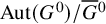 ${\mathrm {Aut}}(G^0)/\overline {G}{}^0$
is equal to
${\mathrm {Aut}}(G^0)/\overline {G}{}^0$
is equal to $\Theta '$
, namely the inverse image of
$\Theta '$
, namely the inverse image of $\Theta '$
. Uniqueness implies that
$\Theta '$
. Uniqueness implies that $H\cong \overline {G}{}^0\rtimes \Theta '$
. Let
$H\cong \overline {G}{}^0\rtimes \Theta '$
. Let $\Delta $
be the unique subgroup of
$\Delta $
be the unique subgroup of $\Theta $
, such that
$\Theta $
, such that $\Delta $
maps isomorphically onto
$\Delta $
maps isomorphically onto $\overline {G}/\overline {G}{}^0 \subseteq {\mathrm {Aut}}(G^0)/\overline {G}{}^0$
. Then by the previous remark
$\overline {G}/\overline {G}{}^0 \subseteq {\mathrm {Aut}}(G^0)/\overline {G}{}^0$
. Then by the previous remark $\overline {G}\cong \overline {G}{}^0\rtimes \Delta $
. We claim that every
$\overline {G}\cong \overline {G}{}^0\rtimes \Delta $
. We claim that every $\delta \in \Delta $
maps
$\delta \in \Delta $
maps $\Phi ^+(L^0)$
to itself. The claim implies that
$\Phi ^+(L^0)$
to itself. The claim implies that $\Delta $
fixes
$\Delta $
fixes $\beta $
, and since it fixes the pinning
$\beta $
, and since it fixes the pinning $\Delta $
acts trivially on
$\Delta $
acts trivially on $H_2$
. Thus
$H_2$
. Thus $\overline {G}\cong (H_1\rtimes \Delta ) \times {\mathrm {PGL}}_2$
and the proposition follows.
$\overline {G}\cong (H_1\rtimes \Delta ) \times {\mathrm {PGL}}_2$
and the proposition follows.
To prove the claim we use the assumption that the map $L/L^0\rightarrow G/G^0$
is an isomorphism. Thus given
$L/L^0\rightarrow G/G^0$
is an isomorphism. Thus given $\delta \in \Delta $
we may find
$\delta \in \Delta $
we may find $g\in L(\kappa )$
,
$g\in L(\kappa )$
, $h_1\in H_1(\kappa )$
and
$h_1\in H_1(\kappa )$
and $h_2\in H_2(\kappa )$
, such that for all
$h_2\in H_2(\kappa )$
, such that for all $u\in U_{\alpha }$
we have
$u\in U_{\alpha }$
we have $\delta (u)= (h_1, h_2) g u g^{-1} (h_1, h_2)^{-1}$
. The image of
$\delta (u)= (h_1, h_2) g u g^{-1} (h_1, h_2)^{-1}$
. The image of $gug^{-1}$
in
$gug^{-1}$
in $\overline {G}{}^0$
lies in
$\overline {G}{}^0$
lies in $H_1$
as L normalises
$H_1$
as L normalises $H_1$
. (It follows from the argument in the proof of [Reference Borel9, Proposition 14.10 (3)] that the closed subgroup of L generated by
$H_1$
. (It follows from the argument in the proof of [Reference Borel9, Proposition 14.10 (3)] that the closed subgroup of L generated by $U_{\alpha }$
for all
$U_{\alpha }$
for all $\alpha \in \Phi (L^0)$
is the derived subgroup of
$\alpha \in \Phi (L^0)$
is the derived subgroup of $L^0$
and thus is normal in L.) Thus
$L^0$
and thus is normal in L.) Thus $\delta (u)$
lies in
$\delta (u)$
lies in $H_1$
, as
$H_1$
, as $h_2$
centralises
$h_2$
centralises $H_1$
. Hence
$H_1$
. Hence $\delta (\alpha )\neq \pm \beta $
and this finishes the proof of the claim.
$\delta (\alpha )\neq \pm \beta $
and this finishes the proof of the claim.
Corollary 11.2. The map $G'\rightarrow \overline {G}$
induces an isomorphism of G-representations:
$G'\rightarrow \overline {G}$
induces an isomorphism of G-representations:
 $$ \begin{align*}{\mathrm{Lie}} G^{\prime}_{\operatorname{sc}} \cong {\mathrm{Lie}} \overline{G}_{\operatorname{sc}} \cong {\mathrm{Lie}} {\mathrm{SL}}_2 \oplus {\mathrm{Lie}} (G_1')_{\operatorname{sc}}.\end{align*} $$
Proof. Since $\overline {G}{}^0 \cong G^0/Z(G^0)$
, the map
$\overline {G}{}^0 \cong G^0/Z(G^0)$
, the map $G'\rightarrow \overline {G}{}^0$
is a central isogeny and hence they have the same simply connected central cover, which induces the first isomorphism. The second isomorphism follows from Proposition 11.1.
$G'\rightarrow \overline {G}{}^0$
is a central isogeny and hence they have the same simply connected central cover, which induces the first isomorphism. The second isomorphism follows from Proposition 11.1.
Let $p_2: G\rightarrow {\mathrm {PGL}}_2$
be the composition of the quotient map
$p_2: G\rightarrow {\mathrm {PGL}}_2$
be the composition of the quotient map $G\rightarrow \overline {G}$
with the projection map
$G\rightarrow \overline {G}$
with the projection map $\overline {G}\rightarrow {\mathrm {PGL}}_2$
onto the second component. Let
$\overline {G}\rightarrow {\mathrm {PGL}}_2$
onto the second component. Let $H_0$
be the preimage of
$H_0$
be the preimage of $\mu _{p-1}\subset T_2$
in G under
$\mu _{p-1}\subset T_2$
in G under $p_2$
.
$p_2$
.
Lemma 11.3. $H_0$
is generalised reductive and
$H_0$
is generalised reductive and $\dim Z(H_0)< \dim Z(L)$
.
$\dim Z(H_0)< \dim Z(L)$
.
Proof. If $H_0$
is contained in a proper R-parabolic of L then the image of
$H_0$
is contained in a proper R-parabolic of L then the image of $H_0$
is contained in a proper R-parabolic of
$H_0$
is contained in a proper R-parabolic of $\overline {L}$
. This would imply that
$\overline {L}$
. This would imply that $Z(\overline {L}) \overline {H}_0$
is contained in a proper R-parabolic of
$Z(\overline {L}) \overline {H}_0$
is contained in a proper R-parabolic of $\overline {L}$
, which is not possible as Proposition 11.1 implies that
$\overline {L}$
, which is not possible as Proposition 11.1 implies that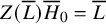 $Z(\overline {L}) \overline {H}_0= \overline {L}$
. Lemma 6.2 in [Reference Martin42] implies that
$Z(\overline {L}) \overline {H}_0= \overline {L}$
. Lemma 6.2 in [Reference Martin42] implies that $H_0$
is reductive and
$H_0$
is reductive and $Z_{L}(H_0)^0= Z(L)^0$
. Since
$Z_{L}(H_0)^0= Z(L)^0$
. Since $H_0\subseteq L$
we have
$H_0\subseteq L$
we have $Z(H_0)\subseteq Z_{L}(H_0)$
and hence
$Z(H_0)\subseteq Z_{L}(H_0)$
and hence $Z(H_0)^0 \subseteq Z(L)^0$
. If
$Z(H_0)^0 \subseteq Z(L)^0$
. If $\dim Z(H_0)= \dim Z(L)$
then the quotient would be
$\dim Z(H_0)= \dim Z(L)$
then the quotient would be $0$
-dimensional and connected and hence
$0$
-dimensional and connected and hence ${Z(H_0)^0 = Z(L)^0}$
. Thus it is enough to produce a cocharacter
${Z(H_0)^0 = Z(L)^0}$
. Thus it is enough to produce a cocharacter $\lambda : \mathbb G_{m}\rightarrow Z(L)$
, such that its image is not contained in
$\lambda : \mathbb G_{m}\rightarrow Z(L)$
, such that its image is not contained in $H_0$
.
$H_0$
.
We have an exact sequence $0\rightarrow Z(G^0)\rightarrow L^0 \rightarrow \overline {L}{}^0\rightarrow 0$
. Since
$0\rightarrow Z(G^0)\rightarrow L^0 \rightarrow \overline {L}{}^0\rightarrow 0$
. Since $L^0$
is reductive we have a surjection
$L^0$
is reductive we have a surjection $Z(L^0)\twoheadrightarrow Z(\overline {L}{}^0)$
. The group of components of L, which we denote by
$Z(L^0)\twoheadrightarrow Z(\overline {L}{}^0)$
. The group of components of L, which we denote by $\Delta $
, acts on both groups and induces a finite map on invariants
$\Delta $
, acts on both groups and induces a finite map on invariants $Z(L^0)^{\Delta } \rightarrow Z(\overline {L}{}^0)^{\Delta }$
. Hence, the quotient is
$Z(L^0)^{\Delta } \rightarrow Z(\overline {L}{}^0)^{\Delta }$
. Hence, the quotient is $0$
-dimensional and hence every cocharacter
$0$
-dimensional and hence every cocharacter $\mu :\mathbb G_{m}\rightarrow Z(\overline {L}{}^0)^{\Delta }$
can be lifted to a cocharacter
$\mu :\mathbb G_{m}\rightarrow Z(\overline {L}{}^0)^{\Delta }$
can be lifted to a cocharacter $\tilde {\mu }: \mathbb G_{m}\rightarrow Z(L^0)^{\Delta }$
. Let
$\tilde {\mu }: \mathbb G_{m}\rightarrow Z(L^0)^{\Delta }$
. Let $\mu : \mathbb G_{m} \rightarrow \overline {L}=G_1\times \mathbb G_{m}$
be the cocharacter
$\mu : \mathbb G_{m} \rightarrow \overline {L}=G_1\times \mathbb G_{m}$
be the cocharacter $t\mapsto (1,t)$
. The image of
$t\mapsto (1,t)$
. The image of $\mu $
is contained in
$\mu $
is contained in $Z^0(\overline {L})^{\Delta }$
. Its lift
$Z^0(\overline {L})^{\Delta }$
. Its lift $\tilde {\mu }$
takes values in
$\tilde {\mu }$
takes values in $Z(L^0)^{\Delta }= Z(L)\cap L^0$
, see the proof of Proposition 2.9. If the image of
$Z(L^0)^{\Delta }= Z(L)\cap L^0$
, see the proof of Proposition 2.9. If the image of $\tilde {\mu }$
is contained in
$\tilde {\mu }$
is contained in $H_0$
, then the image of
$H_0$
, then the image of $\mu $
would be contained in
$\mu $
would be contained in $\overline {H}_0$
, which is not the case.
$\overline {H}_0$
, which is not the case.
The following Lemma is essentially [Reference Böckle, Iyengar and Paškūnas6, Lemma 4.2], but made to work for all F and not just $\mathbb {Q}_2$
.
$\mathbb {Q}_2$
.
Lemma 11.4. Let $\rho : \Gamma _F \rightarrow B_2(\kappa )$
be a representation and let
$\rho : \Gamma _F \rightarrow B_2(\kappa )$
be a representation and let $\psi : \Gamma _F \rightarrow \kappa ^{\times }$
be the character
$\psi : \Gamma _F \rightarrow \kappa ^{\times }$
be the character $\psi : \Gamma _F \overset {\rho }{\longrightarrow } B_2(\kappa )\rightarrow B_2(\kappa )/U_2(\kappa ) \overset {\alpha }{\longrightarrow } \mathbb G_{m}(\kappa ).$
If the following hold:
$\psi : \Gamma _F \overset {\rho }{\longrightarrow } B_2(\kappa )\rightarrow B_2(\kappa )/U_2(\kappa ) \overset {\alpha }{\longrightarrow } \mathbb G_{m}(\kappa ).$
If the following hold:
-
(1)
$\psi \neq \omega ^{\pm 1}$
, where
$\omega = \chi _{\mathrm {cyc}} \otimes _{\mathbb {Z}_p} \kappa $
; -
(2)
$\rho (\Gamma _F)$
is not contained in any maximal split torus in
$B_2$
;




then $h^0(\Gamma _F, ({\mathrm {Lie}} {\mathrm {SL}}_2)^*(1))=0$
, where the action of
$h^0(\Gamma _F, ({\mathrm {Lie}} {\mathrm {SL}}_2)^*(1))=0$
, where the action of $\Gamma _F$
on
$\Gamma _F$
on ${\mathrm {Lie}} {\mathrm {SL}}_2$
is given by
${\mathrm {Lie}} {\mathrm {SL}}_2$
is given by $\rho $
composed with the adjoint action of
$\rho $
composed with the adjoint action of ${\mathrm {PGL}}_2$
.
${\mathrm {PGL}}_2$
.
Proof. Let $M_2(\kappa )$
be the space of
$M_2(\kappa )$
be the space of $2\times 2$
-matrices over
$2\times 2$
-matrices over $\kappa $
. We may identify
$\kappa $
. We may identify ${\mathrm {Lie}} {\mathrm {SL}}_2$
with the subspace of trace zero matrices. The quadratic form
${\mathrm {Lie}} {\mathrm {SL}}_2$
with the subspace of trace zero matrices. The quadratic form $(A, B)\mapsto {\mathrm {tr}}(AB)$
identifies
$(A, B)\mapsto {\mathrm {tr}}(AB)$
identifies $({\mathrm {Lie}} {\mathrm {SL}}_2)^*$
with the quotient of
$({\mathrm {Lie}} {\mathrm {SL}}_2)^*$
with the quotient of $M_2(\kappa )$
by the scalar matrices, and this isomorphism is
$M_2(\kappa )$
by the scalar matrices, and this isomorphism is ${\mathrm {PGL}}_2$
-equivariant for the adjoint action on
${\mathrm {PGL}}_2$
-equivariant for the adjoint action on $M_2(\kappa )$
. We denote the resulting representation of
$M_2(\kappa )$
. We denote the resulting representation of $\Gamma _F$
by
$\Gamma _F$
by $\overline {{\mathrm {ad}}} \rho $
. For
$\overline {{\mathrm {ad}}} \rho $
. For $i, j\in \{1,2\}$
let
$i, j\in \{1,2\}$
let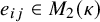 $e_{ij}\in M_2(\kappa )$
be the matrix with
$e_{ij}\in M_2(\kappa )$
be the matrix with $ij$
-entry equal to
$ij$
-entry equal to $1$
and the rest of entries equal to zero, and let
$1$
and the rest of entries equal to zero, and let $\bar {e}_{ij}$
be the image of
$\bar {e}_{ij}$
be the image of $e_{ij}$
in
$e_{ij}$
in $\overline {{\mathrm {ad}}} \rho $
. Then
$\overline {{\mathrm {ad}}} \rho $
. Then $\bar {e}_{12}$
,
$\bar {e}_{12}$
, $\bar {e}_{11}$
,
$\bar {e}_{11}$
, $\bar {e}_{21}$
is a basis of
$\bar {e}_{21}$
is a basis of $\overline {{\mathrm {ad}}} \rho $
as a
$\overline {{\mathrm {ad}}} \rho $
as a $\kappa $
-vector space.
$\kappa $
-vector space.
The subgroup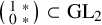 $\bigl (\begin {smallmatrix} 1 & \ast \\ 0 & \ast \end {smallmatrix}\bigr )\subset {\mathrm {GL}}_2$
maps isomorphically onto
$\bigl (\begin {smallmatrix} 1 & \ast \\ 0 & \ast \end {smallmatrix}\bigr )\subset {\mathrm {GL}}_2$
maps isomorphically onto $B_2$
. Thus there is a representation
$B_2$
. Thus there is a representation ${\tilde {\rho }: \Gamma _F \rightarrow {\mathrm {GL}}_2(\kappa )}$
such that
${\tilde {\rho }: \Gamma _F \rightarrow {\mathrm {GL}}_2(\kappa )}$
such that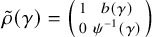 $ \tilde {\rho }(\gamma )= \left (\begin {smallmatrix} 1 & b(\gamma )\\ 0 & \psi ^{-1}(\gamma )\end {smallmatrix}\right )$
, for all
$ \tilde {\rho }(\gamma )= \left (\begin {smallmatrix} 1 & b(\gamma )\\ 0 & \psi ^{-1}(\gamma )\end {smallmatrix}\right )$
, for all $\gamma \in \Gamma _F,$
and
$\gamma \in \Gamma _F,$
and $\rho (\gamma )$
is equal to
$\rho (\gamma )$
is equal to $\tilde {\rho }(\gamma )$
modulo the scalar matrices. A direct computation of
$\tilde {\rho }(\gamma )$
modulo the scalar matrices. A direct computation of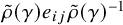 $\tilde {\rho }(\gamma ) e_{ij} \tilde {\rho }(\gamma )^{-1}$
, shows that the action of
$\tilde {\rho }(\gamma ) e_{ij} \tilde {\rho }(\gamma )^{-1}$
, shows that the action of $\Gamma _F$
on
$\Gamma _F$
on $({\mathrm {Lie}} {\mathrm {SL}}_2)^*(1)$
is given on the basis as follows:
$({\mathrm {Lie}} {\mathrm {SL}}_2)^*(1)$
is given on the basis as follows:
 $$ \begin{align*} \begin{aligned} &\gamma \cdot \bar{e}_{12}= \omega(\gamma)\psi(\gamma) \bar{e}_{12}, \quad \gamma \cdot \bar{e}_{11}= \omega(\gamma) \bar{e}_{11}- \omega(\gamma) \psi(\gamma)b(\gamma) \bar{e}_{12},\\ &\gamma \cdot \bar{e}_{21} = \omega(\gamma) \psi^{-1}(\gamma)\bar{e}_{21} -\omega(\gamma) \psi(\gamma) b(\gamma)^2 \bar{e}_{12}. \end{aligned} \end{align*} $$
Thus the flag $\langle \bar {e}_{12}\rangle \subset \langle \bar {e}_{12}, \bar {e}_{11}\rangle \subset \langle \bar {e}_{12}, \bar {e}_{11}, \bar {e}_{21}\rangle $
is
$\langle \bar {e}_{12}\rangle \subset \langle \bar {e}_{12}, \bar {e}_{11}\rangle \subset \langle \bar {e}_{12}, \bar {e}_{11}, \bar {e}_{21}\rangle $
is $\Gamma _F$
-stable and the action on the graded pieces is given by the characters
$\Gamma _F$
-stable and the action on the graded pieces is given by the characters $\omega \psi $
,
$\omega \psi $
, $\omega $
,
$\omega $
, $\omega \psi ^{-1}$
. Since
$\omega \psi ^{-1}$
. Since $\omega \psi ^{-1}$
and
$\omega \psi ^{-1}$
and $\omega \psi $
are non-trivial by assumption, if
$\omega \psi $
are non-trivial by assumption, if $h^0(\Gamma _F, ({\mathrm {Lie}} {\mathrm {SL}}_2)^*(1))\neq 0$
then
$h^0(\Gamma _F, ({\mathrm {Lie}} {\mathrm {SL}}_2)^*(1))\neq 0$
then $\omega $
is trivial and the
$\omega $
is trivial and the $\Gamma _F$
-invariants are of the form
$\Gamma _F$
-invariants are of the form $\langle \bar {e}_{11} + \lambda \bar {e}_{12}\rangle $
for some
$\langle \bar {e}_{11} + \lambda \bar {e}_{12}\rangle $
for some $\lambda \in \kappa $
. A calculation shows that this is equivalent to
$\lambda \in \kappa $
. A calculation shows that this is equivalent to $\lambda \psi (\gamma )= b(\gamma )+\lambda $
for all
$\lambda \psi (\gamma )= b(\gamma )+\lambda $
for all $\gamma \in \Gamma _F$
, and a further calculation shows that this is equivalent to
$\gamma \in \Gamma _F$
, and a further calculation shows that this is equivalent to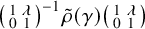 $\bigl (\begin {smallmatrix} 1 & \lambda \\ 0 & 1\end {smallmatrix} \bigr )^{-1} \tilde {\rho }(\gamma ) \bigl (\begin {smallmatrix} 1 & \lambda \\ 0 & 1\end {smallmatrix} \bigr )$
being a diagonal matrix for all
$\bigl (\begin {smallmatrix} 1 & \lambda \\ 0 & 1\end {smallmatrix} \bigr )^{-1} \tilde {\rho }(\gamma ) \bigl (\begin {smallmatrix} 1 & \lambda \\ 0 & 1\end {smallmatrix} \bigr )$
being a diagonal matrix for all $\gamma \in \Gamma _F$
, which would contradict assumption (2).
$\gamma \in \Gamma _F$
, which would contradict assumption (2).
Proposition 11.5. Let $\rho : \Gamma _F\rightarrow P(\kappa )$
be a representation such that the following hold:
$\rho : \Gamma _F\rightarrow P(\kappa )$
be a representation such that the following hold:
-
(1)
$\rho (\Gamma _F)$
is not contained in an R-Levi of P; -
(2) the G-semisimplification of
$\rho $
is not contained in
$H_0$
; -
(3)
$h^0(\Gamma _F, ({\mathrm {Lie}} (G^{\prime }_1)_{\operatorname {sc}})^*(1))=0$
.



Then $h^0(\Gamma _F, ({\mathrm {Lie}} G^{\prime }_{\operatorname {sc}})^*(1))=0$
.
$h^0(\Gamma _F, ({\mathrm {Lie}} G^{\prime }_{\operatorname {sc}})^*(1))=0$
.
Proof. Lemma 11.2 gives us an isomorphism of G-representations
 $$ \begin{align*}({\mathrm{Lie}} G^{\prime}_{\operatorname{sc}})^*\cong ({\mathrm{Lie}} {\mathrm{SL}}_2)^* \oplus ({\mathrm{Lie}} (G_1')_{\operatorname{sc}})^*,\end{align*} $$
and assumption (3) implies that it is enough to show that $h^0(\Gamma _F, ({\mathrm {Lie}} {\mathrm {SL}}_2)^*(1))=0$
.
$h^0(\Gamma _F, ({\mathrm {Lie}} {\mathrm {SL}}_2)^*(1))=0$
.
Let $\rho _2: \Gamma _F \rightarrow {\mathrm {PGL}}_2(\kappa )$
be the composition of
$\rho _2: \Gamma _F \rightarrow {\mathrm {PGL}}_2(\kappa )$
be the composition of $\rho $
with
$\rho $
with $p_2$
. The action of
$p_2$
. The action of $\Gamma _F$
on
$\Gamma _F$
on $({\mathrm {Lie}} {\mathrm {SL}}_2)^*$
factors through
$({\mathrm {Lie}} {\mathrm {SL}}_2)^*$
factors through $\rho _2$
. Thus it is enough to verify that
$\rho _2$
. Thus it is enough to verify that $\rho _2$
satisfies the assumptions of Lemma 11.4.
$\rho _2$
satisfies the assumptions of Lemma 11.4.
If $\rho _2(\Gamma _F)$
is contained in a maximal split torus of
$\rho _2(\Gamma _F)$
is contained in a maximal split torus of $B_2$
then there exists
$B_2$
then there exists $u_2\in U_2(\kappa )$
such that
$u_2\in U_2(\kappa )$
such that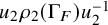 $u_2 \rho _2(\Gamma _F) u^{-1}_2$
is contained in
$u_2 \rho _2(\Gamma _F) u^{-1}_2$
is contained in $T_2(\kappa )$
. Since
$T_2(\kappa )$
. Since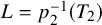 $L= p_2^{-1}(T_2)$
and
$L= p_2^{-1}(T_2)$
and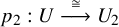 $p_2: U\overset {\cong }{\longrightarrow } U_2$
, there is
$p_2: U\overset {\cong }{\longrightarrow } U_2$
, there is $u\in U(\kappa )$
such that
$u\in U(\kappa )$
such that $u \rho (\Gamma _F) u^{-1}$
is contained in
$u \rho (\Gamma _F) u^{-1}$
is contained in $L(\kappa )$
. Since
$L(\kappa )$
. Since $u^{-1} L u$
is an R-Levi of G we obtain a contradiction to assumption (1).
$u^{-1} L u$
is an R-Levi of G we obtain a contradiction to assumption (1).
Let $\psi :\Gamma _F \rightarrow \kappa ^{\times }$
be a character associated to
$\psi :\Gamma _F \rightarrow \kappa ^{\times }$
be a character associated to $\rho _2$
in Lemma 11.4. If
$\rho _2$
in Lemma 11.4. If $\psi = \omega $
or
$\psi = \omega $
or $\psi = \omega ^{-1}$
then
$\psi = \omega ^{-1}$
then $\psi ^{p-1}=1$
. Thus
$\psi ^{p-1}=1$
. Thus $\rho _2(\Gamma _F)$
is contained in
$\rho _2(\Gamma _F)$
is contained in $\mu _{p-1}(\kappa ) U_2(\kappa )$
. In the proof of Lemma 11.3 we have constructed a cocharacter
$\mu _{p-1}(\kappa ) U_2(\kappa )$
. In the proof of Lemma 11.3 we have constructed a cocharacter $\lambda : \mathbb G_{m}\rightarrow Z(L)$
such that
$\lambda : \mathbb G_{m}\rightarrow Z(L)$
such that $p_2\circ \lambda : \mathbb G_{m}\rightarrow T_2$
is the unique cocharacter satisfying
$p_2\circ \lambda : \mathbb G_{m}\rightarrow T_2$
is the unique cocharacter satisfying $\alpha \circ p_2\circ \lambda ={\mathrm {id}}$
. Then
$\alpha \circ p_2\circ \lambda ={\mathrm {id}}$
. Then $\lim _{t\rightarrow 0} p_2(\lambda (t)) U_2 p_2(\lambda (t))^{-1}= \{1\}$
. Since
$\lim _{t\rightarrow 0} p_2(\lambda (t)) U_2 p_2(\lambda (t))^{-1}= \{1\}$
. Since $p_2: G\rightarrow {\mathrm {PGL}}_2$
is a group homomorphism, which induces an isomorphism between U and
$p_2: G\rightarrow {\mathrm {PGL}}_2$
is a group homomorphism, which induces an isomorphism between U and $U_2$
, we conclude that
$U_2$
, we conclude that
 $$ \begin{align*}\lim_{t\rightarrow 0} \lambda(t) \rho(\Gamma_F) \lambda(t)^{-1}\subset \lim_{t\rightarrow 0} \lambda(t) H_0(\kappa)\lambda(t)^{-1}= H_0(\kappa),\end{align*} $$
as $H_0$
is a subgroup of L and
$H_0$
is a subgroup of L and $\lambda $
takes values in
$\lambda $
takes values in $Z(L)$
. But this contradicts the assumption (2).
$Z(L)$
. But this contradicts the assumption (2).
12 Dimension of fibres
Let $\mathfrak {p}$
be a prime ideal of
$\mathfrak {p}$
be a prime ideal of $R^{\mathrm {ps}}_G$
such that
$R^{\mathrm {ps}}_G$
such that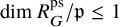 $\dim R^{\mathrm {ps}}_G/\mathfrak {p} \le 1$
. Then
$\dim R^{\mathrm {ps}}_G/\mathfrak {p} \le 1$
. Then $\kappa (\mathfrak {p})$
is either a finite or a local field, which we equip with its natural topology. We denote by y the homomorphism
$\kappa (\mathfrak {p})$
is either a finite or a local field, which we equip with its natural topology. We denote by y the homomorphism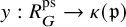 $y: R^{\mathrm {ps}}_{G} \rightarrow \kappa (\mathfrak {p})$
and by
$y: R^{\mathrm {ps}}_{G} \rightarrow \kappa (\mathfrak {p})$
and by $\bar {y}$
the composition of y with an embedding of
$\bar {y}$
the composition of y with an embedding of $\kappa (\mathfrak {p})$
into its algebraic closure
$\kappa (\mathfrak {p})$
into its algebraic closure $\overline {\kappa (\mathfrak {p})}$
. We equip
$\overline {\kappa (\mathfrak {p})}$
. We equip $\overline {\kappa (\mathfrak {p})}$
with its natural topology, extending the topology on
$\overline {\kappa (\mathfrak {p})}$
with its natural topology, extending the topology on $\kappa (\mathfrak {p})$
. The goal of this section is to bound the dimension of
$\kappa (\mathfrak {p})$
. The goal of this section is to bound the dimension of
 $$ \begin{align*}X^{\mathrm{gen}}_{G, y}:= X^{\mathrm{gen}}_{G, \overline{\rho}^{\mathrm{ss}}} \times_{X^{\mathrm{ps}}_G} y = X^{\mathrm{gen}, \tau}_G\times_{X^{\mathrm{ps}}_{G}} y\end{align*} $$
from above in Proposition 12.15.
Lemma 12.1. There is a unique point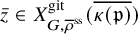 $\bar {z}\in X^{\mathrm {git}}_{G, \overline {\rho }^{\mathrm {ss}}}(\overline {\kappa (\mathfrak {p})})$
mapping to
$\bar {z}\in X^{\mathrm {git}}_{G, \overline {\rho }^{\mathrm {ss}}}(\overline {\kappa (\mathfrak {p})})$
mapping to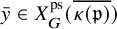 $\bar {y}\in X^{\mathrm {ps}}_G(\overline {\kappa (\mathfrak {p})})$
. Moreover, the map
$\bar {y}\in X^{\mathrm {ps}}_G(\overline {\kappa (\mathfrak {p})})$
. Moreover, the map
 $$ \begin{align*}X^{\mathrm{gen}}_{G, \overline{\rho}^{\mathrm{ss}}}\times_{X^{\mathrm{git}}_{G, \overline{\rho}^{\mathrm{ss}}}} \bar{z}\rightarrow X^{\mathrm{gen}}_{G, \overline{\rho}^{\mathrm{ss}}}\times_{X^{\mathrm{ps}}_{G}} \bar{y}\end{align*} $$
induces an isomorphism of underlying reduced subschemes.
Proof. Proposition 7.4 implies that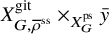 $X^{\mathrm {git}}_{G, \overline {\rho }^{\mathrm {ss}}}\times _{X^{\mathrm {ps}}_{G}} \bar {y}$
is finite over
$X^{\mathrm {git}}_{G, \overline {\rho }^{\mathrm {ss}}}\times _{X^{\mathrm {ps}}_{G}} \bar {y}$
is finite over $\bar {y}$
and its underlying topological space is a point. This implies the assertion.
$\bar {y}$
and its underlying topological space is a point. This implies the assertion.
We assumeFootnote
9
that G is split over $\mathscr O$
and let T be a maximal split torus in G defined over
$\mathscr O$
and let T be a maximal split torus in G defined over $\mathscr O$
. Lemma 12.1 and Corollary 6.11 imply that there is
$\mathscr O$
. Lemma 12.1 and Corollary 6.11 imply that there is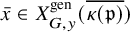 $\bar {x}\in X^{\mathrm {gen}}_{G, y}(\overline {\kappa (\mathfrak {p})})$
, an R-Levi subgroup L of G containing T and a continuous
$\bar {x}\in X^{\mathrm {gen}}_{G, y}(\overline {\kappa (\mathfrak {p})})$
, an R-Levi subgroup L of G containing T and a continuous $L_{\bar {y}}$
-irreducible representation
$L_{\bar {y}}$
-irreducible representation $\rho : \Gamma _F \rightarrow L(\kappa (\bar {y}))$
such that
$\rho : \Gamma _F \rightarrow L(\kappa (\bar {y}))$
such that $\rho =\rho _{\bar {x}}$
and the
$\rho =\rho _{\bar {x}}$
and the $G^0$
-orbit of
$G^0$
-orbit of $\bar {x}$
is closed in
$\bar {x}$
is closed in $X^{\mathrm {gen}}_{G, \bar {y}}$
.
$X^{\mathrm {gen}}_{G, \bar {y}}$
.
Remark 12.2. Proposition 7.4 implies that there is a unique point $y'\in X^{\mathrm {git}}_{G, \overline {\rho }^{\mathrm {ss}}}$
mapping to y. It follows from Lemma 12.1 that the fibres of
$y'\in X^{\mathrm {git}}_{G, \overline {\rho }^{\mathrm {ss}}}$
mapping to y. It follows from Lemma 12.1 that the fibres of $X^{\mathrm {gen}}_{G, \overline {\rho }^{\mathrm {ss}}}$
at y and
$X^{\mathrm {gen}}_{G, \overline {\rho }^{\mathrm {ss}}}$
at y and $y'$
have the same dimension. Moreover, if
$y'$
have the same dimension. Moreover, if $\kappa (\mathfrak {p})$
is a local field then
$\kappa (\mathfrak {p})$
is a local field then $y'$
is a closed point of the subscheme
$y'$
is a closed point of the subscheme $U_{LG, \overline {\rho }^{\mathrm {ss}}}$
defined in section 9. Conversely, if y is the image of a closed point of
$U_{LG, \overline {\rho }^{\mathrm {ss}}}$
defined in section 9. Conversely, if y is the image of a closed point of $U_{LG, \overline {\rho }^{\mathrm {ss}}}$
then
$U_{LG, \overline {\rho }^{\mathrm {ss}}}$
then $\kappa (y)$
is a local field and we may take the R-Levi in the above discussion to be equal to L.
$\kappa (y)$
is a local field and we may take the R-Levi in the above discussion to be equal to L.
Let $\mathfrak {q}$
be the kernel of
$\mathfrak {q}$
be the kernel of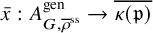 $\bar {x}: A^{\mathrm {gen}}_{G, \overline {\rho }^{\mathrm {ss}}} \rightarrow \overline {\kappa (\mathfrak {p})}$
. We let
$\bar {x}: A^{\mathrm {gen}}_{G, \overline {\rho }^{\mathrm {ss}}} \rightarrow \overline {\kappa (\mathfrak {p})}$
. We let $\kappa :=\kappa (\mathfrak {q})$
, let x be the homomorphism
$\kappa :=\kappa (\mathfrak {q})$
, let x be the homomorphism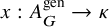 $x: A^{\mathrm {gen}}_G \rightarrow \kappa $
. Then the image of
$x: A^{\mathrm {gen}}_G \rightarrow \kappa $
. Then the image of $\rho $
is contained in
$\rho $
is contained in $L(\kappa )$
. We write
$L(\kappa )$
. We write $\overline {\kappa }$
for
$\overline {\kappa }$
for $\overline {\kappa (\mathfrak {p})}$
. We consider
$\overline {\kappa (\mathfrak {p})}$
. We consider $X^{\mathrm {gen}}_{G, y}$
as a scheme over
$X^{\mathrm {gen}}_{G, y}$
as a scheme over $\kappa $
by considering
$\kappa $
by considering $y: R^{\mathrm {ps}}_{G} \rightarrow \kappa (\mathfrak {p})\hookrightarrow \kappa $
.
$y: R^{\mathrm {ps}}_{G} \rightarrow \kappa (\mathfrak {p})\hookrightarrow \kappa $
.
Let P be any R-parabolic of G which admits L as its R-Levi and let U be the unipotent radical of P.
Definition 12.3. Let $X^{\mathrm {gen}}_{P, \rho }: \kappa \text {-}\mathrm {alg} \to \text {Set}$
be the functor which sends A to the set of
$X^{\mathrm {gen}}_{P, \rho }: \kappa \text {-}\mathrm {alg} \to \text {Set}$
be the functor which sends A to the set of $R^{\mathrm {ps}}_{G}$
-condensed representations
$R^{\mathrm {ps}}_{G}$
-condensed representations $\rho ': \Gamma _F\rightarrow P(A)$
such that
$\rho ': \Gamma _F\rightarrow P(A)$
such that
 $$ \begin{align} \rho'(\gamma)\equiv\rho(\gamma)\otimes_{\kappa} A \pmod{U(A)}, \quad \forall \gamma\in \Gamma. \end{align} $$
Lemma 12.4. The functor $X^{\mathrm {gen}}_{P, \rho }$
is represented by a closed subscheme of
$X^{\mathrm {gen}}_{P, \rho }$
is represented by a closed subscheme of $X^{\mathrm {gen}}_{G, y}$
.
$X^{\mathrm {gen}}_{G, y}$
.
Proof. It follows from Proposition 8.3 that for a $\kappa $
-algebra A,
$\kappa $
-algebra A, $X^{\mathrm {gen}}_{G, y}(A)$
is the set of
$X^{\mathrm {gen}}_{G, y}(A)$
is the set of $R^{\mathrm {ps}}_{G}$
-condensed representations
$R^{\mathrm {ps}}_{G}$
-condensed representations $\rho ':\Gamma _F\rightarrow G(A)$
such that
$\rho ':\Gamma _F\rightarrow G(A)$
such that $\Theta _{\rho '}= \Theta _{\rho }\otimes _{\kappa } A$
. If
$\Theta _{\rho '}= \Theta _{\rho }\otimes _{\kappa } A$
. If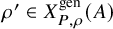 $\rho '\in X^{\mathrm {gen}}_{P, \rho }(A)$
then (45) implies that
$\rho '\in X^{\mathrm {gen}}_{P, \rho }(A)$
then (45) implies that $\Theta _{\rho '}= \Theta _{\rho }\otimes _{\kappa } A$
, and hence
$\Theta _{\rho '}= \Theta _{\rho }\otimes _{\kappa } A$
, and hence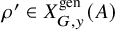 $\rho '\in X^{\mathrm {gen}}_{G, y}(A)$
.
$\rho '\in X^{\mathrm {gen}}_{G, y}(A)$
.
Since $X^{\mathrm {gen},\tau }_G$
is a closed subscheme of
$X^{\mathrm {gen},\tau }_G$
is a closed subscheme of $X^{\mathrm {ps}}_{{\mathrm {GL}}_d}\times G^N$
by Remark 5.8, the map
$X^{\mathrm {ps}}_{{\mathrm {GL}}_d}\times G^N$
by Remark 5.8, the map $\rho ' \mapsto (\rho '(\gamma _1), \ldots , \rho '(\gamma _N))$
identifies
$\rho ' \mapsto (\rho '(\gamma _1), \ldots , \rho '(\gamma _N))$
identifies $X^{\mathrm {gen}}_{G, y}$
with a closed subscheme of
$X^{\mathrm {gen}}_{G, y}$
with a closed subscheme of $G^N_{\kappa }$
. Lemma 4.15 implies that
$G^N_{\kappa }$
. Lemma 4.15 implies that $(X^{\mathrm {gen}}_{G, y}\times _{G^N_{\kappa }} P^N_{\kappa })(A)$
is the set of
$(X^{\mathrm {gen}}_{G, y}\times _{G^N_{\kappa }} P^N_{\kappa })(A)$
is the set of $R^{\mathrm {ps}}_G$
-condensed representations
$R^{\mathrm {ps}}_G$
-condensed representations $\rho ':\Gamma _F \rightarrow P(A)$
such that
$\rho ':\Gamma _F \rightarrow P(A)$
such that $\Theta _{\rho '}=\Theta _{\rho } \otimes _{\kappa } A$
. The proof of Lemma 4.15 shows that an
$\Theta _{\rho '}=\Theta _{\rho } \otimes _{\kappa } A$
. The proof of Lemma 4.15 shows that an $R^{\mathrm {ps}}_G$
-condensed representation
$R^{\mathrm {ps}}_G$
-condensed representation $\rho ': \Gamma _F \rightarrow P(A)$
satisfies (45) if and only if
$\rho ': \Gamma _F \rightarrow P(A)$
satisfies (45) if and only if
 $$ \begin{align*}\rho'(\gamma_i)\equiv \rho(\gamma_i)\quad \pmod{U(A)}, \quad \forall 1\le i\le N.\end{align*} $$
We thus may identify $X^{\mathrm {gen}}_{P, \rho }$
with
$X^{\mathrm {gen}}_{P, \rho }$
with $X^{\mathrm {gen}}_{G, y}\times _{G^N_{\kappa }} P^N_{\kappa } \times _{(P/U)_{\kappa }^N} {\mathrm {Spec}} \kappa $
, where
$X^{\mathrm {gen}}_{G, y}\times _{G^N_{\kappa }} P^N_{\kappa } \times _{(P/U)_{\kappa }^N} {\mathrm {Spec}} \kappa $
, where ${\mathrm {Spec}} \kappa \rightarrow (P/U)_{\kappa }^N$
corresponds to a closed point
${\mathrm {Spec}} \kappa \rightarrow (P/U)_{\kappa }^N$
corresponds to a closed point $(\rho (\gamma _1), \ldots , \rho (\gamma _N))\in (P/U)_{\kappa }^N(\kappa )$
. The claim follows as the fibre products are taken along closed immersions.
$(\rho (\gamma _1), \ldots , \rho (\gamma _N))\in (P/U)_{\kappa }^N(\kappa )$
. The claim follows as the fibre products are taken along closed immersions.
Lemma 12.5. Let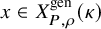 $x\in X^{\mathrm {gen}}_{P, \rho }(\kappa )$
be the point corresponding to
$x\in X^{\mathrm {gen}}_{P, \rho }(\kappa )$
be the point corresponding to $\rho $
and let
$\rho $
and let $T_x X^{\mathrm {gen}}_{P, \rho }$
be the tangent space at x. There is a natural isomorphism
$T_x X^{\mathrm {gen}}_{P, \rho }$
be the tangent space at x. There is a natural isomorphism
 $$ \begin{align} T_x X^{\mathrm{gen}}_{P, \rho} \overset{\cong}{\longrightarrow} Z^1(\Gamma_F, ({\mathrm{Lie}} U)_{\kappa}) \end{align} $$
of $\kappa $
-vector spaces, where the action of
$\kappa $
-vector spaces, where the action of $\Gamma _F$
on
$\Gamma _F$
on $({\mathrm {Lie}} U)_{\kappa }$
is given via the homomorphism
$({\mathrm {Lie}} U)_{\kappa }$
is given via the homomorphism $\rho : \Gamma _F \rightarrow L(\kappa )$
composed with the adjoint action of L on
$\rho : \Gamma _F \rightarrow L(\kappa )$
composed with the adjoint action of L on ${\mathrm {Lie}} U$
.
${\mathrm {Lie}} U$
.
Proof. We may identify $T_x X^{\mathrm {gen}}_{P, \rho }$
with the set of
$T_x X^{\mathrm {gen}}_{P, \rho }$
with the set of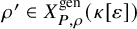 $\rho '\in X^{\mathrm {gen}}_{P, \rho }(\kappa [\varepsilon ])$
such that
$\rho '\in X^{\mathrm {gen}}_{P, \rho }(\kappa [\varepsilon ])$
such that $\rho '\equiv \rho \pmod {\varepsilon }$
, which implies that we may write
$\rho '\equiv \rho \pmod {\varepsilon }$
, which implies that we may write $\rho '(\gamma )= (1 + \varepsilon \beta (\gamma )) \rho (\gamma )$
for a unique function
$\rho '(\gamma )= (1 + \varepsilon \beta (\gamma )) \rho (\gamma )$
for a unique function $\beta : \Gamma _F \rightarrow ({\mathrm {Lie}} U)_{\kappa }$
. Lemma 4.14 implies that
$\beta : \Gamma _F \rightarrow ({\mathrm {Lie}} U)_{\kappa }$
. Lemma 4.14 implies that $\rho ': \Gamma _F \rightarrow P(A)$
is
$\rho ': \Gamma _F \rightarrow P(A)$
is $R^{\mathrm {ps}}_G$
-condensed if and only if
$R^{\mathrm {ps}}_G$
-condensed if and only if $\rho '$
is continuous for the topology on
$\rho '$
is continuous for the topology on $\kappa [\varepsilon ]$
induced by
$\kappa [\varepsilon ]$
induced by $\kappa $
, which is equivalent to continuity of
$\kappa $
, which is equivalent to continuity of $\beta $
. A standard calculation shows that
$\beta $
. A standard calculation shows that $\rho '$
is a representation if and only if
$\rho '$
is a representation if and only if $\beta $
defines a
$\beta $
defines a $1$
-cocycle. Mapping
$1$
-cocycle. Mapping $\rho '$
to
$\rho '$
to $\beta \in Z^1(\Gamma _F, ({\mathrm {Lie}} U)_{\kappa })$
induces the claimed isomorphism.
$\beta \in Z^1(\Gamma _F, ({\mathrm {Lie}} U)_{\kappa })$
induces the claimed isomorphism.
Lemma 12.6. The set $X^{\mathrm {gen}}_{P, \rho }(\overline {\kappa })$
is naturally in bijection with the set of continuous representations
$X^{\mathrm {gen}}_{P, \rho }(\overline {\kappa })$
is naturally in bijection with the set of continuous representations $\rho ':\Gamma _F \rightarrow P(\overline {\kappa })$
, such that
$\rho ':\Gamma _F \rightarrow P(\overline {\kappa })$
, such that $\rho ' \equiv \rho\ \pmod {U(\overline {\kappa })}$
.
$\rho ' \equiv \rho\ \pmod {U(\overline {\kappa })}$
.
Proof. The assertion follows from Lemma 4.14.
Let $\lambda : \mathbb G_{m} \rightarrow G$
be a cocharacter such that
$\lambda : \mathbb G_{m} \rightarrow G$
be a cocharacter such that $P=P_{\lambda }$
and
$P=P_{\lambda }$
and $L=L_{\lambda }$
. Since
$L=L_{\lambda }$
. Since $\lambda $
centralises L and normalises P the adjoint action of
$\lambda $
centralises L and normalises P the adjoint action of $\mathbb G_{m}$
on
$\mathbb G_{m}$
on $X^{\mathrm {gen}}_G$
induces an action of
$X^{\mathrm {gen}}_G$
induces an action of $\mathbb G_{m}$
on
$\mathbb G_{m}$
on $X^{\mathrm {gen}}_{P, \rho }$
.
$X^{\mathrm {gen}}_{P, \rho }$
.
Lemma 12.7. The unique closed $\mathbb G_{m}$
-orbit in
$\mathbb G_{m}$
-orbit in $X^{\mathrm {gen}}_{P, \rho }(\overline {\kappa })$
is the singleton
$X^{\mathrm {gen}}_{P, \rho }(\overline {\kappa })$
is the singleton $\{\rho \}$
.
$\{\rho \}$
.
Proof. Since $\lim _{t\rightarrow 0} \lambda (t) U \lambda (t)^{-1}= 1$
, using Lemma 12.6, we deduce that the closure of any
$\lim _{t\rightarrow 0} \lambda (t) U \lambda (t)^{-1}= 1$
, using Lemma 12.6, we deduce that the closure of any $\mathbb G_{m}$
-orbit in
$\mathbb G_{m}$
-orbit in $X^{\mathrm {gen}}_{P, \rho }(\overline {\kappa })$
will contain
$X^{\mathrm {gen}}_{P, \rho }(\overline {\kappa })$
will contain $\{\rho \}$
, which is a closed
$\{\rho \}$
, which is a closed $\mathbb G_{m}$
-orbit, as it is zero dimensional and
$\mathbb G_{m}$
-orbit, as it is zero dimensional and $\rho (\Gamma _F)\subseteq L(\kappa )$
.
$\rho (\Gamma _F)\subseteq L(\kappa )$
.
Proposition 12.8. Let $x\in X_{P, \rho }^{\mathrm {gen}}$
be the closed point corresponding to
$x\in X_{P, \rho }^{\mathrm {gen}}$
be the closed point corresponding to $\rho $
. Then
$\rho $
. Then
 $$ \begin{align*}\dim X^{\mathrm{gen}}_{P,\rho} \le \dim_{\kappa} T_{x} X^{\mathrm{gen}}_{P, \rho}= \dim U_{\kappa} + \dim U_{\kappa} [F:\mathbb {Q}_p] + h^0(\Gamma_F, ({\mathrm{Lie}} U)_{\kappa}^*(1)),\end{align*} $$
where the action of $\Gamma _F$
on
$\Gamma _F$
on ${\mathrm {Lie}} U$
is given by the composition of
${\mathrm {Lie}} U$
is given by the composition of $\rho $
with the adjoint action of L on
$\rho $
with the adjoint action of L on ${\mathrm {Lie}} U$
.
${\mathrm {Lie}} U$
.
Proof. The first inequality follows from [Reference Böckle, Iyengar and Paškūnas6, Lemma 2.2] together with Lemma 12.7. (Its proof shows that x lies on every irreducible component of $X_{P, \rho }^{\mathrm {gen}}$
.)
$X_{P, \rho }^{\mathrm {gen}}$
.)
Lemma 12.5 identifies $T_xX^{\mathrm {gen}}_{P,\rho }$
with
$T_xX^{\mathrm {gen}}_{P,\rho }$
with $Z^1(\Gamma _F, ({\mathrm {Lie}} U)_{\kappa })$
. The assertion follows from Lemma 3.1, noting that
$Z^1(\Gamma _F, ({\mathrm {Lie}} U)_{\kappa })$
. The assertion follows from Lemma 3.1, noting that $\dim U_{\kappa }$
is equal to
$\dim U_{\kappa }$
is equal to $\dim _{\kappa } ({\mathrm {Lie}} U)_{\kappa }$
.
$\dim _{\kappa } ({\mathrm {Lie}} U)_{\kappa }$
.
Lemma 12.9. Let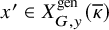 $x'\in X^{\mathrm {gen}}_{G, y}(\overline {\kappa })$
. Then there is an R-parabolic subgroup P of G with R-Levi equal to L,
$x'\in X^{\mathrm {gen}}_{G, y}(\overline {\kappa })$
. Then there is an R-parabolic subgroup P of G with R-Levi equal to L, $g\in G^0(\overline {\kappa })$
and
$g\in G^0(\overline {\kappa })$
and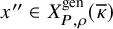 $x"\in X^{\mathrm {gen}}_{P, \rho }(\overline {\kappa })$
such that
$x"\in X^{\mathrm {gen}}_{P, \rho }(\overline {\kappa })$
such that
 $$ \begin{align*}\rho_{x'}(\gamma)= g \rho_{x"}(\gamma) g^{-1}, \quad \forall \gamma\in \Gamma_F.\end{align*} $$
Definition 12.10. We define the defect of the fibre $X^{\mathrm {gen}}_{G,y}$
to be
$X^{\mathrm {gen}}_{G,y}$
to be
 $$ \begin{align} \delta(y):= \max_{P} h^0(\Gamma_F, ({\mathrm{Lie}} U)_{\kappa}^*(1)), \end{align} $$
where P ranges over all R-parabolic subgroups of G with R-Levi L, and U is the unipotent radical of P and $\Gamma _F$
acts on
$\Gamma _F$
acts on $({\mathrm {Lie}} U)_{\kappa }^*$
via
$({\mathrm {Lie}} U)_{\kappa }^*$
via $\rho $
composed with the adjoint action of L.
$\rho $
composed with the adjoint action of L.
Remark 12.12. If we replace $(L, \rho )$
in (47) by a conjugate then
$(L, \rho )$
in (47) by a conjugate then $\delta (y)$
does not change. Since Lemma 12.9 implies that the pair
$\delta (y)$
does not change. Since Lemma 12.9 implies that the pair $(L, \rho )$
is uniquely determined by y up to
$(L, \rho )$
is uniquely determined by y up to $G^0$
-conjugation the defect
$G^0$
-conjugation the defect $\delta (y)$
depends only on y.
$\delta (y)$
depends only on y.
Remark 12.13. Let $\lambda : \mathbb G_{m} \rightarrow G_{\kappa }$
be a cocharacter. Let
$\lambda : \mathbb G_{m} \rightarrow G_{\kappa }$
be a cocharacter. Let $M=L_{\lambda }$
,
$M=L_{\lambda }$
, $U=U_{\lambda }$
and
$U=U_{\lambda }$
and $U^-= U_{-\lambda }$
. Then
$U^-= U_{-\lambda }$
. Then ${{\mathrm {Lie}} G_{\kappa } = {\mathrm {Lie}} U^-\oplus {\mathrm {Lie}} M \oplus {\mathrm {Lie}} U.}$
Moreover, the theory of root systems gives us
${{\mathrm {Lie}} G_{\kappa } = {\mathrm {Lie}} U^-\oplus {\mathrm {Lie}} M \oplus {\mathrm {Lie}} U.}$
Moreover, the theory of root systems gives us $\dim _{\kappa } {\mathrm {Lie}} U^{-}=\dim _{\kappa } {\mathrm {Lie}} U$
. Hence,
$\dim _{\kappa } {\mathrm {Lie}} U^{-}=\dim _{\kappa } {\mathrm {Lie}} U$
. Hence, $\dim _{\kappa } {\mathrm {Lie}} U=\dim U = \frac {1}{2} (\dim G_{\kappa } - \dim M).$
Thus for all the unipotent radicals U appearing in (47) we have
$\dim _{\kappa } {\mathrm {Lie}} U=\dim U = \frac {1}{2} (\dim G_{\kappa } - \dim M).$
Thus for all the unipotent radicals U appearing in (47) we have $\dim _{\kappa } {\mathrm {Lie}} U_{\kappa }= \frac {1}{2} (\dim G_{\kappa } - \dim L_{\kappa }).$
Lemma 12.14. $\delta (y)\le \frac {1}{2}(\dim G_{\overline {\kappa }} - \dim L_{\overline {\kappa }})$
Proof. Since the dimension of $\Gamma _F$
-invariants is less or equal to the dimension of the vector space, we have
$\Gamma _F$
-invariants is less or equal to the dimension of the vector space, we have $h^0(\Gamma _F, ({\mathrm {Lie}} U)_{\kappa }^*(1))\le \dim _{\kappa } {\mathrm {Lie}} U_{\kappa }$
. The bound follows from Remark 12.13 by observing that extending scalars to the algebraic closure does not change the dimension.
$h^0(\Gamma _F, ({\mathrm {Lie}} U)_{\kappa }^*(1))\le \dim _{\kappa } {\mathrm {Lie}} U_{\kappa }$
. The bound follows from Remark 12.13 by observing that extending scalars to the algebraic closure does not change the dimension.
Proposition 12.15.
 $$ \begin{align*}\dim X^{\mathrm{gen}}_{G,y}\le \dim G_{\overline{\kappa}} -\dim Z(L_{\overline{\kappa}}) +\tfrac{1}{2}(\dim G_{\overline{\kappa}} - \dim L_{\overline{\kappa}})[F:\mathbb {Q}_p] + \delta(y).\end{align*} $$
Proof. The dimension does not change if we replace $X^{\mathrm {gen}}_{G,y}$
by the geometric fibre
$X^{\mathrm {gen}}_{G,y}$
by the geometric fibre $X^{\mathrm {gen}}_{G,\bar {y}}$
. The action of
$X^{\mathrm {gen}}_{G,\bar {y}}$
. The action of $G^0$
on
$G^0$
on $X^{\mathrm {gen}}_{G, \overline {\rho }^{\mathrm {ss}}}$
induces an action of
$X^{\mathrm {gen}}_{G, \overline {\rho }^{\mathrm {ss}}}$
induces an action of $G^0_{\overline {\kappa }}$
on
$G^0_{\overline {\kappa }}$
on $X^{\mathrm {gen}}_{G,\bar {y}}$
. Moreover,
$X^{\mathrm {gen}}_{G,\bar {y}}$
. Moreover, $X^{\mathrm {gen}}_{P, \rho }\times _y \bar {y}$
is invariant under the action of the subgroup
$X^{\mathrm {gen}}_{P, \rho }\times _y \bar {y}$
is invariant under the action of the subgroup $Z(L_{\overline {\kappa }})^0 U_{\overline {\kappa }}$
. Thus we obtain a map of schemes
$Z(L_{\overline {\kappa }})^0 U_{\overline {\kappa }}$
. Thus we obtain a map of schemes
 $$ \begin{align} \coprod_{ P} G^0_{\overline{\kappa}} \times^{Z(L_{\overline{\kappa}})^0 U_{\overline{\kappa}}} (X^{\mathrm{gen}}_{P, \rho}\times_y \bar{y})\rightarrow X^{\mathrm{gen}}_{G, \bar{y}}, \end{align} $$
where the disjoint union is taken over all the R-parabolics P of G with R-Levi L. We note that there are only finitely many such P by Lemma 2.18. It follows from Lemma 12.9 that (48) induces a surjection on $\overline {\kappa }$
-points. Since both the source of and the target of (48) are of finite type over
$\overline {\kappa }$
-points. Since both the source of and the target of (48) are of finite type over $\overline {\kappa }$
, [Reference Böckle, Iyengar and Paškūnas6, Lemma 3.14] implies that
$\overline {\kappa }$
, [Reference Böckle, Iyengar and Paškūnas6, Lemma 3.14] implies that
 $$ \begin{align*} \begin{aligned} \dim X^{\mathrm{gen}}_{G, \bar{y}}\le &\max_{P} \dim (G_{\overline{\kappa}}^0 \times^{Z(L_{\overline{\kappa}})^0 U_{\overline{\kappa}}}(X^{\mathrm{gen}}_{P}\times_y \bar{y})^{\mathrm{red}})\\ =& \dim G_{\overline{\kappa}}^0 - \dim Z(L_{\overline{\kappa}})^0 - \dim U_{\overline{\kappa}}+ \max_{P} \dim (X^{\mathrm{gen}}_{P, \rho}\times_y \bar{y})\\ \le& \dim G_{\overline{\kappa}} - \dim Z(L_{\overline{\kappa}}) +\tfrac{1}{2}(\dim G_{\overline{\kappa}} - \dim L_{\overline{\kappa}}) [F:\mathbb {Q}_p] + \delta(y), \end{aligned} \end{align*} $$
where in the last two lines we have used Remark 12.13 and in the last inequality we have used Proposition 12.8.
Remark 12.16. If $y'$
is a closed point of
$y'$
is a closed point of $U_{LG, \overline {\rho }^{\mathrm {ss}}}$
then Remark 12.2 implies that the bound in Proposition 12.15 also applies to the fibre of
$U_{LG, \overline {\rho }^{\mathrm {ss}}}$
then Remark 12.2 implies that the bound in Proposition 12.15 also applies to the fibre of $X^{\mathrm {gen}}_{G,\overline {\rho }^{\mathrm {ss}}}$
at
$X^{\mathrm {gen}}_{G,\overline {\rho }^{\mathrm {ss}}}$
at $y'$
. We will use this without further comment in section 13.
$y'$
. We will use this without further comment in section 13.
Lemma 12.17. Let M be an R-Levi of $G_{\overline {\kappa }}$
. Assume that
$G_{\overline {\kappa }}$
. Assume that $\dim G_{\overline {\kappa }}>1$
. If
$\dim G_{\overline {\kappa }}>1$
. If $\dim M=1$
then
$\dim M=1$
then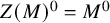 $Z(M)^0= M^0$
. In particular,
$Z(M)^0= M^0$
. In particular, $\dim Z(M)=1$
. Moreover,
$\dim Z(M)=1$
. Moreover, $\dim G_{\overline {\kappa }}=3$
.
$\dim G_{\overline {\kappa }}=3$
.
Proof. The assumption on M implies that the semisimple rank of $G^0_{\overline {\kappa }}$
is
$G^0_{\overline {\kappa }}$
is $1$
and hence
$1$
and hence $G^0_{\overline {\kappa }}$
is isomorphic to either
$G^0_{\overline {\kappa }}$
is isomorphic to either ${\mathrm {SL}}_2$
or
${\mathrm {SL}}_2$
or ${\mathrm {PGL}}_2$
, [Reference Milne44, Theorem 20.33], which implies the Lemma.
${\mathrm {PGL}}_2$
, [Reference Milne44, Theorem 20.33], which implies the Lemma.
Corollary 12.18. Let $y:{\mathrm {Spec}} \overline {k}\rightarrow X^{\mathrm {ps}}_{G} $
be a geometric point above the closed point of
$y:{\mathrm {Spec}} \overline {k}\rightarrow X^{\mathrm {ps}}_{G} $
be a geometric point above the closed point of $X^{\mathrm {ps}}_{G}$
and let
$X^{\mathrm {ps}}_{G}$
and let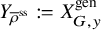 $Y_{\overline {\rho }^{\mathrm {ss}}}:= X^{\mathrm {gen}}_{G,y}$
. If
$Y_{\overline {\rho }^{\mathrm {ss}}}:= X^{\mathrm {gen}}_{G,y}$
. If $\dim G_{\overline {k}}>1$
then
$\dim G_{\overline {k}}>1$
then
 $$ \begin{align} \dim G_{\overline{k}}(1+[F:\mathbb {Q}_p]) - \dim Y_{\overline{\rho}^{\mathrm{ss}}} \ge [F:\mathbb {Q}_p] \dim L_{\overline{k}} + \dim Z(L_{\overline{k}}) \ge [F:\mathbb {Q}_p]+1. \end{align} $$
Moreover, if (49) is an equalityFootnote
10
then $\dim G_{\overline {k}}-\dim L_{\overline {k}}=2$
and L is
$\dim G_{\overline {k}}-\dim L_{\overline {k}}=2$
and L is $\overline {\rho }^{\mathrm {ss}}$
-compatible in the sense of Section 13.1 below. Otherwise,
$\overline {\rho }^{\mathrm {ss}}$
-compatible in the sense of Section 13.1 below. Otherwise,
 $$ \begin{align} \dim G_{\overline{\kappa}}(1+[F:\mathbb {Q}_p])- \dim Y_{\overline{\rho}^{\mathrm{ss}}}\ge 2[F:\mathbb {Q}_p]+1. \end{align} $$
Proof. The first inequality follows from Proposition 12.15 and Lemma 12.14. The second inequality follows from Lemma 12.17.
If (49) is an equality then $\dim L_{\overline {k}}=1$
. The last part of Lemma 12.17 says that
$\dim L_{\overline {k}}=1$
. The last part of Lemma 12.17 says that $\dim G_{\overline {\kappa }}=3$
. So the difference of dimensions is
$\dim G_{\overline {\kappa }}=3$
. So the difference of dimensions is $2$
. The compatibility of
$2$
. The compatibility of $L_k$
with
$L_k$
with $\overline {\rho }^{\mathrm {ss}}$
follows Lemma 13.1 below, since
$\overline {\rho }^{\mathrm {ss}}$
follows Lemma 13.1 below, since $\overline {X}^{\mathrm {git}}_{L, \overline {\rho }^{\mathrm {ss}}}$
is non-empty by construction of L.
$\overline {X}^{\mathrm {git}}_{L, \overline {\rho }^{\mathrm {ss}}}$
is non-empty by construction of L.
If $\dim L_{\overline {k}}\neq 1$
then
$\dim L_{\overline {k}}\neq 1$
then $\dim L_{\overline {k}}\ge 2$
and (49) implies (50).
$\dim L_{\overline {k}}\ge 2$
and (49) implies (50).
13 Complete intersection
In this section we will show that the deformation rings $R^{\square }_{G, \overline {\rho }}$
are complete intersections of expected dimension. As explained in the introduction it is enough to bound the dimension of their special fibres from above. We will achieve this by bounding the dimension of
$R^{\square }_{G, \overline {\rho }}$
are complete intersections of expected dimension. As explained in the introduction it is enough to bound the dimension of their special fibres from above. We will achieve this by bounding the dimension of $\overline {X}^{\mathrm {gen}}_{G, \overline {\rho }^{\mathrm {ss}}}$
.
$\overline {X}^{\mathrm {gen}}_{G, \overline {\rho }^{\mathrm {ss}}}$
.
13.1 Induction hypothesis
Let us recall the setup. We start with a continuous representation $\overline {\rho }: \Gamma _F \rightarrow G(k)$
, such that the group homomorphism
$\overline {\rho }: \Gamma _F \rightarrow G(k)$
, such that the group homomorphism $\pi _G\circ \overline {\rho }^{\mathrm {ss}}: \Gamma _F \rightarrow (G/G^0)(\overline {k})$
is surjective, where
$\pi _G\circ \overline {\rho }^{\mathrm {ss}}: \Gamma _F \rightarrow (G/G^0)(\overline {k})$
is surjective, where $\pi _G: G\rightarrow G/G^0$
is the quotient map.
$\pi _G: G\rightarrow G/G^0$
is the quotient map.
We will bound the dimension of $\overline {X}^{\mathrm {gen}}_{G, \overline {\rho }^{\mathrm {ss}}}$
arguing by induction that the assertion
$\overline {X}^{\mathrm {gen}}_{G, \overline {\rho }^{\mathrm {ss}}}$
arguing by induction that the assertion
 $$ \begin{align} \dim \overline{X}^{\mathrm{git}}_{H, \overline{\rho}_1^{\mathrm{ss}}} \le \dim Z(H) + [F:\mathbb {Q}_p] \dim H. \end{align} $$
holds for all pairs $(H, \overline {\rho }_1)$
, where H is a generalised reductive group scheme defined over a finite extension of k and
$(H, \overline {\rho }_1)$
, where H is a generalised reductive group scheme defined over a finite extension of k and $\overline {\rho }_1: \Gamma _F\rightarrow H(\overline {k})$
is a continuous H-semisimple representation such that
$\overline {\rho }_1: \Gamma _F\rightarrow H(\overline {k})$
is a continuous H-semisimple representation such that ${\pi _H\circ \overline {\rho }_1: \Gamma _F\rightarrow (H/H^0)(\overline {k})}$
is surjective. We refer the reader to Section 1.4.2 for the sketch of the proof strategy. Instead of reading this section linearly we suggest to first look at Proposition 13.25, where the induction step is carried out, and then look up the statements needed for its proof.
${\pi _H\circ \overline {\rho }_1: \Gamma _F\rightarrow (H/H^0)(\overline {k})}$
is surjective. We refer the reader to Section 1.4.2 for the sketch of the proof strategy. Instead of reading this section linearly we suggest to first look at Proposition 13.25, where the induction step is carried out, and then look up the statements needed for its proof.
The induction argument takes place entirely in the special fibre and the group schemes H appearing in the induction need not be special fibres of generalised reductive group schemes defined over $\mathscr O$
. We note that the schemes
$\mathscr O$
. We note that the schemes $\overline {X}^{\mathrm {gen}}_{H, \overline {\rho }_1^{\mathrm {ss}}}$
,
$\overline {X}^{\mathrm {gen}}_{H, \overline {\rho }_1^{\mathrm {ss}}}$
, $\overline {X}^{\mathrm {git}}_{H,\overline {\rho }_1^{\mathrm {ss}}}$
and
$\overline {X}^{\mathrm {git}}_{H,\overline {\rho }_1^{\mathrm {ss}}}$
and $\overline {X}^{\mathrm {ps}}_H$
are still defined for such H by replacing
$\overline {X}^{\mathrm {ps}}_H$
are still defined for such H by replacing $\mathscr O$
with k in all the definitions. All the statements proved for
$\mathscr O$
with k in all the definitions. All the statements proved for $\overline {X}^{\mathrm {gen}}_{G, \overline {\rho }^{\mathrm {ss}}}$
,
$\overline {X}^{\mathrm {gen}}_{G, \overline {\rho }^{\mathrm {ss}}}$
, $\overline {X}^{\mathrm {git}}_{G, \overline {\rho }^{\mathrm {ss}}}$
and
$\overline {X}^{\mathrm {git}}_{G, \overline {\rho }^{\mathrm {ss}}}$
and $\overline {X}^{\mathrm {ps}}_G$
when G is a generalised reductive group scheme over
$\overline {X}^{\mathrm {ps}}_G$
when G is a generalised reductive group scheme over $\mathscr O$
, also hold for
$\mathscr O$
, also hold for $\overline {X}^{\mathrm {gen}}_{H, \overline {\rho }^{\mathrm {ss}}_1}$
,
$\overline {X}^{\mathrm {gen}}_{H, \overline {\rho }^{\mathrm {ss}}_1}$
, $\overline {X}^{\mathrm {git}}_{H, \overline {\rho }^{\mathrm {ss}}_1}$
and
$\overline {X}^{\mathrm {git}}_{H, \overline {\rho }^{\mathrm {ss}}_1}$
and $\overline {X}^{\mathrm {ps}}_H$
. In particular, if x is a closed point of
$\overline {X}^{\mathrm {ps}}_H$
. In particular, if x is a closed point of $Y_{\overline {\rho }^{\mathrm {ss}}_1}$
or a closed point of
$Y_{\overline {\rho }^{\mathrm {ss}}_1}$
or a closed point of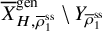 $\overline {X}^{\mathrm {gen}}_{H, \overline {\rho }^{\mathrm {ss}}_1}\setminus Y_{\overline {\rho }^{\mathrm {ss}}_1}$
then the arguments of Proposition 5.16, Lemma 5.17 carry over and relate the completed local ring of
$\overline {X}^{\mathrm {gen}}_{H, \overline {\rho }^{\mathrm {ss}}_1}\setminus Y_{\overline {\rho }^{\mathrm {ss}}_1}$
then the arguments of Proposition 5.16, Lemma 5.17 carry over and relate the completed local ring of $\overline {X}^{\mathrm {git}}_{H,\overline {\rho }_1^{\mathrm {ss}}}$
at x to the deformation ring
$\overline {X}^{\mathrm {git}}_{H,\overline {\rho }_1^{\mathrm {ss}}}$
at x to the deformation ring $\overline {R}{}^{\square }_{\rho _x, H}$
, which parameterises deformations
$\overline {R}{}^{\square }_{\rho _x, H}$
, which parameterises deformations $\rho : \Gamma _F\rightarrow H(A)$
of
$\rho : \Gamma _F\rightarrow H(A)$
of $\rho _x$
for
$\rho _x$
for $A\in \mathfrak {A}_{\kappa (x)}$
. If H is a generalised reductive group scheme over
$A\in \mathfrak {A}_{\kappa (x)}$
. If H is a generalised reductive group scheme over $\mathscr O$
then
$\mathscr O$
then $\overline {R}{}^{\square }_{\rho _x, H}=R^{\square }_{\rho _x, H}/\varpi $
.
$\overline {R}{}^{\square }_{\rho _x, H}=R^{\square }_{\rho _x, H}/\varpi $
.
We say that a pair $(H,\overline {\rho }_1)$
is
$(H,\overline {\rho }_1)$
is $\overline {\rho }^{\mathrm {ss}}$
-compatible if H is a closed subgroup scheme of
$\overline {\rho }^{\mathrm {ss}}$
-compatible if H is a closed subgroup scheme of $G_{\overline {k}}$
and the G-semisimplification of
$G_{\overline {k}}$
and the G-semisimplification of $\overline {\rho }_1$
is
$\overline {\rho }_1$
is $G^0(\overline {k})$
-conjugate to
$G^0(\overline {k})$
-conjugate to $\overline {\rho }^{\mathrm {ss}}$
. We say that a closed generalised reductive subgroup H of
$\overline {\rho }^{\mathrm {ss}}$
. We say that a closed generalised reductive subgroup H of $G_{\overline {k}}$
is
$G_{\overline {k}}$
is $\overline {\rho }^{\mathrm {ss}}$
-compatible if it appears in some
$\overline {\rho }^{\mathrm {ss}}$
-compatible if it appears in some $\overline {\rho }^{\mathrm {ss}}$
-compatible pair
$\overline {\rho }^{\mathrm {ss}}$
-compatible pair $(H,\overline {\rho }_1)$
.
$(H,\overline {\rho }_1)$
.
Lemma 13.1. Let L be an R-Levi of G. If $\overline {X}^{\mathrm {git}}_{LG, \overline {\rho }^{\mathrm {ss}}}$
is non-empty then
$\overline {X}^{\mathrm {git}}_{LG, \overline {\rho }^{\mathrm {ss}}}$
is non-empty then $L_k$
occurs in a
$L_k$
occurs in a $\overline {\rho }^{\mathrm {ss}}$
-compatible pair. Moreover, if
$\overline {\rho }^{\mathrm {ss}}$
-compatible pair. Moreover, if $L\neq G$
then
$L\neq G$
then $\dim L_k <\dim G_k$
.
$\dim L_k <\dim G_k$
.
Proof. This follows from Lemma 9.11.
Lemma 13.2. Let U be a non-empty locally closed subscheme of $X^{\mathrm {git}}_{G, \overline {\rho }^{\mathrm {ss}}}\setminus \{ \ast \}$
, where
$X^{\mathrm {git}}_{G, \overline {\rho }^{\mathrm {ss}}}\setminus \{ \ast \}$
, where $\ast $
is the closed point, and let Z be the closure of U in
$\ast $
is the closed point, and let Z be the closure of U in $X^{\mathrm {git}}_{G, \overline {\rho }^{\mathrm {ss}}}$
. Then
$X^{\mathrm {git}}_{G, \overline {\rho }^{\mathrm {ss}}}$
. Then $\dim Z= \dim U+1$
.
$\dim Z= \dim U+1$
.
Proof. This follows from [Reference Böckle, Iyengar and Paškūnas6, Lemma 3.5 (5)] applied to ${\mathrm {Spec}} R={\mathrm {Spec}} S= Z$
.
${\mathrm {Spec}} R={\mathrm {Spec}} S= Z$
.
Lemma 13.3. Let $Y_{\overline {\rho }^{\mathrm {ss}}}$
be the preimage in
$Y_{\overline {\rho }^{\mathrm {ss}}}$
be the preimage in $X^{\mathrm {gen}}_{G, \overline {\rho }^{\mathrm {ss}}}$
of the closed point in
$X^{\mathrm {gen}}_{G, \overline {\rho }^{\mathrm {ss}}}$
of the closed point in $X^{\mathrm {git}}_{G, \overline {\rho }^{\mathrm {ss}}}$
and let V be an open non-empty
$X^{\mathrm {git}}_{G, \overline {\rho }^{\mathrm {ss}}}$
and let V be an open non-empty $G^0$
-invariant subscheme of
$G^0$
-invariant subscheme of $X\setminus Y_{\overline {\rho }^{\mathrm {ss}}}$
, where X is either
$X\setminus Y_{\overline {\rho }^{\mathrm {ss}}}$
, where X is either $X^{\mathrm {gen}}_{G, \overline {\rho }^{\mathrm {ss}}}$
or
$X^{\mathrm {gen}}_{G, \overline {\rho }^{\mathrm {ss}}}$
or $\overline {X}^{\mathrm {gen}}_{G, \overline {\rho }^{\mathrm {ss}}}$
. Let Z be the closure of V in X. Then
$\overline {X}^{\mathrm {gen}}_{G, \overline {\rho }^{\mathrm {ss}}}$
. Let Z be the closure of V in X. Then $\dim Z=\dim V+1$
.
$\dim Z=\dim V+1$
.
Proof. Since V is $G^0$
-invariant, its closure Z is also
$G^0$
-invariant, its closure Z is also $G^0$
-invariant. It follows from the proof of [Reference Böckle, Iyengar and Paškūnas6, Lemma 3.21] that every irreducible component of Z meets
$G^0$
-invariant. It follows from the proof of [Reference Böckle, Iyengar and Paškūnas6, Lemma 3.21] that every irreducible component of Z meets $Y_{\overline {\rho }^{\mathrm {ss}}}$
non-trivially. The assertion follows from [Reference Böckle, Iyengar and Paškūnas6, Lemma 3.18 (5)].
$Y_{\overline {\rho }^{\mathrm {ss}}}$
non-trivially. The assertion follows from [Reference Böckle, Iyengar and Paškūnas6, Lemma 3.18 (5)].
Lemma 13.4. $\dim X^{\mathrm {gen}}_{G,\overline {\rho }^{\mathrm {ss}}}= \max _{x} \dim R^{\square }_{\rho _x, G}$
,
$\dim X^{\mathrm {gen}}_{G,\overline {\rho }^{\mathrm {ss}}}= \max _{x} \dim R^{\square }_{\rho _x, G}$
, $\dim \overline {X}^{\mathrm {gen}}_{G,\overline {\rho }^{\mathrm {ss}}}= \max _{x} \dim R^{\square }_{\rho _x, G}/\varpi $
, where the maximum is taken over all the closed points
$\dim \overline {X}^{\mathrm {gen}}_{G,\overline {\rho }^{\mathrm {ss}}}= \max _{x} \dim R^{\square }_{\rho _x, G}/\varpi $
, where the maximum is taken over all the closed points $x\in Y$
.
$x\in Y$
.
Proof. Let X be either $X^{\mathrm {gen}}_{G,\overline {\rho }^{\mathrm {ss}}}$
or
$X^{\mathrm {gen}}_{G,\overline {\rho }^{\mathrm {ss}}}$
or $\overline {X}^{\mathrm {gen}}_{G,\overline {\rho }^{\mathrm {ss}}}$
and let x be a closed point of X. If
$\overline {X}^{\mathrm {gen}}_{G,\overline {\rho }^{\mathrm {ss}}}$
and let x be a closed point of X. If $x\not \in Y$
then x is a closed point in
$x\not \in Y$
then x is a closed point in $X\setminus Y$
and since
$X\setminus Y$
and since $\dim X\setminus Y = \dim X -1$
by Lemma 13.3 we have
$\dim X\setminus Y = \dim X -1$
by Lemma 13.3 we have $\dim \mathscr O_{X,x}< \dim X$
. Thus
$\dim \mathscr O_{X,x}< \dim X$
. Thus ${\dim X= \max _{x} \dim \mathscr O_{X,x}}$
, where the maximum is taken over the closed points
${\dim X= \max _{x} \dim \mathscr O_{X,x}}$
, where the maximum is taken over the closed points $x\in Y$
. Since
$x\in Y$
. Since $\dim \mathscr O_{X,x} = \dim \hat {\mathscr {O}}_{X,x}$
the assertion follows from Lemma 5.17.
$\dim \mathscr O_{X,x} = \dim \hat {\mathscr {O}}_{X,x}$
the assertion follows from Lemma 5.17.
Proposition 13.5. Let L be an R-Levi of G and let H be a closed reductive subgroup of $L_{k'}$
, where
$L_{k'}$
, where $k'$
is a finite extension of k. If
$k'$
is a finite extension of k. If $L=G$
then we assume that
$L=G$
then we assume that $H\neq G_{k'}$
. Let U be an open subscheme of
$H\neq G_{k'}$
. Let U be an open subscheme of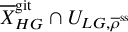 $\overline {X}^{\mathrm {git}}_{HG}\cap U_{LG, \overline {\rho }^{\mathrm {ss}}}$
, let V be the preimage of U in
$\overline {X}^{\mathrm {git}}_{HG}\cap U_{LG, \overline {\rho }^{\mathrm {ss}}}$
, let V be the preimage of U in $\overline {X}^{\mathrm {gen}}_{G, \overline {\rho }^{\mathrm {ss}}}$
, and let Z be the closure of V. If (DIM) holds for all
$\overline {X}^{\mathrm {gen}}_{G, \overline {\rho }^{\mathrm {ss}}}$
, and let Z be the closure of V. If (DIM) holds for all $\overline {\rho }^{\mathrm {ss}}$
-compatible pairs
$\overline {\rho }^{\mathrm {ss}}$
-compatible pairs $(H_1, \overline {\rho }_1)$
with
$(H_1, \overline {\rho }_1)$
with $\dim H_1< \dim G_k$
then
$\dim H_1< \dim G_k$
then
 $$ \begin{align}\begin{aligned} \dim G_k ([F:\mathbb {Q}_p]+1) -&\dim Z \ge \\&(\dim L_k - \dim H)[F:\mathbb {Q}_p] + \dim N_k[F:\mathbb {Q}_p]-\delta(U), \end{aligned} \end{align} $$
where $\delta (U)=\max _y \delta (y)$
, where the maximum is taken over all the closed points
$\delta (U)=\max _y \delta (y)$
, where the maximum is taken over all the closed points $y\in U$
and
$y\in U$
and $\delta (y)$
denotes the defect of the fibre at y and N is a unipotent radical of any R-parabolic subgroup of G with R-Levi L.
$\delta (y)$
denotes the defect of the fibre at y and N is a unipotent radical of any R-parabolic subgroup of G with R-Levi L.
Proof. After extending scalars we may assume that $k=k'$
. We may assume that
$k=k'$
. We may assume that $\overline {X}^{\mathrm {git}}_{H, \overline {\rho }^{\mathrm {ss}}}$
is non-empty, since otherwise both V and Z are empty and the claim holds trivially. Using Lemma 9.4 we may further assume that the map
$\overline {X}^{\mathrm {git}}_{H, \overline {\rho }^{\mathrm {ss}}}$
is non-empty, since otherwise both V and Z are empty and the claim holds trivially. Using Lemma 9.4 we may further assume that the map $\overline {\rho }^{\mathrm {ss}}: \Gamma _F \rightarrow (H/H^0)(k)$
is surjective. If
$\overline {\rho }^{\mathrm {ss}}: \Gamma _F \rightarrow (H/H^0)(k)$
is surjective. If $\dim H=\dim G_k$
then Lemma 9.11 implies that
$\dim H=\dim G_k$
then Lemma 9.11 implies that $H=G_k$
contradicting our assumption. Thus
$H=G_k$
contradicting our assumption. Thus $\dim H <\dim G_k$
and by hypothesis we have
$\dim H <\dim G_k$
and by hypothesis we have
 $$ \begin{align} \dim \overline{X}^{\mathrm{git}}_H \le \dim H [F:\mathbb {Q}_p] + \dim Z(H). \end{align} $$
Since V is a preimage of U, it is $G^0$
-invariant and Lemma 13.3 implies that
$G^0$
-invariant and Lemma 13.3 implies that
 $$ \begin{align} \dim Z = \dim V +1. \end{align} $$
From [Reference Böckle, Iyengar and Paškūnas6, Lemma 3.18] we deduce that
 $$ \begin{align} \dim V \le \dim U + \max_{y} \dim X^{\mathrm{gen}}_{G, y}, \end{align} $$
where the maximum is taken over all closed points y of U. Since U is open in the punctured spectrum of a local ring, and $\overline {X}^{\mathrm {git}}_H \rightarrow \overline {X}^{\mathrm {git}}_G$
is finite by Corollary 6.5, we obtain
$\overline {X}^{\mathrm {git}}_H \rightarrow \overline {X}^{\mathrm {git}}_G$
is finite by Corollary 6.5, we obtain
 $$ \begin{align} \dim U +1\le \dim \overline{X}^{\mathrm{git}}_{HG, \overline{\rho}^{\mathrm{ss}}} \le \dim \overline{X}^{\mathrm{git}}_{H, \overline{\rho}^{\mathrm{ss}}} \le \dim H [F:\mathbb {Q}_p] + \dim Z(H), \end{align} $$
where the last inequality is given by (52). Proposition 12.15 implies that
 $$ \begin{align} \dim X^{\mathrm{gen}}_{G,y} \le \dim G_k+ \dim N_k [F:\mathbb {Q}_p] + \delta(y) - \dim Z(L_k), \end{align} $$
where $\delta (y)$
is the defect of the fibre. Since
$\delta (y)$
is the defect of the fibre. Since $\dim Z(H)\le \dim Z(L_k)$
by Corollary 9.8 putting all the inequalities together we obtain
$\dim Z(H)\le \dim Z(L_k)$
by Corollary 9.8 putting all the inequalities together we obtain
 $$ \begin{align} \dim Z\le \dim H [F:\mathbb {Q}_p] + \dim G_k +\dim N_k [F:\mathbb {Q}_p] +\delta(U). \end{align} $$
where $\delta (U)=\max _y \delta (y)$
. Since
$\delta (U)=\max _y \delta (y)$
. Since $\dim G_k = \dim L_k + 2 \dim N_k$
we obtain (51).
$\dim G_k = \dim L_k + 2 \dim N_k$
we obtain (51).
Corollary 13.6. Let L be an R-Levi of G and let H be a closed reductive subgroup of $L_{k'}$
, where
$L_{k'}$
, where $k'$
is a finite extension of k. If
$k'$
is a finite extension of k. If $L=G$
then we assume that
$L=G$
then we assume that $H\neq G_{k'}$
. Let V be the preimage of
$H\neq G_{k'}$
. Let V be the preimage of $U=\overline {X}^{\mathrm {git}}_{HG}\cap U_{LG, \overline {\rho }^{\mathrm {ss}}}$
in
$U=\overline {X}^{\mathrm {git}}_{HG}\cap U_{LG, \overline {\rho }^{\mathrm {ss}}}$
in $\overline {X}^{\mathrm {gen}}_{G, \overline {\rho }^{\mathrm {ss}}}$
, and let Z be the closure of V in
$\overline {X}^{\mathrm {gen}}_{G, \overline {\rho }^{\mathrm {ss}}}$
, and let Z be the closure of V in $\overline {X}^{\mathrm {gen}}_{G, \overline {\rho }^{\mathrm {ss}}}$
. If (DIM) holds for all
$\overline {X}^{\mathrm {gen}}_{G, \overline {\rho }^{\mathrm {ss}}}$
. If (DIM) holds for all $\overline {\rho }^{\mathrm {ss}}$
-compatible pairs
$\overline {\rho }^{\mathrm {ss}}$
-compatible pairs $(H_1, \overline {\rho }_1)$
with
$(H_1, \overline {\rho }_1)$
with $\dim H_1< \dim G_k$
then
$\dim H_1< \dim G_k$
then
 $$ \begin{align*}\dim G_k ([F:\mathbb {Q}_p]+1) - \dim Z\ge (\dim L_k - \dim H)[F:\mathbb {Q}_p].\end{align*} $$
Proof. Remark 12.2 and Lemma 12.14 imply that
 $$ \begin{align} \delta(U) \le \frac{1}{2}(\dim G_k - \dim L_k) =\dim N_k. \end{align} $$
The assertion follows from Proposition 13.5.
Corollary 13.7. Let L be an R-Levi of G, such that $L\neq G$
, let H be a closed reductive subgroup of
$L\neq G$
, let H be a closed reductive subgroup of $L_{k'}$
, where
$L_{k'}$
, where $k'$
is a finite extension of k. Let U be an open subscheme of
$k'$
is a finite extension of k. Let U be an open subscheme of $U_{LG, \overline {\rho }^{\mathrm {ss}}}\cap \overline {X}^{\mathrm {git}}_{HG}$
, let V be a preimage of U in
$U_{LG, \overline {\rho }^{\mathrm {ss}}}\cap \overline {X}^{\mathrm {git}}_{HG}$
, let V be a preimage of U in $\overline {X}^{\mathrm {gen}}_{G, \overline {\rho }^{\mathrm {ss}}}$
and let Z be its closure. If
$\overline {X}^{\mathrm {gen}}_{G, \overline {\rho }^{\mathrm {ss}}}$
and let Z be its closure. If
 $$ \begin{align} \delta(U) \le \dim L_k -\dim H. \end{align} $$
and (DIM) holds for all $\overline {\rho }^{\mathrm {ss}}$
-compatible pairs
$\overline {\rho }^{\mathrm {ss}}$
-compatible pairs $(H_1, \overline {\rho }_1)$
with
$(H_1, \overline {\rho }_1)$
with $\dim H_1< \dim G_k$
then
$\dim H_1< \dim G_k$
then
 $$ \begin{align*}\dim G_k ([F:\mathbb {Q}_p]+1) - \dim Z\ge \dim N_k [F:\mathbb {Q}_p]\ge 1,\end{align*} $$
where N is the unipotent radical of any R-parabolic of G with R-Levi L. Moreover, if either $F\neq \mathbb {Q}_p$
or
$F\neq \mathbb {Q}_p$
or $\dim N_k \neq 1$
then the lower bound can be changed to
$\dim N_k \neq 1$
then the lower bound can be changed to $2$
.
$2$
.
Proof. We may assume that $\overline {X}^{\mathrm {git}}_{LG, \overline {\rho }^{\mathrm {ss}}}$
is non-empty. Lemma 9.11 implies that
$\overline {X}^{\mathrm {git}}_{LG, \overline {\rho }^{\mathrm {ss}}}$
is non-empty. Lemma 9.11 implies that $\dim L< \dim G$
and
$\dim L< \dim G$
and $\dim N_k \ge 1$
. As in the proof of Corollary 13.6 the assertion follows from Proposition 13.5, but using (59) instead of (58):
$\dim N_k \ge 1$
. As in the proof of Corollary 13.6 the assertion follows from Proposition 13.5, but using (59) instead of (58):
 $$ \begin{align}\begin{aligned} \dim G_k ([F:\mathbb {Q}_p]+1) -&\dim Z \ge \\&(\dim L_k - \dim H)([F:\mathbb {Q}_p]-1) + \dim N_k[F:\mathbb {Q}_p]. \end{aligned} \end{align} $$
Since, as explained above, $\dim N_k \ge 1$
this implies the assertion.
$\dim N_k \ge 1$
this implies the assertion.
13.2 W-special locus
In this subsection we define the W-special locus, where W is a representation of G on a free $\mathscr O$
-module of finite rank. Using it we will show that if L is an R-Levi of G then the locus of
$\mathscr O$
-module of finite rank. Using it we will show that if L is an R-Levi of G then the locus of $\overline {U}_{LG, \overline {\rho }^{\mathrm {ss}}}$
, where the defect of the fibre is non-zero is contained in a finite union of subschemes
$\overline {U}_{LG, \overline {\rho }^{\mathrm {ss}}}$
, where the defect of the fibre is non-zero is contained in a finite union of subschemes $\overline {X}^{\mathrm {git}}_{HG}\cap U_{LG, \overline {\rho }^{\mathrm {ss}}}$
, where H is a closed reductive subgroup of
$\overline {X}^{\mathrm {git}}_{HG}\cap U_{LG, \overline {\rho }^{\mathrm {ss}}}$
, where H is a closed reductive subgroup of $L_k$
of smaller dimension. We will combine this with Corollaries 13.6 and 13.7 to carry out the induction argument in Section 13.3.
$L_k$
of smaller dimension. We will combine this with Corollaries 13.6 and 13.7 to carry out the induction argument in Section 13.3.
Lemma 13.8. Let R be a noetherian $\mathscr O$
-algebra, let G be an affine group scheme over
$\mathscr O$
-algebra, let G be an affine group scheme over ${\mathrm {Spec}} R$
and let W be a representation of G on a free R-module of finite rank. Let A be a noetherian R-algebra and let
${\mathrm {Spec}} R$
and let W be a representation of G on a free R-module of finite rank. Let A be a noetherian R-algebra and let $\rho : \Gamma _F\rightarrow G(A)$
be a group homomorphism. Then for each
$\rho : \Gamma _F\rightarrow G(A)$
be a group homomorphism. Then for each $j\ge 0$
there is a closed reduced subscheme
$j\ge 0$
there is a closed reduced subscheme $X_{W, j}$
of
$X_{W, j}$
of $X:={\mathrm {Spec}} A$
such that for
$X:={\mathrm {Spec}} A$
such that for $x\in X$
we have
$x\in X$
we have
 $$ \begin{align*}x\in X_{W,j} \iff \dim_{\kappa(x)} W_x(1)^{\Gamma_F}\ge j+1,\end{align*} $$
where $W_x= W\otimes _{R} \kappa (x)$
with the
$W_x= W\otimes _{R} \kappa (x)$
with the $\Gamma _F$
action given by the specialisation of
$\Gamma _F$
action given by the specialisation of $\rho $
at x.
$\rho $
at x.
Proof. Let $\check {W}:= {\mathrm {Hom}}_R(W, R)$
equipped with the contragredient left action of G. Then
$\check {W}:= {\mathrm {Hom}}_R(W, R)$
equipped with the contragredient left action of G. Then
 $$ \begin{align*}\check{W}_x:= \check{W}\otimes_R \kappa(x)\cong {\mathrm{Hom}}_{\kappa(x)}(W_x, \kappa(x)), \quad \forall x\in X.\end{align*} $$
In particular, $\Gamma _F$
-invariants in
$\Gamma _F$
-invariants in $W_x(1)$
are non-zero if and only if
$W_x(1)$
are non-zero if and only if $\Gamma _F$
-coinvariants in
$\Gamma _F$
-coinvariants in $\check {W}_x(-1)$
are non-zero.
$\check {W}_x(-1)$
are non-zero.
Evaluating $\check {W}$
at A we get a free finite A-module
$\check {W}$
at A we get a free finite A-module $\check {W}(A)={\mathrm {Hom}}_A(W(A), A)$
. The action of
$\check {W}(A)={\mathrm {Hom}}_A(W(A), A)$
. The action of $\Gamma _F$
on
$\Gamma _F$
on $\check {W}(A)$
is given by
$\check {W}(A)$
is given by $g \cdot \ell := \ell \circ \rho (g)^{-1}$
. Let M be the A-submodule of
$g \cdot \ell := \ell \circ \rho (g)^{-1}$
. Let M be the A-submodule of $\check {W}(A)$
generated by elements of the form
$\check {W}(A)$
generated by elements of the form $ \chi _{\mathrm {cyc}}(g)^{-1} g \cdot \ell - \ell $
for all
$ \chi _{\mathrm {cyc}}(g)^{-1} g \cdot \ell - \ell $
for all $g\in \Gamma _F$
and all
$g\in \Gamma _F$
and all $\ell \in \check {W}(A)$
. Let
$\ell \in \check {W}(A)$
. Let $X_W$
be the support of
$X_W$
be the support of $\check {W}(A)/ M$
in X. Since A is noetherian
$\check {W}(A)/ M$
in X. Since A is noetherian $X_W$
is closed in X and we equip it with the reduced subscheme structure.
$X_W$
is closed in X and we equip it with the reduced subscheme structure.
For all $x\in X$
we have an exact sequence
$x\in X$
we have an exact sequence
 $$ \begin{align*}M\otimes_A \kappa(x) \rightarrow \check{W}_x \rightarrow (\check{W}(A)/M)\otimes_A \kappa(x)\rightarrow 0.\end{align*} $$
Thus $(\check {W}(A)/M)\otimes _A \kappa (x)$
is isomorphic to
$(\check {W}(A)/M)\otimes _A \kappa (x)$
is isomorphic to $\Gamma _F$
-coinvariants of
$\Gamma _F$
-coinvariants of $\check {W}_x(-1)$
. We conclude that
$\check {W}_x(-1)$
. We conclude that $x\in X_W$
if and only if
$x\in X_W$
if and only if $\Gamma _F$
-coinvariants of
$\Gamma _F$
-coinvariants of $\check {W}_x(-1)$
are non-zero, and hence
$\check {W}_x(-1)$
are non-zero, and hence $X_{W,0}=X_W$
. It follows from upper-semicontinuity of the dimension function, [Reference Hartshorne33, Example III.12.7.2] that
$X_{W,0}=X_W$
. It follows from upper-semicontinuity of the dimension function, [Reference Hartshorne33, Example III.12.7.2] that $X_{W,j}$
is a closed subscheme of
$X_{W,j}$
is a closed subscheme of $X_{W}$
for
$X_{W}$
for $j\ge 1$
.
$j\ge 1$
.
Definition 13.9. In the situation of Lemma 13.8 we call $X_{W,0}$
the W-special locus in X and its complement
$X_{W,0}$
the W-special locus in X and its complement $X\setminus X_{W,0}$
the W-nonspecial locus in X. We will refer to
$X\setminus X_{W,0}$
the W-nonspecial locus in X. We will refer to $X_{W,j}$
as the W-special locus of level j.
$X_{W,j}$
as the W-special locus of level j.
Lemma 13.10. Let us assume the setup of Lemma 13.8 and let us further assume that $\mathrm {char} (R) =p$
. Let
$\mathrm {char} (R) =p$
. Let $x\in X_{W,j}$
and let H be the Zariski closure of
$x\in X_{W,j}$
and let H be the Zariski closure of $\rho _x(\Gamma _F)$
in
$\rho _x(\Gamma _F)$
in $G_{\kappa (x)}$
. Then
$G_{\kappa (x)}$
. Then $\dim _{\kappa (x)} W_x^{H^0}\ge j+1$
.
$\dim _{\kappa (x)} W_x^{H^0}\ge j+1$
.
Proof. Since $\mathrm {char} (R) =p$
the restriction of
$\mathrm {char} (R) =p$
the restriction of $W_x(1)$
to
$W_x(1)$
to $\Gamma _{F(\zeta _p)}$
is isomorphic to the restriction of
$\Gamma _{F(\zeta _p)}$
is isomorphic to the restriction of $W_x$
to
$W_x$
to $\Gamma _{F(\zeta _p)}$
. Since
$\Gamma _{F(\zeta _p)}$
. Since $x\in X_{W,j}$
we have
$x\in X_{W,j}$
we have
 $$ \begin{align*}\dim_{\kappa(x)} W_x^{\Gamma_{F(\zeta_p)}}\ge \dim_{\kappa(x)} W_x(1)^{\Gamma_F}\ge j+1\end{align*} $$
and thus $\dim _{\kappa (x)} W_x^{H_1}\ge j+1$
, where
$\dim _{\kappa (x)} W_x^{H_1}\ge j+1$
, where $H_1$
is the closure of
$H_1$
is the closure of $\rho (\Gamma _{F(\zeta _p)})$
in
$\rho (\Gamma _{F(\zeta _p)})$
in $G_{\kappa (x)}$
. Since
$G_{\kappa (x)}$
. Since $\Gamma _{F(\zeta _p)}$
is of finite index in
$\Gamma _{F(\zeta _p)}$
is of finite index in $\Gamma _F$
, we get that
$\Gamma _F$
, we get that $H_1$
is of finite index in H, and thus
$H_1$
is of finite index in H, and thus $H_1^0=H^0$
.
$H_1^0=H^0$
.
From now on let G be a generalised reductive $\mathscr O$
-group scheme as in the previous sections. Then its Lie algebra
$\mathscr O$
-group scheme as in the previous sections. Then its Lie algebra ${\mathrm {Lie}} G$
is a finite free
${\mathrm {Lie}} G$
is a finite free $\mathscr O$
-module equipped with a G-action. If P is an R-parabolic with R-Levi L and unipotent radical U, then
$\mathscr O$
-module equipped with a G-action. If P is an R-parabolic with R-Levi L and unipotent radical U, then ${\mathrm {Lie}} L$
and
${\mathrm {Lie}} L$
and ${\mathrm {Lie}} U$
are
${\mathrm {Lie}} U$
are $\mathscr O$
-submodules of
$\mathscr O$
-submodules of ${\mathrm {Lie}} G$
by [Reference Conrad16, Theorem 4.1.7, part 4]. Thus they are free
${\mathrm {Lie}} G$
by [Reference Conrad16, Theorem 4.1.7, part 4]. Thus they are free $\mathscr O$
-modules of finite rank. Moreover, they are equipped with the adjoint action of the R-Levi L.
$\mathscr O$
-modules of finite rank. Moreover, they are equipped with the adjoint action of the R-Levi L.
Proposition 13.11. Let us assume the setup of Lemma 13.8 in one of the following cases:
-
(1)
$R=\mathscr O$
,
$A=A^{\mathrm {gen}}_{G, \overline {\rho }^{\mathrm {ss}}}$
,
$X=X^{\mathrm {gen}}_{G,\overline {\rho }^{\mathrm {ss}}}$
; -
(2)
$R=k$
,
$A=A^{\mathrm {gen}}_{G, \overline {\rho }^{\mathrm {ss}}} /\varpi $
,
$X= \overline X^{\mathrm {gen}}_{G, \overline {\rho }^{\mathrm {ss}}}$
; -
(3)
$R=L$
,
$A= A^{\mathrm {gen}}_{G, \overline {\rho }^{\mathrm {ss}}}[1/p]$
,
$X= X^{\mathrm {gen}}_{G,\overline {\rho }^{\mathrm {ss}}}[1/p]$
.


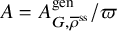


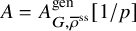
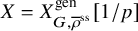
and let $\rho : \Gamma _F \rightarrow G(A)$
be the universal representation. Then the W-special locus of level j in X is
$\rho : \Gamma _F \rightarrow G(A)$
be the universal representation. Then the W-special locus of level j in X is $G^0$
-invariant.
$G^0$
-invariant.
Proof. It follows from the universal property of $A^{\mathrm {gen}}_{G,\overline {\rho }^{\mathrm {ss}}}$
that if
$A^{\mathrm {gen}}_{G,\overline {\rho }^{\mathrm {ss}}}$
that if $g\in G^0(A)$
then there is an isomorphism of
$g\in G^0(A)$
then there is an isomorphism of $R^{\mathrm {ps}}_G$
-algebras
$R^{\mathrm {ps}}_G$
-algebras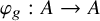 $\varphi _g: A\rightarrow A$
such that for all
$\varphi _g: A\rightarrow A$
such that for all $\gamma \in \Gamma _F$
we have
$\gamma \in \Gamma _F$
we have
 $$ \begin{align} g \rho(\gamma) g^{-1} = G(\varphi_g)(\rho(\gamma)), \end{align} $$
where $G(\varphi _g): G(A)\rightarrow G(A)$
is the group homomorphism induced by
$G(\varphi _g): G(A)\rightarrow G(A)$
is the group homomorphism induced by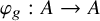 $\varphi _g: A\rightarrow A$
.
$\varphi _g: A\rightarrow A$
.
Let $x: A\rightarrow \kappa $
be a homomorphism of
$x: A\rightarrow \kappa $
be a homomorphism of $R^{\mathrm {ps}}_{{\mathrm {GL}}_d}$
-algebras, where
$R^{\mathrm {ps}}_{{\mathrm {GL}}_d}$
-algebras, where $\kappa $
is a field. Then
$\kappa $
is a field. Then $y:= g(x)= x\circ \varphi _g^{-1}: A\rightarrow \kappa $
. In particular, the residue fields of x and y are the same and we may assume that they are equal to
$y:= g(x)= x\circ \varphi _g^{-1}: A\rightarrow \kappa $
. In particular, the residue fields of x and y are the same and we may assume that they are equal to $\kappa $
. If
$\kappa $
. If $h\in G(A)$
then let
$h\in G(A)$
then let $h_x= G(x)(h), h_y= G(y)(h)\in G(\kappa )$
be the specialisations of h at x and y respectively. It follows from (61) that
$h_x= G(x)(h), h_y= G(y)(h)\in G(\kappa )$
be the specialisations of h at x and y respectively. It follows from (61) that
 $$ \begin{align} \rho_x(\gamma)= G(x)(\rho(\gamma))= G(y)(G(\varphi_g)(\rho(\gamma)))= G(y)(g \rho(\gamma) g^{-1})= g_y \rho_y(\gamma) g_y^{-1}. \end{align} $$
We may identify $W_x= W_y= W_{\kappa }$
as
$W_x= W_y= W_{\kappa }$
as $\kappa $
-vector spaces. If
$\kappa $
-vector spaces. If $v\in W_{\kappa }$
such that
$v\in W_{\kappa }$
such that $\rho _x(\gamma )v = \chi _{\mathrm {cyc}}(\gamma )^{-1} v$
for all
$\rho _x(\gamma )v = \chi _{\mathrm {cyc}}(\gamma )^{-1} v$
for all $\gamma \in \Gamma _F$
then it follows from (62) that
$\gamma \in \Gamma _F$
then it follows from (62) that $\rho _y(\gamma ) (g_y^{-1} v) = \chi _{\mathrm {cyc}}(\gamma )^{-1} g_y^{-1} v$
for all
$\rho _y(\gamma ) (g_y^{-1} v) = \chi _{\mathrm {cyc}}(\gamma )^{-1} g_y^{-1} v$
for all $\gamma \in \Gamma _F$
. Hence,
$\gamma \in \Gamma _F$
. Hence,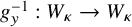 $g_y^{-1}: W_{\kappa } \rightarrow W_{\kappa }$
induces an isomorphism between
$g_y^{-1}: W_{\kappa } \rightarrow W_{\kappa }$
induces an isomorphism between $W_{x}(1)^{\Gamma _F}$
and
$W_{x}(1)^{\Gamma _F}$
and $W_y(1)^{\Gamma _F}$
. Thus
$W_y(1)^{\Gamma _F}$
. Thus $x\in X_{W,j}$
if and only if
$x\in X_{W,j}$
if and only if $y\in X_{W, j}$
.
$y\in X_{W, j}$
.
Corollary 13.12. Assume the setup of Proposition 13.11 and let $X'$
be a closed
$X'$
be a closed $G^0$
-invariant subscheme of X. Then the W-special locus of level j in
$G^0$
-invariant subscheme of X. Then the W-special locus of level j in $X'$
is
$X'$
is $G^0$
-invariant.
$G^0$
-invariant.
Proof. The fibre product $X_{W,j}\times _X X'$
is a closed
$X_{W,j}\times _X X'$
is a closed $G^0$
-invariant subscheme of
$G^0$
-invariant subscheme of $X'$
and its underlying reduced subscheme coincides with
$X'$
and its underlying reduced subscheme coincides with $X^{\prime }_{W,j}$
. Thus
$X^{\prime }_{W,j}$
. Thus $X^{\prime }_{W,j}$
is also
$X^{\prime }_{W,j}$
is also $G^0$
-invariant.
$G^0$
-invariant.
Lemma 13.13. Let Z be a closed non-empty $G^0$
-invariant subscheme of
$G^0$
-invariant subscheme of $X^{\mathrm {gen}}_{G, \overline {\rho }^{\mathrm {ss}}}$
and let
$X^{\mathrm {gen}}_{G, \overline {\rho }^{\mathrm {ss}}}$
and let $Z'$
be an irreducible component of Z. Then
$Z'$
be an irreducible component of Z. Then $Z'$
is
$Z'$
is $G^0$
-invariant and
$G^0$
-invariant and $Z'\cap Y_{\overline {\rho }^{\mathrm {ss}}}$
is non-empty. Moreover, if x is a closed point of
$Z'\cap Y_{\overline {\rho }^{\mathrm {ss}}}$
is non-empty. Moreover, if x is a closed point of $Z'$
then one of the following holds:
$Z'$
then one of the following holds:
-
(1) if
$x\in Y_{\overline {\rho }^{\mathrm {ss}}}$
then
$\dim \mathscr O_{Z', x} = \dim Z'$
; -
(2) if
$x\not \in Y_{\overline {\rho }^{\mathrm {ss}}}$
then
$\dim \mathscr O_{Z', x} = \dim Z'-1$
.




Proof. The proof is the same as the proof of [Reference Böckle, Iyengar and Paškūnas6, Lemma 3.21].
Proposition 13.14. If Z is a closed $G^0$
-invariant subscheme of
$G^0$
-invariant subscheme of $X^{\mathrm {gen}}_{G, \overline {\rho }^{\mathrm {ss}}}$
then
$X^{\mathrm {gen}}_{G, \overline {\rho }^{\mathrm {ss}}}$
then
 $$ \begin{align*}\dim Z[1/p]\le \dim \overline{Z},\quad \dim Z\le \dim \overline{Z}+1,\end{align*} $$
where $\overline {Z}$
is its special fibre and
$\overline {Z}$
is its special fibre and $Z[1/p]$
is its generic fibre.
$Z[1/p]$
is its generic fibre.
Proof. The proof is the same as the proof of [Reference Böckle, Iyengar and Paškūnas6, Lemma 3.23].
Corollary 13.15. Let $X'$
be a closed G-invariant subscheme of
$X'$
be a closed G-invariant subscheme of $X^{\mathrm {gen}}_{G, \overline {\rho }^{\mathrm {ss}}}$
, let W be a representation of G on a free
$X^{\mathrm {gen}}_{G, \overline {\rho }^{\mathrm {ss}}}$
, let W be a representation of G on a free $\mathscr O$
-module of finite rank. Then
$\mathscr O$
-module of finite rank. Then
 $$ \begin{align*}\dim X^{\prime}_{W_L}\le \dim X^{\prime}_{W_k}, \quad \dim X^{\prime}_{W}\le \dim X^{\prime}_{W_k}+1\end{align*} $$
where $X^{\prime }_{W_L}$
is the
$X^{\prime }_{W_L}$
is the $W_L$
-special locus in
$W_L$
-special locus in $X'[1/p]$
and
$X'[1/p]$
and $X^{\prime }_{W_k}$
is the
$X^{\prime }_{W_k}$
is the $W_k$
-special locus in
$W_k$
-special locus in $\overline {X}'$
and
$\overline {X}'$
and $X^{\prime }_W$
is the W-special locus in
$X^{\prime }_W$
is the W-special locus in $X'$
.
$X'$
.
Proof. Let $X^{\prime }_W$
be the W-special locus in
$X^{\prime }_W$
be the W-special locus in $X'$
. Then it follows from the definition of the W-special locus that
$X'$
. Then it follows from the definition of the W-special locus that $X^{\prime }_{W_L}= X^{\prime }_W[1/p]$
and
$X^{\prime }_{W_L}= X^{\prime }_W[1/p]$
and $X^{\prime }_{W_k}$
is the underlying reduced subscheme of the special fibre of
$X^{\prime }_{W_k}$
is the underlying reduced subscheme of the special fibre of $X^{\prime }_W$
. The assertion follows from Corollary 13.12 and Proposition 13.14.
$X^{\prime }_W$
. The assertion follows from Corollary 13.12 and Proposition 13.14.
Proposition 13.16. Assume the setup of Proposition 13.11 (2) so that $R=k$
and
$R=k$
and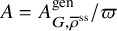 $A=A^{\mathrm {gen}}_{G, \overline {\rho }^{\mathrm {ss}}}/\varpi $
. If the W-special locus of level j in
$A=A^{\mathrm {gen}}_{G, \overline {\rho }^{\mathrm {ss}}}/\varpi $
. If the W-special locus of level j in $\overline {X}^{\mathrm {gen}}_{G, \overline {\rho }^{\mathrm {ss}}}$
is nonempty then the following assertions hold:
$\overline {X}^{\mathrm {gen}}_{G, \overline {\rho }^{\mathrm {ss}}}$
is nonempty then the following assertions hold:
-
(1) The image
$C_{W,j}$
in
$\overline {X}^{\mathrm {git}}_G$
of the W-special locus of level j in
$\overline {X}^{\mathrm {gen}}_{G, \overline {\rho }^{\mathrm {ss}}}$
is closed; -
(2) there exists a finite extension
$k'$
of k and finitely many reductive subgroups
$H_1, \ldots , H_r$
of
$G_{k'}$
such that
$C_{W,j}$
is contained in the union of
$\overline {X}^{\mathrm {git}}_{H_iG, \overline {\rho }^{\mathrm {ss}}}$
and
$$ \begin{align*}\dim_{k'} W_{k'}^{H_i^0} \ge j+1, \quad \forall 1\le i\le r.\end{align*} $$
-
(3) if
$W^{G^0}=0$
then
$H_i$
in (2) satisfy
$\dim H_i\le \dim G_k-1$
; -
(4) if
$W^{G'}=0$
then
$H_i$
in (2) satisfy
$\dim H_i\le \dim G_k -2$
.






Proof. Since the W-special locus of level j is closed in $\overline {X}^{\mathrm {gen}}_{G, \overline {\rho }^{\mathrm {ss}}}$
by Lemma 13.8 and
$\overline {X}^{\mathrm {gen}}_{G, \overline {\rho }^{\mathrm {ss}}}$
by Lemma 13.8 and $G^0$
-invariant by Proposition 13.11, its image in
$G^0$
-invariant by Proposition 13.11, its image in $\overline {X}^{\mathrm {git}}_{G,\overline {\rho }^{\mathrm {ss}}}$
is also closed by [Reference Seshadri57, Theorem 3 (iii)]. To prove part (2), let
$\overline {X}^{\mathrm {git}}_{G,\overline {\rho }^{\mathrm {ss}}}$
is also closed by [Reference Seshadri57, Theorem 3 (iii)]. To prove part (2), let $\eta _1, \ldots , \eta _r$
be the generic points of
$\eta _1, \ldots , \eta _r$
be the generic points of $C_{W,j}$
. It is enough to find
$C_{W,j}$
. It is enough to find $H_i$
satisfying the required bounds on the dimension such that
$H_i$
satisfying the required bounds on the dimension such that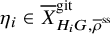 $\eta _i \in \overline {X}^{\mathrm {git}}_{H_iG, \overline {\rho }^{\mathrm {ss}}}$
.
$\eta _i \in \overline {X}^{\mathrm {git}}_{H_iG, \overline {\rho }^{\mathrm {ss}}}$
.
To ease the notation let X be the W-special locus of level j in $\overline {X}^{\mathrm {gen}}_{G, \overline {\rho }^{\mathrm {ss}}}$
, let
$\overline {X}^{\mathrm {gen}}_{G, \overline {\rho }^{\mathrm {ss}}}$
, let $\eta =\eta _1$
and let
$\eta =\eta _1$
and let $\bar {\eta }$
be a geometric point above
$\bar {\eta }$
be a geometric point above $\eta $
. It follows from [Reference Seshadri57, Theorem 3] that there is
$\eta $
. It follows from [Reference Seshadri57, Theorem 3] that there is $x\in X(\kappa (\bar {\eta }))$
above
$x\in X(\kappa (\bar {\eta }))$
above $\bar {\eta }$
such that the orbit
$\bar {\eta }$
such that the orbit $G^0 \cdot x$
is closed in
$G^0 \cdot x$
is closed in $X_{\bar {\eta }}$
. Since X is closed in
$X_{\bar {\eta }}$
. Since X is closed in $\overline {X}^{\mathrm {gen}}_{G, \overline {\rho }^{\mathrm {ss}}}$
, Lemma 5.6 together with (28) imply that
$\overline {X}^{\mathrm {gen}}_{G, \overline {\rho }^{\mathrm {ss}}}$
, Lemma 5.6 together with (28) imply that $X_{\bar {\eta }}$
is a closed
$X_{\bar {\eta }}$
is a closed $G^0$
-invariant subscheme of
$G^0$
-invariant subscheme of $G^N_{\bar {\eta }}$
, where
$G^N_{\bar {\eta }}$
, where $x\in X_{\bar {\eta }}$
is mapped to the N-tuple
$x\in X_{\bar {\eta }}$
is mapped to the N-tuple $y=(\rho _x(\gamma _1), \ldots , \rho _x(\gamma _N))$
, where
$y=(\rho _x(\gamma _1), \ldots , \rho _x(\gamma _N))$
, where $\gamma _i$
are elements of
$\gamma _i$
are elements of $\Gamma _F$
chosen before Lemma 5.6. Hence, the orbit
$\Gamma _F$
chosen before Lemma 5.6. Hence, the orbit $G^0 \cdot y$
is closed in
$G^0 \cdot y$
is closed in $G^N_{\bar {\eta }}$
under the conjugation action. Let
$G^N_{\bar {\eta }}$
under the conjugation action. Let $H_x$
be the smallest closed subgroup of
$H_x$
be the smallest closed subgroup of $G_{\bar {\eta }}$
containing the entries of y. It follows from [Reference Bate, Martin and Röhrle3, Theorem 3.1] that
$G_{\bar {\eta }}$
containing the entries of y. It follows from [Reference Bate, Martin and Röhrle3, Theorem 3.1] that $H_x$
is a strongly reductive subgroup of
$H_x$
is a strongly reductive subgroup of $G_{\bar {\eta }}$
, and thus is reductive by [Reference Martin42, Section 6]. It follows from Lemma 5.13 that
$G_{\bar {\eta }}$
, and thus is reductive by [Reference Martin42, Section 6]. It follows from Lemma 5.13 that $H_x$
is equal to the Zariski closure of
$H_x$
is equal to the Zariski closure of $\rho _x(\Gamma _F)$
in
$\rho _x(\Gamma _F)$
in $G_{\bar {\eta }}$
. Since
$G_{\bar {\eta }}$
. Since $x\in X$
, the dimension of the
$x\in X$
, the dimension of the $H_x^0$
-invariants of
$H_x^0$
-invariants of $W_x$
is at least
$W_x$
is at least $j+1$
by Lemma 13.10. If
$j+1$
by Lemma 13.10. If $\dim H_x= \dim G_k$
then
$\dim H_x= \dim G_k$
then $H_x^0= G_{\bar {\eta }}^0$
and hence
$H_x^0= G_{\bar {\eta }}^0$
and hence $W^{G^0}\neq 0$
. If
$W^{G^0}\neq 0$
. If $W^{G'}=0$
then
$W^{G'}=0$
then $\dim H_x \le \dim G_k - 2$
by Corollary 10.3.
$\dim H_x \le \dim G_k - 2$
by Corollary 10.3.
By [Reference Martin42, Theorem 10.3] there is a closed reductive subgroup H of G defined over $\bar {k}$
and
$\bar {k}$
and $g\in G(\kappa (\bar {\eta }))$
such that
$g\in G(\kappa (\bar {\eta }))$
such that $H_x= g (H_{\bar {\eta }}) g^{-1}$
. Since H is defined by finitely many polynomials with coefficients in
$H_x= g (H_{\bar {\eta }}) g^{-1}$
. Since H is defined by finitely many polynomials with coefficients in $\bar {k}$
, H is defined over a finite extension of k. The point
$\bar {k}$
, H is defined over a finite extension of k. The point $x':= g(x)\in \overline {X}^{\mathrm {gen}}_H(\kappa (\bar {\eta }))$
maps to
$x':= g(x)\in \overline {X}^{\mathrm {gen}}_H(\kappa (\bar {\eta }))$
maps to $\eta $
in
$\eta $
in $\overline {X}^{\mathrm {git}}_{G, \overline {\rho }^{\mathrm {ss}}}$
, thus
$\overline {X}^{\mathrm {git}}_{G, \overline {\rho }^{\mathrm {ss}}}$
, thus $\eta $
lies in
$\eta $
lies in $\overline {X}^{\mathrm {git}}_{HG, \overline {\rho }^{\mathrm {ss}}}$
.
$\overline {X}^{\mathrm {git}}_{HG, \overline {\rho }^{\mathrm {ss}}}$
.
13.3 Bounding the dimension of the space
In this subsection we carry out the induction to prove (DIM). It follows from [Reference Paškūnas and Quast48, Theorem 9.3 (3)] that (DIM) holds if $H^0$
is a torus. Thus we may assume that
$H^0$
is a torus. Thus we may assume that $\dim H\ge 3$
.
$\dim H\ge 3$
.
Proposition 13.17. Let L be an R-Levi of G. Let $\overline {{V}}_{LG, \overline {\rho }^{\mathrm {ss}}}$
be the preimage of
$\overline {{V}}_{LG, \overline {\rho }^{\mathrm {ss}}}$
be the preimage of $\overline {U}_{LG, \overline {\rho }^{\mathrm {ss}}}$
in
$\overline {U}_{LG, \overline {\rho }^{\mathrm {ss}}}$
in $\overline {X}^{\mathrm {gen}}_{G, \overline {\rho }^{\mathrm {ss}}}$
and let
$\overline {X}^{\mathrm {gen}}_{G, \overline {\rho }^{\mathrm {ss}}}$
and let $\overline {Z}_{LG, \overline {\rho }^{\mathrm {ss}}}$
be its closure. Assume that
$\overline {Z}_{LG, \overline {\rho }^{\mathrm {ss}}}$
be its closure. Assume that $L\neq G$
and
$L\neq G$
and $\overline {U}_{LG, \overline {\rho }^{\mathrm {ss}}}$
is non-empty. If (DIM) holds for all
$\overline {U}_{LG, \overline {\rho }^{\mathrm {ss}}}$
is non-empty. If (DIM) holds for all $\overline {\rho }^{\mathrm {ss}}$
-compatible pairs
$\overline {\rho }^{\mathrm {ss}}$
-compatible pairs $(H_1, \overline {\rho }_1)$
with
$(H_1, \overline {\rho }_1)$
with $\dim H_1< \dim G_k$
then
$\dim H_1< \dim G_k$
then
 $$ \begin{align} \dim G_k ([F:\mathbb {Q}_p]+1) - \dim \overline{Z}_{LG, \overline{\rho}^{\mathrm{ss}}} \ge\min(2, \dim N_k) [F:\mathbb {Q}_p]\ge 1, \end{align} $$
where N is the unipotent radical of an R-parabolic subgroup with R-Levi L. Moreover, if either $F\neq \mathbb {Q}_p$
or
$F\neq \mathbb {Q}_p$
or $\dim N_k \neq 1$
then the lower bound can be replaced by
$\dim N_k \neq 1$
then the lower bound can be replaced by $2$
.
$2$
.
Proof. Lemma 9.11 implies that $\dim N_k\ge 1$
. Hence,
$\dim N_k\ge 1$
. Hence, $\min (2, \dim N_k)[F:\mathbb {Q}_p]\ge 1$
with equality if and only if
$\min (2, \dim N_k)[F:\mathbb {Q}_p]\ge 1$
with equality if and only if $F=\mathbb {Q}_p$
and
$F=\mathbb {Q}_p$
and $\dim N_k=1$
.
$\dim N_k=1$
.
It follows from Lemma 2.18 that there are only finitely many R-parabolic subgroups P with R-Levi L. For each such P the Lie algebra of its unipotent radical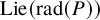 ${\mathrm {Lie}}({\mathrm {rad}}(P))$
is a free
${\mathrm {Lie}}({\mathrm {rad}}(P))$
is a free $\mathscr O$
-module of finite rank with the adjoint action of L. Moreover,
$\mathscr O$
-module of finite rank with the adjoint action of L. Moreover, ${\mathrm {Lie}}({\mathrm {rad}}(P))\otimes _{\mathscr {O}} k = {\mathrm {Lie}}({\mathrm {rad}}(P_k))$
. Let
${\mathrm {Lie}}({\mathrm {rad}}(P))\otimes _{\mathscr {O}} k = {\mathrm {Lie}}({\mathrm {rad}}(P_k))$
. Let $W_P$
denote the k-linear dual of
$W_P$
denote the k-linear dual of ${\mathrm {Lie}}({\mathrm {rad}}(P_k))$
and for each
${\mathrm {Lie}}({\mathrm {rad}}(P_k))$
and for each $j\ge 0$
let
$j\ge 0$
let $C_{W_P, j}$
be the image in
$C_{W_P, j}$
be the image in $\overline {X}^{\mathrm {git}}_{L, \overline {\rho }^{\mathrm {ss}}}$
of the
$\overline {X}^{\mathrm {git}}_{L, \overline {\rho }^{\mathrm {ss}}}$
of the $W_P$
-special locus of level j in
$W_P$
-special locus of level j in $\overline {X}^{\mathrm {gen}}_{L, \overline {\rho }^{\mathrm {ss}}}$
. If
$\overline {X}^{\mathrm {gen}}_{L, \overline {\rho }^{\mathrm {ss}}}$
. If $C_{W_P, j}$
is nonempty then it follows from Proposition 13.16, Corollary 10.7 and Lemma 10.6 that (after possibly replacing k by a finite extension) there exist finitely many closed reductive subgroups
$C_{W_P, j}$
is nonempty then it follows from Proposition 13.16, Corollary 10.7 and Lemma 10.6 that (after possibly replacing k by a finite extension) there exist finitely many closed reductive subgroups $H_{ij}$
, for
$H_{ij}$
, for $1\le i \le r_{P,j}$
, of
$1\le i \le r_{P,j}$
, of $L_k$
defined over k, such that
$L_k$
defined over k, such that $C_{W_P, j}$
is contained in the union of
$C_{W_P, j}$
is contained in the union of $\overline {X}^{\mathrm {git}}_{H_{ij} L, \overline {\rho }^{\mathrm {ss}}}$
and
$\overline {X}^{\mathrm {git}}_{H_{ij} L, \overline {\rho }^{\mathrm {ss}}}$
and
 $$ \begin{align} \dim_k W_P^{H^0_{ij}}\ge j+1 \end{align} $$
and one of the following holds:
-
(a)
$\dim L_k -\dim H_{ij} \ge 2$
, or -
(b)
$\dim L_k -\dim H_{ij}=1$
and
$\dim _k W_P^{H^0_{ij}}=1$
.


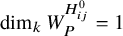
We note that if $j\ge 1$
then (64) rules out (b), so that (a) holds.
$j\ge 1$
then (64) rules out (b), so that (a) holds.
Let $\overline {{V}}_{P,ij}$
be the preimage of
$\overline {{V}}_{P,ij}$
be the preimage of $\overline {U}_{P,ij}:=\overline {U}_{LG, \overline {\rho }^{\mathrm {ss}}}\cap \overline {X}^{\mathrm {git}}_{H_{ij} L, \overline {\rho }^{\mathrm {ss}}}$
in
$\overline {U}_{P,ij}:=\overline {U}_{LG, \overline {\rho }^{\mathrm {ss}}}\cap \overline {X}^{\mathrm {git}}_{H_{ij} L, \overline {\rho }^{\mathrm {ss}}}$
in $\overline {X}^{\mathrm {gen}}_{G, \overline {\rho }^{\mathrm {ss}}}$
and let
$\overline {X}^{\mathrm {gen}}_{G, \overline {\rho }^{\mathrm {ss}}}$
and let $\overline {Z}_{P, ij}$
be its closure. If part (a) holds then Corollary 13.6 gives us
$\overline {Z}_{P, ij}$
be its closure. If part (a) holds then Corollary 13.6 gives us
 $$ \begin{align} \dim G_k ([F:\mathbb {Q}_p]+1) - \dim \overline{Z}_{P,ij}\ge 2[F:\mathbb {Q}_p]. \end{align} $$
As remarked above part (a) holds for $j=1$
. If part (b) holds for
$j=1$
. If part (b) holds for $j=0$
then we let
$j=0$
then we let $\overline {{V}}^{\prime }_{P,i}$
be the preimage in
$\overline {{V}}^{\prime }_{P,i}$
be the preimage in $\overline {X}^{\mathrm {gen}}_{G, \overline {\rho }^{\mathrm {ss}}}$
of
$\overline {X}^{\mathrm {gen}}_{G, \overline {\rho }^{\mathrm {ss}}}$
of
 $$ \begin{align*}\overline{U}^{\prime}_{P,i}:= \overline{U}_{P,i0} \setminus \bigcup_{Q} (\overline{U}_{P,i0} \cap C_{W_Q, 1}),\end{align*} $$
where the union is taken over all R-parabolic subgroups Q of G with R-Levi L. Let $\overline {Z}^{\prime }_{P,i}$
be the closure of
$\overline {Z}^{\prime }_{P,i}$
be the closure of $\overline {{V}}^{\prime }_{P,i}$
in
$\overline {{V}}^{\prime }_{P,i}$
in $\overline {X}^{\mathrm {gen}}_{G, \overline {\rho }^{\mathrm {ss}}}$
.
$\overline {X}^{\mathrm {gen}}_{G, \overline {\rho }^{\mathrm {ss}}}$
.
Let $y: {\mathrm {Spec}} \kappa \rightarrow U^{\prime }_{P,i}$
be a closed geometric point and let
$y: {\mathrm {Spec}} \kappa \rightarrow U^{\prime }_{P,i}$
be a closed geometric point and let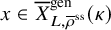 $x\in \overline {X}^{\mathrm {gen}}_{L, \overline {\rho }^{\mathrm {ss}}}(\kappa )$
lie in the preimage of y, such that
$x\in \overline {X}^{\mathrm {gen}}_{L, \overline {\rho }^{\mathrm {ss}}}(\kappa )$
lie in the preimage of y, such that $L\cdot x$
is a closed orbit in
$L\cdot x$
is a closed orbit in $\overline {X}^{\mathrm {gen}}_{L, \overline {\rho }^{\mathrm {ss}}}$
. Let
$\overline {X}^{\mathrm {gen}}_{L, \overline {\rho }^{\mathrm {ss}}}$
. Let $\rho _x: \Gamma _F \rightarrow L(\kappa )$
be the specialisation of the universal representation of
$\rho _x: \Gamma _F \rightarrow L(\kappa )$
be the specialisation of the universal representation of $\Gamma _F$
over
$\Gamma _F$
over $\overline {X}^{\mathrm {gen}}_{L, \overline {\rho }^{\mathrm {ss}}}$
at x. Let
$\overline {X}^{\mathrm {gen}}_{L, \overline {\rho }^{\mathrm {ss}}}$
at x. Let $x'$
be the image of x in
$x'$
be the image of x in $\overline {X}^{\mathrm {gen}}_{G, \overline {\rho }^{\mathrm {ss}}}$
and let
$\overline {X}^{\mathrm {gen}}_{G, \overline {\rho }^{\mathrm {ss}}}$
and let $\rho _{x'}$
be the specialisation of the universal representation over
$\rho _{x'}$
be the specialisation of the universal representation over $\overline {X}^{\mathrm {gen}}_{G, \overline {\rho }^{\mathrm {ss}}}$
at
$\overline {X}^{\mathrm {gen}}_{G, \overline {\rho }^{\mathrm {ss}}}$
at $x'$
. Then
$x'$
. Then $\rho _{x'}$
is equal to the composition of
$\rho _{x'}$
is equal to the composition of $\rho _x$
with the embedding
$\rho _x$
with the embedding $L(\kappa )\hookrightarrow G(\kappa )$
. Since the orbit
$L(\kappa )\hookrightarrow G(\kappa )$
. Since the orbit $L\cdot x$
is closed
$L\cdot x$
is closed $\rho _x$
is L-semisimple and hence
$\rho _x$
is L-semisimple and hence $\rho _{x'}$
is G-semisimple and the orbit
$\rho _{x'}$
is G-semisimple and the orbit $G\cdot x'$
is closed in
$G\cdot x'$
is closed in $X^{\mathrm {gen}}_{G,y}$
. We let
$X^{\mathrm {gen}}_{G,y}$
. We let $\Gamma _F$
act on
$\Gamma _F$
act on $W_{Q, \kappa }$
via
$W_{Q, \kappa }$
via $\rho _x$
. If
$\rho _x$
. If $h^0(\Gamma _F, W_{Q, \kappa }(1))\ge 2$
then
$h^0(\Gamma _F, W_{Q, \kappa }(1))\ge 2$
then $x'$
is in
$x'$
is in $W_{Q}$
-special locus of level
$W_{Q}$
-special locus of level $1$
. Since
$1$
. Since $x'$
maps to y, we would obtain that
$x'$
maps to y, we would obtain that $y\in C_{W_Q, 1}$
, which yields a contradiction. Hence
$y\in C_{W_Q, 1}$
, which yields a contradiction. Hence $h^0(\Gamma _F, W_{Q, \kappa }(1))\le 1$
, which implies that
$h^0(\Gamma _F, W_{Q, \kappa }(1))\le 1$
, which implies that $\delta (y)\le 1$
and hence
$\delta (y)\le 1$
and hence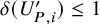 $\delta (U^{\prime }_{P,i})\le 1$
. Since part (b) holds by assumption we deduce that
$\delta (U^{\prime }_{P,i})\le 1$
. Since part (b) holds by assumption we deduce that $\delta (U^{\prime }_{P,i})\le \dim L_k -\dim H_{i0}$
. Corollary 13.7 implies that
$\delta (U^{\prime }_{P,i})\le \dim L_k -\dim H_{i0}$
. Corollary 13.7 implies that
 $$ \begin{align} \dim G_k([F:\mathbb {Q}_p] +1) - \dim \overline{Z}^{\prime}_{P,i} \ge \dim N_k [F:\mathbb {Q}_p]. \end{align} $$
Since $Z_{P, i0} \subseteq \overline {Z}^{\prime }_{P,i} \cup \bigcup _{Q,k} \overline {Z}_{Q,k1}$
we deduce from (65) and (66) that
$Z_{P, i0} \subseteq \overline {Z}^{\prime }_{P,i} \cup \bigcup _{Q,k} \overline {Z}_{Q,k1}$
we deduce from (65) and (66) that
 $$ \begin{align} \dim G_k([F:\mathbb {Q}_p] +1) - \dim \overline{Z}_{P,i0} \ge \min(2, \dim N_k)[F:\mathbb {Q}_p]. \end{align} $$
Let $\overline {{V}}"$
be the preimage of
$\overline {{V}}"$
be the preimage of $\overline {U}":= \overline {U}_{LG, \overline {\rho }^{\mathrm {ss}}} \setminus \bigcup _P (\overline {U}_{LG, \overline {\rho }^{\mathrm {ss}}}\cap C_{W_P,0})$
and let
$\overline {U}":= \overline {U}_{LG, \overline {\rho }^{\mathrm {ss}}} \setminus \bigcup _P (\overline {U}_{LG, \overline {\rho }^{\mathrm {ss}}}\cap C_{W_P,0})$
and let $\overline {Z}"$
be its closure. The same argument as above shows that
$\overline {Z}"$
be its closure. The same argument as above shows that $\delta (\overline {U}")=0$
. Corollary 13.7 applied with
$\delta (\overline {U}")=0$
. Corollary 13.7 applied with $H=L$
gives
$H=L$
gives
 $$ \begin{align} \dim G_k([F:\mathbb {Q}_p] +1) - \dim \overline{Z}" \ge \dim N_k [F:\mathbb {Q}_p]. \end{align} $$
Since $\overline {Z}_{LG, \overline {\rho }^{\mathrm {ss}}} = \overline {Z}"\cup \bigcup _{P,i} \overline {Z}_{P,i0}$
we conclude from (67) and (68) that (63) holds.
$\overline {Z}_{LG, \overline {\rho }^{\mathrm {ss}}} = \overline {Z}"\cup \bigcup _{P,i} \overline {Z}_{P,i0}$
we conclude from (67) and (68) that (63) holds.
Let $G^{\prime }_{\operatorname {sc}}\rightarrow G'$
be the simply connected central cover of
$G^{\prime }_{\operatorname {sc}}\rightarrow G'$
be the simply connected central cover of $G'$
. We have shown in Lemma 2.11 that
$G'$
. We have shown in Lemma 2.11 that ${\mathrm {Lie}} G^{\prime }_{\operatorname {sc}}$
is naturally a G-representation.
${\mathrm {Lie}} G^{\prime }_{\operatorname {sc}}$
is naturally a G-representation.
Proposition 13.18. Let $\overline {X}^{{\mathrm {spcl}}}_{G,\overline {\rho }^{\mathrm {ss}}}$
be the
$\overline {X}^{{\mathrm {spcl}}}_{G,\overline {\rho }^{\mathrm {ss}}}$
be the $({\mathrm {Lie}} G_{\operatorname {sc}}')^*$
-special locus in
$({\mathrm {Lie}} G_{\operatorname {sc}}')^*$
-special locus in $\overline {X}^{\mathrm {gen}}_{G, \overline {\rho }^{\mathrm {ss}}}$
. Let
$\overline {X}^{\mathrm {gen}}_{G, \overline {\rho }^{\mathrm {ss}}}$
. Let $\overline {{V}}^{{\mathrm {spcl}}}_{GG, \overline {\rho }^{\mathrm {ss}}}=\overline {{V}}_{GG, \overline {\rho }^{\mathrm {ss}}}\cap \overline {X}^{{\mathrm {spcl}}}_{G,\overline {\rho }^{\mathrm {ss}}}$
and let
$\overline {{V}}^{{\mathrm {spcl}}}_{GG, \overline {\rho }^{\mathrm {ss}}}=\overline {{V}}_{GG, \overline {\rho }^{\mathrm {ss}}}\cap \overline {X}^{{\mathrm {spcl}}}_{G,\overline {\rho }^{\mathrm {ss}}}$
and let $\overline {Z}^{{\mathrm {spcl}}}_{GG, \overline {\rho }^{\mathrm {ss}}}$
be its closure. If (DIM) holds for all
$\overline {Z}^{{\mathrm {spcl}}}_{GG, \overline {\rho }^{\mathrm {ss}}}$
be its closure. If (DIM) holds for all $\overline {\rho }^{\mathrm {ss}}$
-compatible pairs
$\overline {\rho }^{\mathrm {ss}}$
-compatible pairs $(H_1, \overline {\rho }_1)$
with
$(H_1, \overline {\rho }_1)$
with $\dim H_1< \dim G_k$
then
$\dim H_1< \dim G_k$
then
 $$ \begin{align} \dim G_k ([F:\mathbb {Q}_p]+1) - \dim \overline{Z}_{GG, \overline{\rho}^{\mathrm{ss}}}^{{\mathrm{spcl}}} \ge 2 [F:\mathbb {Q}_p]. \end{align} $$
Proof. We may assume that $\overline {{V}}^{{\mathrm {spcl}}}_{GG, \overline {\rho }^{\mathrm {ss}}}$
is non-empty. Let
$\overline {{V}}^{{\mathrm {spcl}}}_{GG, \overline {\rho }^{\mathrm {ss}}}$
is non-empty. Let $W=({\mathrm {Lie}} G_{\operatorname {sc}}')^*$
and let
$W=({\mathrm {Lie}} G_{\operatorname {sc}}')^*$
and let $C_{W}$
be the image of
$C_{W}$
be the image of $\overline {X}^{{\mathrm {spcl}}}_{G,\overline {\rho }^{\mathrm {ss}}}$
in
$\overline {X}^{{\mathrm {spcl}}}_{G,\overline {\rho }^{\mathrm {ss}}}$
in $\overline {X}^{\mathrm {git}}_{G,\overline {\rho }^{\mathrm {ss}}}$
. Since
$\overline {X}^{\mathrm {git}}_{G,\overline {\rho }^{\mathrm {ss}}}$
. Since $W^{G'}=0$
by Lemma 10.5, Proposition 13.16 implies that there exist finitely many reductive subgroups
$W^{G'}=0$
by Lemma 10.5, Proposition 13.16 implies that there exist finitely many reductive subgroups $H_i$
of
$H_i$
of $G_k$
, such that
$G_k$
, such that $C_W$
is contained in the union of
$C_W$
is contained in the union of $\overline {X}^{\mathrm {git}}_{H_iG, \overline {\rho }^{\mathrm {ss}}}$
and
$\overline {X}^{\mathrm {git}}_{H_iG, \overline {\rho }^{\mathrm {ss}}}$
and ${\dim G_k - \dim H_i\ge 2}$
. The assertion follows from Corollary 13.6.
${\dim G_k - \dim H_i\ge 2}$
. The assertion follows from Corollary 13.6.
Definition 13.19. We define the absolutely irreducible non-special locus $V^{{\mathrm {n-spcl}}}_{GG, \overline {\rho }^{\mathrm {ss}}}$
in
$V^{{\mathrm {n-spcl}}}_{GG, \overline {\rho }^{\mathrm {ss}}}$
in $X^{\mathrm {gen}}_{G, \overline {\rho }^{\mathrm {ss}}}$
as the complement of the
$X^{\mathrm {gen}}_{G, \overline {\rho }^{\mathrm {ss}}}$
as the complement of the $({\mathrm {Lie}} G^{\prime }_{\operatorname {sc}})^*$
-special locus in
$({\mathrm {Lie}} G^{\prime }_{\operatorname {sc}})^*$
-special locus in $V_{GG, \overline {\rho }^{\mathrm {ss}}}$
. We define the absolutely irreducible non-special locus
$V_{GG, \overline {\rho }^{\mathrm {ss}}}$
. We define the absolutely irreducible non-special locus $\overline {{V}}^{{\mathrm {n-spcl}}}_{GG, \overline {\rho }^{\mathrm {ss}}}$
in
$\overline {{V}}^{{\mathrm {n-spcl}}}_{GG, \overline {\rho }^{\mathrm {ss}}}$
in $\overline {X}^{\mathrm {gen}}_{G, \overline {\rho }^{\mathrm {ss}}}$
as the complement of the
$\overline {X}^{\mathrm {gen}}_{G, \overline {\rho }^{\mathrm {ss}}}$
as the complement of the $({\mathrm {Lie}} G^{\prime }_{\operatorname {sc}})_k^*$
-special locus in
$({\mathrm {Lie}} G^{\prime }_{\operatorname {sc}})_k^*$
-special locus in $\overline {{V}}_{GG, \overline {\rho }^{\mathrm {ss}}}$
.
$\overline {{V}}_{GG, \overline {\rho }^{\mathrm {ss}}}$
.
Remark 13.20. $\overline {{V}}^{{\mathrm {n-spcl}}}_{GG, \overline {\rho }^{\mathrm {ss}}}$
coincides with the reduced special fibre of
$\overline {{V}}^{{\mathrm {n-spcl}}}_{GG, \overline {\rho }^{\mathrm {ss}}}$
coincides with the reduced special fibre of $V^{{\mathrm {n-spcl}}}_{GG, \overline {\rho }^{\mathrm {ss}}}$
.
$V^{{\mathrm {n-spcl}}}_{GG, \overline {\rho }^{\mathrm {ss}}}$
.
Recall that $Y_{\overline {\rho }^{\mathrm {ss}}}$
is the preimage in
$Y_{\overline {\rho }^{\mathrm {ss}}}$
is the preimage in $X^{\mathrm {gen}}_{G, \overline {\rho }^{\mathrm {ss}}}$
of the closed point in
$X^{\mathrm {gen}}_{G, \overline {\rho }^{\mathrm {ss}}}$
of the closed point in $X^{\mathrm {git}}_{G, \overline {\rho }^{\mathrm {ss}}}$
.
$X^{\mathrm {git}}_{G, \overline {\rho }^{\mathrm {ss}}}$
.
Proposition 13.21. If (DIM) holds for all $\overline {\rho }^{\mathrm {ss}}$
-compatible pairs
$\overline {\rho }^{\mathrm {ss}}$
-compatible pairs $(H_1, \overline {\rho }_1)$
with
$(H_1, \overline {\rho }_1)$
with $\dim H_1< \dim G_k$
then the complement of
$\dim H_1< \dim G_k$
then the complement of $\overline {{V}}^{{\mathrm {n-spcl}}}_{GG, \overline {\rho }^{\mathrm {ss}}}$
in
$\overline {{V}}^{{\mathrm {n-spcl}}}_{GG, \overline {\rho }^{\mathrm {ss}}}$
in $\overline {X}^{\mathrm {gen}}_{G, \overline {\rho }^{\mathrm {ss}}}$
has positive codimension. Moreover,
$\overline {X}^{\mathrm {gen}}_{G, \overline {\rho }^{\mathrm {ss}}}$
has positive codimension. Moreover,
 $$ \begin{align} \dim \overline{X}^{\mathrm{gen}}_{G,\overline{\rho}^{\mathrm{ss}}}= \dim \overline{{V}}^{{\mathrm{n-spcl}}}_{GG, \overline{\rho}^{\mathrm{ss}}}+1= \dim \overline{X}^{\mathrm{git}}_{G, \overline{\rho}^{\mathrm{ss}}} + \dim G_k -\dim Z(G_k). \end{align} $$
In particular, $\overline {{V}}^{{\mathrm {n-spcl}}}_{GG, \overline {\rho }^{\mathrm {ss}}}$
is non-empty.
$\overline {{V}}^{{\mathrm {n-spcl}}}_{GG, \overline {\rho }^{\mathrm {ss}}}$
is non-empty.
Proof. We have $\overline {{V}}^{{\mathrm {n-spcl}}}_{GG, \overline {\rho }^{\mathrm {ss}}}$
is open in
$\overline {{V}}^{{\mathrm {n-spcl}}}_{GG, \overline {\rho }^{\mathrm {ss}}}$
is open in $\overline {X}^{\mathrm {gen}}_{G, \overline {\rho }^{\mathrm {ss}}}$
and its complement C is contained in
$\overline {X}^{\mathrm {gen}}_{G, \overline {\rho }^{\mathrm {ss}}}$
and its complement C is contained in $Y_{\overline {\rho }^{\mathrm {ss}}}\cup \overline {Z}^{{\mathrm {spcl}}}_{GG, \overline {\rho }^{\mathrm {ss}}} \cup \bigcup _L \overline {Z}_{LG, \overline {\rho }^{\mathrm {ss}}}$
, where L runs over R-Levi subgroups of G, such that
$Y_{\overline {\rho }^{\mathrm {ss}}}\cup \overline {Z}^{{\mathrm {spcl}}}_{GG, \overline {\rho }^{\mathrm {ss}}} \cup \bigcup _L \overline {Z}_{LG, \overline {\rho }^{\mathrm {ss}}}$
, where L runs over R-Levi subgroups of G, such that $L\neq G$
and L contains a fixed maximal split torus. It follows from Propositions 13.17, 13.18 and 12.18 that
$L\neq G$
and L contains a fixed maximal split torus. It follows from Propositions 13.17, 13.18 and 12.18 that
 $$ \begin{align} \dim G_k([F:\mathbb {Q}_p]+1) - \dim C \ge 1. \end{align} $$
If $\overline {{V}}^{{\mathrm {n-spcl}}}_{GG, \overline {\rho }^{\mathrm {ss}}}$
is empty then
$\overline {{V}}^{{\mathrm {n-spcl}}}_{GG, \overline {\rho }^{\mathrm {ss}}}$
is empty then $C= \overline {X}^{\mathrm {gen}}_{G, \overline {\rho }^{\mathrm {ss}}}$
and we deduce that
$C= \overline {X}^{\mathrm {gen}}_{G, \overline {\rho }^{\mathrm {ss}}}$
and we deduce that
 $$ \begin{align} \dim G_k([F:\mathbb {Q}_p]+1)> \dim \overline{X}^{\mathrm{gen}}_{G, \overline{\rho}^{\mathrm{ss}}}. \end{align} $$
The representation $\overline {\rho }: \Gamma _F \rightarrow G(k)$
defines a closed point
$\overline {\rho }: \Gamma _F \rightarrow G(k)$
defines a closed point $x\in Y_{\overline {\rho }^{\mathrm {ss}}}(k)$
. The completion of the local ring at x with respect to the maximal ideal is isomorphic to
$x\in Y_{\overline {\rho }^{\mathrm {ss}}}(k)$
. The completion of the local ring at x with respect to the maximal ideal is isomorphic to $R^{\square }_{G,\overline {\rho }}/\varpi $
by Lemma 5.17. Since
$R^{\square }_{G,\overline {\rho }}/\varpi $
by Lemma 5.17. Since ${\dim R^{\square }_{G,\overline {\rho }}/\varpi \ge \dim G_k([F:\mathbb {Q}_p]+1)}$
by Corollary 3.8, we conclude that
${\dim R^{\square }_{G,\overline {\rho }}/\varpi \ge \dim G_k([F:\mathbb {Q}_p]+1)}$
by Corollary 3.8, we conclude that
 $$ \begin{align} d:=\dim \overline{X}^{\mathrm{gen}}_{G, \overline{\rho}^{\mathrm{ss}}}\ge \dim G_k([F:\mathbb {Q}_p]+1) \end{align} $$
contradicting (72). Thus $\overline {{V}}^{{\mathrm {n-spcl}}}_{GG, \overline {\rho }^{\mathrm {ss}}}$
is non-empty and it follows from (71) and (72) that C has positive codimension.
$\overline {{V}}^{{\mathrm {n-spcl}}}_{GG, \overline {\rho }^{\mathrm {ss}}}$
is non-empty and it follows from (71) and (72) that C has positive codimension.
We may write $\overline {X}^{\mathrm {gen}}_{G, \overline {\rho }^{\mathrm {ss}}} = \overline {Z}^{{\mathrm {n-spcl}}}_{GG, \overline {\rho }^{\mathrm {ss}}} \cup C$
, where
$\overline {X}^{\mathrm {gen}}_{G, \overline {\rho }^{\mathrm {ss}}} = \overline {Z}^{{\mathrm {n-spcl}}}_{GG, \overline {\rho }^{\mathrm {ss}}} \cup C$
, where $\overline {Z}^{{\mathrm {n-spcl}}}_{GG, \overline {\rho }^{\mathrm {ss}}}$
is the closure of
$\overline {Z}^{{\mathrm {n-spcl}}}_{GG, \overline {\rho }^{\mathrm {ss}}}$
is the closure of $\overline {{V}}^{{\mathrm {n-spcl}}}_{GG, \overline {\rho }^{\mathrm {ss}}}$
in
$\overline {{V}}^{{\mathrm {n-spcl}}}_{GG, \overline {\rho }^{\mathrm {ss}}}$
in $\overline {X}^{\mathrm {gen}}_{G, \overline {\rho }^{\mathrm {ss}}}$
. We deduce that
$\overline {X}^{\mathrm {gen}}_{G, \overline {\rho }^{\mathrm {ss}}}$
. We deduce that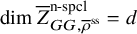 $\dim \overline {Z}^{{\mathrm {n-spcl}}}_{GG, \overline {\rho }^{\mathrm {ss}}}=d$
, as C has positive codimension. Lemma 13.3 implies the first equality in (70). We have
$\dim \overline {Z}^{{\mathrm {n-spcl}}}_{GG, \overline {\rho }^{\mathrm {ss}}}=d$
, as C has positive codimension. Lemma 13.3 implies the first equality in (70). We have $d-1=\dim \overline {{V}}^{{\mathrm {n-spcl}}}_{GG, \overline {\rho }^{\mathrm {ss}}} \le \dim \overline {{V}}_{GG, \overline {\rho }^{\mathrm {ss}}} \le d -1$
by Lemma 13.3. Thus
$d-1=\dim \overline {{V}}^{{\mathrm {n-spcl}}}_{GG, \overline {\rho }^{\mathrm {ss}}} \le \dim \overline {{V}}_{GG, \overline {\rho }^{\mathrm {ss}}} \le d -1$
by Lemma 13.3. Thus $\dim \overline {{V}}_{GG, \overline {\rho }^{\mathrm {ss}}}= d-1$
. It follows from Corollary 9.10 that
$\dim \overline {{V}}_{GG, \overline {\rho }^{\mathrm {ss}}}= d-1$
. It follows from Corollary 9.10 that $\dim \overline {U}_{GG, \overline {\rho }^{\mathrm {ss}}} = d - 1 -\dim G_k +\dim Z(G_k).$
Let
$\dim \overline {U}_{GG, \overline {\rho }^{\mathrm {ss}}} = d - 1 -\dim G_k +\dim Z(G_k).$
Let $\overline {Z}$
denote the closure of
$\overline {Z}$
denote the closure of $\overline {U}_{GG, \overline {\rho }^{\mathrm {ss}}}$
in
$\overline {U}_{GG, \overline {\rho }^{\mathrm {ss}}}$
in $\overline {X}^{\mathrm {git}}_{G, \overline {\rho }^{\mathrm {ss}}}$
. Lemma 13.2 implies
$\overline {X}^{\mathrm {git}}_{G, \overline {\rho }^{\mathrm {ss}}}$
. Lemma 13.2 implies
 $$ \begin{align} \dim \overline{Z}= \dim \overline{U}_{GG, \overline{\rho}^{\mathrm{ss}}}+1= d- \dim G_k +\dim Z(G)_k. \end{align} $$
We have $\overline {X}^{\mathrm {git}}_{G, \overline {\rho }^{\mathrm {ss}}} = \overline {Z} \cup \bigcup _L \overline {X}^{\mathrm {git}}_{LG, \overline {\rho }^{\mathrm {ss}}}$
, where the union is taken over all R-Levi subgroups L of G, containing a fixed maximal split torus in G and not equal to G. If
$\overline {X}^{\mathrm {git}}_{G, \overline {\rho }^{\mathrm {ss}}} = \overline {Z} \cup \bigcup _L \overline {X}^{\mathrm {git}}_{LG, \overline {\rho }^{\mathrm {ss}}}$
, where the union is taken over all R-Levi subgroups L of G, containing a fixed maximal split torus in G and not equal to G. If $\overline {X}^{\mathrm {git}}_{LG, \overline {\rho }^{\mathrm {ss}}}$
is non-empty then
$\overline {X}^{\mathrm {git}}_{LG, \overline {\rho }^{\mathrm {ss}}}$
is non-empty then $L_k$
is
$L_k$
is $\overline {\rho }^{\mathrm {ss}}$
-compatible by Lemma 13.1 and
$\overline {\rho }^{\mathrm {ss}}$
-compatible by Lemma 13.1 and $\dim L_k<\dim G_k$
as
$\dim L_k<\dim G_k$
as $L\neq G$
. Thus we may apply (DIM) to deduce that
$L\neq G$
. Thus we may apply (DIM) to deduce that
 $$ \begin{align} \dim \overline{X}^{\mathrm{git}}_{LG, \overline{\rho}^{\mathrm{ss}}}\le \dim L_k [F:\mathbb {Q}_p]+ \dim Z(L_k). \end{align} $$
Lemma 9.11 implies that $\dim N_k \ge 1$
, where N is the unipotent radical of any R-parabolic with R-Levi L. It follows from Lemma 2.16, (73), (74) and (75) that
$\dim N_k \ge 1$
, where N is the unipotent radical of any R-parabolic with R-Levi L. It follows from Lemma 2.16, (73), (74) and (75) that $\dim \overline {Z}> \dim \overline {X}^{\mathrm {git}}_{LG, \overline {\rho }^{\mathrm {ss}}}$
and thus
$\dim \overline {Z}> \dim \overline {X}^{\mathrm {git}}_{LG, \overline {\rho }^{\mathrm {ss}}}$
and thus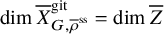 $\dim \overline {X}^{\mathrm {git}}_{G, \overline {\rho }^{\mathrm {ss}}}= \dim \overline {Z}$
, which implies the last equality in (70).
$\dim \overline {X}^{\mathrm {git}}_{G, \overline {\rho }^{\mathrm {ss}}}= \dim \overline {Z}$
, which implies the last equality in (70).
Lemma 13.22. Let x be a closed point of $X^{\mathrm {gen}}_{G, \overline {\rho }^{\mathrm {ss}}}\setminus Y_{\overline {\rho }^{\mathrm {ss}}}$
and let
$X^{\mathrm {gen}}_{G, \overline {\rho }^{\mathrm {ss}}}\setminus Y_{\overline {\rho }^{\mathrm {ss}}}$
and let $\rho _x: \Gamma _F \rightarrow G(\kappa (x))$
be the specialisation of the universal Galois representation over
$\rho _x: \Gamma _F \rightarrow G(\kappa (x))$
be the specialisation of the universal Galois representation over $X^{\mathrm {gen}}_{G, \overline {\rho }^{\mathrm {ss}}}$
at x. If
$X^{\mathrm {gen}}_{G, \overline {\rho }^{\mathrm {ss}}}$
at x. If $\pi _1(G')$
is étale or
$\pi _1(G')$
is étale or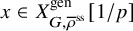 $x\in X^{\mathrm {gen}}_{G,\overline {\rho }^{\mathrm {ss}}}[1/p]$
then
$x\in X^{\mathrm {gen}}_{G,\overline {\rho }^{\mathrm {ss}}}[1/p]$
then $x\in V^{{\mathrm {n-spcl}}}_{GG, \overline {\rho }^{\mathrm {ss}}}$
if and only if
$x\in V^{{\mathrm {n-spcl}}}_{GG, \overline {\rho }^{\mathrm {ss}}}$
if and only if $\rho _x$
is absolutely G-irreducible and
$\rho _x$
is absolutely G-irreducible and $H^2(\Gamma _F, {\mathrm {ad}}^0 \rho _x)=0$
.
$H^2(\Gamma _F, {\mathrm {ad}}^0 \rho _x)=0$
.
Proof. If $\pi _1(G')$
is étale or
$\pi _1(G')$
is étale or $x\in X^{\mathrm {gen}}_{G,\overline {\rho }^{\mathrm {ss}}}[1/p]$
then
$x\in X^{\mathrm {gen}}_{G,\overline {\rho }^{\mathrm {ss}}}[1/p]$
then $({\mathrm {Lie}} G^{\prime }_{\operatorname {sc}})_x=({\mathrm {Lie}} G')_x$
. It follows from Proposition 9.7 and Lemma 13.8 that
$({\mathrm {Lie}} G^{\prime }_{\operatorname {sc}})_x=({\mathrm {Lie}} G')_x$
. It follows from Proposition 9.7 and Lemma 13.8 that $x\in V^{{\mathrm {n-spcl}}}_{GG, \overline {\rho }^{\mathrm {ss}}}$
if and only if
$x\in V^{{\mathrm {n-spcl}}}_{GG, \overline {\rho }^{\mathrm {ss}}}$
if and only if $\rho _x$
is absolutely G-irreducible and
$\rho _x$
is absolutely G-irreducible and $H^0(\Gamma _F, ({\mathrm {ad}}^0 \rho _x)^*(1))=0$
. Since x is closed in
$H^0(\Gamma _F, ({\mathrm {ad}}^0 \rho _x)^*(1))=0$
. Since x is closed in $X^{\mathrm {gen}}_{G, \overline {\rho }^{\mathrm {ss}}}\setminus Y_{\overline {\rho }^{\mathrm {ss}}}$
its residue field is a local field by [Reference Böckle, Iyengar and Paškūnas6, Lemmas 3.17, 3.18]. Local Tate duality gives us an isomorphism
$X^{\mathrm {gen}}_{G, \overline {\rho }^{\mathrm {ss}}}\setminus Y_{\overline {\rho }^{\mathrm {ss}}}$
its residue field is a local field by [Reference Böckle, Iyengar and Paškūnas6, Lemmas 3.17, 3.18]. Local Tate duality gives us an isomorphism $H^0(\Gamma _F, ({\mathrm {ad}}^0 \rho _x)^*(1))\cong H^2(\Gamma _F,{\mathrm {ad}}^0 \rho _x)^*$
, which implies the assertion.
$H^0(\Gamma _F, ({\mathrm {ad}}^0 \rho _x)^*(1))\cong H^2(\Gamma _F,{\mathrm {ad}}^0 \rho _x)^*$
, which implies the assertion.
Lemma 13.23. Assume that $\pi _1(G')$
is étale. If
$\pi _1(G')$
is étale. If $V^{{\mathrm {n-spcl}}}_{GG, \overline {\rho }^{\mathrm {ss}}}$
is non-empty then it is flat over
$V^{{\mathrm {n-spcl}}}_{GG, \overline {\rho }^{\mathrm {ss}}}$
is non-empty then it is flat over ${\mathrm {Spec}} \mathscr O$
of relative dimension
${\mathrm {Spec}} \mathscr O$
of relative dimension $\dim G_k([F:\mathbb {Q}_p]+1) -1$
, which is also equal to the dimension of
$\dim G_k([F:\mathbb {Q}_p]+1) -1$
, which is also equal to the dimension of $\overline {{V}}^{{\mathrm {n-spcl}}}_{GG, \overline {\rho }^{\mathrm {ss}}}$
.
$\overline {{V}}^{{\mathrm {n-spcl}}}_{GG, \overline {\rho }^{\mathrm {ss}}}$
.
Proof. Let x be a closed point of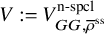 $V:=V^{{\mathrm {n-spcl}}}_{GG, \overline {\rho }^{\mathrm {ss}}}$
. Since
$V:=V^{{\mathrm {n-spcl}}}_{GG, \overline {\rho }^{\mathrm {ss}}}$
. Since $H^2(\Gamma _F, {\mathrm {ad}}^0\rho _x)=0$
by Lemma 13.22, Proposition 3.6 implies that
$H^2(\Gamma _F, {\mathrm {ad}}^0\rho _x)=0$
by Lemma 13.22, Proposition 3.6 implies that

where $\varphi : G \rightarrow G/G'$
is the quotient map and
$\varphi : G \rightarrow G/G'$
is the quotient map and $r= \dim G^{\prime }_k ([F:\mathbb {Q}_p]+1)$
. It is proved in [Reference Paškūnas and Quast48, Corollary 9.5] that
$r= \dim G^{\prime }_k ([F:\mathbb {Q}_p]+1)$
. It is proved in [Reference Paškūnas and Quast48, Corollary 9.5] that $X^{\mathrm {gen}}_{G/G', \varphi \circ \overline {\rho }^{\mathrm {ss}}}$
is
$X^{\mathrm {gen}}_{G/G', \varphi \circ \overline {\rho }^{\mathrm {ss}}}$
is $\mathscr O$
-flat of relative dimension
$\mathscr O$
-flat of relative dimension $\dim (G/G')_k([F:\mathbb {Q}_p] + 1)$
. It follows from Proposition 5.16 that
$\dim (G/G')_k([F:\mathbb {Q}_p] + 1)$
. It follows from Proposition 5.16 that $R^{\square }_{G/G', \varphi \circ \rho _x}$
is flat over the coefficient ring
$R^{\square }_{G/G', \varphi \circ \rho _x}$
is flat over the coefficient ring $\Lambda $
for
$\Lambda $
for $\kappa (x)$
of relative dimension
$\kappa (x)$
of relative dimension $\dim (G/G')_k([F:\mathbb {Q}_p] + 1)$
. Thus
$\dim (G/G')_k([F:\mathbb {Q}_p] + 1)$
. Thus $R^{\square }_{G, \rho _x}$
is flat over
$R^{\square }_{G, \rho _x}$
is flat over $\Lambda $
of relative dimension
$\Lambda $
of relative dimension $\dim G_k ([F:\mathbb {Q}_p]+1)$
.
$\dim G_k ([F:\mathbb {Q}_p]+1)$
.
If the characteristic of $\kappa (x)$
is zero then
$\kappa (x)$
is zero then $\Lambda $
is a finite field extension of L and
$\Lambda $
is a finite field extension of L and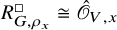 $R^{\square }_{G, \rho _x}\cong \hat {\mathscr {O}}_{V,x}$
by Lemma 5.17. Thus
$R^{\square }_{G, \rho _x}\cong \hat {\mathscr {O}}_{V,x}$
by Lemma 5.17. Thus $\mathscr O_{V,x}$
is flat over
$\mathscr O_{V,x}$
is flat over $\mathscr O$
and
$\mathscr O$
and $\dim \mathscr O_{V,x}= \dim \hat {\mathscr {O}}_{V,x}= \dim G_k ([F:\mathbb {Q}_p]+1)$
.
$\dim \mathscr O_{V,x}= \dim \hat {\mathscr {O}}_{V,x}= \dim G_k ([F:\mathbb {Q}_p]+1)$
.
If the characteristic of $\kappa (x)$
is p then
$\kappa (x)$
is p then $\Lambda $
is a DVR, which is flat over
$\Lambda $
is a DVR, which is flat over $\mathscr O$
and
$\mathscr O$
and  by Lemma 5.17. Thus $\mathscr O_{V,x}$
is flat over
$\mathscr O_{V,x}$
is flat over $\mathscr O$
and
$\mathscr O$
and $\dim \mathscr O_{V,x}= \dim \hat {\mathscr {O}}_{V,x}= \dim G_k ([F:\mathbb {Q}_p]+1)$
.
$\dim \mathscr O_{V,x}= \dim \hat {\mathscr {O}}_{V,x}= \dim G_k ([F:\mathbb {Q}_p]+1)$
.
Hence, V is flat over ${\mathrm {Spec}} \mathscr O$
and
${\mathrm {Spec}} \mathscr O$
and $\dim V= \max _{x} \dim \mathscr O_{V,x}= \dim G_k ([F:\mathbb {Q}_p]+1),$
where the maximum is taken over all the closed points x in V. We have to subtract
$\dim V= \max _{x} \dim \mathscr O_{V,x}= \dim G_k ([F:\mathbb {Q}_p]+1),$
where the maximum is taken over all the closed points x in V. We have to subtract $1$
to get the relative dimension over
$1$
to get the relative dimension over $\mathscr O$
, which is equal to the dimension of the special fibre.
$\mathscr O$
, which is equal to the dimension of the special fibre.
Corollary 13.24. Assume that $\pi _1(G')$
is étale. If (DIM) holds for all
$\pi _1(G')$
is étale. If (DIM) holds for all $\overline {\rho }^{\mathrm {ss}}$
-compatible pairs
$\overline {\rho }^{\mathrm {ss}}$
-compatible pairs $(H_1, \overline {\rho }_1)$
with
$(H_1, \overline {\rho }_1)$
with $\dim H_1< \dim G_k$
then the following hold:
$\dim H_1< \dim G_k$
then the following hold:
-
(1)
$\dim \overline {X}^{\mathrm {gen}}_{G, \overline {\rho }^{\mathrm {ss}}}= \dim G_k ([F:\mathbb {Q}_p] +1)$
; -
(2)
$\dim \overline {X}^{\mathrm {git}}_{G, \overline {\rho }^{\mathrm {ss}}}= \dim G_k [F:\mathbb {Q}_p] + \dim Z(G_k)$
.


Proposition 13.25. If (DIM) holds for all pairs $(H_1, \overline {\rho }_1)$
with
$(H_1, \overline {\rho }_1)$
with $\dim H_1 < \dim G_k$
, then (DIM) holds for
$\dim H_1 < \dim G_k$
, then (DIM) holds for $(G_k, \overline {\rho }^{\mathrm {ss}})$
.
$(G_k, \overline {\rho }^{\mathrm {ss}})$
.
Proof. For the purpose of establishing (DIM), after passing to a finite extension of $\mathscr O$
we may assume that
$\mathscr O$
we may assume that $G^0$
is split, see Remark 5.9. Let
$G^0$
is split, see Remark 5.9. Let $\mu := Z(G^0) \cap G' = Z(G')$
,
$\mu := Z(G^0) \cap G' = Z(G')$
, $G_1 := G/\mu $
and let
$G_1 := G/\mu $
and let $\varphi _1 : G \to G_1$
be the projection map. Since
$\varphi _1 : G \to G_1$
be the projection map. Since $Z(G^0)$
is a split torus,
$Z(G^0)$
is a split torus, $\mu $
is a finite diagonalisable group scheme and we may decompose
$\mu $
is a finite diagonalisable group scheme and we may decompose $\mu $
canonically into a p-part and a prime-to-p part, which are both normal in G. Let x be a closed point of
$\mu $
canonically into a p-part and a prime-to-p part, which are both normal in G. Let x be a closed point of $Y_{\overline {\rho }^{\mathrm {ss}}}$
. Corollary 3.12 and Proposition 3.16 imply that
$Y_{\overline {\rho }^{\mathrm {ss}}}$
. Corollary 3.12 and Proposition 3.16 imply that $\dim \overline {R}^{\square }_{G, \rho _x}= \dim \overline {R}^{\square }_{G_1, \varphi _1 \circ \rho _x}$
.
$\dim \overline {R}^{\square }_{G, \rho _x}= \dim \overline {R}^{\square }_{G_1, \varphi _1 \circ \rho _x}$
.
As $G'$
is the fppf sheafification of
$G'$
is the fppf sheafification of $A \mapsto [G^0(A), G^0(A)]$
, the map
$A \mapsto [G^0(A), G^0(A)]$
, the map $G' \to G_1'$
is surjective with kernel
$G' \to G_1'$
is surjective with kernel $Z(G')$
. So
$Z(G')$
. So $G_1'$
is semisimple of adjoint type and we have
$G_1'$
is semisimple of adjoint type and we have $Z(G_1^0) \cap G_1' = Z(G_1') = 1$
; this can be checked on geometric fibres using that semisimple groups of adjoint type over algebraically closed fields are centreless. We can apply Corollary 3.14 to
$Z(G_1^0) \cap G_1' = Z(G_1') = 1$
; this can be checked on geometric fibres using that semisimple groups of adjoint type over algebraically closed fields are centreless. We can apply Corollary 3.14 to $Z(G_1^0)$
in
$Z(G_1^0)$
in $G_1$
and
$G_1$
and $G_2 := G_1/Z(G_1^0) = G/Z(G^0)$
and obtain
$G_2 := G_1/Z(G_1^0) = G/Z(G^0)$
and obtain
 $$ \begin{align} \dim \overline{R}^{\square}_{G_1, \varphi_1 \circ \rho_x}= \dim \overline{R}^{\square}_{G_2, \varphi \circ \rho_x} + ([F:\mathbb {Q}_p]+1) \dim Z(G^0)_k, \end{align} $$
where $\varphi : G \to G/Z(G^0)$
is the projection map.
$\varphi : G \to G/Z(G^0)$
is the projection map.
By Proposition 2.30 we find a surjection of generalised reductive k-group schemes $G_3 \to (G_2)_k$
with finite connected kernel, such that
$G_3 \to (G_2)_k$
with finite connected kernel, such that $\pi _1(G_3^0)$
is étale. Since
$\pi _1(G_3^0)$
is étale. Since $G_3^0$
is semisimple, we have
$G_3^0$
is semisimple, we have $G_3' = G_3^0$
. Thus Corollary 13.24 can be applied to
$G_3' = G_3^0$
. Thus Corollary 13.24 can be applied to $G_3$
.
$G_3$
.
Let $\kappa $
be the residue field of x. Then
$\kappa $
be the residue field of x. Then $G_2(\kappa ) = G_3(\kappa )$
and we can lift
$G_2(\kappa ) = G_3(\kappa )$
and we can lift $\varphi \circ \rho _x$
to a representation
$\varphi \circ \rho _x$
to a representation $\rho _3 : \Gamma _F \to G_3(\kappa )$
. Using Proposition 3.16, we get
$\rho _3 : \Gamma _F \to G_3(\kappa )$
. Using Proposition 3.16, we get $\dim \overline {R}^{\square }_{G_2, \varphi \circ \rho _x} = \dim \overline {R}^{\square }_{G_3, \rho _3}$
. Since
$\dim \overline {R}^{\square }_{G_2, \varphi \circ \rho _x} = \dim \overline {R}^{\square }_{G_3, \rho _3}$
. Since $\kappa $
is finite
$\kappa $
is finite $\rho _3$
defines a closed point in
$\rho _3$
defines a closed point in $\overline {X}^{\mathrm {gen}}_{G_3, \rho _3^{\mathrm {ss}}}$
with a finite residue field. Using Lemma 13.4 for the inequality, we get
$\overline {X}^{\mathrm {gen}}_{G_3, \rho _3^{\mathrm {ss}}}$
with a finite residue field. Using Lemma 13.4 for the inequality, we get
 $$ \begin{align} \begin{aligned} \dim \overline{R}^{\square}_{G_1, \varphi_1 \circ \rho_x} &\overset{(77)}{=} \dim \overline{R}^{\square}_{G_3, \rho_3} + ([F:\mathbb {Q}_p]+1) \dim Z(G^0)_k \\ &\leq \dim \overline{X}^{\mathrm{gen}}_{G_3, \rho_3^{\mathrm{ss}}} + ([F:\mathbb {Q}_p]+1) \dim Z(G^0)_k. \end{aligned} \end{align} $$
Corollary 13.24 applied to $G_3$
gives
$G_3$
gives $\dim \overline {X}^{\mathrm {gen}}_{G_3, \rho _3^{\mathrm {ss}}} = \dim G_3 ([F:\mathbb {Q}_p] +1)$
. Since
$\dim \overline {X}^{\mathrm {gen}}_{G_3, \rho _3^{\mathrm {ss}}} = \dim G_3 ([F:\mathbb {Q}_p] +1)$
. Since $\dim G_k = \dim (G_2)_k + \dim Z(G^0)_k = \dim G_3 + \dim Z(G^0)_k$
, we obtain
$\dim G_k = \dim (G_2)_k + \dim Z(G^0)_k = \dim G_3 + \dim Z(G^0)_k$
, we obtain
 $$ \begin{align} \dim \overline{R}^{\square}_{G, \rho_x}\le \dim G_k ([F:\mathbb {Q}_p]+1), \quad \forall x\in Y_{\overline{\rho}^{\mathrm{ss}}}. \end{align} $$
Lemma 13.4 implies that $\dim \overline {X}^{\mathrm {gen}}_{G, \overline {\rho }^{\mathrm {ss}}} \le \dim G_k ([F:\mathbb {Q}_p]+1)$
. It follows from (73) that this is an equality. The assertion follows from Proposition 13.21.
$\dim \overline {X}^{\mathrm {gen}}_{G, \overline {\rho }^{\mathrm {ss}}} \le \dim G_k ([F:\mathbb {Q}_p]+1)$
. It follows from (73) that this is an equality. The assertion follows from Proposition 13.21.
Theorem 13.26. The hypothesis (DIM) holds for all pairs $(H_1, \overline {\rho }_1)$
with
$(H_1, \overline {\rho }_1)$
with $\dim H_1< \dim G_k$
. In particular, the following hold:
$\dim H_1< \dim G_k$
. In particular, the following hold:
-
(1) the complement of
$\overline {{V}}^{{\mathrm {n-spcl}}}_{GG, \overline {\rho }^{\mathrm {ss}}}$
in
$\overline {X}^{\mathrm {gen}}_{G, \overline {\rho }^{\mathrm {ss}}}$
has positive codimension; -
(2)
$\dim \overline {X}^{\mathrm {gen}}_{G, \overline {\rho }^{\mathrm {ss}}}= \dim G_k ([F:\mathbb {Q}_p] +1)$
; -
(3)
$\dim \overline {X}^{\mathrm {git}}_{G, \overline {\rho }^{\mathrm {ss}}}= \dim G_k [F:\mathbb {Q}_p] + \dim Z(G_k)$
.




Proof. Let S be the set of pairs $(H_1, \overline {\rho }_1)$
such that
$(H_1, \overline {\rho }_1)$
such that $\dim H_1 < \dim G_k$
, and let
$\dim H_1 < \dim G_k$
, and let $S'$
be the subset of S consisting of those pairs for which (DIM) does not hold. If
$S'$
be the subset of S consisting of those pairs for which (DIM) does not hold. If $S'$
is non-empty then let
$S'$
is non-empty then let $(H_1, \overline {\rho }_1) \in S'$
be such that
$(H_1, \overline {\rho }_1) \in S'$
be such that $\dim H_1$
is minimal. Then (DIM) holds for all pairs of dimension less than
$\dim H_1$
is minimal. Then (DIM) holds for all pairs of dimension less than $\dim H_1$
, so Proposition 13.25 applies to
$\dim H_1$
, so Proposition 13.25 applies to $(H_1, \overline {\rho }_1)$
, yielding a contradiction. So
$(H_1, \overline {\rho }_1)$
, yielding a contradiction. So $S' = \emptyset $
and Proposition 13.25 implies that (DIM) holds for
$S' = \emptyset $
and Proposition 13.25 implies that (DIM) holds for $(G_k, \overline {\rho }^{\mathrm {ss}})$
. Moreover, Proposition 13.21 implies that
$(G_k, \overline {\rho }^{\mathrm {ss}})$
. Moreover, Proposition 13.21 implies that $\dim \overline {X}^{\mathrm {gen}}_{G, \overline {\rho }^{\mathrm {ss}}} \le \dim G_k ([F:\mathbb {Q}_p]+1)$
, and (73) implies that part (2) of the Theorem holds. Parts (1) and (3) follow from Proposition 13.21.
$\dim \overline {X}^{\mathrm {gen}}_{G, \overline {\rho }^{\mathrm {ss}}} \le \dim G_k ([F:\mathbb {Q}_p]+1)$
, and (73) implies that part (2) of the Theorem holds. Parts (1) and (3) follow from Proposition 13.21.
13.4 Consequences
We record some consequences of Theorem 13.26. Most of the results follow the proof of analogous results for ${\mathrm {GL}}_d$
in [Reference Böckle, Iyengar and Paškūnas6] with the exception of Corollaries 13.31 and 13.32, where we prove the analogues of the main results of [Reference Böckle and Juschka7] and the argument is new even when
${\mathrm {GL}}_d$
in [Reference Böckle, Iyengar and Paškūnas6] with the exception of Corollaries 13.31 and 13.32, where we prove the analogues of the main results of [Reference Böckle and Juschka7] and the argument is new even when $G={\mathrm {GL}}_d$
.
$G={\mathrm {GL}}_d$
.
Corollary 13.27. Let x be either a closed point of $X^{\mathrm {gen}}_{G, \overline {\rho }^{\mathrm {ss}}}\setminus Y_{\overline {\rho }^{\mathrm {ss}}}$
or a closed point of
$X^{\mathrm {gen}}_{G, \overline {\rho }^{\mathrm {ss}}}\setminus Y_{\overline {\rho }^{\mathrm {ss}}}$
or a closed point of $Y_{\overline {\rho }^{\mathrm {ss}}}$
and let
$Y_{\overline {\rho }^{\mathrm {ss}}}$
and let $\Lambda $
be a coefficient ring for
$\Lambda $
be a coefficient ring for $\kappa (x)$
introduced in Section 3. Then the following hold:
$\kappa (x)$
introduced in Section 3. Then the following hold:
-
(1)
$R^{\square }_{G, \rho _x}$
is a flat
$\Lambda $
-algebra of relative dimension
$\dim G_k([F:\mathbb {Q}_p]+1)$
and is a complete intersection; -
(2) if
$\mathrm {char}(\kappa (x))=p$
then
$R^{\square }_{G, \rho _x}/\varpi $
is a complete intersection of dimension
$\dim G_k([F:\mathbb {Q}_p]+1)$
.






Proof. The proof is essentially the same as the proof of [Reference Böckle, Iyengar and Paškūnas6, Corollary 3.38], so we only give a sketch. Corollary 3.8 and Lemma 3.9 applied with $A=\Lambda $
and
$A=\Lambda $
and $B=R^{\square }_{G, \rho _x}$
imply that to prove part (1) it is enough to show that
$B=R^{\square }_{G, \rho _x}$
imply that to prove part (1) it is enough to show that
 $$ \begin{align} \dim \kappa(x)\otimes_{\Lambda} R^{\square}_{G, \rho_x}\le \dim G_k ([F:\mathbb {Q}_p]+1). \end{align} $$
If $\mathrm {char}(\kappa (x))=0$
then
$\mathrm {char}(\kappa (x))=0$
then $\Lambda =\kappa (x)$
. If
$\Lambda =\kappa (x)$
. If $\mathrm {char}(\kappa (x))=p$
then
$\mathrm {char}(\kappa (x))=p$
then $\Lambda $
is a DVR with uniformiser
$\Lambda $
is a DVR with uniformiser $\varpi $
and the fibre ring in (80) is
$\varpi $
and the fibre ring in (80) is $R^{\square }_{G, \rho _x}/\varpi $
. Thus, if we can prove (80) then Lemma 3.9 applied with
$R^{\square }_{G, \rho _x}/\varpi $
. Thus, if we can prove (80) then Lemma 3.9 applied with $A=\kappa (x)$
and
$A=\kappa (x)$
and $B=R^{\square }_{\rho _x}/\varpi $
will imply part (2).
$B=R^{\square }_{\rho _x}/\varpi $
will imply part (2).
Let $X:= X^{\mathrm {gen}}_{G, \overline {\rho }^{\mathrm {ss}}}$
and let
$X:= X^{\mathrm {gen}}_{G, \overline {\rho }^{\mathrm {ss}}}$
and let $\overline {X}:= \overline {X}^{\mathrm {gen}}_{G, \overline {\rho }^{\mathrm {ss}}}$
. If
$\overline {X}:= \overline {X}^{\mathrm {gen}}_{G, \overline {\rho }^{\mathrm {ss}}}$
. If $x\in Y_{\overline {\rho }^{\mathrm {ss}}}$
then Lemma 13.13 applied to
$x\in Y_{\overline {\rho }^{\mathrm {ss}}}$
then Lemma 13.13 applied to $Z=\overline {X}$
gives us
$Z=\overline {X}$
gives us $\dim \mathscr O_{\overline {X}, x}\le \dim \overline {X}= \dim G_k ([F:\mathbb {Q}_p]+1)$
, where the last equality follows from Theorem 13.26 (2). Lemma 5.17 implies that
$\dim \mathscr O_{\overline {X}, x}\le \dim \overline {X}= \dim G_k ([F:\mathbb {Q}_p]+1)$
, where the last equality follows from Theorem 13.26 (2). Lemma 5.17 implies that $R^{\square }_{\rho _x}/\varpi \cong \hat {\mathscr {O}}_{\overline {X},x}$
and this implies (80). If
$R^{\square }_{\rho _x}/\varpi \cong \hat {\mathscr {O}}_{\overline {X},x}$
and this implies (80). If $x\in \overline {X}\setminus Y_{\overline {\rho }^{\mathrm {ss}}}$
then
$x\in \overline {X}\setminus Y_{\overline {\rho }^{\mathrm {ss}}}$
then  by Lemma 5.17 and Lemma 13.13 gives $\dim \mathscr O_{\overline {X}, x} +1 \le \dim \overline {X}$
. If
$\dim \mathscr O_{\overline {X}, x} +1 \le \dim \overline {X}$
. If $\mathrm {char}(\kappa (x))=0$
then
$\mathrm {char}(\kappa (x))=0$
then $x\in X[1/p]$
,
$x\in X[1/p]$
,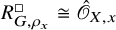 $R^{\square }_{G, \rho _x}\cong \hat {\mathscr {O}}_{X, x}$
by Lemma 5.17 and
$R^{\square }_{G, \rho _x}\cong \hat {\mathscr {O}}_{X, x}$
by Lemma 5.17 and $\dim \mathscr O_{X, x} \le \dim X -1 \le \dim \overline {X}$
by Lemma 13.13 applied to
$\dim \mathscr O_{X, x} \le \dim X -1 \le \dim \overline {X}$
by Lemma 13.13 applied to $Z=X$
and Proposition 13.14. Hence, (80) holds also in this case.
$Z=X$
and Proposition 13.14. Hence, (80) holds also in this case.
Corollary 13.28. Let $d= \dim G_k([F:\mathbb {Q}_p]+1)$
. Then the following hold:
$d= \dim G_k([F:\mathbb {Q}_p]+1)$
. Then the following hold:
-
(1)
$X^{\mathrm {gen}}_{G, \overline {\rho }^{\mathrm {ss}}}$
is flat over
${\mathrm {Spec}} \mathscr O$
, equidimensional of relative dimension d and is locally complete intersection; -
(2)
$\overline {X}^{\mathrm {gen}}_{G, \overline {\rho }^{\mathrm {ss}}}$
is equidimensional of dimension d and is locally complete intersection.


Proof. The proof is essentially the same as the proof of [Reference Böckle, Iyengar and Paškūnas6, Corollary 3.40] so we only give a sketch. Lemma 5.17 relates $R^{\square }_{G, \rho _x}$
and the local ring
$R^{\square }_{G, \rho _x}$
and the local ring $\mathscr O_{X, x}$
, where
$\mathscr O_{X, x}$
, where $X:=X^{\mathrm {gen}}_{G, \overline {\rho }^{\mathrm {ss}}}$
and x is a closed point of X. Using Corollary 13.27 we deduce that
$X:=X^{\mathrm {gen}}_{G, \overline {\rho }^{\mathrm {ss}}}$
and x is a closed point of X. Using Corollary 13.27 we deduce that $\mathscr O_{X, x}$
are complete intersection and
$\mathscr O_{X, x}$
are complete intersection and $\mathscr O$
-flat for all closed points x. Thus X is flat over
$\mathscr O$
-flat for all closed points x. Thus X is flat over ${\mathrm {Spec}} \mathscr O$
and locally complete intersection. The last property implies that X is equidimensional. Part (1) implies part (2).
${\mathrm {Spec}} \mathscr O$
and locally complete intersection. The last property implies that X is equidimensional. Part (1) implies part (2).
Corollary 13.29. Let H be a closed generalised reductive subgroup of G (resp. $G_k$
) such that
$G_k$
) such that $X^{\mathrm {gen}}_{H,\overline {\rho }^{\mathrm {ss}}}$
(resp.
$X^{\mathrm {gen}}_{H,\overline {\rho }^{\mathrm {ss}}}$
(resp. $\overline {X}^{\mathrm {gen}}_{H, \overline {\rho }^{\mathrm {ss}}}$
) is non-empty. Let
$\overline {X}^{\mathrm {gen}}_{H, \overline {\rho }^{\mathrm {ss}}}$
) is non-empty. Let $d=\dim H_k ([F:\mathbb {Q}_p]+1)$
then
$d=\dim H_k ([F:\mathbb {Q}_p]+1)$
then $X^{\mathrm {gen}}_{H, \overline {\rho }^{\mathrm {ss}}}$
is
$X^{\mathrm {gen}}_{H, \overline {\rho }^{\mathrm {ss}}}$
is $\mathscr O$
-flat of relative dimension d and is locally complete intersection (resp.
$\mathscr O$
-flat of relative dimension d and is locally complete intersection (resp. $\overline {X}^{\mathrm {gen}}_{H, \overline {\rho }^{\mathrm {ss}}}$
is equidimensional of dimension d and is locally complete intersection).
$\overline {X}^{\mathrm {gen}}_{H, \overline {\rho }^{\mathrm {ss}}}$
is equidimensional of dimension d and is locally complete intersection).
Proof. This follows from Corollary 13.28 applied to $X^{\mathrm {gen}}_{H_j, \overline {\rho }^{\mathrm {ss}}_j}$
(resp.
$X^{\mathrm {gen}}_{H_j, \overline {\rho }^{\mathrm {ss}}_j}$
(resp. $\overline {X}^{\mathrm {gen}}_{H_j, \overline {\rho }^{\mathrm {ss}}_j}$
) appearing in Corollary 9.4 (1).
$\overline {X}^{\mathrm {gen}}_{H_j, \overline {\rho }^{\mathrm {ss}}_j}$
) appearing in Corollary 9.4 (1).
Corollary 13.30. The non-special absolutely irreducible locus is Zariski dense in $X^{\mathrm {gen}}_{G, \overline {\rho }^{\mathrm {ss}}}$
and in
$X^{\mathrm {gen}}_{G, \overline {\rho }^{\mathrm {ss}}}$
and in $\overline {X}^{\mathrm {gen}}_{G,\overline {\rho }^{\mathrm {ss}}}$
.
$\overline {X}^{\mathrm {gen}}_{G,\overline {\rho }^{\mathrm {ss}}}$
.
Proof. Theorem 13.26 (1) implies that the complement $\overline {C}$
of
$\overline {C}$
of $\overline {{V}}^{{\mathrm {n-spcl}}}_{GG, \overline {\rho }^{\mathrm {ss}}}$
in
$\overline {{V}}^{{\mathrm {n-spcl}}}_{GG, \overline {\rho }^{\mathrm {ss}}}$
in $\overline {X}^{\mathrm {gen}}_{G, \overline {\rho }^{\mathrm {ss}}}$
is closed and has positive codimension. Since
$\overline {X}^{\mathrm {gen}}_{G, \overline {\rho }^{\mathrm {ss}}}$
is closed and has positive codimension. Since $\overline {X}^{\mathrm {gen}}_{G, \overline {\rho }^{\mathrm {ss}}}$
is equidimensional by Corollary 13.28 we conclude that
$\overline {X}^{\mathrm {gen}}_{G, \overline {\rho }^{\mathrm {ss}}}$
is equidimensional by Corollary 13.28 we conclude that $\overline {{V}}^{{\mathrm {n-spcl}}}_{GG, \overline {\rho }^{\mathrm {ss}}}$
contains all the generic points of
$\overline {{V}}^{{\mathrm {n-spcl}}}_{GG, \overline {\rho }^{\mathrm {ss}}}$
contains all the generic points of $\overline {X}^{\mathrm {gen}}_{G, \overline {\rho }^{\mathrm {ss}}}$
and hence is dense. Let C be the complement of
$\overline {X}^{\mathrm {gen}}_{G, \overline {\rho }^{\mathrm {ss}}}$
and hence is dense. Let C be the complement of $V^{{\mathrm {n-spcl}}}_{GG, \overline {\rho }^{\mathrm {ss}}}$
in
$V^{{\mathrm {n-spcl}}}_{GG, \overline {\rho }^{\mathrm {ss}}}$
in $X^{\mathrm {gen}}_{G, \overline {\rho }^{\mathrm {ss}}}$
. It follows from Lemma 13.22 that the reduced special fibre of C is equal to
$X^{\mathrm {gen}}_{G, \overline {\rho }^{\mathrm {ss}}}$
. It follows from Lemma 13.22 that the reduced special fibre of C is equal to $\overline {C}$
. Since C is
$\overline {C}$
. Since C is $G^0$
-invariant we have
$G^0$
-invariant we have $\dim C \le \dim \overline {C}+1$
by Proposition 13.14. Since
$\dim C \le \dim \overline {C}+1$
by Proposition 13.14. Since $\dim X^{\mathrm {gen}}_{G, \overline {\rho }^{\mathrm {ss}}}= \dim \overline {X}^{\mathrm {gen}}_{G, \overline {\rho }^{\mathrm {ss}}}+1$
by Corollary 13.28, C has positive codimension in
$\dim X^{\mathrm {gen}}_{G, \overline {\rho }^{\mathrm {ss}}}= \dim \overline {X}^{\mathrm {gen}}_{G, \overline {\rho }^{\mathrm {ss}}}+1$
by Corollary 13.28, C has positive codimension in $X^{\mathrm {gen}}_{G, \overline {\rho }^{\mathrm {ss}}}$
and the same argument shows that
$X^{\mathrm {gen}}_{G, \overline {\rho }^{\mathrm {ss}}}$
and the same argument shows that $V^{{\mathrm {n-spcl}}}_{GG, \overline {\rho }^{\mathrm {ss}}}$
is dense in
$V^{{\mathrm {n-spcl}}}_{GG, \overline {\rho }^{\mathrm {ss}}}$
is dense in $X^{\mathrm {gen}}_{G, \overline {\rho }^{\mathrm {ss}}}$
.
$X^{\mathrm {gen}}_{G, \overline {\rho }^{\mathrm {ss}}}$
.
Corollary 13.31. Let $d=\dim G_k[F:\mathbb {Q}_p]+\dim Z(G_k)$
. Then the following hold:
$d=\dim G_k[F:\mathbb {Q}_p]+\dim Z(G_k)$
. Then the following hold:
-
(1)
$X^{\mathrm {ps}}_{G, \overline {\rho }^{\mathrm {ss}}}$
is equidimensional of dimension
$d+1$
; -
(2)
$\overline {X}^{\mathrm {ps}}_{G, \overline {\rho }^{\mathrm {ss}}}$
is equidimensional of dimension d.


Proof. Since the claim is about the underlying topological spaces, it is enough to prove the Corollary after replacing $X^{\mathrm {ps}}_{G, \overline {\rho }^{\mathrm {ss}}}$
with
$X^{\mathrm {ps}}_{G, \overline {\rho }^{\mathrm {ss}}}$
with $X^{\mathrm {git}}_{G, \overline {\rho }^{\mathrm {ss}}}$
and
$X^{\mathrm {git}}_{G, \overline {\rho }^{\mathrm {ss}}}$
and $\overline {X}^{\mathrm {ps}}_{G, \overline {\rho }^{\mathrm {ss}}}$
with
$\overline {X}^{\mathrm {ps}}_{G, \overline {\rho }^{\mathrm {ss}}}$
with $\overline {X}^{\mathrm {git}}_{G, \overline {\rho }^{\mathrm {ss}}}$
, as these spaces are homeomorphic by Proposition 7.4.
$\overline {X}^{\mathrm {git}}_{G, \overline {\rho }^{\mathrm {ss}}}$
, as these spaces are homeomorphic by Proposition 7.4.
We will prove (1); the proof of (2) is identical. Let $\eta $
be a generic point of
$\eta $
be a generic point of $X^{\mathrm {git}}_{G, \overline {\rho }^{\mathrm {ss}}}$
. Let
$X^{\mathrm {git}}_{G, \overline {\rho }^{\mathrm {ss}}}$
. Let $\bar {\eta }$
be a geometric point above
$\bar {\eta }$
be a geometric point above $\eta $
. It follows from [Reference Seshadri57, Theorem 3 (ii)] that there is a geometric point
$\eta $
. It follows from [Reference Seshadri57, Theorem 3 (ii)] that there is a geometric point $\xi : {\mathrm {Spec}} \kappa (\bar {\eta })\rightarrow X^{\mathrm {gen}}_{G, \overline {\rho }^{\mathrm {ss}}}$
above
$\xi : {\mathrm {Spec}} \kappa (\bar {\eta })\rightarrow X^{\mathrm {gen}}_{G, \overline {\rho }^{\mathrm {ss}}}$
above $\bar {\eta }$
. Let X be an irreducible component of
$\bar {\eta }$
. Let X be an irreducible component of $X^{\mathrm {gen}}_{G, \overline {\rho }^{\mathrm {ss}}}$
containing
$X^{\mathrm {gen}}_{G, \overline {\rho }^{\mathrm {ss}}}$
containing $\xi $
and let
$\xi $
and let $X^{\mathrm {git}}$
be the image of X in
$X^{\mathrm {git}}$
be the image of X in $X^{\mathrm {git}}_{G, \overline {\rho }^{\mathrm {ss}}}$
. Then
$X^{\mathrm {git}}_{G, \overline {\rho }^{\mathrm {ss}}}$
. Then $X^{\mathrm {git}}$
contains
$X^{\mathrm {git}}$
contains $\eta $
. It follows from [Reference Böckle, Iyengar and Paškūnas6, Lemma 2.1] that X is
$\eta $
. It follows from [Reference Böckle, Iyengar and Paškūnas6, Lemma 2.1] that X is $G^0$
-invariant. Since X is closed in
$G^0$
-invariant. Since X is closed in $X^{\mathrm {gen}}_{G, \overline {\rho }^{\mathrm {ss}}}$
, [Reference Seshadri57, Theorem 3 (iii)] implies that
$X^{\mathrm {gen}}_{G, \overline {\rho }^{\mathrm {ss}}}$
, [Reference Seshadri57, Theorem 3 (iii)] implies that $X^{\mathrm {git}}$
is closed in
$X^{\mathrm {git}}$
is closed in $X^{\mathrm {git}}_{G, \overline {\rho }^{\mathrm {ss}}}$
. Since X is irreducible,
$X^{\mathrm {git}}_{G, \overline {\rho }^{\mathrm {ss}}}$
. Since X is irreducible, $X^{\mathrm {git}}$
is also irreducible, [Reference Project59, Tag 0379]. We conclude that
$X^{\mathrm {git}}$
is also irreducible, [Reference Project59, Tag 0379]. We conclude that $X^{\mathrm {git}}$
is the irreducible component of
$X^{\mathrm {git}}$
is the irreducible component of $X^{\mathrm {git}}_{G, \overline {\rho }^{\mathrm {ss}}}$
containing
$X^{\mathrm {git}}_{G, \overline {\rho }^{\mathrm {ss}}}$
containing $\eta $
.
$\eta $
.
Corollary 13.30 implies that $V:=X\cap V_{GG, \overline {\rho }^{\mathrm {ss}}}$
is non-empty open dense subset of X, thus
$V:=X\cap V_{GG, \overline {\rho }^{\mathrm {ss}}}$
is non-empty open dense subset of X, thus ${U:= X^{\mathrm {git}}\cap U_{GG, \overline {\rho }^{\mathrm {ss}}}}$
is a non-empty open dense subset of
${U:= X^{\mathrm {git}}\cap U_{GG, \overline {\rho }^{\mathrm {ss}}}}$
is a non-empty open dense subset of $X^{\mathrm {git}}$
. Lemmas 13.2 and 13.3 give us
$X^{\mathrm {git}}$
. Lemmas 13.2 and 13.3 give us $\dim X = \dim V+1$
,
$\dim X = \dim V+1$
, $\dim X^{\mathrm {git}}=\dim U+1$
. Corollary 9.10 implies that
$\dim X^{\mathrm {git}}=\dim U+1$
. Corollary 9.10 implies that $ \dim V = \dim U + \dim G_k - \dim Z(G_k),$
which together with Corollary 13.28 implies that
$ \dim V = \dim U + \dim G_k - \dim Z(G_k),$
which together with Corollary 13.28 implies that $\dim X^{\mathrm {git}} = \dim G_k [F:\mathbb {Q}_p] + \dim Z(G_k)+1$
.
$\dim X^{\mathrm {git}} = \dim G_k [F:\mathbb {Q}_p] + \dim Z(G_k)+1$
.
Corollary 13.32. The image of the non-special absolutely irreducible locus is Zariski dense in $X^{\mathrm {ps}}_{G, \overline {\rho }^{\mathrm {ss}}}$
and in
$X^{\mathrm {ps}}_{G, \overline {\rho }^{\mathrm {ss}}}$
and in $\overline {X}^{\mathrm {ps}}_{G, \overline {\rho }^{\mathrm {ss}}}$
.
$\overline {X}^{\mathrm {ps}}_{G, \overline {\rho }^{\mathrm {ss}}}$
.
Proof. As explained in the proof of Corollary 13.31 it is enough to prove the statement for $X^{\mathrm {git}}_{G, \overline {\rho }^{\mathrm {ss}}}$
and
$X^{\mathrm {git}}_{G, \overline {\rho }^{\mathrm {ss}}}$
and $\overline {X}^{\mathrm {git}}_{G, \overline {\rho }^{\mathrm {ss}}}$
. Let
$\overline {X}^{\mathrm {git}}_{G, \overline {\rho }^{\mathrm {ss}}}$
. Let $U^{{\mathrm {n-spcl}}}_{GG, \overline {\rho }^{\mathrm {ss}}}$
be the image of
$U^{{\mathrm {n-spcl}}}_{GG, \overline {\rho }^{\mathrm {ss}}}$
be the image of $V^{{\mathrm {n-spcl}}}_{G, \overline {\rho }^{\mathrm {ss}}}$
in
$V^{{\mathrm {n-spcl}}}_{G, \overline {\rho }^{\mathrm {ss}}}$
in $X^{\mathrm {git}}_{G, \overline {\rho }^{\mathrm {ss}}}$
and let U be a non-empty open subset of
$X^{\mathrm {git}}_{G, \overline {\rho }^{\mathrm {ss}}}$
and let U be a non-empty open subset of $X^{\mathrm {git}}_{G, \overline {\rho }^{\mathrm {ss}}}$
. Then its preimage V in
$X^{\mathrm {git}}_{G, \overline {\rho }^{\mathrm {ss}}}$
. Then its preimage V in $X^{\mathrm {gen}}_{G, \overline {\rho }^{\mathrm {ss}}}$
is open and non-empty. Corollary 13.30 implies that
$X^{\mathrm {gen}}_{G, \overline {\rho }^{\mathrm {ss}}}$
is open and non-empty. Corollary 13.30 implies that $V\cap V^{{\mathrm {n-spcl}}}_{GG, \overline {\rho }^{\mathrm {ss}}}$
is non-trivial, which implies that
$V\cap V^{{\mathrm {n-spcl}}}_{GG, \overline {\rho }^{\mathrm {ss}}}$
is non-trivial, which implies that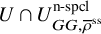 $U\cap U^{{\mathrm {n-spcl}}}_{GG, \overline {\rho }^{\mathrm {ss}}}$
is non-trivial, and hence
$U\cap U^{{\mathrm {n-spcl}}}_{GG, \overline {\rho }^{\mathrm {ss}}}$
is non-trivial, and hence $U^{{\mathrm {n-spcl}}}_{GG, \overline {\rho }^{\mathrm {ss}}}$
is dense in
$U^{{\mathrm {n-spcl}}}_{GG, \overline {\rho }^{\mathrm {ss}}}$
is dense in $X^{\mathrm {git}}_{G, \overline {\rho }^{\mathrm {ss}}}$
. The argument with
$X^{\mathrm {git}}_{G, \overline {\rho }^{\mathrm {ss}}}$
. The argument with $\overline {X}^{\mathrm {git}}_{G, \overline {\rho }^{\mathrm {ss}}}$
is the same.
$\overline {X}^{\mathrm {git}}_{G, \overline {\rho }^{\mathrm {ss}}}$
is the same.
Remark 13.33. Corollaries 13.31 and 13.32 are the analogues of the main results of [Reference Böckle and Juschka7]; compare [Reference Böckle and Juschka7, Theorem 5.5.1]. Even if $G={\mathrm {GL}}_d$
the proof given here is new: although we use many techniques introduced by Böckle and Juschka in [Reference Böckle and Juschka7], we never appeal to [Reference Böckle and Juschka7, Section 5].
$G={\mathrm {GL}}_d$
the proof given here is new: although we use many techniques introduced by Böckle and Juschka in [Reference Böckle and Juschka7], we never appeal to [Reference Böckle and Juschka7, Section 5].
Corollary 13.34. Let $\rho : \Gamma _F \rightarrow G(\kappa )$
be a continuous representation with
$\rho : \Gamma _F \rightarrow G(\kappa )$
be a continuous representation with $\kappa $
a local field. Then the conclusions of Corollary 13.27 apply to
$\kappa $
a local field. Then the conclusions of Corollary 13.27 apply to $R^{\square }_{G, \rho }$
.
$R^{\square }_{G, \rho }$
.
Proof. Using Lemma 3.10 it is enough to prove the statement after replacing $\kappa $
by a finite extension. Using Proposition 6.6 we may assume that there exist
$\kappa $
by a finite extension. Using Proposition 6.6 we may assume that there exist $g\in G^0(\kappa )$
such that
$g\in G^0(\kappa )$
such that $\rho '(\gamma ):=g \rho (\gamma )g^{-1} \in G(\mathscr O_{\kappa })$
for all
$\rho '(\gamma ):=g \rho (\gamma )g^{-1} \in G(\mathscr O_{\kappa })$
for all $\gamma \in \Gamma _F$
. Since G is smooth over
$\gamma \in \Gamma _F$
. Since G is smooth over $\mathscr O$
we may pick
$\mathscr O$
we may pick $h\in G(\Lambda )$
which maps to g in
$h\in G(\Lambda )$
which maps to g in $G(\kappa )$
. Conjugation by h induces an isomorphism of
$G(\kappa )$
. Conjugation by h induces an isomorphism of $\Lambda $
-algebras between
$\Lambda $
-algebras between $R^{\square }_{G, \rho }$
and
$R^{\square }_{G, \rho }$
and $R^{\square }_{G, \rho '}$
, so we may assume that
$R^{\square }_{G, \rho '}$
, so we may assume that $\rho $
takes values in
$\rho $
takes values in $G(\mathscr O_{\kappa })$
. Let
$G(\mathscr O_{\kappa })$
. Let $\overline {\rho }$
be the reduction of
$\overline {\rho }$
be the reduction of $\rho $
modulo the uniformiser of
$\rho $
modulo the uniformiser of $\mathscr O_{\kappa }$
. Let
$\mathscr O_{\kappa }$
. Let $\mathscr O$
be the Witt ring of residue field of
$\mathscr O$
be the Witt ring of residue field of $\mathscr O_{\kappa }$
. Since
$\mathscr O_{\kappa }$
. Since $\rho $
is a deformation of
$\rho $
is a deformation of $\overline {\rho }$
to
$\overline {\rho }$
to $\mathscr O_{\kappa }$
we obtain a map of local
$\mathscr O_{\kappa }$
we obtain a map of local $\mathscr O$
-algebras
$\mathscr O$
-algebras $R^{\square }_{G, \overline {\rho }} \rightarrow \mathscr O_{\kappa }$
. Lemma 3.11 says that
$R^{\square }_{G, \overline {\rho }} \rightarrow \mathscr O_{\kappa }$
. Lemma 3.11 says that $R^{\square }_{G, \overline {\rho }}$
is naturally isomorphic to the completion of
$R^{\square }_{G, \overline {\rho }}$
is naturally isomorphic to the completion of $\Lambda \otimes _{\mathscr {O}} R^{\square }_{G, \overline {\rho }}$
with respect to the kernel
$\Lambda \otimes _{\mathscr {O}} R^{\square }_{G, \overline {\rho }}$
with respect to the kernel $\mathfrak {q}$
of the natural map to
$\mathfrak {q}$
of the natural map to $\kappa (x)$
. Corollary 13.27 together with [Reference Böckle, Iyengar and Paškūnas6, Lemmas 3.36, 3.37] allow us to bound the dimension of the completion by
$\kappa (x)$
. Corollary 13.27 together with [Reference Böckle, Iyengar and Paškūnas6, Lemmas 3.36, 3.37] allow us to bound the dimension of the completion by $\dim \Lambda +\dim G_k([F:\mathbb {Q}_p]+1)$
, and if
$\dim \Lambda +\dim G_k([F:\mathbb {Q}_p]+1)$
, and if $\mathrm {char}(\kappa (x))=p$
then the dimension of the special fibre of the completion by
$\mathrm {char}(\kappa (x))=p$
then the dimension of the special fibre of the completion by $\dim G_k([F:\mathbb {Q}_p]+1)$
. We obtain
$\dim G_k([F:\mathbb {Q}_p]+1)$
. We obtain $ \dim \kappa \otimes _{\Lambda } R^{\square }_{G, \rho }\le \dim G_k([F:\mathbb {Q}_p]+1)$
and the proof of Corollary 13.27 goes through.
$ \dim \kappa \otimes _{\Lambda } R^{\square }_{G, \rho }\le \dim G_k([F:\mathbb {Q}_p]+1)$
and the proof of Corollary 13.27 goes through.
Corollary 13.35. Every continuous representation $\overline {\rho }: \Gamma _F \rightarrow G(k)$
can be lifted to characteristic zero. More precisely, there is a finite extension
$\overline {\rho }: \Gamma _F \rightarrow G(k)$
can be lifted to characteristic zero. More precisely, there is a finite extension $L'$
of L with a ring of integers
$L'$
of L with a ring of integers $\mathscr O'$
and uniformiser
$\mathscr O'$
and uniformiser $\varpi '$
and a continuous representation
$\varpi '$
and a continuous representation $\rho : \Gamma _F \rightarrow G(\mathscr O')$
such that
$\rho : \Gamma _F \rightarrow G(\mathscr O')$
such that $\rho \equiv \overline {\rho }\ \pmod {\varpi '}$
.
$\rho \equiv \overline {\rho }\ \pmod {\varpi '}$
.
Proof. It follows from Corollary 13.27 that $R^{\square }_{G, \overline {\rho }}[1/p]$
is non-zero. If x is a closed point of
$R^{\square }_{G, \overline {\rho }}[1/p]$
is non-zero. If x is a closed point of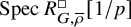 ${\mathrm {Spec}} R^{\square }_{G, \overline {\rho }}[1/p]$
then its residue field is a finite extension of L and specialising the universal deformation along x gives the required lift.
${\mathrm {Spec}} R^{\square }_{G, \overline {\rho }}[1/p]$
then its residue field is a finite extension of L and specialising the universal deformation along x gives the required lift.
Corollary 13.36. Let $\overline {\rho }: \Gamma _F \rightarrow G(k)$
be a continuous representation,
$\overline {\rho }: \Gamma _F \rightarrow G(k)$
be a continuous representation, $X^{\square }_{G, \overline {\rho }}:= {\mathrm {Spec}} R^{\square }_{G, \overline {\rho }}$
and let
$X^{\square }_{G, \overline {\rho }}:= {\mathrm {Spec}} R^{\square }_{G, \overline {\rho }}$
and let $\ast $
be the closed point in
$\ast $
be the closed point in $X^{\square }_{G, \overline {\rho }}$
. Let
$X^{\square }_{G, \overline {\rho }}$
. Let $\Sigma ^{{\mathrm {n-spcl}}}$
be the subset of closed points of
$\Sigma ^{{\mathrm {n-spcl}}}$
be the subset of closed points of $X^{\square }_{G, \overline {\rho }}\setminus \{\ast \}$
such that
$X^{\square }_{G, \overline {\rho }}\setminus \{\ast \}$
such that $x\in \Sigma ^{{\mathrm {n-spcl}}}$
if and only if
$x\in \Sigma ^{{\mathrm {n-spcl}}}$
if and only if $\rho _x$
is absolutely G-irreducible and
$\rho _x$
is absolutely G-irreducible and $H^2(\Gamma _F, ({\mathrm {Lie}} G^{\prime }_{\operatorname {sc}})_x)=0$
. Then
$H^2(\Gamma _F, ({\mathrm {Lie}} G^{\prime }_{\operatorname {sc}})_x)=0$
. Then $\Sigma ^{{\mathrm {n-spcl}}}$
is Zariski dense in
$\Sigma ^{{\mathrm {n-spcl}}}$
is Zariski dense in $X^{\square }_{G, \overline {\rho }}$
and
$X^{\square }_{G, \overline {\rho }}$
and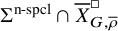 $\Sigma ^{{\mathrm {n-spcl}}}\cap \overline {X}^{\square }_{G, \overline {\rho }}$
is Zariski dense in the special fibre
$\Sigma ^{{\mathrm {n-spcl}}}\cap \overline {X}^{\square }_{G, \overline {\rho }}$
is Zariski dense in the special fibre $\overline {X}^{\square }_{G, \overline {\rho }}$
.
$\overline {X}^{\square }_{G, \overline {\rho }}$
.
Proof. The proof is essentially the same as the proof of [Reference Böckle, Iyengar and Paškūnas6, Proposition 3.55]. The map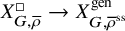 $X^{\square }_{G, \overline {\rho }} \rightarrow X^{\mathrm {gen}}_{G, \overline {\rho }^{\mathrm {ss}}}$
is flat, since it is a localisation followed by completion. Let V be a preimage of
$X^{\square }_{G, \overline {\rho }} \rightarrow X^{\mathrm {gen}}_{G, \overline {\rho }^{\mathrm {ss}}}$
is flat, since it is a localisation followed by completion. Let V be a preimage of $V^{{\mathrm {n-spcl}}}_{GG, \overline {\rho }^{\mathrm {ss}}}$
in
$V^{{\mathrm {n-spcl}}}_{GG, \overline {\rho }^{\mathrm {ss}}}$
in $X^{\square }_{G, \overline {\rho }}$
. Then V is contained in
$X^{\square }_{G, \overline {\rho }}$
. Then V is contained in $X^{\square }_{G, \overline {\rho }}\setminus \{\ast \}$
and Lemma 3.54 in [Reference Böckle, Iyengar and Paškūnas6] together with Corollary 13.30 implies that V is Zariski dense in
$X^{\square }_{G, \overline {\rho }}\setminus \{\ast \}$
and Lemma 3.54 in [Reference Böckle, Iyengar and Paškūnas6] together with Corollary 13.30 implies that V is Zariski dense in $X^{\square }_{G, \overline {\rho }}$
. The set of closed points in V is equal to
$X^{\square }_{G, \overline {\rho }}$
. The set of closed points in V is equal to $\Sigma ^{{\mathrm {n-spcl}}}$
. Since V is open
$\Sigma ^{{\mathrm {n-spcl}}}$
. Since V is open $X^{\square }_{G, \overline {\rho }}\setminus \{\ast \}$
, it is Jacobson, and hence
$X^{\square }_{G, \overline {\rho }}\setminus \{\ast \}$
, it is Jacobson, and hence $\Sigma ^{{\mathrm {n-spcl}}}$
is dense in V and also in
$\Sigma ^{{\mathrm {n-spcl}}}$
is dense in V and also in $X^{\square }_{G, \overline {\rho }}$
. The same argument works for the special fibre.
$X^{\square }_{G, \overline {\rho }}$
. The same argument works for the special fibre.
Remark 13.37. Corollary 13.36 implies that $\Sigma ^{{\mathrm {n-spcl}}}\cap U$
is dense in every open subscheme U of
$\Sigma ^{{\mathrm {n-spcl}}}\cap U$
is dense in every open subscheme U of $X^{\square }_{G, \overline {\rho }}$
. In particular, this applies when U is the generic fibre
$X^{\square }_{G, \overline {\rho }}$
. In particular, this applies when U is the generic fibre $X^{\square }_{G, \overline {\rho }}[1/p]$
.
$X^{\square }_{G, \overline {\rho }}[1/p]$
.
Corollary 13.38. One may choose a characteristic zero lift $\rho $
of
$\rho $
of $\overline {\rho }$
in Corollary 13.35 to be absolutely irreducible with
$\overline {\rho }$
in Corollary 13.35 to be absolutely irreducible with $H^2(\Gamma _F, {\mathrm {ad}}^0 \rho )=0$
.
$H^2(\Gamma _F, {\mathrm {ad}}^0 \rho )=0$
.
Proof. Since $X^{\square }_{G, \overline {\rho }}[1/p]$
is non-empty and open in
$X^{\square }_{G, \overline {\rho }}[1/p]$
is non-empty and open in $X^{\square }_{G, \overline {\rho }}$
, and
$X^{\square }_{G, \overline {\rho }}$
, and $\Sigma ^{{\mathrm {n-spcl}}}$
is dense by Corollary 13.36, we conclude that
$\Sigma ^{{\mathrm {n-spcl}}}$
is dense by Corollary 13.36, we conclude that $X^{\square }_{G, \overline {\rho }}[1/p]\cap \Sigma ^{{\mathrm {n-spcl}}}$
is non-empty. Lemma 13.22 implies that the specialisation of the universal deformation at
$X^{\square }_{G, \overline {\rho }}[1/p]\cap \Sigma ^{{\mathrm {n-spcl}}}$
is non-empty. Lemma 13.22 implies that the specialisation of the universal deformation at $x\in X^{\square }_{G, \overline {\rho }}[1/p]\cap \Sigma ^{{\mathrm {n-spcl}}}$
gives the required lift.
$x\in X^{\square }_{G, \overline {\rho }}[1/p]\cap \Sigma ^{{\mathrm {n-spcl}}}$
gives the required lift.
14 Non-special locus
Let G be a generalised reductive $\mathscr O$
-group scheme. By Lemma 2.11 we have a G-equivariant map
$\mathscr O$
-group scheme. By Lemma 2.11 we have a G-equivariant map ${\mathrm {Lie}} G^{\prime }_{\operatorname {sc}}\rightarrow {\mathrm {Lie}} G'$
, where
${\mathrm {Lie}} G^{\prime }_{\operatorname {sc}}\rightarrow {\mathrm {Lie}} G'$
, where $G^{\prime }_{\operatorname {sc}}\rightarrow G'$
is the simply connected central cover of
$G^{\prime }_{\operatorname {sc}}\rightarrow G'$
is the simply connected central cover of $G'$
. This map becomes an isomorphism after inverting p.
$G'$
. This map becomes an isomorphism after inverting p.
Let $X^{{\mathrm {spcl}}}_{G, \overline {\rho }^{\mathrm {ss}}}$
and
$X^{{\mathrm {spcl}}}_{G, \overline {\rho }^{\mathrm {ss}}}$
and $\overline {X}^{{\mathrm {spcl}}}_{G,\overline {\rho }^{\mathrm {ss}}}$
be the
$\overline {X}^{{\mathrm {spcl}}}_{G,\overline {\rho }^{\mathrm {ss}}}$
be the $({\mathrm {Lie}} G^{\prime }_{\operatorname {sc}})^{\ast }$
-special locus in
$({\mathrm {Lie}} G^{\prime }_{\operatorname {sc}})^{\ast }$
-special locus in $X^{\mathrm {gen}}_{G, \overline {\rho }^{\mathrm {ss}}}$
and in
$X^{\mathrm {gen}}_{G, \overline {\rho }^{\mathrm {ss}}}$
and in $\overline {X}^{\mathrm {gen}}_{G, \overline {\rho }^{\mathrm {ss}}}$
, respectively. Then
$\overline {X}^{\mathrm {gen}}_{G, \overline {\rho }^{\mathrm {ss}}}$
, respectively. Then $\overline {X}^{{\mathrm {spcl}}}_{G,\overline {\rho }^{\mathrm {ss}}}$
coincides with the reduced special fibre of
$\overline {X}^{{\mathrm {spcl}}}_{G,\overline {\rho }^{\mathrm {ss}}}$
coincides with the reduced special fibre of $X^{{\mathrm {spcl}}}_{G, \overline {\rho }^{\mathrm {ss}}}$
. In this subsection we bound the codimension of
$X^{{\mathrm {spcl}}}_{G, \overline {\rho }^{\mathrm {ss}}}$
. In this subsection we bound the codimension of $X^{{\mathrm {spcl}}}_{G, \overline {\rho }^{\mathrm {ss}}}$
in
$X^{{\mathrm {spcl}}}_{G, \overline {\rho }^{\mathrm {ss}}}$
in $X^{\mathrm {gen}}_{G,\overline {\rho }^{\mathrm {ss}}}$
by
$X^{\mathrm {gen}}_{G,\overline {\rho }^{\mathrm {ss}}}$
by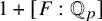 $1+[F:\mathbb {Q}_p]$
from below. Recall via Definition 13.9 that
$1+[F:\mathbb {Q}_p]$
from below. Recall via Definition 13.9 that $x\in X^{\mathrm {gen}}_{G,\overline {\rho }^{\mathrm {ss}}}$
lies in
$x\in X^{\mathrm {gen}}_{G,\overline {\rho }^{\mathrm {ss}}}$
lies in $X^{{\mathrm {spcl}}}_{G, \overline {\rho }^{\mathrm {ss}}}$
if and only if
$X^{{\mathrm {spcl}}}_{G, \overline {\rho }^{\mathrm {ss}}}$
if and only if $h^0(\Gamma _F, ({\mathrm {Lie}} G^{\prime }_{\operatorname {sc}})^{\ast }_x(1))\neq 0$
. If x is a closed point of
$h^0(\Gamma _F, ({\mathrm {Lie}} G^{\prime }_{\operatorname {sc}})^{\ast }_x(1))\neq 0$
. If x is a closed point of $Y_{\overline {\rho }^{\mathrm {ss}}}$
or a closed point of
$Y_{\overline {\rho }^{\mathrm {ss}}}$
or a closed point of $X^{\mathrm {gen}}_{G,\overline {\rho }^{\mathrm {ss}}}\setminus Y_{\overline {\rho }^{\mathrm {ss}}}$
then
$X^{\mathrm {gen}}_{G,\overline {\rho }^{\mathrm {ss}}}\setminus Y_{\overline {\rho }^{\mathrm {ss}}}$
then $\kappa (x)$
is either a finite or a local field and local Tate duality implies that x is
$\kappa (x)$
is either a finite or a local field and local Tate duality implies that x is $({\mathrm {Lie}} G^{\prime }_{\operatorname {sc}})^{\ast }$
-non-special if and only if
$({\mathrm {Lie}} G^{\prime }_{\operatorname {sc}})^{\ast }$
-non-special if and only if $H^2(\Gamma _F, ({\mathrm {Lie}} G^{\prime }_{\operatorname {sc}})_x)=0$
.
$H^2(\Gamma _F, ({\mathrm {Lie}} G^{\prime }_{\operatorname {sc}})_x)=0$
.
If $\pi _1(G')$
is étale or
$\pi _1(G')$
is étale or $x\in X^{\mathrm {gen}}_{G,\overline {\rho }^{\mathrm {ss}}}[1/p]$
then
$x\in X^{\mathrm {gen}}_{G,\overline {\rho }^{\mathrm {ss}}}[1/p]$
then $({\mathrm {Lie}} G^{\prime }_{\operatorname {sc}})_x = ({\mathrm {Lie}} G')_x$
and the above is equivalent to vanishing of
$({\mathrm {Lie}} G^{\prime }_{\operatorname {sc}})_x = ({\mathrm {Lie}} G')_x$
and the above is equivalent to vanishing of $H^2(\Gamma _F, {\mathrm {ad}}^0 \rho _x)$
. Proposition 3.6 implies that in this case
$H^2(\Gamma _F, {\mathrm {ad}}^0 \rho _x)$
. Proposition 3.6 implies that in this case $R^{\square }_{G, \rho _x}$
is formally smooth over
$R^{\square }_{G, \rho _x}$
is formally smooth over $R^{\square }_{G/G', \varphi \circ \rho _x}$
, where
$R^{\square }_{G/G', \varphi \circ \rho _x}$
, where $\varphi : G \rightarrow G/G'$
is the quotient map. In the next section we will use this to compute the set of irreducible components of
$\varphi : G \rightarrow G/G'$
is the quotient map. In the next section we will use this to compute the set of irreducible components of $X^{\mathrm {gen}}_{G, \overline {\rho }^{\mathrm {ss}}}$
. It will be important for us that
$X^{\mathrm {gen}}_{G, \overline {\rho }^{\mathrm {ss}}}$
. It will be important for us that $1+[F:\mathbb {Q}_p]\ge 2$
as this will be used to verify Serre’s criterion for normality.
$1+[F:\mathbb {Q}_p]\ge 2$
as this will be used to verify Serre’s criterion for normality.
If $G^0$
is a torus then
$G^0$
is a torus then $G'$
is trivial and there is nothing to verify. In particular, we assume that
$G'$
is trivial and there is nothing to verify. In particular, we assume that $\dim G_k>1$
in this section.
$\dim G_k>1$
in this section.
Let H be a closed generalised reductive subgroup of G such that $X^{\mathrm {gen}}_{H, \overline {\rho }^{\mathrm {ss}}}$
is non-empty. Then
$X^{\mathrm {gen}}_{H, \overline {\rho }^{\mathrm {ss}}}$
is non-empty. Then $H^0$
acts on
$H^0$
acts on $G^0 \times X^{\mathrm {gen}}_{H, \overline {\rho }^{\mathrm {ss}}}$
via
$G^0 \times X^{\mathrm {gen}}_{H, \overline {\rho }^{\mathrm {ss}}}$
via $h\cdot (g, x)= (gh^{-1}, h \cdot x)$
. We let
$h\cdot (g, x)= (gh^{-1}, h \cdot x)$
. We let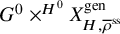 $G^0\times ^{H^0} X^{\mathrm {gen}}_{H, \overline {\rho }^{\mathrm {ss}}}$
be the GIT quotient for this action. Since the action is free the fibre at a geometric point x is isomorphic to
$G^0\times ^{H^0} X^{\mathrm {gen}}_{H, \overline {\rho }^{\mathrm {ss}}}$
be the GIT quotient for this action. Since the action is free the fibre at a geometric point x is isomorphic to $H^0_{\kappa (x)}$
. This implies that
$H^0_{\kappa (x)}$
. This implies that
 $$ \begin{align} \dim (G^0\times^{H^0} X^{\mathrm{gen}}_{H, \overline{\rho}^{\mathrm{ss}}})= \dim G^0 + \dim X^{\mathrm{gen}}_{H, \overline{\rho}^{\mathrm{ss}}} -\dim H^0. \end{align} $$
It follows from Corollaries 13.28, 13.29 that if $X^{\mathrm {gen}}_{H, \overline {\rho }^{\mathrm {ss}}}$
is non-empty then
$X^{\mathrm {gen}}_{H, \overline {\rho }^{\mathrm {ss}}}$
is non-empty then
 $$ \begin{align} \dim X^{\mathrm{gen}}_{G, \overline{\rho}^{\mathrm{ss}}} - \dim X^{\mathrm{gen}}_{H, \overline{\rho}^{\mathrm{ss}}}= (\dim G -\dim H) ([F:\mathbb {Q}_p]+1). \end{align} $$
A similar calculation can be made over ${\mathrm {Spec}} k$
.
${\mathrm {Spec}} k$
.
Definition 14.1. If H is a closed generalised reductive subgroup of G (resp. $G_k$
) we denote by
$G_k$
) we denote by $G^0\cdot X^{\mathrm {gen}}_{H, \overline {\rho }^{\mathrm {ss}}}$
(resp.
$G^0\cdot X^{\mathrm {gen}}_{H, \overline {\rho }^{\mathrm {ss}}}$
(resp. $G^0\cdot \overline {X}^{\mathrm {gen}}_{H, \overline {\rho }^{\mathrm {ss}}}$
) the scheme theoretic image of
$G^0\cdot \overline {X}^{\mathrm {gen}}_{H, \overline {\rho }^{\mathrm {ss}}}$
) the scheme theoretic image of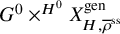 $G^0\times ^{H^0} X^{\mathrm {gen}}_{H, \overline {\rho }^{\mathrm {ss}}}$
(resp.
$G^0\times ^{H^0} X^{\mathrm {gen}}_{H, \overline {\rho }^{\mathrm {ss}}}$
(resp.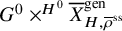 $G^0\times ^{H^0} \overline {X}^{\mathrm {gen}}_{H, \overline {\rho }^{\mathrm {ss}}}$
) in
$G^0\times ^{H^0} \overline {X}^{\mathrm {gen}}_{H, \overline {\rho }^{\mathrm {ss}}}$
) in $X^{\mathrm {gen}}_{G, \overline {\rho }^{\mathrm {ss}}}$
.
$X^{\mathrm {gen}}_{G, \overline {\rho }^{\mathrm {ss}}}$
.
The following Lemma formalises an argument made in [Reference Böckle, Iyengar and Paškūnas6, Proposition 3.8].
Lemma 14.2. Let $f:X\rightarrow Y$
be a morphism of affine schemes of finite type over
$f:X\rightarrow Y$
be a morphism of affine schemes of finite type over $S={\mathrm {Spec}} R$
, where R is a complete local noetherian
$S={\mathrm {Spec}} R$
, where R is a complete local noetherian $\mathscr O$
-algebra with residue field k. Let
$\mathscr O$
-algebra with residue field k. Let $s\in S$
be the closed point and let
$s\in S$
be the closed point and let $X_s$
and
$X_s$
and $Y_s$
denote the fibres of X and Y at s respectively. Suppose that the following hold:
$Y_s$
denote the fibres of X and Y at s respectively. Suppose that the following hold:
-
(1) f is dominant;
-
(2) every irreducible component of X intersects
$X_s$
non-trivially;

Then $\dim Y \le \dim X$
.
$\dim Y \le \dim X$
.
Proof. Let $U= X\setminus X_s$
and let
$U= X\setminus X_s$
and let $V=Y\setminus Y_s$
. Since
$V=Y\setminus Y_s$
. Since $Y_s$
is closed in Y and
$Y_s$
is closed in Y and $f(X_s)\subseteq Y_s$
, the closure of
$f(X_s)\subseteq Y_s$
, the closure of $f(X_s)$
cannot contain the generic points of V. Since f is dominant its restriction
$f(X_s)$
cannot contain the generic points of V. Since f is dominant its restriction $f:U\rightarrow V$
is still dominant. Now both U and V are Jacobson by [Reference Böckle, Iyengar and Paškūnas6, Lemma 3.18 (1)] and [Reference Böckle, Iyengar and Paškūnas6, Lemma 3.14] implies that
$f:U\rightarrow V$
is still dominant. Now both U and V are Jacobson by [Reference Böckle, Iyengar and Paškūnas6, Lemma 3.18 (1)] and [Reference Böckle, Iyengar and Paškūnas6, Lemma 3.14] implies that $\dim V \le \dim U$
. Let Z be the closure of U in X and let W be the closure of V in Y. The assumption (2) and [Reference Böckle, Iyengar and Paškūnas6, Lemma 3.18 (5)] imply that
$\dim V \le \dim U$
. Let Z be the closure of U in X and let W be the closure of V in Y. The assumption (2) and [Reference Böckle, Iyengar and Paškūnas6, Lemma 3.18 (5)] imply that $\dim Z = \dim U+1$
. The proof of [Reference Böckle, Iyengar and Paškūnas6, Lemma 3.18 (5)], namely the inequality (14) in [Reference Böckle, Iyengar and Paškūnas6], implies that
$\dim Z = \dim U+1$
. The proof of [Reference Böckle, Iyengar and Paškūnas6, Lemma 3.18 (5)], namely the inequality (14) in [Reference Böckle, Iyengar and Paškūnas6], implies that $\dim W\le \dim V+1$
. Thus
$\dim W\le \dim V+1$
. Thus $ \dim W\le \dim Z $
.
$ \dim W\le \dim Z $
.
Let $W'$
be the closure of
$W'$
be the closure of $f(X_s)$
in
$f(X_s)$
in $Y_s$
. Since both
$Y_s$
. Since both $X_s$
and
$X_s$
and $Y_s$
are of finite type over
$Y_s$
are of finite type over ${\mathrm {Spec}} k$
they are Jacobson, and hence
${\mathrm {Spec}} k$
they are Jacobson, and hence $W'$
is Jacobson. Lemma 3.14 in [Reference Böckle, Iyengar and Paškūnas6] implies that
$W'$
is Jacobson. Lemma 3.14 in [Reference Böckle, Iyengar and Paškūnas6] implies that $\dim W'\le \dim X_s$
. Since
$\dim W'\le \dim X_s$
. Since $Y_s$
is closed in Y,
$Y_s$
is closed in Y, $W'$
is also closed in Y.
$W'$
is also closed in Y.
Since f is dominant, we have $Y= W\cup W'$
. Thus
$Y= W\cup W'$
. Thus $\dim Y= \max (\dim W, \dim W')\le \max (\dim Z, \dim X_s)=\dim X.$
Remark 14.3. We note that $\mathbb {Q}_p= \mathbb {Z}_p[x]/(px-1)$
is of finite type over
$\mathbb {Q}_p= \mathbb {Z}_p[x]/(px-1)$
is of finite type over $\mathbb {Z}_p$
and
$\mathbb {Z}_p$
and ${\mathrm {Spec}} \mathbb {Q}_p \rightarrow {\mathrm {Spec}} \mathbb {Z}_p$
is dominant, and so that the assumption (2) in Lemma 14.2 is necessary.
${\mathrm {Spec}} \mathbb {Q}_p \rightarrow {\mathrm {Spec}} \mathbb {Z}_p$
is dominant, and so that the assumption (2) in Lemma 14.2 is necessary.
Proposition 14.4. If H is a closed generalised reductive subgroup of G such that $X^{\mathrm {gen}}_{H, \overline {\rho }^{\mathrm {ss}}}$
is non-empty then
$X^{\mathrm {gen}}_{H, \overline {\rho }^{\mathrm {ss}}}$
is non-empty then
 $$ \begin{align} \dim X^{\mathrm{gen}}_{G, \overline{\rho}^{\mathrm{ss}}} - \dim G^0\cdot X^{\mathrm{gen}}_{H, \overline{\rho}^{\mathrm{ss}}} \ge (\dim G - \dim H) [F:\mathbb {Q}_p]. \end{align} $$
If H is a closed generalised reductive subgroup of $G_k$
such that
$G_k$
such that $\overline {X}^{\mathrm {gen}}_{H, \overline {\rho }^{\mathrm {ss}}}$
is non-empty then
$\overline {X}^{\mathrm {gen}}_{H, \overline {\rho }^{\mathrm {ss}}}$
is non-empty then
 $$ \begin{align} \dim \overline{X}^{\mathrm{gen}}_{G, \overline{\rho}^{\mathrm{ss}}} - \dim G^0\cdot \overline{X}^{\mathrm{gen}}_{H, \overline{\rho}^{\mathrm{ss}}} \ge (\dim G_k - \dim H) [F:\mathbb {Q}_p]. \end{align} $$
Proof. Let H be a closed generalised reductive subgroup of G. We claim that the assumptions of Lemma 14.2 are satisfied with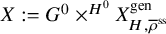 $X:= G^0\times ^{H^0} X^{\mathrm {gen}}_{H, \overline {\rho }^{\mathrm {ss}}}$
and
$X:= G^0\times ^{H^0} X^{\mathrm {gen}}_{H, \overline {\rho }^{\mathrm {ss}}}$
and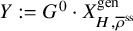 $Y:= G^0\cdot X^{\mathrm {gen}}_{H, \overline {\rho }^{\mathrm {ss}}}$
. Since
$Y:= G^0\cdot X^{\mathrm {gen}}_{H, \overline {\rho }^{\mathrm {ss}}}$
. Since $\dim G=\dim G^0$
and
$\dim G=\dim G^0$
and $\dim H=\dim H^0$
, the claim together with Lemma 14.2, (81) and (82) imply (83).
$\dim H=\dim H^0$
, the claim together with Lemma 14.2, (81) and (82) imply (83).
To prove the claim we observe that the map $X^{\mathrm {gen}}_{H, \overline {\rho }^{\mathrm {ss}}} \rightarrow G^0\times X^{\mathrm {gen}}_{H, \overline {\rho }^{\mathrm {ss}}}$
,
$X^{\mathrm {gen}}_{H, \overline {\rho }^{\mathrm {ss}}} \rightarrow G^0\times X^{\mathrm {gen}}_{H, \overline {\rho }^{\mathrm {ss}}}$
, $x\mapsto (1,x)$
induces an isomorphism
$x\mapsto (1,x)$
induces an isomorphism  with the inverse map induced by $(g, x)\mapsto x$
. Now
$(g, x)\mapsto x$
. Now  is a spectrum of a finite product of local noetherian $\mathscr O$
-algebras by (31). Since
$\mathscr O$
-algebras by (31). Since $G^0$
is connected every irreducible component
$G^0$
is connected every irreducible component $X'$
of X is
$X'$
of X is $G^0$
-invariant by [Reference Böckle, Iyengar and Paškūnas6, Lemma 2.1] and hence its image in
$G^0$
-invariant by [Reference Böckle, Iyengar and Paškūnas6, Lemma 2.1] and hence its image in  is closed by Corollary 2 (ii) to [Reference Seshadri57, Proposition 9]. Thus the image of $X'$
in
$X'$
in 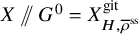 will contain a closed point. Since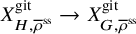 $X^{\mathrm {git}}_{H, \overline {\rho }^{\mathrm {ss}}} \rightarrow X^{\mathrm {git}}_{G, \overline {\rho }^{\mathrm {ss}}}$
is finite, it sends closed points to the closed point of
$X^{\mathrm {git}}_{H, \overline {\rho }^{\mathrm {ss}}} \rightarrow X^{\mathrm {git}}_{G, \overline {\rho }^{\mathrm {ss}}}$
is finite, it sends closed points to the closed point of $X^{\mathrm {git}}_{G, \overline {\rho }^{\mathrm {ss}}}$
. This implies that X satisfies the assumption (2) of Lemma 14.2. The assumption (1) holds as Y is by definition the closure of
$X^{\mathrm {git}}_{G, \overline {\rho }^{\mathrm {ss}}}$
. This implies that X satisfies the assumption (2) of Lemma 14.2. The assumption (1) holds as Y is by definition the closure of $f(X)$
. The argument in the special fibre is the same.
$f(X)$
. The argument in the special fibre is the same.
Proposition 14.5. Let L be a $\overline {\rho }^{\mathrm {ss}}$
-compatible R-Levi of G such that
$\overline {\rho }^{\mathrm {ss}}$
-compatible R-Levi of G such that $\dim G -\dim L=2$
. There is a closed subscheme
$\dim G -\dim L=2$
. There is a closed subscheme $\overline {D}_L$
of
$\overline {D}_L$
of $\overline {X}^{\mathrm {gen}}_{G, \overline {\rho }^{\mathrm {ss}}}$
such that the following hold:
$\overline {X}^{\mathrm {gen}}_{G, \overline {\rho }^{\mathrm {ss}}}$
such that the following hold:
-
(1)
$\dim \overline {X}^{\mathrm {gen}}_{G, \overline {\rho }^{\mathrm {ss}}} - \dim \overline {D}_L\ge 1+[F:\mathbb {Q}_p]$
; -
(2) if
$x\in \overline {{V}}_{LG}$
and
$x\not \in \overline {D}_L$
then
$h^0(\Gamma _F, ({\mathrm {Lie}} G^{\prime }_{\operatorname {sc}})^*_x(1))=0$
.




Proof. We want to define $\overline {D}_L$
, so that for every geometric point
$\overline {D}_L$
, so that for every geometric point $x\in \overline {{V}}_{LG, \overline {\rho }^{\mathrm {ss}}}$
such that
$x\in \overline {{V}}_{LG, \overline {\rho }^{\mathrm {ss}}}$
such that $x\not \in \overline {D}_L$
the assumptions of Proposition 11.5 hold for
$x\not \in \overline {D}_L$
the assumptions of Proposition 11.5 hold for $\rho _x: \Gamma _F \rightarrow G(\kappa (x))$
, since then Proposition 11.5 implies that part (2) holds.
$\rho _x: \Gamma _F \rightarrow G(\kappa (x))$
, since then Proposition 11.5 implies that part (2) holds.
If $x\in \overline {{V}}_{LG, \overline {\rho }^{\mathrm {ss}}}$
then
$x\in \overline {{V}}_{LG, \overline {\rho }^{\mathrm {ss}}}$
then $\rho _x(\Gamma _F)$
is contained in
$\rho _x(\Gamma _F)$
is contained in $P(\kappa (x))$
for some R-parabolic subgroup P of
$P(\kappa (x))$
for some R-parabolic subgroup P of $G_{\kappa (x)}$
such that some R-Levi of P is conjugate to
$G_{\kappa (x)}$
such that some R-Levi of P is conjugate to $L_{\kappa (x)}$
. Thus if
$L_{\kappa (x)}$
. Thus if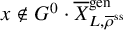 $x\not \in G^0\cdot \overline {X}^{\mathrm {gen}}_{L, \overline {\rho }^{\mathrm {ss}}}$
then
$x\not \in G^0\cdot \overline {X}^{\mathrm {gen}}_{L, \overline {\rho }^{\mathrm {ss}}}$
then $\rho _x(\Gamma _F)$
is not contained in any R-Levi subgroup of P, and so part (1) of Proposition 11.5 holds for
$\rho _x(\Gamma _F)$
is not contained in any R-Levi subgroup of P, and so part (1) of Proposition 11.5 holds for $\rho _x$
. Moreover, Proposition 14.4 implies that
$\rho _x$
. Moreover, Proposition 14.4 implies that
 $$ \begin{align} \dim \overline{X}^{\mathrm{gen}}_{G, \overline{\rho}^{\mathrm{ss}}} - \dim G^0\cdot \overline{X}^{\mathrm{gen}}_{L, \overline{\rho}^{\mathrm{ss}}} \ge 2 [F:\mathbb {Q}_p]. \end{align} $$
Let $\varphi : G_k \rightarrow {\mathrm {Aut}}(G^0_k)$
be the map induced by the conjugation action of
$\varphi : G_k \rightarrow {\mathrm {Aut}}(G^0_k)$
be the map induced by the conjugation action of $G_k$
on
$G_k$
on $G^0_k$
. Let
$G^0_k$
. Let $\overline {G}= G_k/{\mathrm {Ker}} \varphi $
and
$\overline {G}= G_k/{\mathrm {Ker}} \varphi $
and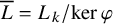 $\overline {L}= L_k/\ker \varphi $
. It follows from [Reference Conrad19, Theorem 7.1.9] and Proposition 11.1 that
$\overline {L}= L_k/\ker \varphi $
. It follows from [Reference Conrad19, Theorem 7.1.9] and Proposition 11.1 that $\overline {G}_{\overline {k}}\cong G_1 \times {\mathrm {PGL}}_2$
and
$\overline {G}_{\overline {k}}\cong G_1 \times {\mathrm {PGL}}_2$
and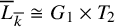 $\overline {L}_{\overline {k}} \cong G_1\times T_2$
, where
$\overline {L}_{\overline {k}} \cong G_1\times T_2$
, where $G_1$
is a generalised reductive group and
$G_1$
is a generalised reductive group and $T_2$
is the subgroup of diagonal matrices in
$T_2$
is the subgroup of diagonal matrices in ${\mathrm {PGL}}_2$
. The isomorphisms are defined over some finite extension of k, and after extending scalars we may assume that it is defined over k. Let
${\mathrm {PGL}}_2$
. The isomorphisms are defined over some finite extension of k, and after extending scalars we may assume that it is defined over k. Let $p_2: G\rightarrow {\mathrm {PGL}}_2$
be the quotient map composed with the projection onto the second factor.
$p_2: G\rightarrow {\mathrm {PGL}}_2$
be the quotient map composed with the projection onto the second factor.
Let $H_0$
be the preimage of
$H_0$
be the preimage of $\mu _{p-1} \subset T_2$
in G under
$\mu _{p-1} \subset T_2$
in G under $p_2$
. It follows from Lemma 11.3 applied to the base change of
$p_2$
. It follows from Lemma 11.3 applied to the base change of $H_0$
over
$H_0$
over $\overline {k}$
that
$\overline {k}$
that $H_0$
is reductive and
$H_0$
is reductive and $\dim Z(H_0)< \dim Z(L_k)$
. Since the inequality is strict we can improve the codimension bound in Corollary 13.6 by
$\dim Z(H_0)< \dim Z(L_k)$
. Since the inequality is strict we can improve the codimension bound in Corollary 13.6 by $1$
:
$1$
:
 $$ \begin{align} \dim \overline{X}^{\mathrm{gen}}_{G, \overline{\rho}^{\mathrm{ss}}} - \dim \overline{Z}_{H_0 G, \overline{\rho}^{\mathrm{ss}}}\ge 1+ (\dim L_k - \dim H_0)[F:\mathbb {Q}_p]= 1+[F:\mathbb {Q}_p], \end{align} $$
where $\overline {Z}_{H_0 G, \overline {\rho }^{\mathrm {ss}}}$
is the closure of the preimage of
$\overline {Z}_{H_0 G, \overline {\rho }^{\mathrm {ss}}}$
is the closure of the preimage of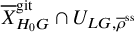 $\overline {X}^{\mathrm {git}}_{H_0 G}\cap U_{LG, \overline {\rho }^{\mathrm {ss}}}$
in
$\overline {X}^{\mathrm {git}}_{H_0 G}\cap U_{LG, \overline {\rho }^{\mathrm {ss}}}$
in $\overline {X}^{\mathrm {gen}}_{G, \overline {\rho }^{\mathrm {ss}}}$
, and the extra
$\overline {X}^{\mathrm {gen}}_{G, \overline {\rho }^{\mathrm {ss}}}$
, and the extra $1$
comes as a difference between the dimensions of the centres in (55) and (56).
$1$
comes as a difference between the dimensions of the centres in (55) and (56).
If x is a geometric point of $\overline {{V}}_{LG, \overline {\rho }^{\mathrm {ss}}}$
then the G-semisimplification of
$\overline {{V}}_{LG, \overline {\rho }^{\mathrm {ss}}}$
then the G-semisimplification of $\rho _x$
is contained in
$\rho _x$
is contained in $H_0$
if and only if
$H_0$
if and only if $x\in \overline {Z}_{H_0 G, \overline {\rho }^{\mathrm {ss}}}$
. Thus if
$x\in \overline {Z}_{H_0 G, \overline {\rho }^{\mathrm {ss}}}$
. Thus if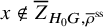 $x\not \in \overline {Z}_{H_0 G, \overline {\rho }^{\mathrm {ss}}}$
then part (1) of Proposition 11.5 holds for
$x\not \in \overline {Z}_{H_0 G, \overline {\rho }^{\mathrm {ss}}}$
then part (1) of Proposition 11.5 holds for $\rho _x$
.
$\rho _x$
.
If $G_1^0$
is a torus then
$G_1^0$
is a torus then $G_1'$
is trivial and part (3) of Proposition 11.5 holds for
$G_1'$
is trivial and part (3) of Proposition 11.5 holds for $\rho _x$
. Proposition 11.5 implies that if
$\rho _x$
. Proposition 11.5 implies that if $x\not \in \overline {D}_L:= G^0\cdot \overline {X}^{\mathrm {gen}}_{L, \overline {\rho }^{\mathrm {ss}}} \cup \overline {Z}_{H_0 G, \overline {\rho }^{\mathrm {ss}}}$
then part (2) holds, and (85) and (86) imply that part (1) holds.
$x\not \in \overline {D}_L:= G^0\cdot \overline {X}^{\mathrm {gen}}_{L, \overline {\rho }^{\mathrm {ss}}} \cup \overline {Z}_{H_0 G, \overline {\rho }^{\mathrm {ss}}}$
then part (2) holds, and (85) and (86) imply that part (1) holds.
If $G_1^0$
is not a torus then we have to further cut out some pieces to make sure that
$G_1^0$
is not a torus then we have to further cut out some pieces to make sure that $h^0(\Gamma _F, ({\mathrm {Lie}} G^{\prime }_1)_x^*(1))=0$
, so that part (3) of Proposition 11.5 is satisfied. Let
$h^0(\Gamma _F, ({\mathrm {Lie}} G^{\prime }_1)_x^*(1))=0$
, so that part (3) of Proposition 11.5 is satisfied. Let $p_1: G\rightarrow G_1$
be the composition of the quotient map with the projection onto the first component. Let
$p_1: G\rightarrow G_1$
be the composition of the quotient map with the projection onto the first component. Let $\overline {\rho }_1=p_1\circ \rho : \Gamma _F \rightarrow G_1(k)$
. As in the proof of Proposition 13.18 let
$\overline {\rho }_1=p_1\circ \rho : \Gamma _F \rightarrow G_1(k)$
. As in the proof of Proposition 13.18 let $J_1, \ldots , J_r$
be reductive subgroups of
$J_1, \ldots , J_r$
be reductive subgroups of $G_1$
, such that
$G_1$
, such that $\dim G_1 - \dim J_i\ge 2$
and the image of the special
$\dim G_1 - \dim J_i\ge 2$
and the image of the special $G_1$
-absolutely irreducible locus in
$G_1$
-absolutely irreducible locus in $\overline {X}^{\mathrm {git}}_{G_1,\overline {\rho }_1^{\mathrm {ss}}}$
is contained in the union of
$\overline {X}^{\mathrm {git}}_{G_1,\overline {\rho }_1^{\mathrm {ss}}}$
is contained in the union of $\overline {X}^{\mathrm {git}}_{J_i G_1, \overline {\rho }_1^{\mathrm {ss}}}$
. Let
$\overline {X}^{\mathrm {git}}_{J_i G_1, \overline {\rho }_1^{\mathrm {ss}}}$
. Let $H_i$
be the preimage of
$H_i$
be the preimage of $J_i \times T_2$
in
$J_i \times T_2$
in $L_k$
for
$L_k$
for $1\le i \le r$
. Then
$1\le i \le r$
. Then $\dim L_k -\dim H_i = \dim G_1 - \dim J_i \ge 2$
. It follows from Corollary 13.6 that
$\dim L_k -\dim H_i = \dim G_1 - \dim J_i \ge 2$
. It follows from Corollary 13.6 that
 $$ \begin{align} \dim \overline{X}^{\mathrm{gen}}_{G, \overline{\rho}^{\mathrm{ss}}} - \dim \overline{Z}_{H_i G, \overline{\rho}^{\mathrm{ss}}} \ge (\dim L_k - \dim H_i)[F:\mathbb {Q}_p]\ge 2[F:\mathbb {Q}_p]. \end{align} $$
If $x\in \overline {{V}}_{LG, \overline {\rho }^{\mathrm {ss}}}$
then the action of
$x\in \overline {{V}}_{LG, \overline {\rho }^{\mathrm {ss}}}$
then the action of $\Gamma _F$
on
$\Gamma _F$
on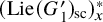 $({\mathrm {Lie}} (G^{\prime }_1)_{\operatorname {sc}})^*_x$
factors through
$({\mathrm {Lie}} (G^{\prime }_1)_{\operatorname {sc}})^*_x$
factors through $p_1\circ \rho _x: \Gamma _F \rightarrow G_1(\kappa (x))$
. If
$p_1\circ \rho _x: \Gamma _F \rightarrow G_1(\kappa (x))$
. If $p_1\circ \rho _{x}$
is not
$p_1\circ \rho _{x}$
is not $G_1$
-irreducible, then its image would be contained in a proper R-parabolic of
$G_1$
-irreducible, then its image would be contained in a proper R-parabolic of $G_1$
, and then the image of
$G_1$
, and then the image of $\rho _x$
would be contained in a proper R-parabolic of
$\rho _x$
would be contained in a proper R-parabolic of $L_k$
, which would contradict
$L_k$
, which would contradict $x\in \overline {{V}}_{LG}$
. Thus
$x\in \overline {{V}}_{LG}$
. Thus $p_1\circ \rho _{x}$
is
$p_1\circ \rho _{x}$
is $G_1$
-irreducible and
$G_1$
-irreducible and $h^0(\Gamma _F, ({\mathrm {Lie}} (G^{\prime }_1)_{\operatorname {sc}})_x^*(1))=0$
if and only if
$h^0(\Gamma _F, ({\mathrm {Lie}} (G^{\prime }_1)_{\operatorname {sc}})_x^*(1))=0$
if and only if $p_1\circ \rho _{x}$
corresponds to a non-special point in
$p_1\circ \rho _{x}$
corresponds to a non-special point in $\overline {X}^{\mathrm {gen}}_{G_1, \overline {\rho }^{\mathrm {ss}}_1}$
. The map
$\overline {X}^{\mathrm {gen}}_{G_1, \overline {\rho }^{\mathrm {ss}}_1}$
. The map $p_1: L_k\rightarrow G_1$
induces a map
$p_1: L_k\rightarrow G_1$
induces a map $\overline {{V}}_{LG, \overline {\rho }^{\mathrm {ss}}} \rightarrow \overline {U}_{LG, \overline {\rho }^{\mathrm {ss}}} \rightarrow \overline {X}^{\mathrm {git}}_{G_1, \overline {\rho }_1^{\mathrm {ss}}}$
and the preimage of
$\overline {{V}}_{LG, \overline {\rho }^{\mathrm {ss}}} \rightarrow \overline {U}_{LG, \overline {\rho }^{\mathrm {ss}}} \rightarrow \overline {X}^{\mathrm {git}}_{G_1, \overline {\rho }_1^{\mathrm {ss}}}$
and the preimage of $\overline {X}^{\mathrm {git}}_{J_i G_1, \overline {\rho }^{\mathrm {ss}}_1}$
under this map is equal to
$\overline {X}^{\mathrm {git}}_{J_i G_1, \overline {\rho }^{\mathrm {ss}}_1}$
under this map is equal to $\overline {{V}}_{LG, \overline {\rho }^{\mathrm {ss}}}\cap \overline {Z}_{H_i G, \overline {\rho }^{\mathrm {ss}}}$
. We conclude that if
$\overline {{V}}_{LG, \overline {\rho }^{\mathrm {ss}}}\cap \overline {Z}_{H_i G, \overline {\rho }^{\mathrm {ss}}}$
. We conclude that if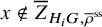 $x\not \in \overline {Z}_{H_i G, \overline {\rho }^{\mathrm {ss}}}$
for
$x\not \in \overline {Z}_{H_i G, \overline {\rho }^{\mathrm {ss}}}$
for $1\le i\le r$
then
$1\le i\le r$
then $h^0(\Gamma _F, ({\mathrm {Lie}} (G^{\prime }_1)_{\operatorname {sc}})_x^*(1))=0$
. Thus part (3) of Proposition 11.5 holds for
$h^0(\Gamma _F, ({\mathrm {Lie}} (G^{\prime }_1)_{\operatorname {sc}})_x^*(1))=0$
. Thus part (3) of Proposition 11.5 holds for $\rho _x$
. Hence, if
$\rho _x$
. Hence, if $x\not \in \overline {D}_L:=G^0\cdot \overline {X}^{\mathrm {gen}}_{L, \overline {\rho }^{\mathrm {ss}}} \cup \bigcup \nolimits_{i=0}^r\overline {Z}_{H_i G, \overline {\rho }^{\mathrm {ss}}}$
then Proposition 11.5 implies that part (2) holds. Moreover, (85), (86) and (87) imply that part (1) holds.
$x\not \in \overline {D}_L:=G^0\cdot \overline {X}^{\mathrm {gen}}_{L, \overline {\rho }^{\mathrm {ss}}} \cup \bigcup \nolimits_{i=0}^r\overline {Z}_{H_i G, \overline {\rho }^{\mathrm {ss}}}$
then Proposition 11.5 implies that part (2) holds. Moreover, (85), (86) and (87) imply that part (1) holds.
Theorem 14.6. The following hold:
-
(1)
$X^{{\mathrm {spcl}}}_{G,\overline {\rho }^{\mathrm {ss}}}$
has codimension at least
$1+[F:\mathbb {Q}_p]$
in
$X^{\mathrm {gen}}_{G, \overline {\rho }^{\mathrm {ss}}}$
; -
(2)
$\overline {X}^{{\mathrm {spcl}}}_{G,\overline {\rho }^{\mathrm {ss}}}$
has codimension at least
$1+[F:\mathbb {Q}_p]$
in
$\overline {X}^{\mathrm {gen}}_{G, \overline {\rho }^{\mathrm {ss}}}$
; -
(3)
$X^{{\mathrm {spcl}}}_{G,\overline {\rho }^{\mathrm {ss}}}[1/p]$
has codimension at least
$1+[F:\mathbb {Q}_p]$
in
$X^{\mathrm {gen}}_{G, \overline {\rho }^{\mathrm {ss}}}[1/p]$
.


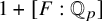


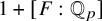

Moreover, if there is no $\overline {\rho }^{\mathrm {ss}}$
-compatible R-Levi subgroup L of G such that
$\overline {\rho }^{\mathrm {ss}}$
-compatible R-Levi subgroup L of G such that $\dim G -\dim L=2$
then the bounds can be improved to
$\dim G -\dim L=2$
then the bounds can be improved to $2[F:\mathbb {Q}_p]$
.
$2[F:\mathbb {Q}_p]$
.
Proof. Since $\dim X^{\mathrm {gen}}_{G, \overline {\rho }^{\mathrm {ss}}} = \dim \overline {X}^{\mathrm {gen}}_{G, \overline {\rho }^{\mathrm {ss}}} +1$
by Corollary 13.28, Corollary 13.15 applied with
$\dim X^{\mathrm {gen}}_{G, \overline {\rho }^{\mathrm {ss}}} = \dim \overline {X}^{\mathrm {gen}}_{G, \overline {\rho }^{\mathrm {ss}}} +1$
by Corollary 13.28, Corollary 13.15 applied with $W= ({\mathrm {Lie}} G^{\prime }_{\operatorname {sc}})^*$
implies that it is enough to prove the assertion about the special fibre.
$W= ({\mathrm {Lie}} G^{\prime }_{\operatorname {sc}})^*$
implies that it is enough to prove the assertion about the special fibre.
We claim that $\overline {X}^{{\mathrm {spcl}}}_{G,\overline {\rho }^{\mathrm {ss}}}$
is contained in the union of
$\overline {X}^{{\mathrm {spcl}}}_{G,\overline {\rho }^{\mathrm {ss}}}$
is contained in the union of $Y_{\overline {\rho }^{\mathrm {ss}}}$
,
$Y_{\overline {\rho }^{\mathrm {ss}}}$
, $\overline {Z}^{{\mathrm {spcl}}}_{GG, \overline {\rho }^{\mathrm {ss}}}$
,
$\overline {Z}^{{\mathrm {spcl}}}_{GG, \overline {\rho }^{\mathrm {ss}}}$
, $\overline {Z}_{LG, \overline {\rho }^{\mathrm {ss}}}$
, for
$\overline {Z}_{LG, \overline {\rho }^{\mathrm {ss}}}$
, for $\overline {\rho }^{\mathrm {ss}}$
-compatible R-Levi subgroups L of G containing a fixed maximal split torus T and satisfying
$\overline {\rho }^{\mathrm {ss}}$
-compatible R-Levi subgroups L of G containing a fixed maximal split torus T and satisfying $\dim G -\dim L> 2$
, and
$\dim G -\dim L> 2$
, and $\overline {D}_L$
for
$\overline {D}_L$
for $\overline {\rho }^{\mathrm {ss}}$
-compatible R-Levi subgroups L of G containing T and satisfying
$\overline {\rho }^{\mathrm {ss}}$
-compatible R-Levi subgroups L of G containing T and satisfying $\dim G - \dim L =2$
. Since this is a finite union and each piece has codimension of at least
$\dim G - \dim L =2$
. Since this is a finite union and each piece has codimension of at least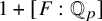 $1+[F:\mathbb {Q}_p]$
by Corollary 12.18, Propositions 13.18, 13.17, 14.5 we obtain the assertion. Moreover, if there are no
$1+[F:\mathbb {Q}_p]$
by Corollary 12.18, Propositions 13.18, 13.17, 14.5 we obtain the assertion. Moreover, if there are no $\overline {\rho }^{\mathrm {ss}}$
-compatible R-Levi subgroups L with
$\overline {\rho }^{\mathrm {ss}}$
-compatible R-Levi subgroups L with $\dim G-\dim L=2$
then the same references imply that each piece has codimension at least
$\dim G-\dim L=2$
then the same references imply that each piece has codimension at least $2[F:\mathbb {Q}_p]$
.
$2[F:\mathbb {Q}_p]$
.
We will now prove the claim. Let $x\in \overline {X}^{{\mathrm {spcl}}}_{G,\overline {\rho }^{\mathrm {ss}}}$
be a geometric point. If x is not contained in
$x\in \overline {X}^{{\mathrm {spcl}}}_{G,\overline {\rho }^{\mathrm {ss}}}$
be a geometric point. If x is not contained in $Y_{\overline {\rho }^{\mathrm {ss}}}$
then it is contained in
$Y_{\overline {\rho }^{\mathrm {ss}}}$
then it is contained in $\overline {{V}}_{LG, \overline {\rho }^{\mathrm {ss}}}$
for some
$\overline {{V}}_{LG, \overline {\rho }^{\mathrm {ss}}}$
for some $\overline {\rho }^{\mathrm {ss}}$
-compatible R-Levi L of G containing T. If
$\overline {\rho }^{\mathrm {ss}}$
-compatible R-Levi L of G containing T. If $L=G$
then
$L=G$
then $x\in \overline {Z}^{{\mathrm {spcl}}}_{GG, \overline {\rho }^{\mathrm {ss}}}$
by definition of the absolutely irreducible special locus. If
$x\in \overline {Z}^{{\mathrm {spcl}}}_{GG, \overline {\rho }^{\mathrm {ss}}}$
by definition of the absolutely irreducible special locus. If $L\neq G$
then
$L\neq G$
then $\dim G - \dim L\ge 2$
by part (3) of Lemma 9.11. If
$\dim G - \dim L\ge 2$
by part (3) of Lemma 9.11. If $\dim G-\dim L>2$
then
$\dim G-\dim L>2$
then $x\in \overline {Z}_{LG, \overline {\rho }^{\mathrm {ss}}}$
, as this locus contains
$x\in \overline {Z}_{LG, \overline {\rho }^{\mathrm {ss}}}$
, as this locus contains $\overline {{V}}_{LG, \overline {\rho }^{\mathrm {ss}}}$
. If
$\overline {{V}}_{LG, \overline {\rho }^{\mathrm {ss}}}$
. If $\dim G -\dim L=2$
then Proposition 14.5 implies that
$\dim G -\dim L=2$
then Proposition 14.5 implies that $x\in \overline {D}_L$
.
$x\in \overline {D}_L$
.
Example 14.7. Let $G={\mathrm {GL}}_1\times {\mathrm {GL}}_2$
and
$G={\mathrm {GL}}_1\times {\mathrm {GL}}_2$
and $\overline {\rho }= \overline {\rho }_1\times \overline {\rho }_2$
. If
$\overline {\rho }= \overline {\rho }_1\times \overline {\rho }_2$
. If $\overline {\rho }_2: \Gamma _F \rightarrow {\mathrm {GL}}_2(k)$
is absolutely irreducible then the only
$\overline {\rho }_2: \Gamma _F \rightarrow {\mathrm {GL}}_2(k)$
is absolutely irreducible then the only $\overline {\rho }^{\mathrm {ss}}$
-compatible Levi of G is G itself and so Theorem 14.6 implies that the codimension of
$\overline {\rho }^{\mathrm {ss}}$
-compatible Levi of G is G itself and so Theorem 14.6 implies that the codimension of $({\mathrm {Lie}} G^{\prime }_{\operatorname {sc}})^*$
-special locus is at least
$({\mathrm {Lie}} G^{\prime }_{\operatorname {sc}})^*$
-special locus is at least $2[F:\mathbb {Q}_p]$
. On the other hand if
$2[F:\mathbb {Q}_p]$
. On the other hand if $\overline {\rho }_2$
is reducible then the subgroup of diagonal matrices in G is also
$\overline {\rho }_2$
is reducible then the subgroup of diagonal matrices in G is also $\overline {\rho }^{\mathrm {ss}}$
-compatible and the bound given by the theorem is
$\overline {\rho }^{\mathrm {ss}}$
-compatible and the bound given by the theorem is $1+[F:\mathbb {Q}_p]$
.
$1+[F:\mathbb {Q}_p]$
.
15 Irreducible components and normality
We assume that $G^0$
is split over
$G^0$
is split over $\mathscr O$
and the map
$\mathscr O$
and the map $\pi _G\circ \overline {\rho }^{\mathrm {ss}}: \Gamma _F \rightarrow (G/G^0)(\overline {k})$
is surjective. It follows from Remark 5.9 and Lemma 9.2 that we can always achieve this after shrinking the group of connected components of G and after replacing L by a finite unramified extension. Let
$\pi _G\circ \overline {\rho }^{\mathrm {ss}}: \Gamma _F \rightarrow (G/G^0)(\overline {k})$
is surjective. It follows from Remark 5.9 and Lemma 9.2 that we can always achieve this after shrinking the group of connected components of G and after replacing L by a finite unramified extension. Let $G'$
be the derived subgroup scheme of
$G'$
be the derived subgroup scheme of $G^0$
and let
$G^0$
and let $\varphi : G\rightarrow G/G'$
be the quotient map.
$\varphi : G\rightarrow G/G'$
be the quotient map.
Let $\Gamma _E$
be the kernel of
$\Gamma _E$
be the kernel of $\pi _G \circ \overline {\rho }^{\mathrm {ss}}$
. Our assumptions on G imply that
$\pi _G \circ \overline {\rho }^{\mathrm {ss}}$
. Our assumptions on G imply that $G^0/G'$
is a torus over
$G^0/G'$
is a torus over $\mathscr O$
. We thus may write
$\mathscr O$
. We thus may write $G^0/G' ={\mathrm {Spec}} \mathscr O[M]$
, where M is the character lattice of
$G^0/G' ={\mathrm {Spec}} \mathscr O[M]$
, where M is the character lattice of $G^0/G'$
. Let
$G^0/G'$
. Let $\Delta :=(G/G^0)(\overline {k})$
. Our assumptions on
$\Delta :=(G/G^0)(\overline {k})$
. Our assumptions on $\pi _G \circ \overline {\rho }^{\mathrm {ss}}$
imply that
$\pi _G \circ \overline {\rho }^{\mathrm {ss}}$
imply that
 $$ \begin{align*}\Delta= (G/G^0)(k)= {\mathrm{Gal}}(E/F).\end{align*} $$
The action of G by conjugation on ${\mathrm {Hom}}_{\mathscr O\text {-}\mathrm {GrpSch}}(G^0/G', \mathbb G_{m})=M$
induces an action of
${\mathrm {Hom}}_{\mathscr O\text {-}\mathrm {GrpSch}}(G^0/G', \mathbb G_{m})=M$
induces an action of $\Delta $
on M. We assume that we are given a
$\Delta $
on M. We assume that we are given a $\Delta $
-invariant decomposition
$\Delta $
-invariant decomposition
 $$ \begin{align} M=M_1 \oplus M_2. \end{align} $$
The projections $M\rightarrow M_i$
identify
$M\rightarrow M_i$
identify $K_i={\mathrm {Spec}} \mathscr O[M_i]$
with a normal subgroup scheme of
$K_i={\mathrm {Spec}} \mathscr O[M_i]$
with a normal subgroup scheme of $G/G'$
. We let
$G/G'$
. We let
 $$ \begin{align*}H_1 = (G/G')/K_2, \quad H_2:= (G/G')/K_1.\end{align*} $$
We fix $\overline {\rho }: \Gamma _F \rightarrow G(k)$
corresponding to a point in
$\overline {\rho }: \Gamma _F \rightarrow G(k)$
corresponding to a point in $X^{\mathrm {gen}}_{G, \overline {\rho }^{\mathrm {ss}}}(k)$
. Let
$X^{\mathrm {gen}}_{G, \overline {\rho }^{\mathrm {ss}}}(k)$
. Let $\varphi _i: G\rightarrow H_i$
denote the quotient map and let
$\varphi _i: G\rightarrow H_i$
denote the quotient map and let $\overline {\psi }_i= \varphi _i \circ \overline {\rho }$
and
$\overline {\psi }_i= \varphi _i \circ \overline {\rho }$
and $\overline {\psi }= \varphi \circ \overline {\rho }$
. We fix a continuous representation
$\overline {\psi }= \varphi \circ \overline {\rho }$
. We fix a continuous representation $\psi _1: \Gamma _F\rightarrow H_1(\mathscr O)$
lifting
$\psi _1: \Gamma _F\rightarrow H_1(\mathscr O)$
lifting $\overline {\psi }_1: \Gamma _F\rightarrow H_1(k)$
. The lift
$\overline {\psi }_1: \Gamma _F\rightarrow H_1(k)$
. The lift $\psi _1$
induces a morphism
$\psi _1$
induces a morphism ${\mathrm {Spec}} \mathscr O \rightarrow X^{\mathrm {gen}}_{H_1, \overline {\psi }^{\mathrm {ss}}_1}$
. Whenever
${\mathrm {Spec}} \mathscr O \rightarrow X^{\mathrm {gen}}_{H_1, \overline {\psi }^{\mathrm {ss}}_1}$
. Whenever $X={\mathrm {Spec}} A$
is a scheme over
$X={\mathrm {Spec}} A$
is a scheme over $X^{\mathrm {gen}}_{H_1, \overline {\psi }^{\mathrm {ss}}_1}$
, we denote by
$X^{\mathrm {gen}}_{H_1, \overline {\psi }^{\mathrm {ss}}_1}$
, we denote by $X^{\psi _1}$
the fibre product along this morphism, and
$X^{\psi _1}$
the fibre product along this morphism, and $A^{\psi _1}$
the ring of global sections of
$A^{\psi _1}$
the ring of global sections of $X^{\psi _1}$
. By functoriality proved in Proposition 8.5 the quotient morphism
$X^{\psi _1}$
. By functoriality proved in Proposition 8.5 the quotient morphism $\varphi _1: G\rightarrow H_1$
induces a morphism
$\varphi _1: G\rightarrow H_1$
induces a morphism
 $$ \begin{align} X^{\mathrm{gen}}_{G, \overline{\rho}^{\mathrm{ss}}} \rightarrow X^{\mathrm{gen}}_{H_1, \overline{\psi}^{\mathrm {ss}}_1}. \end{align} $$
We obtain closed subschemes $X^{\mathrm {gen}, \psi _1}_{G, \overline {\rho }^{\mathrm {ss}}}$
of
$X^{\mathrm {gen}, \psi _1}_{G, \overline {\rho }^{\mathrm {ss}}}$
of $X^{\mathrm {gen}}_{G, \overline {\rho }^{\mathrm {ss}}}$
and
$X^{\mathrm {gen}}_{G, \overline {\rho }^{\mathrm {ss}}}$
and $\overline {X}^{\mathrm {gen}, \psi _1}_{G, \overline {\rho }^{\mathrm {ss}}}$
of
$\overline {X}^{\mathrm {gen}, \psi _1}_{G, \overline {\rho }^{\mathrm {ss}}}$
of $\overline {X}^{\mathrm {gen}}_{G, \overline {\rho }^{\mathrm {ss}}}$
, respectively.
$\overline {X}^{\mathrm {gen}}_{G, \overline {\rho }^{\mathrm {ss}}}$
, respectively.
In this section we study the irreducible components of $X^{\mathrm {gen}, \psi _1}_{G, \overline {\rho }^{\mathrm {ss}}}$
and the corresponding deformation rings and show that they are normal in many cases. The main results are Theorem 15.18 and its Corollaries 15.20, 15.26 and 15.30, where we prove an analogue of a conjecture of Böckle–Juschka posed originally for
$X^{\mathrm {gen}, \psi _1}_{G, \overline {\rho }^{\mathrm {ss}}}$
and the corresponding deformation rings and show that they are normal in many cases. The main results are Theorem 15.18 and its Corollaries 15.20, 15.26 and 15.30, where we prove an analogue of a conjecture of Böckle–Juschka posed originally for $G={\mathrm {GL}}_d$
.
$G={\mathrm {GL}}_d$
.
Before delving into the details let us point out two interesting cases: if $M_1=0$
then
$M_1=0$
then $X^{\mathrm {gen}, \psi _1}_{G, \overline {\rho }^{\mathrm {ss}}}=X^{\mathrm {gen}}_{G, \overline {\rho }^{\mathrm {ss}}}$
, if
$X^{\mathrm {gen}, \psi _1}_{G, \overline {\rho }^{\mathrm {ss}}}=X^{\mathrm {gen}}_{G, \overline {\rho }^{\mathrm {ss}}}$
, if $M_1=M$
then
$M_1=M$
then $X^{\mathrm {gen}, \psi _1}_{G, \overline {\rho }^{\mathrm {ss}}}$
parameterises representations with ‘a fixed determinant’. If
$X^{\mathrm {gen}, \psi _1}_{G, \overline {\rho }^{\mathrm {ss}}}$
parameterises representations with ‘a fixed determinant’. If $G={\mathrm {GL}}_d$
then
$G={\mathrm {GL}}_d$
then $G/G'=\mathbb G_{m}$
,
$G/G'=\mathbb G_{m}$
, $M=\mathbb Z$
and these are the only two cases that can occur. A further interesting case occurs, when G is a C-group; we discuss it in Theorem 16.5.
$M=\mathbb Z$
and these are the only two cases that can occur. A further interesting case occurs, when G is a C-group; we discuss it in Theorem 16.5.
Let $\kappa $
be either a finite or a local field, which is an
$\kappa $
be either a finite or a local field, which is an $\mathscr O$
-algebra, and let
$\mathscr O$
-algebra, and let $\Lambda $
be a coefficient ring for
$\Lambda $
be a coefficient ring for $\kappa $
in the sense of section 5.2. Let
$\kappa $
in the sense of section 5.2. Let $\rho : \Gamma _F \rightarrow G(\kappa )$
be a continuous representation. Let
$\rho : \Gamma _F \rightarrow G(\kappa )$
be a continuous representation. Let $D^{\square , \psi _1}_{G, \rho }: \mathfrak {A}_{\Lambda } \rightarrow \text {Set}$
be the functor
$D^{\square , \psi _1}_{G, \rho }: \mathfrak {A}_{\Lambda } \rightarrow \text {Set}$
be the functor
 $$ \begin{align*}D^{\square, \psi_1}_{G, \rho}(A):= \{\rho_{A}\in D^{\square}_{G, \rho}(A): \varphi_1\circ \rho_{A} = \psi_1\otimes_{\mathscr{O}} A\}.\end{align*} $$
It is easy to see that $D^{\square , \psi _1}_{G, \rho }$
is pro-represented by a quotient of
$D^{\square , \psi _1}_{G, \rho }$
is pro-represented by a quotient of $R^{\square }_{G, \rho }$
, which we denote by
$R^{\square }_{G, \rho }$
, which we denote by $R^{\square , \psi _1}_{G, \rho }$
.
$R^{\square , \psi _1}_{G, \rho }$
.
Let N be the character lattice of $Z(G^0)^0$
. The map
$Z(G^0)^0$
. The map $Z(G^0)\rightarrow G/G'$
is a central isogeny by [Reference Conrad19, Corollary 5.3.3]. We thus obtain a homomorphism
$Z(G^0)\rightarrow G/G'$
is a central isogeny by [Reference Conrad19, Corollary 5.3.3]. We thus obtain a homomorphism $M\rightarrow N$
of
$M\rightarrow N$
of $\Delta $
-modules, which induces an isomorphism
$\Delta $
-modules, which induces an isomorphism $M \otimes \mathbb Q\cong N\otimes \mathbb Q$
. Let
$M \otimes \mathbb Q\cong N\otimes \mathbb Q$
. Let $N_1$
be the image of N in
$N_1$
be the image of N in $(N\otimes \mathbb Q)/ (M_2\otimes \mathbb Q)$
and let
$(N\otimes \mathbb Q)/ (M_2\otimes \mathbb Q)$
and let $N_2$
be the image of N in
$N_2$
be the image of N in $(N\otimes \mathbb Q)/ (M_1\otimes \mathbb Q)$
. Then
$(N\otimes \mathbb Q)/ (M_1\otimes \mathbb Q)$
. Then $Z_i:={\mathrm {Spec}} \mathscr O[N_i]$
is a
$Z_i:={\mathrm {Spec}} \mathscr O[N_i]$
is a $\Delta $
-invariant subtorus of
$\Delta $
-invariant subtorus of $Z(G^0)$
, and hence a normal subgroup of G. Moreover, the map
$Z(G^0)$
, and hence a normal subgroup of G. Moreover, the map $Z_i\rightarrow H_i$
is an isogeny as
$Z_i\rightarrow H_i$
is an isogeny as $M_i\otimes \mathbb Q\cong N_i\otimes \mathbb Q$
by construction.
$M_i\otimes \mathbb Q\cong N_i\otimes \mathbb Q$
by construction.
15.1 Dimension
In this section we bound the dimension of $\overline {X}^{\mathrm {gen}, \psi _1}_{G, \overline {\rho }^{\mathrm {ss}}}$
. We obtain the bound from the results of the previous section applied to the group
$\overline {X}^{\mathrm {gen}, \psi _1}_{G, \overline {\rho }^{\mathrm {ss}}}$
. We obtain the bound from the results of the previous section applied to the group $\overline {G}:= G/Z_1$
via the map
$\overline {G}:= G/Z_1$
via the map $X^{\mathrm {gen}, \psi _1}_{G, \overline {\rho }^{\mathrm {ss}}} \rightarrow X^{\mathrm {gen}}_{G, \overline {\rho }^{\mathrm {ss}}} \rightarrow X^{\mathrm {gen}}_{\overline {G}, q\circ \overline {\rho }^{\mathrm {ss}}}$
, where the second arrow is induced by the quotient map
$X^{\mathrm {gen}, \psi _1}_{G, \overline {\rho }^{\mathrm {ss}}} \rightarrow X^{\mathrm {gen}}_{G, \overline {\rho }^{\mathrm {ss}}} \rightarrow X^{\mathrm {gen}}_{\overline {G}, q\circ \overline {\rho }^{\mathrm {ss}}}$
, where the second arrow is induced by the quotient map $q: G\rightarrow \overline {G}$
and functoriality proved in Proposition 8.5. For example, if
$q: G\rightarrow \overline {G}$
and functoriality proved in Proposition 8.5. For example, if $G={\mathrm {GL}}_d$
then we deduce the bound in the fixed determinant case from our results on
$G={\mathrm {GL}}_d$
then we deduce the bound in the fixed determinant case from our results on ${\mathrm {PGL}}_d$
. This differs from the argument in [Reference Böckle, Iyengar and Paškūnas6], where the authors twist the universal deformation by characters to unfix the determinant and get back to the
${\mathrm {PGL}}_d$
. This differs from the argument in [Reference Böckle, Iyengar and Paškūnas6], where the authors twist the universal deformation by characters to unfix the determinant and get back to the ${\mathrm {GL}}_d$
-case. To ease the notation we will drop q and write
${\mathrm {GL}}_d$
-case. To ease the notation we will drop q and write $X^{\mathrm {gen}}_{\overline {G}, \overline {\rho }^{\mathrm {ss}}}$
instead of
$X^{\mathrm {gen}}_{\overline {G}, \overline {\rho }^{\mathrm {ss}}}$
instead of $X^{\mathrm {gen}}_{\overline {G}, q\circ \overline {\rho }^{\mathrm {ss}}}$
.
$X^{\mathrm {gen}}_{\overline {G}, q\circ \overline {\rho }^{\mathrm {ss}}}$
.
Proposition 15.1. The morphism $X^{\mathrm {gen}, \psi _1}_{G, \overline {\rho }^{\mathrm {ss}}}\rightarrow X^{\mathrm {gen}}_{\overline {G}, \overline {\rho }^{\mathrm {ss}}}$
is finite.
$X^{\mathrm {gen}, \psi _1}_{G, \overline {\rho }^{\mathrm {ss}}}\rightarrow X^{\mathrm {gen}}_{\overline {G}, \overline {\rho }^{\mathrm {ss}}}$
is finite.
Proof. Let $H:= H_1 \times \overline {G}$
. Then the natural map
$H:= H_1 \times \overline {G}$
. Then the natural map $q: G\rightarrow H$
is a central isogeny as
$q: G\rightarrow H$
is a central isogeny as $Z_1\rightarrow H_1$
is an isogeny by construction. Thus the induced map
$Z_1\rightarrow H_1$
is an isogeny by construction. Thus the induced map $f: X^{\mathrm {gen}}_{G, \overline {\rho }^{\mathrm {ss}}}\rightarrow X^{\mathrm {gen}}_{H, q\circ \overline {\rho }^{\mathrm {ss}}}$
is finite by Proposition 8.7. The quotient maps
$f: X^{\mathrm {gen}}_{G, \overline {\rho }^{\mathrm {ss}}}\rightarrow X^{\mathrm {gen}}_{H, q\circ \overline {\rho }^{\mathrm {ss}}}$
is finite by Proposition 8.7. The quotient maps $ G\rightarrow H_1$
,
$ G\rightarrow H_1$
, $ H\rightarrow H_1$
induce maps
$ H\rightarrow H_1$
induce maps $X^{\mathrm {gen}}_{G, \overline {\rho }^{\mathrm {ss}}}\rightarrow X^{\mathrm {gen}}_{H_1, \overline {\psi }^{\mathrm {ss}}_1}$
and
$X^{\mathrm {gen}}_{G, \overline {\rho }^{\mathrm {ss}}}\rightarrow X^{\mathrm {gen}}_{H_1, \overline {\psi }^{\mathrm {ss}}_1}$
and $X^{\mathrm {gen}}_{H, \overline {\rho }^{\mathrm {ss}}}\rightarrow X^{\mathrm {gen}}_{H_1, \overline {\psi }^{\mathrm {ss}}_1}$
which make f into a morphism of
$X^{\mathrm {gen}}_{H, \overline {\rho }^{\mathrm {ss}}}\rightarrow X^{\mathrm {gen}}_{H_1, \overline {\psi }^{\mathrm {ss}}_1}$
which make f into a morphism of $X^{\mathrm {gen}}_{H_1, \overline {\psi }^{\mathrm {ss}}_1}$
-schemes. We thus obtain a finite map
$X^{\mathrm {gen}}_{H_1, \overline {\psi }^{\mathrm {ss}}_1}$
-schemes. We thus obtain a finite map $ X^{\mathrm {gen}, \psi _1}_{G, \overline {\rho }^{\mathrm {ss}}}\rightarrow X^{\mathrm {gen}, \psi _1}_{H, q\circ \overline {\rho }^{\mathrm {ss}}}$
. It follows from Proposition 8.10 that the projection onto the second factor
$ X^{\mathrm {gen}, \psi _1}_{G, \overline {\rho }^{\mathrm {ss}}}\rightarrow X^{\mathrm {gen}, \psi _1}_{H, q\circ \overline {\rho }^{\mathrm {ss}}}$
. It follows from Proposition 8.10 that the projection onto the second factor $H\rightarrow \overline {G}$
induces an isomorphism
$H\rightarrow \overline {G}$
induces an isomorphism $X^{\mathrm {gen}, \psi _1}_{H, q\circ \overline {\rho }^{\mathrm {ss}}} \cong X^{\mathrm {gen}}_{\overline {G}, \overline {\rho }^{\mathrm {ss}}}$
.
$X^{\mathrm {gen}, \psi _1}_{H, q\circ \overline {\rho }^{\mathrm {ss}}} \cong X^{\mathrm {gen}}_{\overline {G}, \overline {\rho }^{\mathrm {ss}}}$
.
Corollary 15.2. Let Z be a closed subscheme of $X^{\mathrm {gen}}_{\overline {G}, \overline {\rho }^{\mathrm {ss}}}$
and let
$X^{\mathrm {gen}}_{\overline {G}, \overline {\rho }^{\mathrm {ss}}}$
and let $Z'$
be its preimage in
$Z'$
be its preimage in $X^{\mathrm {gen}, \psi }_{G,\overline {\rho }^{\mathrm {ss}}}$
. Then
$X^{\mathrm {gen}, \psi }_{G,\overline {\rho }^{\mathrm {ss}}}$
. Then $\dim Z'\le \dim Z$
. In particular,
$\dim Z'\le \dim Z$
. In particular,
 $$ \begin{align*}\dim \overline{X}^{\mathrm{gen}, \psi_1}_{G, \overline{\rho}^{\mathrm{ss}}} \le \dim \overline{G}_k([F:\mathbb {Q}_p]+1).\end{align*} $$
Proof. Proposition 15.1 implies that $Z'\rightarrow Z$
is finite, which implies the assertion about the dimension. The last assertion follows from Corollary 13.28.
$Z'\rightarrow Z$
is finite, which implies the assertion about the dimension. The last assertion follows from Corollary 13.28.
Since $\dim (H_1)_k+\dim (H_2)_k= \dim (Z_1)_k +\dim (Z_2)_k= \dim Z(G^0)_k$
we obtain
$\dim (H_1)_k+\dim (H_2)_k= \dim (Z_1)_k +\dim (Z_2)_k= \dim Z(G^0)_k$
we obtain
 $$ \begin{align} \dim \overline{G}_k = \dim G_k - \dim (H_1)_k = \dim (H_2)_k +\dim G^{\prime}_k. \end{align} $$
Corollary 15.3. The morphism  is finite.
Proof. Proposition 15.1 together with [Reference Seshadri57, Theorem 2 (ii)] imply that

is finite. Since the action of $G'$
on
$G'$
on $X^{\mathrm {gen}}_{\overline {G}, \overline {\rho }^{\mathrm {ss}}}$
factors through the surjective morphism
$X^{\mathrm {gen}}_{\overline {G}, \overline {\rho }^{\mathrm {ss}}}$
factors through the surjective morphism $Z_2G'\rightarrow \overline {G}{}^0$
we obtain
$Z_2G'\rightarrow \overline {G}{}^0$
we obtain  .
.
Corollary 15.4. Let R be the ring of global sections of  , then R is a finite product of local noetherian $\mathscr O$
-algebras with residue fields finite extensions of k. Moreover, if the orders of
$\mathscr O$
-algebras with residue fields finite extensions of k. Moreover, if the orders of $(G/G^0)(\overline {k})$
and
$(G/G^0)(\overline {k})$
and $(Z_1\cap Z_2G')(\overline {k})$
are coprime then R is a complete local noetherian
$(Z_1\cap Z_2G')(\overline {k})$
are coprime then R is a complete local noetherian $\mathscr O$
-algebra with residue field k.
$\mathscr O$
-algebra with residue field k.
Proof. Since $R^{\mathrm {git}}_{\overline {G}, \overline {\rho }^{\mathrm {ss}}}$
is a complete noetherian
$R^{\mathrm {git}}_{\overline {G}, \overline {\rho }^{\mathrm {ss}}}$
is a complete noetherian $\mathscr O$
-algebra with residue field k, and
$\mathscr O$
-algebra with residue field k, and $R^{\mathrm {git}}_{\overline {G}, \overline {\rho }^{\mathrm {ss}}} \rightarrow R$
is a finite map by Corollary 15.3, R is a finite product of complete local noetherian
$R^{\mathrm {git}}_{\overline {G}, \overline {\rho }^{\mathrm {ss}}} \rightarrow R$
is a finite map by Corollary 15.3, R is a finite product of complete local noetherian $\mathscr O$
-algebras with residue field a finite extension of k. Moreover, R is a local noetherian
$\mathscr O$
-algebras with residue field a finite extension of k. Moreover, R is a local noetherian $\mathscr O$
-algebra with residue field k if and only if
$\mathscr O$
-algebra with residue field k if and only if  consists of one point.
Let $x\in X^{\mathrm {gen}, \psi _1}_{G, \overline {\rho }^{\mathrm {ss}}}(\overline {k})$
be such that the orbit
$x\in X^{\mathrm {gen}, \psi _1}_{G, \overline {\rho }^{\mathrm {ss}}}(\overline {k})$
be such that the orbit $Z_2G'\cdot x$
is closed. We claim that the orbit
$Z_2G'\cdot x$
is closed. We claim that the orbit $G^0\cdot x$
is also closed in
$G^0\cdot x$
is also closed in $X^{\mathrm {gen}}_{G, \overline {\rho }^{\mathrm {ss}}}$
. Let P be a minimal R-parabolic of
$X^{\mathrm {gen}}_{G, \overline {\rho }^{\mathrm {ss}}}$
. Let P be a minimal R-parabolic of $G_{\overline {k}}$
containing the image of
$G_{\overline {k}}$
containing the image of $\rho _x$
, and let U be its unipotent radical. Then
$\rho _x$
, and let U be its unipotent radical. Then $P\cap G^0= P^0$
is a parabolic of
$P\cap G^0= P^0$
is a parabolic of $G^0$
by Lemma 2.13 and thus
$G^0$
by Lemma 2.13 and thus $P\cap Z_2G'$
is a parabolic of
$P\cap Z_2G'$
is a parabolic of $Z_2G'$
with unipotent radical U. We may find a cocharacter
$Z_2G'$
with unipotent radical U. We may find a cocharacter $\lambda : \mathbb G_{m}\rightarrow Z_2G'\cap P$
such that
$\lambda : \mathbb G_{m}\rightarrow Z_2G'\cap P$
such that $\lim _{t\rightarrow 0} \lambda (t) U \lambda (t)^{-1}= {1}$
. Let
$\lim _{t\rightarrow 0} \lambda (t) U \lambda (t)^{-1}= {1}$
. Let $x': = \lim _{t\rightarrow 0} \lambda (t) \cdot x$
. Then
$x': = \lim _{t\rightarrow 0} \lambda (t) \cdot x$
. Then $\rho _{x'} \equiv \rho _{x}\ \pmod {U}$
and the minimality of P implies that
$\rho _{x'} \equiv \rho _{x}\ \pmod {U}$
and the minimality of P implies that $\rho _{x'}$
is the G-semisimplification of
$\rho _{x'}$
is the G-semisimplification of $\rho _x$
. Thus
$\rho _x$
. Thus $G^0\cdot x'$
is the unique closed
$G^0\cdot x'$
is the unique closed $G^0$
-orbit contained in the closure of
$G^0$
-orbit contained in the closure of $G^0\cdot x$
by Proposition 6.7. On the other hand,
$G^0\cdot x$
by Proposition 6.7. On the other hand, $x'$
lies in the closure of
$x'$
lies in the closure of $Z_2G'\cdot x$
. Since
$Z_2G'\cdot x$
. Since $Z_2G'\cdot x$
is closed by assumption we deduce that
$Z_2G'\cdot x$
is closed by assumption we deduce that $x\in Z_2G' \cdot x'$
and hence
$x\in Z_2G' \cdot x'$
and hence $G^0 \cdot x = G^0\cdot x'$
is closed.
$G^0 \cdot x = G^0\cdot x'$
is closed.
Let  and let $Z_2G'\cdot x$
,
$Z_2G'\cdot x$
, $Z_2G'\cdot x'$
be the corresponding closed orbits in
$Z_2G'\cdot x'$
be the corresponding closed orbits in $X^{\mathrm {gen}, \psi _1}_{G, \overline {\rho }^{\mathrm {ss}}}(\overline {k})$
. As discussed above
$X^{\mathrm {gen}, \psi _1}_{G, \overline {\rho }^{\mathrm {ss}}}(\overline {k})$
. As discussed above $G^0\cdot x$
and
$G^0\cdot x$
and $G^0\cdot x'$
are closed in
$G^0\cdot x'$
are closed in $X^{\mathrm {gen}}_{G, \overline {\rho }^{\mathrm {ss}}}(\overline {k})$
. Since
$X^{\mathrm {gen}}_{G, \overline {\rho }^{\mathrm {ss}}}(\overline {k})$
. Since $R^{\mathrm {git}}_{G, \overline {\rho }^{\mathrm {ss}}}$
is a local ring with residue field k there is a unique such closed
$R^{\mathrm {git}}_{G, \overline {\rho }^{\mathrm {ss}}}$
is a local ring with residue field k there is a unique such closed $G^0$
-orbit. Thus there is
$G^0$
-orbit. Thus there is $g\in G^0(\overline {k})$
such that
$g\in G^0(\overline {k})$
such that
 $$ \begin{align} g \rho_x(\gamma) g^{-1} = \rho_{x'}(\gamma), \quad \forall \gamma\in \Gamma_F. \end{align} $$
We may write $g = z_1 z_2 h$
, where
$g = z_1 z_2 h$
, where $z_1\in Z_1(\overline {k})$
,
$z_1\in Z_1(\overline {k})$
, $z_2\in Z_2(\overline {k})$
and
$z_2\in Z_2(\overline {k})$
and $h\in G'(\overline {k})$
. After replacing x by a translate with
$h\in G'(\overline {k})$
. After replacing x by a translate with $z_2h$
we may assume that
$z_2h$
we may assume that $g\in Z_1(\overline {k})$
. By applying
$g\in Z_1(\overline {k})$
. By applying $\varphi _1$
to (91) we get
$\varphi _1$
to (91) we get
 $$ \begin{align} \varphi_1(g) \psi_1(\gamma) \varphi_1(g)^{-1} \psi_1(\gamma)^{-1} = 1, \quad \forall \gamma\in \Gamma_F \end{align} $$
in $H_1(\overline {k})$
. Since by assumption the map
$H_1(\overline {k})$
. Since by assumption the map $\pi _G \circ \overline {\rho }: \Gamma _F \rightarrow \Delta $
is surjective, for every
$\pi _G \circ \overline {\rho }: \Gamma _F \rightarrow \Delta $
is surjective, for every $\delta \in \Delta $
there is
$\delta \in \Delta $
there is $\gamma \in \Gamma _F$
such that
$\gamma \in \Gamma _F$
such that $\delta =\psi _1(\gamma )$
. We deduce from (92) that
$\delta =\psi _1(\gamma )$
. We deduce from (92) that $\varphi _1(g)\in H_1^{\Delta }(\overline {k})$
. Since
$\varphi _1(g)\in H_1^{\Delta }(\overline {k})$
. Since $g\in G^0(\overline {k})$
we have
$g\in G^0(\overline {k})$
we have $\varphi _1(g) \in (H_1^0)^{\Delta }(\overline {k})$
.
$\varphi _1(g) \in (H_1^0)^{\Delta }(\overline {k})$
.
The isogeny $Z_1\times Z_2\rightarrow G^0/G'$
induces an isomorphism
$Z_1\times Z_2\rightarrow G^0/G'$
induces an isomorphism $\varphi _1: G^0/Z_2 G'\cong H_1^0$
and an exact sequence of diagonalisable groups
$\varphi _1: G^0/Z_2 G'\cong H_1^0$
and an exact sequence of diagonalisable groups
 $$ \begin{align*}0\rightarrow Z_1\cap Z_2G'\rightarrow Z_1\rightarrow H_1^0\rightarrow 0.\end{align*} $$
This induces an exact sequence on $\overline {k}$
-points, and after taking
$\overline {k}$
-points, and after taking $\Delta $
-invariants we obtain an exact sequence of abelian groups:
$\Delta $
-invariants we obtain an exact sequence of abelian groups:
 $$ \begin{align*}0\rightarrow (Z_1\cap Z_2G')(\overline{k})^{\Delta} \rightarrow Z_1^{\Delta}(\overline{k})\rightarrow (H_1^0)^{\Delta}(\overline{k})\rightarrow H^1(\Delta, (Z_1\cap Z_2G')(\overline{k})).\end{align*} $$
If the orders of $\Delta $
and
$\Delta $
and $(Z_1\cap Z_2G')(\overline {k})$
are coprime then the
$(Z_1\cap Z_2G')(\overline {k})$
are coprime then the $H^1$
-term vanishes and there is
$H^1$
-term vanishes and there is $g'\in Z_1^{\Delta }(\overline {k})$
which maps to
$g'\in Z_1^{\Delta }(\overline {k})$
which maps to $g\in (H_1^0)^{\Delta }(\overline {k})$
. Since
$g\in (H_1^0)^{\Delta }(\overline {k})$
. Since $Z_1^{\Delta }$
is contained in
$Z_1^{\Delta }$
is contained in $Z(G)$
,
$Z(G)$
, $g'$
acts trivially on x, and hence x and
$g'$
acts trivially on x, and hence x and $x'$
lie in the same
$x'$
lie in the same $Z_2G'$
-orbit and thus
$Z_2G'$
-orbit and thus $y=y'$
.
$y=y'$
.
Corollary 15.5. Let Z be an irreducible component of a closed $Z_2G'$
-invariant subscheme of
$Z_2G'$
-invariant subscheme of $X^{\mathrm {gen}, \psi _1}_{G, \overline {\rho }^{\mathrm {ss}}}$
. Then Z is
$X^{\mathrm {gen}, \psi _1}_{G, \overline {\rho }^{\mathrm {ss}}}$
. Then Z is $Z_2G'$
-invariant and intersects
$Z_2G'$
-invariant and intersects $Y^{\psi _1}_{\overline {\rho }^{\mathrm {ss}}}$
non-trivially. Moreover, if x is a closed point of Z then following hold:
$Y^{\psi _1}_{\overline {\rho }^{\mathrm {ss}}}$
non-trivially. Moreover, if x is a closed point of Z then following hold:
-
(1) if x is a closed point of
$Z\cap Y^{\psi _1}_{\overline {\rho }^{\mathrm {ss}}}$
then
$\dim \mathscr O_{Z,x}= \dim Z$
; -
(2) if x is a closed point of
$Z\setminus (Z\cap Y^{\psi _1}_{\overline {\rho }^{\mathrm {ss}}})$
then
$\dim \mathscr O_{Z, x}= \dim Z -1$
.


Proof. It follows from Corollary 15.4 that $Y^{\psi _1}_{\overline {\rho }^{\mathrm {ss}}}$
is the preimage of closed points in
$Y^{\psi _1}_{\overline {\rho }^{\mathrm {ss}}}$
is the preimage of closed points in  . Given this the proof is the same as the proof of [Reference Böckle, Iyengar and Paškūnas6, Lemma 3.21].
15.2 Generalised tori
We summarise some of the results of [Reference Paškūnas and Quast48]. The group
 $$ \begin{align*}\mu:=(\mu_{p^{\infty}}(E)\otimes M_2)^{\Delta}\end{align*} $$
is a finite abelian group of order $p^m$
. We assume that L contains all the
$p^m$
. We assume that L contains all the $p^m$
-th roots of unity. We further assume that L is large enough so that
$p^m$
-th roots of unity. We further assume that L is large enough so that $X^{\mathrm {gen}}_{H_2, \overline {\psi }_2}(\mathscr O)$
is non-empty. This is possible by [Reference Paškūnas and Quast48, Theorem 9.3]. Under these assumptions we prove in [Reference Paškūnas and Quast48, Theorem 9.3] that there is an isomorphism of complete local noetherian
$X^{\mathrm {gen}}_{H_2, \overline {\psi }_2}(\mathscr O)$
is non-empty. This is possible by [Reference Paškūnas and Quast48, Theorem 9.3]. Under these assumptions we prove in [Reference Paškūnas and Quast48, Theorem 9.3] that there is an isomorphism of complete local noetherian $\mathscr O$
-algebras:
$\mathscr O$
-algebras:

where $\Gamma _E^{\mathrm {ab},p}$
is the maximal abelian pro-p quotient of
$\Gamma _E^{\mathrm {ab},p}$
is the maximal abelian pro-p quotient of $\Gamma _E$
, and an isomorphism of
$\Gamma _E$
, and an isomorphism of $\mathscr O$
-algebras
$\mathscr O$
-algebras
 $$ \begin{align} A^{\mathrm{gen}}_{H_2, \overline{\psi}^{\mathrm {ss}}_2} \cong R^{\mathrm{ps}}_{H_2, \overline{\psi}^{\mathrm {ss}}_2}[t_1^{\pm{1}}, \ldots, t_s^{\pm{1}}], \end{align} $$
where $s= {{\mathrm {rank}}}_{\mathbb Z} M_2 - {\mathrm {rank}}_{\mathbb Z} (M_2)_{\Delta }$
. The Artin map of local class field theory
$s= {{\mathrm {rank}}}_{\mathbb Z} M_2 - {\mathrm {rank}}_{\mathbb Z} (M_2)_{\Delta }$
. The Artin map of local class field theory ${\mathrm {Art}}_E: E^{\times } \rightarrow \Gamma _E^{\mathrm {ab}}$
identifies
${\mathrm {Art}}_E: E^{\times } \rightarrow \Gamma _E^{\mathrm {ab}}$
identifies $\mu $
with the torsion subgroup of
$\mu $
with the torsion subgroup of $(\Gamma _E^{\mathrm {ab},p}\otimes M_2)^{\Delta }$
. We show in [Reference Paškūnas and Quast48, Corollary 8.8] that
$(\Gamma _E^{\mathrm {ab},p}\otimes M_2)^{\Delta }$
. We show in [Reference Paškūnas and Quast48, Corollary 8.8] that

where $r= {{\mathrm {rank}}}_{\mathbb Z} M_2 \cdot [F:\mathbb {Q}_p]+ {{\mathrm {rank}}}_{\mathbb Z} (M_2)_{\Delta }$
is the rank of
$r= {{\mathrm {rank}}}_{\mathbb Z} M_2 \cdot [F:\mathbb {Q}_p]+ {{\mathrm {rank}}}_{\mathbb Z} (M_2)_{\Delta }$
is the rank of $(\Gamma _E^{\mathrm {ab},p}\otimes M_2)^{\Delta }$
as a
$(\Gamma _E^{\mathrm {ab},p}\otimes M_2)^{\Delta }$
as a $\mathbb {Z}_p$
-module. It follows from (93), (94) and (95) that
$\mathbb {Z}_p$
-module. It follows from (93), (94) and (95) that

where $r+s = {{\mathrm {rank}}}_{\mathbb Z} M_2 ([F:\mathbb {Q}_p] +1)=\dim (H_2)_k ([F:\mathbb {Q}_p]+1)$
.
$r+s = {{\mathrm {rank}}}_{\mathbb Z} M_2 ([F:\mathbb {Q}_p] +1)=\dim (H_2)_k ([F:\mathbb {Q}_p]+1)$
.
Let $\mathrm {X}(\mu )$
be the group of characters
$\mathrm {X}(\mu )$
be the group of characters $\chi :\mu \rightarrow \mathscr O^{\times }$
. We may interpret
$\chi :\mu \rightarrow \mathscr O^{\times }$
. We may interpret $\chi \in \mathrm {X}(\mu )$
as
$\chi \in \mathrm {X}(\mu )$
as $\mathscr O$
-algebra homomorphisms
$\mathscr O$
-algebra homomorphisms $\chi : \mathscr O[\mu ]\rightarrow \mathscr O$
. If
$\chi : \mathscr O[\mu ]\rightarrow \mathscr O$
. If $X={\mathrm {Spec}} A$
is a scheme over
$X={\mathrm {Spec}} A$
is a scheme over $X^{\mathrm {ps}}_{H, \overline {\psi }^{\mathrm {ss}}_2}$
then (93) induces a morphism
$X^{\mathrm {ps}}_{H, \overline {\psi }^{\mathrm {ss}}_2}$
then (93) induces a morphism $\mathscr O[\mu ]\rightarrow A$
and we define
$\mathscr O[\mu ]\rightarrow A$
and we define
 $$ \begin{align} A^{\chi}:= A\otimes_{ \mathscr O[\mu], \chi} \mathscr O, \quad X^{\chi}:= {\mathrm{Spec}} A^{\chi}. \end{align} $$
Lemma 15.6. Let Z be an affine scheme over $\overline {X}^{\mathrm {ps}}_{H, \overline {\psi }^{\mathrm {ss}}_2}$
Then the underlying reduced subschemes of Z and
$\overline {X}^{\mathrm {ps}}_{H, \overline {\psi }^{\mathrm {ss}}_2}$
Then the underlying reduced subschemes of Z and $Z^{\chi }$
coincide. In particular,
$Z^{\chi }$
coincide. In particular, $\dim Z = \dim Z^{\chi }$
.
$\dim Z = \dim Z^{\chi }$
.
Proof. Since $\mu $
is a finite p-group
$\mu $
is a finite p-group $k[\mu ]$
is a local k-algebra with a nilpotent maximal ideal. This implies the first assertion. Since dimension is a topological invariant the second assertion follows.
$k[\mu ]$
is a local k-algebra with a nilpotent maximal ideal. This implies the first assertion. Since dimension is a topological invariant the second assertion follows.
Lemma 15.7. Let $\kappa $
be either a finite or a local
$\kappa $
be either a finite or a local $\mathscr O$
-field and let
$\mathscr O$
-field and let $\psi _2: \Gamma _F\rightarrow H_2(\kappa )$
be a continuous representation corresponding to
$\psi _2: \Gamma _F\rightarrow H_2(\kappa )$
be a continuous representation corresponding to $x\in X^{\mathrm {gen}, \chi }_{H_2, \overline {\psi }^{\mathrm {ss}}_2}(\kappa )$
. Then
$x\in X^{\mathrm {gen}, \chi }_{H_2, \overline {\psi }^{\mathrm {ss}}_2}(\kappa )$
. Then

where $t=\dim (H_2)_k([F:\mathbb {Q}_p]+1)$
and
$t=\dim (H_2)_k([F:\mathbb {Q}_p]+1)$
and $\Lambda $
is a coefficient ring for
$\Lambda $
is a coefficient ring for $\kappa $
.
$\kappa $
.
Proof. It follows from the proof of Proposition 5.16 that $R^{\square ,\chi }_{H_2, \psi _2}$
is the completion of
$R^{\square ,\chi }_{H_2, \psi _2}$
is the completion of $ \Lambda \otimes _{\mathscr {O}} A^{\mathrm {gen}, \chi }_{H_2,\overline {\psi }^{\mathrm {ss}}_2}$
with respect to the kernel of the natural map
$ \Lambda \otimes _{\mathscr {O}} A^{\mathrm {gen}, \chi }_{H_2,\overline {\psi }^{\mathrm {ss}}_2}$
with respect to the kernel of the natural map $ \Lambda \otimes _{\mathscr {O}} A^{\mathrm {gen}, \chi }_{H_2,\overline {\psi }^{\mathrm {ss}}_2}\twoheadrightarrow \kappa .$
It follows from (96) that
$ \Lambda \otimes _{\mathscr {O}} A^{\mathrm {gen}, \chi }_{H_2,\overline {\psi }^{\mathrm {ss}}_2}\twoheadrightarrow \kappa .$
It follows from (96) that

with $r+s =\dim (H_2)_k ([F:\mathbb {Q}_p]+1)$
. The assertion follows from Lemma 5.17.
$r+s =\dim (H_2)_k ([F:\mathbb {Q}_p]+1)$
. The assertion follows from Lemma 5.17.
15.3 Serre’s criterion for normality
In this subsection we show that the deformation rings $R^{\square , \psi _1, \chi }_{G, \rho _x}$
(defined below) and their special fibres are integral domains by verifying Serre’s criterion for normality for
$R^{\square , \psi _1, \chi }_{G, \rho _x}$
(defined below) and their special fibres are integral domains by verifying Serre’s criterion for normality for $X^{\mathrm {gen}, \psi _1, \chi }_{G, \overline {\rho }^{\mathrm {ss}}}$
and its special fibre, when
$X^{\mathrm {gen}, \psi _1, \chi }_{G, \overline {\rho }^{\mathrm {ss}}}$
and its special fibre, when $\pi _1(G')$
is étale. We also show that
$\pi _1(G')$
is étale. We also show that $X^{\mathrm {gen}, \psi _1, \chi }_{G, \overline {\rho }^{\mathrm {ss}}}[1/p]$
is normal without making any assumptions on
$X^{\mathrm {gen}, \psi _1, \chi }_{G, \overline {\rho }^{\mathrm {ss}}}[1/p]$
is normal without making any assumptions on $\pi _1(G')$
.
$\pi _1(G')$
.
Lemma 15.8. The composition with $\varphi _2: G/G'\rightarrow H_2$
induces an isomorphism
$\varphi _2: G/G'\rightarrow H_2$
induces an isomorphism
 $$ \begin{align} X^{\mathrm{gen}, \psi_1}_{G/G', \overline{\psi}^{\mathrm {ss}}} \overset{\cong}{\longrightarrow} X^{\mathrm{gen}}_{H_2,\overline{\psi}^{\mathrm {ss}}_2}. \end{align} $$
Proof. The natural map $G/G'\rightarrow H:=H_1\times H_2$
induces an isomorphism between neutral components. Lemma 9.2 implies that
$G/G'\rightarrow H:=H_1\times H_2$
induces an isomorphism between neutral components. Lemma 9.2 implies that $X^{\mathrm {gen}}_{G/G', \overline {\psi }^{\mathrm {ss}}} \cong X^{\mathrm {gen}}_{H, \overline {\psi }^{\mathrm {ss}}}$
. The assertion then follows from Proposition 8.10 and Lemma 8.9.
$X^{\mathrm {gen}}_{G/G', \overline {\psi }^{\mathrm {ss}}} \cong X^{\mathrm {gen}}_{H, \overline {\psi }^{\mathrm {ss}}}$
. The assertion then follows from Proposition 8.10 and Lemma 8.9.
If $X={\mathrm {Spec}} A$
is a scheme over
$X={\mathrm {Spec}} A$
is a scheme over $X^{\mathrm {gen}}_{G/G', \overline {\psi }^{\mathrm {ss}}}$
then
$X^{\mathrm {gen}}_{G/G', \overline {\psi }^{\mathrm {ss}}}$
then $X^{\psi _1}$
is a scheme over
$X^{\psi _1}$
is a scheme over $X^{\mathrm {gen}, \psi _1}_{G/G', \overline {\psi }^{\mathrm {ss}}}$
. The isomorphism (99) allows us to consider
$X^{\mathrm {gen}, \psi _1}_{G/G', \overline {\psi }^{\mathrm {ss}}}$
. The isomorphism (99) allows us to consider $X^{\psi _1,\chi }$
for every character
$X^{\psi _1,\chi }$
for every character $\chi \in \mathrm X(\mu )$
with the notation introduced in (97). We will denote its ring of global sections by
$\chi \in \mathrm X(\mu )$
with the notation introduced in (97). We will denote its ring of global sections by $A^{\psi _1, \chi }$
.
$A^{\psi _1, \chi }$
.
Lemma 15.9. $X^{\mathrm {gen}, \psi _1, \chi }_{G, \overline {\rho }^{\mathrm {ss}}}$
and
$X^{\mathrm {gen}, \psi _1, \chi }_{G, \overline {\rho }^{\mathrm {ss}}}$
and $\overline {X}^{\mathrm {gen}, \psi _1, \chi }_{G, \overline {\rho }^{\mathrm {ss}}}$
are non-empty for every
$\overline {X}^{\mathrm {gen}, \psi _1, \chi }_{G, \overline {\rho }^{\mathrm {ss}}}$
are non-empty for every $\chi \in \mathrm X(\mu )$
.
$\chi \in \mathrm X(\mu )$
.
Proof. The underlying reduced schemes of $\overline {X}^{\mathrm {gen}, \psi _1, \chi }_{G, \overline {\rho }^{\mathrm {ss}}}$
and
$\overline {X}^{\mathrm {gen}, \psi _1, \chi }_{G, \overline {\rho }^{\mathrm {ss}}}$
and $\overline {X}^{\mathrm {gen}, \psi _1}_{G, \overline {\rho }^{\mathrm {ss}}}$
coincide by Lemma 15.6. Moreover,
$\overline {X}^{\mathrm {gen}, \psi _1}_{G, \overline {\rho }^{\mathrm {ss}}}$
coincide by Lemma 15.6. Moreover, $\overline {X}^{\mathrm {gen}, \psi _1}_{G, \overline {\rho }^{\mathrm {ss}}}(k)$
is non-empty as it contains a point corresponding to the representation
$\overline {X}^{\mathrm {gen}, \psi _1}_{G, \overline {\rho }^{\mathrm {ss}}}(k)$
is non-empty as it contains a point corresponding to the representation $\overline {\rho }$
fixed at the beginning of the section.
$\overline {\rho }$
fixed at the beginning of the section.
Lemma 15.10. Let $\kappa $
be a finite or a local
$\kappa $
be a finite or a local $\mathscr O$
-field and let
$\mathscr O$
-field and let $\psi : \Gamma _F\rightarrow (G/G')(\kappa )$
be a representation corresponding to
$\psi : \Gamma _F\rightarrow (G/G')(\kappa )$
be a representation corresponding to $x\in X^{\mathrm {gen}, \psi _1, \chi }_{G/G', \overline {\psi }^{\mathrm {ss}}}(\kappa )$
and let
$x\in X^{\mathrm {gen}, \psi _1, \chi }_{G/G', \overline {\psi }^{\mathrm {ss}}}(\kappa )$
and let $\psi _2=\varphi _2 \circ \psi $
. Then
$\psi _2=\varphi _2 \circ \psi $
. Then
 $$ \begin{align*}R^{\square, \psi_1, \chi}_{G/G', \psi} \cong R^{\square,\chi}_{H_2, \psi_2}.\end{align*} $$
In particular,  , where $t=\dim (H_2)_k([F:\mathbb {Q}_p]+1)$
.
$t=\dim (H_2)_k([F:\mathbb {Q}_p]+1)$
.
Proof. The isomorphism follows from Lemma 15.8 and Proposition 5.16. Formal smoothness follows from Lemma 15.7.
Lemma 15.11. Let $X= X^{\mathrm {gen}, \psi _1,\chi }_{G, \overline {\rho }^{\mathrm {ss}}}$
and let
$X= X^{\mathrm {gen}, \psi _1,\chi }_{G, \overline {\rho }^{\mathrm {ss}}}$
and let $\overline {X}= \overline {X}^{\mathrm {gen}, \psi _1,\chi }_{G, \overline {\rho }^{\mathrm {ss}}}$
and let x be a closed point of
$\overline {X}= \overline {X}^{\mathrm {gen}, \psi _1,\chi }_{G, \overline {\rho }^{\mathrm {ss}}}$
and let x be a closed point of $Y_{\overline {\rho }^{\mathrm {ss}}}^{\psi _1,\chi }$
or a closed point
$Y_{\overline {\rho }^{\mathrm {ss}}}^{\psi _1,\chi }$
or a closed point $X\setminus Y^{\psi _1,\chi }_{\overline {\rho }^{\mathrm {ss}}}$
. Then we have the following isomorphisms of local rings:
$X\setminus Y^{\psi _1,\chi }_{\overline {\rho }^{\mathrm {ss}}}$
. Then we have the following isomorphisms of local rings:
-
(1) if
$x\in Y^{\psi _1,\chi }_{\overline {\rho }^{\mathrm {ss}}}$
then
$R^{\square , \psi _1,\chi }_{G, \rho _x}\cong \hat {\mathscr {O}}_{X, x}$
,
$R^{\square , \psi _1,\chi }_{G, \rho _x}/\varpi \cong \hat {\mathscr {O}}_{\overline {X}, x}$
; -
(2) if
$x\in \overline {X}\setminus Y^{\psi _1,\chi }_{\overline {\rho }^{\mathrm {ss}}}$
then , ; -
(3) if
$x\in X[1/p]$
then
$R^{\square , \psi _1,\chi }_{G, \rho _x}\cong \hat {\mathscr {O}}_{X, x}$
.


 ,
,  ;
;

Proof. Since $X^{\mathrm {gen}, \psi _1,\chi }_{G, \overline {\rho }^{\mathrm {ss}}}$
is a closed subscheme of
$X^{\mathrm {gen}, \psi _1,\chi }_{G, \overline {\rho }^{\mathrm {ss}}}$
is a closed subscheme of $X^{\mathrm {gen}, \tau }_G$
the assertion follows from Proposition 5.16 and Lemma 5.17.
$X^{\mathrm {gen}, \tau }_G$
the assertion follows from Proposition 5.16 and Lemma 5.17.
Corollary 15.12. Let x be either a closed point of $X^{\mathrm {gen},\psi _1, \chi }_{G, \overline {\rho }^{\mathrm {ss}}}\setminus Y_{\overline {\rho }^{\mathrm {ss}}}^{\psi _1, \chi }$
or a closed point of
$X^{\mathrm {gen},\psi _1, \chi }_{G, \overline {\rho }^{\mathrm {ss}}}\setminus Y_{\overline {\rho }^{\mathrm {ss}}}^{\psi _1, \chi }$
or a closed point of $Y^{\psi _1, \chi }_{\overline {\rho }^{\mathrm {ss}}}$
. Then the following hold:
$Y^{\psi _1, \chi }_{\overline {\rho }^{\mathrm {ss}}}$
. Then the following hold:
-
(1)
$R^{\square ,\psi _1, \chi }_{G, \rho _x}$
is a flat
$\Lambda $
-algebra of relative dimension
$\dim \overline {G}_k([F:\mathbb {Q}_p]+1)$
and is complete intersection; -
(2) if
$\mathrm {char}(\kappa (x))=p$
then
$R^{\square ,\psi _1, \chi }_{G, \rho _x}/\varpi $
is complete intersection of dimension
$\dim \overline {G}_k([F:\mathbb {Q}_p]+1)$
.


Proof. Proposition 3.6 and Lemma 15.10 give us a presentation

with $r-s= \dim G^{\prime }_k ([F:\mathbb {Q}_p]+1)$
and
$r-s= \dim G^{\prime }_k ([F:\mathbb {Q}_p]+1)$
and $t=\dim (H_2)_k ([F:\mathbb {Q}_p]+1)$
. Lemma 3.9 implies that it is enough to show that
$t=\dim (H_2)_k ([F:\mathbb {Q}_p]+1)$
. Lemma 3.9 implies that it is enough to show that
 $$ \begin{align} \dim (\kappa(x)\otimes_{\Lambda} R^{\square,\psi_1, \chi}_{G, \rho_x}) \le r-s +t \overset{(90)}{=} \dim \overline{G}_k ([F:\mathbb {Q}_p]+1). \end{align} $$
Lemma 15.6 and Corollary 15.2 give us
 $$ \begin{align} \dim \overline{X}^{\mathrm{gen}, \psi_1, \chi}_{G, \overline{\rho}^{\mathrm{ss}}}\le \dim \overline{G}_k ([F:\mathbb {Q}_p]+1). \end{align} $$
To ease the notation we let $X:= X^{\mathrm {gen},\psi _1,\chi }_{G, \overline {\rho }^{\mathrm {ss}}}$
, let
$X:= X^{\mathrm {gen},\psi _1,\chi }_{G, \overline {\rho }^{\mathrm {ss}}}$
, let $\overline {X}:= \overline {X}^{\mathrm {gen},\psi _1,\chi }_{G, \overline {\rho }^{\mathrm {ss}}}$
and let
$\overline {X}:= \overline {X}^{\mathrm {gen},\psi _1,\chi }_{G, \overline {\rho }^{\mathrm {ss}}}$
and let $Y:=Y^{\psi _1, \chi }_{\overline {\rho }^{\mathrm {ss}}}$
.
$Y:=Y^{\psi _1, \chi }_{\overline {\rho }^{\mathrm {ss}}}$
.
If $x\in Y$
then Corollary 15.5 applied to
$x\in Y$
then Corollary 15.5 applied to $Z=\overline {X}$
gives us
$Z=\overline {X}$
gives us $\dim \mathscr O_{\overline {X}, x}\le \dim \overline {X}$
. Lemma 15.11 implies that
$\dim \mathscr O_{\overline {X}, x}\le \dim \overline {X}$
. Lemma 15.11 implies that $R^{\square ,\psi _1,\chi }_{\rho _x}/\varpi \cong \hat {\mathscr {O}}_{\overline {X},x}$
and this implies (101).
$R^{\square ,\psi _1,\chi }_{\rho _x}/\varpi \cong \hat {\mathscr {O}}_{\overline {X},x}$
and this implies (101).
If $x\in \overline {X}\setminus Y$
then
$x\in \overline {X}\setminus Y$
then  by Lemma 15.11. Corollary 15.5 gives $\dim \mathscr O_{\overline {X}, x} +1 \le \dim \overline {X}$
and this implies (101).
$\dim \mathscr O_{\overline {X}, x} +1 \le \dim \overline {X}$
and this implies (101).
If $x\in X[1/p]$
then
$x\in X[1/p]$
then $R^{\square ,\psi _1, \chi }_{G, \rho _x}\cong \hat {\mathscr {O}}_{X, x}$
by Lemma 15.11 and
$R^{\square ,\psi _1, \chi }_{G, \rho _x}\cong \hat {\mathscr {O}}_{X, x}$
by Lemma 15.11 and $\dim \mathscr O_{X, x} \le \dim X -1$
by Corollary 15.5 applied to
$\dim \mathscr O_{X, x} \le \dim X -1$
by Corollary 15.5 applied to $Z=X$
. Since by Corollary 15.5 every irreducible component of X intersects the special fibre we have
$Z=X$
. Since by Corollary 15.5 every irreducible component of X intersects the special fibre we have $\dim X -1 \le \dim \overline {X}$
and (101) follows.
$\dim X -1 \le \dim \overline {X}$
and (101) follows.
Remark 15.13. The proof of Corollary 15.12 also applies verbatim to the rings $R^{\square ,\psi _1}_{G, \rho _x}$
after replacing
$R^{\square ,\psi _1}_{G, \rho _x}$
after replacing $X^{\mathrm {gen}, \psi _1, \chi }_{G, \overline {\rho }^{\mathrm {ss}}}$
with
$X^{\mathrm {gen}, \psi _1, \chi }_{G, \overline {\rho }^{\mathrm {ss}}}$
with $X^{\mathrm {gen}, \psi _1}_{G, \overline {\rho }^{\mathrm {ss}}}$
everywhere.
$X^{\mathrm {gen}, \psi _1}_{G, \overline {\rho }^{\mathrm {ss}}}$
everywhere.
Corollary 15.14. Let $d= \dim \overline {G}_k ([F:\mathbb {Q}_p]+1)$
. Then the following hold:
$d= \dim \overline {G}_k ([F:\mathbb {Q}_p]+1)$
. Then the following hold:
-
(1)
$X^{\mathrm {gen},\psi _1, \chi }_{G, \overline {\rho }^{\mathrm {ss}}}$
is
$\mathscr O$
-flat of relative dimension d and is locally complete intersection; -
(2)
$\overline {X}^{\mathrm {gen},\psi _1, \chi }_{G, \overline {\rho }^{\mathrm {ss}}}$
is locally complete intersection of dimension d.


Corollary 15.15. Let c be one of the following:
-
(1) the codimension of the
$({\mathrm {Lie}} G^{\prime }_{\operatorname {sc}})^*$
-special locus in
$X^{\mathrm {gen},\psi _1,\chi }_{G, \overline {\rho }^{\mathrm {ss}}}$
; -
(2) the codimension of the
$({\mathrm {Lie}} G^{\prime }_{\operatorname {sc}})^*_k$
-special locus in
$\overline {X}^{\mathrm {gen},\psi _1,\chi }_{G, \overline {\rho }^{\mathrm {ss}}}$
; -
(3) the codimension of the
$({\mathrm {Lie}} G^{\prime }_{\operatorname {sc}})^*_L$
-special locus in
$X^{\mathrm {gen},\psi _1,\chi }_{G, \overline {\rho }^{\mathrm {ss}}}[1/p]$
.


Then $c\ge 1+[F:\mathbb {Q}_p]$
. Moreover, if there is no
$c\ge 1+[F:\mathbb {Q}_p]$
. Moreover, if there is no $\overline {\rho }^{\mathrm {ss}}$
-compatible R-Levi subgroup L of G such that
$\overline {\rho }^{\mathrm {ss}}$
-compatible R-Levi subgroup L of G such that $\dim G -\dim L=2$
then
$\dim G -\dim L=2$
then $c\ge 2[F:\mathbb {Q}_p]$
.
$c\ge 2[F:\mathbb {Q}_p]$
.
Proof. Let $Z^{{\mathrm {spcl}}}_G$
be the
$Z^{{\mathrm {spcl}}}_G$
be the $({\mathrm {Lie}} G^{\prime }_{\operatorname {sc}})^*$
-special locus in
$({\mathrm {Lie}} G^{\prime }_{\operatorname {sc}})^*$
-special locus in $X^{\mathrm {gen}, \psi _1,\chi }_{G, \overline {\rho }^{\mathrm {ss}}}$
and let
$X^{\mathrm {gen}, \psi _1,\chi }_{G, \overline {\rho }^{\mathrm {ss}}}$
and let $Z^{{\mathrm {spcl}}}_{\overline {G}}$
be the
$Z^{{\mathrm {spcl}}}_{\overline {G}}$
be the $({\mathrm {Lie}} \overline {G}^{\prime }_{\operatorname {sc}})^*$
-special locus in
$({\mathrm {Lie}} \overline {G}^{\prime }_{\operatorname {sc}})^*$
-special locus in $X^{\mathrm {gen}}_{\overline {G}, \overline {\rho }^{\mathrm {ss}}}$
. If
$X^{\mathrm {gen}}_{\overline {G}, \overline {\rho }^{\mathrm {ss}}}$
. If $x'\in X^{\mathrm {gen}, \psi _1,\chi }_{G, \overline {\rho }^{\mathrm {ss}}}$
maps to
$x'\in X^{\mathrm {gen}, \psi _1,\chi }_{G, \overline {\rho }^{\mathrm {ss}}}$
maps to $x\in X^{\mathrm {gen}}_{\overline {G}, \overline {\rho }^{\mathrm {ss}}}$
then the representations
$x\in X^{\mathrm {gen}}_{\overline {G}, \overline {\rho }^{\mathrm {ss}}}$
then the representations $({\mathrm {Lie}} G^{\prime }_{\operatorname {sc}})^*_{x'}$
and
$({\mathrm {Lie}} G^{\prime }_{\operatorname {sc}})^*_{x'}$
and $({\mathrm {Lie}} \overline {G}^{\prime }_{\operatorname {sc}})^*_{x}\otimes _{\kappa (x)} \kappa (x')$
are isomorphic as representations of G as
$({\mathrm {Lie}} \overline {G}^{\prime }_{\operatorname {sc}})^*_{x}\otimes _{\kappa (x)} \kappa (x')$
are isomorphic as representations of G as $G'\rightarrow \overline {G}'$
is a central isogeny of semisimple groups and the adjoint action of G on both factors through the action of
$G'\rightarrow \overline {G}'$
is a central isogeny of semisimple groups and the adjoint action of G on both factors through the action of $\overline {G}$
. Thus
$\overline {G}$
. Thus $h^0(\Gamma _F, ({\mathrm {Lie}} G^{\prime }_{\operatorname {sc}})^*_{x'}(1))= h^0(\Gamma _F, ({\mathrm {Lie}} \overline {G}^{\prime }_{\operatorname {sc}})^*_{x}(1))$
, and so x is special if and only if
$h^0(\Gamma _F, ({\mathrm {Lie}} G^{\prime }_{\operatorname {sc}})^*_{x'}(1))= h^0(\Gamma _F, ({\mathrm {Lie}} \overline {G}^{\prime }_{\operatorname {sc}})^*_{x}(1))$
, and so x is special if and only if $x'$
is special. Thus
$x'$
is special. Thus $Z^{{\mathrm {spcl}}}_G$
is equal to the preimage of
$Z^{{\mathrm {spcl}}}_G$
is equal to the preimage of $Z^{{\mathrm {spcl}}}_{\overline {G}}$
.
$Z^{{\mathrm {spcl}}}_{\overline {G}}$
.
Since $X^{\mathrm {gen}, \psi _1,\chi }_{G, \overline {\rho }^{\mathrm {ss}}} \rightarrow X^{\mathrm {gen}}_{\overline {G}, \overline {\rho }^{\mathrm {ss}}}$
is finite by Proposition 15.1, the map
$X^{\mathrm {gen}, \psi _1,\chi }_{G, \overline {\rho }^{\mathrm {ss}}} \rightarrow X^{\mathrm {gen}}_{\overline {G}, \overline {\rho }^{\mathrm {ss}}}$
is finite by Proposition 15.1, the map $Z^{{\mathrm {spcl}}}_G\rightarrow Z^{{\mathrm {spcl}}}_{\overline {G}}$
is finite, and hence
$Z^{{\mathrm {spcl}}}_G\rightarrow Z^{{\mathrm {spcl}}}_{\overline {G}}$
is finite, and hence $\dim Z^{{\mathrm {spcl}}}_G \le \dim Z^{{\mathrm {spcl}}}_{\overline {G}}$
. Since
$\dim Z^{{\mathrm {spcl}}}_G \le \dim Z^{{\mathrm {spcl}}}_{\overline {G}}$
. Since $\dim X^{\mathrm {gen}, \psi _1,\chi }_{G, \overline {\rho }^{\mathrm {ss}}}=\dim X^{\mathrm {gen}}_{\overline {G}, \overline {\rho }^{\mathrm {ss}}}$
by Corollary 15.14 and Corollary 13.28 the assertion follows from Theorem 14.6 applied to
$\dim X^{\mathrm {gen}, \psi _1,\chi }_{G, \overline {\rho }^{\mathrm {ss}}}=\dim X^{\mathrm {gen}}_{\overline {G}, \overline {\rho }^{\mathrm {ss}}}$
by Corollary 15.14 and Corollary 13.28 the assertion follows from Theorem 14.6 applied to $\overline {G}$
. The argument for the special and generic fibres is the same.
$\overline {G}$
. The argument for the special and generic fibres is the same.
Lemma 15.16. The $({\mathrm {Lie}} G^{\prime }_{\operatorname {sc}})^*_L$
-non-special locus in
$({\mathrm {Lie}} G^{\prime }_{\operatorname {sc}})^*_L$
-non-special locus in $X^{\mathrm {gen},\psi _1,\chi }_{G, \overline {\rho }^{\mathrm {ss}}}[1/p]$
is regular. Moreover, if
$X^{\mathrm {gen},\psi _1,\chi }_{G, \overline {\rho }^{\mathrm {ss}}}[1/p]$
is regular. Moreover, if $\pi _1(G')$
is étale then the following hold:
$\pi _1(G')$
is étale then the following hold:
-
(1)
$({\mathrm {Lie}} G^{\prime }_{\operatorname {sc}})^*$
-non-special locus in
$X^{\mathrm {gen},\psi _1, \chi }_{G, \overline {\rho }^{\mathrm {ss}}}$
is regular; -
(2)
$({\mathrm {Lie}} G^{\prime }_{\operatorname {sc}})^*_k$
-non-special locus in
$\overline {X}^{\mathrm {gen},\psi _1, \chi }_{G, \overline {\rho }^{\mathrm {ss}}}$
is regular.


Proof. Let Z be the $({\mathrm {Lie}} G^{\prime }_{\operatorname {sc}})^*$
-special locus in
$({\mathrm {Lie}} G^{\prime }_{\operatorname {sc}})^*$
-special locus in $X^{\mathrm {gen},\psi _1, \chi }_{G, \overline {\rho }^{\mathrm {ss}}}$
. Let x be a closed point in the complement of Z. Then
$X^{\mathrm {gen},\psi _1, \chi }_{G, \overline {\rho }^{\mathrm {ss}}}$
. Let x be a closed point in the complement of Z. Then $\kappa (x)$
is either a local or a finite field and local Tate duality induces an isomorphism
$\kappa (x)$
is either a local or a finite field and local Tate duality induces an isomorphism $ H^2(\Gamma _F, {\mathrm {ad}}^0 \rho _x)\cong H^0(\Gamma _F, ({\mathrm {ad}}^0 \rho _x)^*(1)).$
If $\pi _1(G')$
is étale or
$\pi _1(G')$
is étale or $x\in X^{\mathrm {gen}}_{G, \overline {\rho }^{\mathrm {ss}}}[1/p]$
then
$x\in X^{\mathrm {gen}}_{G, \overline {\rho }^{\mathrm {ss}}}[1/p]$
then $({\mathrm {Lie}} G^{\prime }_{\operatorname {sc}})_x=({\mathrm {Lie}} G')_x$
. Since x is not contained in the
$({\mathrm {Lie}} G^{\prime }_{\operatorname {sc}})_x=({\mathrm {Lie}} G')_x$
. Since x is not contained in the $({\mathrm {Lie}} G^{\prime }_{\operatorname {sc}})^*$
-special locus
$({\mathrm {Lie}} G^{\prime }_{\operatorname {sc}})^*$
-special locus $H^2(\Gamma _F, {\mathrm {ad}}^0 \rho _x)=0$
and thus
$H^2(\Gamma _F, {\mathrm {ad}}^0 \rho _x)=0$
and thus $s=0$
in the presentation (100), which implies that
$s=0$
in the presentation (100), which implies that $R^{\square ,\psi _1, \chi }_{G, \rho _x}$
is formally smooth over
$R^{\square ,\psi _1, \chi }_{G, \rho _x}$
is formally smooth over $\Lambda $
. It follows from Lemma 15.11 that the local ring of
$\Lambda $
. It follows from Lemma 15.11 that the local ring of $X^{\mathrm {gen},\psi _1, \chi }_{G, \overline {\rho }^{\mathrm {ss}}}$
at x is regular. If x is in the special fibre then we deduce that
$X^{\mathrm {gen},\psi _1, \chi }_{G, \overline {\rho }^{\mathrm {ss}}}$
at x is regular. If x is in the special fibre then we deduce that $R^{\square ,\psi _1, \chi }_{G, \rho _x}/\varpi $
is formally smooth over
$R^{\square ,\psi _1, \chi }_{G, \rho _x}/\varpi $
is formally smooth over $\kappa (x)$
and the same argument applies.
$\kappa (x)$
and the same argument applies.
If there is no $\overline {\rho }^{\mathrm {ss}}$
-compatible R-Levi subgroup L of G such that
$\overline {\rho }^{\mathrm {ss}}$
-compatible R-Levi subgroup L of G such that $\dim G -\dim L=2$
then we let
$\dim G -\dim L=2$
then we let $c(\overline {\rho }^{\mathrm {ss}})=2[F:\mathbb {Q}_p]-1$
and let
$c(\overline {\rho }^{\mathrm {ss}})=2[F:\mathbb {Q}_p]-1$
and let $c(\overline {\rho }^{\mathrm {ss}})=[F:\mathbb {Q}_p]$
, otherwise.
$c(\overline {\rho }^{\mathrm {ss}})=[F:\mathbb {Q}_p]$
, otherwise.
Lemma 15.17. $X^{\mathrm {gen},\psi _1,\chi }_{G,\overline {\rho }^{\mathrm {ss}}}[1/p]$
is regular in codimension
$X^{\mathrm {gen},\psi _1,\chi }_{G,\overline {\rho }^{\mathrm {ss}}}[1/p]$
is regular in codimension $c(\overline {\rho }^{\mathrm {ss}})$
. Moreover, if
$c(\overline {\rho }^{\mathrm {ss}})$
. Moreover, if $\pi _1(G')$
is étale then
$\pi _1(G')$
is étale then $X^{\mathrm {gen},\psi _1, \chi }_{G, \overline {\rho }^{\mathrm {ss}}}$
and
$X^{\mathrm {gen},\psi _1, \chi }_{G, \overline {\rho }^{\mathrm {ss}}}$
and $\overline {X}^{\mathrm {gen}, \psi _1, \chi }_{G, \overline {\rho }^{\mathrm {ss}}}$
are also regular in codimension
$\overline {X}^{\mathrm {gen}, \psi _1, \chi }_{G, \overline {\rho }^{\mathrm {ss}}}$
are also regular in codimension $c(\overline {\rho }^{\mathrm {ss}})$
.
$c(\overline {\rho }^{\mathrm {ss}})$
.
Theorem 15.18. If $\pi _1(G')$
is étale then
$\pi _1(G')$
is étale then $X^{\mathrm {gen}, \psi _1, \chi }_{G, \overline {\rho }^{\mathrm {ss}}}$
and
$X^{\mathrm {gen}, \psi _1, \chi }_{G, \overline {\rho }^{\mathrm {ss}}}$
and $\overline {X}^{\mathrm {gen}, \psi _1, \chi }_{G, \overline {\rho }^{\mathrm {ss}}}$
are normal. Moreover, if the orders of
$\overline {X}^{\mathrm {gen}, \psi _1, \chi }_{G, \overline {\rho }^{\mathrm {ss}}}$
are normal. Moreover, if the orders of $(G/G^0)(\overline {k})$
and
$(G/G^0)(\overline {k})$
and $(Z_1\cap Z_2G')(\overline {k})$
are coprime then they are integral.
$(Z_1\cap Z_2G')(\overline {k})$
are coprime then they are integral.
Proof. Corollary 15.14 and Lemma 15.17 imply that Serre’s criterion for normality holds and hence $X^{\mathrm {gen}, \psi _1, \chi }_{G, \overline {\rho }^{\mathrm {ss}}}$
and
$X^{\mathrm {gen}, \psi _1, \chi }_{G, \overline {\rho }^{\mathrm {ss}}}$
and $\overline {X}^{\mathrm {gen}, \psi _1, \chi }_{G, \overline {\rho }^{\mathrm {ss}}}$
are normal.
$\overline {X}^{\mathrm {gen}, \psi _1, \chi }_{G, \overline {\rho }^{\mathrm {ss}}}$
are normal.
It follows from [Reference Böckle, Iyengar and Paškūnas6, Lemma 2.1] that their connected components are $Z_2G'$
-invariant. If there was more than one then [Reference Seshadri57, Theorem 3 (iii)] implies that their images would disconnect
$Z_2G'$
-invariant. If there was more than one then [Reference Seshadri57, Theorem 3 (iii)] implies that their images would disconnect  (resp.
  ). If the orders of $(G/G^0)(\overline {k})$
and
$(G/G^0)(\overline {k})$
and $(Z_1\cap Z_2G')(\overline {k})$
are coprime then this is not possible as the GIT quotients are spectra of local rings in both cases by Corollary 15.4.
$(Z_1\cap Z_2G')(\overline {k})$
are coprime then this is not possible as the GIT quotients are spectra of local rings in both cases by Corollary 15.4.
Theorem 15.19. $X^{\mathrm {gen},\psi _1,\chi }_{G,\overline {\rho }^{\mathrm {ss}}}[1/p]$
is normal.
$X^{\mathrm {gen},\psi _1,\chi }_{G,\overline {\rho }^{\mathrm {ss}}}[1/p]$
is normal.
Corollary 15.20. Assume that $\pi _1(G')$
is étale. Let x be either a closed point of
$\pi _1(G')$
is étale. Let x be either a closed point of $\overline {X}^{\mathrm {gen},\psi _1,\chi }_{G, \overline {\rho }^{\mathrm {ss}}}\setminus Y_{\overline {\rho }^{\mathrm {ss}}}^{\psi _1,\chi }$
or a closed point of
$\overline {X}^{\mathrm {gen},\psi _1,\chi }_{G, \overline {\rho }^{\mathrm {ss}}}\setminus Y_{\overline {\rho }^{\mathrm {ss}}}^{\psi _1,\chi }$
or a closed point of $Y^{\psi _1,\chi }_{\overline {\rho }^{\mathrm {ss}}}$
. Then
$Y^{\psi _1,\chi }_{\overline {\rho }^{\mathrm {ss}}}$
. Then $R^{\square , \psi _1,\chi }_{G, \rho _x}$
and
$R^{\square , \psi _1,\chi }_{G, \rho _x}$
and $R^{\square , \psi _1,\chi }_{G, \rho _x}/\varpi $
are normal domains, which are regular in codimension
$R^{\square , \psi _1,\chi }_{G, \rho _x}/\varpi $
are normal domains, which are regular in codimension $c(\overline {\rho }^{\mathrm {ss}})$
.
$c(\overline {\rho }^{\mathrm {ss}})$
.
Proof. Let A be either $A^{\mathrm {gen}, \psi _1,\chi }_{G, \overline {\rho }^{\mathrm {ss}}}$
or
$A^{\mathrm {gen}, \psi _1,\chi }_{G, \overline {\rho }^{\mathrm {ss}}}$
or $A^{\mathrm {gen},\psi _1, \chi }_{G, \overline {\rho }^{\mathrm {ss}}}/\varpi $
. Since A is of finite type over a complete local noetherian ring, it is excellent by [Reference Project59, Tag 07QW]. Let
$A^{\mathrm {gen},\psi _1, \chi }_{G, \overline {\rho }^{\mathrm {ss}}}/\varpi $
. Since A is of finite type over a complete local noetherian ring, it is excellent by [Reference Project59, Tag 07QW]. Let $\mathfrak {p}$
be a prime of A. If A is regular in codimension i then
$\mathfrak {p}$
be a prime of A. If A is regular in codimension i then $A_{\mathfrak {p}}$
is regular in codimension i, and since
$A_{\mathfrak {p}}$
is regular in codimension i, and since $A_{\mathfrak {p}}$
is again excellent, its completion
$A_{\mathfrak {p}}$
is again excellent, its completion $\hat {A}_{\mathfrak {p}}$
is also regular in codimension i by [Reference Matsumura43, Theorem 23.9 (ii)]. (Since
$\hat {A}_{\mathfrak {p}}$
is also regular in codimension i by [Reference Matsumura43, Theorem 23.9 (ii)]. (Since $A_{\mathfrak {p}}$
is excellent, it is a G-ring, and this implies that the assumptions made in the reference are satisfied. This is used implicitly in the proof of [Reference Matsumura43, Theorem 32.2 (i)].) By repeating the same argument with
$A_{\mathfrak {p}}$
is excellent, it is a G-ring, and this implies that the assumptions made in the reference are satisfied. This is used implicitly in the proof of [Reference Matsumura43, Theorem 32.2 (i)].) By repeating the same argument with $A[T]$
we deduce that
$A[T]$
we deduce that  is regular in codimension i. Lemma 15.17 and Lemma 5.17 imply that $R^{\square , \psi _1,\chi }_{G, \rho _x}$
and
$R^{\square , \psi _1,\chi }_{G, \rho _x}$
and $R^{\square , \psi _1,\chi }_{G, \rho _x}$
are regular in codimension
$R^{\square , \psi _1,\chi }_{G, \rho _x}$
are regular in codimension $c(\overline {\rho }^{\mathrm {ss}})$
. Since
$c(\overline {\rho }^{\mathrm {ss}})$
. Since $c(\overline {\rho }^{\mathrm {ss}})\ge 1$
, Corollary 15.12 imply that Serre’s criterion for normality holds and we deduce that
$c(\overline {\rho }^{\mathrm {ss}})\ge 1$
, Corollary 15.12 imply that Serre’s criterion for normality holds and we deduce that $R^{\square , \psi _1,\chi }_{G, \rho _x}$
and
$R^{\square , \psi _1,\chi }_{G, \rho _x}$
and $R^{\square , \psi _1,\chi }_{G, \rho _x}/\varpi $
are normal domains.
$R^{\square , \psi _1,\chi }_{G, \rho _x}/\varpi $
are normal domains.
Corollary 15.21. If x is a closed point of $X^{\mathrm {gen},\psi _1,\chi }_{G, \overline {\rho }^{\mathrm {ss}}}[1/p]$
then
$X^{\mathrm {gen},\psi _1,\chi }_{G, \overline {\rho }^{\mathrm {ss}}}[1/p]$
then $R^{\square , \psi _1,\chi }_{G, \rho _x}$
is a normal domain, which is regular in codimension
$R^{\square , \psi _1,\chi }_{G, \rho _x}$
is a normal domain, which is regular in codimension $c(\overline {\rho }^{\mathrm {ss}})$
.
$c(\overline {\rho }^{\mathrm {ss}})$
.
Proof. The same proof as the proof of Corollary 15.20.
Corollary 15.22. Assume that either $[F:\mathbb {Q}_p]\ge 3$
or
$[F:\mathbb {Q}_p]\ge 3$
or $[F:\mathbb {Q}_p]=2$
and there is no
$[F:\mathbb {Q}_p]=2$
and there is no $\overline {\rho }^{\mathrm {ss}}$
-compatible R-Levi subgroup L of G such that
$\overline {\rho }^{\mathrm {ss}}$
-compatible R-Levi subgroup L of G such that $\dim G -\dim L=2$
.
$\dim G -\dim L=2$
.
If x is a closed point of $X^{\mathrm {gen},\psi _1,\chi }_{G, \overline {\rho }^{\mathrm {ss}}}[1/p]$
then
$X^{\mathrm {gen},\psi _1,\chi }_{G, \overline {\rho }^{\mathrm {ss}}}[1/p]$
then $R^{\square , \psi _1,\chi }_{G, \rho _x}$
is factorial. If x is a closed point of
$R^{\square , \psi _1,\chi }_{G, \rho _x}$
is factorial. If x is a closed point of $\overline {X}^{\mathrm {gen},\psi _1,\chi }_{G, \overline {\rho }^{\mathrm {ss}}}\setminus Y_{\overline {\rho }^{\mathrm {ss}}}^{\psi _1,\chi }$
or a closed point of
$\overline {X}^{\mathrm {gen},\psi _1,\chi }_{G, \overline {\rho }^{\mathrm {ss}}}\setminus Y_{\overline {\rho }^{\mathrm {ss}}}^{\psi _1,\chi }$
or a closed point of $Y^{\psi _1,\chi }_{\overline {\rho }^{\mathrm {ss}}}$
and we additionally assume that
$Y^{\psi _1,\chi }_{\overline {\rho }^{\mathrm {ss}}}$
and we additionally assume that $\pi _1(G')$
is étale then
$\pi _1(G')$
is étale then $R^{\square , \psi _1,\chi }_{G, \rho _x}$
and
$R^{\square , \psi _1,\chi }_{G, \rho _x}$
and $R^{\square , \psi _1,\chi }_{G, \rho _x}/\varpi $
are also factorial.
$R^{\square , \psi _1,\chi }_{G, \rho _x}/\varpi $
are also factorial.
Proof. The assumptions together with Corollary 15.20 imply that the rings are regular in codimension $3$
. Since they are complete intersection by Corollary 15.12, a theorem of Grothendieck implies the assertion; see [Reference Call and Lyubeznik14] for a quick proof.
$3$
. Since they are complete intersection by Corollary 15.12, a theorem of Grothendieck implies the assertion; see [Reference Call and Lyubeznik14] for a quick proof.
15.4 Irreducible components
We now focus on the case, when $M_1=0$
and
$M_1=0$
and $M_2=M$
, so that
$M_2=M$
, so that $X^{\mathrm {gen},\psi _1}_{G, \overline {\rho }^{\mathrm {ss}}}=X^{\mathrm {gen}}_{G, \overline {\rho }^{\mathrm {ss}}}$
.
$X^{\mathrm {gen},\psi _1}_{G, \overline {\rho }^{\mathrm {ss}}}=X^{\mathrm {gen}}_{G, \overline {\rho }^{\mathrm {ss}}}$
.
Corollary 15.23. $X^{\mathrm {gen}}_{G, \overline {\rho }^{\mathrm {ss}}}$
is reduced and
$X^{\mathrm {gen}}_{G, \overline {\rho }^{\mathrm {ss}}}$
is reduced and $X^{\mathrm {gen}}_{G, \overline {\rho }^{\mathrm {ss}}}[1/p]$
is normal.
$X^{\mathrm {gen}}_{G, \overline {\rho }^{\mathrm {ss}}}[1/p]$
is normal.
Proof. The normality of $X^{\mathrm {gen}}_{G, \overline {\rho }^{\mathrm {ss}}}[1/p]$
follows from Theorem 15.19. This implies that
$X^{\mathrm {gen}}_{G, \overline {\rho }^{\mathrm {ss}}}[1/p]$
follows from Theorem 15.19. This implies that $A^{\mathrm {gen}}_{G, \overline {\rho }^{\mathrm {ss}}}[1/p]$
is reduced. Since
$A^{\mathrm {gen}}_{G, \overline {\rho }^{\mathrm {ss}}}[1/p]$
is reduced. Since $A^{\mathrm {gen}}_{G, \overline {\rho }^{\mathrm {ss}}}$
is
$A^{\mathrm {gen}}_{G, \overline {\rho }^{\mathrm {ss}}}$
is $\mathscr O$
-flat by Corollary 13.28, it is a subring of
$\mathscr O$
-flat by Corollary 13.28, it is a subring of $A^{\mathrm {gen}}_{G, \overline {\rho }^{\mathrm {ss}}}[1/p]$
and hence is reduced.
$A^{\mathrm {gen}}_{G, \overline {\rho }^{\mathrm {ss}}}[1/p]$
and hence is reduced.
Corollary 15.24. $X^{\mathrm {git}}_{G, \overline {\rho }^{\mathrm {ss}}}$
is reduced,
$X^{\mathrm {git}}_{G, \overline {\rho }^{\mathrm {ss}}}$
is reduced, $\mathscr O$
-flat and
$\mathscr O$
-flat and $X^{\mathrm {git}}_{G, \overline {\rho }^{\mathrm {ss}}}[1/p]$
is normal. The map
$X^{\mathrm {git}}_{G, \overline {\rho }^{\mathrm {ss}}}[1/p]$
is normal. The map $X^{\mathrm {gen}}_{G, \overline {\rho }^{\mathrm {ss}}}\rightarrow X^{\mathrm {git}}_{G, \overline {\rho }^{\mathrm {ss}}}$
induces a bijection between the sets of irreducible components.
$X^{\mathrm {gen}}_{G, \overline {\rho }^{\mathrm {ss}}}\rightarrow X^{\mathrm {git}}_{G, \overline {\rho }^{\mathrm {ss}}}$
induces a bijection between the sets of irreducible components.
Proof. Since $R^{\mathrm {git}}_{G, \overline {\rho }^{\mathrm {ss}}}$
is a subring of
$R^{\mathrm {git}}_{G, \overline {\rho }^{\mathrm {ss}}}$
is a subring of $A^{\mathrm {gen}}_{G, \overline {\rho }^{\mathrm {ss}}}$
it is
$A^{\mathrm {gen}}_{G, \overline {\rho }^{\mathrm {ss}}}$
it is $\mathscr O$
-torsion free (and hence
$\mathscr O$
-torsion free (and hence $\mathscr O$
-flat) and reduced. Hence, the irreducible components of
$\mathscr O$
-flat) and reduced. Hence, the irreducible components of $R^{\mathrm {git}}_{G, \overline {\rho }^{\mathrm {ss}}}$
and
$R^{\mathrm {git}}_{G, \overline {\rho }^{\mathrm {ss}}}$
and $R^{\mathrm {git}}_{G, \overline {\rho }^{\mathrm {ss}}}[1/p]$
coincide. Since
$R^{\mathrm {git}}_{G, \overline {\rho }^{\mathrm {ss}}}[1/p]$
coincide. Since $A^{\mathrm {gen}}_{G, \overline {\rho }^{\mathrm {ss}}}[1/p]$
is normal by Theorem 15.19 and
$A^{\mathrm {gen}}_{G, \overline {\rho }^{\mathrm {ss}}}[1/p]$
is normal by Theorem 15.19 and $R^{\mathrm {git}}_{G, \overline {\rho }^{\mathrm {ss}}}[1/p]=(A^{\mathrm {gen}}_{G, \overline {\rho }^{\mathrm {ss}}}[1/p])^{G^0}$
, [Reference Bruns and Herzog12, Proposition 6.4.1] implies that
$R^{\mathrm {git}}_{G, \overline {\rho }^{\mathrm {ss}}}[1/p]=(A^{\mathrm {gen}}_{G, \overline {\rho }^{\mathrm {ss}}}[1/p])^{G^0}$
, [Reference Bruns and Herzog12, Proposition 6.4.1] implies that $R^{\mathrm {git}}_{G, \overline {\rho }^{\mathrm {ss}}}[1/p]$
is normal. Since
$R^{\mathrm {git}}_{G, \overline {\rho }^{\mathrm {ss}}}[1/p]$
is normal. Since $G^0$
is connected the irreducible components of
$G^0$
is connected the irreducible components of $X^{\mathrm {gen}}_{G, \overline {\rho }^{\mathrm {ss}}}[1/p]$
are
$X^{\mathrm {gen}}_{G, \overline {\rho }^{\mathrm {ss}}}[1/p]$
are $G^0$
-invariant and since
$G^0$
-invariant and since $X^{\mathrm {gen}}_{G, \overline {\rho }^{\mathrm {ss}}}[1/p]$
is normal its irreducible and connected components coincide. Thus irreducible components of
$X^{\mathrm {gen}}_{G, \overline {\rho }^{\mathrm {ss}}}[1/p]$
is normal its irreducible and connected components coincide. Thus irreducible components of $X^{\mathrm {git}}_{G, \overline {\rho }^{\mathrm {ss}}}[1/p]$
correspond to the GIT quotients of irreducible components of
$X^{\mathrm {git}}_{G, \overline {\rho }^{\mathrm {ss}}}[1/p]$
correspond to the GIT quotients of irreducible components of $X^{\mathrm {gen}}_{G, \overline {\rho }^{\mathrm {ss}}}[1/p]$
.
$X^{\mathrm {gen}}_{G, \overline {\rho }^{\mathrm {ss}}}[1/p]$
.
Corollary 15.25. The reduced subscheme $(X^{\mathrm {ps}}_G[1/p])^{\mathrm {red}}$
is normal.
$(X^{\mathrm {ps}}_G[1/p])^{\mathrm {red}}$
is normal.
Proof. Corollary 15.24 implies that $X^{\mathrm {git}}_{G, \overline {\rho }^{\mathrm {ss}}}[1/p]$
is reduced. Corollary 7.6 gives us an isomorphism of schemes between
$X^{\mathrm {git}}_{G, \overline {\rho }^{\mathrm {ss}}}[1/p]$
is reduced. Corollary 7.6 gives us an isomorphism of schemes between $(X^{\mathrm {ps}}_G[1/p])^{\mathrm {red}}$
and
$(X^{\mathrm {ps}}_G[1/p])^{\mathrm {red}}$
and $X^{\mathrm {git}}_{G, \overline {\rho }^{\mathrm {ss}}}[1/p]$
. The assertion follows from Corollary 15.24.
$X^{\mathrm {git}}_{G, \overline {\rho }^{\mathrm {ss}}}[1/p]$
. The assertion follows from Corollary 15.24.
Corollary 15.26. If $\pi _1(G')$
is étale then the map
$\pi _1(G')$
is étale then the map $X^{\mathrm {gen}}_{G, \overline {\rho }^{\mathrm {ss}}}\rightarrow X^{\mathrm {gen}}_{G/G', \overline {\psi }^{\mathrm {ss}}}$
induces a bijection between the sets of irreducible components.
$X^{\mathrm {gen}}_{G, \overline {\rho }^{\mathrm {ss}}}\rightarrow X^{\mathrm {gen}}_{G/G', \overline {\psi }^{\mathrm {ss}}}$
induces a bijection between the sets of irreducible components.
Proof. Since both schemes are $\mathscr O$
-flat it is enough to verify the assertion after inverting p. Since
$\mathscr O$
-flat it is enough to verify the assertion after inverting p. Since $\mathscr O[\mu ][1/p]\cong \prod _{\chi \in \mathrm X(\mu )} L$
we have
$\mathscr O[\mu ][1/p]\cong \prod _{\chi \in \mathrm X(\mu )} L$
we have
 $$ \begin{align} A^{\mathrm{gen}}_{G, \overline{\rho}^{\mathrm{ss}}}[1/p] = \prod_{\chi\in \mathrm X(\mu)} A^{\mathrm{gen}, \chi}_{G, \overline{\rho}^{\mathrm{ss}}}[1/p], \quad A^{\mathrm{gen}}_{G/G', \overline{\psi}^{\mathrm {ss}}}[1/p] = \prod_{\chi\in \mathrm X(\mu)} A^{\mathrm{gen}, \chi}_{G/G', \overline{\psi}^{\mathrm {ss}}}[1/p]. \end{align} $$
It follows from (98) that $A^{\mathrm {gen},\chi }_{G/G', \overline {\psi }^{\mathrm {ss}}}$
are
$A^{\mathrm {gen},\chi }_{G/G', \overline {\psi }^{\mathrm {ss}}}$
are $\mathscr O$
-flat integral domains. As
$\mathscr O$
-flat integral domains. As $Z_1$
is trivial in our case, Theorem 15.18, Lemma 15.9 and Corollary 15.14 imply that
$Z_1$
is trivial in our case, Theorem 15.18, Lemma 15.9 and Corollary 15.14 imply that $A^{\mathrm {gen}, \chi }_{G, \overline {\rho }^{\mathrm {ss}}}$
are
$A^{\mathrm {gen}, \chi }_{G, \overline {\rho }^{\mathrm {ss}}}$
are $\mathscr O$
-flat integral domains. The claim follows from (103).
$\mathscr O$
-flat integral domains. The claim follows from (103).
Corollary 15.27. If $\pi _1(G')$
is étale then the natural maps
$\pi _1(G')$
is étale then the natural maps $X^{\mathrm {gen}}_{G,\overline {\rho }^{\mathrm {ss}}}\rightarrow X^{\mathrm {git}}_{G,\overline {\rho }^{\mathrm {ss}}}\rightarrow X^{\mathrm {ps}}_G \rightarrow X^{\mathrm {ps}}_{G/G'}$
induce bijections between the sets of irreducible components.
$X^{\mathrm {gen}}_{G,\overline {\rho }^{\mathrm {ss}}}\rightarrow X^{\mathrm {git}}_{G,\overline {\rho }^{\mathrm {ss}}}\rightarrow X^{\mathrm {ps}}_G \rightarrow X^{\mathrm {ps}}_{G/G'}$
induce bijections between the sets of irreducible components.

15.5 Conjecture of Böckle–Juschka
We fix $z\in X^{\mathrm {gen},\psi _1}_{G, \overline {\rho }^{\mathrm {ss}}}(k)$
and to ease the notation we write
$z\in X^{\mathrm {gen},\psi _1}_{G, \overline {\rho }^{\mathrm {ss}}}(k)$
and to ease the notation we write $\overline {\rho }:=\rho _z$
,
$\overline {\rho }:=\rho _z$
, $R^{\square }_{\overline {\rho }}:= R^{\square ,\psi _1}_{G, \rho _z}$
,
$R^{\square }_{\overline {\rho }}:= R^{\square ,\psi _1}_{G, \rho _z}$
, $\overline {\psi }:= \varphi \circ \overline {\rho }$
and
$\overline {\psi }:= \varphi \circ \overline {\rho }$
and $R^{\square }_{\overline {\psi }}:= R^{\square ,\psi _1}_{G/G', \overline {\psi }}$
. It follows from (96) and Proposition 5.16 that
$R^{\square }_{\overline {\psi }}:= R^{\square ,\psi _1}_{G/G', \overline {\psi }}$
. It follows from (96) and Proposition 5.16 that

where $t=\dim (H_2)_k ([F:\mathbb {Q}_p]+1)$
. We let
$t=\dim (H_2)_k ([F:\mathbb {Q}_p]+1)$
. We let $X^{\square }_{\overline {\rho }}:={\mathrm {Spec}} R^{\square }_{\overline {\rho }}$
and
$X^{\square }_{\overline {\rho }}:={\mathrm {Spec}} R^{\square }_{\overline {\rho }}$
and $X^{\square }_{\overline {\psi }}:= {\mathrm {Spec}} R^{\square }_{\overline {\psi }}$
.
$X^{\square }_{\overline {\psi }}:= {\mathrm {Spec}} R^{\square }_{\overline {\psi }}$
.
Corollary 15.28. The natural map $R^{\square }_{\overline {\psi }} \rightarrow R^{\square }_{\overline {\rho }}$
is flat.
$R^{\square }_{\overline {\psi }} \rightarrow R^{\square }_{\overline {\rho }}$
is flat.
Proof. It follows from (104) that there is an $\mathscr O$
-algebra homomorphism
$\mathscr O$
-algebra homomorphism $x: R^{\square }_{\overline {\psi }}\rightarrow \mathscr O$
. Let
$x: R^{\square }_{\overline {\psi }}\rightarrow \mathscr O$
. Let $\psi : \Gamma _F \rightarrow (G/G')(\mathscr O)$
be the deformation of
$\psi : \Gamma _F \rightarrow (G/G')(\mathscr O)$
be the deformation of $\overline {\psi }$
corresponding to x. Then
$\overline {\psi }$
corresponding to x. Then
 $$ \begin{align} R^{\square, \psi}_{\overline{\rho}}\cong R^{\square}_{\overline{\rho}}\otimes_{R^{\square}_{\overline{\psi}}, x} \mathscr O, \end{align} $$
where the left hand side is defined taking $M_1=M$
and
$M_1=M$
and $M_2=0$
. Reducing this identity modulo
$M_2=0$
. Reducing this identity modulo $\varpi $
we obtain an isomorphism
$\varpi $
we obtain an isomorphism
 $$ \begin{align} R^{\square, \psi}_{\overline{\rho}}/\varpi \cong R^{\square}_{\overline{\rho}}\otimes_{R^{\square}_{\overline{\psi}}} k. \end{align} $$
Proposition 3.6 gives us a presentation

with $r-s= \dim G^{\prime }_k ([F:\mathbb {Q}_p]+1) = \dim (R^{\square , \psi }_{\overline {\rho }}/\varpi )$
, where the last equality is given by Corollary 15.12 (2) and (90) noting that
$r-s= \dim G^{\prime }_k ([F:\mathbb {Q}_p]+1) = \dim (R^{\square , \psi }_{\overline {\rho }}/\varpi )$
, where the last equality is given by Corollary 15.12 (2) and (90) noting that $\dim (H_2)_k=0$
in the ‘fixed determinant’ case. Lemma 3.9 applied with
$\dim (H_2)_k=0$
in the ‘fixed determinant’ case. Lemma 3.9 applied with $A= R^{\square }_{\overline {\psi }}$
and
$A= R^{\square }_{\overline {\psi }}$
and $B=R^{\square }_{\overline {\rho }}$
implies the assertion.
$B=R^{\square }_{\overline {\rho }}$
implies the assertion.
Corollary 15.29. $R^{\square }_{\overline {\rho }}[1/p]$
is normal and
$R^{\square }_{\overline {\rho }}[1/p]$
is normal and $R^{\square }_{\overline {\rho }}$
is reduced.
$R^{\square }_{\overline {\rho }}$
is reduced.
Proof. Since $R^{\square }_{\overline {\rho }}$
is
$R^{\square }_{\overline {\rho }}$
is $\mathscr O$
-flat either by Lemma 15.28 or by Remark 15.13, it is a subring of
$\mathscr O$
-flat either by Lemma 15.28 or by Remark 15.13, it is a subring of $R^{\square }_{\overline {\rho }}[1/p]$
and hence it is enough to show that
$R^{\square }_{\overline {\rho }}[1/p]$
and hence it is enough to show that $R^{\square }_{\overline {\rho }}[1/p]$
is normal. Further, it is enough to show that
$R^{\square }_{\overline {\rho }}[1/p]$
is normal. Further, it is enough to show that $R^{\square , \chi }_{\overline {\rho }}[1/p]$
is normal as
$R^{\square , \chi }_{\overline {\rho }}[1/p]$
is normal as $R^{\square }_{\overline {\rho }}[1/p]$
is a finite product of such rings. Since normality is a local property, it is enough to show that the localisations of
$R^{\square }_{\overline {\rho }}[1/p]$
is a finite product of such rings. Since normality is a local property, it is enough to show that the localisations of $R^{\square ,\chi }_{\overline {\rho }}[1/p]$
at maximal ideals are normal. Since
$R^{\square ,\chi }_{\overline {\rho }}[1/p]$
at maximal ideals are normal. Since $R^{\square }_{\overline {\rho }}$
is a complete noetherian local ring, it is excellent and hence it is enough to show that the completions of
$R^{\square }_{\overline {\rho }}$
is a complete noetherian local ring, it is excellent and hence it is enough to show that the completions of $R^{\square , \chi }_{\overline {\rho }}[1/p]$
at maximal ideals are normal. These are isomorphic to
$R^{\square , \chi }_{\overline {\rho }}[1/p]$
at maximal ideals are normal. These are isomorphic to $R^{\square , \psi _1, \chi }_{G, \rho _x}$
by Lemma 3.11, which are normal by Corollary 15.21.
$R^{\square , \psi _1, \chi }_{G, \rho _x}$
by Lemma 3.11, which are normal by Corollary 15.21.
The following result proves an analogue of the conjecture of Böckle–Juschka posed originally for $G={\mathrm {GL}}_d$
(and proved in that case in [Reference Böckle, Iyengar and Paškūnas6]).
$G={\mathrm {GL}}_d$
(and proved in that case in [Reference Böckle, Iyengar and Paškūnas6]).
Corollary 15.30. If $\pi _1(G')$
is étale then the natural map
$\pi _1(G')$
is étale then the natural map $R^{\square }_{\overline {\psi }} \rightarrow R^{\square }_{\overline {\rho }}$
induces a bijection between the sets of irreducible components.
$R^{\square }_{\overline {\psi }} \rightarrow R^{\square }_{\overline {\rho }}$
induces a bijection between the sets of irreducible components.
Proof. It follows from (104) that $R^{\square }_{\overline {\psi }}$
is
$R^{\square }_{\overline {\psi }}$
is $\mathscr O$
-flat and its irreducible components are given by
$\mathscr O$
-flat and its irreducible components are given by $R^{\square , \chi }_{\overline {\psi }}$
for
$R^{\square , \chi }_{\overline {\psi }}$
for $\chi \in \mathrm X(\mu )$
, which are formally smooth and hence flat over
$\chi \in \mathrm X(\mu )$
, which are formally smooth and hence flat over $\mathscr O$
.
$\mathscr O$
.
The natural map $R^{\square }_{\overline {\psi }} \rightarrow R^{\square }_{\overline {\rho }}$
induces a map of local rings
$R^{\square }_{\overline {\psi }} \rightarrow R^{\square }_{\overline {\rho }}$
induces a map of local rings $R^{\square ,\chi }_{\overline {\psi }} \rightarrow R^{\square ,\chi }_{\overline {\rho }}$
. Since the reduced special fibres of of
$R^{\square ,\chi }_{\overline {\psi }} \rightarrow R^{\square ,\chi }_{\overline {\rho }}$
. Since the reduced special fibres of of $X^{\mathrm {gen},\psi _1, \chi }_{G, \overline {\rho }^{\mathrm {ss}}}$
and of
$X^{\mathrm {gen},\psi _1, \chi }_{G, \overline {\rho }^{\mathrm {ss}}}$
and of $X^{\mathrm {gen}, \psi _1}_{G, \overline {\rho }^{\mathrm {ss}}}$
coincide by Lemma 15.6, the point z lies in
$X^{\mathrm {gen}, \psi _1}_{G, \overline {\rho }^{\mathrm {ss}}}$
coincide by Lemma 15.6, the point z lies in $X^{\mathrm {gen},\psi _1, \chi }_{G, \overline {\rho }^{\mathrm {ss}}}(k)$
for every
$X^{\mathrm {gen},\psi _1, \chi }_{G, \overline {\rho }^{\mathrm {ss}}}(k)$
for every $\chi \in \mathrm X(\mu )$
. Hence,
$\chi \in \mathrm X(\mu )$
. Hence, $R^{\square ,\chi }_{\overline {\rho }}$
is an
$R^{\square ,\chi }_{\overline {\rho }}$
is an $\mathscr O$
-flat integral domain by Corollaries 15.12, 15.20. Thus
$\mathscr O$
-flat integral domain by Corollaries 15.12, 15.20. Thus $R^{\square ,\chi }_{\overline {\rho }}[1/p]$
is an integral domain for every
$R^{\square ,\chi }_{\overline {\rho }}[1/p]$
is an integral domain for every $\chi \in \mathrm X(\mu )$
. Since
$\chi \in \mathrm X(\mu )$
. Since $R^{\square }_{\overline {\psi }}$
is
$R^{\square }_{\overline {\psi }}$
is $\mathscr O$
-flat, Lemma 15.28 implies that
$\mathscr O$
-flat, Lemma 15.28 implies that $R^{\square }_{\overline {\rho }}$
is
$R^{\square }_{\overline {\rho }}$
is $\mathscr O$
-flat (this also follows from Remark 15.13), hence the irreducible components of
$\mathscr O$
-flat (this also follows from Remark 15.13), hence the irreducible components of $R^{\square }_{\overline {\rho }}$
and
$R^{\square }_{\overline {\rho }}$
and $R^{\square }_{\overline {\rho }}[1/p]$
coincide. Since the order of
$R^{\square }_{\overline {\rho }}[1/p]$
coincide. Since the order of $\mu $
becomes invertible once we invert p we have
$\mu $
becomes invertible once we invert p we have $R^{\square }_{\overline {\rho }}[1/p]\cong \prod _{\chi } R^{\square , \chi }_{\overline {\rho }}[1/p]$
, which implies the assertion.
$R^{\square }_{\overline {\rho }}[1/p]\cong \prod _{\chi } R^{\square , \chi }_{\overline {\rho }}[1/p]$
, which implies the assertion.
Remark 15.31. If x is a closed point of $X^{\mathrm {gen}, \psi _1}_{G,\overline {\rho }^{\mathrm {ss}}}[1/p]$
then the isomorphism
$X^{\mathrm {gen}, \psi _1}_{G,\overline {\rho }^{\mathrm {ss}}}[1/p]$
then the isomorphism $\mathscr O[\mu ][1/p]\cong \prod _{\chi \in \mathrm X(\mu )} L$
implies that there is a unique
$\mathscr O[\mu ][1/p]\cong \prod _{\chi \in \mathrm X(\mu )} L$
implies that there is a unique $\chi \in \mathrm X(\mu )$
such that
$\chi \in \mathrm X(\mu )$
such that $x\in X^{\mathrm {gen}, \psi _1,\chi }_{G,\overline {\rho }^{\mathrm {ss}}}$
. Then
$x\in X^{\mathrm {gen}, \psi _1,\chi }_{G,\overline {\rho }^{\mathrm {ss}}}$
. Then $R^{\square ,\psi _1}_{G, \rho _x}= R^{\square , \psi _1, \chi }_{G, \rho _x}$
is an integral domain by Corollary 15.21. If
$R^{\square ,\psi _1}_{G, \rho _x}= R^{\square , \psi _1, \chi }_{G, \rho _x}$
is an integral domain by Corollary 15.21. If $\chi '\neq \chi $
then
$\chi '\neq \chi $
then $R^{\square , \psi _1, \chi '}_{G, \rho _x}$
is the zero ring.
$R^{\square , \psi _1, \chi '}_{G, \rho _x}$
is the zero ring.
15.6 Labelling irreducible components
We have seen in the proofs of Corollaries 15.26, 15.27, 15.30 that if $\pi _1(G')$
is étale then the set of irreducible components of corresponding schemes are in bijection with the group of characters
$\pi _1(G')$
is étale then the set of irreducible components of corresponding schemes are in bijection with the group of characters $\mathrm {X}(\mu )$
. This bijection is non-canonical in general as the isomorphism
$\mathrm {X}(\mu )$
. This bijection is non-canonical in general as the isomorphism $\alpha $
in (93) is non-canonical.
$\alpha $
in (93) is non-canonical.
We show in [Reference Paškūnas and Quast48, Section 7.4] that there is a canonical action of $\mathrm X(\mu )$
on the set of irreducible components of
$\mathrm X(\mu )$
on the set of irreducible components of $X^{\mathrm {ps}}_{H_2}= {\mathrm {Spec}} R^{\mathrm {ps}}_{H_2, \overline {\psi }^{\mathrm {ss}}_2}$
, and this action is faithful and transitive. So to fix an
$X^{\mathrm {ps}}_{H_2}= {\mathrm {Spec}} R^{\mathrm {ps}}_{H_2, \overline {\psi }^{\mathrm {ss}}_2}$
, and this action is faithful and transitive. So to fix an $\mathrm X(\mu )$
-equivariant bijection between
$\mathrm X(\mu )$
-equivariant bijection between $\mathrm X(\mu )$
and the set of irreducible components it is enough to specify to which component the identity in
$\mathrm X(\mu )$
and the set of irreducible components it is enough to specify to which component the identity in $\mathrm X(\mu )$
corresponds to. We don’t know how to do this canonically in general, except in one case, which we will now discuss.
$\mathrm X(\mu )$
corresponds to. We don’t know how to do this canonically in general, except in one case, which we will now discuss.
Assume that $H_2\cong H_2^0 \rtimes \Delta $
. We have already identified
$H_2\cong H_2^0 \rtimes \Delta $
. We have already identified $\Delta ={\mathrm {Gal}}(E/F)$
and
$\Delta ={\mathrm {Gal}}(E/F)$
and $\overline {\psi }_2: \Gamma _F \rightarrow H_2(k)$
is a representation, such that composition of
$\overline {\psi }_2: \Gamma _F \rightarrow H_2(k)$
is a representation, such that composition of $\overline {\psi }_2$
with the projection to
$\overline {\psi }_2$
with the projection to ${\mathrm {Gal}}(E/F)$
is the map
${\mathrm {Gal}}(E/F)$
is the map $\gamma \mapsto \gamma |_E$
. The surjection
$\gamma \mapsto \gamma |_E$
. The surjection
 $$ \begin{align*}H_2^0(\mathscr O)={\mathrm{Hom}}(M_2, \mathscr O^{\times})\twoheadrightarrow {\mathrm{Hom}}(M_2, k^{\times})= H_2^0(k)\end{align*} $$
has a canonical section given by the Teichmüller lift. This section is $\Delta $
-equivariant and induces a section
$\Delta $
-equivariant and induces a section $\sigma : H_2(k)\rightarrow H_2(\mathscr O)$
. The composition
$\sigma : H_2(k)\rightarrow H_2(\mathscr O)$
. The composition $\sigma \circ \overline {\psi }_2: \Gamma _F \rightarrow H_2(\mathscr O)$
is a minimally ramified lift of
$\sigma \circ \overline {\psi }_2: \Gamma _F \rightarrow H_2(\mathscr O)$
is a minimally ramified lift of $\overline {\psi }_2$
. It is canonical and defines an
$\overline {\psi }_2$
. It is canonical and defines an $\mathscr O$
-valued point on a unique irreducible component of
$\mathscr O$
-valued point on a unique irreducible component of $X^{\mathrm {gen}}_{H_2,\overline {\psi }^{\mathrm {ss}}_2}$
and its
$X^{\mathrm {gen}}_{H_2,\overline {\psi }^{\mathrm {ss}}_2}$
and its $H_2$
-pseudocharacter defines an
$H_2$
-pseudocharacter defines an $\mathscr O$
-valued point on the unique irreducible component of
$\mathscr O$
-valued point on the unique irreducible component of $X^{\mathrm {ps}}_{H_2}$
. We thus obtain a canonical bijection between the set of irreducible components of
$X^{\mathrm {ps}}_{H_2}$
. We thus obtain a canonical bijection between the set of irreducible components of $X^{\mathrm {ps}}_{H_2}$
and
$X^{\mathrm {ps}}_{H_2}$
and $\mathrm X(\mu )$
, where the identity in
$\mathrm X(\mu )$
, where the identity in $\mathrm X(\mu )$
is mapped to the distinguished component constructed above.
$\mathrm X(\mu )$
is mapped to the distinguished component constructed above.
We will now give a different description of the bijection in the semi-direct product case. Let X be an irreducible component of $X^{\mathrm {ps}}_{H_2}$
. It follows from (93) and (95) that every point
$X^{\mathrm {ps}}_{H_2}$
. It follows from (93) and (95) that every point $x\in X^{\mathrm {ps}}_{H_2}(\overline {\mathbb {Q}}_p)$
lies on a unique irreducible component and every irreducible component contains a
$x\in X^{\mathrm {ps}}_{H_2}(\overline {\mathbb {Q}}_p)$
lies on a unique irreducible component and every irreducible component contains a $\overline {\mathbb {Q}}_p$
-valued point. We choose
$\overline {\mathbb {Q}}_p$
-valued point. We choose $x\in X(\overline {\mathbb {Q}}_p)$
and let
$x\in X(\overline {\mathbb {Q}}_p)$
and let $\psi _2: \Gamma _F \rightarrow H_2(\overline {\mathbb {Q}}_p)$
be a continuous representation such that its
$\psi _2: \Gamma _F \rightarrow H_2(\overline {\mathbb {Q}}_p)$
be a continuous representation such that its $H_2$
-pseudocharacter corresponds to x. The representation
$H_2$
-pseudocharacter corresponds to x. The representation $\psi _2$
is uniquely determined by x up to
$\psi _2$
is uniquely determined by x up to $H_2^0(\overline {\mathbb {Q}}_p)$
-conjugation. Using that
$H_2^0(\overline {\mathbb {Q}}_p)$
-conjugation. Using that $H_2$
is a semi-direct product, we may write
$H_2$
is a semi-direct product, we may write $\psi _2(\gamma )=(\Phi (\gamma ), \gamma |_E)$
for all
$\psi _2(\gamma )=(\Phi (\gamma ), \gamma |_E)$
for all $\gamma \in \Gamma _F$
. Since
$\gamma \in \Gamma _F$
. Since $\psi _2$
is a continuous representation one may check that
$\psi _2$
is a continuous representation one may check that $\Phi : \Gamma _F \rightarrow H_2^0(\overline {\mathbb {Q}}_p)$
defines a continuous
$\Phi : \Gamma _F \rightarrow H_2^0(\overline {\mathbb {Q}}_p)$
defines a continuous $1$
-cocycle and the
$1$
-cocycle and the $H_2^0(\overline {\mathbb {Q}}_p)$
-conjugacy class of
$H_2^0(\overline {\mathbb {Q}}_p)$
-conjugacy class of $\psi _2$
defines a cohomology class in
$\psi _2$
defines a cohomology class in $H^1(\Gamma _F, H^0(\overline {\mathbb {Q}}_p))$
. We show in [Reference Paškūnas and Quast48] using arguments that go back to the work of Langlands [Reference Langlands38] on his correspondence for tori that
$H^1(\Gamma _F, H^0(\overline {\mathbb {Q}}_p))$
. We show in [Reference Paškūnas and Quast48] using arguments that go back to the work of Langlands [Reference Langlands38] on his correspondence for tori that
 $$ \begin{align*}{\mathrm{Hom}}^{\mathrm{cont}}_{\mathrm{Group}}((\Gamma_F^{\mathrm{ab},p}\otimes M_2)^{\Delta}, \overline{\mathbb{Q}}_p^{\times})\cong H^1(\Gamma_F, H^0_2(\overline{\mathbb{Q}}_p)).\end{align*} $$
Thus to $x\in X(\overline {\mathbb {Q}}_p)$
we may canonically attach a continuous character
$x\in X(\overline {\mathbb {Q}}_p)$
we may canonically attach a continuous character
 $$ \begin{align*}\tilde{\chi}: (\Gamma_F^{\mathrm{ab},p}\otimes M_2)^{\Delta} \rightarrow \overline{\mathbb{Q}}_p^{\times}.\end{align*} $$
The Artin map induces an isomorphism between $\mu :=(\mu _{p^{\infty }}(E)\otimes M_2)^{\Delta }$
and the p-power torsion subgroup of
$\mu :=(\mu _{p^{\infty }}(E)\otimes M_2)^{\Delta }$
and the p-power torsion subgroup of $(\Gamma _F^{\mathrm {ab},p}\otimes M_2)^{\Delta }$
. Let
$(\Gamma _F^{\mathrm {ab},p}\otimes M_2)^{\Delta }$
. Let $\chi : \mu \rightarrow \overline {\mathbb {Q}}_p^{\times }$
be the restriction of
$\chi : \mu \rightarrow \overline {\mathbb {Q}}_p^{\times }$
be the restriction of $\tilde {\chi }$
to
$\tilde {\chi }$
to $\mu $
. Then
$\mu $
. Then $\chi $
takes values in
$\chi $
takes values in $\mathscr O^{\times }\subset \overline {\mathbb {Q}}_p^{\times }$
and we show in [Reference Paškūnas and Quast48, Section 7.4] that the irreducible component X is uniquely determined by
$\mathscr O^{\times }\subset \overline {\mathbb {Q}}_p^{\times }$
and we show in [Reference Paškūnas and Quast48, Section 7.4] that the irreducible component X is uniquely determined by $\chi $
.
$\chi $
.
16 Deformations into L-groups and C-groups
In this section we spell out that the results proved in sections 13.4 and 15 are applicable, when G is an L-group or a C-group. Galois representations with values in such groups appear in the Langlands correspondence.
Let H be a connected reductive group defined over F and let E be a finite Galois extension of F such that $H_E$
is split. Let T be a maximal split torus in
$H_E$
is split. Let T be a maximal split torus in $H_E$
and let B be a Borel subgroup of
$H_E$
and let B be a Borel subgroup of $H_E$
containing T. To the triple
$H_E$
containing T. To the triple $(H_E, B, T)$
one may attach a based root datum
$(H_E, B, T)$
one may attach a based root datum $(X^{\ast }(T), \Phi , \Delta , X_{\ast }(T), \Phi ^{\vee }, \Delta ^{\vee })$
, where the symbols denote characters of T, the set of all roots, the set of positive roots corresponding to B, cocharacters of T, the set of coroots, and the set of positive coroots corresponding to B, respectively, see [Reference Conrad19, Section 1.5]. The dual group is a triple
$(X^{\ast }(T), \Phi , \Delta , X_{\ast }(T), \Phi ^{\vee }, \Delta ^{\vee })$
, where the symbols denote characters of T, the set of all roots, the set of positive roots corresponding to B, cocharacters of T, the set of coroots, and the set of positive coroots corresponding to B, respectively, see [Reference Conrad19, Section 1.5]. The dual group is a triple $(\widehat {H}, \widehat {B}, \widehat {T}$
), where
$(\widehat {H}, \widehat {B}, \widehat {T}$
), where $\widehat {H}$
is a connected split reductive group scheme defined over
$\widehat {H}$
is a connected split reductive group scheme defined over $\mathbb Z$
,
$\mathbb Z$
, $\widehat {B}$
is a Borel subgroup scheme of
$\widehat {B}$
is a Borel subgroup scheme of $\widehat {H}$
containing a maximal split torus
$\widehat {H}$
containing a maximal split torus $\widehat {T}$
, such that the based root datum of
$\widehat {T}$
, such that the based root datum of $(\widehat {H}, \widehat {B}, \widehat {T})$
is isomorphic to
$(\widehat {H}, \widehat {B}, \widehat {T})$
is isomorphic to $(X_{\ast }(T), \Phi ^{\vee }, \Delta ^{\vee }, X^{\ast }(T), \Phi , \Delta )$
. Out of the action of
$(X_{\ast }(T), \Phi ^{\vee }, \Delta ^{\vee }, X^{\ast }(T), \Phi , \Delta )$
. Out of the action of ${\mathrm {Gal}}(E/F)$
on
${\mathrm {Gal}}(E/F)$
on $H_E$
one may construct a group of homomorphism of
$H_E$
one may construct a group of homomorphism of ${\mathrm {Gal}}(E/F)$
to the automorphism group of the based root datum. After fixing additional datum, called a pinning, one rigidifies the situation to obtain a group homomorphism
${\mathrm {Gal}}(E/F)$
to the automorphism group of the based root datum. After fixing additional datum, called a pinning, one rigidifies the situation to obtain a group homomorphism ${\mathrm {Gal}}(E/F)\rightarrow {\mathrm {Aut}}(\widehat {H})$
. We refer the reader to [Reference Borel8, Section I.1], or [Reference Dospinescu, Paškūnas and Schraen23, Section 2] for further details. The L-group is defined as
${\mathrm {Gal}}(E/F)\rightarrow {\mathrm {Aut}}(\widehat {H})$
. We refer the reader to [Reference Borel8, Section I.1], or [Reference Dospinescu, Paškūnas and Schraen23, Section 2] for further details. The L-group is defined as
 $$ \begin{align*}{}^L H:= \widehat{H}\rtimes {\mathrm{Gal}}(E/F),\end{align*} $$
which we will consider as a group scheme over $\mathscr O$
. An important consequence of the construction is that there are canonical
$\mathscr O$
. An important consequence of the construction is that there are canonical ${\mathrm {Gal}}(E/F)$
-equivariant identifications
${\mathrm {Gal}}(E/F)$
-equivariant identifications
 $$ \begin{align*}X_{\ast}(T)=X^{\ast}(\widehat{T}), \quad X^{\ast}(T)=X_{\ast}(\widehat{T}).\end{align*} $$
Lemma 16.1. Let $Z(H)^0$
be the neutral component of the centre of H and let M be the character lattice of
$Z(H)^0$
be the neutral component of the centre of H and let M be the character lattice of $\widehat {H}/\widehat {H}'$
. Then there is a canonical identification
$\widehat {H}/\widehat {H}'$
. Then there is a canonical identification
 $$ \begin{align*}Z(H)^0(F)=(E^{\times} \otimes M)^{{\mathrm{Gal}}(E/F)}.\end{align*} $$
In particular, $\mu :=(\mu _{p^{\infty }}(E) \otimes M)^{{\mathrm {Gal}}(E/F)}$
gets canonically identified with p-power torsion subgroup
$\mu :=(\mu _{p^{\infty }}(E) \otimes M)^{{\mathrm {Gal}}(E/F)}$
gets canonically identified with p-power torsion subgroup $Z(H)^0(F)_{p^{\infty }}$
of
$Z(H)^0(F)_{p^{\infty }}$
of $Z(H)^0(F)$
.
$Z(H)^0(F)$
.
Proof. The base change of $Z(H)^0$
to E is equal to
$Z(H)^0$
to E is equal to $Z(H_E)^0$
. It follows from [Reference Borel9, Proposition 14.2] that
$Z(H_E)^0$
. It follows from [Reference Borel9, Proposition 14.2] that
 $$ \begin{align*}X_{\ast}(Z(H_E)^0)=\{ \beta^{\vee}\in X_{\ast}(T): \langle \beta^{\vee}, \alpha\rangle=0, \forall \alpha\in \Phi\}.\end{align*} $$
Thus the canonical identification $X_{\ast }(T)=X^{\ast }(\widehat {T})$
identifies
$X_{\ast }(T)=X^{\ast }(\widehat {T})$
identifies $X_{\ast }(Z(H_E)^0)$
with M. Since this identification is
$X_{\ast }(Z(H_E)^0)$
with M. Since this identification is ${\mathrm {Gal}}(E/F)$
-equivariant we obtain
${\mathrm {Gal}}(E/F)$
-equivariant we obtain
 $$ \begin{align} \begin{aligned} Z(H)^0(F)&=Z(H)^0(E)^{{\mathrm{Gal}}(E/F)}={\mathrm{Hom}}(X^{\ast}(Z(H_E)^0), E^{\times})^{{\mathrm{Gal}}(E/F)}\\ &= (X_{\ast}(Z(H_E)^0)\otimes E^{\times})^{{\mathrm{Gal}}(E/F)}= (M\otimes E^{\times})^{{\mathrm{Gal}}(E/F)}. \end{aligned} \end{align} $$
We fix a continuous representation $\overline {\rho }: \Gamma _F \rightarrow {}^L H(k)$
such that the composition of
$\overline {\rho }: \Gamma _F \rightarrow {}^L H(k)$
such that the composition of $\overline {\rho }$
with the projection onto
$\overline {\rho }$
with the projection onto ${\mathrm {Gal}}(E/F)$
is the map
${\mathrm {Gal}}(E/F)$
is the map $\gamma \mapsto \gamma |_E$
. Representations satisfying this condition are called admissible.
$\gamma \mapsto \gamma |_E$
. Representations satisfying this condition are called admissible.
Let $D_{\overline {\rho }}: \mathfrak {A}_{\mathscr {O}}\rightarrow \text {Set}$
be the functor which maps
$D_{\overline {\rho }}: \mathfrak {A}_{\mathscr {O}}\rightarrow \text {Set}$
be the functor which maps $(A, \mathfrak {m}_A)$
to the set of continuous representations
$(A, \mathfrak {m}_A)$
to the set of continuous representations $\rho _{A}:\Gamma _F\rightarrow {}^L H(A)$
such that
$\rho _{A}:\Gamma _F\rightarrow {}^L H(A)$
such that $\rho _{A}(\gamma )\equiv \overline {\rho }(\gamma )\ \pmod {\mathfrak {m}_A}$
for all
$\rho _{A}(\gamma )\equiv \overline {\rho }(\gamma )\ \pmod {\mathfrak {m}_A}$
for all $\gamma \in \Gamma _F$
. This functor is representable by a complete local noetherian
$\gamma \in \Gamma _F$
. This functor is representable by a complete local noetherian $\mathscr O$
-algebra
$\mathscr O$
-algebra $R^{\square }_{\overline {\rho }}$
. The results of Section 13.4 apply to
$R^{\square }_{\overline {\rho }}$
. The results of Section 13.4 apply to $R^{\square }_{\overline {\rho }}$
. We have
$R^{\square }_{\overline {\rho }}$
. We have $R^{\square }_{\overline {\rho }}= R^{\square }_{G, \rho _x}$
, where
$R^{\square }_{\overline {\rho }}= R^{\square }_{G, \rho _x}$
, where $G={}^L H$
and
$G={}^L H$
and $x\in X^{\mathrm {gen}}_{G, \overline {\rho }^{\mathrm {ss}}}(k)$
is the point corresponding to
$x\in X^{\mathrm {gen}}_{G, \overline {\rho }^{\mathrm {ss}}}(k)$
is the point corresponding to $\overline {\rho }$
. We highlight a few of the results below.
$\overline {\rho }$
. We highlight a few of the results below.
Theorem 16.2. The ring $R^{\square }_{\overline {\rho }}$
is
$R^{\square }_{\overline {\rho }}$
is $\mathscr O$
-flat, complete intersection of relative dimension
$\mathscr O$
-flat, complete intersection of relative dimension $\dim \widehat {H}_k([F:\mathbb {Q}_p]+1)$
. Its special fibre
$\dim \widehat {H}_k([F:\mathbb {Q}_p]+1)$
. Its special fibre $R^{\square }_{\overline {\rho }}/\varpi $
is complete intersection.
$R^{\square }_{\overline {\rho }}/\varpi $
is complete intersection.
Proof. This follows from Corollary 13.27, observing that $G^0= \widehat {H}$
.
$G^0= \widehat {H}$
.
Theorem 16.3 (Corollary 15.29). $R^{\square }_{\overline {\rho }}$
is reduced and
$R^{\square }_{\overline {\rho }}$
is reduced and $R^{\square }_{\overline {\rho }}[1/p]$
is normal.
$R^{\square }_{\overline {\rho }}[1/p]$
is normal.
We assume that $\mathscr O$
contains all
$\mathscr O$
contains all $p^m$
-th roots of unity, where
$p^m$
-th roots of unity, where $p^m$
is the order of
$p^m$
is the order of $Z(H)^0(F)_{p^{\infty }}$
. We let
$Z(H)^0(F)_{p^{\infty }}$
. We let $\mathrm X$
be the group of characters
$\mathrm X$
be the group of characters $\chi : Z(H)^0(F)_{p^{\infty }}\rightarrow \mathscr O^{\times }$
.
$\chi : Z(H)^0(F)_{p^{\infty }}\rightarrow \mathscr O^{\times }$
.
Theorem 16.4. If $\pi _1(\widehat {H}')$
is étale then there is a canonical bijection
$\pi _1(\widehat {H}')$
is étale then there is a canonical bijection
 $$ \begin{align*}\chi\mapsto {\mathrm{Spec}} R^{\square, \chi}_{\overline{\rho}}\end{align*} $$
between $\mathrm X$
and the set of irreducible components of
$\mathrm X$
and the set of irreducible components of ${\mathrm {Spec}} R^{\square }_{\overline {\rho }}$
. The rings
${\mathrm {Spec}} R^{\square }_{\overline {\rho }}$
. The rings $R^{\square , \chi }_{\overline {\rho }}$
and their special fibres
$R^{\square , \chi }_{\overline {\rho }}$
and their special fibres $R^{\square , \chi }_{\overline {\rho }}/\varpi $
are complete intersection normal domains.
$R^{\square , \chi }_{\overline {\rho }}/\varpi $
are complete intersection normal domains.
Proof. We have $ G/G'\cong (\widehat {H}/\widehat {H}')\rtimes {\mathrm {Gal}}(E/F).$
The assertion about the bijection follows from Corollary 15.30, Section 15.6 and Lemma 16.1.
$ G/G'\cong (\widehat {H}/\widehat {H}')\rtimes {\mathrm {Gal}}(E/F).$
The assertion about the bijection follows from Corollary 15.30, Section 15.6 and Lemma 16.1.
Let us make the bijection more explicit. If X is an irreducible component of ${\mathrm {Spec}} R^{\square }_{\overline {\rho }}$
then we may pick a geometric point
${\mathrm {Spec}} R^{\square }_{\overline {\rho }}$
then we may pick a geometric point $y\in X(\overline {\mathbb {Q}}_p)$
. Then y corresponds to a continuous representation
$y\in X(\overline {\mathbb {Q}}_p)$
. Then y corresponds to a continuous representation $\rho : \Gamma _F \rightarrow {}^L H(\overline {\mathbb {Q}}_p)$
. By quotienting out
$\rho : \Gamma _F \rightarrow {}^L H(\overline {\mathbb {Q}}_p)$
. By quotienting out $\widehat {H}'(\overline {\mathbb {Q}}_p)$
we obtain a continuous admissible representation
$\widehat {H}'(\overline {\mathbb {Q}}_p)$
we obtain a continuous admissible representation
 $$ \begin{align*}\psi: \Gamma_F \rightarrow ({}^L H/\widehat{H}')(\overline{\mathbb{Q}}_p)=(\widehat{H}/\widehat{H}')(\overline{\mathbb{Q}}_p)\rtimes {\mathrm{Gal}}(E/F).\end{align*} $$
The group ${}^LH/\widehat {H}'$
is the L-group for
${}^LH/\widehat {H}'$
is the L-group for $Z(H)^0(F)$
. The
$Z(H)^0(F)$
. The $\widehat {H}(\overline {\mathbb {Q}}_p)$
-conjugacy of
$\widehat {H}(\overline {\mathbb {Q}}_p)$
-conjugacy of $\psi $
corresponds to a continuous character
$\psi $
corresponds to a continuous character $\tilde {\chi }: Z(H)^0(F)\rightarrow \overline {\mathbb {Q}}_p$
under the local Langlands correspondence for tori, [Reference Langlands38], [Reference Birkbeck4]. By restricting
$\tilde {\chi }: Z(H)^0(F)\rightarrow \overline {\mathbb {Q}}_p$
under the local Langlands correspondence for tori, [Reference Langlands38], [Reference Birkbeck4]. By restricting $\tilde {\chi }$
to
$\tilde {\chi }$
to $Z(H)^0(F)_{p^{\infty }}$
we obtain the required character
$Z(H)^0(F)_{p^{\infty }}$
we obtain the required character $\chi $
.
$\chi $
.
The rest of the theorem follows from the results of Section 15. Namely, $R^{\square ,\chi }_{\overline {\rho }}= R^{\square , \psi _1, \chi }_{G, \rho _x}$
, where
$R^{\square ,\chi }_{\overline {\rho }}= R^{\square , \psi _1, \chi }_{G, \rho _x}$
, where $G={}^L H$
,
$G={}^L H$
, $x\in X^{\mathrm {gen}}_{G, \overline {\rho }^{\mathrm {ss}}}(k)$
corresponds to
$x\in X^{\mathrm {gen}}_{G, \overline {\rho }^{\mathrm {ss}}}(k)$
corresponds to $\overline {\rho }$
,
$\overline {\rho }$
, $M_1=0$
, so that
$M_1=0$
, so that $H_1= {\mathrm {Gal}}(E/F)$
, and
$H_1= {\mathrm {Gal}}(E/F)$
, and $\psi _1:\Gamma _F \rightarrow H_1(\mathscr O)$
is the character
$\psi _1:\Gamma _F \rightarrow H_1(\mathscr O)$
is the character $\gamma \mapsto \gamma |_E$
. The assertions about the rings
$\gamma \mapsto \gamma |_E$
. The assertions about the rings $R^{\square ,\chi }_{\overline {\rho }}$
and
$R^{\square ,\chi }_{\overline {\rho }}$
and $R^{\square ,\chi }_{\overline {\rho }}/\varpi $
follow from Corollaries 15.12, 15.20.
$R^{\square ,\chi }_{\overline {\rho }}/\varpi $
follow from Corollaries 15.12, 15.20.
The C-group ${}^C H$
of H is a variant of an L-group. It has been defined in [Reference Buzzard and Gee13, Definition 5.3.2]; a nice exposition is given in [Reference Zhu66, Section 1.1]. For us only the following properties are important: there is an exact sequence
${}^C H$
of H is a variant of an L-group. It has been defined in [Reference Buzzard and Gee13, Definition 5.3.2]; a nice exposition is given in [Reference Zhu66, Section 1.1]. For us only the following properties are important: there is an exact sequence
 $$ \begin{align} 0\rightarrow {}^LH \rightarrow {}^CH \overset{d}{\rightarrow} \mathbb G_{m}\rightarrow 0. \end{align} $$
The derived subgroup of the neutral component of ${}^C H$
is equal to
${}^C H$
is equal to $\widehat {H}'$
and (109) induces an isomorphism:
$\widehat {H}'$
and (109) induces an isomorphism:
 $$ \begin{align} {}^CH/\widehat{H}'\cong {}^{L}H/\widehat{H}' \times \mathbb G_{m}. \end{align} $$
These properties of the C-group easily follow from its construction, see for example [Reference Dospinescu, Paškūnas and Schraen23, Section 2.1]. It follows from (110) that the subgroup scheme $\widehat {H}$
is normal in
$\widehat {H}$
is normal in ${}^C H$
and (110) induces an isomorphism
${}^C H$
and (110) induces an isomorphism
 $$ \begin{align} {}^CH/ \widehat{H}\cong {\mathrm{Gal}}(E/F)\times \mathbb G_{m}. \end{align} $$
Let $\overline {\rho }: \Gamma _F\rightarrow {}^C H(k)$
be a continuous representation such that
$\overline {\rho }: \Gamma _F\rightarrow {}^C H(k)$
be a continuous representation such that $d\circ \overline {\rho } \equiv \chi _{\mathrm {cyc}}\ \pmod {\varpi }$
, where
$d\circ \overline {\rho } \equiv \chi _{\mathrm {cyc}}\ \pmod {\varpi }$
, where $\chi _{\mathrm {cyc}}$
is the p-adic cyclotomic character, and the composition
$\chi _{\mathrm {cyc}}$
is the p-adic cyclotomic character, and the composition $\Gamma _F\overset {\overline {\rho }}{\longrightarrow } {}^C H(k)\rightarrow \bigl ({}^CH/ \widehat {H}\bigr )(k)$
with the projection onto
$\Gamma _F\overset {\overline {\rho }}{\longrightarrow } {}^C H(k)\rightarrow \bigl ({}^CH/ \widehat {H}\bigr )(k)$
with the projection onto ${\mathrm {Gal}}(E/F)$
under (111) is the map
${\mathrm {Gal}}(E/F)$
under (111) is the map $\gamma \mapsto \gamma |_E$
.
$\gamma \mapsto \gamma |_E$
.
Let $D^C_{\overline {\rho }}: \mathfrak {A}_{\mathscr {O}}\rightarrow \text {Set}$
be the functor such that
$D^C_{\overline {\rho }}: \mathfrak {A}_{\mathscr {O}}\rightarrow \text {Set}$
be the functor such that $D^{C}_{\overline {\rho }}(A)$
is the set of continuous representations
$D^{C}_{\overline {\rho }}(A)$
is the set of continuous representations $\rho _{A}: \Gamma _F\rightarrow {}^C H(A)$
, such that
$\rho _{A}: \Gamma _F\rightarrow {}^C H(A)$
, such that $\rho _{A}\equiv \overline {\rho }\ \pmod {\mathfrak {m}_A}$
and
$\rho _{A}\equiv \overline {\rho }\ \pmod {\mathfrak {m}_A}$
and $d\circ \rho _{A} = \chi _{\mathrm {cyc}}\otimes _{\mathscr {O}} A$
. The definition of this deformation problem is motivated by the first two bullet points in [Reference Buzzard and Gee13, Conjecture 5.3.4], which describes Galois representations attached to C-algebraic automorphic forms. The functor
$d\circ \rho _{A} = \chi _{\mathrm {cyc}}\otimes _{\mathscr {O}} A$
. The definition of this deformation problem is motivated by the first two bullet points in [Reference Buzzard and Gee13, Conjecture 5.3.4], which describes Galois representations attached to C-algebraic automorphic forms. The functor $D^C_{\overline {\rho }}$
is representable by a complete local noetherian
$D^C_{\overline {\rho }}$
is representable by a complete local noetherian $\mathscr O$
-algebra
$\mathscr O$
-algebra $R^{\square ,C}_{\overline {\rho }}$
with residue field k.
$R^{\square ,C}_{\overline {\rho }}$
with residue field k.
Theorem 16.5. Theorems 16.2, 16.3 and 16.4 hold with $R^{\square , C}_{\overline {\rho }}$
instead of
$R^{\square , C}_{\overline {\rho }}$
instead of $R^{\square }_{\overline {\rho }}$
.
$R^{\square }_{\overline {\rho }}$
.
Proof. It follows from (110) that we are in the setting of Section 15 with $G={}^C H$
,
$G={}^C H$
, $M_1=\mathbb Z$
with the trivial
$M_1=\mathbb Z$
with the trivial ${\mathrm {Gal}}(E/F)$
-action,
${\mathrm {Gal}}(E/F)$
-action, $M_2=X^{\ast }(\widehat {H}/\widehat {H}')$
with the natural
$M_2=X^{\ast }(\widehat {H}/\widehat {H}')$
with the natural ${\mathrm {Gal}}(E/F)$
-action. Moreover,
${\mathrm {Gal}}(E/F)$
-action. Moreover,
 $$ \begin{align*}H_1= {\mathrm{Gal}}(E/F)\times \mathbb G_{m}, \quad H_2= (\widehat{H}/\widehat{H}')\rtimes {\mathrm{Gal}}(E/F)\end{align*} $$
and $\psi _1: \Gamma _F \rightarrow H_1(\mathscr O)$
the character
$\psi _1: \Gamma _F \rightarrow H_1(\mathscr O)$
the character $\gamma \mapsto (\gamma |_E, \chi _{\mathrm {cyc}}(\gamma ))$
. The ring
$\gamma \mapsto (\gamma |_E, \chi _{\mathrm {cyc}}(\gamma ))$
. The ring $R^{\square , C}_{\overline {\rho }}$
is the ring
$R^{\square , C}_{\overline {\rho }}$
is the ring $R^{\square , \psi _1}_{G, \rho _x}$
with
$R^{\square , \psi _1}_{G, \rho _x}$
with $x\in X^{\mathrm {gen}, \psi _1}_{G, \overline {\rho }^{\mathrm {ss}}}(k)$
corresponding to
$x\in X^{\mathrm {gen}, \psi _1}_{G, \overline {\rho }^{\mathrm {ss}}}(k)$
corresponding to $\overline {\rho }$
.
$\overline {\rho }$
.
The assertions of Theorem 16.2 follow from Remark 15.13, which indicates how to modify the proof of Corollary 15.12 to get the assertion.
The assertions of Theorem 16.3 follow from Corollary 15.29.
Lemma 16.1 implies that we may canonically identify $(\mu _{p^{\infty }}(E)\otimes M_2)^{{\mathrm {Gal}}(E/F)}$
with
$(\mu _{p^{\infty }}(E)\otimes M_2)^{{\mathrm {Gal}}(E/F)}$
with $Z(H)^0(F)_{p^{\infty }}$
. It follows from the proof of Corollary 15.30 that the set of irreducible components of
$Z(H)^0(F)_{p^{\infty }}$
. It follows from the proof of Corollary 15.30 that the set of irreducible components of $R^{\square , C}_{\overline {\rho }}$
is in bijection of the character group of
$R^{\square , C}_{\overline {\rho }}$
is in bijection of the character group of $Z(H)^0(F)_{p^{\infty }}$
. The irreducible component corresponding to
$Z(H)^0(F)_{p^{\infty }}$
. The irreducible component corresponding to $\chi $
is the spectrum of
$\chi $
is the spectrum of $R^{\square , \psi _1, \chi }_{G, \rho _x}$
. The assertion of Theorem 16.4 follows from Corollaries 15.14, 15.20 and observing that (90) implies
$R^{\square , \psi _1, \chi }_{G, \rho _x}$
. The assertion of Theorem 16.4 follows from Corollaries 15.14, 15.20 and observing that (90) implies $\dim \overline {G}_k= \dim \widehat {H}_k$
.
$\dim \overline {G}_k= \dim \widehat {H}_k$
.
It follows from (110) that $G/G'\cong (G^0/G')\rtimes {\mathrm {Gal}}(E/F)$
. Hence, as we explain in section 15.6, the map associating an irreducible component to a character is canonical. Concretely, if X is an irreducible component of
$G/G'\cong (G^0/G')\rtimes {\mathrm {Gal}}(E/F)$
. Hence, as we explain in section 15.6, the map associating an irreducible component to a character is canonical. Concretely, if X is an irreducible component of ${\mathrm {Spec}} R^{\square , C}_{\overline {\rho }}$
then we may pick a geometric point
${\mathrm {Spec}} R^{\square , C}_{\overline {\rho }}$
then we may pick a geometric point $y\in X(\overline {\mathbb {Q}}_p)$
. Then y corresponds to a continuous representation
$y\in X(\overline {\mathbb {Q}}_p)$
. Then y corresponds to a continuous representation $\rho : \Gamma _F \rightarrow {}^C H(\overline {\mathbb {Q}}_p)$
. By quotienting out
$\rho : \Gamma _F \rightarrow {}^C H(\overline {\mathbb {Q}}_p)$
. By quotienting out $\widehat {H}'(\overline {\mathbb {Q}}_p)$
and projecting onto
$\widehat {H}'(\overline {\mathbb {Q}}_p)$
and projecting onto $({}^L H/ \widehat {H}')(\overline {\mathbb {Q}}_p)$
under (110) we obtain a continuous admissible representation
$({}^L H/ \widehat {H}')(\overline {\mathbb {Q}}_p)$
under (110) we obtain a continuous admissible representation
 $$ \begin{align*}\psi_2: \Gamma_F \rightarrow (\widehat{H}/\widehat{H}')(\overline{\mathbb{Q}}_p)\rtimes {\mathrm{Gal}}(E/F).\end{align*} $$
We then proceed as in the proof of Theorem 16.4. The group ${}^LH/\widehat {H}'$
is the L-group for
${}^LH/\widehat {H}'$
is the L-group for $Z(H)^0(F)$
. The
$Z(H)^0(F)$
. The $\widehat {H}(\overline {\mathbb {Q}}_p)$
-conjugacy of
$\widehat {H}(\overline {\mathbb {Q}}_p)$
-conjugacy of $\psi _2$
corresponds to a continuous character
$\psi _2$
corresponds to a continuous character $\tilde {\chi }: Z(H)^0(F)\rightarrow \overline {\mathbb {Q}}_p$
under the local Langlands correspondence for tori, [Reference Langlands38], [Reference Birkbeck4]. By restricting
$\tilde {\chi }: Z(H)^0(F)\rightarrow \overline {\mathbb {Q}}_p$
under the local Langlands correspondence for tori, [Reference Langlands38], [Reference Birkbeck4]. By restricting $\tilde {\chi }$
to
$\tilde {\chi }$
to $Z(H)^0(F)_{p^{\infty }}$
we obtain the required character
$Z(H)^0(F)_{p^{\infty }}$
we obtain the required character $\chi $
.
$\chi $
.
A Condensed sets
In [Reference Scholze53] Clausen and Scholze introduced the notion of a condensed set, which is a more algebraic notion of topological space. It turns out that condensed sets behave better in algebraic contexts and lead to clearer statements.
A condensed set can be defined as an accessible functor $X : \mathrm {ProFin}^{\mathrm {op}} \to \text {Set}$
on the opposite category of profinite sets [Reference Scholze53, Footnote 5], which satisfies the following two conditions:
$X : \mathrm {ProFin}^{\mathrm {op}} \to \text {Set}$
on the opposite category of profinite sets [Reference Scholze53, Footnote 5], which satisfies the following two conditions:
-
(1) X maps finite disjoint unions of profinite sets to finite products.
-
(2) For any surjection
$S' \twoheadrightarrow S$
of profinite sets with projections
$p_1, p_2 : S' \times _S S' \to S'$
, the canonical map is bijective.
$$ \begin{align*}X(S) \to \{x \in X(S') \mid p_1^*(x) = p_2^*(x) \in X(S' \times_S S')\}\end{align*} $$


A map of condensed sets is a natural transformation. The category of condensed sets can be identified with the category of functors on the full subcategory of extremally disconnected profinite sets, which only satisfy condition (1) [Reference Scholze53, Proposition 2.7]. We will switch between the two perspectives without further comment.
It can be shown that the category of condensed sets is (up to a set-theoretic condition) a coherent topos. In particular, we can define all kinds of algebraic structures internal to condensed sets and thereby obtain a notion of condensed group, condensed ring, etc. In general we can speak about quasi-compact and quasi-separated objects of a coherent topos. We will start by giving a concrete characterisation of quasi-compact condensed sets and quasi-separated condensed sets.
Lemma A.1. Profinite sets are compact objects in the category of condensed sets, that is, for every filtered colimit of condensed sets $X = \varinjlim _i X_i$
and every profinite set S, we have
$X = \varinjlim _i X_i$
and every profinite set S, we have $X(S) = \varinjlim _i X_i(S)$
.
$X(S) = \varinjlim _i X_i(S)$
.
Proof. We have to check that the presheaf colimit $\varinjlim _i X_i$
is already a sheaf. The sheaf condition as formulated in [Reference Scholze53, Section 1] is in terms of finite limits, and these commute with filtered colimits.
$\varinjlim _i X_i$
is already a sheaf. The sheaf condition as formulated in [Reference Scholze53, Section 1] is in terms of finite limits, and these commute with filtered colimits.
Lemma A.2. Every surjection of condensed sets is an effective epimorphism.
Proof. For a surjection $f : X \to Y$
of condensed sets, we need to see that f is the coequaliser of its kernel pair
$f : X \to Y$
of condensed sets, we need to see that f is the coequaliser of its kernel pair $X \times _Y X \rightrightarrows X$
. This is a reflexive coequaliser and therefore sifted. The condensed sets X and Y can be seen as finite product preserving functors on the opposite category of the category of extremally disconnected profinite sets. Since sifted coequalisers commute with finite products, we can reduce the claim to sets. Every surjection of sets is an effective epimorphism. This completes the proof.
$X \times _Y X \rightrightarrows X$
. This is a reflexive coequaliser and therefore sifted. The condensed sets X and Y can be seen as finite product preserving functors on the opposite category of the category of extremally disconnected profinite sets. Since sifted coequalisers commute with finite products, we can reduce the claim to sets. Every surjection of sets is an effective epimorphism. This completes the proof.
Lemma A.3. Let X be a condensed set. The following are equivalent.
-
(1) X is a quasi-compact object of the topos of condensed sets. That is, for every collection of condensed sets
$(T_i)_{i \in I}$
and every effective epimorphism
$\coprod _{i \in I} T_i \twoheadrightarrow X$
, there is a finite subset
$I_0 \subseteq I$
, such that
$\coprod _{i \in I_0} T_i \twoheadrightarrow X$
is an effective epimorphism. -
(2) There is a profinite set T and a surjection
$\underline T \twoheadrightarrow X$
.


Proof. Suppose X is a quasi-compact condensed set. By definition it arises as a left Kan extension from a $\kappa $
-condensed set. By the density theorem [Reference Mac Lane41, Theorem III.7.1] we can write X as a small colimit of
$\kappa $
-condensed set. By the density theorem [Reference Mac Lane41, Theorem III.7.1] we can write X as a small colimit of $\kappa $
-small profinite sets. The inclusion functor from
$\kappa $
-small profinite sets. The inclusion functor from $\kappa $
-condensed sets into all condensed set preserves colimits [Reference Scholze53, Proposition 2.9], so X is a small colimit of profinite sets. In particular, there is an epimorphism
$\kappa $
-condensed sets into all condensed set preserves colimits [Reference Scholze53, Proposition 2.9], so X is a small colimit of profinite sets. In particular, there is an epimorphism $\coprod _{i \in I} \underline {S_i} \twoheadrightarrow X$
, where
$\coprod _{i \in I} \underline {S_i} \twoheadrightarrow X$
, where $S_i$
are profinite sets. Since this epimorphism is effective by Lemma A.2 and X is assumed quasi-compact, there is a finite subset
$S_i$
are profinite sets. Since this epimorphism is effective by Lemma A.2 and X is assumed quasi-compact, there is a finite subset $I_0 \subseteq I$
, such that
$I_0 \subseteq I$
, such that $\coprod _{i \in I_0} \underline {S_i} \twoheadrightarrow X$
is a surjection.
$\coprod _{i \in I_0} \underline {S_i} \twoheadrightarrow X$
is a surjection.
Suppose there is a profinite set and a surjection $\underline T \twoheadrightarrow X$
and let
$\underline T \twoheadrightarrow X$
and let $\coprod _{i \in I} X_i \twoheadrightarrow X$
be an effective epimorphism. By pullback we obtain a surjection
$\coprod _{i \in I} X_i \twoheadrightarrow X$
be an effective epimorphism. By pullback we obtain a surjection $\coprod _{i \in I} (X_i \times _X T) \twoheadrightarrow T$
. Since by [Reference Scholze52, Proposition 1.2 (3)] T is a quasi-compact object in the category of condensed sets, there is a finite subset
$\coprod _{i \in I} (X_i \times _X T) \twoheadrightarrow T$
. Since by [Reference Scholze52, Proposition 1.2 (3)] T is a quasi-compact object in the category of condensed sets, there is a finite subset $I_0 \subseteq I$
, such that
$I_0 \subseteq I$
, such that $\coprod _{i \in I_0} (X_i \times _X T) \twoheadrightarrow T$
is an effective epimorphism. The map
$\coprod _{i \in I_0} (X_i \times _X T) \twoheadrightarrow T$
is an effective epimorphism. The map $\coprod _{i \in I_0} (X_i \times _X T) \twoheadrightarrow X$
factors over
$\coprod _{i \in I_0} (X_i \times _X T) \twoheadrightarrow X$
factors over $\coprod _{i \in I_0} X_i \twoheadrightarrow X$
, which is thus also a surjection.
$\coprod _{i \in I_0} X_i \twoheadrightarrow X$
, which is thus also a surjection.
Lemma A.4. Let X be a condensed set. The following are equivalent.
-
(1) X is a quasi-separated object of the topos of condensed sets. That is, for every pair of morphisms
$Y \to X \leftarrow Z$
, where Y and Z are quasi-compact the fibre-product
$Y \times _X Z$
is quasi-compact. -
(2) For every profinite set S together with a morphism
$\underline S \to X \times X$
, the pullback
$\underline S \times _{X \times X} X$
along the diagonal
$\Delta _X : X \to X \times X$
is quasi-compact.


Proof. Assume that X is a quasi-separated condensed set. Let S be a profinite set together with a map $\underline S \to X \times X$
. Then
$\underline S \to X \times X$
. Then $\underline S \times _X \underline S$
is quasi-compact where the maps
$\underline S \times _X \underline S$
is quasi-compact where the maps $\underline S \to X$
are given by composing with the projections. In the following diagram all squares are cartesian.
$\underline S \to X$
are given by composing with the projections. In the following diagram all squares are cartesian.

Since $\underline S \times \underline S = \underline {S \times S}$
comes from a profinite set it is quasi-separated by [Reference Scholze52, Proposition 1.2 (3)]. So
$\underline S \times \underline S = \underline {S \times S}$
comes from a profinite set it is quasi-separated by [Reference Scholze52, Proposition 1.2 (3)]. So $\underline S_{X \times X} X$
is quasi-compact.
$\underline S_{X \times X} X$
is quasi-compact.
Now suppose that X satisfies (2). Let $Y \to X \leftarrow Z$
be a pair of morphisms, where Y and Z are quasi-compact. By Lemma A.3, there exist profinite sets S and T and surjections
$Y \to X \leftarrow Z$
be a pair of morphisms, where Y and Z are quasi-compact. By Lemma A.3, there exist profinite sets S and T and surjections $\underline S \twoheadrightarrow Y$
and
$\underline S \twoheadrightarrow Y$
and $\underline T \twoheadrightarrow Z$
. We get a diagram in which are squares are cartesian:
$\underline T \twoheadrightarrow Z$
. We get a diagram in which are squares are cartesian:

By (2) $\underline S \times _X \underline T$
is quasi-compact, hence by one further application of Lemma A.3 also
$\underline S \times _X \underline T$
is quasi-compact, hence by one further application of Lemma A.3 also $Y \times _X Z$
.
$Y \times _X Z$
.
Lemma A.5. A filtered colimit of quasi-compact quasi-separated condensed sets along quasi-compact injections is quasi-separated.
Proof. Let $X = \varinjlim _i X_i$
be a filtered colimit of quasi-compact quasi-separated condensed sets where all transition maps in the diagram are injections. Let T be a profinite set together with a map
$X = \varinjlim _i X_i$
be a filtered colimit of quasi-compact quasi-separated condensed sets where all transition maps in the diagram are injections. Let T be a profinite set together with a map $T \to X \times X$
. The map
$T \to X \times X$
. The map $X_i \times X_i \to X \times X$
is still a quasi-compact injection, so the fibre product
$X_i \times X_i \to X \times X$
is still a quasi-compact injection, so the fibre product $T_i := T \times _{X \times X} (X_i \times X_i)$
is quasi-compact. We know that the diagonals
$T_i := T \times _{X \times X} (X_i \times X_i)$
is quasi-compact. We know that the diagonals $\Delta _{X_i} : X_i \to X_i \times X_i$
are quasi-compact. Since in the diagram
$\Delta _{X_i} : X_i \to X_i \times X_i$
are quasi-compact. Since in the diagram

both squares are cartesian, we have $T \times _{X \times X} X = T \times _{X_i \times X_i} X_i$
, which is quasi-compact. The claim follows from Lemma A.4.
$T \times _{X \times X} X = T \times _{X_i \times X_i} X_i$
, which is quasi-compact. The claim follows from Lemma A.4.
Lemma A.6. Let X be a quasi-separated condensed set and let $Y \hookrightarrow X$
be an injection. Then Y is quasi-separated.
$Y \hookrightarrow X$
be an injection. Then Y is quasi-separated.
Proof. Let T be a profinite set. In the diagram

the right square is cartesian, since $Y \to X$
is injective. So the outer square is cartesian. Hence
$Y \to X$
is injective. So the outer square is cartesian. Hence $T \times _{Y \times Y} Y$
is quasi-compact, so Y is quasi-separated by Lemma A.4.
$T \times _{Y \times Y} Y$
is quasi-compact, so Y is quasi-separated by Lemma A.4.
Lemma A.7. Let S be a profinite set, let X be a quasi-separated condensed set and let $f : S \to X(*)$
be a map. Then there is at most one morphism of condensed sets
$f : S \to X(*)$
be a map. Then there is at most one morphism of condensed sets $\tilde {f} : \underline {S} \to X$
, whose map on underlying sets is f.
$\tilde {f} : \underline {S} \to X$
, whose map on underlying sets is f.
Proof. By [Reference Scholze52, Proposition 1.2 (4)] X is a filtered colimit of quasi-compact quasi-separated condensed sets $X_i$
along injections. Recall that the
$X_i$
along injections. Recall that the $X_i$
can be seen as compact Hausdorff spaces [Reference Scholze52, Proposition 1.2 (3)]. So for any profinite set S
$X_i$
can be seen as compact Hausdorff spaces [Reference Scholze52, Proposition 1.2 (3)]. So for any profinite set S
 $$ \begin{align*}X(S) = \bigcup_i \mathscr{C}(S, X_i) \subseteq \mathrm{Map}(S, X(*))\end{align*} $$
using Lemma A.1.
A.1 Condensed structure on points
Let $X : \mathrm {CRing} \to \text {Set}$
be an accessible presheaf and let
$X : \mathrm {CRing} \to \text {Set}$
be an accessible presheaf and let $A : \mathrm {ProFin}^{\mathrm {op}} \to \mathrm {CRing}$
be a condensed commutative ring. We denote by
$A : \mathrm {ProFin}^{\mathrm {op}} \to \mathrm {CRing}$
be a condensed commutative ring. We denote by $X(A)$
the condensed set obtained by composition
$X(A)$
the condensed set obtained by composition $X \circ A$
with the functor of points of X. By construction
$X \circ A$
with the functor of points of X. By construction $X \mapsto X(A)$
preserves limits.
$X \mapsto X(A)$
preserves limits.
Lemma A.8. Let $X \hookrightarrow \mathbb A^n_R$
be a closed immersion of schemes over a commutative ring R and let A be a quasi-separated condensed R-algebra. Then
$X \hookrightarrow \mathbb A^n_R$
be a closed immersion of schemes over a commutative ring R and let A be a quasi-separated condensed R-algebra. Then $X(A) \hookrightarrow A^n$
is a quasi-compact injection.
$X(A) \hookrightarrow A^n$
is a quasi-compact injection.
Proof. We see X as the zero set of a family of polynomials $g_1, \dots , g_r \in R[x_1, \dots , x_n]$
. We can see them as a map of condensed sets
$g_1, \dots , g_r \in R[x_1, \dots , x_n]$
. We can see them as a map of condensed sets $\underline g : A^n \to A$
. Since A is quasi-separated
$\underline g : A^n \to A$
. Since A is quasi-separated $\Delta _A : A \to A \times A$
is quasi-compact and the map
$\Delta _A : A \to A \times A$
is quasi-compact and the map $0 : * \to A$
, is quasi-compact by pullback along
$0 : * \to A$
, is quasi-compact by pullback along $(0, {\mathrm {id}}) : A \to A \times A$
. It follows from the cartesian diagram
$(0, {\mathrm {id}}) : A \to A \times A$
. It follows from the cartesian diagram

that $X(A) \to A^n$
is a quasi-compact injection.
$X(A) \to A^n$
is a quasi-compact injection.
Glossary $ {\mathrm {ad}}\, \overline {\rho }$
adjoint representation associated to
$ {\mathrm {ad}}\, \overline {\rho }$
adjoint representation associated to $\overline {\rho }$ $ {\mathrm {ad}}^{0,\varphi }$
Proposition 3.6
$ {\mathrm {ad}}^{0,\varphi }$
Proposition 3.6 $A^{\mathrm {gen}(, \tau )}_G$
coordinate ring representing
$A^{\mathrm {gen}(, \tau )}_G$
coordinate ring representing $X^{\mathrm {gen},\tau }_G$ $A^{\mathrm {gen}}_{G,\overline {\rho }^{\mathrm {ss}}}$
abbreviation of
$A^{\mathrm {gen}}_{G,\overline {\rho }^{\mathrm {ss}}}$
abbreviation of $A^{\mathrm {gen}, \tau }_{G,\overline {\rho }^{\mathrm {ss}}}$
as an
$A^{\mathrm {gen}, \tau }_{G,\overline {\rho }^{\mathrm {ss}}}$
as an $R^{\mathrm {ps}}_G$
-algebra used after Corollary 8.4
$R^{\mathrm {ps}}_G$
-algebra used after Corollary 8.4 $A^{\mathrm {gen}, \tau }_{G,\overline {\rho }^{\mathrm {ss}}}$
coordinate ring of
$A^{\mathrm {gen}, \tau }_{G,\overline {\rho }^{\mathrm {ss}}}$
coordinate ring of $X^{\mathrm {gen}, \tau }_{G,\overline {\rho }^{\mathrm {ss}}}$ ${\mathfrak {A}}_{\mathscr {O}}$
category of local Artinian
${\mathfrak {A}}_{\mathscr {O}}$
category of local Artinian $\mathscr O$
-algebras with residue field k
$\mathscr O$
-algebras with residue field k ${\mathfrak {A}}_{\Lambda }$
category of local Artinian
${\mathfrak {A}}_{\Lambda }$
category of local Artinian $\Lambda $
-algebras with residue field
$\Lambda $
-algebras with residue field $\kappa $ $A^{\chi }$
Section 15.2
$A^{\chi }$
Section 15.2 ${}^C H$
C-group attached to a connected reductive group H
${}^C H$
C-group attached to a connected reductive group H $\mathrm {CH}(D)$
Cayley–Hamilton ideal of a determinant law D
$\mathrm {CH}(D)$
Cayley–Hamilton ideal of a determinant law D $\mathrm {cPC}^{\Gamma }_G(A)$
set of continuous G-pseudocharacters of
$\mathrm {cPC}^{\Gamma }_G(A)$
set of continuous G-pseudocharacters of $\Gamma $
with values in A
$\Gamma $
with values in A $c_{P,L}$
semisimplification map
$c_{P,L}$
semisimplification map $P(\kappa ) \to G(\kappa )$
, Section 2.2
$P(\kappa ) \to G(\kappa )$
, Section 2.2 $(-)_{\operatorname {disc}}$
discrete condensed set associated to a set
$(-)_{\operatorname {disc}}$
discrete condensed set associated to a set $\overline D$
determinant law associated to
$\overline D$
determinant law associated to $\overline {\rho }$ $D_{\rho }$
determinant law associated to
$D_{\rho }$
determinant law associated to $\rho $ $D^{\square }_{(\rho ,) G}$
framed deformation functor of
$D^{\square }_{(\rho ,) G}$
framed deformation functor of $\rho $
with values in G, Section 3
$\rho $
with values in G, Section 3 $D^u$
universal determinant law extended to
$D^u$
universal determinant law extended to  $D^u_{|A}$
specialisation of
$D^u_{|A}$
specialisation of $D^u$
along
$D^u$
along $R^{\mathrm {ps}}_{ {\mathrm {GL}}_d} \to A$ $D^u_{E^u}$
determinant law induced by
$D^u_{E^u}$
determinant law induced by $D^u$
on
$D^u$
on $E^u$
$E^u$ $D_{\overline {\Theta }}$
deformation functor of
$D_{\overline {\Theta }}$
deformation functor of $\overline {\Theta }$
Definition 7.2
$\overline {\Theta }$
Definition 7.2 $D^{\square ,\psi _1}_{G,\rho }$
Section 15
$D^{\square ,\psi _1}_{G,\rho }$
Section 15
E a finite extension of F such that $\Gamma _E = \ker (\Gamma _F \xrightarrow {\overline {\rho }} G(k) \to (G/G^0)(k))$ $E^u$
universal Cayley–Hamilton quotient
$E^u$
universal Cayley–Hamilton quotient  $\mathcal F_N$
free abstract group on N generators
$\mathcal F_N$
free abstract group on N generators
G a generalised reductive group scheme over $\mathscr O$ $G'$
derived group scheme of
$G'$
derived group scheme of $G^0$
$G^0$ $G^{\prime }_{\operatorname {sc}}$
simply connected central cover of
$G^{\prime }_{\operatorname {sc}}$
simply connected central cover of $G'$
$G'$ $G^0$
neutral component of G
$G^0$
neutral component of G $L_{\lambda }$
R-Levi attached to a cocharacter
$L_{\lambda }$
R-Levi attached to a cocharacter $\lambda $
, Section 2.1
$\lambda $
, Section 2.1 ${}^LH$
L-group of H, Section 16
${}^LH$
L-group of H, Section 16 $\mathfrak m_A$
maximal ideal of a local ring A, Section 3
$\mathfrak m_A$
maximal ideal of a local ring A, Section 3
N fixed number of topological generators of Q, Section 5.1 $\mathscr O_{\kappa }$
Section 3
$\mathscr O_{\kappa }$
Section 3 $\mathrm {PC}^{\Gamma }_G$
scheme of G-pseudocharacters of
$\mathrm {PC}^{\Gamma }_G$
scheme of G-pseudocharacters of $\Gamma $
, Section 7
$\Gamma $
, Section 7 $P_{\lambda }$
R-parabolic attached to a cocharacter
$P_{\lambda }$
R-parabolic attached to a cocharacter $\lambda $
, Section 2.1
$\lambda $
, Section 2.1
Q fixed quotient of $\Gamma $
as in Lemma 5.5
$\Gamma $
as in Lemma 5.5 $ {\mathrm {Rep}}^{\Gamma (, \square )}_G$
scheme of group homomorphisms
$ {\mathrm {Rep}}^{\Gamma (, \square )}_G$
scheme of group homomorphisms $\Gamma \to G(A)$
, Sections 1.4, 5.1
$\Gamma \to G(A)$
, Sections 1.4, 5.1 $R^{\mathrm {git},\tau }_G$
invariant ring
$R^{\mathrm {git},\tau }_G$
invariant ring $(A^{\mathrm {gen}, \tau }_G)^{G^0}$
, coordinate ring of
$(A^{\mathrm {gen}, \tau }_G)^{G^0}$
, coordinate ring of $X^{\mathrm {git},\tau }_G$
, Section 6.1
$X^{\mathrm {git},\tau }_G$
, Section 6.1 $R^{\mathrm {git}}_{G,\overline {\rho }^{\mathrm {ss}}}$
abbreviation of
$R^{\mathrm {git}}_{G,\overline {\rho }^{\mathrm {ss}}}$
abbreviation of $R^{\mathrm {git}, \tau }_{G,\overline {\rho }^{\mathrm {ss}}}$
as an
$R^{\mathrm {git}, \tau }_{G,\overline {\rho }^{\mathrm {ss}}}$
as an $R^{\mathrm {ps}}_G$
-algebra used after Corollary 8.4
$R^{\mathrm {ps}}_G$
-algebra used after Corollary 8.4 $R^{\mathrm {git},\tau }_{G, \overline {\rho }^{\mathrm {ss}}}$
connected component of
$R^{\mathrm {git},\tau }_{G, \overline {\rho }^{\mathrm {ss}}}$
connected component of $R^{\mathrm {git},\tau }_G$
corresponding to
$R^{\mathrm {git},\tau }_G$
corresponding to $\overline {\rho }^{\mathrm {ss}}$
, Section 6.1
$\overline {\rho }^{\mathrm {ss}}$
, Section 6.1 $R^{\square }_{(\rho ,)G}$
universal deformation ring representing
$R^{\square }_{(\rho ,)G}$
universal deformation ring representing $D^{\square }_{\rho ,G}$
, Section 3
$D^{\square }_{\rho ,G}$
, Section 3 $R^{\square }_{\overline {\psi }}$
the universal framed deformation ring of
$R^{\square }_{\overline {\psi }}$
the universal framed deformation ring of $\overline {\psi }$ $R^{\square ,\psi _1}_{\overline {\rho }}$
the universal deformation ring pro-representing
$R^{\square ,\psi _1}_{\overline {\rho }}$
the universal deformation ring pro-representing $D^{\square ,\psi _1}_{\overline {\rho }}$ $R^{\mathrm {ps}}_G$
the complete local noetherian
$R^{\mathrm {ps}}_G$
the complete local noetherian $\mathscr O$
-algebra pro-representing
$\mathscr O$
-algebra pro-representing $D_{\overline {\Theta }}$
, Section 7.2
$D_{\overline {\Theta }}$
, Section 7.2 $R^{\mathrm {ps}}_{ {\mathrm {GL}}_d}$
universal deformation ring of
$R^{\mathrm {ps}}_{ {\mathrm {GL}}_d}$
universal deformation ring of $\overline D$
, Section 5.1
$\overline D$
, Section 5.1 $R^{\square ,\psi _1}_{G,\rho }$
, Section 15
$R^{\square ,\psi _1}_{G,\rho }$
, Section 15 $\underline S$
condensed set associated to a topological space S
$\underline S$
condensed set associated to a topological space S $U^{\mathrm {git}, \tau }_{G,\overline {\rho }^{\mathrm {ss}}}$
punctured space
$U^{\mathrm {git}, \tau }_{G,\overline {\rho }^{\mathrm {ss}}}$
punctured space $X^{\mathrm {git}, \tau }_{G,\overline {\rho }^{\mathrm {ss}}} \setminus \{\text {closed point}\}$ $U_{LG}$
,
$U_{LG}$
, $\overline U_{LG}$
Section 9.2
$\overline U_{LG}$
Section 9.2 $U_{LG, \overline {\rho }^{\mathrm {ss}}}$
,
$U_{LG, \overline {\rho }^{\mathrm {ss}}}$
, $\overline U_{LG, \overline {\rho }^{\mathrm {ss}}}$
component of
$\overline U_{LG, \overline {\rho }^{\mathrm {ss}}}$
component of $U_{LG}$
,
$U_{LG}$
, $\overline U_{LG}$
associated to
$\overline U_{LG}$
associated to $\overline {\rho }^{\mathrm {ss}}$ $U^{\mathrm {ps}}_G$
punctured spectrum
$U^{\mathrm {ps}}_G$
punctured spectrum $( {\mathrm {Spec}} R^{\mathrm {ps}}_G) \setminus \{\text {closed point}\}$ $U_{\lambda }$
unipotent radical of
$U_{\lambda }$
unipotent radical of $P_{\lambda }$
, Section 2.1
$P_{\lambda }$
, Section 2.1 $V_{LG}$
,
$V_{LG}$
, $\overline V_{LG}$
, Section 9.2
$\overline V_{LG}$
, Section 9.2 $V^{ {\mathrm {n-spcl}}}_{GG, \overline {\rho }^{\mathrm {ss}}}$
,
$V^{ {\mathrm {n-spcl}}}_{GG, \overline {\rho }^{\mathrm {ss}}}$
, $\overline V^{ {\mathrm {n-spcl}}}_{GG, \overline {\rho }^{\mathrm {ss}}}$
Definition 13.19
$\overline V^{ {\mathrm {n-spcl}}}_{GG, \overline {\rho }^{\mathrm {ss}}}$
Definition 13.19 $\overline V^{ {\mathrm {spcl}}}_{GG, \overline {\rho }^{\mathrm {ss}}}$
Proposition 13.18
$\overline V^{ {\mathrm {spcl}}}_{GG, \overline {\rho }^{\mathrm {ss}}}$
Proposition 13.18
 affine GIT quotient of affine scheme X by H, i.e. $ {\mathrm {Spec}}(\mathscr O(X)^H)$ $X^{\mathrm {gen}}_{ {\mathrm {GL}}_d}$
Wang-Erickson’s space of generic matrices, Definition 5.3
$X^{\mathrm {gen}}_{ {\mathrm {GL}}_d}$
Wang-Erickson’s space of generic matrices, Definition 5.3 $X^{\mathrm {gen}(,\tau )}_G$
closed subscheme of
$X^{\mathrm {gen}(,\tau )}_G$
closed subscheme of $X^{\mathrm {gen}}_{ {\mathrm {GL}}_d}$
of representations factoring through
$X^{\mathrm {gen}}_{ {\mathrm {GL}}_d}$
of representations factoring through $\tau $
, Definition 5.7
$\tau $
, Definition 5.7 $\overline X^{\mathrm {gen},\tau }_G$
special fibre of
$\overline X^{\mathrm {gen},\tau }_G$
special fibre of $X^{\mathrm {gen},\tau }_G$ $X^{\mathrm {gen}}_{G,\overline {\rho }^{\mathrm {ss}}}$
abbreviation of
$X^{\mathrm {gen}}_{G,\overline {\rho }^{\mathrm {ss}}}$
abbreviation of $X^{\mathrm {gen}, \tau }_{G,\overline {\rho }^{\mathrm {ss}}}$
as an
$X^{\mathrm {gen}, \tau }_{G,\overline {\rho }^{\mathrm {ss}}}$
as an $R^{\mathrm {ps}}_G$
-scheme used after Corollary 8.4
$R^{\mathrm {ps}}_G$
-scheme used after Corollary 8.4 $X^{\mathrm {gen}, \tau }_{G,\overline {\rho }^{\mathrm {ss}}}$
component of
$X^{\mathrm {gen}, \tau }_{G,\overline {\rho }^{\mathrm {ss}}}$
component of $X^{\mathrm {gen}, \tau }_G$
corresponding to
$X^{\mathrm {gen}, \tau }_G$
corresponding to $\overline {\rho }^{\mathrm {ss}}$
, Section 6.2
$\overline {\rho }^{\mathrm {ss}}$
, Section 6.2 $X^{\mathrm {gen}, \psi _1}_{G,\overline {\rho }^{\mathrm {ss}}}$
,
$X^{\mathrm {gen}, \psi _1}_{G,\overline {\rho }^{\mathrm {ss}}}$
, $\overline X^{\mathrm {gen}, \psi _1}_{G,\overline {\rho }^{\mathrm {ss}}}$
, Section 15
$\overline X^{\mathrm {gen}, \psi _1}_{G,\overline {\rho }^{\mathrm {ss}}}$
, Section 15 $X^{\mathrm {gen}}_{P,\rho }$
Definition 12.3
$X^{\mathrm {gen}}_{P,\rho }$
Definition 12.3 $X^{\mathrm {git}(, \tau )}_G$
GIT quotient
$X^{\mathrm {git}(, \tau )}_G$
GIT quotient  , Section 6 $\overline X^{\mathrm {git}(, \tau )}_G$
GIT quotient
$\overline X^{\mathrm {git}(, \tau )}_G$
GIT quotient  , Section 6 $X^{\mathrm {git}(, \tau )}_{HG}$
,
$X^{\mathrm {git}(, \tau )}_{HG}$
, $\overline X^{\mathrm {git}(, \tau )}_{HG}$
image of
$\overline X^{\mathrm {git}(, \tau )}_{HG}$
image of $X^{\mathrm {git}, \tau }_H \to X^{\mathrm {git}, \tau }_G$
(resp.
$X^{\mathrm {git}, \tau }_H \to X^{\mathrm {git}, \tau }_G$
(resp. $\overline X^{\mathrm {git}, \tau }_H \to \overline X^{\mathrm {git}, \tau }_G$
)
$\overline X^{\mathrm {git}, \tau }_H \to \overline X^{\mathrm {git}, \tau }_G$
) $X^{\mathrm {git}(, \tau )}_{HG,\overline {\rho }^{\mathrm {ss}}}$
component of
$X^{\mathrm {git}(, \tau )}_{HG,\overline {\rho }^{\mathrm {ss}}}$
component of $X^{\mathrm {git}(, \tau )}_{HG}$
corresponding to
$X^{\mathrm {git}(, \tau )}_{HG}$
corresponding to $\overline {\rho }^{\mathrm {ss}}$ $\overline X^{\mathrm {git}(, \tau )}_{HG}$
special fiber of
$\overline X^{\mathrm {git}(, \tau )}_{HG}$
special fiber of $X^{\mathrm {git}(, \tau )}_{HG}$
, as a topological space, Remark 9.3
$X^{\mathrm {git}(, \tau )}_{HG}$
, as a topological space, Remark 9.3 $X^{\mathrm {git}}_{G,\overline {\rho }^{\mathrm {ss}}}$
abbreviation of
$X^{\mathrm {git}}_{G,\overline {\rho }^{\mathrm {ss}}}$
abbreviation of $X^{\mathrm {git}, \tau }_{G,\overline {\rho }^{\mathrm {ss}}}$
as an
$X^{\mathrm {git}, \tau }_{G,\overline {\rho }^{\mathrm {ss}}}$
as an $R^{\mathrm {ps}}_G$
-scheme used after Corollary 8.4
$R^{\mathrm {ps}}_G$
-scheme used after Corollary 8.4 $X^{\mathrm {git},\tau }_{G, \overline {\rho }^{\mathrm {ss}}}$
connected component of
$X^{\mathrm {git},\tau }_{G, \overline {\rho }^{\mathrm {ss}}}$
connected component of $X^{\mathrm {git},\tau }_G$
corresponding to
$X^{\mathrm {git},\tau }_G$
corresponding to $\overline {\rho }^{\mathrm {ss}}$
, Section 6.1
$\overline {\rho }^{\mathrm {ss}}$
, Section 6.1 $X^{\mathrm {ps}}_{ {\mathrm {GL}}_d}$
spectrum of
$X^{\mathrm {ps}}_{ {\mathrm {GL}}_d}$
spectrum of $R^{\mathrm {ps}}_{ {\mathrm {GL}}_d}$
, the universal deformation ring of
$R^{\mathrm {ps}}_{ {\mathrm {GL}}_d}$
, the universal deformation ring of $\overline D$
, Section 5.1
$\overline D$
, Section 5.1 $X^{\mathrm {ps}}_{G(, \overline {\rho }^{\mathrm {ss}})}$
,
$X^{\mathrm {ps}}_{G(, \overline {\rho }^{\mathrm {ss}})}$
, $\overline X^{\mathrm {ps}}_{G(, \overline {\rho }^{\mathrm {ss}})}$
spectrum of
$\overline X^{\mathrm {ps}}_{G(, \overline {\rho }^{\mathrm {ss}})}$
spectrum of $R^{\mathrm {ps}}_{G(, \overline {\rho }^{\mathrm {ss}})}$ $R^{\mathrm {ps}}_{G(, \overline {\rho }^{\mathrm {ss}})}/\varpi $ $X^{ {\mathrm {spcl}}}_{G, \overline {\rho }^{\mathrm {ss}}}$
,
$X^{ {\mathrm {spcl}}}_{G, \overline {\rho }^{\mathrm {ss}}}$
, $\overline X^{ {\mathrm {spcl}}}_{G, \overline {\rho }^{\mathrm {ss}}}$
Proposition 13.18
$\overline X^{ {\mathrm {spcl}}}_{G, \overline {\rho }^{\mathrm {ss}}}$
Proposition 13.18 $X(\mu )$
group of characters
$X(\mu )$
group of characters $\mu \to \mathscr O^{\times }$ $X^{\chi }$
Section 15.2
$X^{\chi }$
Section 15.2 $X^{\square }_{G,\overline {\rho }}$
,
$X^{\square }_{G,\overline {\rho }}$
, $\overline X^{\square }_{G,\overline {\rho }}$
spectrum of
$\overline X^{\square }_{G,\overline {\rho }}$
spectrum of $R^{\square }_{G,\overline {\rho }}$
,
$R^{\square }_{G,\overline {\rho }}$
, $R^{\square }_{G,\overline {\rho }}/\varpi $
Y preimage of closed points of $X^{\mathrm {git}, \tau }_G$
in
$X^{\mathrm {git}, \tau }_G$
in $X^{\mathrm {gen}, \tau }_G$
, Section 9.2
$X^{\mathrm {gen}, \tau }_G$
, Section 9.2 $Y_{\overline {\rho }^{\mathrm {ss}}}$
preimage of closed point of
$Y_{\overline {\rho }^{\mathrm {ss}}}$
preimage of closed point of $X^{\mathrm {ps}}_G$
in
$X^{\mathrm {ps}}_G$
in $X^{\mathrm {gen}}_{G,\overline {\rho }^{\mathrm {ss}}}$ $Y^{\psi _1}_{\overline {\rho }^{\mathrm {ss}}}$
Section 15.2
$Y^{\psi _1}_{\overline {\rho }^{\mathrm {ss}}}$
Section 15.2 $Z_G(H)$
centraliser of a subgroup scheme
$Z_G(H)$
centraliser of a subgroup scheme $H \leq G$ $Z(H)$
centre of a group scheme H, Lemma 2.1
$Z(H)$
centre of a group scheme H, Lemma 2.1 $\underline Z(H)$
centre functor of a group scheme H, Lemma 2.1
$\underline Z(H)$
centre functor of a group scheme H, Lemma 2.1 $Z^i(\Gamma , V)$
set of continuous i-cocycles
$Z^i(\Gamma , V)$
set of continuous i-cocycles $\overline Z^{ {\mathrm {spcl}}}_{GG, \overline {\rho }^{\mathrm {ss}}}$
Proposition 13.18
$\overline Z^{ {\mathrm {spcl}}}_{GG, \overline {\rho }^{\mathrm {ss}}}$
Proposition 13.18 $\Delta $
image of
$\Delta $
image of $\pi _G \circ \overline {\rho }^{\mathrm {ss}} : \Gamma \to (G/G^0)(\overline {k})$ $\underline \Delta $
constant group scheme associated to
$\underline \Delta $
constant group scheme associated to $\Delta $ $\Gamma _F^{\mathrm {ab},p}$
maximal abelian pro-p quotient of
$\Gamma _F^{\mathrm {ab},p}$
maximal abelian pro-p quotient of $\Gamma _F$ $\gamma _i$
for
$\gamma _i$
for $1 \leq i \leq N$
fixed topological generators of Q, Section 5.1
$1 \leq i \leq N$
fixed topological generators of Q, Section 5.1 $\overline {\Theta }$
the G-pseudocharacter attached to
$\overline {\Theta }$
the G-pseudocharacter attached to $\overline {\rho }$ $\Theta _n$
homomorphism
$\Theta _n$
homomorphism $\Theta _n : \mathscr O[G^n]^{G^0} \to \mathrm {Map}(\Gamma ^n, A)$
part of G-pseudocharacter
$\Theta _n : \mathscr O[G^n]^{G^0} \to \mathrm {Map}(\Gamma ^n, A)$
part of G-pseudocharacter $\Theta $ $\Theta ^u_{|A}$
specialisation of
$\Theta ^u_{|A}$
specialisation of $\Theta ^u$
along
$\Theta ^u$
along $R^{\mathrm {ps}}_G \to A$ $\Theta ^u_{(G)}$
universal G-pseudocharacter over
$\Theta ^u_{(G)}$
universal G-pseudocharacter over $R^{\mathrm {ps}}_G$ $\Theta _{\rho }$
G-pseudocharacter associated with
$\Theta _{\rho }$
G-pseudocharacter associated with $\rho $ $\kappa $
finite or local field in Section 3, otherwise a (topological) field
$\kappa $
finite or local field in Section 3, otherwise a (topological) field $\kappa (\mathfrak p)$
residue field at prime ideal
$\kappa (\mathfrak p)$
residue field at prime ideal $\mathfrak p$ $\kappa [\varepsilon ]$
ring of dual numbers
$\kappa [\varepsilon ]$
ring of dual numbers $\kappa [\varepsilon ] := \kappa [x]/(x^2)$
of
$\kappa [\varepsilon ] := \kappa [x]/(x^2)$
of $\kappa $ $\Lambda $
coefficient ring for
$\Lambda $
coefficient ring for $\kappa $
, Section 3
$\kappa $
, Section 3 $\Lambda ^0$
subring of coefficient ring
$\Lambda ^0$
subring of coefficient ring $\Lambda $
for
$\Lambda $
for $\kappa $
, Section 3
$\kappa $
, Section 3 $\mu _{p^{\infty }}(E)$
the group of all p-power roots of unity contained in E
$\mu _{p^{\infty }}(E)$
the group of all p-power roots of unity contained in E $\pi _1(G')$
kernel of
$\pi _1(G')$
kernel of $G^{\prime }_{ {sc}}\to G'$ $\pi _G$
projection
$\pi _G$
projection $G \to G/G^0$
, Section 9
$G \to G/G^0$
, Section 9 $\overline {\rho }$
a continuous representation
$\overline {\rho }$
a continuous representation $\Gamma _F \to G(k)$ $\rho _{A}$
a continuous representation
$\rho _{A}$
a continuous representation $\Gamma _F \to G(A)$
lifting a given residual representation
$\Gamma _F \to G(A)$
lifting a given residual representation $\rho ^{\mathrm {ss}}$
G-semisimplification of
$\rho ^{\mathrm {ss}}$
G-semisimplification of $\rho $
Definition 2.21
$\rho $
Definition 2.21 $\tau $
fixed faithful representation
$\tau $
fixed faithful representation $\tau : G \to {\mathrm {GL}}_d$
, Section 5.1
$\tau : G \to {\mathrm {GL}}_d$
, Section 5.1 $\chi _{\mathrm {cyc}}$
the p-adic cyclotomic character
$\chi _{\mathrm {cyc}}$
the p-adic cyclotomic character $\widehat {\otimes }$
completed tensor product, [Reference Project59, Tag 0AMU]
$\widehat {\otimes }$
completed tensor product, [Reference Project59, Tag 0AMU] $M^{\otimes _R d}$
abbreviation for the d-fold tensor product
$M^{\otimes _R d}$
abbreviation for the d-fold tensor product $M \otimes _R \cdots \otimes _R M$ $(-)^{\sharp }$
for a map
$(-)^{\sharp }$
for a map $f : X \to Y$
of schemes
$f : X \to Y$
of schemes $f^{\sharp } : \Gamma (Y,\mathscr O_Y) \to \Gamma (X,\mathscr O_X)$
Acknowledgements
The authors would like to thank Jarod Alper and Sean Cotner for the correspondence regarding their work; Tasho Kaletha for a very useful discussion regarding Section 11; Vincent Pilloni for sharing his notes of the talk he gave on [Reference Böckle, Iyengar and Paškūnas6]; Sophie Morel for making a preliminary version of [Reference Emerson and Morel25] available to them; Toby Gee, James Newton and Sean Cotner for their comments. The authors would like to especially thank Brian Conrad for pointing out an error in an earlier version of the paper and for the subsequent correspondence. We also heartily thank the referee for their careful reading of the paper.
VP would like to thank his colleagues Ulrich Görtz, Daniel Greb and Jochen Heinloth for several stimulating discussions regarding various aspects of the paper.
This paper builds on the collaboration [Reference Böckle, Iyengar and Paškūnas6] of VP with Gebhard Böckle and Ashwin Iyengar, where the case $G={\mathrm {GL}}_d$
is treated. The paper [Reference Böckle, Harris, Khare and Thorne5] by Gebhard Böckle, Michael Harris, Chandrashekhar Khare and Jack Thorne also played an important role for us, especially at the beginning of the project.
$G={\mathrm {GL}}_d$
is treated. The paper [Reference Böckle, Harris, Khare and Thorne5] by Gebhard Böckle, Michael Harris, Chandrashekhar Khare and Jack Thorne also played an important role for us, especially at the beginning of the project.
JQ would like to thank Gebhard Böckle for introducing him to Lafforgue’s theory of G-pseudocharacters and their deformation theory during his PhD studies at the University of Heidelberg.
Parts of the paper were written during the research stay of VP at the Hausdorff Research Institute for Mathematics in Bonn for the Trimester Program The Arithmetic of the Langlands Program. VP would like to thank the organisers Frank Calegari, Ana Caraiani, Laurent Fargues and Peter Scholze for the invitation and a stimulating research environment.
Competing interests
The authors have no competing interest to declare.
Financial support
The research stay of VP was funded by the Deutsche Forschungsgemeinschaft (DFG, German Research Foundation) under Germany’s Excellence Strategy – EXC-2047/1 – 390685813.
The research of JQ was funded by the Deutsche Forschungsgemeinschaft (DFG, German Research Foundation) – project number 517234220.
Data availability statement
None.
Ethical standards
The research meets all ethical guidelines, including adherence to the legal requirements of the study country.


 Open access

