





1. Introduction
Since the inception of sociolinguistics, the evaluation of linguistic variables was deemed one of the main questions for variationistsFootnote 1 to pursue (Weinreich, Labov & Herzog, Reference Weinreich, Labov, Herzog, Lehmann and Malkiel1968:186). While this has remained a central part of subfields such as perceptual dialectologyFootnote 2 and linguistic anthropologyFootnote 3 (Niedzielski & Preston, Reference Niedzielski and Preston1999; Schieffelin, Woolard & Kroskrity, Reference Schieffelin, Woolard and Kroskrity1998), the analysis of listeners’ social evaluations of linguistic variation has remained relatively absent in variationist perceptual work (Thomas, Reference Thomas2002). However, the last decades have seen a boom in sociolinguistic perception studies aiming to understand the social evaluation of linguistic variables, particularly studies of third wave sociolinguistics (Eckert, Reference Eckert2008, Reference Eckert2012).
Recent sociolinguistic work utilizing a modified matched-guise test (Lambert, Hodgson, Gardner & Fillenbaum, Reference Lambert, Hodgson, Gardner and Fillenbaum1960) has demonstrated that a single phonetic variable or a single word phonological switch is sufficient information for a listener to modify their social evaluationsFootnote 4 of a speaker (Barnes, Reference Barnes2015; Campbell Kibler, Reference Campbell Kibler2007; Chappell, Reference Chappell2016; Walker, García, Cortés & Campbell Kibler, Reference Walker, García, Cortés and Campbell-Kibler2014). Other studies have demonstrated that even when listeners are only given a one-word stimulus, they are able to make fairly accurate inferences towards the ethnicity of the speaker or the regional identity of the speaker (Purnell, Idsardi & Baugh, Reference Purnell, Idsardi and Baugh1999; Ruch, Reference Ruch2018a). Furthermore, these studies have demonstrated that speaker and listener characteristics influence the social evaluation of linguistic variants.
Many of these previous studies included participants from geographically large regions. While this allows researchers to analyze inter-regional differences, it may conflate intra-regional differences. For example, we would expect Philadelphians and Pittsburghers, Austinites and West Texans, or Virginians and North Carolinians to evaluate a linguistic variable in nuanced ways; however, these nuances would be missed if we treated these groups as Pennsylvanians, Texans, and Southerners, respectively. There have, however, been a few perception studies that have looked specifically at intra-regional differences. For example, Watson & Clark (Reference Watson and Clark2013) compared evaluations from Liverpool and St Helens (north-west England) listeners regarding the nurse-square merger; Ruch (Reference Ruch2018a) compared Granada and Sevilla (Andalucía, Spain) listeners’ evaluations of pre- and post-aspirated /st, sk, sp/ clusters; and Ruch (Reference Ruch2018b) compared Grison German and Zurich German (Switzerland) listeners’ evaluations of a multitude of dialect features. Similar to Watson & Clark (Reference Watson and Clark2013), the current endeavor not only compares two specific communities, but also two nearby communities that share the same dialect variety. Such a detailed look at listeners from specific nearby communities within a larger region could provide a more nuanced analysis of a particular linguistic feature. One community is the (post-)industrial capital city of the province (Huelva), while the other is a large agricultural town (Lepe). Therefore, building on previous perception studies, the aim of the current study was twofold: to examine the social evaluations of two variable allophones, a local traditional dialect feature and a supra-local feature; and, to compare two specific speech communities of the same region and same dialect variety in order to determine any nuanced differences between their evaluations toward this allophonic variation.
2. Background literature
2.1 Linguistic variable: /tʃ/
The phoneme inventory of non-contact varieties of Spanish presents only one affricate, the voiceless prepalatal affricate /tʃ/ for orthographic <ch> (Hualde, Reference Hualde2005:152). /tʃ/ was one of several simple consonant phonemes that were the result of a reduction of Latin consonant clusters during medieval Spanish beginning in the northwestern part of the Iberian Peninsula including word-medial /kt/, word-medial /lt/ preceded by /u/, word-initial /pl/, and word-medial /pl/, /kl/, or /fl/ preceded by a consonant (Penny, 2000:112, Reference Penny2002:93). This phoneme only occurs in prevocalic positions with the exception of Catalan surnames; although in Catalan, <ch> represents the phoneme /k/ (Hualde, Reference Hualde2005:152). While the phonetic realization of the voiceless prepalatal affricate varies greatly throughout the Spanish speaking worldFootnote 5, in Peninsular Spanish the most relevant dialectal difference is the “deaffrication of /tʃ/; that is, the loss of the occlusive element of the affricate, resulting in the fricative [ʃ]” (Hualde, Reference Hualde2005:152). The Castilian Spanish variant is the voiceless prepalatal affricate [tʃ] (Figure 1) while the traditionalFootnote 6 Andalusian variant is the voiceless prepalatal fricative [ʃ] (Figure 2). However, allophonic variation between the affricate and fricative realizations co-exists throughout Andalucía, particularly within coastal areas (Narbona, Cano & Morillo, Reference Narbona Jiménez, Cano Aguilar and Morillo Velarde1998:178).
Spectrogram, waveform, and textgrid of de la noche ‘at night’ with [tʃ] realization by a 26-year old woman from Huelva (move cursor over figure to hear sound).
Spectrogram, waveform, and textgrid of un coche mañana ‘a car tomorrow’ with [ʃ] realization by a 51-year old man from Huelva (move cursor over figure to hear sound).
2.2 Previous production studies of /tʃ/ variation
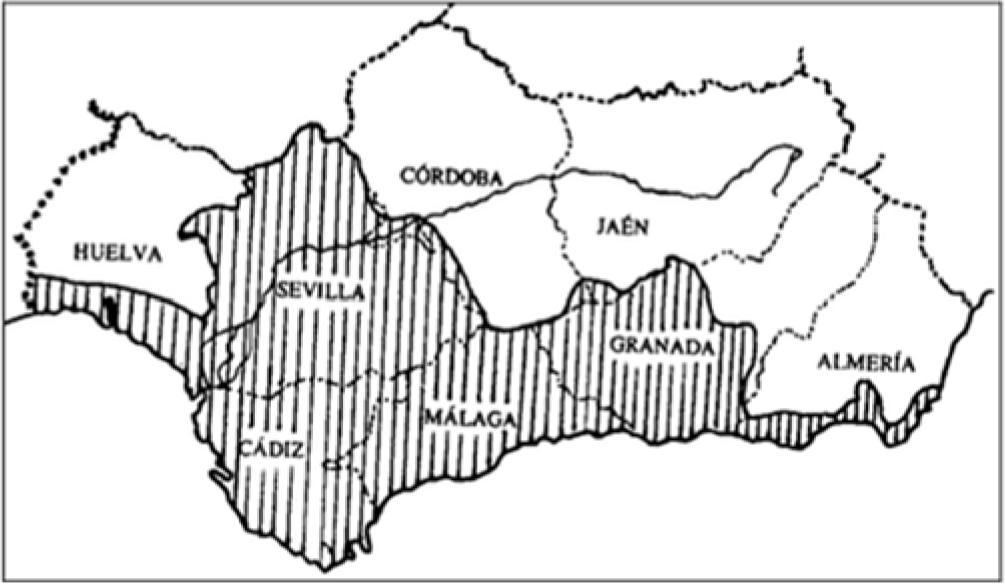
As Villena Ponsoda (Reference Villena Ponsoda1996:116) indicates, /tʃ/ variation has received much more scholarly attention among varieties of Latin American Spanish than Peninsular Spanish. Specifically, variation between [tʃ] and [ʃ] has been analyzed in Panama (Cedergren, Reference Cedergren1972), Puerto Rico (López Morales, Reference López Morales1983), the state of Chihuahua, Mexico (Mazzaro & González de Anda, Reference Mazzaro, González de Anda and Chappell2019), Ciudad Juárez, Mexico (Amastae, Reference Amastae1996; Méndez, Reference Méndez2017), the state of Sonora, Mexico (Brown, Reference Brown1989), Arizona (Casillas, Reference Casillas2012; Noriega, Reference Noriega2004), and New Mexico (Jaramillo, Reference Jaramillo1986; Jaramillo & Bills, Reference Jaramillo, Bills, Barkin, Brandt and Ornstein-Galicia1982). Regarding Peninsular Spanish, the seminal dialectology work of Alvar et al. (Reference Alvar, Llorente, Salvador and Mondéjar1973) from the 1950s of the Atlas Lingüístico y Etnográfico de Andalucía ‘Linguistic and Ethnographic Atlas of Andalucía’ (ALEA), indicated that [ʃ] dominated coastal Andalucía while [tʃ] was more common in northern Huelva, Córdoba, Jaén, and Almería, that is, areas that border other autonomous communities (see Map 1). However, more recently there have been several sociolinguistic studies quantifying this allophonic variation.
Dialectal map (Moya Corral, Reference Moya Corral and Waluch-de la Torre2011:64) of [tʃ] (white) versus [ʃ] (stripes) throughout Andalucía based on the results from the ALEA (Alvar et al., Reference Alvar, Llorente, Salvador and Mondéjar1973).
Studies in urban Eastern Andalucía indicate that fricative [ʃ] is in regression in favor of the supra-local Castilian affricate [tʃ] (Samper Padilla, Reference Samper Padilla and Díaz Campos2011:116). This trend supports previous findings in which traditional Andalusian phonetic features are being levelled in favor of regional or national featuresFootnote 7 in syllable-onset position (Hernández Campoy & Villena Ponsoda, Reference Hernández Campoy and Villena Ponsoda2009; Moya Corral, Reference Moya Corral2018b; Villena Ponsoda & Vida-Castro, Reference Villena Ponsoda, Vida-Castro, Cerruti and Tsiplakou2020). In the city of Granada, Moya Corral & García Wiedemann (Reference Moya Corral and García Wiedemann1995a, Reference Moya Corral, García Wiedemann, Ward Aengus, Whicker and Flitter1995b) found an overall rate of 82% [tʃ] realizations and only 18% [ʃ] realizations based on 105 speakers. They found that [tʃ] was most favored by those of upper and mid socioeconomic levels, the youngest and middle generations, and non-traditional neighborhoods. They found that [ʃ] was nearly absent among women with only 3% of all female tokens. In analyzing 72 Granada residents who emigrated from the nearby town of Pinos Puente, Melguizo Moreno (Reference Melguizo Moreno2007a) found that overall there were 81.8% [tʃ] and 18.2% [ʃ] realizations. Specifically, [tʃ] was favored by those with more formal education, the youngest generation, and women. In Málaga, Villena Ponsoda (Reference Villena Ponsoda1996) found that there was an overall probability of 0.75 for [tʃ] and 0.25 for [ʃ] based on 98 speakers. [tʃ] was favored by women, younger generations, and those of higher socioeconomic levels.
Studies in Western Andalucía have generally demonstrated some maintenance of the traditional dialectal feature [ʃ], particularly in the province of Cádiz. In the city of Cádiz, based on 28 speakers, Payán Sotomayor (Reference Payán Sotomayor1988) found an overall rate of 50.24% [tʃ] and 49.76% [ʃ]. [ʃ] was favored by men and those with less formal education. In Jerez de la Frontera, based on 54 speakers, Carbonero et al. (Reference Carbonero, Álvarez, Casas and Gutiérrez1992) found an overall rate of 0.17 for [tʃ] and 0.83 for [ʃ]. [ʃ] was most favored by speakers of the lowest socioeconomic level, older generations, and, unlike in other communities, women. In a more recent study in Jerez de la Frontera, based on 18 speakers, Harjus (Reference Harjus2018) found 19% [tʃ] and 81% [ʃ] realizations. The speakers who most favored [ʃ] were of middle and older generations, men, and those with less formal education. In the province of Huelva, however, there appears to be a trend towards [tʃ]. The coexistence of both [tʃ] and [ʃ] in Huelva capital has been documented since the 1950s (Alvar et al., Reference Alvar, Llorente, Salvador and Mondéjar1973). Unfortunately, there is no early dialectological data for Lepe regarding /tʃ/ realizations; but, map 1709 of the ALEA (Alvar et al., Reference Alvar, Llorente, Salvador and Mondéjar1973) indicates that both Huelva capital and Ayamonte located to the east and west of Lepe, respectively, demonstrating the coexistence of both variants in these two communities. Thus, one could reasonably assume a similar realization has existed in Lepe. Mendoza Abreu (Reference Mendoza Abreu1985:85) later indicates that in the 1980s, [tʃ] was the norm in Lepe, at least with her 10 participants. Based on 8 speakers per town of three peripheral towns around the city of Huelva, de las Heras et al. (Reference de las Heras, Romero, Bardallo, Torrejón, Castrillo, Gallego, Padilla and Vacas1996) found relatively low rates of fricative [ʃ] in Aljaraque (0.19), San Juan del Puerto (0.0), and Trigueros (0.06). Finally, based on 31 speakers from Huelva and surrounding towns (Bonares, Cartaya, Gibraleón, Lepe), Regan (Reference Regan2020a) found an overall rate of 74% [tʃ] realizations and 26% [ʃ] realizations in which [tʃ] realizations were favored by younger speakers, those with university education, and womenFootnote 8. Thus, the results in Western Andalucía are mixed, in which Cádiz and Jerez appear to maintain the traditional fricative [ʃ] while Huelva and surrounding towns appear to follow the trends in Eastern Andalucía of dialect levelling of traditional Andalusian features in syllable-onset position in favor of supra-local Castilian features.
Villena Ponsoda (Reference Villena Ponsoda, Mancera, Martos and García2006, Reference Villena Ponsoda2008:148) indicates that these differences in which Jerez favors [ʃ] while Málaga and Granada favor [tʃ] follow other trends in which Eastern Andalusian Spanish tends to adopt supra-local Castilian phonetic features in syllable-onset position while Western Andalusian Spanish tends to maintain traditional dialectal features. In fact, Hernández Campoy & Villena Ponsoda (Reference Hernández Campoy and Villena Ponsoda2009:191) indicate that the two main isoglosses that separate Eastern and Western Andalusian Spanish are those of syllable-initial coronal fricatives (distinción versus seseo or ceceo) and /tʃ/ realizations ([tʃ] versus [ʃ]). While this may be true for /tʃ/ realizations, recent studies of coronal fricatives in Western Andalucía, including Jerez (García Amaya, Reference García Amaya, Siegel, Nagle, Lorente-Lapole and Auger2008), Huelva (Regan, Reference Regan2017a, Reference Regan2017b, Reference Regan2020b), peripheral towns around Huelva (de las Heras et al. Reference de las Heras, Romero, Bardallo, Torrejón, Castrillo, Gallego, Padilla and Vacas1996), Lepe (Regan, Reference Regan2017b, Reference Regan2020b), and Sevilla (Gylfadottir, Reference Gylfadottir2018; Santana Marrero, Reference Santana Marrero2016, 2016-Reference Santana Marrero2017), have demonstrated a change of ceceo (seseo in the case of Sevilla) towards distinción. However, discrepancies between Jerez and Huelva may put into question the lack of dialect levelling of [ʃ] towards [tʃ] in parts of Western Andalucía.
2.3 Previous perception studies of /tʃ/ variation
Most of the social perception studies regarding /tʃ/ variation have examined Northern Mexican Spanish. For example, Jewell (Reference Jewell1993) examined the social evaluations toward /tʃ/ variation of Mexican students attending Brigham Young University (Utah). Students first listened to recordings with /tʃ/ guises to decide if they sounded ‘professional’ or ‘laborer’ and then were asked to rate the level of acceptance of the [ʃ] variant. Students generally accepted the [ʃ] variant and simply saw it as a regional marker of Northern Mexican Spanish without socioeconomic connotations. In Tucson, Arizona, Casillas (Reference Casillas, Carvalho and Beaudrie2013) created a matched-guise experiment using read-speech with four speakers (2 male, 2 female). Each speaker had a [tʃ] and a [ʃ] guise, created through splicing. 111 Heritage Spanish undergraduate students ranked the [ʃ] guises as less competent than the [tʃ] guises. Finally, Mazzaro & González de Anda (Reference Mazzaro, González de Anda and Chappell2019) conducted a discrimination task in El Paso, Texas in which 35 participants from the El Paso-Ciudad Juárez area were presented with guises from the same speaker that included /tʃ/ variation and coda final rhotic variation. While not a social perception study, their results demonstrated that [ʃ] was salient to listeners as 84.8% of listeners were able to explicitly distinguish the difference between [ʃ] and [tʃ] while another 9.1% were able to perceive a difference without the ability to specify it.
To the current knowledge of the author no previous matched-guise study has been conducted solely on variation between [tʃ] and [ʃ] in Andalucía. There have been several matched-guise studies in Granada, however, that have included /tʃ/ variation in tandem with coronal fricative variation. Moya Corral and García Wiedemann (Reference Moya Corral and García Wiedemann1995a) conducted a matched-guise experiment with four guises from one voice: (i) distinción and [tʃ] for <ch>; (ii) seseo and [tʃ] for <ch>; (iii) seseo and [ʃ] for <ch>; (iv) ceceo and [tʃ] for <ch>. 103 listeners matched these recordings with four different possible professions. The distinción and [tʃ] guise was most associated with the bank director, the seseo and [tʃ] guise with the bank teller, the seseo and [ʃ] guise with the taxi driver, and the ceceo and [tʃ] guise with the doorman. Similarly, in a written questionnaire with 65 first year university students in Granada, García Wiedemann (Reference García Wiedemann, Narbona and Ropero1997) found that students valued distinción as the most prestigious followed by seseo, and then rated equally low both seseo and [ʃ] as well as ceceo. A few years later in Granada, Martínez & Moya Corral (Reference Martínez and Moya Corrales2000) conducted another matched-guise study with three guises: (i) distinción; (ii) seseo; (iii) seseo and [ʃ] for <ch>. The distinción guise was rated the highest while the seseo and [ʃ] guise was rated the lowest. Although there are potential confounding factors with the inclusion of the coronal fricatives, when the fricatives are held constant, such as seseo with [tʃ] or [ʃ], it appears that [tʃ] is rated as more prestigious in the speech community of Granada.
2.4 Indexicality of traditional dialectal features
Throughout variationist sociolinguistics, there is an increasing interest in understanding the social meaning of linguistic variation following the third-wave of sociolinguistics (Eckert, Reference Eckert2008, Reference Eckert2012). In this approach, linguistic variables do not possess static social meaning, but rather acquire and negotiate new meaning in different contexts. Eckert’s (Reference Eckert2008) indexical field, building on Silverstein’s (Reference Silverstein2003) notion of indexical orders, illuminates how social meaning is acquired. The indexical field is a “constellation of meanings that are ideologically linked. As such it is inseparable from the ideological field and can be seen as an embodiment of ideology in linguistic form” (Eckert, Reference Eckert2008:464). Several sociophonetic perception studies have found a wide range of indexical fields for linguistic variables (Campbell Kibler, Reference Campbell Kibler2007, Reference Campbell Kibler2008, Reference Campbell Kibler2009; Chappell, Reference Chappell2016; Walker et al. Reference Walker, García, Cortés and Campbell-Kibler2014, inter alia).
Eckert (Reference Eckert2008:462) notes that there are several studies demonstrating that traditional dialectal features that were once a regional marker can “take on interactional meaning based in local ideology.” For example, Labov’s (Reference Labov1963) Martha’s Vineyard study revealed that centralized /ay/ indexed locality to the island in a time of increased tourism. In Pittsburgh, monophthongal /aw/, which was previously only a regional dialect marker, but now most common among older working-class speakers, has been shown to index an authentic yinzer, or Pittsburgh speaker (Johnstone, Reference Johnstone and Robert2007; Johnstone, Andrus & Danielson, Reference Johnstone, Andrus and Danielson2006; Johnstone & Kiesling, Reference Johnstone and Kiesling2008). In Beijing, Zhang (Reference Zhang2005) has demonstrated that the local interdental pronunciation of dental sibilants can index an “alley saunterer.” Thus, traditional dialectal features, which were once only a marker of regional identity, can acquire a variety of indexical meanings.
2.5 Urban-rural dichotomy
There has been an “urban turn” in modern variationist sociolinguistics since Labov’s (Reference Labov1966) New York City study (Britain, Reference Britain and Al-Wer2009, Reference Britain, Hansen, Schwarz, Stoeckle and Streck2012a). This move was mostly due to outdated methodologies of traditional dialectology such as focusing on the speech of non-mobile rural males, i.e. NORMs (Chambers & Trudgill, Reference Chambers and Trudgill1998; Trudgill, Reference Trudgill1986), and the incorporation of the “quantitative revolution” into variationist sociolinguistics (Britain, Reference Britain and Al-Wer2009, Reference Britain, Hansen, Schwarz, Stoeckle and Streck2012a). These both inspired variationists to focus on cities to analyze language variation and change.
However, as Britain notes (Reference Britain and Al-Wer2009, Reference Britain, Auer and Schmidt2010a, Reference Britain, Llamas and Watt2010b, Reference Britain, Hansen, Schwarz, Stoeckle and Streck2012a, Reference Britain, Dchreier and Hundt2012b), there is no linguistic reason to assume that an urban area should be different from a more rural area. However, the notions of rural and urban still “trigger very distinct images and attitudes in our minds” (Britain, Reference Britain and Al-Wer2009:224). It is possible that dialect contact may occur more frequently in larger cities leading to an increase in linguistic change, but these processes may also occur in smaller towns and rural areas as well. For this reason, what is more important than notions of urbanity or rurality are rather the “causal social processes” that affect a speech community such as dialect contact or mobility (Britain, Reference Britain and Al-Wer2009:224, Reference Britain, Hansen, Schwarz, Stoeckle and Streck2012a). In Andalucía, most sociolinguistic studies have been conducted in urban centers, with a few exceptionsFootnote 9. Thus, the current study compares an urban community to an agricultural town with a focus on the causal social processes of changes in language attitudes as opposed to idealized urban-rural differences.
2.6 The speech communities
Since the seminal dialectology data collection in the 1950s for the ALEA (Alvar et al., Reference Alvar, Llorente, Salvador and Mondéjar1973), there have been significant societal changes in Huelva and Lepe. These changes are important for both linguistic production and perception of traditional dialectal features as it has been shown that large-scale societal changes in the 20th century throughout Europe significantly affected traditional dialectsFootnote 10 in which local dialectal features are being levelled in favor of supra-local features (Auer & Hinskens, Reference Auer and Hinskens1996; Auer, Hinskens & Kerwsill, Reference Auer, Hinskens and Kerswill2005). Specifically, European society in the 20th century changed from an “agrarian to an industrial, and eventually, post-industrial society” (Hinskens, Auer & Kerswill, Reference Hinskens, Auer, Kerswill, Auer, Hinskens and Kerswill2005: 24). These changes have led to increased literacy and educational attainment, mobility, and dialect contact (Auer & Hinskens, Reference Auer and Hinskens1996). Consequently, similar to much of Europe, Huelva and Lepe have also witnessed significant changes in education, economies, and populations.
In the 1950s the city of Huelva was a large agrarian and fishing town of 83,648 inhabitants, but has increased to 147,808 inhabitants as of 2011 (INEFootnote 11). The central reason for this large increase was the opening of the Polo Industrial (industrial plant) in 1964 by decree of Dictator Franco’s regime. Workers emigrated from the northern part of the province (la sierra de Aracena) as well as from other parts of Spain to work in the factories (Feria Toribio, Reference Feria Toribio1994; Martínez Chacón, Reference Martínez Chacón1992; Ruiz García, Reference Ruiz García2001). This would not only increase the population overnight, but also serve as the catalyst for dialect contact in Huelva capital (Morillo Velarde, Reference Morillo Velarde, Narbona and Ropero1997:209). While the plant led to the industrialization of the economy for several decades, there has been an increasing sector of the workforce employed in service-oriented occupations. Of those in the work force in 2011 (INE), 74.45% were employed in the service sector, 19.07% in the manufacturing/construction sector, and only 6.48% in the agricultural sector. These changes have coincided with a large increase in educational attainment. Regarding maximum educational attainment, between 1950 to 2011 (INE), those with no studies decreased from 37.88% to 9.87%, those with primary studies decreased from 60.11% to 12.69%, those with secondary or professional studies increased from 1.31% to 57.45%, and those with university studies increased from 0.7% to 19.99% (see Figure 3).
Educational attainment in Huelva and Lepe in 1950/1960 and 2011.
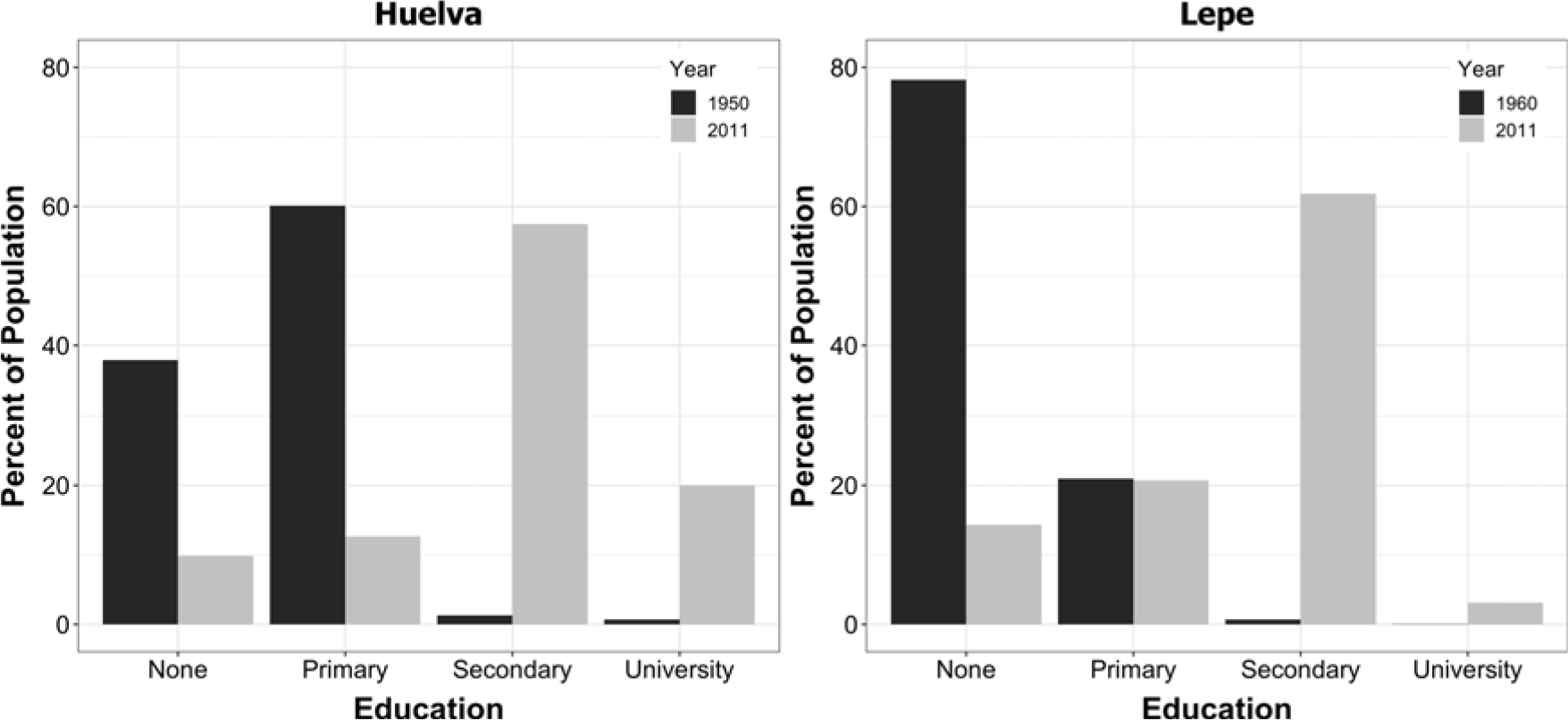
The town of Lepe has grown from 9,285 inhabitants in 1950 to 26,538 in 2011 (IECA, 2016). While Lepe is only 33km west of Huelva capital, unlike other towns nearby the capital city, it has maintained its population and remained economically autonomous (Feria Toribio, Reference Feria Toribio1994:190). Lepe has historically been a fishing and agricultural town that never passed through industrialization like Huelva capital. However, recently the fishing economy has nearly disappeared while the service-sector has increased rapidly. Of the working population in 2011 (INE), 53.95% were employed in the service sector, 29.72% in the agriculture sector, and 16.33% in the manufacturing/construction sector. Similar to Huelva, Lepe’s educational attainment has increased drastically. Between 1960Footnote 12 to 2011 (INE), those with no studies decreased from 78.23% to 14.34%, those with primary studies remained about the same from 20.99% to 20.7%, those with secondary or professional studies increased from 0.72% to 61.81%, and those with university studies increased from 0.06% to 3.15% (see Figure 3).
3. Methods
This study sought to answer the following research questions: (i) What are the social evaluations of [tʃ] and [ʃ] for /tʃ/ (<ch>) in Western Andalucía? (ii) How do these evaluations vary by listener and speaker characteristics? (iii) What differences in evaluations of these variants exist between the two communities of Huelva and Lepe?
3.1 Stimuli
A modified matched-guise experiment (Lambert et al., Reference Lambert, Hodgson, Gardner and Fillenbaum1960) was created in order to examine the social perception of allophonic variation between [tʃ] and [ʃ] for /tʃ/. Following Campbell Kibler (Reference Campbell Kibler2007, Reference Campbell Kibler2009), the stimuli were taken from spontaneous speech from sociolinguistic interviews to allow for a more natural sociolinguistic perception of speech. Interviews were conducted by the author during the summers of 2015 and 2016. Participants were recorded with a solid-state digital recorder Marantz PMD660 wearing a Shure WH20XLR Headworn Dynamic Microphone with a sampling rate of 44.1kHz (16-bit digitization). From this larger corpus, speakers were selected based on the production of both [tʃ] and [ʃ] in their speech. Twelve speakers were included ranging from 25 to 59 years of age (M: 36.5, SD: 10.85), all with at least secondary education, balanced by gender and speech community: 6 speakers (3 men, 3 women) from Huelva capital (age: M: 40.17, SD: 12.43) and 6 speakers (3 men, 3 women) from Lepe (age: M: 32.8, SD: 8.5).
The extracted stimuli included one 2 to 6 second clip of spontaneous speech from each participant (see Appendix I). Each clip contained one /tʃ/ realization. Each /tʃ/ token was in a word-internal intervocalic position forming the syllable-onset of the atonic syllable in disyllabic words. Although spontaneous speech sacrifices some control over stimuli (Campbell Kibler, Reference Campbell Kibler2007:34), all efforts were made to select clips that did not contain other confounding factors such as references to place, socioeconomic status, or occupation, as well as the inclusion of other dialect features. As Villena Ponsoda (Reference Villena Ponsoda1996, Reference Villena Ponsoda2001, Reference Villena Ponsoda, Auer, Hinskens and Kerswill2005, Reference Villena Ponsoda2008) has found correlations of [tʃ] with distinción and [ʃ] with ceceo, the following dialect features were avoided in all clips: any syllable-initial coronal fricative (that would indicate whether a speaker follows the norm of distinción or ceceo); word internal coda <l> as it can be realized as [ɾ] or [l]; and, <ll> as it can be realized as [ʝ] or [ʎ] in Lepe. Additionally, any clip containing a realization of [s] for coda /s/, as opposed to [h] or [Ø], was also excluded as this variety presents coda /s/ aspiration or elision (Villena, Reference Villena Ponsoda2008).
Each speaker had one original clip, from which a second guise was created so that there were two guises per speaker ([tʃ] and [ʃ]). Only /tʃ/ tokens with a similar duration (ms) to the original /tʃ/ token were included. The original phrase was almost always a [tʃ] realization. Thus, a [ʃ] realization had to be identified within their speech with a similar duration and phonetic context (word-internal, atonic syllable, and similar preceding and following vowels). Following Styler (Reference Styler2017:31), the desired tokens were spliced at zero crossings using Praat (Boersma & Weenink, Reference Boersma and Weenink2017). The fricative portion of intervocalic /tʃ/ tokens were segmented following the guidelines of Jongman, Wayland & Wong (Reference Jongman, Wayland and Wong2000:1255) while the affricate portion was segmented at the lack of voicing and frication. After each [ʃ] token was identified, its intensity (dB) was adjusted prior to its insertion into the new context to avoid any unnatural intensity differences. Once the fricative [ʃ] token was highlighted, both the start and end of selection were moved to nearest zero crossing. At this point, the segment was copied. Before pasting it into the desired location, the cursor was moved to the nearest zero crossing at the start of the affricate portion of the original [tʃ] token. The copied [ʃ] segment was then inserted. The original [tʃ] segment was then highlighted, the start and end of selection were moved to nearest zero crossing and the segment was deleted. Figure 4 and 5 present the final product of this phonetic manipulation, where the only difference between guises is the /tʃ/ realization. Thus, each speaker had two guises for a total of 24 experimental stimuli. Once all guises were completed, each clip was normalized for intensity in Praat (Modify > Scale Intensity) in order to bring all sound files to an overall range between 66–70dB so that listeners would not have to change the volume. Two native Andalusian speakers with training in phonetics checked the stimuli prior to the experiment. Both agreed that each recording sounded natural and they were easily able to identify [tʃ] versus [ʃ] guises. They were not told until after the evaluation that the stimuli had been digitally manipulated, further validating the naturalness of the sounds. Finally, there were an additional 24 distractor guises (12 additional speakers with two guises each) with spontaneous speech clips between 2 to 6 seconds that did not contain /tʃ/ realizations. These distractor guises were also balanced by gender and speaker origin. Consequently, the 48 total guises included 12 [tʃ] guises, 12 [ʃ] guises, and 24 distractors.
Spectrogram, waveform, and textgrid of a [tʃ] guise (move cursor over figure to hear sound).
Spectrogram, waveform, and textgrid of a [ʃ] guise (move cursor over figure to hear sound).
3.2 Experimental design
The guises were uploaded and organized into an online survey using Qualtrics (2005–2020). The two guises, [tʃ] and [ʃ], for each speaker were divided into two separate surveys with a balance of variant and speaker gender and origin (see Appendix II). Following Barnes (Reference Barnes2015), these two versions were branched so that each participant would be randomly assigned to one version and hear each voice only once. The rationale for dividing the stimuli into two surveys was to reduce the time of completion as there were a total of 48 guises as well as prevent listeners from hearing the same voice twice. Given the uniqueness of their spontaneous utterances, it was hypothesized that listeners would recognize voices and/or phrases. Each version contained 12 /tʃ/ guises (6 [tʃ], 6 [ʃ]) and 12 distractors. The distractors were included so that listeners would not recognize the variable of interest: [tʃ] versus [ʃ]. Each version of the survey was pseudo-randomized to prevent listeners from hearing multiple [tʃ] or [ʃ] guises in a row.
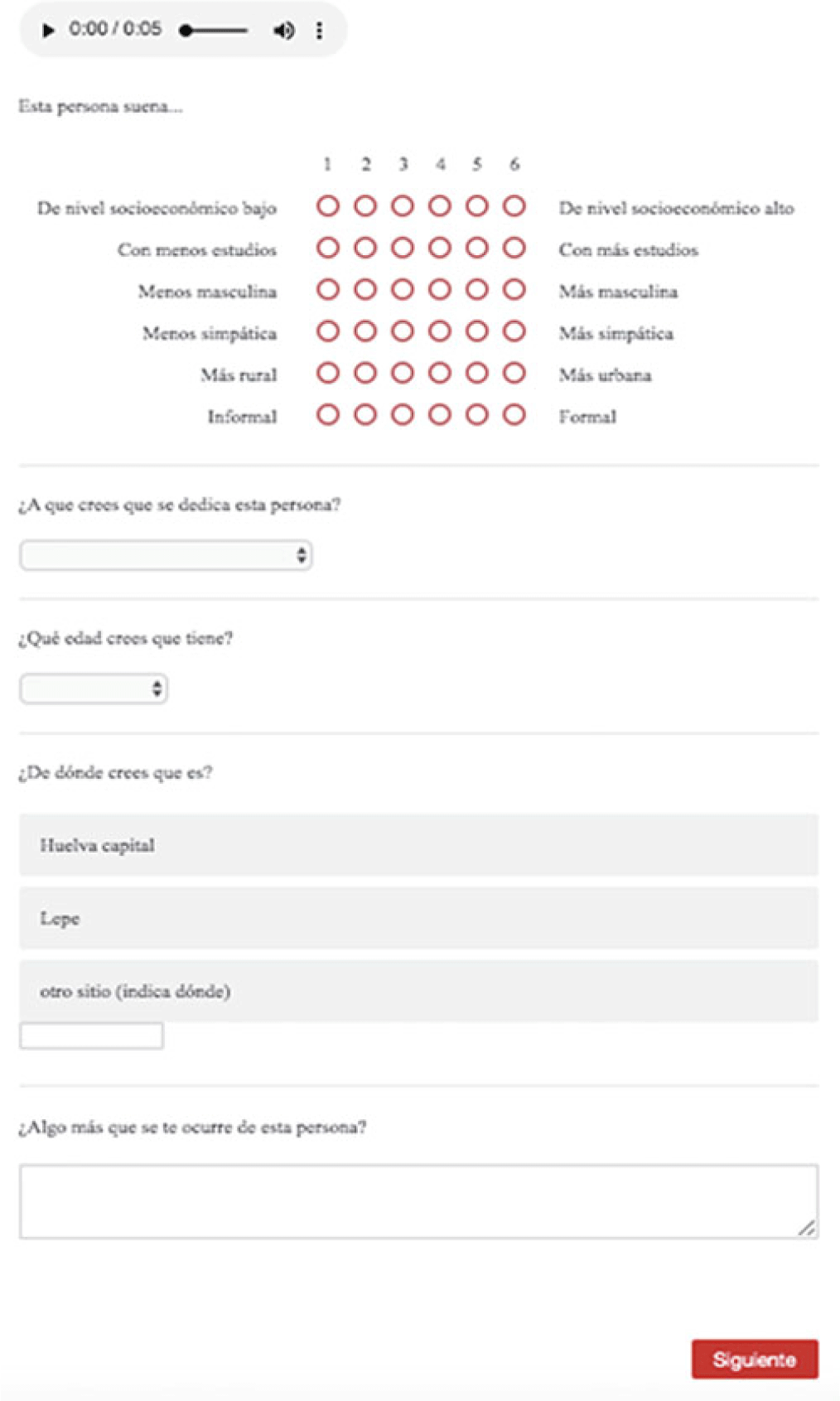
Upon consenting to the study, participants were told that that they would hear short clips of 24 different speakers. They were asked to wear headphones and listen to the recordings in a quiet place. They were able to listen to each recording as many times as they chose. Following each recording the listeners had to evaluate each speaker on nine different questions (see Appendix III). The first six questions were a set of social characteristics based on a six-point Likert scale in order to avoid neutral answers in line with previous studies (Barnes, Reference Barnes2015; Campbell Kibler, Reference Campbell Kibler2007, Reference Campbell Kibler2008, Reference Campbell Kibler2009; Chappell, Reference Chappell2016; Walker et al., Reference Walker, García, Cortés and Campbell-Kibler2014). For these social characteristics, they were asked ‘Esta persona suena…’ ‘This persons sounds…’: (i) de nivel socioeconómico bajo/de nivel socioeconómico alto ‘of low socioeconomic level/of high socioeconomic level’; (ii) con menos estudios/con más estudios ‘with less studies/with more studies’; (iii) menos masculina/más masculina ‘less masculine/more masculine’ for male voices and más femenina/menos femenina ‘more feminine/less feminine’ for female voices; (iv) menos simpática/más simpática, ‘less nice/more nice’; (v) más rural/más urbana ‘more rural/more urban’; (vi) and informal/formal. There were also three multiple-choice questions. The first question was perceived occupation (¿A qué crees que se dedica esta persona? ‘What do you believe this person does for a living?’) with the following options: trabaja en un bar/restaurante ‘works in a bar/restaurant’, trabaja en la construcción ‘works in construction’, trabaja en una tienda ‘works in a store’, trabaja en el campo ‘works in the field’, es administrativo ‘is an administrator’, es maestro ‘is a teacher’, or es médico/abogado ‘is a doctor/lawyer’. The second question was perceived age (¿Qué edad crees que tiene? ‘How old do you think they are?’) with the following options: < 30, 30–40, 40–50, 50–60, > 60. The third question was perceived origin (¿De dónde crees que es? ‘Where do you think s/he is from?’) with the following options: Huelva capital, Lepe, or otro sitio (indica dónde) ‘another place (indicate where)’. The otro sitio selection had the option to write in an answer. Finally, after completing all evaluations, participants then answered basic demographic questions about themselves including gender, age, origin, years lived outside of Huelva/Lepe, and educational attainment.
3.3 Implementation and participants
The survey was implemented online in order to increase participation with participants having access to the survey via a link. In winter/spring 2018 the survey link was sent to the author’s social networks in Huelva and Lepe as well as to several Huelva and Lepe Facebook group pages such as No Eres de Lepe si no, No Eres de Huelva si no. Additionally, El Diario de Huelva, a newspaper in the province of Huelva, as well as Huelva24, promoted the study on their online editions. Upon clicking the survey link, participants were asked to consent to the terms of the study and confirm that they were 18 years or older and from Huelva or Lepe (or had at least lived half of their life there). Those who consented and confirmed their eligibility continued while skip logic took ineligible participants to the end of the survey, preventing them from participating. Only completed surveys were considered for analysis.
While a total of 242 listeners completed the study, 21 participants’ data were eliminated from analysis due to either confusing the directionality of the scales (i.e., by selecting a doctor/lawyer for occupation, but selecting 1 for perceived class and education) or selecting the same scalar number for each of the six social questions for all speakers. Thus, a total of 221 participants (78 men, 143 women) ranging from 18–67 years of age (M: 37.14, SD: 10.43) were included in the analysis. 126 participants were from Huelva capital (78 women, 48 men) and 95 from Lepe (30 men, 65 women). Table 1 shows the distribution of participants by gender and education.
Participants by gender and education.

3.4 Statistical analysis
In order to include the multiple-choice questions of perceived occupational prestige and perceived age with the six-point Likert scale questions, their categorical responses were converted into numerical values following previous studies (Barnes, Reference Barnes2015; Chappell, Reference Chappell2016; Walker et al., Reference Walker, García, Cortés and Campbell-Kibler2014). Following Barnes (Reference Barnes2015), perceived occupational prestige was converted into a five-point scale based on the occupational prestige scales in Spain proposed by Carabaña Morales and Gómez Bueno (Reference Carabaña Morales and Carmen1996). Perceived age was also converted into a five-point scale. Due to the difference between the five-point and six-point scales, all values were centered on zero in order to have comparable results.
Before conducting a principle component analysis and a factor analysis to determine if there were any underlying factors, initial mixed effects linear regression models were run using the lmer function (Bates et al., Reference Bates, Maechler, Bolker and Walker2015) and lmerTest (Kuznetsova, Brockhoff & Christensen, Reference Kuznetsova, Brockhoff and Christensen2014) in R (R Core Team, 2017) with the random factors of speaker and listener to determine if there were any non-significant dependent measures. As there were no significant main effects for variant or interactions for perceived masculinity/femininity and perceived age, both measures were discarded from future analyses. The other six continuous dependent measures (perceived socioeconomic level, educational level, friendliness, urban-ness, formality, and occupational prestige) were then subjected to a principle component analysis and a factor analysis in R. The principle component analysis indicated that there were two underlying larger factors. The factor analysis revealed that perceived socioeconomic level, perceived educational level, and perceived occupational prestige loaded onto the factor one. However, occupational prestige did not load as strongly. Furthermore, as follow up analyses revealed that there were nuanced differences in the results for occupational prestige, it was analyzed separately. Thus, perceived socioeconomic level and perceived educational level were combined for a “status” factor. Additionally, perceived urban-ness and perceived formality strongly loaded onto factor two. Perceived friendliness had high uniqueness scores and subsequently loaded very weakly onto factor two. This resulted in friendliness being analyzed separately while perceived urban-ness and perceived formality were combined for a “cosmopolitan-ness”Footnote 13 factor. Consequently, there were a total of four continuous dependent measures: status, cosmopolitan-ness, occupational prestige, and friendliness.
A separate mixed effects linear regression model was created in R for each dependent measure with speaker and listener as the random factors. The independent variables tested in the various models included: variant ([tʃ], [ʃ]); speaker gender (male, female); listener gender (male, female); listener origin (Huelva, Lepe); listener education (1–5); listener age (18–67); and, listener years lived away from Huelva/Lepe (0–30). All independent variables were tested in the original model construction, but then non-significant main effects and interactions were removed from each subsequent model. For listener education, a scale from 1–5 represented an educational continuum with 5 being the most amount of formal education and 1 being the least amount of formal education attained: 1 = primary education, 2 = secondary education, 3 = bachillerato ‘college preparatory’ or professional formation, 4 = undergraduate university degree, and 5 = graduate degree.
A separate multinomial logistic regression model was fitted to the listeners’ evaluations of speaker origin using the multinom function in the nnet package (Venables & Ripley, Reference Venables and Ripley2002) as the measure of perceived origin was a non-binary categorical variable. Z-scores and p-values were then calculated manually. In this model, the dependent variable was perceived origin (Huelva, Isla Cristina/Cádiz, Lepe, otro sitio).
4. Results
All regression models present the estimated marginal means, emmeans (Lenth et al., Reference Lenth, Singmann, Love, Buerkner and Herve2018), the estimate, standard error, t-value, and p-value. Larger estimates in either direction from zero indicate a stronger effect of the main effect or interaction. Post-hoc analyses were conducted with estimated marginal means, emmeans (Lenth et al., Reference Lenth, Singmann, Love, Buerkner and Herve2018), to analyze categorical predictors with more than two levels. Marginal R-squared (R2m) values and conditional R-squared (R2c) values are also listed for each model in order to assess the goodness-of-fit of the variation per measure (Nakagawa & Schielzeth, Reference Nakagawa and Schielzeth2013). The following subsections review the results of the models fitted to each dependent measure independently. Reference levels are displayed within the tables. The y-axis of all figures is centered on zero, with positive numbers indicating a higher score for a perceived trait and negative numbers indicating a lesser score for a perceived trait. All images were created with ggplot2 (Wickham, Reference Wickham2013).
4.1 Perceived status
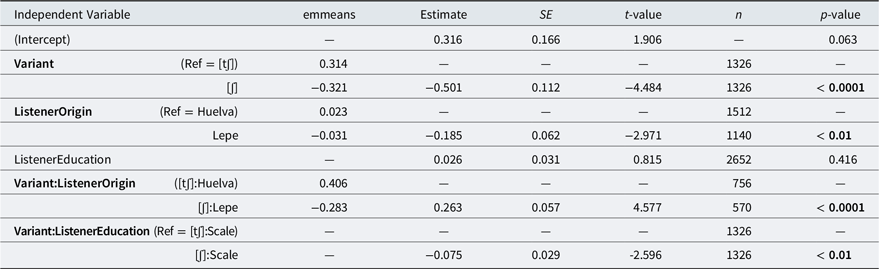
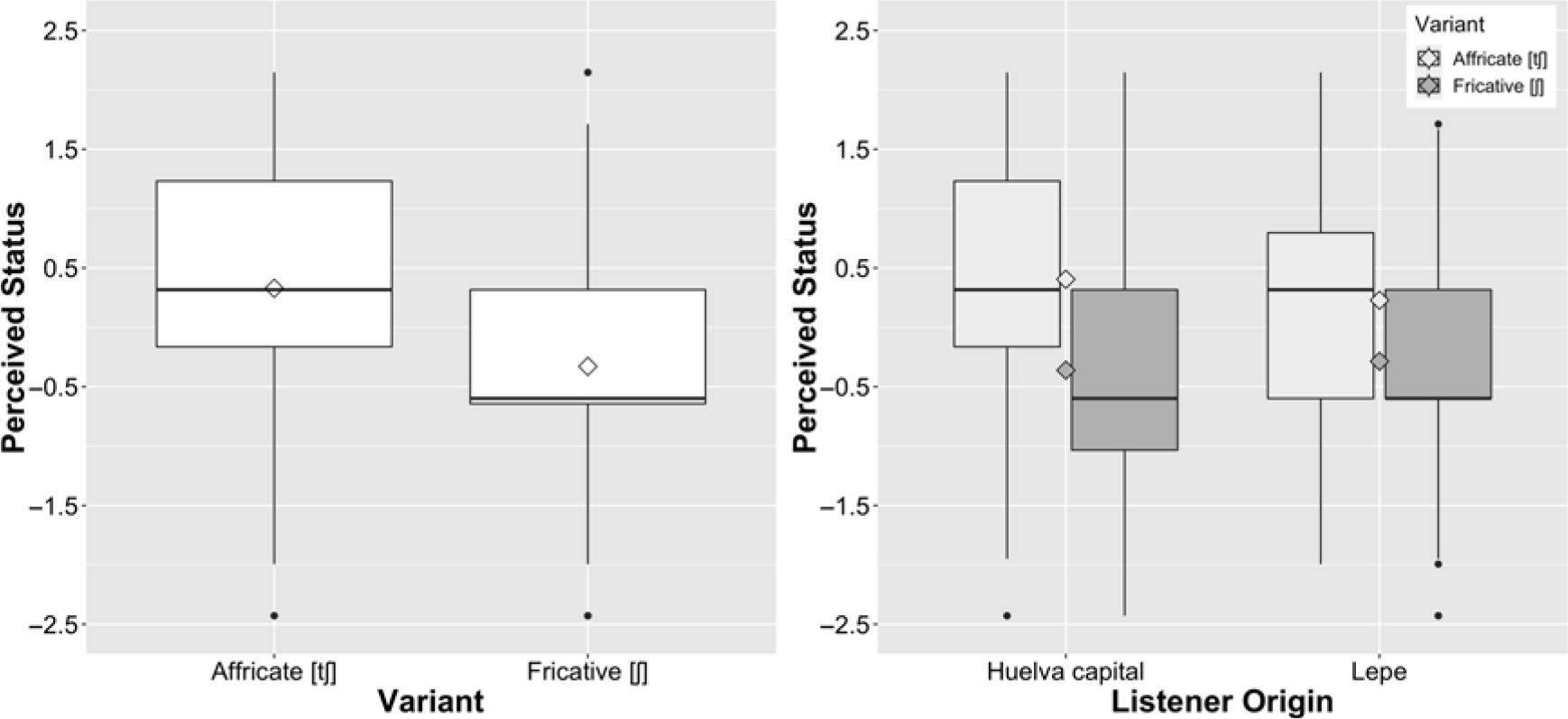
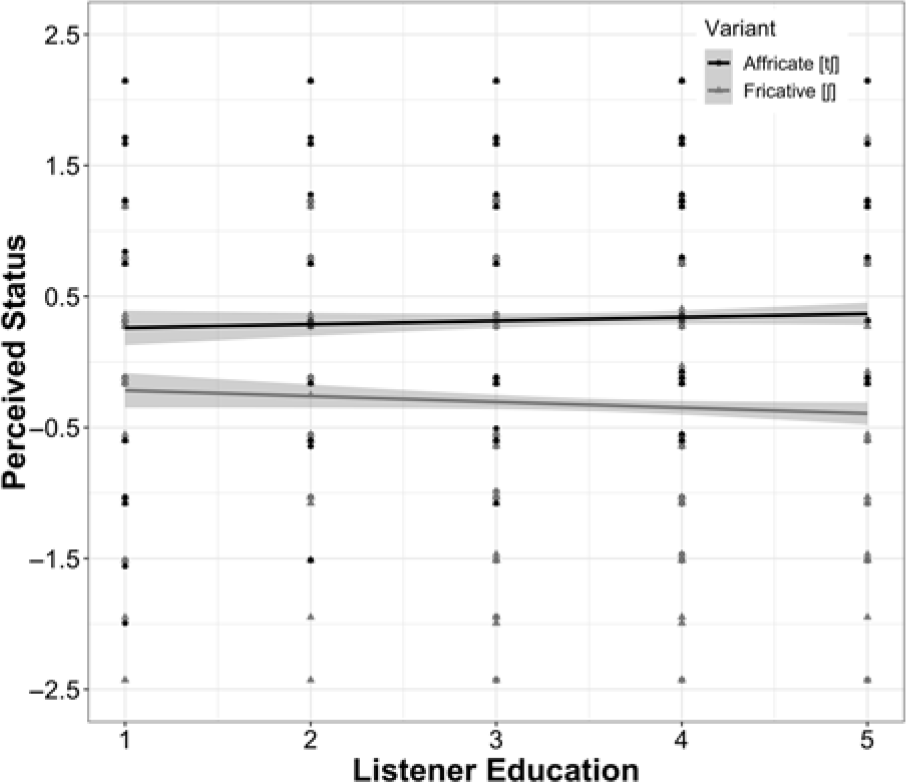
The best-fit mixed effects linear regression model for perceived status (combined factor of perceived socioeconomic level and perceived education level) is shown in Table 2. The model demonstrates a main effect for variant, in which speakers with [tʃ] guises received higher perceived status evaluations than those with [ʃ] guises as seen in Figure 6. The interaction between variant and listener origin indicates that while listeners from both communities perceived speakers with [tʃ] guises of higher status than those with [ʃ] guises, Huelva listeners perceived speakers with [tʃ] guises of even higher status than Lepe listeners (see Figure 6). Finally, the interaction between variant and listener education indicates that listeners with more formal education perceived speakers with [tʃ] guises of even higher status and speakers with [ʃ] guises of even lower status than listeners with fewer years of formal education (see Figure 7).
Summary of mixed effects linear regression model for perceived status, speaker and listener as random factors; n = 2,652 (R2m: 0.125, R2c: 0.424).
Left: Boxplot of main effect of variant for perceived status; Right: Boxplot of variant by listener origin interaction for perceived status.
Scatterplot of variant by listener education interaction for perceived status.
4.2 Perceived cosmopolitan-ness
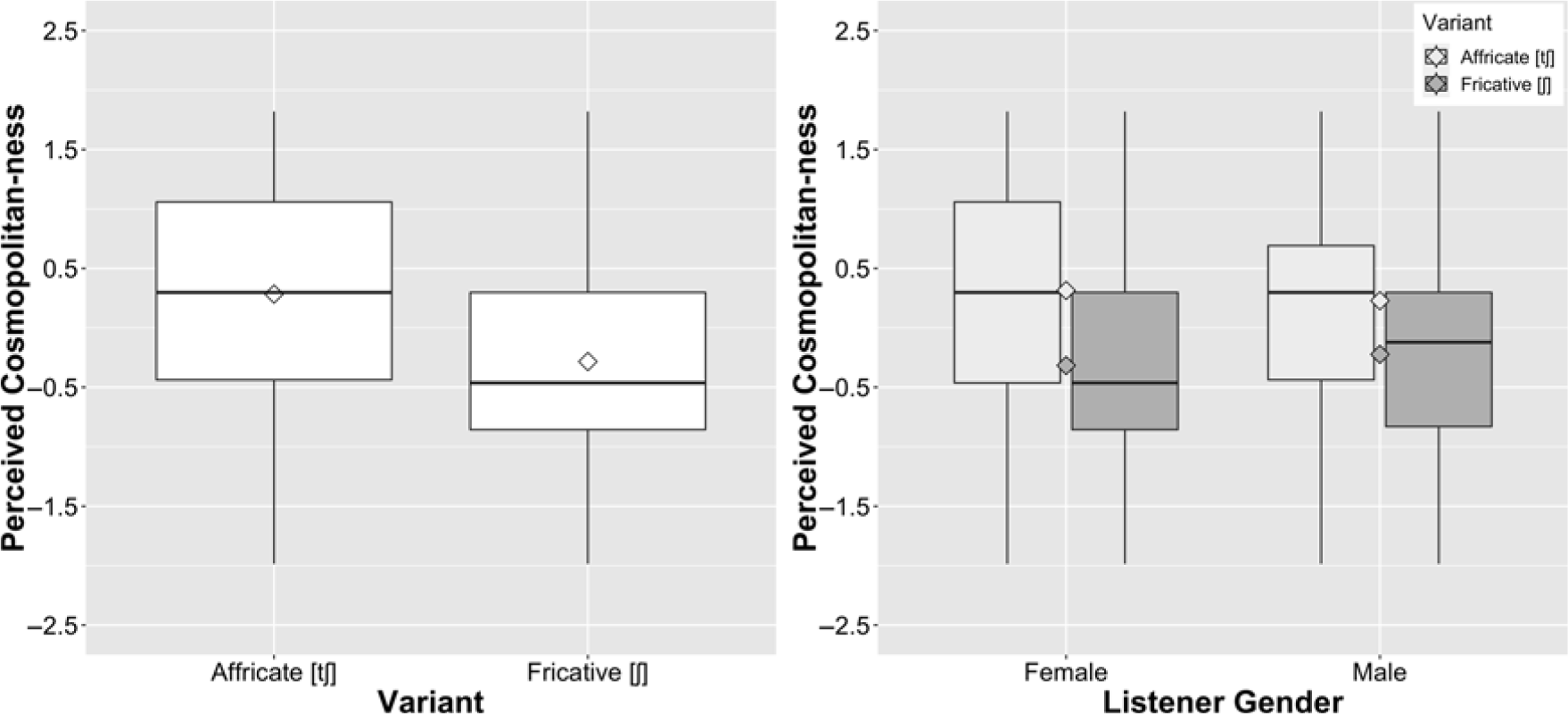
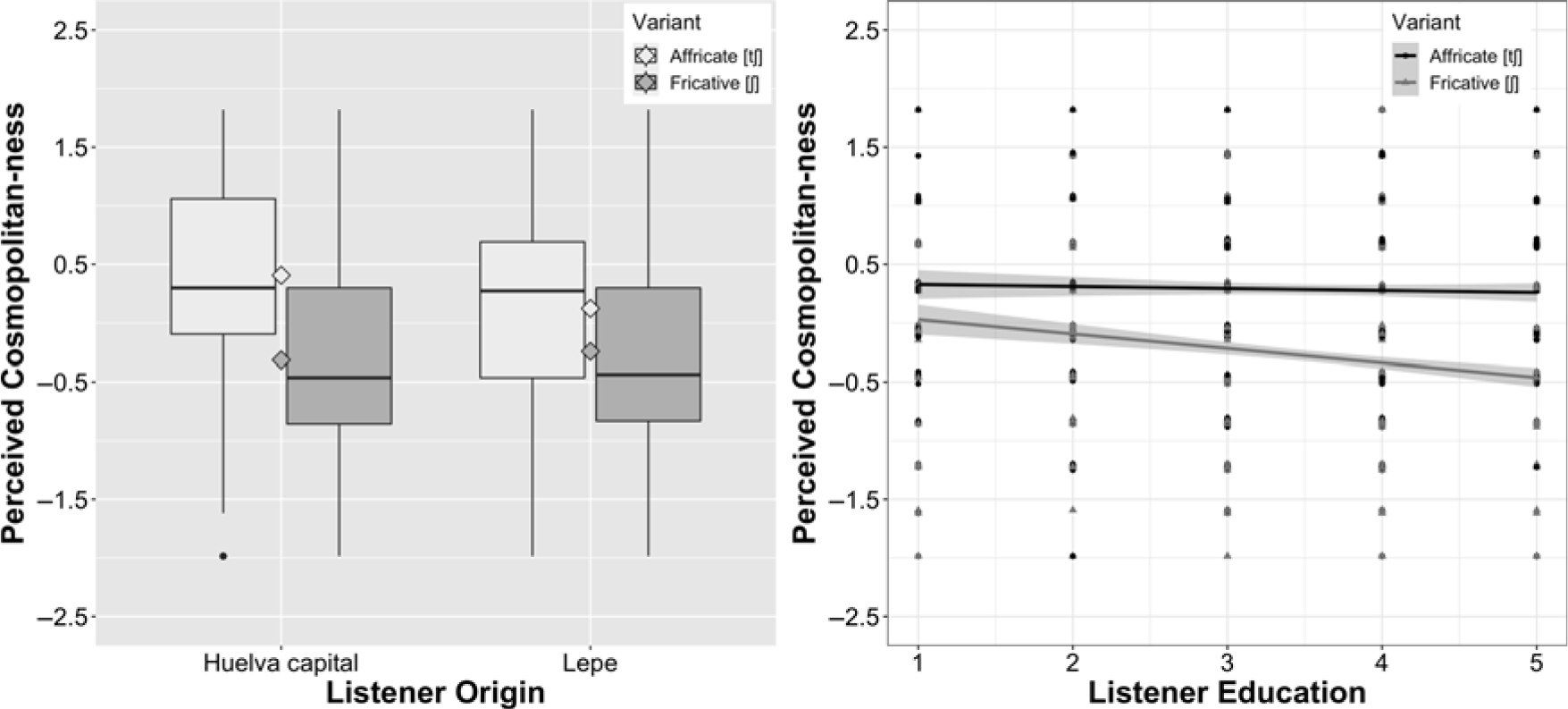
The best-fit mixed effects linear regression model for perceived cosmopolitan-ness (combined factor of perceived urban-ness and perceived formality) is shown in Table 3. The model demonstrates a main effect for variant in which speakers with [tʃ] guises were perceived as more cosmopolitan than those with [ʃ] guises (Figure 8). The interaction between variant and listener gender indicates that female listeners had a larger difference in cosmopolitan-ness evaluations between [tʃ] and [ʃ] than male listeners (Figure 8). The interaction between variant and listener origin indicates that Huelva listeners perceived speakers with [tʃ] guises as even more cosmopolitan than Lepe listeners (Figure 9). Finally, the interaction between variant and listener education indicates that there were no differences in the evaluation of speakers with [tʃ] guises between educational levels, but that listeners with more formal education evaluated speakers with [ʃ] guises as less cosmopolitan than listeners with fewer years of formal education (Figure 9).
Summary of mixed effects linear regression model for perceived cosmopolitan-ness, speaker and listener as random factors; n = 2,652 (R2m: 0.124, R2c: 0.372).
Left: Boxplot of main effect of variant for perceived cosmopolitan-ness; Right: Boxplot of variant by listener gender interaction for perceived cosmopolitan-ness.
Left: Boxplot of variant by listener origin interaction for perceived cosmopolitan-ness; Right: Scatterplot of variant by listener education interaction for perceived cosmopolitan-ness.
4.3 Perceived occupational prestige
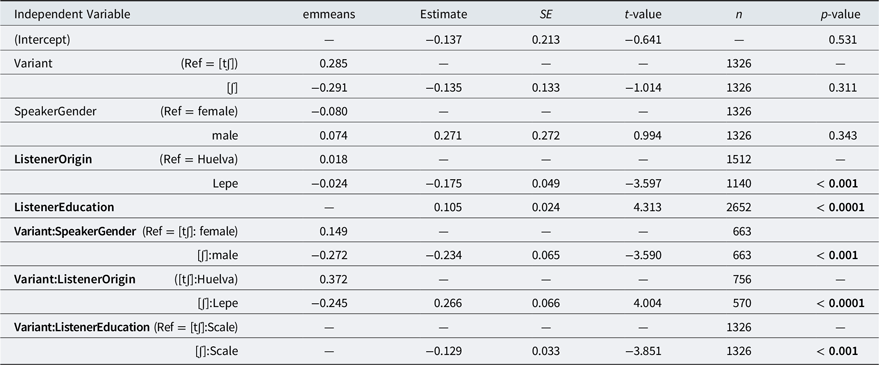
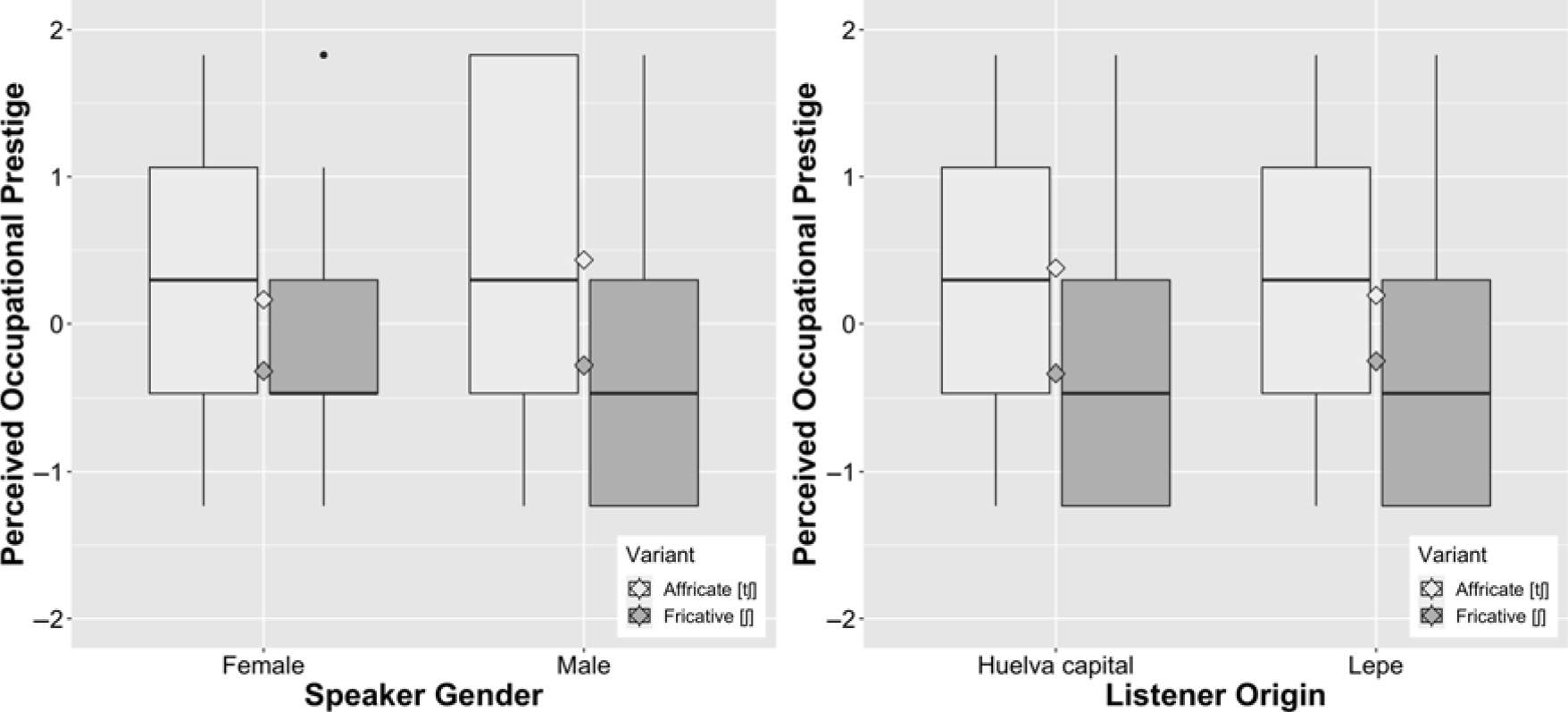
The best-fit mixed effects linear regression model for perceived occupational prestige is shown in Table 4. There was no significant main effect for variant. The interaction between variant and speaker gender indicates that male speakers received a larger difference in occupational prestige evaluations between [tʃ] and [ʃ] than female speakers (Figure 10). The interaction between variant and listener origin indicates that while speakers from both communities perceived speakers with [tʃ] guises of higher occupational prestige than those with [ʃ] guises, that Huelva listeners perceive speakers with [tʃ] guises of even higher occupational prestige than Lepe listeners (Figure 10). Finally, the interaction between variant and listener education indicates that all listeners rated speakers with [ʃ] guises at a similar lower occupational prestige. However, listeners with more formal education perceived speakers with [tʃ] guises as even higher occupational prestige than did listeners with less formal education (Figure 11).
Summary of mixed effects linear regression model for perceived occupational prestige, speaker and listener as random factors; n = 2,652 (R2m: 0.105, R2c: 0.321).
Left: Boxplot of variant and speaker gender interaction for perceived occupational prestige; Right: Boxplot of variant and listener origin interaction for perceived occupational prestige.
Scatterplot of variant and listener education interaction for perceived occupational prestige.

4.4 Perceived friendliness
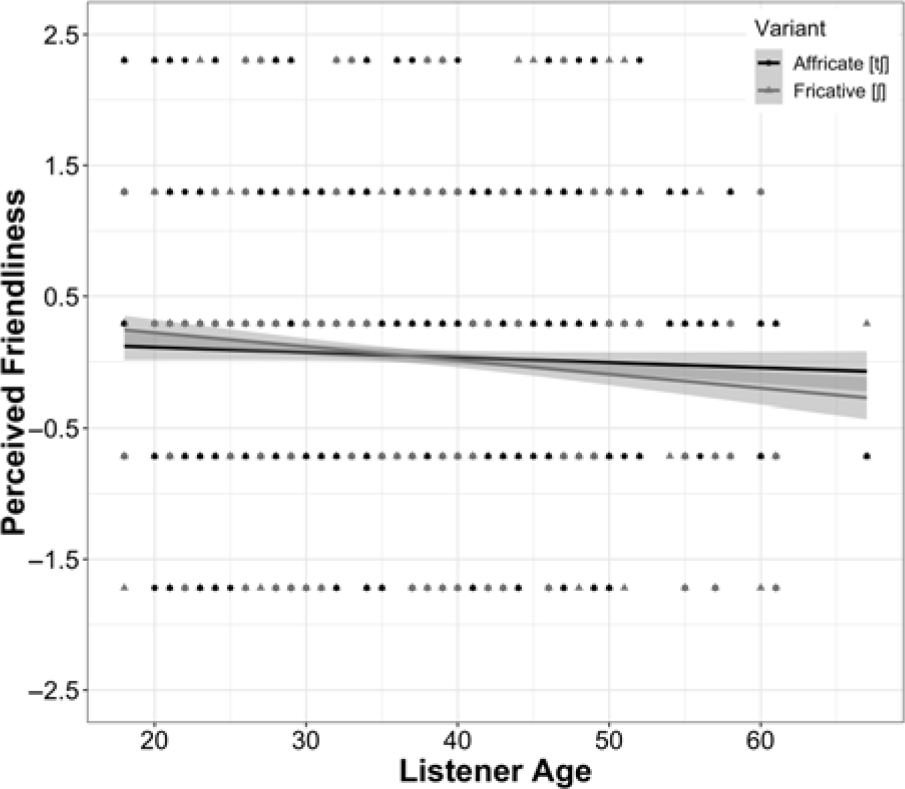
The best-fit mixed effects linear regression model for perceived friendliness is shown in Table 5. As demonstrated by the low R2m value, these results should be taken with caution. The model demonstrates a main effect for variant in which speakers with [ʃ] guises were perceived as friendlier than speakers with [tʃ] guises. This finding is not visualized, as the boxplots do not clearly demonstrate this difference. The interaction between variant and listener age demonstrates that while overall older listeners perceived all guises as less friendly than younger listeners, there appears to be a slight inversion of guises between older and younger listeners. Specifically, older listeners evaluated speakers with [tʃ] guises as friendlier than those with [ʃ] guises while younger listeners evaluated speakers with [ʃ] guises as friendlier than speakers with [tʃ] guises (Figure 12).
Summary of mixed effects linear regression model for perceived friendliness, speaker and listener as random factors; n = 2,652 (R2m: 0.005, R2c: 0.273).

Scatterplot of variant and speaker age interaction for perceived friendliness.
4.5 Perceived origin
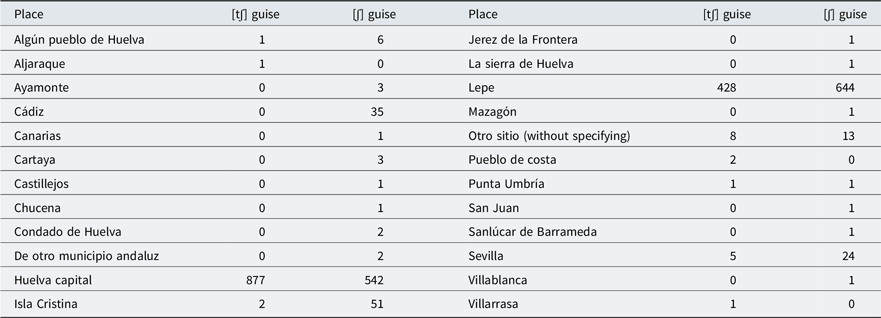
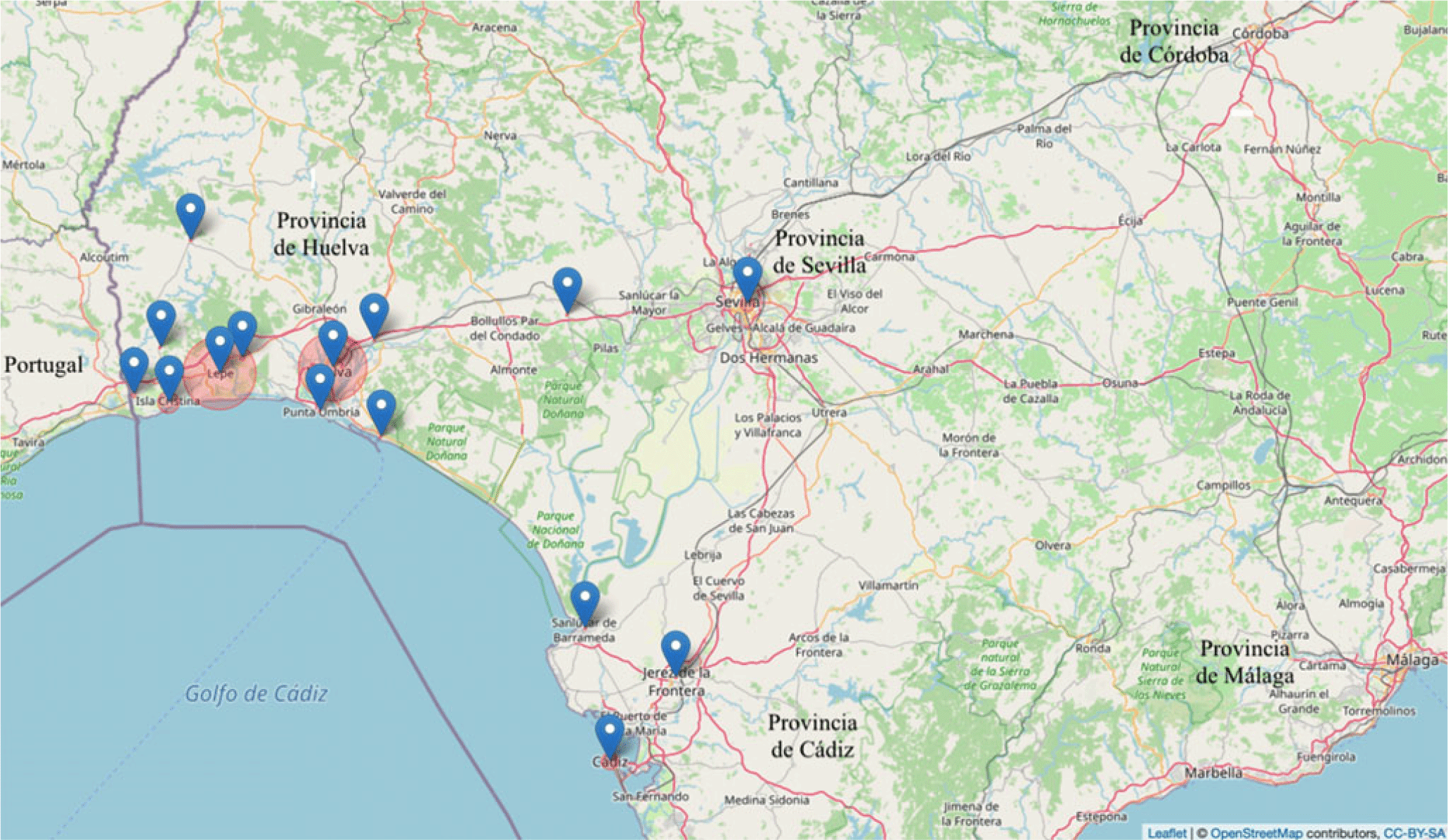
For perceived origin, participants were given the option of selecting Huelva capital, Lepe, or otro sitio ‘another place’ with the possibility of specifying a place. Table 6 presents all the perceived places mentioned. It should be noted that there were a few cases where participants listed two places such as “Cádiz o Isla Cristina”. Both names were counted in the table, thus there is a higher number of tokens here than the overall number of guises. Given most of the write-in places were for the [ʃ] guises, this data was visualized using the leaflet package (Graul, Reference Graul2016) in R as seen in Map 2. Each municipality mentioned has a popup marker. The red circle under the popup demonstrates the proportion of tokens per municipality.
Frequency count of all perceived places of origin per guise.
Map of specific municipalities identified for [ʃ] guises.
Prior to statistical analysis, in order to have a sufficient number of tokens per perceived origin for the write-in answers, a few changes were made. Given there were 8 instances of participants writing Isla Cristina and Cádiz together, these were combined for an “Isla Cristina o Cádiz” category. As Sevilla had fewer than 30 tokens for the [ʃ] guises, it was combined into the larger category of otro sitio in addition to all of the write-in places. Thus, there were a total of four options included in the analysis: Huelva capital, Isla Cristina o Cádiz, Lepe, and otro sitio. The best-fit multinomial logistic regression for perceived origin in shown in Table 7. The reference levels are Huelva for perceived origin, [tʃ] for variant, and Huelva for listener origin.
Best-fit multinomial logistic regression model fitted to perceived speaker origin based on variant and listener origin, n = 2,652.

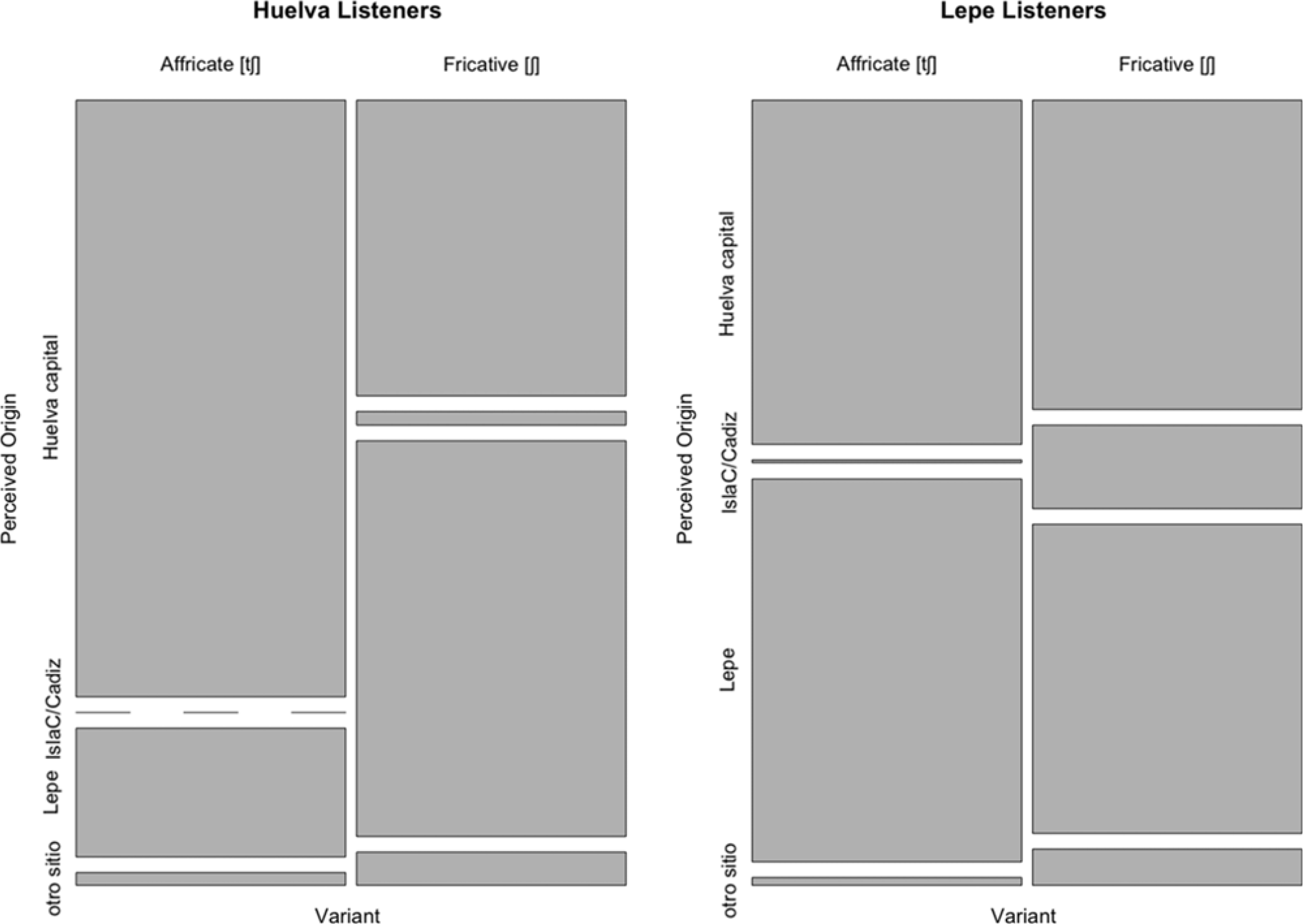
The main effect of variant indicates that overall listeners were more likely to perceive speakers with [tʃ] guises as being from Huelva, followed by Lepe. Conversely, listeners were more likely to perceive [ʃ] guises as being from Lepe, followed by Huelva. Participants also more often perceived speakers with [ʃ] guises as being from Isla Cristina/Cádiz than those with [tʃ] guises. However, the interaction between variant and listener origin demonstrates that each speech community varies on their perceived origin of speakers according to the guises. Huelva listeners were much more likely to associate [tʃ] guises as speakers being of Huelva, while Lepe listeners perceived speakers with [tʃ] guises to be as likely from Lepe as from Huelva. Moreover, Huelva listeners were much more likely to perceive speakers with [ʃ] guises as being from Lepe, while Lepe listeners again demonstrated an almost equal perception of a speaker from Huelva or Lepe. Additionally, Lepe listeners were more likely than Huelva listeners to perceive speakers with [ʃ] guises as being from Isla Cristina/Cádiz. Figure 13 presents a mosaic plot (i.e., a visualization of a contingency table), which demonstrates that perceived origin varies significantly by variant and listener origin.
Mosaic plot of variant by listener origin interaction for perceived origin.
5. Discussion and conclusion
The manipulation of /tʃ/ realizations used in the stimuli had significant effects on how listeners perceived speakers’ social characteristics. Here we review the main effect of variant across the different dependent measures, followed by the interactions between variant and listener/speaker characteristics, and finally, discuss differences between the two speech communities.
The main effects for variant indicate that [tʃ] guises were perceived as higher status, more cosmopolitan, and less friendly than [ʃ] guises. The findings regarding perceived status and cosmopolitan-ness support previous matched-guise experiments. Specifically, Casillas’ (Reference Casillas, Carvalho and Beaudrie2013) found that Spanish heritage students in Arizona ranked the [ʃ] guise as less competent than [tʃ] guises. For Andalusian Spanish, while not a direct comparison of [tʃ] to [ʃ] as the focus was coronal fricative realizations, Granada appears to rank [tʃ] as more prestigious than [ʃ] when holding constant the same coronal fricative realizations (Martínez & Moya Corral, Reference Martínez and Moya Corrales2000; Moya Corral & García Wiedemann, Reference Moya Corral and García Wiedemann1995a). These findings also support production studies in which [tʃ] is favored by upper/mid sociocultural level speakers (Moya Corral & García Wiedemann, Reference Moya Corral and García Wiedemann1995a, Reference Moya Corral, García Wiedemann, Ward Aengus, Whicker and Flitter1995b; Villena Ponsoda, Reference Villena Ponsoda1996). The main effect of perceived friendliness for variant reflects trends found in folk dialectology, in which linguistic variants that lack overt prestige generally receive higher scores in solidarity and lower scores in status (Niedzielski & Preston, Reference Niedzielski and Preston1999:366). These main effect findings of variant for various dependent measures shed light into the social motivation for the phonetic change from [ʃ] to [tʃ] that has occurred throughout many parts of Andalucía since the time of the ALEA findings. While more production data is needed in the region, these social evaluations would indicate that Huelva and Lepe evaluated the traditional dialectal variant as less overtly prestigious compared to the supra-local feature. This would indicate that there might not be as clear an Eastern-Western Andalusian difference as previously observed with regard to /tʃ/ variation (Hernández Campoy & Villena Ponsoda, Reference Hernández Campoy and Villena Ponsoda2009; Villena Ponsoda, Reference Villena Ponsoda, Mancera, Martos and García2006, Reference Villena Ponsoda2008).
Interactions between education and variant revealed that social perceptions were influenced by listeners’ educational attainment. Specifically, those with more formal education evaluated guises with [tʃ] of higher status and guises with [ʃ] of lower status than listeners with lower levels of education. Listeners with more formal education also rated guises with [ʃ] as less cosmopolitan than those with less education. Finally, listeners with more formal education evaluated guises with [tʃ] of higher occupational prestige than those with less formal education perhaps reflecting pressures of the linguistic market (Bourdieu, Reference Bourdieu1991; Bourdieu & Boltanski, Reference Bourdieu and Boltanski1975; Sankoff & Laberge, Reference Sankoff, Laberge and Sankoff1978). These findings support previous production studies of /tʃ/ variation in which [tʃ] is favored by those with more formal education (Harjus, Reference Harjus2018; Melguizo Moreno, Reference Melguizo Moreno2007a; Moya Corral & García Wiedemann, Reference Moya Corral and García Wiedemann1995a; Regan, Reference Regan2020a; Villena Ponsoda, Reference Villena Ponsoda1996). The influence of increased educational attainment cannot be underestimated. Huelva and Lepe have experienced an incredible increase in educational attainment since the 1950s. This appears to have had an impact on listeners’ perceptions of the traditional Andalusian feature [ʃ] in comparison to the supra-local Castilian feature [tʃ]. In Málaga, Villena Ponsoda (Reference Villena Ponsoda1996) has demonstrated that more formal education leads to less production of traditional Andalusian features in favor of regional or national features. The current results indicate that is also true for language attitudes towards /tʃ/ variation. Specifically, more formal education may negatively affect the social perception of traditional Andalusian features.
Interactions between speaker/listener gender and variant revealed that social perceptions were also affected by gender. The interaction between variant and listener gender demonstrated that female listeners had a larger difference in cosmopolitan-ness evaluations between [tʃ] and [ʃ] than male listeners. In this regard, if women regard [tʃ] as even more cosmopolitan than male listeners, this could provide insight into why women favor [tʃ] more than men (Harjus, Reference Harjus2018; Melguizo Moreno, Reference Melguizo Moreno2007a; Moya Corral & García Wiedemann, Reference Moya Corral and García Wiedemann1995a, Reference Moya Corral, García Wiedemann, Ward Aengus, Whicker and Flitter1995b; Regan, Reference Regan2020a; Villena Ponsoda, Reference Villena Ponsoda1996). The interaction between variant and speaker gender indicated that male speakers received a larger difference in occupational prestige evaluations between [tʃ] and [ʃ] than female speakers. This finding could reflect two possible realities. First, perhaps men have more to gain than women regarding the linguistic market in producing the affricate. Second, this could reflect an internalization of the gender wage-gap. That is, given the unfortunate reality of the biased workforce where women earn less than men on average for the same work, a male’s voice with [tʃ] may be rated higher than a women’s voice with the same variant perhaps because listeners assume this speaker has a higher paying job (when other variables are held the same), simply because of that speaker’s gender.
Regarding interactions between variant and age, only perceived friendliness was significant. Younger listeners evaluated [ʃ] as friendlier than older listeners while older listeners evaluated [tʃ] as friendlier than younger listeners. The lack of significance of perceived age for the other dependent measures is surprising as production studies have found that younger generations favor [tʃ] more than older generations (Moya Corral & García Wiedemann, Reference Moya Corral and García Wiedemann1995a, Reference Moya Corral, García Wiedemann, Ward Aengus, Whicker and Flitter1995b; Regan, Reference Regan2020a; Villena Ponsoda, Reference Villena Ponsoda1996).
The interactions between variant and listener origin demonstrated that while the evaluations of each guise were similar, there exist differences in the degree to which each community evaluated each variant. Regarding perceived status, Huelva listeners rated guises with [tʃ] higher than Lepe listeners. Huelva listeners also rated [tʃ] guises higher than Lepe listeners for perceived cosmopolitan-ness and perceived occupational prestige. Finally, the interaction between variant and listener origin for perceived origin was the largest difference between the two communities. These findings suggest that Huelva listeners assume that the supra-local Castilian feature [tʃ] must be from Huelva while the traditional Andalusian feature [ʃ] must be from Lepe. Lepe listeners on the other hand demonstrate a greater awareness that both variants exist in both communities and that [ʃ] is also common in Isla Cristina/Cádiz as well as other municipalities. As seen in Table 6, most of the additional write-in answers for otro sitio were in reference to [ʃ]. Figure 13 demonstrates that Lepe listeners selected other municipalities more often than Huelva listeners. Finally, Map 2 demonstrates an awareness that [ʃ] is associated with Western Andalucía with mostly coastal towns in the provinces of Huelva and Cádiz being selected with a few additional municipalities in the province of Sevilla. These listener evaluations of perceived origin of coastal areas support findings from the ALEA (Alvar et al., Reference Alvar, Llorente, Salvador and Mondéjar1973). Additionally, these perceptions suggest that there is at least a folk isogloss with fricative [ʃ] being associated with Western Andalucía without one reference to Eastern Andalucía in line with proposed scholarly isoglosses between Western and Eastern Andalucía regarding /tʃ/ variation (Hernández Campoy & Villena Ponsoda, Reference Hernández Campoy and Villena Ponsoda2009; Villena Ponsoda, Reference Villena Ponsoda, Mancera, Martos and García2006, Reference Villena Ponsoda2008).
These nuanced differences in the evaluation of allophonic variation between [tʃ] and [ʃ] is perhaps a result of the unique socioeconomic developments of each speech community. It could be suggested that societal changes have been larger and quicker in Huelva than Lepe. Specifically, dialect contact occurred earlier in Huelva due to the immigration spurred by the industrial plant. Additionally, educational attainment has increased more rapidly in Huelva than Lepe. Thus, both communities have undergone societal changes at different paces, which appear to have affected their perceptions of the traditional Andalusian feature and the supra-local Castilian feature. One additional recent social change is the increased summer tourism along coastal Huelva, particularly La Antilla, Lepe’s beach, and Punta Umbría, Huelva capital’s main beach. These areas receive a large number of vacation goers from nearby Sevilla as well as from northern autonomous communities like Madrid. This dialect contact could also affect language attitudes. Thus, as Britain (Reference Britain and Al-Wer2009, Reference Britain, Hansen, Schwarz, Stoeckle and Streck2012a) suggests, it is important here not to focus on urbanity or rurality, but rather the causal social changes that have occurred in each community. Although there are nuanced differences between the communities, the agricultural town of Lepe demonstrates similar perceptions towards [ʃ] indicating that changes in language attitudes occur in both urban and more rural environments. Thus, the increased dialect contact, changes in economies, and increased educational attainment in both Huelva and Lepe provided the context for a change in linguistic attitudes towards traditional dialectal features.
It is noteworthy how many mentions Cádiz and Isla Cristina received for the fricative variant. While production studies in the cities of Granada, Málaga, and Huelva suggest dialect levelling from [ʃ] to [tʃ], studies in the province of Cádiz, specifically in Jerez de la Frontera (Carbonero et al., Reference Carbonero, Álvarez, Casas and Gutiérrez1992; Harjus, Reference Harjus2018) and Cádiz capital (Payán Sotomayor, Reference Payán Sotomayor1988), demonstrate a great degree of maintenance of the traditional Andalusian feature [ʃ]. While more recent production studies are needed throughout Andalucía, the perceptions of the speakers in Huelva and Lepe could reflect the possibility that there is simply more [ʃ] production in Cádiz and in Isla Cristina than in other areas in Andalucía. In fact, there were three listeners who made direct metalinguistic connections of the [ʃ] pronunciation of <ch> being from Cádiz and/or Isla Cristina as seen in Examples 1–3. As mentioned before (see Appendix III), listeners were able to write open comments for each speaker. Examples 1–3 are comments that were written for specific speakers with [ʃ] guises.
-
(1) Al pronunciar la “ch” de la palabra “fecha”, me he dado cuenta de que es de Isla Cristina. ‘In pronouncing the “ch” of the word “date”, I have realized that he is from Isla Cristina.’ (woman, 29 years, Lepe)
-
(2) Esa forma de pronunciar el sonido //ch// es típico del pueblo de Isla Cristina e incluso de Cádiz. ‘That form of pronouncing the sound //ch// is typical of the town of Isla Cristina and even of Cádiz.’ (woman, 47 years, Lepe)
-
(3) Puede ser de cualquier entorno, tanto rural como urbano. Del mismo modo puede o no tener estudios. Creo que no es de la provincia de Huelva, el sonido de la ch es muy de Cádiz. ‘He could be from any environment, as much from a rural or an urban one. In the same way, he may or may not have studies. I believe that he is not from the province of Huelva, the sound of the ch is very much from Cádiz’ (man, 43 years, Huelva)
Additionally, it should be acknowledged that a word that is associated with Cádiz is picha ‘dude’ (also ‘penis/dick’), which is a way to colloquially greet a male friend. Of note is that picha is nearly canonically realized with the fricative variant, suggesting a potential word-specific phonetics (Pierrehumbert, Reference Pierrehumbert, Gussenhoven and Warner2002). Andalusians produce [ˈpi.ʃa] to index Cádiz, while Northern Spaniards produce this same realization to index Andalusians. For example, during a sociolinguistic interview, one speaker from Lepe imitated how people in Cádiz greet each other with picha with an emphatic [ʃ] realization (click here for audio). This association of [ʃ] with the province of Cádiz supports the findings from Harjus’ (Reference Harjus2017:7) perceptual variety analysis. Specifically, in draw-a-map task (Preston, Reference Preston and Preston1999), Harjus found that several participants from Jerez explicitly identified [ʃ], written as <sh> individually as a sound or within a word such as in <pisha>, as pertaining to the local speech of Jerez.
Returning to the notion of indexicality, it appears [ʃ], once only a regional marker of coastal Andalusian Spanish, has acquired an indexical field of social meaning (Eckert, Reference Eckert2008), similar to other dialectal features (Johnstone, Reference Johnstone and Robert2007; Johnstone et al., Reference Johnstone, Andrus and Danielson2006; Johnstone & Kiesling, Reference Johnstone and Kiesling2008; Labov, Reference Labov1963; Zhang, Reference Zhang2005). The results indicate that the traditional Andalusian feature [ʃ] indexes less status (lower educational levels, lower socioeconomic class), less cosmopolitan-ness (less urban-ness, less formality), lower occupational prestige, and more friendliness as compared to the supra-local Castilian feature [tʃ]. One could also suggest that for Huelva listeners it indexes Lepe while for Lepe listeners it indexes Isla Cristina and/or Cádiz. Future studies, should seek to better understand and develop these indexical values in discourse (Bucholtz & Hall, Reference Bucholtz and Hall2005).
While the findings are noteworthy, this study is not without limitations. One limitation is the lack of balance of listener gender, which unfortunately is a common problem with online surveys. Another limitation is the question of perceived origin. Instead of providing participants Huelva capital and Lepe, given the large number of write-in answers, future studies should consider using only a write-in answer. Another limitation, which is true of many online surveys, is who decided to participate. While the current study had a wide range of participant sociodemographics, perhaps there would have been more covert prestige afforded the traditional Andalusian feature had the entire community participated.
As there is ample evidence of dialect levelling of traditional Andalusian features in syllable-onset position in favor of supra-local features throughout Andalucía (Hernández Campoy & Villena Ponsoda, Reference Hernández Campoy and Villena Ponsoda2009; Moya Corral, Reference Moya Corral2018b; Villena Ponsoda & Vida Castro, Reference Villena Ponsoda, Vida-Castro, Cerruti and Tsiplakou2020; inter alia), future studies should look to conduct perception studies of these variants in order to shed light into the social motivation for such dialect levelling of traditional features. Additionally, more studies should not only analyze specific communities, but compare specific communities within larger regions (Ruch, Reference Ruch2018a, Ruch, Reference Ruch2018b) as well as nearby communities (Watson & Clark, Reference Watson and Clark2013) in order to find more nuanced evaluations of linguistic variables that would be overlooked in larger regional labels such as Andalusians, Pennsylvanians, Texans, or Southerners. In conclusion, the current study has demonstrated that while the communities of Huelva and Lepe share similar language attitudes in evaluating the supra-local Castilian feature [tʃ] as more overtly prestigious than the traditional Andalusian feature [ʃ], there are nuanced differences in attitudes between the two communities due to their unique historical and socioeconomic developments.
Acknowledgement
I would like to thank Whitney Chappell and Sonia Barnes for insights regarding experimental design, to Ana Rodríguez Padial and Myriam Rubio Hernández for feedback on guises, to El Diario de Huelva for their efforts in promoting the study, and to two anonymous reviewers for their helpful suggestions. I am truly grateful to los choqueros y los leperos for being so generous with their time in participating. This investigation was funded by an NSF DDRI Award (BCS-1528551). All errors remain my own.
Appendix I: Stimuli phrases
-
1. El tema de, antes la, como te habrán dicho
-
2. No lo entiendo, hay muchas fórmulas de respetar
-
3. Es la misma fecha
-
4. Es un coche de caballo pequeñito
-
5. De hecho cuando mi hija estudia
-
6. y pero nada, era mucho trabajo
-
7. caminitos de arena bien hecho
-
8. ha metido mucha gente en la política
-
9. tiene mucho la verdad
-
10. y es una playa mucho más virgen
-
11. el último es a las nueve de la noche
-
12. por ejemplo los trabajadores o mucha gente
Appendix II: Block ordering of the survey
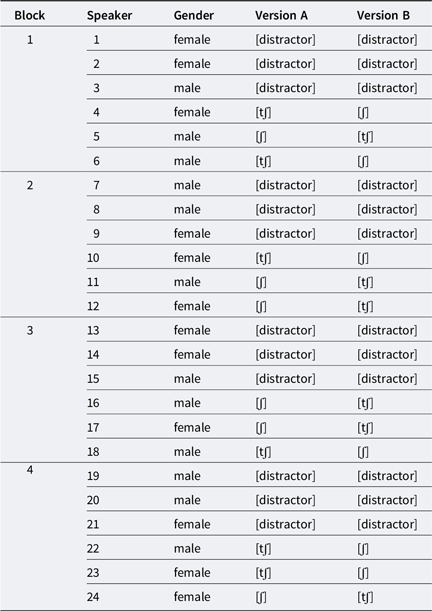
Note: Block orders remained fixed, but speaker guises were randomized within each block.
Appendix III: Screenshot of Qualtrics survey


 Open access

