

Writing in the Ladies’ Home Journal in the early days of America’s mobilization for the First World War in 1917, Secretary of War Newton Baker recognized that “men and women are essential partners in industrial and commercial civilization, in any modern civilization.”Footnote 1 On the same page, Dr. Anna Howard Shaw, the head of the Woman’s Committee of the Council of National Defense, agreed but took the argument further. America could no longer view the efforts of women as “merely supplementary to those of men,” she wrote. Instead, “women should become integral parts of all bodies organized for war work.”Footnote 2 In an official report written at the same time, Chairman of the Woman’s Committee of North Carolina Mrs. James Eugene (Laura Holmes) Reilley described her efforts to organize the women of her state and encourage them to greater effort, so that each citizen could “give her best toward the building of this great organization for war.”Footnote 3
The aspirational sentiment of support for women engaging in war work captured in the pages of the Ladies’ Home Journal was not uncommon in America from 1917–1919. Men supported and at times advocated for women to take up war work in specific areas. In response, women mobilized support through the issues-focused groups created over the previous two decades to push the boundaries of the kinds of work in which women could engage. Because of this, the structures created for home front mobilization during the war took into account both extant conceptions of woman’s work, as well as possible opportunities to expand beyond them. The primary structure coordinating the mobilization was the Council of Defense System, which linked national governmental agencies to each state government, a state governments to their local communities, and private interest groups like women’s clubs and associations to the government, through interconnected councils at different levels—national, state, district, and county.Footnote 4 The system also decentralized the organization and execution of war work to the states to rationalize and coordinate efforts toward mobilization, allowing local actors to shape and manage how they engaged in mobilization according to local interests. [Figure 1]
Mrs. J. Eugene (Laura Holmes) Reilley, the Chair of the North Carolina Council of Defense Woman’s Committee. Taken from The American Club Woman Magazine, Volumes 11–14 (New York: American Club Woman Publishing Company, 1916), 112.

North Carolina was a late convert to the Council of Defense System. Governor Thomas Bickett only created a state mobilization organization after receiving pressure from the federal government and the national Woman’s Committee in Washington, DC, pushed the issue by naming Charlotte resident Laura Holmes Reilley, a college-educated woman with deep ties to both state and national woman’s organizations, a temporary chairman of their subordinate organization in the Old North State.Footnote 5 Bickett subsequently included Reilley on the executive committee of the state Council of Defense, allowing her to create a state woman’s committee to coordinate the work of women during the state’s mobilization. However, the committee would report to the state council and not just the national Woman’s Committee in Washington, DC, as originally intended. Reilley’s role, and the function of her committee, would be to coordinate the efforts of women in the state—both individually and as members of organized groups—to support mobilization activities in North Carolina. In effect, the Woman’s Committee would manage the actions of women at the state level, coordinating between federal and local actions, while also acting as an intermediary mechanism for private efforts to complement and enhance areas which the public sector struggled to address. According to Brian Balogh, the linking together of public and private, national and local, in this way created an “associational state” that provides increased power in the American political system without creating citizen pushback against national centralization.Footnote 6 Bickett’s inclusion of Reilley, and the resultant structure of the Woman’s Committee, shows his willingness to support progressive ideas toward social reform and the employment of women in the mobilization to extend this associational state into the state’s community of women.
The creation of a woman’s committee subordinate to the state Council of Defense also indicates that Bickett, mirroring the national government’s approach toward women in the mobilization, understood the importance of including women in mobilization activities and yet desired a measure of control over how and in what areas women were employed in support of the state.Footnote 7 The resultant bifurcation of work based on gender, while complicated by race, became a way to temporarily resolve the necessity for including women in the mobilization until the end of the war, as “society found itself able to adjust to changes in women’s roles when they suited societies ends.”Footnote 8 Women were needed to organize and support many aspects of the home front mobilization, particularly in areas considered to be the province of women, such as caring for the home and family and the morality of state citizens. In these areas, the men leading mobilization provided space and resources to Reilley and the Woman’s Committee to help them organize the women of the state.Footnote 9
However, Bickett and the men leading the Council of Defense were also determined to maintain stability in the state during the war, including retaining extant hierarchies of political, economic, and social power.Footnote 10 To ensure this, the Council of Defense constrained the work of the Woman’s Committee in areas in which social conventions of both men and many women had previously prevented their participation, including in areas of industrial work and political agitation. The leaders in the state were able to prevent, in their minds, too much social or political change in North Carolina by preventing women from expanding into these areas.
North Carolina provides an interesting case to explore the mobilization of American society for the First World War along associational state lines. In its organization and resources, the state Council of Defense and its Woman’s Committee was an average case, mobilizing roughly all its territory for general support, while relying upon private donations for its operations. This put the state in the median for mobilization, neither ascending to the heights of organization and resources of the Northeast or upper Midwest, nor descending to the depths of complete ineffectiveness of states in the Deep South or West. Additionally, North Carolina’s politics and the relatively poor integration of women and Black citizens was unique from much of the nation, while still representative of the South.Footnote 11 Focusing on the Woman’s Committee specifically allows for an interrogation of gender and its impact on the relationships between the federal government, state government, and organized interest groups into an associational state in wartime. This includes a specific focus on the dynamic and sometimes conflicted relationship between government and civil society in the early twentieth century around issues associated with women, including the welfare of women and children, the role of race in society and wartime mobilization, and the place of women in the American workforce.
Such women’s issues quickly became an integral part of home front mobilization, leveraging and legitimating the private organizations that had long addressed these issues outside of formal governmental agencies, many of them created and run by women. There is a robust historiography regarding women’s clubs, groups, and associations in the Progressive Era and their impact on work, political development, and the First World War.Footnote 12 Most recent and pertinent to the role of the North Carolina Council of Defense and the state’s Woman’s Committee is Glenda Gilmore’s Gender and Jim Crow. Gilmore analyzes southern politics from the perspective of middle-class Black women, including Black club women, concluding that, despite the significant obstacles of Jim Crow and the disenfranchisement of Black men, they were able to develop strategies for action that circumvented a segregation that was “as natural as the sunrise,” particularly when it came to the inclusion of Black women in mobilization activities.Footnote 13 In addition to Gilmore, Joan Marie Johnson’s Southern Ladies, New Women puts into conversation Black and white woman’s clubs in South Carolina, using the state’s Federation of Women’s Clubs and its African American counterpart, the Federation of Colored Women’s Clubs, to ascertain the construction of meaning, identity, and citizenship, as a part of wartime mobilization.Footnote 14 Finally, multiple monographs address the role of women in the First World War, at home and abroad, from the perspective of private and nongovernmental arrangements, including Kimberly Jensen’s Mobilizing Minerva, Julia Irwin’s Making the World Safe, and Lynn Dumenil’s The Second Line of Defense. Footnote 15 Such analyses of gender, race, and citizenship establish the importance of women and their organizing to political development in Progressive Era America, in the public and private sectors, as well as the varied breadth of action and authority in the mobilization for the First World War.
The historiography of women in the war also builds upon the previous institutional approach analyzing the Progressive Era, the corporatization and bureaucratization of business and government, and the mobilization for the First World War.Footnote 16 Such works focus on the structures of business, law, government, and politics—rom the Constitution and the party system, to the judiciary and bureaucracies of public and private enterprises—to explain political development across the Progressive Era, as well as affected the mobilization for the First World War. For example, Stephen Skowronek details how the pre-twentieth century system of rulemaking by courts and the patronage of political parties became too unwieldy in the increasingly complex and expanding American state, leading to the ascendance of functional experts in federal organizations that were able to gain political dominance and create a more administrative form of politics.Footnote 17 However, the strength and endurance of the previous system hobbled and limited reforms, reducing the power and effectiveness of the federal state. For other scholars, including Daniel Carpenter, the increasing bureaucratization of the federal government was a function of the inclusion into policymaking of informal managerial institutions within the American state. For Carpenter, power shifted from informal patronage networks into a more administrative, bureaucratic state, with left individuals within the federal government able to use their expertise and connections to elected leaders to gain reputations of competence and increasing autonomy and expand the missions of their federal agencies.Footnote 18 Alternatively, institutional scholars like Theda Skocpol find a different explanation in the grass-roots development of organizations and movements focused on specific social services, which accreted to an increasingly-expanding federal state. From the Civil War through the First World War, organizations dedicated to ensuring soldier pensions, workman’s compensation, and women’s and children’s welfare had mixed success, but each led to the building up of the state as it met social service needs at the local level.Footnote 19 This strain of the historiography “brings the state back in,” as an actor, though one shaped by the people within the structures of politics and government.
The third historiography of political development and the mobilization for the First World War are those works focused on America’s federal system and the associational approach to governing seen in the use of private, organized interests to expand governmental power.Footnote 20 This scholarship, led by historians like Brian Balogh, describes how the public and private actions of both state and voluntary groups sought to achieve collective goals without overtly pushing against the American belief in individual freedom, resulting in a less-centralized, bureaucratic—or administrative—“associational state.”Footnote 21 Building upon Ellis Hawley, who described this type of relationship between formal government organizations and private groups as an “expanded system of extra-governmental governance,”Footnote 22 Balogh details how an associational state allowed Americans to link formal governmental power at the federal and state level with “interlocking relationships between citizens and their localities” based on the United States’ decentralized governance structure built on federalism.Footnote 23 [Figure 2]
Governor Thomas & Mrs. Fanny Bickett on the steps of the North Carolina Executive Mansion on the way to the inauguration of his successor, Cameron Morrison, 1921. North Carolina State Archives, Museum of History, Accession Number H.19XX.321.47.

These previous historiographies largely overlook a key level of analysis, however, by focusing on the national government, private organized groups, or the interaction of the two. They do not integrate the state level into their analysis, despite its critical role in the political, social, and economic roles of American life. Even William Breen, whose thoughtful and extensive analysis of multiple state councils of defense, including North Carolina, primarily uses individual actors and the state entities as a lens to describe the national mobilization for war, or describes actions in the state without directly interrogating the role of the state in the national mobilization.Footnote 24 Complementing the works of those like Breen, I contend that political and business elites in North Carolina, and particularly its Council of Defense, acted as a nexus of an associational order that mediated between the national and the local, and more importantly, coordinated individual citizens and groups within the state. The North Carolina Council of Defense was the coordinating structure in the associational order for wartime; a way to tie together individual citizens, publicly and privately funded nongovernmental organizations, and the interests of the state government, as well as simultaneously supporting and inhibiting national interference in its affairs. The Woman’s Committee was a part of this intermediary mechanism, allowing women to coordinate among themselves as a part of the state’s various mobilization activities. However, the creation and integration of a woman’s committee as a part of the Council of Defense was also a way male political elites could limit social and political power among those same women, while also generating increased control for the state government over what tasks women could and could not do during wartime. Interrogating the Woman’s Committee and the role of gender in the mobilization for the First World War provides an opportunity to expand current historiographical treatments, which detail the associational order as one that builds up the national state or shows the informal power of an expanding national government. At the state level one can see that the integration of women into mobilization expanded women-run private initiatives and integrated these associational efforts into the war effort, while also preventing their extension into politically and socially contestable areas. In the end, the increased attention and organization of private organizations by the state around women’s issues was inconsistent in its effectiveness and ultimately fleeting. The national crisis created by the war allowed for the temporary integration of women and many of their concerns into the wartime associational state, particularly at the state and local levels, but quickly receded with the conclusion of the war.Footnote 25
The Council of Defense System
In the first few days of May 1917 a select group of men from across the nation, each representing an American state, gathered at a conference in Washington, DC, at the behest of the federal government’s Council of National Defense. Following the declaration of war in mid-April 1917, the council was struggling to convert itself into a coordinating body for a national mobilization and saw the states as a key partner. As the chairman of the council, Secretary of War Baker said to welcome the delegates to the conference, “The task upon which we have started is so large that no language is adequate to describe the extent of the work” and that the strength of the effort would depend on the organization of the states supported by “general direction [from] Washington.”Footnote 26
Two fundamental concepts of Progressive Era American governance underpinned the Council of National Defense’s vision for the mobilization effort. First, they recognized and built upon the traditional structure of federalism created in the American Constitution and subsequent national and state legislation. According to this system, the federal government had limited power in the states. Instead, the federal government depended on its moral example and the generation of voluntary support and depended upon the states to use their powers to coerce and police their own citizens.Footnote 27 Therefore, the federal government had to rely upon each state to develop its own approach to mobilizing its people to support the war. At the federal level the Council of National Defense could only provide direction and advice, though they tried to instill their ideas of best practices in the states’ actions, including on the most effective forms of organization down to the county and local levels.Footnote 28 The second concept driving the organization of the mobilization effort was the segregation work and life. Segregation was a key component of early twentieth century progressivism, in itself a driving force in President Woodrow Wilson’s administration and his federal agencies, including Baker’s War Department and the Council of National Defense.Footnote 29 These two underlying ideas resulted in a Council of Defense System structured on voluntary participation by the states and the bifurcation of work coordinated by men on the one hand, and women on the other, and further segregated by race, particularly in southern states like North Carolina.Footnote 30 Ultimately, this bifurcation of the management of war work provided women more flexibility in managing areas men willingly ceded as the “female dominion.”Footnote 31 However, it also created friction in areas where their work overlapped with men’s concerns or in areas that tested traditional boundaries of women’s work, requiring “continual renegotiation of those limitations.”Footnote 32
The inclusion of women in war work followed along similar lines encountered in other elements of the mobilization. The national Woman’s Committee was created by the Council of National Defense in reaction to popular sentiment. Following America’s entry into the war in Europe in April 1917, woman’s groups and associations made themselves visible to the federal government, inundating the War Department and other federal agencies with letters and visits requesting guidance on how they could support the war effort. Such groups were dominated by suffragists, who viewed participation in the war as a way to greater political participation, including a national right to vote.Footnote 33 To manage the overwhelming support, the council created the national Woman’s Committee, composed of women they believed understood the woman’s groups that were offering assistance.Footnote 34
Led by Dr. Anna Howard Shaw, a former president of the National American Woman Suffrage Association, the organization drew upon the dozens of national woman’s organizations to expand their reach, consulting with prominent leaders from across the country. By the end of the meeting, they nominated one woman in each state to represent the federal effort as the temporary chairman of local woman’s committees.Footnote 35 Chosen to represent North Carolina was Reilley. [Figure 3]
This was the official seal of the Woman’s Committee of the Council of National Defense. North Carolina State Archives, Military Collections, WWI 1, Box 17, from a document labeled “Woman’s Committee, Council of National Defense, North Carolina Division.” Used courtesy of the North Carolina Department of Natural and Cultural Resources.

The North Carolina Woman’s Committee
The formation of a state-level committee run by women and coordinating the mobilization of “woman power” in southern states in this period is itself interesting, given the entrenched opposition to the changing roles of women, such as the refusal to grant women the right to vote and other expanded rights.Footnote 36 Opposition was based in the conservative nature of Southern society, a conservatism that had returned in force after 1877, as the Southern political system forcibly returned to one based in white-supremacy as the national government abandoned Reconstruction. At this time, hierarchies of power based in race, patriarchy, and the white planter elite were able to reassert themselves, most violently seen in the Wilmington Coup of 1898 when white Democrats overthrew the legitimately elected biracial Republican-Populist fusion government.Footnote 37
The progressive approach in North Carolina, therefore, matched national progressive movements for more democratic governance and social uplift, while also ensuring the formerly enslaved and women were unable to access it.Footnote 38 Where progressivism elsewhere in the country was dedicated to the extension of popular government or greater democracy, in the South its approach was tailored, as Jack Temple Kirby assesses in Darkness at the Dawning, to a “conserving or restorative impulse” stemming from “traditional values,” leading to a movement based in revanchism over reform.Footnote 39 While progressive in specific areas, the men that populated the state government of North Carolina and the leaders of woman’s groups in the state were also committed to the politics of white supremacy and dedicated to the continuation of patriarchy.Footnote 40 This included the chairman of the state Council of Defense, Daniel Harvey Hill Jr., who “does not want to cooperate with us, he is simply a gentleman of the old school and is slow and unprogressive” said Reilley.Footnote 41 According to Janet Hudson in Entangled by White Supremacy, the social and economic challenges posed by a national mobilization for the First World War, including the federal government’s efforts to manage it, “threatened the stability of the existing racial [and gendered] hierarchy” in the South.Footnote 42
In this political and social milieu, southern women had a decidedly “unfixed status,” a term captured by Emily Blair, a member of the national Woman’s Committee.Footnote 43 In her final report she described how a woman’s “status varied according to the group of men to whom she applied.”Footnote 44 Unable to vote and not represented in local or state government, women carved out areas of society in which they could participate and lead the change they believed needed to occur. The principal mechanism for organizing and mobilizing women from the late nineteenth century to the First World War were voluntary woman’s groups, associations, or clubs, which provided an avenue for the inclusion of women in political and social issues of the day, though such groups were segregated by race.Footnote 45 White middle-class women gathered to study literature and civics for self-improvement. Black women worked together to prevent lynching and other racially and politically motivated violence.Footnote 46 Both white and Black women undertook social reform projects that included starting schools, building libraries, and lobbying for sanitation and child welfare. Both groups of women also worked to uplift the members of their communities through the teaching of the latest trends in home economics and to mobilize for issues like the right to vote.Footnote 47 According to Penelope Brown, in some ways these groups “resembled political parties more than private associations” as they elected leaders, voted their agendas, and actively recruited new members.Footnote 48 However, the areas in which they focused their attention allowed women to avoid social and political backlash based on observable ties to traditional woman’s work. The exception to this was mobilization and agitation for the right of women to vote and the protection of Black men and women from violence, both areas staunchly opposed by many in the South. This included North Carolina, where suffrage for women failed to gain popular support even after the war and white supremacy reigned.
Owing to the associational approach of the mobilization, woman’s groups were the driving force and organizational backbone behind the creation of woman’s committees and their wartime work, from the national to the local level. The women that participated and led these various organizations were selected or requested by the national Woman’s Committee to lead efforts that provided “a clearinghouse for all women’s war work” and would avoid competing with extant organizations, instead leading the way to coordinate with them and reduce inefficiency.Footnote 49 This was true of Dr. Shaw, who had been selected for leadership of the national Woman’s Committee based on her role in leading the National American Woman Suffrage Association prior to the war.Footnote 50 It was equally true for Reilley’s selection as the chairman of the North Carolina Woman’s Committee based on her work with the Federation of Women’s Clubs and Equal Suffrage League in that state and nationally.Footnote 51
The first organizational meeting of the North Carolina Woman’s Committee was in June 1917, shortly after Reilley’s appointment to the executive committee of the state Council of Defense. Reilley immediately integrated her committee as the intermediary organization in North Carolina’s mobilization, calling together all the leaders of woman’s organizations in the state, as well as the leading women of the major cities and towns to represent the “unorganized” women of the state. Held in the Senate Chamber of the State Capitol in Raleigh, this gathering of sixty-eight women established the associational structure and functions of the state Woman’s Committee, including confirming Reilley as the chairman and the election of other officers to manage the different departments that would drive woman’s war work. The power of the private woman’s groups to support the state in organizing “woman power” during the First World War is evident. The entirety of the executive board of the Woman’s Committee were previously leading members of state or local woman’s groups, including each of the district chairmen (established at the congressional district level), and all but two of the eighty-eight county chairmen of the Woman’s Committee.Footnote 52 However, continuing the approach that would be followed throughout the war with only a few exceptions, no Black women were invited or meaningfully integrated into the Woman’s Committee, despite their enthusiasm to participate in the state’s wartime activities, the profligacy of Black woman’s organizations in the state, and national level encouragement to include them in mobilization.Footnote 53 A month before the end of the war the national Woman’s Committee sent a Black field representative, Alice Dunbar-Nelson, to assess the integration of Black women into state mobilization activities, including North Carolina.Footnote 54 While Reilley seemed open to the idea of incorporating a Black field agent under her own committee when meeting with Dunbar-Nelson, it is unclear whether she would have actually done so, as the end of the war forestalled any further progress on mobilization.Footnote 55 Even had she done so, it is likely that a Black field representative would have only been employed “when need for specific activities arose” as this “kept black women not only subordinate but also virtually invisible to the larger society.”Footnote 56 [Figure 4]
African American soldiers and Red Cross women taking part in a post-war parade in Wilmington, North Carolina on March 29, 1919. World War I Files, Lower Cape Fear Historical Society, Latimer House, Wilmington, NC. Used courtesy of the Lower Cape Fear Historical Society.

The establishment of separate areas of work for women in North Carolina mirrored those of their national level counterpart in Washington, DC. Reilley pushed to more comprehensively leverage women to participate fully in the mobilization at the state level, just as Shaw did at the national level. Without “any well-defined plan of work,” there was an opportunity for women to coordinate and direct work in areas well-represented by woman’s groups and accepted by American society, as well as a possibility to “create those new lines of service” that best engaged women.Footnote 57 However, leaders of the woman’s committees, including Reilley, believed that women were also required to “be the calm, well-disciplined, home-loving people who are to keep harmony and the conditions of society and the Government from being disturbed.”Footnote 58 This balance between pushing for the most effective work for women and not disturbing the harmony of society during wartime was a key theme in the work done in North Carolina by the Woman’s Committee, particularly as an argument for preventing the integration of Black women into the work.Footnote 59
The work done by the women of the state included three broad categories: work for the preservation of the home, relief work, and woman’s defense work.Footnote 60 Within these three categories of work were eleven sections, led by a chairman and coordinated by Reilley and her executive board. Each area included activities by individual women, private groups, and those linked with public agencies, all coordinated by the Woman’s Committee as a nexus of the wartime associational state in North Carolina. Work for the preservation of the home included food administration and home economics, food production, and health and recreation. Relief work incorporated home and foreign relief, the maintenance of existing social service agencies, and child welfare. Finally, woman’s defense work involved publicity, educational propaganda, liberty loans, registration for service, and women in industry.Footnote 61 Each of these three broad areas of work provide a different angle from which to observe the bifurcation of work based on gender and race, as well as the negotiation of woman’s war work during the mobilization. The success, or lack thereof, by women in each area indicate which were “congruent with their visions of themselves as progressive reformers” as well as with men and society in general, versus those that required negotiation or were so contentious that Reilley and her committee were unable to make any headway during the war.Footnote 62
Woman’s War Work and the State
War work was divided up into separate spheres—“men’s work” and “women’s work”—from its inception in 1917, although there was an understanding that most areas would require significant cooperation between the groups headed by women and those headed by men.Footnote 63 Some areas, however, could be more clearly identified as woman’s work than others, and none more so than the managing and upkeep of the home and family. Of particular importance was the conservation and production of food, a key element of the war effort both at home and abroad. As one local official in Granville County recounted, “Money and food were the things needful to carry on the war,” and in the area of food in particular, women were “the foundation stone on which [America’s] whole economic structure is built.”Footnote 64 Money could be raised through bonds and loans or dollars could be printed outright, “but all assets become valueless from a military point of view unless there is a food supply sufficient to sustain the armed forces and the civilian population.”Footnote 65
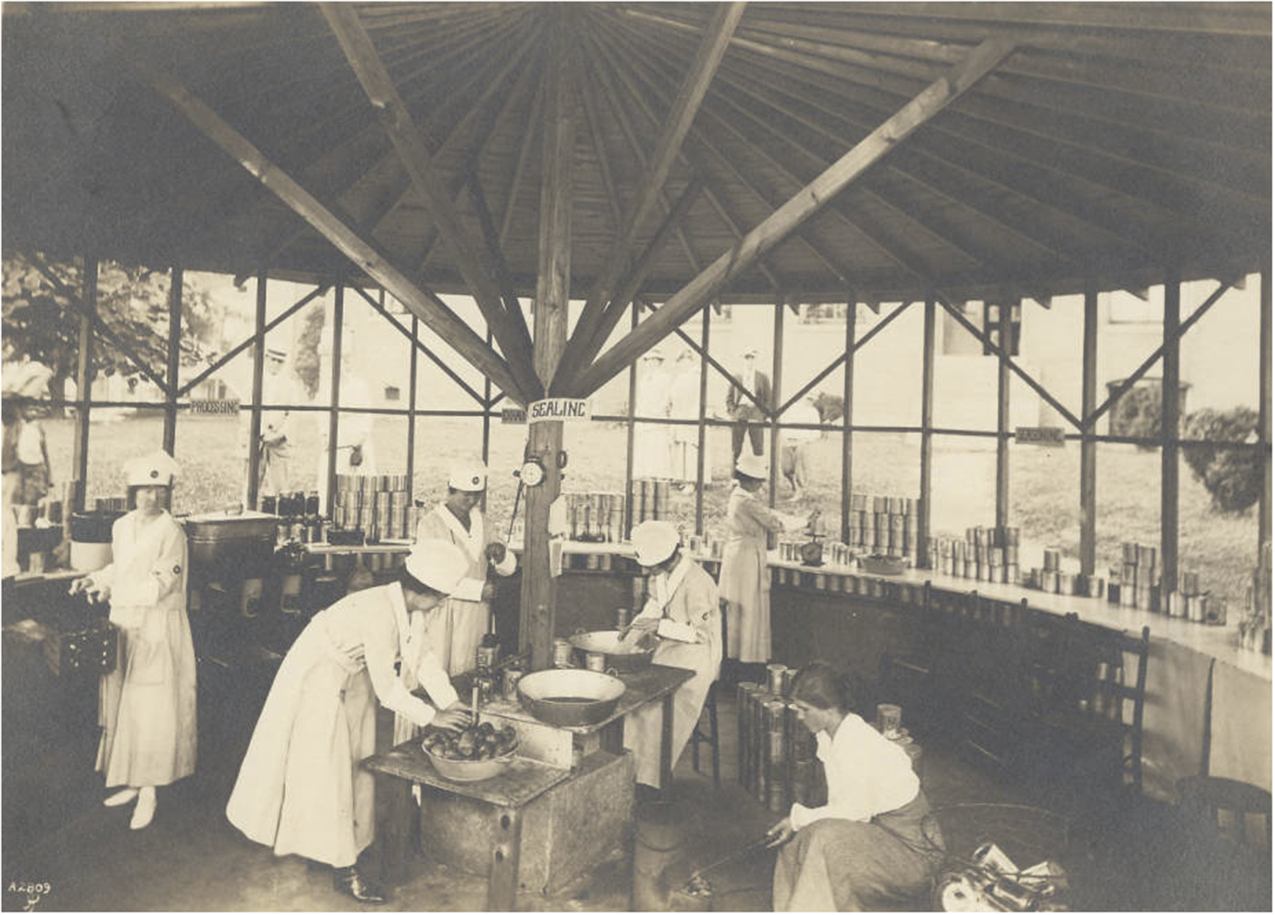
America found itself in a poor position to produce and ship food to its military forces in France, let alone to sustain the civilian population. Before entering the war, the United States sent most of its surplus foodstuffs in support of Britain, France, and Russia to help “Win with food.”Footnote 66 The lack of food in the states led leaders, and the Woman’s Committee in particular, to spend significant time and effort to convince its citizens “to do everything in their power to conserve and enlarge the existing food supply.”Footnote 67 These efforts included encouraging housewives to sign Herbert Hoover’s Food Administration pledge cards to reduce consumption and waste, avoiding scarce products like wheat and meat, and teaching the women of the state the most efficient ways to preserve produce through canning and other methods.Footnote 68 Most efforts regarding food boiled down to the idea that “Kitchen efficiency is practical patriotism” and waste was the enemy of patriotic American citizens.Footnote 69 Engagement across the state was significant. Tens of thousands of women and girls engaged in conservation efforts that preserved close to ten million cans of food in both 1917 and 1918.Footnote 70 This element of woman’s war work was one in which they were excited to engage and created little resistance from Southern society.Footnote 71 Food conservation was also an area in which there was broad cross-race engagement, with North Carolina’s primary leader, and chair of the Woman’s Committee’s Food Administration Committee Jane McKimmon, leading outreach to Black women, ultimately integrating them onto her staff after the war, though only as assistants to white agents.Footnote 72 [Figure 5]
Women canning produce in Asheville, North Carolina. North Carolina State Archives, Military Collections, WWI Private Collections, Box 18, Papers of Elizabeth Earl Jones, American Red Cross Volunteer, and May F. Jones, Y.M.C.A. Worker. Used courtesy of the North Carolina Department of Natural and Cultural Resources.
Another key area when it came to food was in its production: the sowing and growing of more crops to meet wartime requirements. Here, again, the Woman’s Committee was largely successful. They encouraged the growing of “war gardens” to reduce the fruit and vegetable needs of individuals during the war, as well as demonstrations detailing timing and types of vegetables to plant.Footnote 73 Less successful were efforts focused on getting women in the city to support their counterparts on farms in the state, despite federal agencies’ exhortations to do so to reduce labor shortages and increase food production.Footnote 74 Ideas included encouraging city women to do household chores for local farm women so the latter could focus on agricultural production, whether in support of the men of their family, or in lieu of the men if they had been drafted into the military. Some also pushed for city women to engage in agricultural work in the fields themselves. With the exception of a handful of students from the women’s State Normal and Industrial College (now University of North Carolina–Greensboro), which organized a “Farmerettes” group for summer work on farms, few women flocked to the fields.Footnote 75 The Food Production Division of the Woman’s Committee, and Reilley in particular, did not place much emphasis on expanding their work into broader agricultural production as they worried about the implications of “forcing” women into the fields, focusing instead on convincing individual women to plant war gardens at home.Footnote 76 It is not a surprise, therefore, that women in North Carolina primarily supported food production via home gardening.Footnote 77
Focusing on the health and recreation of American citizens was a favorite of progressive reformers across the nation. It was also a key area of woman’s war work in North Carolina. While this area of work included the sanitation and healthcare of cities in general, in practice the activities around army cantonments and camps was their primary focus. Women worked diligently to create a “wholesome social environment and supervised recreation” for soldiers, “girls of the community,” and families of soldiers both in residence and those visiting during training.Footnote 78 This expanded even further by the end of the war to include the prevention of young women of outlying towns and cities from traveling to the camp cities. Providing support to soldiers while in the training camps was an area in which Black women were able to have a large impact, creating and running Hostess Houses and YWCA facilities for Black soldiers, particularly at Camp Greene outside Charlotte. Due to the segregated nature of the training, white officers and local white women left Black women alone to minister to their men.Footnote 79 [Figure 6]
Red Cross women running a canteen to support soldiers traveling through Raleigh on the way to training camps. North Carolina State Archives, Military Collections, WWI 6, Box 3. Used courtesy of the North Carolina Department of Natural and Cultural Resources.

The Woman’s Committee leveraged multiple organizations and mechanisms to police behavior that fell broadly under the heading of “social hygiene,” which was narrowly defined around the prevention of sexual activity and its attendant issues of alcohol consumption and venereal diseases. Such mechanisms of prevention included the creation of supervised social clubs, canteens, and house stays, as well as the institution of patrols by groups of women around well-known areas of use by deviants.Footnote 80 The Woman’s Committee created an entire new division for social hygiene by the summer of 1918, managing the interactions of populations on or around three camps in the state. This was despite the existence of a national Commission on Training Camp Activities chartered to handle such issues.Footnote 81 Efforts toward social hygiene were encouraged by Governor Bickett and the Council of National Defense, but ultimately deemed the responsibility of women, who in the mind of the governor and most of Southern society, were charged with tending to the morality of both their fellow women and the men at camp.Footnote 82 The area of health and recreation allowed for increased engagement and activism by the Woman’s Committee, with support by the state Council of Defense. This was a nonthreatening area to men because it was intimately tied to the Southern ideal of women as the protectors of the family, and girls’ innocence in particular, as well as the increasing role of women in the nascent profession of social services seen at the turn of the twentieth century.Footnote 83
The ability of Reilley and her Woman’s Committee to manage and expand their activities in the area of work for the preservation of the home—namely through food administration, food production, and health and welfare—was greater than almost any other aspect of their work during the mobilization for the First World War. This was due to the natural overlap between previous conceptions of the role of women as managers and protectors of the home and family, extant throughout American society, buttressed by the patriarchal foundations of Southern Progressivism. These areas were also well-addressed by private woman’s groups even before the war, providing the Woman’s Committee an ample source of personnel and experience addressing these issues.
The second area in which women were engaged during the First World War was relief work. This area included activities that matched pre-war expectations of woman’s work, while also overlapping in places with political concerns managed by the state Council of Defense, causing friction. Each of these activities—including home and foreign relief, the maintenance of existing social service agencies, and child welfare—were enhanced by a burgeoning professionalism around social services occurring at the turn of the twentieth century, particularly at the state level.Footnote 84 [Figure 7]
Red Cross women serving returning 30th Infantry Division soldiers in Charleston, South Carolina on March 27, 1919. Handwritten on the back of the photo is the citation, “Upon their arrival, the boys of the 30th were served by a host of Red Cross nurses.” North Carolina State Archives, Military Collections, WWI Papers, 1903–1933, Military Organizations, Box 1. Used courtesy of the North Carolina Department of Natural and Cultural Resources.

Home and foreign relief, or work dedicated to the care of the sick and wounded or the materiel to support their care, was “the war work which appeals more generally than any other line of war work” to the women of the North Carolina because they “can see the demand and supply and [it] gives opportunity for splendid service, where there is no interest in economic lines of endeavor.”Footnote 85 Such work included “preparing surgical dressings, collecting funds, knitting for sailors and soldiers, making comfort kits, assisting the families of men in military and naval service, and organizing courses for first aid and for home nursing.”Footnote 86 The Woman’s Committee played a coordinating and supportive role in this area, as the work was primarily executed by the American Red Cross, an organization which grew from minimal local support in North Carolina prior to the war to over 250,000 members in 140 chapters, 360 branches, and 250 auxiliaries by 1918.Footnote 87 The preference for the Red Cross in the area of relief began at the beginning of mobilization, with Governor Bickett stating that any wartime work conducted by women should be done by the state chapter of the Red Cross.Footnote 88 Because of this, Reilley and the women on her committee sometimes struggled to understand their role and were consistently concerned their personnel were not getting the credit they deserved.Footnote 89 To overcome this, Reilley coordinated a division of labor that focused on mobilizing personnel for relief, funneling volunteers to local Red Cross chapters. She also coordinated space for work, including the use of the brand new North Carolina Federation of Woman’s Clubs Clubhouse in Raleigh as a Red Cross Center.Footnote 90 Yet despite interorganizational friction between the Woman’s Committee and the Red Cross, the work they were jointly undertaking was politically and socially within the “female dominion.”Footnote 91 Because of this, like the work of preserving the home, they received significant support from political leadership in the state, and the Council of Defense in particular.Footnote 92 A long-standing associational relationship between the Red Cross and other relief organizations with both federal and state governments also reduced friction in this area of work.
The Woman’s Committee also oversaw the maintenance of existing social service agencies, which was designed to “further the activities of existing agencies for relief.”Footnote 93 After a robust expansion of public services under Governor Bickett in 1916 and early 1917, there was a desire by progressive reformers in the state, including Reilley and the members on the Woman’s Committee, to ensure continued support of families in need of food, housing, or mental health care.Footnote 94 Additionally, with the outbreak of war there was no shortage of charities and causes in need of monetary support. The Woman’s Committee diligently worked to appeal to the citizens of the state that “social service is war service,” and that they should continue supporting pre-war charities that needed their help. Some women contested the insistence that they participate in the war effort, or that they should be required to donate time or money to charities. However, most women in the state were supportive of existing social services, both private and public. As the Council of Defense and the Woman’s Committee developed guidance on wartime causes worth investing in, none more crucial than the Red Cross and government loan and bond drives, women in the state canvassed their neighborhoods on behalf of financing the war and necessary social services in the state.Footnote 95 However, the ability of Reilley and the other members of the Woman’s Committee to have any impact was largely contingent on their relationships with the men in control of the welfare bureaucracies of the state and social service organizations like the Red Cross.Footnote 96 Devoid of women leaders in social service, despite the expanding number of women in this increasingly professionalized sector, the challenges the Woman’s Committee experienced in this area demonstrated women’s continued “unfixed status” and the “continued necessity for women of cultivating relationships with men with access to political power.”Footnote 97
Child welfare became a surprisingly contested issue during mobilization. The issue was firmly within the “female dominion.” However, children also had a role in the state economy and efforts to limit child labor had produced conflicts between levels of government. Many states, particularly southern states that opposed such limiting measures, consistently fought the federal government, which attempted to place limits upon child labor. When it came to progressives in North Carolina, including Governor Bickett and the men running the Council of Defense, the idea of federal government intervention into the free market was acceptable as far as it protected their agrarian and textiles-based economy. However, they also believed that “the government’s role did not extend to social problems” such as poverty or child labor, let alone race relations.Footnote 98 This was especially true for businessmen in textiles and mills who were accustomed to independence in their labor practices, including the use of child laborers, and resented any intrusion into how they managed their workers.Footnote 99
Many women’s groups focused on child welfare and education supported limitations on the employment of children. Having diligently worked on this issue for years before the war, child welfare was a key action for Reilley.Footnote 100 She pushed strenuously for child welfare measures, including a limit to underage labor in the state.Footnote 101 Her efforts were continually stymied, however, despite the repeated requests for support sent to Governor Bickett and the state Council of Defense.Footnote 102 The lack of support became pronounced after the US Supreme Court struck down the Federal Child Labor Law as unconstitutional in 1918.Footnote 103 Because this area of concern overlapped with men’s economic interests and their war work, it put women at a disadvantage. Once again, the bifurcation of work and women’s unfixed status denied them the political power to address underage labor, and they were unable to find an ally in the state’s associational wartime state to take up their cause given the economic and political pressures.
Aside from the issue of child labor, “assisting in the uplift of the poor, the disadvantaged, and the vulnerable,” most especially children, “were among those Progressive reform activities deemed most appropriate for women giving their presumed innate abilities for nurturing.”Footnote 104 Most reformers recognized the general benefits of ensuring a healthy population, including economic, social, and even moral benefits. There was also military justification reformers could bring to bear during the wartime emergency. Throughout the war there was a relatively high rate of medical rejections of draftees from southern states.Footnote 105 This legitimated a focus on determining the health of its children, as well as developing measures to improve it. The Woman’s Committee and their members energetically pursued such tasks, including the weighing, measuring, and registering of young children in the state to ensure they were getting enough sustenance and exercise; the development and funding of recreational activities for children; and working to ensure there were enough teachers for schools despite the conscription of many men that were instructors, through the identification and employment of more women in education.Footnote 106 These efforts were nationally organized, but state-executed, as a part of a coordinated “Children’s Year” from 1918–1919.
Relief work remained one of the most effective and desired aspects of woman’s work throughout the war, although it generated pushback by political leaders. This was particularly the case when their work overlapped with men’s control of the economy or their leadership of state social welfare programs. Where the Woman’s Committee worked within the traditional “female dominion” involving the family and home, however, they were able to manage themselves and generate support from the people of North Carolina, men and women.Footnote 107
The Woman’s Committee in North Carolina was least able to effectively manage areas in which the work directly tied to either the relations between the state and the federal government, or work that tried to expand the role of women outside the traditional “female dominion” of the home and family. These more contested areas threatened existing hierarchies of political and economic power within North Carolina and were less susceptible to the associational aspects of the committee’s coordination of mobilization activities. Such areas included the Woman’s Committee’s work on publicity and educational propaganda, registering women for service, the raising of liberty loans and war bonds to fund the war, and women in industry.
A fundamental role of the Woman’s Committee was simply communicating with the women of North Carolina. Reilley did the majority of this work herself, spending much of her time writing press releases to newspapers, giving speeches, and corresponding with leading women in the state. By 1918, much of the key themes and ideas she communicated came from the national Woman’s Committee through their bulletins, circulars, and pamphlets. The state Woman’s Committee was originally envisioned as a mechanism to create a direct channel of communication from federal agencies to women at a local level and communicate local concerns back to the state and federal government. In reality, however, official communications and publicity became a method of creating boundaries around speech in the state, encouraging “purposeful loyalty” that included the need to provide “prompt conformity to Governmental requests,” the “forbearance of criticism,” and requirement to report “anti-American sentiment.”Footnote 108
Another area the Woman’s Committee failed to gain ground during the war was the registering of women for service. Established as a way to identify and categorize the abilities and desires of women to support the mobilization, the registration had limited success, with Reilley reporting in 1918 that “Of the 641,666 women in the state” only “11,358 women have registered for service to date.”Footnote 109 This lack of support concerned Woman’s Committees at all levels, given the concomitant and wildly successful registrations of men for military service.Footnote 110 Such lack of a voluntary spirit was seen as a failing of not just those serving on the Woman’s Committee, but of all women, because “No able-bodied woman has a right to occupy space in our land who is not doing, or preparing to do, some active service for the right to occupy the space she fills.”Footnote 111 Women in the state, on the other hand, were concerned that if they registered it would either take them away from their families or affect the status of their husbands and lead to their conscription into the military.Footnote 112
The final area in which the Woman’s Committee was most constrained in their activities was their work relating to the federal government and work outside the home. These two areas, typified by the liberty loan drives and women in industry, respectively, were largely taken out of the hands of the Woman’s Committee and managed by federal agencies.Footnote 113 In the case of Liberty Loans, the Treasury Department created their own administrative structure to solicit participation in the three drives conducted during the war. This pushed aside the Woman’s Committee while still using their connections in North Carolina to mobilize support on the ground.Footnote 114 However, while white women felt circumvented by this approach, Black women were able to organize themselves to have a sizeable impact by selling War Savings Stamps among African-Americans in the state, even integrating into county-wide efforts by white citizens to raise money for the war.Footnote 115 [Figure 8]
A North Carolina woman working a machine in September 1918 to weave jerkin linings for soldiers at a local woolen mill in Leaksville, North Carolina. North Carolina State Archives, Military Collections, WWI 4, Box 1. Used courtesy of the North Carolina Department of Natural and Cultural Resources.

Addressing women in industry received the least support from the Council of Defense. The issue of women working outside the home and in industry was highly contentious from the very foundation of the Woman’s Committee.Footnote 116 At the federal level, the Department of Labor requested the national Woman’s Committee refrain from formally establishing a division focused on woman’s labor. Instead, the department created their own organization led by men, the Women in Industry Service, that set their own policies in coordination with the War Labor Policies Board, another emergency wartime organization run by men.Footnote 117 This negated any real impact the Woman’s Committee might have been able to have in the area of working women. Instead, their Women in Industry Division ended up as a mere publicity agency, interpreting and communicating Labor Department policies to the states’ woman’s committees. In North Carolina, the inability of Reilley to get approval by the state Council of Defense for her preferred candidate to manage the division of women in industry led to virtually no work being done in this area, at least among white women.Footnote 118 Through the YWCA, which supported urban and industrial woman workers even before the war, many Black women in the state were able to push for better housing and recreation, if not improved pay and hours.Footnote 119 This included Charlotte Hawkins Brown, an educator and leading Black activist in North Carolina, who recognized that most women newly hired into factories were “working under new conditions and [a] strange environment, and all at top speed. They must be comfortably housed, and given recreation, sympathy and comfort.”Footnote 120 Reilley continued to advocate up until the end of the war for support from the Council of Defense, emphasizing the increasing importance of women in industry. Unfortunately, the need to enact standards to protect women and manage the continued effect of men leaving for military service and women taking up their jobs remained unaddressed by the council as a whole.Footnote 121
Conclusion
In September 1918, the national Woman’s Committee merged with the State Division of the Council of National Defense to streamline the management of and communications with the separate elements of state councils run by men and women. Some viewed this amalgamation as “a sign that the Government at Washington recognized the importance of women’s war work and realized that the amalgamation was a great step in the partnership of men and women.”Footnote 122 The new field division this amalgamation created had equal representation of men and women within the organization, though the women representatives were subordinate to their male counterparts.Footnote 123
Governor Bickett and the men on the state council, similar to the delayed creation of a council of defense and their woman’s committee at the beginning of the war, dragged their feet and did not institute a similar amalgamation of work across the gender gap. When the United States signed an armistice with Germany on November 11, 1918, effectively ending the war, the state Council of Defense and the Woman’s Committee halted their activities. With the exception of the final collecting of documents and the completion of final reports, both organizations dissolved.
The alacrity with which North Carolina dispensed with these mechanisms for mobilization is another example of their purpose as temporary, associational measures to manage the dynamics of wartime and maintain pre-war hierarchies of power. Throughout the war, the bifurcation of work based on gender and the “unfixed” status of women in southern states created a situation in which their participation required constant negotiation. In areas regarding the home and the family, the traditional “female dominion,” the Woman’s Committee of the Council of Defense was able to lead their own work and have an impact. Reilley and the other women of the Woman’s Committee were able to create an organization that permeated the entire state at multiple levels and mobilize a body of women to address food conservation and production, to address social hygiene and relief work, and to help raise Liberty Loans.Footnote 124 As the men of the national and state councils primarily saw the woman’s committees as a way to usefully channel women’s work, the performance of women in these areas were also seen by them as a success.Footnote 125 However, in areas that overlapped with concerns of men, the Woman’s Committee had to negotiate their ability to mobilize and organize the women of the state through the building relationships and coalitions with men.Footnote 126 Most emblematic of these areas are those that contested political or economic power, such as child welfare, financing the war, and women in industry. In the eyes of the men on the North Carolina Council of Defense, the failures of the Woman’s Committee to advance their agenda in these areas was also a success, ensuring the pre-war economic, social, and political hierarchies of power in the state which were built upon an economically progressive agenda, but one that was inherently white supremacist and patriarchal.
Despite the particularities of the politics of North Carolina, however, the mobilization for the First World War in the state provides a larger example of how the mobilization was itself an outgrowth of the conflicted relationship between American government and civil society over women’s issues. American entry into the war and the need for women in home-front mobilization provided an opportunity to expand activism around issues important to women, leveraging woman’s groups to expand governmental power through an associational state in those areas.
This opportunity was temporary, however. As the emergency ended, so too did the increased state support for the inclusion of women in governance and in addressing women’s issues. Wartime work did create a shared vision for future social and political work among many woman reformers, but the men in state executive and legislative leadership in North Carolina pushed back, ultimately refusing to ratify the 19th Amendment, the ultimate recognition of women’s role in the most recent crisis.Footnote 127 So, while women in the state were ultimately granted full citizenship rights when Tennessee ratified the amendment, the state government in Raleigh continued to maintain its patriarchal approach to governing following the war. Because of this, women’s issues that had gained support during the war once again became the purview of private organizations and other systems of “extra-governmental governance” that leveraged a more “associational” relationship with federal and state governments.Footnote 128


 Open access

