

Introduction
In 1931, the Tianjin-based Beiyang Pictorial (北洋画报, Beiyang hua bao ) published a series of 12 photographs taken during the performance of Dance on Hands (掌上舞, Zhang Shang Wu) by the Plum Blossom Girls Song and Dance Troupe ( 梅花少女歌舞团 , Meihua shao nü ge wu tuan , Meihua hereafter), a commercial song and dance company active in China and Southeast Asia from the late 1920s to the 1940s during China’s semi-colonial Republican Era (1912-1949).Footnote 1 In the first photo of the series, Meihua’s male dancer Huang Hun (黄昏) is seen standing in a forward lunge position while holding the female dancer Zhang Qi (张绮) as she stands on top of his knee and holds one leg up vertically to the ground. Zhang wears a multi-layered mini skirt and a tight, cropped, sleeveless top with what appears to be a giant bow tie around her neck. Huang sports a pair of Roman-style gladiator shoes with wide laces tied up to his knees and a pair of loose-fitting shorts made from reflective material. His shirt appears to be a shortened and form-fitting Greek tunic. The female costume choices are reminiscent of vaudeville shows and musical films through which they were seen and disseminated in China’s urban cities and colonial treaty ports, and the male dancer’s costume resembles Greek statues that inspired many dance activities in Republican era new-style schools.Footnote 2
As one of the first commercial song and dance companies, Meihua was active during a time when China had ceded several port cities to foreign powers following military defeats and internal strife.Footnote 3 Because Meihua’s performance and revealing costumes resembled Western social and vernacular dances, or lowbrow “leg business” (Ma Reference Ma2023, 15), its performances were condemned as mere salacious distractions that diverted urban Chinese audiences from pressing social issues.Footnote 4 In contemporary historiography, commercial dance activities that engaged with Western popular forms during this time were overlooked either due to ideological deliberation or difficulties accessing any dedicated archive, two issues that often go hand in hand. As a result, commercial dance activities during the Republican era were hastily labeled as mere entertainment and condemned for their “decadent” and “vulgar” content; they were largely overlooked as mimicking Western cabaret and vaudeville shows, cultural forms brought by imperial powers and consumerist cultures. For instance, historians Wang Kefen (王克芬) and Long Yinpei (隆荫培) deem:
[most of the song and dance troupes in the 1920s and 1930s] copied Western song and dance programs, they did not have high artistic qualities. Their existence was a product of foreign political, economic, as well as cultural invasion, therefore, their existence was rather transient, and they did not leave any useful heritage for people. (Wang and Long Reference Wang and Long1999, 58)
Tong Yan (仝妍) sees the song and dance performances in conceded urban spaces as a reaction to an emergent degenerate “modern culture” (摩登文化, modeng wenhua) and describes it as:
a cultural phenomenon where people take emergent social trends and foreign culture as fashionable things to chase and imitate… people who pursue the modern culture do not care about the practical purposes art and literature should serve, they also do not care to reflect upon the real problems in the Chinese society” (Tong Reference Tong2013, 44).
Despite this prevailing pejorative view of song and dance troupes, Tong (Reference Tong2013), Wang, and Long (Reference Wang and Long1999), along with other Chinese language scholarship, acknowledge that Meihua distinguished itself within the broader “corrupted stream” of song and dance troupes (Wang and Long Reference Wang and Long1999, 58) and contributed meaningfully to the development of song and dance in China. However, existing discussions of Meihua remain largely brief and descriptive, lacking critical analysis (Cao and Nan Reference Cao and Hongyan2022; Liu Reference Liu2010; Tong Reference Tong2013; Wang and Long Reference Wang and Long1999).
Rooted in an anti-colonial and anti-imperialist perspective, contemporary understandings of Republican era song and dance often fail to articulate the fact that these artistic experiments emerged within China’s colonial modern context, an era in which “modernization and colonialism must be understood as an integrally connected process” (Liu Reference Liu2013, 5). Historian Tani Barlow (Reference Barlow1997) advocates for an “ensemble-like historical writing” that moves beyond the rigid binaries of self/other, state/nation, and colony/metropole (6), offering a more nuanced approach to understanding cultural formations within China’s colonial modernity. While Meihua’s costume choices, balletic partnering techniques, and use of popular dance vocabularies reflect choreographic influences from foreign dance styles, this article examines how the troupe adapted these influences to local contexts, intertwining them with Chinese literati traditions and both local and global modernist aesthetic experiments, all while advancing progressive ideas about gender.
The study of corporeality and aesthetic formations in popular dance during China’s Republican era remains an underexplored area in both Dance Studies and Chinese Studies. While Anglophone scholarship on dance in China has primarily focused on the historical and aesthetic development of Chinese concert dance forms, particularly Chinese classical dance, ethnic and folk dance, and modern dance during the Socialist and postsocialist eras (Chen, Y Reference Chen2023; Cui Reference Cui2024; Frederiksen and Chang Reference Chang and Frederiksen2016; Guan Reference Guan2024; Ma Reference Ma2023; Miao Reference Miao2019, Reference Miao2022; Seetoo Reference Seetoo2021; Wilcox Reference Wilcox, Marion and Wilcox2012a, Reference Wilcox2012b, Reference Wilcox2014, Reference Wilcox2016, Reference Wilcox2017, Reference Wilcox2019; Xu Reference Xu and Wilcox2025), the Republican era remains largely underexamined (Chen, H Reference Chen2023; Ma Reference Ma2016; MacDougall Reference MacDougall2021). Although the growing field of Chinese dance studies has provided valuable insights into institutionalized dance practices, popular dance experiments from the Republican period are often neglected; as a result, their artistic and social significance remains largely unexplored.
Within Chinese Studies, several English-language works have historicized popular song and dance activities in colonial treaty port cities such as Shanghai, yet these studies rarely center the aesthetic and corporeal dimensions of dance itself. Andrew Field’s Shanghai’s Dancing World: Cabaret Culture and Urban Politics, 1919–1954 (2010) explores the Republican era dance hall culture in Shanghai. The book shows revealingly how the cabaret workers in taxi dance halls negotiated complex socio-political dynamics and portrays in fine detail the power dynamics between the dancing courtesans, their patrons, and other social actors who policed and regulated the activities in and outside of the dance halls. Andrew Jones’ Yellow Music: Media Culture and Colonial Modernity in the Chinese Jazz Age (Reference Jones2001) explores the flourishment of “Sinified Jazz music” in China’s Eastern coastal cities. When introducing the book’s main protagonist, Li Jinhui (黎锦辉), Jones explains how Li’s casting of female performers and dancers dovetailed with a eugenic belief prevalent during the Republican Era, yet still couldn’t save Li’s company from decades of discursive attacks from various ideological positions. Taking Li Jinhui and his Bright Moon Opera Company’s performance activities in Southeast Asia as main subjects, Beiyu Zhang dedicates a chapter in Chinese Theatre Troupes in Southeast Asia: Touring Diaspora, 1900s-1970s (Reference Zhang2023) to discuss the company’s complex perceptions within the Chinese diasporic communities and notes that a unique blending of Peking Opera, Chinese ethnic dance, ballet and “interpretive dance” learned from the Denishawn company informed much of Li Jinhui’s choreographic practices.
Building on these studies, my article contributes to both Dance Studies and Chinese Studies by centering the aesthetic and corporeal dimensions of popular dance experiments in Republican era China. By foregrounding choreography of and by the gendered body as a site of cultural and political intervention, this study illuminates how dance functioned as a curatorial practice, one that corporealized the frictions and negotiations inherent in a seismic period of social, political, and cultural transformation.
In this article, I analyze twelve photographs of Meihua’s Dance on Hands that visualize various Chinese literati images in relation to literary descriptions of the Han Dynasty empress Zhao Feiyan’s dance with the same name. I used various primary and secondary sources including (1) Meihua’s photographs, advertisements, play scripts, performance reviews, and interviews published in newspapers and magazines spanning the 1930s and 1940s; (2) the group’s founder, Wei Yingbo’s (Reference Wei1963) retrospective reflection about the company; (3) primary and secondary sources that discuss the performance and physical culture at the time.
This methodological approach in reconstructing Dance on Hands is intentionally trans-medial. Due to the absence of preserved video recordings, it is impossible to render the dance fully. However, by situating the work within intersecting literary, theatrical, and physical culture discourses, I contextualize Meihua’s repertoire within its socio-cultural moment, underscoring the stakes involved in the company’s experiments at a time when China sought to assert its global legibility on and off the stage.Footnote 5 In weaving together these different media, I rely on my dancerly “kinesthetic seeing,” a methodology proposed by dance scholar Hannah Kosstrin (Reference Kosstrin, Manning, Ross and Schneider2020), to identify the work’s kinesthetic mechanisms and affective registers, allowing me to reenact its sensuality. My training in Chinese concert dance, ballet, and modern dance enables me to discern movement structures and embodied affect both visually and kinesthetically. This approach is both a pragmatic necessity and a strategic choice that foregrounds the transmediality of Dance on Hands. In doing so, I extend Nan Ma’s (Reference Ma2023) discussion on transmediality as a defining characteristic of early dance modernism in China and position Meihua’s popular dance experiments as a worthy equal to other dance modernists and avant-gardists of the same period.
Imagining Empress Zhao Feiyan’s Corporeality
The title under which the series of photos was published made a connection between Meihua’s female dancer Zhang Qi and a Western Han dynasty (202 BC – 9 AD) empress, Zhao Feiyan (赵飞燕, ?- 1 BCE). The title reads, “As if Zhao Feiyan was Incarnated in Zhang Qi, ( 飞燕在世化张绮 , Feiyan zaishi hua Zhang Qi)” (Jiangnan Reference Jiang1930), as the dance’s name Dance on Hands (掌上舞, zhang shang wu) borrows the name from Empress Zhao Feiyan’s famous (and most likely fictitious) repertoire by the same name.
Empress Zhao was historically known for her extremely slim figure that afforded an ethereal quality to her dance; her name “Feiyan” literally translates as “flying swallow.” Born in a family of government slaves, Zhao was trained in singing and dancing from a young age and served the Han dynasty Emperor Cheng’s older sister in her palace. Her exceptional singing and dancing abilities eventually drew the attention of Emperor Cheng (r. 32-7 BCE), who later summoned her and her sister Zhao Hede into his imperial palace. Feiyan later became Cheng’s empress. This unusual life story made Zhao Feiyan an undying subject in the historical and contemporary imagination of imperial harem life. Feiyan was the subject of the earliest erotic novel in Chinese history, which impacted fictional writings throughout East Asia (Milburn Reference Milburn2018, Reference Milburn2021). She was also the subject of several unofficial historiographies, novels, and numerous poems that portray her as a promiscuous empress who had sex with libertine men and a jealous and villainous murderer of her rivals and their children (McMahon Reference McMahon2013; Milburn Reference Milburn2018). To this day, Empress Zhao’s portrayal in the media remains both a subject of desire and a target of criticism in contemporary popular imagination.Footnote 6
Remaining a folk legend, Zhao Feiyan’s Dance on Hands has a couple of different origin stories that highlight her ethereal physique and imply the dance’s purpose of trying to retain the emperor’s favor. One story believes that Emperor Cheng especially appreciated Zhao’s lithe body and ordered crystal plates to be made so that the empress could dance on them while her servants held the plates in their hands. Another possible description of Dance on Hands appears in the erotic tale, The Scandalous Tale of Zhao Feiyan ( 赵飞燕外传 , Zhao Feiyan wai zhuan ), written by Ling Xuan, a Han dynasty chancellor whose concubine was believed to be a close relative of Zhao and served the imperial court (Milburn Reference Milburn2018).
In the story, Empress Zhao Feiyan grew increasingly jealous of her sister Zhao Hede’s ability to attract the emperor’s sexual interest, therefore, Feiyan put on an extravagant dance performance on the imperial boat:
The empress sang and danced to the tune “The Whirlwind Travels Far Away.” The emperor beat time on a jade jar with a patterned rhinoceros-horn hairpin. He ordered the empress’s beloved gentleman in attendance, Feng Wufang, to play the flute to accompany the empress as she sang. In the middle of this, as they were enjoying the music, a storm began to brew. The empress faced into the wind and sang even louder, while Wufang drew deep breaths [with which to play] his elegant and refined [melody].
The empress’s skirt [blew up to reveal] her legs. “Look at me! Look at me!” she cried. Then the empress spread out her sleeves [like wings] and said: “I am an immortal! I am an immortal! But you have abandoned your old love in favor of a new! Have you indeed forgotten your love?” [She seemed about to throw herself from the top of the belvedere, and in the process she tore her skirts.]
“Wufang, catch the empress for me!” the emperor shouted. Wufang stopped playing and [was in time to] grab the empress’s shoe. After a while the wind died down.
The empress wept and said: “You have been kind to me, Your Majesty, and prevented me from becoming an immortal.” She heaved a long sigh, redolent with sadness, as the tears trickled down her cheeks. (Milburn Reference Milburn2021, 44).
In this story, Feiyan’s exceptionally lithe figure was central to transforming her dance into a masochistic spectacle, making her suicide attempt hauntingly visceral. The power of her erotic performance depended on an act of attempted self-destruction. Her slender body, once an object of the emperor’s desire, now becomes the very instrument of her potential demise. This dual wielding of her extreme lithe corporeality, both as an object of erotic allure and as a weapon, intensifies her allure while heightening the emotional stakes of her display, ultimately compelling the emperor to confront his own guilt. According to the tale, “the emperor was ashamed of [how he behaved] and loved the empress with more fervor” (Milburn Reference Milburn2021, 45). In this story, Feiyan’s physicality and performance were inextricably shaped by power, eroticism, and the unidirectional gaze of imperial spectatorship.
Feiyan’s role as an object of desire was not unique to the narrative in The Scandalous Tale of Zhao Feiyan but rather a recurring trope across historical texts, where her status as an entertainer predetermined her fate within the imperial court. By studying Feiyan’s appearances in texts such as Miscellaneous Records of the Western Capital (西京杂记, Xijing zaji ), Yellow Plans of the Three Capital Regions (三辅黄图, Sanfu huangtu ), and Records of Gleanings from Lost Texts (拾遗记, Shiyi Ji), works spanning the Late Han to early medieval periods, Sinologist Olivia Milburn demonstrates that “women from entertainer backgrounds who were brought into the rear palace were there for the pleasure that they brought to the ruler” (Milburn Reference Milburn2018, 116).
According to Milburn’s Reference Milburn2021 monograph, writing about Feiyan has long been a highly gendered endeavor. For more than 700 years after The Scandalous Tale of Zhao Feiyan was written in the late Tang dynasty (618-907), Feiyan remained primarily a subject of male literati imagination. It was not until the Qing dynasty that female writers began to engage with her as a major literary subject. Throughout imperial China, both male and female writers depicted Feiyan’s transgressions in overwhelmingly negative terms (Milburn Reference Milburn2021). Both fictitious accounts and official historiography, such as the History of the Han Dynasty, reinforced this disciplinary framing of women. Feiyan is consistently portrayed in damning tones, her presence in the imperial court accompanied by evil omens (Milburn Reference Milburn2018). In a Confucian patriarchal society, female writers largely avoided writing about her, fearing that readers would associate them with Feiyan’s perceived promiscuity and villainy (Milburn Reference Milburn2021). This gendered and sexualized conflation between the creator and her female character is prevalent across literary and performance traditions. Theater scholar Joshua Goldstein similarly asserts that in the early Republic, within Peking Opera’s representational regime, cross-dressed male performers could enforce a clear separation between reality and representation on stage. By contrast, straight-dressing actresses, who just started to appear on the stage in the early 20th century, were assumed to be sexually available both on and off the stage (Goldstein Reference Goldstein2007, 109).
The differences between the imagined Dance on Hands of Zhao Feiyan and that of Meihua are striking. While Empress Zhao’s dance has long been framed as a masochistic spectacle, Meihua’s reinterpretation introduces a more complex dynamic between the genders and between performers and spectators. When Meihua revived the empress’s dance over a millennium later, the feudal imperial system had been dismantled nearly two decades earlier, and many Chinese cities had been forced open to Western imperialist powers. By the 1930s, coastal cities like Shanghai and Tianjin had established foreign concession areas where expatriates lived and conducted business. These imperial influences transformed urban spaces, filling them with dazzling Art Deco-style grand hotels, movie theaters screening Hollywood films, and numerous social dance halls that attracted the city’s youth. Within this context, the connection between Empress Zhao and the modern commercial dancer Zhang Qi raises critical questions: Why does the song and dance company resurrect this historical figure? What does it mean to evoke an “inferior” past in modern China? And how does Zhang Qi’s public-facing, modern dancing body reimagine and reconfigure a once-sheltered imperial empress? In other words, how is femininity modernized?
Salvaging the Past to Stay in the Now
The most conspicuous difference between the two versions of Dance on Hands is seen through the way Zhang Qi evokes the empress but rewrites the empress’s “morbid” physicality with modern femininity that is coded with Euro-American white feminine representations. At first glance, the materiality of the black-and-white photos immediately brings the dancers’ strong and tense muscles into focus. Strikingly, across the twelve photographs, which all had accompanying titles that illustrate the meanings of each pose, Zhang Qi poses in various precarious positions that require precise and strong muscular control.
In a pose titled “Riding the Horse while Bending the Bow (盘马弯弓, pan ma wan gong),” Zhang manages to stand on Huang’s leg in a forward-lunge position, she hooks one foot behind his neck, spreads and suspends her entire upper body backward in mid-air (see Fig.1). She leans back so far that nothing is keeping her secure above the knee. This pose, while evoking the aerial imagination of Empress Zhao’s Dance on Hands, replaces the sense of danger and impending death with Zhang Qi’s athletic physicality that can hold the precarious position for up to two minutes for the camera to capture.Footnote 7 In highlighting this physicality, the reporter describes Dance on Hands as an “athletic dance.”
Riding the Horse while Bending the Bow.
Jiangnan 江南. 1931. “Pan ma wan gong” (盘马弯弓) [Riding the Horse while Bending the Bow]. Beiyang Pictorial 北洋画报 585 (12): 2.

Ideas of athleticism and physical fitness were disseminated in China through the development of Christian missionary schools that promoted the “Christian Muscular Movement” since the 1840s (Zhang, Hong, and Huang Reference Zhang, Hong and Huang2019). Riding the winds with Chinese intellectuals’ adoption of eugenics as a viable means to strengthen the Chinese nation, these programs introduced athleticism as the new ideal physical quality as opposed to the Confucian ideal of the slim scholar, once considered nobler and superior to the muscular peasant.Footnote 8
To the Republican era audience, the healthy and robust physicality is what makes the commercial female song and dance performers quintessentially “modern,” and this modern physicality is coded with Euro-American white femininity through sometimes crude anatomical comparisons. For instance, after watching a song and dance performance at the Lianhua Film Company (联华电影公司) in 1931, the enthusiastic Bi Fen (碧芬) wrote an article that particularly condemned the feudalistic ideal of beauty epitomized by Empress Zhao Feiyan as “morbid.” Bi Fen wrote:
Chinese women have always regarded slim and weak as beautiful, they not only don’t exercise, they never even bother to do household chores. For thousands of years, they have become so weak and morbid that they cannot even stand the wind. If we look at them from a modern perspective, they don’t look beautiful from head to toe. But if we take a look at the young female performers in the song and dance class organized by the Lianhua company, they are so different. We can see the youthful blush on their snowy white faces, their full and vigorous arms and legs fully display a youthful physical beauty. Their physique is extremely healthy and extremely elegant. They sure left a deep impression on our minds, and made us believe that they should be the ideal of modern young women … Therefore, the song and dance classes at the Lianhua company will be very influential in promoting healthy, vigorous beauty for women. (Bi Reference Bi1931, 44)
In Bi’s statement, the phrase “weak and morbid that they cannot even stand the wind” (弱不禁风的病态 ruo bu jing feng de bing tai) vividly recalls the feudal ideal of feminine beauty epitomized by Empress Zhao Feiyan, whose extremely lithe body made her suicide attempt in Dance on Hands all the more visceral, as she could barely withstand the wind. Instead, Bi Fen enthusiastically advocated that all Chinese women should aspire to song and dance performers’ “snowy white face… full and vigorous arms and legs” as the ideal for modern femininity (Bi Reference Bi1931, 44). For artist and fine arts educator Yu Jifan (俞寄凡), the healthy and robust physicality is what makes Western white women more appealing than Chinese women. In his 1933 textbook entitled Studies on the Beauty of the Human Body ( 人体美之研究 , ren ti mei zhi yan jiu), Yu states, “Western people have rosy white skin color… taller stature, and more developed arm and leg muscles… therefore, proportionately, Chinese women are not as beautiful as Western women” (Yu Reference Yu1933, 4). Later in the book, Yu promotes that dancers have the “most free and full” muscle coordination to which all modern women should aspire (Yu Reference Yu1933, 68), while using “American modern beauty” Annette Kellermann, posing en pointe, to demonstrate the “ideal body proportions” (Yu Reference Yu1933, 123).
As outrageous as these comparisons may sound to contemporary dance audiences, they reveal the deep-seated reality of China’s semi-colonial era, when the West was framed as the superior “other” to which the Chinese population aspired. This dynamic was also evident in the modernization of Peking Opera during the 1910s and 1920s, when performers and scholars such as Mei Lanfang (梅兰芳) and Qi Rushan (齐如山) actively sought inspiration from Euro-American modern dancers such as Loïe Fuller and Denishawn, as well as from Japanese dance forms. By adopting elements from modern dance aesthetics, Mei and Qi aimed to elevate Peking Opera’s status within a globalized framework of modernity. As Catherine Yeh (Reference Yeh2020, 48) argues, modern dance was seen as the “new language of civilized vitality,” directly influencing the “dancification” of Peking Opera as part of a broader effort to align Chinese performance traditions with international standards of artistic modernity.
The aspiration to the Euro-American white femininity as an evolutionarily superior ideal also permeates through Dance on Hands’s adaptation of Isadora Duncan’s Greek-inspired corporeal modernity, which motivated Wei Yingbo (Reference Wei1963), the founder of Meihua, to “follow [Isadora] Duncan’s way of performance and emphasize the performance of energy (力的表演, li de biao yan)” (Wei Reference Wei1963, 166). According to dance historian Nan Ma (Reference Ma2023), Duncan’s Greek-inspired corporeal modernity is undergirded with a twisted evolutionist temporality. At the turn of the twentieth century, Duncan returned to the idealized Greek past supposedly free of suppression to “‘restart’ the natural evolution of women that has supposedly been arrested since the advent of the Christian civilization” (46). Additionally, Ma (Reference Ma2023) details how Duncan incorporated the Qing dynasty princess, Yu Rongling’s “oriental” body in her Greek Dance, was vital in proving Duncan’s claim of modern dance’s universality, as “even the Chinese body, allegedly most astray from the right evolutionary path, can be saved and brought back on track through modern dance” (Ma Reference Ma2023, 47). While this interaction shows how the Chinese dancer participated in Duncan’s construction of the “universal body of the New Woman” (Ma Reference Ma2023, 47), it also reveals how this interaction was fraught with Duncan’s Euro-centrism, if not exoticization (and eroticization) of the Chinese dancer, rendering Duncan’s universalist claim precarious. Nevertheless, Duncan’s corporeal modernity, epitomized in Greek Dance, “redirected the time arrow pointing to the past forward” (46). In other words, Duncan recycled an idealized Greek past to be the aspiration for the future of a universal modern dance.
While Meihua similarly performs a return to the past, I argue that the group synthesizes Duncan’s universal corporeal modernity with the Chinese particularities. More than returning to the past, Meihua renews the past, for the now.
Literary scholar Leo Ou-fan Lee (Reference Lee2001) theorizes that Republican era intellectuals adopted a “new linear consciousness of time and history” (43), viewing the present as a radical departure from the past and a necessary step toward the future. Terms such as “new,” “modern,” “civilization,” and “Western” formed a semantic cluster frequently invoked in scientific and literary discourse to emphasize the stark contrast between the 1920s–1930s and China’s imperial past (Lee Reference Lee2001, 44). In this context, modern consciousness was marked by a deliberate attempt to sever ties with the past in order to align with the global West.
However, Zhang Qi’s quintessentially modern physicality does not emerge through a complete rupture with tradition, nor through a simple return to it. Rather, it is forged through a redemptive re-embodiment of the past by enacting Euro-American-coded white feminine aesthetics, which were perceived at the time as evolutionarily superior. As Bi Fen and Yu Jifan demonstrate, it is the stark contrast between Zhang Qi’s and Empress Zhao’s physicalities that most clearly articulates what it meant for Chinese women to embody the “modern.” In Meihua’s Dance on Hands, Zhao Feiyan’s corporeality is strategically evoked, through both the shared title and the dance’s aeriality, as a “morbid” foil against which the modern asserts its vitality and omnipotence.
Andrew Jones (Reference Jones2001) argues that the display of feminine youth and physicality in Meihua’s contemporary, Li Jinhui’s work, aligned with May Fourth-era discourses of national regeneration and the eugenic beliefs widely held among intellectuals. However, Dance on Hands complicates the eugenic narrative of linear progress by activating a form of feminine corporeality that resists pure erasure. Rather than eliminating the morbid bodies, it reforms them. In doing so, Meihua’s approach disrupts the teleological model of modernity, proposing a more dialectical relationship between past and present. Modernity, as embodied in Zhang Qi’s performance, does not signify rupture, but emerges instead as a process of negotiation and renewal where the past is not discarded, but reinterpreted through the body.
Transmediality as Political Agency
The first half of the 20th century saw a significant introduction of Western dance forms to China. These dances left cultural imprints in treaty port cities such as Shanghai and Tianjin, ranging from Ana Pavlova’s Ballet tour, Denishawn and Irma Duncan’s modern dance which inspired leftist intellectuals like Tian Han (田汉) and Nie’er (聂耳), to social dance practices like Jazz, Foxtrot, Charleston, or Rumba introduced by foreign expatriates and later embraced by Chinese urbanites (Liu Reference Liu2010; Field Reference Field2010; Tong Reference Tong2013). However, while Irma Duncan’s performances were praised by leftists like Tian Han for its power of political mobilization (Luo Reference Luo2014), many Western social and popular dance forms were often linked with “primitivity” and sensuality, reflecting the persistent racialized and exoticized perceptions of these dances in relation to the forms’ African American cultural roots (Field Reference Field2010).
In this context, Meihua’s use of balletic partnering techniques, combined with revealing costumes inspired by those worn by Western performers in social dance and entertainment settings, creates an eclectic aesthetic that merges ballet’s technical proficiency with the era’s perceived frivolity of social dance. While both ballet and social dance were associated with Western-oriented colonial modern cultural trends (Ma Reference Ma2023; Wilcox Reference Wilcox2019), ballet was regarded by its practitioners as a vital component of European class education (Wilcox Reference Wilcox2019, 124) and thus imbued with cultural legitimacy. This contrast in perception makes Dance on Hands’ hybrid experimentation resistant to interpretation through a single ideological framework.
This hybridization of the high and low arts enabled Meihua’s Dance on Hands to intimate while pushing back on a strict gendered binary dynamic. In 1932, the Tianjin Commercial Newspaper’s Illustrative Edition ( 天津商报画刊 , Tianjin Shangbao huankan ) published a performance review of Meihua’s tour in Tianjin. In it, the reporter casts an overall positive light on the group’s performance and describes Dance on Hands as “agile and striking” (矫捷可观 jiao jie ke guan) (Yingzhen 1932). This positive albeit brief comment importantly highlights the dancers’ physicality without immediately falling into the gendered and sexualized interpretation of heterosexual duets often evoked at the time. For instance, Li Jinhui (黎锦晖), “the father of Chinese popular music,” created a spoken drama named Consciousness (良心, liangxin) in 1932, which starred his own daughter Li Minghui (黎明晖). Despite the work’s socially conscious theme, it was denounced as “corrupting public morale” simply because “the troupe’s males and females perform together” (Chow as quoted in Jones Reference Jones2001, 88).
Wei Yingbo (Reference Wei1963) is keenly aware of the public’s expectations (or bias) for a commercial dance group like Meihua. In an interview with Da Kung Pao (大公报) in 1932, when asked why the group chose to present works that were “rather superficial, lacking depth or meaning” in their Tianjin tour, Wei responded, “The group has plenty of substantial and meaningful works. However, since the premiere is in Tianjin, those pieces might not be well received and could provoke other troubles” ( Da Kung Pao 1932). This remark suggests the choreographer’s strategic decision to cater to the treaty port city audience’s expectation for visual pleasure, shaped by their familiarity with cosmopolitan entertainment forms such as cabaret and revue performances. At the same time, it reflects an acute awareness of the political stakes involved in staging works with strong political messaging just one year after Japan began its invasion of China. In fact, by that time, the troupe has made several song and dance as well as spoken drama works that cite and incite Chinese nationalism.Footnote 9 This strategic negotiation underscores the choreographer’s political acuity and curatorial agency in shaping programs and aesthetic messaging attuned to specific geo-social and political conditions.
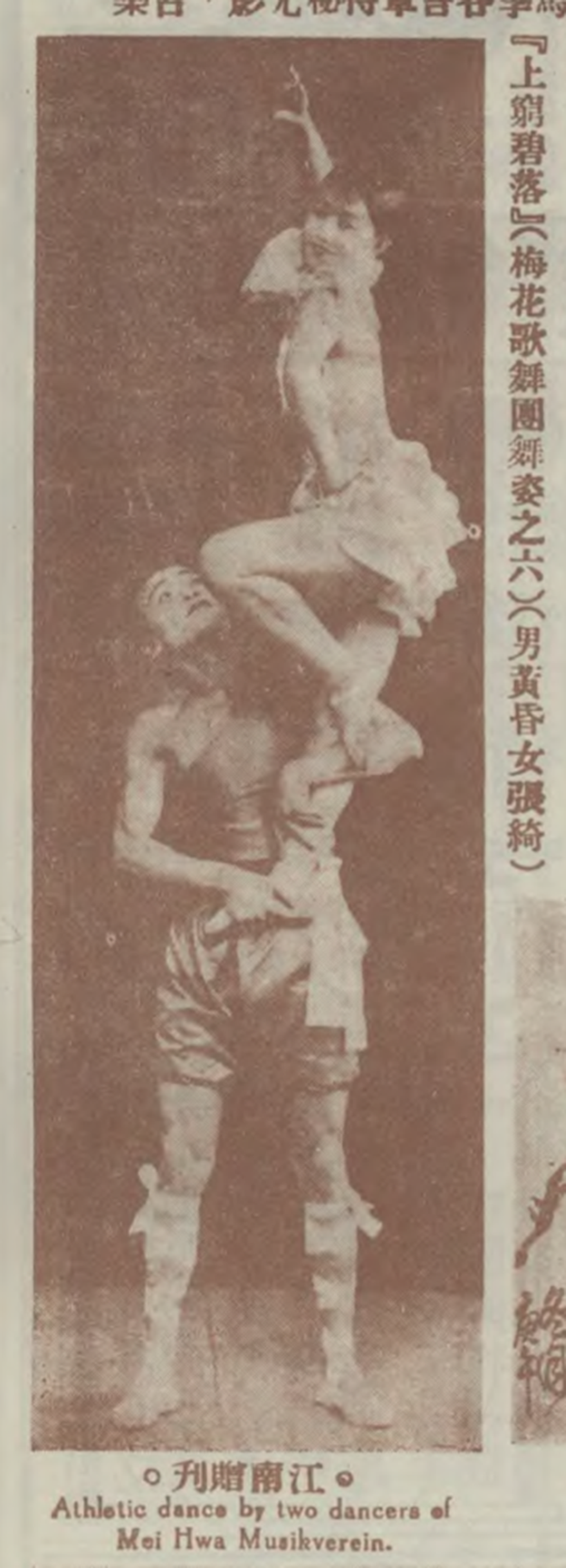
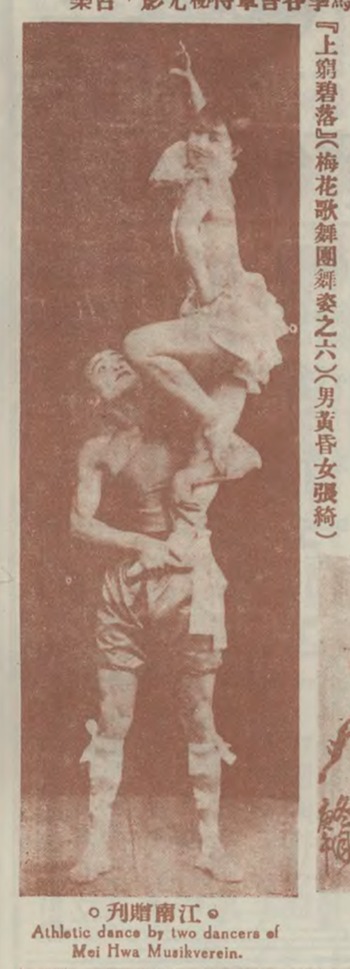
In Dance on Hands, Meihua reinterpreted nationalist themes by transforming dancers into plants, animals, and imagery drawn from traditional Chinese literature, subtly embedding nationalist ideas within their performance. Notably, across the twelve photos published on Beiyang Pictorial each dance pose was accompanied by a poetic description that directly referenced Chinese literati culture. For example, “Riding the Horse while Bending the Bow” (盘马弯弓, pan ma wan gong), a pose described earlier in this article (Fig. 1), draws inspiration from a Tang dynasty poem, Wild Chicken Shot by an Arrow (雉带箭, zhi dai jian). “Powerful as a Flying Dragon” (矫若游龙, jiao ruo you long) is inspired by a poem celebrating the calligraphy of the renowned Eastern Jin dynasty artist Wang Xizhi (王羲之). In this pose, Zhang Qi balances horizontally on Huang Hun’s right shoulder, arms spread wide and legs extended straight back. Another pose, “Searching Thoroughly Up in the Blue Beyond” (上穷碧落, shang qiong bi luo) features Zhang Qi lifted vertically by Huang Hun. With one hand on her hip, a cheeky smile, a tilted gaze toward the audience, and a slightly raised shoulder, Zhang strikes a parallel passé that recalls the flair of jazz dance. This pose is inspired by a stanza from Bai Juyi’s The Everlasting Regret (长恨歌, chang hen ge), a famous Tang dynasty poem (see Fig. 2).
Searching Thoroughly Up in the Blue Beyond.
Jiangnan 江南. 1931. “Shang qiong bi luo” (上穷碧落) [Searching Thoroughly Up in the Blue Beyond]. Beiyang Pictorial 北洋画报 576 (12): 2.
Other poses evoke vivid imagery, such as “A Newborn Swallow Trying to Fly” (乳燕试羽, ru yan shi yu), where Zhang Qi is held horizontally by Huang Hun as if she is soaring through the air. Another, “A Willow Swaying in the Wind” (弱柳迎风, ruo liu ying feng), features Zhang Qi sitting on Huang Hun’s shoulder, extending one leg in an à la seconde position with her arms in third position, a reference to the description of Lin Daiyu’s (林黛玉) posture, the protagonist in Dream of the Red Chamber, a Chinese literary classic. “Waking Up from a Spring Nap” (春眠乍觉, chun mian zha jue) is likely inspired by Meng Haoran’s (孟浩然) Tang dynasty poem Spring Dawn (春晓, chun xiao), where Zhang Qi performs a controlled backbend, creating the illusion of lying flat, while Huang Hun supports her knee and back. The pose “Wandering Dragon Plays with the Phoenix” (游龙戏凤, you long xi feng) shares its name with a well-known Peking opera work and mirrors traditional balletic partnering, with Zhang Qi holding an arabesque while Huang Hun supports her at the knee and shoulder. “Falling Leaves Drift with the Wind” (落叶随风, luo ye sui feng) visualizes the literati metaphor of individuals drifting along with social forces. In this pose, Zhang Qi sits and balances on one foot, leaning backward while extending her arms and legs in opposite directions. Lastly, “Lotus Leaf Holding Up the Rain” (荷盖擎雨, he gai qin yu) presents an opposite interpretation of Su Shi’s (苏轼) depiction of a withered lotus in winter. Here, Zhang Qi is lifted by Huang Hun into an exaggerated arabesque, with her leg representing the strong stem of a lotus and her body forming the lotus leaf, resisting the pouring summer rain.
As I have detailed in the previous section, Meihua’s founder and choreographer, Wei Yingbo, was heavily influenced by Isadora Duncan’s choreography. Beyond adapting Duncan’s corporeal modernity, Dance on Hands may have also drawn inspiration from Duncan’s choreographic methods, particularly her practice of observing and embodying “the figures and forms from ancient Greek artifacts displayed in museums” (Ma as quoted in Chen, H Reference Chen2023, 96). Alternatively, Meihua’s choice to embody literati imageries may also be a choreographic method of Imitation Dance, or Xingyi Wu (形意舞), which shares the same name with a martial art form, Xingyi Chuan (形意拳), that takes animalistic movements as one of its main movement principles (Liu Reference Liu2009). Having personally taught Xingyi Wu (Wang and Long Reference Wang and Long1999, 63), Wei might have adopted the dance’s logic of cross-genre, cross-species imitation and embodiment.Footnote 10 While these connections remain speculative, as I lack direct evidence to definitively prove their influence, the evidence presented points to a strong sense of transmediality, a defining characteristic of early Chinese dance modernism theorized by Nan Ma (Reference Ma2023).
While Western dance scholars have argued that modern (and post-modern) dance’s self-referentiality is a key indicator of its artistic autonomy (Banes Reference Banes1987), Nan Ma asserts that “intermediality” and “transmediality,” the entanglement of dance with other artistic media such as literary narrative and music, should not be seen as a sign of Chinese modern dance’s underdevelopment. Instead, she contends that these strategies were “an effective yet friction-fraught” means for modern dance pioneers to promote dance modernism amid ongoing socio-political upheavals (Ma Reference Ma2023, 21). Amid the looming threats of war and social turmoil, Meihua, a popular song and dance troupe, subtly embedded nationalist themes into its performances while catering to the expectations of popular song and dance entertainment. Advertisements for the troupe emphasized its sensual appeal, guaranteeing the audience would experience the “beauty of the young girls, the legs of young girls, and unparalleled appearance and talent, and the salacious song and dance” (Cao and Nan Reference Cao and Hongyan2022, 60). Yet, inside the theater, audiences encountered nationalist messages, such as those in Dance on Hands, cloaked in the visual spectacle of commercial entertainment. In other words, transmediality functioned not only as a choreographic device that rendered their experiments legible to a Chinese audience but also as a strategic tool: it enabled Meihua to assert political agency while maintaining a façade of commercial entertainment to evade political scrutiny.
However, it remains unclear how or if the meanings and imagery of Dance on Hands were fully conveyed to audiences. Due to the absence of program notes or other documentation of a live performance, there is no direct evidence of how spectators interpreted the work in Meihua’s live performances. Beiyang Pictorial also does not clarify whether the titles of each pose were editorial interpretations or provided by Meihua themself. Nevertheless, if the editorial board could infer the dance’s meanings simply by looking at the photographs, this would further support the success of Meihua’s transmedial strategies.
In her study of the Chinese leftist composer Tian Han’s (田汉) artistic oeuvre and activism in the first half of the twentieth century, Chinese Studies scholar Liang Luo (Reference Luo2014) highlights how during this period, “the avant-garde engaged creatively with popular forms, and both the avant-garde and the popular converged on political engagement” (Luo Reference Luo2014, 7). While Chinese avant-gardists like Tian maintained artistic dialogues with the international aesthetic avant-garde, sharing commitments to stylistic innovation and internationalist visions, they were also deeply involved in social movements, creating works aimed at mobilizing the masses. Figures like Tian and his contemporary Wu Xiaobang exemplify this dual commitment (Luo Reference Luo2014; Ma Reference Ma2023).
Similarly, Meihua’s choreographic and programmatic strategies positioned the troupe within both the political and aesthetic avant-garde, despite its limited political reach due to its primarily educated, bourgeois urban audience. As demonstrated throughout this section, Dance on Hands engaged in hybrid formal experimentation, drawing on ballet and jazz vocabularies and incorporating Hollywood musical aesthetics in its costuming, while thematically referencing traditional Chinese literati culture to inspire modern nationalist expression. The piece exemplifies how the troupe’s choreographic innovation transcended conventional boundaries between high and low art, and between progressive and “decadent” dance forms, integrating formal experimentation with political intent. In doing so, it not only challenges contemporary historians’ dismissal of popular song and dance as mere imitations of ballet or Western vernacular forms, but also positions Meihua among China’s early dance modernists and avant-gardists.
Smiling and Risk-Taking as Feminist Intervention
The 1932 issue of the Youth World Magazine ( 青年世界杂志 qingnian shijie zazhi ) published a portrait of a smiling, dancing Zhang Qi. In the photo, she demonstrates her remarkable flexibility by balancing on one standing leg while holding the other behind her with one hand. Her back bends at an almost impossible angle, yet she faces the camera with a bright smile, so iconic that the caption names her “Dr. Smile” (笑博士 xiao boshi) (Youth World Magazine 1932, 11). While I was not surprised by the publication’s emphasis on her smile, given the long history of pejorative and socially coded connotations of female entertainers’ smiles since imperial China, I was intrigued by how an entertainer had earned the prestigious title of doctor, a term that signifies both expertise and high social status.
The choreography of facial expressions in dance performances must be understood within its social and cultural context. In her monograph on the choreography of the face in U.S. popular dance performance, dance scholar Sherril Dodds asserts that “the design of the dancing face is intentional and practiced across diverse movement idioms, conveying ideas, values, and meanings embedded within the social and aesthetic fabric to which it belongs” (Dodds Reference Dodds2024, 2). Furthermore, while facial expressions can communicate meaning, they can also be choreographed to resist and challenge dominant interpretations. Analyzing the choreography of the smile in Michael Jackson’s performances, Dodds examines how “pedagogies of a smile,” disciplinary regimes shaped by respectability politics and racist stereotypes in the U.S. popular music industry, sought to confine Jackson’s identity within the white spectator’s racist imaginations. However, through facial choreographies of resistance that deviated from prescribed expressions, Jackson actively exposed how these pedagogies upheld outdated and offensive racial tropes (Dodds Reference Dodds2024).
Just as Dodds highlights how racialized pedagogies of smiling sought to fix Jackson’s identity within stereotypes, similar dynamics of discipline and expectation shaped the facial expressions of female performers in imperial China. Smiling has long been a gendered and classed expression in Chinese culture. Maixiao (卖笑), or “selling smiles,” referred to the non-sexual services provided by female courtesans and entertainers, who engaged in poetic exchanges, music, chess, calligraphy, and painting with their male patrons in exchange for financial compensation. Numerous poems document how male literati derived both intellectual and sexual pleasure from these women.Footnote 11 Courtesans and female performers were simultaneously valued for their artistic and intellectual talents and commodified as objects of desire, yet their profession placed them outside Confucian gender norms and denied them opportunities for social mobility. Unlike respectable married women, or liang jia fu nü (良家妇女), who were expected to abide by the “Three Obediences and Four Virtues” (三从四德 san cong si de ) by submitting to male authority and exercising restraint in speech and emotional expression, female performers occupied a precarious social position. They were at once desired and marginalized. In other words, the “pedagogies of a smile” in imperial China reinforced the idea that female entertainers existed to provide entertainment for men, their expressions shaped by expectations of desirability rather than personal agency. It is not surprising, then, that the imagined Empress Zhao Feiyan, with her transgressive sexuality and background as an entertainer, fits the archetype of a maixiao woman, despite her high status.
With the launch of the modernity project during the Republican era, reservedness and emotional composure came to be reframed as forms of feudal emotional oppression (Wang Reference Wang2024, 4). Cultural sociologist Xiaoqing Wang (Reference Wang2024) argues that along with the introduction of humanist aesthetics in the Chinese art field, the bright, toothy smile became a symbol of civilization and beauty for Chinese women. The “pedagogies of a smile” in this era established a new form of expressive etiquette that conveyed “facial naturalness, emotional openness, and bodily liberation” (Wang Reference Wang2024, 12), qualities linked to the elevation of women’s status and, by extension, the symbolic strengthening of China as it pursued modernity and national rejuvenation (Fitzgerald Reference Fitzgerald2008). However, Wang also warns that, particularly during the 1930s, the smile remained a distinctly feminized and commodifiable expression. Through an analysis of advertisements, portraits, and pictorials in popular magazines, she reveals how the idealized feminine smile became intertwined with urban consumer culture, often deployed to sell beauty products and cultivate an image of the cosmopolitan happy consumer and the fascinating identity of a modern woman (Barlow Reference Barlow, Weinbaum, Thomas, Ramamurthy, Poiger, Dong and Barlow2008; Wang Reference Wang2024). While the Republican-era smile signified modernity and progress for women, it simultaneously reinforced gendered expectations, aligning femininity with pleasure, desirability, and visual appeal in the commercial sphere.
While it is expected for both Empress Zhao and Zhang Qi, as performers, to trade in/for smiles, Zhang Qi’s smiles defy both the imperial pedagogies of a pleasing smile and the Republican era pedagogies of a commodifiable toothy smile. Instead, her smiles are a part of the dancer’s choreographic input, playing a crucial role in the dance’s meaning-making process.
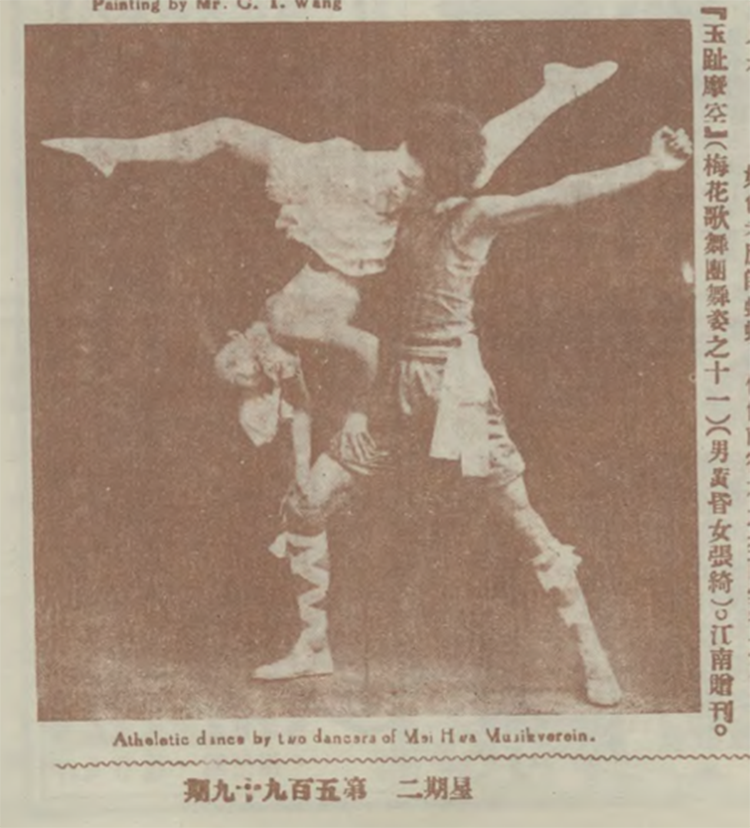
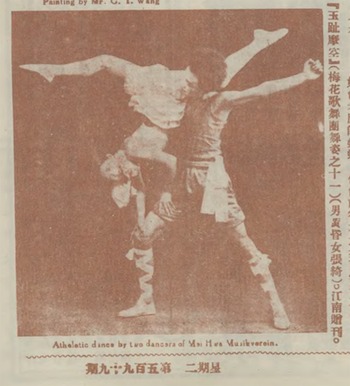
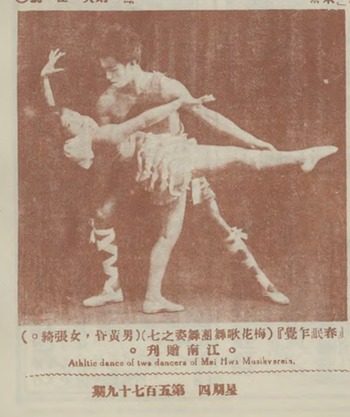
In the pose “Jade-like Toes Touching the Sky” (玉趾磨空, yu zhi mo kong), Zhang performs a handstand with her hands balanced on Huang Hun’s knee, her legs splitting in two directions, one extending over his shoulder. Despite the pose’s difficulty, she turns her head and smiles brightly at the camera with effortless ease, as if declaring her extraordinary physical strength to the audience (see Fig.3). In contrast, in “Waking Up from a Spring Nap” (春眠乍觉, chun mian zha jue), her smile is barely a stretch of the mouth. As she extends her entire body horizontally, supported by a single leg, she creates the illusion of lying flat. Tilting her head slightly toward the camera, only part of her face is visible, while her arms appear mid-motion, as though completing a stretch after waking from sleep (see Fig. 4). In “Lotus Leaf Holding Up the Rain” (荷盖擎雨, he gai qing yu), Zhang directs a full smile toward the sky. Along with her astonishingly high arabesque, her face radiates a sense of bravery and confidence, as if embracing the pouring rain (see Fig. 5).
Jade-like Toes Touching the Sky.
Jiangnan 江南. 1931. “Yu zhi mo kong” (玉趾磨空) [Jade-like Toes Touching the Sky]. Beiyang Pictorial 北洋画报 599 (12): 2.
Waking Up from a Spring Nap.
Jiangnan 江南. 1931. “Chun mian zha jue” (春眠乍觉) [Waking Up from a Spring Nap]. Beiyang Pictorial 北洋画报 579 (12): 2.

Lotus Leaf Holding Up the Rain.
Jiangnan 江南. 1931. “he gai qing yu” (荷盖擎雨) [Lotus Leaf Holding Up the Rain]. Beiyang Pictorial 北洋画报 600 (12): 2.

Yet, her face is not always visible to the audience. In “Riding the Horse While Bending the Bow” (盘马弯弓, pan ma wan gong) (see Fig. 1), Zhang stands atop Huang’s leg in a forward lunge position, arching her entire back and gazing fully upward, her face is invisible in this pose. In fact, a visible smile would be unfitting for a moment of bow-bending tension on the battle field. In “Leaves Falling with the Wind” (落叶随风, luo ye sui feng), she offers a subtly melancholic smile to Huang, who holds her hand as if preparing to spin her, a gesture that symbolizes the wind. This faint smile conveys a sense of surrender, aligning with the pose’s metaphor of drifting fates (see Fig. 6).
Leaves Falling with the Wind.
Jiangnan 江南. 1931. “luo ye sui feng” (落叶随风) [Leaves Falling with the Wind]. Beiyang Pictorial 北洋画报 575 (12): 2.

Across the twelve photographs of Dance on Hands, Zhang Qi deliberately choreographs her smile. By curating its shape, angle, and direction, she actively shapes the meaning of each pose. Her agency lies in the artistic visualization of the literati images rather than in entertaining or enabling consumerist desires. In doing so, she challenges the “pedagogies of a smile” as a symbol of submission or a tool for pleasing and appeasing others, particularly male desires.
In addition to an agentive rejection of the pedagogies of a smile, Zhang also actively risks herself in their partner work to visualize the literati images. In analyzing the critical reception of ballet dancers Wendy Whelan and Jock Soto’s interpretation of the ballet After the Rain (2005), dance scholar Clare Croft (Reference Croft2014) advocates for a feminist approach that acknowledges the shifting, complicated power dynamics between the duet, rather than treating the female dancer in ballet as mere object of desire situated in ballet’s dramaturgical structuring of heterosexual love. Croft deems, and I extend her argument, that female dancers “deserve to be viewed as subjects capable of desire, action, and agency” within any dance work (214). With this, I read the difficult poses in Dance on Hands as not simply the result of a lift where the male partner elevates and manipulates the female partner into positions.
In poses like Flying Away into the Heaven and Riding the Horse while Bending the Bow, described earlier in this article (Fig. 1), Zhang Qi’s elevated position prevents her male partner from controlling her upper body movements. Yet it is precisely these upper body movements that most vividly embody literati imagery. The outstretched arms and gravity-defying forward lean of Flying Away into the Heaven create an ethereal visual effect, while the suspended, elevated backbend in Bending the Bow while Riding a Horse emerges from acts of experimentation and risk-taking, of Zhang’s own agency, as Huang Hun’s hands remain occupied stabilizing her legs. In contrast to Empress Zhao Feiyan, who risked her life for the male sovereign’s attention, Zhang Qi’s risk-taking becomes a feminist intervention in Republican era performance culture, reclaiming agency and redefining the dynamics of bodily expression on stage.
It is difficult for a contemporary audience to grasp the shock value of seeing bare-limbed female and male dancers in close embrace in the 1930s, a time when feudal gender norms had only recently begun to crumble both on stage and in everyday life. As mentioned earlier, female performers were still widely regarded as sexually available (Goldstein Reference Goldstein2007). While Zhang and Huang’s performance adhered to conventions of gendered partnering, where the male dancer provides support and lifts the female dancer, reading Dance on Hands solely through a male-centered lens overlooks Zhang Qi’s active agency. Through her physical risk-taking and agentive choreography in the dance’s meaning-making, Zhang Qi disrupts unidirectional spectatorship, asserting herself as the subject rather than a passive receiver of the audience’s gaze. In doing so, she reclaims performative space, resisting the sexualized narratives imposed on female performers and challenging the entrenched artistic and social tropes that seek to define them.
Conclusion
As I have demonstrated throughout this article, Dance on Hands precariously balances on the margins of past and present, popular and avant-garde, and the new and the old. It cannot simply be dismissed as an imitation of Western popular dance, nor is it devoid of artistic and social significance. Instead, by evoking and rewriting the “morbid” femininity of Empress Zhao Feiyan, Dance on Hands brings two contrasting visions of femininity into focus, complicating dominant narratives of gender and modernity within China’s colonial modern context.
Through Zhang Qi’s dancing body, Empress Zhao Feiyan is “reincarnated” as a woman in control of her own physicality. Her vigorous and robust movements simultaneously index a national pursuit of a stronger population and an aspiration toward Euro-American femininity, which was perceived at the time as evolutionarily advanced. However, the choreography resists positioning the female dancer as merely a copy of Western corporeal modernity. Rather than reenacting or abandoning the frail and tragic image of Zhao Feiyan, Meihua reimagines her in a gesture of salvation, one that embodies a dialectical understanding of past and present. In doing so, Meihua’s work becomes an act of self-salvation, albeit one shaped by an ambivalent desire for Euro-American feminine ideals.
Despite media portrayals that framed the troupe’s performances as salacious spectacles, Meihua continually engaged with local cultural references to inspire nationalist expressions. Their works actively negotiated ideological tensions, mobilizing popular performance to cite and incite nationalism amidst the ongoing wars. By foregrounding the aesthetic and ideological convergences between popular culture and the avant-garde, I argue that Meihua exemplifies the transmediality that defines early Chinese dance modernism. Like their contemporaries Tian Han and Wu Xiaobang, Meihua’s dual consciousness of national well-being and choreographic innovation positioned them at the intersection of political and artistic avant-garde.
Finally, far from being a passive recipient of the audience’s projections and desires, Meihua’s Zhang Qi actively shaped spectatorship through her rejection of the “pedagogies of a smile” for female performers. Unlike conventional expectations, her smiles were not merely tools of seduction or commodification but integral to the meaning of the dance itself. Her risk-taking physicality affirmed her role as a subjective creator rather than an attachment to her male partner. Ultimately, Dance on Hands emerges not as an erotic spectacle but as a feminist experiment that challenges conventional gendered expectations. Throughout Dance on Hands, Meihua traverses the racialized, classed, and gendered boundaries between the popular and the avant-garde, demonstrating how women in early Chinese popular performance actively negotiated agency, representation, and national identity.



 Open access

