


In low and middle-income countries (LMIC), depression is increasingly recognised as a public health problem due to its myriad consequences. The prevalence of depression is higher among women than men in both developed and developing countries and is often higher overall in low-income settings(1–Reference Ferrari, Charlson and Norman4). The risk of depression is even higher among postpartum women, including those in LMIC, most likely due to a combination of biological, socio-economic and psychological factors(Reference Fisher, Mello and Patel5).
Parental mental health problems are linked to a host of problems for families such as unemployment and conflict, which in turn can negatively affect the well-being of children and other family members(Reference Manning and Gregoire6–Reference Patel8). Maternal depression has been associated with a 1·53 odds of obesity in a high-income country(Reference LaCoursiere, Baksh and Bloebaum9) as well as child social, emotional, behavioural and cognitive development problems(Reference Gupta and Ford-Jones10–Reference Patel, Rahman and Jacob13). One study in the UK linked depressive symptoms during pregnancy with poor nutrition and even poor cognition in children(Reference Barker, Kirkham and Ng14). Women who are depressed may be less able to focus on their own needs and the needs of their children, including being able to perceive and respond to a child’s expression of hunger, happiness or distress(Reference Pottinger, Trotman-Edwards and Younge15). Maternal depression can reduce health care seeking behaviour, influence breast-feeding practices or modify dietary practices, which makes children of mothers with depressive symptoms more susceptible to growth faltering(Reference Patel, Rahman and Jacob13,Reference Emerson, Tol and Caulfield16–Reference Stewart18) . There are few studies to date assessing the relationship between maternal depression and child health and nutrition in LMIC(12), and the results from existing studies are mixed. Studies have shown that maternal depression is associated with a 2–3-fold increased risk of underweight and stunting(Reference Rahman, Iqbal and Bunn19) and inversely associated with breast-feeding duration(Reference Henderson, Evans and Straton20), whereas a prospective study in Brazil found no association between maternal depression and child malnutrition(Reference Lima, Maciel and Alencar21). The field of nutritional psychiatry recently highlighted evidence gaps related to diet, nutrition, mental health and well-being(Reference Marx, Moseley and Berk22).
There is also evidence that paternal depression may have a negative impact on maternal and child well-being(Reference Ramchandani, Psychogiou and Vlachos23). A recent systematic review indicated that paternal depression is negatively associated with child social, emotional and behavioural function(Reference Glasser and Lerner-Geva24). The impact of paternal depression on their own, maternal and child nutrition in LMIC, however, has not been studied.
In Nepal, the recently reported suicide mortality rate of 8·8 per 100 000 indicates that mental health problems are a public health issue(Reference Upadhyaya and Pol25–27). Surveys indicate that close to 12 % of adults in Nepal suffer from depressive symptoms(Reference Risal, Manandhar and Linde28). Large surveys using the nine-question Patient Health Questionnaire (PHQ-9) found that women are at higher risk for depression than men (20 v. 11 %)(Reference Luitel, Baron and Kohrt29). Studies suggest that perinatal women are even more at risk of depression. Studies in Nepal using the Edinburgh Postnatal Depression Scale found that between one-fifth and one-third of postpartum mothers screened positive for depression(Reference Giri, Khatri and Mishra30,Reference Joshi, Shrestha and Shrestha31) . To our knowledge, no one has examined whether maternal depression in Nepal is associated with maternal and child nutrition, including maternal and child dietary practices. Furthermore, no study has assessed paternal depression and its association with paternal and child nutritional status and dietary practices. This study, therefore, aims to assess the associations between parental depression (both maternal and paternal) with parental and child nutritional status and diets in Nepal.
Methods
We used a cross-sectional data set, which was originally collected as an annual monitoring survey for Suaahara. A United States Agency for International Development-funded multi-sectoral programme was implemented in forty-two of Nepal’s seventy-seven districts. A local survey firm conducted this survey during the 2017 rainy season, using a multi-stage cluster sampling design. Initially, sixteen of the forty-two Suaahara districts were selected based on population proportion to size. Then, two municipalities (one urban and one rural) per district (n 32), three wards per municipality (n 96) and two clusters (sub-wards) per ward were selected (n 192), all also based on population proportion to size. In the final stage, nineteen households with children <5 years of age were randomly selected, after a full household listing in each cluster was done (n 3648).
An interviewer-administered questionnaire was conducted with mothers and fathers (when available) that included questions on: household demographics and socioeconomics; infant and young child feeding practices; 24-h dietary recalls (i.e. collecting data on each food and summing the number of food groups consumed) for the father, mother and youngest child (the child’s dietary recall was done by the mother); and the psychosocial well-being of the mother and father, which measured depression using the PHQ-9 screening tool. Anthropometric measurements of all mothers and the youngest child were taken by trained and standardised anthropometrists. Height (for women and children 2 years and older) and recumbent length (for children under 2 years) were measured in duplicate to the nearest 0·1 cm using a Shorr board. Weight was measured once to the nearest 0·1 kg using an electronic digital Seca scale (model number 874).
For this analysis, we excluded households in which the child was <6 months (n 456) as babies should be exclusively breastfed. They should not start eating semi-solid and solid foods during the first 6 months of life. We also excluded households for which the necessary information was unavailable: including PHQ-9 (n 4), child dietary diversity (n 22), maternal dietary diversity (n 2) and maternal BMI (n 4). Likewise, based on WHO guidelines, outliers for child anthropometry were excluded: length/height-for-age z-score (>6/<−6) (n 13), weight-for-length/height z-score (>5/<−6) (n 14) and weight-for-age z-score (>5/<−5) (n 5)(Reference Crowe, Seal and Grijalva-Eternod32) (Fig. 1).
Process of sample selection. PHQ-9, nine-question Patient Health Questionnaire

Maternal and paternal depression, the primary exposure variables, were measured based on the PHQ-9. With four-point scale answers for each of nine questions, the possible scores ranged from 0 to 27, with higher scores indicating more symptoms of depression. The validated Nepalese PHQ-9 has a sensitivity of 94 % and specificity of 80 % with a cut-off of ≥10 to detect moderate to severe depression(Reference Kohrt, Luitel and Acharya33).
The primary outcome variable of dietary diversity was assessed based on the foods consumed during the 24 h prior to the survey. These foods were grouped into food groups, and continuous dietary diversity scores were generated. For adults, the ten-food group women’s dietary diversity score measure was used, which includes the following ten-food group: (1) grain, roots, tubers and plantains; (2) pulses; (3) nuts and seeds; (4) dairy; (5) meat, poultry and fish; (6) eggs; (7) dark green leafy vegetables; (8) vitamin-A-rich fruits and vegetables; (9) other vegetables and (10) other fruits(34). Child dietary diversity was assessed using the recommended and standardised seven-food group measure, which includes the following food groups: (1) grain, roots, tubers and plantains; (2) legumes and nuts; (3) dairy; (4) meat, poultry and fish; (5) eggs; (6) vitamin-A-rich fruits and vegetables and (7) other fruits and vegetables(35). The possible scores, thus, ranged from 0 to 10 for adults and 0 to 7 for children. Binary variables were created to indicate whether the individual achieved minimum dietary diversity, defined as consuming foods from at least five or more of ten-food group(34) for mothers and fathers and four or more of seven-food group for children(35).
Child nutritional status was measured based on the three anthropometry indicators of stunting, wasting and underweight, classified based on the cut-offs of –2 sd of length/height-for-age z-score, weight-for-length/height z-score and weight-for-age z-score, respectively. Likewise, women’s nutritional status was measured as underweight (BMI < 18·5) and overweight/obesity (BMI of 25 or more).
The following potential socio-economic and demographic confounders were selected based on prior similar studies and knowledge of the local context: socio-economic well-being, caste/ethnicity, agro-ecological zone, age, schooling, number of children <5 years, and whether the mother is also the household head. Socio-economic well-being was measured using equity quintiles which captures relative wealth and is based on a score for ownership of selected household assets (television, fan, chair, cupboard, sofa and table) and types of housing materials (cooking fuel and floor, roof and wall materials) (for more information please see: https://www.equitytool.org/nepal-2/). The caste/ethnicity variable classified all Nepalis into socially excluded, Brahmin/Chhetri, and others. Agro-ecological zone was a categorical variable to denote differences in residency in the mountain, hills and terai (plains). Age was measured based on completed months (children) and years (adults); maternal and paternal schooling was measured based on number of completed years of formal schooling. Number of children <5 years in the household was a categorical variable to differentiate households with only one child <5 years v. those with more. A binary variable was created to denote if the mother was the head of household or not.
To explore associations of parental depression and their own and their child’s diet and nutritional status, logistic regression models were used. All potentially confounding variables and clustering (sub-ward, primary sampling unit) were adjusted for in the final models. All data analyses were performed in Stata14.
Results
Characteristics of the study population
Interviews with 3642 randomly selected households with children <60 months were completed. Data from 3158 mothers, 826 fathers and 3158 children were analysed. On average, mothers were 27 years old and had completed 6 years of formal schooling, whereas fathers were, on average, 33 years old and had completed an average of 6·5 years of formal schooling. Surveyed households had an average of five household members. Nearly half of the respondent households belonged to the socially excluded caste/ethnic group, half were from the two poorest equity quintiles and more than half resided in the hilly areas (Table 1).
Sociodemographic characteristics of study participants

PHQ-9, nine-question Patient Health Questionnaire.
* Dalit, Muslim, Disadvantaged Janajati.
† Newar, Gurung/Thakali, Non-Dalit tarai, other.
In this study population, about 5 % of mothers and 3 % of fathers suffered from symptoms of depression, based on the PHQ-9 cut-off score of 10 or above. About 17 % of mothers were underweight (BMI < 18·5 kg/m2) and 15 % overweight/obese (BMI ≥ 25 kg/m2). The prevalence of child stunting, wasting and underweight was 28, 11 and 23 %, respectively. Standards for minimum dietary diversity were met by 36 % of mothers, 37 % of fathers and 55 % of children (Table 1).
When exploring dietary diversity by background characteristics, some patterns emerged. The prevalence of meeting minimum dietary diversity was higher among children Brahmin/Chettri caste/ethnic groups (62 %), in comparison with socially excluded (50 %) and other caste/ethnic groups (50 %) (P = 0·003); a similar pattern emerged for mothers and fathers, but the differences were not statistically significant. We also found variation by agro-ecological zone for the prevalence of meeting minimum dietary diversity for mothers (mountains: 44 %, hills: 39 % and terai: 26 %; P = 0·000), fathers (mountains: 43 %, hills: 42 % and terai: 25 %; P = 0·000) and children (mountains: 56 %, hills: 58 % and terai: 48 %; P = 0·000). The prevalence of meeting minimum dietary diversity also varied by socio-economic status with an increasing prevalence from the lowest to the highest equity quintiles for mothers (28–42 %; P = 0·000), fathers (25–61 %; P = 0·000) and children (53–63 %; P = 0·000). The prevalence of obtaining minimum dietary diversity was lower in households with more than one child under 5 years for all respondents but significantly different only for mothers (36 v. 31 %; P = 0·019) and children (56 v. 47 %; P = 0·000). Finally, more mothers met minimum dietary diversity when she herself was not the household head (39 v. 31 %; P = 0·000) (see online supplementary material, Supplemental Table 1).
Similarly, we conducted unadjusted analyses of depression by background characteristics. We found no significant variation by caste/ethnic group. By agro-ecological zone, the prevalence of depression varied among both mothers (mountains: 6 %, hills: 6 % and terai: 2 %; P = 0·000) and fathers (mountains: 6 %, hills: 3 % and terai: 2 %; P = 0·014). The highest prevalence of depression was found among the poorest, with a range from lowest to highest equity quintile for mothers (7–2 %; P = 0·000) and fathers (8–4 %; P = 0·011). The prevalence of depression did not vary by number of children under 5 years among fathers but was higher among mothers with more than one preschool child (4 v. 6 %; P = 0·044). Mothers in households where she is the household head v. someone else (her spouse or in-law) were more likely to have depressive symptoms (4 v. 6 %; P = 0·006) (see online supplementary material, Supplemental Table 1).
Parental depression and minimum dietary diversity
Maternal and paternal depression were not associated with achieving minimum dietary diversity for themselves or their children. Instead, maternal and paternal education, ethnicity, agro-ecological zone and equity quintile were associated with minimum dietary diversity across all groups. Mothers who were household heads and mothers and children in households with more than one preschool child were less likely to have achieved minimum dietary diversity (Tables 2 and 3). We also ran separate models to test if child age (6–23·9 v. 24–59·9 months) or maternal age (less than 25 v. 25 years or more) influenced the association between depression and child diet or other factors, but the results did not differ from the results of the overall group (see online supplementary material, Supplemental Tables 2 and 3).
Associations between maternal depression and maternal and child (6–59·9 months) minimum dietary diversity (N 3158)
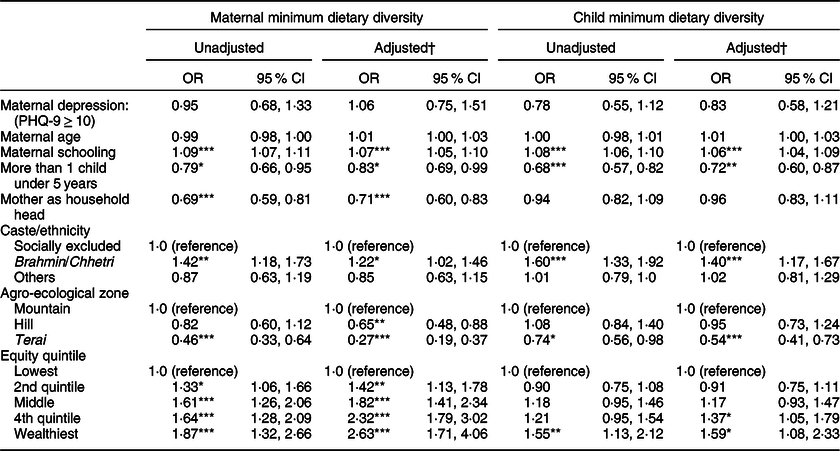
PHQ-9, nine-question Patient Health Questionnaire.
† Adjusted for maternal age, year of schooling, more than one child less than five, mother household head, caste/ethnicity, agro-ecological zone and equity quintile.
*P < 0·05, **P < 0·01, *** P < 0·001.
Association between paternal depression with paternal and child (6–59·9 months) minimum dietary diversity (N 826)

PHQ-9, nine-question Patient Health Questionnaire.
† Adjusted for paternal age, year of schooling, more than one child less than five, mother household head, caste/ethnicity, agro-ecological zone and equity quintile.
*P < 0·05, **P < 0·01, *** P < 0·001.
Maternal depression and maternal nutritional status
A depressed mother was 1·5 times more likely to be underweight, but there was no association with overweight. Mothers from the upper privileged caste/ethnic groups had nearly two times increased odds of being underweight, in comparison with those from socially excluded groups. Older maternal age, more years of schooling and being from a higher equity quintile, however, were all significantly associated with an increased risk of being overweight (Table 4).
Associations between maternal depression and maternal underweight and overweight (N 3158)

PHQ-9, nine-question Patient Health Questionnaire.
† Adjusted for maternal age, year of schooling, more than one child less than five, mother household head, caste/ethnicity, agro-ecological zone and equity quintile.
*P < 0·05, **P < 0·01, *** P < 0·001.
Parental depression and child nutrition status
Neither maternal nor paternal depression was associated with child stunting, wasting or underweight after adjusting for potential confounding factors. In both maternal and paternal models, the factors most strongly associated with child anthropometry were agro-ecological zone and socio-economic status, with parental education and household size also often being a significant factor. For example, in the maternal models, children from the highest socio-economic groups were less stunted and less underweight. Furthermore, children living in the terai had almost six times the odds of being wasted and three and a half times the odds of being underweight. Finally, similar to the maternal nutrition results, in the maternal depression and child anthropometry analysis, we found children from the upper caste groups had about 1·5 times the odds of being wasted and underweight than children from the socially excluded caste/ethnicity groups (Tables 5 and 6).
Associations between maternal depression and child (6–59·9 months) nutritional status

PHQ-9, nine-question Patient Health Questionnaire
† Outliers are excluded.
‡ Adjusted for maternal age, year of schooling, more than one child less than five, child age and sex, mother household head, caste/ethnicity, agro-ecological zone and equity quintile.
*P < 0·05, **P < 0·01, *** P < 0·001.
Associations between paternal depression and child (6–59·9 months) nutritional status

PHQ-9, nine-question Patient Health Questionnaire.
† Outliers are excluded.
‡ Adjusted for paternal age, year of schooling, more than one child less than five, child age and sex, mother household head, caste/ethnicity, agro-ecological zone and equity quintile.
*P < 0·05, **P < 0·01, *** P < 0·001.
Discussion
This study explores associations between parental depression and parental and child dietary diversity and anthropometric status in Nepal. In our sample, the percentage of parents suffering from depression was low, based on a dichotomous indicator using the PHQ-9 screening tool, whereas child undernutrition was high and the diets of just over one-third of parents and half of children achieved minimum dietary diversity. In this context, we found maternal depression is positively associated with maternal underweight, but not maternal overweight. The wealth status of the households is associated with overweight, a finding that is consistent with the results of several studies in LMIC(Reference Gouda and Prusty36–Reference Al Kibria38). We did not find any associations between paternal depression and paternal diets or between parental (maternal or paternal) depression and child dietary diversity or anthropometric status.
The findings that mothers and children from upper caste households, in comparison with those from socially excluded caste groups, had increased odds of obtaining minimum dietary diversity but were also at increased odds of being underweight were counterintuitive. Since minimum dietary diversity does not capture the quantity of food in the diet or nutritional adequacy(Reference Ruel, Harris, Cunningham, Preedy, Hunter and Patel39), it may be that those from upper caste groups consume less food but overall from more food groups. For example, in our data set, only 16 % of Brahmin/Chettri mothers consumed meat, a nutrient-dense food, v. 35 % of mothers from socially excluded caste groups (P: 0·20) (additional food group-specific results by caste/ethnicity is presented in Appendix 1 in online supplementary material). Furthermore, results may reflect differences among caste/ethnicity groups on factors not available in the data set or that require complementary qualitative research, such as intra-household food allocation and dynamics, fasting, food taboos and deference to senior household members which other studies have noted as factors influencing women’s diets in Nepal(Reference Morrison, Dulal and Harris-Fry40).
Our results that maternal depression and child anthropometry are not associated in Nepal differ from findings reported in systematic reviews and meta-analyses of studies from LMIC. Others found maternal depression was strongly associated with child stunting (OR = 1·4; 95 % CI 1·20, 1·70) and underweight (OR = 1·50; 95 % CI 1·20, 1·80)(Reference Surkan, Kennedy and Hurley17). Additional studies in South Asia have reported similar findings. In urban Pakistan, Saeed et al. found increased odds of stunting (OR = 3·15; 95 % CI 1·91, 5·18) and underweight (OR = 3·26; 95 % CI 1·99, 5·34) in children under 2 years when their mothers were screened for depression using the Edinburgh Postnatal Depression Scale(Reference Saeed, Shah and Inam41). Likewise, a study in Andhra Pradesh and Telangana in India, using the Self-Reporting Questionnaire, found that depressive symptoms in mothers were associated with children being stunted at 1 year of age (OR = 1·18; 95 % CI 1·03, 1·35)(Reference Bennett, Schott and Krutikova42). A second study in rural India found that depression in mothers was linked to stunting (OR = 1·47; 95 % CI 1·09, 1·98) and underweight (OR = 1·39; 95 % CI 1·49, 2·49), but only in the group that screened positive for severe depression, with no association found between child growth and moderate depressive symptoms(Reference Nguyen, Friedman and Kak43). Our null findings for child outcomes are similar to a recent study in an urban area of Northern Ghana that also found that maternal depression, measured using the Centre for Epidemiologic Studies-Depression, was not associated with minimum dietary diversity (OR = 1·28; 95 % CI 0·68, 2·39) or stunting among children 6–23 months of age (OR = 1·05; 95 % CI 0·58, 1·91)(Reference Wemakor and Iddrisu44). The inconsistency in study findings is likely due at least in part to substantial variation in the screening tools used to measure depression, study designs, age ranges of children and mothers, settings (e.g. rural v. urban), cultures and other factors. For example, Saeed and colleagues’ study in Pakistan included children under 2 years(Reference Saeed, Shah and Inam41) and Bennett and colleagues’ study in India included children <1 year(Reference Bennett, Schott and Krutikova42), although both studies found significant association between maternal depression and child stunting.
The underlying prevalence of depression in the population may also influence findings and thus be another contributing factor to the inconsistency in study findings to date. In Nepal, the reported prevalence of maternal depression has ranged from 5 to 30 %; this variation can be similarly explained by methodological differences, variation in screening tools and studies taking place in different sub-populations or communities(Reference Giri, Khatri and Mishra30,Reference Joshi, Shrestha and Shrestha31,Reference Lam, Fitzpatrick and Shrestha45,Reference Luitel, Jordans and Kohrt46) . Giri and colleagues’ finding that depression increases with maternal age, for example, may explain why our study sample, within which the average age is 27 years old, had low levels of depression(Reference Giri, Khatri and Mishra30). Several tools to measure depression have been validated in Nepal, but among different populations. The Centre for Epidemiologic Studies-Depression tool was validated in community settings for adults 55 years and older(Reference Shrestha47). The Edinburgh Postnatal Depression Scale was validated in health facilities in Nepal among postpartum mothers attending child immunisation clinics(Reference Bhusal, Bhandari and Chapagai48). The PHQ-9 was also validated in Nepal in primary care settings(Reference Kohrt, Luitel and Acharya33). Luitel and colleagues also used the PHQ-9 tool with the same cut-off score (≥10), among women seeking healthcare in a primary health care centre. Their screening found about 20 % of women aged 18 years and above were depressed(Reference Luitel, Baron and Kohrt29). Since the PHQ-9 is validated in Nepal in the primary care setting and not in a community setting, it could be that the tool did not perform well in this community survey or that the prevalence of depression among the general population is much lower than the prevalence among those seeking healthcare.
Several limitations of this study are worth mentioning. First, because this study was based on cross-sectional survey data, establishing causal relationships between depression and nutrition is not possible. Second, the measure of depression is a current measure, whereas stunting reflects deprivations that occurred in the past, which is especially problematic for these analyses among older children. Third, there is strong social stigma surrounding mental illness in Nepal (and in other LMIC)(Reference Luitel, Jordans and Kohrt46,Reference Luitel, Jordans and Adhikari49) , and therefore, data collected by enumerators who do not specifically work in mental health may have also impacted the results found, including a potential under reporting of depressive symptoms. Fourth, the PHQ-9 was incorporated into a long multi-sectoral questionnaire. Enumerators may not have had the time needed to build rapport with participants on such a sensitive topic to elicit nuanced or accurate responses. Fifth, the tool used to asses dietary diversity of children 6–59·9 months has only been validated for children aged 6–23 months. Extension of this tool is a common practice, however, because there are currently no official indicators for children older than 23 months(Reference Busert, Neuman and Rehfuess50,Reference Rakotonirainy, Razafindratovo and Remonja51) . Likewise, there is no validated tool for assessing dietary diversity of men, so we used the WDDS, which was validated for women of reproductive age. Finally, this survey only included a 24-h food recall measure at one point in time; these measures do not ascertain nutritional composition of the diet and are prone to recall and social desirability biases. On the other hand, there are several strengths of this study including its large sample size and that it is representative of over half of the country. It is the first study to report on relationships between mental health and nutrition in Nepal and the first study globally to assess depression of both parents. It is also the first study to examine whether paternal depression is related to diets and child stunting, wasting or underweight, which is important given overall family dynamics not solely dominated by mothers in household decision-making, control of income and other factors of importance for childcare.
Conclusion
While improving mental health is important independent of its links to other health outcomes, the evidence for it being a potentially strong intervention point for improving diets and nutritional status in South Asia is mixed. Additional studies are needed, including cohort studies, to further investigate the prevalence of depression in Nepal, associated factors, and what the effects of depression might be in this setting. There have been studies, including a recent systematic review of trials, to assess the effect of dietary interventions on anxiety and depression(Reference Firth, Marx and Dash52), but further studies are needed to clarify what intervention components may also help address mental health problems and their underlying mechanisms for reducing depression and anxiety. Similarly, research is needed to clarify whether interventions to reduce maternal depression can contribute to reductions in undernutrition. This study’s findings echo a previous study in Nepal which highlighted that key components for reducing undernutrition in Nepal have increased access to education, reductions in poverty, improvements in sanitation and hygiene and increased health service access(Reference Cunningham, Headey and Singh53). Furthermore, it is plausible that mental health issues will also benefit from such a comprehensive approach.
Acknowledgements
Acknowledgements: The authors acknowledge USAID for providing support to conduct this study. This publication was prepared using data from Suaahara II. The contents of this publication are the sole responsibility of the authors and do not necessarily reflect the views of USAID or the United States Government. The authors are also thankful to the survey firm and all study respondents for their time and valuable inputs. Financial support: This study was funded by the United States Agency for International Development (USAID) under a Cooperative Agreement (No. AID-367-A-16-00006) between USAID and Helen Keller International. Conflict of interest: The authors declare no conflicts of interest. Authorship: K.C., R.W. and R.P.A. designed and conducted the research. R.P.A. and R.W. analysed data and prepared the first draft. All authors reviewed multiple versions of the manuscript and read and approved the final version for submission. Ethics of human subject participation: This study was conducted according to the guidelines laid down in the Declaration of Helsinki, and all procedures involving study participants were approved by the Nepal Health Research Council (Reg. No. 1620/2017). Written informed consent was obtained from all subjects/patients.
Supplementary material
For supplementary material accompanying this paper visit https://doi.org/10.1017/S1368980020000968



