

I. Introduction
In the later fifth century BC, Greek astronomers began producing parapēgmata, documents enumerating predicted astronomical and meteorological changes throughout the year. Over the subsequent four centuries, numerous scientific authorities produced their own such almanacs; by the end of the Hellenistic period, astrometeorological parapēgmata had come to be used widely throughout the Greek-speaking world, including by poleis that published their own such calendars. But while the scientific context of this development has been much discussed in scholarship, there has been relatively little reflection on what practical purpose these documents, whether literary or inscribed, served.Footnote 1
In this article I explore the possible uses of these almanacs within Hellenistic poleis with reference to three points. First, by the second century BC at the latest a variety of parapēgmata attributed to different authorities, many produced in disparate regions of the Mediterranean and emphasizing distinct atmospheric phenomena, were circulating throughout the Greek-speaking world, and individuals or communities compiled them, or selections from them, to produce their own such calendars. Second, these meteorological schemes were of interest to the politically engaged citizens of poleis because the organization of collective responses to the impacts of irregular weather on the food supply fell predominantly to civic governments, and these calendars were regarded as authoritative tools for monitoring and anticipating meteorological developments. Third, parapēgmata would have been of great use to doctors, particularly the itinerant physicians employed by many poleis to attend to their citizens, because Greek medical orthodoxy held that changes in the weather had important effects on illnesses at both an individual and a community level, and thus that meteorological forecasting was a crucial means of improving prognoses.
II. The nature of astrometeorological parapēgmata
Premodern societies generally anticipated meteorological fluctuations within a ‘normal envelope’ determined by a body of social memory extending back several generations, perceiving irregular weather events to be atmospheric phenomena that transgressed the bounds of the normal envelope in perceptible ways.Footnote 2 In Greek folk meteorology, first attested by Hesiod’s Works and Days, astronomical markers and simple day counts were used to anticipate seasonal weather changes, while prognosticatory natural phenomena, so-called weather signs, were used to anticipate short-term meteorological developments.Footnote 3 Over time, this tradition of meteorological observation and prognostication led to the development of increasingly elaborate models, attested in detail for the first time in the fifth century BC by preserved medical and astronomical texts.Footnote 4
In the late fifth century BC, two Athenian astronomers, Meton and Euktemon, for the first time produced calendars that recorded the occurrences of sidereal and atmospheric phenomena throughout the year with greater precision.Footnote 5 They were soon followed by others who produced their own such calendars, which by ca. 300 BC at the latest came to be compiled into texts called parapēgmata. Footnote 6 As the name (derived from the verb parapēgnumi, ‘to insert something beside’) implies, these were originally physical documents that allowed for celestial phenomena to be tracked using pegs inserted into holes, one for each day of the year.Footnote 7 While, as will be discussed below, it is clear that many came to believe that parapēgmata were valuable tools for predicting weather patterns, it is unclear how normative their creators believed or intended the meteorological data included in them to be; as such, I will generally refer to these data as weather observations rather than predictions.
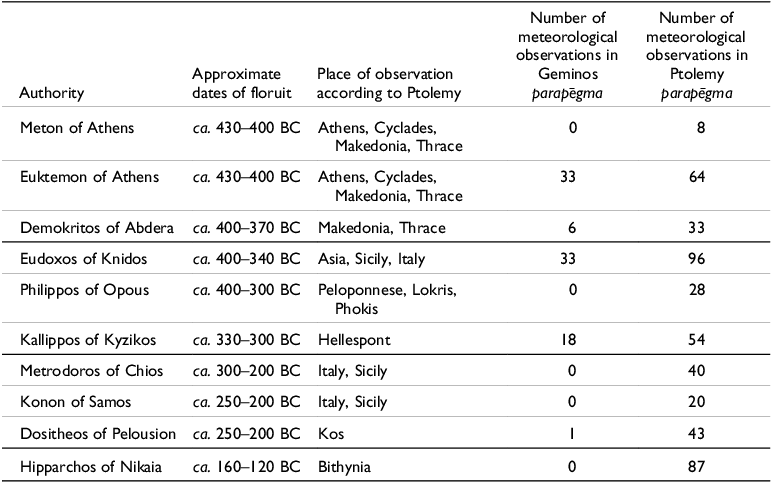
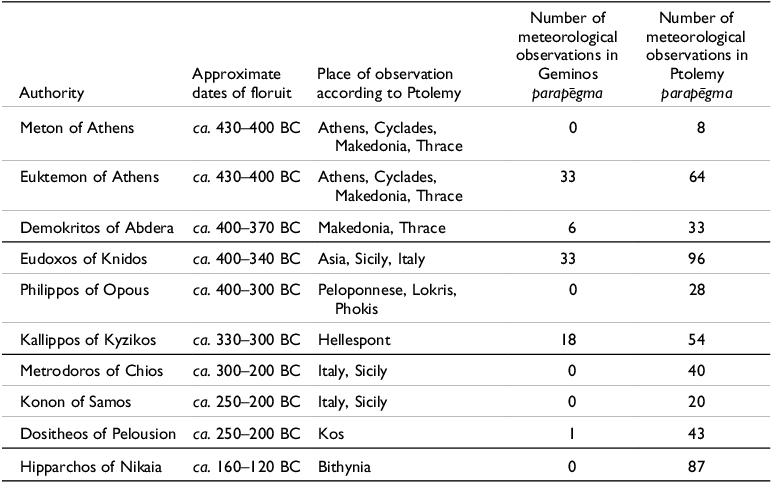
The weather observations compiled in these calendars are typically succinct. Apart from generic entries stating only that a weather change was ‘signalled’ (episēmainei) on a certain day, which were probably intended to advise the reader on when to remain vigilant for indicators of impending weather changes that could have been interpreted using knowledge of weather signs,Footnote 8 they most often reference precipitation, storms and winds. The early parapēgmata of Meton and Euktemon are not well understood, as they are only attested through scattered references in later documents.Footnote 9 Nonetheless, these references suggest that while Meton’s astrometeorological observations were sparse, Euktemon’s were considerably more numerous,Footnote 10 a development that was to have important consequences for the creation of detailed meteorological schemes.Footnote 11 Between the fourth and first century BC, several other individuals produced their own astrometeorological almanacs, some of which included numerous observations (table 1).Footnote 12 Because ancient meteorology tended towards doxography,Footnote 13 our knowledge of late classical and Hellenistic parapēgmata largely derives from later texts that compiled earlier such calendars.
Classical and Hellenistic parapegmatists; the approximate dates of their floruits; their places of observation (according to Ptol. Risings of the Fixed Stars p. 67, ll. 4–11 (ed. Heiberg)); and the number of meteorological observations attributed to each in the Geminos and Ptolemy parapēgmata. Note that I have excluded ‘the Egyptians’, cited in the Ptolemy parapēgma, as the date and nature of their observations are uncertain (produced by the author)
The earliest preserved Greek astrometeorological parapēgma is P.Hib. 27, a papyrus dating to ca. 300 BC found in the necropolis of Ankyron Polis (modern El-Hibeh) in Egypt.Footnote 14 This parapēgma differs from other preserved pre-Roman Greek examples in many respects. First, it is divided into the months of the Egyptian calendar. Second, it includes references to festivals (for example, P.Hib. 27, ll. 60–62, 76–77, 85–86).Footnote 15 Third, its only weather observations are a handful of references to winds and generic statements that a weather change was signalled (episēmainei) on a certain date (P.Hib. 27, ll. 70–71, 77, 86, 125, 156), none of which is attributed to an authority. Finally, it includes references to changes in the level of the Nile (P.Hib. 27, ll. 126–27, 168–69, 174–76). All of these features suggest that P.Hib. 27 was an adaptation of an indigenous Egyptian astrometeorological almanac for an audience of Greeks living in Egypt.Footnote 16 While it is a helpful illustration of the ways in which Greeks adapted to local astrometeorological traditions in some parts of the Hellenistic world, I will exclude this document from the analysis that follows due to its incongruity with the Greek parapegmatic tradition as attested in our other sources.
The sole surviving complete Hellenistic astrometeorological calendar is the Geminos parapēgma, an appendix to that author’s Isagoge or Introduction to the Phenomena (henceforth Introduction), written probably ca. 90–30 BC as a commentary on Aratos of Soloi’s immensely popular third-century astrometeorological poem the Phenomena.Footnote 17 This parapēgma is a compilation of astronomical and meteorological observations divided into 12 zodiacal signs; its weather observations are attributed to five authorities, the most frequently cited being Euktemon, Eudoxos and Kallippos (table 1). Despite its modern name, two facts suggest that the Geminos parapēgma was not composed by Geminos but by someone else after the floruit of Dositheos (ca. 250–200 BC) but prior to that of Hipparchos (ca. 160–120 BC), and was attached much later to the Introduction.Footnote 18 First, despite Geminos mentioning Hipparchos elsewhere in the Introduction (3.8, 3.13), the Geminos parapēgma includes no observations attributed to that famed astronomer. Second, the seasonal lengths employed in the Geminos parapēgma do not match those attributed to Hipparchos, despite Geminos himself advocating for their use (1.13).Footnote 19 Nonetheless, this evidence is not conclusive, and Geminos may simply have compiled this text without access to Hipparchos’ parapēgma.Footnote 20 Because this almanac remains anonymous, we can state little about its purpose beyond these observations.
The only other surviving pre-Roman Greek parapēgma to list both astronomical and meteorological information in any quantity is a fragmentary monumental inscribed example from Miletos.Footnote 21 Four fragments of this inscription, known as Miletos II, were recovered from the theatre of the city along with a fragment of a separate calendar inscription, known as Miletos I; all four fragments include entries associated with holes indicating that they were intended to be used with pegs to track the progress of time.Footnote 22 Miletos I lists stellar phases divided according to the zodiac but does not attribute its entries to parapegmatists; of the several dozen entries preserved, only one includes meteorological information, suggesting that this was primarily an astronomical calendar.Footnote 23 Miletos II begins with an archon date of 89/8 BC followed by detailed user instructions which seem to indicate that it was intended to be used with pegs on which were inscribed information pertaining to the lunar calendar.Footnote 24 The preserved sections of the Miletos II parapēgma itself indicate that it was similar in form to that of Geminos,Footnote 25 with surviving weather observations attributed to Euktemon, Eudoxos, Philippos, ‘the Egyptians’ and ‘Kallaneus of the Indians’.Footnote 26 Enough of Miletos II is preserved to indicate that the original inscription was very large. Excavators estimated its size to have been ca. 3.5m2,Footnote 27 and it seems to have formed part of the wall of a hall located beside the theatre,Footnote 28 which was the meeting place of the Milesian assembly.Footnote 29 Finally, a separate fragmentary inscription from Miletos lists the dates of two summer solstices, including that in 432/1 BC which Meton was believed to have used as the starting point of his famous 19-year cycle of astronomical revolutions;Footnote 30 the relationship between this fragment and the other five comprising the Miletos I and II calendars is unclear, but it was probably erected in association with those two documents to aid in aligning them with the Metonic chronological system.Footnote 31
The final source of information on classical and Hellenistic Greek astrometeorological parapēgmata is the example preserved in Ptolemy’s Phases of Fixed Stars and Collection of Weather Signs, dated to the second century AD. This work originally consisted of two books that enumerated the heliacal risings and settings of the fixed stars and their relationship to changes in the weather, but only the second book, an astrometeorological parapēgma compiling observations from earlier parapegmatists, survives in Greek. As a post-Hellenistic text, the form of this almanac is not relevant to the present discussion; for our purposes its value lies in the fact that it is complete and much longer than the Geminos parapēgma, including extensive weather observations attributed to almost every authority attested in the Greek parapegmatic tradition (table 1).Footnote 32
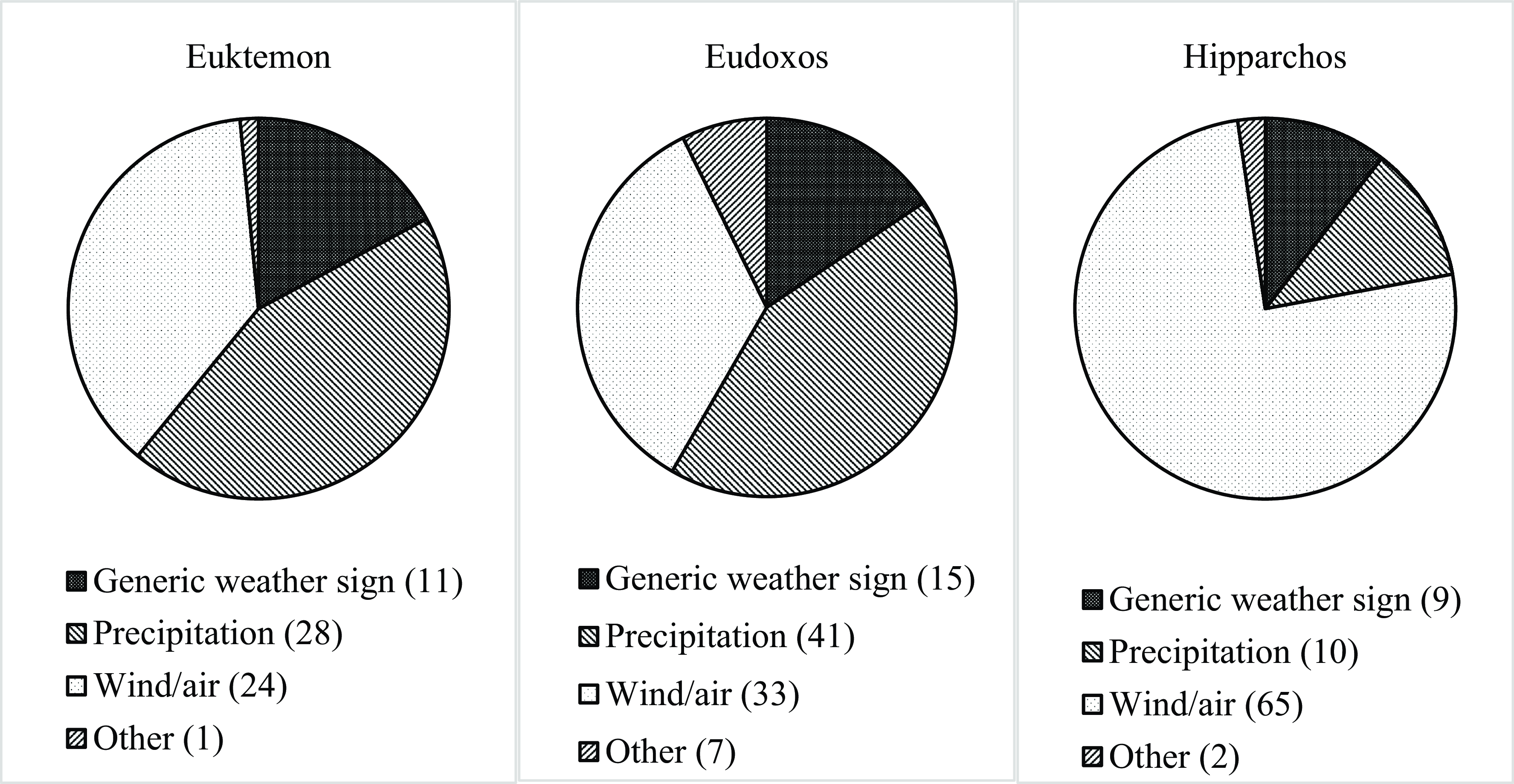
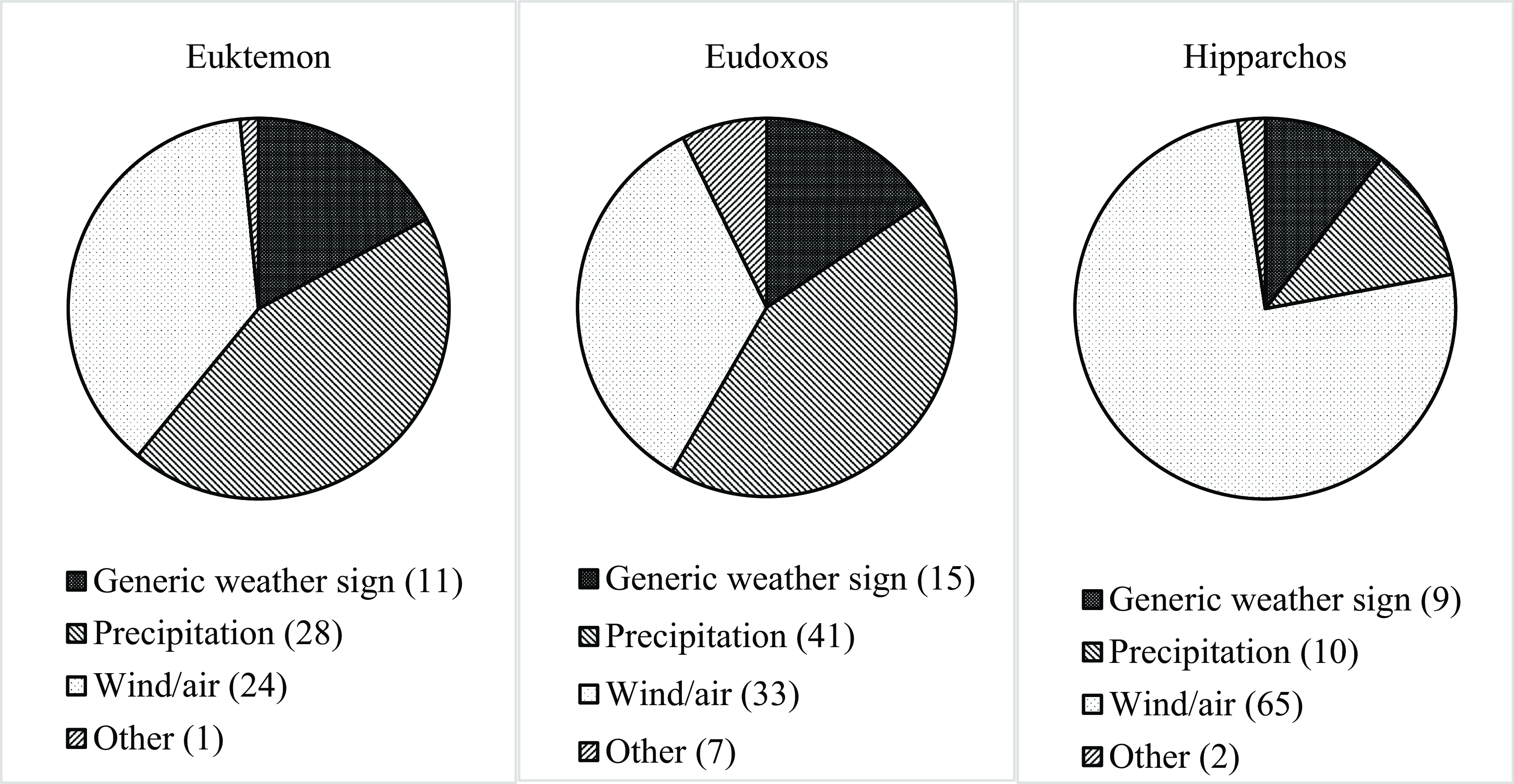
Whatever precise form the almanacs attributed to the parapegmatists cited in the Geminos, Miletos II and Ptolemy parapēgmata originally took,Footnote 33 their observations were eventually compiled in the relatively standardized form found in these three texts.Footnote 34 Much remains unclear about the methodologies the authorities cited in these documents employed to produce their parapēgmata. The sole ancient reference to their methods comes from Geminos, who states that the parapegmatists recorded their observations of atmospheric phenomena over multiple years (17.6–8); but whether this is an inference derived from the parapēgmata themselves or a fact obtained from other sources is unclear.Footnote 35 Regardless, it is important to note that the Geminos and Ptolemy parapēgmata (and, most likely, also many of the original almanacs from which they drew) were not comprehensive, empirical records of the incidence of atmospheric phenomena, but rather carefully curated documents.Footnote 36 This is illustrated not only by the different authorities cited in each (table 1), but also by differences in the weather observations attributed to the same authorities in these preserved almanacs.Footnote 37 An analysis of the meteorological observations in the Ptolemy parapēgma suggests that some authorities included more specialized meteorological observations in their almanacs, or were considered more authoritative on certain weather phenomena, than their peers. For instance, among the three authorities whose observations are most numerous and who, scattered references in later authors indicate, were the most renowned and popular by the late Hellenistic period (for example, Vitr. De arch. 9.6.3; Columella, Rust. 9.14.12), winds make up a considerably larger part of the meteorological observations attributed to Hipparchos than those attributed to Euktemon and Eudoxos;Footnote 38 conversely, considerably more observations related to precipitation are preserved for Euktemon and Eudoxos than Hipparchos (fig. 1).
A breakdown of the types of meteorological observations attributed to each of the three most-cited authorities in the Ptolemy parapēgma, Euktemon, Eudoxos and Hipparchos. The observations are categorized as generic instructions to watch for ‘weather signs’ (episēmainei); precipitation (rain, storm, hail, snow); changes in the wind and air; and observations that do not fit these categories, predominantly those relating to heat and thunder (produced by the author).
III. The use of astrometeorological parapēgmata in the Hellenistic world
Astrometeorology was widely accepted as a science in the Greek worldFootnote 39 and, as several anecdotes supposedly attesting to Greek astronomers’ remarkable ability to predict weather suggest,Footnote 40 compilations of authoritative astrometeorological knowledge were widely reputed to have been powerful tools for forecasting the weather. As such, it is no surprise that texts devoted to this topic seem to have been employed by a broad swathe of literate (and perhaps semi-literate) individuals in the Hellenistic world. A chapter in the Introduction entitled ‘On weather signs from the stars’ (Πϵρὶ ἐπισημασιῶν τῶν ἄστρων) critiquing astrometeorological parapēgmata suggests that these texts were widely popular. Geminos claims that they had disseminated ‘among laymen’ (παρὰ μὲν τοῖς ἰδιώταις, 17.1) the belief that celestial phenomena were not only correlated with but actually directly influenced the weather.Footnote 41 Later, he notes the frequent inability of parapegmatic weather observations to predict actual weather patterns, stating (17.21–22):
ἀλλὰ τοὺς μϵγίστους πϵριέχουσι χϵιμῶνας ἐπιτολαὶ καὶ δύσϵις ϵὐδίας σημϵίωσιν ἔχουσαι, ἔστι δ’ ὅτϵ κατὰ μὲν τὴν πόλιν ϵὐδία ἐγένϵτο, ἐπὶ χώρας δὲ ὄμβρος. Πολλάκις δέ τις μϵθ’ ἡμέρας τρϵῖς ἢ τέσσαρας ἐπϵσήμηνϵ τῇ ἐπιτολῇ ἢ τῇ δύσϵι τοῦ ἄστρου, ἔστι δ’ ὅτϵ προέλαβϵ τὴν ἐπισημασίαν πρὸ ἡμϵρῶν τϵσσάρων. Ὅθϵν καὶ ἀποτυγχάνουσιν ἐν ταῖς προρρήσϵσι τῶν ἐπισημασιῶν ἔχοντϵς ἀπολογίαν, ὅτι προέλαβον τὴν ἐπισημασίαν ἢ ὅτι ὑστέρα ἐγένϵτο.
The risings and settings [of the stars] accompany the greatest storms while presenting an indication of fair weather, and sometimes there has been fair weather in the city but rain in the country. On many occasions a weather change has been signalled three or four days after the fact by the rising or the setting of a star; sometimes one has taken the weather sign four days earlier. For this reason, they are incorrect in their predictions from the weather signs but have the defence that they took the sign early, or that it came later.Footnote 42
Similarly, Geminos complains that individuals used these documents without recognizing that different authorities ‘made their observations’ (ἐτήρησαν, 17.18–19) in different regions (cf. Ptol. Risings p. 67, ll. 1–11 Heiberg; see also table 1), highlighting the necessity to consult their parapēgmata according to the region and/or parallel in which they were produced (cf. Ptol. Risings p. 67, ll. 11–21 Heiberg).Footnote 43
Thus, by the late Hellenistic period, numerous astrometeorological parapēgmata attributed to authorities from different regions of the Mediterranean were circulating throughout the Greek-speaking world. Some of these parapegmatists appear to have favoured the inclusion of, or been considered more authoritative on, particular meteorological phenomena. As both the Geminos and Miletos II parapēgmata indicate, by the second century BC at the latest individuals had also begun drawing from these documents to compile their own astrometeorological calendars. I wish now to explore how both literary and epigraphical parapēgmata may have been used in the context of the Hellenistic polis. While no explicit reference to the utilization of literary parapēgmata in a civic context is preserved, the evidence for the widespread popularity of the documents discussed above suggests that they were almost certainly employed by politically active citizens in city-states.
As versions of these documents that received the imprimatur of the polis, publicly inscribed parapēgmata are of particular interest in understanding the civic role these documents may have played. As noted above, the only preserved epigraphical astrometeorological parapēgma from the pre-Roman Greek world is the Miletos II example. The contents and find-spot of this inscription indicate that it was a formal civic document, and its monumental scale and the inclusion of user instructions suggest that the Milesian authorities wished for its observations to be accessible to the public.Footnote 44 That such monumental civic parapēgmata were not uncommon, the lack of other surviving examples simply reflecting the rarity with which such specialized inscriptions survive,Footnote 45 is suggested by a scholion to Aratos’ Phenomena. In this passage, the commentator states in relation to the Metonic cycle:
δϵξάμϵνοι τοίνυν οἱ μϵτ’ αὐτον ἀστρονόμοι πίνακας ἐν ταῖς πόλϵσιν ἔθηκαν πϵρὶ τῶν τοῦ ἡλίου πϵριφορῶν τῶν ἐννϵακαιδϵκαϵτηρίδων, ἀριθμήσαντϵς ὅτι καθ’ ἕκαστον ἐνιαυτὸν τοιόσδϵ ἔσται χϵιμών, καὶ τοιόνδϵ θέρος, καὶ τοιόνδϵ φθινόπωρον, καὶ τοιοίδϵ ἄνϵμοι, καὶ ἄλλα πολλὰ πρὸς βιωφϵλϵῖς χρϵίας τοῖς ἀνθρώποις. ἐπϵιδη οὖν ἤδη ταῦτα ἐγνώσθη ἐκ τῶν πινάκων, καὶ αὐτὸς ἐκϵῖθϵν ἔγνω τὰ πολλὰ ὁ Ἄρατος …Footnote 46
Those astronomers who came after him [Meton] set up plaques pertaining to the 19-year revolutions of the sun in poleis, having reckoned that in each year there would be such a kind of winter, summer, autumn, winds and many other things useful for people’s everyday needs. Since these things were already known from the plaques, and Aratos himself knew all this from them …
Several scholars have argued that astrometeorological parapēgmata were used to link the seasonal calendars of the agricultural world with the lunar calendars of poleis, which were infamously changeable and frequently misaligned with the solar year, in order to create a unified chronological framework for their citizens.Footnote 47 This was undoubtedly one reason why the astronomical information in parapēgmata was useful, but it does not account for the inclusion of so many meteorological observations in these documents.Footnote 48 Some scholars have thus assumed that astrometeorological parapēgmata were primarily employed by farmers and sailors, groups to which Greek meteorological literature often refers.Footnote 49 Average members of these groups certainly did employ folk systems of weather prognostication from which some of the meteorological observations in parapēgmata were perhaps derived,Footnote 50 but relatively few are likely to have been literate enough to have made regular use of such documents.Footnote 51 Some scholars have also postulated that these documents could have been employed by literate professionals with an interest in the effects of weather on their livelihoods, such as merchants, but without discussing in detail how.Footnote 52 Nonetheless, monumental inscribed parapēgmata erected in urban centres at least would have been of little quotidian use for most members of these groups, for whom regular travel to and from an urban centre to consult such documents would have been impractical.Footnote 53 Liba Taub and Michael Beardmore acknowledged that these must have served some civic purpose but refrained from speculating on the precise uses to which they may have been put.Footnote 54 To my knowledge, only Gerd Graßhoff has discussed the practical role the meteorological observations in parapēgmata may have served in a civic context, speculating in an aside that they were intended to determine at a community level ‘when it would be best to travel, to go to market and to order goods for storage’.Footnote 55
I argue that two groups in particular would have benefited from the use of astrometeorological parapēgmata within the context of the Hellenistic polis: literate, politically active citizens and physicians. There is reason to believe that both groups would have viewed these documents as useful tools for anticipating the effects of weather on communities and as emblems of authority that could have legitimized related decision-making in relation to those effects. I also posit that these factors may have motivated civic officials to produce bespoke compilations of astrometeorological observations made by different parapegmatists based on their status in the doxographical tradition, the locations in which they made their observations and/or their perceived specialized knowledge on certain meteorological phenomena.
Hellenistic politicians and physicians had a direct interest in monitoring the weather because it was believed to have significant effects on communal well-being, most notably by causing food shortages and epidemics.Footnote 56 As a passage in Polybios of the mid-second century BC illustrates, the first collective response to extreme weather was often religious (36.17.2–3). That significant deviation from meteorological norms prompted propitiatory ritual activity and oracular consultation in addition to more practical collective measures in Greek communities is further supported by inquiries made by classical and Hellenistic states to the oracle at Dodona:Footnote 57 two, perhaps three, of 17 preserved communal inquiries from Dodona reference weather or its effects.Footnote 58 Plutarch further asserted that in his day at Delphi ‘the majority of inquiries by poleis concern the yields of crops, the propagation of livestock and the health of bodies’ (τὰ δὲ μέγιστα πόλϵων μαντϵύματα φορᾶς καρπῶν πέρι καὶ βοτῶν ἐπιγονῆς καὶ σωμάτων ὑγιϵίας, Mor. 408B–C): the three aspects of communal life most affected by weather. Given that astrometeorological parapēgmata communicated meteorological patterns recorded by authoritative figures, such documents could have been perceived as invaluable tools for those charged with safeguarding the well-being of the community, allowing them to anticipate important atmospheric changes, determine when conditions transitioned from ‘normal’ to ‘abnormal’ and plan when to take appropriate action in response.
IV. Astrometeorological parapēgmata, agriculture and the grain supply
Communities throughout the Greek world became increasingly concerned with managing the supply of wheat and barley, the staple grain crops, available to their inhabitants from the later Classical period onwards. By the Hellenistic period, monitoring the agricultural economy and intervening when necessary to subsidize or obtain and distribute stocks of grain had come to be viewed as one of the primary responsibilities of polis governments.Footnote 59 To understand how Hellenistic politicians may have used astrometeorological parapēgmata to aid in regulating the grain supply, it is necessary to consider the agricultural cycle in the ancient Aegean.Footnote 60 Greek households generally had to rely on crops they had reaped and processed between mid-May and early July for subsistence; as these stocks diminished over subsequent months, the price of grain normally increased, so that a shortfall in agricultural production was often felt most acutely in the winter and spring months.Footnote 61 Farmers monitored meteorological conditions that could have deleterious effects on cereal yields during the growing season, most notably dry spells, cold snaps and heavy rainfall. The timely deployment of risk-buffering mechanisms, especially the sowing of emergency crops, could have helped to mitigate the impact of such weather;Footnote 62 however, extreme spring weather, such as flooding or hail, could have signalled impending poor yields at a time when it was too late for farmers to deploy such methods.Footnote 63 Households could usually endure a poor harvest so long as the next was sufficient; but if many experienced an agricultural deficit simultaneously, especially if it became apparent that the coming harvest was also likely to be poor, then a localized food shortage might have resulted.
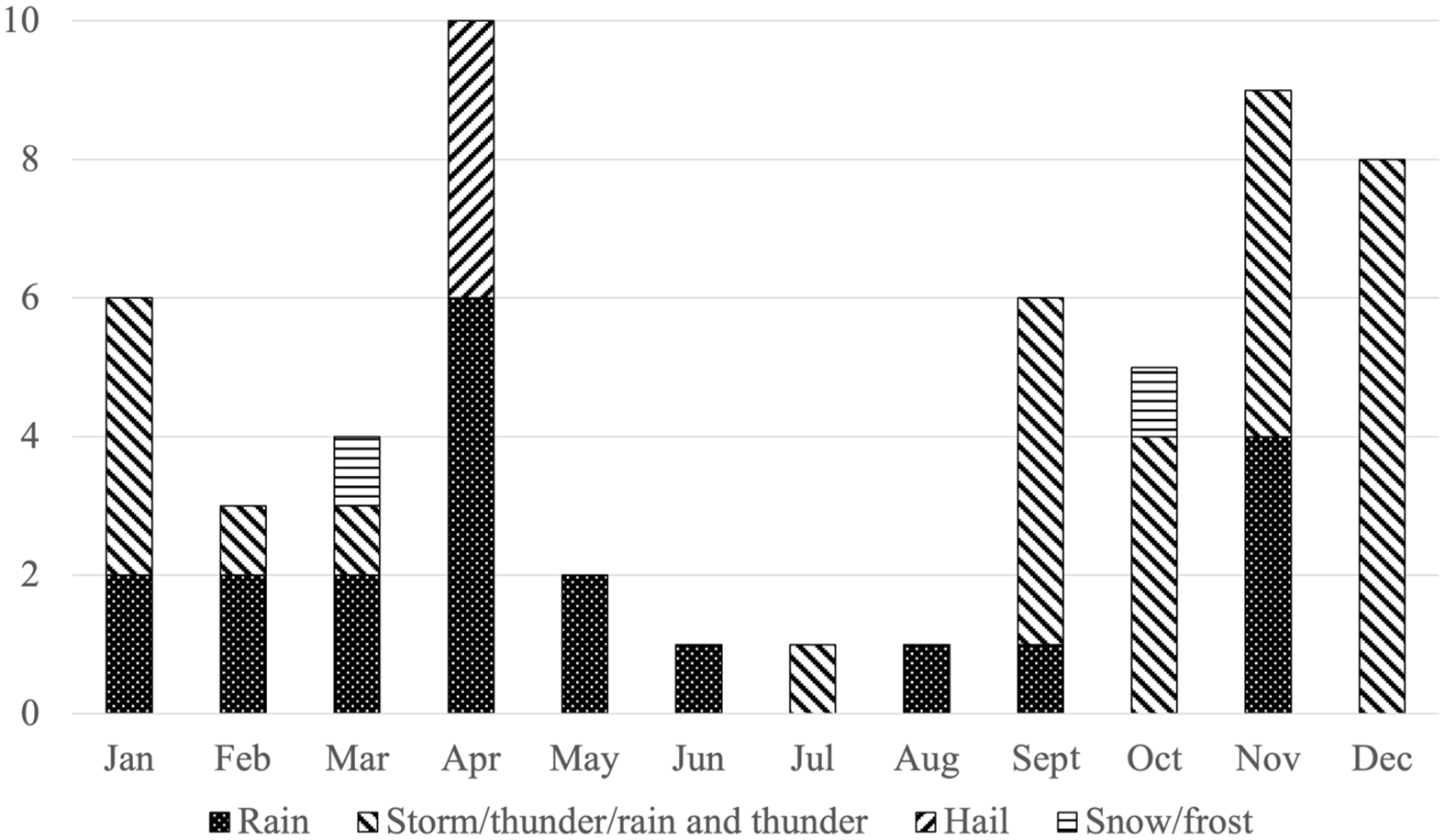
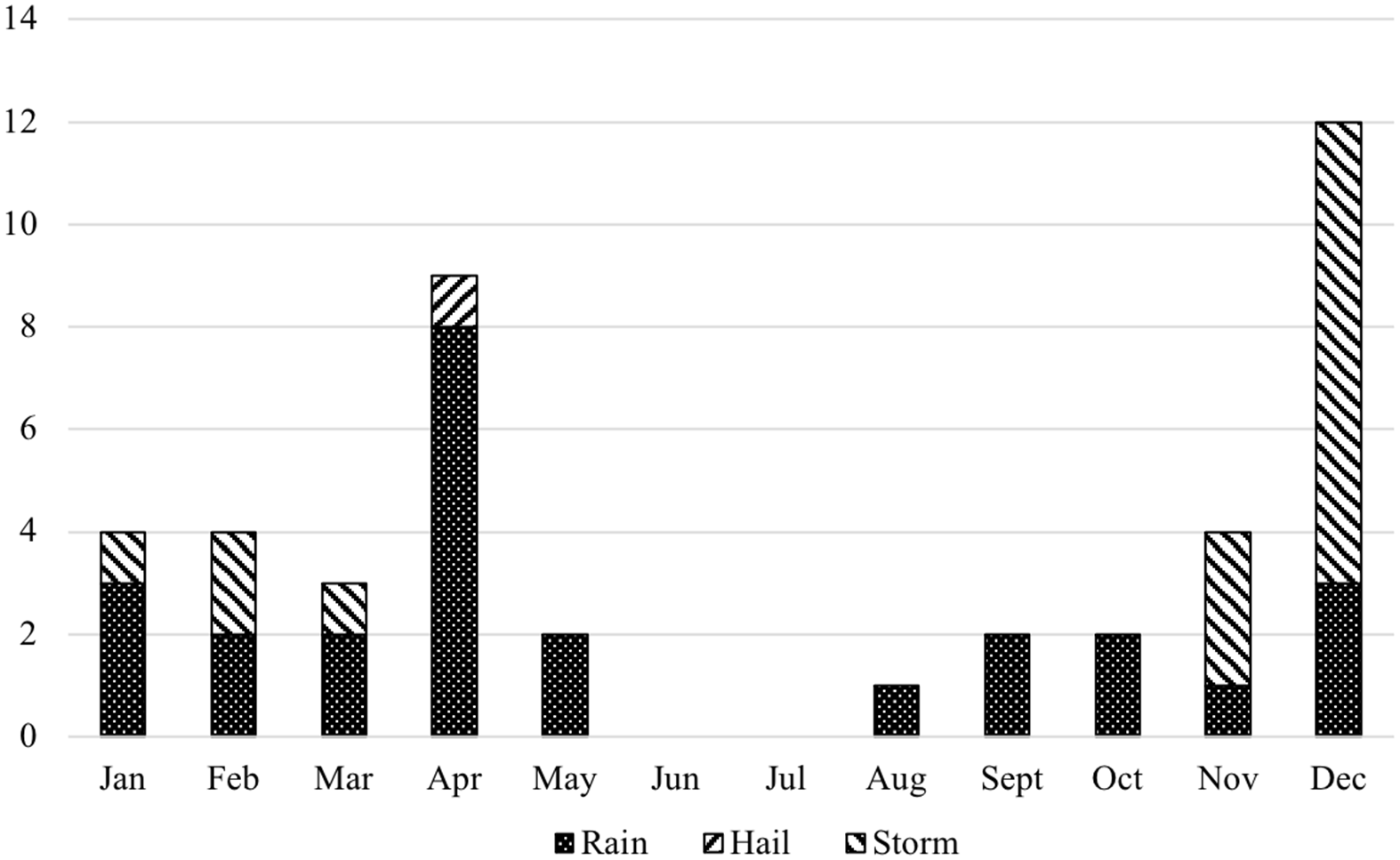
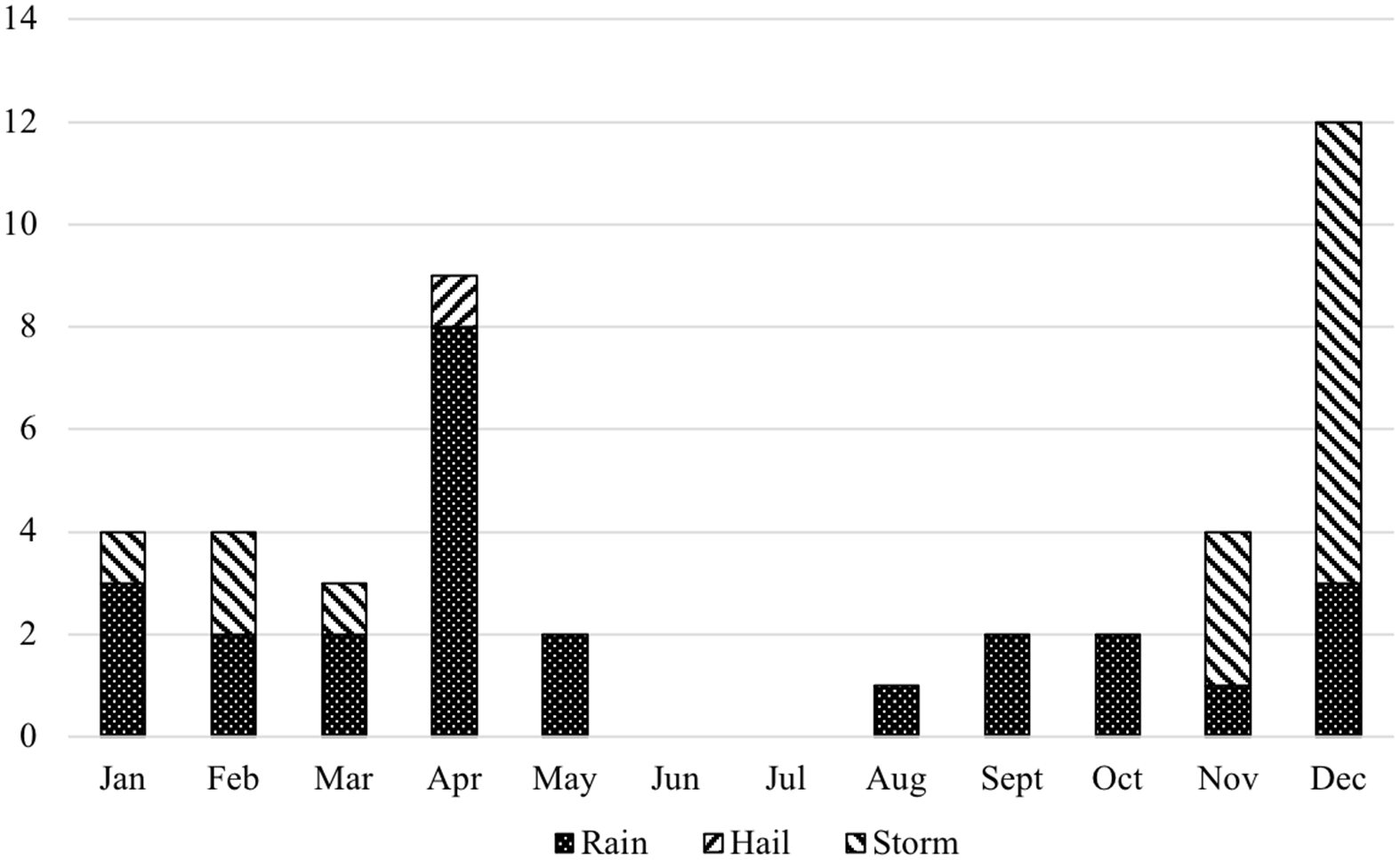
There is good reason to believe that variations in the annual distribution of certain meteorological observations in different parapēgmata were based on their relevance to the cereal farming calendar. Robert Hannah has noted that many of the observations most relevant to agriculture attributed to Euktemon in the Geminos parapēgma are clustered within the traditional period of the cereal harvest (May–July).Footnote 64 When observations relating to all forms of precipitation attributed to all authorities in the Geminos parapēgma are plotted across the year, April stands out for having the most references to rain and hail of any month (fig. 2).
Annual distribution of observations of rain, storms/thunder/rain and thunder, hail and snow/frost in the Geminos parapēgma (produced by the author).
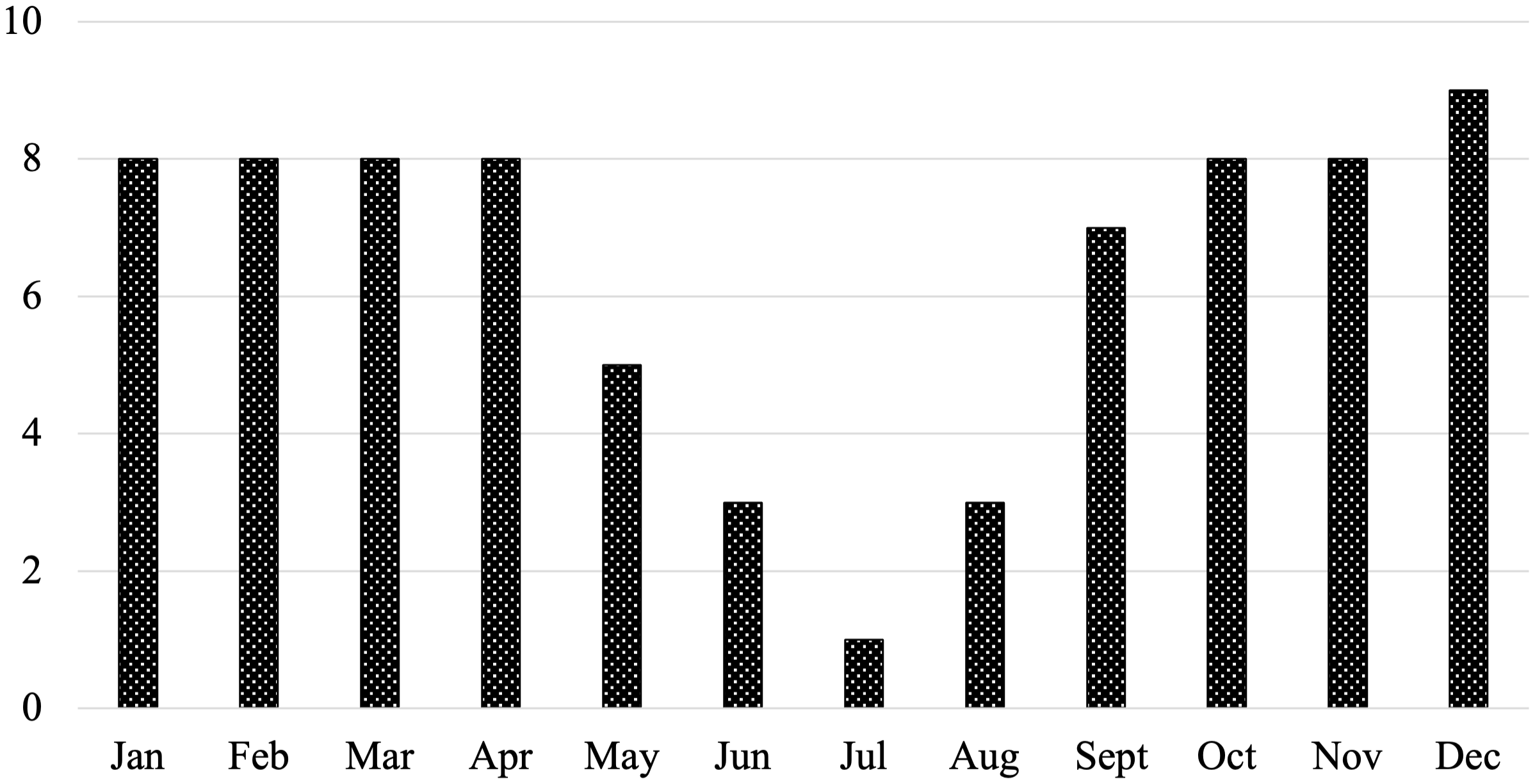
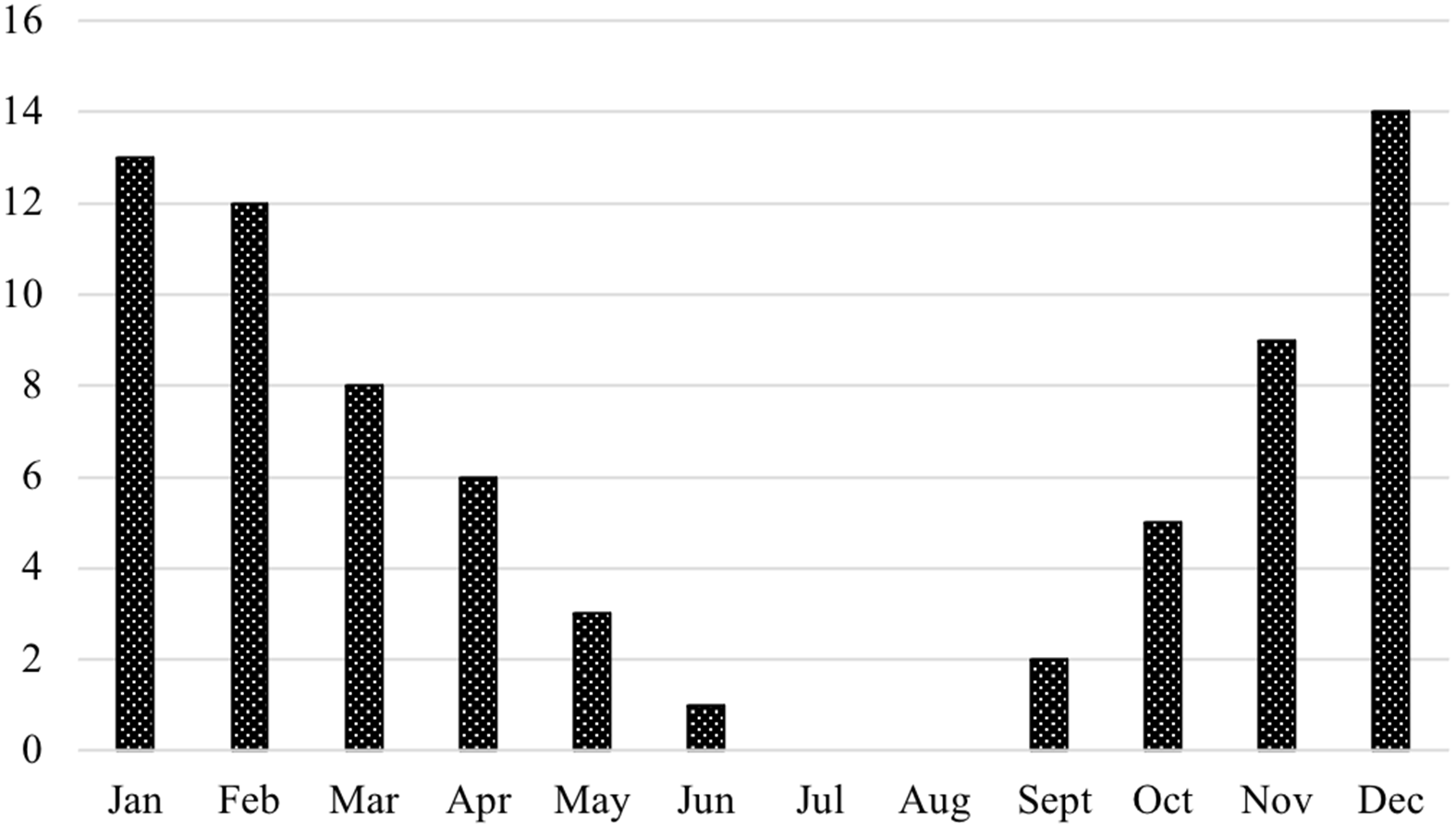
Similarly, when the distributions throughout the year of the plentiful precipitation-related observations attributed to Eudoxos in the Ptolemy parapēgma (fig. 3), which are said to have been made in Asia Minor, Sicily and Italy (Risings p. 67, ll. 8–9 Heiberg), are compared to the modern annual distribution of rainfall days in southern Italy (fig. 4) or western Turkey (fig. 5),Footnote 65 the pattern of distribution is roughly similar, with the notable exception of April, which includes a disproportionately high number of precipitation observations.
Annual distribution of observations of rain, hail and storms attributed to Eudoxos in the Ptolemy parapēgma (produced by the author).
Average number of rainfall days per month, Palermo, Italy (produced by the author; climate data from https://en.climate-data.org/).

Average number of rainfall days per month, Bodrum, Turkey (produced by the author; climate data from https://en.climate-data.org/).
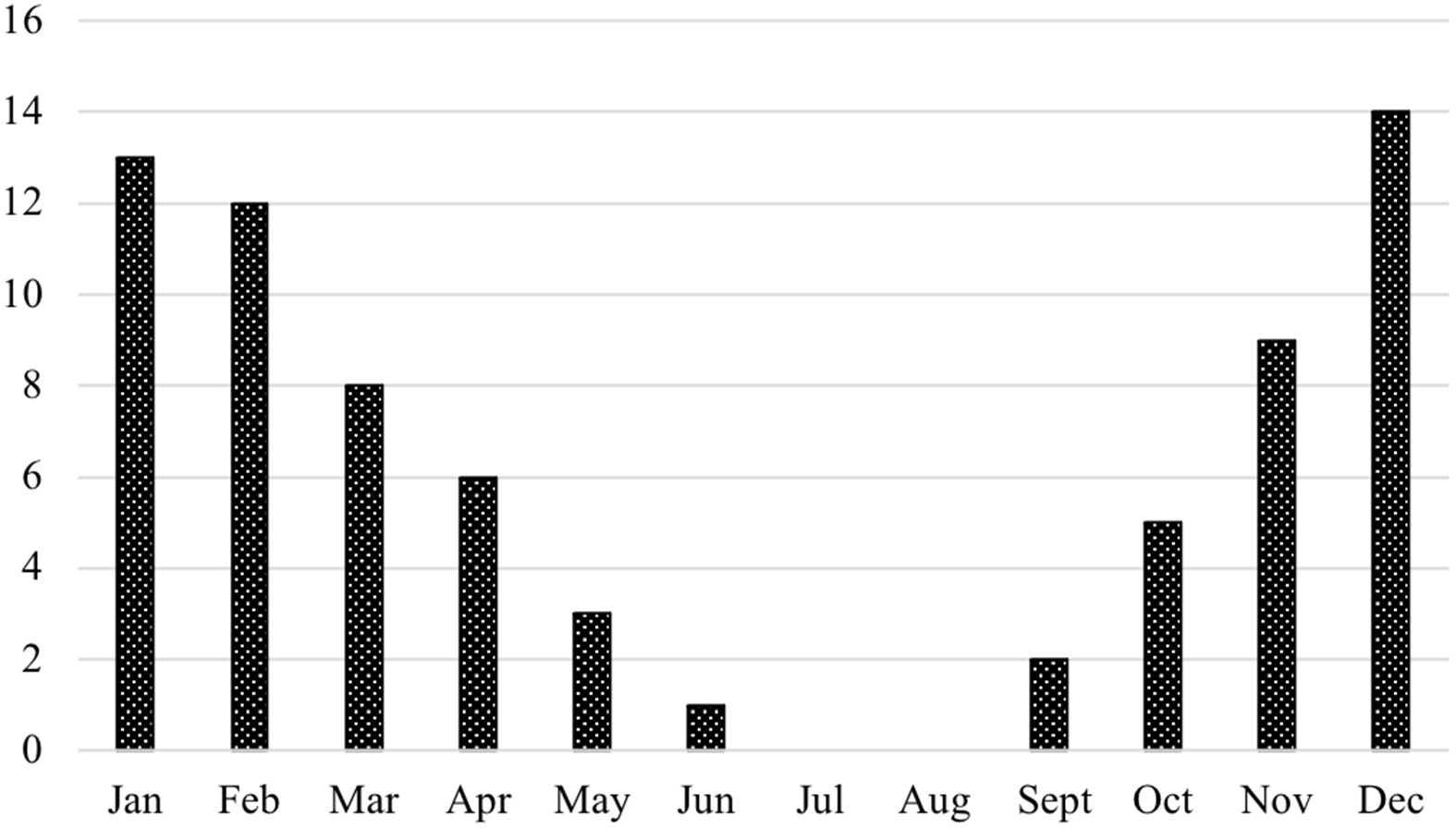
Eudoxos’ only hail observation in the Ptolemy parapēgma also occurs in April, despite this meteorological phenomenon being far more common in the summer months in the Mediterranean.Footnote 66 In coastal southern Italy and the Aegean, April and May are crucial months for kernel production in wheat and barley, with April an especially rapid period of growth.Footnote 67 Moderate rainfall at this time is highly beneficial to these crops, while excessive precipitation can cause lodging, which may reduce harvest yields;Footnote 68 hail, which is rare before April, can also cause significant damage to mature plants.Footnote 69 Finally, April and (to a lesser extent) May were crucially the last months in which the late sowing of cereals was possible, and sprouting crops are particularly vulnerable to heavy rainfall and hail.Footnote 70 These factors combine to make April one of the most important months for monitoring precipitation in the Greek agricultural calendar, explaining the concentration of related observations in this month. It is notable in this regard that Columella stated that for his agricultural treatise he employed ‘the calendars of Eudoxos and Meton and the old astronomers’ (Eudoxi et Metonis antiquorumque fastus astrologorum) over that of Hipparchos because their older parapēgmata were ‘more familiar to farmers’ (notior … agricolis) in his day (Rust. 9.14.12).
When meteorological conditions conspired to cause a shortfall in local grain supplies, poleis regularly had to decide when and how to take action to protect their citizens against food shortages. This decision-making commonly fell to the assembled citizenry and/or elected officials subject to public scrutiny. Much of the most detailed evidence for the involvement of assemblies in deliberation about the public food supply comes from fourth-century BC Athens. The Athenian grain-tax law of 374/3 BC (SEG 48.96, ll. 40–46) states that the Assembly was to decide when and at what price grain imported from its cleruchies was to be sold. In Xenophon’s Memorabilia, composed in the 360s BC, Sokrates advises his young interlocutor who aspires to become a politician that among other things he must consider (3.6.13):
πόσον χρόνον ἱκανός ἐστιν ὁ ἐκ τῆς χώρας γιγνόμϵνος σῖτος διατρέφϵιν τὴν πόλιν, καὶ πόσου ϵἰς τὸν ἐνιαυτὸν προσδϵῖται, ἵνα μὴ τοῦτό γϵ λάθῃ σέ ποτϵ ἡ πόλις ἐνδϵὴς γϵνομένη, ἀλλ’ ϵἰδὼς ἔχῃς ὑπὲρ τῶν ἀναγκαίων συμβουλϵύων τῇ πόλϵι βοηθϵῖν τϵ καὶ σῴζϵιν αὐτήν.
how long the grain grown in the country will be sufficient to sustain the polis and how much is needed annually, so that if the polis ever runs short you will not be caught off guard but, by knowing this and giving advice about necessities, you will be able to come to the rescue and save the polis.
According to the author of the pseudo-Aristotelian Athenaion politeia, writing a few decades later, the grain supply was a mandatory topic of discussion at every Athenian kuria ekklēsia (43.4). Evidence for such deliberations among the citizenry in other late classical and Hellenistic poleis is scattered but indicative. The pseudo-Aristotelian Oikonomika, for instance, refers to the citizens of the fourth-century BC poleis of Selymbria and Klazomenai voting on how to respond to grain shortages (2.16a, 2.17, 1348b–1349a). Most often such decision-making is left implicit in decrees discussing various government interventions to manage the food supply.Footnote 71
In these deliberations politically active citizens would have discussed the options available to ameliorate grain shortages. The two most common were appealing to local landowners to sell or donate some of their surplus and sending out commissioners, commonly known as sitōnai, to foreign markets to secure grain imports. The corpus of civic inscriptions honouring citizens who intervened in times of grain shortage provides evidence for the former practice;Footnote 72 when such local measures failed, however, poleis often resorted to the latter.Footnote 73 Even when sitōnai had the discretion to determine where and when to seek grain imports, they still had to account for their decision-making in relation to the purchase or distribution of that commodity. For example, an inscription outlining the regulations of a grain fund established by the Boiotian polis of Koroneia in the third century BC (SEG 43.205, ll. 9–13) states that the officials charged with purchasing public grain were free to buy it at the best price available so long as it was purchased prior to the month of Pamboiotios (September/October), though they subsequently had to render an account of their activity to the Koroneian assembly (ll. 13–16).
In many cases, the first ports of call for sitōnai were other economic centres in the same region. In the case of Klazomenai, for instance, an inscription of 387/6 BC (IG II2 28, ll. 18–19) mentions that its citizens regularly imported grain from nearby Smyrna and two other poleis whose names are no longer preserved but which were probably also proximate. In the Hellenistic central Aegean, Delos became one such important regional market for grain exports, as illustrated by an inscription of ca. 220 BC (IG XI 4.1055) that references sitōnai from Histiaia purchasing grain on that island. When conditions conspired to cause widespread food shortages, however, commissioners had to sail further afield, most notably to the large grain-exporting markets of Sicily, North Africa and the Black Sea. The best example of how vital these markets could have been to Aegean poleis in times of dearth is an inscription from Kyrene dating to the 330s or 320s BC that lists 41 recipients of shipments of grain ranging in size from 900 to 100,000 medimnoi ‘when there was a grain shortage in Greece’ (ὅκα ἁ σιτοδϵία ἐγένϵτο ἐν τᾶι Ἑλλάδι, SEG 9.2).Footnote 74
The dispatching of sitōnai to such major grain-exporting markets would have required careful consideration of timing,Footnote 75 as the farmers of Sicily, Egypt, Kyrenaika and the Black Sea all harvested their cereals at different times. In Sicily, the cereal harvest would begin in May, around the same time as the Aegean,Footnote 76 while in Egypt and parts of Kyrenaika it would begin in April or sometimes even late March (Theophr. Hist. pl. 8.2.7; cf. Hdt. 4.100).Footnote 77 As noted above, food shortages were often most acute in the months immediately preceding the cereal harvest. Civic authorities aiming to import grain might have found it difficult to do so safely by sea before the traditional opening of the sailing season in April (cf. Hes. Op. 618–34; Veg. Mil. 4.39; Cod. Theod. 13.9.3), however, and the longer they waited to find suitable supplies, the higher the chances that foreign markets might have been monopolized by other buyers.Footnote 78 Officials could have awaited later grain exports from the Black Sea region, whose cereal harvests generally began in June, about a month after the Aegean (Theophr. Hist. pl. 8.2.10); but while this region had been a major exporter of grain to Athens in the late Classical period,Footnote 79 Polybios states that by the second century BC at least Pontic communities were as likely to have been net importers of grain as net exporters (4.38.5).Footnote 80 If Black Sea grain supplies thus also proved limited, grain prices could become prohibitively high for importing poleis, making it risky to await later Pontic harvests.
Thus, if a regional food shortage was pressing and the prospect of a poor harvest looming, timely action to secure foreign grain supplies beginning in April, when sitōnai both could have sailed safely overseas and foreign grain was likely to have first become available, would have been a crucial means of mitigating risk. For civic officials tasked with monitoring the food supply, astrometeorological parapēgmata could have facilitated the collective observation of meteorological developments in this window and aided in building consensus among the body politic as to when direct action was necessary. Consider the observations in the Geminos parapēgma corresponding to April in the Gregorian calendar:
ἐν δὲ τῇ ιγ´ Eὐδοξῳ Πλϵιάδϵς ἀκρόνυχοι δύνουσι, καὶ Ὠρίων ἄρχϵται δύνϵιν ἀπὸ ἀκρονύχου· ὑϵτὸς γίνϵται. Δημοκρίτῳ Πλϵιάδϵς κρύπτονται ἅμα ἡλίῳ ἀνίσχοντι καὶ ἀφανϵῖς γίνονται νύκτας μ´.
ἐν δὲ τῇ κα´ Eὐδοξῳ Ὑάδϵς ἀκρόνυχοι δύνουσιν.
ἐν δὲ τῇ κγ´ Eὐκτήμονι Ὑάδϵς κρύπτονται· καὶ χάλαζα ἐπιγίνϵται, καὶ ζέφυρος πνϵῖ. Καλλίππῳ Χηλαὶ ἄρχονται δύνϵιν· πολλαχῇ δὲ καὶ χάλαζα.
ἐν δὲ τῇ κζ´ Eὐδόξῳ Λύρα ἀκρόνυχος ἐπιτέλλϵι.
Τὸν δὲ Ταῦρον διαπορϵύϵται ὁ ἥλιος ἐν ἡμέραις λβ´.
ἐν μὲν οὖν τῇ α´ ἡμέρᾳ Eὐδόξῳ Ὠρίων ἀκρόνυχος δύνϵι· ὑϵτία. Καλλίππῳ ὁ Κρίὸς λήγϵι ἐπιτέλλων· ὑϵτία, πολλαχῇ δὲ καὶ χάλαζα.
ἐν δὲ τῇ β´ Eὐκτήμονι Κύων κρύπτϵται· καὶ χάλαζα γίνϵται. τῇ δ’ Λύρα ἐπιτέλλϵι. Eὐδόξῳ Κύων ἀκρόνυχος δύνϵι· καὶ ὑϵτὸς γίνϵται. Καλλίππῳ τοῦ Ταύρου ἡ κέρκος ἐπιτέλλϵι· νότια.
ἐν δὲ τῇ ζ´ Eὐδόξῳ ὑϵτὸς γίνϵται.
ἐν δὲ τῇ η´ Eὐκτήμονι Αἲξ ἑῴα ἐπιτέλλϵι· ϵὐδία· ὕϵι νοτίῳ ὕδατι.
ἐν δὲ τῇ θ´ Eὐδόξῳ Αἲξ ἑῴα ἐπιτέλλϵι.Footnote 81
On the 13th [of Aries, 2 April in the Gregorian calendar], according to Eudoxos, the Pleiades set at nightfall and Orion begins to set at nightfall; there is rain. According to Demokritos, the Pleiades hide themselves while the Sun is setting and become invisible for 40 nights.
On the 21st [10 April], according to Eudoxos, the Hyades set at nightfall.
On the 23rd [12 April], according to Euktemon, the Hyades hide themselves; hail follows and the west wind blows. According to Kallippos, the Claws begin setting; in many places [there is] hail.
On the 27th [16 April], according to Eudoxos, the Lyre rises at nightfall.
The Sun passes through Taurus in 32 days.
On the 1st day [21 April], according to Eudoxos, Orion sets at nightfall; rainy weather. According to Kallippos, Aries finishes rising; rainy weather and in many places [there is] hail.
On the 2nd [22 April], according to Euktemon, the Dog hides itself; there is hail. On the same [day], the Lyre rises <in the evening>. According to Eudoxos, the Dog sets at nightfall; there is rain. According to Kallippos, the tail of Taurus rises; southerly [winds].
On the 7th [27 April], according to Eudoxos, there is rain.
On the 8th [28 April], according to Euktemon, the Goat rises in the morning; [there is] fair weather <or> it rains with a southerly rain.
On the 9th [29 April], according to Eudoxos, the Goat rises in the morning.
The reference to the west wind beginning to blow on the 23rd of Aries would have been useful both for navigational and agricultural purposes, as it typically signalled the opening of the sailing season after the stormy winter season (Anth. Pal. 5.169; Philostr. Imag. 2.17),Footnote 82 but it was also believed to be either harmful or beneficial to crops, depending on geography (Theophr. On Winds 43 Mayhew). The succession of precipitation observations that follows in the first eight days of Taurus suggests an attentiveness to weather conditions that could similarly have helped or hurt grain crops in this crucial period when it would often first become safe for officials to undertake long-distance voyages to grain-exporting markets.
The availability of parapēgmata, especially publicly sanctioned versions of these documents such as Miletos II, thus might have shifted the basis of collective decision-making in relation to the grain supply from the subjective, disparate experiences of atmospheric phenomena among the citizenry scattered throughout a polis’ territory to the authoritative knowledge embodied in these almanacs. By externalizing the evaluation of meteorological patterns, parapēgmata would have conferred on politically engaged citizens greater authority to determine when weather had progressed from being normal to abnormal, and when intervention was necessary, whether it should be inquiring of an oracle what religious actions had to be taken to appease the gods, appealing to local landowners to donate surplus grain or travelling to purchase grain from foreign markets.
V. Astrometeorological parapēgmata and medicine
The other main concern of Greek populations in relation to the weather was its effect on collective health. Many poleis came to employ public doctors in the Hellenistic period, with epigraphical evidence suggesting that even tiny communities actively sought to hire such professionals.Footnote 83 Greek physicians typically trained in centres of medical learning, the most renowned being Kos and Knidos,Footnote 84 before travelling abroad to find employment, often working in several communities throughout their careers.Footnote 85
Greek medical theory held that weather forecasting was an essential part of the doctor’s practice for two reasons.Footnote 86 First, on a community level it was believed to have allowed for the anticipation of outbreaks of endemic or epidemic disease months in advance (cf. Hippoc. De natura hominis 9.7–47; Anonymus Londinensis 7.15–21 Jones).Footnote 87 Second, it was thought to have been essential to timely medical intervention in the treatment of individual cases (Hippoc. Aer. 11, Aff. 8, Epid. 2.1.5, De natura hominis 8).Footnote 88 It was thus crucial for the average itinerant physician upon arrival in a new community to learn about its distinctive climate (Hippoc. Aer. 1–2). References to the connection between meteorology and medicine can be found in numerous works of the Hippocratic Corpus,Footnote 89 the most insightful being the Epidemics, a collection of case studies sketching the nature of weather in the course of a specific year for a particular community followed by detailed descriptions of the progression of common pathologies.Footnote 90 Nonetheless, discussions of the actual quotidian practice of medical weather prognostication are surprisingly scarce in the Hippocratic texts, including the Epidemics.
This absence can best be explained by a comment in Rufus of Ephesos’ first-to-second-century AD treatise Medical Questions (70–73 Daremberg and Ruelle) that physicians typically obtained information on local environmental conditions relevant to their profession from external sources, chiefly the communities in which they practised. An early Hellenistic pseudepigraphic text attributed to Hippokrates, the Embassy, sheds further light on this in the context of a fictional episode in which several Greek communities afflicted by a pandemic appealed to the famed physician for help (Embassy 27 Smith).Footnote 91 Hippokrates is said to have inquired ‘what kinds of disturbances occurred, region by region, in the heat, winds, mist and other factors that by nature disturb the accustomed state, contrary to what is normal’ (ὁκοῖαί τινϵς ἐν μέρϵι κινήσιϵς γίνονται κατά τϵ καύματα καὶ ἀνέμους καὶ ἀχλύας καὶ τ’ άλλα ἃ πέφυκϵ ἕξιας κινϵῖν παρὰ τὸ καθϵστηκός, 27.7.8–10, 20–21); having obtained this information from the inquiring communities, he then sent therapeutic instructions tailored to each.
Upon arriving in a new polis, the peripatetic physician thus would have had to learn about its distinctive climatic regime in order to practise properly. The consultation of astrometeorological parapēgmata believed to be relevant to the area, whether personal copies of literary works or civic inscriptions that represented the sanctioned weather calendar of the community, would have greatly simplified this process; such documents would have allowed the doctor to establish with precision the perceived normality or abnormality of a season’s weather according to regional or local convention, and thus both to anticipate the medical conditions likely to appear in subsequent seasons and to maintain the correct timing of observation for the current season.Footnote 92 The detail of the compilatory astrometeorological parapēgmata available in the Hellenistic period could have been especially helpful in aiding physicians to anticipate crucial periods in the course of a medical condition, known as kriseis, and intervene when deemed necessary. In Hippocratic medicine, a krisis was believed to be a decisive period in which a condition would either show improvement or a change in its symptoms.Footnote 93 On anticipated krisis days, the doctor had to remain vigilant for ‘critical’ signs, chiefly changes in fever, rigour and the evacuation of sweat, urine, faeces or blood.Footnote 94 But because kriseis and their accompanying symptoms were thought to be affected by atmospheric changes (Hippoc. Aer. 11), the physician had to be attuned to both the traditional periodicities of kriseis and changes in weather to treat patients correctly (Hippoc. Epid. 1.5, 2.1.4–5).Footnote 95 One meteorological phenomenon that medical practitioners were particularly keen to monitor was the wind: seasonal winds were thought to govern broader meteorological patterns that had significant impacts on communal health, and changes in aeolian phenomena consequently feature prominently in discussions of meteorology in Hippocratic treatises.Footnote 96 Almost all parapegmatists include at least some references to winds. As we have seen, however, the meteorological observations of Hipparchos are disproportionately aeolian in nature (fig. 1). This would have made his parapēgma, which Columella considered more appropriate for an educated audience than those of Meton or Eudoxos (Rust. 9.14.12), particularly useful for physicians.
The third case study of Epidemics book 1, from Thasos, suggests an example of how physicians might have used a detailed weather calendar to inform their medical practice (Hippoc. Epid. 1.19). The year’s meteorological conditions were the following (1.13):
Ἐν Θάσῳ, πρὸ ἀρκτούρου ὀλίγον καὶ ἐπ’ ἀρκτούρου, ὕδατα πολλὰ μϵγάλα ἐν βορϵίοισι. πϵρὶ δὲ ἰσημϵρίην καὶ μέχρι πληϊάδος, νότια ὕσματα ὀλίγα. χϵιμὼν βόρϵιος, αὐχμοί, ψύχϵα, πνϵύματα μϵγάλα, χιόνϵς. πϵρὶ δὲ ἰσημϵρίην χϵιμῶνϵς μέγιστοι. ἔαρ βόρϵιον· αὐχμοί, ὕσματα ὀλίγα, ψύχϵα. πϵρὶ δὲ ἡλίου τροπὰς θϵρινάς, ὕδατα ὀλίγα, μϵγάλα ψύχϵα μέχρι κυνὸς ἐπλησίασϵ. μϵτὰ δὲ κύνα μέχρι ἀρκτούρου, θέρος θϵρμόν· καύματα μϵγάλα καὶ οὐκ ἐκ προσαγωγῆς, ἀλλὰ συνϵχέα καὶ βίαια· ὕδωρ οὐκ ἐγένϵτο· ἐτησίαι ἔπνϵυσαν. πϵρὶ ἀρκτοῦρον, ὕσματα νότια μέχρι ἰσημϵρίης.
In Thasos a little before and at the time of (sc. the rising of) Arcturus frequent violent rains with northerly winds. About the equinox until (sc. the cosmic setting of) the Pleiades infrequent southerly rains. Winter northerly, droughts, cold periods, strong winds, snow. About the equinox very severe storms. Spring northerly, droughts, infrequent rains, periods of cold. About the summer solstice light showers, periods of great cold until the approach of Sirius. After (sc. the rising of) Sirius, until (the rising of) Arcturus, hot summer, great heat with no variation, but continuous and intense. No rain fell. The Etesian winds blew. About Arcturus southerly rains until the equinox. (tr. Potter (Reference Potter2022))
After outlining the most common conditions afflicting the Thasian populace during this year as well as some representative individual cases, the author then states (Epid. 1.19):
ἐν δὲ τῇ καταστάσϵι ταύτῃ ἐπὶ σημϵίων μάλιστα τϵσσάρων διϵσῴζοντο· οἷσι γὰρ ἢ διὰ ῥινῶν καλῶς αἱμορραγήσαι ἢ κατὰ κύστιν οὖρα πολλὰ καὶ πολλὴν καὶ καλὴν ὑπόστασιν ἔχοντα ἔλθοι, ἢ κατὰ κοιλίην ταραχώδϵα χολώδϵσιν ἐπικαίρως, ἢ δυσϵντϵρικοὶ γϵνοίατο. πολλοῖσι δὲ συνέπιπτϵ μὴ ἐφ’ ἑνὸς κρίνϵσθαι τῶν ὑπογϵγραμμένων σημϵίων, ἀλλὰ διϵξιέναι διὰ πάντων τοῖσι πλϵίστοισι καὶ δοκέϵιν μὲν ἔχϵιν ὀχληροτέρως· διϵσῴζοντο δὲ πάντϵς, οἷσι ταῦτα συμπίπτοι.
In this constitution there were four symptoms in particular that determined recovery: a proper haemorrhage through the nostrils; copious discharges via the bladder of urine with much sediment of a favourable character; the bowels being disordered with bilious evacuations at the right time; the appearance of dysenteric symptoms. The krisis in many cases did not come with only one of the symptoms described, but in most cases with all of them, and the patients appeared to be in a very distressed state: nevertheless all who had these symptoms were saved. (tr. Potter (Reference Potter2022))
In the case of two of these ‘critical’ symptoms, nosebleeds and dysentery, the treatise On the Nature of Man explains that they were associated with the onset of warm and rainy conditions (7.19–28). Thus, in theory the physician serving Thasos might have used a parapēgma in winter to anticipate with as much precision as possible the arrival of warmer weather and showers in alignment with anticipated kriseis, visiting patients on specific days to look for ‘critical’ nosebleeds and dysenteric symptoms. Here again the concentration of references to rainfall in the spring months in the Geminos parapēgma, for example, would have been helpful (fig. 2). This information might then have been used to determine the optimal timing and nature of treatment for patients, especially the gathering and administration of drugs (Hippoc. Epid. 2.3.2).Footnote 97
VI. Conclusion
Astrometeorological parapēgmata were manifestations of the diligent surveillance of the heavens carried out by some of the most renowned scientific thinkers of the ancient Greek world. They were perceived as distillations of empirical meteorological data that, in the words of one scholiast to Aratos’ Phenomena, were intended to be ‘useful for people’s everyday needs’.Footnote 98 By the second century BC at the latest, individuals were gathering observations from different astrometeorological parapēgmata in circulation, some of which devoted particular attention to specific types of meteorological phenomena, to produce their own compilatory calendars. As more and more such documents were compiled over time, these documents became increasingly dense almanacs that were perceived as establishing normative weather patterns with precision. Civic officials also erected monumental inscribed astrometeorological parapēgmata, substantial portions of one of which, from Miletos, have been preserved.
I argue that these documents, whether circulated on papyrus or erected as inscriptions, were of interest to poleis in large part because the organization of collective responses to abnormal weather fell predominantly to civic assemblies and/or public functionaries and parapēgmata were perceived as authoritative tools for making such decisions. The nature of civic government in the Hellenistic world has been debated in recent decades,Footnote 99 but it is clear that assembly politics, and hence the need to establish a consensus in political decision-making,Footnote 100 remained central to governance in many Hellenistic poleis.Footnote 101 To use the example of Miletos, Milesian citizens still enjoyed fairly widespread involvement in civic political institutions when the Miletos II parapēgma was erected in 89/8 BC.Footnote 102 It is notable that this sizeable inscribed almanac was accompanied by detailed user instructions,Footnote 103 suggesting that it was not only an impressive symbol of the scientific knowledge endorsed by the polis,Footnote 104 but a tool intended to be useful for the body politic.
The food supply and health of the community were among the most critical issues about which politically engaged individuals would have had to make decisions in the Hellenistic polis; a large proportion of the citizens of the average Greek city-state would have been scattered across its territory, however, making it difficult for authorities to monitor agriculture or public health closely at a community level. Furthermore, even disregarding the realities of the spatial heterogeneity of atmospheric phenomena, individuals’ discrepant subjective experiences of the weather could have hindered decision-making in matters affected by it. How, for instance, might a community have arrived at the collective conclusion that a stretch of rainy or dry weather was ‘exceptional’, thus necessitating the sending of a delegation to an oracle or the bolstering of the food supply? Similarly, how were the physicians serving a community to have judged when a season’s weather shifted to being ‘abnormal’, as was believed to have been crucial in anticipating epidemiological developments according to Hippocratic doctrine?
Astrometeorological parapēgmata could have assisted the collective recognition of deviations from normal weather patterns throughout the year, and thus facilitated related discussions about communal ritual activity or practical planning and intervention. These documents could also have been particularly useful during the spring months, especially April, a crucial phase of the agricultural calendar as well as the traditional beginning of the sailing season, by informing or justifying decision-making related to when public grain stocks should be released or travel abroad undertaken to seek foreign grain supplies. If the meteorological requirements embodied in the normative observations of parapēgmata were not being met and a poor harvest was anticipated, politicians might have used these calendars to decide on when to act, especially when it concerned sailing abroad to obtain grain from major exporting markets before competitors did and prices potentially rose. Similarly, physicians could have used these documents year round to make decisions on how and when to treat illnesses, both at the individual and the community level. Parapēgmata would have offered them a comprehensive framework for understanding and anticipating meteorological trends, allowing them to mark with precision weather events that were believed to make medical intervention more or less effective during kriseis. Most importantly for the polis, these documents would have been particularly useful in monitoring the abnormal weather patterns believed to cause outbreaks of endemic or epidemic disease at the community level.
In the Hellenistic world, parapēgmata were believed to provide an authoritative methodological framework for anticipating crucial windows of opportunity to respond to the effects of the weather and determining when conditions diverged from meteorological norms. In this respect, these documents might have been used to build consensus for potentially divisive communal action taken in response to the food supply or health of the community. A similar purpose has been suggested for divination and oracular consultation in group decision-making,Footnote 105 namely the legitimization of collective action by removing or minimizing the burden of decision-making from the individual.Footnote 106 The disembodied collection of knowledge that was the astrometeorological parapēgma would have allowed for the depersonalization of decision-making in relation to the effects of abnormal weather. Literary examples such as the Geminos parapēgma probably played an important role in this respect for literate individuals, while the availability of public monumental parapēgmata, such as the Miletos II inscription with its system of tracking atmospheric developments by the movement of pegs, would have allowed any passers-by to read, or have someone else read for them, the sanctioned weather forecast for any particular part of the year and integrate that knowledge into their decision-making.


 Open access

