



School food policies are important for healthy child and adolescent growth and development. Epidemiological evidence linking state-level competitive food and beverage laws and health-related outcomes for students continues to grow. For example, such laws are associated with healthier products( Reference Chriqui, Turner and Taber 1 ), healthier weights( Reference Taber, Chriqui and Perna 2 ) and stable or increased food-service revenue( 3 – Reference Bassler, Chriqui and Stagg 5 ). Students often consume a large portion of their daily energy at school, as they spend more time there than in any other environment outside the home( 6 – Reference Story, Nanney and Schwartz 8 ). Prior studies have shown that school practices impact issues such as children’s dietary behaviour( Reference French, Story and Fulkerson 9 , Reference Perry, Bishop and Taylor 10 ) and weight status( Reference Kubick, Lytle and Story 11 ). This is important because over one-third of children and adolescents are overweight or obese( Reference Ogden, Carroll and Kit 12 , Reference Driessen, Cameron and Thornton 13 ).
Foods in schools include school meals and ‘competitive’ foods and beverages: products that compete with the sale of school meals and are sold à la carte in the cafeteria, in school stores, in vending machines and in fundraisers. Typically competitive foods and beverages are energy dense and of poor nutritional quality. National estimates suggest competitive food and beverage products unnecessarily add 628–837 kJ (150–200 kcal) to children’s energy intake each day( Reference Fox, Gordon and Nogales 14 ). While school meals have consistently been regulated at the federal level, up until recently competitive foods and beverages were regulated on a state-by-state basis. Starting in July 2016 school districts are expected to comply with fully implemented (or ‘final’) federal Smart Snacks in School standards. Smart Snacks in School sets nutrition standards for competitive foods and beverages; it is the first major federal update of competitive foods and beverages in more than 40 years( 15 ). Prior to Smart Snacks in School, most state competitive foods policies were weak and limited in scope( 16 ).
In 2012, Massachusetts implemented a state law to establish nutrition standards for competitive foods and beverages sold or provided in public schools (105 CMR 225·000); hereafter referred to as the ‘MA standards’. Similar to the new federal standards, the MA standards aim to limit the energy, portion sizes, saturated and trans fats, sugar and sodium contents of snack foods and beverages offered to public-school students, while emphasizing water without additives, skimmed and 1 % milk, fruits and vegetables, and whole grains( Reference Hoffman, Rosenfeld and Schmidt 17 , Reference Gorski, Cohen and Hoffman 18 ). The Massachusetts experience in implementing the standards can provide useful lessons for schools districts across the country as they consider the most appropriate strategies for complying with Smart Snacks in Schools. The NOURISH (Nutrition Opportunities to Understand Reforms Involving Student Health) study examined the extent to which school districts in Massachusetts complied with the standards( Reference Hoffman, Rosenfeld and Schmidt 17 , Reference Gorski, Cohen and Hoffman 18 ) and the impact of the standards on school food-service finances( Reference Cohen, Gorski and Hoffman 4 ) and students’ dietary intake (J Cohen, M Gorski, J Hoffman et al., unpublished results).
School districts are the primary enactors of federal, state and local school policies. However, we know little about school administrators’ work in applying such standards. The purpose of the current mixed-methods study was to understand food-service directors’ (FSD) perspectives and experiences implementing the MA standards. FSD run school district food-service programmes in partnership with cafeteria and other school staff. Typically, the FSD is in charge of menu development and ensuring that nutritional content complies with state and federal standards, food preparation and business operations. In some districts, school food-service departments operate vending machines, school stores or snack bars; and in others, they have contracts with outside vendors to provide these services. In addition, there may be points of sale for foods and beverages that are not under the jurisdiction of FSD (e.g. sports concessions, some vending machines). For all competitive foods and beverages sold or served in Massachusetts schools, the school food authority at the district level is responsible for complying with the state standards. We asked FSD participating in the NOURISH study about the steps they took to prepare for implementation and what they considered the impact of the standards to be on revenue. We particularly examined the themes raised by FSD leading compliant school food-service programmes. These data were used to generate best-practice recommendations for implementing the US Department of Agriculture’s new Smart Snacks in School standards.
Methods
Participants, setting and recruitment
The overall study response rate was 32·7 %. School district recruitment procedures have been described previously( Reference Hoffman, Rosenfeld and Schmidt 17 , Reference Gorski, Cohen and Hoffman 18 ). Only school districts that ran their own school food-service programmes participated in the NOURISH study. NOURISH visited school districts to collect study data during lunchtime in the spring of 2012 (n 36), 2013 (n 28) and 2014 (n 21). At the time of recruitment, FSD agreed to a qualitative interview among other site-level data collection. FSD interviews were conducted in spring 2013 and 2014 (after implementation of the MA standards). In 2013, the FSD participation rate was 92·9 % (twenty-six of twenty-eight NOURISH districts). In 2014, the FSD participation rate was 100 % (twenty-one of twenty-one NOURISH districts). There were no differences between school districts participating in 2013 and 2014 with regard to demographic variables (Table 1). FSD were provided with $US 50 gift cards for the time involved in completing the survey and site visit. The majority of non-participating districts cited time or availability constraints, as statewide testing pushed data collection to late spring in each year. All study procedures were approved by the Institutional Review Board at the Harvard School of Public Health. Informed consent was obtained from FSD before each site visit began.
Demographics of school districts whose food-service directors were interviewed; NOURISH (Nutrition Opportunities to Understand Reforms Involving Student Health) study, 2013 and 2014

FRPL, free and reduced-price lunch programme.
Data collection procedures
Research assistants were trained to collect data using established protocols, including administration of mock qualitative interviews with real-time feedback from the study team. In addition, each research assistant shadowed an experienced team member on an entire site visit before conducting his/her own. Prior to each visit, research assistants consulted a site visit protocol document.
School district compliance
We used direct observations of competitive foods and beverages to assess compliance with the MA standards. Detailed information on school district compliance has been published previously( Reference Hoffman, Rosenfeld and Schmidt 17 , Reference Gorski, Cohen and Hoffman 18 ). For the purpose of the present study, we defined 2013 and 2014 compliance by taking the median of the middle tertile. Prior to the analysis, we decided that this approach best reflected usual compliance of participating school districts. Thus, we grounded the assessment of more compliant (i.e. better than typical) in the reality, and difficulty, of compliance. Therefore, beverage compliance was defined as 98 % or above in 2013 and 2014, and food compliance was defined as 65 % or above in 2013 and 72 % or above in 2014. Finally, a district was considered more compliant if it met compliance thresholds in either the food or the beverage category, or both. Because perfect compliance was not reached by any school district, we therefore refer to these cut-offs more appropriately as more compliant v. less compliant to reflect the true difficulty of reaching full compliance with competitive food and nutrition standards.
Interviews with food-service directors
A qualitative interview guide was developed by the NOURISH researchers. There were eight questions that focused on implementing the MA standards, including anticipating changes, working with the wellness committee and sales. Research assistants followed the qualitative interview guide verbatim. Research assistants were instructed to record the response of each FSD as fully as possible in real time. Interviews ranged from 10 to 20 min and all questions were answered, although response detail and length varied.
Data analysis
We explored the relationship between school district compliance with the 2012 MA standards and themes raised by more than two-thirds (≥66 %) of FSD. Three coders (L.E.R., M.A.J. and K.T.) participated in each step of the coding process. L.E.R. directed the analysis and checked for consistency in practice, including hand checking over 20 % of coding content. L.E.R. facilitated regular coder meetings to discuss coding process, progress and questions. M.A.J. and K.T. coded all FSD interview responses from 2013 and 2014, with a scheduled inter-rater reliability check after the first three interviews were coded. This process was performed in 2013 and 2014. At the initial check, inter-rater reliability was over 90 % in both 2013 and 2014. Issues were resolved and further understandings of procedure reached. Subsequent inter-rater reliability checks were over 98 % in both years. Any coding disagreements were resolved together by L.E.R., M.A.J. and K.T. Themes were created iteratively as data were coded. The first round of coding generated descriptive codes that were used to define data content. The second round of coding generated interpretative codes that reflected the meaning underlying the data. Content analysis was used to group FSD responses by identified theme( Reference Patton 19 ). Each interview was coded line by line following a constant comparison approach, iteratively coded and categorized to capture all new arising themes( Reference Miles and Huberman 20 , Reference Rosenfeld, Shepherd and Agunwamba 21 ). Both descriptive and interpretive codes were continually refined as each consecutive transcript was read by comparing new information with the existing code list and determining if new codes needed to be developed or if existing codes adequately defined new data( Reference Patton 19 , Reference Miles and Huberman 20 ).
To explore the relationship between themes raised by FSD and school district compliance, we used the following approach. First, we explored themes mentioned by ≥66 % of districts in either 2013 or 2014, or both( Reference Creswell and Plano Clark 22 ). Food and beverage item compliance was calculated by the NOURISH team, by examining each documented item against the state standards. The John C. Stalker Institute’s ‘A-List’ is comprised of products compliant with the MA competitive food and nutrition standards, which are also closely aligned with the US Department of Agriculture’s Smart Snacks in School standards. Only compliant products are included, although the list is not exhaustive( 23 ). Therefore, if a food or beverage was on the Stalker ‘A-List’ for acceptable vending and snack products, it was considered compliant. If an item was not on the ‘A-List’, the John C. Stalker Institute’s Massachusetts Nutrition Evaluation Tool for Schools( 24 ) (e.g. a ‘compliance calculator’) was used to determine an item’s compliance with the state standards. Finally, to determine the relationship between often-discussed themes (≥66 % of districts) and compliance, we created 2×2 tables in Microsoft® Excel to compare the percentage of more-compliant districts that had discussed the theme v. the percentage of more-compliant districts that had not discussed the theme( 23 ). The standards guide the amount of fat, energy, sodium and sugar permissible per food or beverage product, as well as detail the types of foods and beverages that can be sold (e.g. whole grains, 100 % fruit juices and sugar-sweetened beverages). The standards also explain, among other things, the unacceptable use of fryolators and having water (available and free). A full explanation of the MA standards which determine food and beverage compliance has been published previously( Reference Hoffman, Rosenfeld and Schmidt 17 , Reference Gorski, Cohen and Hoffman 18 ).
Results
Overall, NOURISH schools were demographically similar to schools that declined to participate( Reference Gorski, Cohen and Hoffman 18 ). In addition, Massachusetts schools with both years of follow-up data were demographically similar to schools with incomplete follow-up. In 2013, six themes were raised by more than two-thirds of FSD (range 69–100 %): (i) took measures for successful transition; (ii) communicated with vendors; (iii) used the ‘A-List’; (iv) had wellness committee support for making changes; (v) believed competitive food sales were impacted; and (vi) believed school meal sales were impacted. In 2014, seven themes were raised by more than two-thirds of FSD (range 71–100 %); these included all six themes from 2013, plus (vii) grappling with fundraisers and parties. These themes in both years were raised more frequently by more-compliant v. less-compliant school districts. The percentage of FSD from more-compliant school districts who discussed these themes increased from 2013 to 2014 (range of increase 4–14 %; see Table 2).
Themes discussed in interviews with food-service directors; NOURISH (Nutrition Opportunities to Understand Reforms Involving Student Health) study, 2013 and 2014
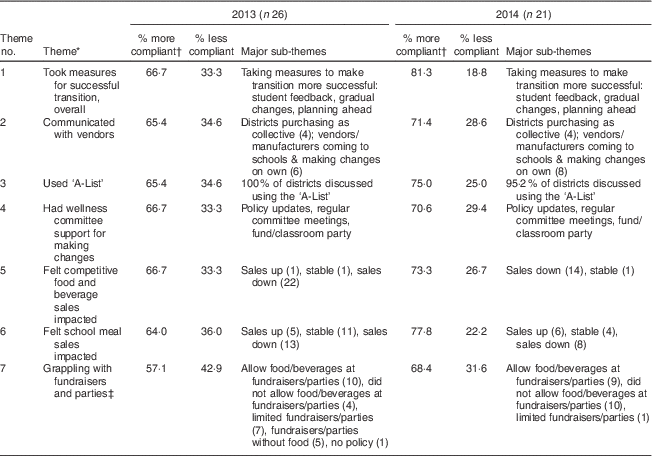
* Themes discussed by ≥66 % of school districts.
† Compliance=compliant with foods or beverages, or both (2013: beverage compliance=≥98 %, food compliance=≥65 %; 2014: beverage compliance=≥98 %, food compliance=≥72 %).
‡ In response to Question 7, Theme: Fundraisers and Parties, only 53·8 % of districts mentioned the theme in 2013, but since ≥66 % of districts mentioned the theme in 2014, both years were included for comparison.
Themes from more-compliant school districts
General measures
In 2013 and 2014, 66·7 and 81·3 % of FSD in more-compliant districts, respectively, discussed general measures they were taking to create a successful transition to the new standards (Theme 1). One FSD noted: ‘We started making changes six years ago’ (Table 3). Major sub-themes included garnering student feedback, making gradual changes and planning ahead. In 2013 and 2014, 65·4 and 71·4 % of FSD in more-compliant districts, respectively, discussed communicating with vendors because of the new standards. Major sub-themes included districts purchasing as a collective (only 2013) and having vendors/manufacturers coming to the school to discuss new needs and even manufacturers making changes towards compliance on their own (Theme 2). One FSD noted: ‘Vendors have come up with new products. Also, the food shows [where companies display products, often at conferences] are more geared to what we can buy now’ (Table 3). In 2013 and 2014, respectively 65·4 and 75·0 % of FSD in more-compliant districts discussed using the ‘A-List’ to meet the new standards (Theme 3). One FSD noted: ‘Yes [we use the “A-List”] and we have trained cafeteria managers to use it to find new items and use the calculator option’. Also, whether more compliant or less compliant, all districts discussed communicating with vendors/manufacturers and using the ‘A-List’ in both years: 100 % for both themes in 2013 (among all districts, not just more-compliant districts) and 95·2 % in 2014 for use of the ‘A-List’ (among all districts, not just more-compliant districts). In 2013 and 2014, 66·7 and 70·6 % of FSD in more-compliant school districts, respectively, discussed the wellness committee being supportive of making changes to comply with the new standards (Theme 4). One FSD noted: ‘We worked with the wellness committee to make sure only foods that comply were being sold and changes in such school policy were reflected on their website’ (Table 3). Major sub-themes included making policy updates, holding regular committee meetings and regulating fundraisers/classroom parties.
Quotes from food-service directors (FSD) highlighting best practices; NOURISH (Nutrition Opportunities to Understand Reforms Involving Student Health) study, 2013 and 2014

Fundraisers and parties
Importantly, while 57·1 % (2013) and 68·4 % (2014) of FSD in more-compliant school districts noted grappling with fundraisers and parties, restricting or eliminating fundraisers and parties was not part of the final standards (Theme 7). One FSD noted: ‘No food-based fundraisers during the school day and only a monthly classroom party’ (Table 3). Major sub-themes noted in 2013 included: allowing fundraisers/parties (ten out of twenty-six districts), not allowing fundraisers/parties (four out of twenty-six), limiting the number of fundraisers/parties in some way (seven out of twenty-six) and allowing fundraisers/parties without food/beverages (five of twenty-six). In 2014, major sub-themes included allowing (nine out of twenty-one districts) and not allowing (ten out of twenty-one) food/beverages at fundraisers/parties; only one school district mentioned limiting fundraisers/parties.
Impact on sales
FSD reported changes in competitive food and beverage sales, as well as school meal sales, where changes were simultaneously taking place. In 2013 and 2014, 66·7 and 73·3 % of FSDs in more-compliant school districts, respectively, discussed competitive food and beverage sales being impacted (Theme 5). One FSD noted: ‘Not selling ice cream and the new chocolate milk rule will be difficult’ (Table 3). In 2013, most FSD mentioned competitive food and beverage sales going down (twenty-two out of twenty-six). Only one FSD mentioned sales going up or sales being stable. In 2014, the majority of FSD mentioned sales going down (fourteen out of twenty-one); one mentioned sales being stable. In 2013 and 2014, 64·0 and 77·8 % of FSD in more-compliant school districts, respectively, discussed school meal sales being impacted (Theme 6). One FSD noted: ‘Getting kids to accept them [the changes] has been difficult’. In 2013, half of FSD mentioned school meal sales going down, while five of twenty-six mentioned sales going up and eleven of twenty-six mentioned sales being stable. In 2014, eight of twenty-one FSD mentioned sales going down while six of twenty-one and four of twenty-one, respectively, mentioned sales going up or being stable (see Table 4). Additional FSD quotes are presented in Table 3 to further highlight the themes raised by more-compliant school districts.
Lessons learned, best-practice recommendations and related resources
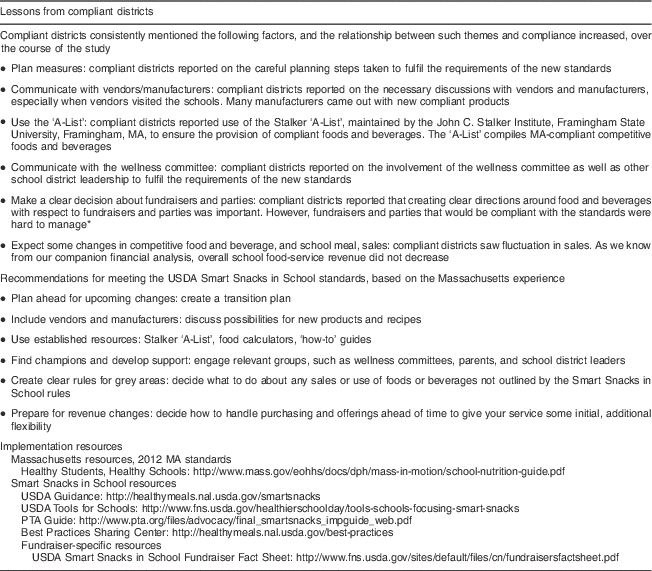
USDA, US Department of Agriculture; MA standards, Massachusetts School Nutrition Standards for Competitive Foods and Beverages.
* Compliance during fundraisers and school parties was not mandated by the 2012 MA standards.
Discussion
Data derived from the present study facilitated an understanding of the issues being considered among a group of Massachusetts school FSD implementing competitive food and beverage standards that are similar to the US Department of Agriculture’s new Smart Snacks in School standards. Changes were not easy, but they did result in the availability of healthier competitive food and beverage options in the school environment( Reference Hoffman, Rosenfeld and Schmidt 17 , Reference Gorski, Cohen and Hoffman 18 ). We uncovered seven main messages from interviews with FSD, which suggest strategies for complying with comprehensive school competitive food and beverage policies. To our knowledge, our study is the first to simultaneously explore both lessons learned by exploring issues raised by FSD and compliance with comprehensive competitive food and beverage standards.
Previous studies support our findings. In particular, five recent peer-reviewed publications examine school district implementation of state competitive food and beverage standards; these states include Arkansas, California, Connecticut, Maine and Massachusetts( Reference Hoffman, Rosenfeld and Schmidt 17 , Reference Gorski, Cohen and Hoffman 18 , Reference Phillips, Raczynski and West 25 – Reference Blum, Beaudoin and O’Brien 28 ). While none directly explore the relationship between implementation strategy and compliance, all five report that the school food environment improved (i.e. healthier options available) after implementation of the standards. Further, a 2012 case study report describes school districts across the USA that have successfully implemented strong competitive food standards while minimizing negative financial consequences( Reference Bassler, Chriqui and Stagg 5 ). The report notes that a wide variety of strategies were used to implement the standards. It describes findings aligned with NOURISH study results.
The present study builds on previous NOURISH analyses that demonstrate increased availability of food and beverage products meeting the 2012 MA standards as well as school food-service financial stability over the initial two years of policy changes( Reference Cohen, Gorski and Hoffman 4 , Reference Hoffman, Rosenfeld and Schmidt 17 , Reference Gorski, Cohen and Hoffman 18 ). We offer best-practice recommendations, based on the themes generated from our analyses among more-compliant school districts (see Table 4): (a) create a transition plan; (b) discuss possibilities for new products and recipes with vendors and manufacturers; (c) use established resources like compliant food and beverage lists, compliance calculators and ‘how-to’ guides; (d) find champions and develop support by engaging relevant groups, such as wellness committees, parents and school district leaders; (e) create clear rules for grey areas by deciding, for example, what to do about any sales or use of foods or beverages not outlined by the Smart Snacks in School rules; and (f) prepare for revenue changes by deciding how to handle purchasing and offerings ahead of required compliance to give your food service some initial, additional flexibility.
Our study’s findings should be interpreted with the following limitations in mind. First, we had a small sample size, largely due to lack of time and resources for participation. Of course, school districts that agreed to participate might be those with more resources or those more likely to comply with the standards. However, the range of compliance rates, and the demographic similarity of participating and non-participating school districts, suggests that participating school districts are likely representative of the state as a whole( Reference Gorski, Cohen and Hoffman 18 ). Second, school meals and competitive foods and beverages are often difficult for FSD to disentangle. For example, FSD conversations with vendors and manufacturers are not limited to one or the other. Also, we defined compliance broadly. Using a stricter criterion (i.e. compliant for both foods and beverages) did not yield meaningful results. Even among participating school districts that knew they were being evaluated, very few schools were fully compliant; therefore, it does not seem that participation made school districts compliant. In all, it is clear that meeting the MA competitive food and beverage standards is difficult. Despite such complexity, clear themes among more-compliant districts surfaced, which align well with previous research. FSD in more-compliant districts were more likely to talk about such themes than those in less-compliant districts. The evidence-based best-practice recommendations may be useful for FSD across the country grappling with implementing the final national Smart Snacks in School standards in 2016. Table 4 includes these recommendations as well as related resources for Smart Snacks in School implementation. A policy brief will be available on the Heller School for Social Policy and Management, Brandeis University website (http://heller.brandeis.edu/).
Acknowledgements
Acknowledgements: The authors gratefully acknowledge the time and candour of the participating school FSD, who spent time talking with the authors as they were in the midst of implementing the 2012 MA standards. They are also indebted to the NOURISH research assistants who collected and coded food and beverage product data and who conducted FSD interviews. In particular, they thank Ms Kayla Timmons and Ms Manar Al Jazzaf for their rigorous qualitative coding assistance for this study. Finally, they thank colleagues at the Massachusetts Departments of Public Health and Elementary and Secondary Education for their support throughout the NOURISH study: Dr Tom Land, Ms Kathleen Millett, Ms Christina Nordstrom, Ms Laura York and Ms Julianna Valcour. Financial support: Funding for the NOURISH study was provided by The Robert Wood Johnson Foundation and Harvard Catalyst | The Harvard Clinical and Translational Science Center (National Center for Research Resources and National Center for Advancing Translational Sciences, National Institutes of Health Award, grant number UL1 TR001102), with financial contributions from Harvard University and its affiliated academic health-care centres. The content is solely the responsibility of the authors and does not necessarily represent the official views of Harvard Catalyst, Harvard University and its affiliated academic health-care centres, or the National Institutes of Health. J.F.W.C. was supported by the Nutritional Epidemiology of Cancer Education and Career Development Program (grant number R25 CA 098566). M.T.G. was supported by the Agency for Healthcare Research and Quality (grant number T32HS000055). Conflict of interest: The authors have no conflicts of interest and no financial disclosures. L.E.R. has submitted abstracts related to this work to two conferences in autumn 2016: the American Public Health Association Annual Meeting and CityMatCH: The National Organization of Urban MCH Leaders. Authorship: L.E.R. made substantial contributions to conception and design, data acquisition, analysis and interpretation; drafted the article and revised it critically for important intellectual content; and had final approval of the version to be published. J.F.W.C. made substantial contributions data acquisition; and revised the article critically for important intellectual content, including final submission. M.T.G. made substantial contributions data acquisition; and revised the article critically for important intellectual content, including final submission. A.J.L. made substantial contributions to analysis and interpretation; and revised the article critically for important intellectual content, including final submission. L.S. revised the article critically for important intellectual content, including final submission. E.B.R. revised the article critically for important intellectual content, including final submission. J.A.H. made substantial contributions to conception and design, analysis and interpretation; revised the article critically for important intellectual content; and had approval of the version to be published. Ethics of human subject participation: This study was conducted according to the guidelines laid down in the Declaration of Helsinki and all procedures involving human subjects/patients were approved by the Harvard T.H. Chan School of Public Health Institutional Review Board. Written informed consent was obtained from all subjects/patients.



