




Introduction: The Issue of Wage Labour in Premodern Europe
In 2001, Robert Allen confidently wrote: “Wages and prices have long been central concerns of economic historians, for they bear on such fundamental issues as the pace of economic development, economic leadership and the standard of living.”Footnote 1 Since then, however, a growing body of historical research has become critical of such widely available but very crude measures of social and economic life as the purchasing power of wages. Increasingly, the sources and methods often used to map changing living standards are deemed unsatisfactory, if not completely unreliable, for the premodern period and even much of the modern period. As a result, historians ironically introduced the metaphor of “unreal wages” to denote the criticized real wage series.Footnote 2 We will not reproduce all the sets of arguments but will simply summarize the major arguments, which foster suspicion when translating data on wages and prices into living standard experiences.Footnote 3 Observations of daily wages are often gathered from large building schemes and big institutional employers. These can hardly be deemed representative of an entire economy. Whether subcontracted workers actually received the full wages their masters charged to these institutions is another question entirely. While data on daily wages are readily available, the number of days worked, the income of other family members, let alone from other sources of income, and so forth are all subject to speculation. Most importantly in the context of this article, the relationship between wage labour and living standards is often questioned because many people, both in towns and in the countryside, were largely self-employed. Our central aim is to empirically test this critique by benchmarking specific groups of wage labourers in different urban communities in the Southern Low Countries between the fourteenth and sixteenth centuries. We will develop a new method to assess how unreal wage series are and show how they can still be fundamental to the study of premodern living standards, albeit for different reasons than traditionally claimed.
In the following pages, wage labour is defined as “work, which is performed on the basis of a contract between a worker and an employer, and which the employer remunerates in the form of a wage”.Footnote 4 It implies a voluntary exchange on the market, even though power relations were often asymmetrical. Prior to the nineteenth century, this form of labour was the exception rather than the rule in many parts of Europe. Precise figures on wage dependency are rare and often rest on multiple assumptions, but they help to reveal the exceptional position of wage labourers in premodern societies. Even in the highly urbanized and commercialized Low Countries, many households enjoyed an entrepreneurial or non-marketed income.Footnote 5 For example, in the Brabantine city of 's-Hertogenbosch, the maximum share of wage income in gross urban income amounted to approximately seventeen per cent in the sixteenth century, while the entrepreneurial income was about 46.5 per cent.Footnote 6 At about the same time, only a quarter of all work was performed by wage labourers in the countryside of Inland Flanders.Footnote 7 Even in the late nineteenth century, household accounts reveal that the marketed income of the male head still amounted to less than half of the household income in the Low Countries as a whole.Footnote 8 In early twentieth-century Brussels, workers in the building industry still regularly switched from wage to independent labour.Footnote 9
The limited dependency on wages is certainly not unique to households of the Low Countries. Similar patterns have been observed for most European regions during the premodern period.Footnote 10 This is not to say that wage labour was a marginal phenomenon in this part of the world. From the High Middle Ages onwards, this form of employment became increasingly important as a result of economic transformations, proletarianization, and the relative supply of labour.Footnote 11 These processes seem to have gathered pace by the end of the early modern period, especially through (proto-)industrialization. However, its evolution was never linear nor uniform across space. Contrary to our earlier examples of 's-Hertogenbosch and Flanders, wage work was already dominant in the sixteenth-century countryside of the Guelders River area, amounting to fifty-seven per cent of the total labour input, especially due to the dominance of large tenant farmers.Footnote 12 Likewise, England was a clear frontrunner: about two-thirds of the population was already wage-dependent by the eighteenth century.Footnote 13 Conversely, the importance of wage labour declined significantly in parts of Northern and Eastern Europe from the sixteenth century because of the reintroduction of serfdom and its accompanying forms of coerced labour, such as the corvée.Footnote 14
The above variations in the prevalence of wage labour show that we cannot simply assume a fixed or steadily increasing correlation between general living standards and real wage series. Instead, we need a better understanding of how the organization of labour changed over time and across space. In this sense, we follow a long line of historians who have stressed the social rather than the economic aspects of wages.Footnote 15 Which groups relied predominantly on wage labour and to what extent did this affect their income compared with others? Premodern labour markets are often characterized as imperfect with large frictions. As a consequence, the bargaining power and job mobility of wage workers were often limited, forcing them to be price takers.Footnote 16 Was this fundamentally different for self-employed households, such as brewers, who needed lots of capital to run a business, and butchers, for whom access to a meat stall depended on family ties? Conversely, what about the poorly paid, allegedly ‘independent’ pin-makers of 's-Hertogenbosch who relied upon large international merchants for employment?Footnote 17 Several authors have already argued that some self-employed craftsmen evolved into semi-wage labourers in the sixteenth century.Footnote 18 Yet the cultural and social perception of wage labour was often negative because it implied a subordinate relationship with an employer at a time when personal freedom was held in high regard.Footnote 19 Did such norms impact the competition between different forms of labour and, subsequently, the income derived from them? These questions urge us to reflect upon the place of wage labour in premodern society and to critically rethink real wages as a proxy for general living standards. As Hatcher acknowledges:
There is a pressing need to create a far better representation of the population as a whole across seven centuries of massive economic and social change by moving far beyond builders and agricultural labourers to gather information on the incomes provided by a far greater range of occupations and social strata.Footnote 20
While Hatcher's call is imperative to the debate, it presents significant methodological challenges as sources detailing the income of non-wage earners are extremely rare. In the following pages, we therefore propose a new approach to measure the representativeness of real wage series for the wider population. Paradoxically, we suggest putting building labourers and their remuneration centre stage again. Key to our methodology is a systematic benchmarking of this group in fiscal sources as a proxy for the income hierarchy of society at large. As a proof of concept, we apply this approach to several cities in three subregions of the Southern Low Countries between the fourteenth and sixteenth centuries, namely the County of Flanders, the County of Hainaut, and the Duchy of Brabant. We demonstrate how the waxing and waning of builders’ fiscal position in society at large did not follow a haphazard path. On the contrary, as a rule, periods of rising purchasing power of wage-earning building craftsmen corresponded to periods in which they improved their position within the social hierarchy. Conversely, when the price revolution put pressure on the consumer baskets that could be bought by carpenters and masons, they again dropped in the fiscal ranking. This is suggestive of the relative stability and resilience of the incomes earned by the majority of the self-employed in society. It also supports the idea that real wages are an important proxy for assessing the changing functional distribution of income in pre-industrial societies rather than a proxy for general living standards.
The remainder of the article is structured as follows. First, we explain our rationale for focusing on building workers in the Southern Low Countries and discuss their most important characteristics, such as the evolution of their real wages and the organization of the building industry. Next, we introduce the new methodology along with the sources and datasets used for our proof of concept. We explain how to identify different groups of wage labourers in taxation lists through record linking in the city accounts. The results of the approach are presented in the following section, where we assess the evolving fiscal position of the 1114 identified workers vis-à-vis the rest of society. Finally, we discuss the implications of our findings for studying living standards in premodern Europe. Like others before us, we advocate for the social contextualization of wage series. In doing so, we also formulate an apology for the “unreal wages”, showing how they are still highly valuable and indispensable to the research.
The Case Study: Building Labourers in the Southern Low Countries
The Southern Low Countries offer an excellent test case to (re)assess the relationship between real wages and living standards during the premodern period thanks to their commercialized economies and rich archival sources. About one-third of the region's population lived in cities between the fourteenth and sixteenth centuries.Footnote 21 Accordingly, the demand for specialized building craftsmen was significant. Labour markets were well developed even though important barriers and frictions existed. In cities, guilds controlled access to the craft and regulated labour markets from at least the end of the thirteenth century. For example, to be recognized as a master carpenter in Bruges in 1441, sons of already registered masters only needed to pay 26 gr. Fl., the equivalent of two and a half days of skilled work, whereas newcomers from Flanders had to pay 506 gr. Fl. (50.6 days) and those from outside the county 746 gr. Fl. (74.6 days). Journeymen were not allowed to work for other employers until they completed their tasks on an ongoing project. In addition, the carpenters’ guild enforced standardized wage levels and prohibited work on holidays, Sundays, and at night. Similar regulations can be found in other guilds of building craftsmen throughout the Southern Low Countries.Footnote 22
According to Jean-Pierre Sosson, these regulations created structural inequalities in the building industry. Indeed, masters and their sons occupied a privileged position in the guilds. Next to professional titles and family ties, a distinction must be made based on access to capital and the reliance on wage work. While labourers of all skill levels were the most regulated category in the building industry, entrepreneurs enjoyed a great deal of freedom. A few large players monopolized the lucrative trade in raw materials: most of these had to be sourced outside the region and implied high transportation and organization costs. In contrast to wages, the prices of these goods and services were never fixed. Because most contracts for large construction projects were assigned through reverse auction, large entrepreneurs could use this advantage to outbid smaller players. The need for floating capital to prefinance such projects also enhanced economic inequalities. As a result, capital became concentrated in the hands of a few masters in the Southern Low Countries. Unsurprisingly, these entrepreneurs used their economic power to gain political capital. Many held the position of dean or judge in the guild for multiple years or were even elected as aldermen in the urban government. Accordingly, a select group of entrepreneurs set the rules and decided upon their enforcement. Entering this exclusive group was therefore difficult without pre-existing wealth and/or familial ties.Footnote 23
Structural inequalities shaped the day-to-day organization of labour in the building industry. As we have seen, a few major entrepreneurs managed the larger projects. Their incomes relied on the profit margins of subcontracting workers and reselling materials. Detailed accounts of these activities have barely survived from before the seventeenth century, but we may look at the expenses of large ecclesiastical and urban institutions instead because they often managed several major construction works themselves. To this end, they hired one or more supervisors, usually prominent master carpenters and/or masons, to organize and inspect all the different tasks.Footnote 24 Although they received a significant annual salary for their organizational services, supervisors often generated more income from using their privileged positions, employing themselves as labourers and suppliers. In the urban administration of Bruges, supervisors even evolved from salaried officials to full-fledged contractors during the fifteenth century, showcasing the social and functional similarities between the two groups.Footnote 25
To complete the various building tasks, a plethora of workers were employed by contractors and supervisors. The vast majority were paid a wage for every day they toiled. This included trained craftsmen who brought their own tools to process the provided materials on the construction site, which was usually the case for carpenters, masons, pavers, plasterers, plumbers, stonecutters, thatchers, and tilers. Sawyers were remunerated as a group because sawing timber required a coordinated team of at least two people. Prior to the seventeenth century, the wages of masters and journeymen were identical as long as they performed the same work.Footnote 26 However, due to their inferior status and limited employment opportunities, journeymen regularly performed less rewarding tasks that required little training and expertise, such as moving materials, clearing debris, or digging trenches. Notwithstanding the involvement of journeymen, such tasks were predominantly performed by wage labourers who had no formal training and who were not members of a guild.
Because sources rarely state the rank of individuals, we have chosen to differentiate skilled and unskilled labourers in our analysis based on their remuneration. The distinction can easily be made given the significant skill premium of at least fifty per cent (see below) and the high uniformity of wages per task per project. Depending on the nature of the building project, the ratio between the number of employed skilled and unskilled labourers was roughly equal or in favour of the latter. For example, the accounts of the Flemish city of Geraardsbergen contain 4748 days of unskilled labour (68.1 per cent of the total) compared with 2219 days of skilled labour (31.9 per cent) between the fifteenth and the middle of the sixteenth centuries.Footnote 27 In the same period, ecclesial institutions in Ghent employed unskilled workers for 7895 days (46.6 per cent) and skilled workers for 9056 days (53.4 per cent).Footnote 28 The difference can be explained by the large investments made by Geraardsbergen in roadworks and fortifications, jobs that require lots of moving materials and digging, whereas the abbeys and hospitals focused on maintaining their buildings, increasing the need for trained craftsmen.
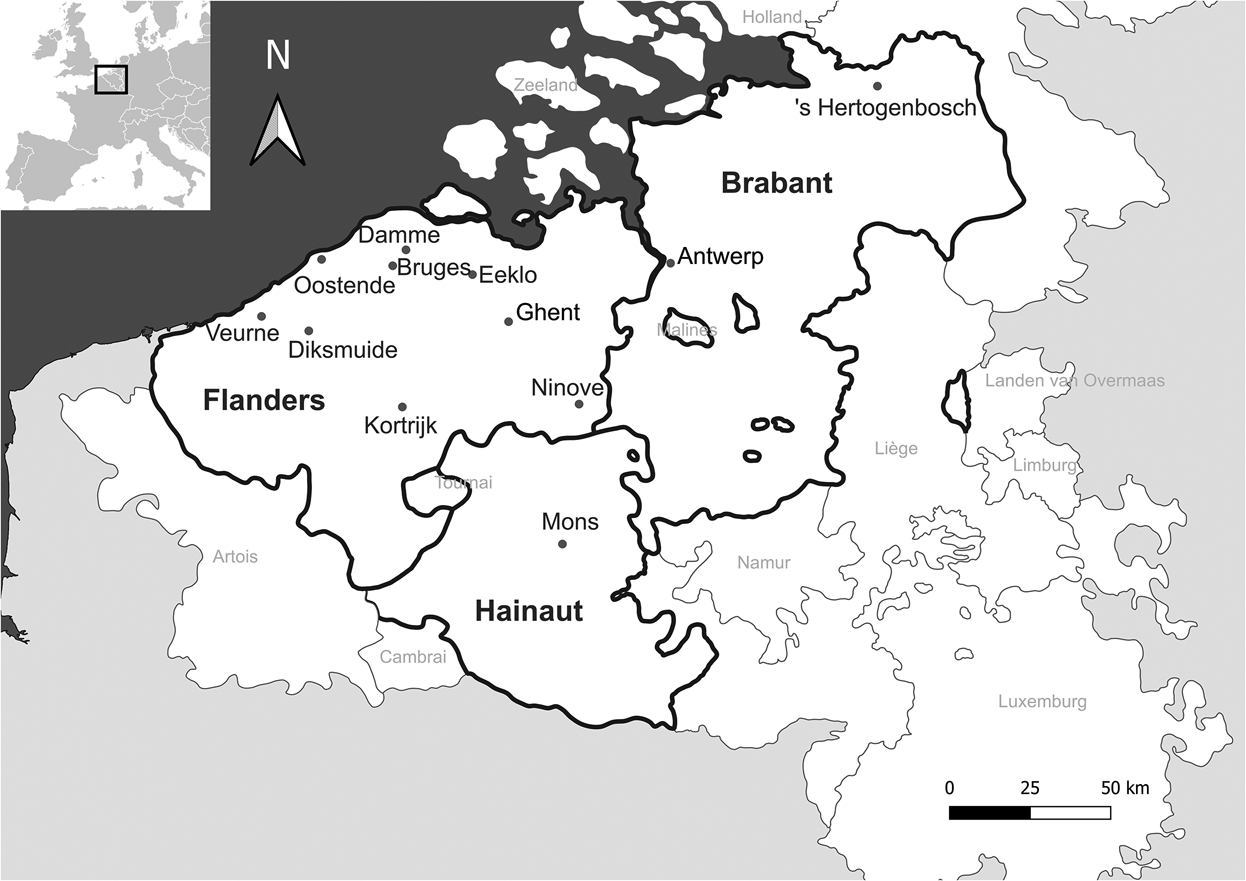
Observations on wages for skilled and unskilled building labourers for different parts of the Southern Low Countries are readily available thanks to extensive past studies.Footnote 29 Recently, Sam Geens has compiled all these data to reconstruct real wage series for the three subregions under study (see Figure 1).Footnote 30 Figure 2 reveals the evolution of daily wages of skilled craftsmen for the capitals of the County of Hainaut (Mons), the County of Flanders (Bruges and Ghent), and the Duchy of Brabant (Antwerp). Wages are expressed in consumer baskets (i.e. a bundle of basic necessities related to clothing, fuel, food, and drink).Footnote 31 The trend for unskilled labourers is nearly identical and therefore not included; the skill premium fluctuated between 1.5 and 2.2 throughout the period.
Selected cases in the Southern Low Countries.
Notes: Map created with QGis 3.36. Shapefile of the medieval Low Countries provided by GIStorical Antwerp.
The real wages of building craftsmen in the Southern Low Countries (1286–1550).
Source: Geens, “A Golden Age for Labour?”.
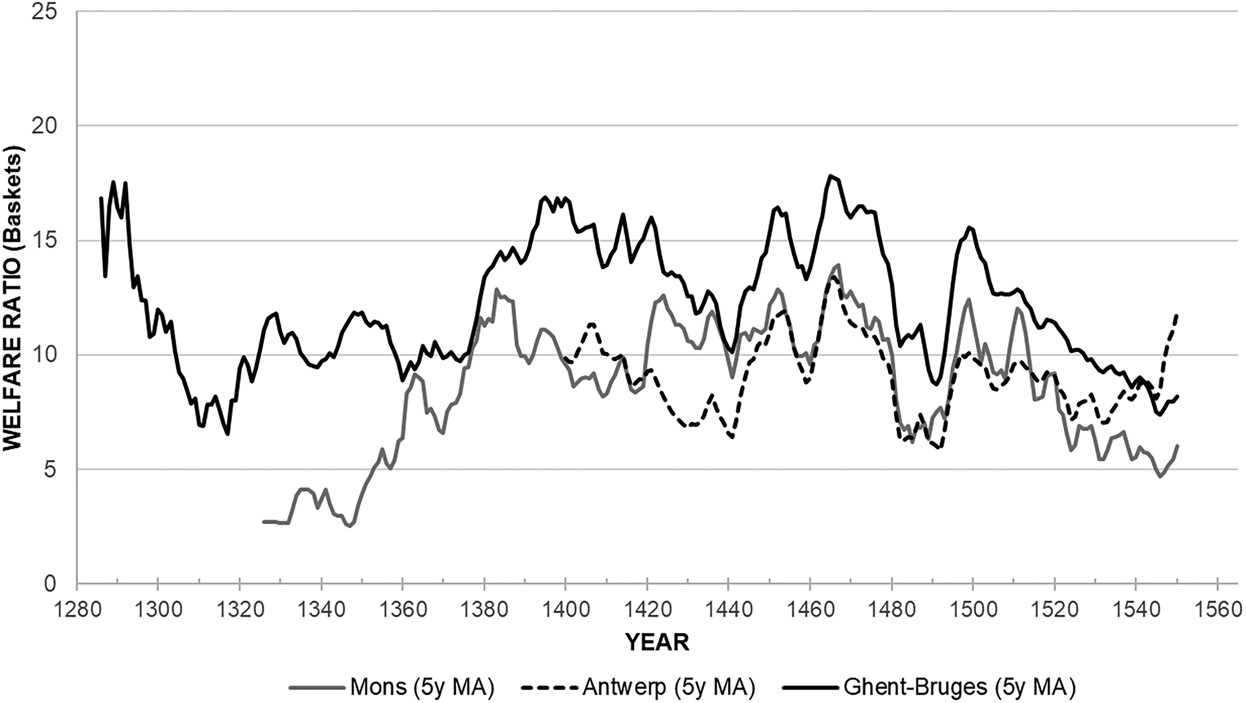
In general, Figure 2 displays evolutions similar to other parts of Northwestern Europe: real wages were low before the Black Death, skyrocketed afterwards, and remained stable at this high level during the fifteenth century before plummeting in the sixteenth century. Some regional differences can be distinguished, however. The level of remuneration was the highest in Bruges and Ghent, the largest cities of the medieval Southern Low Countries. Here, the increase in wages after the Black Death arrived relatively late.Footnote 32 In this respect, the evolution in Mons conforms better to the typical Northwestern pattern. The remuneration of skilled labour tripled between 1340 and 1400. Its trend and level were similar to those found in Antwerp up to the middle of the sixteenth century. At that time, the Brabantine city was the only one displaying an increase in real wages. Building craftsmen owed this favourable position to the commercial efflorescence of Antwerp, which had taken over the leading role from Bruges as the most important trade hub of the Low Countries. This recovery is exceptional, however, even within the Duchy of Brabant. Most localities in the Southern Low Countries experienced a prolonged decline in purchasing power during the rest of the sixteenth century.
Aside from wage labourers, contractors and supervisors also paid independent masters for (half-)finished materials, such as windows or planks made in off-site workshops, but they remained a minority in the accounts of the institutions studied. On the private market, master craftsmen probably had more opportunities to work independently as many jobs were small and required less coordination. For example, building accounts for two townhouses in sixteenth-century Bruges reveal that craftsmen were often paid per task instead of per day.Footnote 33 From the late fifteenth century on, this market specialized, judging from the increasing quantity of and detail found in building contracts.Footnote 34 Although we should not underestimate the importance of these smaller entrepreneurial activities, pointing to a more mixed form of income for some master craftsmen, the vast majority of workers in the building industry were largely dependent on wage work to earn a living. According to Johan Dambruyne, no other industry was characterized by such high numbers of masters working for a daily wage.Footnote 35 Even in the small independent workshops, wage labour was common as the usual restrictions on the number of employers per master were often absent. One exception is the cabinetmakers in fourteenth-century Bruges. Yet they could still employ up to five persons per atelier.Footnote 36 An overview of the effective ratio between independent master craftsmen and wage-earning apprentices and journeymen is missing for the medieval period. However, figures for eighteenth-century Ghent may be indicative of the atypical character of the building industry in premodern times. On average, across all sectors, one master employed 1.3 journeymen and apprentices. In retail and transportation, many businesses operated without permanent help. In stark contrast, master carpenters on average relied on 6.6 aides and master masons on no fewer than 10.1!Footnote 37 In no other occupation were figures this high. To this, we should also add the army of unskilled labourers who were not part of the guild and remained unrecorded. As we have seen, they often outnumbered their skilled colleagues.
Although the building industry hardly seems representative of society at large, we should not discount the sector as a touchstone too quickly. The building industry was by no means a marginal phenomenon. Based on data from militia and tax lists, we can estimate that about ten to fifteen per cent of the male urban population with an occupation toiled in construction in the counties of Flanders and Hainaut during the fourteenth and fifteenth centuries. This figure is relatively high for the Late Middle Ages. In comparison, building craftsmen only constituted around five per cent of the total in Nuremberg and Florence.Footnote 38 The difference can be attributed to the power of the building guilds in the Southern Low Countries. They prohibited hiring non-members on projects in the city unless there was a severe labour shortage or a lack of expertise. Moreover, the wages of these unfree craftsmen were set well below those of affiliated craftsmen, even in the less regulated countryside.Footnote 39 Given the severe economic disadvantages for non-members, and given that citizens were expected to reside in the city lest they lose their statute, craftsmen felt compelled to live in cities. This urban concentration of building labourers in the Southern Low Countries has the advantage that they can easily be identified in the sources and, subsequently, benchmarked against the wider population. The next two sections explain how this can be achieved and what sources are available to this end.
Methodological Framework
The idea to test the representativeness of real wage series of building labourers is hardly new. In the past, historians have explored a whole range of alternative proxies for premodern living standards, such as the material culture recorded in probate inventories, the total wealth according to fiscal sources, or the GDP per capita based on extensive modelling of economic performance.Footnote 40 A confrontation of such proxies and the position of building labourers vis-à-vis their remuneration is, however, rare.Footnote 41 Accordingly, it remains unclear to what extent real wages capture changes in living standards for the population at large and building labourers in particular.
One notable exception is the study of building craftsmen in sixteenth-century 's-Hertogenbosch by Bruno Blondé and Jord Hanus. Their method consisted of three important steps, which also form the point of departure of our methodology. First, they scanned the city accounts for wage payments to masons, carpenters, and unskilled construction workers. They selected every individual who worked more than 200 days in any given year as a proxy for full-time wage labour. For example, they found that the unskilled Willem Voss toiled 261 days for the city according to the accounting book of 1507–1508. In the second step, the names of the selected individuals were cross-referenced with those included in income taxes. This allowed Blondé and Hanus to map the evolving position of building labourers relative to the general population. The earlier mentioned Willem Voss belonged to the 30th percentile according to the income levy of 1507–1508. In comparison, Jan Peters was deemed too poor to contribute to the tax of 1552–1553 even though he had performed similar work for the city for a comparable number of days (260 days) as Willem had four decades earlier. Apparently, the relative position of unskilled building labourers had declined significantly during the first half of the sixteenth century. In the third and final step, Blondé and Hanus utilized the remuneration of the construction workers to estimate the income of the general population. More specifically, they divided the tax levies of the selected labourers by their annual wages, as derived from the city accounts, to approximate how much income each unit of taxation represented. The ratio could then be applied to the entire tax register. The results for the urban population at large deviated considerably from the forecasts based on the real income of daily wages. In contrast to the declining trend in real wage series, median households witnessed an increase in their real income from 2.0 to 3.3 consumer baskets (+65 per cent) between 1501 and 1558 in 's-Hertogenbosch. Thus, while the wage series did seem to capture the trend in living standards for building labourers adequately, they did not do so for society at large. As already mentioned, most households were not dependent on wages only. Next to wealth as a source of income, most craftsmen and retailers enjoyed an entrepreneurial income and proved resilient to purchasing power fluctuations.Footnote 42
To date, this methodology has not been applied to other periods or locations even though it holds the promise of fundamentally reshaping our understanding of living standards in the past. One possible reason is that the methodology requires the combination of detailed city accounts and multiple, comparable taxes at regular intervals for a single locality. Unfortunately, building work is often accounted for in a limited way. As a result, it is often impossible to ascertain with certainty the total number of days labourers toiled per year based on urban government expenses only. Building craftsmen could not rely on the urban government alone, hence they worked for multiple employers and probably also in different formulae. Even in one of the largest cities of the medieval Low Countries, Bruges, the accounts rarely mention labourers who worked more than three months a year.Footnote 43 The few cases of full employment in 's-Hertogenbosch that allow us to approximate yearly incomes, such as those of Willem Voss and Jan Peters, are thus exceptional for the premodern period. Moreover, the fiscal records for sixteenth-century 's-Hertogenbosch are of high quality and tax criteria are well documented. In contrast, for most localities we have no idea about the precise tax criteria let alone how they changed over time. It is therefore impossible to convert the levies of households into absolute income levels even if the annual wage of some identified full-time labourers were available.
Given these limitations, we suggest major modifications for every step of the Blondé–Hanus methodology to increase its applicability for our purposes and enhance future comparative research elsewhere.Footnote 44 For the first step, the identification of wage labourers, we broadened the criteria to include the large group that toiled for multiple employers. To this end, the city accounts were scanned for anyone who performed wage work on construction sites irrespective of the length of employment. Based on the structural inequalities in the building industry outlined in the previous section, we distinguish three income profiles: unskilled labourers, skilled labourers, and entrepreneurs. As we have seen, many building labourers relied (largely) on wage income. Therefore, we hypothesize that if skilled and unskilled real wage series represent anyone's living standards, it must be these respective two groups. The category of entrepreneurs encompasses all independent masters and merchants who relied on subcontracting and/or delivering materials for a living. As they derived most of their income from entrepreneurial activities, much like the majority of the urban population, they will serve as a control group. If the criticism of the representativeness of real wages is correct, we should observe a significantly different evolution for entrepreneurs compared with labourers.
How do we assign individuals to one of the three income groups if the city accounts do not inform us about total employment? Because we are most interested in benchmarking wage labourers, we apply the most rigid classification to these two groups. We label anyone listed in the city accounts who performed contracted work or delivered building materials as an entrepreneur, even if this entailed a one-time small project or the delivery of a single stone and even if the individual was also paid a wage for a substantial number of days. Through this process of elimination, the remainder of our sample includes building craftsmen who, to the best of our knowledge, only worked for wages. As mentioned, we differentiate between skilled and unskilled labourers based on remuneration. If a worker, such as a journeyman, performed both types of work, we classify him as a skilled labourer.
The main advantage of this approach is that we can greatly increase the number of observations even when the construction expenses in the accounts are limited. The downside is that we probably misidentify some workers on the basis of a single source: at the top of the distribution, we might miss some entrepreneurial activities. At the bottom, we might include some men who only engaged in construction labour intermittently. To minimize this bias, we introduce a modification to the second step. When we assess the position of each group in the fiscal sources, we do not look at the whole distribution of labourers or entrepreneurs but instead focus on the middle two quartiles (Q2 and Q3) as a proxy for the general experience of each group. For example, for the period between 1390 and 1409, we identified twenty skilled labourers in the Flemish city accounts (see below). We assume that our method misidentified some workers as fully employed wage labourers, so we exclude the five individuals with the highest contributions and the five with the lowest in the corresponding tax lists.
The second step does not simply involve benchmarking the three groups in a given year but also compares their taxation with the rest of society over time. Whereas Blondé and Hanus could employ the informative income taxes of 's-Hertogenbosch as a proxy for absolute income differences between households, such an approach is often unfeasible because most sources are mute about the tax criteria. Prior to the sixteenth century, a hybrid system was in place across the Low Countries in which wealth, income, and perceived socio-economic status were assessed together. Nevertheless, these mixed levies do not rank households in a random way. Collectors were usually selected from among prominent local figures and had sufficient knowledge to assess the ability to pay given that premodern societies relied heavily on credit and estimating creditworthiness was thus essential to economic life.Footnote 45 In this sense, we believe that the relative fiscal ranking rather than the absolute differences in tax assessments can still be informative about differences in income. Given that income and wealth are strongly connected, we may assume that on an aggregated level the ordinal fiscal positions of the three groups are comparable for lists that use a different mixture of both criteria. For 's-Hertogenbosch, we can even calculate the correlation between two different types of taxes as a housing tax has been preserved for 1505–1506 and a mixed levy for 1506–1507. Of the 2742 households, we were able to retrace 1782 households in both sources (sixty-five per cent of the total). If we compare their absolute contributions, a simple linear regression can only explain half of the observations (R2 = 0.50; p < 0.001). However, if we compare the percentile rankings of each household, the correlation –which we do not expect to be perfect – is much higher (R2 = 0.77; p < 0.001). For 60.9 per cent of the households, the rankings differed by less than ten percentiles between the two fiscal sources and only 5.3 per cent moved from one quartile in the distribution to another.Footnote 46
The common lack of serial income taxes is thus not problematic for our methodology. Instead of retracing absolute evolutions, we can exploit the relationship between fiscal and income hierarchies by mapping the relative changes in the position of construction workers vis-à-vis the rest of society. For each group, we calculate the percentile distribution of the middle two quartiles at regular intervals. For example, the earlier mentioned ten skilled wage labourers from Flanders in 1390–1409 ranked between the 38th and 67th percentiles in taxation records, but their colleagues in 1430–1449 were only situated between the 30th and 56th percentiles, a clear deterioration of their relative position in the fiscal sources (see below).
This change to a non-parametric approach comes at a cost: we cannot estimate the absolute income levels for every household based on their tax assessment or levy. At the same time, it opens up the full range of available tax lists as well as the inclusion of as many observations of building craftsmen as possible. We are no longer bound to income taxes alone. This is especially valuable for the medieval period, when pure income taxes were rare. Moreover, the new approach enables the grouping of data across time and space. While the absolute levies of different tax lists are often impossible to combine due to the absence of clear tax criteria, the relative position of specific groups can easily be aggregated and compared without this information. Obviously, a statistical test is needed to check if the structure of the building industry deviated significantly in a certain location or period, but the potential to expand the analysis is immense. Research into the premodern period is limited by the fragmentary nature of the source material. We often possess a few taxes scattered throughout time and space. Thanks to our modifications we can now combine them to cautiously assess long-term evolutions in the relative position of building craftsmen in society. In this article, we have opted to do this at a twenty-year interval. Such an interval proves long enough to overcome the most volatile fluctuations in the real wage series but is short enough to remain sensitive to structural changes in remuneration.
The issue of remuneration brings us to the third and final step of our methodology. For Blondé and Hanus, the annual wages of specific labourers were the key to estimating the ratio between tax levies and income levels, but such an exercise is not possible based on the relative measures we just proposed. Nevertheless, a confrontation between the fiscal position of the identified groups and the real wages is still valuable. If we compare the relative trends of both variables, they should look similar for the skilled and unskilled labourers if wages are representative of their income. By contrast, the two should be unrelated for the entrepreneurs. In other words, the confrontation allows us to test whether changes in remuneration are really driving the trends we observe for wage labourers. As we will see, the declining fiscal position of skilled labourers between 1390 and 1449 was indeed mirrored by a drop in purchasing power (from 11.2 to 9.9 baskets).
In sum, our methodology consists of three steps. First, we identify construction workers in city accounts and classify them as unskilled wage labourers, skilled wage labourers, or entrepreneurs. Next, we cross-reference their names with available tax lists for the same cities. For the middle two quartiles (Q2–Q3) of every group, we calculate their position within the entire fiscal population per twenty-year interval, based on their percentile rankings. Finally, we compare the relative changes in their fiscal position with the changes in real wage series. If our hypothesis is correct, we should observe that wage labourers moved up or down the social ladder in accordance with their purchasing power while entrepreneurs, the control group, did not.
Sources for the Southern Low Countries
The potential of the outlined methodology is explored for three subregions of the Southern Low Countries. We focus foremost on the County of Flanders, the economic centre until the sixteenth century. Here, we find the most extensive collection of medieval city accounts. Many boast a nearly continuous series and some already commence in the late thirteenth century. Unfortunately, taxation records are less abundant and only become available from the late fourteenth century. We selected the most comprehensive tax records for towns with more than 1000 inhabitants or 250 households. Below this threshold, the economic nature of urban communities becomes difficult to discern from larger villages in the countryside and – more importantly – the number of building labourers becomes too limited to be reliable.Footnote 47 A full overview of the included communities and their sources can be found in Table 1 and Figure 1. Our sample includes both major cities with a regional or international network, such as Bruges and Kortrijk, and small towns mainly servicing their immediate hinterlands, such as Ninove and Eeklo. The size of the community and the scale of the economy may influence the fiscal position of building labourers. However, a multivariate regression analysis does not reveal any significant differences between the included locations (p > 0.05 for all location dummies; see Table 2). This can be explained by the high degree of mobility of medieval building labourers. More ambitious artisans would move from one city to the next in search of better opportunities. Wealthier communities probably attracted more talented or well-off workers.Footnote 48 Certainly, the absolute difference between the economic elite and the building labourers would be greater in, say, Bruges compared with Ninove, but the relative difference is similar.
Identified building workers in tax registers and city accounts.
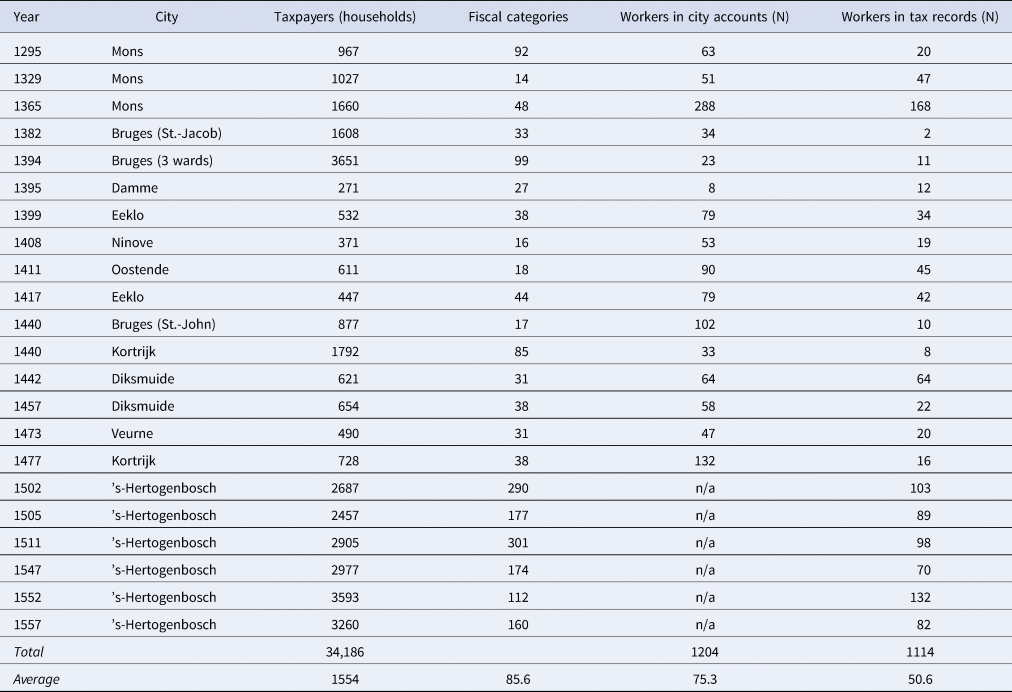
Sources: Droits de meilleur catel sur les habitants de la ville de Mons, 1295, Archives de l'Etat à Mons, Mons, AEM.08.005, Tresorie des comtes de Hainaut: Recette des mortemains, 48; Le 3 sous dou jour Saint Rémi, 1329, Archives de l'Etat à Mons, Mons, AEM.01.151, Commune Mons. Section ancienne, 1349; Comptes semestriels des recettes et dépenses du massard, 1338–1389, Archives de l'Etat à Mons, Mons, AEM.01.151, Commune Mons. Section ancienne, 1427–1476; Paul Heupgen, “Le rôle de la taille de Mons de 1365”, Annales du cercle archéologique de Mons, 55 (1937), pp. 41–95; Willem De Backere, Pointingboek van de glavye: Sint Jacobszestendeel, 1383, Stadsarchief Brugge, Bruges, Stadsrekeningen Annexe, s.n.; Ingrid De Meyer and Willy Vanderpijpen, “De sociale strukturen van de St.-Jakobs-, St.-Niklaas-, en O.-L.-Vrouwzestendelen in Brugge in 1394–1396”, in Wim Blockmans et al. (eds), Studiën betreffende de sociale strukturen te Brugge, Kortrijk en Gent in de 14e en 15e eeuw, Standen en Landen, LVII (Heule, 1972); Rekening van de tresoriers Mattiis Van Mendonc en Jan Van Ghedezbeke, 25 December 1394–25 December 1396, Algemeen Rijksarchief Brussel, Brussels, CCRK67, Rekenkamers, Registers, Stadsrekeningen van het Graafschap Vlaanderen: Damme, 33545; Eric De Smet, “Eeklose en Lembeekse belastingbetalers, einde 14e–begin 15e eeuw”, De Eik, driemaandelijks tijdschrift voor familiegeschiedenis Eeklo-Meetjesland, 2 (1980), pp. 124–149; Stadsrekening Ninove, 1408, Algemeen Rijksarchief Brussel, Brussels, CCRK67, Rekenkamers, Registers, Stadsrekeningen van het Graafschap Vlaanderen: Eeklo, 37083; Stadsrekening Oostende, 1411, Algemeen Rijksarchief Brussel, Brussels, CCRK67, Rekenkamers, Registers, Stadsrekeningen van het Graafschap Vlaanderen: Oostende, 37247; Pointingboek wekelijkse pointing: St.-Jans-zestendeel, 1440, Stadsarchief Brugge, Bruges, Stadsrekeningen Annexe, s.n.; Belastingrol van binnen- en buitenpoorters, 1440, Rijksarchief Kortrijk, Kortrijk, Oud Stadsarchief Kortrijk (OSAK), 101/10, 7; Zoete, De beden in het graafschap, Appendix 7; Stadsrekening Diksmuide, 1457, Algemeen Rijksarchief Brussel, Brussels, CCRK67, Rekenkamers, Registers, Stadsrekeningen van het Graafschap Vlaanderen: Diksmuide, 34068; Stadsrekening Veurne, 1473, Algemeen Rijksarchief Brussel, Brussels, CCRK67, Rekenkamers, Registers, Stadsrekeningen van het Graafschap Vlaanderen: Veurne, 34604; Stadsrekening Kortrijk, 1477, Algemeen Rijksarchief Brussel, Brussels, CCRK67, Rekenkamers, Registers, Stadsrekeningen van het Graafschap Vlaanderen: Kortrijk, 33223; Blondé and Hanus, “Beyond Building Craftsmen”; Hanus, “Dataset 's-Hertogenbosch”.
Determinants of the fiscal position of building workers in the County of Flanders.

Notes: The dependent variable is the percentile in fiscal distributions. The reference for dummies is 0. ***p < 0.001, **p < 0.01, *p < 0.05.
The lack of fiscal data for the early fourteenth century implies that we cannot assess the impact of the huge increase in real wages after the Black Death. To this end, we include the County of Hainaut. Although medieval sources are comparatively scant, some exceptionally early tax registers have been preserved for its capital, the medium-sized city of Mons. Tax records encompassing the entire urban population are available for the years 1295 and 1365. However, building expenses were not recorded in detail in the city accounts until the 1320s. Before that, only the names of contractors and suppliers were written down.Footnote 49 In other words, we can only retrace the fiscal position of entrepreneurs in the records of 1295. We therefore also include a less optimal poll tax from 1329 in our analysis. From at least 1283 on, all inhabitants of Mons were obliged to pay an annual fee at the feast day of Saint Rémi (1 October), called le droit de bourgeoisie. In theory, every household had to contribute 36 d. tor. but reductions were granted to the lower classes. In the records of 1329, about half of the taxpayers (52.4 per cent of the total) paid the expected fee. For the lowest half, we find no fewer than thirteen different payment amounts. The variety allows us to determine the fiscal position of the last-mentioned group with sufficient precision. The uniform tax for the upper half clusters very different wealth levels. As we will see, this is only an issue for the position of the entrepreneurs, a problem which in turn can be circumvented with the data of 1295. In contrast, the vast majority of skilled and unskilled labourers paid one of the lower contributions (see below). No taxation records have been preserved for Mons for the fifteenth century so a direct comparison with Flanders is impossible.
At the other end of our time period, we use the pre-existing dataset for the Brabantine city of 's-Hertogenbosch to study the impact of the long-lasting decline of real wages in the sixteenth century.Footnote 50 While Blondé and Hanus only focused on four income taxes in their article, we also employed two taxations based on mixed criteria. In addition, we added all the records of those who did not work full-time for the city to our analysis. In contrast to our methodology of scanning city accounts, this information in the dataset was based on identification by tax officials. Occupational details were not randomly scattered: the odds of being identified by occupation rather than surname declined spectacularly in the upper quintile of the fiscal hierarchy.Footnote 51 Consequently, this bias adds to the probability that the majority of men identified as building labourers in the dataset were wage labourers rather than independent masters, who generally belonged to the upper quintile. For the same reason, entrepreneurs are unfortunately missing from the dataset. Notwithstanding this bias, the available dataset allows us to test the robustness of our methodology by comparing the trend with the one found by Blondé and Hanus for the fully employed labourers.
For the two other subregions, Flanders and Hainaut, the building workers from the city accounts were linked to the fiscal registers manually as outlined in the methodological framework. This was done by scanning the accounts of the year of taxation as well as those from one year before and after. The time frame is deliberately narrow to maximize the accuracy in identifying the same person in both sources. Fortunately, naming conventions in the medieval Southern Low Countries resulted in a great diversity of names, ensuring fairly accurate identification. For instance, 97.2 per cent of the taxed households in Mons in 1365 carried a unique combination of names. To put this figure in perspective, only sixty per cent of the persons mentioned in the famous Florentine Catasto of 1427 bore distinctive names.Footnote 52 Whenever two individuals did share a combination of names in the Southern Low Countries, the officials often included additional information related to occupation, age (e.g. “the old” or “the young”), family ties (“son of”), or physical appearance (“the great” or “the blind”). In addition, they also mentioned the place of origin whenever a building craftsman was hired from outside the city. For example, the aldermen of the small town of Ninove hired Willem den Potghieter, “a master from [the nearby city of] Aalst”, to oversee the construction of new rain gutters for the Butcher's Hall.Footnote 53 As we have seen, the large majority of the other workers in the accounts probably lived in the city of employment. Accordingly, we can be fairly certain that we are dealing with the same person whenever we find a match between the two sources.
Aside from the names of construction workers, the city accounts also provide us with the daily remuneration of skilled and unskilled labourers. Given the differences in welfare ratios between the three subregions (see Figure 2), we determined the real wage separately for each one. For Mons and 's-Hertogenbosch, this exercise was fairly straightforward. For every year, we selected the modal nominal wage for both skilled and unskilled labour. Next, we divided it by the cost of a consumer basket in the capital of the subregion, respectively Mons and Antwerp. These data are readily available thanks to earlier studies.Footnote 54 One may argue that the purchasing power is undervalued in 's-Hertogenbosch considering that prices were probably higher in the populous capital of Antwerp. However, as outlined, we are interested in relative changes rather than absolute ones. Given the integration of the urban markets in the Southern Low Countries, we expect long-term trends to have moved along similar lines. Once we determined the yearly welfare ratios expressed as a multiple of consumer baskets a labourer could buy with his wage, we calculated the average for every twenty-year interval. For the County of Flanders, the computation of the nominal wage was more complex as we combined multiple towns with varying populations per interval. A solution was found by using the yearly welfare ratios calculated by Geens for the entire County of Flanders by aggregating data for multiple towns. These ratios were likewise based on modal nominal wages and consumer baskets for the capital (Bruges). More importantly, the figures also considered differences between communities through a weighted average based on population size.Footnote 55 Again, the absolute level may not reflect the exact wage for every city we included, but the trend is representative of the county as a whole and can be compared with the fiscal position of building labourers. The next section delves into the results of this confrontation.
Results
For the three subregions combined, we were able to identify 1114 building workers who figure in both the city accounts and tax registers. Table 3 shows the distribution among the three groups across different periods. In general, the number of observations gradually increases over time as the sources become more detailed. Nevertheless, each century is well represented with at least 250 workers. We only lack data for the period between 1330 and 1365. The number of identified building labourers is also low for the periods 1290–1309 (except for entrepreneurs), 1370–1389, 1450–1469, and 1470–1490 (only unskilled labourers). While the results for these periods are less robust, they provide us with some important spot checks. As we will see (see Figure 3), they always fall in the expected range of Q2–Q3 based on the surrounding samples. Regarding the social bias, our dataset includes mostly skilled wage workers. However, this overall figure is mainly driven by the case of 's-Hertogenbosch, for which we have no separate data on entrepreneurs. For the fourteenth and fifteenth centuries, this last-mentioned group is actually the most numerous. Due to our strict categorization of wage labourers, we were less likely to identify them in the sources. Again, a single reference to a different kind of activity, no matter how small in scope, already caused us to categorize an individual as an entrepreneur. Moreover, the higher average wealth of contractors and suppliers increased their chances of being included in poll taxes. At the other end of the fiscal spectrum, unskilled labourers were the least likely to be included given their limited resources. Officials were also less inclined to record their names in the city accounts. Instead, they usually wrote down the expenses for an entire group of unskilled workers. Accordingly, they are less represented in our dataset than the other two groups. The only exception is the tax list of Mons in 1365, in which we were able to identify 108 manual workers. The ratio between the three groups in Table 3 thus is not indicative of the historical importance of wage labour but reflects the potential to identify them in premodern sources.

The evolving fiscal position of building workers compared with real wages: a) entrepreneurs; b) unskilled building labourers; c) skilled building labourers.
Sources: See Table 1.
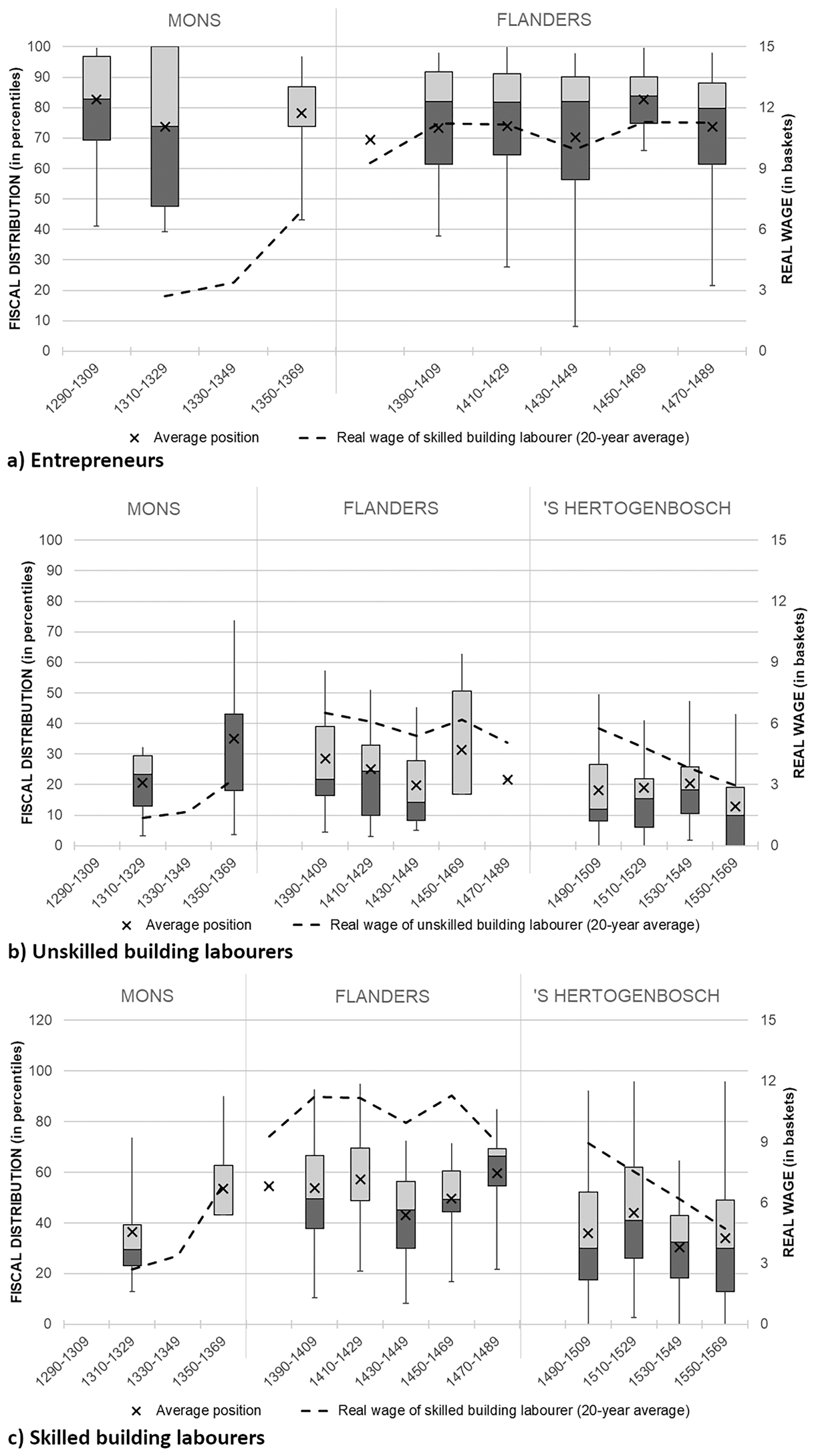
The evolving fiscal position of the 1114 building workers can be found in Figure 3. For every twenty-year interval, we show the percentile distribution. Before delving into the important changes over time, we can first evaluate the viability of our methodology to categorize the workers into three distinct groups by looking at the general picture for Q2–Q3 of each group. Three observations seem to confirm this ability. Firstly, there is little to no overlap between the three groups. For Flanders, the multivariate regression analysis shows that the dummy variable for each group is highly significant (p < 0.001; see Table 2). Secondly, the dispersion of wealth and income levels is limited, encompassing fewer than 25 percentiles of the total distribution. Thirdly, the fiscal position of the three groups conforms to the hierarchy we described earlier for the premodern building industry in the Southern Low Countries. At the very bottom, we find the unskilled and unaffiliated wage labourers (on average, Q2–Q3 belonged to P12–P31). The majority of skilled craftsmen, including journeymen and dependent masters, can be described as (lower) middle classes (P34–P57). Contractors and suppliers can generally be found at the top (P64–P89).
For a better understanding of the percentile rankings discussed in this article, Table 4 includes an overview of the different occupational titles commonly found around important thresholds of the distribution for every subregion at a hundred-year interval. The taxation list of 1365 in Mons contains titles for two-thirds of the assessed households (66.7 per cent) and that of 1552 in 's-Hertogenbosch holds information for about one-third (31.2 per cent).Footnote 56 For Flanders, we relied on the work of Antoine Zoete, who identified the occupations of half the individuals included in the levy of 1442 in Diksmuide through accounts and probate inventories.Footnote 57 Two or three occupations were selected for each threshold by combining maximum group size with fiscal importance within that group. For example, bakers could be the most numerous group around the median when compared to all occupations, say five bakers versus three tailors. However, they were not selected as representative of the median if a larger share of all bakers could be found for another threshold, say ten bakers around the 75th percentile versus the five around the median. As we have seen, the identification of occupations in fiscal sources, either by tax collectors or through record linking, comes with many pitfalls. Table 4 therefore has no ambition to give a robust and detailed evolution of a hierarchy. Instead, it tries to give an impression of the socio-economic groups among which construction workers moved.
Most commonly found occupational titles in taxation records per fiscal threshold.
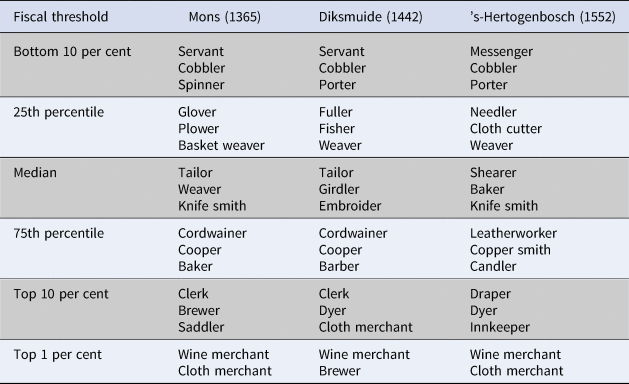
Sources: Heupgen, “Le rôle de la taille de Mons de 1365”, pp. 41–95; Zoete, De beden in het Graafschap, Appendix 7; Blondé, De sociale structuren, pp. 192–197.
To test the relationship between wages and living standards for the three groups, Figure 3 includes the evolution of real wages for the same twenty-year intervals as the percentile rankings. A cursory glance reveals that both series are highly correlated for the skilled and unskilled wage labourers yet lack any coherence for the entrepreneurs. This last group is characterized by incredible stability across time (Figure 3A). In the fifteenth-century County of Flanders, the median position of contractors and suppliers remains virtually identical (standard deviation of only 1.2 percentiles). Excluding the less representative tax of 1329 (see above, droit de bourgeoisie), the largest change occurred after the Black Death. In Mons, the relative position of entrepreneurs fell between 2.3 and 10 percentiles for Q2–Q3 while real wages for skilled building labourers increased more than twofold (from 2.7 consumer baskets in 1310–1329 to 6.9 baskets in 1350–1369). For example, the big contractors Jehan Villain and Martin de le Joie were responsible for building and maintaining the new fortifications of the city in the 1290s.Footnote 58 The tax register revealed that they belonged to the absolute top of the urban elite (P96–99). Seven decades later, Jehan Liermite was contracted for similar work on the Great Tower. While still being a wealthy citizen, he did not belong to the richest ten per cent (P87). In fact, most of his colleagues had lost connection to the top of the distribution compared with the previous century (forty per cent of the entrepreneurs in 1295 were found above the threshold of the 90th percentile versus only 16.1 per cent in 1365). This trend is in line with the observation of reduced building activity after 1300 and, again, after the Black Death in the Southern Low Countries.Footnote 59 Most likely, the sudden rise in vacant houses and the decline in public building projects resulted in the relative decline of the industry during the second half of the fourteenth century. Wage labourers could offset the reduced demand for their services by higher wages, but higher remuneration primarily implied higher costs for entrepreneurs. After all, their income was more dependent on the profit margins of reselling materials and subcontracting workers. Based on the occupation of new citizens in Bruges, building activity seemed to have picked up pace again in the fifteenth century and remained relatively stable until the disruptive revolt against Maximilian of Austria (1482–1492).Footnote 60 The fiscal data for the County of Flanders reveal that the entrepreneurs established themselves again firmly at the top of the fiscal distribution. Real wages waxed and waned but their position did not change.
The evolution is completely different for the unskilled wage labourers (Figure 3B). For them, the demographic shock of the Black Death had a clear positive effect on their fiscal position. In 1327, Jakemart de Montigny was one of many unskilled labourers who helped to pave the roadway in the Rivage district of Mons. He toiled twenty-seven days over ten weeks, the equivalent of part-time. For a meagre wage of 13 d. tor. per day, Jakemart would have needed to find additional employment for the remaining days. His earnings from the urban project would not allow him to cover the cost of living: he could only buy half of the necessary consumer baskets (56.9 per cent). Even if they managed to secure a full-time position, manual workers like Jakemart would have little coin to spare beyond the absolute necessities. Unsurprisingly, their fiscal position in the tax list of 1329 is relatively low (P13–P29 for Q2–Q3). Jakemart de Montigny paid 12 d. tor., about a day's wage. It was the lowest amount possible aside from complete exemption. Skilled labourers fared a little better (Figure 3C). Around the same time Jakemart was toiling on the road in Rivage, carpenter Jehan de Haynne was working on a gatehouse in the same district. On average, he worked four days per week for 28 d. tor. per day, which was enough to comfortably support himself (he earned 1.8 consumer baskets per week). However, if Jehan had a typical urban family of two or three children and a wife, he would not have been able to build up a financial reserve or invest in profitable assets.Footnote 61 His labour was probably his major, if not only, source of income. Accordingly, Jehan de Haynne only had to pay a reduced fee of 24 d. tor. at the feast of Saint-Rémi, which put him in the lower middle classes (P39) alongside many of his colleagues (P23–P39 for Q2–Q3).
Like elsewhere in Europe, the Black Death and subsequent plague waves decimated the County of Hainaut.Footnote 62 Although the population of Mons was actually increasing in the second half of the fourteenth century, the labour shortage was apparent in the entire region and real wages rapidly increased. Despite the ongoing pandemic, public infrastructure needed to be maintained. For example, the city accounts of 1363 figure a multitude of unskilled labourers working on the road between Mons and the nearby village of Hyon. The records show that a digger named Jehan le Fosse was employed for 51.5 days over thirteen weeks.Footnote 63 His remuneration was set at 36 d. tor. per day, almost three times as much as de Montigny had earned in 1326 for the exact same job. In contrast, the cost of living had hardly increased. As a result, Jehan le Fosse was earning more than the skilled carpenter de Haynne four decades earlier (his weekly earnings were equal to 2.3 consumer baskets). Apparently, this allowed him to rise in the ranks of the fiscal distribution (P43), beyond the level of our two early fourteenth-century workers. The story of the digger Jehan le Fosse is far from atypical as most unskilled wage labourers witnessed an increase in their fiscal position (P18–P43 for Q2–Q3). Coincidently, the city accounts of 1363 also contain some repairs to a gate, this time of the town hall. Just as in 1327, they were conducted by a carpenter named Jehan. Jehan le fils Frasinaul worked 7.5 days for two weeks at a daily compensation of 60 d. tor. At this rate and level of employment, he would have been able to support a typical urban household and still have coins to spare (total earnings of 4.8 consumer baskets). Such a comfortable financial position put le fils Frasinaul above the average household in Mons according to the tax of 1365 (P63). In general, most of his colleagues had moved up from the lower middle classes to the very middle of the distribution (P43–P63 for Q2–Q3).
For the fifteenth century, changes in remuneration and the fiscal position of building labourers are less drastic. Nevertheless, a clear correlation is still visible. According to our multivariate regression analysis, the relationship between fiscal position and the purchasing power of nominal wages is significant (p < 0.05). For every additional consumption basket a wage labourer earned per day, he would move up 10.5 percentiles in the distribution. Aside from the dummy variables for skill levels, this determinant had the largest (and only significant) effect on the outcome (see Table 2).
In addition to this general statistical relationship, two specific evolutions may help to illustrate the sensitivity of the fiscal position of building labourers to changes in the wage series. Firstly, the evolution between 1390 and 1429 is particularly interesting because it is the only time our series for unskilled workers diverges from the trend seen for skilled workers (downwards versus upwards). Remarkably and most reassuring for us, the fiscal position of the two groups likewise displays an opposite evolution (see Figure 3). Unskilled workers fell on average nine percentiles in this period (from P16–P39 to P10–P33 for Q2–Q3) whereas skilled workers moved three to eleven percentiles upwards (from P38–P67 to P49–P70 for Q2–Q3).
Secondly, we zoom in on the evolution between 1450 and 1489. We only possess enough data for skilled labourers to test the relationship. At first glance, the change in their fiscal position does not seem to correspond to the one we find for real wages. However, this disconnect can be explained by the timing of our tax samples. In both periods, taxation occurred when consumer prices deviated significantly from the prevailing levels in the entire twenty-year interval. The middle of the fifteenth century was characterized by very high real wages: they were consistently above eleven consumer baskets except for a five-year intermission of bad harvests. Between 1455 and 1459, skilled labourers earned on average 9.5 consumer baskets (sixteen per cent below the average for the corresponding twenty-year interval). Our sample for this period unfortunately pertains to 1457. Conversely, the available tax records for the next period predate the significant decline in real wages during the turbulent reign of Mary of Burgundy (1477–1482) and the subsequent revolt against Maximilian of Austria (1483–1492). Whereas skilled labourers only earned nine consumer baskets on average, real wages still reached 11.6 consumer baskets (or 28.9 per cent higher) between 1470 and 1476. In other words, the fiscal position followed the trend of real wages. Skilled workers climbed about ten percentiles in the distribution (from P44–P61 to P55–P69 for Q2–Q3) as their remuneration increased from 9.5 consumer baskets to 11.6.
A similar sampling problem is present in the sixteenth century. Both unskilled and skilled labourers witnessed an increase in their socio-economic position between 1490 and 1529 even though wages declined. However, the sample for the second interval of 's-Hertogenbosch pertains to 1511, just six years after the latest tax records of the first interval. During this time, remuneration had increased consistently from 4.7 consumer baskets to 6.4 for unskilled workers (+36.2 per cent) and from 8.7 consumer baskets to 11.6 for skilled workers (+33.3 per cent). For the first group, the next twenty-year interval is more problematic. Real wages were falling rapidly from 1520 but the fiscal position of unskilled labourers seems to have increased. There is no clear reason why this occurred, especially because the position of their skilled colleagues does conform to the trend (declining from P26–P62 to P18–P43 for Q2–Q3). Perhaps an answer can be found in the incomplete identification of workers, considering it is the only sample without exempted households among the unskilled. Unfortunately, we do not have access to these details because we are using the Blondé and Hanus database for 's-Hertogenbosch, hence we were obliged to rely on incomplete job descriptions in tax lists only, rather than an extensive archival survey. In any case, the overall picture is consistent with our earlier observations for the counties of Flanders and Hainaut. Swings in remuneration had a clear effect on the fiscal capacity of building labourers. By the middle of the sixteenth century, the position of all wage workers had clearly deteriorated as their wages were plummeting to ever-lower levels. The situation in 's-Hertogenbosch and, more generally, in the Southern Low Countries would not improve until the seventeenth century.
Discussion: An Apology for Real Wages
What does the evolving fiscal position of building labourers tell us about living standards in the past? Two major conclusions can be drawn based on the above study of the Southern Low Countries. Firstly, real wages cannot be used as a proxy for the experience of the general population. In this sense, our findings reinforce the ever-growing body of literature that questions the representativeness of building labourers’ welfare ratios for average living standards.Footnote 64 The relative fiscal position of this group waxed and waned according to their wages, which implies that the relative living standards of other groups in society remained far more stable. The huge swings in remuneration between the fourteenth and sixteenth centuries must have been less dramatic for those who did not rely on wage work, encompassing the majority of the urban populace. This idea is consistent with alternative proxies for living standards. For example, GDP per capita seems to have increased slowly and steadily in this period.Footnote 65 Moreover, households increasingly invested in the consumption of fashionable goods, well before the Industrious Revolution.Footnote 66 A more stable evolution of income may also help to explain why social mobility rates were relatively low throughout the premodern period.Footnote 67 Such a working hypothesis is corroborated by recent research into the drivers of late early modern inequality, in which the growing discrepancy between real wage income and GDP per capita plays a key role.Footnote 68
Our approach warns us to remain critical of recent efforts to model households’ annual income from daily wages by including household composition, market participation, working time, and so forth.Footnote 69 Although such studies are valuable and may overcome some shortcomings of the current wage series, they cannot be used as a new and improved yardstick of living standards for the entire population. The fiscal sources we employed were based on a similarly complete assessment of households’ financial means. Yet, our data clearly show that the experience of building labourers was still atypical. The remuneration of this group will never be a good proxy, whatever technical improvements are made to the methodology. The remarkable stability of the entrepreneurs in our study confirms this claim.
Secondly, real wages can be used as a proxy for living standards, but for specific groups only. Building on this observation, we still want to formulate a strong apology for the alleged “unreal wages”. Although daily wages have been characterized as fiction for the very group they are supposed to represent, the sensitivity of the fiscal position of building labourers to changes in remuneration is remarkable. Our approximative and crude methodology notwithstanding, almost every real wage increase and decline was immediately reflected in the taxation records of the Southern Low Countries. The majority of building workers included in our scrutiny must have depended predominantly on the labour market to earn a living. Daily wages seem to capture their experience aptly, at least in relative terms. Changes in the working year, household composition, or the demand for labour certainly occurred. Historians have, for example, pointed to the rise of the European marriage pattern and the increase in leisure after the Black Death.Footnote 70 However, according to our data, their impact was not of such magnitude to reverse the trends in real wages and fiscal positions entirely. If workers contented themselves with keeping income stable in favour of leisure after the plague pandemic, we would expect their fiscal position to remain stable. Yet, this was not the case in the medieval Southern Low Countries: apparently, the labour supply curve did not fully bend backwards.Footnote 71
Crucially, while this is an important observation for the building labourers, we argue that the predictable relationship between real wages and fiscal capacity can be exploited to explore living standards for other groups in society and the shifting functional distribution of income. For instance, some historians argue that market arbitrage can be applied to the labour market for unskilled labourers. They believe that the rewards for this type of work were similar irrespective of the contract type. This assumption allows them to deduct the evolution of the premodern working year by dividing the annual wages of servants by the daily wages of unskilled labourers, which, in turn, leads to the construction of the already mentioned new and improved real wage series.Footnote 72 However, our data do not support this methodology. The fiscal position of unskilled building labourers toiling for daily wages fluctuated drastically between the fourteenth and sixteenth centuries. They cannot be taken as representative of the bottom tier of the workforce. It would therefore be interesting to see if servants experienced similar fluctuations. Suggestively, urban servants identified in our fiscal sources ranked consistently among the bottom 10 per cent, even when wages were at their peak (see Table 4). Perhaps cultural preferences, such as a desire for steady employment or the promise of a certain diet in a time of volatile food prices, may have pushed some workers into less rewarding fixed contracts. In a similar vein, skilled artisans may have preferred to work independently given the status connected to guild membership and personal freedom, even in the face of asymmetrical power relationships vis-à-vis international merchants.
The methodology we have outlined in this article enables us to test these kinds of hypotheses by documenting shifts in the functional distribution of income in the entire economy. To fully exploit this potential, a series of research questions will need to be tackled. Which groups exactly depended on wages? How did the structure of the economy affect wage dependency? When do we see fundamental shifts? What do our findings imply for the proletarianization process of the late early modern period, when the relative share of wage-dependent people in the economy soared in a context of price inflation? Such fundamental questions of economic history, we argue, can be addressed by amplifying a systematic comparison between the “unreal wages” historiography and the fiscal (or comparable) sources that yield ordinal data on the social positions of individuals across society.


 Open access

