

Among the diverse cultural offerings that arrived in Buenos Aires in the new cycle of socio-cultural modernization during the 1960s rock music offered young people a type of artistic consumption that enlarged their aesthetic boundaries and became a powerful, and typically youthful, form of collective intervention. Like other countries in the world, Argentina was no stranger to the worldwide process of juvenilization of culture. People under 30 years of age had mostly absorbed culture in its dual dimension: they were the producers and consumers of new mass-oriented cultural products destined for themselves.Footnote 1
During the early 1960s in Argentina, rock was chiefly identified with TV stars and media idols who constructed a model of happy, cheerful youth. But from 1965 onward, a transformation took place, and rock came to be an alternative means of expression to conventional understandings of society. In tune with the new musical manifestations arriving from Great Britain and the United States, the poetic sensibility of the Beat Generation, concern for ecology, counterculture, ‘free love’ and pacifism, Argentine rockers (rockeros) rejected mainstream values and promoted a type of identity characterized by a new youth consciousness.Footnote 2 In this way, groups such as Los Beatniks, Los Gatos, Manal, Almendra, Los Abuelos de la Nada, Arco Iris and Pedro y Pablo, among others, opened the space for the rise of a rock culture that defined itself as rebellious. Although it sought an authentic artistic expression that would not be tainted by the requirements of record companies or cultural industries, this did not prevent it after 1970 from experiencing a vertiginous expansion in its audience, which grew from a few dozen spectators at performances to some 30,000 people.Footnote 3
This ‘rebellious’ turn occurred in a political context marked first by authoritarianism and censorship and then by the political and ideological radicalization of the late 1960s.Footnote 4 When the military de facto government took power in June 1966, the self-styled ‘Argentine Revolution’ set in motion a repressive social and political programme whose main objective was to ensure the permanence of the ‘natural destiny’ of the nation as Christian, western and anti-Communist.Footnote 5 To that end, it implemented a policy of cultural control including the censorship of books, periodicals, shows and films.Footnote 6 It was not by chance, then, that rockers first appeared in the newspapers in the ‘Crime’ section.Footnote 7
The crisis of the military government, unleashed after the cycle of social protest that started in May 1969 with the popular revolt by workers and students in the city of Córdoba, led to the radicalization of significant sectors of society, in particular middle-class youth, who – stimulated by the triumph of the Cuban Revolution – swelled the ranks of the armed militants.Footnote 8 This set a new political-ideological scene for the development of rock culture, as broad swathes of politically committed youth began to criticize rockers for fostering an anti-national and pro-foreign culture.
In the fields of the production and consumption of popular music, the 1960s saw a process of innovation in genres and styles involving, as well as rock, folk-influenced music, jazz, the New Argentine Song and also some innovative trends in tango. However, when it came to giving Buenos Aires a musical identity, rock, known at the time as ‘beat music’, was the genre that aspired to paint the musical portrait of modern urbanity. Folk music answered a need to incorporate the reality of the countryside into urban life by singing of ‘the social injustice suffered by the peasant’ to an urban audience.Footnote 9 The tango, which had been able to interpret the feel of Buenos Aires as few others had done, was already in the sixties considered a genre from the past.Footnote 10 Building on the tango's urban sensibility, local beat music was promoted by its musicians and journalists as the natural successor to the earlier musical genre.Footnote 11
It is paradoxical, therefore, that, although rockers, those who composed and performed rock, defined the genre as the sound of modern Buenos Aires and developed specific urban practices that conditioned its aesthetic, its ideology, its forms of sociability and its insertion into local culture, they promulgated a viscerally anti-urban discourse through the lyrics of the songs and the graphics on the record sleeves. Against the diagnostic of an oppressive city turned into a metaphor for a decadent society, most of the bands put forward as an alternative a romantic account that called for escape from the city in order to live in natural spaces. Non-urban spaces were considered as the only places in which freedom could be found.
Bearing in mind that musical genres contribute to forging feelings and identities relative to the space in which they exist and that they can be understood as ‘geographical essays’, I analyse in this article the way in which Argentine rockeros occupied the city of Buenos Aires both materially and symbolically.Footnote 12 This methodological approach requires an examination of two parallel processes. One is the manner in which rock culture has been inserted into space. This involves an understanding of the itineraries of rockers and the places of sociability, in particular venues where this musical genre was typically consumed.Footnote 13 The other process requires considering how rock culture has been inserted into the geographic imagination and the configurations of the city that are present in the cultural production of rock.Footnote 14
Several useful studies address the social and cultural history of Latin American rock. Despite the difficulties in defining it, there is a consensus that rock as a culture is not just a genre of music but that it is also an ensemble of specific practices and values.Footnote 15 Most studies focus on the arrival of rock in various national settings in the context of the growing cultural influence of the United States in Latin America between 1950 and 1960. Attention has been given to the forms in which this foreign genre was appropriated locally, to its ability to form national identities among urban youth and to the tensions between the cultural industries and counterculture. Similarly, the reception of rock by other actors has been investigated, especially the criticisms of cosmopolitanism made by nationalists or leftists, and the different ways in which the state and the most conservative sectors of society criminalized the consumption of rock.Footnote 16
The study of rock culture's early years in Argentina is in its infancy. The few extant studies reveal that certain particularities of the Argentine case would enrich discussions under way as regards the rest of the region, for they not only confirm the role of rock in the transnational formation of local youth cultures, but also suggest – albeit without going deeper into the issue – the need to understand this process from the point of view of tensions between the construction of national imaginaries and practices and symbolizations forged around the city of Buenos Aires.Footnote 17 Furthermore, these investigations are part of the study of ‘recent history’ which has centred on questions of politics and militancy, but has recently broadened its horizons towards the study of culture, society and daily life.Footnote 18 Even so, there is a great deal of work that needs to be done on the origins of rock in Argentina. Its protagonists and journalists have written histories ‘from within’, but these are celebratory and are rarely critical in tone. These histories, nonetheless, will be taken into account as sources together with the memories of musicians, interviews, LPs and stories in both the specialist and general-interest press.Footnote 19
In the first part of this article, I undertake a reading of the conditions that enabled the development of a local rock culture in the social space of Buenos Aires. To do this, I discuss the porteño character that rock assumed at the beginning in urban circles and the specifically rock-based uses of the city promoted by rock composers and performers. In the second part, I analyse the growth of a rock audience and the insertion of rockers into the urban circles of other artists of the period who forged new and alternative artistic modes. In the third section, I move from practices to representations and investigate images of the city and nature present in the rock aesthetic. Finally, I examine the discourses on rock culture produced towards the end of the 1960s by militants, left-wing intellectuals and promoters of rock in the context of political radicalization.
‘Buenos Aires beat’: the first practices of rock culture in Buenos Aires
The city of Buenos Aires occupied a central place in the formative years of the local rock culture. As the capital of a culturally centralized country, the city was the principal – though not the only – destination of any artist who aspired to national popularity. Being an ‘imported’ musical genre, and consequently lacking a local tradition in its production, rock needed to be based in the capital so as to have access to new musical developments and to sound equipment and instruments, which were difficult to obtain in the cities of the interior. Therefore, in the early years, Buenos Aires became the privileged centre of production and consumption of this musical genre. The vocalist of Los Gatos, Litto Nebbia, recalls the time when he would perform with his first rock band in Rosario in the early 1960s:
The two most important groups of around forty that would have been in Rosario at the time . . . played every Sunday at the Club Francés [the French Club], where there was a seven- or eight-hour marathon of bands . . . they tried to ensure conditions that would attract a known figure from Buenos Aires every second Sunday . . . Then the guy from Buenos Aires would come and you'd be kicked off the stage.Footnote 20
Even in Rosario, one of the biggest cities in the country, the conditions for making rock music were precarious. So, in 1965, Nebbia and other rosarinos ‘went down to the city’Footnote 21 to try their luck in the recording market and reprised in Buenos Aires their version of the Wildcats in Spanish, first as Los Gatos Salvajes and then as Los Gatos. Other musicians such as Miguel ‘Abuelo’ Peralta and Alberto ‘Tanguito’ Iglesias took a similar route, this time from the suburbs of Buenos Aires to the city centre. Even so, the bulk of the Argentine rock pioneers came from well-off middle-class families, attended prestigious schools and lived in the most central zones of the city. For that reason, when they were first mentioned in the media, the rockers were labelled as young ‘aristocrats’ with ‘double-barrelled surnames’.Footnote 22
‘La Balsa’, the first Argentine rock single to gain public notoriety, was recorded in 1967 by Los Gatos and became a commercial success. Until then, the rock genre had been produced and consumed outside of the record market and was restricted to a small group of spectators and musicians, the two groups hardly distinguishable from each other. This favoured the development of an alternative culture of production and consumption of popular music which was presented as something specific and original. However, we must remember that these alternative practices were always in tension with the culture industry and with the development of mass forms of cultural consumption aimed at youth. The musicians’ aspirations to be heard and to have a disc produced came up against the requirements of those with the ability to record them – the big recording companies. By following the general tendencies in consumption, these companies dictated the musical styles that would be recorded and influenced the content of song lyrics. This is what happened when Los Gatos recorded ‘La Balsa’ with the record company Radio Corporation America (RCA Argentina). The company forced the band to modify its original version, which predicted ‘a world of shit’, to the more polite ‘abandoned world’.Footnote 23
By the middle of the 1960s, the growing scale of ‘rebel rock’ and the culture of the concert as a meeting place specific to rock music was far from typical. In this context, the first rockers implemented a way of appropriating the city which made the street a place for lingering and socializing and walking an aesthetic practice.Footnote 24 From this perspective, the urban practices of local rock culture can be read as creating a history of twentieth-century Buenos Aires centred on the traversing of space. In fact, other avant-garde artists and intellectuals had turned walking through the city and its suburbs into a form of cultural exploration. The specific character of rock's appropriation of urban space in this way can be understood by examining two earlier manifestations of cultural urbanity: the first by the group of writers associated with the journal Martín Fierro during the 1920s, and the second by intellectuals linked to the journal Contorno in 1950.
During the early twentieth century, Buenos Aires experienced a dizzying expansion into the city's peripheral zones. Around 1920, these rings of suburbs, where the border between the wild pampa and the urban area was blurred, were the locus of political and cultural debates striving to define the place the periphery would occupy in the city.Footnote 25 In this context, the Martín Fierro group's rambles around the city's margins aimed paradoxically at establishing the bases of a local tradition as an avant-garde act. This implied giving a new aesthetic meaning to those fragile landscapes which would soon disappear under the impact of modernization. By converting those landscapes into the ‘essence’ of young Buenos Aires, they were contradicting the dominant perspective, which saw them as no more than a transient reality. Jorge Luis Borges’ travels with the photographer Horacio Cóppola are the most frequently cited and remembered.Footnote 26 Their trips formed part of the famous excursions through the neighbourhoods of Buenos Aires’ periphery to which Leopoldo Marechal sarcastically referred in his novel of 1948, Adán Buenosayres, as the nocturnal expeditions of ‘adventurers’ and ‘artists’ (among whom were to be found Jorge Luis Borges, Xul Solar, Jacobo Fijman, Raúl Scalabrini Ortiz and Marechal himself). These journeys, in his view, that took place in that ‘frontier region where the city and the desert come together in a combative embrace’.Footnote 27
Buenos Aires and the journeys taken by artists were quite different by the 1950s. Towards the end of the Peronist period, the city's intellectual world had been transformed. Three key elements characterized this transformation: a democratization resulting from the expansion in school and university enrolment in the preceding decade; the arrival of new currents in theory such as existentialism; and the beginning of a less critical revision, in a nationalist key, of the past experience of Peronism.Footnote 28 The routes taken by the ‘Sartrean existentialist trio’ consisting of Oscar Masotta, Juan José Sebreli and Carlos Correas shed light on these mutations. Although they claimed in various autobiographies that they had rambled without heading for Buenos Aires, three different itineraries were well travelled.Footnote 29 The first took place in the neighbourhoods where they were born, which betrayed these intellectuals’ plebeian origins and lack of ‘pedigree’. The next journey was ‘the zone’, a few blocks (manzanas) in the administrative and business centre of the city where the social life of porteño artists, university students and intellectuals was concentrated. Crammed in there were a great number of bars, art galleries, cinemas and bookshops, where local bohemians engaged in long discussions that questioned the socio-economic borders between individuals and facilitated an ‘egalitarian’ exchange between them as members of the ‘elite of knowledge’. Finally, the topography traced by these travellers culminated at the margins of ‘decent society’ and plunged into the lower depths of a nocturnal, clandestine city. Their links with homosexual subculture led them through the ‘teapots’ (public baths), cinemas, municipal swimming pools and railway stations of metropolitan Buenos Aires. These urban places allowed them to escape from incriminating gazes and from persecution by a police force that considered sodomy as a perversion and a crime.
From 1965 onward, it was the turn of the young rockers to make journeys through the city and to initiate new forms of creativity and new avenues of cultural exploration. These long walks, called ‘shipwrecks’, sought to avoid the ‘bourgeois uses’ of time imposed by urban life. The name given to the journeys refers to ‘La Balsa’ (The Raft), which became the generation's anthem and called on its hearers to escape from the world, to build a boat to be ‘shipwrecked’ in and ‘to set off towards madness’.Footnote 30 Often under the influence of amphetamines, the ‘castaways’ could extend their trips over several days. With this expansion of the hours of wakefulness, musicians and poets hoped to enlarge their creative capacities: going without sleep served as a source of artistic inspiration which was reinforced by the communal life of a group as they moved through the city en bloc. As Alberto Lernoud, one of the poets of that generation, recalls, the shipwrecks
were hours and hours of walking or sitting, finding oneself in a square . . ., we would find the doorway of a building that gave us somewhere to sit and we'd begin to talk, and if anyone had a viola [guitar] they would play a tune or demonstrate a tune . . . the walk was very long, very talkative.Footnote 31
These walks were also regarded as a means of informal dissemination of the first musical productions, as Nebbia recounts: ‘we would go downtown with our violas . . . to disseminate the songs. We'd go into a bar full of office workers, or bankers, we'd ask for a coffee, and when the guy brought the coffee and the water, we'd take out the viola and start to sing out loud.’Footnote 32 The office workers would watch this ‘spectacle’, astonished at the group's scandalously long hair, hand-painted denim jackets, leather windcheaters and flowered shirts, who were wandering carefree through downtown. The attitude of the police was quite different. Invoking the campaign of ‘raising the public morality of the city’, they accused the young rockers of ‘vagrancy’ and creating a ‘public scandal’ by ‘sleeping rough’, ‘singing in the square’ or prowling around without good reason at night. Punishment consisted of long interrogations to verify personal details, spending the night in the police cells, and shaving off the youths’ long hair ‘to make an example of them’.Footnote 33
Between 1965 and 1967, there existed a relatively regular itinerary in which these eternal days and nights alternated. During the day, the castaways passed through the central squares of Francia, San Martín and Congreso, and on hot days took in the Saint Tropez beach resort on the urban shores of the River Plate. The city's public spaces played host to meetings accompanied by acoustic music: folk guitars, percussion instruments and a large group of friends who formed a chorus to the ablest singers and guitarists.Footnote 34 At night, the two most frequented meeting places were La Cueva and La Perla del Once.
Holding no more than 50 people at a time, La Cueva was a cramped basement consisting of a bar, some banquettes, an improvised stage and a sound system. Located in Recoleta, a smart neighbourhood of Buenos Aires high society, it was one of the few places in Buenos Aires where one could hear live jazz, a genre which these young people considered ‘the mother of rock, the mother of blues, and the mother of everything’.Footnote 35 The venue had a series of established musicians contracted to provide musical numbers during its opening hours, from 10 pm to 4 am. There were also jam sessions, which enabled outstanding impromptu musicians to obtain a permanent post on La Cueva's payroll.Footnote 36 It was here that many novice musicians interested in rock came together to give their first live performances, meet each other and make their first contact with the world of professional music. Seeing that performances by rockers were becoming more and more frequent, the jazz musicians left the venue, and La Cueva became the first venue specifically for rock music.Footnote 37
La Perla was about 20 blocks away. It was a bar in the less glamorous Plaza Miserere, opposite the railway terminal of the Sarmiento line, which connected the city with its western periphery. This café stayed open all night and was patronized by workers waiting for the train to take them to or from their work, university students who gathered in groups to review and discuss lectures and group of musicians who stayed all night, consuming very little, talking and composing songs. In fact, this was not the first time La Perla had sheltered artists. In the early 1920s, its tables had been the meeting spot for members of the literary club organized by the writer Macedonio Fernández, who was already in his fifties at the time.Footnote 38 Both in 1920 and 1960, the station bar was at the centre of a creative explosion. The presence of the rockers at La Perla, however, was more conflictive in comparison to the literary club because their presence was not always well received; they often had to move on after being thrown out by waiters bothered by the noise.Footnote 39
Musicians, intellectuals and bohemians in downtown Buenos Aires: towards an expansion of the topography of rock
By 1967, the ‘castaways'’ lifestyle had achieved public notoriety. While radio stations were playing ‘La Balsa’ and ‘Ayer Nomás’ (Yesterday), singles which offered an ‘authentic’ Spanish version of international beat music at the time of the rise of Beatlemania, news magazines such as Atlántida, Clarín or Primera Plana were disseminating to a mass public the lurid, disreputable way of life of a group whom they identified as ‘local hippies’.Footnote 40 Their increased notoriety led to an expansion of their audience and to the beginning of a separation between the rockers and their fans. The media now reckoned there were some 200 young people swelling the itinerant population of the plazas and calling themselves ‘castaways’ in Buenos Aires.Footnote 41
Against this background, La Cueva closed its doors after being attacked with an incendiary bomb; the perpetrator was never found. One version of the story brought the police under suspicion, while another blamed some ‘anti-hippie’ groups such as the Argentine Federation of Democratic Anti-communist Entities (FAEDA) in one of its campaigns against what it regarded as ‘cogs in a diabolical worldwide plan, orchestrated by Communism’.Footnote 42
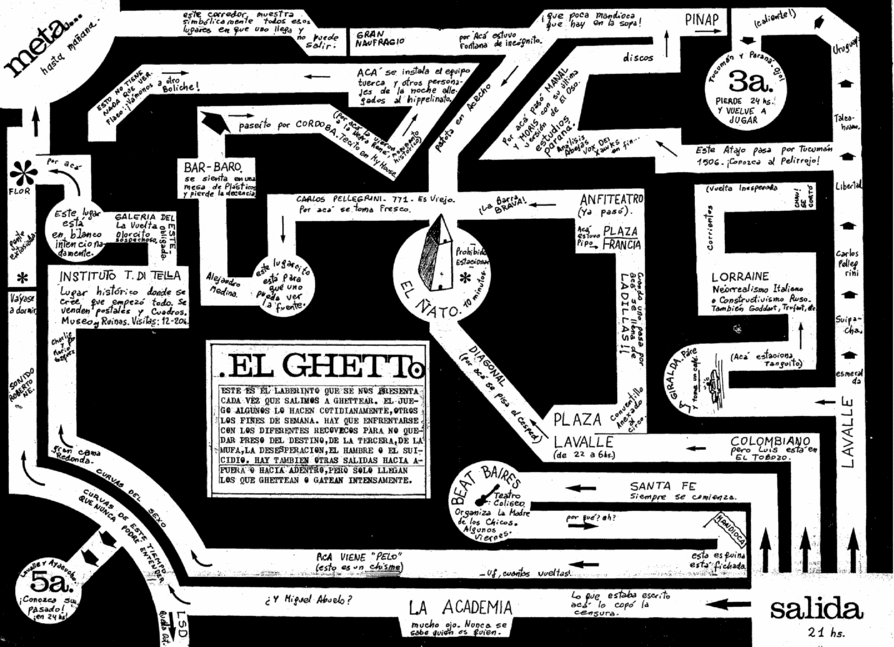
In 1969, a youth magazine distributed at the doors after rock concerts published in one of its issues a map of Buenos Aires in the form of a board game in which each of the places frequented by the ‘castaways’ was represented by a slot in the board.Footnote 43 La Perla del Once and La Cueva were no longer shown, but in their places a whole new topography was revealed which gave evidence of greater systematization in the practices of ‘shipwreck’ and a flow of walks towards new zones of the city (Figure 1). This reorientation of the itineraries contributed to the insertion of the ‘castaways’ into a wider network of artists and intellectuals, resulting in the expansion of the small group of musicians and poets who had taken part in the first walks. In the new circuit, the places frequented were further to the east of downtown, within a radius of about 20 blocks, as far as the zone of influence of the building that housed the Instituto Torcuato Di Tella, the most important centre of artistic experimentation in Buenos Aires, and of the group of intellectuals based in the central Avenida Corrientes, linked with left-wing political culture. These were the same spaces that the ‘existentialist trio’ had described as ‘the zone’, although, a decade later, these same streets would add to their intellectual image and innovative pop fashion and arts.
‘El Ghetto’, Mano de Mandioca, c. 1969. Reproduced in J. Carmona, El paladín de la libertad. Miguel Abuelo y sus abuelos de la nada (Buenos Aires, 2003), 68–9.

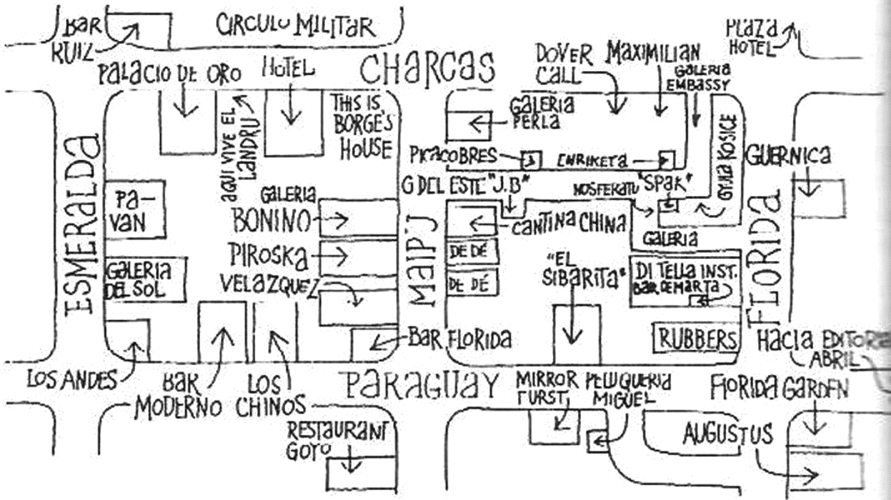
The modernizing cultural activity of Buenos Aires had been concentrated in a few blocks of the business and administrative centre since the establishment of the premises of new university careers in Sociology and Psychology, which had been incorporated into the curriculum of the University of Buenos Aires at the end of the 1950s, and the building of the Instituto Torcuato Di Tella arts centre in 1963. Around these spaces, an ‘avant-garde itinerary’ had taken shape, in which galleries of contemporary art, independent theatres, film clubs, bookshops and bohemian cafés also participated. In spite of increasing police control, this zone was still considered an ‘island in the middle of the city’ because it enjoyed a level of permissiveness unthinkable in other areas.Footnote 44 For their part, the mass media tended to reinforce this image, identifying these blocks as ‘the mad manzana’, a part of the city which had little cause to envy the cities that dictated international trends in fashion and consumption. One significant example among several was an article published in the women's magazine Claudia in 1968, which included a map of ‘Swinging Buenos Aires’ (Figure 2), in a direct allusion to the Swinging London of the sixties which became the international reference point for fashion, design and pop art.Footnote 45 For these magazines, Buenos Aires and its mad manzana were ‘capable of conversing on a par with Europe’.Footnote 46 And, just as in London, there was talk of a ‘popularization of culture’ within everyone's reach and obtainable in any stylish boutique.Footnote 47 So the map of ‘accelerated Buenos Aires’ emphasized the excessive offer of supermodern consumer goods that could be found in places ‘where business isn't at odds with hippie style’.Footnote 48
Map of the ‘Manzana Loca’, Claudia, c. Nov. 1968. Reproduced in J. King, El Di Tella y el desarrollo cultural argentino en la década del '60 (Buenos Aires, 2007), 169.
Even so, the insertion of the rockers into the artistic vanguard began tangentially. The milieu of the musicians – a fundamentally masculine world – saw the zone surrounding the Instituto Di Tella as possible spaces for dalliance. As Alberto Lernoud recalls, some musicians, in order to persuade the others to home in on the vicinity of the Instituto, claimed that ‘the painters’ minas [women] are the most beautiful, and the painters are so boring that we can pull them’.Footnote 49 Despite this hardly sophisticated motivation, the rock musicians slipped easily into this milieu. Proof of this was their participation in various cultural productions of Di Tella, such as the music for the multimedia show ‘Be at Beat Beatles’, performing in a series of concerts in 1969, and acting in various theatrical productions.Footnote 50
Their involvement in this zone also put the musicians in contact with another group of young people. Among these were the brothers Pedro and Hernán Pujó, Rafael López Sánchez, Mario Rabey and Javier Arroyuelo, recent graduates of the Colegio Nacional Buenos Aires (Buenos Aires National College), the oldest high school in the country, whose building was a few blocks from the ‘mad manzana’. They connected the musicians with the intellectual milieu of the Avenida Corrientes, and in particular with the prestigious publisher Jorge Álvarez, whose bookshop was ‘a hotbed of revolutionary, nationalist and left-wing writers’.Footnote 51 Together, they created the first independent record label, called ‘Mandioca, la madre de los chicos’ (Manioc, the mother of the kids), which, like the manioc root itself, was ‘subterranean’ and ‘Latin American’.Footnote 52 Their concept of music recording aimed to alter the dynamic of the big record companies. On the other hand, the label encouraged a more organized management of concerts in theatres in the capital and the Buenos Aires conurbation, to which a growing audience was beginning to be attracted.
‘Hoy todo el hielo en la ciudad’: visions of the city and nature
Despite having claimed for itself the authority of being the musical genre of modern Buenos Aires, rock culture originally developed an anti-urban vision which tended to become a metaphor for a decadent society. Against this diagnostic of an oppressive city, most of the bands proposed as an alternative a romantic account that called for abandoning the grey life of the metropolis for living in natural spaces, which were seen as the only environment in which freedom could flourish. The repertoire of the first local rock songbook reveals that its representation of urban life was above all a universalist one, since there were few references to any identifiable place. It was a generic concept of the city, which could be applied to the westernized urban world as a whole and which made clear the desire of these young people to distance themselves from society rather than transform it.Footnote 53
The city, seen as a nullifying force in relation to creative identities, appeared in these lyrics as a cause of sorrow. In effect, ‘La Balsa’ made sadness a permanent state of mind. And to sing ‘I'm all alone and sad here in this abandoned world’ made the topography of the rock imaginary one of essential angst. From this single on, the pairing ‘city–sorrow’ was repeated in several lyrics. In ‘Mi ciudad’ (My city), Los Gatos lamented that ‘no one can be happy’, and in another song, ‘Réquiem para un hombre feliz’ (Requiem for a happy man), they sang epitaphs to happiness, recognizing that none of the inhabitants of the city questioned either the pace or the demands of an expanding consumer society.Footnote 54 This manifestation of nonconformity cannot be hived off from the reaction to the mythology of the young capitalist, which, as Carlos Monsiváis observed, demanded quotas of happiness and acceptance from its members.Footnote 55 But at the same time, it was the expression of a romantic feeling of rejection of the metropolitan experience and its growing rationalization of life, a feeling which seemed to rework the modernist perception of the metropolis that Raymond Williams described with regard to literature of the late nineteenth century.Footnote 56 However, in the songs of the first rock music the landmarks changed. Topics concerned with metropolitan alienation, the growing dehumanization of life, and anguish at the feeling of loneliness amid the multitude were structured basically around two principal actors. On the one hand, there were the police, a visible, everyday agent of repression. On the other hand, there was a generic imaginary referring to the musicians’ original families, in particular the parents, who represented a middle-class morality which the rockers considered outdated. And it was through impugning their parents that the musicians expressed the rejection of the urban middle classes that was so widespread in other circles of Argentine at the time.Footnote 57 The morality of employees and their routines were presented as the tragic repetition of endless sameness. Songs such as ‘A estos hombres tristes’ (To these sad men), ‘Vivimos paremos’ (Let's stop living like this), ‘No hay tiempo de más’ (There's no more time) or ‘Ya no quiero soñar’ (I don't want to dream any more) transmitted this scorn for the values of the members of the urban middle class, in whose lives there was time only to ‘go back to work, come home to rest’.Footnote 58
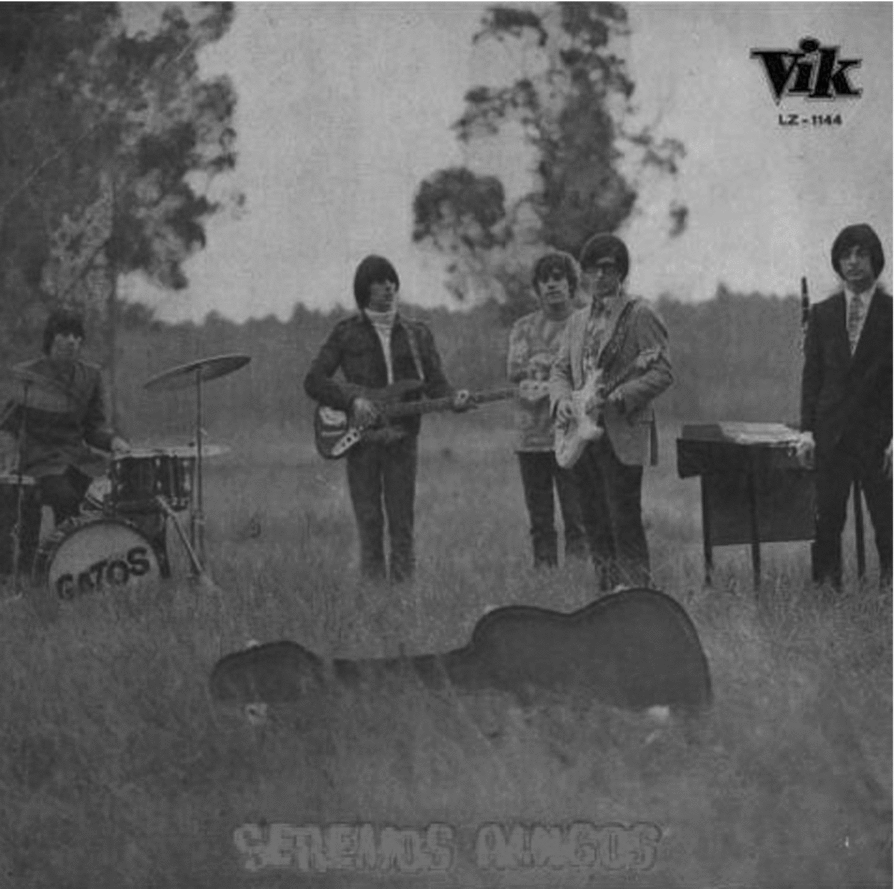
To this image of the city as a repressive and decadent uniform space corrupted by mercantile relations, the lyrics of the songs counterposed another way of life which had little to do with the real behaviour of musicians in the city. In contrast to the city, nature – in the generic sense of the countryside, the beach or the mountains – was identified as the environment for the free realization of humanity. With songs such as ‘Amor de aire’ (Love of the air), ‘Los elefantes’ (Elephants), ‘Andando a caballo’ (Riding on horseback), ‘Hoy seremos campesinos’ (Today we'll be peasants), ‘Final’ (Finale), ‘Verdes prados’ (Green meadows), ‘Paz en la playa’ (Peace on the beach), and ‘Campos verdes’ (Green fields), among others, the musicians introduced into rock culture a pastoral rhetoric that established all the moral virtues absent from the city in pristine natural surroundings.Footnote 59 On the covers of discs and in magazines, too, when the musicians were not portrayed with their instruments or sound equipment, their predilection for natural surroundings is clear (Figure 3).
Los Gatos, Seremos Amigos, RCA, 1968.
Travel was the sine qua non for starting the new life. This had already been anticipated in ‘La Balsa’, but in later songs the idea of travelling took on less metaphorical expressions. While the destination was the ideal place, the conflict appeared in the journey: in the song ‘Rutas argentinas’ (Argentine routes), the band Almendra described hitchhiking across the country although no one would give them a lift.Footnote 60 In July 1965, the weekly Confirmado defined hitchhiking as a European practice which had extended to young Argentines who wanted to travel long distances without spending too much money; but it drew attention to the same problem that the young musicians had found. As one author noted, ‘the importunate thumb . . . has been turned into a pointless gesture, without response’.Footnote 61 In 1969, another magazine, Siete Días, put forward some hypotheses as to who were these young people devoted to ‘driving by thumb’ (dedismo automotriz), arguing that travellers of this type could only be ‘survivors of hippie groups’ or ‘guerrillas’.Footnote 62 What it did not notice, however, was whether there was any difference between the places chosen by one or the other group.
Almendra was the first band to define spatially the bucolic, unspoiled place so longed for by rock musicians. ‘Toma el tren hacia el sur’ (Take the train south) was explicit that the place chosen by Argentine hippies was Patagonia.Footnote 63 As sublime landscapes of natural beauty, the Patagonian provinces appeared in the rock imaginary as an uncontaminated, uninhabited space. This choice differed from the preference of many other young people, especially those connected with militant politics, for the northern regions of Argentina. This wish to know the ‘deep hinterland’ was linked to the aspirations for change held by various political organizations. In their eyes, these places were proof of the difficult life that many Argentines endured daily. But the young rockers were not very interested in the modalities of social transformation espoused by militant youth. Although they shared in the general idea that change was imminent, their proposal consisted of an inner, individual search which could potentially affect one's surroundings. So, instead of choosing the northern provinces with their baggage of history and social significance, they opted for a southern ‘vacuum’, lacking in traditions, which they could access with nothing more than a train ticket to embark on a new lifestyle in the country's most virgin wilderness.
The ‘two Argentinas’: rock, folklore and radicalized militancy
The spatial convergence of musicians, plastic artists and intellectuals in downtown Buenos Aires was no guarantee that they agreed with one another. A sketched map by Roberto Jacoby (one of the most active participants in the Instituto Di Tella experiences), first published in the periodical Tiempo Argentino in 1986 and later in the daily Página/12 on the 25th anniversary of the events of May 1968 in France, identified in retrospect the typical social circuits of Buenos Aires bohemians in the 1960s.Footnote 64 This ‘Sixties Guide to Downtown Buenos Aires’ mapped the zones of the Di Tella, the Faculty of Philosophy and Letters, and the publishing house of Jorge Álvarez. The map provided a static image which said nothing about the relationships between the zones. A commentary by the writer Miguel Briante at the foot of the map, however, gave evidence of the ideological divisions between these milieux:
the intellectuals up to their armpits in Pavese and Sartre argued in the bars of the Calle Corrientes . . . and looked with distrust at those painters . . . because the plastic arts were ‘elitist’ . . . The painters responded with long drinking sprees in which they deified vitality to laugh at the intellectuals. More than once these theoretical battles ended in blows.Footnote 65
Even though these groups defined themselves by their will to renew and modernize, their differences arose around the means and contents with which to achieve that transformation. To the habitués of the Corrientes bars, the Instituto Di Tella zone was a bastion of frivolity and snobbishness. As Longoni and Mestman note, the reception of the Di Tella into the intellectual milieu was greeted with definitions such as ‘a false avant-garde, playful and without commitment, dancing to a frenetic rhythm, a slave to international fashions’, and offering ‘a distorted vision of Buenos Aires as an international cultural centre’.Footnote 66
And although there were certain personalities, such as the rockers, who built bridges between the different zones, towards the end of the 1960s, the growing politicization and radicalization of large numbers of young Argentines made the ideological differences increasingly irreconcilable. While some members of the Instituto Di Tella looked for ways to link art with left-wing political practice by joining the most combative trade union federation of the time, many in the intellectual circles close to Jorge Álvarez joined the ranks of the armed Peronist militants, in particular the guerrilla organization Montoneros.
Rock was also part of this context of growing radicalization. While some rockers adopted a supposedly more committed attitude and incorporated direct references to revolution, Che Guevara or the Peronist movement into their lyrics,Footnote 67 the majority lent their support to the defence of peace and rejected armed struggle, claiming that the revolution would only be possible on the basis of ‘an internal, personal change, not a political one’.Footnote 68 Following this mandate, some rockers put into practice their desire to abandon the city and left for other latitudes such as El Bolsón in Patagonia, the beaches of Brazil or the Balearic islands in Spain, places which had become international hippie centres.Footnote 69
Meanwhile, resorting to an anti-United States rhetoric, young people attracted to militancy accused rock of being anti-national and pro-foreign.Footnote 70 Folk music was the genre with which they identified, for its subject matter and its vernacular origins allowed them to channel their expectations of change towards a national, Latin American consciousness. In parallel, many folk musicians accompanied this process of radicalization by promoting song ‘for social change’; this would result, in the early 1970s, in a closer relationship between folk music and armed organizations.Footnote 71
The polarization between rock and folklore thus seemed to contribute to the idea of ‘two Argentinas’, an idea which had been in force since the nineteenth century. This polarization was a key concept in the interpretation of a national reality split between an urban Argentina and a rural one, equivalent to the contrasting interests of Buenos Aires and the interior of the country.Footnote 72 For progressive sectors, the provinces ceased to be seen as a territory requiring modernization and became the locus of deep-rooted values of authentic Argentine-ness as opposed to the dissipated, cosmopolitan port-city, in thrall to foreign interests. In this scheme of things, folk music, which spoke of rural life and people, seemed to be the genre that best embodied the national identity. And, paradoxically, although this recovery of folk revealed a critique of the city which in many cases coincided with the arguments of rock, the Anglo-Saxon origin of rock made it a foreign hybrid, the bearer of just those values that had to be fought.
It was not surprising, then, that rockers looked ironically on their increasing marginalization from the cultural initiatives of the left. In an article entitled ‘The Beatles vs. Martín Fierro’, Miguel Grinberg, one of the ‘organic intellectuals’ of rock, ridiculed the alleged incompatibility between cosmopolitan culture and the Argentine national mythology, asking why the universities did not invite ‘our rock’ to perform in the faculties. In a tone parodying the typical conspiracy-theory attitudes of the Cold War he wrote, ‘Perhaps they too think rockers are the secret agents of some foreign power?’Footnote 73
Conclusion
This article has studied the conditions that made possible the rise of rock culture in the city of Buenos Aires. I have looked at the development of the urban practices typical of the producers and consumers of rock and also at the modes of imagining and interpreting the city that are present in the first rock productions recorded between 1965 and 1970.
The areas where the ‘castaways’ met and their particular form of voyaging through the city – their walks accompanied by singing, their long sessions in bars or nights spent in the squares – enabled the modes of production and consumption of local music for young people to be transformed. Even though their itineraries were part of a longer-term history in the cultural tradition of the local avant-gardes, the rockeros, in contrast to the Martín Fierro group or the intellectuals of Contorno, did not travel through the city's marginal zones. On the contrary, their eccentric style of appropriating the various areas of Buenos Aires enabled their rapid insertion into a wider circle of artists and intellectuals. The Contorno group had also roved through Buenos Aires’ bohemian area, yet their intention to remain outsiders did not result, as it did in the case of the rockers, in the development of lasting productions together with other cultural actors. The linkage with the Instituto Torcuato Di Tella and their closeness to the Álvarez publishing house sprang from some ‘shipwrecks’ that claimed to be alternatives to the culture industry but resulted in an expanded audience that quickly grew to mass proportions.
One of the principal paradoxes of rock culture was that despite defining itself as the genre of modern Buenos Aires it developed a typically anti-urban discourse which asserted itself as apolitical and promoted an aesthetic of escape into natural settings. Despite the growing political crisis in the late 1960s, the young rockers remained relatively marginalized from the new, radicalized political and ideological scenario. Accused of being anti-national and pro-foreign, rock did not attract young people who were politically active, and – despite some attempts – it would be the music in the folk tradition that succeeded in channelling expectations of change among revolutionary youth. Although folk music and rock shared an anti-porteño imaginary, their motives for rejecting the city followed different tracks. For the former, opposition to Buenos Aires meant making contact with the provinces in the interior of Argentina, with the ‘real country’ and its Latin American condition. The latter group idealized an unspoiled natural environment in which to put the hippie ethos into practice. Thus, in contrast to what had happened during the formative years of the ‘rebel rock’ culture, its production and consumption became autonomous with respect to other cultural agents and it shaped specific fields of sociability, in particular massive rock concerts. This happened, however, in a climate of generational renewal, since after 1970 many of the early groups broke up, making way for a new batch of musicians and spectators.