Introduction
Rice is the primary staple food for about 50% of the world’s population, with the majority of consumers living in Asia, sub-Saharan Africa, and South America. Asian countries grow 90% of the rice produced in the world. In India, rice is grown on 45 million ha of land with a production of about 120 billion kg. This accounts for 27% and 24% of the harvested rice hectares and total rice produced in the world, respectively (USDA-ERS 2021). Transplanted rice in flooded soil is the most common rice system in India, but direct seeded rice (DSR) is gaining popularity because of its lower input demand and overall simplicity (Raj and Syriac Reference Raj and Syriac2017; Rao et al. Reference Rao, Johnson, Sivaprasad, Ladha and Mortimer2007). In traditional rice cultivation, rice seedlings are transplanted into puddled soil with standing water; but in DSR, seeds are directly drilled into the soil. This process eliminates the laborious process of puddling and transplanting. It also greatly reduces the crop’s water requirement. However, DSR is more vulnerable to weeds than transplanted rice. Unlike transplanted rice, no standing water is required by DSR to suppress emerging weeds at crop establishment. Rice and weeds emerge simultaneously in DSR fields causing early weed competition. A long-term study in India reported 21% yield loss in DSR compared with a 14% loss in transplanted rice (Gharde et al. Reference Gharde, Singh, Dubey and Gupta2018). Some other DSR trials reported even up to 82% yield loss (Mahajan et al. Reference Mahajan, Chauhan and Johnson2009). Among grass weeds of rice, barnyardgrass is the most common noxious weed. It is widely adapted to conditions of DSR fields (Rao et al. Reference Rao, Johnson, Sivaprasad, Ladha and Mortimer2007). Barnyardgrass is a C4 species and a prolific seed producer with an adaptive capability in a wide range of soils (Bagavathiannan et al. Reference Bagavathiannan, Norsworthy, Smith and Neve2012; Chauhan and Johnson Reference Chauhan and Johnson2009). Worldwide studies have reported that barnyardgrass can cause extensive interference throughout the season, affect photosynthesis and physiological characteristics of rice, and ultimately, serious yield losses and seed quality deterioration (Marchesi and Chauhan Reference Marchesi and Chauhan2019; Wang et al. Reference Wang, Zhang, Xu and Li2019; Zhang et al. Reference Zhang, Gu, Zhao, Yang, Peng, Li and Bai2017, Reference Zhang, Cao, Gu, Yang, Peng, Bai and Li2021). It was reported that barnyardgrass even at a low density of one plant per square meter can reduce yields by 257 kg ha−1 in rice (Stauber et al. Reference Stauber, Smith and Talbert1991).
A majority of rice growers in India prefer to use herbicides for weed management because they are readily available, less expensive than mechanical and hand weeding, easy to apply, and efficient in controlling weeds (Choudhary and Dixit Reference Choudhary and Dixit2018). For the past decade, rice growers in India have used herbicides such as bensulfuron, bispyribac-sodium, chlorimuron-ethyl, ethoxysulfuron, metsulfuron-methyl, penoxsulam, and pyrazosulfuron that inhibit acetolactate synthase (ALS) (Choudhary and Dixit Reference Choudhary and Dixit2018). ALS-inhibiting herbicides prevent the synthesis of the ALS enzyme, which is involved in the biosynthesis of branched-chain amino acids valine, leucine, and isoleucine (Mc Court et al. Reference Mc Court, Pang, King-Scott, Guddat and Duggleby2006; Poston et al. Reference Poston, Hirata and Wilson2002). These amino acids are needed for the growth and development of a plant. In the absence of ALS enzyme, root and shoot growth is drastically reduced because of a reduction in plant metabolism and cell division that ultimately leads to plant death (Lamego et al. Reference Lamego, Charlson, Delatorre, Burgos and Vidal2009; Salamanez et al. Reference Salamanez, Baltazar, Rodriguez, Lacsamana, Ismail and Johnson2015; Yoon et al. Reference Yoon, Yoon, Kim and Choi2003).
Exclusive and recurrent use of herbicides with the same mode of action (MOA) may promote change in the weed flora from easily controllable weeds to more competitive weeds and evolution of herbicide-resistant weeds (Jugulam and Shyam Reference Jugulam and Shyam2019). It has been recognized that ALS-inhibiting herbicides are more prone to select resistant weeds than other herbicides with different MOAs. This is mainly attributed to widespread use of these herbicides and their ability to cause strong selection pressure on sensitive biotypes (Tranel and Wright Reference Tranel and Wright2002). To date it has been reported that worldwide, 169 weed species have shown evolved resistance to ALS-inhibiting herbicides, and among those, 43 weeds exist among rice crops (Heap Reference Heap2022). Barnyardgrass has been reported to be resistant to ALS-inhibiting herbicides from 14 countries so far (Heap Reference Heap2022). Among them, most of the cases were reported from rice fields, and those biotypes showed cross-resistance to several ALS-inhibiting herbicides. It was reported that in most cases, resistance to ALS-inhibiting herbicides is caused by an altered target site (i.e., the ALS enzyme; Tranel and Wright Reference Tranel and Wright2002). To date, 28 possible substitutions of amino acids in the ALS enzyme were identified in different weed species that resulted in target site–based resistance (Božić et al. Reference Božić, Pavlović, Bregola, Di Loreto, Bosi and Vrbničanin2015; Brosnan et al. Reference Brosnan, Vargas, Breeden, Grier, Aponte, Tresch and Laforest2016; Powles and Yu Reference Powles and Yu2010). Moreover, a nontarget site–based resistance mechanism is also a possibility but has been less explored (Mei et al. Reference Mei, Si, Liu, Qiu and Zheng2017).
For the last decade, rice farmers in India have widely used the ALS-inhibiting herbicide bispyribac-sodium, which belongs to class of pyrimidinylthiobenzoates. As a systemic postemergence herbicide, it has proved to be extremely effective on several broadleaf weeds, grasses, and sedges present in rice (Kumar et al. Reference Kumar, Rana, Chander and Chauhan2013; Rawat et al. Reference Rawat, Chaudhary, Upadhyaya and Jain2012; Veeraputhiran and Balasubramanian Reference Veeraputhiran and Balasubramanian2013). However, lately, rice farmers in India are experiencing poor barnyardgrass control with bispyribac-sodium. Some field studies also reported failed barnyardgrass control with the herbicide (Choudhary and Dixit Reference Choudhary and Dixit2018). Evolution of resistance in barnyardgrass for bispyribac-sodium has been already reported in Italy, South Korea, Turkey, Brazil, the United States, China, and Iran (Chen et al. Reference Chen, Wang, Yao, Zhu and Dong2016; Haghnama and Mennan Reference Haghnama and Mennan2020; Heap Reference Heap2022; Kacan et al. Reference Kacan, Tursun, Ullah and Datta2020; Riar et al. Reference Riar, Norsworthy, Bond, Bararpour, Wilson and Scott2012). However, ALS-resistant barnyardgrass has not yet been confirmed in India. Recently, bispyribac-sodium resistance in another predominant weed, smallflower umbrella sedge (Cyperus difformis), has been reported in rice fields in India (Choudhary et al. Reference Choudhary, Reddy, Mishra, Kumar, Gharde, Kumar, Yadav, Barik and Singh2021). Hence it is possible that barnyardgrass has developed resistance to the herbicide. To confirm this, trials were conducted with an objective of evaluating and characterizing the resistance levels to bispyribac-sodium in barnyardgrass in rice fields of India.
Materials and Methods
Collection of Putative Resistant Biotypes
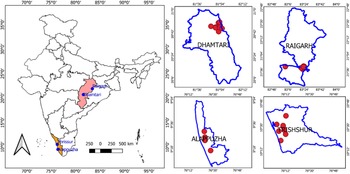
Most of the reports about failed or inconsistent barnyardgrass control in rice with bispyribac-sodium occurred in Chhattisgarh and Kerala states (VKC, personal observation). Hence, a large-scale survey was carried out in those two states to determine the extent of the problem. A total of 188 farmers (120 from Chhattisgarh and 68 from Kerala) were interviewed in 2017. Based on survey responses, Thrissur and Alappuzha districts in Kerala, and Dhamtari and Raigarh districts in Chhattisgarh were selected from which to collect seed samples. A total of 37 seed samples (25 from Chhattisgarh and 12 from Kerala) were collected from mature barnyardgrass plants that survived bispyribac-sodium spray in DSR fields prior to crop harvest (Figure 1). From each field, seed samples were collected from five locations, and they were combined to make one composite sample. Each composite sample was considered as one biotype.
Geographical distribution of the locations from where the 37 barnyardgrass biotypes were collected.

Description of Climate and Soil Type at the Study Site
Open-field pot experiments were conducted for 2 yr during rainy season (i.e., June to August 2018 and 2019) at the Directorate of Weed Research in Jabalpur, India. The experimental site is located at 23.132°N, 79.592°E with a subtropic climate that receives about 1,400 mm of rainfall annually. On average, 365 mm of rainfall occurred during the trial period. The mean maximum temperature was 33 C, and the minimum temperature was 25 C. The soil was a fine, montmorillonitic hyperthermic, Typic Haplustert that belongs to the Kheri series. The soil pH was 7.1, and organic carbon content was 0.59%.
Whole-Plant Dose-Response Assay
Plastic pots (15-cm height, 15-cm diameter) were used to grow all biotypes. The pots were filled with soil that was autoclaved at 120 C for 30 min. Around 20 to 25 barnyardgrass seeds were planted in each pot, and optimum soil moisture conditions were maintained to simulate field conditions of a DSR system. Fifteen uniform plants were maintained in each pot by thinning out extra plants, and they were grown in a 14-h photoperiod. Plants were treated with herbicides when they were at the 3- to 5-leaf stage. The experimental design was a completely randomized design with six replications. Herbicide treatments include bispyribac-sodium (Nominee Gold® 10% SC; PI Industries, Gurgaon, India) at 12.5, 25, 50, 100, and 200 g ai ha−1, and an untreated control. The recommended use rate of the herbicide is 20 to 25 g ai ha−1.
Treatments were applied to all putative bispyribac-sodium resistant (BR) biotypes and two known susceptible biotypes with a solar-powered backpack sprayer with a spray volume of 375 L ha−1. The sprayer was fitted with a flat-fan nozzle calibrated to deliver 3 L min−1 at a pressure of 350 kPa. The susceptible biotypes, one each from Chhattisgarh (CGDEC-4) and Kerala (KATEC-32), were included as standard checks for comparison purposes. Seeds for these two biotypes were collected from the edges of rice fields where barnyardgrass control was not a problem with application of bispyribac-sodium. After herbicide application plants were irrigated to maintain optimum level of water to simulate DSR. From the six treated replications, three replications were used to collect plant samples for the analysis of ALS enzyme activity at 6 d after herbicide application (DAHA), and the remaining three replications were used to assess visible control and biomass at 21 DAHA.
Observations
In vitro ALS enzyme assay
Six days after herbicide application, about 10 g of aboveground plant samples were collected from three replications that were maintained for purposes of analyzing ALS enzyme activity. Plant samples were collected from all biotypes including susceptible ones, and stored at −80 C. They were analyzed for enzyme activity following the method suggested by Uchino et al. (Reference Uchino, Ogata, Kohara, Yoshida, Yoshioka and Watanabe2007). This assay detects acetoin production via acetolactate, the ALS enzyme product. Distilled water (3 ml) was added to 100 mg of frozen leaf tissue and thawed at 25 C for 45 min by shaking the samples at 15-min intervals using a vortex mixer. Then leaf residue was discarded by filtering the aliquot. Fifty microliters of 6N H2SO4 was added to 3 ml of the homogenate aliquot and mixed for a few seconds. To convert acetolactate to acetoin, the samples were incubated for 0.5 h at 60 C. Subsequently, a 1-ml aliquot of creatine and α-naphthol solution (0.09% and 0.9% wt/vol, respectively) in 2N NaOH was added to the mixture to stop the reaction, and the solution was mixed in a vortex mixer for 4 to 5 s. The solution was then placed in a water bath at 60 C for 0.5 h to allow the color to change from white to pink or red. A greater color intensity indicates a higher quantity of acetoin, which means greater ALS enzyme activity. The absorption was measured at 530 nm and converted into micrograms of acetoin per gram of fresh foliage using a standard curve. Results were expressed as a percentage of enzyme activity compared with the untreated control.
Visible control and biomass reduction
At 21 d after herbicide application, visible control ratings were recorded on a scale of 0% (no control) to 100% (complete plant death). After taking visible control ratings, from each pot, five barnyardgrass plants were randomly selected and harvested at ground level and placed in paper bags. Those samples were oven-dried at 60 ± 2 C until stable dry weights were achieved. All the aboveground dry biomass values were converted into percent biomass reduction compared to the untreated control plants using the following formula:
 $$Biomass\;reduction\;(\% ) = [(U - T)/U] \times 100$$
where U is the average dry weight of the aboveground biomass from the three untreated control replicates of a biotype and T is the aboveground biomass of an individual treated replicate for the same biotype. After collecting samples for biomass, the remaining plants were allowed to set seed. Their seed heads were covered with cloth bags to allow self-pollination. Of the 37 biotypes tested in the first year, 11 biotypes survived the 1× rate of bispyribac-sodium. The seed collected from those 11 biotypes were used for the second-year trial (only 11 biotypes were tested in the second-year trial).
Statistical Analysis
From the 37 tested putative BR biotypes, 11 survived the 1× rate (25 g ha−1) of bispyribac-sodium. Hence, data are presented here for only those 11 biotypes and are compared with two susceptible biotypes (Table 1). Data from both years were pooled because there was no significant interaction between treatment and year. A nonlinear regression model was fitted to visible control and biomass reduction data in response to herbicide dose using the drm() function in R software (version 4.2.2; R Foundation for Statistical Computing, Vienna, Austria) with the drc package (Knezevic et al. Reference Knezevic, Streibig and Ritz2007). The amount of bispyribac-sodium required to provide 50% control of barnyardgrass (ED50) or to reduce 50% of the biomass (GR50) was estimated by using the following two-parameter log-logistic model:
 $$y = 100/ \{1 + {\rm{exp}}[b({\rm{log}}(x)) - {\rm{log}}(e)]\} $$

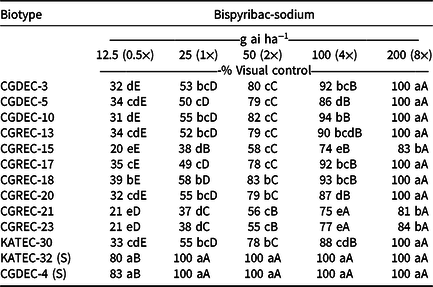
a Abbreviations: CGDEC, Chhattisgarh State, Dhamtari District, Echinochloa crus-galli; CGREC, Chhattisgarh State, Raigarh District, Echinochloa crus-galli; KATEC, Kerala State, Thrissur District, Echinochloa crus-galli; S, susceptible.
b In each column, treatment means for biotypes followed by the same lowercase letter are not significantly different from each other at P ≤ 0.05.
c In each row, treatment means for bispyribac-sodium rates followed by the same uppercase letter are not significantly different from each other at P ≤ 0.05.
where y is the percent visible control score or percent aboveground biomass reduction, e represents the ED50 or GR50 value, x is bispyribac-sodium rate, and b is the slope of the curve at the e-parameter rate. A lack-of-fit test indicated that the selected model adequately describes the visible control and biomass reduction data. The resistance index (RI) was calculated by dividing the ED50 or GR50 value of the resistant biotype by the average ED50 or GR50 of the two susceptible biotypes KATEC-32 and CGDEC-4. Visible control, biomass reduction, and ALS enzyme activity data were subjected to ANOVA using the GLIMMIX procedure with SAS software (version 9.2, SAS Institute Inc., Cary, NC, USA), and means were separated using Fisher’s protected LSD test at α = 0.05.
Results and Discussion
Whole-Plant Dose Response
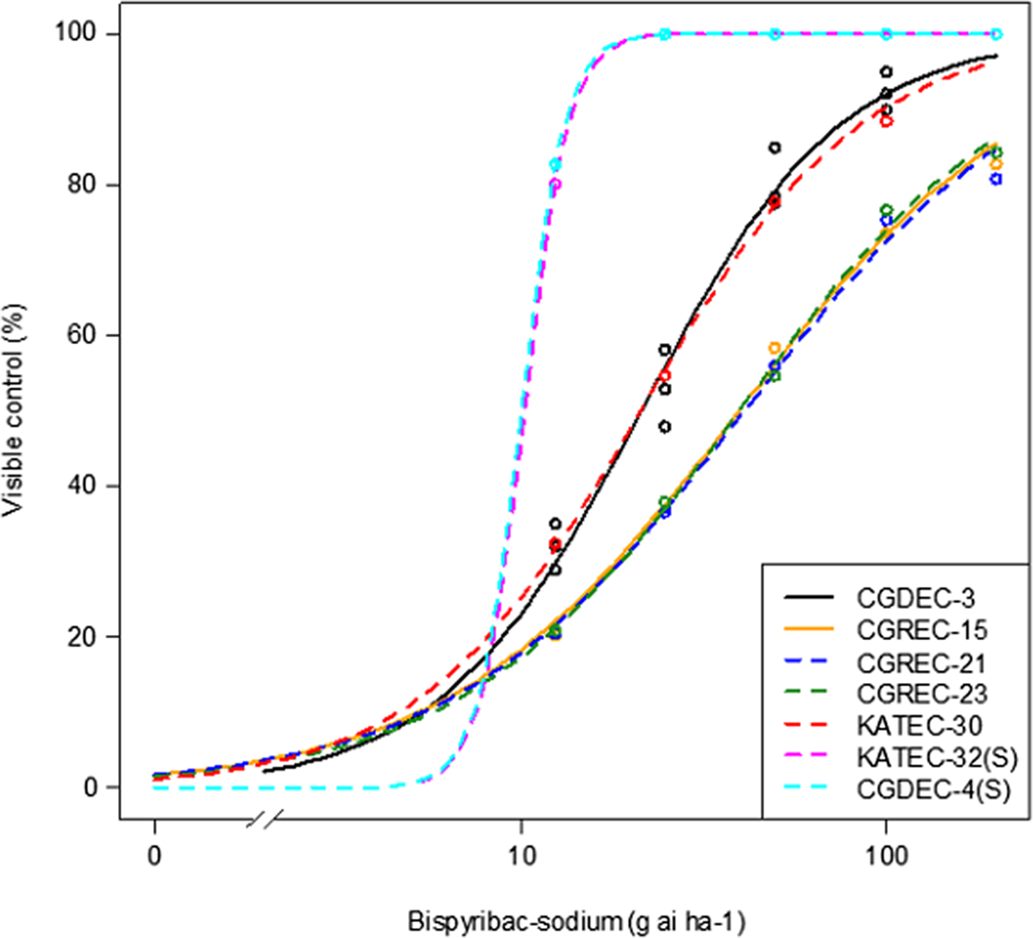
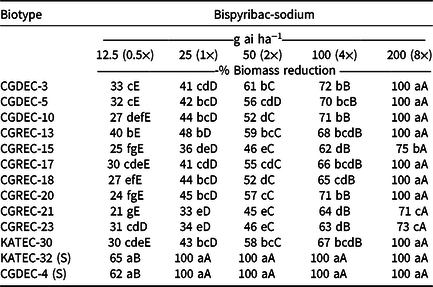
At 21 d after herbicide application, from the 37 putative barnyardgrass biotypes that were tested, 11 biotypes (10 from Chhattisgarh and one from Kerala) survived the 1× rate (25 g ha−1) of bispyribac-sodium (Table 1). These biotypes were controlled by up to a maximum of 58% with the 1× rate. The lowest control was observed in biotypes CGREC-15 (38%), CGREC-21 (37%), and CGREC-23 (38%). As the rate of herbicide increased, control of these biotypes increased, but none of the 11 biotypes were completely controlled up to the 4× rate. Bispyribac-sodium at the 2× rate provided 55% to 83% control, and the 4× rate provided 74% to 94% control. However, the 8× rate (200 g ha−1) provided complete control of most of the putative biotypes except three: CGREC-15, CGREC-21, and CGREC-23. Those three biotypes were controlled by 81% to 84% with the maximum tested rate of 200 g ha−1 (Figure 2). Dry biomass reduction data has also shown a trend similar to that of visible control data (Table 2). A maximum of 48% biomass was reduced with the 1× rate of bispyribac-sodium compared to the untreated control. Only 33% to 36% of the biomass was reduced in three highly resistant biotypes (CGREC-15, CGREC-21, and CGREC-23) with the 1× rate (Figure 3). Bispyribac-sodium at 2× and 4× rates reduced biomass by 45% to 61% and 62% to 72%, respectively. Similar to the visible control data, the 8× rate of bispyribac-sodium completely reduced the biomass in 8 of 11 biotypes. Biomass in the remaining three biotypes was reduced by 71% to 75%.
Dose-response curves of selected bispyribac-sodium resistant and susceptible (S) biotypes of barnyardgrass based on visual control data at 21 d after herbicide application. Abbreviations: CGDEC, Chhattisgarh State, Dhamtari District, Echinochloa crus-galli; CGREC, Chhattisgarh State, Raigarh District, Echinochloa crus-galli; KATEC, Kerala State, Thrissur District, Echinochloa crus-galli.

Percentage biomass reduction in barnyardgrass compared with the control at 21 d after bispyribac-sodium application. a, b, c

a Abbreviations: CGDEC, Chhattisgarh State, Dhamtari District, Echinochloa crus-galli; CGREC, Chhattisgarh State, Raigarh District, Echinochloa crus-galli; KATEC, Kerala State, Thrissur District, Echinochloa crus-galli; S, susceptible.
b In each column, treatment means for biotypes followed by the same lowercase letter are not significantly different from each other at P ≤ 0.05.
c In each row, treatment means for bispyribac-sodium rates followed by the same uppercase letter are not significantly different from each other at the P ≤ 0.05.
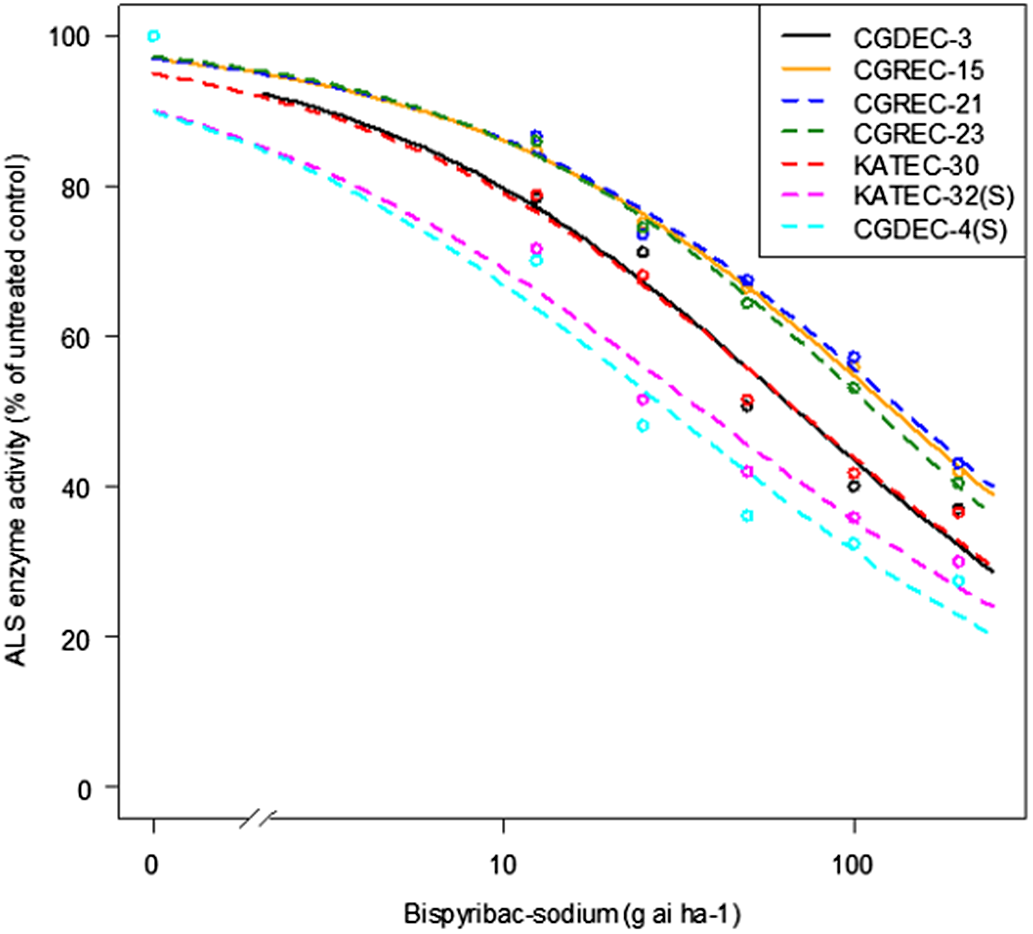
Acetolactate synthase enzyme activity compared to untreated control in selected bispyribac-sodium resistant and susceptible (S) biotypes of barnyardgrass at 6 d after herbicide application. Abbreviations: CGDEC, Chhattisgarh State, Dhamtari District, Echinochloa crus-galli; CGREC, Chhattisgarh State, Raigarh District, Echinochloa crus-galli; KATEC, Kerala State, Thrissur District, Echinochloa crus-galli.

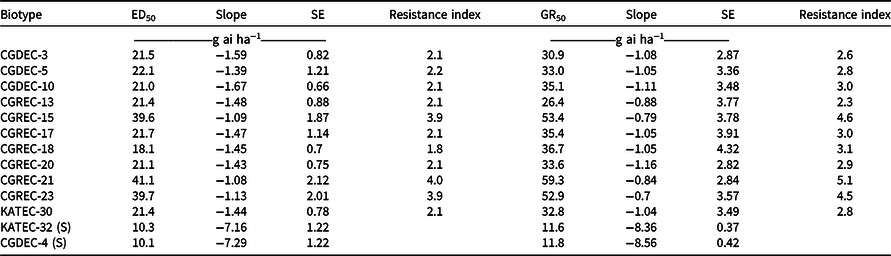
Estimates of bispyribac-sodium rate needed to provide 50% visible control (ED50) across all BR biotypes ranged from 18 to 41 g ha−1, whereas it was about 10 g ha−1 in susceptible biotypes KATEC-32 and CGDEC-4 (Table 3). In a majority of the biotypes ED50 ranged from 18 to 22 g ha−1, and in three biotypes (CGREC-15, CGREC-21, and CGREC-23) it ranged from 39.6 to 41.1 g ha−1. This suggests that most of the biotypes exhibited a low level of resistance (2-fold), and three biotypes exhibited medium resistance (4-fold) to bispyribac-sodium. Similar to visible control data, the amount of bispyribac-sodium required to reduce 50% of the biomass (GR50) across all the biotypes ranged from 26 to 59 g ha−1, suggesting a 2-fold to 5-fold resistance (Table 3). Barnyardgrass resistance to bispyribac-sodium has been reported from seven countries so far, and reported resistance levels ranged from 2-fold to 42-fold (Chen et al. Reference Chen, Wang, Yao, Zhu and Dong2016; Haghnama and Mennan Reference Haghnama and Mennan2020; Heap Reference Heap2022; Kacan et al. Reference Kacan, Tursun, Ullah and Datta2020; Panozzo et al. Reference Panozzo, Scarabel, Rosan and Sattin2017; Riar et al. Reference Riar, Norsworthy, Bond, Bararpour, Wilson and Scott2012).
Estimates of bispyribac-sodium dose required for 50% control of barnyardgrass biotypes and resistance level at 21 d after treatment. a, b, c, d

a Abbreviations: CGDEC, Chhattisgarh State, Dhamtari District, Echinochloa crus-galli; CGREC, Chhattisgarh State, Raigarh District, Echinochloa crus-galli; ED50, effective bispyribac-sodium dose required to control 50% population;GR50, bispyribac-sodium dose required to reduce 50% biomass; KATEC, Kerala State, Thrissur District, Echinochloa crus-galli; S, susceptible biotype.
b ED50 value estimates for visual rating were generated using the two-parameter log-logistic model.
c GR50 value estimates for biomass reduction were generated using the two-parameter log-logistic model.
d Resistance index was calculated by dividing the ED50 or GR50 value of the resistant biotype by the average ED50 or GR50 of the two susceptible biotypes, KATEC-32 and CGDEC-4.
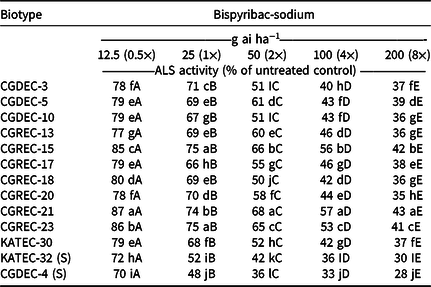
The ALS enzyme assay at 6 d after herbicide application exhibited 66% to 75% enzyme activity in putative BR biotypes at the 1× rate of bispyribac-sodium compared with the untreated control, whereas it was only 48% to 52% in susceptible biotypes (Table 4). In other words, 66% to 75% of the enzyme activity was still remaining in BR biotypes at 6 d after being exposed to the 1× rate of bispyribac-sodium. This indicates that an insensitive ALS enzyme exists in resistant biotypes compared with susceptible biotypes, and the difference in enzyme activity between these biotypes was clearly reflected in their growth. With the 1× rate of bispyribac-sodium, susceptible biotypes KATEC-32 and CGDEC-4 were completely dead by 21 DAHA, whereas 11 BR biotypes survived with some growth reduction (Table 2). Among these 11 BR biotypes, eight biotypes with RI 2 exhibited 66% to 71% enzyme activity, and three biotypes with RI 4 exhibited around 75% enzyme activity. With an increase in herbicide rate, the enzyme activity declined in all BR biotypes. At 2×, 4×, and 8× herbicide rates, BR biotypes maintained 51% to 68%, 40% to 57%, and 35% to 43%, respectively, of the enzyme activity at 6 DAHA, whereas susceptible biotypes were able to maintain only 36% to 42%, 33% to 36%, and 28% to 30%, respectively, of enzyme activity. Higher ALS enzyme activity in BR biotypes helped them to maintain active growth up to the 4× rate of the herbicide. Among 11 BR biotypes, only three (CGREC-15, CGREC-21, and CGREC-23) were able to maintain ALS enzyme activity above 40% at the 8× rate of the herbicide and they survived at that rate with greater biomass reduction (71% to 75%).
ALS enzyme activity in resistant and susceptible biotypes of barnyardgrass compared with the untreated control at 6 d after treatment. a, b, c

a Abbreviations: ALS, acetolactate synthase; CGDEC, Chhattisgarh State, Dhamtari District, Echinochloa crus-galli; CGREC, Chhattisgarh State, Raigarh District, Echinochloa crus-galli; KATEC, Kerala State, Thrissur District, Echinochloa crus-galli; S, susceptible biotype.
b In each column, treatment means for biotypes followed by the same lowercase letter are not significantly different from each other at P ≤ 0.05.
c In each row, treatment means for bispyribac-sodium rates followed by the same uppercase letter are not significantly different from each other at the P ≤ 0.05.
ALS enzyme analysis results suggest that target-site mutation (altered target site/ALS enzyme) is a possible reason for resistance of barnyardgrass to bispyribac-sodium. The modifications in the protein of the ALS enzyme, which is the target of bispyribac-sodium, induces low binding affinity of the herbicide with the target enzyme (El-Nady et al. Reference El-Nady, Hamza and Derbalah2012). Thus, the enzyme in resistant biotypes becomes insensitive to the herbicide compared with susceptible biotypes. In our current experiment, 11 putative BR biotypes that survived the 1× rate of bispyribac-sodium maintained 66% to 75% ALS enzyme activity at 6 DAHA compared with around 50% enzyme activity in susceptible biotypes. This indicates that the ALS enzyme in those 11 biotypes was less sensitive to bispyribac-sodium. Altered target site as a mechanism of resistance to bispyribac-sodium in barnyardgrass was reported from Italy (Heap Reference Heap2022; Panozzo et al. Reference Panozzo, Scarabel, Rosan and Sattin2017). However, Riar et al. (Reference Riar, Norsworthy, Bond, Bararpour, Wilson and Scott2012) reported increased metabolism as the reason for resistance in barnyardgrass collected from rice fields in Arkansas and Mississippi in the United States. Enhanced metabolic activity in resistant biotypes brings herbicide concentration below the physiologically active levels and reduces the quantity of herbicide that reaches the target site, which enables them to survive herbicide applications. Cytochrome P450 genes are often identified as being responsible for herbicide metabolic resistance for ALS-inhibiting herbicides (Jugulam and Syam Reference Jugulam and Shyam2019).
Practical Implications
For the first time, results of this study confirmed evolved resistance in barnyardgrass to bispyribac-sodium in rice fields in India. Of the 37 biotypes that were tested, 30% were 2-fold to 4-fold resistant to bispyribac-sodium. Among the two states from where the biotypes were collected, resistance was found to be more widespread in Chhattisgarh than in Kerala. The monoculture of rice and repeated use of bispyribac-sodium year after year were the major reasons that contributed to selection pressure on resistant biotypes. Further studies are needed to evaluate these biotypes for cross-resistance to other ALS-inhibiting herbicides that have been used for long periods in Indian rice fields. Adoption of sustainable management practices such as crop rotation, herbicide rotation with different MOAs, mixing multiple MOAs, applying the herbicide at the labeled rate at recommended weed sizes, preventing field-to-field or within-field movement of weed seed, and maintaining a desired water depth in rice fields after herbicide applications would help in delaying herbicide resistance.
Acknowledgments
We thank Corteva Agriscience (formerly Dow Agro Science Pvt. Ltd.) for providing funding for this research. The authors declare that no conflicts of interest exist.