





Heavy alcohol intake increases all-cause mortality and is an important contributor to the global burden of disease(1). Nevertheless, low-to-moderate alcohol intake has been repeatedly found associated with lower rates of CVD and all-cause mortality(Reference Costanzo, Di Castelnuovo and Donati2–Reference Trichopoulou, Bamia and Trichopoulos8). In two large cohorts, with long-term follow-up and repeated measures, the lowest mortality was found for alcohol intakes between 5 and 30 g/d(Reference Li, Pan and Wang9). These findings support a J-shaped dose–response curve.
However, recent approaches (Mendelian randomisation analyses, mega-cohorts, modelling studies) have supported the universal public health message that ‘there is no safe level of alcohol consumption’(Reference Holmes, Dale and Zuccolo10). There is a controversy, and it needs to be resolved because almost 50 % of the human race usually drinks alcohol(11). A large and well-conducted randomised controlled trial, though feasible, is very challenging for ethical and practical reasons(Reference Spiegelman, Lovato and Khudyakov12,Reference Mukamal13) . In the absence of such a trial, prospective cohorts can provide the most useful information, but some biases must be controlled: (1) misclassification of former drinkers who quitted because of previous disease (the ‘sick quitter’ hypothesis), (2) the failure to separate occasional drinkers (drinking once a month or less) from complete abstainers(Reference Fillmore, Stockwell and Chikritzhs14) and (3) the underreporting of the amount of alcohol consumed by some heavy drinkers(Reference Vance, Caverly and Hayward15). Only the last one of these three potential biases could result in finding a detrimental association (or underestimating a protection) of low amounts of alcohol with mortality because a subset of heavy drinkers would be misclassified as light or moderate drinkers, they will have higher mortality rates and they will erroneously inflate the mortality rate of the group theoretically considered as only moderately exposed(Reference Vance, Caverly and Hayward15). To our knowledge, the effect of this potential underreporting has not been empirically evaluated in any actual cohort.
In addition, the effect of alcohol on mortality needs to be contextualised in the context of precision medicine(Reference Mukamal13) because age, sex and distribution of death causes may act as effect modifiers. In a relatively young Mediterranean cohort, where the main cause of mortality is not CVD, but cancer, the dose–response would be more likely to show a linear relationship than in older cohorts of Western countries where cardiovascular deaths are predominant. Most cardiovascular deaths occur after 75 years of age (80·52 % in Spanish population)(16); therefore, these late deaths represent a smaller amount of years of life lost as compared with premature deaths. Interestingly, there is scarcity of cohort studies assessing only early mortality as an alcohol-related outcome.
We evaluated (a) the association between alcohol consumption and early mortality (<65 years) and (b) the potential effect of participants who may underreport alcohol intake.
Materials and methods
Study population
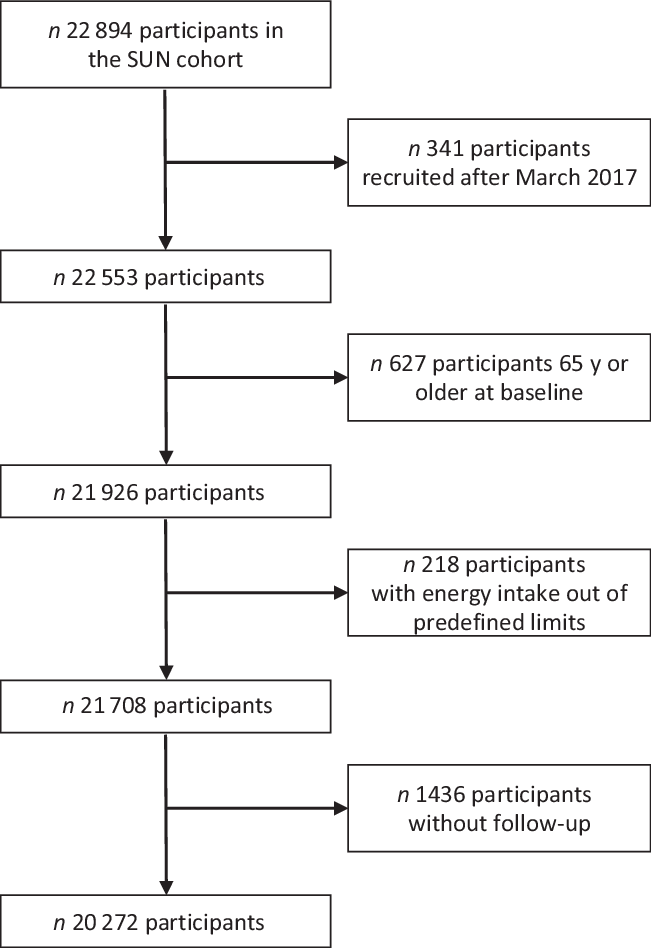
The methods and design of the Seguimiento Universidad de Navarra cohort have been previously reported(Reference Seguí-Gómez, de la Fuente and Vázquez17–Reference Gea, Bes-Rastrollo and Toledo19). Briefly, Seguimiento Universidad de Navarra is a Mediterranean cohort formed of highly educated volunteers (all participants are university graduates) with continually open recruitment. Participants completed a baseline questionnaire, and follow-up questionnaires were updated biennially, where they report new-onset medically diagnosed diseases and provide ample information on their dietary habits and other lifestyles. Figure 1 shows the selection of the analytical sample. From December 1999 to December 2019, 22 894 subjects completed the baseline questionnaire. For the present analysis, 341 subjects with insufficient follow-up time, 627 participants older than 65 years at inception and 218 subjects with total energy intake out of percentiles 0·5 and 99·5 were excluded. Among the remaining 21 708 subjects, 20 272 were successfully followed-up (overall retention 93·4 %). Finally, the age range of the subjects in the analysis was between 20 and 65 years. The study was approved by the Institutional Review Board of the University of Navarra.
Flow chart of recruitment and inclusion of participants in the study. Sample size (n) for each group is given.

Dietary and alcohol assessment
A repeatedly validated 136-item semi-quantitative FFQ assessed habitual diet including alcohol consumption(Reference Trichopoulou, Costacou and Bamia7,Reference de la Fuente-Arrillaga, Ruiz and Bes-Rastrollo20) . Alcoholic beverage consumption (red wine, non-red wine, beer and spirits) was thus collected at baseline and repeatedly after 10-year follow-up. Validation studies showed good results for alcohol intake(Reference de la Fuente-Arrillaga, Ruiz and Bes-Rastrollo20,Reference Fernández-Ballart, Piñol and Zazpe21) . Further information about alcohol-drinking habits during the year preceding enrolment was also gathered at baseline(Reference Gea, Bes-Rastrollo and Toledo19).
Alcohol consumption, expressed in g/d, was calculated using the validated FFQ, as it is the standard practice in nutritional epidemiology. A participant responded to five items inquiring the frequency of consumption of a defined serving size of alcoholic beverages. We multiplied the mid-point of the frequency of consumption range by the defined serving size (ml) of each beverage to obtain the ml of each beverage consumed per day. Then, we multiplied the consumed volume of each beverage by its alcohol content and alcohol density to obtain grams of pure alcohol consumed per day. Total alcohol intake (g/d) was calculated as the sum of alcohol intake of each beverage. Using this information on total pure alcohol intake in g/d, we made a priori four categories of alcohol intake: (1) abstainers (0 alcohol intake); (2) men who consumed >0–10 g/d, and women who consumed >0–5 g/d (light drinkers); (3) men who consumed >10–50 g/d, and women who consumed >10–25 g/d (moderate drinkers) and (4) men who consumed >50 g/d, and women who consumed >25 g/d (heavy drinkers)(Reference Trichopoulou, Costacou and Bamia7).
We based the sensitivity analysis of the alcohol consumption variable on an additional questionnaire exclusively completed by those participants who self-reported to be abstainers in the main questionnaire. Using this additional questionnaire, we were able to refine the group of abstainers into never drinkers (those who reported no alcohol consumption in the FFQ and also consistently reported never having consumed alcohol in their lifetime in the additional questionnaire) and former drinkers (the group that did not report any alcohol consumption in the FFQ but they reported some previous alcohol intake before the baseline assessment of the cohort in the additional questionnaire). Adherence to Mediterranean diet was assessed using the Mediterranean-Diet Score proposed by Trichopoulou(Reference Trichopoulou, Costacou and Bamia7,Reference Benítez-Arciniega, Mendez and Baena-Díez22) , after removing the item for moderate alcohol intake to avoid redundancies with our main exposure variable.
Covariate assessment
We gathered information about different variables from the baseline questionnaire and also from the 10-year follow-up questionnaire (for participants with follow-up longer than 10 years). The sociodemographic variables studied were age, sex, years of university education and marital status, among others. In addition, for the anthropometric variables, height and weight data were used to calculate the BMI for each participant(Reference Bes-Rastrollo, Pérez Valdivieso and Sánchez-Villegas23). Lifestyle information was also collected from participants including variables such as physical activity(Reference Martínez-González, López-Fontana and Varo24), smoking habits and hours of television watching. The questionnaire also collected medically diagnosed conditions, such as hypercholesterolaemia, hypertriacylglycerolaemia, hypertension, diabetes, cancer, depression or family history of several diseases. Finally, for the dietary variables, the validated 136-item FFQ included in the baseline assessment was used to compute adherence to the Mediterranean-Diet Score(Reference Trichopoulou, Costacou and Bamia7). As we excluded alcohol intake to avoid overlapping with our main exposure, this score had a range from 0 to 8.
Outcome assessment
The primary outcome was all-cause mortality, but only if death occurred before 65 years of age. When participants attained 65 years during follow-up, they were censored. Continuous contact with participants was maintained through postal mail, email and telephone calls, and deaths were continually detected. We also gathered information on potentially deceased participants from their next of kin, work’s associates and the postal system. This allowed us to identify more than 85 % of deaths. For the rest of deaths, the National Death Index was checked at least once a year to update vital status and identify causes of death, if unknown. All causes of death were coded using International Classification of Diseases, 10th version based on the data provided by the National Death Index.
Statistical analyses
Baseline characteristics of participants were described according to categories of alcohol intake, separately for men and women. The relationship between alcohol consumption and mortality (<65 years) was evaluated with Cox models with time varying exposures. Hazard ratios (HR) and 95 % CI for each alcohol consumption category were estimated using the group of 0 g/d of alcohol consumption as the reference category. We included the information of the 10-year follow-up questionnaire to update information on alcohol for participants with follow-up longer than 10 years. Enter time was considered as the date of returning the baseline questionnaire. Exit time was the date of death (for participants who died before attaining 65 years old), date of returning the last follow-up questionnaire or their 65th birthday (for survivors who attained 65 years up to 2019). Age was the underlying time variable (birthday as origin). All multivariable models were stratified by age groups (10-year periods), calendar year of recruitment (1999/2003; 2004/2009 and >2009) and total energy intake (quintiles). Models were also adjusted for sex, Mediterranean diet adherence (three categories), smoking (never, former, active smokers or missing value for smoking), total cumulative exposure to cigarette smoking (pack-years, continuous), baseline BMI (kg/m2, with both linear and quadratic terms), leisure-time physical activity (three categories)(Reference Alvarez-Alvarez, Zazpe and Pérez de Rojas25), hours of television watching (continuous), years of university education (continuous), marital status, coffee consumption (five categories)(Reference Navarro, Martinez-Gonzalez and Gea26), sugar-sweetened beverage consumption (three categories), fast-food consumption (three categories) and indicators of previous personal history of hypertension, hypercholesterolaemia, hypertriacylglycerolaemia, cancer, diabetes, CVD and depression. We updated confounder information for participants with a follow-up longer than 10 years.
We also evaluated the association with alcohol as a continuous variable, estimating the HR for each additional 10 g/d of alcohol consumed.
The multiplicative interactions between alcohol intake and sex or age (≤45/>45) were tested with a likelihood ratio test comparing the models with and without the interaction term.
To address the effect of potential underreporting of alcohol intake, we conducted the following procedures: (a) corrected alcohol intake for potential underreporters; (b) imputed alcohol intake for potential underreporters and (c) excluded potential underreporters. Further details are more extensively described in the Supplementary material.
Finally, as very low alcohol intake is unlikely to have a biological effect, and the apparent benefit of this group could be due to confounding, we also conducted sensitivity analyses under different scenarios (please check the supplementary material).
Baseline characteristics of participants across alcohol intake categories were compared using one-way ANOVA and χ 2 tests for continuous and categorical variables, respectively.
All P values are two-tailed. The level of confidence was 95 % for CI (two-tailed).
Results
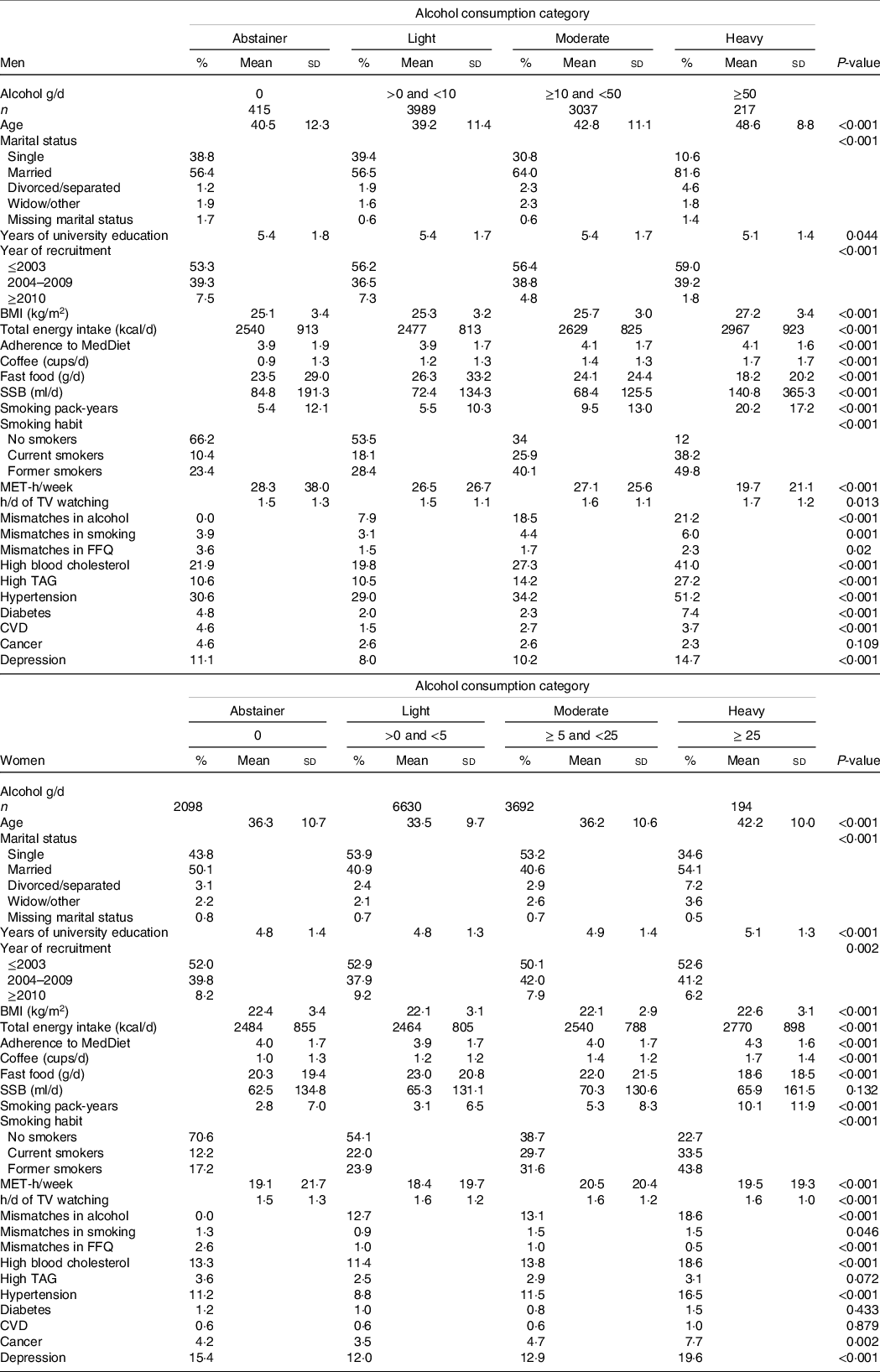
Table 1 shows baseline characteristics of cohort participants by categories of alcohol, separately for men (n 7658; 37·8 %) and women (n 12 614; 62·2 %). Importantly, boundaries were different in men and women in Table 1. Only 217 (2·83 %) men reported heavy drinking (≥50 g/d of pure ethanol intake), while most reported light consumption (<10 g/d, n 3989; 52·08 %) and only 415 (5·42 %) reported to be abstainers. Heavy drinkers had higher total energy intake, higher BMI and greater sugar-sweetened beverage consumption. Participants with higher alcohol consumption exhibited substantially greater consumption of tobacco and coffee and more frequent pre-existent chronic diseases (except cancer) at baseline than abstainers. Inconsistencies in their self-reports of smoking habits, alcohol consumption and other food habits were higher in heavy drinkers than in other categories.
Baseline characteristics of participants in the ‘Seguimiento Universidad de Navarra’ (SUN) cohort (1999–2019) according to categories of alcohol consumption
(Percentages; mean values and standard deviations)

MedDiet, Mediterranean diet; SSB, sugar-sweetened beverages; MET, metabolic equivalents.
In women, alcohol consumption was slightly different, with more frequent abstention (n 2098; 16·63 %), less heavy drinking (n 194; 1·54 %) and similar percentages of light consumption (n 6630; 52·56 %). Women with higher alcohol consumption were also more likely to maintain higher levels of total energy intake, usual coffee consumption, heavier exposure to smoking and more frequent presence of chronic diseases at baseline.
During a median follow-up of 12·25 years (interquartile range: 6·76–14·95), 226 participants (130 men and 96 women) died before their 65th birthday. Among subjects who died, their mean age at death was 51·7 (sd 10·15) years. The leading cause of early mortality was cancer with 140 deaths (61·95 %, 56·92 % among men; 68·75 % among women). CVD only accounted for thirty-five deaths (15·49 %, 17·69 % among men; 2·50 % among women). Forty-eight premature deaths were from non-cardiovascular-non-cancer causes (21·24 %, 23·85 % among men; 17·71 % among women). The cause of death was unknown in three participants (two among men and one among women).
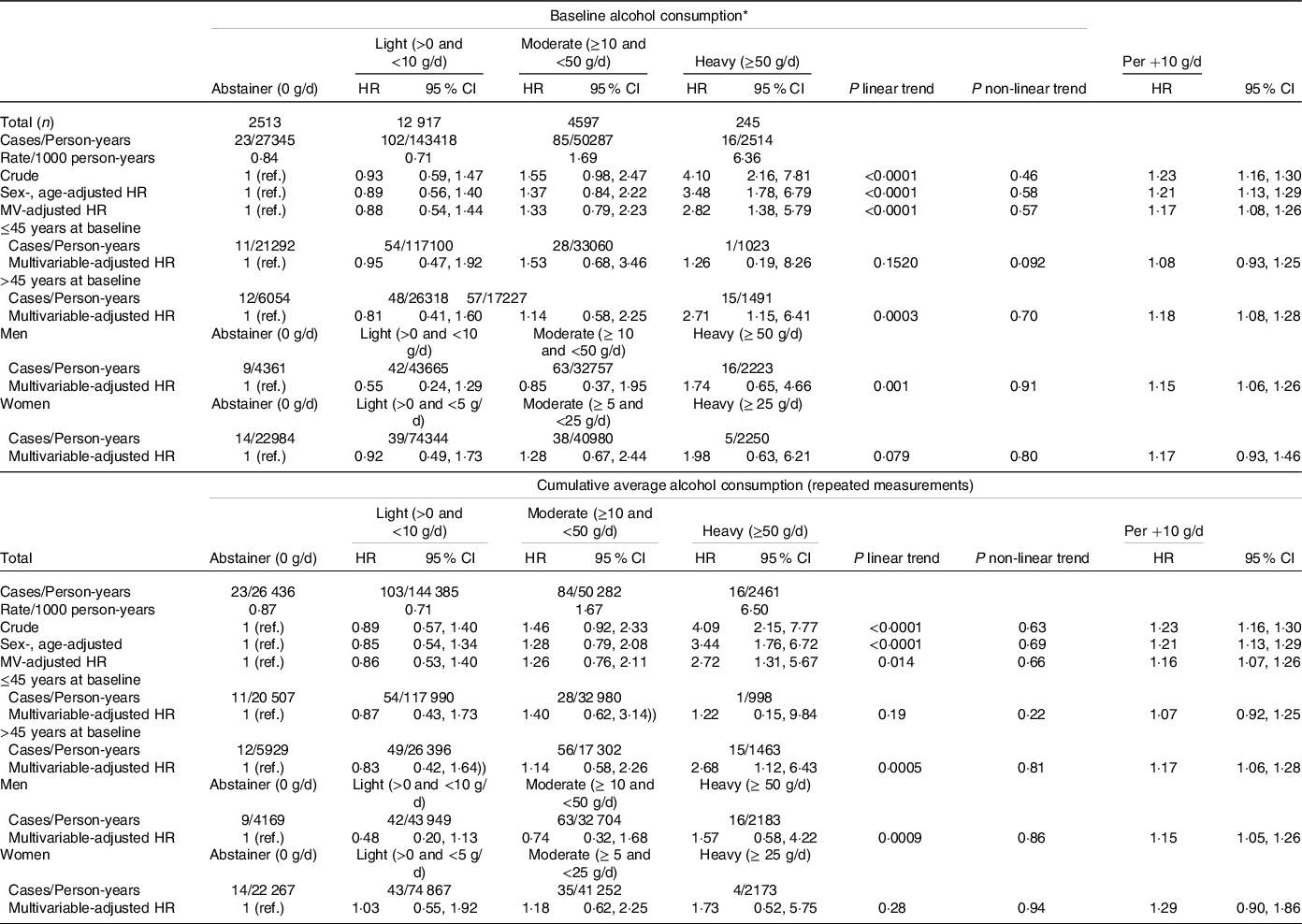
No significant association between baseline light alcohol consumption and early mortality was observed in multivariable-adjusted models as compared with the reference category (abstainers). Among men, the point estimate suggesting an inverse, but non-significant association (HR = 0·55, 95 % CI 0·24, 1·29) was further from the null than the point estimate in women (HR = 0·92, 95 % CI 0·49, 1·73). For moderate alcohol consumption, no firm conclusions can be drawn because of the wide and overlapping CI and the lack of statistical significance. Heavy baseline alcohol intake was significantly associated with higher premature mortality in the multivariable-adjusted model (HR = 2·82, 95 % CI 1·38, 5·79). In the analysis of baseline alcohol intake as a continuous variable, a significant direct linear dose–response curve was found, with 17 % relative risk increase of early death for each 10 g/d (Table 2). When cumulative repeated measures after 10 years of follow-up were used to update confounders and alcohol consumption, the results barely changed. The higher risk for premature mortality remained significant for heavy consumers in multivariable-adjusted models (HR = 2·72, 95 % CI 1·31, 5·67). Likewise, the linear dose–response trend was maintained with a 16 % relative risk increase for every 10 additional g/d (Table 2). An inverse association between light alcohol consumption and premature mortality was observed for both younger and older participants (Table 2), but without being statistically significant (≤45 years at baseline HR = 0·95, 95 % CI 0·47, 1·92, >45 years at baseline HR = 0·81, 95 % CI 0·41, 1·60). For a moderate alcohol intake, the risk of premature mortality increased, being significant for heavy consumers with a HR of 2·71 (95 % CI 1·15, 6·41) in those over 45 years at baseline. In all analyses shown in Table 2, alcohol intake (g/d) was upgraded according to self-reported information on several aspects of the alcohol consumption pattern (including days of consuming wine with meals, consumption of alcohol when driving and intakes on weekends and special days).
Association of alcohol consumption with early mortality (death <65 years old). The SUN cohort (1999–2019)
(Hazard ratios (HR) and 95% confidence intervals)

MV, Multivariable.
* Alcohol intake was always upgraded according to the self-reported additional information contained in other specific items inquiring on the alcohol consumption pattern (including days of consuming wine with meals, consumption of alcohol when driving and intakes on weekends and special days).
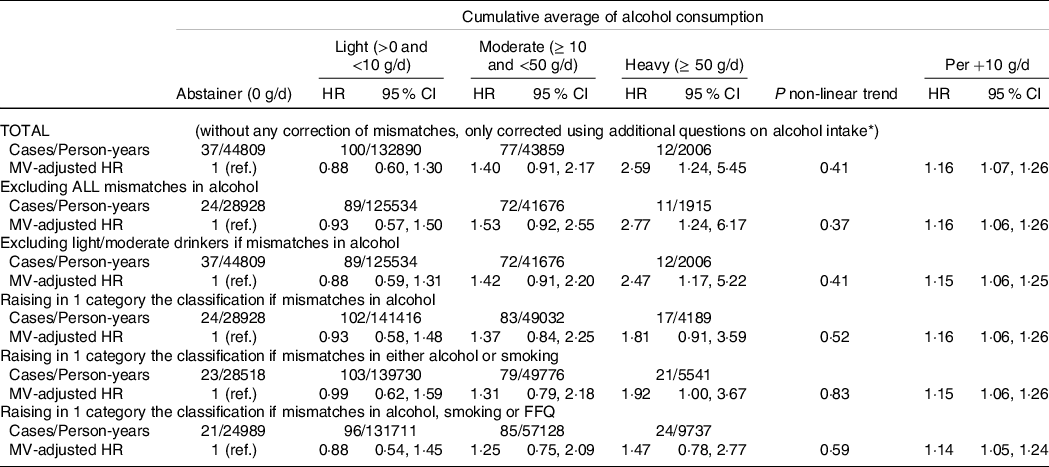
Table 3 shows different assumptions on alcohol misclassification due to a potential underreporting by heavy consumers which might have affected our estimates of the association between alcohol intake and early mortality. Analyses with repeated measurements were rerun after excluding all participants who presented inconsistencies or mismatches in their self-report of alcohol intake. When these participants (more likely to be misclassified) were excluded, similar results to Table 2 were found, except for high consumption which presented a slightly increased HR (HR = 2·77; 95 % CI 1·24, 6·17) compared with the uncorrected multivariate model (HR = 2·59; 95 % CI 1·24, 5·45). Alternatively, we only excluded those who initially were classified in the light or moderate alcohol intake categories and presented inconsistencies or mismatches in their self-reported alcohol. Again, the results were similar to those found without any correction, but now with a lower HR (2·47; 95 % CI 1·17, 5·22) for the heavy consumption category in the corrected analysis.
Association between cumulative average of alcohol consumption (repeated measurements) and early mortality (death <65 years old) under some assumptions for re-classification of potential underreporters. The SUN cohort (1999–2019)
(Hazard ratio (HR) and 95 % confidence interval)

MV, multivariable.
* Alcohol intake was always upgraded according to the self-reported additional information contained in other specific items inquiring on the alcohol consumption pattern (including days of consuming wine with meals, consumption of alcohol when driving, and intakes on weekends and special days).
Under the assumption that some heavy consumers might have underreported their alcohol intake and be misclassified in the group of moderate intake and also that some moderate consumers might have been misclassified for the same reason as light consumers, we raised in one category those participants who presented inconsistencies or mismatches in their self-report of alcohol intake and rerun the repeated measurements analyses. We did this again also raising those with mismatches in their self-reports of smoking habits or diet (FFQ). In all these analyses, similar results to those of the uncorrected estimates were found. The only exception being the highest level of alcohol consumption (heavy drinkers), where a small attenuation in the HR was noted and became non-significant. However, all multivariable-adjusted HR assuming a linear dose–response with alcohol intake as a continuous variable maintained their statistical significance in these corrected analyses.
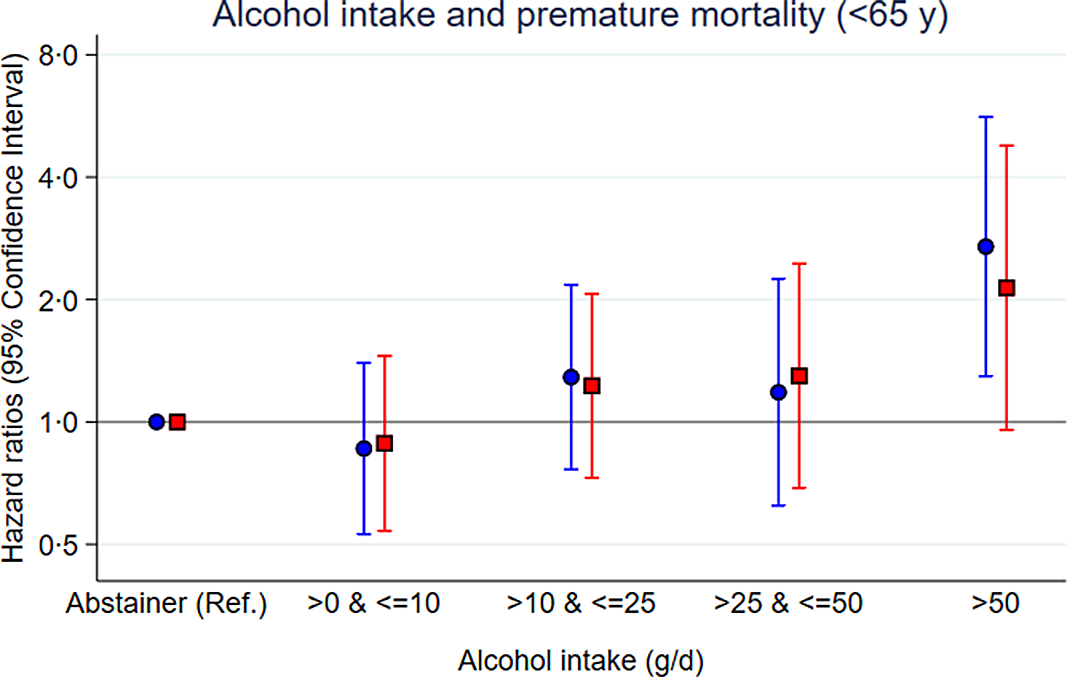
Figure 2 shows the risk of early mortality during follow-up for five categories of alcohol consumption (using this time the same boundaries for men and women). The uncorrected and corrected HR are shown for the four upper categories v. the abstention group. The corrections consist in raising the intake (by adding 10 g/d of alcohol) in participants with evidence of inconsistencies in their self-reports of alcohol, smoking or diet. A J-shaped association could be observed, but the only statistically significant result occurred in heavy drinkers, and only in the uncorrected model (HR = 2·70, 95 % CI 1·30, 5·63).
Association of categories of alcohol intake with early mortality (<65 years old) with or without corrections for potential misclassification of alcohol use*. Multivariable-adjusted hazard ratios with repeated measurements of alcohol intake (cumulative average) and updated information on potential confounders. The ‘Seguimiento Universidad de Navarra’ (SUN) cohort 1999–2019.  , Uncorrected;
  , Corrected.

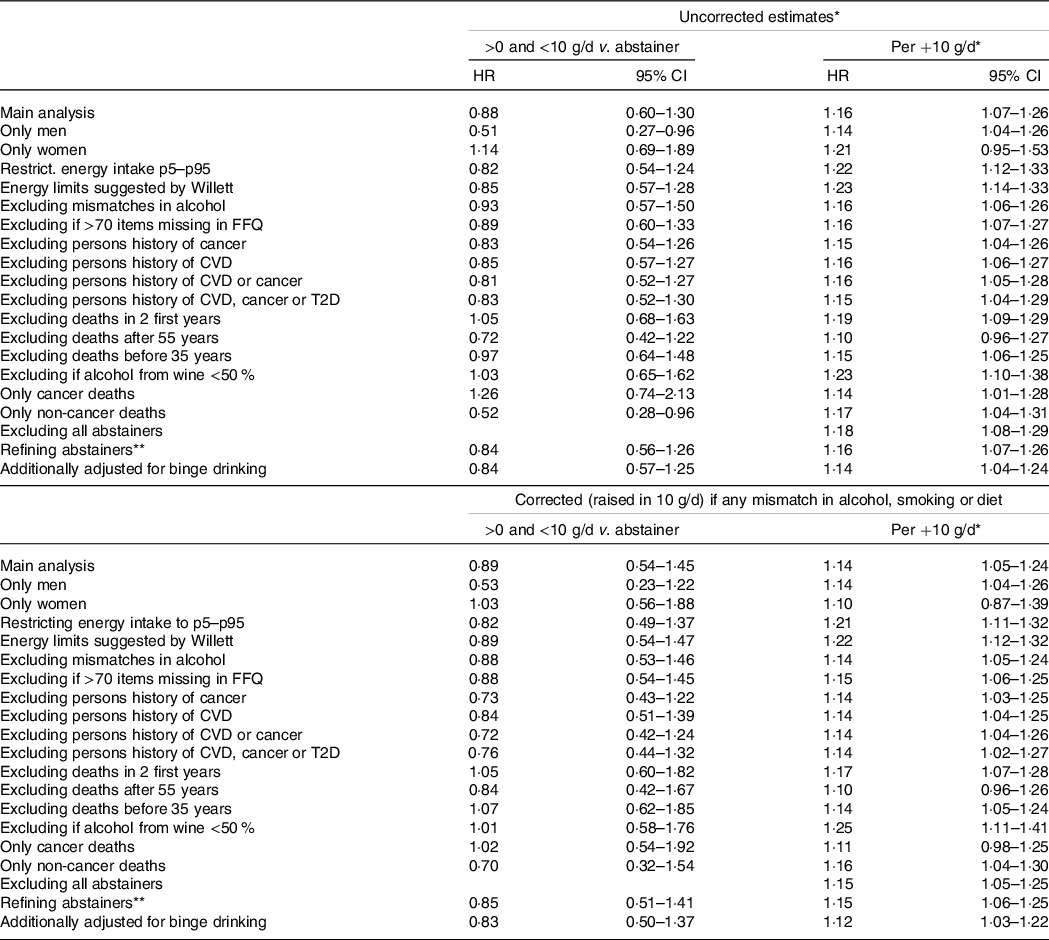
Sensitivity analyses were carried out to assess the robustness of our results (Table 4). The light consumption category (>0 to 10 g/d) was compared with abstainers, and we also tested a linear dose–response association for each 10 g/d additional alcohol intake. We did that under different assumptions. At first, we did not introduce any upgrading or correction in alcohol consumption. Then, we used alternative models corrected for potential misclassification (both upgrading alcohol intake and raising the intake in 10 g/d in participants with evidence of inconsistencies in their self-reports of alcohol, smoking or diet). As shown in Table 4, when we did not apply any upgrading or correction, light alcohol consumption (>0 and <10 g/d) was inversely associated with early mortality only in two cases: among men (HR = 0·51, 95 % CI 0·27, 0·96) and for non-cancer deaths (HR = 0·52, 95 % CI 0·28, 0·96). When the models were upgraded or corrected for potential misclassification, both findings lost their statistical significance.
Sensitivity analysis. Association of light alcohol consumption (or the consumption of additional 10 g/d of alcohol linearly) with early mortality (<65 years old) under a diversity of scenarios without and with correction (upgrade) for potential underreporting of alcohol. The ‘Seguimiento Universidad de Navarra’ (SUN) cohort 1999–2019
(Odds ratio and range)

T2D, type 2 diabetes.
* None of the tests for a departure of linear trend was statistically significant.
** A special detailed questionnaire only sent to the subset of abstainers was used to exclude those drinkers who initially reported to be abstainers, but they did consume some quantities of alcohol and to exclude former drinkers (please consult the Supplement).
Importantly, in most sensitivity analyses, a significant and consistent linear association was found, suggesting that for each additional 10 g/d of alcohol intake, the relative risk of early death was 10–25 % larger.
Discussion
In a cohort of middle-aged adults assessing as outcome only premature mortality (i.e. deaths occurring earlier than 65 years of age), all significant associations between alcohol intake and early death suggested an adverse linear effect. Given these results, the safest alcohol consumption for young adults should be 0.
Contrary to our expectations, several corrections for potential biases due to potential underreporting by heavy drinkers did not lead to finding any significant protection by light or moderate alcohol intake. As Vance et al. suggested(Reference Vance, Caverly and Hayward15), theoretically, a systematic underreporting of alcohol intake would result in overestimating harms associated with a light-to-moderate alcohol consumption or they could nullify true protection by low amounts of alcohol intake. It could be thought that some degree of underreporting by heavy drinkers may lead to misclassifying them as light-moderate drinkers and this mistaken inclusion of heavy drinkers in the light-moderate group may hide some protection afforded by light-moderate drinking. It should also be noted that the number of heavy drinkers was not large, which could potentially limit the statistical power (217 men and 194 women). Nevertheless, the analyses using alcohol intake as a continuous variable (per +10 g/d) provided a considerably higher statistical power, and they were consistent with the findings for heavy drinkers. Our results suggest that this is not the case for premature mortality because we only found a significant inverse association (and only among men) when we did not apply any correction for this potential misclassification.
If low amounts of alcohol reduce cardiovascular risk but increase cancer risk, the reported inverse association between low-to-moderate alcohol intake and all-cause mortality in previous studies(Reference Bell, Daskalopoulou and Rapsomaniki3,Reference Arriola, Martinez-Camblor and Larrañaga5,Reference Li, Pan and Wang9,Reference Bobak, Malyutina and Horvat27–Reference Bellavia, Bottai and Wolk31) would likely be absent or even reversed in our cohort where cancer mortality clearly predominated. In addition, more mechanisms to explain our findings include early deaths due to suicides (3·5 % of deaths in our cohort), traffic injuries and other accidents (8·8 % of deaths). Moreover, alcohol consumption has been associated with over 200 health conditions(11), with a particularly strong relative burden of harmful effects in the range of ages between 20 and 40 years.
Contrary to the expected effects of misclassification due to underreporting by heavy drinkers(Reference Vance, Caverly and Hayward15), when we tried to correct this misclassification by using a wide variety of sensitivity analyses and assumptions, the results were null in categorical analyses for any potential protective effect by light-moderate drinking, but significant in most cases for a direct linear adverse effect. Although in this prospective cohort, light alcohol consumption predominated, the number of early deaths was not large, and we admit that a potential lack of statistical power may have contributed to obtain non-significant results in the categorical analyses for light-moderate consumption. It should also be noted that the subset of participants who reported a heavy drinking alcohol consumption was not large, which could reflect a lack of statistical power (217 men and 194 women).
These results need to be considered with caution for several reasons. First, we assessed absolute alcohol amounts and not the drinking pattern (reported elsewhere in this cohort)(Reference Gea, Bes-Rastrollo and Toledo19). Multidimensional aspects of the drinking pattern may help to obtain a better picture of the association between alcohol and diverse health outcomes, but this aim was not the scope of the present study. However, results remained similar after adjustment for binge-drinking habit. Second, our present outcome only considered premature mortality and not late deaths occurring after 65 years of age. Therefore, generalisability of these findings is limited only to early deaths. Moreover, the assessed population is at a low risk for CVD; therefore, generalisability of these findings presents the limitation inherent to the non-representative nature of this cohort, as it is the case of most prospective cohorts. In another population at a higher CVD risk, CVD mortality may have exerted a higher impact on the outcome and could have led to different results. Third, the assumptions that we made in order to disclose potential underreportings were only suppositions based on identifying those participants with inconsistencies in their self-reports of alcohol (or, alternatively, in smoking or food habits). Such inconsistencies do not necessarily indicate that these participants were underreporting alcohol, nor the consistency can be taken as a proof of correctly reporting alcohol intake.
The strengths of this study are that we were able to assess participants for a long follow-up period and with a relatively high overall retention in a young cohort. Given that confounding and reverse causality (the so-called ‘healthy user’ and ‘sick quitter’ effects) can represent the main threats to validity in this type of longitudinal studies, a considerable strength is that we were able to adjust for a large number of confounders and we studied cumulative alcohol consumption with repeated measurements of both alcohol intake and potential confounders along the follow-up period, using a well-validated FFQ. The exclusive use of premature mortality as the outcome in a healthy and young cohort can be instrumental to avoid the sick quitter phenomenon. Refining abstainer’s category with an additional questionnaire and excluding all abstainers did not substantially change the results.
Ideally, clinical trials testing alternative advices on alcohol intake among drinkers will eventually provide a well-founded answer on the healthiest option for alcohol intake(Reference Spiegelman, Lovato and Khudyakov12,Reference Mukamal13,Reference Mukamal, Clowry and Murray32) . A recently published study proved that, although challenging, trials on alcohol intake are feasible and they are able to overcome some methodological limitations of observational studies(Reference Voskoboinik, Kalman and De Silva33).
In conclusion, among young adults, no inverse association between light-to-moderate drinking and premature mortality was observed after diverse attempts to correct for potential underreporting of alcohol intake by heavy drinkers. New approaches for misclassification detection are needed. Recommendations to the population should be stratified and consider that the potential beneficial effect of alcohol may be different in younger populations than in older subjects. Regardless of the current controversy on the healthiest level of alcohol intake, the available evidence shows that though light-to-moderate alcohol reduces cardiovascular risk, probably, the best recommendation for younger drinkers who are at low cardiovascular risk is to reduce their alcohol intake as much as possible(Reference Bell, Daskalopoulou and Rapsomaniki3,Reference Casswell34–Reference Sluik, Boeing and Bergmann38) . Until large-scale randomised trials may shed light on this issue, the precautionary principle of public health must be the rule.
Acknowledgements
We thank very specially all participants in the SUN cohort for their long-standing and enthusiastic collaboration and our advisors from Harvard TH Chan School of Public Health Walter Willett, Alberto Ascherio, Frank B. Hu and Meir J. Stampfer who helped us to design the SUN Project. We also thank the other members of the SUN Group: Aguilera-Buenosvinos I, Alonso A, Álvarez-Álvarez I, Balaguer A, Barrio-López MT, Basterra-Gortari FJ, Battezzati A, Bazal P, Benito S, Bertoli S, Bes-Rastrollo M, Beunza JJ, Buil-Cosiales P, Carlos S, de Irala J, de la Fuente-Arrillaga C, de la O V, de la Rosa PA, Delgado-Rodríguez M, Díaz-Gutiérrez J, Díez Espino J, Donat-Vargas C, Donazar M, Eguaras S, Fernández-Lázaro CI, Fernández-Montero A, Fresán U, Galbete C, García-Arellano A, Gardeazábal I, Gutiérrez-Bedmar M, Gomes-Domingos AL, Gómez-Donoso C, Gómez-Gracia E, Goñi E, Goñi L, Guillén F, Hernández-Hernández A, Hershey MS, Hidalgo-Santamaría M, Hu E, Lahortiga F, Leone A, Llavero M, Llorca J, López del Burgo C, Marí A, Martí A, Martín-Calvo N, Martín-Moreno JM, Martínez JA, Mendonça R, Menéndez C, Molendijk M, Molero P, Muñoz M, Pano O, Pérez de Ciriza P, Pérez-Cornago A, Pimenta AM, Ramallal R, Razquin C, Rico-Campà A, Romanos-Nanclares A, Ruiz L, Ruiz-Canela M, San Julián B, Sánchez D, Sánchez-Bayona R, Sánchez-Tainta A, Sánchez-Villegas A, Santiago S, Sayón-Orea C, Toledo E, Vázquez Z and Zazpe I.
The SUN Project has received funding from the Spanish Government-Instituto de Salud Carlos III, and the European Regional Development Fund (FEDER) (grant numbers PI10/02658, PI10/02293, PI13/00615, PI14/01668, PI14/01798, PI14/01764, PI17/01795, PI20/00564, RD 06/0045, G03/140); the Navarra Regional Government (grant numbers 27/2011, 45/2011, 122/2014); the National Plan of Drug use prevention (Plan Nacional de Drogas, PNSD 2020/2021, grants to Maira Bes-Rastrollo and Alfredo Gea); and the European Research Council (M.A.M.G., grant number 340918).
Conceptualisation, A. G. and M. A. M. G.; methodology, M. B. L., A. G. S. and M. A. M. G.; formal analysis, M. B. L., J. P. R., M. A. M. G. and A. G. S.; resources, M. A. M. G.; data curation, M. B. L.; writing—original draft preparation, M. A. M. G.; writing—review and editing, all authors; supervision M. B. L., J. P. R.; A. G. S.; funding acquisition, M. A. M. G. All authors have read and agreed to the published version of the manuscript.
The authors declare no conflicts of interest.
Supplementary material
For supplementary material/s referred to in this article, please visit https://doi.org/10.1017/S0007114521002397


 Open access

